US809795A - Method of making solidified antiseptic compounds. - Google Patents
Method of making solidified antiseptic compounds. Download PDFInfo
- Publication number
- US809795A US809795A US23815304A US1904238153A US809795A US 809795 A US809795 A US 809795A US 23815304 A US23815304 A US 23815304A US 1904238153 A US1904238153 A US 1904238153A US 809795 A US809795 A US 809795A
- Authority
- US
- United States
- Prior art keywords
- antiseptic
- solidified
- steam
- making
- per cent
- Prior art date
- Legal status (The legal status is an assumption and is not a legal conclusion. Google has not performed a legal analysis and makes no representation as to the accuracy of the status listed.)
- Expired - Lifetime
Links
- 150000001875 compounds Chemical class 0.000 title description 14
- 230000002421 anti-septic effect Effects 0.000 title description 10
- 238000004519 manufacturing process Methods 0.000 title description 7
- PEDCQBHIVMGVHV-UHFFFAOYSA-N Glycerine Chemical compound OCC(O)CO PEDCQBHIVMGVHV-UHFFFAOYSA-N 0.000 description 12
- 239000000203 mixture Substances 0.000 description 9
- 239000004615 ingredient Substances 0.000 description 7
- 235000011187 glycerol Nutrition 0.000 description 6
- MGSRCZKZVOBKFT-UHFFFAOYSA-N thymol Chemical compound CC(C)C1=CC=C(C)C=C1O MGSRCZKZVOBKFT-UHFFFAOYSA-N 0.000 description 4
- 101100441413 Caenorhabditis elegans cup-15 gene Proteins 0.000 description 3
- CDBYLPFSWZWCQE-UHFFFAOYSA-L Sodium Carbonate Chemical compound [Na+].[Na+].[O-]C([O-])=O CDBYLPFSWZWCQE-UHFFFAOYSA-L 0.000 description 3
- NOOLISFMXDJSKH-UTLUCORTSA-N (+)-Neomenthol Chemical compound CC(C)[C@@H]1CC[C@@H](C)C[C@@H]1O NOOLISFMXDJSKH-UTLUCORTSA-N 0.000 description 2
- NOOLISFMXDJSKH-UHFFFAOYSA-N DL-menthol Natural products CC(C)C1CCC(C)CC1O NOOLISFMXDJSKH-UHFFFAOYSA-N 0.000 description 2
- LFQSCWFLJHTTHZ-UHFFFAOYSA-N Ethanol Chemical compound CCO LFQSCWFLJHTTHZ-UHFFFAOYSA-N 0.000 description 2
- UIIMBOGNXHQVGW-UHFFFAOYSA-M Sodium bicarbonate Chemical compound [Na+].OC([O-])=O UIIMBOGNXHQVGW-UHFFFAOYSA-M 0.000 description 2
- 239000005844 Thymol Substances 0.000 description 2
- 229940044949 eucalyptus oil Drugs 0.000 description 2
- 239000010642 eucalyptus oil Substances 0.000 description 2
- 239000007788 liquid Substances 0.000 description 2
- 229940041616 menthol Drugs 0.000 description 2
- QIQXTHQIDYTFRH-UHFFFAOYSA-N octadecanoic acid Chemical compound CCCCCCCCCCCCCCCCCC(O)=O QIQXTHQIDYTFRH-UHFFFAOYSA-N 0.000 description 2
- 229960000790 thymol Drugs 0.000 description 2
- 241000239290 Araneae Species 0.000 description 1
- KWYUFKZDYYNOTN-UHFFFAOYSA-M Potassium hydroxide Chemical compound [OH-].[K+] KWYUFKZDYYNOTN-UHFFFAOYSA-M 0.000 description 1
- 238000013019 agitation Methods 0.000 description 1
- 230000015572 biosynthetic process Effects 0.000 description 1
- 235000013339 cereals Nutrition 0.000 description 1
- 238000000354 decomposition reaction Methods 0.000 description 1
- 230000008020 evaporation Effects 0.000 description 1
- 238000001704 evaporation Methods 0.000 description 1
- 229960005150 glycerol Drugs 0.000 description 1
- 238000010438 heat treatment Methods 0.000 description 1
- 239000007937 lozenge Substances 0.000 description 1
- 230000007721 medicinal effect Effects 0.000 description 1
- 238000000034 method Methods 0.000 description 1
- 229940072033 potash Drugs 0.000 description 1
- 235000015320 potassium carbonate Nutrition 0.000 description 1
- BWHMMNNQKKPAPP-UHFFFAOYSA-L potassium carbonate Substances [K+].[K+].[O-]C([O-])=O BWHMMNNQKKPAPP-UHFFFAOYSA-L 0.000 description 1
- 235000017557 sodium bicarbonate Nutrition 0.000 description 1
- RYYKJJJTJZKILX-UHFFFAOYSA-M sodium octadecanoate Chemical compound [Na+].CCCCCCCCCCCCCCCCCC([O-])=O RYYKJJJTJZKILX-UHFFFAOYSA-M 0.000 description 1
- IUEMQUIQAPPJDL-UHFFFAOYSA-M sodium;2,3-dihydroxypropanoate Chemical compound [Na+].OCC(O)C([O-])=O IUEMQUIQAPPJDL-UHFFFAOYSA-M 0.000 description 1
- 239000000126 substance Substances 0.000 description 1
- XLYOFNOQVPJJNP-UHFFFAOYSA-N water Substances O XLYOFNOQVPJJNP-UHFFFAOYSA-N 0.000 description 1
Images
Classifications
-
- A—HUMAN NECESSITIES
- A61—MEDICAL OR VETERINARY SCIENCE; HYGIENE
- A61K—PREPARATIONS FOR MEDICAL, DENTAL OR TOILETRY PURPOSES
- A61K33/00—Medicinal preparations containing inorganic active ingredients
Definitions
- the invention relates to a method of making a solidified antiseptic compound, the object of the invention being to render it possible to place upon the market in a solidified form compounds which have heretofore been manufactured only in a liquid form and which compounds it has been generally considered impossible to place in a solidified form without destroying their medicinal properties.
- the essence of the invention resides in first preparing at a certain temperature a mixture of substances to form the solidifying base and then mixing with said base the antiseptic ingredients at a lower temperature than that first employed, so as to prevent decomposition or evaporation, but still maintain the liquid condition of the compound.
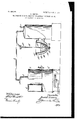
- FIG. 1 indicates a boiler which is designed to be supported above any suitable heating device, such as indicated by 2, and which is provided on its upper side with an upright steam-dome 3, located centrally of said upper side. but of much less diameter than the boiler.
- Supported on the boiler 1 and surrounding the steamdome 3 is an annular chamber I, having toward the lower end a drawofi' cock 5.
- the annular chamber i is provided with a closable opening 6, through which ingredients to be liquefied may be inserted.
- Communicating with the steam dome 3 at the upper end thereof is a pipe '7, which at its other end communicates with a steam-chamber 8.
- a short steam-duct t Projecting from one side of the steam-chamber 8 is a short steam-duct t), which is connected to the outer wall 10 of a steam-jacket 11, the inner wall of which is indicated by 12. Steam is supplied from the steam-dome 3, by means of the pipe 7, to the interior of the steamchamber 8 and is free to circulate in the space 13 between the walls 10 and 19. of the steamjacket. open, as indicated at 14, and supported in said steam-jacket is a cup 15, the lower end of which is provided with a valved tap 16, projecting through the opening 14:.
- the shaft 16 indicates a shaft-supported atits lower end in the cup 15 by means of a spider-bearing 17 and having on its upper end a pulley 18, by means of which it may be rotated through the medium of a suitable cord or band.
- the shaft 16 is supported at its upper end in a bearing 19.
- I first take ninety-four parts, by weight, of glycerin and six parts, by ⁇ veight,'of stearatc of soda and place these ingredients in the chamber 4 and subject them to a temperature of 220 Fahrenheit for from three to five hours. This re sults in the formation of a compound containing glycerin in intense excess mechanically united with sodium stearate.
- the antiseptic mixture referred to may consist of the following ingredients in about the proportions indicated: menthol, one per cent.; thymol, one per cent; eucalyptus-oil, three per cent; potash, one-tenth of one per cent; h amamelis, ten per cent. extract of bay, twenty per cent; bicarbonate of soda, five per cent; glycerin, alcohol, and water in equal parts to make one hundred per cent.
Landscapes
- Health & Medical Sciences (AREA)
- Chemical & Material Sciences (AREA)
- Inorganic Chemistry (AREA)
- Medicinal Chemistry (AREA)
- Pharmacology & Pharmacy (AREA)
- Epidemiology (AREA)
- Life Sciences & Earth Sciences (AREA)
- Animal Behavior & Ethology (AREA)
- General Health & Medical Sciences (AREA)
- Public Health (AREA)
- Veterinary Medicine (AREA)
- Agricultural Chemicals And Associated Chemicals (AREA)
Description
No. 809,795. PATENTED JAN. 9, 1906.
D. GENBSE.
METHOD OF MAKING SOLIDIPIED ANTISBPTIC COMPOUNDS. APPLICATION FILED DEC.23,1904.
.Z'7zvezzfm i 650505 66226496,
DAVID GENESIS, OF 'BALTIMORE, MARYLAND, ASSIGNOR TO GENESE CEREAL MANUFACTURING COMPANY OF M EST VIRGINIA, OF BAL- TI MORE, MARYLAND.
Specification of Letters Patent.
Patented Jan. 9., 1906.
Application filed December 23, 1904. Serial No. 238,153.
To all whom it may concern..-
Be it known that I, DAVID GENESE, a citizen of the United States, residing at Baltimore, in the State of Maryland, have invented new and useful Improvements in Methods of Making Solidified Antiseptic Compounds, of which the following is a specification.
The invention relates to a method of making a solidified antiseptic compound, the object of the invention being to render it possible to place upon the market in a solidified form compounds which have heretofore been manufactured only in a liquid form and which compounds it has been generally considered impossible to place in a solidified form without destroying their medicinal properties.
The essence of the invention resides in first preparing at a certain temperature a mixture of substances to form the solidifying base and then mixing with said base the antiseptic ingredients at a lower temperature than that first employed, so as to prevent decomposition or evaporation, but still maintain the liquid condition of the compound.
The drawing illustrates, partly in section and partly in elevation, a preferred form of apparatus for carrying out the invention, and I will now proceed to describe this apparatus, first premising that the invention is not limited to any particular form of apparatus.
1 indicates a boiler which is designed to be supported above any suitable heating device, such as indicated by 2, and which is provided on its upper side with an upright steam-dome 3, located centrally of said upper side. but of much less diameter than the boiler. Supported on the boiler 1 and surrounding the steamdome 3 is an annular chamber I, having toward the lower end a drawofi' cock 5. The annular chamber i is provided with a closable opening 6, through which ingredients to be liquefied may be inserted. Communicating with the steam dome 3 at the upper end thereof is a pipe '7, which at its other end communicates with a steam-chamber 8. Projecting from one side of the steam-chamber 8 is a short steam-duct t), which is connected to the outer wall 10 of a steam-jacket 11, the inner wall of which is indicated by 12. Steam is supplied from the steam-dome 3, by means of the pipe 7, to the interior of the steamchamber 8 and is free to circulate in the space 13 between the walls 10 and 19. of the steamjacket. open, as indicated at 14, and supported in said steam-jacket is a cup 15, the lower end of which is provided with a valved tap 16, projecting through the opening 14:.
16 indicates a shaft-supported atits lower end in the cup 15 by means of a spider-bearing 17 and having on its upper end a pulley 18, by means of which it may be rotated through the medium of a suitable cord or band. The shaft 16 is supported at its upper end in a bearing 19.
In carrying out my invention I first take ninety-four parts, by weight, of glycerin and six parts, by \veight,'of stearatc of soda and place these ingredients in the chamber 4 and subject them to a temperature of 220 Fahrenheit for from three to five hours. This re sults in the formation of a compound containing glycerin in intense excess mechanically united with sodium stearate. I then prepare the antiseptic portion of the compound, which may consist of menthol, thymol, eucalyptus oil, and glycerin, and havingdrawn off the the stearatc of sodium glycerate from the chamber 4: and placed it in the cup 15 I then add the antiseptic mixture thereto in the proportion of twenty-five per cent. of the second mixture to about seventy-five per cent. of the first and subject this mixture to continuous agitation while maintaining the same, through the medium of the steam-jacket 11, at a temperatu re of about 125 As soon as the various ingredients have been thoroughly mixed I withdraw the compound quickly through the tap 16 into molds and allow it to solidify, the compound preferably being molded in the shape of lozenges. 1
The antiseptic mixture referred to may consist of the following ingredients in about the proportions indicated: menthol, one per cent.; thymol, one per cent; eucalyptus-oil, three per cent; potash, one-tenth of one per cent; h amamelis, ten per cent. extract of bay, twenty per cent; bicarbonate of soda, five per cent; glycerin, alcohol, and water in equal parts to make one hundred per cent.
Having thus fully described my invention, what I claim as new is- 1. The method of making a solidified antiseptic compound containing volatile ingredients which consists in subjecting a mixture of glycerin and stearate of soda to a tempera The lower end of the steam-jacket is,
ture of about 220 Fahrenheit, then reducing said mixture to and maintaining it at a temperature of about 125 Fahrenheit and while at said temperature mixing therewith the volatile ingredients.
2. The method of making a solidified antiseptic compound containing stearoptens and alcohol, which consists in subjecting a mixture of glycerin and stearate of soda to a temperature of about 220 Fahrenheit then reducing the temperature of the mixture to and maintaining it at about a temperature of 125 Fahrenheit, and then while at such temperature mixing therewith the stearoptens and alcoho].
3. The method of making a solidified antiseptic compound containing stearoptens and DAVID GENESE.
Witnesses:
N. L. BOGAN, F. B. KEEPER.
Priority Applications (1)
| Application Number | Priority Date | Filing Date | Title |
|---|---|---|---|
| US23815304A US809795A (en) | 1904-12-23 | 1904-12-23 | Method of making solidified antiseptic compounds. |
Applications Claiming Priority (1)
| Application Number | Priority Date | Filing Date | Title |
|---|---|---|---|
| US23815304A US809795A (en) | 1904-12-23 | 1904-12-23 | Method of making solidified antiseptic compounds. |
Publications (1)
| Publication Number | Publication Date |
|---|---|
| US809795A true US809795A (en) | 1906-01-09 |
Family
ID=2878276
Family Applications (1)
| Application Number | Title | Priority Date | Filing Date |
|---|---|---|---|
| US23815304A Expired - Lifetime US809795A (en) | 1904-12-23 | 1904-12-23 | Method of making solidified antiseptic compounds. |
Country Status (1)
| Country | Link |
|---|---|
| US (1) | US809795A (en) |
-
1904
- 1904-12-23 US US23815304A patent/US809795A/en not_active Expired - Lifetime
Similar Documents
| Publication | Publication Date | Title |
|---|---|---|
| US2635103A (en) | Detergent and method of making the same | |
| US2044194A (en) | Process of preparing dry powder from emulsions and solutions | |
| US800097A (en) | Chemical apparatus. | |
| US402736A (en) | Curing and preserving meats | |
| US1262808A (en) | Semisolidified hydrocarbon liquid and method of producing and utilizing the same. | |
| US1344673A (en) | Manufacture of urea and of intermediate products | |
| US1029737A (en) | Fusible phenol resin and method of forming same. | |
| US722832A (en) | Method of purifying fats. | |
| US2295596A (en) | Soap flake of novel phase composition and process for making the same | |
| US320144A (en) | Apparatus foe cooling and freezing fluids | |
| US993784A (en) | Apparatus for the manufacture of compound lard. | |
| US2295595A (en) | Particle soap of novel phase composition and process for making the same | |
| RU1239911C (en) | Method of manufacturing candied peel | |
| US1413092A (en) | Manufacture of milk fat | |
| US1288853A (en) | Process of manufacturing pastry-shortening. | |
| US125635A (en) | Improvement jn apparatus for the treatment of liquids with nitric acid | |
| US384884A (en) | Manufacture of bicarbonate of soda | |
| US1281690A (en) | Method of stopping leaks in automobile-radiators and other receptacles. | |
| US980809A (en) | Manufacture of compound lard. | |
| US585844A (en) | Joseph glatz | |
| JP7752869B2 (en) | Manufacturing method of cellulose nanofiber capsules | |
| USRE8192E (en) | Improvement in filtering apparatus | |
| US532682A (en) | Walter mills | |
| US448362A (en) | Russell s | |
| US766628A (en) | Process of separating fluid portions from solid portions of fatty substances. |