US8094824B2 - Encrypting device, decrypting device, information system, encrypting method, decrypting method, and program - Google Patents
Encrypting device, decrypting device, information system, encrypting method, decrypting method, and program Download PDFInfo
- Publication number
- US8094824B2 US8094824B2 US11/849,465 US84946507A US8094824B2 US 8094824 B2 US8094824 B2 US 8094824B2 US 84946507 A US84946507 A US 84946507A US 8094824 B2 US8094824 B2 US 8094824B2
- Authority
- US
- United States
- Prior art keywords
- key
- user
- encryption
- encrypted
- parts
- Prior art date
- Legal status (The legal status is an assumption and is not a legal conclusion. Google has not performed a legal analysis and makes no representation as to the accuracy of the status listed.)
- Expired - Fee Related, expires
Links
Images




Classifications
-
- H—ELECTRICITY
- H04—ELECTRIC COMMUNICATION TECHNIQUE
- H04L—TRANSMISSION OF DIGITAL INFORMATION, e.g. TELEGRAPHIC COMMUNICATION
- H04L9/00—Cryptographic mechanisms or cryptographic arrangements for secret or secure communications; Network security protocols
- H04L9/08—Key distribution or management, e.g. generation, sharing or updating, of cryptographic keys or passwords
- H04L9/0816—Key establishment, i.e. cryptographic processes or cryptographic protocols whereby a shared secret becomes available to two or more parties, for subsequent use
- H04L9/0819—Key transport or distribution, i.e. key establishment techniques where one party creates or otherwise obtains a secret value, and securely transfers it to the other(s)
- H04L9/083—Key transport or distribution, i.e. key establishment techniques where one party creates or otherwise obtains a secret value, and securely transfers it to the other(s) involving central third party, e.g. key distribution center [KDC] or trusted third party [TTP]
- H04L9/0833—Key transport or distribution, i.e. key establishment techniques where one party creates or otherwise obtains a secret value, and securely transfers it to the other(s) involving central third party, e.g. key distribution center [KDC] or trusted third party [TTP] involving conference or group key
-
- G—PHYSICS
- G06—COMPUTING OR CALCULATING; COUNTING
- G06F—ELECTRIC DIGITAL DATA PROCESSING
- G06F21/00—Security arrangements for protecting computers, components thereof, programs or data against unauthorised activity
- G06F21/60—Protecting data
- G06F21/62—Protecting access to data via a platform, e.g. using keys or access control rules
- G06F21/6209—Protecting access to data via a platform, e.g. using keys or access control rules to a single file or object, e.g. in a secure envelope, encrypted and accessed using a key, or with access control rules appended to the object itself
-
- H—ELECTRICITY
- H04—ELECTRIC COMMUNICATION TECHNIQUE
- H04L—TRANSMISSION OF DIGITAL INFORMATION, e.g. TELEGRAPHIC COMMUNICATION
- H04L63/00—Network architectures or network communication protocols for network security
- H04L63/04—Network architectures or network communication protocols for network security for providing a confidential data exchange among entities communicating through data packet networks
- H04L63/0428—Network architectures or network communication protocols for network security for providing a confidential data exchange among entities communicating through data packet networks wherein the data content is protected, e.g. by encrypting or encapsulating the payload
- H04L63/0442—Network architectures or network communication protocols for network security for providing a confidential data exchange among entities communicating through data packet networks wherein the data content is protected, e.g. by encrypting or encapsulating the payload wherein the sending and receiving network entities apply asymmetric encryption, i.e. different keys for encryption and decryption
-
- H—ELECTRICITY
- H04—ELECTRIC COMMUNICATION TECHNIQUE
- H04L—TRANSMISSION OF DIGITAL INFORMATION, e.g. TELEGRAPHIC COMMUNICATION
- H04L63/00—Network architectures or network communication protocols for network security
- H04L63/06—Network architectures or network communication protocols for network security for supporting key management in a packet data network
- H04L63/062—Network architectures or network communication protocols for network security for supporting key management in a packet data network for key distribution, e.g. centrally by trusted party
-
- H—ELECTRICITY
- H04—ELECTRIC COMMUNICATION TECHNIQUE
- H04L—TRANSMISSION OF DIGITAL INFORMATION, e.g. TELEGRAPHIC COMMUNICATION
- H04L9/00—Cryptographic mechanisms or cryptographic arrangements for secret or secure communications; Network security protocols
- H04L9/08—Key distribution or management, e.g. generation, sharing or updating, of cryptographic keys or passwords
- H04L9/0816—Key establishment, i.e. cryptographic processes or cryptographic protocols whereby a shared secret becomes available to two or more parties, for subsequent use
- H04L9/0819—Key transport or distribution, i.e. key establishment techniques where one party creates or otherwise obtains a secret value, and securely transfers it to the other(s)
- H04L9/0825—Key transport or distribution, i.e. key establishment techniques where one party creates or otherwise obtains a secret value, and securely transfers it to the other(s) using asymmetric-key encryption or public key infrastructure [PKI], e.g. key signature or public key certificates
-
- H—ELECTRICITY
- H04—ELECTRIC COMMUNICATION TECHNIQUE
- H04L—TRANSMISSION OF DIGITAL INFORMATION, e.g. TELEGRAPHIC COMMUNICATION
- H04L9/00—Cryptographic mechanisms or cryptographic arrangements for secret or secure communications; Network security protocols
- H04L9/08—Key distribution or management, e.g. generation, sharing or updating, of cryptographic keys or passwords
- H04L9/0861—Generation of secret information including derivation or calculation of cryptographic keys or passwords
- H04L9/0869—Generation of secret information including derivation or calculation of cryptographic keys or passwords involving random numbers or seeds
-
- H—ELECTRICITY
- H04—ELECTRIC COMMUNICATION TECHNIQUE
- H04L—TRANSMISSION OF DIGITAL INFORMATION, e.g. TELEGRAPHIC COMMUNICATION
- H04L9/00—Cryptographic mechanisms or cryptographic arrangements for secret or secure communications; Network security protocols
- H04L9/08—Key distribution or management, e.g. generation, sharing or updating, of cryptographic keys or passwords
- H04L9/0891—Revocation or update of secret information, e.g. encryption key update or rekeying
-
- G—PHYSICS
- G06—COMPUTING OR CALCULATING; COUNTING
- G06F—ELECTRIC DIGITAL DATA PROCESSING
- G06F2221/00—Indexing scheme relating to security arrangements for protecting computers, components thereof, programs or data against unauthorised activity
- G06F2221/21—Indexing scheme relating to G06F21/00 and subgroups addressing additional information or applications relating to security arrangements for protecting computers, components thereof, programs or data against unauthorised activity
- G06F2221/2107—File encryption
-
- H—ELECTRICITY
- H04—ELECTRIC COMMUNICATION TECHNIQUE
- H04L—TRANSMISSION OF DIGITAL INFORMATION, e.g. TELEGRAPHIC COMMUNICATION
- H04L2209/00—Additional information or applications relating to cryptographic mechanisms or cryptographic arrangements for secret or secure communication H04L9/00
- H04L2209/60—Digital content management, e.g. content distribution
Definitions
- the present invention relates to a technology of encrypting and decrypting content on a component basis.
- Those kinds of content may include information such as personal information, the viewing of which should be prohibited or restricted depending on users wishing to view the information. For example, if personal information is made public on the Internet, there may be a case where the personal information is abused by a user with malicious intent.
- the entire content is encrypted as a unit, and therefore it is not possible to selectively allow the content to be partially disclosed to different users.
- the present invention provides a technology for limiting, for each part of content, a user allowed to view the part of the content.
- an encryption key is created for each component included in content data by using a public key of a user allowed to view the component of the content data and a secret key of an administrator of the content data, and the content data is encrypted on a component basis by using the encryption key, to thereby create encrypted content.
- the present invention provides an encrypting device which encrypts content data, including: a storing part which stores a secret key of a first user, first public key information in which identification information for identifying each of the first user and a plurality of second users is associated with public keys of the first user and the plurality of second users identified by the identification information, and a coefficient shared by the secret key and the public keys; and a controlling part, in which the controlling part performs: an encryption target part specifying process of specifying, from among components which constitute the content data, at least one or more of the components as encryption target parts; a random number generating process of generating random numbers each corresponding to each of the encryption target parts; a user specifying process of creating, for each of the encryption target parts, user list information which specifies identification information for identifying, from among the plurality of second users, second users who are allowed to view the encryption target parts; an encryption key creation key creating process of creating an encryption key creation key, for each of the encryption target parts, by reading out a public key corresponding to the identification
- FIG. 1 is a schematic diagram of an information system according to a first embodiment of the present invention
- FIG. 2 is a schematic diagram of a key managing device
- FIG. 3 is a schematic diagram of a computer
- FIG. 4 is a schematic diagram of a key storing device
- FIG. 5 is a schematic diagram of a pubic key table
- FIG. 6 is a schematic diagram of a content storing device
- FIG. 7 is a schematic diagram of a user device
- FIG. 8 is a flowchart illustrating a process of creating a management secret key
- FIG. 9 is a flowchart illustrating a process of creating a secret key and a public key corresponding to the secret key
- FIG. 10 is a flowchart illustrating a process of creating and registering encrypted content
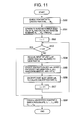
- FIG. 11 is a flowchart illustrating a process of creating encrypted content
- FIG. 12 is a schematic diagram of encrypted content
- FIG. 13 is a schematic diagram of a header
- FIG. 14 is a flowchart illustrating a process of obtaining and decrypting encrypted content
- FIG. 15 is a flowchart illustrating a process of decrypting encrypted content
- FIG. 16 is a flowchart illustrating a process of creating an encryption key (sek i );
- FIG. 17 is a schematic diagram of a key managing device ( 210 ) used in an information system according to a second embodiment of the present invention.
- FIG. 18 is a flowchart illustrating an example of an updating process
- FIG. 19 is a schematic diagram for describing a procedure of generating random numbers.
- FIG. 20 is a schematic diagram of a management server.
- FIG. 1 is a schematic diagram of an information system 100 according to a first embodiment of the present invention.
- the information system 100 includes a key managing device 110 , a key storing device 120 , a content storing device 130 , and user devices 140 A to 140 C, which are connected to one another through a network 160 .
- the key managing device 110 includes, as shown in FIG. 2 (schematic diagram of the key managing device), a controlling part 111 , a storing part 114 , a transmitting and receiving part 116 , an input part 117 , and an output part 118 .
- the controlling part 111 includes, as shown in FIG. 2 , a transmission and reception processing part 112 and a key creation processing part 113 .
- the transmission and reception processing part 112 controls transmission and reception of data through the transmitting and receiving part 116 described later.
- the key creation processing unit 113 creates a management secret key for creating a secret key and a public key to be used by each of the user devices 140 A to 140 C described later, and stores the management secret key in a management key storing area 115 of the storing part 114 described later.
- the key creation processing part 113 creates secret keys to be used by the user devices 140 A to 140 C and pubic keys corresponding to the secret keys, in response to user registration requests made by the user devices 140 A to 140 C described later.
- the key creation processing part 113 transmits the secret keys to the user devices 140 A to 140 C from the transmitting and receiving part 116 described later through the transmission and reception processing part 112 , and controls a process of transmitting the public keys to the key storing device 120 described later.
- the user registration requests made by the user devices 140 A to 140 C described later each include a user ID for identifying a user, and a secret key and a public key are created for each user ID, and the user ID is attached to the public key to be transmitted to the key storing device 120 .
- the storing part 114 includes, as shown in FIG. 2 , the management key storing area 115 .
- the management key storing area 115 stores a management secret key for creating secret keys and public keys to be used by the user devices 140 A to 140 C described later.
- the transmitting and receiving part 116 is an interface which transmits and receives data through the network 160 .
- the input part 117 is a device for inputting data.
- the output part 118 is a device for outputting data.
- the key managing device 110 configured as described above may be implemented by, for example, a computer 170 as shown in FIG. 3 (schematic diagram of a computer).
- the controlling part 111 and each processing part included therein may be implemented by executing a predetermined program stored in an external storage device 173 by a central processing unit (CPU) 171 .
- the storing part 114 may be implemented by the external storage device 173 such as a hard disk.
- the transmission and receiving part 116 may be implemented by a communications device 174 such as a network interface card (NIC).
- the input part 117 may be implemented by an input device 175 such as a keyboard or a mouse.
- the output part 153 may be implemented by an output device 406 such as a reader device which reads data from an external storage medium including a magnetic disk, an optical disk, or a semiconductor memory.
- FIG. 4 is a schematic diagram of the key storing device 120 .
- the key storing device 120 includes a controlling part 121 , a storing part 123 , and a transmitting and receiving part 125 .
- the controlling part 121 includes, as shown in FIG. 4 , a transmission and reception processing part 122 .
- the transmission and reception processing part 122 controls transmission and reception of data through the transmitting and receiving part 125 described later.
- the storing part 123 includes, as shown in FIG. 4 , a public key storing area 124 .
- the public key storing area 124 stores a public key received from the key managing device 110 and information for specifying a user, the public key and the information being associated with each other.
- the public key storing area 124 stores a public key table 124 a as shown in FIG. 5 (schematic diagram of a public key table).
- the public key table 124 a is provided with a user ID field 124 b and a public key field 124 c.
- a user ID is registered as information for specifying a user.
- public key field 124 c a public key of a user specified by the user ID in the user ID field 124 b is registered.
- the transmitting and receiving part 125 is an interface for transmitting and receiving data through the network 160 .
- the key storing device 120 configured as described above may also be implemented by, for example, the computer 170 shown in FIG. 3 .
- controlling part 121 and each processing part included therein may be implemented by executing a predetermined program stored in the external storage device 173 by the CPU 171 .
- the storing part 123 may be implemented by the external storage device 173 such as a hard disk.
- the transmission and receiving part 125 may be implemented by the communications device 174 such as an NIC.
- FIG. 6 is a schematic diagram of the content storing device 130 .
- the content storing device 130 includes a controlling part 131 , a storing part 133 , a transmitting and receiving part 135 .
- the controlling part 131 includes, as shown in FIG. 6 , a transmission and reception processing part 132 .
- the transmission and reception processing part 132 controls transmission and reception of data through the transmitting and receiving part 135 described later.
- the storing part 133 includes, as shown in FIG. 6 , an encrypted content storing area 134 .
- the encrypted content storing area 134 stores encrypted content received from the user devices 140 A to 140 C described later. A data configuration of the encrypted content is described later.
- the transmitting and receiving part 135 is an interface for transmitting and receiving data through the network 160 .
- the key storing device 130 configured as described above may also be implemented by, for example, the computer 170 shown in FIG. 3 .
- controlling part 131 and each processing part included therein may be implemented by executing a predetermined program stored in the external storage device 173 by the CPU 171 .
- the storing part 133 may be implemented by the external storage device 173 such as a hard disk.
- the transmission and receiving part 135 may be implemented by the communications device 174 such as an NIC.
- the user devices 140 A to 140 C each include, as shown in FIG. 7 (schematic diagram of a user device), a controlling part 141 , a storing part 146 , a transmitting and receiving part 151 , an input part 152 , an output part 153 , and a reader part 154 .
- the controlling part 141 includes, as shown in FIG. 7 , a transmission and reception processing part 142 , a content processing part 143 , an encryption processing part 144 , and a decryption processing part 145 .
- the transmission and reception processing part 142 controls transmission and reception of data through the transmitting and receiving part 151 described later.
- the transmission and reception processing part 142 controls a process of creating a user registration request to be transmitted to the key managing device 110 and transmitting the user registration request to the key managing device 110 through the transmitting and receiving part 151 described later, a process of creating an encrypted content registration request to be transmitted with respect to the content storing device 130 and transmitting the encrypted content registration request to the content storing device 130 through the transmitting and receiving part 151 described later, and further a process of creating an encrypted content transmission request to be transmitted with respect to the content storing device 130 and transmitting the encrypted content transmission request to the content storing device 130 through the transmitting and receiving part 151 described later.
- the transmission and reception processing part 142 also controls a process of storing the secret key received from the key managing device 110 , in a secret key storing area 149 described later, a process of storing the public key received from the key storing device 120 , in a public key storing area 150 described later, and a process of storing the encrypted content received from the content storing device 130 , in an encrypted content storing area 148 described later.
- the content processing part 143 accepts a data input from a user of each of the user devices 140 A to 140 C through the input part 152 described later and creates content data, or reads content data through the reader part 154 described later and stores the content data in a content data storing area 147 described later.
- the encryption processing part 144 Upon receiving an encryption instruction specifying content data to be encrypted, from a user of one of the user device 140 A to 140 C through the input part 152 described later, the encryption processing part 144 encrypts the specified content data, to thereby create encrypted content. A process of creating encrypted content is described later with reference to FIG. 11 .
- the decryption processing part 145 Upon receiving the encrypted content from the content storing device 148 , the decryption processing part 145 decrypts the encrypted content thus received, to thereby create content data. A process of decrypting content data is described later with reference to FIG. 15 .
- the storing part 146 includes, as shown in FIG. 7 , the content data storing area 147 , the encrypted content storing area 148 , the secret key storing area 149 , and the public key storing area 150 .
- the content data storing area 147 stores the content data created in the content processing part 143 based on the data input through the input part 152 or the content data read by the content processing part 143 through the reader part 154 .
- the encrypted content storing area 148 stores the encrypted content created in the encryption processing part 144 .
- the secret key storing area 149 stores a secret key of a specific user, which has been created in the key managing device 110 .
- the public key storing area 150 stores public keys of users received from the key storing device 120 and information for specifying each of the users (owners) of the public keys in association with each other.
- the public key storing area 150 may store a table similar to the public key table 124 a shown in FIG. 5 , which is provided with a user ID field 124 b and a public key field 124 c , so that the public key storing area 150 can store the user IDs and public keys corresponding to the user IDs.
- the transmitting and receiving part 151 is an interface for transmitting and receiving data through the network 160 .
- the input part 152 is a device for inputting data.
- the output part 153 is a device for outputting data.
- the output part 153 for example, displays content data decrypted in the decryption processing part 145 .
- the reader part 154 is a device for reading data from an external storage medium such as a magnetic disk, an optical disk, or a semiconductor memory.
- Each of the user devices 140 A to 140 C configured as described above may also be configured by the computer 170 shown in FIG. 3 .
- the controlling part 141 and each processing part included therein may be implemented by executing a predetermined program stored in the external storage device 173 by the CPU 171 .
- the storing part 146 may be implemented by the external storage device 173 such as a hard disk.
- the transmission and receiving part 151 may be implemented by the communications device 174 such as an NIC.
- the input part 152 may be implemented by the input device 175 such as a keyboard or a mouse.
- the output part 153 may be implemented by an output device 176 such as a display.
- the reader part 154 may be implemented by a reader device 178 which reads information from a storage medium 180 having portability such as a CD-ROM or a DVD-ROM.
- Each program executed in each of the devices may be stored in the external storage device 173 in the computer 170 in advance, or may be introduced as necessary from a removable external storage medium which can be used by the computer 170 or from another device through a communications medium (such as the network 160 or a carrier wave or a digital signal which is passed on through the network 160 or the like).
- a communications medium such as the network 160 or a carrier wave or a digital signal which is passed on through the network 160 or the like.
- FIG. 8 is a flowchart illustrating a process of creating a management secret key in the key managing device 110 .
- the process of creating a management secret key in the key managing device 110 is started, for example, in response to an instruction to create a management secret key, the instruction being input by an operator of the key managing device 110 through the input part 117 .
- the key creation processing part 113 generates an integer s which is smaller than n obtained in Step S 10 (S 11 ).
- the key creation processing part 113 stores p, q, n, and s generated as described above in the management key storing area 115 as a management secret key (S 12 ).
- the coefficient n may include public information, and therefore may not necessarily be included in the management secret key.
- the coefficient n may be stored and disclosed by the key storing device 120 as public information to be shared in the information system 100 .
- FIG. 9 is a flowchart illustrating a process of creating a secret key to be used by any one of the user devices 140 A to 140 C and a public key corresponding to the secret key.
- a user making registration in this flowchart is defined as a user i (with a user ID of u i ).
- one of the users of the user devices 140 A to 140 C transmits a user registration request, through one of the user devices 140 A to 140 C, to the key managing device 110 (S 20 ).
- the user registration request includes the user ID (u i ) for identifying the user i.
- the transmission of the user registration request in Step S 20 may be implemented by, for example, a method of transmitting e-mail to the key managing device 110 , or by a method in which the key managing device 110 discloses a registration Web page to the user devices 140 A to 140 C, and the user i uses the registration Web page (by using HTTP) to transmit the user registration request from one of the user devices 140 A to 140 C to the key managing device 110 .
- a secret key storage completion notice and a public key registration completion notice may also be transmitted similarly through e-mail, HTTP, or the like.
- the transmission and reception processing part 112 provides a key creation instruction to the key creation processing part 113 , and the key creation processing part 113 generates prime number pk i smaller than ⁇ (n) and calculates the following expression (1), to thereby create sk i (S 22 ).
- sk i s pk i mod n (1)
- the transmission and reception processing part 112 transmits pk i created in Step S 22 as a public key, together with u i which is the user ID of the user i, to the key storing device 120 through the transmitting and receiving part 116 (S 23 ).
- the transmission and reception processing part 122 of the key storing device 120 receives the public key pk i together with the u i which is the user ID through the transmitting and receiving part 125 (S 24 ), the transmission and reception processing part 122 creates an additional row in the public key table 124 a stored in the public key storing area 124 , and registers the user ID (u i ) and the public key pk i in the additional row created in the public key table 124 a (S 25 ).
- the key storing device 120 may disclose the public key pk i registered in Step S 25 on, for example, a Web page, such that the public key pk i can be used by the users of the user devices 140 A to 140 C.
- the transmission and reception processing part 122 of the key storing device 120 transmits a registration completion notice to the key managing device 110 through the transmitting and receiving part 125 (S 26 ).
- the transmission and reception processing part 112 of the key managing device 110 receives the registration completion notice from the key storing device 120 through the transmitting and receiving part 116 (S 27 ), the transmission and reception processing part 112 transmits the secret key sk i of the user i created in Step S 22 and the coefficient n as secret information (n, sk i ), together with the registration completion notice, to one of the 140 A to 140 C which has transmitted the user registration request in Step S 20 (S 28 ).
- Step S 28 In transmitting the secret information (n, sk i ) to the one of the user devices 140 A to 140 C in Step S 28 , it is desirable to transmit the secret information (n, sk i ) through encrypted communications in order to prevent the secret information from being leaked out to a third party.
- the transmission and reception processing part 142 stores the secret information (n, sk i ) in the secret key storing area 149 (S 30 ).
- the coefficient n is included as part of the secret information of the user.
- the coefficient n may not necessarily be included in the secret information, and may be included as part of the public information together with the public key. In this case, it is desirable to transmit the coefficient n to the key storing device 120 to be disclosed as well as the public key.
- the secret information of the user i may be deleted from the corresponding one of the user devices 140 A to 140 C and a user deletion request may be transmitted to the key managing device 110 .
- the key managing device 110 which has received the user deletion request may transmit a deletion request for deleting the user i to the key storing device 120 , and the key managing device 120 may delete the public key pk i of the user and transmit a user deletion completion notice corresponding to the deletion of the user i to the corresponding one of the user devices 140 A to 140 C through the key managing device 110 .
- the key managing device 110 authenticate (verify) a user transmitting the user deletion request, in order to prevent a situation where a malicious user spoofing as another user deletes the other user without permission.
- Examples of a process to authenticate a user include a process in which the key managing device 110 stores correspondence between the user IDs (u i ) and the secret keys sk i , a secret key sk i of a user i to be deleted is included in the user deletion request to be transmitted by one of the user devices 140 A to 140 C to the key managing device 110 , and it is checked whether the secret key sk i included in the user deletion request matches the secret key sk i of the user i who has transmitted the user deletion request. In this process, it is desirable to securely transmit the user deletion request to the key managing device 110 through encryption communications or the like.
- the above-mentioned user authentication (verification) may also be performed by another method different from the above.
- the key managing device 110 may desirably issue, in deleting a key, a certificate revocation list (CRL), in order to make it clear that which one of the keys has been deleted.
- CTL certificate revocation list
- a key of a user must be deleted as described above not only in case where a user withdraws from a community but also a case where a secret key sk i of a user i has been leaked out. In a case where a key has been leaked out, it is desirable that the key managing device 110 immediately performs a process of deleting the key even if no request is made by the user, and notify the user of the deletion of the key.
- FIG. 10 is a flowchart illustrating a process of creating and registering encrypted content in the information system 100 .
- the content data storing area 147 of each one of the user devices 140 A to 140 C has already stored content data created in the content processing part 143 and input through the input part 152 or content data read by the content processing part 143 through the reader part 154 .
- the process of creating and registering encrypted content is started in response to an instruction to create and register encrypted content, the instruction being input by a user of one of the user devices 140 A to 140 C through the input part 152 .
- the encryption processing part 144 of one of the user devices 140 A to 140 C which has received the instruction of creating and registering encrypted content from the user, obtains content data to be encrypted from the content data storing area 147 (S 40 ).
- the encryption processing part 144 encrypts the content data obtained in Step S 40 , to thereby create predetermined encrypted content (S 41 ).
- a specific method which creates the encrypted content is described later with reference to FIG. 11 .
- the encrypted content thus created is transmitted to the content storing device 130 from the transmission and reception processing part 142 through the transmitting and receiving part 151 (S 42 ).
- the transmission and reception processing part 132 of the content storing device 130 which has received the encrypted content from one of the user devices 140 A to 140 C (S 43 ), stores the encrypted content thus received in the encrypted content storing area 134 (S 44 ).
- FIG. 11 is a flowchart illustrating a process of creating encrypted content in the encryption processing part 144 of each of the user devices 140 A to 140 C.
- o is a natural number.
- a user o encrypting content data has a user ID defined as u o and the secret information defined as (n, sk o ).
- the encryption processing part 144 divides the content data obtained from the content data storing area 147 into a plurality of components (S 50 ).
- content M the content data which is to be divided into the plurality of components
- the content M may be divided, for example, by using element units of an extensible markup language (XML) or by using units of column, row, or cell of a table.
- XML extensible markup language
- Step S 50 all the components of the content data may be subjected to the division to form the parts M 1 , . . . , M m , or only specific components may be extracted from the content data to form the parts M 1 , . . . , M m , which are subjected to encryption.
- the encryption processing part 144 generates a random number seed value R 0 and calculates encryption key creation random numbers R 1 , . . . , R m by a known technique by using a random number generator (RNG) (S 51 ).
- RNG random number generator
- RNG random number generator
- an arbitrary random generator such as a random number generator based on a linear congruential method or a random number generator using SAH-1 or DES.
- the encryption processing part 144 initializes an index i (i ⁇ 1) which specifies one of the parts (M 1 , . . . , M m ) (S 52 ).
- the index i is a natural number.
- Step S 58 when the index i is larger than m (m corresponds to the number of parts into which the content is divided), the process proceeds to Step S 58 , otherwise the process proceeds to Step S 54 (S 53 ).
- k is a natural number.
- the list L i of users includes the user ID (u o ) of the user encrypting content data.
- the encryption processing part 144 creates an encryption key sek i based on the secret information (n, sk o ) of the user u o , the encryption key creation random numbers R i , and the list L i (S 55 ).
- o is a natural number as described above.
- the encryption processing part 144 encrypts the part M i through symmetric-key cryptography by using the encryption key sek i created in Step S 55 , and creates an encrypted part C i (S 56 ).
- the encryption of the part M i through symmetric-key cryptography by using the encryption key sek i in Step S 56 may be performed by carrying out an arbitrary symmetric key cryptography algorithm such as DES or AES of 128 bit key by using an arbitrary encryption usage mode such as CBC.
- the encryption processing part 144 increments the index i by “1” (i ⁇ +1) (S 57 ), and returns to Step S 53 to repeat the process.
- Step S 53 if the index i is larger than m, encrypted content C is created (S 58 ).
- the encrypted content C includes the random number seed value R 0 , the list L 1 , . . . , L m of users, and the encrypted parts C 1 , . . . , C m , which are created in the above-mentioned flow.
- the encrypted content C includes position information for each encrypted part C 1 , . . . , C m .
- the position information is used for relating the encrypted parts C 1 , . . . , C m to the parts M 1 , . . . , M m when the parts M 1 , . . . , M m are decrypted.
- the part M i may not only be encrypted by the above-mentioned AES but also be attached with a message authentication code (MAC).
- MAC message authentication code
- the encryption key sek i is divided into two so as to allow the higher-order half thereof to be used as an encryption key in the symmetric-key cryptography technique and the lower-order half thereof to be used as a key for creating the MAC.
- an entire result obtained by the above-mentioned encryption may be attached with a digital signature or a MAC.
- a digital signature or a MAC With the attachment of a digital signature or a MAC, it is possible to check whether the encrypted content stored in the content storing device 130 has been falsified or not.
- a signing key for creating the digital signature is necessary in addition to the secret key to be used for encryption.
- the MAC is created by using an encryption key sek MAC which is created from a set of all the users who are allowed to view the content M (users capable of decrypting one or more parts M i ) and a secret key of a user requesting permission to view the content M (user creating encrypted content) by using the process in Step S 55 .
- the encryption key creation random numbers R 1 , . . . , R m are created based on the random number seed value R 0 by using the random number generator RNG, and the encryption key sek i is created by using the random numbers thus generated.
- the process is not limited thereto.
- the generation of the encryption key creation random numbers in Step S 51 may be skipped and the random number seed value R 0 may be used as the encryption key creation random number with respect to all the parts M 1 , . . . , M m .
- the encryption key sek i may be created only from the secret key of the user u o and the list L i without using the encryption key creation random numbers, and the encryption key creation random numbers may be used as an initial value (initial value: IV) of the encryption usage mode to be used for encrypting the parts M 1 , . . . , M m .
- the encrypted content C created in Step S 58 may have a data configuration, for example, shown in FIG. 12 (schematic diagram of encrypted content).
- the encrypted content C is configured by including, for example, a header 161 and an encrypted content main body 162 .
- the header 161 includes information which specifies the random number seed value R 0 and information which specifies the user list (L 1 , . . . , L m ) for specifying, for each encrypted part, a user who is allowed to view the part.
- the header 161 may be configured as XML data shown in FIG. 13 (schematic diagram of the header).
- the header 161 is illustrated as an MRCipher element 161 a.
- the MRCipher element 161 a includes an MRCipherParam element 161 b and an MRBlocks element 161 c .
- the MRCipherParam element 161 b stores information on a symmetric key cryptography algorithm used for the encryption, a random number generator used for generating random numbers, a random number seed value R 0 , and the like, the information being common to all the parts M 1 , . . . , M m .
- the MRBlocks element 161 c stores information on the list L i of users capable of viewing each of the parts M 1 , . . . , M m , storage sites of the parts M 1 , . . . , M m , and the like, which is necessary for decrypting each of the encrypted parts C 1 , . . . , C m .
- the MRCipherParam element 161 b is configured by including an EncryptionAlgorithm element 161 d , a SekGenerationAlgorithm element 161 e , and a RandomSeed element 161 f.
- the EncryptionAlgorithm element 161 d is an encryption algorithm to be used for encrypting the part M i .
- the SekGenerationAlgorithm element 161 e is an element for describing an algorithm name of a random number generator to be used for generating the encryption key creation random numbers R 1 , . . . , R m from the random number seed value R 0 .
- the Algorithm attribute of the part M i may be described as “http://www.w3.org/2001/04/xmlenc#aes128-cbc”.
- the RandomSeed value element 161 f there may be described a value obtained by converting the random number seed value R 0 into a character string by using BASE64 encoding.
- the MRBlocks element 161 c includes an MRblock element 161 g for storing information necessary for decrypting each part of the content.
- the MRblock element 161 g includes a UserList element 161 h for storing the list L i of users allowed to view the part M i and a TargetList element 161 i which indicates where the part M i is actually stored.
- the UserList element 161 h has a User element 161 j as a child, and describes User IDs of the users allowed to view the part M i as the id attribute of the User element 161 j , to thereby express the list L i of users capable of viewing the part M i .
- the TargetList element 161 i has a Target element 161 k as a child, and describes a URI or an XPath expression as the URI attribute in the Target element 161 k , to thereby indicate the location of the part M i .
- Elements such as the EncryptionAlgorithm element 161 d and the SekGenerationAlgorithm element 161 e may be omitted in a case where the algorithm is unmistakable without being specified because a common algorithm is used in the entire information system 100 shown in FIG. 1 .
- the elements name such as the MRCipher element 161 a used in the above example is not limited thereto.
- an original format is used as an example of using the XML
- another format such as an XML Encryption which is an encryption standard of the XML may also be used.
- the encrypted content C may not necessarily be realized by the XML.
- FIG. 14 is a flowchart illustrating a process of obtaining and decrypting encrypted content in the information system 100 .
- the process of obtaining and decrypting encrypted content in the information system 100 is started in response to an instruction to obtain the encrypted content, the instruction being input by one of the users of the user devices 140 A to 140 c with respect to the corresponding one of the user devices 140 A to 140 c through the input part 152 thereof.
- the transmission and reception processing part 142 of one of the user devices 140 A to 140 C creates a transmission request of the encrypted content C and transmits the transmission request to the content storing device 130 (S 60 ).
- the content storing device 130 which has received the transmission request from any one of the user devices 140 A to 140 C (S 61 ), obtains the encrypted content C which has been requested to be transmitted from the encrypted content storing area 134 (S 62 ), and transmits the encrypted content C thus obtained to the corresponding one of the user devices 140 A to 140 C which has transmitted the transmission request (S 63 ).
- the one of the user devices 140 A to 140 C which has received the encrypted content C from the content storing device 130 (S 64 ), transmits the encrypted content C to the decryption processing part 145 from the transmission and reception processing part 142 , decrypts the encrypted content C in the decryption processing part 145 (S 65 ), and displays by the output part 153 an image of content data obtained by decrypting the encrypted content C.
- the decryption process is described later with reference to FIG. 15 .
- regions which should not be viewed by the user are filled with black or the like.
- FIG. 15 is a flowchart illustrating a process of decrypting the encrypted content in the decryption processing part 145 of each of the user devices 140 A to 140 C.
- a user ID of a user j who has instructed the decryption processing of the encrypted content is defined as u j
- the secret information of the user j is defined as (n, sk j ).
- j is a natural number.
- the decryption processing part 145 obtains, from the encrypted content C, the random number seed value R 0 , the user list L 1 , . . . , L m , and the encrypted parts C 1 , C m (S 70 ).
- the decryption processing part 145 generates encryption key creation random numbers R 1 , . . . , R m from the random number seed value R 0 by using a random number generator RNG (S 71 ).
- the decryption processing part 145 initializes an index i of the encrypted parts C 1 , . . . , C m to be decrypted to “1” (i ⁇ 1) (S 72 ).
- Step S 78 the decryption processing part 145 proceeds to Step S 78 if i>m (m corresponds to the number of the encrypted parts), otherwise proceeds to Step S 74 (S 73 ).
- the decryption processing part 145 refers to the list L i of users allowed to view the encrypted part C i , and proceeds to Step S 75 if the list L i includes the user ID (u j ) of the user j, otherwise proceeds to Step S 77 (S 74 ).
- the decryption processing part 145 creates an encryption key sek i based on the secret information (n, sk j ) of the user j, the encryption key creation random number R i , and the list L i (S 75 ).
- the process of creating the encryption key sek i in Step S 75 is described later with reference to FIG. 16 .
- the decryption processing part 145 decrypts the encrypted part C i by using the encryption key sek i created in Step S 75 as the encryption key in the symmetric-key cryptography technique, to thereby create a part M i (S 76 ).
- the decryption processing part 145 increments the index i of the encrypted part by “1” (i ⁇ i+1) (S 77 ), and returns to Step S 73 to repeat the process.
- Step S 73 the decrypted parts M 1 , . . . , M m are combined to create content data M′ (S 78 ).
- FIG. 16 is a flowchart illustrating a process of creating the encryption key sek i in Step S 55 of FIG. 11 or in Step S 75 of FIG. 15 .
- the encryption processing part 144 or the decryption processing part 145 creates the encryption key sek i based on a user ID (u x ) of a user x, secret information (n, sk x ) of the user x, the user list L i , and the encryption key creation random number R i .
- x is a natural number.
- the encryption processing part 144 or the decryption processing part 145 initializes an index i of the encrypted key sek i to “1” (i ⁇ 1), and inputs the secret key sk x of the user x as an initial value for the encryption key creation key gsk i (gsk i ⁇ sk x ) (S 81 ).
- Step S 86 the encryption processing part 144 or the decryption processing part 145 proceeds to Step S 86 if i>k (k corresponds to the number of users registered in the user list L i ), otherwise proceeds to Step S 83 (S 82 ).
- Step S 84 the encryption processing part 144 or the decryption processing part 145 proceeds to Step S 84 if i ⁇ x, otherwise proceeds to Step S 85 (S 83 ).
- Step S 84 the encryption processing part 144 or the decryption processing part 145 calculates an encryption key creation key gsk i ′ by using the following expression (2), and replaces the encryption key creation key gsk i with the encryption key creation key gsk i ′ thus created (S 84 ).
- gsk i ′ gsk pk i mod n (2)
- the encryption processing part 144 or the decryption processing part 145 increments the index i by “1” (i ⁇ i+1) (S 85 ), and returns to Step S 82 to repeat the process.
- hash function H a known hash function such as SHA-1 or MD5 may be used.
- the above-mentioned symmetric key cryptography algorithm such as AES or DES may be used.
- h i H(gsk i ) is calculated, and the encryption key creation random number R i is encrypted by using h i as the creation key in the symmetric-key cryptography technique, to thereby obtain the encryption key sek i as a result of the encryption.
- the encryption key creation random number R i may be encrypted by using gsk i , to thereby obtain the encryption key sek i as a result of the encryption.
- Step S 86 another process different from the above-mentioned process may also be performed.
- h i may be created by taking out higher-order bits or lower-order bits of the created gsk i , rather than by using the hash function H, and the higher-order bits or the lower-order bits thus taken out may be used as the encryption key in the symmetric-key cryptography technique which is used for creating the encryption key sek i .
- the symmetric-key cryptography may not be used for creating the encryption key sek i .
- an exclusive OR of gsk i and R i may be calculated to obtain the encryption key sek i , and the result of the calculation may be obtained as the encryption key sek i .
- the encryption processing part 144 and the decryption processing part 145 can create the same encryption key sek i when information included in the list L i used by the encryption processing part 144 is the same with information included in the list L i used by the decryption processing part 145 .
- the encryption processing part 144 when a user ID of the user o (o is a specific natural number of 1 to k; k is a natural number) is defined as u o and the secret key of the user o is defined as sk o , the encryption key sek i is created based on the following expression (3).
- gsk i ⁇ ( ⁇ ... ⁇ ⁇ ( ( sk o p ⁇ ⁇ k 1 ) p ⁇ ⁇ k 2 ) ⁇ ⁇ ... ⁇ ) p ⁇ ⁇ k k ⁇ ⁇ mod ⁇ ⁇ n ( 3 )
- sk o s pk o mod n (4)
- the expression (3) is expressed as the following expression (5).
- gsk i ⁇ s (pk 0 ⁇ pk 1 ⁇ . . . ⁇ pk k ) ⁇ mod n (5)
- the decryption processing part 145 when a user ID of the user j (j is a specific natural number of 1 to k; k is a natural number) is defined as u j and the secret key of the user j is defined as sk j , the encryption key sek i is created based on the following expression (6).
- gsk i ⁇ ( ⁇ ... ⁇ ⁇ ( ( sk j p ⁇ ⁇ k 1 ) p ⁇ ⁇ k 2 ) ⁇ ⁇ ... ⁇ ) p ⁇ ⁇ k k ⁇ ⁇ mod ⁇ ⁇ n ( 6 )
- sk j is expressed by the following expression (7).
- sk j s pk j mod n (7)
- the expression (6) is expressed as the following expression (8).
- gsk i ⁇ s (pk 0 ⁇ pk 1 ⁇ . . . ⁇ pk k ) ⁇ mod n (8)
- the encryption key sek i created in the encryption processing part 144 and the encryption key sek i created in the decryption processing part 145 are equal to each other.
- One of the methods for solving this problem includes a method of calculating in advance the encryption key creation key gsk i which is often used, and storing the encryption key creation key gsk i in the storing part 146 , to thereby omit the process. It is also possible to determine, among the plurality of users, the encryption key creation key gsk i to be calculated in advance such that the encryption key creation key gsk i calculated in advance can be regarded as a common key for the community.
- the users agree on what type of users to exist in the community, which makes it difficult to keep track of the users in the community. Also, in a case where a certain user has withdrawn from the community, there arises a problem that the remaining users each have to calculate again the encryption key gsk i shared by the users.
- the key managing device 110 is allowed to manage a public key corresponding to a community as described above, it is possible to easily perform, for example, formation of a community. Also, by using the public key for the community issued by the key managing device 110 , it is possible to efficiently encrypt information to be disclosed to the community.
- the key managing device 110 there may be a case where not only a secret key sk i and a public key pk i of an individual user are issued but also a secret key sk i is issued with respect to a group including a plurality of users.
- the process flow of issuing the secret key sk i and the public key pk i follows the above-mentioned process, but the secret key sk i thus created and the registration completion notice need to be transmitted to all the users belonging to the group.
- the creation of a group key described above is not limited to a social network, and is also effective in a case where a group key is applied with respect to an organization structure in a company (e.g., a division or a section).
- FIG. 17 is a schematic diagram of a key managing device 210 used in an information system according to a second embodiment of the present invention.
- the key managing device 210 in this embodiment is similar to the first embodiment except in that a controlling part 211 is further provided with an updating part 219 , and a storing part 214 is further provided with a public key storing area 220 and encrypted content storing area 221 . Accordingly, in the following, those parts which are different from the first embodiment are described.
- content data is encrypted to be provided to a user.
- a secret key of a certain user has leaked out
- a risk that encrypted content C which has already been encrypted may be viewed by an unintended user who uses the secret key which has leaked out.
- a secret key and a public key of the user are re-issued while decrypting once the encrypted content C which has been created by using the secret key which has leaked out, and re-encrypting the encrypted content C.
- an information system capable of efficiently taking countermeasures against a case where a secret key which has been distributed to a user has leaked out.
- the updating part 219 additionally provided to the controlling part 211 stores the encrypted content C, which may be decrypted by using the key which has leaked out, in an encrypted content storing area 221 described later through the transmission and reception processing part 112 , and controls a process of updating the header 161 of the encrypted content C thus stored.
- the process of updating the header 161 is described in detail later with reference to FIG. 18 .
- the public key storing area 220 additionally provided to the storing part 214 stores, in a case where a secret key and a public key of a user have been created in the key creation processing part 113 as shown in the flowchart of FIG. 9 , the public keys of users and information for specifying a user (owner) of the corresponding public key, in association with each other.
- the public key storing area 220 also stores a table similar to the public key table 124 a shown in FIG. 5 which includes the user ID field 124 b and the public key field 124 c , to thereby store user IDs and public keys corresponding to the user IDs.
- the secret key and the public key of the user are recreated by following the procedure similar to the flowchart shown in FIG. 9 , to thereby update a public key to be registered in the public key field 124 c of the public key table 124 a.
- the encrypted content storing area 221 additionally provided to the storing part 214 stores encrypted content C having the header 161 to be updated.
- the transmission and reception processing part 112 in this embodiment also performs a process of receiving, in response to a request from the updating part 219 , the encrypted content C from the content storing device 130 through the transmitting and receiving part 110 , and a process of transmitting the encrypted content C with the updated header 161 to the content storing device 130 .
- FIG. 18 is a flowchart illustrating an example of an update process to be performed by the updating part 219 of the key managing device 210 .
- This flowchart is started in response to an update instruction input by an operator of the key managing device 210 through the input part 117 , the update instruction specifying the encrypted content C having header information to be updated.
- the transmission and reception processing part 112 of the key managing device 210 receives the specified encrypted content C from the content storing device 130 , and stores the encrypted content C in the encrypted content storing area 148 .
- the updating part 219 reads out the encrypted content C from the encrypted content storing area 221 and obtains the random number seed value R 0 , a list of users L 1 , . . . , L m , and encrypted parts C 1 , . . . , C m from the encrypted content C (S 90 ).
- the updating part 219 generates encryption key creation random numbers R 1 , . . . , R m from the random value seed value R 0 by using the random number generator RNG (S 91 ).
- the updating part 219 initializes an index i of the encrypted parts to “1” (i ⁇ 1) (S 92 ), and proceeds to step S 97 if i>m (m corresponds to the number of the encrypted parts), otherwise proceeds to step S 93 (S 92 ).
- the updating part 219 creates an encrypted key sek i based on a management secret key s, the encryption key creation random number R i , and the list L i of users (S 94 ).
- z is a natural number.
- Step S 94 the creation of the encryption key sek i in Step S 94 may be performed by following the flowchart shown in FIG. 16 .
- the initial value of the encryption key creation key gsk i may use s which is part of the management secret key stored in the management key storing area 115
- Step S 84 may be performed by using all the public keys corresponding to the list L i , without performing the process of Step S 83 .
- a secret key and a public key of a user z are recreated, and replace the public key of the user z stored in the public key storing area 220 with the public key thus recreated, to thereby update the public key (S 95 ).
- the updating part 219 creates a creation key H (gsk i ) based on the management secret key s and the list L i of users (S 96 ), and decrypts the encryption key sek i created in Step S 94 by the creation key H (gsk i )′ created in Step S 96 , to thereby create a new encryption key creation random number R i ′ (S 97 ).
- the creation of the creation key H (gsk i ) may be performed by following the flowchart shown in FIG. 16 .
- the creation key H (gsk i )′ has a different value from the creation key H (gsk i ) calculated in the process of creating the secret key sk i in Step S 94 with respect to a part for which the public key of the user z is used, because the public key of the user z who has a secret key leaked out is updated in Step S 95 .
- the updating part 219 increments the index i of the encrypted part by “1” (i ⁇ i+1) (S 98 ), and returns to Step S 93 to repeat the process.
- encrypted content C′ is created based on the newly-generated encryption key creation random numbers R 1 ′, . . . , R m ′, the list of users L 1 , . . . , L m , and the encrypted parts C 1 , . . . , C m (S 99 ).
- the encrypted content C′ thus created is transmitted to the content storing device 130 through the transmission and reception processing part 112 , and the content storing device 130 replaces the encrypted content C before updating with updated encrypted content C′ to store the encrypted content C′.
- Any one of the user devices 140 A to 140 C which has received the encrypted content C′ updated as described above, may perform decryption by using the encryption key creation random numbers R 1 ′, . . . , R m ′ included in the header 161 , instead of generating encryption key creation random numbers from the random number seed value R 0 .
- the key managing device 210 updates the header 161 .
- an updating part which functions similarly to the updating part 219 may be provided to any one of the user devices 140 A to 140 C, so as to allow each of the user devices 140 A to 140 C to update the header 161 based on the secret key or the management secret key which has been used for creating the encrypted content C.
- the encryption key creation random numbers R 1 ′, . . . , R m ′ are re-generated and attached, in place of the random number seed value R 0 , to the encrypted content C′ newly created. Accordingly, the encrypted content C′ created in the above-mentioned process has the header 161 increased in size.
- FIG. 19 is a schematic diagram for describing a procedure of generating random numbers.
- FIG. 19 illustrates, as an example, a case where the number of the content parts (components) m is 8 (the number of random numbers is also 8), however, the number of the parts may be arbitrary.
- the random number generator RNG includes a random number generator for generating random numbers twice as long as an input length.
- R b0 ⁇ R b1 ⁇ RNG(R b ) an output with respect to the input of R b is illustrated as R b0 ⁇ R b1 ⁇ RNG(R b ).
- R L ⁇ R R indicates the concatenation of R L and R R
- b indicates a character string of arbitrary length including 0 and 1 (hereinafter the same) “b 0 ” and “b 1 ” each indicate a character string b to which a character “0” or a character “1” is connected, respectively.
- the updating part 219 generates R 00 and R 11 from R 0 by using the random number generator RNG.
- the updating part 219 generates R 001 , R 001 and R 011 , R 011 from R 00 and R 11 .
- the updating part 219 repeatedly applies the random number generator RNG along a tree structure (binary tree), to thereby finally generate R 0000 to R 0111 .
- the encryption key creation random numbers the number of which is m, are generated from the random number seed value R 0 .
- the key managing device 110 the key storing device 120 , and the content storing device 130 are each used to create a key, store a key, and store encrypted content.
- the present invention is not limited thereto. In view of dispersing and centralizing the process, the processes performed in those devices may be dispersed or centralized.
- a key may be created and stored, and encrypted content may be managed by a single device such as a management server 310 as shown in FIG. 20 (schematic diagram of a management server), which includes a controlling part 311 , a storing part 314 , a transmitting and receiving part 318 , an input part 319 , and an output part 320 .
- a management server 310 as shown in FIG. 20 (schematic diagram of a management server), which includes a controlling part 311 , a storing part 314 , a transmitting and receiving part 318 , an input part 319 , and an output part 320 .
- a transmission and reception processing part 312 of the controlling part 311 performs a process similar to the process performed by the transmission and reception processing parts 112 , 122 , and 132 in the key managing device 110 , the key storing device 120 , and the content storing device 130 .
- a key creation processing part 313 of the management server 310 performs a process similar to the process performed by the key creation processing part 113 of the key managing device 110 .
- the management server 310 performs the processes which are otherwise performed by the key managing device 110 , the key storing device 120 , and the content storing device 130 , the transmission and reception processing part 312 of the management server 310 does not have to perform data communications between the key managing device 110 , the key storing device 120 , and the content storing device 130 .
- a management key storing area 315 of the storing part 314 in the management server 310 stores information similar to the information stored in the management key storing area 115 of the storing part 114 of the key managing device 110 .
- a public key storing area 316 of the storing part 314 in the management server 310 stores information similar to the information stored in the public key storing area 124 of the storing part 123 in the key storing device 120 .
- an encrypted content storing area 317 of the storing part 314 in the management server 310 stores information similar to the information stored in the encrypted content storing area 134 of the storing part 133 in the content storing device 130 .
- the transmitting and receiving part 318 , the input part 319 , and the output part 320 may be configured similarly to the transmitting and receiving part 116 , the input part 117 , and the output part 118 in the key managing device 110 of the first embodiment.
- the key managing device 110 the key storing device 120 , the content storing device 130 , and the user devices 140 A to 140 C are connected to one another through the network 160 .
- the present invention is not limited thereto.
- information to be exchanged between those devices may be stored in an external storage medium such as a USB memory and the external storage medium may be sent by mail to each of the devices so that the each of the devices can read out the information therefrom.
- the number of the user devices 140 A to 140 C is three, but the number can be arbitrarily changed.
- a public key stored in the key storing device 120 it is desirable to issue a certificate with respect to the public key by the key managing device 110 in order to prevent the public key itself from being falsified.
- the key managing device 110 it is necessary to provide the key managing device 110 with a certificate issuance processing part for issuing a certificate and a signing key storing area for storing a signing key to be used for issuing the certificate.
- the public key storing area 150 is provided to the storing part 146 of each of the user devices 140 A to 140 C, and a public key corresponding to the list L i is obtained from the public key storing area 150 .
- the present invention is not limited thereto, and the list L i may be transmitted to the key storing device 120 and a public key corresponding to the list L i may be obtained from the key storing device 120 .
- the encryption processing part 144 and the decryption processing part 145 of each of the user devices 140 A to 140 C can generate the same encryption key creation random numbers from the same random number seed value R 0 , and the same encryption key creation random numbers as the encryption key creation random numbers used for creating (encrypting) the encrypted parts C 1 . . . , C m can be allocated when decrypting the encrypted parts C 1 , . . . , C m (which includes, for example, a case where parts M 1 , . . . , M m and encrypted parts C 1 , C m which are obtained by encrypting the parts M 1 , . . .
- M m are arranged in the same order, and the encryption processing part 144 and the decryption processing part 145 generate the encryption key creation random numbers in the same order).
- the present invention is not limited to thereto, and even in a case where the encryption processing part 144 and the decryption processing part 145 cannot generate the same encryption key creation random numbers from the same random number seed value R 0 and in a case where the same encryption key creation random numbers as the encryption key creation random numbers used for creating (encrypting) the encrypted parts C 1 , . . . , C m cannot be allocated when decrypting the encrypted parts C 1 , . . .
- a process similar to that of the present invention can be performed by specifying the encryption key creation random numbers used for creating the encrypted parts C 1 , . . . , C m for each of the encrypted parts C 1 , . . . , C m in the header.
Landscapes
- Engineering & Computer Science (AREA)
- Computer Security & Cryptography (AREA)
- Signal Processing (AREA)
- Computer Networks & Wireless Communication (AREA)
- General Engineering & Computer Science (AREA)
- Computer Hardware Design (AREA)
- Computing Systems (AREA)
- Theoretical Computer Science (AREA)
- Software Systems (AREA)
- General Physics & Mathematics (AREA)
- Physics & Mathematics (AREA)
- Health & Medical Sciences (AREA)
- General Health & Medical Sciences (AREA)
- Bioethics (AREA)
- Storage Device Security (AREA)
Abstract
Description
sk i =s pk
gsk i ′=gsk pk
sk o =s pk
gsk i ={s (pk
sk j =s pk
gsk i ={s (pk
Claims (13)
Applications Claiming Priority (2)
| Application Number | Priority Date | Filing Date | Title |
|---|---|---|---|
| JP2006-238988 | 2006-09-04 | ||
| JP2006238988A JP4256415B2 (en) | 2006-09-04 | 2006-09-04 | ENCRYPTION DEVICE, DECRYPTION DEVICE, INFORMATION SYSTEM, ENCRYPTION METHOD, DECRYPTION METHOD, AND PROGRAM |
Publications (2)
| Publication Number | Publication Date |
|---|---|
| US20080063191A1 US20080063191A1 (en) | 2008-03-13 |
| US8094824B2 true US8094824B2 (en) | 2012-01-10 |
Family
ID=38895943
Family Applications (1)
| Application Number | Title | Priority Date | Filing Date |
|---|---|---|---|
| US11/849,465 Expired - Fee Related US8094824B2 (en) | 2006-09-04 | 2007-09-04 | Encrypting device, decrypting device, information system, encrypting method, decrypting method, and program |
Country Status (3)
| Country | Link |
|---|---|
| US (1) | US8094824B2 (en) |
| EP (1) | EP1895739A3 (en) |
| JP (1) | JP4256415B2 (en) |
Cited By (3)
| Publication number | Priority date | Publication date | Assignee | Title |
|---|---|---|---|---|
| US20100128878A1 (en) * | 2008-11-27 | 2010-05-27 | Samsung Electronics Co., Ltd. | System and method for providing digital contents service |
| US20100138656A1 (en) * | 2008-11-28 | 2010-06-03 | International Business Machines Corporation | Shielding a Sensitive File |
| US8600061B2 (en) * | 2011-06-24 | 2013-12-03 | Broadcom Corporation | Generating secure device secret key |
Families Citing this family (20)
| Publication number | Priority date | Publication date | Assignee | Title |
|---|---|---|---|---|
| WO2006133267A2 (en) * | 2005-06-06 | 2006-12-14 | Monogram Biosciences, Inc. | Methods and compositions for determining altered susceptibility of hiv-1 to anti-hiv drugs |
| US8458799B2 (en) * | 2009-06-30 | 2013-06-04 | Nokia Corporation | Method and apparatus for providing a scalable service platform using a network cache |
| WO2011114373A1 (en) * | 2010-03-17 | 2011-09-22 | 富士通株式会社 | Communication device, program, and method |
| US9772834B2 (en) * | 2010-04-27 | 2017-09-26 | Red Hat, Inc. | Exportable encoded identifications of networked machines |
| JP2012010052A (en) * | 2010-06-24 | 2012-01-12 | Sony Corp | Information processing device and method, program, and information processing system |
| CA2813758C (en) | 2010-10-08 | 2023-01-03 | Brian Lee Moffat | Private data sharing system |
| EP2715968A4 (en) * | 2011-05-26 | 2015-08-12 | Certicom Corp | RANDOM CHARACTER FOR ENCRYPTION OPERATIONS |
| US9100453B2 (en) * | 2011-10-08 | 2015-08-04 | Broadcom Corporation | Social device security in a social network |
| EP2680487B1 (en) * | 2012-06-29 | 2019-04-10 | Orange | Secured cloud data storage, distribution and restoration among multiple devices of a user |
| GB2519966A (en) * | 2013-11-01 | 2015-05-13 | Ibm | Anonymously sharing resources based on social network user data |
| US20170063550A1 (en) * | 2015-04-23 | 2017-03-02 | Keith J Brodie | Secure Digital Signature Apparatus and Methods |
| US10044693B1 (en) * | 2016-07-29 | 2018-08-07 | Microsoft Technology Licensing, Llc | Security for confidential data |
| US10686598B2 (en) * | 2017-02-27 | 2020-06-16 | Cord3 Innovation Inc. | One-to-many symmetric cryptographic system and method |
| JP7163656B2 (en) * | 2018-07-30 | 2022-11-01 | 株式会社リコー | Delivery system, receiving client terminal, delivery method |
| CN110798434B (en) * | 2018-08-03 | 2022-04-08 | Emc Ip控股有限公司 | Computer system, method performed by computing device, and storage medium |
| US11032062B2 (en) * | 2019-09-17 | 2021-06-08 | Switchbit, Inc. | Data processing permits system with keys |
| JP2022074807A (en) * | 2020-11-05 | 2022-05-18 | 株式会社日立製作所 | File storage and computer system |
| CN112865953B (en) * | 2021-02-01 | 2022-05-17 | 浙江大学 | Auxiliary server-based secure multi-party computing method, device and system |
| CN115102708B (en) * | 2022-05-05 | 2024-04-09 | 阿里巴巴(中国)有限公司 | Data processing method and device |
| CN116894273B (en) * | 2023-09-11 | 2023-11-21 | 四川建设网有限责任公司 | File encryption method, decryption method, equipment and medium based on exclusive or sum remainder |
Citations (3)
| Publication number | Priority date | Publication date | Assignee | Title |
|---|---|---|---|---|
| WO2003049359A1 (en) | 2001-11-30 | 2003-06-12 | International Business Machines Corporation | Information content distribution based on privacy and/or personal information |
| EP1503267A2 (en) | 2003-07-31 | 2005-02-02 | Sony United Kingdom Limited | Access control for digital content |
| US6961849B1 (en) | 1999-10-21 | 2005-11-01 | International Business Machines Corporation | Selective data encryption using style sheet processing for decryption by a group clerk |
Family Cites Families (6)
| Publication number | Priority date | Publication date | Assignee | Title |
|---|---|---|---|---|
| JP2887299B2 (en) * | 1990-07-31 | 1999-04-26 | 博一 岡野 | Intelligent information processing method and apparatus |
| JPH05122701A (en) * | 1991-10-25 | 1993-05-18 | Canon Inc | Information processing device for billing |
| JP2005051734A (en) * | 2003-07-15 | 2005-02-24 | Hitachi Ltd | Electronic document authenticity guarantee method and electronic document publication system |
| JP2006060722A (en) * | 2004-08-24 | 2006-03-02 | Hitachi Ltd | Electronic document authenticity guarantee method and electronic document publication system |
| JP4728104B2 (en) * | 2004-11-29 | 2011-07-20 | 株式会社日立製作所 | Electronic image authenticity guarantee method and electronic data disclosure system |
| JP4489613B2 (en) | 2005-03-01 | 2010-06-23 | リンナイ株式会社 | Dishwasher |
-
2006
- 2006-09-04 JP JP2006238988A patent/JP4256415B2/en not_active Expired - Fee Related
-
2007
- 2007-09-04 EP EP07017296A patent/EP1895739A3/en not_active Withdrawn
- 2007-09-04 US US11/849,465 patent/US8094824B2/en not_active Expired - Fee Related
Patent Citations (3)
| Publication number | Priority date | Publication date | Assignee | Title |
|---|---|---|---|---|
| US6961849B1 (en) | 1999-10-21 | 2005-11-01 | International Business Machines Corporation | Selective data encryption using style sheet processing for decryption by a group clerk |
| WO2003049359A1 (en) | 2001-11-30 | 2003-06-12 | International Business Machines Corporation | Information content distribution based on privacy and/or personal information |
| EP1503267A2 (en) | 2003-07-31 | 2005-02-02 | Sony United Kingdom Limited | Access control for digital content |
Non-Patent Citations (2)
| Title |
|---|
| Jun Anzai et al.; A Quick Group Key Distribution Scheme with Entity Revocation; Advances in Cryptology-ASIACRYPT'99; Lecture Notes in computer Science: vol. 1716 (LNCS 1716); pp. 333-347, Apringer-Verlag, 1999. |
| Nuttapong Attrapadung, et al.; Broadcast Encryption with Short Keys and Transmissions; Proceedings of the 3rd ACM workshop on Digital rights management, pp. 55-66, 2003. |
Cited By (6)
| Publication number | Priority date | Publication date | Assignee | Title |
|---|---|---|---|---|
| US20100128878A1 (en) * | 2008-11-27 | 2010-05-27 | Samsung Electronics Co., Ltd. | System and method for providing digital contents service |
| US8619994B2 (en) * | 2008-11-27 | 2013-12-31 | Samsung Electronics Co., Ltd. | System and method for providing digital contents service |
| US20100138656A1 (en) * | 2008-11-28 | 2010-06-03 | International Business Machines Corporation | Shielding a Sensitive File |
| US8245042B2 (en) * | 2008-11-28 | 2012-08-14 | International Business Machines Corporation | Shielding a sensitive file |
| US8600061B2 (en) * | 2011-06-24 | 2013-12-03 | Broadcom Corporation | Generating secure device secret key |
| US9165148B2 (en) | 2011-06-24 | 2015-10-20 | Broadcom Corporation | Generating secure device secret key |
Also Published As
| Publication number | Publication date |
|---|---|
| EP1895739A2 (en) | 2008-03-05 |
| JP4256415B2 (en) | 2009-04-22 |
| US20080063191A1 (en) | 2008-03-13 |
| JP2008061197A (en) | 2008-03-13 |
| EP1895739A3 (en) | 2008-10-22 |
Similar Documents
| Publication | Publication Date | Title |
|---|---|---|
| US20080063191A1 (en) | Encrypting Device, Decrypting Device, Information System, Encrypting Method, Decrypting Method, and Program | |
| US8423764B2 (en) | Method and apparatus for key revocation in an attribute-based encryption scheme | |
| Fang et al. | Privacy protection for medical data sharing in smart healthcare | |
| CN1910848B (en) | Effective Management of Cryptographic Key Generation | |
| KR100753932B1 (en) | contents encryption method, system and method for providing contents through network using the encryption method | |
| CN114039790A (en) | Block chain-based fine-grained cloud storage security access control method | |
| US20100046749A1 (en) | Content protection apparatus, and content utilization apparatus | |
| Michalevsky et al. | Decentralized policy-hiding ABE with receiver privacy | |
| US20100005318A1 (en) | Process for securing data in a storage unit | |
| Jin et al. | Full integrity and freshness for cloud data | |
| Braun et al. | Lincos: A storage system providing long-term integrity, authenticity, and confidentiality | |
| JP7318490B2 (en) | Cryptographic processing system and cryptographic processing method | |
| CN114267100A (en) | Unlocking authentication method and device, security chip and electronic key management system | |
| KR101615137B1 (en) | Data access method based on attributed | |
| CN114936380A (en) | Blockchain privacy data sharing method and system based on chameleon hash | |
| Deng et al. | Tracing and revoking leaked credentials: accountability in leaking sensitive outsourced data | |
| CN104901968A (en) | Method for managing and distributing secret keys in secure cloud storage system | |
| Tian et al. | An efficient scheme of cloud data assured deletion | |
| Sun et al. | On the security of an efficient time-bound hierarchical key management scheme | |
| Ding et al. | Secure Multi‐Keyword Search and Access Control over Electronic Health Records in Wireless Body Area Networks | |
| JP7350220B2 (en) | Search execution device, search execution method, search execution program, and secret search system | |
| JP2008506293A (en) | How to provide digital authentication functionality | |
| KR101054075B1 (en) | Method and device to restrict use of protection key | |
| Schaad | Use of the RSASSA-PSS Signature Algorithm in Cryptographic Message Syntax (CMS) | |
| Tourani et al. | Access control enforcement on outsourced data ensuring privacy of access control policies |
Legal Events
| Date | Code | Title | Description |
|---|---|---|---|
| AS | Assignment |
Owner name: HITACHI, LTD., JAPAN Free format text: ASSIGNMENT OF ASSIGNORS INTEREST;ASSIGNORS:HATANO, YASUO;MIYAZAKI, KUNIHIKO;MATSUMOTO, KENJI;AND OTHERS;REEL/FRAME:020138/0898;SIGNING DATES FROM 20070905 TO 20070910 Owner name: HITACHI, LTD., JAPAN Free format text: ASSIGNMENT OF ASSIGNORS INTEREST;ASSIGNORS:HATANO, YASUO;MIYAZAKI, KUNIHIKO;MATSUMOTO, KENJI;AND OTHERS;SIGNING DATES FROM 20070905 TO 20070910;REEL/FRAME:020138/0898 |
|
| FEPP | Fee payment procedure |
Free format text: PAYOR NUMBER ASSIGNED (ORIGINAL EVENT CODE: ASPN); ENTITY STATUS OF PATENT OWNER: LARGE ENTITY |
|
| STCF | Information on status: patent grant |
Free format text: PATENTED CASE |
|
| FPAY | Fee payment |
Year of fee payment: 4 |
|
| FEPP | Fee payment procedure |
Free format text: MAINTENANCE FEE REMINDER MAILED (ORIGINAL EVENT CODE: REM.); ENTITY STATUS OF PATENT OWNER: LARGE ENTITY |
|
| LAPS | Lapse for failure to pay maintenance fees |
Free format text: PATENT EXPIRED FOR FAILURE TO PAY MAINTENANCE FEES (ORIGINAL EVENT CODE: EXP.); ENTITY STATUS OF PATENT OWNER: LARGE ENTITY |
|
| STCH | Information on status: patent discontinuation |
Free format text: PATENT EXPIRED DUE TO NONPAYMENT OF MAINTENANCE FEES UNDER 37 CFR 1.362 |
|
| FP | Lapsed due to failure to pay maintenance fee |
Effective date: 20200110 |