US8094367B2 - Optically locked photon echo apparatus and method - Google Patents

Optically locked photon echo apparatus and method Download PDF

Info

Publication number
US8094367B2
US8094367B2 US12/857,537 US85753710A US8094367B2 US 8094367 B2 US8094367 B2 US 8094367B2 US 85753710 A US85753710 A US 85753710A US 8094367 B2 US8094367 B2 US 8094367B2
Authority
US
United States
Prior art keywords
optical
light
photon echo
pulses
optically locked
Prior art date
Legal status (The legal status is an assumption and is not a legal conclusion. Google has not performed a legal analysis and makes no representation as to the accuracy of the status listed.)
Expired - Fee Related
Application number
US12/857,537
Other versions
US20110222387A1 (en
Inventor
Byoung Seung Ham
Current Assignee (The listed assignees may be inaccurate. Google has not performed a legal analysis and makes no representation or warranty as to the accuracy of the list.)
Gwangju Institute of Science and Technology
Inha University Research and Business Foundation
Original Assignee
Inha Industry Partnership Institute
Priority date (The priority date is an assumption and is not a legal conclusion. Google has not performed a legal analysis and makes no representation as to the accuracy of the date listed.)
Filing date
Publication date
Application filed by Inha Industry Partnership Institute filed Critical Inha Industry Partnership Institute
Assigned to INHA-INDUSTRY PARTNERSHIP INSTITUTE reassignment INHA-INDUSTRY PARTNERSHIP INSTITUTE ASSIGNMENT OF ASSIGNORS INTEREST (SEE DOCUMENT FOR DETAILS). Assignors: HAM, BYOUNG SEUNG
Publication of US20110222387A1 publication Critical patent/US20110222387A1/en
Application granted granted Critical
Publication of US8094367B2 publication Critical patent/US8094367B2/en
Assigned to GWANGJU INSTITUTE OF SCIENCE AND TECHNOLOGY, INHA INDUSTRY PARTNERSHIP INSTITUTE reassignment GWANGJU INSTITUTE OF SCIENCE AND TECHNOLOGY ASSIGNMENT OF ASSIGNORS INTEREST (SEE DOCUMENT FOR DETAILS). Assignors: INHA INDUSTRY PARTNERSHIP INSTITUTE
Expired - Fee Related legal-status Critical Current
Anticipated expiration legal-status Critical

Links

Images

Classifications

    • GPHYSICS
    • G02OPTICS
    • G02FOPTICAL DEVICES OR ARRANGEMENTS FOR THE CONTROL OF LIGHT BY MODIFICATION OF THE OPTICAL PROPERTIES OF THE MEDIA OF THE ELEMENTS INVOLVED THEREIN; NON-LINEAR OPTICS; FREQUENCY-CHANGING OF LIGHT; OPTICAL LOGIC ELEMENTS; OPTICAL ANALOGUE/DIGITAL CONVERTERS
    • G02F1/00Devices or arrangements for the control of the intensity, colour, phase, polarisation or direction of light arriving from an independent light source, e.g. switching, gating or modulating; Non-linear optics
    • G02F1/35Non-linear optics
    • G02F1/3515All-optical modulation, gating, switching, e.g. control of a light beam by another light beam
    • GPHYSICS
    • G02OPTICS
    • G02FOPTICAL DEVICES OR ARRANGEMENTS FOR THE CONTROL OF LIGHT BY MODIFICATION OF THE OPTICAL PROPERTIES OF THE MEDIA OF THE ELEMENTS INVOLVED THEREIN; NON-LINEAR OPTICS; FREQUENCY-CHANGING OF LIGHT; OPTICAL LOGIC ELEMENTS; OPTICAL ANALOGUE/DIGITAL CONVERTERS
    • G02F2203/00Function characteristic
    • G02F2203/26Pulse shaping; Apparatus or methods therefor

Definitions

  • quantum optical data is necessary for quantum information processing ranging from quantum computers that require a shorter storage time to quantum communications such as long distance quantum cryptography that requires a longer storage time.
  • the storage time of three-pulse photon echoes is limited by the optical population decay time and is similar to the optical phase relaxation time. Unlike the two-pulse photon echoes, three pulse photon echoes cannot retrieve more than 50% of stored information due to optical coherence loss attributable to optical population decay.
  • phase-locked echo methods the storage time is extended from optical phase relaxation time to spin dephasing time, which is inversely proportional to spin inhomogeneous broadening [B. S. Ham, Opt. Exp. Vol. 18, No. 2, pp. 1704-1713 (2010)].
  • phase inversion is realized using an externally applied Direct Current (DC) voltage or a magnetic field gradient, where spontaneous emission noise caused by a rephasing pulse in conventional two-pulse photon echoes is eliminated.
  • DC Direct Current
  • the storage time in CRIB is still limited by the optical phase relaxation time, which is much shorter than a millisecond [M. Nilsson and S. Kroll, Opt. Commun. Vol. 247 (No. 4-6), pp. 393-403 (2005)].
  • an object of the present invention is to provide an optically locked photon echo apparatus and method, which can solve the problem of limited echo efficiency and can overcome constraints on the conventional storage time being limited to the spin dephasing time.
  • Another object of the present invention is to provide an optically locked photon echo apparatus and method, which extend the storage time up to spin population relaxation time while obtaining more than 50% retrieval efficiency because the present invention locks even the phase evolution of individual atoms as well as an optical population decay process, unlike the conventional version of phase-locked photon echoes.
  • a further explanation thereof may be given in such a way that, in rare-earth-doped crystal such as Pr 3+ -doped Y 2 SiO 5 , the spin population relaxation time is at least a million times as long as the spin dephasing time which is the limit of the storage time of conventional three-pulse photon echoes.
  • a further object of the present invention is to provide an optically locked photon echo apparatus and method, which causes the storage time to be unchanged even by spin dephasing caused by spin inhomogeneous broadening. Thanking to the inherent optical phase locking characteristics of three-pulse photon echoes, preventing optical coherence loss from population decay the optically locked echo provides ultralong photon storage time with more than 50% retrieval efficiency.
  • the five or more optical pulses fall into a first optical pulse group including one or more of optical pulses corresponding to input light (D), write light (W) and read light (R) which resonate between the energy levels
  • the three energy levels are set in such a way that the energy levels
  • a time interval between the input light (D) and the write light (W) is shorter than an optical phase relaxation time, but has a length sufficient to fall within the spectral width of the system.
  • a time interval between the first control light (B 1 ) and the second control light (B 2 ) is shorter than a spin population relaxation time.
  • areas of the pulses corresponding to the first control light (B 1 ) and the second control light (B 2 ) are ⁇ and 3 ⁇ , respectively, and a sum of the areas of these pulses is 4 ⁇ .
  • the nonlinear optical medium is a solid, multiply coupled semiconductors, or a cold atom ensemble.
  • the present invention provides an optically locked photon echo method for generating output light (E), which satisfies a phase matching condition, using an optically locked photon echo apparatus, the apparatus including a nonlinear optical medium provided with three energy levels
  • FIGS. 1A and 1B are respectively a configuration diagram of an optically locked photon echo apparatus and a diagram of the energy levels of an optical medium interacting with optical pulses according to an embodiment of the present invention
  • FIG. 2 is a diagram showing the optically locked photon echo apparatus according to an embodiment of the present invention.
  • FIG. 3 is a diagram showing the sequence of optical pulses for optically locked photon echoes according to the present invention
  • FIG. 4 is a flowchart showing an optically locked photon echo method according to the present invention.
  • FIGS. 5A to 5D are diagrams showing the results of numerical simulations of typical two-pulse photon echoes
  • FIGS. 6A to 6D are diagrams showing the results of numerical simulations of three-pulse photon echoes
  • FIGS. 7A to 7F are diagrams showing the comparison between the results of numerical simulations of the three-pulse photon echoes and optically locked photon echoes;
  • FIGS. 8A to 8D are diagrams showing the results of detailed numerical simulations for describing the optical locking of FIG. 7B ;
  • FIGS. 9A and 9B are diagrams showing the experimental results of the optically locked photon echoes according to the present invention.
  • FIGS. 1A and 1B are respectively a configuration diagram of an optically locked photon echo apparatus and a diagram of the energy levels of an optical medium interacting with optical pulses according to an embodiment of the present invention.
  • the optically locked photon echo apparatus includes an optical medium 10 , and an optical pulse generation unit 20 for generating five or more optical pulses resonating between the energy levels of the optical medium 10 .
  • the optical medium 10 has nonlinear optical characteristics and has three energy levels
  • the optical medium 10 can be a solid such as a rare-earth Pr 3+ doped Y 2 SiO 5 , multiply coupled semiconductors, or a cold atomic ensemble.
  • FIG. 1B illustrates the energy levels of the optical medium 10 which interacts with the five or more optical pulses.
  • 2 > are in a ground state, and the energy level
  • FIGS. 1A and 1B will be described in detail below.
  • the five or more optical pulses fall into a first optical pulse group f 1 including optical pulses corresponding to one or more input lights D, write light W and read light R which resonate between the energy levels
  • the five or more optical pulses are incident on the optical medium 10 after having passed through an optical fiber, surface plasmon medium or free space.
  • the first optical pulse group f 1 and the second optical pulse group f 2 are implemented using light having different wavelengths or polarization.
  • the first optical pulse group f 1 is used for the input light D, the write light W, and the read light R.
  • the second optical pulse group f 2 has the first control light B 1 used to transfer excited atoms in state
  • the input light D may include one or more lights, and the time interval between the first control light B 1 and the second control light B 2 must be shorter than the spin population relaxation time.
  • the time interval between the input light D and the write light W must be shorter than the optical phase relaxation time, but has a length sufficient to fall within the spectral width of the system.
  • the output light E satisfies a phase matching condition for the five or more optical pulses.
  • FIG. 2 illustrates an optically locked photon echo apparatus according to an embodiment of the present invention.
  • the optical pulse generation unit 20 of the optically locked photon echo apparatus includes a first light source 21 for outputting laser light; a second light source 22 for outputting laser light; a first optical modulation module 23 for modulating the laser light from the first light source 21 into an optical pulse train so as to generate some of the five or more optical pulses, a second optical modulation module 24 for modulating the laser light from the second light source 22 into an optical pulse train so as to generate the remaining optical pulses, which are different from the optical pulses generated by the first optical modulation module 23 among the five or more optical pulses; and a control module 25 for generating a synchronous signal required to synchronize the optical pulse trains output from the first and second optical modulation modules 23 and 24 with each other.
  • FIG. 3 illustrates the sequence of optical pulses for optically locked photon echoes according to the present invention.
  • the optical pulses are incident on the optical medium 10 in the sequence of the input light D, the write light W, the first control light B 1 , the second control light B 2 and the read light R, and the output light E is generated last of all as a result.
  • T i is the time at which an optical pulse i arrives at the optical medium.
  • FIG. 4 is a flowchart showing an optically locked photon echo method according to the present invention to describe FIG. 3 in detail.
  • the optically locked photon echo method can be implemented according to the following sequence.
  • the optically locked photon echo method includes the step S 110 of input light D being incident on the optical medium 10 ; the step S 115 of the write light W being incident on the optical medium 10 ; the step S 120 of the input light D and the write light W, which are temporally separated from each other, forming a spectral grating in cooperation with each other; the step S 125 of the first control light B 1 being incident on the optical medium 10 ; the step S 130 of the second control light B 2 being incident on the optical medium 10 ; the step S 135 of the read light R being incident on the optical medium 10 ; the step S 140 of reproducing the information of the input light D, stored in the spectral grating, using the read light R; and the step S 145 of the input light D, the write light W and the read light R generating the output light E which satisfies the phase matching condition via interaction with the optical medium 10 .
  • the term “spectral grating” means that the information of the input light D is stored. However, it means that the information is stored in the wide frequency band of relevant atoms.
  • the output light E is determined by performing four-wave mixing generation.
  • FIGS. 5A to 5D illustrate the results of numerical simulations of conventional two-pulse photon echoes.
  • FIG. 5A illustrates the sequence of pulses corresponding to the input light D and the write light W resonating between the energy levels
  • the write light W needs perfect rephasing, so that the pulse width of W must be t.
  • FIG. 5C illustrates the sum of phase coherences exhibited by the individual atoms of FIG. 5B .
  • FIG. 5D illustrates the phase evolution of atoms detuned to resonant laser light over time. This detuning occurs because the optical medium is inhomogeneous, wherein detuned values are determined on the basis of inhomogeneous broadening of the atoms. In this case, conditions for the inhomogeneous broadening of atoms are the fundamental basis of photon echoes based on a rephasing process.
  • FIGS. 6A to 6D are diagrams showing the results of numerical simulations of conventional three-pulse photon echoes.
  • the write light W of FIGS. 5A to 5D is divided into two ⁇ /2 pulses, as shown in FIG. 6 .
  • This division is required in the three-pulse photon echoes to form a spectral grating according to the population inversion between the ground state and the excited state, rather than to perform rephasing which is the core principle of the two-pulse photon echoes.
  • the information of the input light D is stored in the spectral grating.
  • the final results are identical to those of FIGS. 5A to 5D except for the delay time.
  • the three-pulse photon echoes are intended to extend the storage time, which is due to the fact that the optical population decay time is longer than the phase relaxation time.
  • the initial coherence additionally decreases.
  • coherence loss is more than 50%, and thus the three-pulse photon echoes cannot be applied to quantum memory.
  • FIG. 7E shows the reason why the magnitude of the echo of FIG. 7A is less than that of FIG. 7B , which is that in the case of the phase evolution of the individual atoms, the phase coherence is rapidly weakened and the relative coherence is also rapidly lost due to optical population loss.
  • FIG. 8A illustrates the results of numerical simulations of the phase evolution of symmetrical atoms which are identical to those of FIG. 7F .
  • two-photon coherence Re( ⁇ 12 ) is created using the transfer of the population from the excited state
  • the two-photon coherence in such population transfer induction is more temporally stable than that of conventional phase-locked two-photon coherence.
  • optical coherence created by the input light D and the write light W is replaced with spin coherence by the first control light B 1 , and is then stored. Since the spin population relaxation time is much longer than the optical population decay time, it can be stored for a longer time. In contrast, the storage time is limited by the optical population decay time in the conventional three-pulse photon echo scheme.
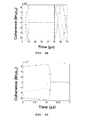
  • FIGS. 9A and 9B are diagrams illustrating the experimental results of the optically locked photon echoes according to the present invention.
  • the present invention can provide an optically locked photon echo apparatus and method, which can solve the problem of limited echo efficiency and can overcome constraints on the conventional storage time being limited to the spin dephasing time.
  • the present invention is advantageous in that it can halt the phase evolution of individual atoms as well as optical population decay, unlike the phase-locked photon echoes, thus extending the storage time up to the spin population relaxation time while obtaining more than 50% retrieval efficiency.
  • the present invention is advantageous in that the storage time can be unchanged even by spin dephasing caused by spin inhomogeneous broadening, thanks to the inherent optical phase locking characteristics of three-pulse photon echoes, unlike phase-locked photon echoes while preventing optical coherence loss from occurring during the storage time.

Landscapes

  • Physics & Mathematics (AREA)
  • Nonlinear Science (AREA)
  • General Physics & Mathematics (AREA)
  • Optics & Photonics (AREA)
  • Optical Modulation, Optical Deflection, Nonlinear Optics, Optical Demodulation, Optical Logic Elements (AREA)

Abstract

Disclosed herein is an optically locked photon echo apparatus and method, which can solve the problem of limited echo efficiency and can overcome constraints on the conventional storage time being limited to the spin dephasing time. The optically locked photon echo apparatus of the present invention includes a nonlinear optical medium and an optical pulse generation unit. The nonlinear optical medium is provided with three energy levels |1>, |2>, and |3>, and is configured to receive optical pulses from an optical pulse generation unit and generate output light (E) which satisfies a phase matching condition. The optical pulse generation unit is configured to generate five or more optical pulses which resonate between the energy levels of the optical medium.

Description

CROSS-REFERENCE TO RELATED APPLICATIONS
The present application claims priority under 35 U.S.C. 119 of Korean Patent Application No. 10-2010-0022444, filed on Mar. 12, 2010, the disclosure of which is expressly incorporated by reference herein in its entirety.
BACKGROUND OF THE INVENTION
1. Field of the Invention
The present invention relates, in general, to a photon echo apparatus and method, and, more particularly, to an optically locked photon echo apparatus and method, which includes a nonlinear optical medium having three energy levels and an optical pulse generation unit for generating five or more optical pulses resonating between the energy levels of the nonlinear optical medium.
2. Description of the Related Art
The storage of quantum optical data is necessary for quantum information processing ranging from quantum computers that require a shorter storage time to quantum communications such as long distance quantum cryptography that requires a longer storage time.
Similarly to all classical optical memory devices, the performance of quantum memory is also determined by writing speed, bandwidth, and storage time. Even though slow light-based quantum memory which uses stopped light has succeeded in proving the storage of quantum optical data, actual limitations such as limited storage time and the inevitable use of only one piece of quantum optical data have become obstacles to quantum communications [C. Liu, Nature Vol. 409, pp. 490-493 (2001)].
On the other hand, research into photon echoes has been intensively conducted in order to apply the photon echoes to quantum memory owing to their characteristics such as high speed access rate, ultrawide bandwidth, and extremely longer storage time [G. Hetet, Phys. Rev. Lett. Vol. 100, p. 023601 (2008), and B. Hosseini, Nature Vol. 461, pp. 241-245 (2009)].
Recently, photon echoes have succeeded in experimentally demonstrating the storage of quantum optical data using a rare-earth-doped solid medium [H. de Riedmatten, Nature Vol. 456, pp. 773-777 (2008)].
To be used in quantum memory, two-pulse photon echoes must have more than 50% echo efficiency. However, in the two-pulse photon echoes, the storage time is limited by the optical phase relaxation time and is about 100 μs in a rare earth-doped optical medium.
The storage time of three-pulse photon echoes is limited by the optical population decay time and is similar to the optical phase relaxation time. Unlike the two-pulse photon echoes, three pulse photon echoes cannot retrieve more than 50% of stored information due to optical coherence loss attributable to optical population decay.
Recently, several modifications, which are intended to extend the storage time as well as to improve retrieval efficiency, have been proposed to make up for the problems with photon echoes that have occurred to date. With regard to the storage time, there is only one modification which has succeeded, that is, an Atomic Frequency Comb (AFC) method [Afzelius, M., Phys. Rev. A 79, 052329 (2009)]. AFC, however, is problematic in that a long preparation time is required because to replace two π/2-π/2 optical pulse sequences in the three-pulse photon echo system, hundreds of optical pulse trains, each composed of two weak optical pulse pair, are used to make a sharp spectral grating.
In phase-locked echo methods, the storage time is extended from optical phase relaxation time to spin dephasing time, which is inversely proportional to spin inhomogeneous broadening [B. S. Ham, Opt. Exp. Vol. 18, No. 2, pp. 1704-1713 (2010)].
Further, in the case of phase-locked photon echoes or resonant Raman echoes, optical coherence loss occurs during the storage time [B. S. Ham, Nature Photon. Vol. 3, pp. 518-522 (2009)].
Furthermore, in modified two-pulse photon echo methods using Controlled Reversible Inhomogeneous Broadening (CRIB), phase inversion is realized using an externally applied Direct Current (DC) voltage or a magnetic field gradient, where spontaneous emission noise caused by a rephasing pulse in conventional two-pulse photon echoes is eliminated. However, the storage time in CRIB is still limited by the optical phase relaxation time, which is much shorter than a millisecond [M. Nilsson and S. Kroll, Opt. Commun. Vol. 247 (No. 4-6), pp. 393-403 (2005)].
SUMMARY OF THE INVENTION
Accordingly, the present invention has been made keeping in mind the above problems occurring in the prior art, and an object of the present invention is to provide an optically locked photon echo apparatus and method, which can solve the problem of limited echo efficiency and can overcome constraints on the conventional storage time being limited to the spin dephasing time.
Another object of the present invention is to provide an optically locked photon echo apparatus and method, which extend the storage time up to spin population relaxation time while obtaining more than 50% retrieval efficiency because the present invention locks even the phase evolution of individual atoms as well as an optical population decay process, unlike the conventional version of phase-locked photon echoes. A further explanation thereof may be given in such a way that, in rare-earth-doped crystal such as Pr3+-doped Y2SiO5, the spin population relaxation time is at least a million times as long as the spin dephasing time which is the limit of the storage time of conventional three-pulse photon echoes.
A further object of the present invention is to provide an optically locked photon echo apparatus and method, which causes the storage time to be unchanged even by spin dephasing caused by spin inhomogeneous broadening. Thanking to the inherent optical phase locking characteristics of three-pulse photon echoes, preventing optical coherence loss from population decay the optically locked echo provides ultralong photon storage time with more than 50% retrieval efficiency.
In order to accomplish the above objects, the present invention provides an optically locked photon echo apparatus, comprising a nonlinear optical medium provided with three energy levels |1>, |2>, and |3>, and configured to receive optical pulses from an optical pulse generation unit and generate output light (E) which satisfies a phase matching condition; and the optical pulse generation unit configured to generate five or more optical pulses which resonate between the energy levels of the optical medium.
Preferably, the optical pulse generation unit comprises a first light source for providing first laser light; a second light source for providing second laser light; a first optical modulation module for modulating the first laser light from the first light source into an optical pulse train so as to generate some of the five or more optical pulses; a second optical modulation module for modulating the second laser light from the second light source into an optical pulse train so as to generate remaining optical pulses, which are different from the optical pulses generated by the first optical modulation module among the five or more optical pulses; and a control module for generating a synchronous signal required to synchronize the optical pulses output from the first and second optical modulation modules with each other.
Preferably, the five or more optical pulses fall into a first optical pulse group including one or more of optical pulses corresponding to input light (D), write light (W) and read light (R) which resonate between the energy levels |1> and |3> of the optical medium; and a second optical pulse group including optical pulses corresponding to first control light (B1) and second control light (B2) which resonate between the energy levels |2> and |3> of the optical medium.
Preferably, the first optical pulse group and the second optical pulse group have different wavelengths or polarization.
Preferably, the five or more optical pulses are incident on the optical medium after having passed through an optical fiber, surface plasmon polariton, or free space.
Preferably, the three energy levels are set in such a way that the energy levels |1> and |2> form ground states, and the energy level |3> is an excited state which enables optical transition from the individual ground states.
Preferably, a time interval between the input light (D) and the write light (W) is shorter than an optical phase relaxation time, but has a length sufficient to fall within the spectral width of the system.
Preferably, a time interval between the first control light (B1) and the second control light (B2) is shorter than a spin population relaxation time.
Preferably, wherein areas of the pulses corresponding to the first control light (B1) and the second control light (B2) are π and 3π, respectively, and a sum of the areas of these pulses is 4π.
Preferably, the nonlinear optical medium is a solid, multiply coupled semiconductors, or a cold atom ensemble.
In addition, the present invention provides an optically locked photon echo method for generating output light (E), which satisfies a phase matching condition, using an optically locked photon echo apparatus, the apparatus including a nonlinear optical medium provided with three energy levels |1>, |2> and |3> and configured to receive optical pulses from an optical pulse generation unit and generate the output light (E); and the optical pulse generation unit configured to generate optical pulses corresponding to one or more input lights (D), write light (W), read light (R), first control light (B1) and second control light (B2) which resonate between the energy levels of the optical medium, the method comprising the input light (D) being incident on the optical medium; the write light (W) being incident on the optical medium; the input light (D) and the write light (W), which are temporally spaced apart from each other, forming a spectral grating in cooperation with each other; the first control light (B1) being incident on the optical medium; the second control light (B2) being incident on the optical medium; the read light (R) being incident on the optical medium; reproducing information of the input light (D), stored in the spectral grating, using the read light (R); and the input light (D), the write light (W) and the read light (R) generating the output light (E), which satisfies the phase matching condition, via interaction with the optical medium.
BRIEF DESCRIPTION OF THE DRAWINGS
The above and other objects, features and advantages of the present invention will be more clearly understood from the following detailed description taken in conjunction with the accompanying drawings, in which:
FIGS. 1A and 1B are respectively a configuration diagram of an optically locked photon echo apparatus and a diagram of the energy levels of an optical medium interacting with optical pulses according to an embodiment of the present invention;
FIG. 2 is a diagram showing the optically locked photon echo apparatus according to an embodiment of the present invention;
FIG. 3 is a diagram showing the sequence of optical pulses for optically locked photon echoes according to the present invention;
FIG. 4 is a flowchart showing an optically locked photon echo method according to the present invention;
FIGS. 5A to 5D are diagrams showing the results of numerical simulations of typical two-pulse photon echoes;
FIGS. 6A to 6D are diagrams showing the results of numerical simulations of three-pulse photon echoes;
FIGS. 7A to 7F are diagrams showing the comparison between the results of numerical simulations of the three-pulse photon echoes and optically locked photon echoes;
FIGS. 8A to 8D are diagrams showing the results of detailed numerical simulations for describing the optical locking of FIG. 7B; and
FIGS. 9A and 9B are diagrams showing the experimental results of the optically locked photon echoes according to the present invention.
DESCRIPTION OF THE PREFERRED EMBODIMENTS
Hereinafter, embodiments of an optically locked photon echo apparatus and method according to the present invention will be described in detail with reference to the attached drawings.
It is apparent that the following embodiments of the present invention are only intended to embody the present invention, and are not intended to restrict or limit the scope of the present invention. Contents that can be easily derived by those skilled in the art from the detailed description and embodiments of the present invention are interpreted as falling within the scope of the present invention.
FIGS. 1A and 1B are respectively a configuration diagram of an optically locked photon echo apparatus and a diagram of the energy levels of an optical medium interacting with optical pulses according to an embodiment of the present invention.
As shown in FIG. 1A, the optically locked photon echo apparatus according to an embodiment of the present invention includes an optical medium 10, and an optical pulse generation unit 20 for generating five or more optical pulses resonating between the energy levels of the optical medium 10.
The optical medium 10 has nonlinear optical characteristics and has three energy levels |1>, |2> and |3>.
Here the optical medium 10 can be a solid such as a rare-earth Pr3+ doped Y2SiO5, multiply coupled semiconductors, or a cold atomic ensemble.
FIG. 1B illustrates the energy levels of the optical medium 10 which interacts with the five or more optical pulses.
Among the three energy levels, the energy levels |1> and |2> are in a ground state, and the energy level |1> is slightly higher or lower than the energy level |2>. Further, |3> is in an excited state and enables optical transition from the individual ground states to the excited state.
FIGS. 1A and 1B will be described in detail below.
The five or more optical pulses fall into a first optical pulse group f1 including optical pulses corresponding to one or more input lights D, write light W and read light R which resonate between the energy levels |1> and |3> of the optical medium 10; and a second optical pulse group f2 including optical pulses corresponding to first control light B1 and second control light B2 which resonate between the energy levels |2> and |3> of the optical medium 10. The five or more optical pulses are incident on the optical medium 10 after having passed through an optical fiber, surface plasmon medium or free space.
That is, the first optical pulse group f1 and the second optical pulse group f2 are implemented using light having different wavelengths or polarization. The first optical pulse group f1 is used for the input light D, the write light W, and the read light R. The second optical pulse group f2 has the first control light B1 used to transfer excited atoms in state |3> into the ground state |2>, and the second control light B2 used to transfer the transferred atoms in state |2> back to the excited state |3>.
Further, the input light D may include one or more lights, and the time interval between the first control light B1 and the second control light B2 must be shorter than the spin population relaxation time. The time interval between the input light D and the write light W must be shorter than the optical phase relaxation time, but has a length sufficient to fall within the spectral width of the system.
Furthermore, the output light E satisfies a phase matching condition for the five or more optical pulses. The phase matching condition denotes a condition satisfying the following Equations (1) and (2),
k E +k D =k W +k R  (1)
f E =f D =f W +f R  (2)
where ki is the propagation vector of an optical pulse i and fi is the frequency of the optical pulse i.
FIG. 2 illustrates an optically locked photon echo apparatus according to an embodiment of the present invention.
As shown in FIG. 2, the optical pulse generation unit 20 of the optically locked photon echo apparatus includes a first light source 21 for outputting laser light; a second light source 22 for outputting laser light; a first optical modulation module 23 for modulating the laser light from the first light source 21 into an optical pulse train so as to generate some of the five or more optical pulses, a second optical modulation module 24 for modulating the laser light from the second light source 22 into an optical pulse train so as to generate the remaining optical pulses, which are different from the optical pulses generated by the first optical modulation module 23 among the five or more optical pulses; and a control module 25 for generating a synchronous signal required to synchronize the optical pulse trains output from the first and second optical modulation modules 23 and 24 with each other.
FIG. 3 illustrates the sequence of optical pulses for optically locked photon echoes according to the present invention.
That is, the optical pulses are incident on the optical medium 10 in the sequence of the input light D, the write light W, the first control light B1, the second control light B2 and the read light R, and the output light E is generated last of all as a result. In FIG. 3, Ti is the time at which an optical pulse i arrives at the optical medium.
FIG. 4 is a flowchart showing an optically locked photon echo method according to the present invention to describe FIG. 3 in detail.
As shown in FIG. 4, the optically locked photon echo method can be implemented according to the following sequence.
The optically locked photon echo method according to the present invention includes the step S110 of input light D being incident on the optical medium 10; the step S115 of the write light W being incident on the optical medium 10; the step S120 of the input light D and the write light W, which are temporally separated from each other, forming a spectral grating in cooperation with each other; the step S125 of the first control light B1 being incident on the optical medium 10; the step S130 of the second control light B2 being incident on the optical medium 10; the step S135 of the read light R being incident on the optical medium 10; the step S140 of reproducing the information of the input light D, stored in the spectral grating, using the read light R; and the step S145 of the input light D, the write light W and the read light R generating the output light E which satisfies the phase matching condition via interaction with the optical medium 10.
At step S120, the term “spectral grating” means that the information of the input light D is stored. However, it means that the information is stored in the wide frequency band of relevant atoms.
Further, at step S145, the output light E is determined by performing four-wave mixing generation.
FIGS. 5A to 5D illustrate the results of numerical simulations of conventional two-pulse photon echoes.
FIG. 5A illustrates the sequence of pulses corresponding to the input light D and the write light W resonating between the energy levels |1> and |3>. Unlike the optically locked photon echoes according to the present invention, the write light W needs perfect rephasing, so that the pulse width of W must be t. FIG. 5B illustrates the phase evolution of individual atoms over time, where coherence excited by the input light D is retrieved by the write light W at t=55 μs. This retrieved optical pulse is the photon echo.
FIG. 5C illustrates the sum of phase coherences exhibited by the individual atoms of FIG. 5B. FIG. 5D illustrates the phase evolution of atoms detuned to resonant laser light over time. This detuning occurs because the optical medium is inhomogeneous, wherein detuned values are determined on the basis of inhomogeneous broadening of the atoms. In this case, conditions for the inhomogeneous broadening of atoms are the fundamental basis of photon echoes based on a rephasing process.
FIGS. 6A to 6D are diagrams showing the results of numerical simulations of conventional three-pulse photon echoes.
The write light W of FIGS. 5A to 5D is divided into two π/2 pulses, as shown in FIG. 6. This division is required in the three-pulse photon echoes to form a spectral grating according to the population inversion between the ground state and the excited state, rather than to perform rephasing which is the core principle of the two-pulse photon echoes. As described above, the information of the input light D is stored in the spectral grating. However, the final results are identical to those of FIGS. 5A to 5D except for the delay time.
In conclusion, the three-pulse photon echoes are intended to extend the storage time, which is due to the fact that the optical population decay time is longer than the phase relaxation time. However, unfortunately, due to this population decay, the initial coherence additionally decreases. When all decay has ultimately finished, coherence loss is more than 50%, and thus the three-pulse photon echoes cannot be applied to quantum memory.
FIGS. 7A to 7F are diagrams showing the comparison between the results of numerical simulations of three-pulse photon echoes and optically locked photon echoes.
As described above with reference to FIGS. 1A and 1B, in FIG. 7B, an optically locked photon echo method can be implemented by adding the first control light B1 and the second control light B2. The magnitude of an echo in FIG. 7A is weakened according to the decaying parameter of the optical medium 10 of FIG. 1A. However, since a spin decaying parameter is more stable than an optical decaying parameter, it can be seen that the magnitude of the echo of FIG. 7B is much greater than that of FIG. 7A. FIGS. 7C and 7D illustrate individual atom evolutions for FIGS. 7A and 7B, respectively. FIGS. 7E and 7F illustrate the results of numerical simulations of the phase evolution of symmetrical atoms. FIG. 7E shows the reason why the magnitude of the echo of FIG. 7A is less than that of FIG. 7B, which is that in the case of the phase evolution of the individual atoms, the phase coherence is rapidly weakened and the relative coherence is also rapidly lost due to optical population loss.
FIGS. 8A to 8D illustrate the results of detailed numerical simulations for describing the optical locking of FIG. 7B.
FIG. 8A illustrates the results of numerical simulations of the phase evolution of symmetrical atoms which are identical to those of FIG. 7F.
As shown in FIG. 8B, phase coherence Imρ13 (absorption) decreases to zero after the first control light B1 appears. The reason for this is that the transfer of the population from the energy level |3> to the energy level |2> occurs. Further, due to this population transfer, the phase evolution of all individual atoms is halted.
As shown in FIG. 8C, the phase evolution is halted until the second control light B2 is applied. Finally, the read light R reads the spectral grating, as in the case of the three-pulse photon echoes, and thus generates the echo output light E at t=50 μs.
In the optically locked photon echoes according to the present invention, two-photon coherence Re(ρ12) is created using the transfer of the population from the excited state |3> to the auxiliary ground state |2> only by the first control light B1. The two-photon coherence in such population transfer induction is more temporally stable than that of conventional phase-locked two-photon coherence.
Finally, optical coherence created by the input light D and the write light W is replaced with spin coherence by the first control light B1, and is then stored. Since the spin population relaxation time is much longer than the optical population decay time, it can be stored for a longer time. In contrast, the storage time is limited by the optical population decay time in the conventional three-pulse photon echo scheme.
In the present invention, this optical population decay time is replaced with spin population relaxation time, and thus the constraints on the storage time are overcome. The core principle of the present invention is that coherence in the excited state is replaced with the ground state using the first control light B1 in consideration of both the population and phase of the coherent atoms, and a resulting state is inversely replaced using the second control light B2.
FIG. 8D illustrates a Bloch vector model in a uv plane, which shows that coherence evolution depending on the passage of time is halted after the first control light B1 appears. The important point in this case is that there is a need to correct a change in the phase of coherent atoms caused by a change in population occurring due to the first control light B1. For this operation, the area of the second control light B2 is different from that of the first control light B1 in such a way that the latter is (2n−1)π (n is a natural number) and the former is 4nπ (n is a natural number). Further, the sum of the first control light B1 and the second control light B2 must satisfy 4nπ (n is a natural number), so that a π pulse and a 3π pulse are respectively used as the first control light B1 and the second control light B2.
In more detail, a method of determining the areas of the pulses of the first and second control lights B1 and B2 will be described below.
Generally, in a rare-earth-doped medium, the spin population relaxation time is several million times as long as the optical population decay time. In this case, it is important that the original coherence levels of the atoms in optical coherence are damaged by optical population decay. In the spin state, since population decay is very slow, coherence loss actually stops. In order to read the optical information replaced and stored in this way, the atoms in the spin state must be converted back into those in the optical state. In this case, the second control light B2 is used. Here, it is important that a change in the population caused by the first control light B1 varies individual atoms' phase by π/2, and thus a change in the phase of at least 3π/2 is additionally required to recover the phase to its original state. That is, the second control light B2 requires the area of a pulse which is three times as large as that of the pulse of the first control light B1. As a further explanation, 2π means that there is no change in phase.
FIGS. 9A and 9B are diagrams illustrating the experimental results of the optically locked photon echoes according to the present invention.
As shown in FIG. 9A, the extension of the photon echo storage time was proven by adding the first control light B1 and the second control light B2. FIG. 9B illustrates the magnitude of a photon echo depending on the delay time of the second control light B2. The decay time was observed to be much longer than 500 μs which is the spin dephasing time. With regard to the spin dephasing time, a document by B. S. Ham et al., Opt. Lett. 22, 1849-1851 (1997) can be referred to. The experimental results of FIGS. 9A and 9B show that the core principle of the present invention has been sufficiently proven experimentally.
As described above, the present invention can provide an optically locked photon echo apparatus and method, which can solve the problem of limited echo efficiency and can overcome constraints on the conventional storage time being limited to the spin dephasing time.
Further, the present invention is advantageous in that it can halt the phase evolution of individual atoms as well as optical population decay, unlike the phase-locked photon echoes, thus extending the storage time up to the spin population relaxation time while obtaining more than 50% retrieval efficiency.
Furthermore, the present invention is advantageous in that the storage time can be unchanged even by spin dephasing caused by spin inhomogeneous broadening, thanks to the inherent optical phase locking characteristics of three-pulse photon echoes, unlike phase-locked photon echoes while preventing optical coherence loss from occurring during the storage time.
Although the preferred embodiments of the present invention have been disclosed for illustrative purposes, those skilled in the art will appreciate that various modifications, additions and substitutions are possible, without departing from the scope and spirit of the invention as disclosed in the accompanying claims.

Claims (18)

1. An optically locked photon echo apparatus, comprising:
a nonlinear optical medium provided with three energy levels |1>, |2>, and |3>, and configured to receive optical pulses from an optical pulse generation unit and generate output light (E) which satisfies a phase matching condition; and
the optical pulse generation unit configured to generate five or more optical pulses which resonate between the energy levels of the optical medium.
2. The optically locked photon echo apparatus according to claim 1, wherein the optical pulse generation unit comprises:
a first light source for providing first laser light;
a second light source for providing second laser light;
a first optical modulation module for modulating the first laser light from the first light source into an optical pulse train so as to generate some of the five or more optical pulses;
a second optical modulation module for modulating the second laser light from the second light source into an optical pulse train so as to generate remaining optical pulses, which are different from the optical pulses generated by the first optical modulation module among the five or more optical pulses; and
a control module for generating a synchronous signal required to synchronize the optical pulses output from the first and second optical modulation modules with each other.
3. The optically locked photon echo apparatus according to claim 1, wherein the five or more optical pulses fall into:
a first optical pulse group including one or more of optical pulses corresponding to input light (D), write light (W) and read light (R) which resonate between the energy levels |1> and |3> of the optical medium; and
a second optical pulse group including optical pulses corresponding to first control light (B1) and second control light (B2) which resonate between the energy levels |2> and |3> of the optical medium.
4. The optically locked photon echo apparatus according to claim 2, wherein the five or more optical pulses fall into:
a first optical pulse group including one or more of optical pulses corresponding to input light (D), write light (W) and read light (R) which resonate between the energy levels |1> and |3> of the optical medium; and
a second optical pulse group including optical pulses corresponding to first control light (B1) and second control light (B2) which resonate between the energy levels |2> and |3> of the optical medium.
5. The optically locked photon echo apparatus according to claim 3, wherein the first optical pulse group and the second optical pulse group have different wavelengths or polarization.
6. The optically locked photon echo apparatus according to claim 4, wherein the first optical pulse group and the second optical pulse group have different wavelengths or polarization.
7. The optically locked photon echo apparatus according to claim 3, wherein the five or more optical pulses are incident on the optical medium after having passed through an optical fiber, surface plasmon medium, or free space.
8. The optically locked photon echo apparatus according to claim 4, wherein the five or more optical pulses are incident on the optical medium after having passed through an optical fiber, surface plasmon medium, or free space.
9. The optically locked photon echo apparatus according to claim 3, wherein the three energy levels are set in such a way that the energy levels |1> and |2> are in a ground state, and the energy level |3> is in an excited state which enables optical transition from the individual ground states.
10. The optically locked photon echo apparatus according to claim 4, wherein the three energy levels are set in such a way that the energy levels |1> and |2> are in a ground state, and the energy level |3> is in an excited state which enables optical transition from the individual ground states.
11. The optically locked photon echo apparatus according to claim 9, wherein a time interval between the input light (D) and the write light (W) is shorter than an optical phase relaxation time, but has a length to fall within the inhomogeneous width.
12. The optically locked photon echo apparatus according to claim 10, wherein a time interval between the input light (D) and the write light (W) is shorter than an optical phase relaxation time, but has a length to fall within the inhomogeneous width.
13. The optically locked photon echo apparatus according to claim 9, wherein a time interval between the first control light (B1) and the second control light (B2) is shorter than a spin population relaxation time.
14. The optically locked photon echo apparatus according to claim 10, wherein a time interval between the first control light (B1) and the second control light (B2) is shorter than a spin population relaxation time.
15. The optically locked photon echo apparatus according to claim 9, wherein areas of the pulses corresponding to the first control light (B1) and the second control light (B2) are π and 3π, respectively, and a sum of the areas of the pulses is 4π.
16. The optically locked photon echo apparatus according to claim 10, wherein areas of the pulses corresponding to the first control light (B1) and the second control light (B2) are π and 3π, respectively, and a sum of the areas of the pulses is 4π.
17. The optically locked photon echo apparatus according to claim 1, wherein the nonlinear optical medium is made of any one selected from among a solid, multiply coupled semiconductors and a cold atom ensemble.
18. An optically locked photon echo method for generating output light (E), which satisfies a phase matching condition, using an optically locked photon echo apparatus, the apparatus including a nonlinear optical medium provided with three energy levels |1>, |2> and |3> and configured to receive optical pulses from an optical pulse generation unit and generate the output light (E); and the optical pulse generation unit configured to generate optical pulses corresponding to one or more input lights (D), write light (W), read light (R), first control light (B1) and second control light (B2) which resonate between the energy levels of the optical medium, the method comprising:
the input light (D) being incident on the optical medium;
the write light (W) being incident on the optical medium;
the input light (D) and the write light (W), which are temporally separated from each other, forming a spectral grating in cooperation with each other;
the first control light (B1) being incident on the optical medium;
the second control light (B2) being incident on the optical medium;
the read light (R) being incident on the optical medium;
reproducing information of the input light (D), stored in the spectral grating, using the read light (R); and
the input light (D), the write light (W) and the read light (R) generating the output light (E), which satisfies the phase matching condition, via interaction with the optical medium.
US12/857,537 2010-03-12 2010-08-16 Optically locked photon echo apparatus and method Expired - Fee Related US8094367B2 (en)

Applications Claiming Priority (2)

Application Number Priority Date Filing Date Title
KR1020100022444A KR101063508B1 (en) 2010-03-12 2010-03-12 Photo-Lock Photon Eco Apparatus and Method
KR10-2010-0022444 2010-03-12

Publications (2)

Publication Number Publication Date
US20110222387A1 US20110222387A1 (en) 2011-09-15
US8094367B2 true US8094367B2 (en) 2012-01-10

Family

ID=44559869

Family Applications (1)

Application Number Title Priority Date Filing Date
US12/857,537 Expired - Fee Related US8094367B2 (en) 2010-03-12 2010-08-16 Optically locked photon echo apparatus and method

Country Status (3)

Country Link
US (1) US8094367B2 (en)
KR (1) KR101063508B1 (en)
CN (1) CN102194487A (en)

Cited By (1)

* Cited by examiner, † Cited by third party
Publication number Priority date Publication date Assignee Title
US9659651B1 (en) * 2016-02-23 2017-05-23 Corning Incorporated Quantum memory systems and quantum repeater systems comprising chalcogenide optical fiber links and methods of storing and releasing photons using the same

Families Citing this family (9)

* Cited by examiner, † Cited by third party
Publication number Priority date Publication date Assignee Title
US8891282B2 (en) * 2012-04-24 2014-11-18 Centre National De La Recherche Scientifique Photon echo quantum memory and method
CN103512653B (en) * 2012-06-29 2016-12-21 新昌县冠阳技术开发有限公司 A kind of device of the light logic gates measuring reflection light
CN109415201B (en) * 2016-05-13 2022-05-31 康宁股份有限公司 Quantum memory and repeater systems including doped polycrystalline ceramic optics and methods of making the same
GB201610192D0 (en) 2016-06-10 2016-07-27 Isis Innovation Quantum memory device
US10553280B2 (en) 2017-03-01 2020-02-04 Corning Incorporated Quantum memory systems and quantum repeater systems comprising doped polycrystalline ceramic optical devices and methods of manufacturing the same
CN108511017B (en) * 2018-04-02 2021-08-20 郑州云海信息技术有限公司 An optical media storage optical media mechanism and system
EP3857553A1 (en) 2018-09-24 2021-08-04 Corning Incorporated Rare-earth doped metal oxide ceramic waveguide quantum memories and methods of manufacturing the same
CN112652344B (en) * 2019-10-09 2023-11-28 中国科学技术大学 Photon storage method with locked spin population
CN111208689B (en) * 2020-01-21 2026-03-06 天津理工大学 Method for generating dual-amplitude particle population gratings

Family Cites Families (3)

* Cited by examiner, † Cited by third party
Publication number Priority date Publication date Assignee Title
WO2006082897A1 (en) * 2005-02-03 2006-08-10 National University Corporation Chiba University Light-by-light switching method, light-by-light switching element, and its manufacturing method
KR20080036794A (en) * 2006-10-24 2008-04-29 함병승 Gwangyang Logic Gate
FR2933786B1 (en) * 2008-07-11 2010-08-20 Thales Sa OPTICAL DEVICE COMPRISING GAINP-BASED PHOTONIC CRYSTAL WITHOUT TWO PHOTON ABSORPTION

Non-Patent Citations (16)

* Cited by examiner, † Cited by third party
Title
Afzelius, M., et al.; "Multimode Quantum Memory Based on Atomic Frequency Combs", Phys. Rev. A 79, 052329 (2009).
B. Hosseini et al., "Coherent Optical Pulse Sequencer For Quantum Applications" Nature vol. 461, pp. 241-245 (2009).
B. S. Ham et al.; "Frequency-Selective Time-Domain Optical Data Storage by Electromagnetically Induced Transparency in a Rare-Earth-Doped Solid", Opt. Lett. vol. 22, pp. 1849 (1997).
B. S. Ham; "Control of Photon Storage Time Using Phase Locking," Opt. Exp. 18, 1704 (2010).
B. S. Ham;"Ultralong Quantum Optical Storage Using Reversible Inhomogeneous Spin Ensembles," Nature Photon. vol. 3, pp. 518-522 (2009).
C. Liu et al, "Observation of Coherent Optical Information Storage in an Atomic Medium Using Halted Light Pulses," Nature vol. 409, pp. 490-493 (2001).
H. de Riedmatten et al.; "A Solid-State Light-Matter Interface at the Single-Photon Level," Nature 456, 773 (2008).
Hetet et al., "Electro-Optic Quantum Memory For Light Using Two-Level Atoms," Phys. Rev. Lett, vol. 100, p. 023601 (2008).
J. J. Longdell et al., "Stopped light with storage times greater than one second using electromagnetically induced transparency in a solid," Phys. Rev. Lett. 95, 063601 (2005).
M. Afzelius et al., "Demonstration of Atomic Frequency Comb Memory for Light With Spin-Wave Storage," Phys. Rev. Lett. 104, 040503 (2010).
M. Nilsson et al; "Solid State Quantum Memory Using Complete Absorption and Re-Emission of Photons by Tailored and Externally Controlled Inhomogeneous Absorption Profiles," Opt. Commun. 247, 393 (2005).
N. A. Kurnit, et al.; "Observation of a Photon Echo," Phys. Rev. Lett. vol. 13, pp. 567-570 (1964).
S. A. Moiseev et al; "Quantum memory photon echo-like techniques in solids," J. Opt. B: Quantum Semiclassical Opt. 5, S497 (2003).
S. A. Moissev et al; "Complete Reconstruction of the Quantum State of a Single-Photon Wave Packet Absorbed by a Doppler-Broadened Transition," Phys. Rev. Lett. 87, 173601 (2001).
S. Ham et al.; "Spin Coherence Excitation and Rephasing With Optically Shelved Atoms," Phys. Rev. B 58, R11825 (1998).
T. W. Mossberg; "Time-Domain Frequency-Selective Optical Data Storage," Opt. Lett. vol. 7, pp. 77-79 (1982).

Cited By (3)

* Cited by examiner, † Cited by third party
Publication number Priority date Publication date Assignee Title
US9659651B1 (en) * 2016-02-23 2017-05-23 Corning Incorporated Quantum memory systems and quantum repeater systems comprising chalcogenide optical fiber links and methods of storing and releasing photons using the same
US10033147B2 (en) 2016-02-23 2018-07-24 Corning Incorporated Chalcogenide optical fiber links for quantum communication systems and methods of storing and releasing photons using the same
US10505333B2 (en) 2016-02-23 2019-12-10 Corning Incorporated Chalcogenide optical fiber links for quantum communication systems and methods of storing and releasing photons using the same

Also Published As

Publication number Publication date
CN102194487A (en) 2011-09-21
US20110222387A1 (en) 2011-09-15
KR101063508B1 (en) 2011-09-08

Similar Documents

Publication Publication Date Title
US8094367B2 (en) Optically locked photon echo apparatus and method
Afzelius et al. Demonstration of atomic frequency comb memory for light with spin-wave storage
Zhang et al. Creation of Long-Term Coherent Optical Memory via Controlled Nonlinear Interactions<? format?> in Bose-Einstein Condensates
Craiciu et al. Multifunctional on-chip storage at telecommunication wavelength for quantum networks
Chen et al. Low-light-level cross-phase-modulation based on stored light pulses
Kraus et al. Quantum memory for nonstationary light fields based on controlled reversible inhomogeneous broadening
Lin et al. Stationary light pulses in cold atomic media and without Bragg gratings
Heinze et al. Stopped Light and Image Storage by Electromagnetically Induced Transparency<? format?> up to the Regime of One Minute
US7952796B2 (en) Quantum optical data storage
Mikhailov et al. Large negative and positive delay of optical pulses in coherently prepared dense Rb vapor with buffer gas
Wang et al. Electromagnetically induced transparency in multi-level cascade scheme of cold rubidium atoms
Staudt et al. Interference of Multimode Photon Echoes Generated<? format?> in Spatially Separated Solid-State Atomic Ensembles
Sparkes et al. Precision spectral manipulation: a demonstration using a coherent optical memory
WO2011036814A1 (en) Quantum computer and quantum memory
Lezama et al. Storage and retrieval of light pulses in atomic media with “slow” and “fast” light
Minář et al. Spin-wave storage using chirped control fields in atomic frequency comb-based quantum memory
Moiseev et al. Echo protocols of an optical quantum memory
Moreno et al. Interference effect and Autler-Townes splitting in coherent blue light generated by four-wave mixing
Le Gouët et al. Raman scheme for adjustable-bandwidth quantum memory
KR102008765B1 (en) A photon echo-based quantum memory using ac stark shift and a controlled cohernce conversion in a double rephasing photon echo scheme and the method
Novikova et al. Dynamic optical bistability in resonantly enhanced Raman generation
Ilinova et al. Dynamics of a three-level Λ-type system driven by trains of ultrashort laser pulses
Akhmedzhanov et al. Experimental observation of electromagnetically induced transparency in Pr3+: LaF3
Novikova et al. Optimization of slow and stored light in atomic vapor
Hu et al. Sideband control of optical bistability and multistability

Legal Events

Date Code Title Description
AS Assignment

Owner name: INHA-INDUSTRY PARTNERSHIP INSTITUTE, KOREA, REPUBL

Free format text: ASSIGNMENT OF ASSIGNORS INTEREST;ASSIGNOR:HAM, BYOUNG SEUNG;REEL/FRAME:024847/0018

Effective date: 20100709

ZAAA Notice of allowance and fees due

Free format text: ORIGINAL CODE: NOA

ZAAB Notice of allowance mailed

Free format text: ORIGINAL CODE: MN/=.

STCF Information on status: patent grant

Free format text: PATENTED CASE

FEPP Fee payment procedure

Free format text: PAYOR NUMBER ASSIGNED (ORIGINAL EVENT CODE: ASPN); ENTITY STATUS OF PATENT OWNER: SMALL ENTITY

AS Assignment

Owner name: GWANGJU INSTITUTE OF SCIENCE AND TECHNOLOGY, KOREA

Free format text: ASSIGNMENT OF ASSIGNORS INTEREST;ASSIGNOR:INHA INDUSTRY PARTNERSHIP INSTITUTE;REEL/FRAME:032051/0268

Effective date: 20140117

Owner name: INHA INDUSTRY PARTNERSHIP INSTITUTE, KOREA, REPUBL

Free format text: ASSIGNMENT OF ASSIGNORS INTEREST;ASSIGNOR:INHA INDUSTRY PARTNERSHIP INSTITUTE;REEL/FRAME:032051/0268

Effective date: 20140117

FPAY Fee payment

Year of fee payment: 4

MAFP Maintenance fee payment

Free format text: PAYMENT OF MAINTENANCE FEE, 8TH YR, SMALL ENTITY (ORIGINAL EVENT CODE: M2552); ENTITY STATUS OF PATENT OWNER: SMALL ENTITY

Year of fee payment: 8

FEPP Fee payment procedure

Free format text: MAINTENANCE FEE REMINDER MAILED (ORIGINAL EVENT CODE: REM.); ENTITY STATUS OF PATENT OWNER: SMALL ENTITY

LAPS Lapse for failure to pay maintenance fees

Free format text: PATENT EXPIRED FOR FAILURE TO PAY MAINTENANCE FEES (ORIGINAL EVENT CODE: EXP.); ENTITY STATUS OF PATENT OWNER: SMALL ENTITY

STCH Information on status: patent discontinuation

Free format text: PATENT EXPIRED DUE TO NONPAYMENT OF MAINTENANCE FEES UNDER 37 CFR 1.362

FP Lapsed due to failure to pay maintenance fee

Effective date: 20240110