US809248A - Machine for gaging pivots. - Google Patents
Machine for gaging pivots. Download PDFInfo
- Publication number
- US809248A US809248A US67977698A US1898679776A US809248A US 809248 A US809248 A US 809248A US 67977698 A US67977698 A US 67977698A US 1898679776 A US1898679776 A US 1898679776A US 809248 A US809248 A US 809248A
- Authority
- US
- United States
- Prior art keywords
- gages
- machine
- pivots
- carrier
- pivot
- Prior art date
- Legal status (The legal status is an assumption and is not a legal conclusion. Google has not performed a legal analysis and makes no representation as to the accuracy of the status listed.)
- Expired - Lifetime
Links
- 239000010437 gem Substances 0.000 description 18
- 229910001751 gemstone Inorganic materials 0.000 description 12
- 230000000994 depressogenic effect Effects 0.000 description 10
- 238000005259 measurement Methods 0.000 description 6
- 230000000284 resting effect Effects 0.000 description 3
- 208000027418 Wounds and injury Diseases 0.000 description 1
- 239000000969 carrier Substances 0.000 description 1
- 238000010276 construction Methods 0.000 description 1
- 230000006378 damage Effects 0.000 description 1
- 238000006073 displacement reaction Methods 0.000 description 1
- 208000014674 injury Diseases 0.000 description 1
- 239000000463 material Substances 0.000 description 1
- 230000000153 supplemental effect Effects 0.000 description 1
Images






Classifications
-
- G—PHYSICS
- G01—MEASURING; TESTING
- G01B—MEASURING LENGTH, THICKNESS OR SIMILAR LINEAR DIMENSIONS; MEASURING ANGLES; MEASURING AREAS; MEASURING IRREGULARITIES OF SURFACES OR CONTOURS
- G01B5/00—Measuring arrangements characterised by the use of mechanical techniques
- G01B5/0002—Arrangements for supporting, fixing or guiding the measuring instrument or the object to be measured
Definitions
- This invention has for its object the provision of a machine for automatically gaging the pivots of balance-wheels or other rotating or oscillating parts of a watch and automatically recording the thickness or diameter of each.
- the pivots are gaged automatically and their diameters are recorded, whereby the operation is accomplished expeditiously and accurately without the employment of special skilled labor, since the operator is required merely to place the wheels or parts carrying the pivots in a carrier which automatically presents them lto the proper gaging devices.
- the gaging or measuring is accomplished with the aid of a series of gages, each having an aperture smaller than the preceding one by a fraction of one-thousandth part of a centimeter, the gages being brought successively into operative relation to the pivot until one is found that has an aperture exactly equal in diameter to the pivot. In this way there is no danger of flattening the pivot and injuring it.
- the carrier is provided for the reception of a number of pivots, and they are presented one by one to the gages, which are successively brought into engagement with each pivot until a gage is found which corresponds to the diameter of the pivot, whereupon the diameter of the pivot is immediately recorded upon a record-sheet.
- the gages are all mounted upon a rotatable carrier, and as soon as the diameter of the pivot is ascertained the next succeeding gages are all held in an inoperative position until a new pivot is presented tofthem.
- the recording devices are arranged to record the diameters of each two pivots side by side upon the record-sheet.
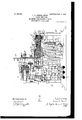
- Figure 1 represents in plan view a machine embodying the invention.
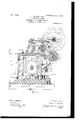
- Fig. Q' represents afront elevation, partially in section, of the same.
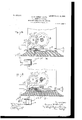
- Fig. 3 represents an end elevation of the machine.
- Fig. 4 represents a section on the line 4 4 of Fig. 2.
- Fig. 5 represents a similar section with the parts in a different position.
- Fig. 6 reprel a nut d4, between which and the end of the sents in elevation the opposite end of the machine.
- Fig. 7 represents the valves which control the passage of compressed air to the gage-spindle-operating devices ⁇
- Figs. 7 and 7b represent sectional views illustrating the mechanism for automatically stopping the machine.
- Fig. Q' represents afront elevation, partially in section, of the same.
- Fig. 3 represents an end elevation of the machine.
- Fig. 4 represents a section on the line 4 4 of Fig. 2.
- Fig. 5 represents a similar section with the parts in a different position.
- FIG. 7'c represents a partially-sectional perspective view and shows more or less conventionally the air ducts.
- Fig. 8 represents a transverse section through the gage-spindle holder or carrier on line 8 8 of Fig. 2.
- Fig. 9 represents in section a portion of the work-carrier.
- Fig. 1() represents the valve which initially controls the entrance of air toy the 'gage-spindle-controlling devices.
- Figs. 1]., l2, and 13 represent the gages and gage-spindles magnified about four times.
- a shaft b is ournaled in bearings in the said end standards and is provided with a series of cams, to be hereinafter described, which govern the operation of the various parts of the machine.
- This shaft is provided with a worin-wheel b, to which power is applied through a worm b2 from the main driving-shaft b3, mounted in bearings upon the base-plate a.
- the shaft b3 is driven from a counter-shaft by a belt or by any other suitable means, there being, if desired, clutch devices operatable through the action of one of the parts of the machine for stopping the rotation of the shaft when one cycle of operations has been completed.
- a shaft c Mounted in a bearing-bracket a, arising from -a top plate at, supported by the end standards a/ a2, is a shaft c, upon which is fulcrumed a flat plate or arm c', constituting a movable support for a carrier to be subsequently described.
- the outer free end of the arm is bifurcated, Fig. 1, and is constructed to receive a' transverse hollow shaft or arbor c2, rotatably supported in bushings c5 therein, Fig. 4.
- the shaft projects beyond the arm to receive a split collar c3, Figs. 2 and 3, having its ends connected by a screw c4, so as to hold the shaft c2 against axial or endwise movement.
- a ratchet-wheel cl On the other end of the shaft is formed a ratchet-wheel cl.
- a carrier for the wheels or parts A, having the pivots to be gaged, is attached to the outer face of the ratchet-wheel d, said carrier consisting of a disk d and a coacting ring d, having apertures to receive dowel-pins d2, projecting axially from the wheel (l, and said ring being held against the face of the disk by a locking device, such as shown in Figs. 6 and 9.
- This locking device consists of a pin d3, Fig. 2, passing through aconical sleeve dm, driven tightly into a tapering aperture in the shaft c2, said pin having on its threaded end sleeve a coiled spring ,d5 is placed.
- amilled head d On the end of the pin is secured amilled head d, provided with a radially-extended locking-bar 17, Figs. 6 and 9.
- the disk d/ is provided with a central aperture and slots d8 to receive the cross-bar d? when the latter is in position to pass through it, but when the milled head d is turned the bar Z7 is thrown out of alinement with the notches d8 and holds the carrier-disk d against the ratchet with a spring-pressure.
- the carrier-disk may be removed from the shaft c2 or placed thereon, as desired.
- the disk is cut away on its face near its outer edge, so as to leave a space between it and the ring du for the reception of the wheels or parts A.
- the disk and ring have alined apertures d d10, there being a socket X12 surrounding each aperture on the rear face of the disk and a corresponding socket (Z22 in the outer face of the ring, as best shown in Figs.- 11, 12, and 13.
- the ring d is removably secured to the disk by a series of locking devices d1,'Figs. 6 and 9, each device consisting of a milled head CX14, having a cross-bar (215, adapted to be set at an angle'to the slots d1 in the ring.
- a pin d Connected to the milled head d is a pin d, having a flange on its end and passed through the end of a thimble dlg in the disk d', there being aspring placed between the iianged end of the pin d1? and the thimble, so that the cross-bar d is held against the ring with a yielding pressure.
- the disk is provided with tapering dowel or steady pins du to project into apertures in the ring d, there being an additional pin di lying in a slot d20 in the ring, so as to determine their relative positions.
- the pins dm are preferably tapered, so that when the disk d and ring du are assembled prior to being fitted to the wheel d the said disk and ring may be brought together, so that the apertures which are provided for the pins d2, projecting from the Wheel ci', will be in alinement.
- the disk d and ring d are first assembled and are then iitted to the wheel d. If the disk d" and ring d were not properly assembled, it would be difficult to finally locate them with the pins d2 of the wheel d engaging the apertures that are formed in the disk d and ring d for said pins d2.
- the latter is removed and the disk is detached. Then the wheels A or other parts carrying the studs are placed in position, there being twenty apertures in the disk and in the ring for the reception of twenty wheels A.
- the pivots B are inserted in the apertures in the disk and their ends project into the sockets (K12 therein, the pivots C projecting through the apertures in the ring into the sockets d therein, so that they are both exposed and in position to receive the gages.
- I In order to impart a step-by-step movement to the work-carrier, so as to present each pair of pivots B C to the action of the gages, I employ the following devices.
- pawl e Figs. 3, 4, and 5 is pivoted upon one side of the carrier-support c and is held in engagement with the ratchet-wheel d by a coiled spring e, having one end attached to the support c and the other secured to a pin e2, projecting out from the hub of the pawl.
- Rigidly secured to the shaft c2 between the forked ends of the support c is a sleeve e3, Fig. 2, threaded at one end and having a flange e4 at the other end.
- a collar e5 is placed loosely on the sleeve e3 between the flange e4 and a nut e, screwed on the threaded end thereof, and in order to connect the collar frictionally to the sleeve friction-rings e7, of rubber or other suitable material, are interposed between it and the flange and nut.
- springs e71 are arranged in sockets in the sleeve and bear against a ring 672 between them and the friction-ring e7.
- the collar e5 has two radially-projecting iingers 673, Fig. 4, which straddle a stud es, eX-
- the support is raised and lowered by ya pneumatic device consisting of a piston 61 (shown in dotted lines in Figs. 3 and 7 c) in a vertical cylindrical aperture e100 in the block or extension a5.
- the piston has a rod e, eX- tending upward into contact with the under side of the arm or support c', so that when air is admitted to the cylinder below the piston the latter is raised, carrying with it the carrier-support; but when the air is cut olf the weight of the piston and the carrier, aided by a spring cs, causes them to drop back into normal position.
- Compressed air is admitted to the cylinder from a main through a valve, the movement of which is automatically controlled, air passing into the machine through a duct 4.
- the valve is indicated at f in Figs. 2 and 10 and is mounted in a valve-casingf, supported upon the base of the machine.
- a spring f2 abutting against the end of the valve and against a threaded plug f3, normally holds the valve forward, so that communication between the main inlet f4 and the ductf", which leads to the cylinder, is cut ofl", and consequently to shift the valve in the opposite direction to permit the passage of'air into the last-mentioned duct a curved lever f6, Fig.
- a shaft g Journaled in bushings g g in the arms as a, which project forwardly from the top plate a4 of the machine, is a shaft g, as shown in Figs. 2 and 7c. Midway between its ends is rigidly secured, by means of a screw g2, the gage-carrier, consisting of a sleeve g3, having enlarged ends which are hollowed out to form cylinders g4 for the purpose which T shall subsequently set forth.
- Each end of the carrier or sleeve g3 is formed with a series of axially-arranged V-shaped grooves g5, in which are placed longitudinallymovable gage-spindles h h', the spindles h being mounted in one end of the carrier and those at 7L being mounted in the other end thereof.
- Each set of gage-spindles is held movably in the carrier by a sleeve h2 forced thereon, and each of the sleeves is slotted, as at h3, Fig. 11, so that each of the slots registers with a spindle.
- a spring h4 is placed in each slot, and one end thereof is connected to a spindle and the other end is connected to the sleeve.
- the spindles consist of slender cylindrical pins, each having an enlarged head h5, Figs 11, 12, and 13, and in its inner end a tapering socket 7L to receive a holder in which a jewel hg or other gage or measuring device is placed.
- Each jewel has a minute cylindrical aperture which is greater than the aperture in the preceding jewel by a minute fraction of a centimeter-that is to say, the last gage of each set or series may have an aperture of eleven one-thousandths (.011) of a centimeter in diameter and the first one eighteen one-thousandths, (.0 1 8,) and as there are twelve gages in each setv the aperture of each intermediate gage will be one-twelfth of seven one-thousandths (.007) of a centimeter greater than the preceding one.
- the jewels and their holders gages lOO ' venient way For convenience I have termed the jewels and their holders gages lOO ' venient way.
- each gage has an extern al diameter small enough to permit it to enter any one of the sockets du or (Z22 in the work-carlier, and the gage-carrier is in such relation to the work-carrier that two gages (one of each set) are in alinement with each other and with the pivots on one of the parts A.
- the gages are held normally away from the carrier, and when they are released their springs h4 draw them forward yieldingly, so that the y gages which are in operative position would be drawn into engagement with the pivots B C of a wheel or part A, as shown in Figs. l2 and 13.
- the shaft g In order to rotate the gage-carrier, the shaft g is formed or provided with a ratchetwheel gio, and between the latter and a collar g, rigidly secured upon the end of the shaft, is placed loosely apartial pinion g7, there being friction disks or rings g8 g8 between this pinion and the ratchet-wheel and collar g, whereby it is frictionally engaged with the shaft g,
- springs g are placed in longitudinally-arranged sockets in the pinion g? and bear against a disk glo between the pinion g7 and one of the friction-rings gs.
- the pawl qu is pivoted upon the plate a4 and is held by a spring g12 in engagement with the ratchet g5, as shown in Fig. 6.
- wall a2 of the machine is thickened at its upper end to provide a cylinder 913, Fig. 6, one end of which is closed by an elongated plug g14 and the other end of which is closed by an apertured plug gf.
- the piston g1 is provided with a forwardly-projecting pistonrod g, having rack-teeth g18 meshing with the teeth of the pinion (17. The piston is normally in its forward position, as shown in Fig.
- a lever g2g similar to that at]m and shown in dotted lines in Fig. 6, is fulcrumed in upwardly-projecting arms and has one end pressed against the valve gi and the other end bearing against a cam 923 upon the camshaft b.
- This cam has twelve rises, and there are twelve teeth to the ratchet-wheel g5", so that for each revolution of the shaft t the gage-carrier is actuated twelve times and 'but each time the gage-carrier is moved forward one step the lgages are released and are allowed to be drawn forward by their springs into operative relation to the pivots.
- a hollow piston i is placed loosely on the shaft g in each of the cylinders gd of the carrier and is provided with a flange i, adapted to engage the heads h5 of the gagespindles 7L 7M, as shown in Figs. 11 to 13, inelusive.
- a spiral spring i2 is placed upon the hub of each piston and bears against the bushing g, so that if other means were not interposed the pistons would be held inward against the gage-carrier.
- each air-duct i3 communicates with an annular duct i4 in the bushing g', as shown in Fig. 2.
- Each of the ducts i4 communicates through a duct 5 (see Figs. 7 and 7C) with a duct i in a valve-casing
- the ducts i i7 lead into transverse ducts is i, either of which communicates with the ducts i i, there being two valves im i, which control the entrance of air from either of said ducts i8 or i into the ducts i6.
- the valves im i are adapted to be raised by springs i12; but they are held normally depressed by latches fils, Fig. 4, arranged side by side and each pivoted in a groove in the valve-casing.
- the latches are shown in Fig. 4, and they are provided with lips, which engage shoulders on the valve, so as to hold them depressed against the pressure of the springs i, which tend to raise them.
- valve t will be reciprocated at intervals to permit compressedair to pass through the duct t7 into the ducts 'i5 and from thence to the cylinders g4, and as the supply is cut off at intervals for a short time the spring i2 is allowed to force the piston i inward intermittingly to permit the gages to move into operative relation to the pivots. Under normal conditions this inward movement of the piston i is permitted immediately after the gage-carrier has been fed forward one step.
- the gages are arranged in such order that the aperture in the first jewel is the largest and those in the rest diminish gradually in diameter,and consequently when the gages are thrust into operative relation to the pivots the pivots, if they are smaller than the apertures in the gages, enter therein easily, as shown in Fig. 12, and so long as the pivots are able to enter the apertures they must necessarily be less in cross-diameter than the apertures; but as soon as a jewel is reached in which the aperture is exactly the same diameter as that of the pivot the jewel cannot be slipped onto the pivot, and the inward movement of the gage spindle is checked, as shown in Fig. 13. Then as the apertures in the gages are all known the diameter of the pivot is readily ascertained.
- the two sets of gages are entirely independent of each other so far as the movement of the individual gage-spindles is, concerned; but the two sets are revolved with the gagecarrier simultaneously, so that two opposing spindles are moved'in unison into operative position with relation to the work.
- lugs 7c, Figs. 1 and 6, extending upward from the plate a are two centrally-pivoted independently-movable levers Zc, each having in its forward projecting end a pin k2, provided at one end with a disk or head k3 and on the other end with an adjusting-nut Zci.
- Each pin is mounted in the split sleeve at the end of one of the levers 7c and is held frictionally against lmovement in the direction of its length except when adjusted by the nut Zr, which is screwed upon the threaded end thereof and bears against the end of the sleeve.
- the disks 7c3 are so mounted with respect to the gage-carrier that the disks 7c3 are immediately over the heads h5 of the two gage-spindles which are in alinement with the studs whose diameters are to be ascertained, as shown in Figs. 2, 6 and 11 to 13, and they are likewise so placed that when the gage-spindles are thrust forward until the studs enter the apertures in the jewels the front ends of the levers k cannot be depressed, as the disks k3 will engage the said heads h5, as shown in Fig. 12.
- the head h5 thereof is not directly under the disk Zcs, and consequently the forward end of that lever Zc may be depressed to a greater extent.
- each lever k having the pin and disk a feeler, which is adapted to be vibrated by means now to be described.
- cams Z Z Upon the shaft Z) are placed two cams Z Z, Figs. 2 and 7a, each having twelve notches or depressions, and fulcrumed in brackets depending from the plate a4 are two levers Zl Z, each having a pin Z2 extending over one of the cams Z.
- the forward end of each of the levers project under a pin Z3, mounted in suitable guides and having its upper end bearing a ainst the under side of the inner end of one of the levers ZC.
- Each spring Z5 and contact Z6 is in circuit with an electromagnet m by wires m m2, as illustrated conventionally in Fig. 4. In practice the wires will pass through insulated tubes m3 m4 and thence under the base of the ma- IOO IIO
- each electromagnet is connected to one of the latches il, and hence so long as the spring Z5 remains in contact with the contact l the circuit is closed through each magnet and the two latches t are held in engagement with their respective valves 10 im; but when a gage has been brought into operative relation to one of the pivots and has been found to have an aperture of the diameter equal thereto, whereupon the forward end of the feeler can be depressed, (the cam Z being in position whereby one of its depressions register with the pin 12,) the spring-pressed pin Z4 forces downward the rear end of the lever and also forces the spring Z5 away from the contact Z6 to break the circuit through one of the magnets m, whereupon the armature m is released and the spring i12 forces the valve im upward to close the duct i7 and open communication between the duct i and the duct t5, which leads to the cylinder on that
- the two feelers are independent of each other, as stated, and the pneumatic devices for operating the gage-spindles are likewise independent, so that although the gages on one side of the carrier may be held in an inoperative position the gages on the other end may be operated until the diameter of the pivot' or work-carrier on that side has been ascertained.
- a bushing n Secured upon the end of the shaft g, Fig. 4, is a bushing n, to which is keyed a ring n, having on its periphery types or stencils bearing 'numerals n2 n, Fig. 2, arranged in two, sets and placed side by side, the said numerals indicating the diameters of the gages.
- rlwo platens n4 (one of which. is shown in Figs. 3, 4, and 5) are mounted upon the ends of pins fc5, longitudinally movable in guides n and normally held at a slight distance away from the numeral-bearing ring, as shown in Fig. 4, by the paper strip D, hereinafter described.
- Said paper strip in the operation of the machine is always under su'll'icient tension to hold it in the position shown in said 'ligure when pressed against the numeralbearing ring, afs hereinafter described, and they are so arranged that one platen is opposite each set of numerals.
- the inner ends of the pins ns project inwardly and are in position to be struck by two hammers a7, fulcrumed upon a shaft as, held in suitable bearings.
- the hammers p7 are in the form of bell-crank levers, and their arms rest upon the tops of the valves 10 im. connection with Fig. 7G.)
- a strip of paper D is drawn from a reel 0, supported upon the top of the machine, past a stud o and downward between the platens and the numeralbearing ring, and an ink-ribbon is wound upon the shafts o2 03, which are provided with milled heads, as shown in Fig. 2.
- the ribbon is fed forward at times by hand, but the record-strip D is fed one step each time the work-carrier is actuated.
- This arm p2 is movable between stopspf p5, (shown in Fig.
- valves il@ in are returned to their normal positions to provide for the admission of the compressed air to the pneumatic devices which move the gage-spindles.
- levers g, Figs. 4 and 5 are fulcrumed upon a shaft g, supported in ICO bearing-brackets g2 in the rear of the machine, and their front ends project through apertures in the valve-casing y' and rest upon the lower flanged ends of the valve fi10 1111, as shown in Figs. 4 and 5.
- One of the levers is provided with a pin g3, with which a cam g4 on the shaft l), as clearly shown in Fig. 5, engages once during each revolution thereof.
- the parts are timed to cause the depression of the levers q immediately before the completion of one cycle of operations of the machine or during the movement of the work-carrier after the record for a pair of pivots has been made.
- a ratchet or toothed wheel T In order to bring the machine to a stop after all the pairs of pivots in the pivot-carrier have been measured and their diameters recorded, I mount upon a stud-shaft T in the rear of the machine a ratchet or toothed wheel T, Figs. 5, 70, and 711, to which a stepby-step movement is imparted by the en gagement therewith of a pin T2 on the cam l, which is at the right end of the machine.
- a disk T3,having a single notch T4 is formed on or secured to the ratchet or toothed wheel, and against it bears a centrally-fulcrumed curved lever T5, whose lower end presses against a valve T0. (Shown in Figs. 7 a and 71j and in dotted lines in Fig. 3.)
- the valve slides in a valve-casing to which air is admitted from the main duct 4 by a duct T7 and is normally held against the pressure of a spring T2 to cut off the air-supply from a pipe T0.
- a spring T2 to cut off the air-supply from a pipe T0.
- the said duct leads into a cylinder T10., in which there is a piston T11, having its rod T12 connected to a lever T13.
- This last-mentioned lever is connected to clutch and brake mechanism, (not shown,) which controls the movement of the initial power-shaft b2, and consequently when air is admitted to the cylinder T10 the power is shut off from the said shaft and the brake mechanism immediately prevents further movement of the same.
- valve-rod is formed with a small port T15, (see dotted lines in Figs. 7a and 711,) and the inner end of said port T15 registers with the port leading to the pipe T9 when the valve-rod is shifted to cut off the supply of air from the duct T2.
- Said port T15 serves as a vent, so that the air in cylinder T10 may exhaust to the atmosphere to permit the lever T13 to beoperated, so that power may be again supplied to the power-shaft b3.
- the operation of the machine may be I erated and cause the rotation of the main power-shaft b through the shaft b3.
- valve i12 is operated by the lever 15 and the cam T10 to cut off the air from the cylinders g1, formed by the sleeves g, and permit the springs i2 to force the pistons i toward each other, and thereby allow the springs h4 to draw the gages h into operative position with relation to each of the two pivots on the staff being measured and into engagement with the said pivots.
- the first pair of gages have the largest apertures in their ends, and if the pivots are smaller than the apertures they enter therein.
- the feelers are operated by the levers l and the disks 761 pass freely by the heads of the gages and prevent the circuit being broken between the contacts Z5 Z0, as seen in Fig. 5, and the operation of the recording mechanism.
- air is admitted first to the rear end of the cylinder g13 and then to the front end thereof by means of the cam 923, the lever 922, and the valve 921 to advance the gage-carrier one step to bring two new gages a size smaller into alinement with the pivots.
- These gages are brought into operative relation with the pivots, and if the apertures therein are adequate to receive the ends of the pivots the recording mechanism is again prevented from being actuated.
- the springs i12 raise the plungers 9110 and cause the hammers 'n2 to engage the plungers Tf, which carry the platens n4.
- the platens force the tally-sheet against the numerals on the gage-carriers, and the diameters of the pivots, which are then in engagement with the gages, are automatically recorded upon the said sheet.
- air is permitted to enter from the open ducts @'01 'is into the ducts i, so as to hold the pistons i back- IOO IIO
- valvej/ is operated by the camf7 and leverf" to admit air to the cylinder e100 and also the cylinder p.
- the piston 7) is forced downward to swing the arm p2 and actuate the arm a7 to feed the record sheet or strip of paper D, and at the same time the piston @10 is raised to rotate the ratchet d one step, this being accomplished by its lifting the lever c until the pawl c engages the next succeeding tooth in the ratchet, whereupon when the said lever c drops a new stall" is presented to the action of the gages.
- the work carrier or holder is referredto in some of the claims as having relatively movable members.
- said members comprise the disk d and the ring d, between which the Work is held.
- the ring d is movable relatively to the disk d/ for the purpose of inserting and removing the work.
- a machine of the character described comprising a holder having relatively movable members for holding a pivot against displacement, a plurality of gages each having an aperture differing in its known diameter from that of the others, and mechanism for automatically bringing said pivot and said gages into operative relation while said pivot is held or carried by the holder.
- a machine of the character described comprising a holder having clamps, for a pivot, a plurality of gages each having a jewel with an aperture of a known diameter, and automatic mechanism 'for bringing said pivot and said jewels into operative relation while said pivot is carried by said holder.
- a machine of the character described comprising a holder having provisions for clamping a pivot therein, a plurality of gages each having a jewel with an aperture of a known diameter, and automatic mechanism for moving said gages in succession into operative relation to said pivot.
- a machine of the character specied comprising a holder having relatively movable members having provisions for clamping the article being measured, measuring devices, and mechanism for causing said devices to measure the diameter of a part or feature of said article.
- a machine of the character specilied comprising a holder with provisions for clamping or securing the articles being measured, measuring devices, and mechanism for causing said devices to measure and record the diameter of a part or 'feature of said article.
- a machine of the character described having a holder for the article to be measured 'and a plurality of measuring-gages for automatically measuring each of two different parts of said article.
- a machine of the character described having a holder for the article to be measured and a plurality of measuring-gages for automatically measuring and independently recording the measurements of each of two different parts or features of said article.
- a machine of the character described comprising a plurality of gages, a holder having relatively movable members independent of the gages for the articles to be measured, means for moving said holder to present said articles to each of said gages, and means for bringing each article and said gages successively into engagement until said article is measured.
- a machine comprising a plurality of gages, a holder having lrelatively movable members independent of the gages for a plurality of articles to be measured, means for automaticallymoving said holder, and mechanism for automatically causing the pivot and gage to engage without dislocating said article from its holder.
- a machine comprising a holder having relatively movable members for receiving and holding a pivot or thing to be measured
- a machine comprising a rotary holder having relatively movable members for receiving a pivot or thing to be measured, a carrier having a plurality of graded gages, mechanism for imparting a step-by-step movement to said holder to present the pivots or things to be measured successively to the gages, and mechanism for causing said gages to .measure said pivot without removing it from said holder.
- Amachine for measuring the pivot on the end of a balance staff comprising a holder having provisions for receiving and rigidly holding said staff, a plurality of independent meas'uring devices for measuring the cross-diameter of the said pivot, and automatic mechanism for causing said holder to present said pivot to said measuring mechanism.
- a machine having a holder having relatively movable members for receiving and rigidly holding a thing to be measured, a plurality of gages for measuring said thing, and means for'causing said thing and said gages to be brought into operative relation.
- a machine comprising a series of gages, a holder having relatively movable members for receiving and rigidly holding an article to be measured, mechanism for causing the article to be brought into operative relation to the gages until a gage corresponding to the article is reached.
- a machine of the character described comprising a holder having relatively movable members for clamping an article to be measured, and a series of gages each movable into operative relation to said article.
- a machine of the character described comprising a pivot-holder having provisions for clamping an article to be measured, a gage-carrier having a series of gages, and mechanism for moving said carrier to bring said gages successively into operative relation to an article.
- a machine of the character described comprising a holder having relatively movable members for an article to be measured, a rotary carrier having a series of gages, and mechanism for imparting a step-by-step movement to the carrier to bring ythe gages successively into operative relation to said article.
- a machine of the character described comprising aholder for the article to be measured, a carrier having. a series of movable gages, mechanism for moving the carrier to bring the gages successively into alinement with said'article, and mechanism for bringing the gages into lcontact with said article.
- a machine of the character described comprising a holder, for the article to be measured, a series of independently-movable gages, mechanism for bringing said gages successively into engagement with said article, and automatic devices for holding the rep maining gages out of contact with said article after a gage corresponding to said article has been engaged therewith.
- a machine of the character described comprising a holder for the article to be measured, a series of movable gages, mechanism for bringing said gages successively into engagement with the said article, a feeler, in operative relation to said gages, and mechanism controlled by said feeler for governing the movement of the gages.
- a machine of the character described comprising a holder for the article to be measured, a carrier, a series of graded gages mounted on said carrier and movable into engagement with said article, a pneumatic device for controlling the movement of the gages, and a Jfeeler in operative relation to said gages for controlling the pneumatic device.
- 'A machine of the character described comprising a holder for the article to be measured, a carrier having a series of movable gages, a pneumatic device for moving the gages, a regularly automatically moving valve'controlling the passage of air to said pneumatic device, a feeler in operative relation to the gages, and supplemental devices controlled by the feeler for cutting the iirst said supply to the pneumatic.device when a gage corresponding to the pivot is presented thereto.
- a machine of the character described comprising a pivot-holder having relatively movable members, a series of automaticallyacting measuring devices, each having an aperture of a known diameter, and means for bringing said pivots and said apertures successively into alinement.
- a machine of the character described comprising a pivot-holder, a series of measuring devices, each consisting oi a jewel having an aperture of a predetermined diameter, and automatic devices for moving and presenting them successively to the pivot.
- a machine of the character described comprising a holder having means for clamping a pivot, a series of measuring devices, each having an aperture of a known diameter different from that of any of the others, and mechanism including va movable carrier for engaging said devices with the pivot, in order beginning with that having the aperture of the largest diameter.
- a machine of the character described comprising a recording device, a series of graded gages, mechanism for automatically presenting said gages one by one to the pivot to be measured, and mechanism for' operating IOO TIO
- a machine of the character described comprising a work-holder, a series oi graded gages, mechanism for presenting said gages one by one to the work carried by said holder, devices for holding a record-sheet, and devices for making a record oi the diameter of each piece of work upon the sheet.
- a machine of the character described comprising a work-holder having relatively movable members, a series of graded gages, mechanism for presenting said gages one by one to the work carried by said holder, and a device having symbols designating the internal diameters of the gages and moving simultaneously with the gages.
- a machine of the character described comprising a work-holder, a series of graded gages, mechanism i'or presenting said gages, one by one, to the pivot, a device having symbols designating the internal diameters of the gages, and moving simultaneously with the gages, and mechanism for bringing a recordsheet against a symbol when a gage corresponding to the pivot is presented thereto.
- a machine of the character described having provisions for automatically measuring and recording the diameter of a predetermined number of pivots in succession, and provisions for stopping the machine automatically when the diameters of said pivots have been recorded.
- a machine oi the character described comprising two independent sets of measuring devices and a carrier located between said sets of measuring devices for presenting the two pivots of a balance-wheel or other part of a watch simultaneously to the said devices.
- a machine of the character described comprising a holder for the pivots to be measured, means for supporting a record-sheet, two independent sets of oppositely-arranged graded gages, and mechanism controlled by said gages for recording on said record-sheet the measurements of the pivots.
- a machine of the character described comprising measuring devices, and a carrier for presenting the pivots to the said devices,
- said carrier consisting of two separable clamps having alined apertures to receive the pivots whereby said pivots are held rigidly while being measured.
- a machine of the character described comprising a pivot-carrier, two independent sets oi measuring devices, means Jfor supporting a record-sheet, a device having two sets of symbols, and placed in operative relation to the record-sheet, a feeler for each set of gages, and two independent hammers each controlled by one of the feelers, and each arranged to strike the record-sheet against one ofthe symbols.
- a machine comprising recording mechanism, devices for measuring the diameter of the thing to be measured, means for automatically presenting the thing to be measured to the measuring device, and mechanism for operating the recording mechanism when the said thing is measured.
- a machine comprising mechanism, for measuring the diameter of the thing to be measured and for recording the measurements, means for automatically presenting the thing to be measured to the measuring device, and mechanism controlled by the measuring devices for automatically operating the recording mechanism.
- a machine of the character specified comprising a holder for the articles to be measured, a plurality of gages, a carrier for said gages, means for moving said gages to present them one by one to one oi' said articles, and means for moving said holder to present said articles in succession to said gages.
- a machine of the character described comprising a holder for the article to be measured, measuring devices for ascertaining the diameter of said article, and pneumatic mechanism for automatically causing said devices to measure said article.
- a machine oi the character described comprising a holder having relatively movable members for the article to be measured, a plurality of gages, said article and said gages being adapted to pass one into the other, and means for causing said gages to successively move into operative relation to said article while it is ⁇ in the holder without dislocating said article.
Landscapes
- Physics & Mathematics (AREA)
- General Physics & Mathematics (AREA)
- A Measuring Device Byusing Mechanical Method (AREA)
Description
No. 809,248. PA'TBN'I'ED JAN.2, 1906.. D. H. CHURCH, DECD.
H. L. oHUBoH, EXEGUTRIX. MACHINE FCR GAGING PIVO'IS.
APPLICATION FILED MAY 5, 1898.
9 SHEETS-SHEET l.
INVENTU R WWEESE No. 809,248. PATENTED JAN. 2, 1906. D. H. CHURCH, DECD. n. L. ommen, ExnoUTBIx. MACHINE FOR GAGING PIVOTS.
9 SHEETS-SHEET 2.
APPLICATION FILED MAY 5, 1898.
Li INVENTEJR: lf- PLM/Q M WTNEEEES:
No. 809,248. PATENTED JAN. 2, 1906.
' D. H. CHURCH, DEGD.
H. L. CHURCH, EXEGUTRIX. MAGHINE POR GAGING PIVOTS.
A PPLIGATION FILED HAYE, 1898.
9 SHEETS-SHEET 3.
WWNEEEEE Ma A No. 809,248. PATENTED JAN. 2, 1906. D. H. CHURCH, DECD.
H. L. CHURCH, BXEGUTRIX. MACHINE FOR GAGINC PIVOTS APPLICATION FILED MAY, 1898.
9 SHEETS-SHEET 4.
INVPLNTCJ Fl;
@@@wf #WiWinm 0 9 1 21 Nh A TU D E T N E T A P mmm UM ET Dm E Mm mm Hm CH no HL DE om A.. 2 9; 0 8 nw N 'MACHINE FOR GAGING PIVOTS.
APPLICATION FILED MAY 5, 1898.
9 SHEETS-SHEET 5.
6. O 9 1|. 2f N. A TJ D E T N ...L T A P ,u C E D H, C R U H C H.. D. oo. 4 2, 9 O 8 0. N
H. L. CHURCH, BXEGUTRIX. MACHINE PUR GAGING PIVOTS.
APPLICATION FILED MAY 5, 1898.
9 SHEETS--SHEBT 6.
WITNSEE.; MQW
No. 809,248. PATENTED JAN. 2, 1906. D. H. CHURCH, DECD.
H. L. CHURCH, EXBGUTRIX. MACHINE POR GAGING PIVOTS.
' APPLICATION FILED MM5, 1898.
9 SHEETS-SHEET 7.
' Pegg/ 4 1o INVENTDR:
A f' WITN E 55 E E' j '//l//l//l//f//l// QM() l l #www um l *wmg PATBNTED JAN. 2, 1906,. D. H. CHURCH, DECD.
H. L. CHURUH, BXEGUTRIX. MACHINE POR. GAGING PIVOTS.
APPLIOATION FILED MAY 5, 1898.
9 SHEETS-SHEET s.
INVENTUR:
D. H. GHURCH, DECD. H. I.. GHUHUH, EXEOUTBIX.
4MACHINE FOR GAGING PIVOTS.
APPLIUATION FILED MAY 5, 1898.
PATENTED JAN.2, 1906.
9 SHEETS--SHEET 9.
WITNEEEEE:
0. /VWz/J Y 8MM/.Q aan@ UNITED NSTATES PATENT OFFICE.
DUANE H. CHURCH, OF NEWTON, MASSACHUSETTS; HARRIET L. CHURCH EXECUTRIX CF SAID DUANEH. CHURCH, DECEASED.
Specication of Letters Patent.
Patented Jan. 2, 1906.
Application filed May 5, 1898. Serial No. 679,776.
To all whom, it may concern:
Be it known that I, DUANE H. CHURCH, of Newton, in the county of Middlesex and State of Massachusetts, have invented certain new and useful Improvements in Machines for Graging Pivots, of which the following is a specification. y
This invention has for its object the provision of a machine for automatically gaging the pivots of balance-wheels or other rotating or oscillating parts of a watch and automatically recording the thickness or diameter of each. By reason of the minuteness of the pivots of such parts of a watch as those mentioned it is practically impossible at the present time and with the machines now known to turn and polish them equally or to the same extent, so that they shall be exact duplicates or facsimiles of each other; but inasmuch as they must be fitted with great exactness in the jewels in which they are journaled it is necessary to ascertain the precise diameter of each pivot, whereby a jewel having an aperture of corresponding size may be z 5 selected to receive it.
Heretofore it has been the practice to gage each pivot manually by the aid of calipers or other measuring device and then note upon a slip of paper or in some other way its diameter and thickness; but on account of the smallness of the parts and of the fact that the pivots are gaged to the fraction of one-thousandth part of a centimeter thin has been a laborious and difficult operation, requiring the expenditure of a great deal of time and not always proving to be accurate. Moreover, inasmuch as the pivots are rarely ever exactly cylindrical it has been the practice to take the measurement of the greatest crossdiameter of each pivot, and consequently it is difficult to select a jewel having the proper aperture to receive it, since the apertures in the jewels likewise vary. The operation of gaging the pivot by calipers or other tools having jaws has proved to be a source of injury to the pivots, as the pressure of the jaws flattens them and destroys to a greater or less extent their symmetry. v
By the present invention the pivots are gaged automatically and their diameters are recorded, whereby the operation is accomplished expeditiously and accurately without the employment of special skilled labor, since the operator is required merely to place the wheels or parts carrying the pivots in a carrier which automatically presents them lto the proper gaging devices. The gaging or measuring is accomplished with the aid of a series of gages, each having an aperture smaller than the preceding one by a fraction of one-thousandth part of a centimeter, the gages being brought successively into operative relation to the pivot until one is found that has an aperture exactly equal in diameter to the pivot. In this way there is no danger of flattening the pivot and injuring it.
Before proceeding to a minute and detailed description of the invention T may briefly state that the machine illustrated upon the drawings as embodying it comprises a movable carrier into which the parts having the pivots are placed, a series of gaging devices such as just described, mechanism for bringing each gage into operative relation to the pivot, and devices for recording the VVdiameter of the aperture in the gage which corresponds to the pivot. f
' The carrier is provided for the reception of a number of pivots, and they are presented one by one to the gages, which are successively brought into engagement with each pivot until a gage is found which corresponds to the diameter of the pivot, whereupon the diameter of the pivot is immediately recorded upon a record-sheet.
The gages are all mounted upon a rotatable carrier, and as soon as the diameter of the pivot is ascertained the next succeeding gages are all held in an inoperative position until a new pivot is presented tofthem. By reason of there being two pivots for each wheel or oscillating part there are two sets of gages, and the recording devices are arranged to record the diameters of each two pivots side by side upon the record-sheet.
Reference is to be had to the accom anying drawings, and to the letters and gures marked thereon, forming a part of this specification, the same characters designating the same parts or features, as the case may be, wherever they occur.
Of the drawings, Figure 1 represents in plan view a machine embodying the invention. Fig. Q'represents afront elevation, partially in section, of the same. Fig. 3 represents an end elevation of the machine. Fig. 4 represents a section on the line 4 4 of Fig. 2. Fig. 5 represents a similar section with the parts in a different position. Fig. 6 reprel a nut d4, between which and the end of the sents in elevation the opposite end of the machine. Fig. 7 represents the valves which control the passage of compressed air to the gage-spindle-operating devices` Figs. 7 and 7b represent sectional views illustrating the mechanism for automatically stopping the machine. Fig. 7'c represents a partially-sectional perspective view and shows more or less conventionally the air ducts. Fig. 8 represents a transverse section through the gage-spindle holder or carrier on line 8 8 of Fig. 2. Fig. 9 represents in section a portion of the work-carrier. Fig. 1() represents the valve which initially controls the entrance of air toy the 'gage-spindle-controlling devices. Figs. 1]., l2, and 13 represent the gages and gage-spindles magnified about four times.
Referring to the drawings, which illustrate one embodiment of the invention selected by me as being best adapted to accomplish the gaging of the pivots7 a indicates the baseplate, and c a.2 indicate the end standards supported thereon. A shaft b is ournaled in bearings in the said end standards and is provided with a series of cams, to be hereinafter described, which govern the operation of the various parts of the machine. This shaft is provided with a worin-wheel b, to which power is applied through a worm b2 from the main driving-shaft b3, mounted in bearings upon the base-plate a. The shaft b3 is driven from a counter-shaft by a belt or by any other suitable means, there being, if desired, clutch devices operatable through the action of one of the parts of the machine for stopping the rotation of the shaft when one cycle of operations has been completed.
Mounted in a bearing-bracket a, arising from -a top plate at, supported by the end standards a/ a2, is a shaft c, upon which is fulcrumed a flat plate or arm c', constituting a movable support for a carrier to be subsequently described. The outer free end of the arm is bifurcated, Fig. 1, and is constructed to receive a' transverse hollow shaft or arbor c2, rotatably supported in bushings c5 therein, Fig. 4. At one end the shaft projects beyond the arm to receive a split collar c3, Figs. 2 and 3, having its ends connected by a screw c4, so as to hold the shaft c2 against axial or endwise movement. On the other end of the shaft is formed a ratchet-wheel cl.
A carrier for the wheels or parts A, having the pivots to be gaged, is attached to the outer face of the ratchet-wheel d, said carrier consisting of a disk d and a coacting ring d, having apertures to receive dowel-pins d2, projecting axially from the wheel (l, and said ring being held against the face of the disk by a locking device, such as shown in Figs. 6 and 9. This locking device consists of a pin d3, Fig. 2, passing through aconical sleeve dm, driven tightly into a tapering aperture in the shaft c2, said pin having on its threaded end sleeve a coiled spring ,d5 is placed. On the end of the pin is secured amilled head d, provided with a radially-extended locking-bar 17, Figs. 6 and 9. The disk d/ is provided with a central aperture and slots d8 to receive the cross-bar d? when the latter is in position to pass through it, but when the milled head d is turned the bar Z7 is thrown out of alinement with the notches d8 and holds the carrier-disk d against the ratchet with a spring-pressure.
Thus it will be seen that the carrier-disk may be removed from the shaft c2 or placed thereon, as desired. The disk is cut away on its face near its outer edge, so as to leave a space between it and the ring du for the reception of the wheels or parts A. The disk and ring have alined apertures d d10, there being a socket X12 surrounding each aperture on the rear face of the disk and a corresponding socket (Z22 in the outer face of the ring, as best shown in Figs.- 11, 12, and 13.
The ring d is removably secured to the disk by a series of locking devices d1,'Figs. 6 and 9, each device consisting of a milled head CX14, having a cross-bar (215, adapted to be set at an angle'to the slots d1 in the ring. Connected to the milled head d is a pin d, having a flange on its end and passed through the end of a thimble dlg in the disk d', there being aspring placed between the iianged end of the pin d1? and the thimble, so that the cross-bar d is held against the ring with a yielding pressure. The disk is provided with tapering dowel or steady pins du to project into apertures in the ring d, there being an additional pin di lying in a slot d20 in the ring, so as to determine their relative positions. The pins dm are preferably tapered, so that when the disk d and ring du are assembled prior to being fitted to the wheel d the said disk and ring may be brought together, so that the apertures which are provided for the pins d2, projecting from the Wheel ci', will be in alinement. In other words, the disk d and ring d are first assembled and are then iitted to the wheel d. If the disk d" and ring d were not properly assembled, it would be difficult to finally locate them with the pins d2 of the wheel d engaging the apertures that are formed in the disk d and ring d for said pins d2.
To place the work in the carrier, the latter is removed and the disk is detached. Then the wheels A or other parts carrying the studs are placed in position, there being twenty apertures in the disk and in the ring for the reception of twenty wheels A. The pivots B are inserted in the apertures in the disk and their ends project into the sockets (K12 therein, the pivots C projecting through the apertures in the ring into the sockets d therein, so that they are both exposed and in position to receive the gages.
IOO
TIO
IIS
ISO
In order to impart a step-by-step movement to the work-carrier, so as to present each pair of pivots B C to the action of the gages, I employ the following devices.
pawl e, Figs. 3, 4, and 5, is pivoted upon one side of the carrier-support c and is held in engagement with the ratchet-wheel d by a coiled spring e, having one end attached to the support c and the other secured to a pin e2, projecting out from the hub of the pawl. Rigidly secured to the shaft c2 between the forked ends of the support c is a sleeve e3, Fig. 2, threaded at one end and having a flange e4 at the other end. A collar e5 is placed loosely on the sleeve e3 between the flange e4 and a nut e, screwed on the threaded end thereof, and in order to connect the collar frictionally to the sleeve friction-rings e7, of rubber or other suitable material, are interposed between it and the flange and nut. To increase the friction, springs e71 are arranged in sockets in the sleeve and bear against a ring 672 between them and the friction-ring e7. The collar e5 has two radially-projecting iingers 673, Fig. 4, which straddle a stud es, eX-
tending laterally from a post e9, supportedl upon a forwardly-projecting extension or block a5 of the bracket a3. Hence when the nut e has been adjusted to bind the collar e5 friction-tight to the sleeve e3 and shaft e2 the upward movement of the support c on its fulcrum c will cause the shaft c2 to turn in its bearings, as the collar is prevented from rotating, and the pawl e to slide over a tooth in the ratchet-wheel. Then when the support is allowed to drop the pawl engaging .a tooth of the ratchet prevents the shaft and the carrier from turning in a retrograde direction, and consequently the carrier returns to position, having been advanced one step. In its return movement the collar e5 turns upon the sleeve c3, so that when the support is again raised and lowered the same operation will be performed.
The support is raised and lowered by ya pneumatic device consisting of a piston 61 (shown in dotted lines in Figs. 3 and 7 c) in a vertical cylindrical aperture e100 in the block or extension a5. The piston has a rod e, eX- tending upward into contact with the under side of the arm or support c', so that when air is admitted to the cylinder below the piston the latter is raised, carrying with it the carrier-support; but when the air is cut olf the weight of the piston and the carrier, aided by a spring cs, causes them to drop back into normal position. Compressed air is admitted to the cylinder from a main through a valve, the movement of which is automatically controlled, air passing into the machine through a duct 4. (Shown in Figs. 6 and 7 C.) The valve is indicated at f in Figs. 2 and 10 and is mounted in a valve-casingf, supported upon the base of the machine. A spring f2, abutting against the end of the valve and against a threaded plug f3, normally holds the valve forward, so that communication between the main inlet f4 and the ductf", which leads to the cylinder, is cut ofl", and consequently to shift the valve in the opposite direction to permit the passage of'air into the last-mentioned duct a curved lever f6, Fig. 2, is fulcrumed in an upward extension of the casing f and has one end resting against the project- -ing end of the valve and the other end resting against a camf on the shaft b. There is but one rise upon the cam, so that during each rotation thereof the lever f6 is swung about its fulcrum to press back the valve f for the purpose of admitting air to the cylinder and raising the piston elo and the support c. There is an eXhaust-portf71, which extends through the valve, as shown in Fig. 10,which permits the air from the cylinder to be discharged after the valve is returned to normal position by the spring f2.
I shall now proceed to describe the gages and mechanism for bringing them successively' into operative relation to the pivots B and C for the purpose hereinbefore referred to.
Journaled in bushings g g in the arms as a, which project forwardly from the top plate a4 of the machine, is a shaft g, as shown in Figs. 2 and 7c. Midway between its ends is rigidly secured, by means of a screw g2, the gage-carrier, consisting of a sleeve g3, having enlarged ends which are hollowed out to form cylinders g4 for the purpose which T shall subsequently set forth. Each end of the carrier or sleeve g3 is formed with a series of axially-arranged V-shaped grooves g5, in which are placed longitudinallymovable gage-spindles h h', the spindles h being mounted in one end of the carrier and those at 7L being mounted in the other end thereof. Each set of gage-spindles is held movably in the carrier by a sleeve h2 forced thereon, and each of the sleeves is slotted, as at h3, Fig. 11, so that each of the slots registers with a spindle. A spring h4 is placed in each slot, and one end thereof is connected to a spindle and the other end is connected to the sleeve. The spindles consist of slender cylindrical pins, each having an enlarged head h5, Figs 11, 12, and 13, and in its inner end a tapering socket 7L to receive a holder in which a jewel hg or other gage or measuring device is placed. Each jewel has a minute cylindrical aperture which is greater than the aperture in the preceding jewel by a minute fraction of a centimeter-that is to say, the last gage of each set or series may have an aperture of eleven one-thousandths (.011) of a centimeter in diameter and the first one eighteen one-thousandths, (.0 1 8,) and as there are twelve gages in each setv the aperture of each intermediate gage will be one-twelfth of seven one-thousandths (.007) of a centimeter greater than the preceding one. For convenience I have termed the jewels and their holders gages lOO ' venient way.
The end of each gage has an extern al diameter small enough to permit it to enter any one of the sockets du or (Z22 in the work-carlier, and the gage-carrier is in such relation to the work-carrier that two gages (one of each set) are in alinement with each other and with the pivots on one of the parts A. The gages are held normally away from the carrier, and when they are released their springs h4 draw them forward yieldingly, so that the y gages which are in operative position would be drawn into engagement with the pivots B C of a wheel or part A, as shown in Figs. l2 and 13.
In order to rotate the gage-carrier, the shaft g is formed or provided with a ratchetwheel gio, and between the latter and a collar g, rigidly secured upon the end of the shaft, is placed loosely apartial pinion g7, there being friction disks or rings g8 g8 between this pinion and the ratchet-wheel and collar g, whereby it is frictionally engaged with the shaft g, In order to increase the friction, springs g are placed in longitudinally-arranged sockets in the pinion g? and bear against a disk glo between the pinion g7 and one of the friction-rings gs.
The pawl qu is pivoted upon the plate a4 and is held by a spring g12 in engagement with the ratchet g5, as shown in Fig. 6. wall a2 of the machine is thickened at its upper end to provide a cylinder 913, Fig. 6, one end of which is closed by an elongated plug g14 and the other end of which is closed by an apertured plug gf. The piston g1 is provided with a forwardly-projecting pistonrod g, having rack-teeth g18 meshing with the teeth of the pinion (17. The piston is normally in its forward position, as shown in Fig. 6, and hence when it is moved rearwardly by the admission of air in front thereof it rotates the pinion 97, which by its frictional engagement with the shaft g turns the latter a part of a rotation, and when the piston'g1G is again moved forwardly the pinion 97 turns upon the shaft g after it has brought one toothof the ratchet firmly against the pawl gu. Compressed air is admitted to the cylinder gli through ducts g1" gm, leading to the valve-casingf/ from the main duct 4, and the passage of air into the said ducts is controlled by a valve (721, Figs. 2 and 7C, in said casing similar in construction to the valvef. A lever g2g, similar to that at]m and shown in dotted lines in Fig. 6, is fulcrumed in upwardly-projecting arms and has one end pressed against the valve gi and the other end bearing against a cam 923 upon the camshaft b. This cam has twelve rises, and there are twelve teeth to the ratchet-wheel g5", so that for each revolution of the shaft t the gage-carrier is actuated twelve times and 'but each time the gage-carrier is moved forward one step the lgages are released and are allowed to be drawn forward by their springs into operative relation to the pivots. To accomplish this, a hollow piston i is placed loosely on the shaft g in each of the cylinders gd of the carrier and is provided with a flange i, adapted to engage the heads h5 of the gagespindles 7L 7M, as shown in Figs. 11 to 13, inelusive.
A spiral spring i2 is placed upon the hub of each piston and bears against the bushing g, so that if other means were not interposed the pistons would be held inward against the gage-carrier.
The shaft g, however, is bored inward from each end to provide the air-ducts i3, which lead into the cylinder g4, and each air-duct i3 communicates with an annular duct i4 in the bushing g', as shown in Fig. 2. Each of the ducts i4 communicates through a duct 5 (see Figs. 7 and 7C) with a duct i in a valve-casing There are two ducts leading into the casing y', one, im, leading from the main duct 4, and the other, i7, leading from the valvecasing f, to which air is supplied from the said duct 4.
The ducts i i7 lead into transverse ducts is i, either of which communicates with the ducts i i, there being two valves im i, which control the entrance of air from either of said ducts i8 or i into the ducts i6. ,The valves im i are adapted to be raised by springs i12; but they are held normally depressed by latches fils, Fig. 4, arranged side by side and each pivoted in a groove in the valve-casing. The latches are shown in Fig. 4, and they are provided with lips, which engage shoulders on the valve, so as to hold them depressed against the pressure of the springs i, which tend to raise them.
When the valves are depressed, air is adapted to enter from the duct i7 to the ducts i i through the duets i5 4 L3 into the cylinders g4; but when the valves are allowed to rise by the disengagement therewith of the latches il air is permitted to vflow in a steady stream through the duct im and the duct i8 into the ducts i, so as to hold the pistons i backward against the force of the spring, whereupon the gages are all held in lan inoperative position. Under normal conditions, however, the communication from the duct if is shut off and air is admitted from the ducts i7 in puffs as needed.
The admission of air into the duct iwhich ICO leads into the valve-casing f, is controlled by a valve 14, Fig. 7 C, in the casing f, similar to that shown in Fig. 10, and against the end of the valve a curved lever 'im lies, the upper end of the lever resting against a cam fil on the shaft Z). This cam has twelve rises, which are elongated, comparatively, and are separated by notches.
Now it will be seen that as the cam-shaft Z) rotates the valve t will be reciprocated at intervals to permit compressedair to pass through the duct t7 into the ducts 'i5 and from thence to the cylinders g4, and as the supply is cut off at intervals for a short time the spring i2 is allowed to force the piston i inward intermittingly to permit the gages to move into operative relation to the pivots. Under normal conditions this inward movement of the piston i is permitted immediately after the gage-carrier has been fed forward one step.
The gages are arranged in such order that the aperture in the first jewel is the largest and those in the rest diminish gradually in diameter,and consequently when the gages are thrust into operative relation to the pivots the pivots, if they are smaller than the apertures in the gages, enter therein easily, as shown in Fig. 12, and so long as the pivots are able to enter the apertures they must necessarily be less in cross-diameter than the apertures; but as soon as a jewel is reached in which the aperture is exactly the same diameter as that of the pivot the jewel cannot be slipped onto the pivot, and the inward movement of the gage spindle is checked, as shown in Fig. 13. Then as the apertures in the gages are all known the diameter of the pivot is readily ascertained.
The two sets of gages are entirely independent of each other so far as the movement of the individual gage-spindles is, concerned; but the two sets are revolved with the gagecarrier simultaneously, so that two opposing spindles are moved'in unison into operative position with relation to the work.
As soon as the gage having the aperture corresponding to the aperture of the stud is found a record is made by devices which I shall now describe.
Fulcrumed in lugs 7c, Figs. 1 and 6, extending upward from the plate a, are two centrally-pivoted independently-movable levers Zc, each having in its forward projecting end a pin k2, provided at one end with a disk or head k3 and on the other end with an adjusting-nut Zci. (See Figs. 1. to 6 and 11 to 13.) Each pin is mounted in the split sleeve at the end of one of the levers 7c and is held frictionally against lmovement in the direction of its length except when adjusted by the nut Zr, which is screwed upon the threaded end thereof and bears against the end of the sleeve. The levers and pins ZC? are so mounted with respect to the gage-carrier that the disks 7c3 are immediately over the heads h5 of the two gage-spindles which are in alinement with the studs whose diameters are to be ascertained, as shown in Figs. 2, 6 and 11 to 13, and they are likewise so placed that when the gage-spindles are thrust forward until the studs enter the apertures in the jewels the front ends of the levers k cannot be depressed, as the disks k3 will engage the said heads h5, as shown in Fig. 12. When, however, a gage has been reached in which the diameter of the jewel is equal to the diameter of the stud and the gage-spindle is prevented from making its complete inward stroke, as shown in Fig. 13, the head h5 thereof is not directly under the disk Zcs, and consequently the forward end of that lever Zc may be depressed to a greater extent.
From this description it is apparent that so long as neither of the levers k can be depressed a gage having an aperture equal in diameter to either of the pivots being measured has not been reached, but that when one of said levers is free to be depressed or vibrated it indicates that a gage has at last been reached in which the aperture is equal in diameter to the pivot. The vi'bratory levers Zr are independent, sincethe pivots B C are liable to vary.
For convenience I term each lever k having the pin and disk a feeler, which is adapted to be vibrated by means now to be described.
Upon the shaft Z) are placed two cams Z Z, Figs. 2 and 7a, each having twelve notches or depressions, and fulcrumed in brackets depending from the plate a4 are two levers Zl Z, each having a pin Z2 extending over one of the cams Z. The forward end of each of the levers project under a pin Z3, mounted in suitable guides and having its upper end bearing a ainst the under side of the inner end of one of the levers ZC. A spring-pressed pin Z4, Fig. 3, bears against the rear end of each of the levers Z, the spring being strong enough to force downward the rear end of the lever Z when the cam Z is in proper position so that the pin Z2 can move into one of the notches thereof and raise the forward end of the lever to depress the outer end of the lever lc against the pressure of its spring 7c", (this lastmentioned spring being shown in Fig. 6,) provided that the front end of the said lever Zc does not engage a gage-spindle.
A leaf-spring Z5, Fig. 4, secured to the plate a4, but insulated therefrom, projects under the rear end of each of the levers Z and is held thereby normally away from the contact ZG. Each spring Z5 and contact Z6 is in circuit with an electromagnet m by wires m m2, as illustrated conventionally in Fig. 4. In practice the wires will pass through insulated tubes m3 m4 and thence under the base of the ma- IOO IIO
chine and will be connected to binding-posts m5. (Shown in Fig. 2.) The armature m of each electromagnet is connected to one of the latches il, and hence so long as the spring Z5 remains in contact with the contact l the circuit is closed through each magnet and the two latches t are held in engagement with their respective valves 10 im; but when a gage has been brought into operative relation to one of the pivots and has been found to have an aperture of the diameter equal thereto, whereupon the forward end of the feeler can be depressed, (the cam Z being in position whereby one of its depressions register with the pin 12,) the spring-pressed pin Z4 forces downward the rear end of the lever and also forces the spring Z5 away from the contact Z6 to break the circuit through one of the magnets m, whereupon the armature m is released and the spring i12 forces the valve im upward to close the duct i7 and open communication between the duct i and the duct t5, which leads to the cylinder on that side of the carrier on which the depressed feeler is located, and. from that time until the gagecarrier completes one revolution its gages 7L are held in inoperative position by air being steadily admitted through the duct 'im to the cylinder g4 on. the left side of the carrier.
The two feelers are independent of each other, as stated, and the pneumatic devices for operating the gage-spindles are likewise independent, so that although the gages on one side of the carrier may be held in an inoperative position the gages on the other end may be operated until the diameter of the pivot' or work-carrier on that side has been ascertained.
Secured upon the end of the shaft g, Fig. 4, is a bushing n, to which is keyed a ring n, having on its periphery types or stencils bearing 'numerals n2 n, Fig. 2, arranged in two, sets and placed side by side, the said numerals indicating the diameters of the gages.
rlwo platens n4 (one of which. is shown in Figs. 3, 4, and 5) are mounted upon the ends of pins fc5, longitudinally movable in guides n and normally held at a slight distance away from the numeral-bearing ring, as shown in Fig. 4, by the paper strip D, hereinafter described. Said paper strip in the operation of the machine is always under su'll'icient tension to hold it in the position shown in said 'ligure when pressed against the numeralbearing ring, afs hereinafter described, and they are so arranged that one platen is opposite each set of numerals. The inner ends of the pins ns project inwardly and are in position to be struck by two hammers a7, fulcrumed upon a shaft as, held in suitable bearings. The hammers p7 are in the form of bell-crank levers, and their arms rest upon the tops of the valves 10 im. connection with Fig. 7G.)
(See Fig. 4 in The numeralbearing ring n is so mounted upon the shaft g that the numerals which indicate the diameters of the apertures in the gages then in alinement with the pivot in the carrier are registered with the platens n4. Consequently when either one of the feelers is depressed beyond the end of a gage-spindle and the corresponding latch i, Fig. 5, is released the valve which was held down by the latch is forced upward, causing its hammer p7 to strike the pin 71.5 a sharp blow and force the platen against the numeral on the numeralbearing ring.
A strip of paper D, Figs. 3, 4, and 5, is drawn from a reel 0, supported upon the top of the machine, past a stud o and downward between the platens and the numeralbearing ring, and an ink-ribbon is wound upon the shafts o2 03, which are provided with milled heads, as shown in Fig. 2. The ribbon is fed forward at times by hand, but the record-strip D is fed one step each time the work-carrier is actuated.
A piston p, Figs. 4 and 5, movable through a cylinder p', depending from the plate a4 and communicating with the cylinder e100, Fig. 7"', rests upon an inwardly-projecting arm p2, secured to a shaft p3, journaled in bearings p4 )4, Fig. 2, in the front of the machine and in front of the valve-casing This arm p2 is movable between stopspf p5, (shown in Fig.
5,) and it is normally raised when the piston is lifted b a sprin T p21.
p To the erid of thebshaft p3 is secured another arm p6, to the end of which is pivoted an arm p7, Figs. 3 and 4, having a sharpened transverse edge p8 at its end, held against an abutment p by a spring-pressed pin p10, arranged in a socket in the arm p6 and bearing against the said arm p7, as shown in Fig. 4. The strip of paper or record-sheet D is passed between theedge p8 and the abutment p, and hence when the piston p is raised the arms p p7 are in the position illustrated in Fig. 5; but when the piston p is forced downward by air being admitted into the cylinders e100 p the knife-edge p8 engages the paper and draws it downward a short distance, as will be readily understood. The tension thus produced on the paper strip causes it to leave or move away from the numeral-bearing ring as soon as the hammer n.7 has retreated, the paper carrying with it the pin 1f which had been actuated. The paper-feed devices operate after the record has been made, and the workcarrier is moved forward one step.
After the gage-carrier has made one complete rotation the valves il@ in are returned to their normal positions to provide for the admission of the compressed air to the pneumatic devices which move the gage-spindles. To accomplish this, levers g, Figs. 4 and 5, are fulcrumed upon a shaft g, supported in ICO bearing-brackets g2 in the rear of the machine, and their front ends project through apertures in the valve-casing y' and rest upon the lower flanged ends of the valve fi10 1111, as shown in Figs. 4 and 5.
One of the levers is provided with a pin g3, with which a cam g4 on the shaft l), as clearly shown in Fig. 5, engages once during each revolution thereof. The parts are timed to cause the depression of the levers q immediately before the completion of one cycle of operations of the machine or during the movement of the work-carrier after the record for a pair of pivots has been made.
In order to bring the machine to a stop after all the pairs of pivots in the pivot-carrier have been measured and their diameters recorded, I mount upon a stud-shaft T in the rear of the machine a ratchet or toothed wheel T, Figs. 5, 70, and 711, to which a stepby-step movement is imparted by the en gagement therewith of a pin T2 on the cam l, which is at the right end of the machine. A disk T3,having a single notch T4, is formed on or secured to the ratchet or toothed wheel, and against it bears a centrally-fulcrumed curved lever T5, whose lower end presses against a valve T0. (Shown in Figs. 7 a and 71j and in dotted lines in Fig. 3.)
The valve slides in a valve-casing to which air is admitted from the main duct 4 by a duct T7 and is normally held against the pressure of a spring T2 to cut off the air-supply from a pipe T0. There are as many teeth to the ratchet T as there are pairs of pivots in the work-carrier, and when the gaging of the last pair of pivots is completed the disk is moved to bring the notch T4 opposite the end of the lever T5, whereupon the said end immediately. drops into the notch and the spring forces the valve forward to permit air to pass into the duct T0. The said duct leads into a cylinder T10., in which there is a piston T11, having its rod T12 connected to a lever T13. This last-mentioned lever is connected to clutch and brake mechanism, (not shown,) which controls the movement of the initial power-shaft b2, and consequently when air is admitted to the cylinder T10 the power is shut off from the said shaft and the brake mechanism immediately prevents further movement of the same.
T o start the machine again, the rod T14 of the valve T0 is operated by means of its knob,
(see Figs. 711 and 70,) so that the valve isl moved forward to cut off air from the pipe T2, which supplies air to the cylinder T10. The
valve-rod is formed with a small port T15, (see dotted lines in Figs. 7a and 711,) and the inner end of said port T15 registers with the port leading to the pipe T9 when the valve-rod is shifted to cut off the supply of air from the duct T2. Said port T15 serves as a vent, so that the air in cylinder T10 may exhaust to the atmosphere to permit the lever T13 to beoperated, so that power may be again supplied to the power-shaft b3.
The operation of the machine may be I erated and cause the rotation of the main power-shaft b through the shaft b3.
As the shaft commences its rotation the valve i12 is operated by the lever 15 and the cam T10 to cut off the air from the cylinders g1, formed by the sleeves g, and permit the springs i2 to force the pistons i toward each other, and thereby allow the springs h4 to draw the gages h into operative position with relation to each of the two pivots on the staff being measured and into engagement with the said pivots. The first pair of gages have the largest apertures in their ends, and if the pivots are smaller than the apertures they enter therein. Immediately while the gages are in that position the feelers are operated by the levers l and the disks 761 pass freely by the heads of the gages and prevent the circuit being broken between the contacts Z5 Z0, as seen in Fig. 5, and the operation of the recording mechanism. Again, as the shaft b continues to rotate air is admitted first to the rear end of the cylinder g13 and then to the front end thereof by means of the cam 923, the lever 922, and the valve 921 to advance the gage-carrier one step to bring two new gages a size smaller into alinement with the pivots. These gages are brought into operative relation with the pivots, and if the apertures therein are adequate to receive the ends of the pivots the recording mechanism is again prevented from being actuated.
Let it be assumed, however, that when the next pair of gages is brought into operative relation to the pivots the apertures in the jewels carried thereby will not permit the pivots to enter therein. Then when they are engaged with the latter and the feelers are operated the disks 7c3 move downward past the edge of the gages and permit Contact to be made between the spring l5 and the contact Z0. This breaks the circuit through the magnet m and causes the release of the plungers i10 in the manner hereinbefore described.
The springs i12 raise the plungers 9110 and cause the hammers 'n2 to engage the plungers Tf, which carry the platens n4. The platens force the tally-sheet against the numerals on the gage-carriers, and the diameters of the pivots, which are then in engagement with the gages, are automatically recorded upon the said sheet. At the same time air is permitted to enter from the open ducts @'01 'is into the ducts i, so as to hold the pistons i back- IOO IIO
ward, whereby all the gages are held in inoperative position during the remainder of the rotation of the gage-carrier.
As the shaft l) completes one rotation the valvej/ is operated by the camf7 and leverf" to admit air to the cylinder e100 and also the cylinder p. The piston 7) is forced downward to swing the arm p2 and actuate the arm a7 to feed the record sheet or strip of paper D, and at the same time the piston @10 is raised to rotate the ratchet d one step, this being accomplished by its lifting the lever c until the pawl c engages the next succeeding tooth in the ratchet, whereupon when the said lever c drops a new stall" is presented to the action of the gages. W hen all of the pivots in the carrier have been gaged and their measurements recorded, the ratchet r completes one rotation and the end of the lever T5 drops into the socket 'i4 and permits the spring rs to shift the rod r1 and admit air to the cylinder 'rm to shift the clutch mechanism and stop the machine.
it is to be understood that no attempt has been made in the drawings to illustrate all of the details of the various operating-cylinders of the machine, inasmuch as the same areI not claimed herein. lt is also to be understood that suitable exhausts are provided for permitting air to be exhausted from the cylin-- ders when their pistons are to be returned to their original positions.
vlt will be understood that while l have illustrated the invention as embodied in a machine for gaging pivots yet l do not therebylimit myself to the use of the machine for the measurement of those particularparts, and hence wherever in the specification and claims I use the word pivot I employ it as designatory of an;I part or feature to be measured. The gages var r' in character with the thing to be measured, and instead of grad lng them from large to small they may be equally well graded from small te large.
The work carrier or holder is referredto in some of the claims as having relatively movable members. In the embodiment of the invention illustrated in the accompanying drawings said members comprise the disk d and the ring d, between which the Work is held. As hereinbefore described, the ring d is movable relatively to the disk d/ for the purpose of inserting and removing the work.
'It is to be understood, however, that :my invention is not limited to the specific form of relatively movable members illustrated.
Having thus explained the nature of the invention and described a way of constructing and using the same, though without attempting to set forth all of the forms in which it maybe made or all of the modes of its use, I declare that what l claim is l. A machine of the character described comprising a holder having relatively movable members for holding a pivot against displacement, a plurality of gages each having an aperture differing in its known diameter from that of the others, and mechanism for automatically bringing said pivot and said gages into operative relation while said pivot is held or carried by the holder.
2. A machine of the character described, comprising a holder having clamps, for a pivot, a plurality of gages each having a jewel with an aperture of a known diameter, and automatic mechanism 'for bringing said pivot and said jewels into operative relation while said pivot is carried by said holder.
A machine of the character described comprising a holder having provisions for clamping a pivot therein, a plurality of gages each having a jewel with an aperture of a known diameter, and automatic mechanism for moving said gages in succession into operative relation to said pivot.
4. A machine of the character specied comprising a holder having relatively movable members having provisions for clamping the article being measured, measuring devices, and mechanism for causing said devices to measure the diameter of a part or feature of said article. y
5. A machine of the character specilied comprising a holder with provisions for clamping or securing the articles being measured, measuring devices, and mechanism for causing said devices to measure and record the diameter of a part or 'feature of said article.
6. A machine of the character described having a holder for the article to be measured 'and a plurality of measuring-gages for automatically measuring each of two different parts of said article.
7. A machine of the character described having a holder for the article to be measured and a plurality of measuring-gages for automatically measuring and independently recording the measurements of each of two different parts or features of said article.
S. A machine of the character described comprising a plurality of gages, a holder having relatively movable members independent of the gages for the articles to be measured, means for moving said holder to present said articles to each of said gages, and means for bringing each article and said gages successively into engagement until said article is measured.
9. A machine comprising a plurality of gages, a holder having lrelatively movable members independent of the gages for a plurality of articles to be measured, means for automaticallymoving said holder, and mechanism for automatically causing the pivot and gage to engage without dislocating said article from its holder.
10. A machine comprising a holder having relatively movable members for receiving and holding a pivot or thing to be measured,
TOO
ISO
a plurality of graded gages, mechanism for advancing said gages automatically into operative relation to a pivotin the holder, and mechanism for causing said gages to measure said pivot without removing it from said holder.
1l. A machine comprising a rotary holder having relatively movable members for receiving a pivot or thing to be measured, a carrier having a plurality of graded gages, mechanism for imparting a step-by-step movement to said holder to present the pivots or things to be measured successively to the gages, and mechanism for causing said gages to .measure said pivot without removing it from said holder.
12. Amachine for measuring the pivot on the end of a balance staff, comprising a holder having provisions for receiving and rigidly holding said staff, a plurality of independent meas'uring devices for measuring the cross-diameter of the said pivot, and automatic mechanism for causing said holder to present said pivot to said measuring mechanism.
` 13. A machine having a holder having relatively movable members for receiving and rigidly holding a thing to be measured, a plurality of gages for measuring said thing, and means for'causing said thing and said gages to be brought into operative relation.
14. A machine comprisinga series of gages, a holder having relatively movable members for receiving and rigidly holding an article to be measured, mechanism for causing the article to be brought into operative relation to the gages until a gage corresponding to the article is reached.
15. A machine of the character described comprising a holder having relatively movable members for clamping an article to be measured, and a series of gages each movable into operative relation to said article.
16. A machine of the character described comprising a pivot-holder having provisions for clamping an article to be measured, a gage-carrier having a series of gages, and mechanism for moving said carrier to bring said gages successively into operative relation to an article.
17. A machine of the character described comprising a holder having relatively movable members for an article to be measured, a rotary carrier having a series of gages, and mechanism for imparting a step-by-step movement to the carrier to bring ythe gages successively into operative relation to said article.
18. A machine of the character described comprising aholder for the article to be measured, a carrier having. a series of movable gages, mechanism for moving the carrier to bring the gages successively into alinement with said'article, and mechanism for bringing the gages into lcontact with said article.
19. A machine of the character described comprising a holder, for the article to be measured, a series of independently-movable gages, mechanism for bringing said gages successively into engagement with said article, and automatic devices for holding the rep maining gages out of contact with said article after a gage corresponding to said article has been engaged therewith.
20. A machine of the character described comprising a holder for the article to be measured, a series of movable gages, mechanism for bringing said gages successively into engagement with the said article, a feeler, in operative relation to said gages, and mechanism controlled by said feeler for governing the movement of the gages.
21. A machine of the character described comprising a holder for the article to be measured, a carrier, a series of graded gages mounted on said carrier and movable into engagement with said article, a pneumatic device for controlling the movement of the gages, and a Jfeeler in operative relation to said gages for controlling the pneumatic device. Y
22. 'A machine of the character described comprising a holder for the article to be measured, a carrier having a series of movable gages, a pneumatic device for moving the gages, a regularly automatically moving valve'controlling the passage of air to said pneumatic device, a feeler in operative relation to the gages, and supplemental devices controlled by the feeler for cutting the iirst said supply to the pneumatic.device when a gage corresponding to the pivot is presented thereto.
23. A machine of the character described comprising a pivot-holder having relatively movable members, a series of automaticallyacting measuring devices, each having an aperture of a known diameter, and means for bringing said pivots and said apertures successively into alinement.
24. A machine of the character described comprising a pivot-holder, a series of measuring devices, each consisting oi a jewel having an aperture of a predetermined diameter, and automatic devices for moving and presenting them successively to the pivot.
25. A machine of the character described comprising a holder having means for clamping a pivot, a series of measuring devices, each having an aperture of a known diameter different from that of any of the others, and mechanism including va movable carrier for engaging said devices with the pivot, in order beginning with that having the aperture of the largest diameter.
26. A machine of the character described, comprising a recording device, a series of graded gages, mechanism for automatically presenting said gages one by one to the pivot to be measured, and mechanism for' operating IOO TIO
the recording device when a gage corresponding to the pivot is presented thereto.
27. A machine of the character described, comprising a work-holder, a series oi graded gages, mechanism for presenting said gages one by one to the work carried by said holder, devices for holding a record-sheet, and devices for making a record oi the diameter of each piece of work upon the sheet.
28. A machine of the character described, comprising a work-holder having relatively movable members, a series of graded gages, mechanism for presenting said gages one by one to the work carried by said holder, and a device having symbols designating the internal diameters of the gages and moving simultaneously with the gages.
29. A machine of the character described, comprising a work-holder, a series of graded gages, mechanism i'or presenting said gages, one by one, to the pivot, a device having symbols designating the internal diameters of the gages, and moving simultaneously with the gages, and mechanism for bringing a recordsheet against a symbol when a gage corresponding to the pivot is presented thereto.
3 0. A machine of the character described having provisions for automatically measuring and recording the diameter of a predetermined number of pivots in succession, and provisions for stopping the machine automatically when the diameters of said pivots have been recorded.
31. A machine oi the character described comprising two independent sets of measuring devices and a carrier located between said sets of measuring devices for presenting the two pivots of a balance-wheel or other part of a watch simultaneously to the said devices.
3 2. A machine of the character described comprising a holder for the pivots to be measured, means for supporting a record-sheet, two independent sets of oppositely-arranged graded gages, and mechanism controlled by said gages for recording on said record-sheet the measurements of the pivots.
33. A machine of the character described comprising measuring devices, and a carrier for presenting the pivots to the said devices,
said carrier consisting of two separable clamps having alined apertures to receive the pivots whereby said pivots are held rigidly while being measured.
34. A machine of the character described, comprising a pivot-carrier, two independent sets oi measuring devices, means Jfor supporting a record-sheet, a device having two sets of symbols, and placed in operative relation to the record-sheet, a feeler for each set of gages, and two independent hammers each controlled by one of the feelers, and each arranged to strike the record-sheet against one ofthe symbols.
35. A machine comprising recording mechanism, devices for measuring the diameter of the thing to be measured, means for automatically presenting the thing to be measured to the measuring device, and mechanism for operating the recording mechanism when the said thing is measured.
36. A machine comprising mechanism, for measuring the diameter of the thing to be measured and for recording the measurements, means for automatically presenting the thing to be measured to the measuring device, and mechanism controlled by the measuring devices for automatically operating the recording mechanism.
37. A machine of the character specified comprising a holder for the articles to be measured, a plurality of gages, a carrier for said gages, means for moving said gages to present them one by one to one oi' said articles, and means for moving said holder to present said articles in succession to said gages.
38. A machine of the character described comprising a holder for the article to be measured, measuring devices for ascertaining the diameter of said article, and pneumatic mechanism for automatically causing said devices to measure said article.
39. A machine oi the character described comprising a holder having relatively movable members for the article to be measured, a plurality of gages, said article and said gages being adapted to pass one into the other, and means for causing said gages to successively move into operative relation to said article while it is` in the holder without dislocating said article.
In testimony whereof I have ai'HXedmy signature in presence oi two witnesses.
DUANE H. CHURCH.
Witnesses MARCUS B. MAY, P. W. PEZZETTI.
Priority Applications (2)
| Application Number | Priority Date | Filing Date | Title |
|---|---|---|---|
| US67977698A US809248A (en) | 1898-05-05 | 1898-05-05 | Machine for gaging pivots. |
| US16250A US662434A (en) | 1898-05-05 | 1900-05-11 | Safe-hinge. |
Applications Claiming Priority (1)
| Application Number | Priority Date | Filing Date | Title |
|---|---|---|---|
| US67977698A US809248A (en) | 1898-05-05 | 1898-05-05 | Machine for gaging pivots. |
Publications (1)
| Publication Number | Publication Date |
|---|---|
| US809248A true US809248A (en) | 1906-01-02 |
Family
ID=2877729
Family Applications (1)
| Application Number | Title | Priority Date | Filing Date |
|---|---|---|---|
| US67977698A Expired - Lifetime US809248A (en) | 1898-05-05 | 1898-05-05 | Machine for gaging pivots. |
Country Status (1)
| Country | Link |
|---|---|
| US (1) | US809248A (en) |
-
1898
- 1898-05-05 US US67977698A patent/US809248A/en not_active Expired - Lifetime
Similar Documents
| Publication | Publication Date | Title |
|---|---|---|
| US809248A (en) | Machine for gaging pivots. | |
| GB902038A (en) | Spring coiling machine | |
| US2624121A (en) | Micrometer measuring device | |
| US1650375A (en) | Glass-cutting machine | |
| US2221918A (en) | Valve grinding machine | |
| US1421074A (en) | Machine for indenting characters on metal plates or other like | |
| US1262703A (en) | Time-recorder. | |
| US469943A (en) | Machine for making coil-springs | |
| US650268A (en) | Music-roll punch. | |
| US1443108A (en) | Apparatus for printing and copying music and the like | |
| US623569A (en) | Railway-chronograph | |
| US617253A (en) | Machine for making bale-ties | |
| US1529105A (en) | Coin-counting machine | |
| US1149538A (en) | Machine for the production of type-matrices or similar bodies. | |
| US739991A (en) | Machine for securing end caps and journal-pins to music rolls or spools. | |
| US990026A (en) | Cloth measuring and cutting machine. | |
| US314428A (en) | Bottling-wire machine | |
| US676973A (en) | Winding, measuring, and severing machinery. | |
| US1938445A (en) | Measuring device for textiles and the like | |
| US1338886A (en) | Machine for making thermophone-blanks | |
| US2587030A (en) | Machine for severing tags | |
| US780012A (en) | Time-recorder. | |
| US834487A (en) | Workman's time-recorder. | |
| US416743A (en) | Casper l | |
| US1239251A (en) | Coin-handling machine. |