US809234A - Stop-motion for knitting-machines. - Google Patents
Stop-motion for knitting-machines. Download PDFInfo
- Publication number
- US809234A US809234A US21128204A US1904211282A US809234A US 809234 A US809234 A US 809234A US 21128204 A US21128204 A US 21128204A US 1904211282 A US1904211282 A US 1904211282A US 809234 A US809234 A US 809234A
- Authority
- US
- United States
- Prior art keywords
- stop
- cloth
- needles
- finger
- machine
- Prior art date
- Legal status (The legal status is an assumption and is not a legal conclusion. Google has not performed a legal analysis and makes no representation as to the accuracy of the status listed.)
- Expired - Lifetime
Links
- 239000004744 fabric Substances 0.000 description 29
- 210000000078 claw Anatomy 0.000 description 4
- 239000002699 waste material Substances 0.000 description 4
- 101000794560 Arbacia punctulata Calmodulin-beta Proteins 0.000 description 3
- 230000035508 accumulation Effects 0.000 description 2
- 238000009825 accumulation Methods 0.000 description 2
- 238000009940 knitting Methods 0.000 description 2
- 238000005452 bending Methods 0.000 description 1
- 230000007246 mechanism Effects 0.000 description 1
- 239000011435 rock Substances 0.000 description 1
Images
Classifications
-
- D—TEXTILES; PAPER
- D04—BRAIDING; LACE-MAKING; KNITTING; TRIMMINGS; NON-WOVEN FABRICS
- D04B—KNITTING
- D04B35/00—Details of, or auxiliary devices incorporated in, knitting machines, not otherwise provided for
- D04B35/10—Indicating, warning, or safety devices, e.g. stop motions
Definitions
- This invention is an improvement in knitting-machines; and it relates to the, automatic stop-motions of such machines, its object being to provide what may be termed an auxiliary stop-motion device adapted to actuate the stop motion when the cloth leaves the needles, thus preventing the collection of waste yarn on the needles and the frequent damage resulting therefrom before the machine is stopped.
- Said arm stands normally adjacent to the needles and is provided with a spring-controlled stop-finger, which is normally pressed against the cloth just above the needles by a suitable spring.
- a pusher or presser arm which holds the cloth outward against the pressure of the stop-finger. If a hole occurs in the cloth, the stop-finger will be projected thereinto by the spring and the cloth will pull the stopfinger ahead, thereby turning the arm and shaft and stopping the machine automatically.
- the arm in turning revolves on its axis and Withdraws the finger from the cloth.
- these stop-motions have a claw or claws attached to the arm adjacent to the stop-finger and projecting sufliciently close to the needles to be engaged by accu-- mulations of waste or yarn thereon, so that the machine will be eventually automatically stopped if the cloth leaves the needles.
- Such stop-motions will ofperate satisfactorily to stop the machine i a hole or drop-stitch comes to the finger, but will not operate promptly when the cloth leaves the needles,
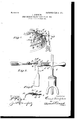
- My invention consists in a simple auxiliary device which will come into operation when the cloth leaves the needles and engage the stop-finger or arm, thereby causing the instant stoppage of the machine, and the novel features and combinations of parts thereof are set forth in the claims, and I will describe my invention in detail with reference to the accompanying drawings, in which 7 Figure l is a perspective view of part of a knitting-machine stop-motion with my auxiliary stop devices.
- Fig. 2 is an enlarged vertical section thereof.
- Fig. 3 is a transverse section on line 3 3, Fig. 2.
- A designates the needles, B the cloth-cam, C the stop-motion shaft, D the arm on said shaft, (1 the spring-controlled stop-finger, and d the claws on said arm, all arranged and constructed substantially as in the usual stop-motions of knitting-machines above referred to and which do not need more detailed explanation or illustration.
- a helical spring F is shown having one end connected to a pin depending from arm E and the other end fast to a pin or screw 1), attached to cam B.
- a laterally-movable trip G which is guided in a slot 1 in cam-plate B, so as to move close to the needles.
- Said tri is connected by a link or arm 9 to the arm of the presser E, so that the trip will be moved by and with the presser, and is actuated by Spring F.
- the trip and link may be made in one piece of suitably-bent wire,
- a knitting-machine, and a stop-motion having a stop-finger located exterior to the needles and cloth, and a presser located within the needles and cloth; with a movable trip located adjacent to the presser and adapted to actuate the stop-finger when the cloth leaves the machine, substantially as described.
Landscapes
- Engineering & Computer Science (AREA)
- Textile Engineering (AREA)
- Knitting Machines (AREA)
Description
No- 809,234.' PATENTED JAN. 2, 1906; E. TOMPKINS.
STOP MOTION FOR KNITTING MACHINES.
APPLICATION FILED JUNE 6. 1904.
Allomeys UNITED STATES PATENT OFFICE.
.ERNEST TOMPKINS, OF TROY, NEW YORK, ASSIGNOR TO TOMPKINS BROTHERS COMPANY, OF TROY, NEW YORK.
Specification of Letters Patent.
Patented Jan. 2, 1906.
Application filed June 6, 1904;. Serial No. 211.282.
To all whmn it Wtcty concern:
Be it known that I, ERNEST TOMPKINS, of Troy, in the county of Rensselaer and State of New'York, have invented certain new and useful Improvements in Stop-Motions for Knitting Machines; and I hereby declare that the following is a full, clear, and exact description thereof, reference being had to the accompanying drawings, which form part of this specification.
This invention is an improvement in knitting-machines; and it relates to the, automatic stop-motions of such machines, its object being to provide what may be termed an auxiliary stop-motion device adapted to actuate the stop motion when the cloth leaves the needles, thus preventing the collection of waste yarn on the needles and the frequent damage resulting therefrom before the machine is stopped.
The stop-motion ordinarily in use as, for instance, that shown in the patent to Brown et (11., No. 354,387, of December 14, 1886 consists, essentially, of an arm supported by a vertical shaft, which is connected with the mechanisms for stopping the machine, so that by slightly rotating said shaft the machine will be stopped. Said arm stands normally adjacent to the needles and is provided with a spring-controlled stop-finger, which is normally pressed against the cloth just above the needles by a suitable spring.
Within the circle of needles and just above them and opposite the spring-pressed finger is a pusher or presser arm, which holds the cloth outward against the pressure of the stop-finger. If a hole occurs in the cloth, the stop-finger will be projected thereinto by the spring and the cloth will pull the stopfinger ahead, thereby turning the arm and shaft and stopping the machine automatically. The arm in turning revolves on its axis and Withdraws the finger from the cloth. As usually made these stop-motions have a claw or claws attached to the arm adjacent to the stop-finger and projecting sufliciently close to the needles to be engaged by accu-- mulations of waste or yarn thereon, so that the machine will be eventually automatically stopped if the cloth leaves the needles. Such stop-motions will ofperate satisfactorily to stop the machine i a hole or drop-stitch comes to the finger, but will not operate promptly when the cloth leaves the needles,
as there is nothing to actuate the stop-finger or arm at the time, and the machine will run until suflicient yarn accumulates on the needles to catch the claws and move the arm, and it frequently happens in such cases that a number of needles are broken or bent before the machine is stopped and delay is caused in replacing and readjusting the broken or bent needles and getting the machine in condition for operation once more.
My invention consists in a simple auxiliary device which will come into operation when the cloth leaves the needles and engage the stop-finger or arm, thereby causing the instant stoppage of the machine, and the novel features and combinations of parts thereof are set forth in the claims, and I will describe my invention in detail with reference to the accompanying drawings, in which 7 Figure l is a perspective view of part of a knitting-machine stop-motion with my auxiliary stop devices. Fig. 2 is an enlarged vertical section thereof. Fig. 3 is a transverse section on line 3 3, Fig. 2.
A designates the needles, B the cloth-cam, C the stop-motion shaft, D the arm on said shaft, (1 the spring-controlled stop-finger, and d the claws on said arm, all arranged and constructed substantially as in the usual stop-motions of knitting-machines above referred to and which do not need more detailed explanation or illustration.
E is a pusher or presser pivoted at e on the cam B and projecting against the inside of the cloth, so as to press it outward against the action of the stop-finger d, as usual. This presser is yieldingly thrown outward by means of a spring which is attached to the short arm E of the presser, said arm extending at right angles to its long arm. Any suitable spring may be used. A helical spring F is shown having one end connected to a pin depending from arm E and the other end fast to a pin or screw 1), attached to cam B.
Beneath the cam B and opposite the finger (Z is a laterally-movable trip G, which is guided in a slot 1) in cam-plate B, so as to move close to the needles. Said tri is connected by a link or arm 9 to the arm of the presser E, so that the trip will be moved by and with the presser, and is actuated by Spring F. As shown, the trip and link may be made in one piece of suitably-bent wire,
and a washer g is strung thereon above slot 1) to uphold the trip in position. When the cloth is in the machine, as indicated in Fig. 2, the presser E is held back almost in line with the needles, spring F being under tension in this position of the presser E, the trip G is drawn back toward the end of slot 1) away from the stop-finger d and remains out of the way and inert so long as the cloth is in the machine, and the presser E is held about in line with the needles. The instant the cloth leaves the needles, however, the stop-finger d is projected thereover by the usual spring (i (indicated in dotted lines) or by other suitable means, just as it would be if it found a hole in the cloth, and as immediately afterward the cloth frees presser E the spring F rocks arm E, throwing the free end of the presser outward over the needlesand moving trip G laterally against the stop-finger d and forcing the latter to one side, thereby actuating the stop-motion proper and stopping the machine, just as would happen if the stop-finger had been pulled to one side by engaging a hole in the cloth. This stoppage occurs instantly without any accumulation of waste yarn on the needles, and thus my attachment serves as an auxiliary stop-motion, acting when the cloth leaves the needles to stop the machine instantly. It prevents the ac cumulation of waste yarn on the needles and consequent danger of breakage or bending of the needles and loss of time in putting the machine again into useful operation. When the cloth is put in the machine, the trip G is automatically moved out of the way and reset and held in such position by the position of presser E behind or within the cloth.
Having thus described my invention,what I therefore claim as new, and desire to secure by Letters Patent thereon, is
1. In combination with a knitting-machine stop-motion having a stop-finger located outside the cloth and needles and having a clothpresser located within the cloth; with a spring controlled trip located within the cloth and needles adapted to engage the stopfinger and actuate the stop-motion when the cloth leaves the needles, said trip being controlled by the said presser, substantially as described.
2. In combination, a knitting-machine, and a stop-motion having a stop-finger located exterior to the needles and cloth, and a presser located within the needles and cloth; with a movable trip located adjacent to the presser and adapted to actuate the stop-finger when the cloth leaves the machine, substantially as described.
3. The combination of a knitting-machine, and astop-motion having a spring-pressed stop-finger located exterior to the needles and cloth, and a spring-actuated presser located within the needles and cloth; with a laterallymovable trip located adjacent to the presserarm, and connected therewith so as to be controlled thereby, said trip actuating the stop-finger when the cloth leaves the machine, substantially as described.
In testimony that I claim the foregoing as my own I affix my signature in presence of two witnesses.
ERNEST TOMPKINS. Witnesses:
FREDK. W. J. MOKIBBIN, H. O. WILCOX.
Priority Applications (1)
| Application Number | Priority Date | Filing Date | Title |
|---|---|---|---|
| US21128204A US809234A (en) | 1904-06-06 | 1904-06-06 | Stop-motion for knitting-machines. |
Applications Claiming Priority (1)
| Application Number | Priority Date | Filing Date | Title |
|---|---|---|---|
| US21128204A US809234A (en) | 1904-06-06 | 1904-06-06 | Stop-motion for knitting-machines. |
Publications (1)
| Publication Number | Publication Date |
|---|---|
| US809234A true US809234A (en) | 1906-01-02 |
Family
ID=2877715
Family Applications (1)
| Application Number | Title | Priority Date | Filing Date |
|---|---|---|---|
| US21128204A Expired - Lifetime US809234A (en) | 1904-06-06 | 1904-06-06 | Stop-motion for knitting-machines. |
Country Status (1)
| Country | Link |
|---|---|
| US (1) | US809234A (en) |
Cited By (1)
| Publication number | Priority date | Publication date | Assignee | Title |
|---|---|---|---|---|
| WO2021033130A1 (en) | 2019-08-21 | 2021-02-25 | 3M Innovative Properties Company | Article useable for sampling surfaces for microorganisms and methods of use |
-
1904
- 1904-06-06 US US21128204A patent/US809234A/en not_active Expired - Lifetime
Cited By (1)
| Publication number | Priority date | Publication date | Assignee | Title |
|---|---|---|---|---|
| WO2021033130A1 (en) | 2019-08-21 | 2021-02-25 | 3M Innovative Properties Company | Article useable for sampling surfaces for microorganisms and methods of use |
Similar Documents
| Publication | Publication Date | Title |
|---|---|---|
| US189501A (en) | Island | |
| US76854A (en) | Benjamin ward | |
| US622542A (en) | Knitting-machine | |
| US1251459A (en) | Defective-yarn detector for knitting-machines. | |
| US449910A (en) | Stopping mechanism for knitting-machines | |
| US180404A (en) | Improvement in stop-motions for knitting-machines | |
| US766305A (en) | Stop-motion for knitting-machines. | |
| US1541628A (en) | Thread guide for stop motions | |
| US1006386A (en) | Warp stop-motion. | |
| US776445A (en) | Stop-motion knitting-machine. | |
| US972266A (en) | Automatic rove-stop. | |
| US1782550A (en) | Stop motion for knitting machines | |
| US431969A (en) | Robert b | |
| US327696A (en) | Stop motion foe eailway heads | |
| US1375218A (en) | Stop-motion for knitting-machines | |
| US205336A (en) | Improvement in stopping mechanisms for knitting-machines | |
| US494673A (en) | Alonzo falls | |
| US2271902A (en) | Knitting machine | |
| US463562A (en) | Island | |
| US1044943A (en) | Splicing mechanism for knitting-machines. | |
| US883958A (en) | Take-up device for circular-knitting machines. | |
| US935981A (en) | Automatic circular-knitting machine. | |
| US560106A (en) | Quarter saver for knitting machines | |
| US637929A (en) | Stop-motion for circular-knitting machines. | |
| US707768A (en) | Automatic stop mechanism for cigarette-machines. |