US809131A - Cotton-gin. - Google Patents
Cotton-gin. Download PDFInfo
- Publication number
- US809131A US809131A US24697405A US1905246974A US809131A US 809131 A US809131 A US 809131A US 24697405 A US24697405 A US 24697405A US 1905246974 A US1905246974 A US 1905246974A US 809131 A US809131 A US 809131A
- Authority
- US
- United States
- Prior art keywords
- saws
- brush
- chamber
- gin
- board
- Prior art date
- Legal status (The legal status is an assumption and is not a legal conclusion. Google has not performed a legal analysis and makes no representation as to the accuracy of the status listed.)
- Expired - Lifetime
Links
- 239000002699 waste material Substances 0.000 description 18
- 239000002245 particle Substances 0.000 description 10
- 239000000428 dust Substances 0.000 description 8
- 238000010276 construction Methods 0.000 description 7
- 230000005484 gravity Effects 0.000 description 6
- 230000009471 action Effects 0.000 description 5
- 239000000835 fiber Substances 0.000 description 5
- 238000000926 separation method Methods 0.000 description 4
- 229920000742 Cotton Polymers 0.000 description 2
- 230000008901 benefit Effects 0.000 description 2
- 238000004140 cleaning Methods 0.000 description 2
- 230000007246 mechanism Effects 0.000 description 2
- 230000000717 retained effect Effects 0.000 description 2
- 241000370685 Arge Species 0.000 description 1
- 230000005540 biological transmission Effects 0.000 description 1
- 210000000481 breast Anatomy 0.000 description 1
- 230000001413 cellular effect Effects 0.000 description 1
- 230000002596 correlated effect Effects 0.000 description 1
- 230000000694 effects Effects 0.000 description 1
- 239000002657 fibrous material Substances 0.000 description 1
- -1 motes Substances 0.000 description 1
- 239000010813 municipal solid waste Substances 0.000 description 1
- 230000002093 peripheral effect Effects 0.000 description 1
- 230000008439 repair process Effects 0.000 description 1
- 230000000576 supplementary effect Effects 0.000 description 1
Images
Classifications
-
- D—TEXTILES; PAPER
- D01—NATURAL OR MAN-MADE THREADS OR FIBRES; SPINNING
- D01B—MECHANICAL TREATMENT OF NATURAL FIBROUS OR FILAMENTARY MATERIAL TO OBTAIN FIBRES OF FILAMENTS, e.g. FOR SPINNING
- D01B1/00—Mechanical separation of fibres from plant material, e.g. seeds, leaves, stalks
- D01B1/02—Separating vegetable fibres from seeds, e.g. cotton
- D01B1/04—Ginning
- D01B1/08—Saw gins
Definitions
- My invention relates to cotton-gins and similar machines for separating cotton or the like fibrous material from its seed, hulls, or other cellular matters associated therewith, and more especially to gins of the familiar type in which a revolving gang of saws or equivalent member constitutes the primary separator and arevolving brush removes the lint from the saws.
- the invention comprises an improved gin of novel construction and arrangement of the working parts having incorporated with the ginning mechanism simple and efficient provision for causing the cleaning of the fiber or separation of all dust, motes, dirt, and
- One of the chief distinctions of my present invention is such a structural arrangement of the gin that the cleaning function referred to is performed without the use of an air-blast or suction; in fact, without importing into the machine any specific device for the purpose, but, as above stated, simply by the centrifugal action due to rotation of the saws, supplemented by the force of gravity acting upon the motes and other particles ejected from the fiber.
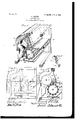
- Figure 1 is a cross-sectional perspective view of the gin.
- Fig. 2 is an end elevation thereof.
- Fig. 3 is a crosssection.
- Fig. 4 is a detail view of one of the adjustable bearings for the brush-shaft.
- A indicates the roll-box; B, the breastplate; C, the gang of saws; D, the brush; E, the brush-chamber, whose discharge-chute F leads to the lint-flue.
- G is a deflector-board in front of the lintremoving side of the brush and which gives the lint its downward course after it has been removed by the brush from the saws.
- H is the usual bottom board of the brushchamber or mote-board, which is preferably adjustable, as shown, by means of a rack and pinion I thereunder.
- a gin comprising the above -named elements properly correlated and actuated is a type of the art, and the general construction and functions are therefore understood so far as concerns the ginning mechanism and the operation thereof. It is understood, of course, that the saws and brush rotate in opposite directions, as indicated by the arrows in Fig. 1.
- the cotton in the roll-box is caught by the revolving saw-teeth and drawn through the bars of the breastplate, thus separating the lint or fiber from the seeds, which are retained in or dropped from the front of the roll-box, while the lint adheres to the peripheries of the saws until it is removed by the brush into the brush-chamber, whence it is discharged into the lint-flue, this being the usual operation of gins.
- a distinctive feature of the structure is that the saws are practically superposed above the brush, though preferably slightly in advance thereof, the brush coacting with the saws just behind the lowermost parts of their peripheries.
- This divider-board which is adjacent to the saws, is preferably shaped at its lower front to extend tangentially toward or between the meeting peripheries of the saws and brush, and it has a curved or concave front face approximately conforming to'and disposed close to the peripheries of the saws.
- the top of said dividerboard turns sharply back from the concave front face thereof and slopes downward into a longitudinal channel or trough L, which is back of the dividerboard or between it and a rear longitudinal upstanding part M, which also slants downward into the depression L, the said trough extending from one end to the other of the gin substantially parallel with the saws and brush.
- This trough or channel L constitutes the bottom of the settling-chamber N, into which the motes, dust, and waste particles are ejected centrifugally from the rapidly-revolving saw-teeth during the ginning oper ation.
- the back of said settling-chamber is the board or gate 0, which is preferably hinged or swung from a frame-beam above,
- the divider-board K having its lower end adapted to reach both the top of the dividerboard K and the top of the projection M, so that the discharge of motes and waste into the settling-chamber and the trough L may be permitted or not, as desired.
- the top of the divider-board K slanting rearwardly downward away from the peripheries of the saws below the axis of rotation thereof causes every particle thrown from the saws to slide directly down into the trough or pocket L.
- the board or gate 0 When the board or gate 0 is in the position shown in full lines in Fig. 1, it also aids by the slanting under surface it presents in throwing the motes into the pocket. In this position the gate 0 may be secured by providing a latch connection with the top of the projection M.
- I preferably provide for such removal by means of a worm or screw co'nveyer P, driven by suitable transmission connection with the shaft of the saws.
- This conveyer carries off the collected or settled dirt and waste out through one end of the gin and may deposit it either on the floor or into a suitable receptacle, or it may be spouted into the seed auger.
- the divider-board K preventing any of the particles from passing into the brush-chamber.
- the positions of the dividerboard K and deflector-board G are such that only a very small portion of the saws are presented to the brush-chamber. Particles of waste which may fall with the seed through the breastplate in front of the saws will fall to the outside of the deflector-board G, which prevents such waste and seed from being drawn into the brush-chamber by the air-currents created by the brush.
- the ceiling J together with the parts supported thereby, is made removable, being supported upon suitable lugs or otherwise in the frame of the machine and retained in place by catches Q at the sides of the brushchamber.
- the sides of the brush-chamber also have removable parts R, and the top S of the discharge-chute F is hinged, so that it be had to the saws and brush for repairs or other purposes, and the brush may be bodily lifted out when necessary.
- the shaft-bearings T thereof at each ends are adjustable, as by bolt-and-slot fastenings U, to the frame-beams, movement of the bearings T permitting longitudinal adjustment of the shaft to the extent of the length of the slot.
- the ends of the brush are located in circular openings in the side boards of the brush-chamber, covered by coveringboards V. Said circular openings are indicated by dotted lines by W in Fig. 2.
- the brush can be longitudinally adjusted to bring fresh portions of the brush-surface into contact with the saws at different times.
- Fig. 2 denotes a belt passing around pulley 2 on the saw-shaft, around pulley 3 on the brush-shaft, and'around pulley 4.
- 5 is a belt passing around pulleys 6 and 7 on the saw-shaft and conveyer-shaft.
- What'I claim is 1.
- the combination of the ginning member, brush, and brush-chamber, the ginning member and brush being so relatively disposed that matter centrifugally discharged from the ginning member will fall upon the top of the brush-chamber, and an upright divider-board upon the top of the brush-chamber, closely adjacent to the ginning member.
- the'combination of the saws means for removing the lint from the lower sides thereof, and a settling-chamber for waste, &c., opening to the exposed rear portions of the saws, a divider-board at the bottom of said chamber havin a concave front face adjacent to the rear 0 the saws, a longitudinal trough or pocket back of said divider-board, and a conveyer therein.
Landscapes
- Engineering & Computer Science (AREA)
- Mechanical Engineering (AREA)
- Textile Engineering (AREA)
- Cleaning In General (AREA)
- Brushes (AREA)
- Preliminary Treatment Of Fibers (AREA)
Description
PATENTED JAN: 2, 1906.
F. PHELPS. COTTON GIN.
APPLICATION FILED PBB.23,1905.
UNITED STA E PATENT oFFIo Specification of Letters Patent.
Patented Jan. 2, 1906.
Application filed February 23, 1905. Serial No. 24 6,974=.
To all whom it may concern.-
Be it known that I, FRANK PHELPS, a citizen of the United States, residing at Wellston, in the county of Lincoln, Oklahoma Territory, have invented certain new and useful Improvements in Cotton-Grins; and I do.
hereby declare the following to be a full, clear, and exact description of the invention, such as will enable others skilled in the art to which it appertains to make and use the same.
My invention relates to cotton-gins and similar machines for separating cotton or the like fibrous material from its seed, hulls, or other cellular matters associated therewith, and more especially to gins of the familiar type in which a revolving gang of saws or equivalent member constitutes the primary separator and arevolving brush removes the lint from the saws.
The invention comprises an improved gin of novel construction and arrangement of the working parts having incorporated with the ginning mechanism simple and efficient provision for causing the cleaning of the fiber or separation of all dust, motes, dirt, and
waste from the lint adhering on the periph-- eries of the saws before reaching the brush, which is accomplished simply by the centrifugal action of the saws and the supplementary action of gravity without the importation into the machine of any specific contrivance, such as a blower or suction device, for effecting said separation, and .the construction being also characterized by ready and convenient accessibility to the working parts and by great compactness, the machine taking up a minimum floor-space consistent with the performance of its functions, and further characterized by the several specific improvements and desirable features hereinafter explained.
As well known in the operation of ginning the centrifugal action of the revolving saws tends to throw off from the adhering lint or fiber much of the motes, dirt, and waste associated therewith, and hitherto this action has been utilized in connection with'a blast of air or suction acting upon the peripheries of the saws between the breastplate and the brush for effecting separation of such matters andcleaning the lint, as exemplified in the modern types of gins illustrated and described in my Patents Nos. 796,861 and 796,862, dated August 8, 1905.
One of the chief distinctions of my present invention is such a structural arrangement of the gin that the cleaning function referred to is performed without the use of an air-blast or suction; in fact, without importing into the machine any specific device for the purpose, but, as above stated, simply by the centrifugal action due to rotation of the saws, supplemented by the force of gravity acting upon the motes and other particles ejected from the fiber. This accomplishment is attained by superposing the axis of rotation of the saws above that of the brush, leaving a relatively large free or exposed space for the peripheries of the saws between the breastplate and brush to allow a sufiicient interval for the centrifugal ejecting action before the lint on the saw-teeth reaches the brush and providing ample allowance for the fall of the waste, motes, and other particles by gravity. According to this construction as the saws rapidly rotate the waste matter ejected centrifugally from the lint falls or settles upon the top of the brushchamber or into a suitable pocket or recess, whence it can be removed. I prefer to provide for such removal by means of a conveyer acting in unison with the rest of the machine, so as to make the entire operation automatic.
A preferred embodiment of the invention securing the above and other advantages is shown in the accompanying drawings, which form part of this specification, and with reference to which the invention will be fully described and then particularly pointed out and defined in the appended claims.
In said drawings, Figure 1 is a cross-sectional perspective view of the gin. Fig. 2 is an end elevation thereof. Fig. 3 is a crosssection. Fig. 4 is a detail view of one of the adjustable bearings for the brush-shaft.
A indicates the roll-box; B, the breastplate; C, the gang of saws; D, the brush; E, the brush-chamber, whose discharge-chute F leads to the lint-flue.
G is a deflector-board in front of the lintremoving side of the brush and which gives the lint its downward course after it has been removed by the brush from the saws.
H is the usual bottom board of the brushchamber or mote-board, which is preferably adjustable, as shown, by means of a rack and pinion I thereunder.
A gin comprising the above -named elements properly correlated and actuated is a type of the art, and the general construction and functions are therefore understood so far as concerns the ginning mechanism and the operation thereof. It is understood, of course, that the saws and brush rotate in opposite directions, as indicated by the arrows in Fig. 1. The cotton in the roll-box is caught by the revolving saw-teeth and drawn through the bars of the breastplate, thus separating the lint or fiber from the seeds, which are retained in or dropped from the front of the roll-box, while the lint adheres to the peripheries of the saws until it is removed by the brush into the brush-chamber, whence it is discharged into the lint-flue, this being the usual operation of gins. A distinctive feature of the structure is that the saws are practically superposed above the brush, though preferably slightly in advance thereof, the brush coacting with the saws just behind the lowermost parts of their peripheries. Inasmuch as only the upper front peripheral portions of the saws pass through the breast lateor into the roll-box, there is a relatively arge open space between the breastplate and brush-chamber where the peripheries of the saws are free or exposed, allowing a suflicient space and interval in the ginning operation for the effective ejection of the dust and waste particles centrifugally from the saws into the aforesaid open space or chamber above the brush-chamber, where they can fall or settle by gravity. This construction also renders the machine compact and lessens the floor-space required, which is an important advantage where the machine must be installed in narrow quarters or when a number of stands of machinery are run together.
Above the brush, back of the saws, is the ceiling J of the brush-chamber, provided on its top with an upright longitudinal dividerboard K, so called because of its function. This divider-board, which is adjacent to the saws, is preferably shaped at its lower front to extend tangentially toward or between the meeting peripheries of the saws and brush, and it has a curved or concave front face approximately conforming to'and disposed close to the peripheries of the saws. The top of said dividerboard turns sharply back from the concave front face thereof and slopes downward into a longitudinal channel or trough L, which is back of the dividerboard or between it and a rear longitudinal upstanding part M, which also slants downward into the depression L, the said trough extending from one end to the other of the gin substantially parallel with the saws and brush. This trough or channel L constitutes the bottom of the settling-chamber N, into which the motes, dust, and waste particles are ejected centrifugally from the rapidly-revolving saw-teeth during the ginning oper ation. The back of said settling-chamber is the board or gate 0, which is preferably hinged or swung from a frame-beam above,
having its lower end adapted to reach both the top of the dividerboard K and the top of the projection M, so that the discharge of motes and waste into the settling-chamber and the trough L may be permitted or not, as desired. The top of the divider-board K slanting rearwardly downward away from the peripheries of the saws below the axis of rotation thereof causes every particle thrown from the saws to slide directly down into the trough or pocket L. When the board or gate 0 is in the position shown in full lines in Fig. 1, it also aids by the slanting under surface it presents in throwing the motes into the pocket. In this position the gate 0 may be secured by providing a latch connection with the top of the projection M. When unlatchecl, the gate will swing back to vertical or approximately vertical position, when its lower end will contact with the dividerboard K. The effect of this construction, as shown in Fig. 1, is to provide a waste or dust chamber N approximately tangential to the free or exposed peripheries of the saws from which the dust and waste are ejected or slanting rearwardly downward from the saws into the pocket a receptacle for collecting the waste. Hence all matter thrown centrifugally from the saws falls or settles by gravity into the longitudinal receptacle or trough L, whence it can be removed by means of any suitable conveyer. I preferably provide for such removal by means of a worm or screw co'nveyer P, driven by suitable transmission connection with the shaft of the saws. This conveyer carries off the collected or settled dirt and waste out through one end of the gin and may deposit it either on the floor or into a suitable receptacle, or it may be spouted into the seed auger. Thus exceedingly simple and efficient provision is made for selfcleaning of the fiber or lint before it reaches the brush by the effective separation of all dirt, motes, and trash and the settling and collection thereof by gravity, the divider-board K preventing any of the particles from passing into the brush-chamber. The positions of the dividerboard K and deflector-board G are such that only a very small portion of the saws are presented to the brush-chamber. Particles of waste which may fall with the seed through the breastplate in front of the saws will fall to the outside of the deflector-board G, which prevents such waste and seed from being drawn into the brush-chamber by the air-currents created by the brush.
To promote ready accessibility to the working parts, the ceiling J, together with the parts supported thereby, is made removable, being supported upon suitable lugs or otherwise in the frame of the machine and retained in place by catches Q at the sides of the brushchamber. The sides of the brush-chamber also have removable parts R, and the top S of the discharge-chute F is hinged, so that it be had to the saws and brush for repairs or other purposes, and the brush may be bodily lifted out when necessary.
To secure longitudinal adjustment of the brush, the shaft-bearings T thereof at each endsare adjustable, as by bolt-and-slot fastenings U, to the frame-beams, movement of the bearings T permitting longitudinal adjustment of the shaft to the extent of the length of the slot. The ends of the brush are located in circular openings in the side boards of the brush-chamber, covered by coveringboards V. Said circular openings are indicated by dotted lines by W in Fig. 2. By.
using this construction the brush can be longitudinally adjusted to bring fresh portions of the brush-surface into contact with the saws at different times.
In Fig. 2, 1 denotes a belt passing around pulley 2 on the saw-shaft, around pulley 3 on the brush-shaft, and'around pulley 4. 5 is a belt passing around pulleys 6 and 7 on the saw-shaft and conveyer-shaft.
What'I claim is 1. In a gin, the combination of the ginning member, brush, and brush-chamber, the ginning member and brush being so relatively disposed that matter centrifugally discharged from the ginning member will fall upon the top of the brush-chamber, and an upright divider-board upon the top of the brush-chamber, closely adjacent to the ginning member.
2. In a gin, the combinationof the saws, means for removing the lint from the lower sides thereof, and a settling-chamber for motes, dirt and waste open to the exposed rear portions of the saws, and a divider-board in the bottom of said chamber having a concave front face immediately adjacent to the rear of the saws and an inclined back face slanting rearwardly downward from the peripheries of the saws toward the bottom of said settling-chamber.
3. In a gin, the combination of the saws, means for removing the lint from the lower side thereof, a receptacle for centrifugallyejected motes, dust and waste particles located back of the saws below the axis of rotation thereof, and a divider-board between said receptacle and the saws closely adjacent to the latter. I
4. In a gin, the combination of the saws, means for removing the lint from the lower side thereof, a receptacle for centrifugallyejected motes, dust and waste particles located back of the saws below the axis of rotation thereof, a divider-board between said receptacle and the saws adjacent to the latter,and a swinging gate having its lower end adapted to reach either the top of said divider-board or the opposite side of said receptacle to permit the discharge of such particles into said receptacle or not, as preferred.
5. In a gin, the combination of the saws, the lint-removing brush below the saws, a divider-board between the approaching peripheries of the saws and brush curved to the shape of the saws, and a deflector-board between the oppo site or receding peripheries of the saws and brush.
6. In a gin, the combination of the breastplate, saws, and lint-removing brush below the saws, the brush-chamber whose ceiling is back of the lower part of the saws, a dust or waste chamber above said ceiling, said cha1n her having a longitudinal recess or trough in its bottom, and a divider-board between said recess and the saws having a concave front face adjacent to the saws and a rearwardly downwardly slanting rear face.
7. In a gin, the combination of a ginning member or saws, the brush, and brush-chamber, the ginning member and brush being so relatively disposed that matter centrifugally discharged from the ginning member will fall upon the top of the brush-chamber, and an upper divider-board upon the top of the brush-chamber adjacent to the rear portion of the saws and curved in conformity therewith.
8. In a gin, the'combination of the saws, means for removing the lint from the lower sides thereof, and a settling-chamber for waste, &c., opening to the exposed rear portions of the saws, a divider-board at the bottom of said chamber havin a concave front face adjacent to the rear 0 the saws, a longitudinal trough or pocket back of said divider-board, and a conveyer therein.
9. In a gin, the combination of the saws, a brush-chamber lower than the saws having a removable ceiling supported upon the inside of the gin-frame, an inner discharge-chute having a hinged ceiling, a mote-receptacle above the brushchamber, a swinging gate behind the saws adapted to permit or cut off the discharge of motes thereinto, the sides of the brush-chamber having circular openings axially alined with the brush, and removable coverings for the same, whereby access can be had to the ends of the brush and the rear of the saws and brush.
In testimony whereof I afiix my signature in presence of two witnesses.
FRANK PHELPSiI Witnesses:
A. E. KING, W. H. SPURR
Priority Applications (1)
| Application Number | Priority Date | Filing Date | Title |
|---|---|---|---|
| US24697405A US809131A (en) | 1905-02-23 | 1905-02-23 | Cotton-gin. |
Applications Claiming Priority (1)
| Application Number | Priority Date | Filing Date | Title |
|---|---|---|---|
| US24697405A US809131A (en) | 1905-02-23 | 1905-02-23 | Cotton-gin. |
Publications (1)
| Publication Number | Publication Date |
|---|---|
| US809131A true US809131A (en) | 1906-01-02 |
Family
ID=2877612
Family Applications (1)
| Application Number | Title | Priority Date | Filing Date |
|---|---|---|---|
| US24697405A Expired - Lifetime US809131A (en) | 1905-02-23 | 1905-02-23 | Cotton-gin. |
Country Status (1)
| Country | Link |
|---|---|
| US (1) | US809131A (en) |
-
1905
- 1905-02-23 US US24697405A patent/US809131A/en not_active Expired - Lifetime
Similar Documents
| Publication | Publication Date | Title |
|---|---|---|
| USRE23044E (en) | Cotton cleaning apparatus | |
| US1740990A (en) | Cotton condenser | |
| US809131A (en) | Cotton-gin. | |
| US2372796A (en) | Linter | |
| US2421483A (en) | Cotton cleaner | |
| US2776454A (en) | Cotton cleaning machinery | |
| US2009047A (en) | Huller feeder or the like | |
| US2174143A (en) | Cotton gin | |
| US351401A (en) | Cotton-gin | |
| US732869A (en) | Cotton huller, cleaner, and gin-feeder. | |
| US2668989A (en) | Cotton hull extractor and cleaner | |
| US1436372A (en) | Mechanism for removing useful fiber from seeds | |
| US656107A (en) | Mechanism for cleaning seed-cotton. | |
| US961624A (en) | Cotton-gin. | |
| US811896A (en) | Process of treating waste fiber. | |
| US755701A (en) | Cotton-separator. | |
| US1514044A (en) | Cotton-cleaning machine | |
| US391744A (en) | Seed-cotton cleaner | |
| US2036915A (en) | Wool cleaning machine | |
| US2031587A (en) | Machine for cleaning seed cotton and for extracting the seed cotton from burrs and hulls | |
| US1180134A (en) | Cotton cleaning and renovating plant. | |
| US1630638A (en) | Hull and cotton separator and cleaner | |
| US769251A (en) | Attachment for cotton-seed cleaners. | |
| US751639A (en) | John tv | |
| US1950061A (en) | Hull extractor |