US809093A - Navigable balloon. - Google Patents
Navigable balloon. Download PDFInfo
- Publication number
- US809093A US809093A US15467603A US1903154676A US809093A US 809093 A US809093 A US 809093A US 15467603 A US15467603 A US 15467603A US 1903154676 A US1903154676 A US 1903154676A US 809093 A US809093 A US 809093A
- Authority
- US
- United States
- Prior art keywords
- propeller
- propellers
- ship
- driving
- air
- Prior art date
- Legal status (The legal status is an assumption and is not a legal conclusion. Google has not performed a legal analysis and makes no representation as to the accuracy of the status listed.)
- Expired - Lifetime
Links
Images


Classifications
-
- B—PERFORMING OPERATIONS; TRANSPORTING
- B64—AIRCRAFT; AVIATION; COSMONAUTICS
- B64C—AEROPLANES; HELICOPTERS
- B64C23/00—Influencing air flow over aircraft surfaces, not otherwise provided for
- B64C23/005—Influencing air flow over aircraft surfaces, not otherwise provided for by other means not covered by groups B64C23/02 - B64C23/08, e.g. by electric charges, magnetic panels, piezoelectric elements, static charges or ultrasounds
Definitions
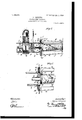
- FIG. 1 is a side elevation; Fig. 2, a lan, and Figs. 3 and 4 front and rear end e evations, respectively, of my improved air-ship.
- Fig. 5 is a side elevation, and Fig. 6 a plan view, showing the general arrangement of the side propellers and the motor.
- Fig. 7 is a detail sectional vertical view of the motor and part of one of the propellers, and Fig. 8 is a similar view, enlarged, showing part of a propeller and its support.
- FIGs. 1 to 4 and as an example I have shown an air-ship the gas-field a of which has the general form of a fish having a tail-fin d and a single body-fin d encompassing the gasfield nearly to thetail end.
- These so-called fins (Z cZ are more or less rigid flat surfaces performing the function of parachutes or aero lanes in descending or ascending.
- a car mounted on wheels 0 is suspended from the gas-field in any suitable manner and by any suitable means connected, for instance, to the Wheel axles of the car, as shown, on which axles the car is mounted in any desired or well-known manner.
- the car contains a motor of any desired typeas, for instance, a gas or vapor engine 6, that drives side propellers f, revoluble about vertical axes f and adapted for adjustment about a horizontal planethat is to say, about a diameter of the propellerfor the purpose of varying their relative angular relations or posi-.
- a motor of any desired typeas for instance, a gas or vapor engine 6, that drives side propellers f, revoluble about vertical axes f and adapted for adjustment about a horizontal planethat is to say, about a diameter of the propellerfor the purpose of varying their relative angular relations or posi-.
- tions means being provided to drive the propellers independently of each other and to turn them on edge in converging planes toward the gas-field and car I) independently of each other and of the motor-shaftwhen the air-ship is descending or near or on the ground to avoid possible injury to the propellers by contact with obstructions.
- the air-ship as organized can be navigated, as by shifting the center of gravity toward the front, for instance, the ship will take a forwardly and downwardly inclined position and will move downward by reason of the surplus weight, which acts as a dead-weight, the fins (Z and d performing the function of aeroplanes.
- the air-ship By shifting the center of gravity toward or to the center again and if the propellers are thrown out of operation the air-ship will be'stopped, and it will then descend slowly and substantially in a vertical direction, the fins (Z and d then acting as parachutes, while if the propellers are again set in motion the air-ship will ascend obliquely, said fins again acting as aeroplanes.
- the air-ship can be steered to one side or the other, and this ma also be done by setting the propellers at di ferent angles.
- the driving crank-shaft g, Fig. 7, common to both propellers f, carries friction clutch members 'i, cooperating with complementary friction clutch members i on the driven shafts h, said members i being moved into and out of contact with the members '2: by shifting-levers 11.. (See also Fig. 5.)
- the driven shafts h have bearing in the hub of the spiders 7L2, Whose arms are connected to rods Z, and at its outer end each driven shaft h is provided with a friction-disk p.
- a ring m is secured between two rings m and 0 in such manner as to admit of rotation of said rings m and 0 on ring m, ringo being provided with handles 0.
- the ring m has hinge connection at t with two of the arms Z, of
- bracket-arms 1b To the ring 0 are secured two radial bracket-arms 1b, in the outer ends of which the shafts f of the propellers f have their bearings, one of said bracket-arms carrying at its inner end a friction-wheel 8, preferably of rubber and mounted in suitable bearings.
- the fricti0n-wheel s and friction-disk 19 act on a peripheral flange 1" on one of the propeller-wheel rims or tires 9, each of the propellers consisting of a hub or shaft f having journals revolving in bearings in the arms at, and to said shaft and to the peripheral rims or tires 9 are secured the propeller-blades.
- a propeller-frame In an air-ship, a propeller-frame, a propeller rotatablycarried by said frame, a support for the latter, a hinged connection between the support and frame, a driving-shaft and separable driving elements connecting the shaft and propeller.
- a propeller-frame a propeller rotatably carried by said frame, a fixed support, a frame-support comprising a normally stationary element, a hin e-connection between the latter and the fixed support and a framecarrying element revoluble about said stationary element and about anaxis at right angles to the axis of rotation of the ropeller; in combination with a driving-s aft and separable driving elements connecting said shaft to the propeller.
- a motor having two shafts, each composed of two sections adapted to'be coupled and uncoupled, of a plurality of supporting-rods, rings hinged to said rods, a propeller for each drivin -shaft and a propeller-framefor each propelIer rotatably mounted on said rings.
Landscapes
- Engineering & Computer Science (AREA)
- Aviation & Aerospace Engineering (AREA)
- Toys (AREA)
Description
P'ATENTBD JAN. 2, 1906.
A. CHIODERA.
NAVIGABLE BALLOON. 1 APPLICATION FILED APR.28,1903' 3 SHEETS-SHEET 1.
N0. 809,093 PATENTE D JAN. 2. 1906.
' A. UHIODERA.
NAVIGABLE BALLOON.
APPLICATION FILED APR.28, 1903.
3 SHEETS-SHEET 2.
nil/k f No. 809,093. PATENTED JAN. 2, 1906. A. OHIODERA. NAVIGABLE BALLOON.
APPLICATION FILED APR.28,1903.
3 SHEBTSSHBET 3.
UNITED STATES PATENT OFFICE.
NAVIGABLE BALLOON- Specification of Letters Patent.
Patented. Jan. 2, 1906.
Application filed April 28, 1903. Serial No. 154,676-
To all whom it may concern:
Be it known that I, ALFRED OHIODERA, a citizen of the Republic of Switzerland, residing at Zurich, Switzerland, have invented certain new and useful Improvements in Navigable Balloons, of which the following is part of this specification; but that my invention may be fully understood I will describe the same in detail, reference being had to the accompanying drawings, in which- Figure 1 is a side elevation; Fig. 2, a lan, and Figs. 3 and 4 front and rear end e evations, respectively, of my improved air-ship. Fig. 5 is a side elevation, and Fig. 6 a plan view, showing the general arrangement of the side propellers and the motor. Fig. 7 is a detail sectional vertical view of the motor and part of one of the propellers, and Fig. 8 is a similar view, enlarged, showing part of a propeller and its support.
In Figs. 1 to 4 and as an example I have shown an air-ship the gas-field a of which has the general form of a fish having a tail-fin d and a single body-fin d encompassing the gasfield nearly to thetail end. These so-called fins (Z cZ are more or less rigid flat surfaces performing the function of parachutes or aero lanes in descending or ascending. A car mounted on wheels 0, is suspended from the gas-field in any suitable manner and by any suitable means connected, for instance, to the Wheel axles of the car, as shown, on which axles the car is mounted in any desired or well-known manner. The car contains a motor of any desired typeas, for instance, a gas or vapor engine 6, that drives side propellers f, revoluble about vertical axes f and adapted for adjustment about a horizontal planethat is to say, about a diameter of the propellerfor the purpose of varying their relative angular relations or posi-.
tions, means being provided to drive the propellers independently of each other and to turn them on edge in converging planes toward the gas-field and car I) independently of each other and of the motor-shaftwhen the air-ship is descending or near or on the ground to avoid possible injury to the propellers by contact with obstructions.
The air-ship as organized can be navigated, as by shifting the center of gravity toward the front, for instance, the ship will take a forwardly and downwardly inclined position and will move downward by reason of the surplus weight, which acts as a dead-weight, the fins (Z and d performing the function of aeroplanes. By shifting the center of gravity toward or to the center again and if the propellers are thrown out of operation the air-ship will be'stopped, and it will then descend slowly and substantially in a vertical direction, the fins (Z and d then acting as parachutes, while if the propellers are again set in motion the air-ship will ascend obliquely, said fins again acting as aeroplanes. Finally, according as one or the other propeller f is set in operation, the air-ship can be steered to one side or the other, and this ma also be done by setting the propellers at di ferent angles.
I will now describe the mechanism by means of which the described operations are performed, referring more particularly to igs. 7 and 8. The driving crank-shaft g, Fig. 7, common to both propellers f, carries friction clutch members 'i, cooperating with complementary friction clutch members i on the driven shafts h, said members i being moved into and out of contact with the members '2: by shifting-levers 11.. (See also Fig. 5.) The driven shafts h have bearing in the hub of the spiders 7L2, Whose arms are connected to rods Z, and at its outer end each driven shaft h is provided with a friction-disk p. A ring m is secured between two rings m and 0 in such manner as to admit of rotation of said rings m and 0 on ring m, ringo being provided with handles 0. The ring m has hinge connection at t with two of the arms Z, of
which I preferably provide four, while said ring m has a separable connection t, of any desired rconstruction, with the other two arms Z, so that rings m, m, and 0 can be swung bodily on said hinge connections 15 for the purpose of turning the propellers f inboard on edge from the position shown in Figs. 7 and 8 to the position shown in Fig. 4, thus throwing said propellers out of operation. As the revoluble rings m 0 adapt a propeller to rotate about a diameter thereof IIO the angular relation of the two side propellers can be varied ad Zt'bitum, two examples of the relative angular position of the two propellers f being given in Figs. 5 and 6.
In order to admit of the described shipping of the propellers, I provide a friction driving mechanism, of which the disk 19, above described, constitutes one member.
To the ring 0 are secured two radial bracket-arms 1b, in the outer ends of which the shafts f of the propellers f have their bearings, one of said bracket-arms carrying at its inner end a friction-wheel 8, preferably of rubber and mounted in suitable bearings. The fricti0n-wheel s and friction-disk 19 act on a peripheral flange 1" on one of the propeller-wheel rims or tires 9, each of the propellers consisting of a hub or shaft f having journals revolving in bearings in the arms at, and to said shaft and to the peripheral rims or tires 9 are secured the propeller-blades.
Having thus described my invention, what I claim as new therein, and desire to secure by Letters Patent, is
1. In an air-ship, a propeller-frame, a propeller rotatablycarried by said frame, a support for the latter, a hinged connection between the support and frame, a driving-shaft and separable driving elements connecting the shaft and propeller.
2. In an air-ship, the combination with a driving-shaft and a friction driving element thereon, of a propeller-frame, a propeller ro-' tatably mounted therein and having a complementary friction-driven element, a support for the propeller-frame and a hinge connection between the support and said frame.
3. In an air-ship, the combination with the driving-shaft of a propeller-frame, a proeller rotatably mounted therein, a support for the propeller-frame to which the latter is hin ed and adjustable about an axis at ri ht ang es to the axis of rotation of the propeller and separable driving elements connecting said propeller to the driving-shaft.
4. In an air-ship, the combination with a motor having two driving-shafts, each composed of two sections adapted to be coupled and uncoupled; of a propeller for each driving-shaft, a propeller-frame for each prope ler in which frames said propellers are rotatably mounted, supports for said frames, a
hinged connection between the frames and their respective supports and separable driving elements connecting the propellers to their driving-shafts.
5. In an air-ship, the combination with a motor having two driving-shafts, each composed of two sections adapted to be coupled and uncoupled; of a propeller for each drivin '-shaft, a propeller-frame for each prope ler in which frames said propellers are rotatably mounted supports for said frames about which the latter are adjustable about an axis at right angles to the axis of rotation of the propellers, a hinged connection between the frames and their respective supports and separable driving elements con necting the propellers to their driving-shafts.
6. In an air-ship, the combination with a motor having two motor-shafts, each composed of two sections adapted to be coupled and uncoupled; of a propeller for each driving-shaft, a propeller-frame for each propeller, in which frames said propellers are rotatably mounted, supports for said propeller-frames, separable connections between said supports and frames and means to adjust the frames independently of each other about an axis at right angles to the axis of rotation of the propellers.
7. In an air-ship, the combination with a motor having two motor-shafts, each composed of two sections adapted to be coupled and uncoupled; of a propeller for each driving-shaft, a propeller-frame for each propeller, in which frames said propellers are rotatably mounted, supports for said propellerframes, a hinge connection and a separable connection between the propeller-frames and their respective supports, and means to adjust the frames independently of each other about an axis at right angles to the axis of rotation of the propellers.
8. In an airship, a propeller-frame, a propeller rotatably carried by said frame, a fixed support, a frame-support comprising a normally stationary element, a hin e-connection between the latter and the fixed support and a framecarrying element revoluble about said stationary element and about anaxis at right angles to the axis of rotation of the ropeller; in combination with a driving-s aft and separable driving elements connecting said shaft to the propeller.
9. In an air-ship, a motor, a horizontal driving-shaft and friction-disks driven thereby in combination with propeller-wheels having a peripheral flange in contact with their respective friction-disks, the vertical shafts for said wheels, arms in which said shafts have their bearings, a friction-wheel on one of said arms in contact with the aforesaid peripheral flange and a relatively stationary support for said arms, for the purpose set forth.
10. In an air-ship, the combination with a motor having two shafts, each composed of two sections adapted to'be coupled and uncoupled, of a plurality of supporting-rods, rings hinged to said rods, a propeller for each drivin -shaft and a propeller-framefor each propelIer rotatably mounted on said rings.
11. In an air-ship, the combination with a motor having two shafts, each composed of two sections adapted to be con led and uncoupled, of a plurality of fixe supportingrods, circular bearing members hinged to said rods, supporting members rotatably mounted on the bearing members, propeller- IIO bearing members, propeller-frames mounted on the rotatable supporting members and a propeller rotatably mounted in each frame.
In testimony whereof I have signed my I 5 name to this specification in the presence of two subscribing witnesses.
ALFRED CHIODERA.
Witnesses Momrz VEITH, A. LIEBERKNEOHT.
Priority Applications (1)
| Application Number | Priority Date | Filing Date | Title |
|---|---|---|---|
| US15467603A US809093A (en) | 1903-04-28 | 1903-04-28 | Navigable balloon. |
Applications Claiming Priority (1)
| Application Number | Priority Date | Filing Date | Title |
|---|---|---|---|
| US15467603A US809093A (en) | 1903-04-28 | 1903-04-28 | Navigable balloon. |
Publications (1)
| Publication Number | Publication Date |
|---|---|
| US809093A true US809093A (en) | 1906-01-02 |
Family
ID=2877574
Family Applications (1)
| Application Number | Title | Priority Date | Filing Date |
|---|---|---|---|
| US15467603A Expired - Lifetime US809093A (en) | 1903-04-28 | 1903-04-28 | Navigable balloon. |
Country Status (1)
| Country | Link |
|---|---|
| US (1) | US809093A (en) |
-
1903
- 1903-04-28 US US15467603A patent/US809093A/en not_active Expired - Lifetime
Similar Documents
| Publication | Publication Date | Title |
|---|---|---|
| US20250033767A1 (en) | Rotor Deployment Mechanism For Vertical Take-Off And Landing Aircraft | |
| US6402088B1 (en) | Passenger vehicle employing a circumferentially disposed rotatable thrust assembly | |
| US2868476A (en) | Convertiplane with tiltable cylindrical wing | |
| US1578833A (en) | Flying machine | |
| US1132049A (en) | Flying-machine. | |
| US3837600A (en) | Vertical take-off and landing airplane | |
| JP4731618B2 (en) | Rotorcraft | |
| US1006734A (en) | Dirigible airship. | |
| US954574A (en) | Means for steering flying-machines. | |
| US2936970A (en) | Helicopter | |
| US1361276A (en) | Aircraft propulsion | |
| US1277206A (en) | Aeroplane. | |
| US1040136A (en) | Gyroplane. | |
| US1058485A (en) | Flying-machine. | |
| US1336669A (en) | Flying-machine | |
| US969627A (en) | Propelling and steering device for airships. | |
| US986434A (en) | Airship. | |
| US1418248A (en) | Combined aeroplane and helicopter | |
| US995361A (en) | Aerial machine. | |
| US932712A (en) | Air-ship. | |
| US968918A (en) | Flying-machine. | |
| US1015656A (en) | Flying-machine. | |
| US2085359A (en) | Helicopter | |
| US1898764A (en) | Flying machine | |
| US908794A (en) | Aeronautic apparatus. |