US8079482B2 - Teat unit - Google Patents
Teat unit Download PDFInfo
- Publication number
- US8079482B2 US8079482B2 US12/482,273 US48227309A US8079482B2 US 8079482 B2 US8079482 B2 US 8079482B2 US 48227309 A US48227309 A US 48227309A US 8079482 B2 US8079482 B2 US 8079482B2
- Authority
- US
- United States
- Prior art keywords
- teat
- main body
- mouthpiece
- receiving unit
- suction channel
- Prior art date
- Legal status (The legal status is an assumption and is not a legal conclusion. Google has not performed a legal analysis and makes no representation as to the accuracy of the status listed.)
- Expired - Fee Related, expires
Links
- 239000007788 liquid Substances 0.000 claims description 10
- 230000003670 easy-to-clean Effects 0.000 abstract description 2
- 210000002445 nipple Anatomy 0.000 description 58
- 239000011796 hollow space material Substances 0.000 description 5
- 239000008267 milk Substances 0.000 description 4
- 210000004080 milk Anatomy 0.000 description 4
- 235000013336 milk Nutrition 0.000 description 4
- 238000007789 sealing Methods 0.000 description 4
- 239000004743 Polypropylene Substances 0.000 description 3
- 239000000463 material Substances 0.000 description 3
- 229920001155 polypropylene Polymers 0.000 description 3
- 229920001296 polysiloxane Polymers 0.000 description 3
- 239000004952 Polyamide Substances 0.000 description 2
- 230000035622 drinking Effects 0.000 description 2
- 229920001971 elastomer Polymers 0.000 description 2
- 230000002093 peripheral effect Effects 0.000 description 2
- 229920002647 polyamide Polymers 0.000 description 2
- 229920002725 thermoplastic elastomer Polymers 0.000 description 2
- 240000004178 Anthoxanthum odoratum Species 0.000 description 1
- 206010036590 Premature baby Diseases 0.000 description 1
- 239000011324 bead Substances 0.000 description 1
- 238000005452 bending Methods 0.000 description 1
- 238000004140 cleaning Methods 0.000 description 1
- 238000007373 indentation Methods 0.000 description 1
- 238000000034 method Methods 0.000 description 1
- 239000004033 plastic Substances 0.000 description 1
- 229920003023 plastic Polymers 0.000 description 1
- -1 polypropylene Polymers 0.000 description 1
- 125000006850 spacer group Chemical group 0.000 description 1
- XLYOFNOQVPJJNP-UHFFFAOYSA-N water Substances O XLYOFNOQVPJJNP-UHFFFAOYSA-N 0.000 description 1
Images



Classifications
-
- A—HUMAN NECESSITIES
- A61—MEDICAL OR VETERINARY SCIENCE; HYGIENE
- A61J—CONTAINERS SPECIALLY ADAPTED FOR MEDICAL OR PHARMACEUTICAL PURPOSES; DEVICES OR METHODS SPECIALLY ADAPTED FOR BRINGING PHARMACEUTICAL PRODUCTS INTO PARTICULAR PHYSICAL OR ADMINISTERING FORMS; DEVICES FOR ADMINISTERING FOOD OR MEDICINES ORALLY; BABY COMFORTERS; DEVICES FOR RECEIVING SPITTLE
- A61J11/00—Teats
- A61J11/04—Teats with means for fastening to bottles
- A61J11/045—Teats with means for fastening to bottles with interlocking means, e.g. protrusions or indentations on the teat
Definitions
- the invention relates to a teat unit.
- a wide variety of teats for feeding bottles are known in the prior art. They are secured on a neck of the feeding bottle, usually by hand, by means of a connecting or receiving unit, for example a rotary ring.
- a known teat has a radially outwardly protruding flange. It is held by the mouthpiece and drawn through a rotary ring until it bears with its flange on an inner surface of the rotary ring. The rotary ring is then screwed onto the neck of the feeding bottle.
- this teat is extremely easy to fit in place, a disadvantage is that the mouthpiece has to be held in the hand and could in this way become contaminated.
- U.S. Pat. No. 7,320,678 discloses a teat with a radially outwardly protruding flange, and with a cylindrical suction tube which extends within the mouthpiece and protrudes into the main body of the teat and through which the milk is sucked from the bottle to the suction opening of the mouthpiece.
- This suction tube has to be plugged into a corresponding receiving tube in the receiving unit. This is quite difficult to do.
- this teat cannot be easily cleaned.
- the teat according to the invention for connection to a receiving unit of a drink container has a main body and, adjoining the main body and tapered relative to the main body, a mouthpiece with at least one suction opening, through which liquid emerges from the teat, and with a free end.
- the teat has a first connector element for connection to the receiving unit, a second connector element for connection to the receiving unit, and a suction channel.
- the suction channel extends within the mouthpiece, opens via a first end into the suction opening and is directed via a second end towards the main body. This second end forms the first connector element for leaktight connection to the receiving unit.
- the main body is designed such that it can be turned back towards the free end of the mouthpiece, preferably for the purpose of connecting the first connector element to the receiving unit.
- the suction opening is preferably located in the free end of the mouthpiece, i.e. in its front tip, and is in the form of a single hole.
- the suction opening in the front area of the mouthpiece can also be arranged laterally instead of in the tip. In both variants, it can also be formed by several holes.
- the main body can be turned back and the first connector element is thus made easily accessible, especially being free, it can therefore be connected more easily to the receiving unit.
- the main body can preferably be turned back from an intended position of use, which forms a first stable position, to the turned-back state, which turned-back state forms a second stable position.
- a further advantage is that the turned-back teat can be better cleaned, since any complex structures in the interior of the main body, for example the first connector element, lie free and can be better accessed for cleaning.
- the main body has a substantially frustoconical, spherical cap-shaped or hemispherical design. It preferably has a radially inwardly protruding flange.
- the teat in the turned-back state of the main body, surfaces are exposed which can be touched and which, during the intended use of the teat, do not come into contact with a liquid flowing through the teat, wherein the teat can be correctly connected to the receiving unit simply by holding it via these surfaces.
- the teat is preferably adapted to be connected to or mounted on the receiving unit without the use of additional aids or tools.
- the teat can be gripped only at parts which subsequently, during its intended use, do not enter the baby's mouth and are not in contact with the milk or the drinking liquid. It is thus possible to ensure that the teat can also be fitted in place under high standards of hygiene. This is very important, especially in premature babies and neonates.
- the turned-back main body can be gripped via its inner face, and the mouthpiece does not have to be touched at any time. If a tubular suction channel is present in the interior of the main body, then the inner surface of the main body also does not come into contact with the drinking liquid.
- the teat therefore has a suction channel which extends within the mouthpiece, opens via a first end into the suction opening and is directed via a second end towards the main body.
- This second end forms the first connector element for leaktight connection to the receiving unit.
- This second end preferably does not protrude beyond the main body in the position of use.
- the first connector element protrudes at least partially or even completely beyond it.
- the suction channel preferably has a hollow cylindrical shape in the area of the second end, where it can have, for example, a radially outwardly or radially inwardly protruding flange.
- the teat has a one-wall mouthpiece onto which is integrally formed an axially inwardly protruding skirt that extends into the main body.
- the teat has a double-walled mouthpiece comprising an outer wall and an inner wall and with a flange formed integrally on the lower end of the inner wall.
- the inner wall is completely closed about its circumference and forms the suction channel through which the liquid flows.
- the inner wall has a flange at its free end and forms a leaktight connection.
- FIG. 1 shows an exploded view of a feeding bottle with a receiving unit and with a teat according to the invention in a first embodiment
- FIG. 2 shows the feeding bottle, receiving unit and teat according to FIG. 1 , with a teat that has been turned back in order to be fitted;
- FIG. 3 shows the teat according to FIG. 1 secured on a part of the receiving unit
- FIG. 4 shows a perspective view of the teat according to FIG. 1 in the intended position of use
- FIG. 5 shows the teat according to FIG. 4 in the turned-back state
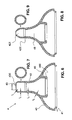
- FIG. 6 shows a longitudinal section through the teat according to FIG. 4 when not in use
- FIG. 7 shows a cross section, perpendicular to the longitudinal axis of the teat, through an upper area of the teat according to FIG. 6 ;
- FIG. 8 shows a longitudinal section through the teat according to FIG. 4 during its intended use
- FIG. 9 shows a cross section, perpendicular to the longitudinal axis of the teat, through an upper area of the teat according to FIG. 8 ;
- FIG. 10 shows a longitudinal section of an alternative embodiment of the teat of the present invention.
- FIGS. 1 to 10 A preferred illustrative embodiment of the teat unit according to the invention is depicted in FIGS. 1 to 10 .
- FIG. 1 shows a liquid container, here a baby's feeding bottle 1 , with a neck 11 that has an outer thread 12 .
- a teat 4 is adapted to be secured on the baby's feeding bottle 1 by means of an assembly unit or receiving unit 2 , 3 .
- the receiving unit 2 , 3 is composed principally of two parts: a base part 2 and a receiving head 3 .
- the base part 2 is preferably made of polypropylene (PP) or a polyamide
- the receiving head 3 is made of a combination of PP or a polyamide with silicone, rubber or TPE.
- silicone, a silicone-based plastic, rubber or TPE is preferably used.
- the base part 2 is dimensionally stable (substantially rigid). It is composed principally of an annular body 20 and of a truncated cone 25 formed integrally on the latter. Centrally in the truncated cone 25 , there is a through-opening or discharge opening 24 which serves as the inlet opening of the unit and which connects the interior of the container 1 to the outside, i.e. to the teat.
- the truncated cone 25 protrudes above the annular body 20 and extends upwards towards the receiving head 3 .
- the discharge opening 24 is preferably arranged in the uppermost area, preferably in the flattened tip.
- This base part 2 is adapted to be fitted onto the container neck 11 , but without already being positionally fixed relative to the latter, in particular secured against rotation.
- a lower abutment is present which limits how far the container neck 11 can pass through the base part 2 , i.e. how far the base part 2 can slip down on the container neck 11 .
- the abutment can be an inner contact surface in the upper area of the base ring 2 .
- Other types of abutments are also possible, for example projecting lugs or ribs.
- the receiving head 3 is also annular and preferably rotationally symmetrical.
- the receiving head 3 is composed principally of two areas.
- the lower and preferably hard area is formed here by several plug elements 30 which form sections of a common jacket that are distributed uniformly about the circumference.
- the plug elements 30 form a common inner thread 301 on their inner face.
- an outer thread can also be present if the drink (liquid) container 1 is provided with a corresponding inner thread.
- the plug elements 30 can be plugged into slits 21 of the base part 2 .
- Locking ribs 33 on the base part and on the receiving head 3 prevent the receiving head 3 from falling out of the base part 2 .
- the upper area of the receiving head 3 can be made of the same material as the lower area, or of a softer material. It can be of any desired configuration in the peripheral area. It preferably has peripheral supporting bodies or supporting structures, here supporting wings 340 , which interact with the suction body or teat 4 described below.
- the teat 4 can be seen clearly in FIGS. 4 to 6 . It has a frustoconical, spherical cap-shaped or semicircular main body 40 , and a mouthpiece 42 integrally formed thereon. In its outer circumference, the mouthpiece 42 is tapered relative to the main body 40 , or the latter is widened in its outer circumference relative to the mouthpiece.
- the main body 40 is preferably bent inwards with its lower edge, resulting in a radially inwardly directed flange 41 . This flange 41 is oriented at a downward angle from the opening of the main body 40 .
- the flange 41 is preferably made relatively narrow and stiffens the lower area of the main body 40 only very slightly, if at all.
- the mouthpiece 42 is preferably designed in a known manner as a hollow cylinder or as a truncated cone. It preferably forms a thin-walled hollow body with a suction opening 43 . It is resiliently and/or flexibly deformable.
- the suction opening 43 is present in the mouthpiece 42 , preferably in the uppermost tip. During use, the liquid sucked from the container 1 emerges through this suction opening 43 .
- a tubular suction channel 48 also called the liquid channel or milk channel, extends in the mouthpiece 42 .
- the suction channel 48 opens at one end into the suction opening 43 . At its second end, it protrudes into the main body 40 and forms the inlet opening of the teat 4 .
- the mouthpiece 42 forms the upper area of the suction channel 48 .
- the lower area of the suction channel 48 is formed by a circumferential skirt 46 , which forms an extension of the mouthpiece 42 protruding into the main body 40 .
- This skirt 46 protrudes towards the receiving head 3 .
- An inwardly or outwardly protruding flange 460 is preferably formed integrally on the skirt 46 .
- the suction opening 43 or the suction channel 48 preferably has a round cross section in the upper area, as can be seen in FIG. 7 . Since the mouthpiece 42 is relatively soft, it is deformed during its intended use, and the suction opening 43 or the suction channel 48 in the adjacent area can assume an oval shape, for example, as is shown in FIG. 9 .
- the mouthpiece 42 can be of any desired shape, provided that it remains flexible and resilient. As can be seen in particular from FIGS. 6 and 8 , the wall of the mouthpiece 42 can increase in thickness towards the head part 3 . This increase takes place in stages here. Typical wall thicknesses are: t 1 circa 0.5 mm, t 2 circa 1.5 mm, t 3 and t 4 circa 2.0 mm. Other sizes are possible, however.
- a tapered area 420 in the internal diameter, such that a deforming hollow space 421 is formed in the area of the suction opening 43 .
- the hollow space 421 is arranged adjacent to the tapered area 420 .
- This hollow space 421 like the suction opening 43 also, preferably has a substantially round cross section.
- the cross section of this hollow space 421 deforms during the intended use of the teat.
- the hollow space 421 can in particular become longer, but narrower, and change from a round cross section to an oval cross section. This shape may be changed during feeding by the baby.
- the mouthpiece is preferably flexible and, during its intended use, there are preferably no parts protruding into and stiffening the mouthpiece along a substantial part of its length.
- the mouthpiece is therefore preferably deformable during its intended use.
- the suction channel 48 can be spaced apart from an inner wall of the mouthpiece and designed as an independent tube.
- the suction channel 48 is formed in one piece with the mouthpiece 42 and is preferably made of the same material.
- the whole teat 4 is preferably made in one piece.
- the suction opening 43 is connected to the interior of the container 1 via this suction channel 48 and, subsequently, via the through-opening 32 and the discharge opening 24 , such that the baby is able to take its drink, e.g. tea, water or milk, through this opening.
- drink e.g. tea, water or milk
- the teat 4 can be pushed with its main body 40 over the receiving head 3 .
- the main body 40 is inverted in this process until it has adopted its second stable position. This inverting can be done by hand, by gripping the lower edge of the main body 40 and bending it upwards and outwards. The main body 40 thus assumes its second stable position, as is shown in FIG. 5 .
- the first connecting means or securing means namely the lower end of the suction channel 48 lies free and protrudes from the inverted main body 40 .
- the teat 4 can be held via the now outwardly protruding inner face 400 of the main body 40 , and the free end of the suction channel 48 , here the skirt 46 , can be pushed over the truncated cone 35 and thus over the through-opening 32 of the receiving head 3 .
- the flange 460 of the skirt 46 engages behind a bead or a rib of the truncated cone 35 and rests sealingly thereon. Since the skirt 46 is easy to see and easily accessible, this can be done is a simple manner.
- the main body 40 is now turned back down to its stable position of use, again by means of just the free edge of the main body 40 being pulled downwards.
- the flange 41 of the main body 40 engages behind the protruding edge between the upper and lower areas of the receiving head 3 and rests flat and sealingly on the outer sealing face 310 of the receiving head 3 .
- the teat 4 is now fitted on the receiving head 3 in the manner shown in FIG. 3 .
- the teat 4 can in this way be placed onto the receiving head 3 or partially pushed over the latter.
- the receiving head 3 can then be plugged into the base part 2 .
- the receiving head 3 can be plugged into the base part 2 when the latter is free, but also when the latter is already located on the container neck 11 . Since the base part 2 can still move slightly in the axial direction relative to the receiving head 3 , the teat 4 can also be pushed over the receiving head 3 only after the receiving head 3 and base part 2 have been plugged together.
- the two threads namely the outer thread 12 and inner thread 301
- the receiving head 3 runs downwards along the thread.
- the base part is pulled down with it as far as its lower abutment.
- the base part 2 and the receiving head 3 are now secured on the container 1 and secured against rotation relative to each other.
- the outer sealing face 270 of the base part 2 is now pressed relative to the outer sealing face 310 of the receiving head 3 . They clamp the flange 41 of the teat 4 and thus ensure a liquid-tight and air-tight connection between teat 4 , receiving head 3 and base part 2 .
- a differently shaped lower edge 41 of the teat 4 can also be clamped sealingly between the two parts 2 , 3 .
- the teat despite its relatively complicated internal structure (as compared to a simple common nipple structure), can be easily fitted in place in this way. As can be seen from FIG. 5 , it can also be well cleaned, since all areas of the teat are readily accessible.
- the described mode of assembly with the two-part receiving unit is only one of many possible examples of how an inverted teat with exposed connector element can be fitted in place.
- the teat does not necessarily have to be placed onto a receiving unit. For example, it can also pass through a receiving unit.
- the radially inwardly directed flange of the main body can be flush with the opening plane of the main body or can be oriented downwards at an angle from the opening of the main body.
- a suction channel can have a radially outwardly directed flange that engages behind a correspondingly shaped seat of the receiving unit, in particular of the receiving head.
- the first connector element i.e. the free end of the suction channel
- the suction channel does not necessarily have to protrude into the main body. It is also possible for the suction channel to terminate at the end of the mouthpiece directed towards the main body.
- This free end of the suction channel is in this case shaped in such a way that it permits a leaktight, preferably plug-in connection to the receiving unit, for example by provision of suitable sealing means on or in the suction channel.
- this end area of the suction channel can be designed as a cone that takes up the receiving unit with pretensioning.
- the mouthpiece and/or the suction channel can further be provided with internal structures, for example radial or axial grooves, ribs, indentations or knobs.
- the suction channel can also be provided on its outside with such internal structures.
- the outer and inner surfaces of the main body can also have a plane or structured design.
- the mouthpiece can be designed with a double wall along its entire length, in which case the two walls extend at a distance from each other, and either they join each other in the area of the mouthpiece or the inner wall ends free.
- the inner wall thus forms the suction channel.
- Ribs or other spacers protruding into the gap between the walls can be arranged on the outer wall and/or on the inner wall.
- the mouthpiece and/or the suction channel can have, for example, a hollow cylindrical or frustoconical design on the inside and/or the outside.
- the chosen suction opening can be relatively large or small.
- the suction opening can in particular have approximately the same cross-sectional surface area as the suction channel along its entire length.
- the suction opening can also have a smaller cross-sectional surface area than the suction channel.
- the teat according to the invention is adapted to be connected to the feeding bottle in a simple and hygienic manner and is, moreover, easy to clean.
Landscapes
- Health & Medical Sciences (AREA)
- Life Sciences & Earth Sciences (AREA)
- Animal Behavior & Ethology (AREA)
- General Health & Medical Sciences (AREA)
- Public Health (AREA)
- Veterinary Medicine (AREA)
- Medical Preparation Storing Or Oral Administration Devices (AREA)
Abstract
Description
Claims (10)
Applications Claiming Priority (6)
| Application Number | Priority Date | Filing Date | Title |
|---|---|---|---|
| CH8972008 | 2008-06-12 | ||
| CH00897/08 | 2008-06-12 | ||
| CH0897/08 | 2008-06-12 | ||
| CH1752009 | 2009-02-06 | ||
| CH00175/09 | 2009-02-06 | ||
| CH0175/09 | 2009-02-06 |
Publications (2)
| Publication Number | Publication Date |
|---|---|
| US20090314733A1 US20090314733A1 (en) | 2009-12-24 |
| US8079482B2 true US8079482B2 (en) | 2011-12-20 |
Family
ID=40886157
Family Applications (1)
| Application Number | Title | Priority Date | Filing Date |
|---|---|---|---|
| US12/482,273 Expired - Fee Related US8079482B2 (en) | 2008-06-12 | 2009-06-10 | Teat unit |
Country Status (4)
| Country | Link |
|---|---|
| US (1) | US8079482B2 (en) |
| EP (1) | EP2291165B1 (en) |
| PL (1) | PL2291165T3 (en) |
| WO (1) | WO2009149573A1 (en) |
Cited By (1)
| Publication number | Priority date | Publication date | Assignee | Title |
|---|---|---|---|---|
| US20120061393A1 (en) * | 2009-05-20 | 2012-03-15 | Makita Corporation | Power tool |
Families Citing this family (5)
| Publication number | Priority date | Publication date | Assignee | Title |
|---|---|---|---|---|
| TWD137696S1 (en) * | 2009-04-24 | 2010-11-11 | 米黛拉控股公司 | Part of a teat for a feeding bottle |
| US8371464B2 (en) * | 2010-10-27 | 2013-02-12 | Medela Holding Ag | Container with adjustable date indicium |
| CH704758A1 (en) * | 2011-03-29 | 2012-10-15 | Medela Holding Ag | Teat. |
| US8689988B2 (en) * | 2012-05-07 | 2014-04-08 | Tao Xu | Bottle cap having removal tracking indicia |
| USD872512S1 (en) * | 2017-08-14 | 2020-01-14 | Glenn Robbins | Straw for a beverage container |
Citations (16)
| Publication number | Priority date | Publication date | Assignee | Title |
|---|---|---|---|---|
| US981072A (en) * | 1909-09-28 | 1911-01-10 | William More Decker | Nursing-nipple. |
| US1735670A (en) * | 1928-06-15 | 1929-11-12 | Blumenfeld Marcus | Safety nipple |
| US1902433A (en) * | 1931-07-02 | 1933-03-21 | Gen Health Corp | Nipple |
| US1904710A (en) | 1931-08-19 | 1933-04-18 | Barkan Irving | Nipple |
| US2133411A (en) * | 1934-02-27 | 1938-10-18 | Zohe Ludwig Alvine | Baby nurser |
| US3777753A (en) * | 1971-07-20 | 1973-12-11 | Mapa Gmbh Gummi Plastikwerke | Feeding bottle teats |
| US4623069A (en) * | 1984-04-12 | 1986-11-18 | Baxter Travenol Laboratories, Inc. | Nipple and nursing container |
| US6126679A (en) * | 1999-04-12 | 2000-10-03 | Botts; Lynne Marie | Nipple for use with liquid and medicine dispensing bottle |
| EP1093785A2 (en) | 1999-10-20 | 2001-04-25 | Anagnostopoulos, Konstantin, Dr. | Articles, such as a nipple, a pacifier or a baby s bottle |
| WO2003013419A1 (en) | 2001-08-09 | 2003-02-20 | The First Years Inc. | Nipple for a baby bottle |
| US20030071006A1 (en) | 2001-10-12 | 2003-04-17 | Kolb Kenneth W. | Infant nipple attachment |
| US20030160019A1 (en) * | 2002-02-28 | 2003-08-28 | Marcy Blanding | Combination cap for a baby bottle and water bottle |
| WO2004043325A2 (en) | 2002-11-08 | 2004-05-27 | Medela Holding Ag | Artificial nipple |
| CA2650714A1 (en) | 2006-05-26 | 2007-12-06 | Medela Holding Ag | Teat for milk bottles |
| WO2007137440A2 (en) | 2006-05-26 | 2007-12-06 | Medela Holding Ag | Teat for feeding bottles |
| WO2008088227A1 (en) | 2007-01-15 | 2008-07-24 | Gunnar Berg | Nipple device |
Family Cites Families (1)
| Publication number | Priority date | Publication date | Assignee | Title |
|---|---|---|---|---|
| US7320678B2 (en) | 2003-03-31 | 2008-01-22 | Ruth Anthony M | Feeding device for infants |
-
2009
- 2009-06-09 WO PCT/CH2009/000192 patent/WO2009149573A1/en not_active Ceased
- 2009-06-09 EP EP09761231.1A patent/EP2291165B1/en not_active Not-in-force
- 2009-06-09 PL PL09761231T patent/PL2291165T3/en unknown
- 2009-06-10 US US12/482,273 patent/US8079482B2/en not_active Expired - Fee Related
Patent Citations (16)
| Publication number | Priority date | Publication date | Assignee | Title |
|---|---|---|---|---|
| US981072A (en) * | 1909-09-28 | 1911-01-10 | William More Decker | Nursing-nipple. |
| US1735670A (en) * | 1928-06-15 | 1929-11-12 | Blumenfeld Marcus | Safety nipple |
| US1902433A (en) * | 1931-07-02 | 1933-03-21 | Gen Health Corp | Nipple |
| US1904710A (en) | 1931-08-19 | 1933-04-18 | Barkan Irving | Nipple |
| US2133411A (en) * | 1934-02-27 | 1938-10-18 | Zohe Ludwig Alvine | Baby nurser |
| US3777753A (en) * | 1971-07-20 | 1973-12-11 | Mapa Gmbh Gummi Plastikwerke | Feeding bottle teats |
| US4623069A (en) * | 1984-04-12 | 1986-11-18 | Baxter Travenol Laboratories, Inc. | Nipple and nursing container |
| US6126679A (en) * | 1999-04-12 | 2000-10-03 | Botts; Lynne Marie | Nipple for use with liquid and medicine dispensing bottle |
| EP1093785A2 (en) | 1999-10-20 | 2001-04-25 | Anagnostopoulos, Konstantin, Dr. | Articles, such as a nipple, a pacifier or a baby s bottle |
| WO2003013419A1 (en) | 2001-08-09 | 2003-02-20 | The First Years Inc. | Nipple for a baby bottle |
| US20030071006A1 (en) | 2001-10-12 | 2003-04-17 | Kolb Kenneth W. | Infant nipple attachment |
| US20030160019A1 (en) * | 2002-02-28 | 2003-08-28 | Marcy Blanding | Combination cap for a baby bottle and water bottle |
| WO2004043325A2 (en) | 2002-11-08 | 2004-05-27 | Medela Holding Ag | Artificial nipple |
| CA2650714A1 (en) | 2006-05-26 | 2007-12-06 | Medela Holding Ag | Teat for milk bottles |
| WO2007137440A2 (en) | 2006-05-26 | 2007-12-06 | Medela Holding Ag | Teat for feeding bottles |
| WO2008088227A1 (en) | 2007-01-15 | 2008-07-24 | Gunnar Berg | Nipple device |
Cited By (2)
| Publication number | Priority date | Publication date | Assignee | Title |
|---|---|---|---|---|
| US20120061393A1 (en) * | 2009-05-20 | 2012-03-15 | Makita Corporation | Power tool |
| US8672162B2 (en) * | 2009-05-20 | 2014-03-18 | Makita Corporation | Power tool including a reservoir and a cap attached to the opening of the reservoir |
Also Published As
| Publication number | Publication date |
|---|---|
| WO2009149573A1 (en) | 2009-12-17 |
| EP2291165A1 (en) | 2011-03-09 |
| EP2291165B1 (en) | 2014-10-29 |
| PL2291165T3 (en) | 2015-03-31 |
| US20090314733A1 (en) | 2009-12-24 |
Similar Documents
| Publication | Publication Date | Title |
|---|---|---|
| US8322546B2 (en) | Teat unit | |
| US20090314733A1 (en) | Teat | |
| US5669520A (en) | Flexible neck baby bottle | |
| CN103501754B (en) | Teat unit | |
| US8251234B2 (en) | Teat | |
| US20160106628A1 (en) | Dual configuration bottle assembly | |
| CN101686900A (en) | Separate type nursing bottle | |
| CN215504443U (en) | Nipple, straw matched with nipple and feeding bottle using nipple | |
| AU2013237725B2 (en) | Suction teat unit | |
| CN221356105U (en) | Brush head | |
| CN112386499A (en) | Nipple and nipple matched straw and feeding bottle using nipple | |
| US20090159551A1 (en) | Universal Adapter for Baby Nipple/Pacifier | |
| CN112386498A (en) | Nipple, straw matched with nipple and feeding bottle using nipple | |
| EP1447073A1 (en) | Child care mouthpiece for a child to suck | |
| HK1153121B (en) | Suction teat unit | |
| HK1153122A (en) | Suction teat unit | |
| HK1202047B (en) | Teat unit | |
| PL64196B1 (en) |
Legal Events
| Date | Code | Title | Description |
|---|---|---|---|
| AS | Assignment |
Owner name: MEDELA HOLDING AG, SWITZERLAND Free format text: ASSIGNMENT OF ASSIGNORS INTEREST;ASSIGNOR:MEDELA HOLDING AG;REEL/FRAME:023191/0784 Effective date: 20090817 |
|
| FEPP | Fee payment procedure |
Free format text: PAYOR NUMBER ASSIGNED (ORIGINAL EVENT CODE: ASPN); ENTITY STATUS OF PATENT OWNER: LARGE ENTITY |
|
| ZAAA | Notice of allowance and fees due |
Free format text: ORIGINAL CODE: NOA |
|
| ZAAB | Notice of allowance mailed |
Free format text: ORIGINAL CODE: MN/=. |
|
| STCF | Information on status: patent grant |
Free format text: PATENTED CASE |
|
| FEPP | Fee payment procedure |
Free format text: PAYOR NUMBER ASSIGNED (ORIGINAL EVENT CODE: ASPN); ENTITY STATUS OF PATENT OWNER: LARGE ENTITY Free format text: PAYER NUMBER DE-ASSIGNED (ORIGINAL EVENT CODE: RMPN); ENTITY STATUS OF PATENT OWNER: LARGE ENTITY |
|
| FPAY | Fee payment |
Year of fee payment: 4 |
|
| MAFP | Maintenance fee payment |
Free format text: PAYMENT OF MAINTENANCE FEE, 8TH YEAR, LARGE ENTITY (ORIGINAL EVENT CODE: M1552); ENTITY STATUS OF PATENT OWNER: LARGE ENTITY Year of fee payment: 8 |
|
| FEPP | Fee payment procedure |
Free format text: MAINTENANCE FEE REMINDER MAILED (ORIGINAL EVENT CODE: REM.); ENTITY STATUS OF PATENT OWNER: LARGE ENTITY |
|
| LAPS | Lapse for failure to pay maintenance fees |
Free format text: PATENT EXPIRED FOR FAILURE TO PAY MAINTENANCE FEES (ORIGINAL EVENT CODE: EXP.); ENTITY STATUS OF PATENT OWNER: LARGE ENTITY |
|
| STCH | Information on status: patent discontinuation |
Free format text: PATENT EXPIRED DUE TO NONPAYMENT OF MAINTENANCE FEES UNDER 37 CFR 1.362 |
|
| FP | Lapsed due to failure to pay maintenance fee |
Effective date: 20231220 |