US8079444B1 - Transportable, self-erecting, battery powered, vertical lift assembly - Google Patents

Transportable, self-erecting, battery powered, vertical lift assembly Download PDF

Info

Publication number
US8079444B1
US8079444B1 US12/315,946 US31594608A US8079444B1 US 8079444 B1 US8079444 B1 US 8079444B1 US 31594608 A US31594608 A US 31594608A US 8079444 B1 US8079444 B1 US 8079444B1
Authority
US
United States
Prior art keywords
linear guide
carriage
guide member
transportable
erecting
Prior art date
Legal status (The legal status is an assumption and is not a legal conclusion. Google has not performed a legal analysis and makes no representation as to the accuracy of the status listed.)
Expired - Fee Related, expires
Application number
US12/315,946
Inventor
William J. Rands
Michael S. Schumacher
Current Assignee (The listed assignees may be inaccurate. Google has not performed a legal analysis and makes no representation or warranty as to the accuracy of the list.)
Elevated Tech LLC
Original Assignee
Elevated Tech LLC
Priority date (The priority date is an assumption and is not a legal conclusion. Google has not performed a legal analysis and makes no representation as to the accuracy of the date listed.)
Filing date
Publication date
Application filed by Elevated Tech LLC filed Critical Elevated Tech LLC
Priority to US12/315,946 priority Critical patent/US8079444B1/en
Assigned to ELEVATED TECHNOLOGIES LLC reassignment ELEVATED TECHNOLOGIES LLC ASSIGNMENT OF ASSIGNORS INTEREST (SEE DOCUMENT FOR DETAILS). Assignors: SCHUMACHER, MICHAEL S., RANDS, WILLIAM J.
Application granted granted Critical
Publication of US8079444B1 publication Critical patent/US8079444B1/en
Expired - Fee Related legal-status Critical Current
Adjusted expiration legal-status Critical

Links

Images

Classifications

    • BPERFORMING OPERATIONS; TRANSPORTING
    • B66HOISTING; LIFTING; HAULING
    • B66BELEVATORS; ESCALATORS OR MOVING WALKWAYS
    • B66B9/00Kinds or types of lifts in, or associated with, buildings or other structures
    • B66B9/16Mobile or transportable lifts specially adapted to be shifted from one part of a building or other structure to another part or to another building or structure
    • B66B9/187Mobile or transportable lifts specially adapted to be shifted from one part of a building or other structure to another part or to another building or structure with a liftway specially adapted for temporary connection to a building or other structure

Definitions

  • the present invention relates to a transportable lift assembly and, more particularly, to a transportable, battery powered lift assembly with a support platform and, most particularly, to a transportable, self-erecting, battery powered lift assembly with a support platform that is suitable for use by an individual with limited mobility.
  • the present invention pertains to a transportable vertical lift assembly, as may be used to lift wheelchair-bound hunters to an elevated location.
  • a transportable vertical lift assembly as may be used to lift wheelchair-bound hunters to an elevated location.
  • Sports for the wheelchair-bound such as racing and basketball, are no exceptions to this trend, and hunting is included among these sports.
  • the physically disadvantaged present unique needs, and special devices are required to allow for their full participation.
  • a physically disadvantaged hunter confined to a wheelchair presents a real challenge. It is common for hunters to construct a tree stand in a tree and then wait in the tree stand for game to come by. Such a feat is extremely impractical for a hunter confined to a wheelchair.
  • Applicants have devised a transportable, self-erecting, battery powered vertical lift assembly suitable for use by any individual, including an individual confined to a wheelchair.
  • the invention is directed to a transportable, self-erecting, battery powered, vertical lift assembly adapted for raising and lowering a load vertically along a substantially linear structure.
  • the transportable, self-erecting, battery powered, vertical lift assembly includes a wheeled frame member having an axle and two wheel members, secured to one end of the frame member and a towing attachment mechanism at an opposite end of the frame member.
  • a linear guide member is pivotally secured at a first end to the frame member adjacent to the axle and two wheel members thereof.
  • a link chain member is secured to an exterior surface of the linear guide member and extends essentially the length of the linear guide member.
  • a carriage member is movably attached to the linear guide member, and a platform member is attached to the carriage member. The carriage member and platform member are positioned between the frame member and a second end of the linear guide member.
  • the carriage member includes a drive mechanism, comprising a battery powered DC motor, driving a worm gear operatively connected to a sprocket.
  • the drive mechanism is attached to the carriage member, with the sprocket engaging the link chain member secured to the linear guide member.
  • the carriage member and attached platform member are movable toward the first end of the linear guide member by controlled rotation of the sprocket, engaged with the link chain member on the linear guide member, to pivot and elevate the guide member, which engages an essentially vertical support structure.
  • the carriage member and attached platform member then are moveable toward the second end of the linear guide member by controlled rotation of the sprocket, engaged with the link chain member on the linear guide member, to elevate the carriage member and attached platform member.
  • a safety brake assembly is actuated to immobilizing the carriage member with respect to the linear guide member upon power loss between the battery and the DC motor. The safety brake assembly locks the carriage member to the linear guide member until power is restored to the drive mechanism.
  • FIG. 1 is a front view of the platform member and carriage member engaged with the linear guide member of the present invention.
  • FIG. 2 is a side view of the platform member and carriage member engaged with the linear guide member of the present invention.
  • FIG. 3 is a perspective view of the platform member and carriage member with an exploded view of the elements of the drive mechanism of the present invention.
  • FIG. 4 is another perspective view of the platform member and carriage member with the drive mechanism engaged with the roller chain member, the linear guide member with an anchoring assembly of the present invention.
  • FIG. 5 is a perspective front view of the carriage member with the mounting opening exposing the roller chain member of the present invention.
  • FIG. 6 is an exploded, perspective view of the drive mechanism with actuation arms of the present invention.
  • FIG. 7 is a perspective, side view of the platform member and attached carriage member with the safety brake assembly in an unlocked state of the present invention.
  • FIG. 8 is a perspective, side view of the platform member and attached carriage member with the safety brake assembly in a locked state of the present invention.
  • FIG. 9 a is a perspective view of a first embodiment of the transportable, self-erecting, battery powered, vertical lift assembly of the present invention.
  • FIG. 9 b is a close up perspective view of the towing attachment mechanism and linear guide member of FIG. 9 a.
  • FIG. 10 is a perspective view of the first embodiment of the transportable, self-erecting, battery powered, vertical lift assembly of the present invention with the stabilizer frame section attached.
  • FIG. 11 is a perspective view of the partially erected first embodiment of the transportable, self-erecting, battery powered, vertical lift assembly of the present invention.
  • FIG. 12 is another perspective view of the fully erected first embodiment of the transportable, self-erecting, battery powered, vertical lift assembly of the present invention.
  • FIG. 13 is a perspective view of the fully erected first embodiment of the transportable, self-erecting, battery powered, vertical lift assembly of the present invention attached to a vertical support structure with the platform member in an elevated position.
  • FIG. 14 a is an enlarged view of the first anchoring assembly of the first embodiment of the transportable, self-erecting, battery powered, vertical lift assembly of the present invention.
  • FIG. 14 b is another enlarged view of the first anchoring assembly of the first embodiment of the transportable, self-erecting, battery powered, vertical lift assembly of the present invention.
  • FIG. 15 a is a perspective view of a second embodiment of the transportable, self-erecting, battery powered, vertical lift assembly of the present invention.
  • FIG. 15 b is an enlarged view of the first anchoring assembly of the second embodiment of the transportable, self-erecting, battery powered, vertical lift assembly of the present invention.
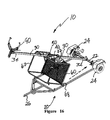
  • FIG. 16 is a perspective view of the second embodiment of the transportable, self-erecting, battery powered, vertical lift assembly of the present invention assembled for erecting.
  • FIG. 17 is a perspective view of the partially erected, second embodiment of the transportable, self-erecting, battery powered, vertical lift assembly of the present invention.
  • FIG. 18 is a perspective view of the fully erected, second embodiment of the transportable, self-erecting, battery powered, vertical lift assembly of the present invention.
  • FIG. 19 is a perspective view of the fully erected, second embodiment of the transportable, self-erecting, battery powered, vertical lift assembly of the present invention with the platform member in an elevated position.
  • FIG. 20 is a perspective view of a third embodiment of the transportable, self-erecting, battery powered, vertical lift assembly of the present invention.
  • FIG. 21 is a perspective, side view of a third embodiment of the transportable, self-erecting, battery powered, vertical lift assembly of the present invention.
  • FIG. 22 is a perspective, front view of a third embodiment of the transportable, self-erecting, battery powered, vertical lift assembly of the present invention.
  • FIG. 23 is a perspective view of a third embodiment of the transportable, self-erecting, battery powered, vertical lift assembly of the present invention with the platform member in an elevated position.
  • FIG. 24 is a perspective, front view of a third embodiment of the transportable, self-erecting, battery powered, vertical lift assembly of the present invention with the platform member in an elevated position.
  • FIG. 25 is a perspective view of a third embodiment of the transportable, self-erecting, battery powered, vertical lift assembly of the present invention with the platform member in an elevated position.
  • the invention is directed to a transportable, self-erecting, battery powered, vertical lift assembly adapted for raising and lowering a load vertically along a substantially linear structure.
  • the transportable, self-erecting, battery powered, vertical lift assembly includes a wheeled frame member, having an axle and two wheel members secured to one end of the frame member, and a towing attachment mechanism at an opposite end of the frame member.
  • a linear guide member is pivotally secured at a first end to the frame member, adjacent to the axle and two wheels thereof.
  • a link chain member is secured to an exterior surface of the linear guide member and extends essentially the length of the linear guide member.
  • a carriage member is movably attached to the linear guide member, and a platform member is attached to the carriage member. The carriage member and platform member are positioned between the frame member and a second end of the linear guide member.
  • the carriage member includes a drive mechanism comprising a battery powered DC motor driving a gear unit operatively connected to a sprocket.
  • the drive mechanism is attached to the carriage member, with the sprocket engaging the link chain member secured to the linear guide member.
  • the carriage member and attached platform member are movable toward the first end of the linear guide member by controlled rotation of the sprocket, engaged with the link chain member on the linear guide member, to pivot and elevate the guide member, which engages an essentially vertical support structure.
  • the carriage member and attached platform member then are moveable toward the second end of the linear guide member by controlled rotation of the sprocket, engaged with the link chain member on the linear guide member, to elevate the carriage member and attached platform member.
  • a safety brake assembly is actuated to immobilize the carriage member with respect to the linear guide member, upon power loss between the battery and the DC motor. The safety brake assembly locks the carriage member to the linear guide member until power is restored to the drive mechanism.
  • FIGS. 1-8 several views of the lifting portion 15 of the transportable, self-erecting, battery powered, vertical lift assembly 10 of the present invention are shown.
  • the transportable, self-erecting, battery powered, vertical lift assembly 10 is adapted for raising and lowering a load vertically and is completely portable.
  • the structure and function of the power train and platform of the vertical lift assembly 10 are detailed in a copending utility patent application Ser. No. 12/231,864, filed Sep. 8, 2008. Application Ser. No. 12/231,864 is hereby incorporated by reference.
  • the transportable, self-erecting, battery powered vertical lift assembly 10 comprises a hollow, linear guide member 30 of selected length, most preferably with a rectangular cross section.
  • the linear guide member 30 has a first end 32 and a second end 34 and is adapted for securing to a substantially vertical structure, such as a building, a pole, or a tree.
  • the linear guide member 30 may be a single, unitary structure or assembled from two or more subunits to provide an extended length.
  • a roller chain member 38 is secured to an exterior surface of the linear guide member 30 and extends essentially the full length of the linear guide member 30 .
  • the roller chain member 38 is securely anchored at one end, adjacent the first end 32 of the guide member 30 , and at the opposite end, adjacent the second end 34 of the guide member 30 .
  • a carriage member 40 is movably attached to the linear guide member 30 , with the carriage member 40 essentially encircling the linear guide member 30 and the roller chain member 38 attached thereto.
  • the carriage member 40 is also rectangular in cross section to conform to the rectangular linear guide member 30 .
  • the carriage member 40 has an upper end 42 and a lower end 44 and includes a mounting opening 46 centered over the roller chain member 38 , which allows the drive mechanism 50 to engage the roller chain member 38 .
  • the mounting opening 46 is best seen in FIG. 5 .
  • a platform member 60 which supports a load, is rigidly attached to the carriage member 40 in an essentially perpendicular orientation thereto.
  • the platform member 60 is fabricated from rectangular tubing with an expanded metal base for supporting the load thereon.
  • the platform member 60 includes a safety railing 62 , surrounding at least a portion of the platform member 60 , and a vertical locking peg 64 , extending upwardly from the platform member 60 .
  • the locking peg 64 functions to secure a wheel chair to the platform member 60 , so the vertical lift assembly 10 can be safely used by an individual in the wheel chair.
  • the carriage member 40 is raised and lowered along the linear guide member 30 by a drive mechanism 50 , supporting the carriage member 40 .
  • the drive mechanism 50 is positioned over the mounting opening 46 and engages the roller chain member 38 .
  • the drive mechanism 50 includes a mounting frame 70 that engages the contact surface 48 ( FIG. 5 ) of the mounting opening 46 of the carriage member 40 .
  • the drive mechanism 50 comprises a battery member 52 powering a DC motor member 54 , which drives a gear unit 56 , such as a worm gear member, that is operatively connected to a sprocket member 58 .
  • the DC motor member 54 , gear unit 56 , and sprocket member 58 are secured within the mounting frame 70 , as shown in FIG. 6 .
  • the sprocket member 58 engages the roller chain member 38 on the linear guide member 30 .
  • the carriage member 40 and attached platform member 60 are raised and lowered by controlled rotation of the sprocket member 58 engaged with the roller chain member 38 on the linear guide member 30 .
  • a control switch member 76 selectively controls operation of the DC motor member 54 .
  • the control switch member 76 includes a handle portion 78 that actuates the DC motor member 54 to raise the carriage member 40 and attached platform member 60 upon raising the handle portion 76 .
  • the control switch member 76 also actuates the DC motor member 54 to lower the carriage member 40 and attached platform member 60 upon lowering the handle portion 78 .
  • a safety brake assembly 80 is actuated to immobilize the carriage member 40 , with respect to the linear guide member 30 , upon relative movement between the carriage member 40 and the drive mechanism 50 .
  • the mounting frame 70 of the drive mechanism 50 supports the carriage member 40 , as described above.
  • the safety brake assembly 80 includes a biased brake clamp member 82 , encircling the linear guide member 30 and pivotally contacting the carriage member 40 below the lower end 44 of the carriage member 40 . As shown in FIGS. 7 and 8 , the lower end 44 of the carriage member 40 is beveled, with the low point of the lower end 44 of the carriage member 40 adjacent the platform member 60 .
  • a pair of brake actuation arms 72 extends vertically downward from the mounting frame 70 of the drive mechanism 50 , with a connecting plate 74 joining the ends of the arms 72 opposite the mounting frame 70 ( FIG. 6 ).
  • the brake clamp member 82 is biased upwardly by a biasing spring 84 , attached to the carriage member 40 opposite the low point of the lower end 44 thereof.
  • the connecting plate 74 attached to the brake actuation arms 72 , applies force to the under side of the brake clamp member 82 to hold the brake clamp member 82 essentially perpendicular to the linear guide member 30 to allow movement of the brake clamp member 82 on the linear guide member 30 .
  • the carriage member 40 and attached platform member 60 are free to move upwardly or downwardly on the linear guide member 30 , by means of the drive mechanism 50 .
  • the drive mechanism 50 will move out of contact with the contact surface 48 of the carriage member 40 .
  • Such movement removes the force from the under side of the brake clamp member 82 , and the biasing spring 84 pulls the brake clamp member 82 away from the perpendicular, unlocked state to a non-perpendicular, locked state to prevent downward movement of the carriage member 40 and attached platform member 60 .
  • the unlocked condition and the locked condition for the brake clamp member 82 are illustrated in FIGS. 7 and 8 , respectively.
  • the brake clamp member 82 is biased in an unlocked state, with the drive mechanism 50 supporting the carriage member 40 .
  • the brake clamp member 82 is actuated to a locked state upon relative movement between the carriage member 40 and the drive mechanism 50 , thereby locking the carriage member 40 and attached platform member 60 to the linear guide member 30 .
  • the transportable lift assembly 10 includes a wheeled frame member 20 , having at least two wheel members 24 secured to one end of the frame member 20 , and a towing attachment mechanism 26 opposite the frame member 20 .
  • a detailed view of the towing attachment mechanism 26 is provided in FIG. 9 b .
  • the linear guide member 30 is pivotally secured at a first end 32 to the frame member 20 adjacent to the two wheel members 24 thereof.
  • the first embodiment of the transportable lift assembly 10 is designed to be pulled with an ATV or similar small vehicle.
  • the linear guide member 30 also functions as a portion of the towing attachment mechanism 26 , with a ball-accepting, towing attachment mechanism 26 removably secured to the second end 34 of the linear guide member 30 .
  • the ball-accepting, towing attachment mechanism 26 is replaced by a first anchoring assembly 90 for securing the linear guide member 30 to a vertical support structure, such as a tree, as described below.
  • an additional stabilizing frame section 28 is secured to the frame member 20 adjacent the first end 32 of the linear guide member 30 .
  • the stabilizing frame section 28 can be transported withing the linear guide member 30 and removed for attachment to the frame member 20 prior to erecting the vertical lift assembly 10 .
  • the lifting portion 15 including the carriage member 50 and attached platform member 60 , is positioned between the stabilizing frame section 28 and the linear guide member 30 , as illustrated in FIG. 10 .
  • a first anchoring assembly 90 replaces the ball-accepting, towing attachment mechanism 26 at the second end 34 of the linear guide member 30 .
  • a roller member 68 attached to an edge of the platform member 60 , engages the stabilizing frame section 28 for facile movement of the platform member 60 there along.
  • the carriage member 50 and attached platform member 60 are then moved toward the first end 32 of the linear guide member 30 by controlled rotation of the sprocket 58 , engaged with the link chain member 40 on the linear guide member 30 .
  • This movement pivots and elevates the linear guide member 30 to essentially vertical, which then engages the essentially vertical support structure, the tree, by means of the attached first anchoring assembly 90 .
  • This elevating sequence is illustrated in FIGS. 10-12 .
  • a second anchoring assembly 95 secured to the frame member 20 , provides additional attachment of the vertical lift assembly 10 to the vertical support structure, such as a tree.
  • safety cables (not shown) attached to the first end 32 and second end 34 of the linear guide member 30 encircle the vertical support structure (such as a tree) for additional safety.
  • the anchoring assemblies 90 , 95 and stabilizing frame section 28 provide a stable foundation for the linear guide member 30 , the engaged carriage member 50 and the platform member 60 attached thereto.
  • the carriage member 50 and attached platform member 60 are, then moveable toward the second end 34 of the linear guide member 30 by controlled rotation of the sprocket 58 , engaged with the link chain member 40 on the linear guide member 30 , to elevate the carriage member 50 and attached platform member 60 .
  • the full elevation of the platform member 60 is illustrated in FIG. 13 .
  • Details of the construction of the first anchoring assembly 90 is provided in FIGS. 14 a and 14 b.
  • the safety brake assembly 80 is actuated to immobilize the carriage member 50 with respect to the linear guide member 30 upon relative movement between the carriage member 50 and the drive mechanism 40 .
  • the safety brake assembly 80 locks the carriage member 50 to the linear guide member 30 upon either mechanical or electrical failure of any component of the lift assembly 10 .
  • the safety brake assembly 80 in an unlocked condition is shown in FIG. 7 and in a locked condition in FIG. 8 .
  • FIGS. 15-19 a second embodiment of the transportable, self-erecting, battery powered, vertical lift assembly 10 is illustrated.
  • the second embodiment is suitable for trailering over the highway.
  • the wheeled frame member 20 is generally rectangular, with the pair of wheel members 24 mounted to an axle 22 secured to the frame member 20 .
  • the lifting portion 15 which includes the platform member 60 and attached carriage member 50 , is positioned adjacent the second end 34 of the linear guide member 30 and between the frame member 20 and the linear guide member 30 for transport, as illustrated in FIG. 15 a .
  • the linear guide member 30 is provided in two sections that attach together for use, as shown in FIG. 16 .
  • the roller chain member 38 is attached to an exterior surface of the linear guide member 30 after the sections thereof are attached together.
  • the first anchoring assembly 90 is secured to the second end 34 of the guide member 30
  • the second anchoring assembly 95 is secured to the frame member 20 adjacent the pivotal attachment of the first end 32 of the linear guide member 30 .
  • the transportable lift assembly 10 is placed against the base of a tree, with the linear guide member 30 having the first anchoring assembly 90 affixed at the second end 34 thereof.
  • the second anchoring assembly 95 is secured to the frame member 20 adjacent the wheel members 24 for anchoring the frame member 20 to the vertical support structure, such as a tree.
  • the elevation of the linear guide member 30 , attachment to the tree, and movement of the platform member 60 and attached carriage member 40 occurs as described above, for the first embodiment.
  • the sequence is illustrated in FIGS. 16-19 .
  • the power source in the form of a battery member 52 , is mounted on the platform member 60 , adjacent the drive mechanism 50 .
  • the battery member 52 is not shown in FIGS. 1-14 for purposes of clarity.
  • the platform member 60 contains a pair of roller members 68 that engage the frame member 20 during elevation or lowering of the linear guide member 30 .
  • the wheeled frame member 20 is generally rectangular with a pair of linear guide members 30 extending vertically upward there from in spaced-apart relationship.
  • Each linear guide member 30 includes a roller chain member 38 , secured to an exterior surface thereof and extending the full length of the guide member 30 .
  • a separate carriage member 40 is moveably attached to each linear guide member 30 , with a gear unit 56 operatively connected to a sprocket member 58 , which engages the roller chain member 38 of each linear guide member 30 .
  • Each carriage member 40 is attached to a single platform member 60 positioned between the two linear guide members 30 .
  • the platform member 60 includes a covered shelter 100 extending upwardly from the platform member 60 , as illustrated in FIGS. 20-25 .
  • a single battery powered DC motor 54 operates the gear unit 56 of each carriage member 40 , with a power shaft member 110 connecting the two gear units 56 , enabling the tandem carriage members 50 to function in unison.
  • the power shaft member 110 is best seen in FIG. 25 .
  • the power source, a battery member 52 is mounted to the platform member 60 .
  • Each carriage member 50 is equipped with a safety brake assembly 80 to immobilize the carriage member 40 with respect to the linear guide member 30 upon relative movement between the carriage member 40 and the drive mechanism 50 , as described above for the first and second embodiments of the vertical lift assembly 10 .
  • the storage battery member 52 is positioned within the covered shelter 100 .
  • the covered shelter 100 includes an access opening 120 with a safety railing 64 and several viewing windows 130 .
  • FIGS. 20-22 The third embodiment of the lift assembly 10 , with the platform member 60 and attached shelter member 100 in the lowest position, is illustrated in FIGS. 20-22 . Actuating the drive mechanism 50 causes each carriage member 40 to ascend the attached linear guide member 30 in unison, thereby raising the platform member 60 and covered shelter 100 to an elevated location.
  • the third embodiment of the lift assembly 10 in an elevated position is illustrated in FIGS. 23-25 .
  • the height of the linear guide members 30 is selected so that the lift assembly 10 of the third embodiment can be trailered under all standard height highway overpasses.

Landscapes

  • Engineering & Computer Science (AREA)
  • Structural Engineering (AREA)
  • Civil Engineering (AREA)
  • Transportation (AREA)
  • Automation & Control Theory (AREA)
  • Handcart (AREA)

Abstract

A transportable, self-erecting, battery powered, vertical lift assembly includes a wheeled frame with a towing attachment mechanism. A linear guide member with an exterior roller chain member is pivotally secured to the frame. A carriage member with attached platform member is movably mounted to the linear guide member adjacent the frame. The carriage member includes an attached drive mechanism with a battery powered DC motor driving a gear unit operatively connected to a sprocket, which engages the roller chain member on the linear guide member. The carriage member and attached platform member are movable along the linear guide member by the drive mechanism to pivot and elevate the guide member, which engages a vertical support structure, and to elevate the carriage member and attached platform member. A safety brake assembly immobilizes the carriage member with respect to the linear guide member upon relative movement between the carriage member and drive mechanism.

Description

CROSS-REFERENCE TO RELATED APPLICATIONS, IF ANY
This application claims the benefit under 35 U.S.C. §119 (e) of provisional application Ser. No. 61/063,407, filed 1 Feb. 2008, and Ser. No. 61/128,231, filed 20 May 2008. Application Ser. No. 61/063,407 and Ser. No. 61/128,231 are hereby incorporated by reference.
STATEMENT REGARDING FEDERALLY SPONSORED RESEARCH OR DEVELOPMENT
Not applicable.
REFERENCE TO A MICROFICHE APPENDIX, IF ANY
Not applicable.
BACKGROUND OF THE INVENTION
1. Field of the Invention
The present invention relates to a transportable lift assembly and, more particularly, to a transportable, battery powered lift assembly with a support platform and, most particularly, to a transportable, self-erecting, battery powered lift assembly with a support platform that is suitable for use by an individual with limited mobility.
2. Background Information
The present invention pertains to a transportable vertical lift assembly, as may be used to lift wheelchair-bound hunters to an elevated location. As our society progresses, the number of activities which are accessible to the physically disadvantaged, or in which the physically disadvantaged desire to participate, is also increasing. Sports for the wheelchair-bound, such as racing and basketball, are no exceptions to this trend, and hunting is included among these sports. However, in many cases, the physically disadvantaged present unique needs, and special devices are required to allow for their full participation. For example, a physically disadvantaged hunter confined to a wheelchair presents a real challenge. It is common for hunters to construct a tree stand in a tree and then wait in the tree stand for game to come by. Such a feat is extremely impractical for a hunter confined to a wheelchair. A need exists for a technology to overcome this barrier to the disabled hunter.
Applicants have devised a transportable, self-erecting, battery powered vertical lift assembly suitable for use by any individual, including an individual confined to a wheelchair.
SUMMARY OF THE INVENTION
The invention is directed to a transportable, self-erecting, battery powered, vertical lift assembly adapted for raising and lowering a load vertically along a substantially linear structure. The transportable, self-erecting, battery powered, vertical lift assembly includes a wheeled frame member having an axle and two wheel members, secured to one end of the frame member and a towing attachment mechanism at an opposite end of the frame member. A linear guide member is pivotally secured at a first end to the frame member adjacent to the axle and two wheel members thereof. A link chain member is secured to an exterior surface of the linear guide member and extends essentially the length of the linear guide member. A carriage member is movably attached to the linear guide member, and a platform member is attached to the carriage member. The carriage member and platform member are positioned between the frame member and a second end of the linear guide member.
The carriage member includes a drive mechanism, comprising a battery powered DC motor, driving a worm gear operatively connected to a sprocket. The drive mechanism is attached to the carriage member, with the sprocket engaging the link chain member secured to the linear guide member. The carriage member and attached platform member are movable toward the first end of the linear guide member by controlled rotation of the sprocket, engaged with the link chain member on the linear guide member, to pivot and elevate the guide member, which engages an essentially vertical support structure. The carriage member and attached platform member then are moveable toward the second end of the linear guide member by controlled rotation of the sprocket, engaged with the link chain member on the linear guide member, to elevate the carriage member and attached platform member. A safety brake assembly is actuated to immobilizing the carriage member with respect to the linear guide member upon power loss between the battery and the DC motor. The safety brake assembly locks the carriage member to the linear guide member until power is restored to the drive mechanism.
BRIEF DESCRIPTION OF THE DRAWINGS
FIG. 1 is a front view of the platform member and carriage member engaged with the linear guide member of the present invention.
FIG. 2 is a side view of the platform member and carriage member engaged with the linear guide member of the present invention.
FIG. 3 is a perspective view of the platform member and carriage member with an exploded view of the elements of the drive mechanism of the present invention.
FIG. 4 is another perspective view of the platform member and carriage member with the drive mechanism engaged with the roller chain member, the linear guide member with an anchoring assembly of the present invention.
FIG. 5 is a perspective front view of the carriage member with the mounting opening exposing the roller chain member of the present invention.
FIG. 6 is an exploded, perspective view of the drive mechanism with actuation arms of the present invention.
FIG. 7 is a perspective, side view of the platform member and attached carriage member with the safety brake assembly in an unlocked state of the present invention.
FIG. 8 is a perspective, side view of the platform member and attached carriage member with the safety brake assembly in a locked state of the present invention.
FIG. 9 a is a perspective view of a first embodiment of the transportable, self-erecting, battery powered, vertical lift assembly of the present invention.
FIG. 9 b is a close up perspective view of the towing attachment mechanism and linear guide member of FIG. 9 a.
FIG. 10 is a perspective view of the first embodiment of the transportable, self-erecting, battery powered, vertical lift assembly of the present invention with the stabilizer frame section attached.
FIG. 11 is a perspective view of the partially erected first embodiment of the transportable, self-erecting, battery powered, vertical lift assembly of the present invention.
FIG. 12 is another perspective view of the fully erected first embodiment of the transportable, self-erecting, battery powered, vertical lift assembly of the present invention.
FIG. 13 is a perspective view of the fully erected first embodiment of the transportable, self-erecting, battery powered, vertical lift assembly of the present invention attached to a vertical support structure with the platform member in an elevated position.
FIG. 14 a is an enlarged view of the first anchoring assembly of the first embodiment of the transportable, self-erecting, battery powered, vertical lift assembly of the present invention.
FIG. 14 b is another enlarged view of the first anchoring assembly of the first embodiment of the transportable, self-erecting, battery powered, vertical lift assembly of the present invention.
FIG. 15 a is a perspective view of a second embodiment of the transportable, self-erecting, battery powered, vertical lift assembly of the present invention.
FIG. 15 b is an enlarged view of the first anchoring assembly of the second embodiment of the transportable, self-erecting, battery powered, vertical lift assembly of the present invention.
FIG. 16 is a perspective view of the second embodiment of the transportable, self-erecting, battery powered, vertical lift assembly of the present invention assembled for erecting.
FIG. 17 is a perspective view of the partially erected, second embodiment of the transportable, self-erecting, battery powered, vertical lift assembly of the present invention.
FIG. 18 is a perspective view of the fully erected, second embodiment of the transportable, self-erecting, battery powered, vertical lift assembly of the present invention.
FIG. 19 is a perspective view of the fully erected, second embodiment of the transportable, self-erecting, battery powered, vertical lift assembly of the present invention with the platform member in an elevated position.
FIG. 20 is a perspective view of a third embodiment of the transportable, self-erecting, battery powered, vertical lift assembly of the present invention.
FIG. 21 is a perspective, side view of a third embodiment of the transportable, self-erecting, battery powered, vertical lift assembly of the present invention.
FIG. 22 is a perspective, front view of a third embodiment of the transportable, self-erecting, battery powered, vertical lift assembly of the present invention.
FIG. 23 is a perspective view of a third embodiment of the transportable, self-erecting, battery powered, vertical lift assembly of the present invention with the platform member in an elevated position.
FIG. 24 is a perspective, front view of a third embodiment of the transportable, self-erecting, battery powered, vertical lift assembly of the present invention with the platform member in an elevated position.
FIG. 25 is a perspective view of a third embodiment of the transportable, self-erecting, battery powered, vertical lift assembly of the present invention with the platform member in an elevated position.
DESCRIPTION OF THE EMBODIMENTS
Nomenclature
10 Transportable, Self-Erecting, Battery Powered, Vertical Lift Assembly
15 Lifting Portion of Vertical Lift Assembly
20 Wheeled Frame Member
22 Axle
24 Wheel Members
26 Towing Attachment Mechanism
28 Stabilizer Frame Section
30 Linear Guide Member
32 First End of Guide Member
34 Second End of Guide Member
38 Roller Chain Member
40 Carriage Member
42 Upper End of Carriage Member
44 Lower End of Carriage Member
46 Mounting Opening of Carriage Member
48 Contact Surface of Carriage Member
50 Drive Mechanism
52 Battery Member
54 DC Motor Member
56 Gear Unit
58 Sprocket Member
60 Platform Member
62 Safety Railing
64 Locking Peg
66 Expanded Mesh Floor
68 Roller Member
70 Mounting Frame of Drive Mechanism
72 Actuation Arms to Brake Clamp Member
74 Connecting Plate between Actuation Arms
76 Control Switch Member
78 Handle Portion of Control Switch Member
80 Safety Brake Assembly
82 Brake Clamp Member
84 Biasing Spring of Safety Brake
90 First Anchoring Assembly
95 Second Anchoring Assembly
100 Shelter Member
110 Power Shaft Member
120 Shelter Access Opening
130 Shelter Viewing Window

Construction
The invention is directed to a transportable, self-erecting, battery powered, vertical lift assembly adapted for raising and lowering a load vertically along a substantially linear structure. The transportable, self-erecting, battery powered, vertical lift assembly includes a wheeled frame member, having an axle and two wheel members secured to one end of the frame member, and a towing attachment mechanism at an opposite end of the frame member. A linear guide member is pivotally secured at a first end to the frame member, adjacent to the axle and two wheels thereof. A link chain member is secured to an exterior surface of the linear guide member and extends essentially the length of the linear guide member. A carriage member is movably attached to the linear guide member, and a platform member is attached to the carriage member. The carriage member and platform member are positioned between the frame member and a second end of the linear guide member.
The carriage member includes a drive mechanism comprising a battery powered DC motor driving a gear unit operatively connected to a sprocket. The drive mechanism is attached to the carriage member, with the sprocket engaging the link chain member secured to the linear guide member. The carriage member and attached platform member are movable toward the first end of the linear guide member by controlled rotation of the sprocket, engaged with the link chain member on the linear guide member, to pivot and elevate the guide member, which engages an essentially vertical support structure. The carriage member and attached platform member then are moveable toward the second end of the linear guide member by controlled rotation of the sprocket, engaged with the link chain member on the linear guide member, to elevate the carriage member and attached platform member. A safety brake assembly is actuated to immobilize the carriage member with respect to the linear guide member, upon power loss between the battery and the DC motor. The safety brake assembly locks the carriage member to the linear guide member until power is restored to the drive mechanism.
Referring now to FIGS. 1-8, several views of the lifting portion 15 of the transportable, self-erecting, battery powered, vertical lift assembly 10 of the present invention are shown. The transportable, self-erecting, battery powered, vertical lift assembly 10 is adapted for raising and lowering a load vertically and is completely portable. The structure and function of the power train and platform of the vertical lift assembly 10 are detailed in a copending utility patent application Ser. No. 12/231,864, filed Sep. 8, 2008. Application Ser. No. 12/231,864 is hereby incorporated by reference.
The transportable, self-erecting, battery powered vertical lift assembly 10 comprises a hollow, linear guide member 30 of selected length, most preferably with a rectangular cross section. The linear guide member 30 has a first end 32 and a second end 34 and is adapted for securing to a substantially vertical structure, such as a building, a pole, or a tree. The linear guide member 30 may be a single, unitary structure or assembled from two or more subunits to provide an extended length. A roller chain member 38 is secured to an exterior surface of the linear guide member 30 and extends essentially the full length of the linear guide member 30. Preferably, the roller chain member 38 is securely anchored at one end, adjacent the first end 32 of the guide member 30, and at the opposite end, adjacent the second end 34 of the guide member 30.
A carriage member 40 is movably attached to the linear guide member 30, with the carriage member 40 essentially encircling the linear guide member 30 and the roller chain member 38 attached thereto. Preferably, the carriage member 40 is also rectangular in cross section to conform to the rectangular linear guide member 30. The carriage member 40 has an upper end 42 and a lower end 44 and includes a mounting opening 46 centered over the roller chain member 38, which allows the drive mechanism 50 to engage the roller chain member 38. The mounting opening 46 is best seen in FIG. 5.
A platform member 60, which supports a load, is rigidly attached to the carriage member 40 in an essentially perpendicular orientation thereto. Preferably, the platform member 60 is fabricated from rectangular tubing with an expanded metal base for supporting the load thereon. The platform member 60 includes a safety railing 62, surrounding at least a portion of the platform member 60, and a vertical locking peg 64, extending upwardly from the platform member 60. The locking peg 64 functions to secure a wheel chair to the platform member 60, so the vertical lift assembly 10 can be safely used by an individual in the wheel chair.
The carriage member 40 is raised and lowered along the linear guide member 30 by a drive mechanism 50, supporting the carriage member 40. As indicated above, the drive mechanism 50 is positioned over the mounting opening 46 and engages the roller chain member 38. The drive mechanism 50 includes a mounting frame 70 that engages the contact surface 48 (FIG. 5) of the mounting opening 46 of the carriage member 40.
The drive mechanism 50 comprises a battery member 52 powering a DC motor member 54, which drives a gear unit 56, such as a worm gear member, that is operatively connected to a sprocket member 58. The DC motor member 54, gear unit 56, and sprocket member 58 are secured within the mounting frame 70, as shown in FIG. 6. The sprocket member 58 engages the roller chain member 38 on the linear guide member 30. The carriage member 40 and attached platform member 60 are raised and lowered by controlled rotation of the sprocket member 58 engaged with the roller chain member 38 on the linear guide member 30.
A control switch member 76 selectively controls operation of the DC motor member 54. The control switch member 76 includes a handle portion 78 that actuates the DC motor member 54 to raise the carriage member 40 and attached platform member 60 upon raising the handle portion 76. The control switch member 76 also actuates the DC motor member 54 to lower the carriage member 40 and attached platform member 60 upon lowering the handle portion 78.
A safety brake assembly 80 is actuated to immobilize the carriage member 40, with respect to the linear guide member 30, upon relative movement between the carriage member 40 and the drive mechanism 50. The mounting frame 70 of the drive mechanism 50 supports the carriage member 40, as described above. The safety brake assembly 80 includes a biased brake clamp member 82, encircling the linear guide member 30 and pivotally contacting the carriage member 40 below the lower end 44 of the carriage member 40. As shown in FIGS. 7 and 8, the lower end 44 of the carriage member 40 is beveled, with the low point of the lower end 44 of the carriage member 40 adjacent the platform member 60. A pair of brake actuation arms 72 extends vertically downward from the mounting frame 70 of the drive mechanism 50, with a connecting plate 74 joining the ends of the arms 72 opposite the mounting frame 70 (FIG. 6). The brake clamp member 82 is biased upwardly by a biasing spring 84, attached to the carriage member 40 opposite the low point of the lower end 44 thereof. The connecting plate 74, attached to the brake actuation arms 72, applies force to the under side of the brake clamp member 82 to hold the brake clamp member 82 essentially perpendicular to the linear guide member 30 to allow movement of the brake clamp member 82 on the linear guide member 30. In this unlocked state, the carriage member 40 and attached platform member 60 are free to move upwardly or downwardly on the linear guide member 30, by means of the drive mechanism 50. Should there be a mechanical or electrical failure of the system, such as failure of the roller chain member 38, the drive mechanism 50 will move out of contact with the contact surface 48 of the carriage member 40. Such movement removes the force from the under side of the brake clamp member 82, and the biasing spring 84 pulls the brake clamp member 82 away from the perpendicular, unlocked state to a non-perpendicular, locked state to prevent downward movement of the carriage member 40 and attached platform member 60. The unlocked condition and the locked condition for the brake clamp member 82 are illustrated in FIGS. 7 and 8, respectively. Thus, the brake clamp member 82 is biased in an unlocked state, with the drive mechanism 50 supporting the carriage member 40. The brake clamp member 82 is actuated to a locked state upon relative movement between the carriage member 40 and the drive mechanism 50, thereby locking the carriage member 40 and attached platform member 60 to the linear guide member 30. This extremely important safety feature makes the transportable, self-erecting, battery powered, vertical lift assembly 10 of the present invention unique.
Referring now to FIGS. 9-14, a first embodiment of the transportable, self-erecting, battery powered, vertical lift assembly 10 is illustrated. The transportable lift assembly 10 includes a wheeled frame member 20, having at least two wheel members 24 secured to one end of the frame member 20, and a towing attachment mechanism 26 opposite the frame member 20. A detailed view of the towing attachment mechanism 26 is provided in FIG. 9 b. The linear guide member 30 is pivotally secured at a first end 32 to the frame member 20 adjacent to the two wheel members 24 thereof. The first embodiment of the transportable lift assembly 10 is designed to be pulled with an ATV or similar small vehicle. In this embodiment, the linear guide member 30 also functions as a portion of the towing attachment mechanism 26, with a ball-accepting, towing attachment mechanism 26 removably secured to the second end 34 of the linear guide member 30. As illustrated in FIG. 10, the ball-accepting, towing attachment mechanism 26 is replaced by a first anchoring assembly 90 for securing the linear guide member 30 to a vertical support structure, such as a tree, as described below.
In order to secure the linear guide member 30 to a vertical support, such as a tree, and elevate the platform member 60, an additional stabilizing frame section 28 is secured to the frame member 20 adjacent the first end 32 of the linear guide member 30. The stabilizing frame section 28 can be transported withing the linear guide member 30 and removed for attachment to the frame member 20 prior to erecting the vertical lift assembly 10. The lifting portion 15, including the carriage member 50 and attached platform member 60, is positioned between the stabilizing frame section 28 and the linear guide member 30, as illustrated in FIG. 10. At this point, a first anchoring assembly 90 replaces the ball-accepting, towing attachment mechanism 26 at the second end 34 of the linear guide member 30. A roller member 68, attached to an edge of the platform member 60, engages the stabilizing frame section 28 for facile movement of the platform member 60 there along.
With the frame member 20 positioned adjacent the base of a tree, the carriage member 50 and attached platform member 60 are then moved toward the first end 32 of the linear guide member 30 by controlled rotation of the sprocket 58, engaged with the link chain member 40 on the linear guide member 30. This movement pivots and elevates the linear guide member 30 to essentially vertical, which then engages the essentially vertical support structure, the tree, by means of the attached first anchoring assembly 90. This elevating sequence is illustrated in FIGS. 10-12. A second anchoring assembly 95, secured to the frame member 20, provides additional attachment of the vertical lift assembly 10 to the vertical support structure, such as a tree. Preferably, safety cables (not shown) attached to the first end 32 and second end 34 of the linear guide member 30 encircle the vertical support structure (such as a tree) for additional safety. The anchoring assemblies 90, 95 and stabilizing frame section 28 provide a stable foundation for the linear guide member 30, the engaged carriage member 50 and the platform member 60 attached thereto.
The carriage member 50 and attached platform member 60 are, then moveable toward the second end 34 of the linear guide member 30 by controlled rotation of the sprocket 58, engaged with the link chain member 40 on the linear guide member 30, to elevate the carriage member 50 and attached platform member 60. The full elevation of the platform member 60 is illustrated in FIG. 13. Details of the construction of the first anchoring assembly 90 is provided in FIGS. 14 a and 14 b.
The safety brake assembly 80 is actuated to immobilize the carriage member 50 with respect to the linear guide member 30 upon relative movement between the carriage member 50 and the drive mechanism 40. The safety brake assembly 80 locks the carriage member 50 to the linear guide member 30 upon either mechanical or electrical failure of any component of the lift assembly 10. The safety brake assembly 80 in an unlocked condition is shown in FIG. 7 and in a locked condition in FIG. 8.
Referring now to FIGS. 15-19, a second embodiment of the transportable, self-erecting, battery powered, vertical lift assembly 10 is illustrated. The second embodiment is suitable for trailering over the highway. In the second embodiment, the wheeled frame member 20 is generally rectangular, with the pair of wheel members 24 mounted to an axle 22 secured to the frame member 20. The lifting portion 15, which includes the platform member 60 and attached carriage member 50, is positioned adjacent the second end 34 of the linear guide member 30 and between the frame member 20 and the linear guide member 30 for transport, as illustrated in FIG. 15 a. The linear guide member 30 is provided in two sections that attach together for use, as shown in FIG. 16. The roller chain member 38 is attached to an exterior surface of the linear guide member 30 after the sections thereof are attached together. The first anchoring assembly 90 is secured to the second end 34 of the guide member 30, and the second anchoring assembly 95 is secured to the frame member 20 adjacent the pivotal attachment of the first end 32 of the linear guide member 30. Again, the transportable lift assembly 10 is placed against the base of a tree, with the linear guide member 30 having the first anchoring assembly 90 affixed at the second end 34 thereof. The second anchoring assembly 95 is secured to the frame member 20 adjacent the wheel members 24 for anchoring the frame member 20 to the vertical support structure, such as a tree. The elevation of the linear guide member 30, attachment to the tree, and movement of the platform member 60 and attached carriage member 40 occurs as described above, for the first embodiment. The sequence is illustrated in FIGS. 16-19. The power source, in the form of a battery member 52, is mounted on the platform member 60, adjacent the drive mechanism 50. The battery member 52 is not shown in FIGS. 1-14 for purposes of clarity. In this embodiment, the platform member 60 contains a pair of roller members 68 that engage the frame member 20 during elevation or lowering of the linear guide member 30.
Referring now to FIGS. 20-25, a third embodiment of the transportable, self-erecting, battery powered, vertical lift assembly 10 is illustrated. The third embodiment also is suitable for trailering over the highway. In the third embodiment, the wheeled frame member 20 is generally rectangular with a pair of linear guide members 30 extending vertically upward there from in spaced-apart relationship. Each linear guide member 30 includes a roller chain member 38, secured to an exterior surface thereof and extending the full length of the guide member 30. A separate carriage member 40 is moveably attached to each linear guide member 30, with a gear unit 56 operatively connected to a sprocket member 58, which engages the roller chain member 38 of each linear guide member 30. Each carriage member 40 is attached to a single platform member 60 positioned between the two linear guide members 30.
In this embodiment, the platform member 60 includes a covered shelter 100 extending upwardly from the platform member 60, as illustrated in FIGS. 20-25. A single battery powered DC motor 54 operates the gear unit 56 of each carriage member 40, with a power shaft member 110 connecting the two gear units 56, enabling the tandem carriage members 50 to function in unison. The power shaft member 110 is best seen in FIG. 25. The power source, a battery member 52, is mounted to the platform member 60. Each carriage member 50 is equipped with a safety brake assembly 80 to immobilize the carriage member 40 with respect to the linear guide member 30 upon relative movement between the carriage member 40 and the drive mechanism 50, as described above for the first and second embodiments of the vertical lift assembly 10. Preferably, the storage battery member 52 is positioned within the covered shelter 100. The covered shelter 100 includes an access opening 120 with a safety railing 64 and several viewing windows 130.
The third embodiment of the lift assembly 10, with the platform member 60 and attached shelter member 100 in the lowest position, is illustrated in FIGS. 20-22. Actuating the drive mechanism 50 causes each carriage member 40 to ascend the attached linear guide member 30 in unison, thereby raising the platform member 60 and covered shelter 100 to an elevated location. The third embodiment of the lift assembly 10 in an elevated position is illustrated in FIGS. 23-25. The height of the linear guide members 30 is selected so that the lift assembly 10 of the third embodiment can be trailered under all standard height highway overpasses.
While the invention has been particularly shown and described with reference to preferred embodiments thereof, it will be understood by those skilled in the art that various changes in form and details may be made therein without departing from the spirit and scope of the invention.

Claims (18)

1. A transportable, self-erecting, battery powered, vertical lift assembly adapted for raising and lowering a load vertically, the transportable, self-erecting, battery powered, vertical lift assembly comprising:
a wheeled frame member having at least two wheel members secured to the frame member and a towing attachment mechanism secured to the frame member opposite the wheel members;
a linear guide member of selected length pivotally secured at a first end to the frame member adjacent the at least two wheel members thereof, the linear guide member adapted for securing to a substantially vertical structure;
a roller chain member secured to an exterior surface of the linear guide member and extending essentially the selected length of the linear guide member;
a carriage member movably attached to the linear guide member;
a platform member, which supports a load, rigidly attached to the carriage member;
the carriage member and attached platform member movable along the linear guide member by a drive mechanism supporting the carriage member;
the drive mechanism comprising a battery member powering a DC motor member driving a gear unit operatively connected to a sprocket member, which engages the roller chain member on the linear guide member, the supported carriage member and attached platform member moved by controlled rotation of the sprocket member engaged with the roller chain member on the linear guide member;
a control switch member selectively controlling operation of the DC motor member; and
a safety brake assembly actuated to immobilize the carriage member with respect to the linear guide member upon relative movement between the carriage member and the drive mechanism;
whereby the carriage member and attached platform member move along the linear guide member in one direction, by controlled rotation of the sprocket engaged with the roller chain member on the linear guide member, to pivot and elevate the guide member, which is adapted to engage an essentially vertical support structure;
the carriage member and attached platform member then moves along the linear guide member in an opposite direction, by controlled rotation of the sprocket engaged with the roller chain member on the linear guide member, to vertically elevate the carriage member and attached platform member.
2. The transportable, self-erecting, battery powered, vertical lift assembly adapted for raising and lowering a load vertically of claim 1, wherein the linear guide member is hollow and rectangular in cross section, and the carriage member essentially encircles the linear guide member and roller chain member attached thereto.
3. The transportable, self-erecting, battery powered, vertical lift assembly adapted for raising and lowering a load vertically of claim 1, wherein the platform member includes an expanded metal mesh support surface and further includes a safety railing surrounding at least a portion of the platform member and a vertical locking peg extending upwardly from the platform member.
4. The transportable, self-erecting, battery powered, vertical lift assembly adapted for raising and lowering a load vertically of claim 1, wherein the safety brake assembly includes a biased brake clamp member encircling the linear guide member and pivotally contacting the carriage member, the brake clamp member biased in an unlocked state with the drive mechanism supporting the carriage member and actuated to a locked state upon relative movement between the carriage member and the drive mechanism, thereby locking the carriage member and attached platform member to the linear guide member.
5. The transportable, self-erecting, battery powered, vertical lift assembly adapted for raising and lowering a load vertically of claim 1, wherein the control switch member includes a handle portion that actuates the DC motor member to raise the carriage member and attached platform member upon raising the handle portion and actuates the DC motor member to lower the carriage member and attached platform member upon lowering the handle portion.
6. The transportable, self-erecting, battery powered, vertical lift assembly adapted for raising and lowering a load vertically of claim 1, further including a first anchoring assembly attached to a second end of the linear guide member and a second anchoring assembly attached adjacent the first end of the linear guide assembly, the first and second anchoring assemblies adapted for securing the linear guide member to a substantially vertical structure.
7. The transportable, self-erecting, battery powered, vertical lift assembly adapted for raising and lowering a load vertically of claim 1, further including a stabilizer frame section attachable to the frame member for stabilizing the vertical lift assembly in an upright orientation.
8. The transportable, self-erecting, battery powered, vertical lift assembly adapted for raising and lowering a load vertically of claim 1, further including at least one roller member fastened to the platform member for facile movement of the platform member along the frame member.
9. The transportable, self-erecting, battery powered, vertical lift assembly adapted for raising and lowering a load vertically of claim 1, wherein the frame member is T-shaped with an arm section having a wheel member at each end thereof and a leg section extending from a midpoint thereof with the towing attachment mechanism at an end of the leg section opposite the arm section.
10. The transportable, self-erecting, battery powered, vertical lift assembly adapted for raising and lowering a load vertically of claim 1, wherein the frame member is rectangular with a wheel member at adjacent corners of one end thereof, and the towing attachment mechanism secured to the frame member opposite the wheel members.
11. A transportable, self-erecting, battery powered, vertical lift assembly adapted for raising and lowering a load vertically, the transportable, self-erecting, battery powered, vertical lift assembly comprising:
a wheeled frame member having at least two wheel members secured to the frame member and a towing attachment mechanism secured to the frame member opposite the wheel members;
a hollow linear guide member of selected length with a rectangular cross section, the linear guide member pivotally secured at a first end to the frame member adjacent the at least two wheel members thereof, the linear guide member adapted for securing to a substantially vertical structure;
a roller chain member secured to an exterior surface of the linear guide member and extending essentially the selected length of the linear guide member;
a carriage member movably attached to the linear guide member, the carriage member essentially encircing the linear guide member and roller chain member attached thereto;
a platform member, which supports a load, rigidly attached to the carriage member;
the carriage member and attached platform member movable along the linear guide member by a drive mechanism supporting the carriage member;
the drive mechanism comprising a battery member powering a DC motor member driving a gear unit operatively connected to a sprocket member, which engages the roller chain member on the linear guide member, the supported carriage member and attached platform member moved by controlled rotation of the sprocket member engaged with the roller chain member on the linear guide member;
a control switch member selectively controlling operation of the DC motor member; and
a safety brake assembly actuated to immobilize the carriage member with respect to the linear guide member upon relative movement between the carriage member and the drive mechanism, the safety brake assembly including a biased brake clamp member encircling the linear guide member and pivotally contacting the carriage member, the brake clamp member biased in an unlocked state with the drive mechanism supporting the carriage member and actuated to a locked state upon relative movement between the carriage member and the drive mechanism, thereby locking the carriage member and attached platform member to the linear guide member;
whereby the carriage member and attached platform member move along the linear guide member in one direction, by controlled rotation of the sprocket engaged with the roller chain member on the linear guide member, to pivot and elevate the guide member, which is adapted to engage an essentially vertical support structure;
the carriage member and attached platform member then moves along the linear guide member in an opposite direction, by controlled rotation of the sprocket engaged with the roller chain member on the linear guide member, to vertically elevate the carriage member and attached platform member.
12. The transportable, self-erecting, battery powered, vertical lift assembly adapted for raising and lowering a load vertically of claim 11, wherein the platform member includes an expanded metal mesh support surface and further includes a safety railing surrounding at least a portion of the platform member and a vertical locking peg extending upwardly from the platform member.
13. The transportable, self-erecting, battery powered, vertical lift assembly adapted for raising and lowering a load vertically of claim 11, wherein the control member includes a handle portion that actuates the DC motor member to raise the carriage member and attached platform member upon raising the handle portion and actuates the DC, motor member to lower the carriage member and attached platform member upon lowering the handle portion.
14. The transportable, self-erecting, battery powered, vertical lift assembly adapted for raising and lowering a load vertically of claim 11, further including a first anchoring assembly attached to a second end of the linear guide member and a second anchoring assembly attached adjacent the first end of the linear guide assembly, the first and second anchoring assemblies adapted for securing the linear guide member to a substantially vertical structure.
15. The transportable, self-erecting, battery powered, vertical lift assembly, adapted for raising and lowering a load vertically of claim 11, further including a stabilizer frame section attachable to the frame member for stabilizing the vertical lift assembly in an upright orientation.
16. The transportable, self-erecting, battery powered, vertical lift assembly adapted for raising and lowering a load vertically of claim 11, further including at least one roller member fastened to the platform member for facile movement of the platform member along the frame member.
17. The transportable, self-erecting, battery powered, vertical lift assembly adapted for raising and lowering a load vertically of claim 11, wherein the frame member is T-shaped with an arm section having a wheel member at each end thereof and a leg section extending from a midpoint thereof with the towing attachment mechanism at an end of the leg section opposite the arm section.
18. The transportable, self-erecting, battery powered, vertical lift assembly adapted for raising and lowering a load vertically of claim 11, wherein the frame member is rectangular with a wheel member at adjacent corners of one end thereof, and the towing attachment mechanism secured to the frame member opposite the wheel members.
US12/315,946 2008-02-01 2008-12-08 Transportable, self-erecting, battery powered, vertical lift assembly Expired - Fee Related US8079444B1 (en)

Priority Applications (1)

Application Number Priority Date Filing Date Title
US12/315,946 US8079444B1 (en) 2008-02-01 2008-12-08 Transportable, self-erecting, battery powered, vertical lift assembly

Applications Claiming Priority (3)

Application Number Priority Date Filing Date Title
US6340708P 2008-02-01 2008-02-01
US12823108P 2008-05-20 2008-05-20
US12/315,946 US8079444B1 (en) 2008-02-01 2008-12-08 Transportable, self-erecting, battery powered, vertical lift assembly

Publications (1)

Publication Number Publication Date
US8079444B1 true US8079444B1 (en) 2011-12-20

Family

ID=45219134

Family Applications (1)

Application Number Title Priority Date Filing Date
US12/315,946 Expired - Fee Related US8079444B1 (en) 2008-02-01 2008-12-08 Transportable, self-erecting, battery powered, vertical lift assembly

Country Status (1)

Country Link
US (1) US8079444B1 (en)

Cited By (14)

* Cited by examiner, † Cited by third party
Publication number Priority date Publication date Assignee Title
US20110284327A1 (en) * 2010-05-20 2011-11-24 Rope Partner, Inc. Device for positioning a rope access technician in relation to a blade of a wind turbine
US8316994B1 (en) * 2008-02-01 2012-11-27 Elevated Technologies Llc Battery powered vertical lift assembly
US20130001013A1 (en) * 2011-06-29 2013-01-03 Reechcraft, Inc. Lift Safety System
US20130341122A1 (en) * 2011-03-09 2013-12-26 Highstep Systems Ag Lift for high-voltage towers and wind turbine towers
US20170100201A1 (en) * 2015-10-09 2017-04-13 Evalve, Inc. Devices, systems, and methods to support, stabilize, and position a medical device
WO2018039149A1 (en) * 2016-08-23 2018-03-01 Abouelmakarem Kadry Electrically controlled movable tree stand for supporting a person
USD816832S1 (en) 2015-10-09 2018-05-01 Evalve, Inc. Stabilizer
CN111302261A (en) * 2020-03-03 2020-06-19 钟顺荣 Lifting device for stereoscopic warehouse stacker
US11345576B2 (en) 2019-02-04 2022-05-31 Pflow Industries, Inc. Hinged carriage deck for vertical reciprocating conveyor
US20220258009A1 (en) * 2018-05-02 2022-08-18 Take It, LLC Adjustable climbing stand
US20240270547A1 (en) * 2023-02-15 2024-08-15 Oshkosh Corporation Lift device
USD1070221S1 (en) 2023-07-21 2025-04-08 Oshkosh Corporation Lift
USD1070220S1 (en) 2023-02-15 2025-04-08 Oshkosh Corporation Lift
US12421714B2 (en) 2022-02-14 2025-09-23 Levitation, LLC System and method for supporting, raising and lowering a modular structure

Citations (29)

* Cited by examiner, † Cited by third party
Publication number Priority date Publication date Assignee Title
US1943A (en) * 1841-01-23 Manner of constructing the apparatus called
US2531346A (en) 1947-07-12 1950-11-21 Schuchert Oakey Builder's hoist
US2757756A (en) * 1951-11-13 1956-08-07 R F Warry Ltd Hoists
US3276546A (en) 1964-09-21 1966-10-04 Slais Raymond Knock down building material elevator
US3517774A (en) 1968-01-17 1970-06-30 Roy E Meyer Tower elevator
US4194591A (en) * 1978-07-17 1980-03-25 Up-Right, Inc. Mobile scaffold with fixed-use-position outriggers
US4353308A (en) 1980-07-14 1982-10-12 Brown Kenneth G Cog wheel railway
US4397373A (en) * 1982-01-25 1983-08-09 Ream Michael D Mobile pedestal scaffold
US4592447A (en) * 1985-09-27 1986-06-03 Up-Right, Inc. Movable pedestal scaffold
US4633538A (en) 1984-02-14 1987-01-06 James Industries Limited Invalid hoist
US4862997A (en) 1987-09-14 1989-09-05 Eberle Kenneth F Wheel chair with elevating seat having a high lift capability
US4987976A (en) 1986-06-30 1991-01-29 Vermette Machine Company, Inc. Telescoping portable lift
US5070792A (en) 1990-04-09 1991-12-10 Gullco International Limited Multi-position travelling carriage with flexible track
US5102179A (en) 1991-04-24 1992-04-07 Royer Jerry L Hunter's blind
US5143181A (en) * 1991-10-07 1992-09-01 Bixby Lawrence B Platform lift apparatus
US5322408A (en) 1992-09-21 1994-06-21 Handi-Loft, Inc. Device for raising and lowering an impaired person
US5595265A (en) 1994-09-02 1997-01-21 Lebrocquy; Chester J. Portable vertical lift
US5960909A (en) 1995-11-28 1999-10-05 Horcher Gmbh Device for lifting a person from a pool
US5979602A (en) 1998-05-14 1999-11-09 Grout; Melvin Personal mini-hoist
US6290023B1 (en) * 1999-08-31 2001-09-18 Harlan Martin Sports utility trailer
US20020017429A1 (en) * 2000-04-11 2002-02-14 Mccowan John D. Fruit Harvesting device
US6347684B1 (en) * 1999-08-12 2002-02-19 Dale C. Fath Mobile hunter's stand
US6523641B2 (en) * 2001-04-26 2003-02-25 Richard D. Smith Trailer mounted, retractable elevated hunting stand
US6640934B1 (en) 2000-05-01 2003-11-04 Ricky L. Edwards Residential cargo lift
US6978862B1 (en) * 2003-04-15 2005-12-27 Cotten Sr David W Mobile deer stand
US20070089930A1 (en) * 2004-05-06 2007-04-26 Friesenhahn Lawrence Sr Rapid assembly game blind transport trailer
US20070125599A1 (en) * 2004-04-27 2007-06-07 Campbell Geoffrey G Mast lift machine
US7281607B1 (en) * 2005-03-10 2007-10-16 King Tool & Manufacturing Company, Inc. Elevating device
US20080302601A1 (en) * 2007-06-06 2008-12-11 Andrew Baker Lift assembly

Patent Citations (29)

* Cited by examiner, † Cited by third party
Publication number Priority date Publication date Assignee Title
US1943A (en) * 1841-01-23 Manner of constructing the apparatus called
US2531346A (en) 1947-07-12 1950-11-21 Schuchert Oakey Builder's hoist
US2757756A (en) * 1951-11-13 1956-08-07 R F Warry Ltd Hoists
US3276546A (en) 1964-09-21 1966-10-04 Slais Raymond Knock down building material elevator
US3517774A (en) 1968-01-17 1970-06-30 Roy E Meyer Tower elevator
US4194591A (en) * 1978-07-17 1980-03-25 Up-Right, Inc. Mobile scaffold with fixed-use-position outriggers
US4353308A (en) 1980-07-14 1982-10-12 Brown Kenneth G Cog wheel railway
US4397373A (en) * 1982-01-25 1983-08-09 Ream Michael D Mobile pedestal scaffold
US4633538A (en) 1984-02-14 1987-01-06 James Industries Limited Invalid hoist
US4592447A (en) * 1985-09-27 1986-06-03 Up-Right, Inc. Movable pedestal scaffold
US4987976A (en) 1986-06-30 1991-01-29 Vermette Machine Company, Inc. Telescoping portable lift
US4862997A (en) 1987-09-14 1989-09-05 Eberle Kenneth F Wheel chair with elevating seat having a high lift capability
US5070792A (en) 1990-04-09 1991-12-10 Gullco International Limited Multi-position travelling carriage with flexible track
US5102179A (en) 1991-04-24 1992-04-07 Royer Jerry L Hunter's blind
US5143181A (en) * 1991-10-07 1992-09-01 Bixby Lawrence B Platform lift apparatus
US5322408A (en) 1992-09-21 1994-06-21 Handi-Loft, Inc. Device for raising and lowering an impaired person
US5595265A (en) 1994-09-02 1997-01-21 Lebrocquy; Chester J. Portable vertical lift
US5960909A (en) 1995-11-28 1999-10-05 Horcher Gmbh Device for lifting a person from a pool
US5979602A (en) 1998-05-14 1999-11-09 Grout; Melvin Personal mini-hoist
US6347684B1 (en) * 1999-08-12 2002-02-19 Dale C. Fath Mobile hunter's stand
US6290023B1 (en) * 1999-08-31 2001-09-18 Harlan Martin Sports utility trailer
US20020017429A1 (en) * 2000-04-11 2002-02-14 Mccowan John D. Fruit Harvesting device
US6640934B1 (en) 2000-05-01 2003-11-04 Ricky L. Edwards Residential cargo lift
US6523641B2 (en) * 2001-04-26 2003-02-25 Richard D. Smith Trailer mounted, retractable elevated hunting stand
US6978862B1 (en) * 2003-04-15 2005-12-27 Cotten Sr David W Mobile deer stand
US20070125599A1 (en) * 2004-04-27 2007-06-07 Campbell Geoffrey G Mast lift machine
US20070089930A1 (en) * 2004-05-06 2007-04-26 Friesenhahn Lawrence Sr Rapid assembly game blind transport trailer
US7281607B1 (en) * 2005-03-10 2007-10-16 King Tool & Manufacturing Company, Inc. Elevating device
US20080302601A1 (en) * 2007-06-06 2008-12-11 Andrew Baker Lift assembly

Cited By (22)

* Cited by examiner, † Cited by third party
Publication number Priority date Publication date Assignee Title
US8316994B1 (en) * 2008-02-01 2012-11-27 Elevated Technologies Llc Battery powered vertical lift assembly
US20110284327A1 (en) * 2010-05-20 2011-11-24 Rope Partner, Inc. Device for positioning a rope access technician in relation to a blade of a wind turbine
US9834944B2 (en) * 2011-03-09 2017-12-05 Highstep Systems Ag Lift for high-voltage towers and wind turbine towers
US20130341122A1 (en) * 2011-03-09 2013-12-26 Highstep Systems Ag Lift for high-voltage towers and wind turbine towers
US20130001013A1 (en) * 2011-06-29 2013-01-03 Reechcraft, Inc. Lift Safety System
US8863899B2 (en) * 2011-06-29 2014-10-21 Reechcraft, Inc. Lift safety system
US8985275B2 (en) 2011-06-29 2015-03-24 Reechcraft, Inc. Lift safety system
US11272999B2 (en) 2015-10-09 2022-03-15 Evalve, Inc. Devices, systems, and methods to support, stabilize, and position a medical device
US20170100201A1 (en) * 2015-10-09 2017-04-13 Evalve, Inc. Devices, systems, and methods to support, stabilize, and position a medical device
USD816832S1 (en) 2015-10-09 2018-05-01 Evalve, Inc. Stabilizer
US10226309B2 (en) * 2015-10-09 2019-03-12 Evalve, Inc. Devices, systems, and methods to support, stabilize, and position a medical device
USD847983S1 (en) 2015-10-09 2019-05-07 Evalve, Inc. Stabilizer
US10159242B2 (en) 2016-08-23 2018-12-25 Kadry Abouelmakarem Electrically controlled movable tree stand for supporting a person
WO2018039149A1 (en) * 2016-08-23 2018-03-01 Abouelmakarem Kadry Electrically controlled movable tree stand for supporting a person
US20220258009A1 (en) * 2018-05-02 2022-08-18 Take It, LLC Adjustable climbing stand
US11345576B2 (en) 2019-02-04 2022-05-31 Pflow Industries, Inc. Hinged carriage deck for vertical reciprocating conveyor
CN111302261B (en) * 2020-03-03 2021-04-09 钟顺荣 Lifting device for stereoscopic warehouse stacker
CN111302261A (en) * 2020-03-03 2020-06-19 钟顺荣 Lifting device for stereoscopic warehouse stacker
US12421714B2 (en) 2022-02-14 2025-09-23 Levitation, LLC System and method for supporting, raising and lowering a modular structure
US20240270547A1 (en) * 2023-02-15 2024-08-15 Oshkosh Corporation Lift device
USD1070220S1 (en) 2023-02-15 2025-04-08 Oshkosh Corporation Lift
USD1070221S1 (en) 2023-07-21 2025-04-08 Oshkosh Corporation Lift

Similar Documents

Publication Publication Date Title
US8079444B1 (en) Transportable, self-erecting, battery powered, vertical lift assembly
US8316994B1 (en) Battery powered vertical lift assembly
US7823694B2 (en) Motorized climbing hunting stand
US7395900B2 (en) Portable wheelchair lift
US7909139B2 (en) Powered lift platform
US7735605B2 (en) Selectively liftable platform mechanism, and method for erecting a shooting house
US5595265A (en) Portable vertical lift
AU611658B2 (en) An arrangement for a lift adapted for use with a motor vehicle
ES3039313T3 (en) Method for outdoor installation of an array of solar converters, and carriage used in the method
US5263808A (en) Automatic storage latch system for a cargo platform
US8584275B2 (en) Patient lifter
ES2412012A2 (en) Loading device
US20090236179A1 (en) Portable and mechanized elevated hunting stand
JP2006102366A (en) Stair lift for wheelchair
KR102003443B1 (en) Full automatic freight elevator
US4723744A (en) Camper storage stand
US20070029267A1 (en) Bicycle support rack
US20040083660A1 (en) Mobile elevating hut
ES2455340T3 (en) Transport cart, mainly for use in a stable
GB2489479A (en) Portable Wheelchair Lifting Assembly
WO1997019887A1 (en) Lift device
US3485321A (en) Work tower
US7857098B2 (en) Elevated sports stand for the handicapped
EP0310624A1 (en) Steering device for a bed
CA2351928C (en) Mobile elevator assembly

Legal Events

Date Code Title Description
AS Assignment

Owner name: ELEVATED TECHNOLOGIES LLC, WISCONSIN

Free format text: ASSIGNMENT OF ASSIGNORS INTEREST;ASSIGNORS:RANDS, WILLIAM J.;SCHUMACHER, MICHAEL S.;SIGNING DATES FROM 20090317 TO 20090318;REEL/FRAME:022480/0749

STCF Information on status: patent grant

Free format text: PATENTED CASE

FPAY Fee payment

Year of fee payment: 4

FEPP Fee payment procedure

Free format text: MAINTENANCE FEE REMINDER MAILED (ORIGINAL EVENT CODE: REM.); ENTITY STATUS OF PATENT OWNER: SMALL ENTITY

LAPS Lapse for failure to pay maintenance fees

Free format text: PATENT EXPIRED FOR FAILURE TO PAY MAINTENANCE FEES (ORIGINAL EVENT CODE: EXP.); ENTITY STATUS OF PATENT OWNER: SMALL ENTITY

STCH Information on status: patent discontinuation

Free format text: PATENT EXPIRED DUE TO NONPAYMENT OF MAINTENANCE FEES UNDER 37 CFR 1.362

FP Lapsed due to failure to pay maintenance fee

Effective date: 20191220