US8071948B2 - Aircraft having an integrated radiation detection system and method therefor - Google Patents
Aircraft having an integrated radiation detection system and method therefor Download PDFInfo
- Publication number
- US8071948B2 US8071948B2 US12/121,956 US12195608A US8071948B2 US 8071948 B2 US8071948 B2 US 8071948B2 US 12195608 A US12195608 A US 12195608A US 8071948 B2 US8071948 B2 US 8071948B2
- Authority
- US
- United States
- Prior art keywords
- aircraft
- component member
- accordance
- radiation detection
- radiation
- Prior art date
- Legal status (The legal status is an assumption and is not a legal conclusion. Google has not performed a legal analysis and makes no representation as to the accuracy of the status listed.)
- Expired - Fee Related, expires
Links
- 230000005855 radiation Effects 0.000 title claims abstract description 69
- 238000001514 detection method Methods 0.000 title claims abstract description 41
- 238000000034 method Methods 0.000 title claims description 10
- 239000000463 material Substances 0.000 claims abstract description 63
- 239000002131 composite material Substances 0.000 claims description 12
- 238000012544 monitoring process Methods 0.000 claims description 5
- 238000013507 mapping Methods 0.000 claims description 4
- 239000007787 solid Substances 0.000 claims description 2
- 238000004891 communication Methods 0.000 claims 3
- 238000012806 monitoring device Methods 0.000 description 7
- 239000002245 particle Substances 0.000 description 4
- 238000004458 analytical method Methods 0.000 description 2
- 238000010586 diagram Methods 0.000 description 2
- 230000010354 integration Effects 0.000 description 2
- 230000003993 interaction Effects 0.000 description 2
- 230000009467 reduction Effects 0.000 description 2
- 239000013078 crystal Substances 0.000 description 1
- 238000013461 design Methods 0.000 description 1
- 238000011161 development Methods 0.000 description 1
- 230000002452 interceptive effect Effects 0.000 description 1
- 238000004519 manufacturing process Methods 0.000 description 1
- 238000012986 modification Methods 0.000 description 1
- 230000004048 modification Effects 0.000 description 1
- 239000011824 nuclear material Substances 0.000 description 1
- 230000003287 optical effect Effects 0.000 description 1
- 229920005989 resin Polymers 0.000 description 1
- 239000011347 resin Substances 0.000 description 1
- 230000004044 response Effects 0.000 description 1
- 230000035945 sensitivity Effects 0.000 description 1
- 238000003860 storage Methods 0.000 description 1
- 239000000126 substance Substances 0.000 description 1
Images


Classifications
-
- G—PHYSICS
- G01—MEASURING; TESTING
- G01T—MEASUREMENT OF NUCLEAR OR X-RADIATION
- G01T7/00—Details of radiation-measuring instruments
Definitions
- Embodiments of this disclosure relate generally to a radiation detection system, and more particularly, to an aircraft having components of a radiation detection system integrated into the aircraft structure.
- Manned and UAV aircraft also have certain limitations. Manned and UAV aircraft generally use solid-state radiological and/or nuclear detectors. Solid-state radiation detectors may generally be characterized with low detector volumes. This is due to the interaction physics within the radiation detector and the statistical likelihood of interaction between the radiation photons to be measured and the volumetric size of radiation detectors.
- the detectors are housed in an aerodynamic and structural airframe that is generally mounted externally to the aircraft. As the payload of the manned and especially unmanned air vehicle system is limited, this subsequently limits the radiation detector volume and therefore the sensitivity of the radiation detection system.
- An embodiment of a radiation detection aircraft has at least one component member of the aircraft having scintillator material.
- a signal converter is coupled to the at least one component member.
- An accumulator is coupled to the signal converter.
- a method of detecting radiation comprising: operating an aircraft having structural component members of the aircraft having scintillator material; monitoring light signals generated by the structural component members of the aircraft having scintillator material; and accumulating the light signals to determine radiation level.
- a radiation detection system has at least one component member of an airframe of the aircraft having scintillator material.
- a signal converter is coupled to the at least one component member to convert signals generated from the scintillator material to pulse signals.
- An accumulator is coupled to the signal converter to record the pulse signals to determine a radiation level.
- FIG. 1 is one embodiment of an aircraft incorporating an integrated radiation detection system
- FIG. 2 is a magnified view of the interior structure of the fuselage of the aircraft incorporating an embodiment of the integration detection system
- FIG. 3 is a magnified view of the interior structure of the wing assembly of the aircraft incorporating an embodiment of the integration detection system
- FIG. 4A is a simplified block view of an embodiment of the scintillating structural components used in forming the aircraft;
- FIG. 4B is a magnified view of an embodiment of the scintillating structural components used in forming the aircraft;
- FIG. 4C is a simplified block diagram of an embodiment of the integrated radiation detection system
- FIG. 4D is a block diagram of an embodiment of the integrated radiation detection system.
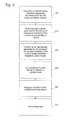
- FIG. 5 is a flow chart depicting a method of detecting radiation using an aircraft incorporating an integrated radiation detection system.
- FIG. 1 shows one embodiment of the aircraft 100 .
- the aircraft 100 may take on different shapes and sizes without departing from the spirit and scope.
- the aircraft 100 may be a manned aircraft, a UAV aircraft or the like.
- the aircraft 100 is shown wherein skin members 104 have been removed from the aircraft 100 to expose portions of the structural airframe 106 of the aircraft 100 .
- a scintillator material 108 ( FIG. 4A ) is used to form different component members of the structural airframe 106 of the aircraft 100 .
- the scintillator material 108 may further be used to form different component members of the aircraft skin 104 .
- a scintillator material 108 is a substance that absorbs high energy such as charged particle radiation. In response to absorbing the high energy, fluoresces photons at a characteristic Stokes-shifted wavelength are generated, releasing the previously absorbed energy.
- Scintillator materials 108 are defined by their light output (number of emitted photons per unit absorbed energy), short fluorescence decay times, and optical transparency at wavelengths of their own specific emission energy. The lower the decay time of a scintillator material 108 , that is, the shorter the duration of its flashes of fluorescence are, the less so-called “dead time” the radiation detection system 102 will have and the more ionizing events per unit of time it will be able to detect.
- the scintillator material 108 may be a plastic scintillator material, cast resins, organic crystal material or the like.
- the scintillator material 108 may be used to form different component members of the structural airframe 106 of the aircraft 100 .
- the scintillator material 108 may further be used to form different component members of the aircraft skin 104 .
- the component members formed of the scintillator material 108 can be substituted for or combined with existing component members in the structures of the aircraft 100 .
- FIG. 2 a magnified section of the fuselage 100 A of the aircraft 100 is shown.
- different component members of the structural airframe 106 of the aircraft 100 may be formed of scintillator material 108 .
- the main structural components of the fuselage 100 A are shown.
- the fuselage 100 A will generally have a bulkhead 106 A and a plurality of support members 106 B.
- Bracing members 106 C may be used to secure the bulkhead 106 A and the plurality of support members 106 B together.
- the main structural components of the fuselage 100 A may then be covered with the aircraft skin 104 .
- the bracing members 106 C may provide longitudinal support of the aircraft skin 104 .
- the bulkhead 106 A and a plurality of support members 106 B may be formed of scintillator material 108 .
- the one or more sheets of the aircraft skin 104 on the fuselage 100 A may also be formed of scintillator material 108 .
- scintillation material 108 By using scintillation material 108 in different component members of the structural airframe 106 of the fuselage 100 A, the detector volume is increased without adding additional weight to the aircraft 100 . Instead, the weight of the radiation detection system 102 is integrated into the overall weight of the aircraft 100 and offers a reduction in overall weight of the aircraft 100 . This permits a larger volume of radiation detector(s) to be flown with the aircraft 100 that provide a more accurate means of detecting radiation fields.
- FIG. 3 a magnified section of a wing assembly 100 B of the aircraft 100 is shown.
- different component members of the structural airframe 106 of the aircraft 100 may be formed of scintillator material 108 .
- structural components of the wing assembly 100 B are shown.
- the wing assembly 100 B may generally have a plurality of wing rib members 106 D which may be connected together by wing spars 106 E. Attached to the rear of the wing assembly 100 B may be flap members 106 F which are generally used to control the movement of the aircraft 100 .
- the main structural components of the wing assembly 100 B may be covered with the aircraft skin 104 .
- the wing rib members 106 D and/or the wing spars 106 E may be formed of scintillator material 108 .
- the one or more sheets of the aircraft skin 104 on the wing assembly 100 B may also be formed of scintillator material 108 .
- scintillation material 108 By using scintillation material 108 to form different component members of the wing assembly 100 B, the detector volume is increased without adding additional weight to the aircraft 100 . Instead, the weight of the radiation detection system 102 is integrated into the overall weight of the aircraft 100 and thus offers a reduction in overall weight of the aircraft 100 . This permits a relatively large volume of radiation detector(s) to be flown with the aircraft thereby providing a more accurate means of detecting radiation fields.
- the radiation detection system 102 increases the radiation detector volume without requiring larger devices to be mounted externally to the aircraft and/or larger aircrafts. Thus, the radiation detection system 102 does not increase the radar signature of the aircraft 100 or require additional manned ground teams thereby allowing more covert means of detecting radiation fields.
- FIGS. 4A-4B more detailed views of the structural airframe 106 having scintillation material 108 are shown.
- different component members of the structural airframe 106 of the aircraft 100 may be formed/comprised of scintillation material 108 to increase the detector volume of the radiation detection system 102 .
- the structural airframe 106 having scintillation material 108 may be formed in different manners.
- the structural airframe 106 having scintillation material 108 may be composed of solid elements 108 A of scintillator material 108 .
- the structural airframe 106 having scintillation material 108 may be composed of multiple thin elements of scintillator material 108 B attached and positioned between layers of composite material sheets 107 as shown in FIG. 4B .
- FIGS. 4C-4D in order to use the different component members of the structural airframe 106 having scintillation material 108 in the radiation detection system 102 , the different component members of the structural airframe 106 having scintillation material 108 are each coupled to a monitoring device 110 .
- FIGS. 4C-4D are directed to the embodiment shown in FIG. 4B but the monitoring device 110 may also be used with the embodiment shown in FIG. 4A as well.
- the monitoring device 110 records signals from the different component members of the structural airframe 106 having scintillation material 108 and determines a count rate of radiation photons monitored.
- the monitoring device 110 may further coordinate the location where the count rate was monitored.
- the monitoring device 110 may use a signal converter 112 .
- the signal converter 112 may be coupled to each component member of the structural airframe 106 having scintillation material 108 .
- the signal converter 112 may be used to convert the fluoresces photons generated to pulse signals.
- the signal converter 112 may be a photomultiplier tube, a light detecting diode, and the like.
- the component member having scintillation material 108 may be enclosed with a covering 118 .
- the covering 118 will generally be a non-opaque covering to prevent any ambient light from interfering with the fluoresces photons generated.
- the pulse signals generated by each signal converter 112 may be sent to an accumulator 114 .
- the accumulator 114 gathers the output signals from each signal converter 112 and determines a count rate of radiation photons.
- the accumulator 114 may be coupled to a location system 116 so that the count rate calculated may be coordinated to a specific location.
- the location system 116 would generally be a mapping system, a Global Positioning Satellite (GPS) system or the like. This information may then be transmitted using a wireless transmitting system 120 in the aircraft 100 to a remote or stand-off sea, land or air-based monitoring station for real-time radiation field mapping, analyses and forensics.
- GPS Global Positioning Satellite
- a scintillator material 108 may be used to form different component members of the structural airframe 106 of the aircraft 100 as shown in 200 .
- the different component members having scintillator material 108 absorb the charged particle radiation and generate fluoresces photons 210 .
- the fluoresces photons may be to convert pulse signals 220 .
- a monitoring device 110 records signals from the different component members having scintillation material 108 and determine a count rate of radiation photons monitored as shown in 230 .
- the monitoring device 110 will further coordinate the location where the count rate was monitored 240 . This information may then be transmitted to a remote or stand-off sea, land or air-based monitoring station for real-time radiation field mapping, analyses and forensics 250 .
Landscapes
- Physics & Mathematics (AREA)
- Health & Medical Sciences (AREA)
- Life Sciences & Earth Sciences (AREA)
- General Physics & Mathematics (AREA)
- High Energy & Nuclear Physics (AREA)
- Molecular Biology (AREA)
- Spectroscopy & Molecular Physics (AREA)
- Measurement Of Radiation (AREA)
Abstract
Description
Claims (23)
Priority Applications (1)
| Application Number | Priority Date | Filing Date | Title |
|---|---|---|---|
| US12/121,956 US8071948B2 (en) | 2008-05-16 | 2008-05-16 | Aircraft having an integrated radiation detection system and method therefor |
Applications Claiming Priority (1)
| Application Number | Priority Date | Filing Date | Title |
|---|---|---|---|
| US12/121,956 US8071948B2 (en) | 2008-05-16 | 2008-05-16 | Aircraft having an integrated radiation detection system and method therefor |
Publications (2)
| Publication Number | Publication Date |
|---|---|
| US20090283686A1 US20090283686A1 (en) | 2009-11-19 |
| US8071948B2 true US8071948B2 (en) | 2011-12-06 |
Family
ID=41315260
Family Applications (1)
| Application Number | Title | Priority Date | Filing Date |
|---|---|---|---|
| US12/121,956 Expired - Fee Related US8071948B2 (en) | 2008-05-16 | 2008-05-16 | Aircraft having an integrated radiation detection system and method therefor |
Country Status (1)
| Country | Link |
|---|---|
| US (1) | US8071948B2 (en) |
Cited By (2)
| Publication number | Priority date | Publication date | Assignee | Title |
|---|---|---|---|---|
| CN109407132A (en) * | 2018-11-02 | 2019-03-01 | 杭州湘亭科技有限公司 | A kind of unmanned plane Radiation monitoring method and system |
| US12050292B2 (en) | 2019-04-04 | 2024-07-30 | Atomic Energy Of Canada Limited/Ènergie Atomique Du Canada Limitèe | Radiation detection device with directional radiation detector |
Families Citing this family (7)
| Publication number | Priority date | Publication date | Assignee | Title |
|---|---|---|---|---|
| DE102012108179A1 (en) * | 2012-09-04 | 2013-12-19 | Gsi Helmholtzzentrum Für Schwerionenforschung Gmbh | Method for checking existence of radioactive contamination in specific region at nuclear plant, involves checking the existence of radioactive contamination at specific region in air-based and unmanned manner by unmanned flight device |
| GB2511754B (en) * | 2013-03-11 | 2016-09-28 | Univ Bristol | Radiation Detection Device and Method |
| DE202017002114U1 (en) * | 2017-04-23 | 2018-07-25 | Claudio Crazzolara | Airborne device for collecting aerosol particles from the air |
| CN107117312A (en) * | 2017-05-22 | 2017-09-01 | 中国原子能科学研究院 | A kind of unmanned vehicle low latitude radiation monitoring system |
| CN109117602A (en) * | 2018-10-17 | 2019-01-01 | 江西洪都航空工业集团有限责任公司 | Large scale covering digitizing detection method based on laser tracker |
| FR3088306B1 (en) * | 2018-11-13 | 2021-01-22 | Orano Mining | AERIAL DRONE FOR AIRBORNE CARTOGRAPHY OF AN AREA OF INTEREST BY MEASURING GAMMA RADIATION |
| CN115540791B (en) * | 2022-12-01 | 2023-03-14 | 成都市鸿侠科技有限责任公司 | Aircraft skin appearance precision detection device |
Citations (7)
| Publication number | Priority date | Publication date | Assignee | Title |
|---|---|---|---|---|
| US3555278A (en) | 1968-12-18 | 1971-01-12 | Gerald L Schroeder | Potential alpha ray activity meter |
| US4464574A (en) | 1981-03-19 | 1984-08-07 | Pylon Electronic Development Co., Ltd. | Sampling devices for detecting particulate contaminants |
| US4571492A (en) | 1982-09-29 | 1986-02-18 | Kane Noel S | Method to detect, identify, authenticate and date an article |
| US4808827A (en) | 1985-11-25 | 1989-02-28 | Central Electricity Generating Board | Method and apparatus for monitoring the concentration of airborne actinide particles |
| US6184531B1 (en) | 1998-04-17 | 2001-02-06 | Battelle Memorial Institute | Apparatus for real-time airborne particulate radionuclide collection and analysis |
| US20060266948A1 (en) | 2005-05-24 | 2006-11-30 | Hofstetter Kenneth J | Portable nuclear material detector and process |
| US20070012879A1 (en) * | 2004-01-30 | 2007-01-18 | Testardi Louis R | Fast, simple radiation detector for responders |
-
2008
- 2008-05-16 US US12/121,956 patent/US8071948B2/en not_active Expired - Fee Related
Patent Citations (7)
| Publication number | Priority date | Publication date | Assignee | Title |
|---|---|---|---|---|
| US3555278A (en) | 1968-12-18 | 1971-01-12 | Gerald L Schroeder | Potential alpha ray activity meter |
| US4464574A (en) | 1981-03-19 | 1984-08-07 | Pylon Electronic Development Co., Ltd. | Sampling devices for detecting particulate contaminants |
| US4571492A (en) | 1982-09-29 | 1986-02-18 | Kane Noel S | Method to detect, identify, authenticate and date an article |
| US4808827A (en) | 1985-11-25 | 1989-02-28 | Central Electricity Generating Board | Method and apparatus for monitoring the concentration of airborne actinide particles |
| US6184531B1 (en) | 1998-04-17 | 2001-02-06 | Battelle Memorial Institute | Apparatus for real-time airborne particulate radionuclide collection and analysis |
| US20070012879A1 (en) * | 2004-01-30 | 2007-01-18 | Testardi Louis R | Fast, simple radiation detector for responders |
| US20060266948A1 (en) | 2005-05-24 | 2006-11-30 | Hofstetter Kenneth J | Portable nuclear material detector and process |
Cited By (2)
| Publication number | Priority date | Publication date | Assignee | Title |
|---|---|---|---|---|
| CN109407132A (en) * | 2018-11-02 | 2019-03-01 | 杭州湘亭科技有限公司 | A kind of unmanned plane Radiation monitoring method and system |
| US12050292B2 (en) | 2019-04-04 | 2024-07-30 | Atomic Energy Of Canada Limited/Ènergie Atomique Du Canada Limitèe | Radiation detection device with directional radiation detector |
Also Published As
| Publication number | Publication date |
|---|---|
| US20090283686A1 (en) | 2009-11-19 |
Similar Documents
| Publication | Publication Date | Title |
|---|---|---|
| US8071948B2 (en) | Aircraft having an integrated radiation detection system and method therefor | |
| US8352105B2 (en) | Unmanned underwater vehicle integrated radiation detection system | |
| Kurvinen et al. | Design of a radiation surveillance unit for an unmanned aerial vehicle | |
| EP2972499B1 (en) | Radiation detection device and method | |
| US6236050B1 (en) | Method and apparatus for radiation detection | |
| Lee et al. | Optimizing UAV-based radiation sensor systems for aerial surveys | |
| JP2016515204A5 (en) | ||
| EP2748642A2 (en) | Apparatus and method for radiation detection | |
| US10495766B2 (en) | Optoelectronic neutron detector | |
| Grove et al. | Glowbug, a low-cost, high-sensitivity gamma-ray burst telescope | |
| Widodo et al. | Development of drone mounted aerial gamma monitoring system for environmental radionuclide surveillance in BATAN | |
| Chakrabarti et al. | Study of high energy phenomena from near space using low-cost meteorological balloons | |
| Pöllänen et al. | Performance of an air sampler and a gamma-ray detector in a small unmanned aerial vehicle | |
| Lacy et al. | Boron-coated straw detectors for backpack monitors | |
| US10429521B1 (en) | Low power charged particle counter | |
| RU238141U1 (en) | Portable airborne gamma ray detection spectrometer | |
| Colalillo et al. | Crystal Eye: a wide sight on the Universe for X and gamma-ray detection | |
| Maxwell et al. | Vertical distribution of ionizing radiation and nano-aerosols in the austral troposphere and stratosphere with concurrent solar flare | |
| Fawwaz et al. | Development of a compact electronics system for a drone-mounted gamma radiation detector aiming at aerial mapping and surveillance | |
| Harriger | Trade-Space Analysis of a Small Unmanned Vehicle System for Radiological Search Missions | |
| Olyslaegers et al. | Detecting radioactive atmospheric releases with an UAS | |
| Norsworthy | Outline for the Operational Use of Unmanned Aerial Systems During a Radiological Emergency | |
| Priedhorsky | Physical and economic limitations for distributed nuclear sensing | |
| Budden et al. | Long duration balloon flight exposure of a Ce: LaBr 3 crystal | |
| Duberg | The meteoritic hazard of the environment of a satellite |
Legal Events
| Date | Code | Title | Description |
|---|---|---|---|
| AS | Assignment |
Owner name: THE BOEING COMPANY, ILLINOIS Free format text: ASSIGNMENT OF ASSIGNORS INTEREST;ASSIGNORS:BARNES, JAMES GARY;AUSTIN, THOMAS ROBERT;REEL/FRAME:020958/0306;SIGNING DATES FROM 20080514 TO 20080516 Owner name: THE BOEING COMPANY, ILLINOIS Free format text: ASSIGNMENT OF ASSIGNORS INTEREST;ASSIGNORS:BARNES, JAMES GARY;AUSTIN, THOMAS ROBERT;SIGNING DATES FROM 20080514 TO 20080516;REEL/FRAME:020958/0306 |
|
| ZAAA | Notice of allowance and fees due |
Free format text: ORIGINAL CODE: NOA |
|
| ZAAB | Notice of allowance mailed |
Free format text: ORIGINAL CODE: MN/=. |
|
| STCF | Information on status: patent grant |
Free format text: PATENTED CASE |
|
| FPAY | Fee payment |
Year of fee payment: 4 |
|
| MAFP | Maintenance fee payment |
Free format text: PAYMENT OF MAINTENANCE FEE, 8TH YEAR, LARGE ENTITY (ORIGINAL EVENT CODE: M1552); ENTITY STATUS OF PATENT OWNER: LARGE ENTITY Year of fee payment: 8 |
|
| FEPP | Fee payment procedure |
Free format text: MAINTENANCE FEE REMINDER MAILED (ORIGINAL EVENT CODE: REM.); ENTITY STATUS OF PATENT OWNER: LARGE ENTITY |
|
| LAPS | Lapse for failure to pay maintenance fees |
Free format text: PATENT EXPIRED FOR FAILURE TO PAY MAINTENANCE FEES (ORIGINAL EVENT CODE: EXP.); ENTITY STATUS OF PATENT OWNER: LARGE ENTITY |
|
| STCH | Information on status: patent discontinuation |
Free format text: PATENT EXPIRED DUE TO NONPAYMENT OF MAINTENANCE FEES UNDER 37 CFR 1.362 |
|
| FP | Lapsed due to failure to pay maintenance fee |
Effective date: 20231206 |