US8050790B2 - Inductor/transformer and manufacturing method thereof - Google Patents

Inductor/transformer and manufacturing method thereof Download PDF

Info

Publication number
US8050790B2
US8050790B2 US12/264,532 US26453208A US8050790B2 US 8050790 B2 US8050790 B2 US 8050790B2 US 26453208 A US26453208 A US 26453208A US 8050790 B2 US8050790 B2 US 8050790B2
Authority
US
United States
Prior art keywords
conductive layer
inductor
transformer
conductive layers
turns
Prior art date
Legal status (The legal status is an assumption and is not a legal conclusion. Google has not performed a legal analysis and makes no representation as to the accuracy of the status listed.)
Active, expires
Application number
US12/264,532
Other versions
US20090115560A1 (en
Inventor
Sheng-Yow Chen
Kuo-Yu Tseng
Current Assignee (The listed assignees may be inaccurate. Google has not performed a legal analysis and makes no representation or warranty as to the accuracy of the list.)
Airoha Technology Corp
Original Assignee
Airoha Technology Corp
Priority date (The priority date is an assumption and is not a legal conclusion. Google has not performed a legal analysis and makes no representation as to the accuracy of the date listed.)
Filing date
Publication date
Application filed by Airoha Technology Corp filed Critical Airoha Technology Corp
Priority to US12/264,532 priority Critical patent/US8050790B2/en
Assigned to AIROHA TECHNOLOGY CORP. reassignment AIROHA TECHNOLOGY CORP. ASSIGNMENT OF ASSIGNORS INTEREST (SEE DOCUMENT FOR DETAILS). Assignors: CHEN, SHENG-YOW, TSENG, KUO-YU
Publication of US20090115560A1 publication Critical patent/US20090115560A1/en
Application granted granted Critical
Publication of US8050790B2 publication Critical patent/US8050790B2/en
Active legal-status Critical Current
Adjusted expiration legal-status Critical

Links

Images

Classifications

    • HELECTRICITY
    • H01ELECTRIC ELEMENTS
    • H01FMAGNETS; INDUCTANCES; TRANSFORMERS; SELECTION OF MATERIALS FOR THEIR MAGNETIC PROPERTIES
    • H01F17/00Fixed inductances of the signal type
    • H01F17/0006Printed inductances
    • H01F17/0013Printed inductances with stacked layers
    • HELECTRICITY
    • H01ELECTRIC ELEMENTS
    • H01FMAGNETS; INDUCTANCES; TRANSFORMERS; SELECTION OF MATERIALS FOR THEIR MAGNETIC PROPERTIES
    • H01F41/00Apparatus or processes specially adapted for manufacturing or assembling magnets, inductances or transformers; Apparatus or processes specially adapted for manufacturing materials characterised by their magnetic properties
    • H01F41/02Apparatus or processes specially adapted for manufacturing or assembling magnets, inductances or transformers; Apparatus or processes specially adapted for manufacturing materials characterised by their magnetic properties for manufacturing cores, coils, or magnets
    • H01F41/04Apparatus or processes specially adapted for manufacturing or assembling magnets, inductances or transformers; Apparatus or processes specially adapted for manufacturing materials characterised by their magnetic properties for manufacturing cores, coils, or magnets for manufacturing coils
    • H01F41/041Printed circuit coils
    • H10W20/497
    • H10W20/423

Definitions

  • the present invention is related to an inductor/transformer and the manufacturing method thereof, wherein the inductance, quality factor, and self-resonance frequency of the inductor/transformer can be input into a simulator to proceed with the simulation process.
  • the wide application of the wireless communication device improves the manufacturing process and the design of the RFIC, such as the reduction of chip size, improvement of the yield, and so on.
  • transistors and passive elements such as inductors, play an essential role in the RFIC; for example, the inductor is provided within the filter and the amplifier of the RFIC.
  • the inductance, quality factor (Q), and self-resonance frequency (Fsr) of the inductor are usually limited in specific scope according to the demand of the circuit.
  • the inductance, quality factor (Q), and self-resonance frequency (Fsr) of the inductor are extracted from network synthesizer. Thereafter, the designer can select the proper inductor according to the measured inductance, quality factor (Q), and self-resonance frequency Fsr(Fsr).
  • One major drawback of foregoing the mentioned embodiment is the cost of the manufacturing process; it cannot be reduced because of the manufacturing and measuring of a variety of inductors. Furthermore, the thickness of the conductive layer within the inductor is increased in order to improve the quality factor of the inductor, and it is more difficult to manufacture the inductor by way of the generic logic circuit process.
  • SoC System on Chip
  • SiP System in Package
  • a manufacturing method for the inductor/transformer wherein the inductor/transformer comprises a stack of a conductive layer and a first conductive layer, is comprised of: inputting the inductance, the quality factor, and the self-resonance frequency of the inductor/transformer into a simulator; analyzing the inductance, the quality factor, and the self-resonance frequency of the inductor/transformer to generate at least one group of the area size, the number of the conductive layer, the line width, the number of turns, and/or the line space of the conductive layer and the first conductive layer by the simulator; manufacturing the inductor/transformer according to the area size, the number of the conductive layer, the line width, the number of turns, and/or the line space of the conductive layer and the first conductive layer; proceeding a process variability analysis of the manufactured inductor/transformer according to a Monte-Carlo simulation to generate a result for the process variability analysis; and modulating the area
  • an inductor/transformer is comprised of: a substrate; at least one conductive layer provided on the substrate; and a first conductive layer stacked on the conductive layer, wherein the thicknesses of the conductive layer and the first conductive layer are both smaller than 1 ⁇ m.
  • FIG. 1A and FIG. 1B are a cross-sectional view and a top view, respectively, of the inductor/transformer according to an embodiment of the present invention
  • FIG. 2 is a flow chart illustrating the manufacturing process of the inductor/transformer according to an embodiment of the present invention
  • FIG. 3 is a cross-sectional view of the inductor/transformer according to another embodiment of the present invention.
  • FIG. 4 is a top view of the floating pattern shield of the inductor/transformer according to another embodiment of the present invention.
  • FIG. 5 is a top view of the floating pattern shield of the inductor/transformer according to another embodiment of the present invention.
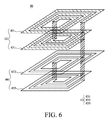
  • FIG. 6 is a block diagram of the inductor/transformer according to another embodiment of the present invention.
  • FIG. 7 is a block diagram of the inductor/transformer according to another embodiment of the present invention.
  • the inductor/transformer 10 comprises a substrate 11 , at least one conductive layer 13 , and a first conductive layer 15 , wherein the conductive layer 13 is provided on the substrate 11 , and the first conductive layer 15 is stacked on the conductive layer 13 ; moreover, the thicknesses (H 1 /H 2 ) of the conductive layer 13 and the first conductive layer 15 are both smaller than 1.0 ⁇ m.
  • a dielectric layer 14 is provided between the conductive layer 13 and the first conductive layer 15 ; furthermore, the dielectric layer 14 can be provided between the adjacent conductive layer 13 , while the number of the conductive layer 13 is plurality.
  • the conductive layer 13 comprises a second conductive layer 131 , a third conductive layer 133 , and a fourth conductive layer 135 , and the dielectric layer 14 is provided for each conductive layer 131 / 133 / 135 .
  • each conductive layer 13 can be electrically connected with each other; as well, the conductive layer 13 can be electrically connected to the first conductive layer 15 . As such, the conductive layer 13 is connected to the first conductive layer 15 in parallel or in series, and each conductive layer 13 is connected with each other in parallel or in series.
  • the factors, such as the area size (X, Y), the number of the conductive layer (L), the line width (W), the number of turns (T), and/or the line space (S), of the first conductive layer 15 and the conductive layer 13 of the inductor/transformer 10 can be modulated during the manufacturing process in order to receive a group of proper inductance, quality factor (Q), and self-resonance frequency (Fsr), wherein the number of the conductive layer (L) is the sum of the conductive layer 13 and the first conductive layer 15 . That is, the inductance, the quality factor (Q), and the self-resonance frequency (Fsr) of the inductor/transformer 10 can be adjusted according to these factors.
  • the number of groups of the inductance, quality factor (Q), and self-resonance frequency (Fsr) of the inductor/transformer 10 can be a plurality, and one group of the inductance, quality factor (Q), and the self-resonance frequency (Fsr) can be selected from those groups and inputted into a simulator.
  • the simulator comprises a software program, and a grouping of the inductance, quality factor (Q), and self-resonance frequency (Fsr), can be inputted into the software program, as shown in step 21 .
  • the simulator can analyze and synthesize the inputted inductance, quality factor (Q), and self-resonance frequency (Fsr), to generate at least one group of the area size (X, Y), the number of the conductive layer (L), the line width (W), the number of turns (T), and/or the line space (S) of the conductive layer 13 and the first conductive layer 15 , as shown in step 23 .
  • the inductor/transformer 10 can be manufactured according to the area size (X, Y), the number of the conductive layer (L), the line width (W), the number of turns (T), and/or the line space (S) of the conductive layer 13 and the first conductive layer 15 , as shown in step 25 .
  • the thicknesses of the conductive layer 13 and the first conductive layer 15 can be smaller than 1 ⁇ m in accordance with selecting one group of the area size (X, Y), the number of the conductive layer (L), the line width (W), the number of turns (T), and/or the line space (S). Furthermore, as the thicknesses of the first conductive layer 15 (H 1 ) and the conductive layer 13 (H 2 ) are both smaller than 1.0 ⁇ m, the process of the generic logic circuit can be used to manufacture the inductor/transformer 10 with a high quality factor (Q) and high inductance. In one embodiment, the thickness of the first conductive layer 15 can be slightly larger than the conductive layer 13 , such as the thickness H 1 of the first conductive layer 15 is slightly larger than the thickness H 2 of the conductive layer 13 .
  • the Monte-Carlo simulation can be used to initiate the process variability analysis of the manufactured inductor/transformer 10 during the manufacturing process of the inductor/transformer 10 .
  • the Monte-Carlo simulation can be used to initiate the process variability analysis of the inductance, quality factor (Q), and self-resonance frequency (Fsr) of the inductor/transformer 10 to obtain a result from the process variability analysis, such that the distribution of the inductance, quality factor (Q), and self-resonance frequency (Fsr) of the manufactured inductor/transformer 10 can be obtained, as shown in the step 27 .
  • the process conditions of the inductor/transformer 10 can be adjusted according to the result of the process variability analysis of the inductor/transformer 10 .
  • the area size (X, Y), the number of the conductive layer (L), the line width (W), the number of turns (T), and/or the line space (S) of the conductive layer 13 and the first conductive layer 15 can be adjusted according to the distribution of inductance, quality factor (Q), and self-resonance frequency (Fsr) for improving the yield of the inductor/transformer 10 , as shown in step 29 .
  • the simulator can be used to generate a plurality of groups of the area size (X, Y), the number of the conductive layer (L), the line width (W), the number of turns (T), and/or the line space (S) of the conductive layer 13 and the first conductive layer 15 according to the inputted inductance, quality factor (Q), and self-resonance frequency (Fsr). Furthermore, one group of area size (X, Y), the number of the conductive layer (L), the line width (W), the number of turns (T), and/or the line space (S) can be selected to begin the manufacturing process of the inductor/transformer 10 .
  • the simulator can comprise a software program and a database; the database comprises an abundance of relations between the factors (X, Y, L, W, T, S) and the groups of the inductance, the quality factor (Q) and the self-resonance frequency (Fsr), such that the software program can be used to compare the inputted conditions with the database to obtain a corresponding group of the area size (X, Y), the number of the conductive layer (L), the line width (W), the number of turns (T), and/or the line space (S).
  • the database can comprise a plurality of foregoing mentioned results of the process variability analysis, such that the ease of use will be greatly improved.
  • the inductor/transformer 30 comprises a substrate 31 , a conductive layer 13 , and a first conductive layer 15 , wherein the thicknesses of the conductive layer 13 and the first conductive layer 15 are both smaller than 1 ⁇ m, and a floating pattern shield 37 is provided on the substrate 31 for reducing the substrate loss and improving the quality factor of the inductor/transformer 30 .
  • the floating pattern shield 37 is a pattern structure that is formed on the surface of the substrate 31 by which the substrate 31 can be divided into a plurality of non-continuous blocks to reduce the flow path and value of the eddy current formed on the substrate 31 , such that the energy loss of the inductor/transformer 30 can be reduced, and the quality factor (Q) of the inductor/transformer 30 can be improved.
  • the geometric shape of the floating pattern shield 37 can vary; furthermore, the floating pattern shield 37 comprises a plurality of trench isolation 371 and/or floating P/N junction, as shown in FIG. 4 .
  • the trench isolation 371 is provided between the P well 373 and the N well 375 , wherein the P well 373 can be P+, the N well can be N+ or deep N well, and the trench isolation 371 can be made of silicon dioxide.
  • the floating pattern shield 37 comprises a plurality of floating metal poles 377 , as shown in FIG. 5 , such that the eddy current can be constrained within the floating metal poles 377 , which minimizes the flow paths of the eddy current.
  • the inductor/transformer 40 comprises a first conductive layer 45 and at least one conductive layer 43 , wherein the first conductive layer 45 is similar with the conductive layer 43 in geometric shape.
  • the conductive layer 43 comprises a second conductive layer 431 , a third conductive layer 433 , and a fourth conductive layer 435 ; furthermore, the thicknesses of the first conductive layer 45 , the second conductive layer 431 , the third conductive layer 433 , and the fourth conductive layer 435 are all smaller than 1 ⁇ m.
  • the characterization of the inductor/transformer 40 can be altered according to the connection relation among the first conductive layer 45 , the second conductive layer 431 , the third conductive layer 433 , and the fourth conductive layer 435 .
  • the first conductive layer 45 and the second conductive layer 431 are connected in parallel to form a first conductive block 42 ; as well, the third conductive layer 433 and the fourth conductive layer 435 are connected in parallel to form a second conductive block 44 , wherein the first conductive block 42 and the second conductive block 44 are connected in series, as shown in FIG. 6 .
  • the first conductive layer 45 , the second conductive layer 431 , the third conductive layer 433 , and the fourth conductive layer 435 are connected in series, as shown in FIG. 7 .

Landscapes

  • Engineering & Computer Science (AREA)
  • Power Engineering (AREA)
  • Microelectronics & Electronic Packaging (AREA)
  • Manufacturing & Machinery (AREA)
  • Coils Or Transformers For Communication (AREA)
  • Semiconductor Integrated Circuits (AREA)
  • Manufacturing Cores, Coils, And Magnets (AREA)

Abstract

A manufacturing method for the inductor/transformer is disclosed. A simulator is used to simulate the inductance, the quality factor, and the self-resonance frequency of said inductor/transformer to generate at least one group of the area size, the number of the conductive layer, the line width, the number of turns, and/or the line space of the conductive layers and the first conductive layer; the inductor/transformer is manufactured according to the factors. Thereafter, the Monte-Carlo simulation is used to initiate the process variability analysis of the factors of the conductive layer and the first conductive layer, and the geometric size of the inductor/transformer can be modulated according to the results of the process variability analysis during the manufacturing process, such that the inductor/transformer can be manufactured by the process of the generic logic circuit.

Description

BACKGROUND OF THE INVENTION
1. Technical Field
The present invention is related to an inductor/transformer and the manufacturing method thereof, wherein the inductance, quality factor, and self-resonance frequency of the inductor/transformer can be input into a simulator to proceed with the simulation process.
2. Description of the Prior Art
The wide application of the wireless communication device improves the manufacturing process and the design of the RFIC, such as the reduction of chip size, improvement of the yield, and so on. In general, transistors and passive elements, such as inductors, play an essential role in the RFIC; for example, the inductor is provided within the filter and the amplifier of the RFIC.
In the design and manufacturing processes of the circuit, it is of great importance to consider the inductance, quality factor (Q), and self-resonance frequency (Fsr) of the inductor. For example, an inductor with a high quality factor can store more energy and reduce electronic noise; moreover, the inductance and quality factor (Q) correlate closely with the self-resonance frequency (Fsr) of the inductor, such that the inductance, quality factor (Q), and self-resonance frequency (Fsr) of the inductor are usually limited in specific scope according to the demand of the circuit.
In traditionally, the inductance, quality factor (Q), and self-resonance frequency (Fsr) of the inductor are extracted from network synthesizer. Thereafter, the designer can select the proper inductor according to the measured inductance, quality factor (Q), and self-resonance frequency Fsr(Fsr).
One major drawback of foregoing the mentioned embodiment is the cost of the manufacturing process; it cannot be reduced because of the manufacturing and measuring of a variety of inductors. Furthermore, the thickness of the conductive layer within the inductor is increased in order to improve the quality factor of the inductor, and it is more difficult to manufacture the inductor by way of the generic logic circuit process.
SUMMARY OF THE INVENTION
It is the primary objective of the present invention to provide a manufacturing process for the inductor/transformer, wherein the inductance, quality factor (Q), and self-resonance frequency (Fsr) of the inductor/transformer can be inputted into the simulator for synthesizing and generating at least one group of the area size (X, Y), the number of the conductive layer (L), the line width (W), the number of turns (T), and/or the line space (S) of the conductive layer and the first conductive layer, such that the thicknesses of the first conductive layer and the other conductive layer are smaller than 1 μm.
It is a secondary objective of the present invention to provide a manufacturing process for the inductor/transformer, wherein the Monte-Carlo simulation is used to initiate a process variability analysis of the manufactured inductor/transformer, such that the factor of the inductor/transformer can be modulated according to the result of the process variability analysis.
It is another objective of the present invention to provide an inductor/transformer, wherein the thicknesses of the first conductive layer and the other conductive layer are both smaller than 1 μm, so that the inductor/transformer can be manufactured by the process of the generic logic circuit.
It is still another objective of the present invention to provide an inductor/transformer, wherein a floating pattern shield is provided on the substrate of the inductor/transformer for reducing substrate loss.
It is still another objective of the present invention to provide an inductor/transformer, wherein the RFIC and the high-density digital circuit can be integrated into a System on Chip (SoC) by way of the generic logic circuit process.
It is still another objective of the present invention to provide an inductor/transformer, wherein the process variability analysis can be initiated according to the process variation of the semiconductor, the packaging material, and the Si chip stacked on the Si chip with the inductor/transformer within the System in Package (SiP) for generating a result for the process variability analysis.
According to the above objectives, a manufacturing method for the inductor/transformer, wherein the inductor/transformer comprises a stack of a conductive layer and a first conductive layer, is comprised of: inputting the inductance, the quality factor, and the self-resonance frequency of the inductor/transformer into a simulator; analyzing the inductance, the quality factor, and the self-resonance frequency of the inductor/transformer to generate at least one group of the area size, the number of the conductive layer, the line width, the number of turns, and/or the line space of the conductive layer and the first conductive layer by the simulator; manufacturing the inductor/transformer according to the area size, the number of the conductive layer, the line width, the number of turns, and/or the line space of the conductive layer and the first conductive layer; proceeding a process variability analysis of the manufactured inductor/transformer according to a Monte-Carlo simulation to generate a result for the process variability analysis; and modulating the area size, the number of the conductive layer, the line width, the number of turns, and/or the line space of the conductive layer and the first conductive layer according to the result of the process variability analysis during the manufacturing process.
According to the above objectives, an inductor/transformer is comprised of: a substrate; at least one conductive layer provided on the substrate; and a first conductive layer stacked on the conductive layer, wherein the thicknesses of the conductive layer and the first conductive layer are both smaller than 1 μm.
The present invention can be best understood through the following description and accompanying drawings.
BRIEF DESCRIPTION OF THE DRAWINGS
FIG. 1A and FIG. 1B are a cross-sectional view and a top view, respectively, of the inductor/transformer according to an embodiment of the present invention;
FIG. 2 is a flow chart illustrating the manufacturing process of the inductor/transformer according to an embodiment of the present invention;
FIG. 3 is a cross-sectional view of the inductor/transformer according to another embodiment of the present invention;
FIG. 4 is a top view of the floating pattern shield of the inductor/transformer according to another embodiment of the present invention;
FIG. 5 is a top view of the floating pattern shield of the inductor/transformer according to another embodiment of the present invention;
FIG. 6 is a block diagram of the inductor/transformer according to another embodiment of the present invention; and
FIG. 7 is a block diagram of the inductor/transformer according to another embodiment of the present invention.
DETAILED DESCRIPTION OF THE PREFERRED EMBODIMENTS
Referring to FIG. 1A, FIG. 1B, and FIG. 2, a cross-sectional view, a top view, and a flow chart illustrating the manufacturing process of the inductor/transformer according to an embodiment of the present invention, respectively, is disclosed. The inductor/transformer 10 comprises a substrate 11, at least one conductive layer 13, and a first conductive layer 15, wherein the conductive layer 13 is provided on the substrate 11, and the first conductive layer 15 is stacked on the conductive layer 13; moreover, the thicknesses (H1/H2) of the conductive layer 13 and the first conductive layer 15 are both smaller than 1.0 μm.
A dielectric layer 14 is provided between the conductive layer 13 and the first conductive layer 15; furthermore, the dielectric layer 14 can be provided between the adjacent conductive layer 13, while the number of the conductive layer 13 is plurality. For example, the conductive layer 13 comprises a second conductive layer 131, a third conductive layer 133, and a fourth conductive layer 135, and the dielectric layer 14 is provided for each conductive layer 131/133/135. Moreover, each conductive layer 13 can be electrically connected with each other; as well, the conductive layer 13 can be electrically connected to the first conductive layer 15. As such, the conductive layer 13 is connected to the first conductive layer 15 in parallel or in series, and each conductive layer 13 is connected with each other in parallel or in series.
The factors, such as the area size (X, Y), the number of the conductive layer (L), the line width (W), the number of turns (T), and/or the line space (S), of the first conductive layer 15 and the conductive layer 13 of the inductor/transformer 10 can be modulated during the manufacturing process in order to receive a group of proper inductance, quality factor (Q), and self-resonance frequency (Fsr), wherein the number of the conductive layer (L) is the sum of the conductive layer 13 and the first conductive layer 15. That is, the inductance, the quality factor (Q), and the self-resonance frequency (Fsr) of the inductor/transformer 10 can be adjusted according to these factors.
The number of groups of the inductance, quality factor (Q), and self-resonance frequency (Fsr) of the inductor/transformer 10 can be a plurality, and one group of the inductance, quality factor (Q), and the self-resonance frequency (Fsr) can be selected from those groups and inputted into a simulator. For example, the simulator comprises a software program, and a grouping of the inductance, quality factor (Q), and self-resonance frequency (Fsr), can be inputted into the software program, as shown in step 21.
The simulator can analyze and synthesize the inputted inductance, quality factor (Q), and self-resonance frequency (Fsr), to generate at least one group of the area size (X, Y), the number of the conductive layer (L), the line width (W), the number of turns (T), and/or the line space (S) of the conductive layer 13 and the first conductive layer 15, as shown in step 23. Thereafter, the inductor/transformer 10 can be manufactured according to the area size (X, Y), the number of the conductive layer (L), the line width (W), the number of turns (T), and/or the line space (S) of the conductive layer 13 and the first conductive layer 15, as shown in step 25.
The thicknesses of the conductive layer 13 and the first conductive layer 15 can be smaller than 1 μm in accordance with selecting one group of the area size (X, Y), the number of the conductive layer (L), the line width (W), the number of turns (T), and/or the line space (S). Furthermore, as the thicknesses of the first conductive layer 15 (H1) and the conductive layer 13 (H2) are both smaller than 1.0 μm, the process of the generic logic circuit can be used to manufacture the inductor/transformer 10 with a high quality factor (Q) and high inductance. In one embodiment, the thickness of the first conductive layer 15 can be slightly larger than the conductive layer 13, such as the thickness H1 of the first conductive layer 15 is slightly larger than the thickness H2 of the conductive layer 13.
The Monte-Carlo simulation can be used to initiate the process variability analysis of the manufactured inductor/transformer 10 during the manufacturing process of the inductor/transformer 10. For example, the Monte-Carlo simulation can be used to initiate the process variability analysis of the inductance, quality factor (Q), and self-resonance frequency (Fsr) of the inductor/transformer 10 to obtain a result from the process variability analysis, such that the distribution of the inductance, quality factor (Q), and self-resonance frequency (Fsr) of the manufactured inductor/transformer 10 can be obtained, as shown in the step 27.
In addition, the process conditions of the inductor/transformer 10 can be adjusted according to the result of the process variability analysis of the inductor/transformer 10. For example, the area size (X, Y), the number of the conductive layer (L), the line width (W), the number of turns (T), and/or the line space (S) of the conductive layer 13 and the first conductive layer 15, can be adjusted according to the distribution of inductance, quality factor (Q), and self-resonance frequency (Fsr) for improving the yield of the inductor/transformer 10, as shown in step 29.
The simulator can be used to generate a plurality of groups of the area size (X, Y), the number of the conductive layer (L), the line width (W), the number of turns (T), and/or the line space (S) of the conductive layer 13 and the first conductive layer 15 according to the inputted inductance, quality factor (Q), and self-resonance frequency (Fsr). Furthermore, one group of area size (X, Y), the number of the conductive layer (L), the line width (W), the number of turns (T), and/or the line space (S) can be selected to begin the manufacturing process of the inductor/transformer 10.
The simulator can comprise a software program and a database; the database comprises an abundance of relations between the factors (X, Y, L, W, T, S) and the groups of the inductance, the quality factor (Q) and the self-resonance frequency (Fsr), such that the software program can be used to compare the inputted conditions with the database to obtain a corresponding group of the area size (X, Y), the number of the conductive layer (L), the line width (W), the number of turns (T), and/or the line space (S). Moreover, the database can comprise a plurality of foregoing mentioned results of the process variability analysis, such that the ease of use will be greatly improved.
Referring to FIG. 3, a cross-sectional view of the inductor/transformer according to another embodiment of the present invention is disclosed. The inductor/transformer 30 comprises a substrate 31, a conductive layer 13, and a first conductive layer 15, wherein the thicknesses of the conductive layer 13 and the first conductive layer 15 are both smaller than 1 μm, and a floating pattern shield 37 is provided on the substrate 31 for reducing the substrate loss and improving the quality factor of the inductor/transformer 30.
The floating pattern shield 37 is a pattern structure that is formed on the surface of the substrate 31 by which the substrate 31 can be divided into a plurality of non-continuous blocks to reduce the flow path and value of the eddy current formed on the substrate 31, such that the energy loss of the inductor/transformer 30 can be reduced, and the quality factor (Q) of the inductor/transformer 30 can be improved.
The geometric shape of the floating pattern shield 37 can vary; furthermore, the floating pattern shield 37 comprises a plurality of trench isolation 371 and/or floating P/N junction, as shown in FIG. 4. For example, the trench isolation 371 is provided between the P well 373 and the N well 375, wherein the P well 373 can be P+, the N well can be N+ or deep N well, and the trench isolation 371 can be made of silicon dioxide. Alternatively, the floating pattern shield 37 comprises a plurality of floating metal poles 377, as shown in FIG. 5, such that the eddy current can be constrained within the floating metal poles 377, which minimizes the flow paths of the eddy current.
Referring to FIG. 6 and FIG. 7, block diagrams of the inductor/transformer according to another embodiment of the present invention are disclosed. The inductor/transformer 40 comprises a first conductive layer 45 and at least one conductive layer 43, wherein the first conductive layer 45 is similar with the conductive layer 43 in geometric shape. For example, the conductive layer 43 comprises a second conductive layer 431, a third conductive layer 433, and a fourth conductive layer 435; furthermore, the thicknesses of the first conductive layer 45, the second conductive layer 431, the third conductive layer 433, and the fourth conductive layer 435 are all smaller than 1 μm.
The characterization of the inductor/transformer 40 can be altered according to the connection relation among the first conductive layer 45, the second conductive layer 431, the third conductive layer 433, and the fourth conductive layer 435. For example, the first conductive layer 45 and the second conductive layer 431 are connected in parallel to form a first conductive block 42; as well, the third conductive layer 433 and the fourth conductive layer 435 are connected in parallel to form a second conductive block 44, wherein the first conductive block 42 and the second conductive block 44 are connected in series, as shown in FIG. 6. Alternatively, the first conductive layer 45, the second conductive layer 431, the third conductive layer 433, and the fourth conductive layer 435 are connected in series, as shown in FIG. 7.
The above embodiments are only used to illustrate the present invention, and not intended to limit the scope thereof. Many modifications of the above embodiments can be made without departing from the spirit of the present invention.

Claims (6)

1. A manufacturing method of an inductor or a transformer, wherein said inductor or transformer comprises a substrate, a stack of conductive layers, and a first conductive layer, wherein said conductive layers are on the substrate and said first conductive layer is on said conductive layers, comprising the steps of:
inputting the inductance, the quality factor, and the self-resonance frequency of said inductor or transformer into a simulator;
analyzing the inductance, the quality factor, and the self-resonance frequency of said inductor or transformer to generate, by said simulator, at least one group including: the area size, the number of conductive layers, the line width, and the number of turns, or to generate, by said simulator, at least one group including: the area size, the number of conductive layers, the line width, the number of turns, and the line space of said conductive layers and said first conductive layer;
manufacturing said inductor or transformer according to the area size, the number of conductive layers, the line width, and the number of turns, or according to the area size, the number of conductive layers, the line width, the number of turns, and the line space of said conductive layers and said first conductive layer;
proceeding with a process variability analysis of the manufactured inductor or transformer according to a Monte-Carlo simulation to generate a result for said process variability analysis; and
modulating the area size, the number of conductive layers, the line width, and the number of turns, or modulating the area size, the number of conductive layers, the line width, the number of turns, and the line space of said conductive layers and said first conductive layer, according to said result of said process variability analysis of the manufactured inductor or transformer;
wherein the total thickness of said conductive layers, and said first conductive layer is less than 1 μm, and the number of conductive layers is the sum of said conductive layers and the first conductive layer.
2. The manufacturing method of claim 1, comprising the steps of:
proceeding with said process variability analysis according to said Monte-Carlo simulation to obtain a distribution of the inductance, the quality factor, and the self-resonance frequency of said inductor or transformer.
3. The manufacturing method of claim 2, comprising the steps of:
modulating the area size, the number of conductive layers, the line width, and the number of turns of the manufactured inductor or transformer, or modulating the area size, the number of conductive layers, the line width, the number of turns, and the line space of said conductive layers and said first conductive layer of the manufactured inductor or transformer, according to the distribution of the inductance, the quality factor, and the self-resonance frequency of said inductor or transformer.
4. The manufacturing method of claim 1, wherein said simulator comprises a software program and a database.
5. The manufacturing method of claim 4, wherein said database comprises said result of said process variability analysis.
6. The manufacturing method of claim 1, wherein said simulator is used to obtain a plurality of groups, each group including the area size, the number of conductive layers, the line width, and the number of turns, or each group including the area size, the number of conductive layers, the line width, the number of turns, and the line space of said conductive layers and said first conductive layer.
US12/264,532 2007-11-05 2008-11-04 Inductor/transformer and manufacturing method thereof Active 2029-05-20 US8050790B2 (en)

Priority Applications (1)

Application Number Priority Date Filing Date Title
US12/264,532 US8050790B2 (en) 2007-11-05 2008-11-04 Inductor/transformer and manufacturing method thereof

Applications Claiming Priority (2)

Application Number Priority Date Filing Date Title
US98546607P 2007-11-05 2007-11-05
US12/264,532 US8050790B2 (en) 2007-11-05 2008-11-04 Inductor/transformer and manufacturing method thereof

Publications (2)

Publication Number Publication Date
US20090115560A1 US20090115560A1 (en) 2009-05-07
US8050790B2 true US8050790B2 (en) 2011-11-01

Family

ID=40587531

Family Applications (1)

Application Number Title Priority Date Filing Date
US12/264,532 Active 2029-05-20 US8050790B2 (en) 2007-11-05 2008-11-04 Inductor/transformer and manufacturing method thereof

Country Status (3)

Country Link
US (1) US8050790B2 (en)
CN (1) CN101452761B (en)
TW (1) TWI397087B (en)

Families Citing this family (5)

* Cited by examiner, † Cited by third party
Publication number Priority date Publication date Assignee Title
JP5890156B2 (en) * 2011-11-24 2016-03-22 ルネサスエレクトロニクス株式会社 Semiconductor device
US20130214890A1 (en) * 2012-02-20 2013-08-22 Futurewei Technologies, Inc. High Current, Low Equivalent Series Resistance Printed Circuit Board Coil for Power Transfer Application
CN102930973B (en) * 2012-09-05 2015-08-19 广东岭先技术投资企业(有限合伙) The method of manufacture transformer iron-core piece mould, sheet stock and sheet mould, sheet stock
KR20140094324A (en) * 2013-01-22 2014-07-30 삼성전기주식회사 Common mode filter and method of manufacturing the same
CN112752401B (en) * 2019-10-29 2023-12-12 汕头凯星印制板有限公司 A printed circuit board type multi-point variable inductance coil and its production method

Citations (3)

* Cited by examiner, † Cited by third party
Publication number Priority date Publication date Assignee Title
US5420558A (en) 1992-05-27 1995-05-30 Fuji Electric Co., Ltd. Thin film transformer
CN1536590A (en) 2003-04-04 2004-10-13 矽统科技股份有限公司 High quality factor inductive device with shielding pattern embedded in substrate
WO2007019280A2 (en) 2005-08-04 2007-02-15 The Regents Of The University Of California Interleaved three-dimensional on-chip differential inductors and transformers

Family Cites Families (3)

* Cited by examiner, † Cited by third party
Publication number Priority date Publication date Assignee Title
US3526575A (en) * 1967-08-02 1970-09-01 Willard H Bennett Production and utilization of high density plasma
JP3580054B2 (en) * 1996-10-29 2004-10-20 富士電機デバイステクノロジー株式会社 Thin film magnetic element and method of manufacturing the same
KR100881676B1 (en) * 2005-10-03 2009-02-06 가부시키가이샤 무라타 세이사쿠쇼 Laminated coil

Patent Citations (3)

* Cited by examiner, † Cited by third party
Publication number Priority date Publication date Assignee Title
US5420558A (en) 1992-05-27 1995-05-30 Fuji Electric Co., Ltd. Thin film transformer
CN1536590A (en) 2003-04-04 2004-10-13 矽统科技股份有限公司 High quality factor inductive device with shielding pattern embedded in substrate
WO2007019280A2 (en) 2005-08-04 2007-02-15 The Regents Of The University Of California Interleaved three-dimensional on-chip differential inductors and transformers

Non-Patent Citations (2)

* Cited by examiner, † Cited by third party
Title
"Inductance Optimization using 3D Field Solver based on Design Of Experiment Approach", Simulation Standard, Silvaco International, vol. 16, No. 2, pp. 1-5, Feb. 2006. *
Ilumoka et al., "Neural Network-Based Modeling & Design of On-Chip Spiral Inductors", pp. 561-564, IEEE 2004. *

Also Published As

Publication number Publication date
CN101452761B (en) 2011-11-16
TW200921722A (en) 2009-05-16
CN101452761A (en) 2009-06-10
TWI397087B (en) 2013-05-21
US20090115560A1 (en) 2009-05-07

Similar Documents

Publication Publication Date Title
US8050790B2 (en) Inductor/transformer and manufacturing method thereof
US8312404B2 (en) Multi-segments modeling bond wire interconnects with 2D simulations in high speed, high density wire bond packages
US10594290B2 (en) Planar balun and multi-layer circuit board
CN110619136B (en) Method for optimizing voltage drop of wire bonding packaging chip and application
US11393787B2 (en) Conductor design for integrated magnetic devices
Qu et al. Area-efficient extended 3-D inductor based on TSV technology for RF applications
CN102411659B (en) Silicon wafer through hole equivalent circuit model and model parameter extraction method
CN105069228A (en) Method for adding spare via into spare cell
US10410356B2 (en) Method for processing the LEF diagram of a layout
US7640523B1 (en) Substrate via patterns for optimal power distribution and manufacturability in semiconductor die packages
CN107068649B (en) A high-quality three-dimensional inductor based on through-silicon vias and its manufacturing process
Bontzios et al. Prospects of 3D inductors on through silicon vias processes for 3D ICs
Bellaredj et al. Design and characterization of package-embedded solenoidal magnetic core inductors for high-frequency and high-efficiency SIP integrated voltage regulators
Chen et al. A scalable model of on-chip inductor including tunable dummy metal density factor
CN207818570U (en) A kind of passive device stacked structure
Hsu Implementation of high-coupling and broadband transformer in RFCMOS technology
Kim et al. Recent advances in TSV inductors for 3D IC technology
Hou et al. Silicon Dioxide Ring Innovations in TSV Structures: Analysis of Thermal-Mechanical and Signal Integrity for 3D Chip Applications
Aguilera et al. A novel geometry for circular series connected multilevel inductors for CMOS RF integrated circuits
Bantas et al. An inductance modeling flow seamlessly integrated in the RF IC design chain
US8710622B2 (en) Defected ground plane inductor
Rahimian et al. Inter-plane communication methods for 3-D ICs
CN109637999B (en) Layout of Silicon-Based Inductor Structure and Closed Lines in It
Weng et al. Automatic Synthesis for On-chip Transformer
Descamps et al. Analytic description, measurements, and modeling of 3D-embedded silicon inductance for High-Performance Hybrid Systems Applications

Legal Events

Date Code Title Description
AS Assignment

Owner name: AIROHA TECHNOLOGY CORP., TAIWAN

Free format text: ASSIGNMENT OF ASSIGNORS INTEREST;ASSIGNORS:CHEN, SHENG-YOW;TSENG, KUO-YU;REEL/FRAME:021784/0201

Effective date: 20080829

STCF Information on status: patent grant

Free format text: PATENTED CASE

FPAY Fee payment

Year of fee payment: 4

MAFP Maintenance fee payment

Free format text: PAYMENT OF MAINTENANCE FEE, 8TH YR, SMALL ENTITY (ORIGINAL EVENT CODE: M2552); ENTITY STATUS OF PATENT OWNER: SMALL ENTITY

Year of fee payment: 8

FEPP Fee payment procedure

Free format text: ENTITY STATUS SET TO UNDISCOUNTED (ORIGINAL EVENT CODE: BIG.); ENTITY STATUS OF PATENT OWNER: LARGE ENTITY

MAFP Maintenance fee payment

Free format text: PAYMENT OF MAINTENANCE FEE, 12TH YEAR, LARGE ENTITY (ORIGINAL EVENT CODE: M1553); ENTITY STATUS OF PATENT OWNER: LARGE ENTITY

Year of fee payment: 12