US8023486B2 - Multicell joint detection method in slotted code division multiple access system - Google Patents
Multicell joint detection method in slotted code division multiple access system Download PDFInfo
- Publication number
- US8023486B2 US8023486B2 US11/663,789 US66378905A US8023486B2 US 8023486 B2 US8023486 B2 US 8023486B2 US 66378905 A US66378905 A US 66378905A US 8023486 B2 US8023486 B2 US 8023486B2
- Authority
- US
- United States
- Prior art keywords
- code
- joint detection
- grouping
- code channel
- interference
- Prior art date
- Legal status (The legal status is an assumption and is not a legal conclusion. Google has not performed a legal analysis and makes no representation as to the accuracy of the status listed.)
- Active, expires
Links
Images


Classifications
-
- H—ELECTRICITY
- H04—ELECTRIC COMMUNICATION TECHNIQUE
- H04B—TRANSMISSION
- H04B1/00—Details of transmission systems, not covered by a single one of groups H04B3/00 - H04B13/00; Details of transmission systems not characterised by the medium used for transmission
- H04B1/69—Spread spectrum techniques
- H04B1/707—Spread spectrum techniques using direct sequence modulation
- H04B1/7097—Interference-related aspects
- H04B1/7103—Interference-related aspects the interference being multiple access interference
-
- H—ELECTRICITY
- H04—ELECTRIC COMMUNICATION TECHNIQUE
- H04B—TRANSMISSION
- H04B1/00—Details of transmission systems, not covered by a single one of groups H04B3/00 - H04B13/00; Details of transmission systems not characterised by the medium used for transmission
- H04B1/69—Spread spectrum techniques
- H04B1/707—Spread spectrum techniques using direct sequence modulation
- H04B1/7097—Interference-related aspects
- H04B1/7103—Interference-related aspects the interference being multiple access interference
- H04B1/7105—Joint detection techniques, e.g. linear detectors
-
- H—ELECTRICITY
- H04—ELECTRIC COMMUNICATION TECHNIQUE
- H04J—MULTIPLEX COMMUNICATION
- H04J13/00—Code division multiplex systems
- H04J13/16—Code allocation
-
- H—ELECTRICITY
- H04—ELECTRIC COMMUNICATION TECHNIQUE
- H04L—TRANSMISSION OF DIGITAL INFORMATION, e.g. TELEGRAPHIC COMMUNICATION
- H04L25/00—Baseband systems
- H04L25/02—Details ; arrangements for supplying electrical power along data transmission lines
- H04L25/0202—Channel estimation
- H04L25/0204—Channel estimation of multiple channels
-
- H—ELECTRICITY
- H04—ELECTRIC COMMUNICATION TECHNIQUE
- H04B—TRANSMISSION
- H04B1/00—Details of transmission systems, not covered by a single one of groups H04B3/00 - H04B13/00; Details of transmission systems not characterised by the medium used for transmission
- H04B1/69—Spread spectrum techniques
- H04B1/707—Spread spectrum techniques using direct sequence modulation
- H04B1/7097—Interference-related aspects
- H04B1/7103—Interference-related aspects the interference being multiple access interference
- H04B1/7107—Subtractive interference cancellation
-
- H—ELECTRICITY
- H04—ELECTRIC COMMUNICATION TECHNIQUE
- H04B—TRANSMISSION
- H04B2201/00—Indexing scheme relating to details of transmission systems not covered by a single group of H04B3/00 - H04B13/00
- H04B2201/69—Orthogonal indexing scheme relating to spread spectrum techniques in general
- H04B2201/707—Orthogonal indexing scheme relating to spread spectrum techniques in general relating to direct sequence modulation
- H04B2201/70702—Intercell-related aspects
Definitions
- the present invention relates to a joint detection method in mobile communication techniques fields, and more particularly to a multi-cell joint detection method for a slot Code Division Multiple Access (CDMA) system or for a wireless communication system adopting a signal structure similar with that of a slot CDMA system.
- CDMA Code Division Multiple Access
- Severe multi-address interference and inter-symbol interference exist in CDMA mobile communication systems.
- a joint detection method can be used to eliminate the multi-address interference and inter-symbol interference for a received local cell signal.
- the joint detection method takes a signal detection process as a unified inter-related joint detection process by using transmission signals and channel response information of all users in the local cell. Since the joint detection technology effectively restrains the inter-symbol interference and the multi-address interference in the local cell, performance of the CDMA system is improved greatly.
- a time division-synchronous code division multi-address (TD-SCDMA) system is a kind of slot CDMA system adopting the joint detection solution for multi-user signal in the local cell.
- TD-SCDMA time division-synchronous code division multi-address
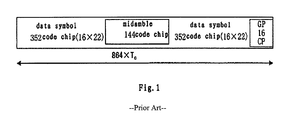
- FIG. 1 a structure of a burst signal in a normal slot is shown in FIG. 1 , wherein a midamble (also called channel estimation code) in the middle of the burst signal is used for channel estimation and the data block at the two sides of the burst signal are used for service data transmission.
- e represents sampled data of a signal received by the receiver
- d represents transmitted data
- n represents a received noise
- matrix A is a transmission matrix.
- the transmission matrix A is composed of a combined response vector b (k) of each code channel, wherein assuming there are K code channels all together and k represents a serial number of the code channel (the matrix A can be computed according to b (k) and b (k) is a column in each block distributed on a diagonal of the matrix.).
- Each vector b (k) corresponds to a combined channel response of a user code channel whose serial number is k.
- C (k) is a spreading code of the user code channel whose serial number is k
- ⁇ is a convolution operator
- h (k) is a channel response of the user code channel whose serial number is k
- h (k) is obtained by performing channel estimation with the midamble.
- the joint detection algorithm can be an interference cancellation method or a block linear equalizer method or a combination of the two methods.
- the matrix T is obtained from the following formula:
- T ⁇ I MF A * T ⁇ R n - 1 ⁇ A ZF - BLE A * T ⁇ R n - 1 ⁇ A + R d - 1 MMSE - BLE ( 4 )
- *T is a conjugation transposition
- R d I
- Rn ⁇ 2 I, wherein I represents a unit matrix.
- the MF in formulae (4) and (6) is matching-filter corresponding to a matching-filter method
- ZF-BLE is a Zero-Forcing Block Linear Equalizer method corresponding to a maximum likelihood linear solution
- MMSE-BLE is a Minimum Mean Square Error Block Linear Equalizer method corresponding to a minimum mean square linear solution. Any one of the above three methods for obtaining T can be used and generally the ZF-BLE or the MMSE-BLE method is selected.
- the single cell joint detection method uses the structure information of signals (including the spreading code and the channel response) transmitted by all the users in the cell, i.e. uses the structure information of signals in the local cell. At this time, the detection method processes the interference signals from other cells as the Gauss white noise of the time, therefore, the single cell joint detection method is more effective in restraining the inter-symbol interference and multi-address interference in the local cell.
- the single cell joint detection method can greatly improve the system performance for a single cell or for a CDMA system adopting inter-frequency networking.
- the single cell joint detection method can also improve the system performance.
- the interference between signals from intra-frequency neighboring cells impacts the system performance greatly.
- the intra-frequency interference is generally the most important interference.
- the single cell joint detection method cannot restrain the intra-frequency neighboring cell interference so when the intra-frequency neighboring cell interference exists, the system performance will decrease greatly.
- the single cell joint detection method will cause the deterioration of the system performance, so there is a need for providing a better joint detection method that can enable better system performance. If the joint detection method can be extended from a single cell to intra-frequency multiple cells by using the structure information of the intra-frequency neighboring cells, the performance of the slot CDMA system in same frequency network will be improved greatly.
- each neighboring cell takes a different midamble as a basic code and different users in the cell use cyclic shift versions of this basic code as their channel estimation codes.
- the different cyclic shift versions of the basic code of one cell can be called a code set, multiple cells have multiple code sets and the channel estimation of the multiple code sets is that of the multiple cells.
- the above mentioned technical solution performs finite time decision processing for the single code set channel estimation result and only keeps finite taps with stronger signal responses so as to recover interference signals of other code sets, to cancel the interference signals, to obtain net signals of every code set, and to perform the single code set channel estimation for the net signal of each code set.
- the above processing is repeated for iterative times and then multiple code set (multi-cell) channel estimation result is outputted.
- the object of the present invention is to provide a multi-cell joint detection method for a slot CDMA system.
- This method realizes a multi-cell joint detection using structure information of multiple cells aiming at intra-frequency neighboring cell interference.
- the method provided by the present invention may greatly improve a system performance when the slot CDMA system works in the intra-frequency neighboring cells.
- the technical solution realizing the object of the present invention is a multi-cell joint detection method for a slot CDMA system, which performing a joint detection by using structure information of multiple intra-frequency neighboring cells.
- the method includes steps of:
- the present invention obtains the channel estimation result of each neighboring cell by using the multiple code set channel estimation method; grouping code channels of each neighboring cell according to the grouping method of the present invention performing joint detection by using the channel estimation result and the code channel grouping result.
- the grouping method includes grouping based on the cell having the code channel, grouping based on the strength of the code channel power or amplitude, grouping based on the strength of the code channel correlation, and grouping using the combination of the above;
- a process of the joint detection includes constructing matrix A, performing matched-filtering, and finishing a multi-cell joint detection. When different code channel grouping methods are used, the matrix A will be different so there are differences when using channel estimation result and code channel grouping result to perform the joint detection.
- the method provided by the present invention can make the joint detection method available to intra-frequency multi-cell slot CDMA system. Compared with the single cell joint detection method, the method of the present invention can make full use of structure information of multiple cell signals and perform the multi-cell joint detection so as to highly restrain the multi-address interference between intra-frequency neighboring cells. The method provided by the present invention can greatly improve the performance of the slot CDMA system when the system works in intra-frequency neighboring cells.
- FIG. 1 is a diagram showing a slot burst structure of a TD-SCDMA service
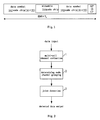
- FIG. 2 is a schematic block diagram showing a flow of a multi-cell joint detection of a slot CDMA system according to an embodiment of the invention
- FIG. 3 is a flowchart showing a multi-cell joint detection based on a cell code channel grouping according to an embodiment of the invention
- FIG. 4 is a flowchart showing a multi-cell joint detection based on a code channel amplitude or power grouping or based on a code channel correlation grouping according to an embodiment of the invention.
- the present invention provides a joint detection method based on multi-cell structure information taking account in interferences of signals between intra-frequency neighboring cells in a slot CDMA system. Details of the method are shown as in FIG. 2 .
- First step is multi-cell channel estimation.
- the channel estimation result of each neighboring cell is obtained by the aforementioned multiple code set channel estimation method. Since when generating the channel estimation code, each neighboring cell takes a different midamble as a basic code and different users in the cell use different cyclic shift versions of this basic code as their channel estimation codes. Thus, all the different cyclic shift versions of the basic code of one cell are called a code set, multiple cells have multiple code sets and the channel estimations of the multiple code sets are those of the multiple cells.
- the multi-cell channel estimation of the present invention makes use of the multiple code set channel estimation technology provided in the patent application No.
- 031006701 adopts a multiple code set joint channel iterative estimation method based on a finite time location decision feedback processing in a case that response signal of the multiple code set channel estimation code exists in intra-frequency multiple cells, and obtains channel estimation result of multiple cells.
- the multiple cells for which channel estimations have been performed are neighboring ones and include a local cell to which the detection user belongs and a cell which is most close to the local cell in geography.
- Second step is code channel grouping. Firstly a code channel grouping method is determined. Then code channels grouping is performed for code channels of each neighboring cell according to the selected grouping method.
- Technical solutions for determining the code channel grouping are as follows:
- First solution is a grouping method based on the cell to which the code channel belongs.
- the number of the groups is the same as the number of the intra-frequencys so the code channel in each group is the one of the corresponding cell.
- Second solution is a grouping method based on the code channel power or amplitude.
- a combined channel response of each code channel can be obtained by using the multi-cell channel estimation result, or the amplitude or power (power can be acquired with the square of the amplitude) of each code channel can be estimated according to the output of each code channel matched-filtering, and then the code channels are grouped according to the strength of the amplitude or the power. For example, a threshold of the amplitude or of the power is determined and the code channel is strong if its signal amplitude or power is higher than the threshold, and is weak if its signal amplitude or power is lower than the threshold. Strong code channels belong to a group and weak ones belong to another group.
- Third solution is a grouping method based on the code channel correlation. Firstly a combined channel response of each code channel is obtained by using the multi-cell channel estimation result; the correlation between any two of code channels of the multi-cell signals is estimated by using the combined channel response of each code channel and then all the code channels are grouped according to the strength of the correlations. For example, a correlation threshold is determined and the code channel is strong if its correlation is higher than the threshold, and is weak if its correlation is lower than the threshold. Strong code channels belong to a group and weak ones belong to another group.
- the correlations among multiple code channels can be an average correlation, maximum correlation or minimum correlation.
- a mixture of the above methods can also be used or the code channels can be grouped based on other principles.
- Third step is joint detection.
- the joint detection is performed based on the multi-cell channel estimation result and the code channel grouping result so that the multi-cell joint detection result is obtained.
- the joint detection method can be an interference cancellation method or a block linear equalizer method or a combination of the two methods.
- the block linear equalizer method can be used in each group and the interference cancellation method can be used between different code channel groups.
- the code channels to be grouped can be those pre-allocated by each neighboring cell (grouping without activation processing) and also can be activated code channels remained after the activation processing is performed for all the code channels of neighboring cells (grouping after activation processing).
- the code channels for which the joint detection will be performed can be those pre-allocated by each neighboring cell (performing joint detection according to the code channel grouping without activation processing) and also can be the activated code channels remained after the activation processing is performed for all the code channels of neighboring cells (performing joint detection according to the code channel grouping after activation processing).
- a second activation processing can be implemented, i.e. the activated code channels subject to a first activation processing before grouping will be matching filtered after grouping and then will be subject to a second activation processing. The joint detection is performed for the code channels subject to the second activation processing.
- Another significance of grouping the code channels in the present invention is that: since when intra-frequency neighboring cells are in work and a lot of code channels are allocated to multiple neighboring cells, an activation processing can be performed for these code channels firstly and there are still a lot of activated code channels. In order to perform the joint detection at lower cost and with better performance, the remained activated code channels subject to the activation processing are grouped and then the joint detection method is further performed.
- the multi-user signal of the local cell and the two intra-frequency cells can be represented as:
- a 0 and d 0 are the transmission matrix and the transmitted data of the user in the local cell respectively;
- n 0 is the interference and noise power (such as the white noise) after the interference of the two neighboring cells are eliminated.
- step 31 the multi-user signal e is divided into different parts of data, i.e. the normal slot burst structure in FIG. 1 is divided, the middle part em (received signal of the midamble or response signal of the channel estimation code) is then subject to the multi-cell channel estimation and the divided data symbol part e d is then subject to the matched-filtering.
- the middle part em received signal of the midamble or response signal of the channel estimation code
- step 32 the multi-cell channel estimation is performed.
- e m is subject to the multiple code set channel estimation method and the channel estimation result of the three intra-frequency neighboring cells is obtained (as to the specific method, please refer to “a multiple code set channel estimation method for a slot CDMA system” filed on May 09, 2003 with the application No. CN03100670.1).
- step 37 the code channels are grouped.
- the code channels of the three cells are grouped.
- the code channels can be grouped into three groups corresponding to the number of the cells if adopting the first grouping method based on the cell to which the code channel belongs.
- step 38 b (k) is used to construct the transmission matrix A in formulae (8)-(10) (according to formula (2), b (k) can be obtained from h (k) ).
- the corresponding transmission matrix A in formulae (8)-(10) is constructed. Since the first grouping method is adopted, the constructed transmission matrix A is the transmission matrixes A 0 , A 1 , and A 2 of the three cells. Then the three transmission matrixes are forwarded to step 39 respectively for the joint detection.
- step 39 the multi-cell joint detection is completed finally.
- the joint detection can adopt the “block linear equalizer+interference cancellation” method, i.e. the block linear equalizer method is adopted in the three groups and the interference cancellation method is adopted between any two of the three groups.
- Step 39 includes the following sub-steps.
- the block linear equalizer method is used to detect the data symbol received signal e d for each group, i.e. each group is detected with the single cell joint detection method.
- e d A 0 d 0 +A 1 d 1 +A 2 d 2 +n 0 .
- n 1 is the interference of signals in non-interfering cell 1 .
- d 1 can be obtained according to the single cell joint detection method (formula (3)) and d 2 can be obtained in the same way.
- Interference recovery is performed based on the detected result of each group, and interferences A 1 d 1 and A 2 d 2 to the user in the local cell from the interfering cell 1 and 2 are obtained respectively.
- the block linear equalizer method is performed for the net signal of the group to which the user (or users) to be detected belongs and the transmit signal result do of the user to be detected is obtained (formula (3)).
- the obtained d 0 here is of more accuracy since the intra-frequency neighboring cell interference is eliminated.
- the above process only uses the interference cancellation processing once, but also can use the interference cancellation processing for multiple times.
- the implementation of cancellation once or multiple times can be realized by setting iterative times and cyclically performing “block linear equalizer+interference cancellation”.
- the iterative times refer to the interference cancellation times.
- the detailed process includes the following steps.
- the above block linear equalizer method obtains the detected data according to formula (3) and e in formula (3) represents the net signal after the interference is cancelled.
- FIG. 4 shows step 31 and 32 are the same with those in FIG. 3 .
- step 33 if the grouping method based on the code channel amplitude or the power is adopted, the combined channel response of each code channel is obtained from the channel estimation result and then the amplitude or power of each code channel signal is estimated or the power of each code channel signal is estimated from the output result of each code channel matched-filtering; then all the code channels are divided into two groups according to the power strength, wherein the code channel of the user (or users) to be detected joint detection) and the interference code channel with stronger power are allocated to a code channel group for which the joint detection will be performed, and the interference code channels which don't include code channels of a user to be detected and whose amplitude or power are less than the threshold are allocated to an interference code channel group.
- the interference code channels refer to other user code channels except those to be detected, which include other user code channels of the local cell and those of the intra-frequency neighboring cells.
- a S and d S are the transmission matrix and transmitted data of the code channel group will be subject to the joint detection;
- a I and d I are the transmission matrix and transmitted data of the interference code channel group.
- the grouping method based on the code channel correlation is adopted, the combined channel response of each code channel is obtained from the channel estimation result of each neighboring cell and thus the average value of the correlation between all the code channels of the user (or users) not to be detected and the code channels of the user (or users) to be detected; then all the code channels are divided into two groups according to the strength of the average value of the correlation, wherein all the code channels of the user to be detected and the code channels having stronger average correlation with all the code channels of the user to be detected are allocated to the code channel group for which the joint detection will be performed, the rest code channels which don't include code channels of the user (or users) to be detected and code channels with weaker average correlation are allocated to the interference code channel group.
- a S and d S are the transmission matrix and transmitted data of the code channel group to be subject to the joint detection;
- a I and d I are the transmission matrix and transmitted data of the interference code channel group (the same expression is used for the data symbol total received signal ed after grouping in the second and third grouping methods).
- step 34 b (k) is used to construct the transmission matrix A in formulae (8)-(10) (b (k) is obtained from h (k) according to formula (2)). Respective transmission matrix A in formulae (8)-(10) are constructed according to the adopted grouping method.
- the respectively constructed transmission matrix A is A S (transmission matrix of the code channel group to be subject to the joint detection) and A I (transmission matrix of the interference code channel group not to be subject to the joint detection) respectively according to the second and third grouping methods.
- a s is then subject to matched-filtering in step 35 and A S and A I are then subject to joint detection in step 36 .
- the matched-filtering process in this step is the process of obtaining A *T R n ⁇ 1 e in formula (3) in which the soft output value estimated by transmitted data d is obtained.
- A is the constructed matrix and e is the divided data symbol part e d .
- a in the matched-filtering process is A S .
- R n is the covariance matrix of the coloured noise sequence n.
- step 36 the multi-cell joint detection is completed finally.
- different constructed transmission matrixes accomplish the multi-cell joint detection.
- T is obtained by one method in formula (4), based on A *T R n ⁇ 1 e d obtained by matched-filtering ⁇ circumflex over (d) ⁇ is obtained according to formula (3).
- the block linear equalizer method is used to detect the code channel group for which the joint detection will be performed.
- a S and A I are obtained when constructing the transmission matrix A, wherein A S is the transmission matrix constructed by the code channels of the local user in the local cell and those with large power or correlation of the local cell or the neighboring cells and As is used for multi-user joint detection;
- a I is the transmission matrix constructed by the code channels of other users in the local cell and those with small power or correlation of the neighboring cells and A I is used for computing R n .
- Matrix T S is obtained according to the following formula (choosing any one of the methods):
- T S ⁇ I MF A S * T ⁇ R n - 1 ⁇ A S ZF - BLE A S * T ⁇ R n - 1 ⁇ A S + R d - 1 MMSE - BLE ( 12 )
- One method is to compute strictly according to formula (13).
- Steps 32 , 33 , 34 , 35 and 36 in FIG. 3 and steps 32 , 37 , 38 and 39 in FIG. 4 wholly represent the multi-cell joint detection process of the present invention, i.e. steps 1 , 2 and 3 in FIG. 2 .
- the method of the present invention can be used in the slot CMDA system or the wireless communication system adopting the similar signal structure.
Landscapes
- Engineering & Computer Science (AREA)
- Computer Networks & Wireless Communication (AREA)
- Signal Processing (AREA)
- Power Engineering (AREA)
- Mobile Radio Communication Systems (AREA)
Abstract
Description
e=Ad+n (1)
b (k) =C (k) ⊕h (k) k=1 . . . K (2)
{circumflex over (d)}=(T)−1A*T R n −1 e (3)
e d =A 0 d 0 +A 1 d 1 +A 2 d 2 +n 0 (8)
e d =A S d S+(A I d I +n 0) (9)
e d =A S d S+(A IdI +n 0) (10)
{circumflex over (d)}S=(TS)−1 A S *T R n −1e (11)
R n =E{n·n *T }=E{(A I d I +n 0)·(A I d I +n 0)*T }=A I A I *T+σ2 I (13)
R n =E{n·n *T }=E{(A I d I +n 0)·(A I d I +n 0)*T }=A I d I *T+σ2 I≈σ I 2 I+σ 2 I=(σI 2+σ2)I (14)
Claims (14)
Applications Claiming Priority (4)
| Application Number | Priority Date | Filing Date | Title |
|---|---|---|---|
| CN200410080196.6 | 2004-09-24 | ||
| CNB2004100801966A CN100401646C (en) | 2004-09-24 | 2004-09-24 | Multi-cell Joint Detection Method in Slotted Code Division Multiple Access System |
| CN200410080196 | 2004-09-24 | ||
| PCT/CN2005/001539 WO2006032211A1 (en) | 2004-09-24 | 2005-09-22 | Multicell joint detection method in slotted code division multiple access system |
Publications (2)
| Publication Number | Publication Date |
|---|---|
| US20080123611A1 US20080123611A1 (en) | 2008-05-29 |
| US8023486B2 true US8023486B2 (en) | 2011-09-20 |
Family
ID=36089856
Family Applications (1)
| Application Number | Title | Priority Date | Filing Date |
|---|---|---|---|
| US11/663,789 Active 2028-07-28 US8023486B2 (en) | 2004-09-24 | 2005-09-22 | Multicell joint detection method in slotted code division multiple access system |
Country Status (6)
| Country | Link |
|---|---|
| US (1) | US8023486B2 (en) |
| EP (2) | EP2618507A1 (en) |
| JP (1) | JP4866357B2 (en) |
| KR (1) | KR100874507B1 (en) |
| CN (1) | CN100401646C (en) |
| WO (1) | WO2006032211A1 (en) |
Cited By (2)
| Publication number | Priority date | Publication date | Assignee | Title |
|---|---|---|---|---|
| US20120127923A1 (en) * | 2010-11-23 | 2012-05-24 | Wanlun Zhao | Method and Apparatus for Enabling a Low Complexity Receiver |
| US20130217392A1 (en) * | 2010-02-08 | 2013-08-22 | Zte Corporation | Method and system for managing neighboring cell information |
Families Citing this family (55)
| Publication number | Priority date | Publication date | Assignee | Title |
|---|---|---|---|---|
| CN100409588C (en) * | 2005-06-03 | 2008-08-06 | 上海原动力通信科技有限公司 | Multi-cell Joint Detection Method in Slotted Code Division Multiple Access System |
| CN100464603C (en) * | 2005-06-16 | 2009-02-25 | 上海原动力通信科技有限公司 | A handover method in a digital cellular communication system using same-frequency networking |
| CN1929323B (en) * | 2005-09-07 | 2011-04-06 | 大唐移动通信设备有限公司 | Method of suppressing cross time slot interfere for time slot CDMA system |
| CN1929353B (en) * | 2005-09-09 | 2012-04-25 | 展讯通信(上海)有限公司 | Channel estimation method and device for same-frequency cell |
| WO2007115434A1 (en) * | 2006-04-12 | 2007-10-18 | Zte Corporation | Strong interference canceling method for neighboring cells using same frequency in cdma system |
| CN100536360C (en) * | 2006-04-14 | 2009-09-02 | 鼎桥通信技术有限公司 | A multi-cell joint detection method of the broadcast channel in the time-division duplex system |
| CN100525130C (en) * | 2006-04-14 | 2009-08-05 | 鼎桥通信技术有限公司 | Uplink multi-user detection method in code-division multi-address wireless communication system |
| CN101056285B (en) * | 2006-04-14 | 2011-01-19 | 鼎桥通信技术有限公司 | Parallel interference elimination channel estimation method and device in the radio mobile communication system |
| CN100525131C (en) * | 2006-04-14 | 2009-08-05 | 鼎桥通信技术有限公司 | Downlink multi-user detection method in code-division multi-address wireless communication system |
| CN101060505B (en) * | 2006-04-19 | 2011-06-01 | 鼎桥通信技术有限公司 | Joint channel estimation method and estimation device in a wireless mobile communication system |
| CN101075843B (en) * | 2006-05-18 | 2010-05-12 | 大唐移动通信设备有限公司 | A method and device for selecting co-frequency adjacent cells for joint detection |
| CN101098184B (en) * | 2006-06-26 | 2012-04-25 | 上海原动力通信科技有限公司 | Method and apparatus for eliminating interference between adjacent cells |
| CN100405865C (en) * | 2006-07-19 | 2008-07-23 | 北京天碁科技有限公司 | TD-SCDMA terminal and its co-frequency cell delay and power detection method |
| CN101154959B (en) * | 2006-09-25 | 2010-12-08 | 中兴通讯股份有限公司 | A method for detecting system self-interference in time-division duplex wireless cellular communication network |
| CN101170366B (en) * | 2006-10-24 | 2010-12-22 | 普天信息技术研究院 | A Method of Signal Joint Detection Based on Minimum Mean Square Error Linear Block Equalization |
| CN101175296B (en) * | 2006-10-30 | 2010-08-25 | 大唐移动通信设备有限公司 | Ascending multi-code set associated detecting method and system |
| CN1949683B (en) * | 2006-11-03 | 2011-11-16 | 上海宣普实业有限公司 | Method and apparatus for cancellation eliminating common-frequency cell signal interference based on serial interference |
| CN1949682B (en) * | 2006-11-03 | 2011-09-07 | 上海宣普实业有限公司 | Method and apparatus for cancellation eliminating common-frequency cell signal interference based on serial interference |
| CN101207401B (en) * | 2006-12-22 | 2012-07-18 | 联芯科技有限公司 | Apparatus, base station, terminal unit and method for obtaining signal-noise ratio and amplitude-noise ratio |
| CN101282553B (en) * | 2007-04-05 | 2011-05-18 | 大唐移动通信设备有限公司 | Method for improving combined detection performance, baseband signal processor and base station |
| CN101286786B (en) * | 2007-04-11 | 2013-03-20 | 中兴通讯股份有限公司 | Method for inhibiting interference during identical networking by scheduling |
| CN101296463B (en) * | 2007-04-23 | 2011-08-31 | 电信科学技术研究院 | Macro diversity method, system and device using multi-community associated detection method |
| CN101304587B (en) * | 2007-05-09 | 2012-11-21 | 华为技术有限公司 | Association detection method, cognitive system, subscriber terminal and base station |
| WO2008138262A1 (en) * | 2007-05-09 | 2008-11-20 | Huawei Technologies Co., Ltd. | Joint detection method, aware system, user terminal and base station |
| CN101312359B (en) * | 2007-05-23 | 2012-02-29 | 鼎桥通信技术有限公司 | Apparatus and method for multi-cell combined channel estimation and multi-cell combined detection |
| CN101359927B (en) * | 2007-07-31 | 2012-09-05 | 鼎桥通信技术有限公司 | Method for selecting strength path in multiple cell combined channel estimation |
| WO2009038528A2 (en) * | 2007-09-18 | 2009-03-26 | Telefonaktiebolaget L M Ericsson (Publ) | Reduced interference in an mbms enabled system |
| CN101128056B (en) * | 2007-09-19 | 2012-01-18 | 中兴通讯股份有限公司 | A method for interference elimination between cooperative cells |
| CN101399803B (en) * | 2007-09-27 | 2011-04-13 | 大唐移动通信设备有限公司 | Multi-user detection method and device for OFDM signal |
| CN101409573B (en) * | 2007-10-12 | 2012-05-09 | 中兴通讯股份有限公司 | A method and device for reducing joint detection message transmission volume |
| US7995641B2 (en) * | 2007-11-06 | 2011-08-09 | Telefonaktiebolaget Lm Ericsson (Publ) | Method and apparatus for code power parameter estimation for received signal processing |
| US8306012B2 (en) | 2007-11-07 | 2012-11-06 | Telefonaktiebolaget L M Ericsson (Publ) | Channel estimation for synchronized cells in a cellular communication system |
| WO2009079832A1 (en) * | 2007-12-18 | 2009-07-02 | Zte Corporation | Method of uplink multi-cell joint detection in a time division -synchronous code division multiple access system |
| KR100966018B1 (en) * | 2008-02-04 | 2010-06-24 | 에스케이 텔레콤주식회사 | Multicell Combined Channel Estimation Method and System in Uplink of Mobile Communication Network |
| KR101457690B1 (en) * | 2008-03-05 | 2014-11-04 | 삼성전자주식회사 | Receiving apparatus and method for removing an interference signal in a communication system |
| CN101340206B (en) * | 2008-07-04 | 2013-01-23 | 重庆重邮信科通信技术有限公司 | Determination feedback multiple cell combined channel estimation method and apparatus |
| CN101630960B (en) * | 2008-07-18 | 2014-06-18 | 俊茂微电子(上海)有限公司 | Combined detection method and apparatus for communication equipment and communication equipment |
| CN101667898B (en) * | 2008-09-05 | 2013-07-03 | 中兴通讯股份有限公司 | Method for dividing and implementing uplink HARQ feedback channel resources |
| CN101959208B (en) * | 2009-07-15 | 2013-04-24 | 电信科学技术研究院 | Anti-interference method and device for same-frequency networking mobile communication system |
| CN102202328B (en) * | 2010-03-24 | 2013-11-20 | 电信科学技术研究院 | Data detection processing method and base station under multiple subareas |
| CN102291161B (en) * | 2010-06-21 | 2014-03-19 | 中兴通讯股份有限公司 | Method and device carrying out same frequency measurement in TD-SCDMA (Time Division-Synchronization Code Division Multiple Access) system |
| CN101969657B (en) * | 2010-10-26 | 2012-10-24 | 东南大学 | Same-frequency cell detection method of FDD-LTE system |
| CN102739283A (en) * | 2011-04-07 | 2012-10-17 | 联发科技(新加坡)私人有限公司 | Combined detection method based on active code channel selection in time division synchronous code division multiple access receiver |
| US20120269175A1 (en) * | 2011-04-21 | 2012-10-25 | Aiguo Yan | Efficient implementation of joint detection based tdscdma receivers |
| CN102185631B (en) * | 2011-04-28 | 2014-05-14 | 意法·爱立信半导体(北京)有限公司 | Method and device for activating code channel |
| CN102158892B (en) * | 2011-05-25 | 2013-07-24 | 哈尔滨工业大学 | System and method for testing multi-address interference resisting capacity of ISM (Industry, Scientific and Medicine) frequency band wireless products |
| CN102158242B (en) * | 2011-05-25 | 2013-07-24 | 哈尔滨工业大学 | System and method for testing antijamming capability of wireless communication products operating at ISM (Industry, Science and Medical) frequency range |
| CN102201833B (en) * | 2011-05-26 | 2013-09-25 | 南京邮电大学 | Terminal multi-cell joint detection method for time division synchronous code division multiple access cluster system |
| US9287924B2 (en) | 2011-09-20 | 2016-03-15 | St-Ericsson Sa | Method, apparatus, receiver, computer program and storage medium for joint detection |
| EP2761764A4 (en) * | 2011-09-27 | 2015-07-22 | St Ericsson Sa | Method and apparatus for code activation, computer program and storage medium thereof |
| CN103905086B (en) * | 2012-12-26 | 2016-07-20 | 联芯科技有限公司 | Associated detecting method and system |
| EP2787652B1 (en) * | 2013-04-04 | 2018-08-01 | Telefonaktiebolaget LM Ericsson (publ) | Blind code allocation detection |
| CN103701735B (en) * | 2013-12-26 | 2017-02-08 | 大唐移动通信设备有限公司 | Multiple cell-based same-frequency joint detection method and device |
| US11503609B2 (en) * | 2019-09-27 | 2022-11-15 | Qualcomm Incorporated | PUCCH repetition before RRC connection setup |
| CN113572661B (en) * | 2021-07-28 | 2022-12-27 | 迈普通信技术股份有限公司 | System and method for testing multi-activation detection performance |
Citations (7)
| Publication number | Priority date | Publication date | Assignee | Title |
|---|---|---|---|---|
| WO2001069801A2 (en) | 2000-03-15 | 2001-09-20 | Interdigital Technology Corporation | Multi-user detection using an adaptive combination of joint detection and successive interference cancellation |
| WO2003017511A1 (en) | 2001-08-09 | 2003-02-27 | Matsushita Electric Industrial Co., Ltd. | Interference elimination apparatus and interference elimination method |
| US20030128679A1 (en) * | 2001-12-06 | 2003-07-10 | Ntt Docomo, Inc. | Mobile communication terminal, interference cancellation system, interference cancellation method, and base station |
| US20040052236A1 (en) * | 2002-09-07 | 2004-03-18 | Samsung Electronics Co., Ltd. | Apparatus and method for joint detection receiving irrespective of orthogonal code length in mobile communication system |
| US20040116122A1 (en) * | 2002-09-20 | 2004-06-17 | Interdigital Technology Corporation | Enhancing reception using intercellular interference cancellation |
| CN1520077A (en) | 2003-01-21 | 2004-08-11 | 大唐移动通信设备有限公司 | Method for estimating channel containing multiple code sets in time slot CDMA system |
| US20050111408A1 (en) * | 2003-11-25 | 2005-05-26 | Telefonaktiebolaget Lm Ericsson (Publ) | Selective interference cancellation |
Family Cites Families (3)
| Publication number | Priority date | Publication date | Assignee | Title |
|---|---|---|---|---|
| JP2003174431A (en) * | 2001-09-26 | 2003-06-20 | Matsushita Electric Ind Co Ltd | Wireless communication device and wireless communication method |
| CN1170374C (en) * | 2002-06-20 | 2004-10-06 | 大唐移动通信设备有限公司 | Space-time compilation code method suitable for frequency selective fading channels |
| MXPA05000828A (en) * | 2002-07-19 | 2005-04-19 | Interdigital Tech Corp | Groupwise successive interference cancellation for block transmission with reception diversity. |
-
2004
- 2004-09-24 CN CNB2004100801966A patent/CN100401646C/en not_active Expired - Lifetime
-
2005
- 2005-09-22 US US11/663,789 patent/US8023486B2/en active Active
- 2005-09-22 EP EP13163779.5A patent/EP2618507A1/en not_active Withdrawn
- 2005-09-22 KR KR1020077008939A patent/KR100874507B1/en not_active Expired - Lifetime
- 2005-09-22 JP JP2007532750A patent/JP4866357B2/en not_active Expired - Lifetime
- 2005-09-22 EP EP05791531A patent/EP1793518A4/en not_active Withdrawn
- 2005-09-22 WO PCT/CN2005/001539 patent/WO2006032211A1/en not_active Ceased
Patent Citations (7)
| Publication number | Priority date | Publication date | Assignee | Title |
|---|---|---|---|---|
| WO2001069801A2 (en) | 2000-03-15 | 2001-09-20 | Interdigital Technology Corporation | Multi-user detection using an adaptive combination of joint detection and successive interference cancellation |
| WO2003017511A1 (en) | 2001-08-09 | 2003-02-27 | Matsushita Electric Industrial Co., Ltd. | Interference elimination apparatus and interference elimination method |
| US20030128679A1 (en) * | 2001-12-06 | 2003-07-10 | Ntt Docomo, Inc. | Mobile communication terminal, interference cancellation system, interference cancellation method, and base station |
| US20040052236A1 (en) * | 2002-09-07 | 2004-03-18 | Samsung Electronics Co., Ltd. | Apparatus and method for joint detection receiving irrespective of orthogonal code length in mobile communication system |
| US20040116122A1 (en) * | 2002-09-20 | 2004-06-17 | Interdigital Technology Corporation | Enhancing reception using intercellular interference cancellation |
| CN1520077A (en) | 2003-01-21 | 2004-08-11 | 大唐移动通信设备有限公司 | Method for estimating channel containing multiple code sets in time slot CDMA system |
| US20050111408A1 (en) * | 2003-11-25 | 2005-05-26 | Telefonaktiebolaget Lm Ericsson (Publ) | Selective interference cancellation |
Cited By (3)
| Publication number | Priority date | Publication date | Assignee | Title |
|---|---|---|---|---|
| US20130217392A1 (en) * | 2010-02-08 | 2013-08-22 | Zte Corporation | Method and system for managing neighboring cell information |
| US8838112B2 (en) * | 2010-02-08 | 2014-09-16 | Zte Corporation | Method and system for managing neighboring cell information |
| US20120127923A1 (en) * | 2010-11-23 | 2012-05-24 | Wanlun Zhao | Method and Apparatus for Enabling a Low Complexity Receiver |
Also Published As
| Publication number | Publication date |
|---|---|
| CN100401646C (en) | 2008-07-09 |
| KR20070072882A (en) | 2007-07-06 |
| JP4866357B2 (en) | 2012-02-01 |
| US20080123611A1 (en) | 2008-05-29 |
| EP1793518A4 (en) | 2011-07-20 |
| EP2618507A1 (en) | 2013-07-24 |
| JP2008515252A (en) | 2008-05-08 |
| WO2006032211A1 (en) | 2006-03-30 |
| KR100874507B1 (en) | 2008-12-18 |
| CN1753322A (en) | 2006-03-29 |
| EP1793518A1 (en) | 2007-06-06 |
Similar Documents
| Publication | Publication Date | Title |
|---|---|---|
| US20080123611A1 (en) | Mulitcell Joint Detection Method In Slotted Code Division Multiple Access System | |
| US7920651B2 (en) | Joint symbol, amplitude, and rate estimator | |
| CN101399803B (en) | Multi-user detection method and device for OFDM signal | |
| KR100842893B1 (en) | Iterative and turbobased method and apparatus for equalization of spreadspectrum downlink channels | |
| US7167529B2 (en) | Method and device for radio signal reception | |
| JP4205761B2 (en) | Interference cancellation method and receiver | |
| US7606318B2 (en) | Method of space-time encoding and decoding for frequency selective fading channel | |
| EP1641161B1 (en) | Method for detecting the orthogonal code CDMA signal | |
| US7944903B2 (en) | Multi-cell joint-detection method in time-slotted CDMA system | |
| CN1110072A (en) | Code Division Multiple Access Communication System | |
| CN101133562B (en) | Signal Interference Suppression Method for Adjacent Cell Users | |
| CN102201833B (en) | Terminal multi-cell joint detection method for time division synchronous code division multiple access cluster system | |
| US7298801B2 (en) | Method and device for demodulating signals from multiple users | |
| US9287924B2 (en) | Method, apparatus, receiver, computer program and storage medium for joint detection | |
| Visotsky et al. | Noncoherent multiuser detection for CDMA systems with nonlinear modulation: A non-Bayesian approach | |
| US7362831B2 (en) | Method and device for sequencing signals from multiusers | |
| EP1892842A1 (en) | Equalized parallel interference cancellation for cdma systems | |
| US6621856B1 (en) | Method of receiving CDMA signals with parallel interference suppression, and corresponding stage and receiver | |
| Nithyanandan et al. | ANALYTICAL BER COMPUTATION FOR INTERFERENCE CANCELLATION RECEIVER IN MC-CDMA SYSTEM. |
Legal Events
| Date | Code | Title | Description |
|---|---|---|---|
| AS | Assignment |
Owner name: A TANG MOBILE COMMUNICATIONS EQUIPMENT CO., LTD., Free format text: ASSIGNMENT OF ASSIGNORS INTEREST;ASSIGNORS:WANG, YINGMIN;ZHONG, NAN;REN, SHIYAN;AND OTHERS;REEL/FRAME:019858/0581;SIGNING DATES FROM 20070604 TO 20070613 Owner name: A TANG MOBILE COMMUNICATIONS EQUIPMENT CO., LTD., Free format text: ASSIGNMENT OF ASSIGNORS INTEREST;ASSIGNORS:WANG, YINGMIN;ZHONG, NAN;REN, SHIYAN;AND OTHERS;SIGNING DATES FROM 20070604 TO 20070613;REEL/FRAME:019858/0581 |
|
| AS | Assignment |
Owner name: DA TANG MOBILE COMMUNICATIONS EQUIPMENT CO., LTD., Free format text: REQUEST FOR RECORDATION; REEL 019858 FRAME 0581;ASSIGNORS:WANG, YINGMIN;ZHONG, NAN;REN, SHIYAN;AND OTHERS;REEL/FRAME:020164/0786;SIGNING DATES FROM 20070604 TO 20070613 Owner name: DA TANG MOBILE COMMUNICATIONS EQUIPMENT CO., LTD., Free format text: REQUEST FOR RECORDATION; REEL 019858 FRAME 0581;ASSIGNORS:WANG, YINGMIN;ZHONG, NAN;REN, SHIYAN;AND OTHERS;SIGNING DATES FROM 20070604 TO 20070613;REEL/FRAME:020164/0786 |
|
| AS | Assignment |
Owner name: DA TANG MOBILE COMMUNICATIONS EQUIPMENT CO., LTD, Free format text: ASSIGNMENT OF ASSIGNORS INTEREST;ASSIGNORS:WANG, YINGMIN;ZHONG, NAN;REN, SHIYAN;AND OTHERS;REEL/FRAME:020446/0884;SIGNING DATES FROM 20070604 TO 20070613 Owner name: DA TANG MOBILE COMMUNICATIONS EQUIPMENT CO., LTD, Free format text: ASSIGNMENT OF ASSIGNORS INTEREST;ASSIGNORS:WANG, YINGMIN;ZHONG, NAN;REN, SHIYAN;AND OTHERS;SIGNING DATES FROM 20070604 TO 20070613;REEL/FRAME:020446/0884 |
|
| STCF | Information on status: patent grant |
Free format text: PATENTED CASE |
|
| FEPP | Fee payment procedure |
Free format text: PAT HOLDER NO LONGER CLAIMS SMALL ENTITY STATUS, ENTITY STATUS SET TO UNDISCOUNTED (ORIGINAL EVENT CODE: STOL); ENTITY STATUS OF PATENT OWNER: LARGE ENTITY |
|
| FPAY | Fee payment |
Year of fee payment: 4 |
|
| MAFP | Maintenance fee payment |
Free format text: PAYMENT OF MAINTENANCE FEE, 8TH YEAR, LARGE ENTITY (ORIGINAL EVENT CODE: M1552); ENTITY STATUS OF PATENT OWNER: LARGE ENTITY Year of fee payment: 8 |
|
| AS | Assignment |
Owner name: DATANG MOBILE COMMUNICATIONS EQUIPMENT CO., LTD., CHINA Free format text: CHANGE OF NAME;ASSIGNOR:CHINA ACADEMY OF TELECOMMUNICATIONS TECHNOLOGY;REEL/FRAME:056804/0182 Effective date: 20210609 |
|
| MAFP | Maintenance fee payment |
Free format text: PAYMENT OF MAINTENANCE FEE, 12TH YEAR, LARGE ENTITY (ORIGINAL EVENT CODE: M1553); ENTITY STATUS OF PATENT OWNER: LARGE ENTITY Year of fee payment: 12 |