US8008278B2 - Diarylmethyl and related compounds - Google Patents
Diarylmethyl and related compounds Download PDFInfo
- Publication number
- US8008278B2 US8008278B2 US12/891,459 US89145910A US8008278B2 US 8008278 B2 US8008278 B2 US 8008278B2 US 89145910 A US89145910 A US 89145910A US 8008278 B2 US8008278 B2 US 8008278B2
- Authority
- US
- United States
- Prior art keywords
- ylene
- phen
- alkyl
- nhc
- group
- Prior art date
- Legal status (The legal status is an assumption and is not a legal conclusion. Google has not performed a legal analysis and makes no representation as to the accuracy of the status listed.)
- Expired - Fee Related
Links
- 0 CC.[5*]C(C[4*]N1CCC(C(C)(CC)CC)C1)C(O)C1=C([7*])C([6*])=C(O)C=C1 Chemical compound CC.[5*]C(C[4*]N1CCC(C(C)(CC)CC)C1)C(O)C1=C([7*])C([6*])=C(O)C=C1 0.000 description 32
- ABMDIECEEGFXNC-UHFFFAOYSA-N CCNC(=O)CC Chemical compound CCNC(=O)CC ABMDIECEEGFXNC-UHFFFAOYSA-N 0.000 description 4
- CGODSXNVGVCXGY-UHFFFAOYSA-N CC.CCC(C)(CC)C1CCN(C(C)C)C1 Chemical compound CC.CCC(C)(CC)C1CCN(C(C)C)C1 CGODSXNVGVCXGY-UHFFFAOYSA-N 0.000 description 2
- LKNFCBOZWHSNEJ-UHFFFAOYSA-N CCC(=O)NC1=CC=C(CC)C=C1 Chemical compound CCC(=O)NC1=CC=C(CC)C=C1 LKNFCBOZWHSNEJ-UHFFFAOYSA-N 0.000 description 2
- QRGHPJFDJYSWGN-UHFFFAOYSA-N CCC(=O)NCC1=CC=C(CC)C=C1 Chemical compound CCC(=O)NCC1=CC=C(CC)C=C1 QRGHPJFDJYSWGN-UHFFFAOYSA-N 0.000 description 2
- NXCCFUKHWJXMOK-UHFFFAOYSA-N CCNC(=O)C1=CC=C(CC)C=C1 Chemical compound CCNC(=O)C1=CC=C(CC)C=C1 NXCCFUKHWJXMOK-UHFFFAOYSA-N 0.000 description 2
- ZDLSJDSDTIXUNT-UHFFFAOYSA-N CCNC(=O)CC1=CC=C(CC)C=C1 Chemical compound CCNC(=O)CC1=CC=C(CC)C=C1 ZDLSJDSDTIXUNT-UHFFFAOYSA-N 0.000 description 2
- BHVUXEHDWHQEIW-UHFFFAOYSA-N C.CCCON1CCC(CC)CC1 Chemical compound C.CCCON1CCC(CC)CC1 BHVUXEHDWHQEIW-UHFFFAOYSA-N 0.000 description 1
- YUZVSCBTHOLYBA-UHFFFAOYSA-N C.CCOCN1CCC(CC)CC1 Chemical compound C.CCOCN1CCC(CC)CC1 YUZVSCBTHOLYBA-UHFFFAOYSA-N 0.000 description 1
- FKARMNVFEQZBOT-UHFFFAOYSA-N CC(C)C.CC(C)NCC1=CC=C(CC(=O)NCCN2CCCCC2)C=C1 Chemical compound CC(C)C.CC(C)NCC1=CC=C(CC(=O)NCCN2CCCCC2)C=C1 FKARMNVFEQZBOT-UHFFFAOYSA-N 0.000 description 1
- HZNPFJRKHBXYFW-HKPSJHCMSA-N CC.CC.CC.CC(C)N1CC[C@@H](C(C(=O)N(C)C)(C2=CC=CS2)C2=CC=CS2)C1 Chemical compound CC.CC.CC.CC(C)N1CC[C@@H](C(C(=O)N(C)C)(C2=CC=CS2)C2=CC=CS2)C1 HZNPFJRKHBXYFW-HKPSJHCMSA-N 0.000 description 1
- AKJISIDGAZKIGV-OTKOOOHISA-N CC.CC.CC.CC.CC.CC.CC.CC.CC.CC.CC.CC.CC.CC.CC.CC.CC.CC.CC.CC.CC.CC(C)N1CCC(C(C(=O)N(C)C)(C2=CC=CC=C2)C2=CC=CC=C2)CC1.CC(C)N1CC[C@@H](C(C(=O)N(C)C)(C2=CC=CC=C2)C2=CC=CC=C2)C1.CC(C)N1CC[C@@H](C(C(=O)N(C)C)(C2=CC=CC=C2)C2=CC=CC=N2)C1.CC(C)N1CC[C@@H](C(C(=O)N(C)C)(C2=CC=CC=C2)C2=CC=CS2)C1.CC(C)N1CC[C@@H](C(C(=O)N(C)C)(C2=CC=CC=C2)C2CCC2)C1.CC(C)N1CC[C@@H](C(C(=O)N(C)C)(C2=CC=CC=C2)C2CCCC2)C1.CC(C)N1CC[C@@H](C(C(=O)N(C)C)(C2=CC=CC=C2)C2CCCCC2)C1 Chemical compound CC.CC.CC.CC.CC.CC.CC.CC.CC.CC.CC.CC.CC.CC.CC.CC.CC.CC.CC.CC.CC.CC(C)N1CCC(C(C(=O)N(C)C)(C2=CC=CC=C2)C2=CC=CC=C2)CC1.CC(C)N1CC[C@@H](C(C(=O)N(C)C)(C2=CC=CC=C2)C2=CC=CC=C2)C1.CC(C)N1CC[C@@H](C(C(=O)N(C)C)(C2=CC=CC=C2)C2=CC=CC=N2)C1.CC(C)N1CC[C@@H](C(C(=O)N(C)C)(C2=CC=CC=C2)C2=CC=CS2)C1.CC(C)N1CC[C@@H](C(C(=O)N(C)C)(C2=CC=CC=C2)C2CCC2)C1.CC(C)N1CC[C@@H](C(C(=O)N(C)C)(C2=CC=CC=C2)C2CCCC2)C1.CC(C)N1CC[C@@H](C(C(=O)N(C)C)(C2=CC=CC=C2)C2CCCCC2)C1 AKJISIDGAZKIGV-OTKOOOHISA-N 0.000 description 1
- KTMJSSNJOOFFHE-UHFFFAOYSA-N CC.CC.CCC1(C2CCN(C(C)C)C2)C(=O)N(C)C2=C1C=CC=C2 Chemical compound CC.CC.CCC1(C2CCN(C(C)C)C2)C(=O)N(C)C2=C1C=CC=C2 KTMJSSNJOOFFHE-UHFFFAOYSA-N 0.000 description 1
- LCYJSUPIBLXZDV-UHFFFAOYSA-N CC.CCC(C)(CC)C1CCCC1 Chemical compound CC.CCC(C)(CC)C1CCCC1 LCYJSUPIBLXZDV-UHFFFAOYSA-N 0.000 description 1
- TWXDFVQMCDDWEL-UHFFFAOYSA-N CC.CCC(C)(CC)C1CCNC1 Chemical compound CC.CCC(C)(CC)C1CCNC1 TWXDFVQMCDDWEL-UHFFFAOYSA-N 0.000 description 1
- COGHQNIPKYORCI-UHFFFAOYSA-N CC.CCC(CC)(C(=O)O)C1CCCC1 Chemical compound CC.CCC(CC)(C(=O)O)C1CCCC1 COGHQNIPKYORCI-UHFFFAOYSA-N 0.000 description 1
- DJUPRUBAQHRNCI-UHFFFAOYSA-N CC.CCN1CCC(C(C)(CC)CC)C1 Chemical compound CC.CCN1CCC(C(C)(CC)CC)C1 DJUPRUBAQHRNCI-UHFFFAOYSA-N 0.000 description 1
Classifications
-
- C—CHEMISTRY; METALLURGY
- C07—ORGANIC CHEMISTRY
- C07D—HETEROCYCLIC COMPOUNDS
- C07D401/00—Heterocyclic compounds containing two or more hetero rings, having nitrogen atoms as the only ring hetero atoms, at least one ring being a six-membered ring with only one nitrogen atom
- C07D401/02—Heterocyclic compounds containing two or more hetero rings, having nitrogen atoms as the only ring hetero atoms, at least one ring being a six-membered ring with only one nitrogen atom containing two hetero rings
- C07D401/12—Heterocyclic compounds containing two or more hetero rings, having nitrogen atoms as the only ring hetero atoms, at least one ring being a six-membered ring with only one nitrogen atom containing two hetero rings linked by a chain containing hetero atoms as chain links
-
- A—HUMAN NECESSITIES
- A61—MEDICAL OR VETERINARY SCIENCE; HYGIENE
- A61P—SPECIFIC THERAPEUTIC ACTIVITY OF CHEMICAL COMPOUNDS OR MEDICINAL PREPARATIONS
- A61P11/00—Drugs for disorders of the respiratory system
-
- A—HUMAN NECESSITIES
- A61—MEDICAL OR VETERINARY SCIENCE; HYGIENE
- A61P—SPECIFIC THERAPEUTIC ACTIVITY OF CHEMICAL COMPOUNDS OR MEDICINAL PREPARATIONS
- A61P11/00—Drugs for disorders of the respiratory system
- A61P11/06—Antiasthmatics
-
- A—HUMAN NECESSITIES
- A61—MEDICAL OR VETERINARY SCIENCE; HYGIENE
- A61P—SPECIFIC THERAPEUTIC ACTIVITY OF CHEMICAL COMPOUNDS OR MEDICINAL PREPARATIONS
- A61P11/00—Drugs for disorders of the respiratory system
- A61P11/08—Bronchodilators
-
- A—HUMAN NECESSITIES
- A61—MEDICAL OR VETERINARY SCIENCE; HYGIENE
- A61P—SPECIFIC THERAPEUTIC ACTIVITY OF CHEMICAL COMPOUNDS OR MEDICINAL PREPARATIONS
- A61P29/00—Non-central analgesic, antipyretic or antiinflammatory agents, e.g. antirheumatic agents; Non-steroidal antiinflammatory drugs [NSAID]
-
- A—HUMAN NECESSITIES
- A61—MEDICAL OR VETERINARY SCIENCE; HYGIENE
- A61P—SPECIFIC THERAPEUTIC ACTIVITY OF CHEMICAL COMPOUNDS OR MEDICINAL PREPARATIONS
- A61P43/00—Drugs for specific purposes, not provided for in groups A61P1/00-A61P41/00
-
- C—CHEMISTRY; METALLURGY
- C07—ORGANIC CHEMISTRY
- C07D—HETEROCYCLIC COMPOUNDS
- C07D207/00—Heterocyclic compounds containing five-membered rings not condensed with other rings, with one nitrogen atom as the only ring hetero atom
- C07D207/02—Heterocyclic compounds containing five-membered rings not condensed with other rings, with one nitrogen atom as the only ring hetero atom with only hydrogen or carbon atoms directly attached to the ring nitrogen atom
- C07D207/04—Heterocyclic compounds containing five-membered rings not condensed with other rings, with one nitrogen atom as the only ring hetero atom with only hydrogen or carbon atoms directly attached to the ring nitrogen atom having no double bonds between ring members or between ring members and non-ring members
-
- C—CHEMISTRY; METALLURGY
- C07—ORGANIC CHEMISTRY
- C07D—HETEROCYCLIC COMPOUNDS
- C07D207/00—Heterocyclic compounds containing five-membered rings not condensed with other rings, with one nitrogen atom as the only ring hetero atom
- C07D207/02—Heterocyclic compounds containing five-membered rings not condensed with other rings, with one nitrogen atom as the only ring hetero atom with only hydrogen or carbon atoms directly attached to the ring nitrogen atom
- C07D207/04—Heterocyclic compounds containing five-membered rings not condensed with other rings, with one nitrogen atom as the only ring hetero atom with only hydrogen or carbon atoms directly attached to the ring nitrogen atom having no double bonds between ring members or between ring members and non-ring members
- C07D207/08—Heterocyclic compounds containing five-membered rings not condensed with other rings, with one nitrogen atom as the only ring hetero atom with only hydrogen or carbon atoms directly attached to the ring nitrogen atom having no double bonds between ring members or between ring members and non-ring members with hydrocarbon radicals, substituted by hetero atoms, attached to ring carbon atoms
- C07D207/09—Radicals substituted by nitrogen atoms, not forming part of a nitro radical
-
- C—CHEMISTRY; METALLURGY
- C07—ORGANIC CHEMISTRY
- C07D—HETEROCYCLIC COMPOUNDS
- C07D401/00—Heterocyclic compounds containing two or more hetero rings, having nitrogen atoms as the only ring hetero atoms, at least one ring being a six-membered ring with only one nitrogen atom
- C07D401/02—Heterocyclic compounds containing two or more hetero rings, having nitrogen atoms as the only ring hetero atoms, at least one ring being a six-membered ring with only one nitrogen atom containing two hetero rings
- C07D401/06—Heterocyclic compounds containing two or more hetero rings, having nitrogen atoms as the only ring hetero atoms, at least one ring being a six-membered ring with only one nitrogen atom containing two hetero rings linked by a carbon chain containing only aliphatic carbon atoms
-
- C—CHEMISTRY; METALLURGY
- C07—ORGANIC CHEMISTRY
- C07D—HETEROCYCLIC COMPOUNDS
- C07D401/00—Heterocyclic compounds containing two or more hetero rings, having nitrogen atoms as the only ring hetero atoms, at least one ring being a six-membered ring with only one nitrogen atom
- C07D401/02—Heterocyclic compounds containing two or more hetero rings, having nitrogen atoms as the only ring hetero atoms, at least one ring being a six-membered ring with only one nitrogen atom containing two hetero rings
- C07D401/10—Heterocyclic compounds containing two or more hetero rings, having nitrogen atoms as the only ring hetero atoms, at least one ring being a six-membered ring with only one nitrogen atom containing two hetero rings linked by a carbon chain containing aromatic rings
-
- C—CHEMISTRY; METALLURGY
- C07—ORGANIC CHEMISTRY
- C07D—HETEROCYCLIC COMPOUNDS
- C07D401/00—Heterocyclic compounds containing two or more hetero rings, having nitrogen atoms as the only ring hetero atoms, at least one ring being a six-membered ring with only one nitrogen atom
- C07D401/14—Heterocyclic compounds containing two or more hetero rings, having nitrogen atoms as the only ring hetero atoms, at least one ring being a six-membered ring with only one nitrogen atom containing three or more hetero rings
-
- C—CHEMISTRY; METALLURGY
- C07—ORGANIC CHEMISTRY
- C07D—HETEROCYCLIC COMPOUNDS
- C07D403/00—Heterocyclic compounds containing two or more hetero rings, having nitrogen atoms as the only ring hetero atoms, not provided for by group C07D401/00
- C07D403/02—Heterocyclic compounds containing two or more hetero rings, having nitrogen atoms as the only ring hetero atoms, not provided for by group C07D401/00 containing two hetero rings
- C07D403/06—Heterocyclic compounds containing two or more hetero rings, having nitrogen atoms as the only ring hetero atoms, not provided for by group C07D401/00 containing two hetero rings linked by a carbon chain containing only aliphatic carbon atoms
-
- C—CHEMISTRY; METALLURGY
- C07—ORGANIC CHEMISTRY
- C07D—HETEROCYCLIC COMPOUNDS
- C07D403/00—Heterocyclic compounds containing two or more hetero rings, having nitrogen atoms as the only ring hetero atoms, not provided for by group C07D401/00
- C07D403/02—Heterocyclic compounds containing two or more hetero rings, having nitrogen atoms as the only ring hetero atoms, not provided for by group C07D401/00 containing two hetero rings
- C07D403/12—Heterocyclic compounds containing two or more hetero rings, having nitrogen atoms as the only ring hetero atoms, not provided for by group C07D401/00 containing two hetero rings linked by a chain containing hetero atoms as chain links
-
- C—CHEMISTRY; METALLURGY
- C07—ORGANIC CHEMISTRY
- C07D—HETEROCYCLIC COMPOUNDS
- C07D405/00—Heterocyclic compounds containing both one or more hetero rings having oxygen atoms as the only ring hetero atoms, and one or more rings having nitrogen as the only ring hetero atom
- C07D405/02—Heterocyclic compounds containing both one or more hetero rings having oxygen atoms as the only ring hetero atoms, and one or more rings having nitrogen as the only ring hetero atom containing two hetero rings
- C07D405/06—Heterocyclic compounds containing both one or more hetero rings having oxygen atoms as the only ring hetero atoms, and one or more rings having nitrogen as the only ring hetero atom containing two hetero rings linked by a carbon chain containing only aliphatic carbon atoms
-
- C—CHEMISTRY; METALLURGY
- C07—ORGANIC CHEMISTRY
- C07D—HETEROCYCLIC COMPOUNDS
- C07D405/00—Heterocyclic compounds containing both one or more hetero rings having oxygen atoms as the only ring hetero atoms, and one or more rings having nitrogen as the only ring hetero atom
- C07D405/02—Heterocyclic compounds containing both one or more hetero rings having oxygen atoms as the only ring hetero atoms, and one or more rings having nitrogen as the only ring hetero atom containing two hetero rings
- C07D405/12—Heterocyclic compounds containing both one or more hetero rings having oxygen atoms as the only ring hetero atoms, and one or more rings having nitrogen as the only ring hetero atom containing two hetero rings linked by a chain containing hetero atoms as chain links
-
- C—CHEMISTRY; METALLURGY
- C07—ORGANIC CHEMISTRY
- C07D—HETEROCYCLIC COMPOUNDS
- C07D405/00—Heterocyclic compounds containing both one or more hetero rings having oxygen atoms as the only ring hetero atoms, and one or more rings having nitrogen as the only ring hetero atom
- C07D405/14—Heterocyclic compounds containing both one or more hetero rings having oxygen atoms as the only ring hetero atoms, and one or more rings having nitrogen as the only ring hetero atom containing three or more hetero rings
-
- C—CHEMISTRY; METALLURGY
- C07—ORGANIC CHEMISTRY
- C07D—HETEROCYCLIC COMPOUNDS
- C07D409/00—Heterocyclic compounds containing two or more hetero rings, at least one ring having sulfur atoms as the only ring hetero atoms
- C07D409/02—Heterocyclic compounds containing two or more hetero rings, at least one ring having sulfur atoms as the only ring hetero atoms containing two hetero rings
- C07D409/06—Heterocyclic compounds containing two or more hetero rings, at least one ring having sulfur atoms as the only ring hetero atoms containing two hetero rings linked by a carbon chain containing only aliphatic carbon atoms
-
- C—CHEMISTRY; METALLURGY
- C07—ORGANIC CHEMISTRY
- C07D—HETEROCYCLIC COMPOUNDS
- C07D409/00—Heterocyclic compounds containing two or more hetero rings, at least one ring having sulfur atoms as the only ring hetero atoms
- C07D409/02—Heterocyclic compounds containing two or more hetero rings, at least one ring having sulfur atoms as the only ring hetero atoms containing two hetero rings
- C07D409/12—Heterocyclic compounds containing two or more hetero rings, at least one ring having sulfur atoms as the only ring hetero atoms containing two hetero rings linked by a chain containing hetero atoms as chain links
-
- C—CHEMISTRY; METALLURGY
- C07—ORGANIC CHEMISTRY
- C07D—HETEROCYCLIC COMPOUNDS
- C07D409/00—Heterocyclic compounds containing two or more hetero rings, at least one ring having sulfur atoms as the only ring hetero atoms
- C07D409/14—Heterocyclic compounds containing two or more hetero rings, at least one ring having sulfur atoms as the only ring hetero atoms containing three or more hetero rings
Definitions
- the present invention relates to novel diarylmethyl and related compounds having both ⁇ 2 adrenergic receptor agonist and muscarinic receptor antagonist activity.
- This invention also relates to pharmaceutical compositions comprising such compounds, processes and intermediates for preparing such compounds and methods of using such compounds to treat pulmonary disorders.
- bronchodilators Pulmonary disorders, such as asthma and chronic obstructive pulmonary disease (COPD), are commonly treated with bronchodilators.
- bronchodilator in widespread use consists of ⁇ 2 adrenergic receptor (adrenoceptor) agonists, such as albuterol, formoterol and salmeterol. These compounds are generally administered by inhalation.
- adrenoceptor ⁇ 2 adrenergic receptor
- albuterol albuterol
- formoterol formoterol and salmeterol
- adrenoceptor ⁇ 2 adrenergic receptor
- adrenoceptor ⁇ 2 adrenergic receptor
- albuterol albuterol
- formoterol formoterol
- salmeterol adrenoceptor
- muscarinic receptor antagonists anticholinergic compounds
- compositions containing both a ⁇ 2 adrenergic receptor agonist and a muscarinic receptor antagonist are also known in the art for use in treating pulmonary disorders.
- U.S. Pat. No. 6,433,027 discloses medicament compositions containing a muscarinic receptor antagonist, such as tiotropium bromide, and a ⁇ 2 adrenergic receptor agonist, such as formoterol fumarate.
- the present invention provides novel diarylmethyl and related compounds that are useful for treating pulmonary disorders.
- compounds of this invention have been found to possess both ⁇ 2 adrenergic receptor agonist and muscarinic receptor antagonist activity.
- the present invention is directed to a compound of formula I:
- Ar 1 represents phenyl, (3-6C)cycloalkyl, (3-5C)heteroaryl or (3-5C)heterocyclyl; wherein the heteroaryl and heterocyclyl groups contain 1 or 2 ring heteroatoms selected independently from oxygen, nitrogen and sulfur;
- a is 0 or an integer from 1 to 3;
- each R 1 is selected independently from (1-4C)alkyl, (2-4C)alkenyl, (2-4C)alkynyl, (3-6C)cycloalkyl, cyano, halo, —OR 1a , —SR 1b , —S(O)R 1c , —S(O) 2 R 1d , —NR 1e R 1f and —C(O)OR 1g ; or two adjacent R 1 groups are joined together to form (3-6C)alkylene, (2-4C)alkylene-O— or —O-(1-4C)alkylene)-O—;
- each of R 1a , R 1b , R 1c , R 1d , R 1e , R 1f and R 1g is independently hydrogen, (1-4C)alkyl or phenyl-(1-4C)alkyl;
- Ar 2 represents phenyl, (3-6C)cycloalkyl, (3-5C)heteroaryl or (3-5C)heterocyclyl; wherein the heteroaryl and heterocyclyl group contain 1 or 2 ring heteroatoms selected independently from oxygen, nitrogen and sulfur;
- b is 0 or an integer of from 1 to 3;
- each R 2 is selected independently from (1-4C)alkyl, (2-4C)alkenyl, (2-4C)alkynyl, (3-6C)cycloalkyl, cyano, halo, —OR 2a , —SR 2b , —S(O)R 2c , —S(O) 2 R 2d , —NR 2e R 2f and —C(O)OR 2g ; or two adjacent R 2 groups are joined together to form (3-6C)alkylene, (2-4C)alkylene-O— or —O-(1-4C)alkylene)-O—;
- each of R 2a , R 2b , R 2c , R 2d , R 2e , R 2f and R 2g is independently hydrogen, (1-4C)alkyl or phenyl-(1-4C)alkyl;
- E is —CN, —OH, —C(O)NW a W b or —C(O)OW c ;
- W a and W b are selected independently from hydrogen, (1-4C)alkyl or phenyl-(1-4C)alkyl, or together with the nitrogen atom to which they are attached, W a and W b form a pyrrolidin-1-yl, piperidin-1-yl, piperazin-1-yl, morpholin-4-yl or thiomorpholin-4-yl group; or W a and one R 1 are joined to form a covalent bond;
- W c is hydrogen, (1-4C)alkyl or phenyl-(1-4C)alkyl;
- c is 0 or an integer of from 1 to 4;
- each R 3 is independently selected from (1-4C)alkyl, (2-4C)alkenyl, (2-4C)alkynyl, (3-6C)cycloalkyl, cyano, halo, —OR 3a , —SR 3b , —S(O)R 3c , —S(O) 2 R 3d and —NR 3e R 3f and —C(O)OR 3g ; or two R 3 groups are joined to form (1-3C)alkylene, (2-3C)alkenylene or oxiran-2,3-diyl;
- each of R 3a , R 3b , R 3c , R 3d , R 3e , R 3f and R 3g is independently hydrogen, (1-4C)alkyl or phenyl-(1-4C)alkyl;
- z is 1 or 2;
- R 4 is a divalent group of the formula: —(R 4a ) d -(A 1 ) e -(R 4b ) f -Q-(R 4c ) g -(A 2 ) h -(R 4d ) i — wherein
- d, e, f, g, h and i are each independently selected from 0 and 1;
- R 4a , R 4b , R 4c and R 4d are each independently selected from (1-10C)alkylene, (2-10C)alkenylene and (2-10C)alkynylene, wherein each alkylene, alkenylene or alkynylene group is unsubstituted or substituted with from 1 to 5 substituents independently selected from (1-4C)alkyl, fluoro, hydroxy, phenyl and phenyl-(1-4C)alkyl;
- a 1 and A 2 are each independently selected from (3-7C)cycloalkylene, (6-10C)arylene, —O-(6-10C)arylene, (6-10C)arylene-O—, (2-9C)heteroarylene, —O-(2-9C)heteroarylene, (2-9C)heteroarylene-O— and (3-6C)heterocyclene, wherein each cycloalkylene is unsubstituted or substituted with from 1 to 4 substitutents selected independently from (1-4C)alkyl, and each arylene, heteroarylene or heterocyclene group is unsubstituted or substituted with from 1 to 4 substituents independently selected from halo, (1-4C)alkyl, (1-4C)alkoxy, —S-(1-4C)alkyl, —S(O)-(1-4C)alkyl, —S(O) 2 -(1-4C)alkyl, —C(O)O(1-4C)alkyl, carboxy
- Q is selected from a bond, —O—, —C(O)O—, —OC(O)—, —S—, —S(O)—, —S(O) 2 —, —N(Q a )C(O)—, —C(O)N(Q b )-, —N(Q c )S(O) 2 —, —S(O) 2 N(Q d )-, —N(Q c )C(O)N(Q f )-, —N(Q g )S(O) 2 N(Q h )-, —OC(O)N(Q i )-, —N(Q j )C(O)O— and —N(Q k );
- Q a , Q b , Q c , Q d , Q e , Q f , Q g , Q h , Q i , Q j and Q k are each independently selected from hydrogen, (1-6C)alkyl, A 3 and (1-4C)alkylene-A 4 , wherein the alkyl group is unsubstituted or substituted with from 1 to 3 substituents independently selected from fluoro, hydroxy and (1-4C)alkoxy; or together with the nitrogen atom and the group R 4b or R 4c to which they are attached, form a 4-6 membered azacycloalkylene group;
- a 3 and A 4 are each independently selected from (3-6C)cycloalkyl, (6-10C)aryl, (2-9C)heteroaryl and (3-6C)heterocyclyl, wherein each cycloalkyl is unsubstituted or substituted with from 1 to 4 substitutents selected independently from (1-4C)alkyl and each aryl, heteroaryl or heterocyclyl group is unsubstituted or substituted with from 1 to 4 substituents independently selected from halo, (1-4C)alkyl and (1-4C)alkoxy;
- the number of contiguous atoms in the shortest chain between the two nitrogen atoms to which R 4 is attached is in the range of from 4 to 16;
- R 5 represents hydrogen or (1-4C)alkyl
- R 6 is —NR 6a CR 6b (O) or —CR 6c R 6d OR 6e and R 7 is hydrogen; or R 6 and R 7 together form —NR 7a C(O)—CR 7b ⁇ CR 7c —, —CR 7d ⁇ CR 7e —C(O)—NR 7f —, —NR 7g C(O)—CR 7h R 7i —CR 7j R 7k — or —CR 7l R 7m —CR 7n R 7o —C(O)—NR 7p —;
- each of R 6a , R 6b , R 6c , R 6d and R 6e is independently hydrogen or (1-4C)alkyl
- each of R 7a , R 7b , R 7c , R 7d , R 7e , R 7f , R 7g , R 7h , R 7i , R 7j , R 7k , R 7l , R 7m , R 7n , R 7o and R 7p is independently hydrogen or (1-4C)alkyl;
- each alkyl, alkenyl, alkylene and cycloalkyl group in R 1 , R 1a-g , R 2 , R 2a-g , R 3 , R 3a-g , W a-c is optionally substituted with from 1 to 5 fluoro substituents;
- this invention is directed to a compound of formula II:
- R 4 , R 6 and R 7 are as defined herein (including any specific or preferred embodiments);
- this invention is directed to a compound of formula III:
- R 4 is as defined herein (including any specific or preferred embodiments);
- this invention is directed to a compound of formula IV:
- R 4 is as defined herein (including any specific or preferred embodiments);
- this invention is directed to a compound of formula V:
- R 4 is as defined herein (including any specific or preferred embodiments);
- this invention is directed to a pharmaceutical composition
- a pharmaceutical composition comprising a pharmaceutically acceptable carrier and a therapeutically effective amount of a compound of formula I or a pharmaceutically acceptable salt or solvate or stereoisomer thereof.
- Such pharmaceutical compositions may optionally contain other therapeutic agents.
- this invention is directed to such a pharmaceutical composition wherein the composition further comprises a therapeutically effective amount of a steroidal anti-inflammatory agent, such as a corticosteroid.
- Compounds of this invention possess both ⁇ 2 adrenergic receptor agonist activity and muscarinic receptor antagonist activity. Accordingly, the compounds of formula I are useful for treating pulmonary disorders, such as asthma and chronic obstructive pulmonary disease.
- this invention is directed to a method for treating a pulmonary disorder, the method comprising administering to a patient in need of treatment a therapeutically effective amount of a compound of formula I or a pharmaceutically acceptable salt or solvate or stereoisomer thereof.
- this invention is directed to a method of providing bronchodilation in a patient, the method comprising administering to a patient requiring bronchodilation a therapeutically effective amount of a compound of formula I or a pharmaceutically acceptable salt or solvate or stereoisomer thereof.
- This invention is also directed to a method of treating chronic obstructive pulmonary disease or asthma, the method comprising administering to a patient in need of treatment a therapeutically effective amount of a compound of formula I or a pharmaceutically acceptable salt or solvate or stereoisomer thereof.
- this invention is directed to a method for using a compound of formula I or a pharmaceutically acceptable salt or solvate or stereoisomer thereof as a research tool for studying a biological system or sample, or for discovering new chemical compounds having both ⁇ 2 adrenergic agonist activity and muscarinic receptor antagonist activity.
- This invention is also directed to processes and novel intermediates useful for preparing compounds of formula I or a pharmaceutically acceptable salt or solvate or stereoisomer thereof. Accordingly, in another of its method aspects, this invention is directed to a process of preparing a compound of formula I, the process comprising:
- the above process further comprises the step of forming a pharmaceutically acceptable salt of a compound of formula I.
- this invention is directed to the other processes described herein; and to the product prepared by any of the processes described herein.
- This invention is also directed to a compound of formula I or a pharmaceutically acceptable salt or solvate or stereoisomer thereof, for use in therapy or as a medicament.
- this invention is directed to the use of a compound of formula I or a pharmaceutically acceptable salt or solvate or stereoisomer thereof, for the manufacture of a medicament; especially for the manufacture of a medicament for the treatment of a pulmonary disorder.
- this invention is directed to novel compounds of formula I or pharmaceutically acceptable salts or solvates or stereoisomers thereof. These compounds contain one or more chiral centers and therefore, this invention is directed to racemic mixtures; pure stereoisomers (i.e., enantiomers or diastereomers); stereoisomer-enriched mixtures and the like unless otherwise indicated.
- pure stereoisomers i.e., enantiomers or diastereomers
- stereoisomer-enriched mixtures unless otherwise indicated.
- compounds of formula I contain a chiral center at the carbon atom indicated by the symbol * in the following formula:
- the carbon atom identified by the symbol * has the (R) configuration. In this embodiment, it is preferred for compounds of formula I to have the (R) configuration at the carbon atom identified by the symbol * or to be enriched in a stereoisomeric form having the (R) configuration at this carbon atom. In another embodiment of this invention, the carbon atom identified by the symbol * has the (S) configuration. In this embodiment, it is preferred for compounds of formula I to have the (S) configuration at the carbon atom identified by the symbol * or to be enriched in a stereoisomeric form having the (S) configuration at this carbon atom. In some cases, in order to optimize the ⁇ 2 adrenergic agonist activity of the compounds of this invention, it is preferred that the carbon atom identified by the symbol * has the (R) configuration.
- the carbon atom identified by the symbol ** has the (S) configuration. In this embodiment, it is preferred for compounds of formula I to have the (S) configuration at the carbon atom identified by the symbol ** or to be enriched in a stereoisomeric form having the (S) configuration at this carbon atom. In another embodiment of this invention, the carbon atom identified by the symbol ** has the (R) configuration. In this embodiment, it is preferred for compounds of formula I to have the (R) configuration at the carbon atom identified by the symbol ** or to be enriched in a stereoisomeric form having the (R) configuration at this carbon atom.
- the compounds of formula I also contain several basic groups (e.g., amino groups) and therefore, the compounds of formula I can exist as the free base or in various salt forms. All such salt forms are included within the scope of this invention. Furthermore, solvates of compounds of formula I or salts thereof are included within the scope of this invention.
- Ar 1 represents phenyl optionally substituted with 1 to 3 R 1 groups.
- R 1 may be at the 2, 3, 4, 5 or 6-position of the phenyl ring.
- Representative Ar 1 groups in this embodiment include phenyl, 2-chlorophenyl, 3-chlorophenyl, 4-chlorophenyl, 2-fluorophenyl, 3-fluorophenyl, 4-fluorophenyl, 2-methylphenyl, 3-methylphenyl, 4-methylphenyl, 3,4-difluorophenyl, 3-chloro-4-fluorophenyl, and the like.
- Ar 1 represents (3-6C)cycloalkyl optionally substituted with 1 to 3 R 1 groups.
- R 1 may be at any available position of the cycloalkyl group.
- Representative Ar 1 groups in this embodiment include cyclopropyl, cyclobutyl, cyclopentyl and cyclohexyl.
- Ar 1 represents (3-5C)heteroaryl optionally substituted with 1 to 3 R 1 groups.
- R 1 may be at any available position of the heteroaryl group.
- Representative Ar 1 groups in this embodiment include pyridyl, such as pyrid-2-yl, pyrid-3-yl or pyrid-4-yl; furyl, such as fur-2-yl and fur-3-yl; thienyl, such as thien-2-yl and thien-3-yl; and a pyrrolyl, such as pyrrol-2-yl and pyrrol-3-yl.
- Ar 1 represents (3-5C)heterocyclyl optionally substituted with 1 to 3 R 1 groups.
- R 1 may be at any available position of the heterocyclyl group.
- Representative Ar 1 groups in this embodiment include piperidinyl, such as piperidin-4-yl; and pyrrolidinyl, such as pyrrolidin-2-yl.
- Ar 1 is optionally substituted phenyl, pyridyl, thienyl, cyclobutyl, cyclopentyl or cyclohexyl.
- Ar 2 represents phenyl optionally substituted with 1 to 3 R 2 groups.
- R 2 may be at the 2, 3, 4, 5 or 6-position of the phenyl ring.
- Representative Ar 2 groups in this embodiment include phenyl, 2-chlorophenyl, 3-chlorophenyl, 4-chlorophenyl, 2-fluorophenyl, 3-fluorophenyl, 4-fluorophenyl, 2-methylphenyl, 3-methylphenyl, 4-methylphenyl, 3,4-difluorophenyl, 3-chloro-4-fluorophenyl, and the like.
- Ar 2 represents (3-6C)cycloalkyl optionally substituted with 1 to 3 R 2 groups.
- R 2 may be at any available position of the cycloalkyl group.
- Representative Ar 2 groups in this embodiment include cyclopropyl, cyclobutyl, cyclopentyl and cyclohexyl.
- Ar 2 represents (3-5C)heteroaryl optionally substituted with 1 to 3 R 2 groups.
- R 2 may be at any available position of the heteroaryl group.
- Representative Ar 2 groups in this embodiment include pyridyl, such as pyrid-2-yl, pyrid-3-yl or pyrid-4-yl; furyl, such as fur-2-yl and fur-3-yl; thienyl, such as thien-2-yl and thien-3-yl; and a pyrrolyl, such as pyrrol-2-yl and pyrrol-3-yl.
- Ar 2 represents (3-5C)heterocyclyl optionally substituted with 1 to 3 R 2 groups.
- R 2 may be at any available position of the heterocyclyl group.
- Representative Ar 2 groups in this embodiment include piperidinyl, such as piperidin-4-yl; and pyrrolidinyl, such as pyrrolidin-2-yl.
- Ar 2 is optionally substituted phenyl, pyridyl, thienyl, cyclobutyl, cyclopentyl, cyclohexyl or piperidinyl.
- Ar 1 is optionally substituted phenyl and Ar 2 is optionally substituted phenyl, pyridyl, thienyl, cyclobutyl, cyclopentyl or cyclohexyl.
- a and b are independently 0, 1 or 2; including 0 or 1. In one embodiment, both a and b are 0.
- each R 1 may be at any available position of the Ar 1 ring to which it is attached.
- each R 1 is independently selected from (1-4C)alkyl, halo, —OR 1a and —NR 1f R 1g ; wherein the alkyl group is optionally substituted with 1 to 3 fluoro substituents; such as methyl, fluoro, chloro, bromo, hydroxy, methoxy, amino, methylamino, dimethylamino, trifluoromethyl and the like.
- Particular values for R 1 are fluoro or chloro.
- each R 2 may be at any available position of the Ar 2 ring to which it is attached.
- each R 2 is independently selected from (1-4C)alkyl, halo, —OR 2a and —NR 2f R 2g , wherein the alkyl group is optionally substituted with 1 to 3 fluoro substituents; such as methyl, fluoro, chloro, bromo, hydroxy, methoxy, amino, methylamino, dimethylamino, trifluoromethyl and the like.
- Particular values for R 2 are fluoro or chloro.
- Each R 1a , R 1b , R 1c , R 1d , R 1e , R 1f and R 1g and R 2a , R 2b , R 2c , R 2d , R 2e , R 2f and R 2g as used in R 1 and R 2 , respectively, is independently hydrogen, (1-4C)alkyl or phenyl-(1-4C)alkyl; wherein the alkyl group is optionally substituted with 1 to 3 fluoro substituents; such as hydrogen, methyl, trifluoromethyl, ethyl, n-propyl, isopropyl, n-butyl, sec-butyl, isobutyl, tert-butyl or benzyl.
- these groups are independently hydrogen or (1-3C)alkyl.
- these groups are independently hydrogen, methyl or ethyl.
- E is —C(O)NW a W b . In another embodiment, E is —CN.
- W a and W b are independently hydrogen or (1-4C)alkyl; such as hydrogen, methyl, ethyl, n-propyl, isopropyl, n-butyl, sec-butyl, isobutyl and tert-butyl.
- W a and W b are independently hydrogen or (1-3C)alkyl.
- W a and W b are independently hydrogen, methyl or ethyl; such as hydrogen or methyl.
- W a and W b are both hydrogen and E is —C(O)NH 2 .
- W a when Ar 1 is phenyl, W a is joined with one R 1 group at the 2-position of the phenyl ring to form a covalent bond.
- W a and R 1 form an indolone moiety of the formula:
- c is 0, 1 or 2; including 0 or 1. In one embodiment, c is 0.
- each R 3 is independently selected from (1-4C)alkyl; wherein the alkyl group is optionally substituted with 1 to 3 fluoro substituents; such as methyl, trifluoromethyl, ethyl, n-propyl, isopropyl, n-butyl, sec-butyl, isobutyl and tert-butyl.
- each R 3 is independently methyl or ethyl.
- two R 3 groups are joined to form a (1-3C)alkylene or (2-3C)alkenylene group.
- a (1-3C)alkylene or (2-3C)alkenylene group For example, when z is 2, two R 3 groups at the 2 and 6-positions on the piperidine ring can be joined to form an ethylene bridge (i.e., the piperidine ring and the R 3 groups form an 8-azabicyclo[3.2.1]octane ring); or two R 3 groups at the 1 and 4-positions on the piperidine ring can be joined to form an ethylene bridge (i.e., the piperidine ring and the R 3 groups form an 1-azabicyclo[2.2.2]octane ring).
- other R 3 groups as defined herein may also be present.
- two R 3 groups are joined to form a oxiran-2,3-diyl group.
- a oxiran-2,3-diyl group For example, when z is 2, two R 3 groups at the 2 and 6-positions on the piperidine ring can be joined to form a 3-oxatricyclo[3.3.1.0 2,4 ]nonane ring).
- other R 3 groups as defined herein may also be present.
- Each R 3a , R 3b , R 3c , R 3d , R 3e , R 3f and R 3g as used in R 3 is independently hydrogen or (1-4C)alkyl; wherein the alkyl group is optionally substituted with 1 to 3 fluoro substituents; such as hydrogen, methyl, trifluoromethyl, ethyl, n-propyl, isopropyl, n-butyl, sec-butyl, isobutyl and tert-butyl.
- these groups are independently hydrogen or (1-3C)alkyl.
- these groups are independently hydrogen, methyl or ethyl.
- R 1 , R 2 , R 3 , W a , W b , a, b and c are as defined herein.
- R 5 is hydrogen or (1-4C)alkyl; such as hydrogen, methyl, ethyl, n-propyl, isopropyl, n-butyl, sec-butyl, isobutyl and tert-butyl.
- each R 5 is independently hydrogen, methyl or ethyl.
- R 5 is hydrogen.
- R 6 is —NR 6a CR 6b (O) and R 7 is hydrogen, where each of R 6a and R 6b is independently hydrogen or (1-4C)alkyl, such as hydrogen, methyl, ethyl, n-propyl, isopropyl, n-butyl, sec-butyl, isobutyl and tert-butyl. In one embodiment, these groups are independently hydrogen or (1-3C)alkyl. In another embodiment, these groups are independently hydrogen, methyl or ethyl. A particular value for R 6 in this embodiment is —NHCHO.
- R 6 and R 7 together form —NR 7a C(O)—CR 7b ⁇ CR 7c —, —CR 7d ⁇ CR 7e —C(O)—NR 7f —, —NR 7g C(O)—CR 7h R 7i —CR 7j R 7k — or —CR 7l R 7m —CR 7n R 7o —C(O)—NR 7p —; where each of R 7a , R 7b , R 7c , R 7d , R 7e , R 7f , R 7g , R 7h , R 7i , R 7j , R 7k , R 7l , R 7m , R 7n , R 7o and R 7p is independently hydrogen or (1-4C)alkyl; such as hydrogen, methyl, ethyl, n-propyl, isopropyl, n-butyl, sec-butyl, isobutyl and tert-butyl
- these groups are independently hydrogen or (1-3C)alkyl. In another embodiment, these groups are independently hydrogen, methyl or ethyl. Particular values for R 6 and R 7 in this embodiment are R 6 and R 7 together form —NHC(O)—CH ⁇ CH—, —CH ⁇ CH—C(O)—NH—, —CH 2 —CH 2 —C(O)NH— or —NHC(O)—CH 2 —CH 2 —; including where R 6 and R 7 together form —NHC(O)—CH ⁇ CH— or —CH ⁇ CH—C(O)—NH—; and in particular, where R 6 and R 7 together form —NHC(O)—CH ⁇ CH— (i.e., the nitrogen atom is attached at R 6 and the carbon atom is attached at R 7 to form, together with the hydroxyphenyl ring to which R 6 and R 7 are attached, a 8-hydroxy-2-oxo-1,2-dihydroquinolin-5-yl group).
- R 4 is a divalent group of the formula: —(R 4a ) d -(A 1 ) e -(R 4b ) f -Q-(R 4c ) g -(A 2 ) h -(R 4d ) i —
- R 4a , A 1 , R 4b , Q, R 4c , A 2 , R 4d , d, e, f, g h and i are as defined herein.
- the values of each of the components R 4a , A 1 , R 4b , Q, R 4c , A 2 and R 4d are selected such that the number of contiguous atoms in the shortest chain between the two nitrogen atoms to which R 4 is attached is in the range of from 4 to 16, (specifically, 4, 5, 6, 7, 8, 9, 10, 11, 12, 13, 14, 15 or 16); including 8, 9, 10, 11, 12, 13 or 14; such as 8, 9, 10 or 11; or 9 or 10.
- values for each variable in R 4 it will be appreciated by those skilled in the art that values should be selected such that a chemically stable group is formed.
- each contiguous atom of the chain is counted consecutively starting from the first atom in the R 4 group adjacent to the nitrogen of the piperidine ring ending with the last atom in the R 4 group adjacent to the nitrogen of the aminohydroxyethyl group.
- the shortest chain is used to determine the number of contiguous atoms.
- R 4 is —(CH 2 ) 2 —NHC(O)—CH 2 -(phen-1,4-ylene)-CH 2 —
- R 4a is selected from (1-10C)alkylene, (2-10C)alkenylene and (2-10C)alkynylene wherein the alkylene group is unsubstituted or substituted with 1 or 2 substituents independently selected from (1-4C)alkyl, hydroxy and phenyl.
- R 4a Representative examples of particular values for R 4a are —(CH 2 ) 2 —, —(CH 2 ) 3 —, —(CH 2 ) 4 —, —(CH 2 ) 5 —, —(CH 2 ) 6 —, —(CH 2 ) 7 —, —(CH 2 ) 8 —, —(CH 2 ) 9 —, —(CH 2 ) 10 —, —(CH 2 )CH(CH 3 )—, —(CH 2 )C(CH 3 ) 2 —, and —(CH 2 ) 2 C(phenyl) 2 -.
- R 4a is —(CH 2 )C( ⁇ CH 2 )—.
- d is 1.
- a 1 is an optionally substituted (3-7C)cycloalkylene group; including a cyclohexylene group, such as cyclohex-1,4-ylene and cyclohex-1,3-ylene; and a cyclopentylene group, such as cyclopent-1,3-ylene.
- a 1 is an optionally substituted (6-10C)arylene group, including a phenylene group, such as phen-1,4-ylene, phen-1,3-ylene and phen-1,2-ylene; and a naphthylene group, such as naphth-1,4-ylene and napth-1,5-ylene.
- a phenylene group such as phen-1,4-ylene, phen-1,3-ylene and phen-1,2-ylene
- a naphthylene group such as naphth-1,4-ylene and napth-1,5-ylene.
- a 1 is an optionally substituted (2-9C)heteroarylene group, including a pyridylene group, such as pyrid-1,4-ylene; a furylene group, such as fur-2,5-ylene and fur-2,4-ylene; a thienylene group, such as thien-2,5-ylene and thien-2,4-ylene; and a pyrrolylene, such as pyrrol-2,5-ylene and pyrrol-2,4-ylene.
- a pyridylene group such as pyrid-1,4-ylene
- a furylene group such as fur-2,5-ylene and fur-2,4-ylene
- a thienylene group such as thien-2,5-ylene and thien-2,4-ylene
- a pyrrolylene such as pyrrol-2,5-ylene and pyrrol-2,4-ylene.
- a 1 is an optionally substituted (3-6C)heterocyclene group, including a piperidinylene group, such as piperidin-1,4-ylene; and a pyrrolidinylene group, such as pyrrolidin-2,5-ylene.
- a 1 is an optionally substituted phenylene, thienylene, cyclopentylene, cyclohexylene or piperidinylene.
- e 0.
- R 4b is (1-5C)alkylene.
- Representative examples of particular values for R 4b are —CH 2 —, —(CH 2 ) 2 —, —(CH 2 ) 3 —, —(CH 2 ) 4 —, —(CH 2 ) 5 —; including methylene, ethylene and propylene.
- f 0.
- Q is selected from a bond, —N(Q a )C(O)—, —C(O)N(Q b )-, —N(Q c )S(O) 2 —, —S(O) 2 N(Q d )-, —N(Q e )C(O)N(Q f )-, —OC(O)N(Q i )-, —N(Q j )C(O)O— or —N(Q k ); such as where Q is a bond, —N(Q a )C(O)— or —C(O)N(Q b )-.
- Representative examples of particular values for Q are a bond, O, NH, —C(O)NH—, —C(O)N(CH 3 )—, —NHC(O)—, —N(CH 3 )C(O)—, —S(O) 2 NH—, —S(O) 2 N(CH 3 )—, —NHS(O) 2 —, —N(CH 3 )S(O) 2 — and —NHC(O)NH—.
- Another example of a value for Q, together with R 4c is —C(O)(piperidin-1,4-ylene).
- Q a , Q b , Q c , Q d , Q e , Q f , Q g , Q h , Q i , Q j and Q k are each independently selected from hydrogen and (1-6C)alkyl, wherein the alkyl group is unsubstituted or substituted with from 1 to 3 substituents independently selected from fluoro, hydroxy and (1-4C)alkoxy.
- Q a , Q b , Q c , Q d , Q e , Q f , Q g , Q h , Q i , Q j and Q k are each independently selected from hydrogen, and (1-3C)alkyl, including hydrogen, methyl, ethyl, n-propyl and isopropyl.
- An example of a value for each of Q a , Q b , Q c , Q d , Q e , Q f , Q g , Q h , Q i , Q j and Q k is hydrogen.
- Q a , Q b , Q c , Q d , Q e , Q f , Q g , Q h , Q i , Q j and Q k together with the nitrogen atom and the group R 4b or R 4c to which they are attached form a 4-6 membered azacycloalkylene group.
- Q a and Q b together with the nitrogen atom and the group R 4b or R 4c to which they are attached form a piperidin-4-ylene group.
- R 4 is a group of formula:
- R 4 is a group of formula:
- R 4c is (1-5C)alkylene.
- Representative examples of particular values for R 4c are —CH 2 —, —(CH 2 ) 2 —, —(CH 2 ) 3 —, —(CH 2 ) 4 —, —(CH 2 ) 5 —; including methylene, ethylene and propylene.
- a 2 is an optionally substituted (3-7C)cycloalkylene group; including a cyclohexylene group, such as cyclohex-1,4-ylene and cyclohex-1,3-ylene; and a cyclopentylene group, such as cyclopent-1,3-ylene.
- a 2 is an optionally substituted (6-10C)arylene group, including a phenylene group, such as phen-1,4-ylene, phen-1,3-ylene and phen-1,2-ylene; and a naphthylene group, such as naphth-1,4-ylene and napth-1,5-ylene.
- a phenylene group such as phen-1,4-ylene, phen-1,3-ylene and phen-1,2-ylene
- a naphthylene group such as naphth-1,4-ylene and napth-1,5-ylene.
- a 2 is an optionally substituted (2-9C)heteroarylene group, including a pyridylene group, such as pyrid-1,4-ylene; a furylene group, such as fur-2,5-ylene and fur-2,4-ylene; a thienylene group, such as thien-2,5-ylene and thien-2,4-ylene; and a pyrrolylene, such as pyrrol-2,5-ylene and pyrrol-2,4-ylene.
- a pyridylene group such as pyrid-1,4-ylene
- a furylene group such as fur-2,5-ylene and fur-2,4-ylene
- a thienylene group such as thien-2,5-ylene and thien-2,4-ylene
- a pyrrolylene such as pyrrol-2,5-ylene and pyrrol-2,4-ylene.
- a 2 is an optionally substituted (3-6C)heterocyclene group, including a piperidinylene group, such as piperidin-1,4-ylene; and a pyrrolidinylene group, such as pyrrolidin-2,5-ylene.
- a piperidinylene group such as piperidin-1,4-ylene
- a pyrrolidinylene group such as pyrrolidin-2,5-ylene
- a 2 is optionally substituted phenylene, thienylene, cyclopentylene, cyclohexylene or piperidinylene.
- a 1 or A 2 or both can be phenylene, such as phen-1,4-ylene or phen-1,3-ylene, where the phenylene group is unsubstituted or substituted with from 1 to 4 substituents independently selected from halo, (1-4C)alkyl, (1-4C)alkoxy, —S-(1-4C)alkyl, —S(O)-(1-4C)alkyl, —S(O) 2 -(1-4C)alkyl, —C(O)O(1-4C)alkyl, carboxy, cyano, hydroxy, nitro, trifluoromethyl and trifluoromethoxy.
- substituents independently selected from halo, (1-4C)alkyl, (1-4C)alkoxy, —S-(1-4C)alkyl, —S(O)-(1-4C)alkyl, —S(O) 2 -(1-4C)alkyl, —C(O)O(1-4C)alkyl,
- a 1 or A 2 or both can be cyclopentylene or cyclohexylene; wherein the cyclopentylene or cyclohexylene group is unsubstituted or substituted with (1-4C)alkyl.
- Representative examples include cis-cyclopent-1,3-ylene, trans-cyclopent-1,3-ylene, cis-cyclohex-1,4-ylene and trans-cyclohex-1,4-ylene.
- a 1 or A 2 or both can also be optionally substituted thienylene or piperidinylene, for example, thien-2,5-ylene or piperidin-1,4-ylene.
- R 4d is selected from (1-10C)alkylene, (2-10C)alkenylene and (2-10C)alkynylene wherein the alkylene is unsubstituted or substituted with 1 or 2 substituents independently selected from (1-4C)alkyl, hydroxy and phenyl.
- R 4d Representative examples of particular values for R 4d are —(CH 2 )—, —(CH 2 ) 2 —, —(CH 2 ) 3 —, —(CH 2 ) 4 —, —(CH 2 ) 5 —, —(CH 2 ) 6 —, —(CH 2 ) 7 —, —(CH 2 ) 8 —, —(CH 2 ) 9 —, —(CH 2 ) 10 — and —(CH 2 )CH(CH 3 )—(CH 2 )—C(CH 3 ) 2 —(CH 2 ) 2 —.
- R 4 is a divalent group of the formula: —(R 4a ) d — where R 4a is (4-10C)alkylene. In one aspect of this embodiment, R 4 is a divalent group of the formula: —(CH 2 ) j — where j is 8, 9 or 10.
- R 4 in this embodiment examples are —(CH 2 ) 4 —, —(CH 2 ) 5 —, —(CH 2 ) 6 —, —(CH 2 ) 7 —, —(CH 2 ) 8 —, —(CH 2 ) 9 , and —(CH 2 ) 10 —; including —(CH 2 ) 8 —, —(CH 2 ) 9 , and —(CH 2 ) 10 —.
- R 4 is a divalent group of the formula: —(R 4a ) d -(A 2 ) h -(R 4d ) i —
- R 4a is (1-10C)alkylene, such as —(CH 2 )—, —(CH 2 ) 2 —, —(CH 2 ) 3 —;
- a 2 is (6-10C)arylene, such as phen-1,4-ylene or phen-1,3-ylene, or (2-9C)heteroarylene, such as thien-2,5-ylene or thien-2,4-ylene; and
- R 4d is (1-10C)alkylene, such as —(CH 2 )—, —(CH 2 ) 2 —, —(CH 2 ) 3 —.
- R 4 in this embodiment examples are —(CH 2 )-(phen-1,4-ylene)—(CH 2 )—; —(CH 2 )-(phen-1,4-ylene)—(CH 2 ) 2 —; —(CH 2 )-(phen-1,4-ylene)—(CH 2 ) 3 —; —(CH 2 ) 2 -(phen-1,4-ylene)—(CH 2 )—; —(CH 2 ) 2 -(phen-1,4-ylene)—(CH 2 ) 2 —; —(CH 2 ) 2 -(phen-1,4-ylene)—(CH 2 ) 3 —; —(CH 2 ) 3 -(phen-1,4-ylene)—(CH 2 )—; —(CH 2 ) 3 -(phen-1,4-ylene)—(CH 2 )—; —(CH 2 ) 3 -(phen-1,4-ylene)—(CH 2 )—; —
- R 4 is a divalent group of the formula: —(R 4a ) d -Q-(A 2 ) h -(R 4d ) i —
- Q is —O— or —N(Q k )-;
- Q k is hydrogen or (1-3C)alkyl, such as methyl or ethyl;
- R 4a is (1-10C)alkylene, such as —(CH 2 )—, —(CH 2 ) 2 —, —(CH 2 ) 3 —;
- a 2 is (6-10C)arylene, such as phen-1,4-ylene or phen-1,3-ylene, or (2-9C)heteroarylene, such as thien-2,5-ylene or thien-2,4-ylene;
- R 4d is (1-10C)alkylene, such as —(CH 2 )—, —(CH 2 ) 2 —, —(CH 2 ) 3 —.
- R 4 in this embodiment examples are —(CH 2 ) 2 —O-(phen-1,4-ylene)—(CH 2 )—; —(CH 2 ) 2 —O-(phen-1,4-ylene)—(CH 2 ) 2 —; —(CH 2 ) 2 —O-(phen-1,4-ylene)—(CH 2 ) 3 —; —(CH 2 ) 3 —O-(phen-1,4-ylene)—(CH 2 )—; —(CH 2 ) 3 —O-(phen-1,4-ylene)—(CH 2 ) 2 —; —(CH 2 ) 3 —O-(phen-1,4-ylene)—(CH 2 ) 3 —; —(CH 2 ) 2 —NH-(phen-1,4-ylene)—(CH 2 )—; —(CH 2 ) 2 —NH-(phen-1,4-ylene)—(CH 2 ) 2 —; —(CH 2
- R 4 is a divalent group of the formula: —(R 4a ) d -(A 1 ) e -(R 4b ) f -Q-(R 4c ) g -(A 2 ) h -(R 4d ) i —
- R 4 in this embodiment is the formula:
- m is an integer from 2 to 10; and n is an integer from 2 to 10; provided that m+n is an integer from 4 to 12.
- d and g are 1 and e, f, h and i are 0; and R 4a is —(CH 2 ) m —, R 4c is —(CH 2 ) n — and Q is —C(O)NH—.
- Particular values for m are 2 or 3; and for n, 4, 5 or 6.
- R 4 Another particular value for R 4 is the formula:
- o is an integer from 2 to 7; and p is an integer from 1 to 6; provided that o+p is an integer from 3 to 8.
- R 4 d, h and i are 1 and e, f and g are 0; and R 4a is —(CH 2 ) o —, A 2 is phen-1,4-ylene, R 4d is —(CH 2 ) p — and Q is —C(O)NH—.
- Particular values for o are 2 or 3; and for p, 1 or 2.
- the phen-1,4-ylene group may be optionally substituted as defined herein for A 2 .
- R 4 Another particular value for R 4 is the formula:
- q is an integer from 2 to 6; r is an integer from 1 to 5; and s is an integer from 1 to 5; provided that q+r+s is an integer from 4 to 8.
- R 4 d, g, h and i are 1 and e and f are 0; and R 4a is —(CH 2 ) q —, R 4c is —(CH 2 ) r —, A 2 is 1,4-phenylene, R 4d is —(CH 2 ) s — and Q is —C(O)NH—.
- Particular values for q are 2 or 3; for r, 1 or 2; and for s, 1 or 2.
- the phen-1,4-ylene group may be optionally substituted as defined herein for A 2 .
- R 4 Another particular value for R 4 is the formula:
- t is an integer from 2 to 10; and u is an integer from 2 to 10; provided that t+u is an integer from 4 to 12.
- d and g are 1 and e, f, h and i are 0; and R 4a is —(CH 2 ) t —, R 4c is —(CH 2 ) u — and Q is —NHC(O)—.
- Particular values for t are 2 or 3; and for u, 4, 5 or 6.
- R 4 Another particular value for R 4 is the formula:
- v is an integer from 2 to 7; and w is an integer from 1 to 6; provided that v+w is an integer from 3 to 8.
- R 4 d, h and i are 1 and e, f and g are 0; and R 4a is —(CH 2 ) v —, A 2 is 1,4-phenylene, R 4d is —(CH 2 ) w — and Q is —NHC(O)—.
- Particular values for v are 2 or 3; and for w, 1 or 2.
- the phen-1,4-ylene group may be optionally substituted as defined herein for A 2 .
- R 4 Another particular value for R 4 is the formula:
- x is an integer from 2 to 6; y is an integer from 1 to 5; and aa is an integer from 1 to 5; provided that x+y+aa is an integer from 4 to 8.
- R 4 d, g, h and i are 1 and e and f are 0; and R 4a is —(CH 2 ) x —, R 4c is —(CH 2 ) y —, A 2 is 1,4-phenylene, R 4d is —(CH 2 ) 2 — and Q is —NHC(O)—.
- Particular values for x are 2 or 3; for y, 1 or 2; and for aa, 1 or 2.
- the phen-1,4-ylene group may be optionally substituted as defined herein for A 2 .
- R 4 can be selected from:
- Ar 1 represents a phenyl, (5-6C)cycloalkyl, (4-5C)heteroaryl or (4-5C)heterocyclyl group wherein the (4-5C)heteroaryl or (4-5C)heterocyclyl group contains one ring heteroatom selected from oxygen, nitrogen and sulfur;
- each R 1 represents an optional substituent on Ar 1 that is independently selected from the group consisting of (1-4C)alkyl, (2-4C)alkenyl, (2-4C)alkynyl, (3-6C)cycloalkyl, cyano, halo, —OR 1a , —SR 1b , —S(O)R 1c , —S(O) 2 R 1d , and —NR 1e R 1f ; or two adjacent R 1 groups together form (3-6C)alkylene, (2-4C)alkylene-O— or —O-(1-4C)alkylene)-O—; wherein each alkyl, alkenyl or cycloalkyl group is optionally substituted with from 1 to 5 fluorine atoms;
- each of R 1a , R 1b , R 1c , R 1d , R 1e and R 1f is independently hydrogen or (1-4C)alkyl;
- a is 0 or an integer of from 1 to 3;
- Ar 2 represents a phenyl, (5-6C)cycloalkyl, (4-5C)heteroaryl or (4-5C)heterocyclyl group wherein the (4-5C)heteroaryl or (4-5C)heterocyclyl group contains one ring heteroatom selected from oxygen, nitrogen and sulfur;
- each R 2 represents an optional substituent on Ar 2 that is independently selected from the group consisting of (1-4C)alkyl, (2-4C)alkenyl, (2-4C)alkynyl, (3-6C)cycloalkyl, cyano, halo, and —OR 2a , —SR 2b , —S(O)R 2c , —S(O) 2 R 2d , and —NR 2e R 2f ; or two adjacent R 2 groups together form (3-6C)alkylene, (2-4C)alkylene-O— or —O-(1-4C)alkylene)-O—; wherein each alkyl, alkenyl or cycloalkyl group is optionally substituted with from 1 to 5 fluorine atoms;
- each of R 2a , R 2b , R 2c , R 2d , R 2e and R 2f is independently hydrogen or (1-4C)alkyl;
- b is 0 or an integer of from 1 to 3;
- E is CN or C(O)NW a W b ;
- each of W a and W b is independently selected from hydrogen and (1-4C)alkyl, or together with the nitrogen atom to which they are attached form a pyrrolidin-1-yl, piperidin-1-yl, piperazin-1-yl, morpholin-4-yl or thiomorpholin-4-yl group;
- c is 0 or an integer of from 1 to 4;
- each R 3 is a substituent on carbon independently selected from the group consisting of (1-4C)alkyl and fluoro, wherein each alkyl group is optionally substituted with from 1 to 5 fluorine atoms;
- z is 1 or 2, the atom bearing the group E being attached to the ring containing the nitrogen atom at the 2- or 3-position with respect to the nitrogen atom;
- R 4 is a divalent group of the formula: —(R 4a ) d -(A 1 ) e -(R 4b ) f -Q-(R 4c ) g -(A 2 ) h -(R 4d ) i — wherein
- d, e, f, g, h and i are each independently selected from 0 and 1;
- R 4a , R 4b , R 4c and R 4d are each independently selected from the group consisting of (1-10C)alkylene, (2-10C)alkenylene and (2-10C)alkynylene wherein each alkylene, alkenylene or alkynylene group is unsubstituted or substituted with from 1 to 5 substituents independently selected from the group consisting of (1-4C)alkyl, fluoro, hydroxy, phenyl and phenyl(1-4C)-alkyl;
- a 1 and A 2 are each independently selected from (3-7C)cycloalkylene, (6-10C)arylene, (2-9C)heteroarylene and (3-6C)heterocyclene; wherein each cycloalkylene is unsubstituted or substituted with from 1 to 4 substitutents selected independently from (1-4C)alkyl and each arylene, heteroarylene or heterocyclene group is unsubstituted or substituted with from 1 to 4 substituents independently selected from the group consisting of halogen, (1-4C)alkyl and (1-4C)alkoxy;
- Q is selected from the group consisting of a bond, —O—, —C(O)O—, —OC(O)—, —S—, —S(O)—, —S(O) 2 —, —N(Q a )C(O)—, —C(O)N(Q b )-, —N(Q c )S(O) 2 —, —S(O) 2 N(Q d )-, —N(Q e )C(O)N(Q f )-, —N(Q g )S(O) 2 N(Q h )-, —OC(O)N(Q i )- and —N(Q j )C(O)O—;
- Q a , Q b , Q c , Q d , Q e , Q f , Q g , Q h , Q i and Q j are each independently selected from the group consisting of hydrogen, (1-6C)alkyl, A 3 and (1-4C)alkylene-A 4 ; wherein the alkyl group is unsubstituted or substituted with from 1 to 3 substituents independently selected from fluoro, hydroxy and (1-4C)alkoxy; or together with the nitrogen atom and the group R 4b or R 4c to which they are attached, form a 4-6 membered azacycloalkylene group;
- a 3 and A 4 are each independently selected from (3-6C)cycloalkyl, (6-10C)aryl, (2-9C)heteroaryl and (3-6C)heterocyclyl; wherein each cycloalkyl is unsubstituted or substituted with from 1 to 4 substitutents selected independently from (1-4C)alkyl and each aryl, heteroaryl or heterocyclyl group is unsubstituted or substituted with from 1 to 4 substituents independently selected from the group consisting of halogen, (1-4C)alkyl and (1-4C)alkoxy;
- the number of contiguous atoms in the shortest chain between the two nitrogen atoms to which R 4 is attached is in the range of from 4 to 14;
- R 5 represents hydrogen or (1-4C)alkyl
- R 6 is —NR 6a CR 6b (O) or —CR 6c R 6d OR 6e and R 7 is hydrogen, or R 6 and R 7 together form —NR 7a C(O)—CR 7b ⁇ CR 7c —, —CR 7d ⁇ CR 7e —C(O)—NR 7f —, —NR 7g C(O)—CR 7h R 7i —CR 7j R 7k — or —CR 7l R 7m —CR 7n R 7o —C(O)—NR 7p —;
- each of R 6a , R 6b , R 6c , R 6d and R 6e is independently hydrogen or (1-4C)alkyl
- each of R 7a , R 7b , R 7c , R 7d , R 7e , R 7f , R 7g , R 7h , R 7i , R 7j , R 7k , R 7l , R 7m , R 7n , R 7o and R 7p is independently hydrogen or (1-4C)alkyl;
- Another particular group of compounds of formula I are those where: a is 0; b is 0; c is 0; R 5 is hydrogen; and E, Ar 1 , Ar 2 , R 4 , R 6 , as R 7 and z are defined herein; or a pharmaceutically acceptable salt or solvate or stereoisomer thereof.
- Yet another particular group of compounds of formula I are those where: c is 0; z is 1; R 5 is hydrogen; E is —C(O)NW a W b ; Ar 1 is phenyl; Ar 2 is phenyl; and R 1 , R 2 , R 4 , R 6 , R 7 , W a , W b , a and b are as defined herein; or a pharmaceutically acceptable salt or solvate or stereoisomer thereof.
- Still another particular group of compounds of formula I are those where: c is 0; z is 1; R 5 is hydrogen; E is —C(O)NH 2 ; Ar 1 is phenyl; Ar 2 is phenyl; and R 1 , R 2 , R 4 , R 6 , R 7 , a and b are as defined herein; or a pharmaceutically acceptable salt or solvate or stereoisomer thereof.
- Another particular group of compounds of formula I are those of formula II as defined herein; or a pharmaceutically acceptable salt or solvate or stereoisomer thereof.
- Another particular group of compounds of formula I are those of formula III as defined herein; or a pharmaceutically acceptable salt or solvate or stereoisomer thereof.
- Another particular group of compounds of formula I are those of formula IV as defined herein; or a pharmaceutically acceptable salt or solvate or stereoisomer thereof.
- Another particular group of compounds of formula I are those of formula V as defined herein; or a pharmaceutically acceptable salt or solvate or stereoisomer thereof.
- R 4 is as defined in Table I; or a pharmaceutically acceptable salt or solvate thereof.
- R 4 is as defined in Table II; or a pharmaceutically acceptable salt or solvate thereof.
- alkyl means a monovalent saturated hydrocarbon group which may be linear or branched. Unless otherwise defined, such alkyl groups typically contain from 1 to 10 carbon atoms. Representative alkyl groups include, by way of example, methyl, ethyl, n-propyl, isopropyl, n-butyl, sec-butyl, isobutyl, tert-butyl, n-pentyl, n-hexyl, n-heptyl, n-octyl, n-nonyl, n-decyl and the like.
- alkylene means a divalent saturated hydrocarbon group which may be linear or branched. Unless otherwise defined, such alkylene groups typically contain from 1 to 10 carbon atoms. Representative alkylene groups include, by way of example, methylene, ethane-1,2-diyl (“ethylene”), propane-1,2-diyl, propane-1,3-diyl, butane-1,4-diyl, pentane-1,5-diyl and the like.
- ethylene ethane-1,2-diyl
- propane-1,2-diyl propane-1,3-diyl
- butane-1,4-diyl pentane-1,5-diyl and the like.
- alkoxy means a monovalent group of the formula (alkyl)-O—, where alkyl is as defined herein.
- Representative alkoxy groups include, by way of example, methoxy, ethoxy, n-propoxy, isopropoxy, n-butoxy, sec-butoxy, isobutoxy, tert-butoxy and the like.
- alkenyl means a monovalent unsaturated hydrocarbon group which may be linear or branched and which has at least one, and typically 1, 2 or 3, carbon-carbon double bonds. Unless otherwise defined, such alkenyl groups typically contain from 2 to 10 carbon atoms. Representative alkenyl groups include, by way of example, ethenyl, n-propenyl, isopropenyl, n-but-2-enyl, n-hex-3-enyl and the like.
- alkenylene means a divalent alkenyl group.
- alkynyl means a monovalent unsaturated hydrocarbon group which may be linear or branched and which has at least one, and typically 1, 2 or 3, carbon-carbon triple bonds. Unless otherwise defined, such alkynyl groups typically contain from 2 to 10 carbon atoms. Representative alkynyl groups include, by way of example, ethynyl, n-propynyl, n-but-2-ynyl, n-hex-3-ynyl and the like.
- alkynylene means a divalent alkynyl group.
- aryl means a monovalent aromatic hydrocarbon having a single ring (i.e., phenyl) or fused rings (i.e., naphthalene). Unless otherwise defined, such aryl groups typically contain from 6 to 10 carbon ring atoms. Representative aryl groups include, by way of example, phenyl and naphthalene-1-yl, naphthalene-2-yl, and the like.
- arylene means a divalent aryl group.
- azacycloalkyl means a monovalent heterocyclic ring containing one nitrogen atom, i.e., a cycloalkyl group in which one carbon atom has been replaced with a nitrogen atom. Unless otherwise defined, such azacycloalkyl groups typically contain from 2 to 9 carbon atoms. Representative examples of an azacycloalkyl group are pyrrolidinyl and piperidinyl groups.
- azacycloalkylene means a divalent azacycloakyl group. Representative examples of an azacycloalkylene group are pyrrolidinylene and piperidinylene groups.
- cycloalkyl means a monovalent saturated carbocyclic hydrocarbon group. Unless otherwise defined, such cycloalkyl groups typically contain from 3 to 10 carbon atoms. Representative cycloalkyl groups include, by way of example, cyclopropyl, cyclobutyl, cyclopentyl, cyclohexyl and the like.
- cycloalkylene means a divalent cycloalkyl group.
- halo means fluoro, chloro, bromo and iodo.
- heteroaryl means a monovalent aromatic group having a single ring or two fused rings and containing in the ring at least one heteroatom (typically 1 to 3 heteroatoms) selected from nitrogen, oxygen or sulfur. Unless otherwise defined, such heteroaryl groups typically contain from 5 to 10 total ring atoms.
- heteroaryl groups include, by way of example, monovalent species of pyrrole, imidazole, thiazole, oxazole, furan, thiophene, triazole, pyrazole, isoxazole, isothiazole, pyridine, pyrazine, pyridazine, pyrimidine, triazine, indole, benzofuran, benzothiophene, benzimidazole, benzthiazole, quinoline, isoquinoline, quinazoline, quinoxaline and the like, where the point of attachment is at any available carbon or nitrogen ring atom.
- heteroarylene means a divalent heteroaryl group.
- heterocyclyl or “heterocyclic” means a monovalent saturated or unsaturated (non-aromatic) group having a single ring or multiple condensed rings and containing in the ring at least one heteroatom (typically 1 to 3 heteroatoms) selected from nitrogen, oxygen or sulfur. Unless otherwise defined, such heterocyclic groups typically contain from 2 to 9 total ring carbon atoms.
- Representative heterocyclic groups include, by way of example, monovalent species of pyrrolidine, imidazolidine, pyrazolidine, piperidine, 1,4-dioxane, morpholine, thiomorpholine, piperazine, 3-pyrroline and the like, where the point of attachment is at any available carbon or nitrogen ring atom.
- heterocyclene means a divalent heterocyclyl or heterocyclic group.
- (1-4C)alkyl means an alkyl group having from 1 to 4 carbon atoms.
- salts means a salt which is acceptable for administration to a patient, such as a mammal (e.g., salts having acceptable mammalian safety for a given dosage regime).
- Such salts can be derived from pharmaceutically acceptable inorganic or organic bases and from pharmaceutically acceptable inorganic or organic acids.
- Salts derived from pharmaceutically acceptable inorganic bases include ammonium, calcium, copper, ferric, ferrous, lithium, magnesium, manganic, manganous, potassium, sodium, zinc and the like. Particularly preferred are ammonium, calcium, magnesium, potassium and sodium salts.
- Salts derived from pharmaceutically acceptable organic bases include salts of primary, secondary and tertiary amines, including substituted amines, cyclic amines, naturally-occurring amines and the like, such as arginine, betaine, caffeine, choline, N,N′-dibenzylethylenediamine, diethylamine, 2-diethylaminoethanol, 2-dimethylaminoethanol, ethanolamine, ethylenediamine, N-ethylmorpholine, N-ethylpiperidine, glucamine, glucosamine, histidine, hydrabamine, isopropylamine, lysine, methylglucamine, morpholine, piperazine, piperadine, polyamine resins, procaine, purines, theobromine, triethylamine, trimethylamine, tripropylamine, tromethamine and the like.
- arginine betaine
- caffeine choline
- Salts derived from pharmaceutically acceptable acids include acetic, ascorbic, benzenesulfonic, benzoic, camphorsulfonic, citric, ethanesulfonic, edisylic, fumaric, gentisic, gluconic, glucoronic, glutamic, hippuric, hydrobromic, hydrochloric, isethionic, lactic, lactobionic, maleic, malic, mandelic, methanesulfonic, mucic, naphthalenesulfonic, naphthalene-1,5-disulfonic, naphthalene-2,6-disulfonic, nicotinic, nitric, orotic, pamoic, pantothenic, phosphoric, succinic, sulfuric, tartaric, p-toluenesulfonic, xinafoic and the like. Particularly preferred are citric, hydrobromic, hydrochloric, isethionic,
- salt thereof means a compound formed when the hydrogen of an acid is replaced by a cation, such as a metal cation or an organic cation and the like.
- the salt is a pharmaceutically acceptable salt, although this is not required for salts of intermediate compounds that are not intended for administration to a patient.
- solvate means a complex or aggregate formed by one or more molecules of a solute, i.e. a compound of formula I or a pharmaceutically acceptable salt thereof, and one or more molecules of a solvent.
- solvates are typically crystalline solids having a substantially fixed molar ratio of solute and solvent.
- Representative solvents include, by way of example, water, methanol, ethanol, isopropanol, acetic acid and the like. When the solvent is water, the solvate formed is a hydrate.
- a pharmaceutically acceptable salt or solvate or stereoisomer thereof is intended to include all permutations of salts, solvates and stereoisomers, such as a solvate of a pharmaceutically acceptable salt of a stereoisomer of a compound of formula I.
- terapéuticaally effective amount means an amount sufficient to effect treatment when administered to a patient in need of treatment.
- treating means the treating or treatment of a disease or medical condition (such as COPD) in a patient, such as a mammal (particularly a human) that includes:
- leaving group means a functional group or atom which can be displaced by another functional group or atom in a substitution reaction, such as a nucleophilic substitution reaction.
- representative leaving groups include chloro, bromo and iodo groups; sulfonic ester groups, such as mesylate, tosylate, brosylate, nosylate and the like; and acyloxy groups, such as acetoxy, trifluoroacetoxy and the like.
- protected derivatives thereof means a derivative of the specified compound in which one or more functional groups of the compound are protected from undesired reactions with a protecting or blocking group.
- Functional groups which may be protected include, by way of example, carboxylic acid groups, amino groups, hydroxyl groups, thiol groups, carbonyl groups and the like.
- protecting groups for carboxylic acids include esters (such as a p-methoxybenzyl ester), amides and hydrazides; for amino groups, carbamates (such as tert-butoxycarbonyl) and amides; for hydroxyl groups, ethers and esters; for thiol groups, thioethers and thioesters; for carbonyl groups, acetals and ketals; and the like.
- Such protecting groups are well-known to those skilled in the art and are described, for example, in T. W. Greene and G. M. Wuts, Protecting Groups in Organic Synthesis , Third Edition, Wiley, New York, 1999, and references cited therein.
- amino-protecting group means a protecting group suitable for preventing undesired reactions at an amino group.
- Representative amino-protecting groups include, but are not limited to, tert-butoxycarbonyl (BOC), trityl (Tr), benzyloxycarbonyl (Cbz), 9-fluorenylmethoxycarbonyl (Fmoc), formyl, trimethylsilyl (TMS), tert-butyldimethylsilyl (TBS), and the like.
- carboxy-protecting group means a protecting group suitable for preventing undesired reactions at a carboxy group.
- Representative carboxy-protecting groups include, but are not limited to, esters, such as methyl, ethyl, tert-butyl, benzyl (Bn), p-methoxybenzyl (PMB), 9-fluoroenylmethyl (Fm), trimethylsilyl (TMS), tert-butyldimethylsilyl (TBS), diphenylmethyl (benzhydryl, DPM) and the like.
- hydroxyl-protecting group means a protecting group suitable for preventing undesirable reactions at a hydroxyl group.
- Representative hydroxyl-protecting groups include, but are not limited to, silyl groups including tri(1-6C)alkylsilyl groups, such as trimethylsilyl (TMS), triethylsilyl (TES), tert-butyldimethylsilyl (TBS) and the like; esters (acyl groups) including (1-6C)alkanoyl groups, such as formyl, acetyl and the like; arylmethyl groups, such as benzyl (Bn), p-methoxybenzyl (PMB), 9-fluorenylmethyl (Fm), diphenylmethyl (benzhydryl, DPM) and the like.
- two hydroxyl groups can also be protected as an alkylidene group, such as prop-2-ylidine, formed, for example, by reaction with a ketone, such as acetone.
- the compounds of this invention can be prepared from readily available starting materials using the following general methods and procedures or by using other information readily available to those of ordinary skill in the art. Although a particular embodiment of the present invention may be shown or described herein, those skilled in the art will recognize that all embodiments or aspects of the present invention can be prepared using the methods described herein or by using other methods, reagents and starting materials known to those skilled in the art. It will also be appreciated that where typical or preferred process conditions (i.e., reaction temperatures, times, mole ratios of reactants, solvents, pressures, etc.) are given, other process conditions can also be used unless otherwise stated. While the optimum reaction conditions may vary depending on the particular reactants or solvent used, such conditions can be readily determined by one skilled in the art by routine optimization procedures.
- process conditions i.e., reaction temperatures, times, mole ratios of reactants, solvents, pressures, etc.
- protecting groups may be necessary or desired to prevent certain functional groups from undergoing undesired reactions.
- the choice of a suitable protecting group for a particular functional group as well as suitable conditions for protection and deprotection of such functional groups are well-known in the art.
- Protecting groups other than those illustrated in the procedures described herein may be used, if desired. For example, numerous protecting groups, and their introduction and removal, are described in T. W. Greene and G. M. Wuts, Protecting Groups in Organic Synthesis , Third Edition, Wiley, New York, 1999, and references cited therein.
- the compounds of this invention can be prepared by a process comprising:
- X 1 represents a leaving group
- P 1 and P 2 each independently represent hydrogen or a hydroxyl-protecting group
- X 2 represents a leaving group
- P 4 and P 5 each independently represent hydrogen or a hydroxyl-protecting group
- X Qa and X Qb each independently represent functional groups that couple to form a group Q
- P 6 represents hydrogen or an amino-protecting group
- P 7 and P 8 each independently represent hydrogen or a hydroxyl-protecting group
- P 10 and P 11 each independently represent hydrogen or a hydroxyl-protecting group
- P 12 represents hydrogen or an amino-protecting group
- R 4′ represents a residue that, together with the carbon to which it is attached, affords a group R 4 upon completion of the reaction
- P 13 and P 14 each independently represent hydrogen or a hydroxyl-protecting group, and P 15 represents hydrogen or an amino-protecting group;
- P 16 represents hydrogen or an amino-protecting group
- P 17 represents hydrogen or a hydroxyl-protecting group
- P 18 and P 19 each represents hydrogen or a hydroxyl-protecting group, with a compound of formula 13: HNW a W b 13
- R 4′′ represents a residue that, together with the carbon to which it is attached, affords an R 4 group upon completion of the reaction; with a compound of formula 10 in the presence of a reducing agent;
- a salt of one of the starting materials is used in the processes described above, such as an acid addition salt
- the salt is typically neutralized before or during the reaction process. This neutralization reaction is typically accomplished by contacting the salt with one molar equivalent of a base for each molar equivalent of acid addition salt.
- the leaving group represented by X 1 can be, for example, halo, such as chloro, bromo or iodo, or a sulfonic ester group, such as mesylate or tosylate.
- the groups P 1 and P 2 can be, for example, trimethylsilyl and benzyl, respectively.
- This reaction is typically conducted in an inert diluent, such as acetonitrile, in the presence of a base.
- this reaction can be conducted in the presence of a tertiary amine, such as diisopropylethylamine.
- this reaction is conducted at a temperature in the range of from 0° C. to 100° C. until the reaction is substantially complete.
- the reaction product is then isolated using conventional procedures, such as extraction, recrystallization, chromatography and the like.
- P 20 represents an amino-protecting group, such as a benzyl group.
- benzyl groups are readily removed by reduction using, for example, hydrogen or ammonium formate and a Group VIII metal catalyst, such as palladium.
- this reaction is conducted in the presence of an acid, such as formic acid, acetic acid, hydrochloric acid, hydrobromic acid, sulfuric acid and the like.
- Compounds of formula 16 may be prepared by hydrolyzing a compound of formula 15 in which E represents CN.
- Compounds of formula 15 can be prepared as described in U.S. Pat. No. 5,096,890.
- hydroxyl group of a compound of formula 25 can be readily converted into a leaving group using well-known reagents and procedures.
- a hydroxyl group can be converted into a halo group using an inorganic acid halide, such as thionyl chloride, phosphorous trichloride, phosphorous tribromide, phosphorous oxychloride and the like, or a halogen acid, such a hydrogen bromide.
- the leaving represented by X 2 can be, for example, halo, such as chloro, bromo or iodo, or a sulfonic ester group, such as mesylate or tosylate.
- the groups P 3 , P 4 and P 5 can be, for example, benzyl, tert-butyldimethylsilyl and benzyl, respectively.
- This reaction is typically conducted in the presence of a base, such as sodium bicarbonate, and optionally in the presence of an alkali metal iodide, such as sodium iodide.
- this reaction is conducted in an inert diluent, such as tetrahydrofuran, at a temperature ranging from 25° C. to 100° C. until the reaction is substantially complete.
- an inert diluent such as tetrahydrofuran
- the reaction product is then isolated using conventional procedures, such as extraction, recrystallization, chromatography and the like.
- P 21 and P 22 independently represents a protecting group, such as tert-butoxycarbonyl or benzyl, and any remainder represents a hydrogen atom.
- a tert-butoxycarbonyl group can be removed by treating the protected compound with trifluoroacetic acid.
- X 3 represents a leaving group such as halo, such as chloro, bromo or iodo, or sulfonic ester group, such as mesylate or tosylate.
- This reaction is typically conducted by contacting a compound of formula 1 with a compound of formula 18 in an inert diluent, such as acetonitrile, DMF or mixtures thereof, at a temperature ranging from about 0° C. to about 100° C. until the reaction is substantially complete.
- an inert diluent such as acetonitrile, DMF or mixtures thereof
- compounds of formula 3 can be obtained by reductive amination of a compound of formula 14.
- the reductive amination can be performed by reacting the compound of formula 14 with, for example, benzylamine in the presence of a reducing agent, including a borohydride reducing agent, such as sodium triacetoxyborohydride.
- a reducing agent including a borohydride reducing agent, such as sodium triacetoxyborohydride.
- oxidizing agent such as sulfur trioxide pyridine complex and dimethyl sulfoxide.
- This oxidation reaction is typically conducted in an inert diluent, such as dichloromethane, the presence of a tertiary amine, such as diisopropylethylamine, at a temperature ranging from about ⁇ 20° C. to about 25° C.
- Compounds of formula 19 can be prepared by reacting a compound of formula 1 with a compound of formula 20: X 4 —R 4 —OH 20 wherein X 4 represents a leaving group such as halo, such as chloro, bromo or iodo, or a sulfonic ester group, such as mesylate or tosylate.
- X 4 represents a leaving group such as halo, such as chloro, bromo or iodo, or a sulfonic ester group, such as mesylate or tosylate.
- a reducing agent such as borane.
- a reduction can be performed in the presence of a chiral catalyst to provide compounds of formula 4 in chiral form.
- compounds of formula 21 can be reduced in the presence of a chiral catalyst formed from (R)-(+)- ⁇ , ⁇ -diphenyl-2-pyrrolidinemethanol and trimethylboroxine; or alternatively, from (S)-( ⁇ )- ⁇ , ⁇ -diphenyl-2-pyrrolidinemethanol and trimethylboroxine.
- the resulting hydroxyl group can then be protected with a hydroxyl-protecting group, P 4 , by reaction with, for example, tert-butyldimethylsilyl trifluoromethanesulfonate.
- the groups X Qa and X Qb should be selected so as to afford the desired group Q upon completion of the reaction.
- the desired group Q is an amide group, i.e., —N(Q a )C(O)— or —C(O)N(Q b )
- one of X Qa and X Qb can be an amine group (i.e., —NHQ a or —NHQ b ) and the other can be a carboxyl group (i.e., —COOH) or a reactive derivative thereof (such as acyl halide, such as an acyl chloride or acyl bromide).
- the groups P 6 , P 7 and P 8 can be, for example, benzyl, trimethylsilyl and benzyl, respectively.
- Q is an amide group
- the reaction can be performed under conventional amide coupling conditions.
- the desired group Q is a sulfonamide, i.e., —N(Q c )S(O) 2 — or —S(O) 2 N(Q d )-
- one of X Qa and X Qb can be an amine group, —NHQ c or —NHQ d and the other can be a sulfonyl halide group (such as sulfonyl chloride or sulfonyl bromide).
- Compounds of formula 5 can be prepared by reacting a compound of formula 1 with a compound of formula 23: X 5 —(R 4a ) d -(A 1 ) e -(R 4b ) f —X Qa′ 23 wherein X 5 represents a leaving group including halo, such as chloro, bromo or iodo, and a sulfonic ester group, such as mesylate or tosylate; and X Qa′ represents X Qa , such as a carboxyl group or an amino group NHQ a , or a protected derivative thereof, such as a (1-6C)alkoxycarbonylamino group or a tert-butoxycarbonylamino group. This reaction is typically conducted by a method analogous to that used to prepare compounds of formula 3, followed by removing any protecting group in X Qa′ .
- Compounds of formula 6 can be prepared by reacting a compound of formula 4 with a compound of formula 24: X Qb′ —(R 4c ) g -(A 2 ) h -(R 4d ) i —X 6 24 wherein X 6 represents a leaving group including halo, such as chloro, bromo or iodo, and a sulfonic ester group, such as mesylate or tosylate; and X Qb′ represents X Qb , such as a carboxyl group or an amino group NHQ b , or a protected derivative thereof, such as a (1-6C)alkoxycarbonyl group or a tert-butoxycarbonylamino group. This reaction is typically conducted by a method analogous to that used to prepare compounds of formula 3, followed by removing any protecting group in X Qb′ .
- any suitable reducing agent may be used in this reaction.
- the reducing agent can be hydrogen in the presence of a Group VIII metal catalyst, such as palladium on carbon; or a metal hydride reagent, such as sodium triacetoxyborohydride.
- the group P 7 can be, for example, benzyl.
- This reaction is typically conducted in an inert diluent and a protic solvent, such as a mixture of dichloroethane and methanol, at a temperature in the range of from 0° C. to 100° C. until the reaction is substantially complete.
- Compounds of formula 7 in the form of a hydrate can be prepared by conventional procedures, for example, by dibrominating a compound of formula 21 (where X 2 in this case can also be hydrogen), and then hydrolyzing the resulting dibromide to form a glyoxal or a hydrate thereof.
- a compound of formula 21 can be reacted with hydrogen bromide and then hydrolyzed with water to form the corresponding glyoxal hydrate.
- any suitable reducing agent may be used in this reaction.
- the reducing agent may be hydrogen in the presence of a Group VIII metal catalyst, such as palladium on carbon; or a metal hydride reagent, such as sodium triacetoxyborohydride.
- the groups P 10 , P 11 and P 12 can be, for example, trimethylsilyl, benzyl and benzyl, respectively.
- this reduction reaction is conducted in an inert diluent and a protic solvent, such as dichloroethane and methanol, at a temperature in the range of from 0° C. to 100° C. until the reaction is substantially complete.
- oxidizing agent such as sulfur trioxide pyridine complex and dimethyl sulfoxide.
- This reaction is typically conducted in the presence of a tertiary amine, such as diisopropylethylamine, at a temperature in the range of from about ⁇ 20° C. to about 25° C. until the oxidation is substantially complete.
- Compounds of formula 25 can be prepared by reacting a compound of formula 10 with a compound of formula 26: HO—R 4 —X 7 26 wherein X 7 represents a leaving group including halo, such as chloro, bromo or iodo, and a sulfonic ester group, such as mesylate or tosylate.
- the leaving group represented by X 3 can be, for example, halo, such as chloro, bromo or iodo, or a sulfonic ester group, such as mesylate or tosylate.
- the groups P 13 , P 14 and P 15 can be, for example, trimethylsilyl, benzyl and benzyl, respectively.
- This reaction is typically conducted an inert diluent, such as acetonitrile, in the presence of a suitable base.
- this reaction can be conducted in the presence of a tertiary amine, such as diisopropylethylamine.
- this reaction is conducted at a temperature in the range of from 0° C. to 100° C. until the reaction is substantially complete.
- Compounds of formula 9 can be prepared by steps analogous to those of methods (a) to (e) herein, starting from a compound of formula 1. Additionally, compounds of formula 10 can be prepared from compounds of formula 4 by reaction with an amine of formula P 15 NH 2 .
- P 16 and P 17 are benzyl or tert-butyldimethylsilyl.
- This reduction reaction can be conducted using any suitable reducing agent including borohydrides, such as sodium borohydride. Any suitable solvent or diluent may be employed, such as N,N-dimethylformamide. This reaction is typically conducted at a temperature in the range of from 0° C. to 100° C. until the reaction is substantially complete.
- Compounds of formula 11 can be prepared by reacting a compound of formula 3 with a compound of formula 21. This reaction is conveniently performed in the presence of a base, such as potassium carbonate.
- the hydroxyl-protecting groups represented by P 18 and P 19 can be, for example, trimethylsilyl and benzyl. This reaction is typically performed under conventional amide bond forming conditions.
- Compounds of formula 12 can be prepared using the methods as described herein by employing a starting material in which E is —C(O)OW c . Alternatively, such compounds can be prepared by hydrolyzing a compound corresponding to 12 in which the —COOH group is —CN.
- any suitable reducing agent may be used in this reaction.
- the reducing agent may be hydrogen in the presence of a Group VIII metal catalyst, such as palladium on carbon; or a metal hydride reagent, such as sodium triacetoxyborohydride.
- the groups P 13 , P 14 and P 15 can be, for example, tert-butyldimethylsilyl, benzyl and benzyl, respectively.
- this reduction reaction is conducted in an inert diluent and a protic solvent, such as dichloroethane and methanol, at a temperature in the range of from 0° C. to 100° C. until the reaction is substantially complete.
- Compounds of formula 14 are readily prepared by oxidation of the corresponding alcohol or by hydrolysis of the corresponding acetal. Any suitable oxidizing agent may be employed in this reaction to provide the aldehyde, such as sulfur trioxide pyridine complex and dimethyl sulfoxide. The acetal may be hydrolyzed under conventional conditions using aqueous acid to provide the aldehyde.
- Any suitable oxidizing agent may be employed in this reaction to provide the aldehyde, such as sulfur trioxide pyridine complex and dimethyl sulfoxide.
- the acetal may be hydrolyzed under conventional conditions using aqueous acid to provide the aldehyde.
- compounds of formula I in which R 6 and R 7 together form —NR 7g C(O)—CR 7h R 7i —CR 7j R 7k — or —CR 7l R 7m —CR 7n R 7o —C(O)—NR 7p — may be prepared by reducing a corresponding compound of formula I in which R 6 and R 7 together form —NR 7a C(O)—CR 7b ⁇ CR 7c — or —CR 7d ⁇ CR 7e —C(O)—NR 7f —, for example by catalytic hydrogenation.
- the compounds of this invention are typically administered to a patient in the form of a pharmaceutical composition or formulation.
- Such pharmaceutical compositions may be administered to the patient by any acceptable route of administration including, but not limited to, inhaled, oral, nasal, topical (including transdermal) and parenteral modes of administration.
- any form of the compounds of this invention, (i.e., free base, pharmaceutically acceptable salt, solvate, etc.) that is suitable for the particular mode of administration can be used in the pharmaceutical compositions discussed herein.
- this invention is directed to a pharmaceutical composition
- a pharmaceutical composition comprising a pharmaceutically acceptable carrier or excipient and a therapeutically effective amount of a compound of formula I, or a pharmaceutically acceptable salt thereof.
- such pharmaceutical compositions may contain other therapeutic and/or formulating agents if desired.
- compositions of this invention typically contain a therapeutically effective amount of a compound of the present invention or a pharmaceutically acceptable salt thereof.
- pharmaceutical compositions will contain from about 0.01 to about 95% by weight of the active agent; including, from about 0.01 to about 30% by weight; such as from about 0.01 to about 10% by weight of the active agent.
- any conventional carrier or excipient may be used in the pharmaceutical compositions of this invention.
- the choice of a particular carrier or excipient, or combinations of carriers or excipients, will depend on the mode of administration being used to treat a particular patient or type of medical condition or disease state.
- the preparation of a suitable pharmaceutical composition for a particular mode of administration is well within the scope of those skilled in the pharmaceutical arts.
- the ingredients for such compositions are commercially available from, for example, Sigma, P.O. Box 14508, St. Louis, Mo. 63178.
- conventional formulation techniques are described in Remington: The Science and Practice of Pharmacy, 20 th Edition, Lippincott Williams & White, Baltimore, Md. (2000); and H. C. Ansel et al., Pharmaceutical Dosage Forms and Drug Delivery Systems, 7 th Edition, Lippincott Williams & White, Baltimore, Md. (1999).
- compositions which can serve as pharmaceutically acceptable carriers include, but are not limited to, the following: (1) sugars, such as lactose, glucose and sucrose; (2) starches, such as corn starch and potato starch; (3) cellulose, and its derivatives, such as sodium carboxymethyl cellulose, ethyl cellulose and cellulose acetate; (4) powdered tragacanth; (5) malt; (6) gelatin; (7) talc; (8) excipients, such as cocoa butter and suppository waxes; (9) oils, such as peanut oil, cottonseed oil, safflower oil, sesame oil, olive oil, corn oil and soybean oil; (10) glycols, such as propylene glycol; (11) polyols, such as glycerin, sorbitol, mannitol and polyethylene glycol; (12) esters, such as ethyl oleate and ethyl laurate; (13) agar; (14) buffering agents, such as magnesium magnesium
- compositions of this invention are typically prepared by thoroughly and intimately mixing or blending a compound of the invention with a pharmaceutically acceptable carrier and one or more optional ingredients. If necessary or desired, the resulting uniformly blended mixture can then be shaped or loaded into tablets, capsules, pills, canisters, cartridges, dispensers and the like using conventional procedures and equipment.
- the pharmaceutical compositions of this invention are suitable for inhaled administration.
- Suitable pharmaceutical compositions for inhaled administration will typically be in the form of an aerosol or a powder.
- Such compositions are generally administered using well-known delivery devices, such as a nebulizer inhaler, a metered-dose inhaler (MDI), a dry powder inhaler (DPI) or a similar delivery device.
- MDI metered-dose inhaler
- DPI dry powder inhaler
- the pharmaceutical composition comprising the active agent is administered by inhalation using a nebulizer inhaler.
- a nebulizer inhaler typically produce a stream of high velocity air that causes the pharmaceutical composition comprising the active agent to spray as a mist that is carried into the patient's respiratory tract.
- the active agent when formulated for use in a nebulizer inhaler, is typically dissolved in a suitable carrier to form a solution.
- the active agent can be micronized and combined with a suitable carrier to form a suspension of micronized particles of respirable size, where micronized is typically defined as having about 90% or more of the particles with a diameter of less than about 10 ⁇ m.
- Suitable nebulizer devices are provided commercially, for example, by PARI GmbH (Starnberg, German).
- Other nebulizer devices include Respimat (Boehringer Ingelheim) and those disclosed, for example, in U.S. Pat. No. 6,123,068 and WO 97/12687.
- a representative pharmaceutical composition for use in a nebulizer inhaler comprises an isotonic aqueous solution comprising from about 0.05 ⁇ g/mL to about 10 mg/mL of a compound of formula I or a pharmaceutically acceptable salt or solvate or stereoisomer thereof.
- the pharmaceutical composition comprising the active agent is administered by inhalation using a dry powder inhaler.
- dry powder inhalers typically administer the active agent as a free-flowing powder that is dispersed in a patient's air-stream during inspiration.
- the active agent is typically formulated with a suitable excipient such as lactose or starch.
- a representative pharmaceutical composition for use in a dry powder inhaler comprises dry lactose having a particle size between about 1 ⁇ m and about 100 ⁇ m and micronized particles of a compound of formula I, or a pharmaceutically acceptable salt or solvate or stereoisomer thereof.
- Such a dry powder formulation can be made, for example, by combining the lactose with the active agent and then dry blending the components.
- the active agent can be formulated without an excipient.
- the pharmaceutical composition is then typically loaded into a dry powder dispenser, or into inhalation cartridges or capsules for use with a dry powder delivery device.
- Examples of dry powder inhaler delivery devices include Diskhaler (GlaxoSmithKline, Research Triangle Park, N.C.) (see, e.g., U.S. Pat. No. 5,035,237); Diskus (GlaxoSmithKline) (see, e.g., U.S. Pat. No. 6,378,519; Turbuhaler (AstraZeneca, Wilmington, Del.) (see, e.g., U.S. Pat. No. 4,524,769); Rotahaler (GlaxoSmithKline) (see, e.g., U.S. Pat. No. 4,353,365) and Handihaler (Boehringer Ingelheim). Further examples of suitable DPI devices are described in U.S. Pat. Nos. 5,415,162, 5,239,993, and 5,715,810 and references cited therein.
- the pharmaceutical composition comprising the active agent is administered by inhalation using a metered-dose inhaler.
- metered-dose inhalers typically discharge a measured amount of the active agent or a pharmaceutically acceptable salt thereof using compressed propellant gas.
- pharmaceutical compositions administered using a metered-dose inhaler typically comprise a solution or suspension of the active agent in a liquefied propellant.
- Any suitable liquefied propellant may be employed including chlorofluorocarbons, such as CCl 3 F, and hydrofluoroalkanes (HFAs), such as 1,1,1,2-tetrafluoroethane (HFA 134a) and 1,1,1,2,3,3,3-heptafluoro-n-propane, (HFA 227).
- chlorofluorocarbons such as CCl 3 F
- HFAs hydrofluoroalkanes
- HFA 134a 1,1,1,2-tetrafluoroethane
- HFA 22-7 1,1,1,2,3,3,3-heptafluoro-n-propane
- Additional optional components of HFA formulations include co-solvents, such as ethanol or pentane, and surfactants, such as sorbitan trioleate, oleic acid, lecithin, and glycerin. See, for example, U.S. Pat. No. 5,225,183, EP 0717987 A2, and WO
- a representative pharmaceutical composition for use in a metered-dose inhaler comprises from about 0.01% to about 5% by weight of a compound of formula I, or a pharmaceutically acceptable salt or solvate or stereoisomer thereof; from about 0% to about 20% by weight ethanol; and from about 0% to about 5% by weight surfactant; with the remainder being an HFA propellant.
- compositions are typically prepared by adding chilled or pressurized hydrofluoroalkane to a suitable container containing the active agent, ethanol (if present) and the surfactant (if present).
- the active agent is micronized and then combined with the propellant.
- the formulation is then loaded into an aerosol canister, which forms a portion of a metered-dose inhaler device. Examples of metered-dose inhaler devices developed specifically for use with HFA propellants are provided in U.S. Pat. Nos. 6,006,745 and 6,143,277.
- a suspension formulation can be prepared by spray drying a coating of surfactant on micronized particles of the active agent. See, for example, WO 99/53901 and WO 00/61108.
- compositions of this invention are suitable for oral administration.
- suitable pharmaceutical compositions for oral administration may be in the form of capsules, tablets, pills, lozenges, cachets, dragees, powders, granules; or as a solution or a suspension in an aqueous or non-aqueous liquid; or as an oil-in-water or water-in-oil liquid emulsion; or as an elixir or syrup; and the like; each containing a predetermined amount of a compound of the present invention as an active ingredient.
- compositions of this invention When intended for oral administration in a solid dosage form (i.e., as capsules, tablets, pills and the like), the pharmaceutical compositions of this invention will typically comprise a compound of the present invention as the active ingredient and one or more pharmaceutically acceptable carriers, such as sodium citrate or dicalcium phosphate.
- pharmaceutically acceptable carriers such as sodium citrate or dicalcium phosphate.
- such solid dosage forms may also comprise: (1) fillers or extenders, such as starches, lactose, sucrose, glucose, mannitol, and/or silicic acid; (2) binders, such as carboxymethylcellulose, alginates, gelatin, polyvinyl pyrrolidone, sucrose and/or acacia; (3) humectants, such as glycerol; (4) disintegrating agents, such as agar-agar, calcium carbonate, potato or tapioca starch, alginic acid, certain silicates, and/or sodium carbonate; (5) solution retarding agents, such as paraffin; (6) absorption accelerators, such as quaternary ammonium compounds; (7) wetting agents, such as cetyl alcohol and/or glycerol monostearate; (8) absorbents, such as kaolin and/or bentonite clay; (9) lubricants, such as talc, calcium stearate, magnesium stearate, solid polyethylene
- antioxidants include: (1) water-soluble antioxidants, such as ascorbic acid, cysteine hydrochloride, sodium bisulfate, sodium metabisulfate sodium sulfite and the like; (2) oil-soluble antioxidants, such as ascorbyl palmitate, butylated hydroxyanisole (BHA), butylated hydroxytoluene (BHT), lecithin, propyl gallate, alpha-tocopherol, and the like; and (3) metal-chelating agents, such as citric acid, ethylenediamine tetraacetic acid (EDTA), sorbitol, tartaric acid, phosphoric acid, and the like.
- water-soluble antioxidants such as ascorbic acid, cysteine hydrochloride, sodium bisulfate, sodium metabisulfate sodium sulfite and the like
- oil-soluble antioxidants such as ascorbyl palmitate, butylated hydroxyanisole (BHA), butylated hydroxytoluene (BHT), lecithin
- Coating agents for tablets, capsules, pills and like include those used for enteric coatings, such as cellulose acetate phthalate (CAP), polyvinyl acetate phthalate (PVAP), hydroxypropyl methylcellulose phthalate, methacrylic acid-methacrylic acid ester copolymers, cellulose acetate trimellitate (CAT), carboxymethyl ethyl cellulose (CMEC), hydroxypropyl methyl cellulose acetate succinate (HPMCAS), and the like.
- enteric coatings such as cellulose acetate phthalate (CAP), polyvinyl acetate phthalate (PVAP), hydroxypropyl methylcellulose phthalate, methacrylic acid-methacrylic acid ester copolymers, cellulose acetate trimellitate (CAT), carboxymethyl ethyl cellulose (CMEC), hydroxypropyl methyl cellulose acetate succinate (HPMCAS), and the like.
- enteric coatings such as cellulose acetate phthal
- compositions of the present invention may also be formulated to provide slow or controlled release of the active ingredient using, by way of example, hydroxypropyl methyl cellulose in varying proportions; or other polymer matrices, liposomes and/or microspheres.
- compositions of the present invention may optionally contain opacifying agents and may be formulated so that they release the active ingredient only, or preferentially, in a certain portion of the gastrointestinal tract, optionally, in a delayed manner.
- opacifying agents include polymeric substances and waxes.
- the active ingredient can also be in micro-encapsulated form, if appropriate, with one or more of the above-described excipients.
- Suitable liquid dosage forms for oral administration include, by way of illustration, pharmaceutically acceptable emulsions, microemulsions, solutions, suspensions, syrups and elixirs.
- Such liquid dosage forms typically comprise the active ingredient and an inert diluent, such as, for example, water or other solvents, solubilizing agents and emulsifiers, such as ethyl alcohol, isopropyl alcohol, ethyl carbonate, ethyl acetate, benzyl alcohol, benzyl benzoate, propylene glycol, 1,3-butylene glycol, oils (esp., cottonseed, groundnut, corn, germ, olive, castor and sesame oils), glycerol, tetrahydrofuryl alcohol, polyethylene glycols and fatty acid esters of sorbitan, and mixtures thereof.
- an inert diluent such as, for example, water or other solvents, solubilizing agents and emulsifier
- Suspensions in addition to the active ingredient, may contain suspending agents such as, for example, ethoxylated isostearyl alcohols, polyoxyethylene sorbitol and sorbitan esters, microcrystalline cellulose, aluminium metahydroxide, bentonite, agar-agar and tragacanth, and mixtures thereof.
- suspending agents such as, for example, ethoxylated isostearyl alcohols, polyoxyethylene sorbitol and sorbitan esters, microcrystalline cellulose, aluminium metahydroxide, bentonite, agar-agar and tragacanth, and mixtures thereof.
- unit dosage form means a physically discrete unit suitable for dosing a patient, i.e., each unit containing a predetermined quantity of active agent calculated to produce the desired therapeutic effect either alone or in combination with one or more additional units.
- unit dosage forms may be capsules, tablets, pills, and the like.
- the compounds of this invention can also be administered transdermally using known transdermal delivery systems and excipients.
- a compound of this invention can be admixed with permeation enhancers, such as propylene glycol, polyethylene glycolm monolaurate, azacycloalkan-2-ones and the like, and incorporated into a patch or similar delivery system.
- permeation enhancers such as propylene glycol, polyethylene glycolm monolaurate, azacycloalkan-2-ones and the like
- Additional excipients including gelling agents, emulsifiers and buffers, may be used in such transdermal compositions if desired.
- compositions of this invention may also contain other therapeutic agents that are co-administered with a compound of formula I, or pharmaceutically acceptable salt or solvate or stereoisomer thereof.
- the pharmaceutical compositions of this invention may further comprise one or more therapeutic agents selected from other bronchodilators (e.g., PDE 3 inhibitors, adenosine 2b modulators and ⁇ 2 adrenergic receptor agonists); anti-inflammatory agents (e.g. steroidal anti-inflammatory agents, such as corticosteroids; non-steroidal anti-inflammatory agents (NSAIDs), and PDE 4 inhibitors); other muscarinic receptor antagonists (i.e., anticholinergic agents); antiinfective agents (e.g.
- the other therapeutic agents can be used in the form of pharmaceutically acceptable salts or solvates. Additionally, if appropriate, the other therapeutic agents can be used as optically pure stereoisomers.
- Representative ⁇ 2 adrenergic receptor agonists that can be used in combination with, and in addition to, the compounds of this invention include, but are not limited to, salmeterol, salbutamol, formoterol, salmefamol, fenoterol, terbutaline, albuterol, isoetharine, metaproterenol, bitolterol, pirbuterol, levalbuterol and the like, or pharmaceutically acceptable salts thereof.
- ⁇ 2 adrenergic receptor agonists that can be used in combination with the compounds of this invention include, but are not limited to, 3-(4- ⁇ [6-( ⁇ (2R)-2-hydroxy-2-[4-hydroxy-3-(hydroxymethyl)-phenyl]ethyl ⁇ amino)-hexyl]oxy ⁇ butyl)benzenesulfonamide and 3-(-3- ⁇ [7-( ⁇ (2R)-2-hydroxy-2-[4-hydroxy-3-(hydroxymethyl)phenyl]ethyl ⁇ -amino)heptyl]oxy ⁇ -propyl)benzenesulfonamide and related compounds disclosed in WO 02/066422, published on Aug.
- the ⁇ 2 -adrenoreceptor agonist will be present in the pharmaceutical composition in a therapeutically effective amount. Typically, the ⁇ 2 -adrenoreceptor agonist will be present in an amount sufficient to provide from about 0.05 ⁇ g to about 500 ⁇ g per dose.
- steroidal anti-inflammatory agents that can be used in combination with the compounds of this invention include, but are not limited to, methyl prednisolone, prednisolone, dexamethasone, fluticasone propionate, 6,9-difluoro-17-[(2-furanylcarbonyl)oxy]-11-hydroxy-16-methyl-3-oxoandrosta-1,4-diene-17-carbothioic acid S-fluoromethyl ester, 6,9-difluoro-11-hydroxy-16-methyl-3-oxo-17-propionyloxy-androsta-1,4-diene-17-carbothioic acid S-(2-oxo-tetrahydrofuran-3S-yl) ester, beclomethasone esters (e.g.
- the steroidal anti-inflammatory agent will be present in the pharmaceutical composition in a therapeutically effective amount. Typically, the steroidal anti-inflammatory agent will be present in an amount sufficient to provide from about 0.05 ⁇ g to about 500 ⁇ g per dose.
- NSAIDs such as sodium chromoglycate; nedocromil sodium; phosphodiesterase (PDE) inhibitors (e.g. theophylline, PDE4 inhibitors or mixed PDE3/PDE4 inhibitors); leukotriene antagonists (e.g. monteleukast); inhibitors of leukotriene synthesis; iNOS inhibitors; protease inhibitors, such as tryptase and elastase inhibitors; beta-2 integrin antagonists and adenosine receptor agonists or antagonists (e.g. adenosine 2a agonists); cytokine antagonists (e.g. chemokine antagonists such as, an interleukin antibody (IL antibody), specifically, an IL-4 therapy, an IL-13 therapy, or a combination thereof); or inhibitors of cytokine synthesis.
- IL antibody interleukin antibody
- IL-13 therapy an IL-13 therapy
- a combination thereof or inhibitors of cytokin
- representative phosphodiesterase-4 (PDE4) inhibitors or mixed PDE3/PDE4 inhibitors that can be used in combination with the compounds of this invention include, but are not limited to cis 4-cyano-4-(3-cyclopentyloxy-4-methoxyphenyl)cyclohexan-1-carboxylic acid, 2-carbomethoxy-4-cyano-4-(3-cyclopropylmethoxy-4-difluoromethoxyphenyl)cyclohexan-1-one; cis-[4-cyano-4-(3-cyclopropylmethoxy-4-difluoromethoxyphenyl)cyclohexan-1-ol]; cis-4-cyano-4-[3-(cyclopentyloxy)-4-methoxyphenyl]cyclohexane-1-carboxylic acid and the like, or pharmaceutically acceptable salts thereof.
- PDE4 phosphodiesterase-4
- PDE4 or mixed PDE4/PDE3 inhibitors include AWD-12-281 (elbion); NCS-613 (INSERM); D-4418 (Chiroscience and Schering-Plough); CI-1018 or PD-168787 (Pfizer); benzodioxole compounds disclosed in WO99/16766 (Kyowa Hakko); K-34 (Kyowa Hakko); V-11294A (Napp); roflumilast (Byk-Gulden); phthalazinone compounds disclosed in WO99/47505 (Byk-Gulden); Pumafentrine (Byk-Gulden, now Altana); arofylline (Almirall-Prodesfarma); VM554/UM565 (Vernalis); T-440 (Tanabe Seiyaku); and T2585 (Tanabe Seiyaku).
- muscarinic antagonists i.e., anticholinergic agents
- muscarinic antagonists include, but are not limited to, atropine, atropine sulfate, atropine oxide, methylatropine nitrate, homatropine hydrobromide, hyoscyamine (d,l) hydrobromide, scopolamine hydrobromide, ipratropium bromide, oxitropium bromide, tiotropium bromide, methantheline, propantheline bromide, anisotropine methyl bromide, clidinium bromide, copyrrolate (Robinul), isopropamide iodide, mepenzolate bromide, tridihexethyl chloride (Pathilone), hexocyclium methylsulfate, cyclopentolate hydrochloride, tropicamide, trihexyphenidyl hydrochloride,
- antihistamines i.e., H 1 -receptor antagonists
- ethanolamines such as carbinoxamine maleate, clemastine fumarate, diphenylhydramine hydrochloride and dimenhydrinate
- ethylenediamines such as pyrilamine amleate, tripelennamine hydrochloride and tripelennamine citrate
- alkylamines such as chlorpheniramine and acrivastine
- piperazines such as hydroxyzine hydrochloride, hydroxyzine pamoate, cyclizine hydrochloride, cyclizine lactate, meclizine hydrochloride and cetirizine hydrochloride
- piperidines such as astemizole, levocabastine hydrochloride, loratadine or its descarboethoxy analogue, terfenadine and fexofenadine hydrochloride
- Suitable doses for the other therapeutic agents administered in combination with a compound of the invention are in the range of about 0.05 ⁇ g/day to about 100 mg/day.
- a dry powder for administration by inhalation is prepared as follows:
- the compound of the invention is micronized and then blended with lactose. This blended mixture is then loaded into a gelatin inhalation cartridge. The contents of the cartridge are administered using a powder inhaler.
- a dry powder formulation for use in a dry powder inhalation device is prepared as follows:
- a pharmaceutical composition is prepared having a bulk formulation ratio of micronized compound of the invention to lactose of 1:200.
- the composition is packed into a dry powder inhalation device capable of delivering between about 10 ⁇ g and about 100 ⁇ g of the compound of the invention per dose.
- a dry powder for administration by inhalation in a metered dose inhaler is prepared as follows:
- a suspension containing 5 wt. % of a compound of the invention and 0.1 wt. % lecithin is prepared by dispersing 10 g of the compound of the invention as micronized particles with mean size less than 10 ⁇ m in a solution formed from 0.2 g of lecithin dissolved in 200 mL of demineralized water. The suspension is spray dried and the resulting material is micronized to particles having a mean diameter less than 1.5 ⁇ m. The particles are loaded into cartridges with pressurized 1,1,1,2-tetrafluoroethane.
- a pharmaceutical composition for use in a metered dose inhaler is prepared as follows:
- a suspension containing 5% compound of the invention, 0.5% lecithin, and 0.5% trehalose is prepared by dispersing 5 g of active ingredient as micronized particles with mean size less than 10 m in a colloidal solution formed from 0.5 g of trehalose and 0.5 g of lecithin dissolved in 100 mL of demineralized water.
- the suspension is spray dried and the resulting material is micronized to particles having a mean diameter less than 1.5 ⁇ m.
- the particles are loaded into canisters with pressurized 1,1,1,2-tetrafluoroethane.
- a pharmaceutical composition for use in a nebulizer inhaler is prepared as follows:
- An aqueous aerosol formulation for use in a nebulizer is prepared by dissolving 0.1 mg of the compound of the invention in 1 mL of a 0.9% sodium chloride solution acidified with citric acid. The mixture is stirred and sonicated until the active ingredient is dissolved. The pH of the solution is adjusted to a value in the range of from 3 to 8 by the slow addition of NaOH.
- Hard gelatin capsules for oral administration are prepared as follows:
- a suspension for oral administration is prepared as follows:
- Amount Compound of the invention 1.0 g Fumaric acid 0.5 g Sodium chloride 2.0 g Methyl paraben 0.15 g Propyl paraben 0.05 g Granulated sugar 25.5 g Sorbitol (70% solution) 12.85 g Veegum k (Vanderbilt Co.) 1.0 g Flavoring 0.035 mL Colorings 0.5 mg Distilled water q.s. to 100 mL
- An injectable formulation is prepared as follows:
- the compounds of this invention possess both ⁇ 2 adrenergic receptor agonist and muscarinic receptor antagonist activity and therefore, such compounds are useful for treating medical conditions mediated by ⁇ 2 adrenergic receptors or muscarinic receptors, i.e., medical conditions that are ameliorated by treatment with a ⁇ 2 adrenergic receptor agonist or a muscarinic receptor antagonist.
- medical conditions include, by way of example, pulmonary disorders or diseases associated with reversible airway obstruction, such as chronic obstructive pulmonary disease (e.g., chronic and whez bronchitis and emphysema), asthma, pulmonary fibrosis and the like.
- Other conditions which may be treated include premature labor, depression, congestive heart failure, skin diseases (e.g., inflammatory, allergic, psoriatic and proliferative skin diseases, conditions where lowering peptic acidity is desirable (e.g., peptic and gastric ulceration) and muscle wasting disease.
- skin diseases e.g., inflammatory, allergic, psoriatic and proliferative skin diseases, conditions where lowering peptic acidity is desirable (e.g., peptic and gastric ulceration) and muscle wasting disease.
- this invention is directed to a method for treating a pulmonary disorder, the method comprising administering to a patient in need of treatment a therapeutically effective amount of a compound of formula I or a pharmaceutically acceptable salt or solvate or stereoisomer thereof.
- the compounds of this invention When used to treat a pulmonary disorder, the compounds of this invention will typically be administered by inhalation in multiple doses per day, in a single daily dose or a single weekly dose.
- the dose for treating a pulmonary disorder will range from about 10 ⁇ g/day to about 200 ⁇ g/day.
- this invention is directed to a method of providing bronchodilation in a patient, the method comprising administering to a patient requiring bronchodilation a therapeutically effective amount of a compound of formula I or a pharmaceutically acceptable salt or solvate or stereoisomer thereof.
- the dose for providing bronchodilation will range from about 10 ⁇ g/day to about 200 ⁇ g/day.
- this invention is directed to a method of treating chronic obstructive pulmonary disease or asthma, the method comprising administering to a patient in need of treatment a therapeutically effective amount of a compound of formula I or a pharmaceutically acceptable salt or solvate or stereoisomer thereof.
- the compounds of this invention When used to treat a COPD or asthma, the compounds of this invention will typically be administered by inhalation in multiple doses per day or in a single daily dose. Generally, the dose for treating COPD or asthma will range from about 10 ⁇ g/day to about 200 ⁇ g/day.
- COPD includes chronic obstructive bronchitis and emphysema (see, for example, Barnes, Chronic Obstructive Pulmonary Disease, N Engl J Med 2000: 343:269-78).
- the compounds of this invention are optionally administered in combination with other therapeutic agents.
- a steroidal anti-inflammatory agent e.g. a corticosteroid
- the pharmaceutical compositions of this invention can provide triple therapy, i.e., ⁇ 2 adrenergic receptor agonist, muscarinic receptor antagonist and anti-inflammatory activity, using only two active components. Since pharmaceutical compositions containing two active components are typically easier to formulate compared to compositions containing three active components, such two component compositions provide a significant advantage over compositions containing three active components. Accordingly, in a particular embodiment, the pharmaceutical compositions and methods of this invention further comprise a therapeutically effective amount of a steroidal anti-inflammatory agent.
- compounds of this invention exhibit both muscarinic receptor antagonist and ⁇ 2 adrenergic receptor agonist activity. Accordingly, among other properties, compounds of particular interest are those that demonstrate an inhibitory constant K i value for binding at the M 3 muscarinic receptor and an EC 50 value for ⁇ 2 adrenergic receptor agonist activity of less than about 100 nM; particularly less than 10 nM.
- compounds of special interest include those having muscarinic activity, expressed in terms of the inhibitory constant K i for binding at the M 3 muscarinic receptor, that is about equal to the compound's ⁇ 2 adrenergic agonist activity, expressed in terms of the half maximal effective concentration EC 50 , as determined in the in vitro assays described herein, or in similar assays.
- compounds of particular interest are those having a ratio of the inhibitory constant K i for the M 3 muscarinic receptor to the EC 50 for the ⁇ 2 adrenergic receptor ranging from about 30:1 to about 1:30; including about 20:1 to about 1:20; such as about 10:1 to about 1:10.
- the present invention also provides a method for treating a pulmonary disorder, the method comprising administering to a patient in need of treatment a therapeutically effective amount of a compound having both muscarinic receptor antagonist and ⁇ 2 adrenergic receptor agonist activity.
- the compound administered has an inhibitory constant K i for the M 3 muscarinic receptor that is less than about 100 nM and a half maximal effective concentration EC 50 for agonism at the ⁇ 2 adrenergic receptor that is less than about 100 nM.
- the method for treating a pulmonary disorder comprises administering a therapeutically effective amount of a compound for which the ratio of the inhibitory constant K i for the M 3 muscarinic receptor to the EC 50 for agonism of the ⁇ 2 adrenergic receptor is between about 30:1 and about 1:30.
- compounds of this invention possess both ⁇ 2 adrenergic agonist activity and muscarinic receptor antagonist activity, such compounds are also useful as research tools for investigating or studying biological systems or samples having ⁇ 2 adrenergic receptors or muscarinic receptors, or for discovering new compounds having both ⁇ 2 adrenergic agonist activity and muscarinic receptor antagonist activity.
- biological systems or samples may comprise ⁇ 2 adrenergic receptors and/or muscarinic receptors.
- Any suitable biological system or sample having ⁇ 2 adrenergic and/or muscarinic receptors may be employed in such studies which may be conducted either in vitro or in vivo.
- Representative biological systems or samples suitable for such studies include, but are not limited to, cells, cellular extracts, plasma membranes, tissue samples, mammals (such as mice, rats, guinea pigs, rabbits, dogs, pigs, etc.), and the like.
- a biological system or sample comprising a ⁇ 2 adrenergic receptor or a muscarinic receptor is contacted with a ⁇ 2 adrenergic receptor-agonizing or muscarinic receptor-antagonizing amount of a compound of this invention.
- the effects are then determined using conventional procedures and equipment, such as radioligand binding assays and functional assays.
- Such functional assays include ligand-mediated changes in intracellular cyclic adenosine monophosphate (cAMP), ligand-mediated changes in activity of the enzyme adenylyl cyclase (which synthesizes cAMP), ligand-mediated changes in incorporation of guanosine 5′-O-(-thio)triphosphate ([ 35 S]GTP S) into isolated membranes via receptor catalyzed exchange of [ 35 S]GTP S for GDP, ligand-mediated changes in free intracellular calcium ions (measured, for example, with a fluorescence-linked imaging plate reader or FLIPR® from Molecular Devices, Inc.).
- cAMP cyclic adenosine monophosphate
- adenylyl cyclase which synthesizes cAMP
- ligand-mediated changes in incorporation of guanosine 5′-O-(-thio)triphosphate [ 35 S]GTP S
- a compound of this invention will agonize or cause activation of a ⁇ 2 adrenergic receptor and antagonize or decrease the activation of muscarinic receptors in any of the functional assays listed above, or assays of a similar nature.
- the amount of compound used in these studies will typically range from about 0.1 nanomolar to about 100 nanomolar.
- the compounds of this invention can be used as research tools for discovering new compounds that have both a ⁇ 2 adrenergic receptor agonist and muscarinic receptor antagonist activity.
- a ⁇ 2 adrenergic receptor and muscarinic receptor binding data for example, as determined by in vitro radioligand displacement assays
- a compound of this invention is compared to the ⁇ 2 adrenergic receptor and muscarinic receptor binding data for a compound of this invention to identify those test compounds that have about equal or superior ⁇ 2 adrenergic receptor and/or muscarinic receptor binding, if any.
- This aspect of the invention includes, as separate embodiments, both the generation of comparison data (using the appropriate assays) and the analysis of the test data to identify test compounds of interest.
- compounds of this invention may possess either weak muscarinic receptor antagonist activity or weak ⁇ 2 adrenergic receptor agonist activity. In these cases, those of ordinary skill in the art will recognize that such compounds still have utility as primarily either a ⁇ 2 adrenergic receptor agonist or a muscarinic receptor antagonist, respectively.
- reagents, starting materials and solvents were purchased from commercial suppliers (such as Aldrich, Fluka, Sigma and the like) and were used without further purification.
- LCMS Liquid chromatography mass spectrometry
- Small-scale purification was conducted using an API 150EX Prep Workstation system from Applied Biosystems.
- the mobile phase was A: water+0.05% v/v TFA; and B: acetonitrile+0.05% v/v TFA.
- arrays typically about 3 to 50 mg recovered sample size
- the following conditions were used: 20 mL/min flow rate; 15 min gradients and a 20 mm ⁇ 50 mm Prism RP column with 5 micron particles (Thermo Hypersil-Keystone, Bellefonte, Pa.).
- step (a) above (20.48 g, 61.3 mmol) was then added to the reaction mixture at 0° C. in one portion. The cold bath was removed and the reaction mixture was stirred for 5-10 min, at which time the reaction mixture had become a homogeneous solution. The reaction mixture was then heated at 40° C. overnight (20 ⁇ 5 h).
- the reaction mixture was allowed to cool to ambient temperature, and then water (150 mL) was added. Most of the THF was then removed in vacuo and isopropyl acetate (200 mL) was added. The layers were separated and the organic layer was washed with saturated aqueous ammonium chloride solution (150 mL) and saturated aqueous sodium chloride solution (150 mL); and then dried over sodium sulfate (50 g). The sodium sulfate was filtered off and washed with isopropyl acetate (20 mL). The solvent was removed in vacuo to give 23.88 g of the title intermediate as an oil (>99% yield, 75% purity by HPLC Method A, containing mainly an excess of diphenylacetonitrile starting material).
- step (b) above was dissolved in isopropyl acetate (ca. 1 g/10 mL) and the solution was mixed with an equal volume of 1N aqueous hydrochloric acid. The resulting layers were separated and the aqueous layer was extracted with an equal volume of isopropyl acetate. The organic layers were combined, dried over sodium sulfate and filtered. The solvent was removed in vacuo to afford ((S)-1-benzylpyrrolidin-3-yl)diphenylacetonitrile hydrochloride as a foamy solid. (Note: This hydrochloride salt can also be prepared during the work-up of Step (b)).
- 8-Hydroxyquinoline-N-oxide (160.0 g, 1.0 mol), commercially-available from Aldrich, Milwaukee, Wis., and acetic anhydride (800 mL, 8.4 mol) were heated at 100° C. for 3 h and then cooled in ice. The product was collected on a Buchner funnel, washed with acetic anhydride (2 ⁇ 100 mL) and dried under reduced pressure to give 8-acetoxy-1H-quinolin-2-one (144 g) as a solid.
- step (b) To the product from step (b) (37.7 g, 186 mmol) was added N,N-dimethylformamide (200 mL) and potassium carbonate (34.5 g, 250 mmol) followed by benzyl bromide (31.8 g, 186 mmol). The mixture was stirred at room temperature for 2.25 hour and then poured into saturated sodium chloride (3.5 L) at 0° C. and stirred for 1 hour. The product was collected and dried on a Buchner funnel for 1 hour, and the resulting solids were dissolved in dichloromethane (2 L) and this mixture was dried over sodium sulfate. The solution was filtered through a pad of Celite which was then washed with dichloromethane (5 ⁇ 200 mL).
- step (c) The product from step (c) (20.0 g, 68.2 mmol) was dissolved in dichloromethane (200 mL) and cooled to 0° C. Boron trifluoride diethyl etherate (10.4 mL, 82.0 mmol) was added via syringe and the mixture was warmed to room temperature to give a thick suspension. The suspension was heated at 45° C. (oil bath) and a solution of bromine (11.5 g, 72.0 mmol) in dichloromethane (100 mL) was added over 40 min. The mixture was kept at 45° C. for an additional 15 min and then cooled to room temperature.
- the mixture was concentrated under reduced pressure and then triturated with 10% aqueous sodium carbonate (200 mL) for 1 hour.
- the solids were collected on a Buchner funnel, washed with water (4 ⁇ 100 mL) and dried under reduced pressure.
- the product of two runs was combined for purification.
- the crude product (52 g) was triturated with 50% methanol in chloroform (500 mL) for 1 hour.
- the product was collected on a Buchner funnel and washed with 50% methanol in chloroform (2 ⁇ 50 mL) and methanol (2 ⁇ 50 mL).
- the solid was dried under reduced pressure to give the title compound (34.1 g) as a powder.
- Trifluoroacetic acid (11 mL) is added to a solution of the product of Preparation 9 (11.3 mmol) in dichloromethane (56 mL). After 2 h, the reaction mixture is concentrated to dryness and diluted with ethyl acetate (75 mL). Sodium hydroxide (1N) is then added until the pH of the mixture reaches 14. The organic phase is then collected and washed with saturated sodium bicarbonate (2 ⁇ 50 mL) and brine (50 mL). The organic phase is then dried over magnesium sulfate and concentrated to provide the title compound.
- step (b) To the product of step (b) (70.2 g, 189 mmol) was added N,N-dimethylformamide (260 mL) and this mixture was cooled in an ice bath under nitrogen. 2,6-Lutidine (40.3 g, 376 mmol) was added over 5 min and then tert-butyldimethylsilyl trifluoromethanesulfonate (99.8 g, 378 mmol) was added slowly while maintaining the temperature below 20° C. The mixture was allowed to warm to room temperature for 45 min.
- the product of Preparation 11 (3.9 g, 8.17 mmol) is added to a solution of the product of Preparation 10 (11.4 mmol) in THF (20 mL), followed by sodium bicarbonate (2.0 g, 24.5 mmol) and sodium iodide (1.8 g, 12.2 mmol).
- the reaction mixture is heated to 80° C. for 72 h.
- the reaction mixture is then cooled, diluted with dichloromethane (20 mL) and the organic phase is washed with saturated sodium bicarbonate (2 ⁇ 50 mL) and brine (50 mL).
- the organic phase is then dried (magnesium sulfate) and concentrated to give a crude product.
- the crude product is purified by chromatography on silica gel to provide the title compound.
- Triethylamine hydrogen fluoride (376 ⁇ L, 2.3 mmol) is added to a solution of the product of Preparation 12 (1.5 mmol) in THF (8 mL) and the reaction mixture is stirred at ambient temperature. After 5 h, the reaction mixture is quenched with 1N NaOH until the pH is 14 and then diluted with ethyl acetate (20 mL) and washed with 1N NaOH (20 mL) and brine (20 mL). The organic phase is then separated, dried over magnesium sulfate, and concentrated to yield the title compound.
- Methyl 3-bromopropionate (553 ⁇ L, 5.07 mmol) is added to a stirred solution of the product of Preparation 1 (3.38 mmol) and DIPEA (1.76 mL, 10.1 mmol) in acetonitrile (34 mL) at 50° C. and the reaction mixture is heated at 50° C. overnight. The solvent is then removed under reduced pressure and the residue is dissolved in dichloromethane (30 mL). The resulting solution is washed with saturated aqueous sodium bicarbonate solution (10 mL), dried (magnesium sulfate) and the solvent is removed under reduced pressure. The crude residue is purified by column chromatography to give the title compound.
- 6-Bromohexanoyl chloride (3.23 mL, 21.1 mmol) is added to a stirred solution of the product of Preparation 21 (17.6 mmol) and DIPEA (6.13 mL, 35.2 mmol) in dichloroethane (170 mL).
- the reaction mixture is stirred for 1 hour and it is then diluted with EtOAc (250 mL) and washed with saturated aqueous sodium bicarbonate solution (2 ⁇ 200 mL) and brine (200 mL), and then dried (magnesium sulfate). The solvent is removed under reduced pressure to give the title compound.
- N-tert-butoxycarbonyl-1,5-diaminopentane (1.04 g, 5.12 mmol) was added to a solution of the product of Preparation 11 (1.00 g, 2.05 mmol) in dimethyl sulfoxide (2 mL). The solution was stirred at 75° C. for 12 hours, at which time LCMS analysis showed that the reaction was complete. The reaction mixture was then concentrated under vacuum to dryness. To the residue was added dichloromethane (2 mL) and trifluoroacetic acid (1 mL) was then added. The solution was stirred at room temperature for about 3 hours, at which time MS analysis showed that the reaction was complete.
- Carbonyl diimidazole (127 mg, 0.78 mmol) is added to a solution of the product of Preparation 30 (78 mmol) in dimethyl formamide (4 mL) and the resulting mixture is stirred at room temperature for 3 hours. After 3 hours, the product of Preparation 34 (399 mg, 0.78 mmol) is added to the reaction mixture and this mixture is stirred for 12 hours at room temperature. The reaction mixture is concentrated in vacuo and the residue is diluted with ethyl acetate (5 mL). The organic layer is washed two times with saturated sodium bicarbonate (5 mL) and then brine (5 mL). The organic layer is dried over magnesium sulfate, filtered and then concentrated to afford the title compound.
- Triethylamine trihydrofluoride (0.16 mL, 1.02 mmol) is added to a solution of the product of Preparation 35 (0.68 mmol) in tetrahydrofuran (3.4 mL) and this mixture is stirred at room temperature for about 12 hours.
- the reaction mixture is diluted with ethyl acetate (5 mL) and this mixture is washed with 1N sodium hydroxide (5 mL), brine, dried over magnesium sulfate and concentrated to give the title compound.
- the crude product is purified by flash chromatography and then is dissolved in a trifluoroacetic acid/DCM mixture (1 mL/5 mL) and stirred at room temperature for 1 h. The solvent is removed under reduced pressure. The residue is dissolved in dichloromethane (20 mL) and washed with 1M sodium hydroxide (10 mL), dried (magnesium sulfate) and the solvent is removed to yield the title compound as the ditrifluoroacetate salt.
- step (a) To the product of step (a) (1.71 g, 7.2 mmol) was added a solution of 4 M hydrochloric acid in dioxane (9 mL, 36 mmol) and the resulting mixture was stirred at room temperature for 1 h. The reaction mixture was then concentrated and the residue was diluted with diethyl ether (50 mL) and filtered to provide the title compound as a white solid (1.09 g).
- reaction mixture is then concentrated to dryness and the residue is diluted with dichloromethane (20 mL) and this solution is washed with saturated sodium bicarbonate (2 ⁇ ), saturated sodium chloride, dried over magnesium sulfate, and concentrated to provide the title compound.
- Triethylamine trihydrofluoride (2.4 mL, 13.6 mmol) is added to a solution of the product of Preparation 59 (1.36 mmol) in dichloromethane (2 mL) and the resulting mixture is stirred at room temperature for 15 h. The reaction mixture is then concentrated under vacuum to dryness and the residue is dissolved in a 1:1 mixture of water and acetonitrile with 0.1% TFA and this mixture is purified by HPLC to provide the title compound as the ditrifluoroacetate salt.
- reaction mixture is then concentrated to dryness and the residue is diluted with ethyl acetate (20 mL) and this solution is washed with saturated sodium bicarbonate (25 mL), saturated sodium chloride (25 mL), dried over magnesium sulfate and concentrated to give the title compound.
- Triethylamine trihydrofluoride (1.5 mL, 8.87 mmol) is added to a solution of the product of Preparation 69 (0.89 mmol) in dichloromethane (4.5 mL) and the resulting mixture is stirred at room temperature for 24 h. The mixture is then concentrated under vacuum and purified by HPLC to give the title compound as the ditrifluoroacetate salt.
- step (a) To the crude product from step (a) is added DMF (50 mL), diisopropylethylamine (3.0 mL, 17.3 mmol) and the product of Preparation 1 (8.1 mmol). The reaction mixture is stirred at room temperature for 18 h and then the solvent is removed under reduced pressure to give the title compound.
- step (a) To the product from step (a) is added acetonitrile (20 mL), diisopropylethylamine (0.5 mL, 2.8 mmol) and the product of Preparation 1 (2.11 mmol). The reaction mixture is heated to 50° C. for 20 h and then cooled to room temperature and the solvent is removed under reduced pressure. The residue is purified by silica gel chromatography to afford the title compound.
- the reaction mixture was then diluted with a mixture of isopropyl acetate (53 mL) and hexanes (27 mL) and transferred to a separatory funnel.
- the organic layer was washed twice with a mixture of water (27 mL) and saturated aqueous sodium chloride (27 mL) followed by a final wash with saturated aqueous sodium chloride (27 mL).
- the organic layer was dried over sodium sulfate.
- Silica gel (23.6 g) and hexanes (27 mL) were added and the suspension was stirred for 10 min. The solids were removed by filtration and the filtrate concentrated under vacuum.
- the starting material, (R)-2-bromo-1-(3-formamido-4-benzyloxyphenyl)ethanol can be prepared as described in U.S. Pat. No. 6,268,533 B1; or R. Hett et al., Organic Process Research and Development, 1998, 2:96-99; or using procedures similar to those described in Hong et al., Tetrahedron Lett., 1994, 35:6631; or similar to those described in U.S. Pat. No. 5,495,054.
- step (b) To the product of step (b) (23.4 g, 0.113 mol) in 600 mL of THF at ⁇ 78° C. was added 135 mL of 1.0 M sodium hexamethyldisilazane in THF (Sigma-Aldrich). After 1 hour, trimethylsilyl chloride (15.8 mL, 0.124 mol) was added. After another 30 minutes, bromine (5.82 mL, 0.113 mol) was added. After 10 minutes, the reaction was quenched by diluting the reaction mixture with diethyl ether and pouring it onto 500 mL of 5% aqueous Na 2 SO 3 premixed with 500 mL of 5% aqueous NaHCO 3 . The phases were separated and the organic phase was washed with brine, dried over Na 2 SO 4 , filtered and concentrated under reduced pressure to give the title compound as an oil that solidified upon storage in the freezer.
- step (c) To the product of step (c) (10 g, 35.1 mmol) in 100 mL of THF was added the solid catalyst of Preparation 13, step (c)(1) (0.97 g, 3.5 mmol). The solution was cooled to between ⁇ 20° C. and ⁇ 10° C. and BH 3 -THF (35 mL, 35 mmol) diluted with 50 mL THF was added dropwise via a dropping funnel. After the addition was complete, the reaction mixture was allowed to warm to ambient temperature. After 30 minutes, the reaction mixture was quenched by slow addition of 50 mL of methanol and then concentrated to a thick oil. The oil was purified by silica gel chromatography eluted with 1:2 ethyl acetate/hexanes. The fractions were combined and concentrated to give the title compound as an off-white solid.
- step (d) To the product of step (d) (10 g, 34.8 mmol) and imidazole (4.7 g, 69.7 mmol) dissolved in 100 mL DMF was added tert-butyldimethylsilyl chloride (5.78 g, 38.3 mmol). The reaction mixture was stirred for 18 hours. The reaction mixture was then partitioned between 200 mL of saturated sodium chloride and 200 mL of diethyl ether. The aqueous layer was extracted with 200 mL of diethyl ether. The organic layers were then combined, washed with saturated sodium chloride (3 ⁇ 100 mL), dried over MgSO 4 and concentrated. The product was purified by silica gel chromatography, eluting with hexanes followed by 5% ethyl acetate in hexanes. The desired fractions were combined and concentrated to give the title compound as an oil.
- Triethylamine trihydrofluoride (342 ⁇ L, 2.10 mmol) is added to a stirred solution of the Product of Preparation 90 (1.05 mmol) in dichloromethane (10.5 mL) at ambient temperature. The reaction mixture is stirred for 24 h and it is then diluted with dichloromethane (20 mL) and washed with saturated aqueous sodium bicarbonate (15 mL). The organic layer is dried (magnesium sulfate) and the solvent is removed under reduced pressure to give the title compound.
- Trifluoroacetic acid (2.80 mL) is added to a stirred solution of the product of Preparation 91 (0.93 mmol) in THF/H 2 O (14 mL, 1:1) and the reaction mixture is stirred for 2 h at ambient temperature. The reaction mixture is concentrated under reduced pressure and dissolved in 20% MeCN/H 2 O then purified by preparative HPLC to yield the title compound.
- the title compound is prepared by the procedure described in Preparation 1 by substituting 2-cyclobutyl-2-phenylacetonitrile in place of diphenylacetonitrile.
- the reaction conditions described in Examples 1 and 6 of U.S. Pat. No. 3,984,557, issued Oct. 5, 1976 may be used by substituting 2-cyclobutyl-2-phenylacetonitrile in place of a-phenyl-a-(2-pyridyl)acetonitrile, and toluene-4-sulfonic acid (S)-1-benzylpyrrolidin-3-yl ester in place of 1-isobutyl-3-chloropyrrolidine.
- the title compound is prepared by the procedure described in Preparation 1 by substituting 2-cyclopentyl-2-phenylacetonitrile in place of diphenylacetonitrile.
- the reaction conditions described in Examples 1 and 6 of U.S. Pat. No. 3,984,557, issued Oct. 5, 1976 may be used by substituting 2-cyclopentyl-2-phenylacetonitrile in place of a-phenyl-a-(2-pyridyl)acetonitrile, and toluene-4-sulfonic acid (S)-1-benzylpyrrolidin-3-yl ester in place of 1-isobutyl-3-chloropyrrolidine.
- the title compound is prepared by the procedure described in Preparation 1 by substituting 2-cyclohexyl-2-phenylacetonitrile in place of diphenylacetonitrile.
- the reaction conditions described in Examples 1 and 6 of U.S. Pat. No. 3,984,557, issued Oct. 5, 1976 may be used by substituting 2-cyclohexyl-2-phenylacetonitrile in place of a-phenyl-a-(2-pyridyl)acetonitrile, and toluene-4-sulfonic acid (S)-1-benzylpyrrolidin-3-yl ester in place of 1-isobutyl-3-chloropyrrolidine.
- the title compound is prepared by the procedure described in Preparation 1 by substituting 2-(thien-2-yl)-2-phenylacetonitrile in place of diphenylacetonitrile.
- the reaction conditions described in Examples 1 and 6 of U.S. Pat. No. 3,984,557, issued Oct. 5, 1976 may be used by substituting 2-(thien-2-yl)-2-phenylacetonitrile in place of a-phenyl-a-(2-pyridyl)acetonitrile, and toluene-4-sulfonic acid (S)-1-benzylpyrrolidin-3-yl ester in place of 1-isobutyl-3-chloropyrrolidine.
Landscapes
- Chemical & Material Sciences (AREA)
- Organic Chemistry (AREA)
- Health & Medical Sciences (AREA)
- Life Sciences & Earth Sciences (AREA)
- Public Health (AREA)
- General Chemical & Material Sciences (AREA)
- Medicinal Chemistry (AREA)
- Nuclear Medicine, Radiotherapy & Molecular Imaging (AREA)
- Chemical Kinetics & Catalysis (AREA)
- Pharmacology & Pharmacy (AREA)
- Veterinary Medicine (AREA)
- Animal Behavior & Ethology (AREA)
- General Health & Medical Sciences (AREA)
- Bioinformatics & Cheminformatics (AREA)
- Engineering & Computer Science (AREA)
- Pulmonology (AREA)
- Pain & Pain Management (AREA)
- Rheumatology (AREA)
- Pharmaceuticals Containing Other Organic And Inorganic Compounds (AREA)
- Plural Heterocyclic Compounds (AREA)
- Pyrrole Compounds (AREA)
- Medicines That Contain Protein Lipid Enzymes And Other Medicines (AREA)
Abstract

-
- wherein R1, R2, R3, R4, R5, R6, R7, Ar1, Ar2, E, a, b, c and z are as defined in the specification, or a pharmaceutically acceptable salt or solvate or stereoisomer thereof. The compounds of this invention possess both β2 adrenergic receptor agonist and muscarinic receptor antagonist activity and therefore, such compounds are useful for treating pulmonary disorders, such as chronic obstructive pulmonary disease and asthma.
Description

wherein:
—(R4a)d-(A1)e-(R4b)f-Q-(R4c)g-(A2)h-(R4d)i—
wherein


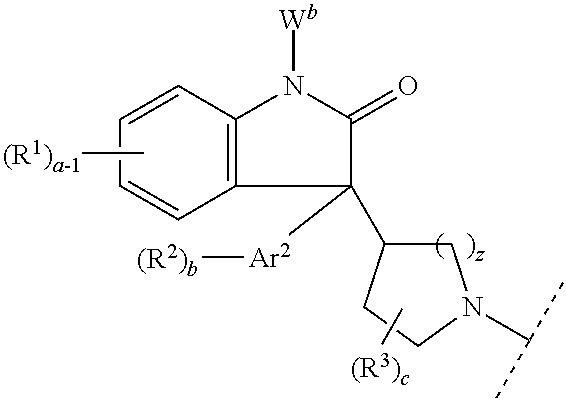


—(R4a)d-(A1)e-(R4b)f-Q-(R4c)g-(A2)h-(R4d)i—


—(R4a)d-(A2)h-(R4d)i—
—(R4a)d-Q-(A2)h-(R4d)i—
—(R4a)d-(A1)e-(R4b)f-Q-(R4c)g-(A2)h-(R4d)i—


—(R4a)d-(A1)e-(R4b)f-Q-(R4c)g-(A2)h-(R4d)i—
wherein

| TABLE I | |
| Ex. | R4 |
| 1 | —(CH2)9— (racemic)1 |
| 2 | —(CH2)9— |
| 3 | —(CH2)2C(O)NH(CH2)5— |
| 4 | —(CH2)2N(CH3)C(O)(CH2)5— |
| 5 | —(CH2)2C(O)NH(phen-1,4-ylene)CH2— |
| 6 | —(CH2)2NHC(O)(phen-1,4-ylene)CH2— |
| 7 | —(CH2)2NHC(O)NH(CH2)5— |
| 8 | —(CH2)3NHC(O)NH(CH2)5— |
| 9 | —(CH2)2C(O)NHCH2(cyclohex-1,3-ylene)CH2— |
| 10 | —(CH2)2NHC(O)(cis-cyclopent-1,3-ylene)- |
| 11 | —(CH2)2C(O)NH(2-chlorophen-1,4-ylene)CH2— |
| 12 | —(CH2)2S(O)2NH(CH2)5— |
| 13 | —(CH2)2N(CH3)S(O)2(phen-1,4-ylene)CH2— |
| 14 | —(CH2)2NHC(O)NHCH2(phen-1,3-ylene)CH2— |
| 15 | —(CH2)3(phen-1,4-ylene)NH(phen-1,4-ylene)(CH2)2— |
| 16 | 1-[—CH2(2-fluorophen-1,3-ylene)CH2](piperidin-4-yl)CH2— |
| 17 | —(CH2)3O(phen-1,4-ylene)(CH2)2— |
| 18 | —(CH2)4(phen-1,4-ylene)(CH2)2— |
| 19 | —(CH2)3(thien-2,5-ylene)(CH2)3— |
| 20 | —(CH2)2C(O)NH(2-chloro-5-methoxyphen-1,4-ylene)CH2— |
| 21 | —(CH2)7— |
| 22 | —(CH2)8— |
| 23 | —(CH2)2NHC(O)NH(phen-1,4-ylene)(CH2)2— |
| 24 | 1-[—(CH2)2C(O)](piperidin-4-yl)(CH2)2— |
| 25 | —(CH2)2NHC(O)(trans-cyclohex-1,4-ylene)CH2— |
| 26 | —(CH2)2NHC(O)(cis-cyclopent-1,3-ylene)- |
| 27 | —(CH2)2NH(phen-1,4-ylene)(CH2)2— |
| 28 | 1-[—(CH2)2NHC(O)](piperidin-4-yl)(CH2)2— |
| 29 | —CH2(phen-1,4-ylene)NH(phen-1,4-ylene)CH2— |
| 30 | —(CH2)2C(O)NHCH2(phen-1,3-ylene)CH2— |
| 31 | —(CH2)2C(O)NH(phen-1,4-ylene)CH2— |
| 32 | —(CH2)2C(O)NHCH2(pyrid-2,6-ylene)CH2— |
| 33 | —(CH2)2C(O)NH(cis-cyclohex-1,4-ylene)CH2— |
| 34 | —(CH2)2C(O)NH(trans-cyclohex-1,4-ylene)CH2— |
| 35 | —(CH2)2NHC(O)(cis-cyclopent-1,3-ylene)CH2— |
| 36 | —(CH2)2N(CH3)C(O)(phen-1,3-ylene)CH2— |
| 37 | —(CH2)2N(CH3)C(O)(trans-cyclohex-1,4-ylene)CH2— |
| 38 | —(CH2)2C(O)NH(phen-1,4-ylene)CH2— |
| 39 | —(CH2)2C(O)NH(phen-1,4-ylene)C*H(CH3)— ((S)-isomer) |
| 40 | —(CH2)2C(O)NH(phen-1,4-ylene)C*H(CH3)— ((R)-isomer) |
| 41 | 2-[(S)-(—CH2-](pyrrolidin-1-yl)C(O)(CH2)4— |
| 42 | 2-[(S)-(—CH2-](pyrrolidin-1-yl)C(O)(phen-1,4-ylene)CH2— |
| 43 | —(CH2)2C(O)NH(4-chlorophen-1,3-ylene)CH2— |
| 44 | —(CH2)2C(O)NH(phen-1,4-ylene)CH2— |
| 45 | 1-[—(CH2)2C(O)](piperidin-4-yl)(CH2)2— |
| 46 | —(CH2)2C(O)NHCH2(phen-1,3-ylene)CH2— |
| 47 | —CH2(2-fluorophen-1,3-ylene)CH2— |
| 48 | —(CH2)2C(O)NH(4-methylphen-1,3-ylene)CH2— |
| 49 | —(CH2)2C(O)NH(6-chlorophen-1,3-ylene)CH2— |
| 50 | —(CH2)2C(O)NH(2,6-dichlorophen-1,4-ylene)CH2— |
| 51 | 4-[—CH2-](piperidin-1-yl)C(O)(phen-1,4-ylene)CH2— |
| 52 | —(CH2)2C(O)N(CH2CH3)(phen-1,4-ylene)CH2— |
| 53 | 1-[—(CH2)2NHC(O)](piperidin-4-yl)- |
| 54 | —(CH2)2C(O)NH(phen-1,4-ylene)(CH2)2— |
| 55 | —(CH2)2NHC(O)(thien-2,5-ylene)CH2— |
| 56 | —(CH2)2N(CH3)C(O)(3-nitrophen-1,4-ylene)CH2— |
| 57 | —(CH2)2N(CH3)C(O)(trans-cyclohex-1,4-ylene)- |
| 58 | 1-[—CH2(2-fluorophen-1,3-ylene)CH2](piperidin-4-yl)- |
| 59 | 5-[—(CH2)2NHC(O)](pyrid-2-yl)CH2— |
| 60 | 1-[—(CH2)3](piperidin-4-yl)CH2— |
| 61 | —CH2(phen-1,2-ylene)NH(phen-1,4-ylene)(CH2)2— |
| 62 | 1-[—CH2(2-fluorophen-1,3-ylene)CH2](piperidin-4-yl)(CH2)2— |
| 63 | —(CH2)3NH(phen-1,4-ylene)(CH2)2— |
| 64 | —(CH2)2C(O)NH(3-chlorophen-1,4-ylene)CH2— |
| 65 | —(CH2)2C(O)NH(2-(CF3O-)phen-1,4-ylene)CH2— |
| 66 | —(CH2)3(phen-1,3-ylene)NH(phen-1,4-ylene)(CH2)2— |
| 67 | —CH2(phen-1,3-ylene)NH(phen-1,4-ylene)(CH2)2— |
| 68 | —(CH2)2C(O)NH(2-iodophen-1,4-ylene)CH2— |
| 69 | —(CH2)2C(O)NH(2-chloro-6-methylphen-1,4-ylene)CH2— |
| 70 | —(CH2)3C(O)NH(CH2)5— |
| 71 | —(CH2)2C(O)NH(2-bromophen-1,4-ylene)CH2— |
| 72 | —(CH2)3(phen-1,2-ylene)NH(phen-1,4-ylene)(CH2)2— |
| 73 | 1-[—CH2(2-fluorophen-1,3-ylene)CH2](piperidin-4-yl)(CH2)3— |
| 74 | —(CH2)2C(O)NH(2-methoxyphen-1,4-ylene)CH2— |
| 75 | —(CH2)5NH(phen-1,4-ylene)(CH2)2— |
| 76 | 4-[—(CH2)2-](piperidin-1-yl)(phen-1,4-ylene)(CH2)2— |
| 77 | —(CH2)2C(O)NH(phen-1,4-ylene)CH(CH3)CH2— |
| 78 | —(CH2)2-(trans-cyclohex-1,4-ylene)NH(phen-1,4-ylene)(CH2)2— |
| 79 | —(CH2)2C(O)NH(2-fluorophen-1,4-ylene)CH2— |
| 80 | —(CH2)2(phen-1,3-ylene)NH(phen-1,4-ylene)(CH2)2— |
| 81 | —(CH2)2C(O)NH(2,5-difluorophen-1,4-ylene)CH2— |
| 82 | —(CH2)2NHC(O)(phen-1,4-ylene)(CH2)2— |
| 83 | 1-[—CH2(pyrid-2,6-ylene)CH2](piperidin-4-yl)CH2— |
| 84 | —(CH2)2NH(naphth-1,4-ylene)(CH2)2— |
| 85 | 4-[—(CH2)2](piperidin-1-yl)C(O)(phen-1,4-ylene)CH2— |
| 86 | —(CH2)3(phen-1,4-ylene)NHC(O)(CH2)2— |
| 87 | —(CH2)3O(phen-1,4-ylene)CH2— |
| 88 | 2-[—(CH2)2](benzimidazol-5-yl)CH2— |
| 89 | —(CH2)2-(trans-cyclohex-1,4-ylene)NHC(O)(CH2)2— |
| 90 | —(CH2)2-(trans-cyclohex-1,4-ylene)NHC(O)(CH2)4— |
| 91 | —(CH2)2-(trans-cyclohex-1,4-ylene)NHC(O)(CH2)5— |
| 92 | 4-[—(CH2)2](piperidin-1-yl)C(O)(CH2)2— |
| 93 | —(CH2)2NHC(O)NH(phen-1,4-ylene)CH2— |
| 94 | —(CH2)2N(CH3)(CH2)2(cis-cyclohex-1,4-ylene)- |
| 95 | —(CH2)2C(O)NH(2,3,5,6-tetrafluorophen-1,4-ylene)CH2— |
| 96 | —(CH2)2C(O)NH(2,6-diiodophen-1,4-ylene)CH2— |
| 97 | 4-[—(CH2)2](piperidin-1-yl)C(O)(CH2)3— |
| 98 | 4-[—(CH2)2](piperidin-1-yl)C(O)(CH2)4— |
| 99 | 4-[—(CH2)2](piperidin-1-yl)C(O)(CH2)5— |
| 100 | —(CH2)2C(O)NHCH2(phen-1,4-ylene)CH2— |
| 101 | —(CH2)2NHC(O)NHCH2(phen-1,4-ylene)CH2— |
| 192 | —(CH2)2C(O)NH(2-methylphen-1,4-ylene)CH2— |
| 103 | 1-[—(CH2)3O(phen-1,4-ylene)(CH2)2](piperidin-4-yl)CH2— |
| 104 | —(CH2)2C(O)NHCH2(phen-1,3-ylene)(CH2)2— |
| 105 | —(CH2)2O(phen-1,3-ylene)CH2— |
| 106 | —(CH2)2N(CH3)C(O)CH2O(phen-1,4-ylene)CH2— |
| 107 | —(CH2)2N(CH3)C(O)CH2O(phen-1,3-ylene)CH2— |
| 108 | —(CH2)2N(CH3)C(O)(fur-2,5-ylene)CH2— |
| 109 | —(CH2)2N(CH3)C(O)(thien-2,5-ylene)CH2— |
| 110 | —(CH2)2O(phen-1,4-ylene)O(CH2)2— |
| 111 | —(CH2)2(trans-cyclohex-1,4-ylene)NHC(O)(phen-1,4-ylene)CH2— |
| 112 | —(CH2)2(trans-cyclohex-1,4-ylene)NHC(O)CH2O(phen-1,2-ylene)CH2— |
| 113 | —(CH2)2(trans-cyclohex-1,4-ylene)NHC(O)CH2O(phen-1,3-ylene)CH2— |
| 114 | —(CH2)2(trans-cyclohex-1,4-ylene)NHC(O)CH2O(phen-1,4-ylene)CH2— |
| 115 | —(CH2)2(trans-cyclohex-1,4-ylene)NHC(O)(fur-2,5-ylene)CH2— |
| 116 | —(CH2)2(trans-cyclohex-1,4-ylene)NHC(O)(thien-2,5-ylene)CH2— |
| 117 | 4-[—(CH2)2](piperidin-1-yl)C(O)CH2O(phen-1,2-ylene)CH2— |
| 118 | 4-[—(CH2)2](piperidin-1-yl)C(O)CH2O(phen-1,3-ylene)CH2— |
| 119 | 4-[—(CH2)2](piperidin-1-yl)C(O)CH2O(phen-1,4-ylene)CH2— |
| 120 | 4-[—(CH2)2](piperidin-1-yl)C(O)(fur-2,5-ylene)CH2— |
| 121 | 4-[—(CH2)2](piperidin-1-yl)C(O)(thien-2,5-ylene)CH2— |
| 122 | —(CH2)2(phen-1,4-ylene)NHC(O)(phen-1,3-ylene)CH2— |
| 123 | —(CH2)2(phen-1,4-ylene)NHC(O)(phen-1,4-ylene)CH2— |
| 124 | —(CH2)2(phen-1,4-ylene)NHC(O)CH2O(phen-1,2-ylene)CH2— |
| 125 | —(CH2)2(phen-1,4-ylene)NHC(O)CH2O(phen-1,3-ylene)CH2— |
| 126 | —(CH2)2(phen-1,4-ylene)NHC(O)CH2O(phen-1,4-ylene)CH2— |
| 127 | —(CH2)2(phen-1,4-ylene)NHC(O)(fur-2,5-ylene)CH2— |
| 128 | —(CH2)2(phen-1,4-ylene)NHC(O)(thien-2,5-ylene)CH2— |
| 129 | —(CH2)2(trans-cyclohex-1,4-ylene)NHC(O)(phen-1,3-ylene)CH2— |
| 130 | —(CH2)3O(phen-1,3-ylene)CH2— |
| 131 | —CH2CH(OH)CH2NH(phen-1,4-ylene)(CH2)2— |
| 132 | —(CH2)4NH(phen-1,4-ylene)(CH2)2— |
| 133 | —(CH2)2C(O)NH(phen-1,4-ylene)CH2NHC(O)CH2— |
| 134 | —(CH2)2C(O)NH(phen-1,4-ylene)(CH2)2NHC(O)CH2— |
| 135 | —(CH2)2C(O)NHCH2(trans-cyclohex-1,4-ylene)CH2— |
| 136 | —(CH2)2NHC(O)(CH2)5— |
| 137 | —(CH2)2O(phen-1,3-ylene)O(CH2)2— |
| 138 | —(CH2)2O(phen-1,2-ylene)O(CH2)2— |
| 139 | —CH2(phen-1,2-ylene)O(phen-1,2-ylene)CH2— |
| 140 | —(CH2)2C(O)NH(CH2)6— |
| 141 | —(CH2)2NHC(O)(cis-cyclopent-1,3-ylene)- |
| 142 | —(CH2)3(phen-1,4-ylene)(CH2)3— |
| 143 | —(CH2)3(phen-1,4-ylene)(CH2)2— |
| 144 | —(CH2)4(phen-1,4-ylene)(CH2)2— |
| 145 | —(CH2)3(furan-2,5-ylene)(CH2)3— |
| 146 | —(CH2)2N(CH3)C(O)NH(phen-1,4-ylene)(CH2)2— |
| 147 | 4-[—(CH2)2](piperidin-1-yl)C(O)NH(phen-1,4-ylene)(CH2)2— |
| 148 | —(CH2)3(phen-1,3-ylene)(CH2)3— |
| 149 | —(CH2)3(tetrahydrofuran-2,5-ylene)(CH2)3— |
| 150 | —(CH2)2O(phen-1,4-ylene)C(O)(CH2)2— |
| 1This compound is racemic at the chiral carbon bearing the hydroxyl group in formula IIIa. | |

| TABLE II | |
| Ex. | R4 |
| 151 | —(CH2)9— |
| 152 | —(CH2)10— |
| 153 | —(CH2)2C(O)NH(CH2)5— |
| 154 | —(CH2)2N(CH3)C(O)(CH2)5— |
| 155 | —(CH2)2C(O)NH(phen-1,4-ylene)CH2— |
| 156 | —(CH2)2NHC(O)(phen-1,4-ylene)CH2— |
| 157 | —(CH2)2NHC(O)NH(CH2)5— |
| 158 | —(CH2)3NHC(O)NH(CH2)5— |
| 159 | —(CH2)2C(O)NHCH2(cyclohex-1,3-ylene)CH2— |
| 160 | —(CH2)2NHC(O)(cis-cyclopent-1,3-ylene)- |
| 161 | —(CH2)2C(O)NH(2-chlorophen-1,4-ylene)CH2— |
| 162 | —(CH2)2S(O)2NH(CH2)5— |
| 163 | —(CH2)2N(CH3)S(O)2(phen-1,4-ylene)CH2— |
| 164 | —(CH2)2NHC(O)NHCH2(phen-1,3-ylene)CH2— |
| 165 | —(CH2)3(phen-1,4-ylene)NH(phen-1,4-ylene)(CH2)2— |
| 166 | 1-[—CH2(2-fluorophen-1,3-ylene)CH2](piperidin-4-yl)CH2— |
| 167 | —(CH2)3O(phen-1,4-ylene)(CH2)2— |
| 168 | —(CH2)4(phen-1,4-ylene)(CH2)2— |
| 169 | —(CH2)3(thien-2,5-ylene)(CH2)3— |
| 170 | —(CH2)2C(O)NH(2-chloro-5-methoxyphen-1,4-ylene)CH2— |
| 171 | —(CH2)7— |
| 172 | —(CH2)8— |
| 173 | —(CH2)2NHC(O)NH(phen-1,4-ylene)(CH2)2— |
| 174 | 1-[—(CH2)2C(O)](piperidin-4-yl)(CH2)2— |
| 175 | —(CH2)2NHC(O)(trans-cyclohex-1,4-ylene)CH2— |
| 176 | —(CH2)2NHC(O)(cis-cyclopent-1,3-ylene)- |
| 177 | —(CH2)2NH(phen-1,4-ylene)(CH2)2— |
| 178 | 1-[—(CH2)2NHC(O)](piperidin-4-yl)(CH2)2— |
| 179 | —CH2(phen-1,4-ylene)NH(phen-1,4-ylene)CH2— |
| 180 | —(CH2)2C(O)NHCH2(phen-1,3-ylene)CH2— |
| 181 | —(CH2)2C(O)NH(phen-1,4-ylene)CH2— |
| 182 | —(CH2)2C(O)NHCH2(pyrid-2,6-ylene)CH2— |
| 183 | —(CH2)2C(O)NH(cis-cyclohex-1,4-ylene)CH2— |
| 184 | —(CH2)2C(O)NH(trans-cyclohex-1,4-ylene)CH2— |
| 185 | —(CH2)2NHC(O)(cis-cyclopent-1,3-ylene)CH2— |
| 186 | —(CH2)2N(CH3)C(O)(phen-1,3-ylene)CH2— |
| 187 | —(CH2)2N(CH3)C(O)(trans-cyclohex-1,4-ylene)CH2— |
| 188 | —(CH2)2C(O)NH(phen-1,4-ylene)CH2— |
| 189 | —(CH2)2C(O)NH(phen-1,4-ylene)C*H(CH3)— ((S)-isomer) |
| 190 | —(CH2)2C(O)NH(phen-1,4-ylene)C*H(CH3)— ((R)-isomer) |
| 191 | 2-[(S)-(—CH2-](pyrrolidin-1-yl)C(O)(CH2)4— |
| 192 | 2-[(S)-(—CH2-](pyrrolidin-1-yl)C(O)(phen-1,4-ylene)CH2— |
| 193 | —(CH2)2C(O)NH(4-chlorophen-1,3-ylene)CH2— |
| 194 | —(CH2)2C(O)NH(phen-1,4-ylene)CH2— |
| 195 | 1-[—(CH2)2C(O)](piperidin-4-yl)(CH2)2— |
| 196 | —(CH2)2C(O)NHCH2(phen-1,3-ylene)CH2— |
| 197 | —CH2(2-fluorophen-1,3-ylene)CH2— |
| 198 | —(CH2)2C(O)NH(4-methylphen-1,3-ylene)CH2— |
| 199 | —(CH2)2C(O)NH(6-chlorophen-1,3-ylene)CH2— |
| 200 | —(CH2)2C(O)NH(2,6-dichlorophen-1,4-ylene)CH2— |
| 201 | 4-[—CH2-](piperidin-1-yl)C(O)(phen-1,4-ylene)CH2— |
| 202 | —(CH2)2C(O)N(CH2CH3)(phen-1,4-ylene)CH2— |
| 203 | 1-[—(CH2)2NHC(O)](piperidin-4-yl)- |
| 204 | —(CH2)2C(O)NH(phen-1,4-ylene)(CH2)2— |
| 205 | —(CH2)2NHC(O)(thien-2,5-ylene)CH2— |
| 206 | —(CH2)2N(CH3)C(O)(3-nitrophen-1,4-ylene)CH2— |
| 207 | —(CH2)2N(CH3)C(O)(trans-cyclohex-1,4-ylene)- |
| 208 | 1-[—CH2(2-fluorophen-1,3-ylene)CH2](piperidin-4-yl)- |
| 209 | 5-[—(CH2)2NHC(O)](pyrid-2-yl)CH2— |
| 210 | 1-[—(CH2)3](piperidin-4-yl)CH2— |
| 211 | —CH2(phen-1,2-ylene)NH(phen-1,4-ylene)(CH2)2— |
| 212 | 1-[—CH2(2-fluorophen-1,3-ylene)CH2](piperidin-4-yl)(CH2)2— |
| 213 | —(CH2)3NH(phen-1,4-ylene)(CH2)2— |
| 214 | —(CH2)2C(O)NH(3-chlorophen-1,4-ylene)CH2— |
| 215 | —(CH2)2C(O)NH(2-(CF3O-)phen-1,4-ylene)CH2— |
| 216 | —(CH2)3(phen-1,3-ylene)NH(phen-1,4-ylene)(CH2)2— |
| 217 | —CH2(phen-1,3-ylene)NH(phen-1,4-ylene)(CH2)2— |
| 218 | —(CH2)2C(O)NH(2-iodophen-1,4-ylene)CH2— |
| 219 | —(CH2)2C(O)NH(2-chloro-6-methylphen-1,4-ylene)CH2— |
| 220 | —(CH2)3C(O)NH(CH2)5— |
| 221 | —(CH2)2C(O)NH(2-bromophen-1,4-ylene)CH2— |
| 222 | —(CH2)3(phen-1,2-ylene)NH(phen-1,4-ylene)(CH2)2— |
| 223 | 1-[—CH2(2-fluorophen-1,3-ylene)CH2](piperidin-4-yl)(CH2)3— |
| 224 | —(CH2)2C(O)NH(2-methoxyphen-1,4-ylene)CH2— |
| 225 | —(CH2)5NH(phen-1,4-ylene)(CH2)2— |
| 226 | 4-[—(CH2)2-](piperidin-1-yl)(phen-1,4-ylene)(CH2)2— |
| 227 | —(CH2)2C(O)NH(phen-1,4-ylene)CH(CH3)CH2— |
| 228 | —(CH2)2-(trans-cyclohex-1,4-ylene)NH(phen-1,4-ylene)(CH2)2— |
| 229 | —(CH2)2C(O)NH(2-fluorophen-1,4-ylene)CH2— |
| 230 | —(CH2)2(phen-1,3-ylene)NH(phen-1,4-ylene)(CH2)2— |
| 231 | —(CH2)2C(O)NH(2,5-difluorophen-1,4-ylene)CH2— |
| 232 | —(CH2)2NHC(O)(phen-1,4-ylene)(CH2)2— |
| 233 | 1-[—CH2(pyrid-2,6-ylene)CH2](piperidin-4-yl)CH2— |
| 234 | —(CH2)2NH(naphth-1,4-ylene)(CH2)2— |
| 235 | 4-[—(CH2)2](piperidin-1-yl)C(O)(phen-1,4-ylene)CH2— |
| 236 | —(CH2)3(phen-1,4-ylene)NHC(O)(CH2)2— |
| 237 | —(CH2)3O(phen-1,4-ylene)CH2— |
| 238 | 2-[—(CH2)2](benzimidazol-5-yl)CH2— |
| 239 | —(CH2)2-(trans-cyclohex-1,4-ylene)NHC(O)(CH2)2— |
| 240 | —(CH2)2-(trans-cyclohex-1,4-ylene)NHC(O)(CH2)4— |
| 241 | —(CH2)2-(trans-cyclohex-1,4-ylene)NHC(O)(CH2)5— |
| 242 | 4-[—(CH2)2](piperidin-1-yl)C(O)(CH2)2— |
| 243 | —(CH2)2NHC(O)NH(phen-1,4-ylene)CH2— |
| 244 | —(CH2)2N(CH3)(CH2)2(cis-cyclohex-1,4-ylene)- |
| 245 | —(CH2)2C(O)NH(2,3,5,6-tetrafluorophen-1,4-ylene)CH2— |
| 246 | —(CH2)2C(O)NH(2,6-diiodophen-1,4-ylene)CH2— |
| 247 | 4-[—(CH2)2](piperidin-1-yl)C(O)(CH2)3— |
| 248 | 4-[—(CH2)2](piperidin-1-yl)C(O)(CH2)4— |
| 249 | 4-[—(CH2)2](piperidin-1-yl)C(O)(CH2)5— |
| 250 | —(CH2)2C(O)NHCH2(phen-1,4-ylene)CH2— |
| 251 | —(CH2)2NHC(O)NHCH2(phen-1,4-ylene)CH2— |
| 252 | —(CH2)2C(O)NH(2-methylphen-1,4-ylene)CH2— |
| 253 | 1-[—(CH2)3O(phen-1,4-ylene)(CH2)2](piperidin-4-yl)CH2— |
| 254 | —(CH2)2C(O)NHCH2(phen-1,3-ylene)(CH2)2— |
| 255 | —(CH2)2O(phen-1,3-ylene)CH2— |
| 256 | —(CH2)2N(CH3)C(O)CH2O(phen-1,4-ylene)CH2— |
| 257 | —(CH2)2N(CH3)C(O)CH2O(phen-1,3-ylene)CH2— |
| 258 | —(CH2)2N(CH3)C(O)(fur-2,5-ylene)CH2— |
| 259 | —(CH2)2N(CH3)C(O)(thien-2,5-ylene)CH2— |
| 260 | —(CH2)2O(phen-1,4-ylene)O(CH2)2— |
| 261 | —(CH2)2(trans-cyclohex-1,4-ylene)NHC(O)(phen-1,4-ylene)CH2— |
| 262 | —(CH2)2(trans-cyclohex-1,4-ylene)NHC(O)CH2O(phen-1,2-ylene)CH2— |
| 263 | —(CH2)2(trans-cyclohex-1,4-ylene)NHC(O)CH2O(phen-1,3-ylene)CH2— |
| 264 | —(CH2)2(trans-cyclohex-1,4-ylene)NHC(O)CH2O(phen-1,4-ylene)CH2— |
| 265 | —(CH2)2(trans-cyclohex-1,4-ylene)NHC(O)(fur-2,5-ylene)CH2— |
| 266 | —(CH2)2(trans-cyclohex-1,4-ylene)NHC(O)(thien-2,5-ylene)CH2— |
| 267 | 4-[—(CH2)2](piperidin-1-yl)C(O)CH2O(phen-1,2-ylene)CH2— |
| 268 | 4-[—(CH2)2](piperidin-1-yl)C(O)CH2O(phen-1,3-ylene)CH2— |
| 269 | 4-[—(CH2)2](piperidin-1-yl)C(O)CH2O(phen-1,4-ylene)CH2— |
| 270 | 4-[—(CH2)2](piperidin-1-yl)C(O)(fur-2,5-ylene)CH2— |
| 271 | 4-[—(CH2)2](piperidin-1-yl)C(O)(thien-2,5-ylene)CH2— |
| 272 | —(CH2)2(phen-1,4-ylene)NHC(O)(phen-1,3-ylene)CH2— |
| 273 | —(CH2)2(phen-1,4-ylene)NHC(O)(phen-1,4-ylene)CH2— |
| 274 | —(CH2)2(phen-1,4-ylene)NHC(O)CH2O(phen-1,2-ylene)CH2— |
| 275 | —(CH2)2(phen-1,4-ylene)NHC(O)CH2O(phen-1,3-ylene)CH2— |
| 276 | —(CH2)2(phen-1,4-ylene)NHC(O)CH2O(phen-1,4-ylene)CH2— |
| 277 | —(CH2)2(phen-1,4-ylene)NHC(O)(fur-2,5-ylene)CH2— |
| 278 | —(CH2)2(phen-1,4-ylene)NHC(O)(thien-2,5-ylene)CH2— |
| 279 | —(CH2)2(trans-cyclohex-1,4-ylene)NHC(O)(phen-1,3-ylene)CH2— |
| 280 | —(CH2)3O(phen-1,3-ylene)CH2— |
| 281 | —CH2CH(OH)CH2NH(phen-1,4-ylene)(CH2)2— |
| 282 | —(CH2)4NH(phen-1,4-ylene)(CH2)2— |
| 283 | —(CH2)2C(O)NH(phen-1,4-ylene)CH2NHC(O)CH2— |
| 284 | —(CH2)2C(O)NH(phen-1,4-ylene)(CH2)2NHC(O)CH2— |
| 285 | —(CH2)2C(O)NHCH2(trans-cyclohex-1,4-ylene)CH2— |
| 286 | —(CH2)2NHC(O)(CH2)5— |
| 287 | —(CH2)2O(phen-1,3-ylene)O(CH2)2— |
| 288 | —(CH2)2O(phen-1,2-ylene)O(CH2)2— |
| 289 | —CH2(phen-1,2-ylene)O(phen-1,2-ylene)CH2— |
| 290 | —(CH2)2C(O)NH(CH2)6— |
| 291 | —(CH2)2NHC(O)(cis-cyclopent-1,3-ylene)- |
| 292 | —(CH2)3(phen-1,4-ylene)(CH2)3— |
| 293 | —(CH2)3(phen-1,4-ylene)(CH2)2— |
| 294 | —(CH2)4(phen-1,4-ylene)(CH2)2— |
| 295 | —(CH2)3(furan-2,5-ylene)(CH2)3— |
| 296 | —(CH2)2N(CH3)C(O)NH(phen-1,4-ylene)(CH2)2— |
| 297 | 4-[—(CH2)2](piperidin-1-yl)C(O)NH(phen-1,4-ylene)(CH2)2— |
| 298 | —(CH2)3(phen-1,3-ylene)(CH2)3— |
| 299 | —(CH2)3(tetrahydrofuran-2,5-ylene)(CH2)3— |
| 300 | —(CH2)2O(phen-1,4-ylene)C(O)(CH2)2— |
-
- (a) preventing the disease or medical condition from occurring, i.e., prophylactic treatment of a patient;
- (b) ameliorating the disease or medical condition, i.e., eliminating or causing regression of the disease or medical condition in a patient;
- (c) suppressing the disease or medical condition, i.e., slowing or arresting the development of the disease or medical condition in a patient; or
- (d) alleviating the symptoms of the disease or medical condition in a patient.


or a hydrate thereof (e.g., a glyoxal), wherein P9 represents hydrogen or a hydroxyl-protecting group, in the presence of a reducing agent;
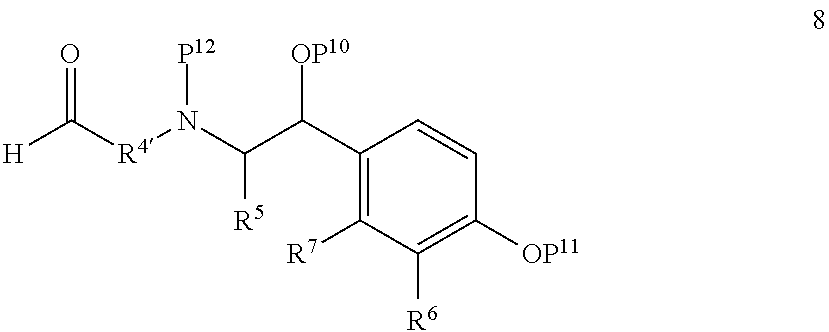


wherein P18 and P19 each represents hydrogen or a hydroxyl-protecting group, with a compound of formula 13:
HNWaWb 13


with an amine of formula 13 under amide bond forming conditions. Compounds of formula 16 may be prepared by hydrolyzing a compound of formula 15 in which E represents CN. Compounds of formula 15 can be prepared as described in U.S. Pat. No. 5,096,890.

X3—R4—NP21P22 18

using a suitable oxidizing agent, such as sulfur trioxide pyridine complex and dimethyl sulfoxide. This oxidation reaction is typically conducted in an inert diluent, such as dichloromethane, the presence of a tertiary amine, such as diisopropylethylamine, at a temperature ranging from about −20° C. to about 25° C.
X4—R4—OH 20
wherein X4 represents a leaving group such as halo, such as chloro, bromo or iodo, or a sulfonic ester group, such as mesylate or tosylate.

with a reducing agent, such as borane. If desired, such a reduction can be performed in the presence of a chiral catalyst to provide compounds of formula 4 in chiral form. For example, compounds of formula 21 can be reduced in the presence of a chiral catalyst formed from (R)-(+)-α,α-diphenyl-2-pyrrolidinemethanol and trimethylboroxine; or alternatively, from (S)-(−)-α,α-diphenyl-2-pyrrolidinemethanol and trimethylboroxine. The resulting hydroxyl group can then be protected with a hydroxyl-protecting group, P4, by reaction with, for example, tert-butyldimethylsilyl trifluoromethanesulfonate.

with bromine in the presence of a Lewis acid, such as boron trifluoride diethyl etherate. Compounds of formula 22 are well-known in the art or can be prepared by well-known procedures using commercially available starting materials and reagents.
X5—(R4a)d-(A1)e-(R4b)f—XQa′ 23
wherein X5 represents a leaving group including halo, such as chloro, bromo or iodo, and a sulfonic ester group, such as mesylate or tosylate; and XQa′ represents XQa, such as a carboxyl group or an amino group NHQa, or a protected derivative thereof, such as a (1-6C)alkoxycarbonylamino group or a tert-butoxycarbonylamino group. This reaction is typically conducted by a method analogous to that used to prepare compounds of formula 3, followed by removing any protecting group in XQa′.
XQb′—(R4c)g-(A2)h-(R4d)i—X6 24
wherein X6 represents a leaving group including halo, such as chloro, bromo or iodo, and a sulfonic ester group, such as mesylate or tosylate; and XQb′ represents XQb, such as a carboxyl group or an amino group NHQb, or a protected derivative thereof, such as a (1-6C)alkoxycarbonyl group or a tert-butoxycarbonylamino group. This reaction is typically conducted by a method analogous to that used to prepare compounds of formula 3, followed by removing any protecting group in XQb′.

using any suitable oxidizing agent, such as sulfur trioxide pyridine complex and dimethyl sulfoxide. This reaction is typically conducted in the presence of a tertiary amine, such as diisopropylethylamine, at a temperature in the range of from about −20° C. to about 25° C. until the oxidation is substantially complete.
HO—R4—X7 26
wherein X7 represents a leaving group including halo, such as chloro, bromo or iodo, and a sulfonic ester group, such as mesylate or tosylate.
| Ingredients | Amount | |
| Compound of the invention | 0.2 mg | |
| Lactose | 25 mg | |
| Ingredients | Amount | |
| Compound of the invention | 250 mg | |
| Lactose (spray-dried) | 200 mg | |
| Magnesium stearate | 10 mg | |
| Ingredients | Amount | |
| Compound of the invention | 1.0 | g | |
| Fumaric acid | 0.5 | g | |
| Sodium chloride | 2.0 | g | |
| Methyl paraben | 0.15 | g | |
| Propyl paraben | 0.05 | g | |
| Granulated sugar | 25.5 | g | |
| Sorbitol (70% solution) | 12.85 | g | |
| Veegum k (Vanderbilt Co.) | 1.0 | g | |
| Flavoring | 0.035 | mL | |
| Colorings | 0.5 | mg | |
| Distilled water | q.s. to 100 | mL | |
-
- Representative Procedure: The ingredients are mixed to form a suspension containing 100 mg of active ingredient per 10 mL of suspension.
| Ingredients | Amount | |
| Compound of the invention | 0.2 | g | |
| Sodium acetate buffer solution (0.4M) | 2.0 | mL |
| HCl (0.5N) or NaOH (0.5N) | q.s. to pH 4 |
| Water (distilled, sterile) | q.s. to 20 | mL | |
-
- Representative Procedure: The above ingredients are blended and the pH is adjusted to 4±0.5 using 0.5 N HCl or 0.5 N NaOH.
| AC | adenylyl cyclase |
| Ach | acetylcholine |
| ATCC | American Type Culture Collection |
| BSA | bovine serum albumin |
| cAMP | 3'-5' cyclic adenosine monophosphate |
| CHO | Chinese hamster ovary |
| cM5 | cloned chimpanzee M5 receptor |
| DCM | dichloromethane (i.e., methylene chloride) |
| DIPEA | N,N-diisopropylethylamine |
| dPBS | Dulbecco's phosphate buffered saline |
| DMEM | Dulbecco's Modified Eagle's Medium |
| DMSO | dimethyl sulfoxide |
| EDTA | ethylenediaminetetraacetic acid |
| Emax | maximal efficacy |
| EtOAc | ethyl acetate |
| EtOH | ethanol |
| FBS | fetal bovine serum |
| FLIPR | fluorometric imaging plate reader |
| Gly | glycine |
| HATU | O-(7-azabenzotriazol-1-yl-N, N, N′, N′-tetramethyluronium |
| hexafluorophosphate | |
| HBSS | Hank's buffered salt solution |
| HEK | human embryonic kidney cells |
| HEPES | 4-(2-hydroxyethyl)-1-piperazineethanesulfonic acid |
| hM1 | cloned human M1 receptor |
| hM2 | cloned human M2 receptor |
| hM3 | cloned human M3 receptor |
| hM4 | cloned human M4 receptor |
| hM5 | cloned human M5 receptor |
| HPLC | high-performance liquid chromatography |
| IBMX | 3-isobutyl-1-methylxanthine |
| % Eff | % efficacy |
| PBS | phosphate buffered saline |
| PyBOP | benzotriazol-1-yloxytripyrrolidinophosphonium |
| hexafluorophosphate | |
| rpm | rotations per minute |
| TFA | trifluoroacetic acid |
| THF | tetrahydrofuran |
| Tris | tris(hydroxymethyl)aminomethane |
| HPLC Method A: |
| Column: | YMC ODSA 5μ C18 4.6 × 50 mm |
| Detector Wavelength: | 220 | nm |
| Column Temperature: | 35° | C. |
| Flow Rate: | 4.0 | mL/min |
| Solvent System: | A = 10% methanol, 90% water, 0.1% TFA |
| B = 90% methanol, 10% water, 0.1% TFA |
| Injection Volume: | 5 | μL |
| Run Time: | 5 | min |
| Gradient: | 0-100% B in A |
| HPLC Method B: |
| Column: | Inertsil OCD-2 C18 |
| Detector Wavelength: | 254 | nm |
| Column Temperature: | 35° | C. |
| Flow Rate: | 1.0 | mL/min |
| Solvent System: | A = 5% methanol, 95% water, 0.1% TFA |
| B = 95% methanol, 5% water, 0.1% TFA |
| Injection Volume: | 5 | μL |
| Run Time: | 15 | min |
| Gradient: | 0-100% Bin A |
Y=Min+(Max−Min)/(1+10((log ID50−X)*Hillslope))
where X is the logarithm of dose, Y is the response (% Inhibition of ACh induced increase in RL). Y starts at Min and approaches asymptotically to Max with a sigmoidal shape.
-
- C1=concentration of Ach or histamine preceding C2
- C2=concentration of Ach or histamine resulting in at least a 2-fold increase in pulmonary resistance (RL)
- R0=Baseline RL value
- R1=RL value after C1
- R2=RL value after C2
Y=Min+(Max−Min)/(1+10((log ID50−X)*Hillslope))
where X is the logarithm of dose, Y is the response. Y starts at Min and approaches asymptotically to Max with a sigmoidal shape.
Y=Min+(Max−Min)/(1+10((log ID50−X)*Hillslope))
where X is the logarithm of dose, Y is the response (% inhibition of salivation). Y starts at Min and approaches asymptotically to Max with a sigmoidal shape.
Claims (11)

—(R4a)d-(A1)e-(R4b)f-Q-(R4c)g-(A2)h-(R4d)i-

(R4a)d-(A11)e-(R4b)f-Q-(Rac)g-(A2)h-(R4d)j-
—(R4a)d-(A2)h-(R4d)i—
—(R4a)d-Q-(A2)h—(R4d)i—


Priority Applications (1)
| Application Number | Priority Date | Filing Date | Title |
|---|---|---|---|
| US12/891,459 US8008278B2 (en) | 2003-04-01 | 2010-09-27 | Diarylmethyl and related compounds |
Applications Claiming Priority (4)
| Application Number | Priority Date | Filing Date | Title |
|---|---|---|---|
| US45929103P | 2003-04-01 | 2003-04-01 | |
| US10/813,745 US7317102B2 (en) | 2003-04-01 | 2004-03-31 | Diarylmethyl and related compounds |
| US11/983,963 US7829728B2 (en) | 2003-04-01 | 2007-11-13 | Diarymethyl and related compounds |
| US12/891,459 US8008278B2 (en) | 2003-04-01 | 2010-09-27 | Diarylmethyl and related compounds |
Related Parent Applications (1)
| Application Number | Title | Priority Date | Filing Date |
|---|---|---|---|
| US11/983,963 Division US7829728B2 (en) | 2003-04-01 | 2007-11-13 | Diarymethyl and related compounds |
Publications (2)
| Publication Number | Publication Date |
|---|---|
| US20110015152A1 US20110015152A1 (en) | 2011-01-20 |
| US8008278B2 true US8008278B2 (en) | 2011-08-30 |
Family
ID=33159636
Family Applications (3)
| Application Number | Title | Priority Date | Filing Date |
|---|---|---|---|
| US10/813,745 Expired - Fee Related US7317102B2 (en) | 2003-04-01 | 2004-03-31 | Diarylmethyl and related compounds |
| US11/983,963 Expired - Fee Related US7829728B2 (en) | 2003-04-01 | 2007-11-13 | Diarymethyl and related compounds |
| US12/891,459 Expired - Fee Related US8008278B2 (en) | 2003-04-01 | 2010-09-27 | Diarylmethyl and related compounds |
Family Applications Before (2)
| Application Number | Title | Priority Date | Filing Date |
|---|---|---|---|
| US10/813,745 Expired - Fee Related US7317102B2 (en) | 2003-04-01 | 2004-03-31 | Diarylmethyl and related compounds |
| US11/983,963 Expired - Fee Related US7829728B2 (en) | 2003-04-01 | 2007-11-13 | Diarymethyl and related compounds |
Country Status (4)
| Country | Link |
|---|---|
| US (3) | US7317102B2 (en) |
| EP (1) | EP1615881A2 (en) |
| JP (2) | JP4767842B2 (en) |
| WO (1) | WO2004089892A2 (en) |
Families Citing this family (70)
| Publication number | Priority date | Publication date | Assignee | Title |
|---|---|---|---|---|
| TWI295669B (en) * | 2002-10-30 | 2008-04-11 | Theravance Inc | Substituted 4-amino-1-(pyridylmethyl) piperidine and related compounds |
| PE20040950A1 (en) * | 2003-02-14 | 2005-01-01 | Theravance Inc | BIPHENYL DERIVATIVES AS AGONISTS OF ß2-ADRENERGIC RECEPTORS AND AS ANTAGONISTS OF MUSCARINAL RECEPTORS |
| JP4767842B2 (en) * | 2003-04-01 | 2011-09-07 | セラヴァンス, インコーポレーテッド | Diarylmethyl compounds and related compounds having β2 adrenergic receptor agonist activity and muscarinic receptor antagonist activity |
| BRPI0409198A (en) * | 2003-04-04 | 2006-05-02 | Novartis Ag | quinolin-2-one derivatives for the treatment of airway diseases |
| DE602004021921D1 (en) | 2003-05-28 | 2009-08-20 | Theravance Inc | AZABICYCLOALKAN COMPOUNDS AS MUSCARIN RECEPTOR ANTAGONISTS |
| TW200510298A (en) | 2003-06-13 | 2005-03-16 | Theravance Inc | Substituted pyrrolidine and related compounds |
| TW200531692A (en) | 2004-01-12 | 2005-10-01 | Theravance Inc | Aryl aniline derivatives as β2 adrenergic receptor agonists |
| WO2005092861A1 (en) * | 2004-03-11 | 2005-10-06 | Pfizer Limited | Quinolinone derivatives pharmaceutical compositions containing them and their use |
| JP2007528418A (en) * | 2004-03-11 | 2007-10-11 | セラヴァンス, インコーポレーテッド | Useful diphenylmethyl compounds as muscarinic receptor antagonists |
| EP1725525A1 (en) | 2004-03-11 | 2006-11-29 | Theravance, Inc. | Diphenylmethyl compounds useful as muscarinic receptor antagonists |
| GB0425054D0 (en) * | 2004-03-23 | 2004-12-15 | Pfizer Ltd | Formamide derivatives for the treatment of diseases |
| TW200540154A (en) * | 2004-06-10 | 2005-12-16 | Theravance Inc | Crystalline form of a substituted pyrrolidine compound |
| GT200500281A (en) | 2004-10-22 | 2006-04-24 | Novartis Ag | ORGANIC COMPOUNDS. |
| WO2006050239A2 (en) * | 2004-10-29 | 2006-05-11 | Glaxo Group Limited | Muscarinic acetylcholine receptor antagonists |
| GB0424284D0 (en) | 2004-11-02 | 2004-12-01 | Novartis Ag | Organic compounds |
| GB0426164D0 (en) | 2004-11-29 | 2004-12-29 | Novartis Ag | Organic compounds |
| ES2265276B1 (en) | 2005-05-20 | 2008-02-01 | Laboratorios Almirall S.A. | DERIVATIVES OF 4- (2-AMINO-1-HYDROXYETHYL) Phenol as agonists of the BETA2 ADRENERGIC RECEIVER. |
| GB0516313D0 (en) | 2005-08-08 | 2005-09-14 | Argenta Discovery Ltd | Azole derivatives and their uses |
| JP2009504624A (en) | 2005-08-08 | 2009-02-05 | アージェンタ ディスカバリー リミテッド | Bicyclo [2.2.1] hept-7-ylamine derivatives and uses thereof |
| TW200738658A (en) | 2005-08-09 | 2007-10-16 | Astrazeneca Ab | Novel compounds |
| WO2007045477A2 (en) | 2005-10-21 | 2007-04-26 | Novartis Ag | Human antibodies against il-13 and therapeutic uses |
| GB0601951D0 (en) | 2006-01-31 | 2006-03-15 | Novartis Ag | Organic compounds |
| GB0602778D0 (en) | 2006-02-10 | 2006-03-22 | Glaxo Group Ltd | Novel compound |
| TW200745084A (en) * | 2006-03-08 | 2007-12-16 | Astrazeneca Ab | Novel compounds |
| TW200745067A (en) | 2006-03-14 | 2007-12-16 | Astrazeneca Ab | Novel compounds |
| WO2007107828A2 (en) | 2006-03-20 | 2007-09-27 | Pfizer Limited | Amine derivatives |
| PT2322525E (en) | 2006-04-21 | 2013-12-26 | Novartis Ag | Purine derivatives for use as adenosin a2a receptor agonists |
| WO2008041095A1 (en) * | 2006-10-04 | 2008-04-10 | Pfizer Limited | Sulfonamide derivatives as adrenergic agonists and muscarinic antagonists |
| ES2302447B1 (en) * | 2006-10-20 | 2009-06-12 | Laboratorios Almirall S.A. | DERIVATIVES OF 4- (2-AMINO-1-HYDROXYETHYL) Phenol as agonists of the BETA2 ADRENERGIC RECEIVER. |
| TW200833670A (en) | 2006-12-20 | 2008-08-16 | Astrazeneca Ab | Novel compounds 569 |
| WO2008096129A1 (en) * | 2007-02-07 | 2008-08-14 | Argenta Discovery Ltd | Nitrogen containing hetrocyclic compounds useful as bifunctional modulators of m3 receptors and beta- 2 receptors |
| GB0702458D0 (en) | 2007-02-08 | 2007-03-21 | Astrazeneca Ab | Salts 668 |
| CA2675942C (en) * | 2007-02-23 | 2016-04-12 | Theravance, Inc. | Quaternary ammonium diphenylmethyl compounds useful as muscarinic receptor antagonists |
| AU2009203693B2 (en) | 2008-01-11 | 2012-06-07 | Novartis Ag | Pyrimidines as kinase inhibitors |
| PL2242759T3 (en) * | 2008-02-06 | 2013-06-28 | Astrazeneca Ab | Compounds |
| EP2096105A1 (en) * | 2008-02-28 | 2009-09-02 | Laboratorios Almirall, S.A. | Derivatives of 4-(2-amino-1-hydroxyethyl)phenol as agonists of the b2 adrenergic receptor |
| UY31905A (en) | 2008-06-18 | 2010-01-29 | Astrazeneca Ab | DERIVATIVES OF BENZOXAZINONA, PREPARATION PROCESSES, PHARMACEUTICAL COMPOSITIONS CONTAINING THEM AND APPLICATIONS. |
| US8263623B2 (en) * | 2008-07-11 | 2012-09-11 | Pfizer Inc. | Triazol derivatives useful for the treatment of diseases |
| WO2010015792A1 (en) * | 2008-08-06 | 2010-02-11 | Argenta Discovery Limited | Nitrogen containing heterocyclic compounds useful as bifunctional modulators of m3 receptors and beta-2 receptors |
| US8236786B2 (en) | 2008-08-07 | 2012-08-07 | Pulmagen Therapeutics (Inflammation) Limited | Respiratory disease treatment |
| MX2011007036A (en) | 2008-12-30 | 2011-07-20 | Pulmagen Therapeutics Inflammation Ltd | Sulfonamide compounds for the treatment of respiratory disorders. |
| TW201036957A (en) | 2009-02-20 | 2010-10-16 | Astrazeneca Ab | Novel salt 628 |
| EP2228368A1 (en) | 2009-03-12 | 2010-09-15 | Almirall, S.A. | Process for manufacturing 5-(2-{[6-(2,2-difluoro-2-phenylethoxy) hexyl]amino}-1-hydroxyethyl)-8-hydroxyquinolin-2(1H)-one |
| JP5540075B2 (en) * | 2009-04-14 | 2014-07-02 | グラクソ グループ リミテッド | Method for preparing biphenyl-2-ylcarbamic acid ester |
| MX2011011446A (en) | 2009-04-30 | 2011-11-18 | Teijin Pharma Ltd | Quaternary ammonium salt compound. |
| WO2010150014A1 (en) | 2009-06-24 | 2010-12-29 | Pulmagen Therapeutics (Inflammation) Limited | 5r- 5 -deuterated glitazones for respiratory disease treatment |
| GB0918922D0 (en) | 2009-10-28 | 2009-12-16 | Vantia Ltd | Aminopyridine derivatives |
| GB0918924D0 (en) | 2009-10-28 | 2009-12-16 | Vantia Ltd | Azaindole derivatives |
| GB0918923D0 (en) | 2009-10-28 | 2009-12-16 | Vantia Ltd | Aminothiazole derivatives |
| WO2011061527A1 (en) | 2009-11-17 | 2011-05-26 | Astrazeneca Ab | Combinations comprising a glucocorticoid receptor modulator for the treatment of respiratory diseases |
| WO2011081937A1 (en) | 2009-12-15 | 2011-07-07 | Gilead Sciences, Inc. | Corticosteroid-beta-agonist-muscarinic antagonist compounds for use in therapy |
| WO2011098746A1 (en) | 2010-02-09 | 2011-08-18 | Pulmagen Therapeutics (Inflammation) Limited | Crystalline acid addition salts of ( 5r) -enanti0mer of pioglitazone |
| GB201002243D0 (en) | 2010-02-10 | 2010-03-31 | Argenta Therapeutics Ltd | Respiratory disease treatment |
| GB201002224D0 (en) | 2010-02-10 | 2010-03-31 | Argenta Therapeutics Ltd | Respiratory disease treatment |
| ITRM20110083U1 (en) | 2010-05-13 | 2011-11-14 | De La Cruz Jose Antonio Freire | PLATE FOR THE CONSTRUCTION OF TRUCKS FOR AIRPLANES |
| EP2386555A1 (en) | 2010-05-13 | 2011-11-16 | Almirall, S.A. | New cyclohexylamine derivatives having beta2 adrenergic agonist and m3 muscarinic antagonist activities |
| WO2012034095A1 (en) | 2010-09-09 | 2012-03-15 | Irm Llc | Compounds and compositions as trk inhibitors |
| UY33597A (en) | 2010-09-09 | 2012-04-30 | Irm Llc | COMPOUNDS AND COMPOSITIONS AS INHIBITORS OF THE TRK |
| AR083115A1 (en) * | 2010-09-30 | 2013-01-30 | Theravance Inc | CRYSTAL OXALATE SALTS OF A DIAMID COMPOUND |
| GB201016912D0 (en) | 2010-10-07 | 2010-11-24 | Astrazeneca Ab | Novel combination |
| MA34969B1 (en) | 2011-02-25 | 2014-03-01 | Irm Llc | COMPOUNDS AND COMPOSITIONS AS TRK INHIBITORS |
| EP2578570A1 (en) | 2011-10-07 | 2013-04-10 | Almirall, S.A. | Novel process for preparing 5-(2-{[6-(2,2-difluoro-2-phenylethoxy)hexyl]amino}-1(r)-hydroxyethyl)-8-hydroxyquinolin-2(1h)-one via novel intermediates of synthesis. |
| EP2592078A1 (en) | 2011-11-11 | 2013-05-15 | Almirall, S.A. | New cyclohexylamine derivatives having beta2 adrenergic agonist and M3 muscarinic antagonist activities |
| EP2641900A1 (en) | 2012-03-20 | 2013-09-25 | Almirall, S.A. | Novel polymorphic Crystal forms of 5-(2-{[6-(2,2-difluoro-2-phenylethoxy) hexyl]amino}-1-(R)-hydroxyethyl)-8-hydroxyquinolin-2(1h)-one, heminapadisylate as agonist of the ß2 adrenergic receptor. |
| MA38260B1 (en) | 2012-12-18 | 2018-04-30 | Almirall Sa | Novel cyclohexyl and quinuclidinyl carbamate derivatives having beta2 adrenergic agonist activity and muscarinic m3 antagonist activity |
| TWI643853B (en) | 2013-02-27 | 2018-12-11 | 阿爾米雷爾有限公司 | a salt of 2-amino-1-hydroxyethyl-8-hydroxyquinoline-2(1H)-one derivative having both β2 adrenergic receptor agonist and M3 muscarinic receptor antagonist activity |
| TWI641373B (en) | 2013-07-25 | 2018-11-21 | 阿爾米雷爾有限公司 | Salt of 2-amino-1-hydroxyethyl-8-hydroxyquinoline-2(1H)-one derivative having activity of both a muscarinic receptor antagonist and a β2 adrenergic receptor agonist |
| TW201517906A (en) | 2013-07-25 | 2015-05-16 | Almirall Sa | Combinations comprising MABA compounds and corticosteroids |
| TW201617343A (en) | 2014-09-26 | 2016-05-16 | 阿爾米雷爾有限公司 | New bicyclic derivatives having [beta]2 adrenergic agonist and M3 muscarinic antagonist activities |
| EP3774731A4 (en) * | 2018-03-30 | 2021-11-24 | The Regents Of The University Of Michigan | PIPERIDINE COMPOUNDS AS COVALENT MENIN INHIBITORS |
Citations (39)
| Publication number | Priority date | Publication date | Assignee | Title |
|---|---|---|---|---|
| US3192210A (en) | 1961-12-04 | 1965-06-29 | Robins Co Inc A H | 4-(omega-substituted alkyl)-3, 3-disubstituted-1-substituted-2-pyrrolidinones and 4-(omega-substituted alkyl)-3, 3-disubstituted-1-substituted-2-thionpyrrolidinones |
| US3192221A (en) | 1961-12-04 | 1965-06-29 | Robins Co Inc A H | 4-(omega-substituted alkyl)-3, 3-disubstituted-1-substituted-2-pyrrolidinones and 4-(omega-substituted alkyl)-3, 3-disubstituted-1-substituted-2-thionpyrrolidinones and production thereof |
| US3247222A (en) | 1962-12-26 | 1966-04-19 | Robins Co Inc A H | Alpha (nu-hydrocarbonpyrrolidyl-3-) alpha, alpha carbocyclic arylacetamides |
| US3732247A (en) | 1970-08-14 | 1973-05-08 | Robins Co Inc A H | 3-di-substituted methylene pyrrolidines wherein the 1-or n-lower-alkyl substituent contains at least two carbon atoms |
| DE2558501A1 (en) | 1974-12-26 | 1976-07-08 | Robins Co Inc A H | PROCESS FOR THE MANUFACTURING OF ALPHA, ALPHA, ALPHA-TRISUBSTITUTED ACETAMIDES, ACETONITRILE AND METHANES AND PHARMACEUTICAL PREPARATIONS CONTAINING THESE COMPOUNDS |
| US3984557A (en) | 1974-12-26 | 1976-10-05 | A. H. Robins Company, Incorporated | Antiarrhythmia compositions and methods |
| US4026897A (en) | 1974-01-31 | 1977-05-31 | Otsuka Pharmaceutical Company | 5-[1-Hydroxy-2-(substituted-amino)]alkyl-8-hydroxycarbostyril derivatives |
| US4250188A (en) | 1976-12-31 | 1981-02-10 | Farmitalia Carlo Erba S.P.A. | Certain PGI1 compounds and pharmaceutical compositions containing them |
| US4299813A (en) | 1979-05-17 | 1981-11-10 | Snyder Solomon H | Assay kit and method |
| US4460581A (en) | 1982-10-12 | 1984-07-17 | Boehringer Ingelheim Kg | (1-Hydroxy-2-amino-alkyl)-substituted benzoxazinones and benzoxazolinones |
| EP0178947A2 (en) | 1984-10-19 | 1986-04-23 | A.H. Robins Company, Incorporated | 1-[(Aminoalkyl and aminoalkylamino)carbonyl and thiocarbonyl]-alpha,alpha-diarylpyrrolidine, piperidine and homopiperidineacetamides and acetonitriles |
| EP0178946A2 (en) | 1984-10-19 | 1986-04-23 | A.H. Robins Company, Incorporated | 1-(Aminoalkyl)-alpha, alpha-diaryl pyrrolidine-piperidine- and homopiperidine- acetamides and acetonitriles |
| EP0235463A2 (en) | 1985-12-20 | 1987-09-09 | A.H. ROBINS COMPANY, INCORPORATED (a Delaware corporation) | N-substituted-arylalkyl and arylalkylene piperidines as cardiovascular antihistaminic and antisecretory agents |
| US4810713A (en) | 1985-12-20 | 1989-03-07 | A. H. Robins Company, Incorporated | Arylalkyl-heterocyclic amines, n-substituted by aryloxyalkyl groups used in a method for allergy treatment |
| US4894219A (en) | 1988-03-29 | 1990-01-16 | University Of Florida | Beta-agonist carbostyril derivatives, assay method and pharmacological composition |
| EP0388054A1 (en) | 1989-03-17 | 1990-09-19 | Pfizer Limited | Pyrrolidine derivatives |
| US4992474A (en) | 1983-04-18 | 1991-02-12 | Glaxo Group Ltd. | Phenethanolamine derivatives |
| WO1991009013A1 (en) | 1989-12-12 | 1991-06-27 | Pfizer Limited | Muscarinic receptor antagonists |
| US5070087A (en) | 1989-05-08 | 1991-12-03 | A. H. Robins Company, Incorporated | Aryl(alkyland alkylene)-N-((phenoxy and phenylthio)alkyl) aminoheterocyclics as cardiovascular, anthihistaminic, antisecretory and antiallergy agents |
| US5233053A (en) | 1989-03-17 | 1993-08-03 | Pfizer Inc. | Pyrrolidine derivatives |
| US5607950A (en) | 1990-01-06 | 1997-03-04 | Pfizer Inc. | Muscarinic receptor antagonists |
| US5837724A (en) | 1996-06-18 | 1998-11-17 | Pfizer Inc. | Method of enhancing cognition |
| WO1998054167A1 (en) | 1997-05-28 | 1998-12-03 | Mitsubishi-Tokyo Pharmaceuticals, Inc. | Indole compounds |
| US5932594A (en) | 1988-11-01 | 1999-08-03 | Pfizer, Inc. | Muscarinic receptor antagonists |
| WO1999064043A1 (en) | 1998-06-08 | 1999-12-16 | Advanced Medicine, Inc. | Muscarinic receptor antagonists |
| WO1999064031A1 (en) | 1998-06-08 | 1999-12-16 | Advanced Medicine, Inc. | β2-ADRENERGIC RECEPTOR AGONISTS |
| US6268533B1 (en) | 1996-11-11 | 2001-07-31 | Sepracor Inc. | Formoterol process |
| US6433027B1 (en) * | 1999-05-12 | 2002-08-13 | Boehringer Ingelheim Pharma Kg | Medicament compositions based on tiotropium bromide and formoterol fumarate |
| WO2002066422A1 (en) | 2001-02-14 | 2002-08-29 | Glaxo Group Limited | Phenethanolamine derivatives for treatment of respiratory diseases |
| US20030018019A1 (en) | 2001-06-23 | 2003-01-23 | Boehringer Ingelheim Pharma Kg | Pharmaceutical compositions based on anticholinergics, corticosteroids and betamimetics |
| US6576793B1 (en) | 1999-12-08 | 2003-06-10 | Theravance, Inc. | β2-adrenergic receptor agonists |
| US6593497B1 (en) | 1999-06-02 | 2003-07-15 | Theravance, Inc. | β2-adrenergic receptor agonists |
| US6653323B2 (en) | 2001-11-13 | 2003-11-25 | Theravance, Inc. | Aryl aniline β2 adrenergic receptor agonists |
| US6670376B1 (en) | 2001-11-13 | 2003-12-30 | Theravance, Inc. | Aryl aniline β2 adrenergic receptor agonists |
| US6693202B1 (en) | 1999-02-16 | 2004-02-17 | Theravance, Inc. | Muscarinic receptor antagonists |
| US6713651B1 (en) | 1999-06-07 | 2004-03-30 | Theravance, Inc. | β2-adrenergic receptor agonists |
| US6747043B2 (en) | 2002-05-28 | 2004-06-08 | Theravance, Inc. | Alkoxy aryl β2 adrenergic receptor agonists |
| WO2004074276A1 (en) | 2003-02-14 | 2004-09-02 | Theravance Inc. | BIPHENYL DERIVATIVES HAVING β2 ADRENERGIC RECEPTOR AGONIST AND MUSCARINIC RECEPTOR ANTAGONIST ACTIVITY |
| US7317102B2 (en) * | 2003-04-01 | 2008-01-08 | Theravance, Inc. | Diarylmethyl and related compounds |
Family Cites Families (3)
| Publication number | Priority date | Publication date | Assignee | Title |
|---|---|---|---|---|
| US5233063A (en) * | 1988-02-18 | 1993-08-03 | G. D. Searle & Co. | Metabolites of pentanedioic acid derivatives |
| GB9000304D0 (en) * | 1990-01-06 | 1990-03-07 | Pfizer Ltd | Muscarinic receptor antagonists |
| US6382371B1 (en) * | 2001-01-26 | 2002-05-07 | Delphi Technologies, Inc. | Self leveling vehicle suspension damper |
-
2004
- 2004-03-31 JP JP2006509509A patent/JP4767842B2/en not_active Expired - Fee Related
- 2004-03-31 EP EP04758642A patent/EP1615881A2/en not_active Withdrawn
- 2004-03-31 WO PCT/US2004/009825 patent/WO2004089892A2/en not_active Ceased
- 2004-03-31 US US10/813,745 patent/US7317102B2/en not_active Expired - Fee Related
-
2007
- 2007-11-13 US US11/983,963 patent/US7829728B2/en not_active Expired - Fee Related
-
2010
- 2010-09-27 US US12/891,459 patent/US8008278B2/en not_active Expired - Fee Related
- 2010-10-15 JP JP2010233130A patent/JP2011016848A/en not_active Withdrawn
Patent Citations (49)
| Publication number | Priority date | Publication date | Assignee | Title |
|---|---|---|---|---|
| US3192221A (en) | 1961-12-04 | 1965-06-29 | Robins Co Inc A H | 4-(omega-substituted alkyl)-3, 3-disubstituted-1-substituted-2-pyrrolidinones and 4-(omega-substituted alkyl)-3, 3-disubstituted-1-substituted-2-thionpyrrolidinones and production thereof |
| US3192210A (en) | 1961-12-04 | 1965-06-29 | Robins Co Inc A H | 4-(omega-substituted alkyl)-3, 3-disubstituted-1-substituted-2-pyrrolidinones and 4-(omega-substituted alkyl)-3, 3-disubstituted-1-substituted-2-thionpyrrolidinones |
| US3247222A (en) | 1962-12-26 | 1966-04-19 | Robins Co Inc A H | Alpha (nu-hydrocarbonpyrrolidyl-3-) alpha, alpha carbocyclic arylacetamides |
| US3732247A (en) | 1970-08-14 | 1973-05-08 | Robins Co Inc A H | 3-di-substituted methylene pyrrolidines wherein the 1-or n-lower-alkyl substituent contains at least two carbon atoms |
| US4026897A (en) | 1974-01-31 | 1977-05-31 | Otsuka Pharmaceutical Company | 5-[1-Hydroxy-2-(substituted-amino)]alkyl-8-hydroxycarbostyril derivatives |
| DE2558501A1 (en) | 1974-12-26 | 1976-07-08 | Robins Co Inc A H | PROCESS FOR THE MANUFACTURING OF ALPHA, ALPHA, ALPHA-TRISUBSTITUTED ACETAMIDES, ACETONITRILE AND METHANES AND PHARMACEUTICAL PREPARATIONS CONTAINING THESE COMPOUNDS |
| US3984557A (en) | 1974-12-26 | 1976-10-05 | A. H. Robins Company, Incorporated | Antiarrhythmia compositions and methods |
| US4002766A (en) | 1974-12-26 | 1977-01-11 | A. H. Robins Company, Incorporated | Antiarrhythmia methods |
| US4250188A (en) | 1976-12-31 | 1981-02-10 | Farmitalia Carlo Erba S.P.A. | Certain PGI1 compounds and pharmaceutical compositions containing them |
| US4299813A (en) | 1979-05-17 | 1981-11-10 | Snyder Solomon H | Assay kit and method |
| US4460581A (en) | 1982-10-12 | 1984-07-17 | Boehringer Ingelheim Kg | (1-Hydroxy-2-amino-alkyl)-substituted benzoxazinones and benzoxazolinones |
| US4992474A (en) | 1983-04-18 | 1991-02-12 | Glaxo Group Ltd. | Phenethanolamine derivatives |
| EP0178946A2 (en) | 1984-10-19 | 1986-04-23 | A.H. Robins Company, Incorporated | 1-(Aminoalkyl)-alpha, alpha-diaryl pyrrolidine-piperidine- and homopiperidine- acetamides and acetonitriles |
| US4594343A (en) | 1984-10-19 | 1986-06-10 | Shanklin Jr James R | 1-[(aminoalkyl and aminoalkylamino)carbonyl and thiocarbonyl]-α,α-diarylpyrrolidine, piperidine and homopiperidineacetamides and acetonitriles |
| EP0178947A2 (en) | 1984-10-19 | 1986-04-23 | A.H. Robins Company, Incorporated | 1-[(Aminoalkyl and aminoalkylamino)carbonyl and thiocarbonyl]-alpha,alpha-diarylpyrrolidine, piperidine and homopiperidineacetamides and acetonitriles |
| EP0235463A2 (en) | 1985-12-20 | 1987-09-09 | A.H. ROBINS COMPANY, INCORPORATED (a Delaware corporation) | N-substituted-arylalkyl and arylalkylene piperidines as cardiovascular antihistaminic and antisecretory agents |
| US4810713A (en) | 1985-12-20 | 1989-03-07 | A. H. Robins Company, Incorporated | Arylalkyl-heterocyclic amines, n-substituted by aryloxyalkyl groups used in a method for allergy treatment |
| US4950674A (en) | 1985-12-20 | 1990-08-21 | A. H. Robins Company, Incorporated | Arylalkylheterocyclic amines,N-substituted by aryloxyalkyl group in a method for allergy treatment |
| US4894219A (en) | 1988-03-29 | 1990-01-16 | University Of Florida | Beta-agonist carbostyril derivatives, assay method and pharmacological composition |
| US5932594A (en) | 1988-11-01 | 1999-08-03 | Pfizer, Inc. | Muscarinic receptor antagonists |
| EP0388054A1 (en) | 1989-03-17 | 1990-09-19 | Pfizer Limited | Pyrrolidine derivatives |
| US5096890B1 (en) | 1989-03-17 | 1995-03-28 | Pfizer | Pyrrolidine derivatives |
| US5096890A (en) | 1989-03-17 | 1992-03-17 | Pfizer Inc. | Pyrrolidine derivatives |
| US5233053A (en) | 1989-03-17 | 1993-08-03 | Pfizer Inc. | Pyrrolidine derivatives |
| US5070087A (en) | 1989-05-08 | 1991-12-03 | A. H. Robins Company, Incorporated | Aryl(alkyland alkylene)-N-((phenoxy and phenylthio)alkyl) aminoheterocyclics as cardiovascular, anthihistaminic, antisecretory and antiallergy agents |
| US5340831A (en) | 1989-12-12 | 1994-08-23 | Pfizer Inc. | Muscarinic receptor antagonists |
| WO1991009013A1 (en) | 1989-12-12 | 1991-06-27 | Pfizer Limited | Muscarinic receptor antagonists |
| US5607950A (en) | 1990-01-06 | 1997-03-04 | Pfizer Inc. | Muscarinic receptor antagonists |
| US5837724A (en) | 1996-06-18 | 1998-11-17 | Pfizer Inc. | Method of enhancing cognition |
| US6268533B1 (en) | 1996-11-11 | 2001-07-31 | Sepracor Inc. | Formoterol process |
| WO1998054167A1 (en) | 1997-05-28 | 1998-12-03 | Mitsubishi-Tokyo Pharmaceuticals, Inc. | Indole compounds |
| WO1999064035A1 (en) | 1998-06-08 | 1999-12-16 | Advanced Medicine, Inc. | β2-ADRENERGIC RECEPTOR AGONISTS |
| WO1999064031A1 (en) | 1998-06-08 | 1999-12-16 | Advanced Medicine, Inc. | β2-ADRENERGIC RECEPTOR AGONISTS |
| US6362371B1 (en) | 1998-06-08 | 2002-03-26 | Advanced Medicine, Inc. | β2- adrenergic receptor agonists |
| WO1999064043A1 (en) | 1998-06-08 | 1999-12-16 | Advanced Medicine, Inc. | Muscarinic receptor antagonists |
| US6541669B1 (en) | 1998-06-08 | 2003-04-01 | Theravance, Inc. | β2-adrenergic receptor agonists |
| US6693202B1 (en) | 1999-02-16 | 2004-02-17 | Theravance, Inc. | Muscarinic receptor antagonists |
| US6433027B1 (en) * | 1999-05-12 | 2002-08-13 | Boehringer Ingelheim Pharma Kg | Medicament compositions based on tiotropium bromide and formoterol fumarate |
| US6593497B1 (en) | 1999-06-02 | 2003-07-15 | Theravance, Inc. | β2-adrenergic receptor agonists |
| US6713651B1 (en) | 1999-06-07 | 2004-03-30 | Theravance, Inc. | β2-adrenergic receptor agonists |
| US6576793B1 (en) | 1999-12-08 | 2003-06-10 | Theravance, Inc. | β2-adrenergic receptor agonists |
| WO2002066422A1 (en) | 2001-02-14 | 2002-08-29 | Glaxo Group Limited | Phenethanolamine derivatives for treatment of respiratory diseases |
| US20030018019A1 (en) | 2001-06-23 | 2003-01-23 | Boehringer Ingelheim Pharma Kg | Pharmaceutical compositions based on anticholinergics, corticosteroids and betamimetics |
| US6670376B1 (en) | 2001-11-13 | 2003-12-30 | Theravance, Inc. | Aryl aniline β2 adrenergic receptor agonists |
| US6653323B2 (en) | 2001-11-13 | 2003-11-25 | Theravance, Inc. | Aryl aniline β2 adrenergic receptor agonists |
| US6747043B2 (en) | 2002-05-28 | 2004-06-08 | Theravance, Inc. | Alkoxy aryl β2 adrenergic receptor agonists |
| WO2004074276A1 (en) | 2003-02-14 | 2004-09-02 | Theravance Inc. | BIPHENYL DERIVATIVES HAVING β2 ADRENERGIC RECEPTOR AGONIST AND MUSCARINIC RECEPTOR ANTAGONIST ACTIVITY |
| US7317102B2 (en) * | 2003-04-01 | 2008-01-08 | Theravance, Inc. | Diarylmethyl and related compounds |
| US7829728B2 (en) * | 2003-04-01 | 2010-11-09 | Theravance, Inc. | Diarymethyl and related compounds |
Non-Patent Citations (8)
| Title |
|---|
| Cale et al., "A Series of Central Nervous System Stimulants Based on the 4-Substituted 3,3-Diphenyl-2-pyrrolidinone Skeleton. II", J. Med. Chem., 10(2), pp. 214-222 (1967). |
| Glaxo Wellcome PLC, New long acting beta2 agonists, Expert Opin. Ther. Patents, 13(2), pp. 273-277 (2003). |
| Glaxo Wellcome PLC, New long acting β2 agonists, Expert Opin. Ther. Patents, 13(2), pp. 273-277 (2003). |
| Graul et al., "Darifenacin", Drugs of the Future, 21(11), pp. 1105-1108 (1996). |
| Milecki et al., "Carbostyril Derivatives Having Potent beta-Adrenergic Agonist Properties", J.Med. Chem., 30, pp. 1563-1566 (1987). |
| Milecki et al., "Carbostyril Derivatives Having Potent β-Adrenergic Agonist Properties", J.Med. Chem., 30, pp. 1563-1566 (1987). |
| Office Action from U.S. Appl. No. 10/813,745 (Feb. 13, 2007). |
| Zlotos et al., "Muscarinic receptor agonists and antagonists", Exp. Opin. Ther. Patents, 9(8), pp. 1029-1053 (1999). |
Also Published As
| Publication number | Publication date |
|---|---|
| US20080114030A1 (en) | 2008-05-15 |
| US7317102B2 (en) | 2008-01-08 |
| WO2004089892A3 (en) | 2004-12-09 |
| JP2011016848A (en) | 2011-01-27 |
| EP1615881A2 (en) | 2006-01-18 |
| JP4767842B2 (en) | 2011-09-07 |
| US7829728B2 (en) | 2010-11-09 |
| JP2006522134A (en) | 2006-09-28 |
| WO2004089892A2 (en) | 2004-10-21 |
| US20060287369A1 (en) | 2006-12-21 |
| US20110015152A1 (en) | 2011-01-20 |
Similar Documents
| Publication | Publication Date | Title |
|---|---|---|
| US8008278B2 (en) | Diarylmethyl and related compounds | |
| US8969571B2 (en) | Biphenyl derivatives | |
| US7528253B2 (en) | Compounds having β2 adrenergic receptor agonist and muscarinic receptor antagonist activity | |
| US7893256B2 (en) | Azabicycloalkane compounds | |
| US8143277B2 (en) | Method of using compounds having β2 adrenergic receptor agonist and muscarinic receptor antagonist activity | |
| US7838535B2 (en) | Compounds having β2 adrenergic receptor agonist and muscarinic receptor antagonist activity |
Legal Events
| Date | Code | Title | Description |
|---|---|---|---|
| CC | Certificate of correction | ||
| AS | Assignment |
Owner name: THERAVANCE RESPIRATORY COMPANY, LLC, CALIFORNIA Free format text: ASSIGNMENT OF ASSIGNORS INTEREST;ASSIGNOR:THERAVANCE, INC.;REEL/FRAME:033179/0573 Effective date: 20140531 |
|
| REMI | Maintenance fee reminder mailed | ||
| LAPS | Lapse for failure to pay maintenance fees | ||
| STCH | Information on status: patent discontinuation |
Free format text: PATENT EXPIRED DUE TO NONPAYMENT OF MAINTENANCE FEES UNDER 37 CFR 1.362 |
|
| STCH | Information on status: patent discontinuation |
Free format text: PATENT EXPIRED DUE TO NONPAYMENT OF MAINTENANCE FEES UNDER 37 CFR 1.362 |
|
| FP | Lapsed due to failure to pay maintenance fee |
Effective date: 20150830 |
|
| AS | Assignment |
Owner name: THERAVANCE BIOPHARMA R&D IP, LLC, CALIFORNIA Free format text: ASSIGNMENT OF ASSIGNORS INTEREST;ASSIGNOR:THERAVANCE RESPIRATORY COMPANY, LLC;REEL/FRAME:054733/0898 Effective date: 20201210 |