US7976852B2 - Compositions and methods for cancer immunotherapy - Google Patents
Compositions and methods for cancer immunotherapy Download PDFInfo
- Publication number
- US7976852B2 US7976852B2 US11/411,332 US41133206A US7976852B2 US 7976852 B2 US7976852 B2 US 7976852B2 US 41133206 A US41133206 A US 41133206A US 7976852 B2 US7976852 B2 US 7976852B2
- Authority
- US
- United States
- Prior art keywords
- alkyl
- cancer
- group
- alkoxy
- independently
- Prior art date
- Legal status (The legal status is an assumption and is not a legal conclusion. Google has not performed a legal analysis and makes no representation as to the accuracy of the status listed.)
- Expired - Lifetime
Links
- 0 [2*]CCC(CCCC([3*])C[4*])COP(=[3H])(CO)OCC[1*]CCOP(=[3H])(OC)OCC(CC[5*])CCCC([6*])C[7*].[2*]CCC(CCCC([3*])C[4*])COP(=[3H])(OCC)OCC[1*]CCOP(=[3H])(OCC)OCC(CC[5*])CCCC([6*])C[7*].[2*]CCC(CCCC([3*])C[4*])C[N+]([12*])([12*])CC[1*]CC[N+]([12*])([12*])CC(CC[5*])CCCC([6*])C[7*] Chemical compound [2*]CCC(CCCC([3*])C[4*])COP(=[3H])(CO)OCC[1*]CCOP(=[3H])(OC)OCC(CC[5*])CCCC([6*])C[7*].[2*]CCC(CCCC([3*])C[4*])COP(=[3H])(OCC)OCC[1*]CCOP(=[3H])(OCC)OCC(CC[5*])CCCC([6*])C[7*].[2*]CCC(CCCC([3*])C[4*])C[N+]([12*])([12*])CC[1*]CC[N+]([12*])([12*])CC(CC[5*])CCCC([6*])C[7*] 0.000 description 18
- ILEFQUBFUCVUHM-UHFFFAOYSA-N CCC(N)CC(C)=O Chemical compound CCC(N)CC(C)=O ILEFQUBFUCVUHM-UHFFFAOYSA-N 0.000 description 4
- WBRYCKBOOCAROH-RGAHOCIOSA-N CCCCCC/C=C/CCCC(=O)O[C@H](CCCCCCC)CC(=O)NC(COCC[C@H](O)CCCCCCC)COP(=O)(O)OCCNC(=O)CC(=O)NCCOP(=O)(O)OCC(COCC[C@H](O)CCCCCCC)NC(=O)C[C@@H](CCCCCCC)OC(=O)CCC/C=C/CCCCCC.[NaH].[NaH] Chemical compound CCCCCC/C=C/CCCC(=O)O[C@H](CCCCCCC)CC(=O)NC(COCC[C@H](O)CCCCCCC)COP(=O)(O)OCCNC(=O)CC(=O)NCCOP(=O)(O)OCC(COCC[C@H](O)CCCCCCC)NC(=O)C[C@@H](CCCCCCC)OC(=O)CCC/C=C/CCCCCC.[NaH].[NaH] WBRYCKBOOCAROH-RGAHOCIOSA-N 0.000 description 4
- RCZOEWHCJWCQFA-LMILDXDRSA-N CCCCCCCCCCCC(=O)CC(=O)N[C@H](COCC[C@@H](CCCCCCC)OC(C)=O)COP(=O)(OCCNC(=O)NCCOP(=O)(OC[C@@H](COCC[C@@H](CCCCCCC)OC(=O)CCCCCCCCCCC)NC(=O)CC(=O)CCCCCCCCCCC)[Na]O)[Na]O Chemical compound CCCCCCCCCCCC(=O)CC(=O)N[C@H](COCC[C@@H](CCCCCCC)OC(C)=O)COP(=O)(OCCNC(=O)NCCOP(=O)(OC[C@@H](COCC[C@@H](CCCCCCC)OC(=O)CCCCCCCCCCC)NC(=O)CC(=O)CCCCCCCCCCC)[Na]O)[Na]O RCZOEWHCJWCQFA-LMILDXDRSA-N 0.000 description 4
- NUZUDAWWFUSSNU-CBIZLMNDSA-N CCCCCC/C=C\CCCC(=O)O[C@H](CCCCCCC)CCOCC(COP(=O)(O)OCCNC(=O)CC(=O)NCCOP(=O)(O)OCC(COCC[C@@H](CCCCCCC)OC(=O)CCC/C=C\CCCCCC)NC(=O)CC(=O)CCCCCCCCCCC)NC(=O)CC(=O)CCCCCCCCCCC.[NaH].[NaH] Chemical compound CCCCCC/C=C\CCCC(=O)O[C@H](CCCCCCC)CCOCC(COP(=O)(O)OCCNC(=O)CC(=O)NCCOP(=O)(O)OCC(COCC[C@@H](CCCCCCC)OC(=O)CCC/C=C\CCCCCC)NC(=O)CC(=O)CCCCCCCCCCC)NC(=O)CC(=O)CCCCCCCCCCC.[NaH].[NaH] NUZUDAWWFUSSNU-CBIZLMNDSA-N 0.000 description 2
- PIZJYUGKWWOGMS-CHOLNRFGSA-N CCCCCC/C=C\CCCC(=O)O[C@H](CCCCCCC)CCOCC(COP(=O)(O)OCCNC(=O)CC(=O)NCCOP(=O)(O)OCC(COCC[C@@H](CCCCCCC)OC(=O)CCC/C=C\CCCCCC)NC(=O)C[C@@H](CCCCCCC)OC(=O)CCC/C=C/CCCCCC)NC(=O)C[C@@H](CCCCCCC)OC(=O)CCC/C=C/CCCCCC.[NaH].[NaH] Chemical compound CCCCCC/C=C\CCCC(=O)O[C@H](CCCCCCC)CCOCC(COP(=O)(O)OCCNC(=O)CC(=O)NCCOP(=O)(O)OCC(COCC[C@@H](CCCCCCC)OC(=O)CCC/C=C\CCCCCC)NC(=O)C[C@@H](CCCCCCC)OC(=O)CCC/C=C/CCCCCC)NC(=O)C[C@@H](CCCCCCC)OC(=O)CCC/C=C/CCCCCC.[NaH].[NaH] PIZJYUGKWWOGMS-CHOLNRFGSA-N 0.000 description 2
- CVQNJMUNMVNYNT-FZSANSSDSA-N CCCCCCCCC/C=C/C(OC(=O)CCCCCCCCCCC)[C@H](COP(=O)(O)OCCNC(=O)NCCOP(=O)(O)OC[C@H](NC(=O)CCCCCCCCCCCCC)C(/C=C/CCCCCCCCC)OC(=O)CCCCCCCCCCC)NC(=O)CCCCCCCCCCCCC.[NaH].[NaH] Chemical compound CCCCCCCCC/C=C/C(OC(=O)CCCCCCCCCCC)[C@H](COP(=O)(O)OCCNC(=O)NCCOP(=O)(O)OC[C@H](NC(=O)CCCCCCCCCCCCC)C(/C=C/CCCCCCCCC)OC(=O)CCCCCCCCCCC)NC(=O)CCCCCCCCCCCCC.[NaH].[NaH] CVQNJMUNMVNYNT-FZSANSSDSA-N 0.000 description 2
- OZHFKFKCBXZCNS-CCNKWWQMSA-N CCCCCCCCCCCC(=O)CC(=O)NC(COCC[C@@H](CCCCCCC)OC(=O)CCCCCCCCCCC)COP(=O)(O)OCCNC(=O)NCCOP(=O)(O)OCC(COCC[C@@H](CCCCCCC)OC(=O)CCCCCCCCCCC)NC(=O)CC(=O)CCCCCCCCCCC.[NaH].[NaH] Chemical compound CCCCCCCCCCCC(=O)CC(=O)NC(COCC[C@@H](CCCCCCC)OC(=O)CCCCCCCCCCC)COP(=O)(O)OCCNC(=O)NCCOP(=O)(O)OCC(COCC[C@@H](CCCCCCC)OC(=O)CCCCCCCCCCC)NC(=O)CC(=O)CCCCCCCCCCC.[NaH].[NaH] OZHFKFKCBXZCNS-CCNKWWQMSA-N 0.000 description 2
- YFCCXVBIICJFPM-MPGSXMBNSA-N CCCCCCCCCCCCC/C=C/C(OC(=O)CCCCCCCCCCC)[C@H](COP(=O)(O)OCCNC(=O)NCCOP(=O)(O)OC[C@H](NC(=O)CCCCCCCCCCCCC)C(/C=C/CCCCCCCCCCCCC)OC(=O)CCCCCCCCCCC)NC(=O)CCCCCCCCCCCCC.[NaH].[NaH] Chemical compound CCCCCCCCCCCCC/C=C/C(OC(=O)CCCCCCCCCCC)[C@H](COP(=O)(O)OCCNC(=O)NCCOP(=O)(O)OC[C@H](NC(=O)CCCCCCCCCCCCC)C(/C=C/CCCCCCCCCCCCC)OC(=O)CCCCCCCCCCC)NC(=O)CCCCCCCCCCCCC.[NaH].[NaH] YFCCXVBIICJFPM-MPGSXMBNSA-N 0.000 description 2
- QOJKLYLJWHROJD-WQQGFAKTSA-N CCCCCCCCCCCCCC(=O)N[C@@H](COCC[C@@H](CCCCCCC)OC(=O)CCCCCCCCCCC)COP(=O)(O)OCCNC(=O)CC(=O)NCCOP(=O)(O)OC[C@@H](COCC[C@@H](CCCCCCC)OC(=O)CCCCCCCCCCC)NC(=O)CCCCCCCCCCCCC.[NaH].[NaH] Chemical compound CCCCCCCCCCCCCC(=O)N[C@@H](COCC[C@@H](CCCCCCC)OC(=O)CCCCCCCCCCC)COP(=O)(O)OCCNC(=O)CC(=O)NCCOP(=O)(O)OC[C@@H](COCC[C@@H](CCCCCCC)OC(=O)CCCCCCCCCCC)NC(=O)CCCCCCCCCCCCC.[NaH].[NaH] QOJKLYLJWHROJD-WQQGFAKTSA-N 0.000 description 2
- GPDOGXDCIDRZEW-AVQYYILQSA-N C/C=C\CCCC(=O)O[C@H](CCCCCCC)CCOC[C@@H](COP(=O)(O)OCCNC(=O)CC(=O)NCCOP(=O)(O)OC[C@H](COCC[C@@H](CCCCCCC)OC(=O)CCC/C=C\CCCCCC)NC(=O)CC(=O)CCCCCCCCCCC)NC(=O)CC(=O)CCCCCCCCCCC.[NaH].[NaH] Chemical compound C/C=C\CCCC(=O)O[C@H](CCCCCCC)CCOC[C@@H](COP(=O)(O)OCCNC(=O)CC(=O)NCCOP(=O)(O)OC[C@H](COCC[C@@H](CCCCCCC)OC(=O)CCC/C=C\CCCCCC)NC(=O)CC(=O)CCCCCCCCCCC)NC(=O)CC(=O)CCCCCCCCCCC.[NaH].[NaH] GPDOGXDCIDRZEW-AVQYYILQSA-N 0.000 description 1
- GPDOGXDCIDRZEW-NKZHNSBHSA-N C/C=C\CCCC(=O)O[C@H](CCCCCCC)CCOC[C@H](COP(=O)(O)OCCNC(=O)CC(=O)NCCOP(=O)(O)OC[C@@H](COCC[C@@H](CCCCCCC)OC(=O)CCC/C=C\CCCCCC)NC(=O)CC(=O)CCCCCCCCCCC)NC(=O)CC(=O)CCCCCCCCCCC.[NaH].[NaH] Chemical compound C/C=C\CCCC(=O)O[C@H](CCCCCCC)CCOC[C@H](COP(=O)(O)OCCNC(=O)CC(=O)NCCOP(=O)(O)OC[C@@H](COCC[C@@H](CCCCCCC)OC(=O)CCC/C=C\CCCCCC)NC(=O)CC(=O)CCCCCCCCCCC)NC(=O)CC(=O)CCCCCCCCCCC.[NaH].[NaH] GPDOGXDCIDRZEW-NKZHNSBHSA-N 0.000 description 1
- JHXNDZHUQTZMMO-UHFFFAOYSA-J CC=CCC=CCCCCCCC(=O)OCC(COP(=O)([O-])OCC(O)COP(=O)([O-])OCC(COC(=O)CCCCCCC=CCC=CCCCCCC)OC(=O)CCCCCCC=CCC=CCCCCCC)OC(=O)CCCCCCC=CCC=CCCCCCC.CCCCCCCCCCCCCCCC(=O)OCC(COP(=O)([O-])OCC(O)COP(=O)([O-])OCC(COC(=O)CCCCCCCCCCCCCCC)OC(=O)CCCCCCCCCCCCCCC)OC(=O)CCCCCCCCCCCCCCC.[Na+].[Na+].[Na+].[Na+] Chemical compound CC=CCC=CCCCCCCC(=O)OCC(COP(=O)([O-])OCC(O)COP(=O)([O-])OCC(COC(=O)CCCCCCC=CCC=CCCCCCC)OC(=O)CCCCCCC=CCC=CCCCCCC)OC(=O)CCCCCCC=CCC=CCCCCCC.CCCCCCCCCCCCCCCC(=O)OCC(COP(=O)([O-])OCC(O)COP(=O)([O-])OCC(COC(=O)CCCCCCCCCCCCCCC)OC(=O)CCCCCCCCCCCCCCC)OC(=O)CCCCCCCCCCCCCCC.[Na+].[Na+].[Na+].[Na+] JHXNDZHUQTZMMO-UHFFFAOYSA-J 0.000 description 1
- DRDFWRMLEFZNEO-KIAMYQEFSA-N CCCCC/C=C/CCCC(=O)O[C@H](CCCCCCC)CC(=O)NC(COCC[C@H](O)CCCCCCC)COP(=O)(O)OCCNC(=O)[C@@H](O)[C@H](O)C(=O)NCCOP(=O)(O)OCC(COCC[C@H](O)CCCCCCC)NC(=O)C[C@@H](CCCCCCC)OC(=O)CCC/C=C/CCCCCC.[NaH].[NaH] Chemical compound CCCCC/C=C/CCCC(=O)O[C@H](CCCCCCC)CC(=O)NC(COCC[C@H](O)CCCCCCC)COP(=O)(O)OCCNC(=O)[C@@H](O)[C@H](O)C(=O)NCCOP(=O)(O)OCC(COCC[C@H](O)CCCCCCC)NC(=O)C[C@@H](CCCCCCC)OC(=O)CCC/C=C/CCCCCC.[NaH].[NaH] DRDFWRMLEFZNEO-KIAMYQEFSA-N 0.000 description 1
- PNGNYDUFNFJXMV-SSTOOKOPSA-N CCCCCC/C=C/CCCC(=O)O[C@H](CCCCCCC)CC(=O)NC(COCC[C@H](O)CCCCCCC)COP(=O)(O)OCCNC(=O)C1=CC(O)=CC(C(=O)NCCOP(=O)(O)OCC(COCC[C@H](O)CCCCCCC)NC(=O)C[C@@H](CCCCCCC)OC(=O)CCC/C=C/CCCCCC)=C1.[NaH].[NaH] Chemical compound CCCCCC/C=C/CCCC(=O)O[C@H](CCCCCCC)CC(=O)NC(COCC[C@H](O)CCCCCCC)COP(=O)(O)OCCNC(=O)C1=CC(O)=CC(C(=O)NCCOP(=O)(O)OCC(COCC[C@H](O)CCCCCCC)NC(=O)C[C@@H](CCCCCCC)OC(=O)CCC/C=C/CCCCCC)=C1.[NaH].[NaH] PNGNYDUFNFJXMV-SSTOOKOPSA-N 0.000 description 1
- YILLWGYTEWLSKT-ODPPESMYSA-N CCCCCC/C=C/CCCC(=O)O[C@H](CCCCCCC)CC(=O)NC(COCC[C@H](O)CCCCCCC)COP(=O)(O)OCCNC(=O)C1=CC=C(C(=O)NCCOP(=O)(O)OCC(COCC[C@H](O)CCCCCCC)NC(=O)C[C@@H](CCCCCCC)OC(=O)CCC/C=C/CCCCCC)C=C1.[NaH].[NaH] Chemical compound CCCCCC/C=C/CCCC(=O)O[C@H](CCCCCCC)CC(=O)NC(COCC[C@H](O)CCCCCCC)COP(=O)(O)OCCNC(=O)C1=CC=C(C(=O)NCCOP(=O)(O)OCC(COCC[C@H](O)CCCCCCC)NC(=O)C[C@@H](CCCCCCC)OC(=O)CCC/C=C/CCCCCC)C=C1.[NaH].[NaH] YILLWGYTEWLSKT-ODPPESMYSA-N 0.000 description 1
- QXONDAWOPPHJCA-ODPPESMYSA-N CCCCCC/C=C/CCCC(=O)O[C@H](CCCCCCC)CC(=O)NC(COCC[C@H](O)CCCCCCC)COP(=O)(O)OCCNC(=O)C1=CC=CC(C(=O)NCCOP(=O)(O)OCC(COCC[C@H](O)CCCCCCC)NC(=O)C[C@@H](CCCCCCC)OC(=O)CCC/C=C/CCCCCC)=C1.[NaH].[NaH] Chemical compound CCCCCC/C=C/CCCC(=O)O[C@H](CCCCCCC)CC(=O)NC(COCC[C@H](O)CCCCCCC)COP(=O)(O)OCCNC(=O)C1=CC=CC(C(=O)NCCOP(=O)(O)OCC(COCC[C@H](O)CCCCCCC)NC(=O)C[C@@H](CCCCCCC)OC(=O)CCC/C=C/CCCCCC)=C1.[NaH].[NaH] QXONDAWOPPHJCA-ODPPESMYSA-N 0.000 description 1
- CHJAQZNLLIDLAH-NCILSLBGSA-N CCCCCC/C=C/CCCC(=O)O[C@H](CCCCCCC)CC(=O)NC(COCC[C@H](O)CCCCCCC)COP(=O)(O)OCCNC(=O)C1=CC=CC=C1C(=O)NCCOP(=O)(O)OCC(COCC[C@H](O)CCCCCCC)NC(=O)C[C@@H](CCCCCCC)OC(=O)CCC/C=C/CCCCCC.[NaH].[NaH] Chemical compound CCCCCC/C=C/CCCC(=O)O[C@H](CCCCCCC)CC(=O)NC(COCC[C@H](O)CCCCCCC)COP(=O)(O)OCCNC(=O)C1=CC=CC=C1C(=O)NCCOP(=O)(O)OCC(COCC[C@H](O)CCCCCCC)NC(=O)C[C@@H](CCCCCCC)OC(=O)CCC/C=C/CCCCCC.[NaH].[NaH] CHJAQZNLLIDLAH-NCILSLBGSA-N 0.000 description 1
- SSAYOBGNCAQUFH-FHCRZKNRSA-N CCCCCC/C=C/CCCC(=O)O[C@H](CCCCCCC)CC(=O)NC(COCC[C@H](O)CCCCCCC)COP(=O)(O)OCCNC(=O)C1OC(C)(C)OC1C(=O)NCCOP(=O)(O)OCC(COCC[C@H](O)CCCCCCC)NC(=O)C[C@@H](CCCCCCC)OC(=O)CCC/C=C/CCCCCC.[NaH].[NaH] Chemical compound CCCCCC/C=C/CCCC(=O)O[C@H](CCCCCCC)CC(=O)NC(COCC[C@H](O)CCCCCCC)COP(=O)(O)OCCNC(=O)C1OC(C)(C)OC1C(=O)NCCOP(=O)(O)OCC(COCC[C@H](O)CCCCCCC)NC(=O)C[C@@H](CCCCCCC)OC(=O)CCC/C=C/CCCCCC.[NaH].[NaH] SSAYOBGNCAQUFH-FHCRZKNRSA-N 0.000 description 1
- JQQQHXPUJLGCGU-NQFAZKDMSA-N CCCCCC/C=C/CCCC(=O)O[C@H](CCCCCCC)CC(=O)NC(COCC[C@H](O)CCCCCCC)COP(=O)(O)OCCNC(=O)CC(=O)NCCOP(=O)(O)OCC(COCC[C@H](O)CCCCCCC)NC(=O)CC(=O)CCCCCCCCCCC.[NaH].[NaH] Chemical compound CCCCCC/C=C/CCCC(=O)O[C@H](CCCCCCC)CC(=O)NC(COCC[C@H](O)CCCCCCC)COP(=O)(O)OCCNC(=O)CC(=O)NCCOP(=O)(O)OCC(COCC[C@H](O)CCCCCCC)NC(=O)CC(=O)CCCCCCCCCCC.[NaH].[NaH] JQQQHXPUJLGCGU-NQFAZKDMSA-N 0.000 description 1
- QUDFLSLMZLOAFP-FUMYEXQSSA-N CCCCCC/C=C/CCCC(=O)O[C@H](CCCCCCC)CC(=O)NC(COCC[C@H](O)CCCCCCC)COP(=O)(O)OCCNC(=O)NCCOP(=O)(O)OCC(COCC[C@H](O)CCCCCCC)NC(=O)C[C@@H](CCCCCCC)OC(=O)CCC/C=C/CCCCCC.[NaH].[NaH] Chemical compound CCCCCC/C=C/CCCC(=O)O[C@H](CCCCCCC)CC(=O)NC(COCC[C@H](O)CCCCCCC)COP(=O)(O)OCCNC(=O)NCCOP(=O)(O)OCC(COCC[C@H](O)CCCCCCC)NC(=O)C[C@@H](CCCCCCC)OC(=O)CCC/C=C/CCCCCC.[NaH].[NaH] QUDFLSLMZLOAFP-FUMYEXQSSA-N 0.000 description 1
- SSAYOBGNCAQUFH-QBULZXFRSA-N CCCCCC/C=C/CCCC(=O)O[C@H](CCCCCCC)CC(=O)NC(COCC[C@H](O)CCCCCCC)COP(=O)(O)OCCNC(=O)[C@H]1OC(C)(C)O[C@@H]1C(=O)NCCOP(=O)(O)OCC(COCC[C@H](O)CCCCCCC)NC(=O)C[C@@H](CCCCCCC)OC(=O)CCC/C=C/CCCCCC.[NaH].[NaH] Chemical compound CCCCCC/C=C/CCCC(=O)O[C@H](CCCCCCC)CC(=O)NC(COCC[C@H](O)CCCCCCC)COP(=O)(O)OCCNC(=O)[C@H]1OC(C)(C)O[C@@H]1C(=O)NCCOP(=O)(O)OCC(COCC[C@H](O)CCCCCCC)NC(=O)C[C@@H](CCCCCCC)OC(=O)CCC/C=C/CCCCCC.[NaH].[NaH] SSAYOBGNCAQUFH-QBULZXFRSA-N 0.000 description 1
- SSAYOBGNCAQUFH-ILDVCQTISA-N CCCCCC/C=C/CCCC(=O)O[C@H](CCCCCCC)CC(=O)NC(COCC[C@H](O)CCCCCCC)COP(=O)(O)OCCNC(=O)[C@H]1OC(C)(C)O[C@H]1C(=O)NCCOP(=O)(O)OCC(COCC[C@H](O)CCCCCCC)NC(=O)C[C@@H](CCCCCCC)OC(=O)CCC/C=C/CCCCCC.[NaH].[NaH] Chemical compound CCCCCC/C=C/CCCC(=O)O[C@H](CCCCCCC)CC(=O)NC(COCC[C@H](O)CCCCCCC)COP(=O)(O)OCCNC(=O)[C@H]1OC(C)(C)O[C@H]1C(=O)NCCOP(=O)(O)OCC(COCC[C@H](O)CCCCCCC)NC(=O)C[C@@H](CCCCCCC)OC(=O)CCC/C=C/CCCCCC.[NaH].[NaH] SSAYOBGNCAQUFH-ILDVCQTISA-N 0.000 description 1
- XJAGIVSBOAWTIO-FTDVIKHFSA-N CCCCCC/C=C\CCCC(=O)O[C@H](CCCCCCC)CCOCC(COP(=O)(O)OCCNC(=O)C(CC1=CC=C(O)C=C1)C(=O)NCCOP(=O)(O)OCC(COCC[C@@H](CCCCCCC)OC(=O)CCC/C=C\CCCCCC)NC(=O)CC(=O)CCCCCCCCCCC)NC(=O)CC(=O)CCCCCCCCCCC.[NaH].[NaH] Chemical compound CCCCCC/C=C\CCCC(=O)O[C@H](CCCCCCC)CCOCC(COP(=O)(O)OCCNC(=O)C(CC1=CC=C(O)C=C1)C(=O)NCCOP(=O)(O)OCC(COCC[C@@H](CCCCCCC)OC(=O)CCC/C=C\CCCCCC)NC(=O)CC(=O)CCCCCCCCCCC)NC(=O)CC(=O)CCCCCCCCCCC.[NaH].[NaH] XJAGIVSBOAWTIO-FTDVIKHFSA-N 0.000 description 1
- GZRXTGCWQPFNIB-WWUXVJDSSA-N CCCCCC/C=C\CCCC(=O)O[C@H](CCCCCCC)CCOCC(COP(=O)(O)OCCNC(=O)C(CC1=CC=C(OCCN)C=C1)C(=O)NCCOP(=O)(O)OCC(COCC[C@@H](CCCCCCC)OC(=O)CCC/C=C\CCCCCC)NC(=O)CCCCCCCCCCCCC)NC(=O)CCCCCCCCCCCCC.[NaH].[NaH] Chemical compound CCCCCC/C=C\CCCC(=O)O[C@H](CCCCCCC)CCOCC(COP(=O)(O)OCCNC(=O)C(CC1=CC=C(OCCN)C=C1)C(=O)NCCOP(=O)(O)OCC(COCC[C@@H](CCCCCCC)OC(=O)CCC/C=C\CCCCCC)NC(=O)CCCCCCCCCCCCC)NC(=O)CCCCCCCCCCCCC.[NaH].[NaH] GZRXTGCWQPFNIB-WWUXVJDSSA-N 0.000 description 1
- JQSBAASUDYZFEK-QTRHBQAZSA-N CCCCCC/C=C\CCCC(=O)O[C@H](CCCCCCC)CCOCC(COP(=O)(O)OCCNC(=O)C(CC1=CC=C(OCCNC(=O)CCCCC(=O)O)C=C1)C(=O)NCCOP(=O)(O)OCC(COCC[C@@H](CCCCCCC)OC(=O)CCC/C=C\CCCCCC)NC(=O)CCCCCCCCCCCCC)NC(=O)CCCCCCCCCCCCC.[NaH].[NaH] Chemical compound CCCCCC/C=C\CCCC(=O)O[C@H](CCCCCCC)CCOCC(COP(=O)(O)OCCNC(=O)C(CC1=CC=C(OCCNC(=O)CCCCC(=O)O)C=C1)C(=O)NCCOP(=O)(O)OCC(COCC[C@@H](CCCCCCC)OC(=O)CCC/C=C\CCCCCC)NC(=O)CCCCCCCCCCCCC)NC(=O)CCCCCCCCCCCCC.[NaH].[NaH] JQSBAASUDYZFEK-QTRHBQAZSA-N 0.000 description 1
- CPZKLDSZBIXNKB-GKRZWAIUSA-N CCCCCC/C=C\CCCC(=O)O[C@H](CCCCCCC)CCOCC(COP(=O)(O)OCCNC(=O)C(CC1=CC=C(OCCNC(=O)OC(C)(C)C)C=C1)C(=O)NCCOP(=O)(O)OCC(COCC[C@@H](CCCCCCC)OC(=O)CCC/C=C\CCCCCC)NC(=O)CC(=O)CCCCCCCCCCC)NC(=O)CC(=O)CCCCCCCCCCC.[NaH].[NaH] Chemical compound CCCCCC/C=C\CCCC(=O)O[C@H](CCCCCCC)CCOCC(COP(=O)(O)OCCNC(=O)C(CC1=CC=C(OCCNC(=O)OC(C)(C)C)C=C1)C(=O)NCCOP(=O)(O)OCC(COCC[C@@H](CCCCCCC)OC(=O)CCC/C=C\CCCCCC)NC(=O)CC(=O)CCCCCCCCCCC)NC(=O)CC(=O)CCCCCCCCCCC.[NaH].[NaH] CPZKLDSZBIXNKB-GKRZWAIUSA-N 0.000 description 1
- RVVPEJIMNNUDDU-PWQYATLMSA-N CCCCCC/C=C\CCCC(=O)O[C@H](CCCCCCC)CCOCC(COP(=O)(O)OCCNC(=O)C(CC1=CC=C(OCCNC(=O)OC(C)(C)C)C=C1)C(=O)NCCOP(=O)(O)OCC(COCC[C@@H](CCCCCCC)OC(=O)CCC/C=C\CCCCCC)NC(=O)CCCCCCCCCCCCC)NC(=O)CCCCCCCCCCCCC.[NaH].[NaH] Chemical compound CCCCCC/C=C\CCCC(=O)O[C@H](CCCCCCC)CCOCC(COP(=O)(O)OCCNC(=O)C(CC1=CC=C(OCCNC(=O)OC(C)(C)C)C=C1)C(=O)NCCOP(=O)(O)OCC(COCC[C@@H](CCCCCCC)OC(=O)CCC/C=C\CCCCCC)NC(=O)CCCCCCCCCCCCC)NC(=O)CCCCCCCCCCCCC.[NaH].[NaH] RVVPEJIMNNUDDU-PWQYATLMSA-N 0.000 description 1
- VUAOLSLPSIAPPQ-JTBJLFPSSA-N CCCCCC/C=C\CCCC(=O)O[C@H](CCCCCCC)CCOCC(COP(=O)(O)OCCNC(=O)C(CCCCN)C(=O)NCCOP(=O)(O)OCC(COCC[C@@H](CCCCCCC)OC(=O)CCC/C=C\CCCCCC)NC(=O)CCCCCCCCCCCCC)NC(=O)CCCCCCCCCCCCC.[NaH].[NaH] Chemical compound CCCCCC/C=C\CCCC(=O)O[C@H](CCCCCCC)CCOCC(COP(=O)(O)OCCNC(=O)C(CCCCN)C(=O)NCCOP(=O)(O)OCC(COCC[C@@H](CCCCCCC)OC(=O)CCC/C=C\CCCCCC)NC(=O)CCCCCCCCCCCCC)NC(=O)CCCCCCCCCCCCC.[NaH].[NaH] VUAOLSLPSIAPPQ-JTBJLFPSSA-N 0.000 description 1
- LSKUXXHBDZEQRF-OGIHYFGMSA-N CCCCCC/C=C\CCCC(=O)O[C@H](CCCCCCC)CCOCC(COP(=O)(O)OCCNC(=O)C(CCCCNC(=O)OC(C)(C)C)C(=O)NCCOP(=O)(O)OCC(COCC[C@@H](CCCCCCC)OC(=O)CCC/C=C\CCCCCC)NC(=O)CCCCCCCCCCCCC)NC(=O)CCCCCCCCCCCCC.[NaH].[NaH] Chemical compound CCCCCC/C=C\CCCC(=O)O[C@H](CCCCCCC)CCOCC(COP(=O)(O)OCCNC(=O)C(CCCCNC(=O)OC(C)(C)C)C(=O)NCCOP(=O)(O)OCC(COCC[C@@H](CCCCCCC)OC(=O)CCC/C=C\CCCCCC)NC(=O)CCCCCCCCCCCCC)NC(=O)CCCCCCCCCCCCC.[NaH].[NaH] LSKUXXHBDZEQRF-OGIHYFGMSA-N 0.000 description 1
- CFLVSLLYTYIADH-IJZCPPDPSA-N CCCCCC/C=C\CCCC(=O)O[C@H](CCCCCCC)CCOCC(COP(=O)(O)OCCNC(=O)CC(=O)NCCOP(=O)(O)OCC(COCC[C@@H](CCCCCCC)OC(=O)CCC/C=C\CCCCCC)NC(=O)CCCCC/C=C/CCCCCC)NC(=O)CCCCC/C=C/CCCCCC.[NaH].[NaH] Chemical compound CCCCCC/C=C\CCCC(=O)O[C@H](CCCCCCC)CCOCC(COP(=O)(O)OCCNC(=O)CC(=O)NCCOP(=O)(O)OCC(COCC[C@@H](CCCCCCC)OC(=O)CCC/C=C\CCCCCC)NC(=O)CCCCC/C=C/CCCCCC)NC(=O)CCCCC/C=C/CCCCCC.[NaH].[NaH] CFLVSLLYTYIADH-IJZCPPDPSA-N 0.000 description 1
- OJYKYUAZXAPURL-VLYHYKKHSA-N CCCCCC/C=C\CCCC(=O)O[C@H](CCCCCCC)CCOCC(COP(=O)(O)OCCNC(=O)CC(=O)NCCOP(=O)(O)OCC(COCC[C@@H](CCCCCCC)OC(=O)CCC/C=C\CCCCCC)NC(=O)CCCCCCCCCCC)NC(=O)CCCCCCCCCCC.[NaH].[NaH] Chemical compound CCCCCC/C=C\CCCC(=O)O[C@H](CCCCCCC)CCOCC(COP(=O)(O)OCCNC(=O)CC(=O)NCCOP(=O)(O)OCC(COCC[C@@H](CCCCCCC)OC(=O)CCC/C=C\CCCCCC)NC(=O)CCCCCCCCCCC)NC(=O)CCCCCCCCCCC.[NaH].[NaH] OJYKYUAZXAPURL-VLYHYKKHSA-N 0.000 description 1
- DMMYZBWHADOEJB-RVLBGRQDSA-N CCCCCC/C=C\CCCC(=O)O[C@H](CCCCCCC)CCOCC(COP(=O)(O)OCCNC(=O)CC(=O)NCCOP(=O)(O)OCC(COCC[C@@H](CCCCCCC)OC(=O)CCC/C=C\CCCCCC)NC(=O)CCCCCCCCCCCCC)NC(=O)CCCCCCCCCCCCC.[NaH].[NaH] Chemical compound CCCCCC/C=C\CCCC(=O)O[C@H](CCCCCCC)CCOCC(COP(=O)(O)OCCNC(=O)CC(=O)NCCOP(=O)(O)OCC(COCC[C@@H](CCCCCCC)OC(=O)CCC/C=C\CCCCCC)NC(=O)CCCCCCCCCCCCC)NC(=O)CCCCCCCCCCCCC.[NaH].[NaH] DMMYZBWHADOEJB-RVLBGRQDSA-N 0.000 description 1
- MOXKGRHBRAHJIW-NWCXYDCHSA-N CCCCCC/C=C\CCCC(=O)O[C@H](CCCCCCC)CCOCC(COP(=O)(O)OCCNC(=O)CC(=O)NCCOP(=O)(O)OCC(COCC[C@@H](CCCCCCC)OC(=O)CCC/C=C\CCCCCC)NC(=O)CCCCCCCCCCCCCCC)NC(=O)CCCCCCCCCCCCCCC.[NaH].[NaH] Chemical compound CCCCCC/C=C\CCCC(=O)O[C@H](CCCCCCC)CCOCC(COP(=O)(O)OCCNC(=O)CC(=O)NCCOP(=O)(O)OCC(COCC[C@@H](CCCCCCC)OC(=O)CCC/C=C\CCCCCC)NC(=O)CCCCCCCCCCCCCCC)NC(=O)CCCCCCCCCCCCCCC.[NaH].[NaH] MOXKGRHBRAHJIW-NWCXYDCHSA-N 0.000 description 1
- BJDFSGMNHUTIQQ-OUILTITKSA-N CCCCCC/C=C\CCCC(=O)O[C@H](CCCCCCC)CCOCC(COP(=O)(O)OCCNC(=O)CC(=O)NCCOP(=O)(O)OCC(COCC[C@@H](CCCCCCC)OC(=O)CCC/C=C\CCCCCC)NC(=O)C[C@H](O)CCCCCCCCCCC)NC(=O)C[C@H](O)CCCCCCCCCCC.[NaH].[NaH] Chemical compound CCCCCC/C=C\CCCC(=O)O[C@H](CCCCCCC)CCOCC(COP(=O)(O)OCCNC(=O)CC(=O)NCCOP(=O)(O)OCC(COCC[C@@H](CCCCCCC)OC(=O)CCC/C=C\CCCCCC)NC(=O)C[C@H](O)CCCCCCCCCCC)NC(=O)C[C@H](O)CCCCCCCCCCC.[NaH].[NaH] BJDFSGMNHUTIQQ-OUILTITKSA-N 0.000 description 1
- LZSHDVSBXWFYPR-CLLSJOBRSA-N CCCCCC/C=C\CCCC(=O)O[C@H](CCCCCCC)CCOCC(COP(=O)(O)OCCNC(=O)CC(=O)NCCOP(=O)(O)OCC(COCC[C@H](O)CCCCCCC)NC(=O)CC(=O)CCCCCCCCCCC)NC(=O)CC(=O)CCCCCCCCCCC.[NaH].[NaH] Chemical compound CCCCCC/C=C\CCCC(=O)O[C@H](CCCCCCC)CCOCC(COP(=O)(O)OCCNC(=O)CC(=O)NCCOP(=O)(O)OCC(COCC[C@H](O)CCCCCCC)NC(=O)CC(=O)CCCCCCCCCCC)NC(=O)CC(=O)CCCCCCCCCCC.[NaH].[NaH] LZSHDVSBXWFYPR-CLLSJOBRSA-N 0.000 description 1
- OCKVQTGMJPVAQH-HYOQSYCGSA-N CCCCCC/C=C\CCCC(=O)O[C@H](CCCCCCC)CCOCC(COP(=O)(O)OCCNC(=O)NCCOP(=O)(O)OCC(COCC[C@@H](CCCCCCC)OC(=O)CCC/C=C\CCCCCC)NC(=O)CC(=O)CCCCCCCCCCC)NC(=O)CC(=O)CCCCCCCCCCC.[NaH].[NaH] Chemical compound CCCCCC/C=C\CCCC(=O)O[C@H](CCCCCCC)CCOCC(COP(=O)(O)OCCNC(=O)NCCOP(=O)(O)OCC(COCC[C@@H](CCCCCCC)OC(=O)CCC/C=C\CCCCCC)NC(=O)CC(=O)CCCCCCCCCCC)NC(=O)CC(=O)CCCCCCCCCCC.[NaH].[NaH] OCKVQTGMJPVAQH-HYOQSYCGSA-N 0.000 description 1
- JTZVAFPHPVUFCZ-ZPRPYDOVSA-N CCCCCC/C=C\CCCC(=O)O[C@H](CCCCCCC)CCOCC(COP(=O)(O)OCCNC(=O)NCCOP(=O)(O)OCC(COCC[C@@H](CCCCCCC)OC(=O)CCC/C=C\CCCCCC)NC(=O)CCCCCCCCCCCCC)NC(=O)CCCCCCCCCCCCC.[NaH].[NaH] Chemical compound CCCCCC/C=C\CCCC(=O)O[C@H](CCCCCCC)CCOCC(COP(=O)(O)OCCNC(=O)NCCOP(=O)(O)OCC(COCC[C@@H](CCCCCCC)OC(=O)CCC/C=C\CCCCCC)NC(=O)CCCCCCCCCCCCC)NC(=O)CCCCCCCCCCCCC.[NaH].[NaH] JTZVAFPHPVUFCZ-ZPRPYDOVSA-N 0.000 description 1
- NUZUDAWWFUSSNU-HZYIRLCSSA-N CCCCCC/C=C\CCCC(=O)O[C@H](CCCCCCC)CCOC[C@@H](COP(=O)(O)OCCNC(=O)CC(=O)NCCOP(=O)(O)OC[C@@H](COCC[C@@H](CCCCCCC)OC(=O)CCC/C=C\CCCCCC)NC(=O)CC(=O)CCCCCCCCCCC)NC(=O)CC(=O)CCCCCCCCCCC.[NaH].[NaH] Chemical compound CCCCCC/C=C\CCCC(=O)O[C@H](CCCCCCC)CCOC[C@@H](COP(=O)(O)OCCNC(=O)CC(=O)NCCOP(=O)(O)OC[C@@H](COCC[C@@H](CCCCCCC)OC(=O)CCC/C=C\CCCCCC)NC(=O)CC(=O)CCCCCCCCCCC)NC(=O)CC(=O)CCCCCCCCCCC.[NaH].[NaH] NUZUDAWWFUSSNU-HZYIRLCSSA-N 0.000 description 1
- DLVGHCZQJYHVEW-FAWHJJDSSA-N CCCCCC/C=C\CCCC(=O)O[C@H](CCCCCCC)CCOC[C@H](COP(=O)(O)OCCNC(=O)C1=C(C(=O)NCCOP(=O)(O)OC[C@@H](COCC[C@@H](CCCCCCC)OC(=O)CCC/C=C\CCCCCC)NC(=O)CCCCCCCCCCCCC)C=CC=C1)NC(=O)CCCCCCCCCCCCC.[NaH].[NaH] Chemical compound CCCCCC/C=C\CCCC(=O)O[C@H](CCCCCCC)CCOC[C@H](COP(=O)(O)OCCNC(=O)C1=C(C(=O)NCCOP(=O)(O)OC[C@@H](COCC[C@@H](CCCCCCC)OC(=O)CCC/C=C\CCCCCC)NC(=O)CCCCCCCCCCCCC)C=CC=C1)NC(=O)CCCCCCCCCCCCC.[NaH].[NaH] DLVGHCZQJYHVEW-FAWHJJDSSA-N 0.000 description 1
- DMNAJMYAVNUSCV-GIESJHRKSA-N CCCCCC/C=C\CCCC(=O)O[C@H](CCCCCCC)CCOC[C@H](COP(=O)(O)OCCNC(=O)[C@H]1OC(C)(C)O[C@H]1C(=O)NCCOP(=O)(O)OC[C@@H](COCC[C@@H](CCCCCCC)OC(=O)CCC/C=C\CCCCCC)NC(=O)CCCCCCCCCCCCC)NC(=O)CCCCCCCCCCCCC.[NaH].[NaH] Chemical compound CCCCCC/C=C\CCCC(=O)O[C@H](CCCCCCC)CCOC[C@H](COP(=O)(O)OCCNC(=O)[C@H]1OC(C)(C)O[C@H]1C(=O)NCCOP(=O)(O)OC[C@@H](COCC[C@@H](CCCCCCC)OC(=O)CCC/C=C\CCCCCC)NC(=O)CCCCCCCCCCCCC)NC(=O)CCCCCCCCCCCCC.[NaH].[NaH] DMNAJMYAVNUSCV-GIESJHRKSA-N 0.000 description 1
- AUZINDQEYLCBJA-UHFFFAOYSA-L CCCCCCC=CCC=CCCCCCCC(=O)OCC(COP(=O)([O-])OCC(O)COP(=O)([O-])OCC(COC(=O)CCCCCCC=CCC=CCCCCCC)OC(=O)CCCCCCC=CCC=CCCCCCC)OC(=O)CCCCCCC=CCC=CCCCCCC.[Na+].[Na+] Chemical compound CCCCCCC=CCC=CCCCCCCC(=O)OCC(COP(=O)([O-])OCC(O)COP(=O)([O-])OCC(COC(=O)CCCCCCC=CCC=CCCCCCC)OC(=O)CCCCCCC=CCC=CCCCCCC)OC(=O)CCCCCCC=CCC=CCCCCCC.[Na+].[Na+] AUZINDQEYLCBJA-UHFFFAOYSA-L 0.000 description 1
- IZSWAJBAGTXENX-JUIQQYBRSA-N CCCCCCCCCCCC(=O)CC(=O)NC(COCC[C@@H](CCCCCCC)OC(=O)CCCCCCCCCCC)COP(=O)(O)OCCNC(=O)CC(=O)NCCOP(=O)(O)OCC(COCC[C@@H](CCCCCCC)OC(=O)CCCCCCCCCCC)NC(=O)CC(=O)CCCCCCCCCCC.[NaH].[NaH] Chemical compound CCCCCCCCCCCC(=O)CC(=O)NC(COCC[C@@H](CCCCCCC)OC(=O)CCCCCCCCCCC)COP(=O)(O)OCCNC(=O)CC(=O)NCCOP(=O)(O)OCC(COCC[C@@H](CCCCCCC)OC(=O)CCCCCCCCCCC)NC(=O)CC(=O)CCCCCCCCCCC.[NaH].[NaH] IZSWAJBAGTXENX-JUIQQYBRSA-N 0.000 description 1
- CAGZHMSFTMNJOQ-DSORCGKVSA-N CCCCCCCCCCCC(=O)CC(=O)NC(COCC[C@H](O)CCCCCCC)COP(=O)(O)OCCNC(=O)CC(=O)NCCOP(=O)(O)OCC(COCC[C@H](O)CCCCCCC)NC(=O)CC(=O)CCCCCCCCCCC.[NaH].[NaH] Chemical compound CCCCCCCCCCCC(=O)CC(=O)NC(COCC[C@H](O)CCCCCCC)COP(=O)(O)OCCNC(=O)CC(=O)NCCOP(=O)(O)OCC(COCC[C@H](O)CCCCCCC)NC(=O)CC(=O)CCCCCCCCCCC.[NaH].[NaH] CAGZHMSFTMNJOQ-DSORCGKVSA-N 0.000 description 1
- SDLOVYIZTZVTTP-HFUSJPSOSA-N CCCCCCCCCCCC(=O)CC(=O)NC(COCC[C@H](O)CCCCCCC)COP(=O)(O)OCCNC(=O)NCCOP(=O)(O)OCC(COCC[C@H](O)CCCCCCC)NC(=O)CC(=O)CCCCCCCCCCC.[NaH].[NaH] Chemical compound CCCCCCCCCCCC(=O)CC(=O)NC(COCC[C@H](O)CCCCCCC)COP(=O)(O)OCCNC(=O)NCCOP(=O)(O)OCC(COCC[C@H](O)CCCCCCC)NC(=O)CC(=O)CCCCCCCCCCC.[NaH].[NaH] SDLOVYIZTZVTTP-HFUSJPSOSA-N 0.000 description 1
- OZHFKFKCBXZCNS-YAFXCYJKSA-N CCCCCCCCCCCC(=O)CC(=O)N[C@@H](COCC[C@@H](CCCCCCC)OC(=O)CCCCCCCCCCC)COP(=O)(O)OCCNC(=O)NCCOP(=O)(O)OC[C@@H](COCC[C@@H](CCCCCCC)OC(=O)CCCCCCCCCCC)NC(=O)CC(=O)CCCCCCCCCCC.[NaH].[NaH] Chemical compound CCCCCCCCCCCC(=O)CC(=O)N[C@@H](COCC[C@@H](CCCCCCC)OC(=O)CCCCCCCCCCC)COP(=O)(O)OCCNC(=O)NCCOP(=O)(O)OC[C@@H](COCC[C@@H](CCCCCCC)OC(=O)CCCCCCCCCCC)NC(=O)CC(=O)CCCCCCCCCCC.[NaH].[NaH] OZHFKFKCBXZCNS-YAFXCYJKSA-N 0.000 description 1
- MAXRPNQMXIXFNY-DYPAPVCISA-N CCCCCCCCCCCC(=O)CC(=O)N[C@@H](COCC[C@@H](CCCCCCC)OC(C)=O)COP(=O)(O)OCCNC(=O)NCCOP(=O)(O)OC[C@H](COCC[C@@H](CCCCCCC)OC(=O)CCCCCCCCCCC)NC(=O)CC(=O)CCCCCCCCCCC.[NaH].[NaH] Chemical compound CCCCCCCCCCCC(=O)CC(=O)N[C@@H](COCC[C@@H](CCCCCCC)OC(C)=O)COP(=O)(O)OCCNC(=O)NCCOP(=O)(O)OC[C@H](COCC[C@@H](CCCCCCC)OC(=O)CCCCCCCCCCC)NC(=O)CC(=O)CCCCCCCCCCC.[NaH].[NaH] MAXRPNQMXIXFNY-DYPAPVCISA-N 0.000 description 1
- MAXRPNQMXIXFNY-YIIIWSATSA-N CCCCCCCCCCCC(=O)CC(=O)N[C@H](COCC[C@@H](CCCCCCC)OC(C)=O)COP(=O)(O)OCCNC(=O)NCCOP(=O)(O)OC[C@@H](COCC[C@@H](CCCCCCC)OC(=O)CCCCCCCCCCC)NC(=O)CC(=O)CCCCCCCCCCC.[NaH].[NaH] Chemical compound CCCCCCCCCCCC(=O)CC(=O)N[C@H](COCC[C@@H](CCCCCCC)OC(C)=O)COP(=O)(O)OCCNC(=O)NCCOP(=O)(O)OC[C@@H](COCC[C@@H](CCCCCCC)OC(=O)CCCCCCCCCCC)NC(=O)CC(=O)CCCCCCCCCCC.[NaH].[NaH] MAXRPNQMXIXFNY-YIIIWSATSA-N 0.000 description 1
- UTNCBEAASSJNKK-ALOHASELSA-N CCCCCCCCCCCC(=O)NCC(=O)N[C@H](COCC[C@@H](CCCCCCC)OC(=O)CCCCCCCCCCC)COP(=O)(O)OCCNC(=O)NCCOP(=O)(O)OC[C@@H](COCC[C@@H](CCCCCCC)OC(=O)CCCCCCCCCCC)NC(=O)CNC(=O)CCCCCCCCCCC.[NaH].[NaH] Chemical compound CCCCCCCCCCCC(=O)NCC(=O)N[C@H](COCC[C@@H](CCCCCCC)OC(=O)CCCCCCCCCCC)COP(=O)(O)OCCNC(=O)NCCOP(=O)(O)OC[C@@H](COCC[C@@H](CCCCCCC)OC(=O)CCCCCCCCCCC)NC(=O)CNC(=O)CCCCCCCCCCC.[NaH].[NaH] UTNCBEAASSJNKK-ALOHASELSA-N 0.000 description 1
- MPNGRMUYFZWGQV-DRNOHSLVSA-N CCCCCCCCCCCC(=O)O[C@H](CCCCCCC)CCOC[C@H](COP(=O)(O)OCCNC(=O)NCCOP(=O)(O)OC[C@@H](COCC[C@@H](CCCCCCC)OC(=O)CCCCCCCCCCC)NC(=O)CCCCCCCCCCCC(C)C)NC(=O)CCCCCCCCCCCC(C)C.[NaH].[NaH] Chemical compound CCCCCCCCCCCC(=O)O[C@H](CCCCCCC)CCOC[C@H](COP(=O)(O)OCCNC(=O)NCCOP(=O)(O)OC[C@@H](COCC[C@@H](CCCCCCC)OC(=O)CCCCCCCCCCC)NC(=O)CCCCCCCCCCCC(C)C)NC(=O)CCCCCCCCCCCC(C)C.[NaH].[NaH] MPNGRMUYFZWGQV-DRNOHSLVSA-N 0.000 description 1
- FMIJQWVMEDBVEL-PXWAUZGTSA-N CCCCCCCCCCCCC(=O)N[C@@H](CCOP(=O)(O)OCCNC(=O)NCCOP(=O)(O)OCC[C@H](NC(=O)CCCCCCCCCCCC)C(CCCCCCCCCC)OC(=O)CCCCCCCCCC)C(CCCCCCCCCC)OC(=O)CCCCCCCCCC.[NaH].[NaH] Chemical compound CCCCCCCCCCCCC(=O)N[C@@H](CCOP(=O)(O)OCCNC(=O)NCCOP(=O)(O)OCC[C@H](NC(=O)CCCCCCCCCCCC)C(CCCCCCCCCC)OC(=O)CCCCCCCCCC)C(CCCCCCCCCC)OC(=O)CCCCCCCCCC.[NaH].[NaH] FMIJQWVMEDBVEL-PXWAUZGTSA-N 0.000 description 1
- BMSPNORRTNIPST-SQLWGUFBSA-N CCCCCCCCCCCCC(=O)O[C@H](CCOP(=O)(O)OCCNC(=O)NCCOP(=O)(O)OCC[C@@H](OC(=O)CCCCCCCCCCCC)C(CCCCCCCCCC)OC(=O)CCCCCCCCCC)C(CCCCCCCCCC)OC(=O)CCCCCCCCCC.[NaH].[NaH] Chemical compound CCCCCCCCCCCCC(=O)O[C@H](CCOP(=O)(O)OCCNC(=O)NCCOP(=O)(O)OCC[C@@H](OC(=O)CCCCCCCCCCCC)C(CCCCCCCCCC)OC(=O)CCCCCCCCCC)C(CCCCCCCCCC)OC(=O)CCCCCCCCCC.[NaH].[NaH] BMSPNORRTNIPST-SQLWGUFBSA-N 0.000 description 1
- GFDCNLFALDPYTO-CLQYFAPDSA-N CCCCCCCCCCCCC(O)C(=O)N[C@H](COCC[C@@H](CCCCCCC)NC(=O)CCCCCCCCCCC)COP(=O)(O)OCCNC(=O)NCCOP(=O)(O)OC[C@@H](COCC[C@@H](CCCCCCC)NC(=O)CCCCCCCCCCC)NC(=O)C(O)CCCCCCCCCCCC.[NaH].[NaH] Chemical compound CCCCCCCCCCCCC(O)C(=O)N[C@H](COCC[C@@H](CCCCCCC)NC(=O)CCCCCCCCCCC)COP(=O)(O)OCCNC(=O)NCCOP(=O)(O)OC[C@@H](COCC[C@@H](CCCCCCC)NC(=O)CCCCCCCCCCC)NC(=O)C(O)CCCCCCCCCCCC.[NaH].[NaH] GFDCNLFALDPYTO-CLQYFAPDSA-N 0.000 description 1
- SIYOPEZAZWGUDH-RACGZFJHSA-N CCCCCCCCCCCCCC(=O)NC(CCCCCCCCC)CC[C@@H](COP(=O)(O)OCCNC(=O)NCCOP(=O)(O)OC[C@H](CCC(CCCCCCCCC)NC(=O)CCCCCCCCCCCCC)OC(=O)CCCCCCCCCCCCC)OC(=O)CCCCCCCCCCCCC.[NaH].[NaH] Chemical compound CCCCCCCCCCCCCC(=O)NC(CCCCCCCCC)CC[C@@H](COP(=O)(O)OCCNC(=O)NCCOP(=O)(O)OC[C@H](CCC(CCCCCCCCC)NC(=O)CCCCCCCCCCCCC)OC(=O)CCCCCCCCCCCCC)OC(=O)CCCCCCCCCCCCC.[NaH].[NaH] SIYOPEZAZWGUDH-RACGZFJHSA-N 0.000 description 1
- GOPINELXHPGESN-OTVSEQFTSA-N CCCCCCCCCCCCCC(=O)NC(CCCCCCCCC)CC[C@H](COP(=O)(O)OCCNC(=O)NCCOP(=O)(O)OC[C@@H](CCC(CCCCCCCCC)NC(=O)CCCCCCCCCCCCC)NC(=O)CCCCCCCCCCCCC)NC(=O)CCCCCCCCCCCCC.[NaH].[NaH] Chemical compound CCCCCCCCCCCCCC(=O)NC(CCCCCCCCC)CC[C@H](COP(=O)(O)OCCNC(=O)NCCOP(=O)(O)OC[C@@H](CCC(CCCCCCCCC)NC(=O)CCCCCCCCCCCCC)NC(=O)CCCCCCCCCCCCC)NC(=O)CCCCCCCCCCCCC.[NaH].[NaH] GOPINELXHPGESN-OTVSEQFTSA-N 0.000 description 1
- YCKOVUBSMDIADX-OEMDJGAJSA-N CCCCCCCCCCCCCC(=O)NC(COCC[C@@H](CCCCCCC)OC(=O)CCCCCCCCCCC)COP(=O)(O)OCCCCCCCCOP(=O)(O)OCC(COCC[C@@H](CCCCCCC)OC(=O)CCCCCCCCCCC)NC(=O)CCCCCCCCCCCCC.[NaH].[NaH] Chemical compound CCCCCCCCCCCCCC(=O)NC(COCC[C@@H](CCCCCCC)OC(=O)CCCCCCCCCCC)COP(=O)(O)OCCCCCCCCOP(=O)(O)OCC(COCC[C@@H](CCCCCCC)OC(=O)CCCCCCCCCCC)NC(=O)CCCCCCCCCCCCC.[NaH].[NaH] YCKOVUBSMDIADX-OEMDJGAJSA-N 0.000 description 1
- QOJKLYLJWHROJD-ZHEDDEDWSA-N CCCCCCCCCCCCCC(=O)NC(COCC[C@@H](CCCCCCC)OC(=O)CCCCCCCCCCC)COP(=O)(O)OCCNC(=O)CC(=O)NCCOP(=O)(O)OCC(COCC[C@@H](CCCCCCC)OC(=O)CCCCCCCCCCC)NC(=O)CCCCCCCCCCCCC.[NaH].[NaH] Chemical compound CCCCCCCCCCCCCC(=O)NC(COCC[C@@H](CCCCCCC)OC(=O)CCCCCCCCCCC)COP(=O)(O)OCCNC(=O)CC(=O)NCCOP(=O)(O)OCC(COCC[C@@H](CCCCCCC)OC(=O)CCCCCCCCCCC)NC(=O)CCCCCCCCCCCCC.[NaH].[NaH] QOJKLYLJWHROJD-ZHEDDEDWSA-N 0.000 description 1
- RQFCPMLFCUQAEU-NRIUTQCZSA-N CCCCCCCCCCCCCC(=O)NC(COCC[C@@H](CCCCCCC)OC(=O)CCCCCCCCCCC)COP(=O)(O)OCCNC(=O)NCCOP(=O)(O)OCC(COCC[C@@H](CCCCCCC)OC(=O)CCCCCCCCCCC)NC(=O)CCCCCCCCCCCCC.[NaH].[NaH] Chemical compound CCCCCCCCCCCCCC(=O)NC(COCC[C@@H](CCCCCCC)OC(=O)CCCCCCCCCCC)COP(=O)(O)OCCNC(=O)NCCOP(=O)(O)OCC(COCC[C@@H](CCCCCCC)OC(=O)CCCCCCCCCCC)NC(=O)CCCCCCCCCCCCC.[NaH].[NaH] RQFCPMLFCUQAEU-NRIUTQCZSA-N 0.000 description 1
- ZCVACUJNEIOFJM-BSPQNMGUSA-N CCCCCCCCCCCCCC(=O)N[C@@H](CCOP(=O)(O)OCCNC(=O)NCCOP(=O)(O)OCC[C@@H](COCC[C@@H](CCCCCCC)OC(=O)CCCCCCCCCCC)NC(=O)CCCCCCCCCCCCC)COCC[C@@H](CCCCCCC)OC(C)=O.[NaH].[NaH] Chemical compound CCCCCCCCCCCCCC(=O)N[C@@H](CCOP(=O)(O)OCCNC(=O)NCCOP(=O)(O)OCC[C@@H](COCC[C@@H](CCCCCCC)OC(=O)CCCCCCCCCCC)NC(=O)CCCCCCCCCCCCC)COCC[C@@H](CCCCCCC)OC(C)=O.[NaH].[NaH] ZCVACUJNEIOFJM-BSPQNMGUSA-N 0.000 description 1
- KYHIJXPHTVRYIW-KZQNFMKXSA-P CCCCCCCCCCCCCC(=O)N[C@@H](CC[N+](C)(C)CCCNC(=O)NCCC[N+](C)(C)CC[C@@H](COC(=O)C[C@@H](CCCCCCC)OC(=O)CCCCCCCCCCC)NC(=O)CCCCCCCCCCCCC)COC(=O)C[C@@H](CCCCCCC)OC(=O)CCCCCCCCCCC Chemical compound CCCCCCCCCCCCCC(=O)N[C@@H](CC[N+](C)(C)CCCNC(=O)NCCC[N+](C)(C)CC[C@@H](COC(=O)C[C@@H](CCCCCCC)OC(=O)CCCCCCCCCCC)NC(=O)CCCCCCCCCCCCC)COC(=O)C[C@@H](CCCCCCC)OC(=O)CCCCCCCCCCC KYHIJXPHTVRYIW-KZQNFMKXSA-P 0.000 description 1
- RQFCPMLFCUQAEU-UZFOEWJISA-N CCCCCCCCCCCCCC(=O)N[C@@H](COCC[C@@H](CCCCCCC)OC(=O)CCCCCCCCCCC)COP(=O)(O)OCCNC(=O)NCCOP(=O)(O)OC[C@@H](COCC[C@@H](CCCCCCC)OC(=O)CCCCCCCCCCC)NC(=O)CCCCCCCCCCCCC.[NaH].[NaH] Chemical compound CCCCCCCCCCCCCC(=O)N[C@@H](COCC[C@@H](CCCCCCC)OC(=O)CCCCCCCCCCC)COP(=O)(O)OCCNC(=O)NCCOP(=O)(O)OC[C@@H](COCC[C@@H](CCCCCCC)OC(=O)CCCCCCCCCCC)NC(=O)CCCCCCCCCCCCC.[NaH].[NaH] RQFCPMLFCUQAEU-UZFOEWJISA-N 0.000 description 1
- PZLOAQKTUUHEOF-FPNCMRKBSA-N CCCCCCCCCCCCCC(=O)N[C@@H](COCC[C@@H](CCCCCCC)OC(C)=O)COP(=O)(O)OCCNC(=O)NCCOP(=O)(O)OC[C@H](COCC[C@@H](CCCCCCC)OC(=O)CCCCCCCCCCC)NC(=O)CCCCCCCCCCCCC.[NaH].[NaH] Chemical compound CCCCCCCCCCCCCC(=O)N[C@@H](COCC[C@@H](CCCCCCC)OC(C)=O)COP(=O)(O)OCCNC(=O)NCCOP(=O)(O)OC[C@H](COCC[C@@H](CCCCCCC)OC(=O)CCCCCCCCCCC)NC(=O)CCCCCCCCCCCCC.[NaH].[NaH] PZLOAQKTUUHEOF-FPNCMRKBSA-N 0.000 description 1
- CKKKTBBZHGFZQR-ZDVNWIAJSA-N CCCCCCCCCCCCCC(=O)N[C@@H](COCC[C@H](O)CCCCCCC)COP(=O)(O)OCCNC(=O)CC(=O)NCCOP(=O)(O)OC[C@@H](COCC[C@@H](CCCCCCC)OC(=O)CCCCCCCCCCC)NC(=O)CCCCCCCCCCCCC.[NaH].[NaH] Chemical compound CCCCCCCCCCCCCC(=O)N[C@@H](COCC[C@H](O)CCCCCCC)COP(=O)(O)OCCNC(=O)CC(=O)NCCOP(=O)(O)OC[C@@H](COCC[C@@H](CCCCCCC)OC(=O)CCCCCCCCCCC)NC(=O)CCCCCCCCCCCCC.[NaH].[NaH] CKKKTBBZHGFZQR-ZDVNWIAJSA-N 0.000 description 1
- UNNBYTURYOPHCL-DKXWSEGTSA-N CCCCCCCCCCCCCC(=O)N[C@@H](COCC[C@H](O)CCCCCCC)COP(=O)(O)OCCNC(=O)CC(=O)NCCOP(=O)(O)OC[C@H](COCC[C@H](O)CCCCCCC)NC(=O)CCCCCCCCCCCCC.[NaH].[NaH] Chemical compound CCCCCCCCCCCCCC(=O)N[C@@H](COCC[C@H](O)CCCCCCC)COP(=O)(O)OCCNC(=O)CC(=O)NCCOP(=O)(O)OC[C@H](COCC[C@H](O)CCCCCCC)NC(=O)CCCCCCCCCCCCC.[NaH].[NaH] UNNBYTURYOPHCL-DKXWSEGTSA-N 0.000 description 1
- QVZZDPPRLIMKDM-LKXNKSTCSA-N CCCCCCCCCCCCCC(=O)N[C@@H](COCC[C@H](O)CCCCCCC)COP(=O)(O)OCCNC(=O)NCCOP(=O)(O)OC[C@@H](COCC[C@@H](CCCCCCC)OC(=O)CCCCCCCCCCC)NC(=O)CCCCCCCCCCCCC.[NaH].[NaH] Chemical compound CCCCCCCCCCCCCC(=O)N[C@@H](COCC[C@H](O)CCCCCCC)COP(=O)(O)OCCNC(=O)NCCOP(=O)(O)OC[C@@H](COCC[C@@H](CCCCCCC)OC(=O)CCCCCCCCCCC)NC(=O)CCCCCCCCCCCCC.[NaH].[NaH] QVZZDPPRLIMKDM-LKXNKSTCSA-N 0.000 description 1
- CPMKVBIMFZCBRV-QHEYKLQBSA-N CCCCCCCCCCCCCC(=O)N[C@@H](COCC[C@H](O)CCCCCCC)COP(=O)(O)OCCNC(=O)NCCOP(=O)(O)OC[C@H](COCC[C@H](O)CCCCCCC)NC(=O)CCCCCCCCCCCCC.[NaH].[NaH] Chemical compound CCCCCCCCCCCCCC(=O)N[C@@H](COCC[C@H](O)CCCCCCC)COP(=O)(O)OCCNC(=O)NCCOP(=O)(O)OC[C@H](COCC[C@H](O)CCCCCCC)NC(=O)CCCCCCCCCCCCC.[NaH].[NaH] CPMKVBIMFZCBRV-QHEYKLQBSA-N 0.000 description 1
- BIYMRRQWCRDITC-IRIILLSNSA-N CCCCCCCCCCCCCC(=O)N[C@@H](COP(=O)(O)OCCNC(=O)NCCOP(=O)(O)OC[C@@H](CC(CCCCCCCCCC)OC(=O)CCCCCCCCCCC)NC(=O)CCCCCCCCCCCCC)CC(CCCCCCCCCC)OC(=O)CCCCCCCCCCC.[NaH].[NaH] Chemical compound CCCCCCCCCCCCCC(=O)N[C@@H](COP(=O)(O)OCCNC(=O)NCCOP(=O)(O)OC[C@@H](CC(CCCCCCCCCC)OC(=O)CCCCCCCCCCC)NC(=O)CCCCCCCCCCCCC)CC(CCCCCCCCCC)OC(=O)CCCCCCCCCCC.[NaH].[NaH] BIYMRRQWCRDITC-IRIILLSNSA-N 0.000 description 1
- JUCVBYQPRWSAMN-ZAJJWAQGSA-N CCCCCCCCCCCCCC(=O)N[C@@H](COP(=O)(O)OCCNC(=O)NCCOP(=O)(O)OC[C@@H](CN(CC[C@@H](CCCCCCC)OC(=O)CCCCCCCCCCC)C(C)=O)NC(=O)CCCCCCCCCCCCC)CN(CC[C@@H](CCCCCCC)OC(=O)CCCCCCCCCCC)C(C)=O.[NaH].[NaH] Chemical compound CCCCCCCCCCCCCC(=O)N[C@@H](COP(=O)(O)OCCNC(=O)NCCOP(=O)(O)OC[C@@H](CN(CC[C@@H](CCCCCCC)OC(=O)CCCCCCCCCCC)C(C)=O)NC(=O)CCCCCCCCCCCCC)CN(CC[C@@H](CCCCCCC)OC(=O)CCCCCCCCCCC)C(C)=O.[NaH].[NaH] JUCVBYQPRWSAMN-ZAJJWAQGSA-N 0.000 description 1
- NSKKIAIZURUQED-MIDMKVJTSA-N CCCCCCCCCCCCCC(=O)N[C@@H](COP(=O)(O)OCCNC(=O)NCCOP(=O)(O)OC[C@H](NC(=O)CCCCCCCCCCCCC)C(CCCCCCCCCCC)OC(=O)CCCCCCCCCCC)C(CCCCCCCCCCC)OC(=O)CCCCCCCCCCC.[NaH].[NaH] Chemical compound CCCCCCCCCCCCCC(=O)N[C@@H](COP(=O)(O)OCCNC(=O)NCCOP(=O)(O)OC[C@H](NC(=O)CCCCCCCCCCCCC)C(CCCCCCCCCCC)OC(=O)CCCCCCCCCCC)C(CCCCCCCCCCC)OC(=O)CCCCCCCCCCC.[NaH].[NaH] NSKKIAIZURUQED-MIDMKVJTSA-N 0.000 description 1
- NSKKIAIZURUQED-FJIONDJRSA-N CCCCCCCCCCCCCC(=O)N[C@@H](COP(=O)(O)OCCNC(=O)NCCOP(=O)(O)OC[C@H](NC(=O)CCCCCCCCCCCCC)[C@@H](CCCCCCCCCCC)OC(=O)CCCCCCCCCCC)[C@@H](CCCCCCCCCCC)OC(=O)CCCCCCCCCCC.[NaH].[NaH] Chemical compound CCCCCCCCCCCCCC(=O)N[C@@H](COP(=O)(O)OCCNC(=O)NCCOP(=O)(O)OC[C@H](NC(=O)CCCCCCCCCCCCC)[C@@H](CCCCCCCCCCC)OC(=O)CCCCCCCCCCC)[C@@H](CCCCCCCCCCC)OC(=O)CCCCCCCCCCC.[NaH].[NaH] NSKKIAIZURUQED-FJIONDJRSA-N 0.000 description 1
- NSKKIAIZURUQED-PIIAZFBGSA-N CCCCCCCCCCCCCC(=O)N[C@@H](COP(=O)(O)OCCNC(=O)NCCOP(=O)(O)OC[C@H](NC(=O)CCCCCCCCCCCCC)[C@H](CCCCCCCCCCC)OC(=O)CCCCCCCCCCC)[C@H](CCCCCCCCCCC)OC(=O)CCCCCCCCCCC.[NaH].[NaH] Chemical compound CCCCCCCCCCCCCC(=O)N[C@@H](COP(=O)(O)OCCNC(=O)NCCOP(=O)(O)OC[C@H](NC(=O)CCCCCCCCCCCCC)[C@H](CCCCCCCCCCC)OC(=O)CCCCCCCCCCC)[C@H](CCCCCCCCCCC)OC(=O)CCCCCCCCCCC.[NaH].[NaH] NSKKIAIZURUQED-PIIAZFBGSA-N 0.000 description 1
- UTRTVTGCHBYLET-GLCKBCRVSA-N CCCCCCCCCCCCCC(=O)N[C@H](CCCC(CCCCCCCC)OC(=O)CCCCCCCCCCCC)COP(=O)(O)OCCNC(=O)NCCOP(=O)(O)OC[C@@H](CCCC(CCCCCCCC)OC(=O)CCCCCCCCCCCC)NC(=O)CCCCCCCCCCCCC.[NaH].[NaH] Chemical compound CCCCCCCCCCCCCC(=O)N[C@H](CCCC(CCCCCCCC)OC(=O)CCCCCCCCCCCC)COP(=O)(O)OCCNC(=O)NCCOP(=O)(O)OC[C@@H](CCCC(CCCCCCCC)OC(=O)CCCCCCCCCCCC)NC(=O)CCCCCCCCCCCCC.[NaH].[NaH] UTRTVTGCHBYLET-GLCKBCRVSA-N 0.000 description 1
- JAUURJDVFFZVSD-HWTFWFIKSA-N CCCCCCCCCCCCCC(=O)N[C@H](CNC(=O)C[C@@H](CCCCCCC)OC(C)=O)COP(=O)(O)OCCNC(=O)NCCOP(=O)(O)OC[C@@H](CNC(=O)C[C@@H](CCCCCCC)OC(=O)CCCCCCCCCCC)NC(=O)CCCCCCCCCCCCC.[NaH].[NaH] Chemical compound CCCCCCCCCCCCCC(=O)N[C@H](CNC(=O)C[C@@H](CCCCCCC)OC(C)=O)COP(=O)(O)OCCNC(=O)NCCOP(=O)(O)OC[C@@H](CNC(=O)C[C@@H](CCCCCCC)OC(=O)CCCCCCCCCCC)NC(=O)CCCCCCCCCCCCC.[NaH].[NaH] JAUURJDVFFZVSD-HWTFWFIKSA-N 0.000 description 1
- SWGFKQHYAWVTOI-RIRPJZCXSA-N CCCCCCCCCCCCCC(=O)N[C@H](CNCC[C@@H](CCCCCCC)OC(=O)CCCCCCCCCCC)COP(=O)(O)OCCNC(=O)NCCOP(=O)(O)OC[C@@H](CNCC[C@@H](CCCCCCC)OC(=O)CCCCCCCCCCC)NC(=O)CCCCCCCCCCCCC.[NaH].[NaH] Chemical compound CCCCCCCCCCCCCC(=O)N[C@H](CNCC[C@@H](CCCCCCC)OC(=O)CCCCCCCCCCC)COP(=O)(O)OCCNC(=O)NCCOP(=O)(O)OC[C@@H](CNCC[C@@H](CCCCCCC)OC(=O)CCCCCCCCCCC)NC(=O)CCCCCCCCCCCCC.[NaH].[NaH] SWGFKQHYAWVTOI-RIRPJZCXSA-N 0.000 description 1
- PMTGYIMKMMTSGT-KYCUQWDCSA-N CCCCCCCCCCCCCC(=O)N[C@H](COCC(CCCCCCCC)OC(=O)CCCCCCCCCCC)COP(=O)(O)OCCNC(=O)NCCOP(=O)(O)OC[C@@H](COCC(CCCCCCCC)OC(=O)CCCCCCCCCCC)NC(=O)CCCCCCCCCCCCC.[NaH].[NaH] Chemical compound CCCCCCCCCCCCCC(=O)N[C@H](COCC(CCCCCCCC)OC(=O)CCCCCCCCCCC)COP(=O)(O)OCCNC(=O)NCCOP(=O)(O)OC[C@@H](COCC(CCCCCCCC)OC(=O)CCCCCCCCCCC)NC(=O)CCCCCCCCCCCCC.[NaH].[NaH] PMTGYIMKMMTSGT-KYCUQWDCSA-N 0.000 description 1
- WQNHPPUFYLRHRJ-QJJAMNOCSA-N CCCCCCCCCCCCCC(=O)N[C@H](COCC[C@@H](CCCCCCC)OC(=O)CCCCCCCCCCC)COP(O)(=S)OCCNC(=O)NCCOP(O)(=S)OC[C@@H](COCC[C@@H](CCCCCCC)OC(=O)CCCCCCCCCCC)NC(=O)CCCCCCCCCCCCC.[NaH].[NaH] Chemical compound CCCCCCCCCCCCCC(=O)N[C@H](COCC[C@@H](CCCCCCC)OC(=O)CCCCCCCCCCC)COP(O)(=S)OCCNC(=O)NCCOP(O)(=S)OC[C@@H](COCC[C@@H](CCCCCCC)OC(=O)CCCCCCCCCCC)NC(=O)CCCCCCCCCCCCC.[NaH].[NaH] WQNHPPUFYLRHRJ-QJJAMNOCSA-N 0.000 description 1
- VLJNMCVTGXWDSG-VGUKHLMCSA-N CCCCCCCCCCCCCC(=O)N[C@H](COCC[C@@H](CCCCCCC)OC(C)=O)COP(=O)(O)OCCNC(=O)CC(=O)NCCOP(=O)(O)OC[C@@H](COCC[C@@H](CCCCCCC)OC(=O)CCCCCCCCCCC)NC(=O)CCCCCCCCCCCCC.[NaH].[NaH] Chemical compound CCCCCCCCCCCCCC(=O)N[C@H](COCC[C@@H](CCCCCCC)OC(C)=O)COP(=O)(O)OCCNC(=O)CC(=O)NCCOP(=O)(O)OC[C@@H](COCC[C@@H](CCCCCCC)OC(=O)CCCCCCCCCCC)NC(=O)CCCCCCCCCCCCC.[NaH].[NaH] VLJNMCVTGXWDSG-VGUKHLMCSA-N 0.000 description 1
- PZLOAQKTUUHEOF-JXJZTKTKSA-N CCCCCCCCCCCCCC(=O)N[C@H](COCC[C@@H](CCCCCCC)OC(C)=O)COP(=O)(O)OCCNC(=O)NCCOP(=O)(O)OC[C@@H](COCC[C@@H](CCCCCCC)OC(=O)CCCCCCCCCCC)NC(=O)CCCCCCCCCCCCC.[NaH].[NaH] Chemical compound CCCCCCCCCCCCCC(=O)N[C@H](COCC[C@@H](CCCCCCC)OC(C)=O)COP(=O)(O)OCCNC(=O)NCCOP(=O)(O)OC[C@@H](COCC[C@@H](CCCCCCC)OC(=O)CCCCCCCCCCC)NC(=O)CCCCCCCCCCCCC.[NaH].[NaH] PZLOAQKTUUHEOF-JXJZTKTKSA-N 0.000 description 1
- SZHKLYDDMTVQMC-PEBOPEEISA-N CCCCCCCCCCCCCC(=O)N[C@H](COCC[C@@H](CCCCCCC)OC(C)=O)COP(=O)(O)OCCNC(=O)NCCOP(=O)(O)OC[C@@H](COCC[C@@H](CCCCCCC)OC(=O)CCCCCCCCCCC)NC(=O)NCCCCCCCCCCCC.[NaH].[NaH] Chemical compound CCCCCCCCCCCCCC(=O)N[C@H](COCC[C@@H](CCCCCCC)OC(C)=O)COP(=O)(O)OCCNC(=O)NCCOP(=O)(O)OC[C@@H](COCC[C@@H](CCCCCCC)OC(=O)CCCCCCCCCCC)NC(=O)NCCCCCCCCCCCC.[NaH].[NaH] SZHKLYDDMTVQMC-PEBOPEEISA-N 0.000 description 1
- YTPTVUMAWPBXGE-DRNOHSLVSA-N CCCCCCCCCCCCCC(=O)N[C@H](COCC[C@@H](CCCCCCC)OCCCCCCCCCCCC)COP(=O)(O)OCCNC(=O)NCCOP(=O)(O)OC[C@@H](COCC[C@@H](CCCCCCC)OCCCCCCCCCCCC)NC(=O)CCCCCCCCCCCCC.[NaH].[NaH] Chemical compound CCCCCCCCCCCCCC(=O)N[C@H](COCC[C@@H](CCCCCCC)OCCCCCCCCCCCC)COP(=O)(O)OCCNC(=O)NCCOP(=O)(O)OC[C@@H](COCC[C@@H](CCCCCCC)OCCCCCCCCCCCC)NC(=O)CCCCCCCCCCCCC.[NaH].[NaH] YTPTVUMAWPBXGE-DRNOHSLVSA-N 0.000 description 1
- DMGGWLWCLZEYIV-MBESPBFLSA-N CCCCCCCCCCCCCC(=O)N[C@H](COCC[C@H](CCCCCCC)CCCCCCCCCCCC)COP(=O)(O)OCCNC(=O)CC(=O)NCCOP(=O)(O)OC[C@@H](COCC[C@H](CCCCCCC)CCCCCCCCCCCC)NC(=O)CCCCCCCCCCCCC.[NaH].[NaH] Chemical compound CCCCCCCCCCCCCC(=O)N[C@H](COCC[C@H](CCCCCCC)CCCCCCCCCCCC)COP(=O)(O)OCCNC(=O)CC(=O)NCCOP(=O)(O)OC[C@@H](COCC[C@H](CCCCCCC)CCCCCCCCCCCC)NC(=O)CCCCCCCCCCCCC.[NaH].[NaH] DMGGWLWCLZEYIV-MBESPBFLSA-N 0.000 description 1
- FOEAGEVCDMOJAE-DRNOHSLVSA-N CCCCCCCCCCCCCC(=O)N[C@H](COCC[C@H](CCCCCCC)CCCCCCCCCCCC)COP(=O)(O)OCCNC(=O)NCCOP(=O)(O)OC[C@@H](COCC[C@H](CCCCCCC)CCCCCCCCCCCC)NC(=O)CCCCCCCCCCCCC.[NaH].[NaH] Chemical compound CCCCCCCCCCCCCC(=O)N[C@H](COCC[C@H](CCCCCCC)CCCCCCCCCCCC)COP(=O)(O)OCCNC(=O)NCCOP(=O)(O)OC[C@@H](COCC[C@H](CCCCCCC)CCCCCCCCCCCC)NC(=O)CCCCCCCCCCCCC.[NaH].[NaH] FOEAGEVCDMOJAE-DRNOHSLVSA-N 0.000 description 1
- USAATNYVSAMBHC-YPLHADCNSA-N CCCCCCCCCCCCCC(=O)N[C@H](COCC[C@H](CCCCCCC)NC(=O)CCCCCCCCCCC)COP(=O)(O)OCCNC(=O)NCCOP(=O)(O)OC[C@@H](COCC[C@H](CCCCCCC)NC(=O)CCCCCCCCCCC)NC(=O)CCCCCCCCCCCCC.[NaH].[NaH] Chemical compound CCCCCCCCCCCCCC(=O)N[C@H](COCC[C@H](CCCCCCC)NC(=O)CCCCCCCCCCC)COP(=O)(O)OCCNC(=O)NCCOP(=O)(O)OC[C@@H](COCC[C@H](CCCCCCC)NC(=O)CCCCCCCCCCC)NC(=O)CCCCCCCCCCCCC.[NaH].[NaH] USAATNYVSAMBHC-YPLHADCNSA-N 0.000 description 1
- RISVADWTFBJUDN-AHVMAVJFSA-N CCCCCCCCCCCCCC(=O)O[C@@H](COCC[C@@H](CCCCCCC)OC(=O)CCCCCCCCCCC)COP(=O)(O)OCCNC(=O)CC(=O)NCCOP(=O)(O)OC[C@H](COCC[C@@H](CCCCCCC)OC(=O)CCCCCCCCCCC)OC(=O)CCCCCCCCCCCCC.[NaH].[NaH] Chemical compound CCCCCCCCCCCCCC(=O)O[C@@H](COCC[C@@H](CCCCCCC)OC(=O)CCCCCCCCCCC)COP(=O)(O)OCCNC(=O)CC(=O)NCCOP(=O)(O)OC[C@H](COCC[C@@H](CCCCCCC)OC(=O)CCCCCCCCCCC)OC(=O)CCCCCCCCCCCCC.[NaH].[NaH] RISVADWTFBJUDN-AHVMAVJFSA-N 0.000 description 1
- WDTRLVNUAAGSAN-FMOXSTBASA-N CCCCCCCCCCCCCC(=O)O[C@@H](COCC[C@@H](CCCCCCC)OC(=O)CCCCCCCCCCC)COP(=O)(O)OCCNC(=O)NCCOP(=O)(O)OC[C@H](COCC[C@@H](CCCCCCC)OC(=O)CCCCCCCCCCC)OC(=O)CCCCCCCCCCCCC.[NaH].[NaH] Chemical compound CCCCCCCCCCCCCC(=O)O[C@@H](COCC[C@@H](CCCCCCC)OC(=O)CCCCCCCCCCC)COP(=O)(O)OCCNC(=O)NCCOP(=O)(O)OC[C@H](COCC[C@@H](CCCCCCC)OC(=O)CCCCCCCCCCC)OC(=O)CCCCCCCCCCCCC.[NaH].[NaH] WDTRLVNUAAGSAN-FMOXSTBASA-N 0.000 description 1
- GRTNLBQYBYZCCM-UHFFFAOYSA-L CCCCCCCCCCCCCCCC(=O)OCC(COP(=O)([O-])OCC(O)COP(=O)([O-])OCC(COC(=O)CCCCCCCCCCCCCCC)OC(=O)CCCCCCCCCCCCCCC)OC(=O)CCCCCCCCCCCCCCC.[Na+].[Na+] Chemical compound CCCCCCCCCCCCCCCC(=O)OCC(COP(=O)([O-])OCC(O)COP(=O)([O-])OCC(COC(=O)CCCCCCCCCCCCCCC)OC(=O)CCCCCCCCCCCCCCC)OC(=O)CCCCCCCCCCCCCCC.[Na+].[Na+] GRTNLBQYBYZCCM-UHFFFAOYSA-L 0.000 description 1
- JYTAUNLNJYBCAO-JHJMOGDQSA-N CCCCCCCCCCCCCCCCCCOC[C@@H](COP(=O)(O)OCCNC(=O)CC(=O)NCCOP(=O)(O)OC[C@H](COCCCCCCCCCCCCCCCCCC)NC(=O)CCCCCCCCCCCCC)NC(=O)CCCCCCCCCCCCC.[NaH].[NaH] Chemical compound CCCCCCCCCCCCCCCCCCOC[C@@H](COP(=O)(O)OCCNC(=O)CC(=O)NCCOP(=O)(O)OC[C@H](COCCCCCCCCCCCCCCCCCC)NC(=O)CCCCCCCCCCCCC)NC(=O)CCCCCCCCCCCCC.[NaH].[NaH] JYTAUNLNJYBCAO-JHJMOGDQSA-N 0.000 description 1
- AJBPGYQAEDOTOZ-TVMORXBRSA-N CCCCCCCCCCCCCCCCCCOC[C@@H](COP(=O)(O)OCCNC(=O)NCCOP(=O)(O)OC[C@H](COCCCCCCCCCCCCCCCCCC)NC(=O)CCCCCCCCCCCCC)NC(=O)CCCCCCCCCCCCC.[NaH].[NaH] Chemical compound CCCCCCCCCCCCCCCCCCOC[C@@H](COP(=O)(O)OCCNC(=O)NCCOP(=O)(O)OC[C@H](COCCCCCCCCCCCCCCCCCC)NC(=O)CCCCCCCCCCCCC)NC(=O)CCCCCCCCCCCCC.[NaH].[NaH] AJBPGYQAEDOTOZ-TVMORXBRSA-N 0.000 description 1
- SXNVZWTVWGCHQB-RRAICWMASA-N CCCCCCCCCCCCCCN(C(C)=O)[C@H](COCC[C@@H](CCCCCCC)OC(=O)CCCCCCCCCCC)COP(=O)(O)OCCNC(=O)NCCOP(=O)(O)OC[C@@H](COCC[C@@H](CCCCCCC)OC(=O)CCCCCCCCCCC)N(CCCCCCCCCCCCCC)C(C)=O.[NaH].[NaH] Chemical compound CCCCCCCCCCCCCCN(C(C)=O)[C@H](COCC[C@@H](CCCCCCC)OC(=O)CCCCCCCCCCC)COP(=O)(O)OCCNC(=O)NCCOP(=O)(O)OC[C@@H](COCC[C@@H](CCCCCCC)OC(=O)CCCCCCCCCCC)N(CCCCCCCCCCCCCC)C(C)=O.[NaH].[NaH] SXNVZWTVWGCHQB-RRAICWMASA-N 0.000 description 1
- WTGZPDOUEUFDHO-YOMURCEFSA-N CCCCCCCCCCCCCCN(C)(C)[C@H](COCC[C@@H](CCCCCCC)OC(=O)CCCCCCCCCCC)COP(=O)(O)OCCNC(=O)NCCOP(=O)(O)OC[C@@H](COCC[C@@H](CCCCCCC)OC(=O)CCCCCCCCCCC)N(C)(C)CCCCCCCCCCCCCC.[NaH].[NaH] Chemical compound CCCCCCCCCCCCCCN(C)(C)[C@H](COCC[C@@H](CCCCCCC)OC(=O)CCCCCCCCCCC)COP(=O)(O)OCCNC(=O)NCCOP(=O)(O)OC[C@@H](COCC[C@@H](CCCCCCC)OC(=O)CCCCCCCCCCC)N(C)(C)CCCCCCCCCCCCCC.[NaH].[NaH] WTGZPDOUEUFDHO-YOMURCEFSA-N 0.000 description 1
- OJVMHWZUGUOASD-FJIONDJRSA-N CCCCCCCCCCCCCCN[C@@H](COCC[C@@H](CCCCCCC)OC(=O)CCCCCCCCCCC)COP(=O)(O)OCCNC(=O)NCCOP(=O)(O)OC[C@H](COCC[C@@H](CCCCCCC)OC(=O)CCCCCCCCCCC)NCCCCCCCCCCCCCC.[NaH].[NaH] Chemical compound CCCCCCCCCCCCCCN[C@@H](COCC[C@@H](CCCCCCC)OC(=O)CCCCCCCCCCC)COP(=O)(O)OCCNC(=O)NCCOP(=O)(O)OC[C@H](COCC[C@@H](CCCCCCC)OC(=O)CCCCCCCCCCC)NCCCCCCCCCCCCCC.[NaH].[NaH] OJVMHWZUGUOASD-FJIONDJRSA-N 0.000 description 1
- OJVMHWZUGUOASD-DRNOHSLVSA-N CCCCCCCCCCCCCCN[C@H](COCC[C@@H](CCCCCCC)OC(=O)CCCCCCCCCCC)COP(=O)(O)OCCNC(=O)NCCOP(=O)(O)OC[C@@H](COCC[C@@H](CCCCCCC)OC(=O)CCCCCCCCCCC)NCCCCCCCCCCCCCC.[NaH].[NaH] Chemical compound CCCCCCCCCCCCCCN[C@H](COCC[C@@H](CCCCCCC)OC(=O)CCCCCCCCCCC)COP(=O)(O)OCCNC(=O)NCCOP(=O)(O)OC[C@@H](COCC[C@@H](CCCCCCC)OC(=O)CCCCCCCCCCC)NCCCCCCCCCCCCCC.[NaH].[NaH] OJVMHWZUGUOASD-DRNOHSLVSA-N 0.000 description 1
- MFYCXMMHKPSINZ-ALOHASELSA-N CCCCCCCCCCCCOC(=O)N[C@H](COCC[C@@H](CCCCCCC)OC(=O)CCCCCCCCCCC)COP(=O)(O)OCCNC(=O)NCCOP(=O)(O)OC[C@@H](COCC[C@@H](CCCCCCC)OC(=O)CCCCCCCCCCC)NC(=O)OCCCCCCCCCCCC.[NaH].[NaH] Chemical compound CCCCCCCCCCCCOC(=O)N[C@H](COCC[C@@H](CCCCCCC)OC(=O)CCCCCCCCCCC)COP(=O)(O)OCCNC(=O)NCCOP(=O)(O)OC[C@@H](COCC[C@@H](CCCCCCC)OC(=O)CCCCCCCCCCC)NC(=O)OCCCCCCCCCCCC.[NaH].[NaH] MFYCXMMHKPSINZ-ALOHASELSA-N 0.000 description 1
- FVSLUGGWWRKDSE-ALOHASELSA-N CCCCCCCCCCCCS(=O)(=O)N[C@H](COCC[C@@H](CCCCCCC)OC(=O)CCCCCCCCCCC)COP(=O)(O)OCCNC(=O)NCCOP(=O)(O)OC[C@@H](COCC[C@@H](CCCCCCC)OC(=O)CCCCCCCCCCC)NS(=O)(=O)CCCCCCCCCCCC.[NaH].[NaH] Chemical compound CCCCCCCCCCCCS(=O)(=O)N[C@H](COCC[C@@H](CCCCCCC)OC(=O)CCCCCCCCCCC)COP(=O)(O)OCCNC(=O)NCCOP(=O)(O)OC[C@@H](COCC[C@@H](CCCCCCC)OC(=O)CCCCCCCCCCC)NS(=O)(=O)CCCCCCCCCCCC.[NaH].[NaH] FVSLUGGWWRKDSE-ALOHASELSA-N 0.000 description 1
Images


Classifications
-
- A—HUMAN NECESSITIES
- A61—MEDICAL OR VETERINARY SCIENCE; HYGIENE
- A61K—PREPARATIONS FOR MEDICAL, DENTAL OR TOILETRY PURPOSES
- A61K39/00—Medicinal preparations containing antigens or antibodies
- A61K39/395—Antibodies; Immunoglobulins; Immune serum, e.g. antilymphocytic serum
-
- A—HUMAN NECESSITIES
- A61—MEDICAL OR VETERINARY SCIENCE; HYGIENE
- A61K—PREPARATIONS FOR MEDICAL, DENTAL OR TOILETRY PURPOSES
- A61K39/00—Medicinal preparations containing antigens or antibodies
- A61K39/0005—Vertebrate antigens
- A61K39/0011—Cancer antigens
-
- A—HUMAN NECESSITIES
- A61—MEDICAL OR VETERINARY SCIENCE; HYGIENE
- A61K—PREPARATIONS FOR MEDICAL, DENTAL OR TOILETRY PURPOSES
- A61K39/00—Medicinal preparations containing antigens or antibodies
-
- A—HUMAN NECESSITIES
- A61—MEDICAL OR VETERINARY SCIENCE; HYGIENE
- A61K—PREPARATIONS FOR MEDICAL, DENTAL OR TOILETRY PURPOSES
- A61K45/00—Medicinal preparations containing active ingredients not provided for in groups A61K31/00 - A61K41/00
- A61K45/06—Mixtures of active ingredients without chemical characterisation, e.g. antiphlogistics and cardiaca
-
- A—HUMAN NECESSITIES
- A61—MEDICAL OR VETERINARY SCIENCE; HYGIENE
- A61P—SPECIFIC THERAPEUTIC ACTIVITY OF CHEMICAL COMPOUNDS OR MEDICINAL PREPARATIONS
- A61P35/00—Antineoplastic agents
-
- A—HUMAN NECESSITIES
- A61—MEDICAL OR VETERINARY SCIENCE; HYGIENE
- A61P—SPECIFIC THERAPEUTIC ACTIVITY OF CHEMICAL COMPOUNDS OR MEDICINAL PREPARATIONS
- A61P37/00—Drugs for immunological or allergic disorders
- A61P37/02—Immunomodulators
- A61P37/04—Immunostimulants
-
- A—HUMAN NECESSITIES
- A61—MEDICAL OR VETERINARY SCIENCE; HYGIENE
- A61P—SPECIFIC THERAPEUTIC ACTIVITY OF CHEMICAL COMPOUNDS OR MEDICINAL PREPARATIONS
- A61P43/00—Drugs for specific purposes, not provided for in groups A61P1/00-A61P41/00
-
- A—HUMAN NECESSITIES
- A61—MEDICAL OR VETERINARY SCIENCE; HYGIENE
- A61K—PREPARATIONS FOR MEDICAL, DENTAL OR TOILETRY PURPOSES
- A61K39/00—Medicinal preparations containing antigens or antibodies
- A61K2039/555—Medicinal preparations containing antigens or antibodies characterised by a specific combination antigen/adjuvant
- A61K2039/55511—Organic adjuvants
-
- A—HUMAN NECESSITIES
- A61—MEDICAL OR VETERINARY SCIENCE; HYGIENE
- A61K—PREPARATIONS FOR MEDICAL, DENTAL OR TOILETRY PURPOSES
- A61K2239/00—Indexing codes associated with cellular immunotherapy of group A61K40/00
- A61K2239/46—Indexing codes associated with cellular immunotherapy of group A61K40/00 characterised by the cancer treated
- A61K2239/57—Skin; melanoma
Definitions
- the invention provides compositions and methods for cancer immunotherapy.
- Cancer immunotherapy involves the use of compositions and methods to elicit and enhance an individual's own immune system against cancerous cells, or infections that predispose to cancer.
- Cancer vaccines function by triggering the immune system to mount a response to an antigen (e.g., typically a protein, peptide, or carbohydrate) that is introduced into the body in a non-carcinogenic form and triggers the body to confer immunity or obtain a long-lived “memory” immune response.
- an antigen e.g., typically a protein, peptide, or carbohydrate
- an antigen e.g., typically a protein, peptide, or carbohydrate
- Freund's complete adjuvant consists of a mixture of mycobacteria in an oil/water emulsion. Freund's adjuvant works (i) by enhancing cell and humoral-mediated immunity and (ii) by blocking rapid dispersal of the antigen challenge (the depot effect). Freund's adjuvant is used primarily with experimental therapies to help stimulate the immune system in animals, and in humans the mycobacterial preparation Bacille Calmette-Guérin (BCG), is an immunotherapy approved as a treatment for bladder cancer.
- BCG Bacille Calmette-Guérin
- LPS lipopolysaccharide
- MPL monophosphoryl lipid A
- the present invention relates to a composition having (i) at least one immunotherapeutic agent which may be one or more cancer antigens, one or more antigens derived from a virus associated with cancer, one or more anti-cancer antibodies; and an anti-idiotypic antibody to an anti-cancer antibody; and, (ii) one or more compounds of formulae (I), (II), (III), (IV), and (V) and/or a pharmaceutically acceptable salt, hydrate, solvate, stereoisomer, amorphous solid thereof, or any combination thereof.
- immunotherapeutic agent which may be one or more cancer antigens, one or more antigens derived from a virus associated with cancer, one or more anti-cancer antibodies; and an anti-idiotypic antibody to an anti-cancer antibody
- one or more compounds of formulae (I), (II), (III), (IV), and (V) and/or a pharmaceutically acceptable salt, hydrate, solvate, stereoisomer, amorphous solid thereof, or any combination thereof may be
- the compounds of the invention can administered to a subject invidual at risk for developing cancer, diagnosed with a cancer, in treatment for cancer, or in post-therapy recovery from cancer or the compounds of the invention can be administered as a prophylactic to a subject individual to prevent or delay the development of cancer.
- the invention further relates to methods for stimulating an immune response in an subject individual by (a) administering to the individual at least one immunotherapeutic agent selected from one or more cancer antigens; one or more viral derived antigen associated with cancer; one or more anti-cancer antibodies; and one or more anti-idiotypic antibodies to an anti-cancer antibody; and (b) administering to the individual one or more compound selected from formulae (I), (II), (III), (IV) and (V) and/or a pharmaceutically acceptable salt, hydrate, solvate, stereoisomer, amorphous solid thereof, or any combination thereof.
- FIG. 1 is a graph depicting the percentage of tumor-bearing mice surviving after treatment with subcutaneous B16 GM-CSF(R) cells, E6020, or B16 GM-CSF (r) cells and E6020, or with no treatment.
- FIG. 2 is a graph depicting the percentage of tumor-bearing mice surviving after intratumoral treatment with B16 GM-CSF (R) cells, or B16 GM-CSF(r) cells and E6020, or with no treatment.
- FIG. 3 is a graph depicting the percentage of animals without sign of disease after no treatment or treatment with vaccine and E6020.
- FIG. 4 is a graph depicting the percentage of animals alive after no treatment, treatment with vaccine, or treatment with E6020.
- compositions comprising (i) at least one immunotherapeutic agent selected from one or more cancer antigens, one or more antigens derived from a virus associated with cancer, one or more an anti-cancer antibody, and one or more anti-idiotypic antibody to an anti-cancer antibody, and (ii) one or more compounds selected from formulae (I), (II), (III), (IV), and (V), and/or a pharmaceutically acceptable salt, hydrate, solvate, stereoisomer, amorphous solid thereof, or any combination thereof.
- immunotherapeutic agent selected from one or more cancer antigens, one or more antigens derived from a virus associated with cancer, one or more an anti-cancer antibody, and one or more anti-idiotypic antibody to an anti-cancer antibody
- compounds selected from formulae (I), (II), (III), (IV), and (V)
- a pharmaceutically acceptable salt hydrate, solvate, stereoisomer, amorphous solid thereof, or any combination thereof.
- compositions may be therapeutic, that is, the compounds are administered to treat an existing cancer, or to prevent the recurrence of a cancer, or prophylactic, that is, the compounds are administered to prevent or delay the development of cancer.
- the compositions are used therapeutically, they are administered to cancer patients and are designed to elicit an immune response to stabilize a tumor by preventing or slowing the growth of the existing cancer, to prevent the spread of a tumor or of metastases, to reduce the tumor size, to prevent the recurrence of treated cancer, or to eliminate cancer cells not killed by earlier treatments.
- a composition used as a prophylactic treatment is administered to individuals who do not have cancer, and are designed to elicit an immune response to target potential cancer cells or to target an antigen derived from a virus associated with cancer.
- compositions of this invention may include more than one immunotherapeutic agent with another immunotherapeutic agent, for example, a cancer antigen in combination with one or more antigens derived from a virus associated with cancer, one or more anti-cancer antibodies, and one or more anti-idiotypic antibodies to an anti-cancer antibody.
- a cancer antigen in combination with one or more antigens derived from a virus associated with cancer, one or more anti-cancer antibodies, and one or more anti-idiotypic antibodies to an anti-cancer antibody.
- Another embodiment of the compositions may include one or more cancer antigens and an anti-cancer antibody and/or an anti-idiotypic antibody to an anti-cancer antibody.
- Other embodiments of the compositions may include an anti-cancer antibody and an anti-idiotypic antibody to an anti-cancer antibody.
- Another embodiment may include one or more antigens derived from a virus associated with cancer and an anti-cancer antibody and/or an anti-idiotypic antibody to an anti-cancer antibody.
- One of the immunotherapeutic agents of the pharmaceutical composition may be one or more cancer antigens.
- a cancer antigen is (a) a cell surface antigen that can be found on a malignant cell, (b) an antigen that can be found inside a malignant cell or (c) a mediator of tumor cell growth.
- cancer antigen refers to (i) tumor-specific antigens, (ii) tumor-associated antigens, (iii) cells that express tumor-specific antigens, (iv) cells that express tumor-associated antigens, (v) embryonic antigens on tumors, (vi) autologous tumor cells, (vii) tumor-specific membrane antigens, (viii) tumor-associated membrane antigens, (ix) growth factor receptors, (x) growth factor ligands, and (xi) any other type of antigen or antigen-presenting cell or material that is associated with cancer.
- the cancer antigen can be any type of cancer antigen known in the art.
- the cancer antigen may be an epithelial cancer antigen, (e.g., breast, gastrointestinal, lung), a prostate specific cancer antigen (PSA) or prostate specific membrane antigen (PSMA), a bladder cancer antigen, a lung (e.g., small cell lung) cancer antigen, a colon cancer antigen, an ovarian cancer antigen, a brain cancer antigen, a gastric cancer antigen, a renal cell carcinoma antigen, a pancreatic cancer antigen, a liver cancer antigen, an esophageal cancer antigen, a head and neck cancer antigen, or a colorectal cancer antigen.
- epithelial cancer antigen e.g., breast, gastrointestinal, lung
- PSA prostate specific cancer antigen
- PSMA prostate specific membrane antigen
- a bladder cancer antigen e.g., a lung (e.g., small cell lung) cancer antigen
- a colon cancer antigen
- the cancer antigen is a lymphoma antigen (e.g., non-Hodgkin's lymphoma or Hodgkin's lymphoma), a B-cell lymphoma cancer antigen, a leukemia antigen, a myeloma (i.e., multiple myeloma or plasma cell myeloma) antigen, an acute lymphoblastic leukemia antigen, a chronic myeloid leukemia antigen, or an acute myelogenous leukemia antigen.
- a lymphoma antigen e.g., non-Hodgkin's lymphoma or Hodgkin's lymphoma
- a B-cell lymphoma cancer antigen e.g., a B-cell lymphoma cancer antigen
- a leukemia antigen e.g., a myeloma (i.e., multiple myeloma or plasma cell myeloma) anti
- the cancer antigen is a mucin-1 protein or peptide (MUC-1) that is found on all human adenocarcinomas: pancreas, colon, breast, ovarian, lung, prostate, head and neck, including multiple myelomas and some B cell lymphomas.
- MUC-1 is a type I transmembrane glycoprotein. The major extracellular portion of MUC-1 has a large number of tandem repeats consisting of 20 amino acids which comprise immunogenic epitopes. In some cancers it is exposed in an unglycosylated form that is recognized by the immune system. See Gendler, S. J., et al., J. Biol. Chem. 265:15286-15293 (1990).
- the cancer antigen is a mutated B-Raf antigen, which is associated with melanoma and colon cancer.
- the vast majority of these mutations represent a single nucleotide change of T-A at nucleotide 1796 resulting in a valine to glutamic acid change at residue 599 within the activation segment of B-Raf.
- Raf proteins are also indirectly associated with cancer as effectors of activated Ras proteins, oncogenic forms of which are present in approximately one-third of all human cancers.
- Normal non-mutated B-Raf is involved in cell signaling, relaying signals from the cell membrane to the nucleus. The protein is usually only active when needed to relay signals.
- mutant B-Raf has been reported to be constantly active, disrupting the signaling relay.
- Mercer and Pritchard Biochim Biophys Acta. (2003);1653(1):25-40; Sharkey, et al, Cancer Res. ( 2004);64(5):1595-9.
- the cancer antigen is a human epidermal growth factor receptor-2 (HER-2/neu) antigen.
- HER-2/neu human epidermal growth factor receptor-2
- Cancers that have cells that overexpress HER-2/neu are referred to as HER-2/neu + cancers.
- Exemplary HER-2/neu + cancers include prostate cancer, lung cancer, breast cancer, ovarian cancer, pancreatic cancer, skin cancer, liver cancer (e.g., hepatocellular adenocarcinoma), intestinal cancer, and bladder cancer.
- HER-2/neu has an extracellular binding domain (ECD) of approximately 645 aa, with 40% homology to epidermal growth factor receptor (EGFR), a highly hydrophobic transmembrane anchor domain (TMD), and a carboxyterminal intracellular domain (ICD) of approximately 580 aa with 80% homology to EGFR.
- ECD extracellular binding domain
- EGFR epidermal growth factor receptor
- TMD highly hydrophobic transmembrane anchor domain
- ICD carboxyterminal intracellular domain
- AH002823 human HER-2 gene, promoter region and exon 1
- M16792 human HER-2 gene, exon 4
- M16791 human HER-2 gene, exon 3
- M16790 human HER-2 gene, exon 2
- M16789 human HER-2 gene, promoter region and exon 1).
- the amino acid sequence for the HER-2/neu protein is available at GENBANK® Accession No. AAA58637. Based on these sequences, one skilled in the art could develop HER-2/neu antigens using known assays to find appropriate epitopes that generate an effective immune response.
- HER-2/neu antigens include p369-377 (a HER-2/neu derived HLA-A2 peptide); dHER2 (Corixa Corporation); li-Key MHC class II epitope hybrid (Generex Biotechnology Corporation); peptide P4 (amino acids 378-398); peptide P7 (amino acids 610-623); mixture of peptides P6 (amino acids 544-560) and P7; mixture of peptides P4, P6 and P7; HER2 [9 754 ]; and the like.
- the cancer antigen is an epidermal growth factor receptor (EGFR) antigen.
- the EGFR antigen can be an EGFR variant 1 antigen, an EGFR variant 2 antigen, an EGFR variant 3 antigen and/or an EGFR variant 4 antigen.
- Cancers with cells that overexpress EGFR are referred to as EGFR + cancers.
- Exemplary EGFR + cancers include lung cancer, head and neck cancer, colon cancer, colorectal cancer, breast cancer, prostate cancer, gastric cancer, ovarian cancer, brain cancer and bladder cancer.
- the nucleotide sequence (mRNA) of EGFR variant 1 is available at GENBANK® Accession No. NM — 005228.
- the nucleotide sequence (mRNA) of EGFR variant 2 is available at GENBANK® Accession No. NM — 201282.
- the nucleotide sequence (mRNA) of EGFR variant 3 is available at GENBANK® Accession No. NM — 201283.
- the nucleotide sequence (mRNA) of EGFR variant 4 is available at GENBANK® Accession No. NM — 201284.
- Exemplary EGFR antigens include GI-3001; peptide aa 1168-1181; and the like.
- the cancer antigen is a vascular endothelial growth factor receptor (VEGFR) antigen.
- VEGFR antigen can be VEGFR variant 1 antigen or VEGFR variant 2 antigen.
- VEGFR variant 1 is synonymous with Flt-1.
- VEGFR variant 2 is synonymous with Flk-1 and Kdr (i.e., kinase insert domain protein receptor).
- VEGFR is considered to be a regulator of cancer-induced angiogenesis.
- Cancers with cells that overexpress VEGFR are called VEGFR + cancers.
- Exemplary VEGFR + cancers include breast cancer, lung cancer, small cell lung cancer, colon cancer, colorectal cancer, renal cancer, leukemia, and lymphocytic leukemia.
- the nucleotide sequence (DNA) for VEGFR variant 1 (Flt-1) is available at GENBANK® Accession No. D64016 (human gene for vascular endothelial growth factor receptor, promoter and exon 1).
- the nucleotide sequence (mRNA) for VEGFR variant 2 (Flk-1 or Kdr) is available at GENBANK® Accession No. AF063658 (human vascular endothelial growth factor receptor 2).
- the cancer antigen is prostate-specific antigen (PSA) and/or prostate-specific membrane antigen (PSMA) that are prevalently expressed in androgen-independent prostate cancers.
- PSA prostate-specific antigen
- PSMA prostate-specific membrane antigen
- the cancer antigen is Gp-100 Glycoprotein 100 (gp 100) is a tumor-specific antigen associated with melanoma.
- the cancer antigen is a carcinoembryonic (CEA) antigen.
- CEA carcinoembryonic
- Cancers with cells that overexpress CEA are referred to as CEA + cancers.
- Exemplary CEA + cancers include colorectal cancer, gastric cancer and pancreatic cancer.
- the nucleotide sequence (mRNA) for human carcinoembryonic antigen-like 1 is available at GENBANK® Accession No. NM — 020219.
- Exemplary CEA antigens include CAP-1 (i.e., CEA aa 571-579), CAP1-6D, CAP-2 (i.e., CEA aa 555-579), CAP-3 (i.e., CEA aa 87-89), CAP-4 (CEA aa 1-11), CAP-5 (i.e. CEA aa 345-354), CAP-6 (i.e., CEA aa 19-28) and CAP-7.
- CAP-1 i.e., CEA aa 571-579
- CAP1-6D i.e., CEA aa 555-579
- CAP-3 i.e., CEA aa 87-89
- CAP-4 CEA aa 1-11
- CAP-5 i.e. CEA aa 345-354
- CAP-6 i.e., CEA aa 19-28
- CAP-7 CAP-7.
- the cancer antigen is carbohydrate antigen 10.9 (CA 19.9).
- CA 19.9 is an oligosaccharide related to the Lewis A blood group substance and is associated with colorectal cancers.
- the cancer antigen is a melanoma cancer antigen.
- Melanoma cancer antigens are useful for treating melanoma.
- Exemplary melanoma cancer antigens include MART-1 (e.g., MART-1 26-35 peptide, MART-1 27-35 peptide); MART-1/Melan A; pMel17; pMel17/gp100; gp100 (e.g., gp 100 peptide 280-288, gp 100 peptide 154-162, gp 100 peptide 457-467); TRP-1; TRP-2; NY-ESO-1; p16; beta-catenin; mum-1; and the like.
- MART-1 e.g., MART-1 26-35 peptide, MART-1 27-35 peptide
- MART-1/Melan A pMel17; pMel17/gp100
- gp100 e.g., gp
- the cancer antigen is a mutant or wild type ras peptide.
- the mutant ras peptide can be a mutant K-ras peptide, a mutant N-ras peptide and/or a mutant H-ras peptide. Mutations in the ras protein typically occur at positions 12 (e.g., arginine or valine substituted for glycine), 13 (e.g., asparagine for glycine), 61 (e.g., glutamine to leucine) and/or 59.
- Mutant ras peptides can be useful as lung cancer antigens, gastrointestinal cancer antigens, hepatoma antigens, myeloid cancer antigens (e.g., acute leukemia, myelodysplasia), skin cancer antigens (e.g., melanoma, basal cell, squamous cell), bladder cancer antigens, colon cancer antigens, colorectal cancer antigens, and renal cell cancer antigens.
- myeloid cancer antigens e.g., acute leukemia, myelodysplasia
- skin cancer antigens e.g., melanoma, basal cell, squamous cell
- bladder cancer antigens e.g., colon cancer antigens, colorectal cancer antigens, and renal cell cancer antigens.
- the cancer antigen is a mutant and/or wildtype p53 peptide.
- the p53 peptide can be used as colon cancer antigens, lung cancer antigens, breast cancer antigens, hepatocellular carcinoma cancer antigens, lymphoma cancer antigens, prostate cancer antigens, thyroid cancer antigens, bladder cancer antigens, pancreatic cancer antigens and ovarian cancer antigens.
- the cancer antigen can be a cell, a protein, a peptide, a fusion protein, DNA encoding a peptide or protein, RNA encoding a peptide or protein, a glycoprotein, a lipoprotein, a phosphoprotein, a carbohydrate, a lipopolysaccharide, a lipid, a chemically linked combination of two or more thereof, a fusion or two or more thereof, or a mixture of two or more thereof.
- the cancer antigen is a peptide comprising about 6 to about 24 amino acids; from about 8 to about 20 amino acids; from about 8 to about 12 amino acids; from about 8 to about 10 amino acids; or from about 12 to about 20 amino acids.
- the cancer antigen is a peptide having a MHC Class I binding motif or a MHC Class II binding motif.
- the cancer antigen comprises a peptide that corresponds to one or more cytotoxic T lymphocyte (CTL) epitopes.
- CTL cytotoxic T lymphocyte
- the cancer antigen is in the form of a foreign homologous cancer antigen.
- Foreign homologous cancer antigens and methods for making them are described in U.S. Pat. No. 6,942,862. Because many human cancer antigens are self proteins (i.e., proteins normally produced by an individual and not necessarily unique to cancer), immunologic tolerance may exist and represent a barrier to effective vaccination against the human cancer antigens. This aspect of the invention overcomes immunologic tolerance by immunizing a patient with a protein or peptide that is foreign (i.e., not identical to that in the individual) but nevertheless homologous to an individual's self cancer antigen or portion thereof. “Foreign” cancer antigens can be generated from, for example, rabbits, rats, mice and pigs.
- a foreign cancer antigen e.g., protein or peptide
- Sequence homology means either identical amino acids at the same positions in the sequence (i.e., sequence identity), or conservative substitutions of amino acids at the same positions in the sequence. Conservative substitutions are well known in the art. Examples are isoleucine for leucine, valine for alanine, glutamic acid for aspartic acid, threonine for serine, etc.
- a foreign cancer antigen e.g., proteins or peptides
- Preferred foreign cancer antigens are those which are highly homologous, e.g., with from about but less than 100% sequence homology.
- Particularly preferred foreign cancer antigens are those wherein the aforementioned sequence homology percents each represent percent sequence identity.
- One of the immunotherapeutic agents of the pharmaceutical composition may be one or more antigens derived from a virus associated with cancer. Infection from certain viruses are known to lead to the development of different types of cancers, for example, human papilloma virus (HPV), hepatitis viral infections, Epstein-Barr virus (EBV), human herpes virus 8 (HHV-8), human T-cell leukemia virus-1 (HTLV-1) and human T-cell leukemia virus-2 (HTLV-2).
- HPV human papilloma virus
- EBV Epstein-Barr virus
- HHV-8 human herpes virus 8
- HTLV-1 human T-cell leukemia virus-1
- HTLV-2 human T-cell leukemia virus-2
- HPV human papilloma virus
- HPV antigen that can be used in the pharmaceutical compositions and the methods of the invention can be an HPV-16 antigen, an HPV-18 antigen, an HPV-31 antigen, an HPV-33 antigen and/or an HPV-35 antigen; and is preferably an HPV-16 antigen and/or HPV-18 antigen.
- HPV-16 antigens e.g., seroreactive regions of the E1 and/or E2 proteins of HPV-16
- HPV-18 antigens e.g., seroreactive regions of the L1 and/or L2 proteins of HPV-18
- sequences and antigens for HPV-16 and HPV-18 described in these references one skilled in the art could develop other HPV antigens using known assays to find appropriate epitopes that generate an effective immune response.
- HBV antigens and HCV antigens can be used in the pharmaceutical compositions and the methods of the invention.
- the complete genome for HBV is available at GENBANK® Accession No. NC — 003977, the disclosure of which is incorporated herein.
- the genome of HCV is described in European Patent Application No. 318 216, the disclosure of which is incorporated herein.
- PCT/US90/013408 discloses sequence information of clones of the HCV genome, amino acid sequences of HCV viral proteins and methods of making and using such compositions for HCV vaccines comprising HCV proteins and peptides derived there from. Based on the sequences and antigens for HBV and HCV described in these references, one skilled in the art could develop other HBV and/or HCV antigens using known assays to find appropriate epitopes that generate an effective immune response.
- EBV antigen can be used in the pharmaceutical compositions and the methods of the invention.
- the nucleotide sequence of EBV DNA is described, for example, in U.S. Pat. No. 4,707,358. Based on this sequences for EBV, one skilled in the art could develop EBV antigens using known assays to find appropriate epitopes that generate an effective immune response.
- the compounds of the invention, EBV antigens and immunostimulatory compounds can be administered separately or in the form of a composition.
- the composition can be in the form of a prophylactic vaccine (i.e., for patients who are EBV negative) or therapeutic vaccine (i.e., for patients who are EBV positive).
- HHV-8 human herpes virus 8
- the HHV-8 antigen can be used in the pharmaceutical compositions and the methods of the invention.
- the nucleotide sequence of HHV-8 is described, for example, by Russo et al, “Nucleotide sequence of the Kaposi sarcoma-associated herpes virus (HHV8),” Proc. Natl. Acad. Sci USA, 93:14862-14867 (1996).
- Russo et al “Nucleotide sequence of the Kaposi sarcoma-associated herpes virus (HHV8),” Proc. Natl. Acad. Sci USA, 93:14862-14867 (1996).
- Russo et al “Nucleotide sequence of the Kaposi sarcoma-associated herpes virus (HHV8),” Proc. Natl. Acad. Sci USA, 93:14862-14867 (1996).
- Russo et al “Nucleotide sequence
- HTLV-1 human T-cell leukemia virus-1
- HTLV-2 human T-cell leukemia virus-2
- the sequences of HTLV-1 and HTLV-2 are well known in the art and are described in Wong-Staal F, Gallo R C. Human T-lymphotropic retroviruses. Nature 317:395-403, 1985.
- One of the immunotherapeutic agents of the pharmaceutical composition may be one or more anti-cancer antibodies, that is, an antibody that has been generated to one or more cancer antigens.
- anti-cancer antibodies include the following:
- trastuzumab (HERCEPTIN® by Genentech) which is used to treat HER-2/neu positive breast cancer or metastatic breast cancer;
- bevacizumab (AVASTIN® by Genentech) which is used to treat colorectal cancer, metastatic colorectal cancer, breast cancer, metastatic breast cancer, non-small cell lung cancer, or renal cell carcinoma;
- rituximab (RITUXAN® by Genentech), which is used to treat non-Hodgkin's lymphoma or chronic lymphocytic leukemia;
- pertuzumab (OMNITARG® by Genentech) which is used to treat breast cancer, prostate cancer, non-small cell lung cancer, or ovarian cancer;
- cetuximab (ERBITUX® by ImClone Systems Incorporated) which can be used to treat colorectal cancer, metastatic colorectal cancer, lung cancer, head and neck cancer, colon cancer, breast cancer, prostate cancer, gastric cancer, ovarian cancer, brain cancer, pancreatic cancer, esophageal cancer, renal cell cancer, prostate cancer, cervical cancer, or bladder cancer;
- IMC-1C11 (ImClone Systems Incorporated) which is used to treat colorectal cancer, head and neck cancer, as well as other potential cancer targets;
- tositumomab and tositumomab and iodine I 131 (BEXXAR® by Corixa Corporation) which is used to treat non-Hodgkin's lymphoma, which can be CD20 positive, follicular, non-Hodgkin's lymphoma, with and without transformation, whose disease is refractory to Rituximab and has relapsed following chemotherapy;
- EMD 7200 (EMD Pharmaceuticals) which is used for treating for treating cancer is non-small cell lung cancer or cervical cancer;
- SGN-30 (genetically engineered monoclonal antibody targeted to CD30 antigen by Seattle Genetics) (Hodgkin's lymphoma or non-Hodgkin's lymphoma); SGN-15 (genetically engineered monoclonal antibody targeted to a Lewis ⁇ -related antigen that is conjugated to doxorubicin by Seattle Genetics)(non-small cell lung cancer); SGN-40 (humanized monoclonal antibody targeted to CD40 antigen by Seattle Genetics)(multiple myeoloma or non-Hodgkin's lymphoma); SGN-35 (genetically engineered monoclonal antibody targeted to a CD30 antigen that is conjugated to Auristatin E by Seattle Genetics)(non-Hodgkin's lymphoma); SGN-17/19 (fusion protein containing antibody and enzyme conjugated to melphalan prodrug by Seattle Genetics)(melanoma or metastatic melanoma).
- the anti-cancer antibody can be a fragment of an antibody; a complex comprising an antibody; or a conjugate comprising an antibody.
- the antibody can optionally be chimeric or humanized.
- ADCC antibody-dependent cell-mediated cytotoxicity
- Antibodies to antigens have a serologically unique structure at the antigen-binding site, called an idiotype.
- An antibody may be generated to the original antibody, resulting in the production of anti-idiotypic antibodies.
- the original antibody is designated Ab1, and the anti-idiotypic antibody Ab2.
- the Ab2 antibodies recognize the antigen-binding site of Ab1, and therefore share a motif or structural similarities with the original antigen. An antibody raised to the binding site on Ab2 may therefore react with the original antigen. If the original antigen is a cancer antigen, the anti-Ab2 antibody may have a therapeutic effect.
- the anti-idiotypic antibody When administered alone, the anti-idiotypic antibody may not be able to generate sufficient immune response to a cancer antigen. However, when the anti-idiotypic antibody is used in combination with one or more compound selected from formulae (I), (II), (III), (IV), and (V) as a pharmaceutical composition or in a method of administration of this invention, an immune response is generated.
- the adjuvant compounds of formulae (I), (II), (III), (IV), and (V) can improve the immunogenicity of the anti-idiotypic antibody or provide the anti-idiotypic antibody with the ability to generate an immune response by breaking immunological tolerance.
- the pharmaceutical composition of the invention may also reduce the amount of anti-idiotypic antibodies needed to induce an immune response and/or reduce the number of administrations needed to induce the desired immune response.
- Anti-idiotypic antibodies are known in the art.
- the anti-idiotypic antibody may be an antibody to an antibody that is produced in response to a cancer antigen described above or to an anti-cancer antibody.
- Exemplary anti-idiotypic antibodies include 105AD7 (described in U.S. Pat. No. 6,042,827, the disclosure of which is incorporated by reference herein in its entirety); BEC2 (ImClone Systems Incorporated); IGN301 (Igeneon, a subsidiary of Aphton Corporation); and the like.
- the production of anti-idiotypic antibodies are well known in the art and are described for example in U.S. Pat. No. 6,926,893, the disclosure of which is incorporated by reference herein in its entirety.
- Administration of the pharmaceutical composition can be accomplished by several routes that would be suitable for delivery.
- exemplary delivery modes include parenteral administration, e.g., subcutaneous injection, transcutaneous, intravenous, intra-tumoral, peri-tumoral, intra-nasal, ophthalmic, intramuscular, intradermal, intraperitoneal, pulmonary, and non-parenteral administration, e.g., transmucosal, transdermal, inhalation, intravaginal, rectal or oral administration.
- the pharmaceutical composition provides a method for stimulating or eliciting or enhancing an immune response in a subject individual.
- the subject individual is preferably human, although the invention can be applied in veterinary applications to animal species, including mammals or avian species.
- the subject individual may be at risk for developing cancer, diagnosed with a cancer, in treatment for cancer, or in post-therapy recovery from cancer.
- immune response encompasses both cellular and humoral immune responses, including stimulating the production of cytokines, stimulating the proliferation of immune cells, stimulating the activation of immune cells, or stimulating the lytic activity of immune cells.
- immune responses stimulated by the methods of the invention are the secretion of cytokines, the activation of NK cells, the proliferation of B cells, T cells, macrophages, monocytes, and other immune cells, and other immune responses.
- T cell effector activity against cells expressing the antigen can be detected using standard assays, e.g., target-cell killing, macrophage activation, B-cell activation or lymphokine production.
- Humoral responses can be measured by detecting the appearance of, or the increase in titer of, for example, antigen-specific antibodies, using routine methods such as ELISA.
- the progress of the antibody response can be determined by measuring class switching, such as the switch from an early IgM response to a later IgG response.
- the term “stimulate an immune response” includes stimulating, eliciting, increasing, enhancing, sustaining, and/or improving the stimulation of new immune response or of a preexisting immune response.
- “stimulating an immune response” as an immunotherapy refers to enhancing the therapeutic efficacy, increasing survival time, slowing the progression of a cancerous tumor or shrinking the cancerous tumor size, preventing the spread of a tumor or of metastases, preventing or slowing the recurrence of treated cancer, eliminating cancer cells not killed by earlier treatments, targeting potential cancer cells or targeting antigens derived from a virus associated with cancer.
- the immunotherapeutic agent and the compound of selected from formulae (I), (II), (III), (IV) and (V) are administered in an amount effective to stimulate an immune response in the subject individual at a dose sufficient to generate an effective immune response without unacceptable toxicity.
- the magnitude of the immune response and the maintenance of that response may have varying degrees which will be recognized a having a potential therapeutic or prophylactic benefit.
- the subject individual is administered (i) at least one immunotherapeutic agent selected from one or more cancer antigens, one or more antigens derived from a virus associated with cancer, an anti-cancer antibody, and an anti-idiotypic antibody to an anti-cancer antibody, and (ii) one or more compounds selected from formulae (I), (II), (III), (IV) and (V), and/or a pharmaceutically acceptable salt, hydrate, solvate, stereoisomer, amorphous solid thereof, or any combination thereof.
- the administration of the immunotherapeutic agent and the compound of selected from formulae (I), (II), (III), (IV) and (V) will be in the form of a vaccine or administered in a vaccine regimen.
- the therapeutic agent and the compound of selected from formulae (I), (II), (III), (IV) and (V) can be administered at about the same time to the subject individual, or can be administered separately and/or sequentially. “At about the same time” includes administering one or more immunotherapeutic agents and one or more compounds selected from formulae (I), (II), (III), (IV), and (V) at the same time, at the same time, but through different modes of administration or at different sites on the body, at different times on the same day, or on different days, provided that they are administered as part of an overall dosing treatment regimen.
- the one or more immunotherapeutic agents and one or more compounds selected from formulae (I), (II), (III), (IV), and (V) are part of an overall treatment regimen, such as a therapeutic cocktail or a combination therapy.
- the dosing schedule can be routinely determined by one of skill in the art and may be varied or modified according to the appropriate treatment for the subject individual.
- the immunotherapeutic agent and a compound of formulae (I), (II), (III), (IV) and (V) can be administered at about the same time as a single dose, or by a dose of the therapeutic agent and a dose of a compound of formulae (I), (II), (III), (IV) and (V).
- the dosing schedule can be continued at regular intervals, such as at 1 to 4 week time periods, followed by dosing at regular intervals of 1 to 3 months, for example.
- the dosing schedule can be based on a “prime” and “boost” treatment, in which the immunotherapeutic agent is administered to prime or stimulate the production of CTLs and then another dose of immunotherapeutic agent in combination with one or more compounds selected from formulae (I), (II), (III), (IV), and (V) to boost the production of neutralizing antibodies and antibody dependent cellular cytotoxcity.
- the immune response in the subject individual can be assessed and monitored through known methods.
- these treatments can be used in combination with conventional cancer therapies or pharmaceutical formulations useful for treating cancer or infectious diseases.
- These treatments can include surgical procedures, radiation therapy and/or ablation therapy (e.g., laser therapy, infrared therapy and the like).
- Cancer therapies including dendritic cell therapy, chemokines, cytokines, tumor necrosis factors (e.g., TNF- ⁇ ), chemotherapeutic agents (e.g., adenosine analogs (e.g., cladribine, pentostatin), alkyl sulfanates (e.g., busulfan)), anti-tumoral antibiotics (e.g., bleomycin, dactinomycin, daunorubicin, doxorubicin, epirubicin, idarubicin, mitoxantrone, mitomycin), aziridines (e.g., thiotepa), camptothecin analogs (e.g., irinotecan, topotecan), cryptophycins (e.g., cryptophycin 52, cryptophicin 1), dolastatins (e.g., dolastatin 10, dolastatin 15), enedyine anticancer drugs (e.g.
- Antibodies that block immunosuppressive functions for example, anti-CTLA4 antibodies that block a receptor on T cells that turns off activation may also be used in combination with the immunotherapeutic agent and a compound of formulae (I), (II), (III), (IV) and (V).
- administering the immunotherapeutic agent and a compound of formulae (I), (II), (III), (IV) and (V) with anti-CTLA4 antibodies will increase immune response in the subject individual.
- “Pharmacogenomics” refers to the application of genomics technologies such as gene sequencing, statistical genetics, and gene expression analysis to drugs in clinical development and on the market. More specifically, the term refers to the study of how a patient's genes determine his or her response to a drug (e.g., a patient's “drug response phenotype” or “drug response genotype”).
- a patient's “drug response phenotype” or “drug response genotype” e.g., a patient's “drug response phenotype” or “drug response genotype”.
- Pharmacogenomics allows a clinician or physician to target prophylactic or therapeutic treatments to patients who will most benefit from the treatment and to avoid treatment of patients who will experience toxic drug-related side effects.
- the clinician or physician can thereby tailor the type of treatment that may be necessary to the specific patient.
- the immune response is further augmented by the administration of compounds that may act as an immunostimulatory compound.
- immunostimulatory compounds include toll like receptor (TLR) agonists (e.g., TLR4, TLR7, TLR9), N-acetylmuramyl-L-alanine-D-isoglutamine (MDP), lipopolysaccharides (LPS), genetically modified and/or degraded LPS, alum, glucan, colony stimulating factors (e.g., EPO, GM-CSF, G-CSF, M-CSF, pegylated G-CSF, SCF, IL-3, IL6, PIXY 321), interferons (e.g., ⁇ -interferon, ⁇ -interferon), interleukins (e.g., IL-2, IL-7, IL-12, IL-15, IL-18), MHC Class II binding peptides, saponins (e
- TLR toll like receptor
- Exemplary TLR4 agonists include lipopolysaccharides (LPS); E. coli LPS; and P. gingivalis LPS.
- Exemplary TLR7 agonists include imidazoquinoline compounds (e.g., imiquimod, resiquimod and the like); and loxoribine.
- the pharmaceutical composition is formulated to be compatible with its intended route of administration, and will typically include a pharmaceutically acceptable carrier.
- a pharmaceutically acceptable carrier includes solvents, dispersion media, coatings, antibacterial and antifungal agents, isotonic and absorption delaying agents, and the like, compatible with pharmaceutical administration. Supplementary active compounds can also be incorporated into the compositions.
- the pharmaceutical compositions may be formulated according to conventional pharmaceutical practice (see, e.g., Remington: The Science and Practice of Pharmacy (20th ed.), ed. A. R. Gennaro, Lippincott Williams & Wilkins, 2000 and Encyclopedia of Pharmaceutical Technology, (eds. J. Swarbrick and J. C. Boylan), 1988-1999, Marcel Dekker, New York).
- Solutions or suspensions used for parenteral, intradermal, or subcutaneous application can include the following components: a sterile diluent such as water for injection, saline solution, fixed oils, polyethylene glycols, glycerine, propylene glycol or other synthetic solvents; antibacterial agents such as benzyl alcohol or methyl parabens; antioxidants such as ascorbic acid or sodium bisulfite; chelating agents such as ethylenediaminetetraacetic acid; buffers such as acetates, citrates or phosphates and agents for the adjustment of tonicity such as sodium chloride or dextrose. pH can be adjusted with acids or bases, such as hydrochloric acid or sodium hydroxide.
- the parenteral preparation can be enclosed in ampoules, disposable syringes or multiple dose vials made of glass or plastic.
- compositions suitable for injectable use include sterile aqueous solutions (where water soluble) or dispersions and sterile powders for the extemporaneous preparation of sterile injectable solutions or dispersion.
- suitable carriers include physiological saline, bacteriostatic water, Cremophor ELTM (BASF, Parsippany, N.J.) or phosphate buffered saline (PBS).
- the composition must be sterile and should be fluid to the extent that easy syringability exists. It should be stable under the conditions of manufacture and storage and must be preserved against the contaminating action of microorganisms such as bacteria and fungi.
- the carrier can be a solvent or dispersion medium containing, for example, water, ethanol, polyol (for example, glycerol, propylene glycol, and liquid polyetheylene glycol, and the like), and suitable mixtures thereof.
- the proper fluidity can be maintained, for example, by the use of a coating such as lecithin, by the maintenance of the selected particle size in the case of dispersion and by the use of surfactants.
- Prevention of the action of microorganisms can be achieved by various antibacterial and antifungal agents, for example, parabens, chlorobutanol, phenol, ascorbic acid, thimerosal, and the like.
- isotonic agents for example, sugars, polyalcohols such as mannitol, sorbitol, and sodium chloride are included in the composition.
- Prolonged absorption of the injectable compositions can be brought about by including in the composition an agent which delays absorption, for example, aluminum monostearate and gelatin.
- Sterile injectable solutions can be prepared by incorporating compound selected from formulae (I), (II), (III), (IV), and (V) in the specified amount in an appropriate solvent with one or a combination of ingredients enumerated above, as needed, followed by filtered sterilization.
- dispersions are prepared by incorporating the active compound into a sterile vehicle, which contains a basic dispersion medium and other ingredients selected from those enumerated above or others known in the art.
- the methods of preparation can be vacuum drying and freeze-drying, which yields a powder of the active ingredient plus any additional desired ingredient from a previously sterile-filtered solution thereof.
- one or more immunotherapeutic agent and a compound selected from formulae (I), (II), (III), (IV), and (V) can be covalently bonded together through an alkyl, amino, carbonyl, ether, hydroxyl, phosphate, phosphonyl, sulfonyl, sulfate, thiol ether, or thiol moiety of compound selected from formulae (I), (II), (III), (IV), and (V).
- one or more immunotherapeutic agent can be covalently bonded to the R 1 , X 1 and/or Y 1 substituents in the compounds selected from formulae (I), (II), (III), (IV), and (V).
- the immunotherapeutic agent can be covalently bonded to a carbonyl moiety (e.g., the C 1 carbonyl) of the —C(O)— group or to the —C(O)—C 1-14 alkyl-C(O)— group of the R 1 substituent in one or more compounds of the invention.
- the immunotherapeutic agent can be covalently bonded through a nitrogen atom in the X 1 and/or Y 1 substituents in the compound selected from formulae (I), (II), (III), (IV), and (V).
- the immunotherapeutic agent can be in the form of a complex.
- the complex can comprise at least one cancer antigen (optionally bonded to the compound selected from formulae (I), (II), (III), (IV), and (V)) and one or more proteins, peptides, immunostimulatory compounds and/or cells.
- proteins and peptides include heat shock proteins, heat shock peptides, MHC Class I proteins, MHC Class I peptides, MHC Class II proteins, MHC Class II peptides, and the like.
- Exemplary cells include dendritic cells, autologous dendritic cells, dendritic cells pulsed with cancer antigens, autologous dendritic cells pulsed with cancer antigens, and the like.
- Exemplary immunostimulatory compounds include TLR agonists (e.g., TLR4, TLR7, TLR9), N-acetylmuramyl-L-alanine-D-isoglutamine (MDP), lipopolysaccharides (LPS), genetically modified and/or degraded LPS, alum, glucan, colony stimulating factors (e.g., EPO, GM-CSF, G-CSF, M-CSF, PEGylated G-CSF, SCF, IL-3, IL6, PIXY 321), interferons (e.g., ⁇ -interferon, ⁇ -interferon), interleukins (e.g., IL-2, IL-7, IL-12, IL-15, IL-18), saponins (e.g., QS21), monophosphoryl lipid A, 3 De-O-acylated monophosphoryl lipid A (3D-MPL), unmethylated CpG sequences, 1-methyl tryp
- the complex with at least one cancer antigen (optionally bonded to compound selected from formulae (I), (II), (III), (IV), and (V)) and the proteins, peptides, immunostimulatory compounds and/or cells can be non-covalent, ionic, covalent, van der Waals' forces, hydrogen bonding, and the like.
- the cancer antigen (optionally bonded to compound selected from formulae (I), (II), (III), (IV), and (V)) is in the form of a complex comprising a heat shock protein or heat shock peptide (HSP), particularly gp96.
- HSP heat shock protein
- the complex is formed by in vitro peptide pulsing the heat shock proteins and/or heat shock peptides.
- the complex can be covalent or non-covalent.
- the cancer antigen (optionally bonded to compound selected from formulae (I), (II), (III), (IV), and (V)) is in the form of a complex comprising a peptide, at least one heat shock protein and/or heat shock peptide, and at least one MHC Class I and/or II protein or peptide.
- the cancer antigen (optionally bonded to compound selected from formulae (I), (II), (III), (IV), and (V)) is in the form of a complex comprising a peptide and dendritic cells.
- the complex is formed by in vitro peptide pulsing the dendritic cells to form cancer antigen loaded dendritic cells.
- the dendritic cells can be pulsed with cancer antigens and/or organisms (e.g., recombinant viruses or bacteria) expressing cancer antigens.
- the dendritic cells can be autologous.
- the cancer antigen (optionally bonded to compound selected from formulae (I), (II), (III), (IV), and (V)) is in the form of a complex comprising a peptide and an MHC Class I protein or peptide; and/or comprising a peptide and a MHC Class II protein or peptide.
- the MHC Class I protein or peptide is HLA (e.g., HLA-A*0201, HLA-A2, HLA-A3, HLA-A*1101, HLA-A*3101, HLA-A*3301, HLA-A*6801, HLA-A24).
- the complex can be covalent or non-covalent.
- the cancer antigen (optionally bonded to compound selected from formulae (I), (II), (III), (IV), and (V)) is in the form of a complex comprising a peptide, a MHC Class I and/or II protein or peptide, and at least one heat shock protein and/or heat shock peptide.
- the cancer antigen is in the form of a conjugate.
- one or more cancer antigens can be chemically linked to one or more proteins, peptides, carbohydrates, polymers, lipids and/or toxic moieties.
- the conjugate can be of the formula: A-L-X, wherein “A” is one or more cancer antigens as described herein, “L” is one or more linking groups, and “X” is one or more proteins, peptide, carbohydrates, polymers, lipids and/or toxic moieties.
- Exemplary linking groups include chemical linking groups and peptide linking groups.
- linking “A” and “X” rely on the presence of free amino ( ⁇ -amino or Lys), sufhydryl (Cys), or carboxylic acid groups (Asp, Glu, or ⁇ -carboxyl).
- Linking methods should be used that link the peptides to the carrier proteins, peptides, carbohydrates, lipids and/or toxic moieties via the carboxy- or amino-terminal residue.
- Other common linking methods include maleimide and carbodiimide coupling chemistry.
- the linking group can be selected so that enzymes act upon the linking group so that “A” and “X” separate from each other in vivo.
- a linking group can be selected so that “A” and “X” remain covalently bonded via the linking group in vivo.
- “L” can simply be a covalent bond between “A” and “X.”
- “X” can be a peptide, protein (such as an MHC Class I protein or an MHC Class II protein); keyhole limpet hemocyanin; albumin; bovine serum albumin; ovalbumin; rabbit serum albumin, antibody and the like. “X” can be a peptide.
- the peptide can be cancer antigen that is the same as or different from “A.” Such a conjugate may be referred to as a multiple antigen peptide (MAP), and the peptides can form a fusion protein with or without the presence of a linking group “L.”
- the peptide can be a Class I and/or Class II peptide that can assist in generating an immune response.
- fusion protein may be used when two peptides are linked together, in which case the “L” group may drop out of the structure.
- “X” can be a toxic moiety.
- Exemplary toxic moieties include viral toxins, bacterial toxins (e.g., diphtheria toxins, tetanus toxins, clostridia toxin, cholera toxin, anthrax toxin, botulinum toxin, pertussis toxin, tracheal toxin,
- viral toxins e.g., diphtheria toxins, tetanus toxins, clostridia toxin, cholera toxin, anthrax toxin, botulinum toxin, pertussis toxin, tracheal toxin
- bacterial toxins e.g., diphtheria toxins, tetanus toxins, clostridia toxin, cholera toxin, anthrax toxin, botulinum toxin, pertussis toxin, tracheal toxin
- bacterial toxins e.g., diphtheria toxins,
- compositions include the immunotherapeutic agents described above and a compound selected from formulae (I), (II), (III), (IV), and (V) and/or a pharmaceutically acceptable salt, hydrate, solvate, stereoisomer, amorphous solid thereof, or any combination thereof.).
- the compounds of Formula (I), (II), (III), (IV) and (V) can function as adjuvants and/or as immunostimulatory compounds depending on the application in which they are used.
- R 1 in the compounds of Formula (I)-(V) is —C(O)— or —C(O)—C 1-14 alkyl-C(O)—. In another embodiment, R 1 in the compounds of Formula (I)-(V) is —C(O)—.
- T is oxygen in the compounds of Formula (I)-(V).
- G 1 , G 2 , G 3 and G 4 in the compounds of Formula (I)-(V) are each independently oxygen, —NH—, —NH—C(O)—, —C(O)—O—, —C(O)NH—, —O—C(O)—, —O—(O)NH—, —O—C(O)—O—, —NH—C(O)—NH—, or —C(O)NH—.
- G 1 , G 2 , G 3 and G 4 in the compounds of Formula (I)-(V) are each independently oxygen, —C(O)—O— or —O—C(O)—.
- G 1 and G 3 in the compounds of Formula (I)-(V) are —O—C(O)—.
- R 2 and R 5 are each independently substituents selected from (a), (b), (c), (d) and (f) in the definitions of R 2 and R 5 herein;
- R 3 and R 6 are each independently substituents selected from (a) and (b) in the definitions of R 3 and R 6 herein;
- R 4 and R 7 are each independently substituents selected from (a), (b), (c) and (e) in the definitions of R 4 and R 7 herein.
- R 2 , R 3 , R 4 , R 5 , R 6 and R 7 are each independently substituents selected from (a), (b), (g) and (h) in the definitions of R 2 , R 3 , R 4 , R 5 , R 6 and R 7 herein.
- each of a and b is 2; each of X 1 and Y 1 is NH; R 1 is —C(O)— or —C(O)—C 1-14 alkyl-C(O)—; each of d′ and e′ is 1; each of d′′ and e′′ is 1; X is O or NH, more preferably NH; and W is C(O); or each of d′ and e′ are 2.
- R 1 is a —C(O)C 1-14 alkyl-C(O)—, wherein the C 1-14 alkyl is substituted, for example, with a C 1-5 alkoxy group.
- the compounds of Formulas (I)-(III) are “Type 1” wherein the values of a and b are the same; the values of d and e are the same; the values of d′ and e′ are the same; the values of d′′ and e′′ are the same; X 1 and Y 1 are the same; X 2 and Y 2 are the same; W 1 and W 2 are the same; R 2 and R 5 are the same; G 1 and G 3 are the same; R 3 and R 6 are the same; G 2 and G 4 are the same; and R 4 and R 7 are the same.
- the compounds of Formulas (I)-(III) are “Type 2” wherein the values of a and b are different, the values of d and e are the same, the values of d′ and e′ are different; the values of d′′ and e′′ are the same; X 1 and Y 1 are different; X 2 and Y 2 are different; W 1 and W 2 are different; R 2 and R 5 are different; G 1 and G 3 are different; R 3 and R 6 are different; G 2 and G 4 are different; or R 4 and R 7 are different.
- the compounds of Formulas (I)-(III) are “Type 3” wherein the values of a and b are different, the values of d and e are different, the values of d′ and e′ are different; the values of d′′ and e′′ are different; X 1 and Y 1 are different; X 2 and Y 2 are different; W 1 and W 2 are different; R 2 and R 5 are different; G 1 and G 3 are different; R 3 and R 6 are different; G 2 and G 4 are different; or R 4 and R 7 are different.
- the compounds of Formulas (I), (II) and/or (III) are preferably:
- ER 803022 a pharmaceutically acceptable salt thereof other than the sodium salt shown below; and/or the one or more sodium cations shown below can be replaced with hydrogen atoms:
- ER 803058 a pharmaceutically acceptable salt thereof other than the sodium salt shown below; and/or the one or more sodium cations shown below can be replaced with hydrogen atoms:
- ER 803732 a pharmaceutically acceptable salt thereof other than the sodium salt shown below; and/or the one or more sodium cations shown below can be replaced with hydrogen atoms:
- ER 804053 a pharmaceutically acceptable salt thereof other than the sodium salt shown below; and/or the one or more sodium cations shown below can be replaced with hydrogen atoms:
- ER 804058 a pharmaceutically acceptable salt thereof other than the sodium salt shown below; and/or the one or more sodium cations shown below can be replaced with hydrogen atoms:
- ER 804059 a pharmaceutically acceptable salt thereof other than the sodium salt shown below; and/or the one or more sodium cations shown below can be replaced with hydrogen atoms:
- ER 804442 a pharmaceutically acceptable salt thereof other than the sodium salt shown below; and/or the one or more sodium cations shown below can be replaced with hydrogen atoms:
- ER 804680 a pharmaceutically acceptable salt thereof other than the sodium salt shown below; and/or the one or more sodium cations shown below can be replaced with hydrogen atoms:
- ER 804764 a pharmaceutically acceptable salt thereof other than the sodium salt shown below; and/or the one or more sodium cations shown below can be replaced with hydrogen atoms:
- the preferred compound is 112066; a stereoisomer thereof; a pharmaceutically acceptable salt thereof other than the sodium salt shown below; and/or the one or more sodium cations shown below can be replaced with hydrogen atoms:
- the preferred compound is ER 804057; a pharmaceutically acceptable salt thereof other than the sodium salt shown below; or the one or more sodium cations shown below can be replaced with hydrogen atoms:
- each of a and b is 2; each of X 1 and Y 1 is NH; each of d and e is 1 or 2; and each of d′ and e′ is 0, 1, or 2.
- each of d and e is 1 and each of d′ and e′ is 0.
- each of d and e is 1 and each of d′ and e′ is 1 or 2.
- R 1 is —C(O)— or —C(O)—C 1-14 alkyl-C(O)—, wherein the C 1-14 alkyl is optionally substituted with one or two substituents selected from the group consisting of hydroxy, C 1-6 alkoxy, C 1-6 alkyldioxy, C 1-6 alkylamino, or (aryl)C 1-6 alkyl, wherein the aryl moiety of the (aryl)C 1-6 alkyl is optionally substituted with C 1-6 alkyl, C 1-6 alkoxy, C 1-6 alkylamino, (C 1-6 alkoxy)C 1-6 alkylamino, (C 1-6 alkylamino)C 1-6 alkoxy, —O—-C 1-6 alkyl-NH—C 1-6 alkyl-O—C 1-6 alkyl, —O—C 1-6 alkyl-NH—C(O)—C 1-6 alkyl-C(O)—C 1-6 alkyl-C(O)
- G 1 , G 2 , G 3 , and G 4 are each independently selected from the group consisting of —NH—C(O)— and —O—C(O)—.
- R 2 , R 3 , R 4 , R 5 , R 6 , R 7 , R 9 and R 10 are C 6-20 straight or branched chain alkyl, alkenyl, or alkynyl; any of which may optionally be substituted with one or more substituents selected from the group consisting of halo, oxo, hydroxy and/or alkoxy.
- R 2 , R 3 , R 4 , R 5 , R 6 , R 7 , R 9 and R 10 are C 8-15 straight or branched chain alkyl, alkenyl, or alkynyl; any of which may optionally be substituted with one or more substituents selected from the group consisting of halo, oxo, hydroxy and alkoxy.
- R 2 , R 3 , R 4 , R 5 , R 6 , R 7 , R 9 and R 10 are C 6-20 straight or branched chain alkyl, alkenyl or alkynyl; any of which may optionally be substituted with one or more substituents selected from the group consisting of halo, oxo, hydroxy and alkoxy.
- At least four of R 2 , R 3 , R 4 , R 5 , R 6 , R 7 , R 9 and R 10 are C 8-15 straight or branched chain alkyl, alkenyl or alkynyl; any of which may optionally be substituted with one or more substituents selected from the group consisting of halo, oxo, hydroxy and alkoxy.
- R 2 , R 3 , R 4 , R 5 , R 6 , R 7 , R 9 and R 10 are C 6-20 straight or branched chain alkyl, alkenyl, or alkynyl; any of which may optionally be substituted with one or more substituents selected from the group consisting of halo, oxo, hydroxy and alkoxy.
- R 2 , R 3 , R 4 , R 5 , R 6 , R 7 , R 9 and R 10 are C 8-15 straight or branched chain alkyl, alkenyl or alkynyl; any of which may optionally be substituted with one or more substituents selected from the group consisting of halo, oxo, hydroxy and alkoxy.
- the invention provides compounds of Formula (I), (II), (III), (IV) or (V) wherein T is sulfur. In other embodiments, the invention provides compounds of Formula (I), (II), (III), (IV) or (V) wherein T is sulfur; provided that the compound is not Compound No. 804678.
- alkyl includes substituted or unsubstituted, straight or branched chain monovalent or bivalent aliphatic hydrocarbon groups.
- a monovalent alkyl group and a bivalent alkyl group in view of the context of the term “alkyl” in the definition for any particular substituent.
- an alkyl When an alkyl is a terminal group, it will be monovalent, such as —CH 3 , —CH 2 CH 3 , —CH 2 CH 2 CH 3 , —CH 2 CH 2 CH 2 CH 3 , and the like.
- alkyl group When an alkyl is between other moieties, such as “—C(O)—C 1-14 alkyl-C(O)—” in the definition of R 1 , the alkyl group will be bivalent, such as —CH 2 —, —CR 2 CH 2 —, —CH 2 CH 2 CH 2 —, —CH 2 CH 2 CH 2 CH 2 —, and the like.
- alkenyl includes substituted or unsubstituted, straight or branched chain unsaturated monovalent or bivalent aliphatic hydrocarbon groups.
- the “alkenyl” group can have any number of carbon-carbon double bonds, preferably one or two.
- One skilled in the art will appreciate the distinction between a monovalent alkenyl group and a bivalent alkenyl group in view of the context of the term “alkenyl” in the definition for any particular substituent.
- alkenyl When an alkenyl is a terminal group, it will be monovalent, such as —CH ⁇ CH 2 , —CH ⁇ CHCH 3 , and the like.
- alkenyl group When an alkenyl is between other moieties, such as “—C(O)—C 1-14 alkenyl-C(O)—” in the definition of R 1 , the alkenyl group will be bivalent, such as —CH ⁇ CH—, —CH ⁇ CHCH 2 —, —CH 2 CH ⁇ CHCH 2 —, and the like.
- aryl includes substituted or unsubstituted, monovalent or bivalent aromatic hydrocarbon groups.
- aryl includes substituted or unsubstituted, monovalent or bivalent aromatic hydrocarbon groups.
- aryl in the definition for any particular substituent.
- Boc is t-butyloxycarbonyl.
- Null with reference to a given substituent means that the substituent is absent, and the chemical groups between which the substituent is positioned are directly attached to each other by way of a covalent bond.
- the compounds of Formulas (I), (II), (III), (IV) and (V) may have one or more asymmetric carbon atoms, depending upon the substituents, and can have stereoisomers, which are within the scope of the invention.
- the compounds of Formulas (I), (II), (III), (IV) and/or (V) can be administered in the form of a pharmaceutically acceptable salt (e.g., where M in the compounds of Formulas (I), (II), (III), (IV) and/or (V) is a pharmaceutically acceptable cation).
- the compounds of Formulas (I), (II), (III), (IV) and/or (V) can be administered in the form of a pharmaceutically acceptable salt of a stereoisomer of the compounds.
- “Pharmaceutically acceptable salt” refers to salts which retain their biological effectiveness.
- Pharmaceutically acceptable base addition salts can be prepared from inorganic and organic bases.
- Exemplary pharmaceutically acceptable salts derived from inorganic bases include sodium, potassium, lithium, ammonium, calcium and magnesium salts.
- Exemplary salts derived from organic bases include salts of primary, secondary and tertiary amines.
- Pharmaceutically acceptable acid addition salts may be prepared from inorganic and organic acids.
- Exemplary salts derived from inorganic acids include hydrochloric acid, hydrobromic acid, sulfuric acid, nitric acid, phosphoric acid, and the like.
- Exemplary salts derived from organic acids include acetic acid, propionic acid, glycolic acid, pyruvic acid, oxalic acid, malic acid, malonic acid, succinic acid, maleic acid, fumaric acid, tartaric acid, citric acid, benzoic acid, cinnamic acid, mandelic acid, methanesulfonic acid, ethanesulfonic acid, p-toluene-sulfonic acid, salicylic acid, and the like.
- a sodium salt of ER 804057 when administered intraperitoneally with a cancer vaccine, e.g., granulocyte-macrophage colony stimulating factor (GM-CSF) secreting tumor cells, a mouse model using melanoma cells was used.
- a cancer vaccine e.g., granulocyte-macrophage colony stimulating factor (GM-CSF) secreting tumor cells
- E6020 is a TLR4 (Toll-like receptor-4) agonist.
- B6 mice C57BL/6 mice
- B16-GM-CSF cells Three days after tumor cell inoculation, the mice were either (1) vaccinated subcutaneously (s.c.) with 1 ⁇ 10 6 B16F10 tumor cells that were genetically modified to stably express and secrete murine GM-CSF (B16-GM-CSF cells); (2) vaccinated intraperitoneally (i.p.) with E6020; or (3) were treated with a combination of s.c. GM-CSF cell vaccination and i.p.
- E6020 (the GM-CSF cell vaccination and E6020 vaccination were administered at separate sites in the mice).
- the GM-CSF cells were inactivated by gamma-irradiation prior to inoculation. Survival of the animals was monitored.
- mice that were engrafted subcutaneously with 1 ⁇ 10 6 syngeneic B16F10 murine melanoma cells were examined. When tumors became palpable, the mice were injected intratumorally with GM-CSF cells alone, or in combination with E6020 (about 3-10 ⁇ g). Survival of the animals was monitored.
- mice spontaneously develop intestinal inflammation resembling IBD followed by colon adenocarcinoma.
- mice were immunized intranasally with 30 mg/nare of Tn MUC100mer (HGVTSAPDTRPAPGSTAPPA) ⁇ 5, SEQ ID NO:1) and 3 mg of E6020. Animals were vaccinated at about 4.5 weeks and boosted at about 6.5 weeks and 9 weeks.
- MUC IL-10 ⁇ / ⁇ mice treated with vaccine and E6020 had delayed onset of IBD or did not develop IBD during the period of the experiment ( FIG. 3 ).
- Mice treated with vaccine and E6020 had improved survival and did not develop colon cancer ( FIG. 4 and Table 1).
- mice treated Age (weeks) Colon tumors Vaccine/6 mice 14-35.5 0/6 Adjuvant/3 mice 12.5-18 3/3 No treatment/4 mice 8-15.5 4/4
- an adjuvant can enhance the effect of an oncology antigen (i.e., an antigen that can be used to vaccinate an animal against a cancer)
- C57/BL6J mice were immunized subcutaneously with a tumor-associated peptide, LEEKKGNYVVTDHC (SEQ ID NO: 2) (derived from mutant form of EGFR, EGFRvIII) conjugated to the protein carrier keyhole limpet hemocyanin (KLH), with or without E6020 or murine GM-CSF, a cytokine used in cancer vaccine trials to boost immune response.
- E6020 was dosed at 3 ⁇ g, GM-CSF at 5 ⁇ g and the peptide-KLH conjugate at 25 ⁇ g per dose.
- mice were immunized three times at intervals of three weeks. Serum was prepared from mice two weeks after each immunization and tested for EGFRvIII peptide-specific antibodies using ELISA on plates coated with EGFRvIII peptide conjugated to bovine serum albumin. The results in Table 2 are presented as titers from individual animals. The titer is defined as the last serum dilution at which a signal at 0.25 OD units above background was observed.
- IgG2a is the mouse correlate of the human IgG1 isotype that is used in currently marketed human anti-tumor monoclonal antibodies, because it is most efficacious in tumor killing.
Landscapes
- Health & Medical Sciences (AREA)
- Life Sciences & Earth Sciences (AREA)
- Chemical & Material Sciences (AREA)
- Medicinal Chemistry (AREA)
- Veterinary Medicine (AREA)
- General Health & Medical Sciences (AREA)
- Pharmacology & Pharmacy (AREA)
- Public Health (AREA)
- Animal Behavior & Ethology (AREA)
- Immunology (AREA)
- Epidemiology (AREA)
- Mycology (AREA)
- Microbiology (AREA)
- Oncology (AREA)
- Engineering & Computer Science (AREA)
- Organic Chemistry (AREA)
- Nuclear Medicine, Radiotherapy & Molecular Imaging (AREA)
- Chemical Kinetics & Catalysis (AREA)
- Bioinformatics & Cheminformatics (AREA)
- General Chemical & Material Sciences (AREA)
- Medicines That Contain Protein Lipid Enzymes And Other Medicines (AREA)
- Medicines Containing Antibodies Or Antigens For Use As Internal Diagnostic Agents (AREA)
- Pharmaceuticals Containing Other Organic And Inorganic Compounds (AREA)
Abstract
Description


wherein:
- R1 is: (a) —C(O)—;
- (b) —C(O)—C1-14alkyl-C(O)— or —C(O)—C1-14alkenyl-C(O)—;
- wherein the —C1-14alkyl- or —C1-14alkenyl- is optionally substituted with one or more substituents selected from hydroxy, C1-6alkyl, C1-6alkoxy, C1-6alkyldioxy, C1-5 alkylamino, carboxy, C1-6 alkoxycarbonyl, C1-6 carbamoyl, C1-6 acylamino, and/or (aryl)C1-6alkyl; and
- wherein the aryl moiety of the (aryl)C1-6-alkyl is optionally substituted with one or more substituents selected from C1-6alkyl, C1-6alkoxy, C1-6alkylamino, C1-6alkoxyamino, C1-6alkylamino-C1-6alkoxy, —O—C1-6alkylamino-C1-6alkoxy, —O—C1-6alkylamino-C(O)—C1-6alkyl-C(O)OH, —O—C1-6alkylamino-C(O)—C1-6alkyl-C(O)—C1-6alkyl, —O—C1-6alkyl-NH—C1-6alkyl-O—C1-6 alkyl, —O—C1-6alkyl-NH—C(O)C1-6alkyl-C(O)OH, and/or —O—C1-6alkyl-NH—C(O)C1-6alkyl-C(O)—C1-6alkyl;
- wherein the —C1-14alkyl- or —C1-14alkenyl- is optionally substituted with one or more substituents selected from hydroxy, C1-6alkyl, C1-6alkoxy, C1-6alkyldioxy, C1-5 alkylamino, carboxy, C1-6 alkoxycarbonyl, C1-6 carbamoyl, C1-6 acylamino, and/or (aryl)C1-6alkyl; and
- (c) a C2 to C15 straight or branched chain alkyl group optionally substituted with one or more hydroxy and/or alkoxy groups; or
- (d) —C(O)—C6-12aryl-C(O)— wherein the aryl is optionally substituted with one or more hydroxy, halo (e.g., fluoro), nitro, amino, C1-6alkyl and/or C1-6alkoxy groups;
- (b) —C(O)—C1-14alkyl-C(O)— or —C(O)—C1-14alkenyl-C(O)—;
- a and b are each independently 0, 1, 2, 3 or 4; (preferably 2);
- a′ and b′ are independently 2, 3, 4, 5, 6, 7 or 8; (preferably 2);
- d and e are each independently 1, 2, 3, 4, 5 or 6;
- d′ and e′ are each independently 0, 1, 2, 3 or 4; (preferably 0, 1 or 2);
- d″ and e″ are each independently 0, 1, 2, 3 or 4; (preferably 1, 2, 3 or 4);
- T is oxygen or sulfur;
- X1, X2, Y1 and Y2 are each independently null, oxygen, NH, —N(C(O)C1-4alkyl)-, or —N(C1-4alkyl)-;
- W1 and W2 are each independently carbonyl, methylene, sulfone or sulfoxide;
- R2, R3, R4, R5, R6 and R7 are each independently:
- (a) C2 to C20 straight chain or branched chain alkyl, which is optionally substituted with one or more oxo, halo (preferably fluoro), hydroxy and/or alkoxy groups;
- (b) C2 to C20 straight chain or branched chain alkenyl, which is optionally substituted with one or more of oxo, halo (preferably fluoro), hydroxy and/or alkoxy groups;
- (c) C2 to C20 straight chain or branched chain alkoxy, which is optionally substituted with one or more oxo, halo (e.g., fluoro), hydroxy and/or alkoxy groups;
- (d) —NH—C2-20 straight chain or branched chain alkyl, wherein the alkyl group is optionally substituted with one or more oxo, halo (e.g., fluoro), hydroxy and/or alkoxy groups;
- (e) —C(O)—C2-20 straight chain or branched chain alkyl or alkenyl, wherein the alkyl or alkenyl is optionally substituted with one or more oxo, halo (e.g., fluoro), hydroxy and/or alkoxy groups;
- (f)

-
- Z is O or NH; and M and N are each independently C2 to C20 straight chain or branched chain alkyl, alkenyl, alkoxy, acyloxy, alkylamino, or acylamino;
- (g)

-
- R8 is C1-6 straight or branched chain alkyl or C2-6 straight or branched chain alkenyl or alkynyl;
- R9 and R10 are independently selected from the group consisting of
- (i) C1 to C20 straight chain or branched chain alkyl, which is optionally substituted with one or more halo, oxo, hydroxy and/or alkoxy; and
- (ii) C2 to C20 straight chain or branched chain alkenyl or alkynyl which is optionally substituted with one or more halo, oxo, hydroxy and/or alkoxy;
- G1, G2, G3, G4 and G5 are each independently oxygen, methylene, —NH—, thiol, —N(C1-4alkyl)-, —N[C(O)—C1-4alkyl]-, —NH—C(O)—, —NH—SO2—, —C(O)—O—, —C(O)—NH—, —O—C(O)—, —O—C(O)NH—, —O—C(O)O—, —NH—C(O)—NH—, —C(O)NH—, —C(O)N(C1-4alkyl), aryl, and —S(O)n—, where n is 0, 1, or 2;
- or G1R2, G2R4, G3R5 and/or G4R7 may together be a hydrogen atom or hydroxyl;
- Z1 and Z2 are each independently selected from —OP(O)(OH)2, —P(O)(OH)2, —OP(O)(OR8)(OH) {where R8 is a C1-4alkyl}, —OS(O)2OH, —S(O)2OH—, —CO2H, —OB(OH)2, —OH, —CH3, —NH2, and —N(R9)2 {where R9 is a C1-4alkyl};
- R12 is H or a C1-4 straight or branched alkyl; and
- M is independently selected from a hydrogen atom and a pharmaceutically acceptable cation {a monovalent cation will take the place of one M, while a divalent cation will take the place of two M variables}.


| No. | Structure |
| 112022 |
 |
| 111230 |
 |
| 111231 |
 |
| 111232 |
 |
| 111233 |
 |
| 112043 |
 |
| 112044 |
 |
| 112047 |
 |
| 112048 |
 |
| 112049 |
 |
| 112063 |
 |
| 112064 |
 |
| 112065 |
 |
| 112066 |
 |
| 112071 |
 |
| 112072 |
 |
| 112091 |
 |
| 112092 |
 |
| 112093 |
 |
| 112098 |
 |
| 112099 |
 |
| 112100 |
 |
| 112859 |
 |
| 112860 |
 |
| 112861 |
 |
| 113634 |
 |
| 113635 |
 |
| 113643 |
 |
| 113644 |
 |
| 113651 |
 |
| 113665 |
 |
| 113666 |
 |
| 118023 |
 |
| 019772 |
 |
| 118989 |
 |
| 118999 |
 |
| 119000 |
 |
| 119001 |
 |
| 118949 |
 |
| 119327 |
 |
| 119328 |
 |
| 119329 |
 |
| 119521 |
 |
| 119522 |
 |
| 119523 |
 |
| 803028 |
 |
| 803045 |
 |
| 803056 |
 |
| 803059 |
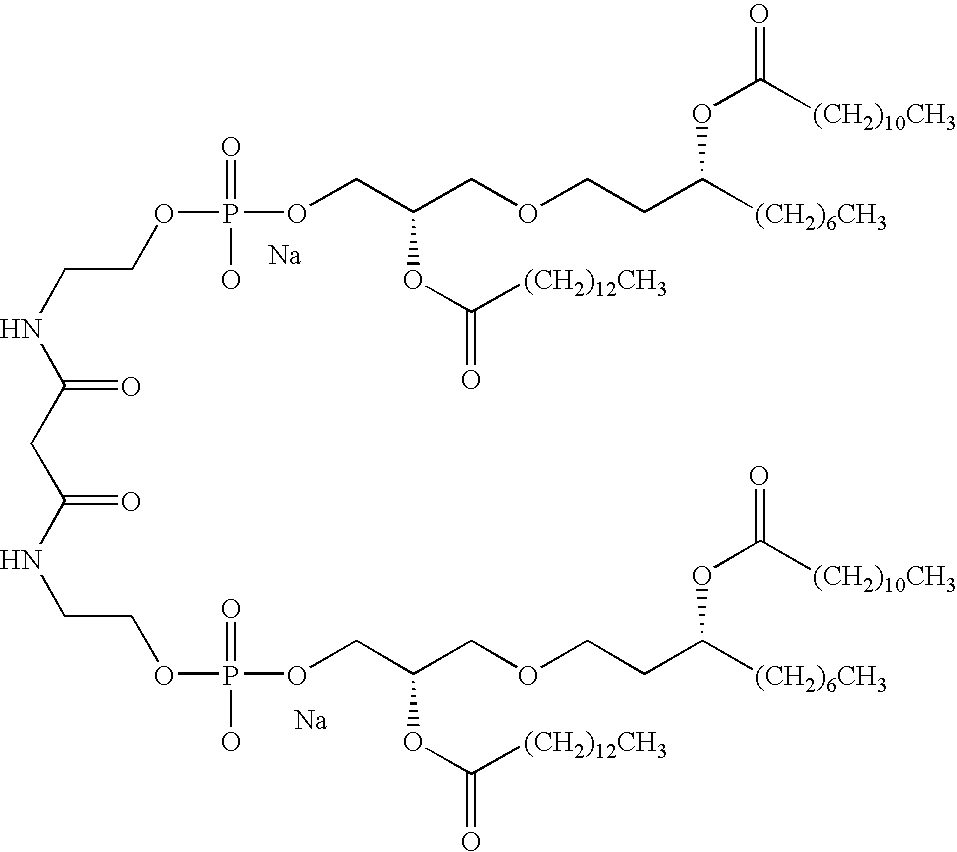 |
| 803592 |
 |
| 803596 |
 |
| 803597 |
 |
| 803598 |
 |
| 803599 |
 |
| 803613 |
 |
| 803731 |
 |
| 803733 |
 |
| 803751 |
 |
| 803783 |
 |
| 803784 |
 |
| 803789 |
 |
| 804061 |
 |
| 804097 |
 |
| 804121 |
 |
| 804130 |
 |
| 804221 |
 |
| 804222 |
 |
| 804252 |
 |
| 804253 |
 |
| 804281 |
 |
| 804313 |
 |
| 804339 |
 |
| 804372 |
 |
| 804503 |
 |
| 804558 |
 |
| 804596 |
 |
| 804674 |
 |
| 804678 |
 |
| 804679 |
 |
| 804732 |
 |
| 804772 |
 |
| 804947 |
 |
| 804638 |
 |
| 804666 |
 |
| 804874 |
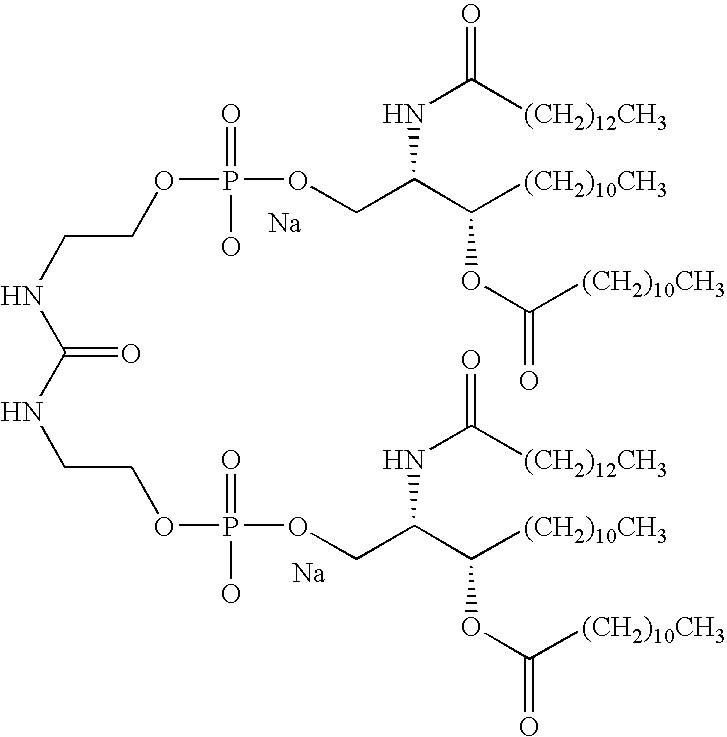 |
| 805028 |
 |
| 805520 Isomer A |
 |
| 805270 Isomer B |
 |
| 805271 |
 |
| 805274 |
 |
| 805328 |
 |
| 805329 |
 |
| 805517 |
 |
| 805518 Isomer A |
 |
| 805519 Isomer B |
 |

E6020 is a TLR4 (Toll-like receptor-4) agonist. B6 mice (C57BL/6 mice) were engrafted subcutaneously with 1×10⁶ syngeneic B16F10 murine melanoma cells. Three days after tumor cell inoculation, the mice were either (1) vaccinated subcutaneously (s.c.) with 1×10⁶ B16F10 tumor cells that were genetically modified to stably express and secrete murine GM-CSF (B16-GM-CSF cells); (2) vaccinated intraperitoneally (i.p.) with E6020; or (3) were treated with a combination of s.c. GM-CSF cell vaccination and i.p. E6020 (the GM-CSF cell vaccination and E6020 vaccination were administered at separate sites in the mice). In these experiments, the GM-CSF cells were inactivated by gamma-irradiation prior to inoculation. Survival of the animals was monitored.
| TABLE 1 | |||
| Treatment/no. of mice treated | Age (weeks) | Colon tumors | |
| Vaccine/6 mice | 14-35.5 | 0/6 | |
| Adjuvant/3 mice | 12.5-18 | 3/3 | |
| No treatment/4 mice | 8-15.5 | 4/4 | |
| TABLE 2 |
| Antibody titers to EGFRvIII peptide are enhanced by E6020 |
| Antigen administered with: |
| PBS | E6020 | GM-CSF | E6020/GMCSF |
| Antibody subclass: | IgG1 | IgG2a | IgG1 | IgG2a | IgG1 | IgG2a | IgG1 | IgG2a |
| 6000 | 3000 | 3000 | 1500 | 12000 | 750 | 12000 | 3000 | |
| 12000 | 3000 | 24000 | 6000 | 12000 | 750 | 12000 | 6000 | |
| 24000 | 6000 | 24000 | 6000 | 12000 | 3000 | 24000 | 24000 | |
| 24000 | 6000 | 24000 | 12000 | 24000 | 3000 | 24000 | 24000 | |
| 24000 | 6000 | 24000 | 12000 | 24000 | 6000 | 48000 | 24000 | |
| 24000 | 6000 | 24000 | 12000 | 48000 | 6000 | 48000 | 48000 | |
| 48000 | 6000 | 24000 | 24000 | 48000 | 6000 | 48000 | 48000 | |
| 48000 | 24000 | 48000 | 48000 | 48000 | 24000 | 48000 | 48000 | |
| Geometric | 22008 | 6000 | 20182 | 10091 | 24000 | 3568 | 28541 | 20182 |
| mean titer: | ||||||||
Claims (27)


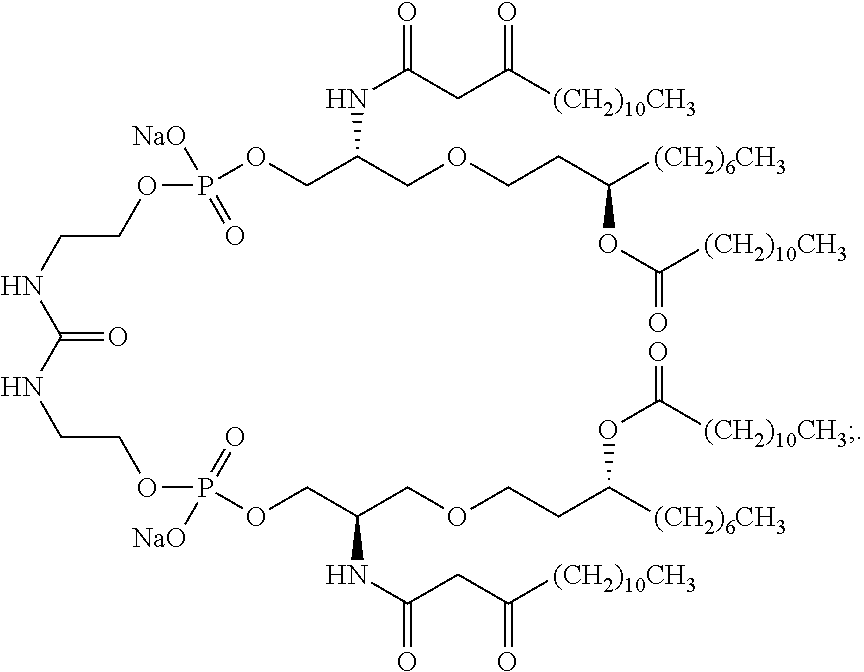


Priority Applications (5)
| Application Number | Priority Date | Filing Date | Title |
|---|---|---|---|
| US11/411,332 US7976852B2 (en) | 2005-04-26 | 2006-04-26 | Compositions and methods for cancer immunotherapy |
| US11/605,557 US20070292418A1 (en) | 2005-04-26 | 2006-11-28 | Compositions and methods for immunotherapy |
| US13/082,720 US20110243935A1 (en) | 2005-04-26 | 2011-04-08 | Compositions and Methods for Immunotherapy |
| US13/158,786 US8603482B2 (en) | 2005-04-26 | 2011-06-13 | Compositions and methods for cancer immunotherapy |
| US14/075,130 US20140065100A1 (en) | 2005-04-26 | 2013-11-08 | Compositions and Methods for Cancer Immunotherapy |
Applications Claiming Priority (2)
| Application Number | Priority Date | Filing Date | Title |
|---|---|---|---|
| US67468005P | 2005-04-26 | 2005-04-26 | |
| US11/411,332 US7976852B2 (en) | 2005-04-26 | 2006-04-26 | Compositions and methods for cancer immunotherapy |
Related Child Applications (2)
| Application Number | Title | Priority Date | Filing Date |
|---|---|---|---|
| US11/605,557 Continuation-In-Part US20070292418A1 (en) | 2005-04-26 | 2006-11-28 | Compositions and methods for immunotherapy |
| US13/158,786 Continuation US8603482B2 (en) | 2005-04-26 | 2011-06-13 | Compositions and methods for cancer immunotherapy |
Publications (2)
| Publication Number | Publication Date |
|---|---|
| US20070020232A1 US20070020232A1 (en) | 2007-01-25 |
| US7976852B2 true US7976852B2 (en) | 2011-07-12 |
Family
ID=37215428
Family Applications (3)
| Application Number | Title | Priority Date | Filing Date |
|---|---|---|---|
| US11/411,332 Expired - Lifetime US7976852B2 (en) | 2005-04-26 | 2006-04-26 | Compositions and methods for cancer immunotherapy |
| US13/158,786 Expired - Lifetime US8603482B2 (en) | 2005-04-26 | 2011-06-13 | Compositions and methods for cancer immunotherapy |
| US14/075,130 Abandoned US20140065100A1 (en) | 2005-04-26 | 2013-11-08 | Compositions and Methods for Cancer Immunotherapy |
Family Applications After (2)
| Application Number | Title | Priority Date | Filing Date |
|---|---|---|---|
| US13/158,786 Expired - Lifetime US8603482B2 (en) | 2005-04-26 | 2011-06-13 | Compositions and methods for cancer immunotherapy |
| US14/075,130 Abandoned US20140065100A1 (en) | 2005-04-26 | 2013-11-08 | Compositions and Methods for Cancer Immunotherapy |
Country Status (8)
| Country | Link |
|---|---|
| US (3) | US7976852B2 (en) |
| EP (1) | EP1874342B1 (en) |
| JP (2) | JP5185813B2 (en) |
| KR (1) | KR101205064B1 (en) |
| CN (2) | CN103285392A (en) |
| AU (1) | AU2006241206B2 (en) |
| CA (1) | CA2605749C (en) |
| WO (1) | WO2006116423A2 (en) |
Cited By (1)
| Publication number | Priority date | Publication date | Assignee | Title |
|---|---|---|---|---|
| US20110250171A1 (en) * | 2005-04-26 | 2011-10-13 | Eisai R&D Management Co., Ltd. | Compositions and Methods for Cancer Immunotherapy |
Families Citing this family (97)
| Publication number | Priority date | Publication date | Assignee | Title |
|---|---|---|---|---|
| US7915238B2 (en) * | 1999-02-01 | 2011-03-29 | Eisai R & D Management Co., Ltd. | Immunomodulatory compounds and methods of use thereof |
| US6835721B2 (en) | 1999-02-01 | 2004-12-28 | Eisai Co., Ltd. | Immunomodulatory compounds and methods of use thereof |
| US20040006242A1 (en) * | 1999-02-01 | 2004-01-08 | Hawkins Lynn D. | Immunomodulatory compounds and method of use thereof |
| US7507724B2 (en) | 2001-01-16 | 2009-03-24 | Sloan-Kettering Institute For Cancer Research | Therapy-enhancing glucan |
| US7906492B2 (en) * | 2001-01-16 | 2011-03-15 | Sloan-Kettering Institute For Cancer Research | Therapy-enhancing glucan |
| US20070292418A1 (en) * | 2005-04-26 | 2007-12-20 | Eisai Co., Ltd. | Compositions and methods for immunotherapy |
| WO2007070660A2 (en) | 2005-12-13 | 2007-06-21 | President And Fellows Of Harvard College | Scaffolds for cell transplantation |
| US8323644B2 (en) * | 2006-01-17 | 2012-12-04 | Sloan-Kettering Institute For Cancer Research | Therapy-enhancing glucan |
| US20090053221A1 (en) * | 2006-01-17 | 2009-02-26 | Cheung Nai-Kong V | Immune response enhancing glucan |
| US9770535B2 (en) | 2007-06-21 | 2017-09-26 | President And Fellows Of Harvard College | Scaffolds for cell collection or elimination |
| US8501417B2 (en) * | 2007-06-26 | 2013-08-06 | Vanderbilt University | Immunological compositions as cancer biomarkers and/or therapeutics |
| EP2453234B1 (en) | 2007-10-29 | 2014-01-15 | Eisai R&D Management Co., Ltd. | Methods for prognosing the ability of a zearalenone analog compound to treat cancer |
| CN102006891B (en) | 2008-02-13 | 2017-04-26 | 哈佛学院董事会 | Continuous cell programming device |
| US9370558B2 (en) | 2008-02-13 | 2016-06-21 | President And Fellows Of Harvard College | Controlled delivery of TLR agonists in structural polymeric devices |
| WO2011063336A2 (en) * | 2009-11-20 | 2011-05-26 | President And Fellows Of Harvard College | Secondary site of antigen stimulation for therapeutic vaccination |
| WO2009146456A1 (en) | 2008-05-30 | 2009-12-03 | President And Fellows Of Harvard College | Controlled release of growth factors and signaling molecules for promoting angiogenesis |
| EP2310006A4 (en) * | 2008-07-03 | 2012-04-25 | Mayo Foundation | TREATMENT OF CANCER |
| ES2555858T3 (en) * | 2009-03-24 | 2016-01-11 | Transgene Sa | Biomarker for patient control |
| US9297005B2 (en) | 2009-04-13 | 2016-03-29 | President And Fellows Of Harvard College | Harnessing cell dynamics to engineer materials |
| AU2010278702C1 (en) | 2009-07-31 | 2016-07-14 | Forsyth Dental Infirmary For Children | Programming of cells for tolerogenic therapies |
| US20120214828A1 (en) * | 2009-08-24 | 2012-08-23 | Georgia Hatzivassiliou | Determining sensitivity of cells to b-raf inhibitor treatment by detecting kras mutation and rtk expression levels |
| US9610328B2 (en) | 2010-03-05 | 2017-04-04 | President And Fellows Of Harvard College | Enhancement of skeletal muscle stem cell engraftment by dual delivery of VEGF and IGF-1 |
| BR112012027745A2 (en) | 2010-04-27 | 2017-01-10 | Univ Johns Hopkins | method and immunogenic composition for treatment of neoplasia |
| EP3239139B1 (en) * | 2010-05-27 | 2020-10-28 | Ningbo Combireg Pharmaceutical Technology Co. Ltd | Chemical synthesis and anti-tumor and anti-metastatic effects of dual functional conjugate |
| WO2011163669A2 (en) | 2010-06-25 | 2011-12-29 | President And Fellows Of Harvard College | Co-delivery of stimulatory and inhibitory factors to create temporally stable and spatially restricted zones |
| US9890202B2 (en) | 2010-07-19 | 2018-02-13 | Yeda Research And Development Co. Ltd. | Peptides based on the transmembrane domain of a toll-like receptor (TLR) for treatment of TLR-mediated diseases |
| EP3195868A3 (en) * | 2010-10-01 | 2017-08-02 | VentiRx Pharmaceuticals, Inc. | Therapeutic use of a tlr agonist and combination therapy |
| CN107648668B (en) | 2010-10-06 | 2021-06-18 | 哈佛学院董事会 | Injectable pore-forming hydrogels for material-based cell therapy |
| US9603894B2 (en) | 2010-11-08 | 2017-03-28 | President And Fellows Of Harvard College | Materials presenting notch signaling molecules to control cell behavior |
| WO2012105219A1 (en) * | 2011-01-31 | 2012-08-09 | オリンパス株式会社 | Antibody therapy effect-enhancing drug |
| US10647959B2 (en) | 2011-04-27 | 2020-05-12 | President And Fellows Of Harvard College | Cell-friendly inverse opal hydrogels for cell encapsulation, drug and protein delivery, and functional nanoparticle encapsulation |
| US10045947B2 (en) | 2011-04-28 | 2018-08-14 | President And Fellows Of Harvard College | Injectable preformed macroscopic 3-dimensional scaffolds for minimally invasive administration |
| US9675561B2 (en) | 2011-04-28 | 2017-06-13 | President And Fellows Of Harvard College | Injectable cryogel vaccine devices and methods of use thereof |
| AU2012253571A1 (en) | 2011-05-09 | 2014-01-09 | Mayo Foundation For Medical Education And Research | Cancer treatments |
| CN110078789A (en) * | 2011-05-27 | 2019-08-02 | Ambrx 公司 | Composition of aplysiatoxin derivative, the method for being related to the aplysiatoxin derivative containing unnatural amino acid connection and application thereof |
| EP2714073B1 (en) | 2011-06-03 | 2021-03-10 | President and Fellows of Harvard College | In situ antigen-generating cancer vaccine |
| WO2013019620A2 (en) * | 2011-07-29 | 2013-02-07 | Glaxosmithkline Llc | Method of treating cancer using combination of braf inhibitor, mek inhibitor, and anti-ctla-4 antibody |
| WO2013036201A1 (en) * | 2011-09-06 | 2013-03-14 | Agency For Science, Technology And Research | Polypeptide vaccine |
| EP2766384B1 (en) | 2011-10-10 | 2016-11-23 | Yeda Research and Development Co. Ltd. | Toll-like receptor 4 (tlr-4) agonist peptides for modulating tlr-4 mediated immune response |
| DK2838515T3 (en) | 2012-04-16 | 2020-02-24 | Harvard College | MESOPOROUS SILICON Dioxide COMPOSITIONS FOR MODULATING IMMUNE RESPONSES |
| CN108727466B (en) * | 2012-06-07 | 2023-04-28 | Ambrx公司 | Prostate specific membrane antigen-antibody drug conjugates |
| CN112587671A (en) | 2012-07-18 | 2021-04-02 | 博笛生物科技有限公司 | Targeted immunotherapy for cancer |
| US10413606B2 (en) | 2012-10-01 | 2019-09-17 | Mayo Foundation For Medical Education And Research | Methods for treating cancer with nanoparticle complexes of albumin-bound paclitaxel and anti-VEGF antibodies |
| CN103768596B (en) * | 2012-10-17 | 2016-06-22 | 苏州丁孚靶点生物技术有限公司 | For the combination product of oncotherapy, its purposes and correlation technique |
| WO2014089127A1 (en) * | 2012-12-03 | 2014-06-12 | Merrimack Pharmaceuticals, Inc. | Combination therapy for treating her2-positive cancers |
| DK3092256T3 (en) | 2014-01-10 | 2022-06-20 | Birdie Biopharmaceuticals Inc | COMPOUNDS AND COMPOSITIONS FOR IMMUNTERAPHY |
| EP3137105A4 (en) | 2014-04-30 | 2017-12-27 | President and Fellows of Harvard College | Combination vaccine devices and methods of killing cancer cells |
| EP3154586B1 (en) | 2014-06-13 | 2020-05-27 | Mayo Foundation for Medical Education and Research | Treating lymphomas |
| KR20170020371A (en) | 2014-06-16 | 2017-02-22 | 메이오 파운데이션 포 메디칼 에쥬케이션 앤드 리써치 | Treating myelomas |
| CN121243402A (en) | 2014-07-09 | 2026-01-02 | 博笛生物科技有限公司 | Anti-PD-L1 combinations for the treatment of tumors |
| CN105233291A (en) * | 2014-07-09 | 2016-01-13 | 博笛生物科技有限公司 | Combination Therapy Compositions and Methods of Combination Therapy for the Treatment of Cancer |
| KR101940430B1 (en) | 2014-08-07 | 2019-01-18 | 가꼬우호우징 효고 이카다이가쿠 | Therapeutic agent for cancer which comprises combination of il-18 and molecule-targeting antibody |
| CN112587672A (en) | 2014-09-01 | 2021-04-02 | 博笛生物科技有限公司 | anti-PD-L1 conjugates for the treatment of tumors |
| US9446148B2 (en) | 2014-10-06 | 2016-09-20 | Mayo Foundation For Medical Education And Research | Carrier-antibody compositions and methods of making and using the same |
| GB201501302D0 (en) * | 2015-01-27 | 2015-03-11 | Ostara Biomedical Ltd | Embryo implantation |
| US11786457B2 (en) | 2015-01-30 | 2023-10-17 | President And Fellows Of Harvard College | Peritumoral and intratumoral materials for cancer therapy |
| WO2016164705A1 (en) | 2015-04-10 | 2016-10-13 | Omar Abdel-Rahman Ali | Immune cell trapping devices and methods for making and using the same |
| CN108135875B (en) | 2015-07-31 | 2021-12-31 | 约翰霍普金斯大学 | Methods and compositions for treating metabolic reprogramming disorders |
| EA034571B1 (en) | 2015-07-31 | 2020-02-21 | Дзе Джонс Хопкинс Юниверсити | Prodrugs of glutamine analogs |
| US10842763B2 (en) | 2015-07-31 | 2020-11-24 | The Johns Hopkins University | Methods for cancer and immunotherapy using prodrugs of glutamine analogs |
| TW201707725A (en) | 2015-08-18 | 2017-03-01 | 美國馬友醫藥教育研究基金會 | Carrier-antibody compositions and methods of making and using the same |
| TW201713360A (en) | 2015-10-06 | 2017-04-16 | Mayo Foundation | Methods of treating cancer using compositions of antibodies and carrier proteins |
| EP3368092B9 (en) | 2015-10-29 | 2020-07-29 | Novartis AG | Antibody conjugates comprising toll-like receptor agonist |
| CN106943597A (en) | 2016-01-07 | 2017-07-14 | 博笛生物科技(北京)有限公司 | Anti-EGFR Combinations for the Treatment of Tumors |
| CN106943596A (en) | 2016-01-07 | 2017-07-14 | 博笛生物科技(北京)有限公司 | Anti-CD20 Combinations for Treating Tumors |
| CN115350279A (en) | 2016-01-07 | 2022-11-18 | 博笛生物科技有限公司 | anti-HER 2 combinations for the treatment of tumors |
| WO2017120501A1 (en) | 2016-01-07 | 2017-07-13 | Mayo Foundation For Medical Education And Research | Methods of treating cancer with interferon |
| US11752238B2 (en) | 2016-02-06 | 2023-09-12 | President And Fellows Of Harvard College | Recapitulating the hematopoietic niche to reconstitute immunity |
| WO2017139698A1 (en) | 2016-02-12 | 2017-08-17 | Mayo Foundation For Medical Education And Research | Hematologic cancer treatments |
| CN107126563B (en) * | 2016-02-26 | 2021-09-10 | 博生吉医药科技(苏州)有限公司 | Composition containing low-dose antibody for blocking VEGF signal path and application thereof |
| EP3432928A4 (en) | 2016-03-21 | 2019-11-20 | Mayo Foundation for Medical Education and Research | METHODS FOR ENHANCING THE THERAPEUTIC INDEX OF A CHEMOTHERAPEUTIC MEDICAMENT |
| EP3432926A4 (en) | 2016-03-21 | 2019-11-20 | Mayo Foundation for Medical Education and Research | METHODS OF REDUCING THE TOXICITY OF A CHEMOTHERAPEUTIC MEDICAMENT |
| US10618969B2 (en) | 2016-04-06 | 2020-04-14 | Mayo Foundation For Medical Education And Research | Carrier-binding agent compositions and methods of making and using the same |
| CN109789092A (en) | 2016-07-13 | 2019-05-21 | 哈佛学院院长等 | Antigen presenting cell mimetic scaffolds and methods of making and using same |
| IL264557B2 (en) | 2016-08-02 | 2024-01-01 | Harvard College | Biomaterials for modulating immune responses |
| JP2019526579A (en) | 2016-09-01 | 2019-09-19 | マヨ ファウンデーション フォー メディカル エデュケーション アンド リサーチMayo Foundation For Medical Education And Research | Methods and compositions for targeting T cell cancer |
| WO2018045239A1 (en) | 2016-09-01 | 2018-03-08 | Mayo Foundation For Medical Education And Research | Carrier-pd-l1 binding agent compositions for treating cancers |
| RU2021128415A (en) | 2016-09-06 | 2021-11-08 | Мэйо Фаундейшн Фор Медикал Эдьюкейшн Энд Рисерч | COMPOSITIONS WITH PACLITAXEL, ALBUMIN AND BINDING AGENT AND METHODS FOR THEIR APPLICATION AND PREPARATION |
| KR20230011473A (en) | 2016-09-06 | 2023-01-20 | 메이오 파운데이션 포 메디칼 에쥬케이션 앤드 리써치 | Methods of treating pd-l1 expressing cancer |
| EP3509635A1 (en) | 2016-09-06 | 2019-07-17 | Vavotar Life Sciences LLC | Methods of treating triple-negative breast cancer using compositions of antibodies and carrier proteins |
| CA3055200A1 (en) * | 2017-03-03 | 2018-09-07 | Obsidian Therapeutics, Inc. | Compositions and methods for immunotherapy |
| WO2018166298A1 (en) * | 2017-03-13 | 2018-09-20 | Fudan University | Immunopotentiator, immunotherapeutic pharmaceutical composition and its preparation and use |
| CN108567977B (en) * | 2017-03-13 | 2022-04-12 | 复旦大学 | Immunopotentiator, immunotherapy pharmaceutical composition, preparation and application thereof |
| CN108794467A (en) | 2017-04-27 | 2018-11-13 | 博笛生物科技有限公司 | 2-amino-quinoline derivatives |
| CA3067268A1 (en) | 2017-06-23 | 2018-12-27 | Birdie Biopharmaceuticals, Inc. | Crystalline resiquimod monosulfate anhydrate and its preparation and uses |
| WO2019102265A1 (en) | 2017-11-23 | 2019-05-31 | Theraphage Inc. | Peptide displaying bacteriophage nanoparticles and related compositions and methods |
| WO2019175147A1 (en) | 2018-03-12 | 2019-09-19 | Janssen Vaccines & Prevention B.V. | Vaccines against intra-abdominal infections |
| WO2019240218A1 (en) | 2018-06-14 | 2019-12-19 | 株式会社明治 | Composition for promoting immune checkpoint inhibition therapy |
| WO2020061129A1 (en) | 2018-09-19 | 2020-03-26 | President And Fellows Of Harvard College | Compositions and methods for labeling and modulation of cells in vitro and in vivo |
| CA3128081A1 (en) | 2019-02-12 | 2020-08-20 | Ambrx, Inc. | Compositions containing, methods and uses of antibody-tlr agonist conjugates |
| WO2021050696A1 (en) * | 2019-09-10 | 2021-03-18 | The Research Foundation For The State University Of New York | Compositions and methods for improving tumor penetration of tumor specific antibodies |
| WO2021061837A1 (en) | 2019-09-23 | 2021-04-01 | President And Fellows Of Harvard College | Biomaterial-based antigen free vaccine and the use thereof |
| JP2022550884A (en) | 2019-10-02 | 2022-12-05 | ヤンセン ファッシンズ アンド プリベンション ベーフェー | Staphylococcus peptides and methods of use |
| EP4461744A3 (en) | 2020-01-16 | 2025-01-08 | Janssen Pharmaceuticals, Inc. | Fimh mutant, compositions therewith and use thereof |
| KR20250007029A (en) | 2021-01-12 | 2025-01-13 | 얀센 파마슈티칼즈, 인코포레이티드 | FimH Mutants, compositions therewith and use thereof |
| IL307247A (en) | 2021-04-01 | 2023-11-01 | Janssen Pharmaceuticals Inc | Production of e. coli o18 bioconjugates |
| EP4487123A4 (en) * | 2022-03-02 | 2026-02-25 | Abreos Biosciences Inc | METHODS AND COMPOSITIONS FOR MEASURING SERUM ANALYTE LEVELS FROM BIOLOGICAL MATRICS |
Citations (33)
| Publication number | Priority date | Publication date | Assignee | Title |
|---|---|---|---|---|
| EP0390216A2 (en) | 1989-03-31 | 1990-10-03 | Nippon Paint Co., Ltd. | Metallic pigment composition and water borne coating composition thereof |
| WO1993004672A1 (en) | 1991-09-11 | 1993-03-18 | Pitman-Moore, Inc. | Method for enhancing the immune system in a host employing liposome-encapsulated polypeptides |
| WO1995011700A1 (en) | 1993-10-29 | 1995-05-04 | Pharmos Corp. | Submicron emulsions as vaccine adjuvants |
| US5484911A (en) | 1993-04-01 | 1996-01-16 | Health Research, Inc. | Nucleoside 5'-diphosphate conjugates of ether lipids |
| US5635188A (en) | 1987-04-23 | 1997-06-03 | Bystryn; Jean-Claude | Anti-cancer vaccine |
| US5681824A (en) | 1995-06-05 | 1997-10-28 | Eisai Co., Ltd. | Substituted liposaccharides useful in the treatment and prevention of endotoxemia |
| WO1998057659A1 (en) | 1997-06-14 | 1998-12-23 | Smithkline Beecham Biologicals S.A. | Adjuvant compositions for vaccines |
| US5895653A (en) | 1995-03-27 | 1999-04-20 | Tempo G | Adjuvant based on colloidal iron compounds |
| US5904925A (en) | 1993-12-09 | 1999-05-18 | Exner; Heinrich | Adjuvant for antigens, and process for making |
| US5961970A (en) | 1993-10-29 | 1999-10-05 | Pharmos Corporation | Submicron emulsions as vaccine adjuvants |
| WO2000044758A1 (en) | 1999-02-01 | 2000-08-03 | Eisai Co., Ltd. | Immunological adjuvant compound |
| US6136797A (en) | 1995-12-15 | 2000-10-24 | Zilch; Harald | Phospholipid derivatives of phosphono-carboxylic acids, the production of said derivatives and the use of said derivatives as antiviral medicaments |
| US6146632A (en) | 1993-12-23 | 2000-11-14 | Smithkline Beecham Biologicals S.A. | Vaccines |
| US6146659A (en) | 1998-07-01 | 2000-11-14 | Neopharm, Inc. | Method of administering liposomal encapsulated taxane |
| WO2000073263A1 (en) | 1999-05-28 | 2000-12-07 | Vical Incorporated | Cytofectin dimers and methods of use thereof |
| US6165502A (en) | 1996-09-11 | 2000-12-26 | Albany Medical College | Protein-lipid vesicles and autogenous vaccine comprising the same |
| US6172049B1 (en) | 1995-06-07 | 2001-01-09 | Promega Biosciences, Inc. | Phosphonic acid-based cationic lipids |
| US6180111B1 (en) | 1995-05-18 | 2001-01-30 | University Of Maryland | Vaccine delivery system |
| WO2001046127A1 (en) | 1999-12-22 | 2001-06-28 | Om Pharma | Acyl pseudopeptides bearing a functionalised auxiliary spacer |
| US6306404B1 (en) | 1998-07-14 | 2001-10-23 | American Cyanamid Company | Adjuvant and vaccine compositions containing monophosphoryl lipid A |
| WO2001090129A2 (en) | 2000-05-19 | 2001-11-29 | Corixa Corporation | Prophylactic and therapeutic treatment of infectious, autoimmune and allergic diseases with mono and disaccharide-base compounds |
| WO2002009752A2 (en) | 2000-07-31 | 2002-02-07 | Eisai Co., Ltd. | Immunological adjuvant compounds |
| US6355257B1 (en) | 1997-05-08 | 2002-03-12 | Corixa Corporation | Aminoalkyl glucosamine phosphate compounds and their use as adjuvants and immunoeffectors |
| US6437165B1 (en) | 2000-08-31 | 2002-08-20 | Merck & Co., Inc. | Phosphate derivatives as immunoregulatory agents |
| US20020176861A1 (en) | 1999-02-01 | 2002-11-28 | Hawkins Lynn D. | Immunological adjuvant compounds compositions and methods of use thereof |
| WO2003003985A2 (en) | 2001-07-06 | 2003-01-16 | Sloan-Kettering Institute For Cancer Research | Polyvalent conjugate vaccine for cancer |
| US20030153532A1 (en) | 1999-02-01 | 2003-08-14 | Hawkins Lynn D. | Immunomodulatory compounds and methods of use thereof |
| US6630161B1 (en) | 1998-05-07 | 2003-10-07 | Ribi Immunochem Research, Inc. | Adjuvant composition and methods for its use |
| WO2003099195A2 (en) | 2002-05-28 | 2003-12-04 | Eisai Co., Ltd. | Immunomodulatory compounds and methods of use thereof |
| US20070020232A1 (en) | 2005-04-26 | 2007-01-25 | Eisai Co., Ltd. | Compositions and methods for cancer immunotherapy |
| US20070027111A1 (en) | 1999-02-01 | 2007-02-01 | Eisai Co., Ltd. | Immunomodulatory compounds and methods of use thereof |
| US20070292418A1 (en) * | 2005-04-26 | 2007-12-20 | Eisai Co., Ltd. | Compositions and methods for immunotherapy |
| US7416726B2 (en) * | 2000-04-13 | 2008-08-26 | The Rockefeller University | Enhancement of antibody-mediated immune responses |
Family Cites Families (15)
| Publication number | Priority date | Publication date | Assignee | Title |
|---|---|---|---|---|
| US4707358A (en) | 1984-01-30 | 1987-11-17 | The University Of Chicago | Vaccine against Epstein-Barr Virus |
| JPH02500880A (en) | 1987-11-18 | 1990-03-29 | カイロン コーポレイション | Diagnostic agents and vaccines for NANBV |
| JP3095169B2 (en) | 1988-10-17 | 2000-10-03 | キャンサー リサーチ キャンペーン テクノロジー リミティド | Induction of anti-tumor response by anti-idiotype antibody |
| DE4123760C2 (en) | 1991-07-18 | 2000-01-20 | Dade Behring Marburg Gmbh | Seroreactive areas on the HPV 16 proteins E1 and E2 |
| US5798100A (en) | 1994-07-06 | 1998-08-25 | Immunomedics, Inc. | Multi-stage cascade boosting vaccine |
| US5840306A (en) | 1995-03-22 | 1998-11-24 | Merck & Co., Inc. | DNA encoding human papillomavirus type 18 |
| US6942862B2 (en) | 1996-04-01 | 2005-09-13 | University Of Washington | Methods and compositions to generate immunity in humans against self tumor antigens by immunization with homologous foreign proteins |
| HU226150B1 (en) * | 1999-01-13 | 2008-05-28 | Igeneon Krebs Immuntherapie | Use of antibodies for anticancer vaccination |
| US7189397B2 (en) * | 1999-10-08 | 2007-03-13 | Arius Research Inc. | Cytotoxicity mediation of cells evidencing surface expression of CD44 |
| US7507724B2 (en) * | 2001-01-16 | 2009-03-24 | Sloan-Kettering Institute For Cancer Research | Therapy-enhancing glucan |
| WO2003089593A2 (en) * | 2002-04-19 | 2003-10-30 | Endocyte, Inc. | Adjuvant enhanced immunotherapy |
| US20040197312A1 (en) * | 2003-04-02 | 2004-10-07 | Marina Moskalenko | Cytokine-expressing cellular vaccine combinations |
| WO2005019435A2 (en) * | 2003-08-26 | 2005-03-03 | Board Of Regents, The University Of Texas System | Anti-cancer vaccines |
| FR2863890B1 (en) * | 2003-12-19 | 2006-03-24 | Aventis Pasteur | IMMUNOSTIMULATING COMPOSITION |
| JP6136343B2 (en) | 2012-06-12 | 2017-05-31 | 株式会社リコー | Information processing system, information processing method, program, and recording medium |
-
2006
- 2006-04-26 CN CN2013101300117A patent/CN103285392A/en active Pending
- 2006-04-26 CN CN2006800143808A patent/CN101355928B/en not_active Expired - Lifetime
- 2006-04-26 CA CA2605749A patent/CA2605749C/en not_active Expired - Lifetime
- 2006-04-26 JP JP2008509049A patent/JP5185813B2/en not_active Expired - Lifetime
- 2006-04-26 AU AU2006241206A patent/AU2006241206B2/en not_active Expired
- 2006-04-26 WO PCT/US2006/015668 patent/WO2006116423A2/en not_active Ceased
- 2006-04-26 KR KR1020077024654A patent/KR101205064B1/en not_active Expired - Lifetime
- 2006-04-26 EP EP06751398.6A patent/EP1874342B1/en not_active Expired - Lifetime
- 2006-04-26 US US11/411,332 patent/US7976852B2/en not_active Expired - Lifetime
-
2011
- 2011-06-13 US US13/158,786 patent/US8603482B2/en not_active Expired - Lifetime
-
2012
- 2012-08-02 JP JP2012171874A patent/JP5539460B2/en not_active Expired - Lifetime
-
2013
- 2013-11-08 US US14/075,130 patent/US20140065100A1/en not_active Abandoned
Patent Citations (45)
| Publication number | Priority date | Publication date | Assignee | Title |
|---|---|---|---|---|
| US5635188A (en) | 1987-04-23 | 1997-06-03 | Bystryn; Jean-Claude | Anti-cancer vaccine |
| JPH02261866A (en) | 1989-03-31 | 1990-10-24 | Nippon Paint Co Ltd | Metal pigment composition and aqueous coating composition containing same |
| EP0390216A2 (en) | 1989-03-31 | 1990-10-03 | Nippon Paint Co., Ltd. | Metallic pigment composition and water borne coating composition thereof |
| WO1993004672A1 (en) | 1991-09-11 | 1993-03-18 | Pitman-Moore, Inc. | Method for enhancing the immune system in a host employing liposome-encapsulated polypeptides |
| US5484911A (en) | 1993-04-01 | 1996-01-16 | Health Research, Inc. | Nucleoside 5'-diphosphate conjugates of ether lipids |
| US5961970A (en) | 1993-10-29 | 1999-10-05 | Pharmos Corporation | Submicron emulsions as vaccine adjuvants |
| WO1995011700A1 (en) | 1993-10-29 | 1995-05-04 | Pharmos Corp. | Submicron emulsions as vaccine adjuvants |
| US5985284A (en) | 1993-10-29 | 1999-11-16 | Pharmos Corp | Oral or intranasal vaccines using hydrophobic complexes having proteosomes and lipopolysaccharides |
| US5904925A (en) | 1993-12-09 | 1999-05-18 | Exner; Heinrich | Adjuvant for antigens, and process for making |
| US6146632A (en) | 1993-12-23 | 2000-11-14 | Smithkline Beecham Biologicals S.A. | Vaccines |
| US5895653A (en) | 1995-03-27 | 1999-04-20 | Tempo G | Adjuvant based on colloidal iron compounds |
| US6180111B1 (en) | 1995-05-18 | 2001-01-30 | University Of Maryland | Vaccine delivery system |
| US5681824A (en) | 1995-06-05 | 1997-10-28 | Eisai Co., Ltd. | Substituted liposaccharides useful in the treatment and prevention of endotoxemia |
| US6172049B1 (en) | 1995-06-07 | 2001-01-09 | Promega Biosciences, Inc. | Phosphonic acid-based cationic lipids |
| US6136797A (en) | 1995-12-15 | 2000-10-24 | Zilch; Harald | Phospholipid derivatives of phosphono-carboxylic acids, the production of said derivatives and the use of said derivatives as antiviral medicaments |
| US6165502A (en) | 1996-09-11 | 2000-12-26 | Albany Medical College | Protein-lipid vesicles and autogenous vaccine comprising the same |
| US6355257B1 (en) | 1997-05-08 | 2002-03-12 | Corixa Corporation | Aminoalkyl glucosamine phosphate compounds and their use as adjuvants and immunoeffectors |
| WO1998057659A1 (en) | 1997-06-14 | 1998-12-23 | Smithkline Beecham Biologicals S.A. | Adjuvant compositions for vaccines |
| US6630161B1 (en) | 1998-05-07 | 2003-10-07 | Ribi Immunochem Research, Inc. | Adjuvant composition and methods for its use |
| US6146659A (en) | 1998-07-01 | 2000-11-14 | Neopharm, Inc. | Method of administering liposomal encapsulated taxane |
| US6306404B1 (en) | 1998-07-14 | 2001-10-23 | American Cyanamid Company | Adjuvant and vaccine compositions containing monophosphoryl lipid A |
| US20050164988A1 (en) | 1999-02-01 | 2005-07-28 | Eisai Co., Ltd. | Immunomodulatory compounds and methods of use thereof |
| US20030153532A1 (en) | 1999-02-01 | 2003-08-14 | Hawkins Lynn D. | Immunomodulatory compounds and methods of use thereof |
| US7560584B2 (en) | 1999-02-01 | 2009-07-14 | Eisai R&D Management Co., Ltd. | Immunomodulatory compounds and methods of use thereof |
| US20070027111A1 (en) | 1999-02-01 | 2007-02-01 | Eisai Co., Ltd. | Immunomodulatory compounds and methods of use thereof |
| US6290973B1 (en) | 1999-02-01 | 2001-09-18 | Eisai Co., Ltd. | Immunological adjuvant compounds, compositions, and methods of use thereof |
| US20050123566A1 (en) | 1999-02-01 | 2005-06-09 | Eisai Co., Ltd | Immunomodulatory compounds and methods of use thereof |
| US6551600B2 (en) | 1999-02-01 | 2003-04-22 | Eisai Co., Ltd. | Immunological adjuvant compounds compositions and methods of use thereof |
| US20020176861A1 (en) | 1999-02-01 | 2002-11-28 | Hawkins Lynn D. | Immunological adjuvant compounds compositions and methods of use thereof |
| US20040006242A1 (en) | 1999-02-01 | 2004-01-08 | Hawkins Lynn D. | Immunomodulatory compounds and method of use thereof |
| WO2000044758A1 (en) | 1999-02-01 | 2000-08-03 | Eisai Co., Ltd. | Immunological adjuvant compound |
| US6835721B2 (en) | 1999-02-01 | 2004-12-28 | Eisai Co., Ltd. | Immunomodulatory compounds and methods of use thereof |
| WO2000073263A1 (en) | 1999-05-28 | 2000-12-07 | Vical Incorporated | Cytofectin dimers and methods of use thereof |
| WO2001046127A1 (en) | 1999-12-22 | 2001-06-28 | Om Pharma | Acyl pseudopeptides bearing a functionalised auxiliary spacer |
| US7416726B2 (en) * | 2000-04-13 | 2008-08-26 | The Rockefeller University | Enhancement of antibody-mediated immune responses |
| WO2001090129A2 (en) | 2000-05-19 | 2001-11-29 | Corixa Corporation | Prophylactic and therapeutic treatment of infectious, autoimmune and allergic diseases with mono and disaccharide-base compounds |
| WO2002009752A2 (en) | 2000-07-31 | 2002-02-07 | Eisai Co., Ltd. | Immunological adjuvant compounds |
| US6521776B2 (en) | 2000-07-31 | 2003-02-18 | Eisai Company, Limited | Immunological adjuvant compounds compositions and methods of use thereof |
| US20020049314A1 (en) | 2000-07-31 | 2002-04-25 | Hawkins Lynn D. | Immunological adjuvant compounds compositions and methods of use thereof |
| US6437165B1 (en) | 2000-08-31 | 2002-08-20 | Merck & Co., Inc. | Phosphate derivatives as immunoregulatory agents |
| WO2003003985A2 (en) | 2001-07-06 | 2003-01-16 | Sloan-Kettering Institute For Cancer Research | Polyvalent conjugate vaccine for cancer |
| WO2003011223A2 (en) | 2001-07-31 | 2003-02-13 | Eisai Co., Ltd. | Immunomodulatory compounds and methods of use thereof |
| WO2003099195A2 (en) | 2002-05-28 | 2003-12-04 | Eisai Co., Ltd. | Immunomodulatory compounds and methods of use thereof |
| US20070020232A1 (en) | 2005-04-26 | 2007-01-25 | Eisai Co., Ltd. | Compositions and methods for cancer immunotherapy |
| US20070292418A1 (en) * | 2005-04-26 | 2007-12-20 | Eisai Co., Ltd. | Compositions and methods for immunotherapy |
Non-Patent Citations (96)
| Title |
|---|
| Baldridge et al., Exp. Opin. Biol. Ther. 4:1129 (2004). * |
| Baselga et al., Cancer Res. 58:2825 (1998). * |
| Beckman et al. (Can. 109:170-179 (2007)). * |
| Belimezi et al., "Growth inhibiton of breast cancer cell lines overexpressing Her2/neu by a novel internalized fully human Fab antibody fragment," Cancer Immunol. Immunother. 55:1091-1099 (2006). |
| Berenbaum Clin. Exp. Immunol. 28:1-18 (1977). * |
| Berenbaum Pharmacol. Rev. 41:93-141 (1989)). * |
| Berzoksky and Berkower, "Chapter 8: Immunogenicity and Antigen Structure," Fundamental Immunology, William E. Paul, ed., Raven Press NY, p. 242 (1993). |
| Bhattacharya et al., "Synthesis and Vesicle Formation from Novel Pseudoglyceryl Dimeric Lipids. Evidence of Formation of Widely Different Membrane Organizations with Exceptional Thermotropic Properties," Chem. Commun. 23:2287-2288 (1997). |
| Braga et al., "Making crystals from crystals: a green route to crystal engineering and polymorphism," Chem. Commun. pp. 3635-3645 (2005). |
| Cespdes et al. (Clin. Transl. Oncol. 8(5):318-329 (2006)). * |
| Cespedes of al., "Mouse Models in Oncogenesis and Cancer Therapy," Clin. Transl. Oncol. 8(5):318-329 (2006). |
| Chatterjee et al. Cancer Immunol. Imunother. (1994). * |
| Cheung and Paterson, "American Chemical Society-226th National Meeting: New Drug Highlights," IDrugs 6(10):939-942 (2003). |
| Clynes et al., Nature Med. 6:443 (2000). * |
| Coelho et al. (British J. Can. 90:2032-2041 (2004)). * |
| Cooper et al., J. Clin. Immunol. 24:693 (2004). * |
| Cragg et al., Blood 103:2738 (2004). * |
| Dalpke et al., Biodrugs 16:419 (2002). * |
| Defoort et al., "Macromolecular Assemblage in the Design of a Synthetic AIDS Vaccine," Proc. Natl. Acad. Sci. USA 89:3879-3883 (1992). |
| Dennis (Nature 442:739-741 (2006)). * |
| Dennis, "Off by a Whisker," Cancer News Feature 442:739-741 (2006). |
| Dermer, Biotechnology 12: 320 (1994). * |
| Dullenkopf et al, "Synthesis of a Structurally Defined Antigen-Immunostimulant Combination for Use in Cancer Vaccines," Chem. Euro. J. 5(8):2432-2438 (1999). |
| Duralski et al., "Synthesis of Isotopically Labelled Cardiolipins," Tetrahedron Lett. 1607-1610 (1998). |
| Esai Research Inst. product datasheet for E6020 or ER-804057 (pp. 1-5; Mar. 1999). * |
| Eustache et al., "New Acyclic Analogues of Lipid A: Synthesis of 4-Phosphonoxybutyl and 3-Phosphonoxypropyl Glycosides of 2-Amino-2-Deoxy-D-Glucose," Carbohydrate Res. 251:251-267 (1994). |
| Fujimori et al. (J. Nuc. Med. 31:1191-1198 (1990)). * |
| Gokhale et al., "An improved method of encapsulation of doxorubicin in liposomes: pharmacological, toxicological, and therapeutic evaluation," Br. J. Cancer 74:43-48 (1996). |
| Gregoriadis et al., "Liposomes as Immunological Adjuvants and Vaccine Carriers," J. Controlled Release 41(Jan. 2002):49-56 (1996). |
| Gura et al (Science 278:1041-1042 (1997). * |
| Hawkins et al., "Inhibition of endotoxins response by synthetic TLR4 antagonists," Curr. Topics Med. Chem. 4:1147-71 (2004). |
| Hawkins LD et al. A novel class of endotoxin receptor agonists with simplified structure, toll-like receptor 4-dependent immunostimulatory action, and adjuvant activity. The Journal of Pharmacology and Experimental Therapeutics (2002), vol. 300, No. 2, pp. 655-661. |
| Hawkins LD et al. Inhibition of endotoxin response by synthetic TLR4 antagonists. Current Topics in Medicinal Chemistry (2004), vol. 4, No. 11, pp. 1147-1171. |
| Hoffmann et al., "Induction of Tumor Cytotoxicity in Murine Bone Marrow-Derived Macrophages by Two Synthetic Lipopeptide Analogues," Biol. Chem. 370:575-582 (1989). |
| Homma et al., "Structural Requirements of Lipid A Responsible for the Functions: A Study with Chemically Synthesized Lipid A and its Analogues," J. Biochem. 98:395-406 (1985). |
| Inoue and Nojima, "Immunochemical Studies of Phospholipids IV: The Reactivities of Antisera Against Natural Cardiolipin and Synthetic Cardiolipin Analogues-Containing Antigens," Chem. Phys. Lipids(CPLIA4) 3(1):70-77 (1969). |
| Inoue and Nojima, "Immunochemical Studies of Phospholipids. I. Reactivity of Various Synthetic Cardiolipin Derivatives with Wassermann Antibody," Chem. Phys. Lipids 1(4):360-367 (1967). |
| Inoue and Nojima, "Immunochemical Studies of Phospholipids. II, Syntheses of Cardiolipin and its Analogues," Chem. Pharm. Bull. 16(1):76-81 (1968). |
| Jain (Scientific American Jul. 1994:58-64). * |
| Jain et al., "Effect of the Structure of Phospholipid on the Kinetics of Intravesicle Scooting of Phospholipase A2," Biochimica Biophysica Acta 860(3):462-474 (1986). |
| Jain et al., "Polymorphism in Pharmacy," Indian Drugs 23:315-329 (1986). |
| Jiang and Koganty, "Synthetic Vaccines: The Role of Adjuvants in Immune Targeting," Curr. Med. Chem. 10:1423-1439 (2003). |
| Jiang et al., Curr. Med. Chem. 10:1423 (2003). * |
| Kamitakahara et al., "A Lysoganglioside/poly-L-glutamic Acid Conjugate as a Picomolar Inhibitor of Influenza Hemagglutinin," Angew. Chem. Int. Ed. 37(11):1524-1528 (1998). |
| Lederman et al (Molecular Immunology 28:1171-1181, 1991). * |
| Li et al (Proc. Natl. Acad. Sci. USA 77:3211-3214, 1980). * |
| Lien et al., "A Novel Synthetic Acyclic Lipid A-Like Agonist Activates Cells Via the Lipopolysaccharide/Toll-Like Receptor 4 Signaling Pathway," J. Biol. Chem. 276(3):1873-1880 (2001). |
| Matsuura et al., "Activity of Monosaccharide Lipid A Analogues in Human Monocytic Cells as Agonists or Antagonists of Bacterial Lipopolysaccharide," Infect. lmmun. 67(12):6286-6292 (1999). |
| Merriam-Webster's Collegiate Dictionary, 10th edition, published 1998 by Merriam-Webster, Inc., p. 924. |
| Mitchell M S. Immunotherapy as part of combinations for the treatment of cancer. International Immunopharmacology (2003), vol. 3, pp. 1051-1059. |
| Overholser et al., Cancer 89:74 (2000). * |
| Pharmaceutical Dosage Forms: Tablets, vol. 2, Published 1990 by Marcel Dekker, Inc., ed. By Lieberman, Lachman, and Schwartz, pp. 462-472 (1990). |
| Przetak et al., "Novel Synthetic LPS Receptor Agonists Boost Systemic and Mucosal Antibody Responses in Mice," Vaccine 21:961-970 (2003). |
| Reichel et al., "Synthetic Carbohydrate-Based Vaccine: Synthesis of an L-Glycero-D-Manno-Heptose Antigen-T-Epitope-Lipopeptide Conjugate," Chem. Commun. pp. 2087-2088 (1997). |
| Roitt et al., "Adjuvants," Immunology 8.9 Gower Medical Publishing, London (1985). |
| Ross et al., "The Her-2/neu Gene and Protein in Breast Cancer 2003: Biomarker and Target of Therapy," Oncologist 8:307-325 (2003). |
| Rossignol and Lynn, "TLR4 antagonists for endotoxemia and beyond," Curr. Opin. Invest. Drugs 6:295-502 (2005). |
| Rossignol DP and Lynn M. TLR4 antagonists for endotoxemia and beyond. Current Opinion in Investigational Drugs (2005), vol. 6, No. 5, pp. 495-502. |
| Rudnick et al. (Can. Biotherp. & Radiopharm. 24: 155-162 (2009)). * |
| Schuster et al., "Cancer Immunotherapy," Biotechnol. J. 1:138-147 (2006). |
| Schuster M et al. Cancer immunotherapy. Biotechnol. J. (2006), vol. 1, pp. 138-147. |
| Search Report and Written Opinion for PCT/US06/15688, mailed Jul. 31, 2008. |
| Seaver (1994) Genetic Engineering vol. 14(14):pp. 10 and 21. * |
| Seydel et al., "The Generalized Endotoxic Principle," Eur. J. Immunol. 33:1586-1592 (2003). |
| Skinner, Dermatol. Clint 21:291 (2003). * |
| Tallarida "Drug Synergism and Dose Effect Analysis" Ed. Chapman & Hall (2000), pp. 1-8, 10-13 and 57-71. * |
| Talmadge et al. (Am. J. Pathol 170(3):793-804 (2007)). * |
| The Merck Manual of Diagnosis and Therapy, 17th Edition, 1999, published by Merck Research Laboratories , pp. 1420-1421. |
| The Merck Manual of Diagnosis and Therapy, 17th Edition, 1999, published by Merck Research Laboratories pp. 397-398, 948-949, 1916, and 1979-1981. |
| The Oxford Textbook of Oncology, 1995, published by Oxford University Press, pp. 447-453. |
| Thurber et al. (Adv. Drug Deliv. Rev. 60:1421-1434 (2008)). * |
| Toyokuni et al., "Synthetic Vaccines: Synthesis of a Dimeric Tn Antigen-Lipopeptide Conjugate that Elicits Immune Responses Against Tn-Expressing Glycoproteins," J. Am. Chem. Soc. 116:395-396 (1994). |
| U.S. Appl. No. 10/157,791; Filed: May 28, 2002; Office Action Mailed: Jun. 16, 2005. |
| U.S. Appl. No. 10/157,791; Filed: May 28, 2002; Office Action Mailed: Sep. 9, 2004. |
| U.S. Appl. No. 11/024,328; Filed: Dec. 28, 2004; Office Action Mailed: Mar. 6, 2008. |
| U.S. Appl. No. 11/024,328; Filed: Dec. 28, 2004; Office Action Mailed: Sep. 17, 2007. |
| U.S. Appl. No. 11/077,344; Filed Mar. 9, 2005; Office Action Mailed: Jan. 14, 2010. |
| U.S. Appl. No. 11/077,344; Filed Mar. 9, 2005; Office Action Mailed: Jun. 30, 2009. |
| U.S. Appl. No. 11/077,344; Filed: Mar. 9, 2005; Office Action Mailed: Jul. 3, 2008. |
| U.S. Appl. No. 11/077,344; Filed: Mar. 9, 2005; Office Action Mailed: Oct. 4, 2007. |
| U.S. Appl. No. 11/411,564; Filed Apr. 26, 2006; Office Action Mailed: Mar. 18, 2010. |
| U.S. Appl. No. 11/411,564; Filed Apr. 26, 2006; Office Action Mailed: Oct. 7, 2009. |
| U.S. Appl. No. 11/411,564; Filed: Apr. 26, 2006; Office Action Mailed: May 12, 2009. |
| U.S. Appl. No. 11/411,564; Filed: Apr. 26, 2006; Office Action Mailed: Oct. 2, 2008. |
| U.S. Appl. No. 11/605,557; Filed Nov. 28, 2006; Office Action Mailed: Jan. 22, 2010. |
| U.S. Appl. No. 11/605,557; Filed Nov. 28, 2006; Office Action Mailed: Sep. 4, 2009. |
| U.S. Appl. No. 11/605,557; Filed: Nov. 28, 2006; Office Action Mailed: Feb. 26, 2009. |
| U.S. Appl. No. 11/605,557; Filed: Nov. 28, 2006; Office Action Mailed: Jun. 26, 2008. |
| Vippagunta et al., "Crystalline Solids," Adv. Drug Deliv. Rev. 48:3-26 (2001). |
| Vogel, "Immunologic Adjuvants for Modern Vaccine Formulations," Ann. NY Acad. Sci. 754:153-160 (1995). |
| Voskoglou-Nomikos (Clin. Can. Res. 9:4227-4239 (2003)). * |
| Weissig et al., "Functionalized Liposomes with Immunological Adjuvant Effects," Wiss Z. Martin Luther Univ. Halle-Wittenberg, Math. Naturwiss. Reihe 39(6):101-109 (1990) (German Language Only). |
| Wiesmuller et al., "Novel Low-Molecular-Weight Synthetic Vaccine Against Foot-and-Mouth Disease Containing a Potent B-Cell and Macrophage Activator," Vaccine 7:29-33 (1989). |
| Wiesmuller et al., "Solid Phase Peptide Synthesis of Lipopeptide Vaccines Eliciting Epitope-Specific B-, T-Helper and T-Killer Cell Response," Int. J. Peptide Protein Res. 40:255-260 (1992). |
| Wikipedia, online encyclopedia. "Toll-Like Receptor" Definition from Wikipedia.org, (http://en.wikipedia.org/wiki/Toll-Like-Receptor) Accessed Jul. 12, 2006 (5 pages). |
| Zhang et al., J. Clin. Oncol. 25:3712 (2007. * |
Cited By (2)
| Publication number | Priority date | Publication date | Assignee | Title |
|---|---|---|---|---|
| US20110250171A1 (en) * | 2005-04-26 | 2011-10-13 | Eisai R&D Management Co., Ltd. | Compositions and Methods for Cancer Immunotherapy |
| US8603482B2 (en) * | 2005-04-26 | 2013-12-10 | Eisai R&D Management Co., Ltd. | Compositions and methods for cancer immunotherapy |
Also Published As
| Publication number | Publication date |
|---|---|
| JP5185813B2 (en) | 2013-04-17 |
| AU2006241206B2 (en) | 2011-06-09 |
| CA2605749C (en) | 2015-06-30 |
| KR20070122510A (en) | 2007-12-31 |
| EP1874342A2 (en) | 2008-01-09 |
| US8603482B2 (en) | 2013-12-10 |
| US20070020232A1 (en) | 2007-01-25 |
| WO2006116423A2 (en) | 2006-11-02 |
| WO2006116423A3 (en) | 2008-10-09 |
| JP5539460B2 (en) | 2014-07-02 |
| KR101205064B1 (en) | 2012-11-27 |
| JP2012211196A (en) | 2012-11-01 |
| EP1874342B1 (en) | 2018-06-06 |
| CN103285392A (en) | 2013-09-11 |
| CN101355928A (en) | 2009-01-28 |
| JP2008539249A (en) | 2008-11-13 |
| CA2605749A1 (en) | 2006-11-02 |
| EP1874342A4 (en) | 2012-08-08 |
| AU2006241206A1 (en) | 2006-11-02 |
| CN101355928B (en) | 2013-05-22 |
| US20110250171A1 (en) | 2011-10-13 |
| US20140065100A1 (en) | 2014-03-06 |
Similar Documents
| Publication | Publication Date | Title |
|---|---|---|
| US7976852B2 (en) | Compositions and methods for cancer immunotherapy | |
| US20110243935A1 (en) | Compositions and Methods for Immunotherapy | |
| JP2018021047A (en) | Cancer immunotherapy | |
| US20170202949A1 (en) | Defective ribosomal products in blebs (dribbles) and methods of use to stimulate an immune response | |
| JP2006523688A (en) | Nucleotide vaccine composition, nucleotide and cell vaccine composition production method, vaccine composition, vaccine composition use, immune response production method, disease treatment or prevention method, kit comprising antigen presenting cells | |
| JP6698541B2 (en) | Medicament for use in a method of inducing or prolonging a cellular cytotoxic immune response | |
| US20230190927A1 (en) | Enpp1 inhibitors and methods of modulating immune response | |
| CN101594877A (en) | Simultaneous Chemotherapy and Immunotherapy | |
| KR102375057B1 (en) | Anti-cancer vaccine composition comprising HSP90 antigenic peptide | |
| US7915238B2 (en) | Immunomodulatory compounds and methods of use thereof | |
| AU2011211457B2 (en) | Compositions and methods for cancer immunotherapy | |
| HK1189348A (en) | Compositions for cancer immunotherapy and use thereof |
Legal Events
| Date | Code | Title | Description |
|---|---|---|---|
| AS | Assignment |
Owner name: EISAI R&D MANAGEMENT CO., LTD., JAPAN Free format text: ASSIGNMENT OF ASSIGNORS INTEREST;ASSIGNORS:ROSSIGNOL, DANIEL P.;ISHIZAKA, SALLY T.;HAWKINS, LYNN D.;AND OTHERS;REEL/FRAME:020531/0229;SIGNING DATES FROM 20080123 TO 20080201 Owner name: EISAI R&D MANAGEMENT CO., LTD., JAPAN Free format text: ASSIGNMENT OF ASSIGNORS INTEREST;ASSIGNORS:ROSSIGNOL, DANIEL P.;ISHIZAKA, SALLY T.;HAWKINS, LYNN D.;AND OTHERS;SIGNING DATES FROM 20080123 TO 20080201;REEL/FRAME:020531/0229 |
|
| STCF | Information on status: patent grant |
Free format text: PATENTED CASE |
|
| CC | Certificate of correction | ||
| FPAY | Fee payment |
Year of fee payment: 4 |
|
| MAFP | Maintenance fee payment |
Free format text: PAYMENT OF MAINTENANCE FEE, 8TH YEAR, LARGE ENTITY (ORIGINAL EVENT CODE: M1552); ENTITY STATUS OF PATENT OWNER: LARGE ENTITY Year of fee payment: 8 |
|
| MAFP | Maintenance fee payment |
Free format text: PAYMENT OF MAINTENANCE FEE, 12TH YEAR, LARGE ENTITY (ORIGINAL EVENT CODE: M1553); ENTITY STATUS OF PATENT OWNER: LARGE ENTITY Year of fee payment: 12 |