US7964746B2 - Copper precursors for CVD/ALD/digital CVD of copper metal films - Google Patents
Copper precursors for CVD/ALD/digital CVD of copper metal films Download PDFInfo
- Publication number
- US7964746B2 US7964746B2 US12/058,751 US5875108A US7964746B2 US 7964746 B2 US7964746 B2 US 7964746B2 US 5875108 A US5875108 A US 5875108A US 7964746 B2 US7964746 B2 US 7964746B2
- Authority
- US
- United States
- Prior art keywords
- same
- aryl
- different
- alkyl
- independently selected
- Prior art date
- Legal status (The legal status is an assumption and is not a legal conclusion. Google has not performed a legal analysis and makes no representation as to the accuracy of the status listed.)
- Active, expires
Links
- 0 *[Cu]1(*)[H]B23([H])[H]B24([H])([H])[H]B34([H])[H]1 Chemical compound *[Cu]1(*)[H]B23([H])[H]B24([H])([H])[H]B34([H])[H]1 0.000 description 155
- WGZFVMGDHBJYGK-UHFFFAOYSA-I C.C.C.C[Cu]1[H][Cu](C)[H][Cu](C)[H]1.I[Al](I)I.[AlH3].[Cu]I.[LiH].[Li]I Chemical compound C.C.C.C[Cu]1[H][Cu](C)[H][Cu](C)[H]1.I[Al](I)I.[AlH3].[Cu]I.[LiH].[Li]I WGZFVMGDHBJYGK-UHFFFAOYSA-I 0.000 description 2
- HHNJVWYGXIIHJB-UHFFFAOYSA-N C[Cu]1[H][Cu](C)[H][Cu](C)[H]1 Chemical compound C[Cu]1[H][Cu](C)[H][Cu](C)[H]1 HHNJVWYGXIIHJB-UHFFFAOYSA-N 0.000 description 2
Images


Classifications
-
- C—CHEMISTRY; METALLURGY
- C07—ORGANIC CHEMISTRY
- C07F—ACYCLIC, CARBOCYCLIC OR HETEROCYCLIC COMPOUNDS CONTAINING ELEMENTS OTHER THAN CARBON, HYDROGEN, HALOGEN, OXYGEN, NITROGEN, SULFUR, SELENIUM OR TELLURIUM
- C07F17/00—Metallocenes
-
- C—CHEMISTRY; METALLURGY
- C23—COATING METALLIC MATERIAL; COATING MATERIAL WITH METALLIC MATERIAL; CHEMICAL SURFACE TREATMENT; DIFFUSION TREATMENT OF METALLIC MATERIAL; COATING BY VACUUM EVAPORATION, BY SPUTTERING, BY ION IMPLANTATION OR BY CHEMICAL VAPOUR DEPOSITION, IN GENERAL; INHIBITING CORROSION OF METALLIC MATERIAL OR INCRUSTATION IN GENERAL
- C23C—COATING METALLIC MATERIAL; COATING MATERIAL WITH METALLIC MATERIAL; SURFACE TREATMENT OF METALLIC MATERIAL BY DIFFUSION INTO THE SURFACE, BY CHEMICAL CONVERSION OR SUBSTITUTION; COATING BY VACUUM EVAPORATION, BY SPUTTERING, BY ION IMPLANTATION OR BY CHEMICAL VAPOUR DEPOSITION, IN GENERAL
- C23C16/00—Chemical coating by decomposition of gaseous compounds, without leaving reaction products of surface material in the coating, i.e. chemical vapour deposition [CVD] processes
- C23C16/44—Chemical coating by decomposition of gaseous compounds, without leaving reaction products of surface material in the coating, i.e. chemical vapour deposition [CVD] processes characterised by the method of coating
- C23C16/455—Chemical coating by decomposition of gaseous compounds, without leaving reaction products of surface material in the coating, i.e. chemical vapour deposition [CVD] processes characterised by the method of coating characterised by the method used for introducing gases into reaction chamber or for modifying gas flows in reaction chamber
- C23C16/45523—Pulsed gas flow or change of composition over time
- C23C16/45525—Atomic layer deposition [ALD]
- C23C16/45553—Atomic layer deposition [ALD] characterized by the use of precursors specially adapted for ALD
Definitions
- the present invention relates to copper precursors useful for deposition of copper, e.g., on a microelectronic device substrate, as well as to corresponding deposition methods utilizing such precursors, and to microelectronic device structures and products formed by use of such copper precursors and deposition methods.
- VLSI very large scale integrated
- Chemical vapor deposition (CVD) of copper provides uniform coverage for the metallization.
- Atomic layer deposition (ALD) which is a modified CVD process, also provides uniform step coverage which is critical for copper seed layers.
- ALD an excess amount of precursor is delivered to the deposition chamber for reaction therein to form a monolayer of reacted precursor on the wafer surface.
- the deposition chamber is purged with a carrier gas to remove unreacted precursor followed by the delivery of a reactant to the deposition chamber for reaction with the monolayer of reacted precursor to form the preferred material. This cycle is repeated until the desired thickness of material is achieved.
- ALD provides uniform step coverage and a high level of control over film thicknesses and as such is used extensively for the deposition of very thin films, such as diffusion barrier layers and copper seed layers, on wafer surfaces having high aspect ratio trenches and vias.
- sequential precursor pulses are used to form a film, layer by layer.
- a first precursor may be introduced to form a monolayer on a substrate, followed by introduction of a second precursor to react with the monolayer to form a first film layer.
- Each cycle including first and second precursor pulses therefore forms one monolayer.
- the process then is repeated to form successive layers until a film of desired thickness is obtained.
- Digital CVD sometimes referred to as rapid vapor deposition (RVD) is similar in nature to atomic layer deposition, involving alternate introduction of reactant gases to the substrate but without the restriction to a monolayer coverage of precursor in each cycle. Many structures can be conformally covered using a digital CVD approach with the advantage of providing faster film formation than ALD.
- Liquid precursors and/or solid precursors dissolved in suitable solvents enable the direct injection and/or liquid delivery of precursors into a CVD, ALD or digital CVD vaporizer unit.
- the accurate and precise delivery rate can be obtained through volumetric metering to achieve reproducibility during CVD, ALD or digital CVD metallization of a VLSI device.
- Solid precursor delivery via specially-designed devices, such as ATMI's ProE Vap (ATMI, Danbury, Conn., USA) enables highly efficient transport of solid precursors to a CVD or ALD reactor.
- the present invention relates to copper precursors useful in the deposition of copper and copper-containing materials, e.g., on microelectronic device substrates by techniques such as chemical vapor deposition (CVD), atomic layer deposition (ALD) and digital CVD, and to precursor formulations containing such precursors.
- CVD chemical vapor deposition
- ALD atomic layer deposition
- digital CVD digital chemical vapor deposition
- the invention relates to a copper precursor compound selected from the group consisting of compounds of formulae (i)-(xvii):
- each L may be the same as or different from the other, each is a unidentate or multidentate Lewis-base ligand, and each is independently selected from the group consisting of phosphines, tertiary phosphines, ethers, polyethers, amines, alkylamines, polyamines, glymes, crown ethers, crown thioethers, cyclic polyamines (cyclenes), thioglymes, C 2 -C 6 alkynes, azoles, imidazoles, C 2 -C 6 alkenes, pyridines, bipyridines, isonitriles, carbenes and hetero-carbenes;
- each L may be the same as or different from the other, each is a unidentate or multidentate Lewis-base ligand, and each is independently selected from the group consisting of phosphines, tertiary phosphines, ethers, polyethers, amines, alkylamines, polyamines, glymes, crown ethers, crown thioethers, cyclic polyamines (cyclenes), thioglymes, C 2 -C 6 alkynes, azoles, imidazoles, C 2 -C 6 alkenes, pyridines, bipyridines, isonitriles, carbenes and hetero-carbenes;
- each L may be the same as or different from the other, each is a unidentate or multidentate Lewis-base ligand, and each is independently selected from the group consisting of phosphines, tertiary phosphines, ethers, polyethers, amines, alkylamines, polyamines, glymes, crown ethers, crown thioethers, cyclic polyamines (cyclenes), thioglymes, C 2 -C 6 alkynes, azoles, imidazoles, C 2 -C 6 alkenes, pyridines, bipyridines, isonitriles, carbenes and hetero-carbenes;
- each L may be the same as or different from the other, each is a unidentate or multidentate Lewis-base ligand, and each is independently selected from the group consisting of phosphines, tertiary phosphines, ethers, polyethers, amines, alkylamines, polyamines, glymes, crown ethers, crown thioethers, cyclic polyamines (cyclenes), thioglymes, C 2 -C 6 alkynes, azoles, imidazoles, C 2 -C 6 alkenes, pyridines, bipyridines, isonitriles, carbenes and hetero-carbenes;
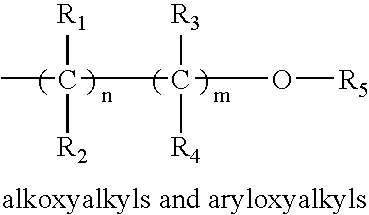
- each of R 1 , R 2 , R 3 , R 4 and R 5 may be the same as or different from the others, and each is independently selected from among hydrogen, C 1 -C 6 alkyl, C 2 -C 6 alkenyl, C 6 -C 10 aryl, C 1 -C 6 alkoxy, C 3 -C 6 alkylsilyl, C 1 -C 6 alkylamino, hydrazino of the formula R a R b NNR c — wherein each of R a , R b and R c may be the same as or different from one another and each is independently selected from among C 1 -C 6 alkyl, and pendant ligands including functional group(s) providing further coordination to the metal center, such as, for example, aminoalkyl, alkoxyalkyl, aryloxyalkyl, imidoalkyl, and acetylalkyl, wherein suitable groups in these classes include those of the following formulae:
- each of R 1 -R 4 is the same as or different from one another, with each being independently selected from among hydrogen, C 1 -C 6 alkyl, and C 6 -C 10 aryl;
- R 5 is selected from among C 1 -C 6 alkyl, and C 6 -C 10 aryl; and n and m are selected independently from 0 to 4, with the proviso that m and n cannot be 0 at the same time;
- each L may be the same as or different from the other, each is a unidentate or multidentate Lewis-base ligand, and each is independently selected from the group consisting of phosphines, tertiary phosphines, ethers, polyethers, amines, alkylamines, polyamines, glymes, crown ethers, crown thioethers, cyclic polyamines (cyclenes), thioglymes, C 2 -C 6 alkynes, azoles, imidazoles, C 2 -C
- each of R 1 , R 2 , R 3 , R 4 and R 5 may be the same as or different from the others, and each is independently selected from among hydrogen, C 1 -C 6 alkyl, C 2 -C 6 alkenyl, C 6 -C 10 aryl, C 1 -C 6 alkoxy, C 3 -C 6 alkylsilyl, C 1 -C 6 alkylamino, hydrazino of the formula R a R b NNR c — wherein each of R a , R b and R c may be the same as or different from one another and each is independently selected from among C 1 -C 6 alkyl, and pendant ligands including functional group(s) providing further coordination to the metal center, such as, for example, aminoalkyl, alkoxyalkyl, aryloxyalkyl, imidoalkyl, and acetylalkyl, wherein suitable groups in these classes include those of the following formulae:
- each of R 1 -R 4 is the same as or different from one another, with each being independently selected from among hydrogen, C 1 -C 6 alkyl, and C 6 -C 10 aryl;
- R 5 is selected from among C 1 -C 6 alkyl, and C 6 -C 10 aryl; and n and m are selected independently from 0 to 4, with the proviso that m and n cannot be 0 at the same time;
- each L may be the same as or different from the other, each is a unidentate or multidentate Lewis-base ligand, and each is independently selected from the group consisting of phosphines, tertiary phosphines, ethers, polyethers, amines, alkylamines, polyamines, glymes, crown ethers, crown thioethers, cyclic polyamines (cyclenes), thioglymes, C 2 -C 6 alkynes, azoles, imidazoles, C 2 -C
- each of R 1 , R 2 , R 3 , R 4 and R 5 may be the same as or different from the others, and each is independently selected from among hydrogen, C 1 -C 6 alkyl, C 2 -C 6 alkenyl, C 6 -C 10 aryl, C 1 -C 6 alkoxy, C 3 -C 6 alkylsilyl, C 1 -C 6 alkylamino, hydrazino of the formula R a R b NNR c — wherein each of R a , R b and R c may be the same as or different from one another and each is independently selected from among C 1 -C 6 alkyl, and pendant ligands including functional group(s) providing further coordination to the metal center, such as, for example, aminoalkyl, alkoxyalkyl, aryloxyalkyl, imidoalkyl, and acetylalkyl, wherein suitable groups in these classes include those of the following formulae:
- each of R 1 -R 4 is the same as or different from one another, with each being independently selected from among hydrogen, C 1 -C 6 alkyl, and C 6 -C 10 aryl;
- R 5 is selected from among C 1 -C 6 alkyl, and C 6 -C 10 aryl; and n and m are selected independently from 0 to 4, with the proviso that m and n cannot be 0 at the same time;
- each L may be the same as or different from the other, each is a unidentate or multidentate Lewis-base ligand, and each is independently selected from the group consisting of phosphines, tertiary phosphines, ethers, polyethers, amines, alkylamines, polyamines, glymes, crown ethers, crown thioethers, cyclic polyamines (cyclenes), thioglymes, C 2 -C 6 alkynes, azoles, imidazoles, C 2 -C
- each of R 1 , R 2 , R 3 , R 4 and R 5 may be the same as or different from the others, and each is independently selected from among hydrogen, C 1 -C 6 alkyl, C 2 -C 6 alkenyl, C 6 -C 10 aryl, C 1 -C 6 alkoxy, C 3 -C 6 alkylsilyl, C 1 -C 6 alkylamino, hydrazino of the formula R a R b NNR c — wherein each of R a , R b and R c may be the same as or different from one another and each is independently selected from among C 1 -C 6 alkyl, and pendant ligands including functional group(s) providing further coordination to the metal center, such as, for example, aminoalkyl, alkoxyalkyl, aryloxyalkyl, imidoalkyl, and acetylalkyl, wherein suitable groups in these classes include those of the following formulae:
- each of R 1 -R 4 is the same as or different from one another, with each being independently selected from among hydrogen, C 1 -C 6 alkyl, and C 6 -C 10 aryl;
- R 5 is selected from among C 1 -C 6 alkyl, and C 6 -C 10 aryl; and
- n and m are selected independently from 0 to 4, with the proviso that m and n cannot be 0 at the same time;
- R a R b NNR c hydrogen, C 1 -C 6 alkyl, C 2 -C 6 alkenyl, C 6 -C 10 aryl, C 1 -C 6 alkoxy, C 3 -C 6 alkylsilyl, C 1 -C 6 amino, hydrazino of the formula R a R b NNR c — wherein each of R a , R b and R c may be the same as or different from one another and each is independently selected from among C 1 -C 6 alkyl, and pendant ligands including functional group(s) providing further coordination to the metal center, such as, for example, aminoalkyl, alkoxyalkyl, aryloxyalkyl, imidoalkyl, and acetylalkyl, wherein suitable groups in these classes include those of the following formulae:
- each of R 1 -R 4 is the same as or different from one another, with each being independently selected from among hydrogen, C 1 -C 6 alkyl, and C 6 -C 10 aryl;
- R 5 is selected from among C 1 -C 6 alkyl, and C 6 -C 10 aryl; and n and m are selected independently from 0 to 4, with the proviso that m and n cannot be 0 at the same time;
- L is a unidentate or multidentate Lewis-base ligand selected from among phosphines, tertiary phosphines, ethers, polyethers, amines, alkylamines, polyamines, glymes, crown ethers, crown thioethers, cyclic polyamines (cyclenes), thioglymes, C 2 -C 6 alkynes, azoles, imidazoles, C 2 -C 6 alkenes, pyridines, bipyridines, isonitriles,
- each of R 1 , R 2 , R 3 , R 4 and R 5 may be the same as or different from the others, and each is independently selected from among hydrogen, C 1 -C 6 alkyl, C 2 -C 6 alkenyl, C 6 -C 10 aryl, C 1 -C 6 alkoxy, C 3 -C 6 alkylsilyl, C 1 -C 6 alkylamino, hydrazino of the formula R a R b NNR c — wherein each of R a , R b and R c may be the same as or different from one another and each is independently selected from among C 1 -C 6 alkyl, and pendant ligands including functional group(s) providing further coordination to the metal center, such as, for example, aminoalkyl, alkoxyalkyl, aryloxyalkyl, imidoalkyl, and acetylalkyl, wherein suitable groups in these classes include those of the following formulae:
- each of R 1 -R 4 is the same as or different from one another, with each being independently selected from among hydrogen, C 1 -C 6 alkyl, and C 6 -C 10 aryl;
- R 5 is selected from among C 1 -C 6 alkyl, and C 6 -C 10 aryl; and
- n and m are selected independently from 0 to 4, with the proviso that m and n cannot be 0 at the same time;
- each of R 1 , R 2 , R 3 , R 4 and R 5 may be the same as or different from the others, and each is independently selected from among hydrogen, C 1 -C 6 alkyl, C 2 -C 6 alkenyl, C 6 -C 10 aryl, C 1 -C 6 alkoxy, C 3 -C 6 alkylsilyl, C 1 -C 6 amino, hydrazino of the formula R a R b NNR c — wherein each of R a , R b and R c may be the same as or different from one another and each is independently selected from among C 1 -C 6 alkyl, and pendant ligands including functional group(s) providing further coordination to the metal center, such as, for example, aminoalkyl, alkoxyalkyl, aryloxyalkyl, imidoalkyl, and acetylalkyl, wherein suitable groups in these classes include those of the following formulae:
- each of R 1 -R 4 is the same as or different from one another, with each being independently selected from among hydrogen, C 1 -C 6 alkyl, and C 6 -C 10 aryl;
- R 5 is selected from among C 1 -C 6 alkyl, and C 6 -C 10 aryl; and n and m are selected independently from 0 to 4, with the proviso that m and n cannot be 0 at the same time;
- L is a unidentate or multidentate Lewis-base ligand selected from among phosphines, tertiary phosphines, ethers, polyethers, amines, alkylamines, polyamines, glymes, crown ethers, crown thioethers, cyclic polyamines (cyclenes), thioglymes, C 2 -C 6 alkynes, azoles, imidazoles, C 2 -C 6 alkenes, pyridines, bipyridines, isonitriles,
- each of R 1 , R 2 , R 3 , R 4 and R 5 may be the same as or different from the others, and each is independently selected from among hydrogen, C 1 -C 6 alkyl, C 1 -C 6 alkenyl, C 6 -C 10 aryl, C 1 -C 6 alkoxy, C 3 -C 6 alkylsilyl, C 1 -C 6 amino, hydrazino of the formula R a R b NNR c — wherein each of R a , R b and R c may be the same as or different from one another and each is independently selected from among C 1 -C 6 alkyl, and pendant ligands including functional group(s) providing further coordination to the metal center, such as, for example, aminoalkyl, alkoxyalkyl, aryloxyalkyl, imidoalkyl, and acetylalkyl, wherein suitable groups in these classes include those of the following formulae:
- each of R 1 -R 4 is the same as or different from one another, with each being independently selected from among hydrogen, C 1 -C 6 alkyl, and C 6 -C 10 aryl;
- R 5 is selected from among C 1 -C 6 alkyl, and C 6 -C 10 aryl; and
- n and m are selected independently from 0 to 4, with the proviso that m and n cannot be 0 at the same time;
- R a R b NNR c hydrogen, C 1 -C 6 alkyl, C 1 -C 6 alkenyl, C 6 -C 10 aryl, C 1 -C 6 alkoxy, C 3 -C 6 alkylsilyl, C 1 -C 6 amino, hydrazino of the formula R a R b NNR c — wherein each of R a , R b and R c may be the same as or different from one another and each is independently selected from among C 1 -C 6 alkyl, and pendant ligands including functional group(s) providing further coordination to the metal center, such as, for example, aminoalkyl, alkoxyalkyl, aryloxyalkyl, imidoalkyl, and acetylalkyl, wherein suitable groups in these classes include those of the following formulae:
- each of R 1 -R 4 is the same as or different from one another, with each being independently selected from among hydrogen, C 1 -C 6 alkyl, and C 6 -C 10 aryl;
- R 5 is selected from among C 1 -C 6 alkyl, and C 6 -C 10 aryl; and n and m are selected independently from 0 to 4, with the proviso that m and n cannot be 0 at the same time;
- L is a unidentate or multidentate Lewis-base ligand selected from among phosphines, tertiary phosphines, ethers, polyethers, amines, alkylamines, polyamines, glymes, crown ethers, crown thioethers, cyclic polyamines (cyclenes), thioglymes, C 2 -C 6 alkynes, azoles, imidazoles, C 2 -C 6 alkenes, pyridines, bipyridines, isonitriles,
- each of R 1 , R 2 , R 3 , R 4 and R 5 may be the same as or different from the others, and each is independently selected from among hydrogen, C 1 -C 6 alkyl, C 1 -C 6 alkenyl, C 6 -C 10 aryl, C 1 -C 6 alkoxy, C 3 -C 6 alkylsilyl, C 1 -C 6 amino, hydrazino of the formula R a R b NNR c — wherein each of R a , R b and R c may be the same as or different from one another and each is independently selected from among C 1 -C 6 alkyl, and pendant ligands including functional group(s) providing further coordination to the metal center, such as, for example, aminoalkyl, alkoxyalkyl, aryloxyalkyl, imidoalkyl, and acetylalkyl, wherein suitable groups in these classes include those of the following formulae:
- each of R 1 -R 4 is the same as or different from one another, with each being independently selected from among hydrogen, C 1 -C 6 alkyl, and C 6 -C 10 aryl; R 5 is selected from among C 1 -C 6 alkyl, and C 6 -C 10 aryl; and n and m are selected independently from 0 to 4, with the proviso that m and n cannot be 0 at the same time; CuHL n (xv) wherein n is an integer having a value of from 0 to 2 inclusive, and each L may be the same as or different from other(s), each is a unidentate or multidentate Lewis-base ligand, and each is independently selected from the group consisting of phosphines, tertiary phosphines, ethers, polyethers, amines, alkylamines, polyamines, glymes, crown ethers, crown thioethers, cyclic polyamines (cyclenes), thiogly
- n is an integer having a value of from 0 to 2 inclusive, and each L may be the same as or different from the other, each is a unidentate or multidentate Lewis-base ligand, and each is independently selected from the group consisting of phosphines, tertiary phosphines, ethers, polyethers, amines, alkylamines, polyamines, glymes, crown ethers, crown thioethers, cyclic polyamines (cyclenes), thioglymes, C 2 -C 6 alkynes, azoles, imidazoles, C 2 -C 6 alkenes, pyridines, bipyridines, isonitriles, carbenes and hetero-carbenes.
- the invention in another aspect, relates to a copper precursor formulation comprising a copper precursor compound of the invention, and a solvent medium.
- the invention relates to a precursor vapor composition, comprising a vapor of a copper precursor compound of the invention.
- a further aspect of the invention relates to a reagent source package, comprising a storage and dispensing vessel containing a copper precursor compound of the invention.
- a still further aspect of the invention relates to a method of making a copper borohydride compound, comprising a reaction step selected from the following group of reaction steps:
- each of R 1 , R 2 , R 3 , R 4 and R 5 may be the same as or different from the others, and each is independently selected from among hydrogen, C 1 -C 6 alkyl, C 2 -C 6 alkenyl, C 6 -C 10 aryl, C 1 -C 6 alkoxy, C 3 -C 6 alkylsilyl, C 1 -C 6 alkylamino, hydrazino of the formula R a R b NNR c — wherein each of R a , R b and R c may be the same as or different from one another and each is independently selected from among C 1 -C 6 alkyl, and pendant ligands including functional group(s) providing further coordination to the metal center, such as, for example, aminoalkyl, alkoxyalkyl, aryloxyalkyl, imidoalkyl, and acetylalkyl, wherein suitable groups in these classes include those of the following formulae:
- each of R 1 -R 4 is the same as or different from one another, with each being independently selected from among hydrogen, C 1 -C 6 alkyl, and C 6 -C 10 aryl;
- R 5 is selected from among C 1 -C 6 alkyl, and C 6 -C 10 aryl; and n and m are selected independently from 0 to 4, with the proviso that m and n cannot be 0 at the same time;
- each L may be the same as or different from the other, each is a unidentate or multidentate Lewis-base ligand, and each is independently selected from the group consisting of phosphines, tertiary phosphines, ethers, polyethers, amines, alkylamines, polyamines, glymes, crown ethers, crown thioethers, cyclic polyamines (cyclenes), thioglymes, C 2 -C 6 alkynes, azoles, imidazoles, C 2 -C
- An additional aspect of the invention relates to a method of making a cyclopentadienyl-type copper precursor, comprising carrying out a synthesis selected from a synthetic route comprising
- cyclopentadienyl-type copper precursor from a reaction volume including reactants and products of such synthesis.
- Such synthesis may be carried out with the cyclopentadienyl substituents instead of being all methyl are each independently selected from among hydrogen, C 1 -C 6 alkyl, C 1 -C 6 alkenyl, C 6 -C 10 aryl, C 1 -C 6 alkoxy, C 3 -C 6 alkylsilyl, C 1 -C 6 amino, hydrazino of the formula R a R b NNR c — wherein each of R a , R b and R c may be the same as or different from one another and each is independently selected from among C 1 -C 6 alkyl, and pendant ligands including functional group(s) providing further coordination to the metal center, such as, for example, aminoalkyl, alkoxyalkyl, aryloxyalkyl, imidoalkyl, and acetylalkyl, where
- each of R 1 -R 4 is the same as or different from one another, with each being independently selected from among hydrogen, C 1 -C 6 alkyl, and C 6 -C 10 aryl;
- R 5 is selected from among C 1 -C 6 alkyl, and C 6 -C 10 aryl; and n and m are selected independently from 0 to 4, with the proviso that m and n cannot be 0 at the same time;
- L being a unidentate or multidentate Lewis-base ligand selected from the group consisting of phosphines, tertiary phosphines, ethers, polyethers, amines, alkylamines, polyamines, glymes, crown ethers, crown thioethers, cyclic polyamines (cyclenes), thioglymes, C 2 -C 6 alkynes, azoles, imidazoles, C 2 -C 6 alkenes, pyridines, bipyridines, ison
- the invention in a further aspect relates to a method of making a copper hydride compound, comprising carrying out a synthesis including the following reaction:
- n is an integer having a value of from 0 to 2 inclusive, and each L may be the same as or different from other(s), and each L is independently selected from the group consisting of phosphines, tertiary phosphines, ethers, polyethers, amines, alkylamines, polyamines, glymes, crown ethers, crown thioethers, cyclic polyamines (cyclenes), thioglymes, C 2 -C 6 alkynes, azoles, imidazoles, C 2 -C 6 alkenes, pyridines, bipyridines, isonitriles, carbenes and hetero-carbenes.
- Still another aspect of the invention relates to a copper precursor compound selected from the group consisting of (Ph 3 P) 2 CuBH 4 , CpCu(CyNC), EtCpCu(tBuNC), and MeCpCu(tBuNC), wherein Ph is phenyl, Cp is cyclopentadienyl, Cy is cyclohexyl, Et is ethyl, and tBu is tertiary butyl.
- organic substituents by reference to carbon numbers, includes ranges as well as sub-ranges within the ranges identified by end-point carbon numbers, and such sub-ranges may be specified, e.g., as including one of such end-point carbon numbers in such a sub-range, or as including carbon numbers greater than the lower end-point carbon number and less than the upper end-point carbon number of the range, to constitute various sub-ranges in the various specific embodiments of the invention.
- Hydrocarbon groups may be branched or unbranched.
- FIG. 1 is a simultaneous thermal analysis (STA) plot for (Ph 3 P) 2 CuBH 4 .
- FIG. 2 is a 1H NMR plot for CpCu(CyNC).
- FIG. 3 is a simultaneous thermal analysis (STA) plot for CpCu(CyNC).
- FIG. 4 is a 1H NMR plot for EtCpCu(tBuNC).
- FIG. 5 is a simultaneous thermal analysis (STA) plot for CpCu(CyNC).
- FIG. 6 is an ORTEP diagram of the structure of EtCpCu(tBuNC).
- FIG. 7 is a 1H NMR plot for MeCpCu(tBuNC).
- FIG. 8 is a simultaneous thermal analysis (STA) plot for MeCpCu(tBuNC).
- the present invention relates to copper precursors that have utility in deposition of copper by film deposition techniques such as chemical vapor deposition (CVD), atomic layer deposition (ALD) and rapid vapor deposition (digital CVD).
- CVD chemical vapor deposition
- ALD atomic layer deposition
- digital CVD rapid vapor deposition
- Such precursors include various specific copper precursors that contain halogengen substituents, as well as various other copper precursors that are free of halogengen atoms (F, Cl, Br, I). From such precursors, copper can be deposited on substrates, e.g., microelectronic device substrates, at temperatures below 500° C.
- the precursors of the invention can be used for metallization of integrated circuitry with copper.
- these precursors can be employed to form copper thin films on barrier layers in microelectronic device structures, such as on the lower interconnect level in such device structures.
- One class of copper precursors of the invention include is constituted by copper borohydrides.
- This class of copper precursors of the invention includes compounds having the structures set out in Table 1 below, which are shown with an appertaining synthesis reaction.
- X is halogen (fluoro, chloro, bromo or iodo); each of R 1 , R 2 , R 3 , R 4 and R 5 may be the same as or different from the others, and each is independently selected from among hydrogen, C 1 -C 6 alkyl, C 2 -C 6 alkenyl, C 6 -C 10 aryl, C 1 -C 6 alkoxy, C 3 -C 6 alkylsilyl, C 1 -C 6 alkylamino, hydrazino of the formula R a R b NNR c — wherein each of R a , R b and R c may be the same as or different from one another and each is independently selected from among C 1 -C 6 alkyl, and pendant ligands including functional group(s) providing further coordination to the metal center, such as, for example, aminoalkyl, alkoxyalkyl, aryl
- each of R 1 -R 4 is the same as or different from one another, with each being independently selected from among hydrogen, C 1 -C 6 alkyl, and C 6 -C 10 aryl;
- R 5 is selected from among C 1 -C 6 alkyl, and C 6 -C 10 aryl; and n and m are selected independently from 0 to 4, with the proviso that m and n cannot be 0 at the same time;
- each L may be the same as or different from the other, each is a unidentate or multidentate Lewis-base ligand, and each is independently selected from the group consisting of phosphines, tertiary phosphines, ethers, polyethers, amines, alkylamines, polyamines, glymes, crown ethers, crown thioethers, cyclic polyamines (cyclenes), thioglymes, C 2 -C 6 alkynes, azoles, imidazoles, C 2 -C
- the class of copper precursors shown in Table 1 can be varied by selection and synthesis of particular borohydride ligands that are coordinated to the copper central atom, so that the resulting precursor possesses a thermal and solution behavior that is tailored for the specific deposition process in which the precursor is employed.
- the copper precursors of Table 1 are usefully employed as precursors for copper deposition using CVD, ALD or digital CVD deposition processes, under process conditions that can readily empirically be determined, to achieve deposited copper of a desired character, e.g., film thickness, conformality, etc.
- a simultaneous thermal analysis (STA) plot for (Ph 3 P) 2 CuBH 4 is shown in FIG. 1 hereof.
- DSC differential scanning calorimetry
- TG thermogravimetric
- MR low mass residue
- Another class of copper precursors of the invention include is constituted by the copper compounds having cyclopentadienyl-type ligands, of the formulae A, A′, B, B′, C, C′, D, and D′ shown in Table II below.
- each of R 1 , R 2 , R 3 , R 4 and R 5 may be the same as or different from the others, and each is independently selected from among hydrogen, C 1 -C 6 alkyl, C 2 -C 6 alkenyl, C 6 -C 10 aryl, C 1 -C 6 alkoxy, C 3 -C 6 alkylsilyl, C 1 -C 6 amino, hydrazino of the formula R a R b NNR c — wherein each of R a , R b and R c may be the same as or different from one another and each is independently selected from among C 1 -C 6 alkyl, and pendant ligands including functional group(s) providing further coordination to the metal center, such as, for example, aminoalkyl
- each of R 1 -R 4 is the same as or different from one another, with each being independently selected from among hydrogen, C 1 -C 6 alkyl, and C 6 -C 10 aryl;
- R 5 is selected from among C 1 -C 6 alkyl, and C 6 -C 10 aryl; and n and m are selected independently from 0 to 4, with the proviso that m and n cannot be 0 at the same time;
- each L may be the same as or different from the other, each is a unidentate or multidentate Lewis-base ligand, and each is independently selected from the group consisting of phosphines, tertiary phosphines, ethers, polyethers, amines, alkylamines, polyamines, glymes, crown ethers, crown thioethers, cyclic polyamines (cyclenes), thioglymes, C 2 -C 6 alkynes, azoles, imidazoles, C 2 -C
- the electron-deficient character of the cyclopentadienyl-like ligands in the compounds of formulae B, B′, C, C′, D, D′ due to the presence of boron atom is advantageous in bonding to the electron-rich copper central atom.
- the class of copper precursors shown in Table 2 can be varied by selection and synthesis of particular cyclopentadienyl-type (Cp-type) ligands that are coordinated to the copper central atom, so that the resulting precursor possesses a thermal and solution behavior that is suitably tailored for the specific deposition process in which such precursor is employed.
- Cp-type cyclopentadienyl-type
- the copper precursors of Table 2 thus constitute a class of compounds including: substituted cyclopentadienyl compounds A of the formula (C 5 R 1 R 2 R 3 R 4 R 5 )CuL wherein each of R 1 , R 2 , R 3 , R 4 and R 5 may be the same as or different from the others, and each is independently selected from among hydrogen, C 1 -C 6 alkyl, C 2 -C 6 alkenyl, C 6 -C 10 aryl, C 1 -C 6 alkoxy, C 3 -C 6 alkylsilyl, C 1 -C 6 amino, hydrazino of the formula R a R b NNR c — wherein each of R a , R b and R c may be the same as or different from one another and each is independently selected from among C 1 -C 6 alkyl, and pendant ligands including functional group(s) providing further coordination to the metal center, such as, for example, aminoalkyl, alkoxyalkyl,
- each of R 1 -R 4 is the same as or different from one another, with each being independently selected from among hydrogen, C 1 -C 6 alkyl, and C 6 -C 10 aryl;
- R 5 is selected from among C 1 -C 6 alkyl, and C 6 -C 10 aryl; and n and m are selected independently from 0 to 4, with the proviso that m and n cannot be 0 at the same time;
- L is a unidentate or multidentate Lewis-base ligand selected from among phosphines, tertiary phosphines, ethers, polyethers, amines, alkylamines, polyamines, glymes, crown ethers, crown thioethers, cyclic polyamines (cyclenes), thioglymes, C 2 -C 6 alkynes, azoles, imidazoles, C 2 -C 6 alkenes, pyridines, bipyridines, isonitriles,
- each of R 1 -R 4 is the same as or different from one another, with each being independently selected from among hydrogen, C 1 -C 6 alkyl, and C 6 -C 10 aryl; R 5 is selected from among C 1 -C 6 alkyl, and C 6 -C 10 aryl; and n and m are selected independently from 0 to 4, with the proviso that m and n cannot be 0 at the same time; thiaborolyl compounds B of the formula (C 3 BSR 1 R 2 R 3 R 5 )CuL wherein each of R 1 , R 2 , R 3 , R 4 and R 5 may be the same as or different from the others, and each is independently selected from among hydrogen, C 1 -C 6 alkyl, C 1 -C 6 alkenyl, C 6 -C 10 aryl, C 1 -C 6 alkoxy, C 3 -C 6 alkylsilyl, C 1 -C 6 amino, hydrazino of the formula R a R b
- each of R 1 -R 4 is the same as or different from one another, with each being independently selected from among hydrogen, C 1 -C 6 alkyl, and C 6 -C 10 aryl;
- R 5 is selected from among C 1 -C 6 alkyl, and C 6 -C 10 aryl; and n and m are selected independently from 0 to 4, with the proviso that m and n cannot be 0 at the same time;
- L is a unidentate or multidentate Lewis-base ligand selected from among phosphines, tertiary phosphines, ethers, polyethers, amines, alkylamines, polyamines, glymes, crown ethers, crown thioethers, cyclic polyamines (cyclenes), thioglymes, C 2 -C 6 alkynes, azoles, imidazoles, C 2 -C 6 alkenes, pyridines, bipyridines, isonitriles,
- each of R 1 -R 4 is the same as or different from one another, with each being independently selected from among hydrogen, C 1 -C 6 alkyl, and C 6 -C 10 aryl; R 5 is selected from among C 1 -C 6 alkyl, and C 6 -C 10 aryl; and n and m are selected independently from 0 to 4, with the proviso that m and n cannot be 0 at the same time; azaborolyl compounds C of the formula (C 3 BNR 1 R 2 R 3 R 4 R 5 )CuL wherein each of R 1 , R 2 , R 3 , R 4 and R 5 may be the same as or different from the others, and each is independently selected from among hydrogen, C 1 -C 6 alkyl, C 2 -C 6 alkenyl, C 6 -C 10 aryl, C 1 -C 6 alkoxy, C 3 -C 6 alkylsilyl, C 1 -C 6 amino, hydrazino of the formula R a R
- each of R 1 -R 4 is the same as or different from one another, with each being independently selected from among hydrogen, C 1 -C 6 alkyl, and C 6 -C 10 aryl;
- R 5 is selected from among C 1 -C 6 alkyl, and C 6 -C 10 aryl; and n and m are selected independently from 0 to 4, with the proviso that m and n cannot be 0 at the same time;
- L is a unidentate or multidentate Lewis-base ligand selected from among phosphines, tertiary phosphines, ethers, polyethers, amines, alkylamines, polyamines, glymes, crown ethers, crown thioethers, cyclic polyamines (cyclenes), thioglymes, C 2 -C 6 alkynes, azoles, imidazoles, C 2 -C 6 alkenes, pyridines, bipyridines, isonitriles,
- each of R 1 -R 4 is the same as or different from one another, with each being independently selected from among hydrogen, C 1 -C 6 alkyl, and C 6 -C 10 aryl; R 5 is selected from among C 1 -C 6 alkyl, and C 6 -C 10 aryl; and n and m are selected independently from 0 to 4, with the proviso that m and n cannot be 0 at the same time; oxoborolyl compounds D of the formula (C 3 BOR 1 R 2 R 3 R 5 )CuL wherein each of R 1 , R 2 , R 3 , R 4 and R 5 may be the same as or different from the others, and each is independently selected from among hydrogen, C 1 -C 6 alkyl, C 2 -C 6 alkenyl, C 6 -C 10 aryl, C 1 -C 6 alkoxy, C 3 -C 6 alkylsilyl, C 1 -C 6 amino, hydrazino of the formula R a R
- each of R 1 -R 4 is the same as or different from one another, with each being independently selected from among hydrogen, C 1 -C 6 alkyl, and C 6 -C 10 aryl;
- R 5 is selected from among C 1 -C 6 alkyl, and C 6 -C 10 aryl; and n and m are selected independently from 0 to 4, with the proviso that m and n cannot be 0 at the same time;
- L is a unidentate or multidentate Lewis-base ligand selected from among phosphines, tertiary phosphines, ethers, polyethers, amines, alkylamines, polyamines, glymes, crown ethers, crown thioethers, cyclic polyamines (cyclenes), thioglymes, C 2 -C 6 alkynes, azoles, imidazoles, C 2 -C 6 alkenes, pyridines, bipyridines, isonitriles,
- each of R 1 -R 4 is the same as or different from one another, with each being independently selected from among hydrogen, C 1 -C 6 alkyl, and C 6 -C 10 aryl;
- R 5 is selected from among C 1 -C 6 alkyl, and C 6 -C 10 aryl; and
- n and m are selected independently from 0 to 4, with the proviso that m and n cannot be 0 at the same time.
- copper precursors of formulae A, A′, B, B′, C, C′, D, and D′ are usefully employed as precursors for copper deposition using CVD, ALD or digital CVD deposition processes, under process conditions that can readily empirically be determined, to achieve deposited copper of a desired character, e.g., film thickness, conformality, etc.
- L is selected from among phosphines, tertiary phosphines, ethers, polyethers, amines, alkylamines, polyamines, glymes, crown ethers, crown thioethers, cyclic polyamines (cyclenes), thioglymes, C 2 -C 6 alkynes, azoles, imidazoles, C 2 -C 6 alkenes, pyridines, bipyridines, isonitriles, carbenes and hetero-carbenes, and wherein such synthesis may be carried out with the cyclopentadienyl substituents instead of being all methyl are each independently selected from among hydrogen, C 1 -C 6 alkyl, C 1 -C 6 alkenyl, C 6 -C 10 aryl, C 1 -C 6 alkoxy, C 3 -C 6 alkylsilyl, C 1 -C 6 amino,
- each of R 1 -R 4 is the same as or different from one another, with each being independently selected from among hydrogen, C 1 -C 6 alkyl, and C 6 -C 10 aryl;
- R 5 is selected from among C 1 -C 6 alkyl, and C 6 -C 10 aryl; and
- n and m are selected independently from 0 to 4, with the proviso that m and n cannot be 0 at the same time.
- a further class of copper precursors of the invention comprises substituted cyclopentadienyl compounds of formula E:
- each of R 1 , R 2 , R 3 , R 4 and R 5 may be the same as or different from the others, and each is independently selected from among hydrogen, halogengen, C 1 -C 6 alkyl, C 1 -C 6 alkoxy and cyanide (—CN), and L is selected from among phosphines, tertiary phosphines, ethers, polyethers, amines, alkylamines, polyamines, glymes, crown ethers, crown thioethers, cyclic polyamines (cyclenes), thioglymes, C 2 -C 6 alkynes, azoles, imidazoles, C 2 -C 6 alkenes, pyridines, bipyridines, isonitriles, carbenes and hetero-carbenes.
- L is selected from among phosphines, tertiary phosphines, ethers, polyethers, amines, alkylamines, polyamine
- Illustrative compounds of formula E include MeCpCu(tBuNC), EtCpCu(tBuNC), and CpCu(CyNC), wherein Me is methyl, Cp is cyclopentadienyl, tBu is tert-butyl, Et is ethyl and Cy is isocyanato. Characterization data for these formula E compounds are set out in FIGS. 2-7 , by way of example.
- FIG. 2 is a 1H NMR plot for CpCu(CyNC).
- FIG. 3 is a simultaneous thermal analysis (STA) plot for CpCu(CyNC).
- STA simultaneous thermal analysis
- DSC differential scanning calorimetry
- TG thermogravimetric
- MR mass residue
- FIG. 4 is a 1H NMR plot for EtCpCu(tBuNC).
- FIG. 5 is a simultaneous thermal analysis (STA) plot for CpCu(CyNC).
- STA simultaneous thermal analysis
- DSC differential scanning calorimetry
- TG thermogravimetric
- MR mass residue
- FIG. 6 is an ORTEP diagram of the structure of EtCpCu(tBuNC).
- FIG. 7 is a 1H NMR plot for MeCpCu(tBuNC).
- FIG. 8 is a simultaneous thermal analysis (STA) plot for MeCpCu(tBuNC).
- STA differential scanning calorimetry
- TG thermogravimetric
- MR mass residue
- Yet another class of copper precursors of the invention is constituted by copper hydride compounds of the formula CuHLn wherein n is an integer having a value of from 0 to 2 inclusive, and each L may be the same as or different from the other, each is a unidentate or multidentate Lewis-base ligand, and each L is independently selected from the group consisting of phosphines, tertiary phosphines, ethers, polyethers, amines, alkylamines, polyamines, glymes, crown ethers, crown thioethers, cyclic polyamines (cyclenes), thioglymes, C 2 -C 6 alkynes, azoles, imidazoles, C 2 -C 6 alkenes, pyridines, bipyridines, isonitriles, carbenes and hetero-carbenes, and n is an integer having a value of from 0 to 2 inclusive.
- Such copper hydride precursors are capable of forming trimers of the formula
- each L is independently selected from the group consisting of phosphines, tertiary phosphines, ethers, polyethers, amines, alkylamines, polyamines, glymes, crown ethers, crown thioethers, cyclic polyamines (cyclenes), thioglymes, C 2 -C 6 alkynes, azoles, imidazoles, C 2 -C 6 alkenes, pyridines, bipyridines, isonitriles, carbenes and hetero-carbenes, and n is an integer having a value of from 0 to 2 inclusive.
- copper hydride monomer and trimer precursors of the invention have utility for copper deposition processes such as CVD, ALD and digital CVD, and may be utilized in solid or liquid forms that are volatilized to form corresponding precursor vapor that is contacted with the microelectronic device substrate or other suitable deposition surface to effect deposition of copper thereon.
- Such copper hydride precursors in their respective monomer and trimer forms can be varied by selection and synthesis of particular ligands L that are coordinated to the copper central atom, so that the resulting precursor possesses a thermal and solution behavior that is suitably tailored for the specific deposition process in which such precursor is employed.
- the ligands in specific embodiments may for example be selected to provide the copper precursor with an environmentally benign or readily biodegradable character.
- the ligand L is selected from among tertiary phosphines, azoles, imidazoles, pyridines, and bipyridines.
- the copper hydride precursors described above can be synthesized in any suitable manner.
- the aforementioned trimer copper precursors are formed by the following synthesis reaction:
- each L is independently selected from the group consisting of phosphines, tertiary phosphines, ethers, polyethers, amines, alkylamines, polyamines, glymes, crown ethers, crown thioethers, cyclic polyamines (cyclenes), thioglymes, C 2 -C 6 alkynes, azoles, imidazoles, C 2 -C 6 alkenes, pyridines, bipyridines, isonitriles, carbenes and hetero-carbenes, and n is an integer having a value of from 0 to 2 inclusive.
- the copper precursors of the invention are usefully employed for deposition of conformal copper or copper-containing films using CVD/ALD/digital CVD techniques, as monomeric copper precursors that are transportable (volatile) at temperatures specific to such processes, e.g., temperatures below 500° C.
- the copper precursors of the invention can be readily synthesized from the parent ligands and the metal, to provide such precursors in readily recoverable form.
- the copper precursors of the invention may be packaged in a precursor storage and dispensing package of any suitable type.
- suitable storage and dispensing packages may include those described in U.S. Provisional Patent Application No. 60/662,515 filed in the names of Paul J. Marganski, et al. for “SYSTEM FOR DELIVERY OF REAGENTS FROM SOLID SOURCES THEREOF” and the storage and dispensing apparatus variously described in U.S. Pat. No. 5,518,528; U.S. Pat. No. 5,704,965; U.S. Pat. No. 5,704,967; U.S. Pat. No. 5,707,424; U.S. Pat.
- the copper precursors of the invention are volatilized to form a precursor vapor that is then contacted with a microelectronic device substrate under elevated temperature vapor decomposition conditions to deposit copper on the substrate.
- CVD involves the contacting of a volatile metal-organic compound in the gas phase with areas of a substrate where growth of a metal film (e.g., to form an interconnect) is required.
- a surface catalyzed chemical reaction e.g., thermal decomposition, occurs and produces deposition of the desired metal. Since the metal film steadily grows on the desired surface, it is of a uniform thickness and highly conformal even to severe (e.g., high aspect) geometries.
- CVD is well suited to use in fabricating submicron high aspect ratio features.
- the copper precursors of the invention are well-suited for such CVD usage.
- ALD involves the deposition of successive monolayer over a substrate within a deposition chamber typically maintained at subatmospheric pressure.
- An exemplary method includes feeding a single vaporized precursor into a deposition chamber to form a first monolayer over a substrate positioned therein. The substrate is heated to a temperature that is high enough to prevent condensation of the precursor but low enough to prevent thermal decomposition of said precursor. Thereafter, the flow of the first deposition precursor is ceased and an inert purge gas, e.g., nitrogen or argon, is flowed through the chamber to exhaust any unreacted first precursor from the chamber. Subsequently, a second vaporized precursor the same as or different from the first is flowed into the chamber to form a second monolayer upon the first monolayer. The second monolayer might react with the first monolayer. Additional precursors can form successive monolayer, or the above process can be repeated until a desired thickness and composition layer has been formed over the substrate.
- the copper precursors of the invention are well-suited for ALD processes
- Digital CVD involves the alternate introduction of reactant gases over a surface of a substrate, and is similar to ALD, but digital CVD accommodates a more rapid growth of the deposited film.
- digital CVD achieves a rapid film growth similar to that obtained by CVD techniques, but with a high conformality of the deposited film that is characteristic of ALD techniques.
- the copper precursors of the invention are well-suited for digital CVD processes.
- the copper precursors of the present invention are volatile and thermally stable, and are usefully employed as solid copper CVD or ALD precursors under reduced pressure deposition conditions in the CVD or ALD reactor.
- the solid precursors can be dissolved in organic solvents, and liquid delivery processes can be used to meter the solution into a vaporizer for transport of the vapor to the reactor.
- the copper precursor compositions of the present invention may be used to form copper interconnect lines in microelectronic device integrated circuitry, thin-film circuitry, thin-film packaging components and thin-film recording head coils.
- a microelectronic device substrate may be utilized having a number of dielectric and conductive layers (multilayers) formed on and/or within the substrate.
- the microelectronic device substrate may include a bare substrate or any number of constituent layers formed on a bare substrate.
- “microelectronic device” corresponds to semiconductor substrates, flat panel displays, and microelectromechanical systems (MEMS).
- a copper-containing layer may be formed on a microelectronic device substrate using the copper precursor, for use in a first, second, third, or more metallization layer.
- Such copper layers typically are used in circuit locations requiring low resistivity, high performance and/or high speed circuit paths.
- a barrier layer may be deposited or otherwise formed on the microelectronic device substrate before a copper layer is formed on said substrate.
- copper can be deposited on wafer substrates using CVD, ALD or digital CVD systems, such systems being well known in the microelectronic device fabrication art.
- water, water-generating compounds, or other adjuvants to the precursor formulation may be mixed with the copper precursor upstream of, at, or within, the CVD, ALD or digital CVD tool. Reducing agents may be utilized in an analogous fashion.
- the copper precursor formulation may contain or be mixed with other metal source reagent materials, or such other reagent materials may be separately vaporized and introduced to the deposition chamber.
- compositions of the present invention may be delivered to a CVD, ALD or digital CVD reactor in a variety of ways.
- a liquid delivery system may be utilized.
- a combined liquid delivery and flash vaporization process unit may be employed, such as the LDS300 liquid delivery and vaporizer unit (commercially available from ATMI, Inc., Danbury, Conn., USA), to enable low volatility materials to be volumetrically delivered, leading to reproducible transport and deposition without thermal decomposition of the precursor. Both of these considerations of reproducible transport and deposition without thermal decomposition are essential for providing a commercially acceptable copper CVD, ALD or digital CVD process.
- copper precursors that are liquids may be used in neat liquid form, or liquid or solid copper precursors may be employed in solvent formulations containing same.
- copper precursor formulations of the invention may include solvent component(s) of suitable character as may be desirable and advantageous in a given end use application to form copper on a substrate.
- Suitable solvents may for example include alkane solvents (e.g., hexane, heptane, octane, and pentane), aryl solvents (e.g., benzene or toluene), amines (e.g., triethylamine, tert-butylamine), imines and carbodiimides (e.g., N,N′-diisopropylcarbodiimide), alcohols, ethers, ketones, aldehydes, amidines, guanadines, isoureas, and the like.
- alkane solvents e.g., hexane, heptane, octane, and pentane
- aryl solvents e.g., benzene or toluene
- amines e.g., triethylamine, tert-butylamine
- a wide variety of CVD, ALD or digital CVD process conditions may be employed in the use of the precursor compositions of the present invention.
- Generalized process conditions may include substrate temperature in a range of 50-400° C.; pressure in a range of 0.05-50 Torr; and carrier gas flows of helium, hydrogen, nitrogen, or argon in a range of 25-750 sccm, at a temperature approximately the same as the vaporizer, e.g., in a range of 50 to 120° C.
- the deposition of copper thin films with useful electrical properties (low resistivity) and good adhesion to the barrier layer (e.g., formed of TiN or TaN), are also achieved by the process and precursors of the present invention.
- the conformality of the deposited film is practically achievable through CVD, ALD or digital CVD techniques that preferably provide a pathway to the achievement of “full-fill” copper metallization.
- the liquid delivery approach of the present invention including “flash” vaporization and the use of copper precursor chemistry as herein disclosed, enable next-generation device geometries and dimensions to be attained, e.g., a conformal vertical interconnect of 22 nanometer line width.
- the conformal deposition of interconnects of these critical dimensions cannot be realized by currently available physical deposition methods.
- the approach of the present invention affords a viable pathway to future generation devices, and embodies a substantial advance in the art.
Landscapes
- Chemical & Material Sciences (AREA)
- Organic Chemistry (AREA)
- General Chemical & Material Sciences (AREA)
- Chemical Kinetics & Catalysis (AREA)
- Engineering & Computer Science (AREA)
- Materials Engineering (AREA)
- Mechanical Engineering (AREA)
- Metallurgy (AREA)
Abstract
Description

wherein each L may be the same as or different from the other, each is a unidentate or multidentate Lewis-base ligand, and each is independently selected from the group consisting of phosphines, tertiary phosphines, ethers, polyethers, amines, alkylamines, polyamines, glymes, crown ethers, crown thioethers, cyclic polyamines (cyclenes), thioglymes, C2-C6 alkynes, azoles, imidazoles, C2-C6 alkenes, pyridines, bipyridines, isonitriles, carbenes and hetero-carbenes;

wherein each L may be the same as or different from the other, each is a unidentate or multidentate Lewis-base ligand, and each is independently selected from the group consisting of phosphines, tertiary phosphines, ethers, polyethers, amines, alkylamines, polyamines, glymes, crown ethers, crown thioethers, cyclic polyamines (cyclenes), thioglymes, C2-C6 alkynes, azoles, imidazoles, C2-C6 alkenes, pyridines, bipyridines, isonitriles, carbenes and hetero-carbenes;

wherein each L may be the same as or different from the other, each is a unidentate or multidentate Lewis-base ligand, and each is independently selected from the group consisting of phosphines, tertiary phosphines, ethers, polyethers, amines, alkylamines, polyamines, glymes, crown ethers, crown thioethers, cyclic polyamines (cyclenes), thioglymes, C2-C6 alkynes, azoles, imidazoles, C2-C6 alkenes, pyridines, bipyridines, isonitriles, carbenes and hetero-carbenes;

wherein each L may be the same as or different from the other, each is a unidentate or multidentate Lewis-base ligand, and each is independently selected from the group consisting of phosphines, tertiary phosphines, ethers, polyethers, amines, alkylamines, polyamines, glymes, crown ethers, crown thioethers, cyclic polyamines (cyclenes), thioglymes, C2-C6 alkynes, azoles, imidazoles, C2-C6 alkenes, pyridines, bipyridines, isonitriles, carbenes and hetero-carbenes;

wherein each of R1, R2, R3, R4 and R5 may be the same as or different from the others, and each is independently selected from among hydrogen, C1-C6 alkyl, C2-C6 alkenyl, C6-C10 aryl, C1-C6 alkoxy, C3-C6 alkylsilyl, C1-C6 alkylamino, hydrazino of the formula RaRbNNRc— wherein each of Ra, Rb and Rc may be the same as or different from one another and each is independently selected from among C1-C6 alkyl, and pendant ligands including functional group(s) providing further coordination to the metal center, such as, for example, aminoalkyl, alkoxyalkyl, aryloxyalkyl, imidoalkyl, and acetylalkyl, wherein suitable groups in these classes include those of the following formulae:

wherein each of R1-R4 is the same as or different from one another, with each being independently selected from among hydrogen and C1-C6 straight chain or branched alkyl, C1-C6 straight chain or branched alkoxy, C6-C10 aryl and NR5R6; each of R5 and R6 is the same as or different from the other, with each being independently selected from among C1-C6 straight chain or branched alkyl and C6-C10 aryl; n and m are each selected independently from 0 to 4 with the proviso that m and n cannot be 0 at the same time, and x is selected from 1 to 5;

wherein each of R1-R4 is the same as or different from one another, with each being independently selected from among hydrogen, C1-C6 alkyl, and C6-C10 aryl; R5 is selected from among C1-C6 alkyl, and C6-C10 aryl; and n and m are selected independently from 0 to 4, with the proviso that m and n cannot be 0 at the same time; each L may be the same as or different from the other, each is a unidentate or multidentate Lewis-base ligand, and each is independently selected from the group consisting of phosphines, tertiary phosphines, ethers, polyethers, amines, alkylamines, polyamines, glymes, crown ethers, crown thioethers, cyclic polyamines (cyclenes), thioglymes, C2-C6 alkynes, azoles, imidazoles, C2-C6 alkenes, pyridines, bipyridines, isonitriles, carbenes and hetero-carbenes;

wherein each of R1, R2, R3, R4 and R5 may be the same as or different from the others, and each is independently selected from among hydrogen, C1-C6 alkyl, C2-C6 alkenyl, C6-C10 aryl, C1-C6 alkoxy, C3-C6 alkylsilyl, C1-C6 alkylamino, hydrazino of the formula RaRbNNRc— wherein each of Ra, Rb and Rc may be the same as or different from one another and each is independently selected from among C1-C6 alkyl, and pendant ligands including functional group(s) providing further coordination to the metal center, such as, for example, aminoalkyl, alkoxyalkyl, aryloxyalkyl, imidoalkyl, and acetylalkyl, wherein suitable groups in these classes include those of the following formulae:

wherein each of R1-R4 is the same as or different from one another, with each being independently selected from among hydrogen and C1-C6 straight chain or branched alkyl, C1-C6 straight chain or branched alkoxy, C6-C10 aryl and NR5R6; each of R5 and R6 is the same as or different from the other, with each being independently selected from among C1-C6 straight chain or branched alkyl and C6-C10 aryl; n and m are each selected independently from 0 to 4 with the proviso that m and n cannot be 0 at the same time, and x is selected from 1 to 5;

wherein each of R1-R4 is the same as or different from one another, with each being independently selected from among hydrogen, C1-C6 alkyl, and C6-C10 aryl; R5 is selected from among C1-C6 alkyl, and C6-C10 aryl; and n and m are selected independently from 0 to 4, with the proviso that m and n cannot be 0 at the same time; each L may be the same as or different from the other, each is a unidentate or multidentate Lewis-base ligand, and each is independently selected from the group consisting of phosphines, tertiary phosphines, ethers, polyethers, amines, alkylamines, polyamines, glymes, crown ethers, crown thioethers, cyclic polyamines (cyclenes), thioglymes, C2-C6 alkynes, azoles, imidazoles, C2-C6 alkenes, pyridines, bipyridines, isonitriles, carbenes and hetero-carbenes;

wherein each of R1, R2, R3, R4 and R5 may be the same as or different from the others, and each is independently selected from among hydrogen, C1-C6 alkyl, C2-C6 alkenyl, C6-C10 aryl, C1-C6 alkoxy, C3-C6 alkylsilyl, C1-C6 alkylamino, hydrazino of the formula RaRbNNRc— wherein each of Ra, Rb and Rc may be the same as or different from one another and each is independently selected from among C1-C6 alkyl, and pendant ligands including functional group(s) providing further coordination to the metal center, such as, for example, aminoalkyl, alkoxyalkyl, aryloxyalkyl, imidoalkyl, and acetylalkyl, wherein suitable groups in these classes include those of the following formulae:

wherein each of R1-R4 is the same as or different from one another, with each being independently selected from among hydrogen and C1-C6 straight chain or branched alkyl, C1-C6 straight chain or branched alkoxy, C6-C10 aryl and NR5R6; each of R5 and R6 is the same as or different from the other, with each being independently selected from among C1-C6 straight chain or branched alkyl and C6-C10 aryl; n and m are each selected independently from 0 to 4 with the proviso that m and n cannot be 0 at the same time, and x is selected from 1 to 5;
wherein each of R1-R4 is the same as or different from one another, with each being independently selected from among hydrogen, C1-C6 alkyl, and C6-C10 aryl; R5 is selected from among C1-C6 alkyl, and C6-C10 aryl; and n and m are selected independently from 0 to 4, with the proviso that m and n cannot be 0 at the same time; each L may be the same as or different from the other, each is a unidentate or multidentate Lewis-base ligand, and each is independently selected from the group consisting of phosphines, tertiary phosphines, ethers, polyethers, amines, alkylamines, polyamines, glymes, crown ethers, crown thioethers, cyclic polyamines (cyclenes), thioglymes, C2-C6 alkynes, azoles, imidazoles, C2-C6 alkenes, pyridines, bipyridines, isonitriles, carbenes and hetero-carbenes;

wherein each of R1, R2, R3, R4 and R5 may be the same as or different from the others, and each is independently selected from among hydrogen, C1-C6 alkyl, C2-C6 alkenyl, C6-C10 aryl, C1-C6 alkoxy, C3-C6 alkylsilyl, C1-C6 alkylamino, hydrazino of the formula RaRbNNRc— wherein each of Ra, Rb and Rc may be the same as or different from one another and each is independently selected from among C1-C6 alkyl, and pendant ligands including functional group(s) providing further coordination to the metal center, such as, for example, aminoalkyl, alkoxyalkyl, aryloxyalkyl, imidoalkyl, and acetylalkyl, wherein suitable groups in these classes include those of the following formulae:

wherein each of R1-R4 is the same as or different from one another, with each being independently selected from among hydrogen and C1-C6 straight chain or branched alkyl, C1-C6 straight chain or branched alkoxy, C6-C10 aryl and NR5R6; each of R5 and R6 is the same as or different from the other, with each being independently selected from among C1-C6 straight chain or branched alkyl and C6-C10 aryl; n and m are each selected independently from 0 to 4 with the proviso that m and n cannot be 0 at the same time, and x is selected from 1 to 5;

wherein each of R1-R4 is the same as or different from one another, with each being independently selected from among hydrogen, C1-C6 alkyl, and C6-C10 aryl; R5 is selected from among C1-C6 alkyl, and C6-C10 aryl; and n and m are selected independently from 0 to 4, with the proviso that m and n cannot be 0 at the same time;

hydrogen, C1-C6 alkyl, C2-C6 alkenyl, C6-C10 aryl, C1-C6 alkoxy, C3-C6 alkylsilyl, C1-C6 amino, hydrazino of the formula RaRbNNRc— wherein each of Ra, Rb and Rc may be the same as or different from one another and each is independently selected from among C1-C6 alkyl, and pendant ligands including functional group(s) providing further coordination to the metal center, such as, for example, aminoalkyl, alkoxyalkyl, aryloxyalkyl, imidoalkyl, and acetylalkyl, wherein suitable groups in these classes include those of the following formulae:

wherein each of R1-R4 is the same as or different from one another, with each being independently selected from among hydrogen and C1-C6 straight chain or branched alkyl, C1-C6 straight chain or branched alkoxy, C6-C10 aryl and NR5R6; each of R5 and R6 is the same as or different from the other, with each being independently selected from among C1-C6 straight chain or branched alkyl and C6-C10 aryl; n and m are each selected independently from 0 to 4 with the proviso that m and n cannot be 0 at the same time, and x is selected from 1 to 5;

wherein each of R1-R4 is the same as or different from one another, with each being independently selected from among hydrogen, C1-C6 alkyl, and C6-C10 aryl; R5 is selected from among C1-C6 alkyl, and C6-C10 aryl; and n and m are selected independently from 0 to 4, with the proviso that m and n cannot be 0 at the same time; L is a unidentate or multidentate Lewis-base ligand selected from among phosphines, tertiary phosphines, ethers, polyethers, amines, alkylamines, polyamines, glymes, crown ethers, crown thioethers, cyclic polyamines (cyclenes), thioglymes, C2-C6 alkynes, azoles, imidazoles, C2-C6 alkenes, pyridines, bipyridines, isonitriles, carbenes and hetero-carbenes;

wherein each of R1, R2, R3, R4 and R5 may be the same as or different from the others, and each is independently selected from among hydrogen, C1-C6 alkyl, C2-C6 alkenyl, C6-C10 aryl, C1-C6 alkoxy, C3-C6 alkylsilyl, C1-C6 alkylamino, hydrazino of the formula RaRbNNRc— wherein each of Ra, Rb and Rc may be the same as or different from one another and each is independently selected from among C1-C6 alkyl, and pendant ligands including functional group(s) providing further coordination to the metal center, such as, for example, aminoalkyl, alkoxyalkyl, aryloxyalkyl, imidoalkyl, and acetylalkyl, wherein suitable groups in these classes include those of the following formulae:

wherein each of R1-R4 is the same as or different from one another, with each being independently selected from among hydrogen and C1-C6 straight chain or branched alkyl, C1-C6 straight chain or branched alkoxy, C6-C10 aryl and NR5R6; each of R5 and R6 is the same as or different from the other, with each being independently selected from among C1-C6 straight chain or branched alkyl and C6-C10 aryl; n and m are each selected independently from 0 to 4 with the proviso that m and n cannot be 0 at the same time, and x is selected from 1 to 5;

wherein each of R1-R4 is the same as or different from one another, with each being independently selected from among hydrogen, C1-C6 alkyl, and C6-C10 aryl; R5 is selected from among C1-C6 alkyl, and C6-C10 aryl; and n and m are selected independently from 0 to 4, with the proviso that m and n cannot be 0 at the same time;

wherein each of R1, R2, R3, R4 and R5 may be the same as or different from the others, and each is independently selected from among hydrogen, C1-C6 alkyl, C2-C6 alkenyl, C6-C10 aryl, C1-C6 alkoxy, C3-C6 alkylsilyl, C1-C6 amino, hydrazino of the formula RaRbNNRc— wherein each of Ra, Rb and Rc may be the same as or different from one another and each is independently selected from among C1-C6 alkyl, and pendant ligands including functional group(s) providing further coordination to the metal center, such as, for example, aminoalkyl, alkoxyalkyl, aryloxyalkyl, imidoalkyl, and acetylalkyl, wherein suitable groups in these classes include those of the following formulae:

wherein each of R1-R4 is the same as or different from one another, with each being independently selected from among hydrogen and C1-C6 straight chain or branched alkyl, C1-C6 straight chain or branched alkoxy, C6-C10 aryl and NR5R6; each of R5 and R6 is the same as or different from the other, with each being independently selected from among C1-C6 straight chain or branched alkyl and C6-C10 aryl; n and m are each selected independently from 0 to 4 with the proviso that m and n cannot be 0 at the same time, and x is selected from 1 to 5;

wherein each of R1-R4 is the same as or different from one another, with each being independently selected from among hydrogen, C1-C6 alkyl, and C6-C10 aryl; R5 is selected from among C1-C6 alkyl, and C6-C10 aryl; and n and m are selected independently from 0 to 4, with the proviso that m and n cannot be 0 at the same time; L is a unidentate or multidentate Lewis-base ligand selected from among phosphines, tertiary phosphines, ethers, polyethers, amines, alkylamines, polyamines, glymes, crown ethers, crown thioethers, cyclic polyamines (cyclenes), thioglymes, C2-C6 alkynes, azoles, imidazoles, C2-C6 alkenes, pyridines, bipyridines, isonitriles, carbenes and hetero-carbenes;

wherein each of R1, R2, R3, R4 and R5 may be the same as or different from the others, and each is independently selected from among hydrogen, C1-C6 alkyl, C1-C6 alkenyl, C6-C10 aryl, C1-C6 alkoxy, C3-C6 alkylsilyl, C1-C6 amino, hydrazino of the formula RaRbNNRc— wherein each of Ra, Rb and Rc may be the same as or different from one another and each is independently selected from among C1-C6 alkyl, and pendant ligands including functional group(s) providing further coordination to the metal center, such as, for example, aminoalkyl, alkoxyalkyl, aryloxyalkyl, imidoalkyl, and acetylalkyl, wherein suitable groups in these classes include those of the following formulae:

wherein each of R1-R4 is the same as or different from one another, with each being independently selected from among hydrogen and C1-C6 straight chain or branched alkyl, C1-C6 straight chain or branched alkoxy, C6-C10 aryl and NR5R6; each of R5 and R6 is the same as or different from the other, with each being independently selected from among C1-C6 straight chain or branched alkyl and C6-C10 aryl; n and m are each selected independently from 0 to 4 with the proviso that m and n cannot be 0 at the same time, and x is selected from 1 to 5;

wherein each of R1-R4 is the same as or different from one another, with each being independently selected from among hydrogen, C1-C6 alkyl, and C6-C10 aryl; R5 is selected from among C1-C6 alkyl, and C6-C10 aryl; and n and m are selected independently from 0 to 4, with the proviso that m and n cannot be 0 at the same time;

hydrogen, C1-C6 alkyl, C1-C6 alkenyl, C6-C10 aryl, C1-C6 alkoxy, C3-C6 alkylsilyl, C1-C6 amino, hydrazino of the formula RaRbNNRc— wherein each of Ra, Rb and Rc may be the same as or different from one another and each is independently selected from among C1-C6 alkyl, and pendant ligands including functional group(s) providing further coordination to the metal center, such as, for example, aminoalkyl, alkoxyalkyl, aryloxyalkyl, imidoalkyl, and acetylalkyl, wherein suitable groups in these classes include those of the following formulae:

wherein each of R1-R4 is the same as or different from one another, with each being independently selected from among hydrogen and C1-C6 straight chain or branched alkyl, C1-C6 straight chain or branched alkoxy, C6-C10 aryl and NR5R6; each of R5 and R6 is the same as or different from the other, with each being independently selected from among C1-C6 straight chain or branched alkyl and C6-C10 aryl; n and m are each selected independently from 0 to 4 with the proviso that m and n cannot be 0 at the same time, and x is selected from 1 to 5;

wherein each of R1-R4 is the same as or different from one another, with each being independently selected from among hydrogen, C1-C6 alkyl, and C6-C10 aryl; R5 is selected from among C1-C6 alkyl, and C6-C10 aryl; and n and m are selected independently from 0 to 4, with the proviso that m and n cannot be 0 at the same time; L is a unidentate or multidentate Lewis-base ligand selected from among phosphines, tertiary phosphines, ethers, polyethers, amines, alkylamines, polyamines, glymes, crown ethers, crown thioethers, cyclic polyamines (cyclenes), thioglymes, C2-C6 alkynes, azoles, imidazoles, C2-C6 alkenes, pyridines, bipyridines, isonitriles, carbenes and hetero-carbenes;

wherein each of R1, R2, R3, R4 and R5 may be the same as or different from the others, and each is independently selected from among hydrogen, C1-C6 alkyl, C1-C6 alkenyl, C6-C10 aryl, C1-C6 alkoxy, C3-C6 alkylsilyl, C1-C6 amino, hydrazino of the formula RaRbNNRc— wherein each of Ra, Rb and Rc may be the same as or different from one another and each is independently selected from among C1-C6 alkyl, and pendant ligands including functional group(s) providing further coordination to the metal center, such as, for example, aminoalkyl, alkoxyalkyl, aryloxyalkyl, imidoalkyl, and acetylalkyl, wherein suitable groups in these classes include those of the following formulae:

wherein each of R1-R4 is the same as or different from one another, with each being independently selected from among hydrogen and C1-C6 straight chain or branched alkyl, C1-C6 straight chain or branched alkoxy, C6-C10 aryl and NR5R6; each of R5 and R6 is the same as or different from the other, with each being independently selected from among C1-C6 straight chain or branched alkyl and C6-C10 aryl; n and m are each selected independently from 0 to 4 with the proviso that m and n cannot be 0 at the same time, and x is selected from 1 to 5;

wherein each of R1-R4 is the same as or different from one another, with each being independently selected from among hydrogen, C1-C6 alkyl, and C6-C10 aryl; R5 is selected from among C1-C6 alkyl, and C6-C10 aryl; and n and m are selected independently from 0 to 4, with the proviso that m and n cannot be 0 at the same time;
CuHLn (xv)
wherein n is an integer having a value of from 0 to 2 inclusive, and each L may be the same as or different from other(s), each is a unidentate or multidentate Lewis-base ligand, and each is independently selected from the group consisting of phosphines, tertiary phosphines, ethers, polyethers, amines, alkylamines, polyamines, glymes, crown ethers, crown thioethers, cyclic polyamines (cyclenes), thioglymes, C2-C6 alkynes, azoles, imidazoles, C2-C6 alkenes, pyridines, bipyridines, isonitriles, carbenes and hetero-carbenes; and

wherein n is an integer having a value of from 0 to 2 inclusive, and each L may be the same as or different from the other, each is a unidentate or multidentate Lewis-base ligand, and each is independently selected from the group consisting of phosphines, tertiary phosphines, ethers, polyethers, amines, alkylamines, polyamines, glymes, crown ethers, crown thioethers, cyclic polyamines (cyclenes), thioglymes, C2-C6 alkynes, azoles, imidazoles, C2-C6 alkenes, pyridines, bipyridines, isonitriles, carbenes and hetero-carbenes.

wherein each of R1, R2, R3, R4 and R5 may be the same as or different from the others, and each is independently selected from among hydrogen, C1-C6 alkyl, C2-C6 alkenyl, C6-C10 aryl, C1-C6 alkoxy, C3-C6 alkylsilyl, C1-C6 alkylamino, hydrazino of the formula RaRbNNRc— wherein each of Ra, Rb and Rc may be the same as or different from one another and each is independently selected from among C1-C6 alkyl, and pendant ligands including functional group(s) providing further coordination to the metal center, such as, for example, aminoalkyl, alkoxyalkyl, aryloxyalkyl, imidoalkyl, and acetylalkyl, wherein suitable groups in these classes include those of the following formulae:

wherein each of R1-R4 is the same as or different from one another, with each being independently selected from among hydrogen and C1-C6 straight chain or branched alkyl, C1-C6 straight chain or branched alkoxy, C6-C10 aryl and NR5R6; each of R5 and R6 is the same as or different from the other, with each being independently selected from among C1-C6 straight chain or branched alkyl and C6-C10 aryl; n and m are each selected independently from 0 to 4 with the proviso that m and n cannot be 0 at the same time, and x is selected from 1 to 5;

wherein each of R1-R4 is the same as or different from one another, with each being independently selected from among hydrogen, C1-C6 alkyl, and C6-C10 aryl; R5 is selected from among C1-C6 alkyl, and C6-C10 aryl; and n and m are selected independently from 0 to 4, with the proviso that m and n cannot be 0 at the same time; each L may be the same as or different from the other, each is a unidentate or multidentate Lewis-base ligand, and each is independently selected from the group consisting of phosphines, tertiary phosphines, ethers, polyethers, amines, alkylamines, polyamines, glymes, crown ethers, crown thioethers, cyclic polyamines (cyclenes), thioglymes, C2-C6 alkynes, azoles, imidazoles, C2-C6 alkenes, pyridines, bipyridines, isonitriles, carbenes and hetero-carbenes; and X is halogen.

and recovering the cyclopentadienyl-type copper precursor from a reaction volume including reactants and products of such synthesis. Such synthesis may be carried out with the cyclopentadienyl substituents instead of being all methyl are each independently selected from among hydrogen, C1-C6 alkyl, C1-C6 alkenyl, C6-C10 aryl, C1-C6 alkoxy, C3-C6 alkylsilyl, C1-C6 amino, hydrazino of the formula RaRbNNRc— wherein each of Ra, Rb and Rc may be the same as or different from one another and each is independently selected from among C1-C6 alkyl, and pendant ligands including functional group(s) providing further coordination to the metal center, such as, for example, aminoalkyl, alkoxyalkyl, aryloxyalkyl, imidoalkyl, and acetylalkyl, wherein suitable groups in these classes include those of the following formulae:

wherein each of R1-R4 is the same as or different from one another, with each being independently selected from among hydrogen and C1-C6 straight chain or branched alkyl, C1-C6 straight chain or branched alkoxy, C6-C10 aryl and NR5R6; each of R5 and R6 is the same as or different from the other, with each being independently selected from among C1-C6 straight chain or branched alkyl and C6-C10 aryl; n and m are each selected independently from 0 to 4 with the proviso that m and n cannot be 0 at the same time, and x is selected from 1 to 5;

wherein each of R1-R4 is the same as or different from one another, with each being independently selected from among hydrogen, C1-C6 alkyl, and C6-C10 aryl; R5 is selected from among C1-C6 alkyl, and C6-C10 aryl; and n and m are selected independently from 0 to 4, with the proviso that m and n cannot be 0 at the same time; and with L being a unidentate or multidentate Lewis-base ligand selected from the group consisting of phosphines, tertiary phosphines, ethers, polyethers, amines, alkylamines, polyamines, glymes, crown ethers, crown thioethers, cyclic polyamines (cyclenes), thioglymes, C2-C6 alkynes, azoles, imidazoles, C2-C6 alkenes, pyridines, bipyridines, isonitriles, carbenes and hetero-carbenes.

wherein n is an integer having a value of from 0 to 2 inclusive, and each L may be the same as or different from other(s), and each L is independently selected from the group consisting of phosphines, tertiary phosphines, ethers, polyethers, amines, alkylamines, polyamines, glymes, crown ethers, crown thioethers, cyclic polyamines (cyclenes), thioglymes, C2-C6 alkynes, azoles, imidazoles, C2-C6 alkenes, pyridines, bipyridines, isonitriles, carbenes and hetero-carbenes.
| TABLE 1 |
| Copper Borohydride Precursors |
 |
 |
 |
 |
 |
 |
In the compounds and synthetic reactions shown in Table 1, X is halogen (fluoro, chloro, bromo or iodo); each of R1, R2, R3, R4 and R5 may be the same as or different from the others, and each is independently selected from among hydrogen, C1-C6 alkyl, C2-C6 alkenyl, C6-C10 aryl, C1-C6 alkoxy, C3-C6 alkylsilyl, C1-C6 alkylamino, hydrazino of the formula RaRbNNRc— wherein each of Ra, Rb and Rc may be the same as or different from one another and each is independently selected from among C1-C6 alkyl, and pendant ligands including functional group(s) providing further coordination to the metal center, such as, for example, aminoalkyl, alkoxyalkyl, aryloxyalkyl, imidoalkyl, and acetylalkyl, wherein suitable groups in these classes include those of the following formulae:

wherein each of R1-R4 is the same as or different from one another, with each being independently selected from among hydrogen and C1-C6 straight chain or branched alkyl, C1-C6 straight chain or branched alkoxy, C6-C10 aryl and NR5R6; each of R5 and R6 is the same as or different from the other, with each being independently selected from among C1-C6 straight chain or branched alkyl and C6-C10 aryl; n and m are each selected independently from 0 to 4 with the proviso that m and n cannot be 0 at the same time, and x is selected from 1 to 5;

wherein each of R1-R4 is the same as or different from one another, with each being independently selected from among hydrogen, C1-C6 alkyl, and C6-C10 aryl; R5 is selected from among C1-C6 alkyl, and C6-C10 aryl; and n and m are selected independently from 0 to 4, with the proviso that m and n cannot be 0 at the same time; each L may be the same as or different from the other, each is a unidentate or multidentate Lewis-base ligand, and each is independently selected from the group consisting of phosphines, tertiary phosphines, ethers, polyethers, amines, alkylamines, polyamines, glymes, crown ethers, crown thioethers, cyclic polyamines (cyclenes), thioglymes, C2-C6 alkynes, azoles, imidazoles, C2-C6 alkenes, pyridines, bipyridines, isonitriles, carbenes and hetero-carbenes.
| TABLE II |
| Copper Precursors Having Cyclopentadienyl-Type Ligands |
| A | |
 | |
| A′ | |
 | |
| B | |
 | |
| C | |
 | |
| D | |
 | |
| B′ | |
 | |
| C′ | |
 | |
| D′ | |
 | |
In such formulae A, A′, B, B′, C, C′, D, and D′, each of R1, R2, R3, R4 and R5 may be the same as or different from the others, and each is independently selected from among hydrogen, C1-C6 alkyl, C2-C6 alkenyl, C6-C10 aryl, C1-C6 alkoxy, C3-C6 alkylsilyl, C1-C6 amino, hydrazino of the formula RaRbNNRc— wherein each of Ra, Rb and Rc may be the same as or different from one another and each is independently selected from among C1-C6 alkyl, and pendant ligands including functional group(s) providing further coordination to the metal center, such as, for example, aminoalkyl, alkoxyalkyl, aryloxyalkyl, imidoalkyl, and acetylalkyl, wherein suitable groups in these classes include those of the following formulae:

wherein each of R1-R4 is the same as or different from one another, with each being independently selected from among hydrogen and C1-C6 straight chain or branched alkyl, C1-C6 straight chain or branched alkoxy, C6-C10 aryl and NR5R6; each of R5 and R6 is the same as or different from the other, with each being independently selected from among C1-C6 straight chain or branched alkyl and C6-C10 aryl; n and m are each selected independently from 0 to 4 with the proviso that m and n cannot be 0 at the same time, and x is selected from 1 to 5;

wherein each of R1-R4 is the same as or different from one another, with each being independently selected from among hydrogen, C1-C6 alkyl, and C6-C10 aryl; R5 is selected from among C1-C6 alkyl, and C6-C10 aryl; and n and m are selected independently from 0 to 4, with the proviso that m and n cannot be 0 at the same time; each L may be the same as or different from the other, each is a unidentate or multidentate Lewis-base ligand, and each is independently selected from the group consisting of phosphines, tertiary phosphines, ethers, polyethers, amines, alkylamines, polyamines, glymes, crown ethers, crown thioethers, cyclic polyamines (cyclenes), thioglymes, C2-C6 alkynes, azoles, imidazoles, C2-C6 alkenes, pyridines, bipyridines, isonitriles, carbenes and hetero-carbenes.

wherein each of R1-R4 is the same as or different from one another, with each being independently selected from among hydrogen and C1-C6 straight chain or branched alkyl, C1-C6 straight chain or branched alkoxy, C6-C10 aryl and NR5R6; each of R5 and R6 is the same as or different from the other, with each being independently selected from among C1-C6 straight chain or branched alkyl and C6-C10 aryl; n and m are each selected independently from 0 to 4 with the proviso that m and n cannot be 0 at the same time, and x is selected from 1 to 5;

wherein each of R1-R4 is the same as or different from one another, with each being independently selected from among hydrogen, C1-C6 alkyl, and C6-C10 aryl; R5 is selected from among C1-C6 alkyl, and C6-C10 aryl; and n and m are selected independently from 0 to 4, with the proviso that m and n cannot be 0 at the same time; L is a unidentate or multidentate Lewis-base ligand selected from among phosphines, tertiary phosphines, ethers, polyethers, amines, alkylamines, polyamines, glymes, crown ethers, crown thioethers, cyclic polyamines (cyclenes), thioglymes, C2-C6 alkynes, azoles, imidazoles, C2-C6 alkenes, pyridines, bipyridines, isonitriles, carbenes and hetero-carbenes;
substituted cyclopentadienyl compounds A′ of the formula (C5R1R2R3R4R5)2Cu wherein each of R1, R2, R3, R4 and R5 may be the same as or different from the others, and each is independently selected from among hydrogen, C1-C6 alkyl, C1-C6 alkenyl, C6-C10 aryl, C1-C6 alkoxy, C3-C6 alkylsilyl, C1-C6 amino, hydrazino of the formula RaRbNNRc— wherein each of Ra, Rb and Rc may be the same as or different from one another and each is independently selected from among C1-C6 alkyl, and pendant ligands including functional group(s) providing further coordination to the metal center, such as, for example, aminoalkyl, alkoxyalkyl, aryloxyalkyl, imidoalkyl, and acetylalkyl, wherein suitable groups in these classes include those of the following formulae:

wherein each of R1-R4 is the same as or different from one another, with each being independently selected from among hydrogen and C1-C6 straight chain or branched alkyl, C1-C6 straight chain or branched alkoxy, C6-C10 aryl and NR5R6; each of R5 and R6 is the same as or different from the other, with each being independently selected from among C1-C6 straight chain or branched alkyl and C6-C10 aryl; n and m are each selected independently from 0 to 4 with the proviso that m and n cannot be 0 at the same time, and x is selected from 1 to 5;

wherein each of R1-R4 is the same as or different from one another, with each being independently selected from among hydrogen, C1-C6 alkyl, and C6-C10 aryl; R5 is selected from among C1-C6 alkyl, and C6-C10 aryl; and n and m are selected independently from 0 to 4, with the proviso that m and n cannot be 0 at the same time;
thiaborolyl compounds B of the formula (C3BSR1R2R3R5)CuL wherein each of R1, R2, R3, R4 and R5 may be the same as or different from the others, and each is independently selected from among hydrogen, C1-C6 alkyl, C1-C6 alkenyl, C6-C10 aryl, C1-C6 alkoxy, C3-C6 alkylsilyl, C1-C6 amino, hydrazino of the formula RaRbNNRc— wherein each of Ra, Rb and Rc may be the same as or different from one another and each is independently selected from among C1-C6 alkyl, and pendant ligands including functional group(s) providing further coordination to the metal center, such as, for example, aminoalkyl, alkoxyalkyl, aryloxyalkyl, imidoalkyl, and acetylalkyl, wherein suitable groups in these classes include those of the following formulae:

wherein each of R1-R4 is the same as or different from one another, with each being independently selected from among hydrogen and C1-C6 straight chain or branched alkyl, C1-C6 straight chain or branched alkoxy, C6-C10 aryl and NR5R6; each of R5 and R6 is the same as or different from the other, with each being independently selected from among C1-C6 straight chain or branched alkyl and C6-C10 aryl; n and m are each selected independently from 0 to 4 with the proviso that m and n cannot be 0 at the same time, and x is selected from 1 to 5;

wherein each of R1-R4 is the same as or different from one another, with each being independently selected from among hydrogen, C1-C6 alkyl, and C6-C10 aryl; R5 is selected from among C1-C6 alkyl, and C6-C10 aryl; and n and m are selected independently from 0 to 4, with the proviso that m and n cannot be 0 at the same time; and L is a unidentate or multidentate Lewis-base ligand selected from among phosphines, tertiary phosphines, ethers, polyethers, amines, alkylamines, polyamines, glymes, crown ethers, crown thioethers, cyclic polyamines (cyclenes), thioglymes, C2-C6 alkynes, azoles, imidazoles, C2-C6 alkenes, pyridines, bipyridines, isonitriles, carbenes and hetero-carbenes; thiaborolyl compounds B′ of the formula (C3BSR1R2R3R5)2Cu wherein each of R1, R2, R3, R4 and R5 may be the same as or different from the others, and each is independently selected from among hydrogen, C1-C6 alkyl, C1-C6 alkenyl, C6-C10 aryl, C1-C6 alkoxy, C3-C6 alkylsilyl, C1-C6 amino, hydrazino of the formula RaRbNNRc— wherein each of Ra, Rb and Rc may be the same as or different from one another and each is independently selected from among C1-C6 alkyl, and pendant ligands including functional group(s) providing further coordination to the metal center, such as, for example, aminoalkyl, alkoxyalkyl, aryloxyalkyl, imidoalkyl, and acetylalkyl, wherein suitable groups in these classes include those of the following formulae:

wherein each of R1-R4 is the same as or different from one another, with each being independently selected from among hydrogen and C1-C6 straight chain or branched alkyl, C1-C6 straight chain or branched alkoxy, C6-C10 aryl and NR5R6; each of R5 and R6 is the same as or different from the other, with each being independently selected from among C1-C6 straight chain or branched alkyl and C6-C10 aryl; n and m are each selected independently from 0 to 4 with the proviso that m and n cannot be 0 at the same time, and x is selected from 1 to 5;

wherein each of R1-R4 is the same as or different from one another, with each being independently selected from among hydrogen, C1-C6 alkyl, and C6-C10 aryl; R5 is selected from among C1-C6 alkyl, and C6-C10 aryl; and n and m are selected independently from 0 to 4, with the proviso that m and n cannot be 0 at the same time; azaborolyl compounds C of the formula (C3BNR1R2R3R4R5)CuL wherein each of R1, R2, R3, R4 and R5 may be the same as or different from the others, and each is independently selected from among hydrogen, C1-C6 alkyl, C2-C6 alkenyl, C6-C10 aryl, C1-C6 alkoxy, C3-C6 alkylsilyl, C1-C6 amino, hydrazino of the formula RaRbNNRc— wherein each of Ra, Rb and Rc may be the same as or different from one another and each is independently selected from among C1-C6 alkyl, and pendant ligands including functional group(s) providing further coordination to the metal center, such as, for example, aminoalkyl, alkoxyalkyl, aryloxyalkyl, imidoalkyl, and acetylalkyl, wherein suitable groups in these classes include those of the following formulae:

wherein each of R1-R4 is the same as or different from one another, with each being independently selected from among hydrogen and C1-C6 straight chain or branched alkyl, C1-C6 straight chain or branched alkoxy, C6-C10 aryl and NR5R6; each of R5 and R6 is the same as or different from the other, with each being independently selected from among C1-C6 straight chain or branched alkyl and C6-C10 aryl; n and m are each selected independently from 0 to 4 with the proviso that m and n cannot be 0 at the same time, and x is selected from 1 to 5;

wherein each of R1-R4 is the same as or different from one another, with each being independently selected from among hydrogen, C1-C6 alkyl, and C6-C10 aryl; R5 is selected from among C1-C6 alkyl, and C6-C10 aryl; and n and m are selected independently from 0 to 4, with the proviso that m and n cannot be 0 at the same time; L is a unidentate or multidentate Lewis-base ligand selected from among phosphines, tertiary phosphines, ethers, polyethers, amines, alkylamines, polyamines, glymes, crown ethers, crown thioethers, cyclic polyamines (cyclenes), thioglymes, C2-C6 alkynes, azoles, imidazoles, C2-C6 alkenes, pyridines, bipyridines, isonitriles, carbenes and hetero-carbenes;
azaborolyl compounds C′ of the formula (C3BNR1R2R3R4R5)2Cu wherein each of R1, R2, R3, R4 and R5 may be the same as or different from the others, and each is independently selected from among hydrogen, C1-C6 alkyl, C2-C6 alkenyl, C6-C10 aryl, C1-C6 alkoxy, C3-C6 alkylsilyl, C1-C6 amino, hydrazino of the formula RaRbNNRc— wherein each of Ra, Rb and Rc may be the same as or different from one another and each is independently selected from among C1-C6 alkyl, and pendant ligands including functional group(s) providing further coordination to the metal center, such as, for example, aminoalkyl, alkoxyalkyl, aryloxyalkyl, imidoalkyl, and acetylalkyl, wherein suitable groups in these classes include those of the following formulae:

wherein each of R1-R4 is the same as or different from one another, with each being independently selected from among hydrogen and C1-C6 straight chain or branched alkyl, C1-C6 straight chain or branched alkoxy, C6-C10 aryl and NR5R6; each of R5 and R6 is the same as or different from the other, with each being independently selected from among C1-C6 straight chain or branched alkyl and C6-C10 aryl; n and m are each selected independently from 0 to 4 with the proviso that m and n cannot be 0 at the same time, and x is selected from 1 to 5;

wherein each of R1-R4 is the same as or different from one another, with each being independently selected from among hydrogen, C1-C6 alkyl, and C6-C10 aryl; R5 is selected from among C1-C6 alkyl, and C6-C10 aryl; and n and m are selected independently from 0 to 4, with the proviso that m and n cannot be 0 at the same time;
oxoborolyl compounds D of the formula (C3BOR1R2R3R5)CuL wherein each of R1, R2, R3, R4 and R5 may be the same as or different from the others, and each is independently selected from among hydrogen, C1-C6 alkyl, C2-C6 alkenyl, C6-C10 aryl, C1-C6 alkoxy, C3-C6 alkylsilyl, C1-C6 amino, hydrazino of the formula RaRbNNRc— wherein each of Ra, Rb and Rc may be the same as or different from one another and each is independently selected from among C1-C6 alkyl, and pendant ligands including functional group(s) providing further coordination to the metal center, such as, for example, aminoalkyl, alkoxyalkyl, aryloxyalkyl, imidoalkyl, and acetylalkyl, wherein suitable groups in these classes include those of the following formulae:

wherein each of R1-R4 is the same as or different from one another, with each being independently selected from among hydrogen and C1-C6 straight chain or branched alkyl, C1-C6 straight chain or branched alkoxy, C6-C10 aryl and NR5R6; each of R5 and R6 is the same as or different from the other, with each being independently selected from among C1-C6 straight chain or branched alkyl and C6-C10 aryl; n and m are each selected independently from 0 to 4 with the proviso that m and n cannot be 0 at the same time, and x is selected from 1 to 5;

wherein each of R1-R4 is the same as or different from one another, with each being independently selected from among hydrogen, C1-C6 alkyl, and C6-C10 aryl; R5 is selected from among C1-C6 alkyl, and C6-C10 aryl; and n and m are selected independently from 0 to 4, with the proviso that m and n cannot be 0 at the same time; L is a unidentate or multidentate Lewis-base ligand selected from among phosphines, tertiary phosphines, ethers, polyethers, amines, alkylamines, polyamines, glymes, crown ethers, crown thioethers, cyclic polyamines (cyclenes), thioglymes, C2-C6 alkynes, azoles, imidazoles, C2-C6 alkenes, pyridines, bipyridines, isonitriles, carbenes and hetero-carbenes; and
oxoborolyl compounds D′ of the formula (C3BOR1R2R3R5)2Cu wherein each of R1, R2, R3, R4 and R5 may be the same as or different from the others, and each is independently selected from among hydrogen, C1-C6 alkyl, C2-C6 alkenyl, C6-C10 aryl, C1-C6 alkoxy, C3-C6 alkylsilyl, C1-C6 amino, hydrazino of the formula RaRbNNRc— wherein each of Ra, Rb and Rc may be the same as or different from one another and each is independently selected from among C1-C6 alkyl, and pendant ligands including functional group(s) providing further coordination to the metal center, such as, for example, aminoalkyl, alkoxyalkyl, aryloxyalkyl, imidoalkyl, and acetylalkyl, wherein suitable groups in these classes include those of the following formulae:

wherein each of R1-R4 is the same as or different from one another, with each being independently selected from among hydrogen and C1-C6 straight chain or branched alkyl, C1-C6 straight chain or branched alkoxy, C6-C10 aryl and NR5R6; each of R5 and R6 is the same as or different from the other, with each being independently selected from among C1-C6 straight chain or branched alkyl and C6-C10 aryl; n and m are each selected independently from 0 to 4 with the proviso that m and n cannot be 0 at the same time, and x is selected from 1 to 5;
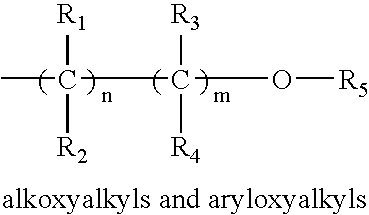
wherein each of R1-R4 is the same as or different from one another, with each being independently selected from among hydrogen, C1-C6 alkyl, and C6-C10 aryl; R5 is selected from among C1-C6 alkyl, and C6-C10 aryl; and n and m are selected independently from 0 to 4, with the proviso that m and n cannot be 0 at the same time.
| TABLE 3 |
| Synthetic Route for Formula A and A′ Copper Precursors |
 |
wherein L is selected from among phosphines, tertiary phosphines, ethers, polyethers, amines, alkylamines, polyamines, glymes, crown ethers, crown thioethers, cyclic polyamines (cyclenes), thioglymes, C2-C6 alkynes, azoles, imidazoles, C2-C6 alkenes, pyridines, bipyridines, isonitriles, carbenes and hetero-carbenes, and wherein such synthesis may be carried out with the cyclopentadienyl substituents instead of being all methyl are each independently selected from among hydrogen, C1-C6 alkyl, C1-C6 alkenyl, C6-C10 aryl, C1-C6 alkoxy, C3-C6 alkylsilyl, C1-C6 amino, hydrazino of the formula RaRbNNRc— wherein each of Ra, Rb and Rc may be the same as or different from one another and each is independently selected from among C1-C6 alkyl, and pendant ligands including functional group(s) providing further coordination to the metal center, such as, for example, aminoalkyl, alkoxyalkyl, aryloxyalkyl, imidoalkyl, and acetylalkyl, wherein suitable groups in these classes include those of the following formulae:

wherein each of R1-R4 is the same as or different from one another, with each being independently selected from among hydrogen and C1-C6 straight chain or branched alkyl, C1-C6 straight chain or branched alkoxy, C6-C10 aryl and NR5R6; each of R5 and R6 is the same as or different from the other, with each being independently selected from among C1-C6 straight chain or branched alkyl and C6-C10 aryl; n and m are each selected independently from 0 to 4 with the proviso that m and n cannot be 0 at the same time, and x is selected from 1 to 5;

wherein each of R1-R4 is the same as or different from one another, with each being independently selected from among hydrogen, C1-C6 alkyl, and C6-C10 aryl; R5 is selected from among C1-C6 alkyl, and C6-C10 aryl; and n and m are selected independently from 0 to 4, with the proviso that m and n cannot be 0 at the same time.

wherein each of R1, R2, R3, R4 and R5 may be the same as or different from the others, and each is independently selected from among hydrogen, halogengen, C1-C6 alkyl, C1-C6 alkoxy and cyanide (—CN), and L is selected from among phosphines, tertiary phosphines, ethers, polyethers, amines, alkylamines, polyamines, glymes, crown ethers, crown thioethers, cyclic polyamines (cyclenes), thioglymes, C2-C6 alkynes, azoles, imidazoles, C2-C6 alkenes, pyridines, bipyridines, isonitriles, carbenes and hetero-carbenes.

wherein each L is independently selected from the group consisting of phosphines, tertiary phosphines, ethers, polyethers, amines, alkylamines, polyamines, glymes, crown ethers, crown thioethers, cyclic polyamines (cyclenes), thioglymes, C2-C6 alkynes, azoles, imidazoles, C2-C6 alkenes, pyridines, bipyridines, isonitriles, carbenes and hetero-carbenes, and n is an integer having a value of from 0 to 2 inclusive.

wherein each L is independently selected from the group consisting of phosphines, tertiary phosphines, ethers, polyethers, amines, alkylamines, polyamines, glymes, crown ethers, crown thioethers, cyclic polyamines (cyclenes), thioglymes, C2-C6 alkynes, azoles, imidazoles, C2-C6 alkenes, pyridines, bipyridines, isonitriles, carbenes and hetero-carbenes, and n is an integer having a value of from 0 to 2 inclusive.
Claims (14)


Priority Applications (1)
| Application Number | Priority Date | Filing Date | Title |
|---|---|---|---|
| US12/058,751 US7964746B2 (en) | 2007-03-30 | 2008-03-30 | Copper precursors for CVD/ALD/digital CVD of copper metal films |
Applications Claiming Priority (2)
| Application Number | Priority Date | Filing Date | Title |
|---|---|---|---|
| US90899807P | 2007-03-30 | 2007-03-30 | |
| US12/058,751 US7964746B2 (en) | 2007-03-30 | 2008-03-30 | Copper precursors for CVD/ALD/digital CVD of copper metal films |
Publications (2)
| Publication Number | Publication Date |
|---|---|
| US20080242880A1 US20080242880A1 (en) | 2008-10-02 |
| US7964746B2 true US7964746B2 (en) | 2011-06-21 |
Family
ID=39795539
Family Applications (1)
| Application Number | Title | Priority Date | Filing Date |
|---|---|---|---|
| US12/058,751 Active 2029-04-19 US7964746B2 (en) | 2007-03-30 | 2008-03-30 | Copper precursors for CVD/ALD/digital CVD of copper metal films |
Country Status (1)
| Country | Link |
|---|---|
| US (1) | US7964746B2 (en) |
Cited By (1)
| Publication number | Priority date | Publication date | Assignee | Title |
|---|---|---|---|---|
| US9496491B2 (en) | 2012-05-21 | 2016-11-15 | Micron Technology, Inc. | Methods of forming a metal chalcogenide material and related methods of forming a memory cell |
Families Citing this family (4)
| Publication number | Priority date | Publication date | Assignee | Title |
|---|---|---|---|---|
| US20100200991A1 (en) * | 2007-03-15 | 2010-08-12 | Rohan Akolkar | Dopant Enhanced Interconnect |
| WO2011006035A2 (en) | 2009-07-10 | 2011-01-13 | L'air Liquide Societe Anonyme Pour L'etude Et L'exploitation Des Procedes Georges Claude | Bis-ketoiminate copper precursors for deposition of copper-containing films |
| US8703103B2 (en) | 2010-02-05 | 2014-04-22 | Air Products And Chemicals, Inc. | Volatile imidazoles and group 2 imidazole based metal precursors |
| US8692010B1 (en) | 2012-07-13 | 2014-04-08 | American Air Liquide, Inc. | Synthesis method for copper compounds |
Citations (8)
| Publication number | Priority date | Publication date | Assignee | Title |
|---|---|---|---|---|
| SU768457A1 (en) * | 1976-01-04 | 1980-10-07 | Всесоюзный научно-исследовательский и проектно-конструкторский институт добычи угля гидравлическим способом | Catalyst for removing nitrogen oxides from exhaust gases |
| US4927670A (en) * | 1988-06-22 | 1990-05-22 | Georgia Tech Research Corporation | Chemical vapor deposition of mixed metal oxide coatings |
| US4948623A (en) * | 1987-06-30 | 1990-08-14 | International Business Machines Corporation | Method of chemical vapor deposition of copper, silver, and gold using a cyclopentadienyl/metal complex |
| US6086779A (en) | 1999-03-01 | 2000-07-11 | Mcgean-Rohco, Inc. | Copper etching compositions and method for etching copper |
| US6269979B1 (en) | 1999-10-05 | 2001-08-07 | Charles Dumont | Multi-compartmented mixing dispenser |
| US20040215030A1 (en) | 2003-04-22 | 2004-10-28 | Norman John Anthony Thomas | Precursors for metal containing films |
| US20050283012A1 (en) | 2004-06-16 | 2005-12-22 | Chongying Xu | Copper (I) compounds useful as deposition precursors of copper thin films |
| US20060141155A1 (en) | 2002-11-15 | 2006-06-29 | Havard University | Atomic layer deposition using metal amidinates |
-
2008
- 2008-03-30 US US12/058,751 patent/US7964746B2/en active Active
Patent Citations (8)
| Publication number | Priority date | Publication date | Assignee | Title |
|---|---|---|---|---|
| SU768457A1 (en) * | 1976-01-04 | 1980-10-07 | Всесоюзный научно-исследовательский и проектно-конструкторский институт добычи угля гидравлическим способом | Catalyst for removing nitrogen oxides from exhaust gases |
| US4948623A (en) * | 1987-06-30 | 1990-08-14 | International Business Machines Corporation | Method of chemical vapor deposition of copper, silver, and gold using a cyclopentadienyl/metal complex |
| US4927670A (en) * | 1988-06-22 | 1990-05-22 | Georgia Tech Research Corporation | Chemical vapor deposition of mixed metal oxide coatings |
| US6086779A (en) | 1999-03-01 | 2000-07-11 | Mcgean-Rohco, Inc. | Copper etching compositions and method for etching copper |
| US6269979B1 (en) | 1999-10-05 | 2001-08-07 | Charles Dumont | Multi-compartmented mixing dispenser |
| US20060141155A1 (en) | 2002-11-15 | 2006-06-29 | Havard University | Atomic layer deposition using metal amidinates |
| US20040215030A1 (en) | 2003-04-22 | 2004-10-28 | Norman John Anthony Thomas | Precursors for metal containing films |
| US20050283012A1 (en) | 2004-06-16 | 2005-12-22 | Chongying Xu | Copper (I) compounds useful as deposition precursors of copper thin films |
Non-Patent Citations (6)
| Title |
|---|
| Anderson et al., Organometallics, vol. 17, No. 22, pp. 4917-4920 (1998). * |
| Artaud-Gillet et al., Journal of Crystal Growth, vol. 248, pp. 163-168 (2003). * |
| Li, Wentao, et al., "Additives for stabilizing LiPF6-based electrolyes against thermal decomposition", "J. Electrochem. Soc.", 2005, pp. A1361-A1365, vol. 152, No. 7. |
| Macomber et al., Journal of American Chemical Society, vol. 105, No. 16, pp. 5325-5329 (1983). * |
| Oakley, Sarah H., et al., "Structural consequences of the prohibition of hydrogen bonding in copper-guanidine systems", "Inorg. Chem.", 2004, pp. 5168-5172, vol. 43, No. 16. |
| Ren et al., Journal of Organometallic chemistry, vol. 691, pp. 4109-4113 (available in the Web Jun. 21, 2006). * |
Cited By (3)
| Publication number | Priority date | Publication date | Assignee | Title |
|---|---|---|---|---|
| US9496491B2 (en) | 2012-05-21 | 2016-11-15 | Micron Technology, Inc. | Methods of forming a metal chalcogenide material and related methods of forming a memory cell |
| US10374156B2 (en) | 2012-05-21 | 2019-08-06 | Micron Technology, Inc. | Memory cells including a metal chalcogenide material and related methods |
| US11538991B2 (en) | 2012-05-21 | 2022-12-27 | Micron Technology, Inc. | Methods of forming a memory cell comprising a metal chalcogenide material |
Also Published As
| Publication number | Publication date |
|---|---|
| US20080242880A1 (en) | 2008-10-02 |
Similar Documents
| Publication | Publication Date | Title |
|---|---|---|
| US7371880B2 (en) | Copper (I) compounds useful as deposition precursors of copper thin films | |
| US7750173B2 (en) | Tantalum amido-complexes with chelate ligands useful for CVD and ALD of TaN and Ta205 thin films | |
| US7709384B2 (en) | Tantalum amide complexes for depositing tantalum-containing films, and method of making same | |
| TWI894397B (en) | Lanthanide and lanthanide-like transition metal complexes | |
| US6337148B1 (en) | Copper source reagent compositions, and method of making and using same for microelectronic device structures | |
| JP2022070966A (en) | Metal complex containing cyclopentadienyl ligand | |
| KR101841444B1 (en) | Group 5 metal compounds, preparing methods thereof, precursor compositions including the same for film deposition, and depositing methods of film using the same | |
| US7964746B2 (en) | Copper precursors for CVD/ALD/digital CVD of copper metal films | |
| US20020091268A1 (en) | Pyrazolate copper complexes, and MOCVD of copper using same | |
| US6589329B1 (en) | Composition and process for production of copper circuitry in microelectronic device structures | |
| US20090162550A1 (en) | Copper (i) amidinates and guanidinates, mixed ligand copper complexes, and compositions for chemical vapor deposition, atomic layer deposition, and rapid vapor deposition of copper | |
| TW202432564A (en) | Intramolecular stabilized metal complexes with improved thermal stability for vapor phase thin-film deposition techniques | |
| TW201506193A (en) | Preparation of lanthanide-containing precursors and deposition of lanthanide-containing films |
Legal Events
| Date | Code | Title | Description |
|---|---|---|---|
| AS | Assignment |
Owner name: ADVANCED TECHNOLOGY MATERIALS, INC., CONNECTICUT Free format text: ASSIGNMENT OF ASSIGNORS INTEREST;ASSIGNORS:CHEN, TIANNIU;XU, CHONGYING;BAUM, THOMAS H.;AND OTHERS;REEL/FRAME:021011/0237;SIGNING DATES FROM 20080405 TO 20080520 Owner name: ADVANCED TECHNOLOGY MATERIALS, INC., CONNECTICUT Free format text: ASSIGNMENT OF ASSIGNORS INTEREST;ASSIGNORS:CHEN, TIANNIU;XU, CHONGYING;BAUM, THOMAS H.;AND OTHERS;SIGNING DATES FROM 20080405 TO 20080520;REEL/FRAME:021011/0237 |
|
| FEPP | Fee payment procedure |
Free format text: PAYOR NUMBER ASSIGNED (ORIGINAL EVENT CODE: ASPN); ENTITY STATUS OF PATENT OWNER: LARGE ENTITY |
|
| STCF | Information on status: patent grant |
Free format text: PATENTED CASE |
|
| CC | Certificate of correction | ||
| AS | Assignment |
Owner name: GOLDMAN SACHS BANK USA, AS COLLATERAL AGENT, NEW YORK Free format text: SECURITY INTEREST;ASSIGNORS:ENTEGRIS, INC.;POCO GRAPHITE, INC.;ATMI, INC.;AND OTHERS;REEL/FRAME:032815/0852 Effective date: 20140430 Owner name: GOLDMAN SACHS BANK USA, AS COLLATERAL AGENT, NEW Y Free format text: SECURITY INTEREST;ASSIGNORS:ENTEGRIS, INC.;POCO GRAPHITE, INC.;ATMI, INC.;AND OTHERS;REEL/FRAME:032815/0852 Effective date: 20140430 |
|
| AS | Assignment |
Owner name: GOLDMAN SACHS BANK USA, AS COLLATERAL AGENT, NEW YORK Free format text: SECURITY INTEREST;ASSIGNORS:ENTEGRIS, INC.;POCO GRAPHITE, INC.;ATMI, INC.;AND OTHERS;REEL/FRAME:032812/0192 Effective date: 20140430 Owner name: GOLDMAN SACHS BANK USA, AS COLLATERAL AGENT, NEW Y Free format text: SECURITY INTEREST;ASSIGNORS:ENTEGRIS, INC.;POCO GRAPHITE, INC.;ATMI, INC.;AND OTHERS;REEL/FRAME:032812/0192 Effective date: 20140430 |
|
| FPAY | Fee payment |
Year of fee payment: 4 |
|
| AS | Assignment |
Owner name: ENTEGRIS, INC., MASSACHUSETTS Free format text: ASSIGNMENT OF ASSIGNORS INTEREST;ASSIGNOR:ADVANCED TECHNOLOGY MATERIALS, INC.;REEL/FRAME:034894/0025 Effective date: 20150204 |
|
| AS | Assignment |
Owner name: ADVANCED TECHNOLOGY MATERIALS, INC., CONNECTICUT Free format text: RELEASE BY SECURED PARTY;ASSIGNOR:GOLDMAN SACHS BANK USA, AS COLLATERAL AGENT;REEL/FRAME:047477/0032 Effective date: 20181106 Owner name: ATMI PACKAGING, INC., CONNECTICUT Free format text: RELEASE BY SECURED PARTY;ASSIGNOR:GOLDMAN SACHS BANK USA, AS COLLATERAL AGENT;REEL/FRAME:047477/0032 Effective date: 20181106 Owner name: POCO GRAPHITE, INC., MASSACHUSETTS Free format text: RELEASE BY SECURED PARTY;ASSIGNOR:GOLDMAN SACHS BANK USA, AS COLLATERAL AGENT;REEL/FRAME:047477/0032 Effective date: 20181106 Owner name: ENTEGRIS, INC., MASSACHUSETTS Free format text: RELEASE BY SECURED PARTY;ASSIGNOR:GOLDMAN SACHS BANK USA, AS COLLATERAL AGENT;REEL/FRAME:047477/0032 Effective date: 20181106 Owner name: ATMI, INC., CONNECTICUT Free format text: RELEASE BY SECURED PARTY;ASSIGNOR:GOLDMAN SACHS BANK USA, AS COLLATERAL AGENT;REEL/FRAME:047477/0032 Effective date: 20181106 Owner name: POCO GRAPHITE, INC., MASSACHUSETTS Free format text: RELEASE BY SECURED PARTY;ASSIGNOR:GOLDMAN SACHS BANK USA, AS COLLATERAL AGENT;REEL/FRAME:047477/0151 Effective date: 20181106 Owner name: ADVANCED TECHNOLOGY MATERIALS, INC., CONNECTICUT Free format text: RELEASE BY SECURED PARTY;ASSIGNOR:GOLDMAN SACHS BANK USA, AS COLLATERAL AGENT;REEL/FRAME:047477/0151 Effective date: 20181106 Owner name: ATMI PACKAGING, INC., CONNECTICUT Free format text: RELEASE BY SECURED PARTY;ASSIGNOR:GOLDMAN SACHS BANK USA, AS COLLATERAL AGENT;REEL/FRAME:047477/0151 Effective date: 20181106 Owner name: ATMI, INC., CONNECTICUT Free format text: RELEASE BY SECURED PARTY;ASSIGNOR:GOLDMAN SACHS BANK USA, AS COLLATERAL AGENT;REEL/FRAME:047477/0151 Effective date: 20181106 Owner name: ENTEGRIS, INC., MASSACHUSETTS Free format text: RELEASE BY SECURED PARTY;ASSIGNOR:GOLDMAN SACHS BANK USA, AS COLLATERAL AGENT;REEL/FRAME:047477/0151 Effective date: 20181106 |
|
| AS | Assignment |
Owner name: GOLDMAN SACHS BANK USA, NEW YORK Free format text: SECURITY INTEREST;ASSIGNORS:ENTEGRIS, INC.;SAES PURE GAS, INC.;REEL/FRAME:048811/0679 Effective date: 20181106 |
|
| MAFP | Maintenance fee payment |
Free format text: PAYMENT OF MAINTENANCE FEE, 8TH YEAR, LARGE ENTITY (ORIGINAL EVENT CODE: M1552); ENTITY STATUS OF PATENT OWNER: LARGE ENTITY Year of fee payment: 8 |
|
| AS | Assignment |
Owner name: MORGAN STANLEY SENIOR FUNDING, INC., MARYLAND Free format text: ASSIGNMENT OF PATENT SECURITY INTEREST RECORDED AT REEL/FRAME 048811/0679;ASSIGNOR:GOLDMAN SACHS BANK USA;REEL/FRAME:050965/0035 Effective date: 20191031 |
|
| AS | Assignment |
Owner name: TRUIST BANK, AS NOTES COLLATERAL AGENT, NORTH CAROLINA Free format text: SECURITY INTEREST;ASSIGNORS:ENTEGRIS, INC.;ENTEGRIS GP, INC.;POCO GRAPHITE, INC.;AND OTHERS;REEL/FRAME:060613/0072 Effective date: 20220706 |
|
| MAFP | Maintenance fee payment |
Free format text: PAYMENT OF MAINTENANCE FEE, 12TH YEAR, LARGE ENTITY (ORIGINAL EVENT CODE: M1553); ENTITY STATUS OF PATENT OWNER: LARGE ENTITY Year of fee payment: 12 |