US7961002B2 - Method and apparatus for matching an impedance of a driver to an impedance of a transmission line - Google Patents
Method and apparatus for matching an impedance of a driver to an impedance of a transmission line Download PDFInfo
- Publication number
- US7961002B2 US7961002B2 US12/788,563 US78856310A US7961002B2 US 7961002 B2 US7961002 B2 US 7961002B2 US 78856310 A US78856310 A US 78856310A US 7961002 B2 US7961002 B2 US 7961002B2
- Authority
- US
- United States
- Prior art keywords
- driver
- impedance
- transmission line
- reflection
- pulse
- Prior art date
- Legal status (The legal status is an assumption and is not a legal conclusion. Google has not performed a legal analysis and makes no representation as to the accuracy of the status listed.)
- Expired - Fee Related
Links
Images




Classifications
-
- H—ELECTRICITY
- H04—ELECTRIC COMMUNICATION TECHNIQUE
- H04L—TRANSMISSION OF DIGITAL INFORMATION, e.g. TELEGRAPHIC COMMUNICATION
- H04L25/00—Baseband systems
- H04L25/02—Details ; arrangements for supplying electrical power along data transmission lines
- H04L25/0264—Arrangements for coupling to transmission lines
- H04L25/0278—Arrangements for impedance matching
Definitions
- the present invention is directed to a method, apparatus, and system for adjusting the impedance matching between a driver and a transmission line and, more specifically, for correcting an impedance mismatch between the driver and the transmission line.
- Impedance occurs when there is opposition between a source that transmits an electric pulse and a receiver of that electric pulse.
- Impedance is a combination of two components, resistance and reactance. Resistance is generally in phase with the source signal and is represented by the real component of the impedance. Reactance refers to the out-of-phase portion of the impedance and is represented by the imaginary component of the impedance.
- impedance mismatch may occur between the driver and the receiver as well as between the driver and the transmission line.
- the impedance of the driver can be matched to the impedance of the transmission line by adjusting the voltage-to-current (voltage/current) characteristics of the driver. Efforts to accomplish this impedance matching are tedious and may not be accurate because of the introduction of parasitics into the driver circuit during adjustments. Furthermore, the output impedance of a driver is typically adjusted once and then set. The driver output impedance, then, is insensitive to changes in the impedance of the transmission line.
- a method and apparatus for matching the output impedance of a driver to the impedance of a transmission line is presented.
- a method for matching the impedance between a driver and a transmission line, wherein the transmission line is between the driver and a load can include transmitting a first pulse from the driver to the load through the transmission line, wherein a first reflection from the transmitted first pulse occurs after a first time, measuring a second reflection from the transmitted first pulse after a second time, and adjusting the calibration of the driver in response to the measured second reflection.
- a method for adjusting the output impedance of a driver to the impedance of a transmission line coupled to the driver and a load can include establishing a range of voltages corresponding to a settling voltage, transmitting a first pulse from the driver to the load through the transmission line, wherein a first reflection from the transmitted first pulse occurs after a first time, measuring a second reflection from the transmitted first pulse by determining the time after a first time that a voltage of the second reflection lies outside the range of voltages, and adjusting the calibration of the driver in response to the measured second reflection.
- An apparatus for matching impedance between a driver and a transmission line can include a writer circuit, the writer circuit including, a first switch coupled to charge a capacitor when a voltage is outside a range of voltages, and a second switch coupled to allow current through the first switch after a first time, and an impedance matching circuit receiving a voltage across the capacitor of the writer circuit, the impedance matching circuit adjusting an output impedance of the driver in response to the voltage across the capacitor.
- FIG. 1A illustrates diagram of a circuit used for impedance matching.
- FIG. 1B illustrates a circuit used for impedance matching.
- FIG. 2 illustrates a circuit used for impedance matching.
- FIG. 3 shows a graph depicting the current between output nodes of the circuit shown in FIG. 1A , 1 B, or 2 as a pulse is being driven through the transmission line.
- FIG. 4 shows a graph depicting the voltage across the node as a function of time under the conditions illustrated in FIG. 3 .
- FIG. 5 shows a graph depicting the current through the transmission line as a function of time for a sent pulse.
- FIG. 6 shows a graph depicting the voltage as a function of time for a sent pulse as described in FIG. 5 .
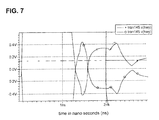
- FIG. 7 shows an enlargement of the graph shown in FIG. 6 .
- FIG. 8 illustrates a system for impedance matching according to some embodiments of the present invention.
- FIG. 9 illustrates a circuit diagram for an impedance matching circuit according to some embodiments of the present invention.
- FIG. 10 shows a flow chart illustrating a method of impedance matching according to some embodiments of the present invention.
- FIG. 11 shows a flow chart illustrating a method of impedance matching according to some embodiments of the present invention.
- FIG. 12 shows a flow chart illustrating a method of impedance matching according to some embodiments of the present invention.
- FIG. 1A illustrates a circuit for impedance matching between a driver and a load.
- a transistor 120 is coupled in series with a current source 110 between rails 100 and 101 .
- Current source 110 may be used to bias transistor 120 .
- a transistor 122 is coupled in series with a current source between rails 100 and 101 .
- the base of transistors 120 and 122 are coupled to one or more internal driver circuits.
- Rail 100 may, for example, be a power supply voltage while rail 101 may, for example, be a ground.
- Fixed resistor 130 is coupled between output node 150 and the junction between transistor 120 and current source 110 .
- resistor 140 is coupled between output node 160 and the junction between transistor 122 and current source 112 .
- Current source 112 may be used to bias transistor 122 .
- An output signal pulse is sent through nodes 150 and 160 .
- Fixed resistors 130 and 140 are used to match the impedance of the driver coupled to nodes 150 and 160 with a load coupled between nodes 150 (OUTL) and 160 (OUTR).
- FIG. 1B illustrates another circuit that can be utilized for impedance matching.
- the circuit in FIG. 1B is similar to the circuit shown in FIG. 1A except that an inductor 170 is also coupled between nodes 150 and 160 .
- Both inductor 170 and transmission line 180 are loads, which current may drive. Current may be from current source 110 or 112 .
- FIG. 2 illustrates another circuit that can be utilized for impedance matching.
- the circuit illustrated in FIG. 2 includes transistors 120 and 122 coupled in series with current source 210 and 212 , respectively, between nodes 100 and 101 .
- Node 150 is coupled to the junction between transistor 120 and current source 210 .
- Node 160 is coupled to the junction between transistor 122 and current source 212 .
- the gates of transistors 120 and 122 are coupled to voltages V b1 and V b2 , respectively.
- Transistors 120 and 122 then, provide resistances that are dependant on the voltages V b1 and V b2 , respectively, in order to match the impedance to transmission line 180 coupled between nodes 150 and 160 .
- the strength of the first reflection typically indicates the degree of impedance mismatch between the driver and inductor 170 .
- the second reflection typically indicates the degree of impedance mismatch between the driver and the transmission line coupled between nodes 150 and 160 .
- the strength of the reflected pulse can be utilized to adjust the voltage values V b1 and V b2 .
- the strength of the reflected pulse can be utilized to adjust the resistance of resistors 130 and 140 and the inductance of inductor 170 .
- FIG. 3 shows a graph of the current through inductor 170 shown in FIG. 1B as a function of time for a sent pulse.
- the impedances of the driver and transmission line in this example are matched, as can be seen by the flat, straight portion of the line occurring after the main peak, which settles after about 1.6 ns in this figure. In the event of an impedance mismatch, a reflection of the portion of the pulse would be reflected from the transmission line.
- FIG. 4 shows the voltage between nodes 150 and 160 as a function of time for the same pulse depicted in FIG. 3 .
- the range of voltages (0.1V to ⁇ 0.1V) between the two straight lines occurring between 1.8 ns and 3 ns represents the settling voltage.
- FIGS. 3 and 4 depict the circumstance when there is substantially no impedance mismatch between the driver and the transmission line, which is attached between inductor 170 and nodes 150 and 160 .
- FIGS. 5 and 6 illustrate the situation where there is an impedance mismatch between the driver and transmission line.
- FIG. 5 is a graph depicting the current between nodes 150 and 160 as a function of time for a sent pulse. The pulse sent in the graph is between the driver and transmission line.
- the impedance mismatch results in a reflection pulse at around 2 ns, between about 1.8 ns and about 3 ns.
- FIG. 6 illustrates the voltage as a function of time for the same pulse depicted in FIG. 5 .
- the range of voltages between the two vertical irregular lines occurring between about 1.6 ns and 3 ns may represent disturbance caused by an impedance mismatch between the driver and transmission line.
- FIG. 7 shows an expanded version of FIG. 6 in order to better illustrate the reflective components of the voltage that occurs between about 1.6 ns and about 3 ns in FIG. 7 .
- the settling voltage which is between about ⁇ 0.1 and 0.1 V in FIG. 4 , is well below the actual voltage in this graph, which in the same time frame ranges to about ⁇ 0.4 V.
- This voltage represents the power reflected from transmission line 180 as a result of the impedance mismatch between driver and the transmission line.
- the voltages and timings provided are exemplary only and are not intended to be limiting. Any voltage and timing range can be experienced in various impedance matching situations. Impedance matching circuits according to the present invention can be utilized in any of these impedance matching situations.
- FIG. 8 shows a block diagram of a driver system 810 according to some embodiments of the present invention.
- System 810 may include a driver 820 and a writer 830 .
- Driver 820 may be any device that couples signal pulses into a load such as load 850 .
- Load 850 may be any type of electrical load (e.g., a receiver chip or any other circuit) and can have any impedance characteristics.
- driver 820 couples the signal pulse into a writer 830 .
- Writer 830 adaptively matches the output impedance of system 810 to that of transmission line 180 so as to minimize the power reflected from transmission line 180 .
- load 850 may include any receiver devices for the signal pulse.
- FIG. 9 illustrates a sensing circuit 900 that can be included in writer 830 according to some embodiments of the present invention.
- a resistor 920 and capacitor 930 are coupled in parallel between a power voltage input 1030 AVDD and an output pin 940 YOUT.
- Resistor 920 functions to discharge capacitor 930 so that the voltage at output pin 940 YOUT is the power voltage on power voltage input 1030 , Vdd.
- the voltage at output pin 940 YOUT will be decreased from Vdd by supplying current to capacitor 930 .
- Switches 932 and 934 are arranged so that before a certain time they pull current from resistors 922 and 924 , respectively, and after a certain time they pull current from switches 926 and 928 , respectively.
- the timing is dependent on input signals VACTP at pin 970 and VACTN at pin 980 .
- signals VACTN and VACTP can be arranged so that, for example, prior to 1.8 ns current is drawn from resistors 922 and 924 and from 1.8 ns to about 3.0 ns current is drawn from switches 926 and 928 .
- Input signals NPNR on pin 990 and AVEE on pin 1000 help to bias the amount of current pulled through switches 932 and 934 .
- switches 926 and 928 When activated by switches 932 and 934 , switches 926 and 928 selectively provide current to capacitor 930 . As illustrated in FIG. 9 , if the voltage OUTR at pin 960 is between OUTN and OUTP, then current is drawn through switches 926 and 928 through source AVCD. OUTR at pin 960 is analogous to node 150 and/or 160 , as shown in FIGS. 1 and 2 . However, if voltage OUTR is higher than OUTP switch 928 provides current from capacitor 930 and if voltage OUTR is lower than OUTN switch 926 provides current from capacitor 930 .
- Capacitor 930 then, integrates the current provided in the time during which the voltage reflected back into writer 830 is above or below threshold voltages OUTP and OUTN during a time later than t, which can be about 1.8 ns from the signal pulse transmission.
- the base voltage at transistor 120 and/or 122 may then be adjusted to match the impedance.
- FIG. 10 shows a flow chart of a method, consistent with some embodiments of the present invention, for performing impedance matching to a transmission line.
- a first pulse may be transmitted from driver 810 to load 850 through transmission line 180 .
- a portion of the first pulse may be reflected as a first reflection from load 850 back into transmission line 18 A 0 .
- This reflection may be caused by an impedance mismatch between driver 810 and load 850 .
- a second reflection, if any, from the first pulse may be measured in writer 830 . The second reflection may be caused by impedance mismatch between driver 810 and transmission line 180 .
- Writer 830 can then adjust the calibration of driver 810 in response to the measured second reflection of the first pulse (step 1030 ). Such adjustments to the calibration of driver 810 may include adjusting the voltage and/or current of driver's 810 outputs. Adjustments of the calibration of driver 810 may be done automatically. Writer 830 may be located in driver 810 . A second pulse may then be transmitted from the adjusted driver 810 to load 850 (step 1040 ).
- FIG. 11 illustrates a flow chart of a method, consistent with embodiments of the present invention.
- a preferred voltage for a first pulse transmitted from driver 810 to load 820 may be established (step 1110 ).
- the preferred voltage may be a range of voltages.
- a first pulse may then be transmitted from driver 810 to load 820 through transmission line 180 (step 1120 ).
- the voltage of the first pulse may be measured. (step 1130 ).
- the difference between the preferred voltage and the voltage of the first pulse may be measured (step 1140 ).
- the calibration of driver 810 may be adjusted based on the measured difference between the preferred voltage and the voltage of the first pulse (step 1150 ). Adjustments of the calibration of driver 810 may be done automatically.
- a second pulse may then be sent by adjusted driver 810 to load 820 through transmission line 180 (step 1160 ).
- a timer may be used to measure a length of time that the voltage of the first pulse is above or below the preferred voltage for the pulse.
- the timer may include nodes 970 and 980 and switches 932 and 934 , as shown in FIG. 9 .
- the calibration of driver 810 may then be adjusted based on the measured length of time the voltage of the first pulse is above or below the trigger voltages for the first pulse.
- FIG. 12 is a flow chart showing a method, consistent with embodiments of the present invention.
- a first pulse may be transmitted from driver 810 to load 820 in a circuit containing at least first node 950 , second node 960 and capacitor 930 (step 1210 ).
- the voltage of the first pulse may be measured at first node 950 and at second node 960 (step 1220 and 1230 ).
- the voltage at second node 960 may correspond to the preferred voltage for the first pulse.
- the voltages of the first pulse at first node 950 and second node 960 are then compared (step 1240 ) and capacitor 930 may be charged when the voltage at first node 950 is greater than the voltage at second node 960 (step 1250 ).
- the calibration of the driver may then be adjusted in response to the voltage across the charged capacitor (step 1260 ). Adjustments of the calibration of the driver may be done automatically.
- a second pulse may then be transmitted (step 1270 ).
- a timer may be used to measure an interval after the transmission of the first pulse. This interval may begin when the first pulse is transmitted and its duration may be, for example, 2 ns. Resistor 920 may be set to stop the flow of current through the circuit for the measured interval of time.
Landscapes
- Engineering & Computer Science (AREA)
- Power Engineering (AREA)
- Computer Networks & Wireless Communication (AREA)
- Signal Processing (AREA)
- Dc Digital Transmission (AREA)
- Logic Circuits (AREA)
Abstract
Description
Claims (12)
Priority Applications (1)
| Application Number | Priority Date | Filing Date | Title |
|---|---|---|---|
| US12/788,563 US7961002B2 (en) | 2006-11-03 | 2010-05-27 | Method and apparatus for matching an impedance of a driver to an impedance of a transmission line |
Applications Claiming Priority (3)
| Application Number | Priority Date | Filing Date | Title |
|---|---|---|---|
| US86428106P | 2006-11-03 | 2006-11-03 | |
| US11/935,061 US7728618B1 (en) | 2006-11-03 | 2007-11-05 | Self-calibrating writer |
| US12/788,563 US7961002B2 (en) | 2006-11-03 | 2010-05-27 | Method and apparatus for matching an impedance of a driver to an impedance of a transmission line |
Related Parent Applications (1)
| Application Number | Title | Priority Date | Filing Date |
|---|---|---|---|
| US11/935,061 Continuation US7728618B1 (en) | 2006-11-03 | 2007-11-05 | Self-calibrating writer |
Publications (2)
| Publication Number | Publication Date |
|---|---|
| US20100277200A1 US20100277200A1 (en) | 2010-11-04 |
| US7961002B2 true US7961002B2 (en) | 2011-06-14 |
Family
ID=42200192
Family Applications (2)
| Application Number | Title | Priority Date | Filing Date |
|---|---|---|---|
| US11/935,061 Expired - Fee Related US7728618B1 (en) | 2006-11-03 | 2007-11-05 | Self-calibrating writer |
| US12/788,563 Expired - Fee Related US7961002B2 (en) | 2006-11-03 | 2010-05-27 | Method and apparatus for matching an impedance of a driver to an impedance of a transmission line |
Family Applications Before (1)
| Application Number | Title | Priority Date | Filing Date |
|---|---|---|---|
| US11/935,061 Expired - Fee Related US7728618B1 (en) | 2006-11-03 | 2007-11-05 | Self-calibrating writer |
Country Status (1)
| Country | Link |
|---|---|
| US (2) | US7728618B1 (en) |
Citations (1)
| Publication number | Priority date | Publication date | Assignee | Title |
|---|---|---|---|---|
| US5455523A (en) * | 1992-06-17 | 1995-10-03 | Texas Instruments Incorporated | Method and apparatus for non-linear transmission line termination |
Family Cites Families (6)
| Publication number | Priority date | Publication date | Assignee | Title |
|---|---|---|---|---|
| JPH0983269A (en) * | 1995-09-20 | 1997-03-28 | Fujitsu Ltd | Bias circuit |
| JP3629346B2 (en) * | 1996-12-25 | 2005-03-16 | 株式会社アドバンテスト | Signal transmission system and transmission line drive circuit |
| US5955911A (en) * | 1997-10-06 | 1999-09-21 | Sun Microsystems, Inc. | On-chip differential resistance technique with noise immunity and symmetric resistance |
| CA2386851A1 (en) * | 2001-07-10 | 2003-01-10 | Robert J. Davies | Logarithmic amplifier |
| US6670821B2 (en) * | 2002-01-02 | 2003-12-30 | Broadcom Corporation | Methods and systems for sensing and compensating for process, voltage, temperature, and load variations |
| US6734702B1 (en) * | 2002-11-12 | 2004-05-11 | Texas Instruments Incorporated | Impedance calibration circuit |
-
2007
- 2007-11-05 US US11/935,061 patent/US7728618B1/en not_active Expired - Fee Related
-
2010
- 2010-05-27 US US12/788,563 patent/US7961002B2/en not_active Expired - Fee Related
Patent Citations (1)
| Publication number | Priority date | Publication date | Assignee | Title |
|---|---|---|---|---|
| US5455523A (en) * | 1992-06-17 | 1995-10-03 | Texas Instruments Incorporated | Method and apparatus for non-linear transmission line termination |
Also Published As
| Publication number | Publication date |
|---|---|
| US7728618B1 (en) | 2010-06-01 |
| US20100277200A1 (en) | 2010-11-04 |
Similar Documents
| Publication | Publication Date | Title |
|---|---|---|
| US6670821B2 (en) | Methods and systems for sensing and compensating for process, voltage, temperature, and load variations | |
| US6664821B2 (en) | Line driver with current source output and low sensitivity to load variations | |
| US6424169B1 (en) | Active termination network | |
| JP3629346B2 (en) | Signal transmission system and transmission line drive circuit | |
| US20040189343A1 (en) | Semiconductor devices with reference voltage generators and termination circuits configured to reduce termination mismatch | |
| US20100321069A1 (en) | Ac-coupled interface circuit | |
| US8229032B2 (en) | Signal receiver for receiving differential signal via transmission line | |
| US8415979B2 (en) | Differential driver with calibration circuit and related calibration method | |
| US20090009242A1 (en) | Line driver capable of automatically adjusting output impedance | |
| US20020118058A1 (en) | Device and method for correcting the baseline wandering of transmitting signals | |
| US7499676B2 (en) | Low voltage differential signaling transceiver | |
| US7961002B2 (en) | Method and apparatus for matching an impedance of a driver to an impedance of a transmission line | |
| US7499677B2 (en) | Low voltage differential signaling transceiver | |
| JPH10308655A (en) | Clock pule transmission circuit | |
| US5513218A (en) | Compensation for ground voltage variation on a communication bus | |
| US6414776B1 (en) | Infrared signal receiver with attenuating circuit | |
| US9166749B2 (en) | Serial data transmission system and method | |
| CN1691504B (en) | Impulse generation circuit | |
| JP3613206B2 (en) | Semiconductor IC output impedance matching method and matching method thereof | |
| US7239172B2 (en) | Impedance matching | |
| JPH10163896A (en) | Reception squelch circuit having pulse width detecting function | |
| WO2020218472A1 (en) | Hysteresis comparator and communication circuit | |
| CN1751299A (en) | Device for compensating ground offsets in data bus systems | |
| CN107409105B (en) | Receiving device and transceiver system including the same | |
| US5789943A (en) | V.35 network terminator |
Legal Events
| Date | Code | Title | Description |
|---|---|---|---|
| STCF | Information on status: patent grant |
Free format text: PATENTED CASE |
|
| FPAY | Fee payment |
Year of fee payment: 4 |
|
| MAFP | Maintenance fee payment |
Free format text: PAYMENT OF MAINTENANCE FEE, 8TH YEAR, LARGE ENTITY (ORIGINAL EVENT CODE: M1552); ENTITY STATUS OF PATENT OWNER: LARGE ENTITY Year of fee payment: 8 |
|
| AS | Assignment |
Owner name: CAVIUM INTERNATIONAL, CAYMAN ISLANDS Free format text: ASSIGNMENT OF ASSIGNORS INTEREST;ASSIGNOR:MARVELL INTERNATIONAL LTD.;REEL/FRAME:052918/0001 Effective date: 20191231 |
|
| AS | Assignment |
Owner name: MARVELL ASIA PTE, LTD., SINGAPORE Free format text: ASSIGNMENT OF ASSIGNORS INTEREST;ASSIGNOR:CAVIUM INTERNATIONAL;REEL/FRAME:053475/0001 Effective date: 20191231 |
|
| FEPP | Fee payment procedure |
Free format text: MAINTENANCE FEE REMINDER MAILED (ORIGINAL EVENT CODE: REM.); ENTITY STATUS OF PATENT OWNER: LARGE ENTITY |
|
| LAPS | Lapse for failure to pay maintenance fees |
Free format text: PATENT EXPIRED FOR FAILURE TO PAY MAINTENANCE FEES (ORIGINAL EVENT CODE: EXP.); ENTITY STATUS OF PATENT OWNER: LARGE ENTITY |
|
| STCH | Information on status: patent discontinuation |
Free format text: PATENT EXPIRED DUE TO NONPAYMENT OF MAINTENANCE FEES UNDER 37 CFR 1.362 |
|
| FP | Lapsed due to failure to pay maintenance fee |
Effective date: 20230614 |