US7910025B2 - Solution composition and polymer light-emitting device - Google Patents
Solution composition and polymer light-emitting device Download PDFInfo
- Publication number
- US7910025B2 US7910025B2 US11/575,755 US57575505A US7910025B2 US 7910025 B2 US7910025 B2 US 7910025B2 US 57575505 A US57575505 A US 57575505A US 7910025 B2 US7910025 B2 US 7910025B2
- Authority
- US
- United States
- Prior art keywords
- group
- polymer
- light
- solution composition
- layer
- Prior art date
- Legal status (The legal status is an assumption and is not a legal conclusion. Google has not performed a legal analysis and makes no representation as to the accuracy of the status listed.)
- Expired - Fee Related
Links
- 0 Cc1ccc(*(c2ccc([*+])cc2)c(cc2)ccc2N(c2ccc(C)cc2)c2ccc(*)cc2)cc1 Chemical compound Cc1ccc(*(c2ccc([*+])cc2)c(cc2)ccc2N(c2ccc(C)cc2)c2ccc(*)cc2)cc1 0.000 description 17
- NWSKGUMAYGXYBH-UHFFFAOYSA-N CC1=C(C)C2=C(C(C)=C1C)C([W])([W])C1=C2C(C)=C(C)C(C)=C1C Chemical compound CC1=C(C)C2=C(C(C)=C1C)C([W])([W])C1=C2C(C)=C(C)C(C)=C1C NWSKGUMAYGXYBH-UHFFFAOYSA-N 0.000 description 2
- PRMVIGAZBWOJAC-UHFFFAOYSA-N C.C.CCN([Ar]N([Ar])[Ar])[Ar]N([Ar])[Ar]C.[Ar].[Ar].[Ar].[Ar].[Ar].[Ar].[Ar].[Ar].[Ar].[Ar].[Ar].[Ar].[Ar].[Ar].[Ar].[Ar].[Ar].[Ar].[Ar].[Ar].[Ar] Chemical compound C.C.CCN([Ar]N([Ar])[Ar])[Ar]N([Ar])[Ar]C.[Ar].[Ar].[Ar].[Ar].[Ar].[Ar].[Ar].[Ar].[Ar].[Ar].[Ar].[Ar].[Ar].[Ar].[Ar].[Ar].[Ar].[Ar].[Ar].[Ar].[Ar] PRMVIGAZBWOJAC-UHFFFAOYSA-N 0.000 description 1
- YUWFEBAXEOLKSG-UHFFFAOYSA-N CC1=C(C)C(C)=C(C)C(C)=C1C Chemical compound CC1=C(C)C(C)=C(C)C(C)=C1C YUWFEBAXEOLKSG-UHFFFAOYSA-N 0.000 description 1
- DVQMHHZERIXHII-UHFFFAOYSA-N CC1=C(C)C(C)=C(C)C2=NON=C21.CC1=C(C)C(C)=C(C)C2=NSN=C21.CC1=C(c2ccc(C)c(C)c2)C2=NON=C2C(c2ccc(C)c(C)c2)=C1C.CC1=C(c2ccc(C)c(C)c2)C2=NSN=C2C(c2ccc(C)c(C)c2)=C1C.CC1=CC=C(C)C2=NON=C12.CC1=CC=C(C)C2=NSN=C12.CCCCCCCCC1=C(C)SC(C2=CC=C(C3=CC(CCCCCCCC)=C(C)S3)C3=NSN=C23)=C1.Cc1ccc(C2=CC=C(c3ccc(C)cc3)C3=NON=C23)cc1.Cc1ccc(C2=CC=C(c3ccc(C)cc3)C3=NSN=C23)cc1 Chemical compound CC1=C(C)C(C)=C(C)C2=NON=C21.CC1=C(C)C(C)=C(C)C2=NSN=C21.CC1=C(c2ccc(C)c(C)c2)C2=NON=C2C(c2ccc(C)c(C)c2)=C1C.CC1=C(c2ccc(C)c(C)c2)C2=NSN=C2C(c2ccc(C)c(C)c2)=C1C.CC1=CC=C(C)C2=NON=C12.CC1=CC=C(C)C2=NSN=C12.CCCCCCCCC1=C(C)SC(C2=CC=C(C3=CC(CCCCCCCC)=C(C)S3)C3=NSN=C23)=C1.Cc1ccc(C2=CC=C(c3ccc(C)cc3)C3=NON=C23)cc1.Cc1ccc(C2=CC=C(c3ccc(C)cc3)C3=NSN=C23)cc1 DVQMHHZERIXHII-UHFFFAOYSA-N 0.000 description 1
- OIJXIHLEJUQIMH-UHFFFAOYSA-N CC1=C(C)C(C)=C(C)O1.CC1=C(C)C(C)=C(C)O1.CC1=C(C)C(C)=C(C)S1.CC1=C(C)C(C)=C(C)S1.CC1=C(C)N(C)C(C)=C1C.CC1=C(C)N(C)C(C)=C1C.CC1=C(C)[Si](C)(C)C(C)=C1C.CC1=C(C)[Si](C)(C)C(C)=C1C Chemical compound CC1=C(C)C(C)=C(C)O1.CC1=C(C)C(C)=C(C)O1.CC1=C(C)C(C)=C(C)S1.CC1=C(C)C(C)=C(C)S1.CC1=C(C)N(C)C(C)=C1C.CC1=C(C)N(C)C(C)=C1C.CC1=C(C)[Si](C)(C)C(C)=C1C.CC1=C(C)[Si](C)(C)C(C)=C1C OIJXIHLEJUQIMH-UHFFFAOYSA-N 0.000 description 1
- GQDQDADMACNQRM-UHFFFAOYSA-N CC1=C(C)C(C)=C2C(C)=C(C)C(C)OC2=C1C.CC1=C(C)C(C)=C2C(C)=C(C)C(C)OC2=C1C.CC1=C(C)C(C)=C2C(C)=C(C)C(C)OC2=C1C.CC1=C(C)C(C)=C2C(C)=C(C)C(C)OC2=C1C.CC1=C(C)C(C)=C2C(C)=C(C)C(C)OC2=C1C.CC1=C(C)C(C)=C2C(C)=C(C)C(C)OC2=C1C.CC1=C(C)C(C)=C2C(C)=C(C)C(C)OC2=C1C.CC1=NC(C)=C(C)C2=C1C(C)=C(C)C(C)=C2C.CC1=NC(C)=C(C)C2=C1C(C)=C(C)C(C)=C2C.CC1=NC(C)=C(C)C2=C1C(C)=C(C)C(C)=C2C.CC1=NC(C)=C(C)C2=C1C(C)=C(C)C(C)=C2C.CC1=NC(C)=C(C)C2=C1C(C)=C(C)C(C)=C2C.CC1=NC(C)=C(C)C2=C1C(C)=C(C)C(C)=C2C.CC1=NC2=C(C(C)=C1C)C(C)=C(C)C(C)=C2C.CC1=NC2=C(C(C)=C1C)C(C)=C(C)C(C)=C2C.CC1=NC2=C(C(C)=C1C)C(C)=C(C)C(C)=C2C Chemical compound CC1=C(C)C(C)=C2C(C)=C(C)C(C)OC2=C1C.CC1=C(C)C(C)=C2C(C)=C(C)C(C)OC2=C1C.CC1=C(C)C(C)=C2C(C)=C(C)C(C)OC2=C1C.CC1=C(C)C(C)=C2C(C)=C(C)C(C)OC2=C1C.CC1=C(C)C(C)=C2C(C)=C(C)C(C)OC2=C1C.CC1=C(C)C(C)=C2C(C)=C(C)C(C)OC2=C1C.CC1=C(C)C(C)=C2C(C)=C(C)C(C)OC2=C1C.CC1=NC(C)=C(C)C2=C1C(C)=C(C)C(C)=C2C.CC1=NC(C)=C(C)C2=C1C(C)=C(C)C(C)=C2C.CC1=NC(C)=C(C)C2=C1C(C)=C(C)C(C)=C2C.CC1=NC(C)=C(C)C2=C1C(C)=C(C)C(C)=C2C.CC1=NC(C)=C(C)C2=C1C(C)=C(C)C(C)=C2C.CC1=NC(C)=C(C)C2=C1C(C)=C(C)C(C)=C2C.CC1=NC2=C(C(C)=C1C)C(C)=C(C)C(C)=C2C.CC1=NC2=C(C(C)=C1C)C(C)=C(C)C(C)=C2C.CC1=NC2=C(C(C)=C1C)C(C)=C(C)C(C)=C2C GQDQDADMACNQRM-UHFFFAOYSA-N 0.000 description 1
- RIXFIRMLNLCDHT-UHFFFAOYSA-N CC1=C(C)C2=C(C(C)=C1C)C(C)=C(C)C(C)=C2C Chemical compound CC1=C(C)C2=C(C(C)=C1C)C(C)=C(C)C(C)=C2C RIXFIRMLNLCDHT-UHFFFAOYSA-N 0.000 description 1
- PJPWHAXWJUGWMD-UHFFFAOYSA-N CC1=C(C)C2=C(C)C3=C(C(C)=C(C)C(C)=C3C)C(C)=C2C(C)=C1C Chemical compound CC1=C(C)C2=C(C)C3=C(C(C)=C(C)C(C)=C3C)C(C)=C2C(C)=C1C PJPWHAXWJUGWMD-UHFFFAOYSA-N 0.000 description 1
- ZYYCBQZWYXFVSZ-UHFFFAOYSA-N CC1=C(C)N(C)c2c(C)c(C)c(C)c(C)c21.CC1=C(C)N(C)c2c(C)c(C)c(C)c(C)c21.CC1=C(C)[Si](C)(C)c2c(C)c(C)c(C)c(C)c21.CC1=C(C)[Si](C)(C)c2c(C)c(C)c(C)c(C)c21.CC1=C(C)c2c(C)c(C)c(C)c(C)c2O1.CC1=C(C)c2c(C)c(C)c(C)c(C)c2O1.CC1=C(C)c2c(C)c(C)c(C)c(C)c2S1.CC1=C(C)c2c(C)c(C)c(C)c(C)c2S1.CC1=Nc2c(C)c(C)c(C)c(C)c2N1C.CC1=Nc2c(C)c(C)c(C)c(C)c2N1C.CC1=Nc2c(C)c(C)c(C)c(C)c2O1.CC1=Nc2c(C)c(C)c(C)c(C)c2O1.CC1=Nc2c(C)c(C)c(C)c(C)c2S1.CC1=Nc2c(C)c(C)c(C)c(C)c2S1.CC1=Nc2c(C)c(C)c(C)c(C)c2[Si]1(C)C.CC1=Nc2c(C)c(C)c(C)c(C)c2[Si]1(C)C Chemical compound CC1=C(C)N(C)c2c(C)c(C)c(C)c(C)c21.CC1=C(C)N(C)c2c(C)c(C)c(C)c(C)c21.CC1=C(C)[Si](C)(C)c2c(C)c(C)c(C)c(C)c21.CC1=C(C)[Si](C)(C)c2c(C)c(C)c(C)c(C)c21.CC1=C(C)c2c(C)c(C)c(C)c(C)c2O1.CC1=C(C)c2c(C)c(C)c(C)c(C)c2O1.CC1=C(C)c2c(C)c(C)c(C)c(C)c2S1.CC1=C(C)c2c(C)c(C)c(C)c(C)c2S1.CC1=Nc2c(C)c(C)c(C)c(C)c2N1C.CC1=Nc2c(C)c(C)c(C)c(C)c2N1C.CC1=Nc2c(C)c(C)c(C)c(C)c2O1.CC1=Nc2c(C)c(C)c(C)c(C)c2O1.CC1=Nc2c(C)c(C)c(C)c(C)c2S1.CC1=Nc2c(C)c(C)c(C)c(C)c2S1.CC1=Nc2c(C)c(C)c(C)c(C)c2[Si]1(C)C.CC1=Nc2c(C)c(C)c(C)c(C)c2[Si]1(C)C ZYYCBQZWYXFVSZ-UHFFFAOYSA-N 0.000 description 1
- YMNSBQHUSKURNC-UHFFFAOYSA-N CC1=CC2=C(C=C1)C1=C(C=C(C)C=C1)C(=O)O2.CC1=CC2=C(C=C1)C1=C(C=C(C)C=C1)C(C)(C)O2.CC1=CC2=C(C=C1)C1=C(C=C(C)C=C1)C(C)=N2.CC1=CC2=C(C=C1)C1=C(C=C(C)C=C1)N(C)C2=O Chemical compound CC1=CC2=C(C=C1)C1=C(C=C(C)C=C1)C(=O)O2.CC1=CC2=C(C=C1)C1=C(C=C(C)C=C1)C(C)(C)O2.CC1=CC2=C(C=C1)C1=C(C=C(C)C=C1)C(C)=N2.CC1=CC2=C(C=C1)C1=C(C=C(C)C=C1)N(C)C2=O YMNSBQHUSKURNC-UHFFFAOYSA-N 0.000 description 1
- IFPHDFUUQOKTQW-UHFFFAOYSA-N CC1=CC2=C(C=C1)C1=C(C=C(C)C=C1)C(=O)O2.CCCCCCCCN1C(=O)C2=C(C=CC(C)=C2)C2=C1C=C(C)C=C2.CCCCCCCCOC1=NC2=C(C=CC(C)=C2)C2=C1C=C(C)C=C2 Chemical compound CC1=CC2=C(C=C1)C1=C(C=C(C)C=C1)C(=O)O2.CCCCCCCCN1C(=O)C2=C(C=CC(C)=C2)C2=C1C=C(C)C=C2.CCCCCCCCOC1=NC2=C(C=CC(C)=C2)C2=C1C=C(C)C=C2 IFPHDFUUQOKTQW-UHFFFAOYSA-N 0.000 description 1
- AMTULFLBNVYBGK-UHFFFAOYSA-N CC1=CC2=C(C=C1)C1=C(C=C(C)C=C1)C(C1=CC=CC=C1)(C1=CC=CC=C1)O2.CC1=CC2=C(C=C1)C1=C(C=C(C)C=C1)C(C1CCCCC1)(C1CCCCC1)O2.CC1=CC2=C(C=C1)C1=C(C=C(C)C=C1)C(CC1CCCCC1)(CC1CCCCC1)O2.CCCCC1=CC=C(C2(C3=CC=C(CCCC)C=C3)OC3=C(C=CC(C)=C3)C3=C2C=C(C)C=C3)C=C1.CCCCCC1(CCCCC)OC2=C(C=CC(C)=C2)C2=C1C=C(C)C=C2.CCCCCCCCC1(CCCCCCCC)OC2=C(C=CC(C)=C2)C2=C1C=C(C)C=C2.CCCCCCCCOC1=CC=C(C2(C3=CC=C(OCCCCCCCC)C=C3)OC3=C(C=CC(C)=C3)C3=C2C=C(C)C=C3)C=C1 Chemical compound CC1=CC2=C(C=C1)C1=C(C=C(C)C=C1)C(C1=CC=CC=C1)(C1=CC=CC=C1)O2.CC1=CC2=C(C=C1)C1=C(C=C(C)C=C1)C(C1CCCCC1)(C1CCCCC1)O2.CC1=CC2=C(C=C1)C1=C(C=C(C)C=C1)C(CC1CCCCC1)(CC1CCCCC1)O2.CCCCC1=CC=C(C2(C3=CC=C(CCCC)C=C3)OC3=C(C=CC(C)=C3)C3=C2C=C(C)C=C3)C=C1.CCCCCC1(CCCCC)OC2=C(C=CC(C)=C2)C2=C1C=C(C)C=C2.CCCCCCCCC1(CCCCCCCC)OC2=C(C=CC(C)=C2)C2=C1C=C(C)C=C2.CCCCCCCCOC1=CC=C(C2(C3=CC=C(OCCCCCCCC)C=C3)OC3=C(C=CC(C)=C3)C3=C2C=C(C)C=C3)C=C1 AMTULFLBNVYBGK-UHFFFAOYSA-N 0.000 description 1
- SQUXPQQZOOMSLH-UHFFFAOYSA-N CC1=CC2=C(C=C1)C1=C(C=C(C)C=C1)N2C.CC1=CC2=C(C=C1)C1=C(C=C(C)C=C1)N2C1=CC=CC=C1.CC1=CC2=C(C=C1)N(C)C1=C2C=C(C)C=C1.CC1=CC2=C(C=C1)N(C1=CC=CC=C1)C1=C2C=C(C)C=C1.CCCCCCCCN1C2=C(C=C(C)C=C2)C2=C1C=CC(C)=C2.CCCCCCCCOC1=CC2=C(C=C1C)B(C1=C(C(C)C)C=C(C(C)C)C=C1C(C)C)C1=C2C=C(OCCCCCCCC)C(C)=C1.CCCCCCCCON1C2=C(C=C(C)C=C2)C2=C1C=CC(C)=C2.CCCCCCN1C2=C(C=C(C)C=C2)C2=C1C=CC(C)=C2.CCCCCCN1C2=C(C=CC(C)=C2)C2=C1C=C(C)C=C2.CCCCCN1C2=C(C=C(C)C=C2)C2=C1C=CC(C)=C2.CCCCCOC1=CC=C(N2C3=C(C=C(C)C=C3)C3=C2C=CC(C)=C3)C=C1.CCCCCOC1=CC=C(N2C3=C(C=CC=C3)C3=C2C=C(C)C=C3)C=C1.CCCCCON1C2=C(C=C(C)C=C2)C2=C1C=CC(C)=C2 Chemical compound CC1=CC2=C(C=C1)C1=C(C=C(C)C=C1)N2C.CC1=CC2=C(C=C1)C1=C(C=C(C)C=C1)N2C1=CC=CC=C1.CC1=CC2=C(C=C1)N(C)C1=C2C=C(C)C=C1.CC1=CC2=C(C=C1)N(C1=CC=CC=C1)C1=C2C=C(C)C=C1.CCCCCCCCN1C2=C(C=C(C)C=C2)C2=C1C=CC(C)=C2.CCCCCCCCOC1=CC2=C(C=C1C)B(C1=C(C(C)C)C=C(C(C)C)C=C1C(C)C)C1=C2C=C(OCCCCCCCC)C(C)=C1.CCCCCCCCON1C2=C(C=C(C)C=C2)C2=C1C=CC(C)=C2.CCCCCCN1C2=C(C=C(C)C=C2)C2=C1C=CC(C)=C2.CCCCCCN1C2=C(C=CC(C)=C2)C2=C1C=C(C)C=C2.CCCCCN1C2=C(C=C(C)C=C2)C2=C1C=CC(C)=C2.CCCCCOC1=CC=C(N2C3=C(C=C(C)C=C3)C3=C2C=CC(C)=C3)C=C1.CCCCCOC1=CC=C(N2C3=C(C=CC=C3)C3=C2C=C(C)C=C3)C=C1.CCCCCON1C2=C(C=C(C)C=C2)C2=C1C=CC(C)=C2 SQUXPQQZOOMSLH-UHFFFAOYSA-N 0.000 description 1
- CYZZKQSBTDMABG-UHFFFAOYSA-N CC1=CC2=C(C=C1)C1=C(C=C(C)C=C1)O2.CC1=CC2=C(C=C1C1=CC=CC=C1)C1=C(C=C(C)C(C3=CC=CC=C3)=C1)O2.CC1=CC2=C(C=C1OC1=CC=CC=C1)C1=C(C=C(C)C(OC3=CC=CC=C3)=C1)O2.CCCCC1=CC=C(C2=CC3=C(C=C2C)SC2=C3C=C(C3=CC=C(CCCC)C=C3)C(C)=C2)C=C1.CCCCC1=CC=C(OC2=CC3=C(C=C2C)SC2=C3C=C(OC3=CC=C(CCCC)C=C3)C(C)=C2)C=C1.CCCCCC1=CC2=C(C=C1C)OC1=C2C=C(CCCCC)C(C)=C1.CCCCCCCCC1=CC2=C(C=C1C)OC1=C2C=C(CCCCCCCC)C(C)=C1.CCCCCCCCOC1=CC2=C(C=C1C)OC1=C2C=C(OCCCCCCCC)C(C)=C1.CCCCCCCCOC1=CC2=C(C=C1C)SC1=C2C=C(OC)C(C)=C1 Chemical compound CC1=CC2=C(C=C1)C1=C(C=C(C)C=C1)O2.CC1=CC2=C(C=C1C1=CC=CC=C1)C1=C(C=C(C)C(C3=CC=CC=C3)=C1)O2.CC1=CC2=C(C=C1OC1=CC=CC=C1)C1=C(C=C(C)C(OC3=CC=CC=C3)=C1)O2.CCCCC1=CC=C(C2=CC3=C(C=C2C)SC2=C3C=C(C3=CC=C(CCCC)C=C3)C(C)=C2)C=C1.CCCCC1=CC=C(OC2=CC3=C(C=C2C)SC2=C3C=C(OC3=CC=C(CCCC)C=C3)C(C)=C2)C=C1.CCCCCC1=CC2=C(C=C1C)OC1=C2C=C(CCCCC)C(C)=C1.CCCCCCCCC1=CC2=C(C=C1C)OC1=C2C=C(CCCCCCCC)C(C)=C1.CCCCCCCCOC1=CC2=C(C=C1C)OC1=C2C=C(OCCCCCCCC)C(C)=C1.CCCCCCCCOC1=CC2=C(C=C1C)SC1=C2C=C(OC)C(C)=C1 CYZZKQSBTDMABG-UHFFFAOYSA-N 0.000 description 1
- NXAHYCFMNIPSGC-UHFFFAOYSA-N CC1=CC2=C(C=C1)C1=C(C=C(C)C=C1)P2(=O)CC(C)(C)C.CC1=CC2=C(C=C1)C1=C(C=C(C)C=C1)P2(=O)CC1CCCCC1.CCCCCCCCB1C2=C(C=CC(C)=C2)C2=C1C=C(C)C=C2.CCCCCCCCOC1=CC2=C(C=C1C)B(CCCCCCCC)C1=C2C=C(OCCCCCCCC)C(C)=C1.CCCCCCCCOC1=CC2=C(C=C1C)P(C1=CC=CC=C1)C1=C2C=C(OCCCCCCCC)C(C)=C1.CCCCCCCCOC1=CC2=C(C=C1C)[Si](C1=CC=CC=C1)(C1=CC=CC=C1)C1=C2C=C(OCCCCCCCC)C(C)=C1.CCCCCCCCOC1=CC2=C(C=C1C)[Si](CCCCCCCC)(CCCCCCCC)C1=C2C=C(OCCCCCCCC)C(C)=C1.CCCCCCCC[Si]1(CCCCCCCC)C2=C(C=C(OC)C(C)=C2)C2=C1C=C(C)C(OC)=C2 Chemical compound CC1=CC2=C(C=C1)C1=C(C=C(C)C=C1)P2(=O)CC(C)(C)C.CC1=CC2=C(C=C1)C1=C(C=C(C)C=C1)P2(=O)CC1CCCCC1.CCCCCCCCB1C2=C(C=CC(C)=C2)C2=C1C=C(C)C=C2.CCCCCCCCOC1=CC2=C(C=C1C)B(CCCCCCCC)C1=C2C=C(OCCCCCCCC)C(C)=C1.CCCCCCCCOC1=CC2=C(C=C1C)P(C1=CC=CC=C1)C1=C2C=C(OCCCCCCCC)C(C)=C1.CCCCCCCCOC1=CC2=C(C=C1C)[Si](C1=CC=CC=C1)(C1=CC=CC=C1)C1=C2C=C(OCCCCCCCC)C(C)=C1.CCCCCCCCOC1=CC2=C(C=C1C)[Si](CCCCCCCC)(CCCCCCCC)C1=C2C=C(OCCCCCCCC)C(C)=C1.CCCCCCCC[Si]1(CCCCCCCC)C2=C(C=C(OC)C(C)=C2)C2=C1C=C(C)C(OC)=C2 NXAHYCFMNIPSGC-UHFFFAOYSA-N 0.000 description 1
- SRBAAMSSRLZHER-UHFFFAOYSA-N CC1=CC=C(C2=NN=C(C3=CC=C(C)C=C3)N2C2=CC(C(C)(C)C)=CC(C(C)(C)C)=C2)C=C1.CC1=CC=C(C2=NN=C(C3=CC=C(C)C=C3)N2C2=CC=CC3=C2C=CC=C3)C=C1.CC1=CC=C(C2=NN=C(C3=CC=C(C)C=C3)N2C2=CC=CC=C2)C=C1.CC1=CC=C(C2=NN=C(C3=CC=C(C)C=C3)O2)C=C1.CC1=CC=C(C2=NN=C(C3=CC=C(C)C=C3)S2)C=C1.CCCCCCCCN1C(C2=CC=C(C)C=C2)=NN=C1C1=CC=C(C)C=C1 Chemical compound CC1=CC=C(C2=NN=C(C3=CC=C(C)C=C3)N2C2=CC(C(C)(C)C)=CC(C(C)(C)C)=C2)C=C1.CC1=CC=C(C2=NN=C(C3=CC=C(C)C=C3)N2C2=CC=CC3=C2C=CC=C3)C=C1.CC1=CC=C(C2=NN=C(C3=CC=C(C)C=C3)N2C2=CC=CC=C2)C=C1.CC1=CC=C(C2=NN=C(C3=CC=C(C)C=C3)O2)C=C1.CC1=CC=C(C2=NN=C(C3=CC=C(C)C=C3)S2)C=C1.CCCCCCCCN1C(C2=CC=C(C)C=C2)=NN=C1C1=CC=C(C)C=C1 SRBAAMSSRLZHER-UHFFFAOYSA-N 0.000 description 1
- SZMDZGGNCNOTPB-WHRXAAGESA-N CC1=CC=C(N(C2=CC=C(C)C=C2)C2=CC=C(/C=C/C3=CC=CC=C3)C=C2)C=C1.CC1=CC=C(N(C2=CC=C(C)C=C2)C2=CC=C(C(C3=CC=CC=C3)C3=CC=CC=C3)C=C2)C=C1.CC1=CC=C(N(C2=CC=C(C)C=C2)C2=CC=CC3=C2C=C2C=CC=CC2=C3)C=C1.CCCCC1=CC=C(/C=C/C2=CC=C(N(C3=CC=C(C)C=C3)C3=CC=C(C)C=C3)C=C2)C=C1.CCCCC1=CC=C(N(C2=CC=C(CCCC)C=C2)C2=CC=C(N(C3=CC=C(C)C=C3)C3=CC=C(C)C=C3)C=C2)C=C1 Chemical compound CC1=CC=C(N(C2=CC=C(C)C=C2)C2=CC=C(/C=C/C3=CC=CC=C3)C=C2)C=C1.CC1=CC=C(N(C2=CC=C(C)C=C2)C2=CC=C(C(C3=CC=CC=C3)C3=CC=CC=C3)C=C2)C=C1.CC1=CC=C(N(C2=CC=C(C)C=C2)C2=CC=CC3=C2C=C2C=CC=CC2=C3)C=C1.CCCCC1=CC=C(/C=C/C2=CC=C(N(C3=CC=C(C)C=C3)C3=CC=C(C)C=C3)C=C2)C=C1.CCCCC1=CC=C(N(C2=CC=C(CCCC)C=C2)C2=CC=C(N(C3=CC=C(C)C=C3)C3=CC=C(C)C=C3)C=C2)C=C1 SZMDZGGNCNOTPB-WHRXAAGESA-N 0.000 description 1
- JFWURCHUHHCBNL-BUABJRBLSA-N CC1=CC=C(N(C2=CC=C(C)C=C2)C2=CC=C(C3=CC=CC=C3)C=C2)C=C1.CC1=CC=C(N(C2=CC=C(C)C=C2)C2=CC=C(N(C3=C(C)C=C(C)C=C3C)C3=C(C)C=C(C)C=C3C)C=C2)C=C1.CC1=CC=C(N(C2=CC=C(C)C=C2)C2=CC=C(N(C3=CC=C(C)C=C3)C3=CC=C(C)C=C3)C=C2)C=C1.CC1=CC=C(N(C2=CC=C(C)C=C2)C2=CC=C(OC3=CC=CC=C3)C=C2)C=C1.COC1=CC=C(/C=C/C2=CC=C(N(C3=CC=C(C)C=C3)C3=CC=C(C)C=C3)C=C2)C=C1 Chemical compound CC1=CC=C(N(C2=CC=C(C)C=C2)C2=CC=C(C3=CC=CC=C3)C=C2)C=C1.CC1=CC=C(N(C2=CC=C(C)C=C2)C2=CC=C(N(C3=C(C)C=C(C)C=C3C)C3=C(C)C=C(C)C=C3C)C=C2)C=C1.CC1=CC=C(N(C2=CC=C(C)C=C2)C2=CC=C(N(C3=CC=C(C)C=C3)C3=CC=C(C)C=C3)C=C2)C=C1.CC1=CC=C(N(C2=CC=C(C)C=C2)C2=CC=C(OC3=CC=CC=C3)C=C2)C=C1.COC1=CC=C(/C=C/C2=CC=C(N(C3=CC=C(C)C=C3)C3=CC=C(C)C=C3)C=C2)C=C1 JFWURCHUHHCBNL-BUABJRBLSA-N 0.000 description 1
- PDNSLTDQXRWYJQ-UHFFFAOYSA-N CC1=CC=C(N(C2=CC=C(C)C=C2)C2=CC=C(C=O)C=C2)C=C1.CC1=CC=C(N(C2=CC=C(C)C=C2)C2=CC=CC3=C2C=CC=C3)C=C1.CC1=CC=C(N(C2=CC=CC=C2)C2=CC=C(C)C=C2)C=C1.CC1=CC=C(N(C2=CC=NC=C2)C2=CC=C(C)C=C2)C=C1.CCCCC1=CC(C)=C(N(C2=CC=C(C)C=C2)C2=CC=C(C)C=C2)C(C)=C1.CCCCC1=CC=C(N(C2=CC=C(C)C=C2)C2=CC=C(C)C=C2)C=C1.CCCCCOC1=CC=C(N(C2=CC=C(C)C=C2)C2=CC=C(C)C=C2)C=C1 Chemical compound CC1=CC=C(N(C2=CC=C(C)C=C2)C2=CC=C(C=O)C=C2)C=C1.CC1=CC=C(N(C2=CC=C(C)C=C2)C2=CC=CC3=C2C=CC=C3)C=C1.CC1=CC=C(N(C2=CC=CC=C2)C2=CC=C(C)C=C2)C=C1.CC1=CC=C(N(C2=CC=NC=C2)C2=CC=C(C)C=C2)C=C1.CCCCC1=CC(C)=C(N(C2=CC=C(C)C=C2)C2=CC=C(C)C=C2)C(C)=C1.CCCCC1=CC=C(N(C2=CC=C(C)C=C2)C2=CC=C(C)C=C2)C=C1.CCCCCOC1=CC=C(N(C2=CC=C(C)C=C2)C2=CC=C(C)C=C2)C=C1 PDNSLTDQXRWYJQ-UHFFFAOYSA-N 0.000 description 1
- DTCJQGMOJYITDQ-UHFFFAOYSA-N CC1=CC=C(N(C2=CC=C(C)C=C2)C2=CC=C(N(C3=CC=C(C)C=C3)C3=CC=C(C)C=C3)C=C2)C=C1.CCCCC1=CC(C)=C(N(C2=CC=C(N(C3=CC=C(C)C(C)=C3)C3=C(C)C=C(CCCC)C=C3C)C=C2)C2=CC=C(C)C(C)=C2)C(C)=C1.CCCCC1=CC=C(C2=CC=C(N(C3=CC=C(C)C=C3)C3=CC=C(N(C4=CC=C(C)C=C4)C4=CC=C(C5=CC=C(CCCC)C=C5)C=C4)C=C3)C=C2)C=C1.CCCCC1=CC=C(N(C2=CC=C(N(C3=CC=C(CCCC)C=C3)C3=C(C)C=C(C)C(C)=C3)C=C2)C2=C(C)C=C(C)C(C)=C2)C=C1.CCCCC1=CC=C(N(C2=CC=C(N(C3=CC=C(CCCC)C=C3)C3=CC=C(C)C(C)=C3)C=C2)C2=CC=C(C)C(C)=C2)C=C1.CCCCOC1=CC(C)=C(N(C2=CC=C(C)C=C2)C2=CC=C(N(C3=CC=C(C)C=C3)C3=C(C)C=C(OCCCC)C=C3C)C=C2)C(C)=C1 Chemical compound CC1=CC=C(N(C2=CC=C(C)C=C2)C2=CC=C(N(C3=CC=C(C)C=C3)C3=CC=C(C)C=C3)C=C2)C=C1.CCCCC1=CC(C)=C(N(C2=CC=C(N(C3=CC=C(C)C(C)=C3)C3=C(C)C=C(CCCC)C=C3C)C=C2)C2=CC=C(C)C(C)=C2)C(C)=C1.CCCCC1=CC=C(C2=CC=C(N(C3=CC=C(C)C=C3)C3=CC=C(N(C4=CC=C(C)C=C4)C4=CC=C(C5=CC=C(CCCC)C=C5)C=C4)C=C3)C=C2)C=C1.CCCCC1=CC=C(N(C2=CC=C(N(C3=CC=C(CCCC)C=C3)C3=C(C)C=C(C)C(C)=C3)C=C2)C2=C(C)C=C(C)C(C)=C2)C=C1.CCCCC1=CC=C(N(C2=CC=C(N(C3=CC=C(CCCC)C=C3)C3=CC=C(C)C(C)=C3)C=C2)C2=CC=C(C)C(C)=C2)C=C1.CCCCOC1=CC(C)=C(N(C2=CC=C(C)C=C2)C2=CC=C(N(C3=CC=C(C)C=C3)C3=C(C)C=C(OCCCC)C=C3C)C=C2)C(C)=C1 DTCJQGMOJYITDQ-UHFFFAOYSA-N 0.000 description 1
- ZPUAIBPXOFIJOQ-UHFFFAOYSA-N CC1=CC=C(N(C2=CC=C(N(C3=CC=C(C)C=C3)C3=C(C)C=C(C)C=C3C)C=C2)C2=C(C)C=C(C)C=C2C)C=C1.CCCCC1=CC(C)=C(N(C2=CC=C(C)C=C2)C2=CC=C(N(C3=CC=C(C)C=C3)C3=C(C)C=C(CCCC)C=C3C)C=C2)C(C)=C1.CCCCC1=CC=C(N(C2=CC=C(C)C=C2)C2=CC(C)=C(N(C3=CC=C(C)C=C3)C3=CC=C(CCCC)C=C3)C=C2C)C=C1.CCCCC1=CC=C(N(C2=CC=C(C)C=C2)C2=CC=C(N(C3=CC=C(C)C=C3)C3=CC=C(CCCC)C=C3)C=C2)C=C1.CCCCCCCCC1=CC=C(N(C2=CC=C(C)C=C2)C2=CC=C(N(C3=CC=C(C)C=C3)C3=CC=C(CCCCCCCC)C=C3)C=C2)C=C1.CCCCOC1=CC=C(N(C2=CC=C(C)C=C2)C2=CC=C(N(C3=CC=C(C)C=C3)C3=CC=C(OCCCC)C=C3)C=C2)C=C1.COC1=CC=C(N(C2=CC=C(C)C=C2)C2=CC=C(N(C3=CC=C(C)C=C3)C3=CC=C(OC)C=C3)C=C2)C=C1 Chemical compound CC1=CC=C(N(C2=CC=C(N(C3=CC=C(C)C=C3)C3=C(C)C=C(C)C=C3C)C=C2)C2=C(C)C=C(C)C=C2C)C=C1.CCCCC1=CC(C)=C(N(C2=CC=C(C)C=C2)C2=CC=C(N(C3=CC=C(C)C=C3)C3=C(C)C=C(CCCC)C=C3C)C=C2)C(C)=C1.CCCCC1=CC=C(N(C2=CC=C(C)C=C2)C2=CC(C)=C(N(C3=CC=C(C)C=C3)C3=CC=C(CCCC)C=C3)C=C2C)C=C1.CCCCC1=CC=C(N(C2=CC=C(C)C=C2)C2=CC=C(N(C3=CC=C(C)C=C3)C3=CC=C(CCCC)C=C3)C=C2)C=C1.CCCCCCCCC1=CC=C(N(C2=CC=C(C)C=C2)C2=CC=C(N(C3=CC=C(C)C=C3)C3=CC=C(CCCCCCCC)C=C3)C=C2)C=C1.CCCCOC1=CC=C(N(C2=CC=C(C)C=C2)C2=CC=C(N(C3=CC=C(C)C=C3)C3=CC=C(OCCCC)C=C3)C=C2)C=C1.COC1=CC=C(N(C2=CC=C(C)C=C2)C2=CC=C(N(C3=CC=C(C)C=C3)C3=CC=C(OC)C=C3)C=C2)C=C1 ZPUAIBPXOFIJOQ-UHFFFAOYSA-N 0.000 description 1
- NFNRXIJWBLQYHI-UHFFFAOYSA-N CC1=CC=C(N(C2=CC=CC=C2)C2=CC=C(C3=CC=C(N(C4=CC=CC=C4)C4=CC=C(C)C(C)=C4)C=C3)C=C2)C=C1C.CC1=CC=C(N(C2=CC=CC=C2)C2=CC=C(C3=CC=C(N(C4=CC=CC=C4)C4=CC=C(C)C=C4)C=C3)C=C2)C=C1.CCCCC1=CC(C)=C(N(C2=CC=C(C)C=C2)C2=CC=C(C3=CC=C(N(C4=CC=C(C)C=C4)C4=C(C)C=C(CCCC)C=C4C)C=C3)C=C2)C(C)=C1.CCCCC1=CC(C)=C(N(C2=CC=C(C3=CC=C(N(C4=CC=C(C)C(C)=C4)C4=C(C)C=C(CCCC)C=C4C)C=C3)C=C2)C2=CC=C(C)C(C)=C2)C(C)=C1.CCCCC1=CC=C(N(C2=CC=C(C)C=C2)C2=CC=C(N(C3=CC=C(CCCC)C=C3)C3=CC=C(N(C4=CC=C(C)C=C4)C4=CC=C(CCCC)C=C4)C=C3)C=C2)C=C1.CCCCC1=CC=C(N(C2=CC=C(CCCC)C=C2)C2=CC=C(N(C3=CC=C(C)C=C3)C3=CC=C(N(C4=CC=C(C)C=C4)C4=CC=C(C)C=C4)C=C3)C=C2)C=C1.CCCCC1=CC=C(N(C2=CC=C(CCCC)C=C2)C2=CC=C(N(C3=CC=C(C)C=C3)C3=CC=C(N(C4=CC=C(C)C=C4)C4=CC=C(N(C5=CC=C(CCCC)C=C5)C5=CC=C(CCCC)C=C5)C=C4)C=C3)C=C2)C=C1 Chemical compound CC1=CC=C(N(C2=CC=CC=C2)C2=CC=C(C3=CC=C(N(C4=CC=CC=C4)C4=CC=C(C)C(C)=C4)C=C3)C=C2)C=C1C.CC1=CC=C(N(C2=CC=CC=C2)C2=CC=C(C3=CC=C(N(C4=CC=CC=C4)C4=CC=C(C)C=C4)C=C3)C=C2)C=C1.CCCCC1=CC(C)=C(N(C2=CC=C(C)C=C2)C2=CC=C(C3=CC=C(N(C4=CC=C(C)C=C4)C4=C(C)C=C(CCCC)C=C4C)C=C3)C=C2)C(C)=C1.CCCCC1=CC(C)=C(N(C2=CC=C(C3=CC=C(N(C4=CC=C(C)C(C)=C4)C4=C(C)C=C(CCCC)C=C4C)C=C3)C=C2)C2=CC=C(C)C(C)=C2)C(C)=C1.CCCCC1=CC=C(N(C2=CC=C(C)C=C2)C2=CC=C(N(C3=CC=C(CCCC)C=C3)C3=CC=C(N(C4=CC=C(C)C=C4)C4=CC=C(CCCC)C=C4)C=C3)C=C2)C=C1.CCCCC1=CC=C(N(C2=CC=C(CCCC)C=C2)C2=CC=C(N(C3=CC=C(C)C=C3)C3=CC=C(N(C4=CC=C(C)C=C4)C4=CC=C(C)C=C4)C=C3)C=C2)C=C1.CCCCC1=CC=C(N(C2=CC=C(CCCC)C=C2)C2=CC=C(N(C3=CC=C(C)C=C3)C3=CC=C(N(C4=CC=C(C)C=C4)C4=CC=C(N(C5=CC=C(CCCC)C=C5)C5=CC=C(CCCC)C=C5)C=C4)C=C3)C=C2)C=C1 NFNRXIJWBLQYHI-UHFFFAOYSA-N 0.000 description 1
- QQYZGZJAZINBRV-UHFFFAOYSA-N CC1=CC=C(N(C2=CC=CC=C2)C2=CC=C(N(C3=CC=CC=C3)C3=CC=C(C)C=C3)C=C2)C=C1.CCCCCCCCN(CCCCCCCC)C1=CC=C(N(C2=CC=C(C)C=C2)C2=CC=C(C)C=C2)C=C1.CCCCCCCCOC1=CC=C(N(C2=CC=C(CCCCCCCC)C=C2)C2=CC=C(N(C3=CC=C(C)C=C3)C3=CC=C(C)C=C3)C=C2)C=C1.CCCCCN(CCCCC)C1=CC=C(N(C2=CC=C(C)C=C2)C2=CC=C(C)C=C2)C=C1.CCCCOC1=CC=C(N(C2=CC=C(OCCCC)C=C2)C2=CC=C(N(C3=CC=C(C)C=C3)C3=CC=C(C)C=C3)C=C2)C=C1.COC1=CC=C(N(C2=CC=C(OC)C=C2)C2=CC=C(N(C3=CC=C(C)C=C3)C3=CC=C(C)C=C3)C=C2)C=C1 Chemical compound CC1=CC=C(N(C2=CC=CC=C2)C2=CC=C(N(C3=CC=CC=C3)C3=CC=C(C)C=C3)C=C2)C=C1.CCCCCCCCN(CCCCCCCC)C1=CC=C(N(C2=CC=C(C)C=C2)C2=CC=C(C)C=C2)C=C1.CCCCCCCCOC1=CC=C(N(C2=CC=C(CCCCCCCC)C=C2)C2=CC=C(N(C3=CC=C(C)C=C3)C3=CC=C(C)C=C3)C=C2)C=C1.CCCCCN(CCCCC)C1=CC=C(N(C2=CC=C(C)C=C2)C2=CC=C(C)C=C2)C=C1.CCCCOC1=CC=C(N(C2=CC=C(OCCCC)C=C2)C2=CC=C(N(C3=CC=C(C)C=C3)C3=CC=C(C)C=C3)C=C2)C=C1.COC1=CC=C(N(C2=CC=C(OC)C=C2)C2=CC=C(N(C3=CC=C(C)C=C3)C3=CC=C(C)C=C3)C=C2)C=C1 QQYZGZJAZINBRV-UHFFFAOYSA-N 0.000 description 1
- LDCHXQWYFABRKE-UHFFFAOYSA-N CC1=NC(C)=C(C)C(C)=C1C.CC1=NC(C)=C(C)C(C)=C1C.CC1=NC(C)=C(C)C(C)=C1C.CC1=NC(C)=C(C)C(C)=N1.CC1=NC(C)=C(C)C(C)=N1.CC1=NC(C)=C(C)C(C)=N1.CC1=NC(C)=C(C)N=C1C Chemical compound CC1=NC(C)=C(C)C(C)=C1C.CC1=NC(C)=C(C)C(C)=C1C.CC1=NC(C)=C(C)C(C)=C1C.CC1=NC(C)=C(C)C(C)=N1.CC1=NC(C)=C(C)C(C)=N1.CC1=NC(C)=C(C)C(C)=N1.CC1=NC(C)=C(C)N=C1C LDCHXQWYFABRKE-UHFFFAOYSA-N 0.000 description 1
- KRCFYVBXJHLODC-UHFFFAOYSA-N CC1=NC(C)=C(C)C2=C1C(C)=C(C)C(C)=C2C.CC1=NC2=C(C(C)=C1C)C(C)=C(C)C(C)=C2C.CC1=NC2=C(C(C)=C1C)C(C)=C(C)C(C)=C2C.CC1=NC2=C(C(C)=C1C)C(C)=C(C)C(C)=C2C Chemical compound CC1=NC(C)=C(C)C2=C1C(C)=C(C)C(C)=C2C.CC1=NC2=C(C(C)=C1C)C(C)=C(C)C(C)=C2C.CC1=NC2=C(C(C)=C1C)C(C)=C(C)C(C)=C2C.CC1=NC2=C(C(C)=C1C)C(C)=C(C)C(C)=C2C KRCFYVBXJHLODC-UHFFFAOYSA-N 0.000 description 1
- YYDRNXMALCDNKW-UHFFFAOYSA-N CCCCC1=CC(C)=C(N(C2=CC=C(Br)C=C2)C2=CC=C(N(C3=CC=C(Br)C=C3)C3=C(C)C=C(CCCC)C=C3C)C=C2)C(C)=C1 Chemical compound CCCCC1=CC(C)=C(N(C2=CC=C(Br)C=C2)C2=CC=C(N(C3=CC=C(Br)C=C3)C3=C(C)C=C(CCCC)C=C3C)C=C2)C(C)=C1 YYDRNXMALCDNKW-UHFFFAOYSA-N 0.000 description 1
- KDMSBRIPLVAKPI-UHFFFAOYSA-N CCCCCC1(CCCCC)C2=CC(C)=CC=C2C2=C1C1=C(C=C2)C=C(C)C=C1.CCCCCC1(CCCCC)C2=CC(C)=CC=C2C2=C1C=C(C)C1=C2C=CC=C1.CCCCCC1(CCCCC)C2=CC(C)=CC=C2C2=C1C=C1C=C(C)C=CC1=C2.CCCCCC1(CCCCC)C2=CC(C)=CC=C2C2=C1C=CC1=C2C=CC=C1C.CCCCCCCCC1(CCCCCCCC)C2=CC(C)=CC=C2C2=C1C1=C(C=C2)C=C(C)C=C1.CCCCCCCCC1(CCCCCCCC)C2=CC(C)=CC=C2C2=C1C=C(C)C1=C2C=CC=C1.CCCCCCCCC1(CCCCCCCC)C2=CC(C)=CC=C2C2=C1C=C1C=C(C)C=CC1=C2.CCCCCCCCC1(CCCCCCCC)C2=CC(C)=CC=C2C2=C1C=CC1=C2C=CC=C1C Chemical compound CCCCCC1(CCCCC)C2=CC(C)=CC=C2C2=C1C1=C(C=C2)C=C(C)C=C1.CCCCCC1(CCCCC)C2=CC(C)=CC=C2C2=C1C=C(C)C1=C2C=CC=C1.CCCCCC1(CCCCC)C2=CC(C)=CC=C2C2=C1C=C1C=C(C)C=CC1=C2.CCCCCC1(CCCCC)C2=CC(C)=CC=C2C2=C1C=CC1=C2C=CC=C1C.CCCCCCCCC1(CCCCCCCC)C2=CC(C)=CC=C2C2=C1C1=C(C=C2)C=C(C)C=C1.CCCCCCCCC1(CCCCCCCC)C2=CC(C)=CC=C2C2=C1C=C(C)C1=C2C=CC=C1.CCCCCCCCC1(CCCCCCCC)C2=CC(C)=CC=C2C2=C1C=C1C=C(C)C=CC1=C2.CCCCCCCCC1(CCCCCCCC)C2=CC(C)=CC=C2C2=C1C=CC1=C2C=CC=C1C KDMSBRIPLVAKPI-UHFFFAOYSA-N 0.000 description 1
- PHNMCSXAVYZNED-UHFFFAOYSA-N CCCCCC1=CC2=C(C(CCCCC)=C1)C1=C(C=C(C)C=C1C)O2.CCCCCC1=CC2=C(C=C1CCCCC)C1=C(C=C(C)C(C)=C1)O2.CCCCCC1=CC2=C(SC3=C2C=C(C)C=C3C)C(CCCCC)=C1.CCCCCCCCC1=CC2=C(C(CCCCCCCC)=C1)C1=C(C=C(C)C=C1C)O2.CCCCCCCCC1=CC2=C(C=C1CCCCCCCC)C1=C(C=C(C)C(C)=C1)O2.CCCCCCCCC1=CC2=C(SC3=C2C=C(C)C=C3C)C(CCCCCCCC)=C1.CCCCCCCCOC1=CC2=C(C=C1OCCCCCCCC)C1=C(C=C(C)C(C)=C1)O2.CCCCCCCCOC1=CC2=C(SC3=C2C=C(C)C=C3C)C(OCCCCCCCC)=C1.CCCCCOC1=CC2=C(C=C1OCCCCC)C1=C(C=C(C)C(C)=C1)O2.CCCCCOC1=CC2=C(SC3=C2C=C(C)C=C3C)C(OCCCCC)=C1 Chemical compound CCCCCC1=CC2=C(C(CCCCC)=C1)C1=C(C=C(C)C=C1C)O2.CCCCCC1=CC2=C(C=C1CCCCC)C1=C(C=C(C)C(C)=C1)O2.CCCCCC1=CC2=C(SC3=C2C=C(C)C=C3C)C(CCCCC)=C1.CCCCCCCCC1=CC2=C(C(CCCCCCCC)=C1)C1=C(C=C(C)C=C1C)O2.CCCCCCCCC1=CC2=C(C=C1CCCCCCCC)C1=C(C=C(C)C(C)=C1)O2.CCCCCCCCC1=CC2=C(SC3=C2C=C(C)C=C3C)C(CCCCCCCC)=C1.CCCCCCCCOC1=CC2=C(C=C1OCCCCCCCC)C1=C(C=C(C)C(C)=C1)O2.CCCCCCCCOC1=CC2=C(SC3=C2C=C(C)C=C3C)C(OCCCCCCCC)=C1.CCCCCOC1=CC2=C(C=C1OCCCCC)C1=C(C=C(C)C(C)=C1)O2.CCCCCOC1=CC2=C(SC3=C2C=C(C)C=C3C)C(OCCCCC)=C1 PHNMCSXAVYZNED-UHFFFAOYSA-N 0.000 description 1
- MGVMSKOGIRVPNS-UHFFFAOYSA-N CCCCCC1=CC2=C(C(CCCCC)=C1)C1=C(C=C(C)C=C1C)S2.CCCCCC1=CC2=C(C=C1CCCCC)C1=C(C=C(C)C(C)=C1)S2.CCCCCCCCC1=CC2=C(C(CCCCCCCC)=C1)C1=C(C=C(C)C=C1C)S2.CCCCCCCCC1=CC2=C(C=C1CCCCCCCC)C1=C(C=C(C)C(C)=C1)S2.CCCCCCCCOC1=CC2=C(C(OCCCCCCCC)=C1)C1=C(C=C(C)C=C1C)S2.CCCCCCCCOC1=CC2=C(C=C1OCCCCCCCC)C1=C(C=C(C)C(C)=C1)S2.CCCCCOC1=CC2=C(C(OCCCCC)=C1)C1=C(C=C(C)C=C1C)S2.CCCCCOC1=CC2=C(C=C1OCCCCC)C1=C(C=C(C)C(C)=C1)S2 Chemical compound CCCCCC1=CC2=C(C(CCCCC)=C1)C1=C(C=C(C)C=C1C)S2.CCCCCC1=CC2=C(C=C1CCCCC)C1=C(C=C(C)C(C)=C1)S2.CCCCCCCCC1=CC2=C(C(CCCCCCCC)=C1)C1=C(C=C(C)C=C1C)S2.CCCCCCCCC1=CC2=C(C=C1CCCCCCCC)C1=C(C=C(C)C(C)=C1)S2.CCCCCCCCOC1=CC2=C(C(OCCCCCCCC)=C1)C1=C(C=C(C)C=C1C)S2.CCCCCCCCOC1=CC2=C(C=C1OCCCCCCCC)C1=C(C=C(C)C(C)=C1)S2.CCCCCOC1=CC2=C(C(OCCCCC)=C1)C1=C(C=C(C)C=C1C)S2.CCCCCOC1=CC2=C(C=C1OCCCCC)C1=C(C=C(C)C(C)=C1)S2 MGVMSKOGIRVPNS-UHFFFAOYSA-N 0.000 description 1
- ONUTVYAPSPLUGY-UHFFFAOYSA-N CCCCCC1=CC2=C(OC3=C2C=C(C)C=C3C)C(CCCCC)=C1.CCCCCCCCC1=CC2=C(OC3=C2C=C(C)C=C3C)C(CCCCCCCC)=C1.CCCCCCCCOC1=CC2=C(C(OCCCCCCCC)=C1)C1=C(C=C(C)C=C1C)O2.CCCCCCCCOC1=CC2=C(OC3=C2C=C(C)C=C3C)C(OCCCCCCCC)=C1.CCCCCOC1=CC2=C(C(OCCCCC)=C1)C1=C(C=C(C)C=C1C)O2.CCCCCOC1=CC2=C(OC3=C2C=C(C)C=C3C)C(OCCCCC)=C1 Chemical compound CCCCCC1=CC2=C(OC3=C2C=C(C)C=C3C)C(CCCCC)=C1.CCCCCCCCC1=CC2=C(OC3=C2C=C(C)C=C3C)C(CCCCCCCC)=C1.CCCCCCCCOC1=CC2=C(C(OCCCCCCCC)=C1)C1=C(C=C(C)C=C1C)O2.CCCCCCCCOC1=CC2=C(OC3=C2C=C(C)C=C3C)C(OCCCCCCCC)=C1.CCCCCOC1=CC2=C(C(OCCCCC)=C1)C1=C(C=C(C)C=C1C)O2.CCCCCOC1=CC2=C(OC3=C2C=C(C)C=C3C)C(OCCCCC)=C1 ONUTVYAPSPLUGY-UHFFFAOYSA-N 0.000 description 1
- XWXOIBRHMKBVEC-UHFFFAOYSA-N CCCCCCCCC(O)C1=C(C2=CC=CC3=C2C=CC=C3)C=CC=C1 Chemical compound CCCCCCCCC(O)C1=C(C2=CC=CC3=C2C=CC=C3)C=CC=C1 XWXOIBRHMKBVEC-UHFFFAOYSA-N 0.000 description 1
- XUEXCYFHPFRUCQ-UHFFFAOYSA-N CCCCCCCCC1(CCCCCCCC)C2=C(C=CC(Br)=C2)C2=C1C=C(Br)C1=C2C=CC=C1 Chemical compound CCCCCCCCC1(CCCCCCCC)C2=C(C=CC(Br)=C2)C2=C1C=C(Br)C1=C2C=CC=C1 XUEXCYFHPFRUCQ-UHFFFAOYSA-N 0.000 description 1
- IECUJAFPPCPPDR-UHFFFAOYSA-N CCCCCCCCC1(CCCCCCCC)C2=C(C=CC=C2)C2=C1C=CC1=C2C=CC=C1 Chemical compound CCCCCCCCC1(CCCCCCCC)C2=C(C=CC=C2)C2=C1C=CC1=C2C=CC=C1 IECUJAFPPCPPDR-UHFFFAOYSA-N 0.000 description 1
- PPRCLEDXWGJMPU-UHFFFAOYSA-N CCCCCCCCC1=C(C)OC(C2=CC=C(C3=CC(CCCCCCCC)=C(C)O3)C3=NON=C23)=C1.CCCCCCCCC1=C(C)OC(C2=CC=C(C3=CC(CCCCCCCC)=C(C)O3)C3=NSN=C23)=C1.CCCCCCCCC1=C(C)SC(C2=C(C)C(C)=C(C3=CC(CCCCCCCC)=C(C)S3)C3=NSN=C32)=C1.CCCCCCCCC1=C(C)SC(C2=CC(C)=C(C3=CC(CCCCCCCC)=C(C)S3)C3=NSN=C23)=C1.CCCCCCCCC1=C(C)SC(C2=CC=C(C3=CC(CCCCCCCC)=C(C)S3)C3=NON=C23)=C1 Chemical compound CCCCCCCCC1=C(C)OC(C2=CC=C(C3=CC(CCCCCCCC)=C(C)O3)C3=NON=C23)=C1.CCCCCCCCC1=C(C)OC(C2=CC=C(C3=CC(CCCCCCCC)=C(C)O3)C3=NSN=C23)=C1.CCCCCCCCC1=C(C)SC(C2=C(C)C(C)=C(C3=CC(CCCCCCCC)=C(C)S3)C3=NSN=C32)=C1.CCCCCCCCC1=C(C)SC(C2=CC(C)=C(C3=CC(CCCCCCCC)=C(C)S3)C3=NSN=C23)=C1.CCCCCCCCC1=C(C)SC(C2=CC=C(C3=CC(CCCCCCCC)=C(C)S3)C3=NON=C23)=C1 PPRCLEDXWGJMPU-UHFFFAOYSA-N 0.000 description 1
- QYEDPKBOVXFQDR-UHFFFAOYSA-N CCCCCCCCC1C2=C(C=CC=C2)C2=C1C=CC1=C2C=CC=C1 Chemical compound CCCCCCCCC1C2=C(C=CC=C2)C2=C1C=CC1=C2C=CC=C1 QYEDPKBOVXFQDR-UHFFFAOYSA-N 0.000 description 1
- MJHXBIKPCCIAKM-UHFFFAOYSA-N CCCCCCCCOC1=CC2=C(C=C1Br)SC1=CC(Br)=C(OCCCCCCCC)C=C12 Chemical compound CCCCCCCCOC1=CC2=C(C=C1Br)SC1=CC(Br)=C(OCCCCCCCC)C=C12 MJHXBIKPCCIAKM-UHFFFAOYSA-N 0.000 description 1
- QPOLVHZRALKFRM-UHFFFAOYSA-N CCCCCCCCOC1=CC2=C(C=C1C)S(=O)(=O)C1=C2C=C(OCCCCCCCC)C(C)=C1.CCCCCCCCOC1=CC2=C(C=C1C)S(=O)C1=C2C=C(OCCCCCCCC)C(C)=C1.CCCCCCCCP1(=O)C2=C(C=CC(C)=C2)C2=C1C=C(C)C=C2 Chemical compound CCCCCCCCOC1=CC2=C(C=C1C)S(=O)(=O)C1=C2C=C(OCCCCCCCC)C(C)=C1.CCCCCCCCOC1=CC2=C(C=C1C)S(=O)C1=C2C=C(OCCCCCCCC)C(C)=C1.CCCCCCCCP1(=O)C2=C(C=CC(C)=C2)C2=C1C=C(C)C=C2 QPOLVHZRALKFRM-UHFFFAOYSA-N 0.000 description 1
- OWSZUKMVEBFJMZ-UHFFFAOYSA-N Nc(c(N)c(c(N)c1N)N)c1N Chemical compound Nc(c(N)c(c(N)c1N)N)c1N OWSZUKMVEBFJMZ-UHFFFAOYSA-N 0.000 description 1
- IVZWVUJYYSPEQT-UHFFFAOYSA-N Nc(c(c(N)c1N)c(c(N)c2N)c(N)c1N)c2N Chemical compound Nc(c(c(N)c1N)c(c(N)c2N)c(N)c1N)c2N IVZWVUJYYSPEQT-UHFFFAOYSA-N 0.000 description 1
- PBZRAEQBTSJQMI-UHFFFAOYSA-N Nc(c(c(N)c1N)c(c(N)c2c(N)c3N)c(N)c1N)c2c(N)c3N Chemical compound Nc(c(c(N)c1N)c(c(N)c2c(N)c3N)c(N)c1N)c2c(N)c3N PBZRAEQBTSJQMI-UHFFFAOYSA-N 0.000 description 1
- STJQFERWDGKJOK-UHFFFAOYSA-N O=CC1=C(C2=CC=CC3=C2C=CC=C3)C=CC=C1 Chemical compound O=CC1=C(C2=CC=CC3=C2C=CC=C3)C=CC=C1 STJQFERWDGKJOK-UHFFFAOYSA-N 0.000 description 1
Classifications
-
- H—ELECTRICITY
- H10—SEMICONDUCTOR DEVICES; ELECTRIC SOLID-STATE DEVICES NOT OTHERWISE PROVIDED FOR
- H10K—ORGANIC ELECTRIC SOLID-STATE DEVICES
- H10K85/00—Organic materials used in the body or electrodes of devices covered by this subclass
- H10K85/10—Organic polymers or oligomers
- H10K85/111—Organic polymers or oligomers comprising aromatic, heteroaromatic, or aryl chains, e.g. polyaniline, polyphenylene or polyphenylene vinylene
- H10K85/115—Polyfluorene; Derivatives thereof
-
- C—CHEMISTRY; METALLURGY
- C08—ORGANIC MACROMOLECULAR COMPOUNDS; THEIR PREPARATION OR CHEMICAL WORKING-UP; COMPOSITIONS BASED THEREON
- C08L—COMPOSITIONS OF MACROMOLECULAR COMPOUNDS
- C08L101/00—Compositions of unspecified macromolecular compounds
-
- C—CHEMISTRY; METALLURGY
- C09—DYES; PAINTS; POLISHES; NATURAL RESINS; ADHESIVES; COMPOSITIONS NOT OTHERWISE PROVIDED FOR; APPLICATIONS OF MATERIALS NOT OTHERWISE PROVIDED FOR
- C09K—MATERIALS FOR MISCELLANEOUS APPLICATIONS, NOT PROVIDED FOR ELSEWHERE
- C09K11/00—Luminescent materials, e.g. electroluminescent or chemiluminescent
- C09K11/06—Luminescent materials, e.g. electroluminescent or chemiluminescent containing organic luminescent materials
-
- H—ELECTRICITY
- H10—SEMICONDUCTOR DEVICES; ELECTRIC SOLID-STATE DEVICES NOT OTHERWISE PROVIDED FOR
- H10K—ORGANIC ELECTRIC SOLID-STATE DEVICES
- H10K50/00—Organic light-emitting devices
-
- H—ELECTRICITY
- H10—SEMICONDUCTOR DEVICES; ELECTRIC SOLID-STATE DEVICES NOT OTHERWISE PROVIDED FOR
- H10K—ORGANIC ELECTRIC SOLID-STATE DEVICES
- H10K50/00—Organic light-emitting devices
- H10K50/10—OLEDs or polymer light-emitting diodes [PLED]
- H10K50/11—OLEDs or polymer light-emitting diodes [PLED] characterised by the electroluminescent [EL] layers
-
- H—ELECTRICITY
- H10—SEMICONDUCTOR DEVICES; ELECTRIC SOLID-STATE DEVICES NOT OTHERWISE PROVIDED FOR
- H10K—ORGANIC ELECTRIC SOLID-STATE DEVICES
- H10K85/00—Organic materials used in the body or electrodes of devices covered by this subclass
-
- C—CHEMISTRY; METALLURGY
- C09—DYES; PAINTS; POLISHES; NATURAL RESINS; ADHESIVES; COMPOSITIONS NOT OTHERWISE PROVIDED FOR; APPLICATIONS OF MATERIALS NOT OTHERWISE PROVIDED FOR
- C09K—MATERIALS FOR MISCELLANEOUS APPLICATIONS, NOT PROVIDED FOR ELSEWHERE
- C09K2323/00—Functional layers of liquid crystal optical display excluding electroactive liquid crystal layer characterised by chemical composition
-
- H—ELECTRICITY
- H10—SEMICONDUCTOR DEVICES; ELECTRIC SOLID-STATE DEVICES NOT OTHERWISE PROVIDED FOR
- H10K—ORGANIC ELECTRIC SOLID-STATE DEVICES
- H10K71/00—Manufacture or treatment specially adapted for the organic devices covered by this subclass
- H10K71/10—Deposition of organic active material
- H10K71/12—Deposition of organic active material using liquid deposition, e.g. spin coating
Definitions
- the present invention relates to a solution composition and polymer light-emitting device (hereinafter, occasionally referred to polymer LED) using the same.
- a forming method by an inkjet method using a solution composition containing a polymer and a solvent has an advantage of enabling production of a light-emitting device of large area at low cost.
- solution compositions applicable to such inkjet method for example, a solution composition containing a polyfluorene derivative and a solvent (WO00/59267 pamphlet) and a solution composition containing polyarylenevinylenes and a solvent (WO02/96970 pamphlet, Kokai (Japan unexamined patent publication) No. 2000-323276) are known.
- the solution composition is required for keeping the polymer concentration thereof within a specific range and having high viscosity; to meet this requirement, the conventional solution compositions are responding by selecting the kind of the solvent depending on the kind of the polymer.
- the invention provides a solution composition comprising one or more solvent(s) and one or more polymer(s) having a polystyrene-reduced Z-average molecular weight of 1.0 ⁇ 10 5 to 5.0 ⁇ 10 6 .
- the polymer used for the solution composition of the invention has a polystyrene-reduced Z-average molecular weight of 1.0 ⁇ 10 5 to 5.0 ⁇ 10 6 , preferably 3.0 ⁇ 10 5 to 3.0 ⁇ 10 6 , and more preferably 5.0 ⁇ 10 5 to 1.5 ⁇ 10 6 . If the Z-average molecular weight of the polymer is too low, the viscosity thereof decreases and problems such as deteriorating the properties of a device tends to be caused when the polymer is applied to a polymer LED; if the Z-average molecular weight thereof is too high, problems such as decrease of solubility in a solvent tends to be caused.
- a number-average molecular weight is preferably 5.0 ⁇ 10 4 to 3.0 ⁇ 10 5 , more preferably 7.0 ⁇ 10 4 to 2.5 ⁇ 10 5 , and even more preferably 1.0 ⁇ 10 5 to 2.0 ⁇ 10 5 .
- a weight-average molecular weight is preferably 1.0 ⁇ 10 5 to 1.0 ⁇ 10 6 , more preferably 2.0 ⁇ 10 5 to 7.0 ⁇ 10 5 , and even more preferably 3.0 ⁇ 10 5 to 5.0 ⁇ 10 5 .
- the number-average molecular weight, weight-average molecular weight, and Z-average molecular weight are preferably in specific ranges respectively, more preferable is a polymer having a polystyrene-reduced number-average molecular weight of 5.0 ⁇ 10 4 to 3.0 ⁇ 10 5 , polystyrene-reduced weight-average molecular weight of 1.0 ⁇ 10 5 to 1.0 ⁇ 10 6 , and polystyrene-reduced Z-average molecular weight of 3.0 ⁇ 10 5 to 3.0 ⁇ 10 6 .
- the solution composition of the invention preferably has a viscosity of 5 mPa ⁇ s or more and 20 mPa ⁇ s or less.
- the polymer used for the solution composition of the invention is not particularly limited as long as having the polystyrene-reduced Z-average molecular weight of 1.0 ⁇ 10 5 to 5.0 ⁇ 10 6 ; and a solution composition is strongly desired for producing polymer LEDs, organic semiconductors, and organic solar cells, and production thereof with using the solution composition is advantageous to save industrial costs. Accordingly, polymers emitting fluorescence in the solid state, polymers emitting phosphorescence in the solid state, hole transporting polymers, electron transporting polymers, and conductive polymers are exemplified as the preferred examples, and polymers emitting fluorescence in the solid state are exemplified as more preferred examples.
- the polymer emitting fluorescence in the solid state includes a conjugated aromatic polymer which may be a homopolymer or a copolymer.
- a carbon atom residing on an aromatic ring and other carbon atom residing on other aromatic ring of the adjacent repeating unit are preferably bonded each other directly or through an oxygen atom, nitrogen atom, sulfur atom, or phosphor atom.
- the conjugated aromatic polymer includes polymers having, as a repeating unit, the following respective formulas (1-1), (1-2), (2), (2-2), (3), (4), (5-1), (5-2), (5-3), (5-4), arylene group, fluorenediyl group, divalent aromatic amine group, or divalent heterocyclic group.
- a ring, B ring, C ring, D ring, E ring, and F ring each independently represent an aromatic ring.
- R represents an alkyl group, alkoxy group, alkylthio group, alkylsilyl group, alkyl amino group, hydroxyl group, amino group, carboxyl group, aldehyde group, cyano group, aryl group, aryloxy group, arylthio group, or arylalkyl group.
- X represents —O—, —N(R)—, —Si(R) 2 , —Se—, —B(R)—, —S—, —S( ⁇ O)—, —SO 2 —, —P( ⁇ O)(R)— or —P(R)—.
- Y 1 and Y 2 each independently represent —O—, —S—, —C(R′) 2 —, —C( ⁇ O) —, —S( ⁇ O)—, —SO 2 —, —Si(R′) 2 —, —N(R′)—, —B(R′)—, —P(R′)—, or —P( ⁇ O)(R′)—.
- R′ represents a hydrogen atom, alkyl group, alkoxy group, alkylthio group, alkylsilyl group, alkylamino group, hydroxyl group, amino group, carboxyl group, aldehyde group, cyano group, aryl group, aryloxy group, arylthio group, and arylalkyl group.
- Y 1 and Y 2 never become same each other.
- Z represents —C(R′)— or —N—.
- Ar represents arylene group or divalent heterocyclic group. When a plurality of Rs, R′s, Xs, Zs, and Ars are contained in one structure, they may be the same or different each other.
- c 1 and c 2 each independently represent an integer of 0 or 1, and c 3 each independently represents an integer of 0 to 2.
- d 1 and d 2 each independently represent an integer of 0 to 4.
- e1 represents an integer of 0 to 5
- e2 represents an integer of 0 to 3.
- f1 represents an integer of 0 to 5
- f2 represents an integer of 0 to 3.
- g1 represents an integer of 0 to 5, and g2 represents an integer of 0 to 3.
- h1 represents an integer of 0 to 5, and h2 represents an integer of 0 to 3.
- the repeating units mentioned above in view of easiness of synthesis, solubility in a solvent, and the like, preferable are the above formulas (1-1), (2), (3), (4), (5-1), (5-2), (5-3), (5-4), and divalent aromatic amine group, arylene group, and fluorenediyl group; and more preferable are fluorenediyl group, divalent aromatic amine group, the above formulas (1-1), (5-1), (5-3), and (5-4).
- the alkyl group may be a linear, branched, or cyclic chain, usually has a carbon number of about 1 to 20, and examples thereof include methyl group, ethyl group, propyl group, i-propyl group, butyl group, i-butyl group, t-butyl group, pentyl group, isoamyl group, hexyl group, cyclohexyl group, heptyl group, octyl group, 2-ethylhexyl group, nonyl group, decyl group, 3,7-dimethyloctyl group, and lauryl group.
- the alkoxy group may be a linear, branched, or cyclic chain, usually has a carbon number of about 1 to 20, and examples thereof include a methoxy group, ethoxy group, propyloxy group, i-propyloxy group, butoxy group, i-butoxy group, t-butoxy group, pentyloxy group, iso-amyloxy group, hexyloxy group, cyclohexyloxy group, heptyloxy group, octyloxy group, 2-ethylhexyloxy group, nonyloxy group, decyloxy group, 3,7-dimethyloctyloxy group, and lauryloxy group.
- the alkylthio may be a linear, branched, or cyclic chain, usually has a carbon number of about 1 to 20, and examples thereof include a methylthio group, ethylthio group, propylthio group, i-propylthio group, butylthio group, i-butylthio group, t-butylthio group, pentylthio group, hexylthio group, cyclohexylthio group, heptylthio group, octylthio group, 2-ethylhexylthio group, nonylthio group, decylthio group, 3,7-dimethyloctylthio group, and laurylthio group.
- the alkylsilyl group may be a linear, branched, or cyclic chain, usually has a carbon number of about 1 to 60, and examples thereof include a methylsilyl group, ethylsilyl group, propylsilyl group, i-propylsilyl group, butylsilyl group, i-butylsilyl group, t-butylsilyl group, pentylsilyl group, hexylsilyl group, cyclohexylsilyl group, heptylsilyl group, octylsilyl group, 2-ethylhexylsilyl group, nonylsilyl group, decylsilyl group, 3,7-dimethyloctylsilyl group, laurylsilyl group, trimethylsilyl group, ethyldimethylsilyl group, propyldimethylsilyl group, i-propyldi
- the alkylamino group may be a linear, branched, or cyclic chain, and may be monoalkylamino group or dialkylamino group, usually has a carbon number of about 1 to 40, and examples thereof include a methylamino group, dimethylamino group, ethylamino group, diethylamino group, propylamino group, i-propylamino group, butylamino group, i-butylamino group, t-butylamino group, pentylamino group, hexylamino group, cyclohexyl amino group, heptylamino group, octylamino group, 2-ethylhexylamino group, nonylamino group, decylamino group, 3,7-dimethyloctylamino group, and laurylamino group.
- the aryl group typically has a carbon number of about 6 to 60, and examples thereof include a phenyl group, naphthyl group, and anthracenyl group.
- the phenyl group of the aryl group includes a monovalent residue in which any one of R′s of a substituted or unsubstituted benzene of the following structure is removed.
- R′ in the following structure is exemplified with the concrete examples of the above R′ are exemplified.
- the naphthyl group includes a monovalent residue in which any one of R′s of a substituted or unsubstituted naphthalene of the following structure is removed.
- R′ in the following structure the concrete examples of the above R′ are exemplified.
- the anthracenyl group includes a monovalent residue in which any one of R′s of a substituted or unsubstituted anthracene of the following structure is removed.
- R′ in the following structure the concrete examples of the above R′ are exemplified.
- the aryloxy group usually has a carbon number of about 6 to 60, and preferably 7 to 48; concrete examples thereof include phenoxy group, C 1 -C 12 alkoxyphenoxy group, C 1 -C 12 alkylphenoxy group, 1-naphthyloxy group, 2-naphthyloxy group, and pentafluorophenyloxy group, and preferably C 1 -C 12 alkoxyphenoxy group and C 1 -C 12 alkylphenoxy group.
- C 1 -C 12 alkoxy examples include methoxy, ethoxy, propyloxy, i-propyloxy, butoxy, i-butoxy, t-butoxy, pentyloxy, hexyloxy, cyclohexyloxy, heptyloxy, octyloxy, 2-ethylhexyloxy, nonyloxy, decyloxy, 3,7-dimethyloctyloxy, and lauryloxy.
- C 1 -C 12 alkylphenoxy group examples include methylphenoxy group, ethylphenoxy group, dimethylphenoxy group, propylphenoxy group, 1,3,5-trimethylphenoxy group, methylethylphenoxy group, i-propylphenoxy group, butylphenoxy group, i-butylphenoxy group, t-butylphenoxy group, pentylphenoxy group, iso-amylphenoxy group, hexylphenoxy group, heptylphenoxy group, octylphenoxy group, nonylphenoxy group, decylphenoxy group, and dodecylphenoxy group.
- the arylthio group usually has a carbon number of about 6 to 60, and preferably 7 to 48; concrete examples thereof include phenylthio group, C 1 -C 12 alkoxyphenylthio group, C 1 -C 12 alkylphenylthio group, 1-naphthylthio group, 2-naphthylthio group, and pentafluorophenylthio group, and preferably C 1 -C 12 alkoxyphenylthio group and C 1 -C 12 alkylphenylthio group.
- the arylalkyl group usually has a carbon number of about 7 to 60, and preferably 7 to 48; concrete examples thereof include phenyl-C 1 -C 12 alkyl group, C 1 -C 12 alkoxyphenyl-C 1 -C 12 alkyl group, C 1 -C 12 alkylphenyl-C 1 -C 12 alkyl group, 1-naphthyl-C 1 -C 12 alkyl group, and 2-naphthyl-C 1 -C 12 alkyl group, and preferably C 1 -C 12 alkoxyphenyl-C 1 -C 12 alkyl group and C 1 -C 12 alkylphenyl-C 1 -C 12 alkyl group.
- the above formula (1-2) preferably has the following structures:
- the R in the above formula is exemplified with the R mentioned above, and preferably alkyl group, alkoxy group, aryl group, and aryloxy group.
- the above formula (2) preferably has the following structures:
- the R′ in the above formula is exemplified with the R′ mentioned above, and preferably alkyl group, alkoxy group, aryl group, and aryloxy group.
- the above formula (3) preferably has the following structures:
- the above formula (4) preferably has the following structures:
- the arylene group usually has a carbon number of about 6 to 60, concrete examples thereof include phenylene group, naphtylene group, and anthracenediyl group.
- phenylene group divalent residues in which two of Rs of the benzene mentioned above are removed are exemplified
- naphtylene group divalent residues in which two of Rs of the naphthalene mentioned above are removed are exemplified
- anthracenediyl group divalent residues in which two of Rs of the anthracene mentioned above are removed are exemplified.
- R′ is exemplified with the R′ mentioned above and two of R′s are bonding links;
- W represents a hydrogen atom, alkyl group, aryl group, or monovalent heterocyclic group, and a plurality of Ws may be same or different each other.
- R′ and W represent the same meanings mentioned above.
- the monovalent heterocyclic group means an atomic group in which one hydrogen atom is removed from a heterocyclic compound, and usually has a carbon number of about 4 to 60, and preferably 4 to 20.
- the carbon number of the monovalent heterocyclic group does not include a carbon number of a substituent.
- the heterocyclic compounds herein, mean organic compounds having a ring structure in which atoms constituting the ring include not only a carbon atom but also a hetero atom such as oxygen, sulfur, nitrogen, silicon, selenium, phosphor, and boron.
- the monovalent heterocyclic group includes 5 membered heterocyclic group containing a hetero atom, 6 membered heterocyclic group containing a hetero atom, and a condensed heterocyclic group having 5 or 6 membered heterocyclic ring containing a hetero atom.
- the hetero atom includes nitrogen, oxygen, sulfur, silicon, selenium, phosphor, and boron, and preferably nitrogen, oxygen, and sulfur.
- 6 membered heterocyclic groups containing a hetero atom preferable is the one containing nitrogen as the hetero atom.
- the 5 membered heterocyclic group containing a hetero atom includes the following groups:
- the 6 membered heterocyclic group containing a hetero atom includes the following groups:
- the condensed heterocyclic group having 5 or 6 membered heterocyclic group containing a hetero atom includes the following groups:
- R′ in the above monovalent heterocyclic group is exemplified with the R′ mentioned above.
- the divalent heterocyclic group is exemplified with a group in which another one R′ is further removed from the above monovalent heterocyclic group.
- the divalent aromatic amine group includes a structure represented by the following formula (6):
- Ar 1 , Ar 2 , Ar 3 , and Ar 4 each independently represent arylene group or divalent heterocyclic group.
- Ar 5 , Ar 6 , and Ar 7 each independently represent aryl group or monovalent heterocyclic group.
- Ar 1 , Ar 2 , Ar 3 , Ar 4 , and Ar 5 may have a substituent.
- the divalent aromatic amine group preferably has the following structures:
- R in the above formulas is exemplified with the R mentioned above, and preferably alkyl group, alkoxy group, aryl group, and aryloxy group.
- divalent aromatic amine group represented by the following structures:
- the polymer contained in the solution composition of the invention may contain a repeating unit other than the above formulas (1-1), (1-2), (2), (2-2), (3), (4), (5-1), (5-2), (5-3), and (5-4), and arylene group, fluorenediyl group, divalent aromatic amine group, and divalent heterocyclic group.
- repeating unit other than the above formulas (1-1), (1-2), (2), (2-2), (3), (4), (5-1), (5-2), (5-3), and (5-4), and arylene group, fluorenediyl group, divalent aromatic amine group, and divalent heterocyclic group they are preferably 30% by moles or less based on the sum of total repeating units, more preferably 20% by moles or less, even more preferably 10% by moles or less, and still particularly preferably being not contained substantially.
- the solution composition of the invention satisfies the characteristics desired for coating by inkjet method, the characteristics being not only the viscosity thereof but also the properties that a polymer concentration in the composition is 1% by weight or less, a film formed therefrom has a high toughness, viscosity change thereof is small after long preservation, a nozzle of an inkjet printer is never clogged, and a film formed from the composition emits light with strong intensity.
- the polymer used for the solution composition of the invention can be produced, for example, by reacting a monomer represented by the general formulas (7), (8), and (9) and/or (10): K 1 —Ar 11 —K 2 (7) K 3 —Ar 12 —K 4 (8) K 5 -L 1 (9) K 6 -L 2 (10) (wherein Ar 11 and Ar 11 each independently represent optionally substituted fluorenediyl group.
- L 1 and L 2 represent a terminal group respectively.
- K 1 , K 2 , K 3 , K 4 , K 5 , and K 6 each independently represent a leaving group.
- L 1 and L 2 are different each other).
- the polymer used for the solution composition of the invention in order to increase the molecular weight thereof, may be polymerized with containing a monomer represented by the formula (11) which has three leaving groups: K 1 —Ar 11 (—K 7 )—K 2 (11) (wherein Ar 11 represents the substituent mentioned above, and K 1 , K 2 , and K 7 each independently represent a leaving group).
- the polymer is preferably a polymer produced by removing leaving groups of a monomer having two leaving groups, 99.9 to 99.5% by mole, and a monomer having three leaving groups, 0.1 to 0.5% by mole.
- a monomer having four leaving groups may be included for the polymerization.
- Examples of the leaving group include a halogen atom, alkylsulfonyloxy group, arylsulfonyloxy group, or a group represented by —B(OR 11 ) 2 (wherein R 11 is a hydrogen atom or alkyl group).
- halogen atom includes a chlorine atom, bromine atom, and iodine atom, preferably a chlorine atom and bromine atom, and more preferably a bromine atom.
- the alkylsulfonyloxy group may be substituted with a fluorine atom, and examples thereof include trifluoromethanesulfonyloxy group and the like.
- the arylsulfonyloxy group may be substituted with alkyl group, and examples thereof include phenylsulfonyloxy group, trisulfonyloxy group, and the like.
- R 11 is a hydrogen atom or alkyl group.
- the alkyl group usually has a carbon number of about 1 to 20, and examples thereof include methyl group, ethyl group, propyl group, butyl group, hexyl group, octyl group, dodecyl group, and the like.
- the alkyl groups may be connected each other to form a ring.
- the total supplied amount of the monomers represented by the general formulas (9) and (10) is usually 0.1 to 10% by mole with respect to the total supplied amount of the monomers represented by the general formulas (7) and (8), preferably 0.2 to 5% by mole, and more preferably 0.5 to 3% by mole.
- the total supplied amount of the monomers represented by the general formulas (9) and (10) is typically 0.1 to 10% by mole with respect to the total supplied amount of the monomers represented by the general formulas (7), (8), and (11), preferably 0.2 to 5% by mole, and more preferably 0.5 to 3% by mole.
- the supplied amount of the monomer represented by the general formula (11) is preferably 0.05 to 1.0% by mole with respect to the total supplied amount of the monomers represented by the general formulas (7), (8), and (11), and more preferably 0.1 to 0.5% by mole.
- a method of polymerization from the corresponding monomers mentioned above by Suzuki's reaction (Chem. Rev., Vol. 95, page 2457 (1995))
- a method of polymerization by Grignard reaction (KYORITSU SHUPPAN CO., LTD. KOUBUNSI KINOUZAIRYOU SERIES Vol. 2, KOUBUNSI NO GOUSEI TO HANNOU(2), page 432-3)
- Yamamoto's polymerization method Prog. Polym. Sci., Vol.
- K 1 and K 2 are each independently the group represented by —B(OR 11 ) 2 (wherein R 11 is a hydrogen atom or alkyl group), K 3 and K 4 are each independently a halogen atom, alkylsulfonyloxy group, or arylsulfonyloxy group, K 5 is the group represented by —B(OR 11 ) 2 (wherein R 11 is a hydrogen atom or alkyl group), and K 6 is a halogen atom, alkylsulfonyloxy group, or arylsulfonyloxy group; these monomers are reacted in the presence of Pd(0) catalyst to produce a polymer.
- the reaction is conducted, for example, with using palladium[tetrakis(triphenylphosphine)] or palladium acetate as a Pd(0) catalyst, and adding an inorganic base such as potassium carbonate, sodium carbonate, and barium hydroxide, organic base such as triethylamine, and inorganic salt such as cesium fluoride in an amount of equivalent or more per monomer, and preferably 1 to 10 equivalent.
- the reaction may be conducted in a two-phase system with using an aqueous solution of an inorganic salt.
- the solvent to be used exemplified are N,N-dimethylformamide, toluene, dimethoxyethane, and tetrahydrofuran.
- a reaction temperature is preferably about 50 to 160° C. depending on the solvent used. It may be heated near to the boiling point of the solvent and refluxed.
- the reaction time is about 1 hour to 200 hours.
- Ni(0) complex zero-valent nickel complex
- a zero-valent nickel is used as itself
- another method is to react a nickel salt in the presence of a reducing agent and generate a zero-valent nickel in situ.
- the zero-valent nickel complex bis(1,5-cyclooctadiene)nickel(0), (ethylene)bis(triphenylphosphine)nickel(0), and tetrakis(triphenylphosphine)nickel are exemplified, and among of them bis(1,5-cyclooctadiene)nickel(0) is preferable in view of versatility and low cost. Furthermore, addition of a neutral ligand is preferable in view of enhancing a yield.
- the neutral ligand means a ligand having neither an anion nor a cation, examples thereof include nitrogen containing ligands such as 2,2′-bipyridyl, 1,10-phenanthroline, methylenebisoxazoline, and N,N-tetramethylethylenediamine; and tertiary phosphine ligands such as triphenylphosphine, tritolylphosphine, tributylphosphine, and triphenoxyphosphine; and nitrogen containing ligands being preferable in view of versatility and low cost, and 2,2′-bipyridyl being particularly preferable in view of high reactivity and high yield.
- nitrogen containing ligands such as 2,2′-bipyridyl, 1,10-phenanthroline, methylenebisoxazoline, and N,N-tetramethylethylenediamine
- tertiary phosphine ligands such as triphenylpho
- a system in which the system containing bis(1,5-cyclooctadiene)nickel(0) is added with 2,2′-bipyridyl as a neutral ligand.
- nickel salt nickel chloride and nickel acetate are exemplified.
- the reducing agent zinc, sodium hydride, hydrazine and derivatives thereof, lithium aluminum hydride, etc. are exemplified; and, if required, as the additive, such as ammonium iodide, lithium iodide, and potassium iodide may be used.
- a solvent for polymerization is not particularly limited as long as not inhibiting the polymerization, and being preferably the one containing one or more kind(s) of aromatic hydrocarbon solvent and/or ether solvent.
- aromatic hydrocarbon solvent include benzene, toluene, xylene, trimethylbenzene, tetramethylbenzene, butylbenzene, naphthalene, and tetralin; and preferably being toluene, xylene, tetralin, and tetramethylbenzene.
- the ether solvent examples include diisopropyl ether, tetrahydrofuran, 1,4-dioxane, diphenyl ether, ethyleneglycoldimethyl ether, and tert-butylmethyl ether, and preferably tetrahydrofuran and 1,4-dioxane which are a good solvent to polymer compounds.
- the solvents tetrahydrofuran is most preferable.
- the solvent may use a solvent of the aromatic hydrocarbon solvent and/or ether solvent mixed with a solvent other than the aromatic hydrocarbon solvent and ether solvent.
- Reaction procedures and the like may be conducted, for example, according to a method disclosed in Kokai No. 2000-44544.
- the polymerization reaction for example, is usually conducted under an inert gas atmosphere such as argon or nitrogen, in the solvent of tetrahydrofuran, at a temperature of 60° C., and in the presence of a zero-valent nickel complex and neutral ligand.
- a polymerization time is usually about 0.5 to 100 hours, and preferably 10 hours or less in view of production cost.
- the polymerization temperature is usually about 0 to 200° C., and preferably 20 to 100° C. in view of high yield and saving heating cost.
- the amount is preferably about 0.5 to 10 moles with respect to 1 mole of the zero-valent nickel complex in view of reaction yield and cost, more preferably 0.8 to 1.5 moles, and even more preferably 0.9 to 1.1 moles.
- the amount of zero-valent nickel complex to be used is not particularly limited as long as not inhibiting the polymerization; if the amount is too small, a resulting molecular weight tends to become smaller; if being too large, after-treatments tend to become troublesome; therefore, the amount is preferably 0.1 to 10 moles with respect to 1 mole of a monomer, more preferably 1 to 5 moles, and even more preferably 2 to 3.5 moles.
- the polymerization is preferably conducted after purifying un-reacted monomers with distillation, sublimation, re-crystallization, and the like; moreover, after the polymerization, the polymer may be subjected to purification treatment such as re-precipitation or fractionation with chromatography.
- the polymer contained in the solution composition of the invention may be one kind or 2 or more kinds thereof; in order to sharing various functions such as transporting charge and light emission, preferably being 2 or more kinds of polymers.
- the polymer contained in the solution composition is preferably 2 to 3 kinds thereof, and more preferably 2 kinds.
- the solution composition of the invention contains 2 or more kinds of polymers, at least one of polymers must be the polymer emitting fluorescence in the solid state.
- 2 kinds of polymers are contained, in view of characteristics of a device, the following cases are preferable: containing a polymer having the above formula (1-1) as a repeating unit thereof and a polymer having divalent aromatic amine group as a repeating unit thereof; containing a polymer having the above formula (1-1) as a repeating unit thereof and a polymer having the above formula (5-1) as a repeating unit thereof; containing a polymer having the above formula (1-1) as a repeating unit thereof and a polymer having the above formula (5-2) as a repeating unit thereof; containing a polymer having the above formula (5-1) as a repeating unit thereof and a polymer having divalent aromatic amine group as a repeating unit thereof; containing a polymer having the above formula (5-2) as a repeating unit thereof and a polymer having divalent aromatic amine group
- the solvent used for the solution composition of the invention is usually an organic solvent, and examples thereof include aromatic hydrocarbon solvents, aliphatic hydrocarbon solvents, alcohol solvents, glycol solvents, ester solvents, aldehyde solvents, ketone solvents, carboxyl solvents, acetate solvents, ether solvents, nitrogen containing solvents, and sulfur containing solvents.
- aromatic hydrocarbon solvents examples include benzene, alkylbenzenes, naphthalene, alkylnaphthalenes, anthracene, phenanthrene, and the like.
- the alkylbenzenes are exemplified with toluene, o-xylene, p-xylene, m-xylene, mesitylene, 1,2,4-trimethylbenzene, tetramethylbenzene, ethylbenzene, n-propylbenzene, i-propylbenzene, n-butylbenzene, s-butylbenzene, i-butylbenzene, t-butylbenzene, n-pentylbenzene, n-hexylbenzene, n-heptylbenzene, n-octylbenzene, n-nonylbenzene, n-decylbenz
- alkylnaphthalenes are exemplified with a-methylnaphthalene, ⁇ -methylnaphthalene, a-ethylnaphthalene, ⁇ -ethylnaphthalene, n-propylnaphthalene, and 1,4-dimethylnaphtalene.
- aliphatic hydrocarbon solvents examples include n-pentane, isopentane, n-hexane, isohexane, n-heptane, isoheptane, n-octane, isooctane, nonane, n-decan, n-undecane, n-dodecane, isododecane, n-tridecane, n-tetradecane, cyclopentane, cyclopentene, cyclohexane, methylcyclohexane, dimethylcyclohexane, ethylcyclohexane, cyclohexene, cycloheptane, decalin, and norbornane.
- the alcohol solvents include aliphatic alcohol solvents and aromatic alcohol solvents.
- the aliphatic alcohol solvents are exemplified with methanol, ethanol, i-propanol, n-propanol, i-butanol, n-butanol, t-butanol, s-butanol, 3-methoxy-1-butanol, n-pentanol, 3-methyl-1-butanol, n-hexanol, n-heptanol, n-octanol, 2-ethyl-1,3-hexyldiol, 2-ethyl-1-hexanol, n-nonylalcohol, n-decanol, isodecylalcohol, isotridecylalcohol, 4-hydroxy-4-methyl-2-pentanone, methylisobutylcarbinol, cyclopentanol, cyclohe
- the aromatic alcohol solvents are exemplified with phenol, o-cresol, m-cresol, p-cresol, o-ethylphenol, m-ethylphenol, p-ethylphenol, 2,3-xylenol, 2,6-xylenol, 3,4-xylenol, 3,5-xylenol, 4-methoxyphenol, o-t-butylphenol, p-t-butylphenol, 2,4-di-t-butylphenol, 2,6-di-t-butylphenol, 2-methyl-6-t-butylphenol, o-phenylphenol, m-phenylphenol, p-phenylphenol, a-naphthol, ⁇ -naphthol, and benzylalcohol.
- glycol solvents examples include ethylene glycol, diethylene glycol, triethylene glycol, ethyleneglycol dimethyl ether, ethyleneglycol mono-butylether, ethyleneglycol mono-t-butylether, propylene glycol, isoprene glycol, dipropylene glycol, tripropylene glycol, 1,3-butanediol, 1,4-butanediol, neopentyl glycol, 1,5-pentanediol, 1,6-hexanediol, 2-methyl-2,4-pentanediol, and 3-methyl-1,5-pentanediol.
- ester solvents examples include aliphatic ester solvents and aromatic ester solvents.
- the aliphatic ester solvents are exemplified with methyl formate, ethyl formate, n-butyl formate, n-propyl formate, methyl acetate, ethyl acetate, allyl acetate, isopropyl acetate, n-butyl acetate, n-propyl acetate, diethyl succinate, dimethyl succinate, dimethyl carbonate, propylene carbonate, diethyl oxalate, dimethyl oxalate, methyl lactate, ethyl lactate, butyl lactate, methyl pyruvate, ethyl pyruvate, dimethyl malonate, diethyl malonate, and ⁇ -butyrolactone.
- aromatic ester solvents are exemplified with diallyl isophthalate, dimethyl isophthalate, diethyl isophthalate, dimethyl terephthalate, diethyl terephthalate, methyl benzoate, ethyl benzoate, n-propyl benzoate, and n-butyl benzoate.
- aldehyde solvents examples include aliphatic aldehyde solvents and aromatic aldehyde solvents.
- the aliphatic aldehyde solvents are exemplified with acetaldehyde, propione aldehyde, and furfural.
- the aromatic aldehyde solvents are exemplified with benzaldehyde.
- ketone solvents examples include aliphatic ketone solvents and aromatic ketone solvents.
- the aliphatic ketone solvents are exemplified with acetone, methylethyl ketone, methylisopropyl ketone, methyisobutyl ketone, diisopropyl ketone, diisobutyl ketone, cyclopentanone, cyclohexanone, 2-(1-cyclohexenyl)cyclohexanone, methylcyclohexanone, and 4-hydroxy-2-butanone.
- the aromatic ketone solvents are exemplified with propiophenone and benzophenone.
- carboxyl solvents examples include aliphatic carboxyl solvents and aromatic carboxyl solvents.
- the aliphatic carboxyl solvents are exemplified with formic acid, oxalic acid, propionic acid, and dodecanedioic acid.
- the aromatic carboxyl solvents are exemplified with benzoic acid, isophthalic acid, o-toluic acid, m-toluic acid, p-toluic acid, a-naphthoic acid, ⁇ -naphthoic acid, phenylacetic acid, and phenoxyacetic acid.
- acetate solvents examples include aliphatic acetate solvents and aromatic acetate solvents.
- the aliphatic acetate solvents are exemplified with propyleneglycolmonomethylether acetate, 3-methoxybutyl acetate, and 3-methoxy-3-methylbutyl acetate.
- ether solvents examples include aliphatic ether solvents and aromatic ether solvents.
- the aliphatic ether solvents are exemplified with methyl-t-butyl ether, diethyl ether, propyl ether, isopropyl ether, dibutyl ether, diisoamyl ether, 2,2-dimethoxy propane, propyleneglycolmonomethyl ether, dioxane, 1,3-dioxolane, cyclohexeneoxide, 2,3-dihydropyrane, tetrahydrofuran, and tetrahydropyrane.
- the aliphatic ether solvents are exemplified with anisole, ethoxyphenol, o-dimethoxybenzene, p-dimethoxybenzene, and benzyl ether.
- nitrogen containing solvents examples include aliphatic nitrogen containing solvents and aromatic nitrogen containing solvents.
- the aliphatic nitrogen containing solvents are exemplified with acetonitrile, amyl acetate, acetic acid amide, N,N-diisopropylethyl amine, cyclohexylamine, N,N-dimethylacetamide, N,N-dimethylformamide, and imidazole.
- the aromatic nitrogen containing solvents are exemplified with o-anisidine, p-anisidine, m-anisidine, aniline, p-aminoacetanilide, o-aminophenol, m-aminophenol, p-aminophenol, o-toluidine, m-toluidine, p-toluidine, N-methylaniline, N,N-dimethylaniline, N-ethylaniline, N,N-diethylaniline, diphenylamine, N,N-dimethyl-p-toluidine, pyridine, and quinoline.
- sulfur containing solvents examples include aliphatic sulfur containing solvents and aromatic sulfur containing solvents.
- the aliphatic sulfur containing solvents are exemplified with dimethyl sulfoxide and thiodiglycol.
- the aromatic sulfur containing solvents are exemplified with diphenylsulfide, diphenylsulfone, and benzylmercaptan.
- the solvent is preferably aliphatic hydrocarbon solvents, aromatic hydrocarbon solvents, alcohol solvents, ether solvents, ester solvents, and ketone solvents; and more preferably aliphatic hydrocarbon solvents, aromatic hydrocarbon solvents, aromatic ether solvents, and aromatic ester solvents.
- the solution composition of the invention is characterized by dissolving a polymer in one or more kind(s) of solvent(s); and preferably dissolved in 2 or more kinds of solvents.
- the kind of solvents is not particularly limited; preferably including one or more kind(s) of solvent(s) which has favorable solubility for a polymer and other one or more kind(s) of solvent(s) which rapidly increases the viscosity during drying the solvent for securing the uniformity of a film.
- 2 to 5 kinds of solvents are preferably used, and more preferably 2 to 3 kinds.
- the mixture of the solvents may include a solvent being solid at 25° C., but the mixture itself must be liquid at 25° C.
- At least one kind of the solvents preferably has a boiling point of 180° C. or more, more preferably 180 to 250° C., and even more preferably 200 to 250° C.
- combination of one kind of aliphatic hydrocarbon solvent and one kind of aromatic hydrocarbon solvent is preferable: combination of one kind of aliphatic hydrocarbon solvent and one kind of aromatic hydrocarbon solvent; combination of one kind of aliphatic hydrocarbon solvent and one kind of aromatic ether solvent; combination of one kind of aliphatic hydrocarbon solvent and one kind of aromatic ester solvent; combination of two kinds of aromatic hydrocarbon solvents; combination of two kinds of aliphatic hydrocarbon solvents and one kind of aromatic hydrocarbon solvent; combination of one kind of aliphatic hydrocarbon solvent and two kinds of aromatic hydrocarbon solvents; combination of one kind of aliphatic hydrocarbon solvent and one kind of aromatic ether solvent; combination of two kinds of aliphatic hydrocarbon solvents and one kind of aromatic ether solvent; combination of one kind of aliphatic hydrocarbon solvent, one kind of aromatic hydrocarbon solvent, and one kind of aromatic ether solvent; and combination of one kind of aliphatic hydrocarbon solvent, one kind of aromatic hydrocarbon solvent, and one kind of aromatic ester solvent; and more preferably combination of one
- a content of the solvent having the highest solubility to a polymer is preferably 10% by weight or more and 50% by weight or less with respect to the total amount of the solvents, and more preferably 10% by weight or more and 30% by weight or less.
- the weight of anisole is preferably 50% by weight or less with respect to the total weight of anisole and bicyclohexyl, and more preferably 30% by weight or less.
- a cone-plate type rotating viscometer is employed because it can easily determine a viscosity of a solution composition with small amount. Specifically, the measurement is conducted with using LVDV-II+Pro manufactured by BROOKFIELD.
- the concentration of the polymer contained in the solution composition of the invention is preferably 0.5 to 2.0% by weight, and more preferably 0.7 to 1.2% by weight. If the concentration is too low, this tends to require plurally coating the solution composition to obtain an intended film thickness; on the other hand, if being too high, this tends to cause a thicker film.
- a film formed with using the solution composition of the invention can have a high toughness.
- Various ways are possible to determine the toughness; as a simple way, toughness can be determined by comparing the time that a film formed on a substrate is exposed with an ultrasonic wave until removing from the substrate.
- the viscosity change at 30 days passing after preparing the solution composition is within ⁇ 5% with respect to the viscosity thereof at the time of the preparation, and more preferable that the viscosity change at 90 days passing after preparing the solution composition is within ⁇ 5% with respect to the viscosity thereof at the time of the preparation.
- a thin film formed with using the solution composition of the invention can be applied to various applications.
- Methods for forming a thin film can employ coating methods such as spin coat methods, casting methods, micro gravure coat methods, gravure coat methods, bar coat methods, roll coat methods, wire-bar coat methods, dip coat methods, spray coat methods, screen printing methods, flexographic printing methods, offset print methods, and inkjet methods.
- An optimal film thickness of the thin film varies depending on the materials used or intended uses thereof; for example, being 1 nm to 1 ⁇ m, preferably 2 nm to 500 nm, and more preferably 5 nm to 200 nm.
- thin film examples include polymer LEDs, organic transistors, organic solar cells, conductive thin films, secondary batteries, coloring matters for lasers, electrophotography photoconductors, photosensitive films, organic capacitors, color filters, organic superconductors, electromagnetic wave shields, and polymer piezo-electric substances.
- the polymer LED of the invention is characterized by having a light-emitting layer between electrodes composed of a anode and a cathode, wherein the light-emitting layer is formed with using the solution composition of the invention.
- the polymer LED of the invention also includes a polymer light-emitting device having a layer including a conductive polymer which is disposed between at least one electrode and the light-emitting layer, and being adjacent to the electrode; and a polymer light-emitting device having an insulating layer having average film thickness of not more than 2 nm which is disposed between at least one electrode and the light-emitting layer, and being adjacent to the electrode.
- the polymer LED of the invention includes a polymer LED having an electron transporting layer between the cathode and light-emitting layer, a polymer LED having a hole transporting layer between the anode and light-emitting layer, a polymer LED having an electron transporting layer between the cathode and light-emitting layer as well as a hole transporting layer between the anode and light-emitting layer, and the like.
- the light-emitting layer represents a layer having a function of emitting light
- the hole transporting layer represents a layer having a function of transporting a hole
- the electron transporting layer represents a layer having a function of transporting an electron.
- the electron transporting layer and hole transporting layer are collectively dubbed as a charge transporting layer.
- the light-emitting layer, hole transporting layer, and electron transporting layer may each independently apply 2 or more layers thereof.
- a charge transporting layer disposed adjacent to an electrode the one having a function of improving an efficiency of injecting charge from the electrode and an effect of lowering a voltage driving of a device is particularly dubbed as a charge injection layer (hole injection layer, electron injection layer).
- the charge injection layer mentioned above or an insulating layer having a film thickness of 2 nm or less may be disposed adjacent to the electrode; and in order to enhance adhesibility of an interface and prevent a mixing, a thin insulating layer may be inserted in the interface of the charge injection layer or light-emitting layer.
- the order and number of the layers to be layered, and the thickness of the respective layers may be appropriately set with considering a light-emitting efficiency and device life.
- the polymer LED having a charge injection layer includes a polymer LED having a charge injection layer adjacent to the cathode, and a polymer LED having a charge injection layer adjacent to the anode.
- the following structures of e) top are included specifically:
- the charge injection layer include a layer having a conductive polymer; a layer disposed between the anode and hole transporting layer, having a material of which ionization potential value belongs between that of a anode material and that of a hole transporting material contained in the hole transporting layer; and a layer disposed between the cathode and electron transporting layer, having a material of which electronic affinity belongs between that of a cathode material and that of an electron transporting material contained in the electron transporting layer.
- the electric conductivity of the conductive polymer is preferably 10 ⁇ 5 S/cm or more and 10 3 or less; and, in order to reduce a leakage current between light-emitting pixels, preferably 10 ⁇ 5 S/cm or more and 10 2 or less, and more preferably 10 ⁇ 5 S/cm or more and 10 1 or less.
- the electric conductivity of the conductive polymer is preferably 10 ⁇ 5 S/cm or more and 10 3 S/cm or less; and, in order to reduce a leakage current between light-emitting pixels, preferably 10 ⁇ 5 S/cm or more and 10 2 S/cm or less, and more preferably 10 ⁇ 5 S/cm or more and 10 1 S/cm or less.
- the conductive polymer is usually doped with an appropriate amount of ion to render the electric conductivity of the conductive polymer 10 ⁇ 5 S/cm or more and 10 3 or less.
- a kind of ion to be doped is anion for the hole injection layer, or cation for the electron injection layer.
- the anion is exemplified with polystyrenesulfonate ion, alkylbenzenesulfonic acid ion, and camphor sulfonic acid ion; and the cation is exemplified with lithium ion, sodium ion, potassium ion, and tetrabutylammonium ion.
- a film thickness of the charge injection layer for example, is 1 nm to 100 nm, and preferably 2 nm to 50 nm.
- the material used for the charge injection layer may be appropriately selected with considering materials applied to the electrode or an adjacent layer, and examples thereof include polyaniline and its derivatives, polythiophene and its derivatives, polypyrrole and its derivatives, polyphenylenevinylene and its derivatives, polythienylenevinylene and its derivatives, polyquinoline and its derivatives, polyquinoxaline and its derivatives, conductive polymers such as polymers having an aromatic amine structure in their main chain or side chain, metal phthalocyanine (copper phthalocyanine etc.), and carbon.
- the insulating layer having a film thickness of 2 nm or less has a function to make charge injection easy.
- a material for the insulating layer mentioned above includes metal fluorides, metal oxides, and organic insulating materials.
- the polymer LED having the insulating layer with a film thickness of 2 nm or less includes a polymer LED disposing the insulating layer with a film thickness of 2 nm or less adjacent to the cathode, and a polymer LED disposing the insulating layer with a film thickness of 2 nm or less adjacent to the anode.
- Methods for forming a film of a light-emitting layer applying the solution composition of the invention can employ coating methods including spin coat methods, casting methods, micro gravure coat methods, gravure coat methods, bar coat methods, roll coat methods, wire-bar coat methods, dip coat methods, spray coat methods, screen printing methods, flexographic printing methods, offset print methods, and inkjet methods.
- coating methods including spin coat methods, casting methods, micro gravure coat methods, gravure coat methods, bar coat methods, roll coat methods, wire-bar coat methods, dip coat methods, spray coat methods, screen printing methods, flexographic printing methods, offset print methods, and inkjet methods.
- inkjet methods are preferably used.
- the inkjet method is a method of spitting out a polymer solution with an inkjet device and the like after the polymer solution is prepared by dissolving a polymer in a solvent.
- An additive and dopant may be contained in the polymer solution in its preparation. This method is advantageous for selective coloring and for effectively utilizing a material with minimizing the loss thereof.
- coating with the inkjet method may cause a problems: if a polymer concentration of the solution composition is too high, a thickness of the thin film obtained by coating becomes thick; and if a polymer concentration of the solution composition is too low, this requires plurally coating to obtain an intended film thickness, and resulting in increase of production cost.
- the polymer concentration of the solution composition is preferably contained in the range of 0.5 to 1.5% by weight, and more preferably 0.7 to 1.2% by weight.
- An optimal film thickness of the light-emitting layer varies depending on the materials applied and may be set at the thickness of making values of a driving voltage and light emission efficiency reasonable, for example, being 1 nm to 1 ⁇ m, preferably 2 nm to 500 nm, and more preferably 5 nm to 200 nm.
- the hole transporting material to be used is exemplified with polyvinyl carbazole or its derivatives, polysilane or its derivatives, polysiloxane derivatives having aromatic amine in a side chain or main chain thereof, pyrazoline derivatives, arylamine derivatives, stilbene derivatives, triphenyldiamine derivatives, polyaniline or its derivatives, polythiophene or its derivatives, polypyrrole or its derivatives, poly(p-phenylenevinylene) or its derivatives, and poly(2,5-thienylenevinylene) or its derivatives.
- the hole transporting material is specifically exemplified with those disclosed in Kokai S63-70257, S63-175860, H2-135359, H2-135361, H2-209988, H3-37992, and H3-152184.
- the hole transporting material used for the hole transporting layer preferably includes high molecular weight hole transporting materials such as polyvinyl carbazole or its derivatives, polysilane or its derivatives, polysiloxane derivatives having an aromatic amine compound group in a side chain or main chain thereof, polyaniline or its derivatives, polythiophene or its derivatives, poly(p-phenylenevinylene) or its derivatives, and poly(2,5-thienylenevinylene) or its derivatives; and more preferably polyvinyl carbazole or its derivatives, polysilane or its derivatives, and polysiloxane derivatives having an aromatic amine in a side chain or main chain thereof.
- the hole transporting material is a low molecular weight, it is preferably used in a form dispersed in a polymer binder.
- the polyvinyl carbazole or its derivatives are produced with cation or radical polymerization of a vinyl monomer.
- polysilane or its derivatives are exemplified with compounds disclosed in Chem. Rev. Vol. 89, page 1359 (1989) and the published specification of British Patent GB2300196; and may be synthesized with methods disclosed therein, and particularly preferably with Kipping method.
- the polysiloxane or its derivatives hardly have hole transportability in their siloxane skeleton structure, they are preferably used in the structure providing the above low molecular hole transporting material to their side chain or main chain; and particularly exemplified with the structure providing a hole transporting aromatic amine to their side chain or main chain.
- a method for forming a film of the hole transporting layer is not particularly limited: as for the low molecular weight hole transporting material, the method of forming a film from a solution thereof being mixed with a polymer binder is exemplified; and as for the high molecular weight hole transporting material, the method of forming a film from a solution thereof is exemplified.
- a solvent used for forming a film from the solution is not particularly limited as long as dissolving the hole transporting material.
- the solvent is exemplified with the solvent used for the solution composition of the invention.
- the method for forming a film from a solution can use methods of coating the solution such as spin coat methods, casting methods, micro gravure coat methods, gravure coat methods, bar coat methods, roll coat methods, wire-bar coat methods, dip coat methods, spray coat methods, screen printing methods, flexographic printing methods, offset print methods, and inkjet methods.
- the polymer binder to be mixed is preferably the one not significantly inhibiting charge transportation, and furthermore the one not strongly absorbing visible light for being suitably applied.
- the polymer binder is exemplified with polycarbonates, polyacrylates, polymethylacrylates, polymethylmethacrylates, polystyrenes, polyvinyl chlorides, and polysiloxanes.
- An optimal film thickness of the hole transporting layer varies depending on the materials used and may be set at the thickness of making values of a driving voltage and emission efficiency reasonable; the thickness not causing a pinhole is at least required, while too thick film is unfavorable because of raising the driving voltage of a device. Therefore, the film thickness of the hole transporting layer, for example, is 1 nm to 1 ⁇ m, preferably 2 nm to 500 nm, and more preferably 5 nm to 200 nm.
- known electron transporting materials can be used, and examples thereof include oxadiazole derivatives, anthraquinodimethane or its derivatives, benzoquinone or its derivatives, naphthoquinone or its derivatives, anthraquinone or its derivatives, tetracyanoanthraquinonedimethane or its derivatives, fluorenone derivatives, diphenyldicyanoethylene or its derivatives, diphenoquinone derivatives, 8-hydroxyquinoline or its derivatives' metal complexes, polyquinoline or its derivatives, polyquinoxaline or its derivatives, and polyfluorene or its derivatives.
- oxadiazole derivatives benzoquinone or its derivatives, anthraquinone or its derivatives, 8-hydroxyquinoline or its derivatives' metal complexes, polyquinoline or its derivatives, polyquinoxaline or its derivatives, and polyfluorene or its derivatives; and more preferable being 2-(4-biphenylyl)-5-(4-t-butylphenyl)-1,3,4-oxadiazole, benzoquinone, anthraquinone, tris(8-quinolinol)aluminium, and polyquinoline.
- a method for forming a film of the electron transporting layer is not particularly limited; as for a low molecular electron transporting material, vacuum deposition methods from a powder and film forming methods from a solution or molten state are exemplified; and as for a high molecular electron transporting material, film forming methods from a solution or molten state are exemplified.
- a polymer binder may be used together.
- a solvent used for forming a film from a solution is not particularly limited as long as dissolving an electron transporting material and/or polymer binder.
- the solvent is exemplified with chlorine solvents such as chloroform, methylene chloride, and dichloroethane; ether solvents such as tetrahydrofuran; aromatic hydrocarbon solvents such as toluene and xylene; ketone solvents such as acetone and methylethylketone; and ester solvents such as ethyl acetate, butyl acetate, and ethylcellosolve acetate.
- chlorine solvents such as chloroform, methylene chloride, and dichloroethane
- ether solvents such as tetrahydrofuran
- aromatic hydrocarbon solvents such as toluene and xylene
- ketone solvents such as acetone and methylethylketone
- ester solvents such as ethyl
- the methods for forming a film from a solution or molten state can use coating methods including spin coat methods, casting methods, micro gravure coat methods, gravure coat methods, bar coat methods, roll coat methods, wire-bar coat methods, dip coat methods, spray coat methods, screen printing methods, flexographic printing methods, offset print methods, and inkjet methods.
- the polymer binder to be mixed preferable is the one not significantly inhibiting charge transportation, and furthermore the one not strongly absorbing visible light for being suitably applied.
- the polymer binder is exemplified with poly(N-vinylcarbazole), polyaniline or its derivatives, polythiophene or its derivatives, poly(p-phenylenevinylene) or its derivatives, poly(2,5-thienylenevinylene) or its derivatives, polycarbonates, polyacrylates, polymethylacrylates, polymethylmethacrylates, polystyrenes, polyvinyl chlorides, or polysiloxanes.
- An optimal film thickness of the electron transporting layer varies depending on the materials applied and may be set at the thickness of making values of a driving voltage and emission efficiency reasonable; the thickness not causing a pinhole is at least required, while too thick film is unfavorable because of raising the driving voltage of a device. Therefore, the film thickness of the electron transporting layer, for example, is 1 nm to 1 ⁇ m, preferably 2 nm to 500 nm, and more preferably 5 nm to 200 nm.
- a substrate composing the polymer LED of the invention may be the one capable of forming an electrode and not being changed in forming an organic film; for example, including glass, plastic, polymer film, and silicone substrates.
- the opposite electrode is preferably transparent or translucent.
- At least one of electrodes including an anode and cathode is typically transparent or translucent, and the electrode disposed at the anode is preferably transparent or translucent.
- conductive metal oxide films, translucent metal thin films, and the like are used: specifically including oxides such as indium oxide, zinc oxide, tin oxide, and indium-tin-oxide (ITO) as a complex of such oxides; films (NESA etc.) produced using an electrically conductive glass which consists of indium-zinc-oxide, and the like; and gold, platinum, silver, copper, and the like; preferably ITO, indium-zinc-oxide, and tin oxide.
- a method for producing the electrode includes vacuum deposition methods, sputtering methods, ion plating methods, plating methods, and the like.
- the anode may use organic transparent electric conductive films such as polyaniline or its derivatives, polythiophene or its derivative, and the like.
- a film thickness of the anode may be appropriately selected under consideration of optical transparency and electric conductivity, for example being 10 nm to 10 ⁇ m, preferably 20 nm to 1 ⁇ m, and more preferably 50 nm to 500 nm.
- a layer may be disposed, the layer being composed of a phthalocyanine derivative, a conductive polymer, carbon, or the like, or being composed of a metal oxide, metal fluoride, an organic insulating material, or the like and having an average film thickness of 2 nm or less.
- a material used for the cathode of the polymer LED of the invention is preferably the material having small work function.
- metals such as lithium, sodium, potassium, rubidium, caesium, beryllium, magnesium, calcium, strontium, barium, aluminium, scandium, vanadium, zinc, yttrium, indium, cerium, samarium, europium, terbium, and ytterbium, and alloys composed of 2 or more thereof; alloys composed of one or more metal(s) or alloy(s) selected from the metal group described above and one or more metal(s) selected from the group consisting of gold, silver, platinum, copper, manganese, titanium, cobalt, nickel, tungsten, and tin; and graphite or intercalated graphites.
- the alloy includes magnesium-silver alloys, magnesium-indium alloys, magnesium-aluminium alloys, indium-silver alloys, lithium-aluminium alloys, lithium-magnesium alloys, lithium-indium alloys, calcium-aluminium alloys, and the like.
- the cathode may be a layered structure having 2 or more layers.
- a film thickness of the cathode may be appropriately selected under consideration of electric conductivity and durability, for example being 10 nm to 10 ⁇ m, preferably 20 nm to 1 ⁇ m, and more preferably 50 nm to 500 nm.
- a method for producing the cathode includes vacuum deposition methods, sputtering methods, laminating methods thermally bonding a metal thin film under a pressure, or the like. Furthermore, a layer may be disposed between the cathode and an organic substance layer, the layer being composed of a conductive polymer, or being composed of a metal oxide, metal fluoride, an organic insulating material, or the like and having an average film thickness of 2 nm or less; still furthermore, a protection layer may be disposed to protect the polymer LED after producing the cathode. To use the polymer LED stably for long period and protect a device from the outside, the protection layer and/or protection cover is preferably disposed.
- the protection layer may use high molecular weight compounds, metal oxides, metal fluorides, metal borides, and the like.
- the protection cover may use glass plates, plastic plates of which surface is subjected to anti-water permeability treatment, and the like; and a method of adhering the cover with a device substrate with a thermally curable resin or light curable resin to seal is suitably employed. If a space on the device is maintained by applying a spacer, it is easy to prevent the device from being harmed.
- the cathode can be prevented from the oxidation; furthermore, if a desiccant agent such as barium oxide is disposed in the space, the device can be easily protected from damages to be caused with the water absorbed during the production processes. Any one or more means mentioned above is preferably applied.
- the polymer light-emitting device of the invention can be used for flat light sources, segment displays, dot-matrix displays, backlights for liquid crystal displays, and the like.
- a flat light emission with using the polymer LED of the invention can be obtained by disposing a flat anode on a flat cathode. Furthermore, a patterned light emission can be obtained with methods such that a mask having a patterned window is disposed on the surface of the flat light-emitting device mentioned above, that an organic substance layer of a part not emitting light is formed extremely thickly for making the part substantially non-light-emitting, or that any one or both of the cathode and cathode is patterned. Forming a pattern with any one of the above methods and arranging some electrodes which can be independently switched, this can provide a segment-type display which is able to display numerals, letters, and simple marks.
- the anode and cathode are formed in a striped shape respectively and arranged orthogonally each other.
- Selectively coating plural kinds of polymer phosphors emitting different colors, or using a color filter or fluorescence conversion filter, these methods enable partially colored displaying or multi-colored displaying.
- the dot-matrix device is applicable to the passive drive, or may be applied to the active drive under combination with TFT and the like.
- These display devices can be used for a display of computers, televisions, mobile terminals, cellular phones, car navigations, and a viewer finder of video cameras.
- the flat light-emitting device mentioned above has a thin shape and emits light by itself, it can be suitably used for a flat light source for a backlight of liquid crystal displays, or for a light source of flat-shaped lamps; and still furthermore, being used for curved light sources or displays by employing a flexible substrate.
- coloring matters for lasers, materials for organic solar cells, organic semiconductors for organic transistors, and materials for electro conductive thin films can be produced.
- Z-average molecular weight, number-average molecular weight, and weight-average molecular weight are determined with a gel permeation chromatography (GPC) (manufactured by Shimadzu Corporation: LC-10Avp) as polystyrene-reduced Z-average molecular weight, number-average molecular weight, and weight-average molecular weight.
- GPC gel permeation chromatography
- a polymer to be measured was dissolved in tetrahydrofuran so as to become the concentration of about 0.5% by weight, and 50 ⁇ l of the polymer solution was injected into the GPC.
- the mobile phase of the GPC was tetrahydrofuran and flown by the flow velocity of 0.6 ml/min.
- a column was arranged by connecting two columns of TSKgel SuperHM-H (manufactured by TOSOH Co., Ltd.) and one column of TSKgel SuperH2000 (manufactured by TOSOH Co., Ltd.) in series.
- a differential refractive index detector (manufactured by Shimadzu Corporation: RID-10A) was used for a detector. The viscosity of a composite was measured by the above method.
- the resultant solution was cooled, poured into a mixture of 80 ml of 25% aqueous ammonia/400 ml of methanol/400 ml of ion-exchanged water, and then stirred for about 1 hour. Then, the resultant precipitate was collected by filtration. This precipitate was dried under a reduced pressure, and then dissolved in toluene. After filtrating this toluene solution to remove insoluble matter, the toluene solution was purified through a column packed with alumina. Thereafter, this toluene solution was washed with 1 N hydrochloric acid; and allowing stand still, and then subjected to partitioning separation to recover a toluene solution.
- this toluene solution was washed with about 3% aqueous ammonia; and allowing stand still, and then subjected to partitioning separation to recover a toluene solution. Thereafter, this toluene solution was washed with water; and allowing stand still, and then subjected to partitioning separation to recover a toluene solution. Thereafter, methanol was added to this toluene solution with stirring to re-precipitate for purification.
- Polymer 1 had polystyrene-reduced Z-average molecular weight of 1.0 ⁇ 10 6 , weight-average molecular weight of 4.5 ⁇ 10 5 , and number-average molecular weight of 1.7 ⁇ 10 5 .
- Composition 1 was prepared by dissolving 50 mg of Polymer 1 in a mixed solution of 1.50 g of xylene and 3.53 g of bicyclohexyl. The polymer concentration of Composition 1 is 0.98% by weight.
- composition 1 The viscosity of Composition 1 was measured as 22.2 mPa ⁇ s.
- reaction solution was cooled, poured into a mixture of 10 ml of 25% aqueous ammonia/100 ml of methanol/200 ml of ion-exchanged water, and then stirred for about 1 hour. Thereafter, the resultant precipitate was collected by filtration. This precipitate was dried under a reduced pressure, and then dissolved in toluene. After filtrating this toluene solution to remove insoluble matters, the toluene solution was washed with 1 N hydrochloric acid; and allowing stand still, and then subjected to partitioning separation to recover the toluene solution.
- this toluene solution was washed with about 3% aqueous ammonia; and allowing stand still, and then subjected to partitioning separation to recover the toluene solution. Thereafter, this toluene solution was washed with water; and allowing stand still, and then subjected to partitioning separation to recover a toluene solution. Thereafter, methanol was added to this toluene solution with stirring to re-precipitate for purification.
- Polymer 2 obtained had polystyrene-reduced Z-average molecular weight of 4.2 ⁇ 10 4 , weight-average molecular weight of 2.2 ⁇ 10 4 , and number-average molecular weight of 1.0 ⁇ 10 4 .
- Composition 2 was prepared by dissolving 50 mg of Polymer 2 in a mixed solution of 1.51 g of xylene and 3.50 g of bicyclohexyl. The polymer concentration of Composition 2 was 0.99% by weight.
- the viscosity of Composition 2 was measured as 2.6 mPa ⁇ s.
- reaction solution was cooled to a room temperature, dropped into a mixture of 14 ml of 25% aqueous ammonia/170 ml of methanol/70 ml of ion-exchanged water, and then stirred for about 30 minutes; thereafter, the resultant precipitate was collected by filtration, dried under a reduced pressure for 2 hours, and then dissolved in 40 ml of toluene. 40 ml of 1 N hydrochloric acid was added to this toluene solution, stirred for 3 hours, and then subjected to fractionation to remove the water layer.
- the organic layer was added with 40 ml of 4% aqueous ammonia, stirred for 3 hours, and then subjected to fractionation to remove the water layer. Thereafter, the organic layer was dropped into 210 ml of methanol, stirred for 30 minutes, and then the resultant precipitate was collected by filtration, dried for 2 hours under a reduced pressure to dissolve in 40 ml of toluene. Thereafter, this toluene solution was purified through a column packed with alumina (14 g of alumina), and then the recovered toluene solution was dropped into 280 ml of methanol, stirred for 30 minutes, and then the resultant precipitate was collected by filtration to dry for 2 hours under a reduced pressure.
- Polymer 3 The amount of the polymer obtained was 0.31 g. This polymer is referred to Polymer 3. Polymer 3 obtained had polystyrene-reduced Z-average molecular weight of 1.0 ⁇ 10 6 , weight-average molecular weight of 3.7 ⁇ 10 5 , and number-average molecular weight of 7.6 ⁇ 10 4 .
- Composition 3 was prepared by dissolving 51 mg of Polymer 3 in a mixed solution of 1.51 g of xylene and 3.55 g of bicyclohexyl.
- the polymer concentration of Composition 3 is 1.0% by weight.
- the viscosity of Composition 3 was measured as 6.2 mPa ⁇ s.
- Composition 4 was prepared by dissolving 51 mg of Polymer 4 in a mixed solution of 1.51 g of xylene and 3.50 g of bicyclohexyl. The polymer concentration of Composition 4 is 1.0% by weight.
- the viscosity of Composition 4 was measured as 2.3 mPa ⁇ s.
- reaction solution was cooled to a room temperature (about 25° C.), dropped into the mixed solution consisting of 12 ml of 25% aqueous ammonia/350 ml of methanol/350 ml of ion-exchanged water, stirred for 30 minutes, and then the resultant precipitate was collected by filtration and dried with air.
- the precipitate was dissolved in 100 ml of toluene, and then subjected to filtration; thereafter, the filtrate was purified through an alumina column, added with about 200 ml of 1N hydrochloric acid, stirred for 3 hours, and then the water layer was removed; thereafter, about 200 ml of 4% aqueous ammonia was added to the organic layer, and then stirred for 2 hours to remove the water layer.
- About 200 ml of ion-exchanged water was added to the organic layer, and stirred for 1 hour, the water layer was removed.
- About 50 ml of methanol was dropped to the organic layer, stirred for 1 hour, and then the supernatant liquid was separated by filtration.
- the precipitate obtained by these procedures is referred to I and the filtrate is referred to II.
- Precipitate I obtained was dissolved in 100 ml of toluene, dropped in about 200 ml of methanol, stirred for 1 hour, filtrated, and then dried for 2 hours under a reduced pressure.
- the amount of the polymer obtained was 2.6 g (hereinafter, referred to Polymer 5).
- Filtrate II was condensed to 10 ml with an evaporator, dropped in about 50 ml of methanol, stirred for 1 hour, and then filtrated to dry for 2 hours under a reduced pressure.
- the amount of the polymer obtained was 0.08 g (hereinafter, referred to Polymer 6).
- Composition 5 was prepared by dissolving 51 mg of Polymer 5 in a mixed solution of 1.50 g of xylene and 3.51 g of bicyclohexyl. The polymer concentration of Composition 5 was 1.0% by weight.
- the viscosity of Composition 5 was measured as 7.0 mPa ⁇ s.
- Composition 6 was prepared by dissolving 51 mg of Polymer 6 in a mixed solution of 1.52 g of xylene and 3.50 g of bicyclohexyl. The polymer concentration of Composition 6 is 1.0% by weight.
- the viscosity of Composition 6 was measured as 2.0 mPa ⁇ s.
- the solution composition of the invention can have a significantly high viscosity and a film having high uniformity can be easily obtained.
- the polymer light-emitting device including the film of high uniformity as a light-emitting layer can be used for flat light sources, segment displays, dot-matrix displays, back-lights for liquid crystal displays, and the like.
Landscapes
- Chemical & Material Sciences (AREA)
- Engineering & Computer Science (AREA)
- Materials Engineering (AREA)
- Organic Chemistry (AREA)
- Physics & Mathematics (AREA)
- Optics & Photonics (AREA)
- Health & Medical Sciences (AREA)
- Chemical Kinetics & Catalysis (AREA)
- Medicinal Chemistry (AREA)
- Polymers & Plastics (AREA)
- Electroluminescent Light Sources (AREA)
- Compositions Of Macromolecular Compounds (AREA)
- Polyoxymethylene Polymers And Polymers With Carbon-To-Carbon Bonds (AREA)
Abstract
Description


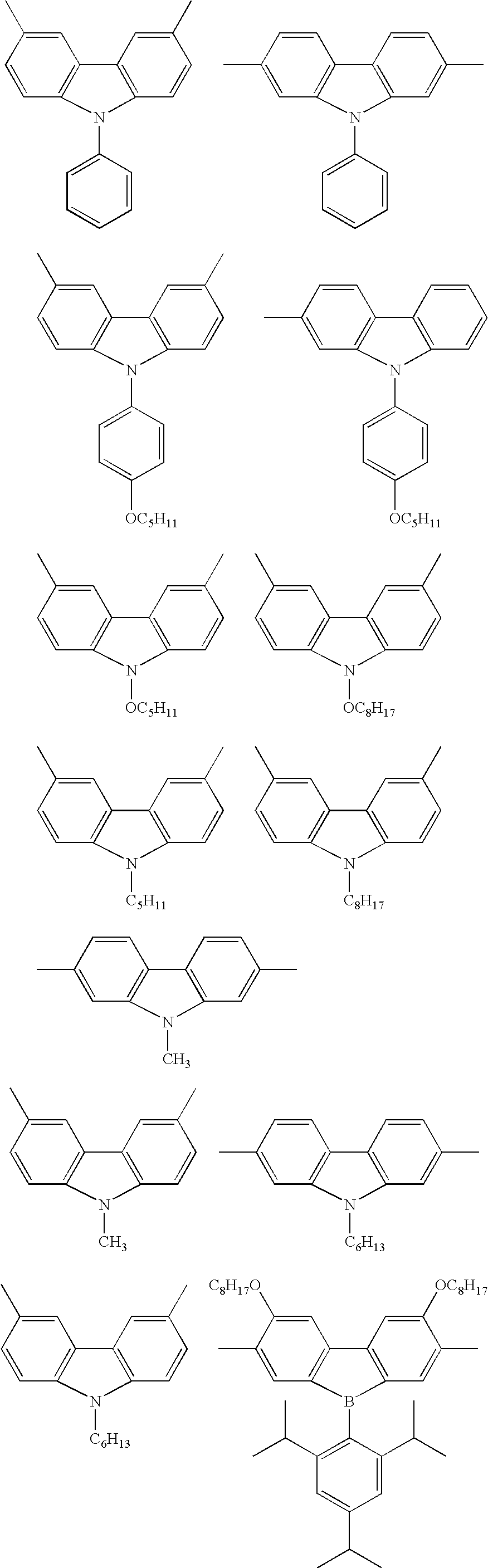


K1—Ar11—K2 (7)
K3—Ar12—K4 (8)
K5-L1 (9)
K6-L2 (10)
(wherein Ar11 and Ar11 each independently represent optionally substituted fluorenediyl group. L1 and L2 represent a terminal group respectively. K1, K2, K3, K4, K5, and K6 each independently represent a leaving group. L1 and L2 are different each other).
K1—Ar11(—K7)—K2 (11)
(wherein Ar11 represents the substituent mentioned above, and K1, K2, and K7 each independently represent a leaving group).

and preferably include the followings,

- a) anode/light-emitting layer/cathode,
- b) anode/hole transporting layer/light-emitting layer/cathode,
- c) anode/light-emitting layer/electron transporting layer/cathode, and
- d) anode/hole transporting layer/light-emitting layer/electron transporting layer/cathode
(wherein the mark “/” denotes that respective layers are layered adjacent each other; hereinafter, denoting the same).
- e) anode/charge injection layer/light-emitting layer/cathode,
- f) anode/light-emitting layer/charge injection layer/cathode,
- g) anode/charge injection layer/light-emitting layer/charge injection layer/cathode,
- h) anode/charge injection layer/hole transporting layer/light-emitting layer/cathode,
- i) anode/hole transporting layer/light-emitting layer/charge injection layer/cathode,
- j) anode/charge injection layer/hole transporting layer/light-emitting layer/charge injection layer/cathode,
- k) anode/charge injection layer/light-emitting layer/electron transporting layer/cathode,
- l) anode/light-emitting layer/electron transporting layer/charge injection layer/cathode,
- m) anode/charge injection layer/light-emitting layer/electron transporting layer/charge injection layer/cathode,
- n) anode/charge injection layer/hole transporting layer/light-emitting layer/electron transporting layer/cathode,
- o) anode/hole transporting layer/light-emitting layer/electron transporting layer/charge injection layer/cathode, and
- p) anode/charge injection layer/hole transporting layer/light-emitting layer/electron transporting layer/charge injection layer/cathode.
- q) anode/insulating layer with a film thickness of 2 nm or less/light-emitting layer/cathode,
- r) anode/light-emitting layer/insulating layer with a film thickness of 2 nm or less/cathode,
- s) anode/insulating layer with a film thickness of 2 nm or less/light-emitting layer/insulating layer with a film thickness of 2 nm or less/cathode,
- t) anode/insulating layer with a film thickness of 2 nm or less/hole transporting layer/light-emitting layer/cathode,
- u) anode/hole transporting layer/light-emitting layer/insulating layer with a film thickness of 2 nm or less/cathode,
- v) anode/insulating layer with a film thickness of 2 nm or less/hole transporting layer/light-emitting layer/insulating layer with a film thickness of 2 nm or less/cathode,
- w) anode/insulating layer with a film thickness of 2 nm or less/light-emitting layer/electron transporting layer/cathode,
- x) anode/light-emitting layer/electron transporting layer/insulating layer with a film thickness of 2 nm or less/cathode,
- y) anode/insulating layer with a film thickness of 2 nm or less/light-emitting layer/electron transporting layer/insulating layer with a film thickness of 2 nm or less/cathode,
- z) anode/insulating layer with a film thickness of 2 nm or less/hole transporting layer/light-emitting layer/electron transporting layer/cathode,
- aa) anode/hole transporting layer/light-emitting layer/electron transporting layer/insulating layer with a film thickness of 2 nm or less/cathode, and
- ab) anode/insulating layer with a film thickness of 2 nm or less/hole transporting layer/light-emitting layer/electron transporting layer/insulating layer with a film thickness of 2 nm or less/cathode.


Claims (13)

Applications Claiming Priority (3)
| Application Number | Priority Date | Filing Date | Title |
|---|---|---|---|
| JP2004301417 | 2004-10-15 | ||
| JP2004-301417 | 2004-10-15 | ||
| PCT/JP2005/019257 WO2006041207A1 (en) | 2004-10-15 | 2005-10-13 | Solution composition and polymer light-emitting device |
Publications (2)
| Publication Number | Publication Date |
|---|---|
| US20080061673A1 US20080061673A1 (en) | 2008-03-13 |
| US7910025B2 true US7910025B2 (en) | 2011-03-22 |
Family
ID=36148491
Family Applications (2)
| Application Number | Title | Priority Date | Filing Date |
|---|---|---|---|
| US11/575,755 Expired - Fee Related US7910025B2 (en) | 2004-10-15 | 2005-10-13 | Solution composition and polymer light-emitting device |
| US13/020,974 Abandoned US20110121278A1 (en) | 2004-10-15 | 2011-02-04 | Solution composition and polymer light-emitting device |
Family Applications After (1)
| Application Number | Title | Priority Date | Filing Date |
|---|---|---|---|
| US13/020,974 Abandoned US20110121278A1 (en) | 2004-10-15 | 2011-02-04 | Solution composition and polymer light-emitting device |
Country Status (7)
| Country | Link |
|---|---|
| US (2) | US7910025B2 (en) |
| JP (1) | JP5092225B2 (en) |
| KR (1) | KR101294902B1 (en) |
| CN (1) | CN101040008B (en) |
| DE (1) | DE112005002503T5 (en) |
| GB (1) | GB2434584B (en) |
| WO (1) | WO2006041207A1 (en) |
Cited By (1)
| Publication number | Priority date | Publication date | Assignee | Title |
|---|---|---|---|---|
| US20140353653A1 (en) * | 2010-01-15 | 2014-12-04 | Sumitomo Chemical Company, Limited | Process for producing liquid composition for organic semiconductor element |
Families Citing this family (11)
| Publication number | Priority date | Publication date | Assignee | Title |
|---|---|---|---|---|
| US20100084000A1 (en) * | 2006-09-26 | 2010-04-08 | Sumitomo Chemical Company, Limited | Organic photoelectric conversion device and polymer useful for producing the same |
| JP5476660B2 (en) * | 2006-09-26 | 2014-04-23 | 住友化学株式会社 | Organic photoelectric conversion device and polymer useful for production thereof |
| JP5577945B2 (en) * | 2010-08-24 | 2014-08-27 | セイコーエプソン株式会社 | Film forming method, light emitting element manufacturing method, light emitting element, light emitting device, and electronic apparatus |
| JP5976269B2 (en) * | 2010-08-26 | 2016-08-23 | セイコーエプソン株式会社 | Film forming ink and film forming method |
| JP5766483B2 (en) * | 2011-03-30 | 2015-08-19 | 株式会社Joled | Ink composition for reversal printing, printing method using the same, and method for producing display device |
| JP5938982B2 (en) * | 2012-03-27 | 2016-06-22 | Tdk株式会社 | Non-aqueous secondary battery separator |
| JP6295790B2 (en) * | 2013-06-24 | 2018-03-20 | 株式会社リコー | Water-based ink for ink jet, ink jet recording apparatus, ink jet recorded matter, and recording method |
| GB2523986A (en) * | 2013-12-19 | 2015-09-16 | Sumitomo Chemical Co | Method and device |
| JP6060993B2 (en) * | 2015-03-13 | 2017-01-18 | セイコーエプソン株式会社 | Deposition method |
| JP7365869B2 (en) * | 2019-11-21 | 2023-10-20 | 住友化学株式会社 | Composition containing a polymer compound, method for manufacturing the polymer compound, and method for manufacturing a light emitting device using the polymer compound |
| JP7672871B2 (en) * | 2021-04-21 | 2025-05-08 | 住友化学株式会社 | Method for producing ink composition |
Citations (8)
| Publication number | Priority date | Publication date | Assignee | Title |
|---|---|---|---|---|
| US5589108A (en) * | 1993-12-29 | 1996-12-31 | Nitto Chemical Industry Co., Ltd. | Soluble alkoxy-group substituted aminobenzenesulfonic acid aniline conducting polymers |
| WO2000059267A1 (en) | 1999-03-29 | 2000-10-05 | Seiko Epson Corporation | Composition, method for preparing film, and functional element and method for preparing the same |
| JP2000323276A (en) | 1999-05-14 | 2000-11-24 | Seiko Epson Corp | Method for manufacturing organic EL device, organic EL device, and ink composition |
| WO2002096970A1 (en) | 2001-05-29 | 2002-12-05 | Koninklijke Philips Electronics N.V. | Polymer, method of its preparation, and electronic device |
| US6627377B1 (en) * | 1997-10-13 | 2003-09-30 | Pi R&D Co., Ltd. | Positive photosensitive poliymide composition |
| US20040131881A1 (en) * | 2002-12-31 | 2004-07-08 | Eastman Kodak Company | Complex fluorene-containing compounds for use in OLED devices |
| WO2004099340A1 (en) * | 2003-05-12 | 2004-11-18 | Sumitomo Chemical Company, Limited | Luminescent-polymer composition |
| WO2005082969A1 (en) * | 2004-02-26 | 2005-09-09 | Sumitomo Chemical Company, Limited | Polymer and polymeric luminescent element comprising the same |
Family Cites Families (14)
| Publication number | Priority date | Publication date | Assignee | Title |
|---|---|---|---|---|
| JP4307839B2 (en) * | 2001-03-10 | 2009-08-05 | メルク パテント ゲーエムベーハー | Organic semiconductor solutions and dispersions |
| JP4062958B2 (en) | 2001-04-27 | 2008-03-19 | 住友化学株式会社 | Block copolymer and polymer light emitting device |
| JP3825711B2 (en) | 2002-04-05 | 2006-09-27 | 独立行政法人産業技術総合研究所 | Copolymer and electroluminescence device |
| SG128438A1 (en) * | 2002-03-15 | 2007-01-30 | Sumitomo Chemical Co | Polymer compound and polymer light emitting deviceusing the same |
| JP2004002703A (en) * | 2002-03-15 | 2004-01-08 | Sumitomo Chem Co Ltd | Polymer compound and polymer light emitting device using the same |
| JP4321110B2 (en) * | 2002-06-05 | 2009-08-26 | 住友化学株式会社 | Polymer compound and polymer light emitting device using the same |
| JP4144271B2 (en) * | 2002-07-09 | 2008-09-03 | 住友化学株式会社 | Polymer thin film and polymer thin film device using the same |
| TWI252053B (en) * | 2002-09-24 | 2006-03-21 | Sharp Kk | Active matrix type organic EL display, and manufacturing method and device thereof, and liquid crystal array and manufacturing method thereof, and manufacturing method and device of color filter substrate, and color filter device |
| DE10249723A1 (en) | 2002-10-25 | 2004-05-06 | Covion Organic Semiconductors Gmbh | Conjugated polymers containing arylamine units, their preparation and use |
| JP4461762B2 (en) * | 2002-10-30 | 2010-05-12 | 住友化学株式会社 | Polymer compound and polymer light emitting device using the same |
| WO2004101682A1 (en) * | 2003-05-16 | 2004-11-25 | Sumitomo Chemical Company, Limited | Composition and polymer light-emitting device |
| TWI415920B (en) * | 2005-08-12 | 2013-11-21 | Sumitomo Chemical Co | High molecular weight material and element using such material |
| US7982212B2 (en) * | 2005-10-07 | 2011-07-19 | Sumitomo Chemical Company, Limited | Copolymer and polymer light emitting device using the same |
| JP5162888B2 (en) * | 2005-12-02 | 2013-03-13 | 住友化学株式会社 | Polymer compound and polymer light emitting device using the same |
-
2005
- 2005-10-13 US US11/575,755 patent/US7910025B2/en not_active Expired - Fee Related
- 2005-10-13 DE DE112005002503T patent/DE112005002503T5/en not_active Withdrawn
- 2005-10-13 KR KR1020077010696A patent/KR101294902B1/en not_active Expired - Fee Related
- 2005-10-13 WO PCT/JP2005/019257 patent/WO2006041207A1/en not_active Ceased
- 2005-10-13 GB GB0709032A patent/GB2434584B/en not_active Expired - Fee Related
- 2005-10-13 CN CN2005800347849A patent/CN101040008B/en not_active Expired - Fee Related
- 2005-10-14 JP JP2005299845A patent/JP5092225B2/en not_active Expired - Fee Related
-
2011
- 2011-02-04 US US13/020,974 patent/US20110121278A1/en not_active Abandoned
Patent Citations (12)
| Publication number | Priority date | Publication date | Assignee | Title |
|---|---|---|---|---|
| US5589108A (en) * | 1993-12-29 | 1996-12-31 | Nitto Chemical Industry Co., Ltd. | Soluble alkoxy-group substituted aminobenzenesulfonic acid aniline conducting polymers |
| US6627377B1 (en) * | 1997-10-13 | 2003-09-30 | Pi R&D Co., Ltd. | Positive photosensitive poliymide composition |
| WO2000059267A1 (en) | 1999-03-29 | 2000-10-05 | Seiko Epson Corporation | Composition, method for preparing film, and functional element and method for preparing the same |
| JP2000323276A (en) | 1999-05-14 | 2000-11-24 | Seiko Epson Corp | Method for manufacturing organic EL device, organic EL device, and ink composition |
| WO2002096970A1 (en) | 2001-05-29 | 2002-12-05 | Koninklijke Philips Electronics N.V. | Polymer, method of its preparation, and electronic device |
| CN1463278A (en) | 2001-05-29 | 2003-12-24 | 皇家菲利浦电子有限公司 | Polymer, its prepn. process and electronic elements |
| JP2004520477A (en) | 2001-05-29 | 2004-07-08 | コーニンクレッカ フィリップス エレクトロニクス エヌ ヴィ | Polymer, preparation method thereof and electronic device |
| US20040131881A1 (en) * | 2002-12-31 | 2004-07-08 | Eastman Kodak Company | Complex fluorene-containing compounds for use in OLED devices |
| WO2004099340A1 (en) * | 2003-05-12 | 2004-11-18 | Sumitomo Chemical Company, Limited | Luminescent-polymer composition |
| US20070020479A1 (en) * | 2003-05-12 | 2007-01-25 | Yasunori Uetani | Luminescent-polymer composition |
| WO2005082969A1 (en) * | 2004-02-26 | 2005-09-09 | Sumitomo Chemical Company, Limited | Polymer and polymeric luminescent element comprising the same |
| US20080274303A1 (en) * | 2004-02-26 | 2008-11-06 | Katsumi Agata | Polymer Compound and Polymer Light Emitting Device Using the Same |
Cited By (2)
| Publication number | Priority date | Publication date | Assignee | Title |
|---|---|---|---|---|
| US20140353653A1 (en) * | 2010-01-15 | 2014-12-04 | Sumitomo Chemical Company, Limited | Process for producing liquid composition for organic semiconductor element |
| US9716231B2 (en) * | 2010-01-15 | 2017-07-25 | Sumitomo Chemical Company, Limited | Process for producing liquid composition for organic semiconductor element |
Also Published As
| Publication number | Publication date |
|---|---|
| DE112005002503T5 (en) | 2007-09-06 |
| GB0709032D0 (en) | 2007-06-20 |
| KR101294902B1 (en) | 2013-08-08 |
| GB2434584A (en) | 2007-08-01 |
| CN101040008B (en) | 2011-02-16 |
| GB2434584B (en) | 2009-09-09 |
| US20080061673A1 (en) | 2008-03-13 |
| US20110121278A1 (en) | 2011-05-26 |
| WO2006041207A1 (en) | 2006-04-20 |
| KR20070067197A (en) | 2007-06-27 |
| JP2006137945A (en) | 2006-06-01 |
| CN101040008A (en) | 2007-09-19 |
| JP5092225B2 (en) | 2012-12-05 |
Similar Documents
| Publication | Publication Date | Title |
|---|---|---|
| US20110121278A1 (en) | Solution composition and polymer light-emitting device | |
| CN101184789B (en) | High-molecular compound and high-molecular luminescent device using the same | |
| TWI472520B (en) | Compound having 1,3-diene structure and process for production thereof | |
| US9045613B2 (en) | Polymer composition and polymer light-emitting device using same | |
| CN101516962B (en) | Polymer compound and polymer light-emitting device using the same | |
| CN101360773B (en) | Polymer compound and polymer light-emitting element formed therefrom | |
| WO2007043495A9 (en) | Copolymer and polymer light emitting devices made by using the same | |
| TWI415920B (en) | High molecular weight material and element using such material | |
| EP2159244B1 (en) | Anthracene polymer compound and light-emitting device using the same | |
| US20100176377A1 (en) | Polymeric compound and polymeric electroluminescence element using the same | |
| CN101124259A (en) | Polymer compound and polymer light-emitting element using same | |
| WO2007081058A1 (en) | Polymer compound and polymer light-emitting device using same | |
| JP2008056910A (en) | Polymer compound and polymer light emitting device using the same | |
| CN101336259A (en) | Polymer compound and polymer light-emitting element formed therefrom | |
| US20100301310A1 (en) | Polymer and polymeric luminescent element employing the same | |
| CN101356211A (en) | Conjugated polymer compound and polymer light emitting device using the conjugated polymer compound | |
| JP5317314B2 (en) | Polymer compound and polymer light emitting device using the same | |
| JP2009132882A (en) | Polymer compound and polymer light emitting device using the same | |
| JP4904805B2 (en) | Polymer compound and polymer light emitting device using the same | |
| JP4614735B2 (en) | Polymer material and polymer light emitting device using the same | |
| US20100289011A1 (en) | Polymer compound and method for producing the same, and light-emitting material, liquid composition, thin film, polymer light-emitting device, surface light source, display device, organic transistor and solar cell, each using the polymer compound | |
| JP5891798B2 (en) | Polymer compound and light emitting device using the same | |
| JP2007224282A (en) | Polymer compound and polymer light emitting device using the same | |
| JP4456963B2 (en) | Copolymer and polymer light emitting device using the same | |
| JP5317315B2 (en) | Polymer compound and polymer light emitting device using the same |
Legal Events
| Date | Code | Title | Description |
|---|---|---|---|
| AS | Assignment |
Owner name: SUMITOMO CHEMICAL COMPANY, LIMITED, JAPAN Free format text: ASSIGNMENT OF ASSIGNORS INTEREST;ASSIGNORS:SUZUKI, TOMOYUKI;IIMURA, KIYOTOSHI;AGATA, KATSUMI;REEL/FRAME:019728/0731;SIGNING DATES FROM 20070320 TO 20070327 Owner name: SUMITOMO CHEMICAL COMPANY, LIMITED, JAPAN Free format text: ASSIGNMENT OF ASSIGNORS INTEREST;ASSIGNORS:SUZUKI, TOMOYUKI;IIMURA, KIYOTOSHI;AGATA, KATSUMI;SIGNING DATES FROM 20070320 TO 20070327;REEL/FRAME:019728/0731 |
|
| REMI | Maintenance fee reminder mailed | ||
| LAPS | Lapse for failure to pay maintenance fees | ||
| STCH | Information on status: patent discontinuation |
Free format text: PATENT EXPIRED DUE TO NONPAYMENT OF MAINTENANCE FEES UNDER 37 CFR 1.362 |
|
| STCH | Information on status: patent discontinuation |
Free format text: PATENT EXPIRED DUE TO NONPAYMENT OF MAINTENANCE FEES UNDER 37 CFR 1.362 |
|
| FP | Lapsed due to failure to pay maintenance fee |
Effective date: 20150322 |