US7906401B1 - Method of tuning threshold voltages of interdiffusible structures - Google Patents

Method of tuning threshold voltages of interdiffusible structures Download PDF

Info

Publication number
US7906401B1
US7906401B1 US11/602,444 US60244406A US7906401B1 US 7906401 B1 US7906401 B1 US 7906401B1 US 60244406 A US60244406 A US 60244406A US 7906401 B1 US7906401 B1 US 7906401B1
Authority
US
United States
Prior art keywords
interdiffusible
laser
metal layer
situating
illuminating
Prior art date
Legal status (The legal status is an assumption and is not a legal conclusion. Google has not performed a legal analysis and makes no representation as to the accuracy of the status listed.)
Expired - Fee Related, expires
Application number
US11/602,444
Inventor
Ryan P. Lu
Ayax D. Ramirez
Bruce W. Offord
Stephen D. Russell
Current Assignee (The listed assignees may be inaccurate. Google has not performed a legal analysis and makes no representation or warranty as to the accuracy of the list.)
US Department of Navy
Original Assignee
US Department of Navy
Priority date (The priority date is an assumption and is not a legal conclusion. Google has not performed a legal analysis and makes no representation as to the accuracy of the date listed.)
Filing date
Publication date
Priority claimed from US11/070,634 external-priority patent/US7153749B1/en
Application filed by US Department of Navy filed Critical US Department of Navy
Priority to US11/602,444 priority Critical patent/US7906401B1/en
Assigned to NAVY, UNITED STATES OF AMERICA AS REPRESENTED BY THE SECRETARY OF THE reassignment NAVY, UNITED STATES OF AMERICA AS REPRESENTED BY THE SECRETARY OF THE ASSIGNMENT OF ASSIGNORS INTEREST (SEE DOCUMENT FOR DETAILS). Assignors: LU, RYAN P., OFFORD, BRUCE W., RAMIREZ, AYAX D., RUSSELL, STEPHEN D.
Application granted granted Critical
Publication of US7906401B1 publication Critical patent/US7906401B1/en
Expired - Fee Related legal-status Critical Current
Adjusted expiration legal-status Critical

Links

Images

Classifications

    • HELECTRICITY
    • H10SEMICONDUCTOR DEVICES; ELECTRIC SOLID-STATE DEVICES NOT OTHERWISE PROVIDED FOR
    • H10PGENERIC PROCESSES OR APPARATUS FOR THE MANUFACTURE OR TREATMENT OF DEVICES COVERED BY CLASS H10
    • H10P34/00Irradiation with electromagnetic or particle radiation of wafers, substrates or parts of devices
    • H10P34/40Irradiation with electromagnetic or particle radiation of wafers, substrates or parts of devices with high-energy radiation
    • H10P34/42Irradiation with electromagnetic or particle radiation of wafers, substrates or parts of devices with high-energy radiation with electromagnetic radiation, e.g. laser annealing
    • HELECTRICITY
    • H10SEMICONDUCTOR DEVICES; ELECTRIC SOLID-STATE DEVICES NOT OTHERWISE PROVIDED FOR
    • H10DINORGANIC ELECTRIC SEMICONDUCTOR DEVICES
    • H10D30/00Field-effect transistors [FET]
    • H10D30/01Manufacture or treatment
    • H10D30/021Manufacture or treatment of FETs having insulated gates [IGFET]
    • H10D30/031Manufacture or treatment of FETs having insulated gates [IGFET] of thin-film transistors [TFT]
    • H10D30/0321Manufacture or treatment of FETs having insulated gates [IGFET] of thin-film transistors [TFT] comprising silicon, e.g. amorphous silicon or polysilicon
    • H10D30/0323Manufacture or treatment of FETs having insulated gates [IGFET] of thin-film transistors [TFT] comprising silicon, e.g. amorphous silicon or polysilicon comprising monocrystalline silicon
    • HELECTRICITY
    • H10SEMICONDUCTOR DEVICES; ELECTRIC SOLID-STATE DEVICES NOT OTHERWISE PROVIDED FOR
    • H10DINORGANIC ELECTRIC SEMICONDUCTOR DEVICES
    • H10D30/00Field-effect transistors [FET]
    • H10D30/60Insulated-gate field-effect transistors [IGFET]
    • H10D30/67Thin-film transistors [TFT]
    • H10D30/6729Thin-film transistors [TFT] characterised by the electrodes
    • H10D30/6737Thin-film transistors [TFT] characterised by the electrodes characterised by the electrode materials
    • H10D30/6739Conductor-insulator-semiconductor electrodes
    • HELECTRICITY
    • H10SEMICONDUCTOR DEVICES; ELECTRIC SOLID-STATE DEVICES NOT OTHERWISE PROVIDED FOR
    • H10DINORGANIC ELECTRIC SEMICONDUCTOR DEVICES
    • H10D64/00Electrodes of devices having potential barriers
    • H10D64/01Manufacture or treatment
    • H10D64/013Manufacture or treatment of electrodes having a conductor capacitively coupled to a semiconductor by an insulator
    • H10D64/01302Manufacture or treatment of electrodes having a conductor capacitively coupled to a semiconductor by an insulator the insulator being formed after the semiconductor body, the semiconductor being silicon
    • H10D64/01304Manufacture or treatment of electrodes having a conductor capacitively coupled to a semiconductor by an insulator the insulator being formed after the semiconductor body, the semiconductor being silicon characterised by the conductor
    • H10D64/01316Manufacture or treatment of electrodes having a conductor capacitively coupled to a semiconductor by an insulator the insulator being formed after the semiconductor body, the semiconductor being silicon characterised by the conductor the conductor comprising a layer of elemental metal contacting the insulator, e.g. Ta, W, Mo or Al
    • HELECTRICITY
    • H10SEMICONDUCTOR DEVICES; ELECTRIC SOLID-STATE DEVICES NOT OTHERWISE PROVIDED FOR
    • H10DINORGANIC ELECTRIC SEMICONDUCTOR DEVICES
    • H10D64/00Electrodes of devices having potential barriers
    • H10D64/60Electrodes characterised by their materials
    • H10D64/66Electrodes having a conductor capacitively coupled to a semiconductor by an insulator, e.g. MIS electrodes
    • H10D64/665Electrodes having a conductor capacitively coupled to a semiconductor by an insulator, e.g. MIS electrodes the conductor comprising a layer of elemental metal contacting the insulator, e.g. tungsten or molybdenum
    • H10D64/666Electrodes having a conductor capacitively coupled to a semiconductor by an insulator, e.g. MIS electrodes the conductor comprising a layer of elemental metal contacting the insulator, e.g. tungsten or molybdenum the conductor further comprising additional layers
    • HELECTRICITY
    • H10SEMICONDUCTOR DEVICES; ELECTRIC SOLID-STATE DEVICES NOT OTHERWISE PROVIDED FOR
    • H10DINORGANIC ELECTRIC SEMICONDUCTOR DEVICES
    • H10D30/00Field-effect transistors [FET]
    • H10D30/60Insulated-gate field-effect transistors [IGFET]

Definitions

  • the patent application is generally in the field of methods of microfabrication and nanofabrication.
  • Typical fabrication methods of modifying threshold voltages of solid-state devices require global processes such as varying metals, oxide thicknesses and doping, which greatly increases process complexity.
  • FIGS. 1A-E are cross-sectional side views of some of the features of an exemplary device formed in accordance with one embodiment of a method of tuning threshold voltages of interdiffusible structures.
  • FIGS. 2A-2B are flowcharts of embodiments of a method of tuning threshold voltages of interdiffusible structures.
  • FIG. 3 is a graph representing exemplary results of a method of tuning threshold voltages of interdiffusible structures.
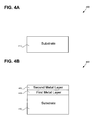
  • FIGS. 4A-4D are cross-sectional side views of some of the features of an exemplary device formed in accordance with one embodiment of a method of tuning threshold voltages of interdiffusible structures.
  • Interdiffusible Structure a structure having at least one metal layer, wherein material from the at least one metal layer is capable of diffusing into an adjacent metal or semiconductor layer.
  • Multiple IS device a device having at least two IS.
  • the method of tuning threshold voltages of interdiffusible structures uses a laser to locally modify threshold voltages of interdiffusible structures.
  • the method includes a step of situating a IS in the path of a laser and a step of illuminating the IS with laser energy.
  • FIGS. 1A-1E are cross-sectional side views of some of the features of an exemplary device formed in accordance with one embodiment of a method of tuning threshold voltages of interdiffusible structures. These intermediate stages of fabrication show some of the features of a method of tuning threshold voltages of interdiffusible structures. The components of FIGS. 1A-1E are not drawn to scale. These fabrication stages are described in detail below in relation to flowchart 200 of FIG. 2A and flowchart 202 of FIG. 2B .
  • FIGS. 2A-2B are flowcharts of embodiments of a method of tuning threshold voltages of interdiffusible structures. Certain details and features have been left out of flowchart 200 of FIG. 2A and flowchart 202 of FIG. 2B that are apparent to a person of ordinary skill in the art. For example, a step may consist of one or more sub-steps or may involve specialized equipment or materials, as known in the art. While STEPS 210 through 260 shown in flowchart 200 are sufficient to describe one embodiment, other embodiments may utilize steps different from those shown in flowchart 200 .
  • IS 100 includes at least two adjacent metal layers, wherein material from one metal layer is capable of diffusing into another metal layer.
  • IS 100 includes substrate 110 , source 122 , drain 124 , insulator layer 130 , first metal layer 140 , second metal layer 150 and third metal layer 160 .
  • material from second metal layer 150 is capable of diffusing into first metal layer 140 .
  • the composition of IS 100 is exemplary as the present method of tuning threshold voltages of IS can be used in conjunction with various IS such as, for example, MOSFET, MISFET, MESFET, semiconductor switches, diodes and LED.
  • IS 100 comprises the following: substrate 110 comprises an insulator such as oxide; source 122 and drain 124 comprise doped semiconductor material; insulator layer 130 comprises gate oxide; first metal layer 140 comprises a metal capable of receiving diffused material from second metal layer 150 ; second metal layer 150 comprises a metal capable of diffusing into first metal layer 140 ; third metal layer 160 comprises a metal.
  • IS 100 comprises: substrate 110 comprising oxide, source 122 and drain 124 comprising doped silicon, insulator layer 130 comprising gate oxide, first metal layer 140 comprising titanium, second metal layer 150 comprising titanium nitride and third metal layer 160 comprising aluminum.
  • substrate 110 comprises oxide having a thickness of approximately 400 nm formed on a silicon layer; insulator layer 130 comprises gate oxide having a thickness of approximately 7 nm; first metal layer 140 comprises titanium having a thickness of approximately 10 nm; second metal layer 150 comprises titanium nitride having a thickness of approximately 50 nm; third metal layer 160 comprises aluminum having a thickness of approximately 200 nm.
  • the method proceeds to STEP 220 .
  • the method situates IS 100 in the path of laser 190 .
  • the method situates IS 100 in the path of laser 190 using a moveable platen, which supports IS 100 .
  • the method situates IS 100 in the path of laser 190 using a moveable laser.
  • the method situates IS 100 in the path of laser 190 using a redirected laser beam.
  • the method proceeds to STEP 240 .
  • the method illuminates IS 100 with laser energy 192 (represented by arrows) until a desired threshold voltage is obtained.
  • second metal layer 150 comprises titanium nitride having a work function of approximately 4.55 eV and first metal layer 140 comprises titanium having a work function of approximately 4.33 eV.
  • the method illuminates IS 100 with laser energy 192 , which results in the diffusion of nitrogen from titanium nitride (second metal layer 150 ) into titanium (first metal layer 140 ), which modifies the threshold voltage of IS 100 .
  • the method at STEP 240 in flowchart 200 illuminates IS with laser energy 192 until a desired threshold voltage is obtained and to initiate thermal mixing and activation of channel dopants.
  • Laser 190 is capable of emitting laser energy 192 such as infrared (IR), visible and ultraviolet (UV) laser light.
  • laser 190 comprises a 308 nm XeCL excimer laser having a fluence of approximately 415 mJ/cm 2 .
  • the method illuminates IS 100 with laser energy 192 using at least one laser pulse.
  • the method illuminates IS 100 with laser energy 192 using a series of laser pulses.
  • the method illuminates IS 100 with laser energy 192 using a series of laser pulses, wherein each laser pulse has a duration between approximately 10 ns and approximately 30 ns.
  • laser 190 comprises a continuous wave laser.
  • laser 190 comprises an incoherent non-monochromatic high intensity light source.
  • desired threshold voltages can be obtained by varying laser energy power, pulse duration, number of pulses and related processing parameters without departing from the scope or spirit of the present method of tuning threshold voltages of interdiffusible structures.
  • the method of flowchart 200 can use interdiffusible structures having at least one metal layer, wherein material from the at least one metal layer is capable of diffusing into an adjacent semiconductor layer without departing from the scope or spirit of the present method of tuning threshold voltages of interdiffusible structures.
  • a multiple IS device embodiment of a method of tuning threshold voltages of interdiffusible structures is now described.
  • a multiple IS device is a device having at least two IS such as, for example, a wafer having at least two MOSFETS including adjacent metal layers comprising titanium nitride and titanium.
  • the exemplary method of tuning threshold voltages of interdiffusible structures comprises:
  • IS 100 comprises a metal-gate MOSFET device.
  • the method fabricates semiconductor layer 120 on substrate 110 .
  • the method fabricates semiconductor layer 120 on substrate 110 using SIMOX techniques.
  • semiconductor layer 120 comprises silicon.
  • substrate 110 comprises sapphire.
  • substrate 110 comprises oxide having a thickness of approximately 400 nm formed on a silicon layer.
  • substrate 110 comprises nitride.
  • the method deposits insulator and metal layers.
  • the method forms insulator layers and metal layers using oxidation and physical vapor deposition methods.
  • the method forms insulator layer 130 over semiconductor layer 120 , first metal layer 140 over insulator layer 130 , second metal layer 150 over first metal layer 140 ; and third metal layer 160 over second metal layer 150 .
  • the method forms: insulator layer 130 comprising gate oxide having a thickness of approximately 7 nm, first metal layer 140 comprising titanium having a thickness of approximately 10 nm, second metal layer 150 comprising titanium nitride having a thickness of approximately 50 nm and third metal layer 160 comprising aluminum having a thickness of approximately 200 nm.
  • first metal layer 140 comprising titanium having a thickness of approximately 10 nm
  • second metal layer 150 comprising titanium nitride having a thickness of approximately 50 nm
  • third metal layer 160 comprising aluminum having a thickness of approximately 200 nm.
  • the method patterns insulator and metal layers.
  • the method patterns insulator layer 130 , first metal layer 140 , second metal layer 150 and third metal layer 160 to form a metal gate of a MOSFET device.
  • the method proceeds to STEP 218 .
  • the method dopes semiconductor layer 120 to form source 122 and drain 124 .
  • the method dopes semiconductor layer 120 to form source 122 and drain 124 using ion implantation.
  • the method proceeds to STEP 220 of flowchart 200 of FIG. 2A .
  • the method proceeds to STEPS 240 and 260 of flowchart 200 of FIG. 2A .
  • FIG. 3 is a graph representing exemplary results of a method of tuning threshold voltages of interdiffusible structures.
  • the graph of FIG. 3 shows exemplary results for a IS MOSFET embodiment, where second metal layer 150 comprises titanium nitride having a work function of approximately 4.55 eV and first metal layer 140 comprises titanium having a work function of approximately 4.33 eV.
  • the method illuminates the IS with laser energy using a series of UV laser pulses, wherein each laser pulse has a duration between approximately 10 ns and approximately 30 ns.
  • the threshold voltage increases depending on the number of laser pulses.
  • FIGS. 4A-4D are cross-sectional side views of some of the features of an exemplary device formed in accordance with one embodiment of a method of tuning threshold voltages of interdiffusible structures. These intermediate stages of fabrication show some of the features of a method of tuning threshold voltages of interdiffusible structures. The components of FIGS. 4A-4D are not drawn to scale. These fabrication stages are described in detail below in relation to flowchart 200 of FIG. 2A .
  • IS 400 includes at least two adjacent metal layers, wherein material from one metal layer is capable of diffusing into another metal layer. As shown in FIG. 4C , IS 400 includes substrate 410 , first metal layer 440 and second metal layer 450 . In one embodiment, material from second metal layer 450 is capable of diffusing into first metal layer 440 .
  • the composition of IS 400 is exemplary as the present method of tuning threshold voltages of IS can be used in conjunction with various IS such as, for example, MOSFET, MISFET, MESFET, semiconductor switches, diodes and LED.
  • the method situates IS 400 in the path of laser 490 .
  • the method situates IS 400 in the path of laser 490 using a moveable platen, which supports IS 400 .
  • the method situates IS 400 in the path of laser 490 using a moveable laser.
  • the method situates IS 400 in the path of laser 490 using a redirected laser beam.
  • the method proceeds to STEP 240 .
  • the method illuminates IS 400 with laser energy 492 (represented by arrows) until a desired threshold voltage is obtained.
  • second metal layer 450 comprises titanium nitride having a work function of approximately 4.55 eV and first metal layer 440 comprises titanium having a work function of approximately 4.33 eV.
  • the method illuminates IS 400 with laser energy 492 , which results in the diffusion of nitrogen from titanium nitride (second metal layer 450 ) into titanium (first metal layer 440 ), which modifies the threshold voltage of IS 400 .
  • Laser 490 is capable of emitting laser energy 492 such as infrared (IR), visible and ultraviolet (UV) laser light.
  • laser 490 comprises a 308 nm XeCL excimer laser having a fluence of approximately 415 ml/cm 2 .
  • the method illuminates IS 400 with laser energy 492 using at least one laser pulse.
  • the method illuminates IS 400 with laser energy 492 using a series of laser pulses.
  • the method illuminates IS 400 with laser energy 492 using a series of laser pulses, wherein each laser pulse has a duration between approximately 10 ns and approximately 30 ns.
  • laser 490 comprises a continuous wave laser.
  • laser 490 comprises an incoherent non-monochromatic high intensity light source.
  • desired threshold voltages can be obtained by varying laser energy power, pulse duration, number of pulses and related processing parameters without departing from the scope or spirit of the present method of tuning threshold voltages of interdiffusible structures.
  • the method of flowchart 200 can use interdiffusible structures having at least one metal layer, wherein material from the at least one metal layer is capable of diffusing into an adjacent semiconductor layer without departing from the scope or spirit of the present method of tuning threshold voltages of interdiffusible structures.
  • IS 400 comprises a two metal layer device.
  • the method deposits metal layers.
  • the method forms metal layers using oxidation and physical vapor deposition methods.
  • the method forms first metal layer 440 over substrate 410 ; and second metal layer 450 over first metal layer 440 .
  • the method forms: first metal layer 440 comprising titanium having a thickness of approximately 10 nm and second metal layer 450 comprising titanium nitride having a thickness of approximately 50 nm.
  • the method patterns metal layers 140 , 150 .

Landscapes

  • Insulated Gate Type Field-Effect Transistor (AREA)
  • Electrodes Of Semiconductors (AREA)

Abstract

A method of tuning threshold voltages of interdiffusible structures. The method includes a step of situating an interdiffusible structure in a path of a laser and a step of illuminating the interdiffusible structure with laser energy until a desired threshold voltage is obtained.

Description

CROSS-REFERENCE TO RELATED APPLICATION
This application is a continuation-in-part of U.S. application Ser. No. 11/070,634, filed Mar. 2, 2005, now U.S. Pat. No. 7,153,749 entitled “Method of Tuning Threshold Voltages of Interdiffusible Structures” (NC#96915), hereby incorporated by reference herein in its entirety for its teachings on fabrication, and referred to hereafter as “the parent application.”
FEDERALLY SPONSORED RESEARCH AND DEVELOPMENT
This invention (Navy Case No. 98456) is assigned to the United States Government and is available for licensing for commercial purposes. Licensing and technical inquiries may be directed to the Office of Research and Technical Applications, Space and Naval Warfare Systems Center, San Diego, Code 2112, San Diego, Calif., 92152; voice (619) 553-2778; email T2@spawar.navy.mil. Reference Navy Case Number 98456.
BACKGROUND
The patent application is generally in the field of methods of microfabrication and nanofabrication.
Typical fabrication methods of modifying threshold voltages of solid-state devices require global processes such as varying metals, oxide thicknesses and doping, which greatly increases process complexity.
A need exists for methods of modifying threshold voltages of solid-state devices allowing local processes.
BRIEF DESCRIPTION OF THE DRAWINGS
FIGS. 1A-E are cross-sectional side views of some of the features of an exemplary device formed in accordance with one embodiment of a method of tuning threshold voltages of interdiffusible structures.
FIGS. 2A-2B are flowcharts of embodiments of a method of tuning threshold voltages of interdiffusible structures.
FIG. 3 is a graph representing exemplary results of a method of tuning threshold voltages of interdiffusible structures.
FIGS. 4A-4D are cross-sectional side views of some of the features of an exemplary device formed in accordance with one embodiment of a method of tuning threshold voltages of interdiffusible structures.
DETAILED DESCRIPTION
Described herein is Method of Tuning Threshold Voltages of Interdiffusible Structures.
DEFINITIONS
The following definitions and acronyms are used herein:
Acronym(s):
IS—Interdiffusible Structure(s)
UV—Ultraviolet
IR—Infrared
Definition(s):
Interdiffusible Structure—a structure having at least one metal layer, wherein material from the at least one metal layer is capable of diffusing into an adjacent metal or semiconductor layer.
Multiple IS device—a device having at least two IS.
The method of tuning threshold voltages of interdiffusible structures (IS) uses a laser to locally modify threshold voltages of interdiffusible structures. The method includes a step of situating a IS in the path of a laser and a step of illuminating the IS with laser energy.
FIGS. 1A-1E are cross-sectional side views of some of the features of an exemplary device formed in accordance with one embodiment of a method of tuning threshold voltages of interdiffusible structures. These intermediate stages of fabrication show some of the features of a method of tuning threshold voltages of interdiffusible structures. The components of FIGS. 1A-1E are not drawn to scale. These fabrication stages are described in detail below in relation to flowchart 200 of FIG. 2A and flowchart 202 of FIG. 2B.
FIGS. 2A-2B are flowcharts of embodiments of a method of tuning threshold voltages of interdiffusible structures. Certain details and features have been left out of flowchart 200 of FIG. 2A and flowchart 202 of FIG. 2B that are apparent to a person of ordinary skill in the art. For example, a step may consist of one or more sub-steps or may involve specialized equipment or materials, as known in the art. While STEPS 210 through 260 shown in flowchart 200 are sufficient to describe one embodiment, other embodiments may utilize steps different from those shown in flowchart 200.
Referring to FIGS. 1D and 2A, at STEP 210 in flowchart 200, the method fabricates IS 100. IS 100 includes at least two adjacent metal layers, wherein material from one metal layer is capable of diffusing into another metal layer. As shown in FIG. 1D, IS 100 includes substrate 110, source 122, drain 124, insulator layer 130, first metal layer 140, second metal layer 150 and third metal layer 160. In one embodiment, material from second metal layer 150 is capable of diffusing into first metal layer 140. The composition of IS 100 is exemplary as the present method of tuning threshold voltages of IS can be used in conjunction with various IS such as, for example, MOSFET, MISFET, MESFET, semiconductor switches, diodes and LED.
In a MOSFET embodiment, IS 100 comprises the following: substrate 110 comprises an insulator such as oxide; source 122 and drain 124 comprise doped semiconductor material; insulator layer 130 comprises gate oxide; first metal layer 140 comprises a metal capable of receiving diffused material from second metal layer 150; second metal layer 150 comprises a metal capable of diffusing into first metal layer 140; third metal layer 160 comprises a metal. In an exemplary MOSFET embodiment, IS 100 comprises: substrate 110 comprising oxide, source 122 and drain 124 comprising doped silicon, insulator layer 130 comprising gate oxide, first metal layer 140 comprising titanium, second metal layer 150 comprising titanium nitride and third metal layer 160 comprising aluminum. In one embodiment, substrate 110 comprises oxide having a thickness of approximately 400 nm formed on a silicon layer; insulator layer 130 comprises gate oxide having a thickness of approximately 7 nm; first metal layer 140 comprises titanium having a thickness of approximately 10 nm; second metal layer 150 comprises titanium nitride having a thickness of approximately 50 nm; third metal layer 160 comprises aluminum having a thickness of approximately 200 nm. After STEP 210, the method proceeds to STEP 220.
Referring to FIGS. 1E and 2A, at STEP 220 in flowchart 200, the method situates IS 100 in the path of laser 190. In one embodiment, the method situates IS 100 in the path of laser 190 using a moveable platen, which supports IS 100. In one embodiment, the method situates IS 100 in the path of laser 190 using a moveable laser. In one embodiment, the method situates IS 100 in the path of laser 190 using a redirected laser beam. After STEP 220, the method proceeds to STEP 240.
Referring to FIGS. 1E and 2A, at STEP 240 in flowchart 200, the method illuminates IS 100 with laser energy 192 (represented by arrows) until a desired threshold voltage is obtained. In an exemplary MOSFET embodiment, second metal layer 150 comprises titanium nitride having a work function of approximately 4.55 eV and first metal layer 140 comprises titanium having a work function of approximately 4.33 eV. In the exemplary MOSFET embodiment, the method illuminates IS 100 with laser energy 192, which results in the diffusion of nitrogen from titanium nitride (second metal layer 150) into titanium (first metal layer 140), which modifies the threshold voltage of IS 100. In one embodiment, the method at STEP 240 in flowchart 200 illuminates IS with laser energy 192 until a desired threshold voltage is obtained and to initiate thermal mixing and activation of channel dopants.
Laser 190 is capable of emitting laser energy 192 such as infrared (IR), visible and ultraviolet (UV) laser light. In one embodiment, laser 190 comprises a 308 nm XeCL excimer laser having a fluence of approximately 415 mJ/cm2. In one embodiment, the method illuminates IS 100 with laser energy 192 using at least one laser pulse. In one embodiment, the method illuminates IS 100 with laser energy 192 using a series of laser pulses. In one embodiment, the method illuminates IS 100 with laser energy 192 using a series of laser pulses, wherein each laser pulse has a duration between approximately 10 ns and approximately 30 ns. In one embodiment, laser 190 comprises a continuous wave laser. In one embodiment, laser 190 comprises an incoherent non-monochromatic high intensity light source. Those skilled in the art shall recognize that desired threshold voltages can be obtained by varying laser energy power, pulse duration, number of pulses and related processing parameters without departing from the scope or spirit of the present method of tuning threshold voltages of interdiffusible structures. After STEP 240, the method proceeds to STEP 260 whereat the method completes further processing on IS structure such as annealing and packaging. The method terminates at STEP 260. Those skilled in the art shall recognize that the method of flowchart 200 can use interdiffusible structures having at least one metal layer, wherein material from the at least one metal layer is capable of diffusing into an adjacent semiconductor layer without departing from the scope or spirit of the present method of tuning threshold voltages of interdiffusible structures.
A multiple IS device embodiment of a method of tuning threshold voltages of interdiffusible structures is now described. A multiple IS device is a device having at least two IS such as, for example, a wafer having at least two MOSFETS including adjacent metal layers comprising titanium nitride and titanium. The exemplary method of tuning threshold voltages of interdiffusible structures comprises:
    • a) situating at least one IS of a multiple IS device in the path of a laser.
    • b) illuminating the at least one IS with laser energy until a desired threshold voltage is obtained.
    • c) repeating STEPS (a)-(b) for other IS of the multiple IS device until desired threshold voltages are obtained.
      The multiple IS device embodiment allows localized tuning of threshold voltages for IS.
Referring to STEP 210 of flowchart 200 of FIG. 2A, an exemplary method of fabricating IS 100 is now described with reference to FIGS. 1A-1D and 2B. In the exemplary method of STEP 210, IS 100 comprises a metal-gate MOSFET device. Referring to FIGS. 1A and 2B, at STEP 212 of flowchart 202, the method fabricates semiconductor layer 120 on substrate 110. In one embodiment, the method fabricates semiconductor layer 120 on substrate 110 using SIMOX techniques. In one embodiment, semiconductor layer 120 comprises silicon. In one embodiment, substrate 110 comprises sapphire. In one embodiment, substrate 110 comprises oxide having a thickness of approximately 400 nm formed on a silicon layer. In one embodiment, substrate 110 comprises nitride. After STEP 212, the method proceeds to STEP 214.
Referring to FIGS. 1B and 2B, at STEP 214 of flowchart 202, the method deposits insulator and metal layers. In one embodiment, the method forms insulator layers and metal layers using oxidation and physical vapor deposition methods. In one embodiment, the method forms insulator layer 130 over semiconductor layer 120, first metal layer 140 over insulator layer 130, second metal layer 150 over first metal layer 140; and third metal layer 160 over second metal layer 150. In one embodiment, the method forms: insulator layer 130 comprising gate oxide having a thickness of approximately 7 nm, first metal layer 140 comprising titanium having a thickness of approximately 10 nm, second metal layer 150 comprising titanium nitride having a thickness of approximately 50 nm and third metal layer 160 comprising aluminum having a thickness of approximately 200 nm. After STEP 214, the method proceeds to STEP 216.
Referring to FIGS. 1C and 2B, at STEP 216 of flowchart 202, the method patterns insulator and metal layers. In one embodiment, the method patterns insulator layer 130, first metal layer 140, second metal layer 150 and third metal layer 160 to form a metal gate of a MOSFET device. After STEP 216, the method proceeds to STEP 218.
Referring to FIGS. 1D and 2B, at STEP 218 of flowchart 202, the method dopes semiconductor layer 120 to form source 122 and drain 124. In one embodiment, the method dopes semiconductor layer 120 to form source 122 and drain 124 using ion implantation. After STEP 218, the method proceeds to STEP 220 of flowchart 200 of FIG. 2A. After STEP 220, the method proceeds to STEPS 240 and 260 of flowchart 200 of FIG. 2A.
FIG. 3 is a graph representing exemplary results of a method of tuning threshold voltages of interdiffusible structures. The graph of FIG. 3 shows exemplary results for a IS MOSFET embodiment, where second metal layer 150 comprises titanium nitride having a work function of approximately 4.55 eV and first metal layer 140 comprises titanium having a work function of approximately 4.33 eV. In addition, the method illuminates the IS with laser energy using a series of UV laser pulses, wherein each laser pulse has a duration between approximately 10 ns and approximately 30 ns. As shown in FIG. 3, the threshold voltage increases depending on the number of laser pulses.
FIGS. 4A-4D are cross-sectional side views of some of the features of an exemplary device formed in accordance with one embodiment of a method of tuning threshold voltages of interdiffusible structures. These intermediate stages of fabrication show some of the features of a method of tuning threshold voltages of interdiffusible structures. The components of FIGS. 4A-4D are not drawn to scale. These fabrication stages are described in detail below in relation to flowchart 200 of FIG. 2A.
Referring to FIGS. 4C and 2A, at STEP 210 in flowchart 200, the method fabricates IS 400. IS 400 includes at least two adjacent metal layers, wherein material from one metal layer is capable of diffusing into another metal layer. As shown in FIG. 4C, IS 400 includes substrate 410, first metal layer 440 and second metal layer 450. In one embodiment, material from second metal layer 450 is capable of diffusing into first metal layer 440. The composition of IS 400 is exemplary as the present method of tuning threshold voltages of IS can be used in conjunction with various IS such as, for example, MOSFET, MISFET, MESFET, semiconductor switches, diodes and LED. After STEP 210, the method proceeds to STEP 220.
Referring to FIGS. 4D and 2A, at STEP 220 in flowchart 200, the method situates IS 400 in the path of laser 490. In one embodiment, the method situates IS 400 in the path of laser 490 using a moveable platen, which supports IS 400. In one embodiment, the method situates IS 400 in the path of laser 490 using a moveable laser. In one embodiment, the method situates IS 400 in the path of laser 490 using a redirected laser beam. After STEP 220, the method proceeds to STEP 240.
Referring to FIGS. 4D and 2A, at STEP 240 in flowchart 200, the method illuminates IS 400 with laser energy 492 (represented by arrows) until a desired threshold voltage is obtained. In an exemplary two metal layer embodiment, second metal layer 450 comprises titanium nitride having a work function of approximately 4.55 eV and first metal layer 440 comprises titanium having a work function of approximately 4.33 eV. In the exemplary two metal layer embodiment, the method illuminates IS 400 with laser energy 492, which results in the diffusion of nitrogen from titanium nitride (second metal layer 450) into titanium (first metal layer 440), which modifies the threshold voltage of IS 400.
Laser 490 is capable of emitting laser energy 492 such as infrared (IR), visible and ultraviolet (UV) laser light. In one embodiment, laser 490 comprises a 308 nm XeCL excimer laser having a fluence of approximately 415 ml/cm2. In one embodiment, the method illuminates IS 400 with laser energy 492 using at least one laser pulse. In one embodiment, the method illuminates IS 400 with laser energy 492 using a series of laser pulses. In one embodiment, the method illuminates IS 400 with laser energy 492 using a series of laser pulses, wherein each laser pulse has a duration between approximately 10 ns and approximately 30 ns. In one embodiment, laser 490 comprises a continuous wave laser. In one embodiment, laser 490 comprises an incoherent non-monochromatic high intensity light source. Those skilled in the art shall recognize that desired threshold voltages can be obtained by varying laser energy power, pulse duration, number of pulses and related processing parameters without departing from the scope or spirit of the present method of tuning threshold voltages of interdiffusible structures. After STEP 240, the method proceeds to STEP 260 whereat the method completes further processing on IS structure such as annealing and packaging. The method terminates at STEP 260. Those skilled in the art shall recognize that the method of flowchart 200 can use interdiffusible structures having at least one metal layer, wherein material from the at least one metal layer is capable of diffusing into an adjacent semiconductor layer without departing from the scope or spirit of the present method of tuning threshold voltages of interdiffusible structures.
An exemplary method of fabricating IS 400 is now described with reference to FIGS. 4A-4D. In the exemplary method, IS 400 comprises a two metal layer device. Referring to FIGS. 4A and 4B, the method deposits metal layers. In one embodiment, the method forms metal layers using oxidation and physical vapor deposition methods. In one embodiment, the method forms first metal layer 440 over substrate 410; and second metal layer 450 over first metal layer 440. In one embodiment, the method forms: first metal layer 440 comprising titanium having a thickness of approximately 10 nm and second metal layer 450 comprising titanium nitride having a thickness of approximately 50 nm. Referring to FIG. 4C, the method patterns metal layers 140, 150.
From the above description, it is manifest that various techniques can be used for implementing the concepts without departing from their scope. Moreover, a person of ordinary skill in the art would recognize that changes can be made in form and detail without departing from the spirit and the scope. The described embodiments are to be considered in all respects as illustrative and not restrictive. It should also be understood that the particular embodiments described herein are capable of many rearrangements, modifications, and substitutions without departing from the scope and spirit.

Claims (17)

1. A method of tuning threshold voltages of interdiffusible structures comprising the steps of:
a) situating an interdiffusible structure formed in the gate of a field effect transistor in a path of a laser; and
b) illuminating said interdiffusible structure with laser energy until a desired threshold voltage is obtained.
2. The method of claim 1, wherein said interdiffusible structure comprises at least one metal layer, wherein material from said at least one metal layer is diffusible into an adjacent layer.
3. The method of claim 2, wherein said adjacent layer comprises a second metal layer.
4. The method of claim 2, wherein said adjacent layer comprises a semiconductor layer.
5. The method of claim 1, wherein said interdiffusible structure comprises at least two adjacent metal layers, wherein material from a second metal layer is diffusible into a first metal layer.
6. The method of claim 5, wherein said second metal layer comprises titanium nitride and said first metal layer comprises titanium.
7. The method of claim 1, wherein said interdiffusible structure comprises a device selected from the group consisting of MOSFET, MISFET, MESFET, semiconductor switches, diodes and LED.
8. The method of claim 1, wherein said situating STEP (a) comprises situating said interdiffusible structure in said path of said laser using a moveable platen, which supports said interdiffusible structure.
9. The method of claim 1, wherein said situating STEP (a) comprises situating said interdiffusible structure in said path of said laser using a moveable laser.
10. The method of claim 1, wherein said situating STEP (a) comprises situating said interdiffusible structure in said path of said laser using a redirected laser beam.
11. The method of claim 1, wherein said illuminating STEP (b) comprises illuminating said interdiffusible structure with laser energy using at least one laser pulse.
12. The method of claim 1, wherein said illuminating STEP (b) comprises illuminating said interdiffusible structure with laser energy using a series of laser pulses.
13. The method of claim 1, wherein said illuminating STEP (b) comprises illuminating said interdiffusible structure with laser energy using laser pulses having a duration between approximately 10 ns and approximately 30 ns.
14. The method of claim 1, wherein the method further comprises a STEP of fabricating said interdiffusible structure performed prior to said situating STEP (a).
15. The method of claim 14, wherein said fabricating STEP comprises the following sub-steps:
i) depositing at least two metal layers, wherein at least one metal layer of said at least two metal layers comprises an interdiffusible material;
ii) patterning said at least two metal layers.
16. A method of tuning threshold voltages of interdiffusible structures comprising the steps of:
a) situating an interdiffusible structure of a multiple IS device in a path of a laser, said interdiffusible structure formed in the gate of a field effect transistor;
b) illuminating said interdiffusible structure with laser energy until a desired threshold voltage is obtained;
c) repeating steps (a) and (b) for other interdiffusible structures of said multiple IS device until desired threshold voltages are obtained.
17. A method comprising the steps of:
situating an interdiffusible structure in the path of a laser, the interdiffusible structure formed in the gate of a field effect transistor, wherein the interdiffusible structure comprises at least one metal layer and an adjacent layer, wherein material from the at least one metal layer is diffusible into the adjacent layer; and
illuminating the interdiffusible structure with laser energy such that material from the at least one metal layer diffuses into the adjacent layer until a desired threshold voltage is obtained and thermal mixing and activation of channel dopants is initiated.
US11/602,444 2005-03-02 2006-11-01 Method of tuning threshold voltages of interdiffusible structures Expired - Fee Related US7906401B1 (en)

Priority Applications (1)

Application Number Priority Date Filing Date Title
US11/602,444 US7906401B1 (en) 2005-03-02 2006-11-01 Method of tuning threshold voltages of interdiffusible structures

Applications Claiming Priority (2)

Application Number Priority Date Filing Date Title
US11/070,634 US7153749B1 (en) 2005-03-02 2005-03-02 Method of tuning threshold voltages of interdiffusible structures
US11/602,444 US7906401B1 (en) 2005-03-02 2006-11-01 Method of tuning threshold voltages of interdiffusible structures

Related Parent Applications (1)

Application Number Title Priority Date Filing Date
US11/070,634 Continuation-In-Part US7153749B1 (en) 2005-03-02 2005-03-02 Method of tuning threshold voltages of interdiffusible structures

Publications (1)

Publication Number Publication Date
US7906401B1 true US7906401B1 (en) 2011-03-15

Family

ID=43708136

Family Applications (1)

Application Number Title Priority Date Filing Date
US11/602,444 Expired - Fee Related US7906401B1 (en) 2005-03-02 2006-11-01 Method of tuning threshold voltages of interdiffusible structures

Country Status (1)

Country Link
US (1) US7906401B1 (en)

Citations (1)

* Cited by examiner, † Cited by third party
Publication number Priority date Publication date Assignee Title
US6156654A (en) * 1998-12-07 2000-12-05 Chartered Semiconductor Manufacturing Ltd. Pulsed laser salicidation for fabrication of ultra-thin silicides in sub-quarter micron devices

Patent Citations (1)

* Cited by examiner, † Cited by third party
Publication number Priority date Publication date Assignee Title
US6156654A (en) * 1998-12-07 2000-12-05 Chartered Semiconductor Manufacturing Ltd. Pulsed laser salicidation for fabrication of ultra-thin silicides in sub-quarter micron devices

Similar Documents

Publication Publication Date Title
US5817550A (en) Method for formation of thin film transistors on plastic substrates
US8980705B2 (en) MOS transistors and fabrication method thereof
US6632729B1 (en) Laser thermal annealing of high-k gate oxide layers
US8293599B2 (en) Methods of forming semiconductor devices having gates with different work functions using selective injection of diffusion inhibiting materials
WO1997033307A9 (en) Method for formation of thin film transistors on plastic substrates
GB2380608A (en) Raised source/drain CMOS FET fabrication
WO2005062345A3 (en) A method of forming a silicon oxynitride layer
US10879371B2 (en) Thermal treatment for gate dielectrics
KR100857398B1 (en) Manufacturing Method of Semiconductor Device
KR100615502B1 (en) Semiconductor device manufacturing method
CN100466173C (en) Manufacturing method of semiconductor device
US7906401B1 (en) Method of tuning threshold voltages of interdiffusible structures
US7153749B1 (en) Method of tuning threshold voltages of interdiffusible structures
CN105448709A (en) Semiconductor structure formation method and transistor and formation method thereof
JP5432621B2 (en) Manufacturing method of semiconductor device
KR970053884A (en) A method for manufacturing a semiconductor integrated circuit device capable of independently forming a MOS transistor
US7115479B2 (en) Sacrificial annealing layer for a semiconductor device and a method of fabrication
TW200514149A (en) A method of gate structure fabrication in semiconductor device
JP3374455B2 (en) Method for manufacturing thin film transistor
JP2009200211A (en) Semiconductor device and method of manufacturing the same
Iwai The Centennial of FET and the Silver Jubilee of IWJT: Tracing the Origins and Evolution of Junction Technology in FETs
KR102894262B1 (en) Laser annealing method and manufacturing method of semiconductor device using the same
Baek et al. Characteristics of HfO/sub 2/pMOSFET prepared by B/sub 2/H/sub 6/plasma doping and KrF excimer laser annealing
Biasotto et al. Integration of laser-annealed junctions in a low-temperature high-k metal-gate MISFET
JP3033579B2 (en) Manufacturing method of thin film transistor

Legal Events

Date Code Title Description
AS Assignment

Owner name: NAVY, UNITED STATES OF AMERICA AS REPRESENTED BY T

Free format text: ASSIGNMENT OF ASSIGNORS INTEREST;ASSIGNORS:LU, RYAN P.;RAMIREZ, AYAX D.;OFFORD, BRUCE W.;AND OTHERS;REEL/FRAME:018628/0203

Effective date: 20061026

STCF Information on status: patent grant

Free format text: PATENTED CASE

FPAY Fee payment

Year of fee payment: 4

FEPP Fee payment procedure

Free format text: MAINTENANCE FEE REMINDER MAILED (ORIGINAL EVENT CODE: REM.); ENTITY STATUS OF PATENT OWNER: LARGE ENTITY

LAPS Lapse for failure to pay maintenance fees

Free format text: PATENT EXPIRED FOR FAILURE TO PAY MAINTENANCE FEES (ORIGINAL EVENT CODE: EXP.); ENTITY STATUS OF PATENT OWNER: LARGE ENTITY

STCH Information on status: patent discontinuation

Free format text: PATENT EXPIRED DUE TO NONPAYMENT OF MAINTENANCE FEES UNDER 37 CFR 1.362

FP Lapsed due to failure to pay maintenance fee

Effective date: 20190315