US7902196B2 - Synthesis of avrainvillamide, strephacidin B, and analogues thereof - Google Patents
Synthesis of avrainvillamide, strephacidin B, and analogues thereof Download PDFInfo
- Publication number
- US7902196B2 US7902196B2 US11/908,901 US90890106A US7902196B2 US 7902196 B2 US7902196 B2 US 7902196B2 US 90890106 A US90890106 A US 90890106A US 7902196 B2 US7902196 B2 US 7902196B2
- Authority
- US
- United States
- Prior art keywords
- substituted
- unsubstituted
- moiety
- branched
- unbranched
- Prior art date
- Legal status (The legal status is an assumption and is not a legal conclusion. Google has not performed a legal analysis and makes no representation as to the accuracy of the status listed.)
- Expired - Fee Related, expires
Links
- 0 CC(C)(*)C(C(C(C1(CCC1)NC(C(C1)(CCC2)N2C1=O)=O)N([C@]1(C(CC23N4CCC2)C2(C)C)C4=O)C3=O)([C@]1c(c1ccc3OC(C)(C)C=Cc3c11)c2[n]1O)c(cc1)c2c3c1OC(C)(C)C=C3)=[N+]2O Chemical compound CC(C)(*)C(C(C(C1(CCC1)NC(C(C1)(CCC2)N2C1=O)=O)N([C@]1(C(CC23N4CCC2)C2(C)C)C4=O)C3=O)([C@]1c(c1ccc3OC(C)(C)C=Cc3c11)c2[n]1O)c(cc1)c2c3c1OC(C)(C)C=C3)=[N+]2O 0.000 description 81
- JAWZPPJVXIXWST-MUGUWCKXSA-N CC(C)=CC(C)(C)/C=C1\C(=O)NC2=C1C=CC=C2.CC1(C)/C=C2/C3=C(C=CC=C3)[N+]([O-])=C2C(C)(C)C1 Chemical compound CC(C)=CC(C)(C)/C=C1\C(=O)NC2=C1C=CC=C2.CC1(C)/C=C2/C3=C(C=CC=C3)[N+]([O-])=C2C(C)(C)C1 JAWZPPJVXIXWST-MUGUWCKXSA-N 0.000 description 2
- WBGWCNSGFMJSKO-UHFFFAOYSA-N CC1(C)CC2(C=CC1=O)OCCO2.CC1(C)CC2(CCC1=O)OCCO2 Chemical compound CC1(C)CC2(C=CC1=O)OCCO2.CC1(C)CC2(CCC1=O)OCCO2 WBGWCNSGFMJSKO-UHFFFAOYSA-N 0.000 description 2
- YOHUVIGSVFDSAH-MRVPVSSYSA-N [H]C1([H])C2(C=C[C@@H](O)C1(C)C)OCCO2 Chemical compound [H]C1([H])C2(C=C[C@@H](O)C1(C)C)OCCO2 YOHUVIGSVFDSAH-MRVPVSSYSA-N 0.000 description 2
- PRNVKULAPKKVJL-RRKGBCIJSA-N [H][C@@]12CCCC1C(=O)C(C(C)C)(C(C)C)NC2=O Chemical compound [H][C@@]12CCCC1C(=O)C(C(C)C)(C(C)C)NC2=O PRNVKULAPKKVJL-RRKGBCIJSA-N 0.000 description 2
- HMBLXZULSZUMFO-UHFFFAOYSA-N B.CC1(C)/C=C2/C3=C(C=CC=C3)[N+]([O-])=C2C(C)(C)C1.[H-].[H-].[H-].[H-].[H-].[H-].[H-].[H-].[H]C1([H])C2=C(N(O)C3=C2C=CC=C3)C(C)(C)CC1(C)C.[NaH] Chemical compound B.CC1(C)/C=C2/C3=C(C=CC=C3)[N+]([O-])=C2C(C)(C)C1.[H-].[H-].[H-].[H-].[H-].[H-].[H-].[H-].[H]C1([H])C2=C(N(O)C3=C2C=CC=C3)C(C)(C)CC1(C)C.[NaH] HMBLXZULSZUMFO-UHFFFAOYSA-N 0.000 description 1
- CVWAKPZKRUAIPZ-UHFFFAOYSA-N C#CC(C)(C)Cl.C#CC(C)(C)OC1=CC=C(I)C([N+](=O)[O-])=C1.O=[N+]([O-])C1=CC(O)=CC=C1I Chemical compound C#CC(C)(C)Cl.C#CC(C)(C)OC1=CC=C(I)C([N+](=O)[O-])=C1.O=[N+]([O-])C1=CC(O)=CC=C1I CVWAKPZKRUAIPZ-UHFFFAOYSA-N 0.000 description 1
- PIFBWCLEPMFGAO-UHFFFAOYSA-N C#CC(C)(C)OC1=CC=C(I)C([N+](=O)[O-])=C1.CC1(C)C=CC2=C([N+](=O)[O-])C(I)=CC=C2O1 Chemical compound C#CC(C)(C)OC1=CC=C(I)C([N+](=O)[O-])=C1.CC1(C)C=CC2=C([N+](=O)[O-])C(I)=CC=C2O1 PIFBWCLEPMFGAO-UHFFFAOYSA-N 0.000 description 1
- ZJCFNHIEEPXKSO-UHFFFAOYSA-N C.C.C Chemical compound C.C.C ZJCFNHIEEPXKSO-UHFFFAOYSA-N 0.000 description 1
- HWMRFUQQBYRXSE-JMSOESSBSA-O C.C.CB1OC(C)(C)C(C)(C)O1.CC1(C)C(=O)C(I)=C[C@]23NC(=O)C4(CCCN4C2=O)CC13.CC1(C)C=CC2=C(C=CC3=C2[N+](O)=C2C3=C[C@]34NC(=O)C5(CCCN5C3=O)CC4C2(C)C)O1.CC1(C)C=CC2=C([N+](=O)[O-])C(C3=C[C@]45NC(=O)C6(CCCN6C4=O)CC5C(C)(C)C3=O)=CC=C2O1.CC1=C([N+](=O)[O-])C2=C(C=C1)OC(C)(C)C=C2.CI.[H]C1(O[Si](C2=CC=CC=C2)(C2=CC=CC=C2)C(C)(C)C)C=C[C@]23NC(=O)C4(CCCN4C2=O)CC3C1(C)C.[Zn] Chemical compound C.C.CB1OC(C)(C)C(C)(C)O1.CC1(C)C(=O)C(I)=C[C@]23NC(=O)C4(CCCN4C2=O)CC13.CC1(C)C=CC2=C(C=CC3=C2[N+](O)=C2C3=C[C@]34NC(=O)C5(CCCN5C3=O)CC4C2(C)C)O1.CC1(C)C=CC2=C([N+](=O)[O-])C(C3=C[C@]45NC(=O)C6(CCCN6C4=O)CC5C(C)(C)C3=O)=CC=C2O1.CC1=C([N+](=O)[O-])C2=C(C=C1)OC(C)(C)C=C2.CI.[H]C1(O[Si](C2=CC=CC=C2)(C2=CC=CC=C2)C(C)(C)C)C=C[C@]23NC(=O)C4(CCCN4C2=O)CC3C1(C)C.[Zn] HWMRFUQQBYRXSE-JMSOESSBSA-O 0.000 description 1
- CIRGWDNYGHRBJP-RIBPVVNKSA-N C.CC#CC#CC#C[S-]([S-](C#CC)C#CCC)([S-](C#CC)C#CCC)(=[SH-](C#CC)C#CCC)=[SH-](C#CC)C#CCC.CC#C[SH-]C#CCC.CC#C[SH-]C#CCC.CC#C[SH-]C#CCC.CC1(C)/C=C2/C3=C(C=CC=C3)[N+]([O-])=C2C(C)(C)C1.O.O.O.O.O.O.O.O.[H][C@@]1(SC2=CC=C(OC)C=C2)C2=C(N(O)C3=C2C=CC=C3)C(C)(C)CC1(C)C Chemical compound C.CC#CC#CC#C[S-]([S-](C#CC)C#CCC)([S-](C#CC)C#CCC)(=[SH-](C#CC)C#CCC)=[SH-](C#CC)C#CCC.CC#C[SH-]C#CCC.CC#C[SH-]C#CCC.CC#C[SH-]C#CCC.CC1(C)/C=C2/C3=C(C=CC=C3)[N+]([O-])=C2C(C)(C)C1.O.O.O.O.O.O.O.O.[H][C@@]1(SC2=CC=C(OC)C=C2)C2=C(N(O)C3=C2C=CC=C3)C(C)(C)CC1(C)C CIRGWDNYGHRBJP-RIBPVVNKSA-N 0.000 description 1
- XLYYGKQXHYBVOQ-MWCIHPPGSA-N C.CC1(C)/C=C2/C3=C(C=CC=C3)[N+]([O-])=C2C(C)(C)C1.[2H]OC([2H])([2H])[2H].[H][C@@]1(OC[2H])C2=C(N(O[2H])C3=C2C=CC=C3)C(C)(C)CC1(C)C Chemical compound C.CC1(C)/C=C2/C3=C(C=CC=C3)[N+]([O-])=C2C(C)(C)C1.[2H]OC([2H])([2H])[2H].[H][C@@]1(OC[2H])C2=C(N(O[2H])C3=C2C=CC=C3)C(C)(C)CC1(C)C XLYYGKQXHYBVOQ-MWCIHPPGSA-N 0.000 description 1
- DUFFIDHWTWSTFE-WDTIYYIKSA-F C.CC1(C)/C=C2/C3=C(C=CC=C3)[N+]([O-])=C2C(C)(C)C1.[H][C@@]1(SC2=CC=CC=C2)C2=C(N(O)C3=C2C=CC=C3)C(C)(C)CC1(C)C.[S-]C1=CC=CC=C1.[S-]C1=CC=CC=C1.[S-]C1=CC=CC=C1.[S-]C1=CC=CC=C1.[S-]C1=CC=CC=C1.[S-]C1=CC=CC=C1.[S-]C1=CC=CC=C1.[S-]C1=CC=CC=C1 Chemical compound C.CC1(C)/C=C2/C3=C(C=CC=C3)[N+]([O-])=C2C(C)(C)C1.[H][C@@]1(SC2=CC=CC=C2)C2=C(N(O)C3=C2C=CC=C3)C(C)(C)CC1(C)C.[S-]C1=CC=CC=C1.[S-]C1=CC=CC=C1.[S-]C1=CC=CC=C1.[S-]C1=CC=CC=C1.[S-]C1=CC=CC=C1.[S-]C1=CC=CC=C1.[S-]C1=CC=CC=C1.[S-]C1=CC=CC=C1 DUFFIDHWTWSTFE-WDTIYYIKSA-F 0.000 description 1
- PLCDNBWPSJWKJH-JIRMHWNPSA-N C.CC1(C)C(=O)C=C[C@]23NC(=O)C4(CCCN4C2=O)CC13.CC1(C)C(O)C=C[C@]23NC(=O)C4(CCCN4C2=O)CC13 Chemical compound C.CC1(C)C(=O)C=C[C@]23NC(=O)C4(CCCN4C2=O)CC13.CC1(C)C(O)C=C[C@]23NC(=O)C4(CCCN4C2=O)CC13 PLCDNBWPSJWKJH-JIRMHWNPSA-N 0.000 description 1
- OBZRDCWFZNCIHL-WOAGAFQESA-N CB1OC(C)(C)C(C)(C)O1.CC1(C)C(=O)/C(I)=C\[C@]23NC(=O)C4(CCCN4C2=O)CC13.CC1(C)C=CC2=C(C=CC(C3=C[C@]45NC(=O)C6(CCCN6C4=O)CC5C(C)(C)C3)=C2[N+](=O)[O-])O1.CC1(C)C=CC2=C(C=CC3=[N+]2(O)=C2/C(=C\[C@]45NC(=O)C6(CCCN6C4=O)CC5C2(C)C)C3)O1.CC1=C([N+](=O)[O-])C2=C(C=C1)OC(C)(C)C=C2.CI.[H]C1(O[Si](C2=CC=CC=C2)(C2=CC=CC=C2)C(C)(C)C)/C=C\[C@]23NC(=O)C4(CCCN4C2=O)CC3C1(C)C.[Zn] Chemical compound CB1OC(C)(C)C(C)(C)O1.CC1(C)C(=O)/C(I)=C\[C@]23NC(=O)C4(CCCN4C2=O)CC13.CC1(C)C=CC2=C(C=CC(C3=C[C@]45NC(=O)C6(CCCN6C4=O)CC5C(C)(C)C3)=C2[N+](=O)[O-])O1.CC1(C)C=CC2=C(C=CC3=[N+]2(O)=C2/C(=C\[C@]45NC(=O)C6(CCCN6C4=O)CC5C2(C)C)C3)O1.CC1=C([N+](=O)[O-])C2=C(C=C1)OC(C)(C)C=C2.CI.[H]C1(O[Si](C2=CC=CC=C2)(C2=CC=CC=C2)C(C)(C)C)/C=C\[C@]23NC(=O)C4(CCCN4C2=O)CC3C1(C)C.[Zn] OBZRDCWFZNCIHL-WOAGAFQESA-N 0.000 description 1
- GPWGCHLQFDKVLA-UHFFFAOYSA-N CB1OC(C)(C)C(C)(C)O1.CC1(C)C=CC2=C([N+](=O)[O-])C(B3OC(C)(C)C(C)(C)O3)=CC=C2O1.CC1(C)C=CC2=C([N+](=O)[O-])C(I)=CC=C2O1 Chemical compound CB1OC(C)(C)C(C)(C)O1.CC1(C)C=CC2=C([N+](=O)[O-])C(B3OC(C)(C)C(C)(C)O3)=CC=C2O1.CC1(C)C=CC2=C([N+](=O)[O-])C(I)=CC=C2O1 GPWGCHLQFDKVLA-UHFFFAOYSA-N 0.000 description 1
- FDELUYHGQZRQBX-JAKDUFIVSA-N CC(=O)N[C@@]1(C)CC(C)(C)C2C(C3=C(C=C(C)C=C3)N2O)C1C.CC(=O)N[C@]1(C)/C=C2/C3=C(C=C(C)C=C3)[N+]([O-])=C2C(C)(C)C1.CC1(C)/C=C2/C3=C(C4=C(C=C3)OC(C)(C)C=C4)[N+]([O-])=C2C(C)(C)C1.CC1(C)/C=C2/C3=C(C=C4OCOC4=C3)[N+]([O-])=C2C(C)(C)C1.CC1(C)C=CC2=C(C=CC3=C2[N+]([O-])=C2/C3=C\C3(CC2(C)C)OCCO3)O1.CC1=CC2=C(C=C1)/C1=C/C(C)(C)CC(C)(C)C1=[N+]2[O-].CC1=CC2=C(C=C1)/C1=C/C(C)(C)CC(C)(C)C1=[N+]2[O-].CC1=CC2=C(C=C1)/C1=C/C(C)(C)CC(C)(C)C1=[N+]2[O-].CC=CCC1(C)C=CC2=C(C=CC3=C2[N+]([O-])=C2/C3=C\C(C)(C)CC2(C)C)O1.O=C=O.O=C=O Chemical compound CC(=O)N[C@@]1(C)CC(C)(C)C2C(C3=C(C=C(C)C=C3)N2O)C1C.CC(=O)N[C@]1(C)/C=C2/C3=C(C=C(C)C=C3)[N+]([O-])=C2C(C)(C)C1.CC1(C)/C=C2/C3=C(C4=C(C=C3)OC(C)(C)C=C4)[N+]([O-])=C2C(C)(C)C1.CC1(C)/C=C2/C3=C(C=C4OCOC4=C3)[N+]([O-])=C2C(C)(C)C1.CC1(C)C=CC2=C(C=CC3=C2[N+]([O-])=C2/C3=C\C3(CC2(C)C)OCCO3)O1.CC1=CC2=C(C=C1)/C1=C/C(C)(C)CC(C)(C)C1=[N+]2[O-].CC1=CC2=C(C=C1)/C1=C/C(C)(C)CC(C)(C)C1=[N+]2[O-].CC1=CC2=C(C=C1)/C1=C/C(C)(C)CC(C)(C)C1=[N+]2[O-].CC=CCC1(C)C=CC2=C(C=CC3=C2[N+]([O-])=C2/C3=C\C(C)(C)CC2(C)C)O1.O=C=O.O=C=O FDELUYHGQZRQBX-JAKDUFIVSA-N 0.000 description 1
- NGXQISFLBCSURS-FSACJVPLSA-N CC(=O)OC1=CC2=C(C=C1)/C1=C/C(C)(C)CC(C)(C)C1=[N+]2[O-].CC1(C)/C=C2/C3=C(C=C4OCOC4=C3)[N+]([O-])=C2C(C)(C)C1.CC1(C)/C=C2/C3=C(C=CC=C3)[N+]([O-])=C2C(C)(C)C1.CC1(C)C=CC2=C(C=CC3=C2[N+]([O-])=C2/C3=C\C3(CC2(C)C)OCCO3)O1.CC=CCC1(C)C=CC2=C(C=CC3=C2[N+]([O-])=C2/C3=C\C(C)(C)CC2(C)C)O1.COC(=O)C1=CC2=C(C=C1)/C1=C/C(C)(C)CC(C)(C)C1=[N+]2[O-].COC(=O)[C@@]1(NC(C)=O)/C=C2/C3=C(C=C(OC)C=C3)[N+]([O-])=C2C(C)(C)C1.COC(=O)[C@]1(NC(C)=O)CC(C)(C)C2C(C3=C(C=C(OC)C=C3)N2O)C1C.COC1=CC2=C(C=C1)/C1=C/C(C)(C)CC(C)(C)C1=[N+]2[O-] Chemical compound CC(=O)OC1=CC2=C(C=C1)/C1=C/C(C)(C)CC(C)(C)C1=[N+]2[O-].CC1(C)/C=C2/C3=C(C=C4OCOC4=C3)[N+]([O-])=C2C(C)(C)C1.CC1(C)/C=C2/C3=C(C=CC=C3)[N+]([O-])=C2C(C)(C)C1.CC1(C)C=CC2=C(C=CC3=C2[N+]([O-])=C2/C3=C\C3(CC2(C)C)OCCO3)O1.CC=CCC1(C)C=CC2=C(C=CC3=C2[N+]([O-])=C2/C3=C\C(C)(C)CC2(C)C)O1.COC(=O)C1=CC2=C(C=C1)/C1=C/C(C)(C)CC(C)(C)C1=[N+]2[O-].COC(=O)[C@@]1(NC(C)=O)/C=C2/C3=C(C=C(OC)C=C3)[N+]([O-])=C2C(C)(C)C1.COC(=O)[C@]1(NC(C)=O)CC(C)(C)C2C(C3=C(C=C(OC)C=C3)N2O)C1C.COC1=CC2=C(C=C1)/C1=C/C(C)(C)CC(C)(C)C1=[N+]2[O-] NGXQISFLBCSURS-FSACJVPLSA-N 0.000 description 1
- UFQINGPKUBVXOO-LNESAXIZSA-N CC(=O)ON1C2=C(C=CC=C2)C2=C1C(C)(C)C[C@]1(C)NC(=O)OC21.CC1(C)C2=[N+]([O-])C3=C(C=C4OCOC4=C3)C2=C[C@@]23NC(=O)[C@]4(CCCN4C2=O)CC13.CC1(C)C2=[N+]([O-])C3=C(C=CC=C3)C2=C[C@@]23NC(=O)[C@]4(CCCN4C2=O)CC13.CC1(C)C=CC2=C(C=CC3=C2[N+]([O-])=C2C3=C[C@@]34NC(=O)[C@]5(CCCN5C3=O)CC4C2(C)C)O1.CC1=CC2=C(C=C1)C1=C[C@@]34NC(=O)[C@]5(CCCN5C3=O)CC4C(C)(C)C1=[N+]2[O-].O=C=O.[H][C@@]12CCCN1C(=O)[C@@]1(C=C3C4=C(C5=C(C=C4)OC(C)(C)C=C5)[N+]([O-])=C3C(C)(C)C1)CC2=O.[H][C@@]12CCCN1C(=O)[C@]1(C=C3C4=C(C5=C(C=C4)OC(C)(C)C=C5)[N+]([O-])=C3C(C)(C)C1)CC2=O Chemical compound CC(=O)ON1C2=C(C=CC=C2)C2=C1C(C)(C)C[C@]1(C)NC(=O)OC21.CC1(C)C2=[N+]([O-])C3=C(C=C4OCOC4=C3)C2=C[C@@]23NC(=O)[C@]4(CCCN4C2=O)CC13.CC1(C)C2=[N+]([O-])C3=C(C=CC=C3)C2=C[C@@]23NC(=O)[C@]4(CCCN4C2=O)CC13.CC1(C)C=CC2=C(C=CC3=C2[N+]([O-])=C2C3=C[C@@]34NC(=O)[C@]5(CCCN5C3=O)CC4C2(C)C)O1.CC1=CC2=C(C=C1)C1=C[C@@]34NC(=O)[C@]5(CCCN5C3=O)CC4C(C)(C)C1=[N+]2[O-].O=C=O.[H][C@@]12CCCN1C(=O)[C@@]1(C=C3C4=C(C5=C(C=C4)OC(C)(C)C=C5)[N+]([O-])=C3C(C)(C)C1)CC2=O.[H][C@@]12CCCN1C(=O)[C@]1(C=C3C4=C(C5=C(C=C4)OC(C)(C)C=C5)[N+]([O-])=C3C(C)(C)C1)CC2=O UFQINGPKUBVXOO-LNESAXIZSA-N 0.000 description 1
- CQAYGDRNKDNMON-NNMVISAWSA-N CC(C)(C(CC1(CCC2)N2C2=O)[C@@]2(CC2Cc3ccc4OC(C)(C)C=Cc4c33)NC1=O)C2=[N+]3[OH2+] Chemical compound CC(C)(C(CC1(CCC2)N2C2=O)[C@@]2(CC2Cc3ccc4OC(C)(C)C=Cc4c33)NC1=O)C2=[N+]3[OH2+] CQAYGDRNKDNMON-NNMVISAWSA-N 0.000 description 1
- AHOFKDIWZYATLH-HAHRCWEASA-N CC(C)(C)/C=C/C=O.CC(C)(C)/C=C/C=[N+](\O)C1=CC=CC=C1.ONC1=CC=CC=C1 Chemical compound CC(C)(C)/C=C/C=O.CC(C)(C)/C=C/C=[N+](\O)C1=CC=CC=C1.ONC1=CC=CC=C1 AHOFKDIWZYATLH-HAHRCWEASA-N 0.000 description 1
- MKZCAUSUYYJYDA-UHFFFAOYSA-N CC(C)(C)OC(=O)N1C=CCC1.CC(C)(C)OC(=O)N1CCC=C1CCCCCCO Chemical compound CC(C)(C)OC(=O)N1C=CCC1.CC(C)(C)OC(=O)N1CCC=C1CCCCCCO MKZCAUSUYYJYDA-UHFFFAOYSA-N 0.000 description 1
- SUZKSTFZQZXXLD-UHFFFAOYSA-N CC(C)(C)OC(=O)N1CCC=C1CO.CC(C)S(=O)(=O)OCC1=CCCN1C(=O)OC(C)(C)C Chemical compound CC(C)(C)OC(=O)N1CCC=C1CO.CC(C)S(=O)(=O)OCC1=CCCN1C(=O)OC(C)(C)C SUZKSTFZQZXXLD-UHFFFAOYSA-N 0.000 description 1
- CIUKHHUGVMDLEL-VOWQMUIKSA-Q CC(C)(C)OC(=O)N1CCC=C1C[C@@H]1C(=O)C=C[C@@H](O[Si](C2=CC=CC=C2)(C2=CC=CC=C2)C(C)(C)C)C1(C)C.CC(C)(C)OC(=O)N1CCC[C@@]1(C[C@H]1C(=O)C=C[C@@H](O[Si](C2=CC=CC=C2)(C2=CC=CC=C2)C(C)(C)C)C1(C)C)C(N)=O.CC(C)(C)OC(=O)N1CCC[C@]12C[C@@H]1C(C)(C)[C@H](O[Si](C3=CC=CC=C3)(C3=CC=CC=C3)C(C)(C)C)[C@@H](SC3=CC=CC=C3)C[C@@]1(O)NC2=O.CC(C)S(=O)(=O)OCC1=CCCN1C(=O)OC(C)(C)C.CC1(C(=O)Cl)C=CCC=C1.CC1(C(=O)N2CCC[C@]23C[C@H]2C(=C[C@H](SC4=CC=CC=C4)[C@@H](O[Si](C4=CC=CC=C4)(C4=CC=CC=C4)C(C)(C)C)C2(C)C)NC3=O)C=CCC=C1.CC1(C)CC(=O)C=C[C@H]1O[Si](C1=CC=CC=C1)(C1=CC=CC=C1)C(C)(C)C.CC1(C)CC2(C=C[C@H]1O)OCCO2.CC1(C)CC2(CCC1=O)OCCO2.COOC(=O)C1=CC=CC=C1.C[Si](C)(C)C#N.[C-]#[N+][C@]1(C[C@@H]2C(=O)C=C[C@@H](O[Si](C3=CC=CC=C3)(C3=CC=CC=C3)C(C)(C)C)C2(C)C)CCCN1C(=O)OC(C)(C)C.[H]N1C(=O)[C@]23CCCN2C(=O)[C@]12C=C[C@@H](O[Si](C1=CC=CC=C1)(C1=CC=CC=C1)C(C)(C)C)C(C)(C)C2C3.[H][Pt@@]1([PH](C)(C)O)[PH](C)(C)[C@@]2(C)O[H]O[PH]21C Chemical compound CC(C)(C)OC(=O)N1CCC=C1C[C@@H]1C(=O)C=C[C@@H](O[Si](C2=CC=CC=C2)(C2=CC=CC=C2)C(C)(C)C)C1(C)C.CC(C)(C)OC(=O)N1CCC[C@@]1(C[C@H]1C(=O)C=C[C@@H](O[Si](C2=CC=CC=C2)(C2=CC=CC=C2)C(C)(C)C)C1(C)C)C(N)=O.CC(C)(C)OC(=O)N1CCC[C@]12C[C@@H]1C(C)(C)[C@H](O[Si](C3=CC=CC=C3)(C3=CC=CC=C3)C(C)(C)C)[C@@H](SC3=CC=CC=C3)C[C@@]1(O)NC2=O.CC(C)S(=O)(=O)OCC1=CCCN1C(=O)OC(C)(C)C.CC1(C(=O)Cl)C=CCC=C1.CC1(C(=O)N2CCC[C@]23C[C@H]2C(=C[C@H](SC4=CC=CC=C4)[C@@H](O[Si](C4=CC=CC=C4)(C4=CC=CC=C4)C(C)(C)C)C2(C)C)NC3=O)C=CCC=C1.CC1(C)CC(=O)C=C[C@H]1O[Si](C1=CC=CC=C1)(C1=CC=CC=C1)C(C)(C)C.CC1(C)CC2(C=C[C@H]1O)OCCO2.CC1(C)CC2(CCC1=O)OCCO2.COOC(=O)C1=CC=CC=C1.C[Si](C)(C)C#N.[C-]#[N+][C@]1(C[C@@H]2C(=O)C=C[C@@H](O[Si](C3=CC=CC=C3)(C3=CC=CC=C3)C(C)(C)C)C2(C)C)CCCN1C(=O)OC(C)(C)C.[H]N1C(=O)[C@]23CCCN2C(=O)[C@]12C=C[C@@H](O[Si](C1=CC=CC=C1)(C1=CC=CC=C1)C(C)(C)C)C(C)(C)C2C3.[H][Pt@@]1([PH](C)(C)O)[PH](C)(C)[C@@]2(C)O[H]O[PH]21C CIUKHHUGVMDLEL-VOWQMUIKSA-Q 0.000 description 1
- PMGOFYOKFYFDNJ-ABUROTOFSA-Q CC(C)(C)OC(=O)N1CCC=C1C[C@@H]1C(=O)C=C[C@@H](O[Si](C2=CC=CC=C2)(C2=CC=CC=C2)C(C)(C)C)C1(C)C.CC(C)(C)OC(=O)N1CCC[C@@]1(C[C@H]1C(=O)C=C[C@@H](O[Si](C2=CC=CC=C2)(C2=CC=CC=C2)C(C)(C)C)C1(C)C)C(N)=O.CC(C)(C)OC(=O)N1CCC[C@]12C[C@@H]1C(C)(C)[C@H](O[Si](C3=CC=CC=C3)(C3=CC=CC=C3)C(C)(C)C)[C@@H](SC3=CC=CC=C3)C[C@@]1(O)NC2=O.CC(C)S(=O)(=O)OCC1=CCCN1C(=O)OC(C)(C)C.CC1(C(=O)Cl)C=CCC=C1.CC1(C(=O)N2CCC[C@]23C[C@H]2C(=C[C@H](SC4=CC=CC=C4)[C@@H](O[Si](C4=CC=CC=C4)(C4=CC=CC=C4)C(C)(C)C)C2(C)C)NC3=O)C=CCC=C1.CC1(C)CC(=O)C=C[C@H]1O[Si](C1=CC=CC=C1)(C1=CC=CC=C1)C(C)(C)C.CC1(C)CC2(C=C[C@H]1O)OCCO2.CC1(C)CC2(CCC1=O)OCCO2.COOC(=O)C1=CC=CC=C1.C[Si](C)(C)C#N.[C-]#[N+][C@]1(C[C@@H]2C(=O)C=C[C@@H](O[Si](C3=CC=CC=C3)(C3=CC=CC=C3)C(C)(C)C)C2(C)C)CCCN1C(=O)OC(C)(C)C.[H]N1C(=O)[C@]23CCCN2C(=O)[C@]12C=C[C@@H](O[Si](C1=CC=CC=C1)(C1=CC=CC=C1)C(C)(C)C)C(C)(C)C2C3.[H][Pt]1([PH](C)(C)O)[PH](C)(C)O[H]O[PH]1(C)C Chemical compound CC(C)(C)OC(=O)N1CCC=C1C[C@@H]1C(=O)C=C[C@@H](O[Si](C2=CC=CC=C2)(C2=CC=CC=C2)C(C)(C)C)C1(C)C.CC(C)(C)OC(=O)N1CCC[C@@]1(C[C@H]1C(=O)C=C[C@@H](O[Si](C2=CC=CC=C2)(C2=CC=CC=C2)C(C)(C)C)C1(C)C)C(N)=O.CC(C)(C)OC(=O)N1CCC[C@]12C[C@@H]1C(C)(C)[C@H](O[Si](C3=CC=CC=C3)(C3=CC=CC=C3)C(C)(C)C)[C@@H](SC3=CC=CC=C3)C[C@@]1(O)NC2=O.CC(C)S(=O)(=O)OCC1=CCCN1C(=O)OC(C)(C)C.CC1(C(=O)Cl)C=CCC=C1.CC1(C(=O)N2CCC[C@]23C[C@H]2C(=C[C@H](SC4=CC=CC=C4)[C@@H](O[Si](C4=CC=CC=C4)(C4=CC=CC=C4)C(C)(C)C)C2(C)C)NC3=O)C=CCC=C1.CC1(C)CC(=O)C=C[C@H]1O[Si](C1=CC=CC=C1)(C1=CC=CC=C1)C(C)(C)C.CC1(C)CC2(C=C[C@H]1O)OCCO2.CC1(C)CC2(CCC1=O)OCCO2.COOC(=O)C1=CC=CC=C1.C[Si](C)(C)C#N.[C-]#[N+][C@]1(C[C@@H]2C(=O)C=C[C@@H](O[Si](C3=CC=CC=C3)(C3=CC=CC=C3)C(C)(C)C)C2(C)C)CCCN1C(=O)OC(C)(C)C.[H]N1C(=O)[C@]23CCCN2C(=O)[C@]12C=C[C@@H](O[Si](C1=CC=CC=C1)(C1=CC=CC=C1)C(C)(C)C)C(C)(C)C2C3.[H][Pt]1([PH](C)(C)O)[PH](C)(C)O[H]O[PH]1(C)C PMGOFYOKFYFDNJ-ABUROTOFSA-Q 0.000 description 1
- LVHLLLYJTHWPDO-LWHBCHJUSA-N CC(C)(C)OC(=O)N1CCC=C1C[C@@H]1C(=O)C=C[C@@H](O[Si](C2=CC=CC=C2)(C2=CC=CC=C2)C(C)(C)C)C1(C)C.CC(C)S(=O)(=O)OCC1=CCCN1C(=O)OC(C)(C)C.CC1(C)CC(=O)C=C[C@H]1O[Si](C1=CC=CC=C1)(C1=CC=CC=C1)C(C)(C)C Chemical compound CC(C)(C)OC(=O)N1CCC=C1C[C@@H]1C(=O)C=C[C@@H](O[Si](C2=CC=CC=C2)(C2=CC=CC=C2)C(C)(C)C)C1(C)C.CC(C)S(=O)(=O)OCC1=CCCN1C(=O)OC(C)(C)C.CC1(C)CC(=O)C=C[C@H]1O[Si](C1=CC=CC=C1)(C1=CC=CC=C1)C(C)(C)C LVHLLLYJTHWPDO-LWHBCHJUSA-N 0.000 description 1
- PWHKFTIOROPMRQ-XSIYCEBVSA-N CC(C)(C)OC(=O)N1CCC=C1C[C@@H]1C(=O)C=C[C@@H](O[Si](C2=CC=CC=C2)(C2=CC=CC=C2)C(C)(C)C)C1(C)C.[C-]#[N+][C@@]1(C[C@@H]2C(=O)C=C[C@@H](O[Si](C3=CC=CC=C3)(C3=CC=CC=C3)C(C)(C)C)C2(C)C)CCCN1C(=O)OC(C)(C)C.[C-]#[N+][C@]1(C[C@@H]2C(=O)C=C[C@@H](O[Si](C3=CC=CC=C3)(C3=CC=CC=C3)C(C)(C)C)C2(C)C)CCCN1C(=O)OC(C)(C)C Chemical compound CC(C)(C)OC(=O)N1CCC=C1C[C@@H]1C(=O)C=C[C@@H](O[Si](C2=CC=CC=C2)(C2=CC=CC=C2)C(C)(C)C)C1(C)C.[C-]#[N+][C@@]1(C[C@@H]2C(=O)C=C[C@@H](O[Si](C3=CC=CC=C3)(C3=CC=CC=C3)C(C)(C)C)C2(C)C)CCCN1C(=O)OC(C)(C)C.[C-]#[N+][C@]1(C[C@@H]2C(=O)C=C[C@@H](O[Si](C3=CC=CC=C3)(C3=CC=CC=C3)C(C)(C)C)C2(C)C)CCCN1C(=O)OC(C)(C)C PWHKFTIOROPMRQ-XSIYCEBVSA-N 0.000 description 1
- ZHUSNDVQGLYAQW-QUSBFVPWSA-N CC(C)(C)OC(=O)N1CCC[C@@]1(C[C@H]1C(=O)C=C[C@@H](O[Si](C2=CC=CC=C2)(C2=CC=CC=C2)C(C)(C)C)C1(C)C)C(N)=O.CC(C)(C)OC(=O)N1CCC[C@]12C[C@@H]1C(C)(C)[C@H](O[Si](C3=CC=CC=C3)(C3=CC=CC=C3)C(C)(C)C)C(SC3=CC=CC=C3)=C[C@@]1(O)NC2=O Chemical compound CC(C)(C)OC(=O)N1CCC[C@@]1(C[C@H]1C(=O)C=C[C@@H](O[Si](C2=CC=CC=C2)(C2=CC=CC=C2)C(C)(C)C)C1(C)C)C(N)=O.CC(C)(C)OC(=O)N1CCC[C@]12C[C@@H]1C(C)(C)[C@H](O[Si](C3=CC=CC=C3)(C3=CC=CC=C3)C(C)(C)C)C(SC3=CC=CC=C3)=C[C@@]1(O)NC2=O ZHUSNDVQGLYAQW-QUSBFVPWSA-N 0.000 description 1
- JJYWILREFIDSKA-NIRGMHTJSA-N CC(C)(C)OC(=O)N1CCC[C@@]1(C[C@H]1C(=O)C=C[C@@H](O[Si](C2=CC=CC=C2)(C2=CC=CC=C2)C(C)(C)C)C1(C)C)C(N)=O.COC1=CC=C(S)C=C1.COC1=CC=C(S[C@H]2C[C@@]3(O)NC(=O)[C@@]4(CCCN4)C[C@@H]3C(C)(C)[C@@H]2O[Si](C2=CC=CC=C2)(C2=CC=CC=C2)C(C)(C)C)C=C1 Chemical compound CC(C)(C)OC(=O)N1CCC[C@@]1(C[C@H]1C(=O)C=C[C@@H](O[Si](C2=CC=CC=C2)(C2=CC=CC=C2)C(C)(C)C)C1(C)C)C(N)=O.COC1=CC=C(S)C=C1.COC1=CC=C(S[C@H]2C[C@@]3(O)NC(=O)[C@@]4(CCCN4)C[C@@H]3C(C)(C)[C@@H]2O[Si](C2=CC=CC=C2)(C2=CC=CC=C2)C(C)(C)C)C=C1 JJYWILREFIDSKA-NIRGMHTJSA-N 0.000 description 1
- OHWSSTTVOBRSRP-KYCJGGJPSA-Q CC(C)(C)OC(=O)N1CCC[C@@]1(C[C@H]1C(=O)C=C[C@@H](O[Si](C2=CC=CC=C2)(C2=CC=CC=C2)C(C)(C)C)C1(C)C)C(N)=O.[C-]#[N+][C@]1(C[C@H]2C(=O)C=C[C@@H](O[Si](C3=CC=CC=C3)(C3=CC=CC=C3)C(C)(C)C)C2(C)C)CCCN1C(=O)OC(C)(C)C.[H][Pt]1([PH](C)(C)O)[PH](C)(C)O[H]O[PH]1(C)C Chemical compound CC(C)(C)OC(=O)N1CCC[C@@]1(C[C@H]1C(=O)C=C[C@@H](O[Si](C2=CC=CC=C2)(C2=CC=CC=C2)C(C)(C)C)C1(C)C)C(N)=O.[C-]#[N+][C@]1(C[C@H]2C(=O)C=C[C@@H](O[Si](C3=CC=CC=C3)(C3=CC=CC=C3)C(C)(C)C)C2(C)C)CCCN1C(=O)OC(C)(C)C.[H][Pt]1([PH](C)(C)O)[PH](C)(C)O[H]O[PH]1(C)C OHWSSTTVOBRSRP-KYCJGGJPSA-Q 0.000 description 1
- OVFCINWBJRSOMQ-XFCCKRDUSA-N CC(C)(C)OC(=O)N1CCC[C@]12C[C@@H]1C(C)(C)[C@H](O[Si](C3=CC=CC=C3)(C3=CC=CC=C3)C(C)(C)C)[C@@H](SC3=CC=CC=C3)C[C@@]1(O)NC2=O.CC1(C)[C@H](O[Si](C2=CC=CC=C2)(C2=CC=CC=C2)C(C)(C)C)[C@@H](SC2=CC=CC=C2)C=C2NC(=O)[C@@]3(CCCN3)C[C@@H]21 Chemical compound CC(C)(C)OC(=O)N1CCC[C@]12C[C@@H]1C(C)(C)[C@H](O[Si](C3=CC=CC=C3)(C3=CC=CC=C3)C(C)(C)C)[C@@H](SC3=CC=CC=C3)C[C@@]1(O)NC2=O.CC1(C)[C@H](O[Si](C2=CC=CC=C2)(C2=CC=CC=C2)C(C)(C)C)[C@@H](SC2=CC=CC=C2)C=C2NC(=O)[C@@]3(CCCN3)C[C@@H]21 OVFCINWBJRSOMQ-XFCCKRDUSA-N 0.000 description 1
- BCYGDFPMIAPJTM-UHFFFAOYSA-N CC(C)(CC(C=C1c(cc2)c3c4c2OC(C)(C)C=C4)(N)N)C1=S3O Chemical compound CC(C)(CC(C=C1c(cc2)c3c4c2OC(C)(C)C=C4)(N)N)C1=S3O BCYGDFPMIAPJTM-UHFFFAOYSA-N 0.000 description 1
- CDDGRARTNILYAB-UHFFFAOYSA-N CC(C)(CC=C1)CC1=O Chemical compound CC(C)(CC=C1)CC1=O CDDGRARTNILYAB-UHFFFAOYSA-N 0.000 description 1
- GODTVQVUUSUDCN-CGHJUBPDSA-N CC(C)(C[C@@](C)(C=C1c(cc2)c3c4c2OC(C)(C)C=C4)N)C1=S3O Chemical compound CC(C)(C[C@@](C)(C=C1c(cc2)c3c4c2OC(C)(C)C=C4)N)C1=S3O GODTVQVUUSUDCN-CGHJUBPDSA-N 0.000 description 1
- VKLFNAMVGXJPPS-RMBWYLMOSA-N CC(C)OOC1CCCO1.CC1(C)CC(=O)C=C[C@H]1O[Si](C1=CC=CC=C1)(C1=CC=CC=C1)C(C)(C)C.CC1(C)CC2(CC[C@H]1O[Si](C1=CC=CC=C1)(C1=CC=CC=C1)C(C)(C)C)OCCO2 Chemical compound CC(C)OOC1CCCO1.CC1(C)CC(=O)C=C[C@H]1O[Si](C1=CC=CC=C1)(C1=CC=CC=C1)C(C)(C)C.CC1(C)CC2(CC[C@H]1O[Si](C1=CC=CC=C1)(C1=CC=CC=C1)C(C)(C)C)OCCO2 VKLFNAMVGXJPPS-RMBWYLMOSA-N 0.000 description 1
- BVGLRCPVBGOQSE-UHFFFAOYSA-N CC(CC(C)C(O)=O)C(C1N2)SCC1NC2=O Chemical compound CC(CC(C)C(O)=O)C(C1N2)SCC1NC2=O BVGLRCPVBGOQSE-UHFFFAOYSA-N 0.000 description 1
- ZQPCHPVQMZYVSY-UHFFFAOYSA-N CC.CC.CC.CC.CC.CC.CC.CC.CC.CC.CC.CC.CC.CC.CC.CC.CC.CC.CC.CC.CC(C)C1=C(C(C)C)C=C2C=CC=CC2=C1.CC(C)C1=C(C(C)C)C=C2C=NC=CC2=C1.CC(C)C1=C(C(C)C)C=C2CCC=CC2=C1.CC(C)C1=C(C(C)C)C=C2N=CC=CC2=C1.CC(C)C1=C(C(C)C)C=C2N=CN=CC2=C1.CC(C)C1=C(C(C)C)C=C2N=CN=CC2=C1.CC(C)C1=C(C(C)C)C=C2OCC=CC2=C1.CC(C)C1=C(C(C)C)C=C2SCC=CC2=C1.CC(C)C1=C(C(C)C)N=C2C=CC=CC2=C1.CC(C)C1=C(C(C)C)N=C2C=CC=CC2=C1 Chemical compound CC.CC.CC.CC.CC.CC.CC.CC.CC.CC.CC.CC.CC.CC.CC.CC.CC.CC.CC.CC.CC(C)C1=C(C(C)C)C=C2C=CC=CC2=C1.CC(C)C1=C(C(C)C)C=C2C=NC=CC2=C1.CC(C)C1=C(C(C)C)C=C2CCC=CC2=C1.CC(C)C1=C(C(C)C)C=C2N=CC=CC2=C1.CC(C)C1=C(C(C)C)C=C2N=CN=CC2=C1.CC(C)C1=C(C(C)C)C=C2N=CN=CC2=C1.CC(C)C1=C(C(C)C)C=C2OCC=CC2=C1.CC(C)C1=C(C(C)C)C=C2SCC=CC2=C1.CC(C)C1=C(C(C)C)N=C2C=CC=CC2=C1.CC(C)C1=C(C(C)C)N=C2C=CC=CC2=C1 ZQPCHPVQMZYVSY-UHFFFAOYSA-N 0.000 description 1
- UZBLGRKAIIFNCU-UHFFFAOYSA-N CC.CC.CC.CC.CC.CC.O=[N+]([O-])C1=CC=CC=C1[Y].O=[N+]([O-])C1=CC=CC=C1[Y].O=[N+]([O-])C1=CC=CC=C1[Y] Chemical compound CC.CC.CC.CC.CC.CC.O=[N+]([O-])C1=CC=CC=C1[Y].O=[N+]([O-])C1=CC=CC=C1[Y].O=[N+]([O-])C1=CC=CC=C1[Y] UZBLGRKAIIFNCU-UHFFFAOYSA-N 0.000 description 1
- VNTNHTKHNJNJOC-UHFFFAOYSA-N CC.CCCCCCC1(CCCCCC)/C=C2/C3=C(C=CC=C3)[N+]([O-])=C2C(C)(C)C1 Chemical compound CC.CCCCCCC1(CCCCCC)/C=C2/C3=C(C=CC=C3)[N+]([O-])=C2C(C)(C)C1 VNTNHTKHNJNJOC-UHFFFAOYSA-N 0.000 description 1
- KLYDMQIPDRDZCL-UHFFFAOYSA-N CC.CCCCCCCCCCC1(C)/C=C2/C3=C(C=CC=C3)[N+]([O-])=C2C(C)(C)C1 Chemical compound CC.CCCCCCCCCCC1(C)/C=C2/C3=C(C=CC=C3)[N+]([O-])=C2C(C)(C)C1 KLYDMQIPDRDZCL-UHFFFAOYSA-N 0.000 description 1
- QRPJUQQZMZTWFJ-UHFFFAOYSA-N CC.O=[N+]([O-])C1=CC=CC=C1[Y] Chemical compound CC.O=[N+]([O-])C1=CC=CC=C1[Y] QRPJUQQZMZTWFJ-UHFFFAOYSA-N 0.000 description 1
- YGZYOXHKYQXWRW-UHFFFAOYSA-N CC.[H]N1C(=O)C2(CCCN2C(=O)OC(C)(C)C)CC2([H])C(C)(C)C(O[Si](C3=CC=CC=C3)(C3=CC=CC=C3)C(C)(C)C)C(SC3=CC=C(OC)C=C3)CC12O Chemical compound CC.[H]N1C(=O)C2(CCCN2C(=O)OC(C)(C)C)CC2([H])C(C)(C)C(O[Si](C3=CC=CC=C3)(C3=CC=CC=C3)C(C)(C)C)C(SC3=CC=C(OC)C=C3)CC12O YGZYOXHKYQXWRW-UHFFFAOYSA-N 0.000 description 1
- XMVGISKHMUSTTC-QWYSYTAWSA-N CC1(C(=O)Cl)C=CCC=C1.CC1(C(=O)N2CCC[C@]23C[C@H]2C(=C[C@H](SC4=CC=CC=C4)[C@@H](O[Si](C4=CC=CC=C4)(C4=CC=CC=C4)C(C)(C)C)C2(C)C)NC3=O)C=CCC=C1.CC1(C)[C@H](O[Si](C2=CC=CC=C2)(C2=CC=CC=C2)C(C)(C)C)[C@@H](SC2=CC=CC=C2)C=C2NC(=O)[C@@]3(CCCN3)C[C@@H]21 Chemical compound CC1(C(=O)Cl)C=CCC=C1.CC1(C(=O)N2CCC[C@]23C[C@H]2C(=C[C@H](SC4=CC=CC=C4)[C@@H](O[Si](C4=CC=CC=C4)(C4=CC=CC=C4)C(C)(C)C)C2(C)C)NC3=O)C=CCC=C1.CC1(C)[C@H](O[Si](C2=CC=CC=C2)(C2=CC=CC=C2)C(C)(C)C)[C@@H](SC2=CC=CC=C2)C=C2NC(=O)[C@@]3(CCCN3)C[C@@H]21 XMVGISKHMUSTTC-QWYSYTAWSA-N 0.000 description 1
- RJUHORGTIQKJQS-AUCPZTTISA-N CC1(C(=O)N2CCC[C@]23C[C@H]2C(=C[C@H](SC4=CC=CC=C4)[C@@H](O[Si](C4=CC=CC=C4)(C4=CC=CC=C4)C(C)(C)C)C2(C)C)NC3=O)C=CCC=C1.CC1(C)C(O[Si](C2=CC=CC=C2)(C2=CC=CC=C2)C(C)(C)C)C=C[C@]23NC(=O)C4(CCCN4C2=O)CC13.CCC(C)(C)OOC(=O)C1=CC=CC=C1 Chemical compound CC1(C(=O)N2CCC[C@]23C[C@H]2C(=C[C@H](SC4=CC=CC=C4)[C@@H](O[Si](C4=CC=CC=C4)(C4=CC=CC=C4)C(C)(C)C)C2(C)C)NC3=O)C=CCC=C1.CC1(C)C(O[Si](C2=CC=CC=C2)(C2=CC=CC=C2)C(C)(C)C)C=C[C@]23NC(=O)C4(CCCN4C2=O)CC13.CCC(C)(C)OOC(=O)C1=CC=CC=C1 RJUHORGTIQKJQS-AUCPZTTISA-N 0.000 description 1
- WNEWYRCJQLZWBE-UHFFFAOYSA-N CC1(C)/C=C2/C3=C(C4=C(C=C3)OC(C)(C)C=C4)[N+]([O-])=C2C(C)(C)C1.CC1(C)/C=C2/C3=C(C=C4OC(C)(C)C=CC4=C3)[N+]([O-])=C2C(C)(C)C1.CCCCCCC1(C)/C=C2/C3=C(C4=C(C=C3)OC(C)(C)C=C4)[N+]([O-])=C2C(C)(C)C1.CCCCCCC1(CCCCCC)CC(C)(C)/C=C2/C3=C(C4=C(C=C3)OC(C)(C)C=C4)[N+]([O-])=C21.CCCCCCCCCCOC1=CC2=C(C=C1)/C1=C/C(C)(C)CC(C)(C)C1=[N+]2[O-].CCOC1=CC2=C(C=C1)/C1=C/C(C)(C)CC(C)(C)C1=[N+]2[O-] Chemical compound CC1(C)/C=C2/C3=C(C4=C(C=C3)OC(C)(C)C=C4)[N+]([O-])=C2C(C)(C)C1.CC1(C)/C=C2/C3=C(C=C4OC(C)(C)C=CC4=C3)[N+]([O-])=C2C(C)(C)C1.CCCCCCC1(C)/C=C2/C3=C(C4=C(C=C3)OC(C)(C)C=C4)[N+]([O-])=C2C(C)(C)C1.CCCCCCC1(CCCCCC)CC(C)(C)/C=C2/C3=C(C4=C(C=C3)OC(C)(C)C=C4)[N+]([O-])=C21.CCCCCCCCCCOC1=CC2=C(C=C1)/C1=C/C(C)(C)CC(C)(C)C1=[N+]2[O-].CCOC1=CC2=C(C=C1)/C1=C/C(C)(C)CC(C)(C)C1=[N+]2[O-] WNEWYRCJQLZWBE-UHFFFAOYSA-N 0.000 description 1
- JAASLMDQELJARE-VOTSOKGWSA-N CC1(C)/C=C2/C3=C(C4=C(C=C3)OC(C)(C/C=C/COC(=O)CC3SCC5NC(=O)NC53)C=C4)[N+]([O-])=C2C(C)(C)C1 Chemical compound CC1(C)/C=C2/C3=C(C4=C(C=C3)OC(C)(C/C=C/COC(=O)CC3SCC5NC(=O)NC53)C=C4)[N+]([O-])=C2C(C)(C)C1 JAASLMDQELJARE-VOTSOKGWSA-N 0.000 description 1
- HUIMPZSTOXYZAX-UHFFFAOYSA-N CC1(C)/C=C2/C3=C(C=C4OC(C)(C)C=CC4=C3)[N+]([O-])=C2C(C)(C)C1.CCCCCCC1(C)/C=C2/C3=C(C4=C(C=C3)OC(C)(C)C=C4)[N+]([O-])=C2C(C)(C)C1.CCCCCCC1(C)/C=C2/C3=C(C=C4OC(C)(C)C=CC4=C3)[N+]([O-])=C2C(C)(C)C1.CCCCCCC1(CCCCCC)CC(C)(C)/C=C2/C3=C(C4=C(C=C3)OC(C)(C)C=C4)[N+]([O-])=C21.CCCCCCCCCCOC1=CC2=C(C=C1)/C1=C/C(C)(C)CC(C)(C)C1=[N+]2[O-].CCOC1=CC2=C(C=C1)/C1=C/C(C)(C)CC(C)(C)C1=[N+]2[O-] Chemical compound CC1(C)/C=C2/C3=C(C=C4OC(C)(C)C=CC4=C3)[N+]([O-])=C2C(C)(C)C1.CCCCCCC1(C)/C=C2/C3=C(C4=C(C=C3)OC(C)(C)C=C4)[N+]([O-])=C2C(C)(C)C1.CCCCCCC1(C)/C=C2/C3=C(C=C4OC(C)(C)C=CC4=C3)[N+]([O-])=C2C(C)(C)C1.CCCCCCC1(CCCCCC)CC(C)(C)/C=C2/C3=C(C4=C(C=C3)OC(C)(C)C=C4)[N+]([O-])=C21.CCCCCCCCCCOC1=CC2=C(C=C1)/C1=C/C(C)(C)CC(C)(C)C1=[N+]2[O-].CCOC1=CC2=C(C=C1)/C1=C/C(C)(C)CC(C)(C)C1=[N+]2[O-] HUIMPZSTOXYZAX-UHFFFAOYSA-N 0.000 description 1
- UCMGBTTWZFUGOY-UHFFFAOYSA-N CC1(C)/C=C2/C3=C(C=CC=C3)[N+]([O-])=C2C(C)(C)C1 Chemical compound CC1(C)/C=C2/C3=C(C=CC=C3)[N+]([O-])=C2C(C)(C)C1 UCMGBTTWZFUGOY-UHFFFAOYSA-N 0.000 description 1
- XRFLKSCLBIHUBA-NSQCPRBHSA-N CC1(C)/C=C2/C3=C(C=CC=C3)[N+]([O-])=C2C(C)(C)C1.CC1(C)C=C(C2=C([N+](=O)[O-])C=CC=C2)C(=O)C(C)(C)C1.CC1(C)C=C(I)C(=O)C(C)(C)C1.CC1(C)C=CC(=O)C(C)(C)C1.CC1(C)CC(C)(C)C2=C(C1=O)C1=C(C=CC=C1)N2O.[H][C@@]1(OCC)C2=C(NC3=C2C=CC=C3)C(C)(C)CC1(C)C Chemical compound CC1(C)/C=C2/C3=C(C=CC=C3)[N+]([O-])=C2C(C)(C)C1.CC1(C)C=C(C2=C([N+](=O)[O-])C=CC=C2)C(=O)C(C)(C)C1.CC1(C)C=C(I)C(=O)C(C)(C)C1.CC1(C)C=CC(=O)C(C)(C)C1.CC1(C)CC(C)(C)C2=C(C1=O)C1=C(C=CC=C1)N2O.[H][C@@]1(OCC)C2=C(NC3=C2C=CC=C3)C(C)(C)CC1(C)C XRFLKSCLBIHUBA-NSQCPRBHSA-N 0.000 description 1
- HHULEISEXOKIBI-XIYRCBLHSA-N CC1(C)/C=C2/C3=C(C=CC=C3)[N+]([O-])=C2C(C)(C)C1.CC1(C)C=C(C2=CC=CC=C2[N+](=O)[O-])C(=O)C(C)(C)C1.CC1(C)CC(C)(C)C2=C(C1=O)C1=C(C=CC=C1)N2O.[H]N1C2=C(C=CC=C2)C2=C1C(C)(C)CC(C)(C)[C@]2([H])OCC.[Zn] Chemical compound CC1(C)/C=C2/C3=C(C=CC=C3)[N+]([O-])=C2C(C)(C)C1.CC1(C)C=C(C2=CC=CC=C2[N+](=O)[O-])C(=O)C(C)(C)C1.CC1(C)CC(C)(C)C2=C(C1=O)C1=C(C=CC=C1)N2O.[H]N1C2=C(C=CC=C2)C2=C1C(C)(C)CC(C)(C)[C@]2([H])OCC.[Zn] HHULEISEXOKIBI-XIYRCBLHSA-N 0.000 description 1
- YFOWZDHFQNTFDL-RFVHGSKJSA-N CC1(C)/C=C2/C3=C(C=CC=C3)[N+]([O-])=C2C(C)(C)C1.[H][C@@]1(C)C2=C(N(O)C3=C2C=CC=C3)C(C)(C)CC1(C)C Chemical compound CC1(C)/C=C2/C3=C(C=CC=C3)[N+]([O-])=C2C(C)(C)C1.[H][C@@]1(C)C2=C(N(O)C3=C2C=CC=C3)C(C)(C)CC1(C)C YFOWZDHFQNTFDL-RFVHGSKJSA-N 0.000 description 1
- MSYCTUXWYRGUHL-RRIOVHPRSA-N CC1(C)C(=O)C(I)=C[C@]23NC(=O)C4(CCCN4C2=O)CC13.CC1(C)C(=O)C=C[C@]23NC(=O)C4(CCCN4C2=O)CC13.II Chemical compound CC1(C)C(=O)C(I)=C[C@]23NC(=O)C4(CCCN4C2=O)CC13.CC1(C)C(=O)C=C[C@]23NC(=O)C4(CCCN4C2=O)CC13.II MSYCTUXWYRGUHL-RRIOVHPRSA-N 0.000 description 1
- BAXLDUYSEAYVMO-DGZSEVKKSA-N CC1(C)C(=O)C(I)=C[C@]23NC(=O)C4(CCCN4C2=O)CC13.CC1(C)C=CC2=C(C=CC(C3=C[C@]45NC(=O)C6(CCCN6C4=O)CC5C(C)(C)C3=O)=C2[N+](=O)[O-])O1.CC1(C)C=CC2=C([N+](=O)[O-])C(B3OC(C)(C)C(C)(C)O3)=CC=C2O1 Chemical compound CC1(C)C(=O)C(I)=C[C@]23NC(=O)C4(CCCN4C2=O)CC13.CC1(C)C=CC2=C(C=CC(C3=C[C@]45NC(=O)C6(CCCN6C4=O)CC5C(C)(C)C3=O)=C2[N+](=O)[O-])O1.CC1(C)C=CC2=C([N+](=O)[O-])C(B3OC(C)(C)C(C)(C)O3)=CC=C2O1 BAXLDUYSEAYVMO-DGZSEVKKSA-N 0.000 description 1
- GFWGWRTXTXPBOT-XGBIPIKTSA-N CC1(C)C(=O)C(I)=C[C@]23NC(=O)C4(CCCN4C2=O)CC13.CC1(C)C=CC2=C(C=CC(C3=C[C@]45NC(=O)C6(CCCN6C4=O)CC5C(C)(C)C3=O)=C2[N+](=O)[O-])O1.CC1(C)C=CC2=C([N+](=O)[O-])C(I)=CC=C2O1 Chemical compound CC1(C)C(=O)C(I)=C[C@]23NC(=O)C4(CCCN4C2=O)CC13.CC1(C)C=CC2=C(C=CC(C3=C[C@]45NC(=O)C6(CCCN6C4=O)CC5C(C)(C)C3=O)=C2[N+](=O)[O-])O1.CC1(C)C=CC2=C([N+](=O)[O-])C(I)=CC=C2O1 GFWGWRTXTXPBOT-XGBIPIKTSA-N 0.000 description 1
- FMZNLTRWAUSPKV-HMXHGGKBSA-N CC1(C)C(O)C=C[C@]23NC(=O)C4(CCCN4C2=O)CC13.CC1(C)C(O[Si](C2=CC=CC=C2)(C2=CC=CC=C2)C(C)(C)C)C=C[C@]23NC(=O)C4(CCCN4C2=O)CC13.F Chemical compound CC1(C)C(O)C=C[C@]23NC(=O)C4(CCCN4C2=O)CC13.CC1(C)C(O[Si](C2=CC=CC=C2)(C2=CC=CC=C2)C(C)(C)C)C=C[C@]23NC(=O)C4(CCCN4C2=O)CC13.F FMZNLTRWAUSPKV-HMXHGGKBSA-N 0.000 description 1
- HCBPAJGVIMBRER-CKKZFWIVSA-N CC1(C)C2=[N+]([O-])C3=C(C=C4OCOC4=C3)/C2=C/[C@@]23NC(=O)[C@]4(CCCN4C2=O)CC13.CC1(C)C2=[N+]([O-])C3=C(C=CC(S(C)(=O)=O)=C3)/C2=C/[C@@]23NC(=O)[C@]4(CCCN4C2=O)CC13.CC1(C)C2=[N+]([O-])C3=C(C=CC=C3)/C2=C/[C@@]23NC(=O)[C@]4(CCCN4C2=O)CC13.CC1(C)C=CC2=C(C=CC3=C2[N+]([O-])=C2/C3=C\[C@@]34NC(=O)[C@]5(CCCN5C3=O)CC4C2(C)C)O1.COC(=O)[C@]12CC(C)(C)C3=C(C4=C(C=CC=C4)N3OC(C)=O)C1OC(=O)N2.[H][C@@]12CCCN1C(=O)[C@@]1(/C=C3/C4=C(C5=C(C=C4)OC(C)(C)C=C5)[N+]([O-])=C3C(C)(C)C1)NC2=O.[H][C@@]12CCCN1C(=O)[C@]1(/C=C3/C4=C(C5=C(C=C4)OC(C)(C)C=C5)[N+]([O-])=C3C(C)(C)C1)NC2=O Chemical compound CC1(C)C2=[N+]([O-])C3=C(C=C4OCOC4=C3)/C2=C/[C@@]23NC(=O)[C@]4(CCCN4C2=O)CC13.CC1(C)C2=[N+]([O-])C3=C(C=CC(S(C)(=O)=O)=C3)/C2=C/[C@@]23NC(=O)[C@]4(CCCN4C2=O)CC13.CC1(C)C2=[N+]([O-])C3=C(C=CC=C3)/C2=C/[C@@]23NC(=O)[C@]4(CCCN4C2=O)CC13.CC1(C)C=CC2=C(C=CC3=C2[N+]([O-])=C2/C3=C\[C@@]34NC(=O)[C@]5(CCCN5C3=O)CC4C2(C)C)O1.COC(=O)[C@]12CC(C)(C)C3=C(C4=C(C=CC=C4)N3OC(C)=O)C1OC(=O)N2.[H][C@@]12CCCN1C(=O)[C@@]1(/C=C3/C4=C(C5=C(C=C4)OC(C)(C)C=C5)[N+]([O-])=C3C(C)(C)C1)NC2=O.[H][C@@]12CCCN1C(=O)[C@]1(/C=C3/C4=C(C5=C(C=C4)OC(C)(C)C=C5)[N+]([O-])=C3C(C)(C)C1)NC2=O HCBPAJGVIMBRER-CKKZFWIVSA-N 0.000 description 1
- GARFSUQPPFMSIO-UHFFFAOYSA-N CC1(C)C=C(C2=CC=CC=C2[N+](=O)[O-])C(=O)C(C)(C)C1.CC1(C)C=C(I)C(=O)C(C)(C)C1.O=[N+]([O-])C1=CC=CC=C1B(O)O Chemical compound CC1(C)C=C(C2=CC=CC=C2[N+](=O)[O-])C(=O)C(C)(C)C1.CC1(C)C=C(I)C(=O)C(C)(C)C1.O=[N+]([O-])C1=CC=CC=C1B(O)O GARFSUQPPFMSIO-UHFFFAOYSA-N 0.000 description 1
- PSRWTJPUDVDAEY-UHFFFAOYSA-N CC1(C)C=C(I)C(=O)C(C)(C)C1.CC1(C)C=CC(=O)C(C)(C)C1 Chemical compound CC1(C)C=C(I)C(=O)C(C)(C)C1.CC1(C)C=CC(=O)C(C)(C)C1 PSRWTJPUDVDAEY-UHFFFAOYSA-N 0.000 description 1
- YJOBXYCKMOZGDN-FJXQXJEOSA-N CC1(C)C=CC(=O)CC1.[H][C@]1(C)CC(C)(C)C=CC1=O Chemical compound CC1(C)C=CC(=O)CC1.[H][C@]1(C)CC(C)(C)C=CC1=O YJOBXYCKMOZGDN-FJXQXJEOSA-N 0.000 description 1
- BKKVJGNPCIYVGH-OHXZIWTHSA-P CC1(C)C=CC2=C(/C=C\C3=C/2N(O)C2=C3[C@@H]3C45C6=C(C7=C(\C=C/6)OC(C)(C)C=C7)\[N+](O)=C/4C(C)(C)[C@H]4CC67CCCN6C(=O)C4(NC7=O)C5N4C(=O)C56CCCN5C(=O)[C@]34C(C6)C2(C)C)O1.CC1(C)C=CC2=C(/C=C\C3=C2\[N+](O)=C2/C3=C[C@]34NC(=O)C5(CCCN5C3=O)CC4C2(C)C)O1.CCN(CC)CC Chemical compound CC1(C)C=CC2=C(/C=C\C3=C/2N(O)C2=C3[C@@H]3C45C6=C(C7=C(\C=C/6)OC(C)(C)C=C7)\[N+](O)=C/4C(C)(C)[C@H]4CC67CCCN6C(=O)C4(NC7=O)C5N4C(=O)C56CCCN5C(=O)[C@]34C(C6)C2(C)C)O1.CC1(C)C=CC2=C(/C=C\C3=C2\[N+](O)=C2/C3=C[C@]34NC(=O)C5(CCCN5C3=O)CC4C2(C)C)O1.CCN(CC)CC BKKVJGNPCIYVGH-OHXZIWTHSA-P 0.000 description 1
- UBMVMYOQESGYCO-UDILADSQSA-O CC1(C)C=CC2=C(/C=C\C3=C2\[N+](O)=C2/C3=C[C@]34NC(=O)C5(CCCN5C3=O)CC4C2(C)C)O1.CC1(C)C=CC2=C(C=CC(C3=C[C@]45NC(=O)C6(CCCN6C4=O)CC5C(C)(C)C3=O)=C2[N+](=O)[O-])O1 Chemical compound CC1(C)C=CC2=C(/C=C\C3=C2\[N+](O)=C2/C3=C[C@]34NC(=O)C5(CCCN5C3=O)CC4C2(C)C)O1.CC1(C)C=CC2=C(C=CC(C3=C[C@]45NC(=O)C6(CCCN6C4=O)CC5C(C)(C)C3=O)=C2[N+](=O)[O-])O1 UBMVMYOQESGYCO-UDILADSQSA-O 0.000 description 1
- IRFCUMDCNWRRGJ-NUWKWPFYSA-P CC1(C)C=CC2=C(C=CC3=C2[N+](O)=C2C3=C[C@]34NC(=O)C5(CCCN5C3=O)CC4C2(C)C)O1.[H][C@]12C[C@]34C(=O)N5CCC[C@@]53C(=O)NC14C1N3C(=O)C45CCCN4C(=O)C34C(C5)C(C)(C)C3=C(C5=C(C6=C(C=C5)OC(C)(C)C=C6)N3O)[C@@H]4C13C1=C(C4=C(C=C1)OC(C)(C)C=C4)/[N+](O)=C\3C2(C)C Chemical compound CC1(C)C=CC2=C(C=CC3=C2[N+](O)=C2C3=C[C@]34NC(=O)C5(CCCN5C3=O)CC4C2(C)C)O1.[H][C@]12C[C@]34C(=O)N5CCC[C@@]53C(=O)NC14C1N3C(=O)C45CCCN4C(=O)C34C(C5)C(C)(C)C3=C(C5=C(C6=C(C=C5)OC(C)(C)C=C6)N3O)[C@@H]4C13C1=C(C4=C(C=C1)OC(C)(C)C=C4)/[N+](O)=C\3C2(C)C IRFCUMDCNWRRGJ-NUWKWPFYSA-P 0.000 description 1
- OLXHCSLVOUNSTG-VPKMAITFSA-N CC1(C)C=CC2=C(C=CC3=C2[N+]([O-])=C2/C3=C\[C@@]34NC(=O)[C@@]5(CCCN5C3=O)CC4C2(C)C)O1.[H][C@@]12C[C@]34CCCN3C(=O)C1(NC4=O)C1N3C(=O)C45CCCN4C(=O)[C@]34C(C5)C(C)(C)C3=C(C5=C(C6=C(C=C5)OC(C)(C)C=C6)N3O)[C@H]4C13C1=C(C4=C(C=C1)OC(C)(C)C=C4)/[N+]([O-])=C\3C2(C)C Chemical compound CC1(C)C=CC2=C(C=CC3=C2[N+]([O-])=C2/C3=C\[C@@]34NC(=O)[C@@]5(CCCN5C3=O)CC4C2(C)C)O1.[H][C@@]12C[C@]34CCCN3C(=O)C1(NC4=O)C1N3C(=O)C45CCCN4C(=O)[C@]34C(C5)C(C)(C)C3=C(C5=C(C6=C(C=C5)OC(C)(C)C=C6)N3O)[C@H]4C13C1=C(C4=C(C=C1)OC(C)(C)C=C4)/[N+]([O-])=C\3C2(C)C OLXHCSLVOUNSTG-VPKMAITFSA-N 0.000 description 1
- OLXHCSLVOUNSTG-OYGGHLBKSA-N CC1(C)C=CC2=C(C=CC3=C2[N+]([O-])=C2C3=CC34NC(=O)C5(CCCN5C3=O)CC4C2(C)C)O1.[H][C@@]12C[C@]34CCCN3C(=O)C1(NC4=O)C1N3C(=O)C45CCCN4C(=O)C34C(C5)C(C)(C)C3=C(C5=C(C6=C(C=C5)OC(C)(C)C=C6)N3O)[C@H]4C13C1=C(C4=C(C=C1)OC(C)(C)C=C4)/[N+]([O-])=C\3C2(C)C Chemical compound CC1(C)C=CC2=C(C=CC3=C2[N+]([O-])=C2C3=CC34NC(=O)C5(CCCN5C3=O)CC4C2(C)C)O1.[H][C@@]12C[C@]34CCCN3C(=O)C1(NC4=O)C1N3C(=O)C45CCCN4C(=O)C34C(C5)C(C)(C)C3=C(C5=C(C6=C(C=C5)OC(C)(C)C=C6)N3O)[C@H]4C13C1=C(C4=C(C=C1)OC(C)(C)C=C4)/[N+]([O-])=C\3C2(C)C OLXHCSLVOUNSTG-OYGGHLBKSA-N 0.000 description 1
- VPTPGVFMIKNADI-XSOZNWDOSA-O CC1(C)C=CC2=C(C=CC3=[N+]2(O)=C2/C(=C\[C@]45NC(=O)C6(CCCN6C4=O)CC5C2(C)C)C3)O1.CCN(CC)CC.[H][C@]12C[C@]34C(=O)N5CCCC53C(=O)NC14C1CC3(C4=C(C5=C(C=C4)OC(C)(C)C=C5)/[N+](O)=C\3C2(C)C)[C@H]2C3=C(C(C)(C)C4CC56CCCN5C(=O)[C@]42N1C6=O)N1(O)=C(C=CC2=C1C=CC(C)(C)O2)C3 Chemical compound CC1(C)C=CC2=C(C=CC3=[N+]2(O)=C2/C(=C\[C@]45NC(=O)C6(CCCN6C4=O)CC5C2(C)C)C3)O1.CCN(CC)CC.[H][C@]12C[C@]34C(=O)N5CCCC53C(=O)NC14C1CC3(C4=C(C5=C(C=C4)OC(C)(C)C=C5)/[N+](O)=C\3C2(C)C)[C@H]2C3=C(C(C)(C)C4CC56CCCN5C(=O)[C@]42N1C6=O)N1(O)=C(C=CC2=C1C=CC(C)(C)O2)C3 VPTPGVFMIKNADI-XSOZNWDOSA-O 0.000 description 1
- MLVVGNMISDEZBV-TYKULDARSA-N CC1(C)C=CC2=C(C=CC3=[N+]2(O)=C2/C(=C\[C@]45NC(=O)C6(CCCN6C4=O)CC5C2(C)C)C3)O1.[2H]C([2H])([2H])OC1/C2=C(\C(C)(C)C3CC45CCCN4C(=O)[C@@]13NC5=O)N1(O)=C(C=CC3=C1C=CC(C)(C)O3)C2.[2H]OC([2H])([2H])[2H] Chemical compound CC1(C)C=CC2=C(C=CC3=[N+]2(O)=C2/C(=C\[C@]45NC(=O)C6(CCCN6C4=O)CC5C2(C)C)C3)O1.[2H]C([2H])([2H])OC1/C2=C(\C(C)(C)C3CC45CCCN4C(=O)[C@@]13NC5=O)N1(O)=C(C=CC3=C1C=CC(C)(C)O3)C2.[2H]OC([2H])([2H])[2H] MLVVGNMISDEZBV-TYKULDARSA-N 0.000 description 1
- PXYVWTPRDJKNNU-UHFFFAOYSA-N CC1(C)C=CC2=C([N+](=O)[O-])C([Y])=CC=C2O1 Chemical compound CC1(C)C=CC2=C([N+](=O)[O-])C([Y])=CC=C2O1 PXYVWTPRDJKNNU-UHFFFAOYSA-N 0.000 description 1
- HHULEISEXOKIBI-YEYGQRMUSA-N CC1(C)CC(C)(C)C2=C(C1=O)C1=C(C=CC=C1)N2O.CCO[C@@H]1C2=C(NC3=C2C=CC=C3)C(C)(C)CC1(C)C.[2H]C([2H])([2H])[C@@]1(C)CC(C)(C)C=C(C2=CC=CC=C2[N+](=O)[O-])C1=O.[2H]C([2H])([2H])[C@]1(C)CC(C)(C)/C=C2/C3=C(C=CC=C3)[N+]([O-])=C21.[Zn] Chemical compound CC1(C)CC(C)(C)C2=C(C1=O)C1=C(C=CC=C1)N2O.CCO[C@@H]1C2=C(NC3=C2C=CC=C3)C(C)(C)CC1(C)C.[2H]C([2H])([2H])[C@@]1(C)CC(C)(C)C=C(C2=CC=CC=C2[N+](=O)[O-])C1=O.[2H]C([2H])([2H])[C@]1(C)CC(C)(C)/C=C2/C3=C(C=CC=C3)[N+]([O-])=C21.[Zn] HHULEISEXOKIBI-YEYGQRMUSA-N 0.000 description 1
- VBHHAYXPOLEPEU-ZZJLYNAWSA-N CC1(C)CC2(C=CC1=O)OCCO2.CC1(C)CC2(C=C[C@H]1O)OCCO2.[H][C@@]12CCCN1B(C)CC2(C1=CC=CC=C1)C1=CC=CC=C1 Chemical compound CC1(C)CC2(C=CC1=O)OCCO2.CC1(C)CC2(C=C[C@H]1O)OCCO2.[H][C@@]12CCCN1B(C)CC2(C1=CC=CC=C1)C1=CC=CC=C1 VBHHAYXPOLEPEU-ZZJLYNAWSA-N 0.000 description 1
- QQXNOYYDVMKOBB-HSZRJFAPSA-N CC1(C)CC2(C=C[C@H]1O[Si](C1=CC=CC=C1)(C1=CC=CC=C1)C(C)(C)C)OCCO2 Chemical compound CC1(C)CC2(C=C[C@H]1O[Si](C1=CC=CC=C1)(C1=CC=CC=C1)C(C)(C)C)OCCO2 QQXNOYYDVMKOBB-HSZRJFAPSA-N 0.000 description 1
- WVFSHUSVRWWFLD-UHFFFAOYSA-N CCCCCCC1(CCCCCC)/C=C2/C3=C(C=CC=C3)[N+]([O-])=C2C(C)(C)C1.CCCCCCCCCCC1(C)/C=C2/C3=C(C=CC=C3)[N+]([O-])=C2C(C)(C)C1 Chemical compound CCCCCCC1(CCCCCC)/C=C2/C3=C(C=CC=C3)[N+]([O-])=C2C(C)(C)C1.CCCCCCCCCCC1(C)/C=C2/C3=C(C=CC=C3)[N+]([O-])=C2C(C)(C)C1 WVFSHUSVRWWFLD-UHFFFAOYSA-N 0.000 description 1
- HQMBLJOHUDYJLK-UHFFFAOYSA-N CN(C)c(cc1)cc(O2)c1C(CC(O)=O)=CC2=O Chemical compound CN(C)c(cc1)cc(O2)c1C(CC(O)=O)=CC2=O HQMBLJOHUDYJLK-UHFFFAOYSA-N 0.000 description 1
- HKAZBTVZMKFKDC-YYVBHLKISA-N O/[N+](=C\C=C\C1=CC=CC=C1)C1=CC=CC=C1.O=C/C=C/C1=CC=CC=C1.ONC1=CC=CC=C1 Chemical compound O/[N+](=C\C=C\C1=CC=CC=C1)C1=CC=CC=C1.O=C/C=C/C1=CC=CC=C1.ONC1=CC=CC=C1 HKAZBTVZMKFKDC-YYVBHLKISA-N 0.000 description 1
- GARFSUQPPFMSIO-MJLBCYHHSA-N O=[N+]([O-])C1=CC=CC=C1B(O)O.[2H]C([2H])([2H])[C@@]1(C)CC(C)(C)C=C(C2=CC=CC=C2[N+](=O)[O-])C1=O.[2H]C([2H])([2H])[C@@]1(C)CC(C)(C)C=C(I)C1=O Chemical compound O=[N+]([O-])C1=CC=CC=C1B(O)O.[2H]C([2H])([2H])[C@@]1(C)CC(C)(C)C=C(C2=CC=CC=C2[N+](=O)[O-])C1=O.[2H]C([2H])([2H])[C@@]1(C)CC(C)(C)C=C(I)C1=O GARFSUQPPFMSIO-MJLBCYHHSA-N 0.000 description 1
- PSRWTJPUDVDAEY-BNHRHXQDSA-N [2H]C([2H])([2H])[C@@]1(C)CC(C)(C)C=C(I)C1=O.[2H]C([2H])([2H])[C@@]1(C)CC(C)(C)C=CC1=O Chemical compound [2H]C([2H])([2H])[C@@]1(C)CC(C)(C)C=C(I)C1=O.[2H]C([2H])([2H])[C@@]1(C)CC(C)(C)C=CC1=O PSRWTJPUDVDAEY-BNHRHXQDSA-N 0.000 description 1
- JZYDTBIPWQYLQL-NZRLEZCASA-N [2H]C([2H])([2H])[C@@]1(C)CC(C)(C)C=CC1=O.[H][C@]1(C)CC(C)(C)C=CC1=O Chemical compound [2H]C([2H])([2H])[C@@]1(C)CC(C)(C)C=CC1=O.[H][C@]1(C)CC(C)(C)C=CC1=O JZYDTBIPWQYLQL-NZRLEZCASA-N 0.000 description 1
- HYDUXULQVDIZHV-DZBHQCCHSA-N [2H]C([2H])([2H])[C@@]1(C)C[C@@](C)(O)C2=C(C1=O)C1=C(C=CC=C1)N2O Chemical compound [2H]C([2H])([2H])[C@@]1(C)C[C@@](C)(O)C2=C(C1=O)C1=C(C=CC=C1)N2O HYDUXULQVDIZHV-DZBHQCCHSA-N 0.000 description 1
- ATYKTSRXHBGDMP-NVJQPBDMSA-N [C-]#[N+][C@]1(C[C@@H]2C(=O)C=C[C@@H](O[Si](C3=CC=CC=C3)(C3=CC=CC=C3)C(C)(C)C)C2(C)C)CCCN1C(=O)OC(C)(C)C.[C-]#[N+][C@]1(C[C@H]2C(=O)C=C[C@@H](O[Si](C3=CC=CC=C3)(C3=CC=CC=C3)C(C)(C)C)C2(C)C)CCCN1C(=O)OC(C)(C)C Chemical compound [C-]#[N+][C@]1(C[C@@H]2C(=O)C=C[C@@H](O[Si](C3=CC=CC=C3)(C3=CC=CC=C3)C(C)(C)C)C2(C)C)CCCN1C(=O)OC(C)(C)C.[C-]#[N+][C@]1(C[C@H]2C(=O)C=C[C@@H](O[Si](C3=CC=CC=C3)(C3=CC=CC=C3)C(C)(C)C)C2(C)C)CCCN1C(=O)OC(C)(C)C ATYKTSRXHBGDMP-NVJQPBDMSA-N 0.000 description 1
- UCMGBTTWZFUGOY-YYQQOAPJSA-N [H]/C1=C2\C3=C(C=CC=C3)[N+]([O-])=C2[C@](C)(C([2H])([2H])[2H])CC1(C)C Chemical compound [H]/C1=C2\C3=C(C=CC=C3)[N+]([O-])=C2[C@](C)(C([2H])([2H])[2H])CC1(C)C UCMGBTTWZFUGOY-YYQQOAPJSA-N 0.000 description 1
- ATEQIPAIQHPPKG-BQQFSXNRSA-N [H][C@@]1(OCC)C2=C(NC3=C2C=CC=C3)[C@](C)(C([2H])([2H])[2H])CC1(C)C.[H][C@]1(OCC)C2=C(NC3=C2C=CC=C3)[C@](C)(C([2H])([2H])[2H])CC1(C)C Chemical compound [H][C@@]1(OCC)C2=C(NC3=C2C=CC=C3)[C@](C)(C([2H])([2H])[2H])CC1(C)C.[H][C@]1(OCC)C2=C(NC3=C2C=CC=C3)[C@](C)(C([2H])([2H])[2H])CC1(C)C ATEQIPAIQHPPKG-BQQFSXNRSA-N 0.000 description 1
Images


Classifications
-
- C—CHEMISTRY; METALLURGY
- C07—ORGANIC CHEMISTRY
- C07D—HETEROCYCLIC COMPOUNDS
- C07D209/00—Heterocyclic compounds containing five-membered rings, condensed with other rings, with one nitrogen atom as the only ring hetero atom
- C07D209/56—Ring systems containing three or more rings
- C07D209/80—[b, c]- or [b, d]-condensed
- C07D209/82—Carbazoles; Hydrogenated carbazoles
- C07D209/88—Carbazoles; Hydrogenated carbazoles with hetero atoms or with carbon atoms having three bonds to hetero atoms with at the most one bond to halogen, e.g. ester or nitrile radicals, directly attached to carbon atoms of the ring system
-
- A—HUMAN NECESSITIES
- A61—MEDICAL OR VETERINARY SCIENCE; HYGIENE
- A61P—SPECIFIC THERAPEUTIC ACTIVITY OF CHEMICAL COMPOUNDS OR MEDICINAL PREPARATIONS
- A61P27/00—Drugs for disorders of the senses
- A61P27/02—Ophthalmic agents
-
- A—HUMAN NECESSITIES
- A61—MEDICAL OR VETERINARY SCIENCE; HYGIENE
- A61P—SPECIFIC THERAPEUTIC ACTIVITY OF CHEMICAL COMPOUNDS OR MEDICINAL PREPARATIONS
- A61P29/00—Non-central analgesic, antipyretic or antiinflammatory agents, e.g. antirheumatic agents; Non-steroidal antiinflammatory drugs [NSAID]
-
- A—HUMAN NECESSITIES
- A61—MEDICAL OR VETERINARY SCIENCE; HYGIENE
- A61P—SPECIFIC THERAPEUTIC ACTIVITY OF CHEMICAL COMPOUNDS OR MEDICINAL PREPARATIONS
- A61P35/00—Antineoplastic agents
-
- A—HUMAN NECESSITIES
- A61—MEDICAL OR VETERINARY SCIENCE; HYGIENE
- A61P—SPECIFIC THERAPEUTIC ACTIVITY OF CHEMICAL COMPOUNDS OR MEDICINAL PREPARATIONS
- A61P9/00—Drugs for disorders of the cardiovascular system
- A61P9/10—Drugs for disorders of the cardiovascular system for treating ischaemic or atherosclerotic diseases, e.g. antianginal drugs, coronary vasodilators, drugs for myocardial infarction, retinopathy, cerebrovascula insufficiency, renal arteriosclerosis
-
- C—CHEMISTRY; METALLURGY
- C07—ORGANIC CHEMISTRY
- C07D—HETEROCYCLIC COMPOUNDS
- C07D471/00—Heterocyclic compounds containing nitrogen atoms as the only ring hetero atoms in the condensed system, at least one ring being a six-membered ring with one nitrogen atom, not provided for by groups C07D451/00 - C07D463/00
- C07D471/22—Heterocyclic compounds containing nitrogen atoms as the only ring hetero atoms in the condensed system, at least one ring being a six-membered ring with one nitrogen atom, not provided for by groups C07D451/00 - C07D463/00 in which the condensed systems contains four or more hetero rings
-
- C—CHEMISTRY; METALLURGY
- C07—ORGANIC CHEMISTRY
- C07D—HETEROCYCLIC COMPOUNDS
- C07D491/00—Heterocyclic compounds containing in the condensed ring system both one or more rings having oxygen atoms as the only ring hetero atoms and one or more rings having nitrogen atoms as the only ring hetero atoms, not provided for by groups C07D451/00 - C07D459/00, C07D463/00, C07D477/00 or C07D489/00
- C07D491/02—Heterocyclic compounds containing in the condensed ring system both one or more rings having oxygen atoms as the only ring hetero atoms and one or more rings having nitrogen atoms as the only ring hetero atoms, not provided for by groups C07D451/00 - C07D459/00, C07D463/00, C07D477/00 or C07D489/00 in which the condensed system contains two hetero rings
- C07D491/04—Ortho-condensed systems
- C07D491/044—Ortho-condensed systems with only one oxygen atom as ring hetero atom in the oxygen-containing ring
- C07D491/052—Ortho-condensed systems with only one oxygen atom as ring hetero atom in the oxygen-containing ring the oxygen-containing ring being six-membered
-
- C—CHEMISTRY; METALLURGY
- C07—ORGANIC CHEMISTRY
- C07D—HETEROCYCLIC COMPOUNDS
- C07D491/00—Heterocyclic compounds containing in the condensed ring system both one or more rings having oxygen atoms as the only ring hetero atoms and one or more rings having nitrogen atoms as the only ring hetero atoms, not provided for by groups C07D451/00 - C07D459/00, C07D463/00, C07D477/00 or C07D489/00
- C07D491/22—Heterocyclic compounds containing in the condensed ring system both one or more rings having oxygen atoms as the only ring hetero atoms and one or more rings having nitrogen atoms as the only ring hetero atoms, not provided for by groups C07D451/00 - C07D459/00, C07D463/00, C07D477/00 or C07D489/00 in which the condensed system contains four or more hetero rings
-
- C—CHEMISTRY; METALLURGY
- C07—ORGANIC CHEMISTRY
- C07D—HETEROCYCLIC COMPOUNDS
- C07D495/00—Heterocyclic compounds containing in the condensed system at least one hetero ring having sulfur atoms as the only ring hetero atoms
- C07D495/22—Heterocyclic compounds containing in the condensed system at least one hetero ring having sulfur atoms as the only ring hetero atoms in which the condensed system contains four or more hetero rings
Definitions
- nucleophiles found on their molecular targets in vivo.
- enzyme inhibitors are frequently designed to target and covalently bind to nucleophiles (e.g., thiols of cysteines, hydroxyl groups of serine, threonine, or tyrosine) in the active site of the enzyme.
- nucleophiles e.g., thiols of cysteines, hydroxyl groups of serine, threonine, or tyrosine
- Functional groups that bond covalently to active site nucleophiles therefore, frequently form the basis for the design of potent and selective enzyme inhibitors.
- Those functional groups that form covalent bonds reversibly e.g., carbonyl groups, boronic esters
- are especially valuable in pharmaceutical development please see Adams, J. Curr. Opin. Chem. Biol. 6:493, 2002, Lecaille et al. Chem. Rev. 102:4459, 2002; each of which is incorporated herein
- Avrainvillamide and stephacidin B formally a dimer of avrainvillamide, have recently been identified and have been shown to include a 3-alkylidene-3H-indole 1-oxide group, which is capable of reversible covalent modification of a heteroatom-based nucleophile. Both of these compounds have been separately identified in culture media from various strains of Aspergillus (for the isolation of avrainvillamide, see Fenical et al. U.S. Pat. No. 6,066,635, issued May 23, 2000; Sugie et al. J. Antibiot.
- stephacidins A and B see Qian-Cutrone et al. J. Am. Chem. Soc. 124:14556, 2002; Qian-Cutrone et al., U.S. Pat. No. 6,291,461, 2003; each of which is incorporated herein by reference).
- Both compounds exhibit anti-proliferative activity (IC 50 values ⁇ 50-100 nM), and avrainvillamide has been reported to exhibit anti-microbial activity against multidrug-resistant bacteria.
- IC 50 values ⁇ 50-100 nM avrainvillamide has been reported to exhibit anti-microbial activity against multidrug-resistant bacteria.
- These compounds are apparently the first natural product with a 3-alkylidene-3H-indole 1-oxide functional group.
- stephacidin B is formed by the dimerization of avrainvillamide.
- a mechanism for the putative dimerization reaction was advanced that involved the protonation of avrainvillamide followed by formation of bonds b and a, in that order, via cationic intermediates (Qian-Cutrone et al. J. Am. Chem. Soc. 124:14556, 2002; incorporated herein by reference).
- the present invention provides syntheses of avrainvillamide, stephacidin B, and analogues thereof.
- the compounds of the invention typically include the electrophilic ⁇ , ⁇ -unsaturated nitrone group of avrainvillamide.
- the compounds include the novel electrophilic group, 3-alkylidene-3H-indole 1 oxide, which includes an ⁇ , ⁇ -unsaturated nitrone group.
- These compounds may be used as pharmaceutical agents themselves or may be used as lead compounds in designing new pharmaceutical agents. Particularly, useful compounds are those which exhibit antiproliferative activity or antimicrobial activity. Pharmaceutical compositions and methods of using these compounds to treat diseases such as cancer, inflammatory diseases, or infectious diseases are also provided.
- the present invention also includes intermediates and synthetic methods useful in preparing avrainvillamide, stephacidin B, and analogues thereof. Furthermore, the invention includes the use of biological targets of avrainvillamide (e.g., cytoskeleton-linking membrance protein (CLIMP-63) in screening for other compounds useful in treating proliferative diseases or infectious diseases.
- avrainvillamide e.g., cytoskeleton-linking membrance protein (CLIMP-63)
- the compounds include an ⁇ , ⁇ -unsaturated nitrone functional group and are of the formula:
- electrophilic compounds are useful in covalently modifying the nucleophiles of biomolecules such as proteins or polynucleotides.
- the compounds covalently modify CLIMP-63 (e.g., Cys100).
- Oxygen- and sulfur-based nucleophiles have been shown to add to the ⁇ -position of the ⁇ , ⁇ -unsaturated nitrone. This property makes these compounds useful in the design of pharmaceutical agents as well as research tools in probing biological pathways.
- Compounds resulting from the 1,5-addition of a nucleophile to the ⁇ , ⁇ -unsaturated nitrone are of the formula:
- Nu is a nucleophile, preferably an oxygen- or sulfur-containing nucleophile.
- the nucleophile may be part of a protein (e.g., serine, threonine, or cysteine), peptide, polynucleotide, or other biomolecule.
- Nu is Cys100 of CLIMP-63.
- Nu is another nucleophilic amino acid of CLIMP-63 (e.g., a cysteine, serine, threonine, tyrosine).
- the invention also provides analogs of avrainvillamide with the formula:
- analogs of avrainvillamide and stephacidin B have anti-proliferative or anti-microbial activity and are useful in treating diseases such as cancer or infection.
- the invention also provides pharmaceutical compositions of these compounds for use in treating human and veterinary disease.
- the compounds of the invention are combined with a pharmaceutical excipient to form a pharmaceutical composition for administration to a subject.
- Methods of treating a disease such as cancer or infection are also provided wherein a therapeutically effective amount of an inventive compound is administered to a subject.
- the invention also provides a method of identifying other compounds that target CLIMP-63.
- Compounds that target CLIMP-63 are useful in the treatment of various proliferative diseases and infectious diseases.
- the method involved contacting a test compound with CLIMP-63 to determine if the compound has any effect on CLIMP-63.
- the compound may alkylate CLIMP-63, prevent the acylation of CLIMP-63, prevent the phosphorylation of CLIMP-63, or prevent the binding of CLIMP-63 to microtubules. Since these compounds typically covalently modify their target, a labeled derivative of the compound may be used to identify the biological target. Identification of compounds in this manner may then be used to refine and develop a lead compounds for the treatment of diseases or for probing biological pathways.
- the syntheses of avrainvillamide, stephacidin B, and the 3-alkylidene-3H-indole 1-oxide core provide methods for the preparation of these compounds as well as other compounds which may be useful in treating diseases such as cancer and infection.
- the use of the compounds in pharmaceutical composition and treatment regimens are also provided.
- the identification of CLIMP-63 as a biological target of avrainvillamide provides for the identification of antagonists, agonists, or compounds which bind or modulate the activity of CLIMP-63.
- the identified compounds are also considered part of the invention.
- Certain compounds of the present invention may exist in parti ⁇ grave over (c) ⁇ ular geometric or stereoisomeric forms.
- the present invention contemplates all such compounds, including cis- and trans-isomers, R- and S-enantiomers, diastereomers, (D)-isomers, (L)-isomers, the racemic mixtures thereof, and other mixtures thereof, as falling within the scope of the invention.
- Additional asymmetric carbon atoms may be present in a substituent such as an alkyl group. All such isomers, as well as mixtures thereof, are intended to be included in this invention.
- Isomeric mixtures containing any of a variety of isomer ratios may be utilized in accordance with the present invention. For example, where only two isomers are combined, mixtures containing 50:50, 60:40, 70:30, 80:20, 90:10, 95:5, 96:4, 97:3, 98:2, 99:1, or 100:0 isomer ratios are all contemplated by the present invention. Those of ordinary skill in the art will readily appreciate that analogous ratios are contemplated for more complex isomer mixtures.
- a particular enantiomer of a compound of the present invention may be prepared by asymmetric synthesis, or by derivation with a chiral auxiliary, where the resulting diastereomeric mixture is separated and the auxiliary group cleaved to provide the pure desired enantiomers.
- the molecule contains a basic functional group, such as amino, or an acidic functional group, such as carboxyl, diastereomeric salts are formed with an appropriate optically-active acid or base, followed by resolution of the diastereomers thus formed by fractional crystallization or chromatographic means well known in the art, and subsequent recovery of the pure enantiomers.
- protecting group it is meant that a particular functional moiety, e.g., O, S, or N, is temporarily blocked so that a reaction can be carried out selectively at another reactive site in a multifunctional compound.
- a protecting group reacts selectively in good yield to give a protected substrate that is stable to the projected reactions; the protecting group should be selectively removable in good yield by readily available, preferably non-toxic reagents that do not attack the other functional groups; the protecting group forms an easily separable derivative (more preferably without the generation of new stereogenic centers); and the protecting group has a minimum of additional functionality to avoid further sites of reaction.
- oxygen, sulfur, nitrogen, and carbon protecting groups may be utilized.
- Hydroxyl protecting groups include methyl, methoxylmethyl (MOM), methylthiomethyl (MTM), t-butylthiomethyl, (phenyldimethylsilyl)methoxymethyl (SMOM), benzyloxymethyl (BOM), p-methoxybenzyloxymethyl (PMBM), (4-methoxyphenoxy)methyl (p-AOM), guaiacolmethyl, (GUM), t-butoxymethyl, 4-pentenyloxymethyl (POM), siloxymethyl, 2-methoxyethoxymethyl (MEM), 2,2,2-trichloroethoxymethyl, bis(2-chloroethoxy)methyl, 2-(trimethylsilyl)ethoxymethyl (SEMOR), tetrahydropyranyl (THP), 3-bromotetrahydropyranyl, tetrahydrothiopyranyl, 1-methoxycyclohexyl, 4-methoxytetrahydropyranyl (MTHP), 4-methoxytetra
- the protecting groups include methylene acetal, ethylidene acetal, 1-t-butylethylidene ketal, 1-phenylethylidene ketal, (4-methoxyphenyl)ethylidene acetal, 2,2,2-trichloroethylidene acetal, acetonide, cyclopentylidene ketal, cyclohexylidene ketal, cycloheptylidene ketal, benzylidene acetal, p-methoxybenzylidene acetal, 2,4-dimethoxybenzylidene ketal, 3,4-dimethoxybenzylidene acetal, 2-nitrobenzylidene acetal, methoxymethylene acetal, ethoxymethylene acetal, dimethoxymethylene ortho ester, 1-methoxyethylidene ortho ester,
- Amino-protecting groups include methyl carbamate, ethyl carbamante, 9-fluorenylmethyl carbamate (Fmoc), 9-(2-sulfo)fluorenylmethyl carbamate, 9-(2,7-dibromo)fluoroenylmethyl carbamate, 2,7-di-t-butyl-[9-(10,10-dioxo-10,10,10,10-tetrahydrothioxanthyl)]methyl carbamate (DBD-Tmoc), 4-methoxyphenacyl carbamate (Phenoc), 2,2,2-trichloroethyl carbamate (Troc), 2-trimethylsilylethyl carbamate (Teoc), 2-phenylethyl carbamate (hZ), 1-(1-adamantyl)-1-methylethyl carbamate (Adpoc), 1,1-dimethyl-2-haloethyl carbamate, 1,1-d
- protecting groups are detailed herein. However, it will be appreciated that the present invention is not intended to be limited to these protecting groups; rather, a variety of additional equivalent protecting groups can be readily identified using the above criteria and utilized in the method of the present invention. Additionally, a variety of protecting groups are described in Protective Groups in Organic Synthesis , Third Ed. Greene, T. W. and Wuts, P. G., Eds., John Wiley & Sons, New York: 1999, the entire contents of which are hereby incorporated by reference.
- the permissible substituents include acyclic and cyclic, branched and unbranched, carbocyclic and heterocyclic, aromatic and nonaromatic substituents of organic compounds.
- heteroatoms such as nitrogen may have hydrogen substituents and/or any permissible substituents of organic compounds described herein which satisfy the valencies of the heteroatoms.
- this invention is not intended to be limited in any manner by the permissible substituents of organic compounds.
- Combinations of substituents and variables envisioned by this invention are preferably those that result in the formation of stable compounds useful in the treatment, for example, of infectious diseases or proliferative disorders.
- stable preferably refers to compounds which possess stability sufficient to allow manufacture and which maintain the integrity of the compound for a sufficient period of time to be detected and preferably for a sufficient period of time to be useful for the purposes detailed herein.
- aliphatic includes both saturated and unsaturated, straight chain (i.e., unbranched), branched, acyclic, cyclic, or polycyclic aliphatic hydrocarbons, which are optionally substituted with one or more functional groups.
- aliphatic is intended herein to include, but is not limited to, alkyl, alkenyl, alkynyl, cycloalkyl, cycloalkenyl, and cycloalkynyl moieties.
- alkyl includes straight, branched and cyclic alkyl groups.
- alkyl alkenyl
- alkynyl alkynyl
- the terms “alkyl”, “alkenyl”, “alkynyl”, and the like encompass both substituted and unsubstituted groups.
- lower alkyl is used to indicate those alkyl groups (cyclic, acyclic, substituted, unsubstituted, branched or unbranched) having 1-6 carbon atoms.
- the alkyl, alkenyl, and alkynyl groups employed in the invention contain 1-20 aliphatic carbon atoms. In certain other embodiments, the alkyl, alkenyl, and alkynyl groups employed in the invention contain 1-10 aliphatic carbon atoms. In yet other embodiments, the alkyl, alkenyl, and alkynyl groups employed in the invention contain 1-8 aliphatic carbon atoms. In still other embodiments, the allyl, alkenyl, and alkynyl groups employed in the invention contain 1-6 aliphatic carbon atoms. In yet other embodiments, the alkyl, alkenyl, and alkynyl groups employed in the invention contain 1-4 carbon atoms.
- Illustrative aliphatic groups thus include, but are not limited to, for example, methyl, ethyl, n-propyl, isopropyl, cyclopropyl, —CH 2 -cyclopropyl, vinyl, allyl, n-butyl, sec-butyl, isobutyl, tert-butyl, cyclobutyl, —CH 2 -cyclobutyl, n-pentyl, sec-pentyl, isopentyl, tert-pentyl, cyclopentyl, —CH 2 -cyclopentyl, n-hexyl, sec-hexyl, cyclohexyl, —CH 2 -cyclohexyl moieties and the like, which again, may bear one or more substituents.
- Alkenyl groups include, but are not limited to, for example, ethenyl, propenyl, butenyl, 1-methyl-2-buten-1-yl, and the like.
- Representative alkynyl groups include, but are not limited to, ethynyl, 2-propynyl (propargyl), 1-propynyl, and the like.
- alkoxy refers to an alkyl group, as previously defined, attached to the parent molecule through an oxygen atom or through a sulfur atom.
- the alkyl, alkenyl, and alkynyl groups contain 1-20 alipahtic carbon atoms.
- the alkyl, alkenyl, and alkynyl groups contain 1-10 aliphatic carbon atoms.
- the alkyl, alkenyl, and alkynyl groups employed in the invention contain 1-8 aliphatic carbon atoms.
- the alkyl, alkenyl, and alkynyl groups contain 1-6 aliphatic carbon atoms. In yet other embodiments, the alkyl, alkenyl, and alkynyl groups contain 1-4 aliphatic carbon atoms.
- alkoxy include but are not limited to, methoxy, ethoxy, propoxy, isopropoxy, n-butoxy, tert-butoxy, neopentoxy, and n-hexoxy.
- Examples of thioalkyl include, but are not limited to, methylthio, ethylthio, propylthio, isopropylthio, n-butylthio, and the like.
- alkylamino refers to a group having the structure —NHR′, wherein R′ is aliphatic, as defined herein.
- the aliphatic group contains 1-20 aliphatic carbon atoms.
- the aliphatic group contains 1-10 aliphatic carbon atoms.
- the aliphatic group employed in the invention contain 1-8 aliphatic carbon atoms.
- the aliphatic group contains 1-6 aliphatic carbon atoms.
- the aliphatic group contains 1-4 aliphatic carbon atoms.
- alkylamino groups include, but are not limited to, methylamino, ethylamino, n-propylamino, iso-propylamino, cyclopropylamino, n-butylamino, tert-butylamino, neopentylamino, n-pentylamino, hexylamino, cyclohexylamino, and the like.
- dialkylamino refers to a group having the structure —NRR′, wherein R and R′ are each an aliphatic group, as defined herein. R and R′ may be the same or different in an dialkyamino moiety.
- the aliphatic groups contains 1-20 aliphatic carbon atoms. In certain other embodiments, the aliphatic groups contains 1-10 aliphatic carbon atoms. In yet other embodiments, the aliphatic groups employed in the invention contain 1-8 aliphatic carbon atoms. In still other embodiments, the aliphatic groups contains 1-6 aliphatic carbon atoms. In yet other embodiments, the aliphatic groups contains 1-4 aliphatic carbon atoms.
- dialkylamino groups include, but are not limited to, dimethylamino, methyl ethylamino, diethylamino, methylpropylamino, di(n-propyl)amino, di(iso-propyl)amino, di(cyclopropyl)amino, di(n-butyl)amino, di(tert-butyl)amino, di(neopentyl)amino, di(n-pentyl)amino, di(hexyl)amino, di(cyclohexyl)amino, and the like.
- R and R′ are linked to form a cyclic structure.
- cyclic structure may be aromatic or non-aromatic.
- cyclic diaminoalkyl groups include, but are not limited to, aziridinyl, pyrrolidinyl, piperidinyl, morpholinyl, pyrrolyl, imidazolyl, 1,3,4-trianolyl, and tetrazolyl.
- substituents of the above-described aliphatic (and other) moieties of compounds of the invention include, but are not limited to aliphatic; heteroaliphatic; aryl; heteroaryl; arylalkyl; heteroarylalkyl; alkoxy; aryloxy; heteroalkoxy; heteroaryloxy; alkylthio; arylthio; heteroalkylthio; heteroarylthio; F; Cl; Br; I; —OH; —NO 2 ; —CN; —CF 3 ; —CH 2 CF 3 ; —CHCl 2 ; —CH 2 OH; —CH 2 CH 2 OH; —CH 2 NH 2 ; —CH 2 SO 2 CH 3 ; —C(O)R x ; —CO 2 (R x ); —CON(R x ) 2 ; —OC(O)R x ; —OCO 2 R x ; —OCON(R x )
- aryl and “heteroaryl”, as used herein, refer to stable mono- or polycyclic, heterocyclic, polycyclic, and polyheterocyclic unsaturated moieties having preferably 3-14 carbon atoms, each of which may be substituted or unsubstituted.
- Substituents include, but are not limited to, any of the previously mentioned substitutents, i.e., the substituents recited for aliphatic moieties, or for other moieties as disclosed herein, resulting in the formation of a stable compound.
- aryl refers to a mono- or bicyclic carbocyclic ring system having one or two aromatic rings including, but not limited to, phenyl, naphthyl, tetrahydronaphthyl, indanyl, indenyl, and the like.
- heteroaryl refers to a cyclic aromatic radical having from five to ten ring atoms of which one ring atom is selected from S, O, and N; zero, one, or two ring atoms are additional heteroatoms independently selected from S, O, and N; and the remaining ring atoms are carbon, the radical being joined to the rest of the molecule via any of the ring atoms, such as, for example, pyridyl, pyrazinyl, pyrimidinyl, pyrrolyl, pyrazolyl, imidazolyl, thiazolyl, oxazolyl, isooxazolyl, thiadiazolyl, oxadiazolyl, thiophenyl, furanyl, quinolinyl, isoquinolinyl, and the like.
- aryl and heteroaryl groups can be unsubstituted or substituted, wherein substitution includes replacement of one, two, three, or more of the hydrogen atoms thereon independently with any one or more of the following moieties including, but not limited to: aliphatic; heteroaliphatic; aryl; heteroaryl; arylalkyl; heteroarylalkyl; alkoxy; aryloxy; heteroalkoxy; heteroaryloxy; alkylthio; arylthio; heteroalkylthio; heteroarylthio; —F; —Cl; —Br; —I; —OH; —NO 2 ; —CN; —CF 3 ; —CH 2 CF 3 ; —CHCl 2 ; —CH 2 OH; —CH 2 CH 2 OH; —CH 2 NH 2 ; —CH 2 SO 2 CH 3 ; —C(O)R x ; —CO 2 (R x ); —
- cycloalkyl refers specifically to groups having three to seven, preferably three to ten carbon atoms. Suitable cycloalkyls include, but are not limited to cyclopropyl, cyclobutyl, cyclopentyl, cyclohexyl, cycloheptyl and the like, which, as in the case of other aliphatic, heteroaliphatic, or heterocyclic moieties, may optionally be substituted with substituents including, but not limited to aliphatic; heteroaliphatic; aryl; heteroaryl; arylalkyl; heteroarylalkyl; alkoxy; aryloxy; heteroalkoxy; heteroaryloxy; alkylthio; arylthio; heteroalkylthio; heteroarylthio; —F; —Cl; —Br; —I; —OH; —NO 2 ; —CN; —CF 3 ; —CH 2 CF 3
- heteroaliphatic refers to aliphatic moieties that contain one or more oxygen, sulfur, nitrogen, phosphorus, or silicon atoms, e.g., in place of carbon atoms. Heteroaliphatic moieties may be branched, unbranched, cyclic or acyclic and include saturated and unsaturated heterocycles such as morpholino, pyrrolidinyl, etc.
- heteroaliphatic moieties are substituted by independent replacement of one or more of the hydrogen atoms thereon with one or more moieties including, but not limited to aliphatic; heteroaliphatic; aryl; heteroaryl; arylalkyl; heteroarylalkyl; alkoxy; aryloxy; heteroalkoxy; heteroaryloxy; alkylthio; arylthio; heteroalkylthio; heteroarylthio; —F; —Cl; —Br; —I; —OH; —NO 2 ; —CN; —CF 3 ; —CH 2 CF 3 ; —CHCl 2 ; —CH 2 OH; —CH 2 CH 2 OH; —CH 2 NH 2 ; —CH 2 SO 2 CH 3 ; —C(O)R x ; —CO 2 (R x ); —CON(R x ) 2 ; —OC(O)R x ; —CO 2 (R
- halo and “halogen” as used herein refer to an atom selected from fluorine, chlorine, bromine, and iodine.
- haloalkyl denotes an alkyl group, as defined above, having one, two, or three halogen atoms attached thereto and is exemplified by such groups as chloromethyl, bromoethyl, trifluoromethyl, and the like.
- heterocycloalkyl refers to a non-aromatic 5-, 6-, or 7-membered ring or a polycyclic group, including, but not limited to a bi- or tri-cyclic group comprising fused six-membered rings having between one and three heteroatoms independently selected from oxygen, sulfur and nitrogen, wherein (i) each 5-membered ring has 0 to 1 double bonds and each 6-membered ring has 0 to 2 double bonds, (ii) the nitrogen and sulfur heteroatoms may be optionally be oxidized, (iii) the nitrogen heteroatom may optionally be quaternized, and (iv) any of the above heterocyclic rings may be fused to a benzene ring.
- heterocycles include, but are not limited to, pyrrolidinyl, pyrazolinyl, pyrazolidinyl, imidazolinyl, imidazolidinyl, piperidinyl, piperazinyl, oxazolidinyl, isoxazolidinyl, morpholinyl, thiazolidinyl, isothiazolidinyl, and tetrahydrofuryl.
- a “substituted heterocycloalkyl or heterocycle” group refers to a heterocycloalkyl or heterocycle group, as defined above, substituted by the independent replacement of one, two or three of the hydrogen atoms thereon with but are not limited to aliphatic; heteroaliphatic; aryl; heteroaryl; arylalkyl; heteroarylalkyl; alkoxy; aryloxy; heteroalkoxy; heteroaryloxy; alkylthio; arylthio; heteroalkylthio; heteroarylthio; —F; —Cl; —Br; —I; —OH; —NO 2 ; —CN; —CF 3 ; —CH 2 CF 3 ; —CHCl 2 ; —CH 2 OH; —CH 2 CH 2 OH; —CH 2 NH 2 ; —CH 2 SO 2 CH 3 ; —C(O)R x ;
- Carbocycle refers to an aromatic or non-aromatic ring in which each atom of the ring is a carbon atom.
- label As used herein, the term “labeled” is intended to mean that a compound has at least one element, isotope, or chemical compound attached to enable the detection of the compound.
- labels typically fall into three classes: a) isotopic labels, which may be radioactive or heavy isotopes, including, but not limited to, 2 H, 3 H, 13 C, 14 C, 15 N, 31 P, 32 P, 35 S, 67 Ga, 99m Tc (Tc-99m), 111 In, 123 I, 125 I, 169 Yb, and 186 Re; b) immune labels, which may be antibodies or antigens, which may be bound to enzymes (such as horseradish peroxidase) that produce detectable agents; and c) colored, luminescent, phosphorescent, or fluorescent dyes.
- isotopic labels which may be radioactive or heavy isotopes, including, but not limited to, 2 H, 3 H, 13 C, 14 C, 15 N, 31 P, 32 P, 35 S,
- the labels may be incorporated into the compound at any position that does not interfere with the biological activity or characteristic of the compound that is being detected.
- hydrogen atoms in the compound are replaced with deuterium atoms ( 2 H) to slow the degradation of compound in vivo. Due to isotope effects, enzymatic degradation of the deuterated compounds may be slowed thereby increasing the half-life of the compound in vivo.
- the compound is labeled with a radioactive isotope, preferably an isotope which emits detectable particles, such as ⁇ particles.
- photoaffinity labeling is utilized for the direct elucidation of intermolecular interactions in biological systems.
- a variety of known photophores can be employed, most relying on photoconversion of diazo compounds, azides, or diazirines to nitrenes or carbenes (See, Bayley, H., Photogenerated Reagents in Biochemistry and Molecular Biology (1983), Elsevier, Amsterdam.), the entire contents of which are hereby incorporated by reference.
- the photoaffinity labels employed are o-, m- and p-azidobenzoyls, substituted with one or more halogen moieties, including, but not limited to 4-azido-2,3,5,6-tetrafluorobenzoic acid.
- biotin labeling is utilized.
- Tautomers As used herein, the term “tautomers” are particular isomers of a compound in which a hydrogen and double bond have changed position with respect to the other atoms of the molecule. For a pair of tautomers to exist there must be a mechanism for interconversion. Examples of tautomers include keto-enol forms, imine-enamine forms, amide-imino alcohol forms, amidine-aminidine forms, nitroso-oxime forms, thio ketone-enethiol forms, N-nitroso-hydroxyazo forms, nitro-aci-nitro forms, and pyridione-hydroxypyridine forms.
- Animal refers to humans as well as non-human animals, including, for example, mammals, birds, reptiles, amphibians, and fish.
- the non-human animal is a mammal (e.g., a rodent, a mouse, a rat, a rabbit, a monkey, a dog, a cat, a primate, or a pig).
- a non-human animal may be a transgenic animal.
- association When two entities are “associated with” one another as described herein, they are linked by a direct or indirect covalent or non-covalent interaction. Preferably, the association is covalent. Desirable non-covalent interactions include hydrogen bonding, van der Waals interactions, hydrophobic interactions, magnetic interactions, electrostatic interactions, etc.
- CLIMP-63 The term “CLIMP-63” or “cytoskeleton-linking membrane protein” or “p63” or “CKAP4 protein” refers to CLIMP-63 polypeptides, proteins, peptides, fragments, variants, and mutants thereof as well as to nucleic acids that encode CLIMP-63 polypeptides, proteins, peptides, fragments, variants, or mutants thereof. CLIMP-63 has been found to be a biological target of avrainvillamide. CLIMP-63 is an integral membrane protein that links the endoplasmic reticulum (ER) to the microtubule cytoskeleton. CLIMP-63 may be derived from any species. In certain embodiments, mammalian or human CLIMP-63 is referred to.
- the “effective amount” of an active agent or the microparticles refers to an amount sufficient to elicit the desired biological response.
- the effective amount of a compound of the invention may vary depending on such factors as the desired biological endpoint, the pharmacokinetics of the compound, the disease being treated, the mode of administration, and the patient.
- the effective amount of a compound with anti-proliferative activity is the amount that results in a sufficient concentration at the site of the tumor to kill or inhibit the growth of tumor cells.
- the effective amount of a compound used to treat infection is the amount needed to kill or prevent the growth of the organism(s) responsible for the infection.
- Polynucleotide or “oligonucleotide” refers to a polymer of nucleotides.
- the polymer may include natural nucleosides (i.e., adenosine, thymidine, guanosine, cytidine, uridine, deoxyadenosine, deoxythymidine, deoxyguanosine, and deoxycytidine), nucleoside analogs (e.g., 2-aminoadenosine, 2-thiothymidine, inosine, pyrrolo-pyrimidine, 3-methyl adenosine, 5-methylcytidine, C-5 propynyl-cytidine, C-5 propynyl-uridine, C5-bromouridine, C5-fluorouridine, C5-iodouridine, 7-deazaadenosine, 7-deazaguanosine, 8-oxoadenosine, 8-oxogu
- a “protein” or “peptide” comprises a polymer of amino acid residues linked together by peptide bonds.
- a protein may refer to an individual protein or a collection of proteins. Inventive proteins preferably contain only natural amino acids, although non-natural amino acids (i.e., compounds that do not occur in nature but that can be incorporated into a polypeptide chain) and/or amino acid analogs as are known in the art may alternatively be employed.
- amino acids in an inventive protein may be modified, for example, by the addition of a chemical entity such as a carbohydrate group, a hydroxyl group, a phosphate group, a farnesyl group, an isofarnesyl group, a fatty acid group, a linker for conjugation, functionalization, or other modification, etc.
- a protein may also be a single molecule or may be a multi-molecular complex.
- a protein may be just a fragment of a naturally occurring protein or peptide.
- a protein may be naturally occurring, recombinant, or synthetic, or any combination of these.
- FIG. 1 shows the capped-stick and space-filling models of the 3-alkylidene-3H-indole 1-oxide function of avrainvillamide from X-ray data.
- FIG. 2 is a series of 1 H NMR spectra obtained at 23° C. (500 MHz, 1:1 DMSO-d 6 -CD 3 CN) of (a) synthetic avrainvillamide, (b) synthetic stephacidin B, (c) stephacidin B from a fungal source (Qian-Cutrone et al., U.S. Pat. No. 6,291,2001; Qian-Cutrone et al. J. Am. Chem. Soc. 124:14556, 2002; each of which is incorporated herein by reference).
- FIG. 3 includes 1 H (500 MHz) and 13 C (100 MHz) NMR of synthetic avrainvillamide (2) in CDCl 3 .
- FIG. 4 includes a 1 H NMR spectra of authentic stephacidin B (500 MHz, 50% d 6 -DMSO-CD 3 CN) from Qian-Cutrone et al., U.S. Pat. No. 6,291,461, issued Sep. 18, 2001, incorporated herein by reference) ( FIG. 4A ), of synthetic stephacidin B (500 MHz, 50% d 6 -DMSO-CD 3 CN) ( FIG. 4B ), and of synthetic stephacidin B (500 MHz, 50% d 6 -DMSO-CD 3 CN) with an expansion of the peaks at approximately 7.5 ppm ( FIG. 4C ). The chemical shifts at approximately 7.5 ppm vary slightly between synthetic samples.
- FIG. 5 shows the addition of methanol to the ⁇ , ⁇ -unsaturated nitrone funationality of avrainvillamide.
- FIG. 6 shows a synthetic route to intermediates useful in the synthesis of amino ester substituted nitrones.
- FIG. 7 shows a second synthetic route to intermediates useful in the synthetis of amino ester substituted nitrones.
- FIG. 8 shows the decarboxylation of the amino ester substituted intermediate.
- FIG. 9 shows another synthetic route to intermediates useful in the synthetis of amino ester substituted nitrones.
- FIG. 10 shows the IBX chemistry useful in the preparation of compounds of the invention containing the ⁇ , ⁇ -unsaturated nitrone funationality of avrainvillamide.
- FIG. 11 shows a synthetic scheme for preparing amino acid derivatized compounds of the invention.
- FIG. 12 shows GI50 data for avrainvillamide and stepacidin B for four difference cell lines.
- FIG. 13 shows GI50 data for several avrainvillamide analogues.
- FIG. 14 shows GI50 data for several amino-ester analogues of avrainvillamide.
- FIG. 15 shows GI50 data for several nucleophile adducts of analogues of avrainvillamide.
- FIG. 16 shows GI50 data for tetramethyl-substitute analogues of avrainvillamide.
- FIG. 17 shows IC 50 and GI50 data for certain probe compounds used to identify the biological target of avrainvillamide.
- FIG. 18 shows the decomposition of stephacidin B into 1.7 equiv. of avrainvillamide.
- Avrainvillamide is the major species present under physiological conditions.
- FIG. 19 shows the effect of avrainvillamide on the cell cycle. Avrainvillamide induces arrest in G2/M.
- FIG. 20 induces apoptosis at 1-4 ⁇ M and necrosis at 8 ⁇ M.
- FIG. 21 is a schematic of the in cellulo affinity based probe (pulldown) experiments used to identify CLIMP-63 as a biological target of avrainvillamide.
- the experiment uses a avrainvillamide analog linked to biotin (shown on the right) as the probe.
- FIG. 22 shows the results of a the pull down experiment in T-47D cells with controls.
- CLIMP-63 can be shown pulled down in the lane with 9 ⁇ M probe (Compound 4).
- FIG. 23 shows the same gel from FIG. 20 with the various bands identified.
- FIG. 24 shows the confirmation of CLIMP-63 as a biological target of avrainvillamide by Western blotting.
- FIG. 25 includes the amino acid sequence of CLIMP-63 (SEQ ID NO:XX).
- FIG. 26 shows the synthesis of the biotin-labelled probe.
- FIG. 27 shows three ways of coupling (Suzuki coupling, Ullmann coupling, Stille coupling) the left and right halves of avrainvillamide analogs.
- the syntheses of the 3-alkylidene-3H-indole 1-oxide function of avrainvillamide, avrainvillamide, and stephacidin B are provided herein.
- the 3-alkylidene-3H-indole 1-oxide function is capable of undergoing reversible covalent bond formation with nucleophiles. Such functionality is thought to account for the biological activity of avrainvillamide and its dimer, stephacidin B.
- the syntheses of these compounds provides for not only these compounds but other related compounds which may be used as pharmaceutical agents in the treatment of proliferative diseases such as cancer, inflammatory diseases, diabetic retinopathy, etc.
- the present invention provides compounds of the formula:
- R 0 , R 1 , R 2 , R 3 , R 4 , R 5 , R 6 , and R 7 are independently selected from the group consisting of hydrogen; halogen; cyclic or acyclic, substituted or unsubstituted, branched or unbranched aliphatic; cyclic or acyclic, substituted or unsubstituted, branched or unbranched heteroaliphatic; substituted or unsubstituted, branched or unbranched acyl; substituted or unsubstituted, branched or unbranched aryl; substituted or unsubstituted, branched or unbranched heteroaryl; —OR G ; —C( ⁇ O)R G ; —CO 2 R G ; —CN; —SCN; —SR G ; —SOR G ; —SO 2 R G ; —NO 2 ; —N 3 ; —N(R G ) 2 ; —NH
- the ring system is a monocyclic, bicyclic, or tricyclic ring system.
- the ring system may be carbocyclic or heterocyclic, aromatic or non-aromatic, substituted or unsubstituted.
- the ring may include fused rings, bridged rings, spiro-linked rings, or a combination thereof. In certain embodiments,
- a monocyclic ring system preferably a 4-, 5-, 6-, or 7-membered monocyclic ring system, more preferably a 5- or 6-membered ring system, optionally including one, two, or three heteroatoms such as oxygen, nitrogen, or sulfur.
- a monocyclic ring system preferably a 4-, 5-, 6-, or 7-membered monocyclic ring system, more preferably a 5- or 6-membered ring system, optionally including one, two, or three heteroatoms such as oxygen, nitrogen, or sulfur.
- phenyl ring with one, two, three, or four substituents, preferably one, two, or three substituents, more preferably one or two substituents.
- substituents preferably one, two, or three substituents, more preferably one or two substituents.
- R 1 is —C(R G ) 3 , —OR G , —N(R G ) 2 , or —SR G , wherein each occurrence of R G is independently a hydrogen, a protecting group, an aliphatic moiety, a heteroaliphatic moiety, an acyl moiety; an aryl moiety; a heteroaryl moiety; alkoxy; aryloxy; alkylthio; arylthio; amino, alkylamino, dialkylamino, heteroaryloxy; or heteroarylthio moiety; preferably R 1 is alkoxy, more preferably methoxy, ethoxy, propoxy, or butoxy.
- R G is an unsubstituted alkyl, alkenyl, or alkynyl group. In certain embodiments, R G is C 1 -C 20 alkyl. In other embodiments, R G is C 1 -C 16 alkyl. In yet other embodiments, R G is C 1 -C 12 alkyl. In still other embodiments, R G is C 1 -C 6 alkyl. In certain embodiments, R G is C 1 -C 20 alkenyl. In other embodiments, R G is C 1 -C 16 alkenyl. In yet other embodiments, R G is C 1 -C 12 alkenyl. In still other embodiments, R G is C 1 -C 6 alkenyl.
- R G is —(CH 2 CH 2 O) n —CH 2 CH 2 OR g ′, wherein n is an integer between 0 and 10, and R G ′ is hydrogen or C 1 -C 6 alkyl (e.g., methyl, ethyl).
- bicyclic ring system represents a bicyclic ring system, preferably a 8-, 9-, 10-, 11-, or 12-membered bicyclic ring system, optionally substituted with one or more heteroatom such as oxygen, nitrogen, or sulfur.
- the ring system may optionally contain an aromatic ring.
- the bicyclic ring system is a phenyl ring fused with a 4-, 5-, 6-, or 7-membered ring, preferably a 5- or 6-membered ring.
- the bicyclic ring system is a six-membered heteroaromatic ring fused with a 4-, 5-, 6-, or 7-membered ring, preferably a 5- or 6-membered ring. Examples of bicyclic systems include:
- R 0 is hydrogen. In certain embodiments, R 0 is halogen. In other embodiments, R 0 is aliphatic. In yet other embodiments, R 0 is C 1 -C 6 alkyl. In certain embodiments, R 0 is selected from the group consisting of hydrogen, methyl, ethyl, n-propyl, iso-propyl, n-butyl, iso-butyl, and tert-butyl. In certain embodiments, R 0 is heteroaliphatic.
- R 1 is hydrogen; halogen; substituted or unsubstituted aliphatic; substituted or unsubstituted heteroaliphatic; alkoxy; alkylthioxy; acyl; cyano; nitro; amino; alkylamino; or dialkylamino.
- R 1 is hydrogen; halogen; substituted or unsubstituted aliphatic; alkoxy; alkylthioxy; amino; alkylamino; or dialkylamino.
- R 1 is hydrogen, alkoxy, acetoxy, or tosyloxy.
- R 1 is hydrogen or methoxy.
- R 1 is an unsubstituted alkyl, alkenyl, or alkynyl group. In certain embodiments, R 1 is C 1 -C 20 alkyl. In other embodiments, R 1 is C 1 -C 16 alkyl. In yet other embodiments, R 1 is C 1 -C 12 alkyl. In still other embodiments, R 1 is C 1 -C 6 alkyl. In certain embodiments, R 1 is methyl. In certain embodiments, R 1 is C 1 -C 20 alkenyl. In other embodiments, R 1 is C 1 -C 16 alkenyl. In yet other embodiments, R 1 is C 1 -C 12 alkenyl.
- R 1 is C 1 -C 6 alkenyl.
- R 1 is —(CH 2 CH 2 O) k —CH 2 CH 2 OR 1 ′, wherein k is an integer between 0 and 10, and R 1 ′ is hydrogen or C 1 -C 6 alkyl (e.g., methyl, ethyl).
- R 1 is —OR G , —N(R G ) 2 , or —SR G , wherein each occurrence of R G is independently a hydrogen, a protecting group, an aliphatic moiety, a heteroaliphatic moiety, an acyl moiety; an aryl moiety; a heteroaryl moiety; alkoxy; aryloxy; alkylthio; arylthio; amino, alkylamino, dialkylamino, heteroaryloxy; or heteroarylthio moiety.
- R 1 is alkoxy (e.g., methoxy, ethoxy, propoxy, butoxy, etc.).
- R G is an unsubstituted alkyl, alkenyl, or alkynyl group. In certain embodiments, R G is C 1 -C 20 alkyl. In other embodiments, R G is C 1 -C 16 alkyl. In yet other embodiments, R G is C 1 -C 12 alkyl. In still other embodiments, R G is C 1 -C 6 alkyl. In certain embodiments, R G is C 1 -C 20 alkenyl. In other embodiments, R G is C 1 -C 16 alkenyl. In yet other embodiments, R G is C 1 -C 12 alkenyl. In still other embodiments, R G is C 1 -C 6 alkenyl.
- R G is —(CH 2 CH 2 O) n —CH 2 CH 2 OR G ′, wherein n is an integer between 0 and 10, and R G ′ is hydrogen or C 1 -C 6 alkyl (e.g., methyl, ethyl).
- n is 0. In other embodiments, n is 1. In yet other embodiments n is 2. In still other embodiments, n is 3, 4, or 5. As would be appreciated by one of skill in this art, as the ring system grows larger, n may be larger as the number of possible positions for substitutions grows.
- any two R 1 groups may form a cyclic structure.
- the cyclic structure may be carbocyclic or heterocyclic, aromatic or non-aromatic.
- the cyclic ring system formed may be a fused ring system, spiro-linked ring system, or a bridged ring system depending on the placement of the R 1 groups.
- each of R 2 , R 3 , R 4 , R 5 , R 6 , and R 7 is independently a hydrogen, or cyclic or acyclic, substituted or unsubstituted, branched or unbranched aliphatic or heteroaliphatic. In certain embodiments, at least one, two, three, four, five, or all six of R 2 , R 3 , R 4 , R 5 , R 6 , and R 7 are hydrogen.
- At least one, two, three, four, five, or all six of R 2 , R 3 , R 4 , R 5 , R 6 , and R 7 are hydrogen or C 1 -C 20 alkyl, preferably hydrogen, methyl, ethyl, n-propyl, iso-propyl, n-butyl, iso-butyl, or tert-butyl. In certain embodiments, all six of R 2 , R 3 , R 4 , R 5 , R 6 , and R 7 are hydrogen or methyl.
- At least one of R 2 , R 3 , R 4 , R 5 , R 6 , and R 7 is substituted or unsubstituted, branched or unbranched acyl. In yet other embodiments, at least one of R 2 , R 3 , R 4 , R 5 , R 6 , and R 7 is substituted or unsubstituted, aryl or heteroaryl. In certain embodiments, at least one of R 2 , R 3 , R 4 , R 5 , R 6 , and R 7 is an unsubstituted alkyl, alkenyl, or alkynyl group.
- At least one of R 2 , R 3 , R 4 , R 5 , R 6 , and R 7 is C 1 -C 20 alkyl. In other embodiments, at least one of R 2 , R 3 , R 4 , R 5 , R 6 , and R 7 is C 1 -C 16 alkyl. In yet other embodiments, at least one of R 2 , R 3 , R 4 , R 5 , R 6 , and R 7 is C 1 -C 12 alkyl. In still other embodiments, at least one of R 2 , R 3 , R 4 , R 5 , R 6 , and R 7 is C 1 -C 6 alkyl.
- At least one of R 2 , R 3 , R 4 , R 5 , R 6 , and R 7 is methyl. In certain embodiments, at least one of R 2 , R 3 , R 4 , R 5 , R 6 , and R 7 is C 1 -C 20 alkenyl. In other embodiments, at least one of R 2 , R 3 , R 4 , R 5 , R 6 , and R 7 is C 1 -C 16 alkenyl. In yet other embodiments, at least one of R 2 , R 3 , R 4 , R 5 , R 6 , and R 7 is C 1 -C 12 alkenyl.
- At least one of R 2 , R 3 , R 4 , R 5 , R 6 , and R 7 is C 1 -C 6 alkenyl. In certain embodiments, at least one of R 2 , R 3 , R 4 , R 5 , R 6 , and R 7 is —(CH 2 CH 2 O) k —CH 2 CH 2 OR B ′, wherein k is an integer between 0 and 10, and R B ′ hydrogen or C 1 -C 6 alkyl (e.g., methyl, ethyl).
- R 1 , R 2 , R 3 , R 4 , R 5 , R 6 , or R 7 comprises a label such as a radiolabel, biotin, peptide epitope, colored, phosphorescent, luminescent, or fluorescent tag.
- the radiolabel may include an isotope of hydrogen, carbon, nitrogen, phosphorus, sulfur, or iodine, e.g. 3 H, 14 C, 31 P, 32 P, 35 S, and 125 I.
- the radiolabel may emit alpha particles, beta particles, or gamma particles, preferably beta particles.
- the fluorescent tag may be fluoroscein or a fluoroscein derivative.
- the label may also include a protein or peptide.
- the protein or peptide may contain an epitope recognized by an antibody or antibody fragment.
- the peptide or protein may be fluorescent, e.g., green fluorescent protein (GFP).
- GFP green fluorescent protein
- R 1 comprises a biotin label.
- the labelled compound is of formula:
- R 2 and R 3 is hydrogen; cyclic or acyclic, substituted or unsubstituted, branched or unbranched aliphatic; cyclic or acyclic, substituted or unsubstituted, branched or unbranched heteroaliphatic; substituted or unsubstituted, branched or unbranched acyl; —OR G ; —SR G ; —C( ⁇ O)R G ; —CO 2 R G ; —CN; —N 3 ; —N(R G ) 2 ; —NH(C ⁇ O)R G ; —OC( ⁇ O)R G ; wherein each occurrence of R G is independently a hydrogen, a protecting group, an aliphatic moiety, a heteroaliphatic moiety, an acyl moiety; an aryl moiety; a heteroaryl moiety; alkoxy; aryloxy; alkylthio; arylthio; amino
- R 2 and R 3 is —OR G ; —SR G ; —(C ⁇ O)R G ; —CN; —CO 2 R G ; —CO 2 H; —C( ⁇ O)N(R G ) 2 ; —C( ⁇ O)NH 2 ; or —N(R G ) 2 ; wherein R G is independently a hydrogen, a protecting group, an aliphatic moiety, a heteroaliphatic moiety, an acyl moiety; an aryl moiety; a heteroaryl moiety; alkoxy; aryloxy; alkylthio; arylthio; amino, alkylamino, dialkylamino, heteroaryloxy; or heteroarylthio moiety.
- R 2 and/or R 3 is —C( ⁇ O)R G or —NH(R G ), wherein R G is as defined above. In other embodiments, R 2 and/or R 3 is —C( ⁇ O)R G or —NH(R G ), wherein R G is an amino acid or peptide. In certain particular embodiments, R 2 is —C( ⁇ O)R G , wherein R G is an amino acid or peptide; and R 3 is —NH(R G ), wherein R G is an amino acid or peptide. In certain embodiments, R 2 and R 3 are taken together to form ⁇ O. In other embodiments, R 2 and R 3 are taken together to form a cyclic acetal group.
- R 6 and R 7 are both hydrogen or C 1 -C 6 alkyl, preferably both are methyl.
- R 4 and R 5 are both hydrogen or C 1 -C 6 alkyl, preferably both are hydrogen.
- R 4 and R 5 are both hydrogen, and R 6 and R 7 are both methyl.
- R 0 , R 1 , R 2 , R 3 , R 4 , R 5 , R 6 , and R 7 are independently selected from the group consisting of hydrogen; halogen; cyclic or acyclic, substituted or unsubstituted, branched or unbranched aliphatic; cyclic or acyclic, substituted or unsubstituted, branched or unbranched heteroaliphatic; substituted or unsubstituted, branched or unbranched acyl; substituted or unsubstituted, branched or unbranched aryl; substituted or unsubstituted, branched or unbranched heteroaryl; —OR G ; —C( ⁇ O)R G ; —CO 2 R G ; —CN; —SCN; —SR G ; —SOR G ; —SO 2 R G ; —NO 2 ; —N 3 ; —N(R G ) 2 ; —NH
- compounds of the invention are of the formula:
- At least one of R 2 , R 3 , R 6 , R 7 , R 8 , and R 9 is C 1 -C 20 alkyl. In certain embodiments, at least two of R 2 , R 3 , R 6 , R 7 , R 8 , and R 9 are C 1 -C 20 alkyl. In certain embodiments, at least three of R 2 , R 3 , R 6 , R 7 , R 8 , and R 9 are C 1 -C 20 alkyl. In certain embodiments, at least four of R 2 , R 3 , R 6 , R 7 , R 8 , and R 9 are C 1 -C 20 alkyl.
- At least five of R 2 , R 3 , R 6 , R 7 , R 8 , and R 9 are C 1 -C 20 alkyl. In certain embodiments, at least one of R 2 , R 3 , R 6 , R 7 , R 8 , and R 9 is C 1 -C 10 alkyl. In certain embodiments, at least two of R 2 , R 3 , R 6 , R 7 , R 8 , and R 9 are C 1 -C 10 alkyl. In certain embodiments, at least three of R 2 , R 3 , R 6 , R 7 , R 8 , and R 9 are C 1 -C 10 alkyl.
- At least four of R 2 , R 3 , R 6 , R 7 , R 8 , and R 9 are C 1 -C 10 alkyl. In certain embodiments, at least five of R 2 , R 3 , R 6 , R 7 , R 8 , and R 9 are C 1 -C 10 alkyl. In certain embodiments, at least one of R 2 , R 3 , R 6 , R 7 , R 8 , and R 9 is C 1 -C 6 alkyl. In certain embodiments, at least two of R 2 , R 3 , R 6 , R 7 , R 8 , and R 9 are C 1 -C 6 alkyl.
- At least three of R 2 , R 3 , R 6 , R 7 , R 8 , and R 9 are C 1 -C 6 alkyl. In certain embodiments, at least four of R 2 , R 3 , R 6 , R 7 , R 8 , and R 9 are C 1 -C 6 alkyl. In certain embodiments, at least five of R 2 , R 3 , R 6 , R 7 , R 8 , and R 9 are C 1 -C 6 alkyl. In certain embodiments, at least one of R 2 , R 3 , R 6 , R 7 , R 8 , and R 9 is methyl.
- At least two of R 2 , R 3 , R 6 , R 7 , R 8 , and R 9 are methyl. In certain embodiments, at least three of R 2 , R 3 , R 6 , R 7 , R 8 , and R 9 are methyl. In certain embodiments, at least four of R 2 , R 3 , R 6 , R 7 , R 8 , and R 9 are methyl. In certain embodiments, at least five of R 2 , R 3 , R 6 , R 7 , R 8 , and R 9 are methyl.
- R 2 is hydrogen. In certain embodiments, R 2 is substituted or unsubstituted, branched or unbranched aliphatic. In certain embodiments, R 2 is substituted or unsubstituted, branched or unbranched heteroaliphatic. In certain embodiments, R 2 is alkyl. In certain embodiments, R 2 is C 1 -C 20 alkyl. In other embodiments, R 2 is C 1 -C 15 alkyl. In yet other embodiments, R 2 is C 1 -C 12 alkyl. In still other embodiments, R 2 is C 1 -C 6 alkyl. In still further embodiments, R 2 is C 1 -C 3 alkyl. In certain embodiments, R 2 is methyl.
- R 2 is alkenyl. In certain embodiments, R 2 is C 2 -C 20 alkenyl. In other embodiments, R 2 is C 2 -C 15 alkenyl. In yet other embodiments, R 2 is C 2 -C 12 alkenyl. In still other embodiments, R 2 is C 2 -C 6 alkenyl. In certain embodiments, R 2 is vinyl. In certain embodiments, R 2 is alkoxy. In certain embodiments, R 2 is C 1-20 alkoxy. In other embodiments, R 2 is C 1 -C 15 alkoxy. In yet other embodiments, R 2 is C 1 -C 10 alkoxy. In still other embodiments, R 2 is C 1 -C 6 alkoxy.
- R 2 is alkylthioxy. In certain embodiments, R 2 is C 1 -C 20 alkylthioxy. In other embodiments, R 2 is C 1 -C 15 alkylthioxy. In yet other embodiments, R 2 is C 1 -C 10 alkylthioxy. In still other embodiments, R 2 is C 1 -C 6 alkylthioxy. In other embodiments, R 2 is acyl. In certain embodiments, R 2 is —(CO)R′, wherein R′ is substituted or unsubstituted, branched or unbranched aliphatic or heteroaliphatic (e.g., C 1 -C 20 alkyl, C 1 -C 20 alkenyl, etc.).
- R 2 is —(CO)OR′, wherein R′ is substituted or unsubstituted, branched or unbranched aliphatic or heteroaliphatic (e.g., C 1 -C 20 alkyl, C 1 -C 20 alkenyl, etc.).
- R 2 is —(CO)NHR′, wherein R′ is substituted or unsubstituted, branched or unbranched aliphatic or heteroaliphatic (e.g., C 1 -C 20 alkyl, C 1 -C 20 alkenyl, etc.).
- R 2 is —O(CO)R′, wherein R′ is substituted or unsubstituted, branched or unbranched aliphatic or heteroaliphatic (e.g., C 1 -C 20 alkyl, C 1 -C 20 alkenyl, etc.).
- R 2 is —NH(CO)R′, wherein R′ is substituted or unsubstituted, branched or unbranched aliphatic or heteroaliphatic (e.g., C 1 -C 20 alkyl, C 1 -C 20 alkenyl, etc.).
- R 3 is hydrogen. In certain embodiments, R 3 is substituted or unsubstituted, branched or unbranched aliphatic. In certain embodiments, R 3 is substituted or unsubstituted, branched or unbranched heteroaliphatic. In certain embodiments, R 3 is alkyl. In certain embodiments, R 3 is C 1 -C 20 alkyl. In other embodiments, R 3 is C 1 -C 15 alkyl. In yet other embodiments, R 3 is C 1 -C 12 alkyl. In still other embodiments, R 3 is C 1 -C 6 alkyl. In still further embodiments, R 3 is C 1 -C 3 alkyl. In certain embodiments, R 3 is methyl.
- R 3 is alkenyl. In certain embodiments, R 3 is C 2 -C 20 alkenyl. In other embodiments, R 3 is C 2 -C 15 alkenyl. In yet other embodiments, R 3 is C 2 -C 12 alkenyl. In still other embodiments, R 3 is C 2 -C 6 alkenyl. In certain embodiments, R 3 is vinyl. In certain embodiments, R 3 is alkoxy. In certain embodiments, R 3 is C 1-20 alkoxy. In other embodiments, R 3 is C 1 -C 15 alkoxy. In yet other embodiments, R 3 is C 1 -C 10 alkoxy. In still other embodiments, R 3 is C 1 -C 6 alkoxy.
- R 3 is alkylthioxy. In certain embodiments, R 3 is C 1 -C 20 alkylthioxy. In other embodiments, R 3 is C 1 -C 15 alkylthioxy. In yet other embodiments, R 3 is C 1 -C 10 alkylthioxy. In still other embodiments, R 3 is C 1 -C 6 alkylthioxy. In other embodiments, R 3 is acyl. In certain embodiments, R 3 is —(CO)R′, wherein R′ is substituted or unsubstituted, branched or unbranched aliphatic or heteroaliphatic (e.g., C 1 -C 20 alkyl, C 1 -C 20 alkenyl, etc.).
- R 3 is —(CO)OR′, wherein R′ is substituted or unsubstituted, branched or unbranched aliphatic or heteroaliphatic (e.g., C 1 -C 20 allyl, C 1 -C 20 alkenyl, etc.).
- R 3 is —(CO)NHR′, wherein R′ is substituted or unsubstituted, branched or unbranched aliphatic or heteroaliphatic (e.g., C 1 -C 20 alkyl, C 1 -C 20 alkenyl, etc.).
- R 3 is —O(CO)R′, wherein R′ is substituted or unsubstituted, branched or unbranched aliphatic or heteroaliphatic (e.g., C 1 -C 20 alkyl, C 1 -C 20 alkenyl, etc.).
- R 3 is —NH(CO)R′, wherein R′ is substituted or unsubstituted, branched or unbranched aliphatic or heteroaliphatic (e.g., C 1 -C 20 alkyl, C 1 -C 20 alkenyl, etc.).
- R 2 and R 3 is hydrogen; cyclic or acyclic, substituted or unsubstituted, branched or unbranched aliphatic; cyclic or acyclic, substituted or unsubstituted, branched or unbranched heteroaliphatic; substituted or unsubstituted, branched or unbranched acyl; —OR G ; —SR G ; —C( ⁇ O)R G ; —CO 2 R G ; —CN; —N 3 ; —N(R G ) 2 ; —NH(C ⁇ O)R G ; —OC( ⁇ O)R G ; wherein each occurrence of R G is independently a hydrogen, a protecting group, an aliphatic moiety, a heteroaliphatic moiety, an acyl moiety; an aryl moiety; a heteroaryl moiety; alkoxy; aryloxy; alkylthio; arylthio; amino
- R 2 and R 3 is —OR G ; —SR G ; —(C ⁇ O)R G ; —CN; —CO 2 R G ; —CO 2 H; —C( ⁇ O)N(R G ) 2 ; —C( ⁇ O)NH 2 ; or —N(R G ) 2 ; wherein R G is independently a hydrogen, a protecting group, an aliphatic moiety, a heteroaliphatic moiety, an acyl moiety; an aryl moiety; a heteroaryl moiety; alkoxy; aryloxy; alkylthio; arylthio; amino, alkylamino, dialkylamino, heteroaryloxy; or heteroarylthio moiety.
- R 2 and/or R 3 is —C( ⁇ O)R G or —NH(R G ), wherein R G is as defined above. In other embodiments, R 2 and/or R 3 is —C( ⁇ O)R G or —NH(R G ), wherein R G is an amino acid or peptide. In certain particular embodiments, R 2 is —C( ⁇ O)R G , wherein R G is an amino acid or peptide; and R 3 is —NH(R G ), wherein R G is an amino acid or peptide. In certain embodiments, R 2 and R 3 are taken together to form ⁇ O. In other embodiments, R 2 and R 3 are taken together to form a cyclic acetal group.
- R 6 is hydrogen. In certain embodiments, R 6 is substituted or unsubstituted, branched or unbranched aliphatic. In certain embodiments, R 6 is substituted or unsubstituted, branched or unbranched heteroaliphatic. In certain embodiments, R 6 is alkyl. In certain embodiments, R 6 is C 1 -C 20 alkyl. In other embodiments, R 6 is C 1 -C 15 alkyl. In yet other embodiments, R 6 is C 1 -C 12 alkyl. In still other embodiments, R 6 is C 1 -C 6 alkyl. In still further embodiments, R 6 is C 1 -C 3 alkyl. In certain embodiments, R 6 is methyl.
- R 6 is alkenyl. In certain embodiments, R 6 is C 2 -C 20 alkenyl. In other embodiments, R 6 is C 2 -C 15 alkenyl. In yet other embodiments, R 6 is C 2 -C 12 alkenyl. In still other embodiments, R 6 is C 2 -C 6 alkenyl. In certain embodiments, R 6 is vinyl. In certain embodiments, R 6 is alkoxy. In certain embodiments, R 6 is C 1-20 alkoxy. In other embodiments, R 6 is C 1 -C 15 alkoxy. In yet other embodiments, R 6 is C 1 -C 10 alkoxy. In still other embodiments, R 6 is C 1 -C 6 alkoxy.
- R 6 is alkylthioxy. In certain embodiments, R 6 is C 1 -C 20 alkylthioxy. In other embodiments, R 6 is C 1 -C 15 alkylthioxy. In yet other embodiments, R 6 is C 1 -C 10 alkylthioxy. In still other embodiments, R 6 is C 1 -C 6 alkylthioxy. In other embodiments, R 6 is acyl. In certain embodiments, R 6 is —(CO)R′, wherein R′ is substituted or unsubstituted, branched or unbranched aliphatic or heteroaliphatic (e.g., C 1 -C 20 alkyl, C 1 -C 20 alkenyl, etc.).
- R 6 is —(CO)OR′, wherein R′ is substituted or unsubstituted, branched or unbranched aliphatic or heteroaliphatic (e.g., C 1 -C 20 alkyl, C 1 -C 20 alkenyl, etc.).
- R 6 is —(CO)NHR′, wherein R′ is substituted or unsubstituted, branched or unbranched aliphatic or heteroaliphatic (e.g., C 1 -C 20 alkyl, C 1 -C 20 alkenyl, etc.).
- R 6 is —O(CO)R′, wherein R′ is substituted or unsubstituted, branched or unbranched aliphatic or heteroaliphatic (e.g., C 1 -C 20 alkyl, C 1 -C 20 alkenyl, etc.).
- R 6 is —NH(CO)R′, wherein R′ is substituted or unsubstituted, branched or unbranched aliphatic or heteroaliphatic (e.g., C 1 -C 20 alkyl, C 1 -C 20 alkenyl, etc.).
- R 7 is hydrogen. In certain embodiments, R 7 is substituted or unsubstituted, branched or unbranched aliphatic. In certain embodiments, R 7 is substituted or unsubstituted, branched or unbranched heteroaliphatic. In certain embodiments, R 7 is alkyl. In certain embodiments, R 7 is C 1 -C 20 alkyl. In other embodiments, R 7 is C 1 -C 15 alkyl. In yet other embodiments, R 7 is C 1 -C 12 alkyl. In still other embodiments, R 7 is C 1 -C 6 alkyl. In still further embodiments, R 7 is C 1 -C 3 alkyl. In certain embodiments, R 7 is methyl.
- R 7 is alkenyl. In certain embodiments, R 7 is C 2 -C 20 alkenyl. In other embodiments, R 7 is C 2 -C 15 alkenyl. In yet other embodiments, R 7 is C 2 -C 12 alkenyl. In still other embodiments, R 7 is C 2 -C 6 alkenyl. In certain embodiments, R 7 is vinyl. In certain embodiments, R 7 is alkoxy. In certain embodiments, R 7 is C 1-20 alkoxy. In other embodiments, R 7 is C 1 -C 15 alkoxy. In yet other embodiments, R 7 is C 1 -C 10 alkoxy. In still other embodiments, R 7 is C 1 -C 6 alkoxy.
- R 7 is alkylthioxy. In certain embodiments, R 7 is C 1 -C 20 alkylthioxy. In other embodiments, R 7 is C 1 -C 15 alkylthioxy. In yet other embodiments, R 7 is C 1 -C 10 alkylthioxy. In still other embodiments, R 7 is C 1 -C 6 alkylthioxy. In other embodiments, R 7 is acyl. In certain embodiments, R 7 is —(CO)R′, wherein R′ is substituted or unsubstituted, branched or unbranched aliphatic or heteroaliphatic (e.g., C 1 -C 20 alkyl, C 1 -C 20 alkenyl, etc.).
- R 7 is —(CO)OR′, wherein R′ is substituted or unsubstituted, branched or unbranched aliphatic or heteroaliphatic (e.g., C 1 -C 20 alkyl, C 1 -C 20 alkenyl, etc.).
- R 7 is —(CO)NHR′, wherein R′ is substituted or unsubstituted, branched or unbranched aliphatic or heteroaliphatic (e.g., C 1 -C 20 alkyl, C 1 -C 20 alkenyl, etc.).
- R 7 is —O(CO)R′, wherein R′ is substituted or unsubstituted, branched or unbranched aliphatic or heteroaliphatic (e.g., C 1 -C 20 alkyl, C 1 -C 20 alkenyl, etc.).
- R 7 is —NH(CO)R′, wherein R′ is substituted or unsubstituted, branched or unbranched aliphatic or heteroaliphatic (e.g., C 1 -C 20 alkyl, C 1 -C 20 alkenyl, etc.).
- R 8 is hydrogen. In certain embodiments, R 8 is substituted or unsubstituted, branched or unbranched aliphatic. In certain embodiments, R 8 is substituted or unsubstituted, branched or unbranched heteroaliphatic. In certain embodiments, R 8 is alkyl. In certain embodiments, R 8 is C 1 -C 20 alkyl. In other embodiments, R 8 is C 1 -C 15 alkyl. In yet other embodiments, R 8 is C 1 -C 12 alkyl. In still other embodiments, R 8 is C 1 -C 6 alkyl. In still further embodiments, R 8 is C 1 -C 3 alkyl. In certain embodiments, R 8 is methyl.
- R 8 is alkenyl. In certain embodiments, R 8 is C 2 -C 20 alkenyl. In other embodiments, R 8 is C 2 -C 15 alkenyl. In yet other embodiments, R 8 is C 2 -C 12 alkenyl. In still other embodiments, R 8 is C 2 -C 6 alkenyl. In certain embodiments, R 8 is vinyl. In certain embodiments, R 8 is alkoxy. In certain embodiments, R 8 is C 1-20 alkoxy. In other embodiments, R 8 is C 1 -C 15 alkoxy. In yet other embodiments, R 8 is C 1 -C 10 alkoxy. In still other embodiments, R 8 is C 1 -C 6 alkoxy.
- R 8 is alkylthioxy. In certain embodiments, R 8 is C 1 -C 20 alkylthioxy. In other embodiments, R 8 is C 1 -C 15 alkylthioxy. In yet other embodiments, R 8 is C 1 -C 10 alkylthioxy. In still other embodiments, R 8 is C 1 -C 6 alkylthioxy. In other embodiments, R 8 is acyl. In certain embodiments, R 8 is —(CO)R′, wherein R′ is substituted or unsubstituted, branched or unbranched aliphatic or heteroaliphatic (e.g., C 1 -C 20 alkyl, C 1 -C 20 alkenyl, etc.).
- R 8 is —(CO)OR′, wherein R′ is substituted or unsubstituted, branched or unbranched aliphatic or heteroaliphatic (e.g., C 1 -C 20 alkyl, C 1 -C 20 alkenyl, etc.).
- R 8 is —(CO)NHR′, wherein R′ is substituted or unsubstituted, branched or unbranched aliphatic or heteroaliphatic (e.g., C 1 -C 20 alkyl, C 1 -C 20 alkenyl, etc.).
- R 8 is —O(CO)R′, wherein R′ is substituted or unsubstituted, branched or unbranched aliphatic or heteroaliphatic (e.g., C 1 -C 20 alkyl, C 1 -C 20 alkenyl, etc.).
- R 8 is —NH(CO)R′, wherein R′ is substituted or unsubstituted, branched or unbranched aliphatic or heteroaliphatic (e.g., C 1 -C 20 alkyl, C 1 -C 20 alkenyl, etc.).
- R 9 is hydrogen. In certain embodiments, R 9 is substituted or unsubstituted, branched or unbranched aliphatic. In certain embodiments, R 9 is substituted or unsubstituted, branched or unbranched heteroaliphatic. In certain embodiments, R 9 is alkyl. In certain embodiments, R 9 is C 1 -C 20 alkyl. In other embodiments, R 9 is C 1 -C 15 alkyl. In yet other embodiments, R 9 is C 1 -C 12 alkyl. In still other embodiments, R 9 is C 1 -C 6 alkyl. In still further embodiments, R 9 is C 1 -C 3 alkyl. In certain embodiments, R 9 is methyl.
- R 9 is alkenyl. In certain embodiments, R 9 is C 2 -C 20 alkenyl. In other embodiments, R 9 is C 2 -C 15 alkenyl. In yet other embodiments, R 9 is C 2 -C 12 alkenyl. In still other embodiments, R 9 is C 2 -C 6 alkenyl. In certain embodiments, R 9 is vinyl. In certain embodiments, R 9 is alkoxy. In certain embodiments, R 9 is C 1-20 alkoxy. In other embodiments, R 9 is C 1 -C 15 alkoxy. In yet other embodiments, R 9 is C 1 -C 10 alkoxy. In still other embodiments, R 9 is C 1 -C 6 alkoxy.
- R 9 is alkylthioxy. In certain embodiments, R 9 is C 1 -C 20 alkylthioxy. In other embodiments, R 9 is C 1 -C 15 alkylthioxy. In yet other embodiments, R 9 is C 1 -C 10 alkylthioxy. In still other embodiments, R 9 is C 1 -C 6 alkylthioxy. In other embodiments, R 9 is acyl. In certain embodiments, R 9 is —(CO)R′, wherein R′ is substituted or unsubstituted, branched or unbranched aliphatic or heteroaliphatic (e.g., C 1 -C 20 alkyl, C 1 -C 20 alkenyl, etc.).
- R 9 is —(CO)OR′, wherein R′ is substituted or unsubstituted, branched or unbranched aliphatic or heteroaliphatic (e.g., C 1 -C 20 alkyl, C 1 -C 20 alkenyl, etc.).
- R 9 is —(CO)NHR′, wherein R′ is substituted or unsubstituted, branched or unbranched aliphatic or heteroaliphatic (e.g., C 1 -C 20 alkyl, C 1 -C 20 alkenyl, etc.).
- R 9 is —O(CO)R′, wherein R′ is substituted or unsubstituted, branched or unbranched aliphatic or heteroaliphatic (e.g., C 1 -C 20 alkyl, C 1 -C 20 alkenyl, etc.).
- R 9 is —NH(CO)R′, wherein R′ is substituted or unsubstituted, branched or unbranched aliphatic or heteroaliphatic (e.g., C 1 -C 20 alkyl, C 1 -C 20 alkenyl, etc.).
- the compound is of the formula:
- R 2 and R 3 are defined as above.
- the compound is of the formula:
- R 2 and R 3 are defined as above.
- the compound is of the formula:
- R 2 and R 3 are defined as above.
- the compound is of the formula:
- R 8 and R 9 are defined as above.
- the compound is of the formula:
- R 8 and R 9 are defined as above.
- the compound is of the formula:
- R 8 and R 9 are defined as above.
- the compound is of the formula:
- R 6 and R 7 are defined as above.
- the compound is of the formula:
- R 6 and R 7 are defined as above.
- the compound is of the formula:
- R 6 and R 7 are defined as above.
- compounds of the invention are of the formula:
- R 2 , R 3 , R 6 , R 7 , R 8 , and R 9 are defined as above.
- at least one of R 2 , R 3 , R 6 , R 7 , R 8 , and R 9 is methyl.
- at least two of R 2 , R 3 , R 6 , R 7 , R 8 , and R 9 are methyl.
- at least three of R 2 , R 3 , R 6 , R 7 , R 8 , and R 9 are methyl.
- at least four of R 2 , R 3 , R 6 , R 7 , R 8 , and R 9 are methyl.
- at least five of R 2 , R 3 , R 6 , R 7 , R 8 , and R 9 are methyl.
- R 2 is hydrogen. In certain embodiments, R 2 is substituted or unsubstituted, branched or unbranched aliphatic. In certain embodiments, R 2 is substituted or unsubstituted, branched or unbranched heteroaliphatic. In certain embodiments, R 2 is alkyl. In certain embodiments, R 2 is C 1 -C 20 alkyl. In other embodiments, R 2 is C 1 -C 15 alkyl. In yet other embodiments, R 2 is C 1 -C 12 alkyl. In still other embodiments, R 2 is C 1 -C 6 alkyl. In still further embodiments, R 2 is C 1 -C 3 alkyl. In certain embodiments, R 2 is methyl.
- R 2 is alkenyl. In certain embodiments, R 2 is C 2 -C 20 alkenyl. In other embodiments, R 2 is C 2 -C 15 alkenyl. In yet other embodiments, R 2 is C 2 -C 12 alkenyl. In still other embodiments, R 2 is C 2 -C 6 alkenyl. In certain embodiments, R 2 is vinyl. In certain embodiments, R 2 is alkoxy. In certain embodiments, R 2 is C 1-20 alkoxy. In other embodiments, R 2 is C 1 -C 15 alkoxy. In yet other embodiments, R 2 is C 1 -C 10 alkoxy. In still other embodiments, R 2 is C 1 -C 6 alkoxy.
- R 2 is alkylthioxy. In certain embodiments, R 2 is C 1 -C 20 alkylthioxy. In other embodiments, R 2 is C 1 -C 15 alkylthioxy. In yet other embodiments, R 2 is C 1 -C 10 alkylthioxy. In still other embodiments, R 2 is C 1 -C 6 alkylthioxy. In other embodiments, R 2 is acyl. In certain embodiments, R 2 is —(CO)R′, wherein R′ is substituted or unsubstituted, branched or unbranched aliphatic or heteroaliphatic (e.g., C 1 -C 20 alkyl, C 1 -C 20 alkenyl, etc.).
- R 2 is —(CO)OR′, wherein R′ is substituted or unsubstituted, branched or unbranched aliphatic or heteroaliphatic (e.g., C 1 -C 20 alkyl, C 1 -C 20 alkenyl, etc.).
- R 2 is —(CO)NHR′, wherein R′ is substituted or unsubstituted, branched or unbranched aliphatic or heteroaliphatic (e.g., C 1 -C 20 alkyl, C 1 -C 20 alkenyl, etc.).
- R 2 is —O(CO)R′, wherein R′ is substituted or unsubstituted, branched or unbranched aliphatic or heteroaliphatic (e.g., C 1 -C 20 alkyl, C 1 -C 20 alkenyl, etc.).
- R 2 is —NH(CO)R′, wherein R′ is substituted or unsubstituted, branched or unbranched aliphatic or heteroaliphatic (e.g., C 1 -C 20 alkyl, C 1 -C 20 alkenyl, etc.).
- R 3 is hydrogen. In certain embodiments, R 3 is substituted or unsubstituted, branched or unbranched aliphatic. In certain embodiments, R 3 is substituted or unsubstituted, branched or unbranched heteroaliphatic. In certain embodiments, R 3 is alkyl. In certain embodiments, R 3 is C 1 -C 20 alkyl. In other embodiments, R 3 is C 1 -C 15 alkyl. In yet other embodiments, R 3 is C 1 -C 12 alkyl. In still other embodiments, R 3 is C 1 -C 6 alkyl. In still further embodiments, R 3 is C 1 -C 3 alkyl. In certain embodiments, R 3 is methyl.
- R 3 is alkenyl. In certain embodiments, R 3 is C 2 -C 20 alkenyl. In other embodiments, R 3 is C 2 -C 15 alkenyl. In yet other embodiments, R 3 is C 2 -C 12 alkenyl. In still other embodiments, R 3 is C 2 -C 6 alkenyl. In certain embodiments, R 3 is vinyl. In certain embodiments, R 3 is alkoxy. In certain embodiments, R 3 is C 1-20 alkoxy. In other embodiments, R 3 is C 1 -C 15 alkoxy. In yet other embodiments, R 3 is C 1 -C 10 alkoxy. In still other embodiments, R 3 is C 1 -C 6 alkoxy.
- R 3 is alkylthioxy. In certain embodiments, R 3 is C 1 -C 20 alkylthioxy. In other embodiments, R 3 is C 1 -C 15 alkylthioxy. In yet other embodiments, R 3 is C 1 -C 10 alkylthioxy. In still other embodiments, R 3 is C 1 -C 6 alkylthioxy. In other embodiments, R 3 is acyl. In certain embodiments, R 3 is —(CO)R′, wherein R′ is substituted or unsubstituted, branched or unbranched aliphatic or heteroaliphatic (e.g., C 1 -C 20 alkyl, C 1 -C 20 alkenyl, etc.).
- R 3 is —(CO)OR′, wherein R′ is substituted or unsubstituted, branched or unbranched aliphatic or heteroaliphatic (e.g., C 1 -C 20 alkyl, C 1 -C 20 alkenyl, etc.).
- R 3 is —(CO)NHR′, wherein R′ is substituted or unsubstituted, branched or unbranched aliphatic or heteroaliphatic (e.g., C 1 -C 20 alkyl, C 1 -C 20 alkenyl, etc.).
- R 3 is —O(CO)R′, wherein R′ is substituted or unsubstituted, branched or unbranched aliphatic or heteroaliphatic (e.g., C 1 -C 20 alkyl, C 1 -C 20 alkenyl, etc.).
- R 3 is —NH(CO)R′, wherein R′ is substituted or unsubstituted, branched or unbranched aliphatic or heteroaliphatic (e.g., C 1 -C 20 alkyl, C 1 -C 20 alkenyl, etc.).
- R 6 is hydrogen. In certain embodiments, R 6 is substituted or unsubstituted, branched or unbranched aliphatic. In certain embodiments, R 6 is substituted or unsubstituted, branched or unbranched heteroaliphatic. In certain embodiments, R 6 is alkyl. In certain embodiments, R 6 is C 1 -C 20 alkyl. In other embodiments, R 6 is C 1 -C 15 alkyl. In yet other embodiments, R 6 is C 1 -C 12 alkyl. In still other embodiments, R 6 is C 1 -C 6 alkyl. In still further embodiments, R 6 is C 1 -C 3 alkyl. In certain embodiments, R 6 is methyl.
- R 6 is alkenyl. In certain embodiments, R 6 is C 2 -C 20 alkenyl. In other embodiments, R 6 is C 2 -C 15 alkenyl. In yet other embodiments, R 6 is C 2 -C 12 alkenyl. In still other embodiments, R 6 is C 2 -C 6 alkenyl. In certain embodiments, R 6 is vinyl. In certain embodiments, R 6 is alkoxy. In certain embodiments, R 6 is C 1-20 alkoxy. In other embodiments, R 6 is C 1 -C 15 alkoxy. In yet other embodiments, R 6 is C 1 -C 10 alkoxy. In still other embodiments, R 6 is C 1 -C 6 alkoxy.
- R 6 is alkylthioxy. In certain embodiments, R 6 is C 1 -C 20 alkylthioxy. In other embodiments, R 6 is C 1 -C 15 alkylthioxy. In yet other embodiments, R 6 is C 1 -C 10 alkylthioxy. In still other embodiments, R 6 is C 1 -C 6 alkylthioxy. In other embodiments, R 6 is acyl. In certain embodiments, R 6 is —(CO)R′, wherein R′ is substituted or unsubstituted, branched or unbranched aliphatic or heteroaliphatic (e.g., C 1 -C 20 alkyl, C 1 -C 20 alkenyl, etc.).
- R 6 is —(CO)OR′, wherein R′ is substituted or unsubstituted, branched or unbranched aliphatic or heteroaliphatic (e.g., C 1 -C 20 alkyl, C 1 -C 20 alkenyl, etc.).
- R 6 is —(CO)NHR′, wherein R′ is substituted or unsubstituted, branched or unbranched aliphatic or heteroaliphatic (e.g., C 1 -C 20 alkyl, C 1 -C 20 alkenyl, etc.).
- R 6 is —O(CO)R′, wherein R′ is substituted or unsubstituted, branched or unbranched aliphatic or heteroaliphatic (e.g., C 1 -C 20 alkyl, C 1 -C 20 alkenyl, etc.).
- R 6 is —NH(CO)R′, wherein R′ is substituted or unsubstituted, branched or unbranched aliphatic or heteroaliphatic (e.g., C 1 -C 20 alkyl, C 1 -C 20 alkenyl, etc.).
- R 7 is hydrogen. In certain embodiments, R 7 is substituted or unsubstituted, branched or unbranched aliphatic. In certain embodiments, R 7 is substituted or unsubstituted, branched or unbranched heteroaliphatic. In certain embodiments, R 7 is alkyl. In certain embodiments, R 7 is C 1 -C 20 alkyl. In other embodiments, R 7 is C 1 -C 15 alkyl. In yet other embodiments, R 7 is C 1 -C 12 alkyl. In still other embodiments, R 7 is C 1 -C 6 alkyl. In still further embodiments, R 7 is C 1 -C 3 alkyl. In certain embodiments, R 7 is methyl.
- R 7 is alkenyl. In certain embodiments, R 7 is C 2 -C 20 alkenyl. In other embodiments, R 7 is C 2 -C 15 alkenyl. In yet other embodiments, R 7 is C 2 -C 12 alkenyl. In still other embodiments, R 7 is C 2 -C 6 alkenyl. In certain embodiments, R 7 is vinyl. In certain embodiments, R 7 is alkoxy. In certain embodiments, R 7 is C 1-20 alkoxy. In other embodiments, R 7 is C 1 -C 15 alkoxy. In yet other embodiments, R 7 is C 1 -C 10 alkoxy. In still other embodiments, R 7 is C 1 -C 6 alkoxy.
- R 7 is alkylthioxy. In certain embodiments, R 7 is C 1 -C 20 alkylthioxy. In other embodiments, R 7 is C 1 -C 15 alkylthioxy. In yet other embodiments, R 7 is C 1 -C 10 alkylthioxy. In still other embodiments, R 7 is C 1 -C 6 alkylthioxy. In other embodiments, R 7 is acyl. In certain embodiments, R 7 is —(CO)R′, wherein R′ is substituted or unsubstituted, branched or unbranched aliphatic or heteroaliphatic (e.g., C 1 -C 20 alkyl, C 1 -C 20 alkenyl, etc.).
- R 7 is —(CO)OR′, wherein R′ is substituted or unsubstituted, branched or unbranched aliphatic or heteroaliphatic (e.g., C 1 -C 20 alkyl, C 1 -C 20 alkenyl, etc.).
- R 7 is —(CO)NHR′, wherein R′ is substituted or unsubstituted, branched or unbranched aliphatic or heteroaliphatic (e.g., C 1 -C 20 alkyl, C 1 -C 20 alkenyl, etc.).
- R 7 is —O(CO)R′, wherein R′ is substituted or unsubstituted, branched or unbranched aliphatic or heteroaliphatic (e.g., C 1 -C 20 alkyl, C 1 -C 20 alkenyl, etc.).
- R 7 is —NH(CO)R′, wherein R′ is substituted or unsubstituted, branched or unbranched aliphatic or heteroaliphatic (e.g., C 1 -C 20 alkyl, C 1 -C 20 alkenyl, etc.).
- R 8 is hydrogen. In certain embodiments, R 8 is substituted or unsubstituted, branched or unbranched aliphatic. In certain embodiments, R 8 is substituted or unsubstituted, branched or unbranched heteroaliphatic. In certain embodiments, R 8 is alkyl. In certain embodiments, R 8 is C 1 -C 20 allyl. In other embodiments, R 8 is C 1 -C 15 alkyl. In yet other embodiments, R 8 is C 1 -C 12 alkyl. In still other embodiments, R 8 is C 1 -C 6 alkyl. In still further embodiments, R 8 is C 1 -C 3 alkyl. In certain embodiments, R 8 is methyl.
- R 8 is alkenyl. In certain embodiments, R 8 is C 2 -C 20 alkenyl. In other embodiments, R 8 is C 2 -C 15 alkenyl. In yet other embodiments, R 8 is C 2 -C 12 alkenyl. In still other embodiments, R 8 is C 2 -C 6 alkenyl. In certain embodiments, R 8 is vinyl. In certain embodiments, R 8 is alkoxy. In certain embodiments, R 8 is C 1-20 alkoxy. In other embodiments, R 8 is C 1 -C 15 alkoxy. In yet other embodiments, R 8 is C 1 -C 10 alkoxy. In still other embodiments, R 8 is C 1 -C 6 alkoxy.
- R 8 is alkylthioxy. In certain embodiments, R 8 is C 1 -C 20 alkylthioxy. In other embodiments, R 8 is C 1 -C 15 alkylthioxy. In yet other embodiments, R 8 is C 1 -C 10 alkylthioxy. In still other embodiments, R 8 is C 1 -C 6 alkylthioxy. In other embodiments, R 8 is acyl. In certain embodiments, R 8 is —(CO)R′, wherein R′ is substituted or unsubstituted, branched or unbranched aliphatic or heteroaliphatic (e.g., C 1 -C 20 alkyl, C 1 -C 20 alkenyl, etc.).
- R 8 is —(CO)OR′, wherein R′ is substituted or unsubstituted, branched or unbranched aliphatic or heteroaliphatic (e.g., C 1 -C 20 alkyl, C 1 -C 20 alkenyl, etc.).
- R 8 is —(CO)NHR′, wherein R′ is substituted or unsubstituted, branched or unbranched aliphatic or heteroaliphatic (e.g., C 1 -C 20 alkyl, C 1 -C 20 alkenyl, etc.).
- R 8 is —O(CO)R′, wherein R′ is substituted or unsubstituted, branched or unbranched aliphatic or heteroaliphatic (e.g., C 1 -C 20 alkyl, C 1 -C 20 alkenyl, etc.).
- R 8 is —NH(CO)R′, wherein R′ is substituted or unsubstituted, branched or unbranched aliphatic or hetetroaliphatic (e.g., C 1 -C 20 alkenyl, etc.).
- R 9 is hydrogen. In certain embodiments, R 9 is substituted or unsubstituted, branched or unbranched aliphatic. In certain embodiments, R 9 is substituted or unsubstituted, branched or unbranched heteroaliphatic. In certain embodiments, R 9 is alkyl. In certain embodiments, R 9 is C 1 -C 20 alkyl. In other embodiments, R 9 is C 1 -C 15 alkyl. In yet other embodiments, R 9 is C 1 -C 12 alkyl. In still other embodiments, R 9 is C 1 -C 6 alkyl. In still further embodiments, R 9 is C 1 -C 3 alkyl. In certain embodiments, R 9 is methyl.
- R 9 is alkenyl. In certain embodiments, R 9 is C 2 -C 20 alkenyl. In other embodiments, R 9 is C 2 -C 15 alkenyl. In yet other embodiments, R 9 is C 2 -C 12 alkenyl. In still other embodiments, R 9 is C 2 -C 6 alkenyl. In certain embodiments, R 9 is vinyl. In certain embodiments, R 9 is alkoxy. In certain embodiments, R 9 is C 1-20 alkoxy. In other embodiments, R 9 is C 1 -C 15 alkoxy. In yet other embodiments, R 9 is C 1 -C 10 alkoxy. In still other embodiments, R 9 is C 1 -C 6 alkoxy.
- R 9 is alkylthioxy. In certain embodiments, R 9 is C 1 -C 20 alkylthioxy. In other embodiments, R 9 is C 1 -C 15 alkylthioxy. In yet other embodiments, R 9 is C 1 -C 10 alkylthioxy. In still other embodiments, R 9 is C 1 -C 6 alkylthioxy. In other embodiments, R 9 is acyl. In certain embodiments, R 9 is —(CO)R′, wherein R′ is substituted or unsubstituted, branched or unbranched aliphatic or heteroaliphatic (e.g., C 1 -C 20 alkyl, C 1 -C 20 alkenyl, etc.).
- R 9 is —(CO)OR′, wherein R′ is substituted or unsubstituted, branched or unbranched aliphatic or heteroaliphatic (e.g., C 1 -C 20 alkyl, C 1 -C 20 alkenyl, etc.).
- R 9 is —(CO)NHR′, wherein R′ is substituted or unsubstituted, branched or unbranched aliphatic or heteroaliphatic (e.g., C 1 -C 20 alkyl, C 1 -C 20 alkenyl, etc.).
- R 9 is —O(CO)R′, wherein R′ is substituted or unsubstituted, branched or unbranched aliphatic or heteroaliphatic (e.g., C 1 -C 20 alkyl, C 1 -C 20 alkenyl, etc.).
- R 9 is —NH(CO)R′, wherein R′ is substituted or unsubstituted, branched or unbranched aliphatic or heteroaliphatic (e.g., C 1 -C 20 alkyl, C 1 -C 20 alkenyl, etc.).
- the compound is of the formula:
- R 6 and R 7 are defined as above.
- the compound is of the formula:
- R 6 and R 7 are defined as above.
- the compound is of the formula:
- R 6 and R 7 are defined as above.
- the compound is of the formula:
- R 8 and R 9 are defined as above.
- the compound is of the formula:
- R 8 and R 9 are defined as above.
- the compound is of the formula:
- R 8 and R 9 are defined as above.
- the compound is of the formula:
- R 2 and R 3 are defined as above.
- the compound is of the formula:
- R 2 and R 3 are defined as above.
- the compound is of the formula:
- R 2 and R 3 are defined as above.
- compounds of the invention are of the formula:
- R 1 , R 2 , R 3 , R 6 , R 7 , and n are defined as above.
- at least one of R 2 , R 3 , R 6 , and R 7 is methyl.
- at least two of R 2 , R 3 , R 6 , and R 7 are methyl.
- at least three of R 2 , R 3 , R 6 , and R 7 are methyl.
- all four of R 2 , R 3 , R 6 , and R 7 are methyl.
- n is 1. In other embodiments, n is 2. In yet other embodiments, n is 3. In still other embodiments, n is 4.
- R 1 is hydrogen. In certain embodiments, R 1 is substituted or unsubstituted, branched or unbranched aliphatic. In certain embodiments, R 1 is substituted or unsubstituted, branched or unbranched heteroaliphatic. In certain embodiments, R 1 is alkyl. In certain embodiments, R 1 is C 1 -C 20 alkyl. In other embodiments, R 1 is C 1 -C 15 alkyl. In yet other embodiments, R 1 is C 1 -C 12 alkyl. In still other embodiments, R 1 is C 1 -C 6 alkyl. In still further embodiments, R 1 is C 1 -C 3 alkyl. In certain embodiments, R 1 is methyl.
- R 1 is alkenyl. In certain embodiments, R 1 is C 2 -C 20 alkenyl. In other embodiments, R 1 is C 2 -C 15 alkenyl. In yet other embodiments, R 1 is C 2 -C 12 alkenyl. In still other embodiments, R 1 is C 2 -C 6 alkenyl. In certain embodiments, R 1 is vinyl. In certain embodiments, R 1 is alkoxy. In certain embodiments, R 1 is C 1-20 alkoxy. In other embodiments, R 1 is C 1 -C 15 alkoxy. In yet other embodiments, R 1 is C 1 -C 10 alkoxy. In still other embodiments, R 1 is C 1 -C 6 alkoxy.
- R 1 is alkylthioxy. In certain embodiments, R 1 is C 1 -C 20 alkylthioxy. In other embodiments, R 1 is C 1 -C 15 alkylthioxy. In yet other embodiments, R 1 is C 1 -C 10 alkylthioxy. In still other embodiments, R 1 is C 1 -C 6 alkylthioxy. In other embodiments, R 1 is acyl. In certain embodiments, R 1 is —(CO)R′, wherein R′ is substituted or unsubstituted, branched or unbranched aliphatic or heteroaliphatic (e.g., C 1 -C 20 alkyl, C 1 -C 20 alkenyl, etc.).
- R 1 is —(CO)OR′, wherein R′ is substituted or unsubstituted, branched or unbranched aliphatic or heteroaliphatic (e.g., C 1 -C 20 alkyl, C 1 -C 20 alkenyl, etc.).
- R 1 is —(CO)NHR′, wherein R′ is substituted or unsubstituted, branched or unbranched aliphatic or heteroaliphatic (e.g., C 1 -C 20 alkyl, C 1 -C 20 alkenyl, etc.).
- R 1 is —O(CO)R′, wherein R′ is substituted or unsubstituted, branched or unbranched aliphatic or heteroaliphatic (e.g., C 1 -C 20 alkyl, C 1 -C 20 alkenyl, etc.).
- R 1 is —NH(CO)R′, wherein R′ is substituted or unsubstituted, branched or unbranched aliphatic or heteroaliphatic (e.g., C 1 -C 20 alkyl, C 1 -C 20 alkenyl, etc.).
- R 2 is hydrogen. In certain embodiments, R 2 is substituted or unsubstituted, branched or unbranched aliphatic. In certain embodiments, R 2 is substituted or unsubstituted, branched or unbranched heteroaliphatic. In certain embodiments, R 2 is alkyl. In certain embodiments, R 2 is C 1 -C 20 allyl. In other embodiments, R 2 is C 1 -C 15 alkyl. In yet other embodiments, R 2 is C 1 -C 12 alkyl. In still other embodiments, R 2 is C 1 -C 6 alkyl. In still further embodiments, R 2 is C 1 -C 3 alkyl. In certain embodiments, R 2 is methyl.
- R 2 is alkenyl. In certain embodiments, R 2 is C 2 -C 20 alkenyl. In other embodiments, R 2 is C 2 -C 15 alkenyl. In yet other embodiments, R 2 is C 2 -C 12 alkenyl. In still other embodiments, R 2 is C 2 -C 6 alkenyl. In certain embodiments, R 2 is vinyl. In certain embodiments, R 2 is alkoxy. In certain embodiments, R 2 is C 1-20 alkoxy. In other embodiments, R 2 is C 1 -C 15 alkoxy. In yet other embodiments, R 2 is C 1 -C 10 alkoxy. In still other embodiments, R 2 is C 1 -C 6 alkoxy.
- R 2 is alkylthioxy. In certain embodiments, R 2 is C 1 -C 20 alkylthioxy. In other embodiments, R 2 is C 1 -C 15 alkylthioxy. In yet other embodiments, R 2 is C 1 -C 10 alkylthioxy. In still other embodiments, R 2 is C 1 -C 6 alkylthioxy. In other embodiments, R 2 is acyl. In certain embodiments, R 2 is —(CO)R′, wherein R′ is substituted or unsubstituted, branched or unbranched aliphatic or heteroaliphatic (e.g., C 1 -C 20 alkyl, C 1 -C 20 alkenyl, etc.).
- R 2 is —(CO)OR′, wherein R′ is substituted or unsubstituted, branched or unbranched aliphatic or heteroaliphatic (e.g., C 1 -C 20 alkyl, C 1 -C 20 alkenyl, etc.).
- R 2 is —(CO)NHR′, wherein R′ is substituted or unsubstituted, branched or unbranched aliphatic or heteroaliphatic (e.g., C 1 -C 20 alkyl, C 1 -C 20 alkenyl, etc.).
- R 2 is —O(CO)R′, wherein R′ is substituted or unsubstituted, branched or unbranched aliphatic or heteroaliphatic (e.g., C 1 -C 20 alkyl, C 1 -C 20 alkenyl, etc.).
- R 2 is —NH(CO)R′, wherein R′ is substituted or unsubstituted, branched or unbranched aliphatic or heteroaliphatic (e.g., C 1 -C 20 alkyl, C 1 -C 20 alkenyl, etc.).
- R 2 is —NHAc.
- R 3 is hydrogen. In certain embodiments, R 3 is substituted or unsubstituted, branched or unbranched aliphatic. In certain embodiments, R 3 is substituted or unsubstituted, branched or unbranched heteroaliphatic. In certain embodiments, R 3 is alkyl. In certain embodiments, R 3 is C 1 -C 20 alkyl. In other embodiments, R 3 is C 1 -C 15 alkyl. In yet other embodiments, R 3 is C 1 -C 12 alkyl. In still other embodiments, R 3 is C 1 -C 6 alkyl. In still further embodiments, R 3 is C 1 -C 3 alkyl. In certain embodiments, R 3 is methyl.
- R 3 is alkenyl. In certain embodiments, R 3 is C 2 -C 20 alkenyl. In other embodiments, R 3 is C 2 -C 15 alkenyl. In yet other embodiments, R 3 is C 2 -C 12 alkenyl. In still other embodiments, R 3 is C 2 -C 6 alkenyl. In certain embodiments, R 3 is vinyl. In certain embodiments, R 3 is alkoxy. In certain embodiments, R 3 is C 1-20 alkoxy. In other embodiments, R 3 is C 1 -C 15 alkoxy. In yet other embodiments, R 3 is C 1 -C 10 alkoxy. In still other embodiments, R 3 is C 1 -C 6 alkoxy.
- R 3 is alkylthioxy. In certain embodiments, R 3 is C 1 -C 20 alkylthioxy. In other embodiments, R 3 is C 1 -C 15 alkylthioxy. In yet other embodiments, R 3 is C 1 -C 10 alkylthioxy. In still other embodiments, R 3 is C 1 -C 6 alkylthioxy. In other embodiments, R 3 is acyl. In certain embodiments, R 3 is —(CO)R′, wherein R′ is substituted or unsubstituted, branched or unbranched aliphatic or heteroaliphatic (e.g., C 1 -C 20 alkyl, C 1 -C 20 alkenyl, etc.).
- R 3 is —(CO)OR′, wherein R′ is substituted or unsubstituted, branched or unbranched aliphatic or heteroaliphatic (e.g., C 1 -C 20 alkyl, C 1 -C 20 alkenyl, etc.).
- R 3 is —(CO)NHR′, wherein R′ is substituted or unsubstituted, branched or unbranched aliphatic or heteroaliphatic (e.g., C 1 -C 20 alkyl, C 1 -C 20 alkenyl, etc.).
- R 3 is —O(CO)R′, wherein R′ is substituted or unsubstituted, branched or unbranched aliphatic or heteroaliphatic (e.g., C 1 -C 20 alkyl, C 1 -C 20 alkenyl, etc.).
- R 3 is —NH(CO)R′, wherein R′ is substituted or unsubstituted, branched or unbranched aliphatic or heteroaliphatic (e.g., C 1 -C 20 alkyl, C 1 -C 20 alkenyl, etc.).
- R 3 is —CO 2 Me.
- R 2 and R 3 taken together form a cyclic structure. In certain embodiments R 2 and R 3 taken together form a carbocyclic structure. In other embodiments, R 2 and R 3 taken together form a heterocyclic structure. In certain embodiments, R 2 and R 3 taken together form a structure of the structure. In certain embodiments, R 2 and R 3 taken together form a structure of the formula:
- R 6 is hydrogen. In certain embodiments, R 6 is substituted or unsubstituted, branched or unbranched aliphatic. In certain embodiments, R 6 is substituted or unsubstituted, branched or unbranched heteroaliphatic. In certain embodiments, R 6 is alkyl. In certain embodiments, R 6 is C 1 -C 20 alkyl. In other embodiments, R 6 is C 1 -C 15 alkyl. In yet other embodiments, R 6 is C 1 -C 12 alkyl. In still other embodiments, R 6 is C 1 -C 6 alkyl. In still further embodiments, R 6 is C 1 -C 3 alkyl. In certain embodiments, R 6 is methyl.
- R 6 is alkenyl. In certain embodiments, R 6 is C 2 -C 20 alkenyl. In other embodiments, R 6 is C 2 -C 15 alkenyl. In yet other embodiments, R 6 is C 2 -C 12 alkenyl. In still other embodiments, R 6 is C 2 -C 6 alkenyl. In certain embodiments, R 6 is vinyl. In certain embodiments, R 6 is alkoxy. In certain embodiments, R 6 is C 1-20 alkoxy. In other embodiments, R 6 is C 1 -C 15 alkoxy. In yet other embodiments, R 6 is C 1 -C 10 alkoxy. In still other embodiments, R 6 is C 1 -C 6 alkoxy.
- R 6 is alkylthioxy. In certain embodiments, R 6 is C 1 -C 20 alkylthioxy. In other embodiments, R 6 is C 1 -C 15 alkylthioxy. In yet other embodiments, R 6 is C 1 -C 10 alkylthioxy. In still other embodiments, R 6 is C 1 -C 6 alkylthioxy. In other embodiments, R 6 is acyl. In certain embodiments, R 6 is —(CO)R′, wherein R′ is substituted or unsubstituted, branched or unbranched aliphatic or heteroaliphatic (e.g., C 1 -C 20 alkyl, C 1 -C 20 alkenyl, etc.).
- R 6 is —(CO)OR′, wherein R′ is substituted or unsubstituted, branched or unbranched aliphatic or heteroaliphatic (e.g., C 1 -C 20 alkyl, C 1 -C 20 alkenyl, etc.).
- R 6 is —(CO)NHR′, wherein R′ is substituted or unsubstituted, branched or unbranched aliphatic or heteroaliphatic (e.g., C 1 -C 20 alkyl, C 1 -C 20 alkenyl, etc.).
- R 6 is —O(CO)R′, wherein R′ is substituted or unsubstituted, branched or unbranched aliphatic or heteroaliphatic (e.g., C 1 -C 20 alkyl, C 1 -C 20 alkenyl, etc.).
- R 6 is —NH(CO)R′, wherein R′ is substituted or unsubstituted, branched or unbranched aliphatic or heteroaliphatic (e.g., C 1 -C 20 alkyl, C 1 -C 20 alkenyl, etc.).
- R 7 is hydrogen. In certain embodiments, R 7 is substituted or unsubstituted, branched or unbranched aliphatic. In certain embodiments, R 7 is substituted or unsubstituted, branched or unbranched heteroaliphatic. In certain embodiments, R 7 is alkyl. In certain embodiments, R 7 is C 1 -C 20 alkyl. In other embodiments, R 7 is C 1 -C 15 alkyl. In yet other embodiments, R 7 is C 1 -C 12 alkyl. In still other embodiments, R 7 is C 1 -C 6 alkyl. In still further embodiments, R 7 is C 1 -C 3 alkyl. In certain embodiments, R 7 is methyl.
- R 7 is alkenyl. In certain embodiments, R 7 is C 2 -C 20 alkenyl. In other embodiments, R 7 is C 2 -C 15 alkenyl. In yet other embodiments, R 7 is C 2 -C 12 alkenyl. In still other embodiments, R 7 is C 2 -C 6 alkenyl. In certain embodiments, R 7 is vinyl. In certain embodiments, R 7 is alkoxy. In certain embodiments, R 7 is C 1-20 alkoxy. In other embodiments, R 7 is C 1 -C 15 alkoxy. In yet other embodiments, R 7 is C 1 -C 10 alkoxy. In still other embodiments, R 7 is C 1 -C 6 alkoxy.
- R 7 is alkylthioxy. In certain embodiments, R 7 is C 1 -C 20 alkylthioxy. In other embodiments, R 7 is C 1 -C 15 alkylthioxy. In yet other embodiments, R 7 is C 1 -C 10 alkylthioxy. In still other embodiments, R 7 is C 1 -C 6 alkylthioxy. In other embodiments, R 7 is acyl. In certain embodiments, R 7 is —(CO)R′, wherein R′ is substituted or unsubstituted, branched or unbranched aliphatic or heteroaliphatic (e.g., C 1 -C 20 alkyl, C 1 -C 20 alkenyl, etc.).
- R 7 is —(CO)OR′, wherein R′ is substituted or unsubstituted, branched or unbranched aliphatic or heteroaliphatic (e.g., C 1 -C 20 alkyl, C 1 -C 20 alkenyl, etc.).
- R 7 is —(CO)NHR′, wherein R′ is substituted or unsubstituted, branched or unbranched aliphatic or heteroaliphatic (e.g., C 1 -C 20 alkyl, C 1 -C 20 alkenyl, etc.).
- R 7 is —O(CO)R′, wherein R′ is substituted or unsubstituted, branched or unbranched aliphatic or heteroaliphatic (e.g., C 1 -C 20 alkyl, C 1 -C 20 alkenyl, etc.).
- R 7 is —NH(CO)R′, wherein R′ is substituted or unsubstituted, branched or unbranched aliphatic or heteroaliphatic (e.g., C 1 -C 20 alkyl, C 1 -C 20 alkenyl, etc.).
- the compound is of the formula:
- R 1 is defined as above.
- the compound is of the formula:
- R 2 and R 3 are defined as above.
- the compound is of the formula:
- R 2 and R 3 are defined as above.
- the compound is of the formula:
- R 2 and R 3 are defined as above.
- the compound is of the formula:
- R 1 and n are defined as above.
- the compound is of the formula:
- R 1 and n are defined as above.
- avrainvillamide Compounds related to the natural product avrainvillamide are also provided.
- the synthesis of avrainvillamide detailed below in Example 2 allows for the preparation of avrainvillamide and analogues of avrainvillamide.
- the total synthesis of avrainvillamide provides access to a variety of analogues which are not able to be prepared by fermentation or semi-synthesis.
- These compounds are of the generic formula:
- each occurrence of R 1 is independently selected from the group consisting of hydrogen; halogen; cyclic or acyclic, substituted or unsubstituted, branched or unbranched aliphatic; cyclic or acyclic, substituted or unsubstituted, branched or unbranched heteroaliphatic; substituted or unsubstituted, branched or unbranched acyl; substituted or unsubstituted, branched or unbranched aryl; substituted or unsubstituted, branched or unbranched heteroaryl; —OR A ; —C( ⁇ O)R A ; —CO 2 R A ; —CN; —SCN; —SR A ; —SOR A ; —SO 2 R A ; —NO 2 ; —N 3 ; —N(R A ) 2 ; —NHC( ⁇ O)R A ; —NR A C( ⁇ O)N(R A ) 2 ;
- R 10 , R 11 , R 12 , R 13 , and R 14 when R 10 , R 11 , R 12 , R 13 , and R 14 are hydrogen, X is O, Z is O, and the dashed line represent a bond, then R 6 , R 7 , R 8 , R 9 , and R 15 are not hydrogen, alkyl, aminoalkyl, or perfluoroalkyl. In certain embodiments, when R 10 , R 11 , R 12 , R 13 , and R 14 are hydrogen, X is O, Z is O, and the dashed line represent a bond, then all of R 6 , R 7 , R 8 , and R 9 are not methyl, or R 15 is not hydrogen.
- the compounds have the stereochemistry as shown in the formula:
- X is O, S, or NR X , wherein R X is defined as above.
- X is O.
- X is S.
- X is NR X , preferably NH.
- X is C(R X ) 2 , preferably CH 2 .
- X is C( ⁇ O), C( ⁇ S), or C(—NR X ).
- Z is O. In other embodiments, Z is S. In yet other embodiments, Z is NR Z , wherein R Z is as defined above. In certain embodiments, R Z is hydrogen; a protecting group; C 1 -C 6 alkyl; or acyl.
- R 1 is hydrogen; halogen; substituted or unsubstituted aliphatic; substituted or unsubstituted heteroaliphatic; alkoxy; alkylthioxy; acyl; cyano; nitro; amino; alkylamino; or dialkylamino.
- R 1 is hydrogen; halogen; substituted or unsubstituted aliphatic; alkoxy; alkylthioxy; amino; alkylamino; or dialkylamino.
- R 1 is hydrogen, alkoxy, acetoxy, or tosyloxy.
- R 1 is hydrogen or methoxy.
- n is 0. In other embodiments, n is 1. In yet other embodiments, n is 2.
- R 6 and R 7 are independently a hydrogen, or cyclic or acyclic, substituted or unsubstituted, branched or unbranched aliphatic or heteroaliphatic.
- R 6 and R 7 are hydrogen or C 1 -C 6 alkyl, preferably hydrogen, methyl, ethyl, n-propyl, iso-propyl, n-butyl, iso-butyl, or tert-butyl.
- at least one of R 6 and R 7 is substituted or unsubstituted, branched or unbranched acyl.
- R 6 and R 7 are substituted or unsubstituted, aryl or heteroaryl.
- R 6 and R 7 are both hydrogen or C 1 -C 6 alkyl, preferably both are methyl.
- R 8 and R 9 are hydrogen; cyclic or acyclic, substituted or unsubstituted, branched or unbranched aliphatic; cyclic or acyclic, substituted or unsubstituted, branched or unbranched aliphatic; alkoxy; acyl; amino; alkylamino; or dialkylamino.
- R 8 and R 9 are hydrogen or cyclic or acyclic, substituted or unsubstituted, branched or unbranched aliphatic.
- R 8 and R 9 are hydrogen or C 1 -C 6 alkyl.
- R 5 and R 9 are both methyl.
- R 10 and R 11 are hydrogen; halogen; substituted or unsubstituted aliphatic; substituted or unsubstituted heteroaliphatic; alkoxy; alkylthioxy; acyl; cyano; nitro; amino; alkylamino; or dialkylamino.
- R 10 and R 11 are hydrogen; halogen; substituted or unsubstituted aliphatic; alkoxy; alkylthioxy; amino; alkylamino; or dialkylamino.
- R 10 and R 11 are hydrogen, alkoxy, acetoxy, or tosyloxy.
- R 10 and R 11 are hydrogen or methoxy.
- R 12 is hydrogen; halogen; substituted or unsubstituted aliphatic; substituted or unsubstituted heteroaliphatic; alkoxy; alkylthioxy; acyl; cyano; nitro; amino; alkylamino; or dialkylamino.
- R 12 is hydrogen; halogen; substituted or unsubstituted aliphatic; alkoxy; alkylthioxy; amino; alkylamino; or dialkylamino.
- R 12 is hydrogen, alkoxy, acetoxy, or tosyloxy.
- R 12 is hydrogen or methoxy.
- R 1 , R 6 , R 7 , R 8 , R 9 , R 10 , R 11 , R 12 , R 13 , R 14 , or R 15 comprises a label such as a radiolabel, biotin, or fluorescent tag.
- the radiolabel may include a isotope of hydrogen, carbon, phosphorus, sulfur, or iodine, e.g., 3 H, 14 c, 31 P, 32 P, 35 S, and 125 I.
- the radiolabel may emit alpha particles, beta particles, or gamma particles, preferably beta particles.
- the fluorescent tag may be fluoroscein or a fluoroscein derivative.
- the label may also include a protein or peptide.
- the protein or peptide may contain an epitope recognized by an antibody or antibody fragment.
- the peptide or protein may be fluorescent, e.g., green fluorescent protein (GFP).
- GFP green fluorescent protein
- n is 0. In other embodiments, m is 1. In other embodiments, m is 2. In yet other embodiments, m is 3.
- R 13 and R 14 are hydrogen; cyclic or acyclic, substituted or unsubstituted, branched or unbranched aliphatic; cyclic or acyclic, substituted or unsubstituted, branched or unbranched aliphatic; alkoxy; acyl; amino; alkylamino; or dialkylamino.
- R 13 and R 14 are hydrogen or cyclic or acyclic, substituted or unsubstituted, branched or unbranched aliphatic.
- R 13 and R 14 are hydrogen or C 1 -C 6 alkyl. In certain embodiments, R 13 and R 14 are both hydrogen.
- R 15 is hydrogen, a nitrogen-protecting group, or aliphatic. In other embodiments, R 15 is hydrogen. In certain embodiments, R 15 is a nitrogen protecting groups. In other embodiments, R 15 is an aliphatic group, preferably C 1 -C 6 alkyl.
- the compound is of the formula:
- R 1 , R 6 , R 7 , and n are defined as above.
- n is 1.
- n is 2.
- the two or more R 1 group may form a cyclic structure.
- R 1 is aliphatic preferably C 1 -C 20 aliphatic.
- R 1 is alkyl, preferably C 1 -C 20 alkyl.
- R 1 is alkenyl, preferably C 1 -C 20 alkenyl.
- R 1 is alkynyl, preferably C 1 -C 20 alkynyl.
- R 1 is —OH.
- R 1 is alkoxy.
- R 1 is acyl, preferably —CO(CH 2 ) x CH 3 , wherein x is an integer between 0 and 20 inclusive.
- R 1 is —SH.
- R 1 is —CN.
- R 1 is —SO 2 Me.
- ⁇ , ⁇ -unsaturated nitrone group of avrainvillamide and derivatives of avrainvillamide are subject to 1,5-addition by nucleophile resulting in a compound of the formula:
- Exemplary compounds of the invention include compounds of the formulae:
- stephacidin B Derivatives of stephacidin B are also provided by the invention.
- the synthesis of stephacidin B by the dimerization of avrainvillamide in the presence of base allows for the synthesis of analogues of stephacidin B not accessible by fermentation or semi-synthesis.
- analogues of avrainvillamide are prepared and then dimerized.
- Stephacidin B analogues provided by the invention are represented by the general formula:
- stephacidin B analogue as when the stephacidin B analogue is prepared by the dimerization of the same avrainvillamide analogues, R 1 and R 1 ′ as well as the other R groups and their analogous R′ groups are the same.
- the stephacidin B analogues may be prepared by the dimerization of two different avrainvillamide analogues (e.g., a heterodimer).
- R groups and their corresponding R′ groups may be the same or different.
- the R groups and R′ groups may be the same at some positions and different at other positions.
- X and X′ are independently O, S, or NR X , wherein R X is defined as above.
- X and X′ are both O.
- X and X′ are both S.
- X and X′ are both NR X , preferably NH.
- X and X′ are both C(R X ) 2 , preferably CH 2 .
- X and X′ are both C( ⁇ O), C( ⁇ S), or C( ⁇ NR X ).
- Z and Z′ are both O. In other embodiments, Z and Z′ are both S. In yet other embodiments, Z and Z′ are both NR Z , wherein R Z is as defined above. In certain embodiments, R Z is hydrogen; a protecting group; C 1 -C 6 alkyl; or acyl.
- R 1 and R 1 ′ are independently hydrogen; halogen; substituted or unsubstituted aliphatic; substituted or unsubstituted heteroaliphatic; alkoxy; alkylthioxy; acyl; cyano; nitro; amino; alkylamino; or dialkylamino.
- R 1 and R 1 ′ are independently hydrogen; halogen; substituted or unsubstituted aliphatic; alkoxy; alkylthioxy; amino; alkylamino; or dialkylamino.
- R 1 and R 1 ′ are independently hydrogen, alkoxy, acetoxy, or tosyloxy.
- R 1 and R 1 ′ are independently hydrogen or methoxy. In certain embodiments, R 1 and R 1 ′ are both hydrogen.
- n and n′ are both 0. In other embodiments, n and n′ are both 1. In yet other embodiments, n and n′ are both 2. In certain embodiments, n and n′ are either 1 or 0.
- R 6 , R 6 ′, R 7 , and R 7 ′ are independently a hydrogen, or cyclic or acyclic, substituted or unsubstituted, branched or unbranched aliphatic or heteroaliphatic. In other embodiments, R 6 , R 6 ′, R 7 , and R 7 ′ are hydrogen or C 1 -C 6 alkyl, preferably hydrogen, methyl, ethyl, n-propyl, iso-propyl, n-butyl, iso-butyl, or tert-butyl.
- R 6 , R 6 ′, R 7 , and R 7 ′ is substituted or unsubstituted, branched or unbranched acyl. In yet other embodiments, at least one of R 6 , R 6 ′, R 7 , and R 7 ′ is substituted or unsubstituted, aryl or heteroaryl. In certain embodiments, R 6 , R 6 ′, R 7 , and R 7 ′ are both hydrogen or C 1 -C 6 alkyl, preferably both are methyl.
- R 8 , R 8 ′, R 9 , and R 9 ′ are independently hydrogen; cyclic or acyclic, substituted or unsubstituted, branched or unbranched aliphatic; cyclic or acyclic, substituted or unsubstituted, branched or unbranched aliphatic; alkoxy; acyl; amino; alkylamino; or dialkylamino.
- R 8 , R 8 ′, R 9 , and R 9 ′ are independently hydrogen or cyclic or acyclic, substituted or unsubstituted, branched or unbranched aliphatic.
- R 8 , R 8 ′, R 9 , and R 9 ′ are independently hydrogen or C 1 -C 6 alkyl. In certain embodiments, R 8 , R 8 ′, R 9 , and R 9 ′ are all C 1 -C 6 alkyl. In certain embodiments, R 8 , R 8 ′, R 9 , and R 9 ′ are independently are all methyl.
- R 10 , R 10 ′, R 11 , and R 11 ′ are independently hydrogen; halogen; substituted or unsubstituted aliphatic; substituted or unsubstituted heteroaliphatic; alkoxy; alkylthioxy; acyl; cyano; nitro; amino; alkylamino; or dialkylamino.
- R 10 , R 10 ′, R 11 and R 11 ′ are independently hydrogen; halogen; substituted or unsubstituted aliphatic; alkoxy; alkylthioxy; amino; alkylamino; or dialkylamino.
- R 10 , R 10 ′, R 11 , and R 11 ′ are independently hydrogen, alkoxy, acetoxy, or tosyloxy. In certain embodiments, R 10 , R 10 ′, R 11 , and R 11 ′ are independently hydrogen or methoxy.
- R 12 and R 12 ′ are independently hydrogen; halogen; substituted or unsubstituted aliphatic; substituted or unsubstituted heteroaliphatic; alkoxy; alkylthioxy; acyl; cyano; nitro; amino; alkylamino; or dialkylamino.
- R 12 and R 12 ′ are independently hydrogen; halogen; substituted or unsubstituted aliphatic; alkoxy; alkylthioxy; amino; alkylamino; or dialkylamino.
- R 12 and R 12 ′ are independently hydrogen or aliphatic. In certain embodiments, R 12 and R 12 ′ are all hydrogen.
- n and m′ are independently 0, 1, 2, or 3. In certain embodiments, m and m′ are 0. In other embodiments, m and m′ are 1. In other embodiments, m and m′ are 2. In yet other embodiments, m and m′ are 3.
- R 13 , R 13 ′, R 14 , and R 14 ′ are independently hydrogen; cyclic or acyclic, substituted or unsubstituted, branched or unbranched aliphatic; cyclic or acyclic, substituted or unsubstituted, branched or unbranched aliphatic; alkoxy; acyl; amino; alkylamino; or dialkylamino.
- R 13 , R 13 ′, R 14 , and R 14 ′ are independently hydrogen or cyclic or acyclic, substituted or unsubstituted, branched or unbranched aliphatic.
- R 13 , R 13 ′, R 14 , and R 14 ′ are independently hydrogen or C 1 -C 6 alkyl. In certain embodiments, R 13 , R 13 ′, R 14 , and R 14 ′ are all hydrogen.
- R 15 and R 15 ′ are independently hydrogen, a nitrogen-protecting group, or aliphatic. In other embodiments, R 15 and R 15 ′ are both hydrogen. In certain embodiments, R 15 and R 15 ′ are both nitrogen protecting groups. In other embodiments, R 15 and R 15 ′ are both aliphatic groups, preferably C 1 -C 6 alkyl.
- R 1 , R 1 ′, R 6 , R 6 ′, R 7 , R 7 ′, R 8 , R 8 ′, R 9 , R 9 ′, R 10 , R 10 ′, R 11 , R 11 ′ R 12 , R 12 ′, R 13 , R 13 ′, R 14 , R 14 ′, R 15 , or R 15 ′ comprises a label such as a radiolabel, biotin, or fluorescent tag.
- the radiolabel may include a isotope of hydrogen, carbon, phosphorus, sulfur, or iodine, e.g., 3 H, 14 C, 31 P, 32 P, 35 S, and 125 I.
- the radiolabel may emit alpha particles, beta particles, or gamma particles, preferably beta particles.
- the fluorescent tag may be fluoroscein or a fluoroscein derivative.
- the label may also include a protein or peptide.
- the protein or peptide may contain an epitope recognized by an antibody or antibody fragment.
- the peptide or protein may be fluorescent, e.g., green fluorescent protein (GFP).
- the label is biotin.
- compounds of invention include derivatives, labeled forms, salts, pro-drugs, isomers, and tautomers thereof.
- Derivatives include protected forms.
- Salts include any pharmaceutically acceptable salts including HCl, HBr, HI, acetate, sulfonate (e.g., besylate, p-toluenesulfonate, mesylate, etc.) and fatty acid (e.g., lactate, citrate, myristoleate, oleate, valerate) salts.
- the invention includes compositions in which the compounds are at least 90%, 95%, 98%, 99%, or 99.9% pure.
- a preparation of avrainvillamide or stephacidin B is provided of at least 90%, 95%, 98%, 99%, or 99.9% purity, preferably at least 95% or 98% purity.
- R 1 , R 2 , R 3 , R 4 and R 5 are independently selected from H, alkyl, aminoalkyl, perfluoroalkyl, is provided of at least 90%, 95%, 98%, 99%, or 99.9% purity, preferably at least 95% or 98% purity.
- the synthetic methods described herein allow for the preparation of compositions of such purity. However, achieving these levels of purity by isolating compounds such as avrainvillamide or stephacidin B from a natural source may be difficult or impossible due to their instability. This level of purity is even more of a challenge when large quantities of these compounds are needed. Sufficiently pure preparations of these compounds are particularly useful in formulating pharmaceutical compositions for administration to humans or other animals.
- avrainvillamide begins with the achiral cyclohexanone derivative 3; however, other chiral or achiral cyclohexanone derivatives may also be used as the starting material.
- the cyclohexanone derivative is transformed via its protected enol ether into the corresponding ⁇ , ⁇ -unsaturated ketone.
- This oxidation reaction can be accomplished by palladium-mediated oxidation as shown.
- Other oxidation methods which may be used include the oxidation with 2-iodoxybenzoic acid in the presence of 4-methoxypyridine N-oxide. As will be appreciated by one of skill in this art, other oxidation may also be used to effect this transformation.
- the resulting ⁇ , ⁇ -unsaturated ketone is reduced enantioselectively.
- the Corey-Bakshi-Shibata catalyst is used in the reduction.
- Either the (S)-CBS catalyst or the (R)-CBS catalyst may be used in the reduction reaction to achieve either enantiomer.
- the (S)-CBS catalyst was used for the (R)-allylic alcohol.
- another enantioselective catalyst is utilized.
- the ⁇ , ⁇ -unsaturated ketone is reduced to give a mixture of enantiomers or diastereomers, and the desired isomer is purified.
- the stereochemistry introduced by the CBS reduction is subsequently relayed to all other stereocenters in avrainvillamide and stephacidin B.
- the resulting allylic alcohol is protected (e.g., as the silyl ether), and the ketal group is hydrolysed to yield the ⁇ , ⁇ -unsaturated ketone 5.
- the ketone 5 is deprotonated at the ⁇ -position using a base (e.g., potassium hexamethyldisilazide (KHMDS), LDA), and the resulting enolate is reacted with electrophile 6, which can be prepared from N-(tert-butoxycarbonyl)-2,3-dihydropyrrole by a sequence involving ⁇ -lithiation, formylation, reduction (e.g., borohydride), and iso-propylsulfonylation.
- KHMDS potassium hexamethyldisilazide
- electrophile 6 can be prepared from N-(tert-butoxycarbonyl)-2,3-dihydropyrrole by a sequence involving ⁇ -lithiation, formylation, reduction
- the resulting trans-coupling product 7 is formed as a single diastereomer.
- the alkylation product 7 underwent Strecker-like addition of hydrogen cyanide in hexyluoroisopropanol (HFIPA) forming the N-Boc amino nitrile 8.
- HFIPA hexyluoroisopropanol
- the ⁇ -carbon of the ketone 8 was epimerized (e.g., by deprotonation with base (e.g., KHDMS) followed by quenching with pivalic acid).
- the platinum catalyst 9 was then used to transform the nitrile group of the epimerized product into the corresponding primary amide.
- the tetracylic product 14 was then transformed into the ⁇ -iodoenone 15 in a three-step sequence as shown.
- the ⁇ -iodoenone 15 was coupled in a Suzuki reaction with the arylboronic acid derivative 16 or by Ullmann-like coupling with the aryl iodide 17.
- the nitroarene coupling product was reduced in the presence of activated zinc powder, forming the heptacyclic unsaturated nitrone 2.
- ( ⁇ )-2 (“Avrainvillamide”) can be transformed into stephacidin B in the presence of base.
- ( ⁇ )-2 was transformed into stephacidin B in the presence of triethylamine at 23° C.
- One particularly useful aspect of the synthesis of avrainvillamide which is also useful in preparing derivative of the 3-alkylidene-3H-indole 1-oxide is the coupling of an ⁇ -iodoenone to an arylboronic acid derivative or aryl iodide.
- the product of such coupling reaction can then be reduced used a metal such as activated zinc powder to form the ⁇ , ⁇ -unsaturated nitrone.
- R 2 , R 3 , R 4 , R 5 , R 6 , and R 7 are independently selected from the group consisting of hydrogen; halogen; cyclic or acyclic, substituted or unsubstituted, branched or unbranched aliphatic; cyclic or acyclic, substituted or unsubstituted, branched or unbranched heteroaliphatic; substituted or unsubstituted, branched or unbranched acyl; substituted or unsubstituted, branched or unbranched aryl; substituted or unsubstituted, branched or unbranched heteroaryl; —OR G ; —C( ⁇ O)R G ; —CO 2 R G ; —CN; —SCN; —SR G ; —SOR G ; —SO 2 R G ; —NO 2 ; —N 3 ; —N(R G ) 2 ; —NHC( ⁇ O)R G ;
- each occurrence of R 1 is independently selected from the group consisting of hydrogen; halogen; cyclic or acyclic, substituted or unsubstituted, branched or unbranched aliphatic; cyclic or acyclic, substituted or unsubstituted, branched or unbranched heteroaliphatic; substituted or unsubstituted, branched or unbranched acyl; substituted or unsubstituted, branched or unbranched aryl; substituted or unsubstituted, branched or unbranched heteroaryl; —OR G ; —C( ⁇ O)R G ; —CO 2 R G ; —CN; —SCN; —SR G ; —SOR G ; —SO 2 R G ; —NO 2 ; —N 3 ; —N(R G ) 2 ; —NHC(—O)R G ; —NR G C( ⁇ O)N(R G ) 2 ;
- either R 4 or R 5 is not hydrogen.
- at least one of R 2 , R 3 , R 6 , and R 7 is not methyl.
- at least one occurrence of R 1 is not hydrogen.
- the transition metal catalyst is a palladium catalyst.
- the palladium catalyst is Pd(OAc) 2 or Pd 2 dba 3 .
- the catalyst is Pd 2 (dba) 3 and Ba(OH) 2 .
- the catalyst is Pd 2 (dba) 3 and Cu.
- X is I or Br.
- Y is —B(OH) 2 or a boronic ester (e.g.,
- the arylboronic acid derivative or aryl iodide is a bicyclic, tricyclic, or polycyclic ring system as shown in the formulae below:
- R 1 , n, and Y are as defined above, and
- bicyclic ring system preferably an 8-, 9-, 10-, 11- or 12-membered bicyclic ring system.
- arylboronic acid derivative or aryl iodide is of the formula:
- nitroarene coupling product is then reduced to form the polycyclic unsaturated nitrone.
- R 1 , R 2 , R 3 , R 4 , R 5 , R 6 , and R 7 are independently selected from the group consisting of hydrogen; halogen; cyclic or acyclic, substituted or unsubstituted, branched or unbranched aliphatic; cyclic or acyclic, substituted or unsubstituted, branched or unbranched heteroaliphatic; substituted or unsubstituted, branched or unbranched acyl; substituted or unsubstituted, branched or unbranched aryl; substituted or unsubstituted, branched or unbranched heteroaryl; —OR G ; —C( ⁇ O)R G ; —CO 2 R G ; —CN; —SCN; —SR G ; SOR G ; —SO 2 R G ; —NO 2 ; —N 3 ; —N(R G ) 2 ; —NHC( ⁇ O)R G
- the reducing agent is a metal.
- the metal is activated zinc powder.
- Avrainvillamide or avrainvillamide derivative may be dimerized to form stephacidin B or analogs of stephacidin B.
- the two avrainvillamide molecules are the same. In other embodiments, the two avrainvillamide molecules are different.
- the base is an amine such as ammonia, alkyl amine (e.g., methylamine, ethylamine, etc.), dialkylamine (e.g. dimethylamine, diethylamine, methylethylamine, etc.), or trialkylamine (e.g., trimethylamine, triethylamine, etc.).
- the reaction is carried out in the presence of a large excess of triethylamine in acetonitrile at approximately room temperature.
- This invention also provides a pharmaceutical preparation comprising at least one of the compounds as described above and herein, or a pharmaceutically acceptable derivative thereof, which compounds inhibit the growth of or kill tumor cells.
- the compounds show cytostatic or cytotoxic activity against neoplastic cells such as cancer cells.
- the compounds inhibit the growth of or kill rapidly dividing cells such as stimulated inflammatory cells.
- the compounds are anti-microbial compound.
- compositions comprising any one of the compounds as described herein, and optionally comprise a pharmaceutically acceptable carrier.
- these compositions optionally further comprise one or more additional therapeutic agents, e.g., another anti-microbial agent or another anti-proliferative agent.
- compositions further comprise an anti-inflammatory agent such as aspirin, ibuprofen, acetaminophen, etc., pain reliever, or anti-pyretic.
- these compositions further comprise an anti-emetic agent, a pain reliever, a multi-vitamin, etc.
- a pharmaceutically acceptable derivative includes, but is not limited to, pharmaceutically acceptable salts, esters, salts of such esters, or any other adduct or derivative which upon administration to a patient in need is capable of providing, directly or indirectly, a compound as otherwise described herein, or a metabolite or residue thereof, e.g., a prodrug.
- the term “pharmaceutically acceptable salt” refers to those salts which are, within the scope of sound medical judgment, suitable for use in contact with the tissues of humans and lower animals without undue toxicity, irritation, allergic response and the like, and are commensurate with a reasonable benefit/risk ratio.
- Pharmaceutically acceptable salts are well known in the art. For example, S. M. Berge, et al. describe pharmaceutically acceptable salts in detail in J. Pharmaceutical Sciences, 66: 1-19, 1977; incorporated herein by reference.
- the salts can be prepared in situ during the final isolation and purification of the compounds of the invention, or separately by reacting the free base functionality with a suitable organic or inorganic acid.
- Examples of pharmaceutically acceptable, nontoxic acid addition salts are salts of an amino group formed with inorganic acids such as hydrochloric acid, hydrobromic acid, phosphoric acid, sulfuric acid and perchloric acid or with organic acids such as acetic acid, oxalic acid, maleic acid, tartaric acid, citric acid, succinic acid, or malonic acid or by using other methods used in the art such as ion exchange.
- inorganic acids such as hydrochloric acid, hydrobromic acid, phosphoric acid, sulfuric acid and perchloric acid
- organic acids such as acetic acid, oxalic acid, maleic acid, tartaric acid, citric acid, succinic acid, or malonic acid or by using other methods used in the art such as ion exchange.
- salts include adipate, alginate, ascorbate, aspartate, benzenesulfonate, benzoate, bisulfate, borate, butyrate, camphorate, camphorsulfonate, citrate, cyclopentanepropionate, digluconate, dodecylsulfate, ethanesulfonate, formate, fumarate, glucoheptonate, glycerophosphate, gluconate, hernisulfate, heptanoate, hexanoate, hydroiodide, 2-hydroxy-ethanesulfonate, lactobionate, lactate, laurate, lauryl sulfate, malate, maleate, malonate, methanesulfonate, 2-naphthalenesulfonate, nicotinate, nitrate, oleate, oxalate, palmitate, pamoate, pectinate,
- alkali or alkaline earth metal salts include sodium, lithium, potassium, calcium, magnesium, and the like.
- Further pharmaceutically acceptable salts include, when appropriate, nontoxic ammonium, quaternary ammonium, and amine cations formed using counterions such as halide, hydroxide, carboxylate, sulfate, phosphate, nitrate, loweralkyl sulfonate, and aryl sulfonate.
- ester refers to esters which hydrolyze in vivo and include those that break down readily in the human body to leave the parent compound or a salt thereof.
- Suitable ester groups include, for example, those derived from pharmaceutically acceptable aliphatic carboxylic acids, particularly alkanoic, alkenoic, cycloalkanoic and alkanedioic acids, in which each alkyl or alkenyl moiety advantageously has not more than 6 carbon atoms.
- esters include formates, acetates, propionates, butyrates, acrylates and ethylsuccinates.
- the esters are cleaved by enzymes such as esterases.
- prodrugs refers to those prodrugs of the compounds of the present invention which are, within the scope of sound medical judgment, suitable for use in contact with the tissues of humans and lower animals with undue toxicity, irritation, allergic response, and the like, commensurate with a reasonable benefit/risk ratio, and effective for their intended use, as well as the zwitterionic forms, where possible, of the compounds of the invention.
- prodrug refers to compounds that are rapidly transformed in vivo to yield the parent compound of the above formula, for example by hydrolysis in blood. A thorough discussion is provided in T. Higuchi and V. Stella, Pro-drugs as Novel Delivery Systems, Vol. 14 of the A.C.S. Symposium Series, and in Edward B. Roche, ed., Bioreversible Carriers in Drug Design, American Pharmaceutical Association and Pergamon Press, 1987, both of which are incorporated herein by reference.
- the pharmaceutical compositions of the present invention additionally comprise a pharmaceutically acceptable carrier, which, as used herein, includes any and all solvents, diluents, or other liquid vehicles, dispersion or suspension aids, surface active agents, isotonic agents, thickening or emulsifying agents, preservatives, solid binders, lubricants and the like, as suited to the particular dosage form desired.
- a pharmaceutically acceptable carrier includes any and all solvents, diluents, or other liquid vehicles, dispersion or suspension aids, surface active agents, isotonic agents, thickening or emulsifying agents, preservatives, solid binders, lubricants and the like, as suited to the particular dosage form desired.
- Remington's Pharmaceutical Sciences Fifteenth Edition, E. W. Martin (Mack Publishing Co., Easton, Pa., 1975) discloses various carriers used in formulating pharmaceutical compositions and known techniques for the preparation thereof.
- any conventional carrier medium is incompatible with the anti-cancer compounds of the invention, such as by producing any undesirable biological effect or otherwise interacting in a deleterious manner with any other component(s) of the pharmaceutical composition, its use is contemplated to be within the scope of this invention.
- materials which can serve as pharmaceutically acceptable carriers include, but are not limited to, sugars such as lactose, glucose and sucrose; starches such as corn starch and potato starch; cellulose and its derivatives such as sodium carboxymethyl cellulose, ethyl cellulose and cellulose acetate; powdered tragacanth; malt; gelatin; talc; Cremophor; Solutol; excipients such as cocoa butter and suppository waxes; oils such as peanut oil, cottonseed oil; safflower oil; sesame oil; olive oil; corn oil and soybean oil; glycols; such a propylene glycol; esters such as ethyl oleate and ethyl laurate; agar; buffering agents such as magnesium hydroxide and aluminum hydroxide; alginic acid; pyrogen-free water; isotonic saline; Ringer's solution; ethyl alcohol, and phosphate buffer solutions, as well as other
- the invention further provides a method of treating infections and inhibiting tumor growth.
- the method involves the administration of a therapeutically effective amount of the compound or a pharmaceutically acceptable derivative thereof to a subject (including, but not limited to a human or animal) in need of it.
- the compounds and pharmaceutical compositions of the present invention may be used in treating or preventing any disease or conditions including infections (e.g., skin infections, GI infection, urinary tract infections, genito-urinary infections, systemic infections), proliferative diseases (e.g., cancer), and autoimmune diseases (e.g., rheumatoid arthritis, lupus).
- infections e.g., skin infections, GI infection, urinary tract infections, genito-urinary infections, systemic infections
- proliferative diseases e.g., cancer
- autoimmune diseases e.g., rheumatoid arthritis, lupus
- the compounds and pharmaceutical compositions may be administered to animals, preferably mammals (e.g., domesticated animals, cats, dogs, mice, rats), and more preferably humans. Any method of administration may be used to deliver the compound of pharmaceutical compositions to the animal.
- the compound or pharmaceutical composition is administered orally. In other embodiments, the compound or pharmaceutical composition is administered parenterally
- the exact amount required will vary from subject to subject, depending on the species, age, and general condition of the subject, the particular compound, its mode of administration, its mode of activity, and the like.
- the compounds of the invention are preferably formulated in dosage unit form for ease of administration and uniformity of dosage. It will be understood, however, that the total daily usage of the compounds and compositions of the present invention will be decided by the attending physician within the scope of sound medical judgment.
- the specific therapeutically effective dose level for any particular patient or organism will depend upon a variety of factors including the disorder being treated and the severity of the disorder; the activity of the specific compound employed; the specific composition employed; the age, body weight, general health, sex and diet of the patient; the time of administration, route of administration, and rate of excretion of the specific compound employed; the duration of the treatment; drugs used in combination or coincidental with the specific compound employed; and like factors well known in the medical arts.
- compositions of this invention can be administered to humans and other animals orally, rectally, parenterally, intracistemally, intravaginally, intraperitoneally, topically (as by powders, ointments, or drops), bucally, as an oral or nasal spray, or the like, depending on the severity of the infection being treated.
- the compounds of the invention may be administered orally or parenterally at dosage levels sufficient to deliver from about 0.001 mg/kg to about 100 mg/kg, from about 0.01 mg/kg to about 50 mg/kg, preferably from about 0.1 mg/kg to about 40 mg/kg, preferably from about 0.5 mg/kg to about 30 mg/kg, from about 0.01 mg/kg to about 10 mg/kg, from about 0.1 mg/kg to about 10 mg/kg, and more preferably from about 1 mg/kg to about 25 mg/kg, of subject body weight per day, one or more times a day, to obtain the desired therapeutic effect.
- the desired dosage may be delivered three times a day, two times a day, once a day, every other day, every third day, every week, every two weeks, every three weeks, or every four weeks.
- the desired dosage may be delivered using multiple administrations (e.g., two, three, four, five, six, seven, eight, nine, ten, eleven, twelve, thirteen, fourteen, or more administrations).
- Liquid dosage forms for oral and parenteral administration include, but are not limited to, pharmaceutically acceptable emulsions, microemulsions, solutions, suspensions, syrups and elixirs.
- the liquid dosage forms may contain inert diluents commonly used in the art such as, for example water or other solvents, solubilizing agents and emulsifiers such as ethyl alcohol, isopropyl alcohol, ethyl carbonate, ethyl acetate, benzyl alcohol, benzyl benzoate, propylene glycol, 1,3-butylene glycol, dimethylformamide, oils (in particular, cottonseed, groundnut, corn, germ, olive, castor, and sesame oils), glycerol, tetrahydrofurfuryl alcohol, polyethylene glycols and fatty acid esters of sorbitan, and mixtures thereof.
- inert diluents commonly used in the art such as, for example water or other solvent
- the oral compositions can also include adjuvants such as wetting agents, emulsifying and suspending agents, sweetening, flavoring, and perfuming agents.
- adjuvants such as wetting agents, emulsifying and suspending agents, sweetening, flavoring, and perfuming agents.
- solubilizing agents such an Cremophor, alcohols, oils, modified oils, glycols, polysorbates, cyclodextrins, polymers, and combinations thereof.
- sterile injectable aqueous or oleaginous suspensions may be formulated according to the known art using suitable dispersing or wetting agents and suspending agents.
- the sterile injectable preparation may also be a sterile injectable solution, suspension or emulsion in a nontoxic parenterally acceptable diluent or solvent, for example, as a solution in 1,3-butanediol.
- acceptable vehicles and solvents that may be employed are water, Ringer's solution, U.S.P. and isotonic sodium chloride solution.
- sterile, fixed oils are conventionally employed as a solvent or suspending medium.
- any bland fixed oil can be employed including synthetic mono- or diglycerides.
- fatty acids such as oleic acid are used in the preparation of injectables.
- the injectable formulations can be sterilized, for example, by filtration through a bacterial-retaining filter, or by incorporating sterilizing agents in the form of sterile solid compositions which can be dissolved or dispersed in sterile water or other sterile injectable medium prior to use.
- the rate of drug release can be controlled.
- biodegradable polymers include poly(orthoesters) and poly(anhydrides).
- Depot injectable formulations are also prepared by entrapping the drug in liposomes or microemulsions which are compatible with body tissues.
- compositions for rectal or vaginal administration are preferably suppositories which can be prepared by mixing the compounds of this invention with suitable non-irritating excipients or carriers such as cocoa butter, polyethylene glycol or a suppository wax which are solid at ambient temperature but liquid at body temperature and therefore melt in the rectum or vaginal cavity and release the active compound.
- suitable non-irritating excipients or carriers such as cocoa butter, polyethylene glycol or a suppository wax which are solid at ambient temperature but liquid at body temperature and therefore melt in the rectum or vaginal cavity and release the active compound.
- Solid dosage forms for oral administration include capsules, tablets, pills, powders, and granules.
- the active compound is mixed with at least one inert, pharmaceutically acceptable excipient or carrier such as sodium citrate or dicalcium phosphate and/or a) fillers or extenders such as starches, lactose, sucrose, glucose, mannitol, and silicic acid, b) binders such as, for example, carboxymethylcellulose, alginates, gelatin, polyvinylpyrrolidinone, sucrose, and acacia, c) humectants such as glycerol, d) disintegrating agents such as agar—agar, calcium carbonate, potato or tapioca starch, alginic acid, certain silicates, and sodium carbonate, e) solution retarding agents such as paraffin, f) absorption accelerators such as quaternary ammonium compounds, g) wetting agents such as, for example, cetyl alcohol and gly
- Solid compositions of a similar type may also be employed as fillers in soft and hard-filled gelatin capsules using such excipients as lactose or milk sugar as well as high molecular weight polyethylene glycols and the like.
- the solid dosage forms of tablets, dragees, capsules, pills, and granules can be prepared with coatings and shells such as enteric coatings and other coatings well known in the pharmaceutical formulating art. They may optionally contain opacifying agents and can also be of a composition that they release the active ingredient(s) only, or preferentially, in a certain part of the intestinal tract, optionally, in a delayed manner. Examples of embedding compositions which can be used include polymeric substances and waxes. Solid compositions of a similar type may also be employed as fillers in soft and hard-filled gelatin capsules using such excipients as lactose or milk sugar as well as high molecular weight polethylene glycols and the like.
- the active compounds can also be in micro-encapsulated form with one or more excipients as noted above.
- the solid dosage forms of tablets, dragees, capsules, pills, and granules can be prepared with coatings and shells such as enteric coatings, release controlling coatings and other coatings well known in the pharmaceutical formulating art.
- the active compound may be admixed with at least one inert diluent such as sucrose, lactose or starch.
- Such dosage forms may also comprise, as is normal practice, additional substances other than inert diluents, e.g., tableting lubricants and other tableting aids such a magnesium stearate and microcrystalline cellulose.
- the dosage forms may also comprise buffering agents. They may optionally contain opacifying agents and can also be of a composition that they release the active ingredient(s) only, or preferentially, in a certain part of the intestinal tract, optionally, in a delayed manner.
- buffering agents include polymeric substances and waxes.
- Dosage forms for topical or transdermal administration of a compound of this invention include ointments, pastes, creams, lotions, gels, powders, solutions, sprays, inhalants or patches.
- the active component is admixed under sterile conditions with a pharmaceutically acceptable carrier and any needed preservatives or buffers as may be required.
- Ophthalmic formulation, ear drops, and eye drops are also contemplated as being within the scope of this invention.
- the present invention contemplates the use of transdermal patches, which have the added advantage of providing controlled delivery of a compound to the body.
- Such dosage forms can be made by dissolving or dispensing the compound in the proper medium.
- Absorption enhancers can also be used to increase the flux of the compound across the skin. The rate can be controlled by either providing a rate controlling membrane or by dispersing the compound in a polymer matrix or gel.
- the compounds and pharmaceutical compositions of the present invention can be employed in combination therapies, that is, the compounds and pharmaceutical compositions can be administered concurrently with, prior to, or subsequent to, one or more other desired therapeutics or medical procedures.
- the particular combination of therapies (therapeutics or procedures) to employ in a combination regimen will take into account compatibility of the desired therapeutics and/or procedures and the desired therapeutic effect to be achieved.
- the therapies employed may achieve a desired effect for the same disorder (for example, an inventive compound may be administered concurrently with another anticancer agent), or they may achieve different effects (e.g., control of any adverse effects).
- At least one biological target of avrainvillamide and stephacidin B has been identified as CLIMP-63 (cytoskeleton-linking membrane protein; formerly, p63 or CKAP4 protein) by in vivo affinity based pull-down experiments using biotin-labelled avrainvillamide.
- CLIMP-63 cytoskeleton-linking membrane protein
- CKAP4 protein CKAP4 protein
- CLIMP-63 was identified as one of the bound protein and therefore is thought to be a biological target of arainvillamide. CLIMP-63 has subsequently been confirmed through other experimentation to be a target. The pull-down of CLIMP-63 by biotin-labelled avrainvillamide has been shown to be dose-dependent. The identity of CLIMP-63 has been confirmed by Western blot using an antibody specific for CLIMP-63.
- the present invention includes the use of CLIMP-63 (cytoskeleton-linking membrane protein; formerly, p63) in assays for screening compounds that target it. Identification of CLIMP-63 allows for the screening of other compounds, besides avrainvillamide, that bind to, inhibit, interfere with, modulate, or activate this target.
- CLIMP-63 is also a validated target for identifying anti-proliferative and/or cytotoxic compounds useful in the treatment of such proliferative diseases as cancer, benign tumors, inflammatory diseases, diabetic retinopathy, infectious diseases, etc.
- the identified compounds are particularly useful in the treatment of cancer.
- CLIMP-63 is a 63 kDa non-glycosylated type II integral endoplasmic reticulum membrane protein (Schweizer et al. J. Cell Sci. 104:671-83, 1993; incorporated herein by reference).
- the protein is found in the rough endoplasmic reticulum but not in the nuclear envelope.
- the protein has an extracytoplasmic domain of 474 amino acids, and an N-terminal domain of 106 amino acids (Schweizer et al., J. Cell Sci. 104:671-83, 1993; Schweizer et al., J. Cell Sci. 104:685-94, 1993; Schweizer et al. J. Cell Sci. 126:25-39, 1994; Schweizer et al., J. Cell Sci.
- the N-terminal cytosolic domain is known to bind to microtubules (Klopfenstein et al. EMBO J. 17:6168-6177, 1998; incorporated herein by reference).
- the protein is thought to anchor the endoplasmic reticulum to the microtubule cytoskeleton. Cysteine-100 of the N-terminal domain is reversibly palmitoylated prior to entry of the cell into mitosis (Mundy et al. J. Cell Biol. 116:135-146, 1992; Schweizer et al., J. Cell Sci. 104:671-683, 1993; Mundy, Biochem. Soc. Trans.
- the identification of a biological target of avrainvillamide makes possible an assay for use in identifying other compounds that inhibit, activate, bind to, or modify CLIMP-63.
- the compounds identified using the inventive screen are useful in the treatment of proliferative diseases such as cancer.
- the identified compounds inhibit the palmitoylation of CLIMP-63.
- the compounds may also effect the phosphorylation status of CLIMP-63.
- the identified compounds modulate the binding of CLIMP-63 to the microtubules.
- the compounds identified using the inventive assay are considered part of the present invention. These compounds may or may not have structural similarity to avrainvillamide, stephacidin B, or the ⁇ , ⁇ -unsaturated nitrone-containing core of these molecules.
- the compounds are described herein and include the ⁇ , ⁇ -unsaturated nitrone-containing core of avrainvillamide.
- the inventive assay includes (1) contacting at least one test compound with CLIMP-63, and (2) detecting an effect on CLIMP-63 or an effect mediated by CLIMP-63.
- the assay may be adapted for high-throughput screening of test compounds. For example, multi-well plates, fluid-handling robots, plate readers, software, computers, etc. may be used to perform the assay on a plurality of test compounds in parallel.
- a test compound is incubated with CLIMP-63.
- the assay may use any form of CLIMP-63.
- purified CLIMP-63 is used.
- partially purified or unpurified CLIMP-63 is used.
- cell lysates containing CLIMP-63 may be used.
- the CLIMP-63 protein used in the inventive assays may be derived from any species.
- mammlian CLIMP-63 preferably human CLIMP-63, is used.
- CLIMP-63 may be obtained from natural sources such as a cell line known to express CLIMP-63, or CLIMP-63 may be obtained from recombinant sources such as bacteria, yeast, fungi, mammalian cells, or human cells made to overexpress CLIMP-63.
- cells expressing CLIMP-63 are used.
- the cells are whole cells which are intact when incubated with the test compound.
- the cells may be any type of cell including cancer cell lines, mammalian cells, human cells, bacterial cells, yeast cells, etc.
- the cells may normally express CLIMP-63.
- the cells may overexpress CLIMP-63.
- the expression of CLIMP-63 in the cells may be altered (e.g., increased or decreased) using any technique known in the art (see, for example, Sambrook et al., Molecular Cloning, second edition, Cold Spring Harbor Laboratory, Plainview, N.Y.; (1989), or Ausubel et al., Current Protocols in Molecular Biology, Current Protocols (1989), and DNA Cloning: A Practical Approach, Volumes I and II (ed. D. N. Glover) IREL Press, Oxford, (1985); each of which is incorporated herein by reference).
- the expression of CLIMP-63 may be increased by transfecting a cell line with a vector which constitutively or upon induction (e.g., addition of an inducing agent) expresses CLIMP-63.
- the expression of CLIMP-63 in the cell may be knocked down by siRNA.
- Wild type CLIMP-63 protein may be used, or a mutant form of CLIMP-63 may be used in the inventive assay.
- the cytoplasmic domain of CLIMP-63 is used in the assay.
- the lumenal domain of CLIMP-63 is used in the assay.
- certain amino acid of CLIMP-63 may be mutated or deleted.
- amino acids may be added to the wild type CLIMP-63 sequence (e.g., green fluorescent protein, a poly-histidine tag, an epitope, etc.).
- the CLIMP-63 and the test compound are contacted under any test conditions; however, conditions close to physiological conditions are preferred.
- the test compound and CLIMP-63 are contacted with each other at approximately 30-40° C., preferably at approximately 37° C.
- the pH may range from 6.5-7.5, preferably pH 7.4.
- Various salts, metal ions, co-factors, proteins, peptides, polynucleotides, etc. may be added to the incubation mixture.
- the test compounds After CLIMP-63 has been incubated for a certain time with the test compound, it is then determined if the test compounds has had an effect on CLIMP-63 or the cells expressing CLIMP-63.
- the CLIMP-63 protein may be assayed for palmitoyation, binding to microtubules, alkylation, conformational changes, phosphorlation, etc.
- CLIMP-63 is assayed for palmitoylation via immunoassay, radioactive assay using labeled palmitate, mass spectroscopy, etc. These same techniques may be used to determine the phosphorylation status of CLIMP-63.
- covalent modification of CLIMP-63 protein by the test compound is assayed for in the inventive assay.
- the compound is labeled with a radioactive isotope for detection.
- the covalent modification of CLIMP-63 may be detected via mass spectrometry.
- the binding of CLIMP-63 for microtubules may also be determined (e.g., by capillary electrophoresis).
- the effect of the test compound may also be assessed by determining the effect on the cell expressing CLIMP-63. For example, the proliferation or inhibition of growth of the cells may be determined.
- another phenotype of the cells may be determined for example, morphology of the ER, morphology of the cell, size of the cell, size of nucleus, DNA content, etc.
- test compounds are small molecules.
- the small molecules have molecular weights less than 1000 g/mol. In other embodiments, the small molecules have molecular weights less than 500 g/mol.
- the test compounds are peptides or proteins. In yet other embodiments, the test compounds are polynucleotides. In certain embodiments, the test compounds are biomolecules. In other embodiments, the test compounds are not biomolecules.
- the compounds to be tested in the inventive assay may be purchased, obtained from natural sources (i.e., natural products), obtained by semi-synthesis, or obtained by total synthesis.
- the test compounds are obtained from collections of small molecules such as the historical compound collections from the pharmaceutical industry.
- the test compounds are prepared using combinatorial chemistry.
- the test compounds are prepared by traditional one-by-one chemical synthesis.
- a compounds may be optionally further modified to obtain a compounds with greater activity and/or specificity for CLIMP-63.
- the compound may also be modified to obtain a compound with better pharmacological properties for use in administration to a subject (e.g., human).
- CLIMP-63 as the biological target of avrainvillamide is the first demonstration of CLIMP-63 as a target in the treatment of proliferative diseases.
- Compounds that inferere with CLIMP-63, and specifically is interaction with the microtubule cytoskeleton, are particularly useful in the treatment of proliferative diseases.
- Proliferative disorders include, but are not limited to, cancer, inflammatory diseases, graft-vs.-host disease, diabetic retinopathy, and benign tumors.
- compounds that target CLIMP-63 may also be useful in the treatment of infectious diseases.
- Compounds that target CLIMP-63 are administered in therapeutically effective doses to a subject suffering from a proliferative disease. In certain embodiments, the subject suffers from cancer.
- the subject suffers from an inflammatory disease (e.g., autoimmune diseases, rheumatoid arthritis, allergies, etc.).
- the subject suffers from an infectious disease (e.g., bacterial infection, fungal infection, protazoal infection, etc.).
- a therapeutically effective amount of a compound that targets CLIMP-63 is administered to a subject.
- 0.01-10 mg/kg of the compound is administered per day.
- 0.01-5 mg/kg of the compound is administered per day.
- 0.01-1 mg/kg of the compound is administered per day.
- the daily dose may be divided into several dosages taken within a twenty four hour period (e.g., twice a day, three times a day, four times a day, or more).
- the compound may be administered to the subject using any route known in the art as described above.
- the compound is administered orally.
- the compound is administered parenterally.
- the compound is administered intravenously.
- Avrainvillamide and stephacidin B formally a dimer of 1 (vide infra), have been separately identified in culture media from various strains of Aspergillus . Both compounds exhibit antiproliferative activity, and 1 is reported to exhibit antimicrobial activity against multidrug-resistant bacteria (isolation of avrainvillamide: (a) Fenical et al. Avrainvillamide, a Cytotoxic Marine Natural Product, and the Derivatives thereof. U.S. Pat. No. 6,066,635, 2000; incorporated herein by reference. (b) Sugie et al. J. Antibiot. 2001, 54, 911.
- stephacidins A and B incorporated herein by reference
- Avrainvillamide is apparently the first natural product with a 3-alkylidene-3H-indole 1-oxide function; synthetic efforts were therefore initially directed toward the development of a viable strategy to introduce this group.
- the model substrate 3 was prepared by iodination (Johnson et al. Tetrahedron Lett. 1992, 33, 917; Barros et al. Chem. Eur J. 2000, 6, 3991; each of which is incorporated herein by reference) of 4,4,6,6-tetramethylcyclohex-2-en-1-one (Lissel et al. Liebigs Ann. Chem. 1987, 263; incorporated herein by reference) (96%, Scheme 1).
- a Suzuki coupling of 3 with 2-nitrophenylboronic acid then afforded the ⁇ -arylated ketone 4 in 73% yield (Scheme 1) (Ishiyama et al. J. Org. Chem.
- 4 could be formed from 3 in 70% yield by using 2-iodo-nitrobenzene as the coupling partner in the presence of Pd 2 (dba) 3 and copper powder (Banwell et al. Org. Lett., 2003, 5, 2497; incorporated herein by reference). Reductive condensation of 4 was accomplished in the presence of activated zinc powder (Knochel et al.
- Reaction conditions (a) I 2 (3 equiv), DMAP (0.2 equiv), CCl 4 -pyridine, 49° C., 96%. (b) Pd 2 (dba) 3 (0.05 equiv), 2-nitrophenylboronic acid (1 equiv), 2-(di-t-butylphosphino)biphenyl (0.20 equiv), Ba(OH) 2 .8H 2 O (3.0 equiv), THF—H 2 O, 38° C., 73%.
- the latter transformation may involve an intermediate oxaziridine, as is frequently proposed in the photochemistry of nitrones (Spence et al. Chem. Rev. 1970, 70, 231; incorporated herein by reference. Similar fragmentations have been reported, see Suginome et al. J. Chem. Soc., Perkin Trans. 1 1991, 917; Page et al. J. Org. Chem. 2002, 67, 7787; each of which is incorporated herein by reference).
- Thin-layer chromatography plates were visualized under ultraviolet light (UV), then were stained using one of the following solutions: ceric ammonium molybdate (CAM), acidic p-anisaldehyde (anis), or phosphomolybdic acid (PMA), followed by development on a hot plate. Flash-column chromatography was performed as described by Still et al. ( J. Org. Chem. 1978, 43, 2923; incorporated herein by reference), employing silica gel (60 ⁇ , standard grade) purchased from Sorbent Technologies.
- CAM ceric ammonium molybdate
- anis acidic p-anisaldehyde
- PMA phosphomolybdic acid
- IR Infrared
- reaction mixture was allowed to cool to 22° C., and then was diluted with ethyl acetate (100 mL). The resulting solution was washed with saturated aqueous sodium thiosulfate solution (2 ⁇ 50 mL). The aqueous layers were isolated, combined, and extracted with dichloromethane (2 ⁇ 100 mL). The combined organic extracts were washed with brine (50 mL) and dried over sodium sulfate.
- Tetrahydrofuran (64 mL) and distilled water (13 mL) were added sequentially to the flask, and the resulting red, heterogeneous mixture was heated to 38° C.
- the reaction was allowed to cool to 23° C., then was quenched by the addition of saturated aqueous ammonium chloride solution (30 mL). The layers were separated, and the aqueous layer was extracted with ethyl acetate (2 ⁇ 30 mL).
- 4,4,6,6-Tetramethyl-2-(o-nitrophenyl)-cyclohex-2-en-1-one (4) could be further purified by re-crystallization from hot 10% ethyl acetate-hexanes solution (white crystals, mp 101-102° C.).
- trimethylsilyl chloride (10.3 ⁇ L, 0.0814 mmol, 0.04 equiv based on zinc) was injected and the resulting grey suspension was stirred for 10 min at 22° C.
- a separate 10-mL flask was charged sequentially with 4,4,6,6-tetramethyl-2-(o-nitrophenyl)-cyclohex-2-en-1-one (4, 113 mg, 0.414 mmol, 1 equiv), absolute ethanol (4 mL), and aqueous ammonium chloride solution (1.0 M, 911 ⁇ L, 0.911 mmol, 2.2 equiv).
- the resulting yellow solution was heated to 48° C. in an oil bath.
- reaction vessel was allowed to cool to 22° C., and then was diluted with ethyl acetate (10 mL). The resulting solution was filtered through a Celite plug, eluting with ethyl acetate. The filtrate was washed with brine (1 mL), then was dried over sodium sulfate.
- alkylidene-3H-indole 1-oxide 5 varied from bright yellow to light brown, in all cases it was isolated as a semi-crystalline solid. Dissolution of 5 in a minimal amount of warm ethyl acetate followed by gradual cooling to 23° C. furnished light brown crystals which were suitable for X-ray analysis (see ORTEP below; CIF file submitted).
- trimethylsilyl chloride (5 ⁇ L, 0.04 mmol, 0.05 equiv based on zinc) was injected and the grey suspension was vigorously stirred at 23° C. 10 m.
- a separate 25-mL flask was charged sequentially with 6-(trideuteriomethyl)-4,6,6-trimethyl-2-(o-nitrophenyl)-cyclohex-2-en-1-one (4-d 3 , 149.0 mg, 0.542 mmol, 1 equiv), absolute ethanol (5.4 mL), and aqueous ammonium chloride solution (1 M, 1.19 mL, 1.19 mmol, 2.2 equiv). The resulting yellow solution was heated to 50° C.
- the solution was diluted with dichloromethane (10 mL) and, without concentration, loaded onto a silica gel column, and purified by flash-column chromatography (65% ether-hexanes) to furnish ⁇ -(trans-3,3-dimethyl-1-butenyl)-N-phenylnitrone (49.1 mg, 63%, clear oil).
- dichloromethane 10 mL
- ⁇ -(trans-3,3-dimethyl-1-butenyl)-N-phenylnitrone 49.1 mg, 63%, clear oil.
- the nitrone was found to be stable for at least 7 h at 23° C. as a 37 mM solution in methylene-d 2 -chloride; however, upon concentration to dryness, the nitrone decomposed within two hours ( 1 H NMR analysis).
- stephacidin B (1) was recently isolated from a fungal culture by a multi-step process (Qian-Cutrone et al. Stephacidin Antitumor Antibiotics.
- the structure 2 had previously appeared in the patent literature as the antiproliferative fungal isolate “avrainvillamide” (where it was depicted as ent-2; neither relative nor absolute stereochemical assignments were discussed) (Fenical et al. “Avrainvillamide, a Cytotoxic Marine Natural Product, and Derivatives thereof” U.S. Pat. No. 6,066,635, 2000; incorporated herein by reference) and was later described by Sugie and co-workers as “CJ-17,665”, an isolate from a different fungal strain (neither relative nor absolute stereochemistry was defined) (Sugie et al. J. Antibiot. 2001, 54, 911; incorporated herein by reference).
- stephacidin B and avrainvillamide are reported to inhibit the growth of cultured human cancer cells (IC 50 values ⁇ 50-100 nM), but side-by-side comparisons of these compounds have not been made, so far as we are aware.
- stephacidin B (1) The stereochemistry of the single stereogenic center introduced in the CBS reduction step was subsequently relayed to all others within stephacidin B (1). Because neither the chirality of 1 nor 2 was known, we randomly selected the (S)-CBS catalyst to illustrate our enantioselective route to stephacidin B (1), forming the (R)-allylic alcohol 4 in >95% ee (96% yield) (The absolute stereochemistry of 4 was determined by the modified Mosher method and is consistent with the established transition-state model for the oxazaborolidine reduction. (a) Dale et al. J. Am. Chem. Soc. 1973, 95, 512; Ohtani et al. J. Am. Chem. Soc. 1991, 113, 4092; each of which is incorporated herein by reference). Silyl ether formation and ketal hydrolysis then gave the ⁇ , ⁇ -unsaturated ketone 5 (98% yield, two steps).
- the ketone 5 was deprotonated with potassium hexamethyldisilazide (KHMDS) and the resulting enolate was trapped with the novel electrophile 6 [synthesized from N-(tert-butoxycarbonyl)-2,3-dihydropyrrole by a sequence involving ⁇ -lithiation (Tae et al. Can. J. Chem. 2000, 78, 689; incorporated herein by reference), formylation, reduction (borohydride), and iso-propylsulfonylation], producing the trans-coupling product 7 as a single diastereomer (70%, 4.4-g scale).
- KHMDS potassium hexamethyldisilazide
- stephacidin B 1 H NMR spectra of synthetic and natural stephacidin B (the latter from published data, Qian-Cutrone et al. Stephacidin Antitumor Antibiotics. U.S. Pat. No. 6,291,461, 2001; incorporated herein by reference) corresponded exactly (cf., FIG. 2 b, c ).
- stephacidin B is an artifact of the isolation of 2; the converse may be true instead, though this would appear to be less likely.
- TLC plates were visualized by exposure to ultraviolet light and/or submersion in aqueous ceric ammonium molybdate solution (CAM), acidic ethanolic p-anisaldehyde solution (anis), ethanolic phosphomolybdic acid (PMA), or solutions of ninhydrin in n-butanol, followed by brief heating on a hot plate (215° C., 10-15 s). Flash-column chromatography was performed as described by Still et al. ( J. Org. Chem. 1978, 43, 2923; incorporated herein by reference), employing silica gel (60 ⁇ , standard grade) purchased from Sorbent Technologies.
- silica gel 60 ⁇ , standard grade
- Trimethylsilyl chloride, triethylamine, N,N-diisopropylethylamine, and hexamethyldisilazane were distilled from calcium hydride at 760 Torr under an atmosphere of dinitrogen immediately prior to use.
- Isopropylsulfonyl chloride was distilled from phosphorous pentoxide at 40 Torr and was stored under argon at ⁇ 20° C.
- Methanol-d 4 was distilled from calcium hydride at 760 Torr and was stored over 3- ⁇ molecular sieves under argon.
- n-butyllithium solutions The molarity of n-butyllithium solutions was determined by titration against a standard solution of diphenylacetic acid in tetrahydrofuran (average of three determinations) (Kofron et al. J. Org. Chem. 1976, 41, 1879; incorporated herein by reference).
- the product solution was then partitioned between ethyl acetate (50 mL) and saturated aqueous sodium bicarbonate solution (40 mL), the layers that formed were separated, and the aqueous layer was further extracted with two 50-mL portions of ethyl acetate.
- the combined organic layers were washed with saturated aqueous sodium chloride solution (10 mL) and the washed solution was dried over sodium sulfate. The dried solution was filtered and the filtrate was concentrated.
- the aqueous layer was treated with saturated aqueous sodium carbonate solution ( ⁇ 50 mL) until all solids had dissolved.
- the homogeneous aqueous layer was then extracted with 50% ethyl ether-hexanes (1.5 L), and the combined organic layers were washed sequentially with saturated aqueous sodium bicarbonate solution (500 mL) and saturated aqueous sodium chloride solution (500 mL).
- the washed solution was dried over magnesium sulfate and the solids were filtered.
- the filtrate was concentrated and the residue obtained was purified by flash-column chromatography (10% ethyl acetate-hexanes) to furnish the enone 18 as a clear, colorless oil (10.4 g, 70%).
- Acetone (80 mL) and 1 N aqueous sulfuric acid solution (80 mL) were added in sequence to a stirring solution of the acetal 19 (9.88 g, 23.4 mmol, 1 equiv) in tetrahydrofuran (80 mL) at 0° C.
- the cooling bath was removed and the reaction solution was allowed to warm to 23° C.
- saturated aqueous sodium bicarbonate solution 100 mL was added and the layers that formed were separated. The aqueous layer was then extracted with two 200-mL portions of ethyl acetate.
- the cold solution was then transferred via cannula over 25 min to a separate flask containing a stirred solution of N,N-dimethylformamide (DMF, 7.10 mL, 91.4 mmol, 1.5 equiv) in tetrahydrofuran (30 mL) at ⁇ 78° C.
- the reaction mixture was stirred at ⁇ 78° C. for 30 min, then was transferred rapidly via cannula to a vigorously stirred solution of saturated aqueous ammonium chloride (500 mL) at 23° C.
- the aqueous layer was then extracted with two 750-mL portions of ethyl acetate.
- the product solution was then slowly poured into a solution of saturated aqueous ammonium chloride (200 mL), and the biphasic mixture was diluted with water (50 mL). The layers were separated and the aqueous layer was extracted with two 500-mL portions of ethyl acetate. The combined organic layers were washed with saturated aqueous sodium bicarbonate solution (120 mL) and hexanes (500 mL) was added. The product solution was washed with saturated aqueous sodium chloride solution (200 mL) and the washed solution was dried over sodium sulfate. The dried solution was filtered and the filtrate was concentrated.
- the product solution was then filtered through a 1.5-cm pad of silica gel, eluting with 10% acetone-hexanes (300 mL). The filtrate was concentrated, furnishing the crude isopropylsulfonate 6 as a clear, colorless oil (4.99 g, 97%).
- the sulfonate ester 6 was found to be unstable towards storage or purification (significant decomposition within one week at ⁇ 20° C.; decomposition upon exposure to silica gel), and therefore was used directly in the following reaction.
- the product solution was then partitioned between saturated aqueous sodium bicarbonate solution (100 mL) and ethyl acetate (200 mL). The layers were separated, and the organic layer was washed with saturated aqueous sodium chloride solution (100 ml). The washed solution was dried over sodium sulfate. The dried solution was filtered and the filtrate was concentrated.
- the residue obtained was purified by flash-column chromatography on silica gel (deactivated with 10% triethylamine-ethyl acetate, eluting with 10% ethyl ether-hexanes initially, grading to 20% ethyl ether-hexanes, 5%-steps) to furnish the alkylation product 7 as a white foam (4.37 g, 70%).
- Trimethylsilyl cyanide (409 ⁇ L, 3.89 mmol, 3.0 equiv) was added dropwise via syringe to a stirred solution of the alkylation product 7 (725 mg, 1.29 mmol, 1 equiv, dried by two successive azeotropic distillations with toluene, 3 mL, 1 mL) in 1,1,1,3,3,3-hexafluoro-2-propanol (2.58 mL) at 0° C. The bright yellow mixture was stirred at 0° C. for 4 days. Hexanes (50 mL) and aqueous potassium hydroxide solution (2.2 M, 14 mL) were added to the product solution.
- Platinum catalyst 9 (Ghaffar et al. Tetrahedron Lett. 1995, 36, 8657; Ghaffar et al. J. Mol. Catal. A 2000, 160, 249; each of which is incorporated herein by reference) was added in one portion to a stirred solution of the nitrile 21 (425 mg, 725 ⁇ mol, 1 equiv) in a mixture of ethanol (1.16 mL) and water (290 ⁇ L) at 23° C. The reaction flask was placed in an oil bath preheated to 70° C. The reaction solution was stirred at 70° C. for 1 h, then was allowed to cool to 23° C.
- the product solution was then filtered through a short column containing a layer of sodium sulfate on top of a layer of silica gel (each 2.5 cm deep), eluting with ethyl acetate (300 mL). The eluent was concentrated. The residue obtained was purified by flash-column chromatography on silica gel (20% acetone-hexanes initially, grading to 30% acetone-hexanes), furnishing the amide 10 as a white foam (374 mg, 85%).
- Triethylamine (863 ⁇ L, 6.19 mmol, 10.0 equiv) and thiophenol (318 ⁇ L, 3.10 mmol, 5.0 equiv) were added in sequence to a stirred solution of the amide 10 (374 mg, 619 ⁇ mol, 1 equiv) in tetrahydrofuran (3.10 mL) at 23° C.
- the flask was fitted with an air condenser and the reaction mixture was heated to 70° C. for 3.5 h.
- the solution was allowed to cool to 23° C. and ethyl acetate (50 mL) and aqueous sulfuric acid solution (1N, 6.2 mL) were added.
- the layers were separated and the organic layer was washed sequentially with 10% aqueous sodium hydroxide solution (2 ⁇ 5 mL), aqueous potassium phosphate buffer (pH 7.0, 0.05 M, 20 mL), and saturated aqueous sodium chloride solution (10 mL). The washed solution was dried over sodium sulfate. The solids were filtered and the filtrate was concentrated. The residue obtained was purified by flash-column chromatography on silica gel (15% acetone-hexanes initially, grading to 20% acetone-hexanes) to furnish the hemiaminal 11 as a white foam (421 mg, 95%).
- 2,6-Lutidine (502 ⁇ L, 3.40 mmol, 10.0 equiv) and trimethylsilyl trifluoromethanesulfonate (308 ⁇ L, 1.70 mmol, 5.0 equiv) were added in sequence to a stirred solution of the hemiaminal 11 (243 mg, 340 ⁇ mol, 1 equiv, dried by azeotropic distillation with toluene, 1 mL) in dichloromethane (8.5 mL) at ⁇ 78° C. The mixture was stirred at ⁇ 78° C. for 20 min, then the reaction flask was immersed in an ice bath and the cooled solution was stirred vigorously for 20 min.
- the product solution was then diluted with saturated aqueous sodium bicarbonate solution (10 mL), ethyl acetate (50 mL), and hexanes (5 mL). The cooling bath was removed and the biphasic mixture was allowed to warm to 23° C. The layers were separated and the organic layer was washed with water (10 mL) and saturated aqueous sodium chloride solution (10 mL). The washed solution was dried over sodium sulfate and the solids were filtered. The filtrate was concentrated.
- the residue obtained was purified by flash-column chromatography on silica gel (3% methanol-dichloromethane initially, grading to 4% methanol-dichloromethane) to furnish the enamide 22 as a white solid (199 mg, 98%).
- the mixture was stirred at 23° C. for 24 h, then was diluted with ethyl acetate (50 mL).
- the product solution was washed sequentially with aqueous sulfuric acid solution (1N, 5 mL), saturated aqueous sodium bicarbonate solution (10 mL) and saturated aqueous sodium chloride solution (10 mL).
- the washed solution was dried over sodium sulfate, the solids were filtered, and the filtrate was concentrated.
- the residue obtained was purified by flash-column chromatography on silica gel (15% acetone-hexanes initially, grading to 20% acetone-hexanes) to give the amide 13 as a white foam (220 mg, 92%).
- tert-Butyl benzene was eluted with hexanes, then the tetracyclic diketopiperazine product 14 was eluted using 20% acetone-hexanes.
- the product 14 was obtained as a clear, colorless oil (63.6 mg, 62%).
- the column fractions eluting between tert-butyl benzene and the product 14 contained peroxides and were pooled and stirred with saturated aqueous sodium thiosulfate solution before disposal.
- Aqueous hydrogen fluoride solution (48%, 500 ⁇ L) was added to a polypropylene reaction flask containing a stirred solution of the silyl ether 14 (53.2 mg, 103 ⁇ mol, 1 equiv) in acetonitrile (500 ⁇ L). The mixture was warmed to 35° C. for 33 h, then was allowed to cool to 23° C. The product solution was then treated with saturated aqueous dipotassiunm hydrogenphosphate solution (2 mL), solid dipotassium hydrogenphosphate (2 g), and distilled water (5 mL), forming a turbid solution. The aqueous solution was extracted with four 20-mL portions of 50% ethyl acetate-hexanes.
- the diluted product solution was washed with saturated aqueous sodium bicarbonate solution (5 mL) and saturated aqueous sodium chloride solution (5 mL). After washing, the organic layer was dried over sodium sulfate and the solids were filtered. The filtrate was concentrated. The residue obtained was dissolved in ethyl acetate (10 mL) and the resulting solution was filtered through a pad of Celite, eluting with ethyl acetate (50 mL).
- Iodoarene 17 (11.8 mg, 35.6 ⁇ mol, 2.50 equiv), copper powder (40 mesh, 4.6 mg, 71 ⁇ mol, 5.0 equiv), and tris(dibenzylideneacetone)dipalladium (1.3 mg, 1.4 ⁇ mol, 0.10 equiv) were added in sequence to a solution of the ⁇ -iodoenone 15 (5.7 mg, 14.2 ⁇ mol, 1 equiv) in dimethyl sulfoxide (71 ⁇ L). The reaction solution was heated at 70° C. for 2 h.
- the product solution was allowed to cool to 23° C., then was partitioned between dichloromethane (20 mL) and aqueous ammonium hydroxide solution (30%, 10 mL). The mixture was shaken vigorously until the organic layer became clear. The layers were then separated and the aqueous layer was extracted with five 20-mL portions of dichloromethane. The combined organic layers were dried over sodium sulfate. The solution was filtered and the filtrate was concentrated. The residue obtained was purified by flash-column chromatography (2% methanol-dichloromethane), to afford the ⁇ -2-nitroarylenone 18 as a pale yellow oil (4.9 mg, 72%).
- Phenyl magnesium chloride (2.0 M in THF, 605 ⁇ L, 1.21 mmol, 1.10 equiv) was added dropwise to a stirred solution of the iodoarene 17 (365 mg, 1.10 mmol, 1 equiv) in tetrahydrofuran (11.0 mL) at ⁇ 40° C.
- the solution was stirred at ⁇ 40° C. for 10 min, then was treated with 2-isopropoxy-4,4,5,5-tetramethyl-1,3,2-dioxaborolane (370 ⁇ L, 1.81 mmol, 1.65 equiv) via syringe.
- the cooling bath was removed and the reaction solution was allowed to warm to 23° C.
- the mixture was warmed to 40° C. for 3 h, then was allowed to cool to 23° C.
- the product solution was filtered through a pad of Celite, eluting with ethyl acetate (20 mL). The eluent was washed with water (5 mL), then brine (5 mL). The washed solution was dried over sodium sulfate and the solids were filtered. The filtrate was concentrated and the residue obtained was purified by flash-column chromatography (30% acetone-hexanes initially, grading to 40% acetone-hexanes) to afford the ⁇ -2-nitroarylenone 18 as a pale yellow oil (3.1 mg, 56%).
- a stock suspension of activated zinc powder was prepared according to the procedure of Knochel and Rao (Knochel et al. Tetrahedron 1993, 49, 29; incorporated herein by reference) by heating a mixture of commercial zinc powder (100 mesh, 330 mg, 4.56 mmol) and 1,2-dibromoethane (85.6 ⁇ L, 456 ⁇ mol, 0.10 equiv based on zinc) in tetrahydrofuran (3.0 mL) to a vigorous boil, then cooling to 23° C. The boiling-cooling cycle was repeated three times, 15 then chlorotrimethylsilane (23.2 ⁇ L, 183 ⁇ mol, 0.04 equiv based on zinc) was injected into the cooled (23° C.) suspension.
- stephacidin B (1) A solution of the unsaturated nitrone 2 (1.6 mg, 3.6 ⁇ mol, 1 equiv) and triethylamine (24.0 ⁇ L) in acetonitrile (140 ⁇ L) was allowed to stand at 23° C. for 3.5 h, then was concentrated to dryness to give stephacidin B (1) as a white solid (est. >95%, 1 H NMR analysis).
- Triethylamine (58.5 ⁇ L, 420 ⁇ mol, 10.0 equiv) and p-methoxybenzenethiol (25.8 ⁇ L, 210 ⁇ mol, 5.0 equiv) were added sequentially to a stirred solution of the amide (10, 25.4 mg, 42.0 ⁇ mol, 1 equiv) in tetrahydrofuran (210 ⁇ L) at 23° C.
- the flask was fitted with an air condenser and the mixture was warmed to 70° C. for 3.5 h.
- the product solution was allowed to cool to 23° C., then was concentrated, and the residue was purified by flash-column chromatography (20% acetone-hexanes) to furnish the hemiaminal depicted as a white solid (21.0 mg, 68%). Crystals suitable for X-ray analysis were obtained by recrystallization from ethanol.
- LNCaP human prostate cancer
- T-47D human breast ductal carcinoma
- BT-549 human breast carcinoma
- MALME-3M human melanoma cells
- ATCC American Type Culture Collection
- LNCaP and T-47D cells grown to approximately 80% confluence were trypsinized, collected, and pelleted by centrifugation (10 minutes at 183 ⁇ g). The supernatant was discarded, and the cell pellet was resuspended in enough fresh media to achieve a cell concentration of approximately 1.0 to 1.5 ⁇ 10 6 cells/mL. A sample was diluted 1 to 10 with media, and the actual concentration of cells was counted using a hemacytometer.
- the cell suspension was diluted to 1.0 ⁇ 10 5 cells/mL.
- a multichannel pipette was used to charge the wells of a 96-well plate (BD Falcon) with 100 ⁇ L per well of the diluted cell suspension.
- the plates were incubated for 24 hours at 37° C., under an atmosphere of 5% CO 2 .
- nitrone analogues were removed from the ⁇ 80° C. freezer. The samples were thawed and dissolved in enough filter-sterilized DMSO to achieve a concentration of 5 mM. Aliquots of 6.5 ⁇ L of the resulting nitrone solution were dissolved in 643.5 ⁇ L of media to achieve a final concentration of 50 ⁇ M. Serial dilutions were employed to generate a range of different concentrations for analysis. Finally, 100 ⁇ L aliquots of this diluted nitrone solution were added to the wells containing adhered cells, resulting in final assay concentrations of up to 25 ⁇ M.
- the treated cell samples were incubated for 72 hours at 37° C. (5% CO 2 ). To each well was added 20 ⁇ L of CellTiter-Blue Cell Viability Assay Reagent (Promega). The samples were returned to the incubator. Fluorescence (560 nm excitation/590 nm emission) was recorded on a fluorescence plate reader following 2.5 hours and 4.0 hours incubation (37° C., 5% CO 2 ).
- GI50 data for (+)-avrainvillamide, ( ⁇ )-avrainvillamide, ( ⁇ )-stephacidin B, and (+)-stephacidin on BT-549, T-47D, MALME-3M, and LNCaP cells based on Method A are shown in FIG. 12 with reported literature values.
- the natural enantiomers are more potent than the unnatural enantiomers.
- GI50 data for various avrainvillamide analogues on LNCaP and T-47D cells based on Method C are shown in FIGS. 13-16 .
- LNCaP and T-47D cells grown to approximately 80% confluence were trypsinized, collected, and pelleted by centrifugation (10 minutes at 183 ⁇ g). The supernatant was discarded, and the cell pellet was resuspended in enough fresh media to achieve a concentration of approximately 1.0 to 1.5 ⁇ 10 6 cells/mL. A sample was diluted 1 to 10 with media, and the actual concentration of cells was counted using a hemacytometer.
- the cell suspension was diluted to 5.0 ⁇ 10 5 cells/mL.
- the wells of a 12-well plate (BD Falcon) were charged with 3 mL per well of the diluted cell suspension.
- the plates were incubated for 24 hours at 37° C., under an atmosphere of 5% CO 2 .
- a sample of the biotinylated nitrone probe (see FIG. 24 for the synthesis of the probe) was dissolved in filter-sterilized DMSO to provide a stock solution of 5 mM. Aliquots of this probe were dissolved in cell culture media to afford concentrations of 0 to 63 ⁇ M probe. DMSO was added to the samples as required to maintain a constant loading.
- the drugged cells were incubated for 2 days (37° C., 5% CO 2 ). The media was then removed from the cells and collected in centrifuge tubes. The adherent cells were washed twice with 1 ⁇ PBS (1 mL per well for each wash). The washes were combined with the collected supernatant. Any detached cells were collected by centrifugation (10 minutes at 1643 ⁇ g) and washed with PBS.
- RIPA buffer 50 mM Tris.HCl, 150 mM NaCl, 1 mM EDTA, 1% Triton X-100, 1% sodium deoxycholoate, 0.1% SDS, pH 7.35
- protease inhibitors (1 mM PMSF, 5 ⁇ g/mL aprotinin, 5 ⁇ g/mL leupeptin, 200 ⁇ M Na 3 VO 4 , 50 mM NaF, 10 mM iodoacetamide). All the cells (adhered and detached) were lysed at 4° C. for 1 hour with 300 ⁇ L per well of the complete RIPA buffer. The resulting lysates were transferred into 1.5 mL centrifuge tubes.
- propionyl-coa 77354 19% almost certainly corresponds carboxylase alpha (M.P.)* to the nonspecific double chain (PCCA) band observed at 77/74 kda (apparent) propionyl-coa 58206 8% almost certainly corresponds carboxylase beta (M.P.)* to the nonspecific double chain (PCCB) band observed at 57/55 kda (apparent) heat shock 70 kDa 70375 10%
- these isoforms of HSP70 are protein 1-like most likely to be ubiqui- (HS70L) tous, nonspecific binders.
- the membrane was treated with blocking solution (3% nonfat milk in 40 mL TBS, containing 1% tween-20) for 1 hour at room temperature. After washing (two 10 minute washes with 40 mL TBS, containing 1% tween-20), the membrane was treated with an antibody to CLIMP-63 (Axxora, mouse monoclonal antibody, 10 ⁇ g in 20 mL of TBS, containing 1% tween-20 and 1% nonfat milk) for 1 hour at room temperature.
- blocking solution 3% nonfat milk in 40 mL TBS, containing 1% tween-20
- an antibody to CLIMP-63 Axxora, mouse monoclonal antibody, 10 ⁇ g in 20 mL of TBS, containing 1% tween-20 and 1% nonfat milk
- the membrane was treated with goat anti-mouse Ig HRP conjugate (Imgenex, 10 ⁇ L in 20 mL of TBS, containing 1% Tween-20 and 1% nonfat milk) for 1 hour at room temperature.
- the membrane was treated with 3 mL each of a stabilized peroxide solution and a luminol/enhancer solution (Supersignal West Pico, Pierce) for 3 minutes. Emitted light was visualized using an Alpha Imager in chemiluminescent detection mode.
- CLIMP-63 (the amino acid sequence of CLIMP-63 is shown in FIG. 25 ) appeared to be selectively harvested with the biotinylated probe.
- Western blotting results for bovine serum albumin, glutathione reductase, and glyceraldehyde phosphate dehydrogenase show these proteins to be present nonspecifically, if at all.
Landscapes
- Chemical & Material Sciences (AREA)
- Organic Chemistry (AREA)
- Health & Medical Sciences (AREA)
- Life Sciences & Earth Sciences (AREA)
- General Health & Medical Sciences (AREA)
- Veterinary Medicine (AREA)
- Public Health (AREA)
- Animal Behavior & Ethology (AREA)
- Chemical Kinetics & Catalysis (AREA)
- General Chemical & Material Sciences (AREA)
- Medicinal Chemistry (AREA)
- Nuclear Medicine, Radiotherapy & Molecular Imaging (AREA)
- Pharmacology & Pharmacy (AREA)
- Bioinformatics & Cheminformatics (AREA)
- Engineering & Computer Science (AREA)
- Rheumatology (AREA)
- Vascular Medicine (AREA)
- Heart & Thoracic Surgery (AREA)
- Cardiology (AREA)
- Ophthalmology & Optometry (AREA)
- Pain & Pain Management (AREA)
- Urology & Nephrology (AREA)
- Pharmaceuticals Containing Other Organic And Inorganic Compounds (AREA)
- Peptides Or Proteins (AREA)
- Organic Low-Molecular-Weight Compounds And Preparation Thereof (AREA)
- Nitrogen Condensed Heterocyclic Rings (AREA)
- Indole Compounds (AREA)
- Medicines That Contain Protein Lipid Enzymes And Other Medicines (AREA)
- Nitrogen And Oxygen Or Sulfur-Condensed Heterocyclic Ring Systems (AREA)
Abstract
Description


In certain embodiments, the

represents a monocyclic, bicyclic, tricyclic, or polycyclic ring system, preferably a substituted or unsubstituted phenyl ring as shown in the formula below:

These electrophilic compounds are useful in covalently modifying the nucleophiles of biomolecules such as proteins or polynucleotides. In certain embodiments, the compounds covalently modify CLIMP-63 (e.g., Cys100). Oxygen- and sulfur-based nucleophiles have been shown to add to the β-position of the α,β-unsaturated nitrone. This property makes these compounds useful in the design of pharmaceutical agents as well as research tools in probing biological pathways. Compounds resulting from the 1,5-addition of a nucleophile to the α,β-unsaturated nitrone are of the formula:

wherein Nu is a nucleophile, preferably an oxygen- or sulfur-containing nucleophile. The nucleophile may be part of a protein (e.g., serine, threonine, or cysteine), peptide, polynucleotide, or other biomolecule. In certain embodiments, Nu is Cys100 of CLIMP-63. In other embodiments, Nu is another nucleophilic amino acid of CLIMP-63 (e.g., a cysteine, serine, threonine, tyrosine).

or with the stereochemistry defined as in formula:

Analogs resulting from the 1,5-addition of a nucleophile to avrainvillamide are also within the scope of the invention. Such compounds are typically of the formula:

wherein Nu is a nucleophile.

In certain embodiments, analogs of avrainvillamide and stephacidin B have anti-proliferative or anti-microbial activity and are useful in treating diseases such as cancer or infection.
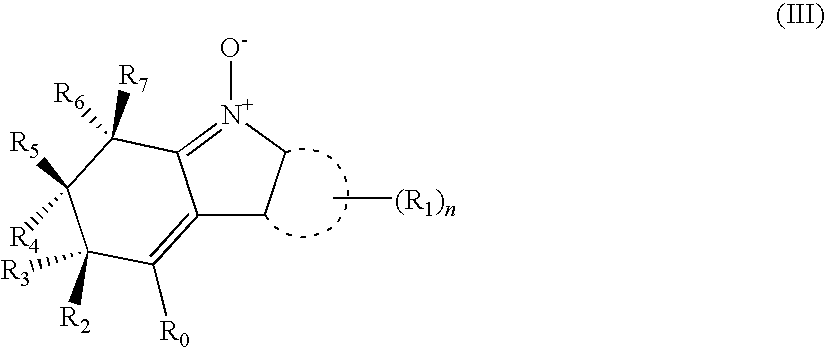
wherein R0, R1, R2, R3, R4, R5, R6, and R7 are independently selected from the group consisting of hydrogen; halogen; cyclic or acyclic, substituted or unsubstituted, branched or unbranched aliphatic; cyclic or acyclic, substituted or unsubstituted, branched or unbranched heteroaliphatic; substituted or unsubstituted, branched or unbranched acyl; substituted or unsubstituted, branched or unbranched aryl; substituted or unsubstituted, branched or unbranched heteroaryl; —ORG; —C(═O)RG; —CO2RG; —CN; —SCN; —SRG; —SORG; —SO2RG; —NO2; —N3; —N(RG)2; —NHC(═O)RG; —NRGC(═O)N(RG)2; —OC(═O)ORG; —OC(—O)RG; —OC(═O)N(RG)2; —NRGC(═O)ORG; or —C(RG)3; wherein each occurrence of RG is independently a hydrogen, a protecting group, an aliphatic moiety, a heteroaliphatic moiety, an acyl moiety; an aryl moiety; a heteroaryl moiety; alkoxy; aryloxy; alkylthio; arylthio; amino, alkylamino, dialkylamino, heteroaryloxy; or heteroarylthio moiety;
-
- wherein two or more substituents may form substituted or unsubstituted, cyclic, heterocyclic, aryl, or heteroaryl structures;
- wherein R2 and R3, R4 and R5, or R6 and R7 may form together ═O, ═NRG, or ═C(RG)2, wherein each occurrence of RG is defined as above;

represents a substituted or unsubstituted, cyclic, heterocyclic, aryl, or heteroaryl ring system; and
-
- n is an integer between 0 and 4.

is a monocyclic, bicyclic, tricyclic, or polycyclic ring system, preferably

is a monocyclic, bicyclic, or tricyclic ring system. The ring system may be carbocyclic or heterocyclic, aromatic or non-aromatic, substituted or unsubstituted. The ring may include fused rings, bridged rings, spiro-linked rings, or a combination thereof. In certain embodiments,

is a monocyclic ring system, preferably a 4-, 5-, 6-, or 7-membered monocyclic ring system, more preferably a 5- or 6-membered ring system, optionally including one, two, or three heteroatoms such as oxygen, nitrogen, or sulfur. In certain embodiments,

represents a phenyl ring. In other embodiments,

represents a six-member heteroaromatic ring. In other embodiments,

represents a five-member heteroaromatic ring. In yet other embodiments,

represents a six-membered non-aromatic ring. In still other embodiments,

represents a five-membered non-aromatic ring. Examples of particular monocyclic ring systems include:


is a phenyl ring with one, two, three, or four substituents, preferably one, two, or three substituents, more preferably one or two substituents. For example,

may be

In certain preferred embodiments,

wherein R1 is —C(RG)3, —ORG, —N(RG)2, or —SRG, wherein each occurrence of RG is independently a hydrogen, a protecting group, an aliphatic moiety, a heteroaliphatic moiety, an acyl moiety; an aryl moiety; a heteroaryl moiety; alkoxy; aryloxy; alkylthio; arylthio; amino, alkylamino, dialkylamino, heteroaryloxy; or heteroarylthio moiety; preferably R1 is alkoxy, more preferably methoxy, ethoxy, propoxy, or butoxy. In certain embodiments, RG is an unsubstituted alkyl, alkenyl, or alkynyl group. In certain embodiments, RG is C1-C20 alkyl. In other embodiments, RG is C1-C16 alkyl. In yet other embodiments, RG is C1-C12 alkyl. In still other embodiments, RG is C1-C6 alkyl. In certain embodiments, RG is C1-C20 alkenyl. In other embodiments, RG is C1-C16 alkenyl. In yet other embodiments, RG is C1-C12 alkenyl. In still other embodiments, RG is C1-C6 alkenyl. In certain embodiments, RG is —(CH2CH2O)n—CH2CH2ORg′, wherein n is an integer between 0 and 10, and RG′ is hydrogen or C1-C6 alkyl (e.g., methyl, ethyl).

represents a bicyclic ring system, preferably a 8-, 9-, 10-, 11-, or 12-membered bicyclic ring system, optionally substituted with one or more heteroatom such as oxygen, nitrogen, or sulfur. The ring system may optionally contain an aromatic ring. In certain embodiments, the bicyclic ring system is a phenyl ring fused with a 4-, 5-, 6-, or 7-membered ring, preferably a 5- or 6-membered ring. In certain embodiments, the bicyclic ring system is a six-membered heteroaromatic ring fused with a 4-, 5-, 6-, or 7-membered ring, preferably a 5- or 6-membered ring. Examples of bicyclic systems include:


wherein R0, R1, R2, R3, R4, R5, R6, and R7 are independently selected from the group consisting of hydrogen; halogen; cyclic or acyclic, substituted or unsubstituted, branched or unbranched aliphatic; cyclic or acyclic, substituted or unsubstituted, branched or unbranched heteroaliphatic; substituted or unsubstituted, branched or unbranched acyl; substituted or unsubstituted, branched or unbranched aryl; substituted or unsubstituted, branched or unbranched heteroaryl; —ORG; —C(═O)RG; —CO2RG; —CN; —SCN; —SRG; —SORG; —SO2RG; —NO2; —N3; —N(RG)2; —NHC(═O)RG; —NRGC(═O)N(RG)2; —OC(═O)ORG; —OC(═O)RG; —OC(═O)N(RG)2; —NRGC(═O)ORG; or —C(RG)3; wherein each occurrence of RG is independently a hydrogen, a protecting group, an aliphatic moiety, a heteroaliphatic moiety, an acyl moiety; an aryl moiety; a heteroaryl moiety; alkoxy; aryloxy; alkylthio; arylthio; amino, alkylamino, dialkylamino, heteroaryloxy; or heteroarylthio moiety;
-
- wherein two or more substituents may form substituted or unsubstituted, cyclic, heterocyclic, aryl, or heteroaryl structures;
- wherein R2 and R3, R4 and R5, or R6 and R7 may form together ═O, ═NRG, or ═C(RG)2, wherein each occurrence of RG is defined as above;
- P is an oxygen protecting group or hydrogen;
- Nu is hydrogen, —ORNu, —SRNu, —C(RNu)3, or —N(RNu)2, wherein each occurrence of RNu is independently a hydrogen, a protecting group, an aliphatic moiety, a heteroaliphatic moiety, an acyl moiety; an aryl moiety; a heteroaryl moiety; alkoxy; aryloxy; alkylthio; arylthio; amino, alkylamino, dialkylamino, heteroaryloxy; or heteroarylthio moiety;

represents a substituted or unsubstituted, cyclic, heterocyclic, aryl, or heteroaryl ring system; and
-
- n is an integer between 0 and 4. In certain preferred embodiments, P is hydrogen. In other embodiments, P is C1-C6 allyl. In yet other embodiments, P is an oxygen-protecting group. In certain embodiments, P is acetyl. In certain embodiments, Nu is a sulfur-based nucleophile of the formula —SRNu. In other embodiments, Nu is an oxygen-based nucleophile of the formula —ORNu (e.g., —OMe, —OEt, etc.). In other embodiments, Nu is a nitrogen-based nucleophile of the formula —N(RNu)2. In certain embodiments, the nucleophile is an amino acid (e.g., the side chain of serine, threonine, cysteine, lysine, histidine, glutamine, asparagine, arginine, tyrosine; preferably, serine, threonine, or cysteine). In certain particular embodiments the nucleophile is cysteine. In other embodiments, the nucleophile is an amino acid which is part of a peptide or protein. In other embodiments, the nucleophile is glutathione. These nucleophilic adducts) may be useful in delivering the drug. For example, these adducts may serve to temporarily protect the α,β-unsaturated nitrone functionality of the molecule. In certain embodiments, the adduct may be a hydrate of the molecule. In certain embodiments, the adduct is a reduced form, wherein Nu is hydrogen.

wherein
-
- R2, R3, R6, and R7 are defined as above; and
- each of R8 and R9 are independently hydrogen; halogen; cyclic or acyclic, substituted or unsubstituted, branched or unbranched aliphatic; cyclic or acyclic, substituted or unsubstituted, branched or unbranched heteroaliphatic; substituted or unsubstituted, branched or unbranched acyl; substituted or unsubstituted, branched or unbranched aryl; substituted or unsubstituted, branched or unbranched heteroaryl; —ORG; —C(═O)RG; —CO2RG; —CN; —SCN; —SRG; —SORG; —SO2RG; —NO2; —N3; —N(RG)2; —NHC(═O)RG; —NRGC(═O)N(RG)2; —OC(═O)ORG; —OC(—O)RG; —OC(═O)N(RG)2; —NRGC(═O)ORG; or —C(RG)3; wherein each occurrence of RG is independently a hydrogen, a protecting group, an aliphatic moiety, a heteroaliphatic moiety, an acyl moiety; an aryl moiety; a heteroaryl moiety; alkoxy; aryloxy; alkylthio; arylthio; amino, alkylamino, dialkylamino, heteroaryloxy; or heteroarylthio moiety.

wherein R2 and R3 are defined as above.

wherein R2 and R3 are defined as above.

wherein R2 and R3 are defined as above.

wherein R8 and R9 are defined as above.

wherein R8 and R9 are defined as above.

wherein R8 and R9 are defined as above.

wherein R6 and R7 are defined as above.

wherein R6 and R7 are defined as above.

wherein R6 and R7 are defined as above.

wherein R2, R3, R6, R7, R8, and R9 are defined as above. In certain embodiments, at least one of R2, R3, R6, R7, R8, and R9 is methyl. In certain embodiments, at least two of R2, R3, R6, R7, R8, and R9 are methyl. In certain embodiments, at least three of R2, R3, R6, R7, R8, and R9 are methyl. In certain embodiments, at least four of R2, R3, R6, R7, R8, and R9 are methyl. In certain embodiments, at least five of R2, R3, R6, R7, R8, and R9 are methyl.

wherein R6 and R7 are defined as above.

wherein R6 and R7 are defined as above.

wherein R6 and R7 are defined as above.

wherein R8 and R9 are defined as above.

wherein R8 and R9 are defined as above.

wherein R8 and R9 are defined as above.

wherein R2 and R3 are defined as above.

wherein R2 and R3 are defined as above.

wherein R2 and R3 are defined as above.

wherein R1, R2, R3, R6, R7, and n are defined as above. In certain embodiments, at least one of R2, R3, R6, and R7 is methyl. In certain embodiments, at least two of R2, R3, R6, and R7 are methyl. In certain embodiments, at least three of R2, R3, R6, and R7 are methyl. In certain embodiments, all four of R2, R3, R6, and R7 are methyl.

In other embodiments, R2 and R3 taken together form a structure of the formula:


wherein R1 is defined as above.

wherein R2 and R3 are defined as above.

wherein R2 and R3 are defined as above.

wherein R2 and R3 are defined as above.

wherein R1 and n are defined as above.

wherein R1 and n are defined as above.

wherein each occurrence of R1 is independently selected from the group consisting of hydrogen; halogen; cyclic or acyclic, substituted or unsubstituted, branched or unbranched aliphatic; cyclic or acyclic, substituted or unsubstituted, branched or unbranched heteroaliphatic; substituted or unsubstituted, branched or unbranched acyl; substituted or unsubstituted, branched or unbranched aryl; substituted or unsubstituted, branched or unbranched heteroaryl; —ORA; —C(═O)RA; —CO2RA; —CN; —SCN; —SRA; —SORA; —SO2RA; —NO2; —N3; —N(RA)2; —NHC(═O)RA; —NRAC(═O)N(RA)2; —OC(═O)ORA; —OC(═O)RA; —OC(—O)N(RA)2; —NRAC(═O)ORA; or —C(RA)3; wherein each occurrence of RA is independently a hydrogen, a protecting group, an aliphatic moiety, a heteroaliphatic moiety, an acyl moiety; an aryl moiety; a heteroaryl moiety; alkoxy; aryloxy; alkylthio; arylthio; amino, alkylamino, dialkylamino, heteroaryloxy; or heteroarylthio moiety;
-
- R6 is selected from the group consisting of hydrogen; halogen; cyclic or acyclic, substituted or unsubstituted, branched or unbranched aliphatic; cyclic or acyclic, substituted or unsubstituted, branched or unbranched heteroaliphatic; substituted or unsubstituted, branched or unbranched acyl; substituted or unsubstituted, branched or unbranched aryl; substituted or unsubstituted, branched or unbranched heteroaryl; —ORF; —C(═O)RF; —CO2RF; —CN; —SCN; —SRF; —SORF; —SO2RF; —NO2; —N3; —N(RF)2; —NHC(═O)RF; —NRFC(—O)N(RF)2; —OC(—O)ORF; —OC(═O)RF; —OC(═O)N(RF)2; —NRFC(═O)ORF; or —C(RF)3; wherein each occurrence of RF is independently a hydrogen, a protecting group, an aliphatic moiety, a heteroaliphatic moiety, an acyl moiety; an aryl moiety; a heteroaryl moiety; alkoxy; aryloxy; alkylthio; arylthio; amino, alkylamino, dialkylamino, heteroaryloxy; or heteroarylthio moiety;
- R7 is selected from the group consisting of hydrogen; halogen; cyclic or acyclic, substituted or unsubstituted, branched or unbranched aliphatic; cyclic or acyclic, substituted or unsubstituted, branched or unbranched heteroaliphatic; substituted or unsubstituted, branched or unbranched acyl; substituted or unsubstituted, branched or unbranched aryl; substituted or unsubstituted, branched or unbranched heteroaryl; —ORG; —C(—O)RG; —CO2RG; —CN; —SCN; —SRG; —SORG; —SO2RG; —NO2; —N3; —N(RG)2; —NHC(═O)RG; —NRGC(═O)N(RG)2; —OC(═O)ORG; —OC(═O)RG; —OC(═O)N(RG)2; —NRGC(═O)ORG; or —C(RG)3; wherein each occurrence of RG is independently a hydrogen, a protecting group, an aliphatic moiety, a heteroaliphatic moiety, an acyl moiety; an aryl moiety; a heteroaryl moiety; alkoxy; aryloxy; alkylthio; arylthio; amino, alkylamino, dialkylamino, heteroaryloxy; or heteroarylthio moiety;
- R8 and R9 are independently selected from the group consisting of hydrogen; halogen; cyclic or acyclic, substituted or unsubstituted, branched or unbranched aliphatic; cyclic or acyclic, substituted or unsubstituted, branched or unbranched heteroaliphatic; substituted or unsubstituted, branched or unbranched acyl; substituted or unsubstituted, branched or unbranched aryl; substituted or unsubstituted, branched or unbranched heteroaryl; —ORH; —C(—O)RH; —CO2RH; —CN; —SCN; —SRH; —SORH; —SO2RH; —NO2; —N3; —N(RH)2; —NHC(═O)RH; —NRHC(═O)N(RH)2; —OC(═O)ORH; —OC(═O)RH; —OC(═O)N(RH)2; —NRHC(═O)ORH; or —C(RH)3; wherein each occurrence of RH is independently a hydrogen, a protecting group, an aliphatic moiety, a heteroaliphatic moiety, an acyl moiety; an aryl moiety; a heteroaryl moiety; alkoxy; aryloxy; alkylthio; arylthio; amino, alkylamino, dialkylamino, heteroaryloxy; or heteroarylthio moiety;
- R10 and R11 are independently selected from the group consisting of hydrogen; halogen; cyclic or acyclic, substituted or unsubstituted, branched or unbranched aliphatic; cyclic or acyclic, substituted or unsubstituted, branched or unbranched heteroaliphatic; substituted or unsubstituted, branched or unbranched acyl; substituted or unsubstituted, branched or unbranched aryl; substituted or unsubstituted, branched or unbranched heteroaryl; —ORJ; —C(—O)RJ; —CO2RJ; —CN; —SCN; —SRJ; —SORJ; —SO2RJ; —NO2; —N3; —N(RJ)2; —NHC(—O)RJ; —NRJC(═O)N(RJ)2; —OC(═O)ORJ; —OC(═O)RJ; —OC(═O)N(RJ)2; —NRJC(═O)ORJ; or —C(RJ)3; wherein each occurrence of RJ is independently a hydrogen, a protecting group, an aliphatic moiety, a heteroaliphatic moiety, an acyl moiety; an aryl moiety; a heteroaryl moiety; alkoxy; aryloxy; alkylthio; arylthio; amino, alkylamino, dialkylamino, heteroaryloxy; or heteroarylthio moiety;
- R12 is selected from the group consisting of hydrogen; halogen; cyclic or acyclic, substituted or unsubstituted, branched or unbranched aliphatic; cyclic or acyclic, substituted or unsubstituted, branched or unbranched heteroaliphatic; substituted or unsubstituted, branched or unbranched acyl; substituted or unsubstituted, branched or unbranched aryl; substituted or unsubstituted, branched or unbranched heteroaryl; —ORL; —C(—O)RL; —CO2RL; —CN; —SCN; —SRL; —SORL; —SO2RL; —NO2; —N3; —N(RL)2; —NHC(—O)RL, —NRLC(═O)N(RL)2; —OC(═O)ORL; —OC(═O)RL; —OC(═O)N(RL)2; —NRLC(═O)ORL; or —C(RL)3; wherein each occurrence of RL is independently a hydrogen, a protecting group, an aliphatic moiety, a heteroaliphatic moiety, an acyl moiety; an aryl moiety; a heteroaryl moiety; alkoxy; aryloxy; alkylthio; arylthio; amino, alkylamino, dialkylamino, heteroaryloxy; or heteroarylthio moiety;
- R13 and R14 are independently selected from the group consisting of hydrogen; halogen; cyclic or acyclic, substituted or unsubstituted, branched or unbranched aliphatic; cyclic or acyclic, substituted or unsubstituted, branched or unbranched heteroaliphatic; substituted or unsubstituted, branched or unbranched acyl; substituted or unsubstituted, branched or unbranched aryl; substituted or unsubstituted, branched or unbranched heteroaryl; —ORM; —C(═O)RM; —CO2RM; —CN; —SCN; —SRM; —SORM; —SO2RM; —NO2; —N3; —N(RM)2; —NHC(═O)RM; —NRMC(═O)N(RM)2; —OC(═O)ORM; —OC(═O)RM; —OC(═O)N(RM)2; —NRMC(═O)ORM; or —C(RM)3; wherein each occurrence of RM is independently a hydrogen, a protecting group, an aliphatic moiety, a heteroaliphatic moiety, an acyl moiety; an aryl moiety; a heteroaryl moiety; alkoxy; aryloxy; alkylthio; arylthio; amino, alkylamino, dialkylamino, heteroaryloxy; or heteroarylthio moiety;
- R15 is selected from the group consisting of hydrogen; halogen; cyclic or acyclic, substituted or unsubstituted, branched or unbranched aliphatic; cyclic or acyclic, substituted or unsubstituted, branched or unbranched heteroaliphatic; substituted or unsubstituted, branched or unbranched acyl; substituted or unsubstituted, branched or unbranched aryl; substituted or unsubstituted, branched or unbranched heteroaryl; —ORP; —C(═O)RP; —CO2RP; —CN; —SCN; —SRP; —SORP; —SO2RP; —NO2; —N3; —N(RP)2; —NHC(═O)RP; —NRPC(═O)N(RP)2; —OC(═O)ORP; —OC(═O)RP; —OC(—O)N(RP)2; —NRPC(═O)ORP; or —C(RP)3; wherein each occurrence of RP is independently a hydrogen, a protecting group, an aliphatic moiety, a heteroaliphatic moiety, an acyl moiety; an aryl moiety; a heteroaryl moiety; alkoxy; aryloxy; alkylthio; arylthio; amino, alkylamino, dialkylamino, heteroaryloxy; or heteroarylthio moiety;
- wherein two or more substituents may form substituted or unsubstituted, cyclic, heterocyclic, aryl, or heteroaryl structures;
- wherein R6 and R7, R8 and R9, R13 and R14, and one R12 and another R12 may form together ═O, ═NRG, or ═C(RG)2, wherein each occurrence of RG is defined as above;
- X is O, S, C(RX)2, or NRX, wherein RX is hydrogen, a protecting group, an aliphatic, heteroaliphatic, aryl, heteroaryl, alkylaryl, or alkylheteroaryl moiety,
- Z is O, S, or NRZ, wherein RZ is hydrogen, a protecting group, an aliphatic, heteroaliphatic, aryl, heteroaryl, alkylaryl, or alkylheteroaryl moiety, or ORZ′, wherein RZ′ is hydrogen, a protecting group, an aliphatic, heteroaliphatic, aryl, heteroaryl, alkylaryl, or alkylheteroaryl moiety;
- the dashed line represents the presence or absence of a bond;
- m is an integer between 0 and 6, inclusive; and
- n is an integer between 0 and 2, inclusive.


wherein R1, R6, R7, and n are defined as above. In certain embodiments, n is 1. In other embodiments, n is 2. When n is greater than 1, the two or more R1 group may form a cyclic structure. In certain embodiments, R1 is aliphatic preferably C1-C20 aliphatic. In particular embodiments, R1 is alkyl, preferably C1-C20 alkyl. In particular embodiments, R1 is alkenyl, preferably C1-C20 alkenyl. In particular embodiments, R1 is alkynyl, preferably C1-C20 alkynyl. In certain embodiments, R1 is —OH. In certain embodiments, R1 is alkoxy. In certain embodiments, R1 is acyl, preferably —CO(CH2)xCH3, wherein x is an integer between 0 and 20 inclusive. In other embodiments, R1 is —SH. In yet other embodiments, R1 is —CN. In other embodiments, R1 is —SO2Me.

wherein
-
- each occurrence of R1 is independently selected from the group consisting of hydrogen; halogen; cyclic or acyclic, substituted or unsubstituted, branched or unbranched aliphatic; cyclic or acyclic, substituted or unsubstituted, branched or unbranched heteroaliphatic; substituted or unsubstituted, branched or unbranched acyl; substituted or unsubstituted, branched or unbranched aryl; substituted or unsubstituted, branched or unbranched heteroaryl; —ORA; —C(═O)RA; —CO2RA; —CN; —SCN; —SRA; —SORA; —SO2RA; —NO2; —N3; —N(RA)2; —NHC(═O)RA; —NRAC(═O)N(RA)2; —OC(═O)ORA; —OC(—O)RA; —OC(═O)N(RA)2; —NRAC(═O)ORA; or —C(RA)3; wherein each occurrence of RA is independently a hydrogen, a protecting group, an aliphatic moiety, a heteroaliphatic moiety, an acyl moiety; an aryl moiety; a heteroaryl moiety; alkoxy; aryloxy; alkylthio; arylthio; amino, alkylamino, dialkylamino, heteroaryloxy; or heteroarylthio moiety;
- R6 is selected from the group consisting of hydrogen; halogen; cyclic or acyclic, substituted or unsubstituted, branched or unbranched aliphatic; cyclic or acyclic, substituted or unsubstituted, branched or unbranched heteroaliphatic; substituted or unsubstituted, branched or unbranched acyl; substitute or unsubstituted, branched or unbranched aryl; substituted or unsubstituted, branched or unbranched heteroaryl; —ORF; —C(═O)RF; —CO2RF; —CN; —SCN; —SRF; —SORF; —SO2RF; —NO2; —N3; —N(RF)2; —NHC(═O)RF; —NRFC(═O)N(RF)2; —OC(═O)ORF; —OC(═O)RF; —OC(═O)N(RF)2; —NRFC(═O)ORF; or —C(RF)3; wherein each occurrence of RF is independently a hydrogen, a protecting group, an aliphatic moiety, a heteroaliphatic moiety, an acyl moiety; an aryl moiety; a heteroaryl moiety; alkoxy; aryloxy; alkylthio; arylthio; amino, alkylamino, dialkylamino, heteroaryloxy; or heteroarylthio moiety;
- R7 is selected from the group consisting of hydrogen; halogen; cyclic or acyclic, substituted or unsubstituted, branched or unbranched aliphatic; cyclic or acyclic, substituted or unsubstituted, branched or unbranched heteroaliphatic; substituted or unsubstituted, branched or unbranched acyl; substituted or unsubstituted, branched or unbranched aryl; substituted or unsubstituted, branched or unbranched heteroaryl; —ORG; —C(═O)RG; —CO2RG; —CN; —SCN; —SRG; —SORG; —SO2RG; —NO2; —N3; —N(RG)2; —NHC(═O)RG; —NRGC(═O)N(RG)2; —OC(═O)ORG; —OC(═O)RG; —OC(═O)N(RG)2; —NRGC(—O)ORG; or —C(RG)3; wherein each occurrence of RG is independently a hydrogen, a protecting group, an aliphatic moiety, a heteroaliphatic moiety, an acyl moiety; an aryl moiety; a heteroaryl moiety; alkoxy; aryloxy; alkylthio; arylthio; amino, alkylamino, dialkylamino, heteroaryloxy; or heteroarylthio moiety;
- R8 and R9 are independently selected from the group consisting of hydrogen; halogen; cyclic or acyclic, substituted or unsubstituted, branched or unbranched aliphatic; cyclic or acyclic, substituted or unsubstituted, branched or unbranched heteroaliphatic; substituted or unsubstituted, branched or unbranched acyl; substituted or unsubstituted, branched or unbranched aryl; substituted or unsubstituted, branched or unbranched heteroaryl; —ORH; —C(═O)RH; —CO2RH; —CN; —SCN; —SRH; —SORH; —SO2RH; —NO2; —N3; —N(RH)2; —NHC(═O)RH; —NRHC(═O)N(RH)2; —OC(═O)ORH; —OC(═O)RH; —OC(═O)N(RH)2; —NRHC(═O)ORH; or —C(RH)3; wherein each occurrence of RH is independently a hydrogen, a protecting group, an aliphatic moiety, a heteroaliphatic moiety, an acyl moiety; an aryl moiety; a heteroaryl moiety; alkoxy; aryloxy; alkylthio; arylthio; amino, alkylamino, dialkylamino, heteroaryloxy; or heteroarylthio moiety;
- R10 and R11 are independently selected from the group consisting of hydrogen; halogen; cyclic or acyclic, substituted or unsubstituted, branched or unbranched aliphatic; cyclic or acyclic, substituted or unsubstituted, branched or unbranched heteroaliphatic; substituted or unsubstituted, branched or unbranched acyl; substituted or unsubstituted, branched or unbranched aryl; substituted or unsubstituted, branched or unbranched heteroaryl; —ORJ; —C(═O)RJ; —CO2RJ; —CN; —SCN; —SRJ; —SORJ; —SO2RJ; —NO2; —N3; —N(RJ)2; —NHC(—O)RJ; —NRJC(═O)N(RJ)2; —OC(═O)ORJ; —OC(═O)RJ; —OC(═O)N(RJ)2; —NRJC(═O)ORJ; or —C(RJ)3; wherein each occurrence of RJ is independently a hydrogen, a protecting group, an aliphatic moiety, a heteroaliphatic moiety, an acyl moiety; an aryl moiety; a heteroaryl moiety; alkoxy; aryloxy; alkylthio; arylthio; amino, alkylamino, dialkylamino, heteroaryloxy; or heteroarylthio moiety;
- R12 is selected from the group consisting of hydrogen; halogen; cyclic or acyclic, substituted or unsubstituted, branched or unbranched aliphatic; cyclic or acyclic, substituted or unsubstituted, branched or unbranched heteroaliphatic; substituted or unsubstituted, branched or unbranched acyl; substituted or unsubstituted, branched or unbranched aryl; substituted or unsubstituted, branched or unbranched heteroaryl; —ORL; —C(—O)RL; —CO2RL; —CN; —SCN; —SRL; —SORL; —SO2RL; —NO2; —N3; —N(RL)2; —NHC(═O)RL; —NRLC(═O)N(RL)2; —OC(═O)ORL; —OC(═O)RL; —OC(═O)N(RL)2; —NRLC(—O)ORL; or —C(RL)3; wherein each occurrence of RL is independently a hydrogen, a protecting group, an aliphatic moiety, a heteroaliphatic moiety, an acyl moiety; an aryl moiety; a heteroaryl moiety; alkoxy; aryloxy; alkylthio; arylthio; amino, alkylamino, dialkylamino, heteroaryloxy; or heteroarylthio moiety;
- R13 and R14 are independently selected from the group consisting of hydrogen; halogen; cyclic or acyclic, substituted or unsubstituted, branched or unbranched aliphatic; cyclic or acyclic, substituted or unsubstituted, branched or unbranched heteroaliphatic; substituted or unsubstituted, branched or unbranched acyl; substituted or unsubstituted, branched or unbranched aryl; substituted or unsubstituted, branched or unbranched heteroaryl; —ORM; —C(═O)RM; —CO2RM; —CN; —SCN; —SRM; —SORM; —SO2RM; —NO2; —N3; —N(RM)2; —NHC(═O)RM; —NRMC(═O)N(RM)2; —OC(═O)ORM; —OC(═O)RM; —OC(═O)N(RM)2; —NRMC(—O)ORM; or —C(RM)3; wherein each occurrence of RM is independently a hydrogen, a protecting group, an aliphatic moiety, a heteroaliphatic moiety, an acyl moiety; an aryl moiety; a heteroaryl moiety; alkoxy; aryloxy; alkylthio; arylthio; amino, alkylamino, dialkylamino, heteroaryloxy; or heteroarylthio moiety;
- R15 is selected from the group consisting of hydrogen; halogen; cyclic or acyclic, substituted or unsubstituted, branched or unbranched aliphatic; cyclic or acyclic, substituted or unsubstituted, branched or unbranched heteroaliphatic; substituted or unsubstituted, branched or unbranched acyl; substituted or unsubstituted, branched or unbranched aryl; substituted or unsubstituted, branched or unbranched heteroaryl; —ORP; —C(═O)RP; —CO2RP; —CN; —SCN; —SRP; —SORP; —SO2RP; —NO2; —N3; —N(RP)2; —NHC(—O)RP; —NRPC(═O)N(RP)2; —OC(═O)ORP; —OC(═O)RP; —OC(═O)N(RP)2; —NRPC(═O)ORP; or —C(RP)3; wherein each occurrence of RP is independently a hydrogen, a protecting group, an aliphatic moiety, a heteroaliphatic moiety, an acyl moiety; an aryl moiety; a heteroaryl moiety; alkoxy; aryloxy; alkylthio; arylthio; amino, alkylamino, dialkylamino, heteroaryloxy; or heteroarylthio moiety;
- wherein two or more substituents may form substituted or unsubstituted, cyclic, heterocyclic, aryl, or heteroaryl structures;
- wherein R6 and R7, R8 and R9, R13 and R14, and one R12 and another R12 may form together ═O, ═NRG, or ═C(RG)2, wherein each occurrence of RG is defined as above;
- X is O, S, C(RX)2, or NRX, wherein RX is hydrogen, a protecting group, an aliphatic, heteroaliphatic, aryl, heteroaryl, alkylaryl, or alkylheteroaryl moiety,
- Z is O, S, or NRZ, wherein RZ is hydrogen, a protecting group, an aliphatic, heteroaliphatic, aryl, heteroaryl, alkylaryl, or alkylheteroaryl moiety, or ORZ′, wherein RZ′ is hydrogen, a protecting group, an aliphatic, heteroaliphatic, aryl, heteroaryl, alkylaryl, or alkylheteroaryl moiety;
- P is an oxygen-protecting group or hydrogen;
- Nu is hydrogen, —ORNu, —SRNu, —C(RNu)3, or —N(RNu)2, wherein each occurrence of RNu is independently a hydrogen, a protecting group, an aliphatic moiety, a heteroaliphatic moiety, an acyl moiety; an aryl moiety; a heteroaryl moiety; alkoxy; aryloxy; alkylthio; arylthio; amino, alkylamino, dialkylamino, heteroaryloxy; or heteroarylthio moiety;
- the dashed line represents the presence or absence of a bond;
- m is an integer between 0 and 6, inclusive; and
- n is an integer between 0 and 2, inclusive. In certain preferred embodiments, P is hydrogen. In other embodiments, P is C1-C6 allyl. In yet other embodiments, P is an oxygen-protecting group. In certain embodiments, P is acetyl. In certain embodiments, Nu is a sulfur-based nucleophile of the formula —SRNu. In other embodiments, Nu is an oxygen-based nucleophile of the formula —ORNu, for example —OH, —OMe, —OEt, etc. In other embodiments, Nu is a nitrogen-based nucleophile of the formula —N(RNu)2. In certain embodiments, the nucleophile is an amino acid (e.g., the side chain of serine, threonine, cysteine, lysine, histidine, glutamine, asparagine, arginine, or tyrosine; preferably, serine, threonine, or cysteine). In certain embodiments, the nucleophile is cysteine. In other embodiments, the nucleophile is an amino acid which is part of a peptide or protein. In certain particular embodiments, the nucleophile is glutathione. In certain embodiments, the nucleophile is a reducing agent such as hydride. These nucleophilic adducts of avrainvillamide and derivatives (including the homodimerization product stephacidin B) may be useful in delivering the drug. For example, these adducts may serve to temporarily protect the α,β-unsaturated nitrone functionality of the molecule. In certain embodiments, the adduct may be a hydrate of avrainvillamide or a derivative thereof.


-
- wherein each occurrence of R1 and R1′, is independently selected from the group consisting of hydrogen; halogen; cyclic or acyclic, substituted or unsubstituted, branched or unbranched aliphatic; cyclic or acyclic, substituted or unsubstituted, branched or unbranched heteroaliphatic; substituted or unsubstituted, branched or unbranched acyl; substituted or unsubstituted, branched or unbranched aryl; substituted or unsubstituted, branched or unbranched heteroaryl; —ORA; —C(═O)RA; —CO2RA; —CN; —SCN; —SRA; —SORA; —SO2RA; —NO2; —N3; —N(RA)2; —NHC(—O)RA; —NRAC(═O)N(RA)2; —OC(═O)ORA; —OC(═O)RA; —OC(═O)N(RA)2; —NRAC(═O)ORA; or —C(RA)3; wherein each occurrence of RA is independently a hydrogen, a protecting group, an aliphatic moiety, a heteroaliphatic moiety, an acyl moiety; an aryl moiety; a heteroaryl moiety; alkoxy; aryloxy; alkylthio; arylthio; amino, alkylamino, dialkylamino, heteroaryloxy; or heteroarylthio moiety;
- R6 and R6′ are independently selected from the group consisting of hydrogen; halogen; cyclic or acyclic, substituted or unsubstituted, branched or unbranched aliphatic; cyclic or acyclic, substituted or unsubstituted, branched or unbranched heteroaliphatic; substituted or unsubstituted, branched or unbranched acyl; substituted or unsubstituted, branched or unbranched aryl; substituted or unsubstituted, branched or unbranched heteroaryl; —ORF; —C(═O)RF; —CO2RF; —CN; —SCN; —SRF; —SORF; —SO2RF; —NO2; —N3; —N(RF)2; —NHC(═O)RF; —NRFC(═O)N(RF)2; —OC(═O)ORF; —OC(—O)RF; —OC(═O)N(RF)2; —NRFC(═O)ORF; or —C(RF)3; wherein each occurrence of RF is independently a hydrogen, a protecting group, an aliphatic moiety, a heteroaliphatic moiety, an acyl moiety; an aryl moiety; a heteroaryl moiety; alkoxy; aryloxy; alkylthio; arylthio; amino, alkylamino, dialkylamino, heteroaryloxy; or heteroarylthio moiety;
- R7 and R7′ are independently selected from the group consisting of hydrogen; halogen; cyclic or acyclic, substituted or unsubstituted, branched or unbranched aliphatic; cyclic or acyclic, substituted or unsubstituted, branched or unbranched heteroaliphatic; substituted or unsubstituted, branched or unbranched acyl; substituted or unsubstituted, branched or unbranched aryl; substituted or unsubstituted, branched or unbranched heteroaryl; —ORG; —C(═O)RG; —CO2RG; —CN; —SCN; —SRG; —SORG; —SO2RG; —NO2; —N3; —N(RG)2; —NHC(═O)RG; —NRGC(═O)N(RG)2; —OC(═O)ORG; —OC(—O)RG; —OC(═O)N(RG)2; —NRGC(═O)ORG; or —C(RG)3; wherein each occurrence of RG is independently a hydrogen, a protecting group, an aliphatic moiety, a heteroaliphatic moiety, an acyl moiety; an aryl moiety; a heteroaryl moiety; alkoxy; aryloxy; alkylthio; arylthio; amino, alkylamino, dialkylamino, heteroaryloxy; or heteroarylthio moiety;
- R8, R9, R8′, and R9′ are independently selected from the group consisting of hydrogen; halogen; cyclic or acyclic, substituted or unsubstituted, branched or unbranched aliphatic; cyclic or acyclic, substituted or unsubstituted, branched or unbranched heteroaliphatic; substituted or unsubstituted, branched or unbranched acyl; substituted or unsubstituted, branched or unbranched aryl; substituted or unsubstituted, branched or unbranched heteroaryl; —ORH; —C(═O)RH; —CO2RH; —CN; —SCN; —SRH; —SORH; —SO2RH; —NO2; —N3; —N(RH)2; —NHC(═O)RH; —NRHC(═O)N(RH)2; —OC(═O)ORH; —OC(═O)RH; —OC(═O)N(RH)2; —NRHC(═O)ORH; or —C(RH)3; wherein each occurrence of RH is independently a hydrogen, a protecting group, an aliphatic moiety, a heteroaliphatic moiety, an acyl moiety; an aryl moiety; a heteroaryl moiety; alkoxy; aryloxy; alkylthio; arylthio; amino, alkylamino, dialkylamino, heteroaryloxy; or heteroarylthio moiety;
- R10, R11, R10′, and R11′ are independently selected from the group consisting of hydrogen; halogen; cyclic or acyclic, substituted or unsubstituted, branched or unbranched aliphatic; cyclic or acyclic, substituted or unsubstituted, branched or unbranched heteroaliphatic; substituted or unsubstituted, branched or unbranched acyl; substituted or unsubstituted, branched or unbranched aryl; substituted or unsubstituted, branched or unbranched heteroaryl; —ORJ; —C(═O)RJ; —CO2RJ; —CN; —SCN; —SRJ; —SORJ; —SO2RJ; —NO2; —N3; —N(RJ)2; —NHC(—O)RJ; —NRJC(—O)N(RJ)2; —OC(═O)ORJ; —OC(═O)RJ; —OC(═O)N(RJ)2; —NRJC(═O)ORJ; or —C(RJ)3; wherein each occurrence of RJ is independently a hydrogen, a protecting group, an aliphatic moiety, a heteroaliphatic moiety, an acyl moiety; an aryl moiety; a heteroaryl moiety; alkoxy; aryloxy; alkylthio; arylthio; amino, alkylamino, dialkylamino, heteroaryloxy; or heteroarylthio moiety;
- R12 and R12′ are independently selected from the group consisting of hydrogen; halogen; cyclic or acyclic, substituted or unsubstituted, branched or unbranched aliphatic; cyclic or acyclic, substituted or unsubstituted, branched or unbranched heteroaliphatic; substituted or unsubstituted, branched or unbranched acyl; substituted or unsubstituted, branched or unbranched aryl; substituted or unsubstituted, branched or unbranched heteroaryl; —ORL; —C(—O)RL; —CO2RL; —CN; —SCN; —SRL; —SORL; —SO2RL; —NO2; —N3; —N(RL)2, —NHC(═O)RL; —NRLC(═O)N(RL)2; —OC(═O)ORL; —OC(═O)RL; —OC(═O)N(RL)2; —NRLC(═O)ORL; or —C(RL)3; wherein each occurrence of RL is independently a hydrogen, a protecting group, an aliphatic moiety, a heteroaliphatic moiety, an acyl moiety; an aryl moiety; a heteroaryl moiety; alkoxy; aryloxy; alkylthio; arylthio; amino, alkylamino, dialkylamino, heteroaryloxy; or heteroarylthio moiety;
- R13, R14, R13′, and R14′ are independently selected from the group consisting of hydrogen; halogen; cyclic or acyclic, substituted or unsubstituted, branched or unbranched aliphatic; cyclic or acyclic, substituted or unsubstituted, branched or unbranched heteroaliphatic; substituted or unsubstituted, branched or unbranched acyl; substituted or unsubstituted, branched or unbranched aryl; substituted or unsubstituted, branched or unbranched heteroaryl; —ORM; —C(═O)RM; —CO2RM; —CN; —SCN; —SRM; —SORM; —SO2RM; —NO2; —N3; —N(RM)2; —NHC(═O)RM; —NRMC(═O)N(RM)2; —OC(═O)ORM; —OC(═O)RM; —OC(═O)N(RM)2; —NRMC(═O)ORM; or —C(RM)3; wherein each occurrence of RM is independently a hydrogen, a protecting group, an aliphatic moiety, a heteroaliphatic moiety, an acyl moiety; an aryl moiety; a heteroaryl moiety; alkoxy; aryloxy; alkylthio; arylthio; amino, alkylamino, dialkylamino, heteroaryloxy; or heteroarylthio moiety;
- R15 and R15′ are selected from the group consisting of hydrogen; halogen; cyclic or acyclic, substituted or unsubstituted, branched or unbranched aliphatic; cyclic or acyclic, substituted or unsubstituted, branched or unbranched heteroaliphatic; substituted or unsubstituted, branched or unbranched acyl; substituted or unsubstituted, branched or unbranched aryl; substituted or unsubstituted, branched or unbranched heteroaryl; —ORP; —C(═O)RP; —CO2RP; —CN; —SCN; —SRP; —SORP; —SO2RP; —NO2; —N3; —N(RP)2; —NHC(—O)RP; —NRPC(═O)N(RP)2; —OC(═O)ORP; —OC(═O)RP; —OC(═O)N(RP)2; —NRPC(═O)ORP; or —C(RP)3; wherein each occurrence of RP is independently a hydrogen, a protecting group, an aliphatic moiety, a heteroaliphatic moiety, an acyl moiety; an aryl moiety; a heteroaryl moiety; alkoxy; aryloxy; alkylthio; arylthio; amino, alkylamino, dialkylamino, heteroaryloxy; or heteroarylthio moiety;
- wherein two or more substituents may form substituted or unsubstituted, cyclic, heterocyclic, aryl, or heteroaryl structures;
- wherein R6 and R7, R6′ and R7′, R8 and R9, R8′ and R9′, R13 and R14, R13′ and R14′, one R12′ and another R12′, and one R12 and another R12 may form together ═O, ═NRG, or ═C(RG)2, wherein each occurrence of RG is defined as above;
- X and X′ are independently O, S, C(RX)2, or NRX, wherein RX is hydrogen, a protecting group, an aliphatic, heteroaliphatic, aryl, heteroaryl, alkylaryl, or alkylheteroaryl moiety,
- Z and Z′ are independently O, S, or NRZ, wherein RZ is hydrogen, a protecting group, an aliphatic, heteroaliphatic, aryl, heteroaryl, alkylaryl, or alkylheteroaryl moiety, or ORZ′, wherein RZ′ is hydrogen, a protecting group, an aliphatic, heteroaliphatic, aryl, heteroaryl, alkylaryl, or alkylheteroaryl moiety;
- m and m′ are independently an integer between 0 and 6, inclusive; and
- n and n′ are independently an integer between 0 and 2, inclusive.

wherein, R1, R2, R3, R4 and R5 are independently selected from H, alkyl, aminoalkyl, perfluoroalkyl, is provided of at least 90%, 95%, 98%, 99%, or 99.9% purity, preferably at least 95% or 98% purity. The synthetic methods described herein allow for the preparation of compositions of such purity. However, achieving these levels of purity by isolating compounds such as avrainvillamide or stephacidin B from a natural source may be difficult or impossible due to their instability. This level of purity is even more of a challenge when large quantities of these compounds are needed. Sufficiently pure preparations of these compounds are particularly useful in formulating pharmaceutical compositions for administration to humans or other animals.
Methods of Synthesis


wherein R2, R3, R4, R5, R6, and R7 are independently selected from the group consisting of hydrogen; halogen; cyclic or acyclic, substituted or unsubstituted, branched or unbranched aliphatic; cyclic or acyclic, substituted or unsubstituted, branched or unbranched heteroaliphatic; substituted or unsubstituted, branched or unbranched acyl; substituted or unsubstituted, branched or unbranched aryl; substituted or unsubstituted, branched or unbranched heteroaryl; —ORG; —C(═O)RG; —CO2RG; —CN; —SCN; —SRG; —SORG; —SO2RG; —NO2; —N3; —N(RG)2; —NHC(═O)RG; —NRGC(═O)N(RG)2; —OC(═O)ORG; —OC(═O)RG; —OC(═O)N(RG)2; —NRGC(═O)ORG; or —C(RG)3; wherein each occurrence of RG is independently a hydrogen, a protecting group, an aliphatic moiety, a heteroaliphatic moiety, an acyl moiety, an aryl moiety; a heteroaryl moiety; alkoxy; aryloxy; alkylthio; arylthio; amino, alkylamino, dialkylamino, heteroaryloxy; or heteroarylthio moiety;
-
- wherein two or more substituents may form substituted or unsubstituted, cyclic, heterocyclic, aryl, or heteroaryl structures;
- wherein R2 and R3, R4 and R5, or R6 and R7 may form together ═O, ═NRG, or ═C(RG)2, wherein each occurrence of RG is defined as above; and
- X is a halogen;
is reacted in the presence of a transition metal catalyst with arylboronic acid derivative or aryl iodide of formula:

wherein each occurrence of R1 is independently selected from the group consisting of hydrogen; halogen; cyclic or acyclic, substituted or unsubstituted, branched or unbranched aliphatic; cyclic or acyclic, substituted or unsubstituted, branched or unbranched heteroaliphatic; substituted or unsubstituted, branched or unbranched acyl; substituted or unsubstituted, branched or unbranched aryl; substituted or unsubstituted, branched or unbranched heteroaryl; —ORG; —C(═O)RG; —CO2RG; —CN; —SCN; —SRG; —SORG; —SO2RG; —NO2; —N3; —N(RG)2; —NHC(—O)RG; —NRGC(═O)N(RG)2; —OC(═O)ORG; —OC(═O)RG; —OC(═O)N(RG)2; —NRGC(═O)ORG; or —C(RG)3; wherein each occurrence of RG is independently a hydrogen, a protecting group, an aliphatic moiety, a heteroaliphatic moiety, an acyl moiety; an aryl moiety; a heteroaryl moiety; alkoxy; aryloxy; alkylthio; arylthio; amino, alkylamino, dialkylamino, heteroaryloxy; or heteroarylthio moiety;
-
- wherein two or more substituents may form substituted or unsubstituted, cyclic, heterocyclic, aryl, or heteroaryl structures; and
- n is an integer between 0 and 4; and
- Y is a halogen, boronic acid (—B(OH)2), boronic ester, or organoborane to form a product of formula:

In certain embodiments, either R4 or R5 is not hydrogen. In another embodiment, at least one of R2, R3, R6, and R7 is not methyl. In yet another embodiment, at least one occurrence of R1 is not hydrogen. In certain embodiments, the transition metal catalyst is a palladium catalyst. The palladium catalyst is Pd(OAc)2 or Pd2dba3. In certain particular embodiments, the catalyst is Pd2(dba)3 and Ba(OH)2. In other embodiments, the catalyst is Pd2(dba)3 and Cu. In certain embodiments, X is I or Br.
In other embodiments, Y is —B(OH)2 or a boronic ester (e.g.,

In certain embodiments, the arylboronic acid derivative or aryl iodide is a bicyclic, tricyclic, or polycyclic ring system as shown in the formulae below:

wherein R1, n, and Y are as defined above, and

represents a substituted or unsubstituted, cyclic, heterocyclic, aryl, or heteroaryl ring system. In certain embodiments,

is a monocyclic ring system, preferably a 5- or 6-membered ring. In other embodiments,

is bicyclic ring system, preferably an 8-, 9-, 10-, 11- or 12-membered bicyclic ring system. In yet other embodiments,

is a tricyclic ring system. Two or more substituents R1 may together from an additional cyclic structure, which may be carbocyclic or heterocyclic, substituted or unsubstituted, or aromatic or non-aromatic. In certain embodiments, the arylboronic acid derivative or aryl iodide is of the formula:


wherein R1, R2, R3, R4, R5, R6, and R7 are independently selected from the group consisting of hydrogen; halogen; cyclic or acyclic, substituted or unsubstituted, branched or unbranched aliphatic; cyclic or acyclic, substituted or unsubstituted, branched or unbranched heteroaliphatic; substituted or unsubstituted, branched or unbranched acyl; substituted or unsubstituted, branched or unbranched aryl; substituted or unsubstituted, branched or unbranched heteroaryl; —ORG; —C(═O)RG; —CO2RG; —CN; —SCN; —SRG; SORG; —SO2RG; —NO2; —N3; —N(RG)2; —NHC(═O)RG; —NRGC(═O)N(RG)2; —OC(═O)ORG; —OC(═O)RG; —OC(═O)N(RG)2; —NRGC(═O)ORG; or —C(RG)3; wherein each occurrence of RG is independently a hydrogen, a protecting group, an aliphatic moiety, a heteroaliphatic moiety, an acyl moiety; an aryl moiety; a heteroaryl moiety; alkoxy; aryloxy; alkylthio; arylthio; amino, alkylamino, dialkylamino, heteroaryloxy; or heteroarylthio moiety;
-
- wherein two or more substituents may form substituted or unsubstituted, cyclic, heterocyclic, aryl, or heteroaryl structures;
- wherein R2 and R3, R4 and R5, or R6 and R7 may form together ═O, ═NRG, or ═C(RG)2, wherein each occurrence of RG is defined as above; and
- n is an integer between 0 and 4;
is reduced to form the nitrone:

In certain embodiments, the reducing agent is a metal. In certain particular embodiments, the metal is activated zinc powder.

are reacted together in the presence of base to form a stephacidin B analog of the formula:

In certain embodiments, the two avrainvillamide molecules are the same. In other embodiments, the two avrainvillamide molecules are different. In certain embodiments, the base is an amine such as ammonia, alkyl amine (e.g., methylamine, ethylamine, etc.), dialkylamine (e.g. dimethylamine, diethylamine, methylethylamine, etc.), or trialkylamine (e.g., trimethylamine, triethylamine, etc.). In certain embodiments, the reaction is carried out in the presence of a large excess of triethylamine in acetonitrile at approximately room temperature.
Pharmaceutical Compositions


Reaction conditions: (a) I2 (3 equiv), DMAP (0.2 equiv), CCl4-pyridine, 49° C., 96%. (b) Pd2(dba)3 (0.05 equiv), 2-nitrophenylboronic acid (1 equiv), 2-(di-t-butylphosphino)biphenyl (0.20 equiv), Ba(OH)2.8H2O (3.0 equiv), THF—H2O, 38° C., 73%. (c) 2-iodonitrobenzene (2 equiv), Pd2(dba)3 (0.025 equiv), Cu (powder, 5 equiv), DMSO, 70° C., 70%. (d) Zn (dust, 2.7 equiv), 1M NH4Cl (2.2 equiv), EtOH, 48° C., 64%.


Preparation of Acyclic Nitrones.


Experimentals:

Small-Scale Oxidation of Ketone 3 (Enone 18)

Large-Scale Oxidation of Ketone 3 (Enone 18)

Enantioselective Reduction of Enone 18 (Alcohol 4)
 |
| H | Δδ (CDCl3) |
| 1 | 0.0945 |
| 2 | 0.051 |
| 3 | −0.076 |
| 4 | −0.058 |
| 5 | −0.024 |
| 6 | 0.011 |
 |  |  |
Silyl Ether 19

Deprotection of 19 (Enone 5)


Alkylation of Ketone 5 (Alkylation Product 7)

Addition of Hydrogen Cyanide to Alkylation Product 7 (Nitrile 8)

Epimerization of Nitrile 8 (Nitrile 21)

Hydrolysis of Nitrile 21 (Amide 10)

Cyclization of Amide 10 (Hemiaminal 11)

Dehydration and Deprotection of 11 (Enamide 22)

Acylation of 22 (Amide 13)

Cyclization of Amide 13 (Tetracyclic Diketopiperazine 14)

Deprotection of Tetracyclic Diketopiperazine 14 (Alcohol 23)

Oxidation of Alcohol 23 (Enone 24)

Iodination of Enone 24 (α-Iodoenone 15)


Iodoarene 17

Palladium-Mediated Coupling of 15 and 10 (α-2-nitroarylenone 18)


Palladium-Mediated Coupling of 15 and 16 (α-2-nitroarylenone 18)


Stephacidin B (1)
| Comparative 1H NMR Data for Stephacidin B (500 MHz, 50% d6-DMSO-CD3CN). |
| Authentic Stephacidin B1 | Synthetic Stephacidin B2 | Authentic Stephacidin B | Synthetic Stephacidin B |
| n/r3 | 10.74 (s, 1H) | 3.22-3.10 (m, 2H) | 3.18-3.14 (m, 2H) |
| 7.73 (s, 1H) | 7.76 (s, 1H) | 2.82 (m, 1H) | 2.81 (m, 1H) |
| 7.50 (d, 1H, J = 10.2 Hz) | 7.50 (app d, 2H, J = 9.5 Hz)4 | 2.72 (m, 1H) | 2.72 (m, 1H) |
| 7.48 (d, 1H, J = 8.3 Hz) | 7.50 (app d, 2H, J = 9.5 Hz)4 | 2.52 (m, 2H) | 2.52 (m, 2H) |
| 7.11 (d, 1H, J = 10.0 Hz) | 7.11 (d, 1H, J = 9.5 Hz) | 2.30 (m, 1H) | 2.28 (m, 1H) |
| 7.04 (d, 1H, J = 8.6 Hz) | 7.04 (d, 1H, J = 9.0 Hz) | 2.15 (m, 2H) | 2.15 (m, 2H) |
| 6.54 (d, 1H, J = 8.2 Hz) | 6.54 (d, 1H, J = 8.5 Hz) | 2.10-2.00 (m, 2H) | 2.10-2.00 (m, 2H) |
| 6.41 (d, 1H, J = 8.6 Hz) | 6.41 (d, 1H, J = 9.0 Hz) | 1.95-1.85 (m, 4H) | 1.93-1.85 (m, 4H) |
| 5.64 (d, 1H, J = 10.2 Hz) | 5.64 (d, 1H, J = 10.5 Hz) | 1.72 (s, 3H) | 1.72 (s, 3H) |
| 5.59 (d, 1H, J = 10.0 Hz) | 5.59 (d, 1H, J = 10.5 Hz) | 1.58 (s, 3H) | 1.58 (s, 3H) |
| 5.34 (s, 1H) | 5.33 (s, 1H) | 1.41 (s, 3H) | 1.41 (s, 3H) |
| 4.93 (s, 1H) | 4.93 (s, 1H) | 1.35 (s, 6H) | 1.34 (s, 3H); 1.33 (s, 3H) |
| 3.49 (m, 1H) | 3.49 (m, 1H) | 1.26 (s, 3H) | 1.26 (s, 3H) |
| 3.45 (m, 1H) | 3.45 (m, 1H) | 1.17 (s, 3H) | 1.17 (s, 3H) |
| 3.40 (m, 1H) | 3.40 (m, 1H) | 1.05 (s, 3H) | 1.05 (s, 3H) |
| 1Data taken from: Qian-Cutrone, J.; Huang, S.; Shu, Y.; Vyas, D.; Fairchild, C.; Menendez, A.; Krampitz, K.; Dalterio, R.; Klohr, S.; Gao, Q. J. Am. Chem. Soc. 2002, 124, 14556; 500 MHz, 50% d6-DMSO-CD3CN. | |||
| 2500 MHz, 50% d6-DMSO-CD3CN, sample referenced to CD2HSOCD3 = 2.49 ppm. | |||
| 3The chemical shift of this resonance was not tabulated; the resonance is observed in the published spectrum. | |||
| 4The chemical shifts of these signals appeared to vary slightly between synthetic samples (compare synthetic spectra above). | |||
Determination of Relative Stereochemistry by X-Ray Analysis:


Percent viability inhibition=100×(B t −S)/(B t)
Percent growth inhibition=100×(S−B 0)/(B t −B 0)
where S is the sample reading, Bt is the average reading for a vehicle-treated population of cells at the completion of the assay, and B0 is the average reading for an untreated population of cells at the beginning of the assay.
| TABLE 4-1 |
| MS/MS Analysis of the 66 kDa Band |
| Observed Protein | MW | Coverage | Assignment |
| bovine serum | 69293 | 26% | known media contaminant - |
| albumin (BSA) | confirmed as nonspecific | ||
| cytoskeletal linking | 66022 | 22% | most likely corresponds to |
| membrane protein- | the observed specific 66 kda | ||
| 63 (CLIMP-63)‡ | band. | ||
| propionyl-coa | 77354 | 19% | almost certainly corresponds |
| carboxylase alpha | (M.P.)* | to the nonspecific double | |
| chain (PCCA) | band observed at 77/74 kda | ||
| (apparent) | |||
| propionyl-coa | 58206 | 8% | almost certainly corresponds |
| carboxylase beta | (M.P.)* | to the nonspecific double | |
| chain (PCCB) | band observed at 57/55 kda | ||
| (apparent) | |||
| | 70375 | 10% | these isoforms of HSP70 are |
| protein 1-like | most likely to be ubiqui- | ||
| (HS70L) | tous, nonspecific binders. | ||
| | 70052 | 7% | |
| protein 1 | |||
| (HSP71) | |||
| heat shock cognate | 70898 | 2% | |
| 71 kDa protein | |||
| (HSP7C) | |||
| *M.P. = Mass of the mitochondrial precursor. Typically these proteins show two bands, separated by ~2 kDa in molecular weight. | |||
| ‡The peptide fragments observed for CLIMP-63 all originate in the lumenal tail, which raises the possibility that the observed protein may correspond to a previously unobserved isoform of CLIMP-63. However, the Western blot results (vide infra) suggest that this is not the case. | |||
Confirmation of CLIMP-63 by Western Blot (
Claims (69)


Priority Applications (1)
| Application Number | Priority Date | Filing Date | Title |
|---|---|---|---|
| US11/908,901 US7902196B2 (en) | 2005-03-17 | 2006-03-17 | Synthesis of avrainvillamide, strephacidin B, and analogues thereof |
Applications Claiming Priority (3)
| Application Number | Priority Date | Filing Date | Title |
|---|---|---|---|
| US66264705P | 2005-03-17 | 2005-03-17 | |
| US11/908,901 US7902196B2 (en) | 2005-03-17 | 2006-03-17 | Synthesis of avrainvillamide, strephacidin B, and analogues thereof |
| PCT/US2006/009749 WO2006102097A2 (en) | 2005-03-17 | 2006-03-17 | Synthesis of avrainvillamide, stephacidin b, and analogues thereof |
Publications (2)
| Publication Number | Publication Date |
|---|---|
| US20090143581A1 US20090143581A1 (en) | 2009-06-04 |
| US7902196B2 true US7902196B2 (en) | 2011-03-08 |
Family
ID=37024426
Family Applications (2)
| Application Number | Title | Priority Date | Filing Date |
|---|---|---|---|
| US11/908,901 Expired - Fee Related US7902196B2 (en) | 2005-03-17 | 2006-03-17 | Synthesis of avrainvillamide, strephacidin B, and analogues thereof |
| US12/913,091 Abandoned US20110166170A1 (en) | 2005-03-17 | 2010-10-27 | Synthesis of avrainvillamide, stephacidin b, and analogues thereof |
Family Applications After (1)
| Application Number | Title | Priority Date | Filing Date |
|---|---|---|---|
| US12/913,091 Abandoned US20110166170A1 (en) | 2005-03-17 | 2010-10-27 | Synthesis of avrainvillamide, stephacidin b, and analogues thereof |
Country Status (7)
| Country | Link |
|---|---|
| US (2) | US7902196B2 (en) |
| EP (1) | EP1863800A4 (en) |
| JP (1) | JP2008537544A (en) |
| CN (1) | CN101189229A (en) |
| AU (1) | AU2006227379B2 (en) |
| CA (1) | CA2601135A1 (en) |
| WO (1) | WO2006102097A2 (en) |
Cited By (2)
| Publication number | Priority date | Publication date | Assignee | Title |
|---|---|---|---|---|
| US20110105515A1 (en) * | 2007-08-07 | 2011-05-05 | President And Fellows Of Harvard College | Targeting the oncoprotein nucleophosmin |
| US20110166170A1 (en) * | 2005-03-17 | 2011-07-07 | President And Fellows Of Harvard College | Synthesis of avrainvillamide, stephacidin b, and analogues thereof |
Families Citing this family (13)
| Publication number | Priority date | Publication date | Assignee | Title |
|---|---|---|---|---|
| JP5564249B2 (en) | 2006-06-23 | 2014-07-30 | アレシア・バイオセラピューティクス・インコーポレーテッド | Polynucleotide and polypeptide sequences involved in cancer |
| MX339476B (en) | 2008-04-18 | 2016-05-27 | Reata Pharmaceuticals Inc | Compounds including an anti-inflammatory pharmacore and methods of use. |
| EP2309860B1 (en) | 2008-07-22 | 2014-01-08 | Trustees of Dartmouth College | Monocyclic cyanoenones and methods of use thereof |
| AU2009321508B2 (en) | 2008-11-03 | 2015-03-12 | Adc Therapeutics Sa | Antibodies that specifically block the biological activity of a tumor antigen |
| HRP20171859T1 (en) | 2010-12-17 | 2018-01-26 | Reata Pharmaceuticals, Inc. | PYRAZOLYL AND PYRIMIDINYL TRICYCLIC ENONS AS ANTIOXIDATION MODULATORS OF INFLAMMATION |
| CN106146664B (en) | 2011-03-31 | 2021-09-07 | Adc治疗股份有限公司 | Antibodies against kidney-associated antigen 1 and antigen-binding fragments thereof |
| CN102268005B (en) * | 2011-06-01 | 2013-10-30 | 中国海洋大学 | Indole diketopiperazine alkaloid compound derived from tryptophan and proline and preparation method and application thereof |
| CA3115623A1 (en) | 2012-01-09 | 2013-07-18 | Adc Therapeutics Sa | Method for treating breast cancer |
| CN105777766B (en) * | 2014-12-15 | 2017-11-24 | 北大方正集团有限公司 | The preparation method of the methylnaltrexone bromides of Delta 7 |
| CN105753874A (en) * | 2014-12-15 | 2016-07-13 | 北大方正集团有限公司 | Delta-7 methylnaltrexone formate and preparation method thereof |
| CN105753875A (en) * | 2014-12-15 | 2016-07-13 | 北大方正集团有限公司 | Acetylated Delta-7 methylnaltrexone formate and preparation method thereof |
| CN105777767A (en) * | 2014-12-15 | 2016-07-20 | 北大方正集团有限公司 | Acetylated Delta-7 methylnaltrexone bromide and preparation method therefor |
| CN115197118B (en) * | 2022-06-21 | 2024-01-23 | 贵州医科大学 | Synthesis method of 3, 3-disubstituted vulcanized oxindole derivative |
Citations (4)
| Publication number | Priority date | Publication date | Assignee | Title |
|---|---|---|---|---|
| US6066635A (en) | 1999-03-23 | 2000-05-23 | University Of California, San Diego | Avrainvillamide, a cytotoxic marine natural product, and derivatives thereof |
| US6291461B1 (en) | 1998-06-10 | 2001-09-18 | Bristol-Myers Squibb Company | Stephacidin antitumor antibiotics |
| WO2004053019A1 (en) | 2002-12-12 | 2004-06-24 | Idemitsu Kosan Co., Ltd. | Organic electroluminescent device material and organic electroluminescent device using same |
| WO2006102097A2 (en) | 2005-03-17 | 2006-09-28 | President And Fellows Of Harvard College | Synthesis of avrainvillamide, stephacidin b, and analogues thereof |
Family Cites Families (4)
| Publication number | Priority date | Publication date | Assignee | Title |
|---|---|---|---|---|
| JPH0331257A (en) * | 1989-06-28 | 1991-02-12 | Kissei Pharmaceut Co Ltd | Production of indole derivative |
| JPH08157475A (en) * | 1994-11-29 | 1996-06-18 | Kissei Pharmaceut Co Ltd | 1-hydroxyindole derivative |
| AU2002367953C1 (en) * | 2001-05-04 | 2009-02-19 | Paratek Pharmaceuticals, Inc | Transcription factor modulating compounds and methods of use thereof |
| AU2003902023A0 (en) * | 2003-04-29 | 2003-05-15 | The Australian National University | A method of indole synthesis |
-
2006
- 2006-03-17 US US11/908,901 patent/US7902196B2/en not_active Expired - Fee Related
- 2006-03-17 AU AU2006227379A patent/AU2006227379B2/en not_active Ceased
- 2006-03-17 WO PCT/US2006/009749 patent/WO2006102097A2/en not_active Ceased
- 2006-03-17 JP JP2008502102A patent/JP2008537544A/en active Pending
- 2006-03-17 CN CNA2006800157270A patent/CN101189229A/en active Pending
- 2006-03-17 EP EP06738771A patent/EP1863800A4/en not_active Withdrawn
- 2006-03-17 CA CA002601135A patent/CA2601135A1/en not_active Abandoned
-
2010
- 2010-10-27 US US12/913,091 patent/US20110166170A1/en not_active Abandoned
Patent Citations (5)
| Publication number | Priority date | Publication date | Assignee | Title |
|---|---|---|---|---|
| US6291461B1 (en) | 1998-06-10 | 2001-09-18 | Bristol-Myers Squibb Company | Stephacidin antitumor antibiotics |
| US6066635A (en) | 1999-03-23 | 2000-05-23 | University Of California, San Diego | Avrainvillamide, a cytotoxic marine natural product, and derivatives thereof |
| WO2004053019A1 (en) | 2002-12-12 | 2004-06-24 | Idemitsu Kosan Co., Ltd. | Organic electroluminescent device material and organic electroluminescent device using same |
| EP1571193A1 (en) | 2002-12-12 | 2005-09-07 | Idemitsu Kosan Co., Ltd. | Organic electroluminescent device material and organic electroluminescent device using same |
| WO2006102097A2 (en) | 2005-03-17 | 2006-09-28 | President And Fellows Of Harvard College | Synthesis of avrainvillamide, stephacidin b, and analogues thereof |
Non-Patent Citations (139)
| Title |
|---|
| Adams, et al., Curr. Opin. Chem. Biol., 6:493, 2002. |
| Bain, et al., J. Magn. Reson., 188a:21, 1996. |
| Banwell, et al., Org. Lett., 5:2497, 2003. |
| Baran, et al., Angew. Chem., Int. Ed. Engl., 44:606, 2004. |
| Barros, et al., Chem. Eur. J., 6:3991, 2000. |
| Bassindale, et al., J. Organomet. Chem., 271:C1, 1984. |
| Bella, et al., Org. Biomol. Chem., 2:421, 2004. |
| Berge, et al., J. Pharmaceutical Science, 66:1-19, 1977. |
| Berger et al., Loss of the NPM1 gene in myeloid disorders with chromosome 5 rearrangements. Leukemia. Feb. 2006;20(2):319-21. |
| Bertwistle et al., Physical and functional interactions of the Arf tumor suppressor protein with nucleophosmin/B23. Mol Cell Biol. Feb. 2004;24(3):985-96. |
| Bloch, Chem. Rev., 98:1407, 1998. |
| Bordwell, et al., J. Am. Chem. Soc., 118:8777, 1996. |
| Bradford, A rapid and sensitive method for the quantitation of microgram quantities of protein utilizing the principle of protein-dye binding. Anal Biochem. May 7, 1976;72:248-54. |
| Breuza, et al., J. of Biological Chemistry, 279:47242-47253, 2004. |
| Busch et al., Actinomycin D inhibition of monoclonal antibody binding to nucleolar phosphoprotein 37/5.2 (B23). Life Sci. Oct. 22, 1984;35(17):1777-85. |
| Cancer Res. Jul. 15, 1987;47(14):3798-801. |
| Cazzaniga et al., Nucleophosmin mutations in childhood acute myelogenous leukemia with normal karyotype. Blood. Aug. 15, 2005;106(4):1419-22. Epub May 3, 2005. |
| Chan et al., Characterization of the cDNA encoding human nucleophosmin and studies of its role in normal and abnormal growth. Biochemistry. Feb. 7, 1989;28(3):1033-9. |
| Chan et al., Nucleolar protein B23 translocation after doxorubicin treatment in murine tumor cells. |
| Chan et al., Nucleophosmin/B23-binding peptide inhibits tumor growth and up-regulates transcriptional activity of p53. Biochem Biophys Res Commun. Jul. 29, 2005;333(2):396-403. |
| Chan, Characterization and cellular localization of nucleophosmin/B23 in HeLa cells treated with selected cytotoxic agents (studies of B23-translocation mechanism). Exp Cell Res. Nov. 1992;203(1):174-81. |
| Chen et al., Nucleophosmin gene mutations in acute myeloid leukemia. Arch Pathol Lab Med. Nov. 2006;130(11):1687-92. |
| Colombo et al., Nucleophosmin is required for DNA integrity and p 19Arf protein stability. Mol Cell Biol. Oct. 2005;25(20):8874-86. |
| Colombo et al., Nucleophosmin regulates the stability and transcriptional activity of p53. Nat Cell Biol. Jul. 2002;4(7):529-33. |
| Colonna, et al., Gazz. Chim. Ital., 97:1569, 1967. |
| Corey, et al, J. Am. Chem. Soc., 109:5551, 1987. |
| Corey, et al., J. Am. Chem. Soc., 109:7925, 1987. |
| Corey, et al., J. Angew. Chem., Int. Ed. Engl., 37:1986, 1998. |
| Coutts et al., The p53 response: emerging levels of co-factor complexity. Biochem Biophys Res Commun. Jun. 2005 10;331(3):778-85. |
| Cox, et al., Tetrahedron Lett., 43:2149, 2002. |
| Cushing, et al., J. Am. Chem. Soc., 118:557, 1996. |
| Dale, et al., J. Am. Chem. Soc., 95:512, 1973. |
| Dalenc et al., Increased expression of a COOH-truncated nucleophosmin resulting from alternative splicing is associated with cellular resistance to ionizing radiation in HeLa cells. Int J Cancer. Aug. 20, 2002;100(6):662-8. |
| Dess, et al., J. Am. Chem. Soc., 113:7277, 1991. |
| Dhar et al., Specificity protein 1-dependent p53-mediated suppression of human manganese superoxide dismutase gene expression. J Biol Chem. Aug. 4, 2006;281(31):21698-709. Epub Jun. 1, 2006. |
| Duyster et al., Translocations involving anaplastic lymphoma kinase (ALK). Oncogene. Sep. 10, 2001;20(40):5623-37. |
| Elomri, et al., Heterocycles, 34:799, 1992. |
| Falini et al., Acute myeloid leukemia carrying cytoplasmic/mutated nucleophosmin (NPMc+AML): biologic and clinical features. Blood. Feb. 1, 2007;109(3):874-85. Epub Sep. 28, 2006. |
| Falini et al., Cytoplasmic nucleophosmin in acute myelogenous leukemia with a normal karyotype. N Engl J Med. Jan. 20, 2005;352(3):254-66. |
| Farah, et al., J. of Biological Chemistry, 280:9439-9449, 2005. |
| Frehlick et al., New insights into the nucleophosmin/nucleoplasmin family of nuclear chaperones. Bioessays. Jan. 2007;29(1):49-59. |
| Frigerio, et al., J. Org. Chem., 64:4537, 1999. |
| Galkin et al., Identification of NVP-TAE684, a potent, selective, and efficacious inhibitor of NPM-ALK. Proc Natl Acad Sci U S A. Jan. 2, 2007;104(1):270-5. Epub Dec. 21, 2006. |
| Ghaffar, et al, J. Mol. Catal. A., 160:249, 2000. |
| Ghaffar, et al., Tetrahedron Lett., 36:8657, 1995. |
| Gjerset, DNA damage, p14ARF, nucleophosmin (NPM/B23), and cancer. J Mol Histol. Sep. 2006;37(5-7):239-51. Epub Jul. 20, 2006. |
| Grisendi et al., Nucleophosmin and cancer. Nat Rev Cancer. Jul. 2006;6(7):493-505. |
| Gutsulyak, et al., Chemistry of Heterocyclic Compounds, 23:846-849, 1987 [abstract]. |
| Herrera et al., Sedimentation analyses of the salt- and divalent metal ion-induced oligomerization of nucleolar protein B23. Biochemistry. Feb. 27, 1996;35(8):2668-73. |
| Herzon, et al., J. Am. Chem. Soc., 127:5342-5344, 2005. |
| Hingorani et al., Mapping the functional domains of nucleolar protein B23. J Biol Chem. Aug. 11, 2000;275(32):24451-7. |
| Hollstein et al., p53 mutations in human cancers. Science. Jul. 5, 1991;253(5015):49-53. |
| International Preliminary Report on Patentability for PCT/US2006/009749 mailed Sep. 27, 2007. |
| International Search Report and Written Opinion for PCT/US2006/009749 mailed Nov. 27, 2006. |
| International Search Report, PCT/US06/09749, mailed on Nov. 27, 2006. |
| Ishiyama, et al., J. Org. Chem., 60:7508, 1995. |
| Ito, et al., J. Org. Chem., 43:1011, 1978. |
| Jackson, et al., Chem. Commun., 2327, 2000. |
| Johnson, et al., Tetrahedron Lett., 33:917, 1992. |
| Klopfenseein, et al., EMBO J., 17:6168-6177, 1998. |
| Klopfenstein, et al., J. of Cell Biology, 153:1287-1299, 2001. |
| Knochel, et al., Tetrahedron, 49:29, 1993. |
| Kofron, et al., J. Org. Chem., 41:1879, 1976. |
| Kurki et al., Nucleolar protein NPM interacts with HDM2 and protects tumor suppressor protein p53 from HDM2-mediated degradation. Cancer Cell. May 2004;5(5):465-75. |
| Kurki et al., Nucleophosmin, HDM2 and p53: players in UV damage incited nucleolar stress response. Cell Cycle. Aug. 2004;3(8):976-9. Epub Aug. 8, 2004. |
| Lambert et al., Characterisation of the interface between nucleophosmin (NPM) and p53: potential role in p53 stabilisation. FEBS Lett. Jan. 9, 2006;580(1):345-50. Epub Dec. 19, 2005. |
| Latonen et al., Cellular UV damage responses—functions of tumor suppressor p53. Biochim Biophys Acta. Jul 25, 2005;1755(2):71-89. |
| Lau, et al., J. Org. Chem., 43:1595, 1978. |
| Lecaille, et al., Chem. Rev., 102:4459, 2002. |
| Lee et al., Crystal structure of human nucleophosmin-core reveals plasticity of the pentamer-pentamer interface. Proteins. Nov. 15, 2007;69(3):672-8. |
| Lee et al., Release of nucleophosmin from the nucleus: Involvement in aloe-emodin-induced human lung non small carcinoma cell apoptosis. Int J Cancer. Mar. 1, 2005;113(6):971-6. |
| Li et al., Hypoxia-induced nucleophosmin protects cell death through inhibition of p53. J Biol Chem. Oct. 1, 2004;279(40):41275-9. Epub Aug. 13, 2004. |
| Li et al., Negative regulation of p53 by nucleophosmin antagonizes stress-induced apoptosis in human normal and malignant hematopoietic cells. Leuk Res. Dec. 2005;29(12):1415-23. Epub Jun. 17, 2005. |
| Li et al., Nucleophosmin suppresses oncogene-induced apoptosis and senescence and enhances oncogenic cooperation in cells with genomic instability. Carcinogenesis. Jun. 2007;28(6):1163-70. Epub Feb. 2, 2007. |
| Lim et al., Nucleophosmin and human cancer. Cancer Detect Prev. 2006;30(6):481-90. Epub Nov. 17, 2006. |
| Lissel, et al., Liebigs Ann. Chem., 263, 1987. |
| Liu et al., Synthesis of biaryls and polyaryls by ligand-free Suzuki reaction in aqueous phase. J Org Chem. May 12, 2006;71(10):3994-7. |
| Lombardo, et al., Synthesis, 6:759, 2000. |
| Maiguel et al., Nucleophosmin sets a threshold for p53 response to UV radiation. Mol Cell Biol. May 2004;24(9):3703-1 1. |
| Maya et al., Synthesis of Fluorinated Oligomers toward Physical Vapor Deposition Molecular Electronics Candidates. Chem Mater. 2005;17:1331-45. |
| Meyer, et al., J. Org. Chem., 59:7549, 1994. |
| Moore et al., Culture of normal human leukocytes. JAMA. Feb. 20, 1967;199(8):519-24. |
| Mundy, Biochem. Soc. Trans., 23:572-576, 1995. |
| Mundy, et al., J. Cell. Biol., 116:135-146, 1992. |
| Myers et al. J. Am. Chem. Soc., 125: 12080, 2003. * |
| Myers et al. Journal of the American Chemical Society, 2003, 125 (40), pp. 12080-12081. * |
| Myers, et al., J. Am. Chem. Soc., 125:12080, 2003. |
| Namboodiri et al., The structure and function of Xenopus NO38-core, a histone chaperone in the nucleolus. Structure. Dec. 2004;12(12):2149-60. |
| Naoe et al., Nucleophosmin: a versatile molecule associated with hematological malignancies. Cancer Sci. Oct. 2006;97(10):963-9. |
| Nelson, et al., Tetrahedron, 47:3259, 1991. |
| Nicolaou, et al., Angew. Chem., Int. Ed. Engl., 41:993, 2002. |
| Nicolini et al., Biomolecular markers of breast cancer. Front Biosci. May 1, 2006;11:1818-43. |
| Nussbaum, et al., Angew. Chem. Int. Ed., 42:3068, 2002. |
| Ohtani, et al., J. Am. Chem. Soc., 113:4092, 1991. |
| Okuda et al., The role of nucleophosmin in centrosome duplication. Oncogene. Sep. 9, 2002;21(40):6170-4. |
| Oliveira, et al., J. Org. Chem., 64:6646, 1999. |
| Page, et al, J. Org. Chem., 67:7787, 2002. |
| Pangbom, et al., Organometallics, 15:1518, 1996. |
| Peng, Current status of gendicine in China: recombinant human Ad-p53 agent for treatment of cancers. Hum Gene Ther. Sep. 2005;16(9):1016-27. |
| Qian-Cutrone, et al., J. Am. Chem. Soc., 124:14556, 2002. |
| Redner et al., The t(5;17) variant of acute promyelocytic leukemia expresses a nucleophosmin-retinoic acid receptor fusion. Blood. Feb. 1, 1996;87(3):882-6. |
| Sanz-Cervera, et al., J. Am. Chem. Soc., 124:2556, 2002. |
| Sapountzis, et al, Angew. Chem., Int. Ed. Engl., 41:1610, 2002. |
| Schaefer, et al., In the Chemistry of the Cyano Group, The Chemistry of Functional Groups, Wiley and Sons: New York, 1970; pp. 239. |
| Schweizer, et al., J. Cell. Sci., 104:671-683, 1993. |
| Schweizer, et al., J. Cell. Sci., 104:685-694, 1993. |
| Schweizer, et al., J. Cell. Sci., 108:2477-2485, 1995. |
| Schweizer, et al., J. Cell. Sci., 126:25-39, 1994. |
| Seko et al., A convenient copper-catalyzed direct amination of nitroarenes with O- alkylhydroxylamines. J Chem Soc., Perkin Trans 1. 1999:1437-44. |
| Spence, et al., Chem. Rev., 70:231, 1970. |
| Still, et al, J. Org. Chem., 43:2923, 1978. |
| Stocking, et al., Angew. Chem., Int. Ed. Engl., 42:3078, 2003. |
| Stocking, et al., J. Am. Chem. Soc., 122:1675, 2000. |
| Strausberg et al., Generation and initial analysis of more than 15,000 full-length human and mouse cDNA sequences. Proc Natl Acad Sci U S A. Dec. 24, 2002;99(26):16899-903. Epub Dec. 11, 2002. |
| Sugie, et al., J. Antiobiot., 54:911, 2001. |
| Suginome, et al., J. Chem. Soc., Perkin Trans., 1:917, 1991. |
| Sun, et al., Synthesis, 1249, 1997. |
| Szebeni et al., Interaction of nucleolar protein B23 with peptides related to nuclear localization signals. Biochemistry. Jun. 27, 1995;34(25):8037-42. |
| Tae, et al., Can. J. Chem., 78:689, 2000. |
| Torri, et al., Bull. Soc. Chem. Fr., 283, 1978. |
| Tosi, et al., Montash. Chem., 118:369, 1987. |
| Townsend et al., A glutathione S-transferase pi-activated prodrug causes kinase activation concurrent with S-glutathionylation of proteins. Mol Pharmacol. Feb. 2006;69(2):501-8. Epub Nov. 15, 2005. |
| Turner et al., What have we learnt from mouse models of NPM-ALK-induced lymphomagenesis? Leukemia. Jul. 2005;19(7):1128-34. |
| Utzinger, et al., Helv. Chim. Acta., 37:1892, 1954. |
| Vassilev et al., In vivo activation of the p53 pathway by small-molecule antagonists of MDM2. Science. Feb. 6, 2004;303(5659):844-8. Epub Jan. 2, 2004. |
| Vedrenne, et al., Mol. Biol. Cell., 16:1928-1937, 2005. |
| Ventura et al., Restoration of p53 function leads to tumour regression in vivo. Nature. Feb. 8, 2007;445(7128):661-5. Epub Jan. 24, 2007. |
| Williams, et al., J. Acc. Chem. Res., 36:127, 2003. |
| Williams, et al., J. Am. Chem. Soc., 112:808, 1990. |
| Williams, et al., J. Am. Chem. Soc., 125:12172, 2003. |
| Wolfe, et al., J. Am. Chem. Soc., 121:9550, 1999. |
| Wulff et al., Evidence for the rapid conversion of stephacidin B into the electrophilic monomer avrainvillamide in cell culture. J Am Chem Soc. Apr. 25, 2007;129(16):4898-9. Epub Mar. 31, 2007. |
| Wulff et al., The natural product avrainvillamide binds to the oncoprotein nucleophosmin. J Am.Chem Soc. Nov. 21, 2007;129(46):14444-51. Epub Oct. 25, 2007. Author Manuscript. |
| Ye, Nucleophosmin/B23, a multifunctional protein that can regulate apoptosis. Cancer Biol Ther. Sep. 2005;4(9):918-23. Epub Sep. 1, 2005. |
| Yoneda-Kato et al., The t(3;5)(q25.1;q34) of myelodysplastic syndrome and acute myeloid leukemia produces a novel fusion gene, NPM-MLF1. Oncogene. Jan. 18, 1996;12(2):265-75. |
| You et al., Decrease in nucleophosmin/B23 mRNA and telomerase activity during indomethacin-induced apoptosis of gastric KATO-III cancer cells. Naunyn Schmiedebergs Arch Pharmacol. Dec. 1999;360(6):683-90. |
| Yung et al., Effects of luzopeptins on protein B23 translocation and ribosomal RNA synthesis in HeLa cells. Cancer Res. Feb. 1986;46(2):922-5. |
| Zou et al., Polyamine depletion increases cytoplasmic levels of RNA-binding protein HuR leading to stabilization of nucleophosmin and p53 mRNAs. J Biol Chem. Jul. 14, 2006;281(28):19387-94 Epub May 10, 2006. |
| Zou et al., Polyamine depletion induces nucleophosmin modulating stability and transcriptional activity of p53 in intestinal epithelial cells. Am J Physiol Cell Physiol. Sep. 2005;289(3):C686-96 Epub May 4, 2005. |
Cited By (2)
| Publication number | Priority date | Publication date | Assignee | Title |
|---|---|---|---|---|
| US20110166170A1 (en) * | 2005-03-17 | 2011-07-07 | President And Fellows Of Harvard College | Synthesis of avrainvillamide, stephacidin b, and analogues thereof |
| US20110105515A1 (en) * | 2007-08-07 | 2011-05-05 | President And Fellows Of Harvard College | Targeting the oncoprotein nucleophosmin |
Also Published As
| Publication number | Publication date |
|---|---|
| US20090143581A1 (en) | 2009-06-04 |
| AU2006227379A1 (en) | 2006-09-28 |
| JP2008537544A (en) | 2008-09-18 |
| CA2601135A1 (en) | 2006-09-28 |
| EP1863800A2 (en) | 2007-12-12 |
| US20110166170A1 (en) | 2011-07-07 |
| WO2006102097A2 (en) | 2006-09-28 |
| AU2006227379B2 (en) | 2011-10-20 |
| CN101189229A (en) | 2008-05-28 |
| WO2006102097A3 (en) | 2007-01-18 |
| EP1863800A4 (en) | 2011-05-04 |
Similar Documents
| Publication | Publication Date | Title |
|---|---|---|
| US20110166170A1 (en) | Synthesis of avrainvillamide, stephacidin b, and analogues thereof | |
| US8394818B2 (en) | Soluble mTOR complexes and modulators thereof | |
| US10202400B2 (en) | Cortistatin analogues and syntheses thereof | |
| US20170081308A1 (en) | Synthesis of thiohydantoins | |
| US11903910B2 (en) | Use of metformin and analogs thereof to reduce RAN protein levels in the treatment of neurological disorders | |
| US20160168154A1 (en) | Inhibitors of transcription factors and uses thereof | |
| US20110263569A1 (en) | Ryanodine channel binders and uses thereof | |
| US20120108605A1 (en) | O-glcnac transferase inhibitors and uses thereof | |
| US20060287520A1 (en) | Synthesis of salinosporamide A and analogues thereof | |
| US20090221568A1 (en) | Synthesis of Inhibitors of FtsZ | |
| US9193665B2 (en) | Synthesis of galanal compounds and analogues thereof | |
| US12582644B2 (en) | O-GlcNAc transferase inhibitors and uses thereof | |
| US20110105515A1 (en) | Targeting the oncoprotein nucleophosmin | |
| WO2025059538A1 (en) | Yap degraders as potential anticancer drugs | |
| US11242331B2 (en) | Analogs of yohimbine and uses thereof | |
| US11919886B2 (en) | 4,9-dioxo-4,9-dihydronaphtho[2,3-B]furan-3-carboxamide derivatives and uses thereof for treating proliferative diseases and infectious diseases | |
| US7910623B2 (en) | Synthesis of scabronines and analogues thereof | |
| HK1118828A (en) | Synthesis of avrainvillamide, stephacidin b, and analogues thereof | |
| WO2026039516A1 (en) | Glucosylceramide synthase inhibitors and uses thereof | |
| CA2616028A1 (en) | Synthesis of scabronines and analogues thereof |
Legal Events
| Date | Code | Title | Description |
|---|---|---|---|
| AS | Assignment |
Owner name: PRESIDENT AND FELLOWS OF HARVARD COLLEGE, MASSACHU Free format text: ASSIGNMENT OF ASSIGNORS INTEREST;ASSIGNORS:MYERS, ANDREW G.;HERZON, SETH B.;WULFF, JEREMY EARLE;AND OTHERS;REEL/FRAME:021774/0880;SIGNING DATES FROM 20080619 TO 20081022 Owner name: PRESIDENT AND FELLOWS OF HARVARD COLLEGE, MASSACHU Free format text: ASSIGNMENT OF ASSIGNORS INTEREST;ASSIGNORS:MYERS, ANDREW G.;HERZON, SETH B.;WULFF, JEREMY EARLE;AND OTHERS;SIGNING DATES FROM 20080619 TO 20081022;REEL/FRAME:021774/0880 |
|
| AS | Assignment |
Owner name: NATIONAL INSTITUTES OF HEALTH (NIH), U.S. DEPT. OF Free format text: EXECUTIVE ORDER 9424, CONFIRMATORY LICENSE;ASSIGNOR:HARVARD UNIVERSITY;REEL/FRAME:022411/0943 Effective date: 20090310 |
|
| AS | Assignment |
Owner name: PRESIDENT AND FELLOWS OF HARVARD COLLEGE, MASSACHU Free format text: ASSIGNMENT OF ASSIGNORS INTEREST;ASSIGNORS:MYERS, ANDREW G.;HERZON, SETH B.;SIEGRIST, ROMAIN;AND OTHERS;REEL/FRAME:023584/0721;SIGNING DATES FROM 20091005 TO 20091116 Owner name: PRESIDENT AND FELLOWS OF HARVARD COLLEGE, MASSACHU Free format text: ASSIGNMENT OF ASSIGNORS INTEREST;ASSIGNORS:MYERS, ANDREW G.;HERZON, SETH B.;SIEGRIST, ROMAIN;AND OTHERS;SIGNING DATES FROM 20091005 TO 20091116;REEL/FRAME:023584/0721 |
|
| CC | Certificate of correction | ||
| REMI | Maintenance fee reminder mailed | ||
| LAPS | Lapse for failure to pay maintenance fees | ||
| STCH | Information on status: patent discontinuation |
Free format text: PATENT EXPIRED DUE TO NONPAYMENT OF MAINTENANCE FEES UNDER 37 CFR 1.362 |
|
| STCH | Information on status: patent discontinuation |
Free format text: PATENT EXPIRED DUE TO NONPAYMENT OF MAINTENANCE FEES UNDER 37 CFR 1.362 |
|
| FP | Lapsed due to failure to pay maintenance fee |
Effective date: 20150308 |