US7893068B2 - Physiologically active substances - Google Patents
Physiologically active substances Download PDFInfo
- Publication number
- US7893068B2 US7893068B2 US11/927,564 US92756407A US7893068B2 US 7893068 B2 US7893068 B2 US 7893068B2 US 92756407 A US92756407 A US 92756407A US 7893068 B2 US7893068 B2 US 7893068B2
- Authority
- US
- United States
- Prior art keywords
- group
- compound
- optionally substituted
- formula
- epoxytricosa
- Prior art date
- Legal status (The legal status is an assumption and is not a legal conclusion. Google has not performed a legal analysis and makes no representation as to the accuracy of the status listed.)
- Expired - Fee Related, expires
Links
- 0 [3*]C1CCC([6*])(C)C([7*])/C=C/C(C)C(/C(C)=C/C=C/C(C)(O)CC2OC2C(C)C([21*])CC)OC(=O)C1 Chemical compound [3*]C1CCC([6*])(C)C([7*])/C=C/C(C)C(/C(C)=C/C=C/C(C)(O)CC2OC2C(C)C([21*])CC)OC(=O)C1 0.000 description 27
- MNOMBFWMICHMKG-DDEPDXEBSA-N CCC(O)C(C)C1OC1CC(C)(O)/C=C/C=C(\C)C1OC(=O)CC(O)CCC(C)(O)C(OC(=O)N2CCN(C3CCCCCC3)CC2)/C=C/C1C Chemical compound CCC(O)C(C)C1OC1CC(C)(O)/C=C/C=C(\C)C1OC(=O)CC(O)CCC(C)(O)C(OC(=O)N2CCN(C3CCCCCC3)CC2)/C=C/C1C MNOMBFWMICHMKG-DDEPDXEBSA-N 0.000 description 3
- SQKPWEBKGIAODD-PSPXNJSOSA-N CCC(OC)C(C)C1OC1CC(C)(O)/C=C/C=C(\C)C1OC(=O)CC(O)CCC(C)(O)C(OC(=O)N2CCN(C(C)C)CC2)/C=C/C1C Chemical compound CCC(OC)C(C)C1OC1CC(C)(O)/C=C/C=C(\C)C1OC(=O)CC(O)CCC(C)(O)C(OC(=O)N2CCN(C(C)C)CC2)/C=C/C1C SQKPWEBKGIAODD-PSPXNJSOSA-N 0.000 description 3
- WOKVLHYHBWUWOF-PSPXNJSOSA-N C=CCN1CCN(C(=O)OC2/C=C/C(C)C(/C(C)=C/C=C/C(C)(O)CC3OC3C(C)C(O)CC)OC(=O)CC(O)CCC2(C)C)CC1 Chemical compound C=CCN1CCN(C(=O)OC2/C=C/C(C)C(/C(C)=C/C=C/C(C)(O)CC3OC3C(C)C(O)CC)OC(=O)CC(O)CCC2(C)C)CC1 WOKVLHYHBWUWOF-PSPXNJSOSA-N 0.000 description 2
- ZPFXOPIELSBPQX-YJOLOOPJSA-N CCC(=O)C(C)C1OC1CC(C)(O)/C=C/C=C(\C)C1OC(=O)CC(O)CCC(C)(O)C(OC(=O)N2CCN(C(C)C)CC2)/C=C/C1C Chemical compound CCC(=O)C(C)C1OC1CC(C)(O)/C=C/C=C(\C)C1OC(=O)CC(O)CCC(C)(O)C(OC(=O)N2CCN(C(C)C)CC2)/C=C/C1C ZPFXOPIELSBPQX-YJOLOOPJSA-N 0.000 description 2
- CJJLJYJWJZEMCJ-WEQOJROLSA-N CCC(C)C(C)C1OC1CC(C)(C)/C=C/C=C(\C)C1OC(=O)CC(C)CCC(C)(C)C(O)/C=C/C1C Chemical compound CCC(C)C(C)C1OC1CC(C)(C)/C=C/C=C(\C)C1OC(=O)CC(C)CCC(C)(C)C(O)/C=C/C1C CJJLJYJWJZEMCJ-WEQOJROLSA-N 0.000 description 2
- HVYJFGNCFXJCJT-NTMONWCFSA-N CCC(C)C(C)C1OC1CC(C)(C)/C=C/C=C(\C)C1OC(=O)CC(C)CCC(C)(C)C(OC(=O)OC2=CC=C([N+](=O)[O-])C=C2)/C=C/C1C Chemical compound CCC(C)C(C)C1OC1CC(C)(C)/C=C/C=C(\C)C1OC(=O)CC(C)CCC(C)(C)C(OC(=O)OC2=CC=C([N+](=O)[O-])C=C2)/C=C/C1C HVYJFGNCFXJCJT-NTMONWCFSA-N 0.000 description 2
- YJKPQJDUCDMBPO-OEWYIGQNSA-N CCC(C)C(C)C1OC1CC(C)(C)/C=C/C=C(\C)C1OC(=O)CC(C)CCC(C)(C)C(OC(C)=O)/C=C/C1C Chemical compound CCC(C)C(C)C1OC1CC(C)(C)/C=C/C=C(\C)C1OC(=O)CC(C)CCC(C)(C)C(OC(C)=O)/C=C/C1C YJKPQJDUCDMBPO-OEWYIGQNSA-N 0.000 description 2
- DYVLZOVGVKNOHS-REFJFBIESA-N CCC(O)C(C)C1OC1CC(C)(O)/C=C/C=C(\C)C1OC(=O)CC(O)CCC(C)(O)C(OC(=O)C2=CC=CC=C2)/C=C/C1C Chemical compound CCC(O)C(C)C1OC1CC(C)(O)/C=C/C=C(\C)C1OC(=O)CC(O)CCC(C)(O)C(OC(=O)C2=CC=CC=C2)/C=C/C1C DYVLZOVGVKNOHS-REFJFBIESA-N 0.000 description 2
- MNKDVSLPNOSJAG-VNVVEESPSA-N CCC(O)C(C)C1OC1CC(C)(O)/C=C/C=C(\C)C1OC(=O)CC(O)CCC(C)(O)C(OC(=O)CCC2=CC=CC=C2)/C=C/C1C Chemical compound CCC(O)C(C)C1OC1CC(C)(O)/C=C/C=C(\C)C1OC(=O)CC(O)CCC(C)(O)C(OC(=O)CCC2=CC=CC=C2)/C=C/C1C MNKDVSLPNOSJAG-VNVVEESPSA-N 0.000 description 2
- MPEVSGODIANVOM-WEQOJROLSA-N CCC(O)C(C)C1OC1CC(C)(O)/C=C/C=C(\C)C1OC(=O)CC(O)CCC(C)(O)C(OC(=O)N(CC)CCN(C)C)/C=C/C1C Chemical compound CCC(O)C(C)C1OC1CC(C)(O)/C=C/C=C(\C)C1OC(=O)CC(O)CCC(C)(O)C(OC(=O)N(CC)CCN(C)C)/C=C/C1C MPEVSGODIANVOM-WEQOJROLSA-N 0.000 description 2
- VJYDVMJDZOCGQB-UPCOWABMSA-N CCC(O)C(C)C1OC1CC(C)(O)/C=C/C=C(\C)C1OC(=O)CC(O)CCC(C)(O)C(OC(=O)N2CCC(N3CCCC3)CC2)/C=C/C1C Chemical compound CCC(O)C(C)C1OC1CC(C)(O)/C=C/C=C(\C)C1OC(=O)CC(O)CCC(C)(O)C(OC(=O)N2CCC(N3CCCC3)CC2)/C=C/C1C VJYDVMJDZOCGQB-UPCOWABMSA-N 0.000 description 2
- JLBPAJUDKVLFKB-GZPYAGADSA-N CCC(O)C(C)C1OC1CC(C)(O)/C=C/C=C(\C)C1OC(=O)CC(O)CCC(C)(O)C(OC(=O)N2CCCN(C)CC2)/C=C/C1C Chemical compound CCC(O)C(C)C1OC1CC(C)(O)/C=C/C=C(\C)C1OC(=O)CC(O)CCC(C)(O)C(OC(=O)N2CCCN(C)CC2)/C=C/C1C JLBPAJUDKVLFKB-GZPYAGADSA-N 0.000 description 2
- KWRPZSCBMBHSFJ-AREZEJRWSA-N CCC(O)C(C)C1OC1CC(C)(O)/C=C/C=C(\C)C1OC(=O)CC(O)CCC(C)(O)C(OC(=O)N2CCN(C(C)(C)C)CC2)/C=C/C1C Chemical compound CCC(O)C(C)C1OC1CC(C)(O)/C=C/C=C(\C)C1OC(=O)CC(O)CCC(C)(O)C(OC(=O)N2CCN(C(C)(C)C)CC2)/C=C/C1C KWRPZSCBMBHSFJ-AREZEJRWSA-N 0.000 description 2
- FURFGWFPIQNSNV-YJOLOOPJSA-N CCC(O)C(C)C1OC1CC(C)(O)/C=C/C=C(\C)C1OC(=O)CC(O)CCC(C)(O)C(OC(=O)N2CCN(C(C)C)CC2)/C=C/C1C Chemical compound CCC(O)C(C)C1OC1CC(C)(O)/C=C/C=C(\C)C1OC(=O)CC(O)CCC(C)(O)C(OC(=O)N2CCN(C(C)C)CC2)/C=C/C1C FURFGWFPIQNSNV-YJOLOOPJSA-N 0.000 description 2
- YOTLPEHEHMSQAC-BTMSFWNASA-N CCC(O)C(C)C1OC1CC(C)(O)/C=C/C=C(\C)C1OC(=O)CC(O)CCC(C)(O)C(OC(=O)N2CCN(C)CC2)/C=C/C1C Chemical compound CCC(O)C(C)C1OC1CC(C)(O)/C=C/C=C(\C)C1OC(=O)CC(O)CCC(C)(O)C(OC(=O)N2CCN(C)CC2)/C=C/C1C YOTLPEHEHMSQAC-BTMSFWNASA-N 0.000 description 2
- GWPNSYQSBYGMRE-ABHJDXNISA-N CCC(O)C(C)C1OC1CC(C)(O)/C=C/C=C(\C)C1OC(=O)CC(O)CCC(C)(O)C(OC(=O)N2CCN(C3CCCCCCC3)CC2)/C=C/C1C Chemical compound CCC(O)C(C)C1OC1CC(C)(O)/C=C/C=C(\C)C1OC(=O)CC(O)CCC(C)(O)C(OC(=O)N2CCN(C3CCCCCCC3)CC2)/C=C/C1C GWPNSYQSBYGMRE-ABHJDXNISA-N 0.000 description 2
- KHWPLSFAAJHJHK-PSPXNJSOSA-N CCC(O)C(C)C1OC1CC(C)(O)/C=C/C=C(\C)C1OC(=O)CC(O)CCC(C)(O)C(OC(=O)N2CCN(CC(C)(C)C)CC2)/C=C/C1C Chemical compound CCC(O)C(C)C1OC1CC(C)(O)/C=C/C=C(\C)C1OC(=O)CC(O)CCC(C)(O)C(OC(=O)N2CCN(CC(C)(C)C)CC2)/C=C/C1C KHWPLSFAAJHJHK-PSPXNJSOSA-N 0.000 description 2
- YLGKXTRJUDONDD-HFPCDRJASA-N CCC(O)C(C)C1OC1CC(C)(O)/C=C/C=C(\C)C1OC(=O)CC(O)CCC(C)(O)C(OC(=S)NC(C)C)/C=C/C1C Chemical compound CCC(O)C(C)C1OC1CC(C)(O)/C=C/C=C(\C)C1OC(=O)CC(O)CCC(C)(O)C(OC(=S)NC(C)C)/C=C/C1C YLGKXTRJUDONDD-HFPCDRJASA-N 0.000 description 2
- UPOJVSRWDKHDPX-CFGSNTOBSA-N CCC(O)C(C)C1OC1CC(C)(O)/C=C/C=C(\C)C1OC(=O)CC(O)CCC(C)(OC(=O)N2CCN(C)CC2)C(OC(C)=O)/C=C/C1C Chemical compound CCC(O)C(C)C1OC1CC(C)(O)/C=C/C=C(\C)C1OC(=O)CC(O)CCC(C)(OC(=O)N2CCN(C)CC2)C(OC(C)=O)/C=C/C1C UPOJVSRWDKHDPX-CFGSNTOBSA-N 0.000 description 2
- HNFVUWNSHZQVBW-PFRVXBSUSA-N CCC(O)C(C)C1OC1CC(C)(O)/C=C/C=C(\C)C1OC(=O)CC(O)CCC(C)(OC)C(OC(=O)N2CCC(N3CCCCC3)CC2)/C=C/C1C Chemical compound CCC(O)C(C)C1OC1CC(C)(O)/C=C/C=C(\C)C1OC(=O)CC(O)CCC(C)(OC)C(OC(=O)N2CCC(N3CCCCC3)CC2)/C=C/C1C HNFVUWNSHZQVBW-PFRVXBSUSA-N 0.000 description 2
- WTFYKLUMXHXALW-MKWDKMDGSA-N CCC(O)C(C)C1OC1CC(C)(O)/C=C/C=C(\C)C1OC(=O)CC(O)CCC(C)(OC)C(OC(=O)N2CCCN(CC)CC2)/C=C/C1C Chemical compound CCC(O)C(C)C1OC1CC(C)(O)/C=C/C=C(\C)C1OC(=O)CC(O)CCC(C)(OC)C(OC(=O)N2CCCN(CC)CC2)/C=C/C1C WTFYKLUMXHXALW-MKWDKMDGSA-N 0.000 description 2
- DEFRWQMVEHLBQR-CFGSNTOBSA-N CCC(O)C(C)C1OC1CC(C)(O)/C=C/C=C(\C)C1OC(=O)CC(O)CCC(C)(OC)C(OC(=O)N2CCN(C)CC2)/C=C/C1C Chemical compound CCC(O)C(C)C1OC1CC(C)(O)/C=C/C=C(\C)C1OC(=O)CC(O)CCC(C)(OC)C(OC(=O)N2CCN(C)CC2)/C=C/C1C DEFRWQMVEHLBQR-CFGSNTOBSA-N 0.000 description 2
- OZPYJESOPQGEHQ-RXPDDCIHSA-N CCC(O)C(C)C1OC1CC(C)(O)/C=C/C=C(\C)C1OC(=O)CC(O)CCC(C)(OC)C(OC(=O)N2CCN(C3CCC3)CC2)/C=C/C1C Chemical compound CCC(O)C(C)C1OC1CC(C)(O)/C=C/C=C(\C)C1OC(=O)CC(O)CCC(C)(OC)C(OC(=O)N2CCN(C3CCC3)CC2)/C=C/C1C OZPYJESOPQGEHQ-RXPDDCIHSA-N 0.000 description 2
- OINDXTAPXDMIRF-ABHJDXNISA-N CCC(O)C(C)C1OC1CC(C)(O)/C=C/C=C(\C)C1OC(=O)CC(O)CCC(C)(OC)C(OC(=O)N2CCN(C3CCCCCC3)CC2)/C=C/C1C Chemical compound CCC(O)C(C)C1OC1CC(C)(O)/C=C/C=C(\C)C1OC(=O)CC(O)CCC(C)(OC)C(OC(=O)N2CCN(C3CCCCCC3)CC2)/C=C/C1C OINDXTAPXDMIRF-ABHJDXNISA-N 0.000 description 2
- JVXKONZPHQKMEQ-UHFFFAOYSA-N CCCC(C)N(C)C(C)C Chemical compound CCCC(C)N(C)C(C)C JVXKONZPHQKMEQ-UHFFFAOYSA-N 0.000 description 2
- VEZYUNVQJDIYEY-PSPXNJSOSA-N CCCCN1CCN(C(=O)OC2/C=C/C(C)C(/C(C)=C/C=C/C(C)(O)CC3OC3C(C)C(O)CC)OC(=O)CC(O)CCC2(C)O)CC1 Chemical compound CCCCN1CCN(C(=O)OC2/C=C/C(C)C(/C(C)=C/C=C/C(C)(O)CC3OC3C(C)C(O)CC)OC(=O)CC(O)CCC2(C)O)CC1 VEZYUNVQJDIYEY-PSPXNJSOSA-N 0.000 description 2
- LVMJGWBWHSQQFT-GCEXOZPRSA-N CCCN1CCCN(C(=O)OC2/C=C/C(C)C(/C(C)=C/C=C/C(C)(O)CC3OC3C(C)C(O)CC)OC(=O)CC(O)CCC2(C)O)CC1 Chemical compound CCCN1CCCN(C(=O)OC2/C=C/C(C)C(/C(C)=C/C=C/C(C)(O)CC3OC3C(C)C(O)CC)OC(=O)CC(O)CCC2(C)O)CC1 LVMJGWBWHSQQFT-GCEXOZPRSA-N 0.000 description 2
- IVEFLWLIMVICRV-YJOLOOPJSA-N CCCN1CCN(C(=O)OC2/C=C/C(C)C(/C(C)=C/C=C/C(C)(O)CC3OC3C(C)C(O)CC)OC(=O)CC(O)CCC2(C)O)CC1 Chemical compound CCCN1CCN(C(=O)OC2/C=C/C(C)C(/C(C)=C/C=C/C(C)(O)CC3OC3C(C)C(O)CC)OC(=O)CC(O)CCC2(C)O)CC1 IVEFLWLIMVICRV-YJOLOOPJSA-N 0.000 description 2
- GWNSHRCBWQEQPK-UHFFFAOYSA-N [H]N1CCN(C2CCOCC2)CC1 Chemical compound [H]N1CCN(C2CCOCC2)CC1 GWNSHRCBWQEQPK-UHFFFAOYSA-N 0.000 description 2
- ISQQWOFVCPHJRH-YJOLOOPJSA-N C#CCN1CCN(C(=O)OC2/C=C/C(C)C(/C(C)=C/C=C/C(C)(O)CC3OC3C(C)C(O)CC)OC(=O)CC(O)CCC2(C)O)CC1 Chemical compound C#CCN1CCN(C(=O)OC2/C=C/C(C)C(/C(C)=C/C=C/C(C)(O)CC3OC3C(C)C(O)CC)OC(=O)CC(O)CCC2(C)O)CC1 ISQQWOFVCPHJRH-YJOLOOPJSA-N 0.000 description 1
- DPHFWRIWZFKMLP-UHFFFAOYSA-N C1CN2CCC1CC2.CNC(C)C Chemical compound C1CN2CCC1CC2.CNC(C)C DPHFWRIWZFKMLP-UHFFFAOYSA-N 0.000 description 1
- YPXMNAXUGDWIHM-IOBGXDEYSA-N C=CCN1CCN(C(=O)OC2/C=C/C(C)C(/C(C)=C/C=C/C(C)(C)CC3OC3C(C)C(C)CC)OC(=O)CC(C)CCC2(C)C)CC1 Chemical compound C=CCN1CCN(C(=O)OC2/C=C/C(C)C(/C(C)=C/C=C/C(C)(C)CC3OC3C(C)C(C)CC)OC(=O)CC(C)CCC2(C)C)CC1 YPXMNAXUGDWIHM-IOBGXDEYSA-N 0.000 description 1
- XVRSLNNBFYFZAN-YJOLOOPJSA-N C=CCN1CCN(C(=O)OC2/C=C/C(C)C(/C(C)=C/C=C/C(C)(O)CC3OC3C(C)C(O)CC)OC(=O)CC(O)CCC2(C)O)CC1 Chemical compound C=CCN1CCN(C(=O)OC2/C=C/C(C)C(/C(C)=C/C=C/C(C)(O)CC3OC3C(C)C(O)CC)OC(=O)CC(O)CCC2(C)O)CC1 XVRSLNNBFYFZAN-YJOLOOPJSA-N 0.000 description 1
- XMBKYFQAKJGNQC-PSPXNJSOSA-N CC#CCN1CCN(C(=O)OC2/C=C/C(C)C(/C(C)=C/C=C/C(C)(O)CC3OC3C(C)C(O)CC)OC(=O)CC(O)CCC2(C)O)CC1 Chemical compound CC#CCN1CCN(C(=O)OC2/C=C/C(C)C(/C(C)=C/C=C/C(C)(O)CC3OC3C(C)C(O)CC)OC(=O)CC(O)CCC2(C)O)CC1 XMBKYFQAKJGNQC-PSPXNJSOSA-N 0.000 description 1
- VMOWKUTXPNPTEN-UHFFFAOYSA-N CC(C)N(C)C Chemical compound CC(C)N(C)C VMOWKUTXPNPTEN-UHFFFAOYSA-N 0.000 description 1
- KTZUYWRWQJJHEA-UHFFFAOYSA-N CC(C)N1CC2CC(CN(C)C2)C1 Chemical compound CC(C)N1CC2CC(CN(C)C2)C1 KTZUYWRWQJJHEA-UHFFFAOYSA-N 0.000 description 1
- DZCHUGXFRRNSBJ-UHFFFAOYSA-N CC(C)N1CC2CCCN2C1 Chemical compound CC(C)N1CC2CCCN2C1 DZCHUGXFRRNSBJ-UHFFFAOYSA-N 0.000 description 1
- UXELAPIKKBUVRV-UHFFFAOYSA-N CC(C)N1CCN(C)C1 Chemical compound CC(C)N1CCN(C)C1 UXELAPIKKBUVRV-UHFFFAOYSA-N 0.000 description 1
- FAXHJNOAQPSMTR-UHFFFAOYSA-N CC.CC(C)N1CCCCC1C Chemical compound CC.CC(C)N1CCCCC1C FAXHJNOAQPSMTR-UHFFFAOYSA-N 0.000 description 1
- GWBFLEUULRDZJC-UHFFFAOYSA-N CC.CC(C)N1CCN(C)C1 Chemical compound CC.CC(C)N1CCN(C)C1 GWBFLEUULRDZJC-UHFFFAOYSA-N 0.000 description 1
- FDTAIVALAHJIFH-UHFFFAOYSA-N CC.CN(C)C1CCCC1 Chemical compound CC.CN(C)C1CCCC1 FDTAIVALAHJIFH-UHFFFAOYSA-N 0.000 description 1
- FLENVEQYVWQJNT-UHFFFAOYSA-N CC.CN1CCCC1 Chemical compound CC.CN1CCCC1 FLENVEQYVWQJNT-UHFFFAOYSA-N 0.000 description 1
- BBKFYMHVBNFIHH-YJOLOOPJSA-N CCC(=O)C(C)C1OC1CC(C)(O)/C=C/C=C(\C)C1OC(=O)CC(=O)CCC(C)(O)C(OC(=O)N2CCN(C(C)C)CC2)/C=C/C1C Chemical compound CCC(=O)C(C)C1OC1CC(C)(O)/C=C/C=C(\C)C1OC(=O)CC(=O)CCC(C)(O)C(OC(=O)N2CCN(C(C)C)CC2)/C=C/C1C BBKFYMHVBNFIHH-YJOLOOPJSA-N 0.000 description 1
- XMKOQINJOCVSRY-LIXUXYNVSA-N CCC(=O)OC1/C=C/C(C)C(/C(C)=C/C=C/C(C)(O)CC2OC2C(C)C(O)CC)OC(=O)CC(O)CCC1(C)O Chemical compound CCC(=O)OC1/C=C/C(C)C(/C(C)=C/C=C/C(C)(O)CC2OC2C(C)C(O)CC)OC(=O)CC(O)CCC1(C)O XMKOQINJOCVSRY-LIXUXYNVSA-N 0.000 description 1
- WDVZEFHKAUDWJI-BZJBFISDSA-N CCC(C)C(C)C1OC1CC(C)(C)/C=C/C=C(\C)C1OC(=O)CC(C)CCC(C)(C)C(OC(=O)C2=CC=CC=C2)/C=C/C1C Chemical compound CCC(C)C(C)C1OC1CC(C)(C)/C=C/C=C(\C)C1OC(=O)CC(C)CCC(C)(C)C(OC(=O)C2=CC=CC=C2)/C=C/C1C WDVZEFHKAUDWJI-BZJBFISDSA-N 0.000 description 1
- BFMFPHDYXHNCTD-YWLSRDJCSA-N CCC(C)C(C)C1OC1CC(C)(C)/C=C/C=C(\C)C1OC(=O)CC(C)CCC(C)(C)C(OC(=O)N2CCC(N3CCCC3)CC2)/C=C/C1C Chemical compound CCC(C)C(C)C1OC1CC(C)(C)/C=C/C=C(\C)C1OC(=O)CC(C)CCC(C)(C)C(OC(=O)N2CCC(N3CCCC3)CC2)/C=C/C1C BFMFPHDYXHNCTD-YWLSRDJCSA-N 0.000 description 1
- UGXSJNHBTOSYPC-IOBGXDEYSA-N CCC(C)C(C)C1OC1CC(C)(C)/C=C/C=C(\C)C1OC(=O)CC(C)CCC(C)(C)C(OC(=O)N2CCN(C(C)C)CC2)/C=C/C1C Chemical compound CCC(C)C(C)C1OC1CC(C)(C)/C=C/C=C(\C)C1OC(=O)CC(C)CCC(C)(C)C(OC(=O)N2CCN(C(C)C)CC2)/C=C/C1C UGXSJNHBTOSYPC-IOBGXDEYSA-N 0.000 description 1
- GGQNARQRGDPMNA-FCOREUKRSA-N CCC(C)C(C)C1OC1CC(C)(C)/C=C/C=C(\C)C1OC(=O)CC(C)CCC(C)(C)C(OC(=O)N2CCN(C)CC2)/C=C/C1C Chemical compound CCC(C)C(C)C1OC1CC(C)(C)/C=C/C=C(\C)C1OC(=O)CC(C)CCC(C)(C)C(OC(=O)N2CCN(C)CC2)/C=C/C1C GGQNARQRGDPMNA-FCOREUKRSA-N 0.000 description 1
- XGHAUCRUQBALCV-BZTZSRAFSA-N CCC(C)C(C)C1OC1CC(C)(C)/C=C/C=C(\C)C1OC(=O)CC(C)CCC(C)(C)C(OC(=O)N2CCN(C3CCCCCC3)CC2)/C=C/C1C Chemical compound CCC(C)C(C)C1OC1CC(C)(C)/C=C/C=C(\C)C1OC(=O)CC(C)CCC(C)(C)C(OC(=O)N2CCN(C3CCCCCC3)CC2)/C=C/C1C XGHAUCRUQBALCV-BZTZSRAFSA-N 0.000 description 1
- NVERJFCLTFSSHG-CGJSZSONSA-N CCC(C)C(C)C1OC1CC(C)(C)/C=C/C=C(\C)C1OC(=O)CC(C)CCC(C)(C)C(OC(=S)NC(C)C)/C=C/C1C Chemical compound CCC(C)C(C)C1OC1CC(C)(C)/C=C/C=C(\C)C1OC(=O)CC(C)CCC(C)(C)C(OC(=S)NC(C)C)/C=C/C1C NVERJFCLTFSSHG-CGJSZSONSA-N 0.000 description 1
- PLQINGNGXIEUMV-MGTWWDLESA-N CCC(C)C(C)C1OC1CC(C)(C)/C=C/C=C(\C)C1OC(=O)CC(C)CCC(C)(C)C(OC(C)=O)/C=C/C1C.CCC(C)C(C)C1OC1CC(C)(C)/C=C/C=C(\C)C1OC(=O)CC(C)CCC(C)(O)C(OC(C)=O)/C=C/C1C Chemical compound CCC(C)C(C)C1OC1CC(C)(C)/C=C/C=C(\C)C1OC(=O)CC(C)CCC(C)(C)C(OC(C)=O)/C=C/C1C.CCC(C)C(C)C1OC1CC(C)(C)/C=C/C=C(\C)C1OC(=O)CC(C)CCC(C)(O)C(OC(C)=O)/C=C/C1C PLQINGNGXIEUMV-MGTWWDLESA-N 0.000 description 1
- DEMCTUWLIJJSOH-WEQOJROLSA-N CCC(C)C(C)C1OC1CC(C)(C)/C=C/C=C(\C)C1OC(=O)CC(C)CCC(C)(O)C(OC(C)=O)/C=C/C1C Chemical compound CCC(C)C(C)C1OC1CC(C)(C)/C=C/C=C(\C)C1OC(=O)CC(C)CCC(C)(O)C(OC(C)=O)/C=C/C1C DEMCTUWLIJJSOH-WEQOJROLSA-N 0.000 description 1
- MZDHTIRCULIWFF-FCOREUKRSA-N CCC(C)C(C)C1OC1CC(C)(C)/C=C/C=C(\C)C1OC(=O)CC(C)CCC(C)(OC(=O)N2CCN(C)CC2)C(OC(C)=O)/C=C/C1C Chemical compound CCC(C)C(C)C1OC1CC(C)(C)/C=C/C=C(\C)C1OC(=O)CC(C)CCC(C)(OC(=O)N2CCN(C)CC2)C(OC(C)=O)/C=C/C1C MZDHTIRCULIWFF-FCOREUKRSA-N 0.000 description 1
- ZYHGXIQEVJDVTN-NTMONWCFSA-N CCC(C)C(C)C1OC1CC(C)(C)/C=C/C=C(\C)C1OC(=O)CC(C)CCC(C)(OC(=O)OC2=CC=C([N+](=O)[O-])C=C2)C(OC(C)=O)/C=C/C1C Chemical compound CCC(C)C(C)C1OC1CC(C)(C)/C=C/C=C(\C)C1OC(=O)CC(C)CCC(C)(OC(=O)OC2=CC=C([N+](=O)[O-])C=C2)C(OC(C)=O)/C=C/C1C ZYHGXIQEVJDVTN-NTMONWCFSA-N 0.000 description 1
- PBDNUPJUPDVIJY-WEQOJROLSA-N CCC(C)C(C)C1OC1CC(C)(C)/C=C/C=C(\C)C1OC(=O)CC(C)CCC(C)(OC)C(O)/C=C/C1C Chemical compound CCC(C)C(C)C1OC1CC(C)(C)/C=C/C=C(\C)C1OC(=O)CC(C)CCC(C)(OC)C(O)/C=C/C1C PBDNUPJUPDVIJY-WEQOJROLSA-N 0.000 description 1
- ZCDLUKPEUQXBRI-FCOREUKRSA-N CCC(C)C(C)C1OC1CC(C)(C)/C=C/C=C(\C)C1OC(=O)CC(C)CCC(C)(OC)C(OC(=O)N2CCN(C)CC2)/C=C/C1C Chemical compound CCC(C)C(C)C1OC1CC(C)(C)/C=C/C=C(\C)C1OC(=O)CC(C)CCC(C)(OC)C(OC(=O)N2CCN(C)CC2)/C=C/C1C ZCDLUKPEUQXBRI-FCOREUKRSA-N 0.000 description 1
- JOMXUFNLMYVQER-NTMONWCFSA-N CCC(C)C(C)C1OC1CC(C)(C)/C=C/C=C(\C)C1OC(=O)CC(C)CCC(C)(OC)C(OC(=O)OC2=CC=C([N+](=O)[O-])C=C2)/C=C/C1C Chemical compound CCC(C)C(C)C1OC1CC(C)(C)/C=C/C=C(\C)C1OC(=O)CC(C)CCC(C)(OC)C(OC(=O)OC2=CC=C([N+](=O)[O-])C=C2)/C=C/C1C JOMXUFNLMYVQER-NTMONWCFSA-N 0.000 description 1
- OOMBJCVIUNLHEQ-OEWYIGQNSA-N CCC(C)C(C)C1OC1CC(C)(C)/C=C/C=C(\C)C1OC(=O)CC(C)CCC(C)(OC)C(OC(C)=O)/C=C/C1C Chemical compound CCC(C)C(C)C1OC1CC(C)(C)/C=C/C=C(\C)C1OC(=O)CC(C)CCC(C)(OC)C(OC(C)=O)/C=C/C1C OOMBJCVIUNLHEQ-OEWYIGQNSA-N 0.000 description 1
- MQZTXBURCFMAOS-FWTMZHIBSA-N CCC(C)C(C)C1OC1CC(C)(O)/C=C/C=C(\C)C1OC(=O)CC(C)CCC(C)(O)C(OC(C)=O)/C=C/C1C Chemical compound CCC(C)C(C)C1OC1CC(C)(O)/C=C/C=C(\C)C1OC(=O)CC(C)CCC(C)(O)C(OC(C)=O)/C=C/C1C MQZTXBURCFMAOS-FWTMZHIBSA-N 0.000 description 1
- JBAWNAOYWXGHLY-KTINPCEZSA-N CCC(O)C(C)C1OC1CC(C)(C)/C=C/C=C(\C)C1OC(=O)CC(O)CCC(C)(C)C(OC(C)=O)/C=C/C1C Chemical compound CCC(O)C(C)C1OC1CC(C)(C)/C=C/C=C(\C)C1OC(=O)CC(O)CCC(C)(C)C(OC(C)=O)/C=C/C1C JBAWNAOYWXGHLY-KTINPCEZSA-N 0.000 description 1
- GFXYVZIPCZPTFG-NEUMXMTLSA-N CCC(O)C(C)C1OC1CC(C)(C)/C=C/C=C(\C)C1OC(=O)CC(O[Si](CC)(CC)C(C)C)CCC(C)(C)C(OC(C)=O)/C=C/C1C Chemical compound CCC(O)C(C)C1OC1CC(C)(C)/C=C/C=C(\C)C1OC(=O)CC(O[Si](CC)(CC)C(C)C)CCC(C)(C)C(OC(C)=O)/C=C/C1C GFXYVZIPCZPTFG-NEUMXMTLSA-N 0.000 description 1
- YQTYAQAPEGKEKX-PSPXNJSOSA-N CCC(O)C(C)C1OC1CC(C)(O)/C=C/C=C(\C)C1OC(=O)CC(O)CCC(C)(C)C(OC(=O)N2CCN(C(C)C)CC2)/C=C/C1C Chemical compound CCC(O)C(C)C1OC1CC(C)(O)/C=C/C=C(\C)C1OC(=O)CC(O)CCC(C)(C)C(OC(=O)N2CCN(C(C)C)CC2)/C=C/C1C YQTYAQAPEGKEKX-PSPXNJSOSA-N 0.000 description 1
- NKYKBNVWEOBSSO-CFGSNTOBSA-N CCC(O)C(C)C1OC1CC(C)(O)/C=C/C=C(\C)C1OC(=O)CC(O)CCC(C)(C)C(OC(=O)N2CCN(C)CC2)/C=C/C1C Chemical compound CCC(O)C(C)C1OC1CC(C)(O)/C=C/C=C(\C)C1OC(=O)CC(O)CCC(C)(C)C(OC(=O)N2CCN(C)CC2)/C=C/C1C NKYKBNVWEOBSSO-CFGSNTOBSA-N 0.000 description 1
- FLZWIXGVSVLPCL-ABHJDXNISA-N CCC(O)C(C)C1OC1CC(C)(O)/C=C/C=C(\C)C1OC(=O)CC(O)CCC(C)(C)C(OC(=O)N2CCN(C3CCCCCC3)CC2)/C=C/C1C Chemical compound CCC(O)C(C)C1OC1CC(C)(O)/C=C/C=C(\C)C1OC(=O)CC(O)CCC(C)(C)C(OC(=O)N2CCN(C3CCCCCC3)CC2)/C=C/C1C FLZWIXGVSVLPCL-ABHJDXNISA-N 0.000 description 1
- FCMRFQUEXRXQSL-XJIZLCITSA-N CCC(O)C(C)C1OC1CC(C)(O)/C=C/C=C(\C)C1OC(=O)CC(O)CCC(C)(O)C(OC(=O)N(C)C2CCN(C)CC2)/C=C/C1C Chemical compound CCC(O)C(C)C1OC1CC(C)(O)/C=C/C=C(\C)C1OC(=O)CC(O)CCC(C)(O)C(OC(=O)N(C)C2CCN(C)CC2)/C=C/C1C FCMRFQUEXRXQSL-XJIZLCITSA-N 0.000 description 1
- NBBZWKZJNDVRKB-LIAVBGLUSA-N CCC(O)C(C)C1OC1CC(C)(O)/C=C/C=C(\C)C1OC(=O)CC(O)CCC(C)(O)C(OC(=O)N(C)CCCN(C)C)/C=C/C1C Chemical compound CCC(O)C(C)C1OC1CC(C)(O)/C=C/C=C(\C)C1OC(=O)CC(O)CCC(C)(O)C(OC(=O)N(C)CCCN(C)C)/C=C/C1C NBBZWKZJNDVRKB-LIAVBGLUSA-N 0.000 description 1
- BPGVZQIMLGTEKE-YCMGNMQCSA-N CCC(O)C(C)C1OC1CC(C)(O)/C=C/C=C(\C)C1OC(=O)CC(O)CCC(C)(O)C(OC(=O)N(C)CCCN(CC)CC)/C=C/C1C Chemical compound CCC(O)C(C)C1OC1CC(C)(O)/C=C/C=C(\C)C1OC(=O)CC(O)CCC(C)(O)C(OC(=O)N(C)CCCN(CC)CC)/C=C/C1C BPGVZQIMLGTEKE-YCMGNMQCSA-N 0.000 description 1
- UPIXOSVOTDZBIN-FWTMZHIBSA-N CCC(O)C(C)C1OC1CC(C)(O)/C=C/C=C(\C)C1OC(=O)CC(O)CCC(C)(O)C(OC(=O)N(C)CCN(C)C)/C=C/C1C Chemical compound CCC(O)C(C)C1OC1CC(C)(O)/C=C/C=C(\C)C1OC(=O)CC(O)CCC(C)(O)C(OC(=O)N(C)CCN(C)C)/C=C/C1C UPIXOSVOTDZBIN-FWTMZHIBSA-N 0.000 description 1
- KWIFDHCNSTVTQN-OEWYIGQNSA-N CCC(O)C(C)C1OC1CC(C)(O)/C=C/C=C(\C)C1OC(=O)CC(O)CCC(C)(O)C(OC(=O)N(C)CCN(CC)CC)/C=C/C1C Chemical compound CCC(O)C(C)C1OC1CC(C)(O)/C=C/C=C(\C)C1OC(=O)CC(O)CCC(C)(O)C(OC(=O)N(C)CCN(CC)CC)/C=C/C1C KWIFDHCNSTVTQN-OEWYIGQNSA-N 0.000 description 1
- PFMHOCNLBOKJMA-AREZEJRWSA-N CCC(O)C(C)C1OC1CC(C)(O)/C=C/C=C(\C)C1OC(=O)CC(O)CCC(C)(O)C(OC(=O)N(C)CCN2CCCC2)/C=C/C1C Chemical compound CCC(O)C(C)C1OC1CC(C)(O)/C=C/C=C(\C)C1OC(=O)CC(O)CCC(C)(O)C(OC(=O)N(C)CCN2CCCC2)/C=C/C1C PFMHOCNLBOKJMA-AREZEJRWSA-N 0.000 description 1
- GSSDMGOSSMGJKZ-POHCCXHYSA-N CCC(O)C(C)C1OC1CC(C)(O)/C=C/C=C(\C)C1OC(=O)CC(O)CCC(C)(O)C(OC(=O)N(C)CCN2CCCCC2)/C=C/C1C Chemical compound CCC(O)C(C)C1OC1CC(C)(O)/C=C/C=C(\C)C1OC(=O)CC(O)CCC(C)(O)C(OC(=O)N(C)CCN2CCCCC2)/C=C/C1C GSSDMGOSSMGJKZ-POHCCXHYSA-N 0.000 description 1
- LNSJFPORDNGSOV-GVAFLZJOSA-N CCC(O)C(C)C1OC1CC(C)(O)/C=C/C=C(\C)C1OC(=O)CC(O)CCC(C)(O)C(OC(=O)N(C)CCN2CCOCC2)/C=C/C1C Chemical compound CCC(O)C(C)C1OC1CC(C)(O)/C=C/C=C(\C)C1OC(=O)CC(O)CCC(C)(O)C(OC(=O)N(C)CCN2CCOCC2)/C=C/C1C LNSJFPORDNGSOV-GVAFLZJOSA-N 0.000 description 1
- NDVSVEOYFAWEQZ-WFOIMEPFSA-N CCC(O)C(C)C1OC1CC(C)(O)/C=C/C=C(\C)C1OC(=O)CC(O)CCC(C)(O)C(OC(=O)N(C)[C@H]2CCN(CC)C2)/C=C/C1C Chemical compound CCC(O)C(C)C1OC1CC(C)(O)/C=C/C=C(\C)C1OC(=O)CC(O)CCC(C)(O)C(OC(=O)N(C)[C@H]2CCN(CC)C2)/C=C/C1C NDVSVEOYFAWEQZ-WFOIMEPFSA-N 0.000 description 1
- YZVCULBJNHLRBR-OZXNAVACSA-N CCC(O)C(C)C1OC1CC(C)(O)/C=C/C=C(\C)C1OC(=O)CC(O)CCC(C)(O)C(OC(=O)N(CC)CCN(CC)CC)/C=C/C1C Chemical compound CCC(O)C(C)C1OC1CC(C)(O)/C=C/C=C(\C)C1OC(=O)CC(O)CCC(C)(O)C(OC(=O)N(CC)CCN(CC)CC)/C=C/C1C YZVCULBJNHLRBR-OZXNAVACSA-N 0.000 description 1
- GDNPQYBRYJNYSD-RRFAFASTSA-N CCC(O)C(C)C1OC1CC(C)(O)/C=C/C=C(\C)C1OC(=O)CC(O)CCC(C)(O)C(OC(=O)N(CC)CCN2CCOCC2)/C=C/C1C Chemical compound CCC(O)C(C)C1OC1CC(C)(O)/C=C/C=C(\C)C1OC(=O)CC(O)CCC(C)(O)C(OC(=O)N(CC)CCN2CCOCC2)/C=C/C1C GDNPQYBRYJNYSD-RRFAFASTSA-N 0.000 description 1
- MKOBVHGROJNZNW-CFGSNTOBSA-N CCC(O)C(C)C1OC1CC(C)(O)/C=C/C=C(\C)C1OC(=O)CC(O)CCC(C)(O)C(OC(=O)N2CC3CC2CN3C(C)C)/C=C/C1C Chemical compound CCC(O)C(C)C1OC1CC(C)(O)/C=C/C=C(\C)C1OC(=O)CC(O)CCC(C)(O)C(OC(=O)N2CC3CC2CN3C(C)C)/C=C/C1C MKOBVHGROJNZNW-CFGSNTOBSA-N 0.000 description 1
- KYNMFFAIUIPSHS-BHDLSNALSA-N CCC(O)C(C)C1OC1CC(C)(O)/C=C/C=C(\C)C1OC(=O)CC(O)CCC(C)(O)C(OC(=O)N2CC3CC2CN3CC2=CC=CC=C2)/C=C/C1C Chemical compound CCC(O)C(C)C1OC1CC(C)(O)/C=C/C=C(\C)C1OC(=O)CC(O)CCC(C)(O)C(OC(=O)N2CC3CC2CN3CC2=CC=CC=C2)/C=C/C1C KYNMFFAIUIPSHS-BHDLSNALSA-N 0.000 description 1
- RMQDFKBWLSBICW-XJIZLCITSA-N CCC(O)C(C)C1OC1CC(C)(O)/C=C/C=C(\C)C1OC(=O)CC(O)CCC(C)(O)C(OC(=O)N2CCC(N(C)C)CC2)/C=C/C1C Chemical compound CCC(O)C(C)C1OC1CC(C)(O)/C=C/C=C(\C)C1OC(=O)CC(O)CCC(C)(O)C(OC(=O)N2CCC(N(C)C)CC2)/C=C/C1C RMQDFKBWLSBICW-XJIZLCITSA-N 0.000 description 1
- NDNHTKMAKCPQQK-BYXKXGTESA-N CCC(O)C(C)C1OC1CC(C)(O)/C=C/C=C(\C)C1OC(=O)CC(O)CCC(C)(O)C(OC(=O)N2CCC(N3CCCCC3)CC2)/C=C/C1C Chemical compound CCC(O)C(C)C1OC1CC(C)(O)/C=C/C=C(\C)C1OC(=O)CC(O)CCC(C)(O)C(OC(=O)N2CCC(N3CCCCC3)CC2)/C=C/C1C NDNHTKMAKCPQQK-BYXKXGTESA-N 0.000 description 1
- ZNVHQKOLOABVMI-GYKHDIRISA-N CCC(O)C(C)C1OC1CC(C)(O)/C=C/C=C(\C)C1OC(=O)CC(O)CCC(C)(O)C(OC(=O)N2CCC(N3CCOCC3)CC2)/C=C/C1C Chemical compound CCC(O)C(C)C1OC1CC(C)(O)/C=C/C=C(\C)C1OC(=O)CC(O)CCC(C)(O)C(OC(=O)N2CCC(N3CCOCC3)CC2)/C=C/C1C ZNVHQKOLOABVMI-GYKHDIRISA-N 0.000 description 1
- OCZFCYKFGBXWIC-GCEXOZPRSA-N CCC(O)C(C)C1OC1CC(C)(O)/C=C/C=C(\C)C1OC(=O)CC(O)CCC(C)(O)C(OC(=O)N2CCCN(C(C)C)CC2)/C=C/C1C Chemical compound CCC(O)C(C)C1OC1CC(C)(O)/C=C/C=C(\C)C1OC(=O)CC(O)CCC(C)(O)C(OC(=O)N2CCCN(C(C)C)CC2)/C=C/C1C OCZFCYKFGBXWIC-GCEXOZPRSA-N 0.000 description 1
- HMHSADDMLVBJNU-HJKUTHLNSA-N CCC(O)C(C)C1OC1CC(C)(O)/C=C/C=C(\C)C1OC(=O)CC(O)CCC(C)(O)C(OC(=O)N2CCCN(C3CC3)CC2)/C=C/C1C Chemical compound CCC(O)C(C)C1OC1CC(C)(O)/C=C/C=C(\C)C1OC(=O)CC(O)CCC(C)(O)C(OC(=O)N2CCCN(C3CC3)CC2)/C=C/C1C HMHSADDMLVBJNU-HJKUTHLNSA-N 0.000 description 1
- CFJADBTXNNEBEZ-BUQMTZJVSA-N CCC(O)C(C)C1OC1CC(C)(O)/C=C/C=C(\C)C1OC(=O)CC(O)CCC(C)(O)C(OC(=O)N2CCCN(C3CCC3)CC2)/C=C/C1C Chemical compound CCC(O)C(C)C1OC1CC(C)(O)/C=C/C=C(\C)C1OC(=O)CC(O)CCC(C)(O)C(OC(=O)N2CCCN(C3CCC3)CC2)/C=C/C1C CFJADBTXNNEBEZ-BUQMTZJVSA-N 0.000 description 1
- IUYXNJZFKCBFHT-RPGTTYAHSA-N CCC(O)C(C)C1OC1CC(C)(O)/C=C/C=C(\C)C1OC(=O)CC(O)CCC(C)(O)C(OC(=O)N2CCCN(C3CCCC3)CC2)/C=C/C1C Chemical compound CCC(O)C(C)C1OC1CC(C)(O)/C=C/C=C(\C)C1OC(=O)CC(O)CCC(C)(O)C(OC(=O)N2CCCN(C3CCCC3)CC2)/C=C/C1C IUYXNJZFKCBFHT-RPGTTYAHSA-N 0.000 description 1
- BNXAFWUUSCEDNJ-JVVLSTANSA-N CCC(O)C(C)C1OC1CC(C)(O)/C=C/C=C(\C)C1OC(=O)CC(O)CCC(C)(O)C(OC(=O)N2CCCN(C3CCCCC3)CC2)/C=C/C1C Chemical compound CCC(O)C(C)C1OC1CC(C)(O)/C=C/C=C(\C)C1OC(=O)CC(O)CCC(C)(O)C(OC(=O)N2CCCN(C3CCCCC3)CC2)/C=C/C1C BNXAFWUUSCEDNJ-JVVLSTANSA-N 0.000 description 1
- RMQUEFFNFUNUGD-BXVQRTSJSA-N CCC(O)C(C)C1OC1CC(C)(O)/C=C/C=C(\C)C1OC(=O)CC(O)CCC(C)(O)C(OC(=O)N2CCCN(CC(C)(C)C)CC2)/C=C/C1C Chemical compound CCC(O)C(C)C1OC1CC(C)(O)/C=C/C=C(\C)C1OC(=O)CC(O)CCC(C)(O)C(OC(=O)N2CCCN(CC(C)(C)C)CC2)/C=C/C1C RMQUEFFNFUNUGD-BXVQRTSJSA-N 0.000 description 1
- CEFUMYONEPCABP-IFWIFWRJSA-N CCC(O)C(C)C1OC1CC(C)(O)/C=C/C=C(\C)C1OC(=O)CC(O)CCC(C)(O)C(OC(=O)N2CCCN(CC(C)C)CC2)/C=C/C1C Chemical compound CCC(O)C(C)C1OC1CC(C)(O)/C=C/C=C(\C)C1OC(=O)CC(O)CCC(C)(O)C(OC(=O)N2CCCN(CC(C)C)CC2)/C=C/C1C CEFUMYONEPCABP-IFWIFWRJSA-N 0.000 description 1
- KYQGGPPTWNGVAZ-KNMVHFEUSA-N CCC(O)C(C)C1OC1CC(C)(O)/C=C/C=C(\C)C1OC(=O)CC(O)CCC(C)(O)C(OC(=O)N2CCCN(CC)CC2)/C=C/C1C Chemical compound CCC(O)C(C)C1OC1CC(C)(O)/C=C/C=C(\C)C1OC(=O)CC(O)CCC(C)(O)C(OC(=O)N2CCCN(CC)CC2)/C=C/C1C KYQGGPPTWNGVAZ-KNMVHFEUSA-N 0.000 description 1
- QBUXULXPYFFLFA-ALVHZTQGSA-N CCC(O)C(C)C1OC1CC(C)(O)/C=C/C=C(\C)C1OC(=O)CC(O)CCC(C)(O)C(OC(=O)N2CCCN(CC3=CC=CC=C3)CC2)/C=C/C1C Chemical compound CCC(O)C(C)C1OC1CC(C)(O)/C=C/C=C(\C)C1OC(=O)CC(O)CCC(C)(O)C(OC(=O)N2CCCN(CC3=CC=CC=C3)CC2)/C=C/C1C QBUXULXPYFFLFA-ALVHZTQGSA-N 0.000 description 1
- IHRGNPCKGCFNNI-NRVUXIHOSA-N CCC(O)C(C)C1OC1CC(C)(O)/C=C/C=C(\C)C1OC(=O)CC(O)CCC(C)(O)C(OC(=O)N2CCCN(CC3CC3)CC2)/C=C/C1C Chemical compound CCC(O)C(C)C1OC1CC(C)(O)/C=C/C=C(\C)C1OC(=O)CC(O)CCC(C)(O)C(OC(=O)N2CCCN(CC3CC3)CC2)/C=C/C1C IHRGNPCKGCFNNI-NRVUXIHOSA-N 0.000 description 1
- OBZMVCUTTVGHFD-CYQLPCNPSA-N CCC(O)C(C)C1OC1CC(C)(O)/C=C/C=C(\C)C1OC(=O)CC(O)CCC(C)(O)C(OC(=O)N2CCCN(CC3CCC3)CC2)/C=C/C1C Chemical compound CCC(O)C(C)C1OC1CC(C)(O)/C=C/C=C(\C)C1OC(=O)CC(O)CCC(C)(O)C(OC(=O)N2CCCN(CC3CCC3)CC2)/C=C/C1C OBZMVCUTTVGHFD-CYQLPCNPSA-N 0.000 description 1
- NJKAFBXRJAACMM-BIRXNKBWSA-N CCC(O)C(C)C1OC1CC(C)(O)/C=C/C=C(\C)C1OC(=O)CC(O)CCC(C)(O)C(OC(=O)N2CCCN(CC3CCCC3)CC2)/C=C/C1C Chemical compound CCC(O)C(C)C1OC1CC(C)(O)/C=C/C=C(\C)C1OC(=O)CC(O)CCC(C)(O)C(OC(=O)N2CCCN(CC3CCCC3)CC2)/C=C/C1C NJKAFBXRJAACMM-BIRXNKBWSA-N 0.000 description 1
- CPQXUFOXXNOWDR-LBRIWFFLSA-N CCC(O)C(C)C1OC1CC(C)(O)/C=C/C=C(\C)C1OC(=O)CC(O)CCC(C)(O)C(OC(=O)N2CCCN(CC=C(C)C)CC2)/C=C/C1C Chemical compound CCC(O)C(C)C1OC1CC(C)(O)/C=C/C=C(\C)C1OC(=O)CC(O)CCC(C)(O)C(OC(=O)N2CCCN(CC=C(C)C)CC2)/C=C/C1C CPQXUFOXXNOWDR-LBRIWFFLSA-N 0.000 description 1
- YERIEOHOOWFJNV-QOGPPZFASA-N CCC(O)C(C)C1OC1CC(C)(O)/C=C/C=C(\C)C1OC(=O)CC(O)CCC(C)(O)C(OC(=O)N2CCCN(CCCCl)CC2)/C=C/C1C Chemical compound CCC(O)C(C)C1OC1CC(C)(O)/C=C/C=C(\C)C1OC(=O)CC(O)CCC(C)(O)C(OC(=O)N2CCCN(CCCCl)CC2)/C=C/C1C YERIEOHOOWFJNV-QOGPPZFASA-N 0.000 description 1
- XAQIYBDTKLHMNT-FAAAIVCVSA-N CCC(O)C(C)C1OC1CC(C)(O)/C=C/C=C(\C)C1OC(=O)CC(O)CCC(C)(O)C(OC(=O)N2CCCNCC2)/C=C/C1C Chemical compound CCC(O)C(C)C1OC1CC(C)(O)/C=C/C=C(\C)C1OC(=O)CC(O)CCC(C)(O)C(OC(=O)N2CCCNCC2)/C=C/C1C XAQIYBDTKLHMNT-FAAAIVCVSA-N 0.000 description 1
- ZEEFKWAHCFXUHI-QAWABGRRSA-N CCC(O)C(C)C1OC1CC(C)(O)/C=C/C=C(\C)C1OC(=O)CC(O)CCC(C)(O)C(OC(=O)N2CCC[C@H]2CN2CCCC2)/C=C/C1C Chemical compound CCC(O)C(C)C1OC1CC(C)(O)/C=C/C=C(\C)C1OC(=O)CC(O)CCC(C)(O)C(OC(=O)N2CCC[C@H]2CN2CCCC2)/C=C/C1C ZEEFKWAHCFXUHI-QAWABGRRSA-N 0.000 description 1
- VDBARLNMHBDZLA-POHCCXHYSA-N CCC(O)C(C)C1OC1CC(C)(O)/C=C/C=C(\C)C1OC(=O)CC(O)CCC(C)(O)C(OC(=O)N2CCN(C(CC)CC)CC2)/C=C/C1C Chemical compound CCC(O)C(C)C1OC1CC(C)(O)/C=C/C=C(\C)C1OC(=O)CC(O)CCC(C)(O)C(OC(=O)N2CCN(C(CC)CC)CC2)/C=C/C1C VDBARLNMHBDZLA-POHCCXHYSA-N 0.000 description 1
- QWUPQPHMJPBZFN-SWXLIDEYSA-N CCC(O)C(C)C1OC1CC(C)(O)/C=C/C=C(\C)C1OC(=O)CC(O)CCC(C)(O)C(OC(=O)N2CCN(C(F)(F)F)CC2)/C=C/C1C Chemical compound CCC(O)C(C)C1OC1CC(C)(O)/C=C/C=C(\C)C1OC(=O)CC(O)CCC(C)(O)C(OC(=O)N2CCN(C(F)(F)F)CC2)/C=C/C1C QWUPQPHMJPBZFN-SWXLIDEYSA-N 0.000 description 1
- XYGZITCWJFOZQK-KGYOCMHDSA-N CCC(O)C(C)C1OC1CC(C)(O)/C=C/C=C(\C)C1OC(=O)CC(O)CCC(C)(O)C(OC(=O)N2CCN(C)[C@@H](C)C2)/C=C/C1C Chemical compound CCC(O)C(C)C1OC1CC(C)(O)/C=C/C=C(\C)C1OC(=O)CC(O)CCC(C)(O)C(OC(=O)N2CCN(C)[C@@H](C)C2)/C=C/C1C XYGZITCWJFOZQK-KGYOCMHDSA-N 0.000 description 1
- DJLPCQCZICDAJG-PFJYYSMSSA-N CCC(O)C(C)C1OC1CC(C)(O)/C=C/C=C(\C)C1OC(=O)CC(O)CCC(C)(O)C(OC(=O)N2CCN(C/C=C(\C)CCC=C(C)C)CC2)/C=C/C1C Chemical compound CCC(O)C(C)C1OC1CC(C)(O)/C=C/C=C(\C)C1OC(=O)CC(O)CCC(C)(O)C(OC(=O)N2CCN(C/C=C(\C)CCC=C(C)C)CC2)/C=C/C1C DJLPCQCZICDAJG-PFJYYSMSSA-N 0.000 description 1
- FNOAEYNTXNPQCR-GYKHDIRISA-N CCC(O)C(C)C1OC1CC(C)(O)/C=C/C=C(\C)C1OC(=O)CC(O)CCC(C)(O)C(OC(=O)N2CCN(C3=CC=NC=C3)CC2)/C=C/C1C Chemical compound CCC(O)C(C)C1OC1CC(C)(O)/C=C/C=C(\C)C1OC(=O)CC(O)CCC(C)(O)C(OC(=O)N2CCN(C3=CC=NC=C3)CC2)/C=C/C1C FNOAEYNTXNPQCR-GYKHDIRISA-N 0.000 description 1
- ASHSFSJQOHLQHB-UGXSRWIGSA-N CCC(O)C(C)C1OC1CC(C)(O)/C=C/C=C(\C)C1OC(=O)CC(O)CCC(C)(O)C(OC(=O)N2CCN(C3CC3)CC2)/C=C/C1C Chemical compound CCC(O)C(C)C1OC1CC(C)(O)/C=C/C=C(\C)C1OC(=O)CC(O)CCC(C)(O)C(OC(=O)N2CCN(C3CC3)CC2)/C=C/C1C ASHSFSJQOHLQHB-UGXSRWIGSA-N 0.000 description 1
- WQGPGGWTPZYMLA-MTGZQZLMSA-N CCC(O)C(C)C1OC1CC(C)(O)/C=C/C=C(\C)C1OC(=O)CC(O)CCC(C)(O)C(OC(=O)N2CCN(C3CCC3)CC2)/C=C/C1C Chemical compound CCC(O)C(C)C1OC1CC(C)(O)/C=C/C=C(\C)C1OC(=O)CC(O)CCC(C)(O)C(OC(=O)N2CCN(C3CCC3)CC2)/C=C/C1C WQGPGGWTPZYMLA-MTGZQZLMSA-N 0.000 description 1
- BUGHRBDSHDDNNL-RXPDDCIHSA-N CCC(O)C(C)C1OC1CC(C)(O)/C=C/C=C(\C)C1OC(=O)CC(O)CCC(C)(O)C(OC(=O)N2CCN(C3CCCC3)CC2)/C=C/C1C Chemical compound CCC(O)C(C)C1OC1CC(C)(O)/C=C/C=C(\C)C1OC(=O)CC(O)CCC(C)(O)C(OC(=O)N2CCN(C3CCCC3)CC2)/C=C/C1C BUGHRBDSHDDNNL-RXPDDCIHSA-N 0.000 description 1
- LWPNKUKMKJVSOK-BHDLSNALSA-N CCC(O)C(C)C1OC1CC(C)(O)/C=C/C=C(\C)C1OC(=O)CC(O)CCC(C)(O)C(OC(=O)N2CCN(C3CCCCC3)CC2)/C=C/C1C Chemical compound CCC(O)C(C)C1OC1CC(C)(O)/C=C/C=C(\C)C1OC(=O)CC(O)CCC(C)(O)C(OC(=O)N2CCN(C3CCCCC3)CC2)/C=C/C1C LWPNKUKMKJVSOK-BHDLSNALSA-N 0.000 description 1
- ZNXFCGIEFXQTAN-GYKHDIRISA-N CCC(O)C(C)C1OC1CC(C)(O)/C=C/C=C(\C)C1OC(=O)CC(O)CCC(C)(O)C(OC(=O)N2CCN(C3CCOCC3)CC2)/C=C/C1C Chemical compound CCC(O)C(C)C1OC1CC(C)(O)/C=C/C=C(\C)C1OC(=O)CC(O)CCC(C)(O)C(OC(=O)N2CCN(C3CCOCC3)CC2)/C=C/C1C ZNXFCGIEFXQTAN-GYKHDIRISA-N 0.000 description 1
- CZCLLIGKJYDNBA-RRFAFASTSA-N CCC(O)C(C)C1OC1CC(C)(O)/C=C/C=C(\C)C1OC(=O)CC(O)CCC(C)(O)C(OC(=O)N2CCN(CC(C)C)CC2)/C=C/C1C Chemical compound CCC(O)C(C)C1OC1CC(C)(O)/C=C/C=C(\C)C1OC(=O)CC(O)CCC(C)(O)C(OC(=O)N2CCN(CC(C)C)CC2)/C=C/C1C CZCLLIGKJYDNBA-RRFAFASTSA-N 0.000 description 1
- DSZNBNHZIUSYBI-CFGSNTOBSA-N CCC(O)C(C)C1OC1CC(C)(O)/C=C/C=C(\C)C1OC(=O)CC(O)CCC(C)(O)C(OC(=O)N2CCN(CC)CC2)/C=C/C1C Chemical compound CCC(O)C(C)C1OC1CC(C)(O)/C=C/C=C(\C)C1OC(=O)CC(O)CCC(C)(O)C(OC(=O)N2CCN(CC)CC2)/C=C/C1C DSZNBNHZIUSYBI-CFGSNTOBSA-N 0.000 description 1
- XEQBDHAYRSKPPX-KYXHNZPCSA-N CCC(O)C(C)C1OC1CC(C)(O)/C=C/C=C(\C)C1OC(=O)CC(O)CCC(C)(O)C(OC(=O)N2CCN(CC3=CC=CC=C3)CC2)/C=C/C1C Chemical compound CCC(O)C(C)C1OC1CC(C)(O)/C=C/C=C(\C)C1OC(=O)CC(O)CCC(C)(O)C(OC(=O)N2CCN(CC3=CC=CC=C3)CC2)/C=C/C1C XEQBDHAYRSKPPX-KYXHNZPCSA-N 0.000 description 1
- LTDAFSFJDDPTAC-LZWPWIHYSA-N CCC(O)C(C)C1OC1CC(C)(O)/C=C/C=C(\C)C1OC(=O)CC(O)CCC(C)(O)C(OC(=O)N2CCN(CC3CC3)CC2)/C=C/C1C Chemical compound CCC(O)C(C)C1OC1CC(C)(O)/C=C/C=C(\C)C1OC(=O)CC(O)CCC(C)(O)C(OC(=O)N2CCN(CC3CC3)CC2)/C=C/C1C LTDAFSFJDDPTAC-LZWPWIHYSA-N 0.000 description 1
- FNBIOORKALNRKD-IDSLYIABSA-N CCC(O)C(C)C1OC1CC(C)(O)/C=C/C=C(\C)C1OC(=O)CC(O)CCC(C)(O)C(OC(=O)N2CCN(CC=C(C)C)CC2)/C=C/C1C Chemical compound CCC(O)C(C)C1OC1CC(C)(O)/C=C/C=C(\C)C1OC(=O)CC(O)CCC(C)(O)C(OC(=O)N2CCN(CC=C(C)C)CC2)/C=C/C1C FNBIOORKALNRKD-IDSLYIABSA-N 0.000 description 1
- QSRTYMQMRMITQT-RRFAFASTSA-N CCC(O)C(C)C1OC1CC(C)(O)/C=C/C=C(\C)C1OC(=O)CC(O)CCC(C)(O)C(OC(=O)N2CCN(CCN(C)C)CC2)/C=C/C1C Chemical compound CCC(O)C(C)C1OC1CC(C)(O)/C=C/C=C(\C)C1OC(=O)CC(O)CCC(C)(O)C(OC(=O)N2CCN(CCN(C)C)CC2)/C=C/C1C QSRTYMQMRMITQT-RRFAFASTSA-N 0.000 description 1
- DBXQPEZERCQNRW-RKXAMOHNSA-N CCC(O)C(C)C1OC1CC(C)(O)/C=C/C=C(\C)C1OC(=O)CC(O)CCC(C)(O)C(OC(=O)N2CCN(CCN(CC)CC)CC2)/C=C/C1C Chemical compound CCC(O)C(C)C1OC1CC(C)(O)/C=C/C=C(\C)C1OC(=O)CC(O)CCC(C)(O)C(OC(=O)N2CCN(CCN(CC)CC)CC2)/C=C/C1C DBXQPEZERCQNRW-RKXAMOHNSA-N 0.000 description 1
- HABVWBAKRLMKLL-GVAFLZJOSA-N CCC(O)C(C)C1OC1CC(C)(O)/C=C/C=C(\C)C1OC(=O)CC(O)CCC(C)(O)C(OC(=O)N2CCN(CCOC)CC2)/C=C/C1C Chemical compound CCC(O)C(C)C1OC1CC(C)(O)/C=C/C=C(\C)C1OC(=O)CC(O)CCC(C)(O)C(OC(=O)N2CCN(CCOC)CC2)/C=C/C1C HABVWBAKRLMKLL-GVAFLZJOSA-N 0.000 description 1
- DYSWIVZEWYSYRA-PNFMWGCXSA-N CCC(O)C(C)C1OC1CC(C)(O)/C=C/C=C(\C)C1OC(=O)CC(O)CCC(C)(O)C(OC(=O)N2CCN3CCCC3C2)/C=C/C1C Chemical compound CCC(O)C(C)C1OC1CC(C)(O)/C=C/C=C(\C)C1OC(=O)CC(O)CCC(C)(O)C(OC(=O)N2CCN3CCCC3C2)/C=C/C1C DYSWIVZEWYSYRA-PNFMWGCXSA-N 0.000 description 1
- RTXDDGZRAAIIJA-SWXLIDEYSA-N CCC(O)C(C)C1OC1CC(C)(O)/C=C/C=C(\C)C1OC(=O)CC(O)CCC(C)(O)C(OC(=O)N2CCNCC2)/C=C/C1C Chemical compound CCC(O)C(C)C1OC1CC(C)(O)/C=C/C=C(\C)C1OC(=O)CC(O)CCC(C)(O)C(OC(=O)N2CCNCC2)/C=C/C1C RTXDDGZRAAIIJA-SWXLIDEYSA-N 0.000 description 1
- IBQFRUQVMKPELA-SWXLIDEYSA-N CCC(O)C(C)C1OC1CC(C)(O)/C=C/C=C(\C)C1OC(=O)CC(O)CCC(C)(O)C(OC(=O)N2CCOCC2)/C=C/C1C Chemical compound CCC(O)C(C)C1OC1CC(C)(O)/C=C/C=C(\C)C1OC(=O)CC(O)CCC(C)(O)C(OC(=O)N2CCOCC2)/C=C/C1C IBQFRUQVMKPELA-SWXLIDEYSA-N 0.000 description 1
- ZVOZQMVRQZWSRD-ODHWUPHZSA-N CCC(O)C(C)C1OC1CC(C)(O)/C=C/C=C(\C)C1OC(=O)CC(O)CCC(C)(O)C(OC(=O)N2C[C@H]3C[C@@H]2CN3C)/C=C/C1C Chemical compound CCC(O)C(C)C1OC1CC(C)(O)/C=C/C=C(\C)C1OC(=O)CC(O)CCC(C)(O)C(OC(=O)N2C[C@H]3C[C@@H]2CN3C)/C=C/C1C ZVOZQMVRQZWSRD-ODHWUPHZSA-N 0.000 description 1
- ROTPAOFOXCWJCF-NSQFCELJSA-N CCC(O)C(C)C1OC1CC(C)(O)/C=C/C=C(\C)C1OC(=O)CC(O)CCC(C)(O)C(OC(=O)N2C[C@H]3C[C@@H]2CN3CC)/C=C/C1C Chemical compound CCC(O)C(C)C1OC1CC(C)(O)/C=C/C=C(\C)C1OC(=O)CC(O)CCC(C)(O)C(OC(=O)N2C[C@H]3C[C@@H]2CN3CC)/C=C/C1C ROTPAOFOXCWJCF-NSQFCELJSA-N 0.000 description 1
- ORZNPICYIIRIEX-QEXSZUCHSA-N CCC(O)C(C)C1OC1CC(C)(O)/C=C/C=C(\C)C1OC(=O)CC(O)CCC(C)(O)C(OC(=O)NCC2=CC=NC=C2)/C=C/C1C Chemical compound CCC(O)C(C)C1OC1CC(C)(O)/C=C/C=C(\C)C1OC(=O)CC(O)CCC(C)(O)C(OC(=O)NCC2=CC=NC=C2)/C=C/C1C ORZNPICYIIRIEX-QEXSZUCHSA-N 0.000 description 1
- QDFYDQFHPBPUSD-ASJACCHESA-N CCC(O)C(C)C1OC1CC(C)(O)/C=C/C=C(\C)C1OC(=O)CC(O)CCC(C)(O)C(OC(=O)NCCCN(C)C)/C=C/C1C Chemical compound CCC(O)C(C)C1OC1CC(C)(O)/C=C/C=C(\C)C1OC(=O)CC(O)CCC(C)(O)C(OC(=O)NCCCN(C)C)/C=C/C1C QDFYDQFHPBPUSD-ASJACCHESA-N 0.000 description 1
- QSIGQAAGFOWZOX-YJAOWRQDSA-N CCC(O)C(C)C1OC1CC(C)(O)/C=C/C=C(\C)C1OC(=O)CC(O)CCC(C)(O)C(OC(=O)NCCCN2CCOCC2)/C=C/C1C Chemical compound CCC(O)C(C)C1OC1CC(C)(O)/C=C/C=C(\C)C1OC(=O)CC(O)CCC(C)(O)C(OC(=O)NCCCN2CCOCC2)/C=C/C1C QSIGQAAGFOWZOX-YJAOWRQDSA-N 0.000 description 1
- HNHCLWQAPXMRDR-DXUVRBKHSA-N CCC(O)C(C)C1OC1CC(C)(O)/C=C/C=C(\C)C1OC(=O)CC(O)CCC(C)(O)C(OC(=O)NCCN(C)C)/C=C/C1C Chemical compound CCC(O)C(C)C1OC1CC(C)(O)/C=C/C=C(\C)C1OC(=O)CC(O)CCC(C)(O)C(OC(=O)NCCN(C)C)/C=C/C1C HNHCLWQAPXMRDR-DXUVRBKHSA-N 0.000 description 1
- NBGNMQKAINYACY-IXFRSNSGSA-N CCC(O)C(C)C1OC1CC(C)(O)/C=C/C=C(\C)C1OC(=O)CC(O)CCC(C)(O)C(OC(=S)NCCCN(CC)CC)/C=C/C1C Chemical compound CCC(O)C(C)C1OC1CC(C)(O)/C=C/C=C(\C)C1OC(=O)CC(O)CCC(C)(O)C(OC(=S)NCCCN(CC)CC)/C=C/C1C NBGNMQKAINYACY-IXFRSNSGSA-N 0.000 description 1
- SDUSVHUQNWGNCQ-RRJBRJTHSA-N CCC(O)C(C)C1OC1CC(C)(O)/C=C/C=C(\C)C1OC(=O)CC(O)CCC(C)(O)C(OC(C)=O)/C=C/C1C Chemical compound CCC(O)C(C)C1OC1CC(C)(O)/C=C/C=C(\C)C1OC(=O)CC(O)CCC(C)(O)C(OC(C)=O)/C=C/C1C SDUSVHUQNWGNCQ-RRJBRJTHSA-N 0.000 description 1
- DAMAJDJBMRQZBA-MKWDKMDGSA-N CCC(O)C(C)C1OC1CC(C)(O)/C=C/C=C(\C)C1OC(=O)CC(O)CCC(C)(OC(=O)N2CCCN(CC)CC2)C(OC(C)=O)/C=C/C1C Chemical compound CCC(O)C(C)C1OC1CC(C)(O)/C=C/C=C(\C)C1OC(=O)CC(O)CCC(C)(OC(=O)N2CCCN(CC)CC2)C(OC(C)=O)/C=C/C1C DAMAJDJBMRQZBA-MKWDKMDGSA-N 0.000 description 1
- SDYKHXPQURYPSU-ABHJDXNISA-N CCC(O)C(C)C1OC1CC(C)(O)/C=C/C=C(\C)C1OC(=O)CC(O)CCC(C)(OC(=O)N2CCN(C3CCCCCC3)CC2)C(OC(C)=O)/C=C/C1C Chemical compound CCC(O)C(C)C1OC1CC(C)(O)/C=C/C=C(\C)C1OC(=O)CC(O)CCC(C)(OC(=O)N2CCN(C3CCCCCC3)CC2)C(OC(C)=O)/C=C/C1C SDYKHXPQURYPSU-ABHJDXNISA-N 0.000 description 1
- UNLLKGKJIYEVPI-IQFOTDNSSA-N CCC(O)C(C)C1OC1CC(C)(O)/C=C/C=C(\C)C1OC(=O)CC(O)CCC(C)(OC)C(OC(=O)N(C)C2CCN(C)CC2)/C=C/C1C Chemical compound CCC(O)C(C)C1OC1CC(C)(O)/C=C/C=C(\C)C1OC(=O)CC(O)CCC(C)(OC)C(OC(=O)N(C)C2CCN(C)CC2)/C=C/C1C UNLLKGKJIYEVPI-IQFOTDNSSA-N 0.000 description 1
- ADBFVILBSGBATP-IXFRSNSGSA-N CCC(O)C(C)C1OC1CC(C)(O)/C=C/C=C(\C)C1OC(=O)CC(O)CCC(C)(OC)C(OC(=O)N(C)CCCN(C)C)/C=C/C1C Chemical compound CCC(O)C(C)C1OC1CC(C)(O)/C=C/C=C(\C)C1OC(=O)CC(O)CCC(C)(OC)C(OC(=O)N(C)CCCN(C)C)/C=C/C1C ADBFVILBSGBATP-IXFRSNSGSA-N 0.000 description 1
- RPRDLOLQWSCUDJ-ITYSBTGSSA-N CCC(O)C(C)C1OC1CC(C)(O)/C=C/C=C(\C)C1OC(=O)CC(O)CCC(C)(OC)C(OC(=O)N(C)CCCN(CC)CC)/C=C/C1C Chemical compound CCC(O)C(C)C1OC1CC(C)(O)/C=C/C=C(\C)C1OC(=O)CC(O)CCC(C)(OC)C(OC(=O)N(C)CCCN(CC)CC)/C=C/C1C RPRDLOLQWSCUDJ-ITYSBTGSSA-N 0.000 description 1
- OGYCQEKOZSKSQG-WEQOJROLSA-N CCC(O)C(C)C1OC1CC(C)(O)/C=C/C=C(\C)C1OC(=O)CC(O)CCC(C)(OC)C(OC(=O)N(C)CCN(C)C)/C=C/C1C Chemical compound CCC(O)C(C)C1OC1CC(C)(O)/C=C/C=C(\C)C1OC(=O)CC(O)CCC(C)(OC)C(OC(=O)N(C)CCN(C)C)/C=C/C1C OGYCQEKOZSKSQG-WEQOJROLSA-N 0.000 description 1
- HIQCGFGLAAPAEN-POHCCXHYSA-N CCC(O)C(C)C1OC1CC(C)(O)/C=C/C=C(\C)C1OC(=O)CC(O)CCC(C)(OC)C(OC(=O)N(C)CCN2CCCC2)/C=C/C1C Chemical compound CCC(O)C(C)C1OC1CC(C)(O)/C=C/C=C(\C)C1OC(=O)CC(O)CCC(C)(OC)C(OC(=O)N(C)CCN2CCCC2)/C=C/C1C HIQCGFGLAAPAEN-POHCCXHYSA-N 0.000 description 1
- JFKJKNGWTZKXNN-RRFAFASTSA-N CCC(O)C(C)C1OC1CC(C)(O)/C=C/C=C(\C)C1OC(=O)CC(O)CCC(C)(OC)C(OC(=O)N(C)CCN2CCOCC2)/C=C/C1C Chemical compound CCC(O)C(C)C1OC1CC(C)(O)/C=C/C=C(\C)C1OC(=O)CC(O)CCC(C)(OC)C(OC(=O)N(C)CCN2CCOCC2)/C=C/C1C JFKJKNGWTZKXNN-RRFAFASTSA-N 0.000 description 1
- ROZLDLNPSHOOHF-IQFOTDNSSA-N CCC(O)C(C)C1OC1CC(C)(O)/C=C/C=C(\C)C1OC(=O)CC(O)CCC(C)(OC)C(OC(=O)N2CCC(N(C)C)CC2)/C=C/C1C Chemical compound CCC(O)C(C)C1OC1CC(C)(O)/C=C/C=C(\C)C1OC(=O)CC(O)CCC(C)(OC)C(OC(=O)N2CCC(N(C)C)CC2)/C=C/C1C ROZLDLNPSHOOHF-IQFOTDNSSA-N 0.000 description 1
- VFZXTBSLUGMZKX-SZSPTHKMSA-N CCC(O)C(C)C1OC1CC(C)(O)/C=C/C=C(\C)C1OC(=O)CC(O)CCC(C)(OC)C(OC(=O)N2CCC(N3CCC(O)CC3)CC2)/C=C/C1C Chemical compound CCC(O)C(C)C1OC1CC(C)(O)/C=C/C=C(\C)C1OC(=O)CC(O)CCC(C)(OC)C(OC(=O)N2CCC(N3CCC(O)CC3)CC2)/C=C/C1C VFZXTBSLUGMZKX-SZSPTHKMSA-N 0.000 description 1
- OQGHQCMHKRAFQL-BYXKXGTESA-N CCC(O)C(C)C1OC1CC(C)(O)/C=C/C=C(\C)C1OC(=O)CC(O)CCC(C)(OC)C(OC(=O)N2CCC(N3CCCC3)CC2)/C=C/C1C Chemical compound CCC(O)C(C)C1OC1CC(C)(O)/C=C/C=C(\C)C1OC(=O)CC(O)CCC(C)(OC)C(OC(=O)N2CCC(N3CCCC3)CC2)/C=C/C1C OQGHQCMHKRAFQL-BYXKXGTESA-N 0.000 description 1
- SJVIGCJETGDMQV-FFMUVXEZSA-N CCC(O)C(C)C1OC1CC(C)(O)/C=C/C=C(\C)C1OC(=O)CC(O)CCC(C)(OC)C(OC(=O)N2CCC(N3CCOCC3)CC2)/C=C/C1C Chemical compound CCC(O)C(C)C1OC1CC(C)(O)/C=C/C=C(\C)C1OC(=O)CC(O)CCC(C)(OC)C(OC(=O)N2CCC(N3CCOCC3)CC2)/C=C/C1C SJVIGCJETGDMQV-FFMUVXEZSA-N 0.000 description 1
- FKZIFFKHWMUNIT-BXVQRTSJSA-N CCC(O)C(C)C1OC1CC(C)(O)/C=C/C=C(\C)C1OC(=O)CC(O)CCC(C)(OC)C(OC(=O)N2CCCN(C(C)C)CC2)/C=C/C1C Chemical compound CCC(O)C(C)C1OC1CC(C)(O)/C=C/C=C(\C)C1OC(=O)CC(O)CCC(C)(OC)C(OC(=O)N2CCCN(C(C)C)CC2)/C=C/C1C FKZIFFKHWMUNIT-BXVQRTSJSA-N 0.000 description 1
- IMLRCHKBFMEXAL-KNMVHFEUSA-N CCC(O)C(C)C1OC1CC(C)(O)/C=C/C=C(\C)C1OC(=O)CC(O)CCC(C)(OC)C(OC(=O)N2CCCN(C)CC2)/C=C/C1C Chemical compound CCC(O)C(C)C1OC1CC(C)(O)/C=C/C=C(\C)C1OC(=O)CC(O)CCC(C)(OC)C(OC(=O)N2CCCN(C)CC2)/C=C/C1C IMLRCHKBFMEXAL-KNMVHFEUSA-N 0.000 description 1
- DUSHFDNKECOYKU-ARZAHUMRSA-N CCC(O)C(C)C1OC1CC(C)(O)/C=C/C=C(\C)C1OC(=O)CC(O)CCC(C)(OC)C(OC(=O)N2CCCN(C3CC3)CC2)/C=C/C1C Chemical compound CCC(O)C(C)C1OC1CC(C)(O)/C=C/C=C(\C)C1OC(=O)CC(O)CCC(C)(OC)C(OC(=O)N2CCCN(C3CC3)CC2)/C=C/C1C DUSHFDNKECOYKU-ARZAHUMRSA-N 0.000 description 1
- ZZNVGOSBDPHJAH-RPGTTYAHSA-N CCC(O)C(C)C1OC1CC(C)(O)/C=C/C=C(\C)C1OC(=O)CC(O)CCC(C)(OC)C(OC(=O)N2CCCN(C3CCC3)CC2)/C=C/C1C Chemical compound CCC(O)C(C)C1OC1CC(C)(O)/C=C/C=C(\C)C1OC(=O)CC(O)CCC(C)(OC)C(OC(=O)N2CCCN(C3CCC3)CC2)/C=C/C1C ZZNVGOSBDPHJAH-RPGTTYAHSA-N 0.000 description 1
- OLSBKUYEPOYODV-JQYILWQNSA-N CCC(O)C(C)C1OC1CC(C)(O)/C=C/C=C(\C)C1OC(=O)CC(O)CCC(C)(OC)C(OC(=O)N2CCCN(C3CCCCC3)CC2)/C=C/C1C Chemical compound CCC(O)C(C)C1OC1CC(C)(O)/C=C/C=C(\C)C1OC(=O)CC(O)CCC(C)(OC)C(OC(=O)N2CCCN(C3CCCCC3)CC2)/C=C/C1C OLSBKUYEPOYODV-JQYILWQNSA-N 0.000 description 1
- ZOCFRTWMPQOBFO-VLXMXXEHSA-N CCC(O)C(C)C1OC1CC(C)(O)/C=C/C=C(\C)C1OC(=O)CC(O)CCC(C)(OC)C(OC(=O)N2CCCN(CC(C)C)CC2)/C=C/C1C Chemical compound CCC(O)C(C)C1OC1CC(C)(O)/C=C/C=C(\C)C1OC(=O)CC(O)CCC(C)(OC)C(OC(=O)N2CCCN(CC(C)C)CC2)/C=C/C1C ZOCFRTWMPQOBFO-VLXMXXEHSA-N 0.000 description 1
- CDAKZZFECNSKHO-PSPXNJSOSA-N CCC(O)C(C)C1OC1CC(C)(O)/C=C/C=C(\C)C1OC(=O)CC(O)CCC(C)(OC)C(OC(=O)N2CCN(C(C)C)CC2)/C=C/C1C Chemical compound CCC(O)C(C)C1OC1CC(C)(O)/C=C/C=C(\C)C1OC(=O)CC(O)CCC(C)(OC)C(OC(=O)N2CCN(C(C)C)CC2)/C=C/C1C CDAKZZFECNSKHO-PSPXNJSOSA-N 0.000 description 1
- NWGHSKVEWSDDPN-FFMUVXEZSA-N CCC(O)C(C)C1OC1CC(C)(O)/C=C/C=C(\C)C1OC(=O)CC(O)CCC(C)(OC)C(OC(=O)N2CCN(C3=CC=NC=C3)CC2)/C=C/C1C Chemical compound CCC(O)C(C)C1OC1CC(C)(O)/C=C/C=C(\C)C1OC(=O)CC(O)CCC(C)(OC)C(OC(=O)N2CCN(C3=CC=NC=C3)CC2)/C=C/C1C NWGHSKVEWSDDPN-FFMUVXEZSA-N 0.000 description 1
- PLHJFJOMVBVLLP-SPOVDECKSA-N CCC(O)C(C)C1OC1CC(C)(O)/C=C/C=C(\C)C1OC(=O)CC(O)CCC(C)(OC)C(OC(=O)N2CCN(C3CC3)CC2)/C=C/C1C Chemical compound CCC(O)C(C)C1OC1CC(C)(O)/C=C/C=C(\C)C1OC(=O)CC(O)CCC(C)(OC)C(OC(=O)N2CCN(C3CC3)CC2)/C=C/C1C PLHJFJOMVBVLLP-SPOVDECKSA-N 0.000 description 1
- GMDTURYWHXPPQB-BHDLSNALSA-N CCC(O)C(C)C1OC1CC(C)(O)/C=C/C=C(\C)C1OC(=O)CC(O)CCC(C)(OC)C(OC(=O)N2CCN(C3CCCC3)CC2)/C=C/C1C Chemical compound CCC(O)C(C)C1OC1CC(C)(O)/C=C/C=C(\C)C1OC(=O)CC(O)CCC(C)(OC)C(OC(=O)N2CCN(C3CCCC3)CC2)/C=C/C1C GMDTURYWHXPPQB-BHDLSNALSA-N 0.000 description 1
- GNFJNGSVKINFPB-DDEPDXEBSA-N CCC(O)C(C)C1OC1CC(C)(O)/C=C/C=C(\C)C1OC(=O)CC(O)CCC(C)(OC)C(OC(=O)N2CCN(C3CCCCC3)CC2)/C=C/C1C Chemical compound CCC(O)C(C)C1OC1CC(C)(O)/C=C/C=C(\C)C1OC(=O)CC(O)CCC(C)(OC)C(OC(=O)N2CCN(C3CCCCC3)CC2)/C=C/C1C GNFJNGSVKINFPB-DDEPDXEBSA-N 0.000 description 1
- PTUVIPWLRLZYFH-LNDYBMQVSA-N CCC(O)C(C)C1OC1CC(C)(O)/C=C/C=C(\C)C1OC(=O)CC(O)CCC(C)(OC)C(OC(=O)N2CCN(C3CCN(C)CC3)CC2)/C=C/C1C Chemical compound CCC(O)C(C)C1OC1CC(C)(O)/C=C/C=C(\C)C1OC(=O)CC(O)CCC(C)(OC)C(OC(=O)N2CCN(C3CCN(C)CC3)CC2)/C=C/C1C PTUVIPWLRLZYFH-LNDYBMQVSA-N 0.000 description 1
- PVWVWWNCUGSUDM-FFMUVXEZSA-N CCC(O)C(C)C1OC1CC(C)(O)/C=C/C=C(\C)C1OC(=O)CC(O)CCC(C)(OC)C(OC(=O)N2CCN(C3CCOCC3)CC2)/C=C/C1C Chemical compound CCC(O)C(C)C1OC1CC(C)(O)/C=C/C=C(\C)C1OC(=O)CC(O)CCC(C)(OC)C(OC(=O)N2CCN(C3CCOCC3)CC2)/C=C/C1C PVWVWWNCUGSUDM-FFMUVXEZSA-N 0.000 description 1
- LQZOXURGZWDOKF-YRMSIWIVSA-N CCC(O)C(C)C1OC1CC(C)(O)/C=C/C=C(\C)C1OC(=O)CC(O)CCC(C)(OC)C(OC(=O)N2CCN(CC(C)C)CC2)/C=C/C1C Chemical compound CCC(O)C(C)C1OC1CC(C)(O)/C=C/C=C(\C)C1OC(=O)CC(O)CCC(C)(OC)C(OC(=O)N2CCN(CC(C)C)CC2)/C=C/C1C LQZOXURGZWDOKF-YRMSIWIVSA-N 0.000 description 1
- GCIPXOXSKOTYSA-AREZEJRWSA-N CCC(O)C(C)C1OC1CC(C)(O)/C=C/C=C(\C)C1OC(=O)CC(O)CCC(C)(OC)C(OC(=O)N2CCN(CC)CC2)/C=C/C1C Chemical compound CCC(O)C(C)C1OC1CC(C)(O)/C=C/C=C(\C)C1OC(=O)CC(O)CCC(C)(OC)C(OC(=O)N2CCN(CC)CC2)/C=C/C1C GCIPXOXSKOTYSA-AREZEJRWSA-N 0.000 description 1
- DMKCDTLLQJZWDL-YRMSIWIVSA-N CCC(O)C(C)C1OC1CC(C)(O)/C=C/C=C(\C)C1OC(=O)CC(O)CCC(C)(OC)C(OC(=O)N2CCN(CCN(C)C)CC2)/C=C/C1C Chemical compound CCC(O)C(C)C1OC1CC(C)(O)/C=C/C=C(\C)C1OC(=O)CC(O)CCC(C)(OC)C(OC(=O)N2CCN(CCN(C)C)CC2)/C=C/C1C DMKCDTLLQJZWDL-YRMSIWIVSA-N 0.000 description 1
- KYDLDTJTZQTCSL-RRFAFASTSA-N CCC(O)C(C)C1OC1CC(C)(O)/C=C/C=C(\C)C1OC(=O)CC(O)CCC(C)(OC)C(OC(=O)N2CCN(CCOC)CC2)/C=C/C1C Chemical compound CCC(O)C(C)C1OC1CC(C)(O)/C=C/C=C(\C)C1OC(=O)CC(O)CCC(C)(OC)C(OC(=O)N2CCN(CCOC)CC2)/C=C/C1C KYDLDTJTZQTCSL-RRFAFASTSA-N 0.000 description 1
- MQTYWNMEYQIACI-BTMSFWNASA-N CCC(O)C(C)C1OC1CC(C)(O)/C=C/C=C(\C)C1OC(=O)CC(O)CCC(C)(OC)C(OC(=O)N2CCNCC2)/C=C/C1C Chemical compound CCC(O)C(C)C1OC1CC(C)(O)/C=C/C=C(\C)C1OC(=O)CC(O)CCC(C)(OC)C(OC(=O)N2CCNCC2)/C=C/C1C MQTYWNMEYQIACI-BTMSFWNASA-N 0.000 description 1
- PJPSMXRYCRGYRR-OKZBALOJSA-N CCC(O)C(C)C1OC1CC(C)(O)/C=C/C=C(\C)C1OC(=O)CC(O)CCC(C)(OC)C(OC(=O)N2C[C@H]3C[C@@H]2CN3C(C)C)/C=C/C1C Chemical compound CCC(O)C(C)C1OC1CC(C)(O)/C=C/C=C(\C)C1OC(=O)CC(O)CCC(C)(OC)C(OC(=O)N2C[C@H]3C[C@@H]2CN3C(C)C)/C=C/C1C PJPSMXRYCRGYRR-OKZBALOJSA-N 0.000 description 1
- OJAOAPNMHUDUFR-NSQFCELJSA-N CCC(O)C(C)C1OC1CC(C)(O)/C=C/C=C(\C)C1OC(=O)CC(O)CCC(C)(OC)C(OC(=O)N2C[C@H]3C[C@@H]2CN3C)/C=C/C1C Chemical compound CCC(O)C(C)C1OC1CC(C)(O)/C=C/C=C(\C)C1OC(=O)CC(O)CCC(C)(OC)C(OC(=O)N2C[C@H]3C[C@@H]2CN3C)/C=C/C1C OJAOAPNMHUDUFR-NSQFCELJSA-N 0.000 description 1
- RSCNCOBQMGKIER-GXTUTHMISA-N CCC(O)C(C)C1OC1CC(C)(O)/C=C/C=C(\C)C1OC(=O)CC(O)CCC(C)(OC)C(OC(=O)N2C[C@H]3C[C@@H]2CN3CC)/C=C/C1C Chemical compound CCC(O)C(C)C1OC1CC(C)(O)/C=C/C=C(\C)C1OC(=O)CC(O)CCC(C)(OC)C(OC(=O)N2C[C@H]3C[C@@H]2CN3CC)/C=C/C1C RSCNCOBQMGKIER-GXTUTHMISA-N 0.000 description 1
- ZGYRJIJLVMSVCK-OEWYIGQNSA-N CCC(O)C(C)C1OC1CC(C)(O)/C=C/C=C(\C)C1OC(=O)CC(O)CCC(C)(OC)C(OC(=O)NCCN(CC)CC)/C=C/C1C Chemical compound CCC(O)C(C)C1OC1CC(C)(O)/C=C/C=C(\C)C1OC(=O)CC(O)CCC(C)(OC)C(OC(=O)NCCN(CC)CC)/C=C/C1C ZGYRJIJLVMSVCK-OEWYIGQNSA-N 0.000 description 1
- UGOJLUGBFTVUJO-LIXUXYNVSA-N CCC(O)C(C)C1OC1CC(C)(O)/C=C/C=C(\C)C1OC(=O)CC(O)CCC(C)(OC)C(OC(C)=O)/C=C/C1C Chemical compound CCC(O)C(C)C1OC1CC(C)(O)/C=C/C=C(\C)C1OC(=O)CC(O)CCC(C)(OC)C(OC(C)=O)/C=C/C1C UGOJLUGBFTVUJO-LIXUXYNVSA-N 0.000 description 1
- JQMUXSKDBJPNFC-PSPXNJSOSA-N CCC(OC(C)=O)C(C)C1OC1CC(C)(O)/C=C/C=C(\C)C1OC(=O)CC(O)CCC(C)(O)C(OC(=O)N2CCN(C(C)C)CC2)/C=C/C1C Chemical compound CCC(OC(C)=O)C(C)C1OC1CC(C)(O)/C=C/C=C(\C)C1OC(=O)CC(O)CCC(C)(O)C(OC(=O)N2CCN(C(C)C)CC2)/C=C/C1C JQMUXSKDBJPNFC-PSPXNJSOSA-N 0.000 description 1
- CQEAPCLCRGDSED-LIXUXYNVSA-N CCC(OC(C)=O)C(C)C1OC1CC(C)(O)/C=C/C=C(\C)C1OC(=O)CC(O)CCC(C)(O)C(OC(C)=O)/C=C/C1C Chemical compound CCC(OC(C)=O)C(C)C1OC1CC(C)(O)/C=C/C=C(\C)C1OC(=O)CC(O)CCC(C)(O)C(OC(C)=O)/C=C/C1C CQEAPCLCRGDSED-LIXUXYNVSA-N 0.000 description 1
- WJRZGAQSYZFQGE-SDGYEUGZSA-N CCC(OC(C)=O)C(C)C1OC1CC(C)(O)/C=C/C=C(\C)C1OC(=O)CC(OC(C)=O)CCC(C)(O)C(OC(=O)N2CCN(C(C)C)CC2)/C=C/C1C Chemical compound CCC(OC(C)=O)C(C)C1OC1CC(C)(O)/C=C/C=C(\C)C1OC(=O)CC(OC(C)=O)CCC(C)(O)C(OC(=O)N2CCN(C(C)C)CC2)/C=C/C1C WJRZGAQSYZFQGE-SDGYEUGZSA-N 0.000 description 1
- NLDFDPDYQIHWDI-KTINPCEZSA-N CCC(OC(C)=O)C(C)C1OC1CC(C)(O)/C=C/C=C(\C)C1OC(=O)CC(OC(C)=O)CCC(C)(O)C(OC(C)=O)/C=C/C1C Chemical compound CCC(OC(C)=O)C(C)C1OC1CC(C)(O)/C=C/C=C(\C)C1OC(=O)CC(OC(C)=O)CCC(C)(O)C(OC(C)=O)/C=C/C1C NLDFDPDYQIHWDI-KTINPCEZSA-N 0.000 description 1
- LDCZLUDGHYDTHV-FPZDJJGISA-N CCC(OC)C(C)C1OC1C(O)C(C)/C=C/C=C(\C)C1OC(=O)CC(O)CCC(C)(O)C(OC(C)=O)/C=C/C1C Chemical compound CCC(OC)C(C)C1OC1C(O)C(C)/C=C/C=C(\C)C1OC(=O)CC(O)CCC(C)(O)C(OC(C)=O)/C=C/C1C LDCZLUDGHYDTHV-FPZDJJGISA-N 0.000 description 1
- MIIYJJWMJNWKJT-KGNUGUCTSA-N CCC(OC)C(C)C1OC1CC(C)(C)/C=C/C=C(\C)C1OC(=O)CC(O)CCC(C)(C)C(OC(=O)N2CCN(C(C)C)CC2)/C=C/C1C Chemical compound CCC(OC)C(C)C1OC1CC(C)(C)/C=C/C=C(\C)C1OC(=O)CC(O)CCC(C)(C)C(OC(=O)N2CCN(C(C)C)CC2)/C=C/C1C MIIYJJWMJNWKJT-KGNUGUCTSA-N 0.000 description 1
- FTOHSQCLWFJPHC-NEUMXMTLSA-N CCC(OC)C(C)C1OC1CC(C)(C)/C=C/C=C(\C)C1OC(=O)CC(O[Si](CC)(CC)C(C)C)CCC(C)(C)C(O)/C=C/C1C Chemical compound CCC(OC)C(C)C1OC1CC(C)(C)/C=C/C=C(\C)C1OC(=O)CC(O[Si](CC)(CC)C(C)C)CCC(C)(C)C(O)/C=C/C1C FTOHSQCLWFJPHC-NEUMXMTLSA-N 0.000 description 1
- UMEYFTWFTMWSPP-GDRMGCFMSA-N CCC(OC)C(C)C1OC1CC(C)(C)/C=C/C=C(\C)C1OC(=O)CC(O[Si](CC)(CC)C(C)C)CCC(C)(C)C(OC(=O)N2CCN(C(C)C)CC2)/C=C/C1C Chemical compound CCC(OC)C(C)C1OC1CC(C)(C)/C=C/C=C(\C)C1OC(=O)CC(O[Si](CC)(CC)C(C)C)CCC(C)(C)C(OC(=O)N2CCN(C(C)C)CC2)/C=C/C1C UMEYFTWFTMWSPP-GDRMGCFMSA-N 0.000 description 1
- VOMGPFQQGDMJAC-KGLMVXMESA-N CCC(OC)C(C)C1OC1CC(C)(C)/C=C/C=C(\C)C1OC(=O)CC(O[Si](CC)(CC)C(C)C)CCC(C)(C)C(OC(=O)OC2=CC=C([N+](=O)[O-])C=C2)/C=C/C1C Chemical compound CCC(OC)C(C)C1OC1CC(C)(C)/C=C/C=C(\C)C1OC(=O)CC(O[Si](CC)(CC)C(C)C)CCC(C)(C)C(OC(=O)OC2=CC=C([N+](=O)[O-])C=C2)/C=C/C1C VOMGPFQQGDMJAC-KGLMVXMESA-N 0.000 description 1
- ZXFCOLHKGZPMRD-HHGHZHAVSA-N CCC(OC)C(C)C1OC1CC(C)(C)/C=C/C=C(\C)C1OC(=O)CC(O[Si](CC)(CC)C(C)C)CCC(C)(C)C(OC(C)=O)/C=C/C1C Chemical compound CCC(OC)C(C)C1OC1CC(C)(C)/C=C/C=C(\C)C1OC(=O)CC(O[Si](CC)(CC)C(C)C)CCC(C)(C)C(OC(C)=O)/C=C/C1C ZXFCOLHKGZPMRD-HHGHZHAVSA-N 0.000 description 1
- UJPUAEZSJQUPTP-KNMVHFEUSA-N CCC(OC)C(C)C1OC1CC(C)(O)/C=C/C=C(\C)C1OC(=O)CC(O)CCC(C)(O)C(OC(=O)N2CCCN(C)CC2)/C=C/C1C Chemical compound CCC(OC)C(C)C1OC1CC(C)(O)/C=C/C=C(\C)C1OC(=O)CC(O)CCC(C)(O)C(OC(=O)N2CCCN(C)CC2)/C=C/C1C UJPUAEZSJQUPTP-KNMVHFEUSA-N 0.000 description 1
- RLZYWFDHWCQSRL-MKWDKMDGSA-N CCC(OC)C(C)C1OC1CC(C)(O)/C=C/C=C(\C)C1OC(=O)CC(O)CCC(C)(O)C(OC(=O)N2CCCN(CC)CC2)/C=C/C1C Chemical compound CCC(OC)C(C)C1OC1CC(C)(O)/C=C/C=C(\C)C1OC(=O)CC(O)CCC(C)(O)C(OC(=O)N2CCCN(CC)CC2)/C=C/C1C RLZYWFDHWCQSRL-MKWDKMDGSA-N 0.000 description 1
- WZPXDWGHKSWKAH-GFHXQTJYSA-N CCCCCC(=O)OC1/C=C/C(C)C(/C(C)=C/C=C/C(C)(O)CC2OC2C(C)C(O)CC)OC(=O)CC(O)CCC1(C)O Chemical compound CCCCCC(=O)OC1/C=C/C(C)C(/C(C)=C/C=C/C(C)(O)CC2OC2C(C)C(O)CC)OC(=O)CC(O)CCC1(C)O WZPXDWGHKSWKAH-GFHXQTJYSA-N 0.000 description 1
- SIFOWXUASJAICL-SDGYEUGZSA-N CCCCCN1CCN(C(=O)OC2/C=C/C(C)C(/C(C)=C/C=C/C(C)(O)CC3OC3C(C)C(O)CC)OC(=O)CC(O)CCC2(C)O)CC1 Chemical compound CCCCCN1CCN(C(=O)OC2/C=C/C(C)C(/C(C)=C/C=C/C(C)(O)CC3OC3C(C)C(O)CC)OC(=O)CC(O)CCC2(C)O)CC1 SIFOWXUASJAICL-SDGYEUGZSA-N 0.000 description 1
- HMGOWKYBTYHYBC-BXVQRTSJSA-N CCCCN1CCCN(C(=O)OC2/C=C/C(C)C(/C(C)=C/C=C/C(C)(O)CC3OC3C(C)C(O)CC)OC(=O)CC(O)CCC2(C)O)CC1 Chemical compound CCCCN1CCCN(C(=O)OC2/C=C/C(C)C(/C(C)=C/C=C/C(C)(O)CC3OC3C(C)C(O)CC)OC(=O)CC(O)CCC2(C)O)CC1 HMGOWKYBTYHYBC-BXVQRTSJSA-N 0.000 description 1
- KPESMQGEMZALTA-UKWNGNTCSA-N CCCCN1CCCN(C(=O)OC2/C=C/C(C)C(/C(C)=C/C=C/C(C)(O)CC3OC3C(C)C(O)CC)OC(=O)CC(O)CCC2(C)OC)CC1 Chemical compound CCCCN1CCCN(C(=O)OC2/C=C/C(C)C(/C(C)=C/C=C/C(C)(O)CC3OC3C(C)C(O)CC)OC(=O)CC(O)CCC2(C)OC)CC1 KPESMQGEMZALTA-UKWNGNTCSA-N 0.000 description 1
- RRNOXSCJCFUGFD-SDGYEUGZSA-N CCCCN1CCN(C(=O)OC2/C=C/C(C)C(/C(C)=C/C=C/C(C)(O)CC3OC3C(C)C(O)CC)OC(=O)CC(O)CCC2(C)OC)CC1 Chemical compound CCCCN1CCN(C(=O)OC2/C=C/C(C)C(/C(C)=C/C=C/C(C)(O)CC3OC3C(C)C(O)CC)OC(=O)CC(O)CCC2(C)OC)CC1 RRNOXSCJCFUGFD-SDGYEUGZSA-N 0.000 description 1
- AILJPWARBYTMEY-OHVFKRLGSA-N CCCCNC(=S)OC1/C=C/C(C)C(/C(C)=C/C=C/C(C)(O)CC2OC2C(C)C(O)CC)OC(=O)CC(O)CCC1(C)O Chemical compound CCCCNC(=S)OC1/C=C/C(C)C(/C(C)=C/C=C/C(C)(O)CC2OC2C(C)C(O)CC)OC(=O)CC(O)CCC1(C)O AILJPWARBYTMEY-OHVFKRLGSA-N 0.000 description 1
- OYQDUCLFZSKBCZ-UHFFFAOYSA-N CCCN(C)C(C)C Chemical compound CCCN(C)C(C)C OYQDUCLFZSKBCZ-UHFFFAOYSA-N 0.000 description 1
- HZPZRCOXPROYTH-BXVQRTSJSA-N CCCN1CCCN(C(=O)OC2/C=C/C(C)C(/C(C)=C/C=C/C(C)(O)CC3OC3C(C)C(O)CC)OC(=O)CC(O)CCC2(C)OC)CC1 Chemical compound CCCN1CCCN(C(=O)OC2/C=C/C(C)C(/C(C)=C/C=C/C(C)(O)CC3OC3C(C)C(O)CC)OC(=O)CC(O)CCC2(C)OC)CC1 HZPZRCOXPROYTH-BXVQRTSJSA-N 0.000 description 1
- NSPGRAWXIHLUNE-PSPXNJSOSA-N CCCN1CCN(C(=O)OC2/C=C/C(C)C(/C(C)=C/C=C/C(C)(O)CC3OC3C(C)C(O)CC)OC(=O)CC(O)CCC2(C)OC)CC1 Chemical compound CCCN1CCN(C(=O)OC2/C=C/C(C)C(/C(C)=C/C=C/C(C)(O)CC3OC3C(C)C(O)CC)OC(=O)CC(O)CCC2(C)OC)CC1 NSPGRAWXIHLUNE-PSPXNJSOSA-N 0.000 description 1
- UDTTUDYVSCJDOD-LIXUXYNVSA-N CCNC(=O)OC1/C=C/C(C)C(/C(C)=C/C=C/C(C)(O)CC2OC2C(C)C(O)CC)OC(=O)CC(O)CCC1(C)O Chemical compound CCNC(=O)OC1/C=C/C(C)C(/C(C)=C/C=C/C(C)(O)CC2OC2C(C)C(O)CC)OC(=O)CC(O)CCC1(C)O UDTTUDYVSCJDOD-LIXUXYNVSA-N 0.000 description 1
- SLCNJWQGCLVKQK-YJOLOOPJSA-N CCOC(=O)CN1CCN(C(=O)OC2/C=C/C(C)C(/C(C)=C/C=C/C(C)(O)CC3OC3C(C)C(O)CC)OC(=O)CC(O)CCC2(C)O)CC1 Chemical compound CCOC(=O)CN1CCN(C(=O)OC2/C=C/C(C)C(/C(C)=C/C=C/C(C)(O)CC3OC3C(C)C(O)CC)OC(=O)CC(O)CCC2(C)O)CC1 SLCNJWQGCLVKQK-YJOLOOPJSA-N 0.000 description 1
- XMRHNHGZVBMREW-FPGKQJHUSA-N CCOC1(C)CCC(O)CC(=O)OC(/C(C)=C/C=C/C(C)(O)CC2OC2C(C)C(O)CC)C(C)/C=C/C1OC(=O)N1CCC(N2CCCCC2)CC1 Chemical compound CCOC1(C)CCC(O)CC(=O)OC(/C(C)=C/C=C/C(C)(O)CC2OC2C(C)C(O)CC)C(C)/C=C/C1OC(=O)N1CCC(N2CCCCC2)CC1 XMRHNHGZVBMREW-FPGKQJHUSA-N 0.000 description 1
- NUGKIJHGKAULOK-AREZEJRWSA-N CCOC1(C)CCC(O)CC(=O)OC(/C(C)=C/C=C/C(C)(O)CC2OC2C(C)C(O)CC)C(C)/C=C/C1OC(=O)N1CCN(C)CC1 Chemical compound CCOC1(C)CCC(O)CC(=O)OC(/C(C)=C/C=C/C(C)(O)CC2OC2C(C)C(O)CC)C(C)/C=C/C1OC(=O)N1CCN(C)CC1 NUGKIJHGKAULOK-AREZEJRWSA-N 0.000 description 1
- NXUMNCUDQCRGOA-KTINPCEZSA-N CCOC1(C)CCC(O)CC(=O)OC(/C(C)=C/C=C/C(C)(O)CC2OC2C(C)C(O)CC)C(C)/C=C/C1OC(C)=O Chemical compound CCOC1(C)CCC(O)CC(=O)OC(/C(C)=C/C=C/C(C)(O)CC2OC2C(C)C(O)CC)C(C)/C=C/C1OC(C)=O NXUMNCUDQCRGOA-KTINPCEZSA-N 0.000 description 1
- IWNBQXFSYAIRCJ-UHFFFAOYSA-N CN1CCC(N(C)C)C1 Chemical compound CN1CCC(N(C)C)C1 IWNBQXFSYAIRCJ-UHFFFAOYSA-N 0.000 description 1
- MVNPSDYXLANAAS-UHFFFAOYSA-N O=C(OCC1=CC=CC=C1)N1CCN(C(=O)C2CC2)CC1 Chemical compound O=C(OCC1=CC=CC=C1)N1CCN(C(=O)C2CC2)CC1 MVNPSDYXLANAAS-UHFFFAOYSA-N 0.000 description 1
- AFRLYMFLBOYRAF-UHFFFAOYSA-N [H]N1CCCN(CC2CC2)CC1 Chemical compound [H]N1CCCN(CC2CC2)CC1 AFRLYMFLBOYRAF-UHFFFAOYSA-N 0.000 description 1
- KIALFUYSJAAJSU-UHFFFAOYSA-N [H]N1CCN(C(=O)C2CC2)CC1 Chemical compound [H]N1CCN(C(=O)C2CC2)CC1 KIALFUYSJAAJSU-UHFFFAOYSA-N 0.000 description 1
- HUUQNWZMQSLPMX-UHFFFAOYSA-N [H]N1CCN(CC(C)C)CC1 Chemical compound [H]N1CCN(CC(C)C)CC1 HUUQNWZMQSLPMX-UHFFFAOYSA-N 0.000 description 1
- GFPOCAYEKCWFPD-UHFFFAOYSA-N [H]N1CCN(CC(F)(F)F)CC1 Chemical compound [H]N1CCN(CC(F)(F)F)CC1 GFPOCAYEKCWFPD-UHFFFAOYSA-N 0.000 description 1
- IVLIBVDZIYFXBZ-UHFFFAOYSA-N [H]N1CCN(CC2CC2)CC1 Chemical compound [H]N1CCN(CC2CC2)CC1 IVLIBVDZIYFXBZ-UHFFFAOYSA-N 0.000 description 1
Classifications
-
- A—HUMAN NECESSITIES
- A61—MEDICAL OR VETERINARY SCIENCE; HYGIENE
- A61K—PREPARATIONS FOR MEDICAL, DENTAL OR TOILETRY PURPOSES
- A61K31/00—Medicinal preparations containing organic active ingredients
- A61K31/33—Heterocyclic compounds
- A61K31/335—Heterocyclic compounds having oxygen as the only ring hetero atom, e.g. fungichromin
- A61K31/336—Heterocyclic compounds having oxygen as the only ring hetero atom, e.g. fungichromin having three-membered rings, e.g. oxirane, fumagillin
-
- A—HUMAN NECESSITIES
- A61—MEDICAL OR VETERINARY SCIENCE; HYGIENE
- A61K—PREPARATIONS FOR MEDICAL, DENTAL OR TOILETRY PURPOSES
- A61K31/00—Medicinal preparations containing organic active ingredients
- A61K31/33—Heterocyclic compounds
- A61K31/335—Heterocyclic compounds having oxygen as the only ring hetero atom, e.g. fungichromin
- A61K31/365—Lactones
- A61K31/366—Lactones having six-membered rings, e.g. delta-lactones
-
- A—HUMAN NECESSITIES
- A61—MEDICAL OR VETERINARY SCIENCE; HYGIENE
- A61K—PREPARATIONS FOR MEDICAL, DENTAL OR TOILETRY PURPOSES
- A61K31/00—Medicinal preparations containing organic active ingredients
- A61K31/33—Heterocyclic compounds
- A61K31/395—Heterocyclic compounds having nitrogen as a ring hetero atom, e.g. guanethidine or rifamycins
- A61K31/40—Heterocyclic compounds having nitrogen as a ring hetero atom, e.g. guanethidine or rifamycins having five-membered rings with one nitrogen as the only ring hetero atom, e.g. sulpiride, succinimide, tolmetin, buflomedil
- A61K31/4025—Heterocyclic compounds having nitrogen as a ring hetero atom, e.g. guanethidine or rifamycins having five-membered rings with one nitrogen as the only ring hetero atom, e.g. sulpiride, succinimide, tolmetin, buflomedil not condensed and containing further heterocyclic rings, e.g. cromakalim
-
- A—HUMAN NECESSITIES
- A61—MEDICAL OR VETERINARY SCIENCE; HYGIENE
- A61K—PREPARATIONS FOR MEDICAL, DENTAL OR TOILETRY PURPOSES
- A61K31/00—Medicinal preparations containing organic active ingredients
- A61K31/33—Heterocyclic compounds
- A61K31/395—Heterocyclic compounds having nitrogen as a ring hetero atom, e.g. guanethidine or rifamycins
- A61K31/435—Heterocyclic compounds having nitrogen as a ring hetero atom, e.g. guanethidine or rifamycins having six-membered rings with one nitrogen as the only ring hetero atom
- A61K31/44—Non condensed pyridines; Hydrogenated derivatives thereof
- A61K31/4427—Non condensed pyridines; Hydrogenated derivatives thereof containing further heterocyclic ring systems
-
- A—HUMAN NECESSITIES
- A61—MEDICAL OR VETERINARY SCIENCE; HYGIENE
- A61K—PREPARATIONS FOR MEDICAL, DENTAL OR TOILETRY PURPOSES
- A61K31/00—Medicinal preparations containing organic active ingredients
- A61K31/33—Heterocyclic compounds
- A61K31/395—Heterocyclic compounds having nitrogen as a ring hetero atom, e.g. guanethidine or rifamycins
- A61K31/435—Heterocyclic compounds having nitrogen as a ring hetero atom, e.g. guanethidine or rifamycins having six-membered rings with one nitrogen as the only ring hetero atom
- A61K31/44—Non condensed pyridines; Hydrogenated derivatives thereof
- A61K31/445—Non condensed piperidines, e.g. piperocaine
- A61K31/4523—Non condensed piperidines, e.g. piperocaine containing further heterocyclic ring systems
-
- A—HUMAN NECESSITIES
- A61—MEDICAL OR VETERINARY SCIENCE; HYGIENE
- A61K—PREPARATIONS FOR MEDICAL, DENTAL OR TOILETRY PURPOSES
- A61K31/00—Medicinal preparations containing organic active ingredients
- A61K31/33—Heterocyclic compounds
- A61K31/395—Heterocyclic compounds having nitrogen as a ring hetero atom, e.g. guanethidine or rifamycins
- A61K31/435—Heterocyclic compounds having nitrogen as a ring hetero atom, e.g. guanethidine or rifamycins having six-membered rings with one nitrogen as the only ring hetero atom
- A61K31/44—Non condensed pyridines; Hydrogenated derivatives thereof
- A61K31/445—Non condensed piperidines, e.g. piperocaine
- A61K31/4523—Non condensed piperidines, e.g. piperocaine containing further heterocyclic ring systems
- A61K31/454—Non condensed piperidines, e.g. piperocaine containing further heterocyclic ring systems containing a five-membered ring with nitrogen as a ring hetero atom, e.g. pimozide, domperidone
-
- A—HUMAN NECESSITIES
- A61—MEDICAL OR VETERINARY SCIENCE; HYGIENE
- A61K—PREPARATIONS FOR MEDICAL, DENTAL OR TOILETRY PURPOSES
- A61K31/00—Medicinal preparations containing organic active ingredients
- A61K31/33—Heterocyclic compounds
- A61K31/395—Heterocyclic compounds having nitrogen as a ring hetero atom, e.g. guanethidine or rifamycins
- A61K31/435—Heterocyclic compounds having nitrogen as a ring hetero atom, e.g. guanethidine or rifamycins having six-membered rings with one nitrogen as the only ring hetero atom
- A61K31/44—Non condensed pyridines; Hydrogenated derivatives thereof
- A61K31/445—Non condensed piperidines, e.g. piperocaine
- A61K31/4523—Non condensed piperidines, e.g. piperocaine containing further heterocyclic ring systems
- A61K31/4545—Non condensed piperidines, e.g. piperocaine containing further heterocyclic ring systems containing a six-membered ring with nitrogen as a ring hetero atom, e.g. pipamperone, anabasine
-
- A—HUMAN NECESSITIES
- A61—MEDICAL OR VETERINARY SCIENCE; HYGIENE
- A61K—PREPARATIONS FOR MEDICAL, DENTAL OR TOILETRY PURPOSES
- A61K31/00—Medicinal preparations containing organic active ingredients
- A61K31/33—Heterocyclic compounds
- A61K31/395—Heterocyclic compounds having nitrogen as a ring hetero atom, e.g. guanethidine or rifamycins
- A61K31/495—Heterocyclic compounds having nitrogen as a ring hetero atom, e.g. guanethidine or rifamycins having six-membered rings with two or more nitrogen atoms as the only ring heteroatoms, e.g. piperazine or tetrazines
- A61K31/496—Non-condensed piperazines containing further heterocyclic rings, e.g. rifampin, thiothixene or sparfloxacin
-
- A—HUMAN NECESSITIES
- A61—MEDICAL OR VETERINARY SCIENCE; HYGIENE
- A61K—PREPARATIONS FOR MEDICAL, DENTAL OR TOILETRY PURPOSES
- A61K31/00—Medicinal preparations containing organic active ingredients
- A61K31/33—Heterocyclic compounds
- A61K31/395—Heterocyclic compounds having nitrogen as a ring hetero atom, e.g. guanethidine or rifamycins
- A61K31/535—Heterocyclic compounds having nitrogen as a ring hetero atom, e.g. guanethidine or rifamycins having six-membered rings with at least one nitrogen and one oxygen as the ring hetero atoms, e.g. 1,2-oxazines
- A61K31/5375—1,4-Oxazines, e.g. morpholine
- A61K31/5377—1,4-Oxazines, e.g. morpholine not condensed and containing further heterocyclic rings, e.g. timolol
-
- A—HUMAN NECESSITIES
- A61—MEDICAL OR VETERINARY SCIENCE; HYGIENE
- A61K—PREPARATIONS FOR MEDICAL, DENTAL OR TOILETRY PURPOSES
- A61K31/00—Medicinal preparations containing organic active ingredients
- A61K31/33—Heterocyclic compounds
- A61K31/395—Heterocyclic compounds having nitrogen as a ring hetero atom, e.g. guanethidine or rifamycins
- A61K31/55—Heterocyclic compounds having nitrogen as a ring hetero atom, e.g. guanethidine or rifamycins having seven-membered rings, e.g. azelastine, pentylenetetrazole
- A61K31/551—Heterocyclic compounds having nitrogen as a ring hetero atom, e.g. guanethidine or rifamycins having seven-membered rings, e.g. azelastine, pentylenetetrazole having two nitrogen atoms, e.g. dilazep
-
- A—HUMAN NECESSITIES
- A61—MEDICAL OR VETERINARY SCIENCE; HYGIENE
- A61P—SPECIFIC THERAPEUTIC ACTIVITY OF CHEMICAL COMPOUNDS OR MEDICINAL PREPARATIONS
- A61P17/00—Drugs for dermatological disorders
- A61P17/06—Antipsoriatics
-
- A—HUMAN NECESSITIES
- A61—MEDICAL OR VETERINARY SCIENCE; HYGIENE
- A61P—SPECIFIC THERAPEUTIC ACTIVITY OF CHEMICAL COMPOUNDS OR MEDICINAL PREPARATIONS
- A61P19/00—Drugs for skeletal disorders
- A61P19/02—Drugs for skeletal disorders for joint disorders, e.g. arthritis, arthrosis
-
- A—HUMAN NECESSITIES
- A61—MEDICAL OR VETERINARY SCIENCE; HYGIENE
- A61P—SPECIFIC THERAPEUTIC ACTIVITY OF CHEMICAL COMPOUNDS OR MEDICINAL PREPARATIONS
- A61P27/00—Drugs for disorders of the senses
- A61P27/02—Ophthalmic agents
-
- A—HUMAN NECESSITIES
- A61—MEDICAL OR VETERINARY SCIENCE; HYGIENE
- A61P—SPECIFIC THERAPEUTIC ACTIVITY OF CHEMICAL COMPOUNDS OR MEDICINAL PREPARATIONS
- A61P29/00—Non-central analgesic, antipyretic or antiinflammatory agents, e.g. antirheumatic agents; Non-steroidal antiinflammatory drugs [NSAID]
-
- A—HUMAN NECESSITIES
- A61—MEDICAL OR VETERINARY SCIENCE; HYGIENE
- A61P—SPECIFIC THERAPEUTIC ACTIVITY OF CHEMICAL COMPOUNDS OR MEDICINAL PREPARATIONS
- A61P35/00—Antineoplastic agents
-
- A—HUMAN NECESSITIES
- A61—MEDICAL OR VETERINARY SCIENCE; HYGIENE
- A61P—SPECIFIC THERAPEUTIC ACTIVITY OF CHEMICAL COMPOUNDS OR MEDICINAL PREPARATIONS
- A61P35/00—Antineoplastic agents
- A61P35/02—Antineoplastic agents specific for leukemia
-
- A—HUMAN NECESSITIES
- A61—MEDICAL OR VETERINARY SCIENCE; HYGIENE
- A61P—SPECIFIC THERAPEUTIC ACTIVITY OF CHEMICAL COMPOUNDS OR MEDICINAL PREPARATIONS
- A61P35/00—Antineoplastic agents
- A61P35/04—Antineoplastic agents specific for metastasis
-
- A—HUMAN NECESSITIES
- A61—MEDICAL OR VETERINARY SCIENCE; HYGIENE
- A61P—SPECIFIC THERAPEUTIC ACTIVITY OF CHEMICAL COMPOUNDS OR MEDICINAL PREPARATIONS
- A61P43/00—Drugs for specific purposes, not provided for in groups A61P1/00-A61P41/00
-
- A—HUMAN NECESSITIES
- A61—MEDICAL OR VETERINARY SCIENCE; HYGIENE
- A61P—SPECIFIC THERAPEUTIC ACTIVITY OF CHEMICAL COMPOUNDS OR MEDICINAL PREPARATIONS
- A61P9/00—Drugs for disorders of the cardiovascular system
-
- A—HUMAN NECESSITIES
- A61—MEDICAL OR VETERINARY SCIENCE; HYGIENE
- A61P—SPECIFIC THERAPEUTIC ACTIVITY OF CHEMICAL COMPOUNDS OR MEDICINAL PREPARATIONS
- A61P9/00—Drugs for disorders of the cardiovascular system
- A61P9/10—Drugs for disorders of the cardiovascular system for treating ischaemic or atherosclerotic diseases, e.g. antianginal drugs, coronary vasodilators, drugs for myocardial infarction, retinopathy, cerebrovascula insufficiency, renal arteriosclerosis
-
- C—CHEMISTRY; METALLURGY
- C07—ORGANIC CHEMISTRY
- C07D—HETEROCYCLIC COMPOUNDS
- C07D405/00—Heterocyclic compounds containing both one or more hetero rings having oxygen atoms as the only ring hetero atoms, and one or more rings having nitrogen as the only ring hetero atom
- C07D405/14—Heterocyclic compounds containing both one or more hetero rings having oxygen atoms as the only ring hetero atoms, and one or more rings having nitrogen as the only ring hetero atom containing three or more hetero rings
-
- C—CHEMISTRY; METALLURGY
- C07—ORGANIC CHEMISTRY
- C07D—HETEROCYCLIC COMPOUNDS
- C07D407/00—Heterocyclic compounds containing two or more hetero rings, at least one ring having oxygen atoms as the only ring hetero atoms, not provided for by group C07D405/00
- C07D407/02—Heterocyclic compounds containing two or more hetero rings, at least one ring having oxygen atoms as the only ring hetero atoms, not provided for by group C07D405/00 containing two hetero rings
- C07D407/06—Heterocyclic compounds containing two or more hetero rings, at least one ring having oxygen atoms as the only ring hetero atoms, not provided for by group C07D405/00 containing two hetero rings linked by a carbon chain containing only aliphatic carbon atoms
-
- C—CHEMISTRY; METALLURGY
- C07—ORGANIC CHEMISTRY
- C07D—HETEROCYCLIC COMPOUNDS
- C07D407/00—Heterocyclic compounds containing two or more hetero rings, at least one ring having oxygen atoms as the only ring hetero atoms, not provided for by group C07D405/00
- C07D407/14—Heterocyclic compounds containing two or more hetero rings, at least one ring having oxygen atoms as the only ring hetero atoms, not provided for by group C07D405/00 containing three or more hetero rings
Definitions
- the present invention relates to a 12-membered ring macrolide compound useful as a medicament, preparation thereof and use thereof.
- tumorgenesis of a normal cell is caused by mutation of a gene in the cell occurs and an abnormal gene is expressed. Accordingly, the present inventors have made intensive investigations based on the inference that the growth of a tumor cell can be suppressed by changing the gene expression of the tumor cell, namely, the growth of the tumor cell can be controlled by changing the gene expression of oncogene or tumor suppressor gene, or by changing the gene expression involved in cell cycle.
- the present inventors have considered that a compound changing of the gene expression, in particular, a compound suppressing VEGF (vascular endothelial growth factor) production at a hypoxic condition could suppress angiogenesis by a tumor and has an antitumor activities for solid cancer.
- VEGF vascular endothelial growth factor
- 11107D among the 11107 analogues is stable even in an aqueous solution, and that compounds obtained by chemical modifications of 11107D (hereinafter, these are referred to as 11107D derivatives) inherit the property of stability in an aqueous solution from 11107D and inhibit the growth of solid tumor cells in vivo experiments in much more degree.
- 11107D derivatives compounds obtained by chemical modifications of 11107D (hereinafter, these are referred to as 11107D derivatives) inherit the property of stability in an aqueous solution from 11107D and inhibit the growth of solid tumor cells in vivo experiments in much more degree.
- the present invention has been accomplished based on these findings.
- FD-895 has in vitro cell growth inhibitory activities against P388 mouse leukemia cell, L-1210 mouse leukemia cell and HL-60 human leukemia cell in RPM-1640 medium (column 6, Table 2).
- P388 mouse leukemia cell L-1210 mouse leukemia cell
- HL-60 human leukemia cell in RPM-1640 medium (column 6, Table 2).
- FD-895 did not show antitumor activities in an in vivo experiment using P388 mouse leukemia cell (Seki-Asano M. et al, J. Antibiotics, 47, 1395-1401, 1994).
- FD-895 is unstable in an aqueous solution as described later and is expected to be inappropriate to mix with an infusion solution upon administration. Thus, it cannot be said that FD-895 has sufficient qualities as an antitumor agent.
- the present invention relates to:
- R 3 , R 6 , R 7 and R 21 are the same as or different from one another and each represents
- R S1 R S2 R S3 SiO— (wherein R S1 , R S2 and R S3 are the same as or different from one another and each represents
- R N1 R N2 N (R N5 O)PO—O— (wherein R N1 , R N2 and R N5 have the same meanings as defined above), provided that a compound in which R 3 , R 6 , R 7 and R 21 are all hydroxyl groups, and a compound in which R 3 , R 6 and R 21 are all hydroxyl groups and R 7 is an acetoxy group are excluded), a pharmacologically acceptable salt thereof or a hydrate of them;
- R 3a , R 6a , R 7a and R 21a are the same as or different from one another and each represents
- R 3b , R 6b , R 7b and R 21b are the same as or different from one another and each represents
- R 3c , R 6c , R 7c and R 21c are the same as or different from one another and each represents
- R 3d represents
- R dN1 R dN2 N (R dN5 O)PO— (wherein R dN1 , R dN2 and R dN5 have the same meanings as defined above), provided that a compound in which R 3d , R 6d , R 7d and R 21d are all hydroxyl groups, and a compound in which R 3d , R 6d and R 21d are hydroxyl groups and R 7d is an acetoxy group are excluded), a pharmacologically acceptable salt thereof or a hydrate of them;
- R 3e and R 21e are the same as or different from each other and each represents
- R eN8 and R eN9 are the same as or different from each other and each represents
- n an integer of 0 to 4;
- X 1 represents
- R dN4 and R dN5 are the same as or different from each other and each represents
- R dN6 and R dN7 are the same as or different from each other and each represents
- R dN9 and R dN10 are the same as or different from each other and each represents a hydrogen atom or an optionally substituted C 1-6 alkyl group
- R dN8 represents
- R 7f represents R f C( ⁇ Y f )—O— (wherein Y f represents an oxygen atom or a sulfur atom; and R f represents the formula (V):
- n an integer of 0 to 4.
- R fN1 represents
- R fN2 represents
- n 1 and n 2 are the same as or different from each other and each represents an integer of 0 to 4; X 2 represents
- R dN11 represents
- R dN12 represents
- R dN13 represents
- R dN14 represents
- R 7g represents R g CO—O— (wherein R g represents the formula (VII):
- R dN18 represents
- n 1 and n 2 are the same as or different from each other and each represents an integer of 0 to 4; X 3 represents
- R dN19 represents
- R dN20 represents
- R dN21 represents
- R dN22 represents
- R 7h represents R h CO—O— (wherein R h represents the formula (IX):
- R 7i represents R i CO—O— (wherein R i represents the formula (X):
- R dN27 represents
- R 7j represents R j CO—O— (wherein R j represents the formula (XI):
- n 4 represents an integer of 1 to 3; and R dN28 represents
- R 7k represents R k CO—O— (wherein R k represents the formula (XII):
- n 1 , m 2 , m 3 and m 4 are the same as or different from one another and each represents 0 or 1; n 4 represents an integer of 1 to 3; and R dN29 represents
- R 7m represents R m CO—O— (wherein R m represents the formula (XIII):
- R 7n represents R n CO—O— (wherein R n is a group represented by the formula (XIV):
- (22) the compound described in (1), which is selected from: (8E,12E,14E)-7-(N-(2-(N′,N′-Dimethylamino)ethyl)-N-methylcarbamoyloxy)-3,6,16,21-tetrahydroxy-6,10,12,16,20-pentamethyl-18,19-epoxytricosa-8,12,14-trien-11-olide (Compound 6); (8E,12E,14E)-3,6,16,21-Tetrahydroxy-6,10,12,16,20-pentamethyl-7-((4-methylhomopiperazin-1-yl)carbonyl)oxy-18,19-epoxytricosa-8,12,14-trien-11-olide (Compound 9); (8E,12E,14E)-3,6,16,21-Tetrahydroxy-6,10,12,16,20-pentamethyl-7-((4-methylpiperazin-1-yl)carbonyl)oxy-18,19
- a medicament comprising the compound described in any one of (1) to (23), a pharmacologically acceptable salt thereof or a hydrate of them as an active ingredient;
- the medicament described in (37), wherein the solid cancer is lung cancer, brain tumor, breast cancer, prostate cancer, ovarian cancer, colon cancer or melanoma;
- (43) a method for preventing or treating a disease against which a regulation of gene expression is efficacious, which comprises administering a pharmacologically effective dose of the medicament described in (24) to a patient;
- (44) a method for preventing or treating a disease against which suppression of VEGF production is efficacious, which comprises administering a pharmacologically effective dose of the medicament described in (24) to a patient;
- (45) a method for preventing or treating a disease against which an angiogenesis inhibition is efficacious, which comprises administering a pharmacologically effective dose of the medicament described in (24) to a patient;
- the chemical formula of the compound according to the present invention is illustrated as a planimetric chemical formula for convenience but the compound can include certain isomers drawn from the chemical formula.
- the present invention can include all isomers and mixtures of the isomers such as a geometric isomer which is generated from the configuration of the compound, an optical isomer based on an asymmetric carbon, a rotamer, a stereoisomer and a tautomer.
- the present invention is not limited to the expediential description of the chemical formula, and can include either of isomers or a mixture thereof. Accordingly, when the compound of the present invention has an asymmetric carbon in the molecule, and its optically active substance and racemate exist, any one is included.
- the crystal form of the present invention is not specifically limited to one form, and any one of the crystal forms may be single or a mixture of the crystal forms.
- the compound represented by the formula (I) according to the present invention or a salt thereof may be an anhydrate or a hydrate, and both are included in the present invention.
- the metabolite which is generated in vivo by decomposition of the compound of the formula (I) according to the present invention and the prodrug of the compound of the formula (I) according to the present invention or a salt thereof are also included in the present invention.
- halogen atom used in the specification of the present application means a fluorine atom, a chlorine atom, a bromine atom and an iodine atom.
- a fluorine atom, a chlorine atom or a bromine atom is preferred, of which a fluorine atom or a chlorine atom is typically preferred.
- C 1-22 alkyl group used in the specification of the present application indicates a linear or branched alkyl group having 1 to 22 carbon atoms, such as methyl group, ethyl group, n-propyl group, iso-propyl group, n-butyl group, iso-butyl group, sec-butyl group, tert-butyl group, n-pentyl group, 1,1-dimethylpropyl group, 1,2-dimethylpropyl group, 2,2-dimethylpropyl group, 1-ethylpropyl group, n-hexyl group, 1-ethyl-2-methylpropyl group, 1,1,2-trimethylpropyl group, 1-propylpropyl group, 1-methylbutyl group, 2-methylbutyl group, 1,1-dimethylbutyl group, 1,2-dimethylbutyl group, 2,2-dimethylbutyl group, 1,3-dimethylbutyl group, 2,3-dimethylbutyl group
- the “unsaturated C 2-22 alkyl group” used in the specification of the present application indicates a linear or branched alkenyl group having 2 to 22 carbon atoms or a linear or branched alkynyl group having 2 to 22 carbon atoms, such as vinyl group, allyl group, 1-propenyl group, isopropenyl group, 2-methyl-1-propenyl group, 2-methyl-2-propenyl group, 1-butenyl group, 2-butenyl group, 3-butenyl group, 1-pentenyl group, 1-hexenyl group, 1,3-hexadienyl group, 1,5-hexadienyl group, ethynyl group, 1-propynyl group, 2-propynyl group, 1-butynyl group, 2-butynyl group, 3-butynyl group, 1-ethynyl-2-propynyl group, 2-methyl-3-butynyl group, 1-pentynyl group
- a linear or branched alkenyl group having 2 to 10 carbon atoms or a linear or branched alkynyl group having 2 to 10 carbon atoms such as vinyl group, allyl group, 1-propenyl group, 2-propenyl group, isopropenyl group, 3-methyl-2-butenyl group,
- C 6-14 aryl group used in the specification of the present application means an aromatic cyclic hydrocarbon group having 6 to 14 carbon atoms, and a monocyclic group and condensed rings such as a bicyclic group and a tricyclic group are included.
- Examples thereof are phenyl group, indenyl group, 1-naphthyl group, 2-naphthyl group, azulenyl group, heptalenyl group, indacenyl group, acenaphthyl group, fluorenyl group, phenalenyl group, phenanthrenyl group and anthracenyl group; of which a preferred example is phenyl group, 1-naphthyl group or 2-naphthyl group.
- the “5 to 14-membered heteroaryl group” used in the specification of the present application means a monocyclic, bicyclic or tricyclic 5 to 14-membered aromatic heterocyclic group which contains one or more of hetero atoms selected from the group consisting of nitrogen atom, sulfur atom and oxygen atom.
- Preferred examples thereof are a nitrogen-containing aromatic heterocyclic group such as pyrrolyl group, pyridinyl group, pyridazinyl group, pyrimidinyl group, pyrazinyl group, triazolyl group, tetrazolyl group, benzotriazolyl group, pyrazolyl group, imidazolyl group, benzimidazolyl group, indolyl group, isoindolyl group, indolizinyl group, purinyl group, indazolyl group, quinolinyl group, isoquinolinyl group, quinolizinyl group, phthalazinyl group, naphthyridinyl group, quinoxalinyl group, quinazolinyl group, cinnolinyl group, pteridinyl group, imidazotriazinyl group, pyrazinopyridazinyl group, acridinyl group, phenanth
- the “3 to 14-membered non-aromatic heterocyclic group” used in the specification of the present application indicates a monocyclic, bicyclic or tricyclic 3 to 14-membered non-aromatic heterocyclic group which may contain one or more hetero atoms selected from the group consisting of nitrogen atom, sulfur atom and oxygen atom.
- Preferred examples thereof are aziridinyl group, azetidinyl group, pyrrolidinyl group, pyrrolyl group, piperidinyl group, piperazinyl group, homopiperidinyl group, homopiperazinyl group, imidazolyl group, pyrazolidinyl group, imidazolidinyl group, morpholinyl group, thiomorpholinyl group, imidazolinyl group, oxazolinyl group, 2,5-diazabicyclo[2.2.1]heptyl group, 2,5-diazabicyclo[2.2.2]octyl group, 3,8-diazabicyclo[3.2.1]octyl group, 1,4-diazabicyclo[4.3.0]nonyl group, quinuclidinyl group, tetrahydrofuranyl group and tetrahydrothiophenyl group.
- the non-aromatic heterocyclic group also includes a group derived from a pyridone ring, and a non-aromatic fused ring (e.g., a group derived from, for example, phthalimide ring or succinimide ring).
- a non-aromatic fused ring e.g., a group derived from, for example, phthalimide ring or succinimide ring.
- C 7-22 aralkyl group used in the specification of the present application means a group corresponding to the above-defined “C 1-22 alkyl group” of which substitutable moiety is replaced by the above-defined “C 6-14 aryl group”. Specific examples thereof are benzyl group, phenethyl group, 3-phenylpropyl group, 4-phenylbutyl group, 1-naphthylmethyl group and 2-naphthylmethyl group, of which an aralkyl group having 7 to 10 carbon atoms such as benzyl group or phenethyl group is preferred.
- the “5 to 14-membered heteroaralkyl group” used in the specification of the present application means a group corresponding to the above-defined “C 1-22 alkyl group” of which substitutable moiety is replaced by the above-defined “5 to 14-membered heteroaryl group”.
- Specific examples thereof are thienylmethyl group, furylmethyl group, pyridinylmethyl group, pyridazinylmethyl group, pyrimidinylmethyl group and pyrazinylmethyl group, of which a preferred example is thienylmethyl group, furylmethyl group or pyridinylmethyl group.
- C 3-14 cycloalkyl group used in the specification of the present application indicates a cycloalkyl group having 3 to 14 carbon atoms, and suitable examples thereof are cyclopropyl group, cyclobutyl group, cyclopentyl group, cyclohexyl group, cycloheptyl group and cyclooctyl group, of which a preferred example is cyclopentyl group, cyclohexyl group, cycloheptyl group or cyclooctyl group.
- C 4-9 cycloalkyl alkyl group used in the specification of the present application means a group corresponding to the above-defined “C 1-22 alkyl group” of which substitutable moiety is replaced by the above-defined “C 3-14 cycloalkyl group”. Specific examples thereof are cyclopropylmethyl group, cyclobutylmethyl group, cyclopentylmethyl group, cyclohexylmethyl group, cycloheptylmethyl group and cyclooctylmethyl group, of which a preferred example is cyclopropylmethyl group, cyclobutylmethyl group or cyclopentylmethyl group.
- the “C 1-22 alkoxy group” used in the specification of the present application means a group corresponding to the above-defined “C 1-22 alkyl group” to which end an oxygen atom is bonded. Suitable examples thereof are methoxy group, ethoxy group, n-propoxy group, iso-propoxy group, n-butoxy group, iso-butoxy group, sec-butoxy group, tert-butoxy group, n-pentyloxy group, iso-pentyloxy group, sec-pentyloxy group, n-hexyloxy group, iso-hexyloxy group, 1,1-dimethylpropoxy group, 1,2-dimethylpropoxy group, 2,2-dimethylpropoxy group, 1-methyl-2-ethylpropoxy group, 1-ethyl-2-methylpropoxy group, 1,1,2-trimethylpropoxy group, 1,2,2-trimethylpropoxy group, 1,1-dimethylbutoxy group, 1,2-dimethylbutoxy group, 2,2-dimethylbutoxy group,
- the “unsaturated C 2-22 alkoxy group” used in the specification of the present application means a group corresponding to the above-defined “unsaturated C 2-22 alkyl group” to which end an oxygen atom is bonded.
- Suitable examples thereof are vinyloxy group, allyloxy group, 1-propenyloxy group, 2-propenyloxy group, isopropenyloxy group, 2-methyl-1-propenyloxy group, 2-methyl-2-propenyloxy group, 1-butenyloxy group, 2-butenyloxy group, 3-butenyloxy group, 1-pentenyloxy group, 1-hexenyloxy group, 1,3-hexadienyloxy group, 1,5-hexadienyloxy group, propargyloxy group and 2-butynyloxy group, of which a preferred example is allyloxy group, propargyloxy group or 2-butynyloxy group.
- the “C 6-14 aryloxy group” used in the specification of the present application means a group corresponding to the above-defined “C 6-14 aryl group” to which end an oxygen atom is bonded.
- Specific examples thereof are phenyloxy group, indenyloxy group, 1-naphthyloxy group, 2-naphthyloxy group, azulenyloxy group, heptalenyloxy group, indacenyloxy group, acenaphthyloxy group, fluorenyloxy group, phenalenyloxy group, phenanthrenyloxy group and anthracenyloxy group, of which a preferred example is phenyloxy group, 1-naphthyloxy group or 2-naphthyloxy group.
- the “C 7-22 aralkyloxy group” used in the specification of the present application means a group corresponding to the above-defined “C 7-22 aralkyl group” to which end an oxygen atom is bonded.
- Specific examples thereof are benzyloxy group, phenethyloxy group, 3-phenylpropyloxy group, 4-phenylbutyloxy group, 1-naphthylmethyloxy group and 2-naphthylmethyloxy group, of which a preferred example is benzyloxy group.
- the “5 to 14-membered heteroaralkyloxy group” used in the specification of the present application means a group corresponding to the above-defined “5 to 14-membered heteroaralkyl group” to which end an oxygen atom is bonded.
- Specific examples thereof are thienylmethyloxy group, furylmethyloxy group, pyridinylmethyloxy group, pyridazinylmethyloxy group, pyrimidinylmethyloxy group and pyrazinylmethyloxy group, of which a preferred example is thienylmethyloxy group, furylmethyloxy group or pyridinylmethyloxy group.
- the “5 to 14-membered heteroaryloxy group” used in the specification of the present application means a group corresponding to the above-defined “5 to 14-membered heteroaryl group” to which end an oxygen atom is bonded.
- Specific examples thereof are pyrrolyloxy group, pyridinyloxy group, pyridazinyloxy group, pyrimidinyloxy group, pyrazinyloxy group, triazolyloxy group, tetrazolyloxy group, benzotriazolyloxy group, pyrazolyloxy group, imidazolyloxy group, benzimidazolyloxy group, indolyloxy group, isoindolyloxy group, indolizinyloxy group, purinyloxy group, indazolyloxy group, quinolinyloxy group, isoquinolinyloxy group, quinolizinyloxy group, phthalazinyloxy group, naphthyridinyloxy group, quinoxal
- aliphatic C 2-22 acyl group used in the specification of the present application means a group corresponding to the above-defined “C 1-22 alkyl group” or “unsaturated C 2-22 alkyl group” to which end a carbonyl group is bonded.
- Examples thereof are acetyl group, propionyl group, butyryl group, iso-butyryl group, valeryl group, iso-valeryl group, pivaloyl group, caproyl group, decanoyl group, lauroyl group, myristoyl group, palmitoyl group, stearoyl group, arachidoyl group, acryloyl group, propioloyl group, crotonoyl group, iso-crotonoyl group, oleoyl group and linolenoyl group, of which a preferred example is an acyl group having 2 to 6 carbon atoms, such as acetyl group, propionyl group, butyryl group, iso-butyryl group or acryloyl group.
- aromatic C 7-15 acyl group used in the specification of the present application means a group corresponding to the above-defined “C 6-14 aryl group” or “5 to 14-membered heteroaryl group” to which end a carbonyl group is bonded.
- examples thereof are benzoyl group, 1-naphthoyl group, 2-naphthoyl group, picolinoyl group, nicotinoyl group, isonicotinoyl group, furoyl group and thiophenecarbonyl group, of which a preferred example is benzoyl group, picolinoyl group, nicotinoyl group or isonicotinoyl group.
- C 1-22 alkylsulfonyl group used in the specification of the present application means a sulfonyl group to which the above-defined “C 1-22 alkyl group” is bound. Specific examples thereof are methanesulfonyl group, ethanesulfonyl group, n-propanesulfonyl group and iso-propanesulfonyl group, of which a preferred example is methanesulfonyl group.
- C 6-14 arylsulfonyl group used in the specification of the present application means a sulfonyl group to which the above-defined “C 6-14 aryl group” is bound. Specific examples thereof are benzenesulfonyl group, 1-naphthalenesulfonyl group and 2-naphthalenesulfonyl group, of which a preferred example is benzenesulfonyl group.
- aliphatic C 2-22 acyloxy group used in the specification of the present application means a group corresponding to the above-defined “aliphatic C 2-22 acyl group” to which end an oxygen atom is bonded.
- Specific examples thereof are acetoxy group, propionyloxy group and acryloxy group, of which a preferred example is acetoxy group or propionyloxy group.
- the “C 2-22 alkoxycarbonyl group” used in the specification of the present application means a group corresponding to the above-defined “C 1-22 alkoxy group” to which end a carbonyl group is bonded.
- Examples thereof are methoxycarbonyl group, ethoxycarbonyl group, n-propoxycarbonyl group, iso-propoxycarbonyl group, n-butoxycarbonyl group, iso-butoxycarbonyl group, sec-butoxycarbonyl group and tert-butoxycarbonyl group, of which a preferred example is ethoxycarbonyl group, iso-propoxycarbonyl group or tert-butoxycarbonyl group.
- the “unsaturated C 3-22 alkoxycarbonyl group” used in the specification of the present application means a group corresponding to the above-defined “unsaturated C 2-22 alkoxy group” to which end a carbonyl group is bonded.
- Examples thereof are vinyloxycarbonyl group, allyloxycarbonyl group, 1-propenyloxycarbonyl group, isopropenyloxycarbonyl group, propargyloxycarbonyl group and 2-butynyloxycarbonyl group, of which a preferred example is allyloxycarbonyl group.
- C 1-22 alkylthio group used in the specification of the present application means a group corresponding to the above-defined “C 1-22 alkyl group” to which end a sulfur atom is bonded.
- Examples thereof are methylthio group, ethylthio group, n-propylthio group and iso-propylthio group, of which a preferred example is methylthio group or ethylthio group.
- C 1-22 alkylsulfinyl group used in the specification of the present application means a group corresponding to the above-defined “C 1-22 alkyl group” to which end a sulfinyl group is bonded.
- Examples thereof are methanesulfinyl group, ethanesulfinyl group, n-propanesulfinyl group and iso-propanesulfinyl group, of which a preferred example is methanesulfinyl group or ethanesulfinyl group.
- the “C 1-22 alkylsulfonyloxy group” used in the specification of the present application means a group corresponding to the above-defined “C 1-22 alkylsulfonyl group” to which end an oxygen atom is bonded.
- Examples thereof are methanesulfonyloxy group, ethanesulfonyloxy group, n-propanesulfonyloxy group and iso-propanesulfonyloxy group, of which a preferred example is methanesulfonyloxy group.
- a C 1-22 alkyl group for example, methyl group, ethyl group, n-propyl group, iso-propyl group, n-butyl group, iso-butyl group, sec-butyl group and tert-butyl group
- a C 1-22 alkyl group for example, methyl group, ethyl group, n-propyl group, iso-propyl group, n-butyl group, iso-butyl group, sec-butyl group and tert-butyl group
- an unsaturated C 2-22 alkyl group for example, vinyl group, allyl group, 1-propenyl group, 2-propenyl group, isopropenyl group, ethynyl group, 1-propynyl group, 2-propynyl group, 1-butynyl group, 2-butynyl group and 3-butynyl group
- unsaturated C 2-22 alkyl group for example, vinyl group, allyl group, 1-propenyl group, 2-propenyl group, isopropenyl group, ethynyl group, 1-propynyl group, 2-propynyl group, 1-butynyl group, 2-butynyl group and 3-butynyl group
- a C 6-14 aryl group for example, phenyl group, 1-naphthyl group and 2-naphthyl group
- a 5 to 14-membered heteroaryl group for example, thienyl group, furyl group, pyridinyl group, pyridazinyl group, pyrimidinyl group and pyrazinyl group
- a 3 to 14-membered non-aromatic heterocyclic group for example, aziridinyl group, azetidyl group, pyrrolidinyl group, pyrrolyl group, piperidinyl group, piperazinyl group, homopiperidinyl group, homopiperazinyl group, imidazolyl group, pyrazolidinyl group, imidazolidinyl group, morpholinyl group, thiomorpholinyl group, imidazolinyl group, oxazolinyl group and quinuclidinyl group), (15) a C 3-14 cycloalkyl group (for example, cyclopropyl group, cyclobutyl group, cyclopentyl group, cyclohexyl group, cycloheptyl group and cyclooctyl group), (16) a C 1-22 alkoxy group (for example, methoxy group, ethoxy group, n-
- a preferred example is an amino group, a C 1-22 alkyl group, an unsaturated C 2-22 alkyl group, a C 6-14 aryl group, a 5 to 14-membered heteroaryl group, a 3 to 14-membered non-aromatic heterocyclic group and a C 3-14 cycloalkyl group, and a more preferred example is an amino group, a C 1-22 alkyl group, a 3 to 14-membered non-aromatic heterocyclic group and a C 3-14 cycloalkyl group.
- an amino group and (31) a carbamoyl group as the substituent in “an optionally substituted” may each be further substituted with one or two of a C 1-22 alkyl group, an unsaturated C 2-22 alkyl group or a C 6-14 aryl group.
- the compounds of the formula (I) suppress VEGF production under a hypoxic condition and possess a growth inhibitory activities to solid tumor cells in in vivo.
- the compounds of the formula (I-a) are preferred, of which the compounds of the formula (I-b) are more preferred and the compounds of the formula (I-c) are typically advantageous.
- the compounds of the formula (I) are structurally characterized by the 6-position side chain and/or 7-position side chain, and the group of more preferred compounds can be defined as the compounds of the formula (I-d).
- the compounds of the formula (I), in which R 21 forms an oxo group together with the carbon atom to which R 21 is bound belong to the group of compounds having good activities.
- the compounds of the above-mentioned “5.” to “19.” of the present invention may be exemplified.
- examples of more preferred compounds are Compound 6, Compound 9, Compound 12, Compound 16, Compound 21, Compound 25, Compound 26, Compound 27, Compound 31, Compound 36, Compound 38, Compound 44, Compound 45, Compound 54, Compound 63, Compound 64, Compound 69, Compound 75, Compound 85, Compound 109 and Compound 131, of which, for example, Compound 9, Compound 12, Compound 26, Compound 44, Compound 45 and Compound 75 are typically preferred.
- the compound of the formula (I) can be prepared by culturing a strain belonging to the genus Streptomyces which has an ability of producing the bioactive substance 11107D [the compound of the formula (I), in which R 3 , R 6 and R 21 are hydroxyl groups, and R 7 is an acetoxy group] under aerobic conditions, collecting the compound from the microorganism cell and culture, and chemically modifying the obtained compound as a key compound according to a conventional procedure.
- the following deposit microorganism strain can be used for the microorganism for producing 11107D.
- the strain was internationally deposited to International Patent Organism Depositary (IPOD) National Institute of Advanced Industrial Science and Technology (Tsukuba Central 6, 1-1, Higashi 1-Chome Tsukuba-shi, Ibaraki-ken 305-8566 Japan).
- Streptomyces sp. Mer-11107 was deposited as FERM P-18144 at the National Institute of Bioscience and Human-Technology Agency of Industrial Science and Technology (1-3, Higashi 1-chome Tsukuba-shi, Ibaraki-ken 305-8566 Japan).
- the strain for producing 11107D is not specifically limited and also includes variants of such strains, as long as the strain is belonging to the genus Streptomyces and has an ability of producing 11107D.
- Examples of the strain are Streptomyces sp. A-1532 , Streptomyces sp. A-1533 and Streptomyces sp. A-1534, in addition to the above-mentioned strain.
- strain for use in the present invention it is expected that any one of strains belonging to the genus Streptomyces and having an ability of producing 11107D can be used.
- a typical strain used in the present invention a strain which was named as “Mer-11107 strain” by the inventors is exemplified.
- the taxonomical properties of this strain are as follows.
- Aerial hyphae that bore spirales is extended from vegetative hypha in this strain.
- Spore chain consisting of about 10 to 20 of columnar spores are formed at the edge of the ripened aerial hyphae.
- the size of the spores is about 0.7 ⁇ 1.0 ⁇ m, the surface of the spores is smooth, and specific organs such as sporangium, sclerotium and flagellum are not observed.
- the strain grew well, the aerial hyphae grew up on the surface, and light gray spores (Light gray; d) were observed.
- the reverse side of colony was Light melon yellow (3ea). Soluble pigment was not produced.
- the strain growth was bad, and the aerial hyphae did not grow on the surface.
- the reverse side of colony was Light melon yellow (3ea). Soluble pigment was not produced.
- the physiological properties of the strain are as shown below.
- Range of growth temperature (yeast extract-malt extract agar medium, incubation for 2 weeks) 12° C. to 37° C.
- LL-diaminopimelic acid and glycine were detected from the cell wall of the present strain.
- the present strain is a strain of the genus Streptomyces from the above-mentioned microbial characteristics. Accordingly, the present inventors have named the present microbial strain as Streptomyces sp. Mer-11107 and have deposited the strain as FERM P-18144 at the National Institute of Bioscience and Human-Technology Agency of Industrial Science and Technology.
- the physiologically active substance 11107D according to the present invention can be produced by inoculating the strain on a nutrition source medium and carrying out aerobic fermentation.
- the strain for producing the physiologically active substance 11107D is not limited to the above-mentioned strain, and any strain belonging to the genus Streptomyces and having an ability of producing 11107D can be used in the present invention.
- the fermentation method of the above-mentioned microorganism is according to the general fermentation method of microorganism, but it is preferably carried out under aerobic conditions such as shaking culture or aeration-agitation fermentation using liquid medium.
- the medium used for culture may be a medium containing a nutrition source which can be utilized by microorganism belonging the genus Streptomyces , therefore all of various synthetic, a semi-synthetic medium, an organic medium and the like can be utilized.
- As the carbon source in the medium composition there can be used a single or a combination of glucose, sucrose, fructose, glycerin, dextrin, starch, molasses, soybean oil and the like.
- the nitrogen source there can be used a single or a combination of organic nitrogen sources such as pharma media, peptone, meat extract, soybean powder, casein, amino acid, yeast extract and urea, and inorganic nitrogen sources such as sodium nitrate and ammonium sulfate.
- organic nitrogen sources such as pharma media, peptone, meat extract, soybean powder, casein, amino acid, yeast extract and urea
- inorganic nitrogen sources such as sodium nitrate and ammonium sulfate.
- salts such as sodium chloride, potassium chloride, calcium carbonate, magnesium sulfate, sodium phosphate, potassium phosphate and cobalt chloride; heavy metal salts, vitamins such as vitamin B or biotin, if necessary.
- various defoaming agents can be appropriately added in the medium as necessary. When the defoaming agent is added, it is required to set at a concentration for not adversely affecting the production of an objective substance, and for example, the use concentration is desirably 0.05%
- the culture condition can be appropriately selected within the range at which the microbial strain grows well and can produce the above-mentioned substance.
- the pH of a medium is about 5 to 9, and preferably nearby neutral in general.
- the temperature of fermentation is usually kept at 20° C. to 40° C. and preferably 28° C. to 35° C.
- the fermentation period is about 2 to 8 days, and usually about 3 to 5 days.
- the above-mentioned fermentation conditions can be suitably changed in accordance with the kind and property of microorganism used, external conditions and the like, and it is needless to say that an optimum condition can be selected.
- the physiologically active substance 11107D of the present invention which was accumulated in the cultured broth can be collected by usual separation procedures utilizing its property such as a solvent extraction method and an absorbing resin method.
- the physiologically active substance 11107D can also be prepared, for example, by using a microorganism belonging to the genus Streptomyces (for example, Streptomyces sp. AB-1704 strain (FERM P-18999)) and using 11107B substance (the compound described in Example A4 of WO 02/060890, as shown in Referential Examples 6 to 10.
- a microorganism belonging to the genus Streptomyces for example, Streptomyces sp. AB-1704 strain (FERM P-18999)
- 11107B substance the compound described in Example A4 of WO 02/060890, as shown in Referential Examples 6 to 10.
- General methods for separation and purification which are used for isolation of microbial metabolites from the cultured broth can be employed in order to collect 11107D from the cultured medium after the fermentation.
- there can be corresponded all methods such as extraction by an organic solvent typically using methanol, ethanol, butanol, ethyl acetate or chloroform; various kinds of ion-exchange chromatography; gel filtration chromatography using Sephadex LH-20; the treatment of adsorption and desorption by absorption chromatography typically using active carbon or silica gel or by thin layer chromatography; or high performance liquid chromatography typically using a reverse phase column, to this.
- the purification methods for 11107D are not specifically limited to the methods shown here.
- the compound 11107D can be isolated and purified by using these methods alone or in combination or repeatedly using them.
- the compounds of the formula (I) can be synthesized from 11107D isolated and purified as a starting compound by converting the hydroxyl group and/or acetoxy group of the compound according to general organic synthetic procedures.
- Typical examples of the synthesis methods are A. a preparation for an urethane derivative, B. a preparation for a thiourethane derivative, C. a preparation for an ether derivative, D. a preparation for an ester derivative, E. a preparation for a phosphoric ester or amidophosphoric ester derivative, F. a preparation for a sulfuric ester or amidosulfuric ester derivative, G. a preparation for a halogen derivative, H. a preparation for a sulfonic ester derivative, I.
- a preparation for an amine derivative and J. a preparation for an oxo-derivative by oxidation of a hydroxyl group.
- the introduction and removal of a protecting group for a hydroxyl group can be carried out according to need by the method described in document (Protective Groups in Organic Synthesis, T. W. Greene, John Wiley & Sons, Inc. 3rd Edition) or a method analogous thereto, while depending on the type of the protecting group and the stability of the compound relating to the preparation.
- the compounds of the formula (I) can be prepared by using the introduction and removal reactions for the hydroxyl-protecting group and the preparation described above in a suitable combination.
- the compounds of the formula (I) in which R 3 , R 6 , R 7 and R 21 are the substituents listed in above-mentioned 9) can be prepared by using the preparation for a urethane derivative, a thiourethane derivative, an amidosulfuric ester or an amine derivative; those in which R 3 , R 6 , R 7 and R 21 are the substituents listed in above-mentioned 2) to 5) can be prepared by using the preparation for an ether derivative; those in which R 3 , R 6 , R 7 and R 21 are the substituents listed in above-mentioned 6) can be prepared by using the preparation for an ester derivative; those in which R 3 , R 6 , R 7 and R 21 are the substituents listed in above-mentioned 11) to 13) can be prepared by using the preparation for a phosphoric ester or amidophosphoric ester derivative; those in which R 3 , R 6 , R 7 and R 21 are the substituents listed in above-mentione
- R 3A , R 6A , R 16A and R 21A each represents a hydrogen atom or a protecting group, provided that R 3A , R 6A , R 16A and R 21A do not concurrently represent hydrogen atoms;
- R 3B , R 6B , R 16B and R 21B each represents a hydrogen atom, a protecting group or a group represented by the formula
- R F O—CO— (wherein RF represents an optionally substituted C 6-14 aryl group), provided that R 3B , R 6B , R 16B and R 21B do not concurrently represent hydrogen atoms; R 3C , R 6C , R 16C and R 21C each represents a hydrogen atom, a protecting group or a group represented by the formula R N1 R N2 N—CO— (wherein R N1 and R N2 each represents the group as defined above); and R 3D , R 6D , R 16D and R 21D each represents a hydrogen atom or a group represented by the formula R N1 R N2 N—CO— (wherein R N1 and R N2 each represents the group as defined above).
- the step A1 is a step for preparing the compound of the formula (IA). This step is carried out by protecting the hydroxyl group(s) of 11107D.
- the reaction for protecting the hydroxyl group(s) is carried out according to a procedure well known in organic synthetic chemistry, while being selected depending on the type of the protecting group.
- Examples of the protecting group are 1-ethoxyethyl, tetrahydropyranyl, 1-methyl-1-methoxyethyl, 1-(2-chloroethoxy)ethyl, 1-methoxycyclohexyl, 4-methoxytetrahydropyranyl, 4-methoxytetrahydrothiopyranyl, 4-methoxytetrahydrothiopyranyl S,S-dioxide, methoxymethyl, methylthiomethyl, methoxyethoxymethyl, trichloroethoxymethyl, trimethylsilylethyl, trimethylsilylethoxymethyl, tert-butyldimethylsilyl, triethylsilyl, diethylisopropylsilyl, trimethylsilyl, triisopropylsilyl, methyl-di-tert-butylsilyl, diphenylmethylsilyl, benzyl, p-methoxybenzyl,
- hydroxyl-protected derivatives protected by 1-ethoxyethyl, tetrahydropyranyl, 1-methoxycyclohexyl, 4-methoxytetrahydropyranyl, 4-methoxytetrahydrothiopyranyl or 4-methoxytetrahydrothiopyranyl-S,S-dioxide can be synthesized by treating 11107D with a corresponding vinyl ether such as ethylvinyl ether or dihydropyran in the presence of an acid.
- Examples of the acid are general acids including organic acids such as pyridinium p-toluenesulfonate (PPTS), p-toluenesulfonic acid, camphorsulfonic acid, acetic acid, trifluoroacetic acid or methanesulfonic acid; and inorganic acids such as hydrogen chloride, nitric acid, hydrochloric acid or sulfuric acid.
- organic acids such as pyridinium p-toluenesulfonate (PPTS), p-toluenesulfonic acid or camphorsulfonic acid.
- PPTS pyridinium p-toluenesulfonate
- camphorsulfonic acid acetic acid, trifluoroacetic acid or methanesulfonic acid
- acetic acid trifluoroacetic acid or methanesulfonic acid
- inorganic acids such as hydrogen chloride, nitric acid, hydrochloric acid or
- solvents examples include ethers such as tetrahydrofuran, diethyl ether, diisopropyl ether, dioxane and dimethoxyethane; halogenated hydrocarbons such as dichloromethane, chloroform, carbon tetrachloride and 1,2-dichloroethane; hydrocarbons such as hexane, benzene and toluene; ketones such as acetone and methyl ethyl ketone; nitriles such as acetonitrile; amides such as N,N-dimethylformamide, N,N-dimethylacetamide, N-methyl-2-pyridone and hexamethylphosphoramide; and sulfoxides such as dimethyl sulfoxide, of which a preferred example is dichloromethane, chloroform or tetrahydrofuran.
- halogenated hydrocarbons such as dichloromethane, chloroform, carbon tet
- the reaction time is 10 minutes to 5 days and is preferably 1 day to 2 days.
- the reaction temperature is a temperature of ⁇ 78° C. to heating under reflux and is preferably room temperature.
- the amounts of the vinyl ether and acid used in the reaction are 1 to 200 equivalents and 0.05 to 2 equivalents, and preferably 30 to 50 equivalents and 0.1 to 0.3 equivalent, respectively, to 11107D.
- Examples of other protecting groups are methoxymethyl, methylthiomethyl, methoxyethoxymethyl, trichloroethoxymethyl, trimethylsilylethyl, trimethylsilylethoxymethyl, tert-butyldimethylsilyl, triethylsilyl, trimethylsilyl, diethylisopropylsilyl, triisopropylsilyl, di-tert-butylmethylsilyl, diphenylmethylsilyl, benzyl, p-methoxybenzyl, p-methylbenzyl, p-nitrobenzyl, p-chlorobenzyl and triphenylmethyl.
- Such hydroxyl-protected derivatives can be synthesized by reacting a starting material with a chloride, bromide or trifluoromethanesulfonate of the respective protecting groups in the presence of a base.
- the base is a general organic base or inorganic base.
- the organic base examples include an aromatic base such as imidazole, 4-(N,N-dimethylamino)pyridine (the 4-dimethylaminopyridine, N,N-dimethylaminopyridine and dimethylaminopyridine used in the present specification have the same meaning), pyridine, 2,6-lutidine or collidine; a tertiary amine such as N-methylpiperidine, N-methylpyrrolidine, triethylamine, trimethylamine, di-iso-propylethylamine, cyclohexyldimethylamine, N-methylmorpholine or 1,8-bis(dimethylamino)naphthalene; a secondary amine such as di-iso-butylamine or dicyclohexylamine; an alkyllithium such as methyllithium or butyllithium; a metal alkoxide such as sodium methoxide or sodium ethoxide.
- aromatic base such as imidazole, 4-(N,
- the inorganic base examples include an alkali metal hydride such as sodium hydride or potassium hydride; an alkaline earth metal hydride such as calcium hydride; an alkali metal hydroxide such as sodium hydroxide or potassium hydroxide; an alkali metal carbonate such as sodium carbonate, potassium carbonate or cesium carbonate; and an alkali metal hydrogen carbonate such as sodium bicarbonate.
- Preferred examples of the base for the protection of the hydroxyl group by a silyl protecting group are an aromatic base such as imidazole or 4-dimethylaminopyridine; and a tertiary amine such as triethylamine.
- the solvent used in the reaction is not specifically limited, but one which does not easily react with a starting material is desirable.
- solvents examples include the above-mentioned inert solvents, of which a preferred example is tetrahydrofuran, dichloromethane or N,N-dimethylformamide.
- the reaction time is 10 minutes to 3 days and is preferably 1 day to 2 days.
- the reaction temperature is a temperature of ⁇ 78° C. to heating under reflux and is preferably ⁇ 10° C. to 50° C.
- the amounts of the chloride, bromide or trifluoromethanesulfate and the base used in the reaction are 1 to 20 equivalents and 0.5 to 30 equivalents, preferably 1 to 15 equivalents and 0.5 to 20 equivalents, respectively, to 11107D.
- the hydroxyl groups of 11107D can be selectively protected by selecting the reagent and equivalence thereof for use in the protection of the hydroxyl groups.
- a compound in which the hydroxyl groups at the 3-position and 21-position are selectively protected can be obtained by carrying out the reaction at room temperature using chlorotriethylsilane, triethylamine and 4-dimethylaminopyridine in dichloromethane or using tert-butylchlorodimethylsilane and imidazole in N,N-dimethylformamide.
- the hydroxyl group at the 3-position can be selectively protected by controlling the equivalence of chlorotriethylsilane or tert-butylchlorodimethylsilane. Further, it is possible that two or three of the four hydroxyl groups are protected by a silyl group, and then the other two or one hydroxyl group is protected by the above-mentioned ethoxyethyl or the like.
- the step A2 is a step for preparing the compound of the formula (IIA). This step is carried out by converting the acetoxy group of the compound of the formula (IA) into the hydroxyl group by the treatment of a base in an inert solvent.
- Examples of the base used herein are inorganic bases including an alkali metal hydride such as sodium hydride or potassium hydride; an alkaline earth metal hydride such as calcium hydride; an alkali metal hydroxide such as lithium hydroxide, sodium hydroxide or potassium hydroxide; an alkali metal carbonate such as lithium carbonate, sodium carbonate or potassium carbonate; an alkali metal hydrogen carbonate such as sodium bicarbonate; and a metal alkoxide such as lithium methoxide, sodium methoxide, sodium ethoxide or potassium tert-butoxide, as well as bases such as guanidine or ammonia.
- Preferred examples of the base are potassium carbonate and guanidine.
- inert solvent used herein examples include, in addition to the above-mentioned inert solvents, an alcohol solvent such as methanol, ethanol, isopropanol or tert-butanol, and water. These solvents can be used in combination as a mixture.
- a preferred solvent is an alcohol solvent or a mixture of an alcohol and a halogen solvent.
- the reaction time is 10 minutes to 5 days and is preferably 30 minutes to 1 day.
- the reaction temperature is a temperature of ⁇ 78° C. to heating under reflux and is preferably room temperature.
- the amount of the base used in the reaction is 1 to 10 equivalents and preferably 2 to 5 equivalents to the compound of the formula (IA).
- the step A3 is a step for preparing the compound of the formula (IIIA). This step is carried out by treating the hydroxyl group of the compound of the formula (IIA) with a chloroformate derivative or carbonyldiimidazole in the presence of a base.
- chloroformate derivative are 4-nitrophenyl chloroformate, phenyl chloroformate, 4-chlorophenyl chloroformate, 4-bromophenyl chloroformate and 2,4-dinitrophenyl chloroformate.
- the base examples include the above-mentioned organic bases and inorganic bases, of which, for example, diisopropylethylamine, 4-dimethylaminopyridine, triethylamine, pyridine, 2,6-lutidine or sodium hydride is preferably used.
- the solvent used in the reaction is not specifically limited, but a solvent that does not easily react with a starting material is desirable.
- examples of such solvents are the above-mentioned inert solvents, of which, for example, tetrahydrofuran, dichloromethane or N,N-dimethylformamide is preferably used.
- the amounts of the chloroformate derivative and base for use in the reaction are 1 to 10 equivalents and 1 to 20 equivalents, and preferably 1 to 5 equivalents and 1 to 10 equivalents, respectively, to the compound of the formula (IIA).
- the reaction time is 10 minutes to 30 hours and is preferably 1 to 4 hours.
- the reaction temperature is a temperature of ⁇ 78° C. to heating under reflux and is preferably ⁇ 10° C. to 50° C.
- the hydroxyl groups can be converted into carbonic ester groups by the step A3. More specifically, the hydroxyl groups of the compound (IA) other than the hydroxyl group at the 7-position can be converted into carbonic ester groups by the same way as the hydroxyl group at the 7-position by treatment with a base and a chloroformate derivative in equivalents corresponding to the number of hydroxyl groups to be converted into carbonic ester groups.
- the step A4 is a step for preparing the compound of the formula (IVA). This step is carried out by treating the carbonic ester of the formula (IIIA) with an amine (R N1 R N2 H) that can form a desired compound of the formula (I) in an inert solvent in the presence of a base or with the amine alone.
- amine used herein are methylamine, ethylamine, propylamine, butylamine, octylamine, decylamine, cyclopropylamine, cyclopentylamine, cyclohexylamine, dimethylamine, diethylamine, ethylmethylamine, ethylenediamine, 1,3-propanediamine, 1,4-butanediamine, N,N-dimethylethylenediamine, N,N-dimethyl-1,3-propanediamine, N,N-dimethyl-1,4-butanediamine, N,N-diethylethylenediamine, N,N-diethyl-1,3-propanediamine, N,N-diethyl-1,4-butanediamine, N,N,N′-trimethylethylenediamine, N,N,N′-trimethyl-1,3-propanediamine, N,N,N′-trimethyl-1,4-butanediamine, N-ethylamine
- the base examples include the above-mentioned organic bases and inorganic bases, of which, for example, diisopropylethylamine, dimethylaminopyridine, triethylamine, pyridine, 2,6-lutidine or sodium hydride is preferably used.
- the solvent used in the reaction is not specifically limited, but a solvent that does not easily react with a starting material is desirable.
- examples of such solvents are the above-mentioned inert solvents, of which, for example, tetrahydrofuran, dichloromethane or N,N-dimethylformamide is preferably used.
- the amounts of the amine and base used in the reaction are 1 to 10 equivalents and 2 to 20 equivalents, and preferably 1.5 to 5 equivalents and 2 to 10 equivalents, respectively, to the compound of the formula (IIIA).
- the reaction time is 10 minutes to 30 hours and is preferably 1 to 2 hours.
- the reaction temperature is a temperature of ⁇ 78° C. to heating under reflux and is preferably ⁇ 10° C. to 50° C.
- the compound of the formula (IVA) can also be prepared by treating the compound of the formula (IIA) with an isocyanate in an inert solvent in the presence of a base and/or cuprous chloride.
- the isocyanate is not specifically limited and includes, for example, ethyl isocyanate, methyl isocyanate and phenyl isocyanate.
- Examples of the base are the above-mentioned organic bases and inorganic bases, of which, for example, diisopropylethylamine, dimethylaminopyridine, triethylamine, pyridine, 2,6-lutidine or sodium hydride is preferably used.
- the solvent used in the reaction is not specifically limited, but a solvent that does not easily react with a starting material is desirable.
- solvents are the above-mentioned inert solvents, of which, for example, tetrahydrofuran, dichloromethane or N,N-dimethylformamide is preferably used.
- the amounts of the base and isocyanate used in the reaction are 3 to 100 equivalents and 1 to 20 equivalents, preferably 5 to 20 equivalents and 3 to 10 equivalents, respectively, to the compound of the formula (IIIA). In the case where cuprous chloride is used, the amount thereof is 1 to 10 equivalents and preferably 2 to 6 equivalents.
- the reaction time is 10 minutes to 30 hours and is preferably 1 to 2 hours.
- the reaction temperature is a temperature of ⁇ 78° C. to heating under reflux and is preferably ⁇ 10° C. to 50° C.
- the hydroxyl compound in which one to three of OR 3A , OR 6A , OR 16A and OR 21A have not been protected in the step A1 can be converted into a derivative having a plurality of urethane structures by converting those hydroxyl groups into carbonic ester groups in the step A3 and further converting them into carbamoyloxy groups in the step A4.
- the step A5 is a step for producing the compound of the formula (VA). This step is carried out by subjecting the urethane derivative of the formula (IVA) to a deprotection treatment mentioned below in an inert solvent.
- the deprotection reaction for the protecting groups of the hydroxyl groups varies depending on the type of the protecting group but is carried out by a method well known in organic synthetic chemistry.
- the deprotection reaction can be easily carried out by treatment with an acid in an inert solvent.
- the acid are the above-mentioned organic acids and inorganic acid, of which, for example, pyridinium p-toluenesulfonate, p-toluenesulfonic acid or camphorsulfonic acid is preferred.
- the solvent used in the reaction is not specifically limited, but a solvent that does not easily react with a starting material is desirable.
- Preferred examples thereof are an alcohol solvent such as methanol, ethanol, isopropanol or tert-butanol, or a mixture of the alcohol and the above-mentioned inert solvent.
- the amount of the acid used in the reaction is 0.5 to 5 equivalents and is preferably 1 to 3 equivalents to the compound of the formula (IVA).
- the reaction time is 10 minutes to 10 days and is preferably 1 day to 4 days.
- the reaction temperature is a temperature of ⁇ 78° C. to heating under reflux and is preferably ⁇ 10° C. to 50° C.
- the hydroxyl group is protected by the other protecting group such as tert-butyldimethylsilyl, triethylsilyl, diethylisopropylsilyl, trimethylsilyl, triisopropylsilyl, di-tert-butylmethylsilyl or diphenylmethylsilyl, it can be deprotected by the treatment of a fluoride anion or an acid.
- fluoride anion are tetrabutylammonium fluoride, hydrogen fluoride, potassium fluoride and hydrogen fluoride-pyridine.
- Examples of the acid are the above-mentioned organic acids and inorganic acids, of which a preferred example is acetic acid, formic acid, trifluoroacetic acid, pyridinium p-toluenesulfonate or camphorsulfonic acid.
- the solvent used in the reaction is not specifically limited, but a solvent that does not easily react with a starting material is desirable. Examples thereof are the above-mentioned inert solvents, of which, for example, tetrahydrofuran, diethyl ether or water is preferably used.
- the amounts of the fluoride anion and acid used in the reaction are 1 to 5 equivalents and 0.5 to 5 equivalents, preferably 1 to 4 equivalents and 0.5 to 3 equivalents, respectively, to the compound of the formula (IVA).
- the reaction time is 10 minutes to 30 hours and is preferably 1 to 2 hours.
- the reaction temperature is a temperature of ⁇ 78° C. to heating under reflux and is preferably ⁇ 10° C. to 50° C.
- the respective hydroxyl groups at the 3-position, 6-position and 21-position can be converted into urethane derivatives selectively.
- a urethane derivative having a hydroxyl group at the 6-position can be synthesized by subjecting the hydroxyl group at the 6-position of the compound (IA) in which R 3A , R 16A and R 21A are triethylsilyl groups to the step A3, the step A4 and the step A5 sequentially.
- R 3A , R 6A , R 16A and R 21A each represents the same group as defined above;
- R 3E , R 6E , R 16E and R 21E each represents a hydrogen atom, a protecting group or a group represented by the formula R N1 R N2 N—CS— (wherein R N1 and R N2 each represents the same group as defined above), provided that R 3E , R 6E , R 16E and R 21E do not concurrently represent hydrogen atoms; and
- R 3F , R 6F , R 16F and R 21F each represents hydrogen atom or a group represented by the formula R N1 R N2 N—CS— (wherein R N1 and R N 2 each represents the same group as defined above).
- the step B1 is a step for preparing the compound of the formula (IB) by using a thioisocyanate or a thiocarbamoyl chloride instead of the isocyanate. This step is carried out by treating the compound of the formula (IIA) with an isothiocyanate or a thiocarbamoyl chloride in an inert solvent in the presence of a base or bis(tributyltin)oxide.
- the isothiocyanate used herein is not specifically limited and includes, for example, ethyl isothiocyanate, methyl isothiocyanate, phenyl isothiocyanate, benzyl isothiocyanate, allyl isothiocyanate, 2-(N,N-dimethylamino)ethyl isothiocyanate, 2-(N,N-diethylamino)ethyl isothiocyanate, 3-(N,N-dimethylamino)propyl isothiocyanate, 3-(N,N-diethylamino)propyl isothiocyanate, 2-(morpholin-4-yl)ethyl isothiocyanate, 2-(piperidin-1-yl)ethyl isothiocyanate and 2-(pyrrolidin-1-yl)ethyl isothiocyanate.
- the thiocarbamoyl chloride used herein is not specifically limited and includes, for example, N,N-dimethylthiocarbamoyl chloride, N-phenyl-N-methylthiocarbamoyl chloride, (morpholin-4-yl)thiocarbamoyl chloride, (4-methylpiperazin-1-yl)thiocarbamoyl chloride and (4-methylhomopiperazin-1-yl)thiocarbamoyl chloride.
- the base examples include the above-mentioned organic bases and inorganic bases, of which, for example, diisopropylethylamine, 4-dimethylaminopyridine, triethylamine, pyridine, 2,6-lutidine or sodium hydride is preferably used.
- the solvent used in the reaction is not specifically limited, but a solvent that does not easily react with a starting material is desirable.
- examples of such solvents are the above-mentioned inert solvents, of which, for example, tetrahydrofuran, dichloromethane, N,N-dimethylformamide or toluene is preferably used.
- the amounts of the base or bis(tributyltin)oxide, and isothiocyanate or thiocarbamoyl chloride are 1 to 5 equivalents and 1 to 10 equivalents, preferably 1 to 3 equivalents and 2 to 5 equivalents, respectively, to the compound of the formula (IIA).
- the reaction time is 10 minutes to 72 hours and is preferably 1 to 24 hours.
- the reaction temperature is a temperature of ⁇ 78° C. to heating under reflux and is preferably ⁇ 10° C. to 70° C.
- a compound of the formula (IB) having a plurality of thiocarbamoyl groups can be synthesized by converting the hydroxyl group(s) of the compound represented by the formula (IIA), in which one to three of OR 3A , OR 6A , OR 16A and OR 21A are not protected, into thiocarbamoyloxy group(s) in the step B1.
- the thiourethane derivative of the formula (IIB) can be synthesized by deprotecting the protecting group of the hydroxyl group by the step A5.
- R 3G , R 6G , R 16G and R 21G each represents a hydrogen atom or a protecting group, provided that R 3G , R 6G , R 16G and R 21G do not concurrently represent hydrogen atoms and at least one of them represents a hydrogen atom; and R 3H , R 6H , R 16H and R 21H each represents a protecting group or an optionally substituted C 1-22 alkyl group.
- the step C1 is a step for synthesizing the compound of the formula (IC). This step is carried out by the same way as in the reaction corresponding to the step A1 of the preparation A, except that one to three hydroxyl groups are to be protected.
- a compound in which one at the 3-position, 6-position or 21-position is a hydroxyl group and the other hydroxyl groups are protected can be synthesized by using a combination of the various protection methods for the hydroxyl group corresponding to the step A1 and deprotection methods for a protected hydroxyl group corresponding to the step A5 in the preparation.
- the step C2 is a step for synthesizing the compound of the formula (IIC). This step is carried out by alkylating the unprotected hydroxyl group(s) of the compound (IC).
- the alkylation can be carried out by the treatment of an alkylating agent of the formula R m —X in the presence of a base.
- the substituent R m represents a C 1-22 alkyl group which may have substituents and includes, for example, methyl group, ethyl group and benzyl group.
- X represents a leaving group. Examples of the leaving group are chloro group, bromo group, iodo group and trifluoromethanesulfonyl group.
- Examples of the base are the above-mentioned organic bases and inorganic bases, of which preferred examples are sodium hydride, lithium bis(trimethylsilyl)amide, lithium diisopropylamide, lithium dicyclohexylamide, potassium carbonate, cesium carbonate and 1,8-bis(N,N-dimethylamino)naphthalene.
- the solvent used in the reaction is not specifically limited, but a solvent that does not easily react with a starting material is desirable. Examples thereof are the above-mentioned inert solvents, of which, for example, diethyl ether, tetrahydrofuran, dimethoxyethane or toluene is preferably used.
- the amounts of the alkylating agent and base used in the reaction are 3 to 20 equivalents and 5 to 30 equivalents, preferably 3 to 5 equivalents and 5 to 10 equivalents, respectively, to the compound of the formula (IC).
- the reaction time is 10 minutes to 48 hours and is preferably 1 to 24 hours.
- the reaction temperature is a temperature of ⁇ 78° C. to heating under reflux and is preferably ⁇ 10° C. to 70° C.
- R 3J , R 6J , R 16J and R 21J each represents an alkyl group or a protecting group;
- R 3K , R 6K , R 16K and R 21K each represents an alkyl group or a hydrogen atom;
- R 7K represents a carbamoyl group or a thiocarbamoyl group, and each may have substituents on the nitrogen atom.
- a derivative having a carbamoyl group introduced into the hydroxyl group at the 7-position and an alkyl group introduced into one or two of the hydroxyl groups at the 3-position, 6-position and 21-position can be obtained by further subjecting the compound of the formula (IIC) to the steps A2, A3, A4 and A5.
- a derivative having a thiocarbamoyl group introduced into the hydroxyl group at the 7-position and an alkyl group introduced into one or two of the hydroxyl groups at the 3-position, 6-position and 21-position can be obtained by subjecting the compound of the formula (IIIC) to the step B1 and then to the step A5.
- R 3A , R 6A , R 16A and R 21A each represents the same group as defined above; and R 3L , R 6L , R 7L , R 16L and R 21L each represents a hydrogen atom or an alkyl group.
- the ether derivative represented by the formula (IIC′), in which the hydroxyl group at the 7-position is alkylated can be prepared by subjecting the compound of the formula (IIA) to the step C2 and then to the step A5 in a similar way as described above.
- a corresponding ether derivative can be prepared by using, instead of the alkylating agent, an unsaturated-alkylating agent, aralkylating agent or heteroaralkylating agent that can prepare a desired compound of the formula (I).
- R 3G , R 6G , R 16G and R 21G each represents the same group as defined above; and R 3M , R 6M , R 16M and R 21M each represents a hydrogen atom, a protecting group or a group represented by the formula R co CO— (wherein R co represents a hydrogen atom, an optionally substituted C 1-22 alkyl group, an optionally substituted unsaturated C 2 -C 22 alkyl group, an optionally substituted C 6-14 aryl group, an optionally substituted 5 to 14-membered heteroaryl group, an optionally substituted C 7-22 aralkyl group or an optionally substituted 5 to 14-membered heteroaralkyl group), provided that R 3M , R 6M , R 16M and R 21M do not concurrently represent hydrogen atoms.
- the step D1 is a step for converting the unprotected hydroxyl group into an ester group by using the compound of the formula (IC) synthesized in the step C1 as a starting material.
- the esterification is carried out, for example, by using an acid anhydride with a base, an acid halide with a base, a carboxylic acid with a condensing agent or by carrying out Mitsunobu reaction.
- an acid anhydride a variety of anhydrides of carboxylic acids are used. Examples thereof are a mixed anhydride comprising, for example, acetic acid, propionic acid, butyric acid, valeric acid and benzoic acid; a symmetrical anhydride; a cyclic anhydride such as succinic anhydride, glutaric anhydride or adipic anhydride.
- Preferred examples are acetic anhydride, propionic anhydride, butyric anhydride and benzoic anhydride.
- acid halide for example, various acid chlorides and bromides are used, of which a preferred example is acetyl chloride, propionyl chloride, benzoyl chloride or benzoyl bromide.
- base are the above-mentioned organic bases and inorganic bases, of which a preferred example is imidazole, 4-dimethylaminopyridine, pyridine or sodium hydride.
- carboxylic acid various carboxylic acids are used, of which a preferred example is acetic acid or propionic acid.
- Preferred examples of the condensing agent are, for example, dicyclohexylcarbodiimide, trifluoroacetic anhydride, carbonyldiimidazole, N,N-diisopropylcarbodiimide and 1-ethyl-3-(3-dimethylaminopropyl)carbodiimide.
- a variety of carboxylic acids can be substituted in the presence of triphenylphosphine and diethyl azodicarboxylate or diisopropyl azodicarboxylate.
- the solvent used in each of the reactions is not specifically limited, but a solvent that does not easily react with a starting material is desirable.
- Examples thereof are the above-mentioned inert solvents, of which, for example, dichloromethane, chloroform or tetrahydrofuran is preferably used.
- the amounts of the acid anhydride with the base, the acid halide with the base, and the carboxylic acid with the condensing agent are 1 to 10 equivalents with 3 to 20 equivalents, 1 to 10 equivalents with 3 to 20 equivalents, and 1 to 20 equivalents with 1 to 20 equivalents, preferably 1 to 5 equivalents with 2 to 10 equivalents, 1 to 5 equivalents with 2 to 10 equivalents, and 1 to 5 equivalents with 1 to 5 equivalents, respectively, to the compound of the formula (IC).
- the reaction can be accelerated by adding 0.2 to 2 equivalents of 4-dimethylaminopyridine as the case requires.
- the reaction time is 10 minutes to 30 hours and is preferably 1 to 2 hours.
- the reaction temperature is a temperature of ⁇ 78° C. to heating under reflux and is preferably ⁇ 10° C. to 50° C.
- the compound of the formula (ID) can be produced by subjecting the thus-synthesized ester derivative to a reaction similar to the step A5 to thereby deprotect the protecting group of a hydroxyl group.
- R 3A , R 6A , R 16A and R 21A each represents the same group as defined above; and R 3N , R 6N , R 7N , R 16N or R 21N represents a hydrogen atom or a group represented by the formula R co CO— (wherein R co represents the same group as defined above).
- the derivative represented by the formula (ID′) in which the hydroxyl group at the 7-position is esterified can be synthesized by subjecting the compound of the formula (IIA) to the step D1 and then to the step A5 in a similar way as described above.
- R 3A , R 6A , R 16A and R 21A each represents the same group as defined above;
- R 3P , R 6P , R 7P , R 6P and R 21P each represents a hydrogen atom, a group represented by the formula (R N3 O) 2 PO—, the formula (R N1 R N2 N) 2 PO— or the formula (R N1 R N2 N)(R N3 O)PO— (wherein R N1 , R N2 and R N3 each represents the same group as defined above).
- the step E1 is a step for converting the hydroxyl group of the compound of the formula (IIA) as a starting material into a phosphoric ester or an amidophosphoric ester.
- the phosphoric-esterification is carried out, for example, by using a phosphoryl halide and a base.
- Various phosphoryl halides can be used herein, and examples thereof are a dialkoxyphosphoryl chloride, a diphenyloxyphosphoryl chloride, an alkoxy(N,N-disubstituted amino)phosphoryl chloride, an allyloxy(N,N-disubstituted amino)phosphoryl chloride, an alkoxy(N-substituted amino)phosphoryl chloride and an allyloxy(N-substituted amino)phosphoryl chloride.
- Examples of the base are the above-mentioned organic bases and inorganic bases, of which a preferred example is pyridine, 4-dimethylaminopyridine, triethylamine, ethyldiisopropylamine, sodium hydride, n-butyllithium, potassium carbonate or sodium carbonate.
- the solvent used in each of the reactions is not specifically limited, but a solvent that does not easily react with a starting material is desirable. Examples thereof are the above-mentioned inert solvents, of which, for example, dichloromethane, chloroform, tetrahydrofuran or N,N-dimethylformamide is preferably used.
- the reaction time is 10 minutes to 72 hours and is preferably 1 to 24 hours.
- the amounts of the phosphoryl halide and base used in the reaction are 1 to 10 equivalents and 2 to 20 equivalents, preferably 1 to 5 equivalents and 2 to 10 equivalents, respectively, to the compound of the formula (IIA).
- the reaction temperature is a temperature of ⁇ 78° C. to heating under reflux and is preferably ⁇ 10° C. to 50° C.
- the compound of the formula (IE) can be prepared by subjecting the thus-synthesized phosphoric ester derivative to a similar reaction as the step A5 to thereby deprotect the protecting group of a hydroxyl group.
- R 3A , R 6A , R 16A and R 21A each represents the same group as defined above; and R 3Q , R 6Q , R 7Q , R 16Q and R 21Q each represents a hydrogen atom or a group represented by R N1 R N2 N—SO 2 — or R N3 O—SO 2 — (wherein R N1 , R N2 and R N3 each represents the same group as defined above).
- the step F1 is a step for converting the hydroxyl group of the compound of the formula (IIA) as a starting material into a sulfuric ester.
- the sulfuric-esterification is carried out, for example, by using a sulfonyl halide and a base.
- Various sulfonyl halides can be used herein, and examples thereof are an alkoxysulfonyl chloride and an N,N-disubstituted sulfamoyl chloride.
- Examples of the base are the above-mentioned organic bases and inorganic bases, of which a preferred example is pyridine, 4-dimethylaminopyridine, triethylamine, ethyldiisopropylamine, sodium hydride, n-butyllithium, potassium carbonate or sodium carbonate.
- the solvent used in each of the reactions is not specifically limited, but a solvent that does not easily react with a starting material is desirable. Examples thereof are the above-mentioned inert solvents, of which, for example, dichloromethane, chloroform, tetrahydrofuran or N,N-dimethylformamide is preferably used.
- the amounts of the sulfonyl halide and base used in the reaction are 1 to 10 equivalents and 2 to 20 equivalents, preferably 1 to 5 equivalents and 2 to 10 equivalents, respectively, to the compounds of the formula (IIA).
- the reaction time is 10 minutes to 72 hours and is preferably 1 to 24 hours.
- the reaction temperature is a temperature of ⁇ 78° C. to heating under reflux and is preferably ⁇ 10° C. to 50° C.
- the compound of the formula (IF) can be synthesized by subjecting the those synthesized sulfuric ester derivative to a similar reaction as the step A5 to thereby deprotect the hydroxyl-protecting group.
- R 3A , R 6A , R 16A and R 21A each represents the same group as defined above; R 3R , R 6R , R 16R and R 21R each represents a hydroxyl group or a halogen atom.
- the step G1 is a step for converting the hydroxyl group of the compound of the formula (IA) as a starting material into a halogen.
- the halogenation is carried out, for example, by treating diethylaminosulfur trifluoride (DAST) or triphenylphosphine with carbon tetrabromide, bromine, phosphorus tribromide, iodine or carbon tetrachloride in the presence of a base.
- the base used herein includes, for example, general organic bases and inorganic bases such as diisopropylethylamine, dimethylaminopyridine, triethylamine, pyridine, 2,6-lutidine and sodium hydride.
- the solvent used in the reaction is not specifically limited, but a solvent that does not easily react with a starting material is desirable.
- Examples thereof are tetrahydrofuran, dichloromethane and N,N-dimethylformamide. Among them, fluorination with diethylaminosulfur trifluoride is preferred.
- the amount of diethylaminosulfur trifluoride (DAST) is 1 to 5 equivalents, and preferably 1 to 3 equivalents to the compound of the formula (IIA).
- the reaction time is 10 minutes to 10 hours.
- the reaction temperature is a temperature of ⁇ 78° C. to room temperature.
- the compound of the formula (IG) can be synthesized by subjecting the those synthesized halogen derivative to the procedure of the step A5 to thereby remove the protecting group of a hydroxyl group.
- R 3A , R 6A , R 16A and R 21A each represents the same group as defined above; and R 3S , R 6S , R 7S , R 16S and R 21S each represents a hydrogen atom or a group represented by R N3 SO 2 — (wherein R N3 represents the same group as defined above).
- the step H1 is a step for sulfonylating the hydroxyl group of the compound of the formula (IIA) as a starting material.
- the sulfonylation can be carried out, for example, by the treatment of a sulfonyl chloride such as p-toluenesulfonyl chloride, methanesulfonyl chloride or benzenesulfonyl chloride in the presence of a base.
- a sulfonyl chloride such as p-toluenesulfonyl chloride, methanesulfonyl chloride or benzenesulfonyl chloride
- a base are general organic bases and inorganic bases such as diisopropylethylamine, dimethylaminopyridine, triethylamine, pyridine, 2,6-lutidine and sodium hydride.
- the solvent used in the reaction is not specifically limited, but a solvent that does not easily react with a starting material is desirable.
- Examples thereof are tetrahydrofuran, dichloromethane and N,N-dimethylformamide.
- the amounts of the sulfonyl chloride and base used in the reaction are 1 to 5 equivalents and 2 to 10 equivalents, preferably 1 to 3 equivalents and 2 to 6 equivalents, respectively, to the compound of the formula (IIA).
- the reaction time is 10 minutes to 30 hours.
- the reaction temperature is a temperature of ⁇ 78° C. to heating under reflux.
- the derivative represented by the formula (IH) in which the hydroxyl group at the 7-position is sulfonylated can be synthesized by subjecting the those synthesized sulfonic ester derivative to the step A5 to deprotect the protecting group of a hydroxyl group.
- 11107D as a starting material is subjected to sulfonylation by a similar procedure as the step H1 to thereby sulfonylate one to four of the hydroxyl groups.
- R 3A , R 6A , R 16A and R 21A each represents the same group as defined above; and R 3T , R 6T , R 7T , R 16T and R 21T each represents a hydroxyl group or the formula R N1 R N2 N— (wherein R N1 and R N2 each represents the same group as defined above).
- the step I1 is a step for converting the hydroxyl group of the compound of (IIA) directly into an amine or into a good leaving group, then into an azide and then into an amine by reduction.
- examples of reagents used in the reaction are 1) diphenylphosphoryl azide (DPPA), diethyl azodicarboxylate and triphenylphosphine, 2) DPPA and 1,8-diazabicyclo[5.4.0]undec-7-ene (DBU), 3) hydrogen azide, diethyl azodicarboxylate and triphenylphosphine, 4) DPPA, tetramethylazodicarboxamide (TMAD) and tributylphosphine, and 5) sodium azide in the presence of a base.
- DPPA diphenylphosphoryl azide
- DBU 1,8-diazabicyclo[5.4.0]undec-7-ene
- TMAD tetramethylazodicarboxamide
- tributylphosphine sodium azide in the presence of a base.
- the base examples include the above-mentioned organic bases and inorganic bases, of which, for example, diisopropylethylamine, dimethylaminopyridine, triethylamine, pyridine, 2,6-lutidine or sodium hydride is preferably used. It is also possible to convert into an azide by the treatment of sodium azide in the presence of a palladium catalyst.
- An example of the palladium catalyst is Pd(PPh 3 ) 4 .
- the solvent used in the reaction is not specifically limited, but a solvent that does not easily react with a starting material is desirable. Examples thereof are tetrahydrofuran, dichloromethane, N,N-dimethylformamide, toluene and benzene.
- the reaction time is 10 minutes to 30 hours.
- the reaction temperature is a temperature of ⁇ 78° C. to heating under reflux.
- the reduction from the azide to the amine can be carried out by using, for example, triphenylphosphine or lithium aluminum hydride.
- the azide can be also reduced into the amine, for example, by using a catalyst such as palladium-carbon or Lindlar catalyst under hydrogen atmosphere.
- the solvent used in the reaction is not specifically limited, but a solvent that does not easily react with a starting material is desirable. Examples thereof are tetrahydrofuran, diethyl ether and ethanol.
- the reaction time is 10 minutes to 30 hours.
- the reaction temperature is a temperature of ⁇ 78° C. to heating under reflux.
- the conversion of a hydroxyl group into a good leaving group can be carried out by the similar procedure of the step G1 (halogenation) or the step H1 (sulfonylation).
- the good leaving group are chloro group, bromo group, iodo group, methanesulfonyl group and p-toluenesulfonyl group.
- Examples of the amine used herein are methylamine, ethylamine, dimethylamine and diethylamine.
- Examples of the base are the above-mentioned organic bases and inorganic bases, of which, for example, diisopropylethylamine, dimethylaminopyridine, triethylamine, pyridine, 2,6-lutidine or sodium hydride is preferably used.
- the solvent used in the reaction is not specifically limited, but a solvent that does not easily react with a starting material is desirable. Examples thereof are the above-mentioned inert solvents, of which, for example, tetrahydrofuran, dichloromethane or N,N-dimethylformamide is preferably used.
- the reaction time is 10 minutes to 30 hours and is preferably 1 to 2 hours.
- the reaction temperature is a temperature of ⁇ 78° C. to heating under reflux and is preferably ⁇ 10° C. to 50° C.
- the compound of the formula (II) can be prepared by subjecting the those synthesized amine derivative to deprotect the protecting group of a hydroxyl group the by a similar way as the step A5. It is also possible to convert one or two of the hydroxyl groups of 11107D as a starting material into amino groups by amination by a similar way as the step I1.
- the compound of the formula (I) can be also prepared by alkylating, acylating, carbamoylating or sulfonylating the amino group of the compound of the formula (II) by methods well known in organic synthetic chemistry and the above-mentioned methods.
- either one of R 3Ja and R 3Ja represents a hydroxyl group and the other represents a hydrogen atom, or R 3Ja and R 3Ja together with the carbon atom to which R 3Ja and R 3Ja are bound represent an oxo group
- either one of R 21Ja and R 21Ja represents a hydroxyl group and the other represents a hydrogen atom, or R 21Ja and R 21Ja together with the carbon atom to which R 21Ja and R 21Ja are bound represent an oxo group.
- the step J1 is a step for synthesizing the oxo-compound represented by the formula (IIJ) by oxidizing the hydroxyl group of 11107D as a starting material.
- Examples of the oxidizing agent used in this step are manganese dioxide, pyridinium chlorochromate, pyridinium dichromate, Dess-Martin reagent and reagents used in Swern oxidation.
- the solvent used in the reaction is not specifically limited, but a solvent that does not easily react with a starting material is desirable. Examples thereof are tetrahydrofuran, dichloromethane, chloroform and toluene.
- the reaction temperature is a temperature of ⁇ 78° C. to heating under reflux.
- the reaction time is 10 minutes to 78 hours.
- the reaction using Dess-Martin reagent manganese dioxide or reagents used in Swern oxidation is preferred, of which the reaction using a Dess-Martin reagent is typically preferred.
- the solvent for use in the oxidation using Dess-Martin reagent dichloromethane or chloroform is typically preferred.
- the amount of the oxidizing agent used herein is 1 to 20 equivalents and is preferably 1 to 5 equivalents to the compound (11107D).
- the reaction temperature is preferably 0° C. to room temperature.
- the reaction time is 30 minutes to 24 hours and is preferably 1 to 8 hours.
- a compound in which the hydroxyl group at the 3-position or 21-position of these derivatives has been converted into an oxo moiety can be synthesized by subjecting, for example, an urethane derivative, thiourethane derivative, ester derivative or alkyl derivative, which is precedently prepared by the above-mentioned methods to the step J1 instead of 11107D. Further, a 7-oxo compound can be obtained by oxidizing the hydroxyl group at the 7-position of the compound represented by the formula (IIA).
- the hydroxyl group at the 3-position, 7-position and/or 21-position can be selectively converted into an oxo moiety by a various combination of the protection and deprotection conditions of the step A1 and the step A5 with the step J1.
- a compound which has both an oxo moiety and a urethane, thiourethane, ester or alkyl moiety can be respectively synthesized by subjecting a compound, which is precedently converted into an oxo moiety, to the above-mentioned methods for a urethane derivative, thiourethane derivative, ester derivative or alkyl derivative.
- the compounds represented by the formula (I) can be synthesized by an appropriate combination of the reactions A to J and protection and deprotection procedures of the hydroxyl group.
- the target product in the respective reaction is isolated from a reaction mixture according to a conventional procedure.
- the target compound can be obtained by filtration, if insoluble matter is present, and evaporation of the solvent, or by diluting the reaction mixture with an organic solvent such as ethyl acetate, washing the organic layer with water, drying over anhydrous magnesium sulfate and evaporating the solvent.
- the compound can be further purified by a conventional procedure such as column chromatography, thin layer chromatography or high performance liquid chromatography as the case requires.
- VEGF transcription-suppressing activity the VEGF transcription-suppressing activity, growth inhibitory activity on WiDr human colon cancer cell, growth inhibitory activity on solid cancer, body weight loss (acute toxicity) and stability in an aqueous solution of representative compounds of the compounds of the formula (I) according to the present invention were determined.
- VEGF promoter sequence was cloned, and inserted in secretory alkaline phosphatase (PLAP) vector to construct reporter vector.
- PLAP secretory alkaline phosphatase
- VEGF genomic DNA was cloned from phage library. PCR primers having the sequences described in Sequence Numbers 1 and 2 were designed based on VEGF cDNA (GenBank accession number: X62568) and a fragment having about 340 bp was obtained by carrying out PCR. Human genomic phage library (Human genomic library, Clontech Co.) was screened using this as a probe to obtain VEGF genomic DNA. The DNA was digested by EcoRI, and the resultant fragments were inserted in the EcoRI site of pUC18. Finally, pUC18-VEGFA containing about 5.4 kb of VEGF 5′ flanking region was obtained.
- VEGF promoter region of about 2.3 kb obtained was inserted in the multi cloning site KpnI/NheI of secretory alkaline phosphatase (PLAP) vector (Goto et al, Mol. Pharmacol., 49, 860-873, 1996), and thus, VEGF-PLAP vector was constructed.
- PLAP secretory alkaline phosphatase
- VEGF-PLAP vector was transfected in the U251 cell cultured in the DULBECCO-modified eagle medium (DMEM; manufactured by SIGMA Co., Ltd.) containing 10% fetal calf serum, and the cells were cultured in the presence of 1 mg/mL G418 (Merck Co.) to establish G418 resistant stable clone (U251/1-8 cell).
- DMEM DULBECCO-modified eagle medium
- G418 Merck Co.
- U251/1-8 cells were rinsed twice with the adequate amount of PBS (Phosphate buffered saline), diluted in the DMEM medium containing 10% of serum in which alkaline phosphates was inactivated by the treatment of 65° C. for 20 min., and dispensed in 96-well plates by 4 ⁇ 10 4 cells/180 ⁇ L.
- PBS Phosphate buffered saline
- the alkaline phosphatase activity of the PLAP was measured by detecting the chemical luminescence by a micro plate reader (Perkin-Elmer Co.).
- the PLAP activity under normoxia was set as 0%
- the PLAP activity of cell which was treated under hypoxia was set as 100%
- the concentration suppressing the PLAP activity by 50% was set as the IC 50 value of PLAP.
- the IC 50 values of 11107D derivatives shown in Examples were measured, and the IC 50 values of representative 11107D derivatives are shown in Table 1.
- the 11107D derivatives showed strong VEGF transcription-suppressing activities.
- WiDr human colon cancer cells cultured in DULBECCO-modified eagle medium (DMEM; manufactured by SIGMA Co., Ltd.) containing 10% fetal calf serum, penicillin (100 unit/mL) and streptomycin (100 ⁇ g/mL) were dispensed in 96-well plates by 2 ⁇ 10 3 cells/well. After culturing overnight in a CO 2 incubator, 20 ⁇ L of the above-mentioned incubation solution containing the test compound diluted with 3-fold succession was added, followed by incubation. After three days, 50 ⁇ L of 3.3 mg/mL MTT solution was added, followed by culturing for further one hour. Then, formazan formed by the reduction by the action of living cells was extracted with 100 ⁇ L of DMSO, the absorbance (A540/A660) was determined and was set as the index of the number of living cells.
- DMEM DULBECCO-modified eagle medium
- the concentrations of the compounds of the formula (I) at which the growth of WiDr human colon cancer cells are inhibited 50% were determined.
- the IC 50 values of representative compounds are shown in Table 2.
- the compounds of the formula (I) showed strong growth inhibitory activities on WiDr human colon cancer cells.
- WiDr human colon cancer cells were implanted subcutaneously into the flanks of nude mice. transplanted to the subcutaneous body sides of mice. The animals were grouped so that the average of the volumes of the respective groups became uniform, when it reached about 100 mm 3 .
- Control group was made up of 10 mice and 11107D-administering groups were made up of 5 mice.
- the derivatives were administered for the administering groups for 5 consecutive days by intravenous injection so as to be any of 0.625 mg, 1.25 mg, 2.5 mg, 5 mg and 10 mg/kg/day, and a vehicle was administered to the control group.
- T/C % relative tumor volume ratios (T/C %) were determined setting the tumor volume of the control group as 100%.
- T/C % of representative compounds of the formula (I) are shown in Table 3.
- the body weights on Day 1, Day 5, Day 8, Day 12 and Day 15 (or 16) were measured, and relative body weight variations were determined setting the body weight on Day 1 as 100%.
- the relative body weight ratios on the day where the body weight reached the minimum were defined as the minimum relative weight ratios and are shown in Table 3.
- the compounds of the formula (I) showed growth inhibitory activities in the WiDr human colon tumor model even in a dose without remarkable weight loss also in vivo.
- the compounds of the formula (I) were dissolved in DMSO in concentrations of 10 to 20 mM, and these were diluted about 500 folds with Britton-Robinson's buffer solution of pH 7. Each of the solutions as sample solutions was incubated at 25° C. for 24 hours.
- sample solutions were analyzed by high performance liquid chromatography before and after incubation, and the residual ratios of the tested substances in the sample solutions after incubation were determined from the peak areas of the obtained chromatograms.
- the compounds of the formula (I) according to the present invention especially suppress VEGF production by varying the gene expression and are expected to use as an antitumor agent, in particular, as a treating agent for solid cancer, a carcinoma metastasis suppressor, as well as an agent for treating diabetic retinopathy, rheumatoid arthritis and anginoma.
- the compounds of the formula (I) show growth inhibitory activities in the WiDr human colon tumor model in such a dose as to not cause remarkable weight loss of the tested mice and are safe compounds.
- the compounds of the formula (I) of the present invention are effective as an antitumor agent, and in particular, as an antitumor agent and a carcinoma metastasis suppressor for solid cancer.
- pancreatic cancer gastric cancer, colon cancer, breast cancer, prostate cancer, lung cancer, kidney cancer, brain tumor, head and neck cancer, esophageal cancer, skin cancer, liver cancer, uterus cancer, cervix uteri cancer, urinary bladder cancer, thyroid cancer, testicular cancer, chorionic carcinoma, osteosarcoma, soft tissue sarcoma, and ovarian cancer
- a cancer such as colon cancer, breast cancer, prostate cancer, lung cancer, head and neck cancer or ovarian cancer is preferred.
- they are also effective as an antitumor agent for leukemia.
- they are also effective as an agent for treating hematoma.
- they are also effective as an agent for treating diabetic retinopathy, rheumatoid arthritis and hematoma, which is based on VEGF production suppressing action.
- they are also effective as an agent for treating inflammatory diseases consisting of osteoarthritis, psoriasis and prolonged hypersensitivity reaction, and atherosclerosis.
- a pH regulator, a buffer, a stabilizer, a solubilizer and the like are added to the main drug, if necessary, to prepare an subcutaneous, intramuscular, intra-articular or intravenous injection according to a conventional procedure.
- the compound When the compound is administered as a preventive or therapeutic agent for various diseases, it may be orally administered as tablets, powders, granules, capsules, syrups and the like, and may be parenterally or parenterally administered as a spray, a suppository, an injection, an external preparation or a drip.
- the dose remarkably varies according to the severity of symptom, age, the kind of liver disease etc., and approximately 1 mg to 100 mg per day for an adult is administered in general at one time or several times.
- Conventional excipients are used at production of pharmaceuticals, and the pharmaceutical products are prepared by a conventional method. Namely, when a solid formulation for oral use is prepared, a filler is added to the main drug, and if necessary, a binder, a disintegrant, a lubricant, a colorant, a flavoring agent and the like are added thereto, and then tablets, coated tablets, granules, powders, capsules and the like are prepared. It is needless to say that sugar coating, gelatin coating or suitable coating may conducted on the tablet and granule, if necessary.
- the compounds of the formula (I) of the present invention suppress, in particular, VEGF production by varying the gene expression and show excellent antitumor activities in in vivo solid tumor models.
- the compounds of the formula (I) of the present invention are stable in an aqueous solution and can provide, for example, an agent for treating cancer, in particular, an agent for treating solid cancer, a carcinoma metastasis suppressor, an agent for treating diabetic retinopathy, rheumatoid arthritis and angioma.
- One loopful of the slant culture (ISP-2) of Mer-11107 strain was inoculated into a 500 ml Erlenmeyer flask containing 50 mL of seed medium (2% of glycerin, 2% of glucose, 2% of soybean meal (ESUSAN-MEAT manufactured by Ajinomoto Co. Ltd.), 0.5% of yeast extract, 0.25% of sodium chloride, 0.32% of calcium carbonate, 0.0005% of copper sulfate, 0.0005% of manganese chloride, 0.0005% of zinc sulfate, pH 7.4), and it was cultured at 28° C. for three days on a shaker to give the first seed culture.
- seed medium 2% of glycerin, 2% of glucose, 2% of soybean meal (ESUSAN-MEAT manufactured by Ajinomoto Co. Ltd.
- yeast extract 0.5%
- sodium chloride 0.25%
- calcium carbonate 0.0005%
- copper sulfate 0.0005%
- manganese chloride 0.0005% of
- the seed culture (0.6 mL) was inoculated into a 500 mL Erlenmeyer flask containing 60 mL of the producing medium (5% of soluble starch, 0.5% of corn steep liquor, 0.5% of dry yeast, 0.5% of gluten meal, 0.1% of calcium carbonate) and it was fermented at 28° C. for four days on a rotary shaker to give a fermentation cultured broth.
- the producing medium 5% of soluble starch, 0.5% of corn steep liquor, 0.5% of dry yeast, 0.5% of gluten meal, 0.1% of calcium carbonate
- the cultured broth (10 L) was extracted with 1-butanol (10 L), then thus acquired butanol layer was evaporated to dryness to give 100 g of crude active fraction.
- the crude active fraction was applied on Sephadex LH-20 (1500 mL; manufactured by Pharmacia Co. Ltd.), and eluted with tetrahydrofuran-methanol (1:1) as a solvent.
- An eluted fraction from 540 mL to 660 mL was concentrated to dryness, to give a residue (660 mg).
- the resulting residue was dissolved in a mixture of ethyl acetate and methanol (9:1; v/v) and subjected to silica gel column chromatography (WAKO GEL C-200, 50 g).
- the column was eluted with a mixture (2 L) consisting of n-hexane and ethyl acetate (1:9, v/v), the fractions eluted from 1440 mL to 1566 mL were collected, evaporated to give 15 mg of a crude active fraction.
- the obtained crude active fraction was subjected to preparative high performance liquid chromatography (HPLC) under the following preparative HPLC condition (A), and the fractions eluted at the retention time of 17 minutes were collected. After removing acetonitrile, the respective fractions were desalted by HPLC under the following preparative HPLC condition (B) to give 11107D (Retention time: 36 minutes, 1.8 mg).
- 11107D The physico-chemical properties of 11107D are shown below.
- the structure of 11107D was determined as shown below.
- Solubility soluble in dimethyl sulfoxide, pyridine, methanol and acetone, and slightly soluble in water
- Example 3-1 (8E,12E,14E)-7-Acetoxy-3,6,16,21-tetrakis(1-ethoxyethoxy)-6,10,12,16,20-pentamethyl-18,19-epoxytricosa-8,12,14-trien-11-olide (Formula XV) and (8E,12E,14E)-7-acetoxy-3,16,21-tris(1-ethoxyethoxy)-6-hydroxy-6,10,12,16,20-pentamethyl-18,19-epoxytricosa-8,12,14-trien-11-olide (Formula XVI)
- Example 3-2 (8E,12E,14E)-3,6,16,21-Tetrakis(1-ethoxyethoxy)-7-hydroxy-6,10,12,16,20-pentamethyl-18,19-epoxytricosa-8,12,14-trien-11-olide
- Example 3-4 (8E,12E,14E)-3,6,16,21-Tetrakis(1-ethoxyethoxy)-6,10,12,16,20-pentamethyl-7-((4-(pyrrolidin-1-yl)piperidin-1-yl)carbonyl)oxy-18,19-epoxytricosa-8,12,14-trien-11-olide
- Example 3-5 (8E,12E,14E)-3,6,16,21-Tetrahydroxy-6,10,12,16,20-pentamethyl-7-((4-(pyrrolidin-1-yl)piperidin-1-yl)carbonyl)oxy-18,19-epoxytricosa-8,12,14-trien-11-olide (Compound 3)
- the reaction mixture was stirred at room temperature for 1.5 hours.
- the reaction mixture was diluted with ethyl acetate, and washed with an aqueous solution of sodium bicarbonate and brine.
- the organic layer was dried over anhydrous magnesium sulfate, filtrated and evaporated.
- the resulting residue was purified by silica gel column chromatography (Kanto silica gel 60N, 40 to 50 ⁇ m; ethyl acetate-hexane-methanol, 1:1:0 to 4:1:0 to 9:1:0 to 1:0:0 to 39:0:1 to 19:0:1) to give the title compound (514 mg, 85%) as a colorless oil.
- reaction mixture was stirred at room temperature for two hours. Additional tetrabutylammonium fluoride (1.0 M tetrahydrofuran solution, 0.3 mL, 0.3 mmol) was added dropwise, and the reaction mixture was stirred at room temperature for one hour. The reaction mixture was diluted with ethyl acetate and washed with an aqueous solution of sodium bicarbonate. The organic layer was dried over anhydrous magnesium sulfate, filtrated and evaporated.
- tetrabutylammonium fluoride 1.0 M tetrahydrofuran solution, 0.3 mL, 0.3 mmol
- reaction mixture was diluted with ethyl acetate, and an aqueous solution of ammonium chloride was added, followed by vigorous stirring for 5 minutes.
- the organic layer was washed with a saturated aqueous solution of sodium bicarbonate and brine, dried over anhydrous magnesium sulfate, and concentrated.
- the obtained compound was subjected to deprotection of ethoxyethyl group by a similar method as described for Example 3, to give the title compound (5.7 mg, 22.9%, two steps) as a colorless oil.
- the reaction mixture was diluted with ethyl acetate and then washed with a saturated aqueous solution of sodium bicarbonate and brine.
- the organic layer was dried over anhydrous magnesium sulfate, filtrated and concentrated.
- the reaction mixture was diluted with ethyl acetate and then washed with a saturated aqueous solution of sodium bicarbonate and brine.
- the organic layer was dried over anhydrous magnesium sulfate, filtrated and evaporated.
- Tetrabutylammonium fluoride (1.0 M tetrahydrofuran solution, 0.52 mL, 0.52 mmol) was further added dropwise, and the reaction mixture was stirred at room temperature for two hours. The reaction mixture was diluted with ethyl acetate and washed with an aqueous solution of sodium bicarbonate and brine. The organic layer was dried over anhydrous magnesium sulfate, filtrated and concentrated.
- the reaction mixture was diluted with ethyl acetate and washed with an aqueous solution of sodium bicarbonate and brine.
- the organic layer was dried over anhydrous magnesium sulfate, filtrated and concentrated.
- the resulting residue was purified by silica gel column chromatography (Fuji Silysia, NH Silica gel, 200 to 350 mesh; ethyl acetate-hexane-methanol, 2:1:0 to 4:1:0 to 99:0:1 to 98:0:1 to 97:0:1), and the crude fraction was concentrated.
- the reaction mixture was diluted with dichloromethane and washed with a saturated aqueous solution of ammonium chloride, a saturated aqueous solution of sodium bicarbonate and brine.
- the organic layer was dried over anhydrous magnesium sulfate, filtrated and concentrated.
- the reaction mixture was diluted with ethyl acetate and washed with a saturated aqueous solution of sodium bicarbonate and brine.
- the organic layer was dried over anhydrous magnesium sulfate, filtrated and concentrated.
- the reaction mixture was diluted with ethyl acetate and washed with a saturated aqueous solution of sodium bicarbonate and brine.
- the organic layer was dried over anhydrous magnesium sulfate, filtrated and concentrated.
Landscapes
- Health & Medical Sciences (AREA)
- Chemical & Material Sciences (AREA)
- Veterinary Medicine (AREA)
- Public Health (AREA)
- General Health & Medical Sciences (AREA)
- Animal Behavior & Ethology (AREA)
- Life Sciences & Earth Sciences (AREA)
- Pharmacology & Pharmacy (AREA)
- Medicinal Chemistry (AREA)
- Organic Chemistry (AREA)
- Epidemiology (AREA)
- Chemical Kinetics & Catalysis (AREA)
- General Chemical & Material Sciences (AREA)
- Nuclear Medicine, Radiotherapy & Molecular Imaging (AREA)
- Bioinformatics & Cheminformatics (AREA)
- Engineering & Computer Science (AREA)
- Rheumatology (AREA)
- Oncology (AREA)
- Heart & Thoracic Surgery (AREA)
- Cardiology (AREA)
- Ophthalmology & Optometry (AREA)
- Pain & Pain Management (AREA)
- Hematology (AREA)
- Urology & Nephrology (AREA)
- Immunology (AREA)
- Orthopedic Medicine & Surgery (AREA)
- Physical Education & Sports Medicine (AREA)
- Vascular Medicine (AREA)
- Dermatology (AREA)
- Pharmaceuticals Containing Other Organic And Inorganic Compounds (AREA)
- Nitrogen Condensed Heterocyclic Rings (AREA)
- Plural Heterocyclic Compounds (AREA)
Abstract

(wherein, R3, R6, R7 and R21 are the same as or different from one another and each represents a hydroxyl group etc.), a pharmacologically acceptable salt thereof or a hydrate of them. The compound (I) of the present invention suppresses angiogenesis, in particular, suppresses VEGF production in a hypoxic condition and is useful as a therapeutic agent for treating solid cancer.
Description


(in the formula, R3, R6, R7 and R21 are the same as or different from one another and each represents
-
- a) a hydrogen atom,
- b) an optionally substituted C1-22 alkyl group,
- c) an optionally substituted unsaturated C2-22 alkyl group,
- d) an optionally substituted C6-14 aryl group,
- e) an optionally substituted 5 to 14-membered heteroaryl group,
- f) an optionally substituted C7-22 aralkyl group,
- g) an optionally substituted 5 to 14-membered heteroaralkyl group,
- h) an optionally substituted C1-22 alkoxy group,
- i) an optionally substituted unsaturated C2-22 alkoxy group,
- j) an optionally substituted C6-14 aryloxy group or
- k) an optionally substituted 5 to 14-membered heteroaryloxy group),
-
- a) a C1-6 alkyl group or
- b) a C6-14 aryl group),
-
- a) a single bond,
- b) —CO—O—,
- c)—SO2—O—,
- d) —CS—O— or
- e) —CO—NRN3— (wherein RN3 represents a hydrogen atom or an optionally substituted C1-6 alkyl group), provided that each of the leftmost bond in b) to e) is bound to the nitrogen atom; and
RN1 and RN2 are the same as or different from each other and each represents - a) a hydrogen atom,
- b) an optionally substituted C1-22 alkyl group,
- c) an optionally substituted unsaturated C2-22 alkyl group,
- d) an optionally substituted aliphatic C2-22 acyl group,
- e) an optionally substituted aromatic C7-15 acyl group,
- f) an optionally substituted C6-14 aryl group,
- g) an optionally substituted 5 to 14-membered heteroaryl group,
- h) an optionally substituted C7-22 aralkyl group,
- i) an optionally substituted C1-22 alkylsulfonyl group,
- j) an optionally substituted C6-14 arylsulfonyl group,
- k) an optionally substituted 3 to 14-membered non-aromatic heterocyclic group formed by RN1 and RN2 together with the nitrogen atom to which RN1 and RN2 are bound, and the non-aromatic heterocyclic group may have substituents,
- l) an optionally substituted 5 to 14-membered heteroaralkyl group,
- m) an optionally substituted C3-14 cycloalkyl group or
- n) an optionally substituted 3 to 14-membered non-aromatic heterocyclic group),
-
- a) an optionally substituted C1-22 alkyl group,
- b) an optionally substituted C6-14 aryl group,
- c) an optionally substituted C1-22 alkoxy group,
- d) an optionally substituted unsaturated C2-22 alkoxy group,
- e) an optionally substituted C6-14 aryloxy group,
- f) an optionally substituted 5 to 14-membered heteroaryloxy group,
- g) an optionally substituted C7-22 aralkyloxy group or
- h) an optionally substituted 5 to 14-membered heteroaralkyloxy group),
-
- a) an optionally substituted C1-22 alkyl group,
- b) an optionally substituted unsaturated C2-22 alkyl group,
- c) an optionally substituted C6-14 aryl group,
- d) an optionally substituted 5 to 14-membered heteroaryl group,
- e) an optionally substituted C7-22 aralkyl group or
- f) an optionally substituted 5 to 14-membered heteroaralkyl group),

(in the formula, R3a, R6a, R7a and R21a are the same as or different from one another and each represents
-
- a) a hydrogen atom,
- b) an optionally substituted C1-22 alkyl group,
- c) an optionally substituted unsaturated C2-22 alkyl group,
- d) an optionally substituted C6-14 aryl group,
- e) an optionally substituted 5 to 14-membered heteroaryl group,
- f) an optionally substituted C7-22 aralkyl group,
- g) an optionally substituted 5 to 14-membered heteroaralkyl group,
- h) an optionally substituted C1-22 alkoxy group,
- i) an optionally substituted unsaturated C2-22 alkoxy group,
- j) an optionally substituted C6-14 aryloxy group or
- k) an optionally substituted 5 to 14-membered heteroaryloxy group),
-
- a) a C1-6 alkyl group or
- b) a C6-14 aryl group),
-
- a) a single bond,
- b) —CO—O—,
- c) —SO2—O—,
- d) —CS—O— or
- e) —CO—NRaN3— (wherein RaN3 represents a hydrogen atom or an optionally substituted C1-6 alkyl group, provided that each of the leftmost bond in b) to e) is bound to the nitrogen atom); and
RaN1 and RaN2 are the same as or different from each other and each represents - a) a hydrogen atom,
- b) an optionally substituted C1-22 alkyl group,
- c) an optionally substituted unsaturated C2-22 alkyl group,
- d) an optionally substituted aliphatic C2-22 acyl group,
- e) an optionally substituted aromatic C7-15 acyl group,
- f) an optionally substituted C6-14 aryl group,
- g) an optionally substituted 5 to 14-membered heteroaryl group,
- h) an optionally substituted C7-22 aralkyl group,
- i) an optionally substituted C1-22 alkylsulfonyl group,
- j) an optionally substituted C6-14 arylsulfonyl group,
- k) an optionally substituted 3 to 14-membered non-aromatic heterocyclic group formed by RaN1 and RaN2 together with the nitrogen atom to which RaN1 and RaN2 are bound, and the non-aromatic heterocyclic group may have substituents,
- l) an optionally substituted 5 to 14-membered heteroaralkyl group,
- m) an optionally substituted C3-14 cycloalkyl group or
- n) an optionally substituted 3 to 14-membered non-aromatic heterocyclic group)), a pharmacologically acceptable salt thereof or a hydrate of them;

(in the formula, R3b, R6b, R7b and R21b are the same as or different from one another and each represents
-
- a) a hydrogen atom,
- b) an optionally substituted C1-22 alkyl group,
- c) an optionally substituted unsaturated C2-22 alkyl group,
- d) an optionally substituted C6-14 aryl group,
- e) an optionally substituted 5 to 14-membered heteroaryl group,
- f) an optionally substituted C7-22 aralkyl group,
- g) an optionally substituted 5 to 14-membered heteroaralkyl group,
- h) an optionally substituted C1-22 alkoxy group,
- i) an optionally substituted unsaturated C2-22 alkoxy group,
- j) an optionally substituted C6-14 aryloxy group or
- k) an optionally substituted 5 to 14-membered heteroaryloxy group),
-
- a) a C1-6 alkyl group or
- b) a C6-14 aryl group) or
-
- a) —CO—O— or
- b) —CS—O—, provided that each of the leftmost bond in a) and b) is bound to the nitrogen atom; and
RbN1 and RbN2 are the same as or different from each other and each represents - a) a hydrogen atom,
- b) an optionally substituted C1-22 alkyl group,
- c) an optionally substituted unsaturated C2-22 alkyl group,
- d) an optionally substituted aliphatic C2-22 acyl group,
- e) an optionally substituted aromatic C7-15 acyl group,
- f) an optionally substituted C6-14 aryl group,
- g) an optionally substituted 5 to 14-membered heteroaryl group,
- h) an optionally substituted C7-22 aralkyl group,
- i) an optionally substituted C1-22 alkylsulfonyl group,
- j) an optionally substituted C6-14 arylsulfonyl group,
- k) an optionally substituted 3 to 14-membered non-aromatic heterocyclic group formed by RbN1 and RbN2 together with the nitrogen atom to which RbN1 and RbN2 are bound, and the non-aromatic heterocyclic group may have substituents,
- l) an optionally substituted 5 to 14-membered heteroaralkyl group,
- m) an optionally substituted C3-14 cycloalkyl group or
- n) an optionally substituted 3 to 14-membered non-aromatic heterocyclic group)), a pharmacologically acceptable salt thereof or a hydrate of them;

(in the formula, R3c, R6c, R7c and R21c are the same as or different from one another and each represents
-
- a) an optionally substituted C1-22 alkyl group,
- b) an optionally substituted C6-14 aryl group,
- c) an optionally substituted C7-22 aralkyl group or
- d) an optionally substituted C6-14 aryloxy group),
-
- a) a C1-6 alkyl group or
- b) a C6-14 aryl group) or
-
- a) —CO—O— or
- b) —CS—O—, provided that each of the leftmost bond in a) and b) is bound to the nitrogen atom; and
RcN1 and RcN2 are the same as or different from each other and each represents - a) a hydrogen atom,
- b) an optionally substituted C1-22 alkyl group,
- c) an optionally substituted 3 to 14-membered non-aromatic heterocyclic group formed by RcN1 and RcN2 together with the nitrogen atom to which RcN1 and RcN2 are bound, and the non-aromatic heterocyclic group may have substituents,
- d) an optionally substituted 5 to 14-membered heteroaralkyl group,
- e) an optionally substituted C3-14 cycloalkyl group or
- f) an optionally substituted 3 to 14-membered non-aromatic heterocyclic group, and the non-aromatic heterocyclic group may have substituents)), a pharmacologically acceptable salt thereof or a hydrate of them;

(in the formula, R3d represents
-
- a) a hydrogen atom,
- b) an optionally substituted C1-22 alkyl group,
- c) an optionally substituted unsaturated C2-22 alkyl group,
- d) an optionally substituted C6-14 aryl group,
- e) an optionally substituted 5 to 14-membered heteroaryl group,
- f) an optionally substituted C7-22 aralkyl group,
- g) an optionally substituted 5 to 14-membered heteroaralkyl group,
- h) an optionally substituted C1-22 alkoxy group,
- i) an optionally substituted unsaturated C2-22 alkoxy group,
- j) an optionally substituted C6-14 aryloxy group or
- k) an optionally substituted 5 to 14-membered heteroaryloxy group) or
-
- a) a hydrogen atom,
- b) an optionally substituted C1-22 alkyl group,
- c) an optionally substituted unsaturated C2-22 alkyl group,
- d) an optionally substituted C6-14 aryl group,
- e) an optionally substituted 5 to 14-membered heteroaryl group,
- f) an optionally substituted C7-22 aralkyl group,
- g) an optionally substituted 5 to 14-membered heteroaralkyl group,
- h) an optionally substituted C3-14 cycloalkyl group,
- i) an optionally substituted 3 to 14-membered non-aromatic heterocyclic group or
- j) an optionally substituted 3 to 14-membered non-aromatic heterocyclic group formed by RdN1 and RdN2 together with the nitrogen atom to which RdN1 and RdN2 are bound, and the non-aromatic heterocyclic group may have substituents); and R6d, R7d and R21d are the same as or different from one another and each represents
-
- a) an optionally substituted C1-22 alkyl group,
- b) an optionally substituted C1-22 alkoxy group,
- c) an optionally substituted unsaturated C2-22 alkoxy group,
- d) an optionally substituted C6-14 aryl group,
- e) an optionally substituted C6-14 aryloxy group,
- f) an optionally substituted 5 to 14-membered heteroaryloxy group,
- g) an optionally substituted C7-22 aralkyloxy group or
- h) an optionally substituted 5 to 14-membered heteroaralkyloxy group),
-
- a) an optionally substituted C1-22 alkyl group,
- b) an optionally substituted unsaturated C2-22 alkyl group,
- c) an optionally substituted C6-14 aryl group,
- d) an optionally substituted 5 to 14-membered heteroaryl group,
- e) an optionally substituted C7-22 aralkyl group or
- f) an optionally substituted 5 to 14-membered heteroaralkyl group),
-
- a) —CO—O— or
- b) —CS—O—; and
RN1 and RN2 have the same meanings as defined above, provided that each of the leftmost bond in a) and b) is bound to the nitrogen atom), a pharmacologically acceptable salt thereof or a hydrate of them;

(in the formula, R3e and R21e are the same as or different from each other and each represents
-
- A) a hydrogen atom or
- B) an optionally substituted C1-6 alkyl group); and
R6e and R7e are the same as or different from each other and each represents
-
- a) a hydrogen atom,
- b) an optionally substituted C1-6 alkyl group,
- c) an optionally substituted C7-10 aralkyl group,
- d) an optionally substituted 5 to 14-membered heteroaralkyl group,
- e) the formula (III):

(in the formula,
-
- A) n represents an integer of 0 to 4;
Xe represents - i) —CHReN4—,
- ii) —NReN5—,
- iii) —O—,
- iv) —S—,
- v) —SO— or
- vi) —SO2—;
ReN1 represents - i) a hydrogen atom or
- ii) a C1-6 alkyl group;
ReN2 represents - i) hydrogen atom or
- ii) a C1-6 alkyl group;
ReN3 and ReN4 are the same as or different from each other and each represents - i) a hydrogen atom,
- ii) an optionally substituted C1-6 alkyl group,
- iii) an optionally substituted unsaturated C2-10 alkyl group,
- iv) an optionally substituted C6-14 aryl group,
- v) an optionally substituted 5 to 14-membered heteroaryl group,
- vi) an optionally substituted C7-10 aralkyl group,
- vii) an optionally substituted C3-8 cycloalkyl group,
- viii) an optionally substituted C4-9 cycloalkyl alkyl group,
- ix) an optionally substituted 5 to 14-membered heteroaralkyl group,
- x) an optionally substituted 5 to 14-membered non-aromatic heterocyclic group,
- xi) —NReN6ReN7 (wherein ReN6 and ReN7 are the same as or different from each other and each represents a hydrogen atom or an optionally substituted C1-6 alkyl group) or
- xii) an optionally substituted 5 to 14-membered non-aromatic heterocyclic group formed by ReN3 and ReN4 together with the carbon atom to which ReN3 and ReN4 are bound, and the non-aromatic heterocyclic group may have substituents; and
ReN5 represents - i) a hydrogen atom,
- ii) an optionally substituted C1-6 alkyl group,
- iii) an optionally substituted unsaturated C2-10 alkyl group,
- iv) an optionally substituted C6-14 aryl group,
- v) an optionally substituted 5 to 14-membered heteroaryl group,
- vi) an optionally substituted C7-10 aralkyl group,
- vii) an optionally substituted C3-8 cycloalkyl group,
- viii) an optionally substituted C4-9 cycloalkyl alkyl group,
- ix) an optionally substituted 5 to 14-membered heteroaralkyl group,
- x) an optionally substituted 5 to 14-membered non-aromatic heterocyclic group or
- xi) an optionally substituted 5 to 14-membered non-aromatic heterocyclic group formed by ReN3 and ReN5 together with the nitrogen atom to which ReN3 and ReN5 are bound, and the non-aromatic heterocyclic group may have substituents,
- B) Xe, n, ReN3, ReN4 and ReN5 each represents the group as defined above; and ReN1 and ReN2 together form an optionally substituted 5 to 14-membered non-aromatic heterocyclic group,
- C) Xe, n, ReN2, ReN4 and ReNn5 each represents the group as defined above; and ReN1 and ReN3 together form an optionally substituted 5 to 14-membered non-aromatic heterocyclic group or
- D) Xe, n, ReN1, ReN4 and ReN5 each represents the group as defined above; and ReN2 and ReN3 together form an optionally substituted 5 to 14-membered non-aromatic heterocyclic group) or
- f) the formula (IV):
- A) n represents an integer of 0 to 4;

(in the formula, ReN8 and ReN9 are the same as or different from each other and each represents
-
- i) a hydrogen atom,
- ii) an optionally substituted C1-6 alkyl group,
- iii) an optionally substituted C6-14 aryl group,
- iv) an optionally substituted 5 to 14-membered heteroaryl group,
- v) an optionally substituted C7-10 aralkyl group or
- vi) an optionally substituted 5 to 14-membered heteroaralkyl group))), a pharmacologically acceptable salt thereof or a hydrate of them;

(in the formula, n represents an integer of 0 to 4; X1 represents

(in the formula, R7f represents RfC(═Yf)—O— (wherein Yf represents an oxygen atom or a sulfur atom; and Rf represents the formula (V):

(wherein n represents an integer of 0 to 4;
RfN1 represents

(wherein n1 and n2 are the same as or different from each other and each represents an integer of 0 to 4;
X2 represents

(in the formula, R7g represents RgCO—O— (wherein Rg represents the formula (VII):

(wherein n3 represents 1 or 2;
RdN17 represents

(wherein n1 and n2 are the same as or different from each other and each represents an integer of 0 to 4;
X3 represents

(in the formula, R7h represents RhCO—O— (wherein Rh represents the formula (IX):

(wherein n4 represents an integer of 1 to 3; and
RdN25 represents

(in the formula, R7i represents RiCO—O— (wherein Ri represents the formula (X):

(wherein n4 represents an integer of 1 to 3;
RdN26 represents

(in the formula, R7j represents RjCO—O— (wherein Rj represents the formula (XI):

(wherein n4 represents an integer of 1 to 3; and
RdN28 represents

(in the formula, R7k represents RkCO—O— (wherein Rk represents the formula (XII):

(wherein m1, m2, m3 and m4 are the same as or different from one another and each represents 0 or 1;
n4 represents an integer of 1 to 3; and
RdN29 represents

(in the formula, R7m represents RmCO—O— (wherein Rm represents the formula (XIII):

(wherein m5 represents an integer of 1 to 3; and n5 represents 2 or 3))), a pharmacologically acceptable salt thereof or a hydrate of them;

(in the formula, R7n represents RnCO—O— (wherein Rn is a group represented by the formula (XIV):

a pharmacologically acceptable salt thereof or a hydrate of them;
(15) a C3-14 cycloalkyl group (for example, cyclopropyl group, cyclobutyl group, cyclopentyl group, cyclohexyl group, cycloheptyl group and cyclooctyl group),
(16) a C1-22 alkoxy group (for example, methoxy group, ethoxy group, n-propoxy group, iso-propoxy group, sec-propoxy group, n-butoxy group, iso-butoxy group and tert-butoxy group),
(17) an unsaturated C2-22 alkoxy group (for example, vinyloxy group, allyloxy group, 1-propenyloxy group, 2-propenyloxy group, isopropenyloxy group, ethynyloxy group, 1-propynyloxy group, 2-propynyloxy group, 1-butynyloxy group and 2-butynyloxy group),
(18) a C6-14 aryloxy group (for example, phenyloxy group, 1-naphthyloxy group and 2-naphthyloxy group),
(19) a C7-22 aralkyloxy group (for example, benzyloxy group, phenethyloxy group, 3-phenylpropyloxy group, 4-phenylbutyloxy group, 1-naphthylmethyloxy group and 2-naphthylmethyloxy group),
(20) a 5 to 14-membered heteroaralkyloxy group (for example, thienylmethyloxy group, furylmethyloxy group, pyridinylmethyloxy group, pyridazinylmethyloxy group, pyrimidinylmethyloxy group and pyrazinylmethyloxy group),
(21) a 5 to 14-membered heteroaryloxy group (for example, thienyloxy group, furyloxy group, pyridinyloxy group, pyridazinyloxy group, pyrimidinyloxy group and pyrazinyloxy group),
(22) an aliphatic C2-22 acyl group (for example, acetyl group, propionyl group, butyryl group, iso-butyryl group, valeryl group, iso-valeryl group, pivaloyl group, caproyl group, decanoyl group, lauroyl group, myristoyl group, palmitoyl group, stearoyl group, arachidoyl group, acryloyl group, propioloyl group, crotonoyl group, iso-crotonoyl group, oleoyl group and linolenoyl group),
(23) an aromatic C7-15 acyl group (for example, benzoyl group, 1-naphthoyl group and 2-naphthoyl group),
(24) an aliphatic C2-22 acyloxy group (for example, acetoxy group, propionyloxy group and acryloxy group),
(25) a C2-22 alkoxycarbonyl group (for example, methoxycarbonyl group, ethoxycarbonyl group, n-propoxycarbonyl group, iso-propoxycarbonyl group, n-butoxycarbonyl group, iso-butoxycarbonyl group, sec-butoxycarbonyl group and tert-butoxycarbonyl group),
(26) an unsaturated C3-22 alkoxycarbonyl group (for example, vinyloxycarbonyl group, allyloxycarbonyl group, 1-propenyloxycarbonyl group, 2-propenyloxycarbonyl group, isopropenyloxycarbonyl group, propargyloxycarbonyl group and 2-butynyloxycarbonyl group),
(27) a C1-22 alkylthio group (for example, methylthio group, ethylthio group, n-propylthio group and iso-propylthio group),
(28) a C1-22 alkylsulfinyl group (for example, methanesulfinyl group, ethanesulfinyl group, n-propanesulfinyl group and iso-propanesulfinyl group),
(29) a C1-22 alkylsulfonyl group (for example, methanesulfonyl group, ethanesulfonyl group, n-propanesulfonyl group and iso-propanesulfonyl group),
(30) a C6-14 arylsulfonyl group (for example, benzenesulfonyl group, 1-naphthalenesulfonyl group and 2-naphthalenesulfonyl group),
(31) a C1-22 alkylsulfonyloxy group (for example, methanesulfonyloxy group, ethanesulfonyloxy group, n-propanesulfonyloxy group and iso-propanesulfonyloxy group),
(32) carbamoyl group, and
(33) formyl group.
| 1) L-arabinose | ± | ||
| 2) D-xylose | ± | ||
| 3) D-glucose | + | ||
| 4) D-fructose | + | ||
| 5) sucrose | + | ||
| 6) inositol | + | ||
| 7) L-rhamnose | − | ||
| 8) D-mannitol | + | ||
| 9) D-raffinose | + | ||
| (+: positive, ±: slightly positive, −: negative) | |||


| TABLE 1 | |||
| VEGF transcription-suppressing | |||
| Compound | activities (IC50: nM) | ||
| 6 | 32.0 | ||
| 9 | 12.9 | ||
| 12 | 10.2 | ||
| 16 | 3.1 | ||
| 17 | 3.9 | ||
| 21 | 6.1 | ||
| 22 | 25.6 | ||
| 24 | 5.5 | ||
| 25 | 2.9 | ||
| 26 | 2.8 | ||
| 27 | 3.7 | ||
| 44 | 3.9 | ||
| 45 | 1.9 | ||
| 75 | 9.1 | ||
| 95 | 1.2 | ||
| 109 | 3.3 | ||
| 122 | 4.4 | ||
| 127 | 2.4 | ||
| 131 | 1.7 | ||
| 136 | 1.2 | ||
| 142 | 11.2 | ||
| TABLE 2 | |||
| Growth inhibitory activities on | |||
| WiDr human colon cancer cells | |||
| Compound | (IC50: nM) | ||
| 6 | 12.5 | ||
| 9 | 5.5 | ||
| 16 | 2.0 | ||
| 17 | 2.6 | ||
| 21 | 3.2 | ||
| 22 | 14.6 | ||
| 24 | 5.3 | ||
| 25 | 1.2 | ||
| 26 | 1.6 | ||
| 27 | 1.2 | ||
| 44 | 2.1 | ||
| 45 | 0.7 | ||
| 75 | 4.1 | ||
| 95 | 0.5 | ||
| 109 | 1.5 | ||
| 122 | 1.1 | ||
| 127 | 0.7 | ||
| 131 | 0.7 | ||
| 136 | 0.8 | ||
| 142 | 4.9 | ||
| TABLE 3 | |||
| Growth inhibitory activities | the minimum | ||
| Dose | in the WiDr human solid | relative weight | |
| Compound | (mg/kg) | tumor model (T/C %) | ratios |
| 6 | 1.25 | 35 | 0.81 |
| 9 | 5.0 | 10 | 0.86 |
| 12 | 2.5 | 21 | 0.85 |
| 15 | 2.5 | 36 | 0.82 |
| 16 | 2.5 | 28 | 0.90 |
| 21 | 2.5 | 28 | 0.80 |
| 22 | 5.0 | 39 | 0.74 |
| 26 | 2.5 | 42 | 0.93 |
| 44 | 5.0 | 19 | 0.89 |
| 45 | 5.0 | 20 | 0.90 |
| 75 | 5.0 | 17 | 0.82 |
| 109 | 0.625 | 36 | 0.89 |
| 131 | 2.5 | 28 | 0.83 |
| Peak area (mAU × sec) | The residual ratios | ||
| Example | initial | after 24 hours | (%) |
| FD895 | 1197 | 993 | 83.0 |
| 11107D | 3994 | 3817 | 95.6 |
| Compound 9 | 5690 | 5476 | 96.2 |
| Compound 12 | 5450 | 5169 | 94.9 |
| Compound 22 | 4713 | 4514 | 95.8 |
| Compound 44 | 4031 | 3820 | 94.8 |
| Compound 45 | 5291 | 5024 | 95.0 |
| Compound 75 | 2594 | 2478 | 95.5 |
| Compound 109 | 2224 | 2111 | 94.9 |
| Compound 122 | 4872 | 4620 | 94.8 |
| Compound 130 | 4819 | 4583 | 95.1 |
| Compound 131 | 168 | 157 | 93.2 |
| Compound 136 | 3750 | 3579 | 95.4 |
| Compound 142 | 3916 | 3705 | 94.6 |


First Step


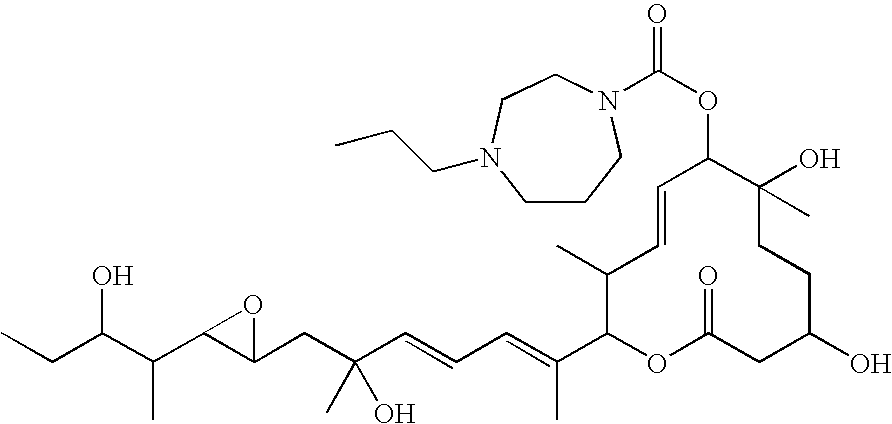


| Compound of Example 44 | 45 (part) | ||
| Heavy magnesium oxide | 15 | ||
| Lactose | 75 | ||
| Compound of Example 75 | 45 (part) | ||
| Starch | 15 | ||
| Lactose | 16 | ||
| Crystalline cellulose | 21 | ||
| Poly(vinyl alcohol) | 3 | ||
| Distilled water | 30 | ||
| Compound of Example 45 | 0.6 (part) | ||
| Nonionic surfactant | 2.4 | ||
| Isotonic sodium chloride solution | 97 | ||


Claims (3)

Priority Applications (1)
| Application Number | Priority Date | Filing Date | Title |
|---|---|---|---|
| US11/927,564 US7893068B2 (en) | 2002-05-29 | 2007-10-29 | Physiologically active substances |
Applications Claiming Priority (10)
| Application Number | Priority Date | Filing Date | Title |
|---|---|---|---|
| JP2002-155853 | 2002-05-29 | ||
| JP2002155853 | 2002-05-29 | ||
| JP2002223355 | 2002-07-31 | ||
| JP2002-223355 | 2002-07-31 | ||
| JP2003-063176 | 2003-03-10 | ||
| JP2003-63176 | 2003-03-10 | ||
| JP2003063176 | 2003-03-10 | ||
| US10/515,647 US20060009439A1 (en) | 2002-05-29 | 2003-05-29 | Novel physiologically active substances |
| US11/473,201 US7550503B2 (en) | 2002-05-29 | 2006-06-23 | Physiologically active substances |
| US11/927,564 US7893068B2 (en) | 2002-05-29 | 2007-10-29 | Physiologically active substances |
Related Parent Applications (1)
| Application Number | Title | Priority Date | Filing Date |
|---|---|---|---|
| US11/473,201 Continuation US7550503B2 (en) | 2002-05-29 | 2006-06-23 | Physiologically active substances |
Publications (2)
| Publication Number | Publication Date |
|---|---|
| US20080255146A1 US20080255146A1 (en) | 2008-10-16 |
| US7893068B2 true US7893068B2 (en) | 2011-02-22 |
Family
ID=29587471
Family Applications (4)
| Application Number | Title | Priority Date | Filing Date |
|---|---|---|---|
| US10/515,647 Abandoned US20060009439A1 (en) | 2002-05-29 | 2003-05-29 | Novel physiologically active substances |
| US11/473,201 Expired - Lifetime US7550503B2 (en) | 2002-05-29 | 2006-06-23 | Physiologically active substances |
| US11/927,564 Expired - Fee Related US7893068B2 (en) | 2002-05-29 | 2007-10-29 | Physiologically active substances |
| US11/927,542 Expired - Fee Related US7619100B2 (en) | 2002-05-29 | 2007-10-29 | Physiologically active substances |
Family Applications Before (2)
| Application Number | Title | Priority Date | Filing Date |
|---|---|---|---|
| US10/515,647 Abandoned US20060009439A1 (en) | 2002-05-29 | 2003-05-29 | Novel physiologically active substances |
| US11/473,201 Expired - Lifetime US7550503B2 (en) | 2002-05-29 | 2006-06-23 | Physiologically active substances |
Family Applications After (1)
| Application Number | Title | Priority Date | Filing Date |
|---|---|---|---|
| US11/927,542 Expired - Fee Related US7619100B2 (en) | 2002-05-29 | 2007-10-29 | Physiologically active substances |
Country Status (17)
| Country | Link |
|---|---|
| US (4) | US20060009439A1 (en) |
| EP (3) | EP1508570A4 (en) |
| JP (2) | JP4491341B2 (en) |
| KR (1) | KR100954401B1 (en) |
| CN (2) | CN1665807B (en) |
| AU (1) | AU2003241927C1 (en) |
| BR (1) | BR0311331A (en) |
| CA (1) | CA2486728C (en) |
| ES (1) | ES2603803T3 (en) |
| IL (2) | IL165388A0 (en) |
| IS (1) | IS7571A (en) |
| MX (1) | MXPA04011885A (en) |
| NO (1) | NO20045679L (en) |
| NZ (1) | NZ536778A (en) |
| PL (1) | PL373806A1 (en) |
| TW (1) | TWI334866B (en) |
| WO (1) | WO2003099813A1 (en) |
Families Citing this family (30)
| Publication number | Priority date | Publication date | Assignee | Title |
|---|---|---|---|---|
| TWI312681B (en) | 2001-02-01 | 2009-08-01 | Novel physiologically active substance | |
| TWI334866B (en) | 2002-05-29 | 2010-12-21 | Mercian Corp | Novel physiologically active substances |
| JP4459051B2 (en) | 2002-07-31 | 2010-04-28 | メルシャン株式会社 | New bioactive substances |
| KR20050086873A (en) * | 2002-11-29 | 2005-08-30 | 메루샹가부시키가이샤 | Process for producing macrolide compound |
| CA2546614A1 (en) | 2003-11-27 | 2005-06-09 | Mercian Corporation | Dna participating in hydroxylation of macrolide compound |
| JPWO2005073223A1 (en) * | 2004-01-29 | 2007-09-13 | エーザイ・アール・アンド・ディー・マネジメント株式会社 | Method for stabilizing macrolide compounds |
| EP1712642B1 (en) * | 2004-02-06 | 2010-06-02 | Eisai R&D Management Co., Ltd. | Method of examining sensitivity of cancer cell to anticancer agent |
| US8008049B2 (en) | 2004-07-20 | 2011-08-30 | Eisai R&D Management Co., Ltd. | DNA coding for polypeptide participating in biosynthesis of pladienolide |
| TW200716744A (en) * | 2005-05-26 | 2007-05-01 | Eisai R&D Man Co Ltd | Genetically modified microorganism and process for production of macrolide compound using the microorganism |
| CN102010403A (en) * | 2005-10-13 | 2011-04-13 | 卫材R&D管理有限公司 | Total Synthesis of Pradienolide B and Pradienolide D |
| EP2053393A1 (en) | 2006-08-02 | 2009-04-29 | Eisai R&D Management Co., Ltd. | Pladienolide target molecule, compound capable of binding to the target molecule, and screening method for the compound |
| CA2659562A1 (en) * | 2006-08-14 | 2008-02-21 | Eisai R&D Management Co., Ltd. | Stable lyophilized preparation |
| AU2008211950A1 (en) | 2007-01-29 | 2008-08-07 | Eisai R & D Management Co., Ltd. | Solid of macrolide compound, method for production thereof, and pharmaceutical composition comprising the same |
| JPWO2008111466A1 (en) * | 2007-03-05 | 2010-06-24 | エーザイ・アール・アンド・ディー・マネジメント株式会社 | Anticancer drug action test method using decreased gene expression as an indicator |
| US20100021918A1 (en) | 2007-03-05 | 2010-01-28 | Eisai R&D Management Co., Ltd. | Method for assaying action of antitumor agent using splicing defects as index |
| US20080312317A1 (en) * | 2007-04-12 | 2008-12-18 | Eisai R&D Management Co., Ltd. | 12 membered-ring macrolactam derivatives |
| EP2168961A1 (en) * | 2007-07-06 | 2010-03-31 | Eisai R&D Management Co., Ltd. | Process for producing macrolide compound and intermediate therefor |
| GB0821539D0 (en) * | 2008-11-25 | 2008-12-31 | Merlion Pharmaceuticals Pte Ltd | Therapeutic compounds and their use |
| PH12016502249B1 (en) | 2014-05-15 | 2023-12-13 | Eisai R&D Man Co Ltd | Pladienolide pyridine compounds and methods of use |
| WO2017040526A2 (en) | 2015-09-01 | 2017-03-09 | Eisai R&D Management Co., Ltd. | Splice variants associated with neomorphic sf3b1 mutants |
| BR112018009995B1 (en) | 2015-11-18 | 2024-04-30 | Eisai R&D Management Co., Ltd | CRYSTALLINE FORM, PHARMACEUTICAL COMPOSITION, AND USE OF CRYSTALLINE FORM |
| US20200190593A1 (en) | 2017-03-15 | 2020-06-18 | Eisai R&D Management Co., Ltd. | Spliceosome mutations and uses thereof |
| TWI863903B (en) * | 2018-04-09 | 2024-12-01 | 日商衛材R&D企管股份有限公司 | Certain pladienolide compounds and methods of use |
| IL304988B2 (en) | 2018-04-12 | 2025-02-01 | Eisai R&D Man Co Ltd | Pladienolide derivatives as spliceosome targeting agents for treating cancer |
| JP7346466B2 (en) | 2018-06-01 | 2023-09-19 | エーザイ・アール・アンド・ディー・マネジメント株式会社 | How to use splicing modulators |
| WO2019232449A1 (en) | 2018-06-01 | 2019-12-05 | Eisai R&D Management Co., Ltd. | Splicing modulator antibody-drug conjugates and methods of use |
| RU195959U1 (en) * | 2019-09-23 | 2020-02-11 | Анна Александровна Золотенкова | DEVICE FOR MECHANICAL NEUROSTIMULATION OF THE LANGUAGE |
| TWI901692B (en) | 2020-06-05 | 2025-10-21 | 日商衛材R&D企管股份有限公司 | Anti-bcma antibody-drug conjugates and methods of use |
| KR20230104204A (en) | 2020-11-04 | 2023-07-07 | 에자이 알앤드디 매니지먼트 가부시키가이샤 | Biomarkers for Myelodysplastic Syndrome (MDS) and Methods of Using The Same |
| WO2023131866A1 (en) | 2022-01-05 | 2023-07-13 | Eisai R&D Management Co., Ltd. | Biomarkers for myelodysplastic syndrome (mds) and methods of using the same |
Citations (25)
| Publication number | Priority date | Publication date | Assignee | Title |
|---|---|---|---|---|
| GB1153092A (en) | 1966-02-01 | 1969-05-21 | Upjohn Co | Improvements in or relating to Freeze-Dried Medicaments |
| JPS54103844A (en) | 1978-01-27 | 1979-08-15 | Ono Pharmaceut Co Ltd | Method of stabilizing formulation of prostaglandin and its analogs |
| JPH04352783A (en) | 1991-05-27 | 1992-12-07 | Taisho Pharmaceut Co Ltd | 12-membered ring macrolide compound |
| JPH10502616A (en) | 1994-04-25 | 1998-03-10 | 協和醗酵工業株式会社 | Method for stabilizing DX-52-1 compound and freeze-dried composition thereof |
| WO2000075126A1 (en) | 1999-06-03 | 2000-12-14 | The United States Of America, Represented By The Secretary, Department Of Health And Human Services | Mycolactone and related compounds, compositions and methods of use |
| EP1083175A2 (en) | 1999-09-09 | 2001-03-14 | Sankyo Company Limited | Triazole derivatives having antifungal activity |
| JP2001348384A (en) | 1999-09-09 | 2001-12-18 | Sankyo Co Ltd | Triazole antifungal agent |
| WO2002012533A2 (en) | 2000-08-03 | 2002-02-14 | Kosan Biosciences, Inc. | Fermentation and purification of mycolactones |
| JP2002145885A (en) | 1999-09-30 | 2002-05-22 | Otsuka Chem Co Ltd | Method for producing 3-cephem derivative crystal |
| WO2002060890A1 (en) | 2001-02-01 | 2002-08-08 | Mercian Corporation | Novel physiologically active substances |
| WO2003099813A1 (en) | 2002-05-29 | 2003-12-04 | Mercian Corporation | Novel physiolgically active substances |
| US20030228404A1 (en) | 2002-06-06 | 2003-12-11 | Kabushiki Kaisha Hayashibara Seibutsu Kagaku Kenkyujo | Crystalline alpha-D-glucosyl alpha-D-galactoside, saccharide composition comprising the same, process for producing the same, and uses thereof |
| US6712617B2 (en) | 2001-04-13 | 2004-03-30 | The General Hospital Corporation | Methods of preventing UVB-induced skin damage |
| WO2004098514A2 (en) | 2003-05-02 | 2004-11-18 | Morinda, Inc. | Morinda citrifolia-based formulation for inhibiting metastasis of carcinogenic cells |
| WO2005073223A1 (en) | 2004-01-29 | 2005-08-11 | Eisai R & D Management Co., Ltd. | Method of stabilizing macrolide compound |
| WO2005116013A1 (en) | 2004-05-28 | 2005-12-08 | Takeda Pharmaceutical Company Limited | Crystal of pharmaceutical compound |
| US20060141589A1 (en) | 2002-11-29 | 2006-06-29 | Akifumi Okuda | Method of producing macrolide compound |
| WO2006075690A1 (en) | 2005-01-14 | 2006-07-20 | Ono Pharmaceutical Co., Ltd. | Stable medicinal composition |
| US20060247203A1 (en) | 2003-05-07 | 2006-11-02 | Eisai Co., Ltd. | Freeze-dried preparation containing methylcobalamin and process for producing the same |
| WO2006121104A1 (en) | 2005-05-11 | 2006-11-16 | Eisai R & D Management Co., Ltd. | Crystal of indole derivative having piperidine ring and process for production thereof |
| US7256178B2 (en) | 2002-07-31 | 2007-08-14 | Eisai Co., Ltd. | Physiologically active substances |
| US20080021226A1 (en) | 2005-10-13 | 2008-01-24 | Eisai R&D Management Co., Ltd. | Process for total synthesis of pladienolide B and pladienolide D |
| US20080214564A1 (en) * | 2007-01-29 | 2008-09-04 | Eisai R&D Management Co., Ltd. | Macrolide compound in solid form, process for preparation thereof, and pharmaceutical composition containing the same |
| US7576204B2 (en) | 2002-07-31 | 2009-08-18 | Mercian Corporation | Heterocyclic macrolide pharmaceutical agent, a method of producing the same and use of the same |
| US20090325978A1 (en) | 2006-08-14 | 2009-12-31 | Katsumi Onai | Stable lyophilized preparation |
-
2003
- 2003-05-28 TW TW092114449A patent/TWI334866B/en not_active IP Right Cessation
- 2003-05-29 IL IL16538803A patent/IL165388A0/en unknown
- 2003-05-29 EP EP03733172A patent/EP1508570A4/en not_active Withdrawn
- 2003-05-29 CN CN038155966A patent/CN1665807B/en not_active Expired - Fee Related
- 2003-05-29 CA CA2486728A patent/CA2486728C/en not_active Expired - Fee Related
- 2003-05-29 WO PCT/JP2003/006779 patent/WO2003099813A1/en not_active Ceased
- 2003-05-29 ES ES15157945.5T patent/ES2603803T3/en not_active Expired - Lifetime
- 2003-05-29 JP JP2004507470A patent/JP4491341B2/en not_active Expired - Lifetime
- 2003-05-29 PL PL03373806A patent/PL373806A1/en not_active Application Discontinuation
- 2003-05-29 NZ NZ536778A patent/NZ536778A/en not_active IP Right Cessation
- 2003-05-29 EP EP20100178687 patent/EP2266978B1/en not_active Expired - Lifetime
- 2003-05-29 KR KR1020047019406A patent/KR100954401B1/en not_active Expired - Fee Related
- 2003-05-29 US US10/515,647 patent/US20060009439A1/en not_active Abandoned
- 2003-05-29 CN CN038155966A patent/CN1665807A/en active Granted
- 2003-05-29 BR BR0311331-0A patent/BR0311331A/en not_active Application Discontinuation
- 2003-05-29 AU AU2003241927A patent/AU2003241927C1/en not_active Ceased
- 2003-05-29 MX MXPA04011885A patent/MXPA04011885A/en active IP Right Grant
- 2003-05-29 EP EP15157945.5A patent/EP2927228B1/en not_active Expired - Lifetime
-
2004
- 2004-11-24 IL IL165388A patent/IL165388A/en not_active IP Right Cessation
- 2004-11-29 IS IS7571A patent/IS7571A/en unknown
- 2004-12-28 NO NO20045679A patent/NO20045679L/en not_active Application Discontinuation
-
2006
- 2006-06-23 US US11/473,201 patent/US7550503B2/en not_active Expired - Lifetime
-
2007
- 2007-10-29 US US11/927,564 patent/US7893068B2/en not_active Expired - Fee Related
- 2007-10-29 US US11/927,542 patent/US7619100B2/en not_active Expired - Fee Related
-
2010
- 2010-02-26 JP JP2010041261A patent/JP2010132693A/en active Pending
Patent Citations (36)
| Publication number | Priority date | Publication date | Assignee | Title |
|---|---|---|---|---|
| GB1153092A (en) | 1966-02-01 | 1969-05-21 | Upjohn Co | Improvements in or relating to Freeze-Dried Medicaments |
| JPS54103844A (en) | 1978-01-27 | 1979-08-15 | Ono Pharmaceut Co Ltd | Method of stabilizing formulation of prostaglandin and its analogs |
| JPH04352783A (en) | 1991-05-27 | 1992-12-07 | Taisho Pharmaceut Co Ltd | 12-membered ring macrolide compound |
| JPH10502616A (en) | 1994-04-25 | 1998-03-10 | 協和醗酵工業株式会社 | Method for stabilizing DX-52-1 compound and freeze-dried composition thereof |
| US5977109A (en) | 1994-04-25 | 1999-11-02 | Kyowa Hakko Kogyo Co., Ltd. | Method for stabilizing compound DX-52-1 and lyophilized composition thereof |
| WO2000075126A1 (en) | 1999-06-03 | 2000-12-14 | The United States Of America, Represented By The Secretary, Department Of Health And Human Services | Mycolactone and related compounds, compositions and methods of use |
| EP1083175A2 (en) | 1999-09-09 | 2001-03-14 | Sankyo Company Limited | Triazole derivatives having antifungal activity |
| JP2001348384A (en) | 1999-09-09 | 2001-12-18 | Sankyo Co Ltd | Triazole antifungal agent |
| JP2002145885A (en) | 1999-09-30 | 2002-05-22 | Otsuka Chem Co Ltd | Method for producing 3-cephem derivative crystal |
| WO2002012533A2 (en) | 2000-08-03 | 2002-02-14 | Kosan Biosciences, Inc. | Fermentation and purification of mycolactones |
| WO2002060890A1 (en) | 2001-02-01 | 2002-08-08 | Mercian Corporation | Novel physiologically active substances |
| US7667052B2 (en) | 2001-02-01 | 2010-02-23 | Eisai R&D Management Co., Ltd. | Bioactive substance |
| US7026352B1 (en) | 2001-02-01 | 2006-04-11 | Mercian Corporation | Physiologically active substances |
| US6712617B2 (en) | 2001-04-13 | 2004-03-30 | The General Hospital Corporation | Methods of preventing UVB-induced skin damage |
| WO2003099813A1 (en) | 2002-05-29 | 2003-12-04 | Mercian Corporation | Novel physiolgically active substances |
| US7550503B2 (en) | 2002-05-29 | 2009-06-23 | Eisai R& D Management Co., Ltd. | Physiologically active substances |
| US20080255146A1 (en) | 2002-05-29 | 2008-10-16 | Yoshihiko Kotake | Novel physiologically active substances |
| US7619100B2 (en) | 2002-05-29 | 2009-11-17 | Mercian Corporation | Physiologically active substances |
| EP1508570A1 (en) | 2002-05-29 | 2005-02-23 | Mercian Corporation | Novel physiolgically active substances |
| US20060009439A1 (en) | 2002-05-29 | 2006-01-12 | Mercian Corporation | Novel physiologically active substances |
| JP2004269488A (en) | 2002-06-06 | 2004-09-30 | Hayashibara Biochem Lab Inc | Crystalline α-D-glucosyl α-D-galactoside, saccharides containing the same, and methods for their production and use |
| US20030228404A1 (en) | 2002-06-06 | 2003-12-11 | Kabushiki Kaisha Hayashibara Seibutsu Kagaku Kenkyujo | Crystalline alpha-D-glucosyl alpha-D-galactoside, saccharide composition comprising the same, process for producing the same, and uses thereof |
| US7256178B2 (en) | 2002-07-31 | 2007-08-14 | Eisai Co., Ltd. | Physiologically active substances |
| US7576204B2 (en) | 2002-07-31 | 2009-08-18 | Mercian Corporation | Heterocyclic macrolide pharmaceutical agent, a method of producing the same and use of the same |
| US20060141589A1 (en) | 2002-11-29 | 2006-06-29 | Akifumi Okuda | Method of producing macrolide compound |
| WO2004098514A2 (en) | 2003-05-02 | 2004-11-18 | Morinda, Inc. | Morinda citrifolia-based formulation for inhibiting metastasis of carcinogenic cells |
| US20060247203A1 (en) | 2003-05-07 | 2006-11-02 | Eisai Co., Ltd. | Freeze-dried preparation containing methylcobalamin and process for producing the same |
| WO2005073223A1 (en) | 2004-01-29 | 2005-08-11 | Eisai R & D Management Co., Ltd. | Method of stabilizing macrolide compound |
| US20070155696A1 (en) | 2004-01-29 | 2007-07-05 | Hiroshi Ishihara | Method for stabilizing macrolide compounds |
| WO2005116013A1 (en) | 2004-05-28 | 2005-12-08 | Takeda Pharmaceutical Company Limited | Crystal of pharmaceutical compound |
| WO2006075690A1 (en) | 2005-01-14 | 2006-07-20 | Ono Pharmaceutical Co., Ltd. | Stable medicinal composition |
| EP1880994A1 (en) | 2005-05-11 | 2008-01-23 | Eisai R&D Management Co., Ltd. | Crystal of indole derivative having piperidine ring and process for production thereof |
| WO2006121104A1 (en) | 2005-05-11 | 2006-11-16 | Eisai R & D Management Co., Ltd. | Crystal of indole derivative having piperidine ring and process for production thereof |
| US20080021226A1 (en) | 2005-10-13 | 2008-01-24 | Eisai R&D Management Co., Ltd. | Process for total synthesis of pladienolide B and pladienolide D |
| US20090325978A1 (en) | 2006-08-14 | 2009-12-31 | Katsumi Onai | Stable lyophilized preparation |
| US20080214564A1 (en) * | 2007-01-29 | 2008-09-04 | Eisai R&D Management Co., Ltd. | Macrolide compound in solid form, process for preparation thereof, and pharmaceutical composition containing the same |
Non-Patent Citations (49)
| Title |
|---|
| A. Anadon; Research in Veterinary Science, Jun. 1999, vol. 66, No. 3, pp. 197-203. |
| Akifumi et al., "Shinki ko-shuyo kassei busshitsu pladienolide ni kansuru kenkyu (2) VEGF sansei yokusei kassei o shihyo to shita pladienolide-rui no kozo kassei sokan", Japan Society for Bioscience, Biotechnology, and Agrochemistry, Taikai Koen Yoshishu, Mar. 2003, p. 124. |
| Bestmann, Hans Jurgen. Synthesis, 1989, vol. 6, pp. 419-423. |
| Bestmann, Jans Jurgen. Angew. Chem., 1983, vol. 95, No. 10, pp. 810-811. |
| D. Zips, et al., "New Anticancer Agents: in Vitro and In Vivo Evaluation," In Vivo, 2005, vol. 19, pp. 1-8. |
| D.J. Farrell et al.; Journal of Antimicrobial Chemotherapy, Sep. 2002, vol. 50, Suppl., pp. 39-47. |
| Eskens et al., "First-in-human clinical, pharmacokinetic (PK) and pharmacodynamic (PD) Phase I study of the first-in-class spliceosome inhibitor E7107 administered IV (bolus) on days 1, 8, and 15 every 28 days to patients with solid tumors", Abstract submission to: American Society of Clinical Oncology, date of submission: Jan. 6, 2009. |
| Final Office Action dated Mar. 4, 2009 of U.S. Appl. No. 10/532,412. |
| Furstner; Alois et al. Efficient Total Syntheses of Resin Glycosides and Analogues by Ring-Closing Olefin Metathesis, J. Am. Chem. Soc., 1999, vol. 121, pp. 7814-7821. |
| Gunawardana, Geewananda, et al. J. Am. Chem. Soc. 1999, vol. 121, pp. 6092-6093. |
| Hamberg, Mats. Chem. Phys. LIPIDS, 1988, vol. 46, No. 4, pp. 235-243. |
| Hamberg, Mats. LIPIDS, 2000, vol. 35, No. 4, pp. 353-363. |
| International Preliminary Report on Patentability and Written Opinion of the International Searching Authority dated Aug. 4, 2009 for Application No. PCT/JP2008/051695 which corresponds to U.S. Appl. No. 60/888,257. |
| J. Simone, "Part XIV-Oncology", Textbook of Medicine, 20th Edition, W.B. Saunders Company, Feb. 3, 1997, vol. 1, pp. 1004-1010. |
| Ji Johnson, et al., "Relationships between drug activity in NCI preclinical in vitro and in vivo models and early clinical trials," British Journal of Cancer, 2001, vol. 84, No. 10, pp. 1424-1431. |
| Kazumi Sugimori, "the Sujimori C method", Seiyaku Koujou, vol. 6, No. 6, pp. 571-576, 1986. |
| Keiji et al., "Shinki ko-shuyo kassei busshitsu pladienolide ni kansuru kenkyu (3)- pladienolide-rui no yakuri kassei (in vitro, in vivo)", Japan Society for Bioscience, Biotechnology, and Agrochemistry. Taikai Koen Yoshishu, Mar. 2003, p. 124. |
| Kobayashi; Jun'ichi et al. Tetrahedron Letters; 1996, vol. 37, No. 9, pp. 1449-1450. |
| M. T. Zell, et al., "Investigation of Polymorphism in Aspartame and Neotame Using Solid-State NMR Spectroscopy," Tetrahedron, 2000, vol. 56, pp. 6603-6616. |
| Moon-Seok Cha, " Endogenous Production of Nitric Oxide by vascular Endothelial Growth Factor Down-Regulates Proliferation of Choriocarcinoma Cells" Biochemical and Biophysical Research Communications, vol. 282, pp. 1061-1066, (2001). |
| Non-Final Office Action dated Aug. 8, 2008 of U.S. Appl. No. 10/532,412. |
| Non-Final Office Action dated Feb. 11, 2009 of U.S. Appl. No. 11/927,542. |
| Non-Final Office Action dated Feb. 6, 2008 of U.S. Appl. No. 10/532,412. |
| Non-Final Office Action dated Jan. 9, 2006 of U.S. Appl. No. 10/515,647. |
| Non-Final Office Action dated Mar. 31, 2008 of U.S. Appl. No. 11/473,201. |
| Notice of Allowability dated Feb. 3, 2009 of U.S. Appl. No. 11/473,201. |
| Notice of Allowance and Allowability dated Feb. 8, 2010 for U.S. Appl. No. 10/532,412. |
| Proceedings for 2003 Annual Meeting of Japan Society for Bioscience, Biotechnology, and Agrochemistry, pp. 123-124, (2003). |
| Restriction Office Action dated Oct. 1, 2008 of U.S. Appl. No. 11/927,542. |
| Restriction Office Action dated Oct. 4, 2007 of U.S. Appl. No. 10/532,412. |
| Roberto Spagnoli et al.; The Journal of Antibiotics, Apr. 1983, vol. 36, No. 4, pp. 365-375. |
| Rohr, Jurgen. Angew Chem. Int. Ed., 2000, vol. 39, No. 16, pp. 2847-2849. |
| Ronald A. Lemahieu et al.; The Journal of Antibiotics, Jul. 1976, vol. 29, No. 7, pp. 728-734. |
| Ryuichi Morishita. "Recent Progress in Gene Therapy for Cardiovascular Disease", Circ Journal, vol. 66, pp. 1077-1086, (2002). |
| S.L. Morissette et al., "Elucidation of crystal form diversity of the HIV protease inhibitor ritonavir by high-throughput crystallization", PNAS, Mar. 4, 2003, vol. 100, No. 5, pp. 2180-2184. |
| Sakai et al., "Shinki ko-shuyo kassel busshitsu pladienolide ni kansuru kenkyu (1)-shinki 12-inkan macrolide pladeienolide B no tanri to kozo", Japan Society for Bioscience, Biotechnology, and Agrochemistry, Taikai Koen Yoshishu, Mar. 2003, p. 123. |
| Seki-Asano, Mitsuko et al., "Isolation and Characterization of a New 12-Membered Macrolide FD-895", J. Antibiot., 1994, vol. 47, No. 12, pp. 1395 to 1401. |
| Supplemental Notice of Allowability dated Apr. 1, 2009 of U.S. Appl. No. 11/473,201. |
| Supplemental Notice of Allowability dated Apr. 13, 2009 of U.S. Appl. No. 11/473,201. |
| T. Gura, "Cancer Models: Systems for Identifying New Drugs Are Often Faulty", Science, Nov. 7, 1997, vol. 278, No. 5340, pp. 1041-1042. |
| USPTO Non-Final Office Action after a Request for Continued Examination, U.S. Appl. No. 10/532,412, Sep. 15, 2009, 6 pages. |
| USPTO Non-Final Office Action, U.S. Appl. No. 11/213,962, Oct. 9, 2008, 4 pages. |
| USPTO Non-Final Office Action, U.S. Appl. No. 12/021,184, Jan. 6, 2010, 9 pages. |
| USPTO Office Action, Notice of Allowance and Notice of Allowability, U.S. Appl. No. 11/213,962, May 18, 2009, 6 pages. |
| USPTO Office Action, Notice of Allowance, and Notice of Allowability, U.S. Appl. No. 11/213,962, Sep. 29, 2009, 6 pages. |
| USPTO Office Action, Restriction Requirement, U.S. Appl. No. 11/213,962, Jun. 19, 2008, 4 pages. |
| USPTO Office Action, Restriction Requirement, U.S. Appl. No. 12/021,184, Sep. 18, 2009, 7 pages. |
| USPTO Office Action-Notice of Allowability and Examiner's Amendment, pp. 1-4, U.S. Appl. No. 11/927,542, Jun. 29, 2009. |
| USPTO Office Action-Notice of Allowance, pp. 1-3, U.S. Appl. No. 11/927,542, Jun. 29, 2009. |
Also Published As
Similar Documents
| Publication | Publication Date | Title |
|---|---|---|
| US7893068B2 (en) | Physiologically active substances | |
| US7256178B2 (en) | Physiologically active substances | |
| US7576204B2 (en) | Heterocyclic macrolide pharmaceutical agent, a method of producing the same and use of the same | |
| US7667052B2 (en) | Bioactive substance | |
| RU2347784C2 (en) | Macrocyclic compounds, medicinal agents based on them and their use | |
| HK1074839A (en) | Novel physiolgically active substances | |
| HK1150309A (en) | Novel physiologically active substances | |
| HK1076839A (en) | Novel physiologically active substances |
Legal Events
| Date | Code | Title | Description |
|---|---|---|---|
| STCF | Information on status: patent grant |
Free format text: PATENTED CASE |
|
| CC | Certificate of correction | ||
| FEPP | Fee payment procedure |
Free format text: PAYOR NUMBER ASSIGNED (ORIGINAL EVENT CODE: ASPN); ENTITY STATUS OF PATENT OWNER: LARGE ENTITY |
|
| AS | Assignment |
Owner name: MICROBIOPHARM JAPAN CO., LTD., JAPAN Free format text: ASSIGNMENT OF ASSIGNORS INTEREST;ASSIGNOR:MERCIAN CORPORATION;REEL/FRAME:027691/0440 Effective date: 20111212 |
|
| FPAY | Fee payment |
Year of fee payment: 4 |
|
| MAFP | Maintenance fee payment |
Free format text: PAYMENT OF MAINTENANCE FEE, 8TH YEAR, LARGE ENTITY (ORIGINAL EVENT CODE: M1552) Year of fee payment: 8 |
|
| FEPP | Fee payment procedure |
Free format text: MAINTENANCE FEE REMINDER MAILED (ORIGINAL EVENT CODE: REM.); ENTITY STATUS OF PATENT OWNER: LARGE ENTITY |
|
| LAPS | Lapse for failure to pay maintenance fees |
Free format text: PATENT EXPIRED FOR FAILURE TO PAY MAINTENANCE FEES (ORIGINAL EVENT CODE: EXP.); ENTITY STATUS OF PATENT OWNER: LARGE ENTITY |
|
| STCH | Information on status: patent discontinuation |
Free format text: PATENT EXPIRED DUE TO NONPAYMENT OF MAINTENANCE FEES UNDER 37 CFR 1.362 |
|
| FP | Lapsed due to failure to pay maintenance fee |
Effective date: 20230222 |