US7846831B2 - Method of forming a metal bump on a semiconductor device - Google Patents

Method of forming a metal bump on a semiconductor device Download PDF

Info

Publication number
US7846831B2
US7846831B2 US12/453,299 US45329909A US7846831B2 US 7846831 B2 US7846831 B2 US 7846831B2 US 45329909 A US45329909 A US 45329909A US 7846831 B2 US7846831 B2 US 7846831B2
Authority
US
United States
Prior art keywords
electrode pad
bump
plating
scribe
forming
Prior art date
Legal status (The legal status is an assumption and is not a legal conclusion. Google has not performed a legal analysis and makes no representation as to the accuracy of the status listed.)
Active
Application number
US12/453,299
Other versions
US20090221142A1 (en
Inventor
Takeshi Matsumoto
Current Assignee (The listed assignees may be inaccurate. Google has not performed a legal analysis and makes no representation or warranty as to the accuracy of the list.)
Godo Kaisha IP Bridge 1
Original Assignee
Panasonic Corp
Priority date (The priority date is an assumption and is not a legal conclusion. Google has not performed a legal analysis and makes no representation as to the accuracy of the date listed.)
Filing date
Publication date
Application filed by Panasonic Corp filed Critical Panasonic Corp
Priority to US12/453,299 priority Critical patent/US7846831B2/en
Publication of US20090221142A1 publication Critical patent/US20090221142A1/en
Application granted granted Critical
Publication of US7846831B2 publication Critical patent/US7846831B2/en
Assigned to GODO KAISHA IP BRIDGE 1 reassignment GODO KAISHA IP BRIDGE 1 ASSIGNMENT OF ASSIGNORS INTEREST (SEE DOCUMENT FOR DETAILS). Assignors: PANASONIC CORPORATION (FORMERLY MATSUSHITA ELECTRIC INDUSTRIAL CO., LTD.)
Active legal-status Critical Current
Anticipated expiration legal-status Critical

Links

Images

Classifications

    • HELECTRICITY
    • H10SEMICONDUCTOR DEVICES; ELECTRIC SOLID-STATE DEVICES NOT OTHERWISE PROVIDED FOR
    • H10PGENERIC PROCESSES OR APPARATUS FOR THE MANUFACTURE OR TREATMENT OF DEVICES COVERED BY CLASS H10
    • H10P74/00Testing or measuring during manufacture or treatment of wafers, substrates or devices
    • H10P74/27Structural arrangements therefor
    • H10P74/277Circuits for electrically characterising or monitoring manufacturing processes, e.g. circuits in tested chips or circuits in testing wafers
    • HELECTRICITY
    • H10SEMICONDUCTOR DEVICES; ELECTRIC SOLID-STATE DEVICES NOT OTHERWISE PROVIDED FOR
    • H10WGENERIC PACKAGES, INTERCONNECTIONS, CONNECTORS OR OTHER CONSTRUCTIONAL DETAILS OF DEVICES COVERED BY CLASS H10
    • H10W46/00Marks applied to devices, e.g. for alignment or identification
    • H10W46/501Marks applied to devices, e.g. for alignment or identification for use before dicing
    • H10W46/503Located in scribe lines
    • HELECTRICITY
    • H10SEMICONDUCTOR DEVICES; ELECTRIC SOLID-STATE DEVICES NOT OTHERWISE PROVIDED FOR
    • H10WGENERIC PACKAGES, INTERCONNECTIONS, CONNECTORS OR OTHER CONSTRUCTIONAL DETAILS OF DEVICES COVERED BY CLASS H10
    • H10W72/00Interconnections or connectors in packages
    • H10W72/01Manufacture or treatment
    • H10W72/012Manufacture or treatment of bump connectors, dummy bumps or thermal bumps
    • H10W72/01231Manufacture or treatment of bump connectors, dummy bumps or thermal bumps using blanket deposition
    • H10W72/01233Manufacture or treatment of bump connectors, dummy bumps or thermal bumps using blanket deposition in liquid form, e.g. spin coating, spray coating or immersion coating
    • H10W72/01235Manufacture or treatment of bump connectors, dummy bumps or thermal bumps using blanket deposition in liquid form, e.g. spin coating, spray coating or immersion coating by plating, e.g. electroless plating or electroplating
    • HELECTRICITY
    • H10SEMICONDUCTOR DEVICES; ELECTRIC SOLID-STATE DEVICES NOT OTHERWISE PROVIDED FOR
    • H10WGENERIC PACKAGES, INTERCONNECTIONS, CONNECTORS OR OTHER CONSTRUCTIONAL DETAILS OF DEVICES COVERED BY CLASS H10
    • H10W72/00Interconnections or connectors in packages
    • H10W72/071Connecting or disconnecting
    • H10W72/075Connecting or disconnecting of bond wires
    • HELECTRICITY
    • H10SEMICONDUCTOR DEVICES; ELECTRIC SOLID-STATE DEVICES NOT OTHERWISE PROVIDED FOR
    • H10WGENERIC PACKAGES, INTERCONNECTIONS, CONNECTORS OR OTHER CONSTRUCTIONAL DETAILS OF DEVICES COVERED BY CLASS H10
    • H10W72/00Interconnections or connectors in packages
    • H10W72/20Bump connectors, e.g. solder bumps or copper pillars; Dummy bumps; Thermal bumps
    • H10W72/251Materials
    • HELECTRICITY
    • H10SEMICONDUCTOR DEVICES; ELECTRIC SOLID-STATE DEVICES NOT OTHERWISE PROVIDED FOR
    • H10WGENERIC PACKAGES, INTERCONNECTIONS, CONNECTORS OR OTHER CONSTRUCTIONAL DETAILS OF DEVICES COVERED BY CLASS H10
    • H10W72/00Interconnections or connectors in packages
    • H10W72/20Bump connectors, e.g. solder bumps or copper pillars; Dummy bumps; Thermal bumps
    • H10W72/251Materials
    • H10W72/252Materials comprising solid metals or solid metalloids, e.g. PbSn, Ag or Cu
    • HELECTRICITY
    • H10SEMICONDUCTOR DEVICES; ELECTRIC SOLID-STATE DEVICES NOT OTHERWISE PROVIDED FOR
    • H10WGENERIC PACKAGES, INTERCONNECTIONS, CONNECTORS OR OTHER CONSTRUCTIONAL DETAILS OF DEVICES COVERED BY CLASS H10
    • H10W72/00Interconnections or connectors in packages
    • H10W72/90Bond pads, in general
    • HELECTRICITY
    • H10SEMICONDUCTOR DEVICES; ELECTRIC SOLID-STATE DEVICES NOT OTHERWISE PROVIDED FOR
    • H10WGENERIC PACKAGES, INTERCONNECTIONS, CONNECTORS OR OTHER CONSTRUCTIONAL DETAILS OF DEVICES COVERED BY CLASS H10
    • H10W72/00Interconnections or connectors in packages
    • H10W72/90Bond pads, in general
    • H10W72/941Dispositions of bond pads
    • H10W72/9415Dispositions of bond pads relative to the surface, e.g. recessed, protruding
    • HELECTRICITY
    • H10SEMICONDUCTOR DEVICES; ELECTRIC SOLID-STATE DEVICES NOT OTHERWISE PROVIDED FOR
    • H10WGENERIC PACKAGES, INTERCONNECTIONS, CONNECTORS OR OTHER CONSTRUCTIONAL DETAILS OF DEVICES COVERED BY CLASS H10
    • H10W72/00Interconnections or connectors in packages
    • H10W72/90Bond pads, in general
    • H10W72/951Materials of bond pads
    • H10W72/952Materials of bond pads comprising metals or metalloids, e.g. PbSn, Ag or Cu

Definitions

  • the present invention relates to a structure of a semiconductor device in which, for example, a plurality of semiconductor chips and ascribe grid are formed on a wafer-shaped substrate.
  • the present invention relates to structures of electrode pads provided on such semiconductor chip and scribe grid.
  • a semiconductor device having a structure in which, for example, a plurality of semiconductor chips, each having a semiconductor circuit integrated thereon, and a scribe grid are formed on a wafer-shaped substrate.
  • a region called the scribe grid is used as a “spacing” along which the wafer is cut to obtain a semiconductor circuit as a semiconductor chip.
  • process control modules hereinafter, referred to as “scribe PCMs”.
  • FIGS. 4A to 4C specifically illustrate a semiconductor chip and a scribe PCM formed on a wafer in the conventional semiconductor device.
  • a semiconductor device is typically formed into a wafer shape as illustrated in FIG. 4A .
  • a plurality of semiconductor chips 2 are formed on a wafer 1 through a manufacturing process called a diffusion process.
  • FIG. 4B each semiconductor chip 2 is cut out from the wafer 1 , and then is subjected to packaging and the like; accordingly, a chip-shaped semiconductor integrated circuit (LSI) is manufactured.
  • LSI chip-shaped semiconductor integrated circuit
  • FIG. 4C a plurality of scribe PCMs 4 are formed on a scribe grid 3 .
  • Each scribe PCM 4 includes multilayered electrode pads 5 for external electrical connection. Formation of such scribe PCM 4 on the scribe grid 3 makes it possible to examine quality of the semiconductor device as the entire wafer 1 , particularly, electrical quality thereof. Although not illustrated in the drawings, a plurality of multilayered electrode pads for external electrical connection are also provided on each semiconductor chip 2 .
  • FIGS. 5A to 5D are sectional views each illustrating a process for forming bumps on an electrode pad 5 of a scribe PCM 4 formed on the scribe grid 3 and an electrode pad 6 of a semiconductor chip 2 , respectively, by electroless plating in the conventional semiconductor device.
  • the drawings show that the semiconductor device has a multilayer structure of three wiring layers.
  • three electrode pads 5 ( 6 ) are laminated in a vertical direction.
  • the uppermost one of the three electrode pads 5 ( 6 ) is made of Al.
  • the electrode pad 5 of the scribe PCM 4 is illustrated on a left side and the electrode pad 6 of the semiconductor chip 2 is illustrated on a right side.
  • Zn plating is performed in an electroless manner.
  • Zn plating layers 7 are formed on the electrode pad 5 of the scribe PCM 4 and the electrode pad 6 of the semiconductor chip 2 , respectively.
  • a mechanism of the Zn plating is as follows. That is, Al which is a material for the electrode pad 5 ( 6 ) is dissolved in an electroless Zn plating solution as Al ions 6 a with difference in ionization tendency between Al and Zn (ionization tendency: Al>Zn). Then, Zn ions 7 a in the electroless Zn plating solution are deposited on the electrode pad 5 ( 6 ); thus, the Zn plating layer 7 is formed. In other words, displacement plating is performed herein.
  • Ni plating is performed in an electroless manner.
  • Ni bumps 8 are formed on the Zn plating layer 7 of the electrode pad 5 of the scribe PCM 4 and the Zn plating layer 7 of the electrode pad 6 of the semiconductor chip 2 , respectively.
  • a mechanism of the Ni plating is as follows. That is, Zn in the Zn plating layer 7 is dissolved in an electroless Ni plating solution as Zn ions 7 a with difference in ionization tendency between Zn and Ni (ionization tendency: Zn>Ni). Then, Ni ions 8 a in the electroless Ni plating solution are deposited on the Zn plating layer 7 ; thus, the Ni bump 8 is formed. In other words, displacement plating is performed herein.
  • Au plating is performed in an electroless manner.
  • Au plating layers 9 are formed on the Ni bump 8 of the electrode pad 5 of the scribe PCM 4 and the Ni bump 8 of the electrode pad 6 of the semiconductor chip 2 , respectively.
  • a mechanism of the Au plating is as follows. That is, Ni in the Ni bump 8 is dissolved in an electroless Au plating solution as Ni ions 8 a with difference in ionization tendency between Ni and Au (ionization tendency: Ni>Au). Then, Au ions 9 a in the electroless Au plating solution are deposited on the Ni bump 8 ; thus, the Au plating layer 9 is formed. In other words, displacement plating is performed herein.
  • FIG. 6 specifically illustrates an electroless plating method performed on the conventional semiconductor device illustrated in FIGS. 5B to 5D .
  • a mechanism of the electroless plating method is as follows. That is, the metal material for the electrode pad 5 of the scribe PCM 4 and the electrode pad 6 of the semiconductor chip 2 is dissolved in a plating solution 13 (herein, a Zn plating solution, a Ni plating solution or an Au plating solution) as metal ions 14 (herein, Al ions, Zn ions or Ni ions) with difference in ionization tendency (ionization tendency: Al>Zn>Ni>Au).
  • a plating solution 13 herein, a Zn plating solution, a Ni plating solution or an Au plating solution
  • metal ions 14 herein, Al ions, Zn ions or Ni ions
  • metal ions 15 (herein, Zn ions, Ni ions or Au ions) in the plating solution 13 are deposited on the electrode pad 5 of the scribe PCM 4 and the electrode pad 6 of the semiconductor chip 2 ; thus, a plating layer (herein, a Zn plating layer, a Ni plating layer or an Au plating layer) is formed.
  • FIGS. 7A and 7B are sectional views each illustrating a dicing process for cutting the electrode pad 5 of the scribe PCM 4 with a bump formed on the electrode pad 5 as illustrated in FIG. 5D , thereby to obtain a semiconductor chip 2 from the wafer 1 .
  • the scribe grid 3 (together with the scribe PCM 4 , the electrode pad 5 of the scribe PCM 4 , and the Ni bump 8 and the Au plating layer 9 on the electrode pad 5 ) is cut by means of a dicing cutter 10 .
  • a semiconductor chip 2 can be cut out from the wafer 1 .
  • FIGS. 8A and 8B are sectional views each illustrating a dicing process for cutting the electrode pad 5 of the scribe PCM 4 with a bump formed on the electrode pad 5 as illustrated in FIG. 5D , thereby to obtain a semiconductor chip 2 from the wafer 1 , similarly to FIGS. 7A and 7B .
  • the scribe grid 3 (together with the scribe PCM 4 , the electrode pad 5 of the scribe PCM 4 , and the Ni bump 8 and the Au plating layer 9 on the electrode pad 5 ) is cut by means of the dicing cutter 10 .
  • an abnormal state occurs as illustrated in FIG. 8B .
  • the Ni bump 8 and the like are partially left at an edge portion even after the dicing process. If the conductive Ni bump 8 is left at the edge portion, electrical leakage may occur at the “left bump” in a case where the semiconductor chip 2 is subjected to packaging subsequently.
  • FIG. 9 is a sectional view illustrating a dicing process for cutting the electrode pad 5 of the scribe PCM 4 with a bump formed on the electrode pad 5 as illustrated in FIG. 5D , thereby to obtain a semiconductor chip 2 from the wafer 1 , similarly to FIGS. 8A and 8B .
  • the scribe grid 3 (together with the scribe PCM 4 , the electrode pad 5 of the scribe PCM 4 , and the Ni bump 8 and the Au plating layer 9 on the electrode pad 5 ) is cut by means of a dicing cutter 10 .
  • the dicing cutter 10 used herein has a large width in order to prevent the bump from being partially left at an edge portion.
  • the scribe grid 3 must be made larger in width in conjunction.
  • the scribe grid 3 formed on the wafer 1 is larger in width than the aforementioned scribe grid 3 illustrated in FIG. 7A (a lower side of FIG. 9 ). Consequently, an area for formation of semiconductor chips 2 is disadvantageously decreased in the wafer 1 , so that there is a possibility that semiconductor chips 2 to be obtained from one wafer are reduced in number.
  • An object of the present invention is to provide a semiconductor device having the following advantages. That is, it is possible to prevent a “left bump” from being generated upon performance of dicing on an electrode pad of a scribe PCM, thereby to prevent occurrence of electrical leakage from such “left bump”. Further, it is possible to suppress reduction in number of semiconductor chips to be obtained from one wafer due to a widening of a scribe grid.
  • a semiconductor device includes: a substrate; a semiconductor chip and a scribe grid formed on the substrate; and a plurality of multilayered electrode pads provided on the semiconductor chip and the scribe grid, respectively.
  • the uppermost one of the multilayered electrode pads, on which a bump and a plating coat will be formed is made of metal having ionization tendency higher than those of materials for the bump and the plating coat.
  • the uppermost one of the multilayered electrode pads, on which none of the bump and the plating coat will be formed is made of metal having ionization tendency lower than those of the materials for the bump and the plating coat.
  • the bump and the plating coat are formed on the electrode pad provided on the semiconductor chip, but are not formed on the electrode pad provided on the scribe grid.
  • the metal having high ionization tendency is Al
  • the metal having low ionization tendency is Cu
  • FIGS. 1A to 1D are sectional views each illustrating a process for bump formation in a semiconductor device according to a first embodiment of the present invention
  • FIG. 2 illustrates a comparison in width between a dicing cutter used in the first embodiment and a conventional dicing cutter
  • FIG. 3 illustrates an outer appearance of a semiconductor chip in a semiconductor device according to a second embodiment of the present invention
  • FIG. 4A illustrates a shape of a wafer in a conventional semiconductor device
  • FIG. 4B illustrates a state in which a semiconductor chip is cut out from the wafer in the conventional semiconductor device
  • FIG. 4C illustrates a shape of a scribe PCM on the wafer in the conventional semiconductor device
  • FIGS. 5A to 5D are sectional views each illustrating a process for bump formation in the conventional semiconductor device
  • FIG. 6 illustrates an electroless plating method performed on the conventional semiconductor device
  • FIGS. 7A and 7B are sectional views each illustrating a dicing process performed on the conventional semiconductor device
  • FIGS. 8A and 8B are sectional views each illustrating a dicing process performed on the conventional semiconductor device under another condition.
  • FIG. 9 is a sectional view illustrating a dicing process performed on the conventional semiconductor device under still another condition.
  • FIGS. 1A to 1D are sectional views each illustrating a case where a bump is not formed on an electrode pad 5 of a scribe PCM 4 formed on a scribe grid 3 , but is formed on an electrode pad 6 of a semiconductor chip 2 by electroless plating, in the semiconductor device according to the first embodiment.
  • the semiconductor device has a multilayer structure of three wiring layers.
  • FIG. 1A illustrates a shape of the semiconductor device according to the first embodiment.
  • the electrode pad 5 of the scribe PCM 4 is illustrated on a left side and the electrode pad 6 of the semiconductor chip 2 is illustrated on a right side.
  • the scribe PCM 4 On the scribe PCM 4 , two electrode pads 5 are laminated in the vertical direction.
  • the uppermost one of the electrode pads 5 of the scribe PCM 4 is made of Cu.
  • the semiconductor chip 2 On the semiconductor chip 2 , three electrode pads 6 are laminated in a vertical direction.
  • the uppermost one of the electrode pads 6 of the semiconductor chip 2 is made of Al.
  • an uppermost one of electrode pads (herein, the electrode pad 6 of the semiconductor chip 2 ), on which a bump and a plating coat will be formed by electroless plating (to be described later), is made of Al, and an uppermost one of electrode pads (herein, the electrode pad 5 of the scribe PCM 4 ), on which none of the bump and the plating coat will be formed by electroless plating, is made of Cu.
  • Zn plating is performed in an electroless manner.
  • a Zn plating layer 7 is formed on the electrode pad 6 of the semiconductor chip 2 .
  • a mechanism of the Zn plating is as follows. That is, Al which is a material for the electrode pad 6 of the semiconductor chip 2 is dissolved in an electroless Zn plating solution as Al ions 6 a with difference in ionization tendency between Al and Zn (ionization tendency: Al>Zn). Then, Zn ions 7 a in the electroless Zn plating solution are deposited on the electrode pad 6 of the semiconductor chip 2 ; thus, the Zn plating layer 7 is formed. In other words, displacement plating is performed herein.
  • the electrode pad 5 of the scribe PCM 4 is made of Cu. Ionization tendency of Cu is considerably lower than that of Zn; therefore, Cu itself is not dissolved in the electroless Zn plating solution as Cu ions in the displacement plating performed as the electroless plating. Accordingly, the Zn ions 7 a in the electroless Zn plating solution are not deposited on the electrode pad 5 of the scribe PCM 4 . In other words, the Zn plating layer 7 is not formed on the electrode pad 5 of the scribe PCM 4 .
  • Ni plating is performed in an electroless manner.
  • a Ni bump 8 is formed on the electrode pad 6 of the semiconductor chip 2 .
  • a mechanism of the Ni plating is as follows. That is, Zn in the Zn plating layer 7 is dissolved in an electroless Ni plating solution as Zn ions 7 a with difference in ionization tendency between Zn and Ni (ionization tendency: Zn>Ni). Then, Ni ions 8 a in the electroless Ni plating solution are deposited on the electrode pad 6 of the semiconductor chip 2 ; thus, the Ni bump 8 is formed. In other words, displacement plating is performed herein.
  • the Zn plating layer 7 is not formed on the electrode pad 5 of the scribe PCM 4 . Further, ionization tendency of Cu is lower than that of Ni; therefore, the Ni bump 8 is not formed on the electrode pad 5 of the scribe PCM 4 .
  • Au plating is performed in an electroless manner.
  • an Au plating layer 9 is formed on the Ni bump 8 on the electrode pad 6 of the semiconductor chip 2 .
  • a mechanism of the Au plating is as follows. That is, Ni in the Ni bump 8 is dissolved in an electroless Au plating solution as Ni ions 8 a with difference in ionization tendency between Ni and Au (ionization tendency: Ni>Au). Then, Au ions 9 a in the electroless Au plating solution are deposited on the Ni bump 8 on the electrode pad 6 of the semiconductor chip 2 ; thus, the Au plating layer 9 is formed. In other words, displacement plating is performed herein.
  • the Ni bump 8 is not formed on the electrode pad 5 of the scribe PCM 4 . Therefore, even in the electroless Au plating solution, the Au plating layer 9 is not formed on the electrode pad 5 of the scribe PCM 4 .
  • the aforementioned method is an electroless plating process for forming a bump on the electrode pad 6 of the semiconductor chip 2 without forming a bump on the electrode pad 5 of the scribe PCM 4 .
  • FIG. 2 illustrates a comparison between a width of a dicing cutter 10 used for cutting the electrode pad 5 of the scribe PCM 4 with no bump formed on the electrode pad 5 as illustrated in FIG. 1D and the width of the conventional dicing cutter 10 used for cutting the electrode pad 5 of the scribe PCM 4 with a bump formed on the electrode pad 5 as illustrated in FIG. 5D .
  • the dicing cutter 10 used for cutting the electrode pad 5 of the scribe PCM 4 with no bump formed on the electrode pad 5 is smaller in width than the conventional dicing cutter 10 used for cutting the electrode pad 5 of the scribe PCM 4 with a bump formed on the electrode pad 5 .
  • the reason therefor is as follows. Conventionally, as illustrated in a lower side of FIG. 2 , the scribe grid 3 (together with the scribe PCM 4 , the electrode pad 5 of the scribe PCM 4 , and the Ni bump 8 and the Au plating layer 9 on the electrode pad 5 ) is cut by means of the dicing cutter 10 . In such case, as illustrated in FIGS.
  • the Ni bump 8 and the like are partially left at the edge portion.
  • the scribe grid 3 must be cut by means of the dicing cutter 10 having a large width. Consequently, the width of the dicing cutter 10 , that is, a width of a “spacing” becomes large. This causes a problem that the scribe grid 3 must be made larger in width in conjunction.
  • the scribe grid 3 on the wafer 1 is reduced in area.
  • an area for formation of semiconductor chips 2 each having a semiconductor integrated circuit provided thereon is increased.
  • FIG. 3 illustrates an outer appearance of a semiconductor chip cut out from the semiconductor device according to the second embodiment.
  • an electrode pad 11 made of Al, on which a bump will be formed by electroless plating, and an electrode pad 12 made of Cu, on which no bump will be formed by electroless plating are formed on a semiconductor chip 2 .
  • bump formation is performed on each of the electrode pads on the semiconductor chip 2 by the electroless plating process described with reference to FIGS. 1A to 1D .
  • the bump is not formed on the electrode pad 12 made of Cu, but is formed on the electrode pad 11 made of Al. That is, the structure of the semiconductor chip has an advantage in that electroless plating can be selectively performed, over a conventional technique.

Landscapes

  • Internal Circuitry In Semiconductor Integrated Circuit Devices (AREA)

Abstract

An uppermost one of multilayered electrode pads, on which a bump and a plating coat will be formed, is made of metal having high ionization tendency, particularly, Al. On the other hand, an uppermost one of multilayered electrode pads, on which none of the bump and the plating coat will be formed, is made of metal having low ionization tendency, particularly, Cu.

Description

This application is a continuation of application Ser. No. 11/785,845 filed on Apr. 20, 2007, now ABN
BACKGROUND OF THE INVENTION
(1) Field of the Invention
The present invention relates to a structure of a semiconductor device in which, for example, a plurality of semiconductor chips and ascribe grid are formed on a wafer-shaped substrate. In particular, the present invention relates to structures of electrode pads provided on such semiconductor chip and scribe grid.
(2) Description of the Related Art
Conventionally, there is manufactured a semiconductor device having a structure in which, for example, a plurality of semiconductor chips, each having a semiconductor circuit integrated thereon, and a scribe grid are formed on a wafer-shaped substrate. Herein, a region called the scribe grid is used as a “spacing” along which the wafer is cut to obtain a semiconductor circuit as a semiconductor chip. In order to determine whether or not the semiconductor circuit in the semiconductor chip is formed without fail, a plurality of elements called process control modules (hereinafter, referred to as “scribe PCMs”) are formed on the scribe grid.
Hereinafter, a description will be given of a conventional semiconductor device (refer to, e.g., JP2001-332577A) with reference to the drawings.
FIGS. 4A to 4C specifically illustrate a semiconductor chip and a scribe PCM formed on a wafer in the conventional semiconductor device. At present, a semiconductor device is typically formed into a wafer shape as illustrated in FIG. 4A. Normally, a plurality of semiconductor chips 2, each having a semiconductor circuit integrated thereon, are formed on a wafer 1 through a manufacturing process called a diffusion process. Thereafter, as illustrated in FIG. 4B, each semiconductor chip 2 is cut out from the wafer 1, and then is subjected to packaging and the like; accordingly, a chip-shaped semiconductor integrated circuit (LSI) is manufactured. Herein, as illustrated in FIG. 4C, a plurality of scribe PCMs 4 are formed on a scribe grid 3.
Each scribe PCM 4 includes multilayered electrode pads 5 for external electrical connection. Formation of such scribe PCM 4 on the scribe grid 3 makes it possible to examine quality of the semiconductor device as the entire wafer 1, particularly, electrical quality thereof. Although not illustrated in the drawings, a plurality of multilayered electrode pads for external electrical connection are also provided on each semiconductor chip 2.
FIGS. 5A to 5D are sectional views each illustrating a process for forming bumps on an electrode pad 5 of a scribe PCM 4 formed on the scribe grid 3 and an electrode pad 6 of a semiconductor chip 2, respectively, by electroless plating in the conventional semiconductor device. As an example, the drawings show that the semiconductor device has a multilayer structure of three wiring layers.
As illustrated in FIG. 5A, three electrode pads 5 (6) are laminated in a vertical direction. Herein, the uppermost one of the three electrode pads 5 (6) is made of Al. In FIG. 5A, the electrode pad 5 of the scribe PCM 4 is illustrated on a left side and the electrode pad 6 of the semiconductor chip 2 is illustrated on a right side.
First, as illustrated in FIG. 5B, Zn plating is performed in an electroless manner. Thus, Zn plating layers 7 are formed on the electrode pad 5 of the scribe PCM 4 and the electrode pad 6 of the semiconductor chip 2, respectively. A mechanism of the Zn plating is as follows. That is, Al which is a material for the electrode pad 5 (6) is dissolved in an electroless Zn plating solution as Al ions 6 a with difference in ionization tendency between Al and Zn (ionization tendency: Al>Zn). Then, Zn ions 7 a in the electroless Zn plating solution are deposited on the electrode pad 5 (6); thus, the Zn plating layer 7 is formed. In other words, displacement plating is performed herein.
Next, as illustrated in FIG. 5C, Ni plating is performed in an electroless manner. Thus, Ni bumps 8 are formed on the Zn plating layer 7 of the electrode pad 5 of the scribe PCM 4 and the Zn plating layer 7 of the electrode pad 6 of the semiconductor chip 2, respectively. A mechanism of the Ni plating is as follows. That is, Zn in the Zn plating layer 7 is dissolved in an electroless Ni plating solution as Zn ions 7 a with difference in ionization tendency between Zn and Ni (ionization tendency: Zn>Ni). Then, Ni ions 8 a in the electroless Ni plating solution are deposited on the Zn plating layer 7; thus, the Ni bump 8 is formed. In other words, displacement plating is performed herein.
Next, as illustrated in FIG. 5D, Au plating is performed in an electroless manner. Thus, Au plating layers 9 are formed on the Ni bump 8 of the electrode pad 5 of the scribe PCM 4 and the Ni bump 8 of the electrode pad 6 of the semiconductor chip 2, respectively. A mechanism of the Au plating is as follows. That is, Ni in the Ni bump 8 is dissolved in an electroless Au plating solution as Ni ions 8 a with difference in ionization tendency between Ni and Au (ionization tendency: Ni>Au). Then, Au ions 9 a in the electroless Au plating solution are deposited on the Ni bump 8; thus, the Au plating layer 9 is formed. In other words, displacement plating is performed herein.
FIG. 6 specifically illustrates an electroless plating method performed on the conventional semiconductor device illustrated in FIGS. 5B to 5D. A mechanism of the electroless plating method is as follows. That is, the metal material for the electrode pad 5 of the scribe PCM 4 and the electrode pad 6 of the semiconductor chip 2 is dissolved in a plating solution 13 (herein, a Zn plating solution, a Ni plating solution or an Au plating solution) as metal ions 14 (herein, Al ions, Zn ions or Ni ions) with difference in ionization tendency (ionization tendency: Al>Zn>Ni>Au). Then, metal ions 15 (herein, Zn ions, Ni ions or Au ions) in the plating solution 13 are deposited on the electrode pad 5 of the scribe PCM 4 and the electrode pad 6 of the semiconductor chip 2; thus, a plating layer (herein, a Zn plating layer, a Ni plating layer or an Au plating layer) is formed.
FIGS. 7A and 7B are sectional views each illustrating a dicing process for cutting the electrode pad 5 of the scribe PCM 4 with a bump formed on the electrode pad 5 as illustrated in FIG. 5D, thereby to obtain a semiconductor chip 2 from the wafer 1.
As illustrated in FIG. 7A, the scribe grid 3 (together with the scribe PCM 4, the electrode pad 5 of the scribe PCM 4, and the Ni bump 8 and the Au plating layer 9 on the electrode pad 5) is cut by means of a dicing cutter 10. Thus, as illustrated in FIG. 7B, a semiconductor chip 2 can be cut out from the wafer 1.
In the conventional semiconductor device, however, the structure of the electrode pad 5 illustrated in FIG. 5D causes the following problems.
FIGS. 8A and 8B are sectional views each illustrating a dicing process for cutting the electrode pad 5 of the scribe PCM 4 with a bump formed on the electrode pad 5 as illustrated in FIG. 5D, thereby to obtain a semiconductor chip 2 from the wafer 1, similarly to FIGS. 7A and 7B. As illustrated in FIG. 8A, the scribe grid 3 (together with the scribe PCM 4, the electrode pad 5 of the scribe PCM 4, and the Ni bump 8 and the Au plating layer 9 on the electrode pad 5) is cut by means of the dicing cutter 10.
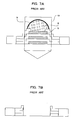
If the dicing cutter 10 deviates from an appropriate position as illustrated in FIG. 8A, an abnormal state occurs as illustrated in FIG. 8B. Specifically, the Ni bump 8 and the like are partially left at an edge portion even after the dicing process. If the conductive Ni bump 8 is left at the edge portion, electrical leakage may occur at the “left bump” in a case where the semiconductor chip 2 is subjected to packaging subsequently.
FIG. 9 is a sectional view illustrating a dicing process for cutting the electrode pad 5 of the scribe PCM 4 with a bump formed on the electrode pad 5 as illustrated in FIG. 5D, thereby to obtain a semiconductor chip 2 from the wafer 1, similarly to FIGS. 8A and 8B. As illustrated in FIG. 9, the scribe grid 3 (together with the scribe PCM 4, the electrode pad 5 of the scribe PCM 4, and the Ni bump 8 and the Au plating layer 9 on the electrode pad 5) is cut by means of a dicing cutter 10. The dicing cutter 10 used herein has a large width in order to prevent the bump from being partially left at an edge portion.
Thus, it is possible to prevent the bump 8 from being partially left at the edge portion. However, since the width of the dicing cutter 10, that is, a width of a “spacing” becomes large, the scribe grid 3 must be made larger in width in conjunction. As a result, the scribe grid 3 formed on the wafer 1 is larger in width than the aforementioned scribe grid 3 illustrated in FIG. 7A (a lower side of FIG. 9). Consequently, an area for formation of semiconductor chips 2 is disadvantageously decreased in the wafer 1, so that there is a possibility that semiconductor chips 2 to be obtained from one wafer are reduced in number.
SUMMARY OF THE INVENTION
The present invention is devised in order to solve the aforementioned conventional problems. An object of the present invention is to provide a semiconductor device having the following advantages. That is, it is possible to prevent a “left bump” from being generated upon performance of dicing on an electrode pad of a scribe PCM, thereby to prevent occurrence of electrical leakage from such “left bump”. Further, it is possible to suppress reduction in number of semiconductor chips to be obtained from one wafer due to a widening of a scribe grid.
In order to accomplish this object, according to a first aspect of the present invention, a semiconductor device includes: a substrate; a semiconductor chip and a scribe grid formed on the substrate; and a plurality of multilayered electrode pads provided on the semiconductor chip and the scribe grid, respectively. Herein, the uppermost one of the multilayered electrode pads, on which a bump and a plating coat will be formed, is made of metal having ionization tendency higher than those of materials for the bump and the plating coat. Further, the uppermost one of the multilayered electrode pads, on which none of the bump and the plating coat will be formed, is made of metal having ionization tendency lower than those of the materials for the bump and the plating coat.
According to a second aspect of the present invention, the bump and the plating coat are formed on the electrode pad provided on the semiconductor chip, but are not formed on the electrode pad provided on the scribe grid.
According to a third aspect of the present invention, the metal having high ionization tendency is Al, and the metal having low ionization tendency is Cu.
According to the present invention, as described above, it is possible to form a bump on an electrode pad of a semiconductor chip without forming a bump on an electrode pad of a scribe PCM on a spacing for dicing.
Therefore, it is possible to prevent a “left bump” from being generated upon performance of dicing on an electrode pad of a scribe PCM, thereby to prevent occurrence of electrical leakage from such “left bump”.
Unlike a conventional technique, moreover, it is possible to suppress reduction in number of semiconductor chips to be obtained from one wafer due to a widening of a scribe grid.
In addition, it is possible to selectively perform plating on a plurality of electrode pads even in an electroless manner.
BRIEF DESCRIPTION OF THE INVENTION
FIGS. 1A to 1D are sectional views each illustrating a process for bump formation in a semiconductor device according to a first embodiment of the present invention;
FIG. 2 illustrates a comparison in width between a dicing cutter used in the first embodiment and a conventional dicing cutter;
FIG. 3 illustrates an outer appearance of a semiconductor chip in a semiconductor device according to a second embodiment of the present invention;
FIG. 4A illustrates a shape of a wafer in a conventional semiconductor device, FIG. 4B illustrates a state in which a semiconductor chip is cut out from the wafer in the conventional semiconductor device, and FIG. 4C illustrates a shape of a scribe PCM on the wafer in the conventional semiconductor device;
FIGS. 5A to 5D are sectional views each illustrating a process for bump formation in the conventional semiconductor device;
FIG. 6 illustrates an electroless plating method performed on the conventional semiconductor device;
FIGS. 7A and 7B are sectional views each illustrating a dicing process performed on the conventional semiconductor device;
FIGS. 8A and 8B are sectional views each illustrating a dicing process performed on the conventional semiconductor device under another condition; and
FIG. 9 is a sectional view illustrating a dicing process performed on the conventional semiconductor device under still another condition.
DESCRIPTION OF THE PREFERRED EMBODIMENTS
Hereinafter, a specific description will be given of preferred embodiments of the present invention with reference to the drawings.
First Embodiment
First, a description will be given of a semiconductor device according to a first embodiment of the present invention.
FIGS. 1A to 1D are sectional views each illustrating a case where a bump is not formed on an electrode pad 5 of a scribe PCM 4 formed on a scribe grid 3, but is formed on an electrode pad 6 of a semiconductor chip 2 by electroless plating, in the semiconductor device according to the first embodiment. In this embodiment, the semiconductor device has a multilayer structure of three wiring layers.
FIG. 1A illustrates a shape of the semiconductor device according to the first embodiment. In FIG. 1A, the electrode pad 5 of the scribe PCM 4 is illustrated on a left side and the electrode pad 6 of the semiconductor chip 2 is illustrated on a right side.
On the scribe PCM 4, two electrode pads 5 are laminated in the vertical direction. Herein, the uppermost one of the electrode pads 5 of the scribe PCM 4 is made of Cu.
On the semiconductor chip 2, three electrode pads 6 are laminated in a vertical direction. Herein, the uppermost one of the electrode pads 6 of the semiconductor chip 2 is made of Al.
In other words, an uppermost one of electrode pads (herein, the electrode pad 6 of the semiconductor chip 2), on which a bump and a plating coat will be formed by electroless plating (to be described later), is made of Al, and an uppermost one of electrode pads (herein, the electrode pad 5 of the scribe PCM 4), on which none of the bump and the plating coat will be formed by electroless plating, is made of Cu.
First, as illustrated in FIG. 1B, Zn plating is performed in an electroless manner. Thus, a Zn plating layer 7 is formed on the electrode pad 6 of the semiconductor chip 2. A mechanism of the Zn plating is as follows. That is, Al which is a material for the electrode pad 6 of the semiconductor chip 2 is dissolved in an electroless Zn plating solution as Al ions 6 a with difference in ionization tendency between Al and Zn (ionization tendency: Al>Zn). Then, Zn ions 7 a in the electroless Zn plating solution are deposited on the electrode pad 6 of the semiconductor chip 2; thus, the Zn plating layer 7 is formed. In other words, displacement plating is performed herein.
Herein, the electrode pad 5 of the scribe PCM 4 is made of Cu. Ionization tendency of Cu is considerably lower than that of Zn; therefore, Cu itself is not dissolved in the electroless Zn plating solution as Cu ions in the displacement plating performed as the electroless plating. Accordingly, the Zn ions 7 a in the electroless Zn plating solution are not deposited on the electrode pad 5 of the scribe PCM 4. In other words, the Zn plating layer 7 is not formed on the electrode pad 5 of the scribe PCM 4.
Next, as illustrated in FIG. 1C, Ni plating is performed in an electroless manner. Thus, a Ni bump 8 is formed on the electrode pad 6 of the semiconductor chip 2. A mechanism of the Ni plating is as follows. That is, Zn in the Zn plating layer 7 is dissolved in an electroless Ni plating solution as Zn ions 7 a with difference in ionization tendency between Zn and Ni (ionization tendency: Zn>Ni). Then, Ni ions 8 a in the electroless Ni plating solution are deposited on the electrode pad 6 of the semiconductor chip 2; thus, the Ni bump 8 is formed. In other words, displacement plating is performed herein.
Also herein, the Zn plating layer 7 is not formed on the electrode pad 5 of the scribe PCM 4. Further, ionization tendency of Cu is lower than that of Ni; therefore, the Ni bump 8 is not formed on the electrode pad 5 of the scribe PCM 4.
Next, as illustrated in FIG. 1D, Au plating is performed in an electroless manner. Thus, an Au plating layer 9 is formed on the Ni bump 8 on the electrode pad 6 of the semiconductor chip 2. A mechanism of the Au plating is as follows. That is, Ni in the Ni bump 8 is dissolved in an electroless Au plating solution as Ni ions 8 a with difference in ionization tendency between Ni and Au (ionization tendency: Ni>Au). Then, Au ions 9 a in the electroless Au plating solution are deposited on the Ni bump 8 on the electrode pad 6 of the semiconductor chip 2; thus, the Au plating layer 9 is formed. In other words, displacement plating is performed herein.
Also herein, the Ni bump 8 is not formed on the electrode pad 5 of the scribe PCM 4. Therefore, even in the electroless Au plating solution, the Au plating layer 9 is not formed on the electrode pad 5 of the scribe PCM 4.
The aforementioned method is an electroless plating process for forming a bump on the electrode pad 6 of the semiconductor chip 2 without forming a bump on the electrode pad 5 of the scribe PCM 4.
FIG. 2 illustrates a comparison between a width of a dicing cutter 10 used for cutting the electrode pad 5 of the scribe PCM 4 with no bump formed on the electrode pad 5 as illustrated in FIG. 1D and the width of the conventional dicing cutter 10 used for cutting the electrode pad 5 of the scribe PCM 4 with a bump formed on the electrode pad 5 as illustrated in FIG. 5D.
It is apparent from FIG. 2 that the dicing cutter 10 used for cutting the electrode pad 5 of the scribe PCM 4 with no bump formed on the electrode pad 5 is smaller in width than the conventional dicing cutter 10 used for cutting the electrode pad 5 of the scribe PCM 4 with a bump formed on the electrode pad 5. The reason therefor is as follows. Conventionally, as illustrated in a lower side of FIG. 2, the scribe grid 3 (together with the scribe PCM 4, the electrode pad 5 of the scribe PCM 4, and the Ni bump 8 and the Au plating layer 9 on the electrode pad 5) is cut by means of the dicing cutter 10. In such case, as illustrated in FIGS. 8A and 8B, there is a possibility that the Ni bump 8 and the like are partially left at the edge portion. In order to avoid this possibility, the scribe grid 3 must be cut by means of the dicing cutter 10 having a large width. Consequently, the width of the dicing cutter 10, that is, a width of a “spacing” becomes large. This causes a problem that the scribe grid 3 must be made larger in width in conjunction.
According to the first embodiment, as illustrated in an upper side of FIG. 2, no bump is formed on the electrode pad 5 of the scribe PCM 4. As a result, there is no possibility that the Ni bump 8 and the like are partially left at an edge portion. Thus, it is unnecessary to cut the scribe grid 3 by means of the dicing cutter 10 having a large width. In addition, it is unnecessary to make the width of the dicing cutter 10, that is, the width of the “spacing” large.
Accordingly, the scribe grid 3 on the wafer 1 is reduced in area. On the other hand, an area for formation of semiconductor chips 2 each having a semiconductor integrated circuit provided thereon is increased. Thus, it is possible to suppress reduction in number of semiconductor chips 2 to be obtained from one wafer.
Second Embodiment
Next, a description will be given of a semiconductor chip according to a second embodiment of the present invention.
FIG. 3 illustrates an outer appearance of a semiconductor chip cut out from the semiconductor device according to the second embodiment. As illustrated in FIG. 3, for example, an electrode pad 11 made of Al, on which a bump will be formed by electroless plating, and an electrode pad 12 made of Cu, on which no bump will be formed by electroless plating, are formed on a semiconductor chip 2. Herein, bump formation is performed on each of the electrode pads on the semiconductor chip 2 by the electroless plating process described with reference to FIGS. 1A to 1D.
As described above with reference to FIGS. 1A to 1D, the bump is not formed on the electrode pad 12 made of Cu, but is formed on the electrode pad 11 made of Al. That is, the structure of the semiconductor chip has an advantage in that electroless plating can be selectively performed, over a conventional technique.

Claims (12)

1. A method of manufacturing a semiconductor device having a bump, comprising:
providing a substrate;
forming a semiconductor chip on the substrate;
forming a first electrode pad area on the semiconductor chip, the first electrode pad area having a plurality of electrode pads, a top electrode pad among the plurality of electrode pads comprising a first metal;
forming a second electrode pad area on the semiconductor chip, the second electrode pad area having a plurality of electrode pads, a top electrode pad among the plurality of electrode pads comprising a second metal; and
electroless plating of the first and second electrode pad areas, thereby forming a bump on the first electrode pad area, and not forming a bump on the second electrode pad area,
wherein the bump directly contacts the top electrode pad of the first electrode pad area, the first metal has an ionization tendency higher than that of the bump, and the second metal has an ionization tendency lower than that of the bump.
2. A method of manufacturing a semiconductor device having a bump according to claim 1, wherein the first metal is Al and the second metal is Cu.
3. A method of manufacturing a semiconductor device having a bump according to claim 2, wherein the bump is made of Ni.
4. A method of manufacturing a semiconductor substrate having a bump, comprising:
providing a substrate;
forming a semiconductor chip and a scribe grid on the substrate;
forming a first electrode pad area on the semiconductor chip, the first electrode pad area having a plurality of electrode pads , a top electrode pad among the plurality of electrode pads comprising a first metal;
forming a second electrode pad area on the scribe grid, the second electrode pad area having a plurality of electrode pads, a top electrode pad among the plurality of electrode pads comprising a second metal;
electroless plating of the first and second electrode pad areas, thereby forming a bump on the first electrode pad area, and not forming a bump on the second electrode pad area,
wherein the bump directly contacts the first metal, the first metal has an ionization tendency higher than that of the bump, and the second metal has an ionization tendency lower than that of the bump.
5. A method of manufacturing a semiconductor substrate having a bump according to claim 4, wherein the first metal is Al, and the second metal is Cu.
6. A method of manufacturing a semiconductor substrate having a bump according to claim 5, wherein the bump is made of Ni.
7. A method of manufacturing a semiconductor device having a bump according to claim 4, further comprising cutting the substrate on the second electrode pad area.
8. A method of manufacturing a semiconductor device having a bump according to claim 4, wherein the first electrode pad area has three electrode pads, and the second electrode pad area has two electrode pads.
9. A method of manufacturing a semiconductor device having a bump according to claim 4, wherein there is no material between the bump and the first metal.
10. A method of manufacturing a semiconductor substrate having a bump, comprising:
providing a substrate;
forming a semiconductor chip and a scribe grid on the substrate;
forming an Al electrode pad on the semiconductor chip;
forming a Cu electrode pad on the scribe grid;
electroless Zn plating forming a Zn plating layer on the Al electrode pad;
electroless Ni plating forming a Ni bump on the Al electrode pad.
11. A method of manufacturing a semiconductor device having a bump according to claim 10, further comprising electroless Au plating forming an Au plating layer on the Ni bump.
12. A method of manufacturing a semiconductor device having a bump according to claim 11, further comprising cutting the substrate on the Cu electrode pad.
US12/453,299 2006-05-01 2009-05-06 Method of forming a metal bump on a semiconductor device Active US7846831B2 (en)

Priority Applications (1)

Application Number Priority Date Filing Date Title
US12/453,299 US7846831B2 (en) 2006-05-01 2009-05-06 Method of forming a metal bump on a semiconductor device

Applications Claiming Priority (4)

Application Number Priority Date Filing Date Title
JP2006127168A JP2007299968A (en) 2006-05-01 2006-05-01 Semiconductor device
JP2006-127168 2006-05-01
US11/785,845 US20070252242A1 (en) 2006-05-01 2007-04-20 Semiconductor device
US12/453,299 US7846831B2 (en) 2006-05-01 2009-05-06 Method of forming a metal bump on a semiconductor device

Related Parent Applications (1)

Application Number Title Priority Date Filing Date
US11/785,845 Continuation US20070252242A1 (en) 2006-05-01 2007-04-20 Semiconductor device

Publications (2)

Publication Number Publication Date
US20090221142A1 US20090221142A1 (en) 2009-09-03
US7846831B2 true US7846831B2 (en) 2010-12-07

Family

ID=38647562

Family Applications (2)

Application Number Title Priority Date Filing Date
US11/785,845 Abandoned US20070252242A1 (en) 2006-05-01 2007-04-20 Semiconductor device
US12/453,299 Active US7846831B2 (en) 2006-05-01 2009-05-06 Method of forming a metal bump on a semiconductor device

Family Applications Before (1)

Application Number Title Priority Date Filing Date
US11/785,845 Abandoned US20070252242A1 (en) 2006-05-01 2007-04-20 Semiconductor device

Country Status (3)

Country Link
US (2) US20070252242A1 (en)
JP (1) JP2007299968A (en)
CN (1) CN101068010B (en)

Families Citing this family (3)

* Cited by examiner, † Cited by third party
Publication number Priority date Publication date Assignee Title
CN102263070A (en) * 2011-06-13 2011-11-30 西安天胜电子有限公司 Wafer level chip scale packaging (WLCSP) piece based on substrate packaging
WO2013067659A1 (en) * 2011-11-11 2013-05-16 Chu Tse-Ming Bump structure of wafer bonding pad and manufacturing method thereof
US9881962B2 (en) * 2013-12-10 2018-01-30 Sony Corporation Semiconductor apparatus, solid state imaging device, imaging apparatus and electronic equipment, and manufacturing method thereof

Citations (5)

* Cited by examiner, † Cited by third party
Publication number Priority date Publication date Assignee Title
JP2001332577A (en) 2000-05-25 2001-11-30 Citizen Watch Co Ltd Method for manufacturing semiconductor device
US20030052409A1 (en) 2001-08-29 2003-03-20 Mie Matsuo Semiconductor device and method of manufacturing the same
US20030153172A1 (en) * 2002-02-08 2003-08-14 Hitachi, Ltd. Method of manufacturing a semiconductor integrated circuit device
US20060154469A1 (en) 2005-01-11 2006-07-13 Hess Kevin J Method and apparatus for providing structural support for interconnect pad while allowing signal conductance
US7452803B2 (en) * 2004-08-12 2008-11-18 Megica Corporation Method for fabricating chip structure

Family Cites Families (4)

* Cited by examiner, † Cited by third party
Publication number Priority date Publication date Assignee Title
JP3622435B2 (en) * 1997-08-06 2005-02-23 富士通株式会社 Semiconductor device and manufacturing method thereof
JP4238694B2 (en) * 2002-11-11 2009-03-18 セイコーエプソン株式会社 Manufacturing method of semiconductor wafer and semiconductor chip
JP2005150452A (en) * 2003-11-17 2005-06-09 Fujikura Ltd Manufacturing method of semiconductor package
KR100575591B1 (en) * 2004-07-27 2006-05-03 삼성전자주식회사 Chip scale package for wafer level stack package and manufacturing method thereof

Patent Citations (5)

* Cited by examiner, † Cited by third party
Publication number Priority date Publication date Assignee Title
JP2001332577A (en) 2000-05-25 2001-11-30 Citizen Watch Co Ltd Method for manufacturing semiconductor device
US20030052409A1 (en) 2001-08-29 2003-03-20 Mie Matsuo Semiconductor device and method of manufacturing the same
US20030153172A1 (en) * 2002-02-08 2003-08-14 Hitachi, Ltd. Method of manufacturing a semiconductor integrated circuit device
US7452803B2 (en) * 2004-08-12 2008-11-18 Megica Corporation Method for fabricating chip structure
US20060154469A1 (en) 2005-01-11 2006-07-13 Hess Kevin J Method and apparatus for providing structural support for interconnect pad while allowing signal conductance

Non-Patent Citations (1)

* Cited by examiner, † Cited by third party
Title
Wolf, S., Silicon Processing for the VLSI Era, vol. 4: Deep-Submicron Process Technology, Chapter 16, Copper Interconnect Process Technology, p. 711, 2002, Lattice Press, Sunset Beach, CA.

Also Published As

Publication number Publication date
JP2007299968A (en) 2007-11-15
CN101068010B (en) 2011-04-06
CN101068010A (en) 2007-11-07
US20090221142A1 (en) 2009-09-03
US20070252242A1 (en) 2007-11-01

Similar Documents

Publication Publication Date Title
US8373278B2 (en) Semiconductor device having stacked dice disposed on base substrate
US8753971B2 (en) Dummy metal design for packaging structures
US6951801B2 (en) Metal reduction in wafer scribe area
US7812456B2 (en) Semiconductor device and a method of manufacturing the same
US7595222B2 (en) Semiconductor device and manufacturing method thereof
US9030019B2 (en) Semiconductor device and method of manufacture thereof
US8211789B2 (en) Manufacturing method of a bump structure having a reinforcement member
US20130095614A1 (en) Wafer level packaging of semiconductor chips
CN105655312A (en) Semiconductor including stress buffer material formed on low-K metalized system
US20070210450A1 (en) Method of forming a bump and a connector structure having the bump
CN105762128A (en) Elongated bump structure for semiconductor devices
JP2011222738A (en) Method of manufacturing semiconductor device
US20080142945A1 (en) Semiconductor package with redistribution layer of semiconductor chip directly contacted with substrate and method of fabricating the same
US7846831B2 (en) Method of forming a metal bump on a semiconductor device
US11990373B2 (en) Method for producing semiconductor device, semiconductor package, and method for producing semiconductor package
US7595268B2 (en) Semiconductor package having re-distribution lines for supplying power and a method for manufacturing the same
US7030492B2 (en) Under bump metallurgic layer
JP2017191840A (en) Semiconductor device and method of manufacturing semiconductor device
US20250061262A1 (en) Method of designing interconnect structure of semiconductor apparatus and method of manufacturing semiconductor apparatus using the same
US7700475B1 (en) Pillar structure on bump pad
US20240096634A1 (en) Semiconductor device and method for making the same
US20120021600A1 (en) Method of fabricating film circuit substrate and method of fabricating chip package including the same
US20070145604A1 (en) Chip structure and chip manufacturing process
US20150340339A1 (en) Method for manufacturing a semiconductor device
KR20190107455A (en) Semiconductor device and wafer level package having redistribution structure, and method for manufacturing the same

Legal Events

Date Code Title Description
STCF Information on status: patent grant

Free format text: PATENTED CASE

FEPP Fee payment procedure

Free format text: PAYOR NUMBER ASSIGNED (ORIGINAL EVENT CODE: ASPN); ENTITY STATUS OF PATENT OWNER: LARGE ENTITY

AS Assignment

Owner name: GODO KAISHA IP BRIDGE 1, JAPAN

Free format text: ASSIGNMENT OF ASSIGNORS INTEREST;ASSIGNOR:PANASONIC CORPORATION (FORMERLY MATSUSHITA ELECTRIC INDUSTRIAL CO., LTD.);REEL/FRAME:032152/0514

Effective date: 20140117

FPAY Fee payment

Year of fee payment: 4

MAFP Maintenance fee payment

Free format text: PAYMENT OF MAINTENANCE FEE, 8TH YEAR, LARGE ENTITY (ORIGINAL EVENT CODE: M1552)

Year of fee payment: 8

MAFP Maintenance fee payment

Free format text: PAYMENT OF MAINTENANCE FEE, 12TH YEAR, LARGE ENTITY (ORIGINAL EVENT CODE: M1553); ENTITY STATUS OF PATENT OWNER: LARGE ENTITY

Year of fee payment: 12