US7842814B2 - Total synthesis of salinosporamide A and analogs thereof - Google Patents
Total synthesis of salinosporamide A and analogs thereof Download PDFInfo
- Publication number
- US7842814B2 US7842814B2 US11/697,689 US69768907A US7842814B2 US 7842814 B2 US7842814 B2 US 7842814B2 US 69768907 A US69768907 A US 69768907A US 7842814 B2 US7842814 B2 US 7842814B2
- Authority
- US
- United States
- Prior art keywords
- compound
- formula
- alkyl
- salt
- group
- Prior art date
- Legal status (The legal status is an assumption and is not a legal conclusion. Google has not performed a legal analysis and makes no representation as to the accuracy of the status listed.)
- Expired - Fee Related, expires
Links
- 0 [1*]C1OCC2(C)N1C(=O)C(CC=C)C2([3*])O Chemical compound [1*]C1OCC2(C)N1C(=O)C(CC=C)C2([3*])O 0.000 description 160
- BDFAFNRHUOEFQW-OKTHUPLCSA-N [H][C@@]1(C(=O)[C@@]23NC(=O)[C@H](CCCl)[C@]2(C)OC3=O)C=CCCC1.[H][C@@]1([C@H](O)[C@@]23NC(=O)[C@H](CCCl)[C@]2(C)OC3=O)C=CCCC1 Chemical compound [H][C@@]1(C(=O)[C@@]23NC(=O)[C@H](CCCl)[C@]2(C)OC3=O)C=CCCC1.[H][C@@]1([C@H](O)[C@@]23NC(=O)[C@H](CCCl)[C@]2(C)OC3=O)C=CCCC1 BDFAFNRHUOEFQW-OKTHUPLCSA-N 0.000 description 4
- BDFAFNRHUOEFQW-OMSNNVOWSA-N [H][C@@]1(C(=O)[C@@]23NC(=O)[C@H](CCCl)[C@]2(C)OC3=O)C=CCCC1.[H][C@@]1([C@@H](O)[C@@]23NC(=O)[C@H](CCCl)[C@]2(C)OC3=O)C=CCCC1 Chemical compound [H][C@@]1(C(=O)[C@@]23NC(=O)[C@H](CCCl)[C@]2(C)OC3=O)C=CCCC1.[H][C@@]1([C@@H](O)[C@@]23NC(=O)[C@H](CCCl)[C@]2(C)OC3=O)C=CCCC1 BDFAFNRHUOEFQW-OMSNNVOWSA-N 0.000 description 3
- RWLDIXYNLOCAQX-AADWAWOOSA-N C=CCC(C(C)=O)C(=O)N1[C@@H](C(=O)OC)CO[C@@H]1C(C)(C)C Chemical compound C=CCC(C(C)=O)C(=O)N1[C@@H](C(=O)OC)CO[C@@H]1C(C)(C)C RWLDIXYNLOCAQX-AADWAWOOSA-N 0.000 description 2
- GMNXFTQYBSNLJE-VKAVAODPSA-N C=CCC1C(=O)N2[C@H](C(C)(C)C)OC[C@@]2(C)C1(C)O Chemical compound C=CCC1C(=O)N2[C@H](C(C)(C)C)OC[C@@]2(C)C1(C)O GMNXFTQYBSNLJE-VKAVAODPSA-N 0.000 description 2
- GMNXFTQYBSNLJE-LVGORTOPSA-N C=CC[C@H]1C(=O)N2[C@H](C(C)(C)C)OC[C@@]2(C)[C@@]1(C)O Chemical compound C=CC[C@H]1C(=O)N2[C@H](C(C)(C)C)OC[C@@]2(C)[C@@]1(C)O GMNXFTQYBSNLJE-LVGORTOPSA-N 0.000 description 2
- NGWSFRIPKNWYAO-QPTZUFNXSA-N C[C@]([C@H]1CCCl)([C@@]2([C@@H]([C@@H]3C=CCCC3)O)NC1=O)OC2=O Chemical compound C[C@]([C@H]1CCCl)([C@@]2([C@@H]([C@@H]3C=CCCC3)O)NC1=O)OC2=O NGWSFRIPKNWYAO-QPTZUFNXSA-N 0.000 description 2
- NGWSFRIPKNWYAO-SHTIJGAHSA-N C[C@]([C@H]1CCCl)([C@@]2([C@H]([C@@H]3C=CCCC3)O)NC1=O)OC2=O Chemical compound C[C@]([C@H]1CCCl)([C@@]2([C@H]([C@@H]3C=CCCC3)O)NC1=O)OC2=O NGWSFRIPKNWYAO-SHTIJGAHSA-N 0.000 description 2
- BHXMWRSNWWTHFN-RTYXUYSRSA-N [H][C@@]1(C(=O)[C@@]23NC(=O)[C@H](CCCl)[C@]2(C)OC3=O)C=CCCC1.[H][C@@]1([C@@H](O)[C@@]23NC(=O)[C@H](CCCl)[C@]2(C)OC3=O)C=CCCC1.[H][C@@]1([C@H](O)[C@@]23NC(=O)[C@H](CCCl)[C@]2(C)OC3=O)C=CCCC1 Chemical compound [H][C@@]1(C(=O)[C@@]23NC(=O)[C@H](CCCl)[C@]2(C)OC3=O)C=CCCC1.[H][C@@]1([C@@H](O)[C@@]23NC(=O)[C@H](CCCl)[C@]2(C)OC3=O)C=CCCC1.[H][C@@]1([C@H](O)[C@@]23NC(=O)[C@H](CCCl)[C@]2(C)OC3=O)C=CCCC1 BHXMWRSNWWTHFN-RTYXUYSRSA-N 0.000 description 2
- QDAGMRIWIDFPLA-UHFFFAOYSA-N B1C2CCCC1CCC2.B[B-](=N)B[B-](=N)B([B-](B)=N)[B-](=N\[B-](B)=N)/[B-](=N/[B-](B)=N)B([B-](B)=N)[B-](B)=N.C1=CC(B2C3CCCC2CCC3)CCC1.C1=CCCC=C1.C1CCOC1 Chemical compound B1C2CCCC1CCC2.B[B-](=N)B[B-](=N)B([B-](B)=N)[B-](=N\[B-](B)=N)/[B-](=N/[B-](B)=N)B([B-](B)=N)[B-](B)=N.C1=CC(B2C3CCCC2CCC3)CCC1.C1=CCCC=C1.C1CCOC1 QDAGMRIWIDFPLA-UHFFFAOYSA-N 0.000 description 1
- OXIMFIHUHHBGFQ-RWARSIMXSA-N C.C.C1=CC(B2C3CCCC2CCC3)CCC1.CC(C)(C)[C@@H]1OC[C@]2(C=O)N1C(=O)[C@@H]1C[C@@H](OCC3=CC=CC=C3)O[C@@]12C.[H][C@@]1([C@@H](O)[C@@]23CO[C@@H](C(C)(C)C)N2C(=O)[C@@H]2C[C@@H](OCC4=CC=CC=C4)O[C@@]23C)C=CCCC1 Chemical compound C.C.C1=CC(B2C3CCCC2CCC3)CCC1.CC(C)(C)[C@@H]1OC[C@]2(C=O)N1C(=O)[C@@H]1C[C@@H](OCC3=CC=CC=C3)O[C@@]12C.[H][C@@]1([C@@H](O)[C@@]23CO[C@@H](C(C)(C)C)N2C(=O)[C@@H]2C[C@@H](OCC4=CC=CC=C4)O[C@@]23C)C=CCCC1 OXIMFIHUHHBGFQ-RWARSIMXSA-N 0.000 description 1
- OXIMFIHUHHBGFQ-FAIMVJMZSA-N C.C.C1=CC(B2C3CCCC2CCC3)CCC1.CC(C)(C)[C@@H]1OC[C@]2(C=O)N1C(=O)[C@@H]1C[C@H](OCC3=CC=CC=C3)O[C@@]12C.[H][C@@]1([C@@H](O)[C@@]23CO[C@@H](C(C)(C)C)N2C(=O)[C@@H]2C[C@H](OCC4=CC=CC=C4)O[C@@]23C)C=CCCC1 Chemical compound C.C.C1=CC(B2C3CCCC2CCC3)CCC1.CC(C)(C)[C@@H]1OC[C@]2(C=O)N1C(=O)[C@@H]1C[C@H](OCC3=CC=CC=C3)O[C@@]12C.[H][C@@]1([C@@H](O)[C@@]23CO[C@@H](C(C)(C)C)N2C(=O)[C@@H]2C[C@H](OCC4=CC=CC=C4)O[C@@]23C)C=CCCC1 OXIMFIHUHHBGFQ-FAIMVJMZSA-N 0.000 description 1
- JEZADJJNGOTTID-SXZROBAOSA-N C.C.CC(C)(C)[C@@H]1OC[C@]2(C=O)N1C(=O)[C@@H]1CC(OCC3=CC=CC=C3)O[C@@]12C.[H][C@@]1([C@@H](O)[C@@]23CO[C@@H](C(C)(C)C)N2C(=O)[C@@H]2CC(OCC4=CC=CC=C4)O[C@@]23C)C=CCCC1 Chemical compound C.C.CC(C)(C)[C@@H]1OC[C@]2(C=O)N1C(=O)[C@@H]1CC(OCC3=CC=CC=C3)O[C@@]12C.[H][C@@]1([C@@H](O)[C@@]23CO[C@@H](C(C)(C)C)N2C(=O)[C@@H]2CC(OCC4=CC=CC=C4)O[C@@]23C)C=CCCC1 JEZADJJNGOTTID-SXZROBAOSA-N 0.000 description 1
- JEZADJJNGOTTID-WUBLGZNOSA-N C.C.CC(C)(C)[C@@H]1OC[C@]2(C=O)N1C(=O)[C@@H]1CC(OCC3=CC=CC=C3)O[C@@]12C.[H][C@@]1([C@H](O)[C@@]23CO[C@@H](C(C)(C)C)N2C(=O)[C@@H]2CC(OCC4=CC=CC=C4)O[C@@]23C)C=CCCC1 Chemical compound C.C.CC(C)(C)[C@@H]1OC[C@]2(C=O)N1C(=O)[C@@H]1CC(OCC3=CC=CC=C3)O[C@@]12C.[H][C@@]1([C@H](O)[C@@]23CO[C@@H](C(C)(C)C)N2C(=O)[C@@H]2CC(OCC4=CC=CC=C4)O[C@@]23C)C=CCCC1 JEZADJJNGOTTID-WUBLGZNOSA-N 0.000 description 1
- LVCOGTOCSOIMRI-NPDWRQTDSA-N C.C.CC(C)(C)[C@@H]1OC[C@]2(C=O)N1C(=O)[C@@H]1C[C@@H](OCC3=CC=CC=C3)O[C@@]12C.CC(C)(C)[C@@H]1OC[C@]2(CO)N1C(=O)[C@@H]1C[C@@H](OCC3=CC=CC=C3)O[C@@]12C Chemical compound C.C.CC(C)(C)[C@@H]1OC[C@]2(C=O)N1C(=O)[C@@H]1C[C@@H](OCC3=CC=CC=C3)O[C@@]12C.CC(C)(C)[C@@H]1OC[C@]2(CO)N1C(=O)[C@@H]1C[C@@H](OCC3=CC=CC=C3)O[C@@]12C LVCOGTOCSOIMRI-NPDWRQTDSA-N 0.000 description 1
- LVCOGTOCSOIMRI-CLRIUQDRSA-N C.C.CC(C)(C)[C@@H]1OC[C@]2(C=O)N1C(=O)[C@@H]1C[C@H](OCC3=CC=CC=C3)O[C@@]12C.CC(C)(C)[C@@H]1OC[C@]2(CO)N1C(=O)[C@@H]1C[C@H](OCC3=CC=CC=C3)O[C@@]12C Chemical compound C.C.CC(C)(C)[C@@H]1OC[C@]2(C=O)N1C(=O)[C@@H]1C[C@H](OCC3=CC=CC=C3)O[C@@]12C.CC(C)(C)[C@@H]1OC[C@]2(CO)N1C(=O)[C@@H]1C[C@H](OCC3=CC=CC=C3)O[C@@]12C LVCOGTOCSOIMRI-CLRIUQDRSA-N 0.000 description 1
- FNUBRZKLHCGEOO-SFVJOBOUSA-N C.C.CC(C)(C)[C@@H]1OC[C@]2(CO)N1C(=O)[C@@H]1C[C@@H](OCC3=CC=CC=C3)O[C@@]12C.COC(=O)[C@@]12CO[C@@H](C(C)(C)C)N1C(=O)[C@@H]1C[C@@H](OCC3=CC=CC=C3)O[C@@]12C Chemical compound C.C.CC(C)(C)[C@@H]1OC[C@]2(CO)N1C(=O)[C@@H]1C[C@@H](OCC3=CC=CC=C3)O[C@@]12C.COC(=O)[C@@]12CO[C@@H](C(C)(C)C)N1C(=O)[C@@H]1C[C@@H](OCC3=CC=CC=C3)O[C@@]12C FNUBRZKLHCGEOO-SFVJOBOUSA-N 0.000 description 1
- FNUBRZKLHCGEOO-WVIYXPOWSA-N C.C.CC(C)(C)[C@@H]1OC[C@]2(CO)N1C(=O)[C@@H]1C[C@H](OCC3=CC=CC=C3)O[C@@]12C.COC(=O)[C@@]12CO[C@@H](C(C)(C)C)N1C(=O)[C@@H]1C[C@H](OCC3=CC=CC=C3)O[C@@]12C Chemical compound C.C.CC(C)(C)[C@@H]1OC[C@]2(CO)N1C(=O)[C@@H]1C[C@H](OCC3=CC=CC=C3)O[C@@]12C.COC(=O)[C@@]12CO[C@@H](C(C)(C)C)N1C(=O)[C@@H]1C[C@H](OCC3=CC=CC=C3)O[C@@]12C FNUBRZKLHCGEOO-WVIYXPOWSA-N 0.000 description 1
- JACWHNKMBONEMO-BHBVTTKQSA-N C.C.COC(=O)[C@@]12CO[C@@H](C(C)(C)C)N1C(=O)[C@@H]1CC(O)O[C@@]12C.COC(=O)[C@@]12CO[C@@H](C(C)(C)C)N1C(=O)[C@@H]1C[C@@H](OCC3=CC=CC=C3)O[C@@]12C.COC(=O)[C@@]12CO[C@@H](C(C)(C)C)N1C(=O)[C@@H]1C[C@H](OCC3=CC=CC=C3)O[C@@]12C.[V][IH-] Chemical compound C.C.COC(=O)[C@@]12CO[C@@H](C(C)(C)C)N1C(=O)[C@@H]1CC(O)O[C@@]12C.COC(=O)[C@@]12CO[C@@H](C(C)(C)C)N1C(=O)[C@@H]1C[C@@H](OCC3=CC=CC=C3)O[C@@]12C.COC(=O)[C@@]12CO[C@@H](C(C)(C)C)N1C(=O)[C@@H]1C[C@H](OCC3=CC=CC=C3)O[C@@]12C.[V][IH-] JACWHNKMBONEMO-BHBVTTKQSA-N 0.000 description 1
- GUNVWAKABLTGAZ-QZVIEOKCSA-L C.CC(C)(C)[C@@H]1OC[C@]2(C=O)N1C(=O)[C@@H]1CC(OCC3=CC=CC=C3)O[C@@]12C.CC(C)(C)[C@@H]1OC[C@]2(CO)N1C(=O)[C@@H]1CC(OCC3=CC=CC=C3)O[C@@]12C.I[V](I)[IH-] Chemical compound C.CC(C)(C)[C@@H]1OC[C@]2(C=O)N1C(=O)[C@@H]1CC(OCC3=CC=CC=C3)O[C@@]12C.CC(C)(C)[C@@H]1OC[C@]2(CO)N1C(=O)[C@@H]1CC(OCC3=CC=CC=C3)O[C@@]12C.I[V](I)[IH-] GUNVWAKABLTGAZ-QZVIEOKCSA-L 0.000 description 1
- JQPROKJVOARNFH-OQYJKFBPSA-M C.COC(=O)[C@@]12CO[C@@H](C(C)(C)C)N1C(=O)[C@@H]1CC(OCC3=CC=CC=C3)O[C@@]12C.I[V][IH-].[H][C@@]1(C(=O)[C@@]23CO[C@@H](C(C)(C)C)N2C(=O)[C@@H]2CC(OCC4=CC=CC=C4)O[C@@]23C)C=CCCC1 Chemical compound C.COC(=O)[C@@]12CO[C@@H](C(C)(C)C)N1C(=O)[C@@H]1CC(OCC3=CC=CC=C3)O[C@@]12C.I[V][IH-].[H][C@@]1(C(=O)[C@@]23CO[C@@H](C(C)(C)C)N2C(=O)[C@@H]2CC(OCC4=CC=CC=C4)O[C@@]23C)C=CCCC1 JQPROKJVOARNFH-OQYJKFBPSA-M 0.000 description 1
- RKMSFXQJJGHVSM-UHFFFAOYSA-M C1=CCCC=C1.CCCC[Sn](CCCC)(CCCC)C1C=CCCC1.Cl[Zn]C1C=CCCC1 Chemical compound C1=CCCC=C1.CCCC[Sn](CCCC)(CCCC)C1C=CCCC1.Cl[Zn]C1C=CCCC1 RKMSFXQJJGHVSM-UHFFFAOYSA-M 0.000 description 1
- YXKIGKBVKFAWMX-UHFFFAOYSA-N C=CCBr.C=CCC(C)C(C)=O.CCC(C)=O Chemical compound C=CCBr.C=CCC(C)C(C)=O.CCC(C)=O YXKIGKBVKFAWMX-UHFFFAOYSA-N 0.000 description 1
- WBUPOUOKFFSYAL-HWZYDDPQSA-N C=CCC(C(=O)N1[C@@H](C(=O)OC)CO[C@@H]1C(C)(C)C)C1(C)OCCO1.C=CCC(C(=O)O)C1(C)OCCO1.COC(=O)[C@H]1COC(C(C)(C)C)N1.I[IH-].I[IH][IH-].[I-] Chemical compound C=CCC(C(=O)N1[C@@H](C(=O)OC)CO[C@@H]1C(C)(C)C)C1(C)OCCO1.C=CCC(C(=O)O)C1(C)OCCO1.COC(=O)[C@H]1COC(C(C)(C)C)N1.I[IH-].I[IH][IH-].[I-] WBUPOUOKFFSYAL-HWZYDDPQSA-N 0.000 description 1
- AXXGWXAQVJSJDM-HZKQFZJYSA-M C=CCC(C(=O)N1[C@@H](C(=O)OC)CO[C@@H]1C(C)(C)C)C1(C)OCCO1.C=CCC(C(C)=O)C(=O)N1[C@@H](C(=O)OC)CO[C@@H]1C(C)(C)C.I[IH][IH-].[V-]I Chemical compound C=CCC(C(=O)N1[C@@H](C(=O)OC)CO[C@@H]1C(C)(C)C)C1(C)OCCO1.C=CCC(C(C)=O)C(=O)N1[C@@H](C(=O)OC)CO[C@@H]1C(C)(C)C.I[IH][IH-].[V-]I AXXGWXAQVJSJDM-HZKQFZJYSA-M 0.000 description 1
- RQTOGBUIPQKZRU-IWSFNTASSA-N C=CCC(C(=O)N1[C@H](C(C)(C)C)OC[C@@H]1C(=O)OC)C1(C)OCCO1.C=CCC(C(=O)O)C1(C)OCCO1.I[IH-].I[IH][IH-] Chemical compound C=CCC(C(=O)N1[C@H](C(C)(C)C)OC[C@@H]1C(=O)OC)C1(C)OCCO1.C=CCC(C(=O)O)C1(C)OCCO1.I[IH-].I[IH][IH-] RQTOGBUIPQKZRU-IWSFNTASSA-N 0.000 description 1
- AXXGWXAQVJSJDM-BQMPALFESA-M C=CCC(C(=O)N1[C@H](C(C)(C)C)OC[C@@H]1C(=O)OC)C1(C)OCCO1.C=CCC(C(C)=O)C(=O)N1[C@H](C(C)(C)C)OC[C@@H]1C(=O)OC.I[IH][IH-].[V-]I Chemical compound C=CCC(C(=O)N1[C@H](C(C)(C)C)OC[C@@H]1C(=O)OC)C1(C)OCCO1.C=CCC(C(C)=O)C(=O)N1[C@H](C(C)(C)C)OC[C@@H]1C(=O)OC.I[IH][IH-].[V-]I AXXGWXAQVJSJDM-BQMPALFESA-M 0.000 description 1
- WLEAOLPZDRDPJF-UHFFFAOYSA-N C=CCC(C(=O)O)C1(C)OCCO1 Chemical compound C=CCC(C(=O)O)C1(C)OCCO1 WLEAOLPZDRDPJF-UHFFFAOYSA-N 0.000 description 1
- GJPFWPUGPQQGDK-UHFFFAOYSA-N C=CCC(C(=O)O)C1(C)OCCO1.C=CCC(C)C1(C)OCCO1.I[IH-] Chemical compound C=CCC(C(=O)O)C1(C)OCCO1.C=CCC(C)C1(C)OCCO1.I[IH-] GJPFWPUGPQQGDK-UHFFFAOYSA-N 0.000 description 1
- CBMFZVQYSFJZFB-ZNWOKRAXSA-M C=CCC(C(C)=O)C(=O)N1[C@@H](C(=O)OC)CO[C@@H]1C(C)(C)C.C=CCC1C(=O)N2[C@H](C(C)(C)C)OC[C@@]2(C(=O)OC)C1(C)O.[V-].[V-]I Chemical compound C=CCC(C(C)=O)C(=O)N1[C@@H](C(=O)OC)CO[C@@H]1C(C)(C)C.C=CCC1C(=O)N2[C@H](C(C)(C)C)OC[C@@]2(C(=O)OC)C1(C)O.[V-].[V-]I CBMFZVQYSFJZFB-ZNWOKRAXSA-M 0.000 description 1
- USMUCXXDZYXZOT-YLDQOAAWSA-M C=CCC(C(C)=O)C(=O)N1[C@H](C(C)(C)C)OC[C@@H]1C(=O)OC.C=CC[C@H]1C(=O)N2[C@H](C(C)(C)C)OC[C@@]2(C(=O)OC)[C@@]1(C)O.[V-]I Chemical compound C=CCC(C(C)=O)C(=O)N1[C@H](C(C)(C)C)OC[C@@H]1C(=O)OC.C=CC[C@H]1C(=O)N2[C@H](C(C)(C)C)OC[C@@]2(C(=O)OC)[C@@]1(C)O.[V-]I USMUCXXDZYXZOT-YLDQOAAWSA-M 0.000 description 1
- UWHAXTFQCIGRJA-UHFFFAOYSA-N C=CCC(C)C(C)=O.C=CCC(C)C1(C)OCCO1 Chemical compound C=CCC(C)C(C)=O.C=CCC(C)C1(C)OCCO1 UWHAXTFQCIGRJA-UHFFFAOYSA-N 0.000 description 1
- GPIYAZNJLJENAN-UHFFFAOYSA-N C=CCC(CC)C(C)=O Chemical compound C=CCC(CC)C(C)=O GPIYAZNJLJENAN-UHFFFAOYSA-N 0.000 description 1
- JXAUMZSRZAMUKW-UHFFFAOYSA-N C=CCC(CC)C1(C)OCCO1 Chemical compound C=CCC(CC)C1(C)OCCO1 JXAUMZSRZAMUKW-UHFFFAOYSA-N 0.000 description 1
- VBPNVCFPWFDKMH-JVAQAMLVSA-N C=CCC1=C(C)[C@]2(C(=O)OC)CO[C@@H](C(C)(C)C)N2C1=O.C=CC[C@@H]1C(=O)N2[C@H](C(C)(C)C)OC[C@@]2(C(=O)OC)[C@@]1(C)O.C=CC[C@H]1C(=O)N2[C@H](C(C)(C)C)OC[C@@]2(C(=O)OC)[C@]1(C)O Chemical compound C=CCC1=C(C)[C@]2(C(=O)OC)CO[C@@H](C(C)(C)C)N2C1=O.C=CC[C@@H]1C(=O)N2[C@H](C(C)(C)C)OC[C@@]2(C(=O)OC)[C@@]1(C)O.C=CC[C@H]1C(=O)N2[C@H](C(C)(C)C)OC[C@@]2(C(=O)OC)[C@]1(C)O VBPNVCFPWFDKMH-JVAQAMLVSA-N 0.000 description 1
- MKGVKFYGCXJFSR-CPFRHXQZSA-N C=CC[C@@H]1C(=O)N2[C@@H](C(C)(C)C)OC[C@@]2(C(=O)OC)[C@@]1(C)O.C=CC[C@H]1C(=O)N2[C@@H](C(C)(C)C)OC[C@@]2(C(=O)OC)[C@@]1(C)O.C=CC[C@H]1C(=O)N2[C@@H](C(C)(C)C)OC[C@@]2(C(=O)OC)[C@]1(C)O Chemical compound C=CC[C@@H]1C(=O)N2[C@@H](C(C)(C)C)OC[C@@]2(C(=O)OC)[C@@]1(C)O.C=CC[C@H]1C(=O)N2[C@@H](C(C)(C)C)OC[C@@]2(C(=O)OC)[C@@]1(C)O.C=CC[C@H]1C(=O)N2[C@@H](C(C)(C)C)OC[C@@]2(C(=O)OC)[C@]1(C)O MKGVKFYGCXJFSR-CPFRHXQZSA-N 0.000 description 1
- FMFSUMRMUKPXMX-UDNPPVAFSA-N C=CC[C@H]1C(=O)N2[C@H](C(C)(C)C)OC[C@@]2(C(=O)OC)[C@@]1(C)O Chemical compound C=CC[C@H]1C(=O)N2[C@H](C(C)(C)C)OC[C@@]2(C(=O)OC)[C@@]1(C)O FMFSUMRMUKPXMX-UDNPPVAFSA-N 0.000 description 1
- GYFYSKSCOXNRDQ-BTHVMELVSA-N C=CC[C@H]1C(=O)N2[C@H](C(C)(C)C)OC[C@@]2(C(=O)OC)[C@@]1(C)O.CC(C)(C)[C@@H]1OC[C@]2(C)N1C(=O)[C@@H]1CC(O)O[C@@]12C.[V][IH-] Chemical compound C=CC[C@H]1C(=O)N2[C@H](C(C)(C)C)OC[C@@]2(C(=O)OC)[C@@]1(C)O.CC(C)(C)[C@@H]1OC[C@]2(C)N1C(=O)[C@@H]1CC(O)O[C@@]12C.[V][IH-] GYFYSKSCOXNRDQ-BTHVMELVSA-N 0.000 description 1
- VKTDMISDNCDPBG-GZSHYZMASA-N C=CC[C@H]1C(=O)N2[C@H](C(C)(C)C)OC[C@@]2(C(=O)OC)[C@@]1(C)O.COC(=O)[C@@]12CO[C@@H](C(C)(C)C)N1C(=O)[C@@H]1CC(O)O[C@@]12C.[V][IH-] Chemical compound C=CC[C@H]1C(=O)N2[C@H](C(C)(C)C)OC[C@@]2(C(=O)OC)[C@@]1(C)O.COC(=O)[C@@]12CO[C@@H](C(C)(C)C)N1C(=O)[C@@H]1CC(O)O[C@@]12C.[V][IH-] VKTDMISDNCDPBG-GZSHYZMASA-N 0.000 description 1
- PBBJVHNSIXOTMA-GRHYVHLVSA-N CC(C)(C)[C@@H]1OC[C@@]([C@@H]([C@]2(C)C=CCCC2)O2)([C@]2([C@H]2C3)O[C@@H]3OCc3ccccc3)N1C2=O Chemical compound CC(C)(C)[C@@H]1OC[C@@]([C@@H]([C@]2(C)C=CCCC2)O2)([C@]2([C@H]2C3)O[C@@H]3OCc3ccccc3)N1C2=O PBBJVHNSIXOTMA-GRHYVHLVSA-N 0.000 description 1
- MLNVVFBBXYVLAK-XMGGFPIQSA-N CC(C)(C)[C@@H]1OC[C@@]2([C@]([C@H]3CCO)(O)O[C@@H]2[C@@H]2C=CCCC2)N1C3=O Chemical compound CC(C)(C)[C@@H]1OC[C@@]2([C@]([C@H]3CCO)(O)O[C@@H]2[C@@H]2C=CCCC2)N1C3=O MLNVVFBBXYVLAK-XMGGFPIQSA-N 0.000 description 1
- VDBDOTDQLOVOIX-AZVLZKOISA-N CC(C)(C)[C@@H]1OC[C@@]2([C@]([C@H]3CCOC(c4ccccc4)=O)(O)O[C@@H]2[C@]2(C)C=CCCC2)N1C3=O Chemical compound CC(C)(C)[C@@H]1OC[C@@]2([C@]([C@H]3CCOC(c4ccccc4)=O)(O)O[C@@H]2[C@]2(C)C=CCCC2)N1C3=O VDBDOTDQLOVOIX-AZVLZKOISA-N 0.000 description 1
- CQNONFJTLPCXMG-BWOMAWGNSA-N CC(C)(C)[C@@H]1OC[C@]([C@](C)([C@H]2C3)O[C@@H]3OCc3ccccc3)(C=O)N1C2=O Chemical compound CC(C)(C)[C@@H]1OC[C@]([C@](C)([C@H]2C3)O[C@@H]3OCc3ccccc3)(C=O)N1C2=O CQNONFJTLPCXMG-BWOMAWGNSA-N 0.000 description 1
- RFLAGRPGPHBQCV-BNZIQLGESA-N CC(C)(C)[C@@H]1OC[C@]2(C)N1C(=O)[C@@H]1CC(O)O[C@@]12C Chemical compound CC(C)(C)[C@@H]1OC[C@]2(C)N1C(=O)[C@@H]1CC(O)O[C@@]12C RFLAGRPGPHBQCV-BNZIQLGESA-N 0.000 description 1
- UJBFNBZHEYXFLB-XWTYBICJSA-M CC(C)(C)[C@@H]1OC[C@]2(C)N1C(=O)[C@@H]1CC(OCC3=CC=CC=C3)O[C@@]12C.COC(=O)[C@@]12CO[C@@H](C(C)(C)C)N1C(=O)[C@@H]1CC(O)O[C@@]12C.I[V][IH-].[V][IH-] Chemical compound CC(C)(C)[C@@H]1OC[C@]2(C)N1C(=O)[C@@H]1CC(OCC3=CC=CC=C3)O[C@@]12C.COC(=O)[C@@]12CO[C@@H](C(C)(C)C)N1C(=O)[C@@H]1CC(O)O[C@@]12C.I[V][IH-].[V][IH-] UJBFNBZHEYXFLB-XWTYBICJSA-M 0.000 description 1
- QQOUTUWQLVBXCJ-TWDWINOFSA-M CC(C)(C)[C@@H]1OC[C@]2(C=O)N1C(=O)[C@@H]1C[C@@H](OCC3=CC=CC=C3)O[C@@]12C.Cl[Zn]C1C=CCCC1.[H][C@]1([C@@H](O)[C@@]23CO[C@@H](C(C)(C)C)N2C(=O)[C@@H]2C[C@@H](OCC4=CC=CC=C4)O[C@@]23C)C=CCCC1 Chemical compound CC(C)(C)[C@@H]1OC[C@]2(C=O)N1C(=O)[C@@H]1C[C@@H](OCC3=CC=CC=C3)O[C@@]12C.Cl[Zn]C1C=CCCC1.[H][C@]1([C@@H](O)[C@@]23CO[C@@H](C(C)(C)C)N2C(=O)[C@@H]2C[C@@H](OCC4=CC=CC=C4)O[C@@]23C)C=CCCC1 QQOUTUWQLVBXCJ-TWDWINOFSA-M 0.000 description 1
- QQOUTUWQLVBXCJ-VELPWCKGSA-M CC(C)(C)[C@@H]1OC[C@]2(C=O)N1C(=O)[C@@H]1C[C@H](OCC3=CC=CC=C3)O[C@@]12C.Cl[Zn]C1C=CCCC1.[H][C@]1([C@@H](O)[C@@]23CO[C@@H](C(C)(C)C)N2C(=O)[C@@H]2C[C@H](OCC4=CC=CC=C4)O[C@@]23C)C=CCCC1 Chemical compound CC(C)(C)[C@@H]1OC[C@]2(C=O)N1C(=O)[C@@H]1C[C@H](OCC3=CC=CC=C3)O[C@@]12C.Cl[Zn]C1C=CCCC1.[H][C@]1([C@@H](O)[C@@]23CO[C@@H](C(C)(C)C)N2C(=O)[C@@H]2C[C@H](OCC4=CC=CC=C4)O[C@@]23C)C=CCCC1 QQOUTUWQLVBXCJ-VELPWCKGSA-M 0.000 description 1
- WERHMCBYOJQSFK-DAXSKMNVSA-N CC/C=C\C(B1C2CCCC1CCC2)C Chemical compound CC/C=C\C(B1C2CCCC1CCC2)C WERHMCBYOJQSFK-DAXSKMNVSA-N 0.000 description 1
- PIKNXVAQFNNKGF-JPVFPSDSSA-K CC[C@@]12CO[C@@H](C(C)(C)C)N1C(=O)[C@@H]1CC(OCC3=CC=CC=C3)O[C@@]12C.COC(=O)[C@@]12CO[C@@H](C(C)(C)C)N1C(=O)[C@@H]1CC(OCC3=CC=CC=C3)O[C@@]12C.I[V](I)[IH-].I[V][IH-] Chemical compound CC[C@@]12CO[C@@H](C(C)(C)C)N1C(=O)[C@@H]1CC(OCC3=CC=CC=C3)O[C@@]12C.COC(=O)[C@@]12CO[C@@H](C(C)(C)C)N1C(=O)[C@@H]1CC(OCC3=CC=CC=C3)O[C@@]12C.I[V](I)[IH-].I[V][IH-] PIKNXVAQFNNKGF-JPVFPSDSSA-K 0.000 description 1
- UPBVGDBFCIEMCH-UHFFFAOYSA-N CN1[Rb][Ra]1 Chemical compound CN1[Rb][Ra]1 UPBVGDBFCIEMCH-UHFFFAOYSA-N 0.000 description 1
- FCOMFAAEZRWCKY-XPJFZRNWSA-N COC(=O)[C@H]1COC(C(C)(C)C)N1 Chemical compound COC(=O)[C@H]1COC(C(C)(C)C)N1 FCOMFAAEZRWCKY-XPJFZRNWSA-N 0.000 description 1
- SDGQXQQVIYNATH-DFEQZCQYSA-O COC(=O)[C@H]1COC(C(C)(C)C)N1.[Cl-].[H][C@@]([NH3+])(CO)C(=O)OC.[I-] Chemical compound COC(=O)[C@H]1COC(C(C)(C)C)N1.[Cl-].[H][C@@]([NH3+])(CO)C(=O)OC.[I-] SDGQXQQVIYNATH-DFEQZCQYSA-O 0.000 description 1
- CWMIZGWZMGYVFU-QPNXVFALSA-N C[C@]([C@H]1CCCl)([C@@]2(C([C@@H]3C=CCCC3)=O)NC1=O)OC2=O Chemical compound C[C@]([C@H]1CCCl)([C@@]2(C([C@@H]3C=CCCC3)=O)NC1=O)OC2=O CWMIZGWZMGYVFU-QPNXVFALSA-N 0.000 description 1
- UONDQUOJIZUKPE-QPNXVFALSA-N C[C@]([C@H]1CCO)([C@@]2(C([C@@H]3C=CCCC3)=O)NC1=O)OC2=O Chemical compound C[C@]([C@H]1CCO)([C@@]2(C([C@@H]3C=CCCC3)=O)NC1=O)OC2=O UONDQUOJIZUKPE-QPNXVFALSA-N 0.000 description 1
- GGFDGEQTYBMPOU-ZUXZFCBVSA-N ClP(Cl)(C1=CC=CC=C1)(C1=CC=CC=C1)C1=CC=CC=C1.[H][C@@]1([C@@H](O)[C@@]23NC(=O)[C@H](CCCl)[C@]2(C)OC3=O)C=CCCC1.[H][C@@]1([C@@H](O)[C@@]23NC(=O)[C@H](CCO)[C@]2(C)OC3=O)C=CCCC1 Chemical compound ClP(Cl)(C1=CC=CC=C1)(C1=CC=CC=C1)C1=CC=CC=C1.[H][C@@]1([C@@H](O)[C@@]23NC(=O)[C@H](CCCl)[C@]2(C)OC3=O)C=CCCC1.[H][C@@]1([C@@H](O)[C@@]23NC(=O)[C@H](CCO)[C@]2(C)OC3=O)C=CCCC1 GGFDGEQTYBMPOU-ZUXZFCBVSA-N 0.000 description 1
- UVLMHBYQLDSAEK-JSRVAWGMSA-N OC[C@@]1([C@]([C@H]2CCOC(c3ccccc3)=O)(O)O[C@@H]1[C@@H]1C=CCCC1)NC2=O Chemical compound OC[C@@]1([C@]([C@H]2CCOC(c3ccccc3)=O)(O)O[C@@H]1[C@@H]1C=CCCC1)NC2=O UVLMHBYQLDSAEK-JSRVAWGMSA-N 0.000 description 1
- SOSABYLBSXJSKX-APVKAGCPSA-N [H][C@@]1(C(=O)[C@@]2(CC)NC(=O)[C@@H]3CC(OCC4=CC=CC=C4)O[C@@]32C)C=CCCC1.[H][C@@]1(C(=O)[C@@]23CO[C@@H](C(C)(C)C)N2C(=O)[C@@H]2CC(OCC4=CC=CC=C4)O[C@@]23C)C=CCCC1 Chemical compound [H][C@@]1(C(=O)[C@@]2(CC)NC(=O)[C@@H]3CC(OCC4=CC=CC=C4)O[C@@]32C)C=CCCC1.[H][C@@]1(C(=O)[C@@]23CO[C@@H](C(C)(C)C)N2C(=O)[C@@H]2CC(OCC4=CC=CC=C4)O[C@@]23C)C=CCCC1 SOSABYLBSXJSKX-APVKAGCPSA-N 0.000 description 1
- DLARIWQIAMNWEB-PSNDCSIDSA-N [H][C@@]1(C(=O)[C@@]23NC(=O)[C@H](CCCl)[C@]2(C)OC3=O)C=CCCC1.[H][C@@]1(C(=O)[C@@]23NC(=O)[C@H](CCO)[C@]2(C)OC3=O)C=CCCC1 Chemical compound [H][C@@]1(C(=O)[C@@]23NC(=O)[C@H](CCCl)[C@]2(C)OC3=O)C=CCCC1.[H][C@@]1(C(=O)[C@@]23NC(=O)[C@H](CCO)[C@]2(C)OC3=O)C=CCCC1 DLARIWQIAMNWEB-PSNDCSIDSA-N 0.000 description 1
- FTAPXPCMCNERON-RDUDNEARSA-N [H][C@@]1(C(=O)[C@@]23NC(=O)[C@H](CCCl)[C@]2(C)OC3=O)C=CCCC1.[H][C@@]1([C@H](O)[C@@]23NC(=O)[C@H](CCCl)[C@]2(C)OC3=C)C=CCCC1 Chemical compound [H][C@@]1(C(=O)[C@@]23NC(=O)[C@H](CCCl)[C@]2(C)OC3=O)C=CCCC1.[H][C@@]1([C@H](O)[C@@]23NC(=O)[C@H](CCCl)[C@]2(C)OC3=C)C=CCCC1 FTAPXPCMCNERON-RDUDNEARSA-N 0.000 description 1
- WFYBXDUQTBMZHU-QTJLYVRGSA-N [H][C@@]1(C(O)[C@@]2(CO)NC(=O)[C@H](CCCl)[C@]2(C)O)C=CCCC1 Chemical compound [H][C@@]1(C(O)[C@@]2(CO)NC(=O)[C@H](CCCl)[C@]2(C)O)C=CCCC1 WFYBXDUQTBMZHU-QTJLYVRGSA-N 0.000 description 1
- GZRKDSRAXFHZKB-NJYVJFMOSA-N [H][C@@]1([C@@H](C)[C@@]2(CO)NC(=O)[C@@H]3CC(OCC4=CC=CC=C4)O[C@@]32C)C=CCCC1.[H][C@@]1([C@@H](O)[C@@]2(CO)NC(=O)[C@@H]3CC(OCC4=CC=CC=C4)O[C@@]32C)C=CCCC1.[H][C@@]1([C@@H](O)[C@@]23CO[C@@H](C(C)(C)C)N2C(=O)[C@@H]2CC(OCC4=CC=CC=C4)O[C@@]23C)C=CCCC1 Chemical compound [H][C@@]1([C@@H](C)[C@@]2(CO)NC(=O)[C@@H]3CC(OCC4=CC=CC=C4)O[C@@]32C)C=CCCC1.[H][C@@]1([C@@H](O)[C@@]2(CO)NC(=O)[C@@H]3CC(OCC4=CC=CC=C4)O[C@@]32C)C=CCCC1.[H][C@@]1([C@@H](O)[C@@]23CO[C@@H](C(C)(C)C)N2C(=O)[C@@H]2CC(OCC4=CC=CC=C4)O[C@@]23C)C=CCCC1 GZRKDSRAXFHZKB-NJYVJFMOSA-N 0.000 description 1
- YMBLHAMDNLVOLS-UPYFNJLSSA-N [H][C@@]1([C@@H](C)[C@@]2(CO)NC(=O)[C@H](CCC)[C@]2(C)O)C=CCCC1.[H][C@@]1([C@@H](O)[C@@]2(CO)NC(=O)[C@H](CCC)[C@]2(C)O)C=CCCC1.[H][C@@]1([C@H](C)[C@@]2(CO)NC(=O)[C@H](CCC)[C@]2(C)O)C=CCCC1.[H][C@@]1([C@H](O)[C@@]2(CO)NC(=O)[C@H](CCC)[C@]2(C)O)C=CCCC1 Chemical compound [H][C@@]1([C@@H](C)[C@@]2(CO)NC(=O)[C@H](CCC)[C@]2(C)O)C=CCCC1.[H][C@@]1([C@@H](O)[C@@]2(CO)NC(=O)[C@H](CCC)[C@]2(C)O)C=CCCC1.[H][C@@]1([C@H](C)[C@@]2(CO)NC(=O)[C@H](CCC)[C@]2(C)O)C=CCCC1.[H][C@@]1([C@H](O)[C@@]2(CO)NC(=O)[C@H](CCC)[C@]2(C)O)C=CCCC1 YMBLHAMDNLVOLS-UPYFNJLSSA-N 0.000 description 1
- ZQNPJHKPUOLANO-DMBXBFMJSA-N [H][C@@]1([C@@H](C)[C@@]23CO[C@@H](C(C)(C)C)N2C(=O)[C@@H]2CC(OCC4=CC=CC=C4)O[C@@]23C)C=CCCC1.[H][C@@]1([C@@H](O)[C@@]23CO[C@@H](C(C)(C)C)N2C(=O)[C@@H]2CC(OCC4=CC=CC=C4)O[C@@]23C)C=CCCC1.[H][C@@]1([C@H](C)[C@@]23CO[C@@H](C(C)(C)C)N2C(=O)[C@@H]2CC(OCC4=CC=CC=C4)O[C@@]23C)C=CCCC1.[H][C@@]1([C@H](O)[C@@]23CO[C@@H](C(C)(C)C)N2C(=O)[C@@H]2CC(OCC4=CC=CC=C4)O[C@@]23C)C=CCCC1 Chemical compound [H][C@@]1([C@@H](C)[C@@]23CO[C@@H](C(C)(C)C)N2C(=O)[C@@H]2CC(OCC4=CC=CC=C4)O[C@@]23C)C=CCCC1.[H][C@@]1([C@@H](O)[C@@]23CO[C@@H](C(C)(C)C)N2C(=O)[C@@H]2CC(OCC4=CC=CC=C4)O[C@@]23C)C=CCCC1.[H][C@@]1([C@H](C)[C@@]23CO[C@@H](C(C)(C)C)N2C(=O)[C@@H]2CC(OCC4=CC=CC=C4)O[C@@]23C)C=CCCC1.[H][C@@]1([C@H](O)[C@@]23CO[C@@H](C(C)(C)C)N2C(=O)[C@@H]2CC(OCC4=CC=CC=C4)O[C@@]23C)C=CCCC1 ZQNPJHKPUOLANO-DMBXBFMJSA-N 0.000 description 1
- SEOXTINTSBPFGS-NSAVUJGJSA-N [H][C@@]1([C@@H](C)[C@@]23CO[C@@H](C(C)(C)C)N2C(=O)[C@@H]2CC(OCC4=CC=CC=C4)O[C@@]23C)C=CCCC1.[H][C@@]1([C@H](C)[C@@]2(CO)NC(=O)[C@@H]3CC(OCC4=CC=CC=C4)O[C@@]32C)C=CCCC1.[H][C@@]1([C@H](C)[C@@]23CO[C@@H](C(C)(C)C)N2C(=O)[C@@H]2CC(OCC4=CC=CC=C4)O[C@@]23C)C=CCCC1.[H][C@@]1([C@H](O)[C@@]2(CO)NC(=O)[C@@H]3CC(OCC4=CC=CC=C4)O[C@@]32C)C=CCCC1.[H][C@@]1([C@H](O)[C@@]23CO[C@@H](C(C)(C)C)N2C(=O)[C@@H]2CC(OCC4=CC=CC=C4)O[C@@]23C)C=CCCC1 Chemical compound [H][C@@]1([C@@H](C)[C@@]23CO[C@@H](C(C)(C)C)N2C(=O)[C@@H]2CC(OCC4=CC=CC=C4)O[C@@]23C)C=CCCC1.[H][C@@]1([C@H](C)[C@@]2(CO)NC(=O)[C@@H]3CC(OCC4=CC=CC=C4)O[C@@]32C)C=CCCC1.[H][C@@]1([C@H](C)[C@@]23CO[C@@H](C(C)(C)C)N2C(=O)[C@@H]2CC(OCC4=CC=CC=C4)O[C@@]23C)C=CCCC1.[H][C@@]1([C@H](O)[C@@]2(CO)NC(=O)[C@@H]3CC(OCC4=CC=CC=C4)O[C@@]32C)C=CCCC1.[H][C@@]1([C@H](O)[C@@]23CO[C@@H](C(C)(C)C)N2C(=O)[C@@H]2CC(OCC4=CC=CC=C4)O[C@@]23C)C=CCCC1 SEOXTINTSBPFGS-NSAVUJGJSA-N 0.000 description 1
- ZCIKAJQGGJGORO-QZNUXECRSA-N [H][C@@]1([C@@H](C)[C@@]23CO[C@@H](C(C)(C)C)N2C(=O)[C@H](CCC)[C@]3(C)O)C=CCCC1.[H][C@@]1([C@@H](O)[C@@]23CO[C@@H](C(C)(C)C)N2C(=O)[C@H](CCC)[C@]3(C)O)C=CCCC1 Chemical compound [H][C@@]1([C@@H](C)[C@@]23CO[C@@H](C(C)(C)C)N2C(=O)[C@H](CCC)[C@]3(C)O)C=CCCC1.[H][C@@]1([C@@H](O)[C@@]23CO[C@@H](C(C)(C)C)N2C(=O)[C@H](CCC)[C@]3(C)O)C=CCCC1 ZCIKAJQGGJGORO-QZNUXECRSA-N 0.000 description 1
- OJXZSLFUYPGUPB-ZZDVONHBSA-N [H][C@@]1([C@@H](C)[C@@]23NC(=O)[C@H](CCC)[C@]2(C)OC3=O)C=CCCC1.[H][C@@]1([C@@H](O)[C@@]23NC(=O)[C@H](CCC)[C@]2(C)OC3=O)C=CCCC1.[H][C@@]1([C@@H](O)[C@@]23NC(=O)[C@H](CCO)[C@]2(C)OC3=O)C=CCCC1.[H][C@@]1([C@H](C)[C@@]23NC(=O)[C@H](CCC)[C@]2(C)OC3=O)C=CCCC1.[H][C@@]1([C@H](O)[C@@]23NC(=O)[C@H](CCC)[C@]2(C)OC3=O)C=CCCC1.[H][C@@]1([C@H](O)[C@@]23NC(=O)[C@H](CCO)[C@]2(C)OC3=O)C=CCCC1 Chemical compound [H][C@@]1([C@@H](C)[C@@]23NC(=O)[C@H](CCC)[C@]2(C)OC3=O)C=CCCC1.[H][C@@]1([C@@H](O)[C@@]23NC(=O)[C@H](CCC)[C@]2(C)OC3=O)C=CCCC1.[H][C@@]1([C@@H](O)[C@@]23NC(=O)[C@H](CCO)[C@]2(C)OC3=O)C=CCCC1.[H][C@@]1([C@H](C)[C@@]23NC(=O)[C@H](CCC)[C@]2(C)OC3=O)C=CCCC1.[H][C@@]1([C@H](O)[C@@]23NC(=O)[C@H](CCC)[C@]2(C)OC3=O)C=CCCC1.[H][C@@]1([C@H](O)[C@@]23NC(=O)[C@H](CCO)[C@]2(C)OC3=O)C=CCCC1 OJXZSLFUYPGUPB-ZZDVONHBSA-N 0.000 description 1
- XVAKZKUASSPDBO-NDZZJRKSSA-N [H][C@@]1([C@@H](O)[C@@]2(C(=O)O)NC(=O)[C@H](CCC)[C@]2(C)O)C=CCCC1.[H][C@@]1([C@@H](O)[C@@]2(C(=O)O)NC(=O)[C@H](CCC)[C@]2(C)O)C=CCCC1.[H][C@@]1([C@@H](O)[C@@]2(C(=O)O)NC(=O)[C@H](CCO)[C@]2(C)O)C=CCCC1.[H][C@@]1([C@@H](O)[C@@]23NC(=O)[C@H](CCC)[C@]2(C)OC3=O)C=CCCC1.[H][C@@]1([C@@H](O)[C@@]23NC(=O)[C@H](CCO)[C@]2(C)OC3=O)C=CCCC1 Chemical compound [H][C@@]1([C@@H](O)[C@@]2(C(=O)O)NC(=O)[C@H](CCC)[C@]2(C)O)C=CCCC1.[H][C@@]1([C@@H](O)[C@@]2(C(=O)O)NC(=O)[C@H](CCC)[C@]2(C)O)C=CCCC1.[H][C@@]1([C@@H](O)[C@@]2(C(=O)O)NC(=O)[C@H](CCO)[C@]2(C)O)C=CCCC1.[H][C@@]1([C@@H](O)[C@@]23NC(=O)[C@H](CCC)[C@]2(C)OC3=O)C=CCCC1.[H][C@@]1([C@@H](O)[C@@]23NC(=O)[C@H](CCO)[C@]2(C)OC3=O)C=CCCC1 XVAKZKUASSPDBO-NDZZJRKSSA-N 0.000 description 1
- MMZPYVJQFYPTFS-XIDLPYMWSA-N [H][C@@]1([C@@H](O)[C@@]2(C(=O)O)NC(=O)[C@H](CCOC(=O)C3=CC=CC=C3)[C@]2(C)O)C=CCCC1.[H][C@@]1([C@@H](O[Si](C)(C)C)[C@@]2(CO)NC(=O)[C@H](CCOC(=O)C3=CC=CC=C3)[C@]2(C)O)C=CCCC1 Chemical compound [H][C@@]1([C@@H](O)[C@@]2(C(=O)O)NC(=O)[C@H](CCOC(=O)C3=CC=CC=C3)[C@]2(C)O)C=CCCC1.[H][C@@]1([C@@H](O[Si](C)(C)C)[C@@]2(CO)NC(=O)[C@H](CCOC(=O)C3=CC=CC=C3)[C@]2(C)O)C=CCCC1 MMZPYVJQFYPTFS-XIDLPYMWSA-N 0.000 description 1
- ZAEDVVOGJPDUNS-IBSKFQHUSA-N [H][C@@]1([C@@H](O)[C@@]2(CO)NC(=O)[C@H](CCOC(=O)C3=CC=CC=C3)[C@]2(C)O)C=CCCC1.[H][C@@]1([C@@H](O)[C@@]23CO[C@@H](C(C)(C)C)N2C(=O)[C@H](CCOC(=O)C2=CC=CC=C2)[C@]3(C)O)C=CCCC1 Chemical compound [H][C@@]1([C@@H](O)[C@@]2(CO)NC(=O)[C@H](CCOC(=O)C3=CC=CC=C3)[C@]2(C)O)C=CCCC1.[H][C@@]1([C@@H](O)[C@@]23CO[C@@H](C(C)(C)C)N2C(=O)[C@H](CCOC(=O)C2=CC=CC=C2)[C@]3(C)O)C=CCCC1 ZAEDVVOGJPDUNS-IBSKFQHUSA-N 0.000 description 1
- JSPWDGFCQLCWGG-PKLYTNBZSA-N [H][C@@]1([C@@H](O)[C@@]2(CO)NC(=O)[C@H](CCOC(=O)C3=CC=CC=C3)[C@]2(C)O)C=CCCC1.[H][C@@]1([C@@H](O[Si](C)(C)C)[C@@]2(CO)NC(=O)[C@H](CCOC(=O)C3=CC=CC=C3)[C@]2(C)O)C=CCCC1 Chemical compound [H][C@@]1([C@@H](O)[C@@]2(CO)NC(=O)[C@H](CCOC(=O)C3=CC=CC=C3)[C@]2(C)O)C=CCCC1.[H][C@@]1([C@@H](O[Si](C)(C)C)[C@@]2(CO)NC(=O)[C@H](CCOC(=O)C3=CC=CC=C3)[C@]2(C)O)C=CCCC1 JSPWDGFCQLCWGG-PKLYTNBZSA-N 0.000 description 1
- QHYAZUCPQXGGHD-SVVVWMLISA-N [H][C@@]1([C@@H](O)[C@@]23CO[C@@H](C(C)(C)C)N2C(=O)[C@@H]2CC(OCC4=CC=CC=C4)O[C@@]23C)C=CCCC1.[H][C@@]1([C@@H](O)[C@@]23CO[C@@H](C(C)(C)C)N2C(=O)[C@H](CCO)[C@]3(C)O)C=CCCC1.[H][C@@]1([C@H](O)[C@@]23CO[C@@H](C(C)(C)C)N2C(=O)[C@@H]2CC(OCC4=CC=CC=C4)O[C@@]23C)C=CCCC1.[H][C@@]1([C@H](O)[C@@]23CO[C@@H](C(C)(C)C)N2C(=O)[C@H](CCO)[C@]3(C)O)C=CCCC1 Chemical compound [H][C@@]1([C@@H](O)[C@@]23CO[C@@H](C(C)(C)C)N2C(=O)[C@@H]2CC(OCC4=CC=CC=C4)O[C@@]23C)C=CCCC1.[H][C@@]1([C@@H](O)[C@@]23CO[C@@H](C(C)(C)C)N2C(=O)[C@H](CCO)[C@]3(C)O)C=CCCC1.[H][C@@]1([C@H](O)[C@@]23CO[C@@H](C(C)(C)C)N2C(=O)[C@@H]2CC(OCC4=CC=CC=C4)O[C@@]23C)C=CCCC1.[H][C@@]1([C@H](O)[C@@]23CO[C@@H](C(C)(C)C)N2C(=O)[C@H](CCO)[C@]3(C)O)C=CCCC1 QHYAZUCPQXGGHD-SVVVWMLISA-N 0.000 description 1
- FZKXSFMFXOPMGB-DKSOPNGLSA-N [H][C@@]1([C@@H](O)[C@@]23CO[C@@H](C(C)(C)C)N2C(=O)[C@@H]2C[C@@H](OCC4=CC=CC=C4)O[C@@]23C)C=CCCC1.[H][C@@]1([C@@H](O)[C@@]23CO[C@@H](C(C)(C)C)N2C(=O)[C@H](CCO)[C@]3(C)O)C=CCCC1 Chemical compound [H][C@@]1([C@@H](O)[C@@]23CO[C@@H](C(C)(C)C)N2C(=O)[C@@H]2C[C@@H](OCC4=CC=CC=C4)O[C@@]23C)C=CCCC1.[H][C@@]1([C@@H](O)[C@@]23CO[C@@H](C(C)(C)C)N2C(=O)[C@H](CCO)[C@]3(C)O)C=CCCC1 FZKXSFMFXOPMGB-DKSOPNGLSA-N 0.000 description 1
- FZKXSFMFXOPMGB-OGBKRYRPSA-N [H][C@@]1([C@@H](O)[C@@]23CO[C@@H](C(C)(C)C)N2C(=O)[C@@H]2C[C@H](OCC4=CC=CC=C4)O[C@@]23C)C=CCCC1.[H][C@@]1([C@@H](O)[C@@]23CO[C@@H](C(C)(C)C)N2C(=O)[C@H](CCO)[C@]3(C)O)C=CCCC1 Chemical compound [H][C@@]1([C@@H](O)[C@@]23CO[C@@H](C(C)(C)C)N2C(=O)[C@@H]2C[C@H](OCC4=CC=CC=C4)O[C@@]23C)C=CCCC1.[H][C@@]1([C@@H](O)[C@@]23CO[C@@H](C(C)(C)C)N2C(=O)[C@H](CCO)[C@]3(C)O)C=CCCC1 FZKXSFMFXOPMGB-OGBKRYRPSA-N 0.000 description 1
- SNUAAHWROGEGFB-BJNPUQSKSA-N [H][C@@]1([C@@H](O)[C@@]23CO[C@@H](C(C)(C)C)N2C(=O)[C@H](CCO)[C@]3(C)O)C=CCCC1.[H][C@@]1([C@@H](O)[C@@]23CO[C@@H](C(C)(C)C)N2C(=O)[C@H](CCOC(=O)C2=CC=CC=C2)[C@]3(C)O)C=CCCC1 Chemical compound [H][C@@]1([C@@H](O)[C@@]23CO[C@@H](C(C)(C)C)N2C(=O)[C@H](CCO)[C@]3(C)O)C=CCCC1.[H][C@@]1([C@@H](O)[C@@]23CO[C@@H](C(C)(C)C)N2C(=O)[C@H](CCOC(=O)C2=CC=CC=C2)[C@]3(C)O)C=CCCC1 SNUAAHWROGEGFB-BJNPUQSKSA-N 0.000 description 1
- DZVZGOIGYBXCPR-IGLRBRDMSA-N [H][C@@]1([C@@H](O)[C@@]23CO[C@@H](C(C)(C)C)N2C(=O)[C@H](CCO)[C@]3(C)O)C=CCCC1.[H][C@@]1([C@H](C)[C@@]23CO[C@@H](C(C)(C)C)N2C(=O)[C@H](CCC)[C@]3(C)O)C=CCCC1.[H][C@@]1([C@H](O)[C@@]23CO[C@@H](C(C)(C)C)N2C(=O)[C@H](CCC)[C@]3(C)O)C=CCCC1.[H][C@@]1([C@H](O)[C@@]23CO[C@@H](C(C)(C)C)N2C(=O)[C@H](CCO)[C@]3(C)O)C=CCCC1 Chemical compound [H][C@@]1([C@@H](O)[C@@]23CO[C@@H](C(C)(C)C)N2C(=O)[C@H](CCO)[C@]3(C)O)C=CCCC1.[H][C@@]1([C@H](C)[C@@]23CO[C@@H](C(C)(C)C)N2C(=O)[C@H](CCC)[C@]3(C)O)C=CCCC1.[H][C@@]1([C@H](O)[C@@]23CO[C@@H](C(C)(C)C)N2C(=O)[C@H](CCC)[C@]3(C)O)C=CCCC1.[H][C@@]1([C@H](O)[C@@]23CO[C@@H](C(C)(C)C)N2C(=O)[C@H](CCO)[C@]3(C)O)C=CCCC1 DZVZGOIGYBXCPR-IGLRBRDMSA-N 0.000 description 1
- SWVZSXQEXWPEDB-QMZYBUQUSA-N [H][C@@]1([C@@H](O)[C@@]23NC(=O)[C@H](CC=O)[C@]2(C)OC3=O)C=CCCC1.[H][C@@]1([C@@H](O)[C@@]23NC(=O)[C@H](CCO)[C@]2(C)OC3=O)C=CCCC1.[H][C@@]1([C@H](O)[C@@]23NC(=O)[C@H](CC=O)[C@]2(C)OC3=O)C=CCCC1.[H][C@@]1([C@H](O)[C@@]23NC(=O)[C@H](CCO)[C@]2(C)OC3=O)C=CCCC1 Chemical compound [H][C@@]1([C@@H](O)[C@@]23NC(=O)[C@H](CC=O)[C@]2(C)OC3=O)C=CCCC1.[H][C@@]1([C@@H](O)[C@@]23NC(=O)[C@H](CCO)[C@]2(C)OC3=O)C=CCCC1.[H][C@@]1([C@H](O)[C@@]23NC(=O)[C@H](CC=O)[C@]2(C)OC3=O)C=CCCC1.[H][C@@]1([C@H](O)[C@@]23NC(=O)[C@H](CCO)[C@]2(C)OC3=O)C=CCCC1 SWVZSXQEXWPEDB-QMZYBUQUSA-N 0.000 description 1
- JKHJMCWNCILAFP-JYGMNHTRSA-N [H][C@@]1([C@@H](O)[C@@]23NC(=O)[C@H](CCCl)[C@]2(C)OC3=O)C=CCCC1.[H][C@@]1([C@@H](O)[C@@]23NC(=O)[C@H](CCO)[C@]2(C)OC3=O)C=CCCC1 Chemical compound [H][C@@]1([C@@H](O)[C@@]23NC(=O)[C@H](CCCl)[C@]2(C)OC3=O)C=CCCC1.[H][C@@]1([C@@H](O)[C@@]23NC(=O)[C@H](CCO)[C@]2(C)OC3=O)C=CCCC1 JKHJMCWNCILAFP-JYGMNHTRSA-N 0.000 description 1
- VDRSAUNEEIWERO-WVFCSQSKSA-N [H][C@@]1([C@@H](O)[C@@]23NC(=O)[C@H](CCCl)[C@]2(C)OC3=O)C=CCCC1.[H][C@@]1([C@@H](O)[C@@]23NC(=O)[C@H](CCO)[C@]2(C)OC3=O)C=CCCC1.[H][C@@]1([C@@H](O)[C@@]23NC(=O)[C@H](CCO)[C@]2(C)OC3=O)C=CCCC1.[H][C@@]1([C@H](O)[C@@]23NC(=O)[C@H](CCCl)[C@]2(C)OC3=O)C=CCCC1.[H][C@@]1([C@H](O)[C@@]23NC(=O)[C@H](CCO)[C@]2(C)OC3=O)C=CCCC1 Chemical compound [H][C@@]1([C@@H](O)[C@@]23NC(=O)[C@H](CCCl)[C@]2(C)OC3=O)C=CCCC1.[H][C@@]1([C@@H](O)[C@@]23NC(=O)[C@H](CCO)[C@]2(C)OC3=O)C=CCCC1.[H][C@@]1([C@@H](O)[C@@]23NC(=O)[C@H](CCO)[C@]2(C)OC3=O)C=CCCC1.[H][C@@]1([C@H](O)[C@@]23NC(=O)[C@H](CCCl)[C@]2(C)OC3=O)C=CCCC1.[H][C@@]1([C@H](O)[C@@]23NC(=O)[C@H](CCO)[C@]2(C)OC3=O)C=CCCC1 VDRSAUNEEIWERO-WVFCSQSKSA-N 0.000 description 1
- CYBCXEGRFMOTQH-NUNXZZDCSA-N [H][C@@]1([C@H](O)[C@@]2(C)NC(=O)[C@@H]3CCO[C@@]32C)C=CCCC1 Chemical compound [H][C@@]1([C@H](O)[C@@]2(C)NC(=O)[C@@H]3CCO[C@@]32C)C=CCCC1 CYBCXEGRFMOTQH-NUNXZZDCSA-N 0.000 description 1
- WTOPYBPWYZTGJM-WJBJTADHSA-N [H][C@@]1([C@H](O)[C@@]23NC(=O)[C@H](CCCl)[C@]2(C)OC3=O)C=CCCC1.[H][C@@]1([C@H](O)[C@@]23NC(=O)[C@H](CCCl)[C@]2(C)OC3=O)C=CCCC1 Chemical compound [H][C@@]1([C@H](O)[C@@]23NC(=O)[C@H](CCCl)[C@]2(C)OC3=O)C=CCCC1.[H][C@@]1([C@H](O)[C@@]23NC(=O)[C@H](CCCl)[C@]2(C)OC3=O)C=CCCC1 WTOPYBPWYZTGJM-WJBJTADHSA-N 0.000 description 1
- JKHJMCWNCILAFP-WJBJTADHSA-N [H][C@@]1([C@H](O)[C@@]23NC(=O)[C@H](CCCl)[C@]2(C)OC3=O)C=CCCC1.[H][C@@]1([C@H](O)[C@@]23NC(=O)[C@H](CCO)[C@]2(C)OC3=O)C=CCCC1 Chemical compound [H][C@@]1([C@H](O)[C@@]23NC(=O)[C@H](CCCl)[C@]2(C)OC3=O)C=CCCC1.[H][C@@]1([C@H](O)[C@@]23NC(=O)[C@H](CCO)[C@]2(C)OC3=O)C=CCCC1 JKHJMCWNCILAFP-WJBJTADHSA-N 0.000 description 1
Images


Classifications
-
- C—CHEMISTRY; METALLURGY
- C07—ORGANIC CHEMISTRY
- C07D—HETEROCYCLIC COMPOUNDS
- C07D207/00—Heterocyclic compounds containing five-membered rings not condensed with other rings, with one nitrogen atom as the only ring hetero atom
- C07D207/02—Heterocyclic compounds containing five-membered rings not condensed with other rings, with one nitrogen atom as the only ring hetero atom with only hydrogen or carbon atoms directly attached to the ring nitrogen atom
- C07D207/18—Heterocyclic compounds containing five-membered rings not condensed with other rings, with one nitrogen atom as the only ring hetero atom with only hydrogen or carbon atoms directly attached to the ring nitrogen atom having one double bond between ring members or between a ring member and a non-ring member
- C07D207/22—Heterocyclic compounds containing five-membered rings not condensed with other rings, with one nitrogen atom as the only ring hetero atom with only hydrogen or carbon atoms directly attached to the ring nitrogen atom having one double bond between ring members or between a ring member and a non-ring member with hetero atoms or with carbon atoms having three bonds to hetero atoms with at the most one bond to halogen, e.g. ester or nitrile radicals, directly attached to ring carbon atoms
- C07D207/24—Oxygen or sulfur atoms
- C07D207/26—2-Pyrrolidones
-
- C—CHEMISTRY; METALLURGY
- C07—ORGANIC CHEMISTRY
- C07D—HETEROCYCLIC COMPOUNDS
- C07D491/00—Heterocyclic compounds containing in the condensed ring system both one or more rings having oxygen atoms as the only ring hetero atoms and one or more rings having nitrogen atoms as the only ring hetero atoms, not provided for by groups C07D451/00 - C07D459/00, C07D463/00, C07D477/00 or C07D489/00
- C07D491/02—Heterocyclic compounds containing in the condensed ring system both one or more rings having oxygen atoms as the only ring hetero atoms and one or more rings having nitrogen atoms as the only ring hetero atoms, not provided for by groups C07D451/00 - C07D459/00, C07D463/00, C07D477/00 or C07D489/00 in which the condensed system contains two hetero rings
- C07D491/04—Ortho-condensed systems
- C07D491/044—Ortho-condensed systems with only one oxygen atom as ring hetero atom in the oxygen-containing ring
- C07D491/048—Ortho-condensed systems with only one oxygen atom as ring hetero atom in the oxygen-containing ring the oxygen-containing ring being five-membered
-
- A—HUMAN NECESSITIES
- A61—MEDICAL OR VETERINARY SCIENCE; HYGIENE
- A61P—SPECIFIC THERAPEUTIC ACTIVITY OF CHEMICAL COMPOUNDS OR MEDICINAL PREPARATIONS
- A61P29/00—Non-central analgesic, antipyretic or antiinflammatory agents, e.g. antirheumatic agents; Non-steroidal antiinflammatory drugs [NSAID]
-
- A—HUMAN NECESSITIES
- A61—MEDICAL OR VETERINARY SCIENCE; HYGIENE
- A61P—SPECIFIC THERAPEUTIC ACTIVITY OF CHEMICAL COMPOUNDS OR MEDICINAL PREPARATIONS
- A61P31/00—Antiinfectives, i.e. antibiotics, antiseptics, chemotherapeutics
- A61P31/04—Antibacterial agents
-
- A—HUMAN NECESSITIES
- A61—MEDICAL OR VETERINARY SCIENCE; HYGIENE
- A61P—SPECIFIC THERAPEUTIC ACTIVITY OF CHEMICAL COMPOUNDS OR MEDICINAL PREPARATIONS
- A61P35/00—Antineoplastic agents
-
- A—HUMAN NECESSITIES
- A61—MEDICAL OR VETERINARY SCIENCE; HYGIENE
- A61P—SPECIFIC THERAPEUTIC ACTIVITY OF CHEMICAL COMPOUNDS OR MEDICINAL PREPARATIONS
- A61P43/00—Drugs for specific purposes, not provided for in groups A61P1/00-A61P41/00
-
- C—CHEMISTRY; METALLURGY
- C07—ORGANIC CHEMISTRY
- C07D—HETEROCYCLIC COMPOUNDS
- C07D207/00—Heterocyclic compounds containing five-membered rings not condensed with other rings, with one nitrogen atom as the only ring hetero atom
- C07D207/02—Heterocyclic compounds containing five-membered rings not condensed with other rings, with one nitrogen atom as the only ring hetero atom with only hydrogen or carbon atoms directly attached to the ring nitrogen atom
- C07D207/18—Heterocyclic compounds containing five-membered rings not condensed with other rings, with one nitrogen atom as the only ring hetero atom with only hydrogen or carbon atoms directly attached to the ring nitrogen atom having one double bond between ring members or between a ring member and a non-ring member
- C07D207/22—Heterocyclic compounds containing five-membered rings not condensed with other rings, with one nitrogen atom as the only ring hetero atom with only hydrogen or carbon atoms directly attached to the ring nitrogen atom having one double bond between ring members or between a ring member and a non-ring member with hetero atoms or with carbon atoms having three bonds to hetero atoms with at the most one bond to halogen, e.g. ester or nitrile radicals, directly attached to ring carbon atoms
- C07D207/24—Oxygen or sulfur atoms
- C07D207/26—2-Pyrrolidones
- C07D207/273—2-Pyrrolidones with hetero atoms or with carbon atoms having three bonds to hetero atoms with at the most one bond to halogen, e.g. ester or nitrile radicals, directly attached to other ring carbon atoms
- C07D207/277—Carbon atoms having three bonds to hetero atoms with at the most one bond to halogen, e.g. ester or nitrile radicals
- C07D207/28—2-Pyrrolidone-5- carboxylic acids; Functional derivatives thereof, e.g. esters, nitriles
-
- C—CHEMISTRY; METALLURGY
- C07—ORGANIC CHEMISTRY
- C07D—HETEROCYCLIC COMPOUNDS
- C07D263/00—Heterocyclic compounds containing 1,3-oxazole or hydrogenated 1,3-oxazole rings
- C07D263/02—Heterocyclic compounds containing 1,3-oxazole or hydrogenated 1,3-oxazole rings not condensed with other rings
- C07D263/04—Heterocyclic compounds containing 1,3-oxazole or hydrogenated 1,3-oxazole rings not condensed with other rings having no double bonds between ring members or between ring members and non-ring members
-
- C—CHEMISTRY; METALLURGY
- C07—ORGANIC CHEMISTRY
- C07D—HETEROCYCLIC COMPOUNDS
- C07D491/00—Heterocyclic compounds containing in the condensed ring system both one or more rings having oxygen atoms as the only ring hetero atoms and one or more rings having nitrogen atoms as the only ring hetero atoms, not provided for by groups C07D451/00 - C07D459/00, C07D463/00, C07D477/00 or C07D489/00
- C07D491/02—Heterocyclic compounds containing in the condensed ring system both one or more rings having oxygen atoms as the only ring hetero atoms and one or more rings having nitrogen atoms as the only ring hetero atoms, not provided for by groups C07D451/00 - C07D459/00, C07D463/00, C07D477/00 or C07D489/00 in which the condensed system contains two hetero rings
- C07D491/04—Ortho-condensed systems
-
- C—CHEMISTRY; METALLURGY
- C07—ORGANIC CHEMISTRY
- C07D—HETEROCYCLIC COMPOUNDS
- C07D498/00—Heterocyclic compounds containing in the condensed system at least one hetero ring having nitrogen and oxygen atoms as the only ring hetero atoms
- C07D498/02—Heterocyclic compounds containing in the condensed system at least one hetero ring having nitrogen and oxygen atoms as the only ring hetero atoms in which the condensed system contains two hetero rings
- C07D498/04—Ortho-condensed systems
-
- Y—GENERAL TAGGING OF NEW TECHNOLOGICAL DEVELOPMENTS; GENERAL TAGGING OF CROSS-SECTIONAL TECHNOLOGIES SPANNING OVER SEVERAL SECTIONS OF THE IPC; TECHNICAL SUBJECTS COVERED BY FORMER USPC CROSS-REFERENCE ART COLLECTIONS [XRACs] AND DIGESTS
- Y02—TECHNOLOGIES OR APPLICATIONS FOR MITIGATION OR ADAPTATION AGAINST CLIMATE CHANGE
- Y02P—CLIMATE CHANGE MITIGATION TECHNOLOGIES IN THE PRODUCTION OR PROCESSING OF GOODS
- Y02P20/00—Technologies relating to chemical industry
- Y02P20/50—Improvements relating to the production of bulk chemicals
- Y02P20/55—Design of synthesis routes, e.g. reducing the use of auxiliary or protecting groups
Definitions
- the present invention relates to certain compounds and to methods for the preparation of certain compounds that can be used in the fields of chemistry and medicine.
- Cancer is a leading cause of death in the United States. Despite significant efforts to find new approaches for treating cancer, the primary treatment options remain surgery, chemotherapy and radiation therapy, either alone or in combination. Surgery and radiation therapy, however, are generally useful only for fairly defined types of cancer, and are of limited use for treating patients with disseminated disease.
- Chemotherapy is the method that is generally useful in treating patients with metastatic cancer or diffuse cancers such as leukemias. Although chemotherapy can provide a therapeutic benefit, it often fails to result in cure of the disease due to the patient's cancer cells becoming resistant to the chemotherapeutic agent. Due, in part, to the likelihood of cancer cells becoming resistant to a chemotherapeutic agent, such agents are commonly used in combination to treat patients.
- infectious diseases caused, for example, by bacteria, fungi and protozoa are becoming increasingly difficult to treat and cure.
- bacteria, fungi and protozoa are developing resistance to current antibiotics and chemotherapeutic agents.
- examples of such microbes include Bacillus, Leishmania, Plasmodium and Trypanosoma.
- diseases and medical conditions are classified as inflammatory diseases.
- diseases include conditions such as asthma to cardiovascular diseases.
- diseases continue to affect larger and larger numbers of people worldwide despite new therapies and medical advances.
- Marine-derived natural products are a rich source of potential new anti-cancer agents and anti-microbial agents.
- the oceans are massively complex and house a diverse assemblage of microbes that occur in environments of extreme variations in pressure, salinity, and temperature.
- Marine microorganisms have therefore developed unique metabolic and physiological capabilities that not only ensure survival in extreme and varied habitats, but also offer the potential to produce metabolites that would not be observed from terrestrial microorganisms (Okami, Y. 1993 J Mar Biotechnol 1:59).
- Representative structural classes of such metabolites include terpenes, peptides, polyketides, and compounds with mixed biosynthetic origins.
- the embodiments disclosed herein generally relate to the total synthesis of chemical compounds, including heterocyclic compounds and analogs thereof Some embodiments are directed to the chemical compound and intermediate compounds. Other embodiments are directed to the individual methods of synthesizing the chemical compound and intermediate compounds.
- An embodiment disclosed herein relates to a method for synthesizing Salinosporamide A and its analogs through an intermediate compound of formula (V):
- One embodiment described herein relates to a method for synthesizing an intermediate compound of formula (V).
- Another embodiment described herein relates to a method for synthesizing an intermediate compound of formula (X).
- Still another embodiment described herein relates to a method for synthesizing an intermediate compound of formula (XV).
- Yet still another embodiment described herein relates to a method for synthesizing an intermediate compound of formula (XVII).
- One embodiment described herein relates to a method for synthesizing Salinosporamide A and its analogs through an intermediate compound of formula (V).
- Another embodiment described herein relates to a method for synthesizing Salinosporamide A and its analogs through an intermediate compound of formula (VI).
- Still another embodiment described herein relates to a method for synthesizing Salinosporamide A and its analogs through an intermediate compound of formula (X).
- Still another embodiment described herein relates to a method for synthesizing Salinosporamide A and its analogs through an intermediate compound of formula (Xp).
- Yet still another embodiment described herein relates to a method for synthesizing Salinosporamide A and its analogs through an intermediate compound of formula (XI).
- One embodiment described herein relates to a method for synthesizing Salinosporamide A and its analogs through an intermediate compound of formula (XV).
- Another embodiment described herein relates to a method for synthesizing Salinosporamide A and its analogs through an intermediate compound of formula (XVII).
- Still another embodiment described herein relates to a method for synthesizing Salinosporamide A and its analogs through an intermediate compound of formula (XVIIp).
- Yet still another embodiment described herein relates to a method for synthesizing Salinosporamide A and its analogs through an intermediate compound of formula (XVIII).
- One embodiment described herein relates to a method for synthesizing Salinosporamide A and its analogs through an intermediate compound of formula (XXIII).
- Some embodiments described herein relate to the individual methods of synthesizing compounds of formula (III), (IV), (VI), (VI), (VII), (VIII), (IX), (X), (XV), (XVI), (XXII), (XXIII), (XXIV), (XXV), (XXVI), (XXVII), (XXVIII) and protected derivatives thereof
- One embodiment described herein relates to a method of forming a compound of formula (X) from a compound of formula (V) comprising the steps of: cleaving the carbon-carbon double bond of the compound of formula (V) and cyclizing the cleaved double bond with the tertiary hydroxy group; transforming —COOR 2 to an aldehyde; and adding R 4 to the aldehyde using an organometallic moiety containing at least one R 4 , wherein R 2 and R 4 are described herein
- An embodiment described herein relates to a method of forming a compound of formula (XV) from a compound of formula (X) comprising the steps of: cleaving an animal group; removing PG 1 and reductively opening the hemiacetal; and forming a four membered lactone ring, wherein PG 1 can be a protecting group moiety described herein.
- the cleaving of the animal group can occur before the removal of PG 1 and reductively opening the hemiacetal, and before the formation of the four membered lactone ring.
- the cleaving of the animal group can occur after the removal of PG 1 and reductively opening the hemiacetal, but before the formation of the four membered ring.
- Another embodiment described herein relates to a method of forming a compound of formula (XVII) from a compound of formula (V) comprising the steps of: cleaving the carbon-carbon double bond of the compound of formula (V) and cyclizing the cleaved double bond with the tertiary hydroxy group; and adding R 4 after cyclization with the tertiary hydroxy group using an organometallic moiety containing at least one R 4 , wherein R 4 is described herein;
- a method of forming a compound of formula (XXII) from a compound of formula (XVII) comprising the steps of: cleaving an animal group; removing PG 1 and reductively opening the hemiacetal; forming a four membered ring via a lactonization reaction; and removing any protecting groups on a ketone, wherein PG 1 can be a protecting group moiety described herein.
- the cleaving of the animal group can occur before the removal of PG 1 and reductively opening the hemiacetal, and before the formation of the four membered ring via a lactonization reaction.
- the cleaving of the animal group is after the removal of PG 1 and reductively opening the hemiacetal, but before the formation of the four membered ring via a lactonization reaction.
- FIG. 1 shows the chemical structure of Salinosporamide A.
- FIG. 2 shows a 1 H NMR spectrum of the compound of formula (I-1) in CDCl 3 .
- FIG. 3 shows a 1 H NMR spectrum of the ester precursor to the compound of formula (II-1) in CDCl 3 .
- FIG. 4 shows a 1 H NMR spectrum of the protected ester precursor of the compound of formula (II-1) in CDCl 3 .
- FIG. 5 shows a 1 H NMR spectrum of the compound of formula (II-1) in CDCl 3 .
- FIG. 6 a shows a 1 H NMR spectrum of the compound of formula (III-1) in CDCl 3 .
- FIG. 6 b shows a LC-MS of the compound of formula (III-1).
- FIG. 7 a shows a 1 H NMR spectrum of the compound of formula (IV-1) in CDCl 3 .
- FIG. 7 b shows a NOESY spectrum of the compound of formula (IV-1) in CDCl 3 .
- FIG. 7 c shows a 1 H NMR spectrum of the compound of formula (IV-1A) in CDCl 3 .
- FIG. 7 d shows a 1 H NMR spectrum of the compound of formula (IV-1B) in CDCl 3 .
- FIG. 7 e shows a LC-MS of the compound of formula (IV-1).
- FIG. 8 shows a 1 H NMR spectrum of the compound of formula (V-1A) in CDCl 3 .
- FIG. 9 shows a 13 C NMR spectrum of the compound of formula (V-1A) in CDCl 3 .
- FIG. 10 shows a 1 H- 1 H COSY NMR spectrum of the compound of formula (V-1A) in CDCl 3 .
- FIG. 11 shows the crystal structure of the compound of formula (V-1A).
- FIG. 12 shows a 1 H NMR spectrum of the compound of formula (VI-1) in CDCl 3 .
- FIG. 13 shows a 1 H NMR spectrum of the compound of formula (VII-1 a ) in CDCl 3 .
- FIG. 14 shows a 1 H NMR spectrum of the compound of formula (VII-1 b ) in CDCl 3 .
- FIG. 15 shows the crystal structure of the compound of formula (VII-1 b ).
- FIG. 16 shows a 1 H NMR spectrum of the compound of formula (VIII-1 b ) in CDCl 3 .
- FIG. 17 shows a 1 H NMR of the compound of formula (VIII-1 a ) in CDCl 3
- FIG. 18 shows a 1 H NMR spectrum of the compound of formula (IX-1 b ) in CDCl 3 .
- FIG. 19 shows a 1 H NMR spectrum of the compound of formula (IX-1 a ) in CDCl 3 .
- FIG. 20 shows a 1 H NMR spectrum of the compound of formula (X-1 b B) in CDCl 3
- FIG. 21 shows a 13 C NMR spectrum of the compound of formula (X-1 b B) in CDCl 3 .
- FIG. 22 shows the crystal structure of the compound of formula (X-1 b B).
- FIG. 23 shows a 1 H NMR spectrum of the compound of formula (X-1 a B) in CDCl 3 .
- FIG. 24 shows a 13 C NMR spectrum of the compound of formula (X-1 a B) in CDCl 3 .
- FIG. 25 shows a 1 H NMR spectrum of the compound of formula (V-1B) in CDCl 3 .
- FIG. 26 shows the crystal structure of the compound of formula (V-1B).
- FIG. 27 shows a 1 H NMR spectrum of the compound of formula (V-1C) in CDCl 3 .
- FIG. 28 shows a 13 C NMR spectrum of the compound of formula (V-1C) in CDCl 3 .
- FIG. 29 shows a NOESY spectrum of the compound of formula (V-1C) in CDCl 3 .
- FIG. 30 shows a 1 H NMR spectrum of the compound of formula (XXIX-1) in CDCl 3 .
- FIG. 31 shows a 13 C NMR spectrum of the compound of formula (XXIX-1) in CDCl 3 .
- FIG. 32 shows a 1 H NMR spectrum of the compound of formula (XXIII-1B) in CDCl 3 .
- FIG. 33 shows a 13 C NMR spectrum of the compound of formula (XXIII-1B) in CDCl 3 .
- FIG. 34 shows a 1 H NMR spectrum of the compound of formula (XXIV-1B-Bz) in CDCl 3 .
- FIG. 35 shows a 1 H NMR spectrum of the compound of formula (XXV-1B-Bz) in CDCl 3 .
- FIG. 36 shows a 13 C NMR spectrum of the compound of formula (XXV-1B-Bz) in CDCl 3 .
- FIG. 37 shows a 1 H NMR spectrum of the compound of formula (XXVp-1B-Bz-TMS) in CDCl 3 .
- FIG. 38 shows a 13 C NMR spectrum of the compound of formula (XXVp-1B-Bz-TMS) in CDCl 3 .
- FIG. 39 shows a 1 H NMR spectrum of the compound of formula (XXVI-1B-Bz) in CD 3 OD.
- FIG. 40 shows a 13 C NMR spectrum of the compound of formula (XXVI-1B-Bz) in CD 3 OD.
- FIG. 41 shows a 1 H NMR spectrum of the compound of formula (XXVIII-1B-TBS) in CDCl 3 .
- FIG. 42 shows a 1 H NMR spectrum of the compound of formula (XV-1B) in acetone-d 6 .
- FIG. 43 shows a 13 C NMR spectrum of the compound of formula (XV-1B) in acetone-d 6 .
- FIG. 44 shows a 1 H NMR spectrum of the compound of formula (XVI-1B) produced from the compound of formula (XV-1B) produced synthetically in CDCl 3 .
- FIG. 45 shows a 13 C NMR spectrum of the compound of formula (XVI-1B) produced from the compound of formula (XV-1B) produced synthetically in CDCl 3 .
- FIG. 46 shows 1 H NMR spectrum of the compound of formula (XXII-1) produced from the compound of formula (XVI-1B) obtained synthetically in CDCl 3 .
- FIG. 47 shows 1 H NMR spectrum of the compound of formula (XVI-1A) produced from the compound of formula (XXII-1) obtained synthetically in DMSO-d 6 .
- FIG. 48 shows a comparison of 1 H NMR spectra of compound (XVI-1A) produced synthetically and from fermentation.
- FIG. 49 shows a 13 C NMR spectrum of the compound of formula (XVI-1A) produced from the compound of formula (XXII-1) obtained synthetically in DMSO-d 6 .
- FIG. 50 shows a comparison of 13 C NMR spectra of compound (XVI-1A) produced synthetically and from fermentation.
- FIG. 51 shows a 1 H NMR spectrum of cyclohexenyltributyltin in CDCl 3 .
- FIG. 52 shows a 1 H NMR spectrum of the compound of formula (X-1 a ) in CDCl 3 .
- FIG. 53 s shows a 13 C NMR spectrum of the compound of formula (X-1 a ) in CDCl 3 .
- FIG. 54 shows a 1 H NMR spectrum of the compound of formula (X-1 b ) in CDCl 3 .
- FIG. 55 shows a 13 C NMR spectrum of the compound of formula (X-1 b ) in CDCl 3 .
- FIG. 56 shows the crystal structure of the compound of formula (X-1 b ).
- FIG. 57 shows a plot of the inhibition of the chymotrypsin-like activity of 20S proteasomes by the synthetic and fermentation compounds of formula (XVI-1A).
- FIG. 58 shows a plot of the inhibition of the trypsin-like activity of 20S proteasomes by the synthetic and fermentation compounds of formula (XVI-1A).
- FIG. 59 shows a plot of the inhibition of the caspase-like activity of 20S proteasomes by the synthetic and fermentation compounds of formula (XVI-1A).
- Embodiments of the invention include, but are not limited to, methods for the preparation of various compounds and intermediates, and the compounds and intermediates themselves.
- one or more substituents, one or more compounds, or groups of compounds can be specifically excluded in any one or more of the methods or compounds as described more fully below.
- Salinosporamide A and its analogs thereof have various biological activities.
- the compounds have chemosensitizing activity, anti-microbial, anti-inflammation, radiosensitizing, and anti-cancer activity.
- Studies have been conducted that show Salinosporamide A and its analogs have proteasome inhibitory activity, effect NF- ⁇ B/I ⁇ B signaling pathway, and have anti-anthrax activity.
- Salinosporamide A and several analogs, as well as biological activity of the same, are described in U.S. Provisional Patent Applications Nos., 60/480,270, filed Jun. 20, 2003; 60/566,952, filed Apr. 30, 2004; 60/627,461, filed Nov. 12, 2004; 60/633,379, filed Dec.
- the compound of formula (V) can be synthesized from readily available starting materials, as described herein.
- the compound of formula (V) may be subsequently converted to Salinosporamide A or analogs thereof
- Salinosporamide A or analogs thereof may be synthesized according to Scheme A.
- each stereogenic carbon can be of R or S configuration.
- the specific compounds exemplified in this application can be depicted in a particular configuration, compounds having either the opposite stereochemistry at any given chiral center or mixtures thereof are also envisioned unless otherwise specified.
- chiral centers are found in the derivatives of this invention, it is to be understood that the compounds encompasses all possible stereoisomers unless otherwise indicated.
- substituted has its ordinary meaning, as found in numerous contemporary patents from the related art. See, for example, U.S. Pat. Nos. 6,509,331; 6,506,787; 6,500,825; 5,922,683; 5,886,210; 5,874,443; and 6,350,759; all of which are incorporated herein in their entireties by reference.
- substituents include but are not limited to hydrogen, alkoxy, cycloalkyl, cycloalkenyl, acyl, acylamino, acyloxy, amino, alkyl amino, aminoacyl, aminoacyloxy, oxyacylamino, cyano, halogen, hydroxy, carboxyl, carboxylalkyl, keto, thioketo, thiol, thioalkoxy, aryl, aryloxy, heteroaryl, heteroaryloxy, heterocyclic, heterocyclooxy, hydroxyamino, alkoxyamino, nitro, —SO-alkyl, —SO-substituted alkyl, —SO-aryl, —SO-heteroaryl, —SO 2 —H, —SO 2 —OH, —SO 2 -alkyl, —SO 2 -substituted alkyl, —SO 2 -aryl and —SO 2 -heteroaryl
- any “R” group(s) such as, without limitation, R, R 1 , R 2 , R 3 , R 4 , R 5 , R 6 , R 7 , R 8 , R A and R B represent substituents that can be attached to the indicated atom.
- An R group may be substituted or unsubstituted. If two “R” groups are covalently bonded to the same atom or to adjacent atoms, then they may be “taken together” as defined herein to form a cycloalkyl, aryl, heteroaryl or heterocycle. For example, without limitation, if R 1a and R 1b of an NR 1a R 1b group are indicated to be “taken together,” it means that they are covalently bonded to one another to form a ring:
- alkyl means any unbranched or branched, substituted or unsubstituted, saturated hydrocarbon, with C 1 -C 24 preferred, and C 1 -C 6 hydrocarbons being preferred, with methyl, ethyl, propyl, isopropyl, butyl, isobutyl, and tert-butyl, and pentyl being most preferred.
- alkenyl means any unbranched or branched, substituted or unsubstituted, unsaturated hydrocarbon containing one or more double bonds.
- alkenyl groups include allyl, homo-allyl, vinyl, crotyl, butenyl, pentenyl, hexenyl, heptenyl and octenyl.
- alkynyl as used herein, means any unbranched or branched, substituted or unsubstituted, unsaturated hydrocarbon with one or more triple bonds
- cycloalkyl refers to any non-aromatic, substituted or unsubstituted, hydrocarbon ring, preferably having five to twelve atoms comprising the ring. Furthermore, in the present context, the term “cycloalkyl” comprises fused ring systems such that the definition covers bicyclic and tricyclic structures.
- cycloalkenyl refers to any non-aromatic, substituted or unsubstituted, hydrocarbon ring that includes a double bond, preferably having five to twelve atoms comprising the ring. Furthermore, in the present context, the term “cycloalkenyl” comprises fused ring systems such that the definition covers bicyclic and tricyclic structures.
- cycloalkynyl refers to any non-aromatic, substituted or unsubstituted, hydrocarbon ring that includes a triple bond, preferably having five to twelve atoms comprising the ring. Furthermore, in the present context, the term “cycloalkynyl” comprises fused ring systems such that the definition covers bicyclic and tricyclic structures.
- acyl refers to hydrogen, lower alkyl, lower alkenyl, or aryl connected, as substituents, via a carbonyl group. Examples include formyl, acetyl, propanoyl, benzoyl, and acryl. An acyl may be substituted or unsubstituted.
- aryl is intended to mean a carbocyclic aromatic ring or ring system. Moreover, the term “aryl” includes fused ring systems wherein at least two aryl rings, or at least one aryl and at least one C 3-8 -cycloalkyl share at least one chemical bond. Some examples of “aryl” rings include optionally substituted phenyl, naphthalenyl, phenanthrenyl, anthracenyl, tetralinyl, fluorenyl, indenyl, and indanyl. An aryl group may be substituted or unsubstituted.
- heteroaryl is intended to mean a heterocyclic aromatic group where one or more carbon atoms in an aromatic ring have been replaced with one or more heteroatoms selected from the group comprising nitrogen, sulfur, phosphorous, and oxygen.
- heteroaryl comprises fused ring systems wherein at least one aryl ring and at least one heteroaryl ring, at least two heteroaryl rings, at least one heteroaryl ring and at least one heterocyclyl ring, or at least one heteroaryl ring and at least one C 3-8 -cycloalkyl ring share at least one chemical bond.
- a heteroaryl can be substituted or unsubstituted.
- heterocycle and “heterocyclyl” are intended to mean three-, four-, five-, six-, seven-, and eight-membered rings wherein carbon atoms together with from 1 to 3 heteroatoms constitute said ring.
- a heterocycle may optionally contain one or more unsaturated bonds situated in such a way, however, that an aromatic ⁇ -electron system does not arise.
- the heteroatoms are independently selected from oxygen, sulfur, and nitrogen.
- a heterocycle may further contain one or more carbonyl or thiocarbonyl functionalities, so as to make the definition include oxo-systems and thio-systems such as lactams, lactones, cyclic imides, cyclic thioimides, cyclic carbamates, and the like.
- Heterocyclyl rings may optionally also be fused to at least other heterocyclyl ring, at least one C 3-8 -cycloalkyl ring, at least one C 3-8 -cycloalkenyl ring and/or at least one C 3-8 -cycloalkynyl ring such that the definition includes bicyclic and tricyclic structures.
- heterocyclyl groups examples include, but are not limited to, benzimidazolidinone, tetrahydroquinoline, and methylenedioxybenzene ring structures.
- heterocycles include, but are not limited to, tetrahydrothiopyran, 4H-pyran, tetrahydropyran, piperidine, 1,3-dioxin, 1,3-dioxane, 1,4-dioxin, 1,4-dioxane, piperazine, 1,3-oxathiane, 1,4-oxathiin, 1,4-oxathiane, tetrahydro-1,4-thiazine, 2H-1,2-oxazine, maleimide, succinimide, barbituric acid, thiobarbituric acid, dioxopiperazine, hydantoin, dihydrouracil, morpholine, trioxane, hexahydro-1,
- alkoxy refers to any unbranched, or branched, substituted or unsubstituted, saturated or unsaturated ether, with C 1 -C 6 unbranched, saturated, unsubstituted ethers being preferred, with methoxy being preferred, and also with dimethyl, diethyl, methyl-isobutyl, and methyl-tert-butyl ethers also being preferred.
- cycloalkoxy refers to any non-aromatic hydrocarbon ring comprising an oxygen heteroatom, preferably having five to twelve atoms comprising the ring.
- a cycloalkoxy can be substituted or unsubstituted.
- alkoxy carbonyl refers to any linear, branched, cyclic, saturated, unsaturated, aliphatic or aromatic alkoxy attached to a carbonyl group.
- the examples include methoxycarbonyl group, ethoxycarbonyl group, propyloxycarbonyl group, isopropyloxycarbonyl group, butoxycarbonyl group, sec-butoxycarbonyl group, tert-butoxycarbonyl group, cyclopentyloxycarbonyl group, cyclohexyloxycarbonyl group, benzyloxycarbonyl group, allyloxycarbonyl group, phenyloxycarbonyl group, pyridyloxycarbonyl group, and the like.
- An alkoxy carbonyl may be substituted or unsubstituted.
- (cycloalkyl)alkyl is understood as a cycloalkyl group connected, as a substituent, via a lower alkylene.
- the (cycloalkyl)alkyl group and lower alkylene of a (cycloalkyl)alkyl group may be substituted or unsubstituted.
- heterocyclealkyl and “(heterocyclyl)alkyl” are understood as a heterocycle group connected, as a substituent, via a lower alkylene.
- the heterocycle group and the lower alkylene of a (heterocycle)alkyl group may be substituted or unsubstituted.
- arylalkyl is intended to mean an aryl group connected, as a substituent, via a lower alkylene, each as defined herein.
- the aryl group and lower alkylene of an arylalky may be substituted or unsubstituted. Examples include benzyl, substituted benzyl, 2-phenylethyl, 3-phenylpropyl, and naphthylalkyl.
- heteroarylalkyl is understood as heteroaryl groups connected, as substituents, via a lower alkylene, each as defined herein.
- the heteroaryl and lower alkylene of a heteroarylalkyl group may be substituted or unsubstituted. Examples include 2-thienylmethyl, 3-thienylmethyl, furylmethyl, thienylethyl, pyrrolylalkyl, pyridylalkyl, isoxazolylalkyl, imidazolylalkyl, and their substituted as well as benzo-fused analogs.
- halogen atom means any one of the radio-stable atoms of column 7 of the Periodic Table of the Elements, i.e., fluorine, chlorine, bromine, or iodine, with bromine and chlorine being preferred.
- organometallic moiety and “organometallic moieties” as used herein refer to any chemical compound that contains a metal-element bond(s) of a largely covalent character.
- metal as used herein include those elements traditionally classified as metals (e.g., lithium, magnesium, zinc, and tin) and those elements classified as metalloids (e.g., boron).
- protecting group moiety and “protecting group moieties” as used herein refer to any atom or group of atoms that is added to a molecule in order to prevent existing groups in the molecule from undergoing unwanted chemical reactions. Examples of protecting group moieties are described in T. W. Greene and P. G. M. Wuts, Protective Groups in Organic Synthesis, 3. Ed. John Wiley & Sons, 1999, and in J. F. W. McOmie, Protective Groups in Organic Chemistry Plenum Press, 1973, both of which are hereby incorporated by reference.
- the protecting group moiety may be chosen in such a way, that they are stable to the reaction conditions applied and readily removed at a convenient stage using methodology known from the art.
- protecting groups include benzyl; substituted benzyl; alkylcarbonyls (e.g., t-butoxycarbonyl (BOC)); arylalkylcarbonyls (e.g., benzyloxycarbonyl, benzoyl); substituted methyl ether (e.g.
- methoxymethyl ether substituted ethyl ether; a substituted benzyl ether; tetrahydropyranyl ether; silyl ethers (e.g., trimethylsilyl, triethylsilyl, triisopropylsilyl, t-butyldimethylsilyl, or t-butyldiphenylsilyl); esters (e.g. benzoate ester); carbonates (e.g. methoxymethylcarbonate); sulfonates (e.g. tosylate, mesylate); acyclic ketal (e.g.
- any “PG” group(s) such as, without limitation, PG 1 , PG 2 and PG 3 represent a protecting group moiety.
- the terms “pure,” “purified,” “substantially purified,” and “isolated” as used herein refer to the compound of the embodiment being free of other, dissimilar compounds with which the compound, if found in its natural state, would be associated in its natural state.
- the compound may comprise at least 0.5%, 1%, 5%, 10%, or 20%, and most preferably at least 50% or 75% of the mass, by weight, of a given sample.
- derivative refers to a compound that is an analog of the other compound.
- the starting compounds of formulae (I) and (II) may be synthesized from readily available materials.
- a compound of formula (I) can be synthesized from a serine ester salt, an aldehyde (e.g. t-butyl aldehyde) and a base (e.g., triethylamine) at elevated temperatures.
- the serine ester salt can be a D-serine methylester salt which can form a compound of formula (I) with the stereochemistry shown in Scheme 1-2.
- a compound of formula (I) can have the structure shown above wherein R 1 can be hydrogen or unsubstituted or substituted C 1-6 alkyl; and R 2 can be hydrogen, or substituted or unsubstituted variants of the following: C 1-6 alkyl, aryl or arylalkyl.
- R 1 when R 1 is hydrogen, one skilled in the art would recognize that the stereochemistry at C-4 may not be retained upon conversion of a compound of formula (IV) to a compound of formula (V) shown below.
- R 1 is an unsubstituted or substituted C 1-6 alkyl
- R 1 is an unsubstituted or substituted C 1-6 alkyl
- one skilled in the art would recognize that the stereochemistry at C-4 would be retained upon conversion of a compound of formula (IV) to a compound of formula (V) shown below.
- a compound of formula (I) can have the following structure and stereochemistry:
- a compound of formula (II) can be synthesized according to Schemes 2, 3 and 4.
- the ester precursor of the compound of Formula II can be prepared according to Scheme 2, starting with a ⁇ -ketoester and a base (e.g., t-BuOK or NaH) and then adding an allyl halide.
- the ester precursor of the compound of formula (II) can have the structure shown above wherein R can be hydrogen or substituted or unsubstituted variants of the following: C 1-6 alkyl, aryl or arylalkyl; and R 3 can be substituted or unsubstituted variants of the following: C 1-6 alkyl, C 3-6 cycloalkyl, C 2-6 alkenyl, C 3-6 cycloalkenyl, aryl, or arylalkyl.
- An exemplary ester precursor is the compound having the following structure:
- the protected ester precursor of the compound of formula (II) can be prepared according to Scheme 3.
- the ketone carbonyl of the ester precursor can be protected using a suitable protecting group moiety/moieties, as described herein.
- One method for protecting the ketone carbonyl is shown in Scheme 3.
- the protected ester precursor of the compound of formula (II) can have structure shown in Scheme 3 wherein R can be hydrogen or substituted or unsubstituted variants of the following: C 1-6 alkyl aryl or arylalkyl; R 3 can be substituted or unsubstituted variants of the following: C 1-6 alkyl C 3-6 cycloalkyl, C 2-6 alkenyl, C 3-6 cycloalkenyl, aryl, or arylalkyl; each Y can be an oxygen or sulfur; and R A and R B can be each independently selected from the group consisting of substituted or unsubstituted variants of the following: C 1-6 alkyl C 2-6 alkenyl and C 2-6 alkynyl, wherein R A and R B can be optionally bound together to form an optionally substituted 5, 6, 7, or 8 membered heterocyclyl.
- the ketone carbonyl may be protected by reacting the ester precursor with 1,2 dihydroxyethane to form a 1,3-dioxolane heterocyclic ring as shown below:
- the protected ester precursor of a compound of formula (II) can then be hydrolyzed to the carboxylic acid equivalent using an appropriate acid such as TFA or PTSA to form a compound of formula (II).
- a compound of formula (II) can have the structure shown in Scheme 4 wherein R 3 can be substituted or unsubstituted variants of the following: C 1-6 alkyl, C 3-6 cycloalkyl, C 2-6 alkenyl, C 3-6 cycloalkenyl, aryl, or arylalkyl; each Y can be an oxygen or sulfur; and R A and R B can be each independently selected from the group consisting of substituted or unsubstituted variants of the following: C 1-6 alkyl, C 2-6 alkenyl and C 2-6 alkynyl, wherein R A and R B can be optionally bound together to form an optionally substituted 5, 6, 7, or 8 membered heterocyclyl.
- the compound of formula (II) can have the following structure:
- a compound of formula (III) can be formed by reacting a compound of formula (I) with a compound of formula (II) under suitable conditions wherein R 1 can be hydrogen or unsubstituted or substituted C 1-6 alkyl; R 2 can be hydrogen, or substituted or unsubstituted variants of the following: C 1-6 alkyl aryl or arylalkyl; R 3 can be substituted or unsubstituted variants of the following: C 1-6 alkyl C 3-6 cycloalkyl, C 2-6 alkenyl, C 3-6 cycloalkenyl, aryl, or arylalkyl; each Y can be an oxygen or sulfur; and R A and R B can be each independently selected from the group consisting of substituted or unsubstituted variants of the following: C 1-6 alkyl C 2-6 alkenyl and C 2-6 alkynyl, wherein R A and R B can be optionally bound together to form an optionally
- a compound of formula (I) can be added to a mixture containing a compound of formula (II), a mild base (e.g., triethylamine or N-methyl piperidine) and an acylating agent such as methanesulfonyl chloride, trifluoromethanesulfonyl chloride or chloromethylformate.
- a mild base e.g., triethylamine or N-methyl piperidine
- an acylating agent such as methanesulfonyl chloride, trifluoromethanesulfonyl chloride or chloromethylformate.
- the compounds of formulae (I), (II) and (III) may have the following structures and stereochemistry:
- the compounds of formulae (I), (II) and (III) can have the following structures:
- R 1 can be hydrogen or unsubstituted or substituted C 1-6 alkyl
- R 2 can be hydrogen, or substituted or unsubstituted variants of the following: C 1-6 alkyl, aryl or arylalkyl
- R 3 can be substituted or unsubstituted variants of the following: C 1-6 alkyl, C 3-6 cycloalkyl, C 2-6 alkenyl, C 3-6 cycloalkenyl, aryl, or arylalkyl
- each Y can be an oxygen or sulfur
- R A and R B can be each independently selected from the group consisting of substituted or unsubstituted variants of the following: C 1-6 alkyl, C 2-6 alkenyl and C 2-6 alkynyl, wherein R A and R B can be optionally bound together to form an optionally substituted 5, 6, 7, or
- One method for removing the ketone carbonyl protecting group includes reacting a compound of formula (III) with sodium iodide and a Lewis base such as cerium (III) chloride heptahydrate.
- a second method includes reacting a compound of formula (III) with iodine in acetone at an elevated temperature.
- a compound of formula (III) can be reacted with lithium tetrafluoroboride at an elevated temperature to form a compound of formula (IV).
- the ketone carbonyl protecting group can be removed using various hydrolytic, oxidative and/or solid-state methods such as those described and cited in Habibi et al., Molecules , (2003) 8, 663-9, which is incorporated by reference in its entirety.
- step (c) of Scheme 5 treatment of a compound of formula (IV) with an appropriate base (e.g., t-BuOK, NaOMe, NaOEt or LDA) can induce an intramolecular aldol reaction to form a compound of formula (V) wherein R 1 can be hydrogen or unsubstituted or substituted C 1-6 alkyl; R 2 can be hydrogen, or substituted or unsubstituted variants of the following: C 1-6 alkyl, aryl or arylalkyl; and R 3 can be substituted or unsubstituted variants of the following: C 1-6 alkyl, C 3-6 cycloalkyl, C 2-6 alkenyl, C 3-6 cycloalkenyl, aryl, or arylalkyl.
- an appropriate base e.g., t-BuOK, NaOMe, NaOEt or LDA
- the compounds of formulae (IV) and (V) may have the following structures and stereochemistry:
- compounds of formula (V) may adopt one of the following stereochemical structures:
- a compound of formula (V) may adopt one of the following stereochemical structures:
- a compound of formula (V) can be used to synthesize heterocyclic compounds such as Salinosporamide A and analogs thereof
- One method can proceed through a compound of formula (X), which can then be transformed to Salinosporamide A and analogs thereof, as shown in the schemes herein.
- a compound of formula (X) can be produced from a compound of formula (V) as shown in Scheme 6.
- step (d) of Scheme 6 the carbon-carbon double bond of the compound of formula (V) can be oxidatively cleaved and then cyclized to form a hemiacetal with the tertiary hydroxy group to form a compound of formula (VI), wherein R 1 can be hydrogen or unsubstituted or substituted C 1-6 alkyl; R 2 can be hydrogen, or substituted or unsubstituted variants of the following: C 1-6 alkyl, aryl or arylalkyl; and R 3 can be substituted or unsubstituted variants of the following: C 1-6 alkyl, C 3-6 cycloalkyl, C 2-6 alkenyl, C 3-6 cycloalkenyl, aryl, or arylalkyl.
- An exemplary method for preparing a compound of formula (VI) includes reacting a compound of formula (V) with a suitable oxidant or oxidant combination, such as OsO 4 and NMO for several hours and then adding an additional oxidant (e.g., NaIO 4 or Pb(OAc) 4 ) to the reaction mixture.
- a suitable oxidant or oxidant combination such as OsO 4 and NMO
- an additional oxidant e.g., NaIO 4 or Pb(OAc) 4
- the hemiacetal of a compound of formula (VI) can be protected by forming an acetal using a protecting group moiety (e.g. benzyl, substituted benzyl, silyl, or methoxylmethyl) to form a compound of formula (VII), as shown in step (e) of Scheme 6.
- a protecting group moiety e.g. benzyl, substituted benzyl, silyl, or methoxylmethyl
- R 1 , R 2 , and R 3 can be the same as described with respect to the compound of formula (VI); and PG 1 can be a protecting group moiety. Examples of suitable protecting group moieties are described herein.
- the compounds of formulae (VI) and (VII) may have the following structures and stereochemistry:
- the COOR 2 group of a compound of formula (VII) can be reduced to an alcohol to form a compound of formula (VIII), wherein R 1 , R 3 , and PG 1 can be the same as described with respect to the compound of formula (VII).
- the COOR 2 group can be reduced to an alcohol using a suitable reducing reagent (e.g., diisobutylaluminum hydride, lithium borohydride, lithium aluminum hydride, superhydride) and known techniques.
- compounds of formulae (VII) and (VIII) can have the following structures:
- step (g) of Scheme 6 the C-5 alcohol of the compound of formula (VIII) can be oxidized using an appropriate oxidizing agent to form the compound of formula (IX), wherein R 1 , R 3 , and PG 1 can be the same as described with respect to the compound of formula (VII).
- an alcohol can be oxidized to an aldehyde using an oxidant such as Dess-Martin periodinane, TPAP/NMO, Swern oxidation reagent, PCC, or PDC.
- the COOR 2 group of a compound of formula (VII) can be reduced directly to an aldehyde to give a compound of formula (IX) in a single step.
- a compound of formula (X) can be synthesized by reacting an organometallic moiety containing at least one R 4 with a compound of formula (IX), wherein R 1 , R 3 , and PG 1 can be the same as described with respect to the compound of formula (VII); and R 4 can be selected from the group consisting of substituted or unsubstituted variants of the following: C 1 -C 12 alkyl, C 2 -C 12 alkenyl, C 2 -C 12 alkynyl, C 3 -C 12 cycloalkyl, C 3 -C 12 cycloalkenyl, C 3 -C 12 cycloalkynyl, C 3 -C 12 heterocyclyl, aryl, heteroaryl, arylalkyl, heteroarylalkyl, (cycloalkyl)alkyl, (heterocyclyl)alkyl, acyl, acylalkyl, alkyloxycarbon
- R 4 can be selected from the group consisting of: substituted or unsubstituted variants of the following: C 3 -C 12 heterocyclyl, aryl, heteroaryl, heteroarylalkyl, (cycloalkyl)alkyl, (heterocyclyl)alkyl, acyl, acylalkyl, alkyloxycarbonyloxy, carbonylacyl, aminocarbonyl, azido, azidoalkyl, aminoalkyl, salt of an aminoalkyl, carboxyalkyl, salt of a carboxyalkyl, alkylaminoalkyl, salt of an alkylaminoalkyl, dialkylaminoalkyl, salt of a dialkylaminoalkyl, phenyl, alkylthioalkyl, arylthioalkyl, carboxy, cyano, alkanesulfonylalkyl, alkanesulfinylalkyl, alkoxys
- organometallic moieties include organomagnesium compounds, organolithium compounds, organotin compounds, organocuprates compounds, organozinc, and organopalladium compounds, metal carbonyls, metallocenes, carbine complexes, and organometalloids (e.g., organoboranes and organosilanes).
- the organometallic moiety can be selected from the group consisting of R 4 —MgR 7 , R 4 —ZnR 7 , R 4 —Li, (R 4 ) p —B(R 7 ) 3-p , and (R 4 ) q —Sn(R 7 ) 4-q ; wherein R 7 can selected from the group consisting of halogen, or substituted or unsubstituted variants of the following: alkyl, alkenyl, cycloalkyl, aryl, arylalkyl, isopinocampheyl, hydroxy, alkoxy, and carbonylalkoxy, wherein if more than one R 7 is present, the R 7 groups can optionally be bond together to form an optionally substituted cycloalkyl (e.g., 9-BBN), optionally substituted cycloalkenyl, optionally substituted heteroalkyl or optionally substituted heteroalkenyl ring; p can be an integer
- the organometallic moiety is (R 4 ) p —B(R 7 ) 3-p . In certain embodiments, the organometallic moiety is (R 4 ) p —B(R 7 ) 3-p , wherein R 4 is 2-cyclohexenyl. In some embodiments, the organometallic moiety is (R 4 ) p —B(R 7 ) 3-p , wherein R 4 is 2-cyclohexenyl, p is 1, and the two R 7 groups are taken together to form an optionally substituted cycloalkyl. In another embodiment, the organometallic moiety is R 4 —MgR 7 .
- the organometallic moiety is R 4 —MgR 7 , wherein R 4 is 2-cyclohexenyl. In some embodiments, the organometallic moiety is R 4 —MgR 7 , wherein R 4 is 2-cyclohexenyl and R 7 is a halogen (e.g., chlorine).
- the compounds of formulae (IX) and (X) may have the following structures and stereochemistry:
- the compounds of formulae (IX) and (X) may have the following structures and stereochemistry.
- the C-5 secondary hydroxy group of a compound of formula (X) can be protected with a suitable protecting group moiety to form a compound of formula (Xp), wherein R 1 , R 3 , R 4 and PG 1 can be the same as described with respect to the compound of formula (X); and PG 2 can be a protecting group moiety.
- suitable protecting group moieties that can be used to protect the C-5 secondary hydroxy group of a compound of formula (X) include a substituted methyl ether (e.g. methoxymethyl), a substituted ethyl, a substituted benzylethyl, tetrahydropyranyl, a silyl ether (e.g.
- compounds of formulae (X) and (Xp) can have the following structures:
- the animal of a compound of formula (Xp) can be cleaved using a suitable acid (e.g. triflic acid, HCl, PTSA, PPTS, TFA, camphor sulfonic acid) to form a compound of formula (XIp), as shown in Scheme 7-1.
- a suitable acid e.g. triflic acid, HCl, PTSA, PPTS, TFA, camphor sulfonic acid
- a suitable acid e.g. triflic acid, HCl, PTSA, PPTS, TFA, camphor sulfonic acid
- a suitable acid e.g. triflic acid, HCl, PTSA, PPTS, TFA, camphor sulfonic acid
- the same or another acid can be used to form a compound of formula (XI) from a compound of formula (X). See Scheme 7-2.
- the compounds of formulae (X), (Xp), (XI), and (XIp) can have the following structures and stereochemistry:
- compounds of formulae (X), (Xp), (XI) and (XIp) can have the following structures:
- step (k) the C-15 primary alcohol group of a compound of formula (XIp) can be transformed to R 5 to form a compound of formula (XIIp).
- step (k) the C-15 primary alcohol group of a compound of formula (XI) can be transformed to R 5 to form a compound of formula (XII). See Scheme 7-2.
- R 3 , R 4 , PG 1 , (and PG 2 , where applicable) of the compounds of formulae (XII) and (XIIp) can be the same as described with respect to the compound of formula (Xp); and R 5 can be selected from the group consisting of —C( ⁇ O)OR 6 , —C( ⁇ O)SR 6 , —C( ⁇ O)NR 6 R 6 , —C( ⁇ O)Z wherein each R 6 can be independently selected from the group consisting of hydrogen, halogen, or substituted or unsubstituted variants of the following: C 1 -C 24 alkyl, acyl, alkylacyl, arylacyl, aryl, arylalkyl, p-nitrophenyl, pentafluorophenyl, pentafluoroethyl, trifluoroethyl, trichloroethyl, and heteroaryl; and Z can be a halogen.
- the primary alcohol group can be converted to a carboxylic acid using appropriate oxidation conditions such as Jones oxidation.
- the carboxylic acid group can be prepared from the primary alcohol group of the compound of formula (XI) or (XIp) through an aldehyde.
- the primary alcohol group of the compound of formula (XI) or (XIp) can first be converted to aldehyde using appropriate oxidant such as Dess-Martin periodinane, TPAP, Swern oxidation reagent, PCC, or PDC and then the resulting aldehyde can be oxidized further to carboxylic acid using appropriate oxidants such as a combination of sodium chlorite/sodium phosphate dibasic/2-methyl-2-butene.
- the carboxylic acid can then be further converted to an ester, a thioester, acid halides (e.g., acid chloride) or an anhydride using an appropriate alcohol, thiol (e.g., thiophenol, cystine), thionyl or oxalyl chlorides, carboxylic acid (e.g., acetic acid, benzoic acid), and/or anhydride (e.g., acetic anhydride).
- acid halides e.g., acid chloride
- an anhydride e.g., thioester
- acid halides e.g., acid chloride
- an anhydride e.g., thioxalyl chlorides
- carboxylic acid e.g., acetic acid, benzoic acid
- anhydride e.g., acetic anhydride
- the compounds of formulae (XI), (XIp), (XII) and (XIIp) may have the following structures and stereochemistry:
- a compound of formula (XII) can have the structure shown in Scheme 7-2, with the proviso that if a compound of formula (XII) has the structure and stereochemistry of the compound of formula (XII-1A), then R 5 cannot be —C( ⁇ O)OR 6 , wherein R 6 is t-butyl.
- a compound of formula (XIV) can be synthesized by removing any protecting group moieties on the compound of formula (XII) and/or (XIIp) to form a compound of formula (XIII) and then cleaving the hemiacetal of the compound of formula (XIII).
- R 3 , R 4 , and R 5 of the compounds of formulae (XIII) and (XIV) can be the same as described with respect to the compound of formula (XIIp).
- One method for reductively cleaving the hemiacetal can be using a suitable reducing reagent such as sodium borohydride.
- the formation of a compound of formula (XIV) from a compound of formula (XII) or (XIIp) can be accomplished in a single step.
- the protecting group moiety PG 1 on the compound of formula (XII) can be initially removed to form a compound of formula (XIII) and then the resulting hemiacetal can be reductively cleaved to form a compound of formula (XIV).
- the protecting group moieties PG 1 and PG 2 on the compound of formula (XIIp) can be removed simultaneously or sequentially to form a compound of formula (XIII) and then the resulting hemiacetal can be reductively cleaved to form a compound of formula (XIV). If the protecting group moieties on the compound of formula (XIIp) are removed sequentially, they can be removed in any order to form a compound of formula (XIII).
- a compound of formula (XIV) can be synthesized by removing any protecting group moieties on the compound of formula (XII) and/or (XIIp) and reductively cleaving the resulting hemiacetal of the compound of formula (XIII) with the proviso that if the compound of formula (XII) has the structure and stereochemistry of the compounds of formula (XII-1A), then R 5 cannot be —C( ⁇ O)OR 6 , wherein R 6 is t-butyl.
- a compound of formula (XIV) can be synthesized by removing any protecting group moieties on the compound of formula (XII) and/or (XIIp) and reductively cleaving the resulting hemiacetal of the compound of formula (XIII) with the proviso that if the compound of formula (XIII) has the structure and stereochemistry of the compounds of formula (XIII-1A), then R 5 cannot be —C( ⁇ O)OR 6 , wherein R 6 is t-butyl.
- a compound of formula (XIII) can have the structure and stereochemistry of a compound of formula (XIII-1A), with the proviso that R 5 cannot be —C( ⁇ O)OR 6 , wherein R 6 is t-butyl.
- a compound of formula (XIV) can have structure shown herein, with the proviso that if the compound of formula (XIV) has the structure and stereochemistry of the compound of formula (XIV-1A), then R 5 cannot be —C( ⁇ O)OR 6 , wherein R 6 is hydrogen, methyl, or t-butyl.
- a compound of formula (XV) can be formed by treating a compound of formula (XIV) with an appropriate base (e.g., BOPCl/pyridine, triethylamine) to induce a lactonization reaction and form the 4-membered heterocyclic ring, wherein R 3 , R 4 , and R 5 can be same as described with respect to the compound of formula (XII) or (XIIp).
- an appropriate base e.g., BOPCl/pyridine, triethylamine
- R 5 if R 5 is an ester, it can first be transformed to a carboxylic acid, an activated acid (e.g., acid halide), or an activated ester (e.g., p-nitrophenyl ester, pentafluorophenyl ester, pentafluoroethyl ester, trifluoroethyl ester, trichloroethyl ester, a thioester, etc.) before being treated with an appropriate reagent to induce the lactonization reaction.
- an activated acid e.g., acid halide
- an activated ester e.g., p-nitrophenyl ester, pentafluorophenyl ester, pentafluoroethyl ester, trifluoroethyl ester, trichloroethyl ester, a thioester, etc.
- R 5 when R 5 is carboxylic acid, it can be treated with an
- the compounds of formulae (XIV) and (XV) may have the following structures and stereochemistry:
- the compounds of formulae (XIV) and (XV) may have the following structures and stereochemistry:
- R 5 of the compound of formula (XIV-1A) can be a carboxylic acid.
- R 5 of the compound of formula (XIV-1A) can be an activated acid (e.g., acid chloride).
- R 5 of the compound of formula (XIV-1A) can be an activated ester such as p-nitrophenyl ester, pentafluorophenyl ester, pentafluoroethyl ester, trifluoroethyl ester, trichloroethyl ester, thioester, etc.
- R 5 of the compound of formula (XIV-1B) can be a carboxylic acid.
- R 5 of the compound of formula (XIV-1B) can be an activated acid (e.g., acid chloride).
- R 5 of the compound of formula (XIV-1B) can be an activated ester such as p-nitrophenyl ester, pentafluorophenyl ester, pentafluoroethyl ester, trifluoroethyl ester, trichloroethyl ester, thioester, etc.
- a compound of formula (XV) can be synthesized by performing a lactonization reaction on a compound of formula (XIV) with the proviso that if the compounds of formulae (XIV) and (XV) have the same structures and stereochemistry as the compounds of formulae (XIV-1A) and (XV-1A), then R 5 cannot be —C( ⁇ O)OR 6 , wherein R 6 is hydrogen.
- the lactonization reaction includes the further proviso that R 6 cannot be methyl or t-butyl when the compounds of formulae (XIV) and (XV) have the structures and stereochemistry of the compounds of formulae (XIV-1A) and (XV-1A).
- a compound of formula (XV) can be synthesized by performing a lactonization reaction on a compound of formula (XIV) and/or (XIV-A) with the proviso that if R 5 is —C( ⁇ O)OR 6 , wherein R 6 is hydrogen, methyl or t-butyl then R 4 cannot be isopropyl.
- a compound of formula (XV) can have the structure shown herein with the proviso that if the compound of formula (XV) has the structure and stereochemistry of the compound of formula (XV-A) and R 3 is methyl then R 4 cannot be 2-cyclohexenyl.
- a compound of formula (XV) can have the structure shown herein with the proviso that if R 3 is methyl then R 4 cannot be isopropyl, cyclohexyl, or phenyl.
- a compound of formula (XV) can have the structure shown herein with the proviso that if the compound of formula (XV) has the structure and stereochemistry of the compound of formula (XV-A) and R 3 is methyl then R 4 cannot be isopropyl.
- a compound of formula (XV) can also be synthesized from a compound of formula (X) as shown in Scheme 7-3. By modifying the protection/deprotection sequence, a compound of formula (XV) can also be obtained from a compound of formula (X) as shown in Schemes 7-4 and 7-5.
- a compound of formula (XXIII) can be synthesized by removing the protecting group moiety on the compound of formula (X) and reductively opening the hemiacetal.
- the protecting group moiety can be removed using known methods and the hemiacetal can be reductively opened using a reducing agent (e.g., sodium borohydride).
- R 1 can be hydrogen or an unsubstituted or substituted C 1-6 alkyl
- R 3 can be substituted or unsubstituted variants of the following: C 1-6 alkyl, C 3-6 cycloalkyl, C 2-6 alkenyl, C 3-6 cycloalkenyl, aryl, or arylalkyl
- R 4 can be selected from the group consisting of substituted or unsubstituted variants of the following: C 1 -C 12 alkyl, C 2 -C 12 alkenyl, C 2 -C 12 alkynyl, C 3 -C 12 cycloalkyl, C 3 -C 12 cycloalkenyl, C 3 -C 12 cycloalkynyl, C 3 -C 12
- compounds of formulae (X) and (XXIII) can have the following structures:
- the C-13 primary and C-5 secondary hydroxy groups of a compound of formula (XXIII) can be protected using suitable protecting group moieties as described herein to form a compound of formula (XXIVp), as shown in Scheme 7-3.
- suitable protecting group moieties as described herein to form a compound of formula (XXIVp)
- only the C-13 primary hydroxy group of a compound of formula (XXIII) can be protected to form a compound of formula (XXIV), as shown in Scheme 7-4 and 7-5.
- R 1 , R 3 , and R 4 of the compound of formula (XXIV) can be the same as described with respect to the compound of formula (X) and PG 3 can be a protecting group moiety.
- PG 3 can be selected from the group consisting of substituted or unsubstituted arylcarbonyls (e.g., benzoyl); substituted or unsubstituted alkyl carbonyl (e.g. acetyl); substituted methyl ether (e.g. methoxymethyl); substituted ethyl ether; substituted or substituted benzyl ether (e.g.
- R 1 , R 3 and R 4 of the compound of formula (XXIVp) can be the same as described with respect to the compound of formula (X), and PG 2 and PG 3 can be protecting group moieties.
- PG 3 cannot be an alkyl carbonyl (e.g., —C( ⁇ O)CH 2 CH 3 ). In other embodiments, PG 3 cannot be a sulfonate (e.g., methylate).
- the compounds of formulae (XXIII), (XXIV), and (XXIVp) may have the following structures and stereochemistry:
- the animal of a compound of formula (XXIV) can be cleaved using a suitable acid as described herein to form a compound of formula (XXV).
- the animal of a compound of formula (XXIVp) can also be cleaved using a suitable acid to form a compound of formula (XXVp).
- R 3 , and R 4 of the compound of formula (XXV) can be the same as described with respect to the compound of formula (X), and PG 3 can be a protecting group moiety.
- R 3 and R 4 , and PG 2 for compound of formula (XXVp) can be the same as described with respect to the compound of formula (X), and PG 2 and PG 3 can be protecting group moieties.
- the animal of the compound of formula (XXIV) can first be cleaved using one of methods described herein to form a compound of formula (XXV).
- the C-5 secondary hydroxy group of the compound of formula (XXV) can then be protected with an appropriate protecting group moiety to form a compound of formula (XXVp).
- R 3 , R 4 , PG 2 , and PG 3 of the compounds of formulae (XXV) and (XXVp) can be the same as described in the preceding paragraphs.
- the compounds of formulae (XXV) and (XXVp) may have the following structures and stereochemistry:
- the primary alcohol group of the compound of formula (XXV) and/or (XXVp) can be transformed to R 5 to form a compound of formula (XXVI) and/or (XXVIp), respectively (see Schemes 7-3 and 7-4, respectively).
- the compound of formula (XXVp) can be transformed directly to a compound of formula (XXVI) as shown in Scheme 7-5.
- the protecting group moiety, PG 2 , on the compound of formula (XXVp) can be removed simultaneously with the transformation of the C-15 primary alcohol to R 5 group to form a compound of formula (XXVI).
- PG 2 can be removed before or after the transformation of the primary alcohol.
- R 3 , R 4 , and R 5 of the compounds of formulae (XXVI) and (XXVIp) can be the same as described with respect to the compound of formulae (XII) or (XIIp) of Schemes 7-1 and/or 7-2, and PG 2 and PG 3 can be a protecting group moieties.
- Exemplary structures and stereochemistry of the compounds of formulae (XXV), (XXVp), (XXVI), and (XXVIp) can have the following structures and stereochemistry:
- the protecting group PG 3 on compounds of formulae (XXVI) and (XXVIp) can be removed to form a compound of formulae (XXVII) and (XXVIIp), respectively. See Scheme 7-5.
- the C-13 primary hydroxy of the compounds of formulae (XXVII) and (XXVIIp) can then be reprotected with the same or different protecting group.
- a benzoyl group protecting the C-13 hydroxy on a compound of formula (XXVI) or (XXVIp) can be removed and replaced with a TBS or TES protecting group. Suitable methods for removing protecting groups are known to those skilled in the art.
- a compound of formula (XXVIII) and/or (XXVIIIp) can be synthesized via a lactonization reaction from a compound of formula (XXVI) and (XXVIp), respectively. See Schemes 7-3, 7-4 and 7-5.
- R 3 , R 4 , R 5 (and PG 2 . where relevant) for compounds of formulae (XXVIII) and (XXVIIIp) can be the same as described with respect to the compound of formulae (XXVI) and (XXVIp), and PG 3 can be a protecting group moiety.
- R 5 of the compound of formula (XXVI) or (XXVIp) can be a carboxylic acid.
- R 5 of the compound of formula (XXVI) or (XXVIp) can be an activated acid (e.g., acid chloride).
- R 5 of the compound of formula (XXVI) or (XXVIp) can be an activated ester such as p-nitrophenyl ester, pentafluorophenyl ester, pentafluoroethyl ester, trifluoroethyl ester, trichloroethyl ester, thioester, etc.
- a compound of formula (XXVIII) can be synthesized by performing a lactonization reaction on a compound of formula (XXVI) with the proviso that if the compounds of formulae (XXVIII) and (XXVI) have the same structures and stereochemistry of the compounds of formulae (XXVIII-1A) and (XXVI-1A), then R 5 cannot be —C( ⁇ O)OR 6 , wherein R 6 is hydrogen.
- the lactonization reaction includes the further the proviso that R 6 cannot be methyl or t-butyl when the compounds of formulae (XXVIII) and (XXVI) have the structures and stereochemistry of the compounds of formulae (XXVIII-1A) and (XXVI-1A).
- the compound of formula (XXVIII) can have the structure shown herein with the proviso that if R 4 is 2-cyclohexenyl and R 3 is methyl, then PG 3 cannot be —C( ⁇ O)CH 2 CH 3 and/or mesylate.
- PG 3 cannot be —C( ⁇ O)CH 2 CH 3 and/or mesylate.
- compounds of formulae (XXVI) and (XXVIII) can have the structures and stereochemistry shown below:
- any protecting group moieties can be removed from a compound of formula (XXVIII) and/or (XXVIIIp) to form a compound of formula (XV), respectively.
- R 3 and R 4 (and PG 2 , where relevant) of the compounds (XXVIII), (XXVIIIp) and (XV) can be the same as described with respect to the compound of formulae (XXVI) or (XXVIp), and PG 3 can be a protecting group moiety.
- the protecting groups PG 2 and PG 3 can be removed from a compound of formula (XXVIIIp) in a stepwise fashion to form a compound of formula (XV); the protecting groups can be removed in any order.
- the protecting groups PG 2 and PG 3 are simultaneously removed from a compound of formula (XXVIIIp) to form a compound of formula (XV).
- a compound of formula (XV) can have the structure shown herein with the proviso that if the compound of formula (XV) has the structure and stereochemistry of the compound of formula (XV-A) and R 3 is methyl then R 4 cannot be 2-cyclohexenyl.
- a compound of formula (XV) can also be synthesized via a lactonization reaction from a compound of formula (XXVII), as shown in Scheme 7-5, or lactonization reaction from a compound of formula (XXVIIp) followed by deprotection.
- R 3 , R 4 , R 5 , (and PG 2 , where relevant) for the compounds of formulae (XXVII), (XXVIIp), and (XV) can be the same as described with respect to the compound of formulae XVII or (XVIIp).
- compounds of formulae (XXVII), (XXVIIp), (XVp) and (XV) can have the structures and stereochemistry shown below:
- a compound of formula (XV) can be synthesized by performing a lactonization reaction on a compound of formula (XXVII) with the proviso that if the compounds of formulae (XXVII) and (XV) have the same structures and stereochemistry as the compounds of formulae (XXVII-1A) and (XV-1A), then R 5 cannot be —C( ⁇ O)OR 6 , wherein R 6 is hydrogen.
- the lactonization reaction includes the further proviso that R 6 cannot be methyl or t-butyl when the compounds of formulae (XXVII) and (XV) have the structures and stereochemistry of the compounds of formulae (XXVII-1A) and (XV-1A).
- a compound of formula (XV) can be synthesized by performing a lactonization reaction on a compound of formula (XXVII) and/or (XXVII-A) with the proviso that if R 5 is —C( ⁇ O)OR 6 , wherein R 6 is hydrogen, methyl or t-butyl then R 4 cannot be isopropyl.
- a compound of formula (XV) can have the structure shown herein with the proviso that if the compound of formula (XV) has the structure and stereochemistry of the compound of formula (XV-A) and R 3 is methyl then R 4 cannot be 2-cyclohexenyl.
- a compound of formula (XV) can have the structure shown herein with the proviso that if the compound of formula (XV) has the structure and stereochemistry of the compound of formula (XV-A) and R 3 is methyl then R 4 cannot be isopropyl.
- a compound of formula (XVp) can have the structure shown herein with the proviso that if R 3 is methyl and R 4 is isopropyl then PG 2 cannot be DMIPS or TBS.
- a compound of formula (XVp) can have the structure shown herein with the proviso that if the compound of formula (XVp) has the structure and stereochemistry of the compound of formula (XVp-A) and R 3 is methyl and R 4 is isopropyl then PG 2 cannot be DMIPS or TBS.
- a compound of formula (XXVII) can have the structure shown herein with the proviso that if the compound of formula (XXVII) has the structure and stereochemistry of the compound of formula (XXVII-A), R 3 is methyl, and R 5 is —C( ⁇ O)OR 6 , wherein R 6 is methyl, H or t-butyl, then R 4 cannot be 2-cyclohexenyl.
- a compound of formula (XXVIIp) can have the structure shown herein with the proviso that if the compound of formula (XXVIIp) has the structure and stereochemistry of the compound of formula (XXVIIp-A); R 3 is methyl; R 5 is —C( ⁇ O)OR 6 , wherein R 6 is hydrogen or methyl; and PG 2 is TBS or DMIPS then R 4 cannot be isopropyl.
- a compound of formula (XV) can further be transformed by replacing the C-13 primary hydroxy group of the compound of formula (XV) to form a compound of formula (XVI), wherein R 3 and R 4 can be the same as described with respect to the compound of formula (X) and X can be a halogen (e.g., F, Cl, Br, and I). If desired or necessary, R 4 , in some embodiments, can be protected and/or deprotected one or several times in any of the synthetic steps described herein.
- R 3 and R 4 can be the same as described with respect to the compound of formula (X) and X can be a halogen (e.g., F, Cl, Br, and I).
- Salinosporamide A can be synthesized by chlorinating a compound of formula (XV), wherein R 4 is 2-cyclohexenyl and R 3 is methyl.
- a compound of formula (XVI) can be prepared by substituting the C-13 primary hydroxy group of the compound of formula (XV), with the proviso that the compounds of formula (XV) and (XVI) cannot be the compounds of formula (XV-1A) and (XVI-1A).
- R 4 if the compound of formula (XVI) has the structure and stereochemistry of the compound of formula (XVI-A), then R 4 cannot be isopropyl or 2-cyclohexenyl when R 3 is methyl and X is chlorine.
- the C-13 primary hydroxy group of the compound of formula (XV) can be converted to a leaving group, as shown in Scheme 7-7.
- suitable leaving groups (LG) includes sulfonate leaving groups (e.g. tosylate, (OTs), mesylate (OMs), triflate (OTf), tripsylate (OTps), and mesitylate (OMst)).
- R 3 and R 4 can be the same as described with respect to the compound of formula (X).
- the C-5 secondary hydroxy can be protected or oxidized before converting the C-13 secondary hydroxy group of the compound of formula (XV). After the leaving group has been added, the C-5 center can be deprotected and/or reduced to a hydroxy group.
- Suitable nucleophiles include but are not limited to R 9 S ⁇ , CN ⁇ , R 9 O ⁇ , halide anion, NR 9a R 9b ⁇ , N 3 ⁇ , —CO 2 R 9 , R 9 OH, and RGSH wherein R 9 , R 9a and R 9b can each be independently selected from the group consisting of hydrogen, or substituted or unsubstituted variants of the following: C 1 -C 12 alkyl, C 2 -C 12 alkenyl, C 2 -C 12 alkynyl, C 3 -C 12 cycloalkyl, C 3 -C 12 cycloalkenyl, C 3 -C 12 cycloalkynyl, C 3 -C 12 heterocyclyl, aryl, heteroaryl, arylalkyl, heteroarylalkyl, (cycloalkyl)alkyl, (heterocyclyl)alkyl, acyl, and alkyl
- Exemplary structures and stereochemistry of compounds of formulae (XXXX) and (XXXXI) include:
- the C-13 primary hydroxy group of the compound of formula (XV) can be oxidized.
- the C-13 primary hydroxy group can be oxidized to an aldehyde to form a compound of formula (XXX). See Scheme 7-9.
- R 3 and R 4 of a compound of formula (XXX) can be the same as described with respect to the compound of formula (XVII). If desired, the C-5 secondary hydroxy can be protected or remained unprotected during the oxidation.
- a compound of formula (XXX) can further be transformed as shown in step (n) of Scheme 7-10.
- a Wittig reaction can be used to convert a compound of formula (XXX) to compounds of formulae (XXXI), wherein R 3 and R 4 can be the same as described with respect to the compound of formula (XXX), R′ can be hydrogen, halogen, —C( ⁇ O)R′′, —C( ⁇ O)OR′′, —C( ⁇ O)N(R′′) 2 , —C( ⁇ O)SR′′, —CN, —(CH 2 ) n OH, and —(CH 2 ) n X; R′′ can be a hydrogen or a substituted or unsubstituted variant of the following: alkyl, alkenyl, alkoxy, aryloxy, and arylalkoxy, and when more than one R′′ is present, they may be the same or different; X can be a halogen; and n can be 0, 1,
- n can be 0. In another embodiment, n can be 1. In still another embodiment, n can be 2. In yet still another embodiment, n can be 3. In an embodiment, n can be 4.
- a compound of formula (XXXIII) can be the same as described with respect to the compound of formula (XXXI).
- a compound of formula (XXXIII) can have the structure shown herein with the proviso that if R 3 is methyl and R′ is hydrogen or chlorine then R 4 cannot be isopropyl, cyclohexyl, or phenyl.
- compounds of formulae (XXXI) and (XXXIII) can have the following structures and stereochemistry:
- nonselective reduction of the compound of formula (XXX1-A) or (XXX1-B) can be used to obtain the compounds of formulae (XXXII), respectively.
- a compound of formula (XXXII) can have the structure shown herein with the proviso that R′ cannot be hydrogen or chlorine.
- a compound of formula (XXX) can also be used to form a compound of formula (XXXIV) using an organometallic reagent as shown in step (p) of Scheme 7-10.
- organometallic reagents include but are not limited to organolithium compounds, organotin compounds, organocuprates compounds, organozinc, and organopalladium compounds, metal carbonyls, metallocenes, carbine complexes, and organometalloids (e.g., organoboranes and organosilanes).
- the organometallic moiety can be selected from the group consisting of R 8 —MgR 7 , R 8 —ZnR 7 , R 8 —Li, (R 8 ) p —B(R 7 ) 3-p , and (R 8 ) q —Sn(R 7 ) 4-q ; wherein R 7 can selected from the group consisting of halogen, or substituted or unsubstituted variants of the following: alkyl, alkenyl, cycloalkyl, aryl, arylalkyl, isopinocampheyl, hydroxy, alkoxy, and carbonylalkoxy, wherein if more than one R 7 is present, the R 7 groups can optionally be bond together to form an optionally substituted cycloalkyl (e.g., 9-BBN), optionally substituted cycloalkenyl, optionally substituted heteroalkyl or optionally substituted heteroalkenyl ring; p can be an integer
- the organometallic moiety is (R 8 ) p —B(R 7 ) 3-p . In certain embodiments, the organometallic moiety is (R 8 ) p —B(R 7 ) 3-p , wherein R 8 is —(CH 2 ) a OH. In some embodiments, the organometallic moiety is (R 8 ) p —B(R 7 ) 3-p , wherein R 8 is —(CH 2 ) a OH, p is 1, and the two R 7 groups are taken together to form an optionally substituted cycloalkyl. In another embodiment, the organometallic moiety is R 8 —MgR 7 .
- the organometallic moiety is R 8 —MgR 7 , wherein R 8 is —(CH 2 ) a OH. In some embodiments, the organometallic moiety is R 8 —MgR 7 , wherein R 8 is —(CH 2 ) a OH and R 7 is a halogen (e.g., chlorine).
- R 3 and R 4 of a compound of formula (XXXIV) can be the same as described with respect to the compound of formula (XXVI).
- a can be 1.
- a can be 3.
- a can be 5.
- R 8 can be —(CH 2 ) a OH, wherein a can be selected from the group consisting of 1, 2, 3, 4, 6, or 7. Examples of the structures and stereochemistry of compounds of formulae (XXXIV-1B) when R 8 is —(CH 2 ) a OH is shown below:
- a compound of formula (XXXIV) can be halogenated to form a compound of formula (XXXV), wherein X is a halogen (e.g., F. Cl, Br, and I), as shown in Scheme 7-11.
- R 3 and R 4 of a compound of formula (XXXV) can be the same as described with respect to the compound of formula (XXVI).
- a can be 1.
- a can be 2.
- the stereochemistry of the secondary hydroxy group of the compound of formula (XVI-B) can be inverted (e.g., by a Mitsunobu transformation) to form a compound of formula (XVI-A).
- Salinosporamide A can be synthesized from a compound with the structure and stereochemistry of formula (XVI-1B) as shown below:
- the stereochemistry of the C-5 secondary hydroxy can be inverted via a multistep process, for example, by oxidizing the secondary hydroxy to a ketone and then reducing the ketone to a secondary hydroxy of opposite stereochemistry.
- the compound of formula (XVI-B) can be oxidized with a suitable oxidizing agent (e.g., Dess-Martin periodinane, TPAP/NMO, Swern oxidation reagent, PCC, or PDC) to form the compound of formula (XXII).
- a suitable oxidizing agent e.g., Dess-Martin periodinane, TPAP/NMO, Swern oxidation reagent, PCC, or PDC
- R 4 cannot be substituted or unsubstituted cyclohexenyl, unsubstituted cyclohexa-1,3-dienyl, TMSO substituted cyclohexa-1,3-dienyl, unsubstituted phenyl, TMSO substituted phenyl, when R 3 is methyl and X is halogen.
- the compound of formula (XXII) if the compound of formula (XXII) has the structure and stereochemistry of the compound of formula (XXII-A), then R 4 cannot be substituted or unsubstituted cyclohexenyl, unsubstituted cyclohexa-1,3-dienyl, TMSO substituted cyclohexa-1,3-dienyl, unsubstituted phenyl, TMSO substituted phenyl, when R 3 is methyl and X is halogen.
- the compound of formula (XXII) can then be reduced to a compound of formula (XVI-A) using a suitable chemical reagent such as sodium borohydride. In some embodiments, the reduction can be accomplished via selective enzymatic transformation.
- the reducing enzyme is a ketoreductase such as KRED-EXP-C1A and/or KRED-EXP-B1Y.
- Salinosporamide A can be synthesized from a compound with the structure and stereochemistry of formula (XVI-1B) as follows:
- the stereochemistry of the C-5 secondary hydroxy can be inverted at any time after the addition of the R 4 group to the compound of formula (X).
- the stereochemistry of the C-5 secondary hydroxy can be inverted in the compounds of formulae (X), (Xp), (XI), (XIp), (XII), (XIIp), (XIII), (XIV), (XV), (XXIII), (XXIV), (XXIVp), (XXV), (XXVp), (XXVI), (XXVIp), (XXII), (XXVIII), and (XXVIIIp).
- the stereochemistry of the C-5 secondary hydroxy can be inverted in a one step process as described herein (e.g., by a Mitsunobu transformation). The inversion can also take place in multistep process.
- the C-5 secondary hydroxy group can be oxidized using an appropriate oxidizing agent (e.g., Dess-Martin periodinane, TPAP/NMO, Swern oxidation reagent, PCC, or PDC) to a keto group and then reduced to a hydroxy group using a suitable reducing agent such as sodium borohydride.
- the keto group can be reduced via selective enzymatic transformation.
- the reducing enzyme is a ketoreductase such as KRED-EXP-C1A and/or KRED-EXP-B1Y.
- Scheme 8-1 shows a method of synthesizing a compound of formula (XVII) from a compound of formula (V).
- Scheme 8-2 shows a method of synthesizing a compound of formula (XVII) from a compound of formula (X).
- Schemes 9-1 and 9-2 show methods of synthesizing Salinosporamide A and its analogs from a compound of formula (XVII).
- steps (d) and (e) of Scheme 8-1 can be the same as described above with respect to Scheme 6.
- R 4 can be added to a compound of formula (VII) using an organometallic moiety containing at least one R 4 to form a compound of formula (XVII), wherein R 1 can be hydrogen or unsubstituted or substituted C 1-6 alkyl; R 2 can be a hydrogen substituted or unsubstituted variants of the following: C 1-6 alkyl, aryl or arylalkyl; R 3 can be a substituted or unsubstituted variants of the following: C 1-6 alkyl, a C 3-6 cycloalkyl, a C 2-6 alkenyl, C 3-6 cycloalkenyl, aryl, or arylalkyl; PG 1 can be a protecting group moiety; and R 4 can be selected from the group consisting of substituted or unsubstituted variants of the following: C 1 -C 12 alkyl, C 2 -C 12 alkenyl, C 2 -
- R 4 can be selected from the group consisting of: substituted or unsubstituted variants of the following: C 3 -C 12 heterocyclyl, aryl, heteroaryl, heteroarylalkyl, (cycloalkyl)alkyl, (heterocyclyl)alkyl, acyl, acylalkyl, alkyloxycarbonyloxy, carbonylacyl, aminocarbonyl, azido, azidoalkyl, aminoalkyl, salt of an aminoalkyl, carboxyalkyl, salt of a carboxyalkyl, alkylaminoalkyl, salt of an alkylaminoalkyl, dialkylaminoalkyl, salt of a dialkylaminoalkyl, phenyl, alkylthioalkyl, arylthioalkyl, carboxy, cyano, alkanesulfonylalkyl, alkanesulfinylalkyl, alkoxys
- a compound of formula (XVII) can also be synthesized from a compound of formula (X) by oxidizing the secondary alcohol group of the compound of formula (X), according to Scheme 8-2.
- the compound of formula (X) can be synthesized as described in Scheme 6.
- a compound of formula (VII) can be synthesized from a compound of formula (V) via steps (d) and (e) of Scheme 8-3 that are described above with respect to Scheme 6.
- the ester of the compound of formula (VII) can be transformed to a carboxylic acid using methods known to those skilled in the art (e.g., hydrolysis by LiOH, alkaline thioates such as LiSMe, NaSMe, LiSC 2 H 5 , etc.) which can be further transformed to acid halide using a suitable reagent (e.g. Oxalyl chloride, SOCl 2 etc.) to form a compound of formula (XXXVI).
- R 1 , R 3 and PG 1 of the compound of formula (XXXVI) can be the same as described with respect to the compound of formula (VII) and X is a halogen.
- the carboxylic acid/acid halide of the compound of formula (XXXVI) can be reacted with an appropriate N,O-dimethylhydroxylamine hydrochloride [HCl.HNMe(OMe)] to form the corresponding Weinreb amide, wherein R 1 , R 3 and PG 1 can be the same as described with respect to the compound of formula (VII) and R′′′ and R′′′′ can each independently be selected from the group consisting of alkyl (e.g. methyl), alkoxy (e.g. methoxy).
- R 1 , R 3 and PG 1 can be the same as described with respect to the compound of formula (VII) and R 4 can be selected from the group consisting of substituted or unsubstituted variants of the following: C 1 -C 12 alkyl, C 2 -C 12 alkenyl, C 2 -C 12 alkynyl, C 3 -C 12 cycloalkyl, C 3 -C 12 cycloalkenyl, C 3 -C 12 cycloalkynyl, C 3 -C 12 heterocyclyl, aryl, heteroaryl, arylalkyl, heteroarylalkyl, (cycloalkyl)alkyl, (heterocyclyl)alkyl, acyl, acylalkyl, alkyloxy
- R 4 can be selected from the group consisting of: substituted or unsubstituted variants of the following: C 3 -C 12 heterocyclyl, aryl, heteroaryl, heteroarylalkyl, (cycloalkyl)alkyl, (heterocyclyl)alkyl, acyl, acylalkyl, alkyloxycarbonyloxy, carbonylacyl, aminocarbonyl, azido, azidoalkyl, aminoalkyl, salt of an aminoalkyl, carboxyalkyl, salt of a carboxyalkyl, alkylaminoalkyl, salt of an alkylaminoalkyl, dialkylaminoalkyl, salt of a dialkylaminoalkyl, phenyl, alkylthioalkyl, arylthioalkyl, carboxy, cyano, alkanesulfonylalkyl, alkanesulfinylalkyl, alkoxys
- compounds of formulae (XXXVII) and (XVII) can have the following structures and stereochemistry:
- step (g 2 ) of Scheme 9-1 the aminal of a compound of formula (XVII) can be cleaved to form a compound of formula (XVIII) using an acid reagent (e.g., triflic acid or HCl).
- an acid reagent e.g., triflic acid or HCl.
- R 1 , R 3 , R 4 and PG 1 of a compound of formula (XVIII) can be the same as described with respect to the compound of formula (XVII).
- the compounds of formula (XVII) and (XVIII) may have the following structures and stereochemistry:
- step (h 2 ) the C-15 primary alcohol group of a compound of formula (XVIII) can be converted to R 5 , which can be selected from the group consisting of —C( ⁇ O)OR 6 , —C( ⁇ O)SR 6 , —C( ⁇ O)NR 6 R 6 and -C( ⁇ O)Z, wherein each R 6 can be independently selected from the group consisting of hydrogen, halogen, or substituted or unsubstituted variants of the following: C 1 -C 24 alkyl, acyl, alkylacyl, arylacyl, aryl, arylalkyl, p-nitrophenyl, pentafluorophenyl, pentafluoroethyl, trifluoroethyl, trichloroethyl, and heteroaryl; and Z can be a halogen.
- R 5 can be selected from the group consisting of —C( ⁇ O)OR 6 , —C( ⁇ O)SR 6
- the conversion of the primary alcohol group to R 5 may be achieved by converting the alcohol group to a carboxylic acid (R 6 ⁇ H) using an appropriate oxidation conditions such as Jones oxidation.
- the carboxylic acid group can be prepared from the primary alcohol group of the compound of formula (XVIII) through an aldehyde.
- the primary alcohol group of the compound of formula (XVIII) can first be converted to aldehyde using appropriate oxidant such as Dess-Martin periodinane, TPAP, Swern oxidation reagent, PCC, or PDC and then the resulting aldehyde can be oxidized further to carboxylic acid using appropriate oxidants such as a combination of sodium chlorite/sodium phosphate dibasic/2-methyl-2-butene. If desired the carboxylic acid can then be converted to an ester, a thioester, or an anhydride to form a compound of formula (XIX) using an appropriate alcohol, thiol (e.g. thiophenol, cystine), carboxylic acid (e.g.
- appropriate oxidant such as Dess-Martin periodinane, TPAP, Swern oxidation reagent, PCC, or PDC
- carboxylic acid can then be converted to an ester, a thioester, or an anhydride to form
- R 3 and R 4 of a compound of formula (XIX) can be the same as described with respect to the compound of formula (XVIII).
- a compound of formula (XX) can be synthesized by removing the protecting group moiety on the compound of formula (XIX) and reductively opening the resulting hemiacetal.
- the hemiacetal can be reductively opened using a reducing agent (e.g., sodium borohydride).
- a reducing agent e.g., sodium borohydride.
- R 3 , R 4 , and R 5 of a compound of formula (XX) can be the same as described with respect to the compound of formula (XIX).
- compounds of formula (XIX) and (XX) can have the following structures:
- a compound of formula (XXI) can be synthesized from a compound of formula (XX) via a lactonization reaction, as shown in step (j 2 ) of Scheme 9-1.
- R 3 , R 4 , and R 5 of a compound of formula (XXI) can be the same as described with respect to the compound of formula (XX).
- compounds of formula (XX) and (XXI) can have the following structures:
- a compound of formula (XXI) can further be transformed by substituting the primary hydroxy of the compound of formula (XXI) to form a compound of formula (XXII).
- R 3 and R 4 of a compound of formula (XXII) can be the same as described with respect to the compound of formula (XXI), and X can be a halogen.
- compounds of formula (XXI) and (XXII) can have the following structures:
- the C-5 ketone group attached to the carbon adjacent to R 4 of a compound of formula (XXII) can be reduced to a secondary hydroxy group using a suitable reducing agent (e.g., sodium borohydride) or an enzyme to form a compound of formula (XVI).
- a suitable reducing agent e.g., sodium borohydride
- an enzyme to form a compound of formula (XVI).
- the compound of formula (XXII) can be reduced to the compound of formula (XVI-A) and/or (XVI-B).
- the compounds of formula (XXII) and (XVI) may have the following structures and stereochemistry:
- stereochemistry of the secondary hydroxy of the compound of formula (XVI-B) can be inverted in a single step or a multistep process, as described herein.
- a compound of formula (XXI) can also be used to synthesize a compound of formula (XV), as shown in Scheme 9-1.
- the C-5 keto group of the compound of formula (XXI) can be reduced using an appropriate reducing agent such as those described herein to form a compound of formula (XV).
- the C-13 primary hydroxy of the compound of formula (XV) can be used to obtain Salinosporamide A or analogs thereof following Schemes 7-6, 7-7, 7-8, 7-9, 7-10 and 7-11 described herein.
- the stereochemistry of the secondary hydroxy of the compound of formula (XVI-B) can be inverted in a single step or a multistep process, such as those described.
- the compounds of formulae (XXI), (XV), and (XVI) can have the following structures and stereochemistry:
- compounds of formula (XV) can be synthesized via Scheme 9-2.
- a compound of formula (XXI) can be synthesized from a compound of formula (XVII) via steps (g 2 ), (h 2 ), (i 2 ) and (j 2 ) of Scheme 9-2 that are described above with respect to Scheme 9-1.
- the C-5 keto group of the compound of formula (XXI) can be reduced to a secondary hydroxy group using a suitable reducing agent (e.g., sodium borohydride) or an enzyme to form a hetero cyclic compound of formula (XV), for example, compounds (XV-A) and/or (XV-B), wherein R 3 , R 4 , and X can be the same as described with respect to the compound of formula (XXII).
- the compound of formula (XV) can then be used to obtain Salinosporamide A or analogs thereof following Schemes 7-6, 7-7, 7-8, 7-9, 7-10 and 7-11 described herein.
- the ketone group of a compound of formula (XVII) can be protected using a suitable protecting group moiety/moieties to form a compound of formula (XVIIp).
- R 1 , R 3 , R 4 , and PG 1 can be the same as described with respect to the compound of formula (XVII)
- each Y can be an oxygen or sulfur
- R A and R B can be each independently selected from the group consisting of C 1-6 alkyl C 2-6 alkenyl and C 2-6 alkynyl, wherein R A and R B can be optionally bound together to form an optionally substituted 5, 6, 7, or 8 membered heterocyclyl.
- a compound of formula (XVIIp) can be transformed to a compound of formula (XXIIp) following the methods as described with respect to steps (g 2 ), (h 2 ), (i 2 ), (j 2 ), and (k 2 ) of Scheme 9-1.
- the protecting group moiety/moieties, Y—R A and Y—R B can be removed from a compound of formula (XXIIp) using a suitable method to obtain a compound of formula (XXII).
- the substituents of the ketone protected compounds can be selected from the same groups as those described with respect to the corresponding unprotected compounds.
- R 3 , R 4 , PG 1 and R 5 of a compound of formula (XIXp) can be selected from the same groups as a compound of formula (XIX).
- the compounds of formula (XVIIp), (XVIIIp), (XIXp), (XXp), (XXIp) and (XXIIp) can have the same structures and/or stereochemistry as the corresponding non-protected compounds of Scheme 9-1 except that the keto carbonyl group is protected with a suitable protecting group(s).
- ketone group attached to the carbon adjacent to R 4 of a compound of formula (XXII) can be reduced to a hydroxy group using a suitable reducing agent (e.g., sodium borohydride) or an enzyme to form a compound of formula (XVI), including (XVI-A) and/or (XVI-B), wherein R 3 , R 4 , and X can be the same as described with respect to the compound of formula (XXII).
- a suitable reducing agent e.g., sodium borohydride
- compounds of formula (XV) can be synthesized from a compound of formula (XVII) is shown in Scheme 9-4.
- a compound of formula (XXIp) can be synthesized from a compound of formula (XVII) via steps (g 2 ), (h 2 ), (i 2 ) and (j 2 ) of Scheme 9-4 that are described above with respect to Scheme 9-1.
- the protecting group moiety/moieties, Y—R A and Y—R B can be removed from a compound of formula (XXIp) using a suitable method to obtain a compound of formula (XXI).
- R 3 and R 4 can be the same as described with respect to the compound of formula (XVII).
- the C-5 keto group of the compound of formula (XXI) can be reduced to a secondary hydroxy group using a suitable reducing agent (e.g., sodium borohydride) or an enzyme to form a compound of formula (XV), including (XV-A) and/or (XV-B), wherein R 3 and R 4 can be the same as described with respect to the compound of formula (XXII).
- a suitable reducing agent e.g., sodium borohydride
- an enzyme e.g., sodium borohydride
- R 3 and R 4 can be the same as described with respect to the compound of formula (XXII).
- the compound of formula (XV) can then be used to obtain Salinosporamide A or analogs thereof following Schemes 7-6, 7-7, 7-8, 7-9, 7-10, and 7-11 described herein.
- the compounds of formulae (XXIp), (XXI), and (XV) can have the following structures and stereochemistry:
- each R 6 can be independently selected from the group consisting of hydrogen, halogen, or substituted or unsubstituted variants of the following: each R 6 can be independently selected from the group consisting of hydrogen, halogen, or substituted or unsubstituted variants of the following: C 1 -C 24 alkyl, acyl, alkylacyl, arylacyl, aryl, arylalkyl, p-nitrophenyl, pentafluorophenyl, pentafluoroethyl, trifluoroethyl, trichloroethyl, and heteroary
- a compound of formula (XVI) can be formed as described above with respect to Schemes 9-1 and 9-3. If desired, the C-13 primary hydroxy group can be protected during the oxidation of C-15 hydroxy group of compounds of formulae (XXXIX) and (XXXIXp) and then removed if desired.
- the C-15 primary alcohol group of the compounds of formula (XXXIX) and (XXXIXp) can be converted to R 5 using the methods described herein, wherein R 5 which can be selected from the group consisting of —C( ⁇ O)OR 6 , —C( ⁇ O)SR 6 , —C( ⁇ O)NR 6 R 6 —C( ⁇ O)Z; each R 6 can be independently selected from the group consisting of hydrogen, halogen, or substituted or unsubstituted variants of the following: C 1 -C 24 alkyl, acyl, alkylacyl, arylacyl, aryl, arylalkyl, p-nitrophenyl, pentafluorophenyl, pentafluoroethyl, trifluoroethyl, trichloroethyl, and heteroaryl, and Z can be a halogen.
- a compound of formula (XVI) can be formed as described above with respect to Schemes 9-1, 9-2, 9-3, and 9-4.
- a compound of formula (XV) obtained via the methods of Schemes 9-7 and/or 9-8 can then used to synthesize Salinosporamide A or analogs thereof following Schemes 7-6, 7-7, 7-8, 7-9, 7-10, and 7-11 as described herein.
- the compounds of formula (XXXVIIIp) and (XXXIXp) can have the same structures and/or stereochemistry as the corresponding non-protected compounds of formulae (XXXVIII) and (XXXIX) except that the keto carbonyl group is protected with a suitable protecting group(s).
- Salinosporamide A (compound XVI-1A) can be obtained from a compound of formula (XXII), wherein R 4 is 2-cyclohexenyl, R 3 is methyl and X is chlorine.
- the compound of formula (XXII-1) can be converted to a compound of formula (XVI-B).
- the stereochemistry of the C-5 secondary hydroxy of the compound of formula (XVI-B) can be inverted in a single step or a multistep process to give a compound of formula (XVI-A), as previously described herein.
- Salinosporamide A or analogs thereof can also be obtained from the compound of formula (XXI) and/or (XXIp).
- the C-13 primary hydoxy of the compounds of formulae (XXI) and (XXIp) can be modified following the procedures shown in Schemes 7-6, 7-7, 7-8, 7-9, 7-10, and 7-11 described herein.
- Reduction of the C-5 keto group to a hydroxy group using an appropriate reducing agent (e.g., sodium borohydride) to produce Salinosporamide A or analogs thereof can take place at any step shown in Schemes 7-6, 7-7, 7-8, 7-9, 7-10, and 7-11.
- the stereochemistry of the C-5 secondary hydroxy can be inverted at any time using one of the methods described herein or one known to those skilled in the art.
- the stereochemistry of the C-5 secondary hydroxy can be inverted in the compound of formula (XV).
- the stereochemistry of the C-5 secondary hydroxy can be inverted in a one step process as described herein (e.g., by a Mitsunobu transformation). The inversion can also take place in multistep process.
- the C-5 secondary hydroxy group can be oxidized using an appropriate oxidizing agent (e.g., Dess-Martin periodinane, TPAP/NMO, Swern oxidation reagent, PCC, or PDC) to a keto group and then reduced to a hydroxy group using a suitable reducing agent such as sodium borohydride.
- an appropriate oxidizing agent e.g., Dess-Martin periodinane, TPAP/NMO, Swern oxidation reagent, PCC, or PDC
- a suitable reducing agent such as sodium borohydride.
- the keto group can be reduced via selective enzymatic transformation.
- the reducing enzyme is a ketoreductase such as KRED-EXP-C1A and/or KRED-EXP-B1Y.
- R 4 cannot be 2-cyclohexenyl in any of the compounds and methods described herein. In other embodiments, R 4 is 2-cyclohexenyl in any of the compounds and methods described herein. In some embodiments, R 4 cannot be isopropyl in any of the compounds and methods described herein. In other embodiments, R 4 is isopropyl in any of the compounds and methods described herein.
- the combined organic phase was dried over Na 2 SO 4 and concentrated under reduced pressure.
- the crude product was purified by silica gel flash chromatography (5 cm ID ⁇ 45 cm) using a solvent gradient of 100% hexanes (1.5 L) to 1.5% EtOAc/hexanes (3 L) to 2.5% EtOAc/hexanes (1 L) to 4% EtOAc/hexanes (700 mL) to afford pure product (14.5 g, 0.073 mol. 38.5% yield).
- the crude product was purified by fractional distillation (130° C. oil bath, 90-95° C. bp) under high vacuum (12 mm Hg) to afford product, the ester precursor of the compound (II-1) (66% yield).
- the combined organic layer was dried over Na 2 SO 4 and concentrated under reduced pressure to yield a mixture of two diastereomers (3:2). See FIG. 6 b .
- the crude product was purified by silica flash chromatography (3 cm ID ⁇ 30 cm) using a solvent gradient of 19:1 (500 mL) to 9:1 (500 mL) to 17:3 (500 mL) to 4:1 (1.5 L) to 3:1 (1 L) hexane/EtOAc to afford the product, compound III-1 (6 g, 16.9 mmol, 65.5% yield).
- the compound III-1 was characterized by 1 H-NMR (CDCl 3 , 500 MHz). See FIG. 6 .
- Method B A mixture of compound III-1 (175 mg, 0.493 mmol) and iodine (12.52 mg, 0.0493 mmol) in acetone (20 mL) was refluxed at 56° C. for one hour. The reaction mixture was then cooled to RT, the acetone was removed under reduced pressure, and the crude reaction product was dissolved in CH 2 Cl 2 (20 mL). The CH 2 Cl 2 solution was washed successively with 5% aqueous sodium thiosulfate (10 mL), H 2 O (10 mL) and brine (10 mL).
- Method C A mixture of compound III-1 (500 mg, 1.40 mmol) and LiBF 4 (200 mg, 2.1 mmol) in CH 3 CN (6 mL, wet with 2% H 2 O) was stirred at 70° C. for 1.5 to 2 hrs (the reaction progress can be monitored by LC-MS). The above reaction mixture was then quickly cooled to 0° C., filtered through a short silica plug and concentrated under reduced pressure.
- the product was purified by silica gel column chromatography (1.25 cm ID ⁇ 5 cm) using a solvent gradient of 19:1 (50 mL) to 9:1 (50 mL) to 4:1 (50 mL) hexanes/EtOAc to afford the purified product, compound IV-1 (260 mg, 0.84 mmol, 60% yield).
- the crystals were washed with ether (2 ⁇ 10 mL) and hexanes (2 ⁇ 10 mL). The combined mother liquor and washes was concentrated under reduced pressure and redissolved in 1:1 ether:hexanes (50 mL each) and the crystallization process was repeated the crystallization process as described above. The crystals (2 nd crop) were separated by decanting the mother liquor. The crystals were washed with ether (2 ⁇ 10 mL) and hexanes (2 ⁇ 10 mL). The two crops of crystals were combined to obtain compound V-1A (13.5 g, 43.4 mmol, 51.9% yield by crystallization).
- the compound V-1A was also characterized by 13 C-NMR (CDCl 3 , 125 MHz) and 1 H- 1 H COSY NMR (CDCl 3 , 500 MHz). See FIGS. 9 and 10 .
- the structure of compound V-1A was confirmed by x-ray crystallography, as shown in FIG. 11 .
- Compound V-1B was purified by reversed phase HPLC using the solvent gradient of 30% to 70% CH 3 CN/H 2 O over 30 min, at a flow rate of 14.5 mL/min to yield pure compound.
- MS (ESI) m/z 312 [M+H] + . The structure was confirmed by x-ray crystallography, FIG. 26 .
- the reaction mixture was then concentrated under reduced pressure and the resulting residue was purified by silica flash chromatography (column 1.25 cm ID ⁇ 10 cm) using a solvent gradient of 19:1(50 mL) to 9:1 (200 mL) of hexanes/EtOAc to afford a pure product, a compound X-1 a B (52.0 mg, 0.114 mmol, 70.9%).
- the compound X-1 a B was characterized by 1 H-NMR (CDCl 3 , 500 MHz), and 13 C-NMR (CDCl 3 , 125 MHz). See FIGS. 23 and 24 .
- MS (ESI) m/z 456 [M+H] and 478 [M+Na].
- reaction mixture was then filtered through a membrane filter (0.2 ⁇ m) and purified by normal phase HPLC using a Phenomenex Luna 10u Silica column (25 cm ⁇ 21.2 mm ID), ELSD detector, a solvent gradient of 25% to 80% EtOAc/hexanes over 19 min, 80 to 100% EtOAc/hexanes over 1 min, holding at 100% EtOAc for 5 min, at a flow rate of 14.5 ml/min to afford a pure compound of formula XXII-1.
- the compound formula XVI-1A was synthesized by reducing the keto group of the compound of formula XII-1 with a common reducing agent(s) under various reaction conditions as shown in the Table 1.
- Method A Compound XXII-1 was subjected to enzymatic reduction using ketoreductases KRED-EXP-C1A and KRED-EXP-B1Y (BioCatalytics, Pasadena Calif.). 20 mM of compound XXII-1 (62 mg, added as a DMSO solution, 0.4 mL), 60 mg of KRED-EXP-C1A or KRED-EXP-B1Y, 50 mM sodium formate 1 mM NAD+ and 30 mg of FDH-101 were dissolved in 10 mL of phosphate buffer (150 mM, pH 6.9). The reaction was stirred at 30° C. for 1 hour before it was extracted with EtOAc.
- KRED-EXP-B1Y ketoreductase was superior to KRED-EXP-C1A in the conversion of XXII-1 to XVI-1A. Doubling the concentrations of KRED-EXP-B1Y and GDH and decreasing the reaction time resulted in better yields and minimal decomposition of product (2-5%).
- Method B Sodium metal (Na, 30 mg, 1.30 mmol) was dissolved in liquid ammonia (3 mL) at ⁇ 78° C. and the resultant dark blue mixture was stirred for 5 min. A solution of X-1 b B (30 mg, 0.066 mmol) in dry THF (0.5 ml) was slowly added to the above reaction mixture and stirred at ⁇ 78° C. for an additional 2 hrs. Solid ammonium chloride (NH 4 Cl, 40 mg) was added slowly to the reaction mixture, which was then allowed to warm to RT (by removing the dry ice-acetone cold bath). Ammonia was evaporated during warm up. The white residue was washed with brine and extracted with EtOAc. The organic phase was concentrated to afford crude hemiacetal, which was directly used in the next reaction without purification.
- the compound XV-1B was characterized by 1 H-NMR (acetone-d 6 , 500 MHz), and 13 C-NMR (acetone-d 6 , 125 MHz). See FIGS. 42 and 43 . MS (ESI) m/z 296 [M+H] + .
- XXII-1 (6 mg, 19.3 ⁇ mol, 60.3% yield).
- the compound XXII-1 was characterized by 1 H NMR (CDCl 3 , 500 MHz). See FIG. 46 .
- the compound XVI-1A was characterized by 1 H-NMR (DMSO-d 6 , 500 MHz) and 13 C-NMR (DMSO-d 6 , 125 MHz). See FIGS. 47 and 49 .
- the 1 H NMR spectra were in complete agreement with those of an authentic sample of XVI-1A ( FIGS. 48 and 50 respectively).
- MS (ESI) m/z 314 [M+H] + .
- XVI-1A was crystallized in 1:1 acetone: heptane (6 mL) in a 20 mL scintillation vial (by slow evaporation under nitrogen gas) to afford XVI-1A as white crystalline solid (42 mg, 0.13 mmol, 85% yield).
- the structure of XVI-1A was confirmed by comparison of its mp, specific rotation and 1 H- and 13 C-NMR spectra with those of an authentic sample.
- the solid material was further washed with hexanes (2 ⁇ 2 mL) and dried on high-vacuum to afford pure X-1 b (32 mg, 0.066 mmol, 75% yield).
- the compound X-1 b was characterized by 1 H-NMR (CDCl 3 , 500 MHz), and 13 C-NMR (CDCl 3 , 125 MHz). See FIGS. 54 and 55 .
- MS (ESI) m/z 456.3 [M+H] + and 478.3 [M+Na] + .
- the stereochemistry was determined by X-ray crystallography (See FIG. 56 ).
- the substrate used was suc-LLVY-AMC, a fluorogenic peptide substrate specifically cleaved by the chymotrypsin-like activity of the proteasome.
- Assays were performed at a proteasome concentration of 1 ⁇ g/ml in a final volume of 200 ⁇ l in 96-well Costar microtiter plates. Both the synthetic and fermentation compounds XVI-1A were tested as eight-point dose response curves with final concentrations ranging from 500 nM to 158 pM. After addition of test compounds to the rabbit 20S proteasomes, the samples were preincubated at 37° C. for five minutes in a temperature controlled Fluoroskan Ascent 96-well microplate reader (Thermo Electron, Waltham, Mass.).
- the substrate was diluted 25-fold in SDS-containing assay buffer.
- the reactions were initiated by the addition of 10 ⁇ l of the diluted substrate and the plates were returned to the plate reader.
- the final concentration of substrate in the reactions was 20 ⁇ M.
- the IC 50 values (the drug concentration at which 50% of the maximal relative fluorescence is inhibited) were calculated by Prism (GraphPad Software) using a sigmoidal dose-response, variable slope model.
- Results (IC 50 values) shown in Table 4 and in FIGS. 57-59 illustrate that both synthetic and fermentation compounds XVI-1A_have similar inhibitory activity against the chymotrypsin-like, trypsin-like and caspase-like activities of the 20S proteasome in vitro.
- RPMI 8226 (ATCC, CCL-155), the human multiple myeloma cell line, was cultured in RPMI 1640 medium supplemented with 2 mM L-Glutamine, 1% Penicillin/Streptomycin, 10 mM HEPES and 10% Fetal Bovine Serum at 37° C., 5% CO 2 and 95% humidified air.
- test compounds prepared in DMSO were appropriately diluted in culture medium and added to 1 ⁇ 10 6 /ml RMPI 8226 cells at final concentration of 1, 5 or 10 nM. DMSO was used as the vehicle control at a final concentration of 0.1%.
- RMPI 8226 cells Following 1 hr incubation of RMPI 8226 cells with the compounds, the cells were pelleted by centrifugation at 2,000 rpm for 10 sec at room temperature and washed 3 ⁇ with ice-cold 1 ⁇ Dubach's Phosphate-Buffered Saline (DPBS, Mediatech, Herndon, Va.). DPBS washed cells were lysed on ice for 15 min in lysis buffer (20 mM HEPES, 0.5 mM EDTA, 0.05% Triton X-100, pH 7.3) supplemented with protease inhibitor cocktail (Roche Diagnostics, Indianapolis, Ind.). Cell debris was pelleted by centrifugation at 14,000 rpm for 10 min, 4° C.
- the final concentration of Suc-LLVY-AMC and DMSO was 20 ⁇ M and 0.2%, respectively.
- the activity of test compound was expressed as % inhibition as normalized to the proteasome activity observed in the DMSO treated control cells.
- Results in Table 5 show that exposure of RPMI 8226 cells to the fermentation or synthetic compounds XVI-1A_resulted in a dose-dependent inhibition of the 20S proteasome chymotrypsin-like activity. In addition, a similar inhibition profile was observed when cells were exposed to compound XVI-1A_obtained via fermentation or to compound XVI-1A obtained synthetically.
Landscapes
- Chemical & Material Sciences (AREA)
- Organic Chemistry (AREA)
- Health & Medical Sciences (AREA)
- General Health & Medical Sciences (AREA)
- Veterinary Medicine (AREA)
- General Chemical & Material Sciences (AREA)
- Medicinal Chemistry (AREA)
- Nuclear Medicine, Radiotherapy & Molecular Imaging (AREA)
- Chemical Kinetics & Catalysis (AREA)
- Pharmacology & Pharmacy (AREA)
- Life Sciences & Earth Sciences (AREA)
- Animal Behavior & Ethology (AREA)
- Public Health (AREA)
- Engineering & Computer Science (AREA)
- Bioinformatics & Cheminformatics (AREA)
- Communicable Diseases (AREA)
- Oncology (AREA)
- Pain & Pain Management (AREA)
- Rheumatology (AREA)
- Pharmaceuticals Containing Other Organic And Inorganic Compounds (AREA)
- Organic Low-Molecular-Weight Compounds And Preparation Thereof (AREA)
- Nitrogen Condensed Heterocyclic Rings (AREA)
- Heterocyclic Carbon Compounds Containing A Hetero Ring Having Nitrogen And Oxygen As The Only Ring Hetero Atoms (AREA)
- Pyrrole Compounds (AREA)
- Nitrogen And Oxygen Or Sulfur-Condensed Heterocyclic Ring Systems (AREA)
Abstract

Description


-
- 9-BBN: 9-borabicyclo[3.3.1]nonane
- BF3.Et2O: borontrifluoride diethyl etherate
- Bn: benzyl
- BnOH: benzyl alcohol
- BOPCl: bis(2-oxo-3-oxazolidinyl)phosphinic chloride
- t-BuOH: tert-butanol/tert-butyl alcohol
- t-BuOK: potassium tert-butoxide
- Bz: benzoyl
- DMIPS: Dimethyl iso-propylsilyl
- ESI: electrospray ionization
- EtOAc: ethyl acetate
- FDH: formate dehydroganase
- GDH: glucose dehydrogenase
- ID: internal diameter
- IPA: isopropyl alcohol
- LC-MS: liquid chromatography—mass spectrometry
- LDA: lithium diisopropylamide
- MS: mass spectrum
- MsCl: methanesulfonyl chloride
- NaOMe: sodium methoxide
- NaOEt: sodium ethoxide
- NMO: N-methylmorpholine N-oxide
- NMR: nuclear magnetic resonance
- Pb(OAc)4: lead tetraacetate
- PCC: pyridinium chlorochromate
- PDC: pyridinium dicromate
- PPTS: pyridinium p-toluene sulfonate
- PTSA: p-toluene sulfonic acid
- RT: room temperature
- SAR: structure-activity relationship
- TMS: trimethylsilyl
- TBS: t-butyldimethylsilyl
- TES: triethylsilyl
- THF: tetrahydrofuran
- TFA: trifluoroacetic acid
- TPAP: tetrapropylammonium perruthenate


Method A


| TABLE 1a | |
| Reaction Conditions | Product Ratio |
| NaBH4 # eq | Solventb | Temp in ° C. | Time in min |
 |
 |
 |
| 1 | Monoglyme + 1% water | −78 | 14 | 5 | 95 | 0 |
| 1 | Monoglyme + 1% water | −10 | 14 | 30 | 50 | 20 |
| 1 | Monoglyme + 1% water | 0 | 14 | 33.3 | 33.3 | 33.3 |
| 2 | Monoglyme + 1% water | RT | 8 | 50 | 0 | 50 |
| 1 | Monoglyme + 1% water | RT | 8 | 45 | 10 | 45 |
| 0.5 | Monoglyme + 1% water | RT | 8 | 50 | 50 | 0 |
| 0.25 | Monoglyme + 1% water | RT | 8 | 50 | 50 | 0 |
| 1 | IPA + 1% water | RT | 10 | 50 | 0 | 50 |
| 0.5 | IPA + 1% water | RT | 12 | 60 | 10 | 30 |
| 0.25 | IPA + 1% water | RT | 8 | 50 | 40 | 10 |
| 0.25 | IPA + 5% water | RT | 8 | 10 | 0 | 10 |
| 0.5 | IPA | RT | 8 | 40 | 50 | 10 |
| 0.5 | IPA | 0 | 8 | 30 | 70 | 0 |
| 0.25 | IPA | RT | 8 | No reaction |
| 1 | THF + 1% water | RT | 10 | 50 | 0 | 50 |
| 0.5 | THF + 1% water | RT | 12 | 50 | 50 | 0 |
| 0.25 | THF + 1% water | RT | 8 | 30 | 70 | 0 |
| 1 + LiCl | Monoglyme + 1% water | −78 | 10 | 5 | 95 | 0 |
| 1 + LiCl | Monoglyme + 1% water | 0 | 10 | 27.2 | 36.4 | 36.4 |
| 1 + LiCl | Monoglyme + 1% water | 10 | 10 | 10 | 30 | 60 |
| 1 + CeCl3 | Monoglyme + 1% water | −78 | 10 | 5 | 95 | 0 |
| 1 + CeCl3 | Monoglyme + 1% water | 0 | 10 | 25 | 50 | 25 |
| 1 + CeCl3 | Monoglyme + 1% water | 10 | 10 | 20 | 60 | 20 |
| aDegradation or little to no product was observed using the following reagents. 1. NaBH4 on 10% Basic Al2O3, 2. K-Selectride, 3. KS-Selectride, 4. BTHF-(R)-CBS, 5. BTHF-(S)-CBS, 6. NaBH(OAc)3, 7. (CH3)4NBH(OAc)3, and 8. iPrMgCl; | ||||||
| bMethyl and ethyl ester derivatives were formed when MeOH and EtOH was used, respectively. | ||||||

| TABLE 2 | |||||
| Ketoreductase | XXII-1 | XVI-1A | XVI-1B | ||
| KRED-EXP-C1A | 18%1 | 82% | Not detected | ||
| KRED-EXP-B1Y | 21%1 | 79% | Not detected | ||
| 1Includes a minor impurity similar to compound (XXII-1) in the calculated yield | |||||
| TABLE 3 | |||||
| XXII-1 | Ketoreductase | GDH | Time | % Conversiona,b | |
| (mg) | # eq (w/w) | #eq (w/w) | % Solvent in water | (h) | from XXII-1 to XVI- |
| 10 | |
1 | 0.5 | ~20 |
1 | 70 |
| 10 | |
1 | 0.1 | ~20 |
1 | 70 |
| 10 | |
1 | 0.1 | ~20 |
2 | 85 |
| 10 | |
1 | 0.1 | ~20 |
3 | 90 |
| 100 | |
1 | 0.1 | ~20 |
1 | 70 |
| 100 | |
1 | 0.1 | ~20 |
3 | 80c |
| 50 | |
1 | 0.1 | ~20 |
4 | 90c |
| 10 | B1Y | 1 | 0.1 | ~20 |
1 | 90 |
| 10 | B1Y | 1 | 0.1 | 50% t- |
1 | 40 |
| 20 | 50 | |||||
| 10 | B1Y | 1 | 0.1 | 50% n- |
1 | 0 |
| 24 | 20 | |||||
| 10 | B1Y | 1 | 0.1 | 50 |
1 | 5 |
| 24 | 80 | |||||
| 10 | B1Y | 2 | 0.2 | ~20% DMSO | 0.67 | 95 |
| 10 | |
2 | 0.2 | ~20% DMSO | 0.67 | 70 |
| 20 | B1Y | 2 | 0.2 | ~20% DMSO | 0.67 | 95d |
| 50 | B1Y | 2 | 0.2 | ~20% DMSO | 0.67 | 90e |
| aAt pH 6.9 using GDH, NAD, glucose | ||||||
| bBased on HPLC analysis of organic extract | ||||||
| cRecovered yield 40% after purification by flash column chromatography. Some decomposition product was detected in aqueous layer | ||||||
| dRecovered |
||||||
| eRecovered yield 85% after purification by crystallization | ||||||


| TABLE 4 |
| IN VITRO INHIBITION OF PURIFIED RABBIT 20S |
| PROTEASOMES BY THE SYNTHETIC AND FERMENTATION |
| COMPOUNDS OF FORMULA XVI-1A |
| Compound | IC50 Values (nM) |
| XVI-1A | Chymotrypsin-like | Trypsin-like | Caspase-like |
| Fermentation | 2.6 | 35 | 387 |
| Synthetic | 3.2 | 37 | 467 |
| TABLE 5 |
| INHIBITION OF THE CHYMOTRYPSIN-LIKE ACTIVITY |
| OF PROTEASOME IN RPMI 8826 CELLS BY SYNTHETIC |
| AND FERMENTATION COMPOUNDS XVI-1A |
| % inhibition of the 20S proteasome | ||
| chymotrypsin-like activity in | ||
| RPMI 8826 cells |
| Concentration (nM) | | Synthetic | |
| 1 | 38 | 32 |
| 5 | 86 | 79 |
| 10 | 97 | 96 |
Claims (27)
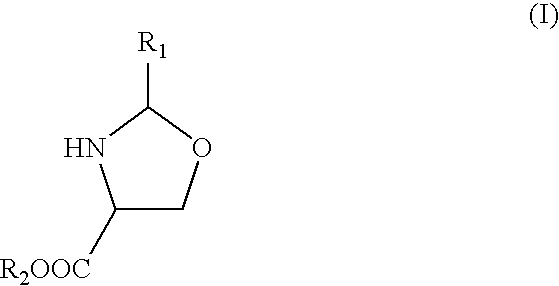


Priority Applications (2)
| Application Number | Priority Date | Filing Date | Title |
|---|---|---|---|
| US11/697,689 US7842814B2 (en) | 2006-04-06 | 2007-04-06 | Total synthesis of salinosporamide A and analogs thereof |
| US12/913,624 US8067616B2 (en) | 2006-04-06 | 2010-10-27 | Total synthesis of salinosporamide A and analogs thereof |
Applications Claiming Priority (6)
| Application Number | Priority Date | Filing Date | Title |
|---|---|---|---|
| US79016806P | 2006-04-06 | 2006-04-06 | |
| US81696806P | 2006-06-27 | 2006-06-27 | |
| US83615506P | 2006-08-07 | 2006-08-07 | |
| US84413206P | 2006-09-12 | 2006-09-12 | |
| US88537907P | 2007-01-17 | 2007-01-17 | |
| US11/697,689 US7842814B2 (en) | 2006-04-06 | 2007-04-06 | Total synthesis of salinosporamide A and analogs thereof |
Related Child Applications (1)
| Application Number | Title | Priority Date | Filing Date |
|---|---|---|---|
| US12/913,624 Division US8067616B2 (en) | 2006-04-06 | 2010-10-27 | Total synthesis of salinosporamide A and analogs thereof |
Publications (2)
| Publication Number | Publication Date |
|---|---|
| US20070249693A1 US20070249693A1 (en) | 2007-10-25 |
| US7842814B2 true US7842814B2 (en) | 2010-11-30 |
Family
ID=38529634
Family Applications (2)
| Application Number | Title | Priority Date | Filing Date |
|---|---|---|---|
| US11/697,689 Expired - Fee Related US7842814B2 (en) | 2006-04-06 | 2007-04-06 | Total synthesis of salinosporamide A and analogs thereof |
| US12/913,624 Active US8067616B2 (en) | 2006-04-06 | 2010-10-27 | Total synthesis of salinosporamide A and analogs thereof |
Family Applications After (1)
| Application Number | Title | Priority Date | Filing Date |
|---|---|---|---|
| US12/913,624 Active US8067616B2 (en) | 2006-04-06 | 2010-10-27 | Total synthesis of salinosporamide A and analogs thereof |
Country Status (14)
| Country | Link |
|---|---|
| US (2) | US7842814B2 (en) |
| EP (2) | EP2013167B1 (en) |
| JP (1) | JP2009532484A (en) |
| KR (1) | KR20080109071A (en) |
| CN (2) | CN101460457B (en) |
| AU (1) | AU2007235323C1 (en) |
| BR (1) | BRPI0709474A2 (en) |
| CA (1) | CA2648317A1 (en) |
| CO (1) | CO6220977A2 (en) |
| IL (1) | IL194507A0 (en) |
| MX (1) | MX2008012847A (en) |
| NZ (2) | NZ596653A (en) |
| WO (1) | WO2007117591A2 (en) |
| ZA (1) | ZA200809305B (en) |
Cited By (3)
| Publication number | Priority date | Publication date | Assignee | Title |
|---|---|---|---|---|
| US20110105762A1 (en) * | 2006-04-06 | 2011-05-05 | Nereus Pharmaceuticals, Inc. | Total synthesis of salinosporamide a and analogs thereof |
| US8003802B2 (en) | 2008-03-07 | 2011-08-23 | Nereus Pharmaceuticals, Inc. | Total synthesis of Salinosporamide A and analogs thereof |
| US9272014B2 (en) | 2011-03-29 | 2016-03-01 | Texas Tech University System | Galectin-3C combination therapy for human cancer |
Families Citing this family (8)
| Publication number | Priority date | Publication date | Assignee | Title |
|---|---|---|---|---|
| US7176232B2 (en) | 2002-06-24 | 2007-02-13 | The Regents Of The University Of California | Salinosporamides and methods for use thereof |
| US8217072B2 (en) * | 2003-06-20 | 2012-07-10 | The Regents Of The University Of California | Salinosporamides and methods for use thereof |
| JP2007523862A (en) | 2003-06-20 | 2007-08-23 | ネレアス ファーマシューティカルズ インコーポレイテッド | Use of [3.2.0] heterocyclic compounds and their analogs for the treatment of cancer, inflammation and infectious diseases |
| CN103230394B (en) | 2004-12-03 | 2016-04-20 | 达纳-法伯癌症研究公司 | Compound for the treatment of neoplastic disease and uses thereof |
| US8394816B2 (en) * | 2007-12-07 | 2013-03-12 | Irene Ghobrial | Methods of using [3.2.0] heterocyclic compounds and analogs thereof in treating Waldenstrom's Macroglobulinemia |
| US7910616B2 (en) | 2008-05-12 | 2011-03-22 | Nereus Pharmaceuticals, Inc. | Proteasome inhibitors |
| ES2984487T3 (en) | 2016-06-01 | 2024-10-29 | Celgene Tri A Holdings Ltd | Combined use of marizomib and bevacizumab for the treatment of central nervous system (CNS) cancers |
| US10703760B2 (en) | 2016-08-19 | 2020-07-07 | Celgene International Ii Sàrl | Morphic forms of marizomib and uses thereof |
Citations (17)
| Publication number | Priority date | Publication date | Assignee | Title |
|---|---|---|---|---|
| WO1996032105A1 (en) | 1995-04-12 | 1996-10-17 | President And Fellows Of Harvard College | Lactacystin analogs |
| WO1999009006A1 (en) | 1997-08-15 | 1999-02-25 | Soucy Francois | SYNTHESIS OF CLASTO-LACTACYSTIN β-LACTONE AND ANALOGS THEREOF |
| WO1999015183A1 (en) | 1997-09-25 | 1999-04-01 | Proscript Inc. | PROTEASOME INHIBITORS, UBIQUITIN PATHWAY INHIBITORS OR AGENTS THAT INTERFERE WITH THE ACTIVATION OF NF-λB VIA THE UBIQUITIN PROTEASOME PATHWAY TO TREAT INFLAMMATORY AND AUTOIMMUNE DISEASES |
| WO2004071382A2 (en) | 2003-02-14 | 2004-08-26 | Bayer Healthcare Ag | Substituted heterocycles |
| US20050049294A1 (en) | 2003-06-20 | 2005-03-03 | Michael Palladino | Methods of using [3.2.0] heterocyclic compounds and analogs thereof |
| WO2005099687A2 (en) | 2004-04-09 | 2005-10-27 | President And Fellows Of Harvard College | Analogs of salinosporamide a |
| WO2006005551A1 (en) | 2004-07-12 | 2006-01-19 | Bayer Cropscience Ag | Substituted 2-pyrrolidone derivatives as fungicides and insecticides |
| WO2006028525A2 (en) | 2004-04-30 | 2006-03-16 | Nereus Pharmaceuticals, Inc. | [3.2.0] heterocyclic compounds and methods of using the same |
| US20060264495A1 (en) | 2004-04-30 | 2006-11-23 | Michael Palladino | Methods of using [3.2.0] heterocyclic compounds and analogs thereof |
| US7144723B2 (en) | 2000-11-16 | 2006-12-05 | The Regents Of The University Of California | Marine actinomycete taxon for drug and fermentation product discovery |
| US20060287520A1 (en) * | 2005-05-16 | 2006-12-21 | Danishefsky Samuel J | Synthesis of salinosporamide A and analogues thereof |
| US20070004676A1 (en) | 2004-04-30 | 2007-01-04 | Michael Palladino | Methods of using [3.2.0] heterocyclic compounds and analogs thereof |
| US7176232B2 (en) | 2002-06-24 | 2007-02-13 | The Regents Of The University Of California | Salinosporamides and methods for use thereof |
| US7179834B2 (en) | 2002-06-24 | 2007-02-20 | The Regents Of The University Of California | Salinosporamides and methods for use thereof |
| US7183417B2 (en) | 2004-04-09 | 2007-02-27 | President And Fellows Of Harvard College | Simple stereocontrolled synthesis of salinosporamide A |
| US7371875B2 (en) | 2004-03-12 | 2008-05-13 | Miikana Therapeutics, Inc. | Cytotoxic agents and methods of use |
| US7465720B2 (en) * | 2005-09-12 | 2008-12-16 | President And Fellows Of Harvard College | Proteasome inhibiting β-lactam compounds |
Family Cites Families (17)
| Publication number | Priority date | Publication date | Assignee | Title |
|---|---|---|---|---|
| US5874443A (en) | 1995-10-19 | 1999-02-23 | Trega Biosciences, Inc. | Isoquinoline derivatives and isoquinoline combinatorial libraries |
| US5886210A (en) | 1996-08-22 | 1999-03-23 | Rohm And Haas Company | Method for preparing aromatic compounds |
| US5922683A (en) | 1997-05-29 | 1999-07-13 | Abbott Laboratories | Multicyclic erythromycin derivatives |
| EP2201945B1 (en) | 1997-11-21 | 2013-03-06 | Purdue Neuroscience Company | Use of substituted 2-aminoacetamides for treating or ameliorating anxiety |
| IL137974A0 (en) | 1998-03-26 | 2001-10-31 | Shionogi & Co | Indole derivatives having antiviral activity |
| US6509331B1 (en) | 1998-06-22 | 2003-01-21 | Elan Pharmaceuticals, Inc. | Deoxyamino acid compounds, pharmaceutical compositions comprising same, and methods for inhibiting β-amyloid peptide release and/or its synthesis by use of such compounds |
| FR2784988B1 (en) | 1998-10-23 | 2002-09-20 | Adir | NOVEL DIHYDRO AND TETRAHYDROQUINOLEINIC COMPOUNDS, PROCESS FOR THEIR PREPARATION AND THE PHARMACEUTICAL COMPOSITIONS CONTAINING THEM |
| JP2008522975A (en) | 2004-12-03 | 2008-07-03 | ネレアス ファーマシューティカルズ インコーポレイテッド | [3.2.0] Methods of using heterocyclic compounds and analogs thereof |
| CN103230394B (en) | 2004-12-03 | 2016-04-20 | 达纳-法伯癌症研究公司 | Compound for the treatment of neoplastic disease and uses thereof |
| WO2006118973A2 (en) | 2005-04-29 | 2006-11-09 | Nereus Pharmaceuticals, Inc. | Methods of using heterobyclic compounds for treatment of rectal cancer |
| US7691896B2 (en) * | 2005-08-10 | 2010-04-06 | President And Fellows Of Harvard College | Analogs of salinosporamide A |
| WO2007021897A1 (en) | 2005-08-10 | 2007-02-22 | President And Fellows Of Harvard College | Analogs of salinosporamide a |
| US7759327B2 (en) * | 2006-01-06 | 2010-07-20 | The Trustees Of Columbia University In The City Of New York | Compositions containing zinc salts for coating medical articles |
| NZ596653A (en) | 2006-04-06 | 2012-10-26 | Nereus Pharmaceuticals Inc | Total synthesis of salinosporamide a and analogs thereof |
| BRPI0909661A2 (en) * | 2008-03-07 | 2015-08-11 | Nereus Pharmaceuticals Inc | Compound and chemical synthesis and compound formation or preparation methods |
| US7910616B2 (en) | 2008-05-12 | 2011-03-22 | Nereus Pharmaceuticals, Inc. | Proteasome inhibitors |
| US11826005B2 (en) | 2022-03-29 | 2023-11-28 | Midea Group Co., Ltd. | Exhibiting a dishwasher rack to the user |
-
2007
- 2007-04-06 NZ NZ596653A patent/NZ596653A/en not_active IP Right Cessation
- 2007-04-06 EP EP07754986A patent/EP2013167B1/en not_active Not-in-force
- 2007-04-06 KR KR1020087027066A patent/KR20080109071A/en not_active Abandoned
- 2007-04-06 AU AU2007235323A patent/AU2007235323C1/en not_active Ceased
- 2007-04-06 BR BRPI0709474-4A patent/BRPI0709474A2/en not_active IP Right Cessation
- 2007-04-06 EP EP12171505.6A patent/EP2631237A2/en not_active Withdrawn
- 2007-04-06 US US11/697,689 patent/US7842814B2/en not_active Expired - Fee Related
- 2007-04-06 NZ NZ572026A patent/NZ572026A/en not_active IP Right Cessation
- 2007-04-06 JP JP2009504312A patent/JP2009532484A/en active Pending
- 2007-04-06 MX MX2008012847A patent/MX2008012847A/en active IP Right Grant
- 2007-04-06 CN CN2007800188644A patent/CN101460457B/en not_active Expired - Fee Related
- 2007-04-06 CA CA002648317A patent/CA2648317A1/en not_active Abandoned
- 2007-04-06 CN CN2012101945790A patent/CN102718776A/en active Pending
- 2007-04-06 WO PCT/US2007/008562 patent/WO2007117591A2/en not_active Ceased
-
2008
- 2008-10-02 IL IL194507A patent/IL194507A0/en unknown
- 2008-10-28 CO CO08115223A patent/CO6220977A2/en not_active Application Discontinuation
- 2008-10-30 ZA ZA2008/09305A patent/ZA200809305B/en unknown
-
2010
- 2010-10-27 US US12/913,624 patent/US8067616B2/en active Active
Patent Citations (19)
| Publication number | Priority date | Publication date | Assignee | Title |
|---|---|---|---|---|
| WO1996032105A1 (en) | 1995-04-12 | 1996-10-17 | President And Fellows Of Harvard College | Lactacystin analogs |
| WO1999009006A1 (en) | 1997-08-15 | 1999-02-25 | Soucy Francois | SYNTHESIS OF CLASTO-LACTACYSTIN β-LACTONE AND ANALOGS THEREOF |
| WO1999015183A1 (en) | 1997-09-25 | 1999-04-01 | Proscript Inc. | PROTEASOME INHIBITORS, UBIQUITIN PATHWAY INHIBITORS OR AGENTS THAT INTERFERE WITH THE ACTIVATION OF NF-λB VIA THE UBIQUITIN PROTEASOME PATHWAY TO TREAT INFLAMMATORY AND AUTOIMMUNE DISEASES |
| US7144723B2 (en) | 2000-11-16 | 2006-12-05 | The Regents Of The University Of California | Marine actinomycete taxon for drug and fermentation product discovery |
| US7179834B2 (en) | 2002-06-24 | 2007-02-20 | The Regents Of The University Of California | Salinosporamides and methods for use thereof |
| US7176233B2 (en) | 2002-06-24 | 2007-02-13 | The Regents Of The University Of California | Salinosporamides and methods for use thereof |
| US7176232B2 (en) | 2002-06-24 | 2007-02-13 | The Regents Of The University Of California | Salinosporamides and methods for use thereof |
| WO2004071382A2 (en) | 2003-02-14 | 2004-08-26 | Bayer Healthcare Ag | Substituted heterocycles |
| US20050049294A1 (en) | 2003-06-20 | 2005-03-03 | Michael Palladino | Methods of using [3.2.0] heterocyclic compounds and analogs thereof |
| US7371875B2 (en) | 2004-03-12 | 2008-05-13 | Miikana Therapeutics, Inc. | Cytotoxic agents and methods of use |
| WO2005099687A2 (en) | 2004-04-09 | 2005-10-27 | President And Fellows Of Harvard College | Analogs of salinosporamide a |
| US7183417B2 (en) | 2004-04-09 | 2007-02-27 | President And Fellows Of Harvard College | Simple stereocontrolled synthesis of salinosporamide A |
| US20060264495A1 (en) | 2004-04-30 | 2006-11-23 | Michael Palladino | Methods of using [3.2.0] heterocyclic compounds and analogs thereof |
| US20070004676A1 (en) | 2004-04-30 | 2007-01-04 | Michael Palladino | Methods of using [3.2.0] heterocyclic compounds and analogs thereof |
| WO2006028525A2 (en) | 2004-04-30 | 2006-03-16 | Nereus Pharmaceuticals, Inc. | [3.2.0] heterocyclic compounds and methods of using the same |
| US7276530B2 (en) | 2004-04-30 | 2007-10-02 | Nereus Pharmaceuticals, Inc. | [3.2.0] Heterocyclic compounds and methods of using the same |
| WO2006005551A1 (en) | 2004-07-12 | 2006-01-19 | Bayer Cropscience Ag | Substituted 2-pyrrolidone derivatives as fungicides and insecticides |
| US20060287520A1 (en) * | 2005-05-16 | 2006-12-21 | Danishefsky Samuel J | Synthesis of salinosporamide A and analogues thereof |
| US7465720B2 (en) * | 2005-09-12 | 2008-12-16 | President And Fellows Of Harvard College | Proteasome inhibiting β-lactam compounds |
Non-Patent Citations (15)
| Title |
|---|
| Andrews, et al., "Highly functionalised pyroglutamates by intramolecular aldol reactions: towards the pyroglutamate skeleton of oxazolomycin", Synlett: Letters (1996) 612-614. |
| Andrews, et al., "Regioselective dieckmann cyclisations leading to enantiopure highly functionalised tetramic acid derivatives", J. Chem. Soc., Perkin Trans. (1998) 1:223-235. |
| Corey, et al., "An efficient tool synthesis of a new and highly active analog of lactacystin", Tetrahedron Letters (1998) 39:7475-7478. |
| Endo and Danishefsky, J. Am. Chem. Soc. 2005, v. 127, 8298-8299. * |
| Endo, et al., "Total synthesis of salinosporamide A ", J. Am. Chem. Soc. (2005) 127:8298-8299 and S1-S23. |
| Hogan, et al., "Proteasome inhibition by a totally synthetic beta-lactam related to salinosporamide A and omuralide", J. Am. Chem. Soc. (2005) 127:15386-15387. |
| Hogan, et al., "Proteasome inhibition by a totally synthetic β-lactam related to salinosporamide A and omuralide", J. Am. Chem. Soc. (2005) 127:15386-15387. |
| International Search Report and Written Opinion dated Mar. 26, 2008, for PCT/US2007/008562. |
| Ma, et al., Concise total synthesis of (±)-salinosporamide A, (±)-cinnabaramide A, and derivatives via a bis-cyclization process: implications for a biosynthetic pathway?, Org. Lett., (2007) 9(11):2143-2146. |
| Mulholland, et al., "A concise total synthesis of salinosporamide A", Org. Biomol. Chem. (2006) 4:2845-2846. |
| Reddy, et al., "A simple sterecontrolled synthesis of salinosporamide A", J. Am. Chem. Soc. (2004) 126:6230-6231. |
| Reddy, et al., "An efficient, stereocontrolled synthesis of a potent omuralide-salinosporin hybrid for selective proteasome inhibition", J. Am. Chem. Soc. (2005) 127:8974-8976. |
| Reddy, et al., "New synthetic route for the enantioselective total synthesis of salinosporamide A and biologically active analogues", Org. Lett. (2005) 7(13): 2699-2701. |
| Seebach, et al., "alpha-Alkylation of serine with self-reproduction of the center of chirality", Tetrahedron Letters (1984) 25(24):2545-2548. |
| Seebach, et al., "α-Alkylation of serine with self-reproduction of the center of chirality", Tetrahedron Letters (1984) 25(24):2545-2548. |
Cited By (6)
| Publication number | Priority date | Publication date | Assignee | Title |
|---|---|---|---|---|
| US20110105762A1 (en) * | 2006-04-06 | 2011-05-05 | Nereus Pharmaceuticals, Inc. | Total synthesis of salinosporamide a and analogs thereof |
| US8067616B2 (en) | 2006-04-06 | 2011-11-29 | Nereus Pharmaceuticals, Inc. | Total synthesis of salinosporamide A and analogs thereof |
| US8003802B2 (en) | 2008-03-07 | 2011-08-23 | Nereus Pharmaceuticals, Inc. | Total synthesis of Salinosporamide A and analogs thereof |
| US8314251B2 (en) | 2008-03-07 | 2012-11-20 | Nereus Pharmaceuticals, Inc. | Total synthesis of salinosporamide A and analogs thereof |
| US9272014B2 (en) | 2011-03-29 | 2016-03-01 | Texas Tech University System | Galectin-3C combination therapy for human cancer |
| US9744212B2 (en) | 2011-03-29 | 2017-08-29 | Texas Tech University System | Galectin-3C combination therapy for human cancer |
Also Published As
| Publication number | Publication date |
|---|---|
| CA2648317A1 (en) | 2007-10-18 |
| MX2008012847A (en) | 2008-10-13 |
| WO2007117591A2 (en) | 2007-10-18 |
| US20110105762A1 (en) | 2011-05-05 |
| WO2007117591A3 (en) | 2008-05-08 |
| JP2009532484A (en) | 2009-09-10 |
| WO2007117591A9 (en) | 2008-10-02 |
| AU2007235323C1 (en) | 2012-05-10 |
| AU2007235323B2 (en) | 2011-09-08 |
| HK1128279A1 (en) | 2009-10-23 |
| CN102718776A (en) | 2012-10-10 |
| BRPI0709474A2 (en) | 2011-07-12 |
| AU2007235323A1 (en) | 2007-10-18 |
| EP2631237A2 (en) | 2013-08-28 |
| KR20080109071A (en) | 2008-12-16 |
| EP2013167A2 (en) | 2009-01-14 |
| CN101460457A (en) | 2009-06-17 |
| EP2013167B1 (en) | 2012-09-05 |
| US20070249693A1 (en) | 2007-10-25 |
| IL194507A0 (en) | 2009-08-03 |
| NZ596653A (en) | 2012-10-26 |
| CO6220977A2 (en) | 2010-11-19 |
| US8067616B2 (en) | 2011-11-29 |
| NZ572026A (en) | 2011-12-22 |
| ZA200809305B (en) | 2011-10-26 |
| CN101460457B (en) | 2012-07-18 |
Similar Documents
| Publication | Publication Date | Title |
|---|---|---|
| US8067616B2 (en) | Total synthesis of salinosporamide A and analogs thereof | |
| US8003802B2 (en) | Total synthesis of Salinosporamide A and analogs thereof | |
| US6919465B2 (en) | Method of preparing (3R, 3aS, 6aR)-3-hydroxyhexahydrofuro[2,3,-b] furan and related compounds | |
| US7183417B2 (en) | Simple stereocontrolled synthesis of salinosporamide A | |
| US20260092066A1 (en) | Novel synthetic options towards the manufacture of (6r,10s)-10-{4-[5-chloro-2-(4-chloro-1h-1,2,3-triazol-1-yl)phenyl]-6-oxo-1(6h)-pyrimidinyl}- 1-(difluoromethyl)-6-methyl-1,4,7,8,9,10-hexahydro-11,15-(metheno)pyrazolo[4,3-b][1,7]diazacyclotetradecin-5(6h)-one | |
| Groth et al. | Asymmetric synthesis of D-erythro-sphingosine | |
| Kawęcki | Addition of dienolates to sulfinimines. Stereoselective synthesis of dihydropyridones | |
| Langlois et al. | Creation of quaternary stereocentres: synthesis of new polyhydroxylated indolizidines | |
| ES2337013A1 (en) | Rearrangement of spirolactams | |
| HK1128279B (en) | Total synthesis of salinosporamide a and analogs thereof | |
| AU2011250836A1 (en) | Total synthesis of salinosporamide a and analogs thereof | |
| WO2004035582A1 (en) | Pyrrolo (3,4-c) carbazole and pyrido (2,3-b) pyrrolo (3,4-e) indole derivatives, preparation method and pharmaceutical compositions containing same | |
| Himmelbauer | Synthetic efforts towards a synthesis of the tetracyclic core of (-)-lemonomycin |
Legal Events
| Date | Code | Title | Description |
|---|---|---|---|
| AS | Assignment |
Owner name: NEREUS PHARMACEUTICALS, INC., CALIFORNIA Free format text: ASSIGNMENT OF ASSIGNORS INTEREST;ASSIGNORS:LING, TAOTAO;MACHERLA, VENKATA RAMI REDDY;POTTS, BARBARA CHRISTINE;AND OTHERS;REEL/FRAME:019564/0850 Effective date: 20070710 |
|
| AS | Assignment |
Owner name: HBM BIOVENTURES (CAYMAN) LTD., CAYMAN ISLANDS Free format text: SECURITY AGREEMENT;ASSIGNOR:NEREUS PHARMACEUTICALS, INC.;REEL/FRAME:022719/0115 Effective date: 20090515 Owner name: HBM BIOCAPITAL (EUR) L.P., CAYMAN ISLANDS Free format text: SECURITY AGREEMENT;ASSIGNOR:NEREUS PHARMACEUTICALS, INC.;REEL/FRAME:022719/0115 Effective date: 20090515 Owner name: HBM BIOCAPITAL (USD) L.P., CAYMAN ISLANDS Free format text: SECURITY AGREEMENT;ASSIGNOR:NEREUS PHARMACEUTICALS, INC.;REEL/FRAME:022719/0115 Effective date: 20090515 Owner name: PRIVATE LIFE BIOMED AG, GERMANY Free format text: SECURITY AGREEMENT;ASSIGNOR:NEREUS PHARMACEUTICALS, INC.;REEL/FRAME:022719/0115 Effective date: 20090515 Owner name: ALSTERTOR PRIVATE LIFE GMBH & CO. KG, GERMANY Free format text: SECURITY AGREEMENT;ASSIGNOR:NEREUS PHARMACEUTICALS, INC.;REEL/FRAME:022719/0115 Effective date: 20090515 Owner name: ADVENT HEALTHCARE AND LIFE SCIENCES III LIMITED PA Free format text: SECURITY AGREEMENT;ASSIGNOR:NEREUS PHARMACEUTICALS, INC.;REEL/FRAME:022719/0115 Effective date: 20090515 Owner name: ADVENT HEALTHCARE AND LIFE SCIENCES III-A LIMITED Free format text: SECURITY AGREEMENT;ASSIGNOR:NEREUS PHARMACEUTICALS, INC.;REEL/FRAME:022719/0115 Effective date: 20090515 Owner name: ADVENT PARTNERS HLS III LIMITED PARTNERSHIP, MASSA Free format text: SECURITY AGREEMENT;ASSIGNOR:NEREUS PHARMACEUTICALS, INC.;REEL/FRAME:022719/0115 Effective date: 20090515 Owner name: PACIFIC VENTURE GROUP II, L.P., CALIFORNIA Free format text: SECURITY AGREEMENT;ASSIGNOR:NEREUS PHARMACEUTICALS, INC.;REEL/FRAME:022719/0115 Effective date: 20090515 Owner name: PVG ASSOCIATES II, L.P., CALIFORNIA Free format text: SECURITY AGREEMENT;ASSIGNOR:NEREUS PHARMACEUTICALS, INC.;REEL/FRAME:022719/0115 Effective date: 20090515 Owner name: FORWARD VENTURES IV, L.P., CALIFORNIA Free format text: SECURITY AGREEMENT;ASSIGNOR:NEREUS PHARMACEUTICALS, INC.;REEL/FRAME:022719/0115 Effective date: 20090515 Owner name: FORWARD VENTURES IV B, L.P., CALIFORNIA Free format text: SECURITY AGREEMENT;ASSIGNOR:NEREUS PHARMACEUTICALS, INC.;REEL/FRAME:022719/0115 Effective date: 20090515 Owner name: GIMV N.V., BELGIUM Free format text: SECURITY AGREEMENT;ASSIGNOR:NEREUS PHARMACEUTICALS, INC.;REEL/FRAME:022719/0115 Effective date: 20090515 Owner name: GIMV ADVIESBEHEER LIFE SCIENCES N.V., BELGIUM Free format text: SECURITY AGREEMENT;ASSIGNOR:NEREUS PHARMACEUTICALS, INC.;REEL/FRAME:022719/0115 Effective date: 20090515 Owner name: LOTUS BIOSCIENCE INVESTMENT HOLDS LTD, HONG KONG Free format text: SECURITY AGREEMENT;ASSIGNOR:NEREUS PHARMACEUTICALS, INC.;REEL/FRAME:022719/0115 Effective date: 20090515 Owner name: NOVARTIS BIOVENTURE FUND / NOVARTIS INTERNATIONAL Free format text: SECURITY AGREEMENT;ASSIGNOR:NEREUS PHARMACEUTICALS, INC.;REEL/FRAME:022719/0115 Effective date: 20090515 Owner name: HENSLER, MARY, CALIFORNIA Free format text: SECURITY AGREEMENT;ASSIGNOR:NEREUS PHARMACEUTICALS, INC.;REEL/FRAME:022719/0115 Effective date: 20090515 Owner name: JACOBS, ROBERT, CALIFORNIA Free format text: SECURITY AGREEMENT;ASSIGNOR:NEREUS PHARMACEUTICALS, INC.;REEL/FRAME:022719/0115 Effective date: 20090515 Owner name: WS INVESTMENT COMPANY, CALIFORNIA Free format text: SECURITY AGREEMENT;ASSIGNOR:NEREUS PHARMACEUTICALS, INC.;REEL/FRAME:022719/0115 Effective date: 20090515 Owner name: GENAVENT PARTNERS LP, NEW JERSEY Free format text: SECURITY AGREEMENT;ASSIGNOR:NEREUS PHARMACEUTICALS, INC.;REEL/FRAME:022719/0115 Effective date: 20090515 Owner name: ASTELLAS VENTURE FUND I LP, CALIFORNIA Free format text: SECURITY AGREEMENT;ASSIGNOR:NEREUS PHARMACEUTICALS, INC.;REEL/FRAME:022719/0115 Effective date: 20090515 Owner name: ROCHE FINANCE LTD, SWITZERLAND Free format text: SECURITY AGREEMENT;ASSIGNOR:NEREUS PHARMACEUTICALS, INC.;REEL/FRAME:022719/0115 Effective date: 20090515 Owner name: ALTA CALIFORNIA PARTNERS II, L.P., CALIFORNIA Free format text: SECURITY AGREEMENT;ASSIGNOR:NEREUS PHARMACEUTICALS, INC.;REEL/FRAME:022719/0115 Effective date: 20090515 Owner name: ALTA EMBARCADERO PARTNERS II, LLC, CALIFORNIA Free format text: SECURITY AGREEMENT;ASSIGNOR:NEREUS PHARMACEUTICALS, INC.;REEL/FRAME:022719/0115 Effective date: 20090515 Owner name: ALTA CALIFORNIA PARTNERS II, L.P. - NEW POOL, CALI Free format text: SECURITY AGREEMENT;ASSIGNOR:NEREUS PHARMACEUTICALS, INC.;REEL/FRAME:022719/0115 Effective date: 20090515 Owner name: HBM BIOVENTURES (CAYMAN) LTD.,CAYMAN ISLANDS Free format text: SECURITY AGREEMENT;ASSIGNOR:NEREUS PHARMACEUTICALS, INC.;REEL/FRAME:022719/0115 Effective date: 20090515 Owner name: HBM BIOCAPITAL (EUR) L.P.,CAYMAN ISLANDS Free format text: SECURITY AGREEMENT;ASSIGNOR:NEREUS PHARMACEUTICALS, INC.;REEL/FRAME:022719/0115 Effective date: 20090515 Owner name: HBM BIOCAPITAL (USD) L.P.,CAYMAN ISLANDS Free format text: SECURITY AGREEMENT;ASSIGNOR:NEREUS PHARMACEUTICALS, INC.;REEL/FRAME:022719/0115 Effective date: 20090515 Owner name: PRIVATE LIFE BIOMED AG,GERMANY Free format text: SECURITY AGREEMENT;ASSIGNOR:NEREUS PHARMACEUTICALS, INC.;REEL/FRAME:022719/0115 Effective date: 20090515 Owner name: ALSTERTOR PRIVATE LIFE GMBH & CO. KG,GERMANY Free format text: SECURITY AGREEMENT;ASSIGNOR:NEREUS PHARMACEUTICALS, INC.;REEL/FRAME:022719/0115 Effective date: 20090515 Owner name: ADVENT PARTNERS HLS III LIMITED PARTNERSHIP,MASSAC Free format text: SECURITY AGREEMENT;ASSIGNOR:NEREUS PHARMACEUTICALS, INC.;REEL/FRAME:022719/0115 Effective date: 20090515 Owner name: PACIFIC VENTURE GROUP II, L.P.,CALIFORNIA Free format text: SECURITY AGREEMENT;ASSIGNOR:NEREUS PHARMACEUTICALS, INC.;REEL/FRAME:022719/0115 Effective date: 20090515 Owner name: PVG ASSOCIATES II, L.P.,CALIFORNIA Free format text: SECURITY AGREEMENT;ASSIGNOR:NEREUS PHARMACEUTICALS, INC.;REEL/FRAME:022719/0115 Effective date: 20090515 Owner name: FORWARD VENTURES IV, L.P.,CALIFORNIA Free format text: SECURITY AGREEMENT;ASSIGNOR:NEREUS PHARMACEUTICALS, INC.;REEL/FRAME:022719/0115 Effective date: 20090515 Owner name: FORWARD VENTURES IV B, L.P.,CALIFORNIA Free format text: SECURITY AGREEMENT;ASSIGNOR:NEREUS PHARMACEUTICALS, INC.;REEL/FRAME:022719/0115 Effective date: 20090515 Owner name: GIMV N.V.,BELGIUM Free format text: SECURITY AGREEMENT;ASSIGNOR:NEREUS PHARMACEUTICALS, INC.;REEL/FRAME:022719/0115 Effective date: 20090515 Owner name: GIMV ADVIESBEHEER LIFE SCIENCES N.V.,BELGIUM Free format text: SECURITY AGREEMENT;ASSIGNOR:NEREUS PHARMACEUTICALS, INC.;REEL/FRAME:022719/0115 Effective date: 20090515 Owner name: LOTUS BIOSCIENCE INVESTMENT HOLDS LTD,HONG KONG Free format text: SECURITY AGREEMENT;ASSIGNOR:NEREUS PHARMACEUTICALS, INC.;REEL/FRAME:022719/0115 Effective date: 20090515 Owner name: HENSLER, MARY,CALIFORNIA Free format text: SECURITY AGREEMENT;ASSIGNOR:NEREUS PHARMACEUTICALS, INC.;REEL/FRAME:022719/0115 Effective date: 20090515 Owner name: JACOBS, ROBERT,CALIFORNIA Free format text: SECURITY AGREEMENT;ASSIGNOR:NEREUS PHARMACEUTICALS, INC.;REEL/FRAME:022719/0115 Effective date: 20090515 Owner name: WS INVESTMENT COMPANY,CALIFORNIA Free format text: SECURITY AGREEMENT;ASSIGNOR:NEREUS PHARMACEUTICALS, INC.;REEL/FRAME:022719/0115 Effective date: 20090515 Owner name: GENAVENT PARTNERS LP,NEW JERSEY Free format text: SECURITY AGREEMENT;ASSIGNOR:NEREUS PHARMACEUTICALS, INC.;REEL/FRAME:022719/0115 Effective date: 20090515 Owner name: ASTELLAS VENTURE FUND I LP,CALIFORNIA Free format text: SECURITY AGREEMENT;ASSIGNOR:NEREUS PHARMACEUTICALS, INC.;REEL/FRAME:022719/0115 Effective date: 20090515 Owner name: ROCHE FINANCE LTD,SWITZERLAND Free format text: SECURITY AGREEMENT;ASSIGNOR:NEREUS PHARMACEUTICALS, INC.;REEL/FRAME:022719/0115 Effective date: 20090515 Owner name: ALTA CALIFORNIA PARTNERS II, L.P.,CALIFORNIA Free format text: SECURITY AGREEMENT;ASSIGNOR:NEREUS PHARMACEUTICALS, INC.;REEL/FRAME:022719/0115 Effective date: 20090515 Owner name: ALTA EMBARCADERO PARTNERS II, LLC,CALIFORNIA Free format text: SECURITY AGREEMENT;ASSIGNOR:NEREUS PHARMACEUTICALS, INC.;REEL/FRAME:022719/0115 Effective date: 20090515 Owner name: ALTA CALIFORNIA PARTNERS II, L.P. - NEW POOL,CALIF Free format text: SECURITY AGREEMENT;ASSIGNOR:NEREUS PHARMACEUTICALS, INC.;REEL/FRAME:022719/0115 Effective date: 20090515 |
|
| CC | Certificate of correction | ||
| AS | Assignment |
Owner name: TRIPHASE RESEARCH AND DEVELOPMENT I CORP., CANADA Free format text: ASSIGNMENT OF ASSIGNORS INTEREST;ASSIGNOR:NEREUS PHARMACEUTICALS, INC.;REEL/FRAME:029909/0114 Effective date: 20121023 |
|
| REMI | Maintenance fee reminder mailed | ||
| LAPS | Lapse for failure to pay maintenance fees | ||
| STCH | Information on status: patent discontinuation |
Free format text: PATENT EXPIRED DUE TO NONPAYMENT OF MAINTENANCE FEES UNDER 37 CFR 1.362 |
|
| STCH | Information on status: patent discontinuation |
Free format text: PATENT EXPIRED DUE TO NONPAYMENT OF MAINTENANCE FEES UNDER 37 CFR 1.362 |
|
| FP | Lapsed due to failure to pay maintenance fee |
Effective date: 20141130 |
|
| AS | Assignment |
Owner name: TRIPHASE RESEARCH AND DEVELOPMENT I CORP., CANADA Free format text: ASSIGNMENT OF ASSIGNORS INTEREST;ASSIGNOR:NEREUS PHARMACEUTICALS, INC.;REEL/FRAME:041698/0404 Effective date: 20121023 |