US7831650B2 - Method for modular multiplication - Google Patents
Method for modular multiplication Download PDFInfo
- Publication number
- US7831650B2 US7831650B2 US11/440,725 US44072506A US7831650B2 US 7831650 B2 US7831650 B2 US 7831650B2 US 44072506 A US44072506 A US 44072506A US 7831650 B2 US7831650 B2 US 7831650B2
- Authority
- US
- United States
- Prior art keywords
- modulus
- transformed
- multiplication
- reduction
- look
- Prior art date
- Legal status (The legal status is an assumption and is not a legal conclusion. Google has not performed a legal analysis and makes no representation as to the accuracy of the status listed.)
- Expired - Fee Related, expires
Links
Images


Classifications
-
- G—PHYSICS
- G06—COMPUTING OR CALCULATING; COUNTING
- G06F—ELECTRIC DIGITAL DATA PROCESSING
- G06F7/00—Methods or arrangements for processing data by operating upon the order or content of the data handled
- G06F7/60—Methods or arrangements for performing computations using a digital non-denominational number representation, i.e. number representation without radix; Computing devices using combinations of denominational and non-denominational quantity representations, e.g. using difunction pulse trains, STEELE computers, phase computers
- G06F7/72—Methods or arrangements for performing computations using a digital non-denominational number representation, i.e. number representation without radix; Computing devices using combinations of denominational and non-denominational quantity representations, e.g. using difunction pulse trains, STEELE computers, phase computers using residue arithmetic
- G06F7/722—Modular multiplication
Definitions
- the present invention relates to cryptographic algorithms and apparatus for implementing such cryptographic algorithms, and in particular to a method for modular multiplication using a multiplication look-ahead process and a reduction look-ahead process.
- Cryptography is one of the essential applications of modular arithmetic.
- An essential algorithm for cryptography is the known RSA algorithm.
- Modulus N usually is generated by multiplication of two prime numbers p and q.
- the modular exponentiation is broken down into multiplications by means of the known square-and-multiply algorithm. To this end, the exponent d is broken down into powers of two so that the modular exponentiation may be broken down into several modular multiplications. For being able to efficiently implement the modular exponentiation in terms of computation, the modular exponentiation thus is broken down into modular multiplications, which may then be broken down into modular additions.
- the document DE 3631992 C2 discloses a cryptographic process in which the modular multiplication can be accelerated using a multiplication look-ahead process and a reduction look-ahead process.
- the process described in DE 3631992 C2 is also referred to as ZDN method and will be explained in more detail by way of FIG. 9 .
- the global variables M, C and N are initialized.
- M is the multiplier
- C is the multiplicand.
- Z is the result of the modular multiplication
- N is the modulus.
- a multiplication shift value s z as well as a multiplication look-ahead parameter a are calculated ( 910 ) employing various look-ahead rules.
- the current contents of the Z register are subjected to a left-shift operation by s z digits ( 920 ).
- a reduction look-ahead process GEN_Mod_LA 930 for calculating a reduction shift value S N and a reduction parameter b.
- the current content of the modulus register, i.e. N is shifted by S N digits to the left or to the right, respectively, in order to produce a shifted modulus value N′.
- the central three-operand operation of the ZDN method takes place in a step 950 .
- the intermediate result Z′ after step 920 is added to the multiplicand C that has been multiplied by the multiplication look-ahead parameter a, and to the shifted modulus N′ that as been multiplied by the reduction look-ahead parameter b.
- the look-ahead parameters a and b may have a value of +1, 0 or ⁇ 1.
- a typical case is that the multiplication look-ahead parameter a is +1 and that the reduction look-ahead parameter b is ⁇ 1, so that the multiplicand C is added to a shifted intermediate result Z′, and the shifted modulus N′ is subtracted therefrom.
- a will have a value of 0 if the multiplication look-ahead process would allow more than a preset number of individual left-shifts, i.e. if s z is greater than the maximum admissible value of s z , which is also referred to as k.
- a is 0 and that Z′, due to the preceding modular reduction, i.e. the preceding subtraction of the shifted modulus, still is quite small, in particular smaller than the shifted modulus N′, no reduction has to take place to that the parameter b is 0.
- Steps 910 to 950 are carried out until all digits of the multiplicand have been worked off or processed, i.e. until m is 0 and also until a parameter n is 0; this parameter indicates whether the shifted modulus N′ still is greater than the original modulus N or whether, despite the fact that all digits of the multiplicand have already been worked off, still further reduction steps have to be carried out by subtraction of the modulus from Z.
- the ZDN method as illustrated in FIG. 9 returns the modular multiplication to a three-operand addition (block 950 in FIG. 9 ), in which the multiplication look-ahead process and, concomitantly therewith, the reduction look-ahead process, are employed for increasing computing time efficiency.
- a three-operand addition block 950 in FIG. 9
- the multiplication look-ahead process and, concomitantly therewith, the reduction look-ahead process are employed for increasing computing time efficiency.
- a reservation is carried out for the local variables, i.e. the reduction look-ahead parameter b and the reduction shift value S N .
- the reduction shift value SN is initialized to zero.
- the value ZDN is calculated in a block 1020 , which is equal to 2 ⁇ 3 of modulus N. This value determined in block 1020 is stored in a register of its own, namely the ZDN register, in the crypto coprocessor.
- n is 0 or whether the shift value S N is ⁇ k.
- k is a value that defines the maximum shift value preset by the hardware.
- block 1030 is answered NO such that in a block 1040 , parameter n is decremented and that in a block 1060 , the reduction shift value is decremented by 1 as well.
- the variable ZDN then is allocated anew, namely with half of its value, which may easily by achieved by a right-shift of the value contained in the ZDN register. It is then determined in a block 1100 whether the absolute value of the current intermediate result is greater than the value contained in the ZDN register.
- This comparison operation in block 1100 is the central operation of the reduction look-ahead process. If the question is answered YES, the iteration is terminated, and the reduction look-ahead parameter b will be allocated as shown in block 1120 . If, in contrast thereto, the question to be answered in block 1100 is answered NO, the iteration jumps back in order to examine the current values of n and S N in block 1030 . If block 1030 is answered YES at any time in the iteration, the sequence jumps back to a block 1140 in which the reduction parameter b is set to zero. In the three-operand operation illustrated in block 950 , this has the effect that no modulus is added or subtracted, which means that the intermediate result Z was so small that no modular reduction was necessary.
- variable n then is allocated anew, and in a block 1180 finally the reduction shift value S N is computed which is required in a block 940 of FIG. 9 in order to perform the left-shift of the modulus so as to obtain a shifted modulus.
- FIGS. 9 and 10 can be implemented in terms of hardware as illustrated in FIG. 7 .
- an arithmetic unit 700 designated AU in FIG. 7 .
- the latter is coupled with a register C 710 for the multiplicand, a register N 720 for the modulus and a register Z 730 for the current intermediate result of the modular multiplication.
- FIG. 7 reveals furthermore that the result of the three-operand operation, via a feedback arrow 740 , is fed back to Z register 730 .
- FIG. 7 illustrates furthermore the mutual connection of the registers.
- the value ZDN computed in block 1020 of FIG. 10 has to be stored in a ZDN register 750 of its own.
- the ZDN comparison i.e. the iteration loop shown in FIG. 10 , furthermore is controlled in its progress by a control logic 760 for the ZDN comparison of its own.
- the multiplication look-ahead parameter a and the reduction look-ahead parameter b may assume values of ⁇ 1, 0 and +1, as is known.
- the intermediate result Z, the multiplicand C and the modulus N are long numbers, i.e. numbers whose count of digits or bits may indeed be greater than 512, and which may also have up to more than 2048 digits.
- the comparison of the current intermediate result Z with the value ZDN, which is to be carried out in block 1100 is not carried out for all bits of Z for reasons of computation time, but only with a number of most significant bits of Z; in this respect, a number of 32 bits has turned out to be sufficient for obtaining very high accuracy for the comparison result.
- this object is achieved by a method of modular multiplication of a multiplicand (C) by a multiplier (M), in which a modulus (N) is employed, making use of a multiplication look-ahead process and a reduction look-ahead process, said method comprising the steps of:
- this object is achieved by a processor for modular multiplication of a multiplicand by a multiplier, in which a modulus is employed, making use of a multiplication look-ahead process and a reduction look-ahead process, comprising:
- the present invention is based on the finding that the comparison of the updated intermediate result with the value ZDN, i.e. 2 ⁇ 3 times modulus N, which comparison involves high expenditure in computation time, can be facilitated when the modulus N is first transformed into a transformed modulus N T and the entire modular multiplication is carried out with the transformed modulus N T instead of the modulus proper.
- the modulus is transformed such that the predetermined fraction of the transformed modulus, i.e. in a preferred embodiment, 2 ⁇ 3 times the transformed modulus, becomes a specific number that is selected such that the comparison of 2 ⁇ 3 N T with the intermediate result Z becomes trivial.
- the transformation is carried out such that the predetermined fraction of the transformed modulus has a higher-order digit with a first predetermined value, which is followed by at least one low-order digit having a second predetermined value.
- the transformation of the modulus into a transformed modulus is carried out such that the second-most-significant bit of 2 ⁇ 3 N T is a binary one, whereas the third-most-significant bit and still further less significant bits are zeroes.
- the comparison is trivial such that it is simply necessary to count the number of the digits between the most significant one of the predetermined fraction of the transformed modulus and the updated intermediate result Z of the modular representation in order to obtain the shift value s i from which the reduction shift value S N can then be determined simply by subtracting the so-called auxiliary shift value s i obtained by the ZDN comparison from the multiplication shift value of the multiplication look-ahead process taking place parallel thereto.
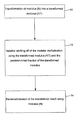
- FIG. 1 shows a flow chart of the concept for modular multiplication according to the invention
- FIG. 2 shows the splitting of a modulus N into a first section N T of bits and into a second section N R of bits;
- FIG. 3 shows the splitting of the transformed modulus N T into a first section of digits having a length L (N T ) and the remaining digits;
- FIG. 4 shows a representation of the digits of 2 ⁇ 3 times the transformed modulus N T ;
- FIG. 5 shows a schematic representation of the digits of the transformed modulus with randomization
- FIG. 6 shows a schematic representation of an arithmetic-logic unit for performing the modular multiplication according to the present invention
- FIG. 7 shows a schematic representation of an arithmetic-logic unit for the known ZDN method
- FIGS. 8 a to 8 c show a schematic representation of the relationship between multiplication shift value s z , auxiliary shift value s i and reduction shift value S N ;
- FIG. 9 shows a flow chart representation of the known ZDN method
- FIG. 10 shows a flow chart representation of the known reduction look-ahead process.
- FIG. 1 shows a flow chart of the method according to the invention for modular multiplication of a multiplicand C by a multiplier M using a modulus N.
- a step 12 the modular multiplication is then worked off using the transformed modulus N T and the predetermined fraction of the transformed modulus which is 2 ⁇ 3 in the preferred embodiment.
- N T the transformed modulus
- the predetermined fraction of the transformed modulus which is 2 ⁇ 3 in the preferred embodiment.
- the result of the modular exponentiation C is not computed in the remainder class defined by modulus N, but in the remainder class defined by the transformed modulus N T , so that C T , and not C, stands on the left side of the above equation.
- the concept according to the invention distinguishes itself in that, due to utilization of the transformed modulus N T , the computation of the auxiliary reduction shift value s i , which corresponds to the iteration loop of FIG. 10 of the known reduction look-ahead process, is highly simplified.
- the transformed result C T that is in the remainder class of the transformed modulus N T is returned to the remainder class of modulus N preferably by a simple shift/subtraction reduction, so that C is the result of the modular exponentiation.
- the transformation of modulus N into a transformed modulus N T utilizing the transformer T of step 10 is carried out such that the predetermined fraction of the transformed modulus, i.e. in the preferred embodiment, 2 ⁇ 3 times the transformed modulus, has a higher-order digit with a first predetermined value, which is followed by at least one low-order digit with a second predetermined value.
- the comparison of the intermediate result Z with 2 ⁇ 3 times the transformed modulus may thus be highly simplified, namely in that the uppermost digit of Z, which has the predetermined value as well, is looked for and the difference between the higher-order digit with the first predetermined value of the predetermined fraction of the transformed modulus and the uppermost digit of the intermediate result Z with the first predetermined value equals the difference s i .
- N T 1100 . . . 0 XX . . . XX
- N T and 2 ⁇ 3 N T both have a first share of e.g. 16 bits and then a share of L(N) bits X and X′, respectively.
- N T For the so-called ZDN comparison, only the uppermost 16 bits of 2 ⁇ 3 times the transformed modulus N T are utilized, since this already yields an error probability of better than approx. 2 ⁇ 10 .
- this approach indeed is easily feasible.
- the transformed modulus N T thus has a higher-order digit with the value 1, which is followed by at least one low-order digit with a value 0 and thus a second predetermined value.
- the number of the low-order digits is 15. It is of course possible here too to make use of higher or lesser numbers, depending on what dimensional differences are to be expected or handled between the intermediate result Z and 2 ⁇ 3 times the transformed modulus N T .
- the value of the intermediate result Z of the modular multiplication i.e. the result of the three-operand addition in block 950 in FIG. 9 , the following form results:
- 00 . . . 01 YY . . . Y
- the auxiliary shift value s i is computed according to the following equation: 2 ⁇ 3 N T ⁇ 2 ⁇ si ⁇
- the value s i always is the distance between the most significant bit with a 1 of 2 ⁇ 3 times the transformed modulus N T and the most significant 1 of the value of the intermediate result.
- this difference in digits or the value s i can be determined in trivial manner. An iteration is no longer required.
- a ZDN register is no longer necessary for storing 2 ⁇ 3 times the modulus since, per definition, at least the upper e.g. 16 bits of 2 ⁇ 3 times the transformed modulus N T always have the same form.
- a bit comparator is not necessary any more.
- the difference in significance between the highest-order digit of 2 ⁇ 3 times the transformed modulus N T with a “1” and the highest-order digit of Z with a “1” can easily be established, for example, by a bitwise XOR operation of the register for the transformed modulus and the register for the intermediate result Z. s i then is equal to the difference in significance of the digit where the XOR operation outputs a first “1” and where the XOR operation outputs a second “1”.
- the crypto control part i.e. the control logic for the ZDN comparison ( 760 in FIG. 7 ) is of lesser complexity since the complex iteration loop of FIG. 10 need not be carried out.
- the computation is faster so that the computation of the auxiliary shift value s i does no longer lead to timing problems for the entire algorithm.
- s i is referred to as auxiliary shift value and is the shift value that is necessary for shifting Z, in terms of digits, to the same position as N.
- the computation of s i required comparison operations of
- the comparison with 2 ⁇ 3 is simplified by transforming the modulus N into the transformed modulus N T , with the transformed modulus N T being greater than N, before any modular operation is carried out with N. All computations modulo N T are carried out thereafter. However, since the result of the computation has to be in the remainder class N, a final reduction with N is carried out according to the invention.
- the transformation is carried out such that the transformed modulus N T is 16 bits longer than the original modulus of FIG. 2 .
- the probability of the comparison yielding a wrong result is less than 2 ⁇ 12 . If the comparison yields a wrong result, there is just produced a sub-optimum reduction shift value S N , however, the result modulo N remains correct.
- N T now is transformed into N T using the transformer T, with T being an appropriately selected integer, which is necessary for reasons of congruence.
- N T should have the form illustrated in FIG. 3 , i.e. the most significant bit (MSB) of N T must be 0, since N T should be a positive integer.
- MSB most significant bit
- the second-most significant bit and the third-most-significant bit of the transformed modulus must be 1, whereas all other bits of the uppermost section of the transformed modulus N T , which section bears reference numeral 33 in FIG. 3 , should have a value of “0”.
- the result for 2 ⁇ 3 times N T that the uppermost section of 2 ⁇ 3 times N T as shown in FIG. 4 , has only one bit with a “1”, whereas all other bits in this uppermost section 44 are “0” so that the already described trivial comparison for determining s i can be carried out.
- N T ⁇ 2 p - 2 + 2 p - 3 N T ⁇ ⁇ ( 2 n - m ⁇ N T + N R )
- N T ( 2 n + p - m - 2 + 2 n + p - m - 3 ) ⁇ ⁇ N T N T + ( 2 p - 2 + 2 p - 3 ) ⁇ N R N T .
- N T 2 n + 14 + 2 n + 13 + N R ⁇ 2 p - 2 + 2 p - 3 N T .
- N T is preferably carried out in the host CPU and not in the crypto coprocessor.
- the host CPU comprises a short-number arithmetic-logic unit, which however is sufficient for computing N T . Due to the fact that T has to be an integer and the computations are carried out within the crypto coprocessor modulo N T instead of modulo N, with N T being greater than N, only the first p-m equal 16 bits of N T are relevant for the trivial ZDN comparison in order to compute the auxiliary shift value s i .
- the other n bits of N T may be any number, they are not relevant for the computation of the auxiliary shift value s i , i.e. for the comparison with Z.
- all bits of the transformed modulus N T are necessary for the three-operand addition which now, instead of using the shifted modulus, is carried out using the shifted transformed modulus.
- the transformer T is a 16 bit integer for the values chosen for m and p.
- the division necessary for computing T and for computing N T , respectively, thus has to be carried out for the most significant 32 bits only and thus can be programmed rapidly and easily on the host CPU.
- FIG. 4 shows 2 ⁇ 3 times the transformed modulus N T .
- the difference of the bit position of the first one in register N and in register Z determines the auxiliary shift value s i .
- a final reduction modulo N is carried out according to the invention, which means that a re-transformation has to be carried out (step 14 in FIG. 1).x
- N T may be combined with randomization of modulus N as illustrated by way of FIG. 5 .
- R is a random number having a length of s bits
- the randomized transformed modulus N T has the form shown in FIG. 5 . Due to the randomization number N, the randomized transformed modulus, as compared to the case in which no randomization has been carried out ( FIG. 3 ), becomes longer by s bits, i.e. by the number of digits of R.
- the randomized transformer T then is as follows:
- N T ⁇ 2 p - 2 + 2 p - 3 + R N T ⁇ ⁇ ( 2 n - m ⁇ N T + N R )
- N T ( 2 n + p - m - 2 + 2 n + p - m - 3 + R ⁇ ⁇ 2 n - m ) ⁇ ⁇ N T N T + ( 2 p - 2 + 2 p - 3 + R ) ⁇ N R N T .
- N T 2 n + 126 + 2 n + 125 + R ⁇ ⁇ 2 n - 16 + N R ⁇ 2 144 + 2 143 + R N T .
- FIG. 6 illustrates an arithmetic-logic unit according to the invention which, as compared to FIG. 7 , no longer has a ZDN register, but merely an arithmetic unit 700 , a C register 710 , an N register 720 and a Z register 730 , with the N register 720 no longer storing the modulus or a shifted modulus, but the transformed modulus or a shifted transformed modulus, or a randomized transformed modulus or a shifted randomized transformed modulus.
- FIGS. 8 a to 8 c shall be dealt with in order to illustrate the relationship between the auxiliary shift value s i and the reduction shift value S N .
- FIGS. 8 a to 8 c shall be dealt with in order to illustrate the computation of the reduction shift value s z using the auxiliary reduction shift value s i .
- FIG. 8 a shows an intermediate result Z and a modulus N.
- the intermediate result has 4 bits, while the modulus has 9 bits.
- the block 214 of FIG. 2 computes a shifted intermediate result Z′, which can be achieved by multiplication by s z .
- the result hereof is that the multiplication shift value s z is 8.
- the modulus N must be brought to the order of magnitude of the shifted intermediate result Z′.
- the modulus N is to be shifted to such an extent that the uppermost bit of the shifted intermediate result polynom Z′ and the uppermost bit of the shifted modulus N are equal.
- a reduction shift value S N of 3 is required in this respect.
- the time-consuming iterative process for determining S N thus can be broken down into a time-consuming iterative process for determining s i (loop 416 ) and a fast difference operation (block 422 of FIG. 4 ).
- a time-consuming iterative process for determining s i loop 416
- a fast difference operation block 422 of FIG. 4
- nearly parallel implementation of the two look-ahead processes is possible, with the sole serial component consisting in that, prior to computing block 422 ( FIG. 4 ), the actual value of s Z has already been computed and delivered by the multiplication look-ahead algorithm (arrow 230 in FIG. 2 ).
- the present invention simplifies the comparison between 2 ⁇ 3 N and the value of Z as compared to the known ZDN method.
- the ZDN register In contrast to the method known so far, in which the uppermost 32 bits of 2 ⁇ 3 N were computed in the crypto coprocessor and deposited in a separate 32 bit register, the ZDN register, with the comparison of 2 ⁇ 3 N with the value of Z having been carried out according to the known ZDN method in hardware via a comparator that was constituent part of the control part of the crypto coprocessor, the method now proceeds as follows.
- the modulus N is transformed by the host CPU into a transformed modulus N T that is greater than N, with the first bits of N T being a constant that is selected such that the comparison of 2 ⁇ 3 N T with the value of Z is trivial.
- the transformation of N into N T may be combined with the randomization of the modulus, as has been illustrated.
- the 2 ⁇ 3 N computation in the crypto coprocessor is thus dispensed with.
- the ZDN register and the comparator logic are omitted as well, thus providing for smaller chip area and reduction of the complexity of the control part in the crypto coprocessor by omission of the comparator logic.
Landscapes
- Physics & Mathematics (AREA)
- General Physics & Mathematics (AREA)
- Engineering & Computer Science (AREA)
- Computational Mathematics (AREA)
- Mathematical Analysis (AREA)
- Mathematical Optimization (AREA)
- Pure & Applied Mathematics (AREA)
- Theoretical Computer Science (AREA)
- Mathematical Physics (AREA)
- General Engineering & Computer Science (AREA)
- Computing Systems (AREA)
- Complex Calculations (AREA)
- Executing Machine-Instructions (AREA)
- Diaphragms For Electromechanical Transducers (AREA)
- Paper (AREA)
- Spinning Or Twisting Of Yarns (AREA)
Abstract
Description
C=M dmod(N),
wherein C is an encrypted message, M is a non-encrypted message, d is the secret key and N is the modulus. Modulus N usually is generated by multiplication of two prime numbers p and q. The modular exponentiation is broken down into multiplications by means of the known square-and-multiply algorithm. To this end, the exponent d is broken down into powers of two so that the modular exponentiation may be broken down into several modular multiplications. For being able to efficiently implement the modular exponentiation in terms of computation, the modular exponentiation thus is broken down into modular multiplications, which may then be broken down into modular additions.
Z=M*CmodN.
M is the multiplier, whereas C is the multiplicand. Z is the result of the modular multiplication, whereas N is the modulus.
⅔N×2−si <|Z|≦ 4/3N×2−si and
Z:=2sZ Z+aC+b×2sz−si N,
⅔2−si N<|Z|≦ 4/32−si N
N T =T×N.
CT:=Mdmod NT.
C:=CTmod N.
N T :=T×N,
wherein T is a natural number.
NT=1100 . . . 0 XX . . . XX
⅔N T=100 . . . 0 X′X′ . . . X′X′
|Z|=00 . . . 01YY . . . Y
⅔N T×2−si <|Z|≦ 4/3N T×2−si.
⅔2−si N<|Z|≦ 4/32−si N.
N=2n−m N T +N R.
(11)2=(3)10 and (⅔×3)2=(2)10=(10)2,
a simple bit pattern results for ⅔ times the transformed modulus NT, with the length of ⅔ times the transformed modulus NT being n−m+p.
L(N T)=n+p−m=n+m+s=n+16+112=n+128 bits
S N =S Z −S i.
Claims (9)
Priority Applications (1)
| Application Number | Priority Date | Filing Date | Title |
|---|---|---|---|
| US11/440,725 US7831650B2 (en) | 2001-03-13 | 2006-05-25 | Method for modular multiplication |
Applications Claiming Priority (6)
| Application Number | Priority Date | Filing Date | Title |
|---|---|---|---|
| DE10111987 | 2001-03-13 | ||
| DE10111987.9 | 2001-03-13 | ||
| DE10111987A DE10111987A1 (en) | 2001-03-13 | 2001-03-13 | Method and device for modular multiplication |
| PCT/EP2002/000734 WO2002073394A2 (en) | 2001-03-13 | 2002-01-24 | Method and device for modular multiplication |
| US10/662,627 US7120660B2 (en) | 2001-03-13 | 2003-09-15 | Method of and apparatus for modular multiplication |
| US11/440,725 US7831650B2 (en) | 2001-03-13 | 2006-05-25 | Method for modular multiplication |
Related Parent Applications (1)
| Application Number | Title | Priority Date | Filing Date |
|---|---|---|---|
| US10/662,627 Division US7120660B2 (en) | 2001-03-13 | 2003-09-15 | Method of and apparatus for modular multiplication |
Publications (2)
| Publication Number | Publication Date |
|---|---|
| US20070185948A1 US20070185948A1 (en) | 2007-08-09 |
| US7831650B2 true US7831650B2 (en) | 2010-11-09 |
Family
ID=7677246
Family Applications (2)
| Application Number | Title | Priority Date | Filing Date |
|---|---|---|---|
| US10/662,627 Expired - Lifetime US7120660B2 (en) | 2001-03-13 | 2003-09-15 | Method of and apparatus for modular multiplication |
| US11/440,725 Expired - Fee Related US7831650B2 (en) | 2001-03-13 | 2006-05-25 | Method for modular multiplication |
Family Applications Before (1)
| Application Number | Title | Priority Date | Filing Date |
|---|---|---|---|
| US10/662,627 Expired - Lifetime US7120660B2 (en) | 2001-03-13 | 2003-09-15 | Method of and apparatus for modular multiplication |
Country Status (8)
| Country | Link |
|---|---|
| US (2) | US7120660B2 (en) |
| EP (1) | EP1370933B1 (en) |
| JP (1) | JP4660066B2 (en) |
| CN (1) | CN100437470C (en) |
| AT (1) | ATE299605T1 (en) |
| CA (1) | CA2418269A1 (en) |
| DE (2) | DE10111987A1 (en) |
| WO (1) | WO2002073394A2 (en) |
Cited By (1)
| Publication number | Priority date | Publication date | Assignee | Title |
|---|---|---|---|---|
| US20110016168A1 (en) * | 2006-12-07 | 2011-01-20 | Electronics And Telecommunications Research Institute | Method and apparatus for modulo n calculation |
Families Citing this family (14)
| Publication number | Priority date | Publication date | Assignee | Title |
|---|---|---|---|---|
| US7337437B2 (en) * | 1999-12-01 | 2008-02-26 | International Business Machines Corporation | Compiler optimisation of source code by determination and utilization of the equivalence of algebraic expressions in the source code |
| US8176108B2 (en) * | 2000-06-20 | 2012-05-08 | International Business Machines Corporation | Method, apparatus and computer program product for network design and analysis |
| US7426529B2 (en) * | 2002-06-06 | 2008-09-16 | Infineon Technologies Ag | Processor and method for a simultaneous execution of a calculation and a copying process |
| DE10260660B3 (en) * | 2002-12-23 | 2004-06-09 | Infineon Technologies Ag | Modular multiplication device for cryptographic applications with parallel calculation of look-ahead parameters for next iteration step during 3 operand addition |
| DE10260655B3 (en) * | 2002-12-23 | 2004-06-24 | Infineon Technologies Ag | Multiplication calculation device for cryptographic applications using iteration proces with several iteration steps |
| US7171544B2 (en) * | 2003-12-15 | 2007-01-30 | International Business Machines Corporation | Run-time parallelization of loops in computer programs by access patterns |
| US7353364B1 (en) * | 2004-06-30 | 2008-04-01 | Sun Microsystems, Inc. | Apparatus and method for sharing a functional unit execution resource among a plurality of functional units |
| US7801937B1 (en) * | 2004-09-01 | 2010-09-21 | Altera Corporation | Method and apparatus for implementing a look-ahead for low radix Montgomery multiplication |
| RU2310223C2 (en) * | 2005-10-03 | 2007-11-10 | Пензенский государственный университет (ПГУ) | Homogeneous computing structure for performing operations with given modulus |
| US20080114820A1 (en) * | 2006-11-15 | 2008-05-15 | Alaaeldin Amin | Apparatus and method for high-speed modulo multiplication and division |
| WO2009084026A2 (en) * | 2007-11-30 | 2009-07-09 | Chandra Mohan Umapathy | System and method for high speed modulo operations |
| US8626811B2 (en) * | 2010-04-30 | 2014-01-07 | Certicom Corp. | Method and apparatus for providing flexible bit-length moduli on a block Montgomery machine |
| US10318308B2 (en) * | 2012-10-31 | 2019-06-11 | Mobileye Vision Technologies Ltd. | Arithmetic logic unit |
| JP7485068B2 (en) * | 2020-10-16 | 2024-05-16 | 日本電信電話株式会社 | Confidential modulus conversion system, distributed processing device, confidential modulus conversion method, and program |
Citations (4)
| Publication number | Priority date | Publication date | Assignee | Title |
|---|---|---|---|---|
| DE3631992C2 (en) | 1986-03-05 | 1988-12-08 | Holger 3300 Braunschweig De Sedlak | |
| US4870681A (en) | 1986-03-05 | 1989-09-26 | Holger Sedlak | Cryptographic method and cryptographic processor for carrying out the method |
| WO1999014880A2 (en) | 1997-09-16 | 1999-03-25 | Koninklijke Philips Electronics N.V. | A method and device for executing a decrypting mechanism through calculating a standardized modular exponentiation for thwarting timing attacks |
| US6917956B2 (en) | 2001-08-14 | 2005-07-12 | Sun Microsystems, Inc. | Apparatus and method for efficient modular exponentiation |
Family Cites Families (1)
| Publication number | Priority date | Publication date | Assignee | Title |
|---|---|---|---|---|
| JP3525209B2 (en) * | 1996-04-05 | 2004-05-10 | 株式会社 沖マイクロデザイン | Power-residue operation circuit, power-residue operation system, and operation method for power-residue operation |
-
2001
- 2001-03-13 DE DE10111987A patent/DE10111987A1/en not_active Withdrawn
-
2002
- 2002-01-24 DE DE50203622T patent/DE50203622D1/en not_active Expired - Lifetime
- 2002-01-24 JP JP2002571986A patent/JP4660066B2/en not_active Expired - Fee Related
- 2002-01-24 WO PCT/EP2002/000734 patent/WO2002073394A2/en not_active Ceased
- 2002-01-24 CA CA002418269A patent/CA2418269A1/en not_active Abandoned
- 2002-01-24 EP EP02712852A patent/EP1370933B1/en not_active Expired - Lifetime
- 2002-01-24 CN CNB028063961A patent/CN100437470C/en not_active Expired - Fee Related
- 2002-01-24 AT AT02712852T patent/ATE299605T1/en not_active IP Right Cessation
-
2003
- 2003-09-15 US US10/662,627 patent/US7120660B2/en not_active Expired - Lifetime
-
2006
- 2006-05-25 US US11/440,725 patent/US7831650B2/en not_active Expired - Fee Related
Patent Citations (4)
| Publication number | Priority date | Publication date | Assignee | Title |
|---|---|---|---|---|
| DE3631992C2 (en) | 1986-03-05 | 1988-12-08 | Holger 3300 Braunschweig De Sedlak | |
| US4870681A (en) | 1986-03-05 | 1989-09-26 | Holger Sedlak | Cryptographic method and cryptographic processor for carrying out the method |
| WO1999014880A2 (en) | 1997-09-16 | 1999-03-25 | Koninklijke Philips Electronics N.V. | A method and device for executing a decrypting mechanism through calculating a standardized modular exponentiation for thwarting timing attacks |
| US6917956B2 (en) | 2001-08-14 | 2005-07-12 | Sun Microsystems, Inc. | Apparatus and method for efficient modular exponentiation |
Non-Patent Citations (2)
| Title |
|---|
| Walter C. D.: "Faster Modular Multiplication by Operand Scaling", Editor: Feigenbaum, J.: "Advances in Cryptology-CRYPTO '91", Springer Verlag, Aug. 1991, pp. 1991, pp. 313-323. |
| Walter, C. D.: "Space/Time Trade-Offs for Higher Radix Modular Multiplication Using Repeated Addition", IEEE, vol. 46, No. 2, Feb. 1997, pp. 139-141. |
Cited By (2)
| Publication number | Priority date | Publication date | Assignee | Title |
|---|---|---|---|---|
| US20110016168A1 (en) * | 2006-12-07 | 2011-01-20 | Electronics And Telecommunications Research Institute | Method and apparatus for modulo n calculation |
| US8417757B2 (en) * | 2006-12-07 | 2013-04-09 | Electronics And Telecommunications Research Institute | Method and apparatus for modulo N calculation wherein calculation result is applied to match speeds in wireless communication system |
Also Published As
| Publication number | Publication date |
|---|---|
| JP2004519017A (en) | 2004-06-24 |
| WO2002073394A2 (en) | 2002-09-19 |
| DE10111987A1 (en) | 2002-09-26 |
| ATE299605T1 (en) | 2005-07-15 |
| US20040220989A1 (en) | 2004-11-04 |
| US7120660B2 (en) | 2006-10-10 |
| CA2418269A1 (en) | 2003-02-06 |
| CN1539103A (en) | 2004-10-20 |
| WO2002073394A3 (en) | 2002-11-07 |
| JP4660066B2 (en) | 2011-03-30 |
| EP1370933B1 (en) | 2005-07-13 |
| US20070185948A1 (en) | 2007-08-09 |
| CN100437470C (en) | 2008-11-26 |
| EP1370933A2 (en) | 2003-12-17 |
| DE50203622D1 (en) | 2005-08-18 |
Similar Documents
| Publication | Publication Date | Title |
|---|---|---|
| EP0801345B1 (en) | Circuit for modulo multiplication and exponentiation arithmetic | |
| JP3014391B2 (en) | Cryptography and cryptographic processor for implementing the method | |
| US6920473B2 (en) | Method and apparatus for modular multiplying and calculating unit for modular multiplying | |
| US6282290B1 (en) | High speed modular exponentiator | |
| US7831650B2 (en) | Method for modular multiplication | |
| JP4554239B2 (en) | Montgomery type modular multiplication apparatus and method | |
| US6209016B1 (en) | Co-processor for performing modular multiplication | |
| US7580966B2 (en) | Method and device for reducing the time required to perform a product, multiplication and modular exponentiation calculation using the Montgomery method | |
| US5261001A (en) | Microcircuit for the implementation of RSA algorithm and ordinary and modular arithmetic, in particular exponentiation, with large operands | |
| JP4302640B2 (en) | Apparatus and method for calculating multiplication using multiplicand shift, and recording medium storing program code for executing the apparatus | |
| US6567832B1 (en) | Device, method, and storage medium for exponentiation and elliptic curve exponentiation | |
| US8781112B2 (en) | Signed montgomery arithmetic | |
| US20070116270A1 (en) | Calculating unit for reducing an input number with respect to a modulus | |
| US7698357B2 (en) | Modular multiplication with parallel calculation of the look-ahead parameters | |
| US7016929B2 (en) | Method and device for calculating a result of an exponentiation | |
| US7016927B2 (en) | Method and apparatus for modular multiplication | |
| Hung et al. | Fast RNS division algorithms for fixed divisors with application to RSA encryption | |
| KR100480997B1 (en) | APPARATUS OF FIELD MULTIPLICATION OVER GF(p) AND GF(2^m) | |
| KR100297110B1 (en) | Modular multiplier | |
| US20120237025A1 (en) | Device and method for determining an inverse of a value related to a modulus | |
| JP3137599B2 (en) | Circuit for calculating the remainder of B raised to the power of C modulo n | |
| WO2000041068A1 (en) | Method for generating a value for a multiplicative inverse of an element of a galois field | |
| JPH10307710A (en) | Remainder arithmetic method and apparatus therefor | |
| JP2002175178A (en) | Dividing method, dividing circuit and multiplying and dividing circuit | |
| Großschädl | A new serial/parallel architecture for a low power modular multiplier |
Legal Events
| Date | Code | Title | Description |
|---|---|---|---|
| FEPP | Fee payment procedure |
Free format text: PAYER NUMBER DE-ASSIGNED (ORIGINAL EVENT CODE: RMPN); ENTITY STATUS OF PATENT OWNER: LARGE ENTITY Free format text: PAYOR NUMBER ASSIGNED (ORIGINAL EVENT CODE: ASPN); ENTITY STATUS OF PATENT OWNER: LARGE ENTITY |
|
| STCF | Information on status: patent grant |
Free format text: PATENTED CASE |
|
| FPAY | Fee payment |
Year of fee payment: 4 |
|
| MAFP | Maintenance fee payment |
Free format text: PAYMENT OF MAINTENANCE FEE, 8TH YEAR, LARGE ENTITY (ORIGINAL EVENT CODE: M1552) Year of fee payment: 8 |
|
| FEPP | Fee payment procedure |
Free format text: MAINTENANCE FEE REMINDER MAILED (ORIGINAL EVENT CODE: REM.); ENTITY STATUS OF PATENT OWNER: LARGE ENTITY |
|
| LAPS | Lapse for failure to pay maintenance fees |
Free format text: PATENT EXPIRED FOR FAILURE TO PAY MAINTENANCE FEES (ORIGINAL EVENT CODE: EXP.); ENTITY STATUS OF PATENT OWNER: LARGE ENTITY |
|
| STCH | Information on status: patent discontinuation |
Free format text: PATENT EXPIRED DUE TO NONPAYMENT OF MAINTENANCE FEES UNDER 37 CFR 1.362 |
|
| FP | Lapsed due to failure to pay maintenance fee |
Effective date: 20221109 |