US7790728B2 - Pyrazine derivatives useful as adenosine receptor antagonists - Google Patents
Pyrazine derivatives useful as adenosine receptor antagonists Download PDFInfo
- Publication number
- US7790728B2 US7790728B2 US11/997,048 US99704806A US7790728B2 US 7790728 B2 US7790728 B2 US 7790728B2 US 99704806 A US99704806 A US 99704806A US 7790728 B2 US7790728 B2 US 7790728B2
- Authority
- US
- United States
- Prior art keywords
- pyridin
- ylpyrazin
- furyl
- amine
- pyrazin
- Prior art date
- Legal status (The legal status is an assumption and is not a legal conclusion. Google has not performed a legal analysis and makes no representation as to the accuracy of the status listed.)
- Expired - Fee Related
Links
- 0 *C1=C(B)N=C([2*])C(N[1*])=N1 Chemical compound *C1=C(B)N=C([2*])C(N[1*])=N1 0.000 description 14
- OLVQNAVMLRPUEF-UHFFFAOYSA-N C/N=C(/[RaH])NC.CN/C([RaH])=C(\C)[Rb] Chemical compound C/N=C(/[RaH])NC.CN/C([RaH])=C(\C)[Rb] OLVQNAVMLRPUEF-UHFFFAOYSA-N 0.000 description 4
- SGYSUAKBJPYARN-UHFFFAOYSA-N CSC1=NC=CC(C2=C(C3=CC=CS3)N=C(N)C(N)=N2)=N1 Chemical compound CSC1=NC=CC(C2=C(C3=CC=CS3)N=C(N)C(N)=N2)=N1 SGYSUAKBJPYARN-UHFFFAOYSA-N 0.000 description 4
- UVQFPXCTJCEFSY-UHFFFAOYSA-N C#CC1=NC(C2=CC=NC=C2)=C(C2=CC=CO2)N=C1N Chemical compound C#CC1=NC(C2=CC=NC=C2)=C(C2=CC=CO2)N=C1N UVQFPXCTJCEFSY-UHFFFAOYSA-N 0.000 description 3
- HMIVCMZRAVRZEH-UHFFFAOYSA-N C1=CC=C(C2=NC3=NC(C4=CC=NC=C4)=C(C4=CC=CO4)N=C3N2)N=C1 Chemical compound C1=CC=C(C2=NC3=NC(C4=CC=NC=C4)=C(C4=CC=CO4)N=C3N2)N=C1 HMIVCMZRAVRZEH-UHFFFAOYSA-N 0.000 description 3
- SGQQBQGWTKSILS-UHFFFAOYSA-N C1=CN=CC(NC2=NC(C3=CC=CO3)=C(C3=CC=NC=C3)N=C2)=C1 Chemical compound C1=CN=CC(NC2=NC(C3=CC=CO3)=C(C3=CC=NC=C3)N=C2)=C1 SGQQBQGWTKSILS-UHFFFAOYSA-N 0.000 description 3
- GPXOEGXAFHCBKS-UHFFFAOYSA-N C1=COC(C2=C(C3=CC=NC=C3)N=C3C=C(C4CCCCC4)NC3=N2)=C1 Chemical compound C1=COC(C2=C(C3=CC=NC=C3)N=C3C=C(C4CCCCC4)NC3=N2)=C1 GPXOEGXAFHCBKS-UHFFFAOYSA-N 0.000 description 3
- GTMPIFCIUHEORI-UHFFFAOYSA-N C1=COC(C2=C(C3=CC=NC=C3)N=C3N=C(C4=CC=NC=C4)NC3=N2)=C1 Chemical compound C1=COC(C2=C(C3=CC=NC=C3)N=C3N=C(C4=CC=NC=C4)NC3=N2)=C1 GTMPIFCIUHEORI-UHFFFAOYSA-N 0.000 description 3
- PQERPVOYVQRRKZ-UHFFFAOYSA-N C1=COC(C2=C(C3=CC=NC=C3)N=C3N=C(C4=CN=CC=N4)NC3=N2)=C1 Chemical compound C1=COC(C2=C(C3=CC=NC=C3)N=C3N=C(C4=CN=CC=N4)NC3=N2)=C1 PQERPVOYVQRRKZ-UHFFFAOYSA-N 0.000 description 3
- CTSQOXTXZBJKFF-UHFFFAOYSA-N CC1=CC=C(C2=C(C3=CC=NC=C3)N=C(N)C(N)=N2)O1 Chemical compound CC1=CC=C(C2=C(C3=CC=NC=C3)N=C(N)C(N)=N2)O1 CTSQOXTXZBJKFF-UHFFFAOYSA-N 0.000 description 3
- IRPVFZCWQMIYNE-UHFFFAOYSA-N CC1=NC2=NC(C3=CC=NC=C3)=C(C3=CC=CC(F)=C3)N=C2N1 Chemical compound CC1=NC2=NC(C3=CC=NC=C3)=C(C3=CC=CC(F)=C3)N=C2N1 IRPVFZCWQMIYNE-UHFFFAOYSA-N 0.000 description 3
- IEKITDWKHYRUBJ-UHFFFAOYSA-N CSC1=NC=CC(C2=C(C3=C(F)C=CC=C3)N=C3NC=NC3=N2)=N1 Chemical compound CSC1=NC=CC(C2=C(C3=C(F)C=CC=C3)N=C3NC=NC3=N2)=N1 IEKITDWKHYRUBJ-UHFFFAOYSA-N 0.000 description 3
- PQWJZVKHNFXZFQ-UHFFFAOYSA-N FC1=CC(C2=C(C3=CC=NC=C3)N=CC(NC3=CN=CN=C3)=N2)=CC=C1 Chemical compound FC1=CC(C2=C(C3=CC=NC=C3)N=CC(NC3=CN=CN=C3)=N2)=CC=C1 PQWJZVKHNFXZFQ-UHFFFAOYSA-N 0.000 description 3
- UTMXBMUZZUHOLH-UHFFFAOYSA-N NC(=O)C1=CC=C(C2=CC3=NC(C4=CC=NC=C4F)=C(C4=CN=CC=C4)N=C3N2)C=C1 Chemical compound NC(=O)C1=CC=C(C2=CC3=NC(C4=CC=NC=C4F)=C(C4=CN=CC=C4)N=C3N2)C=C1 UTMXBMUZZUHOLH-UHFFFAOYSA-N 0.000 description 3
- SSHKZPDJPLUGMZ-UHFFFAOYSA-N NC1=NC(C2=CC=CC(F)=C2)=C(C2=CN=CS2)N=C1 Chemical compound NC1=NC(C2=CC=CC(F)=C2)=C(C2=CN=CS2)N=C1 SSHKZPDJPLUGMZ-UHFFFAOYSA-N 0.000 description 3
- NRZVSXKEYXVPKU-UHFFFAOYSA-N NC1=NC(C2=CC=CN=C2)=C(C2=C(F)C=NC=C2)N=C1N Chemical compound NC1=NC(C2=CC=CN=C2)=C(C2=C(F)C=NC=C2)N=C1N NRZVSXKEYXVPKU-UHFFFAOYSA-N 0.000 description 3
- XYMPEEBNYOUUCV-UHFFFAOYSA-N NC1=NC(C2=CC=NC=C2)=C(C2=CC=CO2)N=C1N Chemical compound NC1=NC(C2=CC=NC=C2)=C(C2=CC=CO2)N=C1N XYMPEEBNYOUUCV-UHFFFAOYSA-N 0.000 description 3
- KWWNWGYKBGURDP-UHFFFAOYSA-N O=C(NC1=CC=C(F)C=C1)NC1=NC(C2=CN=CC=C2)=C(C2=CC=NC=C2)N=C1 Chemical compound O=C(NC1=CC=C(F)C=C1)NC1=NC(C2=CN=CC=C2)=C(C2=CC=NC=C2)N=C1 KWWNWGYKBGURDP-UHFFFAOYSA-N 0.000 description 3
- IANAAPCETAJCRP-UHFFFAOYSA-N O=C(NC1=CC=C(F)C=C1)NC1=NC(C2=NC=CC=C2)=C(C2=CC=NC=C2)N=C1 Chemical compound O=C(NC1=CC=C(F)C=C1)NC1=NC(C2=NC=CC=C2)=C(C2=CC=NC=C2)N=C1 IANAAPCETAJCRP-UHFFFAOYSA-N 0.000 description 3
- GTPWPCYIYPRNLK-UHFFFAOYSA-N O=C(NC1=NC(C2=C(F)C=CC=C2)=C(C2=CC=NC=C2)N=C1)C1CC1 Chemical compound O=C(NC1=NC(C2=C(F)C=CC=C2)=C(C2=CC=NC=C2)N=C1)C1CC1 GTPWPCYIYPRNLK-UHFFFAOYSA-N 0.000 description 3
- YJIPNVZYZQTXPY-UHFFFAOYSA-N O=C(NC1=NC(C2=CC=NC=C2)=C(C2=CC=NC=C2Cl)N=C1)C1CC1 Chemical compound O=C(NC1=NC(C2=CC=NC=C2)=C(C2=CC=NC=C2Cl)N=C1)C1CC1 YJIPNVZYZQTXPY-UHFFFAOYSA-N 0.000 description 3
- VODRBKKBCQSADG-UHFFFAOYSA-N O=C(NC1=NC(C2=CN=C(O)C=C2)=C(C2=CC=NC=C2)N=C1)C1CC1 Chemical compound O=C(NC1=NC(C2=CN=C(O)C=C2)=C(C2=CC=NC=C2)N=C1)C1CC1 VODRBKKBCQSADG-UHFFFAOYSA-N 0.000 description 3
- ZZLICQLGMKIYMC-UHFFFAOYSA-N O=C(NC1=NC(C2=CN=C3C=CC=CC3=C2)=C(C2=CC=NC=C2F)N=C1)C1CC1 Chemical compound O=C(NC1=NC(C2=CN=C3C=CC=CC3=C2)=C(C2=CC=NC=C2F)N=C1)C1CC1 ZZLICQLGMKIYMC-UHFFFAOYSA-N 0.000 description 3
- NTJBLLCFVRNUKR-UHFFFAOYSA-N O=C1NC2=NC(C3=CC=CO3)=C(C3=NC=NC=C3)N=C2N1 Chemical compound O=C1NC2=NC(C3=CC=CO3)=C(C3=NC=NC=C3)N=C2N1 NTJBLLCFVRNUKR-UHFFFAOYSA-N 0.000 description 3
- VFZKJJZHDPSWGO-UHFFFAOYSA-N O=C1NC2=NC(C3=CC=NC=C3)=C(C3=CC=CC(F)=C3)N=C2N1 Chemical compound O=C1NC2=NC(C3=CC=NC=C3)=C(C3=CC=CC(F)=C3)N=C2N1 VFZKJJZHDPSWGO-UHFFFAOYSA-N 0.000 description 3
- NNZQVMFEPIDIEN-UHFFFAOYSA-N C1=CC(C2=C(C3=CC=NC=C3)N=CC(NC3=NC=CS3)=N2)=CN=C1 Chemical compound C1=CC(C2=C(C3=CC=NC=C3)N=CC(NC3=NC=CS3)=N2)=CN=C1 NNZQVMFEPIDIEN-UHFFFAOYSA-N 0.000 description 2
- AMYUCKYPCGYERR-UHFFFAOYSA-N C1=CC=C(C2=CC3=NC(C4=CC=NC=C4)=C(C4=CC=CO4)N=C3N2)C=C1 Chemical compound C1=CC=C(C2=CC3=NC(C4=CC=NC=C4)=C(C4=CC=CO4)N=C3N2)C=C1 AMYUCKYPCGYERR-UHFFFAOYSA-N 0.000 description 2
- HSGFFIFXAMTJFF-UHFFFAOYSA-N C1=CN=CC(C2=NC3=NC(C4=CC=NC=C4)=C(C4=CC=CO4)N=C3N2)=C1 Chemical compound C1=CN=CC(C2=NC3=NC(C4=CC=NC=C4)=C(C4=CC=CO4)N=C3N2)=C1 HSGFFIFXAMTJFF-UHFFFAOYSA-N 0.000 description 2
- PZWFWPXTWSWAMQ-UHFFFAOYSA-N C1=CN=CC(C2=NC3=NC(C4=NC=NC=C4)=C(C4=CC=CO4)N=C3N2)=C1 Chemical compound C1=CN=CC(C2=NC3=NC(C4=NC=NC=C4)=C(C4=CC=CO4)N=C3N2)=C1 PZWFWPXTWSWAMQ-UHFFFAOYSA-N 0.000 description 2
- FXAVMNDJCBVJMJ-UHFFFAOYSA-N C1=COC(C2=C(C3=CC=NC=C3)N=C3C=CNC3=N2)=C1 Chemical compound C1=COC(C2=C(C3=CC=NC=C3)N=C3C=CNC3=N2)=C1 FXAVMNDJCBVJMJ-UHFFFAOYSA-N 0.000 description 2
- SGJIVXPXHQMGIY-UHFFFAOYSA-N C1=COC(C2=C(C3=CC=NC=C3)N=C3N=C(C4CCCC4)NC3=N2)=C1 Chemical compound C1=COC(C2=C(C3=CC=NC=C3)N=C3N=C(C4CCCC4)NC3=N2)=C1 SGJIVXPXHQMGIY-UHFFFAOYSA-N 0.000 description 2
- RWZYHDVGZXIXSO-UHFFFAOYSA-N C1=COC(C2=C(C3=CC=NC=C3)N=C3N=CNC3=N2)=C1 Chemical compound C1=COC(C2=C(C3=CC=NC=C3)N=C3N=CNC3=N2)=C1 RWZYHDVGZXIXSO-UHFFFAOYSA-N 0.000 description 2
- CGNXYKRRNVTJGA-UHFFFAOYSA-N C1=COC(C2=C(C3=CC=NC=C3)N=CC(NC3=CN=CN=C3)=N2)=C1 Chemical compound C1=COC(C2=C(C3=CC=NC=C3)N=CC(NC3=CN=CN=C3)=N2)=C1 CGNXYKRRNVTJGA-UHFFFAOYSA-N 0.000 description 2
- WCULWHAPIQTMOA-UHFFFAOYSA-N C1=COC(C2=C(C3=NC=NC=C3)N=C3N=CNC3=N2)=C1 Chemical compound C1=COC(C2=C(C3=NC=NC=C3)N=C3N=CNC3=N2)=C1 WCULWHAPIQTMOA-UHFFFAOYSA-N 0.000 description 2
- LPLPEBPKDACYIP-UHFFFAOYSA-N C1=COC(C2=NC3=NC(C4=CC=NC=C4)=C(C4=CC=CO4)N=C3N2)=C1 Chemical compound C1=COC(C2=NC3=NC(C4=CC=NC=C4)=C(C4=CC=CO4)N=C3N2)=C1 LPLPEBPKDACYIP-UHFFFAOYSA-N 0.000 description 2
- LANQSNDUFRFFBL-UHFFFAOYSA-N CC(=O)NC1=NC(C2=CC=CC(F)=C2)=C(C2=CC=NC=C2)N=C1 Chemical compound CC(=O)NC1=NC(C2=CC=CC(F)=C2)=C(C2=CC=NC=C2)N=C1 LANQSNDUFRFFBL-UHFFFAOYSA-N 0.000 description 2
- IYMUBQAVDWGMOK-UHFFFAOYSA-N CC(=O)NC1=NC(C2=CC=CO2)=C(C2=CC=NC=C2)N=C1 Chemical compound CC(=O)NC1=NC(C2=CC=CO2)=C(C2=CC=NC=C2)N=C1 IYMUBQAVDWGMOK-UHFFFAOYSA-N 0.000 description 2
- FSVSPICPIINXQZ-UHFFFAOYSA-N CC(=O)NC1=NC(C2=CC=CO2)=C(C2=CC=NC=C2)N=C1C#N Chemical compound CC(=O)NC1=NC(C2=CC=CO2)=C(C2=CC=NC=C2)N=C1C#N FSVSPICPIINXQZ-UHFFFAOYSA-N 0.000 description 2
- DVDWJCINODCMCM-UHFFFAOYSA-N CC(=O)NC1=NC(C2=CC=CO2)=C(C2=NC(C3=CC=CC=C3)=NC=C2)N=C1 Chemical compound CC(=O)NC1=NC(C2=CC=CO2)=C(C2=NC(C3=CC=CC=C3)=NC=C2)N=C1 DVDWJCINODCMCM-UHFFFAOYSA-N 0.000 description 2
- BPJZGFRRIVTFFE-UHFFFAOYSA-N CC(=O)NC1=NC(C2=CC=CO2)=C(C2=NC=NC=C2)N=C1 Chemical compound CC(=O)NC1=NC(C2=CC=CO2)=C(C2=NC=NC=C2)N=C1 BPJZGFRRIVTFFE-UHFFFAOYSA-N 0.000 description 2
- CXPYMHKZQVTJFC-UHFFFAOYSA-N CC(=O)NC1=NC(C2=CC=CS2)=C(C2=CC=NC=C2)N=C1 Chemical compound CC(=O)NC1=NC(C2=CC=CS2)=C(C2=CC=NC=C2)N=C1 CXPYMHKZQVTJFC-UHFFFAOYSA-N 0.000 description 2
- QDNXNNVRBMGKNP-UHFFFAOYSA-N CC(=O)NC1=NC(C2=CN=CC=C2)=C(C2=CC=NC=C2F)N=C1 Chemical compound CC(=O)NC1=NC(C2=CN=CC=C2)=C(C2=CC=NC=C2F)N=C1 QDNXNNVRBMGKNP-UHFFFAOYSA-N 0.000 description 2
- LSFGICPORVRUIW-UHFFFAOYSA-N CC(=O)NC1=NC(C2=NC=CC=C2)=C(C2=CC=NC=C2)N=C1 Chemical compound CC(=O)NC1=NC(C2=NC=CC=C2)=C(C2=CC=NC=C2)N=C1 LSFGICPORVRUIW-UHFFFAOYSA-N 0.000 description 2
- YDWNWIRTUHPONG-UHFFFAOYSA-N CC(C)(C)C(=O)NC1=NC(C2=CN=CC=C2)=C(C2=CC=NC=C2Cl)N=C1 Chemical compound CC(C)(C)C(=O)NC1=NC(C2=CN=CC=C2)=C(C2=CC=NC=C2Cl)N=C1 YDWNWIRTUHPONG-UHFFFAOYSA-N 0.000 description 2
- FXBWXCWDDWUCSK-UHFFFAOYSA-N CC(C)C(=O)NC1=NC(C2=CC=CO2)=C(C2=CC=NC=C2)N=C1 Chemical compound CC(C)C(=O)NC1=NC(C2=CC=CO2)=C(C2=CC=NC=C2)N=C1 FXBWXCWDDWUCSK-UHFFFAOYSA-N 0.000 description 2
- NQRLNEJFRNEQEX-UHFFFAOYSA-N CC(C)C(=O)NC1=NC(C2=CN=CC=C2)=C(C2=CC=NC=C2F)N=C1 Chemical compound CC(C)C(=O)NC1=NC(C2=CN=CC=C2)=C(C2=CC=NC=C2F)N=C1 NQRLNEJFRNEQEX-UHFFFAOYSA-N 0.000 description 2
- SAVYLOFUJMVKCJ-UHFFFAOYSA-N CC(C1=CC=C(Cl)C=C1)C1=NC2=NC(C3=C(F)C=NC=C3)=C(C3=CC=CN=C3)N=C2N1 Chemical compound CC(C1=CC=C(Cl)C=C1)C1=NC2=NC(C3=C(F)C=NC=C3)=C(C3=CC=CN=C3)N=C2N1 SAVYLOFUJMVKCJ-UHFFFAOYSA-N 0.000 description 2
- ZPUDFLOPDPQIAW-UHFFFAOYSA-N CC(NC1=NC(C2=CC=CN=C2)=C(C2=C(F)C=NC=C2)N=C1)C(F)(F)F Chemical compound CC(NC1=NC(C2=CC=CN=C2)=C(C2=C(F)C=NC=C2)N=C1)C(F)(F)F ZPUDFLOPDPQIAW-UHFFFAOYSA-N 0.000 description 2
- GPTCLDHNUGDJKG-UHFFFAOYSA-N CC1=C(C2=C(C3=NC=NC=C3)N=C(N)C(N)=N2)OC=C1 Chemical compound CC1=C(C2=C(C3=NC=NC=C3)N=C(N)C(N)=N2)OC=C1 GPTCLDHNUGDJKG-UHFFFAOYSA-N 0.000 description 2
- OLRCPKGQNGRLPY-UHFFFAOYSA-N CC1=CC(C2=C(C3=CC=NC=C3)N=C(N)C(N)=N2)=CC=C1 Chemical compound CC1=CC(C2=C(C3=CC=NC=C3)N=C(N)C(N)=N2)=CC=C1 OLRCPKGQNGRLPY-UHFFFAOYSA-N 0.000 description 2
- LJVNHXNBZLNTDC-UHFFFAOYSA-N CC1=CC=C(C(=O)C(=O)C2=CC=NC=C2)O1 Chemical compound CC1=CC=C(C(=O)C(=O)C2=CC=NC=C2)O1 LJVNHXNBZLNTDC-UHFFFAOYSA-N 0.000 description 2
- IATOZURPNIOIDD-UHFFFAOYSA-N CC1=CC=C(C2=C(C3=CC=NC=C3)N=CC(NC(=O)C3CC3)=N2)O1 Chemical compound CC1=CC=C(C2=C(C3=CC=NC=C3)N=CC(NC(=O)C3CC3)=N2)O1 IATOZURPNIOIDD-UHFFFAOYSA-N 0.000 description 2
- MRQFWQVYIIOVLL-UHFFFAOYSA-N CC1=NC=CC(C2=C(C3=CC=CO3)N=C(N)C=N2)=N1 Chemical compound CC1=NC=CC(C2=C(C3=CC=CO3)N=C(N)C=N2)=N1 MRQFWQVYIIOVLL-UHFFFAOYSA-N 0.000 description 2
- HJNHZUGYLDGHCR-UHFFFAOYSA-N CC1=NC=CC(C2=C(C3=CC=CO3)N=C(NC(=O)C3CC3)C=N2)=N1 Chemical compound CC1=NC=CC(C2=C(C3=CC=CO3)N=C(NC(=O)C3CC3)C=N2)=N1 HJNHZUGYLDGHCR-UHFFFAOYSA-N 0.000 description 2
- JHBSNTNTZSANRS-UHFFFAOYSA-N CCC(=O)NC1=NC(C2=CC=CO2)=C(C2=CC=NC=C2)N=C1 Chemical compound CCC(=O)NC1=NC(C2=CC=CO2)=C(C2=CC=NC=C2)N=C1 JHBSNTNTZSANRS-UHFFFAOYSA-N 0.000 description 2
- GEHASCSHZWRJEQ-UHFFFAOYSA-N CCC(=O)NC1=NC(C2=CN=CC=C2)=C(C2=CC=NC=C2F)N=C1 Chemical compound CCC(=O)NC1=NC(C2=CN=CC=C2)=C(C2=CC=NC=C2F)N=C1 GEHASCSHZWRJEQ-UHFFFAOYSA-N 0.000 description 2
- IGGXXAKYNOSHED-UHFFFAOYSA-N CCC1=NC(C2=CC=NC=C2)=C(C2=CC=CO2)N=C1N Chemical compound CCC1=NC(C2=CC=NC=C2)=C(C2=CC=CO2)N=C1N IGGXXAKYNOSHED-UHFFFAOYSA-N 0.000 description 2
- IYSIZRHFSPXFGK-UHFFFAOYSA-N CCC1=NC(C2=CC=NC=C2)=C(C2=CC=CO2)N=C1NC(C)=O Chemical compound CCC1=NC(C2=CC=NC=C2)=C(C2=CC=CO2)N=C1NC(C)=O IYSIZRHFSPXFGK-UHFFFAOYSA-N 0.000 description 2
- YWGPDGSGAXLZNF-UHFFFAOYSA-N COC1=CC(C2=C(C3=CC=NC=C3F)N=CC(NC(=O)C3CC3)=N2)=CN=C1 Chemical compound COC1=CC(C2=C(C3=CC=NC=C3F)N=CC(NC(=O)C3CC3)=N2)=CN=C1 YWGPDGSGAXLZNF-UHFFFAOYSA-N 0.000 description 2
- PARFVBFZZQQKDW-UHFFFAOYSA-N COC1=NC(C2=CC=NC=C2)=C(C2=CC=CO2)N=C1N Chemical compound COC1=NC(C2=CC=NC=C2)=C(C2=CC=CO2)N=C1N PARFVBFZZQQKDW-UHFFFAOYSA-N 0.000 description 2
- OTICTNKVUAEFQE-UHFFFAOYSA-N COC1=NC(C2=CC=NC=C2)=C(C2=CC=CO2)N=C1NC(=O)C1CC1 Chemical compound COC1=NC(C2=CC=NC=C2)=C(C2=CC=CO2)N=C1NC(=O)C1CC1 OTICTNKVUAEFQE-UHFFFAOYSA-N 0.000 description 2
- AZZQJVOUBMLJSK-UHFFFAOYSA-N COC1=NC=C(C2=C(C3=CC=NC=C3F)N=CC(NC(=O)C3CC3)=N2)C=C1 Chemical compound COC1=NC=C(C2=C(C3=CC=NC=C3F)N=CC(NC(=O)C3CC3)=N2)C=C1 AZZQJVOUBMLJSK-UHFFFAOYSA-N 0.000 description 2
- PSUIEGILJIUWKX-UHFFFAOYSA-N CS(=O)(=O)NC1=NC(C2=CN=CC=C2)=C(C2=CC=NC=C2F)N=C1 Chemical compound CS(=O)(=O)NC1=NC(C2=CN=CC=C2)=C(C2=CC=NC=C2F)N=C1 PSUIEGILJIUWKX-UHFFFAOYSA-N 0.000 description 2
- FQNADKDSEGLPRY-UHFFFAOYSA-N CSC1=NC2=NC(C3=C(F)C=NC=C3)=C(C3=CC=CN=C3)N=C2N1 Chemical compound CSC1=NC2=NC(C3=C(F)C=NC=C3)=C(C3=CC=CN=C3)N=C2N1 FQNADKDSEGLPRY-UHFFFAOYSA-N 0.000 description 2
- FSDBDMPYHAHGQE-UHFFFAOYSA-N CSC1=NC=CC(C2=C(C3=C(F)C=CC=C3)N=C(N)C(N)=N2)=N1 Chemical compound CSC1=NC=CC(C2=C(C3=C(F)C=CC=C3)N=C(N)C(N)=N2)=N1 FSDBDMPYHAHGQE-UHFFFAOYSA-N 0.000 description 2
- JARJHEXYEOWBHH-UHFFFAOYSA-N CSC1=NC=CC(C2=C(C3=CC=CC(Cl)=C3)N=C(N)C(N)=N2)=N1 Chemical compound CSC1=NC=CC(C2=C(C3=CC=CC(Cl)=C3)N=C(N)C(N)=N2)=N1 JARJHEXYEOWBHH-UHFFFAOYSA-N 0.000 description 2
- NUXBDMMRKXAGTF-UHFFFAOYSA-N CSC1=NC=CC(C2=C(C3=CC=CC(Cl)=C3)N=C3NC=NC3=N2)=N1 Chemical compound CSC1=NC=CC(C2=C(C3=CC=CC(Cl)=C3)N=C3NC=NC3=N2)=N1 NUXBDMMRKXAGTF-UHFFFAOYSA-N 0.000 description 2
- JRDCZOZQWQTLNY-UHFFFAOYSA-N CSC1=NC=CC(C2=C(C3=CC=CC(F)=C3)N=C(N)C(N)=N2)=N1 Chemical compound CSC1=NC=CC(C2=C(C3=CC=CC(F)=C3)N=C(N)C(N)=N2)=N1 JRDCZOZQWQTLNY-UHFFFAOYSA-N 0.000 description 2
- GSAFEJDMUKAPCC-UHFFFAOYSA-N CSC1=NC=CC(C2=C(C3=CC=CC(F)=C3)N=C3NC=NC3=N2)=N1 Chemical compound CSC1=NC=CC(C2=C(C3=CC=CC(F)=C3)N=C3NC=NC3=N2)=N1 GSAFEJDMUKAPCC-UHFFFAOYSA-N 0.000 description 2
- STHCFXBKUHUHPC-UHFFFAOYSA-N CSC1=NC=CC(C2=C(C3=CC=CO3)N=C(N)C(N)=N2)=N1 Chemical compound CSC1=NC=CC(C2=C(C3=CC=CO3)N=C(N)C(N)=N2)=N1 STHCFXBKUHUHPC-UHFFFAOYSA-N 0.000 description 2
- PEYLGBPEEVBLNV-UHFFFAOYSA-N CSC1=NC=CC(C2=C(C3=CC=CO3)N=C(N)C(O)=N2)=N1 Chemical compound CSC1=NC=CC(C2=C(C3=CC=CO3)N=C(N)C(O)=N2)=N1 PEYLGBPEEVBLNV-UHFFFAOYSA-N 0.000 description 2
- CKJJDOOJVWUQSL-UHFFFAOYSA-N CSC1=NC=CC(C2=C(C3=CC=CO3)N=C(N)C=N2)=N1 Chemical compound CSC1=NC=CC(C2=C(C3=CC=CO3)N=C(N)C=N2)=N1 CKJJDOOJVWUQSL-UHFFFAOYSA-N 0.000 description 2
- KUNDAYRXKZMYIW-UHFFFAOYSA-N CSC1=NC=CC(C2=C(C3=CC=CO3)N=C(NC(=O)C3CC3)C=N2)=N1 Chemical compound CSC1=NC=CC(C2=C(C3=CC=CO3)N=C(NC(=O)C3CC3)C=N2)=N1 KUNDAYRXKZMYIW-UHFFFAOYSA-N 0.000 description 2
- VMLQZJGEEIODJG-UHFFFAOYSA-N CSC1=NC=CC(C2=C(C3=CC=CO3)N=C(NC(C)=O)C=N2)=N1 Chemical compound CSC1=NC=CC(C2=C(C3=CC=CO3)N=C(NC(C)=O)C=N2)=N1 VMLQZJGEEIODJG-UHFFFAOYSA-N 0.000 description 2
- PJFSXDDNWTXLJK-UHFFFAOYSA-N CSC1=NC=CC(C2=C(C3=CC=CO3)N=C3NC=NC3=N2)=N1 Chemical compound CSC1=NC=CC(C2=C(C3=CC=CO3)N=C3NC=NC3=N2)=N1 PJFSXDDNWTXLJK-UHFFFAOYSA-N 0.000 description 2
- YBXWCRFDWWDLAX-UHFFFAOYSA-N CSC1=NC=CC(C2=C(C3=CC=CS3)N=C3NC=NC3=N2)=N1 Chemical compound CSC1=NC=CC(C2=C(C3=CC=CS3)N=C3NC=NC3=N2)=N1 YBXWCRFDWWDLAX-UHFFFAOYSA-N 0.000 description 2
- MNCNMTLEOMJDSW-UHFFFAOYSA-N FC1=C(C2=C(C3=CC=CN=C3)N=C(NCC(F)(F)F)C=N2)C=CN=C1 Chemical compound FC1=C(C2=C(C3=CC=CN=C3)N=C(NCC(F)(F)F)C=N2)C=CN=C1 MNCNMTLEOMJDSW-UHFFFAOYSA-N 0.000 description 2
- XSOBAJUITMUZOT-UHFFFAOYSA-N FC1=C(C2=C(C3=CC=CN=C3)N=C3NC(C4=CC=C(OC(F)(F)F)C=C4)=NC3=N2)C=CN=C1 Chemical compound FC1=C(C2=C(C3=CC=CN=C3)N=C3NC(C4=CC=C(OC(F)(F)F)C=C4)=NC3=N2)C=CN=C1 XSOBAJUITMUZOT-UHFFFAOYSA-N 0.000 description 2
- UZZBUPMHTJGQHO-UHFFFAOYSA-N FC1=C(C2=C(C3=CC=CN=C3)N=C3NC(N4CCOCC4)=NC3=N2)C=CN=C1 Chemical compound FC1=C(C2=C(C3=CC=CN=C3)N=C3NC(N4CCOCC4)=NC3=N2)C=CN=C1 UZZBUPMHTJGQHO-UHFFFAOYSA-N 0.000 description 2
- UZXUBJAUGTZDJL-UHFFFAOYSA-N FC1=C(C2=C(C3=CC=CN=C3)N=C3NC=CC3=N2)C=CN=C1 Chemical compound FC1=C(C2=C(C3=CC=CN=C3)N=C3NC=CC3=N2)C=CN=C1 UZXUBJAUGTZDJL-UHFFFAOYSA-N 0.000 description 2
- IZSSXYYFGJNGRT-UHFFFAOYSA-N FC1=CC(C2=C(C3=CC=NC=C3)N=C3N=C(C(F)(F)F)NC3=N2)=CC=C1 Chemical compound FC1=CC(C2=C(C3=CC=NC=C3)N=C3N=C(C(F)(F)F)NC3=N2)=CC=C1 IZSSXYYFGJNGRT-UHFFFAOYSA-N 0.000 description 2
- OCOWPFRHRWJGQP-UHFFFAOYSA-N FC1=CC(C2=C(C3=CC=NC=C3)N=C3N=CNC3=N2)=CC=C1 Chemical compound FC1=CC(C2=C(C3=CC=NC=C3)N=C3N=CNC3=N2)=CC=C1 OCOWPFRHRWJGQP-UHFFFAOYSA-N 0.000 description 2
- IHRIGGZUGRHOCW-UHFFFAOYSA-N FC1=CC(C2=C(C3=CC=NC=C3)N=CC(NC3=CC=CN=C3)=N2)=CC=C1 Chemical compound FC1=CC(C2=C(C3=CC=NC=C3)N=CC(NC3=CC=CN=C3)=N2)=CC=C1 IHRIGGZUGRHOCW-UHFFFAOYSA-N 0.000 description 2
- SFHCAXZVKNTRRG-UHFFFAOYSA-N FC1=CC=C(C2=CC3=NC(C4=CC=NC=C4F)=C(C4=CC=CN=C4)N=C3N2)C=C1 Chemical compound FC1=CC=C(C2=CC3=NC(C4=CC=NC=C4F)=C(C4=CC=CN=C4)N=C3N2)C=C1 SFHCAXZVKNTRRG-UHFFFAOYSA-N 0.000 description 2
- XPCQPPFXAPUEKL-UHFFFAOYSA-N FC1=CC=C(C2=NC3=NC(C4=C(F)C=NC=C4)=C(C4=CC=CN=C4)N=C3N2)C=C1 Chemical compound FC1=CC=C(C2=NC3=NC(C4=C(F)C=NC=C4)=C(C4=CC=CN=C4)N=C3N2)C=C1 XPCQPPFXAPUEKL-UHFFFAOYSA-N 0.000 description 2
- IKDGDWBJYJSBMG-UHFFFAOYSA-N FC1=CC=C(C2=NC3=NC(C4=CC=NC=C4)=C(C4=CN=CC=C4)N=C3N2)C=C1 Chemical compound FC1=CC=C(C2=NC3=NC(C4=CC=NC=C4)=C(C4=CN=CC=C4)N=C3N2)C=C1 IKDGDWBJYJSBMG-UHFFFAOYSA-N 0.000 description 2
- BAQULICHNPFQBN-UHFFFAOYSA-N FC1=CN=CC=C1C1=C(C2=CC=CN=C2)N=C2NC(C3=CC=CC=N3)=CC2=N1 Chemical compound FC1=CN=CC=C1C1=C(C2=CC=CN=C2)N=C2NC(C3=CC=CC=N3)=CC2=N1 BAQULICHNPFQBN-UHFFFAOYSA-N 0.000 description 2
- JNKDXRZMJSKWCR-UHFFFAOYSA-N FC1=CN=CC=C1C1=C(C2=CN=CC=C2)N=C2NC(C3=CC=CN=C3)=CC2=N1 Chemical compound FC1=CN=CC=C1C1=C(C2=CN=CC=C2)N=C2NC(C3=CC=CN=C3)=CC2=N1 JNKDXRZMJSKWCR-UHFFFAOYSA-N 0.000 description 2
- NKPHTHBWCMYERL-UHFFFAOYSA-N N#CC1=CC=C(C2=CC3=NC(C4=CC=NC=C4F)=C(C4=CN=CC=C4)N=C3N2)C=C1 Chemical compound N#CC1=CC=C(C2=CC3=NC(C4=CC=NC=C4F)=C(C4=CN=CC=C4)N=C3N2)C=C1 NKPHTHBWCMYERL-UHFFFAOYSA-N 0.000 description 2
- LSRJVTJDTOQCDX-UHFFFAOYSA-N N#CC1=NC(C2=CC=NC=C2)=C(C2=CC=CO2)N=C1N Chemical compound N#CC1=NC(C2=CC=NC=C2)=C(C2=CC=CO2)N=C1N LSRJVTJDTOQCDX-UHFFFAOYSA-N 0.000 description 2
- LMFVPUYDFHUVAM-UHFFFAOYSA-N NC1=NC(C2=C(F)C=CC=C2)=C(C2=CC=NC=C2)N=C1 Chemical compound NC1=NC(C2=C(F)C=CC=C2)=C(C2=CC=NC=C2)N=C1 LMFVPUYDFHUVAM-UHFFFAOYSA-N 0.000 description 2
- FYTHRXUTCDZXBX-UHFFFAOYSA-N NC1=NC(C2=CC=CC(F)=C2)=C(C2=CC=NC=C2)N=C1 Chemical compound NC1=NC(C2=CC=CC(F)=C2)=C(C2=CC=NC=C2)N=C1 FYTHRXUTCDZXBX-UHFFFAOYSA-N 0.000 description 2
- VYSVECOSBUBAAO-UHFFFAOYSA-N NC1=NC(C2=CC=CC(F)=C2)=C(C2=CC=NC=C2)N=C1Br Chemical compound NC1=NC(C2=CC=CC(F)=C2)=C(C2=CC=NC=C2)N=C1Br VYSVECOSBUBAAO-UHFFFAOYSA-N 0.000 description 2
- YKFNYLYSZWPZFN-UHFFFAOYSA-N NC1=NC(C2=CC=CC(F)=C2)=C(C2=CC=NC=C2)N=C1O Chemical compound NC1=NC(C2=CC=CC(F)=C2)=C(C2=CC=NC=C2)N=C1O YKFNYLYSZWPZFN-UHFFFAOYSA-N 0.000 description 2
- GASXWDDWTQRBFS-UHFFFAOYSA-N NC1=NC(C2=CC=CC(F)=C2)=C(C2=CC=NC=C2Cl)N=C1 Chemical compound NC1=NC(C2=CC=CC(F)=C2)=C(C2=CC=NC=C2Cl)N=C1 GASXWDDWTQRBFS-UHFFFAOYSA-N 0.000 description 2
- NHUZWLOZLFYSDF-UHFFFAOYSA-N NC1=NC(C2=CC=CC(F)=C2)=C(C2=CC=NC=C2F)N=C1 Chemical compound NC1=NC(C2=CC=CC(F)=C2)=C(C2=CC=NC=C2F)N=C1 NHUZWLOZLFYSDF-UHFFFAOYSA-N 0.000 description 2
- RBOWIBKQTJAPHH-UHFFFAOYSA-N NC1=NC(C2=CC=CC=C2)=C(C2=CC=NC=C2)N=C1N Chemical compound NC1=NC(C2=CC=CC=C2)=C(C2=CC=NC=C2)N=C1N RBOWIBKQTJAPHH-UHFFFAOYSA-N 0.000 description 2
- SYDSBBSLPLVNIK-UHFFFAOYSA-N NC1=NC(C2=CC=CN=C2)=C(C2=C(F)C=NC=C2F)N=C1 Chemical compound NC1=NC(C2=CC=CN=C2)=C(C2=C(F)C=NC=C2F)N=C1 SYDSBBSLPLVNIK-UHFFFAOYSA-N 0.000 description 2
- DPKJUZLUTYDOHF-UHFFFAOYSA-N NC1=NC(C2=CC=CO2)=C(C2=CC=NC=C2)N=C1 Chemical compound NC1=NC(C2=CC=CO2)=C(C2=CC=NC=C2)N=C1 DPKJUZLUTYDOHF-UHFFFAOYSA-N 0.000 description 2
- LYVCWPPVOUDPJD-UHFFFAOYSA-N NC1=NC(C2=CC=CO2)=C(C2=CC=NC=C2)N=C1Br Chemical compound NC1=NC(C2=CC=CO2)=C(C2=CC=NC=C2)N=C1Br LYVCWPPVOUDPJD-UHFFFAOYSA-N 0.000 description 2
- HEKZRCOKGIXJED-UHFFFAOYSA-N NC1=NC(C2=CC=CO2)=C(C2=CC=NC=C2)N=C1C#CC1=CC=CC=C1 Chemical compound NC1=NC(C2=CC=CO2)=C(C2=CC=NC=C2)N=C1C#CC1=CC=CC=C1 HEKZRCOKGIXJED-UHFFFAOYSA-N 0.000 description 2
- GBUOCEFMWSVANM-UHFFFAOYSA-N NC1=NC(C2=CC=CO2)=C(C2=CC=NC=C2)N=C1O Chemical compound NC1=NC(C2=CC=CO2)=C(C2=CC=NC=C2)N=C1O GBUOCEFMWSVANM-UHFFFAOYSA-N 0.000 description 2
- YWYDNQZAZXWPJX-UHFFFAOYSA-N NC1=NC(C2=CC=CO2)=C(C2=NC(C3=CC=CC=C3)=NC=C2)N=C1 Chemical compound NC1=NC(C2=CC=CO2)=C(C2=NC(C3=CC=CC=C3)=NC=C2)N=C1 YWYDNQZAZXWPJX-UHFFFAOYSA-N 0.000 description 2
- YSYNIKJVMNQPJX-UHFFFAOYSA-N NC1=NC(C2=CC=CO2)=C(C2=NC(C3CC3)=NC=C2)N=C1 Chemical compound NC1=NC(C2=CC=CO2)=C(C2=NC(C3CC3)=NC=C2)N=C1 YSYNIKJVMNQPJX-UHFFFAOYSA-N 0.000 description 2
- RVRNMLYJGRAPLJ-UHFFFAOYSA-N NC1=NC(C2=CC=CO2)=C(C2=NC=NC=C2)N=C1 Chemical compound NC1=NC(C2=CC=CO2)=C(C2=NC=NC=C2)N=C1 RVRNMLYJGRAPLJ-UHFFFAOYSA-N 0.000 description 2
- GMRJUWBAGIKWAX-UHFFFAOYSA-N NC1=NC(C2=CC=CO2)=C(C2=NC=NC=C2)N=C1N Chemical compound NC1=NC(C2=CC=CO2)=C(C2=NC=NC=C2)N=C1N GMRJUWBAGIKWAX-UHFFFAOYSA-N 0.000 description 2
- PIFNGVPAAZADJU-UHFFFAOYSA-N NC1=NC(C2=CC=CO2)=C(C2=NC=NC=C2)N=C1O Chemical compound NC1=NC(C2=CC=CO2)=C(C2=NC=NC=C2)N=C1O PIFNGVPAAZADJU-UHFFFAOYSA-N 0.000 description 2
- SHGVNFKKZWJIHI-UHFFFAOYSA-N NC1=NC(C2=CC=CS2)=C(C2=CC=NC=C2)N=C1 Chemical compound NC1=NC(C2=CC=CS2)=C(C2=CC=NC=C2)N=C1 SHGVNFKKZWJIHI-UHFFFAOYSA-N 0.000 description 2
- VATHFNVYAXGLOH-UHFFFAOYSA-N NC1=NC(C2=CC=NC=C2)=C(/C2=C/C3=C(C=CC=C3)O2)N=C1N Chemical compound NC1=NC(C2=CC=NC=C2)=C(/C2=C/C3=C(C=CC=C3)O2)N=C1N VATHFNVYAXGLOH-UHFFFAOYSA-N 0.000 description 2
- JNHJQZLLBGWHSB-UHFFFAOYSA-N NC1=NC(C2=CC=NC=C2)=C(C2=CC=C(F)C=C2)N=C1N Chemical compound NC1=NC(C2=CC=NC=C2)=C(C2=CC=C(F)C=C2)N=C1N JNHJQZLLBGWHSB-UHFFFAOYSA-N 0.000 description 2
- VLMMLKVTUSWKHA-UHFFFAOYSA-N NC1=NC(C2=CC=NC=C2)=C(C2=CC=CC(F)=C2)N=C1N Chemical compound NC1=NC(C2=CC=NC=C2)=C(C2=CC=CC(F)=C2)N=C1N VLMMLKVTUSWKHA-UHFFFAOYSA-N 0.000 description 2
- ZSVRBFICYMLOCU-UHFFFAOYSA-N NC1=NC(C2=CC=NC=C2)=C(C2=CC=NC=C2)N=C1 Chemical compound NC1=NC(C2=CC=NC=C2)=C(C2=CC=NC=C2)N=C1 ZSVRBFICYMLOCU-UHFFFAOYSA-N 0.000 description 2
- OEFSTKTYHANWMQ-UHFFFAOYSA-N NC1=NC(C2=CC=NC=C2)=C(C2=CN=CC=C2)N=C1N Chemical compound NC1=NC(C2=CC=NC=C2)=C(C2=CN=CC=C2)N=C1N OEFSTKTYHANWMQ-UHFFFAOYSA-N 0.000 description 2
- RCYDMUNJCCETOO-UHFFFAOYSA-N NC1=NC(C2=CN=CC=C2)=C(C2=CC=NC=C2)N=C1 Chemical compound NC1=NC(C2=CN=CC=C2)=C(C2=CC=NC=C2)N=C1 RCYDMUNJCCETOO-UHFFFAOYSA-N 0.000 description 2
- WAOWQTCRTGDUON-UHFFFAOYSA-N NC1=NC(C2=CN=CC=C2)=C(C2=CC=NC=C2)N=C1Br Chemical compound NC1=NC(C2=CN=CC=C2)=C(C2=CC=NC=C2)N=C1Br WAOWQTCRTGDUON-UHFFFAOYSA-N 0.000 description 2
- QTPMTQAEBWAFAR-UHFFFAOYSA-N NC1=NC(C2=CN=CC=C2)=C(C2=CC=NC=C2F)N=C1 Chemical compound NC1=NC(C2=CN=CC=C2)=C(C2=CC=NC=C2F)N=C1 QTPMTQAEBWAFAR-UHFFFAOYSA-N 0.000 description 2
- HTIGULAIWBMLKY-UHFFFAOYSA-N NC1=NC(C2=NC=CC=C2)=C(C2=CC=NC=C2)N=C1 Chemical compound NC1=NC(C2=NC=CC=C2)=C(C2=CC=NC=C2)N=C1 HTIGULAIWBMLKY-UHFFFAOYSA-N 0.000 description 2
- NIKCWEQLPQHDLZ-UHFFFAOYSA-N O=C(C(=O)C1=NC=NC=C1)C1=CC=CO1 Chemical compound O=C(C(=O)C1=NC=NC=C1)C1=CC=CO1 NIKCWEQLPQHDLZ-UHFFFAOYSA-N 0.000 description 2
- NUXOWWNRTWCGTM-UHFFFAOYSA-N O=C(CC(F)(F)F)NC1=NC(C2=CN=CC=C2)=C(C2=CC=NC=C2F)N=C1 Chemical compound O=C(CC(F)(F)F)NC1=NC(C2=CN=CC=C2)=C(C2=CC=NC=C2F)N=C1 NUXOWWNRTWCGTM-UHFFFAOYSA-N 0.000 description 2
- XQSYGQZXBWJMJX-UHFFFAOYSA-N O=C(CC1=CC=NC=C1)C1=CC=CO1 Chemical compound O=C(CC1=CC=NC=C1)C1=CC=CO1 XQSYGQZXBWJMJX-UHFFFAOYSA-N 0.000 description 2
- OVPRHWINZQUCFC-UHFFFAOYSA-N O=C(CC1CC1)NC1=NC(C2=CN=CC=C2)=C(C2=CC=NC=C2F)N=C1 Chemical compound O=C(CC1CC1)NC1=NC(C2=CN=CC=C2)=C(C2=CC=NC=C2F)N=C1 OVPRHWINZQUCFC-UHFFFAOYSA-N 0.000 description 2
- QGEFGRKOALZSHD-UHFFFAOYSA-N O=C(CC1CCCC1)NC1=NC(C2=CC=CO2)=C(C2=CC=NC=C2)N=C1 Chemical compound O=C(CC1CCCC1)NC1=NC(C2=CC=CO2)=C(C2=CC=NC=C2)N=C1 QGEFGRKOALZSHD-UHFFFAOYSA-N 0.000 description 2
- VPKOQMYXWPNCFT-UHFFFAOYSA-N O=C(CC1CCCC1)NC1=NC(C2=CN=CC=C2)=C(C2=CC=NC=C2F)N=C1 Chemical compound O=C(CC1CCCC1)NC1=NC(C2=CN=CC=C2)=C(C2=CC=NC=C2F)N=C1 VPKOQMYXWPNCFT-UHFFFAOYSA-N 0.000 description 2
- SIQSLHHGKKMXHY-UHFFFAOYSA-N O=C(CN1CCOCC1)NC1=NC(C2=CN=CC=C2)=C(C2=CC=NC=C2F)N=C1 Chemical compound O=C(CN1CCOCC1)NC1=NC(C2=CN=CC=C2)=C(C2=CC=NC=C2F)N=C1 SIQSLHHGKKMXHY-UHFFFAOYSA-N 0.000 description 2
- LDWJZTXFRJKYDZ-UHFFFAOYSA-N O=C(NC1=CN=C(C2=CC=NC=C2F)C(C2=CC=C(O)N=C2)=N1)C1CC1 Chemical compound O=C(NC1=CN=C(C2=CC=NC=C2F)C(C2=CC=C(O)N=C2)=N1)C1CC1 LDWJZTXFRJKYDZ-UHFFFAOYSA-N 0.000 description 2
- VZDMUMBBCBUHSI-UHFFFAOYSA-N O=C(NC1=NC(C2=C(Cl)C=NC=C2)=C(C2=CC=NC=C2)N=C1)C1CC1 Chemical compound O=C(NC1=NC(C2=C(Cl)C=NC=C2)=C(C2=CC=NC=C2)N=C1)C1CC1 VZDMUMBBCBUHSI-UHFFFAOYSA-N 0.000 description 2
- KITVYSAUQAFNGL-UHFFFAOYSA-N O=C(NC1=NC(C2=C(F)C=NC=C2)=C(C2=CC=NC=C2)N=C1)C1CC1 Chemical compound O=C(NC1=NC(C2=C(F)C=NC=C2)=C(C2=CC=NC=C2)N=C1)C1CC1 KITVYSAUQAFNGL-UHFFFAOYSA-N 0.000 description 2
- ZADSUDJAZNDTFY-UHFFFAOYSA-N O=C(NC1=NC(C2=C(F)C=NC=C2)=C(C2=CC=NC=C2F)N=C1)C1CC1 Chemical compound O=C(NC1=NC(C2=C(F)C=NC=C2)=C(C2=CC=NC=C2F)N=C1)C1CC1 ZADSUDJAZNDTFY-UHFFFAOYSA-N 0.000 description 2
- RUPLPSSIFVMLJI-UHFFFAOYSA-N O=C(NC1=NC(C2=CC=C(F)C=C2F)=C(C2=C(F)C=NC=C2)N=C1)C1CC1 Chemical compound O=C(NC1=NC(C2=CC=C(F)C=C2F)=C(C2=C(F)C=NC=C2)N=C1)C1CC1 RUPLPSSIFVMLJI-UHFFFAOYSA-N 0.000 description 2
- GHAFZFHUMPQRHT-UHFFFAOYSA-N O=C(NC1=NC(C2=CC=C(F)C=N2)=C(C2=C(F)C=NC=C2)N=C1)C1CC1 Chemical compound O=C(NC1=NC(C2=CC=C(F)C=N2)=C(C2=C(F)C=NC=C2)N=C1)C1CC1 GHAFZFHUMPQRHT-UHFFFAOYSA-N 0.000 description 2
- SVYGTBODIFTCOZ-UHFFFAOYSA-N O=C(NC1=NC(C2=CC=CC=C2F)=C(C2=C(F)C=NC=C2)N=C1)C1CC1 Chemical compound O=C(NC1=NC(C2=CC=CC=C2F)=C(C2=C(F)C=NC=C2)N=C1)C1CC1 SVYGTBODIFTCOZ-UHFFFAOYSA-N 0.000 description 2
- FAAIBIFPUOKMSB-UHFFFAOYSA-N O=C(NC1=NC(C2=CC=CC=N2)=C(C2=CC=NC=C2)N=C1)NC1CC1 Chemical compound O=C(NC1=NC(C2=CC=CC=N2)=C(C2=CC=NC=C2)N=C1)NC1CC1 FAAIBIFPUOKMSB-UHFFFAOYSA-N 0.000 description 2
- BKEYPKXKFJPYCZ-UHFFFAOYSA-N O=C(NC1=NC(C2=CC=CO2)=C(C2=CC=NC=C2)N=C1)C1=CC=C(F)C=C1 Chemical compound O=C(NC1=NC(C2=CC=CO2)=C(C2=CC=NC=C2)N=C1)C1=CC=C(F)C=C1 BKEYPKXKFJPYCZ-UHFFFAOYSA-N 0.000 description 2
- RZDRIXVHILKLLP-UHFFFAOYSA-N O=C(NC1=NC(C2=CC=CO2)=C(C2=CC=NC=C2)N=C1)C1CC1 Chemical compound O=C(NC1=NC(C2=CC=CO2)=C(C2=CC=NC=C2)N=C1)C1CC1 RZDRIXVHILKLLP-UHFFFAOYSA-N 0.000 description 2
- XCUISAPLRLETKW-UHFFFAOYSA-N O=C(NC1=NC(C2=CC=CO2)=C(C2=CC=NC=C2)N=C1)C1CCC1 Chemical compound O=C(NC1=NC(C2=CC=CO2)=C(C2=CC=NC=C2)N=C1)C1CCC1 XCUISAPLRLETKW-UHFFFAOYSA-N 0.000 description 2
- UEBJAZCBAZVERF-UHFFFAOYSA-N O=C(NC1=NC(C2=CC=CO2)=C(C2=CC=NC=C2)N=C1)C1CCCC1 Chemical compound O=C(NC1=NC(C2=CC=CO2)=C(C2=CC=NC=C2)N=C1)C1CCCC1 UEBJAZCBAZVERF-UHFFFAOYSA-N 0.000 description 2
- SYTDXVVHLLCJCQ-UHFFFAOYSA-N O=C(NC1=NC(C2=CC=CO2)=C(C2=CC=NC=C2)N=C1)NC1CCCC1 Chemical compound O=C(NC1=NC(C2=CC=CO2)=C(C2=CC=NC=C2)N=C1)NC1CCCC1 SYTDXVVHLLCJCQ-UHFFFAOYSA-N 0.000 description 2
- LXKXFEMDEOJNBO-UHFFFAOYSA-N O=C(NC1=NC(C2=CC=CO2)=C(C2=NC(C3=CC=CC=C3)=NC=C2)N=C1)C1CC1 Chemical compound O=C(NC1=NC(C2=CC=CO2)=C(C2=NC(C3=CC=CC=C3)=NC=C2)N=C1)C1CC1 LXKXFEMDEOJNBO-UHFFFAOYSA-N 0.000 description 2
- PSFUKBBLZYVICV-UHFFFAOYSA-N O=C(NC1=NC(C2=CC=CO2)=C(C2=NC(C3CC3)=NC=C2)N=C1)C1CC1 Chemical compound O=C(NC1=NC(C2=CC=CO2)=C(C2=NC(C3CC3)=NC=C2)N=C1)C1CC1 PSFUKBBLZYVICV-UHFFFAOYSA-N 0.000 description 2
- OLQHRWUOMJTQKH-UHFFFAOYSA-N O=C(NC1=NC(C2=CC=CO2)=C(C2=NC=NC=C2)N=C1)C1CC1 Chemical compound O=C(NC1=NC(C2=CC=CO2)=C(C2=NC=NC=C2)N=C1)C1CC1 OLQHRWUOMJTQKH-UHFFFAOYSA-N 0.000 description 2
- SBFVIEFZLFHOBQ-UHFFFAOYSA-N O=C(NC1=NC(C2=CC=C[N+]([O-])=C2)=C(C2=C(F)C=NC=C2F)N=C1)C1CC1 Chemical compound O=C(NC1=NC(C2=CC=C[N+]([O-])=C2)=C(C2=C(F)C=NC=C2F)N=C1)C1CC1 SBFVIEFZLFHOBQ-UHFFFAOYSA-N 0.000 description 2
- NOKGYZHBMDDQTQ-UHFFFAOYSA-N O=C(NC1=NC(C2=CC=NC=C2)=C(C2=C(F)C=NC=C2F)N=C1)C1CC1 Chemical compound O=C(NC1=NC(C2=CC=NC=C2)=C(C2=C(F)C=NC=C2F)N=C1)C1CC1 NOKGYZHBMDDQTQ-UHFFFAOYSA-N 0.000 description 2
- YAPJZGXRIHUBAY-UHFFFAOYSA-N O=C(NC1=NC(C2=CC=NC=C2)=C(C2=CC=NC=C2)N=C1)C1CC1 Chemical compound O=C(NC1=NC(C2=CC=NC=C2)=C(C2=CC=NC=C2)N=C1)C1CC1 YAPJZGXRIHUBAY-UHFFFAOYSA-N 0.000 description 2
- HUPNMGIBODMDOH-UHFFFAOYSA-N O=C(NC1=NC(C2=CC=NC=C2)=C(C2=CC=NC=C2F)N=C1)C1CC1 Chemical compound O=C(NC1=NC(C2=CC=NC=C2)=C(C2=CC=NC=C2F)N=C1)C1CC1 HUPNMGIBODMDOH-UHFFFAOYSA-N 0.000 description 2
- GZSKBRQTEDIXNI-UHFFFAOYSA-N O=C(NC1=NC(C2=CN=CC=C2)=C(Br)N=C1)C1CC1 Chemical compound O=C(NC1=NC(C2=CN=CC=C2)=C(Br)N=C1)C1CC1 GZSKBRQTEDIXNI-UHFFFAOYSA-N 0.000 description 2
- JSTVKVBTXCGTLN-UHFFFAOYSA-N O=C(NC1=NC(C2=CN=CC=C2)=C(C2=C(F)C=NC=C2F)N=C1)C1CC1 Chemical compound O=C(NC1=NC(C2=CN=CC=C2)=C(C2=C(F)C=NC=C2F)N=C1)C1CC1 JSTVKVBTXCGTLN-UHFFFAOYSA-N 0.000 description 2
- HIXMVSBRCJHLQW-UHFFFAOYSA-N O=C(NC1=NC(C2=CN=CC=C2)=C(C2=CC=NC=C2)N=C1)C1CC1 Chemical compound O=C(NC1=NC(C2=CN=CC=C2)=C(C2=CC=NC=C2)N=C1)C1CC1 HIXMVSBRCJHLQW-UHFFFAOYSA-N 0.000 description 2
- IDDOVCRQGKEZON-UHFFFAOYSA-N O=C(NC1=NC(C2=CN=CC=C2)=C(C2=CC=NC=C2)N=C1)C1CCC1 Chemical compound O=C(NC1=NC(C2=CN=CC=C2)=C(C2=CC=NC=C2)N=C1)C1CCC1 IDDOVCRQGKEZON-UHFFFAOYSA-N 0.000 description 2
- AAQAFWRRDHEUIK-UHFFFAOYSA-N O=C(NC1=NC(C2=CN=CC=C2)=C(C2=CC=NC=C2)N=C1)NC1CCCC1 Chemical compound O=C(NC1=NC(C2=CN=CC=C2)=C(C2=CC=NC=C2)N=C1)NC1CCCC1 AAQAFWRRDHEUIK-UHFFFAOYSA-N 0.000 description 2
- IGWUTJXLJJODEY-UHFFFAOYSA-N O=C(NC1=NC(C2=CN=CC=C2)=C(C2=CC=NC=C2Cl)N=C1)C1CC1 Chemical compound O=C(NC1=NC(C2=CN=CC=C2)=C(C2=CC=NC=C2Cl)N=C1)C1CC1 IGWUTJXLJJODEY-UHFFFAOYSA-N 0.000 description 2
- XUYURJQIMYCWBB-UHFFFAOYSA-N O=C(NC1=NC(C2=CN=CC=C2)=C(C2=CC=NC=C2F)N=C1)C1CC1 Chemical compound O=C(NC1=NC(C2=CN=CC=C2)=C(C2=CC=NC=C2F)N=C1)C1CC1 XUYURJQIMYCWBB-UHFFFAOYSA-N 0.000 description 2
- UWOKBPYMVAQSQG-UHFFFAOYSA-N O=C(NC1=NC(C2=CN=CC=C2)=C(C2=CC=NC=C2F)N=C1)C1CCC1 Chemical compound O=C(NC1=NC(C2=CN=CC=C2)=C(C2=CC=NC=C2F)N=C1)C1CCC1 UWOKBPYMVAQSQG-UHFFFAOYSA-N 0.000 description 2
- UZRQQIWMHSBVDS-UHFFFAOYSA-N O=C(NC1=NC(C2=CN=CC=C2)=C(C2=CC=NC=C2F)N=C1)C1CCCC1 Chemical compound O=C(NC1=NC(C2=CN=CC=C2)=C(C2=CC=NC=C2F)N=C1)C1CCCC1 UZRQQIWMHSBVDS-UHFFFAOYSA-N 0.000 description 2
- COVALMISJNHXAC-UHFFFAOYSA-N O=C(NC1=NC(C2=CN=CN=C2)=C(C2=CC=NC=C2F)N=C1)C1CC1 Chemical compound O=C(NC1=NC(C2=CN=CN=C2)=C(C2=CC=NC=C2F)N=C1)C1CC1 COVALMISJNHXAC-UHFFFAOYSA-N 0.000 description 2
- WIPKZBPVDCSZIB-UHFFFAOYSA-N O=C(NC1=NC(C2=CN=CO2)=C(C2=CC=NC=C2)N=C1)C1CC1 Chemical compound O=C(NC1=NC(C2=CN=CO2)=C(C2=CC=NC=C2)N=C1)C1CC1 WIPKZBPVDCSZIB-UHFFFAOYSA-N 0.000 description 2
- UBISUCFAHARBAN-UHFFFAOYSA-N O=C(NC1=NC(C2=C[N+]([O-])=CC=C2)=C(C2=CC=NC=C2F)N=C1)C1CC1 Chemical compound O=C(NC1=NC(C2=C[N+]([O-])=CC=C2)=C(C2=CC=NC=C2F)N=C1)C1CC1 UBISUCFAHARBAN-UHFFFAOYSA-N 0.000 description 2
- RQVGGSXWMIRJTI-UHFFFAOYSA-N O=C(NC1=NC(C2=NC=C(F)C=C2F)=C(C2=CC=NC=C2F)N=C1)C1CC1 Chemical compound O=C(NC1=NC(C2=NC=C(F)C=C2F)=C(C2=CC=NC=C2F)N=C1)C1CC1 RQVGGSXWMIRJTI-UHFFFAOYSA-N 0.000 description 2
- HDBIVURBHQQGPN-UHFFFAOYSA-N O=C(NC1=NC(C2=NC=CC=C2)=C(C2=CC=NC=C2)N=C1)C1CC1 Chemical compound O=C(NC1=NC(C2=NC=CC=C2)=C(C2=CC=NC=C2)N=C1)C1CC1 HDBIVURBHQQGPN-UHFFFAOYSA-N 0.000 description 2
- NWPFJEKJDKGVFC-UHFFFAOYSA-N O=C(NC1=NC(C2=NC=CC=C2)=C(C2=CC=NC=C2)N=C1)NC1CCCC1 Chemical compound O=C(NC1=NC(C2=NC=CC=C2)=C(C2=CC=NC=C2)N=C1)NC1CCCC1 NWPFJEKJDKGVFC-UHFFFAOYSA-N 0.000 description 2
- JQQAZMCFDKJWLF-UHFFFAOYSA-N O=C(NC1=NC(C2=NC=CC=C2)=C(C2=CC=NC=C2Cl)N=C1)C1CC1 Chemical compound O=C(NC1=NC(C2=NC=CC=C2)=C(C2=CC=NC=C2Cl)N=C1)C1CC1 JQQAZMCFDKJWLF-UHFFFAOYSA-N 0.000 description 2
- ZQJVRJDQGYDXPA-UHFFFAOYSA-N O=C(NC1=NC(C2=NC=CN=C2)=C(C2=C(F)C=NC=C2)N=C1)C1CC1 Chemical compound O=C(NC1=NC(C2=NC=CN=C2)=C(C2=C(F)C=NC=C2)N=C1)C1CC1 ZQJVRJDQGYDXPA-UHFFFAOYSA-N 0.000 description 2
- ZUPUHAHWMGRZHY-UHFFFAOYSA-N O=C(NC1=NC(C2=NC=CO2)=C(C2=CC=NC=C2)N=C1)C1CC1 Chemical compound O=C(NC1=NC(C2=NC=CO2)=C(C2=CC=NC=C2)N=C1)C1CC1 ZUPUHAHWMGRZHY-UHFFFAOYSA-N 0.000 description 2
- GEPUTKWSUKGITG-UHFFFAOYSA-N O=C(NC1=NC(C2=NC=CO2)=C(C2=CC=NC=C2F)N=C1)C1CC1 Chemical compound O=C(NC1=NC(C2=NC=CO2)=C(C2=CC=NC=C2F)N=C1)C1CC1 GEPUTKWSUKGITG-UHFFFAOYSA-N 0.000 description 2
- HBIOMGHIUHEFSU-UHFFFAOYSA-N O=C1NC2=NC(C3=CC=NC=C3)=C(C3=CN=CC=C3)N=C2N1 Chemical compound O=C1NC2=NC(C3=CC=NC=C3)=C(C3=CN=CC=C3)N=C2N1 HBIOMGHIUHEFSU-UHFFFAOYSA-N 0.000 description 2
- CLWSOUYDBGWADS-UHFFFAOYSA-N OC(C1=CC=NC=C1)C(O)C1=CC=C(F)C=C1 Chemical compound OC(C1=CC=NC=C1)C(O)C1=CC=C(F)C=C1 CLWSOUYDBGWADS-UHFFFAOYSA-N 0.000 description 2
- QHQUMHICBMGMEB-UHFFFAOYSA-N C/N=C(/[RaH])NC Chemical compound C/N=C(/[RaH])NC QHQUMHICBMGMEB-UHFFFAOYSA-N 0.000 description 1
- RDAFEKODNSKTFE-UHFFFAOYSA-N C1=CC(C2=NC3=NSN=C3N=C2C2=CC=NC=C2)=CN=C1 Chemical compound C1=CC(C2=NC3=NSN=C3N=C2C2=CC=NC=C2)=CN=C1 RDAFEKODNSKTFE-UHFFFAOYSA-N 0.000 description 1
- GJWDHUJGJVIZND-UHFFFAOYSA-N C1=CC2=C(C=C1)O/C(C1=NC3=NSN=C3N=C1C1=CC=NC=C1)=C\2 Chemical compound C1=CC2=C(C=C1)O/C(C1=NC3=NSN=C3N=C1C1=CC=NC=C1)=C\2 GJWDHUJGJVIZND-UHFFFAOYSA-N 0.000 description 1
- IEWMEJWETCRQAR-UHFFFAOYSA-N C1=CC=C(C2=NC3=NSN=C3N=C2C2=CC=NC=C2)C=C1 Chemical compound C1=CC=C(C2=NC3=NSN=C3N=C2C2=CC=NC=C2)C=C1 IEWMEJWETCRQAR-UHFFFAOYSA-N 0.000 description 1
- MHLCJXOFCNMSKF-UHFFFAOYSA-N C1=COC(C2=NC3=NSN=C3N=C2C2=CC=NC=C2)=C1 Chemical compound C1=COC(C2=NC3=NSN=C3N=C2C2=CC=NC=C2)=C1 MHLCJXOFCNMSKF-UHFFFAOYSA-N 0.000 description 1
- OPKOCFMQJAFKQG-UHFFFAOYSA-N C1=COC(C2=NC3=NSN=C3N=C2C2=NC=NC=C2)=C1 Chemical compound C1=COC(C2=NC3=NSN=C3N=C2C2=NC=NC=C2)=C1 OPKOCFMQJAFKQG-UHFFFAOYSA-N 0.000 description 1
- LPTFRLQQXBZTMM-UHFFFAOYSA-N CC(=O)C1=C(C2=CC=CO2)N=C(N)C=N1 Chemical compound CC(=O)C1=C(C2=CC=CO2)N=C(N)C=N1 LPTFRLQQXBZTMM-UHFFFAOYSA-N 0.000 description 1
- SGUQXLLGHZISLF-UHFFFAOYSA-N CC(C)(C)[Si](C)(C)OCC1=CC=NC=C1 Chemical compound CC(C)(C)[Si](C)(C)OCC1=CC=NC=C1 SGUQXLLGHZISLF-UHFFFAOYSA-N 0.000 description 1
- ROZYUFNCRUGYOL-UHFFFAOYSA-N CC1=C(C(=O)C(=O)C2=NC=NC=C2)OC=C1 Chemical compound CC1=C(C(=O)C(=O)C2=NC=NC=C2)OC=C1 ROZYUFNCRUGYOL-UHFFFAOYSA-N 0.000 description 1
- HRSAAGNRKSOIHP-UHFFFAOYSA-N CC1=C(C2=NC3=NSN=C3N=C2C2=NC=NC=C2)OC=C1 Chemical compound CC1=C(C2=NC3=NSN=C3N=C2C2=NC=NC=C2)OC=C1 HRSAAGNRKSOIHP-UHFFFAOYSA-N 0.000 description 1
- WZMOEPZZTTWDIA-UHFFFAOYSA-N CC1=C(F)C=NC=C1 Chemical compound CC1=C(F)C=NC=C1 WZMOEPZZTTWDIA-UHFFFAOYSA-N 0.000 description 1
- GMNVNZAFAGMOOV-UHFFFAOYSA-N CC1=CC(C2=NC3=NSN=C3N=C2C2=CC=NC=C2)=CC=C1 Chemical compound CC1=CC(C2=NC3=NSN=C3N=C2C2=CC=NC=C2)=CC=C1 GMNVNZAFAGMOOV-UHFFFAOYSA-N 0.000 description 1
- BRSITDUHRMJUNT-UHFFFAOYSA-N CC1=CC=C(C2=NC3=NSN=C3N=C2C2=CC=NC=C2)O1 Chemical compound CC1=CC=C(C2=NC3=NSN=C3N=C2C2=CC=NC=C2)O1 BRSITDUHRMJUNT-UHFFFAOYSA-N 0.000 description 1
- IBCRBVULQOLQRE-UHFFFAOYSA-N CC1=CC=CC(C(=O)C(=O)C2=CC=NC=C2)=C1 Chemical compound CC1=CC=CC(C(=O)C(=O)C2=CC=NC=C2)=C1 IBCRBVULQOLQRE-UHFFFAOYSA-N 0.000 description 1
- FECJZHQDURDBKE-UHFFFAOYSA-N CS(=O)(=O)C1=NC2=NC(C3=C(F)C=NC=C3)=C(C3=CC=CN=C3)N=C2N1 Chemical compound CS(=O)(=O)C1=NC2=NC(C3=C(F)C=NC=C3)=C(C3=CC=CN=C3)N=C2N1 FECJZHQDURDBKE-UHFFFAOYSA-N 0.000 description 1
- FGOJRIAUFAGLNU-UHFFFAOYSA-N CSC1=NC=CC(C(=O)C(=O)C2=C(F)C=CC=C2)=N1 Chemical compound CSC1=NC=CC(C(=O)C(=O)C2=C(F)C=CC=C2)=N1 FGOJRIAUFAGLNU-UHFFFAOYSA-N 0.000 description 1
- YFSMOMLQHCWFBV-UHFFFAOYSA-N CSC1=NC=CC(C(=O)C(=O)C2=CC(Cl)=CC=C2)=N1 Chemical compound CSC1=NC=CC(C(=O)C(=O)C2=CC(Cl)=CC=C2)=N1 YFSMOMLQHCWFBV-UHFFFAOYSA-N 0.000 description 1
- WMZUADLIRQRDNE-UHFFFAOYSA-N CSC1=NC=CC(C(=O)C(=O)C2=CC(F)=CC=C2)=N1 Chemical compound CSC1=NC=CC(C(=O)C(=O)C2=CC(F)=CC=C2)=N1 WMZUADLIRQRDNE-UHFFFAOYSA-N 0.000 description 1
- XBMOGBFUHZVJBZ-UHFFFAOYSA-N CSC1=NC=CC(C(=O)C(=O)C2=CC=CO2)=N1 Chemical compound CSC1=NC=CC(C(=O)C(=O)C2=CC=CO2)=N1 XBMOGBFUHZVJBZ-UHFFFAOYSA-N 0.000 description 1
- QQTQMUYGYVFLCF-UHFFFAOYSA-N CSC1=NC=CC(C(=O)C(=O)C2=CC=CS2)=N1 Chemical compound CSC1=NC=CC(C(=O)C(=O)C2=CC=CS2)=N1 QQTQMUYGYVFLCF-UHFFFAOYSA-N 0.000 description 1
- JQWZADRCCBPRPU-UHFFFAOYSA-N CSC1=NC=CC(C2=NC3=NSN=C3N=C2C2=C(F)C=CC=C2)=N1 Chemical compound CSC1=NC=CC(C2=NC3=NSN=C3N=C2C2=C(F)C=CC=C2)=N1 JQWZADRCCBPRPU-UHFFFAOYSA-N 0.000 description 1
- AZFYZFNNYOKDPY-UHFFFAOYSA-N CSC1=NC=CC(C2=NC3=NSN=C3N=C2C2=CC=CC(Cl)=C2)=N1 Chemical compound CSC1=NC=CC(C2=NC3=NSN=C3N=C2C2=CC=CC(Cl)=C2)=N1 AZFYZFNNYOKDPY-UHFFFAOYSA-N 0.000 description 1
- MWFMJCDMGJNOTL-UHFFFAOYSA-N CSC1=NC=CC(C2=NC3=NSN=C3N=C2C2=CC=CC(F)=C2)=N1 Chemical compound CSC1=NC=CC(C2=NC3=NSN=C3N=C2C2=CC=CC(F)=C2)=N1 MWFMJCDMGJNOTL-UHFFFAOYSA-N 0.000 description 1
- MVMWDQZGYRWASL-UHFFFAOYSA-N CSC1=NC=CC(C2=NC3=NSN=C3N=C2C2=CC=CO2)=N1 Chemical compound CSC1=NC=CC(C2=NC3=NSN=C3N=C2C2=CC=CO2)=N1 MVMWDQZGYRWASL-UHFFFAOYSA-N 0.000 description 1
- XTALRUNGZGLHAV-UHFFFAOYSA-N CSC1=NC=CC(C2=NC3=NSN=C3N=C2C2=CC=CS2)=N1 Chemical compound CSC1=NC=CC(C2=NC3=NSN=C3N=C2C2=CC=CS2)=N1 XTALRUNGZGLHAV-UHFFFAOYSA-N 0.000 description 1
- YHJBDWAYEDHUPF-UHFFFAOYSA-N CSC1=NC=CC(CC(=O)C2=CC(F)=CC=C2)=N1 Chemical compound CSC1=NC=CC(CC(=O)C2=CC(F)=CC=C2)=N1 YHJBDWAYEDHUPF-UHFFFAOYSA-N 0.000 description 1
- VANWGHVXORXYSS-UHFFFAOYSA-N CSC1=NC=CC(CC(=O)C2=CC=CO2)=N1 Chemical compound CSC1=NC=CC(CC(=O)C2=CC=CO2)=N1 VANWGHVXORXYSS-UHFFFAOYSA-N 0.000 description 1
- XPWKIGDBZIOEEJ-UHFFFAOYSA-N FC1=C(C2=C(C3=CC=CN=C3)N=C(Cl)C=N2)C=CN=C1 Chemical compound FC1=C(C2=C(C3=CC=CN=C3)N=C(Cl)C=N2)C=CN=C1 XPWKIGDBZIOEEJ-UHFFFAOYSA-N 0.000 description 1
- RDSWYVKRMMYPES-UHFFFAOYSA-N FC1=C(C2=C(C3=CC=CN=C3)N=C3NC(=S)NC3=N2)C=CN=C1 Chemical compound FC1=C(C2=C(C3=CC=CN=C3)N=C3NC(=S)NC3=N2)C=CN=C1 RDSWYVKRMMYPES-UHFFFAOYSA-N 0.000 description 1
- FCAXWAROXJVXNE-UHFFFAOYSA-N FC1=C(C2=NC3=NSN=C3N=C2C2=CC=CN=C2)C=CN=C1 Chemical compound FC1=C(C2=NC3=NSN=C3N=C2C2=CC=CN=C2)C=CN=C1 FCAXWAROXJVXNE-UHFFFAOYSA-N 0.000 description 1
- ASWQGRAEDIWHKG-UHFFFAOYSA-N FC1=CC(C2=NC3=NSN=C3N=C2C2=CC=NC=C2)=CC=C1 Chemical compound FC1=CC(C2=NC3=NSN=C3N=C2C2=CC=NC=C2)=CC=C1 ASWQGRAEDIWHKG-UHFFFAOYSA-N 0.000 description 1
- BJPQYFRBOKQXMS-UHFFFAOYSA-N FC1=CC=C(C2=NC3=NSN=C3N=C2C2=CC=NC=C2)C=C1 Chemical compound FC1=CC=C(C2=NC3=NSN=C3N=C2C2=CC=NC=C2)C=C1 BJPQYFRBOKQXMS-UHFFFAOYSA-N 0.000 description 1
- VHJDGOREWGXHSI-UHFFFAOYSA-N NC1=NC(C2=CC=CC(F)=C2)=C(Br)N=C1 Chemical compound NC1=NC(C2=CC=CC(F)=C2)=C(Br)N=C1 VHJDGOREWGXHSI-UHFFFAOYSA-N 0.000 description 1
- UNZWMPKAHMXZKW-UHFFFAOYSA-N NC1=NC(C2=CC=CC(F)=C2)=CN=C1 Chemical compound NC1=NC(C2=CC=CC(F)=C2)=CN=C1 UNZWMPKAHMXZKW-UHFFFAOYSA-N 0.000 description 1
- WDJXPJRAYWWVOP-UHFFFAOYSA-N NC1=NC(C2=CC=CC=N2)=C(Br)N=C1 Chemical compound NC1=NC(C2=CC=CC=N2)=C(Br)N=C1 WDJXPJRAYWWVOP-UHFFFAOYSA-N 0.000 description 1
- ILGPBGWFUNYHBY-UHFFFAOYSA-N NC1=NC(C2=CC=CC=N2)=CN=C1 Chemical compound NC1=NC(C2=CC=CC=N2)=CN=C1 ILGPBGWFUNYHBY-UHFFFAOYSA-N 0.000 description 1
- NQOWOHXNNMEXCY-UHFFFAOYSA-N NC1=NC(C2=CC=CN=C2)=C(Br)N=C1 Chemical compound NC1=NC(C2=CC=CN=C2)=C(Br)N=C1 NQOWOHXNNMEXCY-UHFFFAOYSA-N 0.000 description 1
- WMOHKZSZMSNCIM-UHFFFAOYSA-N NC1=NC(C2=CC=CO2)=C(Br)N=C1 Chemical compound NC1=NC(C2=CC=CO2)=C(Br)N=C1 WMOHKZSZMSNCIM-UHFFFAOYSA-N 0.000 description 1
- LNBZLGNOQHAWQV-UHFFFAOYSA-N NC1=NC(C2=CC=CO2)=CN=C1 Chemical compound NC1=NC(C2=CC=CO2)=CN=C1 LNBZLGNOQHAWQV-UHFFFAOYSA-N 0.000 description 1
- GTQJLCVPVCHSRS-UHFFFAOYSA-N NC1=NC(C2=CC=CS2)=C(Br)N=C1 Chemical compound NC1=NC(C2=CC=CS2)=C(Br)N=C1 GTQJLCVPVCHSRS-UHFFFAOYSA-N 0.000 description 1
- RGEWDBDSQDUQMC-UHFFFAOYSA-N NC1=NC(C2=CC=CS2)=CN=C1 Chemical compound NC1=NC(C2=CC=CS2)=CN=C1 RGEWDBDSQDUQMC-UHFFFAOYSA-N 0.000 description 1
- OHZVUWILCOLIKO-UHFFFAOYSA-N NC1=NC(C2=CN=CC=C2)=C(C2=CC=NC=C2F)N=C1Br Chemical compound NC1=NC(C2=CN=CC=C2)=C(C2=CC=NC=C2F)N=C1Br OHZVUWILCOLIKO-UHFFFAOYSA-N 0.000 description 1
- QAXLYPQKJZAURD-UHFFFAOYSA-N NC1=NC(C2=CN=CC=C2)=CN=C1 Chemical compound NC1=NC(C2=CN=CC=C2)=CN=C1 QAXLYPQKJZAURD-UHFFFAOYSA-N 0.000 description 1
- NWNHELDNGPLCGQ-UHFFFAOYSA-N NC1=NC(Cl)=C(C2=C(F)C=NC=C2F)N=C1 Chemical compound NC1=NC(Cl)=C(C2=C(F)C=NC=C2F)N=C1 NWNHELDNGPLCGQ-UHFFFAOYSA-N 0.000 description 1
- KWIORQAVKNULFQ-UHFFFAOYSA-N NC1=NC(Cl)=C(C2=CC=NC=C2)N=C1 Chemical compound NC1=NC(Cl)=C(C2=CC=NC=C2)N=C1 KWIORQAVKNULFQ-UHFFFAOYSA-N 0.000 description 1
- ZEGIHOFHDAZOQD-UHFFFAOYSA-N NC1=NC(Cl)=C(C2=CC=NC=C2Cl)N=C1 Chemical compound NC1=NC(Cl)=C(C2=CC=NC=C2Cl)N=C1 ZEGIHOFHDAZOQD-UHFFFAOYSA-N 0.000 description 1
- FVGLYNDXJKGLKZ-UHFFFAOYSA-N NC1=NC(Cl)=C(C2=CC=NC=C2F)N=C1 Chemical compound NC1=NC(Cl)=C(C2=CC=NC=C2F)N=C1 FVGLYNDXJKGLKZ-UHFFFAOYSA-N 0.000 description 1
- YEBDYUMXHLRMBW-UHFFFAOYSA-N NC1=NC(Cl)=C(I)N=C1 Chemical compound NC1=NC(Cl)=C(I)N=C1 YEBDYUMXHLRMBW-UHFFFAOYSA-N 0.000 description 1
- SGLJFBBVTMSGDD-UHFFFAOYSA-N O=C(C(=O)C1=C(F)C=NC=C1)C1=CC=CN=C1 Chemical compound O=C(C(=O)C1=C(F)C=NC=C1)C1=CC=CN=C1 SGLJFBBVTMSGDD-UHFFFAOYSA-N 0.000 description 1
- NZZWTAOLNDULMT-UHFFFAOYSA-N O=C(C(=O)C1=CC(F)=CC=C1)C1=CC=NC=C1 Chemical compound O=C(C(=O)C1=CC(F)=CC=C1)C1=CC=NC=C1 NZZWTAOLNDULMT-UHFFFAOYSA-N 0.000 description 1
- ZHVIBKWPUAHIKC-UHFFFAOYSA-N O=C(C(=O)C1=CC2=C(C=CC=C2)O1)C1=CC=NC=C1 Chemical compound O=C(C(=O)C1=CC2=C(C=CC=C2)O1)C1=CC=NC=C1 ZHVIBKWPUAHIKC-UHFFFAOYSA-N 0.000 description 1
- PWXKRICWMZJIJO-UHFFFAOYSA-N O=C(C(=O)C1=CC=C(F)C=C1)C1=CC=NC=C1 Chemical compound O=C(C(=O)C1=CC=C(F)C=C1)C1=CC=NC=C1 PWXKRICWMZJIJO-UHFFFAOYSA-N 0.000 description 1
- BLWPAPKHKKWRKK-UHFFFAOYSA-N O=C(C(=O)C1=CC=CO1)C1=CC=NC=C1 Chemical compound O=C(C(=O)C1=CC=CO1)C1=CC=NC=C1 BLWPAPKHKKWRKK-UHFFFAOYSA-N 0.000 description 1
- LXHDDNZEFUEFDI-UHFFFAOYSA-N O=C(C(=O)C1=CC=NC=C1)C1=CC=CC=C1 Chemical compound O=C(C(=O)C1=CC=NC=C1)C1=CC=CC=C1 LXHDDNZEFUEFDI-UHFFFAOYSA-N 0.000 description 1
- NUPXCXGQBLHSPE-UHFFFAOYSA-N O=C(C(=O)C1=CN=CC=C1)C1=CC=NC=C1 Chemical compound O=C(C(=O)C1=CN=CC=C1)C1=CC=NC=C1 NUPXCXGQBLHSPE-UHFFFAOYSA-N 0.000 description 1
- ZUQZOMKDMKYDRL-UHFFFAOYSA-N O=C(CC1=C(F)C=NC=C1)C1=CC=CN=C1 Chemical compound O=C(CC1=C(F)C=NC=C1)C1=CC=CN=C1 ZUQZOMKDMKYDRL-UHFFFAOYSA-N 0.000 description 1
- VUVBFCUAAOZARP-UHFFFAOYSA-N O=C(CC1=CC=NC=C1)C1=CC(F)=CC=C1 Chemical compound O=C(CC1=CC=NC=C1)C1=CC(F)=CC=C1 VUVBFCUAAOZARP-UHFFFAOYSA-N 0.000 description 1
- BMJPLABOHAJTGU-UHFFFAOYSA-N O=C(CC1=NC=NC=C1)C1=CC=CO1 Chemical compound O=C(CC1=NC=NC=C1)C1=CC=CO1 BMJPLABOHAJTGU-UHFFFAOYSA-N 0.000 description 1
- NMHQMRNHANUBHJ-UHFFFAOYSA-N O=C(NC1=NC(C2=CN=C(OCC3=CC=CC=C3)C=C2)=C(C2=CC=NC=C2)N=C1)C1CC1 Chemical compound O=C(NC1=NC(C2=CN=C(OCC3=CC=CC=C3)C=C2)=C(C2=CC=NC=C2)N=C1)C1CC1 NMHQMRNHANUBHJ-UHFFFAOYSA-N 0.000 description 1
- OSYPUYFAWSUAIK-UHFFFAOYSA-O O=C(NC1=NC(C2=CN=CC=C2)=C(C2=C(F)C=[N+](O)C=C2F)N=C1)C1CC1 Chemical compound O=C(NC1=NC(C2=CN=CC=C2)=C(C2=C(F)C=[N+](O)C=C2F)N=C1)C1CC1 OSYPUYFAWSUAIK-UHFFFAOYSA-O 0.000 description 1
- DMDLGCOXNAQZND-UHFFFAOYSA-N O=C(NC1=NC(C2=CN=CC=C2)=C(C2=C(F)C=[N+]([O-])C=C2F)N=C1)C1CC1 Chemical compound O=C(NC1=NC(C2=CN=CC=C2)=C(C2=C(F)C=[N+]([O-])C=C2F)N=C1)C1CC1 DMDLGCOXNAQZND-UHFFFAOYSA-N 0.000 description 1
- OPPNOEKHBVQOID-UHFFFAOYSA-O O=C(NC1=NC(C2=CN=CC=C2)=C(C2=CC=[N+](O)C=C2F)N=C1)C1CC1 Chemical compound O=C(NC1=NC(C2=CN=CC=C2)=C(C2=CC=[N+](O)C=C2F)N=C1)C1CC1 OPPNOEKHBVQOID-UHFFFAOYSA-O 0.000 description 1
- CTMKYYZRRXXDNZ-UHFFFAOYSA-N O=C(NC1=NC(C2=CN=CC=C2)=C(C2=CC=[N+]([O-])C=C2F)N=C1)C1CC1 Chemical compound O=C(NC1=NC(C2=CN=CC=C2)=C(C2=CC=[N+]([O-])C=C2F)N=C1)C1CC1 CTMKYYZRRXXDNZ-UHFFFAOYSA-N 0.000 description 1
- SIUBFYSWWHDEOW-UHFFFAOYSA-N O=C(NC1=NC(C2=C[N+]([O-])=CC=C2)=C(Br)N=C1)C1CC1 Chemical compound O=C(NC1=NC(C2=C[N+]([O-])=CC=C2)=C(Br)N=C1)C1CC1 SIUBFYSWWHDEOW-UHFFFAOYSA-N 0.000 description 1
- LXQHOIOXZIGSFC-UHFFFAOYSA-N O=C(NC1=NC(Cl)=C(C2=C(F)C=NC=C2F)N=C1)C1CC1 Chemical compound O=C(NC1=NC(Cl)=C(C2=C(F)C=NC=C2F)N=C1)C1CC1 LXQHOIOXZIGSFC-UHFFFAOYSA-N 0.000 description 1
- CWMFIUHDGSQXFI-UHFFFAOYSA-N O=C(NC1=NC(Cl)=C(C2=CC=NC=C2)N=C1)C1CC1 Chemical compound O=C(NC1=NC(Cl)=C(C2=CC=NC=C2)N=C1)C1CC1 CWMFIUHDGSQXFI-UHFFFAOYSA-N 0.000 description 1
- BPFHNMJHPDPXMO-UHFFFAOYSA-N O=C(NC1=NC(Cl)=C(C2=CC=NC=C2F)N=C1)C1CC1 Chemical compound O=C(NC1=NC(Cl)=C(C2=CC=NC=C2F)N=C1)C1CC1 BPFHNMJHPDPXMO-UHFFFAOYSA-N 0.000 description 1
- ANPIEMCYHYIBBZ-UHFFFAOYSA-N O=C1C=NC(C2=C(F)C=NC=C2)=C(C2=CC=CN=C2)N1 Chemical compound O=C1C=NC(C2=C(F)C=NC=C2)=C(C2=CC=CN=C2)N1 ANPIEMCYHYIBBZ-UHFFFAOYSA-N 0.000 description 1
Images


Classifications
-
- C—CHEMISTRY; METALLURGY
- C07—ORGANIC CHEMISTRY
- C07D—HETEROCYCLIC COMPOUNDS
- C07D487/00—Heterocyclic compounds containing nitrogen atoms as the only ring hetero atoms in the condensed system, not provided for by groups C07D451/00 - C07D477/00
- C07D487/02—Heterocyclic compounds containing nitrogen atoms as the only ring hetero atoms in the condensed system, not provided for by groups C07D451/00 - C07D477/00 in which the condensed system contains two hetero rings
- C07D487/04—Ortho-condensed systems
-
- A—HUMAN NECESSITIES
- A61—MEDICAL OR VETERINARY SCIENCE; HYGIENE
- A61K—PREPARATIONS FOR MEDICAL, DENTAL OR TOILETRY PURPOSES
- A61K31/00—Medicinal preparations containing organic active ingredients
- A61K31/33—Heterocyclic compounds
- A61K31/395—Heterocyclic compounds having nitrogen as a ring hetero atom, e.g. guanethidine or rifamycins
- A61K31/495—Heterocyclic compounds having nitrogen as a ring hetero atom, e.g. guanethidine or rifamycins having six-membered rings with two or more nitrogen atoms as the only ring heteroatoms, e.g. piperazine or tetrazines
- A61K31/4965—Non-condensed pyrazines
- A61K31/497—Non-condensed pyrazines containing further heterocyclic rings
-
- A—HUMAN NECESSITIES
- A61—MEDICAL OR VETERINARY SCIENCE; HYGIENE
- A61P—SPECIFIC THERAPEUTIC ACTIVITY OF CHEMICAL COMPOUNDS OR MEDICINAL PREPARATIONS
- A61P1/00—Drugs for disorders of the alimentary tract or the digestive system
-
- A—HUMAN NECESSITIES
- A61—MEDICAL OR VETERINARY SCIENCE; HYGIENE
- A61P—SPECIFIC THERAPEUTIC ACTIVITY OF CHEMICAL COMPOUNDS OR MEDICINAL PREPARATIONS
- A61P1/00—Drugs for disorders of the alimentary tract or the digestive system
- A61P1/04—Drugs for disorders of the alimentary tract or the digestive system for ulcers, gastritis or reflux esophagitis, e.g. antacids, inhibitors of acid secretion, mucosal protectants
-
- A—HUMAN NECESSITIES
- A61—MEDICAL OR VETERINARY SCIENCE; HYGIENE
- A61P—SPECIFIC THERAPEUTIC ACTIVITY OF CHEMICAL COMPOUNDS OR MEDICINAL PREPARATIONS
- A61P11/00—Drugs for disorders of the respiratory system
-
- A—HUMAN NECESSITIES
- A61—MEDICAL OR VETERINARY SCIENCE; HYGIENE
- A61P—SPECIFIC THERAPEUTIC ACTIVITY OF CHEMICAL COMPOUNDS OR MEDICINAL PREPARATIONS
- A61P11/00—Drugs for disorders of the respiratory system
- A61P11/06—Antiasthmatics
-
- A—HUMAN NECESSITIES
- A61—MEDICAL OR VETERINARY SCIENCE; HYGIENE
- A61P—SPECIFIC THERAPEUTIC ACTIVITY OF CHEMICAL COMPOUNDS OR MEDICINAL PREPARATIONS
- A61P11/00—Drugs for disorders of the respiratory system
- A61P11/08—Bronchodilators
-
- A—HUMAN NECESSITIES
- A61—MEDICAL OR VETERINARY SCIENCE; HYGIENE
- A61P—SPECIFIC THERAPEUTIC ACTIVITY OF CHEMICAL COMPOUNDS OR MEDICINAL PREPARATIONS
- A61P27/00—Drugs for disorders of the senses
- A61P27/02—Ophthalmic agents
-
- A—HUMAN NECESSITIES
- A61—MEDICAL OR VETERINARY SCIENCE; HYGIENE
- A61P—SPECIFIC THERAPEUTIC ACTIVITY OF CHEMICAL COMPOUNDS OR MEDICINAL PREPARATIONS
- A61P29/00—Non-central analgesic, antipyretic or antiinflammatory agents, e.g. antirheumatic agents; Non-steroidal antiinflammatory drugs [NSAID]
-
- A—HUMAN NECESSITIES
- A61—MEDICAL OR VETERINARY SCIENCE; HYGIENE
- A61P—SPECIFIC THERAPEUTIC ACTIVITY OF CHEMICAL COMPOUNDS OR MEDICINAL PREPARATIONS
- A61P3/00—Drugs for disorders of the metabolism
- A61P3/08—Drugs for disorders of the metabolism for glucose homeostasis
- A61P3/10—Drugs for disorders of the metabolism for glucose homeostasis for hyperglycaemia, e.g. antidiabetics
-
- A—HUMAN NECESSITIES
- A61—MEDICAL OR VETERINARY SCIENCE; HYGIENE
- A61P—SPECIFIC THERAPEUTIC ACTIVITY OF CHEMICAL COMPOUNDS OR MEDICINAL PREPARATIONS
- A61P35/00—Antineoplastic agents
-
- A—HUMAN NECESSITIES
- A61—MEDICAL OR VETERINARY SCIENCE; HYGIENE
- A61P—SPECIFIC THERAPEUTIC ACTIVITY OF CHEMICAL COMPOUNDS OR MEDICINAL PREPARATIONS
- A61P37/00—Drugs for immunological or allergic disorders
-
- A—HUMAN NECESSITIES
- A61—MEDICAL OR VETERINARY SCIENCE; HYGIENE
- A61P—SPECIFIC THERAPEUTIC ACTIVITY OF CHEMICAL COMPOUNDS OR MEDICINAL PREPARATIONS
- A61P37/00—Drugs for immunological or allergic disorders
- A61P37/02—Immunomodulators
- A61P37/06—Immunosuppressants, e.g. drugs for graft rejection
-
- A—HUMAN NECESSITIES
- A61—MEDICAL OR VETERINARY SCIENCE; HYGIENE
- A61P—SPECIFIC THERAPEUTIC ACTIVITY OF CHEMICAL COMPOUNDS OR MEDICINAL PREPARATIONS
- A61P37/00—Drugs for immunological or allergic disorders
- A61P37/08—Antiallergic agents
-
- A—HUMAN NECESSITIES
- A61—MEDICAL OR VETERINARY SCIENCE; HYGIENE
- A61P—SPECIFIC THERAPEUTIC ACTIVITY OF CHEMICAL COMPOUNDS OR MEDICINAL PREPARATIONS
- A61P43/00—Drugs for specific purposes, not provided for in groups A61P1/00-A61P41/00
-
- A—HUMAN NECESSITIES
- A61—MEDICAL OR VETERINARY SCIENCE; HYGIENE
- A61P—SPECIFIC THERAPEUTIC ACTIVITY OF CHEMICAL COMPOUNDS OR MEDICINAL PREPARATIONS
- A61P9/00—Drugs for disorders of the cardiovascular system
- A61P9/04—Inotropic agents, i.e. stimulants of cardiac contraction; Drugs for heart failure
-
- A—HUMAN NECESSITIES
- A61—MEDICAL OR VETERINARY SCIENCE; HYGIENE
- A61P—SPECIFIC THERAPEUTIC ACTIVITY OF CHEMICAL COMPOUNDS OR MEDICINAL PREPARATIONS
- A61P9/00—Drugs for disorders of the cardiovascular system
- A61P9/06—Antiarrhythmics
-
- A—HUMAN NECESSITIES
- A61—MEDICAL OR VETERINARY SCIENCE; HYGIENE
- A61P—SPECIFIC THERAPEUTIC ACTIVITY OF CHEMICAL COMPOUNDS OR MEDICINAL PREPARATIONS
- A61P9/00—Drugs for disorders of the cardiovascular system
- A61P9/10—Drugs for disorders of the cardiovascular system for treating ischaemic or atherosclerotic diseases, e.g. antianginal drugs, coronary vasodilators, drugs for myocardial infarction, retinopathy, cerebrovascula insufficiency, renal arteriosclerosis
-
- A—HUMAN NECESSITIES
- A61—MEDICAL OR VETERINARY SCIENCE; HYGIENE
- A61P—SPECIFIC THERAPEUTIC ACTIVITY OF CHEMICAL COMPOUNDS OR MEDICINAL PREPARATIONS
- A61P9/00—Drugs for disorders of the cardiovascular system
- A61P9/12—Antihypertensives
-
- C—CHEMISTRY; METALLURGY
- C07—ORGANIC CHEMISTRY
- C07D—HETEROCYCLIC COMPOUNDS
- C07D401/00—Heterocyclic compounds containing two or more hetero rings, having nitrogen atoms as the only ring hetero atoms, at least one ring being a six-membered ring with only one nitrogen atom
- C07D401/02—Heterocyclic compounds containing two or more hetero rings, having nitrogen atoms as the only ring hetero atoms, at least one ring being a six-membered ring with only one nitrogen atom containing two hetero rings
- C07D401/04—Heterocyclic compounds containing two or more hetero rings, having nitrogen atoms as the only ring hetero atoms, at least one ring being a six-membered ring with only one nitrogen atom containing two hetero rings directly linked by a ring-member-to-ring-member bond
-
- C—CHEMISTRY; METALLURGY
- C07—ORGANIC CHEMISTRY
- C07D—HETEROCYCLIC COMPOUNDS
- C07D401/00—Heterocyclic compounds containing two or more hetero rings, having nitrogen atoms as the only ring hetero atoms, at least one ring being a six-membered ring with only one nitrogen atom
- C07D401/14—Heterocyclic compounds containing two or more hetero rings, having nitrogen atoms as the only ring hetero atoms, at least one ring being a six-membered ring with only one nitrogen atom containing three or more hetero rings
-
- C—CHEMISTRY; METALLURGY
- C07—ORGANIC CHEMISTRY
- C07D—HETEROCYCLIC COMPOUNDS
- C07D403/00—Heterocyclic compounds containing two or more hetero rings, having nitrogen atoms as the only ring hetero atoms, not provided for by group C07D401/00
- C07D403/02—Heterocyclic compounds containing two or more hetero rings, having nitrogen atoms as the only ring hetero atoms, not provided for by group C07D401/00 containing two hetero rings
- C07D403/04—Heterocyclic compounds containing two or more hetero rings, having nitrogen atoms as the only ring hetero atoms, not provided for by group C07D401/00 containing two hetero rings directly linked by a ring-member-to-ring-member bond
-
- C—CHEMISTRY; METALLURGY
- C07—ORGANIC CHEMISTRY
- C07D—HETEROCYCLIC COMPOUNDS
- C07D405/00—Heterocyclic compounds containing both one or more hetero rings having oxygen atoms as the only ring hetero atoms, and one or more rings having nitrogen as the only ring hetero atom
- C07D405/14—Heterocyclic compounds containing both one or more hetero rings having oxygen atoms as the only ring hetero atoms, and one or more rings having nitrogen as the only ring hetero atom containing three or more hetero rings
-
- C—CHEMISTRY; METALLURGY
- C07—ORGANIC CHEMISTRY
- C07D—HETEROCYCLIC COMPOUNDS
- C07D409/00—Heterocyclic compounds containing two or more hetero rings, at least one ring having sulfur atoms as the only ring hetero atoms
- C07D409/14—Heterocyclic compounds containing two or more hetero rings, at least one ring having sulfur atoms as the only ring hetero atoms containing three or more hetero rings
-
- C—CHEMISTRY; METALLURGY
- C07—ORGANIC CHEMISTRY
- C07D—HETEROCYCLIC COMPOUNDS
- C07D413/00—Heterocyclic compounds containing two or more hetero rings, at least one ring having nitrogen and oxygen atoms as the only ring hetero atoms
- C07D413/14—Heterocyclic compounds containing two or more hetero rings, at least one ring having nitrogen and oxygen atoms as the only ring hetero atoms containing three or more hetero rings
-
- C—CHEMISTRY; METALLURGY
- C07—ORGANIC CHEMISTRY
- C07D—HETEROCYCLIC COMPOUNDS
- C07D417/00—Heterocyclic compounds containing two or more hetero rings, at least one ring having nitrogen and sulfur atoms as the only ring hetero atoms, not provided for by group C07D415/00
- C07D417/02—Heterocyclic compounds containing two or more hetero rings, at least one ring having nitrogen and sulfur atoms as the only ring hetero atoms, not provided for by group C07D415/00 containing two hetero rings
- C07D417/04—Heterocyclic compounds containing two or more hetero rings, at least one ring having nitrogen and sulfur atoms as the only ring hetero atoms, not provided for by group C07D415/00 containing two hetero rings directly linked by a ring-member-to-ring-member bond
-
- C—CHEMISTRY; METALLURGY
- C07—ORGANIC CHEMISTRY
- C07D—HETEROCYCLIC COMPOUNDS
- C07D417/00—Heterocyclic compounds containing two or more hetero rings, at least one ring having nitrogen and sulfur atoms as the only ring hetero atoms, not provided for by group C07D415/00
- C07D417/14—Heterocyclic compounds containing two or more hetero rings, at least one ring having nitrogen and sulfur atoms as the only ring hetero atoms, not provided for by group C07D415/00 containing three or more hetero rings
Definitions
- the present invention relates to new antagonists of the A 2B adenosine receptor. These compounds are useful in the treatment, prevention or suppression of diseases and disorders known to be susceptible to improvement by antagonism of the A 2B adenosine receptor, such as asthma, chronic obstructive pulmonary disorder, pulmonary fibrosis, emphysema, allergic diseases, inflammation, reperfusion injury, myocardial ischemia, atherosclerosis, hypertension, retinopathy, diabetes mellitus, inflammatory gastrointestinal tract disorders, and/or autoimmune diseases.
- diseases and disorders known to be susceptible to improvement by antagonism of the A 2B adenosine receptor such as asthma, chronic obstructive pulmonary disorder, pulmonary fibrosis, emphysema, allergic diseases, inflammation, reperfusion injury, myocardial ischemia, atherosclerosis, hypertension, retinopathy, diabetes mellitus, inflammatory gastrointestinal tract disorders, and/or autoimmune diseases.
- the A 2B adenosine receptor subtype (see Feoktistov, I., Biaggioni, I. Pharmacol. Rev. 1997, 49, 381-402) has been identified in a variety of human and murine tissues and is involved in the regulation of vascular tone, smooth muscle growth, angiogenesis, hepatic glucose production, bowel movement, intestinal secretion, and mast cell degranulation.
- a 2B receptor antagonists have been recently disclosed for the treatment or prevention of, asthma, bronchoconstriction, allergic diseases, hypertension, atherosclerosis, reperfusion injury, myocardial ischemia, retinopathy, inflammation, gastrointestinal tract disorders, cell proliferation diseases and/or diabetes mellitus. See for example WO03/063800, WO03/042214, WO 03/035639, WO02/42298, EP 1283056, WO 01/16134, WO 01/02400, WO01/60350 or WO 00/73307.
- Further objectives of the present invention are to provide a method for preparing said compounds; pharmaceutical compositions comprising an effective amount of said compounds; the use of the compounds in the manufacture of a medicament for the treatment of pathological conditions or diseases susceptible to improvement by antagonism of the A 2B adenosine receptor; and methods of treatment of pathological conditions or diseases susceptible to amelioration by antagonism of the A 2B adenosine receptor comprising the administration of the compounds of the invention to a subject in need of treatment.
- A represents a monocyclic or polycyclic aryl or heteroaryl group optionally substituted by one or more substituents independently selected from the group comprising halogen atoms, C 1-4 alkyl, C 3-8 cycloalkyl, C 3-8 cycloalkyl-C 1-4 alkyl, C 1-4 alkoxy, aryl-C 1-4 alkoxy, C 1-4 alkylthio, mono or di-C 1-4 alkylamino, trifluoromethyl, hydroxy and cyano groups;
- B represents a monocyclic nitrogen-containing heteroaryl group optionally substituted by one or more substituents independently selected from the group comprising halogen atoms, C 1-4 alkyl, C 3-8 cycloalkyl, C 3-8 cycloalkyl-C 1-4 alkyl, aryl, C 1-4 alkylthio, mono or di-C 1-4 alkylamino, trifluoromethyl and cyano groups; and either
- alkyl or lower alkyl embraces optionally substituted, linear or branched hydrocarbon radicals having 1 to 8, preferably 1 to 6 and more preferably 1 to 4 carbon atoms.
- Preferred substituents on the alkyl groups are halogen atoms and hydroxy groups.
- Examples include methyl, ethyl, n-propyl, i-propyl, n-butyl, sec-butyl and tert-butyl, n-pentyl, 1-methylbutyl, 2-methylbutyl, isopentyl, 1-ethylpropyl, 1,1-dimethylpropyl, 1,2-dimethylpropyl, n-hexyl, 1-ethylbutyl, 2-ethylbutyl, 1,1-dimethylbutyl, 1,2-dimethylbutyl, 1,3-dimethylbutyl, 2,2-dimethylbutyl, 2,3-dimethylbutyl, 2-methylpentyl, 3-methylpentyl and iso-hexyl radicals.
- alkynyl embraces optionally substituted, linear or branched radicals having 2 to 8, preferably 2 to 6 and more preferably 2 to 4 carbon atoms which contain 1 or 2, preferably 1 triple bond.
- the alkynyl groups are preferably unsubstituted or substituted by halogen atoms.
- Examples include ethynyl, propyn-1-yl, propyn-2-yl, butyn-1-yl, butyn-2-yl, butyn-3-yl and 1-methyl-propyn-2-yl.
- cycloalkyl embraces saturated carbocyclic radicals and, unless otherwise specified, a cycloalkyl radical typically has from 3 to 7 carbon atoms.
- Examples include cyclopropyl, cyclobutyl, cyclopentyl, cyclohexyl and cycloheptyl.
- a cycloalkyl radical carries 2 or more substituents, the substituents may be the same or different.
- Preferred substituents on the cycloalkyl groups are halogen atoms and hydroxy groups.
- aryl radical embraces typically a C 5 -C 14 monocyclic or polycyclic aryl radical such as phenyl or naphthyl, anthranyl or phenanthryl. Optionally substituted phenyl is preferred. When an aryl radical carries 2 or more substituents, the substituents may be the same or different. Preferred substituents on the aryl radicals are halogen atoms and groups selected from —OR 3 , —SR 3 , —R 3 , and —NHR 3 . Halogen atoms are particularly preferred.
- heteroaryl radical embraces typically a 5- to 14-membered ring system comprising at least one heteroaromatic ring and containing at least one heteroatom selected from O, S and N.
- a heteroaryl radical may be a single ring or two or more fused rings wherein at least one ring contains a heteroatom.
- Examples of monocyclic heteroaryl radicals include pyridyl, pyrazinyl, pyrimidinyl, pyridazinyl, furyl, oxadiazolyl, oxazolyl, imidazolyl, thiazolyl, thiadiazolyl, thienyl, pyrrolyl, pyridinyl, triazolyl, imidazolidinyl and pyrazolyl radicals.
- Pyridyl, thienyl, furyl, pyridazinyl and pyrimidinyl radicals are preferred.
- heteroaryl radical When a heteroaryl radical carries 2 or more substituents, the substituents may be the same or different.
- Preferred substituents on the heteroaryl radicals are halogen atoms and groups selected from —OR 3 , —SR 3 , —R 3 , and —NHR 3 .
- heterocyclic group embraces typically an heteroaromatic or non-aromatic, saturated or unsaturated C 3 -C 10 carbocyclic ring, such as a 5, 6 or 7 membered radical, in which one or more, for example 1, 2, 3 or 4 of the carbon atoms, preferably 1 or 2, of the carbon atoms are replaced by a heteroatom selected from N, O and S.
- Non-saturated heterocyclyl radicals are preferred.
- a heterocyclic radical may be a single ring or two or more fused rings wherein at least one ring contains a heteroatom. When a heterocyclyl radical carries 2 or more substituents, the substituents may be the same or different.
- Examples of monocyclic, nitrogen-containing heterocyclic radicals include pyridyl, pyrazinyl, pyrimidinyl, pyridazinyl, oxadiazolyl, oxazolyl, imidazolyl, thiazolyl, thiadiazolyl, pyrrolyl, pyridinyl, triazolyl, imidazolidinyl, pyrazolyl, piperidyl, pyrrolidyl, pyrrolinyl, piperazinyl, morpholinyl, thiomorpholinyl, pyrrolyl, pyrazolinyl, pirazolidinyl, quinuclidinyl, pyrazolyl, tetrazolyl, imidazolidinyl, imidazolyl, and 3-aza-tetrahydrofuranyl.
- Pyridyl, pyrimidinyl, pirazinyl and pyridazinyl are preferred radicals
- a heterocyclyl radical carries 2 or more substituents
- the substituents may be the same or different.
- Preferred substituents on the aryl radicals are halogen atoms and group selected from —OR 3 , —SR 3 , —R 3 , and —NHR 3 . Halogen atoms are particularly preferred.
- atoms, radicals, moieties, chains or cycles present in the general structures of the invention are “optionally substituted”.
- these atoms, radicals, moieties, chains or cycles can be either unsubstituted or substituted in any position by one or more, for example 1, 2, 3 or 4, substituents, whereby the hydrogen atoms bound to the unsubstituted atoms, radicals, moieties, chains or cycles are replaced by chemically acceptable atoms, radicals, moieties, chains or cycles.
- substituents may be the same or different.
- halogen atom embraces chlorine, fluorine, bromine or iodine atoms typically a fluorine, chlorine or bromine atom, most preferably chlorine or fluorine.
- halo when used as a prefix has the same meaning.
- the term pharmaceutically acceptable salt embraces salts with a pharmaceutically acceptable acid or base.
- Pharmaceutically acceptable acids include both inorganic acids, for example hydrochloric, sulphuric, phosphoric, diphosphoric, hydrobromic, hydroiodic and nitric acid and organic acids, for example citric, fumaric, maleic, malic, mandelic, ascorbic, oxalic, succinic, tartaric, benzoic, acetic, methanesulphonic, ethanesulphonic, benzenesulphonic, cyclohexylsulfamic (cyclamic) or p-toluenesulphonic acid.
- Pharmaceutically acceptable bases include alkali metal (e.g. sodium or potassium) and alkali earth metal (e.g. calcium or magnesium) hydroxides and organic bases, for example alkyl amines, arylalkyl amines and heterocyclic amines.
- X— may be an anion of various mineral acids such as, for example, chloride, bromide, iodide, sulphate, nitrate, phosphate, or an anion of an organic acid such as, for example, acetate, maleate, fumarate, citrate, oxalate, succinate, tartrate, malate, mandelate, trifluoroacetate, methanesulphonate and p-toluenesulphonate.
- mineral acids such as, for example, chloride, bromide, iodide, sulphate, nitrate, phosphate
- organic acid such as, for example, acetate, maleate, fumarate, citrate, oxalate, succinate, tartrate, malate, mandelate, trifluoroacetate, methanesulphonate and p-toluenesulphonate.
- X— is preferably an anion selected from chloride, bromide, iodide, sulphate, nitrate, acetate, maleate, oxalate, succinate or trifluoroacetate. More preferably X— is chloride, bromide, trifluoroacetate or methanesulphonate.
- an N-oxide is formed from the tertiary basic amines or imines present in the molecule, using a convenient oxidising agent.
- the present invention is also directed to new pyrazine derivatives of formula (I):
- A represents a monocyclic or polycyclic aryl or heteroaryl group optionally substituted by one or more substituents independently selected from the group comprising halogen atoms, C 1-4 alkyl, C 3-8 cycloalkyl, C 3-8 cycloalkyl-C 1-4 alkyl, C 1-4 alkoxy, aryl-C 1-4 alkoxy, C 1-4 alkylthio, mono or di-C 1-4 alkylamino, trifluoromethyl, hydroxy, and cyano groups;
- B represents a monocyclic nitrogen-containing heteroaryl group optionally substituted by one or more substituents independently selected from the group comprising halogen atoms, C 1-4 alkyl, C 3-8 cycloalkyl, C 3-8 cycloalkyl-C 1-4 alkyl, aryl, C 1-4 alkylthio, mono or di-C 1-4 alkylamino, trifluoromethyl and cyano groups; and either
- the group G is selected from the group consisting of hydrogen atom and C 1-4 alkyl, aryl, C 3-8 cycloalkyl and saturated or unsaturated non-aromatic heterocyclic groups, wherein the aryl groups are unsubstituted or substituted with one or more substituents selected from halogen atoms, C 1-4 alkyl, C 1-4 alkoxy, C 1-4 alkylthio, mono or di-C 1-4 alkylamino, trifluoromethyl and cyano groups;
- A represents an optionally substituted monocyclic five or six-membered heterocyclic ring or an optionally substituted phenyl ring. More preferably A represents an optionally substituted pyridine, oxazol, furan, pyrazol, pyrazine or phenyl group; still more preferably A represents an optionally substituted pyridine, oxazol, furan or pyrazol group. More preferably A represents a pyridine ring which is either unsubstituted or substituted with alkoxy group or halogen atom, still more preferably A represents a pyridine ring which is either unsubstituted or substituted with halogen atom. Yet still preferably A represents a pyridine ring unsubstituted or substituted with one or two halogen atoms; more preferably A represents a pyridine ring unsubstituted or substituted with one halogen atom.
- the group B represents an optionally substituted monocyclic, five or six-membered heterocyclic ring having one or two nitrogen atoms. More preferably B represents an optionally substituted pyridine or pyrimidine group. Still more preferably B represents a pyridine ring either unsubstituted or substituted with one or two halogen atoms; more preferably B represents a pyridine ring either unsubstituted or substituted with one halogen atom.
- R 1 represents a group of formula: -L-(CR′R′′) n -G
- G is selected from the group consisting of hydrogen atom, C 1-4 alkyl, C 3-8 cycloalkyl, aryl or heteroaryl groups wherein the aryl or heteroaryl groups are unsubstituted or substituted with one or more substituents selected from halogen atoms.
- R 1 represents a group of formula: -L-(CR′R′′) n -G
- R 1 represents a group of formula: -L-(CR′R′′) n -G
- R 2 represents a hydrogen atom.
- R 2 , R 1 and the —NH— group to which R 1 is attached form a moiety of formula (IIa) or (IIb):
- R 2 , R 1 and the —NH— group to which R 1 is attached form a moeity of formula (IIb):
- Particular individual compounds of the invention for their use in the manufacture of a medicament for the treatment of a pathological condition or disease susceptible to improvement by antagonism of the A 2B adenosine receptor include:
- FIG. 1 exemplifies a synthetic scheme used for the preparation of compounds of general formula (I) wherein R 2 is hydrogen (general formula 1(a)).
- FIG. 2 exemplifies a synthetic scheme used for the preparation of compounds of general formula (I) wherein R 2 is hydrogen and B is an optionally substituted pyrimidine ring (general formula 1(b)).
- FIG. 3 exemplifies a synthetic scheme used for the preparation of compounds of general formula (I) wherein R 2 is not hydrogen.
- FIG. 4 exemplifies a synthetic scheme used for the preparation of compounds of general formula (I) wherein R 2 , R 1 , and the —NH— group to which R 1 is attached form a moiety of formula II(a).
- FIG. 5 exemplifies an alternative synthetic scheme used for the preparation of compounds of general formula (I) wherein R 2 , R 1 , and the —NH— group to which R 1 is attached form a moiety of formula II(a).
- FIG. 6 exemplifies a synthetic scheme used for the preparation of compounds of general formula (I) wherein R 1 represents -L-(CR′R′′)n-G- wherein L represents a direct bond.
- Stille-type cross coupling of 2-amino-6-chloro-5-iodopyrazine (IV) using the organotin derivative of B in the presence of palladium catalysts such as tetrakis(triphenylphosphine)palladium (0) in solvents such as xylene or dimethylformamide at a temperature between 25° C. to 200° C. also provides compounds of general formula (V).
- Negishi-type cross coupling of 2-amino-6-chloro-5-iodopyrazine (IV) using the organozinc derivative of B in the presence of palladium catalysts such as tetrakis (triphenylphosphine)palladium (0) in solvents such as tetrahydrofuran at a temperature between 25° C. to 180° C. also provides compounds of general formula (V).
- 2-aminopyrazines (VI) can be prepared starting from 2-amino-6-chloropyrazine (III) by Suzuki, Stille or Negishi-type coupling reactions using the corresponding boronic acid, boronate, organotin or organozinc derivative of A under the standard procedures for Pd catalyzed reactions described above to yield the compounds of formula (VII).
- R 1 represents a group of formula -L-(CR′R′′) n -G and L represents a linking group selected from —(CO)—, —(CO)O—, —(CO)NR′—, —SO 2 — and —(SO 2 )NR′— are prepared by treatment of compounds of formula (VI) with acylating agents such as anhydrides, acid chlorides, acylcarbonates, isocianates, sulfonyl chlorides or sulfamoyl chlorides in apolar organic solvents such as THF or pyridine and in the presence of a convenient organic base (such as triethylamine) or inorganic base at a temperature between 25° C. to 100° C., and eventually acylating with carboxylic acids using coupling agents such as diethylcarbodiimide.
- acylating agents such as anhydrides, acid chlorides, acylcarbonates, isocianates, sulfonyl chlorides or
- compounds of general formula (IV) and (V) may be converted into the compounds of general formula (IX) and (X) respectively using the general coupling procedures described above.
- Compound of formula (IX) may be converted into compounds of formula (X) using the procedures described above for converting compounds of formula (IV) into compounds of formula (V).
- compounds of formula (X) may be converted in compounds of formula (Ia) using the procedures described above for converting compounds of formula (V) into compounds of formula (VI).
- alkylvinyl ether derivatives such as butyl vinyl ether
- palladium catalysts such as palladium (II) acetate
- alkylthiopyrimidines can be corverted into diversely substituted pyrimidines by nucleophilic displacement of the alkylthio group or the corresponding sulfone by a convenient nucleophile such as cyanide, mono or dialkylamine or halide.
- a convenient nucleophile such as cyanide, mono or dialkylamine or halide.
- Compounds of general formula (XIV) are prepared by halogenation of compounds of formula (VI) using reagents such as Br 2 or N-halosuccinimide in polar aprotic solvents such as DMF or in mixtures of DMSO-water and at temperatures ranging from 0° C. to 100° C. These compounds correspond to compounds of the invention wherein R 2 is a halogen atom.
- Sonogashira-type coupling starting with compounds of formula (XIV) provides the alkynyl derivatives (XVI).
- Sonogashira coupling takes place in the presence of the alkynyl derivative of Ra in a solvent that is inert to the reaction conditions such as THF, using an organic base, preferably triethylamine, copper (preferably copper (I) iodide) and palladium (such as dichlorobis(triphenylphosphine)palladium (II)) as catalysts.
- the temperature of the reaction could be from about 70° C. to 150° C.
- the compounds of formula (XV) and (XVII) are converted into the compounds of formula (I) by treatment with acylating agents such as anhydrides, acid chlorides, acylcarbonates, isocianates, sulfonyl chlorides or sulfamoyl chlorides in apolar organic solvents such as THF or pyridine and in the presence of a convenient organic base (such as triethylamine) or inorganic base at a temperature between 25° C. to 100° C., and eventually acylating with carboxylic acids using coupling agents such as diethylcarbodiimide
- Compounds of general formula (I) and in particular those of formula (XIX) wherein A and B are as hereinabove defined and R 2 , R 1 and the —NH— group to which R 1 is attached form a moiety of formula (IIb), may be prepared by cyclisation of alkynyl derivatives of general formula (XVI) to compounds of formula (XVIII) mediated by the use of a suitable catalyst e.g. copper (preferably copper (I) iodide) or palladium in polar aprotic solvents such as dimethylformamide and at a temperature range of 70° C. to 150° C. to provide compounds of general formula (XVIII).
- a suitable catalyst e.g. copper (preferably copper (I) iodide) or palladium in polar aprotic solvents such as dimethylformamide and at a temperature range of 70° C. to 150° C. to provide compounds of general formula (XVIII).
- Another alternative method to promote the cyclisation of (XVI) to (XVIII) consists of the use of a suitable base, for example potassium tert-butoxide, in a polar aprotic solvent such as dimethylformamide or 1-methyl-2-pyrrolidinone at temperatures ranging from 60 to 100° C.
- a suitable base for example potassium tert-butoxide
- a polar aprotic solvent such as dimethylformamide or 1-methyl-2-pyrrolidinone
- Compounds of formula (XVIII) can be halogenated using an electrophilic source of halogen such as NBS, NIS. Further functional group transformations using methods known in the art lead to compounds of general formula (XIX) wherein R b is alkyl.
- the aldehydes of formula (XXVIII) are reacted with the halomethyl derivatives of formula (XXIX) to yield the ketones of formula (XXIII) either via cyanohydrin intermediates or in a two step process involving addition of an organometallic derivative of (XIX), preferably magnesium or zinc derivative, followed by reoxidation of the resulting alcohol using oxidating agents such as manganese (IV) oxide.
- organometallic derivative of (XIX) preferably magnesium or zinc derivative
- ketones of formula (XXIII) may be obtained by condensation of the ethyl esters of formula (XXI) with the compounds of formula (XXII). This reaction is conveniently carried out in the presence of an organic base such as lithium bis(trimethylsilyl)amide in a range of temperature about ⁇ 10° C. to about 50° C. and in organic aprotic solvents, preferably tetrahydrofuran or diethyl ether.
- organic base such as lithium bis(trimethylsilyl)amide in a range of temperature about ⁇ 10° C. to about 50° C. and in organic aprotic solvents, preferably tetrahydrofuran or diethyl ether.
- ketones of formula (XXIII) are then oxidized to the diketone derivatives of general formula (XXIV) preferably by reaction with hydrobromic acid or N-bromosuccinimide in a polar aprotic solvent such as dimethylsulfoxide in a range of temperature about ⁇ 10° C. to about 100° C.
- a polar aprotic solvent such as dimethylsulfoxide
- aldehydes of formula (XXVIII) are reacted with derivatives of formula (XIX) (wherein X represents a trialkylsilyloxy group) to yield the corresponding diol (figure not shown) via addition of an organometallic derivative of (XIX), preferably lithium derivative. Reoxidation of the resulting diol using oxidating agents such as oxalyl chloride, yields the diketone (XXIV).
- Diaminopyrazines of general formula (XXVI) are obtained by ring opening of compounds of formula (XXV) by treatment with ammonia (when Y ⁇ S) or by catalytic hydrogenation (when Y ⁇ O).
- diamino derivatives (XXVI) can be cyclized to the imidazopyridines (XXX) by heating in neat trialkylorthoacid or in an acetic acid solution of the orthoacid derivatives and at temperatures between 70° C. and 200° C.
- Compounds (XXXII) can be transformed to compounds of general formula (XXX) by direct treatment with neat mono or dialkylamines or in the presence of a convenient solvent at temperatures ranging from 25° C. to 200° C.
- compounds (XXX) can be obtained by sequential oxidation to the corresponding sulfones (XXXIII) using oxidizing agents such as m-CPBA and further treatment with mono or dialkylamines under the same conditions as in the transformation from (XXXII) to (XXX)
- Pyrazinones of general formula (XXXIV) can be prepared by diazoniation of aminopyrazines of general formula (XV) with organic or inorganic nitrites such as t-butyl or sodium nitrite and subsequent hydrolysis of the corresponding diazonium salt in the presence of an aqueous solution of an acid such as sulphuric acid.
- aqueous solution of an acid such as sulphuric acid.
- reagents such as oxalyl chloride, phosphorus oxychloride, phosphorus pentachloride or a combination of them at a temperature ranging from 20° to 150° C.
- halo-derivatives that by treatment with a convenient primary or secondary amine, preferably in the presence of a palladium catalyst such as palladium(II) acetate, a phosphine ligand such as BINAP, a base such as caesium carbonate in a convenient solvent such as toluene at temperatures ranging from 25 to 200° C. can be converted into the pyrazines of general formula (I)
- A2B membranes were prepared from HEK293 cells stably expressing the human A2B receptor that were purchased from Euroscreen (ES-013-C). Competition assays were carried out incubating in polypropylene 96 well-plates (n° 267245, NUNC) containing 2 ⁇ l of either 1% DMSO solution, test compound or 100 ⁇ M 5′NECA (SIGMA E-2387) for non-specific binding, 100 ⁇ g of A2B-membranes (prepared in Tris-HCl 50 mM pH 6.5, MgCl 2 10 mM, EDTA 1 mM, benzamidine 0.1 mM; buffer A) and 35 nM [ 3 H]-DPCPX (TRK1064, 128 Ci/mmol, Amersham), in a total volume of 200 ⁇ l of buffer A+2 UI/ml adenosine deaminase, for 60 minutes at room temperature.
- samples were transferred to a GF/C filter plates (Milipore MAFCN0B50) pretreated for 15 min. with 250 ⁇ l of Tris-HCl 50 mM pH 6.5 (Buffer B). Samples were then filtered 4 times with 250 ⁇ l of buffer B. Samples were counted using 30 ⁇ l of Hisafe II (Perkin Elmer) in a Trilux counter.
- the compounds of formula (I) have been tested according to the assay described above and have shown to be potent inhibitors of the A2B adenosine receptor subtype.
- Preferred pyrazine derivatives of the invention possess a K i value for the antagonism of A 2B (determined as defined above) of less than 100 nM, preferably less than 30 nM and more preferably less than 10 nM.
- Table 1 shows the binding activitities of some of the compounds of the present invention determined using the adenosine 2B receptor subtype competition radioligand binding assay described above.
- the pyrazine derivatives of the invention are useful in the treatment or prevention of diseases known to be susceptible to improvement by treatment with an antagonist of the A2 B adenosine receptor.
- diseases include but are not limited to asthma, chronic obstructive pulmonary disorder, pulmonary fibrosis, emphysema, allergic diseases including allergic rhinitis (perennial, seasonal or occupational), inflammation, pain, reperfusion injury, myocardial ischemia, atherosclerosis, hypertension, retinopathy, diabetes mellitus, inflammatory gastrointestinal tract disorders, cell proliferation disorders such as cancer, wound healing and/or autoimmune diseases.
- autoimmune diseases which can be treated or prevented using the compounds of the invention are Addison's disease, autoimmune hemolytic anemia, Crohn's disease, Goodpasture's syndrome, Graves disease, Hashimoto's thyroiditis, idiopathic thrombocytopenic purpura, insulin-dependent diabetes mellitus, multiple sclerosis, myasthenia gravis, pemphigus vulgaris, pernicious anemia, poststreptococcal glomerulonephritis, psoriasis, rheumatoid arthritis, scleroderma, Sjogren's syndrome, spontaneous infertility, and systemic lupus erythematosus.
- the pyrazine derivatives of the invention and pharmaceutical compositions comprising such compound and/or salts thereof may be used in a method of treatment of disorders of the human or animal body which comprises administering to a subject requiring such treatment an effective amount of pyrazine derivative of the invention or a pharmaceutically acceptable salt thereof.
- the pyrazine derivatives of the invention may also be combined with other active compounds in the treatment of diseases known to be susceptible to improvement by treatment with an antagonist of the A 2B adenosine receptor.
- the combinations of the invention can optionally comprise one or more additional active substances which are known to be useful in the treatment of respiratory or inflammatory disorders, such as ⁇ 2-agonists, antagonists of M3 muscarinic receptors, PDE4 inhibitors, corticosteroids or glucocorticoids, CysLT1 and/or CysLT2 antagonists (also known as leukotriene D4 antagonists), inhibitors of egfr-kinase, p38 kinase inhibitors, NK1-receptor antagonists, CRTh2 antagonists, syk kinase inhibitors, CCR3 antagonists, VLA-4 antagonists, H1 antagonists, H4 antagonists, 5-Lipoxygenase Inhibitors, A1 adenosine receptor antagonists, A3 adenosine receptor antagonists, A2a adenosine receptor agonists, CCR8 Receptor Antagonists.
- additional active substances which are known to be useful in the treatment of respiratory or inflammatory
- pyrazine derivatives of the invention are used for the treatment of respiratory diseases such as asthma, chronic obstructive pulmonary disorder, pulmonary fibrosis, emphysema it may be advantageous to use them in combination with other active compounds known to be useful in the treatment of respiratory diseases such as (1) antagonists of M3 muscarinic receptors, (2) ⁇ 2-agonists, (3) PDE4 inhibitors, (4) cortiocosteroids, (5) CysLT1 and/or CysLT2 antagonists, (6) inhibitors of egfr-kinase, (7) p38 kinase inhibitors, (8) NK1 receptor agonists, (9) CRTh2 antagonists, (10) syk kinase inhibitors, (11) CCR3 antagonists, (12) VLA-4 antagonists, (13) H1 antagonists, (14) H4 antagonists, (15) 5-Lipoxygenase Inhibitors, (16) A1 adenosine receptor antagonists, (17) A3 aden
- pyrazine derivatives of the present invention When formulating combinations with the pyrazine derivatives of the present invention it is particularly preferred to combine the pyrazine derivatives with an active compound selected from the group consisting of antagonists of M3 muscarinic receptors, ⁇ 2-agonists, H1 antagonists, H4 antagonists, cortiocosteroids and CysLT1 and/or CysLT2 antagonists (also known as leukotriene D4 antagonists).
- an active compound selected from the group consisting of antagonists of M3 muscarinic receptors, ⁇ 2-agonists, H1 antagonists, H4 antagonists, cortiocosteroids and CysLT1 and/or CysLT2 antagonists (also known as leukotriene D4 antagonists).
- Combinations of the pyrazine derivatives of the present invention with CysLT1 and/or CysLT2 antagonists, H1 antagonists and/or H4 antagonists are particularly good in the treatment of respiratory diseases by oral administration.
- Combinations of the pyrazine derivatives of the present invention with corticosteroids, ⁇ 2-agonists and/or M3 antagonists are particularly good in the treatment of respiratory diseases by inhalation.
- Suitable ⁇ 2-agonists that can be combined with the antagonists of the A2 B adenosine receptor of the present invention are: arformoterol, bambuterol, bitolterol, broxaterol, carbuterol, clenbuterol, dopexamine, fenoterol, formoterol, hexoprenaline, ibuterol, isoetharine, isoprenaline, levosalbutamol, mabuterol, meluadrine, metaprotenerol, nolomirole, orciprenaline, pirbuterol, procaterol, reproterol, ritodrine, rimoterol, salbutamol, salmefamol, salmeterol, sibenadet, sotenerot, sulfonterol, terbutaline, tiaramide, tulobuterol, GSK-597901, GSK-159797, HOKU-81,
- the ⁇ 2-agonists are in the form of a salt or derivative It is particularly preferred that it is in a form selected from the sodium salts, sulfobenzoates, phosphates, isonicotinates, acetates, propionates, dihydrogen phosphates, palmitates, pivalates, fumarates, furoates, xinafoates or mixtures thereof.
- ⁇ 2-agonists are of special interest for the combination with the compounds of formula (I): arformoterol, bambuterol, bitolterol, broxaterol, carbuterol, clenbuterol, dopexamine, fenoterol, formoterol, hexoprenaline, ibuterol, isoprenaline, levosalbutamol, mabuterol, meluadrine, nolomirole, orciprenaline, pirbuterol, procaterol, (R,R)-formoterol, reproterol, ritodrine, rimoterol, salbutamol, salmeterol, sibenadet, sulfonterol, terbutaline, tulobuterol, GSK-597901, GSK-159797, KUL-1248, TA-2005 and QAB-149 optionally in the form of their racemates, their enantiomers, their diastere
- the ⁇ 2-agonists are selected from the group consisting of fenoterol, formoterol, hexoprenaline, salmeterol, GSK-597901, GSK-159797, 3-(4- ⁇ 6-[2-hydroxy-2-(4-hydroxy-3-hydroxymethylphenyl)ethylamino]hexyloxy ⁇ -butyl)benzene-sulfonamide, QAB-149, 5-[2-(5,6-diethylindan-2-ylamino)-1-hydroxyethyl]-8-hydroxy-1H-quinolin-2-one, 1-[3-(4-methoxybenzylamino)-4-hydroxyphenyl-]-2-[4-(1-benzimidazolyl)-2-methyl-2-butylamino]ethanol, 1-[2H-5-hydroxy-3-oxo-4H-1,4-benzoxazin-8-yl]-2-[3-(4-N,N-dimethylaminophenyl]-2-[
- formoterol formoterol
- salmeterol and GSK-597901 GSK-159797
- QAB-149 optionally in the form of their racemates, their enantiomers, their diastereomers and mixtures thereof, and optionally their pharmacologically-compatible acid addition salts.
- salmeterol and formoterol are preferred.
- the following can be considered to represent examples of suitable acid for the formation of addition salts: hydrochloric acid, hydrobromic acid, sulphuric acid, phosphoric acid, methanosulphonic acid, acetic acid, fumaric acid, succinic acid, lactic acid, citric acid or maleic acid. Furthermore, mixtures of the aforementioned acids can be used.
- a particularly preferred embodiment of the present invention is a combination of an antagonist of the A2 B adenosine receptor of the present invention with a LABA selected from formoterol, salmeterol, GSK-597901, GSK-159797, ( ⁇ )-2-[7(S)-[2(R)-Hydroxy-2-(4-hydroxyphenyl)ethylamino]-5,6,7,8-tetrahydro-2-naphthyloxy]-N,N-dimethylacetamide hydrochloride monohydrate, carmoterol, QAB-149 and 5-[2-(5,6-diethylindan-2-ylamino)-1-hydroxyethyl]-8-hydroxy-1H-quinolin-2-one.
- LABA selected from formoterol, salmeterol, GSK-597901, GSK-159797, ( ⁇ )-2-[7(S)-[2(R)-Hydroxy-2-(4-hydroxyphenyl)eth
- Still most preferred is a combination of an antagonist of the A2 B adenosine receptor of the present invention with a LABA selected from formoterol, salmeterol, GSK-597901, GSK-159797 and QAB-149. It is a further particularly preferred embodiment of the present invention the combination of an antagonist of the A2 B adenosine receptor of the present invention with either formoterol or salmeterol.
- M3 antagonists anticholinergics
- tiotropium salts oxitropium salts, flutropium salts, ipratropium salts, glycopyrronium salts, trospium salts, revatropate, espatropate, 3-[2-Hydroxy-2,2-bis(2-thienyl)acetoxy]-1-(3-phenoxypropyl)-1-azoniabicyclo[2.2.2]octane salts, 1-(2-Phenylethyl)-3-(9H-xanthen-9-ylcarbonyloxy)-1-azoniabicyclo[2.2.2]octane salts, 2-oxo-1,2,3,4-tetrahydroquinazoline-3-carboxylic acid endo-8-methyl-8-azabicyclo[3.2.1]oct-3-yl ester salts (DAU-5884), 3-
- PDE4 inhibitors that can be combined with the antagonists of the A2 B adenosine receptor of the present invention are denbufylline, rolipram, cipamfylline, arofylline, filaminast, piclamilast, mesopram, drotaverine hydrochloride, lirimilast, cilomilast, 6-[2-(3,4-Diethoxyphenyl)thiazol-4-yl]pyridine-2-carboxylic acid, (R)-(+)-4-[2-(3-Cyclopentyloxy-4-methoxyphenyl)-2-phenylethyl]pyridine, N-(3,5-Dichloro-4-pyridinyl)-2-[1-(4-fluorobenzyl)-5-hydroxy-1H-indol-3-yl]-2-oxoacetamide, 9-(2-Fluorobenzyl)-N6-methyl-2-(
- corticosteroids and glucocorticoids that can be combined with the antagonists of the A2 B adenosine receptor of the present invention are prednisolone, methylprednisolone, dexamethasone, naflocort, deflazacort, halopredone acetate, budesonide, beclomethasone dipropionate, hydrocortisone, triamcinolone acetonide, fluocinolone acetonide, fluocinonide, clocortolone pivalate, methylprednisolone aceponate, dexamethasone palmitoate, tipredane, hydrocortisone aceponate, prednicarbate, alclometasone dipropionate, halometasone, methylprednisolone suleptanate, mometasone furoate, rimexolone, prednisolone farnesylate, cicl
- CysLT1 and/or CysLT2 antagonists that can be combined with the antagonists of the A2 B adenosine receptor of the present invention are tomelukast, Ibudilast, pobilukast, pranlukast hydrate, zafirlukast, ritolukast, verlukast, sulukast, tipelukast, cinalukast, iralukast sodium, masilukast, montelukast sodium, 5-[3-[3-(2-Quinolinylmethoxy)phenoxy]propyl]-1H-tetrazole, (E)-8-[2-[4-[4-(4-Fluorophenyl)butoxy]phenyl]vinyl]-2-(1H-tetrazol-5-yl)-4H-benzopyran-4-one sodium salt, 2-[N-[4-(4-Chlor
- Suitable inhibitors of egfr-kinase that can be combined with the antagonists of the A2 B adenosine receptor of the present invention are palifermin, cetuximab, gefitinib, repifermin, erlotinib hydrochloride, canertinib dihydrochloride, lapatinib, and N-[4-(3-Chloro-4-fluorophenylamino)-3-cyano-7-ethoxyquinolin-6-yl]-4-(dimethylamino)-2(E)-butenamide.
- Suitable p38 kinase inhibitors that can be combined with the antagonists of the A2 B adenosine receptor of the present invention are chlormethiazole edisylate, doramapimod, 5-(2,6-Dichlorophenyl)-2-(2,4-difluorophenylsulfanyl)-6H-pyrimido[3,4-b]pyridazin-6-one, 4-Acetamido-N-(tert-butyl)benzamide, SCIO-469 (described in Clin Pharmacol Ther 2004, 75(2): Abst PII-7 and VX-702 described in Circulation 2003, 108(17, Suppl. 4): Abst 882 and the compounds claimed in Spanish patent application number P200600396.
- NK1-receptor antagonists that can be combined with the antagonists of the A2 B adenosine receptor of the present invention are nolpitantium besilate, dapitant, lanepitant, vofopitant hydrochloride, aprepitant, ezlopitant, N-[3-(2-Pentylphenyl)propionyl]-threonyl-N-methyl-2,3-dehydrotyrosyl-leucyl-D-phenylalanyl-allo-threonyl-asparaginyl-serine C-1.7-O-3.1 lactone, 1-Methylindol-3-ylcarbonyl-[4(R)-hydroxy]-L-prolyl-[3-(2-naphthyl)]-L-alanine N-benzyl-N-methylamide, (+)-(2S,3S)-3-[2-Methoxy-5-(trifluoromethoxy)benz
- CRTh2 antagonists that can be combined with the antagonists of the A2 B adenosine receptor of the present invention are 2-[5-Fluoro-2-methyl-1-[4-(methylsulfonyl)phenylsulfonyl]-1H-indol-3-yl]acetic acid, Ramatroban, [(3R)-4-(4-chlorobenzyl)-7-fluoro-5-(methylsulfonyl)-1,2,3,4tetrahydrocyclopenta[b]indol-3-yl]acetic acid and (1R,2R,3S,5S)-7-[2-(5-Hydroxybenzothiophen-3-ylcarboxamido)-6,6-dimethylbicyclo[3.1.1]hept-3-yl]-5(Z)-heptenoic acid
- Suitable Syk kinase inhibitors that can be combined with the antagonists of the A2 B adenosine receptor of the present invention are piceatannol, 2-(2-Aminoethylamino)-4-[3-(trifluoromethyl)phenylamino]pyrimidine-5-carboxamide, R-091 (from Rigel), R-112 (from Rigel), R-343 (from Rigel), R-788 (from Rigel), 6-[5-Fluoro-2-(3,4,5-trimethoxyphenylamino)pyrimidin-4-ylamino]-2,2-dimethyl-3,4-dihydro-2H-pyrido[3,2-b][1,4]oxazin-3-one benzenesulfonate, 1-(2,4,6-Trihydroxyphenyl)-2-(4-methoxyphenyl)ethan-1-one, N-[4-[6-(Cyclobutylamino)-9H-purin-2-ylamin
- CCR3 antagonists that can be combined with the antagonists of the A2 B adenosine receptor of the present invention are 4-[3-[4-(3,4-Dichlorobenzyl)morpholin-2(S)-ylmethyl]ureidomethyl]benzamide, N-[1(R)-[4-(3,4-Dichlorobenzyl)piperidin-1-ylmethyl]-2-methylpropyl]-N′-(3,4,5-trimethoxyphenyl)urea, N-[1(S)-[4-(4-Chlorobenzyl)piperidin-1-ylmethyl]-2-hydroxypropyl]-N′-(3,4,5-trimethoxyphenyl)urea, 3-[3-(3-Acetylphenyl)ureido]-2-[4-(4-fluorobenzyl)piperidin-1-ylmethyl]-N-methylbenzamide, 4-(3,4-Dichlorobenzyl)-1-methyl-1-[
- VLA4 antagonists that can be combined with the antagonists of the A2 B adenosine receptor of the present invention are N-[4-[3-(2-Methylphenyl)ureido]phenylacetyl]-L-leucyl-L-aspartyl-L-valyl-L-proline, 3(S)-[2(S)-[4,4-Dimethyl-3-[4-[3-(2-methylphenyl)ureido]benzyl]-2,5-dioxoimidazolidin-1-yl]4-methylpentaoylamino]-3-phenylpropionic acid, 2(S)-(2,6-Dichlorobenzamido)-3-(2′,6′-dimethoxybiphenyl-4-yl)propionic acid, RBx-4638 (from Ranbaxy), R-411 (from Roche), RBx-7796 (from Ranbaxy), SB-
- H1 antagonists that can be combined with the antagonists of the A2 B adenosine receptor of the present invention are carebastine, azelastine hydrochloride, acrivastine, emedastine fumarate; emedastine difumarate, loratadine, picumast dihydrochloride, cyproheptadine hydrochloride, diphenhydramine hydrochloride, doxepin hydrochloride, promethazine hydrochloride, rocastine fumarate, fenclozine maleate, levocabastine hydrochloride, desloratadine, cinnarizine, setastine hydrochloride, tagorizine, mizolastine, ebastine, cetirizine hydrochloride, tazifylline hydrochloride, epinastine hydrochloride, olopatadine hydrochloride, 11-(1-Acetyl-4
- H4 antagonists that can be combined with the antagonists of the A2 B adenosine receptor of the present invention are [3-(4-Chlorophenyl)propyl][3-(1H-imidazol-4-yl)propyl]ether, 1-(5-Chloro-1H-indol-2-yl)-1-(4-methylpiperazin-1-yl)methanone and 1-(5-Chloro-1H-benzimidazol-2-yl)-1-(4-methylpiperazin-1-yl)methanone.
- Examples of 5-lipoxygensase inhibitors that can be combined with the antagonists of the A2 B adenosine receptor of the present invention are 6-(3-Pyridylmethyl)-2,3,5-trimethyl-1,4-benzoquinone, tebufelone, zileuton, 6-Hydroxy-4,5,7-trimethyl-2-(4-sulfamoylbenzylamino)benzothiazole hydrochloride, 3,5,6-Trimethyl-2-(3-pyridylmethyl)-1,4-benzoquinone hydrochloride, darbufelone mesilate, etalocib sodium, licofelone, 4-[3-Fluoro-5-[4-(2-methyl-1H-imidazol-1-yl)phenylsulfanyl]phenyl]tetrahydro-2H-pyran-4-carboxamide hydrochloride, 5-[4-(N-Carbamoyl-N-hydroxya
- A1 adenosine receptor antagonists that can be combined with the antagonists of the A2 B adenosine receptor of the present invention are doxofylline, theophylline, (+)-2(R)-(2-Hydroxyethyl)-1-[(E)-3-(2-phenylpyrazolo[1,5-a]pyridin-3-yl)acryloyl]piperidine; 8-(3-Oxocyclopentyl)-1,3-dipropylxanthine; 8-(3-Oxocyclopentyl)-1,3-dipropyl-3,7-dihydro-1H-purine-2,6-dione, 8-Cyclopentyl-1,3-dipropylxanthine; 8-Cyclopentyl-3,7-dihydro-1,3-dipropyl-1H-purine-2,6-dione, 3-[2-(3-Carboxypropy
- A3 adenosine receptor antagonists that can be combined with the antagonists of the A2 B adenosine receptor of the present invention are N-[9-Chloro-2-(2-furyl)-1,2,4-triazolo[1,5-c]quinazolin-5-yl]-2-phenylacetamide, 5-Butyl-8-(4-chlorophenyl)-1H-[1,2,4]triazolo[5,1-i]purine, 5-Butyl-8-[4-(trifluoromethyl)phenyl]-1H-[1,2,4]triazolo[5,1-i]purine, N-[4-(3-Methylphenyl)-5-(4-pyridyl)thiazol-2-yl]acetamide, 4-(3,4-Dichlorophenyl)-5-(4-pyridinyl)thiazol-2-amine, 3-[5-(2-Methyl-1H-imidazol-1-yl
- A2a adenosine receptor agonists that can be combined with the antagonists of the A2 B adenosine receptor of the present invention are 2-(1-Octynyl)adenosine, binodenoson, (1S,2R,3S,4R)-4-[7-[1(R)-(3-Chloro-2-thienylmethyl)propylamino]-3H-imidazo[4,5-b]pyridin-3-yl]-N-ethyl-2,3-dihydroxycyclopentane-1-carboxamide, GW-328267 (from GlaxoSmithKline), apadenoson, regadenoson, 2-[2-(4-Chlorophenyl)ethoxy]adenosine, UK-432097 (from Pfizer).
- chemokine CCR8 receptor antagonists that can be combined with the antagonists of the A2 B adenosine receptor of the present invention are 3-[1-(1H-Indol-2-ylmethyl)piperidin-4-yl]-5-(6-methoxyquinolin-4-yl)oxazolidin-2-one, 5-(6-Methoxyquinolin-4-yl)-3-[1-(1-methyl-1H-indol-2-ylmethyl)piperidin-4-yl]oxazolidin-2-one, 5-(6-Methoxyquinolin-4-yl)-3-[1-(3-phenylpropyl)piperidin-4-yl]oxazolidin-2-one, 3-[1-(1H-Indol-2-ylmethyl)piperidin-4-yl]-5-(6-methoxy-1,5-naphthyridin-4-yl)oxazolidin-2-one, 3-[1-(3,
- the combinations of the invention may be used in the treatment of disorders which are susceptible to amelioration by antagonism of A2 B receptors.
- the present application encompasses methods of treatment of these disorders, as well as the use of the combinations of the invention in the manufacture of a medicament for the treatment of these disorders.
- bronchodilating agents for example asthma, acute or chronic bronchitis, emphysema, or Chronic Obstructive Pulmonary Disease (COPD).
- COPD Chronic Obstructive Pulmonary Disease
- the active compounds in the combinations of the invention may be administered by any suitable route, depending on the nature of the disorder to be treated, e.g. orally (as syrups, tablets, capsules, lozenges, controlled-release preparations, fast-dissolving preparations, lozenges, etc); topically (as creams, ointments, lotions, nasal sprays or aerosols, etc); by injection (subcutaneous, intradermic, intramuscular, intravenous, etc.) or by inhalation (as a dry powder, a solution, a dispersion, etc).
- suitable route e.g. orally (as syrups, tablets, capsules, lozenges, controlled-release preparations, fast-dissolving preparations, lozenges, etc); topically (as creams, ointments, lotions, nasal sprays or aerosols, etc); by injection (subcutaneous, intradermic, intramuscular, intravenous, etc.) or by inhalation (as a dry powder, a
- the active compounds in the combination i.e. the A2 B receptor antagonist of the invention, and the other optional active compounds may be administered together in the same pharmaceutical composition or in different compositions intended for separate, simultaneous, concomitant or sequential administration by the same or a different route.
- One execution of the present invention consists of a kit of parts comprising an antagonist of A2 B receptor antagonists of the present invention together with instructions for simultaneous, concurrent, separate or sequential use in combination with another active compound useful in the treatment of a respiratory disease which responds to A2 B antagonism.
- Another execution of the present invention consists of a package comprising an antagonist of A2 B receptors of formula (I) and another active compound useful in the treatment of a respiratory disease for the simultaneous, concurrent, separate or sequential use in the treatment of a respiratory disease which responds to A2 B antagonism.
- the active compounds in the combination are administered by inhalation through a common delivery device, wherein they can be formulated in the same or in different pharmaceutical compositions.
- the A2 B receptor antagonist of the invention and the other active compound as defined above are both present in the same pharmaceutical composition and are administered by inhalation through a common delivery device.
- the pharmaceutical formulations may conveniently be presented in unit dosage form and may be prepared by any of the methods well known in the art of pharmacy. All methods include the step of bringing the active ingredient(s) into association with the carrier. In general the formulations are prepared by uniformly and intimately bringing into association the active ingredient with liquid carriers or finely divided solid carriers or both and then, if necessary, shaping the product into the desired formulation.
- Formulations of the present invention suitable for oral administration may be presented as discrete units such as capsules, cachets or tablets each containing a predetermined amount of the active ingredient; as a powder or granules; as a solution or a suspension in an aqueous liquid or a non-aqueous liquid; or as an oil-in-water liquid emulsion or a water-in-oil liquid emulsion.
- the active ingredient may also be presented as a bolus, electuary or paste.
- a syrup formulation will generally consist of a suspension or solution of the compound or salt in a liquid carrier for example, ethanol, peanut oil, olive oil, glycerine or water with flavouring or colouring agent.
- a liquid carrier for example, ethanol, peanut oil, olive oil, glycerine or water with flavouring or colouring agent.
- composition is in the form of a tablet
- any pharmaceutical carrier routinely used for preparing solid formulations may be used.
- examples of such carriers include magnesium stearate, talc, gelatine, acacia, stearic acid, starch, lactose and sucrose.
- a tablet may be made by compression or moulding, optionally with one or more accessory ingredients.
- Compressed tablets may be prepared by compressing in a suitable machine the active ingredient in a free-flowing form such as a powder or granules, optionally mixed with a binder, lubricant, inert diluent, lubricating, surface active or dispersing agent.
- Moulded tablets may be made by moulding in a suitable machine a mixture of the powdered compound moistened with an inert liquid diluent.
- the tablets may optionally be coated or scored and may be formulated so as to provide slow or controlled release of the active ingredient therein.
- composition is in the form of a capsule
- any routine encapsulation is suitable, for example using the aforementioned carriers in a hard gelatine capsule.
- composition is in the form of a soft gelatine capsule
- any pharmaceutical carrier routinely used for preparing dispersions or suspensions may be considered, for example aqueous gums, celluloses, silicates or oils, and are incorporated in a soft gelatine capsule.
- Dry powder compositions for topical delivery to the lung by inhalation may, for example, be presented in capsules and cartridges of for example gelatine or blisters of for example laminated aluminium foil, for use in an inhaler or insufflator.
- Formulations generally contain a powder mix for inhalation of the compound of the invention and a suitable powder base (carrier substance) such as lactose or starch. Use of lactose is preferred.
- a suitable powder base such as lactose or starch.
- lactose is preferred.
- Each capsule or cartridge may generally contain between 2 ⁇ g and 150 ⁇ g of each therapeutically active ingredient.
- the active ingredient (s) may be presented without excipients.
- Packaging of the formulation may be suitable for unit dose or multi-dose delivery.
- the formulation can be pre-metered or metered in use. Dry powder inhalers are thus classified into three groups: (a) single dose, (b) multiple unit dose and (c) multi dose devices.
- inhalers of the first type single doses have been weighed by the manufacturer into small containers, which are mostly hard gelatine capsules.
- a capsule has to be taken from a separate box or container and inserted into a receptacle area of the inhaler.
- the capsule has to be opened or perforated with pins or cutting blades in order to allow part of the inspiratory air stream to pass through the capsule for powder entrainment or to discharge the powder from the capsule through these perforations by means of centrifugal force during inhalation.
- the emptied capsule has to be removed from the inhaler again.
- disassembling of the inhaler is necessary for inserting and removing the capsule, which is an operation that can be difficult and burdensome for some patients.
- Some capsule inhalers have a magazine from which individual capsules can be transferred to a receiving chamber, in which perforation and emptying takes place, as described in WO 92/03175.
- Other capsule inhalers have revolving magazines with capsule chambers that can be brought in line with the air conduit for dose discharge (e.g. WO91/02558 and GB 2242134). They comprise the type of multiple unit dose inhalers together with blister inhalers, which have a limited number of unit doses in supply on a disk or on a strip.
- Blister inhalers provide better moisture protection of the medicament than capsule inhalers. Access to the powder is obtained by perforating the cover as well as the blister foil, or by peeling off the cover foil.
- a blister strip is used instead of a disk, the number of doses can be increased, but it is inconvenient for the patient to replace an empty strip. Therefore, such devices are often disposable with the incorporated dose system, including the technique used to transport the strip and open the blister pockets.
- Multi-dose inhalers do not contain pre-measured quantities of the powder formulation. They consist of a relatively large container and a dose measuring principle that has to be operated by the patient. The container bears multiple doses that are isolated individually from the bulk of powder by volumetric displacement.
- rotatable membranes e.g. EP0069715
- disks e.g. GB 2041763; EP 0424790; DE 4239402 and EP 0674533
- rotatable cylinders e.g. EP 0166294; GB 2165159 and WO 92/09322
- rotatable frustums e.g. WO 92/00771
- Other multi dose devices have measuring slides (e.g. U.S. Pat. No.
- Reproducible dose measuring is one of the major concerns for multi dose inhaler devices.
- the powder formulation has to exhibit good and stable flow properties, because filling of the dose measuring cups or cavities is mostly under the influence of the force of gravity.
- Multi dose inhalers can contain a much higher number of doses, whereas the number of handlings to prime a dose is generally lower.
- the inspiratory air stream in multi-dose devices is often straight across the dose measuring cavity, and because the massive and rigid dose measuring systems of multi dose inhalers can not be agitated by this inspiratory air stream, the powder mass is simply entrained from the cavity and little de-agglomeration is obtained during discharge.
- compositions of the invention can be administered in aerosols which operate via propellant gases or by means of so-called atomisers, via which solutions of pharmacologically-active substances can be sprayed under high pressure so that a mist of inhalable particles results.
- atomisers via which solutions of pharmacologically-active substances can be sprayed under high pressure so that a mist of inhalable particles results.
- the advantage of these atomisers is that the use of propellant gases can be completely dispensed with.
- Spray compositions for topical delivery to the lung by inhalation may for example be formulated as aqueous solutions or suspensions or as aerosols delivered from pressurised packs, such as a metered dose inhaler, with the use of a suitable liquefied propellant.
- Aerosol compositions suitable for inhalation can be either a suspension or a solution and generally contain the active ingredient (s) and a suitable propellant such as a fluorocarbon or hydrogen-containing chlorofluorocarbon or mixtures thereof, particularly hydrofluoroalkanes, e.g.
- the aerosol composition may be excipient free or may optionally contain additional formulation excipients well known in the art such as surfactants eg oleic acid or lecithin and cosolvens eg ethanol. Pressurised formulations will generally be retained in a canister (eg an aluminium canister) closed with a valve (eg a metering valve) and fitted into an actuator provided with a mouthpiece.
- a canister eg an aluminium canister
- a valve eg a metering valve
- Medicaments for administration by inhalation desirably have a controlled particle size.
- the optimum particle size for inhalation into the bronchial system is usually 1-10 ⁇ , preferably 2-5 ⁇ . Particles having a size above 20 ⁇ are generally too large when inhaled to reach the small airways.
- the particles of the active ingredient as produced may be size reduced by conventional means eg by micronisation.
- the desired fraction may be separated out by air classification or sieving.
- the particles will be crystalline.
- an excipient such as lactose or glucose is generally employed.
- the particle size of the excipient will usually be much greater than the inhaled medicament within the present invention.
- lactose it will typically be present as milled lactose, preferably crystalline alpha lactose monohydrate.
- Pressurized aerosol compositions will generally be filled into canisters fitted with a valve, especially a metering valve.
- Canisters may optionally be coated with a plastics material e.g. a fluorocarbon polymer as described in W0 96/32150.
- Canisters will be fitted into an actuator adapted for buccal delivery.
- compositions for nasal delivery include those mentioned above for inhalation and further include non-pressurized compositions in the form of a solution or suspension in an inert vehicle such as water optionally in combination with conventional excipients such as buffers, anti-microbials, tonicity modifying agents and viscosity modifying agents which may be administered by nasal pump.
- an inert vehicle such as water
- excipients such as buffers, anti-microbials, tonicity modifying agents and viscosity modifying agents which may be administered by nasal pump.
- Typical dermal and transdermal formulations comprise a conventional aqueous or non-aqueous vehicle, for example a cream, ointment, lotion or paste or are in the form of a medicated plaster, patch or membrane.
- the composition is in unit dosage form, for example a tablet, capsule or metered aerosol dose, so that the patient may administer a single dose.
- each active which is required to achieve a therapeutic effect will, of course, vary with the particular active, the route of administration, the subject under treatment, and the particular disorder or disease being treated.
- Effective doses are normally in the range of 1-2000 mg of active ingredient per day.
- Daily dosage may be administered in one or more treatments, preferably from 1 to 4 treatments, per day.
- the active ingredients are administered once or twice a day.
- Each dosage unit may contain for example from 0.1 mg to 1000 mg and preferably from 1 mg to 100 mg of a pyrazine derivative of the invention or a pharmaceutical acceptable salt thereof.
- active agents When combinations of actives are used, it is contemplated that all active agents would be administered at the same time, or very close in time. Alternatively, one or two actives could be taken in the morning and the other (s) later in the day. Or in another scenario, one or two actives could be taken twice daily and the other (s) once daily, either at the same time as one of the twice-a-day dosing occurred, or separately. Preferably at least two, and more preferably all, of the actives would be taken together at the same time. Preferably, at least two, and more preferably all actives would be administered as an admixture.
- compositions according to the invention are preferably administered in the form of compositions for inhalation delivered with the help of inhalers, especially dry powder inhalers; however, any other form or parenteral or oral application is possible.
- inhaled compositions embodies the preferred application form, especially in the therapy of obstructive lung diseases or for the treatment of asthma.
- the mobile phase was formic acid (0.46 ml), ammonia (0.115 ml) and water (1000 ml) (A) and formic acid (0.4 ml), ammonia (0.1 ml), methanol (500 ml) and acetonitrile (500 ml) (B): initially from 0% to 95% of B in 20 min, and then 4 min. with 95% of B. The reequilibration time between two injections was 5 min. The flow rate was 0.4 ml/min. The injection volume was 5 ⁇ l. Diode array chromatograms were processed at 210 nm.
- the Schlenk tube was capped and placed in a 90° C. oil bath. After 16 h, the mixture was cooled, partitioned between water and ethyl acetate, the aqueous phase extracted twice with ethyl acetate, the organic layers washed with brine, dried (MgSO 4 ) and evaporated. The residue was purified by silica gel flash chromatography (95:5 dichloromethane/methanol) to give the title compound (845 mg, 86%) as a solid.
- the Schlenk tube was subjected to three cycles of evacuation-backfilling with argon, and 1,1′-bis(diphenylphosphino)ferrocene-palladium(II) dichloride dichloromethane complex [PdCl2dppf.DCM] (322 mg, 0.39 mmol) was added.
- the Schlenk tube was capped and placed in a 90° C. oil bath. After 20 h, the mixture was cooled, partitioned between water and ethyl acetate, the aqueous phase extracted twice with ethyl acetate, the organic layers washed with brine, dried (MgSO 4 ) and evaporated. The residue was triturated with diethyl ether and methanol and the precipitate was collected by filtration and dried to furnish the title compound as a light brown solid (0.85 g, 63%).
- n-butyllithium (30 mL, 1.6 N in hexanes) was added dropwise under nitrogen atmosphere. After stirring for 30 min. at 0° C., the mixture was cooled to ⁇ 20° C. and a solution of 4-( ⁇ [tert-butyl(dimethyl)silyl]oxy ⁇ methyl)pyridine (7.5 g, 34 mmol) in THF (24 mL) was added dropwise. 30 min later a solution of 4-fluorobenzaldehyde (4.4 mL, 5.1 g, 41 mmol) in THF (10 mL) was finally added. The reaction was allowed to reach room temperature and quenched with water and a saturated solution of ammonium chloride. The crude product was recovered with diethyl ether.
- step a the title compound was obtained (88% yield) from ethyl 3-fluorobenzoate and 4-methyl-2-(methylthio) pyrimidine.
- step b the title compound was obtained after purification of the crude by silica gel chromatography eluting with 5% MeOH/CH 2 Cl 2 to afford the title compound as yellow oil (0.34 g, 10%).
- step c the title compound was obtained after purification of the crude by silica gel column chromatography with hexane/AcOEt 3:1 to afford the title compound as a yellow solid (0.21 g, 47%).
- the Schienk tube was subjected to three cycles of evacuation-backfilling with argon, and 1,1′-bis(diphenylphosphino)ferrocene-palladium(II) dichloride dichloromethane complex [PdCl 2 dppf.DCM] (45 mg, 0.055 mmol) was added.
- the Schlenk tube was capped and placed in a 100° C. oil bath. After 20 h, the mixture was cooled, partitioned between water and ethyl acetate, the aqueous phase extracted twice with ethyl acetate the organic layers washed with brine, dried (MgSO 4 ) and evaporated. Flash chromatography (dichloromethane/methanol 98:2 to dichloromethane/methanol 95:5) provided the title compound as a yellowish solid (178 mg, 60%)
- a microwave oven reactor was charged with 5-bromo-6-(3-fluorophenyl)pyrazin-2-amine (Preparation 1, 0.3 g, 1.11 mmol), (3-chloropyridin-4-yl)boronic acid (212 mg, 1.03 mmol), [1,1′-bis(diphenylphosphino)ferrocene]palladium(II)dichloride dichloromethane complex (1:1) (39 mg, 0.047 mmol), dioxane (8 mL) and a 1.2M aqueous solution of cesium carbonate was added (1.9 mL, 2.39 mmol). The mixture was heated to 150° C.
- a microwave oven reactor was charged with 5-bromo-6-furan-2-ylpyrazin-2-ylamine (Preparation 2, 220 mg, 0.91 mmol), 2-methylsulfanyl-4-trimethylstannanylpyrimidine* (500 mg, 1.74 mmol), bis-(triphenylphosphin)palladium (II) chloride (60 mg, 0.08 mmol) and dimethylformamide (2.5 mL).
- the mixture was heated at 150° C. for 10 min in the microwave oven, then cooled, partitioned between water and ethyl acetate, the aqueous phase extracted twice with ethyl acetate, the organic layers washed with brine, dried (MgSO 4 ) and evaporated.
- tert-BuLi (1.7M, 8.4 mL, 14.3 mmol) was added dropwise over 30 min. to a stirred solution of 2-(triisopropylsilyl)-1,3-oxazole* (3 g, 13 mmol) in THF (75 mL) at ⁇ 78° C. under argon. The solution was allowed to stir for 20 min. at ⁇ 78° C. and Bu 3 SnCl (5.2 mL, 19.5 mmol) was then added over 20 min. The reaction mixture was warmed up to room temperature and stirred for an additional 16 h. The reaction was diluted with ethyl acetate and washed with water. The organic layer was dried over MgSO 4 and concentrated under reduced pressure.
- n-Butyllithium (1.6M, 4.9 mL, 7.9 mmol) was added dropwise over 30 min. to a solution of oxazole (0.5 g, 7.2 mmol) in THF (7 mL) stirred at ⁇ 78° C. under argon maintaining the mixture at a temperature below ⁇ 55° C.
- Fused zinc chloride (1.96 g, 14.4 mmol) was added in two portions and the reaction mixture was warmed to room temperature and stirred for an additional 16 h. Two layers are formed and further THF (10 mL) was added to give a homogeneous solution of the zinc reagent. Approximate concentration. 0.33 M in THF.
- the Schlenk tube was subjected to three cycles of evacuation-backfilling with argon, and 1,1′-bis(diphenylphosphino)ferrocene-palladium(II) dichloride dichloromethane complex (58 mg, 0.071 mmol) was added.
- the Schlenk tube was capped and placed in a 90° C. oil bath. After 16 h, the mixture was cooled, partitioned between water and ethyl acetate, the aqueous phase extracted twice with ethyl acetate, the organic layers washed with brine, dried (MgSO 4 ) and evaporated. Flash chromatography (95:5 dichloromethane/methanol) gave the title compound (0.16 g, 48%) as a solid.
- Example 21 Title compound of Example 21 was obtained as a white solid (73%) from 5-(3-chloropyridin-4-yl)-6-pyridin-3-ylpyrazin-2-amine and cyclopropanecarbonyl following the procedure of Example 15, step b.
- the Schlenk tube was capped and placed in a 100° C. oil bath. After 20 h, the mixture was cooled and water was added. The solid was collected by filtration, washed with water, diethyl ether and dried, to give the title compound as a yellow solid (88 mg, 63%).
- Example 5 Obtained as a yellow solid (29%) from 6-(2-furyl)-5-pyridin-4-ylpyrazin-2-amine (Example 5) and 3-bromopyridine following the procedure of Example 27.
- Example 5 Obtained as a brown solid from 6-(2-furyl)-5-pyridin-4-ylpyrazin-2-amine (Example 5) and 5-bromopyrimidine following the procedure of Example 27.
- Example 6 Obtained as an off-white solid from 6-(2-furyl)-5-[2-(methylthio)pyrimidin-4-yl]pyrazin-2-amine (Example 6) and cyclopropanecarbonyl chloride following the same procedure of Example 15 (step b).
- the Schlenk tube was subjected to three cycles of evacuation-backfilling with argon, and tris(dibenzylideneacetone)dipalladium(0) (9 mg, 0.01 mmol) and 9,9-dimethyl-4,5-bis(diphenylphosphino)xanthene (11 mg, 0.019 mmol) was added.
- the Schlenk tube was capped and placed in a 100° C. oil bath. After 16 h, the mixture was cooled, partitioned between water and ethyl acetate, the aqueous phase was extracted twice with ethyl acetate, the organic layers washed with brine, dried (MgSO 4 ) and evaporated. Flash chromatography (95:5 dichloromethane/methanol) furnished the title compound as a solid (35 mg, 44%).
Landscapes
- Chemical & Material Sciences (AREA)
- Organic Chemistry (AREA)
- Health & Medical Sciences (AREA)
- General Health & Medical Sciences (AREA)
- Life Sciences & Earth Sciences (AREA)
- Bioinformatics & Cheminformatics (AREA)
- Veterinary Medicine (AREA)
- Public Health (AREA)
- Medicinal Chemistry (AREA)
- Engineering & Computer Science (AREA)
- Pharmacology & Pharmacy (AREA)
- Animal Behavior & Ethology (AREA)
- Nuclear Medicine, Radiotherapy & Molecular Imaging (AREA)
- General Chemical & Material Sciences (AREA)
- Chemical Kinetics & Catalysis (AREA)
- Immunology (AREA)
- Pulmonology (AREA)
- Cardiology (AREA)
- Heart & Thoracic Surgery (AREA)
- Diabetes (AREA)
- Vascular Medicine (AREA)
- Hospice & Palliative Care (AREA)
- Transplantation (AREA)
- Urology & Nephrology (AREA)
- Emergency Medicine (AREA)
- Endocrinology (AREA)
- Hematology (AREA)
- Obesity (AREA)
- Ophthalmology & Optometry (AREA)
- Pain & Pain Management (AREA)
- Rheumatology (AREA)
- Epidemiology (AREA)
- Pharmaceuticals Containing Other Organic And Inorganic Compounds (AREA)
- Nitrogen Condensed Heterocyclic Rings (AREA)
- Plural Heterocyclic Compounds (AREA)
- Medicines That Contain Protein Lipid Enzymes And Other Medicines (AREA)
Abstract

wherein:
-
- A is an optionally substituted monocyclic or polycyclic aryl or heteroaryl group; B is an optionally substituted monocyclic nitrogen-containing heteroaryl group; and either a) R1 and R2 are chosen from a hydrogen atom and specified substituents, or b) R2, R1 and the —NH— group to which R1 is attached, form a moiety chosen from the moiety of formulae (IIa) and (IIb):

or a pharmaceutically acceptable salt thereof, or a N-oxide thereof. The present disclosure also relates to a method for treating a subject afflicted with a pathological condition or disease susceptible to amelioration by antagonism of the A2B adenosine receptor.
Description

wherein:
A represents a monocyclic or polycyclic aryl or heteroaryl group optionally substituted by one or more substituents independently selected from the group comprising halogen atoms, C1-4alkyl, C3-8cycloalkyl, C3-8cycloalkyl-C1-4alkyl, C1-4alkoxy, aryl-C1-4alkoxy, C1-4alkylthio, mono or di-C1-4alkylamino, trifluoromethyl, hydroxy and cyano groups;
B represents a monocyclic nitrogen-containing heteroaryl group optionally substituted by one or more substituents independently selected from the group comprising halogen atoms, C1-4alkyl, C3-8cycloalkyl, C3-8cycloalkyl-C1-4alkyl, aryl, C1-4alkylthio, mono or di-C1-4alkylamino, trifluoromethyl and cyano groups;
and either
-
- a) R1 represents a group of formula:
-L-(CR′R″)n-G- wherein L represents a linking group selected from the group consisting of direct bond, —(CO)—, —(CO)O—, —(CO)NR′—, —SO2— and —SO2NR′—;
- R′ and R″ are independently selected from the groups consisting of hydrogen atoms and C1-4alkyl groups
- n is an integer from 0 to 6; and
- G is selected from the group consisting of hydrogen atom and C1-4alkyl, aryl, heteroaryl, C3-8cycloalkyl and saturated or unsaturated heterocyclic groups, wherein the alkyl, C3-8cycloalkyl, aryl or heteroaryl groups are unsubstituted or substituted with one or more substituents selected from halogen atoms, C1-4alkyl, C1-4alkoxy, C1-4alkylthio, mono or di-C1-4alkylamino, trifluoromethyl, trifluoromethoxy, carbamoyl, carboxy and cyano groups;
- and R2 represents a group selected from hydrogen atoms, halogen atoms and C1-4alkyl, C2-5alkenyl, C2-5alkynyl, C1-4alkoxy, C1-4alkylthio, mono or di-C1-4alkylamino, C1-4alkoxy-(CO)—, —NH2, mono or di-C1-4alkylamino-(CO)— and cyano groups wherein the alkyl, alkenyl and alkynyl groups may be unsubstituted or substituted by one aryl or heteroaryl group
or
- b) R2, R1 and the —NH— group to which R1 is attached, form a moiety selected from the moiety of formulae (IIa) and (IIb):
- a) R1 represents a group of formula:

-
- wherein:
- Ra is selected from hydrogen atom, halogen atoms, —OH, —NH2 or groups selected from C1-4alkyl, C3-8cycloalkyl, C3-8cycloalkylC1-4alkyl, aryl, aryl-C1-4alkyl, heteroaryl, heteroaryl-C1-4alkyl, saturated heterocyclic rings, C1-4alkoxy and C1-4alkylthio; wherein the aryl or heteroaryl moieties are unsubstituted or substituted with one or more groups selected from halogen atoms, C1-4alkyl, C1-4alkylthio, C1-4alkoxy, mono or di-C1-4alkylamino, cyano, trifluoromethyl, trifluoromethoxy, carbamoyl and carboxy;
- Rb is selected from hydrogen, halogen atoms and groups selected from C1-4alkyl, C1-4alkylamino, arylC1-4alkylamino and —NH2;
and the pharmaceutically acceptable salts and N-oxides thereof; with the proviso that the compound is not selected from N-[6-(1-methyl-1H-indol-3-yl)-5-pyridin-2-ylpyrazin-2-yl]benzamide, N-[3-ethoxycarbonyl-6-(1-methyl-1H-indol-3-yl)-5-pyridin-2-yl-pyrazin-2-yl]-benzamide and N-[3-ethoxycarbonyl-6-(1-methyl-1H-indol-3-yl)-5-pyridin-2-yl-pyrazin-2-yl]-formamide.

wherein:
A represents a monocyclic or polycyclic aryl or heteroaryl group optionally substituted by one or more substituents independently selected from the group comprising halogen atoms, C1-4alkyl, C3-8cycloalkyl, C3-8cycloalkyl-C1-4alkyl, C1-4alkoxy, aryl-C1-4alkoxy, C1-4alkylthio, mono or di-C1-4alkylamino, trifluoromethyl, hydroxy, and cyano groups;
B represents a monocyclic nitrogen-containing heteroaryl group optionally substituted by one or more substituents independently selected from the group comprising halogen atoms, C1-4alkyl, C3-8cycloalkyl, C3-8cycloalkyl-C1-4alkyl, aryl, C1-4alkylthio, mono or di-C1-4alkylamino, trifluoromethyl and cyano groups;
and either
-
- a) R1 represents a group of formula:
-L-(CR′R″)n-G- wherein L represents a linking group selected from the group consisting of direct bond, —(CO)—, —(CO)O—, —(CO)NR′—, —SO2— and —SO2NR′—;
- R′ and R″ are independently selected from the groups consisting of hydrogen atoms and C1-4alkyl groups
- n is an integer from 0 to 6; and
- G is selected from the group consisting of hydrogen atom and C1-4alkyl, aryl, heteroaryl, C3-8cycloalkyl and saturated or unsaturated heterocyclic groups, wherein the aryl or heteroaryl groups are unsubstituted or substituted with one or more substituents selected from halogen atoms, C1-4alkyl, C1-4alkoxy, C1-4alkylthio, mono or di-C1-4alkylamino, trifluoromethyl and cyano groups;
- and R2 represents a group selected from hydrogen atoms, halogen atoms and C1-4alkyl, C1-5alkenyl, C1-5alkynyl, C1-4alkoxy, C1-4alkylthio, mono or di-C1-4alkylamino, C1-4alkoxy-(CO)—, mono or di-C1-4alkylamino-(CO)— and cyano groups wherein the alkyl, alkenyl and alkynyl groups may be unsubstituted or substituted by one aryl or heteroaryl group
or
- b) R2, R1 and the —NH— group to which R1 is attached form a moiety selected from the moiety of formulae (IIa) and (IIb):
- a) R1 represents a group of formula:

-
- wherein:
- Ra is selected from hydrogen atom, halogen atoms, —OH, —NH2 or groups selected from C1-4alkyl, C3-8cycloalkyl, C3-8cycloalkylC1-4alkyl, aryl, aryl-C1-4alkyl, heteroaryl, heteroaryl-C1-4alkyl, saturated heterocyclic rings, C1-4alkoxy and C1-4alkylthio; wherein the aryl or heteroaryl moieties are unsubstituted or substituted with one or more groups selected from halogen atoms, C1-4alkyl, C1-4alkylthio, C1-4alkoxy, mono or di-C1-4alkylamino, cyano and trifluoromethyl;
- Rb is selected from hydrogen, halogen atoms and groups selected from C1-4alkyl, C1-4alkylamino, arylC1-4alkylamino and —NH2;
and the pharmaceutically acceptable salts and N-oxides thereof, with the proviso that the compound is not selected from N-[6-(1-methyl-1H-indol-3-yl)-5-pyridin-2-ylpyrazin-2-yl]benzamide, N-[3-ethoxycarbonyl-6-(1-methyl-1H-indol-3-yl)-5-pyridin-2-yl-pyrazin-2-yl]-benzamide and N-[3-ethoxycarbonyl-6-(1-methyl-1H-indol-3-yl)-5-pyridin-2-yl-pyrazin-2-yl]-formamide.
-L-(CR′R″)n-G
-
- wherein L represents a direct bond or a group —(CO)—,
- R′ and R″ are independently selected from the groups consisting of hydrogen atom and methyl groups
- n is an integer from 0 to 6; and
G is selected from the group consisting of hydrogen atom, C1-4alkyl, C3-8cycloalkyl, aryl or heteroaryl groups wherein the C1-4alkyl, C3-8cycloalkyl aryl or heteroaryl groups are unsubstituted or substituted with one or more substituents selected from halogen atoms.
-L-(CR′R″)n-G
-
- wherein L represents a group —(CO)—,
- R′ and R″ are independently selected from the groups consisting of hydrogen atom and methyl groups
- n is an integer from 0 to 6; and
- G is selected from the group consisting of hydrogen atom and C3-8cycloalkyl groups.
-L-(CR′R″)n-G
-
- wherein L represents a group —(CO)—,
- R′ and R″ are independently selected from the groups consisting of hydrogen atom and methyl groups
- n is an integer from 0 to 3; and
- G represents a C3-8cycloalkyl group substituted with one or more substituents selected from halogen atoms.

-
- wherein:
- Ra is selected from C3-8cycloalkyl, saturated heterocyclic ring, aryl and heteroaryl groups; wherein the aryl or heteroaryl moieties are unsubstituted or substituted with one or more halogen atoms; and
- Rb represents a hydrogen atom.

-
- wherein:
R1 is selected from C3-8cycloalkyl, saturated heterocyclic ring, aryl and heteroaryl groups; wherein the aryl or heteroaryl moieties are unsubstituted or substituted with one or more halogen atoms.
- wherein:
- 6-(3-Fluorophenyl)-5-pyridin-4-ylpyrazin-2-amine
- 5-(3-Chloropyridin-4-yl)-6-(3-fluorophenyl)pyrazin-2-amine
- 6-(3-Fluorophenyl)-5-(3-fluoropyridin-4-yl)pyrazin-2-amine
- 6-(3-Fluorophenyl)-5-(1,3-thiazol-5-yl)pyrazin-2-amine
- 6-(2-Furyl)-5-pyridin-4-ylpyrazin-2-amine
- 6-(2-Furyl)-5-[2-(methylthio)pyrimidin-4-yl]pyrazin-2-amine
- 5-Pyridin-4-yl-6-(2-thienyl)pyrazin-2-amine
- 6-(2-Furyl)-5-pyrimidin-4-ylpyrazin-2-amine
- 6-(2-Furyl)-5-(2-methylpyrimidin-4-yl)pyrazin-2-amine
- 5-(2-Cyclopropylpyrimidin-4-yl)-6-(2-furyl)pyrazin-2-amine
- 6-(2-Furyl)-5-(2-phenylpyrimidin-4-yl)pyrazin-2-amine
- 6-Pyridin-2-yl-5-pyridin-4-ylpyrazin-2-amine
- 6-Pyridin-3-yl-5-pyridin-4-ylpyrazin-2-amine
- 5,6-Dipyridin-4-ylpyrazin-2-amine
- N-[6-(5-Methyl-2-furyl)-5-pyridin-4-ylpyrazin-2-yl]cyclopropanecarboxamide
- 6-(2-Fluorophenyl)-5-pyridin-4-ylpyrazin-2-amine
- N-[6-(3-Fluoropyridin-4-yl)-5-pyridin-4-ylpyrazin-2-yl]cyclopropanecarboxamide
- N-[6-(3-Chloropyridin-4-yl)-5-pyridin-4-ylpyrazin-2-yl]cyclopropanecarboxamide
- N-[6-(1,3-Oxazol-5-yl)-5-pyridin-4-ylpyrazin-2-yl]cyclopropanecarboxamide
- N-[6-(1,3-Oxazol-2-yl)-5-pyridin-4-ylpyrazin-2-yl]cyclopropanecarboxamide
- N-[5-(3-Chloropyridin-4-yl)-6-pyridin-3-ylpyrazin-2-yl]cyclopropanecarboxamide
- N-[5-(3-Chloropyridin-4-yl)-6-pyridin-2-ylpyrazin-2-yl]cyclopropanecarboxamide
- N-[5-(3-Chloropyridin-4-yl)-6-pyridin-4-ylpyrazin-2-yl]cyclopropanecarboxamide
- N-[5-(3-Chloropyridin-4-yl)-6-pyridin-3-ylpyrazin-2-yl]-2,2-dimethylpropanamide
- N-[5-(3-Fluoropyridin-4-yl)-6-pyridin-3-ylpyrazin-2-yl]cyclopropanecarboxamide
- N-[5-(3-Fluoropyridin-4-yl)-6-pyridin-4-ylpyrazin-2-yl]cyclopropanecarboxamide
- 6-(3-Fluorophenyl)-N-pyridin-3-yl-5-pyridin-4-ylpyrazin-2-amine
- N-[6-(3-Fluorophenyl)-5-pyridin-4-ylpyrazin-2-yl]pyrimidin-5-amine
- N-[6-(3-Fluorophenyl)-5-pyridin-4-ylpyrazin-2-yl]acetamide
- N-[6-(2-Fluorophenyl)-5-pyridin-4-ylpyrazin-2-yl]cyclopropanecarboxamide
- 6-(2-Furyl)-N-pyridin-3-yl-5-pyridin-4-ylpyrazin-2-amine
- N-[6-(2-Furyl)-5-pyridin-4-ylpyrazin-2-yl]pyrimidin-5-amine
- N-[6-(2-Furyl)-5-pyridin-4-ylpyrazin-2-yl]acetamide
- N-[6-(2-Furyl)-5-pyridin-4-ylpyrazin-2-yl]propanamide
- N-[6-(2-Furyl)-5-pyridin-4-ylpyrazin-2-yl]cyclopropanecarboxamide
- N-[6-(2-Furyl)-5-pyridin-4-ylpyrazin-2-yl]cyclobutanecarboxamide
- N-[6-(2-Furyl)-5-pyridin-4-ylpyrazin-2-yl]cyclopentanecarboxamide
- N-[6-(2-Furyl)-5-pyridin-4-ylpyrazin-2-yl]-2-methylpropanamide
- 2-Cyclopentyl-N-[6-(2-furyl)-5-pyridin-4-ylpyrazin-2-yl]acetamide
- 4-Fluoro-N-[6-(2-furyl)-5-pyridin-4-ylpyrazin-2-yl]benzamide
- N-Cyclopentyl-N′-[6-(2-furyl)-5-pyridin-4-ylpyrazin-2-yl]urea
- N-{6-(2-Furyl)-5-[2-(methylthio)pyrimidin-4-yl]pyrazin-2-yl}acetamide
- N-{6-(2-Furyl)-5-[2-(methylthio)pyrimidin-4-yl]pyrazin-2-yl}cyclopropanecarboxamide
- N-[5-Pyridin-4-yl-6-(2-thienyl)pyrazin-2-yl]acetamide
- N-[6-(2-Furyl)-5-pyrimidin-4-ylpyrazin-2-yl]acetamide
- N-[6-(2-Furyl)-5-pyrimidin-4-ylpyrazin-2-yl]cyclopropanecarboxamide
- N-[6-(2-Furyl)-5-(2-methylpyrimidin-4-yl)pyrazin-2-yl]cyclopropanecarboxamide
- N-[5-(2-Cyclopropylpyrimidin-4-yl)-6-(2-furyl)pyrazin-2-yl]cyclopropanecarboxamide
- N-[6-(2-Furyl)-5-(2-phenylpyrimidin-4-yl)pyrazin-2-yl]acetamide
- N-[6-(2-Furyl)-5-(2-phenylpyrimidin-4-yl)pyrazin-2-yl]cyclopropanecarboxamide
- N-(6-Pyridin-2-yl-5-pyridin-4-ylpyrazin-2-yl)acetamide
- N-(6-Pyridin-2-yl-5-pyridin-4-ylpyrazin-2-yl)cyclopropanecarboxamide
- N-Cyclopentyl-N′-(6-pyridin-2-yl-5-pyridin-4-ylpyrazin-2-yl)urea
- N-(4-Fluorophenyl)-N′-(6-pyridin-2-yl-5-pyridin-4-ylpyrazin-2-yl)urea
- N-(6-Pyridin-3-yl-5-pyridin-4-ylpyrazin-2-yl)cyclopropanecarboxamide
- N-(6-Pyridin-3-yl-5-pyridin-4-ylpyrazin-2-yl)cyclobutanecarboxamide
- N-Cyclopentyl-N′-(6-pyridin-3-yl-5-pyridin-4-ylpyrazin-2-yl)urea
- N-(4-Fluorophenyl)-N′-(6-pyridin-3-yl-5-pyridin-4-ylpyrazin-2-yl)urea
- 6-Pyridin-3-yl-5-pyridin-4-yl-N-1,3-thiazol-2-ylpyrazin-2-amine
- N-(5,6-Dipyridin-4-ylpyrazin-2-yl)cyclopropanecarboxamide
- 3-Bromo-6-(3-fluorophenyl)-5-pyridin-4-ylpyrazin-2-amine
- 3-Bromo-6-(2-furyl)-5-pyridin-4-ylpyrazin-2-amine
- 3-Bromo-6-pyridin-3-yl-5-pyridin-4-ylpyrazin-2-amine
- 3-Amino-5-(2-furyl)-6-pyridin-4-ylpyrazine-2-carbonitrile
- 3-Ethynyl-6-(2-furyl)-5-pyridin-4-ylpyrazin-2-amine
- 6-(2-Furyl)-3-(phenylethynyl)-5-pyridin-4-ylpyrazin-2-amine
- 6-(2-Furyl)-3-methoxy-5-pyridin-4-ylpyrazin-2-amine
- 3-Ethyl-6-(2-furyl)-5-pyridin-4-ylpyrazin-2-amine
- N-[3-Cyano-6-(2-furyl)-5-pyridin-4-ylpyrazin-2-yl]acetamide
- N-[6-(2-Furyl)-3-methoxy-5-pyridin-4-ylpyrazin-2-yl]cyclopropanecarboxamide
- N-[3-Ethyl-6-(2-furyl)-5-pyridin-4-ylpyrazin-2-yl]acetamide
- 5-Phenyl-6-pyridin-4-ylpyrazine-2,3-diamine
- 5-(3-Fluorophenyl)-6-pyridin-4-ylpyrazine-2,3-diamine
- 3-Amino-5-(3-fluorophenyl)-6-pyridin-4-ylpyrazin-2-ol
- 6-(3-Fluorophenyl)-5-pyridin-4-yl-1H-imidazo[4,5-b]pyrazine
- 6-(3-Fluorophenyl)-2-methyl-5-pyridin-4-yl-1H-imidazo[4,5-b]pyrazine
- 5-(3-Fluorophenyl)-6-pyridin-4-yl-1,3-dihydro-2H-imidazo[4,5-b]pyrazin-2-one
- 6-(3-Fluorophenyl)-5-pyridin-4-yl-2-(trifluoromethyl)-1H-imidazo[4,5-b]pyrazine
- 5-(4-Fluorophenyl)-6-pyridin-4-ylpyrazine-2,3-diamine
- 5-(3-Methylphenyl)-6-pyridin-4-ylpyrazine-2,3-diamine
- 5-(2-Fluorophenyl)-6-[2-(methylthio)pyrimidin-4-yl]pyrazine-2,3-diamine
- 6-(2-Fluorophenyl)-5-[2-(methylthio)pyrimidin-4-yl]-1H-imidazo[4,5-b]pyrazine
- 5-(3-Chlorophenyl)-6-[2-(methylthio)pyrimidin-4-yl]pyrazine-2,3-diamine
- 6-(3-Chlorophenyl)-5-[2-(methylthio)pyrimidin-4-yl]-1H-imidazo[4,5-b]pyrazine
- 5-(3-Fluorophenyl)-6-[2-(methylthio)pyrimidin-4-yl]pyrazine-2,3-diamine
- 6-(3-Fluorophenyl)-5-[2-(methylthio)pyrimidin-4-yl]-1H-imidazo[4,5-b]pyrazine
- 5-(2-Furyl)-6-pyridin-4-ylpyrazine-2,3-diamine
- 3-Amino-5-(2-furyl)-6-pyridin-4-ylpyrazin-2-ol
- 6-(2-Furyl)-5-pyridin-4-yl-1H-imidazo[4,5-b]pyrazine
- 2-Cyclopentyl-6-(2-furyl)-5-pyridin-4-yl-1H-imidazo[4,5-b]pyrazine
- 2,6-Di-2-furyl-5-pyridin-4-yl-1H-imidazo[4,5-b]pyrazine
- 6-(2-Furyl)-2-pyridin-3-yl-5-pyridin-4-yl-1H-imidazo[4,5-b]pyrazine
- 6-(2-Furyl)-2,5-dipyridin-4-yl-1H-imidazo[4,5-b]pyrazine
- 6-(2-Furyl)-2-pyridin-2-yl-5-pyridin-4-yl-1H-imidazo[4,5-b]pyrazine
- 6-(2-Furyl)-2-pyrazin-2-yl-5-pyridin-4-yl-1H-imidazo[4,5-b]pyrazine
- 5-(5-Methyl-2-furyl)-6-pyridin-4-ylpyrazine-2,3-diamine
- 5-(1-Benzofuran-2-yl)-6-pyridin-4-ylpyrazine-2,3-diamine
- 5-Pyridin-3-yl-6-pyridin-4-ylpyrazine-2,3-diamine
- 5-Pyridin-3-yl-6-pyridin-4-yl-1,3-dihydro-2H-imidazo[4,5-b]pyrazin-2-one
- 2-(4-Fluorophenyl)-6-pyridin-3-yl-5-pyridin-4-yl-1H-imidazo[4,5-b]pyrazine
- 5-(2-Furyl)-6-pyrimidin-4-ylpyrazine-2,3-diamine
- 3-Amino-5-(2-furyl)-6-pyrimidin-4-ylpyrazin-2-ol
- 6-(2-Furyl)-5-pyrimidin-4-yl-1H-imidazo[4,5-b]pyrazine
- 5-(2-Furyl)-6-pyrimidin-4-yl-1,3-dihydro-2H-imidazo[4,5-b]pyrazin-2-one
- 6-(2-Furyl)-2-pyridin-3-yl-5-pyrimidin-4-yl-1H-imidazo[4,5-b]pyrazine
- 5-(2-Furyl)-6-[2-(methylthio)pyrimidin-4-yl]pyrazine-2,3-diamine
- 3-Amino-5-(2-furyl)-6-[2-(methylthio)pyrimidin-4-yl]pyrazin-2-ol
- 6-(2-Furyl)-5-[2-(methylthio)pyrimidin-4-yl]-1H-imidazo[4,5-b]pyrazine
- 5-(3-Methyl-2-furyl)-6-pyrimidin-4-ylpyrazine-2,3-diamine
- 5-[2-(Methylthio)pyrimidin-4-yl]-6-(2-thienyl)pyrazine-2,3-diamine
- 5-[2-(Methylthio)pyrimidin-4-yl]-6-(2-thienyl)-1H-imidazo[4,5-b]pyrazine
- 3-(2-Furyl)-2-pyridin-4-yl-5H-pyrrolo[2,3-b]pyrazine
- 3-(2-Furyl)-6-phenyl-2-pyridin-4-yl-5H-pyrrolo[2,3-b]pyrazine
- 6-Cyclohexyl-3-(2-furyl)-2-pyridin-4-yl-5H-pyrrolo[2,3-b]pyrazine
- 5-(3-Fluoropyridin-4-yl)-6-pyridin-3-ylpyrazin-2-amine
- 5-(3,5-Difluoropyridin-4-yl)-6-pyridin-3-ylpyrazin-2-amine
- N-[6-(6-Hydroxypyridin-3-yl)-5-pyridin-4-ylpyrazin-2-yl]cyclopropanecarboxamide
- 1-Cyclopropyl-3-(6-(pyridin-2-yl)-5-(pyridin-4-yl)pyrazin-2-yl)urea
- N-[5-(3-Fluoropyridin-4-yl)-6-(6-methoxypyridin-3-yl)pyrazin-2-yl]cyclopropane carboxamide
- N-[5,6-bis(3-Fluoropyridin-4-yl)pyrazin-2-yl]cyclopropanecarboxamide
- N-[5-(3-Fluoropyridin-4-yl)-6-quinolin-3-ylpyrazin-2-yl]cyclopropanecarboxamide
- N-[5-(3-Fluoropyridin-4-yl)-6-(5-methoxypyridin-3-yl)pyrazin-2-yl]cyclopropanecarboxamide
- N-[5-(3-Fluoropyridin-4-yl)-6-(6-hydroxypyridin-3-yl)pyrazin-2-yl]cyclopropane carboxamide
- N-[5-(3-Fluoropyridin-4-yl)-6-(1-oxidopyridin-3-yl)pyrazin-2-yl]cyclopropane carboxamide
- N-[5-(3-fluoropyridin-4-yl)-6-pyrimidin-5-ylpyrazin-2-yl]cyclopropanecarboxamide
- N-[3-(3-fluoropyridin-4-yl)-2,2′-bipyrazin-6-yl]cyclopropanecarboxamide
- N-[5-(3-Fluoro-1-oxidopyridin-4-yl)-6-pyridin-3-ylpyrazin-2-yl]cyclopropanecarboxamide
- N-[5-(3-fluoropyridin-4-yl)-6-(5-fluoropyridin-2-yl)pyrazin-2-yl]cyclopropane-carboxamide
- N-[6-(2-Fluorophenyl)-5-(3-fluoropyridin-4-yl)pyrazin-2-yl]cyclopropane-carboxamide
- N-[6-(2,4-Difluorophenyl)-5-(3-fluoropyridin-4-yl)pyrazin-2-yl]cyclopropane-carboxamide
- N-[5-(3-Fluoropyridin-4-yl)-6-(1,3-oxazol-2-yl)pyrazin-2-yl]cyclopropane-carboxamide
- N-[5-(3-Fluoropyridin-4-yl)-6-pyridin-3-ylpyrazin-2-yl]propanamide
- 2-Cyclopentyl-N-[5-(3-fluoropyridin-4-yl)-6-pyridin-3-ylpyrazin-2-yl]acetamide
- N-[5-(3-Fluoropyridin-4-yl)-6-pyridin-3-ylpyrazin-2-yl]cyclopentanecarboxamide
- 3,3,3-Trifluoro-N-[5-(3-fluoropyridin-4-yl)-6-pyridin-3-ylpyrazin-2-yl]propanamide
- N-[5-(3-Fluoropyridin-4-yl)-6-pyridin-3-ylpyrazin-2-yl]cyclobutanecarboxamide
- N-[5-(3-Fluoropyridin-4-yl)-6-pyridin-3-ylpyrazin-2-yl]acetamide
- 2-Cyclopropyl-N-[5-(3-fluoropyridin-4-yl)-6-pyridin-3-ylpyrazin-2-yl]acetamide
- N-[5-(3-Fluoropyridin-4-yl)-6-pyridin-3-ylpyrazin-2-yl]-2-morpholin-4-ylacetamide
- N-[5-(3-Fluoropyridin-4-yl)-6-pyridin-3-ylpyrazin-2-yl]-2-methylpropanamide
- N-[5-(3-Fluoropyridin-4-yl)-6-pyridin-3-ylpyrazin-2-yl]methanesulfonamide
- N-[5-(3,5-Difluoropyridin-4-yl)-6-pyridin-3-ylpyrazin-2-yl]cyclopropane carboxamide
- N-[5-(3,5-Difluoropyridin-4-yl)-6-pyridin-4-ylpyrazin-2-yl]cyclopropane carboxamide
- N-[5-(3,5-difluoropyridin-4-yl)-6-(1-oxidopyridin-3-yl)pyrazin-2-yl]cyclopropane-carboxamide
- N-[5-(3,5-difluoro-1-oxidopyridin-4-yl)-6-pyridin-3-ylpyrazin-2-yl]cyclopropane-carboxamide
- N-[6-(3,5-Difluoropyridin-2-yl)-5-(3-fluoropyridin-4-yl)pyrazin-2-yl]cyclopropanecarboxamide
- 6-(4-Fluorophenyl)-2-(3-fluoropyridin-4-yl)-3-pyridin-3-yl-5H-pyrrolo[2,3-b]pyrazine
- 2-(3-Fluoropyridin-4-yl)-6-pyridin-2-yl-3-pyridin-3-yl-5H-pyrrolo[2,3-b]pyrazine
- 2-(3-Fluoropyridin-4-yl)-3,6-dipyridin-3-yl-5H-pyrrolo[2,3-b]pyrazine
- 4-[2-(3-Fluoropyridin-4-yl)-3-pyridin-3-yl-5H-pyrrolo[2,3-b]pyrazin-6-yl]benzonitrile
- 4-[2-(3-Fluoropyridin-4-yl)-3-pyridin-3-yl-5H-pyrrolo[2,3-b]pyrazin-6-yl]benzamide
- 2-(3-Fluoropyridin-4-yl)-3-pyridin-3-yl-5H-pyrrolo[2,3-b]pyrazine
- 5-(3-Fluoropyridin-4-yl)-6-pyridin-3-ylpyrazine-2,3-diamine
- 2-(4-Fluorophenyl)-5-(3-fluoropyridin-4-yl)-6-pyridin-3-yl-1H-imidazo[4,5-b]pyrazine
- 5-(3-Fluoropyridin-4-yl)-6-pyridin-3-yl-2-[4-(trifluoromethoxy)phenyl]-1H-imidazo[4,5-b]pyrazine
- 2-[1-(4-Chlorophenyl)ethyl]-5-(3-fluoropyridin-4-yl)-6-pyridin-3-yl-1H-imidazo[4,5-b]pyrazine
- 5-(3-Fluoropyridin-4-yl)-2-(methylthio)-6-pyridin-3-yl-1H-imidazo[4,5-b]pyrazine
- 5-(3-Fluoropyridin-4-yl)-2-morpholin-4-yl-6-pyridin-3-yl-1H-imidazo[4,5-b]pyrazine
- 5-(3-Fluoropyridin-4-yl)-6-pyridin-3-yl-N-(2,2,2-trifluoro-1-methylethyl)pyrazin-2-amine
- 5-(3-Fluoropyridin-4-yl)-6-pyridin-3-yl-N-(2,2,2-trifluoroethyl)pyrazin-2-amine
- 6-(3-Fluorophenyl)-5-(3-fluoropyridin-4-yl)pyrazin-2-amine
- N-[6-(1,3-Oxazol-5-yl)-5-pyridin-4-ylpyrazin-2-yl]cyclopropanecarboxamide
- N-[5-(3-Chloropyridin-4-yl)-6-pyridin-2-ylpyrazin-2-yl]cyclopropanecarboxamide
- N-[5-(3-Chloropyridin-4-yl)-6-pyridin-4-ylpyrazin-2-yl]cyclopropanecarboxamide
- N-[5-(3-Fluoropyridin-4-yl)-6-pyridin-3-ylpyrazin-2-yl]cyclopropanecarboxamide
- N-[5-(3-Fluoropyridin-4-yl)-6-pyridin-4-ylpyrazin-2-yl]cyclopropanecarboxamide
- N-(6-Pyridin-2-yl-5-pyridin-4-ylpyrazin-2-yl)cyclopropanecarboxamide
- N-(4-Fluorophenyl)-N′-(6-pyridin-2-yl-5-pyridin-4-ylpyrazin-2-yl)urea
- N-(6-Pyridin-3-yl-5-pyridin-4-ylpyrazin-2-yl)cyclopropanecarboxamide
- 6-(2-Furyl)-3-methoxy-5-pyridin-4-ylpyrazin-2-amine
- 5-(3-Fluorophenyl)-6-pyridin-4-yl-1,3-dihydro-2H-imidazo[4,5-b]pyrazin-2-one
- 6-(2-Furyl)-5-pyridin-4-yl-1H-imidazo[4,5-b]pyrazine
- N-[5-(3-Fluoropyridin-4-yl)-6-(6-methoxypyridin-3-yl)pyrazin-2-yl]cyclopropane carboxamide
- N-[3-(3-fluoropyridin-4-yl)-2,2′-bipyrazin-6-yl]cyclopropanecarboxamide
- N-[5-(3,5-Difluoropyridin-4-yl)-6-pyridin-3-ylpyrazin-2-yl]cyclopropanecarboxamide
- 6-(4-Fluorophenyl)-2-(3-fluoropyridin-4-yl)-3-pyridin-3-yl-5H-pyrrolo[2,3-b]pyrazine
- 2-(3-Fluoropyridin-4-yl)-3,6-dipyridin-3-yl-5H-pyrrolo[2,3-b]pyrazine
| TABLE 1 | |||
| Example | KI | ||
| 3 | 4 | ||
| 22 | 16 | ||
| 25 | 19 | ||
| 67 | 9 | ||
| 76 | 4 | ||
| 119 | 3 | ||
| 142 | 26 | ||
| 149 | 0.9 | ||


| TABLE 2 | ||
| | Structure | |
| 1 |
 |
| 2 |
 |
| 3 |
 |
| 4 |
 |
| 5 |
 |
| 6 |
 |
| 7 |
 |
| 8 |
 |
| 9 |
 |
| 10 |
 |
| 11 |
 |
| 12 |
 |
| 13 |
 |
| 14 |
 |
| 15 |
 |
| 16 |
 |
| 17 |
 |
| 18 |
 |
| 19 |
 |
| 20 |
 |
| 21 |
 |
| 22 |
 |
| 23 |
 |
| 24 |
 |
| 25 |
 |
| 26 |
 |
| 27 |
 |
| 28 |
 |
| 29 |
 |
| 30 |
 |
| 31 |
 |
| 32 |
 |
| 33 |
 |
| 34 |
 |
| 35 |
 |
| 36 |
 |
| 37 |
 |
| 38 |
 |
| 39 |
 |
| 40 |
 |
| 41 |
 |
| 42 |
 |
| 43 |
 |
| 44 |
 |
| 45 |
 |
| 46 |
 |
| 47 |
 |
| 48 |
 |
| 49 |
 |
| 50 |
 |
| 51 |
 |
| 52 |
 |
| 53 |
 |
| 54 |
 |
| 55 |
 |
| 56 |
 |
| 57 |
 |
| 58 |
 |
| 59 |
 |
| 60 |
 |
| 61 |
 |
| 62 |
 |
| 63 |
 |
| 64 |
 |
| 65 |
 |
| 66 |
 |
| 67 |
 |
| 68 |
 |
| 69 |
 |
| 70 |
 |
| 71 |
 |
| 72 |
 |
| 73 |
 |
| 74 |
 |
| 75 |
 |
| 76 |
 |
| 77 |
 |
| 78 |
 |
| 79 |
 |
| 80 |
 |
| 81 |
 |
| 82 |
 |
| 83 |
 |
| 84 |
 |
| 85 |
 |
| 86 |
 |
| 87 |
 |
| 88 |
 |
| 89 |
 |
| 90 |
 |
| 91 |
 |
| 92 |
 |
| 93 |
 |
| 94 |
 |
| 95 |
 |
| 96 |
 |
| 97 |
 |
| 98 |
 |
| 99 |
 |
| 100 |
 |
| 101 |
 |
| 102 |
 |
| 103 |
 |
| 104 |
 |
| 105 |
 |
| 106 |
 |
| 107 |
 |
| 108 |
 |
| 109 |
 |
| 110 |
 |
| 111 |
 |
| 112 |
 |
| 113 |
 |
| 114 |
 |
| 115 |
 |
| 116 |
 |
| 117 |
 |
| 118 |
 |
| 119 |
 |
| 120 |
 |
| 121 |
 |
| 122 |
 |
| 123 |
 |
| 124 |
 |
| 125 |
 |
| 126 |
 |
| 127 |
 |
| 128 |
 |
| 129 |
 |
| 130 |
 |
| 131 |
 |
| 132 |
 |
| 133 |
 |
| 134 |
 |
| 135 |
 |
| 136 |
 |
| 137 |
 |
| 138 |
 |
| 139 |
 |
| 140 |
 |
| 141 |
 |
| 142 |
 |
| 143 |
 |
| 144 |
 |
| 145 |
 |
| 146 |
 |
| 147 |
 |
| 148 |
 |
| 149 |
 |
| 150 |
 |
| 151 |
 |
| 152 |
 |
| 153 |
 |
| 154 |
 |
| 155 |
 |
| 156 |
 |
| 157 |
 |
| 158 |
 |
| 159 |
 |
| 160 |
 |


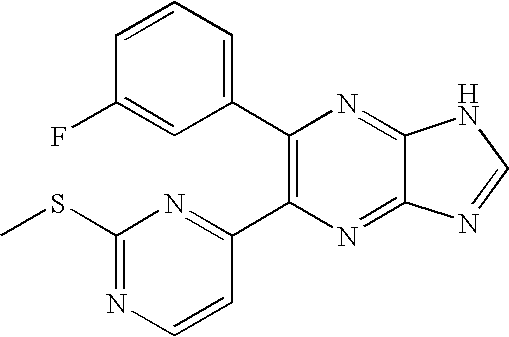


| Active ingredient | 5 Kg | ||
| Lactose monohydrate | 10 Kg | ||
| Colloidal silicon dioxide | 0.1 | ||
| Corn starch | |||
| 1 Kg | |||
| Magnesium stearate | 0.2 Kg | ||
Procedure
| Active ingredient | 2.5 Kg | ||
| Microcrystalline cellulose | 1.95 Kg | ||
| Spray dried lactose | 9.95 Kg | ||
| Carboxymethyl starch | 0.4 Kg | ||
| Sodium stearyl fumarate | 0.1 Kg | ||
| Colloidal silicon dioxide | 0.1 Kg | ||
Procedure
Claims (21)

-L-(CR′R″)n-G

-L-(CR′R″)n-G

-L-(CR′R″)n-G
-L-(CR′R″)n-G
-L-(CR′R″)n-G
Applications Claiming Priority (4)
| Application Number | Priority Date | Filing Date | Title |
|---|---|---|---|
| ES200501876 | 2005-07-29 | ||
| ESP200501876 | 2005-07-29 | ||
| ES200501876A ES2270715B1 (en) | 2005-07-29 | 2005-07-29 | NEW DERIVATIVES OF PIRAZINA. |
| PCT/EP2006/007318 WO2007017096A1 (en) | 2005-07-29 | 2006-07-25 | Pyrazine derivatives useful as adenosine receptor antagonists |
Publications (2)
| Publication Number | Publication Date |
|---|---|
| US20090042891A1 US20090042891A1 (en) | 2009-02-12 |
| US7790728B2 true US7790728B2 (en) | 2010-09-07 |
Family
ID=35945119
Family Applications (2)
| Application Number | Title | Priority Date | Filing Date |
|---|---|---|---|
| US11/997,048 Expired - Fee Related US7790728B2 (en) | 2005-07-29 | 2006-07-25 | Pyrazine derivatives useful as adenosine receptor antagonists |
| US12/794,059 Abandoned US20100273757A1 (en) | 2005-07-29 | 2010-06-04 | Pyrazine derivatives useful as adenosine receptor antagonists |
Family Applications After (1)
| Application Number | Title | Priority Date | Filing Date |
|---|---|---|---|
| US12/794,059 Abandoned US20100273757A1 (en) | 2005-07-29 | 2010-06-04 | Pyrazine derivatives useful as adenosine receptor antagonists |
Country Status (22)
| Country | Link |
|---|---|
| US (2) | US7790728B2 (en) |
| EP (1) | EP1922313A1 (en) |
| JP (1) | JP2009502837A (en) |
| KR (1) | KR20080040681A (en) |
| CN (1) | CN101268064A (en) |
| AR (1) | AR056008A1 (en) |
| AU (1) | AU2006278875A1 (en) |
| CA (1) | CA2616428A1 (en) |
| EC (1) | ECSP088113A (en) |
| ES (1) | ES2270715B1 (en) |
| IL (1) | IL188725A0 (en) |
| MX (1) | MX2008001035A (en) |
| NO (1) | NO20080451L (en) |
| NZ (1) | NZ565150A (en) |
| PE (1) | PE20070407A1 (en) |
| RU (1) | RU2417994C2 (en) |
| SG (1) | SG162805A1 (en) |
| TW (1) | TW200728299A (en) |
| UA (1) | UA93883C2 (en) |
| UY (1) | UY29672A1 (en) |
| WO (1) | WO2007017096A1 (en) |
| ZA (1) | ZA200800353B (en) |
Cited By (5)
| Publication number | Priority date | Publication date | Assignee | Title |
|---|---|---|---|---|
| US10793561B2 (en) | 2017-07-18 | 2020-10-06 | Nuvation Bio Inc. | 1,8-naphthyridinone compounds and uses thereof |
| US11028058B2 (en) | 2017-07-18 | 2021-06-08 | Nuvation Bio Inc. | Heterocyclic compounds as adenosine antagonists |
| US20210395225A1 (en) * | 2018-10-24 | 2021-12-23 | Leadxpro Ag | Functionalized aminotriazines |
| US11254670B2 (en) | 2019-01-18 | 2022-02-22 | Nuvation Bio Inc. | 1,8-naphthyridinone compounds and uses thereof |
| US11306071B2 (en) | 2019-01-18 | 2022-04-19 | Nuvation Bio Inc. | Heterocyclic compounds as adenosine antagonists |
Families Citing this family (74)
| Publication number | Priority date | Publication date | Assignee | Title |
|---|---|---|---|---|
| US8518950B2 (en) | 2005-01-25 | 2013-08-27 | Synta Pharmaceuticals Corp. | 2-amido pyrazines for inflammation and immune related uses |
| ES2274712B1 (en) | 2005-10-06 | 2008-03-01 | Laboratorios Almirall S.A. | NEW IMIDAZOPIRIDINE DERIVATIVES. |
| US7981893B2 (en) * | 2006-10-19 | 2011-07-19 | Signal Pharmaceuticals, Llc | Heteroaryl compounds, compositions thereof, and methods of treatment therewith |
| ES2303776B1 (en) * | 2006-12-29 | 2009-08-07 | Laboratorios Almirall S.A. | DERIVATIVES OF 5-PHENYL-6-PIRIDIN-4-IL-1,3-DIHIDRO-2H-IMIDAZO (4,5-B) PIRIDIN-2-ONA USEFUL AS ANTAGONISTS OF ADENOSINE A2B RECEIVER. |
| ES2320955B1 (en) | 2007-03-02 | 2010-03-16 | Laboratorios Almirall S.A. | NEW DERIVATIVES OF 3 - ((1,2,4) TRIAZOLO (4,3-A) PIRIDIN-7-IL) BENZAMIDA. |
| CA2716223A1 (en) * | 2008-02-25 | 2009-09-03 | F. Hoffmann-La Roche Ag | Pyrrolopyrazine kinase inhibitors |
| EP2268641B1 (en) | 2008-03-26 | 2014-09-03 | Advinus Therapeutics Pvt. Ltd. | Heterocyclic compounds as adenosine receptor antagonist |
| EP2108641A1 (en) | 2008-04-11 | 2009-10-14 | Laboratorios Almirall, S.A. | New substituted spiro[cycloalkyl-1,3'-indo]-2'(1'H)-one derivatives and their use as p38 mitogen-activated kinase inhibitors |
| EP2113503A1 (en) | 2008-04-28 | 2009-11-04 | Laboratorios Almirall, S.A. | New substituted indolin-2-one derivatives and their use as p39 mitogen-activated kinase inhibitors |
| HRP20140265T1 (en) | 2009-02-06 | 2014-04-25 | Nippon Shinyaku Co., Ltd. | Aminopyrazine derivative and drug |
| JP5765239B2 (en) | 2009-03-13 | 2015-08-19 | アドヴィナス・セラピューティックス・リミテッド | Substituted fused pyrimidine compounds |
| US8796290B2 (en) | 2009-11-09 | 2014-08-05 | Advinus Therapeutics Limited | Substituted fused pyrimidine compounds, its preparation and uses thereof |
| EP2322176A1 (en) | 2009-11-11 | 2011-05-18 | Almirall, S.A. | New 7-phenyl-[1,2,4]triazolo[4,3-a]pyridin-3(2H)-one derivatives |
| EP2338890A1 (en) | 2009-12-22 | 2011-06-29 | Bayer CropScience AG | 4,7-Diazaindole derivatives and their use as fungicides |
| DK2531492T3 (en) * | 2010-02-05 | 2016-07-04 | Heptares Therapeutics Ltd | 1,2,4-triazin-4-amine derivatives |
| CN101817823B (en) * | 2010-03-31 | 2012-09-12 | 上海毕得医药科技有限公司 | Preparation method of 4,7-diazaindole and 5-site substitute thereof |
| RS55856B1 (en) | 2010-07-14 | 2017-08-31 | Novartis Ag | HETEROCYCLIC UNITS OF IP RECEPTOR AGONISTS |
| AU2011303420B2 (en) | 2010-09-13 | 2014-03-20 | Impetis Biosciences Ltd. | Purine compounds as prodrugs of A2B adenosine receptor antagonists, their process and medicinal applications |
| WO2012088266A2 (en) | 2010-12-22 | 2012-06-28 | Incyte Corporation | Substituted imidazopyridazines and benzimidazoles as inhibitors of fgfr3 |
| TWI659030B (en) * | 2011-10-26 | 2019-05-11 | 諾華公司 | Ip receptor agonist heterocyclic compounds |
| US20140357641A1 (en) * | 2012-01-13 | 2014-12-04 | Novartis Ag | IP receptor agonist heterocyclic compounds |
| WO2013105063A1 (en) * | 2012-01-13 | 2013-07-18 | Novartis Ag | Fused piperidines as ip receptor agonists for the treatment of pulmonary arterial hypertension (pah) and related disorders |
| EP2802581A1 (en) * | 2012-01-13 | 2014-11-19 | Novartis AG | 7,8- dihydropyrido [3, 4 - b]pyrazines as ip receptor agonists for the treatment of pulmonary arterial hypertension (pah) and related disorders |
| ES2561353T3 (en) * | 2012-01-13 | 2016-02-25 | Novartis Ag | Sales of an IP receiver agonist |
| EP2802585A1 (en) * | 2012-01-13 | 2014-11-19 | Novartis AG | Fused piperidines as ip receptor agonists for the treatment of pah and related disorders |
| CN104053659B (en) * | 2012-01-13 | 2016-11-09 | 诺华股份有限公司 | For treating the pyroles condensed as IP receptor stimulating agent of pulmonary hypertension (PAH) and associated conditions |
| AU2013268400B2 (en) | 2012-05-30 | 2017-07-13 | Nippon Shinyaku Co., Ltd. | Aromatic heterocyclic derivative and pharmaceutical |
| LT3495367T (en) | 2012-06-13 | 2021-02-25 | Incyte Holdings Corporation | MODIFIED TRICYCLIC COMPOUNDS AS FGFR INHIBITORS |
| WO2014026125A1 (en) | 2012-08-10 | 2014-02-13 | Incyte Corporation | Pyrazine derivatives as fgfr inhibitors |
| WO2014087208A2 (en) * | 2012-12-06 | 2014-06-12 | Enaltec Labs Pvt. Ltd. | A process of preparing alcaftadine |
| US9266892B2 (en) | 2012-12-19 | 2016-02-23 | Incyte Holdings Corporation | Fused pyrazoles as FGFR inhibitors |
| EP2956455B1 (en) | 2013-02-13 | 2017-05-17 | Novartis AG | Ip receptor agonist heterocyclic compounds |
| LT2986610T (en) | 2013-04-19 | 2018-04-10 | Incyte Holdings Corporation | Bicyclic heterocycles as fgfr inhibitors |
| CN103364500B (en) * | 2013-06-29 | 2019-01-22 | 北京万全德众医药生物技术有限公司 | A method of with liquid chromatography for separating and determining bilastine raw material and its preparation |
| US10851105B2 (en) | 2014-10-22 | 2020-12-01 | Incyte Corporation | Bicyclic heterocycles as FGFR4 inhibitors |
| JP6779204B2 (en) * | 2014-11-18 | 2020-11-04 | メルク・シャープ・アンド・ドーム・コーポレーションMerck Sharp & Dohme Corp. | Aminopyrazine compound with A2A antagonist properties |
| CN104402833B (en) * | 2014-11-20 | 2016-08-24 | 广东东阳光药业有限公司 | Pyrazine compounds containing cyclobutane substituent and combinations thereof thing and purposes |
| CN104447583B (en) * | 2014-11-20 | 2016-08-24 | 广东东阳光药业有限公司 | Pyrazine compounds containing cyclobutane substituent and combinations thereof thing and purposes |
| CN104447584B (en) * | 2014-11-20 | 2016-08-24 | 广东东阳光药业有限公司 | Pyrazine compounds containing cyclobutane substituent and combinations thereof thing and purposes |
| CN104447585B (en) * | 2014-11-20 | 2016-08-24 | 广东东阳光药业有限公司 | Pyrazine compounds and combinations thereof thing and purposes |
| CN104496918B (en) * | 2014-12-10 | 2016-08-24 | 广东东阳光药业有限公司 | Pyrazines derivatives and application thereof |
| WO2016102672A2 (en) * | 2014-12-23 | 2016-06-30 | Bergenbio As | Pharmaceutically active compounds |
| WO2016134294A1 (en) | 2015-02-20 | 2016-08-25 | Incyte Corporation | Bicyclic heterocycles as fgfr4 inhibitors |
| MA41551A (en) | 2015-02-20 | 2017-12-26 | Incyte Corp | BICYCLIC HETEROCYCLES USED AS FGFR4 INHIBITORS |
| SG11201706287PA (en) | 2015-02-20 | 2017-09-28 | Incyte Corp | Bicyclic heterocycles as fgfr inhibitors |
| ES2580702B1 (en) * | 2015-02-25 | 2017-06-08 | Palobiofarma, S.L. | 2-Aminopyridine derivatives as adenosine A2b receptor antagonists and MT3 melatonin receptor ligands |
| JP7013213B2 (en) * | 2017-05-26 | 2022-01-31 | 日本化薬株式会社 | Pyrazine compound |
| AR111960A1 (en) | 2017-05-26 | 2019-09-04 | Incyte Corp | CRYSTALLINE FORMS OF A FGFR INHIBITOR AND PROCESSES FOR ITS PREPARATION |
| KR20210003831A (en) | 2018-04-20 | 2021-01-12 | 버지니아 테크 인터렉추얼 프라퍼티스, 인크. | Aminopyrazine and related compounds useful as mitochondrial uncouplers |
| MX2020011718A (en) | 2018-05-04 | 2021-02-15 | Incyte Corp | SOLID FORMS OF A FIBROBLAST GROWTH FACTOR RECEPTOR (FGFR) INHIBITOR AND PROCESSES FOR PREPARING THEM. |
| ES3061844T3 (en) | 2018-05-04 | 2026-04-07 | Incyte Corp | Salts of an fgfr inhibitor |
| CN109020881B (en) * | 2018-06-28 | 2020-04-28 | 新发药业有限公司 | Preparation method of apatinib |
| CN115181092B (en) * | 2018-08-17 | 2024-05-03 | 迪哲(江苏)医药股份有限公司 | Pyrazine compounds and uses thereof |
| CN113166119B (en) * | 2018-12-28 | 2024-01-05 | 四川科伦博泰生物医药股份有限公司 | Substituted aryl compounds and preparation methods and uses thereof |
| CN111377906B (en) * | 2018-12-28 | 2022-09-02 | 四川科伦博泰生物医药股份有限公司 | Substituted pyrazine compounds, their preparation and use |
| CN111377873B (en) * | 2018-12-28 | 2023-03-28 | 四川科伦博泰生物医药股份有限公司 | Aminopyrimidine compounds, their preparation and use |
| EP3911325A4 (en) * | 2019-01-18 | 2022-10-12 | Nuvation Bio Inc. | HETEROCYCLIC COMPOUNDS AS ADENOSIN ANTAGONISTS |
| US11628162B2 (en) | 2019-03-08 | 2023-04-18 | Incyte Corporation | Methods of treating cancer with an FGFR inhibitor |
| CN110407677B (en) * | 2019-06-17 | 2022-10-11 | 南京先进生物材料与过程装备研究院有限公司 | Preparation method and application of diphenylethanedione compound |
| US11591329B2 (en) | 2019-07-09 | 2023-02-28 | Incyte Corporation | Bicyclic heterocycles as FGFR inhibitors |
| CN112479956A (en) * | 2019-07-30 | 2021-03-12 | 杭州阿诺生物医药科技有限公司 | Method for preparing adenosine receptor inhibitor intermediate |
| US12122767B2 (en) | 2019-10-01 | 2024-10-22 | Incyte Corporation | Bicyclic heterocycles as FGFR inhibitors |
| TWI891666B (en) | 2019-10-14 | 2025-08-01 | 美商英塞特公司 | Bicyclic heterocycles as fgfr inhibitors |
| US11566028B2 (en) | 2019-10-16 | 2023-01-31 | Incyte Corporation | Bicyclic heterocycles as FGFR inhibitors |
| CA3163875A1 (en) | 2019-12-04 | 2021-06-10 | Incyte Corporation | Tricyclic heterocycles as fgfr inhibitors |
| WO2021113462A1 (en) | 2019-12-04 | 2021-06-10 | Incyte Corporation | Derivatives of an fgfr inhibitor |
| US12012409B2 (en) | 2020-01-15 | 2024-06-18 | Incyte Corporation | Bicyclic heterocycles as FGFR inhibitors |
| WO2021146629A1 (en) * | 2020-01-17 | 2021-07-22 | Nuvation Bio Inc. | Heterocyclic compounds as adenosine antagonists |
| WO2021146631A1 (en) * | 2020-01-17 | 2021-07-22 | Nuvation Bio Inc. | Heterocyclic compounds as adenosine antagonists |
| TW202304459A (en) | 2021-04-12 | 2023-02-01 | 美商英塞特公司 | Combination therapy comprising an fgfr inhibitor and a nectin-4 targeting agent |
| JP2024522189A (en) | 2021-06-09 | 2024-06-11 | インサイト・コーポレイション | Tricyclic Heterocycles as FGFR Inhibitors |
| EP4352060A1 (en) | 2021-06-09 | 2024-04-17 | Incyte Corporation | Tricyclic heterocycles as fgfr inhibitors |
| CN116903634B (en) * | 2023-07-17 | 2025-07-29 | 上海美迪西生物医药股份有限公司 | Preparation method of 6-phenylthieno [2,3-b ] pyrazine |
| WO2025036840A1 (en) * | 2023-08-11 | 2025-02-20 | Almirall, S.A. | Pyridine or pyrazine derivatives as collagen vii (c7) inducers and their use in therapy |
Citations (40)
| Publication number | Priority date | Publication date | Assignee | Title |
|---|---|---|---|---|
| WO1997033883A1 (en) | 1996-03-13 | 1997-09-18 | Smithkline Beecham Corporation | Novel pyrimidine compounds useful in treating cytokine mediated diseases |
| US5763448A (en) | 1993-05-10 | 1998-06-09 | Merck, Sharp & Dohme Limited | Pyrmidine derivatives |
| WO1998024782A2 (en) | 1996-12-05 | 1998-06-11 | Amgen Inc. | Substituted pyrimidine compounds and their use |
| US5916905A (en) | 1995-02-10 | 1999-06-29 | G. D. Searle & Co. | 2,3-substituted pyridines for the treatment of inflammation |
| WO1999032448A1 (en) | 1997-12-19 | 1999-07-01 | Amgen Inc. | Substituted pyridine and pyridazine compounds and their pharmaceutical use |
| WO1999065897A1 (en) | 1998-06-19 | 1999-12-23 | Chiron Corporation | Inhibitors of glycogen synthase kinase 3 |
| WO2000073307A2 (en) | 1999-06-01 | 2000-12-07 | University Of Virginia Patent Foundation | Substituted 8-phenylxanthines useful as antagonists of a2b adenosine receptors |
| WO2001002400A1 (en) | 1999-07-02 | 2001-01-11 | Eisai Co., Ltd. | Fused imidazole compounds and remedies for diabetes mellitus |
| WO2001016134A1 (en) | 1999-08-31 | 2001-03-08 | Vanderbilt University | Selective antagonists of a2b adenosine receptors |
| WO2001060350A2 (en) | 2000-02-17 | 2001-08-23 | Cv Therapeutics, Inc. | Method for identifying and using a2b adenosine receptor antagonists to mediate mammalian cell proliferation |
| WO2001062233A2 (en) | 2000-02-25 | 2001-08-30 | F. Hoffmann La Roche Ag | Adenosine receptor modulators |
| WO2002014282A1 (en) | 2000-08-11 | 2002-02-21 | Eisai Co., Ltd. | 2-aminopyridine compounds and use thereof as drugs |
| WO2002020495A2 (en) | 2000-09-06 | 2002-03-14 | Chiron Corporation | Inhibitors of glycogen synthase kinase 3 |
| WO2002022608A1 (en) | 2000-09-15 | 2002-03-21 | Vertex Pharmaceuticals Incorporated | Pyrazole compounds useful as protein kinase inhibitors |
| WO2002024893A2 (en) | 2000-09-19 | 2002-03-28 | Chiron Corporation | CHARACTERIZATION OF THE GSK-3β PROTEIN AND METHODS OF USE THEREOF |
| WO2002042298A1 (en) | 2000-11-21 | 2002-05-30 | Novartis Ag | Aminothiazoles and their use as adenosine receptor antagonists |
| WO2003002566A1 (en) | 2001-06-29 | 2003-01-09 | Cv Therapeutics, Inc. | Purine derivatives as a2b adenosine receptor antagonists |
| EP1283056A1 (en) | 2000-04-26 | 2003-02-12 | Eisai Co., Ltd. | Medicinal compositions promoting bowel movement |
| WO2003035639A1 (en) | 2001-10-22 | 2003-05-01 | Eisai Co., Ltd. | Pyrimidine compound and medicinal composition thereof |
| WO2003042214A2 (en) | 2001-11-09 | 2003-05-22 | Cv Therapeutics, Inc. | A2b adenosine receptor antagonists |
| WO2003057689A1 (en) | 2002-01-02 | 2003-07-17 | Fujisawa Pharmaceutical Co., Ltd. | Aminopyrimidine compounds, processes for their preparation and pharmaceutical compositions containing them |
| WO2003063800A2 (en) | 2002-02-01 | 2003-08-07 | King Pharmaceuticals Research And Development, Inc. | 8-heteroaryl xanthine adenosine a2b receptor antagonists |
| WO2003068773A1 (en) | 2002-02-12 | 2003-08-21 | Glaxo Group Limited | Pyrazolopyridine derivatives |
| WO2003082191A2 (en) | 2002-03-28 | 2003-10-09 | Merck & Co., Inc. | Substituted 2,3-diphenyl pyridines |
| US20030229106A1 (en) | 2001-11-09 | 2003-12-11 | Rao Kalla | A2B adenosine receptor antagonists |
| WO2003105666A2 (en) | 2002-06-12 | 2003-12-24 | Biogen, Inc. | Method of treating ischemia reperfusion injury using adenosine receptor antagonists |
| WO2004022540A2 (en) | 2002-09-06 | 2004-03-18 | Fujisawa Pharmaceutical Co., Ltd. | Pyridazinone and pyridone derivatives as adenosine antagonists |
| WO2004030635A2 (en) | 2002-10-03 | 2004-04-15 | Targegen, Inc. | Vasculostatic agents and methods of use thereof |
| US20040176399A1 (en) | 2001-11-09 | 2004-09-09 | Elfatih Elzein | A2B adenosine receptor antagonists |
| WO2004076450A1 (en) | 2003-02-27 | 2004-09-10 | J. Uriach Y Compañia S.A. | Pyrazolopyridine derivates |
| WO2004106337A1 (en) | 2003-05-06 | 2004-12-09 | Cv Therapeutics, Inc. | Xanthine derivatives as a2b adenosine receptor antagonists |
| WO2005021548A2 (en) | 2003-08-25 | 2005-03-10 | Adenosine Therapeutics, Llc | Substituted 8-heteroaryl xanthines |
| WO2005033085A1 (en) | 2003-10-03 | 2005-04-14 | Universiteit Leiden | Pyrimidines derivatives as adenosine receptors ligands |
| WO2005040155A1 (en) | 2003-10-02 | 2005-05-06 | Almirall Prodesfarma, S.A. | Pyrimidin-2-amine derivates and their use as a2b adenosine receptor antagonists |
| WO2005040151A1 (en) | 2003-10-27 | 2005-05-06 | Astellas Pharma Inc. | Pyrazine derivatives and pharmaceutical use thereof |
| WO2005042534A2 (en) | 2003-10-31 | 2005-05-12 | Cv Therapeutics, Inc. | A2b adenosine receptor antagonists |
| WO2005070926A1 (en) | 2004-01-21 | 2005-08-04 | Novartis Ag | Thiazole derivatives as a2b antagonists |
| WO2005100353A1 (en) | 2004-04-15 | 2005-10-27 | Almirall Prodesfarma, Sa | Condensed pyridine derivatives useful as a28 adenosine receptor antagonists |
| WO2007039297A1 (en) | 2005-10-06 | 2007-04-12 | Laboratorios Almirall, S.A. | Imidazopyridine derivatives as a2b adenosine receptor antagonists |
| WO2008080461A1 (en) | 2006-12-29 | 2008-07-10 | Laboratorios Almirall, S.A. | 5-phenyl-6-pyridin-4-yl-1,3-dihydro-2h-imidazo[4,5-b]pyridin-2-one derivatives useful as a2b adenosine receptor antagonists |
Family Cites Families (1)
| Publication number | Priority date | Publication date | Assignee | Title |
|---|---|---|---|---|
| DE19632549A1 (en) * | 1996-08-13 | 1998-02-19 | Merck Patent Gmbh | Arylalkanoylpyridazines |
-
2005
- 2005-07-29 ES ES200501876A patent/ES2270715B1/en not_active Expired - Fee Related
-
2006
- 2006-07-13 UY UY29672A patent/UY29672A1/en unknown
- 2006-07-25 MX MX2008001035A patent/MX2008001035A/en not_active Application Discontinuation
- 2006-07-25 AU AU2006278875A patent/AU2006278875A1/en not_active Abandoned
- 2006-07-25 US US11/997,048 patent/US7790728B2/en not_active Expired - Fee Related
- 2006-07-25 CA CA002616428A patent/CA2616428A1/en not_active Abandoned
- 2006-07-25 NZ NZ565150A patent/NZ565150A/en unknown
- 2006-07-25 RU RU2008107264/04A patent/RU2417994C2/en not_active IP Right Cessation
- 2006-07-25 JP JP2008523220A patent/JP2009502837A/en active Pending
- 2006-07-25 KR KR1020087002157A patent/KR20080040681A/en not_active Withdrawn
- 2006-07-25 WO PCT/EP2006/007318 patent/WO2007017096A1/en not_active Ceased
- 2006-07-25 EP EP06762807A patent/EP1922313A1/en not_active Withdrawn
- 2006-07-25 PE PE2006000899A patent/PE20070407A1/en not_active Application Discontinuation
- 2006-07-25 SG SG201004274-5A patent/SG162805A1/en unknown
- 2006-07-25 CN CNA2006800340045A patent/CN101268064A/en active Pending
- 2006-07-25 UA UAA200802498A patent/UA93883C2/en unknown
- 2006-07-28 TW TW095127615A patent/TW200728299A/en unknown
- 2006-07-28 AR ARP060103279A patent/AR056008A1/en not_active Application Discontinuation
-
2008
- 2008-01-10 IL IL188725A patent/IL188725A0/en unknown
- 2008-01-11 ZA ZA200800353A patent/ZA200800353B/en unknown
- 2008-01-17 EC EC2008008113A patent/ECSP088113A/en unknown
- 2008-01-24 NO NO20080451A patent/NO20080451L/en not_active Application Discontinuation
-
2010
- 2010-06-04 US US12/794,059 patent/US20100273757A1/en not_active Abandoned
Patent Citations (53)
| Publication number | Priority date | Publication date | Assignee | Title |
|---|---|---|---|---|
| US5763448A (en) | 1993-05-10 | 1998-06-09 | Merck, Sharp & Dohme Limited | Pyrmidine derivatives |
| US5916905A (en) | 1995-02-10 | 1999-06-29 | G. D. Searle & Co. | 2,3-substituted pyridines for the treatment of inflammation |
| WO1997033883A1 (en) | 1996-03-13 | 1997-09-18 | Smithkline Beecham Corporation | Novel pyrimidine compounds useful in treating cytokine mediated diseases |
| WO1998024782A2 (en) | 1996-12-05 | 1998-06-11 | Amgen Inc. | Substituted pyrimidine compounds and their use |
| WO1999032448A1 (en) | 1997-12-19 | 1999-07-01 | Amgen Inc. | Substituted pyridine and pyridazine compounds and their pharmaceutical use |
| WO1999065897A1 (en) | 1998-06-19 | 1999-12-23 | Chiron Corporation | Inhibitors of glycogen synthase kinase 3 |
| WO2000073307A2 (en) | 1999-06-01 | 2000-12-07 | University Of Virginia Patent Foundation | Substituted 8-phenylxanthines useful as antagonists of a2b adenosine receptors |
| EP1221444A1 (en) | 1999-07-02 | 2002-07-10 | Eisai Co., Ltd. | Fused imidazole compounds and remedies for diabetes mellitus |
| WO2001002400A1 (en) | 1999-07-02 | 2001-01-11 | Eisai Co., Ltd. | Fused imidazole compounds and remedies for diabetes mellitus |
| US6841549B1 (en) | 1999-07-02 | 2005-01-11 | Eisai Co., Ltd. | Condensed imidazole compounds and a therapeutic agent for diabetes mellitus |
| WO2001016134A1 (en) | 1999-08-31 | 2001-03-08 | Vanderbilt University | Selective antagonists of a2b adenosine receptors |
| WO2001060350A2 (en) | 2000-02-17 | 2001-08-23 | Cv Therapeutics, Inc. | Method for identifying and using a2b adenosine receptor antagonists to mediate mammalian cell proliferation |
| WO2001062233A2 (en) | 2000-02-25 | 2001-08-30 | F. Hoffmann La Roche Ag | Adenosine receptor modulators |
| EP1283056A1 (en) | 2000-04-26 | 2003-02-12 | Eisai Co., Ltd. | Medicinal compositions promoting bowel movement |
| EP1308441A1 (en) | 2000-08-11 | 2003-05-07 | Eisai Co., Ltd. | 2-aminopyridine compounds and use thereof as drugs |
| WO2002014282A1 (en) | 2000-08-11 | 2002-02-21 | Eisai Co., Ltd. | 2-aminopyridine compounds and use thereof as drugs |
| US6750232B2 (en) | 2000-08-11 | 2004-06-15 | Eisai Co., Ltd. | 2-aminopyridine compounds and use thereof as drugs |
| US20040006082A1 (en) | 2000-08-11 | 2004-01-08 | Hitoshi Harada | 2-Aminopyridine compounds and use thereof as drugs |
| WO2002020495A2 (en) | 2000-09-06 | 2002-03-14 | Chiron Corporation | Inhibitors of glycogen synthase kinase 3 |
| WO2002022608A1 (en) | 2000-09-15 | 2002-03-21 | Vertex Pharmaceuticals Incorporated | Pyrazole compounds useful as protein kinase inhibitors |
| WO2002024893A2 (en) | 2000-09-19 | 2002-03-28 | Chiron Corporation | CHARACTERIZATION OF THE GSK-3β PROTEIN AND METHODS OF USE THEREOF |
| WO2002042298A1 (en) | 2000-11-21 | 2002-05-30 | Novartis Ag | Aminothiazoles and their use as adenosine receptor antagonists |
| WO2003002566A1 (en) | 2001-06-29 | 2003-01-09 | Cv Therapeutics, Inc. | Purine derivatives as a2b adenosine receptor antagonists |
| CA2463284A1 (en) | 2001-10-22 | 2003-05-01 | Eisai Co., Ltd. | Pyrimidine compounds and pharmaceutical compositions containing the compounds |
| WO2003035639A1 (en) | 2001-10-22 | 2003-05-01 | Eisai Co., Ltd. | Pyrimidine compound and medicinal composition thereof |
| EP1439175A1 (en) | 2001-10-22 | 2004-07-21 | Eisai Co., Ltd. | Pyrimidine compound and medicinal composition thereof |
| US20050004149A1 (en) | 2001-10-22 | 2005-01-06 | Hitoshi Harada | Pyrimidine compound and medicinal composition thereof |
| US20090030023A1 (en) | 2001-10-22 | 2009-01-29 | Hitoshi Harada | Pyrimidine compounds and medicinal composition thereof |
| US7396836B2 (en) | 2001-10-22 | 2008-07-08 | Eisai R&D Management Co., Ltd. | Pyrimidine compound and medicinal composition thereof |
| US20030229106A1 (en) | 2001-11-09 | 2003-12-11 | Rao Kalla | A2B adenosine receptor antagonists |
| US20040176399A1 (en) | 2001-11-09 | 2004-09-09 | Elfatih Elzein | A2B adenosine receptor antagonists |
| WO2003042214A2 (en) | 2001-11-09 | 2003-05-22 | Cv Therapeutics, Inc. | A2b adenosine receptor antagonists |
| WO2003057689A1 (en) | 2002-01-02 | 2003-07-17 | Fujisawa Pharmaceutical Co., Ltd. | Aminopyrimidine compounds, processes for their preparation and pharmaceutical compositions containing them |
| WO2003063800A2 (en) | 2002-02-01 | 2003-08-07 | King Pharmaceuticals Research And Development, Inc. | 8-heteroaryl xanthine adenosine a2b receptor antagonists |
| WO2003068773A1 (en) | 2002-02-12 | 2003-08-21 | Glaxo Group Limited | Pyrazolopyridine derivatives |
| WO2003082191A2 (en) | 2002-03-28 | 2003-10-09 | Merck & Co., Inc. | Substituted 2,3-diphenyl pyridines |
| WO2003105666A2 (en) | 2002-06-12 | 2003-12-24 | Biogen, Inc. | Method of treating ischemia reperfusion injury using adenosine receptor antagonists |
| WO2004022540A2 (en) | 2002-09-06 | 2004-03-18 | Fujisawa Pharmaceutical Co., Ltd. | Pyridazinone and pyridone derivatives as adenosine antagonists |
| WO2004030635A2 (en) | 2002-10-03 | 2004-04-15 | Targegen, Inc. | Vasculostatic agents and methods of use thereof |
| WO2004076450A1 (en) | 2003-02-27 | 2004-09-10 | J. Uriach Y Compañia S.A. | Pyrazolopyridine derivates |
| WO2004106337A1 (en) | 2003-05-06 | 2004-12-09 | Cv Therapeutics, Inc. | Xanthine derivatives as a2b adenosine receptor antagonists |
| WO2005021548A2 (en) | 2003-08-25 | 2005-03-10 | Adenosine Therapeutics, Llc | Substituted 8-heteroaryl xanthines |
| US20070265273A1 (en) | 2003-10-02 | 2007-11-15 | Bernat Vidal Juan | Pyrimidin-2-Amine Derivatives and Their Use as A2b Adenosine Receptor Antagonists |
| WO2005040155A1 (en) | 2003-10-02 | 2005-05-06 | Almirall Prodesfarma, S.A. | Pyrimidin-2-amine derivates and their use as a2b adenosine receptor antagonists |
| WO2005033085A1 (en) | 2003-10-03 | 2005-04-14 | Universiteit Leiden | Pyrimidines derivatives as adenosine receptors ligands |
| WO2005040151A1 (en) | 2003-10-27 | 2005-05-06 | Astellas Pharma Inc. | Pyrazine derivatives and pharmaceutical use thereof |
| WO2005042534A2 (en) | 2003-10-31 | 2005-05-12 | Cv Therapeutics, Inc. | A2b adenosine receptor antagonists |
| WO2005070926A1 (en) | 2004-01-21 | 2005-08-04 | Novartis Ag | Thiazole derivatives as a2b antagonists |
| WO2005100353A1 (en) | 2004-04-15 | 2005-10-27 | Almirall Prodesfarma, Sa | Condensed pyridine derivatives useful as a28 adenosine receptor antagonists |
| US20090023763A1 (en) | 2004-04-15 | 2009-01-22 | Bernat Vidal Juan | Condensed Pyridine Derivatives Useful as A2B Adenosine Receptor Antagonists |
| WO2007039297A1 (en) | 2005-10-06 | 2007-04-12 | Laboratorios Almirall, S.A. | Imidazopyridine derivatives as a2b adenosine receptor antagonists |
| US20080275038A1 (en) | 2005-10-06 | 2008-11-06 | Bernat Vidal Juan | Imidazopyridine Derivatives as A2b Adenosine Receptor Antagonists |
| WO2008080461A1 (en) | 2006-12-29 | 2008-07-10 | Laboratorios Almirall, S.A. | 5-phenyl-6-pyridin-4-yl-1,3-dihydro-2h-imidazo[4,5-b]pyridin-2-one derivatives useful as a2b adenosine receptor antagonists |
Non-Patent Citations (36)
| Title |
|---|
| AL-Masoudi, N.A.L. et al. "Nucleosides LIII* Syntheses and Reactions of 6,7-Dipyridyllumazine and 2'- Deoxylumazine N-1 Nucleosides," Pteridines, 4(3): 119-125 (1993). |
| AL-Masoudi, N.A.L. et al. "Nucleosides LIII* Syntheses and Reactions of 6,7-Dipyridyllumazine and 2′- Deoxylumazine N-1 Nucleosides," Pteridines, 4(3): 119-125 (1993). |
| Barnes, PJ, "Theophylline New Perspectives for an Old Drug," American Journal of Respiratory and Critical Care Medicine, 167: 813-818 (2003). |
| Bondavalli, F. et al., "3-5-diphenyl-1H-pyrazole derivatives IX. 2-substituted 4-phenyl-5-(3,5-diphenyl-1H-pyrazol-1-yl) pyrimidines with platelet antiaggregating and other activities," II Farmaco, 47(2):171-190 (1992). |
| Cacciari, B. et al., "A2B adenosine receptor antagonists: recent developments," Mini-Reviews in Medicinal Chemistry, 5:1053-1060 (2005). |
| Caplus English Abstract of journal article by Tarkhov, L.I. et al. Accession No. 2005:630607 (2005). |
| Caplus English Abstract of journal article by Tarkhov, L.I. et al. CAS Registry No. 875932-62-0 (2009). |
| Feoktistov, I. et al. "Adenosine A2B Receptors," Pharmacological Reviews, 49(4): 381-402 (1997). |
| Fischer, GW et al., "Tetrazole compounds. 8[1]. Synthesis of tetrazolylpyrimidines from tetrazolyl-substituted enamino ketones," J. Heterocyclic Chem., 30:1517-1519 (1993). |
| Fozard, JR et al. "Adenosine receptor ligands as potential therapeutics in asthma," Current Opinion in Investigational Drugs, 3(1): 69-77 (2002). |
| Frank. D. King. Bioisosteres, Conformational Restriction, and Pro-drugs-Case History: An Example of a Conformational Restriction Approach, Medicinal Chemistry: Principles and Practice, Chapter 14, 1994, 208. * |
| Gao et al., Expert Opin. Emerging Drugs (2008) 12(3) 479-492. |
| Haskö, G et al., "Adenosine receptors: therapeutic aspects for inflammatory and immune diseases," Nature Reviews, 7:759-770 (2008). |
| Haskö, G. et al., "Adenosine: an endogenous regulator of innate immunity," Trends in Immunology, 25(1):33-51 (2004). |
| Holgate, ST, "The identification of the adenosine A2B receptor as a novel therapeutic target in asthma," British Journal of Pharmacology, 145:1009-1015 (2005). |
| International Search Report for Application No. PCT/EP2005/003818 dated Jul. 21, 2005. |
| International Search Report for PCT/EP2004/010664 dated Dec. 27, 2004. |
| International Search Report for PCT/EP2006/009620 dated Sep. 1, 2007. |
| International Search Report mailed Mar. 3, 2008, for International Application No. PCT/EP2007/010162 (WO 2008/080461 Al). |
| International Search Report mailed Nov. 22, 2006, for International Application No. PCT/EP2006/007318 (WO 2007/017096 Al). |
| Jacobson, KA et al, "Adenosine receptors as therapeutic targets," Nature Reviews, 5:247-264 (2006). |
| Lappas, CM et al. "Adenosine A2A agonists in development for the treatment of inflammation," Expert Opinion Investig. Drugs, 14(7): 797-806 (2005). |
| Notice of Allowance dated Aug. 28, 2009 for U.S. Appl. No. 10/574,101. |
| Office Action dated Mar. 30, 2009 for Co-pending U.S. Appl. No. 10/574,101. |
| Office Action dated Oct. 6, 2008 for Co-pending U.S. Appl. No. 10/574,101. |
| Palanki, MSS et al., "Structure-activity relationship studies of ethyl 2-[(3-methyl-2,5,dioxo(3-pyrrolinyl)amino]-4-(trifluoromethyl)pyrimidine-5-carboxylate: An inhibitor of AP-1 and KF-kB Mediated Gene Expression," Bioorganic & Medicinal Chemistry Letters, 12:2573-2577 (2002). |
| Peart, Jason N. et al., "Adenosinergic cardioprtection: multiple receptors, multiple pathways," Pharmacology & Therapeutics, 114:208-221 (2007). |
| Polosa, R., "Adenosine-receptor subtypes: their relevance to adenosine-medicated responses in asthma and chronic obstructive pulmonary disease," Eur Respir J., 20:488-496 (2002). |
| Ried, et al. Chemiker-Zeitung, 1988, 112(12), 385. * |
| Rusinov, L.V. et al. "Synthesis and Antiviral Activity of 2-Amino-3-Ethoxycarbonylpyrazine Derivatives," Pharmaceutical Chemistry Journal, 39(12): 630-635 (2005). |
| Schurreit, T. "4-Hydroxy-2H-[1]benzopyran-2on als Baustein zur Synthese von Bisbenzopyranopyridinen," Archiv der Pharmazie (1987) 320:500-506. (English Abstract). |
| Sitkovsky et al. "Adenosine A2A Receptor Antagonists: Blockade of Adenosinergic Effects and T Regulatory Cells," British Journal of Pharmacology (2008) 153:5457-5464. |
| Tarkhov, LI et al. "Photoluminescence of some indolylpyrazines," Materialovedenie, (4): 16-22 (2005). |
| U.S. Appl. No. 12/521,133, filed Jun. 25, 2009, Aiguade Bosch et al. |
| Wilson, CN, "Adenosine receptors and asthma in humans," British Journal of Pharmacology, 155:475-486 (2008). |
| Zablocki, J. et al., "A2B adenosine receptor antagonists and their potential indications," Expert Opinion Ther. Patents, 16(10): 1347-1357 (2006). |
Cited By (6)
| Publication number | Priority date | Publication date | Assignee | Title |
|---|---|---|---|---|
| US10793561B2 (en) | 2017-07-18 | 2020-10-06 | Nuvation Bio Inc. | 1,8-naphthyridinone compounds and uses thereof |
| US11028058B2 (en) | 2017-07-18 | 2021-06-08 | Nuvation Bio Inc. | Heterocyclic compounds as adenosine antagonists |
| US20210395225A1 (en) * | 2018-10-24 | 2021-12-23 | Leadxpro Ag | Functionalized aminotriazines |
| US12391670B2 (en) * | 2018-10-24 | 2025-08-19 | Leadxpro Ag | Functionalized aminotriazines |
| US11254670B2 (en) | 2019-01-18 | 2022-02-22 | Nuvation Bio Inc. | 1,8-naphthyridinone compounds and uses thereof |
| US11306071B2 (en) | 2019-01-18 | 2022-04-19 | Nuvation Bio Inc. | Heterocyclic compounds as adenosine antagonists |
Also Published As
| Publication number | Publication date |
|---|---|
| UY29672A1 (en) | 2007-01-31 |
| JP2009502837A (en) | 2009-01-29 |
| CA2616428A1 (en) | 2007-02-15 |
| AU2006278875A1 (en) | 2007-02-15 |
| IL188725A0 (en) | 2008-08-07 |
| US20100273757A1 (en) | 2010-10-28 |
| RU2417994C2 (en) | 2011-05-10 |
| WO2007017096A1 (en) | 2007-02-15 |
| ZA200800353B (en) | 2008-12-31 |
| US20090042891A1 (en) | 2009-02-12 |
| ECSP088113A (en) | 2008-02-20 |
| CN101268064A (en) | 2008-09-17 |
| RU2008107264A (en) | 2009-09-10 |
| NZ565150A (en) | 2011-02-25 |
| UA93883C2 (en) | 2011-03-25 |
| AR056008A1 (en) | 2007-09-12 |
| KR20080040681A (en) | 2008-05-08 |
| ES2270715A1 (en) | 2007-04-01 |
| MX2008001035A (en) | 2008-03-14 |
| TW200728299A (en) | 2007-08-01 |
| ES2270715B1 (en) | 2008-04-01 |
| EP1922313A1 (en) | 2008-05-21 |
| SG162805A1 (en) | 2010-07-29 |
| NO20080451L (en) | 2008-02-11 |
| PE20070407A1 (en) | 2007-05-12 |
Similar Documents
| Publication | Publication Date | Title |
|---|---|---|
| US20090042891A1 (en) | Pyrazine Derivatives Useful as Adenosine Receptor Antagonists | |
| JP5318785B2 (en) | Novel 3-([1,2,4] triazolo [4,3-a] pyridin-7-yl) benzamide derivatives | |
| US10947228B2 (en) | Indazole inhibitors of the Wnt signal pathway and therapeutic uses thereof | |
| US9546185B2 (en) | 3-(3H-imidazo[4,5-B]pyridin-2-yl)-1H-pyrazolo[3,4-C]pyridine and therapeutic uses thereof | |
| US20120225904A1 (en) | New 7-Phenyl-[1,2,4]triazolo[4,3-a]Pyridin-3(2H)-One Derivatives | |
| EP2738172A1 (en) | New bicyclic compounds as crac channel modulators | |
| US20130309200A1 (en) | Imidazo [1,2-b] pyridazine and imidazo [4,5-b] pyridine derivatives as jak inhibitors | |
| EP2548876A1 (en) | New CRTh2 antagonists | |
| ES2301380B1 (en) | NEW DERIVATIVES OF 1,7-NAFTIRIDINE. | |
| US8334294B2 (en) | 4,8-diphenyl-polyazanaphthalene derivatives | |
| EP2526945A1 (en) | New CRTH2 Antagonists |
Legal Events
| Date | Code | Title | Description |
|---|---|---|---|
| AS | Assignment |
Owner name: LABORATORIOS ALMIRALL, S.A., SPAIN Free format text: ASSIGNMENT OF ASSIGNORS INTEREST;ASSIGNORS:VIDAL JUAN, BERNAT;ESTEVE TRIAS, CRISTINA;SOCA PUEYO, LIDIA;AND OTHERS;REEL/FRAME:020608/0605 Effective date: 20080204 |
|
| FEPP | Fee payment procedure |
Free format text: PAYOR NUMBER ASSIGNED (ORIGINAL EVENT CODE: ASPN); ENTITY STATUS OF PATENT OWNER: LARGE ENTITY |
|
| CC | Certificate of correction | ||
| REMI | Maintenance fee reminder mailed | ||
| LAPS | Lapse for failure to pay maintenance fees | ||
| STCH | Information on status: patent discontinuation |
Free format text: PATENT EXPIRED DUE TO NONPAYMENT OF MAINTENANCE FEES UNDER 37 CFR 1.362 |
|
| STCH | Information on status: patent discontinuation |
Free format text: PATENT EXPIRED DUE TO NONPAYMENT OF MAINTENANCE FEES UNDER 37 CFR 1.362 |
|
| FP | Lapsed due to failure to pay maintenance fee |
Effective date: 20140907 |