US7759399B2 - Pharmaceutical compositions - Google Patents
Pharmaceutical compositions Download PDFInfo
- Publication number
- US7759399B2 US7759399B2 US10/957,242 US95724204A US7759399B2 US 7759399 B2 US7759399 B2 US 7759399B2 US 95724204 A US95724204 A US 95724204A US 7759399 B2 US7759399 B2 US 7759399B2
- Authority
- US
- United States
- Prior art keywords
- group
- substituted
- unsubstituted
- compound
- compounds
- Prior art date
- Legal status (The legal status is an assumption and is not a legal conclusion. Google has not performed a legal analysis and makes no representation as to the accuracy of the status listed.)
- Active, expires
Links
- 0 [1*][C@]1([2*])C(=O)C([6*])=C([5*])[C@@]1([3*])C.[1*][C@]1([2*])C(=O)C([6*])=C([5*])[C@]1([4*])C Chemical compound [1*][C@]1([2*])C(=O)C([6*])=C([5*])[C@@]1([3*])C.[1*][C@]1([2*])C(=O)C([6*])=C([5*])[C@]1([4*])C 0.000 description 26
- OWLYARYUKHGRRA-QPGCEMLRSA-N CC/C=C\C[C@H]1CC=CC1=O.CC/C=C\C[C@H]1CC=C[C@H]1O.OC1C[C@H]2CC=CC2O1 Chemical compound CC/C=C\C[C@H]1CC=CC1=O.CC/C=C\C[C@H]1CC=C[C@H]1O.OC1C[C@H]2CC=CC2O1 OWLYARYUKHGRRA-QPGCEMLRSA-N 0.000 description 3
- IUVVJZFMMJFXKP-UHFFFAOYSA-H B.Br[Cu]Br.C.CC1(C)C(=O)C=CC1=O.CC1(C)C(=O)C=CC1O.CC1(C)C(=O)CCC1=O.CC1C(=O)CCC1=O.CC1C=CC(=O)C1(C)C.CI.Cl[Ce](Cl)Cl.O.O.O.O.O.O.O.O[K].[NaH] Chemical compound B.Br[Cu]Br.C.CC1(C)C(=O)C=CC1=O.CC1(C)C(=O)C=CC1O.CC1(C)C(=O)CCC1=O.CC1C(=O)CCC1=O.CC1C=CC(=O)C1(C)C.CI.Cl[Ce](Cl)Cl.O.O.O.O.O.O.O.O[K].[NaH] IUVVJZFMMJFXKP-UHFFFAOYSA-H 0.000 description 1
- NPSVITJBSICZDV-UHFFFAOYSA-K B.CC1(C)C(=O)C=CC1=O.CC1(C)C(=O)C=CC1O.Cl[Ce](Cl)Cl.O.O.O.O.O.O.O.[NaH] Chemical compound B.CC1(C)C(=O)C=CC1=O.CC1(C)C(=O)C=CC1O.Cl[Ce](Cl)Cl.O.O.O.O.O.O.O.[NaH] NPSVITJBSICZDV-UHFFFAOYSA-K 0.000 description 1
- PYROQGGNFNJJBZ-UHFFFAOYSA-L Br[Cu]Br.CC1(C)C(=O)C=CC1=O.CC1(C)C(=O)CCC1=O Chemical compound Br[Cu]Br.CC1(C)C(=O)C=CC1=O.CC1(C)C(=O)CCC1=O PYROQGGNFNJJBZ-UHFFFAOYSA-L 0.000 description 1
- KOUGIQLVAQUVDR-APTPAJQOSA-N C.CC(=O)NC1=CC=C(S[C@H]2CC(=O)C[C@@H]2O[Si](C)(C)C(C)(C)C)C=C1 Chemical compound C.CC(=O)NC1=CC=C(S[C@H]2CC(=O)C[C@@H]2O[Si](C)(C)C(C)(C)C)C=C1 KOUGIQLVAQUVDR-APTPAJQOSA-N 0.000 description 1
- UXHUCHJZZCTXDT-IODNYQNNSA-N C.CC(=O)NCCS[C@H]1CC(=O)C[C@@H]1O[Si](C)(C)C(C)(C)C Chemical compound C.CC(=O)NCCS[C@H]1CC(=O)C[C@@H]1O[Si](C)(C)C(C)(C)C UXHUCHJZZCTXDT-IODNYQNNSA-N 0.000 description 1
- WDJNTNXINOPNOL-JKBZPBJLSA-N C.CC(=O)N[C@@H](CS[C@H]1CC(=O)C[C@@H]1O[Si](C)(C)C(C)(C)C)C(=O)O Chemical compound C.CC(=O)N[C@@H](CS[C@H]1CC(=O)C[C@@H]1O[Si](C)(C)C(C)(C)C)C(=O)O WDJNTNXINOPNOL-JKBZPBJLSA-N 0.000 description 1
- LRRNETQIPWTXDF-FRKSIBALSA-N C.CC(=O)N[C@@H](CS[C@H]1CC(=O)C[C@@H]1O[Si](C)(C)C(C)(C)C)C(=O)OC(C)(C)C Chemical compound C.CC(=O)N[C@@H](CS[C@H]1CC(=O)C[C@@H]1O[Si](C)(C)C(C)(C)C)C(=O)OC(C)(C)C LRRNETQIPWTXDF-FRKSIBALSA-N 0.000 description 1
- YGBBDJSBJOWWPB-MTSOXUEKSA-N C.CC(C)(C)C(=O)O[C@@H]1C=CC(=O)C1(C)C.CC(C)(C)OC(=O)NC(CS[C@@H]1CC(=O)C(C)(C)[C@@H]1OC(=O)C(C)(C)C)C(=O)O.CC(C)(C)OC(=O)N[C@@H](CS[C@H]1CC(=O)C(C)(C)[C@@H]1OC(=O)C(C)(C)C)C(=O)O.CCN(CC)CC Chemical compound C.CC(C)(C)C(=O)O[C@@H]1C=CC(=O)C1(C)C.CC(C)(C)OC(=O)NC(CS[C@@H]1CC(=O)C(C)(C)[C@@H]1OC(=O)C(C)(C)C)C(=O)O.CC(C)(C)OC(=O)N[C@@H](CS[C@H]1CC(=O)C(C)(C)[C@@H]1OC(=O)C(C)(C)C)C(=O)O.CCN(CC)CC YGBBDJSBJOWWPB-MTSOXUEKSA-N 0.000 description 1
- YGBBDJSBJOWWPB-ALPVZHFISA-N C.CC(C)(C)C(=O)O[C@H]1C=CC(=O)C1(C)C.CC(C)(C)OC(=O)NC(CS[C@H]1CC(=O)C(C)(C)[C@H]1OC(=O)C(C)(C)C)C(=O)O.CC(C)(C)OC(=O)N[C@@H](CS[C@@H]1CC(=O)C(C)(C)[C@H]1OC(=O)C(C)(C)C)C(=O)O.CCN(CC)CC Chemical compound C.CC(C)(C)C(=O)O[C@H]1C=CC(=O)C1(C)C.CC(C)(C)OC(=O)NC(CS[C@H]1CC(=O)C(C)(C)[C@H]1OC(=O)C(C)(C)C)C(=O)O.CC(C)(C)OC(=O)N[C@@H](CS[C@@H]1CC(=O)C(C)(C)[C@H]1OC(=O)C(C)(C)C)C(=O)O.CCN(CC)CC YGBBDJSBJOWWPB-ALPVZHFISA-N 0.000 description 1
- DIRLSHANAIYUST-WDTSGDEMSA-N C.CC(C)(C)OC(=O)N[C@@H](CS[C@H]1CC(=O)C[C@@H]1O[Si](C)(C)C(C)(C)C)C(=O)O Chemical compound C.CC(C)(C)OC(=O)N[C@@H](CS[C@H]1CC(=O)C[C@@H]1O[Si](C)(C)C(C)(C)C)C(=O)O DIRLSHANAIYUST-WDTSGDEMSA-N 0.000 description 1
- BHIQOOMOODSXPN-UVJOBNTFSA-N C.CC(C)(C)OC(=O)N[C@@H](CS[C@H]1CC(=O)C[C@@H]1O[Si](C)(C)C(C)(C)C)C(=O)OC(C)(C)C Chemical compound C.CC(C)(C)OC(=O)N[C@@H](CS[C@H]1CC(=O)C[C@@H]1O[Si](C)(C)C(C)(C)C)C(=O)OC(C)(C)C BHIQOOMOODSXPN-UVJOBNTFSA-N 0.000 description 1
- SZFYBOKRXGXEBS-GGIDKNRMSA-M C.CC(C)(C)[Si](C)(C)O[C@@H]1C=CC(=O)C1.CC(C)(C)[Si](C)(C)O[C@H]1CC(=O)C[C@@H]1SCCSOOO.[Na]OOOSCCS Chemical compound C.CC(C)(C)[Si](C)(C)O[C@@H]1C=CC(=O)C1.CC(C)(C)[Si](C)(C)O[C@H]1CC(=O)C[C@@H]1SCCSOOO.[Na]OOOSCCS SZFYBOKRXGXEBS-GGIDKNRMSA-M 0.000 description 1
- UWGBDIGPANVCEC-BIFWJAOSSA-N C.CC(C)(C)[Si](C)(C)O[C@@H]1C=CC(=O)C1.COC(=O)[C@H](CS[C@H]1CC(=O)C[C@@H]1C)NC(=O)OC(C)(C)C Chemical compound C.CC(C)(C)[Si](C)(C)O[C@@H]1C=CC(=O)C1.COC(=O)[C@H](CS[C@H]1CC(=O)C[C@@H]1C)NC(=O)OC(C)(C)C UWGBDIGPANVCEC-BIFWJAOSSA-N 0.000 description 1
- UWGBDIGPANVCEC-YDAMFWDZSA-N C.CC(C)(C)[Si](C)(C)O[C@H]1C=CC(=O)C1.COC(=O)[C@H](CS[C@@H]1CC(=O)C[C@H]1C)NC(=O)OC(C)(C)C Chemical compound C.CC(C)(C)[Si](C)(C)O[C@H]1C=CC(=O)C1.COC(=O)[C@H](CS[C@@H]1CC(=O)C[C@H]1C)NC(=O)OC(C)(C)C UWGBDIGPANVCEC-YDAMFWDZSA-N 0.000 description 1
- IUCLBVRCEVZXTF-MOGJOVFKSA-N C.CC(C)(C)[Si](C)(C)O[C@H]1CC(=O)C[C@@H]1SC1=CC=C(F)C=C1 Chemical compound C.CC(C)(C)[Si](C)(C)O[C@H]1CC(=O)C[C@@H]1SC1=CC=C(F)C=C1 IUCLBVRCEVZXTF-MOGJOVFKSA-N 0.000 description 1
- DSPGZHZVTGHEKD-MOGJOVFKSA-N C.CC(C)(C)[Si](C)(C)O[C@H]1CC(=O)C[C@@H]1SC1=CC=C([N+](=O)[O-])C=C1 Chemical compound C.CC(C)(C)[Si](C)(C)O[C@H]1CC(=O)C[C@@H]1SC1=CC=C([N+](=O)[O-])C=C1 DSPGZHZVTGHEKD-MOGJOVFKSA-N 0.000 description 1
- JYPQVONLSPOCIZ-IODNYQNNSA-N C.CC(C)(C)[Si](C)(C)O[C@H]1CC(=O)C[C@@H]1SC1=CC=CC=N1 Chemical compound C.CC(C)(C)[Si](C)(C)O[C@H]1CC(=O)C[C@@H]1SC1=CC=CC=N1 JYPQVONLSPOCIZ-IODNYQNNSA-N 0.000 description 1
- VUTIBNDJSXPMLT-YYLIZZNMSA-N C.CC(C)(C)[Si](C)(C)O[C@H]1CC(=O)C[C@@H]1SC1=CC=NC=C1 Chemical compound C.CC(C)(C)[Si](C)(C)O[C@H]1CC(=O)C[C@@H]1SC1=CC=NC=C1 VUTIBNDJSXPMLT-YYLIZZNMSA-N 0.000 description 1
- RHOOOQGEFARLIK-QNTKWALQSA-N C.CC(C)(C)[Si](C)(C)O[C@H]1CC(=O)C[C@@H]1SC1=NC=CC=N1 Chemical compound C.CC(C)(C)[Si](C)(C)O[C@H]1CC(=O)C[C@@H]1SC1=NC=CC=N1 RHOOOQGEFARLIK-QNTKWALQSA-N 0.000 description 1
- PBENJUDFLSZCMG-KAIHZEDASA-N C.CC(S[C@H]1CC(=O)C[C@@H]1O[Si](C)(C)C(C)(C)C)C(=O)NCC(=O)O Chemical compound C.CC(S[C@H]1CC(=O)C[C@@H]1O[Si](C)(C)C(C)(C)C)C(=O)NCC(=O)O PBENJUDFLSZCMG-KAIHZEDASA-N 0.000 description 1
- NDFGEMRZRHIXOD-UHFFFAOYSA-N C.CC1(C)C(=O)C=CC1O.CC1C=CC(=O)C1(C)C Chemical compound C.CC1(C)C(=O)C=CC1O.CC1C=CC(=O)C1(C)C NDFGEMRZRHIXOD-UHFFFAOYSA-N 0.000 description 1
- GKCQOOINUZQBKG-QJHJCNPRSA-N C.CC1=CC(C)=NN1CCS[C@H]1CC(=O)C[C@@H]1O[Si](C)(C)C(C)(C)C Chemical compound C.CC1=CC(C)=NN1CCS[C@H]1CC(=O)C[C@@H]1O[Si](C)(C)C(C)(C)C GKCQOOINUZQBKG-QJHJCNPRSA-N 0.000 description 1
- YZKJJUQARJAIGZ-QJHJCNPRSA-N C.CC1=CC=C(S[C@H]2CC(=O)C[C@@H]2O[Si](C)(C)C(C)(C)C)C=C1 Chemical compound C.CC1=CC=C(S[C@H]2CC(=O)C[C@@H]2O[Si](C)(C)C(C)(C)C)C=C1 YZKJJUQARJAIGZ-QJHJCNPRSA-N 0.000 description 1
- RRHQDKVFTAEFEO-FRKSIBALSA-N C.CCOC(=O)[C@H](CS[C@H]1CC(=O)C[C@@H]1O[Si](C)(C)C(C)(C)C)NC(=O)OC(C)(C)C Chemical compound C.CCOC(=O)[C@H](CS[C@H]1CC(=O)C[C@@H]1O[Si](C)(C)C(C)(C)C)NC(=O)OC(C)(C)C RRHQDKVFTAEFEO-FRKSIBALSA-N 0.000 description 1
- HXYREGHSMPCVRD-NLQWVURJSA-N C.CCOC(=O)[C@H](CS[C@H]1CC(=O)C[C@@H]1O[Si](C)(C)C(C)(C)C)NC(C)=O Chemical compound C.CCOC(=O)[C@H](CS[C@H]1CC(=O)C[C@@H]1O[Si](C)(C)C(C)(C)C)NC(C)=O HXYREGHSMPCVRD-NLQWVURJSA-N 0.000 description 1
- WNOACFJGFGESCB-NBLXOJGSSA-N C.COC(=O)C1=CC=CC=C1S[C@H]1CC(=O)C[C@@H]1O[Si](C)(C)C(C)(C)C Chemical compound C.COC(=O)C1=CC=CC=C1S[C@H]1CC(=O)C[C@@H]1O[Si](C)(C)C(C)(C)C WNOACFJGFGESCB-NBLXOJGSSA-N 0.000 description 1
- MFNSYVMBHOEWCQ-QNTKWALQSA-N C.COC(=O)CCS[C@H]1CC(=O)C[C@@H]1O[Si](C)(C)C(C)(C)C Chemical compound C.COC(=O)CCS[C@H]1CC(=O)C[C@@H]1O[Si](C)(C)C(C)(C)C MFNSYVMBHOEWCQ-QNTKWALQSA-N 0.000 description 1
- WELVPLBCIVWLKI-FXMYHANSSA-N C.COC(=O)CS[C@H]1CC(=O)C[C@@H]1O[Si](C)(C)C(C)(C)C Chemical compound C.COC(=O)CS[C@H]1CC(=O)C[C@@H]1O[Si](C)(C)C(C)(C)C WELVPLBCIVWLKI-FXMYHANSSA-N 0.000 description 1
- HLNIEWBPZUFYME-KVOFRZOKSA-N C.COC(=O)[C@H](CSC1CCC(=O)C1)NC(=O)OC(C)(C)C.O=C1C=CCC1 Chemical compound C.COC(=O)[C@H](CSC1CCC(=O)C1)NC(=O)OC(C)(C)C.O=C1C=CCC1 HLNIEWBPZUFYME-KVOFRZOKSA-N 0.000 description 1
- NTGRKFZZWBPYKX-QJHJCNPRSA-N C.COC1=CC=C(S[C@H]2CC(=O)C[C@@H]2O[Si](C)(C)C(C)(C)C)C=C1 Chemical compound C.COC1=CC=C(S[C@H]2CC(=O)C[C@@H]2O[Si](C)(C)C(C)(C)C)C=C1 NTGRKFZZWBPYKX-QJHJCNPRSA-N 0.000 description 1
- ODZXIGWTEJTNFA-HFSAUVOJSA-N C.C[C@@H](CS[C@H]1CC(=O)C[C@@H]1O[Si](C)(C)C(C)(C)C)C(=O)N1CCCC1C(=O)O Chemical compound C.C[C@@H](CS[C@H]1CC(=O)C[C@@H]1O[Si](C)(C)C(C)(C)C)C(=O)N1CCCC1C(=O)O ODZXIGWTEJTNFA-HFSAUVOJSA-N 0.000 description 1
- MQFKEFWBPACVRE-GQVVDYSFSA-M C1=CC2C=CC1C2.C1=CC2CC2C1.CC(=O)OO.CC/C=C\C[C@H]1CC=C[C@H]1O.CC/C=C\C[C@H]1CC=C[C@H]1O.O=COO[Na].OC1C[C@H]2CC=CC2O1.[NaH] Chemical compound C1=CC2C=CC1C2.C1=CC2CC2C1.CC(=O)OO.CC/C=C\C[C@H]1CC=C[C@H]1O.CC/C=C\C[C@H]1CC=C[C@H]1O.O=COO[Na].OC1C[C@H]2CC=CC2O1.[NaH] MQFKEFWBPACVRE-GQVVDYSFSA-M 0.000 description 1
- MJQNFKCLEUXHEL-ONPNTINVSA-M CC(=O)N[C@@H](CS[C@H]1CC(=O)C[C@@H]1O[Si](C)(C)C(C)(C)C)C(=O)O.CC(=O)N[C@@H](CS[C@H]1CC(=O)C[C@@H]1O[Si](C)(C)C(C)(C)C)C(=O)[O-].CC(C)(C)[Si](C)(C)O[C@@H]1C=CC(=O)C1.COC(=O)[C@H](CS[C@@H]1CCC(=O)C1)NC(=O)OC(C)(C)C.COC(=O)[C@H](CS[C@H]1CC(=O)C[C@H]1O[Si](C)(C)C(C)(C)C)NC(C)=O.O=C1C=CCC1 Chemical compound CC(=O)N[C@@H](CS[C@H]1CC(=O)C[C@@H]1O[Si](C)(C)C(C)(C)C)C(=O)O.CC(=O)N[C@@H](CS[C@H]1CC(=O)C[C@@H]1O[Si](C)(C)C(C)(C)C)C(=O)[O-].CC(C)(C)[Si](C)(C)O[C@@H]1C=CC(=O)C1.COC(=O)[C@H](CS[C@@H]1CCC(=O)C1)NC(=O)OC(C)(C)C.COC(=O)[C@H](CS[C@H]1CC(=O)C[C@H]1O[Si](C)(C)C(C)(C)C)NC(C)=O.O=C1C=CCC1 MJQNFKCLEUXHEL-ONPNTINVSA-M 0.000 description 1
- SURFHDUXIBKHJG-UHFFFAOYSA-N CC(=O)OC(C)=O.CC(=O)OC1C=CC(=O)C1(C)C.CC1(C)C(=O)C=CC1O Chemical compound CC(=O)OC(C)=O.CC(=O)OC1C=CC(=O)C1(C)C.CC1(C)C(=O)C=CC1O SURFHDUXIBKHJG-UHFFFAOYSA-N 0.000 description 1
- HXZILEQYFQYQCE-UHFFFAOYSA-N CC(C(CC1)=O)C1=O Chemical compound CC(C(CC1)=O)C1=O HXZILEQYFQYQCE-UHFFFAOYSA-N 0.000 description 1
- VXVZVJNSRQRUTI-UHFFFAOYSA-N CC(C)(C(CC1)=O)C1=O Chemical compound CC(C)(C(CC1)=O)C1=O VXVZVJNSRQRUTI-UHFFFAOYSA-N 0.000 description 1
- ZYVJGWNSUYUBRY-UHFFFAOYSA-N CC(C)(C)C(=O)Cl.CC(C)(C)C(=O)OC1C=CC(=O)C1(C)C.CC1(C)C(=O)C=CC1O Chemical compound CC(C)(C)C(=O)Cl.CC(C)(C)C(=O)OC1C=CC(=O)C1(C)C.CC1(C)C(=O)C=CC1O ZYVJGWNSUYUBRY-UHFFFAOYSA-N 0.000 description 1
- IMGWOWKXYBFDQL-BCZQOBHSSA-N CC(C)(C)C(=O)OC(=O)C(C)(C)C.CC(C)(C)C(=O)O[C@@H]1C=CC(=O)C1(C)C.CC1(C)C(=O)C=C[C@H]1O Chemical compound CC(C)(C)C(=O)OC(=O)C(C)(C)C.CC(C)(C)C(=O)O[C@@H]1C=CC(=O)C1(C)C.CC1(C)C(=O)C=C[C@H]1O IMGWOWKXYBFDQL-BCZQOBHSSA-N 0.000 description 1
- IMGWOWKXYBFDQL-KLODTSFGSA-N CC(C)(C)C(=O)OC(=O)C(C)(C)C.CC(C)(C)C(=O)O[C@H]1C=CC(=O)C1(C)C.CC1(C)C(=O)C=C[C@@H]1O Chemical compound CC(C)(C)C(=O)OC(=O)C(C)(C)C.CC(C)(C)C(=O)O[C@H]1C=CC(=O)C1(C)C.CC1(C)C(=O)C=C[C@@H]1O IMGWOWKXYBFDQL-KLODTSFGSA-N 0.000 description 1
- ACURXTMLKSZSDF-FIRSFOEWSA-N CC(C)(C)C(=O)O[C@@H]1C=CC(=O)C1(C)C.CC(C)(C)C(=O)O[C@@H]1[C@@H](SC2=CC=C3C=CC=CC3=C2)CC(=O)C1(C)C.CC(C)(C)C(=O)O[C@@H]1[C@H](SC2=CC=C3C=CC=CC3=C2)CC(=O)C1(C)C.CCN(CC)CC Chemical compound CC(C)(C)C(=O)O[C@@H]1C=CC(=O)C1(C)C.CC(C)(C)C(=O)O[C@@H]1[C@@H](SC2=CC=C3C=CC=CC3=C2)CC(=O)C1(C)C.CC(C)(C)C(=O)O[C@@H]1[C@H](SC2=CC=C3C=CC=CC3=C2)CC(=O)C1(C)C.CCN(CC)CC ACURXTMLKSZSDF-FIRSFOEWSA-N 0.000 description 1
- ACURXTMLKSZSDF-NDINSFIXSA-N CC(C)(C)C(=O)O[C@H]1C=CC(=O)C1(C)C.CC(C)(C)C(=O)O[C@H]1[C@@H](SC2=CC=C3C=CC=CC3=C2)CC(=O)C1(C)C.CC(C)(C)C(=O)O[C@H]1[C@H](SC2=CC=C3C=CC=CC3=C2)CC(=O)C1(C)C.CCN(CC)CC Chemical compound CC(C)(C)C(=O)O[C@H]1C=CC(=O)C1(C)C.CC(C)(C)C(=O)O[C@H]1[C@@H](SC2=CC=C3C=CC=CC3=C2)CC(=O)C1(C)C.CC(C)(C)C(=O)O[C@H]1[C@H](SC2=CC=C3C=CC=CC3=C2)CC(=O)C1(C)C.CCN(CC)CC ACURXTMLKSZSDF-NDINSFIXSA-N 0.000 description 1
- AZPSLKRIXXAVGR-AWUVQLDFSA-N CC(C)(C)OC(=O)N[C@@H](CS[C@H]1CC(=O)C[C@@H]1O[Si](C)(C)C(C)(C)C)C(=O)O.CC(C)(C)[Si](C)(C)O[C@H]1CC(=O)C[C@@H]1SC[C@H](N)C(=O)O.CC(C)(C)[Si](C)(C)O[C@H]1CC(=O)C[C@@H]1SC[C@H](NC(=O)CCC(N)C(=O)O)C(=O)NCC(=O)O.COC(=O)[C@H](CS[C@H]1CC(=O)C[C@@H]1O[Si](C)(C)C(C)(C)C)NC(=O)OC(C)(C)C Chemical compound CC(C)(C)OC(=O)N[C@@H](CS[C@H]1CC(=O)C[C@@H]1O[Si](C)(C)C(C)(C)C)C(=O)O.CC(C)(C)[Si](C)(C)O[C@H]1CC(=O)C[C@@H]1SC[C@H](N)C(=O)O.CC(C)(C)[Si](C)(C)O[C@H]1CC(=O)C[C@@H]1SC[C@H](NC(=O)CCC(N)C(=O)O)C(=O)NCC(=O)O.COC(=O)[C@H](CS[C@H]1CC(=O)C[C@@H]1O[Si](C)(C)C(C)(C)C)NC(=O)OC(C)(C)C AZPSLKRIXXAVGR-AWUVQLDFSA-N 0.000 description 1
- RSORGBUYECVNMN-IHRRRGAJSA-O CC(C)(C)[SH+](C)(C)O[C@@H](CC(C1)=O)[C@H]1SC[C@@H](C(O)=O)NC(C)=O Chemical compound CC(C)(C)[SH+](C)(C)O[C@@H](CC(C1)=O)[C@H]1SC[C@@H](C(O)=O)NC(C)=O RSORGBUYECVNMN-IHRRRGAJSA-O 0.000 description 1
- YCQBFHXFQZSOHO-HOTGVXAUSA-O CC(C)(C)[SH+](C)(C)O[C@@H](CC(C1)=O)[C@H]1Sc(cc1)ccc1F Chemical compound CC(C)(C)[SH+](C)(C)O[C@@H](CC(C1)=O)[C@H]1Sc(cc1)ccc1F YCQBFHXFQZSOHO-HOTGVXAUSA-O 0.000 description 1
- ILROXBYGDBKKPJ-UHFFFAOYSA-N CC(C)(C)[Si](C)(C)OC1C=CC(=O)CC1.COC1=CC=CC=C1.COC1=CCC=CC1.O=C(O)C(=O)O.O=C1C=CC(O)CC1.O=C1CC=CCC1.O=C1CCC2OC2C1 Chemical compound CC(C)(C)[Si](C)(C)OC1C=CC(=O)CC1.COC1=CC=CC=C1.COC1=CCC=CC1.O=C(O)C(=O)O.O=C1C=CC(O)CC1.O=C1CC=CCC1.O=C1CCC2OC2C1 ILROXBYGDBKKPJ-UHFFFAOYSA-N 0.000 description 1
- NKVIELKLUDVENE-UHFFFAOYSA-N CC(C)(C)[Si](C)(C)OC1CC(O)CC(O)C1.CC(C)(C)[Si](C)(C)OC1CC(O)CC(O)C1.CC(C)(C)[Si](C)(C)OC1CC=CC(=O)C1.CC1=CC=C(S(=O)(=O)OC2CC(=O)CC(O[Si](C)(C)C(C)(C)C)C2)C=C1.CC1=CC=C(S(=O)(=O)OC2CC(O)CC(O[Si](C)(C)C(C)(C)C)C2)C=C1.CC1=CC=C(S(=O)(=O)OC2CC(O)CC(O[Si](C)(C)C(C)(C)C)C2)C=C1.OC1CC(O)CC(O)C1 Chemical compound CC(C)(C)[Si](C)(C)OC1CC(O)CC(O)C1.CC(C)(C)[Si](C)(C)OC1CC(O)CC(O)C1.CC(C)(C)[Si](C)(C)OC1CC=CC(=O)C1.CC1=CC=C(S(=O)(=O)OC2CC(=O)CC(O[Si](C)(C)C(C)(C)C)C2)C=C1.CC1=CC=C(S(=O)(=O)OC2CC(O)CC(O[Si](C)(C)C(C)(C)C)C2)C=C1.CC1=CC=C(S(=O)(=O)OC2CC(O)CC(O[Si](C)(C)C(C)(C)C)C2)C=C1.OC1CC(O)CC(O)C1 NKVIELKLUDVENE-UHFFFAOYSA-N 0.000 description 1
- MHBORBQHBCKTOE-UHFFFAOYSA-N CC(C)(C)[Si](C)(C)OC1CC(O)CC(O)C1.CC1=CC=C(S(=O)(=O)OC2CC(O)CC(O[Si](C)(C)C(C)(C)C)C2)C=C1 Chemical compound CC(C)(C)[Si](C)(C)OC1CC(O)CC(O)C1.CC1=CC=C(S(=O)(=O)OC2CC(O)CC(O[Si](C)(C)C(C)(C)C)C2)C=C1 MHBORBQHBCKTOE-UHFFFAOYSA-N 0.000 description 1
- MKFYPPWFBVFGRE-UHFFFAOYSA-N CC(C)(C)[Si](C)(C)OC1CC(O)CC(O)C1.OC1CC(O)CC(O)C1 Chemical compound CC(C)(C)[Si](C)(C)OC1CC(O)CC(O)C1.OC1CC(O)CC(O)C1 MKFYPPWFBVFGRE-UHFFFAOYSA-N 0.000 description 1
- QAQYRUGQSKHUFE-UHFFFAOYSA-N CC(C)(C)[Si](C)(C)OC1CC=CC(=O)C1.CC1=CC=C(S(=O)(=O)OC2CC(=O)CC(O[Si](C)(C)C(C)(C)C)C2)C=C1.CC1=CC=C(S(=O)(=O)OC2CC(O)CC(O[Si](C)(C)C(C)(C)C)C2)C=C1 Chemical compound CC(C)(C)[Si](C)(C)OC1CC=CC(=O)C1.CC1=CC=C(S(=O)(=O)OC2CC(=O)CC(O[Si](C)(C)C(C)(C)C)C2)C=C1.CC1=CC=C(S(=O)(=O)OC2CC(O)CC(O[Si](C)(C)C(C)(C)C)C2)C=C1 QAQYRUGQSKHUFE-UHFFFAOYSA-N 0.000 description 1
- AMSDHLJQCHPNKH-IRXDYDNUSA-N CC(C)(C)[Si](C)(C)O[C@@H](CC(C1)=O)[C@H]1Sc(cc1)ccc1OC Chemical compound CC(C)(C)[Si](C)(C)O[C@@H](CC(C1)=O)[C@H]1Sc(cc1)ccc1OC AMSDHLJQCHPNKH-IRXDYDNUSA-N 0.000 description 1
- INNKFILQCXHKFR-VYASEYIHSA-N CC(C)(C)[Si](C)(C)O[C@@H]1C=CC(=O)C1.CC(C)(C)[Si](C)(C)O[C@H]1CC(=O)C=C1SC[C@H](N)C(=O)O.CC(C)(C)[Si](C)(C)O[C@H]1CC(=O)C=C1SC[C@H](NC(=O)CC[C@H](N)C(=O)O)C(=O)NCC(=O)O Chemical compound CC(C)(C)[Si](C)(C)O[C@@H]1C=CC(=O)C1.CC(C)(C)[Si](C)(C)O[C@H]1CC(=O)C=C1SC[C@H](N)C(=O)O.CC(C)(C)[Si](C)(C)O[C@H]1CC(=O)C=C1SC[C@H](NC(=O)CC[C@H](N)C(=O)O)C(=O)NCC(=O)O INNKFILQCXHKFR-VYASEYIHSA-N 0.000 description 1
- YWDPWLXLCMNRAI-BUWKIPHZSA-N CC(C)(C)[Si](C)(C)O[C@@H]1C=CC(=O)CC1.COC(=O)[C@H](CSC1CC(=O)CC[C@@H]1O[Si](C)(C)C(C)(C)C)NC(=O)OC(C)(C)C.COCC(=O)OC(C)(C)C Chemical compound CC(C)(C)[Si](C)(C)O[C@@H]1C=CC(=O)CC1.COC(=O)[C@H](CSC1CC(=O)CC[C@@H]1O[Si](C)(C)C(C)(C)C)NC(=O)OC(C)(C)C.COCC(=O)OC(C)(C)C YWDPWLXLCMNRAI-BUWKIPHZSA-N 0.000 description 1
- MYFAOQRVVAMCQF-MEESHEQUSA-N CC(C)(C)[Si](C)(C)O[C@@H]1CC(=O)C[C@H]1SCC1=CC=CC=C1.COC(=O)[C@](C)(CC[C@@H]1CC(=O)CC1O[Si](C)(C)C(C)(C)C)NC(=O)OC(C)(C)C.[H][C@@](CSC1CC(=O)C[C@@H]1O[Si](C)(C)C(C)(C)C)(NC(=O)OC(C)(C)C)C(=O)OC Chemical compound CC(C)(C)[Si](C)(C)O[C@@H]1CC(=O)C[C@H]1SCC1=CC=CC=C1.COC(=O)[C@](C)(CC[C@@H]1CC(=O)CC1O[Si](C)(C)C(C)(C)C)NC(=O)OC(C)(C)C.[H][C@@](CSC1CC(=O)C[C@@H]1O[Si](C)(C)C(C)(C)C)(NC(=O)OC(C)(C)C)C(=O)OC MYFAOQRVVAMCQF-MEESHEQUSA-N 0.000 description 1
- ODYQTRCDONIUDW-FAFUORQESA-N CC(C)/C=C1/C(=O)CC(C)C1O[Si](C)(C)C(C)(C)C.CC1=CC=C(C=C2C(=O)CC(C)C2O[Si](C2=CC=CC=C2)(C2=CC=CC=C2)C(C)(C)C)C(C)=C1.CC1CC(=O)C(=CC2=CSC=C2)C1O[Si](C)(C1=CC=CC=C1)C1=CC=CC=C1.CC1CC(=O)C(=CC2=CSC=C2)C1O[Si](C1=CC=CC=C1)(C1=CC=CC=C1)C(C)(C)C.CCCC=C1C(=O)CC(C)C1O[Si](C)(C)C(C)(C)C Chemical compound CC(C)/C=C1/C(=O)CC(C)C1O[Si](C)(C)C(C)(C)C.CC1=CC=C(C=C2C(=O)CC(C)C2O[Si](C2=CC=CC=C2)(C2=CC=CC=C2)C(C)(C)C)C(C)=C1.CC1CC(=O)C(=CC2=CSC=C2)C1O[Si](C)(C1=CC=CC=C1)C1=CC=CC=C1.CC1CC(=O)C(=CC2=CSC=C2)C1O[Si](C1=CC=CC=C1)(C1=CC=CC=C1)C(C)(C)C.CCCC=C1C(=O)CC(C)C1O[Si](C)(C)C(C)(C)C ODYQTRCDONIUDW-FAFUORQESA-N 0.000 description 1
- UHKXCGKVJAHORJ-WJDMJJGASA-N CC(C)/C=C1\C(=O)CC(C)C1O[Si](C)(C)C(C)(C)C.CC1CC(=O)C(=CC2=CC=CC=C2)C1O[Si](C)(C)C(C)(C)C.CC1CC(=O)C(=CC2=CN=CC=C2)C1O[Si](C)(C)C(C)(C)C.CCC=C1C(=O)CC(C)C1O[Si](C)(C)C(C)(C)C.CCCCCCCC=C1C(=O)CC(C)C1O[Si](C)(C)C(C)(C)C Chemical compound CC(C)/C=C1\C(=O)CC(C)C1O[Si](C)(C)C(C)(C)C.CC1CC(=O)C(=CC2=CC=CC=C2)C1O[Si](C)(C)C(C)(C)C.CC1CC(=O)C(=CC2=CN=CC=C2)C1O[Si](C)(C)C(C)(C)C.CCC=C1C(=O)CC(C)C1O[Si](C)(C)C(C)(C)C.CCCCCCCC=C1C(=O)CC(C)C1O[Si](C)(C)C(C)(C)C UHKXCGKVJAHORJ-WJDMJJGASA-N 0.000 description 1
- VBMSWLMKPJQGRG-UHFFFAOYSA-N CC(CC(=O)O)C(=O)OC1C(=CC2=CSC=C2)C(=O)CC1C.CC1CC(=O)C(=CC2=CC=C(F)C=C2)C1O[Si](C)(C1=CC=CC=C1)C1=CC=CC=C1.CC1CC(=O)C(=CC2=CSC=C2)C1OC(=O)C1=CC=CC=C1C(=O)O.CC1CC(=O)C(=CC2=CSC=C2)C1OC(=O)CCC(=O)O Chemical compound CC(CC(=O)O)C(=O)OC1C(=CC2=CSC=C2)C(=O)CC1C.CC1CC(=O)C(=CC2=CC=C(F)C=C2)C1O[Si](C)(C1=CC=CC=C1)C1=CC=CC=C1.CC1CC(=O)C(=CC2=CSC=C2)C1OC(=O)C1=CC=CC=C1C(=O)O.CC1CC(=O)C(=CC2=CSC=C2)C1OC(=O)CCC(=O)O VBMSWLMKPJQGRG-UHFFFAOYSA-N 0.000 description 1
- CPGPGUNIONIDQB-VWMZXQGBSA-N CC/C=C/CC1CC=CC1=O.CC/C=C\CC1CC=CC1=O.CC/C=C\C[C@H]1CC=C[C@H]1O.OC1C[C@H]2CC=CC2O1 Chemical compound CC/C=C/CC1CC=CC1=O.CC/C=C\CC1CC=CC1=O.CC/C=C\C[C@H]1CC=C[C@H]1O.OC1C[C@H]2CC=CC2O1 CPGPGUNIONIDQB-VWMZXQGBSA-N 0.000 description 1
- PSHLVGOFMBQGOB-CVTPVISQSA-N CC/C=C\CC1CC(C)CC1=O.CCCC/C=C\CC1CC(C)CC1=O.CCCCCC/C=C\CC1CC(C)CC1=O.CCCCCCCCC/C=C/CC1CC(C)CC1=O.CCCCCCCCC/C=C\CC1CC(C)CC1=O Chemical compound CC/C=C\CC1CC(C)CC1=O.CCCC/C=C\CC1CC(C)CC1=O.CCCCCC/C=C\CC1CC(C)CC1=O.CCCCCCCCC/C=C/CC1CC(C)CC1=O.CCCCCCCCC/C=C\CC1CC(C)CC1=O PSHLVGOFMBQGOB-CVTPVISQSA-N 0.000 description 1
- IFTKQPCCHWEERM-JZLFTLSWSA-N CC1(C)C(=O)C=C[C@@H]1O.CC1(C)C(=O)C=C[C@H]1O Chemical compound CC1(C)C(=O)C=C[C@@H]1O.CC1(C)C(=O)C=C[C@H]1O IFTKQPCCHWEERM-JZLFTLSWSA-N 0.000 description 1
- VJTICLIUQNXIIW-UHFFFAOYSA-M CC1(C)C(=O)CCC1=O.CC1C(=O)CCC1=O.CI.O[K] Chemical compound CC1(C)C(=O)CCC1=O.CC1C(=O)CCC1=O.CI.O[K] VJTICLIUQNXIIW-UHFFFAOYSA-M 0.000 description 1
- SMGNDJZYLKJMAF-UHFFFAOYSA-N CC1=CC=C(C=C2C(=O)CC(C)C2OC(=O)C2=CC=CC=C2C(=O)O)C(C)=C1.CC1=CC=C(C=C2C(=O)CC(C)C2OC(=O)C2CCCCC2C(=O)O)C(C)=C1.CC1CC(=O)C(=CC2=CSC=C2)C1OC(=O)C1CCCCC1C(=O)O.COC1=CC=C(C=C2C(=O)CC(C)C2O[Si](C)(C)C(C)(C)C)C(C)=C1 Chemical compound CC1=CC=C(C=C2C(=O)CC(C)C2OC(=O)C2=CC=CC=C2C(=O)O)C(C)=C1.CC1=CC=C(C=C2C(=O)CC(C)C2OC(=O)C2CCCCC2C(=O)O)C(C)=C1.CC1CC(=O)C(=CC2=CSC=C2)C1OC(=O)C1CCCCC1C(=O)O.COC1=CC=C(C=C2C(=O)CC(C)C2O[Si](C)(C)C(C)(C)C)C(C)=C1 SMGNDJZYLKJMAF-UHFFFAOYSA-N 0.000 description 1
- VXTLYXJTIJNSHS-UHFFFAOYSA-N CC1CC(=O)CC(O[Si](C)(C)C(C)(C)C)C1.CC1CC(=O)CCC1O[Si](C)(C)C(C)(C)C Chemical compound CC1CC(=O)CC(O[Si](C)(C)C(C)(C)C)C1.CC1CC(=O)CCC1O[Si](C)(C)C(C)(C)C VXTLYXJTIJNSHS-UHFFFAOYSA-N 0.000 description 1
- AOKRXIIIYJGNNU-UHFFFAOYSA-N CC1CCC(=O)C1 Chemical compound CC1CCC(=O)C1 AOKRXIIIYJGNNU-UHFFFAOYSA-N 0.000 description 1
- CAEJPHBYWQHDBT-SWWXRFQUSA-N CCCCCCCC[C@H]1C(C)CC(=O)[C@@H]1C/C=C\C/C=C/C(=O)OC.CCCC[C@H]1C(C)CC(=O)[C@@H]1C/C=C\CCCC(=O)O.CCCC[C@H]1C(C)CC(=O)[C@@H]1C/C=C\CCCC(=O)OC Chemical compound CCCCCCCC[C@H]1C(C)CC(=O)[C@@H]1C/C=C\C/C=C/C(=O)OC.CCCC[C@H]1C(C)CC(=O)[C@@H]1C/C=C\CCCC(=O)O.CCCC[C@H]1C(C)CC(=O)[C@@H]1C/C=C\CCCC(=O)OC CAEJPHBYWQHDBT-SWWXRFQUSA-N 0.000 description 1
- IVMGLHCAENZHEV-GNHFRVOESA-N CCCC[C@H]1CCC(=O)[C@@H]1C/C=C\CCCC(=O)O.CCCC[C@H]1CCC(=O)[C@@H]1C/C=C\CCCC(C)=O Chemical compound CCCC[C@H]1CCC(=O)[C@@H]1C/C=C\CCCC(=O)O.CCCC[C@H]1CCC(=O)[C@@H]1C/C=C\CCCC(C)=O IVMGLHCAENZHEV-GNHFRVOESA-N 0.000 description 1
- WSTPDBAZQNNUGA-DCOHKHPSSA-N COC1=CC=C(C=C2C(=O)CC(C)C2OC(=O)CCC(=O)O)C=C1.COC1=CC=C(C=C2C(=O)CC(C)C2O[Si](C)(C2=CC=CC=C2)C2=CC=CC=C2)C=C1.COC1=CC=C(C=C2C(=O)CC(C)C2O[Si](C2=CC=CC=C2)(C2=CC=CC=C2)C(C)(C)C)C(C)=C1.[H][C@@](CSC1CC(=O)/C(=C/C(C)C)[C@@H]1O[Si](C)(C)C(C)(C)C)(NC(=O)OC(C)(C)C)C(=O)OC Chemical compound COC1=CC=C(C=C2C(=O)CC(C)C2OC(=O)CCC(=O)O)C=C1.COC1=CC=C(C=C2C(=O)CC(C)C2O[Si](C)(C2=CC=CC=C2)C2=CC=CC=C2)C=C1.COC1=CC=C(C=C2C(=O)CC(C)C2O[Si](C2=CC=CC=C2)(C2=CC=CC=C2)C(C)(C)C)C(C)=C1.[H][C@@](CSC1CC(=O)/C(=C/C(C)C)[C@@H]1O[Si](C)(C)C(C)(C)C)(NC(=O)OC(C)(C)C)C(=O)OC WSTPDBAZQNNUGA-DCOHKHPSSA-N 0.000 description 1
- KSIODXDGLGSMEN-QUDYKHCISA-M [3H]C1c(C)cC(S[RaH])C1C Chemical compound [3H]C1c(C)cC(S[RaH])C1C KSIODXDGLGSMEN-QUDYKHCISA-M 0.000 description 1
- UVEBGFDKZKTVAD-BVKXGSRLSA-N [H]N(C(=O)OC(C)(C)C)[C@@]([H])(CSC1C=CC(=O)C1)C(=O)OC.[H][C@@](CSC1=CC(=O)CC1)(NC(=O)OC(C)(C)C)C(=O)OC.[H][C@@](CSC1C=C(C(SC[C@]([H])(NC(=O)OC(C)(C)C)C(=O)OC)C(C)C)C(=O)C1)(NC(=O)OC(C)(C)C)C(=O)OC Chemical compound [H]N(C(=O)OC(C)(C)C)[C@@]([H])(CSC1C=CC(=O)C1)C(=O)OC.[H][C@@](CSC1=CC(=O)CC1)(NC(=O)OC(C)(C)C)C(=O)OC.[H][C@@](CSC1C=C(C(SC[C@]([H])(NC(=O)OC(C)(C)C)C(=O)OC)C(C)C)C(=O)C1)(NC(=O)OC(C)(C)C)C(=O)OC UVEBGFDKZKTVAD-BVKXGSRLSA-N 0.000 description 1
- QZBYYNVHLGYAKP-DTIOYNMSSA-N [H][C@@](CSC1CCC(=O)C1)(NC(=O)OC(C)(C)C)C(=O)OC Chemical compound [H][C@@](CSC1CCC(=O)C1)(NC(=O)OC(C)(C)C)C(=O)OC QZBYYNVHLGYAKP-DTIOYNMSSA-N 0.000 description 1
Images


Classifications
-
- C—CHEMISTRY; METALLURGY
- C07—ORGANIC CHEMISTRY
- C07C—ACYCLIC OR CARBOCYCLIC COMPOUNDS
- C07C323/00—Thiols, sulfides, hydropolysulfides or polysulfides substituted by halogen, oxygen or nitrogen atoms, or by sulfur atoms not being part of thio groups
- C07C323/22—Thiols, sulfides, hydropolysulfides or polysulfides substituted by halogen, oxygen or nitrogen atoms, or by sulfur atoms not being part of thio groups containing thio groups and doubly-bound oxygen atoms bound to the same carbon skeleton
-
- A—HUMAN NECESSITIES
- A61—MEDICAL OR VETERINARY SCIENCE; HYGIENE
- A61P—SPECIFIC THERAPEUTIC ACTIVITY OF CHEMICAL COMPOUNDS OR MEDICINAL PREPARATIONS
- A61P1/00—Drugs for disorders of the alimentary tract or the digestive system
- A61P1/02—Stomatological preparations, e.g. drugs for caries, aphtae, periodontitis
-
- A—HUMAN NECESSITIES
- A61—MEDICAL OR VETERINARY SCIENCE; HYGIENE
- A61P—SPECIFIC THERAPEUTIC ACTIVITY OF CHEMICAL COMPOUNDS OR MEDICINAL PREPARATIONS
- A61P1/00—Drugs for disorders of the alimentary tract or the digestive system
- A61P1/04—Drugs for disorders of the alimentary tract or the digestive system for ulcers, gastritis or reflux esophagitis, e.g. antacids, inhibitors of acid secretion, mucosal protectants
-
- A—HUMAN NECESSITIES
- A61—MEDICAL OR VETERINARY SCIENCE; HYGIENE
- A61P—SPECIFIC THERAPEUTIC ACTIVITY OF CHEMICAL COMPOUNDS OR MEDICINAL PREPARATIONS
- A61P1/00—Drugs for disorders of the alimentary tract or the digestive system
- A61P1/14—Prodigestives, e.g. acids, enzymes, appetite stimulants, antidyspeptics, tonics, antiflatulents
-
- A—HUMAN NECESSITIES
- A61—MEDICAL OR VETERINARY SCIENCE; HYGIENE
- A61P—SPECIFIC THERAPEUTIC ACTIVITY OF CHEMICAL COMPOUNDS OR MEDICINAL PREPARATIONS
- A61P1/00—Drugs for disorders of the alimentary tract or the digestive system
- A61P1/16—Drugs for disorders of the alimentary tract or the digestive system for liver or gallbladder disorders, e.g. hepatoprotective agents, cholagogues, litholytics
-
- A—HUMAN NECESSITIES
- A61—MEDICAL OR VETERINARY SCIENCE; HYGIENE
- A61P—SPECIFIC THERAPEUTIC ACTIVITY OF CHEMICAL COMPOUNDS OR MEDICINAL PREPARATIONS
- A61P11/00—Drugs for disorders of the respiratory system
-
- A—HUMAN NECESSITIES
- A61—MEDICAL OR VETERINARY SCIENCE; HYGIENE
- A61P—SPECIFIC THERAPEUTIC ACTIVITY OF CHEMICAL COMPOUNDS OR MEDICINAL PREPARATIONS
- A61P17/00—Drugs for dermatological disorders
- A61P17/02—Drugs for dermatological disorders for treating wounds, ulcers, burns, scars, keloids, or the like
-
- A—HUMAN NECESSITIES
- A61—MEDICAL OR VETERINARY SCIENCE; HYGIENE
- A61P—SPECIFIC THERAPEUTIC ACTIVITY OF CHEMICAL COMPOUNDS OR MEDICINAL PREPARATIONS
- A61P17/00—Drugs for dermatological disorders
- A61P17/06—Antipsoriatics
-
- A—HUMAN NECESSITIES
- A61—MEDICAL OR VETERINARY SCIENCE; HYGIENE
- A61P—SPECIFIC THERAPEUTIC ACTIVITY OF CHEMICAL COMPOUNDS OR MEDICINAL PREPARATIONS
- A61P17/00—Drugs for dermatological disorders
- A61P17/16—Emollients or protectives, e.g. against radiation
-
- A—HUMAN NECESSITIES
- A61—MEDICAL OR VETERINARY SCIENCE; HYGIENE
- A61P—SPECIFIC THERAPEUTIC ACTIVITY OF CHEMICAL COMPOUNDS OR MEDICINAL PREPARATIONS
- A61P19/00—Drugs for skeletal disorders
- A61P19/08—Drugs for skeletal disorders for bone diseases, e.g. rachitism, Paget's disease
-
- A—HUMAN NECESSITIES
- A61—MEDICAL OR VETERINARY SCIENCE; HYGIENE
- A61P—SPECIFIC THERAPEUTIC ACTIVITY OF CHEMICAL COMPOUNDS OR MEDICINAL PREPARATIONS
- A61P25/00—Drugs for disorders of the nervous system
-
- A—HUMAN NECESSITIES
- A61—MEDICAL OR VETERINARY SCIENCE; HYGIENE
- A61P—SPECIFIC THERAPEUTIC ACTIVITY OF CHEMICAL COMPOUNDS OR MEDICINAL PREPARATIONS
- A61P25/00—Drugs for disorders of the nervous system
- A61P25/28—Drugs for disorders of the nervous system for treating neurodegenerative disorders of the central nervous system, e.g. nootropic agents, cognition enhancers, drugs for treating Alzheimer's disease or other forms of dementia
-
- A—HUMAN NECESSITIES
- A61—MEDICAL OR VETERINARY SCIENCE; HYGIENE
- A61P—SPECIFIC THERAPEUTIC ACTIVITY OF CHEMICAL COMPOUNDS OR MEDICINAL PREPARATIONS
- A61P29/00—Non-central analgesic, antipyretic or antiinflammatory agents, e.g. antirheumatic agents; Non-steroidal antiinflammatory drugs [NSAID]
-
- A—HUMAN NECESSITIES
- A61—MEDICAL OR VETERINARY SCIENCE; HYGIENE
- A61P—SPECIFIC THERAPEUTIC ACTIVITY OF CHEMICAL COMPOUNDS OR MEDICINAL PREPARATIONS
- A61P3/00—Drugs for disorders of the metabolism
- A61P3/08—Drugs for disorders of the metabolism for glucose homeostasis
- A61P3/10—Drugs for disorders of the metabolism for glucose homeostasis for hyperglycaemia, e.g. antidiabetics
-
- A—HUMAN NECESSITIES
- A61—MEDICAL OR VETERINARY SCIENCE; HYGIENE
- A61P—SPECIFIC THERAPEUTIC ACTIVITY OF CHEMICAL COMPOUNDS OR MEDICINAL PREPARATIONS
- A61P31/00—Antiinfectives, i.e. antibiotics, antiseptics, chemotherapeutics
- A61P31/04—Antibacterial agents
-
- A—HUMAN NECESSITIES
- A61—MEDICAL OR VETERINARY SCIENCE; HYGIENE
- A61P—SPECIFIC THERAPEUTIC ACTIVITY OF CHEMICAL COMPOUNDS OR MEDICINAL PREPARATIONS
- A61P31/00—Antiinfectives, i.e. antibiotics, antiseptics, chemotherapeutics
- A61P31/12—Antivirals
-
- A—HUMAN NECESSITIES
- A61—MEDICAL OR VETERINARY SCIENCE; HYGIENE
- A61P—SPECIFIC THERAPEUTIC ACTIVITY OF CHEMICAL COMPOUNDS OR MEDICINAL PREPARATIONS
- A61P35/00—Antineoplastic agents
-
- A—HUMAN NECESSITIES
- A61—MEDICAL OR VETERINARY SCIENCE; HYGIENE
- A61P—SPECIFIC THERAPEUTIC ACTIVITY OF CHEMICAL COMPOUNDS OR MEDICINAL PREPARATIONS
- A61P37/00—Drugs for immunological or allergic disorders
- A61P37/02—Immunomodulators
-
- A—HUMAN NECESSITIES
- A61—MEDICAL OR VETERINARY SCIENCE; HYGIENE
- A61P—SPECIFIC THERAPEUTIC ACTIVITY OF CHEMICAL COMPOUNDS OR MEDICINAL PREPARATIONS
- A61P39/00—General protective or antinoxious agents
- A61P39/02—Antidotes
-
- A—HUMAN NECESSITIES
- A61—MEDICAL OR VETERINARY SCIENCE; HYGIENE
- A61P—SPECIFIC THERAPEUTIC ACTIVITY OF CHEMICAL COMPOUNDS OR MEDICINAL PREPARATIONS
- A61P39/00—General protective or antinoxious agents
- A61P39/06—Free radical scavengers or antioxidants
-
- A—HUMAN NECESSITIES
- A61—MEDICAL OR VETERINARY SCIENCE; HYGIENE
- A61P—SPECIFIC THERAPEUTIC ACTIVITY OF CHEMICAL COMPOUNDS OR MEDICINAL PREPARATIONS
- A61P43/00—Drugs for specific purposes, not provided for in groups A61P1/00-A61P41/00
-
- A—HUMAN NECESSITIES
- A61—MEDICAL OR VETERINARY SCIENCE; HYGIENE
- A61P—SPECIFIC THERAPEUTIC ACTIVITY OF CHEMICAL COMPOUNDS OR MEDICINAL PREPARATIONS
- A61P9/00—Drugs for disorders of the cardiovascular system
-
- A—HUMAN NECESSITIES
- A61—MEDICAL OR VETERINARY SCIENCE; HYGIENE
- A61P—SPECIFIC THERAPEUTIC ACTIVITY OF CHEMICAL COMPOUNDS OR MEDICINAL PREPARATIONS
- A61P9/00—Drugs for disorders of the cardiovascular system
- A61P9/08—Vasodilators for multiple indications
-
- A—HUMAN NECESSITIES
- A61—MEDICAL OR VETERINARY SCIENCE; HYGIENE
- A61P—SPECIFIC THERAPEUTIC ACTIVITY OF CHEMICAL COMPOUNDS OR MEDICINAL PREPARATIONS
- A61P9/00—Drugs for disorders of the cardiovascular system
- A61P9/10—Drugs for disorders of the cardiovascular system for treating ischaemic or atherosclerotic diseases, e.g. antianginal drugs, coronary vasodilators, drugs for myocardial infarction, retinopathy, cerebrovascula insufficiency, renal arteriosclerosis
-
- C—CHEMISTRY; METALLURGY
- C07—ORGANIC CHEMISTRY
- C07C—ACYCLIC OR CARBOCYCLIC COMPOUNDS
- C07C323/00—Thiols, sulfides, hydropolysulfides or polysulfides substituted by halogen, oxygen or nitrogen atoms, or by sulfur atoms not being part of thio groups
- C07C323/50—Thiols, sulfides, hydropolysulfides or polysulfides substituted by halogen, oxygen or nitrogen atoms, or by sulfur atoms not being part of thio groups containing thio groups and carboxyl groups bound to the same carbon skeleton
- C07C323/51—Thiols, sulfides, hydropolysulfides or polysulfides substituted by halogen, oxygen or nitrogen atoms, or by sulfur atoms not being part of thio groups containing thio groups and carboxyl groups bound to the same carbon skeleton having the sulfur atoms of the thio groups bound to acyclic carbon atoms of the carbon skeleton
- C07C323/57—Thiols, sulfides, hydropolysulfides or polysulfides substituted by halogen, oxygen or nitrogen atoms, or by sulfur atoms not being part of thio groups containing thio groups and carboxyl groups bound to the same carbon skeleton having the sulfur atoms of the thio groups bound to acyclic carbon atoms of the carbon skeleton the carbon skeleton being further substituted by nitrogen atoms, not being part of nitro or nitroso groups
- C07C323/58—Thiols, sulfides, hydropolysulfides or polysulfides substituted by halogen, oxygen or nitrogen atoms, or by sulfur atoms not being part of thio groups containing thio groups and carboxyl groups bound to the same carbon skeleton having the sulfur atoms of the thio groups bound to acyclic carbon atoms of the carbon skeleton the carbon skeleton being further substituted by nitrogen atoms, not being part of nitro or nitroso groups with amino groups bound to the carbon skeleton
- C07C323/59—Thiols, sulfides, hydropolysulfides or polysulfides substituted by halogen, oxygen or nitrogen atoms, or by sulfur atoms not being part of thio groups containing thio groups and carboxyl groups bound to the same carbon skeleton having the sulfur atoms of the thio groups bound to acyclic carbon atoms of the carbon skeleton the carbon skeleton being further substituted by nitrogen atoms, not being part of nitro or nitroso groups with amino groups bound to the carbon skeleton with acylated amino groups bound to the carbon skeleton
-
- C—CHEMISTRY; METALLURGY
- C07—ORGANIC CHEMISTRY
- C07F—ACYCLIC, CARBOCYCLIC OR HETEROCYCLIC COMPOUNDS CONTAINING ELEMENTS OTHER THAN CARBON, HYDROGEN, HALOGEN, OXYGEN, NITROGEN, SULFUR, SELENIUM OR TELLURIUM
- C07F7/00—Compounds containing elements of Groups 4 or 14 of the Periodic Table
- C07F7/02—Silicon compounds
- C07F7/08—Compounds having one or more C—Si linkages
- C07F7/18—Compounds having one or more C—Si linkages as well as one or more C—O—Si linkages
- C07F7/1804—Compounds having Si-O-C linkages
-
- C—CHEMISTRY; METALLURGY
- C07—ORGANIC CHEMISTRY
- C07C—ACYCLIC OR CARBOCYCLIC COMPOUNDS
- C07C2601/00—Systems containing only non-condensed rings
- C07C2601/06—Systems containing only non-condensed rings with a five-membered ring
- C07C2601/08—Systems containing only non-condensed rings with a five-membered ring the ring being saturated
-
- C—CHEMISTRY; METALLURGY
- C07—ORGANIC CHEMISTRY
- C07C—ACYCLIC OR CARBOCYCLIC COMPOUNDS
- C07C2601/00—Systems containing only non-condensed rings
- C07C2601/06—Systems containing only non-condensed rings with a five-membered ring
- C07C2601/10—Systems containing only non-condensed rings with a five-membered ring the ring being unsaturated
Definitions
- the present invention relates to compounds comprising a saturated or unsaturated, five or six membered carbocyclic group and in particular, to certain cyclopentanone, cyclopentenone, cyclohexanone and cyclohexenone derivatives. It also relates to the preparation of such compound and derivatives, and to their use in medicine and other fields.
- the invention further relates to cyclopentanone, cyclopentenone, cyclohexanone and cyclohexenone derivatives with enhanced water solubility, lipophilicity and/or therapeutic indices, and to methods of enhancing the water solubility, lipophilicity and/or therapeutic indices of pharmaceutically active cyclopentanone, cyclopentenone, cyclohexanone and cyclohexenone derivatives.
- cyclopentenone ring structure also known as the cyclopentenone nucleus
- the heat shock response is a finely regulated and highly conserved mechanism to protect cells against different types of injury, including extreme temperatures, oxidative stress, exposure to toxins and viral infection (1).
- triggering of the heat shock response requires activation of a transregulatory protein, the heat shock transcription factor type 1 (HSF 1), which controls the expression of cytoprotective heat shock proteins (HSPs) (1).
- HSF 1 heat shock transcription factor type 1
- HSPs cytoprotective heat shock proteins
- HSP induction was at first interpreted as a signal for detection of physiological stress
- HSPs are utilised by cells as molecular chaperones in the repair process following different types of injury to prevent damage resulting from the accumulation and aggregation of non-native proteins (1).
- a cytoprotective role of the heat shock protein HSP70 has now been described in a wide variety of human diseases, including ischemia, inflammation and viral infection (2-5).
- HSF 1 is considered a novel, attractive target for cytoprotective and antiviral drugs.
- PGs prostaglandins
- HSP70 inducers via HSF1 activation (6,7).
- PGAs prostaglandins of the A type
- PG containing an ⁇ , ⁇ -unsaturated carbonyl group in the cyclopentane ring structure possess activity against a wide variety of DNA and RNA viruses, including herpes viruses, paramyxo viruses, orthomyxo viruses and retroviruses in in vitro and in vivo experimental models (9).
- the mechanism of the antiviral activity is distinct from any other known antiviral agent and is thought to involve the induction of heat shock proteins and the inhibition of the transcription factor NF- ⁇ B (nuclear factor- ⁇ B) in the infected cell.
- NF- ⁇ B is an inducible eukaryotic transcription factor which has a critical role in promoting inflammation and viral replication (11).
- NF- ⁇ B exists in an inactive cytoplasmic complex, whose predominant form is a heterodimer composed of p50 and p65 subunits, bound to inhibitory proteins of the I ⁇ B family, usually I ⁇ B ⁇ , and is activated in response to primary (viruses, bacteria, UV) or secondary (inflammatory cytokines) pathogenic stimuli (12).
- Stimulation triggers rapid phosphorylation and degradation of I ⁇ B ⁇ , resulting in NF- ⁇ B translocation to the nucleus, where the factor binds to DNA at specific ⁇ B-sites, inducing a variety of genes encoding signalling proteins.
- Target genes include those coding for inflammatory and chemotactic cytokines, cytokine receptors and viral proteins.
- NF- ⁇ B is involved in many pathological events including progression of AIDS by enhancing HIV-1 transcription and is considered an attractive therapeutic target for novel antiviral and anti-inflammatory drugs (12).
- Santoro et al. have shown that cyclopentenone prostaglandins inhibit NF- ⁇ B activation and NF- ⁇ B dependent HIV-1 transcription in human cells, by preventing I ⁇ B ⁇ phosphorylation and degradation, and that this effect is strictly associated with HSF1 activation (11).
- cyclopent-2-en-1-one also known as 2-cyclopenten-1-one
- cyclopent-2-en-1-one has been shown to be able to activate HSF1 and to rapidly and selectively trigger the synthesis of cytoprotective HSP70.
- cyclopent-2-en-1-one has been shown to be able to block NF- ⁇ B activation by chemical or physiological inducers.
- WO00/56341 A family of pharmaceutically active cyclopent-2-en-1-one derivatives is described in International patent application no. PCT/GB00/01086, published as WO00/56341.
- the experimental results set out in this document show members of this family of compounds to be potent activators of HSF and inhibitors of NF- ⁇ B activity. They also show such compounds to be potent inhibitors of HSV-1 and Sendai virus replication.
- WO00/56341 also identifies and sets out methods whereby the described family of compounds can be prepared. Methods of preparing such compounds are also described in Example 7 set out below. The entire content of WO00/56341 is incorporated herein by reference.
- WO01/44254 show members of the family of compounds described in this document to be potent activators of HSF and inhibitors of NF- ⁇ B. They also show these compounds to be potent inhibitors of HSV-1, Sendai virus and influenza virus replication.
- WO01/44354 furthermore, sets out methods whereby the described family of compounds can be prepared. The entire content of WO01/44354 is incorporated herein by reference.
- cyclopentanone, cyclopentenone, cyclohexanone and cyclohexenone derivatives are biologically and pharmaceutically active
- many such compounds are also poorly soluble in water or highly lipophilic. As such, these latter compounds are less suited to being administered to patients orally than by other routes of systemic administration, that are generally less favoured by patients, such as by parenteral injection.
- such compounds are often biologically active in a manner that suggest usefulness in the topical treatment of skin conditions such as, for example, psoriasis and skin cancers.
- many are insufficiently lipophilic to penetrate the skin to the degree required to be therapeutic effective in such treatments.
- the therapeutic index of a drug or pharmaceutically active compound is indicated by the ratio of its median lethal dose, or LD 50 , to its medium effective dose, or ED 50 . Because its use would generally involve a lower risk of causing toxic side effects in individual patients given a therapeutically effective dose, a compound with a larger therapeutic index would normally be preferred over an alternative with a smaller therapeutic index. Accordingly, if the therapeutic index of a particular pharmaceutically active compound could be increased without ill effect, this would be an attractive result.
- a compound comprising a cyclopentanone, cyclopentenone, cyclohexanone or cyclohexenone group, wherein a first ring carbon atom carries an —SR substituent, R is a substituted or unsubstituted alkyl, alkenyl, alkynyl, aryl, aralkyl, aralkenyl, or aralkynyl group that, optionally, includes at least one heteroatom in its carbon skeleton, the remaining available ring carbon atoms are optionally substituted, and said compound either:—
- the “equivalent cyclopent-2-en-1-one or cyclohex-2-en-1-one derivative in which a hydrogen atom replaces said —SR group” is a cyclopent-2-en-1-one derivative with, excepting the absent —SR group, the same substitution pattern as the inventive compound.
- the “equivalent cyclopent-2-en-1-one or cyclohex-2-en-1-one derivative in which a hydrogen atom replaces said —SR group” is a cyclohex-2-en-1-one derivative with, excepting the absent —SR group, the same substitution pattern as the inventive compound.
- the “equivalent cyclopent-2-en-1-one or cyclohex-2-en-1-one derivative in which a hydrogen atom replaces said —SR group” will be referred to merely as the “equivalent cyclopent-2-en-1-one or cyclohex-2-en-1-one derivative”, the “equivalent compound”, or similar.
- n-octanol/water partition coefficient i.e. the n-octanol/water partition coefficient
- a compound in accordance with the invention is required to be more lipophilic than an “equivalent cyclopent-2-en-1-one or cyclohex-2-en-1-one derivative”, this means that the ratio of n-octanol to aqueous solubility for the inventive compound is higher than it is for the “equivalent” compound.
- the ratio of n-octanol to aqueous solubility is usually expressed in terms of its base ten logarithm, “logP”, and a compound with a logP value of 1 will be 10 times more soluble in n-octanol than it is in water, a compound with a logP value of 2 will be 100 times more soluble in n-octanol than it is in water and so on.
- LogP values can be measured by experiment, or calculated using one of several available computer programs or algorithms. Examples of these include the Pomona College Medicinal Chemistry program, the MacLogP application from BioByte Corp. (Claremont USA), and the method described by Moriguchi et al.(20).
- logP values are preferably calculated values (“clogP” values) derived from applying one of the aforementioned programs or algorithms.
- the present invention provides a compound comprising a saturated or unsaturated five or six membered carbocyclic group, wherein at least one ring carbon atom forms a carbonyl group with an associated oxygen atom, a second ring carbon atom carries an —SR substituent, R is a substituted or unsubstituted alkyl, alkenyl, alkynyl, aryl, aralkyl, aralkenyl, or aralkynyl group that, optionally, includes at least one heteroatom in its carbon skeleton, and said compound is not a compound of formula I:—
- R a is any group that can form a compound HS—R a , ----- is an optional bond
- X is OH, Y is O and Z is H when said bond is present
- X is O
- Y is OH and Z is OH when said bond is absent
- X or Y is O, it is bound to the ring by a double bond.
- said carbocyclic group is an alicylic group and, more preferably, said compound is a substituted or unsubstituted cyclopentanone, cyclopentenone, cyclohexanone or cyclohexenone. It is further preferred for compounds in accordance with the second aspect of the invention to be compounds in accordance with the first aspect of the invention.
- the preferred compounds in accordance with the invention are pharmaceutically and, preferably, therapeutically active. It is also preferred for compounds in accordance with the invention to have a calculated or measured logP value that is at least 0.25, 0.5, 0.75, 1 or 1.25 higher or lower than the logP value for the equivalent cyclohex-2-en-1-one or cyclopent-2-en-1-one derivatives, wherein the logP values for the compound and derivative are calculated or measured using the same technique. In embodiments, compounds in accordance with the invention have a logP value of 5 or less, and preferably of no more than 4.15, 4, 3, 2, or 1 when calculated by the method described by Moriguchi et al. (20).
- compounds with logP values in these latter preferred ranges are generally more readily absorbed from the gastro-intestinal tract and, therefore, are more suited to oral administration. See Lipinski et al. (21).
- compounds in accordance with the invention have a logP value of at least 3.5, 4.2, or 5 and preferably of up to 6 or 7 and, therefore, are suitable for use in topical formulations for application to the skin.
- compounds in accordance with the invention are cyclopent-2-en-1-one or cyclohex-2-en-1-one derivatives.
- Further preferred compounds in accordance with the invention include substituted and unsubstituted 3-(RS)-cyclopentan-1-ones, 3-(RS)-cyclohexan-1-ones, 4-(RS)-cyclopentan-1-ones, 4-(RS)-cyclopent-2-en-1-ones, 4-(RS)-cyclohex-2-en-1-ones and 3-(RS)-cyclopent-2-en-1-ones (wherein “RS” is the group RS—).
- cyclopentanone, cyclopentenone, cyclohexanone or cyclohexenone group is a substituted or unsubstituted cyclopentanone or cyclohexanone group, and the most preferred compounds in accordance with the invention are substituted or unsubstituted cyclopentanones.
- compounds in accordance with the invention optionally include further substituents, in addition to the carbonyl oxygen and —SR group. These can be bound to any one or more of the ring carbon atoms excepting that bound to the carbonyl oxygen. Preferred examples of such substituents are described in the following sections of this specification.
- the group —SR is preferably in the 3 position of the cyclopentanone, cyclopentenone, cyclohexanone or cyclohexenone ring of compounds in accordance with the present invention. It is also preferred for the carbon atoms in the 4, 5 and/or 6 (where present) positions of the cyclopentanone, cyclopentenone, cyclohexanone or cyclohexenone ring of compounds in accordance with the invention to carry substituents other than a hydrogen atom. It is particularly preferred that the carbon atom in the 3 position in the cyclopentanone or cyclohexanone ring, of those inventive compounds that include these latter saturated structures, carries an —SR group.
- Compounds in accordance with the invention can include a plurality of —SR groups. Certain examples of such compounds include a second —SR group bound to a substituent, itself bound to the carbocyclic group or the cyclopentanone, cyclopentenone, cyclohexanone or cyclohexenone ring. Thus, in preferred embodiments, compounds in accordance with the invention can comprise an additional group —SR bound to the first carbon atom in a side chain carried by the ring carbon atom adjacent ( ⁇ ) to the carbonyl ring carbon atom.
- R can be an R x CH 2 — group, such that the group —SR is an —SCH 2 R x group, wherein R x is hydrogen or a substituted or unsubstituted alkyl, alkenyl, alkynyl, aryl, aralkyl aralkenyl, or aralkynyl group, that optionally includes at least one heteroatom in its carbon skeleton.
- R preferably, contains 1-12 carbon atoms.
- the group R or R x preferably, includes at least one hydrophilic group.
- Said hydrophilic group can be or include a hydroxyl, carbonyl, carboxyl, amino, amido, quaternary ammonium or thiolyl group.
- R or R x can provide the functionality of an amine, amide, peptide, ester, carboxylic acid, carboxylic acid salt, alcohol, aldehyde, ketone or thiol to an inventive compound.
- the group —SR is an S-cysteinyl or a hydrophilic substituted S-cysteinyl group.
- Preferred substituted S-cysteinyl groups include di- and tri-peptide groups that include an S-cysteinyl moiety, such as an S-glutathionyl group.
- the group R or R x preferably, includes at least one lipophilic group and/or is lipophilic.
- lipophilic groups include substituted and unsubstituted alkyl, alkenyl, alkynyl, aryl, aralkyl, aralkenyl, or aralkynyl groups that, optionally, include at least one heteroatom in their carbon skeletons, but which do not carry any substituents that render them hydrophilic.
- Preferred such groups include substituted and unsubstituted phenyl and napthyl groups and N-tert-butoxycarbonyl S-cysteinyl ester (e.g. methyl and ethyl) groups.
- compositions for oral administration comprising a compound in accordance with the invention that is more soluble in water at a temperature of 20-40° C. and/or less lipophilic than an equivalent cyclohex-2-en-1-one or cyclopent-2-en-1-one derivative in which a hydrogen atom replaces said —SR group.
- Such compositions can include one or more pharmaceutically acceptable diluent, carrier and/or other excipient suitable for use in compositions for oral administration.
- compositions for topical administration preferably to the skin, comprising a compound in accordance with the invention that is less soluble in water at a temperature of 20-40° C. and/or more lipophilic than an equivalent cyclohex-2-en-1-one or cyclopent-2-en-1-one derivative in which a hydrogen atom replaces said —SR group.
- Such compositions can include one or more pharmaceutically acceptable diluent, carrier and/or other excipient suitable for use in compositions for topical administration.
- the pharmaceutically active compounds in accordance with any of the above described aspects of the invention can also have a greater therapeutic index than their equivalents without an —SR substituent, they are potentially more useful in a therapeutic context.
- an anti-tumour drug In the pharmaceutical industry, a major problem with any potential drug is that it may be very biologically active but somewhat toxic. For example, an anti-tumour drug must be toxic towards certain groups of cells but not potentially harmful to other cells.
- Cyclopentenone compounds are known to undergo Michael reactions with glutathione in the cell. Glutathione is found throughout the body and plays crucial roles in protecting cells from oxidative damage (maintaining redox balance). In this regard, work by Uchida et al. (22) and others has suggested a role for glutathione in protecting cells from oxidative stress as a radical scavenger. Uchida's work showed that cells with depleted glutathione retain higher concentration of radical oxygen species. It also demonstrated that, when such cells were treated with N-acetyl-cysteine and cell viability was measured, an increase in cell life and a decrease in the production of radical oxygen species was observed. Uchida et al.
- Glutathione is also known to protect cells from dangerous electrophilic species. For example, morphine type compounds undergo a Michael reaction with glutathione that results in complete deactivation of the drug (23). If large amounts of paracetamol (acetaminophen) are taken then glutathione in the liver is depleted [in 1999 there were 150 deaths in the UK from paracetamol poisoning]. If N-acetyl cysteine is taken intravenously or orally less than 15 h after the overdose it effectively removes the offending electrophilic paracetamol metabolite (24).
- a glutathione group cannot be added to a saturated moiety, such as a cyclopentanone or cyclohexanone group, via a Michael reaction. Thus, unless they are metabolised into the equivalent unsaturated cyclopent-2-en-1-one or cyclohex-2-en-1-one derivatives, compounds in accordance with the invention that comprise a cyclopentanone or cyclohexanone group are less likely to react with glutathinone in vivo than are these unsaturated equivalents.
- Such saturated compounds are less likely to deplete the levels of glutathione in a patient's cells, and thereby compromise their anti-oxidant defences, than the equivalent cyclopent-2-en-1-one or cyclohex-2-en-1-one derivatives.
- this may explain why some compounds in accordance with the invention have significantly enhanced therapeutic indices, in addition to enhanced or reduced water solubility and reduced or enhanced lipophilicity.
- compounds in accordance with the invention are transformable into an equivalent cyclohex-2-en-1-one or cyclopent-2-en-1-one derivative, in which a hydrogen atom replaces said —S—R group, by a reverse Michael reaction, or are pro-drugs for such an equivalent.
- the group —SR is an S-cysteinyl or a substituted S-cysteinyl group.
- a substituted or unsubstituted S-cysteinyl group comprises a cysteinyl moiety that is bound to the ring via its sulphur atom, with the ring replacing the hydrogen atom that is bound to the equivalent sulphur atom in cysteine.
- Preferred substituted S-cysteinyl groups include di- and tri-peptide groups that include an S-cysteinyl moiety, such as S-glutathionyl, S-cysteinyl ester and other like groups, including N-tert-butoxycarbonyl S-cysteinyl and N-tert-butoxycarbonyl S-cysteinyl ester (e.g. methyl and ethyl) groups.
- S-cysteinyl moiety such as S-glutathionyl, S-cysteinyl ester and other like groups, including N-tert-butoxycarbonyl S-cysteinyl and N-tert-butoxycarbonyl S-cysteinyl ester (e.g. methyl and ethyl) groups.
- compounds in accordance with these latter embodiments of the invention are also capable of providing a secondary therapeutic effect resulting from their incorporation of a substituted or unsubstituted cysteinyl moiety.
- such compounds when acting as pro-drugs in the aforementioned manner, such compounds may be capable of delivering both the equivalent cyclopent-2-en-1-one or cyclohex-2-en-1-one derivative and the reduced form of the substituted or unsubstituted cysteinyl moiety to target cells in a patient's body, where both may exert their therapeutic effects.
- the therapeutic effect exerted by the reduced form of the substituted or unsubstituted cysteinyl moiety can be the prevention of glutathione depletion, especially when the reduced moiety is glutathione, an analogue or precursor.
- the reduced, substituted or unsubstituted cysteinyl moiety may compete with native glutathione, to reduce the amount of the latter that is bound by the cyclopent-2-en-1-one or cyclohex-2-en-1-one derivative (formed after in vivo cleavage) or a metabolite, or it may replace or lead to the replacement of glutathione bound by the derivative or a metabolite.
- Such activity is thought to contribute significantly to the reducing the toxicity of the inventive compounds and, hence, to the increased therapeutic indices enjoyed by these compounds, in comparison to the equivalent cyclopent-2-en-1-one or cyclohex-2-en-1-one derivatives.
- compounds in accordance with the invention have a level of activity in at least one of the foregoing respects that is at least twice the level of cyclopent-2-en-1-one. More preferably, it is at least 10 times that of cyclopent-2-en-1-one.
- the present invention provides a compound in accordance with the first and/or second aspect of the invention for use in medicine (including veterinary medicine).
- Preferred such uses include the treatment of the human or animal body by therapy and diagnostic methods practised upon the human or animal body.
- the treatment may be prophylactic or may be in respect of an existing condition.
- Therapeutic (including prophylactic) and diagnostic methods, involving the use of a compound in accordance with the first and/or second aspect of the invention are also within the remit of the invention.
- the preferred uses for compounds in accordance with the first and/or second aspect of the invention include the treatment of disorders which can be treated in a host by the activation of a heat shock transcription factor (e.g. HSF1), by the induction of heat shock proteins (e.g. hsp70) and/or by the inhibition of NF- ⁇ B.
- a heat shock transcription factor e.g. HSF1
- hsp70 heat shock proteins
- Certain preferred compounds in accordance with the first and/or second aspect of the invention can be used in therapeutic applications that involve activating HSF and inhibiting the activity of NF- ⁇ B.
- compounds in accordance with the invention can be used to treat diseases or conditions in which such activity is indicated or can be of advantage. They can also be used in the manufacture of medicaments for use in such treatments.
- the preferred therapeutic and diagnostic applications for the inventive compounds are discussed in detail in the section headed “Medical uses for compounds in accordance with the invention” below.
- a method of changing the lipophilicity, water solubility and or therapeutic index of a pharmaceutically active second compound comprising a saturated or unsaturated five or six membered carbocyclic group, wherein at least one ring carbon atom forms a carbonyl group with an associated oxygen atom, said method comprising forming an adduct of said second compound and a thiol of the formula HSR, wherein R is as herein before defined.
- this method involves decreasing the lipophilicity and/or increasing the water solubility and/or the therapeutic index of the pharmaceutically active second compound, and in an alterative embodiment the method involves decreasing the water solubility and/or increasing the lipophilicity and/or the therapeutic index of the pharmaceutically active second compound.
- the resulting adduct is also a pharmaceutically active compound comprising a saturated or unsaturated five or six membered carbocyclic group, wherein at least one ring carbon atom forms a carbonyl group with an associated oxygen atom and a second ring carbon atom carries an —SR substituent.
- the adduct may act as a pro-drug in the manner discussed above, or it may be pharmaceutically active in its own right.
- the adduct is a compound comprising a saturated or unsaturated five or six membered carbocyclic group in accordance with the second aspect of the invention. More preferably, the adduct is a compound in accordance with the first aspect of the invention.
- the pharmaceutically active second compound comprises an unsaturated five or six membered carbocyclic group
- the adduct comprises a saturated or unsaturated, preferably saturated, five or six membered carbocyclic group
- the number of carbon atoms in said five or six membered carbocyclic group is the same in the adduct and second compound
- the five or six membered carbocyclic group in the adduct has one fewer double bonds than its counterpart in the second compound
- an —SR substituent is bound to a ring carbon atom in the adduct, the equivalent to which in the second compound is preferably unsubstituted.
- the adduct is formed via a Michael reaction between the unsaturated second compound and the thiol. Preferred methods of forming the adduct are described in the examples that follow.
- a further —SR group can, optionally, be added into a side chain bound to the five or six membered carbocyclic group.
- the present invention provides an adduct as herein before defined, prepared or preparable by a method in accordance with the invention.
- alkenyl denotes a group with one or more double bonds in its carbon skeleton and the term “alkynyl” denotes a group with one or more triple bonds in its carbon skeleton.
- alkynyl groups may include both double and single bonds in their carbon skeletons.
- groups referred to in this specification as alkyl, alkenyl or alkynyl groups can be straight chained or branched, or be or include cyclic groups. However, unless the contrary is indicated, they are preferably straight chained or branched.
- R 1 , R 2 , R 3 , R 4 , R 5 and R 6 can (independently) be hydrogen or any other appropriate moiety and X can be any appropriate moiety, excepting that at least one of R 1 -R 6 is a group —SR, as previously defined, and provided that said compounds cannot be of formula I, as previously defined.
- the group OX is not bound to the same ring carbon atom as a group —SR. It is further preferred that R 5 is —SR. In preferred embodiments, only one group —SR is bound to the cyclopentenone ring.
- R 1 , R 2 , R 3 and R 4 can be hydrogen, halogen, substituted or unsubstituted alkyl, substituted or unsubstituted alkenyl, substituted or unsubstituted alkynyl, substituted or unsubstituted alkoxy, substituted or unsubstituted aminoalkyl, substituted or unsubstituted alkylthio, substituted or unsubstituted alkylsulfinyl, substituted or unsubstituted alkylsulfonyl, substituted or unsubstituted carbocyclic aryl, substituted or unsubstituted aralkyl, or a substituted or unsubstituted heteroaromatic or heteroalicyclic group.
- R 1 , R 2 , R 3 , or R 4 may comprise cyclic or non-cyclic groups.
- a functional group e.g. carboxylic acid group
- R 1 , R 2 , R 3 and R 4 are not halogen.
- R 5 and R 6 can be (independently) hydrogen or halogen. Desirably a plurality of R 1 , R 2 , R 3 , R 4 , R 5 and R 6 are hydrogen.
- X can be any moiety. Desirably it comprises one or more carbon atoms. Preferably it is a silicon-containing group or it contains another heteroatom (e.g. oxygen, nitrogen, or sulphur). If a heteroatom is present, desirably it is present as part of a chain (e.g. hydrocarbyl chain). Most preferably, X comprises one or more silicon atoms as part of a hydrocarbyl chain (which may optionally include one or more functional groups). A silicon atom of the silicon-containing group is preferably directly attached to the oxygen atom of the —OX group, although this is not essential, since a linker may be used.
- a linker may be used.
- X therefore includes:—
- R 7 , R 8 and R 9 are defined as for R 1 , R 2 , R 3 and R 4 above, but are preferably alkyl, substituted alkyl, aryl or substituted aryl; and wherein ⁇ is absent or is a moiety providing a linkage with the oxygen of —O—X (e.g. it is a hydrocarbyl linker, such as CH 2 , C 2 H 4 or C 3 H 6 ). It is preferred that none of R 7 , R 8 and R 9 are a group —SR.
- X is hydrophobic and/or lipophilic. It can have only 1, 2 or 3 carbon atoms. Desirably, however, it comprises at least 4 carbon atoms. A maximum number of carbon atoms for X has not been determined. However, without being bound by theory, it is envisaged that compounds in group A can include up to 50 or up to 20 carbon atoms (more preferably up to 12 carbon atoms and most preferably up to 8 carbon atoms).
- a side chain other than —SR is present at positions R 3 and/or R 4 , it is preferred that it has fewer than 7 carbon atoms. More preferably it has no more than 3 carbon atoms. However it is most preferred that R 3 and/or R 4 are hydrogen.
- compounds of the present invention includes various 4- and -5 oxacyclopentanones.
- An oxa moiety (provided by —O—X) may be present at both 4 and 5 positions of the cyclopentanone ring (in either cis or trans form), however this is not preferred, particularly where both groups —O—X are —OH.
- the —O—X group may be provided twice at the 4 position and/or at the 5 position, if desired.
- the preferred compounds of group A include those of formula (a) or (b):—
- X is preferably an Si-containing group and can comprise at least 4 carbon atoms.
- R 7 , R 8 and R 9 are preferably substituted alkyl, aryl or substituted aryl groups.
- group A compounds within the scope of the present invention are set out below (R and S, as well as cis or trans forms are all covered, where applicable, and therefore the stereochemistry should not be construed as limiting:—
- A indicates that one or more additional substituents may optionally be present on the cyclopentanone ring. If present, such substituents are preferably small groups or atoms and desirably do not include more that 7 or more than 3 carbon atoms. However, it is preferred that such additional substituents are not present—i.e. that A is absent. “Z” is preferably H or halogen (e.g. chlorine).
- R b is a moiety incorporating up to 8 carbon atoms or a moiety incorporating one or more heteroatoms (preferably at least one Si atom) and up to 50 carbon atoms.
- R b is preferably a hydrocarbyl group that is optionally substituted.
- R 1 and R 2 are such that either:—
- R 1 and R 2 is an optionally substituted hydrocarbyl group.
- the other of R 1 and R 2 may also be an optionally substituted hydrocarbyl group, but this is not essential. It may for example be hydrogen or another atom or group.
- R 1 and R 2 may be the same or different.
- X and/or Y may be absent or may be groups or atoms providing a linkage between O and Si.
- X and/or Y may, for example, be an optionally substituted hydrocarbyl group.
- X and/or Y maybe CH 2 , C 2 H 4 or C 3 H 6 .
- X and Y may be the same or different.
- R 1 and R 2 can be any appropriate moieties and may be the same or different.
- at least one (desirably both) of R 1 and R 2 is a hydrocarbyl group.
- the hydrocarbyl group may be optionally substituted.
- the hydrocarbyl group preferably comprises up to 30 or up to 50 carbon atoms.
- Compounds in group A can exist in the form of a least two enantiomers and all such enantiomers, unequal mixtures thereof and racemates are encompassed by the present invention. Both R- and S-enantiomers of group A compounds are useful. They can each be provided in a form substantially free of the other enantiomer (e.g. at least 75%, 85%, 90%, 95% or 99% free (w/w)). Mixtures of enantiomers (e.g. racemic mixtures) may however also be used.
- the most preferred compounds in this group are the 3-(SR) derivatives of R-(+) and S( ⁇ )-4-tert-butyldimethylsilyloxy-cyclopentan-1-one, particularly the S enantiomers. These include the following:—
- Another preferred sub-group of compounds within group A are those wherein R 1 and R 2 in formulae II, III, IV, V, (a) and (b) are both methyl groups. Examples of some of these preferred compounds are given in Example 8 below. Further preferred group A compounds, wherein R 1 and R 2 in formulae II, III, IV, V, (a) and (b) are both hydrogen are described in Examples 9 and 10 below. Methods of preparing group A compounds are also described in Examples 8-10.
- R 2 and R 3 independently, can be substituted with one or more ⁇ O, —OR 5 , —COOR 5 and/or a halogen (preferably fluorine) group or atom, wherein R 5 is, independently, hydrogen or an alkyl group containing up to 4 carbon atoms. R 5 preferably is hydrogen or a methyl group.
- R 2 and R 3 independently, can be unsubstituted.
- the heteroatom in the carbon skeleton of R 2 and/or R 3 is preferably oxygen, nitrogen or sulphur.
- R 1 is preferably hydrogen or an unsubstituted alkyl (preferably methyl) group; hydrogen being more preferred.
- R 4 is preferably hydrogen or a methyl group; hydrogen being more preferred.
- R 2 and R 3 independently, can be a substituted or unsubstituted, straight chain, branched and/or cyclo alkyl, alkenyl, or alkynyl group.
- R 2 is a substituted or unsubstituted heterocyclic, aralkyl or aryl group.
- R 2 can be a substituted or unsubstituted phenyl, thiophenyl, or pyridinyl group.
- R 2 is an unsubstituted thiopheneyl, pyridinyl, phenyl, dimethylphenyl, halophenyl or alkoxyphenyl group.
- the halophenyl group is preferably a fluorophenyl group and the alkoxyphenyl group is preferably a methyloxyphenyl group.
- R 2 is a substituted or unsubstituted alkyl, alkenyl or alkynyl group it preferably includes up to 10, 9, 8, 7, 6, 5, 4, or 3 carbon atoms. In preferred embodiments, R 2 contains the 7, 3 or 2 carbon atoms and is preferably an alkyl group. In especially preferred embodiments R 2 is C 7 H 15 , iso-propyl, or ethyl.
- R 3 can be a substituted or unsubstituted alkyl or aralkyl group and, in preferred embodiments R 3 includes a carboxyl and/or a carbonyl group.
- R 3 in preferred embodiments, is a substituted or unsubstituted straight chain, branched and/or cycloalkyl group.
- R 3 preferably contains 5, 6, 7, or 8 carbon atoms when it includes or is a cycloalkyl group and 5 or fewer carbon atoms when it is a straight chain or branched alkyl group.
- R 3 is an aralkyl group and preferably contains 6, 7, or 8 carbon atoms.
- R 3 is a straight chain or branched alkyl group it, more preferably, contains 4, or 5 carbon atoms.
- Preferred cycloalkyl groups are cyclohexyl groups and the preferred aryl group is phenyl.
- R 3 is a succinyl (i.e., a 1-oxo-3-carboxyprop-1-yl) group, or derivative.
- the derivative can be a 2-methylsuccinyl (i.e., a 1-oxo-2-methyl-3-carboxyprop-1-yl) group, or a group wherein two of the carbon atoms of the succinyl moiety form part of a saturated or unsaturated ring.
- the derivative can be a 2-carboxyphenylcarbonyl or a 2-carboxycyclohexylcarbonyl group.
- R 3 includes a carbonyl group ⁇ to the oxygen atom bound to the cyclopentenone ring.
- R 3 is a silyl group it is, preferably, a tri(organo)silyl group.
- Each of the organo-groups can be a substituted or unsubstituted alkyl, aryl and/or aralkyl group, optionally including at least one heteroatom in its carbon skeleton. Any combination of three such groups (e.g. one alkyl group, one aralkyl group and one aryl group; one or two alkyl groups combined with two or one aryl or aralkyl groups; etc.) can be present. Where alkyl groups are present, they preferably have from 1 to 5 carbon atoms. Where aryl or alkaryl groups are present, preferably they have at least 6 or 7 carbon atoms respectively.
- Preferred aryl groups include phenyl groups and preferred aralkyl groups include benzyl groups.
- the alkyl, silyl, or tri(organo)silyl groups, benzyl or phenyl groups can include various hetero atoms and/or groups (e.g. one or more hydroxyl groups and/or halogen atoms may be present in them).
- the organo-groups can be substituted with one or more ⁇ O, —OR 5 , —COOR 5 and/or halogen (preferably fluorine) group or atom, wherein R 5 is, independently, hydrogen or an alkyl group containing up to 4 carbon atoms.
- R 5 preferably is hydrogen or a methyl group.
- Group B compounds can exist in the form of a least two enantiomers and all such enantiomers, unequal mixtures thereof and racemates are encompassed by the present invention. Both R- and S-enantiomers of group B compounds are useful. They can each be provided in a form substantially free of the other enantiomer (e.g. at least 75%, 85%, 90%, 95% or 99% free (w/w)). Mixtures of enantiomers (e.g. racemic mixtures) may however also be used.
- group B compounds in accordance with the invention exist in both E and Z forms, i.e. with R 2 being cis- or trans to the carbonyl carbon in the cyclopentenone ring.
- the present invention encompasses all such individual isomers and mixtures thereof.
- Preferred group B compounds have significant differences from the punaglandins and prostaglandins that have been disclosed previously for therapeutic purposes.
- compounds of group B in accordance with the present invention do not require the presence of two long aliphatic lateral side chains (usually each comprising more than 7 carbon atoms) attached to the cyclopentanone ring structure.
- two long aliphatic lateral side chains usually each comprising more than 7 carbon atoms
- preferred compounds of the present invention do not include the presence of the two long aliphatic lateral side chains associated with prostaglandins.
- R 2 and R 3 are those illustrated in the following formulae, especially in formulae CTC-31a, 2a, 3a, 4a, 5a, 6a and 45a.
- R 2 in formula VI
- alternative embodiments of R 3 in formula VI to those illustrated in the individual formulae and vice versa.
- Preferred group B compounds include the following:—
- R is as defined above and groups joined by bonds shown as ⁇ can be orientated in either the cis- or trans-configurations and both such forms (i.e., the E and Z forms) of the depicted compounds lie within the scope of the present invention. The latter applies throughout this specification.
- Additional preferred compounds within this group have similar formulae to those set out immediately above, excepting that they include an additional group —S—CH 2 —R bound to the first carbon atom in the side chain carried by the ring carbon atom adjacent ( ⁇ ) to the carbonyl ring carbon atom, in place of the double bond to the ring shown in the formulae.
- Compounds of group B can be prepared from their cyclopent-2-en-1-one analogues in which Y is hydrogen, by employing general method A, as described below or one of the techniques described in Example 1.
- the required cyclopent-2-enone analogues can be prepared by one of the preparative methods described in WO01/44254.
- Compounds in this group which include an additional group —SR, in place of the double bond to the ring in the side chain a to the carbonyl ring carbon atom, can also be prepared by using an adaptation of general method A or that described in Example 1.
- R 1 is a saturated or unsaturated, branched or straight alkyl chain terminated with a COOX group and includes 4 to 15 carbon atoms
- X is non-polar and preferably H or a C 1 -C 6 alkyl group
- R 2 is H or a straight chain C 1 -C 20 saturated alkyl group
- R is as herein before defined.
- R 1 and R 2 are as defined above, except that R 2 is preferably not H or n-butyl when R 1 is —CH 2 CH ⁇ CH(CH 2 ) 3 COOH.
- R 1 can include 4, 5, 6, 7, 8, 9, 10, 11, 12, 13, 14, or 15 carbon atoms. However, R 1 preferably includes seven carbon atoms.
- X is preferably a methyl or tert-butyl group and R 2 a C 3 -C 10 and, more preferably, a C 4 -C 8 saturated alkyl group.
- R 2 can include 3, 4, 5, 6, 7, 8, 9 or 10 carbon atoms, but is most preferably a C 4 , C 6 or C 8 alkyl group.
- R 1 is —CH 2 CH ⁇ CH(CH 2 ) n COOX
- R 2 is H, C 4 H 9 or C 8 H 17
- n is 0-11
- X is H or a C 1 -C 6 saturated alkyl group.
- n is preferably 1, 2, 3, 4, 5, 6, 7, 8, 9, 10 or 11 and most preferably 3.
- the alkyl chain in R 1 is also preferably unsaturated, preferably unbranched and, when unsaturated, can include a single double bond between the second and third carbon atoms from the cyclopentenone ring.
- R 1 alkyl chain includes such a double bond, it is preferably in the cis- or (Z) form, although it can be in the trans- or (E) form.
- Compounds in group C can exist in the form of a least two enantiomers and all such enantiomers, unequal mixtures thereof and racemates are encompassed by the present invention. Both R- and S-enantiomers of group C compounds are useful. They can each be provided in a form substantially free of the other enantiomer (e.g. at least 75%, 85%, 90%, 95% or 99% free (w/w)). Mixtures of enantiomers (e.g. racemic mixtures) may however also be used.
- Preferred compound in group C include the following:—
- R is as defined above.
- Compounds in group C may be prepared from their cylcopent-2-en-1-one analogues by a technique of the type described in Example 1.
- the required cylcopent-2-en-1-one analogues can be prepared by a technique of the nature described by C. B. Chapleo, S. M. Roberts and R. F. Newton in J. Chem. Soc., Perkin Trans. 1, 1980, 2088-2092, or in example 2.
- each of R 1 and R 2 is H, or a saturated or unsaturated branched or straight chain alkyl group, both R 1 and R 2 together include between 4 and 12 carbon atoms, and R is as hereinbefore described.
- R 1 is a saturated or unsaturated branched or straight chain alkyl group including up to 5, 6, 7, 8, 9, 10, 11 or 12 carbon atoms and, preferably, at least 4 carbon atoms.
- R 2 is preferably H or a straight chain C 1 -C 4 saturated alkyl group.
- R 1 is more preferably unsubstituted and R 2 is more preferably H.
- R 1 is unsaturated, preferably unbranched, and can include a single double bond between the second and third carbon atoms from the cyclopentanone ring When the R 1 alkyl chain includes such a double bond, it is preferably in the cis- or (Z) form, although it can be in the trans- or (E) form.
- R 1 includes 5, 7, or 12 carbon atoms and R 2 is H.
- R 1 is —CH 2 CH ⁇ CH(CH 2 ) n CH 3
- R 2 is H and n is 0-8.
- n is preferably 1, 2, 3, 4, 5, 6, 7, or 8 and most preferably 1, 3 or 8.
- Compounds in group D can exist in the form of a least two enantiomers and all such enantiomers, unequal mixtures thereof and racemates are encompassed by the present invention. Both R- and S-enantiomers of group D compounds are useful. They can each be provided in a form substantially free of the other enantiomer (e.g. at least 75%, 85%, 90%, 95% or 99% free (w/w)). Mixtures of enantiomers (e.g. racemic mixtures) may however also be used.
- Preferred compounds in group D include the following:—
- R is as defined above.
- Compounds in group D may be prepared from their cyclopent-2-en-1-one analogues by a technique of the type described in Example 1.
- the required cylcopent-2-en-1-one analogues can be prepared by a technique of the nature described in Example 3.
- the compounds in group E comprise a family of cyclohexenone derivatives that have the structure set out in formula IX:—
- R 1 and R 2 are H, or an —OR 3 group in which R 3 is a substituted or unsubstituted alkyl, alkenyl, alkynyl, aryl, aralkyl aralkenyl, or aralkynyl group containing 4-12 carbon atoms, that optionally includes at least one heteroatom in its carbon skeleton, R 1 and R 2 cannot both be H, and R is as hereinbefore defined.
- R 3 is preferably an alkyl group that includes a heteroatom in its carbon skeleton.
- the heteroatom is preferably silicon and, in preferred embodiments, R 3 is a trialkylsilyl group, preferably a tert-butyldimethylsilyl group.
- Compounds in group E can exist in the form of at least two enantiomers and all such enantiomers, unequal mixtures thereof and racemates are encompassed by the present invention. Both R- and S-enantiomers of group E compounds are useful. They can each be provided in a form substantially free of the other enantiomer (e.g. at least 75%, 85%, 90%, 95% or 99% free (w/w)). Mixtures of enantiomers (e.g. racemic mixtures) may however also be used.
- Preferred compounds in group E include the following:—
- R is as defined as above.
- Compounds in group E may be prepared from their cyclohex-2-en-1-one analogues by a technique of the type described in Example 1 or 6.
- the required cyclohex-2-en-1-one analogues can be prepared by a technique of the nature described in Example 4.
- the compounds in group F comprise a family of cyclopent-2-en-1-one derivatives, in which at least one group —SR is bonded to a ring carbon atom.
- Preferred compounds in group F have the formula X:—
- R 1 is hydrogen, or a substituted or unsubstituted alkyl, alkenyl, alkynyl, aryl, aralkyl aralkenyl, or aralkynyl group, optionally including at least one heteroatom in its carbon skeleton, R is as previously defined and n is 1-3. In preferred embodiments R 1 includes at least one —SR group.
- n is one.
- An —SR group can be bonded to the ring carbon atom in the 3 and/or 4 position.
- R 1 is preferably a group —R 2 —SR, wherein R and, preferably, the group —SR are as previously defined and R 2 is a branched or straight chain alkyl or alkenyl group.
- R 2 preferably, includes up to 6, 5, 4, 3, 2, or 1 carbon atoms and is most preferably saturated.
- group F can exist in the form of at least 2 enantiomers and all such enantiomers, unequal mixtures thereof and racemates are encompassed by the present invention. Both R- and S-enantiomers of group F compounds are useful. They can each be provided in a form substantially free of the other enantiomer (e.g. at least 75%, 85%, 90%, 95% or 99% free (w/w)). Mixtures of enantiomers (e.g. racemic mixtures) may however also be used.
- group F Many compounds in group F exist in both cis- and trans-forms, i.e. with a first group —SR being cis- or trans- to a second group —SR across the cyclopentenone ring.
- the present invention encompasses all such individual isomers and mixtures thereof, together with their uses.
- Preferred compounds in group F include the following:—
- Compound CTC-130 can be prepared from compound CTC-35 or CTC-36, which are described in WO 01/44254, using a technique of the same general type as that described in Example 1 below.
- Compound CTC-109 can be prepared by the method set out in Example 5 below and compounds CTM-50 and CTC-130 can be prepared by analogous techniques.
- the preferred uses for compounds in accordance with the invention include the treatment of disorders which can be treated in a host by the activation of a heat shock transcription factor (e.g. HSF1), by the induction of heat shock proteins (e.g. hsp70) and/or by the inhibition of NF- ⁇ B.
- a heat shock transcription factor e.g. HSF1
- hsp70 heat shock proteins
- Certain preferred compounds in accordance with the invention can be used in therapeutic applications that involve activating HSF and inhibiting the activity of NF- ⁇ B.
- such compounds can be used to treat diseases or conditions in which such activity is indicated or can be of advantage. They can also be used in the manufacture of medicaments for use in such treatments. Preferred therapeutic and diagnostic applications for such compounds are discussed below.
- NF- ⁇ B is implicated in the pathogenesis of certain viral infections. It is known that heat shock proteins (e.g. HSP70) can offer protection against the pathogenesis of viral infection. Compounds in accordance with the invention may be active in reducing the replication of viruses.
- HSP70 heat shock proteins
- Compounds in accordance with the invention may be useful in treating viral-mediated disorders. These include disorders mediated by RNA viruses, as well as disorders mediated by DNA viruses.
- Examples of viral disorders that may be treated using compounds in accordance with the invention include the following.
- Diseases caused by or associated with members of the Adenoviridae family including (but not limited to): diarrhea or intussusception caused by or associated with enteric adenoviruses, upper or lower respiratory tract infections (including the common cold or pneumonia) caused by or associated with respiratory adenoviruses; conjunctivitis, keratitis or trachoma caused by or associated with adenovirus infection of the eye; tonsillar or kidney infections caused by or associated with adenoviruses.
- Lassa fever caused by Lassa fever virus including (but not limited to): Lassa fever caused by Lassa fever virus; meningitis caused by or associated with lymphocytic choriomeningitis virus; hemorrhagic fevers including (but not limited to) those caused by Machupo virus, Junin virus, Sabia virus, Guanarito virus or Tacaribe virus.
- Herrhagic fever with renal syndrome including (but not limited to): hemorrhagic fever with renal syndrome, hantavirus pulmonary syndrome, or other diseases caused by or associated with hantaviruses including (but not limited to) Hantaan virus, Puumala virus, Seoul virus, Dobrava virus, Sin Nombre virus, bayou virus, Black Creek canal virus, New York 1 virus, Monogahela virus, Andes virus, Vietnamese Negra virus; arbovirus infections including (but not limited to) La Crosse encephalitis, California encephalitis, or other bunyavirus infections; Rift Valley fever, sandfly fever, Uukuniemi or other arbovirus infections associated with phleboviruses; Crimean-Congo hemorrhagic fever or other infections caused by Nairoviruses.
- hepatitis caused by or associated with hepatitis E virus diarrhea caused by or associated with caliciviruses or small round structured viruses.
- Coronaviridaes Diseases caused by or associated with members of the Coronaviridae family, including (but not limited to): lower or upper respiratory tract infections (including the common cold) caused by or associated with coronaviruses; diarrhea, enterocolitis or gastroenteritis caused by or associated with coronaviruses or toroviruses.
- arbovirus infections including (but not limited to) yellow fever, Kyansur Forest disease, Omsk hemorrhagic fever, other tick-borne encephalitis infections, Rocio, Japanese encephalitis, St. Louis encephalitis, West Nile virus infection, Murray Valley encephalitis, Dengue fever, or Dengue hemorrhagic fever caused by or associated with flaviviruses; hepatitis caused by or associated with hepatitis C virus.
- hepatitis caused by or associated with members of the Hepadnaviridae family including (but not limited to): hepatitis caused by or associated with hepatitis B virus.
- Herpesviridae family including (but not limited to): orolabial herpes, genital herpes, herpetic dermatitis, herpetic whitlow, zosteriform herpes simplex, ocular disease, encephalitis or neonatal herpes caused by or associated with herpes simplex viruses types 1 or 2; chickenpox, shingles, zoster-associated pain, pneumonia, encephalitis, fetal infection or retinal necrosis caused by or associated with varicella-zoster virus; transplant rejection, congenital infection, infectious mononucleosis, retinitis or other diseases of the immunocompromised caused by or associated with cytomegalovirus; infectious mononucleosis, lymphomas, carcinomas or other cancers caused by or associated with Epstein-Barr virus; exanthem subitum, roseola infantum, pneumonitis or hepatitis caused by or associated with human herpe
- Orthomyxoviridae family including (but not limited to): influenza, pneumonia, other respiratory infections, myositis, myoglobinuria, or Reye's syndrome caused by or associated with influenza viruses A, B or C.
- papillomas comdylomas, neoplasias and carcinomas caused by or associated with papillomaviruses
- diseases caused by BKV or JCV viruses progressive multifocal leukoencephalopathy caused by polyomaviruses.
- Parvovindae family Diseases caused by or associated with members of the Parvovindae family, including (but not limited to): anemia, fever, fetal infection or hepatitis caused by or associated with parvorvirus B19.
- hepatitis caused by or associated with hepatitis A virus including (but not limited to): hepatitis caused by or associated with hepatitis A virus; upper respiratory tract infections (including the common cold) caused by or associated with rhinoviruses or other respiratory picornaviruses; poliomyelitis caused by polioviruses; Bornholm disease, encephalitis, meningitis, herpangina, myocarditis, neonatal disease, pancreatitis, fever, conjunctivitis, chronic fatigue syndrome (ME) or hand, foot and mouth disease caused by coxsackieviruses or enteroviruses.
- hepatitis caused by or associated with hepatitis A virus including the common cold
- rhinoviruses or other respiratory picornaviruses including the common cold
- poliomyelitis caused by polioviruses poliomyelitis caused by polioviruses
- Bornholm disease encephalitis, meningitis, herpangina,
- Diseases caused by or associated with members of the Poxviridae family including (but not limited to): smallpox caused by smallpox virus; human forms of monkeypox or cowpox virus infections; infections with vaccinia virus including (but not limited to) complications of vaccination; orf or paravaccinia caused by parapoxviruses; molluscum contagiosum caused by molluscipoxviruses; infections with Tanapox virus.
- Retroviridae family Diseases caused by or associated with members of the Retroviridae family, including (but not limited to): acquired immune deficiency syndrome and associated disorders caused by or associated with human immunodeficiency virus (HIV); leukaemias, lymphomas, or myelopathies caused by or associated with HTLV viruses.
- HIV human immunodeficiency virus
- rabies caused by rabies virus
- other lyssavirus diseases including (but not limited to) those caused by Duvenhage or Mokola viruses.
- rubella or congenital rubella syndrome caused by rubella virus
- fever or encephalitis caused by eastern equine encephalitis virus, Venezuelan equine encephalitis virus, western equine encephalitis virus, Everglades virus or Semliki Forest virus
- fever, rash polyarthritis, myalgia or arthralgia caused by Sindbis virus, Ockelbo virus, Ross River virus, Barmah Forest virus, Chikungunya virus, O'nyong-nyong virus, Mayaro virus or Igo Ora virus.
- HDV delta agent
- CJD Creutzfeld-Jakob disease
- GSS GSS
- Compounds of the present invention may be particularly useful in treating viral and other disorders affecting aquatic organisms (e.g. fish, crustaceans, etc.). Such disorders include disorders mediated by the snout ulcer virus, by the iridovirus, by the lymphocystis disease virus, etc.
- Compounds in accordance with the invention may therefore be used in aquaculture. They may be used in food for aquatic organisms. Such food is within the scope of the present invention. It will generally be sold in sealed containers and labelled appropriately (e.g. as fish food, food for crustaceans, food for aquatic organisms, etc.). Alternatively, compounds in accordance with the invention may be used for water treatment or for direct application to aquatic organisms. Such compounds do not therefore need to be present in foodstuffs in order to be useful in aquaculture.
- NF- ⁇ B is activated in response to bacterial infections.
- Compounds in accordance with the invention can be useful in treating disorders arising from such infections, e.g. in treating NF- ⁇ B stimulated inflammation. Most commonly this will arise due to infection with gram negative bacteria. However it may also arise due to infection with gram positive bacteria (e.g. S. aureus ).
- NF- ⁇ B is activated in response to radiation (e.g. UV-radiation).
- Compounds in accordance with the invention can be useful in treating disorders mediated by radiation.
- disorders include cell and tissue trauma, cell and tissue ageing and cancer (e.g. skin cancer).
- NF- ⁇ B is activated in response to inflammatory cytokines. It is believed to be an early mediator of the immune and inflammatory responses.
- Compounds in accordance with the invention can be useful in treating immune disorders (e.g. auto-immune disorders) and in treating inflammatory disorders.
- immune disorders e.g. auto-immune disorders
- specific inflammatory disorders and disorders of the immune system that may be treated with such compounds include psoriasis, rheumatoid arthritis, multiple sclerosis, adult respiratory distress syndrome, hepatitis and/or cirrhosis, vascular inflammation (including lupus erythematosis disseminata), and inflammatory disorders of the gastro-intestinal tract (e.g. ulcers).
- Preferred amongst these uses is the treatment of psoriasis, particularly by the topical application of a compound in accordance with the invention formulated in a suitable composition, such as a cream, ointment or the like.
- NF- ⁇ B has been implicated in the pathogenesis of ischemia and anteriosclerosis.
- Compounds in accordance with the invention are therefore useful in treating such disorders, including reperfusion damage (e.g. in the heart or brain) and cardiac hypertrophy.
- NF- ⁇ B is implicated in cell proliferation.
- Compounds in accordance with the invention can be useful as anti-proliferatives. They are therefore useful in treating inflammatory granulomas, neointimal proliferation in arterial and venous restenosis, and cancers (including lymphomas, leukemias, sarcomas, carcinomas and melanomas).
- Heat shock proteins are known to provide a cytoprotective effect.
- Compounds in accordance with the invention can be useful in treating disorders involving damage to or killing of cells.
- These disorders include chemical toxicity (e.g. due to ingestion of toxins, such as paraquat, or to overdosing with medicaments, such as paracetamol), oxidative cell damage, cell and tissue ageing trauma, hepatitis diabetes and the effect of burns.
- inventive compounds also, can be used to combat the effects of ageing in a human or animal, and to promote wound healing.
- oxidative stress and degenerative diseases especially neuro-degenerative diseases such as BSE, new variant CJD and Alzheimer's disease.
- Cyclopentenone prostaglandins are of known utility in stimulating peroxisome proliferator activated receptors (PPARs).
- PPARs peroxisome proliferator activated receptors
- Compounds in accordance with the invention can be useful in treating diabetes (including complications arising therefrom).
- Such compounds can also be used in the treatment of disorders in which calcium loss or deficiency is implicated or involved (including bone disorders, skeletal disorders, dental disorders, developmental disorders, etc.).
- Compounds in accordance with the present invention can exhibit a capacity to trigger a heat shock response, activate HSF, or induce HSP expression, at a concentration at which they have no significant inhibitory effect on NF- ⁇ B activity.
- these compounds can be particularly useful in the treatment of viral infections in which the pathology of the virus does not involve an inflammatory component, or in which the killing of cells by the virus is more important in the pathology than is any inflammatory response.
- viruses include those that do not depend upon NF- ⁇ B for their replication or do not have ⁇ B elements in their genomes.
- HSF selective compounds can be used to treat other conditions which do not involve an inflammatory component, and they are particularly useful in cytoprotective applications.
- HSF selective compound allows HSF selective compound to be used in situations where it is desirable for an NF- ⁇ B mediated inflammatory immune response to be maintained.
- they are especially useful in chronic or prophylactic treatments, as long term suppression of NF- ⁇ B activity and, consequently, of a patient's full immune response to infection, can lead to unwanted opportunistic infections. It is also known that long term suppression of NF- ⁇ B activity can cause apoptosis in the liver.
- the HSF selective compounds in accordance with the invention can be used in therapeutic applications that involve activating HSF without significantly inhibiting the activity of NF- ⁇ B. Therefore, in accordance with the invention, these compounds can be used to treat diseases or conditions in which such activity is indicated or can be of advantage. They can also be used in the manufacture of medicaments for use in such treatments.
- Heat shock proteins are known to provide a cytoprotective effect.
- HSF selective compounds can be useful in cytoprotective applications and in treating (including by prophylaxis) disorders involving damage to or killing of cells.
- These disorders include chemical toxicity (e.g. due to ingestion of toxins, such as paraquat, or to overdosing with medicaments, such as paracetamol), oxidative cell damage, cell and tissue ageing trauma, hepatitis, diabetes and the effect of burns.
- toxins such as paraquat
- medicaments such as paracetamol
- oxidative cell damage oxidative cell damage
- cell and tissue ageing trauma oxidative cell damage
- hepatitis hepatitis
- diabetes hepatitis
- effect of burns can be used to combat the effects of ageing in a human or animal, and to promote wound healing.
- HSF selective compounds include oxidative stress and degenerative diseases, especially neuro-degenerative diseases such as BSE, new variant CJD and Alzheimer's disease.
- HSF selective compounds also renders them useful in the treatment of ischemia and the damage resulting from episodes of ischemia and subsequent reperfusion. They can be employed to ameliorate the damaging effects of radiation and/or chemotherapy particularly, but not exclusively, when used in the treatment of cancer. These compounds can also be used to treat certain types of ulcers within the gastrointestinal tract.
- HSF selective compounds are useful, in general, in the treatment of viral infections wherein the pathological effects of the infecting virus can be reversed or prevented by a heat shock response.
- they can be employed to treat viral infections in which an inflammatory component is not significantly involved in or essential to the pathology of the infecting virus, the pathology of the virus does not involve an inflammatory component, or the killing of cells by the virus is more important than any inflammatory response.
- viruses include those that are not dependant upon NF- ⁇ B for their replication, or do not have ⁇ B elements in their genomes. Examples include parvoviruses, rotaviruses and those that infect the upper respiratory tract, including picornaviruses, coronaviruses and adenoviruses.
- HSF selective compounds can also be used to treat infection with certain viruses that involve NF- ⁇ B and inflammation in their pathology, as the effects of many such organisms are reversed or prevented by the heat shock response and there may be other reasons why it may not be appropriate to administer an agent that disrupts the NF- ⁇ B pathway to a particular patient.
- viral infections that can be treated with HSF selective compounds include infections with Picornaviruses (including Rhinoviruses and Hepatitis A virus), Reoviruses (including Rotavirus), Parvoviruses, Paramyxoviruses (including Sendai virus), Rhabdoviruses (e.g. vesicular stomatitis virus and rabies viruses), Filoviruses (e.g. Ebola virus), Adenovirus and Coronavirus.
- a medicament will usually be supplied as part of a pharmaceutical composition, which may include a pharmaceutically acceptable carrier.
- This pharmaceutical composition will generally be provided in a sterile form. It may be provided in unit dosage form. It will generally be provided in a sealed container, and can be provided as part of a kit. Such a kit is within the scope of the present invention. It would normally (although not necessarily) include instructions for use.
- a plurality of unit dosage forms may be provided.
- compositions within the scope of the present invention may include one or more of the following: preserving agents, solubilising agents, stabilising agents, wetting agents, emulsifiers, sweeteners, colourants, odourants, salts (compounds of the present invention may themselves be provided in the form of a pharmaceutically acceptable salt—as explained in greater detail below), buffers, coating agents or antioxidants. They may also contain other therapeutically active agents in addition to a compound of the present invention.
- Compounds of the present invention may themselves be provided in any suitable form—i.e. they may be used as such or may be used in the form of a pharmaceutically effective derivative.
- Pharmaceutically acceptable salts include alkali metal salts (e.g. sodium or potassium salts), alkaline earth metal salts (e.g. calcium or magnesium salts) aluminium salts, zinc salts, ammonium salts (e.g. tetra-alkyl ammonium salts), etc.
- Inorganic acid addition salts e.g. hydrochlorides, sulphates, or phosphates
- organic acid addition salts e.g. citrates, maleates, fumarates, succinates, lactates, propionates or tartrates
- citrates e.g. citrates, maleates, fumarates, succinates, lactates, propionates or tartrates
- compositions of the present invention may be provided in controlled release form. This can be achieved by providing a pharmaceutically active agent in association with a substance that degrades under physiological conditions in a predetermined manner. Degradation may be enzymatic or may be pH-dependent.
- compositions may be designed to pass across the blood brain barrier (BBB).
- BBB blood brain barrier
- a carrier such as a fatty acid, inositol or cholestrol may be selected that is able to penetrate the BBB.
- the carrier may be a substance that enters the brain through a specific transport system in brain endothelial cells, such as insulin-like growth factor I or II.
- the carrier may be coupled to the active agent or may contain/be in admixture with the active agent.
- Liposomes can be used to cross the BBB.
- WO91/04014 describes a liposome delivery system in which an active agent can be encapsulated/embedded and in which molecules that are normally transported across the BBB (e.g. insulin or insulin-like growth factor I or II) are present on the liposome outer surface. Liposome delivery systems are also discussed in U.S. Pat. No. 4,704,355.
- a pharmaceutical composition within the scope of the present invention may be adapted for administration by any appropriate route, for example by the oral (including buccal or sublingual), rectal, nasal, topical (including buccal, sublingual or transdermal), vaginal or parenteral (including subcutaneous, intramuscular, intravenous or intradermal) routes.
- Such a composition may be prepared by any method known in the art of pharmacy, for example by admixing one or more active ingredients with a suitable carrier.
- compounds in accordance with the invention are formulated into oral dosage forms and, therefore, are preferably provided in tablet or capsule form.
- Different drug delivery systems can be used to administer pharmaceutical compositions of the present invention, depending upon the desired route of administration.
- Drug delivery systems are described, for example, by Langer (Science 249, 1527-1533 (1991)) and Illum and Davis (Current Opinions in Biotechnology 2m 254-259 (1991)). Different routes of administration for drug delivery will now be considered in greater detail.
- compositions adapted for oral administration may be provided as capsules or tablets; as powders or granules; as solutions, syrups or suspensions (in aqueous or non-aqueous liquids); as edible foams or whips; or as emulsions.
- Tablets or hard gelatine capsules may comprise lactose, maize starch or derivatives thereof, stearic acid or salts thereof.
- Soft gelatine capsules may comprise vegetable oils, waxes, fats, semi-solid, or liquid polyols etc.
- Solutions and syrups may comprise water, polyols and sugars.
- oils e.g. vegetable oils
- suspensions oils (e.g. vegetable oils) may be used to provide oil-in-water or water-in-oil suspensions.
- An active agent intended for oral administration may be coated with or admixed with a material that delays integration and/or absorption of the active agent in the gastrointestinal tract (e.g. glyceryl monostearate or glyceryl distearate may be used).
- a material that delays integration and/or absorption of the active agent in the gastrointestinal tract e.g. glyceryl monostearate or glyceryl distearate may be used.
- compositions for oral administration may be formulated to facilitate release of an active agent at a particular gastrointestinal location due to specific pH or enzymatic conditions.
- compositions adapted for transdermal administration may be provided as discrete patches intended to remain in intimate contact with the epidermis of the recipient for a prolonged period of time.
- the active ingredient may be delivered from the patch by iontophoresis. (Iontophoresis is described in Pharmaceutical Research, 3(6):318 (1986).
- compositions adapted for topical administration may be provided as ointments, creams, suspensions, lotions, powders, solutions, pastes, gels, sprays, aerosols or oils.
- a topical ointment or cream is preferably used.
- the active ingredient may be employed with either a paraffinic or a water-miscible ointment base.
- the active ingredient may be formulated in a cream with an oil-in-water base or a water-in-oil base.
- Pharmaceutical compositions adapted for topical administration to the eye include eye drops.
- the active ingredient can be dissolved or suspended in a suitable carrier, e.g. in an aqueous solvent.
- Pharmaceutical compositions adapted for topical administration in the mouth include lozenges, pastilles and mouthwashes.
- compositions adapted for rectal administration may be provided as suppositories or enemas.
- compositions adapted for nasal administration may use solid carriers—e.g. powders (preferably having a particle size in the range of 20 to 500 microns). Powders can be administered in the manner in which snuff is taken, i.e. by rapid inhalation through the nose from a container of powder held close to the nose.
- Compositions adopted for nasal administration may alternatively use liquid carriers—e.g. include nasal sprays or nasal drops. These may comprise aqueous or oil solutions of the active ingredient.
- compositions for administration by inhalation may be supplied in specially adapted devices—e.g. in pressurised aerosols, nebulizers or insufflators. These devices can be constructed so as to provide predetermined dosages of the active ingredient.
- compositions adapted for vaginal administration may be provided as pessaries, tampons, creams, gels, pastes, foams or spray formulations.
- compositions adapted for parenteral administration include aqueous and non-aqueous sterile injectable solutions or suspensions. These may contain antioxidants, buffers, bacteriostats and solutes that render the compositions substantially isotonic with the blood of an intended recipient. Other components that may be present in such compositions include water, alcohols, polyols, glycerine and vegetable oils, for example.
- Compositions adapted for parenteral administration may be presented in unit-dose or multi-dose containers, for example sealed ampoules and vials, and may be stored in a freeze-dried (lyophilised) condition requiring only the addition of a sterile liquid carrier, e.g. sterile water for injections, immediately prior to use. Extemporaneous injection solutions and suspensions may be prepared from sterile powders, granules and tablets.
- compositions of the present invention can be formulated in many different way.
- Dosages of a compound of the present invention can vary between wide limits, depending upon the nature of the treatment, the age and condition of the individual to be treated, etc. and physician will ultimately determine appropriate dosages to be used.
- a daily dosage of a compound of the present invention of from 10 ⁇ g to 100 mg/kg body weight may be suitable.
- the dosage is from 5 to 50 mg/kg body weight/day.
- the dosage may be repeated as often as appropriate. If side effects develop, the amount and/or frequency of the dosage can be reduced, in accordance with good clinical practice.
- Compounds of the present invention are useful in research. For example, they can be used as research tools for the analysis of one or more of the following: HSF, NF- ⁇ B, the heat shock response, viral replication, viral-mediated disorders, bacterial-mediated disorders, disorders mediated by radiation (e.g. by UV-radiation), inflammatory disorders, disorders of the immune system, ischemia, arteriosclerosis, disorders involving cell proliferation (e.g. cancers), disorders involving damage to, or killing of cells (e.g. oxidative cell damage), and diabetes.
- Compounds of the present invention can also be useful in treating plant viral disorders. Given that the basic mechanism of the heat shock response are believed to operate in a similar fashion in plants and animals and that it is reasonable to expect that direct antiviral effects will be produced by the compounds of invention in a similar fashion in plants and animals, the use of compounds of the present invention in treating viral infections of plants is within the scope of the present invention. These infections include, but are not limited to, infections by plants of geminiviruses, rhabdoviruses, caulimoviruses, bromoviruses, tobramoviruses, potyviruses and potexviruses. The use of compounds of the present invention in treating infections by viroids (including, but not limited to, potato spindle turnout viroid, hop stunt viroid, and coconut cadang-cadang viroid) is also within the scope of the invention.
- viroids including, but not limited to, potato spindle turnout viroid, hop stunt viroid, and coconut cadang-cadang viroid
- Compounds of the present invention may be particularly useful in treating viral and other disorders affecting aquatic organisms (e.g. fish, crustaceans, etc.). Such disorders include disorders mediated by the snout ulcer virus, iridovirus, lymphocystis disease virus, infectious salmon anaemia, nodaviruses etc.
- Compounds of the present invention may therefore be used in aquaculture. They may be used in food for aquatic organisms. Such food is within the scope of the present invention. It will generally be sold in sealed containers and labelled appropriately (e.g. as fish food, food for crustaceans, food for aquatic organisms, etc.). Alternatively, compounds of the present invention may be used for water treatment or for direct application to aquatic organisms. Such compounds do not therefore need to be present in foodstuffs in order to be useful in aquaculture.
- the enone 1 can be a cyclopent-2-en-1-one derivative, as illustrated, or a cyclohex-2-en-1-one. It can also carry one or more substituents that are retained in the final —SR substituted compound 2 in accordance with the invention.
- the acid 12 (see below) was prepared following the procedures outlined by C. B. Chapleo, S. M. Roberts and R. F. Newton in J. Chem. Soc., Perkin Trans. 1, 1980, 2088-2092.
- the methyl ester 13 was prepared by standard esterification conditions from the corresponding acid 12.
- Cyclopent-2-en-1-one precursors to compounds of group D can be prepared by the following general method:
- Dess-Martin periodinnane (440 mg, 1.04 mmol) was added in one portion to a stirred solution of the allylic alcohol 2 (105 mg, 0.69 mmol) in dichloromethane (14 ml) at 0° C., under an atmosphere of nitrogen. The mixture stirred at 0° C. for an hour, then evaporated in vacuo. Flash chromatography (SiO 2 , 25% diethyl ether in petrol) gave the cyclopentenone 3 (88 mg, 0.59 mmol, 85%) as a pale yellow oil;
- the resulting anhydrous solution was then transferred with a syringe to a reaction flask; the molecular sieves were washed twice with a total amount of 30 mL of pyridine, which was combined with the first 45 mL in the reaction flask.
- a solution of tert-butyldimethylchorosilane (3.01 g, 19.8 mol, 1.1 eq.) in 10 mL of anhydrous THF was then added to the flask, and the reaction mixture was stirred under argon at room temperature for 14 h.
- the reaction was then quenched by the addition of 1 mL of water, the pyridine was removed on a rotary evaporator (below 45° C.) and the residue was dissolved in a mixture of ethyl acetate and water.
- the aqueous phase was extracted with EtOAc (3*30 mL), and the combined organic phases were washed with a saturated solution of NH 4 Cl.
- the organic solution was then dried over MgSO 4 , filtered and evaporated to yield 5.14 g of a colourless oil.
- Cerium (III) chloride heptahydrate (16.5 g, 44.3 mmol) was added to a stirred solution of the enedione 3 (5.00 g, 40.3 mmol) in methanol (150 ml) at room temperature, under an atmosphere of nitrogen. The resulting mixture was then cooled to ⁇ 78° C. and sodium borohydride (1.68 g, 44.4 mmol) was added in portions over 30 minutes. The mixture was stirred at ⁇ 78° C. for a further 2 hours, then at ⁇ 30° C. for 45 minutes. Ammonium chloride (sat'd. aq., 150 ml) was then added and the mixture was extracted with ethyl acetate (3 ⁇ 150 ml).
- Triethylamine (67 ⁇ l, 0.48 mmol), 4-dimethylaminopyridine (15 mg, 0.12 mmol) and acetic anhydride (45 ⁇ l, 0.48 mmol) were added to a solution of the 4-hydroxy ketone 4 (50 mg, 0.40 mmol) in dichloromethane (3 cm 3 ) at room temperature, under an atmosphere of nitrogen. The solution was stirred at room temperature for 48 hours and then water (3 cm 3 ) added. The resulting mixture was then extracted with dichloromethane (2 ⁇ 3 cm 3 ) and the combined organic extracts evaporated in vacuo.
- Triethylamine (67 ⁇ l, 0.48 mmol), 4-dimethylaminopyridine (15 mg, 0.12 mmol) and pivoyl chloride (59 ⁇ l, 0.48 mmol) were added to a solution of the 4-hydroxy ketone 4 (50 mg, 0.40 mmol) in dichloromethane (3 cm 3 ) at room temperature, under an atmosphere of nitrogen. The solution was stirred at room temperature for 48 hours and then water (3 cm 3 ) added. The resulting mixture was then extracted with dichloromethane (2 ⁇ 3 cm 3 ) and the combined organic extracts evaporated in vacuo.
- the chiral alcohols (S)-4 and (R)-4 were prepared using the methods described in the following reference utilising an enzymatic resolution protocol: H. Miyaoka, S. Sagawa, H. Nagaoka and Y. Yamada, Tetrehedron Asymm., 1995, 6, 587-594.
- Triethylamine (0.14 ml, 1.00 mmol), 4-dimethylaminopyridine (15 mg, 0.12 mmol) and pivoyl anhydride (0.10 ml, 0.49 mmol) were added to a solution of the 4-hydroxy ketone (S)-4 (50 mg, 0.40 mmol) in dichloromethane (4 ml) at room temperature, under an atmosphere of nitrogen. The solution was stirred at room temperature for 48 hours, then evaporated in vacuo. Flash chromatography (SiO 2 , dichloromethane) gave the pivolate (S)-5b (79 mg, 0.38 mmol, 95%) as a colourless oil; which was shown to be identical by nmr to the racemic material.
- the pivolate (R)-5b was prepared as a colourless oil, in an analogous manner to the preparation of its epimer (S)-5b; which was also shown to be identical by nmr to the racemic material.
- Preferred compounds of the present invention have activity in one or more of the assays described in Examples 11 to 17 below.
- Certain compounds of the present invention may be advantageous in avoiding the affect of lowering blood pressure that is associated with various prostaglandins.
- An assay for this is set out in Example 18 below.
- Human lymphoblastoid Jurkat T cells were grown at 37° C. in a 5% CO 2 atmosphere in RPM1 1640 medium (GIBCO BRL, Gaithersburg, Md.) supplemented with 10% fetal calf serum (FCS, Hyclone Europe Ltd, UK) 2 mM glutamine and antibiotics according to the method described by A. Rossi et al. (Proc. Natl. Acad. Sci. USA 94: 746-750, 1997).
- the test compounds were stored as a 100% ethanolic stock solution (100 mM) or in DMSO (100 mM) and diluted to the appropriate concentration in culture medium at the time of use.
- Monkey kidney 37RC cells were grown at 37° C. under the conditions described in Example 10 for T cells.
- the parainfluenza Sendai virus (SV) was grown in the allantoic cavity of 10-day-old embroynated eggs.
- Viral titre was expressed in haemagglutinating units (HAU) per ml; haemagglutinin titration was done according to standard procedures using human 0 Rh+ erythrocytes, as described in C. Amici et al. (J. Virol. 68: 6890-6899, 1994).
- Confluent monolayers of 37RC cells were infected with SV virus (5 HAU/10 5 cells) for 1 h at 37° C., and then treated with different concentrations of test compounds.
- Virus yield at 24 hours after infection was determined in the supernatant of infected cells by HAU titration.
- the results from representative experiments are shown in FIGS. 1( a ), 2 ( a ), 3 ( a ), 4 ( a ), and 6 ( a ) for compounds CTM-50, CTM-49, CTM-36, CTM-30 and CTC-109, as identified above.
- the ID 50 (the 50% inhibitory dose/concentration) values at 24 hours and the TD 100 (the dose or concentration at which the tested compound was 100% toxic to uninfected cells, determined visually by microscopy) for the tested compounds and the unsaturated analogues, CTC-1 (cyclopent-2-en-1-one) and CTC-8 (4-tert-butyldimethylsilyloxy-cyclopent-2-en-1-one), to compounds CTM-49 and CTM-36 are given below.
- HeLa cell clone 13B stably transfected with a luciferase reporter plasmid controlled by the human hsp70 promoter
- HeLa ⁇ B-transformed cells stably transfected with a luciferase reporter plasmid controlled by a synthetic NF- ⁇ B-STM construct
- DMEM medium supplemented with 10% FBS, L-glutamine (2 mM) and G418 (250 ⁇ g/ml) at 37° C. in a 5% CO 2 humidified atmosphere.
- Cells were seeded at a density of 4 ⁇ 10 4 cells/well in 96-well plates. After 18-20 h, the medium was removed and cells were treated for 8 h with the test compounds (100 ⁇ l) at the appropriate dilutions in serum-free medium. For the NF- ⁇ B-dependent reporter gene assay, cells were stimulated with TPA (25 ng/ml) 2 h after exposure to the compounds.
- luciferase activity was determined by adding 100 ⁇ l of substrate and measuring the release of light using a Victor 1420 microplate reader (Wallac, Finland).
- the fragment Kpn I-BamH I from the pGL3 basic vector containing the luciferase gene (PROMEGA) was inserted in the pcDNA3 vector (INVITROGEN) digested with Bgl II-KpnI. (This digestion removes the CMV-promoter from pcDNA3.)
- the resulting new vector was digested with Kpn I-Hind III and a promoter containing a ‘5xNF- ⁇ B binding sites—TATA box’ sequence was inserted upstream of the luciferase gene. This vector has been named STM.
- HeLa cells were transfected (using lipofectamine plus GIBCO) with the STM-Pvu I linearized vector, and selected for 20 days with G418 (800 ⁇ g/ml). After selection, the resistant HeLa cell pool was controlled (in quadruplicate samples) for luciferase activity after stimulation with TNF ⁇ , IL-1 and TPA.
- the AC 200 / ⁇ M for HSF is the concentration at which the tested compound doubled the HSF activity in this assay.
- the IC 50 / ⁇ M for NF- ⁇ B is the concentration at which the tested compound halved the NF- ⁇ B activity in this assay.
- HeLa cells were plated in 96-well microtiter plates in 100 ⁇ l culture medium (4 ⁇ 10 4 /well). After 20 hours, the cells were exposed to the test compounds at different dilutions and incubated for the next 8 h at 37° C. in a 5% CO 2 humidified atmosphere. After 6 h incubation, the Alamar Blue was added in an amount equal to 10% of the culture volume (10 ⁇ l). Two hours after the addition of the Alamar Blue, the fluorescence was measured using a Victor 1420 microplate reader.
- the LC 50 / ⁇ M is the concentration at which the tested compound killed half the cells in this assay.
- LC 50 the 50% lethal dose/concentration
- Human lung adenocarcinoma A549 cells are grown at 37° C. in RPMI-1640 medium, supplemented with 10% fetal calf serum (FCS, Gibco) and antibiotics.
- Influenza A virus A/WSN/33 (H1N1) (WSN virus) is grown in the allantoic cavity of 10-day-old embryonated eggs.
- Virus titers are determined by hemagglutinin titration, according to standard procedures (Pica F, Palamara A T, Rossi A, De Marco A, Amici C and Santoro M G: ⁇ 12 -Prostaglandin J 2 is a potent inhibitor of influenza A virus replication. Antimicrob. Agents Chemother., 44: 200-204, 2000).
- Confluent A549 monolayers are infected with WSN virus (10 HAU/10 5 cells) for 1 h at 37° C. After this time, viral inoculum is removed and cells are treated with different concentrations of inventive compound or ethanol-diluent. Viral yields are determined 24 and 48 h post infection (p.i.) and expressed as HAU/ml.
- Cell viability is determined by the 3-(4,5-dimethylthiazol-2-yl)-2,5-diphenyltetrazolium bromide (MTT) assay.
- Uninfected A549 7.5 ⁇ 10 4 cells/well in 96 well plates
- 37RC cells 2.5 ⁇ 10 4 cells/well in 96 well plates
- 10 ml of a 0.5% MTT solution in PBS is added to the monolayers and the mixture is incubated for 2 h at 37° C.
- Reduced MTT (formazan) is extracted from cells by adding 100 ⁇ l of acidic isopropanol containing 10% Triton X-100, and formazan absorbance is measured in an ELISA microplate reader at two different wavelengths (540 and 690 nm).
- Immune cells such as neutrophils and macrophages are activated in response to injury and infection. When activated they produce nitric oxide and superoxide radicals to kill foreign cells and cancer cells. They also produce a variety of cytokines and chemokines to cause further recruitment of immune cells in a cascade leading to the cardinal symptoms of inflammation; heat, redness, swelling, pain, and loss of function.
- NF- ⁇ B transcription factor nuclear factor ⁇ B
- NF- ⁇ B regulates the transcription of a spectrum of pro-inflammatory genes such as IL-1, IL-2, TNF- ⁇ , ICAM-1, VCAM-1, and E-selectin as well as the inducible form of nitric oxide synthase (iNOS) and cyclo-oxygenase II.
- NF- ⁇ B occupies a critical position in the inflammatory cascade.
- a test compound can be tested for its effects on the induction of iNOS in a mouse macrophage model.
- Mouse macrophages of the cell line RA W264.7 can be stimulated with gamma interferon and 0.1 U/ml of bacterial lipopolysaccharide (LPS) in 96-well plates (17).
- the induction of iNOS can be measured by determination of the levels of nitrite (NO 2 ⁇ ) formed in the supernatant, using the Griess reagent.
- test compound It can be determined whether or not a test compound has an inhibitory effect on nitrite formation (preferably at submicromolar concentrations).
- the natural cyclopentenone prostaglandin PG-J 2 can be used for comparison. (IC50 values obtained for PGJ 2 and a test compound can be compared).
- test compound is inhibiting the activation of the NF- ⁇ B pathway.
- Prostaglandins A 1 and E 1 can be used for comparison.
- Test drugs can be infused intravenously. Blood pressure and heart rate can be recorded from the femoral artery.
- Prostaglandins A 1 and E 1 cause dose-dependant falls in blood pressure in doses from 30 ⁇ g/kg/min. It can be determined whether or not a test compound affects blood pressure at various dosages. As a control, solvent alone can be used.
- a compound does not cause significant changes in blood pressure, it may be devoid of the generalised effects on smooth muscle characteristic of natural cyclopentenone prostaglandins.
- the first of these compounds is the equivalent cyclopent-2-en-1-one derivative to the second and third compounds, both of which are embodiments of the present invention.
Landscapes
- Health & Medical Sciences (AREA)
- Chemical & Material Sciences (AREA)
- Organic Chemistry (AREA)
- Life Sciences & Earth Sciences (AREA)
- Chemical Kinetics & Catalysis (AREA)
- General Chemical & Material Sciences (AREA)
- Medicinal Chemistry (AREA)
- Nuclear Medicine, Radiotherapy & Molecular Imaging (AREA)
- Pharmacology & Pharmacy (AREA)
- Animal Behavior & Ethology (AREA)
- General Health & Medical Sciences (AREA)
- Public Health (AREA)
- Veterinary Medicine (AREA)
- Bioinformatics & Cheminformatics (AREA)
- Engineering & Computer Science (AREA)
- Diabetes (AREA)
- Biomedical Technology (AREA)
- Dermatology (AREA)
- Cardiology (AREA)
- Heart & Thoracic Surgery (AREA)
- Toxicology (AREA)
- Neurosurgery (AREA)
- Neurology (AREA)
- Physical Education & Sports Medicine (AREA)
- Communicable Diseases (AREA)
- Oncology (AREA)
- Immunology (AREA)
- Rheumatology (AREA)
- Biochemistry (AREA)
- Vascular Medicine (AREA)
- Obesity (AREA)
- Hematology (AREA)
- Endocrinology (AREA)
- Hospice & Palliative Care (AREA)
- Psychiatry (AREA)
- Pain & Pain Management (AREA)
- Emergency Medicine (AREA)
- Virology (AREA)
- Pulmonology (AREA)
- Nutrition Science (AREA)
Abstract


Description

-
- wherein:
- R1 and R2 are, independently, hydrogen, halogen, substituted or unsubstituted alkyl, substituted or unsubstituted alkenyl, substituted or unsubstituted alkynyl, substituted or unsubstituted aminoalkyl, substituted or unsubstituted alkylthio, substituted or unsubstituted alkylsulfinyl, substituted or unsubstituted alkylsulfonyl, substituted or unsubstituted carbocyclic aryl, substituted or unsubstituted aralkyl, or substituted or unsubstituted heteroaromatic or heteroalicyclic,
- R3 and R4 are hydrogen,
- R5 and R6 are, independently, hydrogen or a halogen,
- and X has the formula:—
- wherein:

-
-
- wherein R7, R8 and R9 are, independently, hydrogen, halogen, substituted or unsubstituted alkyl, substituted or unsubstituted alkenyl, substituted or unsubstituted alkynyl, substituted or unsubstituted alkoxy, substituted or unsubstituted aminoalkyl, substituted or unsubstituted alkylthio, substituted or unsubstituted alkylsulfinyl, substituted or unsubstituted alkylsulfonyl, substituted or unsubstituted carbocyclic aryl, substituted or unsubstituted aralkyl, or substituted or unsubstituted heteroaromatic or heteroalicyclic, and “a” is absent or a linking group, optionally a hydrocarbyl linking group;
and with formulae (c) and (d):—
- wherein R7, R8 and R9 are, independently, hydrogen, halogen, substituted or unsubstituted alkyl, substituted or unsubstituted alkenyl, substituted or unsubstituted alkynyl, substituted or unsubstituted alkoxy, substituted or unsubstituted aminoalkyl, substituted or unsubstituted alkylthio, substituted or unsubstituted alkylsulfinyl, substituted or unsubstituted alkylsulfonyl, substituted or unsubstituted carbocyclic aryl, substituted or unsubstituted aralkyl, or substituted or unsubstituted heteroaromatic or heteroalicyclic, and “a” is absent or a linking group, optionally a hydrocarbyl linking group;
-

-
- wherein:
- R1 and R2 are hydrogen,
- R3 and R4 are, independently, hydrogen, halogen, substituted or unsubstituted alkyl, substituted or unsubstituted alkenyl, substituted or unsubstituted alkynyl, substituted or unsubstituted aminoalkyl, substituted or unsubstituted alkylthio, substituted or unsubstituted alkylsulfinyl, substituted or unsubstituted alkylsulfonyl, substituted or unsubstituted carbocyclic aryl, substituted or unsubstituted aralkyl, or substituted or unsubstituted heteroaromatic or heteroalicyclic, and
- R5, R6 and X are as defined above.
- wherein:

wherein:—
-
- R1 is H, or a substituted or unsubstituted alkyl or alkenyl group containing 1 to 3 carbon atoms;
- R2 is a substituted or unsubstituted alkyl, alkenyl, alkynyl, aryl, aralkyl aralkenyl, or aralkynyl group, optionally including at least one heteroatom in its carbon skeleton, and containing 1-12 carbon atoms;
- R3 is a substituted or unsubstituted alkyl, alkenyl, alkynyl, aryl, aralkyl aralkenyl, or aralkynyl group, optionally including at least one heteroatom in its carbon skeleton, and containing 1-12 carbon atoms, or a silyl group;
- R4 is H, or an alkyl group containing 1-3 carbon atoms;
- X and Y, independently, are H, a halogen, or an alkyl group containing 1-3 carbon atoms; and
- R2 can be cis- or trans- with respect to the carbonyl carbon in the cyclopentene ring.
-
- (a) is more soluble in water at a temperature of 20-40° C.;
- (b) is less lipophilic; and/or,
- (c) has a greater therapeutic index; or;
- (d) is less soluble in water at a temperature of 20-40° C.;
- (e) is more lipophilic; and/or,
- (f) has a greater therapeutic index;
than an equivalent cyclohex-2-en-1-one or cyclopent-2-en-1-one derivative in which a hydrogen atom replaces said —SR group.

in which Ra is any group that can form a compound HS—Ra, ----- is an optional bond, X is OH, Y is O and Z is H when said bond is present, X is O, Y is OH and Z is OH when said bond is absent, and when X or Y is O, it is bound to the ring by a double bond.

wherein R is as previously defined.

- a) activating HSF
- b) inhibiting NF-κB
- c) inhibiting the replication of HSV-1
- d) inhibiting the replication of Sendai virus.

wherein R1, R2, R3, R4, R5 and R6 can (independently) be hydrogen or any other appropriate moiety and X can be any appropriate moiety, excepting that at least one of R1-R6 is a group —SR, as previously defined, and provided that said compounds cannot be of formula I, as previously defined.

wherein R7, R8 and R9 are defined as for R1, R2, R3 and R4 above, but are preferably alkyl, substituted alkyl, aryl or substituted aryl; and wherein α is absent or is a moiety providing a linkage with the oxygen of —O—X (e.g. it is a hydrocarbyl linker, such as CH2, C2H4 or C3H6). It is preferred that none of R7, R8 and R9 are a group —SR.

-
- wherein:
- R is as defined above,
- R1 and R2 are, independently, hydrogen, halogen, substituted or unsubstituted alkyl, substituted or unsubstituted alkenyl, substituted or unsubstituted alkynyl, substituted or unsubstituted aminoalkyl, substituted or unsubstituted alkylthio, substituted or unsubstituted alkylsulfinyl, substituted or unsubstituted alkylsulfonyl, substituted or unsubstituted carbocyclic aryl, substituted or unsubstituted aralkyl, or substituted or unsubstituted heteroaromatic or heteroalicyclic,
- R3 and R4 are hydrogen,
- R6 is hydrogen or a halogen,
- and X has the formula:—
- wherein:

-
-
- wherein R7, R8 and R9 are, independently, hydrogen, halogen, substituted or unsubstituted alkyl, substituted or unsubstituted alkenyl, substituted or unsubstituted alkynyl, substituted or unsubstituted alkoxy, substituted or unsubstituted aminoalkyl, substituted or unsubstituted alkylthio, substituted or unsubstituted alkylsulfinyl, substituted or unsubstituted alkylsulfonyl, substituted or unsubstituted carbocyclic aryl, substituted or unsubstituted aralkyl, or substituted or unsubstituted heteroaromatic or heteroalicyclic, and “a” is absent or a linking group, optionally a hydrocarbyl linking group;
or with formula (c) or (d):—
- wherein R7, R8 and R9 are, independently, hydrogen, halogen, substituted or unsubstituted alkyl, substituted or unsubstituted alkenyl, substituted or unsubstituted alkynyl, substituted or unsubstituted alkoxy, substituted or unsubstituted aminoalkyl, substituted or unsubstituted alkylthio, substituted or unsubstituted alkylsulfinyl, substituted or unsubstituted alkylsulfonyl, substituted or unsubstituted carbocyclic aryl, substituted or unsubstituted aralkyl, or substituted or unsubstituted heteroaromatic or heteroalicyclic, and “a” is absent or a linking group, optionally a hydrocarbyl linking group;
-

-
- wherein:
- R is as defined above,
- R1 and R2 are hydrogen,
- R3 and R4 are, independently, hydrogen, halogen, substituted or unsubstituted alkyl, substituted or unsubstituted alkenyl, substituted or unsubstituted alkynyl, substituted or unsubstituted aminoalkyl, substituted or unsubstituted alkylthio, substituted or unsubstituted alkylsulfinyl, substituted or unsubstituted alkylsulfonyl, substituted or unsubstituted carbocyclic aryl, substituted or unsubstituted aralkyl, or substituted or unsubstituted heteroaromatic or heteroalicyclic, and
- R6 and X are as defined above.
- wherein:

- a) at least one of R1 and R2 incorporates one or more heteroatoms (preferably at least one Si atom) and up to 30 or up to 50 carbon atoms, or
- b) at least one of R1 and R2 comprises up to 8 carbon atoms.


wherein:—
-
- R1 is H, or a substituted or unsubstituted alkyl or alkenyl group containing 1 to 3 carbon atoms;
- R2 is a substituted or unsubstituted alkyl, alkenyl, alkynyl, aryl, aralkyl aralkenyl, or aralkynyl group, optionally including at least one heteroatom in its carbon skeleton, and containing 1-12 carbon atoms;
- R3 is a substituted or unsubstituted alkyl, alkenyl, alkynyl, aryl, aralkyl aralkenyl, or aralkynyl group, optionally including at least one heteroatom in its carbon skeleton, and containing 1-12 carbon atoms, or a silyl group;
- R4 is H, or an alkyl group containing 1-3 carbon atoms;
- X is H, a halogen, or an alkyl group containing 1-3 carbon atoms;
- Y is a group —SR as herein before defined;
- Z is a group —SR as herein before defined;
- n is 1 or 0;
- the bond shown as ---- is present when n is 0 and absent when n is 1; and
- R2 is cis- or trans- with respect to the carbonyl carbon in the cyclopentene ring when the bond shown as ---- is absent.


wherein R1 is a saturated or unsaturated, branched or straight alkyl chain terminated with a COOX group and includes 4 to 15 carbon atoms, X is non-polar and preferably H or a C1-C6 alkyl group, R2 is H or a straight chain C1-C20 saturated alkyl group, and R is as herein before defined.


wherein each of R1 and R2 is H, or a saturated or unsaturated branched or straight chain alkyl group, both R1 and R2 together include between 4 and 12 carbon atoms, and R is as hereinbefore described.


wherein R1 and R2 are H, or an —OR3 group in which R3 is a substituted or unsubstituted alkyl, alkenyl, alkynyl, aryl, aralkyl aralkenyl, or aralkynyl group containing 4-12 carbon atoms, that optionally includes at least one heteroatom in its carbon skeleton, R1 and R2 cannot both be H, and R is as hereinbefore defined.


wherein R1 is hydrogen, or a substituted or unsubstituted alkyl, alkenyl, alkynyl, aryl, aralkyl aralkenyl, or aralkynyl group, optionally including at least one heteroatom in its carbon skeleton, R is as previously defined and n is 1-3. In preferred embodiments R1 includes at least one —SR group.


-
- Theory: 247.17294
- Found: 247.17337


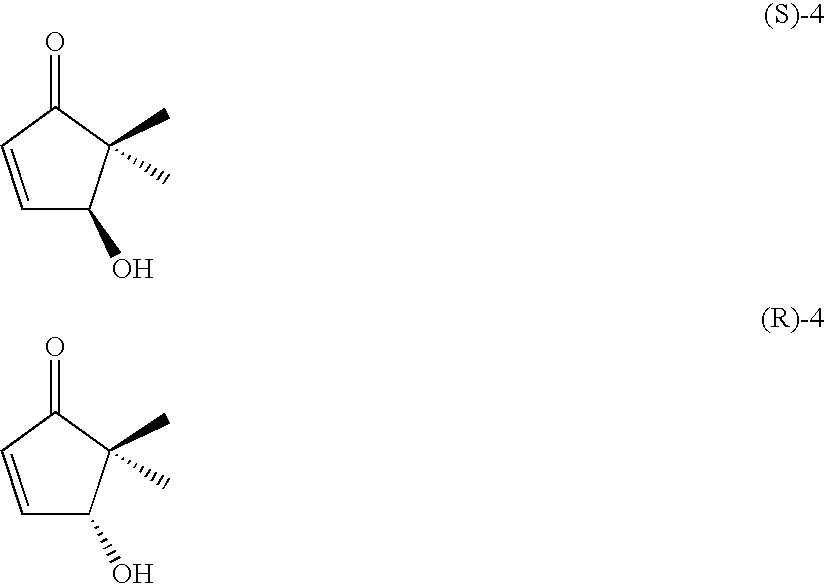


2c (CTM-81). 1H NMR (CDCl3, 400 MHz) δ 7.8 (1H, br.s, NH), 7.6-7.3 (4H, m, ArH), 4.4 (1H, m, CH—O), 3.7 (1H, m, CH—S), 2.9-2.75 (2H, m, CH2), 2.25-2.15 (5H, m, CH3, CH2), 0.85 (9H, s, t-but), −0.01, −0.02 (6H, s, 2xCH3); HRMS (CI, NH3): cacd. for [M+NH3]+ C19H33O3SSiN2: 397.19812; found: 397.19836.


2s (CTM-183). 1H NMR (CDCl3, 400 MHz) δ 5.28 (1H, d, J=6.36 Hz, NH), 4.45 (1H, m, CH), 4.35 (1H, m, CH—O), 3.35 (1H, m, CH—S), 3.10-2.95 (2H, m, CH2), 2.88-2.65 (1H, m, CH2), 2.18-2.1 (2H, m, CH2), 1.48, 1.45 (18H, s, 2xt-but), 0.88 (9H, s, t-but), 0.11, 0.085 (6H, s, 2xCH3), 13C (CDCl3; 100.6 MHz) δ 214.5, 170.05, 155.5, 83.1, 80.4, 75.07, 60.71, 54.08, 49.18, 46.35, 43.12, 34.88, 28.69, 28.36, 26.04, 21.36, 18.28, 14.55, −4.34, −4.42; HRMS (ES+): cacd for [M+Na]+ C23H43NO6SSiNa: 512.2468; found: 512.2478.


| Compound | ID50/μM | TD100/μM | ||
| CTM-50 | 10 | >500 | ||
| CTM-49 | 20 | >500 | ||
| CTM-36 | 4 | >500 | ||
| CTM-30 | 3 | 50 | ||
| CTC-109 | 3 | 500 | ||
| CTC-1 | 90 | >500 | ||
| CTC-8 | 0.5 | 100 | ||
| Compound | ID50/μM | TD100/μM | ||
| CTM-68 | 1 | 9.8 | ||
| CTM-78 | 3 | 18.6 | ||
| CTM-80 | 1 | 50 | ||
| CTM-81 | 1 | 50 | ||
| CTM-82 | 1 | 50 | ||
| CTM-83 | 3 | 50 | ||
| CTM-84 | 1 | 10 | ||
| CTM-85 | 3 | 50 | ||
| CTM-86 | 2 | 10 | ||
| CTM-87 | 4 | 50 | ||
| CTM-88 | 10 | 50 | ||
| CTM-106 | 4 | 50 | ||
| CTM-107 | 0.3 | 10 | ||
| CTM-108 | 4 | 50 | ||
| CTM-109 | 4 | 50 | ||
| CTM-110 | 1 | 50 | ||
| CTM-115 | 50 | >500 | ||
| CTM-131 | 10 | 50 | ||
| CTM-132 | 0.2 | 10 | ||
| CTM-145 | 0.8 | 50 | ||
| CTM-165 | 1 | 50 | ||
| CTM-169 | 1.5 | 50 | ||
| CTM-182 | 5 | 100 | ||
| CTM-183 | 1.6 | 50 | ||
| CTM-184 | 1 | 50 | ||
| CTM-191 | 4 | 50 | ||
| CTM-192 | 2 | 50 | ||
| CTM-193 | 3 | 50 | ||
- 1) Control: 1369±149
- 2) TNFα: 6111±1231
- 3) IL-1: 11814±1151
- 4) TPA: 7181±444
Clones were selected.
| HSF; AC200/μM | NF-κB; IC50/μM | ||
| CTM-68 | 98 | 17 | ||
| CTM-78 | 45 | 22 | ||
| HSF; AC200/μM | NF-κB; IC50/μM | ||
| CTM-80 | 60 | >100 | ||
| CTM-81 | 28 | 31 | ||
| CTM-82 | 35 | 54 | ||
| CTM-83 | 27 | 47 | ||
| CTM-84 | 28 | 28 | ||
| CTM-85 | 28 | 43 | ||
| CTM-86 | 20 | 36 | ||
| CTM-87 | 48 | 52 | ||
| CTM-88 | 60 | 65 | ||
| CTM-106 | 26 | >100 | ||
| CTM-107 | 21 | 47 | ||
| CTM-108 | 13 | >100 | ||
| CTM-109 | 29 | >100 | ||
| CTM-110 | 27 | >100 | ||
| CTM-131 | 70 | >100 | ||
| CTM-132 | 13 | 33 | ||
| CTM-165 | 26 | 50 | ||
| CTM-169 | 26 | 38 | ||
| CTM-182 | 60 | >100 | ||
| CTM-184 | 24 | 61 | ||
| CTM-191 | 18 | 25 | ||
| CTM-192 | 23 | 28 | ||
| CTM-193 | 26 | 32 | ||
| CTM-217 | 10 | 14 | ||
| CTM-218 | 15 | 22 | ||
| LC50/μM | ||
| CTM-68 | >800 | ||
| CTM-78 | >800 | ||
| CTM-80 | >800 | ||
| CTM-81 | 181 | ||
| CTM-82 | >800 | ||
| CTM-83 | >800 | ||
| CTM-84 | 556 | ||
| CTM-85 | 378 | ||
| CTM-86 | 96 | ||
| CTM-87 | 260 | ||
| CTM-88 | 477 | ||
| CTM-106 | 536 | ||
| CTM-107 | 169 | ||
| CTM-108 | >800 | ||
| CTM-109 | 267 | ||
| CTM-110 | >800 | ||
| CTM-115 | >800 | ||
| CTM-131 | >800 | ||
| CTM-132 | 220 | ||
| CTM-145 | >800 | ||
| CTM-165 | >800 | ||
| CTM-169 | >800 | ||
| LC50/μM | ||
| CTM-68 | 9.8 | ||
| CTM-78 | 18.6 | ||
| CTM-80 | 16 | ||
| CTM-81 | 17 | ||
| CTM-82 | 16 | ||
| CTM-83 | 27 | ||
| CTM-84 | 6.3 | ||
| CTM-85 | 10.6 | ||
| CTM-86 | 7 | ||
| CTM-87 | 38 | ||
| CTM-88 | 45 | ||
| CTM-106 | 28 | ||
| CTM-108 | 29 | ||
| CTM-109 | 33 | ||
| CTM-110 | 18 | ||
| CTM-115 | 228 | ||
| CTM-131 | 125 | ||
| CTM-132 | 2.6 | ||
| CTM-145 | 14 | ||
| CTM-165 | 21 | ||
| CTM-169 | 22 | ||
| CTM-182 | 54 | ||
| CTM-183 | 28 | ||
| CTM-184 | 25 | ||
| CTM-191 | 24 | ||
| CTM-192 | 22 | ||
| CTM-193 | 23 | ||

- 1. Feige U, Morimoto R, Yahara I, Polia B S. Stress-inducible Cellular Responses. Birkhaüser Verlag, Basel Boston Berlin, 1996.
- 2. Marber M S, Walker J M, Latchman D S, ‘Yellon D M. J. Clin. Invest. 93, 1087-1094, 1994.
- 3. Feinstein D L e al. J. Biol. Chem. 271, 17724-17732, 1996.
- 4. Amici C, Giorgi C, Rossi A, Santoro M G. J. Virol 68, 6890-6897, 1994.
- 5. Santoro M G, in Stress-inducible Cellular Responses. (Fiege U et al. eds, Birkhaüser Verlag, Basel Boston Berlin) pp. 337-357, 1996.
- 6. Santoro M G, Garaci 9, Amici C. P.N.A.S. USA 86, 8407-8411, 1989.
- 7. Amici C, Sistonen L, Santoro M G, Morimoto R I. P.N.A.S. USA 89, 6227-6231, 1992.
- 8. Santoro M G, Benedetto A. Carruba G, Garaci E, Jaffe B. Science 209, 1032-1034, 1980.
- 9. Santoro M G, Trends Microbiol. 5, 276-281, 1997.
- 10. Rozera C, Carattoli A, De Marco A, Amici C, Giorgi C, Santoro M G J. Clin. Invest. 97; 1795-1803, 1996.
- 11. Rossi A, Elia G, Santoro M G. P.N.A.S. USA 94,746-750, 1997.
- 12. Thanos D,
Maniatis T. Cell 80, 529-532, 1995. - 13. Rossi A, Elia G, Santoro M G. J. Biol. Chem. 271, 32192-32196, 1996.
- 14. Shield M J. Pharmacol. Ther. 65, 125-137, 1995.
- 15. Sinclair S B et al. J. Clin. Invest. 84, 1063-1067, 1989.
- 16. Baeuerle P A and Henkel T (1994). Function and Activation of NF-Kappa B in the Immune System. Annual Reviews of Immunology 12:141-179.
- 17. Colville-Nash P R et al. (1998). Inhibition of Inducible Nitric Oxide Synthase by Peroxisome Proliferator-Activated Receptor Agonists: Correlation with Induction of
Heme Oxygenase 1. Journal of Immunology 161, 978-984. - 18. K. J. Stone, R. D. Little, J O C, 1984, 49, 1849-1853.
- 19. A. Kawamoto, H. Kosugi, H. Uda, Chem. Lett., 1972, 807-810.
- 20. Moriguchi I, Hirono S, Liu Q, Nakagome Y, and Matsushita Y, (1992) Simple method of calculating octanol/water partition coefficient. Chem. Pharm. Bull. 40, 127-130.
- 21. Lipinski C, Lombardo F, Dominy B, Feeney P, (1997) Experimental and computational approaches to estimate solubility and permeability in drug discovery and development settings. Advanced Drug Delivery Reviews 23 (1997) 3-25.
- 22. Kondo, M.; Oya-Ito, T.; Kumagai, T.; Osawa, T.; Uchida, K. J. Biolog. Chem. 2001, 296, 12076-12083.
- 23. Silverman, R. B., In The Organic Chemistry of Drug Design and Drug Action; Academic Press; A Harcourt Science and Technology Company: San Diego, 1992, 336-338.
- 24. R. J. Flanagan, Chemistry in Britain, 2002, 28.
- 25. Meister, A., Anderson, M., E., Ann. Rev. Biochem. 1983, 52, 711-760.
Claims (19)


Applications Claiming Priority (7)
| Application Number | Priority Date | Filing Date | Title |
|---|---|---|---|
| GB0207232.0 | 2002-03-27 | ||
| GBGB0207232.0 | 2002-03-27 | ||
| GB0207232A GB0207232D0 (en) | 2002-03-27 | 2002-03-27 | Improvements in pharmaceutical compositions |
| PCT/GB2002/005709 WO2003051893A2 (en) | 2001-12-14 | 2002-12-16 | Improvements in pharmaceutical compositions |
| WOPCT/GB02/05708 | 2002-12-16 | ||
| WOPCT/GB02/05709 | 2002-12-16 | ||
| PCT/GB2002/005708 WO2003051807A2 (en) | 2001-12-14 | 2002-12-16 | Improvements in pharmaceutical compositions |
Publications (2)
| Publication Number | Publication Date |
|---|---|
| US20060252839A1 US20060252839A1 (en) | 2006-11-09 |
| US7759399B2 true US7759399B2 (en) | 2010-07-20 |
Family
ID=28678577
Family Applications (1)
| Application Number | Title | Priority Date | Filing Date |
|---|---|---|---|
| US10/957,242 Active 2026-08-23 US7759399B2 (en) | 2002-03-27 | 2004-09-27 | Pharmaceutical compositions |
Country Status (6)
| Country | Link |
|---|---|
| US (1) | US7759399B2 (en) |
| EP (1) | EP1487789A2 (en) |
| JP (1) | JP2005521726A (en) |
| AU (1) | AU2003224244A1 (en) |
| CA (1) | CA2480857A1 (en) |
| WO (1) | WO2003082813A2 (en) |
Families Citing this family (3)
| Publication number | Priority date | Publication date | Assignee | Title |
|---|---|---|---|---|
| RU2421213C1 (en) * | 2010-02-24 | 2011-06-20 | Новосибирский институт органической химии им. Н.Н. Ворожцова Сибирского отделения Российской академии наук (НИОХ СО РАН) | Application of 2-hydroxy-3-methyl-6-(1-methylethenyl)cyclohex-3-enone as analgesic |
| US9370488B2 (en) * | 2014-07-21 | 2016-06-21 | Kimia Zist Parsian | Method and system for synthesizing nanocarrier based long acting drug delivery system for insulin |
| CN116874362B (en) * | 2023-06-27 | 2024-08-16 | 东海实验室 | Cyclopentenone compounds, and preparation method and application thereof |
Citations (8)
| Publication number | Priority date | Publication date | Assignee | Title |
|---|---|---|---|---|
| CH531559A (en) * | 1970-08-21 | 1972-12-15 | Firmenich & Cie | Carbonyl mercapto cpds. - for use as odoriferous agents in perfumes and other cosmetic prepns. |
| US4241221A (en) * | 1972-07-24 | 1980-12-23 | American Cyanamid Company | Novel 11-deoxy-substituted prostaglandins of the E and F series |
| US4466980A (en) * | 1980-10-31 | 1984-08-21 | Teijin Limited | Thiaprostaglandin E1 derivatives, process for production thereof, and pharmaceutical use thereof |
| US4680288A (en) * | 1984-01-18 | 1987-07-14 | Merck Patent Gesellschaft Mit Beschrankter Haftung | Sulfur-containing 6-ketoprostaglandins |
| US5892099A (en) * | 1997-01-27 | 1999-04-06 | Ono Pharmaceutical Co., Ltd. | 3,7-dithiaprostanoic acid derivative |
| US6043275A (en) * | 1998-04-16 | 2000-03-28 | Ono Pharmaceutical Co., Ltd. | 3,7-dithiaprostanoic acid derivative |
| US6177592B1 (en) * | 1997-03-05 | 2001-01-23 | Takara Shuzo Co., Ltd. | Compounds |
| US6262293B1 (en) * | 1997-12-25 | 2001-07-17 | Ono Pharmaceutical Co., Ltd. | ω-Cycloalkly-prostaglandin e2 derivatives |
-
2003
- 2003-03-27 JP JP2003580281A patent/JP2005521726A/en active Pending
- 2003-03-27 WO PCT/GB2003/001379 patent/WO2003082813A2/en not_active Ceased
- 2003-03-27 CA CA002480857A patent/CA2480857A1/en not_active Abandoned
- 2003-03-27 AU AU2003224244A patent/AU2003224244A1/en not_active Abandoned
- 2003-03-27 EP EP03720667A patent/EP1487789A2/en not_active Withdrawn
-
2004
- 2004-09-27 US US10/957,242 patent/US7759399B2/en active Active
Patent Citations (8)
| Publication number | Priority date | Publication date | Assignee | Title |
|---|---|---|---|---|
| CH531559A (en) * | 1970-08-21 | 1972-12-15 | Firmenich & Cie | Carbonyl mercapto cpds. - for use as odoriferous agents in perfumes and other cosmetic prepns. |
| US4241221A (en) * | 1972-07-24 | 1980-12-23 | American Cyanamid Company | Novel 11-deoxy-substituted prostaglandins of the E and F series |
| US4466980A (en) * | 1980-10-31 | 1984-08-21 | Teijin Limited | Thiaprostaglandin E1 derivatives, process for production thereof, and pharmaceutical use thereof |
| US4680288A (en) * | 1984-01-18 | 1987-07-14 | Merck Patent Gesellschaft Mit Beschrankter Haftung | Sulfur-containing 6-ketoprostaglandins |
| US5892099A (en) * | 1997-01-27 | 1999-04-06 | Ono Pharmaceutical Co., Ltd. | 3,7-dithiaprostanoic acid derivative |
| US6177592B1 (en) * | 1997-03-05 | 2001-01-23 | Takara Shuzo Co., Ltd. | Compounds |
| US6262293B1 (en) * | 1997-12-25 | 2001-07-17 | Ono Pharmaceutical Co., Ltd. | ω-Cycloalkly-prostaglandin e2 derivatives |
| US6043275A (en) * | 1998-04-16 | 2000-03-28 | Ono Pharmaceutical Co., Ltd. | 3,7-dithiaprostanoic acid derivative |
Non-Patent Citations (10)
| Title |
|---|
| A new method for the determination of the enantiomeric purities of the resolved enones, Journal of Organic Chemistry (1991), 56(15), 4760-4766. * |
| Bogaards et al., Stereoselective Conjugation of Prostaglandin A2 and Prostaglandin J2 with Glutathione, Catalyzed by the Human Glutathione S-Transferases A1-1, A2-2, M1a-1a, and P1-1, Chemical Research in Toxicology (1997), 10(3), 310-317. * |
| Eschler et al., A new resolution procedure for the preparation of both (R)-(+)- and (S)-(-)-4-tert-butoxycyclopent-2-enone from racemic 4-tert-butoxycyclopent-2-enone and conversion of (R)-(+)-4-tert-butoxycyclopent-2-enone into (R)-(+)-4-acetoxycyclopent-2-enone. {The Title continues below: V}. * |
| Eschler et al., A new resolution procedure for the preparation of both (R)-(+)- and (S)-(−)-4-tert-butoxycyclopent-2-enone from racemic 4-tert-butoxycyclopent-2-enone and conversion of (R)-(+)-4-tert-butoxycyclopent-2-enone into (R)-(+)-4-acetoxycyclopent-2-enone. {The Title continues below: V}. * |
| Eschler, B. M. et al., Journal of Organic Chemistry, 56(15):4760-4766 (1991). |
| European Exam Report, Application No. 03720667.9, Mailed on Jan. 25, 2010. |
| Hall et al., Antitumor agents. 21. A proposed mechanism for inhibition of cancer growth by tenulin and helenalin and related cyclopentenones, Journal of Medicinal Chemistry (1977), 20(3), 333-337. * |
| Harusawa et al., [3,3]Sigmatropic ring expansion of cyclic thionocarbonates. IV. Relationship between ring size of cyclic thiocarbonates and geometry of created double bond in medium- and large-membered thiolcarbonates, Chemical and Pharmaceutical Bulletin, 1991, 39 (7), 1659-67. * |
| Hozien et al., Journal of Heterocyclic Chemistry, 2000, 37 (4), 943-949. * |
| Levin, A novel and efficient route to prostanoid intermediates, Tetrahedron Letters (1989), 30(1), 13-14. * |
Also Published As
| Publication number | Publication date |
|---|---|
| WO2003082813A3 (en) | 2004-01-22 |
| EP1487789A2 (en) | 2004-12-22 |
| CA2480857A1 (en) | 2003-10-09 |
| AU2003224244A1 (en) | 2003-10-13 |
| WO2003082813A2 (en) | 2003-10-09 |
| JP2005521726A (en) | 2005-07-21 |
| US20060252839A1 (en) | 2006-11-09 |
Similar Documents
| Publication | Publication Date | Title |
|---|---|---|
| US8236852B2 (en) | Compounds with (substituted phenyl)-propenal moiety, their derivatives, biological activity, and use thereof | |
| AU2007270951A1 (en) | Dioxo-alkanes and dioxo-alkenes | |
| JPH0764806B2 (en) | 16-Dehydro-Vitamin D ▲ Lower 3 ▼ Derivative | |
| US20030186941A1 (en) | Cyclopenteneone derivatives | |
| US20060252839A1 (en) | Pharmaceutical compositions | |
| WO2004013117A1 (en) | Bicyclic cylopentanone and cyclopentenone derivatives as potent activators of hsf | |
| US7183440B2 (en) | Pharmaceutically useful compounds | |
| CA2366877A1 (en) | Chemical compounds and their uses | |
| US20050124665A1 (en) | Pharmaceutical compositions | |
| US20050124696A1 (en) | Pharmaceutical compositions | |
| US8367735B2 (en) | Pharmaceutical compositions | |
| US7304186B2 (en) | Synthetic method and novel chemical compounds | |
| JPH1143460A (en) | Phenyl-substituted hydroxycyclopentenone analogs |
Legal Events
| Date | Code | Title | Description |
|---|---|---|---|
| AS | Assignment |
Owner name: CHARTERHOUSE THERAPEUTICS LTD., UNITED KINGDOM Free format text: ASSIGNMENT OF ASSIGNORS INTEREST;ASSIGNORS:ROBERTS, STANLEY MICHAEL;ROSS, NICOLETTE CHRISTA;JADHAV, VASUDEV;AND OTHERS;REEL/FRAME:016823/0975;SIGNING DATES FROM 20050519 TO 20050725 Owner name: CHARTERHOUSE THERAPEUTICS LTD., UNITED KINGDOM Free format text: ASSIGNMENT OF ASSIGNORS INTEREST;ASSIGNORS:ROBERTS, STANLEY MICHAEL;ROSS, NICOLETTE CHRISTA;JADHAV, VASUDEV;AND OTHERS;SIGNING DATES FROM 20050519 TO 20050725;REEL/FRAME:016823/0975 |
|
| AS | Assignment |
Owner name: ROSANTO PHARMACEUTICALS LTD., UNITED KINGDOM Free format text: CHANGE OF NAME;ASSIGNOR:CHARTERHOUSE THERAPEUTICS LTD.;REEL/FRAME:021672/0718 Effective date: 20051007 Owner name: ROSANTO PHARMACEUTICALS LTD., UNITED KINGDOM Free format text: CHANGE OF NAME;ASSIGNOR:CHARTERHOUSE THERAPEUTICS LTD.;REEL/FRAME:021673/0517 Effective date: 20051007 |
|
| AS | Assignment |
Owner name: FORTRESS CREDIT CO LLC, NEW YORK Free format text: ASSIGNMENT OF ASSIGNORS INTEREST;ASSIGNOR:YORK PHARMA PLC (PARENT COMPANY OF ROSANTO PHARMACEUTICALS LTD.);REEL/FRAME:021752/0663 Effective date: 20080930 |
|
| AS | Assignment |
Owner name: ULURU INC., TEXAS Free format text: PATENT COLLATERAL ASSIGNMENT AND SECURITY AGREEMENT;ASSIGNOR:YORK PHARMA PLC;REEL/FRAME:022494/0457 Effective date: 20090331 |
|
| AS | Assignment |
Owner name: RH ACQUISITIONS LIMITED, UNITED KINGDOM Free format text: ASSIGNMENT OF ASSIGNORS INTEREST;ASSIGNORS:YORK PHARMA (R&D) LIMITED;ROSANTO PHARMACEUTICALS LIMITED;REEL/FRAME:023694/0945 Effective date: 20090728 Owner name: CRAWFORD HEALTHCARE HOLDINGS LIMITED, UNITED KINGD Free format text: CHANGE OF NAME;ASSIGNOR:RH ACQUISITIONS LIMITED;REEL/FRAME:023701/0306 Effective date: 20090820 |
|
| STCF | Information on status: patent grant |
Free format text: PATENTED CASE |
|
| AS | Assignment |
Owner name: BIOGEM S.C.A.R.L., ITALY Free format text: ASSIGNMENT OF ASSIGNORS INTEREST;ASSIGNOR:CRAWFORD HEALTHCARE HOLDINGS LIMITED;REEL/FRAME:030430/0867 Effective date: 20130327 |
|
| FEPP | Fee payment procedure |
Free format text: PAYOR NUMBER ASSIGNED (ORIGINAL EVENT CODE: ASPN); ENTITY STATUS OF PATENT OWNER: SMALL ENTITY |
|
| FPAY | Fee payment |
Year of fee payment: 4 |
|
| MAFP | Maintenance fee payment |
Free format text: PAYMENT OF MAINTENANCE FEE, 8TH YR, SMALL ENTITY (ORIGINAL EVENT CODE: M2552) Year of fee payment: 8 |
|
| FEPP | Fee payment procedure |
Free format text: MAINTENANCE FEE REMINDER MAILED (ORIGINAL EVENT CODE: REM.); ENTITY STATUS OF PATENT OWNER: SMALL ENTITY |
|
| FEPP | Fee payment procedure |
Free format text: 11.5 YR SURCHARGE- LATE PMT W/IN 6 MO, SMALL ENTITY (ORIGINAL EVENT CODE: M2556); ENTITY STATUS OF PATENT OWNER: SMALL ENTITY |
|
| MAFP | Maintenance fee payment |
Free format text: PAYMENT OF MAINTENANCE FEE, 12TH YR, SMALL ENTITY (ORIGINAL EVENT CODE: M2553); ENTITY STATUS OF PATENT OWNER: SMALL ENTITY Year of fee payment: 12 |