US7740357B2 - Deformable mirror device and apparatus for observing retina of eye using the same - Google Patents
Deformable mirror device and apparatus for observing retina of eye using the same Download PDFInfo
- Publication number
- US7740357B2 US7740357B2 US12/188,018 US18801808A US7740357B2 US 7740357 B2 US7740357 B2 US 7740357B2 US 18801808 A US18801808 A US 18801808A US 7740357 B2 US7740357 B2 US 7740357B2
- Authority
- US
- United States
- Prior art keywords
- retina
- support member
- film
- face
- deformable
- Prior art date
- Legal status (The legal status is an assumption and is not a legal conclusion. Google has not performed a legal analysis and makes no representation as to the accuracy of the status listed.)
- Expired - Fee Related, expires
Links
Images


Classifications
-
- A—HUMAN NECESSITIES
- A61—MEDICAL OR VETERINARY SCIENCE; HYGIENE
- A61B—DIAGNOSIS; SURGERY; IDENTIFICATION
- A61B3/00—Apparatus for testing the eyes; Instruments for examining the eyes
- A61B3/10—Objective types, i.e. instruments for examining the eyes independent of the patients' perceptions or reactions
- A61B3/12—Objective types, i.e. instruments for examining the eyes independent of the patients' perceptions or reactions for looking at the eye fundus, e.g. ophthalmoscopes
-
- G—PHYSICS
- G02—OPTICS
- G02B—OPTICAL ELEMENTS, SYSTEMS OR APPARATUS
- G02B26/00—Optical devices or arrangements for the control of light using movable or deformable optical elements
- G02B26/06—Optical devices or arrangements for the control of light using movable or deformable optical elements for controlling the phase of light
Definitions
- the present invention relates to a deformable mirror device having a surface shape deformable by electrostatic force, and an apparatus for observing retina of an eye using such a deformable mirror device.
- the apparatus for observing retina of an eye is an apparatus which irradiates retina of an eye to be examined with illumination light and receives and detects its image through an retina image forming optical system by using an image pickup device (for example, a CCD camera).
- an image pickup device for example, a CCD camera.
- the detection accuracy and resolution are as high as possible. Since an eyeball is not an ideal lens having no aberration, however, the eyeball has a wavefront aberration which becomes a factor of lowering the detection precision and resolution.
- a deformable mirror device which can vary its surface shape on the basis of information supplied from a controller is provided between the image pickup device which detects the image of the retina and the retina of the eye to be examined.
- the image of the retina of the eye to be examined reflected by the deformable mirror device is led to a wavefront sensor (for example, the Shack Hartmann sensor) to detect wavefront aberration.
- a control device applies voltages to electrodes of the deformable mirror device so as to reduce or eliminate the wavefront aberration on the basis of the detected wavefront aberration and causes an electrostatic force to act upon the deformable mirror to deform it. Owing to this deformation, an image having no wavefront aberration is obtained by the image pickup device.
- Deformable mirror devices having a shape deformable by electrostatic sucking force is known (see, for example, FIG. 2 in JP-A-02-101402 (KOKAI)).
- the deformable mirror device shown in FIG. 2 in JP-A-02-101402 (KOKAI) has a structure consisting of a fixed electrode film 12 formed on an insulative substrate 11, a spacer part 18 having an opening in the center disposed on the fixed electrode film 12, a reflection film 17, a movable electrode film 16 and a SiO 2 insulation film 14 stacked on the spacer part 18 so as to cover the opening, and a silicon substrate 13 having an opening in the center disposed on the stacked film.
- the stacked film consisting of the reflection film 17, the movable electrode film 16 and the SiO 2 insulation film 14 makes up a membrane part having its peripheral part fixed by the spacer part 18 and the silicon substrate 13, whose central part is deformed by electrostatic force between the fixed electrode 12 and the movable electrode film 16.
- the deformable mirror device having the shape deformable by electrostatic sucking force has a structure in which the fixed electrode and the membrane part face each other via the spacer part.
- the distance between the fixed electrode and the membrane part becomes smaller, the electrostatic sucking force becomes larger. If it is desired to drive the deformable mirror device by a low applied voltage, therefore, the distance must be very small.
- the present invention has been made in view of the above state, and an object thereof is to provide a low cost deformable mirror device of an electrostatic drive type capable of improving the dynamic characteristics while maintaining a low driving voltage and an apparatus for observing retina of eye using the same.
- a deformable mirror device includes: a substrate; a plurality of electrodes provided on the substrate; a spacer disposed on the substrate; a support member disposed above the spacer and having an opening passing through from a first face of the support member facing to the substrate to a second face of the support member opposite from the first face; a deformable electrode film formed below the first face of the support member so as to be opposed to the electrodes with a distance and so as to cover the opening; an insulation film provided between the deformable electrode film and the support member; a reflection film provided on a face of the deformable electrode film opposite from the electrodes so as to overlap the opening; and a plurality of through holes passing through the reflection film and the deformable electrode film and disposed so as to overlap the opening.
- An apparatus for observing retina of an eye includes: a retina illumination system configured to illuminate retina of an eye to be examined with illumination light to observe the retina; a compensation optical part configured to include the deformable mirror device according to the first aspect, and correct a reflected image obtained from the retina by the illumination light of the retina illumination system by changing a shape of the deformable mirror device responding to a given correction quantity; a retina image forming optical system configured to receive the retina image corrected by the compensation optical part and form a retina image; and a retina image light receiving part configured to receive the retina image formed by the retina image forming optical system.
- FIG. 1 is a sectional view of a deformable mirror device according to a first embodiment of the present invention
- FIG. 2 is an oblique view showing a membrane part according to the first embodiment
- FIGS. 3A to 3E are sectional views showing a manufacturing method of the deformable mirror device according to the first embodiment
- FIGS. 4A to 4C are sectional views showing a manufacturing method of the deformable mirror device according to the first embodiment
- FIG. 5 is a diagram showing a damping coefficient and a rigidity coefficient each as a function of a diameter of a through hole
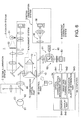
- FIG. 6 is a block diagram showing an apparatus for observing retina of an eye according to a second embodiment of the present invention.
- FIG. 1 A deformable mirror device according to a first embodiment of the present invention is shown in FIG. 1 .
- a deformable mirror device 10 according to the present embodiment, a plurality of electrodes 12 1 to 12 n and 12 g are formed on a multi-layered ceramics substrate 11 .
- a drive part 15 is provided on a spacer 13 using, for example, silica balls disposed on the electrodes 12 g .
- the electrodes 12 g and the drive part 15 are bonded to each other with the spacer 13 interposed therebetween using a conductive adhesive 14 .
- a support member 16 which has an opening 26 in the center, substantially constituted by, for example, single crystal silicon and an insulation film substantially constituted by, for example, SiO 2 is provided on a face of the support member 16 opposed to the ceramics substrate 11 .
- an electrode film 18 substantially constituted by single crystal silicon doped with impurities is provided on the face of the insulation film 17 opposed to the ceramics substrate 11 , covering the opening 16 of the support member 16 and facing to the electrodes 12 1 to 12 n .
- the electrode film 18 is supported by the support member 16 via the insulation film 17 .
- a reflection film 19 (reflection part) is provided in a region in the surface of the electrode film 18 facing to the electrodes 12 1 to 12 n where the electrode film 18 and the opening of the support member 16 overlaps.
- the electrode film 18 and the reflection film 19 constitute a deformable membrane part 20 .
- the distance (gap) between surfaces of the electrodes 12 1 to 12 n and 12 g and the bottom face of the drive part 15 is adjusted by the spacer 13 and the electrodes 12 g .
- the electrodes 12 g serve as grounding electrodes.
- a structure in which the spacer 13 for adjusting the gap and the electrodes 12 g for grounding the drive part 15 are provided in different positions may be used.
- Voltages V 1 to V n generated by a voltage generation part 28 are applied to the electrodes 12 1 to 12 n , respectively.
- electrostatic sucking force acts upon the membrane part 20 and deforms it.
- the deformed membrane part is denoted by a symbol 20 a.
- At least three through holes 22 are provided in the membrane part 20 . As shown in FIG. 2 , these through holes 22 are disposed concentrically around the center of the membrane part 20 and equidistantly in a region other than an effective area 25 (a reference point range sensed by the Shack Hartmann wavefront sensor or the like) utilized for aberration correction. In the meantime, eight through holes 22 are provided in FIG. 2 .
- FIGS. 3A to 4C A manufacturing method of the deformable mirror device according to the present embodiment will now be described with reference to FIGS. 3A to 4C .
- a SOI (Silicon On Insulator) substrate 16 , 17 and 18 is prepared as shown in FIG. 3A .
- the SOI substrate is prepared as hereinafter described.
- a single crystal Si wafer is prepared, and a SiO 2 film is formed on the entire wafer (both the obverse and reverse) by using a thermal oxidation furnace or the like (the film thickness on the obverse is the same as that on the reverse).
- Another single crystal Si wafer is subsequently bonded to the first single crystal Si wafer by interposing one of the SiO 2 films therebetween. After the bonding, one of the bonded single crystal Si wafers is made thin by a polishing process until a desired thickness is attained.
- the single crystal Si layer 16 is coated by a photoresist, and exposure and development is conducted on the photoresist. As a result, a resist pattern 100 having an opening in the center is formed.
- an opening 26 is formed in the center of the single crystal Si layer 16 by dry etching using deep-RIE (Reactive Ion Etching) with the resist pattern 100 used as a mask (see FIG. 3C ).
- the etching process for the single crystal Si layer 16 uses the SiO 2 film (insulation film) 17 as the etching stop. In other words, the etching is finished when the SiO 2 film 17 is exposed.
- the resist pattern 100 is removed (see FIG. 3D ). Thereafter, the substrate is immersed in, for example, diluted fluoric acid or ammonium fluoride to remove the SiO 2 film 17 existing on the bottom of the opening 26 ( FIG. 3E ).
- a metal thin film 19 a substantially constetued by Al is formed by, for example, evaporation so as to cover at least the bottom of the opening 26 ( FIG. 4A ).
- a SiO 2 thin film 19 b is formed by, for example, evaporation as a protection film functioning as a measure against scratches and dirt ( FIG. 4B ).
- the metal thin film 19 a and the SiO 2 thin film 19 b are formed also on the side face of the opening 26 and the single crystal Si layer 16 .
- the metal thin film 19 a and the SiO 2 thin film 19 b constitute the reflection film 19 .
- the drive part 15 of the deformable mirror device is completed.
- the shape (planar shape) of the drive part 15 is, for example, a square.
- the reflection film 19 may be formed after the through holes 22 are provided by using the deep-RIE.
- the drive part 15 is bonded to the ceramics substrate 11 having the electrodes 12 1 to 12 n formed thereon, via the spacer 13 by using the adhesive 14 to complete the deformable mirror device.
- the viscosity coefficient C in the vibration system of the membrane part 20 can be reduced by employing a structure in which the through holes 22 are disposed in the membrane part 20 concentrically and equidistantly as in the present embodiment.
- Variation in the squeeze film damping coefficient and the squeeze film rigidity coefficient as a function of the diameter size of the through holes 22 are shown in FIG. 5 for a case where twelve through holes 22 are disposed concentrically around the center of the membrane part 20 and equidistantly in the region other than the effective area 25 (the reference point range sensed by the Shack Hartmann wavefront sensor or the like) utilized for aberration correction.
- the squeeze film damping coefficient and the squeeze film rigidity coefficient cause degradation in response.
- the squeeze film damping coefficient and the squeeze film rigidity coefficient become smaller as the diameter of the through holes 22 becomes larger. It is considered that fluid can go in and out not only through a gap between the membrane part 20 and the ceramics substrate 11 but also the through holes 22 formed in the membrane part 20 , which makes the squeeze film damping coefficient and the squeeze film rigidity coefficient smaller, and, as a result, improvement of the response of the membrane part 20 can be expected. Furthermore, since the electrostatic sucking force exerts across the primary gap between the surfaces of the electrodes 12 1 to 12 n and 12 g and the membrane part 20 , it is not necessary to increase the drive voltage. As recognized from FIG. 5 , the squeeze film damping coefficient and the squeeze film rigidity coefficient can be reduced if the diameter of the through holes 22 is at least 0.5 mm.
- the number of the through holes 22 is twelve. However, if the number of the through holes 22 is at least three, effects similar to those obtained in the case shown in FIG. 5 can be obtained.
- the through holes 22 are disposed concentrically around the center of the membrane part 20 and equidistantly in the region other than the effective range 25 (the reference point range sensed by the Shack Hartmann wavefront sensor or the like) utilized for aberration correction as heretofore described.
- the effective range 25 the reference point range sensed by the Shack Hartmann wavefront sensor or the like
- the apparatus for observing retina of an eye according to the present embodiment includes the deformable mirror device 10 according to the first embodiment.
- a system of the apparatus for observing retina of an eye according to the present embodiment is schematically shown in FIG. 6 .
- An apparatus for observing retina of an eye 1 according to the present embodiment includes a wavefront correction system 8 , a retina illumination system 2 , a retina observation system 3 , an alignment system 4 , a fixation system 5 and a compensation optical part 70 .
- the wavefront correction system 8 includes a wavefront measurement system 80 , a computer 84 and a control part 85 .
- the wavefront measurement system 80 includes a point image projection optical system 81 , a point image receiving optical system 82 and a point image receiving part 83 (CCD).
- the computer 84 includes an optical characteristics measurement part 841 , an image data forming part 842 , a compensation quantity determination part 843 , a memory 844 and a display part 845 .
- the retina illumination system 2 includes a second light source part, a condenser lens and a beam splitter.
- the retina illumination system 2 is provided to illuminate a predetermined region on retina of an eye to be examined with a second luminous flux emitted from the second light source part.
- the retina observation system 3 includes a retina image forming optical system 36 and a retina image receiving part 38 (CCD).
- the retina image forming optical system 36 includes, for example, an afocal lens 88 , the compensation optical part 70 , a condenser lens and a beam splitter.
- the retina image forming optical system 36 guides light reflected by a retina 61 to the retina image receiving portion 38 via the compensation optical part 70 .
- the compensation optical part 70 includes the deformable mirror device 10 which compensates aberration of measured light and a moving prism and a spherical lens which move in the optical axis direction and compensate a spherical component.
- the compensation optical part 70 is disposed between the point projection optical system 81 and the retina image forming optical system 36 , and the compensation optical portion 70 compensates, for example, aberration of the returning luminous flux reflected by the eye 60 to be examined.
- the alignment system 4 includes a condenser lens and an alignment light receiving portion, and guides returning luminous flux emitted from the light source part and reflected by cornea 62 of the eye 60 to be examined.
- the fixation system 5 includes an optical path which projects a fixation point for fixation or fogging of the eye 60 to be examined, a third light source part 51 , a fixation table 52 and relay lenses.
- the fixation table 52 can be projected to the retina 61 using luminous flux emitted from the third light source portion 51 , which makes the eye 60 to be examined observe an image of the fixation index 52 .
- the optical characteristics measurement part 841 determines optical characteristics including higher order aberration of the eye 60 to be examined on the basis of an output from the point light receiving part 83 .
- the image data forming part 842 simulates how the fixation index appears on the basis of optical characteristics and calculates simulation image data or examined eye data such as the MTF showing how the fixation appears.
- the memory 844 stores a plurality of voltage change templates for adjusting the deformable mirror 10 .
- the compensation quantity determination part 843 selects a voltage change template stored in the memory 844 , determines a correction quantity of the deformable mirror 10 on the basis of the selected voltage change template, and outputs the correction amount to the control part 85 .
- the control part 85 deforms the deformable mirror device 10 on the basis of an output from the compensation quantity determination portion 843 .
- the apparatus for observing retina of an eye has effects described hereinafter.
- Reflected light from the retina of the eye 60 to be examined contains aberration because the eye optical system is not ideal, and a clear retina image is not obtained.
- cylinder components Zernike (2, ⁇ 2) components
- a distinct retina image with sufficient aberration correction can not be obtained due to a restriction that the refraction degree intervals of the cylinder lens (for example, 3 D (diopter) intervals) is constant.
- the optical distortion can be corrected by using the deformable mirror device 10 .
- the deformable mirror device 10 is driven with a high drive voltage, a large aberration quantity capable of covering the refraction degree interval of the cylinder lens can be corrected. Furthermore, a complicated aberration can be corrected by increasing the number of electrodes under the membrane part.
Landscapes
- Health & Medical Sciences (AREA)
- Physics & Mathematics (AREA)
- Life Sciences & Earth Sciences (AREA)
- Medical Informatics (AREA)
- Surgery (AREA)
- Biophysics (AREA)
- Ophthalmology & Optometry (AREA)
- Engineering & Computer Science (AREA)
- Biomedical Technology (AREA)
- Heart & Thoracic Surgery (AREA)
- General Physics & Mathematics (AREA)
- Molecular Biology (AREA)
- Optics & Photonics (AREA)
- Animal Behavior & Ethology (AREA)
- General Health & Medical Sciences (AREA)
- Public Health (AREA)
- Veterinary Medicine (AREA)
- Eye Examination Apparatus (AREA)
- Mechanical Light Control Or Optical Switches (AREA)
- Micromachines (AREA)
Abstract
Description
Claims (8)
Applications Claiming Priority (2)
| Application Number | Priority Date | Filing Date | Title |
|---|---|---|---|
| JP2007-206650 | 2007-08-08 | ||
| JP2007206650A JP2009042456A (en) | 2007-08-08 | 2007-08-08 | Shape variable mirror device and eyegrounds observing device using shape variable device |
Publications (2)
| Publication Number | Publication Date |
|---|---|
| US20090051874A1 US20090051874A1 (en) | 2009-02-26 |
| US7740357B2 true US7740357B2 (en) | 2010-06-22 |
Family
ID=40381799
Family Applications (1)
| Application Number | Title | Priority Date | Filing Date |
|---|---|---|---|
| US12/188,018 Expired - Fee Related US7740357B2 (en) | 2007-08-08 | 2008-08-07 | Deformable mirror device and apparatus for observing retina of eye using the same |
Country Status (2)
| Country | Link |
|---|---|
| US (1) | US7740357B2 (en) |
| JP (1) | JP2009042456A (en) |
Families Citing this family (2)
| Publication number | Priority date | Publication date | Assignee | Title |
|---|---|---|---|---|
| US8708506B1 (en) * | 2010-03-26 | 2014-04-29 | Ball Aerospace & Technologies Corp. | Frozen surface technology |
| WO2019009402A1 (en) | 2017-07-06 | 2019-01-10 | 浜松ホトニクス株式会社 | Optical device |
Citations (4)
| Publication number | Priority date | Publication date | Assignee | Title |
|---|---|---|---|---|
| JPH02101402A (en) | 1988-10-11 | 1990-04-13 | Omron Tateisi Electron Co | Reflecting mirror device |
| US20080180634A1 (en) * | 2006-12-18 | 2008-07-31 | Kabushiki Kaisha Topcon | Deformable mirror device and apparatus for observing retina of eye |
| US20080204661A1 (en) * | 2006-12-14 | 2008-08-28 | Kabushiki Kaisha Toshiba | Deformable mirror device and apparatus for observing retina of eye |
| US20080239528A1 (en) * | 2007-03-27 | 2008-10-02 | Kabushiki Kaisha Toshiba | Deformable mirror apparatus |
Family Cites Families (4)
| Publication number | Priority date | Publication date | Assignee | Title |
|---|---|---|---|---|
| JP3821542B2 (en) * | 1997-06-26 | 2006-09-13 | シャープ株式会社 | Actuator, deformable mirror assembling method, assembling apparatus, and optical apparatus |
| EP1365270B1 (en) * | 2001-01-30 | 2012-01-18 | Panasonic Corporation | Variable mirror and information apparatus comprising variable mirror |
| JP4347654B2 (en) * | 2002-10-16 | 2009-10-21 | オリンパス株式会社 | Variable shape reflector and method of manufacturing the same |
| JP2007021044A (en) * | 2005-07-20 | 2007-02-01 | Topcon Corp | Deformable mirror deformation method, optical device, and fundus oculi observation device |
-
2007
- 2007-08-08 JP JP2007206650A patent/JP2009042456A/en active Pending
-
2008
- 2008-08-07 US US12/188,018 patent/US7740357B2/en not_active Expired - Fee Related
Patent Citations (4)
| Publication number | Priority date | Publication date | Assignee | Title |
|---|---|---|---|---|
| JPH02101402A (en) | 1988-10-11 | 1990-04-13 | Omron Tateisi Electron Co | Reflecting mirror device |
| US20080204661A1 (en) * | 2006-12-14 | 2008-08-28 | Kabushiki Kaisha Toshiba | Deformable mirror device and apparatus for observing retina of eye |
| US20080180634A1 (en) * | 2006-12-18 | 2008-07-31 | Kabushiki Kaisha Topcon | Deformable mirror device and apparatus for observing retina of eye |
| US20080239528A1 (en) * | 2007-03-27 | 2008-10-02 | Kabushiki Kaisha Toshiba | Deformable mirror apparatus |
Non-Patent Citations (1)
| Title |
|---|
| Masunishi, "Deformable Mirror Device and Apparatus for Observing Retina of Eye Using the Same", U.S. Appl. No. 12/186,142, filed Aug. 5, 2008. |
Also Published As
| Publication number | Publication date |
|---|---|
| US20090051874A1 (en) | 2009-02-26 |
| JP2009042456A (en) | 2009-02-26 |
Similar Documents
| Publication | Publication Date | Title |
|---|---|---|
| US7744220B2 (en) | Deformable mirror device and apparatus for observing retina of eye using the same | |
| US7604353B2 (en) | Deformable mirror device and apparatus for observing retina of eye | |
| US7986396B2 (en) | Exposure apparatus | |
| KR101121029B1 (en) | Projection optical system, exposure apparatus and method of manufacturing a device | |
| KR102234255B1 (en) | Exposure apparatus, and method of manufacturing article | |
| US8755030B2 (en) | Lithographic apparatus and device manufacturing method | |
| US7675695B2 (en) | Optical element holding apparatus | |
| JP2007021044A (en) | Deformable mirror deformation method, optical device, and fundus oculi observation device | |
| US7740357B2 (en) | Deformable mirror device and apparatus for observing retina of eye using the same | |
| US20060082775A1 (en) | Mark position detecting apparatus | |
| US20090109513A1 (en) | Head mounted display having electrowetting optical reflecting surface | |
| US20080204661A1 (en) | Deformable mirror device and apparatus for observing retina of eye | |
| US7682030B2 (en) | Deformable mirror apparatus | |
| WO2018008366A1 (en) | Holding device, projection optical system, exposure device, and method for manufacturing article | |
| KR101445426B1 (en) | Exposure apparatus and device manufacturing method | |
| KR20090129348A (en) | Deformation mechanism, exposure apparatus and device manufacturing method | |
| TWI911300B (en) | Method and device for measuring actuators in a projection exposure apparatus for semiconductor lithography | |
| US7345808B2 (en) | Deformable mirror and device for observing retina of eye | |
| JPS6235620A (en) | Optical magnifying power correcting device | |
| JP2002340520A (en) | Position measuring device and adjustment method thereof | |
| JP2007025504A (en) | Deformation method of deformable mirror, aberration compensation method for optical apparatus, and aberration compensation method for fundus observation apparatus | |
| JP4661333B2 (en) | Imaging optical system evaluation method and position detection apparatus | |
| JP4835091B2 (en) | Position detection device | |
| EP2189768A1 (en) | Mirror Structure | |
| JP2004198192A (en) | Instrument and method for measuring eccentricity of optical system |
Legal Events
| Date | Code | Title | Description |
|---|---|---|---|
| AS | Assignment |
Owner name: KABUSHIKI KAISHA TOSHIBA, JAPAN Free format text: ASSIGNMENT OF ASSIGNORS INTEREST;ASSIGNORS:MASUNISHI, KEI;KOGA, AKIHIRO;FURUKAWA, RYO;AND OTHERS;REEL/FRAME:021765/0351;SIGNING DATES FROM 20080827 TO 20080917 Owner name: KABUSHIKI KAISHA TOPCON, JAPAN Free format text: ASSIGNMENT OF ASSIGNORS INTEREST;ASSIGNORS:MASUNISHI, KEI;KOGA, AKIHIRO;FURUKAWA, RYO;AND OTHERS;REEL/FRAME:021765/0351;SIGNING DATES FROM 20080827 TO 20080917 Owner name: KABUSHIKI KAISHA TOSHIBA,JAPAN Free format text: ASSIGNMENT OF ASSIGNORS INTEREST;ASSIGNORS:MASUNISHI, KEI;KOGA, AKIHIRO;FURUKAWA, RYO;AND OTHERS;SIGNING DATES FROM 20080827 TO 20080917;REEL/FRAME:021765/0351 Owner name: KABUSHIKI KAISHA TOPCON,JAPAN Free format text: ASSIGNMENT OF ASSIGNORS INTEREST;ASSIGNORS:MASUNISHI, KEI;KOGA, AKIHIRO;FURUKAWA, RYO;AND OTHERS;SIGNING DATES FROM 20080827 TO 20080917;REEL/FRAME:021765/0351 |
|
| FEPP | Fee payment procedure |
Free format text: PAYOR NUMBER ASSIGNED (ORIGINAL EVENT CODE: ASPN); ENTITY STATUS OF PATENT OWNER: LARGE ENTITY |
|
| REMI | Maintenance fee reminder mailed | ||
| LAPS | Lapse for failure to pay maintenance fees | ||
| STCH | Information on status: patent discontinuation |
Free format text: PATENT EXPIRED DUE TO NONPAYMENT OF MAINTENANCE FEES UNDER 37 CFR 1.362 |
|
| STCH | Information on status: patent discontinuation |
Free format text: PATENT EXPIRED DUE TO NONPAYMENT OF MAINTENANCE FEES UNDER 37 CFR 1.362 |
|
| FP | Lapsed due to failure to pay maintenance fee |
Effective date: 20140622 |