US7722783B2 - Optically isotropic liquid crystal medium and optical device - Google Patents
Optically isotropic liquid crystal medium and optical device Download PDFInfo
- Publication number
- US7722783B2 US7722783B2 US12/274,018 US27401808A US7722783B2 US 7722783 B2 US7722783 B2 US 7722783B2 US 27401808 A US27401808 A US 27401808A US 7722783 B2 US7722783 B2 US 7722783B2
- Authority
- US
- United States
- Prior art keywords
- liquid crystal
- replaced
- independently
- hydrogen atom
- crystal composition
- Prior art date
- Legal status (The legal status is an assumption and is not a legal conclusion. Google has not performed a legal analysis and makes no representation as to the accuracy of the status listed.)
- Expired - Fee Related
Links
- 239000004973 liquid crystal related substance Substances 0.000 title claims abstract description 486
- 230000003287 optical effect Effects 0.000 title claims abstract description 98
- 150000001875 compounds Chemical class 0.000 claims abstract description 362
- 239000002019 doping agent Substances 0.000 claims abstract description 40
- 230000001747 exhibiting effect Effects 0.000 claims abstract description 13
- 239000000203 mixture Substances 0.000 claims description 260
- 239000012071 phase Substances 0.000 claims description 237
- 125000004435 hydrogen atom Chemical group [H]* 0.000 claims description 116
- -1 —OCHF2 Chemical group 0.000 claims description 103
- 229910052731 fluorine Inorganic materials 0.000 claims description 77
- 125000001153 fluoro group Chemical group F* 0.000 claims description 77
- 229920000642 polymer Polymers 0.000 claims description 66
- 239000002131 composite material Substances 0.000 claims description 51
- 125000005843 halogen group Chemical group 0.000 claims description 48
- 239000000758 substrate Substances 0.000 claims description 43
- 239000000178 monomer Substances 0.000 claims description 37
- 229910052801 chlorine Inorganic materials 0.000 claims description 36
- 125000001309 chloro group Chemical group Cl* 0.000 claims description 32
- 125000004093 cyano group Chemical group *C#N 0.000 claims description 31
- 125000000217 alkyl group Chemical group 0.000 claims description 28
- 125000003342 alkenyl group Chemical group 0.000 claims description 27
- 230000005684 electric field Effects 0.000 claims description 27
- 125000002023 trifluoromethyl group Chemical group FC(F)(F)* 0.000 claims description 23
- 125000004955 1,4-cyclohexylene group Chemical group [H]C1([H])C([H])([H])C([H])([*:1])C([H])([H])C([H])([H])C1([H])[*:2] 0.000 claims description 20
- 125000000876 trifluoromethoxy group Chemical group FC(F)(F)O* 0.000 claims description 20
- 125000000008 (C1-C10) alkyl group Chemical group 0.000 claims description 19
- 125000003837 (C1-C20) alkyl group Chemical group 0.000 claims description 19
- 125000006374 C2-C10 alkenyl group Chemical group 0.000 claims description 16
- 125000000304 alkynyl group Chemical group 0.000 claims description 12
- 125000003118 aryl group Chemical group 0.000 claims description 10
- 125000005675 difluoroethenyl group Chemical group [H]C(*)=C(F)F 0.000 claims description 10
- 125000006273 (C1-C3) alkyl group Chemical group 0.000 claims description 9
- 239000003086 colorant Substances 0.000 claims description 9
- 125000001140 1,4-phenylene group Chemical group [H]C1=C([H])C([*:2])=C([H])C([H])=C1[*:1] 0.000 claims description 7
- 125000003545 alkoxy group Chemical group 0.000 claims description 7
- 125000002947 alkylene group Chemical group 0.000 claims description 7
- 125000006583 (C1-C3) haloalkyl group Chemical group 0.000 claims description 6
- 125000005453 2,5-difluoro-1,4-phenylene group Chemical group [H]C1=C([*:1])C(F)=C([H])C([*:2])=C1F 0.000 claims description 6
- 239000011159 matrix material Substances 0.000 claims description 5
- 230000000379 polymerizing effect Effects 0.000 claims description 5
- 239000002250 absorbent Substances 0.000 claims description 4
- 230000002745 absorbent Effects 0.000 claims description 4
- 239000003963 antioxidant agent Substances 0.000 claims description 4
- 230000003078 antioxidant effect Effects 0.000 claims description 4
- 125000006340 pentafluoro ethyl group Chemical group FC(F)(F)C(F)(F)* 0.000 claims description 4
- 125000001997 phenyl group Chemical group [H]C1=C([H])C([H])=C(*)C([H])=C1[H] 0.000 claims description 4
- 239000010409 thin film Substances 0.000 claims description 4
- 125000006274 (C1-C3)alkoxy group Chemical group 0.000 claims description 3
- YTPLMLYBLZKORZ-UHFFFAOYSA-N Thiophene Chemical group C=1C=CSC=1 YTPLMLYBLZKORZ-UHFFFAOYSA-N 0.000 claims description 3
- 125000003302 alkenyloxy group Chemical group 0.000 claims description 3
- 125000000596 cyclohexenyl group Chemical group C1(=CCCCC1)* 0.000 claims description 3
- 125000000113 cyclohexyl group Chemical group [H]C1([H])C([H])([H])C([H])([H])C([H])(*)C([H])([H])C1([H])[H] 0.000 claims description 3
- NLUNLVTVUDIHFE-UHFFFAOYSA-N cyclooctylcyclooctane Chemical group C1CCCCCCC1C1CCCCCCC1 NLUNLVTVUDIHFE-UHFFFAOYSA-N 0.000 claims description 3
- 125000001624 naphthyl group Chemical group 0.000 claims description 3
- CXWXQJXEFPUFDZ-UHFFFAOYSA-N tetralin Chemical group C1=CC=C2CCCCC2=C1 CXWXQJXEFPUFDZ-UHFFFAOYSA-N 0.000 claims description 3
- 125000005108 alkenylthio group Chemical group 0.000 claims description 2
- 125000004414 alkyl thio group Chemical group 0.000 claims description 2
- 125000003386 piperidinyl group Chemical group 0.000 claims description 2
- 125000000068 chlorophenyl group Chemical group 0.000 abstract description 3
- 230000015572 biosynthetic process Effects 0.000 description 83
- 0 C.C.C.C.C.[1*]C1CCC(CC2CCC(CC3=CC(Cl)=C(CC4CCC(CC5CCC(CC6CCC(CC7=CC(C)=C(C)C(C)=C7)CC6)CC5)CC4)C(C)=C3)CC2)CC1 Chemical compound C.C.C.C.C.[1*]C1CCC(CC2CCC(CC3=CC(Cl)=C(CC4CCC(CC5CCC(CC6CCC(CC7=CC(C)=C(C)C(C)=C7)CC6)CC5)CC4)C(C)=C3)CC2)CC1 0.000 description 82
- 238000003786 synthesis reaction Methods 0.000 description 74
- 238000000034 method Methods 0.000 description 43
- YXFVVABEGXRONW-UHFFFAOYSA-N Toluene Chemical compound CC1=CC=CC=C1 YXFVVABEGXRONW-UHFFFAOYSA-N 0.000 description 36
- 230000007704 transition Effects 0.000 description 36
- 239000000243 solution Substances 0.000 description 31
- 238000005259 measurement Methods 0.000 description 24
- IMNFDUFMRHMDMM-UHFFFAOYSA-N N-Heptane Chemical compound CCCCCCC IMNFDUFMRHMDMM-UHFFFAOYSA-N 0.000 description 22
- 239000000126 substance Substances 0.000 description 22
- HEDRZPFGACZZDS-MICDWDOJSA-N Trichloro(2H)methane Chemical compound [2H]C(Cl)(Cl)Cl HEDRZPFGACZZDS-MICDWDOJSA-N 0.000 description 20
- 230000008569 process Effects 0.000 description 20
- XEKOWRVHYACXOJ-UHFFFAOYSA-N Ethyl acetate Chemical compound CCOC(C)=O XEKOWRVHYACXOJ-UHFFFAOYSA-N 0.000 description 18
- 210000002858 crystal cell Anatomy 0.000 description 17
- CSNNHWWHGAXBCP-UHFFFAOYSA-L Magnesium sulfate Chemical compound [Mg+2].[O-][S+2]([O-])([O-])[O-] CSNNHWWHGAXBCP-UHFFFAOYSA-L 0.000 description 16
- MZRVEZGGRBJDDB-UHFFFAOYSA-N N-Butyllithium Chemical compound [Li]CCCC MZRVEZGGRBJDDB-UHFFFAOYSA-N 0.000 description 16
- 238000013213 extrapolation Methods 0.000 description 16
- 230000000704 physical effect Effects 0.000 description 16
- 230000002829 reductive effect Effects 0.000 description 16
- 239000002904 solvent Substances 0.000 description 16
- 239000003795 chemical substances by application Substances 0.000 description 15
- 125000005647 linker group Chemical group 0.000 description 15
- 230000000694 effects Effects 0.000 description 14
- 238000004458 analytical method Methods 0.000 description 13
- 238000005160 1H NMR spectroscopy Methods 0.000 description 12
- WYURNTSHIVDZCO-UHFFFAOYSA-N Tetrahydrofuran Chemical compound C1CCOC1 WYURNTSHIVDZCO-UHFFFAOYSA-N 0.000 description 12
- 239000011521 glass Substances 0.000 description 12
- 238000002156 mixing Methods 0.000 description 12
- NFHFRUOZVGFOOS-UHFFFAOYSA-N palladium;triphenylphosphane Chemical compound [Pd].C1=CC=CC=C1P(C=1C=CC=CC=1)C1=CC=CC=C1.C1=CC=CC=C1P(C=1C=CC=CC=1)C1=CC=CC=C1.C1=CC=CC=C1P(C=1C=CC=CC=1)C1=CC=CC=C1.C1=CC=CC=C1P(C=1C=CC=CC=1)C1=CC=CC=C1 NFHFRUOZVGFOOS-UHFFFAOYSA-N 0.000 description 12
- 239000004990 Smectic liquid crystal Substances 0.000 description 11
- 210000004027 cell Anatomy 0.000 description 11
- 238000006243 chemical reaction Methods 0.000 description 11
- 125000002496 methyl group Chemical group [H]C([H])([H])* 0.000 description 11
- 238000006116 polymerization reaction Methods 0.000 description 11
- LFQSCWFLJHTTHZ-UHFFFAOYSA-N Ethanol Chemical compound CCO LFQSCWFLJHTTHZ-UHFFFAOYSA-N 0.000 description 10
- ZMXDDKWLCZADIW-UHFFFAOYSA-N N,N-Dimethylformamide Chemical compound CN(C)C=O ZMXDDKWLCZADIW-UHFFFAOYSA-N 0.000 description 10
- 239000000975 dye Substances 0.000 description 10
- 125000000219 ethylidene group Chemical group [H]C(=[*])C([H])([H])[H] 0.000 description 10
- 239000012046 mixed solvent Substances 0.000 description 10
- 239000003505 polymerization initiator Substances 0.000 description 10
- 230000002194 synthesizing effect Effects 0.000 description 10
- XLYOFNOQVPJJNP-UHFFFAOYSA-N water Substances O XLYOFNOQVPJJNP-UHFFFAOYSA-N 0.000 description 10
- 239000013078 crystal Substances 0.000 description 9
- 238000004817 gas chromatography Methods 0.000 description 9
- 239000000463 material Substances 0.000 description 9
- VLKZOEOYAKHREP-UHFFFAOYSA-N n-Hexane Chemical compound CCCCCC VLKZOEOYAKHREP-UHFFFAOYSA-N 0.000 description 9
- 239000012299 nitrogen atmosphere Substances 0.000 description 9
- CDBYLPFSWZWCQE-UHFFFAOYSA-L Sodium Carbonate Chemical compound [Na+].[Na+].[O-]C([O-])=O CDBYLPFSWZWCQE-UHFFFAOYSA-L 0.000 description 8
- 239000003480 eluent Substances 0.000 description 8
- 239000012044 organic layer Substances 0.000 description 8
- 238000010898 silica gel chromatography Methods 0.000 description 8
- 238000002834 transmittance Methods 0.000 description 8
- 239000003054 catalyst Substances 0.000 description 7
- 125000000524 functional group Chemical group 0.000 description 7
- 229910052943 magnesium sulfate Inorganic materials 0.000 description 7
- 125000000391 vinyl group Chemical group [H]C([*])=C([H])[H] 0.000 description 7
- NAOKJLSRDFRVLJ-UHFFFAOYSA-N 3,5-difluoro-4-(trifluoromethyl)phenol Chemical compound OC1=CC(F)=C(C(F)(F)F)C(F)=C1 NAOKJLSRDFRVLJ-UHFFFAOYSA-N 0.000 description 6
- YMWUJEATGCHHMB-UHFFFAOYSA-N Dichloromethane Chemical compound ClCCl YMWUJEATGCHHMB-UHFFFAOYSA-N 0.000 description 6
- QOSSAOTZNIDXMA-UHFFFAOYSA-N Dicylcohexylcarbodiimide Chemical compound C1CCCCC1N=C=NC1CCCCC1 QOSSAOTZNIDXMA-UHFFFAOYSA-N 0.000 description 6
- FQCKIWWAEIOPSD-UHFFFAOYSA-N [3-methyl-4-[4-(6-prop-2-enoyloxyhexoxy)benzoyl]oxyphenyl] 4-(6-prop-2-enoyloxyhexoxy)benzoate Chemical compound C=1C=C(OC(=O)C=2C=CC(OCCCCCCOC(=O)C=C)=CC=2)C(C)=CC=1OC(=O)C1=CC=C(OCCCCCCOC(=O)C=C)C=C1 FQCKIWWAEIOPSD-UHFFFAOYSA-N 0.000 description 6
- 230000008859 change Effects 0.000 description 6
- 239000010408 film Substances 0.000 description 6
- RAXXELZNTBOGNW-UHFFFAOYSA-N imidazole Natural products C1=CNC=N1 RAXXELZNTBOGNW-UHFFFAOYSA-N 0.000 description 6
- 235000019341 magnesium sulphate Nutrition 0.000 description 6
- 125000000956 methoxy group Chemical group [H]C([H])([H])O* 0.000 description 6
- 239000000047 product Substances 0.000 description 6
- 239000002994 raw material Substances 0.000 description 6
- YLQBMQCUIZJEEH-UHFFFAOYSA-N tetrahydrofuran Natural products C=1C=COC=1 YLQBMQCUIZJEEH-UHFFFAOYSA-N 0.000 description 6
- BMSYKBWEFGWDKT-UHFFFAOYSA-N 3-fluoro-4-(3,4,5-trifluorophenyl)phenol Chemical compound FC1=CC(O)=CC=C1C1=CC(F)=C(F)C(F)=C1 BMSYKBWEFGWDKT-UHFFFAOYSA-N 0.000 description 5
- GTTSNKDQDACYLV-UHFFFAOYSA-N Trihydroxybutane Chemical compound CCCC(O)(O)O GTTSNKDQDACYLV-UHFFFAOYSA-N 0.000 description 5
- 238000002844 melting Methods 0.000 description 5
- 230000008018 melting Effects 0.000 description 5
- 230000036961 partial effect Effects 0.000 description 5
- WXZMFSXDPGVJKK-UHFFFAOYSA-N pentaerythritol Chemical compound OCC(CO)(CO)CO WXZMFSXDPGVJKK-UHFFFAOYSA-N 0.000 description 5
- 238000010526 radical polymerization reaction Methods 0.000 description 5
- 230000004044 response Effects 0.000 description 5
- OZAIFHULBGXAKX-UHFFFAOYSA-N 2-(2-cyanopropan-2-yldiazenyl)-2-methylpropanenitrile Chemical compound N#CC(C)(C)N=NC(C)(C)C#N OZAIFHULBGXAKX-UHFFFAOYSA-N 0.000 description 4
- VHYFNPMBLIVWCW-UHFFFAOYSA-N 4-Dimethylaminopyridine Chemical compound CN(C)C1=CC=NC=C1 VHYFNPMBLIVWCW-UHFFFAOYSA-N 0.000 description 4
- QZAQHLCDYDKJQP-UHFFFAOYSA-N CCCC1=CC=C(C2=CC=C(C3=CC(Cl)=C(C(=O)OC4=CC(F)=C(F)C(F)=C4)C(F)=C3)C(F)=C2)C=C1 Chemical compound CCCC1=CC=C(C2=CC=C(C3=CC(Cl)=C(C(=O)OC4=CC(F)=C(F)C(F)=C4)C(F)=C3)C(F)=C2)C=C1 QZAQHLCDYDKJQP-UHFFFAOYSA-N 0.000 description 4
- 230000005374 Kerr effect Effects 0.000 description 4
- UIIMBOGNXHQVGW-UHFFFAOYSA-M Sodium bicarbonate Chemical compound [Na+].OC([O-])=O UIIMBOGNXHQVGW-UHFFFAOYSA-M 0.000 description 4
- 239000000460 chlorine Substances 0.000 description 4
- 238000012937 correction Methods 0.000 description 4
- 238000010438 heat treatment Methods 0.000 description 4
- 239000007788 liquid Substances 0.000 description 4
- 229920003986 novolac Polymers 0.000 description 4
- BWHMMNNQKKPAPP-UHFFFAOYSA-L potassium carbonate Chemical compound [K+].[K+].[O-]C([O-])=O BWHMMNNQKKPAPP-UHFFFAOYSA-L 0.000 description 4
- 238000002360 preparation method Methods 0.000 description 4
- 229920006395 saturated elastomer Polymers 0.000 description 4
- 229910000029 sodium carbonate Inorganic materials 0.000 description 4
- 239000003381 stabilizer Substances 0.000 description 4
- GGMDFPMASIXEIR-UHFFFAOYSA-N 1-bromo-3-chloro-5-fluorobenzene Chemical compound FC1=CC(Cl)=CC(Br)=C1 GGMDFPMASIXEIR-UHFFFAOYSA-N 0.000 description 3
- NMYLOBDVCUSHQD-UHFFFAOYSA-N CCCC1=CC=C(C2=CC(Cl)=C(C(=O)OC3=CC(F)=C(OC(F)(F)F)C(F)=C3)C(F)=C2)C=C1 Chemical compound CCCC1=CC=C(C2=CC(Cl)=C(C(=O)OC3=CC(F)=C(OC(F)(F)F)C(F)=C3)C(F)=C2)C=C1 NMYLOBDVCUSHQD-UHFFFAOYSA-N 0.000 description 3
- WHXGHBUNQXEACO-UHFFFAOYSA-N CCCCC1=CC=C(C2=CC(F)=C(C(=O)OC3=CC(F)=C(F)C(F)=C3)C(F)=C2)C=C1 Chemical compound CCCCC1=CC=C(C2=CC(F)=C(C(=O)OC3=CC(F)=C(F)C(F)=C3)C(F)=C2)C=C1 WHXGHBUNQXEACO-UHFFFAOYSA-N 0.000 description 3
- 125000006519 CCH3 Chemical group 0.000 description 3
- CURLTUGMZLYLDI-UHFFFAOYSA-N Carbon dioxide Chemical compound O=C=O CURLTUGMZLYLDI-UHFFFAOYSA-N 0.000 description 3
- PEDCQBHIVMGVHV-UHFFFAOYSA-N Glycerine Chemical compound OCC(O)CO PEDCQBHIVMGVHV-UHFFFAOYSA-N 0.000 description 3
- FAPWRFPIFSIZLT-UHFFFAOYSA-M Sodium chloride Chemical compound [Na+].[Cl-] FAPWRFPIFSIZLT-UHFFFAOYSA-M 0.000 description 3
- HEMHJVSKTPXQMS-UHFFFAOYSA-M Sodium hydroxide Chemical compound [OH-].[Na+] HEMHJVSKTPXQMS-UHFFFAOYSA-M 0.000 description 3
- 230000008901 benefit Effects 0.000 description 3
- 238000010538 cationic polymerization reaction Methods 0.000 description 3
- CSJLBAMHHLJAAS-UHFFFAOYSA-N diethylaminosulfur trifluoride Chemical compound CCN(CC)S(F)(F)F CSJLBAMHHLJAAS-UHFFFAOYSA-N 0.000 description 3
- 239000007789 gas Substances 0.000 description 3
- 230000014509 gene expression Effects 0.000 description 3
- 239000010410 layer Substances 0.000 description 3
- 230000004048 modification Effects 0.000 description 3
- 238000012986 modification Methods 0.000 description 3
- PSHKMPUSSFXUIA-UHFFFAOYSA-N n,n-dimethylpyridin-2-amine Chemical compound CN(C)C1=CC=CC=N1 PSHKMPUSSFXUIA-UHFFFAOYSA-N 0.000 description 3
- 150000004714 phosphonium salts Chemical class 0.000 description 3
- 229920000768 polyamine Polymers 0.000 description 3
- IKNCGYCHMGNBCP-UHFFFAOYSA-N propan-1-olate Chemical compound CCC[O-] IKNCGYCHMGNBCP-UHFFFAOYSA-N 0.000 description 3
- 150000003839 salts Chemical class 0.000 description 3
- 239000011780 sodium chloride Substances 0.000 description 3
- MCISCAUSGRBPTJ-UHFFFAOYSA-N 1,2-bis(2-methoxyphenyl)ethanone Chemical compound COC1=CC=CC=C1CC(=O)C1=CC=CC=C1OC MCISCAUSGRBPTJ-UHFFFAOYSA-N 0.000 description 2
- LPOBDWIFVCTACJ-UHFFFAOYSA-N 1-chloro-3-fluoro-5-(4-propylphenyl)benzene Chemical compound C1=CC(CCC)=CC=C1C1=CC(F)=CC(Cl)=C1 LPOBDWIFVCTACJ-UHFFFAOYSA-N 0.000 description 2
- ZRTWIJKGTUGZJY-UHFFFAOYSA-N 3,4,5-trifluorophenol Chemical compound OC1=CC(F)=C(F)C(F)=C1 ZRTWIJKGTUGZJY-UHFFFAOYSA-N 0.000 description 2
- AMZMLROLIVUFOM-UHFFFAOYSA-N 3,5-difluoro-4-(trifluoromethoxy)phenol Chemical compound OC1=CC(F)=C(OC(F)(F)F)C(F)=C1 AMZMLROLIVUFOM-UHFFFAOYSA-N 0.000 description 2
- LKVFCSWBKOVHAH-UHFFFAOYSA-N 4-Ethoxyphenol Chemical compound CCOC1=CC=C(O)C=C1 LKVFCSWBKOVHAH-UHFFFAOYSA-N 0.000 description 2
- OEBQPSQPCDHCKT-UHFFFAOYSA-N 4-chloro-3,5-difluorophenol Chemical compound OC1=CC(F)=C(Cl)C(F)=C1 OEBQPSQPCDHCKT-UHFFFAOYSA-N 0.000 description 2
- 239000004322 Butylated hydroxytoluene Substances 0.000 description 2
- NLZUEZXRPGMBCV-UHFFFAOYSA-N Butylhydroxytoluene Chemical compound CC1=CC(C(C)(C)C)=C(O)C(C(C)(C)C)=C1 NLZUEZXRPGMBCV-UHFFFAOYSA-N 0.000 description 2
- OVVIMLNGICRSDT-UHFFFAOYSA-N CC.CC.CC.CC12CCC(C)(CC1)CC2.CC1=C(C)C(C)=C(C)C(C)=C1C.CC1=CC2=C(C=C1)C=C(C)C=C2.CC1=CC2=C(C=C1)CC(C)CC2.CC1=CC2=CC=C(C)C(Cl)=C2C=C1.CC1=CC=C(C)N=C1.CC1=CCC(C)CC1.CC1=CCC(C)CC1.CC1=CN=C(C)N=C1.CC1CCC(C)OC1.CC1CCC(C)OC1.CC1COC(C)OC1.[H]C1(C)CCC(C)CC1 Chemical compound CC.CC.CC.CC12CCC(C)(CC1)CC2.CC1=C(C)C(C)=C(C)C(C)=C1C.CC1=CC2=C(C=C1)C=C(C)C=C2.CC1=CC2=C(C=C1)CC(C)CC2.CC1=CC2=CC=C(C)C(Cl)=C2C=C1.CC1=CC=C(C)N=C1.CC1=CCC(C)CC1.CC1=CCC(C)CC1.CC1=CN=C(C)N=C1.CC1CCC(C)OC1.CC1CCC(C)OC1.CC1COC(C)OC1.[H]C1(C)CCC(C)CC1 OVVIMLNGICRSDT-UHFFFAOYSA-N 0.000 description 2
- LIUGUYJLFJPGJF-UHFFFAOYSA-N CC1=CC(Cl)=C(C)C(F)=C1.CC1=CC(F)=C(C)C(F)=C1.CC1=CC2=C(C=C1)C(Cl)=C(C)C=C2.CC1=CC2=C(C=C1)C(F)=C(C)C=C2.CC1=CC=C(C)C(Cl)=C1.CC1=CC=C(C)C(F)=C1.CC1=CC=C(C)C=C1.CC1=CC=C(C)N=C1.CC1=CN=C(C)N=C1.CC1CCC(C)OC1.CC1CCN(C)CC1.CC1COC(C)OC1.[H]C1(C)CCC(C)CC1 Chemical compound CC1=CC(Cl)=C(C)C(F)=C1.CC1=CC(F)=C(C)C(F)=C1.CC1=CC2=C(C=C1)C(Cl)=C(C)C=C2.CC1=CC2=C(C=C1)C(F)=C(C)C=C2.CC1=CC=C(C)C(Cl)=C1.CC1=CC=C(C)C(F)=C1.CC1=CC=C(C)C=C1.CC1=CC=C(C)N=C1.CC1=CN=C(C)N=C1.CC1CCC(C)OC1.CC1CCN(C)CC1.CC1COC(C)OC1.[H]C1(C)CCC(C)CC1 LIUGUYJLFJPGJF-UHFFFAOYSA-N 0.000 description 2
- RRQYVMJPNXJZSI-UHFFFAOYSA-N CC1=CC=C(C)S1.CC1CCN(C)CC1 Chemical compound CC1=CC=C(C)S1.CC1CCN(C)CC1 RRQYVMJPNXJZSI-UHFFFAOYSA-N 0.000 description 2
- KRGCLYYAYCZODX-UHFFFAOYSA-N CCCC1=CC=C(C2=CC(Cl)=C(C(=O)OC3=CC(F)=C(F)C(F)=C3)C(F)=C2)C=C1 Chemical compound CCCC1=CC=C(C2=CC(Cl)=C(C(=O)OC3=CC(F)=C(F)C(F)=C3)C(F)=C2)C=C1 KRGCLYYAYCZODX-UHFFFAOYSA-N 0.000 description 2
- UMSCVTFJIYHCTC-UHFFFAOYSA-N CCCC1=CC=C(C2=CC(Cl)=C(C(=O)OC3=CC=C(C4=CC(F)=C(F)C(F)=C4)C(F)=C3)C(F)=C2)C=C1 Chemical compound CCCC1=CC=C(C2=CC(Cl)=C(C(=O)OC3=CC=C(C4=CC(F)=C(F)C(F)=C4)C(F)=C3)C(F)=C2)C=C1 UMSCVTFJIYHCTC-UHFFFAOYSA-N 0.000 description 2
- RRKRBRVTKIRLHH-UHFFFAOYSA-N CCCC1CCC(C2=CC=C(C3=CC(F)=C(F)C(F)=C3)C=C2)CC1 Chemical compound CCCC1CCC(C2=CC=C(C3=CC(F)=C(F)C(F)=C3)C=C2)CC1 RRKRBRVTKIRLHH-UHFFFAOYSA-N 0.000 description 2
- VJMOFSLZIHUILE-UHFFFAOYSA-N CCCCCC1=CC=C(C2=CC(F)=C(C(=O)OC3=CC(F)=C(F)C(F)=C3)C(F)=C2)C=C1 Chemical compound CCCCCC1=CC=C(C2=CC(F)=C(C(=O)OC3=CC(F)=C(F)C(F)=C3)C(F)=C2)C=C1 VJMOFSLZIHUILE-UHFFFAOYSA-N 0.000 description 2
- PRYCYWMMSZSXBK-UHFFFAOYSA-N CCCCCC1CCC(C2=CC=C(C3=CC(F)=C(F)C(F)=C3)C=C2)CC1 Chemical compound CCCCCC1CCC(C2=CC=C(C3=CC(F)=C(F)C(F)=C3)C=C2)CC1 PRYCYWMMSZSXBK-UHFFFAOYSA-N 0.000 description 2
- 101100496114 Caenorhabditis elegans clc-2 gene Proteins 0.000 description 2
- HEDRZPFGACZZDS-UHFFFAOYSA-N Chloroform Chemical compound ClC(Cl)Cl HEDRZPFGACZZDS-UHFFFAOYSA-N 0.000 description 2
- 239000004986 Cholesteric liquid crystals (ChLC) Substances 0.000 description 2
- 239000004593 Epoxy Substances 0.000 description 2
- ZHNUHDYFZUAESO-UHFFFAOYSA-N Formamide Chemical compound NC=O ZHNUHDYFZUAESO-UHFFFAOYSA-N 0.000 description 2
- QIGBRXMKCJKVMJ-UHFFFAOYSA-N Hydroquinone Chemical compound OC1=CC=C(O)C=C1 QIGBRXMKCJKVMJ-UHFFFAOYSA-N 0.000 description 2
- 238000005481 NMR spectroscopy Methods 0.000 description 2
- KDLHZDBZIXYQEI-UHFFFAOYSA-N Palladium Chemical compound [Pd] KDLHZDBZIXYQEI-UHFFFAOYSA-N 0.000 description 2
- AVUYNUARLFJFMW-GOGZTAQTSA-N [H][C@]12OC[C@@H](OC(=O)C3=CC=C(OCCCCCC)C=C3)[C@@]1([H])OC[C@@H]2OC(=O)C1=CC=C(OCCCCCC)C=C1 Chemical compound [H][C@]12OC[C@@H](OC(=O)C3=CC=C(OCCCCCC)C=C3)[C@@]1([H])OC[C@@H]2OC(=O)C1=CC=C(OCCCCCC)C=C1 AVUYNUARLFJFMW-GOGZTAQTSA-N 0.000 description 2
- KYIKRXIYLAGAKQ-UHFFFAOYSA-N abcn Chemical compound C1CCCCC1(C#N)N=NC1(C#N)CCCCC1 KYIKRXIYLAGAKQ-UHFFFAOYSA-N 0.000 description 2
- 125000003647 acryloyl group Chemical group O=C([*])C([H])=C([H])[H] 0.000 description 2
- 125000004183 alkoxy alkyl group Chemical group 0.000 description 2
- 150000001412 amines Chemical class 0.000 description 2
- 150000008064 anhydrides Chemical class 0.000 description 2
- MWPLVEDNUUSJAV-UHFFFAOYSA-N anthracene Chemical compound C1=CC=CC2=CC3=CC=CC=C3C=C21 MWPLVEDNUUSJAV-UHFFFAOYSA-N 0.000 description 2
- 125000002619 bicyclic group Chemical group 0.000 description 2
- 229910052796 boron Inorganic materials 0.000 description 2
- WTEOIRVLGSZEPR-UHFFFAOYSA-N boron trifluoride Chemical compound FB(F)F WTEOIRVLGSZEPR-UHFFFAOYSA-N 0.000 description 2
- 125000000484 butyl group Chemical group [H]C([*])([H])C([H])([H])C([H])([H])C([H])([H])[H] 0.000 description 2
- 235000010354 butylated hydroxytoluene Nutrition 0.000 description 2
- 229940095259 butylated hydroxytoluene Drugs 0.000 description 2
- 238000004364 calculation method Methods 0.000 description 2
- 125000004432 carbon atom Chemical group C* 0.000 description 2
- 239000003153 chemical reaction reagent Substances 0.000 description 2
- MVPPADPHJFYWMZ-UHFFFAOYSA-N chlorobenzene Chemical group ClC1=CC=CC=C1 MVPPADPHJFYWMZ-UHFFFAOYSA-N 0.000 description 2
- 230000003098 cholesteric effect Effects 0.000 description 2
- 238000001816 cooling Methods 0.000 description 2
- 229910052802 copper Inorganic materials 0.000 description 2
- 239000010949 copper Substances 0.000 description 2
- LSXWFXONGKSEMY-UHFFFAOYSA-N di-tert-butyl peroxide Chemical compound CC(C)(C)OOC(C)(C)C LSXWFXONGKSEMY-UHFFFAOYSA-N 0.000 description 2
- YNHIGQDRGKUECZ-UHFFFAOYSA-N dichloropalladium;triphenylphosphanium Chemical compound Cl[Pd]Cl.C1=CC=CC=C1[PH+](C=1C=CC=CC=1)C1=CC=CC=C1.C1=CC=CC=C1[PH+](C=1C=CC=CC=1)C1=CC=CC=C1 YNHIGQDRGKUECZ-UHFFFAOYSA-N 0.000 description 2
- 238000005516 engineering process Methods 0.000 description 2
- 239000003822 epoxy resin Substances 0.000 description 2
- 125000001495 ethyl group Chemical group [H]C([H])([H])C([H])([H])* 0.000 description 2
- 238000001704 evaporation Methods 0.000 description 2
- 230000008020 evaporation Effects 0.000 description 2
- 238000002474 experimental method Methods 0.000 description 2
- 125000002485 formyl group Chemical class [H]C(*)=O 0.000 description 2
- 125000003055 glycidyl group Chemical group C(C1CO1)* 0.000 description 2
- 125000001188 haloalkyl group Chemical group 0.000 description 2
- LNEPOXFFQSENCJ-UHFFFAOYSA-N haloperidol Chemical compound C1CC(O)(C=2C=CC(Cl)=CC=2)CCN1CCCC(=O)C1=CC=C(F)C=C1 LNEPOXFFQSENCJ-UHFFFAOYSA-N 0.000 description 2
- 125000003187 heptyl group Chemical group [H]C([*])([H])C([H])([H])C([H])([H])C([H])([H])C([H])([H])C([H])([H])C([H])([H])[H] 0.000 description 2
- 125000004051 hexyl group Chemical group [H]C([H])([H])C([H])([H])C([H])([H])C([H])([H])C([H])([H])C([H])([H])* 0.000 description 2
- 239000005457 ice water Substances 0.000 description 2
- 239000007791 liquid phase Substances 0.000 description 2
- 229910052751 metal Inorganic materials 0.000 description 2
- 239000002184 metal Substances 0.000 description 2
- 125000003566 oxetanyl group Chemical group 0.000 description 2
- 125000004430 oxygen atom Chemical group O* 0.000 description 2
- 125000001147 pentyl group Chemical group C(CCCC)* 0.000 description 2
- 229920000647 polyepoxide Polymers 0.000 description 2
- 239000002861 polymer material Substances 0.000 description 2
- 229910000027 potassium carbonate Inorganic materials 0.000 description 2
- 125000001436 propyl group Chemical group [H]C([*])([H])C([H])([H])C([H])([H])[H] 0.000 description 2
- 150000003254 radicals Chemical class 0.000 description 2
- 235000017557 sodium bicarbonate Nutrition 0.000 description 2
- 229910000030 sodium bicarbonate Inorganic materials 0.000 description 2
- AKHNMLFCWUSKQB-UHFFFAOYSA-L sodium thiosulfate Chemical compound [Na+].[Na+].[O-]S([O-])(=O)=S AKHNMLFCWUSKQB-UHFFFAOYSA-L 0.000 description 2
- 235000019345 sodium thiosulphate Nutrition 0.000 description 2
- 239000007858 starting material Substances 0.000 description 2
- 230000001052 transient effect Effects 0.000 description 2
- RIOQSEWOXXDEQQ-UHFFFAOYSA-N triphenylphosphine Chemical compound C1=CC=CC=C1P(C=1C=CC=CC=1)C1=CC=CC=C1 RIOQSEWOXXDEQQ-UHFFFAOYSA-N 0.000 description 2
- JNELGWHKGNBSMD-UHFFFAOYSA-N xanthone Chemical compound C1=CC=C2C(=O)C3=CC=CC=C3OC2=C1 JNELGWHKGNBSMD-UHFFFAOYSA-N 0.000 description 2
- 229910052727 yttrium Inorganic materials 0.000 description 2
- JIAARYAFYJHUJI-UHFFFAOYSA-L zinc dichloride Chemical compound [Cl-].[Cl-].[Zn+2] JIAARYAFYJHUJI-UHFFFAOYSA-L 0.000 description 2
- FVQMJJQUGGVLEP-UHFFFAOYSA-N (2-methylpropan-2-yl)oxy 2-ethylhexaneperoxoate Chemical compound CCCCC(CC)C(=O)OOOC(C)(C)C FVQMJJQUGGVLEP-UHFFFAOYSA-N 0.000 description 1
- FWUHUNUOUDQTFG-UHFFFAOYSA-N (3,4,5-trifluorophenoxy)boronic acid Chemical compound OB(O)OC1=CC(F)=C(F)C(F)=C1 FWUHUNUOUDQTFG-UHFFFAOYSA-N 0.000 description 1
- GNUFQJQCEBFWDQ-UHFFFAOYSA-N (3,5-difluorophenoxy)boronic acid Chemical compound OB(O)OC1=CC(F)=CC(F)=C1 GNUFQJQCEBFWDQ-UHFFFAOYSA-N 0.000 description 1
- MUTGBJKUEZFXGO-OLQVQODUSA-N (3as,7ar)-3a,4,5,6,7,7a-hexahydro-2-benzofuran-1,3-dione Chemical compound C1CCC[C@@H]2C(=O)OC(=O)[C@@H]21 MUTGBJKUEZFXGO-OLQVQODUSA-N 0.000 description 1
- KMOUUZVZFBCRAM-OLQVQODUSA-N (3as,7ar)-3a,4,7,7a-tetrahydro-2-benzofuran-1,3-dione Chemical compound C1C=CC[C@@H]2C(=O)OC(=O)[C@@H]21 KMOUUZVZFBCRAM-OLQVQODUSA-N 0.000 description 1
- CVBASHMCALKFME-UHFFFAOYSA-N (4-methoxyphenyl)-diphenylsulfanium Chemical compound C1=CC(OC)=CC=C1[S+](C=1C=CC=CC=1)C1=CC=CC=C1 CVBASHMCALKFME-UHFFFAOYSA-N 0.000 description 1
- DJFZWUYNTIZEKY-UHFFFAOYSA-M (4-methoxyphenyl)-diphenylsulfanium;2,2,2-trifluoroacetate Chemical compound [O-]C(=O)C(F)(F)F.C1=CC(OC)=CC=C1[S+](C=1C=CC=CC=1)C1=CC=CC=C1 DJFZWUYNTIZEKY-UHFFFAOYSA-M 0.000 description 1
- GDYCLAOHWKCIHQ-UHFFFAOYSA-M (4-methoxyphenyl)-diphenylsulfanium;4-methylbenzenesulfonate Chemical compound CC1=CC=C(S([O-])(=O)=O)C=C1.C1=CC(OC)=CC=C1[S+](C=1C=CC=CC=1)C1=CC=CC=C1 GDYCLAOHWKCIHQ-UHFFFAOYSA-M 0.000 description 1
- WBUSZOLVSDXDOC-UHFFFAOYSA-M (4-methoxyphenyl)-diphenylsulfanium;trifluoromethanesulfonate Chemical compound [O-]S(=O)(=O)C(F)(F)F.C1=CC(OC)=CC=C1[S+](C=1C=CC=CC=1)C1=CC=CC=C1 WBUSZOLVSDXDOC-UHFFFAOYSA-M 0.000 description 1
- JZDQKBZKFIWSNW-UHFFFAOYSA-N (4-methoxyphenyl)-phenyliodanium Chemical compound C1=CC(OC)=CC=C1[I+]C1=CC=CC=C1 JZDQKBZKFIWSNW-UHFFFAOYSA-N 0.000 description 1
- XXCQVFAKDMZVLF-UHFFFAOYSA-M (4-methoxyphenyl)-phenyliodanium;2,2,2-trifluoroacetate Chemical compound [O-]C(=O)C(F)(F)F.C1=CC(OC)=CC=C1[I+]C1=CC=CC=C1 XXCQVFAKDMZVLF-UHFFFAOYSA-M 0.000 description 1
- WMHLKXSYGGEXNQ-UHFFFAOYSA-M (4-methoxyphenyl)-phenyliodanium;4-methylbenzenesulfonate Chemical compound CC1=CC=C(S([O-])(=O)=O)C=C1.C1=CC(OC)=CC=C1[I+]C1=CC=CC=C1 WMHLKXSYGGEXNQ-UHFFFAOYSA-M 0.000 description 1
- YXSLFXLNXREQFW-UHFFFAOYSA-M (4-methoxyphenyl)-phenyliodanium;trifluoromethanesulfonate Chemical compound [O-]S(=O)(=O)C(F)(F)F.C1=CC(OC)=CC=C1[I+]C1=CC=CC=C1 YXSLFXLNXREQFW-UHFFFAOYSA-M 0.000 description 1
- HXVZXZMUNISBQK-UHFFFAOYSA-N (4-pentylphenoxy)boronic acid Chemical compound CCCCCC1=CC=C(OB(O)O)C=C1 HXVZXZMUNISBQK-UHFFFAOYSA-N 0.000 description 1
- MPSMMJPLERAHAL-UHFFFAOYSA-N (4-propylphenoxy)boronic acid Chemical compound CCCC1=CC=C(OB(O)O)C=C1 MPSMMJPLERAHAL-UHFFFAOYSA-N 0.000 description 1
- KYLXYSWUYYPCHF-UHFFFAOYSA-N (diphenyl-lambda3-iodanyl) 2,2,2-trifluoroacetate Chemical compound C=1C=CC=CC=1I(OC(=O)C(F)(F)F)C1=CC=CC=C1 KYLXYSWUYYPCHF-UHFFFAOYSA-N 0.000 description 1
- BOJZPUPAXYETRK-UHFFFAOYSA-N 1,1-diphenylethane-1,2-diamine Chemical compound C=1C=CC=CC=1C(N)(CN)C1=CC=CC=C1 BOJZPUPAXYETRK-UHFFFAOYSA-N 0.000 description 1
- OURODNXVJUWPMZ-UHFFFAOYSA-N 1,2-diphenylanthracene Chemical compound C1=CC=CC=C1C1=CC=C(C=C2C(C=CC=C2)=C2)C2=C1C1=CC=CC=C1 OURODNXVJUWPMZ-UHFFFAOYSA-N 0.000 description 1
- WZCQRUWWHSTZEM-UHFFFAOYSA-N 1,3-phenylenediamine Chemical compound NC1=CC=CC(N)=C1 WZCQRUWWHSTZEM-UHFFFAOYSA-N 0.000 description 1
- VOJBSITZIFDQGH-UHFFFAOYSA-N 1-chloro-3-fluoro-2-iodo-5-(4-propylphenyl)benzene Chemical compound C1=CC(CCC)=CC=C1C1=CC(F)=C(I)C(Cl)=C1 VOJBSITZIFDQGH-UHFFFAOYSA-N 0.000 description 1
- YNSNJGRCQCDRDM-UHFFFAOYSA-N 1-chlorothioxanthen-9-one Chemical compound S1C2=CC=CC=C2C(=O)C2=C1C=CC=C2Cl YNSNJGRCQCDRDM-UHFFFAOYSA-N 0.000 description 1
- WJFKNYWRSNBZNX-UHFFFAOYSA-N 10H-phenothiazine Chemical compound C1=CC=C2NC3=CC=CC=C3SC2=C1 WJFKNYWRSNBZNX-UHFFFAOYSA-N 0.000 description 1
- VILCJCGEZXAXTO-UHFFFAOYSA-N 2,2,2-tetramine Chemical compound NCCNCCNCCN VILCJCGEZXAXTO-UHFFFAOYSA-N 0.000 description 1
- WYMUYYZQUXYMJI-UHFFFAOYSA-M 2,2,2-trifluoroacetate;triphenylsulfanium Chemical compound [O-]C(=O)C(F)(F)F.C1=CC=CC=C1[S+](C=1C=CC=CC=1)C1=CC=CC=C1 WYMUYYZQUXYMJI-UHFFFAOYSA-M 0.000 description 1
- VUBUXALTYMBEQO-UHFFFAOYSA-N 2,2,3,3,3-pentafluoro-1-phenylpropan-1-one Chemical compound FC(F)(F)C(F)(F)C(=O)C1=CC=CC=C1 VUBUXALTYMBEQO-UHFFFAOYSA-N 0.000 description 1
- AHDSRXYHVZECER-UHFFFAOYSA-N 2,4,6-tris[(dimethylamino)methyl]phenol Chemical compound CN(C)CC1=CC(CN(C)C)=C(O)C(CN(C)C)=C1 AHDSRXYHVZECER-UHFFFAOYSA-N 0.000 description 1
- OVSKIKFHRZPJSS-UHFFFAOYSA-N 2,4-D Chemical compound OC(=O)COC1=CC=C(Cl)C=C1Cl OVSKIKFHRZPJSS-UHFFFAOYSA-N 0.000 description 1
- DHKHOQKMNSWHMJ-UHFFFAOYSA-N 2-(2-ethylhexyl)-1h-imidazole Chemical compound CCCCC(CC)CC1=NC=CN1 DHKHOQKMNSWHMJ-UHFFFAOYSA-N 0.000 description 1
- 125000005449 2-fluoro-1,4-phenylene group Chemical group [H]C1=C([*:2])C([H])=C(F)C([*:1])=C1[H] 0.000 description 1
- LXBGSDVWAMZHDD-UHFFFAOYSA-N 2-methyl-1h-imidazole Chemical compound CC1=NC=CN1 LXBGSDVWAMZHDD-UHFFFAOYSA-N 0.000 description 1
- IXHVFQAWXRNZCZ-UHFFFAOYSA-N 2-methyl-2-[2-methyl-1-[(2-methylpropan-2-yl)oxy]-1-oxopropan-2-yl]peroxypropanoic acid Chemical compound CC(C)(C)OC(=O)C(C)(C)OOC(C)(C)C(O)=O IXHVFQAWXRNZCZ-UHFFFAOYSA-N 0.000 description 1
- CEBKHWWANWSNTI-UHFFFAOYSA-N 2-methylbut-3-yn-2-ol Chemical compound CC(C)(O)C#C CEBKHWWANWSNTI-UHFFFAOYSA-N 0.000 description 1
- JZUHIOJYCPIVLQ-UHFFFAOYSA-N 2-methylpentane-1,5-diamine Chemical compound NCC(C)CCCN JZUHIOJYCPIVLQ-UHFFFAOYSA-N 0.000 description 1
- ZCUJYXPAKHMBAZ-UHFFFAOYSA-N 2-phenyl-1h-imidazole Chemical compound C1=CNC(C=2C=CC=CC=2)=N1 ZCUJYXPAKHMBAZ-UHFFFAOYSA-N 0.000 description 1
- 125000005827 3,6-difluoro-1,4-phenylene group Chemical group [H]C1=C([*:2])C(F)=C([H])C([*:1])=C1F 0.000 description 1
- UIDDPPKZYZTEGS-UHFFFAOYSA-N 3-(2-ethyl-4-methylimidazol-1-yl)propanenitrile Chemical compound CCC1=NC(C)=CN1CCC#N UIDDPPKZYZTEGS-UHFFFAOYSA-N 0.000 description 1
- RNLHGQLZWXBQNY-UHFFFAOYSA-N 3-(aminomethyl)-3,5,5-trimethylcyclohexan-1-amine Chemical compound CC1(C)CC(N)CC(C)(CN)C1 RNLHGQLZWXBQNY-UHFFFAOYSA-N 0.000 description 1
- BMYNFMYTOJXKLE-UHFFFAOYSA-N 3-azaniumyl-2-hydroxypropanoate Chemical compound NCC(O)C(O)=O BMYNFMYTOJXKLE-UHFFFAOYSA-N 0.000 description 1
- ZMFBYTAAMHWQHD-UHFFFAOYSA-N 3-chloro-5-fluorophenol Chemical compound OC1=CC(F)=CC(Cl)=C1 ZMFBYTAAMHWQHD-UHFFFAOYSA-N 0.000 description 1
- 125000005451 3-fluoro-1,4-phenylene group Chemical group [H]C1=C([*:1])C([H])=C(F)C([*:2])=C1[H] 0.000 description 1
- RDNPPYMJRALIIH-UHFFFAOYSA-N 3-methylcyclohex-3-ene-1,1,2,2-tetracarboxylic acid Chemical compound CC1=CCCC(C(O)=O)(C(O)=O)C1(C(O)=O)C(O)=O RDNPPYMJRALIIH-UHFFFAOYSA-N 0.000 description 1
- DZIHTWJGPDVSGE-UHFFFAOYSA-N 4-[(4-aminocyclohexyl)methyl]cyclohexan-1-amine Chemical compound C1CC(N)CCC1CC1CCC(N)CC1 DZIHTWJGPDVSGE-UHFFFAOYSA-N 0.000 description 1
- MRQYTJXVULSNIS-UHFFFAOYSA-N 4-bromo-3-fluorophenol Chemical compound OC1=CC=C(Br)C(F)=C1 MRQYTJXVULSNIS-UHFFFAOYSA-N 0.000 description 1
- HBQUXMZZODHFMJ-UHFFFAOYSA-N 4-hexoxybenzoic acid Chemical compound CCCCCCOC1=CC=C(C(O)=O)C=C1 HBQUXMZZODHFMJ-UHFFFAOYSA-N 0.000 description 1
- YXZXRYDYTRYFAF-UHFFFAOYSA-M 4-methylbenzenesulfonate;triphenylsulfanium Chemical compound CC1=CC=C(S([O-])(=O)=O)C=C1.C1=CC=CC=C1[S+](C=1C=CC=CC=1)C1=CC=CC=C1 YXZXRYDYTRYFAF-UHFFFAOYSA-M 0.000 description 1
- VQVIHDPBMFABCQ-UHFFFAOYSA-N 5-(1,3-dioxo-2-benzofuran-5-carbonyl)-2-benzofuran-1,3-dione Chemical compound C1=C2C(=O)OC(=O)C2=CC(C(C=2C=C3C(=O)OC(=O)C3=CC=2)=O)=C1 VQVIHDPBMFABCQ-UHFFFAOYSA-N 0.000 description 1
- ULKLGIFJWFIQFF-UHFFFAOYSA-N 5K8XI641G3 Chemical compound CCC1=NC=C(C)N1 ULKLGIFJWFIQFF-UHFFFAOYSA-N 0.000 description 1
- GLBHAWAMATUOBB-UHFFFAOYSA-N 6,6-dimethylheptane-1,1-diamine Chemical compound CC(C)(C)CCCCC(N)N GLBHAWAMATUOBB-UHFFFAOYSA-N 0.000 description 1
- MWSKJDNQKGCKPA-UHFFFAOYSA-N 6-methyl-3a,4,5,7a-tetrahydro-2-benzofuran-1,3-dione Chemical compound C1CC(C)=CC2C(=O)OC(=O)C12 MWSKJDNQKGCKPA-UHFFFAOYSA-N 0.000 description 1
- ZCYVEMRRCGMTRW-UHFFFAOYSA-N 7553-56-2 Chemical compound [I] ZCYVEMRRCGMTRW-UHFFFAOYSA-N 0.000 description 1
- 101100396152 Arabidopsis thaliana IAA19 gene Proteins 0.000 description 1
- 229910015900 BF3 Inorganic materials 0.000 description 1
- 239000004342 Benzoyl peroxide Substances 0.000 description 1
- OMPJBNCRMGITSC-UHFFFAOYSA-N Benzoylperoxide Chemical compound C=1C=CC=CC=1C(=O)OOC(=O)C1=CC=CC=C1 OMPJBNCRMGITSC-UHFFFAOYSA-N 0.000 description 1
- 229930185605 Bisphenol Natural products 0.000 description 1
- CPELXLSAUQHCOX-UHFFFAOYSA-M Bromide Chemical compound [Br-] CPELXLSAUQHCOX-UHFFFAOYSA-M 0.000 description 1
- WJPOFEFANQRTNH-UHFFFAOYSA-N C1CCOC1.C1CCOC1.CCCC1=CC=C(B(O)O)C=C1.CCCC1=CC=C(C2=CC(Cl)=C(C3=CC(F)=C(C(F)(F)Br)C(F)=C3)C(F)=C2)C=C1.CCCC1=CC=C(C2=CC(Cl)=C(C3=CC(F)=C(C(F)(F)OC4=CC(F)=C(F)C(F)=C4)C(F)=C3)C(F)=C2)C=C1.CCCC1=CC=C(C2=CC(Cl)=C(C3=CC(F)=CC(F)=C3)C(F)=C2)C=C1.CCCC1=CC=C(C2=CC(Cl)=C(I)C(F)=C2)C=C1.CCCC1=CC=C(C2=CC(Cl)=CC(F)=C2)C=C1.FC1=CC(Br)=CC(Cl)=C1.OB(O)C1=CC(F)=CC(F)=C1 Chemical compound C1CCOC1.C1CCOC1.CCCC1=CC=C(B(O)O)C=C1.CCCC1=CC=C(C2=CC(Cl)=C(C3=CC(F)=C(C(F)(F)Br)C(F)=C3)C(F)=C2)C=C1.CCCC1=CC=C(C2=CC(Cl)=C(C3=CC(F)=C(C(F)(F)OC4=CC(F)=C(F)C(F)=C4)C(F)=C3)C(F)=C2)C=C1.CCCC1=CC=C(C2=CC(Cl)=C(C3=CC(F)=CC(F)=C3)C(F)=C2)C=C1.CCCC1=CC=C(C2=CC(Cl)=C(I)C(F)=C2)C=C1.CCCC1=CC=C(C2=CC(Cl)=CC(F)=C2)C=C1.FC1=CC(Br)=CC(Cl)=C1.OB(O)C1=CC(F)=CC(F)=C1 WJPOFEFANQRTNH-UHFFFAOYSA-N 0.000 description 1
- BGTHTYOFAOYPRQ-UHFFFAOYSA-N C1CCOC1.CCCC1=CC=C(C2=CC(Cl)=C(C(=O)O)C(F)=C2)C=C1.CCCC1=CC=C(C2=CC(Cl)=C(C(=O)OC3=CC(F)=C(F)C(F)=C3)C(F)=C2)C=C1.CCCC1=CC=C(C2=CC(Cl)=CC(F)=C2)C=C1.ClCCl.OC1=CC(F)=C(F)C(F)=C1 Chemical compound C1CCOC1.CCCC1=CC=C(C2=CC(Cl)=C(C(=O)O)C(F)=C2)C=C1.CCCC1=CC=C(C2=CC(Cl)=C(C(=O)OC3=CC(F)=C(F)C(F)=C3)C(F)=C2)C=C1.CCCC1=CC=C(C2=CC(Cl)=CC(F)=C2)C=C1.ClCCl.OC1=CC(F)=C(F)C(F)=C1 BGTHTYOFAOYPRQ-UHFFFAOYSA-N 0.000 description 1
- LBYVIYORYZVPJF-UHFFFAOYSA-N C1CCOC1.CCCC1=CC=C(C2=CC=C(B(O)O)C(F)=C2)C=C1.CCCC1=CC=C(C2=CC=C(C3=CC(Cl)=C(C(=O)O)C(F)=C3)C(F)=C2)C=C1.CCCC1=CC=C(C2=CC=C(C3=CC(Cl)=C(C(=O)OC4=CC(F)=C(F)C(F)=C4)C(F)=C3)C(F)=C2)C=C1.CCCC1=CC=C(C2=CC=C(C3=CC(Cl)=CC(F)=C3)C(F)=C2)C=C1.ClCCl.FC1=CC(Br)=CC(Cl)=C1.OC1=CC(F)=C(F)C(F)=C1 Chemical compound C1CCOC1.CCCC1=CC=C(C2=CC=C(B(O)O)C(F)=C2)C=C1.CCCC1=CC=C(C2=CC=C(C3=CC(Cl)=C(C(=O)O)C(F)=C3)C(F)=C2)C=C1.CCCC1=CC=C(C2=CC=C(C3=CC(Cl)=C(C(=O)OC4=CC(F)=C(F)C(F)=C4)C(F)=C3)C(F)=C2)C=C1.CCCC1=CC=C(C2=CC=C(C3=CC(Cl)=CC(F)=C3)C(F)=C2)C=C1.ClCCl.FC1=CC(Br)=CC(Cl)=C1.OC1=CC(F)=C(F)C(F)=C1 LBYVIYORYZVPJF-UHFFFAOYSA-N 0.000 description 1
- JMODKILZSREKCY-UHFFFAOYSA-N CB(O)O.CB(O)O.CC.CC.CC.CC.CC.CC.CC.CC(=O)O.CC(C)(C)O[K].CC=CC.CC=CC.CCC.CCCC.CO.COC(C)(F)F.COC(C)=O.COC(C)=O.COC(C)=S.[H]C(C)=O Chemical compound CB(O)O.CB(O)O.CC.CC.CC.CC.CC.CC.CC.CC(=O)O.CC(C)(C)O[K].CC=CC.CC=CC.CCC.CCCC.CO.COC(C)(F)F.COC(C)=O.COC(C)=O.COC(C)=S.[H]C(C)=O JMODKILZSREKCY-UHFFFAOYSA-N 0.000 description 1
- HUQHUYZYEKRLRL-UHFFFAOYSA-N CC(=O)C(C)=C(C)C.CC1(C)COC1.CC1=C(C)C(=O)N(C)C1=O.CC1OC1C.COC(=O)C(=C(C)C)C(F)(F)F.COC(=O)C(C)=C(C)C.COC(C)=C(C)C.[Rb][Y]CCC[Y][RaH].[Rb][Y]CCC[Y][Rb] Chemical compound CC(=O)C(C)=C(C)C.CC1(C)COC1.CC1=C(C)C(=O)N(C)C1=O.CC1OC1C.COC(=O)C(=C(C)C)C(F)(F)F.COC(=O)C(C)=C(C)C.COC(C)=C(C)C.[Rb][Y]CCC[Y][RaH].[Rb][Y]CCC[Y][Rb] HUQHUYZYEKRLRL-UHFFFAOYSA-N 0.000 description 1
- MVMCPLXDBGOFCY-UHFFFAOYSA-N CC.CC.CC12CCC(C)(CC1)CC2.CC1=C(C)C(C)=C(C)C(C)=C1C.CC1=CC2=C(C=C1)C=C(C)C=C2.CC1=CC=C(C)N=C1.CC1=CCC(C)CC1.CC1=CCC(C)CC1.CC1=CN=C(C)N=C1.CC1CCC(C)OC1.CC1CCC(C)OC1.CC1COC(C)OC1.[H]C1(C)CCC(C)CC1 Chemical compound CC.CC.CC12CCC(C)(CC1)CC2.CC1=C(C)C(C)=C(C)C(C)=C1C.CC1=CC2=C(C=C1)C=C(C)C=C2.CC1=CC=C(C)N=C1.CC1=CCC(C)CC1.CC1=CCC(C)CC1.CC1=CN=C(C)N=C1.CC1CCC(C)OC1.CC1CCC(C)OC1.CC1COC(C)OC1.[H]C1(C)CCC(C)CC1 MVMCPLXDBGOFCY-UHFFFAOYSA-N 0.000 description 1
- DGEWZKBEJMMBRR-UHFFFAOYSA-N CC.CC.CC1C2=C(C=CC(CC3=CC=C([Y][Rb])C=C3)=C2)C2=C1C=C(CC1=CC=C([Y][RaH])C=C1)C=C2.CC1C2=C(C=CC(CC3CCC([Y][Rb])CC3)=C2)C2=C1C=C(CC1CCC([Y][RaH])CC1)C=C2.CF.CF.CF.CF.CF.CF.CF.CF.CF.CF.CF.CF.CF.CF.CF.CF.[Rb][Y]C1=C/C2=CC=C(CC3=CC=C4C(=C3)CC3=CC([Y][RaH])=CC=C34)C=C2/C=C\1.[Rb][Y]C1=CC2=C(C=C1)C1=C(C=C(CC3=C/C4=CC=C([Y][RaH])C=C4/C=C\3)C=C1)C2.[Rb][Y]C1=CC2=CC=C(CC3=C/C4=CC=C([Y][RaH])C=C4/C=C\3)C=C2C=C1.[Rb][Y]C1=CC=C(CC2=CC3=CC=C(CC4=CC=C([Y][RaH])C=C4)C=C3C=C2)C=C1.[Rb][Y]C1=CC=C(CC2=CC3=CC=C(CC4CCC([Y][RaH])CC4)C=C3C=C2)C=C1.[Rb][Y]C1=CC=C(CC2=CC=C(CC3=CC=C([Y][RaH])C=C3)C=C2)C=C1.[Rb][Y]C1=CC=C(CC2=CC=C(CC3CCC([Y][RaH])CC3)C=C2)C=C1.[Rb][Y]C1=CC=C(CC2CCC(CC3=CC=C([Y][RaH])C=C3)CC2)C=C1.[Rb][Y]C1=CC=C(CC2CCC(CC3CCC([Y][RaH])CC3)CC2)C=C1.[Rb][Y]C1CCC(CC2=CC3=CC=C(CC4=CC=C([Y][RaH])C=C4)C=C3C=C2)CC1.[Rb][Y]C1CCC(CC2=CC3=CC=C(CC4CCC([Y][RaH])CC4)C=C3C=C2)CC1.[Rb][Y]C1CCC(CC2=CC=C(CC3=CC=C([Y][RaH])C=C3)C=C2)CC1.[Rb][Y]C1CCC(CC2=CC=C(CC3CCC([Y][RaH])CC3)C=C2)CC1.[Rb][Y]C1CCC(CC2CCC(CC3=CC=C([Y][RaH])C=C3)CC2)CC1 Chemical compound CC.CC.CC1C2=C(C=CC(CC3=CC=C([Y][Rb])C=C3)=C2)C2=C1C=C(CC1=CC=C([Y][RaH])C=C1)C=C2.CC1C2=C(C=CC(CC3CCC([Y][Rb])CC3)=C2)C2=C1C=C(CC1CCC([Y][RaH])CC1)C=C2.CF.CF.CF.CF.CF.CF.CF.CF.CF.CF.CF.CF.CF.CF.CF.CF.[Rb][Y]C1=C/C2=CC=C(CC3=CC=C4C(=C3)CC3=CC([Y][RaH])=CC=C34)C=C2/C=C\1.[Rb][Y]C1=CC2=C(C=C1)C1=C(C=C(CC3=C/C4=CC=C([Y][RaH])C=C4/C=C\3)C=C1)C2.[Rb][Y]C1=CC2=CC=C(CC3=C/C4=CC=C([Y][RaH])C=C4/C=C\3)C=C2C=C1.[Rb][Y]C1=CC=C(CC2=CC3=CC=C(CC4=CC=C([Y][RaH])C=C4)C=C3C=C2)C=C1.[Rb][Y]C1=CC=C(CC2=CC3=CC=C(CC4CCC([Y][RaH])CC4)C=C3C=C2)C=C1.[Rb][Y]C1=CC=C(CC2=CC=C(CC3=CC=C([Y][RaH])C=C3)C=C2)C=C1.[Rb][Y]C1=CC=C(CC2=CC=C(CC3CCC([Y][RaH])CC3)C=C2)C=C1.[Rb][Y]C1=CC=C(CC2CCC(CC3=CC=C([Y][RaH])C=C3)CC2)C=C1.[Rb][Y]C1=CC=C(CC2CCC(CC3CCC([Y][RaH])CC3)CC2)C=C1.[Rb][Y]C1CCC(CC2=CC3=CC=C(CC4=CC=C([Y][RaH])C=C4)C=C3C=C2)CC1.[Rb][Y]C1CCC(CC2=CC3=CC=C(CC4CCC([Y][RaH])CC4)C=C3C=C2)CC1.[Rb][Y]C1CCC(CC2=CC=C(CC3=CC=C([Y][RaH])C=C3)C=C2)CC1.[Rb][Y]C1CCC(CC2=CC=C(CC3CCC([Y][RaH])CC3)C=C2)CC1.[Rb][Y]C1CCC(CC2CCC(CC3=CC=C([Y][RaH])C=C3)CC2)CC1 DGEWZKBEJMMBRR-UHFFFAOYSA-N 0.000 description 1
- JMSUKGXXRAFOBT-UHFFFAOYSA-N CC.CC.CF.CF.CF.CF.CF.CF.CF.CF.CF.CF.CF.CF.CF.CF.CF.CF.[Rb][Y]C1=CC2=CC=C(CC3CCC([Y][Rb])CC3)C=C2C=C1.[Rb][Y]C1=CC=C(CC2=CC=C(CC3=CC=C(CC4=CC=C([Y][RaH])C=C4)C=C3)C=C2)C=C1.[Rb][Y]C1=CC=C(CC2=CC=C(CC3=CC=C([Y][Rb])C=C3)C=C2)C=C1.[Rb][Y]C1=CC=C(CC2=CC=C(CC3CCC([Y][Rb])CC3)C=C2)C=C1.[Rb][Y]C1=CC=C(CC2=CC=C([Y][Rb])C=C2)C=C1.[Rb][Y]C1=CC=C(CC2=CC=C([Y][Rb])C=C2)C=C1.[Rb][Y]C1=CC=C(CC2=CC=C([Y][Rb])C=C2)C=C1.[Rb][Y]C1=CC=C(CC2=CC=C3C=C([Y][Rb])C=CC3=C2)C=C1.[Rb][Y]C1=CC=C(CC2=CC=C3C=C([Y][Rb])C=CC3=C2)C=C1.[Rb][Y]C1=CC=C(CC2CCC(CC3=CC=C([Y][Rb])C=C3)CC2)C=C1.[Rb][Y]C1=CC=C(CC2CCC(CC3CCC([Y][Rb])CC3)CC2)C=C1.[Rb][Y]C1=CC=C(CC2CCC([Y][Rb])CC2)C=C1.[Rb][Y]C1=CC=C(CC2CCC([Y][Rb])CC2)C=C1.[Rb][Y]C1=CC=C2C=C(CC3=C/C4=C(\C=C/3)C3=C(C=C([Y][Rb])C=C3)C4)C=CC2=C1.[Rb][Y]C1=CC=C2C=C(CC3=CC=C4C=C([Y][Rb])C=CC4=C3)C=CC2=C1.[Rb][Y]C1CCC(CC2=CC=C(CC3CCC([Y][Rb])CC3)C=C2)CC1.[Rb][Y]C1CCC(CC2=CC=C3C=C(CC4CCC([Y][Rb])CC4)C=CC3=C2)CC1 Chemical compound CC.CC.CF.CF.CF.CF.CF.CF.CF.CF.CF.CF.CF.CF.CF.CF.CF.CF.[Rb][Y]C1=CC2=CC=C(CC3CCC([Y][Rb])CC3)C=C2C=C1.[Rb][Y]C1=CC=C(CC2=CC=C(CC3=CC=C(CC4=CC=C([Y][RaH])C=C4)C=C3)C=C2)C=C1.[Rb][Y]C1=CC=C(CC2=CC=C(CC3=CC=C([Y][Rb])C=C3)C=C2)C=C1.[Rb][Y]C1=CC=C(CC2=CC=C(CC3CCC([Y][Rb])CC3)C=C2)C=C1.[Rb][Y]C1=CC=C(CC2=CC=C([Y][Rb])C=C2)C=C1.[Rb][Y]C1=CC=C(CC2=CC=C([Y][Rb])C=C2)C=C1.[Rb][Y]C1=CC=C(CC2=CC=C([Y][Rb])C=C2)C=C1.[Rb][Y]C1=CC=C(CC2=CC=C3C=C([Y][Rb])C=CC3=C2)C=C1.[Rb][Y]C1=CC=C(CC2=CC=C3C=C([Y][Rb])C=CC3=C2)C=C1.[Rb][Y]C1=CC=C(CC2CCC(CC3=CC=C([Y][Rb])C=C3)CC2)C=C1.[Rb][Y]C1=CC=C(CC2CCC(CC3CCC([Y][Rb])CC3)CC2)C=C1.[Rb][Y]C1=CC=C(CC2CCC([Y][Rb])CC2)C=C1.[Rb][Y]C1=CC=C(CC2CCC([Y][Rb])CC2)C=C1.[Rb][Y]C1=CC=C2C=C(CC3=C/C4=C(\C=C/3)C3=C(C=C([Y][Rb])C=C3)C4)C=CC2=C1.[Rb][Y]C1=CC=C2C=C(CC3=CC=C4C=C([Y][Rb])C=CC4=C3)C=CC2=C1.[Rb][Y]C1CCC(CC2=CC=C(CC3CCC([Y][Rb])CC3)C=C2)CC1.[Rb][Y]C1CCC(CC2=CC=C3C=C(CC4CCC([Y][Rb])CC4)C=CC3=C2)CC1 JMSUKGXXRAFOBT-UHFFFAOYSA-N 0.000 description 1
- FVJDOZSJOVEIBQ-UHFFFAOYSA-N CC.CC1=CC2=C(C=C1)C1=C(/C=C(C)\C=C/1)C2C.CC1=CC=C(C)C=C1.CC1=CC=C(C)C=C1.CC1=CC=C(C)C=C1.CF.CF.CF.CF.CF.CF.CF.CF.CF.CF.[Rb][Y]C1=CC2=CC=C(CC3=CC=C([Y][RaH])C=C3)C=C2C=C1.[Rb][Y]C1=CC2=CC=C(CC3=CC=C([Y][RaH])C=C3)C=C2C=C1.[Rb][Y]C1=CC2=CC=C(CC3CCC([Y][RaH])CC3)C=C2C=C1.[Rb][Y]C1=CC=C(CC2=CC3=CC=C([Y][RaH])C=C3C=C2)C=C1.[Rb][Y]C1=CC=C(CC2=CC3=CC=C([Y][RaH])C=C3C=C2)C=C1.[Rb][Y]C1=CC=C(CC2=CC=C([Y][RaH])C=C2)C=C1.[Rb][Y]C1=CC=C(CC2=CC=C([Y][RaH])C=C2)C=C1.[Rb][Y]C1=CC=C(CC2=CC=C([Y][RaH])C=C2)C=C1.[Rb][Y]C1=CC=C(CC2=CC=C([Y][RaH])C=C2)C=C1.[Rb][Y]C1=CC=C(CC2CCC([Y][RaH])CC2)C=C1.[Rb][Y]C1=CC=C(CC2CCC([Y][RaH])CC2)C=C1.[Rb][Y]C1CCC(CC2=CC3=CC=C([Y][RaH])C=C3C=C2)CC1.[Rb][Y]C1CCC(CC2=CC=C([Y][RaH])C=C2)CC1.[Rb][Y]C1CCC(CC2=CC=C([Y][RaH])C=C2)CC1 Chemical compound CC.CC1=CC2=C(C=C1)C1=C(/C=C(C)\C=C/1)C2C.CC1=CC=C(C)C=C1.CC1=CC=C(C)C=C1.CC1=CC=C(C)C=C1.CF.CF.CF.CF.CF.CF.CF.CF.CF.CF.[Rb][Y]C1=CC2=CC=C(CC3=CC=C([Y][RaH])C=C3)C=C2C=C1.[Rb][Y]C1=CC2=CC=C(CC3=CC=C([Y][RaH])C=C3)C=C2C=C1.[Rb][Y]C1=CC2=CC=C(CC3CCC([Y][RaH])CC3)C=C2C=C1.[Rb][Y]C1=CC=C(CC2=CC3=CC=C([Y][RaH])C=C3C=C2)C=C1.[Rb][Y]C1=CC=C(CC2=CC3=CC=C([Y][RaH])C=C3C=C2)C=C1.[Rb][Y]C1=CC=C(CC2=CC=C([Y][RaH])C=C2)C=C1.[Rb][Y]C1=CC=C(CC2=CC=C([Y][RaH])C=C2)C=C1.[Rb][Y]C1=CC=C(CC2=CC=C([Y][RaH])C=C2)C=C1.[Rb][Y]C1=CC=C(CC2=CC=C([Y][RaH])C=C2)C=C1.[Rb][Y]C1=CC=C(CC2CCC([Y][RaH])CC2)C=C1.[Rb][Y]C1=CC=C(CC2CCC([Y][RaH])CC2)C=C1.[Rb][Y]C1CCC(CC2=CC3=CC=C([Y][RaH])C=C3C=C2)CC1.[Rb][Y]C1CCC(CC2=CC=C([Y][RaH])C=C2)CC1.[Rb][Y]C1CCC(CC2=CC=C([Y][RaH])C=C2)CC1 FVJDOZSJOVEIBQ-UHFFFAOYSA-N 0.000 description 1
- YTJXNPZKJJLCKV-UHFFFAOYSA-N CC.CC1=CC2=C(C=C1)CC(C)CC2.CC1=CC2=CC=C(C)C(Cl)=C2C=C1.CC1=CC=C(C)S1.CC1CCN(C)CC1 Chemical compound CC.CC1=CC2=C(C=C1)CC(C)CC2.CC1=CC2=CC=C(C)C(Cl)=C2C=C1.CC1=CC=C(C)S1.CC1CCN(C)CC1 YTJXNPZKJJLCKV-UHFFFAOYSA-N 0.000 description 1
- XHKKAYMVNZOHRN-UHFFFAOYSA-N CC1=CC(Cl)=C(C)C(F)=C1.CC1=CC(F)=C(C)C(F)=C1.CC1=CC=C(C)C(Cl)=C1.CC1=CC=C(C)C(F)=C1.CC1=CC=C(C)C=C1.CC1=CC=C(C)N=C1.CC1=CN=C(C)N=C1.CC1CCC(C)OC1.CC1COC(C)OC1.[H]C1(C)CCC(C)CC1 Chemical compound CC1=CC(Cl)=C(C)C(F)=C1.CC1=CC(F)=C(C)C(F)=C1.CC1=CC=C(C)C(Cl)=C1.CC1=CC=C(C)C(F)=C1.CC1=CC=C(C)C=C1.CC1=CC=C(C)N=C1.CC1=CN=C(C)N=C1.CC1CCC(C)OC1.CC1COC(C)OC1.[H]C1(C)CCC(C)CC1 XHKKAYMVNZOHRN-UHFFFAOYSA-N 0.000 description 1
- QHQKIDYKGMFJQQ-UHFFFAOYSA-N CC1=CC2=C(C=C1)C(Cl)=C(C)C=C2.CC1=CC2=C(C=C1)C(F)=C(C)C=C2.CC1CCN(C)CC1 Chemical compound CC1=CC2=C(C=C1)C(Cl)=C(C)C=C2.CC1=CC2=C(C=C1)C(F)=C(C)C=C2.CC1CCN(C)CC1 QHQKIDYKGMFJQQ-UHFFFAOYSA-N 0.000 description 1
- QFSHPAADZRCHGW-UHFFFAOYSA-N CC1=CC=C(C2=CC=C(C3COC4=CC=C5C=CC=CC5=C4C4=C(C=CC5=CC=CC=C54)OC3)C=C2)C=C1.CC1=CC=C(C2COC3=CC=C4C=C(C5=CC=CC=C5)C=CC4=C3C3=C(C=CC4=CC(C5=CC=CC=C5)=CC=C43)OC2)C=C1.CC1CCC(C2=CC=C(C3=CC=C(C4COC5=CC=C6C=CC=CC6=C5C5=C(C=CC6=CC=CC=C65)OC4)C=C3)C=C2)CC1 Chemical compound CC1=CC=C(C2=CC=C(C3COC4=CC=C5C=CC=CC5=C4C4=C(C=CC5=CC=CC=C54)OC3)C=C2)C=C1.CC1=CC=C(C2COC3=CC=C4C=C(C5=CC=CC=C5)C=CC4=C3C3=C(C=CC4=CC(C5=CC=CC=C5)=CC=C43)OC2)C=C1.CC1CCC(C2=CC=C(C3=CC=C(C4COC5=CC=C6C=CC=CC6=C5C5=C(C=CC6=CC=CC=C65)OC4)C=C3)C=C2)CC1 QFSHPAADZRCHGW-UHFFFAOYSA-N 0.000 description 1
- BSMFFBVUBCOEMJ-DIPOIWEKSA-N CC1=CC=C(C2=CC=C(C3COC4=CC=C5C=CC=CC5=C4C4=C(C=CC5=CC=CC=C54)OC3)C=C2)C=C1.CC1=CC=C(C2COC3=CC=C4C=C(C5=CC=CC=C5)C=CC4=C3C3=C(C=CC4=CC(C5=CC=CC=C5)=CC=C43)OC2)C=C1.CC1CCC(C2=CC=C(C3=CC=C(C4COC5=CC=C6C=CC=CC6=C5C5=C(C=CC6=CC=CC=C65)OC4)C=C3)C=C2)CC1.[H][C@]1(OCC2=CC=C(C)C=C2)CO[C@]2([H])[C@]([H])(OCC3=CC=C(C)C=C3)CO[C@]12[H].[H][C@]1(OCC2CCC(C)CC2)CO[C@]2([H])[C@]([H])(OCC3CCC(C)CC3)CO[C@]12[H] Chemical compound CC1=CC=C(C2=CC=C(C3COC4=CC=C5C=CC=CC5=C4C4=C(C=CC5=CC=CC=C54)OC3)C=C2)C=C1.CC1=CC=C(C2COC3=CC=C4C=C(C5=CC=CC=C5)C=CC4=C3C3=C(C=CC4=CC(C5=CC=CC=C5)=CC=C43)OC2)C=C1.CC1CCC(C2=CC=C(C3=CC=C(C4COC5=CC=C6C=CC=CC6=C5C5=C(C=CC6=CC=CC=C65)OC4)C=C3)C=C2)CC1.[H][C@]1(OCC2=CC=C(C)C=C2)CO[C@]2([H])[C@]([H])(OCC3=CC=C(C)C=C3)CO[C@]12[H].[H][C@]1(OCC2CCC(C)CC2)CO[C@]2([H])[C@]([H])(OCC3CCC(C)CC3)CO[C@]12[H] BSMFFBVUBCOEMJ-DIPOIWEKSA-N 0.000 description 1
- JACMYBKMVQXJHD-UHRXOEIXSA-N CC1=CC=C(C2=CC=C(C3COC4=CC=C5C=CC=CC5=C4C4=C(C=CC5=CC=CC=C54)OC3)C=C2)C=C1.CC1CCC(C2=CC=C(C3=CC=C(C4COC5=CC=C6C=CC=CC6=C5C5=C(C=CC6=CC=CC=C65)OC4)C=C3)C=C2)CC1.[H][C@]1(OCC2=CC=C(C)C=C2)CO[C@]2([H])[C@]([H])(OCC3=CC=C(C)C=C3)CO[C@]12[H].[H][C@]1(OCC2=CC=C(C3CCC(C)CC3)C=C2)CO[C@]2([H])[C@]([H])(OCC3=CC=C([C@H]4CC[C@H](C)CC4)C=C3)CO[C@]12[H].[H][C@]1(OCC2CCC(C)CC2)CO[C@]2([H])[C@]([H])(OCC3CCC(C)CC3)CO[C@]12[H].[H][C@]1(OCOC2=CC=C(C)C=C2)CO[C@]2([H])[C@]([H])(OC(=O)C3=CC=C(C)C=C3)CO[C@]12[H].[H][C@]1(OCOC2=CC=C(C3=CC=C(C4CCC(C)CC4)C=C3)C=C2)CO[C@]2([H])[C@]([H])(OC(=O)C3=CC=C(C4=CC=C([C@H]5CC[C@H](C)CC5)C=C4)C=C3)CO[C@]12[H].[H][C@]1(OCOC2=CC=C(C3CCC(C)CC3)C=C2)CO[C@]2([H])[C@]([H])(OC(=O)C3=CC=C([C@H]4CC[C@H](C)CC4)C=C3)CO[C@]12[H].[H][C@]1(OCOC2=CC=C(OCOC3=CC=C(C)C=C3)C=C2)CO[C@]2([H])[C@]([H])(OC(=O)C3=CC=C(OC(=O)C4=CC=C(C)C=C4)C=C3)CO[C@]12[H].[H][C@]1(OCOC2CCC(C)CC2)CO[C@]2([H])[C@]([H])(OC(=O)C3CCC(C)CC3)CO[C@]12[H] Chemical compound CC1=CC=C(C2=CC=C(C3COC4=CC=C5C=CC=CC5=C4C4=C(C=CC5=CC=CC=C54)OC3)C=C2)C=C1.CC1CCC(C2=CC=C(C3=CC=C(C4COC5=CC=C6C=CC=CC6=C5C5=C(C=CC6=CC=CC=C65)OC4)C=C3)C=C2)CC1.[H][C@]1(OCC2=CC=C(C)C=C2)CO[C@]2([H])[C@]([H])(OCC3=CC=C(C)C=C3)CO[C@]12[H].[H][C@]1(OCC2=CC=C(C3CCC(C)CC3)C=C2)CO[C@]2([H])[C@]([H])(OCC3=CC=C([C@H]4CC[C@H](C)CC4)C=C3)CO[C@]12[H].[H][C@]1(OCC2CCC(C)CC2)CO[C@]2([H])[C@]([H])(OCC3CCC(C)CC3)CO[C@]12[H].[H][C@]1(OCOC2=CC=C(C)C=C2)CO[C@]2([H])[C@]([H])(OC(=O)C3=CC=C(C)C=C3)CO[C@]12[H].[H][C@]1(OCOC2=CC=C(C3=CC=C(C4CCC(C)CC4)C=C3)C=C2)CO[C@]2([H])[C@]([H])(OC(=O)C3=CC=C(C4=CC=C([C@H]5CC[C@H](C)CC5)C=C4)C=C3)CO[C@]12[H].[H][C@]1(OCOC2=CC=C(C3CCC(C)CC3)C=C2)CO[C@]2([H])[C@]([H])(OC(=O)C3=CC=C([C@H]4CC[C@H](C)CC4)C=C3)CO[C@]12[H].[H][C@]1(OCOC2=CC=C(OCOC3=CC=C(C)C=C3)C=C2)CO[C@]2([H])[C@]([H])(OC(=O)C3=CC=C(OC(=O)C4=CC=C(C)C=C4)C=C3)CO[C@]12[H].[H][C@]1(OCOC2CCC(C)CC2)CO[C@]2([H])[C@]([H])(OC(=O)C3CCC(C)CC3)CO[C@]12[H] JACMYBKMVQXJHD-UHRXOEIXSA-N 0.000 description 1
- RGIQNYOAVXJFNE-UHFFFAOYSA-N CC1=CC=C(C2COC3=CC=C4C=C(C5=CC=CC=C5)C=CC4=C3C3=C(C=CC4=CC(C5=CC=CC=C5)=CC=C43)OC2)C=C1 Chemical compound CC1=CC=C(C2COC3=CC=C4C=C(C5=CC=CC=C5)C=CC4=C3C3=C(C=CC4=CC(C5=CC=CC=C5)=CC=C43)OC2)C=C1 RGIQNYOAVXJFNE-UHFFFAOYSA-N 0.000 description 1
- QAMVCPNNXMEKKU-UHFFFAOYSA-N CC1C2=C(C=CC(CC3=CC=C([Y][Rb])C=C3)=C2)C2=C1C=C(CC1=CC=C([Y][Rb])C=C1)C=C2.CC1C2=C(C=CC(CC3CCC([Y][Rb])CC3)=C2)C2=C1C=C(CC1CCC([Y][Rb])CC1)C=C2.CF.CF.CF.CF.CF.CF.CF.CF.CF.CF.CF.CF.CF.CF.CF.CF.[Rb][Y]C1=CC=C(CC2=CC3=CC=C(CC4CCC([Y][Rb])CC4)C=C3C=C2)C=C1.[Rb][Y]C1=CC=C(CC2=CC=C(CC3=CC=C(CC4CCC([Y][Rb])CC4)C=C3)C=C2)C=C1.[Rb][Y]C1=CC=C(CC2=CC=C(CC3CCC(CC4CCC([Y][Rb])CC4)CC3)C=C2)C=C1.[Rb][Y]C1=CC=C(CC2=CC=C3C=C(CC4=CC=C([Y][Rb])C=C4)C=CC3=C2)C=C1.[Rb][Y]C1=CC=C(CC2CCC(CC3=CC=C(CC4CCC([Y][Rb])CC4)C=C3)CC2)C=C1.[Rb][Y]C1=CC=C(CC2CCC(CC3CCC(CC4=CC=C([Y][Rb])C=C4)CC3)CC2)C=C1.[Rb][Y]C1CCC(CC2=CC=C(CC3=CC=C(CC4CCC([Y][Rb])CC4)C=C3)C=C2)CC1 Chemical compound CC1C2=C(C=CC(CC3=CC=C([Y][Rb])C=C3)=C2)C2=C1C=C(CC1=CC=C([Y][Rb])C=C1)C=C2.CC1C2=C(C=CC(CC3CCC([Y][Rb])CC3)=C2)C2=C1C=C(CC1CCC([Y][Rb])CC1)C=C2.CF.CF.CF.CF.CF.CF.CF.CF.CF.CF.CF.CF.CF.CF.CF.CF.[Rb][Y]C1=CC=C(CC2=CC3=CC=C(CC4CCC([Y][Rb])CC4)C=C3C=C2)C=C1.[Rb][Y]C1=CC=C(CC2=CC=C(CC3=CC=C(CC4CCC([Y][Rb])CC4)C=C3)C=C2)C=C1.[Rb][Y]C1=CC=C(CC2=CC=C(CC3CCC(CC4CCC([Y][Rb])CC4)CC3)C=C2)C=C1.[Rb][Y]C1=CC=C(CC2=CC=C3C=C(CC4=CC=C([Y][Rb])C=C4)C=CC3=C2)C=C1.[Rb][Y]C1=CC=C(CC2CCC(CC3=CC=C(CC4CCC([Y][Rb])CC4)C=C3)CC2)C=C1.[Rb][Y]C1=CC=C(CC2CCC(CC3CCC(CC4=CC=C([Y][Rb])C=C4)CC3)CC2)C=C1.[Rb][Y]C1CCC(CC2=CC=C(CC3=CC=C(CC4CCC([Y][Rb])CC4)C=C3)C=C2)CC1 QAMVCPNNXMEKKU-UHFFFAOYSA-N 0.000 description 1
- LLPIMPOKKLZQTO-UHFFFAOYSA-N CC=C(F)F.CCCC=C(F)F.CCCCCC=C(F)F Chemical compound CC=C(F)F.CCCC=C(F)F.CCCCCC=C(F)F LLPIMPOKKLZQTO-UHFFFAOYSA-N 0.000 description 1
- JNAPUNORQDLESO-XIPKULQOSA-N CCC(C)CC1=CC=C(C2=CC=C(C#N)C=C2)C=C1.CCC(C)COC1=CC=C(C2=CC=C(C#N)C=C2)C=C1.CCCC1CCC(C2CCC(C3=CC=C(CC(C)CC)C=C3)CC2)CC1.CCCCCC1=CC=C(C2=CC=C(C(=O)OC(CC)C3=CC=CC=C3)C=C2)C=C1.CCCCCCC(C)OC1=C(F)C=C(C2=CC=C(C3CCC(/C=C/C(C)CC)CC3)C=C2)C=C1F.CCCCCCC(C)OC1=C(F)C=C(C2CCC(C3CCC(CCC)CC3)CC2)C=C1F.CCCCCCC(C)OC1=CC=C(C(=O)OC2=CC=C(CCCCC)C=C2)C=C1.CCCCCCCCOC1=CC=C(C2=CC=C(C(=O)OC(CC)C3=CC=CC=C3)C=C2)C=C1.CCCCCCOC1=CC=C(C(=O)OC2=CC=C(C(=O)OC(C)CCCCCC)C=C2)C=C1.[H][C@@]12CC=C3C[C@@H](OC(=O)CCCCCCCC)CC[C@]3(C)[C@@]1([H])CC[C@]1(C)[C@@H]([C@H](C)CCCC(C)C)CC[C@@]21[H] Chemical compound CCC(C)CC1=CC=C(C2=CC=C(C#N)C=C2)C=C1.CCC(C)COC1=CC=C(C2=CC=C(C#N)C=C2)C=C1.CCCC1CCC(C2CCC(C3=CC=C(CC(C)CC)C=C3)CC2)CC1.CCCCCC1=CC=C(C2=CC=C(C(=O)OC(CC)C3=CC=CC=C3)C=C2)C=C1.CCCCCCC(C)OC1=C(F)C=C(C2=CC=C(C3CCC(/C=C/C(C)CC)CC3)C=C2)C=C1F.CCCCCCC(C)OC1=C(F)C=C(C2CCC(C3CCC(CCC)CC3)CC2)C=C1F.CCCCCCC(C)OC1=CC=C(C(=O)OC2=CC=C(CCCCC)C=C2)C=C1.CCCCCCCCOC1=CC=C(C2=CC=C(C(=O)OC(CC)C3=CC=CC=C3)C=C2)C=C1.CCCCCCOC1=CC=C(C(=O)OC2=CC=C(C(=O)OC(C)CCCCCC)C=C2)C=C1.[H][C@@]12CC=C3C[C@@H](OC(=O)CCCCCCCC)CC[C@]3(C)[C@@]1([H])CC[C@]1(C)[C@@H]([C@H](C)CCCC(C)C)CC[C@@]21[H] JNAPUNORQDLESO-XIPKULQOSA-N 0.000 description 1
- IZQPXKDLSVKAMJ-UHFFFAOYSA-N CCC1CCC(C2=CC=C(C3=CC(F)=C(F)C(F)=C3)C=C2)CC1 Chemical compound CCC1CCC(C2=CC=C(C3=CC(F)=C(F)C(F)=C3)C=C2)CC1 IZQPXKDLSVKAMJ-UHFFFAOYSA-N 0.000 description 1
- GVIBUCBDHKUPJE-UHFFFAOYSA-N CCCC1=CC=C(C2=CC(Cl)=C(C(=O)OC3=CC(F)=C(C(F)(F)F)C(F)=C3)C(F)=C2)C=C1 Chemical compound CCCC1=CC=C(C2=CC(Cl)=C(C(=O)OC3=CC(F)=C(C(F)(F)F)C(F)=C3)C(F)=C2)C=C1 GVIBUCBDHKUPJE-UHFFFAOYSA-N 0.000 description 1
- CUJZFAFZVLWHAD-UHFFFAOYSA-N CCCC1=CC=C(C2=CC(Cl)=C(C(=O)OC3=CC(F)=C(C(F)(F)F)C(F)=C3)C(F)=C2)C=C1.ClCCl.OC1=CC(F)=C(C(F)(F)F)C(F)=C1 Chemical compound CCCC1=CC=C(C2=CC(Cl)=C(C(=O)OC3=CC(F)=C(C(F)(F)F)C(F)=C3)C(F)=C2)C=C1.ClCCl.OC1=CC(F)=C(C(F)(F)F)C(F)=C1 CUJZFAFZVLWHAD-UHFFFAOYSA-N 0.000 description 1
- ZJGOBIUNJWTKFN-UHFFFAOYSA-N CCCC1=CC=C(C2=CC(Cl)=C(C(=O)OC3=CC(F)=C(OC(F)(F)F)C(F)=C3)C(F)=C2)C=C1.ClCCl.OC1=CC(F)=C(OC(F)(F)F)C(F)=C1 Chemical compound CCCC1=CC=C(C2=CC(Cl)=C(C(=O)OC3=CC(F)=C(OC(F)(F)F)C(F)=C3)C(F)=C2)C=C1.ClCCl.OC1=CC(F)=C(OC(F)(F)F)C(F)=C1 ZJGOBIUNJWTKFN-UHFFFAOYSA-N 0.000 description 1
- BWBJMFGYHGAZRI-UHFFFAOYSA-N CCCC1=CC=C(C2=CC(Cl)=C(C(=O)OC3=CC=C(C4=CC(F)=C(F)C(F)=C4)C(F)=C3)C(F)=C2)C=C1.ClCCl.OC1=CC=C(C2=CC(F)=C(F)C(F)=C2)C(F)=C1 Chemical compound CCCC1=CC=C(C2=CC(Cl)=C(C(=O)OC3=CC=C(C4=CC(F)=C(F)C(F)=C4)C(F)=C3)C(F)=C2)C=C1.ClCCl.OC1=CC=C(C2=CC(F)=C(F)C(F)=C2)C(F)=C1 BWBJMFGYHGAZRI-UHFFFAOYSA-N 0.000 description 1
- KUKKZXMPNFMTRC-UHFFFAOYSA-N CCCC1=CC=C(C2=CC(Cl)=C(C3=CC(F)=C(C(F)(F)OC4=CC(F)=C(C(F)(F)F)C(F)=C4)C(F)=C3)C(F)=C2)C=C1 Chemical compound CCCC1=CC=C(C2=CC(Cl)=C(C3=CC(F)=C(C(F)(F)OC4=CC(F)=C(C(F)(F)F)C(F)=C4)C(F)=C3)C(F)=C2)C=C1 KUKKZXMPNFMTRC-UHFFFAOYSA-N 0.000 description 1
- GOSIYUFMISKNDK-UHFFFAOYSA-N CCCC1=CC=C(C2=CC(Cl)=C(C3=CC(F)=C(C(F)(F)OC4=CC(F)=C(F)C(F)=C4)C(F)=C3)C(F)=C2)C=C1 Chemical compound CCCC1=CC=C(C2=CC(Cl)=C(C3=CC(F)=C(C(F)(F)OC4=CC(F)=C(F)C(F)=C4)C(F)=C3)C(F)=C2)C=C1 GOSIYUFMISKNDK-UHFFFAOYSA-N 0.000 description 1
- FIEKIMWCVBJJDF-UHFFFAOYSA-N CCCC1=CC=C(C2=CC(Cl)=C(C3=CC(F)=C(C(F)(F)OC4=CC(F)=C(F)C(F)=C4)C(F)=C3)C(F)=C2)C=C1.OC1=CC(F)=C(F)C(F)=C1 Chemical compound CCCC1=CC=C(C2=CC(Cl)=C(C3=CC(F)=C(C(F)(F)OC4=CC(F)=C(F)C(F)=C4)C(F)=C3)C(F)=C2)C=C1.OC1=CC(F)=C(F)C(F)=C1 FIEKIMWCVBJJDF-UHFFFAOYSA-N 0.000 description 1
- LZDCUVRQIALJRK-UHFFFAOYSA-N CCCC1=CC=C(C2=CC(Cl)=C(C3=CC(F)=C(C(F)(F)OC4=CC=C(C5=CC(F)=C(F)C(F)=C5)C(F)=C4)C(F)=C3)C(F)=C2)C=C1 Chemical compound CCCC1=CC=C(C2=CC(Cl)=C(C3=CC(F)=C(C(F)(F)OC4=CC=C(C5=CC(F)=C(F)C(F)=C5)C(F)=C4)C(F)=C3)C(F)=C2)C=C1 LZDCUVRQIALJRK-UHFFFAOYSA-N 0.000 description 1
- DKVJEISTWOIPAP-UHFFFAOYSA-N CCCC1=CC=C(C2=CC(Cl)=C(C3=CC(F)=C(C(F)(F)OC4=CC=C(C5=CC(F)=C(F)C(F)=C5)C(F)=C4)C(F)=C3)C(F)=C2)C=C1.OB(O)C1=CC(F)=C(F)C(F)=C1.OC1=CC=C(Br)C(F)=C1.OC1=CC=C(C2=CC(F)=C(F)C(F)=C2)C(F)=C1 Chemical compound CCCC1=CC=C(C2=CC(Cl)=C(C3=CC(F)=C(C(F)(F)OC4=CC=C(C5=CC(F)=C(F)C(F)=C5)C(F)=C4)C(F)=C3)C(F)=C2)C=C1.OB(O)C1=CC(F)=C(F)C(F)=C1.OC1=CC=C(Br)C(F)=C1.OC1=CC=C(C2=CC(F)=C(F)C(F)=C2)C(F)=C1 DKVJEISTWOIPAP-UHFFFAOYSA-N 0.000 description 1
- RQWGULVFSSXOND-UHFFFAOYSA-N CCCC1=CC=C(C2=CC=C(C3=CC(Cl)=C(C(=O)OC4=CC(F)=C(Cl)C(F)=C4)C(F)=C3)C(F)=C2)C=C1 Chemical compound CCCC1=CC=C(C2=CC=C(C3=CC(Cl)=C(C(=O)OC4=CC(F)=C(Cl)C(F)=C4)C(F)=C3)C(F)=C2)C=C1 RQWGULVFSSXOND-UHFFFAOYSA-N 0.000 description 1
- XZLXYQSPRLCIGZ-UHFFFAOYSA-N CCCC1=CC=C(C2=CC=C(C3=CC(Cl)=C(C(=O)OC4=CC(F)=C(Cl)C(F)=C4)C(F)=C3)C(F)=C2)C=C1.ClCCl.OC1=CC(F)=C(Cl)C(F)=C1 Chemical compound CCCC1=CC=C(C2=CC=C(C3=CC(Cl)=C(C(=O)OC4=CC(F)=C(Cl)C(F)=C4)C(F)=C3)C(F)=C2)C=C1.ClCCl.OC1=CC(F)=C(Cl)C(F)=C1 XZLXYQSPRLCIGZ-UHFFFAOYSA-N 0.000 description 1
- XXUSEPRYHRDKFV-UHFFFAOYSA-N CCCC1CCC(C2=CC=C(C#N)C=C2)CC1 Chemical compound CCCC1CCC(C2=CC=C(C#N)C=C2)CC1 XXUSEPRYHRDKFV-UHFFFAOYSA-N 0.000 description 1
- OFRXBFSVVGNSRQ-UHFFFAOYSA-N CCCCCC1=CC=C(C2=CC(Cl)=C(C3=CC(F)=C(C(F)(F)OC4=CC(F)=C(C(F)(F)F)C(F)=C4)C(F)=C3)C(F)=C2)C=C1 Chemical compound CCCCCC1=CC=C(C2=CC(Cl)=C(C3=CC(F)=C(C(F)(F)OC4=CC(F)=C(C(F)(F)F)C(F)=C4)C(F)=C3)C(F)=C2)C=C1 OFRXBFSVVGNSRQ-UHFFFAOYSA-N 0.000 description 1
- CTAVXHNVSQILMI-UHFFFAOYSA-N CCCCCC1=CC=C(C2=CC=C(C(=O)OC3=CC=C(CC(C)CC)C=C3)C=C2)C=C1.CCCCCC1CCC(C2=CC=C(C(=O)OCC(OC(=O)C3=CC=C(C4CCC(CCCCC)CC4)C=C3)C3=CC=CC=C3)C=C2)CC1.CCCCCCC(C)OC1=C(F)C=C(C2=CC=C(C34CCC(CCCCC)(CC3)CC4)C=C2)C=C1F Chemical compound CCCCCC1=CC=C(C2=CC=C(C(=O)OC3=CC=C(CC(C)CC)C=C3)C=C2)C=C1.CCCCCC1CCC(C2=CC=C(C(=O)OCC(OC(=O)C3=CC=C(C4CCC(CCCCC)CC4)C=C3)C3=CC=CC=C3)C=C2)CC1.CCCCCCC(C)OC1=C(F)C=C(C2=CC=C(C34CCC(CCCCC)(CC3)CC4)C=C2)C=C1F CTAVXHNVSQILMI-UHFFFAOYSA-N 0.000 description 1
- FURZYCFZFBYJBT-UHFFFAOYSA-N CCCCCC1CCC(C2=CC=C(C#N)C=C2)CC1 Chemical compound CCCCCC1CCC(C2=CC=C(C#N)C=C2)CC1 FURZYCFZFBYJBT-UHFFFAOYSA-N 0.000 description 1
- QKEBUASRTJNJJS-UHFFFAOYSA-N CCCCCC1CCC(C2=CC=C(C3=CC=C(C#N)C=C3)C=C2)CC1 Chemical compound CCCCCC1CCC(C2=CC=C(C3=CC=C(C#N)C=C3)C=C2)CC1 QKEBUASRTJNJJS-UHFFFAOYSA-N 0.000 description 1
- NSGMZTNTQKRAFA-UHFFFAOYSA-N CCCCCCCC1CCC(C2=CC=C(C#N)C=C2)CC1 Chemical compound CCCCCCCC1CCC(C2=CC=C(C#N)C=C2)CC1 NSGMZTNTQKRAFA-UHFFFAOYSA-N 0.000 description 1
- NCXBAYFHHOKZJT-UHFFFAOYSA-N CF.CF.CF.CF.CF.CF.CF.CF.CF.CF.CF.CF.CF.CF.CF.CF.CF.CF.CF.CF.CF.CF.CF.CF.[Rb][Y]C1=CC=C(CC2=CC=C(CC3=CC=C(CC4CCC([Y][RaH])CC4)C=C3)C=C2)C=C1.[Rb][Y]C1=CC=C(CC2=CC=C(CC3CCC(CC4=CC=C([Y][RaH])C=C4)CC3)C=C2)C=C1.[Rb][Y]C1=CC=C(CC2=CC=C(CC3CCC(CC4CCC([Y][RaH])CC4)CC3)C=C2)C=C1.[Rb][Y]C1=CC=C(CC2CCC(CC3=CC=C(CC4=CC=C([Y][RaH])C=C4)C=C3)CC2)C=C1.[Rb][Y]C1=CC=C(CC2CCC(CC3=CC=C(CC4CCC([Y][RaH])CC4)C=C3)CC2)C=C1.[Rb][Y]C1=CC=C(CC2CCC(CC3CCC(CC4=CC=C([Y][RaH])C=C4)CC3)CC2)C=C1.[Rb][Y]C1CCC(CC2=CC=C(CC3=CC=C(CC4=CC=C([Y][RaH])C=C4)C=C3)C=C2)CC1.[Rb][Y]C1CCC(CC2=CC=C(CC3=CC=C(CC4CCC([Y][RaH])CC4)C=C3)C=C2)CC1.[Rb][Y]C1CCC(CC2=CC=C(CC3CCC(CC4=CC=C([Y][RaH])C=C4)CC3)C=C2)CC1.[Rb][Y]C1CCC(CC2CCC(CC3=CC=C(CC4=CC=C([Y][RaH])C=C4)C=C3)CC2)CC1 Chemical compound CF.CF.CF.CF.CF.CF.CF.CF.CF.CF.CF.CF.CF.CF.CF.CF.CF.CF.CF.CF.CF.CF.CF.CF.[Rb][Y]C1=CC=C(CC2=CC=C(CC3=CC=C(CC4CCC([Y][RaH])CC4)C=C3)C=C2)C=C1.[Rb][Y]C1=CC=C(CC2=CC=C(CC3CCC(CC4=CC=C([Y][RaH])C=C4)CC3)C=C2)C=C1.[Rb][Y]C1=CC=C(CC2=CC=C(CC3CCC(CC4CCC([Y][RaH])CC4)CC3)C=C2)C=C1.[Rb][Y]C1=CC=C(CC2CCC(CC3=CC=C(CC4=CC=C([Y][RaH])C=C4)C=C3)CC2)C=C1.[Rb][Y]C1=CC=C(CC2CCC(CC3=CC=C(CC4CCC([Y][RaH])CC4)C=C3)CC2)C=C1.[Rb][Y]C1=CC=C(CC2CCC(CC3CCC(CC4=CC=C([Y][RaH])C=C4)CC3)CC2)C=C1.[Rb][Y]C1CCC(CC2=CC=C(CC3=CC=C(CC4=CC=C([Y][RaH])C=C4)C=C3)C=C2)CC1.[Rb][Y]C1CCC(CC2=CC=C(CC3=CC=C(CC4CCC([Y][RaH])CC4)C=C3)C=C2)CC1.[Rb][Y]C1CCC(CC2=CC=C(CC3CCC(CC4=CC=C([Y][RaH])C=C4)CC3)C=C2)CC1.[Rb][Y]C1CCC(CC2CCC(CC3=CC=C(CC4=CC=C([Y][RaH])C=C4)C=C3)CC2)CC1 NCXBAYFHHOKZJT-UHFFFAOYSA-N 0.000 description 1
- CRHGHTYHHUDUNJ-UHFFFAOYSA-N CF.CF.CF.CF.CF.CF.CF.CF.CF.C[Y][Rb].[Rb][Y]C1=C([Y][Rb])C=C(CC2=CC=C(CC3=CC([Y][Rb])=C([Y][Rb])C=C3)C=C2)C=C1.[Rb][Y]C1=CC=C(CC2=CC=C(CC3=CC([Y][Rb])=C([Y][Rb])C=C3)C=C2)C=C1.[Rb][Y]C1=CC=C(CC2=CC=C(CC3=CC=C([Y][Rb])C=C3)C=C2)C=C1 Chemical compound CF.CF.CF.CF.CF.CF.CF.CF.CF.C[Y][Rb].[Rb][Y]C1=C([Y][Rb])C=C(CC2=CC=C(CC3=CC([Y][Rb])=C([Y][Rb])C=C3)C=C2)C=C1.[Rb][Y]C1=CC=C(CC2=CC=C(CC3=CC([Y][Rb])=C([Y][Rb])C=C3)C=C2)C=C1.[Rb][Y]C1=CC=C(CC2=CC=C(CC3=CC=C([Y][Rb])C=C3)C=C2)C=C1 CRHGHTYHHUDUNJ-UHFFFAOYSA-N 0.000 description 1
- DMMWGNWKGDNFAV-UHFFFAOYSA-N CF.CF.CF.CF.CF.CF.CF.[Rb][Y]C1=CC=C(CC2=CC=C(CC3=CC=C(CC4=CC=C([Y][Rb])C=C4)C=C3)C=C2)C=C1.[Rb][Y]C1=CC=C(CC2=CC=C(CC3CCC(CC4=CC=C([Y][Rb])C=C4)CC3)C=C2)C=C1 Chemical compound CF.CF.CF.CF.CF.CF.CF.[Rb][Y]C1=CC=C(CC2=CC=C(CC3=CC=C(CC4=CC=C([Y][Rb])C=C4)C=C3)C=C2)C=C1.[Rb][Y]C1=CC=C(CC2=CC=C(CC3CCC(CC4=CC=C([Y][Rb])C=C4)CC3)C=C2)C=C1 DMMWGNWKGDNFAV-UHFFFAOYSA-N 0.000 description 1
- BVKZGUZCCUSVTD-UHFFFAOYSA-L Carbonate Chemical compound [O-]C([O-])=O BVKZGUZCCUSVTD-UHFFFAOYSA-L 0.000 description 1
- KZBUYRJDOAKODT-UHFFFAOYSA-N Chlorine Chemical compound ClCl KZBUYRJDOAKODT-UHFFFAOYSA-N 0.000 description 1
- ZAMOUSCENKQFHK-UHFFFAOYSA-N Chlorine atom Chemical compound [Cl] ZAMOUSCENKQFHK-UHFFFAOYSA-N 0.000 description 1
- YZCKVEUIGOORGS-OUBTZVSYSA-N Deuterium Chemical compound [2H] YZCKVEUIGOORGS-OUBTZVSYSA-N 0.000 description 1
- RPNUMPOLZDHAAY-UHFFFAOYSA-N Diethylenetriamine Chemical compound NCCNCCN RPNUMPOLZDHAAY-UHFFFAOYSA-N 0.000 description 1
- XTHFKEDIFFGKHM-UHFFFAOYSA-N Dimethoxyethane Chemical compound COCCOC XTHFKEDIFFGKHM-UHFFFAOYSA-N 0.000 description 1
- PXGOKWXKJXAPGV-UHFFFAOYSA-N Fluorine Chemical compound FF PXGOKWXKJXAPGV-UHFFFAOYSA-N 0.000 description 1
- UFHFLCQGNIYNRP-UHFFFAOYSA-N Hydrogen Chemical compound [H][H] UFHFLCQGNIYNRP-UHFFFAOYSA-N 0.000 description 1
- KLDXJTOLSGUMSJ-JGWLITMVSA-N Isosorbide Chemical compound O[C@@H]1CO[C@@H]2[C@@H](O)CO[C@@H]21 KLDXJTOLSGUMSJ-JGWLITMVSA-N 0.000 description 1
- YIVJZNGAASQVEM-UHFFFAOYSA-N Lauroyl peroxide Chemical compound CCCCCCCCCCCC(=O)OOC(=O)CCCCCCCCCCC YIVJZNGAASQVEM-UHFFFAOYSA-N 0.000 description 1
- 101100274486 Mus musculus Cited2 gene Proteins 0.000 description 1
- SVYKKECYCPFKGB-UHFFFAOYSA-N N,N-dimethylcyclohexylamine Chemical compound CN(C)C1CCCCC1 SVYKKECYCPFKGB-UHFFFAOYSA-N 0.000 description 1
- PCLIMKBDDGJMGD-UHFFFAOYSA-N N-bromosuccinimide Chemical compound BrN1C(=O)CCC1=O PCLIMKBDDGJMGD-UHFFFAOYSA-N 0.000 description 1
- ZVSAPKQIIVPELW-UHFFFAOYSA-N Nc(cc1)ccc1NC(CC1)CCC1Nc(cc1)ccc1Nc(cc1)ccc1N Chemical compound Nc(cc1)ccc1NC(CC1)CCC1Nc(cc1)ccc1Nc(cc1)ccc1N ZVSAPKQIIVPELW-UHFFFAOYSA-N 0.000 description 1
- HQJFMXRUZRHQPZ-UHFFFAOYSA-N Nc(cc1)ccc1Nc(cc1)ccc1Nc(cc1)ccc1Nc(cc1)ccc1N Chemical compound Nc(cc1)ccc1Nc(cc1)ccc1Nc(cc1)ccc1Nc(cc1)ccc1N HQJFMXRUZRHQPZ-UHFFFAOYSA-N 0.000 description 1
- ISWSIDIOOBJBQZ-UHFFFAOYSA-N Phenol Chemical compound OC1=CC=CC=C1 ISWSIDIOOBJBQZ-UHFFFAOYSA-N 0.000 description 1
- OAICVXFJPJFONN-UHFFFAOYSA-N Phosphorus Chemical compound [P] OAICVXFJPJFONN-UHFFFAOYSA-N 0.000 description 1
- LGRFSURHDFAFJT-UHFFFAOYSA-N Phthalic anhydride Natural products C1=CC=C2C(=O)OC(=O)C2=C1 LGRFSURHDFAFJT-UHFFFAOYSA-N 0.000 description 1
- 239000004642 Polyimide Substances 0.000 description 1
- 101150096622 Smr2 gene Proteins 0.000 description 1
- NINIDFKCEFEMDL-UHFFFAOYSA-N Sulfur Chemical compound [S] NINIDFKCEFEMDL-UHFFFAOYSA-N 0.000 description 1
- DPOPAJRDYZGTIR-UHFFFAOYSA-N Tetrazine Chemical compound C1=CN=NN=N1 DPOPAJRDYZGTIR-UHFFFAOYSA-N 0.000 description 1
- DAKWPKUUDNSNPN-UHFFFAOYSA-N Trimethylolpropane triacrylate Chemical compound C=CC(=O)OCC(CC)(COC(=O)C=C)COC(=O)C=C DAKWPKUUDNSNPN-UHFFFAOYSA-N 0.000 description 1
- ZPGAPYRYKRBIFC-UHFFFAOYSA-N [2-fluoro-4-(4-propylphenyl)phenoxy]boronic acid Chemical compound C1=CC(CCC)=CC=C1C1=CC=C(OB(O)O)C(F)=C1 ZPGAPYRYKRBIFC-UHFFFAOYSA-N 0.000 description 1
- QLBRROYTTDFLDX-UHFFFAOYSA-N [3-(aminomethyl)cyclohexyl]methanamine Chemical compound NCC1CCCC(CN)C1 QLBRROYTTDFLDX-UHFFFAOYSA-N 0.000 description 1
- FDLQZKYLHJJBHD-UHFFFAOYSA-N [3-(aminomethyl)phenyl]methanamine Chemical compound NCC1=CC=CC(CN)=C1 FDLQZKYLHJJBHD-UHFFFAOYSA-N 0.000 description 1
- CPZPKERNHCZVJD-KDRQJRSWSA-N [H][C@]1(OCC2=CC=C(C)C=C2)CO[C@]2([H])[C@@]([H])(OCC3=CC=C(C)C=C3)CO[C@]12[H].[H][C@]1(OCC2=CC=C(C3CCC(C)CC3)C=C2)CO[C@]2([H])[C@]([H])(OCC3=CC=C([C@H]4CC[C@H](C)CC4)C=C3)CO[C@]12[H].[H][C@]1(OCC2CCC(C)CC2)CO[C@]2([H])[C@@]([H])(OCC3CCC(C)CC3)CO[C@]12[H].[H][C@]1(OCOC2=CC=C(C)C=C2)CO[C@]2([H])[C@]([H])(OC(=O)C3=CC=C(C)C=C3)CO[C@]12[H].[H][C@]1(OCOC2=CC=C(C3=CC=C(C4CCC(C)CC4)C=C3)C=C2)CO[C@]2([H])[C@]([H])(OC(=O)C3=CC=C(C4=CC=C([C@H]5CC[C@H](C)CC5)C=C4)C=C3)CO[C@]12[H].[H][C@]1(OCOC2=CC=C(C3CCC(C)CC3)C=C2)CO[C@]2([H])[C@]([H])(OC(=O)C3=CC=C([C@H]4CC[C@H](C)CC4)C=C3)CO[C@]12[H].[H][C@]1(OCOC2=CC=C(OCOC3=CC=C(C)C=C3)C=C2)CO[C@]2([H])[C@]([H])(OC(=O)C3=CC=C(OC(=O)C4=CC=C(C)C=C4)C=C3)CO[C@]12[H].[H][C@]1(OCOC2CCC(C)CC2)CO[C@]2([H])[C@]([H])(OC(=O)C3CCC(C)CC3)CO[C@]12[H] Chemical compound [H][C@]1(OCC2=CC=C(C)C=C2)CO[C@]2([H])[C@@]([H])(OCC3=CC=C(C)C=C3)CO[C@]12[H].[H][C@]1(OCC2=CC=C(C3CCC(C)CC3)C=C2)CO[C@]2([H])[C@]([H])(OCC3=CC=C([C@H]4CC[C@H](C)CC4)C=C3)CO[C@]12[H].[H][C@]1(OCC2CCC(C)CC2)CO[C@]2([H])[C@@]([H])(OCC3CCC(C)CC3)CO[C@]12[H].[H][C@]1(OCOC2=CC=C(C)C=C2)CO[C@]2([H])[C@]([H])(OC(=O)C3=CC=C(C)C=C3)CO[C@]12[H].[H][C@]1(OCOC2=CC=C(C3=CC=C(C4CCC(C)CC4)C=C3)C=C2)CO[C@]2([H])[C@]([H])(OC(=O)C3=CC=C(C4=CC=C([C@H]5CC[C@H](C)CC5)C=C4)C=C3)CO[C@]12[H].[H][C@]1(OCOC2=CC=C(C3CCC(C)CC3)C=C2)CO[C@]2([H])[C@]([H])(OC(=O)C3=CC=C([C@H]4CC[C@H](C)CC4)C=C3)CO[C@]12[H].[H][C@]1(OCOC2=CC=C(OCOC3=CC=C(C)C=C3)C=C2)CO[C@]2([H])[C@]([H])(OC(=O)C3=CC=C(OC(=O)C4=CC=C(C)C=C4)C=C3)CO[C@]12[H].[H][C@]1(OCOC2CCC(C)CC2)CO[C@]2([H])[C@]([H])(OC(=O)C3CCC(C)CC3)CO[C@]12[H] CPZPKERNHCZVJD-KDRQJRSWSA-N 0.000 description 1
- UKZHCSHFYACRCU-PHGPXOLBSA-N [H][C@]1(OCC2=CC=C(C3CCC(C)CC3)C=C2)CO[C@]2([H])[C@]([H])(OCC3=CC=C([C@H]4CC[C@H](C)CC4)C=C3)CO[C@]12[H].[H][C@]1(OCOC2=CC=C(C)C=C2)CO[C@]2([H])[C@]([H])(OC(=O)C3=CC=C(C)C=C3)CO[C@]12[H].[H][C@]1(OCOC2=CC=C(C3=CC=C(C4CCC(C)CC4)C=C3)C=C2)CO[C@]2([H])[C@]([H])(OC(=O)C3=CC=C(C4=CC=C([C@H]5CC[C@H](C)CC5)C=C4)C=C3)CO[C@]12[H].[H][C@]1(OCOC2=CC=C(C3CCC(C)CC3)C=C2)CO[C@]2([H])[C@]([H])(OC(=O)C3=CC=C([C@H]4CC[C@H](C)CC4)C=C3)CO[C@]12[H].[H][C@]1(OCOC2=CC=C(OCOC3=CC=C(C)C=C3)C=C2)CO[C@]2([H])[C@]([H])(OC(=O)C3=CC=C(OC(=O)C4=CC=C(C)C=C4)C=C3)CO[C@]12[H].[H][C@]1(OCOC2CCC(C)CC2)CO[C@]2([H])[C@]([H])(OC(=O)C3CCC(C)CC3)CO[C@]12[H] Chemical compound [H][C@]1(OCC2=CC=C(C3CCC(C)CC3)C=C2)CO[C@]2([H])[C@]([H])(OCC3=CC=C([C@H]4CC[C@H](C)CC4)C=C3)CO[C@]12[H].[H][C@]1(OCOC2=CC=C(C)C=C2)CO[C@]2([H])[C@]([H])(OC(=O)C3=CC=C(C)C=C3)CO[C@]12[H].[H][C@]1(OCOC2=CC=C(C3=CC=C(C4CCC(C)CC4)C=C3)C=C2)CO[C@]2([H])[C@]([H])(OC(=O)C3=CC=C(C4=CC=C([C@H]5CC[C@H](C)CC5)C=C4)C=C3)CO[C@]12[H].[H][C@]1(OCOC2=CC=C(C3CCC(C)CC3)C=C2)CO[C@]2([H])[C@]([H])(OC(=O)C3=CC=C([C@H]4CC[C@H](C)CC4)C=C3)CO[C@]12[H].[H][C@]1(OCOC2=CC=C(OCOC3=CC=C(C)C=C3)C=C2)CO[C@]2([H])[C@]([H])(OC(=O)C3=CC=C(OC(=O)C4=CC=C(C)C=C4)C=C3)CO[C@]12[H].[H][C@]1(OCOC2CCC(C)CC2)CO[C@]2([H])[C@]([H])(OC(=O)C3CCC(C)CC3)CO[C@]12[H] UKZHCSHFYACRCU-PHGPXOLBSA-N 0.000 description 1
- ZVQOOHYFBIDMTQ-UHFFFAOYSA-N [methyl(oxido){1-[6-(trifluoromethyl)pyridin-3-yl]ethyl}-lambda(6)-sulfanylidene]cyanamide Chemical compound N#CN=S(C)(=O)C(C)C1=CC=C(C(F)(F)F)N=C1 ZVQOOHYFBIDMTQ-UHFFFAOYSA-N 0.000 description 1
- GTDPSWPPOUPBNX-UHFFFAOYSA-N ac1mqpva Chemical compound CC12C(=O)OC(=O)C1(C)C1(C)C2(C)C(=O)OC1=O GTDPSWPPOUPBNX-UHFFFAOYSA-N 0.000 description 1
- 238000009825 accumulation Methods 0.000 description 1
- 239000002253 acid Substances 0.000 description 1
- 150000001252 acrylic acid derivatives Chemical class 0.000 description 1
- 239000000853 adhesive Substances 0.000 description 1
- 230000001070 adhesive effect Effects 0.000 description 1
- 125000002723 alicyclic group Chemical group 0.000 description 1
- 125000001931 aliphatic group Chemical group 0.000 description 1
- 150000001336 alkenes Chemical class 0.000 description 1
- 125000005452 alkenyloxyalkyl group Chemical group 0.000 description 1
- 125000005082 alkoxyalkenyl group Chemical group 0.000 description 1
- 239000001000 anthraquinone dye Substances 0.000 description 1
- 239000000987 azo dye Substances 0.000 description 1
- 125000005337 azoxy group Chemical group [N+]([O-])(=N*)* 0.000 description 1
- 235000019400 benzoyl peroxide Nutrition 0.000 description 1
- XMSVKICKONKVNM-UHFFFAOYSA-N bicyclo[2.2.1]heptane-3,4-diamine Chemical compound C1CC2(N)C(N)CC1C2 XMSVKICKONKVNM-UHFFFAOYSA-N 0.000 description 1
- IISBACLAFKSPIT-UHFFFAOYSA-N bisphenol A Chemical compound C=1C=C(O)C=CC=1C(C)(C)C1=CC=C(O)C=C1 IISBACLAFKSPIT-UHFFFAOYSA-N 0.000 description 1
- 150000001639 boron compounds Chemical class 0.000 description 1
- JHIWVOJDXOSYLW-UHFFFAOYSA-N butyl 2,2-difluorocyclopropane-1-carboxylate Chemical compound CCCCOC(=O)C1CC1(F)F JHIWVOJDXOSYLW-UHFFFAOYSA-N 0.000 description 1
- 229910052799 carbon Inorganic materials 0.000 description 1
- 239000001569 carbon dioxide Substances 0.000 description 1
- 229910002092 carbon dioxide Inorganic materials 0.000 description 1
- 235000011089 carbon dioxide Nutrition 0.000 description 1
- 150000001732 carboxylic acid derivatives Chemical class 0.000 description 1
- 239000012159 carrier gas Substances 0.000 description 1
- 125000002091 cationic group Chemical group 0.000 description 1
- 150000001768 cations Chemical class 0.000 description 1
- 239000003638 chemical reducing agent Substances 0.000 description 1
- 239000012069 chiral reagent Substances 0.000 description 1
- 150000008422 chlorobenzenes Chemical class 0.000 description 1
- 238000004891 communication Methods 0.000 description 1
- SSJXIUAHEKJCMH-UHFFFAOYSA-N cyclohexane-1,2-diamine Chemical compound NC1CCCCC1N SSJXIUAHEKJCMH-UHFFFAOYSA-N 0.000 description 1
- 230000018044 dehydration Effects 0.000 description 1
- 238000006297 dehydration reaction Methods 0.000 description 1
- 239000011903 deuterated solvents Substances 0.000 description 1
- 229910052805 deuterium Inorganic materials 0.000 description 1
- 125000004386 diacrylate group Chemical group 0.000 description 1
- 239000010432 diamond Substances 0.000 description 1
- 125000005520 diaryliodonium group Chemical group 0.000 description 1
- AZSZCFSOHXEJQE-UHFFFAOYSA-N dibromodifluoromethane Chemical compound FC(F)(Br)Br AZSZCFSOHXEJQE-UHFFFAOYSA-N 0.000 description 1
- 125000004786 difluoromethoxy group Chemical group [H]C(F)(F)O* 0.000 description 1
- 125000001028 difluoromethyl group Chemical group [H]C(F)(F)* 0.000 description 1
- 238000007865 diluting Methods 0.000 description 1
- 239000004205 dimethyl polysiloxane Substances 0.000 description 1
- 235000013870 dimethyl polysiloxane Nutrition 0.000 description 1
- XXBDWLFCJWSEKW-UHFFFAOYSA-N dimethylbenzylamine Chemical compound CN(C)CC1=CC=CC=C1 XXBDWLFCJWSEKW-UHFFFAOYSA-N 0.000 description 1
- OZLBDYMWFAHSOQ-UHFFFAOYSA-N diphenyliodanium Chemical compound C=1C=CC=CC=1[I+]C1=CC=CC=C1 OZLBDYMWFAHSOQ-UHFFFAOYSA-N 0.000 description 1
- UMIKAXKFQJWKCV-UHFFFAOYSA-M diphenyliodanium;4-methylbenzenesulfonate Chemical compound CC1=CC=C(S([O-])(=O)=O)C=C1.C=1C=CC=CC=1[I+]C1=CC=CC=C1 UMIKAXKFQJWKCV-UHFFFAOYSA-M 0.000 description 1
- SBQIJPBUMNWUKN-UHFFFAOYSA-M diphenyliodanium;trifluoromethanesulfonate Chemical compound [O-]S(=O)(=O)C(F)(F)F.C=1C=CC=CC=1[I+]C1=CC=CC=C1 SBQIJPBUMNWUKN-UHFFFAOYSA-M 0.000 description 1
- ZZTCPWRAHWXWCH-UHFFFAOYSA-N diphenylmethanediamine Chemical compound C=1C=CC=CC=1C(N)(N)C1=CC=CC=C1 ZZTCPWRAHWXWCH-UHFFFAOYSA-N 0.000 description 1
- 150000002148 esters Chemical class 0.000 description 1
- HHFAWKCIHAUFRX-UHFFFAOYSA-N ethoxide Chemical compound CC[O-] HHFAWKCIHAUFRX-UHFFFAOYSA-N 0.000 description 1
- 239000000706 filtrate Substances 0.000 description 1
- 125000005567 fluorenylene group Chemical group 0.000 description 1
- 239000011737 fluorine Substances 0.000 description 1
- VUWZPRWSIVNGKG-UHFFFAOYSA-N fluoromethane Chemical compound F[CH2] VUWZPRWSIVNGKG-UHFFFAOYSA-N 0.000 description 1
- 125000004216 fluoromethyl group Chemical group [H]C([H])(F)* 0.000 description 1
- ANSXAPJVJOKRDJ-UHFFFAOYSA-N furo[3,4-f][2]benzofuran-1,3,5,7-tetrone Chemical compound C1=C2C(=O)OC(=O)C2=CC2=C1C(=O)OC2=O ANSXAPJVJOKRDJ-UHFFFAOYSA-N 0.000 description 1
- 239000001307 helium Substances 0.000 description 1
- 229910052734 helium Inorganic materials 0.000 description 1
- SWQJXJOGLNCZEY-UHFFFAOYSA-N helium atom Chemical compound [He] SWQJXJOGLNCZEY-UHFFFAOYSA-N 0.000 description 1
- 239000001257 hydrogen Substances 0.000 description 1
- 229910052739 hydrogen Inorganic materials 0.000 description 1
- 150000002460 imidazoles Chemical class 0.000 description 1
- 230000002401 inhibitory effect Effects 0.000 description 1
- 239000003999 initiator Substances 0.000 description 1
- 239000012212 insulator Substances 0.000 description 1
- 238000010813 internal standard method Methods 0.000 description 1
- 229910052740 iodine Inorganic materials 0.000 description 1
- 239000011630 iodine Substances 0.000 description 1
- 229960002479 isosorbide Drugs 0.000 description 1
- PBOSTUDLECTMNL-UHFFFAOYSA-N lauryl acrylate Chemical compound CCCCCCCCCCCCOC(=O)C=C PBOSTUDLECTMNL-UHFFFAOYSA-N 0.000 description 1
- CFHGBZLNZZVTAY-UHFFFAOYSA-N lawesson's reagent Chemical compound C1=CC(OC)=CC=C1P1(=S)SP(=S)(C=2C=CC(OC)=CC=2)S1 CFHGBZLNZZVTAY-UHFFFAOYSA-N 0.000 description 1
- 229940018564 m-phenylenediamine Drugs 0.000 description 1
- 230000014759 maintenance of location Effects 0.000 description 1
- DZVCFNFOPIZQKX-LTHRDKTGSA-M merocyanine Chemical compound [Na+].O=C1N(CCCC)C(=O)N(CCCC)C(=O)C1=C\C=C\C=C/1N(CCCS([O-])(=O)=O)C2=CC=CC=C2O\1 DZVCFNFOPIZQKX-LTHRDKTGSA-M 0.000 description 1
- VNWKTOKETHGBQD-UHFFFAOYSA-N methane Natural products C VNWKTOKETHGBQD-UHFFFAOYSA-N 0.000 description 1
- ZQMHJBXHRFJKOT-UHFFFAOYSA-N methyl 2-[(1-methoxy-2-methyl-1-oxopropan-2-yl)diazenyl]-2-methylpropanoate Chemical compound COC(=O)C(C)(C)N=NC(C)(C)C(=O)OC ZQMHJBXHRFJKOT-UHFFFAOYSA-N 0.000 description 1
- VYKXQOYUCMREIS-UHFFFAOYSA-N methylhexahydrophthalic anhydride Chemical compound C1CCCC2C(=O)OC(=O)C21C VYKXQOYUCMREIS-UHFFFAOYSA-N 0.000 description 1
- QOHMWDJIBGVPIF-UHFFFAOYSA-N n',n'-diethylpropane-1,3-diamine Chemical compound CCN(CC)CCCN QOHMWDJIBGVPIF-UHFFFAOYSA-N 0.000 description 1
- 230000007935 neutral effect Effects 0.000 description 1
- 238000000655 nuclear magnetic resonance spectrum Methods 0.000 description 1
- 230000005693 optoelectronics Effects 0.000 description 1
- 125000000962 organic group Chemical group 0.000 description 1
- 150000002903 organophosphorus compounds Chemical class 0.000 description 1
- PIBWKRNGBLPSSY-UHFFFAOYSA-L palladium(II) chloride Chemical compound Cl[Pd]Cl PIBWKRNGBLPSSY-UHFFFAOYSA-L 0.000 description 1
- 229950000688 phenothiazine Drugs 0.000 description 1
- 229910052698 phosphorus Inorganic materials 0.000 description 1
- 239000011574 phosphorus Substances 0.000 description 1
- 239000003504 photosensitizing agent Substances 0.000 description 1
- 229920000435 poly(dimethylsiloxane) Polymers 0.000 description 1
- 229920001721 polyimide Polymers 0.000 description 1
- 229920001296 polysiloxane Polymers 0.000 description 1
- LPNYRYFBWFDTMA-UHFFFAOYSA-N potassium tert-butoxide Chemical compound [K+].CC(C)(C)[O-] LPNYRYFBWFDTMA-UHFFFAOYSA-N 0.000 description 1
- 238000012545 processing Methods 0.000 description 1
- BWJUFXUULUEGMA-UHFFFAOYSA-N propan-2-yl propan-2-yloxycarbonyloxy carbonate Chemical compound CC(C)OC(=O)OOC(=O)OC(C)C BWJUFXUULUEGMA-UHFFFAOYSA-N 0.000 description 1
- GRJJQCWNZGRKAU-UHFFFAOYSA-N pyridin-1-ium;fluoride Chemical compound F.C1=CC=NC=C1 GRJJQCWNZGRKAU-UHFFFAOYSA-N 0.000 description 1
- 150000003242 quaternary ammonium salts Chemical class 0.000 description 1
- IZMJMCDDWKSTTK-UHFFFAOYSA-N quinoline yellow Chemical compound C1=CC=CC2=NC(C3C(C4=CC=CC=C4C3=O)=O)=CC=C21 IZMJMCDDWKSTTK-UHFFFAOYSA-N 0.000 description 1
- 239000011541 reaction mixture Substances 0.000 description 1
- 238000001953 recrystallisation Methods 0.000 description 1
- YYMBJDOZVAITBP-UHFFFAOYSA-N rubrene Chemical compound C1=CC=CC=C1C(C1=C(C=2C=CC=CC=2)C2=CC=CC=C2C(C=2C=CC=CC=2)=C11)=C(C=CC=C2)C2=C1C1=CC=CC=C1 YYMBJDOZVAITBP-UHFFFAOYSA-N 0.000 description 1
- 238000000646 scanning calorimetry Methods 0.000 description 1
- 238000000926 separation method Methods 0.000 description 1
- 239000012279 sodium borohydride Substances 0.000 description 1
- 229910000033 sodium borohydride Inorganic materials 0.000 description 1
- 238000001228 spectrum Methods 0.000 description 1
- 230000003068 static effect Effects 0.000 description 1
- 125000005504 styryl group Chemical group 0.000 description 1
- 125000001424 substituent group Chemical group 0.000 description 1
- 238000006467 substitution reaction Methods 0.000 description 1
- 229910052717 sulfur Inorganic materials 0.000 description 1
- 239000011593 sulfur Substances 0.000 description 1
- OPQYOFWUFGEMRZ-UHFFFAOYSA-N tert-butyl 2,2-dimethylpropaneperoxoate Chemical compound CC(C)(C)OOC(=O)C(C)(C)C OPQYOFWUFGEMRZ-UHFFFAOYSA-N 0.000 description 1
- 150000003512 tertiary amines Chemical class 0.000 description 1
- JRMUNVKIHCOMHV-UHFFFAOYSA-M tetrabutylammonium bromide Chemical compound [Br-].CCCC[N+](CCCC)(CCCC)CCCC JRMUNVKIHCOMHV-UHFFFAOYSA-M 0.000 description 1
- HWCKGOZZJDHMNC-UHFFFAOYSA-M tetraethylammonium bromide Chemical compound [Br-].CC[N+](CC)(CC)CC HWCKGOZZJDHMNC-UHFFFAOYSA-M 0.000 description 1
- FAGUFWYHJQFNRV-UHFFFAOYSA-N tetraethylenepentamine Chemical compound NCCNCCNCCNCCN FAGUFWYHJQFNRV-UHFFFAOYSA-N 0.000 description 1
- BFKJFAAPBSQJPD-UHFFFAOYSA-N tetrafluoroethene Chemical group FC(F)=C(F)F BFKJFAAPBSQJPD-UHFFFAOYSA-N 0.000 description 1
- CZDYPVPMEAXLPK-UHFFFAOYSA-N tetramethylsilane Chemical compound C[Si](C)(C)C CZDYPVPMEAXLPK-UHFFFAOYSA-N 0.000 description 1
- YRHRIQCWCFGUEQ-UHFFFAOYSA-N thioxanthen-9-one Chemical compound C1=CC=C2C(=O)C3=CC=CC=C3SC2=C1 YRHRIQCWCFGUEQ-UHFFFAOYSA-N 0.000 description 1
- 125000005409 triarylsulfonium group Chemical group 0.000 description 1
- SRPWOOOHEPICQU-UHFFFAOYSA-N trimellitic anhydride Chemical compound OC(=O)C1=CC=C2C(=O)OC(=O)C2=C1 SRPWOOOHEPICQU-UHFFFAOYSA-N 0.000 description 1
- MDCWDBMBZLORER-UHFFFAOYSA-N triphenyl borate Chemical compound C=1C=CC=CC=1OB(OC=1C=CC=CC=1)OC1=CC=CC=C1 MDCWDBMBZLORER-UHFFFAOYSA-N 0.000 description 1
- WLOQLWBIJZDHET-UHFFFAOYSA-N triphenylsulfonium Chemical compound C1=CC=CC=C1[S+](C=1C=CC=CC=1)C1=CC=CC=C1 WLOQLWBIJZDHET-UHFFFAOYSA-N 0.000 description 1
- 239000012953 triphenylsulfonium Substances 0.000 description 1
- FAYMLNNRGCYLSR-UHFFFAOYSA-M triphenylsulfonium triflate Chemical compound [O-]S(=O)(=O)C(F)(F)F.C1=CC=CC=C1[S+](C=1C=CC=CC=1)C1=CC=CC=C1 FAYMLNNRGCYLSR-UHFFFAOYSA-M 0.000 description 1
- 229920002554 vinyl polymer Polymers 0.000 description 1
- 239000011592 zinc chloride Substances 0.000 description 1
- 235000005074 zinc chloride Nutrition 0.000 description 1
Images


Classifications
-
- C—CHEMISTRY; METALLURGY
- C09—DYES; PAINTS; POLISHES; NATURAL RESINS; ADHESIVES; COMPOSITIONS NOT OTHERWISE PROVIDED FOR; APPLICATIONS OF MATERIALS NOT OTHERWISE PROVIDED FOR
- C09K—MATERIALS FOR MISCELLANEOUS APPLICATIONS, NOT PROVIDED FOR ELSEWHERE
- C09K19/00—Liquid crystal materials
- C09K19/52—Liquid crystal materials characterised by components which are not liquid crystals, e.g. additives with special physical aspect: solvents, solid particles
- C09K19/58—Dopants or charge transfer agents
- C09K19/586—Optically active dopants; chiral dopants
-
- C—CHEMISTRY; METALLURGY
- C09—DYES; PAINTS; POLISHES; NATURAL RESINS; ADHESIVES; COMPOSITIONS NOT OTHERWISE PROVIDED FOR; APPLICATIONS OF MATERIALS NOT OTHERWISE PROVIDED FOR
- C09K—MATERIALS FOR MISCELLANEOUS APPLICATIONS, NOT PROVIDED FOR ELSEWHERE
- C09K19/00—Liquid crystal materials
- C09K19/02—Liquid crystal materials characterised by optical, electrical or physical properties of the components, in general
- C09K19/0275—Blue phase
-
- C—CHEMISTRY; METALLURGY
- C09—DYES; PAINTS; POLISHES; NATURAL RESINS; ADHESIVES; COMPOSITIONS NOT OTHERWISE PROVIDED FOR; APPLICATIONS OF MATERIALS NOT OTHERWISE PROVIDED FOR
- C09K—MATERIALS FOR MISCELLANEOUS APPLICATIONS, NOT PROVIDED FOR ELSEWHERE
- C09K19/00—Liquid crystal materials
- C09K19/04—Liquid crystal materials characterised by the chemical structure of the liquid crystal components, e.g. by a specific unit
- C09K19/06—Non-steroidal liquid crystal compounds
- C09K19/08—Non-steroidal liquid crystal compounds containing at least two non-condensed rings
- C09K19/10—Non-steroidal liquid crystal compounds containing at least two non-condensed rings containing at least two benzene rings
- C09K19/20—Non-steroidal liquid crystal compounds containing at least two non-condensed rings containing at least two benzene rings linked by a chain containing carbon and oxygen atoms as chain links, e.g. esters or ethers
- C09K19/2007—Non-steroidal liquid crystal compounds containing at least two non-condensed rings containing at least two benzene rings linked by a chain containing carbon and oxygen atoms as chain links, e.g. esters or ethers the chain containing -COO- or -OCO- groups
-
- C—CHEMISTRY; METALLURGY
- C09—DYES; PAINTS; POLISHES; NATURAL RESINS; ADHESIVES; COMPOSITIONS NOT OTHERWISE PROVIDED FOR; APPLICATIONS OF MATERIALS NOT OTHERWISE PROVIDED FOR
- C09K—MATERIALS FOR MISCELLANEOUS APPLICATIONS, NOT PROVIDED FOR ELSEWHERE
- C09K19/00—Liquid crystal materials
- C09K19/04—Liquid crystal materials characterised by the chemical structure of the liquid crystal components, e.g. by a specific unit
- C09K19/42—Mixtures of liquid crystal compounds covered by two or more of the preceding groups C09K19/06 - C09K19/40
- C09K19/46—Mixtures of liquid crystal compounds covered by two or more of the preceding groups C09K19/06 - C09K19/40 containing esters
-
- C—CHEMISTRY; METALLURGY
- C09—DYES; PAINTS; POLISHES; NATURAL RESINS; ADHESIVES; COMPOSITIONS NOT OTHERWISE PROVIDED FOR; APPLICATIONS OF MATERIALS NOT OTHERWISE PROVIDED FOR
- C09K—MATERIALS FOR MISCELLANEOUS APPLICATIONS, NOT PROVIDED FOR ELSEWHERE
- C09K19/00—Liquid crystal materials
- C09K19/52—Liquid crystal materials characterised by components which are not liquid crystals, e.g. additives with special physical aspect: solvents, solid particles
- C09K19/58—Dopants or charge transfer agents
- C09K19/586—Optically active dopants; chiral dopants
- C09K19/588—Heterocyclic compounds
-
- C—CHEMISTRY; METALLURGY
- C09—DYES; PAINTS; POLISHES; NATURAL RESINS; ADHESIVES; COMPOSITIONS NOT OTHERWISE PROVIDED FOR; APPLICATIONS OF MATERIALS NOT OTHERWISE PROVIDED FOR
- C09K—MATERIALS FOR MISCELLANEOUS APPLICATIONS, NOT PROVIDED FOR ELSEWHERE
- C09K19/00—Liquid crystal materials
- C09K19/04—Liquid crystal materials characterised by the chemical structure of the liquid crystal components, e.g. by a specific unit
- C09K2019/0444—Liquid crystal materials characterised by the chemical structure of the liquid crystal components, e.g. by a specific unit characterized by a linking chain between rings or ring systems, a bridging chain between extensive mesogenic moieties or an end chain group
-
- C—CHEMISTRY; METALLURGY
- C09—DYES; PAINTS; POLISHES; NATURAL RESINS; ADHESIVES; COMPOSITIONS NOT OTHERWISE PROVIDED FOR; APPLICATIONS OF MATERIALS NOT OTHERWISE PROVIDED FOR
- C09K—MATERIALS FOR MISCELLANEOUS APPLICATIONS, NOT PROVIDED FOR ELSEWHERE
- C09K19/00—Liquid crystal materials
- C09K19/04—Liquid crystal materials characterised by the chemical structure of the liquid crystal components, e.g. by a specific unit
- C09K19/06—Non-steroidal liquid crystal compounds
- C09K19/08—Non-steroidal liquid crystal compounds containing at least two non-condensed rings
- C09K19/30—Non-steroidal liquid crystal compounds containing at least two non-condensed rings containing saturated or unsaturated non-aromatic rings, e.g. cyclohexane rings
- C09K19/3001—Cyclohexane rings
- C09K19/3003—Compounds containing at least two rings in which the different rings are directly linked (covalent bond)
- C09K2019/3016—Cy-Ph-Ph
-
- C—CHEMISTRY; METALLURGY
- C09—DYES; PAINTS; POLISHES; NATURAL RESINS; ADHESIVES; COMPOSITIONS NOT OTHERWISE PROVIDED FOR; APPLICATIONS OF MATERIALS NOT OTHERWISE PROVIDED FOR
- C09K—MATERIALS FOR MISCELLANEOUS APPLICATIONS, NOT PROVIDED FOR ELSEWHERE
- C09K2323/00—Functional layers of liquid crystal optical display excluding electroactive liquid crystal layer characterised by chemical composition
Definitions
- This invention relates to a liquid crystal medium useful as a material for an optical device, and in particular, to a liquid crystal medium having a wide temperature range of a liquid crystal phase, a large dielectric anisotropy and a large refractive index anisotropy.
- This invention also relates to an optical device using the liquid crystal medium, and particularly to an optical device that can be used in a wide temperature range and driven at a low voltage and can achieve a high-speed electrooptical response.
- LCD liquid crystal display
- the operation modes of the LCD devices mainly include phase change (PC), twisted nematic (TN), super twisted nematic (STN), bistable twisted nematic (BTN), electrically controlled birefringence (ECB), optically compensated bend (OCB), in-plane switching (IPS), and vertical alignment (VA) and so on, which utilize one or more polarizers for display.
- PC phase change
- TN twisted nematic
- STN super twisted nematic
- BTN bistable twisted nematic
- EB electrically controlled birefringence
- OCB optically compensated bend
- IPS in-plane switching
- VA vertical alignment
- wavelength tunable filters, wavefront control devices, liquid crystal lenses, aberrational correction devices, aperture control devices and optical head devices etc. that utilize the electric birefringence in a blue phase as one of the optically isotropic liquid crystal phases have been proposed (Patent References 10-12).
- LCD devices can be classified into passive matrix (PM) and active matrix (AM) types.
- the PM type is further classified into static type and multiplex type etc.
- the AM type is further classified into thin film transistor (TFT) type, metal insulator metal (MIM) type and so on.
- TFT thin film transistor
- MIM metal insulator metal
- Such LCD devices contain liquid crystal compositions having suitable properties.
- the liquid crystal composition preferably has suitable properties.
- a liquid crystal compound as a component of a liquid crystal composition needs to have the following general properties:
- a liquid crystal compound having a large dielectric anisotropy and a large optical anisotropy is preferred from the viewpoint of lowering the driving voltage.
- a liquid crystal composition containing a liquid crystal compound with a high clearing point or a low lower-limit temperature of a liquid crystal phase can have a wide temperature range of a nematic phase or optically isotropic liquid crystal phase, and thus can be used in a display device in a wide temperature range.
- a liquid crystal compound is generally mixed with a number of other liquid crystal compounds to prepare a liquid crystal composition, so as to exhibit better properties that are difficult to develop by a single compound. Therefore, a liquid crystal compound having good compatibility with other liquid crystal compounds (4 th property) is preferably used in an LCD device. In recent years, LCD devices with superior properties, especially display performances like contrast, display capacity, response time and so on, are required.
- liquid crystal material a liquid crystal composition having a low driving voltage is required.
- a liquid crystal compound with a large dielectric anisotropy and a large optical anisotropy is preferred.
- Patent References 1-3 and Non-Patent References 1-3 require high voltages for device operation.
- Patent References 4-9 disclose optically isotropic liquid crystal compositions and polymer/liquid crystal composite materials being expected to have lower operation voltages; however, the optically isotropic liquid crystal composition and polymer/liquid crystal composite material containing a compound having chlorophenyl moiety according to this invention was not mentioned therein.
- Non-Patent Reference 1 Nature Materials, 1, 64, (2002)
- an object of this invention is to provide a liquid crystal medium, which is stable to heat, light and so on, has a wide temperature range of a liquid crystal phase, a large optical anisotropy, a large dielectric anisotropy, and exhibits an optically isotropic liquid crystal phase.
- Another object of this invention is to provide a variety of optical devices containing the liquid crystal medium, which can be used in a wide temperature range and has a short response time, a high contrast and a low driving voltage.
- This invention provides a liquid crystal medium as a liquid crystal composition or a polymer/liquid crystal composite and an optical device containing the liquid crystal medium as follows.
- a liquid crystal composition including a compound of formula (1) and a chiral dopant, and exhibiting an optically isotropic liquid crystal phase.
- R 1 is a hydrogen atom, or C 1-20 alkyl in which arbitrary —CH 2 — may be replaced by —O—, —S—, —COO—, —OCO—, —CH ⁇ CH—, —CF ⁇ CF— or —C ⁇ C— and arbitrary hydrogen atom may be replaced by a halogen atom or C 1-3 alkyl;
- the rings A 1 , A 2 , A 3 , A 4 and A 5 are each independently a benzene ring, a naphthalene ring, a thiophene ring, a piperidine ring, a cyclohexene ring, a bicyclooctane ring, a tetrahydronaphthalene ring or a cyclohexane ring, and in these rings arbitrary hydrogen atom may be replaced by a halogen atom, C 1-3 alkyl, C 1-3 alkoxy or C 1-3 haloal
- R 1 is C 1-20 alkyl, C 2-21 alkenyl, C 2-21 alkynyl, C 1-19 alkoxy, C 2-20 alkenyloxy, C 1-19 alkylthio, C 1-19 alkenylthio, or —(CH 2 ) n —CH ⁇ CF 2 , in which v is 0 or an integer of 1-19; and X 1 is a hydrogen atom, a halogen atom, —C ⁇ N, —N ⁇ C ⁇ S, —SF 5 , —CH 2 F, —CHF 2 , —CF 3 , —(CH 2 ) 2 —F, —CF 2 CH 2 F, —CF 2 CHF 2 , —CH 2 CF 3 , —CF 2 CF 3 , —(CH 2 ) 3 —F, —(CF 2 ) 3 —F, —CF 2 CHFCF 3 , —CHFCF 3 , —CHFC
- R 1 is a group represented by any one of formulae (CHN-1)-(CHN-19), R 1a is a hydrogen atom or C 1-20 alkyl; the rings A 1 , A 2 , A 3 , A 4 and A 5 are each independently a group represented by any one of formulae (RG-1), (RG-5), (RG-7), (RG-8-1)-(RG-8-5), (RG-9), (RG-10), (RG-11-1), (RG-13) and (RG-15); Z 1 , Z 2 , Z 3 , Z 4 , Z 5 and Z 6 are each independently a single bond, —CH 2 CH 2 —, —CH ⁇ CH—, —C ⁇ C—, —COO—, —CF 2 O—, —CH 2 O— or —OCH 2 —; L 1 , L 2 and L 3 are each independently a hydrogen atom, a fluorine atom or a chlorine atom; and X 1 is a fluorine atom, a chlorine atom,
- R 2 is C 1-10 alkyl or C 2-10 alkenyl, and in the alkyl or alkenyl arbitrary hydrogen atom may be replaced by a fluorine atom and arbitrary —CH 2 — may be replaced by —O—;
- X 2 is a fluorine atom, a chlorine atom, —OCF 3 , —OCHF 2 , —CF 3 , —CHF 2 , —CH 2 F, —OCF 2 CHF 2 or —OCF 2 CHFCF 3 ;
- the rings B 1 , B 2 and B 3 are each independently 1,4-cyclohexylene, 1,3-dioxan-2,5-diyl, pyrimidin-2,5-diyl, tetrahydropyran-2,5-diyl, 1,4-phenylene, naphthalene-2,6-diyl, 1,4-phenylene in which arbitrary hydrogen atom is replaced by a fluorine atom
- R 3 is C 1-10 alkyl or C 2-10 alkenyl, and in the alkyl or alkenyl arbitrary hydrogen atom may be replaced by a fluorine atom and arbitrary —CH 2 — may be replaced by —O—;
- X 3 is —C ⁇ N or —C ⁇ C ⁇ C ⁇ N;
- the rings C 1 , C 2 and C 3 are each independently 1,4-cyclohexylene, 1,4-phenylene, 1,4-phenylene in which arbitrary hydrogen atom is replaced by a fluorine atom, naphthalene-2,6-diyl, naphthalene-2,6-diyl in which arbitrary hydrogen atom is replaced by fluorine or chlorine, 1,3-dioxan-2,5-diyl, tetrahydropyran-2,5-diyl or pyrimidin-2,5-diyl;
- Z 9 is —(CH 2 ) 2 —, —COO
- R 4 and R 5 are each independently C 1-10 alkyl or C 2-10 alkenyl, and in the alkyl or alkenyl arbitrary hydrogen atom may be replaced by a fluorine atom and arbitrary —CH 2 — may be replaced by —O—;
- the rings D 1 , D 2 , D 3 and D 4 are each independently 1,4-cyclohexylene, 1,4-cyclohexenylene, 1,4-phenylene, 1,4-phenylene in which arbitrary hydrogen atom is replaced by a fluorine atom, tetrahydropyran-2,5-diyl or decahydronaphthalene-2,6-diyl;
- Z 10 , Z 11 , Z 12 and Z 13 are each independently —(CH 2 ) 2 —, —COO—, —CH 2 O—, —OCF 2 —, —OCF 2 (CH 2 ) 2 — or a single bond;
- L 9 and L 10 are each independently
- R 6 and R 7 are each independently C 1-10 alkyl or C 2-10 alkenyl, and in the alkyl or alkenyl arbitrary hydrogen atom may be replaced by a fluorine atom and arbitrary —CH 2 — may be replaced by —O—;
- the rings E 1 , E 2 and E 3 are each independently 1,4-cyclohexylene, pyrimidin-2,5-diyl, 1,4-phenylene, 2-fluoro-1,4-phenylene, 3-fluoro-1,4-phenylene or 2,5-difluoro-1,4-phenylene;
- Z 14 and Z 15 are each independently —C ⁇ C—, —COO—, —(CH 2 ) 2 —, —CH ⁇ CH— or a single bond.
- R 8 is C 1-10 alkyl, C 2-10 alkenyl or C 2-10 alkynyl, and in the alkyl, alkenyl or alkynyl arbitrary hydrogen atom may be replaced by a fluorine atom and arbitrary —CH 2 — may be replaced by —O—;
- X 4 is a fluorine atom, a chlorine atom, —SF 5 , —OCF 3 , —OCHF 2 , —CF 3 , —CHF 2 , —CH 2 F, —OCF 2 CHF 2 or —OCF 2 CHFCF 3 ;
- the rings F 1 , F 2 , F 3 and F 4 are each independently 1,4-cyclohexylene, 1,3-dioxan-2,5-diyl, pyrimidin-2,5-diyl, tetrahydropyran-2,5-diyl, 1,4-phenylene, naphthalene-2,6-diy
- R 9 is C 1-10 alkyl, C 2-10 alkenyl or C 2-10 alkynyl, and in the alkyl, alkenyl or alkynyl arbitrary hydrogen atom may be replaced by a fluorine atom and arbitrary —CH 2 — may be replaced by —O—;
- X 5 is —C ⁇ N, —N ⁇ C ⁇ S or —C ⁇ C—C ⁇ N;
- the rings G 1 , G 2 and G 3 are each independently 1,4-cyclohexylene, 1,4-phenylene, 1,4-phenylene in which arbitrary hydrogen atom is replaced by a fluorine atom or a chlorine atom, naphthalene-2,6-diyl, naphthalene-2,6-diyl in which arbitrary hydrogen atom is replaced by a fluorine atom or a chlorine atom, 1,3-dioxan-2,5-diyl, tetrahydropyran-2,5-d
- Each R K is independently C 3-10 alkyl, wherein the —CH 2 — adjacent to a ring may be replaced by —O— and arbitrary —CH 2 — may be replaced by —CH ⁇ CH—.
- a mixture including the liquid crystal composition of any one of Items [1]-[30], and a polymerizable monomer.
- a polymer/liquid crystal composite material which is obtained by polymerizing the mixture of Item [31] or [32], for use in a device driven in an optically isotropic liquid crystal phase.
- the polymer/liquid crystal composite material of Item [33] which is obtained by polymerizing the mixture of Item [31] or [32] in an isotropic phase or an optically isotropic liquid crystal phase.
- An optical device including: two substrates, electrodes disposed on a surface of one or both of the substrates, a liquid crystal medium disposed between the two substrates and electric field applying means for applying an electric field to the liquid crystal medium via the electrodes, where the liquid crystal medium is the liquid crystal composition of any one of Items [26]-[30], or the polymer/liquid crystal composite material of any one of Items [33]-[37].
- An optical device including: two substrates with one or both thereof disposed with electrodes thereon and at least one thereof being transparent, a liquid crystal medium disposed between the two substrates, a polarizer disposed on an outer side of the substrates, and electric field applying means for applying an electric field to the liquid crystal medium via the electrodes, where the liquid crystal medium is the liquid crystal composition of any one of Items [26]-[30], or the polymer/liquid crystal composite material of any one of Items [33]-[37].
- liquid crystal medium is a generic term of a liquid crystal composition and a polymer/liquid crystal composite.
- optical device refers to various devices using electrooptical effect to achieve light modulation or optical switching etc., for example, display devices (LCD devices), light modulation devices used in optical communication systems, optical signal processing or various sensor systems.
- LCD devices display devices
- light modulation devices used in optical communication systems
- optical signal processing optical signal processing or various sensor systems.
- the Kerr effect is known.
- the Kerr effect is an effect that the electric-birefringence ⁇ n(E) is proportional to the square of the electric field E, i.e.
- electric-birefringence refers to the optical anisotropy induced by applying an electric field to the isotropic liquid crystal medium.
- Liquid crystal compound is a generic term of compounds having a liquid crystal phase, such as nematic phase or smectic phase etc., and compounds having no liquid crystal phase but being useful as a component of a liquid crystal composition.
- a chiral dopant is an optically active compound, which is added to impart a desired twisted molecular arrangement to the liquid crystal composition.
- LCD device is a generic term of LCD panels and LCD modules. “Liquid crystal compound”, “liquid crystal composition” and “LCD device” are sometimes simply called “compound”, “composition” and “device”, respectively.
- the upper-limit temperature of a liquid crystal phase is the phase transition temperature from the liquid crystal phase to the isotropic phase, and sometimes simply called “clearing point” or “upper-limit temperature”.
- the lower-limit temperature of a liquid crystal phase is sometimes simply called “lower-limit temperature”.
- a compound represented by formula (1) is sometimes simply called a compound (1), and this rule also applies to a compound represented by formula (2), etc.
- the symbols B, D and E etc. surrounded by hexagons respectively correspond to ring B, ring D and ring E etc.
- the compound content by percentage is weight percentage (wt %) relative to the total weight of the composition. Numerous identical symbols, such as the rings A 1 , Y 1 or B etc., are included in the same or different formulae, but the groups represented by the same symbol can be identical or different from each other.
- Albitrary denotes not only arbitrary position but also arbitrary number, except for the case where the number is zero.
- the expression “arbitrary A may be replaced by B, C or D” not only means arbitrary A may be replaced by B, arbitrary A may be replaced by C or arbitrary A may be replaced by D, but also means that a plurality of A's may be replaced by at least two of B-D.
- the scope of alkyl in which arbitrary —CH 2 — may be replaced by —O— or —CH ⁇ CH— includes alkyl, alkenyl, alkoxy, alkoxyalkyl, alkoxyalkenyl and alkenyloxyalkyl, etc.
- the liquid crystal composition of this invention is stable to heat and light etc., exhibits a high upper-limit temperature and a low lower-limit temperature of an optically isotropic liquid crystal phase, and has a low driving voltage in a device driven in an optically isotropic liquid crystal phase.
- the polymer/liquid crystal composite material of this invention also exhibits an optically isotropic liquid crystal phase, has a high upper-limit temperature and a low lower-limit temperature of an optically isotropic liquid crystal phase, and has a low driving voltage in a device driven in an optically isotropic liquid crystal phase.
- the optical device of this invention driven in an optically isotropic liquid crystal phase has a wide temperature range for use, a short response time, a high contrast and a low driving voltage.
- FIG. 1 shows a comb-like electrode substrate used in an embodiment
- FIG. 2 shows an optical system used in an embodiment.
- the liquid crystal composition having an optically isotropic liquid crystal phase of this invention comprises a compound of formula (1) as a component A.
- a first aspect of this invention relates to a composition containing the component A alone, or a composition containing the component A and other components not specifically mentioned in this specification.
- the compound of formula (1) is first described.
- R 1 is a hydrogen atom, or C 1-20 alkyl in which arbitrary —CH 2 — may be replaced by —O—, —S—, —COO—, —OCO—, —CH ⁇ CH—, —CF ⁇ CF— or —C ⁇ C— and arbitrary hydrogen atom may be replaced by a halogen atom or C 1-3 alkyl.
- examples of the groups formed by substituting arbitrary —CH 2 — in CH 3 (CH 2 ) 3 — with —O—, —S— or —CH ⁇ CH— are CH 3 (CH 2 ) 2 O—, CH 3 —O—(CH 2 ) 2 —, CH 3 —O—CH 2 —O—, CH 3 (CH 2 ) 2 S—, CH 3 —S—(CH 2 ) 2 —, CH 3 —S—CH 2 —S—, CH 2 ⁇ CH—(CH 2 ) 3 —, CH 3 —CH ⁇ CH—(CH 2 ) 2 —, CH 3 —CH ⁇ CH—(CH 2 ) 2 —, CH 3 —CH ⁇ CH—CH 2 O— and CH 3 CH 2 C ⁇ C—, etc.
- examples of the group formed by substituting arbitrary hydrogen atom in CH 3 (CH 2 ) 3 —, or in a group formed by substituting arbitrary —CH 2 — in CH 3 (CH 2 ) 3 — with —O—, —C ⁇ C— or —CH ⁇ CH— with a halogen atom are ClCH 2 (CH 2 ) 3 —, CF 2 ⁇ CH—(CH 2 ) 3 —, CH 2 F(CH 2 ) 2 O— and CH 2 FCH 2 C ⁇ C—.
- R 1 a linear group is preferred to a branched group.
- R 1 When R 1 is branched, it preferably has optical activity.
- the preferred stereo configuration of —CH ⁇ CH— in alkenyl depends on the position of the double bond.
- a trans-configuration is preferred for alkenyl having a double bond at an odd position, such as —CH ⁇ CHCH 3 , —CH ⁇ CHC 2 H 5 , —CH ⁇ CHC 3 H 7 , —CH ⁇ CHC 4 H 9 , —C 2 H 4 —CH ⁇ CHCH 3 and —C 2 H 4 —CH ⁇ CHC 2 H 5 .
- a cis-configuration is preferred for alkenyl having a double bond at an even position, such as —CH 2 CH ⁇ CHCH 3 , —CH 2 CH ⁇ CHC 2 H 5 and —CH 2 CH ⁇ CHC 3 H 7 .
- An alkenyl compound having a preferred stereo configuration has a high upper-limit temperature or a wide temperature range of a liquid crystal phase. This is detailed in Mol. Cryst. Liq. Cryst., 1985, 131, 109 and Mol. Cryst. Liq. Cryst., 1985, 131, 327.
- Alkyl can be linear or branched; specific examples thereof include —CH 3 , —C 2 H 5 , —C 3 H 7 , —C 4 H 9 , —C 5 H 11 , —C 6 H 13 , —C 7 H 15 , —C 8 H 17 , —C 9 H 19 , —C 10 H 21 , —C 11 H 23 , —C 12 H 25 , —C 13 H 27 , —C 14 H 29 and —C 15 H 31 .
- Alkoxy can be linear or branched; specific examples thereof include —OCH 3 , —OC 2 H 5 , —OC 3 H 7 , —OC 4 H 9 , —OC 5 H 11 , —OC 6 H 13 , —OC 7 H 15 , —OC 8 H 17 , —OC 9 H 19 , —OC 10 H 21 , —OC 11 H 23 , —OC 12 H 25 , —OC 13 H 27 and —OC 14 H 29 .
- Alkoxyalkyl can be linear or branched; specific examples thereof include —CH 2 OCH 3 , —CH 2 OC 2 H 5 , —CH 2 OC 3 H 7 , —(CH 2 ) 2 —OCH 3 , —(CH 2 ) 2 —OC 2 H 5 , —(CH 2 ) 2 —OC 3 H 7 , —(CH 2 ) 3 —OCH 3 , —(CH 2 ) 4 —OCH 3 , and —(CH 2 ) 5 —OCH 3 .
- Alkenyl can be linear or branched; specific examples thereof include —CH ⁇ CH 2 , —CH ⁇ CHCH 3 , —CH 2 CH ⁇ CH 2 , —CH ⁇ CHC 2 H 5 , —CH 2 CH ⁇ CHCH 3 , —(CH 2 ) 2 —CH ⁇ CH 2 , —CH ⁇ CHC 3 H 7 , —CH 2 CH ⁇ CHC 2 H 5 , —(CH 2 ) 2 —CH ⁇ CHCH 3 and —(CH 2 ) 3 —CH ⁇ CH 2 .
- Alkenyloxy can be linear or branched; specific examples thereof include —OCH 2 CH ⁇ CH 2 , —OCH 2 CH ⁇ CHCH 3 and —OCH 2 CH ⁇ CHC 2 H 5 .
- Alkynyl can be linear or branched; specific examples thereof include —C ⁇ CH, —C ⁇ CCH 3 , —CH 2 C ⁇ CH, —C ⁇ CC 2 H 5 , —CH 2 C ⁇ CCH 3 , —(CH 2 ) 2 —C ⁇ CH, —C ⁇ CC 3 H 7 , —CH 2 C ⁇ CC 2 H 5 , —(CH 2 ) 2 —C ⁇ CCH 3 and —CC(CH 2 ) 5 .
- R 1 preferably has a structure represented by one of formulae (CHN-1)-(CHN-19).
- R 1a is a hydrogen atom or C 1-20 alkyl. More preferably, R 1 has a structure represented by one of formulae (CHN-1)-(CHN-4) and (CHN-6)-(CHN-8).
- the rings A 1 , A 2 , A 3 , A 4 and A 5 are each independently a benzene ring, a naphthalene ring, a thiophene ring, a cyclohexene ring, a bicyclooctane ring, a tetrahydronaphthalene ring or a cyclohexane ring.
- arbitrary hydrogen atom may be replaced by a halogen atom, C 1-3 alkyl, C 1-3 alkoxy or C 1-3 haloalkyl, —CH 2 — may be replaced by —O— or —S—, and —CH ⁇ may be replaced by —N ⁇ .
- Preferred examples of the rings A 1 , A 2 , A 3 , A 4 and A 5 are formulae (RG-1)-(RG-15), wherein Y 1 , Y 2 , Y 3 and Y 4 are each independently a hydrogen atom or a halogen atom, and fn1, fn2 and fn3 are each independently 0, 1, 2 or 3.
- rings A 1 , A 2 , A 3 , A 4 and A 5 are the ring structures of formulae (RG-1), (RG-5), (RG-7), (RG-8-1)-(RG-8-5), (RG-9), (RG-10), (RG-11-1), (RG-13) and (RG-15).
- Z 1 , Z 2 , Z 3 , Z 4 , Z 5 and Z 6 are each independently a single bond, or C 1-4 alkylene wherein arbitrary —CH 2 — may be replaced by —O—, —S—, —COO—, —OCO—, —CSO—, —OCS—, —CH ⁇ CH—, —CF ⁇ CF— or —C ⁇ C— and arbitrary hydrogen atom may be replaced by a halogen atom.
- Z 1 , Z 2 , Z 3 , Z 4 , Z 5 and Z 6 are a single bond, —CH 2 CH 2 —, —CH ⁇ CH—, —C ⁇ C—, —COO—, —CF 2 O—, —CH 2 O— and —OCH 2 —.
- trans is preferred to cis.
- Z 1 , Z 2 , Z 3 , Z 4 , Z 5 and Z 6 are each independently a single bond, —COO— or —CF 2 O—.
- L 1 , L 2 and L 3 are each independently a hydrogen atom or a halogen atom. Further, L 1 , L 2 and L 3 are preferably each independently a hydrogen atom or a fluorine atom.
- X 1 is a hydrogen atom, a halogen atom, —CEN, —N ⁇ C ⁇ S, —C ⁇ C—C ⁇ N, —SF 5 , or C 1-10 alkyl wherein arbitrary —CH 2 — may be replaced by —O—, —S—, —CH ⁇ CH— or —C ⁇ C— and arbitrary hydrogen atom may be replaced by halogen atom.
- alkyl in which arbitrary hydrogen atom is replaced by a halogen atom are —CH 2 F, —CHF 2 , —CF 3 , —(CH 2 ) 2 —F, —CF 2 CH 2 F, —CF 2 CHF 2 , —CH 2 CF 3 , —CF 2 CF 3 , —(CH 2 ) 3 —F, —(CF 2 ) 3 —F, —CF 2 CHFCF 3 , —CHFCF 2 CF 3 , —(CH 2 ) 4 —F, —(CF 2 ) 4 —F, —(CH 2 ) 5 —F and —(CF 2 ) 5 —F.
- alkoxy in which arbitrary hydrogen atom is replaced by a halogen atom are —OCH 2 F, —OCHF 2 , —OCF 3 , —O—(CH 2 ) 2 —F, —OCF 2 CH 2 F, —OCF 2 CHF 2 , —OCH 2 CF 3 , —O—(CH 2 ) 3 —F, —O—(CF 2 ) 3 —F, —OCF 2 CHFCF 3 , —OCHFCF 2 CF 3 , —O(CH 2 ) 4 —F, —O—(CF 2 ) 4 —F, —O—(CH 2 ) 5 —F and —O—(CF 2 ) 5 —F.
- alkenyl in which arbitrary hydrogen atom is replaced by a halogen atom are —CH ⁇ CHF, —CH ⁇ CF 2 , —CF ⁇ CHF, —CH ⁇ CHCH 2 F, —CH ⁇ CHCF 3 , —(CH 2 ) 2 —CH ⁇ CF 2 , —CH 2 CH ⁇ CHCF 3 and —CH ⁇ CHCF 2 CF 3 .
- X 1 are hydrogen atom, fluorine atom, chlorine atom, —C ⁇ N, —N ⁇ C ⁇ S, —SF 5 , —CH 3 , —C 2 H 5 , —C 3 H 7 , —C 4 H 9 , —C 5 H 11 , —C 6 H 13 , —C 7 H 15 , —C 8 H 17 , —C 9 H 19 , —C 10 H 21 , —CH 2 F, —CHF 2 , —CF 3 , —(CH 2 ) 2 —F, —CF 2 CH 2 F, —CF 2 CHF 2 , —CH 2 CF 3 , —CF 2 CF 3 , —(CH 2 ) 3 —F, —(CF 2 ) 3 —F, —CF 2 CHFCF 3 , —CHFCF 2 CF 3 , —(CH 2 ) 4 —F, —(CF 2 ) 4 —F, —(
- Preferred examples of X 1 are fluorine atom, chlorine atom, —C ⁇ N, —CF 3 , —CHF 2 , —CH 2 F, —OCF 3 , —OCHF 2 and —OCH 2 F. More preferred examples of X 1 are fluorine atom, chlorine atom, —CF 3 and —OCF 3 .
- l, m, n, o and p are each independently 0 or 1, and l+m+n +o+p ⁇ 4.
- l+m+n+o+p ⁇ 3 is preferably, l+m+n+o+p ⁇ 2.
- R 1 has a structure represented by any one of formulae (CHN-1)-(CHN-19), R 1a is a hydrogen atom or C 1-20 alkyl.
- the rings A 1 , A 2 , A 3 , A 4 and A 5 are each independently one of the structures represented by formulae (RG-1)-(RG-15), wherein Y 1 , Y 2 , Y 3 and Y 4 are each independently a hydrogen atom or a halogen atom and fn1, fn2 and fn3 are each independently 0, 1, 2 or 3.
- Z 1 , Z, Z 4, Z 5 and Z 6 are each independently a single bond, —CH 2 CH 2 —, —CH ⁇ CH—, —C ⁇ C—, —COO—, —CF 2 O—, —CH 2 O— or —OCH 2 —.
- L 1 , L 2 and L 3 are each independently a hydrogen atom, a fluorine atom or a chlorine atom.
- X 1 is a fluorine atom, a chlorine atom, —C ⁇ N, —CF 3 , —CHF 2 , —CH 2 F, —OCF 3 , —OCHF 2 , —OCH 2 F or —C ⁇ C—CF 3 .
- a compound (1) is a liquid crystal compound bearing a chlorophenyl ring, which has very stable physical and chemical properties under the conditions where the device is usually used, has good compatibility with other liquid crystal compounds and is difficult to show smectic phase.
- a composition containing such a compound has stable physical and chemical properties under the conditions where the device is usually used. Therefore, the composition has a larger temperature range of the optically isotropic liquid crystal phase, and thus can be used in a display device in a wide temperature range.
- the compound can be used as a component for lowering the driving voltage in a composition driven in an optically isotropic liquid crystal phase.
- the physical properties such as clearing point, optical anisotropy and dielectric anisotropy can be adjusted at will.
- the structures of formulae (RG-7), (RG-8-2)-(RG-8-5), (RG-9), (RG-10) and (RG-15) have an effect of making large dielectric anisotropy
- the structures of formulae (RG-8-1)-(RG-8-5), (RG-9), (RG-10), (RG-11-1), (RG-13) and (RG-15) have an effect of making large optical anisotropy
- the structures of formulae (RG-1) and (RG-5) help to develop good compatibility.
- R 1 When R 1 is linear, the compound (1) has a wide temperature range of a liquid crystal phase, and a low viscosity. When R 1 is branched, the compound (1) is well compatible with other liquid crystal compounds. A compound in which R 1 is an optically active group can be used as a chiral dopant. A compound in which R 1 is not an optically active group can be used as a component of the composition.
- R 1 is alkenyl
- the preferred stereo configuration depends on the position of the double bond. An alkenyl compound having a preferred stereo configuration has a high upper-limit temperature or a wide temperature range of a liquid crystal phase.
- the linking groups Z 1 , Z 2 , Z 3 , Z 4 , Z 5 and Z 6 are a single bond, —CH 2 CH 2 —, —CH ⁇ CH—, —CF 2 O—, —OCF 2 —, —CH 2 O—, —OCH 2 —, —CF ⁇ CF—, —(CH 2 ) 3 —O—, —O—(CH 2 ) 3 —, —(CH 2 ) 2 —CF 2 O—, —OCF 2 —(CH 2 ) 2 — or —(CH 2 ) 4 —, the compound (1) has low viscosity.
- the viscosity of the compound (1) is lower.
- the linking groups are —CH ⁇ CH—, the compound (1) has a wide temperature range of a liquid crystal phase, and a large elastic constant ratio K 33 /K 11 (K 33 : bend elastic constant, K 11 : splay elastic constant).
- K 33 bend elastic constant
- K 11 splay elastic constant
- the linking groups are —C ⁇ C—, the compound (1) has a large optical anisotropy.
- the linking groups are —COO— and —CF 2 O—, the compound (1) has a large dielectric anisotropy.
- Z 1 , Z 2 , Z 3 , Z 4 , Z 5 and Z 6 are a single bond, —(CH 2 ) 2 —, —CH 2 O—, —CF 2 O—, —OCF 2 — or —(CH 2 ) 4 —
- the compound (1) has relatively stable chemical properties and has less tendency to be degraded.
- the compound (1) When the right terminal group X 1 is a fluorine atom, a chlorine atom, —C ⁇ N, —N ⁇ C ⁇ S, —SF 5 , —CF 3 , —CHF 2 , —CH 2 F, —OCF 3 , —OCHF 2 or —OCH 2 F, the compound (1) has a large dielectric anisotropy. When X 1 is —C ⁇ N, —N ⁇ C ⁇ S or alkenyl, the compound (1) has a large optical anisotropy. When X 1 is a fluorine atom, —OCF 3 or alkyl, the compound (1) has stable chemical properties.
- L 1 and L 2 are both fluorine atoms and X 1 is a fluorine atom, a chlorine atom, —C ⁇ N, —N ⁇ C ⁇ S, —SF 5 , —CF 3 , —CHF 2 , —CH 2 F, —OCF 3 , —OCHF 2 or —OCH 2 F, the compound (1) has a large dielectric anisotropy.
- the compound (1) has a large dielectric anisotropy value, a wide temperature range of a liquid crystal phase and stable chemical properties, and has less tendency to be degraded.
- L 3 is preferably a hydrogen, chlorine or fluorine atom. Particularly, when a compound with a large dielectric anisotropy is desired, L 3 is preferably a chlorine atom or a fluorine atom, and more preferably a fluorine atom.
- a compound with target properties can be obtained by properly selecting the species of the ring structures, terminal groups, linking groups, etc.
- Preferred examples of the compound (1) are formulae (1-1)-(1-9). More preferred examples are formulae (1-2A)-(1-2C), (1-3A)-(1-3C), (1-4A)-(1-4E), (1-5A)-(1-5G), (1-6A)-(1-6G), (1-7A)-(1-7D), (1-8A)-(1-8E), (1-9A) and (1-10A)-(1-10C).
- R 1 is selected from formulae (CHN-1)-(CHN-4) and (CHN-6)-(CHN-8).
- the ring A 1 is selected from formulae (RG-7), (RG-8-1)-(RG-8-5), (RG-10), (RG-13) and (RG-15) above.
- X 1 is a fluorine atom, a chlorine atom, —C ⁇ N, —CF 3 , —CHF 2 , —CH 2 F, —OCF 3 , —OCHF 2 or —C ⁇ C—CF 3 . 1-4.
- a compound (1) can be synthesized by a suitable combination of organic synthesis methods.
- the methods for introducing target terminal groups, rings and linking groups in the starting compound are described in, for example, Organic Syntheses , John Wiley & Sons, Inc, Organic Reactions, John Wiley & Sons, Inc, Comprehensive Organic Synthesis , Pergamon Press, and New Lecture on Experimental Chemistry (Maruzen).
- Chlorobenzene compounds such as 1-bromo-3-chloro-5-fluorobenzene and 3-chloro-5-fluorophenol are commercially available as reagents.
- MSG 1 or MSG2 is a monovalent organic group having at least one ring.
- the multiple MSG 1 's (or MSG 2 's) used in the scheme can be identical or different.
- the compounds (1A)-(1J) are within the scope of compound (1).
- Arylboric acid (20) is reacted with a compound (21) synthesized with a well-known method, in the presence of an aqueous carbonate solution and a catalyst such as tetrakis(triphenylphosphine)palladium, to synthesize a compound (1A).
- a compound (1A) could alternatively be synthesized by reacting n-butyl lithium with a compound (22) synthesized by a well-known method, with zinc chloride, and then with the compound (21) in the presence of a catalyst such as bis(triphenylphosphine)palladium dichloride.
- a compound (22) is reacted with n-butyl lithium and then with carbon dioxide to produce a carboxylic acid (23).
- the compound (23) and a phenol compound (24) synthesized with a well-known method are subjected to dehydration in the presence of 1,3-dicyclohexylcarbodiimide (DCC) and 4-dimethylaminopyridine (DMAP) to synthesize a compound (1B) having —COO—.
- DCC 1,3-dicyclohexylcarbodiimide
- DMAP 4-dimethylaminopyridine
- a compound having —OCO— could also be synthesized through this process.
- the compound (1B) is treated with a vulcanizing agent such as Lawesson's reagent to produce a compound (25). Then the compound (25) is fluorinated with hydrogen fluoride pyridine complex and N-bromosuccinimide (NBS), to synthesize a compound (1C) having —CF 2 O—, as described in M. Kuroboshi et al., Chem. Lett., 1992, 827.
- Compound (1C) could alternatively be synthesized by fluorinating the compound (25) with (diethylamino)sulfur trifluoride (DAST), as described in W. H. Bunnelle et al., J. Org. Chem. 1990, 55, 768.
- DAST diethylamino)sulfur trifluoride
- a compound having —OCF 2 — could also be synthesized through this process.
- the compound (22) is treated with n-butyl lithium and then reacted with a formamide such as N,N-dimethylformamide (DMF) to produce aldehyde (27).
- a phosphosium salt (26) synthesized with a well-known method is treated with a base such as potassium t-butoxide, so as to produce a phosphorus ylide, which is then reacted with the aldehyde (27) to produce a compound (1D).
- a cis-compound is produced under the above reaction conditions, and, if necessary, may be isomerized to a trans-compound by a well-known method.
- the compound (1D) is hydrogenated in the presence of a catalyst, such as Pd/C, to produce a compound (1E).
- a compound having —(CH 2 ) 2 —CH ⁇ CH— is produced following the process of (IV) using a phosphonium salt (28) instead of the phosphonium salt (26), which is then catalytically hydrogenated to produce a compound (1F).
- 2-methyl-3-butyn-2-ol is reacted with the compound (22) in the presence of a catalyst containing palladium dichloride and copper halide, and then deprotected under a basic condition to produce a compound (29).
- the compound (29) is reacted with the compound (21), in the presence of a catalyst containing bis(triphenylphosphine) palladium dichloride and copper halide, to produce a compound (1G).
- the compound (22) is treated with n-butyl lithium and then reacted with tetrafluoroethylene to produce a compound (30).
- the compound (21) is treated with n-butyl lithium and then reacted with the compound (30) to produce a compound (1H).
- the compound (27) is reduced with a reductant such as sodium borohydride to produce a compound (31), which is then halogenated with, for example, hydrobromic acid, to produce a compound (32). Afterwards, the compound (32) is reacted with the compound (24) in the presence of, for example, potassium carbonate, to produce a compound (1I).
- a reductant such as sodium borohydride
- hydrobromic acid for example, hydrobromic acid
- a compound (1J) is synthesized according to the same process as (1X), using a compound (33) instead of the compound (27).
- the starting materials are commercially available or can be synthesized through a well-known synthesis process.
- a second aspect of this invention relates to a liquid crystal composition obtained by adding a component selected from the components B, C, D and E shown below to the compound of formula (1) (i.e., component A).
- the liquid crystal composition can be adjusted for the driving voltage, temperature range of a liquid crystal phase, optical anisotropy, dielectric anisotropy, viscosity and so on.
- the component to be added into the component A is a mixture obtained by mixing a component B, C or D, wherein the component B includes at least one compound selected from the group consisting of the compounds of formulae (2), (3) and (4) above, the component C includes at least one compound selected from the group consisting of the compounds of formula (5) above, and the component D includes at least one compound selected from the group consisting of the compounds of formulae (6), (7), (8), (9) and (10) above.
- a component E can be further mixed to adjust the threshold voltage, temperature range of a liquid crystal phase, optical anisotropy, dielectric anisotropy and viscosity etc., and such a component E contains at least one compound selected from the group consisting of formulae (11), (12) and (13).
- suitable examples of the compound of formula (2) are formulae (2-1)-(2-16)
- suitable examples of the compound of formula (3) are formulae (3-1)-(3-112)
- suitable examples of the compound of formula (4) are formulae (4-1)-(4-52).
- R 2 and X 2 are defined as above.
- the compounds of formulae (2)-(4) (component B) have positive dielectric anisotropy and very high thermal or chemical stability, and are thus useful for preparing liquid crystal compositions for TFT devices.
- the content of the component B may be 1-99 wt %, preferably 10-97 wt % and more preferably 40-95 wt %.
- the viscosity can be adjusted.
- Suitable examples of the compounds of formula (5) (component C) are formulae (5-1)-(5-62).
- R 3 and X 3 are defined as above.
- the compounds of formula (5) (component C) has large and positive dielectric anisotropy.
- the driving voltage thereof can be lowered, the viscosity and optical anisotropy can be adjusted, and the temperature range of the liquid crystal phase can be broadened.
- the content of the component C is preferably 0.1-99.9 wt %, more preferably 10-97 wt % and even more preferably 40-95 wt %.
- the threshold voltage, temperature range of the liquid crystal phase, optical anisotropy, dielectric anisotropy and viscosity etc. can be adjusted by mixing the components below.
- the component D containing at least one compound selected from the group consisting of formulae (6)-(10) is preferred as a component thereof.
- Suitable examples of the compounds of formulae (6)-(10) (component D) are formulae (6-1)-(6-5), (7-1)-(7-9), (8-1)-(8-3) and (10-1)-(10-11).
- R 4 and R 5 are defined as above.
- these compounds of component D are mainly used in the liquid crystal composition requiring a negative dielectric anisotropy.
- the compounds of formula (6) are bicyclic compounds, and thus mainly have an effect of adjusting the threshold voltage, viscosity or optical anisotropy.
- the compounds of formulae (7) and (8) can make the effects of raising the clearing point, broadening the temperature range of the optically isotropic liquid crystal phase, increasing the optical anisotropy, and so on.
- the compounds of formulae (9) and (10) have dielectric anisotropy which is negative and large in absolute value, and thus mainly have an effect of adjusting the driving voltage.
- the content of the component D is preferably 40 wt % or more, and more preferably 50-95 wt %.
- the elastic constants and the voltage-transmittance curve of the composition can be controlled by mixing the component D.
- the content of the component D is preferably 30 wt % or less.
- Suitable examples of the compounds of formulae (11), (12) and (13) (component E) are formulae (11-1)-(11-11), (12-1)-(12-18) and (13-1)-(13-6).
- R 6 and R 7 are defined as above.
- the compounds of formulae (11)-(13) (component E) have a small absolute value of dielectric anisotropy, and are nearly neutral.
- a compound of formula (11) mainly has an effect of adjusting the viscosity or optical anisotropy, and the compounds of formulae (12) and (13) have an effect of broadening the temperature range of the optically isotropic liquid crystal phase, such as raising the clearing point, or have an effect of adjusting the optical anisotropy.
- the content of the compounds of component E is increased, the driving voltage of the liquid crystal composition is raised, and the viscosity is lowered. Therefore, it is expected to have a high content as long as a desired driving voltage of the liquid crystal composition can be made.
- the content of the component E is preferably 60 wt % or less, and more preferably 40 wt % or less, relative to the total weight of the composition.
- the liquid crystal composition of this invention preferably contains 0.1-99 wt % of at least one compound of formula (1) of this invention to exhibit good properties.
- the liquid crystal composition of this invention generally can be prepared through a well-know process, for example, a process in which a necessary component is dissolved at a high temperature.
- a third aspect of this invention is a liquid crystal composition obtained by adding a component selected from the components F and G below to the component A.
- a preferred component added to the component A is a mixture obtained by mixing the component F or G, wherein the component F includes at least one compound selected from the group consisting of the compounds of formulae (15), (16), (17) and (18) above, and the component G includes at least one compound selected from the group consisting of the compounds of formula (19) above.
- suitable examples of the compounds of formula (15) are formulae (15-1)-(15-8)
- suitable examples of the compounds of formula (16) are formulae (16-1)-(16-26)
- suitable examples of the compounds of formula (17) are formulae (17-1)-(17-52).
- R 8 and X 4 are defined as above, (F) represents a hydrogen atom or a fluorine atom, and (F, Cl) represents a hydrogen atom, a fluorine atom or chlorine atom.
- the compounds of formulae (15)-(18) have a large positive dielectric anisotropy and very high thermal and chemical stability, and are thus suitable for preparing a liquid crystal composition used in active driving mode like TFT driving.
- the content of the component F is suitably in a range of 1-99 wt %, preferably 10-97 wt % and more preferably 40-95 wt %, relative to the total weight of the liquid crystal composition.
- the liquid crystal composition further contains the compounds of formulae (11)-(13) (component E), the viscosity can be adjusted.
- Suitable examples of the compounds of formula (19) above are formulae (19-1)-(19-37).
- R 9 , X 5 , (F) and (F, Cl) are defined as above.
- component G have a large positive dielectric anisotropy, and are thus mainly used to lower the driving voltage of the devices below: devices driven in an optically isotropic liquid crystal phase, polymer dispersed LCD (PDLCD), polymer network LCD (PNLCD), polymer stabilized cholesteric LCD (PSCLCD) and so on.
- the liquid crystal composition contains the component G, the driving voltage of the composition can be lowered, the viscosity and optical anisotropy can be adjusted, and the temperature range of the liquid crystal phase can be broadened.
- the component G can also be used to improve the steepness of the voltage-transmittance curve.
- the content of the component G is preferably 0.1-99.9 wt %, more preferably 10-97 wt % and even more preferably 40-95 wt %, relative to the total weight of the composition.
- a fourth aspect of this invention is a liquid crystal composition containing a compound of formula (1) and a chiral dopant, which can exhibit an optically isotropic liquid crystal phase and is thus useful in an optical device driven in an optically isotropic liquid crystal phase.
- a compound of formula (1) has a low clearing point, a large dielectric anisotropy and a large optical anisotropy, so its content can be 5-100 wt %, preferably 5-80 wt % and more preferably 10-70 wt %, relative to the total weight of the achiral liquid crystal composition without a chiral dopant.
- the content of the chiral dopant is preferably 1-40 wt %, more preferably 3-25 wt % and even more preferably 5-15 wt %, relative to the total weight of the composition.
- a liquid crystal composition in which the content of the chiral dopant is in the above range is preferred, due to ease of exhibiting an optically isotropic liquid crystal phase.
- the chiral dopant contained in the liquid crystal composition may be a single species, or a mixture of two or more species.
- the chiral dopant contained in the optically isotropic liquid crystal composition is preferably a compound with a high helical twisting power.
- a compound with a high helical twisting power is used, the addition amount required for obtaining a desired pitch is reduced preventing the driving voltage from being raised, which is a merit in practice.
- the compounds of formulae (K1)-(K5) are preferred.
- each R K is independently a hydrogen atom, a halogen atom, —C ⁇ N, —N ⁇ C ⁇ O, —N ⁇ C ⁇ S, or C 1-20 alkyl in which arbitrary —CH 2 — may be replaced by —O—, —S—, —COO—, —OCO—, —CH ⁇ CH—, —CF ⁇ CF— or —C ⁇ C— and arbitrary hydrogen atom may be replaced by a halogen atom.
- Each A is independently an aromatic or non-aromatic three- to eight-membered ring, or a fused ring of 9 or more carbons, and in these rings arbitrary hydrogen atom may be replaced by a halogen atom, C 1-3 alkyl or C 1-3 haloalkyl, —CH 2 — may be replaced by —O—, —S— or —NH—, and —CH ⁇ may be replaced by —N ⁇ .
- Each Z is independently a single bond, or C 1-8 alkylene in which arbitrary —CH 2 — may be replaced by —O—, —S—, —COO—, —OCO—, —CSO—, —OCS—, —N ⁇ N—, —CH ⁇ N—, —N ⁇ CH—, —CH ⁇ CH—, —CF ⁇ CF— or —C ⁇ C— and arbitrary hydrogen atom may be replaced by a halogen atom.
- X is a single bond, —COO—, —OCO—, —CH 2 O—, —OCH 2 —, —CF 2 O—, —OCF 2 — or —CH 2 CH 2 —, and mK is 1-4.
- the compounds of formulae (K2-1)-(K2-8) within the scope of formula (K2) and formulae (K5-1)-(K5-3) within the scope of formula (K5) are preferred.
- each R K is independently C 3-10 alkyl wherein the —CH 2 -adjacent to a ring may be replaced by —O— and arbitrary —CH 2 — may be replaced by —CH ⁇ CH—.
- That a liquid crystal composition has optical isotropy means that the composition exhibits optical isotropy because of macroscopically isotropic arrangement of the liquid crystal molecules but has microscopic liquid crystal order.
- the pitch corresponding to the microscopic liquid crystal order of the liquid crystal composition (sometimes referred to as “pitch”, hereinafter)” is preferably 700 nm or less, more preferably 500 nm or less, and even more preferably 350 nm or less.
- non-liquid crystal isotropic phase refers to a commonly defined isotropic phase, i.e., a disorder phase, or a phase that still exhibits isotropy due to fluctuation even when a region with a non-zero local order parameter is generated.
- an isotropic phase formed at the high temperature side of a nematic phase is equivalent to the non-liquid crystal isotropic phase in this specification.
- the chiral liquid crystal in this specification also has a similar definition.
- optical isotropic liquid crystal phase in this specification means a liquid crystal phase that exhibits optical isotropy without fluctuation, an example of which is a phase exhibiting a platelet structure, i.e., a blue phase in narrow sense.
- the optically isotropic liquid crystal composition of this invention has an optically isotropic liquid crystal phase.
- the typical platelet structure in a blue phase is not observed under a polarizing microscope. Therefore, in this specification, a phase exhibiting the platelet structure is designated as a blue phase, and an optically isotropic liquid crystal phase including a blue phase is designated as an optically isotropic liquid crystal phase. That is, the blue phase is included in the optically isotropic liquid crystal phase.
- the blue phases can be divided into three types, blue phase I, blue phase II and blue phase III, which are all optically active and isotropic.
- a blue phase I or II two or more colors of diffracted light produced by Bragg reflection from different lattice planes are observed.
- the blue phase is generally observed between the isotropic phase and the chiral nematic phase.
- optically isotropic liquid crystal phase does not exhibit two or more colors of diffracted light means that a platelet structure observed in a blue phase I or II is not observed and the phase substantially exhibits a single color in the entire plane.
- brightness/darkness of the color is not necessarily even in plane.
- An optically isotropic liquid crystal phase not exhibiting two or more colors of diffracted light has an advantage of inhibiting the intensity of the reflected light caused by Bragg reflection, or shifting toward the short wavelength side.
- the optically isotropic liquid crystal composition of this invention may be obtained by adding a chiral dopant to a composition having a nematic phase, wherein the chiral dopant is preferably added in a concentration such that the pitch is 700 nm or less. Furthermore, the composition having a nematic phase contains a compound of formula (1) and other necessary components. Moreover, the optically isotropic liquid crystal composition of this invention may alternatively be obtained by adding a chiral dopant to a composition having a chiral nematic phase but no optically isotropic liquid crystal phase.
- the composition having a chiral nematic phase but no optically isotropic liquid phase contains a compound of formula (1), an optically active compound and other necessary components, wherein the optically active compound is preferably added in a concentration such that the pitch is 700 nm or more to exhibit an optically isotropic liquid crystal phase.
- the optically active compounds to be added may be the above compounds with a large helical twisting power, that is, the compounds of formulae (K1)-(K5), (K2-1)-(K2-8) and (K5-1)-(K5-3).
- the optically active compound added may not have a large helical twisting power.
- Such an optically active compound is, for example, one added in a liquid crystal composition for a device driven in a nematic phase (TN mode or STN mode, etc.).
- Examples of the compound without a large helical twisting power are the following optically active compound (Op-1)-(Op-13).
- the temperature range of the optically isotropic liquid crystal composition of this invention can be broadened by adding a chiral dopant to a liquid crystal composition having a wide temperature range for co-existence of a nematic phase or a chiral nematic phase and an isotropic phase for exhibiting an optically isotropic liquid crystal phase.
- a composition exhibiting an optically isotropic liquid crystal phase in a wide temperature range can be prepared as follows. A liquid crystal compound having a high clearing point is mixed with a liquid crystal compound having a low clearing point to prepare a liquid crystal composition with a wide temperature range for co-existence of a nematic phase and an isotropic phase. Then, a chiral dopant is added to the liquid crystal composition.
- the difference between the upper-limit temperature and the lower-limit temperature of the co-existence is preferably 3-150° C., and more preferably 5-150° C.
- the liquid crystal composition preferably has a difference of 3-150° C. between the upper-limit temperature and the lower-limit temperature of the co-existence of the nematic phase and the isotropic phase.
- the electric-birefringence of an optically isotropic liquid crystal phase increases with the pitch
- the electric-birefringence can be increased by adjusting the species and content of the chiral dopant to increase the pitch, as long as other optical properties, such as transmittance and diffraction wavelength etc., could be satisfied.
- the liquid crystal composition of this invention may also contain, for example, a dichroic dye or a photochromic compound.
- a dichroic dye include merocyanine dyes, styryl dyes, azo dyes, azomethine dyes, azoxy dyes, quinophthalone dyes, anthraquinone dyes, tetrazine dyes and so on.
- a fifth aspect of this invention is a composite material of a polymer and a liquid crystal composition containing a compound of formula (1) and a chiral dopant, which exhibits optical isotropy.
- the polymer/liquid crystal composite material can be used in an optical device driven in an optically isotropic liquid crystal phase, which may induce the liquid crystal composition (CLC) according to any of Items [1]-[30] and a polymer.
- Polymer/liquid crystal composite material of this invention has no particular limitation, as long as it is a composite containing both a liquid crystal material and a polymeric compound, wherein the polymer may be partially or entirely not dissolved in the liquid crystal material so that the polymer is separated from the liquid crystal material.
- a nematic phase refers to one in narrow sense but does not include a chiral nematic phase, unless specifically indicated.
- the optically isotropic polymer/liquid crystal composite material according to a preferred aspect of this invention can exhibit an optically isotropic liquid crystal phase in a wide temperature range. Moreover, the polymer/liquid crystal composite material according to a preferred aspect of this invention has very high response speed. Based on such effects, the polymer/liquid crystal composite material according to a preferred aspect of this invention is useful in an optical device such as a display device.
- the composite material of this invention can be produced by mixing an optically isotropic liquid crystal composition with a pre-polymerized polymer, it is preferably produced by mixing a low molecular weight monomer, macromonomer or oligomer etc. (generally referred to as “monomer”, hereinafter) as a raw material of the polymer with the liquid crystal composition CLC and then polymerizing the mixture.
- the mixture containing the monomers and the liquid crystal composition is referred to as “polymerizable monomer/liquid crystal mixture”, which may optionally contain a polymerization initiator, a curing agent, a catalyst, a stabilizer, a dichroic dye or a photochromic compound etc., without compromising the effects of this invention.
- the polymerizable monomer/liquid crystal mixture of this invention may optionally contain 0.1-20 weight parts of a polymerization initiator, relative to 100 weight parts of the polymerizable monomer.
- the polymerization temperature is preferably such that the polymer/liquid crystal composite material exhibits high transparency and isotropy, and more preferably such that the mixture of the monomer and the liquid crystal material exhibits an isotropic phase or a blue phase, while the polymerization is carried out in the isotropic phase or optically isotropic liquid crystal phase. That is, the polymerization temperature is preferably set such that after the polymerization, the polymer/liquid crystal composite material substantially does not scatter light of wavelength greater than that of visible light and exhibit optical isotropy.
- a low molecular weight monomer, macromonomer or oligomer can be used as a raw material of the polymer constituting the composite material of this invention.
- raw material of the polymer covers low molecular weight monomers, macromonomers and oligomers, etc.
- the obtained polymer preferably has a three-dimensional cross-linked structure, and thus the raw material monomer of the polymer is preferably a multi-functional monomer having two or more polymerizable functional groups.
- the polymerizable functional groups have no particular limitation; examples thereof include acryloyl, methacryloyl, glycidyl, epoxy, oxetanyl, vinyl and so on.
- the raw material monomers of the polymer contain 10 wt % or more of a monomer having two or more polymerizable functional groups, since the obtained composite material of this invention can easily exhibit high transparency and isotropy.
- the polymer preferably has mesogen moieties, and a part or all of the raw material monomers of the polymer used can have a mesogen moiety.
- the mono- and di-functional monomers having a mesogen moiety has no particular limitation in structure, and can be, for example, the compounds of formula (M1) or (M2) below.
- each R a is independently a hydrogen atom, a halogen atom, —C ⁇ N, —N ⁇ C ⁇ O, —N ⁇ C ⁇ S 1 or C 1-20 alkyl in which arbitrary —CH 2 — may be replaced by —O—, —S—, —CO—, —COO—, —OCO—, —CH ⁇ CH—, —CF ⁇ CF— or —C ⁇ C— and arbitrary hydrogen atom may be replaced by a halogen atom or —C ⁇ N.
- Each R b is independently a polymerizable functional group of one of formulae (M3-1)-(M3-7).
- R a is a hydrogen atom, a halogen atom, —C ⁇ N, —CF 3 , —CF 2 H, —CFH 2 , —OCF 3 , —OCF 2 H, C 1-20 alkyl, C 1-19 alkoxy, C 2-21 alkenyl or C 2-21 alkynyl.
- R a is —C ⁇ N, C 1-20 alkyl or C 1-19 alkoxy.
- each R b is independently a polymerizable functional group of one of formulae (M3-1)-(M3-7).
- each R d is independently a hydrogen atom, a halogen atom, or C 1-5 alkyl in which arbitrary hydrogen atom may be replaced by a halogen atom.
- Preferred R d is a hydrogen atom, a halogen atom or methyl.
- Especially preferred R d is a hydrogen atom, a fluorine atom or methyl.
- formulae (M3-2), (M3-3), (M3-4) and (M3-7) are preferably polymerized with free radicals.
- Formulae (M3-1), (M3-5) and (M3-6) are preferably polymerized with cations.
- the above polymerizations are all active polymerization, and are initiated as a small amount of free radical or cationic active species is generated in the reaction system.
- a polymerization initiator can be used.
- the active species can be generated by light or heat.
- each A M is independently an aromatic or non-aromatic five-membered ring, six-membered ring or fused ring of 9 or more carbons, in which —CH 2 — may be replaced by —O—, —S—, —NH— or —NCH 3 —, —CH ⁇ may be replaced by —N ⁇ , and hydrogen atom may be replaced by a halogen atom, C 1 -5 alkyl or C 1-5 haloalkyl.
- a M are 1,4-cyclohexylene, 1,4-cyclohexenylene, 1,4-phenylene, naphthalene-2,6-diyl, tetrahydronaphthalin-2,6-diyl, fluorene-2,7-diyl and bicyclo[2.2.2]octan-1,4-diyl, in which arbitrary —CH 2 — may be replaced by —O—, arbitrary —CH ⁇ may be replaced by —N ⁇ , and arbitrary hydrogen atom may be replaced by a halogen atom, C 1-5 alkyl or C 1-5 haloalkyl.
- —CH 2 —O—CH 2 —O— with two oxygen atoms not adjacent to one another is preferred to —CH 2 —O—O—CH 2 — with two oxygen atoms adjacent to one another. This also applies to the case of sulfur.
- each Y is independently a single bond, or C 1-20 alkylene in which arbitrary —CH 2 — may be replaced by —O—, —S—, —CH ⁇ CH—, —C ⁇ C—, —COO— or —OCO—.
- Preferred Y is a single bond, —(CH 2 ) m2 —, —O(CH 2 ) m — or —(CH 2 ) m2 O—, wherein m2 is an integer of 1-20.
- Y is a single bond, —(CH 2 ) m2 —, —O(CH 2 ) m2 — or —(CH 2 ) a2 —, wherein m2 is an integer of 1-10.
- —Y—R a and —Y—R b preferably include no —O—O—, —O—S—, —S—O— or —S—S—.
- each Z M is independently a single bond, —(CH 2 ) m3 —, —O(CH 2 ) m3 —, —(CH 2 ) m3 O—, —O(CH 2 ) m3 O—, —CH ⁇ CH—, —C ⁇ C—, —COO—, —OCO—, —(CF 2 ) 2 —, —(CH 2 ) 2 —COO—, —OCO—(CH 2 ) 2 —, —CH ⁇ CH—COO—, —OCO—CH ⁇ CH—, —C ⁇ C—COO—, —OCO—C ⁇ C—, —CH ⁇ CH—(CH 2 ) 2 —, —(CH 2 ) 2 —CH ⁇ CH—, —CF ⁇ CF—, —C ⁇ C—CH ⁇ CH—, —CH ⁇ CH—C ⁇ C—, —OCF 2 —(CH 2 ) 2 —,
- Preferred Z M is a single bond, —(CH 2 ) m3 —, —O(CH 2 ) m3 —, —(CH 2 ) m3 O—, —CH ⁇ CH—, —C ⁇ C—, —COO—, —OCO—, —(CH 2 ) 2 —COO—, —OCO—(CH 2 ) 2 —, —CH ⁇ CH—COO—, —OCO—CH ⁇ CH—, —OCF 2 — or —CF 2 O—.
- m 1 is an integer of 1-6, preferably an integer of 1-3.
- m 1 When m 1 is 1, they are bicyclic compounds having two six-membered rings.
- m1 When m1 is 2 or 3, they are tricyclic or tetracyclic compounds.
- the two A M 's can be identical or different.
- the three A M 's (or two Z M 's) can be identical or different.
- m 1 is 3-6, it is also the case. This also applies to respective cases of R a , R b , R d , Z M , A M and Y.
- More preferred examples of the compounds (M1) and (M2) are compounds (M1-1)-(M1-41) and (M2-1)-(M2-27) of formulae (M 1 -1)-(M 1 -41) and (M2-1)-(M2-27).
- R a , R b , R d , Z M , A M , Y and p are defined as in the cases of formulae (M1) and (M2) in the above aspects of this invention.
- the partial structure (a1) represents 1,4-phenylene in which arbitrary hydrogen atom is replaced by a fluorine atom.
- the partial structure (a2) represents 1,4-phenylene in which arbitrary hydrogen atom may be replaced by a fluorine atom.
- the partial structure (a3) represents 1,4-phenylene in which arbitrary hydrogen atom may be replaced by a fluorine atom or methyl.
- the partial structure (a4) represents fluorenylene in which the hydrogen atom at position 9 may be replaced by methyl.
- a monomer having no mesogen moiety and a polymerizable compound having a mesogen moiety other than the monomers (M1) and (M2) can be used, if required.
- a monomer having a mesogen moiety and three or more polymerizable functional groups can be used.
- Such a monomer may be a well-known compound, for example, one of (M4-1)-(M4-3), and more specifically a compound described in Japanese Patent Publication Nos. 2000-327632, 2004-182949 and 2004-59772.
- R b , Za, Y and (F) are defined as above.
- Examples of the monomer having no mesogen moiety and having polymerizable groups are linear or branched acrylates of 1-30 carbon atoms, linear or branched diacrylates of 1-30 carbon atoms, and monomers having three or more polymerizable groups.
- Examples of the monomers having three or more polymerizable groups are, but not limited to, glycerol/propoxide (1PO/OH) triacrylate, pentaerythritol/propoxide/triacrylate, pentaerythritol/triacrylate, trihydroxylmethylpropane/ethoxide/triacrylate, trihydroxylmethylpropane/propoxide/triacrylate, trihydroxylmethylpropane/triacrylate, di(trihydroxylmethylpropane)tetraacrylate, pentaerythritol/tetraacrylate, di(pentaerythritol)pentaacrylate, di(pentaerythritol)hexaacrylate and trihydroxylmethylpropane/triacrylate.
- glycerol/propoxide (1PO/OH) triacrylate pentaerythritol/propoxide/triacrylate, pentaerythritol/triacrylate, trihydroxylmethylpropane
- the polymerization reaction utilized to produce the polymer constituting the composite material of this invention has no particular limitation, and may be, for example, photo-radical polymerization, thermo-radical polymerization or photo-cationic polymerization, etc.
- the polymerization initiators useful for photo-radical polymerization are, for example, DAROCURTM 1173 and 4265 (both are trade names, from Ciba Specialty Chemicals) and IRGACURETM 184, 369, 500, 651, 784, 819, 907, 1300, 1700, 1800, 1850 and 2959 (all are trade names, from Ciba Specialty Chemicals).
- Preferred examples of the initiators causing radical polymerization with heating and being useful in thermo-radical polymerization are: benzoyl peroxide, diisopropyl peroxydicarbonate, t-butyl peroxy-2-ethylhexanoate, t-butyl peroxypivalate, t-butyl peroxydiisobutyrate, lauroyl peroxide, dimethyl 2,2′-azobisisobutyrate (MAIB), di-t-butyl peroxide (DTBPO), azobisisobutyronitrile (AIBN) and azobiscyclohexanecarbonitrile (ACN), etc.
- benzoyl peroxide diisopropyl peroxydicarbonate
- t-butyl peroxy-2-ethylhexanoate t-butyl peroxypivalate
- t-butyl peroxydiisobutyrate lauroyl peroxide
- MAIB di
- polymerization initiators useful in photo-cationic polymerization are diaryliodonium salt (referred to as “DAS”, hereinafter) and triarylsulfonium salt (referred to as “TAS”, hereinafter), etc.
- DAS diaryliodonium salt
- TAS triarylsulfonium salt
- DAS diphenyliodonium tetrafluoroborate, diphenyliodonium hexafluorophosphonate, diphenyliodonium hexafluoroarsenate, diphenyliodonium trifluoromesylate, diphenyliodonium trifluoroacetate, diphenyliodonium p-toluenesulfonate, diphenyliodonium tetrakis(pentafluorophenyl)borate, 4-methoxyphenylphenyliodonium tetrafluoroborate, 4-methoxyphenylphenyliodonium hexafluorophosphonate, 4-methoxyphenylphenyliodonium hexafluoroarsenate, 4-methoxyphenylphenyliodonium trifluoromesylate, 4-methoxyphenylphenyliodonium trifluoroa
- DAS can be sensitized by adding a photosensitizer, such as thioxanthone, phenothiazine, chlorothioxanthone, xanthone, anthracene, diphenyl anthracene or rubrene, etc.
- a photosensitizer such as thioxanthone, phenothiazine, chlorothioxanthone, xanthone, anthracene, diphenyl anthracene or rubrene, etc.
- TAS triphenylsulfonium tetrafluoroborate, triphenylsulfonium hexafluorophosphonate, triphenylsulfonium hexafluoroarsenate, triphenylsulfonium trifluoromesylate, triphenylsulfonium trifluoroacetate, triphenylsulfonium p-toluene-sulfonate, triphenylsulfonium tetrakis(pentafluorophenyl)borate, 4-methoxyphenyl-diphenylsulfonium tetrafluoroborate, 4-methoxy phenyldiphenylsulfonium hexafluoro-phosphonate, 4-methoxyphenyldiphenylsulfonium hexafluoroarsenate, 4-methoxyphenyl-diphenylsulfonium trifluoromesylate
- photo-cationic polymerization initiator examples include CyracureTM UVI-6990, UVI-6974 and UVI-6992 (all are trade names, from UCC Corporation), ADEKA OPTOMERTM SP-150, SP-152, SP-170 and SP-172 (all are trade names, from ADEKA Corporation), Rhodorsil Photoinitiator 2074 (trade name, from Rhodia Japan Corporation), IRGACURETM 250 (trade name, from Ciba Specialty Chemicals) and UV-9380C (trade name, from GE/Toshiba Silicone Co. Ltd.), etc.
- latent curing agents commonly used for epoxy resins can be used.
- latent curing agents for epoxy resins are amine curing agents, Novolac curing agents, imidazole curing agents and anhydride curing agents, etc.
- amine curing agents are aliphatic polyamines such as diethylenetriamine, triethylenetetraamine, tetraethylenepentaamine, m-xylenediamine, trimethyl hexanediamine, 2-methyl-pentanediamine and diethylaminopropylamine; alicyclic polyamines such as isophorone diamine, 1,3-diaminomethylcyclohexane, bis(4-aminocyclohexyl)methane, norbornanediamine, 1,2-diaminocyclohexane and Laromin; and aromatic polyamines such as diaminodiphenylmethane, diaminodiphenylethane and m-phenylenediamine, etc.
- Examples of the Novolac curing agents are phenol/Novolac resin, bisphenol/Novolac resin, etc.
- Examples of the imidazole curing agents are 2-methylimidazole, 2-ethylhexylimidazole, 2-phenylimidazole and 1-cyanoethyl-2-phenylimidazolium trimellitate, etc.
- anhydride curing agents examples include tetrahydrophthalic anhydride, hexahydrophthalic anhydride, methyltetrahydrophthalic anhydride, methylhexahydro-phthalic anhydride, methylcyclohexene tetracarboxylic dianhydride, phthalic anhydride, trimellitic anhydride, pyromellitic anhydride and benzophenonetetracarboxylic dianhydride, etc.
- a curing promoter may also be used to facilitate the curing reaction of a polymerizable compound with glycidyl, epoxy or oxetanyl and the curing agent.
- the curing promoter are tertiary amines such as benzyldimethylamine, tris(dimethylaminomethyl)phenol and dimethylcyclohexylamine; imidazoles such as 1-cyanoethyl-2-ethyl-4-methylimidazole and 2-ethyl-4-methylimidazole; organo-phosphorus compounds such as triphenylphosphine; quaternary phosphosium salts such as tetraphenylphosphosium bromide; diazobicyclo alkenes such as 1,8-diazobicyclo-[5.4.0]undecene-7 or an organic acid salt thereof; quaternary ammonium salts such as tetraethylammonium bromide, and tetrabutyl
- a stabilizer is preferably added to prevent unwanted polymerization, for example, during storage.
- the stabilizer can be any compound well known to those of skill in the art; representative examples thereof are 4-ethoxyphenol, hydroquinone and butylated hydroxytoluene (BHT), etc.
- the content of the liquid crystal composition in the polymer/liquid crystal composite material of this invention is preferably as high as possible, so long as it is within a range in which the composite material can exhibit an optically isotropic liquid crystal phase. This is because the electric-birefringence of the composite material of this invention is greater when the content of the liquid crystal composition is higher.
- the content of the liquid crystal composition is preferably 60-99 wt %, more preferably 60-95 wt % and particularly preferably 65-95 wt %, relative to the composite material.
- the content of the polymer is preferably 1-40 wt %, more preferably 5-40 wt % and particularly preferably 5-35 wt %, relative to the composite material.
- the polymer/liquid crystal composite material of this invention may also contain, for example, a dichroic dye and a photochromic compound, without compromising the effects of this invention.
- a sixth aspect of this invention is an optical device, which contains the liquid crystal composition or the polymer/liquid crystal composite material (both referred to as liquid crystal medium) and is driven in an optically isotropic liquid crystal phase.
- the liquid crystal medium is optically isotropic in absence of an electric field but exhibits an optical anisotropy in presence of an electric field, so that optical modulation can be achieved with an electric field.
- the structure of the liquid crystal display device is, for example, shown in FIG. 1 , in which the electrodes on the comb-like electrode substrate are arranged such that parts of the electrode 1 extending from the left side and parts of the electrode 2 extending from the right side are alternatively arranged.
- the comb-like electrode substrate is provided with an electric field in two directions (upward and downward), as shown in FIG. 1 .
- 1 H-NMR analysis was carried out using DRX-500 (made by Bruker BioSpin).
- a sample prepared in an example was dissolved in a deuterated solvent, such as CDCl 3 , capable of dissolving the sample, and was then measured with an NMR apparatus of 500 MHz at room temperature in 24 times of accumulation.
- a deuterated solvent such as CDCl 3
- NMR apparatus 500 MHz at room temperature in 24 times of accumulation.
- s denotes singlet
- d denotes doublet
- t denotes triplet
- q denotes quartet
- m denotes multiplet.
- Tetramethylsilane (TMS) was used as the standard of zero chemical shift (b).
- GC analysis was carried out using a GC apparatus Model GC-14B (made by Shimazu).
- the carrier gas was helium, in a flow rate adjusted to 1 ml/min.
- the sample evaporation chamber was set at 300° C., and the detector (flame ionization detector, FID) was set at 300° C.
- a sample was dissolved in toluene to give a solution of 1 wt %, and then 1 ⁇ l of the solution was injected into the sample evaporation chamber.
- the recorder used was Chromatopac Model C-R6A made by Shimazu, or an equivalent thereof.
- the resulting gas chromatogram exhibited peak retention times and peak areas corresponding to the component compounds.
- the solvent for diluting the sample was, for example, chloroform or hexane, etc.
- the area ratios of the peaks in the gas chromatogram correspond to the ratios of the component compounds.
- the weight percentages of the component compounds in the analyzed sample are not completely identical to the area percentages of the peaks. In this invention, however, when the columns above are used, the correction coefficient is substantially equal to one, and therefore the weight percentages of the component compounds in the analyzed sample are substantially equivalent to the area percentages of the peaks. This is because there is no significant difference among the correction coefficients of the component compounds.
- the internal standard method for GC can be used, wherein GC measurements were simultaneously performed on an accurately weighed specified amount of a liquid crystal compound component (detected component) and a liquid crystal compound as standard (standard), and a relative intensity was previously calculated as a peak area ratio of the detected component to the standard. If a correction was done using the relative intensity expressed as peak area ratio of each component to the standard, the ratios of the liquid crystal compounds in the liquid crystal composition can be more accurately calculated with GC analysis.
- Upon measuring the characteristic values there are two methods, i.e., taking a pure compound as a sample, and mixing a compound in a mother liquid crystal to form a sample.
- a smectic phase or crystal may be separated at the above ratio of the liquid crystal compound to the mother liquid crystal at 25° C.
- the ratio of the liquid crystal compound and the mother liquid crystal is changed to 10 wt %:90 wt %, 5 wt %:95 wt % and 1 wt %:99 wt % in order.
- the composition without separation of a smectic phase or crystal at 25° C. was measured for a characteristic value, and the characteristic value of the liquid crystal compound is calculated by extrapolation based on the above equation.
- the composition of the mother liquid crystal A is as follows (wt %).
- the measurement of the characteristic values was carried out with the methods below. These methods are mainly those described in EIAJ•ED-2521A of the Standard of Electric Industries Association of Japan, or modifications of the same. Moreover, the TN device used in the measurement was not equipped with TFT.
- the obtained values are recorded as experiment data; in case that a mixture of the liquid crystal compound and a mother liquid crystal is a sample, the extrapolated values obtained with extrapolation are recorded as experiment data.
- phase structure and the phase transition temperature were measured using the methods (1) and (2) below.
- a compound was placed on a hot plate (Hot Stage FP-52 by Mettler, Corp.) in a melting point measuring apparatus equipped with a polarizing microscope, and the phase behaviour and its change were observed by the polarizing microscope while the sample is heated at a rate of 3° C./min, to determine the type of the liquid crystal phase.
- a scanning calorimetry DSC-7 system or Diamond DSC system (made by Perkin Elmer Corp.) is used, in a heating or cooling rate of 3° C./min, and the on-set temperature of the endothermic peak or the exothermic peak accompanying with the phase change of the sample was calculated with extrapolation to determine the phase transition temperature.
- a crystal is represented by “K”.
- K 1 A smectic phase
- N a nematic phase
- I a liquid (isotropic phase)
- SmB a smectic B phase and a smectic A phase
- BP represents a blue phase or an optically isotropic liquid crystal phase.
- a biphase co-existence is sometimes represented by (N*+I) or (N*+BP).
- (N*+I) represents a phase in which an isotropic phase and a chiral nematic phase coexist
- (N*+BP) represents a phase in which a BP phase or an optically isotropic liquid crystal phase and a chiral nematic phase coexist
- “Un” represents a non-optically isotropic unidentified phase.
- K 50.0 N 100.0 I means that the phase transition temperature (T KN ) from the crystal to the nematic phase is 50.0° C. and that (T NI ) from the nematic phase to the liquid is 100.0° C. This also applies to the cases of other expressions.
- the upper-limit temperature of a nematic phase (T NI , ° C.): a sample as a mixture of a liquid crystal compound and a mother liquid crystal was placed on a hot plate (Hot Stage FP-52 by Mettler Corp.) in a melting point measuring apparatus equipped with a polarizing microscope, and was observed by the polarizing microscope while heated at a rate of 1° C./min. The temperature at which a part of the sample began to change from a nematic phase to an isotropic liquid was recorded as the upper-limit temperature of the nematic phase, which is sometimes abbreviated to “upper-limit temperature” hereafter.
- samples were prepared by mixing a mother liquid crystal with a liquid crystal compound such that the content of the latter was 20 wt %, 15 wt %, 10 wt %, 5 wt %, 3 wt % or 1 wt %, and then placed into glass bottles.
- the glass bottles were kept in a freezer at ⁇ 10° C. or ⁇ 20° C. for a certain period, and the presence or absence of crystal or a smectic phase was observed.
- Viscosity ( ⁇ , determined at 20° C., mPa ⁇ s): the viscosity of a mixture of a liquid crystal compound and a mother liquid crystal is measured with an E-type viscometer.
- the pitch length was measured with selective reflection (Handbook of Liquid Crystal, p. 196, 2000, from Maruzen).
- the selective reflection wavelength can be determined by a microspectrophotometer MSV-350 made by Japan Electronics Co., Ltd.
- the pitch was calculated by dividing the obtained reflection wavelength with the average refractive index ⁇ n>.
- the pitch of a cholesteric liquid crystal having a reflection wavelength at the long wavelength side of visible light is proportional to the reciprocal of the concentration. Therefore, multiple points were measured in the pitch length of the liquid crystal having a selective reflection wavelength in the visible light region, and then the pitch was calculated using linear extrapolation method.
- the “optically active compound” is equivalent to the chiral dopant in this invention.
- reaction solution was cooled to room temperature, added with toluene, and washed with 1N HCl (aq) and water. Then, the solution was dried with magnesium sulfate and distilled under reduced pressure to remove the solvent.
- the product was purified by silica-gel column chromatography with heptane as an eluent, and then dried under reduced pressure to obtain 24.9 g of 4-propyl-1-(3-chloro-5-fluoro-phenyl)benzene (S1-6). The yield of the compound (S1-6) from (S1-4) was 91.1%.
- the mixture was extracted by adding 100 ml of toluene to separate the organic layer from the aqueous layer, and the organic layer was washed with saline and dried with anhydrous magnesium sulfate.
- the solution was distilled to remove the solvent, and then dried to obtain 19.4 g of (S1-7).
- the resulting organic layer was sequentially washed with saturated aqueous sodium bicarbonate solution, 0.5 N aqueous NaOH solution and saline, and then dried with anhydrous MgSO 4 .
- the resulting solution was concentrated under reduced pressure, and the residue was separated by silica-gel column chromatography with heptane as an eluent.
- the product was further purified by recrystallization in a mixed solvent of heptane/Solmix A-11, and dried to obtain 2.2 g of (S1-9).
- the yield of (S1-9) from (S1-6) was 30.6%.
- the phase transition temperature of the obtained compound (S1-9) is as follows.
- mother liquid crystal A having a nematic phase and the physical properties:
- T NI Upper-limit temperature
- ⁇ dielectric anisotropy
- ⁇ n optical anisotropy
- a liquid crystal composition B containing 85 wt % of the mother liquid crystal A and 15 wt % of (S1-9) obtained in Synthesis Example 1 was prepared and determined for its characteristic values.
- the extrapolated characteristic values of the liquid crystal compound (S1-9) calculated based on the measurements by extrapolation are as follows.
- T NI Upper-limit temperature
- ⁇ dielectric anisotropy
- ⁇ n optical anisotropy
- the liquid crystal compound (S1-9) is well compatible with other liquid crystal compounds, and has a large dielectric anisotropy ( ⁇ ) and a large optical anisotropy ( ⁇ n).
- mother liquid crystal A having a nematic phase and the physical properties:
- T NI Upper-limit temperature
- ⁇ dielectric anisotropy
- ⁇ n optical anisotropy
- a liquid crystal composition C containing 95 wt % of the mother liquid crystal A and 5 wt % of (S2-2) obtained in Synthesis Example 2 was prepared and determined for its characteristic values.
- the extrapolated characteristic values of the liquid crystal compound (S2-2) calculated based on the measurements by extrapolation are as follows.
- T NI 33.7° C.
- dielectric anisotropy (AC) 57.7
- optical anisotropy ( ⁇ n) 0.157.
- the liquid crystal compound (S2-2) has a very large dielectric anisotropy ( ⁇ ).
- a liquid crystal composition D containing 95 wt % of the mother liquid crystal A and 5 wt % of (S3-4) obtained in Synthesis Example 3 was prepared and determined for its characteristic values.
- the extrapolated characteristic values of the liquid crystal compound (S3-4) calculated based on the measurements by extrapolation are as follows.
- T NI Upper-limit temperature
- AC dielectric anisotropy
- ⁇ n optical anisotropy
- the liquid crystal compound (S3-4) has a high upper-limit temperature (T NI ), a large dielectric anisotropy ( ⁇ ) and a large optical anisotropy ( ⁇ n).
- reaction solution was extracted by adding ethyl acetate to separate the organic layer from the aqueous layer, and the organic layer was washed with saline and then dried with anhydrous magnesium sulfate.
- the resulting solution was concentrated under reduced pressure, and then the residue was recrystallized in ethanol to obtain 6.8 g of (S4-3).
- the yield of (S4-3) from (S4-2) was 59.8%.
- reaction solution was filtered under suction, and the filtrate was sequentially washed with 1N HCl (aq) , saturated aqueous sodium bicarbonate solution and water and then dried with magnesium sulfate.
- the yield of (S4-4) from (S4-3) was 75.2%.
- the phase transition temperature of the obtained compound (S4-4) is as follows.
- a liquid crystal composition E containing 85 wt % of the mother liquid crystal A and 15 wt % of (S4-4) obtained in Synthesis Example 4 was prepared and determined for its characteristic values.
- the extrapolated characteristic values of the liquid crystal compound (S4-4) calculated based on the measurements by extrapolation are as follows.
- T NI Upper-limit temperature
- ⁇ dielectric anisotropy
- ⁇ n optical anisotropy
- the liquid crystal compound (S4-4) has a high upper-limit temperature (T NI ), is well compatible with other liquid crystal compounds, and has a large dielectric anisotropy ( ⁇ ) and a large optical anisotropy ( ⁇ n).
- a liquid crystal composition F containing 85 wt % of the mother liquid crystal A and 15 wt % of (S5-2) obtained in Synthesis Example 5 was prepared and determined for its characteristic values.
- the extrapolated characteristic values of the liquid crystal compound (S5-2) calculated based on the measurements by extrapolation are as follows.
- T NI Upper-limit temperature
- AC dielectric anisotropy
- ⁇ n optical anisotropy
- the liquid crystal compound (S5-2) has a high upper-limit temperature (T NI ), is well compatible with other liquid crystal compounds, and has a large dielectric anisotropy ( ⁇ ) and a large optical anisotropy ( ⁇ n).
- the extrapolated characteristic values of the liquid crystal compound (S6-2) calculated based on the measurements by extrapolation are as follows.
- T NI Upper-limit temperature
- ⁇ dielectric anisotropy
- ⁇ n optical anisotropy
- liquid crystal compound (S6-2) is well compatible with other liquid crystal compounds and has a large dielectric anisotropy (As).
- the extrapolated characteristic values of the liquid crystal compound (S7-2) calculated based on the measurements by extrapolation are as follows.
- T NI Upper-limit temperature
- ⁇ dielectric anisotropy
- ⁇ n optical anisotropy
- the liquid crystal compound (S7-2) is well compatible with other liquid crystal compounds and has a large dielectric anisotropy (As).
- a liquid crystal composition I containing 90 wt % of the mother liquid crystal A and 10 wt % of (S8-1) obtained in Synthesis Example 8 was prepared and determined for its characteristic values.
- the extrapolated characteristic values of the liquid crystal compound (S8-1) calculated based on the measurements by extrapolation are as follows.
- T NI Upper-limit temperature
- ⁇ dielectric anisotropy
- ⁇ n optical anisotropy
- the liquid crystal compound (S8-1) has a very large dielectric anisotropy ( ⁇ ).
- a liquid crystal composition J containing 95 wt % of the mother liquid crystal A and 5 wt % of (S9-1) obtained in Synthesis Example 9 was prepared and then determined for its characteristic values.
- the extrapolated characteristic values of the liquid crystal compound (S9-1) calculated based on the measurements by extrapolation are as follows.
- T NI Upper-limit temperature
- ⁇ dielectric anisotropy
- ⁇ n optical anisotropy
- the liquid crystal compound (S9-1) has a large dielectric anisotropy ( ⁇ ) and a large optical anisotropy ( ⁇ n).
- (S 10-1) The synthesis of (S 10-1) was according to the process for synthesizing (S1-9) from (S1-1) in Synthesis Example 1, while 4-pentylphenylboric acid was used instead of (S1-1) and 3,5-difluoro-4-trifluoromethylphenol (S2-1) used instead of (S1-8).
- the phase transition temperature of the obtained compound (S10-1) is as follows.
- a liquid crystal composition K containing 95 wt % of the mother liquid crystal A and 5 wt % of (S10-1) obtained in Synthesis Example 10 was prepared and determined for its characteristic values.
- the extrapolated characteristic values of the compound (S10-1) calculated based on the measurements by extrapolation are as follows.
- T NI Upper-limit temperature
- ⁇ dielectric anisotropy
- ⁇ n optical anisotropy
- the liquid crystal compound (S10-1) has a large dielectric anisotropy ( ⁇ ) and a large optical anisotropy ( ⁇ n).
- the characteristic values of a liquid crystal composition were measured by the methods below, which are mainly the methods described in EIAJ•ED-2521A of the Standard of Electric Industries Association of Japan, or modifications of the same.
- the TN device used in the measurement was not equipped with TFT.
- Upper-limit temperature of a nematic phase (NI, ° C.): a sample was placed on a hot plate in a melting point measuring apparatus equipped with a polarizing microscope and heated at a rate of 1° C./min. The temperature at which a part of the sample began to change from a nematic phase to an isotropic liquid was recorded as the upper-limit temperature of the nematic phase, which is sometimes abbreviated to “upper-limit temperature” below.
- Lower-limit temperature of a nematic phase (T C , ° C.): a sample having a nematic phase was kept in a freezer at 0° C., ⁇ 10° C., ⁇ 20° C., ⁇ 30° C. or ⁇ 40° C. for 10 days, and observed for the liquid crystal phase. For example, in a case where the sample exhibits a nematic phase at ⁇ 20° C. but changes to crystal or a smectic phase at ⁇ 30° C., the T C is recorded as “ ⁇ 20° C.”.
- the lower-limit temperature of a nematic phase is often abbreviated to “lower-limit temperature”.
- Transition temperature of an optically isotropic liquid crystal phase a sample was placed on a hot plate in a melting point measuring apparatus equipped with a polarizing microscope with crossed Nicols, which was initially heated to a temperature allowing formation of an isotropic phase, and then cooled in a rate of 1° C./min until a chiral nematic phase or an optically isotropic liquid crystal phase was completely formed. The phase transition temperature during this cooling process was measured. Then, the temperature was raised in a rate of 1° C./min, and the phase transition temperature during this heating process was measured. In this invention, unless specifically indicated, the phase transition temperature in the heating process was recorded as the phase transition temperature. When it was difficult to determine the phase transition temperature of the optically isotropic liquid crystal phase in the dark field under crossed Nicols, the phase transition temperature could be determined after the polarizing plate is deviated from the crossed Nicol state by 1-10°.
- Viscosity ( ⁇ , determined at 20° C., mPa ⁇ s): The viscosity was measured with an E-type viscometer.
- Dielectric anisotropy ( ⁇ , determined at 25° C.): when the sample was a compound, the compound could be mixed in a suitable composition and determined for the dielectric anisotropy. In this case, the dielectric anisotropy of the compound was an extrapolated value.
- a sample was placed into a liquid crystal cell with a distance (cell gap) of 9 ⁇ m between two glass substrates and a twist angle of 80°.
- the liquid crystal cell was applied with a voltage of 20 V to determine the dielectric constant ( ⁇ // ) in the major-axis direction of the liquid crystal molecule.
- a voltage of 0.5 V was applied to determine the dielectric constant ( ⁇ ⁇ ) in the minor axis direction of the liquid crystal molecule.
- Threshold voltage (Vth, determined at 25° C., V): when the sample was a compound, the compound could be mixed into a suitable composition and then measured for the threshold voltage. In such a case, the threshold voltage of the compound was an extrapolated value.
- composition with a positive dielectric anisotropy a sample was placed into a liquid crystal display device of a normally white mode with a distance of (0.5/ ⁇ n) ⁇ m between two glass substrates and a twist angle of 80°, in which ⁇ n was the optical anisotropy determined using the above method.
- a rectangular wave with a frequency of 32 Hz was applied to the device. Then, the magnitude of rectangular wave was increased, and the voltage value at which the transmittance of light through the device reached 90% was determined.
- composition with a negative dielectric anisotropy a sample was placed into a liquid crystal display device of a normally black mode, which has a distance (cell gap) of 9 ⁇ m between two glass substrates and was processed into homeotropic alignment. A rectangular wave with a frequency of 32 Hz was applied to the device. Then, the magnitude of the rectangular wave was increased, and the voltage value at which the transmittance of light through the device reached 10% was determined.
- VHR Voltage holding ratio
- the TN device used for the determination had a polyimide alignment film, and had a distance (cell gap) of 6 ⁇ m between two glass substrates.
- the sample was placed into the device, which was then sealed with a UV-polymerizable adhesive.
- the TN device was charged by applying a pulse voltage (5V, 60 ms).
- the voltage decay was determined using a high-speed voltmeter at an interval of 16.7 ms, and the area A between the voltage curve and the horizontal axis per unit cycle was calculated.
- the voltage holding ratio was the percentage of the area A relative to the non-decayed area B.
- the pitch length can be determined with selective reflection (Handbook of Liquid Crystal, p. 196, 2000, by Maruzen).
- the selective reflection wavelength was determined by a microspectrophotometer MSV-350 manufactured by Japan Electronics Co., Ltd.
- the pitch was obtained by dividing the measured reflection wavelength with the average refractive index.
- the pitch of a cholesteric liquid crystal having a reflection wavelength at the long wavelength side of visible light is proportional to the reciprocal of the concentration. Therefore, multiple points were measured in the pitch length of the liquid crystal having selective reflection wavelength in the visible light region, and the pitch was calculated with linear extrapolation.
- the proportion (percentage) of a component or a liquid crystal compound is weight percentage (wt %) relative to the total weight of the liquid crystal compounds.
- the composition can be prepared by mixing the components including liquid crystal compounds after they are weighted. Thus, the wt % of each component can be easily calculated.
- a liquid crystal composition NLC-1 was prepared by mixing the liquid crystal compounds below in the following weight percentages.
- the phase transition temperature of NLC-1 is K ⁇ room temperature N 70.1 I.
- liquid crystal composition CLC-1 containing the liquid crystal composition NLC-1 (95 wt %) and the chiral dopant ISO-60BA2 (5 wt %) of the formula below was prepared.
- ISO-60BA2 was obtained by reacting isosorbide with 4-hexyloxybenzoic acid to form an ester in the presence of dicyclohexylcarbodiimide (DCC) and 4-dimethylamino-pyridine.
- DCC dicyclohexylcarbodiimide
- the phase transition temperature of CLC-1 is N* 49.0 BP 49.7 I.
- liquid crystal composition CLC-1 79.4 wt % of the liquid crystal composition CLC-1, 10.0 wt % of n-dodecyl acrylate, 10.0 wt % of 1,4-di(4-(6-(acryloxy)hexyloxy)benzoyloxy)-2-methyl-benzene (LCA-6) as a liquid crystal composition and a mixture of a monomer, and 0.6 wt % of 2,2′-dimethoxyphenylacetophenone as a photo-polymerization initiator were mixed, so as to prepare a liquid crystal composition CLC-1M.
- LCA-6 1,4-di(4-(6-(acryloxy)hexyloxy)benzoyloxy)-2-methyl-benzene
- the liquid crystal composition CLC-1M was held between a non-aligned comb-like electrode substrate and the opposite glass substrate (without electrode) with a cell gap of 10 ⁇ m, and then the resulting liquid crystal cell was heated until the liquid crystal became isotropic phase at 38.0° C. In this state, the cell was irradiated with UV light of 365 nm in an intensity of 13 mW ⁇ cm ⁇ 2 for 1 min for polymerization.
- the polymer/liquid crystal composite material CLC-1P thus prepared maintained an optically isotropic liquid crystal phase even being cooled to room temperature.
- the electrodes on the comb-like electrode substrate were such that parts of the electrode 1 extending from the left side and parts of the electrode 2 from the right side were alternatively arranged. Therefore, when a potential difference is present between the electrodes 1 and 2, the comb-like electrode substrate is provided with an electric field in two directions (upward and downward), as shown in FIG. 1 .
- a liquid crystal cell holding the polymer/liquid crystal composite material CLC-1P obtained in Example 2 was arranged in the optical system of FIG. 2 to measure its electrooptical properties.
- the light source was the white light source of a polarizing microscope OPTIPHOT-PDL manufactured by Nikon.
- the above liquid crystal cell was arranged in the optical system in such a manner that the incident light from the light source irradiated on the liquid crystal cell was perpendicular to the surface of the liquid crystal cell, and the line direction of the comb-like electrode was at 45° with respect to the polarizer and the analyzer respectively.
- a liquid crystal composition NLC-2 was prepared by mixing the liquid crystal compounds below in the following percentages.
- the phase transition temperature of NLC-2 is K ⁇ room temperature N 55.5 I.
- liquid crystal composition CLC-2 containing the liquid crystal composition NLC-2 (95 wt %) and the chiral dopant ISO-60BA2 (5 wt %) of the formula below was prepared.
- liquid crystal composition CLC-2 88.0 wt % of the liquid crystal composition CLC-2, 5.2 wt % of trimethylolpropane triacrylate, 6.8 wt % of 1,4-di(4-(6-(acryloxy)hexyloxy)-benzoyloxy)-2-methylbenzene (LCA-6) as a mixture of a monomer and a liquid crystal composition, and 0.6 wt % of 2,2′-dimethoxyphenylacetophenone as a photo-polymerization initiator were mixed, to prepare a liquid crystal composition CLC-2M.
- LCA-6 1,4-di(4-(6-(acryloxy)hexyloxy)-benzoyloxy)-2-methylbenzene
- the liquid crystal composition CLC-2M was held between a non-aligned comb-like electrode substrate and the opposite glass substrate (without electrode) with a cell gap of 10 ⁇ m), and then the resulting liquid crystal cell was heated until the liquid crystal became isotropic phase at 49° C. In this state, the cell was irradiated with UV light of 365 nm in an intensity of 10 mW ⁇ cm ⁇ 2 for 3 min for polymerization.
- the polymer/liquid crystal composite material CLC-2P thus prepared maintained an optically isotropic liquid crystal phase even being cooled to the room temperature.
- a liquid crystal cell holding the polymer/liquid crystal composite material CLC-2P obtained in Example 5 was arranged in the optical system of FIG. 2 to measure its electrooptical properties.
- the light source was the white light source of a polarizing microscope OPTIPHOT-PDL manufactured by Nikon.
- the above liquid crystal cell was arranged in the optical system in such a manner that the incident light from the light source irradiated on the liquid crystal cell was perpendicular to the surface of the liquid crystal cell, and the line direction of the comb-like electrode was at 45° with respect to the polarizer and the analyzer respectively.
- the relationship between the voltage applied and the transmittance was investigated at room temperature. It was found that when a rectangular wave of 70 V was applied, the transmitted light intensity was saturated.
- This invention is applicable, for example, in the field of optical device, such as display devices using liquid crystal mediums.
Landscapes
- Chemical & Material Sciences (AREA)
- Crystallography & Structural Chemistry (AREA)
- Engineering & Computer Science (AREA)
- Materials Engineering (AREA)
- Organic Chemistry (AREA)
- Liquid Crystal Substances (AREA)
Abstract
Description
- (1) chemical stability and physical stability;
- (2) a high clearing point (phase transition temperature from the liquid crystal phase to the isotropic phase);
- (3) a low lower-limit temperature of a liquid crystal phase (nematic phase, cholesteric phase, smectic phase, optically isotropic liquid crystal phase like blue phase, etc.);
- (4) good compatibility with other liquid crystal compounds;
- (5) a suitable dielectric anisotropy; and
- (6) a suitable optical anisotropy.


In these formulae, R1 is selected from formulae (CHN-1)-(CHN-4) and (CHN-6)-(CHN-8). The ring A1 is selected from formulae (RG-7), (RG-8-1)-(RG-8-5), (RG-10), (RG-13) and (RG-15) above. X1 is a fluorine atom, a chlorine atom, —C≡N, —CF3, —CHF2, —CH2F, —OCF3, —OCHF2 or —C═C—CF3.
1-4. Synthesis of Compound (1)


5-2-2. Monomer Having No Mesogen Moiety and Having Polymerizable Functional Groups
[Extrapolated Value]=(100×[measured value of the sample]−[wt % of the mother liquid crystal]×[measured value of the mother liquid crystal])/[wt % of the liquid crystal compound]
| Mother Liquid Crystal A: |
 | 24% |
 | 36% |
 | 25% |
 | 15% |
Method for Measuring Characteristic Values of Liquid Crystal Compounds


Synthesis of Compound (S1-3)

Synthesis of Compound (S2-2)


Synthesis of Compound (S3-3)


Synthesis of Compound (S4-2)


Synthesis of Compound (S5-2)


Synthesis of Compound (S6-1)


Synthesis of Compound (S7-2)


Synthesis of Compound (S8-1)


Synthesis of Compound (S9-1)

Synthesis of Compound (S10-1)
 |
(S4-4) | 41.6 wt % |
 |
16.7 wt % | |
 |
16.7 wt % | |
 |
(S7-1) | 25.0 wt % |


Preparation of Polymer/Liquid Crystal Composite Material
 |
(S4-4) | 37.0 wt % |
 |
3.0 wt % | |
 |
7.0 wt % | |
 |
(S6-2) | 23.0 wt % |
 |
10.5 wt % | |
 |
10.5 wt % | |
 |
2.25 wt % | |
 |
2.25 wt % | |
 |
4.5 wt % | |


Claims (50)


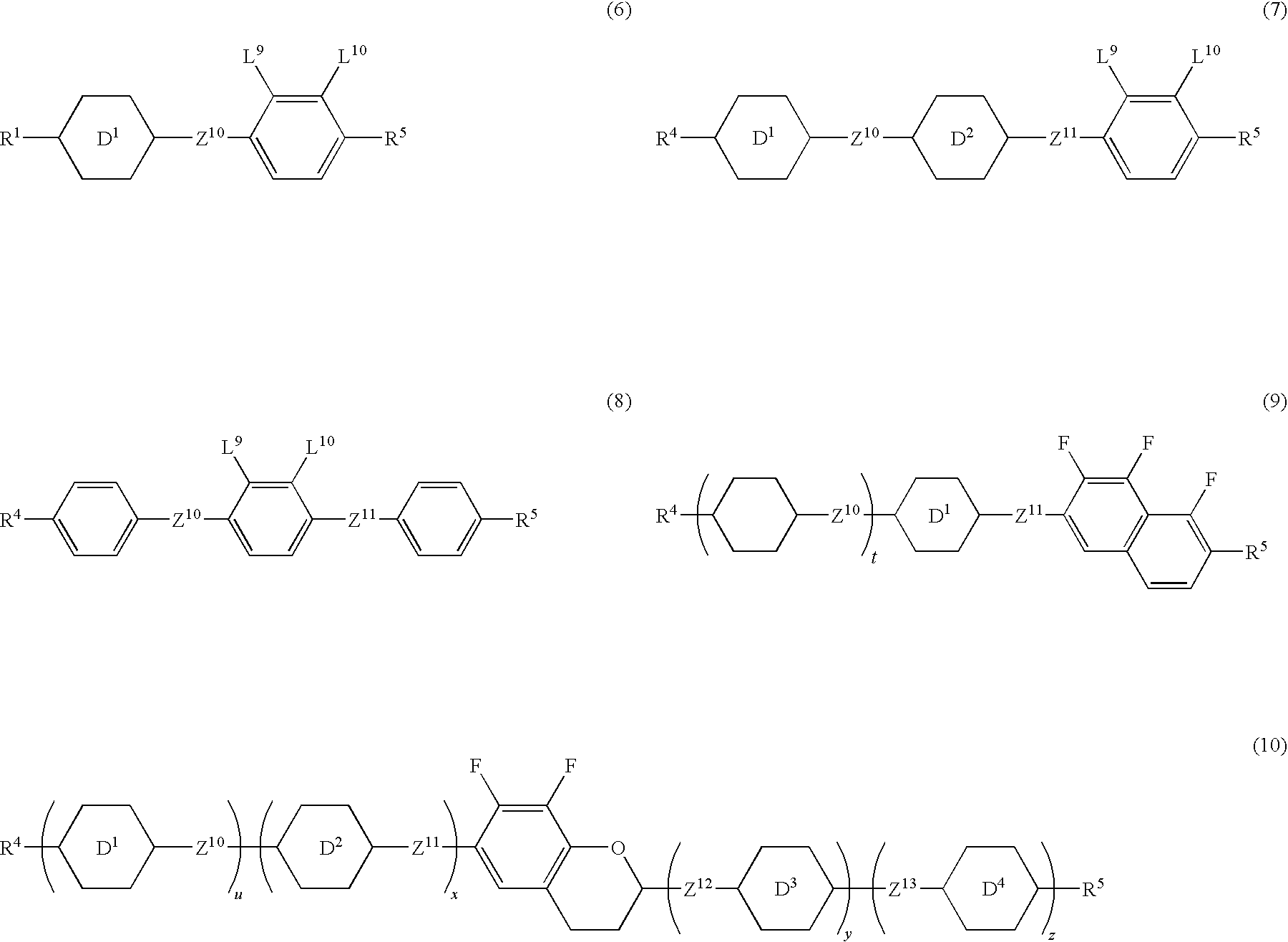


Applications Claiming Priority (4)
| Application Number | Priority Date | Filing Date | Title |
|---|---|---|---|
| JP2007300694 | 2007-11-20 | ||
| JP2007-300694 | 2007-11-20 | ||
| JP2008-236049 | 2008-09-16 | ||
| JP2008236049A JP5544695B2 (en) | 2007-11-20 | 2008-09-16 | Optically isotropic liquid crystal medium and optical element |
Publications (2)
| Publication Number | Publication Date |
|---|---|
| US20090135368A1 US20090135368A1 (en) | 2009-05-28 |
| US7722783B2 true US7722783B2 (en) | 2010-05-25 |
Family
ID=40669419
Family Applications (1)
| Application Number | Title | Priority Date | Filing Date |
|---|---|---|---|
| US12/274,018 Expired - Fee Related US7722783B2 (en) | 2007-11-20 | 2008-11-19 | Optically isotropic liquid crystal medium and optical device |
Country Status (1)
| Country | Link |
|---|---|
| US (1) | US7722783B2 (en) |
Cited By (16)
| Publication number | Priority date | Publication date | Assignee | Title |
|---|---|---|---|---|
| US20090059157A1 (en) * | 2007-08-29 | 2009-03-05 | Chisso Petrochemical Corporation | Optically isotropic liquid crystal medium and optical device |
| US20090302273A1 (en) * | 2008-06-09 | 2009-12-10 | Chisso Corporation | Five-ring liquid crystal compound having cyclohexane ring, liquid crystal composition, and liquid crystal display device |
| US20090314988A1 (en) * | 2008-06-24 | 2009-12-24 | Chisso Corporation | Liquid crystal composition and liquid crystal display device |
| US20090321683A1 (en) * | 2008-06-25 | 2009-12-31 | Chisso Corporation | Liquid crystal composition and liquid crystal display device |
| US20100127211A1 (en) * | 2007-02-28 | 2010-05-27 | Chisso Corporation | Five-ring liquid crystal compound having cf20 bonding group, liquid crystal composition, and liquid crystal display device |
| US20100296029A1 (en) * | 2009-05-19 | 2010-11-25 | Chisso Corporation | Chlorofluorobenzene compound, optically isotropic liquid crystal medium, and optical device |
| US20110069245A1 (en) * | 2008-05-15 | 2011-03-24 | Chisso Petrochemical Corporation | Optically isotropic liquid crystalline medium, and optical element |
| US20110242473A1 (en) * | 2008-11-19 | 2011-10-06 | Jnc Corporation | Optically isotropic liquid crystal medium and optical device |
| US20120099039A1 (en) * | 2009-05-19 | 2012-04-26 | Jnc Petrochemical Corporation | Chlorobenzene derivative, optically isotropic liquid crystal medium, and optical device |
| US20130135544A1 (en) * | 2011-11-30 | 2013-05-30 | Jnc Petrochemical Corporation | Optically isotropic liquid crystal medium and optical device |
| US20130188107A1 (en) * | 2010-10-06 | 2013-07-25 | Jnc Petrochemical Corporation | Liquid-crystal composition |
| US8911644B2 (en) * | 2010-09-27 | 2014-12-16 | Jnc Corporation | Optically isotropic liquid crystal medium and optical device |
| US9011989B2 (en) | 2011-11-01 | 2015-04-21 | Semiconductor Energy Laboratory Co., Ltd. | Liquid crystal composition, composite of polymer and liquid crystal, and liquid crystal display device |
| US9116408B2 (en) | 2011-11-11 | 2015-08-25 | Semiconductor Energy Laboratory Co., Ltd. | Liquid crystal element and method for manufacturing the same |
| US9212308B2 (en) | 2010-11-30 | 2015-12-15 | Semiconductor Energy Laboratory Co., Ltd. | Liquid crystal composition, polymer/liquid crystal composite, liquid crystal element, and liquid crystal display device |
| US9222022B2 (en) | 2012-06-26 | 2015-12-29 | Industrial Technology Research Institute | Polymer-stabilized optical isotropic liquid crystal formulation and optical isotropic liquid crystal device |
Families Citing this family (9)
| Publication number | Priority date | Publication date | Assignee | Title |
|---|---|---|---|---|
| US7648647B2 (en) * | 2007-05-08 | 2010-01-19 | Kyushu University, National University Corporation | Polymer/liquid crystal composite and liquid crystal element |
| WO2011025054A1 (en) * | 2009-08-28 | 2011-03-03 | 国立大学法人九州大学 | Liquid-crystal display element and substrate used in same |
| US8836909B2 (en) * | 2010-11-30 | 2014-09-16 | Semiconductor Energy Laboratory Co., Ltd. | Method for manufacturing liquid crystal display device |
| JP6058644B2 (en) * | 2011-06-01 | 2017-01-11 | メルク パテント ゲゼルシャフト ミット ベシュレンクテル ハフツングMerck Patent Gesellschaft mit beschraenkter Haftung | Liquid crystal medium and liquid crystal display |
| TWI648381B (en) | 2014-07-03 | 2019-01-21 | 日商捷恩智股份有限公司 | Use of liquid crystal composition, optical element, mixture, compound, polymer/liquid crystal composite material, liquid crystal composition, and polymer/liquid crystal composite material |
| EP3115436A1 (en) * | 2015-07-08 | 2017-01-11 | Essilor International (Compagnie Generale D'optique) | Method for obtaining a material comprising a liquid crystal mix with a stabilized blue phase and optical article comprising this material |
| WO2018025996A1 (en) * | 2016-08-04 | 2018-02-08 | Jnc株式会社 | Material for liquid-crystal device, and liquid-crystal device |
| CN106154661B (en) * | 2016-09-21 | 2019-05-14 | 京东方科技集团股份有限公司 | A transparent display panel and its manufacturing method, and a transparent display device |
| CN107916116B (en) * | 2017-11-30 | 2021-05-25 | 湘潭大学 | A method for regulating the liquid crystal interval of conventional liquid crystal molecules by ultra-long rod-shaped liquid crystal small molecules |
Citations (14)
| Publication number | Priority date | Publication date | Assignee | Title |
|---|---|---|---|---|
| JP2003327966A (en) | 2002-05-08 | 2003-11-19 | Japan Science & Technology Corp | Liquid crystal materials for optical modulation elements |
| JP2005157109A (en) | 2003-11-27 | 2005-06-16 | Asahi Glass Co Ltd | Tunable filter |
| WO2005080529A1 (en) | 2004-02-20 | 2005-09-01 | Asahi Glass Company, Limited | Liquid crystal material for optical device and optical modulation device |
| WO2005090520A1 (en) | 2004-03-19 | 2005-09-29 | Japan Science And Technology Agency | Liquid crystal display device |
| JP2005336477A (en) | 2004-04-30 | 2005-12-08 | Japan Science & Technology Agency | Composite material comprising polymer and liquid crystal material having chirality, method for producing the composite material, and optical element using the composite material |
| JP2006506515A (en) | 2002-11-15 | 2006-02-23 | メルク パテント ゲゼルシャフト ミット ベシュレンクテル ハフトング | Electro-optic light modulation element, electro-optic display and modulation medium |
| JP2006506477A (en) | 2002-11-14 | 2006-02-23 | メルク パテント ゲゼルシャフト ミット ベシュレンクテル ハフトング | Electro-optic light modulation element, electro-optic display and modulation medium |
| JP2006089622A (en) | 2004-09-24 | 2006-04-06 | Chisso Corp | Composite made of polymer and optically active liquid crystal material |
| JP2006127707A (en) | 2004-11-01 | 2006-05-18 | Asahi Glass Co Ltd | Aperture control element and optical head device |
| WO2006063662A1 (en) | 2004-12-17 | 2006-06-22 | Merck Patent Gmbh | Liquid crystal system and liquid crystal display |
| JP2006225655A (en) | 2005-02-14 | 2006-08-31 | Merck Patent Gmbh | Mesogenic compound, liquid crystal medium, and liquid crystal display |
| JP2006299084A (en) | 2005-04-20 | 2006-11-02 | Chisso Corp | A composite comprising a polymer and a liquid crystal having chirality |
| US20080280071A1 (en) * | 2007-05-08 | 2008-11-13 | Kyushu University, National University Corporation | Polymer/liquid crystal composite and liquid crystal element |
| US20090059157A1 (en) * | 2007-08-29 | 2009-03-05 | Chisso Petrochemical Corporation | Optically isotropic liquid crystal medium and optical device |
-
2008
- 2008-11-19 US US12/274,018 patent/US7722783B2/en not_active Expired - Fee Related
Patent Citations (14)
| Publication number | Priority date | Publication date | Assignee | Title |
|---|---|---|---|---|
| JP2003327966A (en) | 2002-05-08 | 2003-11-19 | Japan Science & Technology Corp | Liquid crystal materials for optical modulation elements |
| JP2006506477A (en) | 2002-11-14 | 2006-02-23 | メルク パテント ゲゼルシャフト ミット ベシュレンクテル ハフトング | Electro-optic light modulation element, electro-optic display and modulation medium |
| JP2006506515A (en) | 2002-11-15 | 2006-02-23 | メルク パテント ゲゼルシャフト ミット ベシュレンクテル ハフトング | Electro-optic light modulation element, electro-optic display and modulation medium |
| JP2005157109A (en) | 2003-11-27 | 2005-06-16 | Asahi Glass Co Ltd | Tunable filter |
| WO2005080529A1 (en) | 2004-02-20 | 2005-09-01 | Asahi Glass Company, Limited | Liquid crystal material for optical device and optical modulation device |
| WO2005090520A1 (en) | 2004-03-19 | 2005-09-29 | Japan Science And Technology Agency | Liquid crystal display device |
| JP2005336477A (en) | 2004-04-30 | 2005-12-08 | Japan Science & Technology Agency | Composite material comprising polymer and liquid crystal material having chirality, method for producing the composite material, and optical element using the composite material |
| JP2006089622A (en) | 2004-09-24 | 2006-04-06 | Chisso Corp | Composite made of polymer and optically active liquid crystal material |
| JP2006127707A (en) | 2004-11-01 | 2006-05-18 | Asahi Glass Co Ltd | Aperture control element and optical head device |
| WO2006063662A1 (en) | 2004-12-17 | 2006-06-22 | Merck Patent Gmbh | Liquid crystal system and liquid crystal display |
| JP2006225655A (en) | 2005-02-14 | 2006-08-31 | Merck Patent Gmbh | Mesogenic compound, liquid crystal medium, and liquid crystal display |
| JP2006299084A (en) | 2005-04-20 | 2006-11-02 | Chisso Corp | A composite comprising a polymer and a liquid crystal having chirality |
| US20080280071A1 (en) * | 2007-05-08 | 2008-11-13 | Kyushu University, National University Corporation | Polymer/liquid crystal composite and liquid crystal element |
| US20090059157A1 (en) * | 2007-08-29 | 2009-03-05 | Chisso Petrochemical Corporation | Optically isotropic liquid crystal medium and optical device |
Non-Patent Citations (3)
| Title |
|---|
| Article Titled "Electro-Optic Effects of the Optically Isotropic State Induced by the Incorporative Effects of a Polymer Network and the Chirality of Liquid Crystal" jointly authored by Haseba et al., in Journal of the SID, vol. 14/6, 200. (pp. 551). |
| Article Titled "Large Electro-Optic Kerr Effect in Polymer-Stabilized Liquid-Crystalline Blue Phases" jointly authored by Hisakado et al., in Advanced Materials, vol. 17, 2005. (pp. 96). |
| Article Titled "Polymer-Stabilized Liquid Crystal Blue Phases" jointly authored by Kikuchi et al., in Nature Materials, vol. 1, 2002. (pp. 64). |
Cited By (31)
| Publication number | Priority date | Publication date | Assignee | Title |
|---|---|---|---|---|
| US20100127211A1 (en) * | 2007-02-28 | 2010-05-27 | Chisso Corporation | Five-ring liquid crystal compound having cf20 bonding group, liquid crystal composition, and liquid crystal display device |
| US7951433B2 (en) * | 2007-02-28 | 2011-05-31 | Chisso Corporation | Five-ring liquid crystal compound having CF2O bonding group, liquid crystal composition, and liquid crystal display device |
| US7879413B2 (en) * | 2007-08-29 | 2011-02-01 | Chisso Corporation | Optically isotropic liquid crystal medium and optical device |
| US20090059157A1 (en) * | 2007-08-29 | 2009-03-05 | Chisso Petrochemical Corporation | Optically isotropic liquid crystal medium and optical device |
| US8475887B2 (en) * | 2008-05-15 | 2013-07-02 | Jnc Corporation | Optically isotropic liquid crystal medium, and optical device |
| US20110069245A1 (en) * | 2008-05-15 | 2011-03-24 | Chisso Petrochemical Corporation | Optically isotropic liquid crystalline medium, and optical element |
| US7951432B2 (en) * | 2008-06-09 | 2011-05-31 | Chisso Corporation | Five-ring liquid crystal compound having cyclohexane ring, liquid crystal composition, and liquid crystal display device |
| US20090302273A1 (en) * | 2008-06-09 | 2009-12-10 | Chisso Corporation | Five-ring liquid crystal compound having cyclohexane ring, liquid crystal composition, and liquid crystal display device |
| US20090314988A1 (en) * | 2008-06-24 | 2009-12-24 | Chisso Corporation | Liquid crystal composition and liquid crystal display device |
| US8003175B2 (en) * | 2008-06-24 | 2011-08-23 | Jnc Corporation | Liquid crystal composition and liquid crystal display device |
| US20090321683A1 (en) * | 2008-06-25 | 2009-12-31 | Chisso Corporation | Liquid crystal composition and liquid crystal display device |
| US8110256B2 (en) * | 2008-06-25 | 2012-02-07 | Jnc Corporation | Liquid crystal composition and liquid crystal display device |
| US8686196B2 (en) * | 2008-11-19 | 2014-04-01 | Jnc Corporation | Optically isotropic liquid crystal medium and optical device |
| US20110242473A1 (en) * | 2008-11-19 | 2011-10-06 | Jnc Corporation | Optically isotropic liquid crystal medium and optical device |
| US8501285B2 (en) * | 2008-11-19 | 2013-08-06 | Jnc Corporation | Optically isotropic liquid crystal medium and optical device |
| US8343595B2 (en) * | 2009-05-19 | 2013-01-01 | Jnc Corporation | Chlorofluorobenzene compound, optically isotropic liquid crystal medium, and optical device |
| US8409673B2 (en) * | 2009-05-19 | 2013-04-02 | Jnc Corporation | Chlorobenzene derivative, optically isotropic liquid crystal medium, and optical device |
| US20120099039A1 (en) * | 2009-05-19 | 2012-04-26 | Jnc Petrochemical Corporation | Chlorobenzene derivative, optically isotropic liquid crystal medium, and optical device |
| US20100296029A1 (en) * | 2009-05-19 | 2010-11-25 | Chisso Corporation | Chlorofluorobenzene compound, optically isotropic liquid crystal medium, and optical device |
| US8911644B2 (en) * | 2010-09-27 | 2014-12-16 | Jnc Corporation | Optically isotropic liquid crystal medium and optical device |
| US20130188107A1 (en) * | 2010-10-06 | 2013-07-25 | Jnc Petrochemical Corporation | Liquid-crystal composition |
| US8974694B2 (en) * | 2010-10-06 | 2015-03-10 | Jnc Corporation | Liquid-crystal composition |
| US9212308B2 (en) | 2010-11-30 | 2015-12-15 | Semiconductor Energy Laboratory Co., Ltd. | Liquid crystal composition, polymer/liquid crystal composite, liquid crystal element, and liquid crystal display device |
| US9011989B2 (en) | 2011-11-01 | 2015-04-21 | Semiconductor Energy Laboratory Co., Ltd. | Liquid crystal composition, composite of polymer and liquid crystal, and liquid crystal display device |
| US9116408B2 (en) | 2011-11-11 | 2015-08-25 | Semiconductor Energy Laboratory Co., Ltd. | Liquid crystal element and method for manufacturing the same |
| US8858830B2 (en) * | 2011-11-30 | 2014-10-14 | Jnc Corporation | Optically isotropic liquid crystal medium and optical device |
| US20130135544A1 (en) * | 2011-11-30 | 2013-05-30 | Jnc Petrochemical Corporation | Optically isotropic liquid crystal medium and optical device |
| CN103987809A (en) * | 2011-11-30 | 2014-08-13 | 捷恩智株式会社 | Optically isotropic liquid crystal medium and optical device |
| CN103987809B (en) * | 2011-11-30 | 2016-03-09 | 捷恩智株式会社 | Liquid-crystal composition, mixture, polymer/liquid crystal composite material and optical assembly |
| TWI557215B (en) * | 2011-11-30 | 2016-11-11 | 捷恩智股份有限公司 | Optically isotropic liquid crystal medium and optical element |
| US9222022B2 (en) | 2012-06-26 | 2015-12-29 | Industrial Technology Research Institute | Polymer-stabilized optical isotropic liquid crystal formulation and optical isotropic liquid crystal device |
Also Published As
| Publication number | Publication date |
|---|---|
| US20090135368A1 (en) | 2009-05-28 |
Similar Documents
| Publication | Publication Date | Title |
|---|---|---|
| US7722783B2 (en) | Optically isotropic liquid crystal medium and optical device | |
| US8501285B2 (en) | Optically isotropic liquid crystal medium and optical device | |
| US8475887B2 (en) | Optically isotropic liquid crystal medium, and optical device | |
| US8409673B2 (en) | Chlorobenzene derivative, optically isotropic liquid crystal medium, and optical device | |
| US8343595B2 (en) | Chlorofluorobenzene compound, optically isotropic liquid crystal medium, and optical device | |
| EP2098583B1 (en) | Optically isotropic liquid crystal medium and optical device | |
| US7879413B2 (en) | Optically isotropic liquid crystal medium and optical device | |
| US8609208B2 (en) | Optically isotropic liquid crystal medium and optical device | |
| US9593094B2 (en) | Liquid crystal medium, optical device, and liquid crystal compound | |
| US9611429B2 (en) | Liquid crystal medium, optical device and liquid crystal compound | |
| US20130100369A1 (en) | Compound having branched alkyl or branched alkenyl, optically isotropic liquid crystal medium and optical element | |
| US8858830B2 (en) | Optically isotropic liquid crystal medium and optical device | |
| US7727417B2 (en) | Optically isotropic liquid crystal medium and optical device | |
| JP5347347B2 (en) | Optically isotropic liquid crystal medium and optical element | |
| US9701904B2 (en) | Optically isotropic liquid crystal medium and optical device |
Legal Events
| Date | Code | Title | Description |
|---|---|---|---|
| AS | Assignment |
Owner name: CHISSO CORPORATION, JAPAN Free format text: ASSIGNMENT OF ASSIGNORS INTEREST;ASSIGNORS:HASEBA, YASUHIRO;KUNINOBU, TAKASHI;REEL/FRAME:021863/0741 Effective date: 20081110 Owner name: CHISSO PETROCHEMICAL CORPORATION, JAPAN Free format text: ASSIGNMENT OF ASSIGNORS INTEREST;ASSIGNORS:HASEBA, YASUHIRO;KUNINOBU, TAKASHI;REEL/FRAME:021863/0741 Effective date: 20081110 Owner name: CHISSO CORPORATION,JAPAN Free format text: ASSIGNMENT OF ASSIGNORS INTEREST;ASSIGNORS:HASEBA, YASUHIRO;KUNINOBU, TAKASHI;REEL/FRAME:021863/0741 Effective date: 20081110 Owner name: CHISSO PETROCHEMICAL CORPORATION,JAPAN Free format text: ASSIGNMENT OF ASSIGNORS INTEREST;ASSIGNORS:HASEBA, YASUHIRO;KUNINOBU, TAKASHI;REEL/FRAME:021863/0741 Effective date: 20081110 |
|
| STCF | Information on status: patent grant |
Free format text: PATENTED CASE |
|
| AS | Assignment |
Owner name: JNC CORPORATION, JAPAN Free format text: ASSIGNMENT OF ASSIGNORS INTEREST;ASSIGNOR:CHISSO CORPORATION;REEL/FRAME:026207/0653 Effective date: 20110412 |
|
| AS | Assignment |
Owner name: JNC PETROCHEMICAL CORPORATION, JAPAN Free format text: CHANGE OF NAME;ASSIGNOR:CHISSO PETROCHEMICAL CORPORATION;REEL/FRAME:028300/0565 Effective date: 20111003 |
|
| FEPP | Fee payment procedure |
Free format text: PAYOR NUMBER ASSIGNED (ORIGINAL EVENT CODE: ASPN); ENTITY STATUS OF PATENT OWNER: LARGE ENTITY |
|
| FPAY | Fee payment |
Year of fee payment: 4 |
|
| MAFP | Maintenance fee payment |
Free format text: PAYMENT OF MAINTENANCE FEE, 8TH YEAR, LARGE ENTITY (ORIGINAL EVENT CODE: M1552) Year of fee payment: 8 |
|
| FEPP | Fee payment procedure |
Free format text: MAINTENANCE FEE REMINDER MAILED (ORIGINAL EVENT CODE: REM.); ENTITY STATUS OF PATENT OWNER: LARGE ENTITY |
|
| LAPS | Lapse for failure to pay maintenance fees |
Free format text: PATENT EXPIRED FOR FAILURE TO PAY MAINTENANCE FEES (ORIGINAL EVENT CODE: EXP.); ENTITY STATUS OF PATENT OWNER: LARGE ENTITY |
|
| STCH | Information on status: patent discontinuation |
Free format text: PATENT EXPIRED DUE TO NONPAYMENT OF MAINTENANCE FEES UNDER 37 CFR 1.362 |
|
| STCH | Information on status: patent discontinuation |
Free format text: PATENT EXPIRED DUE TO NONPAYMENT OF MAINTENANCE FEES UNDER 37 CFR 1.362 |
|
| FP | Lapsed due to failure to pay maintenance fee |
Effective date: 20220525 |