US7704446B2 - Inducing swirl in a gas flow - Google Patents
Inducing swirl in a gas flow Download PDFInfo
- Publication number
- US7704446B2 US7704446B2 US11/443,099 US44309906A US7704446B2 US 7704446 B2 US7704446 B2 US 7704446B2 US 44309906 A US44309906 A US 44309906A US 7704446 B2 US7704446 B2 US 7704446B2
- Authority
- US
- United States
- Prior art keywords
- vanes
- end portions
- duct
- gas
- portions
- Prior art date
- Legal status (The legal status is an assumption and is not a legal conclusion. Google has not performed a legal analysis and makes no representation as to the accuracy of the status listed.)
- Active, expires
Links
- 230000001939 inductive effect Effects 0.000 title description 2
- 230000007704 transition Effects 0.000 claims abstract description 36
- 230000008859 change Effects 0.000 claims abstract description 6
- 239000000411 inducer Substances 0.000 claims description 33
- 230000015572 biosynthetic process Effects 0.000 claims description 6
- 238000007599 discharging Methods 0.000 claims description 4
- 239000007789 gas Substances 0.000 description 53
- XLYOFNOQVPJJNP-UHFFFAOYSA-N water Substances O XLYOFNOQVPJJNP-UHFFFAOYSA-N 0.000 description 24
- 229910052751 metal Inorganic materials 0.000 description 17
- 239000002184 metal Substances 0.000 description 17
- 239000000498 cooling water Substances 0.000 description 14
- 238000000034 method Methods 0.000 description 12
- 230000008569 process Effects 0.000 description 12
- 238000003723 Smelting Methods 0.000 description 10
- 238000002347 injection Methods 0.000 description 10
- 239000007924 injection Substances 0.000 description 10
- 239000000463 material Substances 0.000 description 10
- XEEYBQQBJWHFJM-UHFFFAOYSA-N Iron Chemical compound [Fe] XEEYBQQBJWHFJM-UHFFFAOYSA-N 0.000 description 8
- 239000007787 solid Substances 0.000 description 8
- 239000002893 slag Substances 0.000 description 7
- 238000010276 construction Methods 0.000 description 6
- QVGXLLKOCUKJST-UHFFFAOYSA-N atomic oxygen Chemical compound [O] QVGXLLKOCUKJST-UHFFFAOYSA-N 0.000 description 4
- 238000006243 chemical reaction Methods 0.000 description 4
- 238000002485 combustion reaction Methods 0.000 description 4
- 229910052742 iron Inorganic materials 0.000 description 4
- 238000002844 melting Methods 0.000 description 4
- 230000008018 melting Effects 0.000 description 4
- 229910052760 oxygen Inorganic materials 0.000 description 4
- 239000001301 oxygen Substances 0.000 description 4
- RYGMFSIKBFXOCR-UHFFFAOYSA-N Copper Chemical compound [Cu] RYGMFSIKBFXOCR-UHFFFAOYSA-N 0.000 description 3
- 239000003575 carbonaceous material Substances 0.000 description 3
- 229910052802 copper Inorganic materials 0.000 description 3
- 239000010949 copper Substances 0.000 description 3
- 230000003628 erosive effect Effects 0.000 description 3
- 238000000605 extraction Methods 0.000 description 3
- 230000004907 flux Effects 0.000 description 3
- 229910044991 metal oxide Inorganic materials 0.000 description 3
- 150000004706 metal oxides Chemical class 0.000 description 3
- 238000007493 shaping process Methods 0.000 description 3
- 229910000831 Steel Inorganic materials 0.000 description 2
- 239000000956 alloy Substances 0.000 description 2
- 238000001816 cooling Methods 0.000 description 2
- 239000010959 steel Substances 0.000 description 2
- 238000012546 transfer Methods 0.000 description 2
- OKTJSMMVPCPJKN-UHFFFAOYSA-N Carbon Chemical compound [C] OKTJSMMVPCPJKN-UHFFFAOYSA-N 0.000 description 1
- VYZAMTAEIAYCRO-UHFFFAOYSA-N Chromium Chemical compound [Cr] VYZAMTAEIAYCRO-UHFFFAOYSA-N 0.000 description 1
- 241001062472 Stokellia anisodon Species 0.000 description 1
- NINIDFKCEFEMDL-UHFFFAOYSA-N Sulfur Chemical compound [S] NINIDFKCEFEMDL-UHFFFAOYSA-N 0.000 description 1
- 239000005864 Sulphur Substances 0.000 description 1
- 229910045601 alloy Inorganic materials 0.000 description 1
- 230000003466 anti-cipated effect Effects 0.000 description 1
- 230000001174 ascending effect Effects 0.000 description 1
- 239000011449 brick Substances 0.000 description 1
- 229910052799 carbon Inorganic materials 0.000 description 1
- 239000012159 carrier gas Substances 0.000 description 1
- 239000003638 chemical reducing agent Substances 0.000 description 1
- 229910052804 chromium Inorganic materials 0.000 description 1
- 239000011651 chromium Substances 0.000 description 1
- 239000003245 coal Substances 0.000 description 1
- 229910017052 cobalt Inorganic materials 0.000 description 1
- 239000010941 cobalt Substances 0.000 description 1
- GUTLYIVDDKVIGB-UHFFFAOYSA-N cobalt atom Chemical compound [Co] GUTLYIVDDKVIGB-UHFFFAOYSA-N 0.000 description 1
- 230000001427 coherent effect Effects 0.000 description 1
- 230000002950 deficient Effects 0.000 description 1
- 238000011161 development Methods 0.000 description 1
- 230000002349 favourable effect Effects 0.000 description 1
- 239000012530 fluid Substances 0.000 description 1
- 238000010438 heat treatment Methods 0.000 description 1
- BHEPBYXIRTUNPN-UHFFFAOYSA-N hydridophosphorus(.) (triplet) Chemical compound [PH] BHEPBYXIRTUNPN-UHFFFAOYSA-N 0.000 description 1
- 238000009434 installation Methods 0.000 description 1
- 229910001338 liquidmetal Inorganic materials 0.000 description 1
- WPBNNNQJVZRUHP-UHFFFAOYSA-L manganese(2+);methyl n-[[2-(methoxycarbonylcarbamothioylamino)phenyl]carbamothioyl]carbamate;n-[2-(sulfidocarbothioylamino)ethyl]carbamodithioate Chemical compound [Mn+2].[S-]C(=S)NCCNC([S-])=S.COC(=O)NC(=S)NC1=CC=CC=C1NC(=S)NC(=O)OC WPBNNNQJVZRUHP-UHFFFAOYSA-L 0.000 description 1
- 238000004519 manufacturing process Methods 0.000 description 1
- 230000004048 modification Effects 0.000 description 1
- 238000012986 modification Methods 0.000 description 1
- 239000002245 particle Substances 0.000 description 1
- 238000005192 partition Methods 0.000 description 1
- 238000012545 processing Methods 0.000 description 1
- 239000012429 reaction media Substances 0.000 description 1
- 239000011819 refractory material Substances 0.000 description 1
- 229910052710 silicon Inorganic materials 0.000 description 1
- 239000010703 silicon Substances 0.000 description 1
Images




Classifications
-
- C—CHEMISTRY; METALLURGY
- C21—METALLURGY OF IRON
- C21C—PROCESSING OF PIG-IRON, e.g. REFINING, MANUFACTURE OF WROUGHT-IRON OR STEEL; TREATMENT IN MOLTEN STATE OF FERROUS ALLOYS
- C21C5/00—Manufacture of carbon-steel, e.g. plain mild steel, medium carbon steel or cast steel or stainless steel
- C21C5/28—Manufacture of steel in the converter
- C21C5/42—Constructional features of converters
- C21C5/46—Details or accessories
- C21C5/4606—Lances or injectors
-
- C—CHEMISTRY; METALLURGY
- C21—METALLURGY OF IRON
- C21C—PROCESSING OF PIG-IRON, e.g. REFINING, MANUFACTURE OF WROUGHT-IRON OR STEEL; TREATMENT IN MOLTEN STATE OF FERROUS ALLOYS
- C21C5/00—Manufacture of carbon-steel, e.g. plain mild steel, medium carbon steel or cast steel or stainless steel
- C21C5/28—Manufacture of steel in the converter
- C21C5/42—Constructional features of converters
- C21C5/46—Details or accessories
- C21C5/48—Bottoms or tuyéres of converters
-
- F—MECHANICAL ENGINEERING; LIGHTING; HEATING; WEAPONS; BLASTING
- F27—FURNACES; KILNS; OVENS; RETORTS
- F27B—FURNACES, KILNS, OVENS OR RETORTS IN GENERAL; OPEN SINTERING OR LIKE APPARATUS
- F27B3/00—Hearth-type furnaces, e.g. of reverberatory type; Electric arc furnaces ; Tank furnaces
- F27B3/10—Details, accessories or equipment, e.g. dust-collectors, specially adapted for hearth-type furnaces
- F27B3/22—Arrangements of air or gas supply devices
-
- F—MECHANICAL ENGINEERING; LIGHTING; HEATING; WEAPONS; BLASTING
- F27—FURNACES; KILNS; OVENS; RETORTS
- F27D—DETAILS OR ACCESSORIES OF FURNACES, KILNS, OVENS OR RETORTS, IN SO FAR AS THEY ARE OF KINDS OCCURRING IN MORE THAN ONE KIND OF FURNACE
- F27D3/00—Charging; Discharging; Manipulation of charge
- F27D3/16—Introducing a fluid jet or current into the charge
-
- C—CHEMISTRY; METALLURGY
- C21—METALLURGY OF IRON
- C21C—PROCESSING OF PIG-IRON, e.g. REFINING, MANUFACTURE OF WROUGHT-IRON OR STEEL; TREATMENT IN MOLTEN STATE OF FERROUS ALLOYS
- C21C5/00—Manufacture of carbon-steel, e.g. plain mild steel, medium carbon steel or cast steel or stainless steel
- C21C5/28—Manufacture of steel in the converter
- C21C5/42—Constructional features of converters
- C21C5/46—Details or accessories
- C21C5/4606—Lances or injectors
- C21C2005/4626—Means for cooling, e.g. by gases, fluids or liquids
Definitions
- This invention relates to swirl inducers for inducing swirl in gas flows. It has particular but not exclusive application to apparatus for injecting a flow of gas with swirl into a metallurgical vessel under high temperature conditions.
- metallurgical vessel may for example be a smelting vessel in which molten metal is produced by a direct smelting process.
- a known direct smelting process which relies on a molten metal layer as a reaction medium, and is generally referred to as the HIsmelt process, is described in International application PCT/AU96/00197 (WO 96/31627) in the name of the applicant.
- the HIsmelt process as described in the International application comprises:
- melting is herein understood to mean thermal processing wherein chemical reactions that reduce metal oxides take place to produce liquid metal.
- the HIsmelt process also comprises post-combusting reaction gases, such as CO and H 2 released from the bath in the space above the bath with oxygen-containing gas and transferring the heat generated by the post-combustion to the bath to contribute to the thermal energy required to smelt the metalliferous feed materials.
- reaction gases such as CO and H 2 released from the bath in the space above the bath with oxygen-containing gas and transferring the heat generated by the post-combustion to the bath to contribute to the thermal energy required to smelt the metalliferous feed materials.
- the HIsmelt process also comprises forming a transition zone above the nominal quiescent surface of the bath in which there is a favourable mass of ascending and thereafter descending droplets or splashes or streams of molten metal and/or slag which provide an effective medium to transfer to the bath the thermal energy generated by post-combusting reaction gases above the bath.
- the metalliferous feed material and solid carbonaceous material is injected into the metal layer through a number of lances/tuyeres which are inclined to the vertical so as to extend downwardly and inwardly through the side wall of the smelting vessel and into the lower region of the vessel so as to deliver the solids material into the metal layer in the bottom of the vessel.
- a blast of hot air which may be oxygen enriched, is injected into the upper region of the vessel through the downwardly extending hot air injection lance.
- the outlet end of the lance may be fitted with internal flow guides to impart an appropriate swirling motion.
- the upper regions of the vessel may reach temperatures of the order of 2000° C. and the hot air may be delivered into the lance at temperatures of the order of 1100-1400° C.
- the lance must therefore be capable of withstanding extremely high temperatures both internally and on the external walls, particularly at the delivery end of the lance which projects into the combustion zone of the vessel.
- a lance construction suitable for injecting gas into a metallurgical vessel for performing the HIsmelt process is disclosed in International Application No. PCT/AU02/00458 (WO 02/083958) in the name of the applicant.
- the gas flows through a gas flow duct within which there is an elongate central tubular structure and a plurality of flow directing vanes disposed about the central tubular structure toward the forward end of the duct to impart swirl to gas flowing through the duct.
- the swirl imparting vanes are disposed in a four-start helical formation with each vane being of helical form throughout its length and extending through a rotation of 180° to impart substantial swirl to the gas flow.
- vanes of this form also impart substantial turbulence to the flow which can actually detract from the amount of swirl induced.
- the shaping of the swirl vanes can be modified so as to enable swirl to be induced with reduced turbulence.
- modification of the shaping of the vanes in accordance with the invention can also facilitate their manufacture.
- the vanes For high temperature applications such as in the HIsmelt process, the vanes must be cast from high melting temperature material which can be difficult to mould into complex shapes.
- apparatus for injecting gas into a vessel may include:
- a gas flow duct extending from a rear end to a forward end from which to discharge gas from the duct;
- the flow directing vanes have substantially straight leading end portions radiating outwardly from the central body and extending along the duct, substantially helical trailing end portions extending helically about the central body toward the front end of the duct, and transition portions joining the leading end portions to the trailing end portions and shaped so as to merge smoothly with both the leading end portions and the trailing end portions and to smoothly and progressively change shape between them.
- leading end portions of the vanes may taper in thickness in the longitudinal direction so as to progressively increase in thickness from leading edges of the vanes to the transition portions of the vanes.
- the vanes may also progressively reduce in thickness radially outwards of the vanes. They may for example be of generally trapezoidal cross-section and taper from their roots to tips which are thinner than the roots.
- the radial cross-sections of the vanes may be generally constant throughout the transitional and trailing end portions.
- vanes there may be four vanes spaced circumferentially about the central body so as to progress from the leading end portions through the transition portions into a four-start helical formation.
- the straight leading end portions of the vanes may extend through less than 20% of the overall length of the vanes measured longitudinally of the duct.
- the length of the leading end portions may be minimised so as to extend through only about 20 mm which may be as little as 3 to 4% of the overall length of the vanes.
- transition portions of the vanes may also extend through at least 20% of the overall length of the vanes measured along the length of the duct.
- the straight leading end portions and the transition portions of the vanes may together extend through a length which is in the range 0.4-0.8 of the outer diameter of the vanes.
- Each vane may rotate through an angle in the range 80°-120° between its leading edge and trailing edge.
- the angle of rotation may be about 90° so that each vane extends through about one quarter of a full turn about the central body between its leading and trailing edges.
- Each vane may in its transition portion rotate through an angle in the range 10°-20° and through its trailing end portion may rotate through a further angle in the range 60°-80°.
- each vane may through its transition portion rotate through an angle of about 13°-14° and may through its trailing end portion rotate through a further angle of between 76° and 77°.
- the angle of the helical portions of the vanes relative to the longitudinal axis of the duct may be such as to produce in the gas discharging from the duct a swirl in the range 0.3-0.7, preferably about 0.5.
- the central body may be formed by a leading end part of an elongate central tubular structure extending within the gas flow duct from its rear end to its forward end and the vanes may be mounted thereon.
- the vanes may be formed integrally with a mounting sleeve by which they are mounted on the central body.
- the invention also extends to a gas swirl inducer for mounting in a gas flow duct for imparting swirl to gas flowing therethrough, comprising a central elongate portion and a plurality of swirl vanes disposed about and extending along the central portion, wherein the swirl vanes have substantially straight leading end portions radiating out from the central portion and extending straight along it, substantially helical trailing end portions extending helically about the central portion, and transition portions joining the leading end portions to the trailing end portions and shaped so as to merge smoothly with both the leading end portions and the trailing end portions and to smoothly and progressively change shape between them.
- FIG. 1 is a vertical section through a direct smelting vessel incorporating a pair of solids injection lances and a hot air blast injection lance incorporating a swirl inducer in accordance with the invention
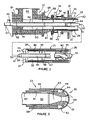
- FIG. 2 is a longitudinal cross-section through the hot air injection lance
- FIG. 3 is a longitudinal cross-section to an enlarged scale through a front part of a central structure of the lance
- FIGS. 4 and 5 illustrate the construction of a forward nose end of the central structure
- FIG. 6 is a longitudinal cross-section through the central structure
- FIG. 7 shows a detail in the region 8 of FIG. 6 ;
- FIG. 8 is a cross-section on the line 8 - 8 in FIG. 7 ;
- FIG. 9 is a cross-section on the line 9 - 9 in FIG. 7 ;
- FIG. 10 illustrates the swirl inducer incorporated in the hot air injection lance
- FIGS. 11 and 12 are end views of the inducer shown in FIG. 10 ;
- FIG. 13 is an enlarged detail of the inducer
- FIG. 14 is a cross-section through a swirl vane of the inducer.
- FIG. 15 illustrates the construction of the swirl inducer in FIG. 10 .
- FIG. 1 illustrates a direct smelting vessel suitable for operation by the HIsmelt process as described in International Patent Application PCT/AU96/00197.
- the metallurgical vessel is denoted generally as 11 and has a hearth that includes a base 12 and sides 13 formed from refractory bricks; side walls 14 which form a generally cylindrical barrel extending upwardly from the sides 13 of the hearth and which includes an upper barrel section 15 and a lower barrel section 16 ; a roof 17 ; an outlet 18 for off-gases; a forehearth 19 for discharging molten metal continuously; and a tap-hole 21 for discharging molten slag.
- the vessel contains a molten bath of iron and slag which includes a layer 22 of molten metal and a layer 23 of molten slag on the metal layer 22 .
- the arrow marked by the numeral 24 indicates the position of the nominal quiescent surface of the metal layer 22 and the arrow marked by the numeral 25 indicates the position of the nominal quiescent surface of the slag layer 23 .
- the term “quiescent surface” is understood to mean the surface when there is no injection of gas and solids into the vessel.
- the vessel is fitted with a downwardly extending hot air injection lance 26 for delivering a hot air blast into an upper region of the vessel and solids injection lances 27 (only two shown) extending downwardly and inwardly through the side walls 14 and into the slag layer 23 for injecting iron ore, solid carbonaceous material, and fluxes entrained in an oxygen-deficient carrier gas into the metal layer 22 .
- the position of the lances 27 is selected so that their outlet ends 28 are above the surface of the metal layer 22 during operation of the process. This position of the lances reduces the risk of damage through contact with molten metal and also makes it possible to cool the lances by forced internal water cooling without significant risk of water coming into contact with the molten metal in the vessel.
- lance 26 comprises an elongate duct 31 which receives hot gas through a gas inlet structure 32 and injects it into the upper region of vessel.
- the lance includes an elongate central tubular structure 33 which extends within the gas flow duct 31 from its rear end to its forward end. Adjacent the forward end of the duct, central structure 33 carries a swirl inducer 90 comprising a series of four swirl imparting vanes 91 for imparting swirl to the gas flow exiting the duct.
- central structure 33 has a domed nose 35 which projects forwardly beyond the tip 36 of duct 31 so that the forward end of the central body and the duct tip co-act together to form an annular nozzle for divergent flow of gas from the duct with swirl imparted by the vanes 91 .
- the inducer consists of the four vanes 91 that are formed integrally with a central tubular portion 93 which serves as a mounting sleeve by which the swirl inducer is mounted on the forward end of central structure 33 .
- the inducer may be moulded from a high melting temperature alloy material such as UMCO 50 which contains by weight 0.05-0.12% carbon, 0.5-1% silicon, a maximum of 0.5-1% manganese, 0.02% phosphorous, 0.02% sulphur, 27-29% chromium, 48-52% cobalt and the balance essentially of iron.
- UMCO 50 which contains by weight 0.05-0.12% carbon, 0.5-1% silicon, a maximum of 0.5-1% manganese, 0.02% phosphorous, 0.02% sulphur, 27-29% chromium, 48-52% cobalt and the balance essentially of iron.
- UMCO 50 a high melting temperature alloy material
- the swirl vanes 91 of inducer 90 have substantially straight leading end portions 91 A radiating outwardly from the central tubular body 93 and extending straight along that body, helical trailing end portions 91 C extending helically about the central tubular body and transition portions 91 B joining the leading end portions 91 A to the trailing end portions 91 C and shaped so as to merge smoothly with both the leading end portions 91 A and the trailing end portions 91 C and to smoothly and progressively change shape between them.
- the taper in thickness in the longitudinal direction throughout the transitions 91 B so as to progressively increase in thickness from relatively narrow leading edges to develop full thickness at the beginning of the helical trailing end portions 91 C.
- the vanes also taper in thickness so as to reduce in thickness in the radially outward direction and to have a trapezoidal cross-section as seen in FIG. 14 .
- the profile tapers from a root of 12 mm thickness to a tip of 8 mm thickness. Through the leading end portions the root thickness increases to 28 mm and the tip thickness to 20 mm.
- the radial cross-sections of the vanes remain constant throughout the transition and trailing end portions 91 B, 91 C.
- Each vane 90 rotates through an angle of 90° between its leading edge 94 and its trailing edge 95 .
- the length of the straight leading end portions 91 A is minimised to about 20 mm which may be as little as 3-4% of the overall length of the vanes whereas the transition portions 91 B extend through a significant part of the overall length of the vanes. Specifically, the transition portions may extend through at least 20% of the overall length of the vanes as measured along the length of the tubular body 93 . It has been found that the shaping of the vanes in this way enhances a uniform flow of gas to efficiently impart swirl while minimising turbulence.
- the extended straight leading end portions 91 A of the vanes partition the gas into quadrants about the central body 93 so that when the gas reaches the transition portions of the vanes any low pressure regions created by the changing gas flow direction cannot result in gas being drawn from an adjacent part of the flow (as can happen if the gas enters helical swirl vanes without extended straight and transition sections).
- the gas flow duct may have a diameter of the order of 782 mm with the swirl vanes 91 produced to a similar diameter so as to be a sliding fit within the duct.
- the central tubular body of the inducer 90 may have an outside diameter of the order of 334 mm and the overall length of the inducer may be 745 mm.
- the vanes may have an overall length of the order of 595 mm as measured axially of the tubular body 93 with the straight portions 91 A of the vanes 91 occupying a length of the order of 20 mm and the transition portions 91 B a length of the order of 170 mm.
- transition portions 91 B of the vanes may turn through an angle of 13.3° with the helical portions 91 C rotating through the remaining 76.7° so as to produce the 90° rotation of the vanes between their leading and trailing edges.
- Computer modelling by the Applicant has indicated that with these dimensions a swirl within the range of 0.3-0.7 preferably of the order of 0.5 at a flow rate of 140,000 Nm 3 /h, at a temperature of 1200° C. and at an axial velocity of 300 m/s appears to be achievable.
- variable ‘S’ is the swirl number of gas flow through the lance
- the variable ‘u’ represents tangential velocity of the gas flow through the lance
- the variable ‘w’ represents the axial velocity of the gas flow through the lance
- the variable ‘r’ is the outer diameter of the swirl vanes.
- the wall of the main part of duct 31 extending downstream from the gas inlet 32 is internally water cooled.
- This section of the duct is comprised of a series of three concentric steel tubes 37 , 38 , 39 extending to the forward end part of the duct where they are connected to the duct tip 36 .
- the duct tip 36 is of hollow annular formation and it is internally water cooled by cooling water supplied and returned through passages in the wall of duct 31 .
- cooling water is supplied through an inlet 41 and annular inlet manifold 42 into an inner annular water flow passage 43 defined between the tubes 38 , 39 of the duct through to the hollow interior of the duct tip 36 through circumferentially spaced openings in the tip. Water is returned from the tip through circumferentially spaced openings into an outer annular water return flow passage 44 defined between the tubes 37 , 38 and backwardly to a water outlet 45 at the rear end of the water cooled section of duct 31 .
- the water cooled section of duct 31 is internally lined with an internal refractory lining 46 that fits within the innermost metal tube 39 of the duct and extends through to the water cooled tip 36 of the duct.
- the inner periphery of duct tip 36 is generally flush with the inner surface of the refractory lining which defines the effective flow passage for gas through the duct.
- the forward end of the refractory lining has a slightly reduced diameter section 47 which receives the swirl vanes 34 with a snug sliding fit.
- the refractory lining is of slightly greater diameter to enable the central structure 33 to be inserted downwardly through the duct on assembly of the lance until the swirl vanes 34 reach the forward end of the duct where they are guided into snug engagement with refractory section 47 by a tapered refractory land 48 which locates and guides the vanes into the refractory section 47 .
- central structure 33 which carries the swirl vanes 34 is internally water cooled by cooling water supplied forwardly through the central structure from the rear end to the forward end of the lance and then returned back along the central structure to the rear end of the lance. This enables a very strong flow of cooling water directly to the forward end of the central structure and to the domed nose 35 in particular which is subjected to very high heat flux in operation of the lance.
- Central structure 33 comprises inner and outer concentric steel tubes 50 , 51 formed by tube segments, disposed end to end and welded together.
- Inner tube 50 defines a central water flow passage 52 through which water flows forwardly through the central structure from a water inlet 53 at the rear end of the lance through to the front end nose 35 of the central structure and an annular water return passage 54 defined between the two tubes through which the cooling water returns from nose 35 back through the central structure to a water outlet 55 at the rear end of the lance.
- the nose end 35 of central structure 33 comprises an inner copper body 61 fitted within an outer domed nose shell 62 also formed of copper.
- the inner copper piece 61 is formed with a central water flow passage 63 to receive water from the central passage 52 of structure 33 and direct it to the tip of the nose.
- Nose end 35 is formed with projecting ribs 64 which fit snugly within the nose shell 62 to define a single continuous cooling water flow passage 65 between the inner section 61 and the outer nose shell 62 .
- the ribs 64 are shaped so that the single continuous passage 65 extends as annular passage segments 66 interconnected by passage segments 67 sloping from one annular segment to the next.
- passage 65 extends from the tip of the nose in a spiral which, although not of regular helical formation, does spiral around and back along the nose to exit at the rear end of the nose into the annular return passage formed between the tubes 51 , 52 of central structure 33 .
- the forced flow of cooling water in a single coherent stream through spiral passage 65 extending around and back along the nose end 35 of central structure ensures efficient heat extraction and avoids the development of “hot spots” on the nose which could occur if the cooling water is allowed to divide into separate streams at the nose.
- the cooling water is constrained in a single stream from the time that it enters the nose end 35 to the time that it exits the nose end.
- Inner structure 33 is provided with an external heat shield 69 to shield against heat transfer from the incoming hot gas flow in the duct 31 into the cooling water flowing within the central structure 33 .
- a solid refractory shield may provide only short service.
- the shield 69 is formed of tubular sleeves of high melting temperature alloy. These sleeves are arranged end to end to form a continuous heat shield surrounding an air gap 70 between the shield and the outermost tube 51 of the central structure.
- the shield may be made of tubular segments of the material UMCO 50 as described above. This material provides excellent heat shielding but it undergoes significant thermal expansion at high temperatures.
- each tubular segment of the heat shield is formed and mounted as shown in FIGS. 6-9 to enable them to expand longitudinally independently of one another while maintaining a substantially continuous shield at all times.
- the individual sleeves are mounted on location strips 71 and plate supports 72 fitted to the outer tube 51 of central structure 33 , the rear end of each shield tube being stepped at 73 to fit over the plate support with an end gap 74 to enable independent longitudinal thermal expansion of each strip.
- Anti-rotation strips 75 may also be fitted to each sleeve to fit about one of the location strips 71 on tube 52 to prevent rotation of the shield sleeves.
- Hot gas is delivered to duct 31 through the gas inlet section 32 .
- the hot gas may be oxygen enriched air provided through heating stoves at a temperature of the order of 1200° C. This air must be delivered through refractory lined ducting and it will pick up refractory grit which can cause severe erosion problems if delivered at high speed directly into the main water cooled section of duct 31 .
- Gas inlet 32 is designed to enable the duct to receive high volume hot air delivery with refractory , particles while minimising damage of the water cooled section of the duct.
- Inlet 31 comprises a T-shaped body 81 moulded as a unit in a hard wearing refractory material and located within a thin walled outer metal shell 82 .
- Body 81 defines a first tubular passage 83 aligned with the central passage of duct 31 and a second tubular passage 84 normal to passage 83 to receive the hot airflow delivered from stoves (not shown).
- Passage 83 is aligned with the gas flow passage of duct 31 and is connected to it through a central passage 85 in a refractory connecting piece 86 of inlet 32 .
- the hot air delivered to inlet 32 passes through tubular passage 84 of body 81 and impinges on the hard wearing refractory wall of the thick refractory body 82 which is resistant to erosion.
- the gas flow then changes direction to flow at right angles down through passage 83 of the T-shaped body 81 and the central passage 85 of transition piece 86 and into the main part of the duct.
- the wall of passage 83 may be tapered in the forward flow direction so as to accelerate the flow into the duct. It may for example be tapered to an included angle of the order of 7°.
- the transition refractory body 86 is tapered in thickness to match the thick wall of refractory body 81 at one end and the much thinner refractory lining 48 of the main section of duct 31 .
- central structure 33 extends through the tubular passage 83 of gas inlet 32 . It is located within a refractory liner plug 91 which closes the rear end of passage 83 , the rear end of central structure 33 extending back from gas inlet 32 to the water flow inlet 53 and outlet 55 .
- the illustrated apparatus is capable of injecting high volumes of hot gas into the smelting vessel 26 at high temperature.
- the central structure 33 is capable of delivering large volumes of cooling water quickly and directly to the nose section of the central structure and the forced flow of that cooling water in an undivided cooling flow around the nose structure enables very efficient heat extraction from the front end of the central structure.
- the independent water flow to the tip of the duct also enables efficient heat extraction from the other high heat flux components of the lance.
- the swirl inducer 90 having the swirl vanes 91 formed with the straight leading end portions 91 A and transition portions 91 B and with the helical portions terminated so that the vanes rotate through only one quarter of a turn rather than through 180° as in previous apparatus allows swirl to be imparted with much reduced turbulence.
- the vanes with the lesser turn are a less complex shape to cast and they can be much more readily manufactured from high melting temperature material such as UMCO 50 .
Landscapes
- Engineering & Computer Science (AREA)
- Chemical & Material Sciences (AREA)
- Mechanical Engineering (AREA)
- Materials Engineering (AREA)
- Metallurgy (AREA)
- Organic Chemistry (AREA)
- Manufacturing & Machinery (AREA)
- General Engineering & Computer Science (AREA)
- Furnace Charging Or Discharging (AREA)
- Vertical, Hearth, Or Arc Furnaces (AREA)
- Carbon Steel Or Casting Steel Manufacturing (AREA)
- Structures Of Non-Positive Displacement Pumps (AREA)
- Thermotherapy And Cooling Therapy Devices (AREA)
Abstract
Description
-
- (a) forming a bath of molten iron and slag in a vessel;
- (b) injecting into the bath:
- (i) a metalliferous feed material, typically metal oxides; and
- (ii) a solid carbonaceous material, typically coal, which acts as a reductant of the metal oxides and a source of energy; and
- (c) smelting metalliferous feed material to metal in the metal layer.
Where the variable ‘S’ is the swirl number of gas flow through the lance, the variable ‘u’ represents tangential velocity of the gas flow through the lance, the variable ‘w’ represents the axial velocity of the gas flow through the lance and the variable ‘r’ is the outer diameter of the swirl vanes.
Claims (30)
Applications Claiming Priority (2)
| Application Number | Priority Date | Filing Date | Title |
|---|---|---|---|
| AU2005902809A AU2005902809A0 (en) | 2005-05-31 | Inducing swirl in a gas flow | |
| AU2005902809 | 2005-05-31 |
Publications (2)
| Publication Number | Publication Date |
|---|---|
| US20070119966A1 US20070119966A1 (en) | 2007-05-31 |
| US7704446B2 true US7704446B2 (en) | 2010-04-27 |
Family
ID=37483842
Family Applications (1)
| Application Number | Title | Priority Date | Filing Date |
|---|---|---|---|
| US11/443,099 Active 2027-04-09 US7704446B2 (en) | 2005-05-31 | 2006-05-31 | Inducing swirl in a gas flow |
Country Status (4)
| Country | Link |
|---|---|
| US (1) | US7704446B2 (en) |
| JP (1) | JP5209189B2 (en) |
| CN (1) | CN1873287B (en) |
| DE (1) | DE102006025185A1 (en) |
Families Citing this family (17)
| Publication number | Priority date | Publication date | Assignee | Title |
|---|---|---|---|---|
| ATE453730T1 (en) * | 2004-10-15 | 2010-01-15 | Tech Resources Pty Ltd | DEVICE FOR INJECTING GAS INTO A CONTAINER |
| DE102006025185A1 (en) * | 2005-05-31 | 2007-02-22 | Technological Resources Pty. Ltd. | Apparatus for blowing gas into a vessel, especially a direct smelting vessel, comprises a swirler with vanes that have a straight front section, a spiral rear section and a smoothly changing transitional region |
| US8012409B2 (en) * | 2006-12-15 | 2011-09-06 | Technological Resources Pty. Limited | Apparatus for injecting gas into a vessel |
| DE102007027281A1 (en) | 2007-06-11 | 2008-12-18 | Daimler Ag | High pressure gas tank and method for filling a high pressure gas tank |
| WO2009081282A2 (en) * | 2007-12-21 | 2009-07-02 | Gi-Gasification International, Sa | Method of using injector system for making fuel gas |
| US8434700B2 (en) * | 2008-04-30 | 2013-05-07 | General Electric Company | Methods and systems for mixing reactor feed |
| US8800895B2 (en) * | 2008-08-27 | 2014-08-12 | Woodward, Inc. | Piloted variable area fuel injector |
| US20110073071A1 (en) * | 2009-09-30 | 2011-03-31 | Woodward Governor Company | Internally Nested Variable-Area Fuel Nozzle |
| US9683739B2 (en) * | 2009-11-09 | 2017-06-20 | Woodward, Inc. | Variable-area fuel injector with improved circumferential spray uniformity |
| CN102168162B (en) * | 2011-03-22 | 2012-07-18 | 熊烈强 | Air cyclone cooling type wire feeding gun |
| CN102389727B (en) * | 2011-10-13 | 2013-10-09 | 东南大学 | SCR (Selective Catalytic Reduction) denitration four-corner tangent circle type ammonia-fume gas uniformly-mixing device |
| WO2014068654A1 (en) * | 2012-10-30 | 2014-05-08 | 三菱電機株式会社 | Air conditioner |
| CN103016469A (en) * | 2012-12-20 | 2013-04-03 | 西安交通大学 | Vortex device and application of vortex device in transportation of high water content crude oil |
| EP3796998A1 (en) | 2018-05-23 | 2021-03-31 | ABS Global, Inc. | Systems and methods for particle focusing in microchannels |
| CN114807502B (en) * | 2021-01-28 | 2023-12-12 | 宝山钢铁股份有限公司 | Circular seam type rotary-flow rotary furnace bottom blowing element and application method thereof |
| CN113639561B (en) * | 2021-07-29 | 2022-10-14 | 中国恩菲工程技术有限公司 | Vortex nozzle and smelting furnace |
| LU502720B1 (en) * | 2022-08-29 | 2024-02-29 | Wurth Paul Sa | Gas injector for shaft injection in a blast furnace |
Citations (10)
| Publication number | Priority date | Publication date | Assignee | Title |
|---|---|---|---|---|
| US20010033046A1 (en) * | 2000-01-31 | 2001-10-25 | Dunne Martin Joseph | Apparatus for injecting gas into a vessel |
| US20020158377A1 (en) * | 2001-04-11 | 2002-10-31 | Dunne Martin Joseph | Apparatus for injecting gas into a vessel |
| US20030011114A1 (en) * | 2001-07-10 | 2003-01-16 | Dunne Martin Joseph | Gas injection lance |
| US6939391B2 (en) * | 2000-03-03 | 2005-09-06 | Technological Resources Pty Ltd | Direct smelting process and apparatus |
| US20060108723A1 (en) * | 2004-10-15 | 2006-05-25 | Trevor Williams | Apparatus for injecting gas into a vessel |
| US20060108722A1 (en) * | 2004-10-15 | 2006-05-25 | Trevor Williams | Apparatus for injecting gas into a vessel |
| US20070119966A1 (en) * | 2005-05-31 | 2007-05-31 | Dry Rodney J | Inducing swirl in a gas flow |
| US20080128963A1 (en) * | 2006-12-05 | 2008-06-05 | Berry Metal Company | Apparatus for injecting gas into a vessel |
| US20080258321A1 (en) * | 2006-12-15 | 2008-10-23 | Tierney Eric | Apparatus for injecting gas into a vessel |
| US20080265473A1 (en) * | 2006-12-15 | 2008-10-30 | Dengel Derek | Inducing swirl in a gas flow |
Family Cites Families (2)
| Publication number | Priority date | Publication date | Assignee | Title |
|---|---|---|---|---|
| JPH07284642A (en) * | 1994-04-19 | 1995-10-31 | Hisao Kojima | Mixing element and manufacturing method thereof |
| AUPR436901A0 (en) * | 2001-04-11 | 2001-05-17 | Technological Resources Pty Limited | Apparatus for injecting gas into a vessel |
-
2006
- 2006-05-30 DE DE102006025185A patent/DE102006025185A1/en not_active Withdrawn
- 2006-05-30 JP JP2006175839A patent/JP5209189B2/en not_active Expired - Fee Related
- 2006-05-31 US US11/443,099 patent/US7704446B2/en active Active
- 2006-05-31 CN CN2006100876976A patent/CN1873287B/en not_active Expired - Fee Related
Patent Citations (13)
| Publication number | Priority date | Publication date | Assignee | Title |
|---|---|---|---|---|
| US6440356B2 (en) * | 2000-01-31 | 2002-08-27 | Technological Resources Pty. Ltd. | Apparatus for injecting gas into a vessel |
| US20010033046A1 (en) * | 2000-01-31 | 2001-10-25 | Dunne Martin Joseph | Apparatus for injecting gas into a vessel |
| US6939391B2 (en) * | 2000-03-03 | 2005-09-06 | Technological Resources Pty Ltd | Direct smelting process and apparatus |
| US20020158377A1 (en) * | 2001-04-11 | 2002-10-31 | Dunne Martin Joseph | Apparatus for injecting gas into a vessel |
| US6673305B2 (en) * | 2001-04-11 | 2004-01-06 | Technological Resources Pty Ltd. | Apparatus for injecting gas into a vessel |
| US20030011114A1 (en) * | 2001-07-10 | 2003-01-16 | Dunne Martin Joseph | Gas injection lance |
| US6773659B2 (en) * | 2001-07-10 | 2004-08-10 | Technological Resources Pty Ltd. | Gas injection lance |
| US20060108723A1 (en) * | 2004-10-15 | 2006-05-25 | Trevor Williams | Apparatus for injecting gas into a vessel |
| US20060108722A1 (en) * | 2004-10-15 | 2006-05-25 | Trevor Williams | Apparatus for injecting gas into a vessel |
| US20070119966A1 (en) * | 2005-05-31 | 2007-05-31 | Dry Rodney J | Inducing swirl in a gas flow |
| US20080128963A1 (en) * | 2006-12-05 | 2008-06-05 | Berry Metal Company | Apparatus for injecting gas into a vessel |
| US20080258321A1 (en) * | 2006-12-15 | 2008-10-23 | Tierney Eric | Apparatus for injecting gas into a vessel |
| US20080265473A1 (en) * | 2006-12-15 | 2008-10-30 | Dengel Derek | Inducing swirl in a gas flow |
Also Published As
| Publication number | Publication date |
|---|---|
| CN1873287B (en) | 2010-06-09 |
| JP2007024309A (en) | 2007-02-01 |
| US20070119966A1 (en) | 2007-05-31 |
| JP5209189B2 (en) | 2013-06-12 |
| CN1873287A (en) | 2006-12-06 |
| DE102006025185A1 (en) | 2007-02-22 |
Similar Documents
| Publication | Publication Date | Title |
|---|---|---|
| EP1932927B1 (en) | Apparatus for injecting gas into a vessel | |
| US20070119966A1 (en) | Inducing swirl in a gas flow | |
| US6673305B2 (en) | Apparatus for injecting gas into a vessel | |
| US20010033046A1 (en) | Apparatus for injecting gas into a vessel | |
| US8017068B2 (en) | Inducing swirl in a gas flow | |
| WO2008070089A1 (en) | Apparatus for injecting gas into a vessel | |
| US8454888B2 (en) | Apparatus for injecting gas into a vessel | |
| US8388888B2 (en) | Apparatus for injecting gas into a vessel | |
| US9879914B2 (en) | Injecting gas into a vessel | |
| CA2410797C (en) | Apparatus for injecting gas into a vessel | |
| AU2007246206B2 (en) | Apparatus for injecting material into a vessel | |
| US7481965B2 (en) | Apparatus for injecting gas into a vessel | |
| AU2006202305B8 (en) | Inducing swirl in a gas flow | |
| AU2002248959B2 (en) | Apparatus for injecting gas into a vessel |
Legal Events
| Date | Code | Title | Description |
|---|---|---|---|
| AS | Assignment |
Owner name: TECHNOLOGICAL RESOURCES PTY. LIMITED,AUSTRALIA Free format text: ASSIGNMENT OF ASSIGNORS INTEREST;ASSIGNORS:DRY, RODNEY JAMES;DAVIS, MARK PRESTON;MEDINA, HECTOR;SIGNING DATES FROM 20060906 TO 20061018;REEL/FRAME:018745/0972 Owner name: TECHNOLOGICAL RESOURCES PTY. LIMITED, AUSTRALIA Free format text: ASSIGNMENT OF ASSIGNORS INTEREST;ASSIGNORS:DRY, RODNEY JAMES;DAVIS, MARK PRESTON;MEDINA, HECTOR;REEL/FRAME:018745/0972;SIGNING DATES FROM 20060906 TO 20061018 |
|
| STCF | Information on status: patent grant |
Free format text: PATENTED CASE |
|
| FPAY | Fee payment |
Year of fee payment: 4 |
|
| MAFP | Maintenance fee payment |
Free format text: PAYMENT OF MAINTENANCE FEE, 8TH YEAR, LARGE ENTITY (ORIGINAL EVENT CODE: M1552) Year of fee payment: 8 |
|
| AS | Assignment |
Owner name: SHANDONG MOLONG PETROLEUM MACHINERY CO. LTD, CHINA Free format text: ASSIGNMENT OF ASSIGNORS INTEREST;ASSIGNOR:TECHNOLOGICAL RESOURCES PTY LTD.;REEL/FRAME:047911/0156 Effective date: 20170908 |
|
| MAFP | Maintenance fee payment |
Free format text: PAYMENT OF MAINTENANCE FEE, 12TH YEAR, LARGE ENTITY (ORIGINAL EVENT CODE: M1553); ENTITY STATUS OF PATENT OWNER: LARGE ENTITY Year of fee payment: 12 |