US7700701B2 - Water-soluble polymer compound having sugar chains - Google Patents
Water-soluble polymer compound having sugar chains Download PDFInfo
- Publication number
- US7700701B2 US7700701B2 US10/556,231 US55623105A US7700701B2 US 7700701 B2 US7700701 B2 US 7700701B2 US 55623105 A US55623105 A US 55623105A US 7700701 B2 US7700701 B2 US 7700701B2
- Authority
- US
- United States
- Prior art keywords
- residue
- group
- sugar chain
- sugar
- compound according
- Prior art date
- Legal status (The legal status is an assumption and is not a legal conclusion. Google has not performed a legal analysis and makes no representation as to the accuracy of the status listed.)
- Expired - Fee Related, expires
Links
- 0 *C(C([C@](O[C@](C(CO)O[C@](C1O)OC[C@@](C(N*)=O)NC(*)=O)C1O)OC1CO)O)[C@]1O* Chemical compound *C(C([C@](O[C@](C(CO)O[C@](C1O)OC[C@@](C(N*)=O)NC(*)=O)C1O)OC1CO)O)[C@]1O* 0.000 description 14
- TWCLHCCXBCDERM-UHFFFAOYSA-N CCC(C)(C)C.CCC(C)C Chemical compound CCC(C)(C)C.CCC(C)C TWCLHCCXBCDERM-UHFFFAOYSA-N 0.000 description 3
- UHXLPOJETNVTLP-SGBRCXNNSA-N C=CC(=O)NCCCCCC(=O)N[C@@H](CC1=CC=CC=C1)C(=O)NCC(=O)N[C@@H](CC(=O)N[C@@H]1OC(CO)[C@@H](O)[C@H](O)C1NC(C)=O)C(=O)NCC(=O)N[C@@H](CCCNC(=N)N)C(=O)NCC(=O)N[C@@H](CC(=O)O)C(=O)N[C@@H](CO)C(=O)O Chemical compound C=CC(=O)NCCCCCC(=O)N[C@@H](CC1=CC=CC=C1)C(=O)NCC(=O)N[C@@H](CC(=O)N[C@@H]1OC(CO)[C@@H](O)[C@H](O)C1NC(C)=O)C(=O)NCC(=O)N[C@@H](CCCNC(=N)N)C(=O)NCC(=O)N[C@@H](CC(=O)O)C(=O)N[C@@H](CO)C(=O)O UHXLPOJETNVTLP-SGBRCXNNSA-N 0.000 description 1
- RILNJLJNQFIVQH-IPICJPRESA-N C=CC(=O)NCCCCCC(=O)N[C@@H](CC1=CC=CC=C1)C(=O)NCCCCCCO[C@@H]1OC(CO)[C@@H](O)[C@H](O)C1NC(C)=O Chemical compound C=CC(=O)NCCCCCC(=O)N[C@@H](CC1=CC=CC=C1)C(=O)NCCCCCCO[C@@H]1OC(CO)[C@@H](O)[C@H](O)C1NC(C)=O RILNJLJNQFIVQH-IPICJPRESA-N 0.000 description 1
- KYCOHEQUPQWLPE-MXIPBWBLSA-N C=CC(=O)NCCCCCC(=O)N[C@@H](CC1=CC=CC=C1)C(=O)NCCCCCCO[C@@H]1OC(COC(C)=O)[C@@H](OC(C)=O)[C@H](OC(C)=O)C1NC(C)=O Chemical compound C=CC(=O)NCCCCCC(=O)N[C@@H](CC1=CC=CC=C1)C(=O)NCCCCCCO[C@@H]1OC(COC(C)=O)[C@@H](OC(C)=O)[C@H](OC(C)=O)C1NC(C)=O KYCOHEQUPQWLPE-MXIPBWBLSA-N 0.000 description 1
- ZLTUGBLCHGVJCT-NNAWAJKVSA-N C=CC(=O)NCCCCCC(=O)N[C@@H](CC1=CC=CC=C1)C(=O)N[C@@H](CCCCNC(=O)CCCO[C@@H]1OC(CO)[C@@H](O)[C@H](O)C1NC(C)=O)C(=O)NCC(=O)N[C@@H](CCCNC(=N)N)C(=O)NCC(=O)N[C@@H](CC(=O)O)C(=O)N[C@@H](CO)C(=O)O Chemical compound C=CC(=O)NCCCCCC(=O)N[C@@H](CC1=CC=CC=C1)C(=O)N[C@@H](CCCCNC(=O)CCCO[C@@H]1OC(CO)[C@@H](O)[C@H](O)C1NC(C)=O)C(=O)NCC(=O)N[C@@H](CCCNC(=N)N)C(=O)NCC(=O)N[C@@H](CC(=O)O)C(=O)N[C@@H](CO)C(=O)O ZLTUGBLCHGVJCT-NNAWAJKVSA-N 0.000 description 1
- GPBMXUJVVDCRAG-AJVOBFCNSA-N C=CC(=O)NCCCCCC(=O)N[C@@H](CO[C@@H]1O[C@@H](CO)[C@@H](O[C@@H]2OC(CO)[C@H](O)[C@H](O)C2O)C(O)C1O)C(=O)NCCCCCCCC Chemical compound C=CC(=O)NCCCCCC(=O)N[C@@H](CO[C@@H]1O[C@@H](CO)[C@@H](O[C@@H]2OC(CO)[C@H](O)[C@H](O)C2O)C(O)C1O)C(=O)NCCCCCCCC GPBMXUJVVDCRAG-AJVOBFCNSA-N 0.000 description 1
- JROTXCANLHAZCX-BCWNZOKBSA-N C=CC(=O)NCCCCCC(=O)N[C@@H](CO[C@@H]1O[C@@H](COC(C)=O)[C@@H](O[C@@H]2OC(COC(C)=O)[C@H](OC(C)=O)[C@H](OC(C)=O)C2OC(C)=O)C(OC(C)=O)C1OC(C)=O)C(=O)NCCCCCCCC Chemical compound C=CC(=O)NCCCCCC(=O)N[C@@H](CO[C@@H]1O[C@@H](COC(C)=O)[C@@H](O[C@@H]2OC(COC(C)=O)[C@H](OC(C)=O)[C@H](OC(C)=O)C2OC(C)=O)C(OC(C)=O)C1OC(C)=O)C(=O)NCCCCCCCC JROTXCANLHAZCX-BCWNZOKBSA-N 0.000 description 1
- RCXNXALNQKFYIF-WMNMLHMOSA-M CC(=O)CNC(=O)CNC(=O)CNC(=O)CNC(=O)CNC(=O)CNC(=O)COC(=O)[C@H](CC1=CC=CC=C1)NC(=O)CNC(=O)C(CC(=O)N[C@@H]1OC(CO)[C@@H](O)[C@H](O)C1NC(C)=O)[N-]C(=O)OC(C)(C)C Chemical compound CC(=O)CNC(=O)CNC(=O)CNC(=O)CNC(=O)CNC(=O)CNC(=O)COC(=O)[C@H](CC1=CC=CC=C1)NC(=O)CNC(=O)C(CC(=O)N[C@@H]1OC(CO)[C@@H](O)[C@H](O)C1NC(C)=O)[N-]C(=O)OC(C)(C)C RCXNXALNQKFYIF-WMNMLHMOSA-M 0.000 description 1
- GUVLZIXFNCKVBO-KAZQVMBTSA-N CC(=O)NC1[C@H](CNC(=O)C[C@H](NC(=O)CN)C(=O)NCC(=O)N[C@@H](CCCNC(=N)N)C(=O)NCC(=O)N[C@@H](CC(=O)O)C(=O)N[C@@H](CO)C(=O)O)OC(CO)[C@@H](O[C@@H]2O[C@@H](CO)[C@H](O)C(O)C2O)[C@@H]1O Chemical compound CC(=O)NC1[C@H](CNC(=O)C[C@H](NC(=O)CN)C(=O)NCC(=O)N[C@@H](CCCNC(=N)N)C(=O)NCC(=O)N[C@@H](CC(=O)O)C(=O)N[C@@H](CO)C(=O)O)OC(CO)[C@@H](O[C@@H]2O[C@@H](CO)[C@H](O)C(O)C2O)[C@@H]1O GUVLZIXFNCKVBO-KAZQVMBTSA-N 0.000 description 1
- RAJRLTTYRZLMKX-JXXPFONMSA-N CC(=O)NC1[C@H](CNC(=O)C[C@H](NC(=O)CN)C(=O)NCC(=O)N[C@@H](CCCNC(=N)N)C(=O)NCC(=O)N[C@@H](CC(=O)O)C(=O)N[C@@H](CO)C(=O)O)OC(CO)[C@@H](O[C@@H]2O[C@@H](CO)[C@H](O)C(O[C@]3(C(=O)O)C[C@@H](O)[C@@H](N=[Ac])C([C@H](O)[C@H](O)CO)O3)C2O)[C@@H]1O Chemical compound CC(=O)NC1[C@H](CNC(=O)C[C@H](NC(=O)CN)C(=O)NCC(=O)N[C@@H](CCCNC(=N)N)C(=O)NCC(=O)N[C@@H](CC(=O)O)C(=O)N[C@@H](CO)C(=O)O)OC(CO)[C@@H](O[C@@H]2O[C@@H](CO)[C@H](O)C(O[C@]3(C(=O)O)C[C@@H](O)[C@@H](N=[Ac])C([C@H](O)[C@H](O)CO)O3)C2O)[C@@H]1O RAJRLTTYRZLMKX-JXXPFONMSA-N 0.000 description 1
- FEJWGQLIJOSUPE-GAMYRGBDSA-N CC(=O)NC1[C@H](OCCCC(=O)NCCCC[C@H](N)C(=O)NCC(=O)N[C@@H](CCCNC(=N)N)C(=O)NCC(=O)N[C@@H](CC(=O)O)C(=O)N[C@@H](CO)C(=O)O)OC(CO)[C@@H](O[C@@H]2O[C@@H](CO)[C@H](O)C(O)C2O)[C@@H]1O Chemical compound CC(=O)NC1[C@H](OCCCC(=O)NCCCC[C@H](N)C(=O)NCC(=O)N[C@@H](CCCNC(=N)N)C(=O)NCC(=O)N[C@@H](CC(=O)O)C(=O)N[C@@H](CO)C(=O)O)OC(CO)[C@@H](O[C@@H]2O[C@@H](CO)[C@H](O)C(O)C2O)[C@@H]1O FEJWGQLIJOSUPE-GAMYRGBDSA-N 0.000 description 1
- NZBKCIVENIDECR-UXGIKDKBSA-M CC(=O)NC1[C@H](OCCCC(=O)NCCCC[C@H]([N-]C(=O)OCC2C3=C(C=CC=C3)C3=C2C=CC=C3)C(=O)O)OC(COC(C)=O)[C@@H](OC(C)=O)[C@@H]1OC(C)=O.[HH] Chemical compound CC(=O)NC1[C@H](OCCCC(=O)NCCCC[C@H]([N-]C(=O)OCC2C3=C(C=CC=C3)C3=C2C=CC=C3)C(=O)O)OC(COC(C)=O)[C@@H](OC(C)=O)[C@@H]1OC(C)=O.[HH] NZBKCIVENIDECR-UXGIKDKBSA-M 0.000 description 1
- XRKOCRZFSBFOAL-KPNPVBBESA-N CC(=O)NC1[C@H](OCCCCCCN)OC(CO)[C@@H](O[C@@H]2O[C@@H](CO[C@]3(C(=O)O)C[C@@H](O)[C@@H](N=[Ac])C([C@H](O)[C@H](O)CO)O3)[C@H](O)C(O)C2O)[C@@H]1O Chemical compound CC(=O)NC1[C@H](OCCCCCCN)OC(CO)[C@@H](O[C@@H]2O[C@@H](CO[C@]3(C(=O)O)C[C@@H](O)[C@@H](N=[Ac])C([C@H](O)[C@H](O)CO)O3)[C@H](O)C(O)C2O)[C@@H]1O XRKOCRZFSBFOAL-KPNPVBBESA-N 0.000 description 1
- BTESEWVBQOWGRI-YKYCXNSXSA-N CC(=O)NC1[C@H](OCCCCCCNC(=O)[C@H](CC2=CC=CC=C2)NC(=O)C(=O)CC2=CC=CC=C2)OC(COC(C)=O)[C@@H](OC(C)=O)[C@@H]1OC(C)=O Chemical compound CC(=O)NC1[C@H](OCCCCCCNC(=O)[C@H](CC2=CC=CC=C2)NC(=O)C(=O)CC2=CC=CC=C2)OC(COC(C)=O)[C@@H](OC(C)=O)[C@@H]1OC(C)=O BTESEWVBQOWGRI-YKYCXNSXSA-N 0.000 description 1
- RAIQSBIIQLWDPP-PXLIIEJJSA-N CCC(C)C(=O)NCCCCCC(=O)N[C@@H](CC1=CC=CC=C1)C(=O)NCC(=O)N[C@@H](CC(=O)N[C@@H]1OC(CO)[C@@H](O)[C@H](O)C1NC(C)=O)C(=O)NCC(=O)N[C@@H](CCCNC(=N)N)C(=O)NCC(=O)N[C@@H](CC(=O)O)C(=O)N[C@@H](CO)C(=O)O Chemical compound CCC(C)C(=O)NCCCCCC(=O)N[C@@H](CC1=CC=CC=C1)C(=O)NCC(=O)N[C@@H](CC(=O)N[C@@H]1OC(CO)[C@@H](O)[C@H](O)C1NC(C)=O)C(=O)NCC(=O)N[C@@H](CCCNC(=N)N)C(=O)NCC(=O)N[C@@H](CC(=O)O)C(=O)N[C@@H](CO)C(=O)O RAIQSBIIQLWDPP-PXLIIEJJSA-N 0.000 description 1
- NUGPISVEHADTQJ-CWSJEMRKSA-N CCC(C)C(=O)NCCCCCC(=O)N[C@@H](CC1=CC=CC=C1)C(=O)NCC(=O)N[C@@H](CC(=O)N[C@@H]1OC(CO)[C@@H](O[C@@H]2O[C@@H](CO)[C@H](O)C(O)C2O)[C@H](O)C1NC(C)=O)C(=O)NCC(=O)N[C@@H](CCCNC(=N)N)C(=O)NCC(=O)N[C@@H](CC(=O)O)C(=O)N[C@@H](CO)C(=O)O Chemical compound CCC(C)C(=O)NCCCCCC(=O)N[C@@H](CC1=CC=CC=C1)C(=O)NCC(=O)N[C@@H](CC(=O)N[C@@H]1OC(CO)[C@@H](O[C@@H]2O[C@@H](CO)[C@H](O)C(O)C2O)[C@H](O)C1NC(C)=O)C(=O)NCC(=O)N[C@@H](CCCNC(=N)N)C(=O)NCC(=O)N[C@@H](CC(=O)O)C(=O)N[C@@H](CO)C(=O)O NUGPISVEHADTQJ-CWSJEMRKSA-N 0.000 description 1
- IBLKZELINWDQQT-BLDBDUOVSA-N CCC(C)C(=O)NCCCCCC(=O)N[C@@H](CC1=CC=CC=C1)C(=O)NCCCCCCO[C@@H]1OC(CO)[C@@H](O)[C@H](O)C1NC(C)=O Chemical compound CCC(C)C(=O)NCCCCCC(=O)N[C@@H](CC1=CC=CC=C1)C(=O)NCCCCCCO[C@@H]1OC(CO)[C@@H](O)[C@H](O)C1NC(C)=O IBLKZELINWDQQT-BLDBDUOVSA-N 0.000 description 1
- FDCJYBLCHBERTG-WTRWARBGSA-N CCC(C)C(=O)NCCCCCC(=O)N[C@@H](CC1=CC=CC=C1)C(=O)N[C@@H](CCCCNC(=O)CCCO[C@@H]1OC(CO)[C@@H](O)[C@H](O)C1NC(C)=O)C(=O)NCC(=O)N[C@@H](CCCNC(=N)N)C(=O)NCC(=O)N[C@@H](CC(=O)O)C(=O)N[C@@H](CO)C(=O)O Chemical compound CCC(C)C(=O)NCCCCCC(=O)N[C@@H](CC1=CC=CC=C1)C(=O)N[C@@H](CCCCNC(=O)CCCO[C@@H]1OC(CO)[C@@H](O)[C@H](O)C1NC(C)=O)C(=O)NCC(=O)N[C@@H](CCCNC(=N)N)C(=O)NCC(=O)N[C@@H](CC(=O)O)C(=O)N[C@@H](CO)C(=O)O FDCJYBLCHBERTG-WTRWARBGSA-N 0.000 description 1
- NNYKVHVHDGHMBE-SVGCYLHPSA-N CCC(C)C(=O)NCCCCCC(=O)N[C@@H](CC1=CC=CC=C1)C(=O)N[C@@H](CCCCNC(=O)CCCO[C@@H]1OC(CO)[C@@H](O[C@@H]2O[C@@H](CO)[C@H](O)C(O)C2O)[C@H](O)C1NC(C)=O)C(=O)NCC(=O)N[C@@H](CCCNC(=N)N)C(=O)NCC(=O)N[C@@H](CC(=O)O)C(=O)N[C@@H](CO)C(=O)O Chemical compound CCC(C)C(=O)NCCCCCC(=O)N[C@@H](CC1=CC=CC=C1)C(=O)N[C@@H](CCCCNC(=O)CCCO[C@@H]1OC(CO)[C@@H](O[C@@H]2O[C@@H](CO)[C@H](O)C(O)C2O)[C@H](O)C1NC(C)=O)C(=O)NCC(=O)N[C@@H](CCCNC(=N)N)C(=O)NCC(=O)N[C@@H](CC(=O)O)C(=O)N[C@@H](CO)C(=O)O NNYKVHVHDGHMBE-SVGCYLHPSA-N 0.000 description 1
- CXXPWHCVCYCFCA-SREDBHFMSA-N CCCCCCCCCCCCC/C=C\[C@@H](O)[C@H](CO[C@@H]1O[C@@H](CO)[C@@H](O[C@@H]2OC(CO)[C@H](O)[C@H](O[C@]3(C(=O)O)C[C@@H](O)[C@@H](N=[Ac])C([C@H](O)[C@H](O)CO)O3)C2O)C(O)C1O)NC(=O)CCCCCCCCCCCCCCCCC Chemical compound CCCCCCCCCCCCC/C=C\[C@@H](O)[C@H](CO[C@@H]1O[C@@H](CO)[C@@H](O[C@@H]2OC(CO)[C@H](O)[C@H](O[C@]3(C(=O)O)C[C@@H](O)[C@@H](N=[Ac])C([C@H](O)[C@H](O)CO)O3)C2O)C(O)C1O)NC(=O)CCCCCCCCCCCCCCCCC CXXPWHCVCYCFCA-SREDBHFMSA-N 0.000 description 1
- HWDVYFJBLXAABQ-USWPTZPUSA-N CCCCCCCCNC(=O)[C@@H](N)CO[C@@H]1O[C@@H](COC(C)=O)[C@@H](O[C@@H]2OC(COC(C)=O)[C@H](OC(C)=O)[C@H](OC(C)=O)C2OC(C)=O)C(OC(C)=O)C1OC(C)=O Chemical compound CCCCCCCCNC(=O)[C@@H](N)CO[C@@H]1O[C@@H](COC(C)=O)[C@@H](O[C@@H]2OC(COC(C)=O)[C@H](OC(C)=O)[C@H](OC(C)=O)C2OC(C)=O)C(OC(C)=O)C1OC(C)=O HWDVYFJBLXAABQ-USWPTZPUSA-N 0.000 description 1
- FVNPRQXVIGGVKL-KRWDZBQOSA-N CCCCCCCCNC(=O)[C@H](CO)NC(=O)OCC1=CC=CC=C1 Chemical compound CCCCCCCCNC(=O)[C@H](CO)NC(=O)OCC1=CC=CC=C1 FVNPRQXVIGGVKL-KRWDZBQOSA-N 0.000 description 1
- REQOHXYVIZSQQG-FKUZRWDESA-N CCCCCCCCNC(=O)[C@H](CO[C@@H]1O[C@@H](CO)[C@@H](O[C@@H]2OC(CO)[C@H](O)[C@H](O)C2O)C(O)C1O)NC(=O)CCCCCNC(=O)C(C)CC Chemical compound CCCCCCCCNC(=O)[C@H](CO[C@@H]1O[C@@H](CO)[C@@H](O[C@@H]2OC(CO)[C@H](O)[C@H](O)C2O)C(O)C1O)NC(=O)CCCCCNC(=O)C(C)CC REQOHXYVIZSQQG-FKUZRWDESA-N 0.000 description 1
- OQEGMKGMCVCSSX-KOWVXQEMSA-N CCCCCCCCNC(=O)[C@H](CO[C@@H]1O[C@@H](CO)[C@@H](O[C@@H]2OC(CO)[C@H](O)[C@H](O[C@]3(C(=O)O)C[C@@H](O)[C@@H](N=[Ac])C([C@H](O)[C@H](O)CO)O3)C2O)C(O)C1O)NC(=O)CCCCCNC(=O)C(C)CC Chemical compound CCCCCCCCNC(=O)[C@H](CO[C@@H]1O[C@@H](CO)[C@@H](O[C@@H]2OC(CO)[C@H](O)[C@H](O[C@]3(C(=O)O)C[C@@H](O)[C@@H](N=[Ac])C([C@H](O)[C@H](O)CO)O3)C2O)C(O)C1O)NC(=O)CCCCCNC(=O)C(C)CC OQEGMKGMCVCSSX-KOWVXQEMSA-N 0.000 description 1
- MZDUTQAGSWAKOK-JXBUFHHNSA-N CCCCCCCCNC(=O)[C@H](CO[C@@H]1O[C@@H](COC(C)=O)[C@@H](O[C@@H]2OC(COC(C)=O)[C@@H](OC(C)=O)[C@H](OC(C)=O)C2OC(C)=O)C(OC(C)=O)C1OC(C)=O)NC(=O)OCC1=CC=CC=C1 Chemical compound CCCCCCCCNC(=O)[C@H](CO[C@@H]1O[C@@H](COC(C)=O)[C@@H](O[C@@H]2OC(COC(C)=O)[C@@H](OC(C)=O)[C@H](OC(C)=O)C2OC(C)=O)C(OC(C)=O)C1OC(C)=O)NC(=O)OCC1=CC=CC=C1 MZDUTQAGSWAKOK-JXBUFHHNSA-N 0.000 description 1
- IAVUYTVAWJJCLO-HVTAYPRNSA-N CNC(=O)COC(=O)CCCCCO[C@@H]1OC(CO)[C@H](O)[C@H](O[C@@H]2OC(CO)[C@@H](O)[C@H](O)C2NC(C)=O)C1O Chemical compound CNC(=O)COC(=O)CCCCCO[C@@H]1OC(CO)[C@H](O)[C@H](O[C@@H]2OC(CO)[C@@H](O)[C@H](O)C2NC(C)=O)C1O IAVUYTVAWJJCLO-HVTAYPRNSA-N 0.000 description 1
- ZJJDYVMEPWFJLK-PMZGFGAPSA-N CNCCCCC(=O)N[C@@H](CC1=CC=CC=C1)C(=O)N[C@@H](CCCCNC(=O)CCCO[C@@H]1OC(CO)[C@@H](O)[C@H](O)C1NC(C)=O)C(=O)NCC(=O)N[C@@H](CCCNC(=N)N)C(=O)NCC(=O)N[C@@H](CC(=O)O)C(=O)N[C@@H](CO)C(=O)O Chemical compound CNCCCCC(=O)N[C@@H](CC1=CC=CC=C1)C(=O)N[C@@H](CCCCNC(=O)CCCO[C@@H]1OC(CO)[C@@H](O)[C@H](O)C1NC(C)=O)C(=O)NCC(=O)N[C@@H](CCCNC(=N)N)C(=O)NCC(=O)N[C@@H](CC(=O)O)C(=O)N[C@@H](CO)C(=O)O ZJJDYVMEPWFJLK-PMZGFGAPSA-N 0.000 description 1
- VIFCKFDQYGGWGL-VMAADFSISA-N CNCCCCCC(=O)NC1=CC=C(CO[C@@H]2OC(CO)[C@@H](O)[C@H](O)C2NC(C)=O)C=C1 Chemical compound CNCCCCCC(=O)NC1=CC=C(CO[C@@H]2OC(CO)[C@@H](O)[C@H](O)C2NC(C)=O)C=C1 VIFCKFDQYGGWGL-VMAADFSISA-N 0.000 description 1
- NLNVEXPENMSZBA-ODWGXNQQSA-N CNCCCCCC(=O)N[C@@H](CC1=CC=CC=C1)C(=O)NCCCCCCO[C@@H]1OC(CO)[C@@H](O)[C@H](O)C1NC(C)=O Chemical compound CNCCCCCC(=O)N[C@@H](CC1=CC=CC=C1)C(=O)NCCCCCCO[C@@H]1OC(CO)[C@@H](O)[C@H](O)C1NC(C)=O NLNVEXPENMSZBA-ODWGXNQQSA-N 0.000 description 1
- ZPYZJALWLUQAAC-VMAADFSISA-N CNCCOCCOCC(=O)NCC1=CC=C(O[C@@H]2OC(CO)[C@@H](O)[C@H](O)C2NC(C)=O)C=C1 Chemical compound CNCCOCCOCC(=O)NCC1=CC=C(O[C@@H]2OC(CO)[C@@H](O)[C@H](O)C2NC(C)=O)C=C1 ZPYZJALWLUQAAC-VMAADFSISA-N 0.000 description 1
- LCQBXCQKZCZFAI-ZHJAHIETSA-N CNCCOCCOCCOCCNC1=C(N[C@@H]2OC(CO)[C@@H](O[C@@H]3OC(CO)[C@H](O)[C@H](O)C3O)[C@H](O)C2O)C(=O)C1=O Chemical compound CNCCOCCOCCOCCNC1=C(N[C@@H]2OC(CO)[C@@H](O[C@@H]3OC(CO)[C@H](O)[C@H](O)C3O)[C@H](O)C2O)C(=O)C1=O LCQBXCQKZCZFAI-ZHJAHIETSA-N 0.000 description 1
- DSHJOZUFQOYZSE-BQYQJAHWSA-M COC(=O)CCOCCOCCOCCOC/C=C/COC(=O)C(C)[N-]C(=O)OCC1C2=C(C=CC=C2)C2=C1C=CC=C2 Chemical compound COC(=O)CCOCCOCCOCCOC/C=C/COC(=O)C(C)[N-]C(=O)OCC1C2=C(C=CC=C2)C2=C1C=CC=C2 DSHJOZUFQOYZSE-BQYQJAHWSA-M 0.000 description 1
- KGZPDEXQPMLFFQ-PETBNLSRSA-N COCC(C)NC(=O)COC1=CC=C(C(NC(=O)CNC(=O)[C@@H](N)CC(=O)N[C@@H]2OC(CO)[C@@H](O)[C@H](O)C2NC(C)=O)C2=C(OC)C=C(OC)C=C2)C=C1 Chemical compound COCC(C)NC(=O)COC1=CC=C(C(NC(=O)CNC(=O)[C@@H](N)CC(=O)N[C@@H]2OC(CO)[C@@H](O)[C@H](O)C2NC(C)=O)C2=C(OC)C=C(OC)C=C2)C=C1 KGZPDEXQPMLFFQ-PETBNLSRSA-N 0.000 description 1
- CNVSWWTYHGHDST-NRFANRHFSA-N O=C(CC1=CC=CC=C1)C(=O)N[C@@H](CC1=CC=CC=C1)C(=O)NCCCCCCO Chemical compound O=C(CC1=CC=CC=C1)C(=O)N[C@@H](CC1=CC=CC=C1)C(=O)NCCCCCCO CNVSWWTYHGHDST-NRFANRHFSA-N 0.000 description 1
Classifications
-
- C—CHEMISTRY; METALLURGY
- C08—ORGANIC MACROMOLECULAR COMPOUNDS; THEIR PREPARATION OR CHEMICAL WORKING-UP; COMPOSITIONS BASED THEREON
- C08F—MACROMOLECULAR COMPOUNDS OBTAINED BY REACTIONS ONLY INVOLVING CARBON-TO-CARBON UNSATURATED BONDS
- C08F251/00—Macromolecular compounds obtained by polymerising monomers on to polysaccharides or derivatives thereof
-
- C—CHEMISTRY; METALLURGY
- C08—ORGANIC MACROMOLECULAR COMPOUNDS; THEIR PREPARATION OR CHEMICAL WORKING-UP; COMPOSITIONS BASED THEREON
- C08F—MACROMOLECULAR COMPOUNDS OBTAINED BY REACTIONS ONLY INVOLVING CARBON-TO-CARBON UNSATURATED BONDS
- C08F220/00—Copolymers of compounds having one or more unsaturated aliphatic radicals, each having only one carbon-to-carbon double bond, and only one being terminated by only one carboxyl radical or a salt, anhydride ester, amide, imide or nitrile thereof
- C08F220/02—Monocarboxylic acids having less than ten carbon atoms; Derivatives thereof
- C08F220/04—Acids; Metal salts or ammonium salts thereof
- C08F220/06—Acrylic acid; Methacrylic acid; Metal salts or ammonium salts thereof
Definitions
- the present invention relates to a water-soluble polymer compound having sugar chains that is useful for producing glycocunjugates, a method for producing the compound, a method for producing glycoconjugates by using the compound, and a water-soluble polymer primer comprising the compound for synthesizing glycoconjugates.
- carbohydrates are just as important constituents of living bodies as nucleic acids and proteins, their structures and mechanisms are not as well understood as those of nucleic acids and proteins. Carbohydrates frequently form polymers having sugar chain in sequence, and bind with proteins or lipids to form extremely complicated composite molecules, glycoconjugates, which are called glycoproteins, glycolipids, and proteoglycans. Nucleic acids and proteins are polymers wherein constituent units of nucleotides or amino acids are linked to one other linearly. In contrast, carbohydrates have a plurality of intramolecular branch points and their constitutional units, i.e., monosaccharides, are linked to each other in various manners, and therefore carbohydrates have complicated structures incomparable to those of nucleic acids or proteins. This structural complexity is one of the major causes of the delay in the study of carbohydrates.
- a certain carrier (sometimes referred to as a primer) bound sugar residues, which serve as initiators, through linkers that can be cleaved under specific conditions is used as a starting material.
- the types of glycoconjugate produced depend on the kind of linkers, and they are released from the carrier as oligosaccharides, glucosides, glycopeptides, glycolipids, etc.
- This method comprises the steps of converting a suitable monosaccharide to 4-carboxy-2-nitrobenzyl glycoside, condensing this glycoside with amino group of the above carrier, elongating the sugar chain by glycosyltransferase using the condensate as a primer, and releasing the elongated sugar chain as oligosaccharide by photolysis.
- sugar transfer yield is low, i.e., less than 10%.
- the peptide chain is elongated using Fmoc-amino acids and Fmoc-Thr( ⁇ GlcNAc)-OH, after peptide elongation protecting groups on the peptide chain are eliminated, the sugar chain is elongated by glycosyltransferase to the above-mentioned N-acetylglucosamine residue, and resultant glycopeptide is released by tetrakis(triphenylphosphine)palladium treatment (see, for example, J. Am. Chem. Soc., 119(1997), 8766).
- the yield of the obtained glycopeptide estimated from the amino acid initially introduced to the solid-phase carrier is less that 10%, which is unsatisfactory.
- glycosyltransferases In sugar chain elongation by glycosyltransferases, the use of immobilized glycosyltransferases that permit repetitive use are desirable, since glycosyltransferases are still very expensive, though mass production of glycosyltransferases by genetic recombination techniques are becoming available.
- the sugar-chain elongation reaction In order to use an immobilized glycosyltransferase, the sugar-chain elongation reaction should be proceeded not on a water-insoluble carrier but on a water-soluble carrier.
- S. Roth et al. have disclosed a method as follows (see, for example, Japanese Unexamined Patent Publication No. 1993-500905). Saccharide, sugar acceptor for a glycosyltransferase, is bound to a solid-phase carrier to form an affinity adsorbent, and a glycosyltransferase is then adsorbed to the above adsorbent by contacting with a tissue extract containing a glycosyltransferase that can recognize the sugar acceptor.
- the glycosyltransferase transfers sugar residue from sugar nucleotide to the acceptor on the absorbent and elutes from the adsorbent by contacting with a solution containing a sugar nucleotide which the glycosyltransferase can use as a sugar donor. Furthermore, by repetition of contacting the resultant one sugar residue elongated sugar chain on the absorbent with a tissue extract containing another glycosyltransferase that can recognize the elongated sugar acceptor and the similar elution procedure, a desired sugar chain can be synthesized on a solid-phase carrier. However, no concrete data demonstrating the effectiveness of this method is provided. Furthermore, no methods for releasing the elongated sugar chain from the solid-phase carrier are disclosed.
- the sugar chain is elongated by glycosyltransferases and released by the treatment with cerium (IV) diammonium nitrate (see, for example, Adv. Synth. Catal., 343(2001), 675).
- cerium (IV) diammonium nitrate see, for example, Adv. Synth. Catal., 343(2001), 675.
- the proportion of acrylic acid in the copolymer primer used in this method is 4%, and therefore this primer differs from that of the present invention.
- the enzymatic transglycosylation reaction progresses at 80 to 90% yield, and the elongated sugar chain is released in the form of a p-formylphenol glucoside.
- this method has drawbacks such that column chromatography using organic solvents is required to purify the released p-formylphenol glucoside, and in some cases obtained p-formylphenol glucoside is not so stable.
- the present inventors have reported a method for elongating a sugar chain on a water-soluble carrier wherein polyacrylamide bound a group represented by the following formula
- the present inventors have also reported a method for elongating a sugar chain on a water-soluble carrier wherein polyacrylamide bound a group represented by the following formula
- glycoconjugates can be efficiently synthesized by free enzymes; however, as described later, when an immobilized enzyme is used, the production efficiency is unsatisfactory.
- the present inventors have also reported a method for elongating a sugar chain on a water-soluble carrier wherein polyacrylamide bound peptide residue linked monosaccharide residue to functional group on side chain of amino acid in this peptide residue through a linker which has a desired length and comprises an amino acid residue or peptide residue having a cleavage site for a certain protease for example a group represented by the following formula
- R 13 and R 14 are independently H, a monosaccharide residue or an oligosaccharide residue; R 15 is a C 6-20 alkyl group or C 6-20 alkenyl group; and R 16 is a C 5-19 alkylene group) bound to a side chain of a water-soluble polymer.
- the sugar chain is elongated by glycosyltransferases, an resultant oligosaccharide residue is transferred in the presence of a ceramid from the polymer having elongated sugar chain to the ceramide by ceramide glycanase, and then liberated as a sphingoglycolipid (see, for example, Japanese Unexamined Patent Publication No. 1998-251287).
- polyacrylamide is disclosed as one example of water-soluble polymer but no examples are disclosed when acrylic acid is used. Furthermore, when a polyacrylamide is used as a water-soluble polymer, if the transglycosylation reaction is proceeded by immobilized glycosyltransferases, its efficiency is unsatisfactory as described later. If the latter primer is used, when gel filtration chromatography and ultrafiltration are performed to remove by-product nucleotides and unreacted sugar nucleotides after the transglycosylation reaction, recovery of the primer is not always satisfactorily high.
- One of the main objects of the present invention is to provide a compound that is suitable and useful as a primer for automatic synthesis of various kinds of glicoconjugates, and a method for producing glycoconjugate using the compound.
- the present inventors conducted extensive research and found that the above problems are solved by using a water-soluble polymer as primer which contains 20 to 80 mol % of (meth)acrylic acid-based residues (selected from the group consisting of acrylic acid and salts thereof, and methacrylic acid and salts thereof) and is bound a monosaccharide residue, an oligosaccharide residue, or a peptide to which a monosaccharide residue or an oligosaccharide residue to a side chain of this polymer through a linker containing a selectively cleavable bond.
- the present invention has been accomplished based on this finding.
- the present invention encompasses the following items.
- a water-soluble polymer compound having sugar chain(s) comprising a monosaccharide or an oligosaccharide residue bound to side chain(s) of a water-soluble polymer through a linker containing a selectively cleavable bond, the water-soluble polymer containing 20 to 80 mol % of (meth)acrylic acid residue, and the linker being bonded to a repeating unit other than (meth)acrylic acid residue.
- a compound according to Item 1 wherein amino acid or peptide residues bound to a monosaccharide or an oligosaccharide residue are linked to side chain(s) of the water-soluble polymer through a linker containing a selectively cleavable bond, the water-soluble polymer containing 20 to 80 mol % of (meth)acrylic acid residue, and the linker being bound to a repeating unit other than (meth)acrylic acid residue.
- a compound according to Item 1 or 2 wherein the water-soluble polymer is a copolymer comprising 20 to 80 mol % of (meth)acrylic acid and 80 to 20 mol % of one or more vinyl monomers selected from the group consisting of acrylamide derivatives, methacrylamide derivatives, acrylic esters, methacrylic esters, styrene derivatives and fatty-acid vinyl esters.
- a compound according to any one of Items 1 to 3, wherein the selectively cleavable bond contained in the linker can be cleaved by hydrogenolysis or by oxidation using 2,3-dichloro-5,6-dicyanobenzoquinone.
- R 1 is a monosaccharide or an oligosaccharide residue
- R 2 is a bivalent linking group with a length equivalent to 4 to 20 methylene groups
- X is O, S, or NH.
- R 1 is an N-acetylglucosamine residue, a glucose residue or a lactose residue.
- R 3 is a monosaccharide or an oligosaccharide residue
- R 4 is a C 6-20 alkyl or alkenyl group
- R 5 is a bivalent linking group with a length equivalent to 5 to 19 methylene groups
- Y is O, S, or NH.
- R 6 is a monosaccharide or an oligosaccharide residue
- R 7 is a bivalent linking group with a length equivalent to 2 to 20 methylene groups
- R 8 is a bivalent linking group with a length equivalent to 5 to 19 methylene groups
- Z and W are each independently O, S, or NH.
- a compound according to Item 2 wherein the peptide residue consists of 2 to 30 amino acid residues.
- a compound according to any one of Items 1 to 12, wherein the selectively cleavable bond contained in the linker can be cleaved by an appropriate hydrolase.
- a compound according to Item 15, wherein the linker containing a selectively cleavable bond that is linked to an amino acid or a peptide residue bound to a monosaccharide or an oligosaccharide residue is a group represented by General Formula (IV), —R 9 —R 10 — (IV) wherein R 9 is a bivalent linking group with a length equivalent to 1 to 20 methylene groups and is linked to the water-soluble polymer compound, and R 10 is an amino acid or a peptide residue containing a cleavable site by an appropriate protease and is bound to a monosaccharide or an oligosaccharide residue, and that the monosaccharide or oligosaccharide residue is bound to a side chain functional group of Asn, Asp, Cys, Gln, Glu, Lys, Ser, Thr or Tyr residue, or to a side chain functional group of the amino acid residue in a peptide residue directly or through a bivalent linking group via
- R 9 is a group represented by General Formula (V), -A-(CH 2 ) n —CO— (V) wherein A is O, CH 2 , C ⁇ O, or NH, the group is linked to a side chain of the water-soluble polymer through A, and n is an integer from 1 to 18.
- a compound according to Item 16 or 17, wherein the bivalent linking group bound to the side chain functional group is a group with a length equivalent to 1 to 20 methylene groups.
- a compound according to any one of Items 16 to 18, wherein the bivalent linking group linked to the side chain functional group is a group represented by General Formula (VI), —B—(CH 2 ) n —O— (VI) wherein B is O, NH, or C ⁇ O, the group is linked to the side chain functional group of an amino acid residue through B, and n is an integer from 1 to 18.
- a water-soluble polymer primer for glycoconjugate synthesis comprising a water-soluble polymer compound having sugar chain(s) according to any one of Items 1 to 19.
- a method for producing a water-soluble polymer compound having sugar chain(s) comprising a step of copolymerization of (meth)acrylic acid, a (meth)acrylamide derivative represented by General Formula (VII),
- R 11 is a monosaccharide or an oligosaccharide residue
- R 12 is a bivalent linking group with a length equivalent to 4 to 20 methylene groups, and at least one vinyl monomer in such a manner that the proportion of the (meth)acrylic acid in the total vinyl copolymers is 20 to 80 mol %.
- R 11 is an N-acetylglucosamine residue, a glucose residue, or a lactose residue.
- the vinyl monomer is at least one monomer selected from the group consisting of acrylamide derivatives, methacrylamide derivatives, acrylic esters, methacrylic acid esters, styrene derivatives, and fatty acid vinyl esters.
- a method for producing a glycoconjugate comprising the steps of:
- step 1 transferring a sugar residue from a sugar nucleotide to a polymer compound by contacting a water-soluble polymer compound having sugar chain(s) of Item 1 or 2 with a glycosyltransferase in the presence of a sugar nucleotide,
- step 2 elongating the sugar chain by repeating step 1 two or more times if necessary
- step 3 removing by-product nucleotides or unreacted sugar nucleotides if necessary, and
- step 4 after repeating steps 1 to 3 two or more times, releasing the resultant glycoconjugate sugar chain from the water-soluble polymer compound which binds the sugar chain elongated by the transfer of the plurality of sugar residues.
- a method for producing a glycoconjugate compound comprising the steps of:
- step 1 transferring a sugar residue from a sugar nucleotide to a water-soluble polymer compound by the action of a glycosyltransferase to the water-soluble polymer compound having sugar chain(s) of Item 8 in the presence of a sugar nucleotide,
- step 2 elongating the sugar chain by repeating step 1 two or more times if necessary
- step 3 removing by-product nucleotides or unreacted sugar nucleotides if necessary and
- step 4 after repeating steps 1 to 3 two or more times, transferring the resultant oligosaccharide elongated by transfer of the plurality of sugar residues from the water-soluble polymer compound to ceramide by the action of ceramide glycanase in the presence of ceramide.
- glycoconjugates can be efficiently synthesized by using the sugar chain-having water-soluble polymer compound of the present invention as a water-soluble polymer primer for glycoconjugate synthesis (which hereunder may be simply referred to as a “primer”), and the primer can be also used for automatic synthesis of glycoconjugates.
- a water-soluble polymer primer for glycoconjugate synthesis which hereunder may be simply referred to as a “primer”
- primer can be also used for automatic synthesis of glycoconjugates.
- the water-soluble polymer compound having sugar chain(s) of the present invention (which hereunder may be referred to as the “sugar chain-having polymer”) is a polymer in which monosaccharide residues or oligosaccharide residues are bound to side chain(s) of a water-soluble polymer through a linker containing a selectively cleavable bond, with the water-soluble polymer usually containing 20 to 80 mol %, preferably 30 to 70 mol %, and more preferably 40 to 60 mol % of (meth)acrylic acid residues as monomers.
- the water-soluble polymer of the present invention contains 20 to 80 mol % of (meth)acrylic acid residues (including carboxyl group salts) represented by the following formulae:
- M is a hydrogen atom, an alkali metal (Na, Li, K), 1 ⁇ 2 an alkaline earth metal (1 ⁇ 2Ca, 1 ⁇ 2Mg, 1 ⁇ 2Ba), ammonium, etc.
- the sugar chain is bound to a repeating unit derived from a monomer other than (meth)acrylic acid residue, such as a repeating unit having one of the following structures:
- a linker is linked to a repeating unit derived from acrylic acid or methacrylic acid via an ester linkage (—COO—), an amide linkage (—CONH—), or a thioester linkage (—COS—), and the linker is bonded to a monosaccharide or an oligosaccharide residue through a glycosidic bond.
- monosaccharides include glucose, galactose, mannose, xylose, N-acetylglucosamine, N-acetylgalactosamine, but are not limited to these.
- oligosaccharides include those comprising 2 to 10 of the above-mentioned monosaccharides linked to one another, such as lactose, chitobiose, N-acetyllactosamine, ⁇ -2,3-sialyllactose, 3- ⁇ -galactosyl-(6- ⁇ -N-acetylglucosaminyl)-N-acetylgalactosamine, etc.
- the oligosaccharide may have a linear structure or have a branched structure in which one sugar residue is bound to two sugar residues.
- the sugar chain-having polymer of the present invention is a polymer in which amino acid or peptide residues bound to a monosaccharide residue or oligosaccharide residue are linked to side chains of the water-soluble polymer through a linker containing a selectively cleavable bond.
- the sugar chain-having polymer contains 20 to 80 mol % of (meth)acrylic acid residues as monomers.
- the polymer may have a partial structure as below:
- a sugar chain-having polymer whose sugar chain has been elongated by applying the action of a glycosyltransferase is also encompassed in the polymer of the invention if the sugar chain thereof can be further elongated by a glycosyltransferase.
- the monomers of the water-soluble polymer other than (meth)acrylic acid (20 to 80 mol %) are not limited and polymers of at least one vinyl monomer selected from the group consisting of acrylamide derivatives, methacrylamide derivatives, acrylic esters, methacrylic esters, styrene derivatives, and fatty acid vinyl esters can be suitably used.
- acrylamide derivatives methacrylamide derivatives, acrylic esters, methacrylic esters, styrene derivatives, and fatty acid vinyl esters
- sugar chains of monosaccharides, oligosaccharides, etc. can be bound preferably to acrylamide derivatives, methacrylamide derivatives, acrylic esters, and methacrylic esters through a linker or, if necessary, an amino acid residue or a peptide residue.
- acrylamide derivatives, methacrylamide derivatives, hydroxyethyl acrylate and like hydroxyalkyl esters of acrylic acid; dimethylaminoethyl acrylate and like dimethylaminoalkyl esters of acrylic acid; hydroxyethyl methacrylate and like hydroxyalkyl esters of methacrylic acid; dimethylaminoethyl methacrylate and like dimethylaminoalkyl esters are highly water soluble and may be used in a large amount (for example, 70 mol % or more).
- acrylic esters other methacrylic esters, styrene derivatives, and fatty acid vinyl esters can be used only in an amount such that the polymer as a whole is water soluble.
- Acrylamide derivatives, methacrylamide derivatives, hydroxyethyl acrylate and like hydroxyalkyl esters of acrylic acid; dimethylaminoethyl acrylate and like dimethylaminoalkyl esters of acrylic acid; hydroxyethyl methacrylate and like methhydroxyalkyl esters of acrylic acid; dimethylaminoethyl acrylate and like dimethylaminoalkyl esters may be used in an amount calculated by subtracting the amount of (meth)acrylic acid (20 to 80 mol %) and that of the sugar chain-having monomers.
- Acrylamide and N-alkylacrylamides such as N-methylacrylamide, N-ethylacrylamide, N-isopropylacrylamide and the like are preferably used as acrylamide derivatives.
- Methacrylamide and N-alkylmethacrylamides such as N-methylmethacrylamide, N-isopropylmethacrylamide and the like are preferably used as methacrylamide derivatives.
- Methyl acrylate, ethyl acrylate, hydroxyethyl acrylate, dimethylaminoethyl acrylate and the like are preferably used as the acrylic esters.
- Methyl methacrylate, ethyl methacrylate, hydroxyethyl methacrylate, dimethylaminoethyl methacrylate are preferably used as methacrylic esters.
- Styrene, p-hydroxystyrene and the like are preferably used as styrenes.
- Vinyl acetate, vinyl butyrate and the like are preferably used as fatty acid vinyl esters.
- cleavable bonds are not limited as long as the sugar chain compound released after cleavage, such as an oligosaccharide, glycopeptide, sphingoglycolipid, oligosaccharide glucoside, is cleaved without being decomposed, and it is possible that several bonds included in linkers used in solid phase synthesis of peptides or oligonucleotides can be used.
- bonds cleavable by weak acid or weak alkali bonds cleavable by hydrogenolysis, bonds cleavable by photoreaction, bonds cleavable by enzymatic reaction, etc., can be used.
- More preferable examples thereof include hydrogenolysis, oxidation using 2,3-dichloro-5,6-dicyanobenzoquinone, hydrolysis using a protease, transglycosylation of ceramide glycanase, etc.
- monosaccharide or oligosaccharide residue bound to a side chain of the water-soluble polymer through a linker having a selectively cleavable bond examples thereof include groups represented by General Formula (I) (wherein R 1 is a monosaccharide or an oligosaccharide residue, R 2 is a bivalent linking group with a length equivalent to 4 to 20 methylene groups, and X is O, S, or NH), groups represented by General Formula (II) (wherein R 3 is a monosaccharide or an oligosaccharide residue, R 4 is a C 6-20 alkyl or alkenyl group, R 5 is a bivalent linking group with a length equivalent to 5 to 19 methylene groups, and Y is O, S, or NH), groups represented by General Formula (III) (wherein R 6 is a monosaccharide or an oligosaccharide residue, R 7 is a bivalent linking group with a length equivalent to 2 to 20
- such a bivalent linking group with a length equivalent to 4 to 20 methylene groups (preferably a length equivalent to 4 to 18 methylene groups, and more preferably a length equivalent to 6 to 12 methylene groups), a bivalent linking group with a length equivalent to 5 to 19 methylene groups (preferably a bivalent linking group with a length equivalent to 5 to 15 methylene groups, and more preferably a bivalent linking group with a length equivalent to 5 to 11 methylene groups), and a bivalent linking group with a length equivalent to 2 to 20 methylene groups (preferably a bivalent linking group with a length equivalent to 4 to 18 methylene groups, and more preferably a bivalent linking group with a length equivalent to 6 to 12 methylene groups) may consist of methylene residues, or a group in which methylene residues are linked by ether linkages (for example, —(OCH 2 CH 2 )n 1 - wherein n 1 is an integer from 1 to 6; however, the length as the whole is equivalent to 4 to 20
- the monosaccharide residue or oligosaccharide residue of R 1 is not limited, and examples thereof include glucose residue, galactose residue, mannose residue, N-acetylglucosamine residue, N-acetylgalactosamine residue, xylose residue, lactose residue, N-acetyllactosamine residue, chitobiose residue, etc.
- C 4-20 alkylene groups there is no limitation to a bivalent linking group of R 2 with a length equivalent to 4 to 20 methylene groups, and, for example, C 4-20 alkylene groups may be used.
- C 4-20 alkylene groups include butylenes group, pentylene group, heptylene group, dodecylene group, etc.
- the monosaccharide or oligosaccharide residue of R 3 is not limited, and examples thereof include glucose residue, lactose residue, etc. Specifically preferable examples thereof include ⁇ -glucose residue and ⁇ -lactose residue.
- C 6-20 alkyl group of R 4 there is no limitation to the C 6-20 alkyl group of R 4 , and hexyl, octyl, dodecyl, octadecyl groups and like linear or branched C 6-20 (preferably C 8-18 ) alkyl groups can be used.
- C 6-20 alkenyl groups and examples thereof include cis-9-octadecenyl and like linear or branched C 6-20 (preferably C 8-18 ) alkenyl groups.
- bivalent linking group of R 5 with a length equivalent to 5 to 19 methylene groups there is no limitation to the bivalent linking group of R 5 with a length equivalent to 5 to 19 methylene groups, and examples thereof include C 5-19 alkylene groups, etc.
- Examples of C 5-19 alkylene groups include pentylene group, heptylene group, nonylene group, heptadecylene group, etc.
- monosaccharide residue or oligosaccharide residue of R 6 there is no limitation to the monosaccharide residue or oligosaccharide residue of R 6 , and examples thereof include glucose residue, galactose residue, mannose residue, N-acetylglucosamine residue, N-acetylgalactosamine residue, xylose residue, lactose residue, N-acetyllactosamine residue, chitobiose residue, etc. Among those, N-acetylglucosamine residue is preferable.
- bivalent linking group of R 7 with a length equivalent to 2 to 20 methylene groups there is no limitation to the bivalent linking group of R 7 with a length equivalent to 2 to 20 methylene groups, and examples thereof include C 2-20 (preferably C 4 -C 18 ) alkylene groups, etc.
- C 2-20 alkylene groups include ethylene, butylene, hexylene, dodecylene, octadecylene, etc.
- bivalent linking group of R 8 with a length equivalent to 5 to 19 methylene groups there is no limitation to the bivalent linking group of R 8 with a length equivalent to 5 to 19 methylene groups, and examples thereof include C 5-19 (preferably C 5 -C 15 ) alkylene groups, etc.
- C 5-19 alkylene groups include pentylene group, heptylene group, undecylen group, heptadecylene group, etc.
- a peptide residue bound to the monosaccharide or oligosaccharide residue which is bound to a side chain of a water-soluble polymer through a linker having a selectively cleavable bond; however, a peptide residue composed of 2 to 30 amino acid residues bound to a monosaccharide or an oligosaccharide residue is preferable, and a peptide residue composed of 4 to 20 amino acid residues bound to a monosaccharide or an oligosaccharide residue is particularly preferable.
- the constituent amino acid residues as long as they have an amino group and a carboxyl group in the molecule.
- Examples thereof include Gly (glycine), Ala (alanine), Val (valine), Leu (leucine), Ile (isoleucine), Tyr (tyrosine), Phe (phenylalanine), Trp (tryptophan), Glu (glutamic acid), Asp (aspartic acid), Lys (lysine), Arg (arginine), His (hystidine), Cys (cystein), Met (methionine), Ser (serine), Thr (threonine), Asn (asparagine), Gln (glutamine), Pro (proline) and like ⁇ -amino acid residues, and ⁇ -Ala and like ⁇ -amino acid residues, etc.
- Such amino acid residues may be D-amino acid or L-amino acid residues; however, L-amino acid residues are preferable.
- monosaccharide residue or oligosaccharide residue bound there is no limitation to the monosaccharide residue or oligosaccharide residue bound, and examples thereof include galactose residue, mannose residue, N-acetylglucosamine residue, N-acetylgalactosamine residue, glucose residue, xylose residue, sialic acid residue, N-acetyllactosamine residue, lactose residue, chitobiose residue, ⁇ -2,3-sialyllactosamine residue, 3- ⁇ -galactosyl-(6- ⁇ -N-acetylglucosaminyl)-N-acetylgalactosamine residue, etc.
- sialic acid is a general term for acyl derivatives of neuraminic acid, and includes N-acetylneuramic acid, N-glycolylneuraminic acid, 9-O-acetyl-N-acetylneuramic acid, etc.
- linkers preferably used in the present invention include groups represented by General Formula (IV) —R 9 —R 10 — (IV) wherein R 9 is a bivalent linking group with a length equivalent to 1 to 20 methylene groups, and R 10 is an amino acid residue or a peptide residue having a site cleavable by a specific protease.
- amino acid residues and peptide residues to which a monosaccharide residue or an oligosaccharide is bound include residues containing at least one amino acid selected from the group consisting of Ser, Thr, Glu, Gln, Asp, Asn, Lys, Cys, and Tyr; and a side chain functional group of such an amino acid can be bound to a sugar residue directly or via a bivalent linking group.
- bivalent linking group of R 9 with a length equivalent to 1 to 20 methylene groups
- examples thereof include groups represented by General Formula (V) -A-(CH 2 ) n —CO— (V) wherein A is O, CH 2 , C ⁇ O or NH, the group is linked to a side chain of a water-soluble polymer through A, and n is an integer from 1 to 18. Specific examples thereof are as follows:
- amino acid or peptide residue of R 10 having a cleavable site by an appropriate protease comprises a site that can be cleaved by a protease that does not contain a cleavage site in an amino acid or a peptide residue to which a monosaccharide or an oligosaccharide residue is bound.
- R 10 when the appropriate protease is ⁇ -chymotrypsin, R 10 may be phenylalanine, tryptophan, tyrosine or a like aromatic amino acid residue, when the appropriate protease is proline-specific protease, R 10 may be a proline residue, when the appropriate protease is lysine-specific protease, R 10 may be a lysine residue, when the appropriate protease is glutamic acid-specific protease, R 10 may be a glutamic acid residue, when the appropriate protease is trypsin, R 10 may be arginine, lysine or a like basic amino acid residue, when the appropriate protease is Factor Xa, R 10 may be an Ile (isoleucine)-Glu (glutamic acid) or Asp (aspartic acid)-Gly (glycine)-Arg (arginine) residue, and when the appropriate protease is enterokinase, R 10
- amino acid residue having a monosaccharide or an oligosaccharide residue bound to a side chain functional group through a bivalent linking group via a glycosidic bound there is no limitation to the amino acid residue having a monosaccharide or an oligosaccharide residue bound to a side chain functional group through a bivalent linking group via a glycosidic bound, as long as the amino residue comprises a side chain functional group that can bond a monosaccharide or an oligosaccharide residue through a bivalent linking group via a glycosidic linkage; however, Ser, Thr, Lys, Asp, Glu, Tyr, Cys, Asn and Gln residues are preferable.
- bivalent linking group there is no limitation to the bivalent linking group as long as it can link an amino acid residue to a monosaccharide residue, but a bivalent linking group with a length equivalent to 1 to 20 methylene groups is preferable, and especially preferable is a group represented by General Formula (VI) —B—(CH 2 ) n —O— (VI) wherein B is O, NH, or C ⁇ O, the group is linked to a side chain functional group of an amino acid residue through B, and n is an integer from 1 to 18. Specific examples thereof are as follows:
- the sugar chain-having polymer of the present invention comprises a side chain functional group and is a copolymer of three or more types of monomers obtained by copolymerization (i) a polymerizable vinyl monomer to which a monosaccharide or an oligosaccharide residue, or an amino acid or peptide residue bonded to a monosaccharide or an oligosaccharide residue is bound to a side chain functional group of the polymer through a linker comprising a selectively cleavable bond, (ii) (meth)acrylic acid, and (iii) at least one of other type of vinyl monomer.
- the proportion of (meth)acrylic acid in total vinyl-based copolymer is 20 to 80 mol %, and preferably 40 to 60 mol %. Furthermore, the proportion of the polymerizable vinyl monomers that have a side chain functional group to which a monosaccharide or an oligosaccharide residue, or an amino acid or peptide residue bound to a monosaccharide or an oligosaccharide residue is linked through a linker comprising a selectively cleavable bond in the total monomer is not limited, but is preferably 0.1 to 50 mol % and more preferably 1 to 25 mol %.
- Examples of polymerizable vinyl monomers having a side chain functional group to which a monosaccharide residue, an oligosaccharide residue, or an amino acid or a peptide residue bound with a monosaccharide or an oligosaccharide residue is linked through a linker comprising a selectively cleavable bond include acrylamide derivatives represented by General Formula (VII) wherein R 11 is a monosaccharide or an oligosaccharide residue, R 12 is a bivalent linking group with a length equivalent to 4 to 20 methylene groups; acrylamide derivatives represented by General Formula (IX) wherein R 17 is a linear or branched C 6-20 alkyl or alkenyl group, and n is an integer from 5 to 19; acrylamide derivatives represented by General Formula (X) wherein R 18 is a C 2-20 alkylene group, and R 19 is a C 5-19 alkylene group; and acrylamide derivatives represented by General Formula (XI) wherein R 20
- acrylamide derivatives represented by General Formulae (VII), (IX), (X), and (XI) it is also possible to use the corresponding methacrylamide derivatives.
- the corresponding methacrylamide derivative can be produced by using the same materials and employing the same methods for producing acrylamide derivatives as described below except for using methacrylamide instead of acrylamide.
- the copolymerization can be conducted using techniques such as radical polymerization, cationic polymerization, anionic polymerization, etc. Among such techniques, radical polymerization using ammonium peroxodisulfate, etc., as a catalyst is preferably employed.
- vinyl monomers examples include acrylamide derivatives, methacrylamide derivatives, methacrylic acid, acrylic esters, methacrylic esters, styrene derivatives, fatty acid vinyl esters, etc.
- acrylamide derivatives include acrylamide, and N-methylacrylamide, N-ethylacrylamide, N-isopropylacrylamide and like N-alkylacrylamides.
- methacrylamide derivatives include methacrylamide, and N-methylmethacrylamide, N-isopropylmethacrylamide and the like N-alkylmethacrylamides, etc.
- acrylic esters examples include methyl acrylate, ethyl acrylate, hydroxyethyl acrylate, and dimethylaminoethyl acrylate.
- methacrylic esters examples include methyl methacrylate, ethyl methacrylate, hydroxyethyl methacrylate, dimethylaminoethyl methacrylate, etc.
- styrene derivatives include styrene, p-hydroxystyrene, etc.
- fatty acid vinyl esters examples include vinyl acetate, vinyl butyrate, etc.
- the molecular weight of such a copolymer is usually about 10000 to about 10000000, preferably 20000 to 5000000, and more preferably 50000 to 2000000.
- the acrylamide derivatives represented by General Formula (VII), (IX), (X), and (XI) can be synthesized by various techniques commonly employed in synthetic organic chemistry.
- the acrylamide derivative represented by General Formula (VII) can be obtained by condensing, in the presence of a suitable catalyst, p-nitrobenzyl alcohol with a sugar oxazoline derivative represented by General Formula (XII) (wherein R 23 , R 24 , and R 25 are each independently an acyl-type protecting group, ether-type protecting group or a monosaccharide or an oligosaccharide residue having a hydroxyl group protected with an acyl-type protecting group and/or an ether-type protecting group), a halogenated sugar represented by General Formula (XIII) (wherein X 1 is F, Cl, Br or OC(NH)CCl 3 , R 26 is a group represented by NHCOCH 3 or OR 30 , and R 27 , R 28 , R 29 and R 30 are each independently an acyl-type protecting group, an ether-type protecting group, or a monosaccharide or an oligosaccharide residue having a hydroxyl group protected with an
- the acrylamide derivative represented by General Formula (IX) can be obtained by, for example, condensing an activated lactose derivative represented by General Formula (XVI) (wherein R 31 , R 32 , R 33 , R 34 , R 35 , R 36 and R 37 are each independently an acyl-type protecting group or an ether-type protecting group, and X 2 is F, Cl, Br, or OC(NH)CCl 3 ) and a serine derivative represented by General Formula (XVII) (wherein R 38 is a C 6-20 alkyl group or an alkenyl group, and R 39 is a protecting group) in the presence of suitable catalyst; removing the protecting group of the amino group in the serine residue; condensing with an acrylamide derivative represented by General Formula (XVIII) (wherein Y 1 is OH, Cl, or Br, and n is an integer from 5 to 9); and removing the protecting groups in lactose moiety.
- XVI activated lactose derivative represented by General
- the acrylamide derivative represented by General Formula (X) can be obtained by condensing, in the presence of a suitable catalyst, a sugar oxazoline derivative represented by General Formula (XIX) (wherein R 40 , R 41 , and R 42 each independently acyl-type protecting group or ether-type protecting group) with a phenylalanine derivative represented by General Formula (XX) (wherein R 43 is a C 2-20 alkylene group and R 44 is a protecting group), removing the protecting group, condensing with an acrylamide derivative represented by General Formula (XXI) (wherein R 45 is a C 5-19 alkylene group, and Y 2 is OH, Cl, or Br), and removing the protecting groups of the sugar portion.
- a sugar oxazoline derivative represented by General Formula (XIX) wherein R 40 , R 41 , and R 42 each independently acyl-type protecting group or ether-type protecting group
- a phenylalanine derivative represented by General Formula (XX)
- the acrylamide derivative represented by General Formula (XI) can be synthesized using automated peptide synthesizer.
- the protease used is ⁇ -chymotrypsin
- R 21 is an aromatic amino acid residue
- R 22 is an arbitrary peptide residue which does not contain an aromatic amino acid and which contains a serine residue, a threonine residue, a glutamine residue or an asparagines residue to which a monosaccharide residue is bound via a glycosidic bond formed between an OH group or an acid amide group and a monosaccharide residue
- a peptide residue contains an amino acid residue to which a monosaccharide residue is linked to a side chain functional group via a glycosidic bond through a bivalent linking group.
- peptide chain is elongated on a suitable solid-phase carrier to synthesize an arbitrary peptide that does not contain aromatic amino acid residue, but contains a serine residue, a threonine residue, a glutamine residue, or an asparagine residue to which a monosaccharide residue is bound via a glycosidic bond formed between an OH position or an acid amide group and a monosaccharide residue, or a peptide containing an amino acid residue to which an arbitrary monosaccharide residue is linked to a side chain functional group via a glycosidic bond through a bivalent linking group.
- the peptide chain is elongated using an aromatic amino acid derivative in which an amino group is acylated by a group represented by General Formula (XXII) (wherein R 46 is a C 1-18 alkylene group), the elongated peptide is released from the solid-phase carrier, and a protecting groups in the peptide chain and monosaccharide residue are removed.
- XXII General Formula
- the peptide residue containing a serine residue, a threonine residue, a glutamine residue or an asparagine residue to which a monosaccharide residue is bound via a glycosidic bond formed between an OH position or an acid amide group and a monosaccharide residue, or the peptide residue containing an amino acid residue to which a monosaccharide residue is linked to a side chain functional group by a glycosidic bond through a bivalent linking group, can be introduced by using, instead of a standard N-protected amino acid, the corresponding N-protected amino acid to which a monosaccharide residue having hydroxyl groups protected with suitable protecting groups is bound to a side chain functional group via a glycosidic bond formed between an OH position or an acid amide group and a monosaccharide residue, or a bivalent linking group.
- An aromatic amino acid in which an amino group is acylated by a group represented by General Formula (XXII) can be also introduced by
- Serine, threonine, glutamine and asparagine residues to which a monosaccharide residue having hydroxyl groups protected with suitable protecting groups is bound via a glycosidic bond formed between an OH position or acid amide and a monosaccharide residue, and N-protected amino acids to which a monosaccharide residue having hydroxyl groups protected with suitable protecting groups bonded to a side chain functional group through a bivalent linking group via a glycosidic linkage can be obtained by employing commonly used synthetic organic chemistry techniques.
- N-protected amino acids to which a monosaccharide residue is bound for example, Fmoc-Asn(GlcNAc(Ac)3- ⁇ -D)-OH, Fmoc-Ser(GalNAc(Ac)3- ⁇ -D)-OH, Fmoc-Thr(GalNAc(Ac)3- ⁇ -D)-OH, etc., are already commercially available and therefore it is possible to use these.
- a polymerizable aromatic amino acid derivative in which an amino group is acylated by a group represented by General Formula (XXII) can be synthesized by employing commonly used synthetic organic chemistry techniques.
- the aromatic amino acid residue is a phenylalanine residue
- the polymerizable phenylalanine derivative can be prepared by condensing a phenylalanine ethyl ester with an ⁇ -acryloylamino fatty acid, and hydrolyzing the ethyl ester.
- Condensation of phenylalanine ethyl ester with an ⁇ -acryloylamino fatty acid is not limited as long as phenylalanine ethyl ester and the ⁇ -acryloylamino fatty acid can be condensed, and they can be condensed by contacting in the presence of a condensation agent typically used for peptide-bond formation, such as dicyclohexylcarbodiimide, carbodiimidazole, 1-ethoxycarbonyl-2-ethoxy-1,2-dihydroxyquinoline, diphenylphosphoryl azide, etc.
- a condensation agent typically used for peptide-bond formation such as dicyclohexylcarbodiimide, carbodiimidazole, 1-ethoxycarbonyl-2-ethoxy-1,2-dihydroxyquinoline, diphenylphosphoryl azide, etc.
- a sugar residue is transferred from a sugar nucleotide to a sugar chain-having polymer by contacting the sugar chain-having water-soluble polymer compound with a glycosyltransferase in the presence of a sugar nucleotide.
- Transfer of a sugar from a sugar nucleotide to a sugar chain-having polymer is usually performed by contacting them with a glycosyltransferase in a neutral buffer solution containing a sugar chain-having polymer and sugar nucleotides usually at 10 to 60° C. and preferably at 20 to 40° C., and usually for 1 to 120 hours and preferably for 2 to 72 hours.
- the amount of sugar nucleotides used relative to one equivalent of sugar chain-having polymer is preferably from about one equivalent to excess.
- Metal salts may be added to the reaction solution if needed.
- examples of usable metal ions include magnesium, manganese, cobalt, nickel, copper, zinc, etc., and these are usually added in a form of chlorides, etc.
- glycosyltransferase used in the present invention is not limited as long as a sugar nucleotide can be used as a sugar donor.
- Leloir pathway glycosyltransferases are examples of such enzymes. Specific examples thereof include galactosyltransferases, N-acetylglucosaminyltransferase, N-acetylgalactosaminyltransferase, fucosyltransferase, sialyltransferase, mannosyltransferase, xylosyltransferase, glucuronyltransferase, etc.
- Such enzymes may be free or immobilized, although immobilized enzymes are preferable.
- the sugar nucleotide used in the present invention is not limited as long as the above-mentioned enzyme can be used.
- sugar nucleotides include uridine-5′-diphospho-galactose, uridine-5′-diphospho-N-acetylglucosamine, uridine-5′-diphospho-N-acetylgalactosamine, uridine-5′-diphospho-glucuronic-acid, uridine-5′-diphospho-xylose, guanosine-5′-diphospho-fucose, guanosine-5′-diphospho-mannose, cytidine-5′-monophoshpho-N-acetylneuramic acid, sodium salts thereof, etc.
- the sugar chain is elongated by transferring a plurality of sugar residues by repeating step two or more times according to requirements.
- by-product nucleotides or unreacted sugar nucleotides are removed if necessary.
- Methods for removing by-product nucleotides or unreacted sugar nucleotides are not limited as long as the sugar chain-having polymer can be separated from nucleotides and sugar nucleotides. Examples of such methods include gel filtration chromatography, ion-exchange chromatography, dialysis, ultrafiltration, etc.
- a glycoconjugate is released from the sugar chain-having polymer whose sugar chain has been elongated by transferred sugar residues.
- the method for release the glycoconjugate whose sugar chain has been elongated from the sugar chain-having polymer of the present invention is not limited as long as it can be released without decomposing the glycoconjugate whose sugar chain has been elongated. Examples of such methods include releasing under weak acid or weak alkali, by hydrogenolysis, by photoreaction, and by enzymatic reaction. Preferable example include hydrogenolysis, oxyzation using 2,3-dichloro-5,6-dicyanobenzoquinone, hydrolysis using a protease, transfer reaction using ceramide glycanase, etc.
- the organic layer was washed with distilled water and dried over anhydrous magnesium sulfate.
- the magnesium sulfate was filtered off, and the filtrate was concentrated under reduced pressure.
- the residue was dissolved in a small amount of ethyl acetate and recrystallized from hexane to give the target compound (9.6 g).
- the mixture was diluted with distilled water (2 ml), directly subjected to gel filtration chromatography on Sephadex G-50 (Amersham Pharmacia) column and eluted with 50 mM ammonium acetate. The void fractions were collected and lyophilized to afford the target compound (137 mg).
- Copolymerization was performed in the same manner as in Example 2 except that acrylic acid and acrylamide were used in amounts of 36.0 mg and 44.4 mg, respectively, to afford 138 mg of the target compound.
- Copolymerization was performed in the same manner as in Example 2 except that acrylic acid and acrylamide were used in amounts of 54.0 mg and 26.7 mg, respectively, to afford 139 mg of the target compound.
- Copolymerization was performed in the same manner as in Example 2 except that acrylic acid and acrylamide were used in amounts of 72.1 mg and 8.9 mg, respectively, to afford 139 mg of the target compound.
- Copolymerization was performed in the same manner as in Example 2 except that acrylic acid was not used and that acrylamide was used in an amount of 80.0 mg, to afford 138 mg of the target compound.
- Copolymerization was performed in the same manner as in Example 2 except that acrylamide was not used and that acrylic acid was used in an amount of 81.1 mg, to afford 139 mg of the target compound.
- Copolymerization was performed in the same manner as in Example 2 except for using 99.0 mg of N-isopropylacrylamide in place of acrylamide, to afford 174 mg of the target compound.
- Copolymerization was performed in the same manner as in Example 2 except that acrylic acid was used in an amount of 36.0 mg and that 70.7 mg of N-isopropylacrylamide was used in place of acrylamide, to afford 164 mg of the target compound.
- Copolymerization was performed in the same manner as in Example 2 except that acrylic acid was used in an amount of 54.0 mg and that 42.4 mg of N-isopropylacrylamide was used in place of acrylamide, to afford 154 mg of the target compound.
- Copolymerization was performed in the same manner as in Example 2 except that acrylic acid was used in an amount of 72.1 mg and that 14.1 mg of N-isopropylacrylamide was used in place of acrylamide, to afford 144 mg of the target compound.
- Copolymerization was performed in the same manner as in Example 2 except that acrylic acid was not used and that N-isopropylacrylamide was used in an amount of 127.3 mg, to afford 183 mg of the target compound.
- Copolymerization was performed in the same manner as in Example 2 except that acrylic acid was not used and that acrylamide and N-isopropylacrylamide were used in amounts of 44.4 mg and 56.6 mg, respectively, to afford 158 mg of the target compound.
- CNBr-activated Sepharose 4B (Pharmacia) was washed with three portions of 1 mM hydrochloric acid (total 100 ml).
- BSA bovine serum albumin
- UDP-Gal 1 mM uridine-5′-diphosphogalactose
- UDP-Gal 1 mM N-acetylglucosamine
- the immobilized ⁇ 1,4-galactosyltransferase was collected by filtration with a glass filter, and washed with 5 ml of the same buffer solution as above except for containing no ⁇ 1,4-galactosyltransferase.
- Five milliliters of 0.1 M Tris-HCl buffer solution (pH 8.0) was added to block remained active groups on the support.
- the immobilized ⁇ 1,4-galactosyltransferase was immersed in 25 mM cacodylate buffer (pH 7.4) containing 1 mM UDP-Gal and 5 mM manganese chloride, and stored at 4° C.
- the obtained immobilized enzyme had an activity of 1.5 U/ml.
- the void fractions were then lyophilized to afford 19 mg of a product.
- To a solution of the product (1 mg) in 1 ml of mixed solvent of distilled water:ethanol 3:1 was added 1 mg of 10% palladium-carbon, and the nmixture was stirred under hydrogen atmosphere at room temperature for 24 hours. After filtering off the catalyst, the filtrate was further filtered with an ultrafiltration unit, Ultra Free MC (molecular weight cut-off: ca. 10,000, Millipore Corp.), to thereby collect the released oligosaccharide as a permeated fraction.
- Ultra Free MC molecular weight cut-off: ca. 10,000, Millipore Corp.
- the permeated fraction was lyophilized, and the residue was pyridylaminated by standard method and subjected to HPLC to analyze the proportions of N-acetyllactosamine and N-acetylglucosamine and thereby determine the sugar transfer yield.
- the immobilized ⁇ 2,3-sialyltransferase was collected by filtration through a glass filter, and washed with 5 ml of the same buffer solution as above except for containing no ⁇ 2,3-sialyltransferase.
- Five milliliters of 0.1 M Tris-HCl buffer (pH 8.0) was added to block remaining active groups on the support.
- the ⁇ 2,3-sialyltransferase was immersed in 25 mM cacodylate buffer (pH 7.4) containing 1 mM cytidine-5′-monophospho-N-acetylneuraminic acid (hereinafter CMP-NeuAc), and stored at 4° C.
- the obtained immobilized enzyme had an activity of 110 mU/ml.
- Example 10 6.0 mg (sugar chain-having polymers A to F), 7.5 mg, 7.0 mg, 6.5 mg, 6.2 mg, 7.8 mg or 6.8 mg of the product was obtained, respectively.
- One milligram of the product was weighed out, and the sugar transfer yield was determined in the same manner as in Example 10.
- the filtrate was washed with saturated saline solution, and the organic layer was dried over anhydrous magnesium sulfate.
- N- ⁇ -(9-fluorenylmethyloxycarbonyl)-N- ⁇ -(4-O-(3′, 4′, 6′-tri-O-acetyl-N-acetylglucosaminyl)butanoyl)lysine had the following structural formula, wherein Fmoc is a 9-fluorenylmethyloxycarbonyl group and Ac is an acetyl group.
- Deprotection of peptide residues was carried out at room temperature for 1 hour in dichloromethane containing 50% trifluoroacetic acid, 1% 1,2-ethanedithiol, 1% thioanisole and 5% phenol, and release the acrylamide derivative from the solid phase support.
- the resin was filtered off, and after concentration under reduced pressure, the residue was diluted with mixed solvent of ethyl acetate and chloroform (1:1). The organic layer was then washed with distilled water.
- B 0.1% trifluoroacetic acid acetonitrile solution
- flow rate 9.0 ml/min
- the void eluant was collected and lyophilized to afford 90 mg of the target compound (sugar chain-having polymer N).
- the acrylamide derivative A residues to which a glycopeptide was bound had the following structural formula, wherein Ac is an acetyl group, and were contained in a proportion of about 9 mol %.
- a reaction was carried out in the same manner as in Example 15 except for using 61 mg of acrylamide derivative B obtained in Reference Example 19 in place of 60 mg of acrylamide derivative A obtained in Reference Example 18, to afford 91 mg of the target compound (sugar chain-having polymer O).
- the acrylamide derivative B residues to which a neoglycopeptide was bound had the following structural formula, wherein Ac is an acetyl group, and were contained in a proportion of 9 mol %.
- a reaction was carried out in the same manner as in Example 15 except for using 35.5 mg of acrylamide in place of 14.4 mg of acrylic acid and 21.3 mg of acrylamide, to afford 90 mg of the target compound (sugar chain-having polymer P).
- the acrylamide derivative A residues to which a glycopeptide was bonded were contained in a proportion of 9 mol %.
- a reaction was carried out in the same manner as in Example 15 except for using 35.5 mg of acrylamide in place of 14.4 mg of acrylic acid and 21.3 mg of acrylamide, and using 61 mg of acrylamide derivative B obtained in Reference Example 19 in place of 60 mg of acrylamide derivative A obtained in Reference Example 18, to afford 91 mg of the target compound (sugar chain-having polymer Q).
- a solution of the product (10 mg) and 0.3 mg of ⁇ -chymotrypsin (0.3 mg) in 80 mM tris-hydrochloric acid buffer solution (2 ml, pH 7.8, containing 0.1 M calcium chloride) was incubated at 40° C. for 24 hours to release a glycopeptide whose sugar chain had been elongated, from the sugar chain-having polymer.
- the reaction mixture was subjected to column chromatography on Sephadex G-25 (Pharmacia) (eluant: 10 mM acetic ammonium).
- the fraction containing a product was lyophilized to afford 6 mg of a glycopeptide whose sugar chain had been elongated.
- the H-NMR spectrum of the obtained glycopeptide was measured, showing that the glycopeptide had the following structural formula, wherein Ac is an acetyl group, and that the galactose transfer reaction had proceeded quantitatively.
- Example 17 A reaction was carried out in the same manner as in Example 17 except for using 39 mg of sugar chain-having polymer O obtained in Example 16 in place of 38 mg of sugar chain-having polymer N obtained in Example 15, to afford 37 mg of a product. Using 10 mg of the product, the procedure of Example 17 was followed to release a neoglycopeptide whose sugar chain had been elongated, from the sugar chain-having polymer. The H-NMR spectrum of the obtained neoglycopeptide was measured, showing that the neoglycopeptide had the following structural formula, wherein Ac is an acetyl group, and that the galactose transfer reaction had proceeded quantitatively.
- a reaction was carried out in the same manner as in Example 17 except for using 38 mg of sugar chain-having polymer P obtained in Reference Example 20 in place of 38 mg of sugar chain-having polymer N obtained in Example 15, to afford 36 mg of a product.
- the H-NMR spectrum of the obtained product was measured, showing that the product contained transferred galactose.
- the acrylamide derivative A residues to which a glycopeptide was bound had the following structural formula, wherein Ac is an acetyl group.
- a reaction was carried out in the same manner as in Example 17 except for using 39 mg of sugar chain-having polymer Q obtained in Reference Example 21 in place of 38 mg of sugar chain-having polymer N obtained in Example 15, to afford 37 mg of a product.
- the H-NMR spectrum of the obtained product was measured, showing that the product contained transferred galactose.
- the acrylamide derivative B residues to which a glycopeptide was bound had the following structural formula, wherein Ac is an acetyl group.
- Example 17 After the incubation, the reaction mixture was subjected to column chromatography on Sephadex G-25 (Pharmacia) (eluant: 10 mM ammonium acetate). The fraction containing a product was lyophilized. 17 mg each of two products was thereby obtained. Using 10 mg each of the obtained products, the procedure of Example 17 was followed to release glycopeptides whose sugar chain had been elongated, from the sugar chain-having polymers. The H-NMR spectra of the released glycopeptides were measured, and based on the spectra, the conversions of the sialic acid transfer reactions were compared. The results were that the conversion of sugar chain-having polymer N was about 80%, whereas that of sugar chain-having polymer P was about 50%, demonstrating that sugar chain-having polymer N had superior reactivity.
- a reaction was carried out in the same manner as in Example 19 except for using 22 mg of sugar chain-having polymer O containing transferred galactose obtained in Example 18, or 22 mg of sugar chain-having polymer Q containing transferred galactose obtained in Reference Example 23, in place of 21 mg of sugar chain-having polymer N containing transferred galactose obtained in Example 17, or 21 mg of sugar chain-having polymer P containing transferred galactose obtained in Reference Example 20, to afford 18 mg each of two products. Using 10 mg each of the obtained products, the procedure of Example 17 was followed to release neoglycopeptides whose sugar chain had been elongated, from the sugar chain-having polymers.
- the H-NMR spectra of the released neoglycopeptides were measured, and based on the spectra, the conversions of the sialic acid transfer reactions were compared. The results were that the conversion of sugar chain-having polymer O was about 80%, whereas that of sugar chain-having polymer Q was about 60%, demonstrating that sugar chain-having polymer O had superior reactivity.
- a reaction was carried out in the same manner as in Example 19 except that the reaction was performed for 24 hours using 100 mM CMP-NeuAc and 1.5 ml of the immobilized ⁇ 2,3-sialyltransferase obtained in Reference Example 10 in place of 50 mM CMP-NeuAc and 1.0 ml of the immobilized ⁇ 2,3-sialyltransferase obtained in Reference Example 10, to afford 17 mg of a product.
- Example 17 The procedure of Example 17 was followed to release a glycopeptide whose sugar chain had been elongated, from the sugar chain-having polymer, and the H-NMR spectrum of the obtained glycopeptide was measured, showing that the glycopeptide had the following structural formula, wherein Ac is an acetyl group, and that the sialic acid transfer reaction proceeded nearly quantitatively.
- N-benzyloxycarbonylphenylalanine 11.96 g
- 6-amino-1-hexanol 5.2 g
- a mixed solvent 40 ml
- benzene:ethanol 1:1
- EEDQ N-ethoxycarbonyl-2-ethoxy-1,2-dihydroquinoline
- N-(benzyloxycarbonylphenylalanyl)-6-amino hexyl-2-acetamide-3,4,6-tri-O-acetyl-2-deoxy- ⁇ -D-glucopyranoside had the following structural formula, wherein Ac is an acetyl group.
- N-(6′-acryloylaminocaproyl)phenylalanyl-6-aminohexyl-2-acetamide-3,4,6-tri-O-acetyl-2-deoxy- ⁇ -D-glucopyranoside had the following structural formula, wherein Ac is an acetyl group.
- N-(6′-acryloylaminocaproyl)phenylalanyl-6-aminohexyl-2-acetamide-2-deoxy- ⁇ -D-glucopyranoside had the following structural formula, wherein Ac is an acetyl group.
- the reaction mixture was concentrated under reduced pressure, DMSO was distilled off, and the residue was subjected to column chromatography on Sephadex G-25 (Pharmacia) (eluant; 10 mM ammonium acetate).
- the target compound fraction was lyophilized to afford the target compound (160 mg).
- the N-(6′-acryloylaminocaproyl)phenylalanyl-6-aminohexyl-2-acetamide-2-deoxy- ⁇ -D-glucopyranoside residues in the obtained polymer had the following structural formula.
- a reaction was carried out in the same manner as in Example 22, except for using 80.0 mg of acrylamide in place of 18.0 mg of acrylic acid and 62.2 mg of acrylamide, to afford 160 mg of the target compound.
- a reaction was carried out in the same manner as in Example 23 except for using 13.5 mg of sugar chain-having polymer S obtained in Example 28 in place of 13.5 mg of sugar chain-having polymer R obtained in Reference Example 22, to afford 11 mg of a product.
- the H-NMR spectrum of the obtained product was measured, showing that galactose had been quantitatively transferred.
- N-benzyloxycarbonylserine octylamide had the following structural formula.
- O-(2,3,6,2′,3′,4′,6′-hepta-O-acetyl)lactosyl-N-benzyloxycarbonylserine octylamide obtained in Reference Example 32 was dissolved in methanol (60 ml), and catalytic reduction was carried out under hydrogen atmosphere at room temperature in the presence of 5% palladium-carbon as catalyst. After the reaction, the catalyst was filtered off, and the reaction mixture was evaporated to afford the target compound (3.42 g).
- O-(2,3,6,2′,3′,4′,6′-hepta-O-acetyl)lactosylserine octylamide had the following structural formula, wherein Ac is an acetyl group.
- O-(2,3,6,2′,3′,4′,6′-hepta-O-acetyl)lactosyl-N-(6-acryloylamino)caproylserine octylamide had the following structural formula, wherein Ac is an acetyl group.
- glycoconjugate synthesis enables easy and efficient synthesis of various glycoconjugates, for example, oligosaccharides, glycopeptides, glycolipids and glycosides.
- the obtained glycoconjugates have various physiological activities, and are therefore expected to find applications in medicines and other fields.
Landscapes
- Chemical & Material Sciences (AREA)
- Health & Medical Sciences (AREA)
- Chemical Kinetics & Catalysis (AREA)
- Medicinal Chemistry (AREA)
- Polymers & Plastics (AREA)
- Organic Chemistry (AREA)
- Preparation Of Compounds By Using Micro-Organisms (AREA)
- Saccharide Compounds (AREA)
- Addition Polymer Or Copolymer, Post-Treatments, Or Chemical Modifications (AREA)
Abstract
Description

(wherein Ac is an acetyl group and Boc is a t-butoxycarbonyl group) as a primer, and the elongated sugar chain was released in the form of a glycopeptide by hydrolysis of α-chymotrypsin (see, for example, J. Am. Chem. Soc., 116(1994), 1136). However, the yield of sugar-chain elongation reaction using glycosyltransferase is unsatisfactory at 55 to 65%.

(wherein Ac is an acetyl group) and reported a method wherein the sugar chain was elongated using glycosyltransferases and released by hydrazinolysis. They also reported that the enzymatic glycosylation reaction was proceeded almost quantitatively (see, for example, J. Am. Chem. Soc., 116(1994), 11315). In this method, the elongated sugar chain is released in the form of a 6-carbohydrazide hexanol glucoside.

(wherein Ac is an acetyl group) as a primer and the elongated sugar chain was released in the form of a glycopeptide using trifluoroacetic acid. According to their report, the transglycosylation reaction is proceeded almost quantitatively (see, for example, J. Chem. Soc., Chem. Commun., 1849 (1994)). The peptide sequence in the glycopeptide obtained by this method is Asn (asparagine)-Gly (glycine), and the glycine residue at the C-end is a glycinamide residue, and therefore it differs from typical glycopeptides. C.-H. Wong et al. have also reported a method for releasing typical glycopeptides synthesized on a solid-phase carrier. In this method, aminated silica is used as a solid-phase carrier introduced a group represented by the following formula as a primer

(wherein Fmoc is (9-fluorenylmethyl)oxycarbonyl)), the peptide chain is elongated using Fmoc-amino acids and Fmoc-Thr(βGlcNAc)-OH, after peptide elongation protecting groups on the peptide chain are eliminated, the sugar chain is elongated by glycosyltransferase to the above-mentioned N-acetylglucosamine residue, and resultant glycopeptide is released by tetrakis(triphenylphosphine)palladium treatment (see, for example, J. Am. Chem. Soc., 119(1997), 8766). The yield of the obtained glycopeptide estimated from the amino acid initially introduced to the solid-phase carrier is less that 10%, which is unsatisfactory.

and the elongated sugar chain is released by treatment with bromine or ammonia/ammonium borate (see, for example, Carbohydr. Res., 319(1999), 80). In this method, the enzymatic transglycosylation reaction proceeds quantitatively, so there is no problem with the yield. However, this method is uneconomical because expensive 3,4-diethoxy-3-cyclobutene-1,2-dione is used for producing the primer. The above-described methods have drawbacks such that the transglycosylation reaction yield is unsatisfactory, and/or an immobilized glycosyltransferase cannot be applied since the sugar-chain elongation reaction is carried out on a water-insoluble carrier. In sugar chain elongation by glycosyltransferases, the use of immobilized glycosyltransferases that permit repetitive use are desirable, since glycosyltransferases are still very expensive, though mass production of glycosyltransferases by genetic recombination techniques are becoming available. In order to use an immobilized glycosyltransferase, the sugar-chain elongation reaction should be proceeded not on a water-insoluble carrier but on a water-soluble carrier.

(wherein Ac is an acetyl group) is used as a primer, the sugar chain is elongated by glycosyltransferases and released by the treatment with cerium (IV) diammonium nitrate (see, for example, Adv. Synth. Catal., 343(2001), 675). The proportion of acrylic acid in the copolymer primer used in this method is 4%, and therefore this primer differs from that of the present invention. In this method, the enzymatic transglycosylation reaction progresses at 80 to 90% yield, and the elongated sugar chain is released in the form of a p-formylphenol glucoside. However, this method has drawbacks such that column chromatography using organic solvents is required to purify the released p-formylphenol glucoside, and in some cases obtained p-formylphenol glucoside is not so stable.

(wherein Ac is an acetyl group) to every fifth amide nitrogen atom in it is used as a primer, the sugar chain is elongated by glycosyltransferases, and the elongated sugar chain is released in the form of an oligosaccharide by hydrogenolysis (see, for example, Tetrahedron Lett., 35(1994), 5657; Carbohydr. Res., 305(1998), 443).

(wherein Ac is an acetyl group) to an amide nitrogen atom of amide moiety is used as a primer, the sugar chain is elongated glycosyltransferases, and the elongated sugar chain is released in the form of a 6-aminohexanol glucoside by hydrolysis of α-chymotrypsin (see, for example, Tetrahedron Lett., 36(1995), 9493; Carbohydr. Res., 305(1998), 443).

(wherein Ac is an acetyl group) is used as a primer, a certain protease dose not have cleavable site in the above-mentioned peptide which bound directly polyacrylamide, the sugar chain elongation is initiated on the above-mentioned monosaccharide by glycosyltransferases, and the elongated sugar chain is released in the form of a glycopeptide using a appropriate protease hydrolysis (see, for example, Japanese Unexamined Patent Publication No. 2001-220399).

(wherein R13 and R14 are independently H, a monosaccharide residue or an oligosaccharide residue; R15 is a C6-20 alkyl group or C6-20 alkenyl group; and R16 is a C5-19 alkylene group) bound to a side chain of a water-soluble polymer. In this method, the sugar chain is elongated by glycosyltransferases, an resultant oligosaccharide residue is transferred in the presence of a ceramid from the polymer having elongated sugar chain to the ceramide by ceramide glycanase, and then liberated as a sphingoglycolipid (see, for example, Japanese Unexamined Patent Publication No. 1998-251287).

wherein R1 is a monosaccharide or an oligosaccharide residue, R2 is a bivalent linking group with a length equivalent to 4 to 20 methylene groups, and X is O, S, or NH.

wherein R3 is a monosaccharide or an oligosaccharide residue, R4 is a C6-20 alkyl or alkenyl group, R5 is a bivalent linking group with a length equivalent to 5 to 19 methylene groups, and Y is O, S, or NH.

wherein R6 is a monosaccharide or an oligosaccharide residue, R7 is a bivalent linking group with a length equivalent to 2 to 20 methylene groups, R8 is a bivalent linking group with a length equivalent to 5 to 19 methylene groups, and Z and W are each independently O, S, or NH.
—R9—R10— (IV)
wherein R9 is a bivalent linking group with a length equivalent to 1 to 20 methylene groups and is linked to the water-soluble polymer compound, and R10 is an amino acid or a peptide residue containing a cleavable site by an appropriate protease and is bound to a monosaccharide or an oligosaccharide residue, and that the monosaccharide or oligosaccharide residue is bound to a side chain functional group of Asn, Asp, Cys, Gln, Glu, Lys, Ser, Thr or Tyr residue, or to a side chain functional group of the amino acid residue in a peptide residue directly or through a bivalent linking group via a glycosidic bond.
-A-(CH2)n—CO— (V)
wherein A is O, CH2, C═O, or NH, the group is linked to a side chain of the water-soluble polymer through A, and n is an integer from 1 to 18.
—B—(CH2)n—O— (VI)
wherein B is O, NH, or C═O, the group is linked to the side chain functional group of an amino acid residue through B, and n is an integer from 1 to 18.

wherein R11 is a monosaccharide or an oligosaccharide residue, and R12 is a bivalent linking group with a length equivalent to 4 to 20 methylene groups, and at least one vinyl monomer in such a manner that the proportion of the (meth)acrylic acid in the total vinyl copolymers is 20 to 80 mol %.

wherein M is a hydrogen atom, an alkali metal (Na, Li, K), ½ an alkaline earth metal (½Ca, ½Mg, ½Ba), ammonium, etc.


—R9—R10— (IV)
wherein R9 is a bivalent linking group with a length equivalent to 1 to 20 methylene groups, and R10 is an amino acid residue or a peptide residue having a site cleavable by a specific protease.
-A-(CH2)n—CO— (V)
wherein A is O, CH2, C═O or NH, the group is linked to a side chain of a water-soluble polymer through A, and n is an integer from 1 to 18. Specific examples thereof are as follows:
-
- —CH2—CH2—CO— —CH2—(CH2)7—CO—
- —CH2—(CH2)11—CO— —O—(CH2)6—CO—
- —O—(CH2)12—CO— —NH—(CH2)6—CO—
- —NH—(CH2)12—CO— —CO—CH2—CO—
- —CO—(CH2)5—CO— —CO—(CH2)11—CO—
- —CO—(CH2)17—CO—
—B—(CH2)n—O— (VI)
wherein B is O, NH, or C═O, the group is linked to a side chain functional group of an amino acid residue through B, and n is an integer from 1 to 18. Specific examples thereof are as follows:
-
- —O—(CH2)6—O— —O—(CH2)12—O—
- —NH—(CH2)6—O— —NH—(CH2)12—O—
- —CO—(CH2)3—O— —CO—(CH2)5—O—
- —CO—(CH2)11—O— —CO—(CH2)17—O—.


| TABLE 1 |
| Results of sugar transfer reactions by |
| immobilized α2,3-sialyltransferase |
| Sugar chain- | Vinyl monomer contents |
| having polymer | GM | AA | AAm | NIPAM | Yield | ||
| A | 10 | 20 | 70 | 0 | 69% | ||
| B | 10 | 40 | 50 | 0 | 74% | ||
| C | 10 | 60 | 30 | 0 | 70% | ||
| D | 10 | 80 | 10 | 0 | 64% | ||
| E | 10 | 0 | 90 | 0 | 15% | ||
| F | 10 | 90 | 0 | 0 | 52% | ||
| G | 10 | 20 | 0 | 70 | 73% | ||
| H | 10 | 40 | 0 | 50 | 76% | ||
| I | 10 | 60 | 0 | 30 | 86% | ||
| J | 10 | 80 | 0 | 10 | 71% | ||
| K | 10 | 0 | 0 | 90 | 40% | ||
| L | 10 | 0 | 50 | 40 | 29% | ||
| GM: p-N-(6-acryloylaminohexanoyl)amino-benzyl-2-acetamide-2-deoxy-D-glucopyranoside | |||||||
| AA: Acrylic acid | |||||||
| Aam: Acrylamide | |||||||
| NIPAM: N-isopropylacrylamide | |||||||


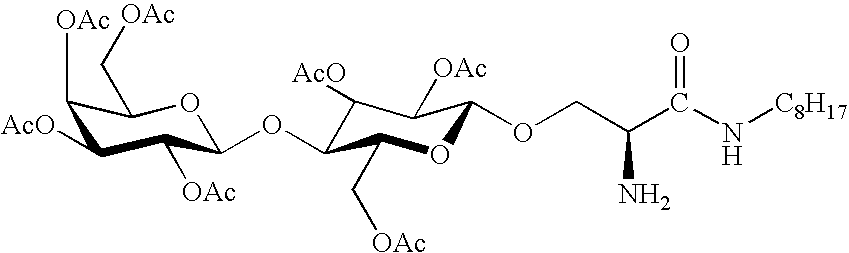


Claims (29)


—R9—R10— (IV)
-A-(CH2)n—CO— (V)
—B—(CH2)n—O— (VI)

Applications Claiming Priority (3)
| Application Number | Priority Date | Filing Date | Title |
|---|---|---|---|
| JP2003-129738 | 2003-05-08 | ||
| JP2003129738A JP2004043782A (en) | 2002-05-09 | 2003-05-08 | Water soluble polymer primer for synthesizing oligosaccharide |
| PCT/JP2004/006480 WO2004099271A1 (en) | 2003-05-08 | 2004-05-07 | Sugar chain-containing water-soluble polymer compound |
Publications (2)
| Publication Number | Publication Date |
|---|---|
| US20060287457A1 US20060287457A1 (en) | 2006-12-21 |
| US7700701B2 true US7700701B2 (en) | 2010-04-20 |
Family
ID=33432085
Family Applications (1)
| Application Number | Title | Priority Date | Filing Date |
|---|---|---|---|
| US10/556,231 Expired - Fee Related US7700701B2 (en) | 2003-05-08 | 2004-05-07 | Water-soluble polymer compound having sugar chains |
Country Status (3)
| Country | Link |
|---|---|
| US (1) | US7700701B2 (en) |
| JP (1) | JP4905879B2 (en) |
| WO (1) | WO2004099271A1 (en) |
Families Citing this family (6)
| Publication number | Priority date | Publication date | Assignee | Title |
|---|---|---|---|---|
| EP2072531A1 (en) * | 2007-12-21 | 2009-06-24 | Sika Technology AG | Polymers with saccharide side chains und their use as a dispersing agent |
| US9243040B2 (en) | 2010-11-30 | 2016-01-26 | The Board Of Trustees Of The University Of Illinois | Stable helical ionic polypeptides |
| WO2018140613A1 (en) | 2017-01-25 | 2018-08-02 | The Board Of Trustees Of The University Of Illinois | Conformation switchable antimicrobial peptides and methods of using the same |
| CN109762035A (en) * | 2019-02-26 | 2019-05-17 | 西北大学 | A kind of preparation method of O-sugar chain carrying functional group |
| KR102949437B1 (en) * | 2019-11-14 | 2026-04-08 | 고쿠리쓰다이가쿠호진 규슈다이가쿠 | O-linked N-acetylglucosamine protein analogue and fibrosis treatment drug containing the same |
| WO2026024847A2 (en) * | 2024-07-23 | 2026-01-29 | Baylor University | Chemical probes for microbial mucin degraders in the gut microbiome |
Citations (8)
| Publication number | Priority date | Publication date | Assignee | Title |
|---|---|---|---|---|
| WO1991016449A1 (en) | 1990-04-16 | 1991-10-31 | The Trustees Of The University Of Pennsylvania | Saccharide compositions, methods and apparatus for their synthesis |
| JPH05500905A (en) | 1990-04-16 | 1993-02-25 | ザ・トラステイーズ・オブ・ザ・ユニバーシテイー・オブ・ペンシルバニア | Saccharide composition, its synthesis method and synthesis equipment |
| JPH10251287A (en) | 1997-03-10 | 1998-09-22 | Toyobo Co Ltd | Polymeric primer for synthesizing sphingoglycolipid and use thereof |
| JPH1135592A (en) | 1997-05-20 | 1999-02-09 | Dainippon Ink & Chem Inc | Alkyl glycosyl (meth) acrylate and method for producing the same |
| JPH1142096A (en) | 1997-07-29 | 1999-02-16 | Toyobo Co Ltd | Sugar production method |
| JP2001040046A (en) | 1999-05-26 | 2001-02-13 | Toyobo Co Ltd | Acrylamide derivative having maltooligosaccharide chain in side chain and immobilized enzyme using the same |
| JP2001220399A (en) | 1999-11-25 | 2001-08-14 | Toyobo Co Ltd | Polymeric primers for synthesizing glycopeptides or neoglycopeptides and their uses |
| JP2003026725A (en) | 2001-07-13 | 2003-01-29 | Toyobo Co Ltd | Novel maltose-bonded protein ligand and its application |
Family Cites Families (1)
| Publication number | Priority date | Publication date | Assignee | Title |
|---|---|---|---|---|
| JP4337026B2 (en) * | 2003-05-08 | 2009-09-30 | 東洋紡績株式会社 | Water-soluble polymer primer for sugar chain synthesis |
-
2004
- 2004-05-07 JP JP2005506041A patent/JP4905879B2/en not_active Expired - Fee Related
- 2004-05-07 US US10/556,231 patent/US7700701B2/en not_active Expired - Fee Related
- 2004-05-07 WO PCT/JP2004/006480 patent/WO2004099271A1/en not_active Ceased
Patent Citations (9)
| Publication number | Priority date | Publication date | Assignee | Title |
|---|---|---|---|---|
| WO1991016449A1 (en) | 1990-04-16 | 1991-10-31 | The Trustees Of The University Of Pennsylvania | Saccharide compositions, methods and apparatus for their synthesis |
| JPH05500905A (en) | 1990-04-16 | 1993-02-25 | ザ・トラステイーズ・オブ・ザ・ユニバーシテイー・オブ・ペンシルバニア | Saccharide composition, its synthesis method and synthesis equipment |
| JPH10251287A (en) | 1997-03-10 | 1998-09-22 | Toyobo Co Ltd | Polymeric primer for synthesizing sphingoglycolipid and use thereof |
| JPH1135592A (en) | 1997-05-20 | 1999-02-09 | Dainippon Ink & Chem Inc | Alkyl glycosyl (meth) acrylate and method for producing the same |
| JPH1142096A (en) | 1997-07-29 | 1999-02-16 | Toyobo Co Ltd | Sugar production method |
| US6046040A (en) * | 1997-07-29 | 2000-04-04 | Toyo Boseki Kabushiki Kaisha | Method for producing glycoconjugates |
| JP2001040046A (en) | 1999-05-26 | 2001-02-13 | Toyobo Co Ltd | Acrylamide derivative having maltooligosaccharide chain in side chain and immobilized enzyme using the same |
| JP2001220399A (en) | 1999-11-25 | 2001-08-14 | Toyobo Co Ltd | Polymeric primers for synthesizing glycopeptides or neoglycopeptides and their uses |
| JP2003026725A (en) | 2001-07-13 | 2003-01-29 | Toyobo Co Ltd | Novel maltose-bonded protein ligand and its application |
Non-Patent Citations (21)
| Title |
|---|
| Blixt et al., "Enzymatic glycosylation of reducing oligosaccharides . . . squarate linker," Carbohydrate Research 319:80-91, 1999. |
| Dalkas et al. Polymer 47 (2006) 243-248. * |
| Huang et al., "Homogenous Enzymatic Synthesis . . . Polymer Support," Adv. Synth. Catal. 343:675-681, 2001. |
| Kopper et al., "Improved accepter polymers for enzymic glycosylation," Reactive Polymers 22:171-180, 1993. |
| Liming Dai "Intelligent Macromolecules for Smart Devices" Published by Springer 2003, p. 90. * |
| Machine Translation of JP 10-251287. * |
| Machine Translation of JP 2001-220399. * |
| Meldal et al., "A PEGA Resin . . . Glycopeptides," J. Chem.. Soc., Chem. Commun. pp. 1849-1850, 1994. |
| Ni et al. (Chinese Chemical Letters, 18 (2007), 79-80). * |
| Nishiguchi et al., "Highly efficient oligosaccharide synthesis . . . on solid supports," Chem. Commun. pp. 1944-1945, 2001. |
| Nishiguchi et al., "Polymer Preprints," Japan 52:3684-3685, 2003. |
| Nishimura et al., "Chemoenzymatic Oligosaccharide Synthesis . . . Polymeric Carrier," Tetrahedron Letters 35:5657-5660, 1994. |
| Randall et al., "Solution- and Solid-Phase Synthesis . . . Adhesion," J. Am. Chem.. Soc. 116:11315-11322, 1994. |
| Sabine Kopper, "Polymer-supported enzymic . . . scale," Carbohydrate Research 265:161-166, 1994. |
| Schuster et al. "Solid-Phase Chemical-Enzymatic . . . Oligosaccharides," J. Am. Chem.. Soc. 116:1135-1136, 1994. |
| Seitz et al., "Chemoenzymatic Solution- and Solid-Phase . . . Peptides," J. Am. Chem.. Soc., 119:8766-8776, 1997. |
| Toda et al., "An Engineered Biocatalyst for the Synthesis of Glycoconjugates . . . Protein," Adv. Synth. Catal. 344:61-69, 2002. |
| Yamada et al., "An Efficient synthesis of Sialoglycoconjugates . . . Support," Tetrahedron Letters 36:9493-9496, 1995. |
| Yamada et al., High performance polymer . . . glycoconjugates, Carbohydrate Research 305:443-461, 1998. |
| Zehavi et al., "Polymers having . . . synthase reaction," Carbohydrate Research 228:225-263, 1992. |
| Zehavi et al., Enzymic Synthesis . . . Polyacrylamide Beads, Carbohydrate Research 124:23-34, 1983. |
Also Published As
| Publication number | Publication date |
|---|---|
| JP4905879B2 (en) | 2012-03-28 |
| US20060287457A1 (en) | 2006-12-21 |
| JPWO2004099271A1 (en) | 2006-07-13 |
| WO2004099271A1 (en) | 2004-11-18 |
Similar Documents
| Publication | Publication Date | Title |
|---|---|---|
| US5369017A (en) | Process for solid phase glycopeptide synthesis | |
| JP4119428B2 (en) | Process for producing glycopeptide having sugar chain asparagine and the glycopeptide | |
| EP0897014A2 (en) | Method for producing glycoconjugates | |
| EP0503301B1 (en) | Peptide derivatives and application thereof | |
| CN1829742B (en) | Aminated complex sugar chain derivative and process for producing the same | |
| CN104936613B (en) | Sugar chain addition connexon, the compound or its salt containing sugar chain addition connexon and physiological activator and its manufacturing method | |
| US20060287457A1 (en) | Sugar chain-containing water-soluble polymer compound | |
| AU2003292641A1 (en) | Three-branched sugar-chain asparagine derivatives, the sugar-chain asparagines, the sugar chains, and processes for producing these | |
| EP2697247B1 (en) | Method for the rapid chemoenzymatic glycosylation of conjugates between peptides and hydrophilic polymers | |
| EP1406927B1 (en) | Glycopeptides, their preparation and use in the diagnosis or therapeutic treatment of multiple sclerosis | |
| Wu et al. | A new N-acetylgalactosamine containing peptide as a targeting vehicle for mammalian hepatocytes via asialoglycoprotein receptor endocytosis | |
| JP2001220399A (en) | Polymeric primers for synthesizing glycopeptides or neoglycopeptides and their uses | |
| JP3991240B2 (en) | Polymer primer for glycosphingolipid synthesis and its use | |
| EP1801118A1 (en) | Process for synthesis of mucin-type peptides and muc1-related glycopeptides | |
| JP4337026B2 (en) | Water-soluble polymer primer for sugar chain synthesis | |
| JP2009143809A (en) | Mucin-type glycopeptide having polylactosamine skeleton | |
| Paulsen et al. | Chemical synthesis of glycopeptides | |
| Nyandoro | Semi-synthesis of glycoproteins by auxiliary-mediated native chemical ligation | |
| Callstrom et al. | New Carbohydrate-Based Polymeric Materials | |
| WO2005108417A1 (en) | Polymeric primer for sugar peptide synthesis | |
| Katajisto et al. | Pentaerythritol and its congeners: Versatile building blocks for the construction of oligomeric bioconjugates and small molecule libraries on a solid support | |
| JP2004043782A (en) | Water soluble polymer primer for synthesizing oligosaccharide |
Legal Events
| Date | Code | Title | Description |
|---|---|---|---|
| AS | Assignment |
Owner name: TOYO BOSEKI KABUSHIKI KAISHA,JAPAN Free format text: ASSIGNMENT OF ASSIGNORS INTEREST;ASSIGNORS:NISHIGUCHI, SUSUMU;TODA, ATSUSHI;NISHIMURA, SHIN-ICHIRO;AND OTHERS;REEL/FRAME:017929/0035 Effective date: 20051026 Owner name: TOYO BOSEKI KABUSHIKI KAISHA, JAPAN Free format text: ASSIGNMENT OF ASSIGNORS INTEREST;ASSIGNORS:NISHIGUCHI, SUSUMU;TODA, ATSUSHI;NISHIMURA, SHIN-ICHIRO;AND OTHERS;REEL/FRAME:017929/0035 Effective date: 20051026 Owner name: NATIONAL INSTITUTE OF ADVANCED INDUSTRIAL SCIENCE Free format text: ASSIGNMENT OF ASSIGNORS INTEREST;ASSIGNORS:NISHIGUCHI, SUSUMU;TODA, ATSUSHI;NISHIMURA, SHIN-ICHIRO;AND OTHERS;REEL/FRAME:017929/0035 Effective date: 20051026 |
|
| AS | Assignment |
Owner name: TOYO BOSEKI KABUSHIKI KAISHA, JAPAN Free format text: ASSIGNMENT OF ASSIGNORS INTEREST;ASSIGNOR:NATIONAL INSTITUTE OF ADVANCED INDUSTRIAL SCIENCE AND TECHNOLOGY;REEL/FRAME:022775/0446 Effective date: 20090526 Owner name: TOYO BOSEKI KABUSHIKI KAISHA,JAPAN Free format text: ASSIGNMENT OF ASSIGNORS INTEREST;ASSIGNOR:NATIONAL INSTITUTE OF ADVANCED INDUSTRIAL SCIENCE AND TECHNOLOGY;REEL/FRAME:022775/0446 Effective date: 20090526 |
|
| FEPP | Fee payment procedure |
Free format text: PAYOR NUMBER ASSIGNED (ORIGINAL EVENT CODE: ASPN); ENTITY STATUS OF PATENT OWNER: LARGE ENTITY |
|
| FPAY | Fee payment |
Year of fee payment: 4 |
|
| AS | Assignment |
Owner name: NISHIMURA, SHIN-ICHIRO, MR., JAPAN Free format text: ASSIGNMENT OF ASSIGNORS INTEREST;ASSIGNOR:TOYOBO CO., LTD;REEL/FRAME:031735/0348 Effective date: 20131119 Owner name: TOYOBO CO., LTD., JAPAN Free format text: CHANGE OF NAME;ASSIGNOR:TOYO BOSEKI KABUSHIKI KAISHA;REEL/FRAME:031770/0235 Effective date: 20120628 |
|
| FEPP | Fee payment procedure |
Free format text: MAINTENANCE FEE REMINDER MAILED (ORIGINAL EVENT CODE: REM.) |
|
| LAPS | Lapse for failure to pay maintenance fees |
Free format text: PATENT EXPIRED FOR FAILURE TO PAY MAINTENANCE FEES (ORIGINAL EVENT CODE: EXP.) |
|
| STCH | Information on status: patent discontinuation |
Free format text: PATENT EXPIRED DUE TO NONPAYMENT OF MAINTENANCE FEES UNDER 37 CFR 1.362 |
|
| FP | Lapsed due to failure to pay maintenance fee |
Effective date: 20180420 |