US7652154B2 - Method and intermediates for the preparation of derivatives of N (1-benzhydrylazetidin-3-yl)-N-phenylmethylsulfonamide - Google Patents
Method and intermediates for the preparation of derivatives of N (1-benzhydrylazetidin-3-yl)-N-phenylmethylsulfonamide Download PDFInfo
- Publication number
- US7652154B2 US7652154B2 US12/194,644 US19464408A US7652154B2 US 7652154 B2 US7652154 B2 US 7652154B2 US 19464408 A US19464408 A US 19464408A US 7652154 B2 US7652154 B2 US 7652154B2
- Authority
- US
- United States
- Prior art keywords
- sodium
- potassium
- carbon atoms
- carbonate
- linear
- Prior art date
- Legal status (The legal status is an assumption and is not a legal conclusion. Google has not performed a legal analysis and makes no representation as to the accuracy of the status listed.)
- Expired - Lifetime
Links
- 0 *C.*C.CC.CS(=O)(=O)N(c1ccccc1)C1CN(C(c2ccccc2)c2ccccc2)C1 Chemical compound *C.*C.CC.CS(=O)(=O)N(c1ccccc1)C1CN(C(c2ccccc2)c2ccccc2)C1 0.000 description 16
Classifications
-
- C—CHEMISTRY; METALLURGY
- C07—ORGANIC CHEMISTRY
- C07D—HETEROCYCLIC COMPOUNDS
- C07D205/00—Heterocyclic compounds containing four-membered rings with one nitrogen atom as the only ring hetero atom
- C07D205/02—Heterocyclic compounds containing four-membered rings with one nitrogen atom as the only ring hetero atom not condensed with other rings
- C07D205/04—Heterocyclic compounds containing four-membered rings with one nitrogen atom as the only ring hetero atom not condensed with other rings having no double bonds between ring members or between ring members and non-ring members
-
- A—HUMAN NECESSITIES
- A61—MEDICAL OR VETERINARY SCIENCE; HYGIENE
- A61P—SPECIFIC THERAPEUTIC ACTIVITY OF CHEMICAL COMPOUNDS OR MEDICINAL PREPARATIONS
- A61P11/00—Drugs for disorders of the respiratory system
- A61P11/06—Antiasthmatics
-
- A—HUMAN NECESSITIES
- A61—MEDICAL OR VETERINARY SCIENCE; HYGIENE
- A61P—SPECIFIC THERAPEUTIC ACTIVITY OF CHEMICAL COMPOUNDS OR MEDICINAL PREPARATIONS
- A61P21/00—Drugs for disorders of the muscular or neuromuscular system
-
- A—HUMAN NECESSITIES
- A61—MEDICAL OR VETERINARY SCIENCE; HYGIENE
- A61P—SPECIFIC THERAPEUTIC ACTIVITY OF CHEMICAL COMPOUNDS OR MEDICINAL PREPARATIONS
- A61P25/00—Drugs for disorders of the nervous system
-
- A—HUMAN NECESSITIES
- A61—MEDICAL OR VETERINARY SCIENCE; HYGIENE
- A61P—SPECIFIC THERAPEUTIC ACTIVITY OF CHEMICAL COMPOUNDS OR MEDICINAL PREPARATIONS
- A61P25/00—Drugs for disorders of the nervous system
- A61P25/02—Drugs for disorders of the nervous system for peripheral neuropathies
-
- A—HUMAN NECESSITIES
- A61—MEDICAL OR VETERINARY SCIENCE; HYGIENE
- A61P—SPECIFIC THERAPEUTIC ACTIVITY OF CHEMICAL COMPOUNDS OR MEDICINAL PREPARATIONS
- A61P25/00—Drugs for disorders of the nervous system
- A61P25/04—Centrally acting analgesics, e.g. opioids
-
- A—HUMAN NECESSITIES
- A61—MEDICAL OR VETERINARY SCIENCE; HYGIENE
- A61P—SPECIFIC THERAPEUTIC ACTIVITY OF CHEMICAL COMPOUNDS OR MEDICINAL PREPARATIONS
- A61P25/00—Drugs for disorders of the nervous system
- A61P25/06—Antimigraine agents
-
- A—HUMAN NECESSITIES
- A61—MEDICAL OR VETERINARY SCIENCE; HYGIENE
- A61P—SPECIFIC THERAPEUTIC ACTIVITY OF CHEMICAL COMPOUNDS OR MEDICINAL PREPARATIONS
- A61P25/00—Drugs for disorders of the nervous system
- A61P25/08—Antiepileptics; Anticonvulsants
-
- A—HUMAN NECESSITIES
- A61—MEDICAL OR VETERINARY SCIENCE; HYGIENE
- A61P—SPECIFIC THERAPEUTIC ACTIVITY OF CHEMICAL COMPOUNDS OR MEDICINAL PREPARATIONS
- A61P25/00—Drugs for disorders of the nervous system
- A61P25/14—Drugs for disorders of the nervous system for treating abnormal movements, e.g. chorea, dyskinesia
- A61P25/16—Anti-Parkinson drugs
-
- A—HUMAN NECESSITIES
- A61—MEDICAL OR VETERINARY SCIENCE; HYGIENE
- A61P—SPECIFIC THERAPEUTIC ACTIVITY OF CHEMICAL COMPOUNDS OR MEDICINAL PREPARATIONS
- A61P25/00—Drugs for disorders of the nervous system
- A61P25/18—Antipsychotics, i.e. neuroleptics; Drugs for mania or schizophrenia
-
- A—HUMAN NECESSITIES
- A61—MEDICAL OR VETERINARY SCIENCE; HYGIENE
- A61P—SPECIFIC THERAPEUTIC ACTIVITY OF CHEMICAL COMPOUNDS OR MEDICINAL PREPARATIONS
- A61P25/00—Drugs for disorders of the nervous system
- A61P25/20—Hypnotics; Sedatives
-
- A—HUMAN NECESSITIES
- A61—MEDICAL OR VETERINARY SCIENCE; HYGIENE
- A61P—SPECIFIC THERAPEUTIC ACTIVITY OF CHEMICAL COMPOUNDS OR MEDICINAL PREPARATIONS
- A61P25/00—Drugs for disorders of the nervous system
- A61P25/22—Anxiolytics
-
- A—HUMAN NECESSITIES
- A61—MEDICAL OR VETERINARY SCIENCE; HYGIENE
- A61P—SPECIFIC THERAPEUTIC ACTIVITY OF CHEMICAL COMPOUNDS OR MEDICINAL PREPARATIONS
- A61P25/00—Drugs for disorders of the nervous system
- A61P25/24—Antidepressants
-
- A—HUMAN NECESSITIES
- A61—MEDICAL OR VETERINARY SCIENCE; HYGIENE
- A61P—SPECIFIC THERAPEUTIC ACTIVITY OF CHEMICAL COMPOUNDS OR MEDICINAL PREPARATIONS
- A61P25/00—Drugs for disorders of the nervous system
- A61P25/28—Drugs for disorders of the nervous system for treating neurodegenerative disorders of the central nervous system, e.g. nootropic agents, cognition enhancers, drugs for treating Alzheimer's disease or other forms of dementia
-
- A—HUMAN NECESSITIES
- A61—MEDICAL OR VETERINARY SCIENCE; HYGIENE
- A61P—SPECIFIC THERAPEUTIC ACTIVITY OF CHEMICAL COMPOUNDS OR MEDICINAL PREPARATIONS
- A61P25/00—Drugs for disorders of the nervous system
- A61P25/30—Drugs for disorders of the nervous system for treating abuse or dependence
-
- A—HUMAN NECESSITIES
- A61—MEDICAL OR VETERINARY SCIENCE; HYGIENE
- A61P—SPECIFIC THERAPEUTIC ACTIVITY OF CHEMICAL COMPOUNDS OR MEDICINAL PREPARATIONS
- A61P27/00—Drugs for disorders of the senses
- A61P27/02—Ophthalmic agents
- A61P27/06—Antiglaucoma agents or miotics
-
- A—HUMAN NECESSITIES
- A61—MEDICAL OR VETERINARY SCIENCE; HYGIENE
- A61P—SPECIFIC THERAPEUTIC ACTIVITY OF CHEMICAL COMPOUNDS OR MEDICINAL PREPARATIONS
- A61P3/00—Drugs for disorders of the metabolism
-
- A—HUMAN NECESSITIES
- A61—MEDICAL OR VETERINARY SCIENCE; HYGIENE
- A61P—SPECIFIC THERAPEUTIC ACTIVITY OF CHEMICAL COMPOUNDS OR MEDICINAL PREPARATIONS
- A61P3/00—Drugs for disorders of the metabolism
- A61P3/04—Anorexiants; Antiobesity agents
-
- A—HUMAN NECESSITIES
- A61—MEDICAL OR VETERINARY SCIENCE; HYGIENE
- A61P—SPECIFIC THERAPEUTIC ACTIVITY OF CHEMICAL COMPOUNDS OR MEDICINAL PREPARATIONS
- A61P3/00—Drugs for disorders of the metabolism
- A61P3/06—Antihyperlipidemics
-
- A—HUMAN NECESSITIES
- A61—MEDICAL OR VETERINARY SCIENCE; HYGIENE
- A61P—SPECIFIC THERAPEUTIC ACTIVITY OF CHEMICAL COMPOUNDS OR MEDICINAL PREPARATIONS
- A61P3/00—Drugs for disorders of the metabolism
- A61P3/08—Drugs for disorders of the metabolism for glucose homeostasis
- A61P3/10—Drugs for disorders of the metabolism for glucose homeostasis for hyperglycaemia, e.g. antidiabetics
-
- A—HUMAN NECESSITIES
- A61—MEDICAL OR VETERINARY SCIENCE; HYGIENE
- A61P—SPECIFIC THERAPEUTIC ACTIVITY OF CHEMICAL COMPOUNDS OR MEDICINAL PREPARATIONS
- A61P35/00—Antineoplastic agents
-
- A—HUMAN NECESSITIES
- A61—MEDICAL OR VETERINARY SCIENCE; HYGIENE
- A61P—SPECIFIC THERAPEUTIC ACTIVITY OF CHEMICAL COMPOUNDS OR MEDICINAL PREPARATIONS
- A61P43/00—Drugs for specific purposes, not provided for in groups A61P1/00-A61P41/00
-
- A—HUMAN NECESSITIES
- A61—MEDICAL OR VETERINARY SCIENCE; HYGIENE
- A61P—SPECIFIC THERAPEUTIC ACTIVITY OF CHEMICAL COMPOUNDS OR MEDICINAL PREPARATIONS
- A61P7/00—Drugs for disorders of the blood or the extracellular fluid
- A61P7/04—Antihaemorrhagics; Procoagulants; Haemostatic agents; Antifibrinolytic agents
-
- A—HUMAN NECESSITIES
- A61—MEDICAL OR VETERINARY SCIENCE; HYGIENE
- A61P—SPECIFIC THERAPEUTIC ACTIVITY OF CHEMICAL COMPOUNDS OR MEDICINAL PREPARATIONS
- A61P9/00—Drugs for disorders of the cardiovascular system
- A61P9/02—Non-specific cardiovascular stimulants, e.g. drugs for syncope, antihypotensives
-
- A—HUMAN NECESSITIES
- A61—MEDICAL OR VETERINARY SCIENCE; HYGIENE
- A61P—SPECIFIC THERAPEUTIC ACTIVITY OF CHEMICAL COMPOUNDS OR MEDICINAL PREPARATIONS
- A61P9/00—Drugs for disorders of the cardiovascular system
- A61P9/10—Drugs for disorders of the cardiovascular system for treating ischaemic or atherosclerotic diseases, e.g. antianginal drugs, coronary vasodilators, drugs for myocardial infarction, retinopathy, cerebrovascula insufficiency, renal arteriosclerosis
-
- A—HUMAN NECESSITIES
- A61—MEDICAL OR VETERINARY SCIENCE; HYGIENE
- A61P—SPECIFIC THERAPEUTIC ACTIVITY OF CHEMICAL COMPOUNDS OR MEDICINAL PREPARATIONS
- A61P9/00—Drugs for disorders of the cardiovascular system
- A61P9/12—Antihypertensives
Definitions
- the present invention relates to processes for preparing azetidine derivatives of N-(1-benzhydrylazetidin-3-yl)-N-phenylmethylsulfonamide (I) and in particular N- ⁇ 1-[bis(4-chlorophenyl)methyl]azetidin-3-yl ⁇ -N-(3,5-difluorophenyl)methylsulfonamide.
- these compounds may be used for treating or preventing psychoses, including schizophrenia, anxiety disorders, depression, epilepsy, neurodegeneration, cerebellar and spinocerebellar disorders, cognitive disorders, head injuries, panic attacks, peripheral neuropathy, glaucoma, migraine, Parkinson's disease, Alzheimer's disease, Huntington's chorea, Reynaud's disease, tremor, obsessive compulsive disorder, senile dementia, thymus disorders, Toureffe's syndrome, tardive dyskinesia, bipolar disorders, cancers, drug-induced locomotor disorders, dystonia, endotoxaemic shock, hemorrhagic shock, hypotension, insomnia, immunological diseases, multiple sclerosis, vomiting, asthma, eating disorders (bulimia or anorexia), obesity, memory disorders, in weaning from chronic treatments and alcohol or drug (opioids, barbiturates, cannabis, cocaine, amphetamine, phencyclidine, hallucinogen or benzodiazepines, for example) abuse, as
- the present invention also relates to the use of N- ⁇ 1-[bis(4-chlorophenyl)methyl]azetidin-3-yl ⁇ -N-(3,5-difluorophenyl)methylsulfonamide in the treatment of metabolic syndrome and visceral obesity.
- the present invention relates to the preparation of N-(1-benzhydrylazetidin-3-yl)-N-phenylmethylsulfonamide derivatives of general formula (I) in which R, R′ and R′′ represent, independently of each other, one or more hydrogen, halogen (Cl, F, Br or I), cyano, nitro, linear or branched alkyl of 1 to 6 carbon atoms, linear or branched alkoxy of 1 to 6 carbon atoms, linear or branched alkyl carboxylate of 1 to 6 carbon atoms, trifluoromethyl or trifluoromethoxy radicals and R′′′ represents a linear or branched alkyl or perfluoroalkyl group of 1 to 6 carbon atoms or an aryl group optionally substituted with one or more radicals R′′.
- R, R′ and R′′ represent, independently of each other, one or more hydrogen, halogen (Cl, F, Br or I), cyano, nitro, linear or branched al
- Patent application WO 01/64634 describes general routes of access for obtaining such products and in particular a synthesis via condensation of a sulfonate and a sulfonamide in an inert solvent such as dioxane, in the presence of Cs 2 CO 3 at the reflux temperature of the reaction mixture.
- the compound of formula (I) is obtained by condensing a sulfonate of general formula (II) and a sulfonamide of general formula (III) in which R, R′ and R′′ represent, independently of each other, one or more hydrogen, halogen (Cl, F, Br or I), cyano, nitro, linear or branched alkyl of 1 to 6 carbon atoms, linear or branched alkoxy of 1 to 6 carbon atoms, linear or branched alkyl carboxylate of 1 to 6 carbon atoms, trifluoromethyl or trifluoromethoxy radicals and R′′′ represents a linear or branched alkyl or perfluoroalkyl group of 1 to 6 carbon atoms or an aryl group optionally substituted with one or more radicals R′′ and R1 represents a methyl, trifluoromethyl, C 4 F 9 , C 8 F 17 or phenyl radical optionally substituted with a methyl, bromo or nitro residue.
- the condensation is performed in an organic solvent optionally in the presence of water, at a temperature of between 20° C. and 150° C. in the presence of mineral or organic base and of a phase-transfer agent.
- the process is preferably performed in a solvent such as toluene or xylene.
- solvents such as heptane, hexane, an ether solvent such as tetrahydrofuran or dimethoxyethane, or alternatively a chlorinated solvent such as monochlorobenzene, dichlorobenzene, chlorobutane or methylene chloride, alcohols such as methanol, ethanol, isopropanol or butanol, acetonitrile, pyridine, dipolar aprotic solvents such as DMF, dimethylacetamide or N-methylpyrrolidone, and ketones such as acetone, methyl ethyl ketone or methyl isobutyl ketone.
- a mineral or organic base such as the hydrogen carbonate, carbonate, phosphate or hydroxide of an alkali metal such as lithium, sodium, potassium or cesium, and more particularly anhydrous tripotassium phosphate, is also used.
- Alkali metal alkoxides such as sodium or potassium methoxide, ethoxide, t-amyloxide or t-butoxide may also be used.
- amine bases such as 1,8-diazabicyclo[5.4.0]undec-7-ene (DBU), 1,5-diazabicyclo[4.3.0]non-5-ene (DBN) or tetramethylguanidine may be used.
- phase-transfer agent such as a quaternary ammonium salt or a complexing agent.
- quaternary ammonium salt means a tetraalkylammonium or benzyltrialkylammonium halide, hydroxide, sulfate or hydrogen sulfate.
- alkyl groups correspond to those commonly used by a person skilled in the art, such as a linear alkyl group of 1 to 16 carbon atoms.
- complexing agent and “phase-transfer agent” mean crown ethers such as 12-Crown-4 (12-C-4), 15-Crown-5 (15-C-5) or 18-Crown-6 (18-C-6), pentaglyme (Glyme-6) or polyethylene glycol, PEG 400 and, more particularly, tris(dioxa-3,6-heptyl)amine (TDA-1).
- crown ethers such as 12-Crown-4 (12-C-4), 15-Crown-5 (15-C-5) or 18-Crown-6 (18-C-6), pentaglyme (Glyme-6) or polyethylene glycol, PEG 400 and, more particularly, tris(dioxa-3,6-heptyl)amine (TDA-1).
- a subject of the invention is also a process characterized in that the compound of formula (II) is obtained by treating a compound of general formula (IV) or an acid salt thereof with a sulfonyl chloride or a sulfonic anhydride in the presence of base at a temperature of between ⁇ 60° C. and 100° C.
- sulfonyl chloride or sulfonic anhydride means methanesulfonyl chloride or methanesulfonic anhydride, perfluoroalkanesulfonic anhydrides of 1 to 9 carbon atoms, and benzenesulfonyl, p-toluenesulfonyl, p-nitrobenzenesulfonyl or p-bromobenzenesulfonyl chloride.
- acid salt means a hydrochloride, hydrobromide, sulfate, hydrogen sulfate, sulfonate such as methanesulfonate or p-toluenesulfonate, or a carboxylic acid salt such as an acetate, an oxalate or a fumarate.
- R′′′ is a methyl.
- the process is preferably performed in a solvent such as toluene, xylene, heptane, hexane, an ether solvent such as tetrahydrofuran or dimethoxyethane, or a chlorinated solvent such as monochlorobenzene, dichlorobenzene, chlorobutane or methylene chloride, acetonitrile, or dipolar aprotic solvents such as DMF, dimethylacetamide or N-methylpyrrolidone, and in the presence of a base such as the hydrogen carbonate, carbonate, phosphate or hydroxide of an alkali metal such as lithium, sodium, potassium or cesium.
- a solvent such as toluene, xylene, heptane, hexane, an ether solvent such as tetrahydrofuran or dimethoxyethane, or a chlorinated solvent such as monochlorobenzene, dichlorobenzene, chlorobutane
- Amine bases such as triethylamine, diisopropylethylamine, N,N-dimethylaniline, N-methylimidazole, pyridine, DBU, DBN or tetramethylguanidine may also be used.
- a subject of the invention is also a process characterized in that the compound of formula (IV) is obtained by treating a compound of general formula (V) or an acid salt thereof with epibromohydrin or epichlorohydrin at a temperature of between 20° C. and 150° C.
- the process is preferably performed in an organic solvent in the presence of base, an additive and, where appropriate, an aqueous phase.
- acid salt means a hydrochloride, hydrobromide, sulfate, hydrogen sulfate, sulfonate such as methanesulfonate or p-toluenesulfonate, or a carboxylic acid salt such as an acetate, an oxalate or a fumarate.
- the process is preferably performed in a solvent such as toluene, xylene, heptane or hexane, an ether solvent such as tetrahydrofuran or dimethoxyethane, or a chlorinated solvent such as monochlorobenzene, dichlorobenzene, chlorobutane or methylene chloride, or linear or branched alcohols of 1 to 6 carbon atoms, such as ethanol and more particularly n-butanol.
- base means the hydrogen carbonate, carbonate, phosphate or hydroxide of an alkali metal such as lithium, sodium, potassium or cesium, and more particularly anhydrous tripotassium phosphate.
- Alkali metal alkoxides such as sodium or potassium methoxide, ethoxide, t-amyloxide or t-butoxide may also be used.
- amine bases such as diisopropylethylamine, DBU, DBN or tetramethylguanidine may be used.
- additive means alkali metal or alkaline-earth metal iodides or bromides, and more particularly sodium iodide.
- a subject of the invention is also a process characterized in that the compound of formula (V) is obtained by heating a compound of general formula (VI) in acidic medium.
- the process is preferably performed in a solvent such as linear or branched alcohols of 1 to 6 carbon atoms and more particularly n-butanol, or optionally as a mixture with water, in the presence of a strong mineral acid such as hydrobromic acid, sulfuric acid and more particularly hydrochloric acid, at a temperature of between 80° C. and 150° C.
- a solvent such as linear or branched alcohols of 1 to 6 carbon atoms and more particularly n-butanol, or optionally as a mixture with water, in the presence of a strong mineral acid such as hydrobromic acid, sulfuric acid and more particularly hydrochloric acid, at a temperature of between 80° C. and 150° C.
- a subject of the invention is also a process characterized in that the compound of formula (VI) is obtained from the compound of formula (VII) via a Ritter reaction in the presence of a nitrile and an acid catalyst.
- the process is preferably performed using a nitrile such as propionitrile, butyronitrile, benzonitrile, ethyl cyanoacetate or, more particularly, in the presence of acetonitrile.
- a nitrile such as propionitrile, butyronitrile, benzonitrile, ethyl cyanoacetate or, more particularly, in the presence of acetonitrile.
- An acid catalysis is performed in the presence of sulfuric acid, methanesulfonic acid, trifluoromethanesulfonic acid, acetic acid, propionic acid or, more particularly, formic acid, at a temperature of between 50° C. and 150° C.
- a subject of the present invention is thus also the three-step synthesis of the product of formula (IV)
- R and R′ represent, independently of each other, one or more hydrogen, halogen (Cl, F, Br or I), cyano, nitro, linear or branched alkyl of 1 to 6 carbon atoms, linear or branched alkoxy of 1 to 6 carbon atoms, linear or branched alkyl carboxylate of 1 to 6 carbon atoms, trifluoromethyl or trifluoromethoxy radicals,
- R and R′ represent, independently of each other, one or more hydrogen, halogen (Cl, F, Br or I), cyano, nitro, linear or branched alkyl of 1 to 6 carbon atoms, linear or branched alkoxy of 1 to 6 carbon atoms, linear or branched alkyl carboxylate of 1 to 6 carbon atoms, trifluoromethyl or trifluoromethoxy radicals, reacted with acetonitrile in the presence of catalysis with formic acid at a temperature of between 50° C. and 150° C., to give the product of formula (VI)
- R and R′ represent, independently of each other, one or more hydrogen, halogen (Cl, F, Br or I), cyano, nitro, linear or branched alkyl of 1 to 6 carbon atoms, linear or branched alkoxy of 1 to 6 carbon atoms, linear or branched alkyl carboxylate of 1 to 6 carbon atoms, trifluoromethyl or trifluoromethoxy radicals,
- R and R′ represent, independently of each other, one or more hydrogen, halogen (Cl, F, Br or I), cyano, nitro, linear or branched alkyl of 1 to 6 carbon atoms, linear or branched alkoxy of 1 to 6 carbon atoms, linear or branched alkyl carboxylate of 1 to 6 carbon atoms, trifluoromethyl or trifluoromethoxy radicals,
- a subject of the invention is also a process according to the text hereinabove, characterized in that the compound of formula (VII) is obtained by reducing a benzophenone of formula (VIII), in the presence of a reducing agent at a temperature of from ⁇ 40° C. to +30° C.
- a reducing agent at a temperature of from ⁇ 40° C. to +30° C.
- the reaction is performed in ethers such as tetrahydrofuran or dimethoxyethane, aromatic solvents such as toluene, chlorinated solvents such as dichloromethane, alcohols such as methanol or ethanol, or water.
- the reducing agents used may be sodium borohydride, lithium borohydride, lithium aluminum hydride or diisobutylaluminum hydride.
- the intermediate (V) may also be obtained directly from the intermediate (VIII) by using the Leuckart reaction via an intermediate (IX).
- the reaction for formation of (IX) is performed in the presence of formic acid, ammonium formate and formamide at 170-175° C., or of formamide with catalysis using magnesium chloride.
- the deformylation of (IX) is performed in the presence of HCl in water or methanol.
- the deformylation of (IX) is performed under conditions similar to those used for the conversion of VI to V.
- a subject of the present invention is thus also a process for synthesizing the product (V), characterized by
- this novel process provides improvements in terms of safety, but also a simplification of the steps for the purification and isolation of the intermediates or of the finished product, especially by chromatography on silica, to replace them with crystallizations, thus making the process compatible with industrial production.
- reaction scheme illustrates, in a non-limiting manner, the reagents used for each of the steps and for which R and R′ represent chlorines in the para position and R′′ represents a fluorine in positions 3 and 5, R′′′ is a methyl, the solvent is toluene, the base is tripotassium phosphate and the phase-transfer agent is tris(dioxa-3,6-heptyl)amine (TDA-1), and N- ⁇ 1-[bis(4-chlorophenyl)methyl]azetidin-3-yl ⁇ -N-(3,5-difluorophenyl)methylsulfonamide is obtained.
- the 4,4′-dichlorobenzydrol solution is introduced at 20 ⁇ 2° C. into a four-necked two-liter flask equipped with a mechanical stirrer and a temperature probe, and placed under an inert nitrogen atmosphere, and is then heated to between 68 and 75° C. and concentrated at atmospheric pressure to 80 ml.
- the solution is cooled to 50 ⁇ 5° C. and 300 ml of acetonitrile are added in a single portion.
- acetonitrile 250 ml of acetonitrile are distilled off at ordinary pressure, and a further 100 ml of acetonitrile are then added in a single portion. 150 ml of acetonitrile are distilled off with stirring, at atmospheric pressure.
- the solution is then cooled to 65 ⁇ 5° C. and 200 ml of formic acid are added over 10 minutes while keeping the temperature at 65 ⁇ 5° C.
- the two-phase solution is refluxed (103° C.) for 5 hours with vigorous stirring, under a stream of nitrogen.
- the solution is cooled with stirring to 80 ⁇ 2° C. and 750 ml of demineralized water are added over 30 minutes.
- the suspension obtained is stirred for 30 minutes at 80 ⁇ 2° C. and then cooled to between +5° C. and +10° C. over 30 minutes and maintained at this temperature for 1 hour.
- the solid is filtered off by suction and washed by slurrying with 3 ⁇ 100 ml of demineralized water.
- reaction mixture 135 ml of 37% hydrochloric acid are then added over 15 minutes; the mixture is exothermic and the temperature rises to 32° C., the dissolution is partial and the mixture is two-phase.
- the reaction mixture is refluxed (93° C.) for 15 hours with stirring, under nitrogen.
- 125 ml of demineralized water are added in a trickle over about 5 minutes with stirring at reflux, under nitrogen.
- 350 ml of reaction medium are distilled off at atmospheric pressure. The temperature rises to 103° C.
- the crystallization is completed by adding 125 ml of demineralized water in a trickle, while maintaining the reflux (105° C.).
- the suspension is cooled to 10 ⁇ 2° C. over 30 minutes and is then maintained at this temperature for 1 hour.
- the medium is cooled and washed by displacement with 50 ml of demineralized water.
- the medium is cooled to 20 ⁇ 2° C. and 29.6 g of epichlorohydrin are added in a trickle (about 5 minutes) at 20 ⁇ 2° C.
- the medium is heated with stirring, under nitrogen, at 80 ⁇ 2° C. for 4 hours.
- reaction medium is then cooled to 40 ⁇ 2° C., after which 31.4 g of tripotassium phosphate and 0.29 g of sodium iodide are added.
- the reaction medium is refluxed (108-109° C.) for 3 hours. It is then cooled over about 1 hour to 20 ⁇ 2° C. and maintained at this temperature overnight. 250 ml of demineralized water are added at 20 ⁇ 2° C. and the whole mixture is stirred at this temperature for 30 minutes. The aqueous phase is separated out by settling and the organic phase is washed with 2 ⁇ 250 ml of demineralized water.
- the organic solution is concentrated at atmospheric pressure to 100 ml.
- reaction medium is then cooled to 20 ⁇ 2° C. and about 10 ml of a 62% solution of hydrobromic acid in water are added over 5 minutes.
- the medium is stirred under nitrogen at 20 ⁇ 2° C. for 30 minutes. About 10 ml of a 62% solution of hydrobromic acid in water are then added over 5 minutes with stirring, under nitrogen, at 20 ⁇ 2° C. The mixture is maintained at this temperature for 30 minutes. The medium is then filtered by suction and washed by displacement with 2 ⁇ 50 ml of toluene.
- the white suspension is maintained at ⁇ 10 ⁇ 2° C. for 2 hours.
- 200 ml of a solution containing 50 g/l of sodium hydrogen carbonate are added over 10 minutes, while allowing the temperature to rise to between +10 and +15° C.
- the dissolution is complete and the medium is maintained at between +10 and +15° C. for 30 minutes.
- the medium is separated into phases by settling and the organic solution is washed with 2 ⁇ 50 ml of a solution containing 50 g/l of sodium hydrogen carbonate, at between +10 and +15° C.
- the solution of 1-[bis(4-chlorophenyl)methyl]azetidin-3-yl methanesulfonate in methylene chloride is concentrated with stirring, under a vacuum of 50 mbar, to 100 ml.
- the solution is distilled with stirring, under a vacuum of 50 mbar, at an internal temperature of less than 60° C., while keeping the level constant by adding 200 ml of toluene.
- the solution is cooled with stirring, under nitrogen, to 20° C. and 32.7 g of anhydrous tripotassium phosphate, 8 ml of tris(dioxa-3,6-heptyl)amine and 27 g of N-(3,5-difluorophenyl)methylsulfonamide are added.
- This suspension is refluxed (112° C.) for 20 hours.
- the medium is cooled to 25° C. 250 ml of demineralized water are added in a single portion.
- the medium is separated into phases by settling and the organic phase is washed with 2 ⁇ 250 ml of demineralized water.
- the organic phase is concentrated to 100 ml, under a vacuum of 50 mbar, at a temperature below 50° C. 750 ml of isopropyl alcohol are added and the distillation is continued under vacuum, while keeping the level constant by adding 500 ml of isopropyl alcohol.
- the recrystallization starts during the distillation.
- the medium is refluxed to dissolve the majority of the product, and is then cooled with stirring, under nitrogen, to 20° C. over about 30 minutes (recrystallization at about 70° C.) and is maintained for 1 hour under these conditions.
- N- ⁇ 1-[bis(4-chlorophenyl)methyl]-azetidin-3-yl ⁇ -N-(3,5-difluorophenyl)methylsulfonamide is obtained in a yield of 79.2%.
- the medium is cooled to about 100° C. and 30 ml of water are then introduced over about 15 minutes with vigorous stirring. The mass crystallizes during the addition of water and, after cooling to about 20 ⁇ 5° C., the medium is filtered by suction and washed by displacement with 3 ⁇ 10 mL of water.
Landscapes
- Health & Medical Sciences (AREA)
- Organic Chemistry (AREA)
- Chemical & Material Sciences (AREA)
- Bioinformatics & Cheminformatics (AREA)
- Engineering & Computer Science (AREA)
- Chemical Kinetics & Catalysis (AREA)
- Medicinal Chemistry (AREA)
- Nuclear Medicine, Radiotherapy & Molecular Imaging (AREA)
- General Chemical & Material Sciences (AREA)
- Pharmacology & Pharmacy (AREA)
- Life Sciences & Earth Sciences (AREA)
- Animal Behavior & Ethology (AREA)
- General Health & Medical Sciences (AREA)
- Public Health (AREA)
- Veterinary Medicine (AREA)
- Neurology (AREA)
- Neurosurgery (AREA)
- Biomedical Technology (AREA)
- Diabetes (AREA)
- Hematology (AREA)
- Psychiatry (AREA)
- Obesity (AREA)
- Cardiology (AREA)
- Heart & Thoracic Surgery (AREA)
- Pain & Pain Management (AREA)
- Ophthalmology & Optometry (AREA)
- Pulmonology (AREA)
- Orthopedic Medicine & Surgery (AREA)
- Vascular Medicine (AREA)
- Endocrinology (AREA)
- Physical Education & Sports Medicine (AREA)
- Child & Adolescent Psychology (AREA)
- Addiction (AREA)
- Urology & Nephrology (AREA)
- Anesthesiology (AREA)
- Psychology (AREA)
- Emergency Medicine (AREA)
- Hospice & Palliative Care (AREA)
- Pharmaceuticals Containing Other Organic And Inorganic Compounds (AREA)
- Organic Low-Molecular-Weight Compounds And Preparation Thereof (AREA)
Abstract
Description


A subject of the invention is also a process characterized in that the compound of formula (IV) is obtained by treating a compound of general formula (V) or an acid salt thereof with epibromohydrin or epichlorohydrin at a temperature of between 20° C. and 150° C.

The process is preferably performed in an organic solvent in the presence of base, an additive and, where appropriate, an aqueous phase.


in which R and R′ represent, independently of each other, one or more hydrogen, halogen (Cl, F, Br or I), cyano, nitro, linear or branched alkyl of 1 to 6 carbon atoms, linear or branched alkoxy of 1 to 6 carbon atoms, linear or branched alkyl carboxylate of 1 to 6 carbon atoms, trifluoromethyl or trifluoromethoxy radicals,
- a) a product of formula (VII)

in which R and R′ represent, independently of each other, one or more hydrogen, halogen (Cl, F, Br or I), cyano, nitro, linear or branched alkyl of 1 to 6 carbon atoms, linear or branched alkoxy of 1 to 6 carbon atoms, linear or branched alkyl carboxylate of 1 to 6 carbon atoms, trifluoromethyl or trifluoromethoxy radicals, reacted with acetonitrile in the presence of catalysis with formic acid at a temperature of between 50° C. and 150° C., to give the product of formula (VI)
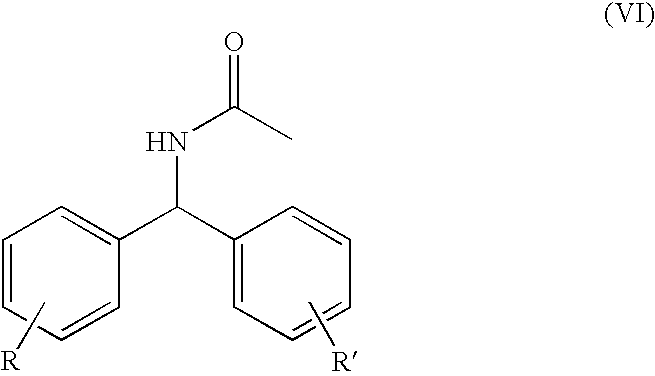
in which R and R′ represent, independently of each other, one or more hydrogen, halogen (Cl, F, Br or I), cyano, nitro, linear or branched alkyl of 1 to 6 carbon atoms, linear or branched alkoxy of 1 to 6 carbon atoms, linear or branched alkyl carboxylate of 1 to 6 carbon atoms, trifluoromethyl or trifluoromethoxy radicals,
- b) the product of formula (VI) is converted by heating in acidic medium into a product of formula (V), or an acid salt thereof

in which R and R′ represent, independently of each other, one or more hydrogen, halogen (Cl, F, Br or I), cyano, nitro, linear or branched alkyl of 1 to 6 carbon atoms, linear or branched alkoxy of 1 to 6 carbon atoms, linear or branched alkyl carboxylate of 1 to 6 carbon atoms, trifluoromethyl or trifluoromethoxy radicals,
- c) the product of formula (V) is converted into the product of formula (IV) in an organic solvent such as n-butanol, in the presence of the base anhydrous tripotassium phosphate, the additive sodium iodide and, where appropriate, an aqueous phase.


- a) formation of N-[bis(4-chlorophenyl)methyl]formamide (IX) from bis(4-chlorophenyl)methanone in the presence of formamide with catalysis using magnesium chloride,
- b) deformylation in the presence of HCl in methanol, to give [bis(4-chlorophenyl)methyl]amine.


Claims (4)


Priority Applications (2)
| Application Number | Priority Date | Filing Date | Title |
|---|---|---|---|
| US12/194,644 US7652154B2 (en) | 2004-10-14 | 2008-08-20 | Method and intermediates for the preparation of derivatives of N (1-benzhydrylazetidin-3-yl)-N-phenylmethylsulfonamide |
| US12/635,965 US8071788B2 (en) | 2004-10-14 | 2009-12-11 | Method and intermediates for the preparation of derivatives of N-(1-benzhydrylazetidin-3-yl)-N-phenylmethylsulfonamide |
Applications Claiming Priority (5)
| Application Number | Priority Date | Filing Date | Title |
|---|---|---|---|
| FR0410845A FR2876689B1 (en) | 2004-10-14 | 2004-10-14 | NOVEL PROCESS AND INTERMEDIATES FOR PREPARING N- (1-BENZHYDRYL-AZETIDIN-3-YL) -N-PHENYL-METHYLSULFONAMIDE DERIVATIVES |
| FR0410845 | 2004-10-14 | ||
| PCT/FR2005/002489 WO2006040464A1 (en) | 2004-10-14 | 2005-10-10 | Method and intermediates for the preparation of derivatives of n-(1-benzhydryl-azetidin-3-yl)-n-phenyl-methylsulphonamide |
| US11/692,462 US7429668B2 (en) | 2004-10-14 | 2007-03-28 | Method and intermediates for the preparation of derivatives of N-(1-benzhydrylazetidin-3-yl)-N-phenylmethylsulfonamide |
| US12/194,644 US7652154B2 (en) | 2004-10-14 | 2008-08-20 | Method and intermediates for the preparation of derivatives of N (1-benzhydrylazetidin-3-yl)-N-phenylmethylsulfonamide |
Related Parent Applications (1)
| Application Number | Title | Priority Date | Filing Date |
|---|---|---|---|
| US11/692,462 Division US7429668B2 (en) | 2004-10-14 | 2007-03-28 | Method and intermediates for the preparation of derivatives of N-(1-benzhydrylazetidin-3-yl)-N-phenylmethylsulfonamide |
Related Child Applications (1)
| Application Number | Title | Priority Date | Filing Date |
|---|---|---|---|
| US12/635,965 Division US8071788B2 (en) | 2004-10-14 | 2009-12-11 | Method and intermediates for the preparation of derivatives of N-(1-benzhydrylazetidin-3-yl)-N-phenylmethylsulfonamide |
Publications (2)
| Publication Number | Publication Date |
|---|---|
| US20080312205A1 US20080312205A1 (en) | 2008-12-18 |
| US7652154B2 true US7652154B2 (en) | 2010-01-26 |
Family
ID=34953744
Family Applications (3)
| Application Number | Title | Priority Date | Filing Date |
|---|---|---|---|
| US11/692,462 Expired - Lifetime US7429668B2 (en) | 2004-10-14 | 2007-03-28 | Method and intermediates for the preparation of derivatives of N-(1-benzhydrylazetidin-3-yl)-N-phenylmethylsulfonamide |
| US12/194,644 Expired - Lifetime US7652154B2 (en) | 2004-10-14 | 2008-08-20 | Method and intermediates for the preparation of derivatives of N (1-benzhydrylazetidin-3-yl)-N-phenylmethylsulfonamide |
| US12/635,965 Expired - Lifetime US8071788B2 (en) | 2004-10-14 | 2009-12-11 | Method and intermediates for the preparation of derivatives of N-(1-benzhydrylazetidin-3-yl)-N-phenylmethylsulfonamide |
Family Applications Before (1)
| Application Number | Title | Priority Date | Filing Date |
|---|---|---|---|
| US11/692,462 Expired - Lifetime US7429668B2 (en) | 2004-10-14 | 2007-03-28 | Method and intermediates for the preparation of derivatives of N-(1-benzhydrylazetidin-3-yl)-N-phenylmethylsulfonamide |
Family Applications After (1)
| Application Number | Title | Priority Date | Filing Date |
|---|---|---|---|
| US12/635,965 Expired - Lifetime US8071788B2 (en) | 2004-10-14 | 2009-12-11 | Method and intermediates for the preparation of derivatives of N-(1-benzhydrylazetidin-3-yl)-N-phenylmethylsulfonamide |
Country Status (32)
| Country | Link |
|---|---|
| US (3) | US7429668B2 (en) |
| EP (1) | EP1802571B1 (en) |
| JP (1) | JP4971986B2 (en) |
| KR (1) | KR20070063540A (en) |
| CN (1) | CN101039903A (en) |
| AR (1) | AR051389A1 (en) |
| AT (1) | ATE534624T1 (en) |
| AU (1) | AU2005293453A1 (en) |
| BR (1) | BRPI0516526A (en) |
| CA (1) | CA2581781A1 (en) |
| CR (1) | CR9008A (en) |
| CY (1) | CY1112390T1 (en) |
| DK (1) | DK1802571T3 (en) |
| EA (2) | EA012523B1 (en) |
| ES (1) | ES2378181T3 (en) |
| FR (1) | FR2876689B1 (en) |
| HR (1) | HRP20120168T1 (en) |
| IL (1) | IL182277A0 (en) |
| MA (1) | MA29005B1 (en) |
| ME (1) | ME01297B (en) |
| MX (1) | MX2007004483A (en) |
| NO (1) | NO20072431L (en) |
| PL (1) | PL1802571T3 (en) |
| PT (1) | PT1802571E (en) |
| RS (1) | RS52132B (en) |
| SG (2) | SG144921A1 (en) |
| SI (1) | SI1802571T1 (en) |
| TN (1) | TNSN07115A1 (en) |
| TW (1) | TW200626542A (en) |
| UY (1) | UY29165A1 (en) |
| WO (1) | WO2006040464A1 (en) |
| ZA (1) | ZA200703011B (en) |
Families Citing this family (4)
| Publication number | Priority date | Publication date | Assignee | Title |
|---|---|---|---|---|
| FR2925050B1 (en) * | 2007-12-14 | 2010-01-08 | Sanofi Aventis | NEW PROCESS FOR THE PREPARATION OF AZETIDINE DERIVATIVES |
| EP2448909B1 (en) * | 2009-06-29 | 2013-05-01 | Merz Pharma GmbH & Co. KGaA | Method of preparing 1-amino-1,3,3,5,5-pentamethylcyclohexane |
| ES2416462T3 (en) * | 2009-06-29 | 2013-08-01 | Merz Pharma Gmbh & Co. Kgaa | Method of preparation of neramexane. |
| CN107089918B (en) * | 2017-04-08 | 2020-06-16 | 迪嘉药业集团有限公司 | A kind of preparation method of benzylamine hydrochloride |
Citations (3)
| Publication number | Priority date | Publication date | Assignee | Title |
|---|---|---|---|---|
| WO2001064634A1 (en) | 2000-03-03 | 2001-09-07 | Aventis Pharma S.A. | Pharmaceutical compositions containing azetidine derivatives, novel azetidine derivatives and preparation thereof |
| WO2002028346A2 (en) | 2000-10-04 | 2002-04-11 | Aventis Pharma S.A. | Association of the cb1 receptor antagonist and sibutramin, for treating obesity |
| US6566356B2 (en) * | 2000-03-03 | 2003-05-20 | Aventis Pharma S.A. | Pharmaceutical compositions containing 3-aminoazetidine derivatives, novel derivatives and their preparation |
Family Cites Families (1)
| Publication number | Priority date | Publication date | Assignee | Title |
|---|---|---|---|---|
| GB9714129D0 (en) * | 1997-07-04 | 1997-09-10 | Pfizer Ltd | Azetidines |
-
2004
- 2004-10-14 FR FR0410845A patent/FR2876689B1/en not_active Expired - Fee Related
-
2005
- 2005-10-10 PL PL05809316T patent/PL1802571T3/en unknown
- 2005-10-10 EP EP05809316A patent/EP1802571B1/en not_active Expired - Lifetime
- 2005-10-10 EA EA200700842A patent/EA012523B1/en not_active IP Right Cessation
- 2005-10-10 AU AU2005293453A patent/AU2005293453A1/en not_active Withdrawn
- 2005-10-10 HR HR20120168T patent/HRP20120168T1/en unknown
- 2005-10-10 AT AT05809316T patent/ATE534624T1/en active
- 2005-10-10 SI SI200531476T patent/SI1802571T1/en unknown
- 2005-10-10 KR KR1020077008412A patent/KR20070063540A/en not_active Withdrawn
- 2005-10-10 BR BRPI0516526-1A patent/BRPI0516526A/en not_active IP Right Cessation
- 2005-10-10 CN CNA2005800350930A patent/CN101039903A/en active Pending
- 2005-10-10 WO PCT/FR2005/002489 patent/WO2006040464A1/en not_active Ceased
- 2005-10-10 SG SG200805168-2A patent/SG144921A1/en unknown
- 2005-10-10 SG SG200805167-4A patent/SG144920A1/en unknown
- 2005-10-10 EA EA200801990A patent/EA200801990A1/en unknown
- 2005-10-10 CA CA002581781A patent/CA2581781A1/en not_active Abandoned
- 2005-10-10 DK DK05809316.2T patent/DK1802571T3/en active
- 2005-10-10 ES ES05809316T patent/ES2378181T3/en not_active Expired - Lifetime
- 2005-10-10 ME MEP-2012-19A patent/ME01297B/en unknown
- 2005-10-10 PT PT05809316T patent/PT1802571E/en unknown
- 2005-10-10 MX MX2007004483A patent/MX2007004483A/en active IP Right Grant
- 2005-10-10 RS RS20120060A patent/RS52132B/en unknown
- 2005-10-10 JP JP2007536213A patent/JP4971986B2/en not_active Expired - Fee Related
- 2005-10-10 ZA ZA200703011A patent/ZA200703011B/en unknown
- 2005-10-13 TW TW094135609A patent/TW200626542A/en unknown
- 2005-10-13 AR ARP050104295A patent/AR051389A1/en unknown
- 2005-10-14 UY UY29165A patent/UY29165A1/en unknown
-
2007
- 2007-03-21 CR CR9008A patent/CR9008A/en not_active Application Discontinuation
- 2007-03-28 IL IL182277A patent/IL182277A0/en unknown
- 2007-03-28 TN TNP2007000115A patent/TNSN07115A1/en unknown
- 2007-03-28 US US11/692,462 patent/US7429668B2/en not_active Expired - Lifetime
- 2007-05-04 MA MA29868A patent/MA29005B1/en unknown
- 2007-05-11 NO NO20072431A patent/NO20072431L/en not_active Application Discontinuation
-
2008
- 2008-08-20 US US12/194,644 patent/US7652154B2/en not_active Expired - Lifetime
-
2009
- 2009-12-11 US US12/635,965 patent/US8071788B2/en not_active Expired - Lifetime
-
2012
- 2012-02-23 CY CY20121100184T patent/CY1112390T1/en unknown
Patent Citations (3)
| Publication number | Priority date | Publication date | Assignee | Title |
|---|---|---|---|---|
| WO2001064634A1 (en) | 2000-03-03 | 2001-09-07 | Aventis Pharma S.A. | Pharmaceutical compositions containing azetidine derivatives, novel azetidine derivatives and preparation thereof |
| US6566356B2 (en) * | 2000-03-03 | 2003-05-20 | Aventis Pharma S.A. | Pharmaceutical compositions containing 3-aminoazetidine derivatives, novel derivatives and their preparation |
| WO2002028346A2 (en) | 2000-10-04 | 2002-04-11 | Aventis Pharma S.A. | Association of the cb1 receptor antagonist and sibutramin, for treating obesity |
Non-Patent Citations (4)
| Title |
|---|
| Annual Update 2003/2004-Treatment of Neurological Disorders, Drugs of the Future (2004), vol. 29, No. 3, pp. 253-317. |
| Gakhar, H.K., et. al., A New Method of Preparation of 1,3-dioxolo[4,5-h] [1,4]Benzodiazepin-9-ones, Indian Journal of Chemistry vol. 34B, (1995) pp. 48-50. |
| The Metabolic Syndrome, http://www.diabetes.org/weightloss-and-exercise/weightioss/metabolicsyndrome.jsp (2005). |
| Zubovics, Z., et. al.,, Synthesis and Antiarrhythmic Activity of N-aryl Alkylenediamines, Eur. J. Med. Chem. Ther. (1986) vol. 21, No. 5, pp. 370-378. |
Also Published As
Similar Documents
| Publication | Publication Date | Title |
|---|---|---|
| US7312345B2 (en) | Process for the preparation of dronedarone | |
| JP6268093B2 (en) | Process for producing fused heterocyclic derivative and production intermediate thereof | |
| US9249084B2 (en) | Substituted n-pentanamide compounds, preparation method and the use thereof | |
| US20130217919A1 (en) | Asymmetric synthetic processes for the preparation of aminosulfone compounds | |
| US8071788B2 (en) | Method and intermediates for the preparation of derivatives of N-(1-benzhydrylazetidin-3-yl)-N-phenylmethylsulfonamide | |
| CN101107228B (en) | Process for producing (Z)-1-phenyl-1-(N,N-diethylaminocarbonyl)-2-phthalimidomethylcyclopropane | |
| US20120065397A1 (en) | Preparation of ketone amides | |
| US20100036125A1 (en) | Synthesis of ccr5 receptor antagonists | |
| US10562834B2 (en) | Process for preparing substituted crotonic acids | |
| HK1113357A (en) | Method and intermediates for the preparation of derivatives of n-(1-benzhydryl-azetidin-3-yl)-n-phenyl-methylsulphonamide | |
| KR0161803B1 (en) | Method for preparing antifungal drug terbinafine and its hydrochloride | |
| JP2002155050A (en) | Method for producing 1-alkyl-3-organosulfonyloxyazetidinium salts | |
| FR2876688A1 (en) | NEW PRODUCT, PROCESS AND INTERMEDIATES FOR PREPARING AZETIDINE DERIVATIVES | |
| CN1541999A (en) | Process for the preparation of aryl-iminomethyl-carbamates | |
| JP2005350390A (en) | Method for producing 3-aminoflavone compound | |
| JP2004250340A (en) | Method for producing 4-hydrazinotetrahydropyran compound or acid salt thereof | |
| JPH11269139A (en) | Method for producing 4-trans-substituted-cyclohexylamine derivative and novel intermediate compound | |
| WO2012165651A1 (en) | Method of manufacturing benzylamine compound |
Legal Events
| Date | Code | Title | Description |
|---|---|---|---|
| AS | Assignment |
Owner name: SANOFI-AVENTIS, FRANCE Free format text: ASSIGNMENT OF ASSIGNORS INTEREST;ASSIGNORS:BOFFELLI, PHILIPPE;DELTHIL, MICHEL;GRONDARD, LUC;AND OTHERS;REEL/FRAME:021475/0367;SIGNING DATES FROM 20070411 TO 20070423 |
|
| STCF | Information on status: patent grant |
Free format text: PATENTED CASE |
|
| FEPP | Fee payment procedure |
Free format text: PAYOR NUMBER ASSIGNED (ORIGINAL EVENT CODE: ASPN); ENTITY STATUS OF PATENT OWNER: LARGE ENTITY |
|
| CC | Certificate of correction | ||
| AS | Assignment |
Owner name: SANOFI, FRANCE Free format text: CHANGE OF NAME;ASSIGNOR:SANOFI-AVENTIS;REEL/FRAME:028413/0927 Effective date: 20110511 |
|
| FPAY | Fee payment |
Year of fee payment: 4 |
|
| FPAY | Fee payment |
Year of fee payment: 8 |
|
| AS | Assignment |
Owner name: PONTIFAX MEDISON FINANCE GP, L.P., ISRAEL Free format text: SECURITY INTEREST;ASSIGNOR:OPIANT PHARMACEUTICALS, INC.;REEL/FRAME:054602/0192 Effective date: 20201210 |
|
| MAFP | Maintenance fee payment |
Free format text: PAYMENT OF MAINTENANCE FEE, 12TH YEAR, LARGE ENTITY (ORIGINAL EVENT CODE: M1553); ENTITY STATUS OF PATENT OWNER: LARGE ENTITY Year of fee payment: 12 |
|
| AS | Assignment |
Owner name: OPIANT PHARMACEUTICALS, INC., VIRGINIA Free format text: RELEASE BY SECURED PARTY;ASSIGNOR:PONTIFAX MEDISON FINANCE GP, L.P.;REEL/FRAME:062937/0311 Effective date: 20230302 Owner name: OPIANT PHARMACEUTICALS, INC., VIRGINIA Free format text: RELEASE OF SECURITY INTEREST;ASSIGNOR:PONTIFAX MEDISON FINANCE GP, L.P.;REEL/FRAME:062937/0311 Effective date: 20230302 |
|
| AS | Assignment |
Owner name: INDIVIOR UK LIMITED, UNITED KINGDOM Free format text: ASSIGNMENT OF ASSIGNORS INTEREST;ASSIGNOR:OPIANT PHARMACEUTICALS, INC.;REEL/FRAME:063944/0323 Effective date: 20230525 |