US7605159B2 - Cathepsin cysteine protease inhibitors and their use - Google Patents
Cathepsin cysteine protease inhibitors and their use Download PDFInfo
- Publication number
- US7605159B2 US7605159B2 US10/538,452 US53845205A US7605159B2 US 7605159 B2 US7605159 B2 US 7605159B2 US 53845205 A US53845205 A US 53845205A US 7605159 B2 US7605159 B2 US 7605159B2
- Authority
- US
- United States
- Prior art keywords
- alkyl
- cyanomethyl
- pyrimidin
- leucinamide
- amino
- Prior art date
- Legal status (The legal status is an assumption and is not a legal conclusion. Google has not performed a legal analysis and makes no representation as to the accuracy of the status listed.)
- Expired - Fee Related, expires
Links
- 0 [1*]N([2*])CN([3*])C([4*])([5*])C(=O)N([6*])C([7*])([8*])C#N Chemical compound [1*]N([2*])CN([3*])C([4*])([5*])C(=O)N([6*])C([7*])([8*])C#N 0.000 description 8
Classifications
-
- C—CHEMISTRY; METALLURGY
- C07—ORGANIC CHEMISTRY
- C07D—HETEROCYCLIC COMPOUNDS
- C07D239/00—Heterocyclic compounds containing 1,3-diazine or hydrogenated 1,3-diazine rings
- C07D239/02—Heterocyclic compounds containing 1,3-diazine or hydrogenated 1,3-diazine rings not condensed with other rings
- C07D239/24—Heterocyclic compounds containing 1,3-diazine or hydrogenated 1,3-diazine rings not condensed with other rings having three or more double bonds between ring members or between ring members and non-ring members
- C07D239/28—Heterocyclic compounds containing 1,3-diazine or hydrogenated 1,3-diazine rings not condensed with other rings having three or more double bonds between ring members or between ring members and non-ring members with hetero atoms or with carbon atoms having three bonds to hetero atoms with at the most one bond to halogen, directly attached to ring carbon atoms
- C07D239/46—Two or more oxygen, sulphur or nitrogen atoms
- C07D239/48—Two nitrogen atoms
-
- A—HUMAN NECESSITIES
- A61—MEDICAL OR VETERINARY SCIENCE; HYGIENE
- A61P—SPECIFIC THERAPEUTIC ACTIVITY OF CHEMICAL COMPOUNDS OR MEDICINAL PREPARATIONS
- A61P1/00—Drugs for disorders of the alimentary tract or the digestive system
-
- A—HUMAN NECESSITIES
- A61—MEDICAL OR VETERINARY SCIENCE; HYGIENE
- A61P—SPECIFIC THERAPEUTIC ACTIVITY OF CHEMICAL COMPOUNDS OR MEDICINAL PREPARATIONS
- A61P11/00—Drugs for disorders of the respiratory system
- A61P11/06—Antiasthmatics
-
- A—HUMAN NECESSITIES
- A61—MEDICAL OR VETERINARY SCIENCE; HYGIENE
- A61P—SPECIFIC THERAPEUTIC ACTIVITY OF CHEMICAL COMPOUNDS OR MEDICINAL PREPARATIONS
- A61P11/00—Drugs for disorders of the respiratory system
- A61P11/16—Central respiratory analeptics
-
- A—HUMAN NECESSITIES
- A61—MEDICAL OR VETERINARY SCIENCE; HYGIENE
- A61P—SPECIFIC THERAPEUTIC ACTIVITY OF CHEMICAL COMPOUNDS OR MEDICINAL PREPARATIONS
- A61P19/00—Drugs for skeletal disorders
- A61P19/02—Drugs for skeletal disorders for joint disorders, e.g. arthritis, arthrosis
-
- A—HUMAN NECESSITIES
- A61—MEDICAL OR VETERINARY SCIENCE; HYGIENE
- A61P—SPECIFIC THERAPEUTIC ACTIVITY OF CHEMICAL COMPOUNDS OR MEDICINAL PREPARATIONS
- A61P19/00—Drugs for skeletal disorders
- A61P19/08—Drugs for skeletal disorders for bone diseases, e.g. rachitism, Paget's disease
-
- A—HUMAN NECESSITIES
- A61—MEDICAL OR VETERINARY SCIENCE; HYGIENE
- A61P—SPECIFIC THERAPEUTIC ACTIVITY OF CHEMICAL COMPOUNDS OR MEDICINAL PREPARATIONS
- A61P19/00—Drugs for skeletal disorders
- A61P19/08—Drugs for skeletal disorders for bone diseases, e.g. rachitism, Paget's disease
- A61P19/10—Drugs for skeletal disorders for bone diseases, e.g. rachitism, Paget's disease for osteoporosis
-
- A—HUMAN NECESSITIES
- A61—MEDICAL OR VETERINARY SCIENCE; HYGIENE
- A61P—SPECIFIC THERAPEUTIC ACTIVITY OF CHEMICAL COMPOUNDS OR MEDICINAL PREPARATIONS
- A61P25/00—Drugs for disorders of the nervous system
-
- A—HUMAN NECESSITIES
- A61—MEDICAL OR VETERINARY SCIENCE; HYGIENE
- A61P—SPECIFIC THERAPEUTIC ACTIVITY OF CHEMICAL COMPOUNDS OR MEDICINAL PREPARATIONS
- A61P25/00—Drugs for disorders of the nervous system
- A61P25/04—Centrally acting analgesics, e.g. opioids
-
- A—HUMAN NECESSITIES
- A61—MEDICAL OR VETERINARY SCIENCE; HYGIENE
- A61P—SPECIFIC THERAPEUTIC ACTIVITY OF CHEMICAL COMPOUNDS OR MEDICINAL PREPARATIONS
- A61P25/00—Drugs for disorders of the nervous system
- A61P25/28—Drugs for disorders of the nervous system for treating neurodegenerative disorders of the central nervous system, e.g. nootropic agents, cognition enhancers, drugs for treating Alzheimer's disease or other forms of dementia
-
- A—HUMAN NECESSITIES
- A61—MEDICAL OR VETERINARY SCIENCE; HYGIENE
- A61P—SPECIFIC THERAPEUTIC ACTIVITY OF CHEMICAL COMPOUNDS OR MEDICINAL PREPARATIONS
- A61P29/00—Non-central analgesic, antipyretic or antiinflammatory agents, e.g. antirheumatic agents; Non-steroidal antiinflammatory drugs [NSAID]
-
- A—HUMAN NECESSITIES
- A61—MEDICAL OR VETERINARY SCIENCE; HYGIENE
- A61P—SPECIFIC THERAPEUTIC ACTIVITY OF CHEMICAL COMPOUNDS OR MEDICINAL PREPARATIONS
- A61P37/00—Drugs for immunological or allergic disorders
- A61P37/02—Immunomodulators
-
- A—HUMAN NECESSITIES
- A61—MEDICAL OR VETERINARY SCIENCE; HYGIENE
- A61P—SPECIFIC THERAPEUTIC ACTIVITY OF CHEMICAL COMPOUNDS OR MEDICINAL PREPARATIONS
- A61P43/00—Drugs for specific purposes, not provided for in groups A61P1/00-A61P41/00
-
- C—CHEMISTRY; METALLURGY
- C07—ORGANIC CHEMISTRY
- C07D—HETEROCYCLIC COMPOUNDS
- C07D401/00—Heterocyclic compounds containing two or more hetero rings, having nitrogen atoms as the only ring hetero atoms, at least one ring being a six-membered ring with only one nitrogen atom
- C07D401/02—Heterocyclic compounds containing two or more hetero rings, having nitrogen atoms as the only ring hetero atoms, at least one ring being a six-membered ring with only one nitrogen atom containing two hetero rings
- C07D401/04—Heterocyclic compounds containing two or more hetero rings, having nitrogen atoms as the only ring hetero atoms, at least one ring being a six-membered ring with only one nitrogen atom containing two hetero rings directly linked by a ring-member-to-ring-member bond
-
- C—CHEMISTRY; METALLURGY
- C07—ORGANIC CHEMISTRY
- C07D—HETEROCYCLIC COMPOUNDS
- C07D401/00—Heterocyclic compounds containing two or more hetero rings, having nitrogen atoms as the only ring hetero atoms, at least one ring being a six-membered ring with only one nitrogen atom
- C07D401/02—Heterocyclic compounds containing two or more hetero rings, having nitrogen atoms as the only ring hetero atoms, at least one ring being a six-membered ring with only one nitrogen atom containing two hetero rings
- C07D401/12—Heterocyclic compounds containing two or more hetero rings, having nitrogen atoms as the only ring hetero atoms, at least one ring being a six-membered ring with only one nitrogen atom containing two hetero rings linked by a chain containing hetero atoms as chain links
-
- C—CHEMISTRY; METALLURGY
- C07—ORGANIC CHEMISTRY
- C07D—HETEROCYCLIC COMPOUNDS
- C07D403/00—Heterocyclic compounds containing two or more hetero rings, having nitrogen atoms as the only ring hetero atoms, not provided for by group C07D401/00
- C07D403/02—Heterocyclic compounds containing two or more hetero rings, having nitrogen atoms as the only ring hetero atoms, not provided for by group C07D401/00 containing two hetero rings
- C07D403/04—Heterocyclic compounds containing two or more hetero rings, having nitrogen atoms as the only ring hetero atoms, not provided for by group C07D401/00 containing two hetero rings directly linked by a ring-member-to-ring-member bond
-
- C—CHEMISTRY; METALLURGY
- C07—ORGANIC CHEMISTRY
- C07D—HETEROCYCLIC COMPOUNDS
- C07D405/00—Heterocyclic compounds containing both one or more hetero rings having oxygen atoms as the only ring hetero atoms, and one or more rings having nitrogen as the only ring hetero atom
- C07D405/02—Heterocyclic compounds containing both one or more hetero rings having oxygen atoms as the only ring hetero atoms, and one or more rings having nitrogen as the only ring hetero atom containing two hetero rings
- C07D405/12—Heterocyclic compounds containing both one or more hetero rings having oxygen atoms as the only ring hetero atoms, and one or more rings having nitrogen as the only ring hetero atom containing two hetero rings linked by a chain containing hetero atoms as chain links
-
- C—CHEMISTRY; METALLURGY
- C07—ORGANIC CHEMISTRY
- C07D—HETEROCYCLIC COMPOUNDS
- C07D409/00—Heterocyclic compounds containing two or more hetero rings, at least one ring having sulfur atoms as the only ring hetero atoms
- C07D409/02—Heterocyclic compounds containing two or more hetero rings, at least one ring having sulfur atoms as the only ring hetero atoms containing two hetero rings
- C07D409/12—Heterocyclic compounds containing two or more hetero rings, at least one ring having sulfur atoms as the only ring hetero atoms containing two hetero rings linked by a chain containing hetero atoms as chain links
-
- C—CHEMISTRY; METALLURGY
- C07—ORGANIC CHEMISTRY
- C07D—HETEROCYCLIC COMPOUNDS
- C07D413/00—Heterocyclic compounds containing two or more hetero rings, at least one ring having nitrogen and oxygen atoms as the only ring hetero atoms
- C07D413/02—Heterocyclic compounds containing two or more hetero rings, at least one ring having nitrogen and oxygen atoms as the only ring hetero atoms containing two hetero rings
- C07D413/12—Heterocyclic compounds containing two or more hetero rings, at least one ring having nitrogen and oxygen atoms as the only ring hetero atoms containing two hetero rings linked by a chain containing hetero atoms as chain links
Definitions
- the present invention relates to compounds and compositions for treating diseases associated with cysteine protease activity.
- the compounds are reversible inhibitors of cysteine proteases S, K, F, L and B. Of particular interest are diseases associated with Cathepsin S.
- this invention also discloses processes for the preparation of such inhibitors.
- Cathepsin S is a member of the papain superfamily of cysteine proteases which also encompasses Cathepsins B, H, L, O and K. Cathepsin S plays a key role in the processing of invariant chain in MHC class II complexes allowing the complex to associate with antigenic peptides. MHC class II complexes are then transported to the surface of the cell for presentation to effector cells such as T cells. The process of antigen presentation is a fundamental step in initiation of the immune response. In this respect inhibitors of cathepsin S could be useful agents in the treatment of inflammation and immune disorders such as, but not limited to, asthma, rheumatoid arthritis, multiple sclerosis and Crohn's disease. Cathepsin S has also been implicated in a variety of other diseases involving extracellular proteolysis such as the development of emphysema in COPD through degradation of elastin and in Alzheimers disease.
- Cathepsins notably K and L have been shown to degrade bone collagen and other bone matrix proteins. Inhibitors of these cysteine proteases would be expected to be useful in the treatment of diseases involving bone resorption such as osteoporosis.
- the present invention therefore provides a compound of formula (I)
- R 1 is independently hydrogen, C 1-6 alkyl or C 3-6 cycloalkyl
- R 2 is independently aryl, heteroaryl or a group C 1-6 alkylR 9 , CO(C 1-6 alkyl)R 9 or SO 2 (C 1-6 alkyl)R 9 ; where R 9 is aryl or heteroaryl or R 1 and R 2 together with the nitrogen atom to which they are attached form a 4 to 7-membered saturated ring optionally containing a carbonyl group, O, S or N atom and optionally substituted by one or more C 1-6 alkyl, amino, hydroxy, CO 2 C 1-6 alkyl, COC 1-6 alkyl, halogen, C 1-6 alkylhydroxy, NR 10 R 11 where R 10 and R 11 are independently hydrogen, C 1-6 alkyl or together with the nitrogen atom to which they are attached form a 5- or 6-membered saturated ring optionally containing a further O, S or NR 1 group, C 1-6 alkylNR 12 R
- Aryl groups include phenyl and naphthyl.
- Heteroaryl groups include 5- or 6-membered, 5,6- or 6,6-fused heterocyclic rings containing one or more heteroatoms selected from N, S or O. Examples include pyridinyl, pyrimidinyl, thiazolyl, oxazolyl, pyrazole, imidazolyl, furyl, thienyl, quinolinyl, isoquinolinyl, benzimidazolyl, benzofuryl, benzothienyl and indolyl.
- Aryl and heteroaryl groups can be optionally substituted by on or more of the following groups; halogen, amino, hydroxy, cyano, nitro, carboxy, CONR 12 R 13 , SO 2 NR 12 R 13 , SO 2 R 12 , trifluoromethyl, NHSO 2 R 12 , NHCOR 12 , ethylenedioxy, methylenedioxy, C 1-6 alkyl, C 1-6 alkoxy, C 1-6 alkyl NR 10 R 11 , SR 12 or NR 10 R 11 .
- Certain compounds of formula (I) are capable of existing in stereoisomeric forms. It will be understood that the invention encompasses all geometric and optical isomers of the compounds of formula (I) and mixtures thereof including racemates. Tautomers and mixtures thereof also form an aspect of the present invention.
- R 1 is hydrogen or C 1-6 alkyl, more preferably methyl and R 2 is CH 2 R 9 or CH 2 CH 2 R 9 where R 9 is phenyl or a 5- or 6-membered aromatic ring containing one or two heteroatoms and optionally substituted by C 1-6 alkyl. More preferably R 2 is CH 2 R 9 or CH 2 CH 2 R 9 where R 9 is phenyl, pyridyl or oxazole substituted by methyl.
- R 1 and R 2 form a piperidine, piperazine, pyrrolidine, morpholine, or thiomorpholine ring optionally substituted by CH 2 OH, CH 2 CH 2 OH, hydroxy, CONH 2 , phenyl, phenoxy, C(O)-furyl, the latter three groups being optionally substituted by halogen, in particular chloro.
- Het is pyrimidine ring.
- R 3 is hydrogen
- R 4 is hydrogen
- R 5 is C 1-6 alkyl, more preferably iso-butyl.
- R 6 is hydrogen
- R 7 and R 8 are both hydrogen.
- Preferred compounds of the invention include:
- the present invention further provides a process for the preparation of a compound of formula (I) which comprises
- L represents a leaving group (e.g. halide, sulphide, sulfoxide or sulphone group), preferably the sulphide is oxidised to a sulphoxide or sulphone group before displacement.
- An oxidising agent such as a peracid may be used, for example meta-chloroperbenzoic acid in dichloromethane at room temperature.
- L may be displaced by NR 1 R 2 respectively where R 1 and R 2 are defined in formula (I).
- the reaction may be performed in an inert solvent for example dioxane, N,N-dimethylformamide at ambient temperature or with heating, usually with a base present for example N,N-diisopropylethylamine.
- X may be CN, or a group that can be readily converted into a nitrile, for example C1-6alkoxycarbonyl, CONH 2 or CO 2 H.
- L 1 represents a leaving group (e.g. halide, sulphide, sulfoxide or sulphone group), preferably the sulphide is oxidised to a sulphoxide or sulphone group before displacement.
- An oxidising agent such as a peracid may be used, for example meta-chloroperbenzoic acid in dichloromethane at room temperature.
- the reaction may be performed in an inert solvent for example dioxane, N,N-dimethylformamide at ambient temperature or with heating, usually with a base present for example N,N-diisopropylethylamine.
- Compounds of formula (III) may be prepared from the reaction of compounds of formula (V) with compounds of formula (VI) using an appropriate coupling agent, for example N-(3-dimethylaminopropyl)-N′-ethylcarbodiimide, carbonyl diimidazole.
- an appropriate coupling agent for example N-(3-dimethylaminopropyl)-N′-ethylcarbodiimide, carbonyl diimidazole.
- the acid may be activated by formation of the acid chloride using for example, oxalyl chloride.
- P is a nitrogen protecting group for example tert-butylcarbamate, benzyl carbamate, benzyl.
- Compound of general formula (II) may also be prepared from the reaction of compounds of formula (VII) with compounds of formula (VI) using an appropriate coupling agent, for example N-(3-dimethylaminopropyl)-N′-ethylcarbodiimide, carbonyl diimidazole.
- an appropriate coupling agent for example N-(3-dimethylaminopropyl)-N′-ethylcarbodiimide, carbonyl diimidazole.
- the acid may be activated by formation of the acid chloride using for example, oxalyl chloride.
- a compound of the formula (I), or a pharmaceutically acceptable salt thereof, for use as a therapeutic agent for use as a therapeutic agent.
- a method for producing inhibition of a cysteine protease in a warm blooded animal, such as man, in need of such treatment which comprises administering to said animal an effective amount of a compound of the present invention, or a pharmaceutically acceptable salt thereof.
- the compounds of the invention are useful in the treatment of inflammation and immune disorders such as, but not limited to, asthma, rheumatoid arthritis, COPD, multiple sclerosis, Crohn's disease, Alzheimers and pain, such as neuropathic pain.
- the compounds of the invention are used to treat pain, especially neuropathic pain.
- the invention also provides a compound of the formula (I), or a pharmaceutically acceptable salt thereof, for use as a medicament; and the use of a compound of the formula (I) of the present invention, or a pharmaceutically acceptable salt thereof, in the manufacture of a medicament for use in the inhibition of a cysteine protease in a warm blooded animal, such as man.
- the invention provides the use of a compound of the formula (I) of the present invention, or a pharmaceutically acceptable salt thereof, in the manufacture of a medicament for use in the inhibition of Cathepsin S in a warm blooded animal, such as man.
- a compound of the formula (I) or a pharmaceutically acceptable salt thereof for the therapeutic treatment of mammals including humans, in particular in the inhibition of a cysteine protease, it is normally formulated in accordance with standard pharmaceutical practice as a pharmaceutical composition.
- the present invention provides a pharmaceutical composition which comprises a compound of the formula (I) or a pharmaceutically acceptable salt thereof and a pharmaceutically acceptable diluent or carrier.
- compositions of this invention may be administered in standard manner for the disease condition that it is desired to treat, for example by oral, rectal or parenteral administration.
- the compounds of this invention may be formulated by means known in the art into the form of, for example, tablets, capsules, aqueous or oily solutions or suspensions, (lipid) emulsions, dispersible powders, suppositories, ointments, creams, drops and sterile injectable aqueous or oily solutions or suspensions.
- a suitable pharmaceutical composition of this invention is one suitable for oral administration in unit dosage form, for example a tablet or capsule which contains between 100 mg and 1 g of the compound of this invention.
- composition of the invention is one suitable for intravenous, subcutaneous or intramuscular injection.
- Each patient may receive, for example, an intravenous, subcutaneous or intramuscular dose of 1 mgkg ⁇ 1 to 100 mgkg ⁇ 1 of the compound, preferably in the range of 5 mgkg ⁇ 1 to 20 mgkg ⁇ 1 of this invention, the composition being administered 1 to 4 times per day.
- the intravenous, subcutaneous and intramuscular dose may be given by means of a bolus injection.
- the intravenous dose may be given by continuous infusion over a period of time.
- each patient will receive a daily oral dose which is approximately equivalent to the daily parenteral dose, the composition being administered 1 to 4 times per day.
- Buffers such as polyethylene glycol, polypropylene glycol, glycerol or ethanol or complexing agents such as hydroxy-propyl ⁇ cyclodextrin may be used to aid formulation.
- the above formulations may be obtained by conventional procedures well known in the pharmaceutical art.
- the tablets (a)-(c) may be enteric coated by conventional means, for example to provide a coating of cellulose acetate phthalate.
- step (i) The product from step (i) (3.70 g) in formic acid (40 ml) was stirred for 90 min at room temperature then the solvent was removed under vacuum to give a yellow oil (2.7 g).
- step (iii) The product from step (iii) (0.5 g), morpholine (0.12 ml) and N,N-diisopropylethylamine (0.24 ml) in tetrahydrofuran (20 ml) was stirred at room temperature overnight. The solvent was removed under vacuum to yield a crude oil which was subjected to column chromatography on silica eluting with ethyl acetate/isohexane 3:1 to give a white solid (0.4 g).
- the sub-title compound was prepared from N-butoxycarbonyl-L-phenylalanine (1.32 g) by the method of example 1 step (i). Yield 2.05 g.
- the sub-title compound was prepared from the product of step (i) (2.05 g) by the method of example 1 steps (ii) and (iii). Yield 0.57 g.
- the sub-title compound was prepared from N-butoxycarbonyl-beta-cyclohexyl-L-alanine (1.36 g) by the method of example 1 step (i). Yield 1.99 g. Used directly in the next step.
- the sub-title compound was prepared from the product of step (i) (1.99 g) by the method of example 1 steps (ii) and (iii). Yield 0.12 g.
- the sub-title compound was prepared from aminoacetonitrile hydrochloride by the method of example 1 step (i).
- the sub-title compound was prepared from the product of step (i) (3.5 g) by the method of example 1 steps (ii) and (iii). Yield 1.11 g.
- the sub-title compound was prepared from N-butoxycarbonyl-beta-cyclohexyl-L-alanine (5.0 g) and aminoacetonitrile hydrochloride (1.71 g) by the method of example 1 step (i). Yield 4.09 g.
- the sub-title compound was prepared from the product of step (i) (4.09 g) by the method of example 1 steps (ii) and (iii). Yield 1.00 g.
- the sub-title compound was prepared according to the procedure of example 1 step (i) with amino acetonitrile hydrochloride (2.22 g) and N-tert-butoxy S-leucine (5 g).
- Examples 13-34 were prepared according to the procedures of example 1 step (iv) using N ⁇ 1 ⁇ -(cyanomethyl)-N ⁇ 2 ⁇ -(2-fluoropyrimidin-4-yl)-L-leucinamide (example 11 step (iii)) and the appropriate amine.
- QFRET Technology Quenched Fluorescent Resonance Energy Transfer
- Synthetic substrate 20 ⁇ M [final] Z-Val-Val-Arg-AMC in phosphate buffer were added to a 96 well black Optiplate.
- the assay plates were pre-read for compound auto fluorescence on SpectraMax Gemini at 355 nM excitation and 460 nM emission.
- 250 pM [final] rHuman Cathepsin S in phosphate buffer was added and incubated for 2 h at room temperature on the SpectraMax Gemini, taking readings every 20 min at 355 nM excitation and 460 nM emission.
- Activity Based template (5PTB-8) used the auto fluorescent corrected data to calculate the percentage inhibition for each compound concentration using the relevent plate controls. This data was used to construct inhibition curves and pIC 50 estimated by non-linear regression using a 4 parameter logistic model.
Landscapes
- Organic Chemistry (AREA)
- Chemical & Material Sciences (AREA)
- Health & Medical Sciences (AREA)
- Life Sciences & Earth Sciences (AREA)
- General Health & Medical Sciences (AREA)
- Chemical Kinetics & Catalysis (AREA)
- General Chemical & Material Sciences (AREA)
- Medicinal Chemistry (AREA)
- Nuclear Medicine, Radiotherapy & Molecular Imaging (AREA)
- Pharmacology & Pharmacy (AREA)
- Engineering & Computer Science (AREA)
- Animal Behavior & Ethology (AREA)
- Bioinformatics & Cheminformatics (AREA)
- Public Health (AREA)
- Veterinary Medicine (AREA)
- Physical Education & Sports Medicine (AREA)
- Rheumatology (AREA)
- Neurosurgery (AREA)
- Neurology (AREA)
- Orthopedic Medicine & Surgery (AREA)
- Biomedical Technology (AREA)
- Immunology (AREA)
- Pulmonology (AREA)
- Pain & Pain Management (AREA)
- Hospice & Palliative Care (AREA)
- Psychiatry (AREA)
- Pharmaceuticals Containing Other Organic And Inorganic Compounds (AREA)
- Acyclic And Carbocyclic Compounds In Medicinal Compositions (AREA)
- Medicines That Contain Protein Lipid Enzymes And Other Medicines (AREA)
- Plural Heterocyclic Compounds (AREA)
- Organic Low-Molecular-Weight Compounds And Preparation Thereof (AREA)
- Thiazole And Isothizaole Compounds (AREA)
Abstract
The present invention relates to compounds and compositions for treating diseases associated with cysteine protease activity. The compounds are reversible inhibitors of cysteine proteases S, K, F, L and B. Of particular interest are diseases associated with Cathepsin S. In addition this invention also discloses processes for the preparation of such inhibitors.
Description
This application is the National Stage of International Application No. PCT/SE2003/001931, filed Dec. 11, 2003, which claims the benefit of Swedish Patent Application Serial No. 0203712-5, filed Dec. 13, 2002. The contents of both applications are hereby incorporated by reference in their entireties.
The present invention relates to compounds and compositions for treating diseases associated with cysteine protease activity. The compounds are reversible inhibitors of cysteine proteases S, K, F, L and B. Of particular interest are diseases associated with Cathepsin S. In addition this invention also discloses processes for the preparation of such inhibitors.
Cathepsin S is a member of the papain superfamily of cysteine proteases which also encompasses Cathepsins B, H, L, O and K. Cathepsin S plays a key role in the processing of invariant chain in MHC class II complexes allowing the complex to associate with antigenic peptides. MHC class II complexes are then transported to the surface of the cell for presentation to effector cells such as T cells. The process of antigen presentation is a fundamental step in initiation of the immune response. In this respect inhibitors of cathepsin S could be useful agents in the treatment of inflammation and immune disorders such as, but not limited to, asthma, rheumatoid arthritis, multiple sclerosis and Crohn's disease. Cathepsin S has also been implicated in a variety of other diseases involving extracellular proteolysis such as the development of emphysema in COPD through degradation of elastin and in Alzheimers disease.
Other Cathepsins notably K and L have been shown to degrade bone collagen and other bone matrix proteins. Inhibitors of these cysteine proteases would be expected to be useful in the treatment of diseases involving bone resorption such as osteoporosis.
The present invention therefore provides a compound of formula (I)

R1 is independently hydrogen, C1-6alkyl or C3-6 cycloalkyl
R2 is independently aryl, heteroaryl or a group C1-6alkylR9, CO(C1-6alkyl)R9 or SO2(C1-6alkyl)R9; where R9 is aryl or heteroaryl
or R1 and R2 together with the nitrogen atom to which they are attached form a 4 to 7-membered saturated ring optionally containing a carbonyl group, O, S or N atom and optionally substituted by one or more C1-6alkyl, amino, hydroxy, CO2C1-6alkyl, COC1-6alkyl, halogen, C1-6alkylhydroxy, NR10R11 where R10 and R11 are independently hydrogen, C1-6alkyl or together with the nitrogen atom to which they are attached form a 5- or 6-membered saturated ring optionally containing a further O, S or NR1 group, C1-6alkylNR12R13 where R12 and R13 are independently hydrogen or C1-6alkyl, CONR12R13, or optionally substituted by C1-6alkylR9, aryl, phenoxy, COaryl, COheteroaryl or a heteroaryl group, the latter six groups being optionally substituted by halogen, amino, hydroxy, cyano, nitro, carboxy, CONR12R13, SO2NR12R13, SO2R12, trifluoromethyl, NHSO2R12, NHCOR12, ethylenedioxy, methylenedioxy, C1-6alkyl, C1-6alkoxy, C1-6 alkyl NR10R11, SR12 or NR10R11;
Het is a heteroaryl ring chosen from pyridine, pyrimidine, pyrazine, pyridazine or triazine and optionally substituted by halogen, amino, hydroxy, cyano, nitro, carboxy, CONR12R13, SO2NR12R13, SO2R12, trifluoromethyl, NHSO2R12, NHCOR12, C1-6alkyl, C1-6alkoxy, SR12 or NR10R11;
R3 is independently hydrogen, C1-6alkyl or C3-6cycloalkyl;
R4 is independently hydrogen, C1-8alkyl, C3-8cycloalkyl, arylC1-5alkyl or heteroarylC1-5alkyl, the latter three groups being optionally substituted by one or more halogen, amino, hydroxy, C1-6alkyl, C1-6alkoxy, SR12 or NR10R11;
R5 is independently hydrogen, C1-6alkyl or C3-6cycloalkyl;
R6 is independently hydrogen, C1-6alkyl or C3-6cycloalkyl;
R7 is independently hydrogen, C1-6alkyl or C3-6cycloalkyl;
R8 is independently hydrogen, aryl, heteroaryl or C1-6alkyl optionally substituted with one or more aryl, heteroaryl, halogen, amino, hydroxy, carboxy, CONR12R13, SO2NR12R13, SO2R12, NHSO2R12, NHCOR12, C1-6alkyl, C3-6cycloalkyl, C1-6alkoxy, SR12 or NR10R11;
or a pharmaceutically acceptable salt thereof.
Aryl groups include phenyl and naphthyl. Heteroaryl groups include 5- or 6-membered, 5,6- or 6,6-fused heterocyclic rings containing one or more heteroatoms selected from N, S or O. Examples include pyridinyl, pyrimidinyl, thiazolyl, oxazolyl, pyrazole, imidazolyl, furyl, thienyl, quinolinyl, isoquinolinyl, benzimidazolyl, benzofuryl, benzothienyl and indolyl.
Aryl and heteroaryl groups can be optionally substituted by on or more of the following groups; halogen, amino, hydroxy, cyano, nitro, carboxy, CONR12R13, SO2NR12R13, SO2R12, trifluoromethyl, NHSO2R12, NHCOR12, ethylenedioxy, methylenedioxy, C1-6alkyl, C1-6alkoxy, C1-6alkyl NR10R11, SR12 or NR10R11.
Certain compounds of formula (I) are capable of existing in stereoisomeric forms. It will be understood that the invention encompasses all geometric and optical isomers of the compounds of formula (I) and mixtures thereof including racemates. Tautomers and mixtures thereof also form an aspect of the present invention.
Preferably R1 is hydrogen or C1-6alkyl, more preferably methyl and R2 is CH2R9 or CH2CH2R9 where R9 is phenyl or a 5- or 6-membered aromatic ring containing one or two heteroatoms and optionally substituted by C1-6alkyl. More preferably R2 is CH2R9 or CH2CH2R9 where R9 is phenyl, pyridyl or oxazole substituted by methyl.
Alternatively R1 and R2 form a piperidine, piperazine, pyrrolidine, morpholine, or thiomorpholine ring optionally substituted by CH2OH, CH2CH2OH, hydroxy, CONH2, phenyl, phenoxy, C(O)-furyl, the latter three groups being optionally substituted by halogen, in particular chloro.
Preferably Het is pyrimidine ring.
Preferably R3 is hydrogen.
Preferably R4 is hydrogen.
Preferably R5 is C1-6alkyl, more preferably iso-butyl.
Preferably R6 is hydrogen.
Preferably R7 and R8 are both hydrogen.
Preferred compounds of the invention include:
- N˜1˜-[Cyano(2-methoxyphenyl)methyl]-N˜2˜-(2-morpholin-4-ylpyrimidin-4-yl)-L-leucinamide
- N˜1˜-[Cyano(2-methoxyphenyl)methyl]-N˜2˜-(2-piperazin-1-ylpyrimidin-4-yl)-L-leucinamide,
- N-[Cyano(2-methoxyphenyl)methyl]-N-(2-morpholin-4-ylpyrimidin-4-yl)-L-phenylalaninamide
- N˜1˜-[Cyano(2-methoxyphenyl)methyl]-3-cyclohexyl-N˜2˜-(2-morpholin-4-ylpyrimidin-4-yl)-L-alaninamide
- N-[2-(Benzylamino)pyrimidin-4-yl]-N-(cyanomethyl)-L-phenylalaninamide
- N-{2-[Benzyl(methyl)amino]pyrimidin-4-yl}-N-(cyanomethyl)-L-phenylalaninamide
- N-{2-[4-(4-Chlorophenyl)piperazin-1-yl]pyrimidin-4-yl}-N-(cyanomethyl)-L-phenylalaninamide
- N˜2˜-[2-(Benzylamino)pyrimidin-4-yl]-N˜1˜-(cyanomethyl)-3-cyclohexyl-L-alaninamide
- N˜2˜-{2-[Benzyl(methyl)amino]pyrimidin-4-yl}-N˜1˜-(cyanomethyl)-3-cyclohexyl-L-alaninamide
- N˜2˜-{2-[4-(4-Chlorophenyl)piperazin-1-yl]pyrimidin-4-yl}-N˜1˜-(cyanomethyl)-3-cyclohexyl-L-alaninamide
- N˜1˜-(Cyanomethyl)-N˜2˜-(4-morpholin-4-ylpyrimidin-2-yl)-L-leucinamide
- N˜1˜-(Cyanomethyl)-N˜2˜-(2-morpholin-4-ylpyrimidin-4-yl)-L-leucinamide
- N˜1˜-(Cyanomethyl)-N˜2˜-[2-(4-hydroxy-4-phenylpiperidin-1-yl)pyrimidin-4-yl]-L-leucinamide
- N˜1˜-(Cyanomethyl)-N˜2˜-{2-[methyl(pyridin-3-ylmethyl)amino]pyrimidin-4-yl}-L-leucinamide
- N˜2˜-{2-[Benzyl(methyl)amino]pyrimidin-4-yl}-N˜1˜-(cyanomethyl)-L-leucinamide
- N˜2˜-{2-[4-(4-Chlorophenyl)piperazin-1-yl]pyrimidin-4-yl}-N˜1˜-(cyanomethyl)-L-leucinamide,
- N˜2˜-{2-[4-(5-Chloropyridin-2-yl)piperazin-1-yl]pyrimidin-4-yl}-N˜1˜-(cyanomethyl)-L-leucinamide,
- N˜1˜-(Cyanomethyl)-N˜2˜-{2-[methyl(thien-3-ylmethyl)amino]pyrimidin-4-yl}-L-leucinamide
- N˜1˜-(Cyanomethyl)-N˜2˜-(2-thiomorpholin-4-ylpyrimidin-4-yl)-L-leucinamide
- N˜1˜-(Cyanomethyl)-N˜2˜-[2-(4-phenylpiperazin-1-yl)pyrimidin-4-yl]-L-leucinamide
- N˜1˜-(Cyanomethyl)-N˜2˜-{2-[2-(hydroxymethyl)piperidin-1-yl]pyrimidin-4-yl}-L-leucinamide
- N˜1˜-(Cyanomethyl)-N˜2˜-{2-[(2R)-2-(hydroxymethyl)pyrrolidin-1-yl]pyrimidin-4-yl}-L-leucinamide
- N˜1˜-(Cyanomethyl)-N˜2˜-[2-(4-hydroxypiperidin-1-yl)pyrimidin-4-yl]-L-leucinamide
- N˜1˜-(Cyanomethyl)-N˜2˜-{2-[4-(2-furoyl)piperazin-1-yl]pyrimidin-4-yl}-L-leucinamide,
- N˜1˜-(Cyanomethyl)-N˜2˜-{2-[methyl(2-pyridin-2-ylethyl)amino]pyrimidin-4-yl}-L-leucinamide
- N˜2˜-[2-(4-Benzylpiperidin-1-yl)pyrimidin-4-yl]-N˜1˜-(cyanomethyl)-L-leucinamide
- N˜1˜-(Cyanomethyl)-N˜2˜-[2-(4-pyridin-2-ylpiperazin-1-yl)pyrimidin-4-yl]-L-leucinamide
- N˜1˜-(Cyanomethyl)-N˜2˜-[2-(4-phenylpiperidin-1-yl)pyrimidin-4-yl]-L-leucinamide
- N˜1˜-(Cyanomethyl)-N˜2˜-{2-[4-(2-hydroxyethyl)piperidin-1-yl]pyrimidin-4-yl}-L-leucinamide
- N˜2˜-{2-[4-(3-Chlorophenyl)piperazin-1-yl]pyrimidin-4-yl}-N˜1˜-(cyanomethyl)-L-leucinamide
- N˜1˜-(Cyanomethyl)-N˜2˜-[2-(4-phenoxypiperidin-1-yl)pyrimidin-4-yl]-L-leucinamide
- N˜1˜-(Cyanomethyl)-N˜2˜-[2-(3-phenylpyrrolidin-1-yl)pyrimidin-4-yl]-L-leucinamide
- N˜1˜-(Cyanomethyl)-N˜2˜-(2-{methyl[(3-methylisoxazol-5-yl)methyl]amino}pyrimidin-4-yl)-L-leucinamide
and pharmaceutically acceptable salts thereof.
The present invention further provides a process for the preparation of a compound of formula (I) which comprises
-
- (i) reaction of a compound of general formula (II)
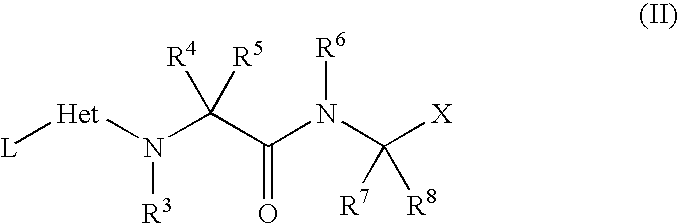
wherein L represents a leaving group (e.g. halide, sulphide, sulfoxide or sulphone group), preferably the sulphide is oxidised to a sulphoxide or sulphone group before displacement. An oxidising agent such as a peracid may be used, for example meta-chloroperbenzoic acid in dichloromethane at room temperature.
L may be displaced by NR1R2 respectively where R1 and R2 are defined in formula (I). The reaction may be performed in an inert solvent for example dioxane, N,N-dimethylformamide at ambient temperature or with heating, usually with a base present for example N,N-diisopropylethylamine.
X may be CN, or a group that can be readily converted into a nitrile, for example C1-6alkoxycarbonyl, CONH2 or CO2H.

Compounds of formula (II) may be prepared from compounds of formula (III) by displacement of a leaving group L1 from compounds of formula (IV).
Wherein L1 represents a leaving group (e.g. halide, sulphide, sulfoxide or sulphone group), preferably the sulphide is oxidised to a sulphoxide or sulphone group before displacement. An oxidising agent such as a peracid may be used, for example meta-chloroperbenzoic acid in dichloromethane at room temperature. The reaction may be performed in an inert solvent for example dioxane, N,N-dimethylformamide at ambient temperature or with heating, usually with a base present for example N,N-diisopropylethylamine.
Compounds of formula (III) may be prepared from the reaction of compounds of formula (V) with compounds of formula (VI) using an appropriate coupling agent, for example N-(3-dimethylaminopropyl)-N′-ethylcarbodiimide, carbonyl diimidazole. Alternatively the acid may be activated by formation of the acid chloride using for example, oxalyl chloride.

P is a nitrogen protecting group for example tert-butylcarbamate, benzyl carbamate, benzyl.
Compound of general formula (II) may also be prepared from the reaction of compounds of formula (VII) with compounds of formula (VI) using an appropriate coupling agent, for example N-(3-dimethylaminopropyl)-N′-ethylcarbodiimide, carbonyl diimidazole. Alternatively the acid may be activated by formation of the acid chloride using for example, oxalyl chloride.

-
- (ii) reaction of a compound of general formula (VII) with compounds of formula (III) or reaction of a compound of general formula (IX) with a compound of general formula (VI).

According to a further feature of the invention there is provided a compound of the formula (I), or a pharmaceutically acceptable salt thereof, for use as a therapeutic agent.
According to a further feature of the present invention there is provided a method for producing inhibition of a cysteine protease in a warm blooded animal, such as man, in need of such treatment, which comprises administering to said animal an effective amount of a compound of the present invention, or a pharmaceutically acceptable salt thereof. In particular the compounds of the invention are useful in the treatment of inflammation and immune disorders such as, but not limited to, asthma, rheumatoid arthritis, COPD, multiple sclerosis, Crohn's disease, Alzheimers and pain, such as neuropathic pain. Preferably the compounds of the invention are used to treat pain, especially neuropathic pain.
The invention also provides a compound of the formula (I), or a pharmaceutically acceptable salt thereof, for use as a medicament; and the use of a compound of the formula (I) of the present invention, or a pharmaceutically acceptable salt thereof, in the manufacture of a medicament for use in the inhibition of a cysteine protease in a warm blooded animal, such as man.
In particular the invention provides the use of a compound of the formula (I) of the present invention, or a pharmaceutically acceptable salt thereof, in the manufacture of a medicament for use in the inhibition of Cathepsin S in a warm blooded animal, such as man. In order to use a compound of the formula (I) or a pharmaceutically acceptable salt thereof for the therapeutic treatment of mammals including humans, in particular in the inhibition of a cysteine protease, it is normally formulated in accordance with standard pharmaceutical practice as a pharmaceutical composition.
Therefore in another aspect the present invention provides a pharmaceutical composition which comprises a compound of the formula (I) or a pharmaceutically acceptable salt thereof and a pharmaceutically acceptable diluent or carrier.
The pharmaceutical compositions of this invention may be administered in standard manner for the disease condition that it is desired to treat, for example by oral, rectal or parenteral administration. For these purposes the compounds of this invention may be formulated by means known in the art into the form of, for example, tablets, capsules, aqueous or oily solutions or suspensions, (lipid) emulsions, dispersible powders, suppositories, ointments, creams, drops and sterile injectable aqueous or oily solutions or suspensions.
A suitable pharmaceutical composition of this invention is one suitable for oral administration in unit dosage form, for example a tablet or capsule which contains between 100 mg and 1 g of the compound of this invention.
In another aspect a pharmaceutical composition of the invention is one suitable for intravenous, subcutaneous or intramuscular injection.
Each patient may receive, for example, an intravenous, subcutaneous or intramuscular dose of 1 mgkg−1 to 100 mgkg−1 of the compound, preferably in the range of 5 mgkg−1 to 20 mgkg−1 of this invention, the composition being administered 1 to 4 times per day. The intravenous, subcutaneous and intramuscular dose may be given by means of a bolus injection. Alternatively the intravenous dose may be given by continuous infusion over a period of time. Alternatively each patient will receive a daily oral dose which is approximately equivalent to the daily parenteral dose, the composition being administered 1 to 4 times per day.
The following illustrate representative pharmaceutical dosage forms containing the compound of formula (I), or a pharmaceutically-acceptable salt thereof (hereafter compound X), for therapeutic or prophylactic use in humans:
| (a) |
| Tablet I | mg/tablet | ||
| Compound X. | 100 | ||
| Lactose Ph.Eur. | 179 | ||
| Croscarmellose sodium | 12.0 | ||
| Polyvinylpyrrolidone | 6 | ||
| Magnesium stearate | 3.0 | ||
| (b) |
| Tablet II | mg/tablet | ||
| Compound X | 50 | ||
| Lactose Ph.Eur. | 229 | ||
| Croscarmellose sodium | 12.0 | ||
| Polyvinylpyrrolidone | 6 | ||
| Magnesium stearate | 3.0 | ||
| (c) |
| Tablet III | mg/tablet | ||
| Compound X | 1.0 | ||
| Lactose Ph.Eur. | 92 | ||
| Croscarmellose sodium | 4.0 | ||
| Polyvinylpyrrolidone | 2.0 | ||
| Magnesium stearate | 1.0 | ||
| (d) |
| Capsule | mg/capsule | ||
| Compound X | 10 | ||
| Lactose Ph.Eur. | 389 | ||
| Croscarmellose sodium | 100 | ||
| Magnesium stearate | 1. | ||
| (e) |
| Injection I | (50 mg/ml) | ||
| Compound X | 5.0% w/v | ||
| Isotonic aqueous solution | to 100% | ||
Buffers, pharmaceutically-acceptable cosolvents such as polyethylene glycol, polypropylene glycol, glycerol or ethanol or complexing agents such as hydroxy-propyl β cyclodextrin may be used to aid formulation.
Note
The above formulations may be obtained by conventional procedures well known in the pharmaceutical art. The tablets (a)-(c) may be enteric coated by conventional means, for example to provide a coating of cellulose acetate phthalate.
The following examples illustrate the invention.
1-(3-Dimethylaminopropyl)-3-ethylcarbodiimide hydrochloride (2.9 g) and 1-hydroxybenzotriazole hydrate (2.0 g) were added to a solution of 2-methoxyphenylamino acetonitrile (2.0 g) and N-tert-butoxycarbonyl L-leucine (2.5 g) in N,N-dimethylformamide (20 ml) at room temperature followed by N,N-diisopropylethylamine (5.3 ml) and stirred at room temperature overnight. The mixture was diluted with water, extracted into ethyl acetate and dried (MgSO4). The solvent was removed under vacuum to leave an oil which was subjected to column chromatography on silica eluting with isohexane/ethyl acetate 2:1 to give a colourless oil (3.7 g).
MS: APCI(+ve) 249 (M-Boc-CN+1)
The product from step (i) (3.70 g) in formic acid (40 ml) was stirred for 90 min at room temperature then the solvent was removed under vacuum to give a yellow oil (2.7 g).
MS: APCI(+ve) 276 (M-Boc+1)
A solution of the product from step (ii) (2.7 g) and N,N-diisopropylethylamine (1.7 ml) in tetrahydrofuran (40 ml) was added dropwise to a solution of 2,4-difluoropyrimidine (1.15 g) in tetrahydrofuran (40 ml) and N,N-diisopropylethylamine (1.7 ml). After stirring at room temperature overnight the solvent was removed under vacuum to yield a crude oil which was subjected to column chromatography on silica eluting with dichloromethane/ethyl acetate 2:1 to give a colourless oil (1.50 g).
MS: APCI(+ve) 372 (M+1)
The product from step (iii) (0.5 g), morpholine (0.12 ml) and N,N-diisopropylethylamine (0.24 ml) in tetrahydrofuran (20 ml) was stirred at room temperature overnight. The solvent was removed under vacuum to yield a crude oil which was subjected to column chromatography on silica eluting with ethyl acetate/isohexane 3:1 to give a white solid (0.4 g).
MS: APCI(+ve) 439 (M+1)
1H NMR: δ (DMSO) 9.40 (1H, m), 9.08 (1H, m), 7.78-7.12 (5H, m), 6.10-6.08 (1H, d), 5.80 (1H, m), 4.60-4.40 (1H, m), 3.84-3.51 (11H, m), 1.80-1.20 (3H, m), 0.96-0.84 (6H, m).
The title compound was prepared according to the procedure in example 1 step (iv) using piperazine.
MS: APCI(+ve) 438 (M+1)
1H NMR: δ (DMSO) 8.83-8.81 (2H, m), 7.79-6.97 (5H, m), 6.09-6.02 (2H, m), 4.40 (1H, m), 3.85 (7H, bm), 3.13-3.05 (4H, m), 1.68-1.49 (3H, m), 0.94-0.84 (6H, m).
The sub-title compound was prepared from N-butoxycarbonyl-L-phenylalanine (1.32 g) by the method of example 1 step (i). Yield 2.05 g.
MS: APCI(+ve) 310 (M-Boc+1)
The sub-title compound was prepared from the product of step (i) (2.05 g) by the method of example 1 steps (ii) and (iii). Yield 0.57 g.
MS: APCI(+ve) 406 (M+1)
The title compound was prepared from the product of step (ii) (0.25 g) by the method of example 1 step (iv). Yield 0.078 g.
MS: APCI(+ve) 473 (M+1)
NMR: δ (DMSO) 9.29 and 9.15 (1H, 2×d), 7.73 and 7.69 (1H, 2×d), 7.45-7.40 (2H, m), 7.33-7.17 (6H, m), 7.11 (1H, m), 7.00 (1H, m), 6.08 (1H, dd), 5.88 and 5.85 (1H, 2×d), 4.64 (1H, brs), 3.83 and 3.80 (3H, 2×s), 3.58 (4H, m), 3.47 (4H, m), 3.05-2.82 (2H, m).
The sub-title compound was prepared from N-butoxycarbonyl-beta-cyclohexyl-L-alanine (1.36 g) by the method of example 1 step (i). Yield 1.99 g. Used directly in the next step.
The sub-title compound was prepared from the product of step (i) (1.99 g) by the method of example 1 steps (ii) and (iii). Yield 0.12 g.
MS: APCI(+ve) 412 (M+1)
The title compound was prepared from the product of step (ii) (0.12 g) by the method of example 1 step (iv). Yield 0.087 g.
MS: APCI(+ve) 479 (M+1)
NMR: δ (DMSO) 9.18 and 9.06 (1H, 2×d), 7.76 and 7.72 (1H, 2×d), 7.49-7.37 (2H, m), 7.24 (1H, brs), 7.11 (1H, d), 7.02 (1H, t), 6.09 (1H, m), 5.91 and 5.88 (1H, 2×d), 4.46 and 4.36 (1H, 2×brs), 3.82 and 3.80 (3H, 2×s), 3.60 (4H, m), 3.47 (4H, m), 1.76-1.36 (8H, m), 1.24-1.09 (3H, m), 0.98-0.83 (2H, m).
The sub-title compound was prepared from aminoacetonitrile hydrochloride by the method of example 1 step (i).
MS: APCI(+ve) 204 (M-Boc+1)
The sub-title compound was prepared from the product of step (i) (3.5 g) by the method of example 1 steps (ii) and (iii). Yield 1.11 g.
MS: APCI(+ve) 300 (M+1)
The title compound was prepared from the product from step (ii) (0.2 g) and benzylamine (0.37 ml) by the method of example 1 step (iv). Yield 0.11 g.
MS: APCI(+ve) 387 (M+1)
NMR: δ (DMSO) 8.60 (1H, brs), 7.61 (1H, d), 7.29-7.14 (10H, m), 6.93 (1H, brs), 5.78 (1H, d), 4.64 (1H, brs), 4.47-4.33 (2H, m), 4.05 (2H, brs), 3.03 (1H, dd), 2.85 (1H, m).
The title compound was prepared from the product of example 5 step (ii) (0.2 g) and N-benzylmethylamine by the method of example 1 step (iv). Yield 0.18 g.
MS: APCI(+ve) 401 (M+1)
NMR: δ (DMSO) 8.69 (1H, brs), 7.71 (1H, d), 7.33-7.15 (10H, m), 5.84 (1H, d), 4.75 (2H, q), 4.62 (1H, brs), 4.03 (2H, brs), 2.99 (1H, dd), 2.94 (3H, s), 2.86 (1H, m).
The title compound was prepared from the product of example 5 step (ii) (0.2 g) and 4(4-chlorophenyl)piperazine by the method of example 1 step (iv). Yield 0.18 g.
MS: APCI(+ve) 476 (M+1)
NMR: δ (DMSO) 8.77 (1H, t), 7.72 (1H, d), 7.40 (1H, brs), 7.31-7.17 (7H, m), 6.98 (2H, d), 5.86 (1H, d), 4.54 (1H, brs), 4.13 (2H, m), 3.74 (4H, m), 3.12 (4H, m), 3.01 (1H, dd), 2.89 (1H, m).
The sub-title compound was prepared from N-butoxycarbonyl-beta-cyclohexyl-L-alanine (5.0 g) and aminoacetonitrile hydrochloride (1.71 g) by the method of example 1 step (i). Yield 4.09 g.
MS: APCI(+ve) 210 (M-Boc+H)
The sub-title compound was prepared from the product of step (i) (4.09 g) by the method of example 1 steps (ii) and (iii). Yield 1.00 g.
MS: APCI(+ve) 306 (M+1)
The title compound was prepared from the product of step (ii) (0.2 g) by the method of example 1 step (iv). Yield 0.05 g.
MS: APCI(+ve) 393 (M+1)
NMR: δ (DMSO) 8.48 (1H, brs), 7.64 (1H, d), 7.31-7.24 (4H, m), 7.17 (1H, m), 7.09 (1H, brs), 6.93 (1H, brs), 5.81 (1H, d), 4.47-4.36 (3H, m), 4.04 (2H, d), 1.75-1.47 (7H, m), 1.31 (1H, m), 1.19-1.09 (3H, m), 0.86 (2H, m).
The title compound was prepared from the product of example 8 step (ii) (0.2 g) and N-benzylmethylamine (0.43 ml) by the method of example 1 step (iv). Yield 0.13 g.
MS: APCI(+ve) 407 (M+1)
NMR: δ (DMSO) 8.57 (1H, brs), 7.73 (1H, d), 7.31-7.27 (2H, m), 7.23-7.19 (4H, m), 5.85 (1H, d), 4.80 (2H, m), 4.42 (1H, brs), 4.02 (2H, m), 2.95 (3H, s), 1.69-1.44 (7H, m), 1.35 (1H, m), 1.24-1.07 (3H, m), 0.92-0.81 (2H, m).
The title compound was prepared from the product of example 8 step (ii) (0.2 g) and 4(4-chlorophenyl)piperazine (0.66 g) by the method of example 1 step (iv). Yield 0.2 g.
MS: APCI(+ve) 482 (M+1)
NMR: δ (DMSO) 8.66 (1H, t), 7.75 (1H, d), 7.25 (3H, d), 6.98 (2H, d), 5.89 (1H, d), 4.35 (1H, brs), 4.12 (2H, d), 3.75 (4H, m), 3.13 (4H, m), 1.73-1.46 (7H, m), 1.37 (1H, m), 1.24-1.07 (3H, m), 0.97-0.87 (2H, m).
The sub-title compound was prepared according to the procedure of example 1 step (i) with amino acetonitrile hydrochloride (2.22 g) and N-tert-butoxy S-leucine (5 g).
MS: APCI(+ve) 270 (M+1)
The sub-title compounds were prepared from the product of step (i) (4.3 g) according to the procedure of example 1 steps (ii) and (iii).
Yield 0.38 g
MS: APCI(+ve) 266 (M+1)
Yield 3.8 g
MS: APCI(+ve) 266 (M+1)
The title compound was prepared according to the procedure of example 1 step (iv) using N˜1˜-(cyanomethyl)-N˜2˜-(4-fluoropyrimidin-2-yl)-L-leucinamide. Yield 0.2 g
MS: APCI(+ve) 333 (M+1)
1H NMR: δ (DMSO) 8.49-8.46 (1H, t), 7.83-7.81 (1H, d), 6.63 (1H, bm), 6.06-6.04 (1H, d), 4.25-4.05 (3H, m), 3.63-3.47 (8H, m), 1.75-1.39 (3H, m), 0.90-0.84 (6H, m).
The title compound was prepared from N˜1˜-(cyanomethyl)-N˜2˜-(2-fluoropyrimidin-4-yl)-L-leucinamide (example 11 step (iii)) according to the procedure of example 1 step (iv). Yield 0.17 g
MS: APCI(+ve) 333 (M+1)
1H NMR: δ (DMSO) 8.64-8.60 (1H, t), 7.74-7.72 (1H, d), 7.24-7.23 (1H, d), 5.89-5.82 (1H, d), 4.31-4.08 (3H, m), 3.58 (8H, m), 1.72-1.39 (3H, m), 0.92-0.84 (6H, m).
Examples 13-34 were prepared according to the procedures of example 1 step (iv) using N˜1˜-(cyanomethyl)-N˜2˜-(2-fluoropyrimidin-4-yl)-L-leucinamide (example 11 step (iii)) and the appropriate amine.
MS: APCI(+ve) 423 (M+1)
1H NMR: δ (DMSO) 8.65-8.61 (1H, t), 7.73-7.14 (7H, m), 5.84-5.82 (1H, d), 5.00-4.39 (4H, m), 4.08-4.03 (2H, m), 3.20-3.12 (2H, m), 1.90-1.35 (7H, m), 0.92-0.85 (6H, m).
MS: APCI(+ve) 368 (M+1)
1H NMR: δ (DMSO) 8.59-7.20 (7H, m), 5.89-5.87 (1H, d), 4.68 & 4.37 (3H, m), 4.08-4.02 (2H, m), 2.99 (3H, s), 1.68-1.35 (3H, m), 0.93-0.80 (6H, m).
MS: APCI(+ve) 367 (M+1)
1H NMR: δ (DMSO) 8.57-8.54 (1H, t), 7.74 (1H, d), 7.31-7.18 (6H, m), 5.87-5.85 (1H, d), 4.82-4.00 (5H, m), 2.95 (3H, s), 1.71-1.40 (3H, m), 0.89-0.81 (6H, m).
MS: APCI(+ve) 442 (M+1)
1H NMR: δ (DMSO) 9.02-9.01 (2H, m), 7.75-6.98 (5H, m), 6.24-6.22 (1H, d), 4.48-4.13 (3H, m), 3.82-3.55 (8H, m), 1.66-1.50 (3H, m), 0.95-0.88 (6H, m).
MS: APCI(+ve) 443 (M+1)
1H NMR: δ (DMSO) 9.03-9.01 (2H, m), 8.15-6.90 (4H, m), 6.25-6.23 (1H, d), 4.49 (1H, m), 4.23-4.18 (2H, d), 3.80-3.66 (8H, m), 1.66-1.51 (3H, m), 0.95-0.88 (6H, m).
MS: APCI(+ve) 373 (M+1)
MS: APCI(+ve) 349 (M+1)
MS: APCI(+ve) 408 (M+1)
MS: APCI(+ve) 361 (M+1)
MS: APCI(+ve) 347 (M+1)
MS: APCI(+ve) 347 (M+1)
MS: APCI(+ve) 426 (M+1)
MS: APCI(+ve) 374 (M+1)
MS: APCI(+ve) 382 (M+1)
MS: APCI(+ve) 421 (M+1)
MS: APCI(+ve) 409 (M+1)
MS: APCI(+ve) 407 (M+1)
MS: APCI(+ve) 375 (M+1)
MS: APCI(+ve) 442/4 (M+1)
MS: APCI(+ve) 423 (M+1)
MS: APCI(+ve) 393 (M+1)
MS: APCI(+ve) 372 (M+1)
Measurement of Cathepsin S Activity.
QFRET Technology (Quenched Fluorescent Resonance Energy Transfer) was used to measure the inhibition by test compounds of Cathepsin S-mediated cleavage of the synthetic peptide Z-Val-Val-Arg-AMC. Compounds were screened at five concentrations in duplicate and the pIC50 values reported.
Synthetic substrate, 20□M [final] Z-Val-Val-Arg-AMC in phosphate buffer were added to a 96 well black Optiplate. The assay plates were pre-read for compound auto fluorescence on SpectraMax Gemini at 355 nM excitation and 460 nM emission. 250 pM [final] rHuman Cathepsin S in phosphate buffer was added and incubated for 2 h at room temperature on the SpectraMax Gemini, taking readings every 20 min at 355 nM excitation and 460 nM emission.
Activity Based template (5PTB-8) used the auto fluorescent corrected data to calculate the percentage inhibition for each compound concentration using the relevent plate controls. This data was used to construct inhibition curves and pIC50 estimated by non-linear regression using a 4 parameter logistic model.
Claims (15)
1. A compound of formula (I):

R1 is independently hydrogen, C1-6alkyl or C3-6cycloalkyl;
R2 is independently aryl, heteroaryl or a group C1-6alkylR9, CO(C1-6alkyl)R9 or SO2(C1-6alkyl)R9;
Het is a heteroaryl ring chosen from pyridine, pyrimidine, pyrazine, pyridazine or triazine and optionally substituted by halogen, amino, hydroxy, cyano, nitro, carboxy, CONR12R13, SO2NR12R13, SO2R12, trifluoromethyl, NHSO2R12, NHCOR12, C1-6alkyl, C1-6alkoxy, SR12 or NR10R11;
R3 is independently hydrogen, C1-6 alkyl or C3-6cycloalkyl;
R4 is independently hydrogen, C1-8alkyl, C3-8cycloalkyl, arylC1-5alkyl or heteroarylC1-5alkyl, the latter three groups being optionally substituted by one or more halogen, amino, hydroxy, C1-6alkyl, C1-6 l alkoxy, SR 12 or NR10R11;
R5 is independently hydrogen, C1-6alkyl or C3-6cycloalkyl;
R6 is independently hydrogen, C1-6alkyl or C3-6cycloalkyl;
R7 is independently hydrogen, C1-6alkyl or C3-6cycloalkyl;
R8 is independently hydrogen, aryl, heteroaryl or C1-6alkyl optionally substituted with one or more aryl, heteroaryl, halogen, amino, hydroxy, carboxy, CONR12R13, SO2NR12R13, SO2R12, NHSO2R12, NHCOR12, C1-6alkyl, C3-6cycloalkyl, C1-6 alkoxy, SR12 or NR10R11;
R9 is aryl or heteroaryl;
R10 and R11 are independently hydrogen, C1-6alkyl or together with the nitrogen atom to which they are attached form a 5- or 6-membered saturated ring optionally containing a further O, S or NR1 group; and
R12 and R13 are independently hydrogen or C1-6alkyl;
or a pharmaceutically acceptable salt thereof.
2. A compound according to claim 1 in which R1 is hydrogen or C1-6alkyl and R2 is CH2R9 or CH2CH2R9 where R9 is phenyl or a 5- or 6-membered aromatic ring containing one or two heteroatoms and optionally substituted by C1-6alkyl.
3. A compound according to claim 1 in which R3 is hydrogen.
4. A compound according to claim 1 in which R4 is hydrogen.
5. A compound according to claim 1 in which R5 is hydrogen.
6. A compound of formula (I) selected from:
N-[2-(Benzylamino)pyrimidin-4-yl]-N-(cyanomethyl)-L-phenylalaninamide,
N-{2-[Benzyl(methyl)amino]pyrimidin-4-yl}-N-(cyanomethyl)-L-phenylalaninamide,
N˜2˜-[2-(Benzylamino)pyrimidin-4-yl]-N˜1˜-(cyanomethyl)-3-cyclohexyl-L-alaninamide,
N˜2˜-{2-[Benzyl(methyl)amino]pyrimidin-4-yl}-N˜1˜-(cyanomethyl)-3-cyclohexyl-L-alaninamide,
N˜1˜-(Cyanomethyl)-N˜2˜-{2-[methyl(pyridin-3-ylmethyl)amino]pyrimidin-4-yl}-L-leucinamide,
N˜2˜-{2-[Benzyl(methyl)amino]pyrimidin-4-yl}-N˜1˜-(cyanomethyl)-L-leucinamide,
N˜1˜-(Cyanomethyl)-N˜2˜-{2-[methyl(thien-3-ylmethyl)amino]pyrimidin-4-yl}-L-leucinamide,
N˜1˜-(Cyanomethyl)-N˜2˜-{2-[methyl(2-pyridin-2-ylethyl)amino]pyrimidin-4-yl}-L-leucinamide,
N˜1˜-(Cyanomethyl)-N˜2˜-(2-{methyl[(3-methylisoxazol-5-yl)methyl]amino}pyrimidin-4-yl)-L-leucinamide,
and pharmaceutically acceptable salts thereof.
7. A pharmaceutical composition which comprises a compound as defined in claim 1 or a pharmaceutically acceptable salt thereof and a pharmaceutically acceptable diluent or carrier.
8. A compound according to claim 1 in which R4 is phenylC1-5alkyl being optionally substituted by one or more halogen, amino, hydroxy, C1-6alkyl, C1-6alkoxy, SR12 or NR10R11.
9. A compound according to claim 1 in which R5 is C1-6alkyl.
10. A compound according to claim 1 in which R5 is iso-butyl.
11. A compound according to claim 1 in which R6 is hydrogen.
12. A compound according to claim 1 in which R7 and R8 are both hydrogen.
13. A compound according to claim 1 in which R9 is phenyl, pyridyl or oxazole substituted by methyl.
14. A pharmaceutical composition which comprises a compound according to claim 13 or a pharmaceutically acceptable salt thereof and a pharmaceutically acceptable diluent or carrier.
15. A compound according to claim 1 in which Het is a pyrimidine ring.
Applications Claiming Priority (3)
| Application Number | Priority Date | Filing Date | Title |
|---|---|---|---|
| SE0203712-5 | 2002-12-13 | ||
| SE0203712A SE0203712D0 (en) | 2002-12-13 | 2002-12-13 | Novel compounds |
| PCT/SE2003/001931 WO2004054987A1 (en) | 2002-12-13 | 2003-12-11 | Cathepsin cysteine protease inhibitors and their use |
Publications (2)
| Publication Number | Publication Date |
|---|---|
| US20060111364A1 US20060111364A1 (en) | 2006-05-25 |
| US7605159B2 true US7605159B2 (en) | 2009-10-20 |
Family
ID=20289870
Family Applications (1)
| Application Number | Title | Priority Date | Filing Date |
|---|---|---|---|
| US10/538,452 Expired - Fee Related US7605159B2 (en) | 2002-12-13 | 2003-12-11 | Cathepsin cysteine protease inhibitors and their use |
Country Status (9)
| Country | Link |
|---|---|
| US (1) | US7605159B2 (en) |
| EP (1) | EP1572667B1 (en) |
| JP (1) | JP2006514948A (en) |
| AT (1) | ATE361914T1 (en) |
| AU (1) | AU2003303076A1 (en) |
| DE (1) | DE60313803T2 (en) |
| ES (1) | ES2285273T3 (en) |
| SE (1) | SE0203712D0 (en) |
| WO (1) | WO2004054987A1 (en) |
Cited By (3)
| Publication number | Priority date | Publication date | Assignee | Title |
|---|---|---|---|---|
| US10858359B2 (en) | 2016-06-07 | 2020-12-08 | Jacobio Pharmaceuticals Co., Ltd. | Heterocyclic ring derivatives useful as SHP2 inhibitors |
| US10988466B2 (en) | 2017-03-23 | 2021-04-27 | Jacobio Pharmaceuticals Co., Ltd. | Heterocyclic derivatives useful as SHP2 inhibitors |
| US12233062B2 (en) | 2018-09-26 | 2025-02-25 | Jacobio Pharmaceuticals Co., Ltd. | Heterocyclic derivatives useful as SHP2 inhibitors |
Families Citing this family (10)
| Publication number | Priority date | Publication date | Assignee | Title |
|---|---|---|---|---|
| AU2005316599A1 (en) * | 2004-12-14 | 2006-06-22 | Vertex Pharmaceuticals Incorporated | Pyrimidine inhibitors of ERK protein kinase and uses therof |
| EP2170879B1 (en) | 2007-06-26 | 2013-01-16 | AstraZeneca AB | 1-cyanocyclopropyl-derivatives as cathepsin k inhibitors |
| WO2011025799A1 (en) * | 2009-08-26 | 2011-03-03 | Glaxo Group Limited | Cathepsin c inhibitors |
| CR20170076A (en) | 2014-08-04 | 2017-06-26 | Nuevolution As | PIRIMIDIMA DERIVATIVES REPLACED WITH OPTIONALLY CONDENSED HETEROCICLYL USEFUL FOR THE TREATMENT OF INFLAMMATORY, METABOLIC, ONCOLOGICAL AND SELF-IMMUNITY DISEASES |
| MA45244A (en) | 2016-06-13 | 2019-04-17 | Cancer Research Tech Ltd | SUBSTITUTED PYRIDINES USED AS DNMT1 INHIBITORS |
| AU2020250933A1 (en) | 2019-04-05 | 2021-10-28 | Centre Hospitalier Régional Et Universitaire De Brest | Protease-activated receptor-2 inhibitors for the treatment of sensory neuropathy induced by a marine neurotoxic poisoning |
| AU2020408107B2 (en) | 2019-12-20 | 2026-04-23 | Nuevolution A/S | Compounds active towards nuclear receptors |
| AU2020405446A1 (en) | 2019-12-20 | 2022-05-26 | Nuevolution A/S | Compounds active towards nuclear receptors |
| EP4126874A1 (en) | 2020-03-31 | 2023-02-08 | Nuevolution A/S | Compounds active towards nuclear receptors |
| US11613532B2 (en) | 2020-03-31 | 2023-03-28 | Nuevolution A/S | Compounds active towards nuclear receptors |
Citations (6)
| Publication number | Priority date | Publication date | Assignee | Title |
|---|---|---|---|---|
| WO2001009110A1 (en) | 1999-07-30 | 2001-02-08 | Boehringer Ingelheim Pharmaceuticals, Inc. | Novel succinate derivative compounds useful as cysteine protease inhibitors |
| WO2001049288A1 (en) | 2000-01-06 | 2001-07-12 | Merck Frosst Canada & Co. | Novel compounds and compositions as protease inhibitors |
| WO2001068645A2 (en) | 2000-03-15 | 2001-09-20 | Axys Pharmaceuticals, Inc. | N-cyanomethylcarboxamides and their use as protease inhibitors |
| WO2002069901A2 (en) | 2001-03-02 | 2002-09-12 | Merck Frosst Canada & Co. | Cathepsin cysteine protease inhibitors |
| WO2003048123A1 (en) | 2001-12-04 | 2003-06-12 | F. Hoffmann-La Roche Ag | Substituted 2-amino-cycloalkanecarboxamides and their use as cysteine protease inhibitors |
| WO2004056324A2 (en) | 2002-12-19 | 2004-07-08 | Bristol-Myers Squibb Company | Substituted tricyclic gamma-carbolines as serotonin receptor agonists and antagonists |
-
2002
- 2002-12-13 SE SE0203712A patent/SE0203712D0/en unknown
-
2003
- 2003-12-11 US US10/538,452 patent/US7605159B2/en not_active Expired - Fee Related
- 2003-12-11 DE DE60313803T patent/DE60313803T2/en not_active Expired - Lifetime
- 2003-12-11 EP EP03813325A patent/EP1572667B1/en not_active Expired - Lifetime
- 2003-12-11 JP JP2004560214A patent/JP2006514948A/en active Pending
- 2003-12-11 AU AU2003303076A patent/AU2003303076A1/en not_active Abandoned
- 2003-12-11 ES ES03813325T patent/ES2285273T3/en not_active Expired - Lifetime
- 2003-12-11 AT AT03813325T patent/ATE361914T1/en not_active IP Right Cessation
- 2003-12-11 WO PCT/SE2003/001931 patent/WO2004054987A1/en not_active Ceased
Patent Citations (6)
| Publication number | Priority date | Publication date | Assignee | Title |
|---|---|---|---|---|
| WO2001009110A1 (en) | 1999-07-30 | 2001-02-08 | Boehringer Ingelheim Pharmaceuticals, Inc. | Novel succinate derivative compounds useful as cysteine protease inhibitors |
| WO2001049288A1 (en) | 2000-01-06 | 2001-07-12 | Merck Frosst Canada & Co. | Novel compounds and compositions as protease inhibitors |
| WO2001068645A2 (en) | 2000-03-15 | 2001-09-20 | Axys Pharmaceuticals, Inc. | N-cyanomethylcarboxamides and their use as protease inhibitors |
| WO2002069901A2 (en) | 2001-03-02 | 2002-09-12 | Merck Frosst Canada & Co. | Cathepsin cysteine protease inhibitors |
| WO2003048123A1 (en) | 2001-12-04 | 2003-06-12 | F. Hoffmann-La Roche Ag | Substituted 2-amino-cycloalkanecarboxamides and their use as cysteine protease inhibitors |
| WO2004056324A2 (en) | 2002-12-19 | 2004-07-08 | Bristol-Myers Squibb Company | Substituted tricyclic gamma-carbolines as serotonin receptor agonists and antagonists |
Non-Patent Citations (4)
| Title |
|---|
| Cai et al. "Cathepsin K Inhibitors 2000-2004" Expert Opinion Ther. Patents. 2005 (15) 33-48. |
| Leroy et al., Expert Opinion on Therapeutic Patents, vol. 14(3), pp. 301-311, (2004). * |
| Palermo et al., Trends in Pharmacological Sciences, vol. 29, No. 1, pp. 22-28, (2007). * |
| Vasiljeva et al., Current Pharmaceutical Design, vol. 13, pp. 387-403 (2007). * |
Cited By (3)
| Publication number | Priority date | Publication date | Assignee | Title |
|---|---|---|---|---|
| US10858359B2 (en) | 2016-06-07 | 2020-12-08 | Jacobio Pharmaceuticals Co., Ltd. | Heterocyclic ring derivatives useful as SHP2 inhibitors |
| US10988466B2 (en) | 2017-03-23 | 2021-04-27 | Jacobio Pharmaceuticals Co., Ltd. | Heterocyclic derivatives useful as SHP2 inhibitors |
| US12233062B2 (en) | 2018-09-26 | 2025-02-25 | Jacobio Pharmaceuticals Co., Ltd. | Heterocyclic derivatives useful as SHP2 inhibitors |
Also Published As
| Publication number | Publication date |
|---|---|
| US20060111364A1 (en) | 2006-05-25 |
| DE60313803D1 (en) | 2007-06-21 |
| AU2003303076A1 (en) | 2004-07-09 |
| ATE361914T1 (en) | 2007-06-15 |
| WO2004054987A1 (en) | 2004-07-01 |
| DE60313803T2 (en) | 2008-01-24 |
| ES2285273T3 (en) | 2007-11-16 |
| SE0203712D0 (en) | 2002-12-13 |
| EP1572667B1 (en) | 2007-05-09 |
| EP1572667A1 (en) | 2005-09-14 |
| JP2006514948A (en) | 2006-05-18 |
Similar Documents
| Publication | Publication Date | Title |
|---|---|---|
| EP1532121B1 (en) | New use of pyrimidine - or triazine- 2-carbonitiles for treating diseases associated with cysteine protease activity and novel pyrimidine-2-carbonitile derivatives | |
| US7393873B2 (en) | Arylsulfonamide derivatives | |
| JP6909729B2 (en) | ERK1 and ERK2 heterocyclic inhibitors and their use in cancer treatment | |
| US6787555B2 (en) | Triazole compounds useful in treating diseases associated with unwanted cytokine activity | |
| US20050054626A1 (en) | Substituted cycloalkylamine derivatives as modulators of chemokine receptor activity | |
| AU2016303891A1 (en) | 1,3,4-oxadiazole derivative compounds as histone deacetylase 6 inhibitor, and the pharmaceutical composition comprising the same | |
| EP1572667B1 (en) | Cathepsin cysteine protease inhibitors and their use in the treatment of inflammation and immune disorders | |
| US20070225292A1 (en) | Therapeutic Compounds: Pyridine as Scaffold | |
| PL211096B1 (en) | New compounds | |
| MXPA04005862A (en) | Pyrimidine a2b selective antagonist compounds, their synthesis and use. | |
| CZ212893A3 (en) | Carboxylic acid derivatives, medicaments containing such compounds, process of their preparation | |
| US20060122236A1 (en) | Substituted biaryl-carboxylate derivatives | |
| US7683067B2 (en) | 3-heterocyclyl-indole derivatives as inhibitors of glycogen synthase kinase-3 (GSK-3) | |
| WO2009082346A1 (en) | New acetyl coenzyme a carboxylase (acc) inhibitors and uses in treatments of obesity and diabetes mellitus - 087 | |
| KR20120083292A (en) | Glycine compound | |
| TW200800200A (en) | Medicinal drug | |
| US20060293297A1 (en) | Cyanofluoropyrrolidine derviative | |
| CA3127791A1 (en) | Compounds and uses thereof | |
| US8853281B2 (en) | Cysteine protease inhibitors | |
| CN116102525B (en) | Benzamide derivatives and uses thereof | |
| US8183239B2 (en) | Substituted piperazines and piperidines as modulators of the neuropeptide Y2 receptor | |
| WO2007025776A2 (en) | Cysteine protease inhibitors | |
| EP3700522A1 (en) | Oxadiazoles and thiadiazoles as tgf-beta inhibitors | |
| US12365692B2 (en) | 6-hydroxy-8-oxatricyclo[3.2.1.02,4]octane-2-carboxamide derivatives for inducing chondrogenesis for treating joint damage | |
| US20120094986A1 (en) | Anticancer deriviatives, preparation thereof, and therapeutic use thereof |
Legal Events
| Date | Code | Title | Description |
|---|---|---|---|
| AS | Assignment |
Owner name: ASTRAZENECA AB, SWEDEN Free format text: ASSIGNMENT OF ASSIGNORS INTEREST;ASSIGNORS:MCLNALLY, JUDITH;PAIRAUDEAU, GARRY;PATEL, ANIL;AND OTHERS;REEL/FRAME:017410/0874;SIGNING DATES FROM 20050512 TO 20050519 |
|
| CC | Certificate of correction | ||
| CC | Certificate of correction | ||
| REMI | Maintenance fee reminder mailed | ||
| LAPS | Lapse for failure to pay maintenance fees | ||
| STCH | Information on status: patent discontinuation |
Free format text: PATENT EXPIRED DUE TO NONPAYMENT OF MAINTENANCE FEES UNDER 37 CFR 1.362 |
|
| STCH | Information on status: patent discontinuation |
Free format text: PATENT EXPIRED DUE TO NONPAYMENT OF MAINTENANCE FEES UNDER 37 CFR 1.362 |
|
| FP | Lapsed due to failure to pay maintenance fee |
Effective date: 20131020 |