US7569654B2 - Epoxy resin composition, process for producing epoxy resin, novel epoxy resin, novel phenol resin - Google Patents
Epoxy resin composition, process for producing epoxy resin, novel epoxy resin, novel phenol resin Download PDFInfo
- Publication number
- US7569654B2 US7569654B2 US11/454,911 US45491106A US7569654B2 US 7569654 B2 US7569654 B2 US 7569654B2 US 45491106 A US45491106 A US 45491106A US 7569654 B2 US7569654 B2 US 7569654B2
- Authority
- US
- United States
- Prior art keywords
- epoxy resin
- group
- difunctional
- hydrocarbon group
- phenol
- Prior art date
- Legal status (The legal status is an assumption and is not a legal conclusion. Google has not performed a legal analysis and makes no representation as to the accuracy of the status listed.)
- Expired - Lifetime, expires
Links
- 0 [1*]C([2*])(c1ccc(OCC2CO2)cc1)c1ccc(OC(C)OCOC(C)Oc2ccc(C([1*])([2*])c3ccc(OCC4CO4)cc3)cc2)cc1.[3*]C.[3*]C.[4*]C.[4*]C.[5*]C.[5*]C.[6*]C.[6*]C Chemical compound [1*]C([2*])(c1ccc(OCC2CO2)cc1)c1ccc(OC(C)OCOC(C)Oc2ccc(C([1*])([2*])c3ccc(OCC4CO4)cc3)cc2)cc1.[3*]C.[3*]C.[4*]C.[4*]C.[5*]C.[5*]C.[6*]C.[6*]C 0.000 description 17
- FHULTEIWKQWRFQ-UHFFFAOYSA-N C1CC2C(C1)C1CC2C2C3CCC(C3)C12.C1CC2C(C1)C1CC2C2C3CCC(C3)C12.C1CC2C3CCC(C3)C2C1.C1CC2C3CCC(C3)C2C1.C1CC2C3CCC(C3)C2C1.C1CC2C3CCC(C3)C2C1.C1CC2C3CCC(C3)C2C1.C1CC2C3CCC(C3)C2C1.C1CC2C3CCC(C3)C2C1.CC.CC.CC.CC.CC.CC.CC.CC.CC.CC.CC.CC.CC(OCC1CCC(COC(C)Oc2cccc3cc(O)ccc23)CC1)Oc1cccc2cc(O)ccc12.CC(Oc1ccccc1)OC1CCC(OC(C)Oc2ccccc2)CC1.CC1CC2C3CCC(C3)C2C1.CCOC(C)OC.CCOC(C)Oc1ccccc1.COC(C)OC.COC(C)Oc1ccccc1.Cc1ccc(O)cc1.Cc1ccc(O)cc1.Cc1ccc(OC(C)OCC2CCC(COC(C)Oc3ccccc3)CC2)cc1.Cc1ccccc1.Cc1ccccc1.Oc1ccccc1.Oc1ccccc1.Oc1ccccc1.Oc1ccccc1.Oc1ccccc1.Oc1ccccc1 Chemical compound C1CC2C(C1)C1CC2C2C3CCC(C3)C12.C1CC2C(C1)C1CC2C2C3CCC(C3)C12.C1CC2C3CCC(C3)C2C1.C1CC2C3CCC(C3)C2C1.C1CC2C3CCC(C3)C2C1.C1CC2C3CCC(C3)C2C1.C1CC2C3CCC(C3)C2C1.C1CC2C3CCC(C3)C2C1.C1CC2C3CCC(C3)C2C1.CC.CC.CC.CC.CC.CC.CC.CC.CC.CC.CC.CC.CC(OCC1CCC(COC(C)Oc2cccc3cc(O)ccc23)CC1)Oc1cccc2cc(O)ccc12.CC(Oc1ccccc1)OC1CCC(OC(C)Oc2ccccc2)CC1.CC1CC2C3CCC(C3)C2C1.CCOC(C)OC.CCOC(C)Oc1ccccc1.COC(C)OC.COC(C)Oc1ccccc1.Cc1ccc(O)cc1.Cc1ccc(O)cc1.Cc1ccc(OC(C)OCC2CCC(COC(C)Oc3ccccc3)CC2)cc1.Cc1ccccc1.Cc1ccccc1.Oc1ccccc1.Oc1ccccc1.Oc1ccccc1.Oc1ccccc1.Oc1ccccc1.Oc1ccccc1 FHULTEIWKQWRFQ-UHFFFAOYSA-N 0.000 description 1
- XZBRSCJJXGSGES-UHFFFAOYSA-N C1CC2C(C1)C1CC2C2C3CCC(C3)C12.C1CC2C3CCC(C3)C2C1.C1CC2C3CCC(C3)C2C1.C1CC2C3CCC(C3)C2C1.CC.CC.CC.CC(OCC1CCC(COC(C)Oc2cccc3cc(OCC4CO4)ccc23)CC1)Oc1cccc2cc(OCC3CO3)ccc12.CC1CC2C3CCC(C3)C2C1.COC(C)OC.COC(C)Oc1ccc(C(C)(C)C)cc1OCC1CO1.COC(C)Oc1ccc(C(C)(C)C)cc1OCC1CO1.COC(C)Oc1ccc2ccccc2c1Cc1c(OCC2CO2)ccc2ccccc12.COC(C)Oc1ccc2ccccc2c1Cc1c(OCC2CO2)ccc2ccccc12.COC(C)Oc1ccccc1.Cc1ccccc1.c1ccc(OCC2CO2)cc1.c1ccc(OCC2CO2)cc1 Chemical compound C1CC2C(C1)C1CC2C2C3CCC(C3)C12.C1CC2C3CCC(C3)C2C1.C1CC2C3CCC(C3)C2C1.C1CC2C3CCC(C3)C2C1.CC.CC.CC.CC(OCC1CCC(COC(C)Oc2cccc3cc(OCC4CO4)ccc23)CC1)Oc1cccc2cc(OCC3CO3)ccc12.CC1CC2C3CCC(C3)C2C1.COC(C)OC.COC(C)Oc1ccc(C(C)(C)C)cc1OCC1CO1.COC(C)Oc1ccc(C(C)(C)C)cc1OCC1CO1.COC(C)Oc1ccc2ccccc2c1Cc1c(OCC2CO2)ccc2ccccc12.COC(C)Oc1ccc2ccccc2c1Cc1c(OCC2CO2)ccc2ccccc12.COC(C)Oc1ccccc1.Cc1ccccc1.c1ccc(OCC2CO2)cc1.c1ccc(OCC2CO2)cc1 XZBRSCJJXGSGES-UHFFFAOYSA-N 0.000 description 1
- VOERAVFAVLKSFI-UHFFFAOYSA-N C1CC2C(C1)C1CC2C2C3CCC(C3)C12.C1CC2C3CCC(C3)C2C1.C1CC2C3CCC(C3)C2C1.CC.CC.CC.CC.CC1CCC(C)CC1.CCC.CCC.CCC1CCC(CC)CC1 Chemical compound C1CC2C(C1)C1CC2C2C3CCC(C3)C12.C1CC2C3CCC(C3)C2C1.C1CC2C3CCC(C3)C2C1.CC.CC.CC.CC.CC1CCC(C)CC1.CCC.CCC.CCC1CCC(CC)CC1 VOERAVFAVLKSFI-UHFFFAOYSA-N 0.000 description 1
- HPBPIDGJUCKDSK-UHFFFAOYSA-N C1CC2C(C1)C1CC2C2C3CCC(C3)C12.C1CC2C3CCC(C3)C2C1.CC.CC.CC.Cc1ccc(C)cc1.Cc1ccc(C2CCC(c3ccc(C)cc3)CC2)cc1.Cc1ccccc1.Cc1ccccc1.Cc1ccccc1 Chemical compound C1CC2C(C1)C1CC2C2C3CCC(C3)C12.C1CC2C3CCC(C3)C2C1.CC.CC.CC.Cc1ccc(C)cc1.Cc1ccc(C2CCC(c3ccc(C)cc3)CC2)cc1.Cc1ccccc1.Cc1ccccc1.Cc1ccccc1 HPBPIDGJUCKDSK-UHFFFAOYSA-N 0.000 description 1
- NEDDNZDKMNVBSL-UHFFFAOYSA-N C1CC2C3CCC(C3)C2C1.C1CC2C3CCC(C3)C2C1.C1CC2C3CCC(C3)C2C1.C1CC2C3CCC(C3)C2C1.CC(OCC1CCC(COC(C)Oc2ccc(C(C)(C)c3ccc(O)cc3)cc2)CC1)Oc1ccc(C(C)(C)c2ccc(O)cc2)cc1.CC(OCC1CCC(COC(C)Oc2ccc(Cc3ccc(O)cc3)cc2)CC1)Oc1ccc(Cc2ccc(O)cc2)cc1.CC(Oc1ccc(C(C)(C)c2ccc(O)cc2)cc1)OC1CCC(OC(C)Oc2ccc(C(C)(C)c3ccc(O)cc3)cc2)CC1.CC(Oc1ccc(Cc2ccc(O)cc2)cc1)OC1CCC(OC(C)Oc2ccc(Cc3ccc(O)cc3)cc2)CC1.CCOC(C)Oc1ccc(C(C)(C)c2ccc(O)cc2)cc1.CCOC(C)Oc1ccc(C(C)(C)c2ccc(O)cc2)cc1.CCOC(C)Oc1ccc(Cc2ccc(O)cc2)cc1.CCOC(C)Oc1ccc(Cc2ccc(O)cc2)cc1.COC(C)Oc1ccc(C(C)(C)c2ccc(O)cc2)cc1.COC(C)Oc1ccc(C(C)(C)c2ccc(O)cc2)cc1.COC(C)Oc1ccc(Cc2ccc(O)cc2)cc1.COC(C)Oc1ccc(Cc2ccc(O)cc2)cc1 Chemical compound C1CC2C3CCC(C3)C2C1.C1CC2C3CCC(C3)C2C1.C1CC2C3CCC(C3)C2C1.C1CC2C3CCC(C3)C2C1.CC(OCC1CCC(COC(C)Oc2ccc(C(C)(C)c3ccc(O)cc3)cc2)CC1)Oc1ccc(C(C)(C)c2ccc(O)cc2)cc1.CC(OCC1CCC(COC(C)Oc2ccc(Cc3ccc(O)cc3)cc2)CC1)Oc1ccc(Cc2ccc(O)cc2)cc1.CC(Oc1ccc(C(C)(C)c2ccc(O)cc2)cc1)OC1CCC(OC(C)Oc2ccc(C(C)(C)c3ccc(O)cc3)cc2)CC1.CC(Oc1ccc(Cc2ccc(O)cc2)cc1)OC1CCC(OC(C)Oc2ccc(Cc3ccc(O)cc3)cc2)CC1.CCOC(C)Oc1ccc(C(C)(C)c2ccc(O)cc2)cc1.CCOC(C)Oc1ccc(C(C)(C)c2ccc(O)cc2)cc1.CCOC(C)Oc1ccc(Cc2ccc(O)cc2)cc1.CCOC(C)Oc1ccc(Cc2ccc(O)cc2)cc1.COC(C)Oc1ccc(C(C)(C)c2ccc(O)cc2)cc1.COC(C)Oc1ccc(C(C)(C)c2ccc(O)cc2)cc1.COC(C)Oc1ccc(Cc2ccc(O)cc2)cc1.COC(C)Oc1ccc(Cc2ccc(O)cc2)cc1 NEDDNZDKMNVBSL-UHFFFAOYSA-N 0.000 description 1
- CMDWOLQVQRZQMM-UHFFFAOYSA-N C1CC2C3CCC(C3)C2C1.C1CC2C3CCC(C3)C2C1.C1CC2C3CCC(C3)C2C1.C1CC2C3CCC(C3)C2C1.CC(OCC1CCC(COC(C)Oc2ccc(C(C)(C)c3ccc(OCC4CO4)cc3)cc2)CC1)Oc1ccc(C(C)(C)c2ccc(OCC3CO3)cc2)cc1.CC(OCC1CCC(COC(C)Oc2ccc(Cc3ccc(OCC4CO4)cc3)cc2)CC1)Oc1ccc(Cc2ccc(OCC3CO3)cc2)cc1.CC(Oc1ccc(C(C)(C)c2ccc(OCC3CO3)cc2)cc1)OC1CCC(OC(C)Oc2ccc(C(C)(C)c3ccc(OCC4CO4)cc3)cc2)CC1.CC(Oc1ccc(Cc2ccc(OCC3CO3)cc2)cc1)OC1CCC(OC(C)Oc2ccc(Cc3ccc(OCC4CO4)cc3)cc2)CC1.CCOC(C)Oc1ccc(C(C)(C)c2ccc(OCC3CO3)cc2)cc1.CCOC(C)Oc1ccc(C(C)(C)c2ccc(OCC3CO3)cc2)cc1.CCOC(C)Oc1ccc(Cc2ccc(OCC3CO3)cc2)cc1.CCOC(C)Oc1ccc(Cc2ccc(OCC3CO3)cc2)cc1.COC(C)Oc1ccc(C(C)(C)c2ccc(OCC3CO3)cc2)cc1.COC(C)Oc1ccc(C(C)(C)c2ccc(OCC3CO3)cc2)cc1.COC(C)Oc1ccc(Cc2ccc(OCC3CO3)cc2)cc1.COC(C)Oc1ccc(Cc2ccc(OCC3CO3)cc2)cc1 Chemical compound C1CC2C3CCC(C3)C2C1.C1CC2C3CCC(C3)C2C1.C1CC2C3CCC(C3)C2C1.C1CC2C3CCC(C3)C2C1.CC(OCC1CCC(COC(C)Oc2ccc(C(C)(C)c3ccc(OCC4CO4)cc3)cc2)CC1)Oc1ccc(C(C)(C)c2ccc(OCC3CO3)cc2)cc1.CC(OCC1CCC(COC(C)Oc2ccc(Cc3ccc(OCC4CO4)cc3)cc2)CC1)Oc1ccc(Cc2ccc(OCC3CO3)cc2)cc1.CC(Oc1ccc(C(C)(C)c2ccc(OCC3CO3)cc2)cc1)OC1CCC(OC(C)Oc2ccc(C(C)(C)c3ccc(OCC4CO4)cc3)cc2)CC1.CC(Oc1ccc(Cc2ccc(OCC3CO3)cc2)cc1)OC1CCC(OC(C)Oc2ccc(Cc3ccc(OCC4CO4)cc3)cc2)CC1.CCOC(C)Oc1ccc(C(C)(C)c2ccc(OCC3CO3)cc2)cc1.CCOC(C)Oc1ccc(C(C)(C)c2ccc(OCC3CO3)cc2)cc1.CCOC(C)Oc1ccc(Cc2ccc(OCC3CO3)cc2)cc1.CCOC(C)Oc1ccc(Cc2ccc(OCC3CO3)cc2)cc1.COC(C)Oc1ccc(C(C)(C)c2ccc(OCC3CO3)cc2)cc1.COC(C)Oc1ccc(C(C)(C)c2ccc(OCC3CO3)cc2)cc1.COC(C)Oc1ccc(Cc2ccc(OCC3CO3)cc2)cc1.COC(C)Oc1ccc(Cc2ccc(OCC3CO3)cc2)cc1 CMDWOLQVQRZQMM-UHFFFAOYSA-N 0.000 description 1
- QSNKWYDQMCJUMG-UHFFFAOYSA-N C1CC2C3CCC(C3)C2C1.C1CC2C3CCC(C3)C2C1.CC.CC.CC.CC(OCCOCCOCCOC(C)Oc1ccc(C(C)(C)C)cc1O)Oc1ccc(C(C)(C)C)cc1O.COC(C)OCCOCCOCCOC(C)Oc1ccccc1.Cc1ccc(C)cc1.Oc1ccccc1.Oc1ccccc1.[Pa-16].[Pa-17] Chemical compound C1CC2C3CCC(C3)C2C1.C1CC2C3CCC(C3)C2C1.CC.CC.CC.CC(OCCOCCOCCOC(C)Oc1ccc(C(C)(C)C)cc1O)Oc1ccc(C(C)(C)C)cc1O.COC(C)OCCOCCOCCOC(C)Oc1ccccc1.Cc1ccc(C)cc1.Oc1ccccc1.Oc1ccccc1.[Pa-16].[Pa-17] QSNKWYDQMCJUMG-UHFFFAOYSA-N 0.000 description 1
- NTNQSTLNBKKOMH-UHFFFAOYSA-N C1CC2C3CCC(C3)C2C1.C1CC2C3CCC(C3)C2C1.CC.CC.CC.CC(OCCOCCOCCOC(C)Oc1ccc(C(C)(C)C)cc1OCC1CO1)Oc1ccc(C(C)(C)C)cc1OCC1CO1.COC(C)OCCOCCOCCOC(C)Oc1ccccc1.Cc1ccc(C)cc1.OCCOc1ccccc1.c1ccc(OCC2CO2)cc1 Chemical compound C1CC2C3CCC(C3)C2C1.C1CC2C3CCC(C3)C2C1.CC.CC.CC.CC(OCCOCCOCCOC(C)Oc1ccc(C(C)(C)C)cc1OCC1CO1)Oc1ccc(C(C)(C)C)cc1OCC1CO1.COC(C)OCCOCCOCCOC(C)Oc1ccccc1.Cc1ccc(C)cc1.OCCOc1ccccc1.c1ccc(OCC2CO2)cc1 NTNQSTLNBKKOMH-UHFFFAOYSA-N 0.000 description 1
- SRHOYEZMKKVKAM-UHFFFAOYSA-N C1CC2C3CCC(C3)C2C1.C1CC2C3CCC(C3)C2C1.COC(C)Oc1ccc(C(C)(C)C)cc1O.COC(C)Oc1ccc(C(C)(C)C)cc1O.COC(C)Oc1ccc2ccccc2c1Cc1c(O)ccc2ccccc12.COC(C)Oc1ccc2ccccc2c1Cc1c(O)ccc2ccccc12 Chemical compound C1CC2C3CCC(C3)C2C1.C1CC2C3CCC(C3)C2C1.COC(C)Oc1ccc(C(C)(C)C)cc1O.COC(C)Oc1ccc(C(C)(C)C)cc1O.COC(C)Oc1ccc2ccccc2c1Cc1c(O)ccc2ccccc12.COC(C)Oc1ccc2ccccc2c1Cc1c(O)ccc2ccccc12 SRHOYEZMKKVKAM-UHFFFAOYSA-N 0.000 description 1
- GSENBISADHMNSC-UHFFFAOYSA-N C=COC.CO.COC(C)OC Chemical compound C=COC.CO.COC(C)OC GSENBISADHMNSC-UHFFFAOYSA-N 0.000 description 1
- TUOSXAJZNICYSX-UHFFFAOYSA-N CC(COC(C)COC(C)Oc1ccc(C(C)(C)c2ccc(O)cc2)cc1)OCC(C)OC(C)Oc1ccc(C(C)(C)c2ccc(O)cc2)cc1.CC(COC(C)COC(C)Oc1ccc(Cc2ccc(O)cc2)cc1)OCC(C)OC(C)Oc1ccc(Cc2ccc(O)cc2)cc1.CC(COC(C)Oc1ccc(C(C)(C)c2ccc(O)cc2)cc1)OCC(C)OC(C)Oc1ccc(C(C)(C)c2ccc(O)cc2)cc1.CC(COC(C)Oc1ccc(Cc2ccc(O)cc2)cc1)OCC(C)OC(C)Oc1ccc(Cc2ccc(O)cc2)cc1.CC(OCCCCOC(C)Oc1ccc(C(C)(C)c2ccc(O)cc2)cc1)Oc1ccc(C(C)(C)c2ccc(O)cc2)cc1.CC(OCCOCCOC(C)Oc1ccc(C(C)(C)c2ccc(O)cc2)cc1)Oc1ccc(C(C)(C)c2ccc(O)cc2)cc1.CC(OCCOCCOC(C)Oc1ccc(Cc2ccc(O)cc2)cc1)Oc1ccc(Cc2ccc(O)cc2)cc1.CC(OCCOCCOCCOC(C)Oc1ccc(C(C)(C)c2ccc(O)cc2)cc1)Oc1ccc(C(C)(C)c2ccc(O)cc2)cc1.CC(OCCOCCOCCOC(C)Oc1ccc(Cc2ccc(O)cc2)cc1)Oc1ccc(Cc2ccc(O)cc2)cc1 Chemical compound CC(COC(C)COC(C)Oc1ccc(C(C)(C)c2ccc(O)cc2)cc1)OCC(C)OC(C)Oc1ccc(C(C)(C)c2ccc(O)cc2)cc1.CC(COC(C)COC(C)Oc1ccc(Cc2ccc(O)cc2)cc1)OCC(C)OC(C)Oc1ccc(Cc2ccc(O)cc2)cc1.CC(COC(C)Oc1ccc(C(C)(C)c2ccc(O)cc2)cc1)OCC(C)OC(C)Oc1ccc(C(C)(C)c2ccc(O)cc2)cc1.CC(COC(C)Oc1ccc(Cc2ccc(O)cc2)cc1)OCC(C)OC(C)Oc1ccc(Cc2ccc(O)cc2)cc1.CC(OCCCCOC(C)Oc1ccc(C(C)(C)c2ccc(O)cc2)cc1)Oc1ccc(C(C)(C)c2ccc(O)cc2)cc1.CC(OCCOCCOC(C)Oc1ccc(C(C)(C)c2ccc(O)cc2)cc1)Oc1ccc(C(C)(C)c2ccc(O)cc2)cc1.CC(OCCOCCOC(C)Oc1ccc(Cc2ccc(O)cc2)cc1)Oc1ccc(Cc2ccc(O)cc2)cc1.CC(OCCOCCOCCOC(C)Oc1ccc(C(C)(C)c2ccc(O)cc2)cc1)Oc1ccc(C(C)(C)c2ccc(O)cc2)cc1.CC(OCCOCCOCCOC(C)Oc1ccc(Cc2ccc(O)cc2)cc1)Oc1ccc(Cc2ccc(O)cc2)cc1 TUOSXAJZNICYSX-UHFFFAOYSA-N 0.000 description 1
- CLKMYGUDUJVBIH-UHFFFAOYSA-N CC(COC(C)COC(C)Oc1ccc(C(C)(C)c2ccc(OCC3CO3)cc2)cc1)OCC(C)OC(C)Oc1ccc(C(C)(C)c2ccc(OCC3CO3)cc2)cc1.CC(COC(C)COC(C)Oc1ccc(Cc2ccc(OCC3CO3)cc2)cc1)OCC(C)OC(C)Oc1ccc(Cc2ccc(OCC3CO3)cc2)cc1.CC(COC(C)Oc1ccc(C(C)(C)c2ccc(OCC3CO3)cc2)cc1)OCC(C)OC(C)Oc1ccc(C(C)(C)c2ccc(OCC3CO3)cc2)cc1.CC(COC(C)Oc1ccc(Cc2ccc(OCC3CO3)cc2)cc1)OCC(C)OC(C)Oc1ccc(Cc2ccc(OCC3CO3)cc2)cc1.CC(OCCCCOC(C)Oc1ccc(C(C)(C)c2ccc(OCC3CO3)cc2)cc1)Oc1ccc(C(C)(C)c2ccc(OCC3CO3)cc2)cc1.CC(OCCOCCOC(C)Oc1ccc(C(C)(C)c2ccc(OCC3CO3)cc2)cc1)Oc1ccc(C(C)(C)c2ccc(OCC3CO3)cc2)cc1.CC(OCCOCCOC(C)Oc1ccc(Cc2ccc(OCC3CO3)cc2)cc1)Oc1ccc(Cc2ccc(OCC3CO3)cc2)cc1.CC(OCCOCCOCCOC(C)Oc1ccc(C(C)(C)c2ccc(OCC3CO3)cc2)cc1)Oc1ccc(C(C)(C)c2ccc(OCC3CO3)cc2)cc1.CC(OCCOCCOCCOC(C)Oc1ccc(Cc2ccc(OCC3CO3)cc2)cc1)Oc1ccc(Cc2ccc(OCC3CO3)cc2)cc1 Chemical compound CC(COC(C)COC(C)Oc1ccc(C(C)(C)c2ccc(OCC3CO3)cc2)cc1)OCC(C)OC(C)Oc1ccc(C(C)(C)c2ccc(OCC3CO3)cc2)cc1.CC(COC(C)COC(C)Oc1ccc(Cc2ccc(OCC3CO3)cc2)cc1)OCC(C)OC(C)Oc1ccc(Cc2ccc(OCC3CO3)cc2)cc1.CC(COC(C)Oc1ccc(C(C)(C)c2ccc(OCC3CO3)cc2)cc1)OCC(C)OC(C)Oc1ccc(C(C)(C)c2ccc(OCC3CO3)cc2)cc1.CC(COC(C)Oc1ccc(Cc2ccc(OCC3CO3)cc2)cc1)OCC(C)OC(C)Oc1ccc(Cc2ccc(OCC3CO3)cc2)cc1.CC(OCCCCOC(C)Oc1ccc(C(C)(C)c2ccc(OCC3CO3)cc2)cc1)Oc1ccc(C(C)(C)c2ccc(OCC3CO3)cc2)cc1.CC(OCCOCCOC(C)Oc1ccc(C(C)(C)c2ccc(OCC3CO3)cc2)cc1)Oc1ccc(C(C)(C)c2ccc(OCC3CO3)cc2)cc1.CC(OCCOCCOC(C)Oc1ccc(Cc2ccc(OCC3CO3)cc2)cc1)Oc1ccc(Cc2ccc(OCC3CO3)cc2)cc1.CC(OCCOCCOCCOC(C)Oc1ccc(C(C)(C)c2ccc(OCC3CO3)cc2)cc1)Oc1ccc(C(C)(C)c2ccc(OCC3CO3)cc2)cc1.CC(OCCOCCOCCOC(C)Oc1ccc(Cc2ccc(OCC3CO3)cc2)cc1)Oc1ccc(Cc2ccc(OCC3CO3)cc2)cc1 CLKMYGUDUJVBIH-UHFFFAOYSA-N 0.000 description 1
- WOZUSAVHORDKIP-UHFFFAOYSA-N CC(OCCCCCCCCCOC(C)Oc1ccc(C(C)(C)c2ccc(O)cc2)cc1)Oc1ccc(C(C)(C)c2ccc(O)cc2)cc1.CC(OCCCCCCCCCOC(C)Oc1ccc(Cc2ccc(O)cc2)cc1)Oc1ccc(Cc2ccc(O)cc2)cc1.CC(OCCCCCCOC(C)Oc1ccc(C(C)(C)c2ccc(O)cc2)cc1)Oc1ccc(C(C)(C)c2ccc(O)cc2)cc1.CC(OCCCCCCOC(C)Oc1ccc(Cc2ccc(O)cc2)cc1)Oc1ccc(Cc2ccc(O)cc2)cc1.CC(OCCCCOC(C)Oc1ccc(Cc2ccc(O)cc2)cc1)Oc1ccc(Cc2ccc(O)cc2)cc1.CC(OCCOCCOCCOC(C)Oc1cccc2cc(O)ccc12)Oc1cccc2cc(O)ccc12 Chemical compound CC(OCCCCCCCCCOC(C)Oc1ccc(C(C)(C)c2ccc(O)cc2)cc1)Oc1ccc(C(C)(C)c2ccc(O)cc2)cc1.CC(OCCCCCCCCCOC(C)Oc1ccc(Cc2ccc(O)cc2)cc1)Oc1ccc(Cc2ccc(O)cc2)cc1.CC(OCCCCCCOC(C)Oc1ccc(C(C)(C)c2ccc(O)cc2)cc1)Oc1ccc(C(C)(C)c2ccc(O)cc2)cc1.CC(OCCCCCCOC(C)Oc1ccc(Cc2ccc(O)cc2)cc1)Oc1ccc(Cc2ccc(O)cc2)cc1.CC(OCCCCOC(C)Oc1ccc(Cc2ccc(O)cc2)cc1)Oc1ccc(Cc2ccc(O)cc2)cc1.CC(OCCOCCOCCOC(C)Oc1cccc2cc(O)ccc12)Oc1cccc2cc(O)ccc12 WOZUSAVHORDKIP-UHFFFAOYSA-N 0.000 description 1
- VSKCGOKRPMQJEL-UHFFFAOYSA-N CC(OCCCCCCCCCOC(C)Oc1ccc(C(C)(C)c2ccc(OCC3CO3)cc2)cc1)Oc1ccc(C(C)(C)c2ccc(OCC3CO3)cc2)cc1.CC(OCCCCCCCCCOC(C)Oc1ccc(Cc2ccc(OCC3CO3)cc2)cc1)Oc1ccc(Cc2ccc(OCC3CO3)cc2)cc1.CC(OCCCCCCOC(C)Oc1ccc(C(C)(C)c2ccc(OCC3CO3)cc2)cc1)Oc1ccc(C(C)(C)c2ccc(OCC3CO3)cc2)cc1.CC(OCCCCCCOC(C)Oc1ccc(Cc2ccc(OCC3CO3)cc2)cc1)Oc1ccc(Cc2ccc(OCC3CO3)cc2)cc1.CC(OCCCCOC(C)Oc1ccc(Cc2ccc(OCC3CO3)cc2)cc1)Oc1ccc(Cc2ccc(OCC3CO3)cc2)cc1.CC(OCCOCCOCCOC(C)Oc1cccc2cc(OCC3CO3)ccc12)Oc1cccc2cc(OCC3CO3)ccc12 Chemical compound CC(OCCCCCCCCCOC(C)Oc1ccc(C(C)(C)c2ccc(OCC3CO3)cc2)cc1)Oc1ccc(C(C)(C)c2ccc(OCC3CO3)cc2)cc1.CC(OCCCCCCCCCOC(C)Oc1ccc(Cc2ccc(OCC3CO3)cc2)cc1)Oc1ccc(Cc2ccc(OCC3CO3)cc2)cc1.CC(OCCCCCCOC(C)Oc1ccc(C(C)(C)c2ccc(OCC3CO3)cc2)cc1)Oc1ccc(C(C)(C)c2ccc(OCC3CO3)cc2)cc1.CC(OCCCCCCOC(C)Oc1ccc(Cc2ccc(OCC3CO3)cc2)cc1)Oc1ccc(Cc2ccc(OCC3CO3)cc2)cc1.CC(OCCCCOC(C)Oc1ccc(Cc2ccc(OCC3CO3)cc2)cc1)Oc1ccc(Cc2ccc(OCC3CO3)cc2)cc1.CC(OCCOCCOCCOC(C)Oc1cccc2cc(OCC3CO3)ccc12)Oc1cccc2cc(OCC3CO3)ccc12 VSKCGOKRPMQJEL-UHFFFAOYSA-N 0.000 description 1
- XGLPZDKJKQPQJQ-UHFFFAOYSA-N Cc1ccc(C(C)(C)c2ccc(C)c(C)c2)cc1C.Cc1ccc(C(C)(c2ccccc2)c2ccc(C)cc2)cc1.Cc1ccc(S(=O)(=O)c2ccc(C)cc2)cc1 Chemical compound Cc1ccc(C(C)(C)c2ccc(C)c(C)c2)cc1C.Cc1ccc(C(C)(c2ccccc2)c2ccc(C)cc2)cc1.Cc1ccc(S(=O)(=O)c2ccc(C)cc2)cc1 XGLPZDKJKQPQJQ-UHFFFAOYSA-N 0.000 description 1
- WUOMYAOLUOBJCV-UHFFFAOYSA-N Cc1ccc(C(C)(C)c2ccc(C)cc2)cc1.Cc1ccc(C)cc1.Cc1ccc(Cc2ccc(C)cc2)cc1 Chemical compound Cc1ccc(C(C)(C)c2ccc(C)cc2)cc1.Cc1ccc(C)cc1.Cc1ccc(Cc2ccc(C)cc2)cc1 WUOMYAOLUOBJCV-UHFFFAOYSA-N 0.000 description 1
- IRGARVHVIWUMBN-UHFFFAOYSA-N Cc1ccc(Cc2ccc(-c3ccc(Cc4ccc(C)cc4)cc3)cc2)cc1.Cc1ccc(Cc2ccc(Cc3ccc(C)cc3)cc2)cc1 Chemical compound Cc1ccc(Cc2ccc(-c3ccc(Cc4ccc(C)cc4)cc3)cc2)cc1.Cc1ccc(Cc2ccc(Cc3ccc(C)cc3)cc2)cc1 IRGARVHVIWUMBN-UHFFFAOYSA-N 0.000 description 1
- MTKNJXWFTBEHQF-UHFFFAOYSA-N Cc1ccc2ccccc2c1C(C)(C)c1c(C)ccc2ccccc12.Cc1ccc2ccccc2c1Cc1c(C)ccc2ccccc12 Chemical compound Cc1ccc2ccccc2c1C(C)(C)c1c(C)ccc2ccccc12.Cc1ccc2ccccc2c1Cc1c(C)ccc2ccccc12 MTKNJXWFTBEHQF-UHFFFAOYSA-N 0.000 description 1
Images


Classifications
-
- C—CHEMISTRY; METALLURGY
- C08—ORGANIC MACROMOLECULAR COMPOUNDS; THEIR PREPARATION OR CHEMICAL WORKING-UP; COMPOSITIONS BASED THEREON
- C08G—MACROMOLECULAR COMPOUNDS OBTAINED OTHERWISE THAN BY REACTIONS ONLY INVOLVING UNSATURATED CARBON-TO-CARBON BONDS
- C08G59/00—Polycondensates containing more than one epoxy group per molecule; Macromolecules obtained by polymerising compounds containing more than one epoxy group per molecule using curing agents or catalysts which react with the epoxy groups
- C08G59/18—Macromolecules obtained by polymerising compounds containing more than one epoxy group per molecule using curing agents or catalysts which react with the epoxy groups ; e.g. general methods of curing
- C08G59/182—Macromolecules obtained by polymerising compounds containing more than one epoxy group per molecule using curing agents or catalysts which react with the epoxy groups ; e.g. general methods of curing using pre-adducts of epoxy compounds with curing agents
-
- C—CHEMISTRY; METALLURGY
- C08—ORGANIC MACROMOLECULAR COMPOUNDS; THEIR PREPARATION OR CHEMICAL WORKING-UP; COMPOSITIONS BASED THEREON
- C08G—MACROMOLECULAR COMPOUNDS OBTAINED OTHERWISE THAN BY REACTIONS ONLY INVOLVING UNSATURATED CARBON-TO-CARBON BONDS
- C08G59/00—Polycondensates containing more than one epoxy group per molecule; Macromolecules obtained by polymerising compounds containing more than one epoxy group per molecule using curing agents or catalysts which react with the epoxy groups
- C08G59/02—Polycondensates containing more than one epoxy group per molecule
- C08G59/04—Polycondensates containing more than one epoxy group per molecule of polyhydroxy compounds with epihalohydrins or precursors thereof
- C08G59/06—Polycondensates containing more than one epoxy group per molecule of polyhydroxy compounds with epihalohydrins or precursors thereof of polyhydric phenols
- C08G59/066—Polycondensates containing more than one epoxy group per molecule of polyhydroxy compounds with epihalohydrins or precursors thereof of polyhydric phenols with chain extension or advancing agents
-
- C—CHEMISTRY; METALLURGY
- C08—ORGANIC MACROMOLECULAR COMPOUNDS; THEIR PREPARATION OR CHEMICAL WORKING-UP; COMPOSITIONS BASED THEREON
- C08G—MACROMOLECULAR COMPOUNDS OBTAINED OTHERWISE THAN BY REACTIONS ONLY INVOLVING UNSATURATED CARBON-TO-CARBON BONDS
- C08G59/00—Polycondensates containing more than one epoxy group per molecule; Macromolecules obtained by polymerising compounds containing more than one epoxy group per molecule using curing agents or catalysts which react with the epoxy groups
- C08G59/14—Polycondensates modified by chemical after-treatment
- C08G59/1433—Polycondensates modified by chemical after-treatment with organic low-molecular-weight compounds
- C08G59/1438—Polycondensates modified by chemical after-treatment with organic low-molecular-weight compounds containing oxygen
- C08G59/1455—Monocarboxylic acids, anhydrides, halides, or low-molecular-weight esters thereof
-
- C—CHEMISTRY; METALLURGY
- C08—ORGANIC MACROMOLECULAR COMPOUNDS; THEIR PREPARATION OR CHEMICAL WORKING-UP; COMPOSITIONS BASED THEREON
- C08G—MACROMOLECULAR COMPOUNDS OBTAINED OTHERWISE THAN BY REACTIONS ONLY INVOLVING UNSATURATED CARBON-TO-CARBON BONDS
- C08G59/00—Polycondensates containing more than one epoxy group per molecule; Macromolecules obtained by polymerising compounds containing more than one epoxy group per molecule using curing agents or catalysts which react with the epoxy groups
- C08G59/18—Macromolecules obtained by polymerising compounds containing more than one epoxy group per molecule using curing agents or catalysts which react with the epoxy groups ; e.g. general methods of curing
- C08G59/20—Macromolecules obtained by polymerising compounds containing more than one epoxy group per molecule using curing agents or catalysts which react with the epoxy groups ; e.g. general methods of curing characterised by the epoxy compounds used
- C08G59/22—Di-epoxy compounds
- C08G59/24—Di-epoxy compounds carbocyclic
- C08G59/245—Di-epoxy compounds carbocyclic aromatic
-
- C—CHEMISTRY; METALLURGY
- C08—ORGANIC MACROMOLECULAR COMPOUNDS; THEIR PREPARATION OR CHEMICAL WORKING-UP; COMPOSITIONS BASED THEREON
- C08G—MACROMOLECULAR COMPOUNDS OBTAINED OTHERWISE THAN BY REACTIONS ONLY INVOLVING UNSATURATED CARBON-TO-CARBON BONDS
- C08G59/00—Polycondensates containing more than one epoxy group per molecule; Macromolecules obtained by polymerising compounds containing more than one epoxy group per molecule using curing agents or catalysts which react with the epoxy groups
- C08G59/18—Macromolecules obtained by polymerising compounds containing more than one epoxy group per molecule using curing agents or catalysts which react with the epoxy groups ; e.g. general methods of curing
- C08G59/20—Macromolecules obtained by polymerising compounds containing more than one epoxy group per molecule using curing agents or catalysts which react with the epoxy groups ; e.g. general methods of curing characterised by the epoxy compounds used
- C08G59/32—Epoxy compounds containing three or more epoxy groups
-
- C—CHEMISTRY; METALLURGY
- C08—ORGANIC MACROMOLECULAR COMPOUNDS; THEIR PREPARATION OR CHEMICAL WORKING-UP; COMPOSITIONS BASED THEREON
- C08G—MACROMOLECULAR COMPOUNDS OBTAINED OTHERWISE THAN BY REACTIONS ONLY INVOLVING UNSATURATED CARBON-TO-CARBON BONDS
- C08G59/00—Polycondensates containing more than one epoxy group per molecule; Macromolecules obtained by polymerising compounds containing more than one epoxy group per molecule using curing agents or catalysts which react with the epoxy groups
- C08G59/18—Macromolecules obtained by polymerising compounds containing more than one epoxy group per molecule using curing agents or catalysts which react with the epoxy groups ; e.g. general methods of curing
- C08G59/40—Macromolecules obtained by polymerising compounds containing more than one epoxy group per molecule using curing agents or catalysts which react with the epoxy groups ; e.g. general methods of curing characterised by the curing agents used
- C08G59/50—Amines
- C08G59/5006—Amines aliphatic
- C08G59/502—Polyalkylene polyamines
Definitions
- the present invention relates to an epoxy resin composition which exhibits excellent moisture resistance in a cured article, a process for producing an epoxy resin used in the composition, a novel epoxy resin, and a novel phenol resin which is an intermediate of the novel epoxy resin.
- Epoxy resins are widely used in the fields of electronics and coatings with high levels of functionality because cured articles thereof obtained by curing with various curing agents are excellent in dimensional stability, electrical insulating properties and chemical resistance.
- attempts of reducing the density of crosslinks of a cured article are made by using a high-molecular weight difunctional epoxy resin for the purpose of imparting flexibility to the cured article or improving dielectric properties dielectric properties in the fields of electrical and electronic components.
- an epoxy resin which can produce cured articles which are flexible and excellent in toughness.
- an epoxy resin having these required characteristics for example, there is known an epoxy resin having increased molecular weight obtained by reacting a liquid bisphenol A type epoxy resin with an aliphatic dicarboxylic acid such as dimer acid or sebacic acid as a molecular chain extender (see, for example, Japanese Unexamined Patent Application, First Publication No. Hei 8-53533 (pages 2 to 4)).
- the epoxy resin obtained by this technique is likely to be hydrolyzed and is inferior in moisture or water resistance due to an ester bond existing in the molecular structure.
- an epoxy resin which is given by glycidyl etherification of a phenol resin, which is a polyadduct of phenol and dicyclopentadiene is known as an epoxy resin having improved dielectric properties for semiconductor encapsulant (see, for example, Japanese Unexamined Patent Application, First Publication No. 2001-240654 (claim 1, paragraph number [0009])).
- Such an epoxy resin is excellent in moisture resistance and dielectric properties and is a useful resin because it can lower a dielectric dissipation, but it is not sufficient in the effect of lowering the dielectric constant and it is difficult to apply the epoxy resin to a semiconductor of a high frequency type in the gigahertz range, which has recently been much in demand.
- the epoxy resin having an alicyclic structure in its chemical structure which is caused by, for example, polyadduct of phenol and dicyclopentadiene in order to further improve dielectric propertiesdielectric properties such as low dielectric constant and low dielectric dissipation factor of the epoxy resin, the viscosity increases and drastic deterioration of moisture resistance and water resistance is caused by the reaction between an epoxy group and a phenolic hydroxyl group, thereby deteriorating solder cracking resistance.
- an object to be achieved by the present invention is to remarkably improve moisture resistance of the epoxy resin in the technical field where a difunctional epoxy resin having increased molecular weight is used for the purpose of imparting flexibility or improving dielectric propertiesdielectric properties.
- a molecular weight of a difunctional epoxy resin can be increased by using a difunctional phenol resin, which is obtained by the acetalization reaction of a divinyl ether of an aliphatic or aromatic hydrocarbon compound or a divinyl ether of an oxyalkylene compound with a difunctional phenol, as a raw material for epoxy resin without deteriorating moisture resistance or water resistance of the epoxy resin.
- a difunctional phenol resin which is obtained by the acetalization reaction of a divinyl ether of an aliphatic or aromatic hydrocarbon compound or a divinyl ether of an oxyalkylene compound with a difunctional phenol
- the present invention relates to an epoxy resin composition
- an epoxy resin composition comprising: a difunctional epoxy resin (A) having a structure wherein an aromatic hydrocarbon group (a1) having a bonding site in an aromatic nucleus and a hydrocarbon group (a2) having an ether bond or the other hydrocarbon group (a3) are bonded via an acetal bond (a4), and also has a structure wherein a glycidyloxy group is bonded to the aromatic hydrocarbon group (a1); and a curing agent (B).
- A difunctional epoxy resin having a structure wherein an aromatic hydrocarbon group (a1) having a bonding site in an aromatic nucleus and a hydrocarbon group (a2) having an ether bond or the other hydrocarbon group (a3) are bonded via an acetal bond (a4), and also has a structure wherein a glycidyloxy group is bonded to the aromatic hydrocarbon group (a1); and a curing agent (B).
- the present invention relates to a process for producing an epoxy resin, which comprises the steps of: reacting a difunctional phenol compound (a1′) with a divinyl ether (a2′) of a hydrocarbon compound having an ether bond or a divinyl ether (a3′) of the other hydrocarbon compound, and reacting the resulting phenol compound with epihalohydrin.
- the present invention relates to a novel epoxy resin represented by the following general formula 1:
- R 1 and R 2 each represents a hydrogen atom or a methyl group
- R 3 to R6 each represents a hydrogen atom, a methyl group, a chlorine atom, or a bromine atom
- X represents an ethyleneoxyethyl group, a di(ethyleneoxy)ethyl group, a tri(ethyleneoxy)ethyl group, a propyleneoxypropyl group, a di(propyleneoxy)propyl group, a tri(propyleneoxy)propyl group, or an alkylene group having 2 to 15 carbon atoms
- n is a natural number, and the average thereof is from 1.2 to 5.
- the present invention relates to a novel epoxy resin represented by the following general formula 2:
- R 1 and R 2 each represents a hydrogen atom or a methyl group
- R 3 to R 6 each represents a hydrogen atom, a methyl group, a chlorine atom, or a bromine atom
- X represents a C 6-17 aliphatic hydrocarbon group having a cycloalkane skeleton
- n is a natural number, and the average thereof is from 1.2 to 5.
- the present invention relates to a novel epoxy resin represented by the following general formula 3:
- R 3 to R6 each represents a hydrogen atom, a methyl group, a chlorine atom, or a bromine atom
- X each independently represents a C 6-17 aliphatic hydrocarbon group having a cycloalkane skeleton
- n is a natural number, and the average thereof is from 1.2 to 5.
- the present invention relates to a novel phenol resin represented by the following general formula 4:
- R 1 and R 2 each represents a hydrogen atom or a methyl group
- R 3 to R 6 each represents a hydrogen atom, a methyl group, a chlorine atom, or a bromine atom
- X represents an ethyleneoxyethyl group, a di(ethyleneoxy)ethyl group, a tri(ethyleneoxy)ethyl group, a propyleneoxypropyl group, a di(propyleneoxy)propyl group, a tri(propyleneoxy)propyl group, or an alkylene group having 2 to 15 carbon atoms
- n is a natural number, and the average thereof is from 1.2 to 5.
- the present invention relates to a novel phenol resin represented by the following general formula 5:
- R 1 and R 2 each represents a hydrogen atom or a methyl group
- R 3 to R 6 each represents a hydrogen atom, a methyl group, a chlorine atom, or a bromine atom
- X represents a C 6-17 aliphatic hydrocarbon group having a cycloalkane skeleton
- n is a natural number, and the average thereof is from 1.2 to 5.
- the present invention relates to a novel phenol resin represented by the following general formula 6:
- R 3 to R 6 each represents a hydrogen atom, a methyl group, a chlorine atom, or a halogen atom
- X each independently represents a C 6-17 aliphatic hydrocarbon group having a cycloalkane skeleton
- n is a natural number, and the average thereof is from 1.2 to 5.
- the epoxy resin composition of the present invention can be used in coatings because it has flexibility and toughness when using a flexible difunctional epoxy resin (A). In this case, a coating film having excellent adhesion and bending properties is obtained.
- the epoxy resin can be used in structural materials such as CFRP (carbon fibre reinforced plastics) because of toughness.
- CFRP carbon fibre reinforced plastics
- the epoxy resin can be used in materials such as underfill materials, adhesives for flexible wiring boards, and resist ink materials.
- the epoxy resin can be used in materials having low dielectric constant and low dielectric dissipation factor, capable of coping with high-frequency equipment, semiconductor encapsulant, printed circuit board materials and build-up layer insulating materials.
- FIG. 1 is a graph showing a 13 C NMR spectrum of modified polyhydric phenols (ph-1a) obtained in Example 1.
- FIG. 2 is a graph showing a 13 C NMR spectrum of an epoxy resin (ep-1a) obtained in Example 2.
- FIG. 3 is a graph showing a 13 C NMR spectrum of a difunctional phenol resin (ph-1b) obtained in Example 12.
- FIG. 4 is a graph showing a 13 C NMR spectrum of a difunctional epoxy resin (ep-1b) obtained in Example 13.
- FIG. 5 is a graph showing a 13 C NMR spectrum of a difunctional phenol resin (ph-2b) obtained in Example 14.
- FIG. 6 is a graph showing a 13 C NMR spectrum of a difunctional epoxy resin (ep-2b) obtained in Example 15.
- the difunctional epoxy resin (A) used in the present invention has a structure wherein an aromatic hydrocarbon group (a1) having a bonding site in an aromatic nucleus and a hydrocarbon group (a2) having an ether bond or the other hydrocarbon group (a3) are bonded via an acetal bond (a4), and also has a structure wherein a glycidyloxy group is bonded to the aromatic hydrocarbon group (a1)
- the aromatic hydrocarbon group (a1) having a bonding site in an aromatic nucleus is a hydrocarbon group having a bonding site with the other structural unit in the aromatic nucleus in an aromatic hydrocarbon compound.
- Specific examples of the aromatic hydrocarbon group (a1) include:
- Examples of the aromatic hydrocarbon group (i) include a phenylene group having a bonding site at the o-, m-, and p-position.
- aromatic hydrocarbon group (ii) examples include 4,4′-biphenylene group and 2,2′,6,6′-tetramethyl-4,4′-biphenyl group.
- aromatic hydrocarbon group (iii) examples include methylenediphenylene group, 2,2-propane-diphenyl group, and those represented by the following structural formulas:
- aromatic hydrocarbon group (iv) examples include those represented by the following structural formulas:
- Bond-positions in the structure iv-1, and iv-3 are located independently on secondary carbon atoms which belong to ethylene or propylene consisting the aliphatic rings in the structures.
- aromatic hydrocarbon group (v) examples include naphthalene groups such as 1,6-naphthalene group and 2,7-naphthalene group, 1,4-naphthalene group, 1,5-naphthalene group, 2,3-naphthalene group, and those represented by the following structure:
- aromatic hydrocarbon group (vi) examples include those represented by the following structure:
- an aromatic hydrocarbon group represented by the structure (iii) is preferable and a methylenediphenylene group and a 2,2-propane-diphenyl group are particularly preferable because the resulting cured epoxy resin article is excellent in balance between flexibility and toughness.
- a chemical structure of the hydrocarbon group (a2) having an ether bond or the other hydrocarbon group (a3) can be appropriately selected.
- an alkyleneoxyalkylene group (a2-1) be selected as the hydrocarbon group (a2) having an ether bond and a straight-chain alkylene group (a3-1) having 2 to 15 carbon atoms be selected as the other hydrocarbon group (a3) (hereinafter a difunctional epoxy resin having the alkyleneoxyalkylene group (a2-1) or the straight-chain alkylene group (a3-1) having 2 to 15 carbon atoms is referred to as a “flexible difunctional epoxy resin (A)”).
- the present invention it is possible to produce a cured epoxy resin article having high flexibility, which has never been achieved by the prior art, by applying the alkyleneoxyalkylene group (a2-1) or the straight-chain alkylene group (a3-1) having 2 to 15 carbon atoms.
- the above-mentioned epoxy resin having increased molecular weight which is obtained by reacting a liquid bisphenol A type epoxy resin using an aliphatic dicarboxylic acid such as dimer acid or sebacic acid as a molecular chain extender, yields a cured epoxy resin article having a flexible structure, but its effect is insufficient because of cohesion of ester groups.
- the alkyleneoxyalkylene group (a2-1) or the straight-chain alkylene group (a3-1) having 2 to 15 carbon atoms serves as a so-called soft segment which imparts flexibility to the difunctional epoxy resin (A), and a cured article obtained by curing the difunctional epoxy resin (A) becomes very flexible.
- the aromatic hydrocarbon group (a1) serves as a so-called hard segment which imparts stiffness to the flexible difunctional epoxy resin (A)
- the flexible difunctional epoxy resin (A) can yield a cured epoxy resin article having both flexibility and toughness.
- the alkyleneoxyalkylene group (a2-1) may include ethyleneoxyethyl group and poly(ethyleneoxy)ethyl group formed by the polyaddition reaction of ethylene oxide, propyleneoxypropyl group and poly(propyleneoxy)propyl group formed by the polyaddition reaction of propylene oxide, and a combination of ethyleneoxy group and propyleneoxy group obtained by the polyaddition reaction of ethylene oxide and propylene oxide.
- the number of alkylene groups in the alkyleneoxyalkylene group (a2) is from 2 to 4 in view of balance between performances.
- the straight-chain alkylene group (a3-1) having 2 to 15 carbon atoms is substantially composed of a straight-chain carbon atom chain.
- the group may have a partially branched structure which does not adversely affect the flexibility, a straight-chain alkylene group having no branching is preferable in view of the flexibility.
- the former is preferable because the flexibility is improved and also adhesion and bondability to a base material of the cured epoxy resin article are improved.
- an aliphatic cyclic hydrocarbon group (a3-2) is preferably selected as the other hydrocarbon group (a3) (hereinafter a difunctional epoxy resin having the aliphatic cyclic hydrocarbon group (a3-2) is referred to as a “low dielectric difunctional epoxy resin (A)”).
- aliphatic cyclic hydrocarbon group (a3-2) include those having the following structures:
- Bond-positions in the structure a3-2-2, a3-2-3, and a3-2-5 are located independently on secondary carbon atoms which belong to ethylene or propylene consisting the aliphatic rings in the structures.
- those having the structure a3-2-2, a3-2-3, or a3-2-5 are preferable in view of the fact that the stiffness of the epoxy resin itself is enhanced and a difunctional epoxy resin (A) having excellent dielectric propertiesdielectric properties is obtained, and on the other hand, those having the structure a3-2-1 or a3-2-4 are preferable in view of excellent balance between dielectric propertiesdielectric properties, heat resistance, moisture resistance and fluidity.
- a polyarylene type difunctional epoxy resin (A) can be produced.
- An acetal bond (a4) which is capable of bonding the aromatic hydrocarbon group (a1) having a bonding site with the other group in an aromatic nucleus to the hydrocarbon group (a2) having an ether bond or the other hydrocarbon group (a3), is represented by the following general formula 7:
- R 7 is selected from hydrogen atom, methyl group, ethyl group, propyl group, and t-butyl group.
- a bond wherein R 7 is a methyl group, that is, a methylacetal bond is most preferable because it is easy to produce the difunctional epoxy resin itself and the flexibility of the cured epoxy resin article is remarkably improved.
- the difunctional epoxy resin (A) can remarkably improve moisture resistance and water resistance of the cured epoxy resin article by using, as a basic skeleton, a molecular structure wherein the aromatic hydrocarbon group (a1) having a bonding site in an aromatic nucleus and the hydrocarbon group (a2) having an ether bond or the other hydrocarbon group (a3) are bonded via the bond (a3).
- the flexible difunctional epoxy resin (A) when the aromatic hydrocarbon group (a1) serving as the hard segment and alkyleneoxyalkylene group (a2-1) or straight-chain alkylene group (a3-1) having 2 to 15 carbon atoms, which serves as the soft segment, are bonded via an acetal bond (a4), it becomes possible to impart flexibility to an epoxy resin structure and exhibit excellent water resistance.
- the toughness of the cured epoxy resin article is remarkably improved by directly bonding a glycidyloxy group to the aromatic nucleus.
- a general-purpose epoxy resin having a structure wherein a diol compound obtained by modifying a low-molecular weight liquid bisphenol A type epoxy resin with ethylene oxide or propylene oxide is subjected to glycidyl etherification the epoxy resin skeleton itself becomes flexible, but is inferior in activity of an epoxy group itself and crosslinking sufficient to exhibit the toughness during curing cannot be obtained.
- the flexible difunctional epoxy resin (A) since the activity of the epoxy group is enhanced by directly bonding a glycidyloxy group to the aromatic nucleus, proper crosslinking is formed during the curing reaction to exhibit excellent toughness regardless of flexible resin. Furthermore, the hard segment adjacent to the epoxy group serving as a crosslink point increases a physical strength at the crosslink point increases and improves the toughness.
- Specific chemical structure of the flexible difunctional epoxy resin (A) include chemical structure having any combination of the aromatic hydrocarbon group (a1) having a bonding site with the other group in an aromatic nucleus, the alkyleneoxyalkylene group (a2-1) or the alkylene group having 2 to 15 carbon atoms (a3-1), and an acetal bond (a4). Examples thereof include those having the following structural formulas.
- n is a natural number, and the average thereof is from 1.2 to 5.
- Bond-positions in the structure Ea-16 are located independently on secondary carbon atoms which belong to ethylene or propylene consisting the aliphatic rings in the structure.
- Examples of the compound represented by the respective structural formulas include resin having a substituent such as methyl group or halogen atom in an aromatic nucleus.
- R 1 and R 2 each represents a hydrogen atom or a methyl group
- R 3 to R 6 each represents a hydrogen atom, a methyl group, a chlorine atom, or a bromine atom
- X represents an ethyleneoxyethyl group, a di(ethyleneoxy)ethyl group, a tri(ethyleneoxy)ethyl group, propyleneoxypropyl group, a di(propyleneoxy)propyl group, a tri(propyleneoxy)propyl group, or an alkylene group having 2 to 15 carbon atoms
- n is a natural number, and the average thereof is from 1.5 to 5, of the present invention is particularly preferable because of the resulting cured epoxy resin article is excellent in balance between flexibility and toughness and is also excellent in water resistance.
- novel epoxy resin examples include the aforementioned epoxy resins of Ea-1 to Ea-14.
- the low dielectric difunctional epoxy resin (A) has, as a basic skeleton, a molecular structure wherein the aromatic hydrocarbon group (a1) having a bonding site in an aromatic nucleus and the aliphatic cyclic hydrocarbon group (a3-2) are bonded via the acetal bond (a4).
- excellent dielectric propertiesdielectric properties are achieved in the cured epoxy resin article because of such features that (1) the distance between crosslinking points increases and the density of crosslinks decreases when the resin is cured and (2) no hydroxyl group exists in the bonding portion of the aromatic hydrocarbon group (a1) and the aliphatic cyclic hydrocarbon group (a2).
- Specific chemical structure of the flexible difunctional epoxy resin (A) include chemical structure having any combination of the aromatic hydrocarbon group (a1) having a bonding site with the other group in an aromatic nucleus, an aliphatic cyclic hydrocarbon group (a3-2) and an acetal bond (a3). Examples thereof include those having the following structural formulas.
- n is a natural number, and the average thereof is from 1.2 to 5.
- Bond-positions in the structure Ea-5 to 12, Ea-14 and Ea-15, are located independently on secondary carbon atoms which belong to ethylene or propylene consisting the aliphatic rings in the structures.
- Examples of the compound represented by the respective structural formulas include resin having a substituent such as methyl group or halogen atom in an aromatic nucleus.
- R 1 and R 2 each represents a hydrogen atom or a methyl group
- R 3 to R 6 each represents a hydrogen atom, a methyl group, a chlorine atom, or a bromine atom
- X represents a C 6-17 aliphatic hydrocarbon group having a cycloalkane skeleton
- n is a natural number, and the average thereof is from 1.2 to 5, of the present invention is particularly preferable because proper flexibility is imparted to the cured epoxy resin article while maintaining excellent dielectric propertiesdielectric properties and the resulting cured epoxy resin article is excellent in toughness.
- novel epoxy resin examples include the aforementioned epoxy resins of Eb-1 to Eb-8.
- R 3 to R 6 each represents a hydrogen atom, a methyl group, a chlorine atom, or a halogen atom
- X each independently represents an aliphatic cyclic hydrocarbon group having 6 to 15 carbon atoms
- n is a natural number, and the average thereof is from 1.2 to 5, of the present invention is particularly preferable.
- novel epoxy resin examples include the aforementioned epoxy resins of Eb-9 to Eb-12.
- the epoxy resin composition of the present invention contains the difunctional epoxy resin (A) as an essential epoxy resin component.
- the difunctional epoxy resin (A) can be used in combination with a component not having increased molecular weight, that is, a difunctional epoxy resin (A′) having a structure wherein a glycidyloxy group is bonded to an aromatic nucleus of the aromatic hydrocarbon group (a1) having a bonding site in the aromatic nucleus.
- the viscosity of the epoxy resin composition decreases and the operability in the case of application is improved and the cured article is excellent in toughness.
- An existing ratio of the flexible difunctional epoxy resin (A) to the difunctional epoxy resin (A′), (A)/(A′), is preferably from 90/10 to 60/40 by weight because the cured article is excellent in balance between toughness and flexibility.
- the mixture of the difunctional epoxy resin (A) and the difunctional epoxy resin (A′) preferably has an epoxy equivalent of 250 to 1000 g/eq and a viscosity at 25° C. of 2000 to 150000 mPa ⁇ s.
- the mixture has a feature such that it has low melt viscosity and is not solidified regardless of comparatively high epoxy equivalent, and an epoxy resin mixture having flexibility, good adhesion and excellent operability can be obtained.
- the difunctional epoxy resin (A) When using a low dielectric difunctional epoxy resin (A), it is to achieve good balance between melt viscosity of the epoxy resin composition and performances of the cured article by using it in a mixture with the difunctional epoxy resin (A′) having a structure wherein a glycidyloxy group is bonded to the aromatic nucleus of the aromatic hydrocarbon group (a1).
- the difunctional epoxy resin (A′) has a structure represented by the following general formula 8:
- R 1 and R 2 each represents a hydrogen atom or a methyl group
- R 3 to R 6 each represents a hydrogen atom, a methyl group, a chlorine atom, or a halogen atom
- X each independently represents an aliphatic cyclic hydrocarbon group having 6 to 15 carbon atoms
- R 1 and R 2 each represents a hydrogen atom or a methyl group
- R 3 to R 6 each represents a hydrogen atom, a methyl group, a chlorine atom, or bromine atom
- X represents a C 6-17 aliphatic hydrocarbon group having a cycloalkane skeleton
- the average of n is preferably within a range from 0.5 to 4.5.
- An existing ratio of the flexible difunctional epoxy resin (A) to the difunctional epoxy resin (A′), (A)/(A′), is preferably from 90/10 to 60/40 by weight in view of balance between performances of the cured article.
- the mixture of the difunctional epoxy resin (A) and the difunctional epoxy resin (A′) preferably has an epoxy equivalent of 300 to 1000 g/eq and a viscosity at 25° C. of 20 to 500 mPa ⁇ s.
- the mixture preferably has a viscosity at 150° C. of 0.1 to 1.0 Pa ⁇ s.
- the difunctional epoxy resin (A) has a feature such that it has high molecular weight and is excellent in dielectric properties because the distance between crosslinking points increases during curing, and it is also excellent in fluidity. Therefore, by controlling to the above mixing ratio, the fluidity of the epoxy resin composition can be enhanced while maintaining excellent dielectric properties and a filling factor of the inorganic filler can be enhanced in applications such as semiconductor encapsulant.
- the difunctional epoxy resin (A) and the difunctional epoxy resin (A′) can be used as a mixture thereof.
- the difunctional epoxy resin (A) described above in detail can be produced by acetalization of a difunctional phenol compound (a1′), a dialcohol of a hydrocarbon compound having an ether bond or a dialcohol of the other hydrocarbon compound, and a carbonyl compound, and glycidyl etherification of the resulting difunctional phenol.
- the difunctional epoxy resin (A) is preferably produced by reacting a difunctional phenol compound (a1′) with a divinyl ether (a2′) of a hydrocarbon compound having an ether bond or a divinyl ether (a3′) of the other hydrocarbon compound (hereinafter this step is referred to as a “step 1”), and reacting the resulting difunctional phenol resin with epihalohydrin (hereinafter this step is referred to as a “step 2”). Since the reaction product produced by this process is commonly obtained as a mixture of a difunctional epoxy resin (A) and a difunctional epoxy resin (A′), the mixture can be used as it is as an epoxy resin component in the present invention.
- an acetal bond is formed by the reaction between a phenolic hydroxyl group in the phenol compound (a1′) and a vinyl ether group in the above (a2′) or (a3′), as shown in the following reaction scheme.
- difunctional phenol compound (a1′) examples include dihydroxybenzenes such as hydroquinone, resorcin, and catechol; dihydroxynaphthalenes such as 1,6-dihydroxynaphthalene, 2,7-dihydroxynaphthalene, 1,4-dihydroxynaphthalene, 1,5-dihydroxynaphthalene, 2,3-dihydroxynaphthalene, and 2,6-dihydroxynaphthalene; bisphenols such as bis(4-hydroxyphenyl)methane, 2,2-bis(4-hydroxyphenyl)propane, 2,2-bis(3-methyl-4-hydroxyphenyl)propane, 1,1-bis(4-hydroxyphenyl)cyclohexane, 1,1-bis(4-hydroxyphenyl)-1-phenylethane, and bis(4-hydroxyphenyl)sulfone; alicyclic structure-containing phenols such as polyadduct of phenol and dicyclopentadiene, and
- the difunctional phenol compound further includes difunctional phenol compounds having a structure wherein a substituent such as methyl group, t-butyl group or halogen atom is substituted on the aromatic nucleus of the above respective compounds.
- a substituent such as methyl group, t-butyl group or halogen atom is substituted on the aromatic nucleus of the above respective compounds.
- bisphenols are preferable because the resulting cured epoxy resin article is excellent in balance between flexibility and toughness, and bis(4-hydroxyphenyl)methane and 2,2-bis(4-hydroxyphenyl)propane are particularly preferable because of their remarkable capability of imparting toughness. Furthermore, in the case of focusing on the moisture resistance of the cured epoxy resin article, alicyclic structure-containing phenols are preferable.
- the divinyl ether (a2′) of the hydrocarbon compound having an ether bond is used to produce a flexible difunctional epoxy resin and is represented, for example, by the following general formula.
- R 8 is a hydrogen atom or a methyl group, and m is 0 or a natural number of 1 to 4.
- R 8 is a hydrogen atom, it has a polyethylene glycol skeleton.
- it is a methyl group, it has a polypropylene glycol skeleton.
- R 8 in the general formula 10 may have a structure wherein a hydrogen atom and a methyl group exist at random, that is, a structure of being copolycondensed with ethylene oxide or propylene oxide.
- the divinyl ether (a3′) of the other hydrocarbon compound is preferably a divinyl ether of an alkylene having 2 to 15 carbon atoms and examples thereof include divinyl ethers of straight-chain alkylene groups, such as polytetramethylene glycol divinyl ether, 1,3-butylene glycol divinyl ether, 1,4-butanedidiol divinyl ether, 1,6-hexanediol divinyl ether, 1,9-nonanediol divinyl ether, and 1,1 0-decanediol divinyl ether; and divinyl ethers of branched alkylene groups, such as neopentyl glycol divinyl ether.
- divinyl ethers of straight-chain alkylene groups are particularly preferable in view of the flexibility of the cured epoxy resin article.
- a divinyl ether represented by the general formula 10 is particularly preferable because the melt viscosity of the flexible difunctional epoxy resin (A) decreases and the resulting cured epoxy resin article is excellent in toughness and flexibility, and thus bending properties, adhesion and bondability are improved.
- the divinyl ether since an epoxy resin having high hydrophilicity is obtained because of its polyether structure, an aqueous or emulsion type epoxy resin composition can be easily prepared.
- examples of the divinyl ether (a3′) of the other hydrocarbon compound include divinyl ethers having a cycloalkane structure, such as 1,4-cyclohexane diol divinyl ether, 1,4-cyclohexane dimethanol divinyl ether, tricyclodecane diol divinyl ether, tricyclodecane dimethanol divinyl ether, pentacyclopentadecane dimethanol divinyl ether, and pentacyclopentadecane diol divinyl ether.
- divinyl ethers having a cycloalkane structure such as 1,4-cyclohexane diol divinyl ether, 1,4-cyclohexane dimethanol divinyl ether, tricyclodecane diol divinyl ether, tricyclodecane dimethanol divinyl ether, pentacyclopentadecane dimethanol divinyl ether, and pentacyclopentadecane
- examples of the divinyl ether (a3′) of the other hydrocarbon compound include bisphenol A divinyl ether, bisphenolF divinyl ether, and hydroquinone divinyl ether.
- the above step 1 is a step of reacting the difunctional phenol compound (a1′) with the divinyl ether (a2′) of the hydrocarbon compound having an ether bond or the divinyl ether (a3′) of the other hydrocarbon compound to produce a difunctional phenol resin as a raw material for epoxy resin.
- the desired difunctional phenol resin can be obtained by charging the difunctional phenol compound (a1′) and the divinyl ether (a2′) of the hydrocarbon compound having an ether bond or the divinyl ether (a3′) of the other hydrocarbon compound in a reaction vessel and heating while mixing them with stirring.
- an organic solvent can be optionally used.
- the organic solvent include aromatic organic solvents such as benzene, toluene, and xylene; ketone organic solvents such as acetone, methylethyl ketone, methylisobutyl ketone, and cyclohexanone; and alcohol organic solvents such as methanol, ethanol, isopropyl alcohol, and normal butanol.
- the catalyst can be appropriately used in view of selection of raw materials and an increase in reaction rate.
- examples of usable catalysts include inorganic acids such as sulfuric acid, hydrochloric acid, nitric acid, and phosphoric acid; organic acids such as toluenesulfonic acid, methanesulfonic acid, xylenesulfonic acid, trifluoromethanesulfonic acid, oxalic acid, formic acid, trichloroacetic acid, and trifluoroacetic acid; and Lewis acids such as aluminum chloride, iron chloride, tin chloride, gallium chloride, titanium chloride, aluminum bromide, gallium bromide, boron trifluoride-ether complex, and boron trifluoride-phenol complex.
- the amount of the catalyst is usually within a range from 10 ppm to 1% by weight based on the total weight of the divinyl ether (a2′) of the hydrocarbon compound having an ether bond and the divinyl ether (a3′) of the other hydrocarbon compound.
- the kind and the amount of the catalyst are preferably selected so as not to cause the nucleus addition reaction of a vinyl group to the aromatic ring.
- the reaction conditions in step 1 can be selected from a range from 25° C. to 200° C., and a temperature ranging from 50° C. to 150° C. is preferable because proper reaction rate can be achieved.
- the reaction time varies depending on the scale, but is preferably within a range from 0.5 to 30 hours.
- the reaction is preferably carried out in an oxygen atmosphere so as to prevent self-polymerization of a vinyl ether group.
- the degree to which the reaction proceeds can be monitored by measuring the residual amount of the raw material using gas chromatography or liquid chromatography.
- the organic solvent When using the organic solvent, the organic solvent is removed by distillation.
- the catalyst is optionally deactivated by a quencher and is removed by a washing or filtration operation.
- the organic solvent or catalyst including deactivated catalyst residue
- a reaction ratio of the difunctional phenol compound (a1′) to the divinyl ether (a2′) of the hydrocarbon compound having an ether bond or the divinyl ether (a3′) of the other hydrocarbon compound in the above reaction may be appropriately selected according to properties of the desired difunctional phenol resin.
- the amount of the divinyl ether (a2′) of the hydrocarbon compound having an ether bond or the divinyl ether (a3′) of the other hydrocarbon compound may be increased in order to enhance the effect of improving flexibility, moisture resistance and dielectric properties of the cured epoxy resin article.
- a ratio of a phenolic hydroxyl group in the difunctional phenol compound (a1′) to a vinyl ether group in the divinyl ether (a2′) of the hydrocarbon compound having an ether bond or the divinyl ether (a3′) of the other hydrocarbon compound, (phenolic hydroxyl group)/(vinyl ether group), is preferably from 80/20 to 50/50 (by molar ratio).
- a proportion of the vinyl ether group may be increased.
- a ratio (phenolic hydroxyl group)/(vinyl ether group) is preferably within a range from 95/5 to 80/20 (by molar ratio).
- the amount of the divinyl ether compound (a3′) of the other hydrocarbon compound may be increased in order to enhance the effect of improving flexibility, moisture resistance and dielectric properties of the difunctional epoxy resin finally obtained.
- a ratio of a phenolic hydroxyl group in the difunctional phenol compound (a1′) to a vinyl ether group in the divinyl ether compound (a3′) of the other hydrocarbon compound, (phenolic hydroxyl group)/(vinyl ether group) is preferably within a range from 80/20 to 50/50 (by molar ratio).
- the proportion of the vinyl ether group may be increased.
- the ratio (phenolic hydroxyl group)/(vinyl ether group) is preferably within a range from 95/5 to 80/20 (by molar ratio).
- the structure of the difunctional phenol resin thus obtained varies depending on the combination of raw materials.
- examples of the resulting difunctional phenol resin include those represented by the following structural formulas.
- n is a natural number, and the average thereof is from 1.5 to 5.
- Bond-positions in the structure Pa-16 are located independently on secondary carbon atoms which belong to ethylene or propylene consisting the aliphatic rings in the structure.
- Examples of the compounds represented by the respective structural formulas include resins having a substituent such as methyl group or halogen atom in the aromatic nucleus.
- R 1 and R 2 each represents a hydrogen atom or a methyl group
- R 3 to R 6 each represents a hydrogen atom, a methyl group, a chlorine atom, or a bromine atom
- X represents an ethyleneoxyethyl group, a di(ethyleneoxy)ethyl group, a tri(ethyleneoxy)ethyl group, propyleneoxypropyl group, a di(propyleneoxy)propyl group, a tri(propyleneoxy)propyl group, or an alkylene group having 2 to 15 carbon atoms
- n is an natural number, and the average thereof is from 1.5 to 5, is particularly preferable because the resulting cured epoxy resin article is excellent in balance between flexibility and toughness and is also excellent in water resistance.
- novel phenol resin examples include the aforementioned compounds of Pa-1 to Pa-14.
- the average of n is preferably within a range from 1 to 4.5.
- n is a natural number, and the average thereof is from 1.5 to 5.
- Bond-positions in the structure Pa-5 to 12, Pa-14 and Pa-15, are located independently on secondary carbon atoms which belong to ethylene or propylene consisting the aliphatic rings in the structures.
- the compounds represented by the respective structural formulas also include resins having a substituent such as methyl group or halogen atom in the aromatic nucleus.
- R 1 and R 2 each represents a hydrogen atom or a methyl group
- R 3 to R 6 each represents a hydrogen atom, a methyl group, a chlorine atom, or a bromine atom
- X represents a C 6-17 aliphatic hydrocarbon group having a cycloalkane skeleton
- n is a natural number, and the average thereof is from 1.5 to 5, is particularly preferable because the resulting cured epoxy resin article is provided with proper flexibility while maintaining excellent dielectric propertiesdielectric properties and is also excellent in toughness.
- Specific examples of the novel phenol resin include the aforementioned compounds of Pb-1 to Pb-8.
- R 3 to R 6 each represents a hydrogen atom, a methyl group, a chlorine atom, or a halogen atom
- X each independently represents an aliphatic cyclic hydrocarbon group having 6 to 15 carbon atoms
- n is a natural number, and the average thereof is from 1.5 to 5, is particularly preferable.
- Specific examples of the novel phenol resin include the aforementioned compounds of Pb-9 to Pb-12.
- the average of n is preferably within a range from 1.5 to 5.
- the desired difunctional epoxy resin (A) can be produced by reacting the difunctional phenol resin thus obtained with epihalohydrin in the subsequent step 2.
- epihalohydrin examples include epichlorohydrin and epibromohydrin.
- reaction conditions are not specifically limited in the reaction of step 2, the reaction is preferably carried out under the conditions of a temperature of 20° C. to 120° C. by or while adding an alkali metal hydroxide such as sodium hydroxide or potassium hydroxide in a melted mixture of the difunctional phenol resin and epihalohydrin.
- the reaction time varies depending on the scale, but is preferably from 1 to 10 hours.
- the amount of epihalohydrin is usually within a range from 0.3 to 20 equivalents per equivalent of a hydroxyl group in the difunctional phenol resin as the raw material.
- the amount is preferably within a range from 2.5 to 20 equivalents from such a point of view.
- the alkali metal hydroxide may be used in the form of an aqueous solution.
- the reaction can be conducted while continuously adding the aqueous solution of the alkali metal hydroxide in a reaction system and continuously distilling off water and epihalohydrin under reduced pressure or normal pressure. Furthermore, there can be applied a method of removing water and continuously returning epihalohydrin into the reaction system by partitioning the distillate.
- a quaternary ammonium salt such as tetramethylammonium chloride, tetramethylammonium bromide or trimethylbenzylammonium chloride, as a catalyst, to a melted mixture of the difunctional phenol resin and epihalohydrin, reacting the mixture under the conditions of a temperature of 50° C. to 150° C. to form a halohydrin etherified product, adding an alkali metal hydroxide in the from of a solid or an aqueous solution, and reacting the mixture again under the conditions of a temperature of 20° C. to 120° C., thereby causing dehydrohalogenation (cyclization).
- the reaction time is not specifically limited, but is usually from 1 to 5 hours in the case of a production reaction of a halohydrin etherified product, and is from 1 to 10 hours in the case of the dehydrohalogenation reaction.
- the reaction is preferably conducted by adding alcohols such as methanol, ethanol, isopropyl alcohol, and butanol; ketones such as acetone and methyl ethyl ketone; ethers such as dioxane; and aprotic polar solvents such as dimethyl sulfone and dimethyl sulfoxide so that the reaction proceeds smoothly.
- the amount of the solvent is usually from 5 to 50% by weight, and is preferably from 10 to 30% by weight, based on the amount of epihalohydrin.
- the aprotic polar solvent the amount is usually from 5 to 100% by weight, and preferably from 10 to 60% by weight, based on the amount of epihalohydrin.
- the reaction product thus obtained is heated under reduced pressure under conditions of a temperature of 110° C. to 250° C. and a pressure of 10 mmHg or less with or without washing with water, thereby removing epihalohydrin or other solvents added.
- a solvent such as toluene or methyl isobutyl ketone
- an alkali metal hydroxide such as sodium hydroxide or potassium hydroxide
- the amount of the alkali metal hydroxide is usually from 0.5 to 10 mol, and preferably from 1.2 to 5.0 mol, per mol of hydrolyzable chlorine remaining in the crude epoxy resin.
- the reaction temperature is usually from 50° C. to 120° C., while the reaction time is usually from 0.5 to 3 hours.
- phase transfer catalysts such as quaternary ammonium salt and crown ether may be added.
- the amount is preferably within a range from 0.1 to 3.0% by weight based on the crude epoxy resin.
- the produced salt is removed by filtration or washing with water and the solvent such as toluene or methyl isobutyl ketone is removed by heating under reduced pressure to obtain the desired difunctional epoxy resin (A).
- a preferable method used in the steps 1 and 2 is a method of producing a difunctional phenol resin in step 1, charging raw materials such as epihalohydrins without taking out the resulting difunctional phenol resin from a reaction vessel and reacting the mixture in step 2 in view of good productivity.
- the difunctional epoxy resin (A) produced by passing through the steps 1 and 2 is produced as a mixture with the difunctional epoxy resin (A′) having a structure wherein a glycidyloxy group is bonded to the aromatic nucleus of the aromatic hydrocarbon group (a1) having a bonding site with the other group in the aromatic nucleus.
- the mixture can be used as it is as an epoxy resin component.
- the epoxy resin mixture can be used in combination with other epoxy resins.
- liquid epoxy resins such as bisphenol A type epoxy resin, bisphenol F type epoxy resin, and dihydroxynaphthalene type epoxy resin can be used in combination.
- brominated epoxy resins such as brominated phenol novolak type epoxy resin can be used in combination with solid bisphenol A type epoxy resins.
- the content of these other epoxy resin, which can be used in combination, is preferably less than 60% by weight based on the epoxy resin composition of the present invention. Two or more kinds of these epoxy resins may be used in combination.
- flexible difunctional epoxy resins (A) in combination for the purpose of imparting flexibility to rigid epoxy resins such as phenol novolak type epoxy resin, cresol novolak type epoxy resin, triphenylmethane type epoxy resin, tetraphenylethane type epoxy resin, dicyclopentadiene-phenol addition reaction type epoxy resin, phenolaralkyl type epoxy resin, naphthol novolak type epoxy resin, naphtholaralkyl type epoxy resin, naphthol-phenol co-condensation novolak type epoxy resin, naphthol-cresol co-condensation novolak type epoxy resin, aromatic hydrocarbon formaldehyde resin-modified phenol resin type epoxy resin, and biphenyl-modified novolak type epoxy resin.
- rigid epoxy resins such as phenol novolak type epoxy resin, cresol novolak type epoxy resin, triphenylmethane type epoxy resin, tetraphenylethane type epoxy resin, dicyclopentadiene-phenol addition reaction type epoxy resin, phenol
- liquid epoxy resins such as bisphenol A type epoxy resin, bisphenol F type epoxy resin, and dihydroxynaphthalene type epoxy resin; and biphenyl type epoxy resin, tetramethylbiphenyl type epoxy resin, phenol novolak type epoxy resin, cresol novolak type epoxy resin, triphenylmethane type epoxy resin, tetraphenylethane type epoxy resin, dicyclopentadiene-phenol addition reaction type epoxy resin, phenolaralkyl type epoxy resin, naphthol novolak type epoxy resin, naphtholaralkyl type epoxy resin, naphthol-phenol co-condensation novolak type epoxy resin, naphthol-cresol co-condensation novolak type epoxy resin, aromatic hydrocarbon formaldehyde resin-modified phenol resin type epoxy resin, and biphenyl-modified novolak type epoxy resin.
- liquid epoxy resins such as bisphenol A type epoxy resin, bisphenol F type epoxy resin, and dihydroxynaphthalene type epoxy resin
- brominated epoxy resins such as brominated phenol novolak type epoxy resin can be used in combination with solid bisphenol A type epoxy resins, in addition to the liquid epoxy resins.
- the content of the epoxy resin, which can be used in combination, is preferably less than 70% by weight, and particularly preferably less than 60% by weight, based on the epoxy resin composition of the present invention. Two or more kinds of these epoxy resins may be used, in combination.
- the difunctional epoxy resin (A) when the difunctional epoxy resin (A) is manufactured and when the above alicyclic structure-containing phenols or xylok-type phenol resins are used as the difunctional phenol compound (a1′), there may be not only difunctional components but also trifunctional components at the same time. As described above, such alicyclic structure-containing phenols or xylok-type phenol resins which have multifunctional components can be reacted as they are with a divinyl ether (a2′) of a hydrocarbon compound having an ether bond or a divinyl ether (a3′) of the other hydrocarbon compound according to the present invention. Accordingly, in this case, the difunctional epoxy resin (A) which is finally obtained is in a mixture epoxy resins which include a trifunctional or higher components, and such a mixture as it is can be used for various purposes.
- curing agent (B) in the epoxy resin composition of the present invention various curing agents for epoxy resin can be used and examples thereof include amine compounds, acid anhydride compounds, amide compounds and phenol compounds.
- amine compounds include aliphatic polyamines such as ethylenediamine, propylenediamine, butylenediamine, hexamethylenediamine, diethylenetriamine, triethylenetetramine, pentaethylenehexamine, and triethylenetetramine; amines having a high molecular weight such as polypropyleneglycoldiamines having a molecular weight of 200 to 500; aromatic polyamines such as metaxylylenediamine, diaminodiphenylmethane, and phenylenediamine; alicyclic polyamines such as 1,3-bis(aminomethyl)cyclohexane, isophoronediamine, and norbornanediamine; and polyamide resins synthesized from a dimer of dicyandiamine or linolenic acid and ethylenediamine.
- aliphatic polyamines such as ethylenediamine, propylenediamine, butylenediamine, hexamethylened
- acid anhydride compounds examples include phthalic anhydride, trimellitic anhydride, pyromellitic anhydride, maleic anhydride, tetrahydrophthalic anhydride, methyltetrahydrophthalic anhydride, methyl nadic anhydride, hexahydrophthalic anhydride, and methylhexahydrophthalic anhydride.
- phenol compounds include phenol novolak resin, cresol novolak resin, aromatic hydrocarbon formaldehyde resin-modified phenol resin, dicyclopentadienephenol addition type resin, phenolaralkyl resin, naphtholaralkyl resin, trimethylolmethane resin, tetraphenylolethane resin, naphthol novolak resin, naphthol-phenol co-condensation novolak resin, naphthol-cresol co-condensation novolak resin, biphenyl-modified phenol resin, and aminotriazine-modified phenol resin, or modified compounds thereof.
- latent catalyst include imidazole, BF 3 -amine complex, and guanidine derivative.
- curing agents such as amine compounds, acid anhydride compounds, amide compounds and phenol compounds may be used alone, or two or more kinds thereof may be used in combination.
- the acid anhydride compounds or amine compounds are preferably used.
- the amine compounds are preferable.
- the amine compounds, particularly dicyandiamine is preferable in view of operability and curability.
- the above amine having a high molecular weight be used as a curing agent.
- solid type phenol compounds are preferable in view of heat resistance of the article.
- the amount of the curing agent (B) is preferably controlled so that an equivalent of an active hydrogen group in the curing agent (B) is from 0.7 to 1.5 equivalents per 1 equivalent of epoxy group in the entire epoxy components in the composition because curing proceeds smoothly and good physical properties of a cured article are obtained.
- curing accelerating agents can be appropriately used.
- the curing accelerating agent include phosphorus compound, tertiary amine, imidazole, organic acid metal salt, Lewis acid, and amine complex salt. These curing accelerating agents can be used alone, or two or more kinds thereof can be used in combination.
- phosphorus compounds such as triphenylphosphine and amine compounds such as DBU are preferable because of excellent curability, heat resistance, electrical characteristics and moisture-resistant reliability.
- the epoxy resin composition of the present invention may contain inorganic fillers according to applications.
- the inorganic filler include fumed silica, crystalline silica, alumina, silicon nitride, and aluminum hydroxide.
- fumed silica is preferably used.
- spherical fumed silica is preferably used so as to increase the amount of the fumed silica and to suppress an increase in melt viscosity of a molding material.
- size distribution of the spherical silica is preferably adjusted.
- the filling factor is particularly preferably at least 65% by weight based on the total amount of the epoxy resin composition.
- conductive fillers such as silver powder and copper powder can be used.
- various additives such as silane coupling agents, relesants, pigments, and emulsifiers can be used in the epoxy resin composition of the present invention, and also fire retardants can be used.
- the fire retardant include halogen compounds such as decabromodiphenyl ether and tetrabromobisphenol A; phosphorus-containing compounds such as red phosphorus and various phosphate ester compounds; nitrogen-containing compounds such as melamine and its derivatives; and inorganic flame-retardant compounds such as aluminum hydroxide, magnesium hydroxide, zinc borate, and calcium borate.
- the epoxy resin composition of the present invention is obtained by uniformly mixing the respective components described above.
- an epoxy resin composition for coating is prepared by uniformly mixing an epoxy resin, a curing agent and, if necessary, additives such as organic solvents, fillers and pigments using a disperser such as paint shaker.
- a cured article of a composition containing the flexible difunctional epoxy resin (A) is flexible and has toughness and, therefore, it is suited for applications such as underfill materials in the field of semiconductor encapsulantsemiconductor encapsulant and flexible wiring boards in the field of electrical laminates, which have recently been much in demand.
- a composition containing the low dielectric difunctional epoxy resin (A) yields a cured epoxy resin article which has low dielectric constant and low dielectric dissipation factor and is also excellent in moisture resistance and water resistance. Therefore, these compositions are suited for applications such as semiconductor encapsulantsemiconductor encapsulant, and electrical laminates such as printed circuit boards.
- a melt-mixing type epoxy resin composition suited for applications such as underfill materials and semiconductor encapsulant is prepared by uniformly mixing a mixture of the difunctional epoxy resin (A) and the difunctional epoxy resin (A′), a curing agent (B), fillers and, if necessary, other epoxy resins using an extruder, a kneader or a roll.
- silica is commonly used as the filler.
- the amount of the filler is preferably within a range from 30 to 95% by weight based on 100 parts by weight of the epoxy resin composition, and particularly preferably at least 70% by weight, in order to improve flame resistance, moisture resistance, and solder cracking resistance, and to decrease the linear expansion coefficient.
- An underfill material made of the composition is produced by molding the composition using a casting or transfer molding machine, or an injection molding machine and curing with heating at 80° C. to 200° C. for 2 to 10 hours.
- An epoxy resin composition for flexible wiring board materials, other electrical laminates, and CFRP is prepared by dissolving the epoxy resin composition in a solvent such as toluene, xylene, acetone, methyl ethyl ketone, or methyl isobutyl ketone to form a varnish-like composition.
- a solvent such as toluene, xylene, acetone, methyl ethyl ketone, or methyl isobutyl ketone to form a varnish-like composition.
- the amount of the solvent is usually from 10 to 70 parts by weight, preferably from 15 to 65 parts by weight, based on 100 parts by weight of the mixture of the epoxy resin composition of the present invention and the solvent.
- a laminate made of the epoxy resin composition is produced by impregnating a base material such as glass fibers, carbon fibers, polyester fibers, polyamide fibers, alumina fibers, and paper with an epoxy resin composition solution (varnish-like composition) and drying the impregnated base material by heating to form a prepreg, followed by hot press forming.
- a base material such as glass fibers, carbon fibers, polyester fibers, polyamide fibers, alumina fibers, and paper
- an epoxy resin composition solution varnish-like composition
- the epoxy resin composition of the present invention can form cured articles such as molded article, laminate, cast, adhesive, coating film, and film in various applications by a thermocuring process.
- the distillate produced during the azeotropic reaction was isolated by a Dean-Stark trap and the aqueous layer was removed, and then the reaction was conducted while returning the organic layer in the reaction.
- the unreacted epichlorohydrin was distilled off under reduced pressure.
- the resulting crude epoxy resin was dissolved by adding 1000 g of methyl isobutyl ketone and 100 g of n-butanol. To the solution, 20 g of an aqueous 10% sodium hydroxide solution was added and the reaction was conducted at 80° C. for 2 hours. Then, the reaction solution was washed with 300 g of water three times until the wash was neutral.
- the results of GPC revealed that the mixture contains 20% by weight of the compound wherein n 0.
- An epoxy equivalent of this epoxy resin (ep-1a) was 462 g/eq, viscosity was 12000 mPa ⁇ s (25° C., Cannon-Fenske method), and an average value of n in the structural formula Ea-1 calculated from the epoxy equivalent was 2.97 in the case of the component of n ⁇ 1 and was 1.35 in the case of the component of n ⁇ 0.
- modified polyhydric phenols (ph-2a) were obtained.
- a hydroxyl group equivalent of the resulting modified polyhydric phenols (ph-2a) was 262 g/eq
- viscosity was 60 mPa ⁇ s (150° C., ICI viscosmeter)
- an average value of n in the structural formula Pa-1 calculated from the hydroxyl group equivalent was 2.21 in the case of the component of n ⁇ 1 and was 0.69 in the case of the component of n ⁇ 0.
- An epoxy equivalent of this epoxy resin (ep-2a) was 350 g/eq, viscosity was 90000 mPa ⁇ s (25° C., E type viscometer), and an average value of n in the structural formula E-1 calculated from the epoxy equivalent was 2.18 in the case of the component of n ⁇ 1 and was 0.84 in the case of the component of n ⁇ 0.
- modified polyhydric phenols (ph-3a) were obtained.
- a hydroxyl group equivalent of the resulting modified polyhydric phenols was 423 g/eq
- viscosity was 30 mPa ⁇ s (150° C., E ICI viscometer)
- an average value of n in the structural formula P-1 calculated from the hydroxyl group equivalent was 3.23 in the case of the component of n ⁇ 1 and was 1.43 in the case of the component of n ⁇ 0.
- An epoxy equivalent of this epoxy resin (ep-3a) was 526 g/eq, viscosity was 4700 mPa ⁇ s (25° C., Cannon-Fenske method), and an average value of n in the structural formula E-1 calculated from the epoxy equivalent was 3.08 in the case of the component of n ⁇ 1 and was 1.65 in the case of the component of n ⁇ 0.
- a semisolid epoxy resin (ep-4a).
- the resulting epoxy resin (ep-4a) had a structure wherein a molecular chain is extended by an ester bond as a result of the reaction between carboxyl groups of the dimer acid and epoxy groups, and had an epoxy equivalent of 451 g/eq and a viscosity of 170 mPa ⁇ s (150° C., ICI viscometer).
- epoxy resin used in combination with the epoxy resins (ep-1a) and (ep-2a) a bisphenol A type liquid epoxy resin (ep-7a, manufactured by Dainippon Ink and Chemicals, Inc., under the trade name “EPICLON 850S”, epoxy equivalent: 188 g/eq) was used.
- Adhesion According to the formulation shown in Table 1, an epoxy resin, an amine curing agent (triethylenetetramine) and xylene were uniformly mixed at room temperature. The mixture was applied on a cold rolled steel sheet(0.8 mm ⁇ 70 mm ⁇ 150 mm, SPCC-SB, treated with a water-resistant sand paper (#240)) and heated at 80° C. for 48 hours to obtain a 50 ⁇ m thick test piece. Using the resulting test piece, a cross cut test was conducted and the adhesion was evaluated. The cross cut test was conducted according to JIS K5400-6.15 and the results were evaluated by the number of remaining coating sections.
- amine curing agent triethylenetetramine
- the distillate produced during the azeotropic reaction was isolated by a Dean-Stark trap and the aqueous layer was removed, and then the reaction was conducted while returning the organic layer in the reaction.
- the unreacted epichlorohydrin was distilled off under reduced pressure.
- the resulting crude epoxy resin was dissolved by adding 1000 g of methyl isobutyl ketone and 100 g of n-butanol. To the solution, 20 g of an aqueous 10% sodium hydroxide solution was added and the reaction was conducted at 80° C. for 2 hours. Then, the reaction solution was washed with 300 g of water three times until the wash was neutral. The system was dehydrated by azeotropy and subjected to precise filtration, and then the solvent was distilled off under reduced pressure to obtain 422 g of an epoxy resin (ep-1b) of a transparent liquid.
- the results of GPC revealed that the mixture contains 15% by weight of the compound wherein n 0.
- An epoxy equivalent of this epoxy resin (ep-1b) was 490 g/eq, viscosity at 150° C. was 130 mPa ⁇ s (ICI viscometer), and an average value of n in the structural formula Eb-1 calculated from the epoxy equivalent was 2.66 in the case of the component of n ⁇ 1 and 1.51 in the case of the component of n ⁇ 0.
- the resulting resin is the desired difunctional phenol resin having a structure represented by the general formula Pb-9.
- a hydroxyl group equivalent was 265 g/eq
- viscosity at 150° C. was 710 mPa ⁇ s (ICI viscometer)
- an average value of n in the structural formula Pb-9 calculated from the hydroxyl group equivalent was 1.37 in the case of the component of n ⁇ 1 and 0.41 in the case of the component of n ⁇ 0.
- An epoxy equivalent was 353 g/eq
- viscosity at 150° C. was 190 mPa ⁇ s (ICI viscometer)
- an average value of n in the structural formula Eb-9 calculated from the hydroxyl group equivalent was 1.44 in the case of the component of n ⁇ 1 and 0.53 in the case of the component of n ⁇ 0.
- an epoxy resin, a phenol novolak resin curing agent (manufactured by Dainippon Ink and Chemicals, Inc., under the trade name “Phenolite TD-2131”, hydroxyl group equivalent: 104 g/eq) and triphenylphosphine (accelerator) were uniformly mixed at 120° C. and then press-formed at a temperature of 150° C. for 10 minutes. Then, the preform was post-cured at 175° C. for 5 hours to obtain a cured article. A test piece having a predetermined size was cut from the cured article and then heat resistance, moisture resistance and dielectric propertiesdielectric properties were evaluated by using the resulting test piece.
- the heat resistance was evaluated by measuring the glass transition temperature using a dynamic viscoelasticity testing machine, while the moisture resistance was evaluated by using an increase in weight after treating by the pressure cooker test (121° C., 100% RH, 2 atm ⁇ 2 times) as a moisture adsorption ratio.
- the dielectric propertiesdielectric properties were measured under the conditions of 1 MHz/25° C. using a dielectric constant measuring device (manufactured by Japan E.M. Co., Ltd., “DPMS1000”).
- the epoxy resins used for comparison include a bisphenol A type liquid epoxy resin (ep-3b, manufactured by Dainippon Ink and Chemicals, Inc., under the trade name “EPICLON 850S”, epoxy equivalent: 188 g/eq), a bisphenol A type solid epoxy resin (ep-4b, manufactured by Dainippon Ink and Chemicals, Inc., under the trade name “EPICLON 1055”, epoxy equivalent: 477 g/eq), a cresol novolak type epoxy resin (ep-5b, manufactured by Dainippon Ink and Chemicals, Inc., under the trade name “EPICLON N-665-EXP”, epoxy equivalent: 203 g/eq), and a dicyclopentadiene type epoxy resin (ep-6b, manufactured by Dainippon Ink and Chemicals, Inc., under the trade name “EPICLON HP-7200H”, epoxy equivalent: 279 g/eq).
- ep-3b manufactured by Dainippon Ink and Chemicals, Inc.
Landscapes
- Chemical & Material Sciences (AREA)
- Health & Medical Sciences (AREA)
- Chemical Kinetics & Catalysis (AREA)
- Medicinal Chemistry (AREA)
- Polymers & Plastics (AREA)
- Organic Chemistry (AREA)
- Emergency Medicine (AREA)
- General Chemical & Material Sciences (AREA)
- Epoxy Resins (AREA)
Abstract
Description

wherein R1 and R2 each represents a hydrogen atom or a methyl group, R3 to R6 each represents a hydrogen atom, a methyl group, a chlorine atom, or a bromine atom, X represents an ethyleneoxyethyl group, a di(ethyleneoxy)ethyl group, a tri(ethyleneoxy)ethyl group, a propyleneoxypropyl group, a di(propyleneoxy)propyl group, a tri(propyleneoxy)propyl group, or an alkylene group having 2 to 15 carbon atoms, n is a natural number, and the average thereof is from 1.2 to 5.

wherein R1 and R2 each represents a hydrogen atom or a methyl group, R3 to R6 each represents a hydrogen atom, a methyl group, a chlorine atom, or a bromine atom, X represents a C6-17 aliphatic hydrocarbon group having a cycloalkane skeleton, n is a natural number, and the average thereof is from 1.2 to 5.

wherein R3 to R6 each represents a hydrogen atom, a methyl group, a chlorine atom, or a bromine atom, X each independently represents a C6-17 aliphatic hydrocarbon group having a cycloalkane skeleton, n is a natural number, and the average thereof is from 1.2 to 5.

wherein R1 and R2 each represents a hydrogen atom or a methyl group, R3 to R6 each represents a hydrogen atom, a methyl group, a chlorine atom, or a bromine atom, and X represents an ethyleneoxyethyl group, a di(ethyleneoxy)ethyl group, a tri(ethyleneoxy)ethyl group, a propyleneoxypropyl group, a di(propyleneoxy)propyl group, a tri(propyleneoxy)propyl group, or an alkylene group having 2 to 15 carbon atoms, n is a natural number, and the average thereof is from 1.2 to 5.

wherein R1 and R2 each represents a hydrogen atom or a methyl group, R3 to R6 each represents a hydrogen atom, a methyl group, a chlorine atom, or a bromine atom, X represents a C6-17 aliphatic hydrocarbon group having a cycloalkane skeleton, n is a natural number, and the average thereof is from 1.2 to 5.

wherein R3 to R6 each represents a hydrogen atom, a methyl group, a chlorine atom, or a halogen atom, X each independently represents a C6-17 aliphatic hydrocarbon group having a cycloalkane skeleton, n is a natural number, and the average thereof is from 1.2 to 5.
- (i) a hydrocarbon group having a structure of having only a benzene ring,
- (ii) a hydrocarbon group having a structure wherein a benzene ring is bonded via a single bond,
- (iii) a hydrocarbon group having a structure wherein a benzene ring is bonded via a benzene ring is bonded via an aliphatic carbon atom,
- (iv) a hydrocarbon group having a structure wherein a benzene ring is bonded via an aliphatic cyclic hydrocarbon group,
- (v) a hydrocarbon group having a structure wherein plural benzene rings are condensed into a polycycle structure, and
- (vi) a hydrocarbon group having a structure wherein a benzene ring is bonded via an aralkyl group.
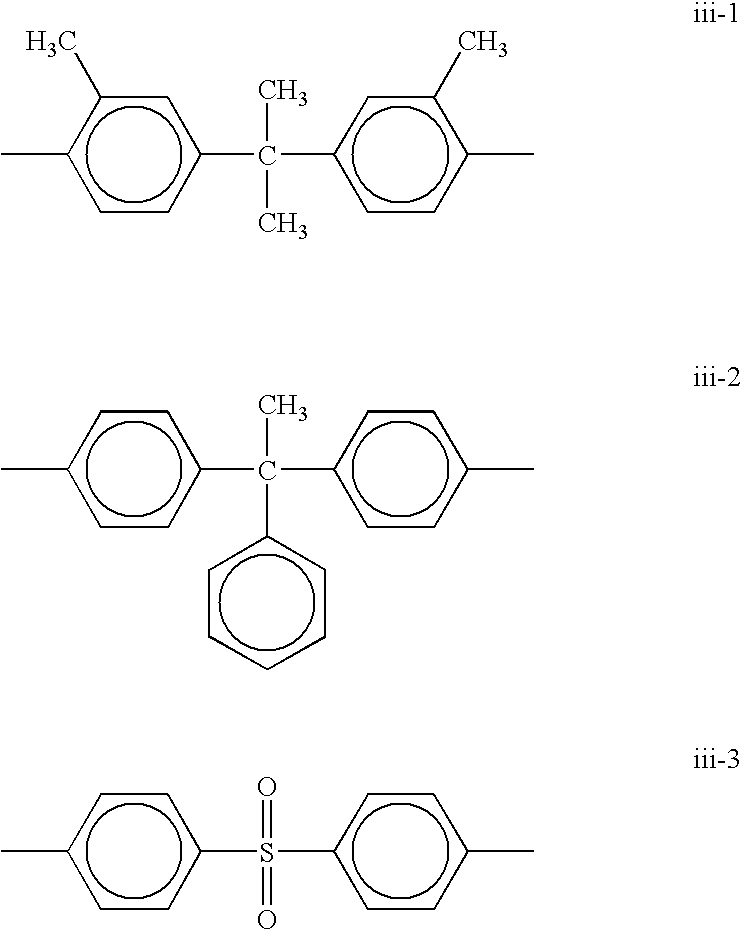

(Here, Bond-positions in the structure iv-1, and iv-3 are located independently on secondary carbon atoms which belong to ethylene or propylene consisting the aliphatic rings in the structures.)


(Here, Bond-positions in the structure a3-2-2, a3-2-3, and a3-2-5 are located independently on secondary carbon atoms which belong to ethylene or propylene consisting the aliphatic rings in the structures.)

a polyarylene type difunctional epoxy resin (A) can be produced.

In the general formula, R7 is selected from hydrogen atom, methyl group, ethyl group, propyl group, and t-butyl group. Among these, a bond wherein R7 is a methyl group, that is, a methylacetal bond is most preferable because it is easy to produce the difunctional epoxy resin itself and the flexibility of the cured epoxy resin article is remarkably improved.


wherein R1 and R2 each represents a hydrogen atom or a methyl group, R3 to R6 each represents a hydrogen atom, a methyl group, a chlorine atom, or a bromine atom, X represents an ethyleneoxyethyl group, a di(ethyleneoxy)ethyl group, a tri(ethyleneoxy)ethyl group, propyleneoxypropyl group, a di(propyleneoxy)propyl group, a tri(propyleneoxy)propyl group, or an alkylene group having 2 to 15 carbon atoms, n is a natural number, and the average thereof is from 1.5 to 5, of the present invention is particularly preferable because of the resulting cured epoxy resin article is excellent in balance between flexibility and toughness and is also excellent in water resistance.


wherein R1 and R2 each represents a hydrogen atom or a methyl group, R3 to R6 each represents a hydrogen atom, a methyl group, a chlorine atom, or a bromine atom, X represents a C6-17 aliphatic hydrocarbon group having a cycloalkane skeleton, n is a natural number, and the average thereof is from 1.2 to 5, of the present invention is particularly preferable because proper flexibility is imparted to the cured epoxy resin article while maintaining excellent dielectric propertiesdielectric properties and the resulting cured epoxy resin article is excellent in toughness.

wherein R3 to R6 each represents a hydrogen atom, a methyl group, a chlorine atom, or a halogen atom, X each independently represents an aliphatic cyclic hydrocarbon group having 6 to 15 carbon atoms, n is a natural number, and the average thereof is from 1.2 to 5, of the present invention is particularly preferable.

wherein R1 and R2 each represents a hydrogen atom or a methyl group, R3 to R6 each represents a hydrogen atom, a methyl group, a chlorine atom, or a halogen atom, X each independently represents an aliphatic cyclic hydrocarbon group having 6 to 15 carbon atoms, the toughness of the cured article is improved.

wherein R1 and R2 each represents a hydrogen atom or a methyl group, R3 to R6 each represents a hydrogen atom, a methyl group, a chlorine atom, or bromine atom, and X represents a C6-17 aliphatic hydrocarbon group having a cycloalkane skeleton, it is possible to achieve good balance between heat resistance, water resistance and dielectric propertiesdielectric properties.


wherein R1 and R2 each represents a hydrogen atom or a methyl group, R3 to R6 each represents a hydrogen atom, a methyl group, a chlorine atom, or a bromine atom, X represents an ethyleneoxyethyl group, a di(ethyleneoxy)ethyl group, a tri(ethyleneoxy)ethyl group, propyleneoxypropyl group, a di(propyleneoxy)propyl group, a tri(propyleneoxy)propyl group, or an alkylene group having 2 to 15 carbon atoms, n is an natural number, and the average thereof is from 1.5 to 5, is particularly preferable because the resulting cured epoxy resin article is excellent in balance between flexibility and toughness and is also excellent in water resistance.


wherein R1 and R2 each represents a hydrogen atom or a methyl group, R3 to R6 each represents a hydrogen atom, a methyl group, a chlorine atom, or a bromine atom, X represents a C6-17 aliphatic hydrocarbon group having a cycloalkane skeleton, n is a natural number, and the average thereof is from 1.5 to 5, is particularly preferable because the resulting cured epoxy resin article is provided with proper flexibility while maintaining excellent dielectric propertiesdielectric properties and is also excellent in toughness. Specific examples of the novel phenol resin include the aforementioned compounds of Pb-1 to Pb-8.

wherein R3 to R6 each represents a hydrogen atom, a methyl group, a chlorine atom, or a halogen atom, X each independently represents an aliphatic cyclic hydrocarbon group having 6 to 15 carbon atoms, n is a natural number, and the average thereof is from 1.5 to 5, is particularly preferable. Specific examples of the novel phenol resin include the aforementioned compounds of Pb-9 to Pb-12.
| TABLE 1 | |||
| Examples | Comparative Examples | ||
| 7 | 8 | 9 | 10 | 11 | 1 | 2 | 3 | ||
| Formulation | Epoxy resin (ep-1a) | 66.5 | 45.5 | ||||||
| Epoxy resin (ep-2a) | 65.5 | 45.1 | |||||||
| Epoxy resin (ep-3a) | 66.9 | ||||||||
| Epoxy resin (ep-4a) | 66.5 | ||||||||
| Epoxy resin (ep-5a) | 66.7 | ||||||||
| Epoxy resin (ep-6a) | 65.6 | ||||||||
| Epoxy resin (ep-7a) | 19.5 | 19.3 | |||||||
| Triethylenetetramine | 3.5 | 4.5 | 3.1 | 5.0 | 5.6 | 3.5 | 3.3 | 4.4 | |
| Xylene | 30.0 | 30.0 | 30.0 | 30.0 | 30.0 | 30.0 | 30.0 | 30.0 |
| Bending test | Good | Good | Good | Good | Good | Poor | Poor | Poor |
| Adhesion (cross cut test) | 100/100 | 100/100 | 100/100 | 100/100 | 100/100 | 90/100 | 87/100 | 100/100 |
| Moisture resistance | Good | Good | Good | Good | Good | Poor | Poor | Poor |
| Moisture adsorption rate | 1.85 | 1.77 | 1.90 | 1.72 | 1.68 | 2.10 | 2.08 | 7.20 |
| Bondability | Cold rolled steel sheet (Mpa) | 17.0 | 15.2 | 17.5 | 12.2 | 10.2 | 6.0 | 5.9 | 10.1 |
| Aluminum sheet (Mpa) | 11.0 | 9.0 | 11.5 | 8.9 | 7.5 | 5.0 | 4.8 | 7.3 | |
| TABLE 2 | |||
| Examples | Comparative Examples | ||
| 16 | 17 | 4 | 5 | 6 | 7 | ||
| Formulation | Epoxy resin (ep-1b) | 82 | |||||
| Epoxy resin (ep-2b) | 77 | ||||||
| Epoxy resin (ep-3b) | 64 | ||||||
| Epoxy resin (ep-4b) | 82 | ||||||
| Epoxy resin (ep-5b) | 66 | ||||||
| Epoxy resin (ep-6b) | 73 | ||||||
| TD-2131 | 18 | 23 | 36 | 18 | 34 | 27 | |
| Triphenylphosphine | 1 | 1 | 1 | 1 | 1 | 1 | |
| Evaluation | Glass transition temperature | 84 | 133 | 134 | 115 | 180 | 174 |
| (° C.) | |||||||
| Moisture adsorption ratio(%) | 1.03 | 0.57 | 1.6 | 1.89 | 1.05 | 0.59 | |
| Dielectric constant | 3.69 | 3.56 | 4.76 | 4.4 | 4.43 | 3.93 | |
| Dielectric dissipation factor | 00.021 | 0.013 | 0.041 | 0.043 | 0.026 | 0.019 | |
Claims (8)
Priority Applications (1)
| Application Number | Priority Date | Filing Date | Title |
|---|---|---|---|
| US11/454,911 US7569654B2 (en) | 2002-10-15 | 2006-06-19 | Epoxy resin composition, process for producing epoxy resin, novel epoxy resin, novel phenol resin |
Applications Claiming Priority (4)
| Application Number | Priority Date | Filing Date | Title |
|---|---|---|---|
| JP2002300212 | 2002-10-15 | ||
| JPP2002-300212 | 2002-10-15 | ||
| US10/682,920 US7087702B2 (en) | 2002-10-15 | 2003-10-14 | Epoxy resin composition, process for producing epoxy resin, novel epoxy resin, novel phenol resin |
| US11/454,911 US7569654B2 (en) | 2002-10-15 | 2006-06-19 | Epoxy resin composition, process for producing epoxy resin, novel epoxy resin, novel phenol resin |
Related Parent Applications (1)
| Application Number | Title | Priority Date | Filing Date |
|---|---|---|---|
| US10/682,920 Division US7087702B2 (en) | 2002-10-15 | 2003-10-14 | Epoxy resin composition, process for producing epoxy resin, novel epoxy resin, novel phenol resin |
Publications (2)
| Publication Number | Publication Date |
|---|---|
| US20060247392A1 US20060247392A1 (en) | 2006-11-02 |
| US7569654B2 true US7569654B2 (en) | 2009-08-04 |
Family
ID=32040781
Family Applications (4)
| Application Number | Title | Priority Date | Filing Date |
|---|---|---|---|
| US10/682,920 Expired - Lifetime US7087702B2 (en) | 2002-10-15 | 2003-10-14 | Epoxy resin composition, process for producing epoxy resin, novel epoxy resin, novel phenol resin |
| US11/455,106 Expired - Lifetime US7456247B2 (en) | 2002-10-15 | 2006-06-19 | Phenolic resin formed from a difunctional phenol and a divinyl ether |
| US11/455,108 Expired - Lifetime US7365147B2 (en) | 2002-10-15 | 2006-06-19 | Epoxy resin composition, process for producing epoxy resin, novel epoxy resin, novel phenol resin |
| US11/454,911 Expired - Lifetime US7569654B2 (en) | 2002-10-15 | 2006-06-19 | Epoxy resin composition, process for producing epoxy resin, novel epoxy resin, novel phenol resin |
Family Applications Before (3)
| Application Number | Title | Priority Date | Filing Date |
|---|---|---|---|
| US10/682,920 Expired - Lifetime US7087702B2 (en) | 2002-10-15 | 2003-10-14 | Epoxy resin composition, process for producing epoxy resin, novel epoxy resin, novel phenol resin |
| US11/455,106 Expired - Lifetime US7456247B2 (en) | 2002-10-15 | 2006-06-19 | Phenolic resin formed from a difunctional phenol and a divinyl ether |
| US11/455,108 Expired - Lifetime US7365147B2 (en) | 2002-10-15 | 2006-06-19 | Epoxy resin composition, process for producing epoxy resin, novel epoxy resin, novel phenol resin |
Country Status (4)
| Country | Link |
|---|---|
| US (4) | US7087702B2 (en) |
| EP (1) | EP1411101B1 (en) |
| CN (1) | CN1331911C (en) |
| DE (1) | DE60304651T2 (en) |
Families Citing this family (22)
| Publication number | Priority date | Publication date | Assignee | Title |
|---|---|---|---|---|
| US7569260B2 (en) * | 2003-08-21 | 2009-08-04 | Asahi Kasei Chemicals Corporation | Photosensitive composition and cured products thereof |
| TW200602427A (en) * | 2004-03-30 | 2006-01-16 | Taiyo Ink Mfg Co Ltd | Thermosetting resin composition and multilayered printed wiring board comprising the same |
| JP2005307032A (en) * | 2004-04-22 | 2005-11-04 | Dainippon Ink & Chem Inc | 1-pack type epoxy resin composition and cured product thereof |
| JP4636307B2 (en) * | 2004-05-24 | 2011-02-23 | Dic株式会社 | Epoxy resin composition and cured product thereof |
| EP1801142B1 (en) * | 2005-12-16 | 2016-02-24 | Canon Kabushiki Kaisha | Resin composition,resin cured product, and liquid discharge head |
| JP5355391B2 (en) * | 2006-06-16 | 2013-11-27 | ハンツマン アドバンスト マテリアルズ (スイッツァランド) ゲーエムベーハー | Paint system |
| WO2008032383A1 (en) * | 2006-09-14 | 2008-03-20 | Panasonic Electric Works Co., Ltd. | Epoxy resin composition for printed wiring board, resin composition varnish, prepreg, metal clad laminate, printed wiring board and multilayer printed wiring board |
| US8084185B2 (en) * | 2009-01-08 | 2011-12-27 | International Business Machines Corporation | Substrate planarization with imprint materials and processes |
| US9059187B2 (en) * | 2010-09-30 | 2015-06-16 | Ibiden Co., Ltd. | Electronic component having encapsulated wiring board and method for manufacturing the same |
| JP2013538918A (en) | 2010-09-30 | 2013-10-17 | ダウ グローバル テクノロジーズ エルエルシー | Epoxy resin adduct and its thermosetting resin |
| US8962792B2 (en) | 2010-09-30 | 2015-02-24 | Dow Global Technologies Llc | Process for preparing epoxy resins |
| JP5795804B2 (en) | 2010-09-30 | 2015-10-14 | ダウ グローバル テクノロジーズ エルエルシー | Coating composition |
| EP2621990B1 (en) | 2010-09-30 | 2016-02-24 | Blue Cube IP LLC | Thermosettable compositions and thermosets therefrom |
| WO2012044443A1 (en) | 2010-09-30 | 2012-04-05 | Dow Global Technologies Llc | Epoxy resin compositions |
| CN102040804B (en) * | 2010-11-19 | 2013-02-13 | 明基材料有限公司 | Epoxy resin composition |
| JP5943505B2 (en) * | 2011-10-31 | 2016-07-05 | 住友化学株式会社 | High voltage coil |
| CN104877302B (en) * | 2015-06-15 | 2017-05-03 | 黑龙江省科学院石油化学研究院 | Waterborne epoxy modified phenolic resin emulsion, preparation method thereof and adhesive prepared by using same as raw material |
| US9842794B2 (en) * | 2015-11-18 | 2017-12-12 | Stmicroelectronics, Inc. | Semiconductor package with integrated heatsink |
| JP7310298B2 (en) * | 2018-06-15 | 2023-07-19 | Dic株式会社 | Adhesives, laminates, packaging materials for batteries and batteries |
| US10822517B2 (en) | 2018-11-28 | 2020-11-03 | Industrial Technology Research Institute | Resin composition and cured resin composition |
| JP7785660B2 (en) * | 2019-08-08 | 2025-12-15 | アディティア・ビルラ・ケミカルズ・(タイランド)・リミテッド・(エポキシ・ディビジョン) | Modified Epoxy Resin |
| CN120209285A (en) * | 2023-12-27 | 2025-06-27 | 上纬创新育成股份有限公司 | Curable carbonate composition, preparation method thereof and carbonate cured product |
Citations (15)
| Publication number | Priority date | Publication date | Assignee | Title |
|---|---|---|---|---|
| FR2346382A1 (en) | 1976-04-02 | 1977-10-28 | Prodotti Chimici Srl Comp | Crosslinkable phenolic resins - for preparation of stable materials for use in furniture or construction industry |
| SU767104A1 (en) * | 1975-12-24 | 1980-09-30 | Предприятие П/Я В-8415 | Diglycidylic acetal-containing ethers of aromatic diols as binders for preparing polymeric mastics,hermetics and coatings and their preparation method |
| US4285381A (en) | 1979-06-18 | 1981-08-25 | Sumitomo Rubber Industries, Ltd. | Curable composition for hard rubber and the use thereof |
| JPS581591A (en) | 1981-08-31 | 1983-01-06 | Mitsubishi Paper Mills Ltd | Color developing paper for no carbon copying paper using paraphenylphenol resin with a higher solubility |
| US5036112A (en) | 1990-01-26 | 1991-07-30 | Gaf Chemicals Corporation | Cross-linkable vinyl ether polyacetal oligomers |
| EP0491550A2 (en) | 1990-12-17 | 1992-06-24 | The Dow Chemical Company | Water-emulsifiable epoxy resin composition |
| EP0519376A2 (en) | 1991-06-21 | 1992-12-23 | Hoechst Aktiengesellschaft | Binder resins for making fibre composites |
| US5330675A (en) | 1991-12-20 | 1994-07-19 | Basf Aktiengesellschaft | Use of polyacetals based on vinyl ethers and dihydroxy compounds in detergents and cleaners and polyacetals |
| US5344856A (en) | 1990-12-17 | 1994-09-06 | The Dow Chemical Company | Water-emulsifiable epoxy resin composition |
| US5414053A (en) | 1993-06-23 | 1995-05-09 | Essex Specialty Products, Inc. | Thermoformable, thermosettable adhesives prepared from epoxy resins and polyesters and/or polycarbonates |
| US5466762A (en) | 1992-11-05 | 1995-11-14 | Basf Aktiengesellschaft | Block copolyacetals, preparation thereof and use thereof in detergents and cleaners |
| US5540663A (en) | 1993-04-20 | 1996-07-30 | Basf Aktiengesellschaft | Use of polyacetals for preparing compostable moldings, as coating and as adhesive |
| US6242533B1 (en) | 1999-06-04 | 2001-06-05 | Gun Ei Chemical Industry Co., Ltd. | Novolak type phenol resin |
| JP2001172494A (en) | 1999-12-22 | 2001-06-26 | Nippon Kayaku Co Ltd | Resin composition for polymeric solid electrolyte, polymeric solid electrolyte and polymer battery |
| US6887737B1 (en) | 2001-12-13 | 2005-05-03 | Henkel Corporation | Epoxidized acetals and thioacetals, episulfidized acetals and thioacetals, and reworkable thermosetting resin compositions formulated therefrom |
-
2003
- 2003-10-14 DE DE60304651T patent/DE60304651T2/en not_active Expired - Lifetime
- 2003-10-14 US US10/682,920 patent/US7087702B2/en not_active Expired - Lifetime
- 2003-10-14 CN CNB2003101249545A patent/CN1331911C/en not_active Expired - Lifetime
- 2003-10-14 EP EP03023246A patent/EP1411101B1/en not_active Expired - Lifetime
-
2006
- 2006-06-19 US US11/455,106 patent/US7456247B2/en not_active Expired - Lifetime
- 2006-06-19 US US11/455,108 patent/US7365147B2/en not_active Expired - Lifetime
- 2006-06-19 US US11/454,911 patent/US7569654B2/en not_active Expired - Lifetime
Patent Citations (16)
| Publication number | Priority date | Publication date | Assignee | Title |
|---|---|---|---|---|
| SU767104A1 (en) * | 1975-12-24 | 1980-09-30 | Предприятие П/Я В-8415 | Diglycidylic acetal-containing ethers of aromatic diols as binders for preparing polymeric mastics,hermetics and coatings and their preparation method |
| FR2346382A1 (en) | 1976-04-02 | 1977-10-28 | Prodotti Chimici Srl Comp | Crosslinkable phenolic resins - for preparation of stable materials for use in furniture or construction industry |
| US4285381A (en) | 1979-06-18 | 1981-08-25 | Sumitomo Rubber Industries, Ltd. | Curable composition for hard rubber and the use thereof |
| JPS581591A (en) | 1981-08-31 | 1983-01-06 | Mitsubishi Paper Mills Ltd | Color developing paper for no carbon copying paper using paraphenylphenol resin with a higher solubility |
| US5036112A (en) | 1990-01-26 | 1991-07-30 | Gaf Chemicals Corporation | Cross-linkable vinyl ether polyacetal oligomers |
| US5344856A (en) | 1990-12-17 | 1994-09-06 | The Dow Chemical Company | Water-emulsifiable epoxy resin composition |
| EP0491550A2 (en) | 1990-12-17 | 1992-06-24 | The Dow Chemical Company | Water-emulsifiable epoxy resin composition |
| EP0519376A2 (en) | 1991-06-21 | 1992-12-23 | Hoechst Aktiengesellschaft | Binder resins for making fibre composites |
| US5330675A (en) | 1991-12-20 | 1994-07-19 | Basf Aktiengesellschaft | Use of polyacetals based on vinyl ethers and dihydroxy compounds in detergents and cleaners and polyacetals |
| US5374681A (en) | 1991-12-20 | 1994-12-20 | Basf Aktiengesellschaft | Polyacetals based on divinyl ethers, dihydroxy compounds and monohydroxy compounds |
| US5466762A (en) | 1992-11-05 | 1995-11-14 | Basf Aktiengesellschaft | Block copolyacetals, preparation thereof and use thereof in detergents and cleaners |
| US5540663A (en) | 1993-04-20 | 1996-07-30 | Basf Aktiengesellschaft | Use of polyacetals for preparing compostable moldings, as coating and as adhesive |
| US5414053A (en) | 1993-06-23 | 1995-05-09 | Essex Specialty Products, Inc. | Thermoformable, thermosettable adhesives prepared from epoxy resins and polyesters and/or polycarbonates |
| US6242533B1 (en) | 1999-06-04 | 2001-06-05 | Gun Ei Chemical Industry Co., Ltd. | Novolak type phenol resin |
| JP2001172494A (en) | 1999-12-22 | 2001-06-26 | Nippon Kayaku Co Ltd | Resin composition for polymeric solid electrolyte, polymeric solid electrolyte and polymer battery |
| US6887737B1 (en) | 2001-12-13 | 2005-05-03 | Henkel Corporation | Epoxidized acetals and thioacetals, episulfidized acetals and thioacetals, and reworkable thermosetting resin compositions formulated therefrom |
Non-Patent Citations (3)
| Title |
|---|
| Derwent abstract of SU 767104 B (1981). * |
| Japanese Unexamined Patent Application, First Publication (Kokai), No. 2001-240654, published on Sep. 4, 2001. (See p. 2 of present specification). |
| Japanese Unexamined Patent Application, First Publication (Kokai), No. Hei 8-53533, published on Feb. 27, 1996. (See p. 2 of present specification). |
Also Published As
| Publication number | Publication date |
|---|---|
| EP1411101A1 (en) | 2004-04-21 |
| US20060235183A1 (en) | 2006-10-19 |
| EP1411101B1 (en) | 2006-04-19 |
| DE60304651T2 (en) | 2007-05-10 |
| US20040087740A1 (en) | 2004-05-06 |
| US7456247B2 (en) | 2008-11-25 |
| DE60304651D1 (en) | 2006-05-24 |
| US7365147B2 (en) | 2008-04-29 |
| US7087702B2 (en) | 2006-08-08 |
| US20060247392A1 (en) | 2006-11-02 |
| CN1524892A (en) | 2004-09-01 |
| CN1331911C (en) | 2007-08-15 |
| US20060241274A1 (en) | 2006-10-26 |
Similar Documents
| Publication | Publication Date | Title |
|---|---|---|
| US7569654B2 (en) | Epoxy resin composition, process for producing epoxy resin, novel epoxy resin, novel phenol resin | |
| JP4632077B2 (en) | Epoxy resin composition, method for producing epoxy resin, novel epoxy resin, and novel phenol resin | |
| US6784228B2 (en) | Epoxy resin composition, cured article thereof, novel epoxy resin, novel phenol compound, and process for preparing the same | |
| KR101408535B1 (en) | Modified liquid epoxy resin, and epoxy resin composition using the same and cured product thereof | |
| JP4461698B2 (en) | Adhesive composition, flexible wiring board, and coverlay film | |
| US7259213B2 (en) | Indole resins epoxy resins and resin compositions containing the same | |
| JPH09291127A (en) | Naphthol-containing novolac resin, naphthol novolac epoxy resin, epoxy resin composition, and cured product thereof | |
| JP3074013B2 (en) | Epoxy resin composition and cured product thereof | |
| JP3894628B2 (en) | Modified epoxy resin, epoxy resin composition and cured product thereof | |
| JPH093162A (en) | Epoxy resin mixture, epoxy resin composition, and its cured product | |
| JP4581397B2 (en) | Epoxy resin composition and cured product thereof | |
| JP3636409B2 (en) | Phenolic resins, epoxy resins, epoxy resin compositions and cured products thereof | |
| JP3998163B2 (en) | Epoxy resin, epoxy resin composition and cured product thereof | |
| JP3907140B2 (en) | Modified epoxy resin, epoxy resin composition and cured product thereof | |
| JPH0920819A (en) | Modified phenol novlak resin, epoxy resin, epoxy resin composition and its cured product | |
| JP3886060B2 (en) | Epoxy resin, epoxy resin composition and cured product thereof | |
| JP3476584B2 (en) | Epoxy resin, epoxy resin composition and cured product thereof | |
| JPH07330645A (en) | Compound of polyphenols, epoxy resin, epoxy resin composition and cured material thereof | |
| JP4404821B2 (en) | Modified epoxy resin, epoxy resin composition and cured product thereof | |
| JPH08310985A (en) | Polyphenolic compound, epoxy resin, epoxy resin composition and cured product thereof | |
| JP3646942B2 (en) | Epoxy resin, epoxy resin composition and cured product thereof | |
| JP5254036B2 (en) | Phenol resin, epoxy resin, curable resin composition, cured product thereof, and method for producing phenol resin | |
| JPH0827052A (en) | Polyphenol, epoxy resin, epoxy resin composition and its cured material | |
| JPH051052A (en) | Epoxy resin and manufacturing method thereof | |
| JPH08157549A (en) | Polyphenol, epoxy resin, epoxy resin composition, and cured material obtained therefrom |
Legal Events
| Date | Code | Title | Description |
|---|---|---|---|
| AS | Assignment |
Owner name: DIC CORPORATION, JAPAN Free format text: CHANGE OF NAME;ASSIGNOR:DAINIPPON INK AND CHEMICALS, INC.;REEL/FRAME:022851/0339 Effective date: 20080401 |
|
| STCF | Information on status: patent grant |
Free format text: PATENTED CASE |
|
| FEPP | Fee payment procedure |
Free format text: PAYOR NUMBER ASSIGNED (ORIGINAL EVENT CODE: ASPN); ENTITY STATUS OF PATENT OWNER: LARGE ENTITY |
|
| FPAY | Fee payment |
Year of fee payment: 4 |
|
| FPAY | Fee payment |
Year of fee payment: 8 |
|
| MAFP | Maintenance fee payment |
Free format text: PAYMENT OF MAINTENANCE FEE, 12TH YEAR, LARGE ENTITY (ORIGINAL EVENT CODE: M1553); ENTITY STATUS OF PATENT OWNER: LARGE ENTITY Year of fee payment: 12 |