US7541454B2 - Compounds and methods for fluorescent labeling - Google Patents
Compounds and methods for fluorescent labeling Download PDFInfo
- Publication number
- US7541454B2 US7541454B2 US10/975,042 US97504204A US7541454B2 US 7541454 B2 US7541454 B2 US 7541454B2 US 97504204 A US97504204 A US 97504204A US 7541454 B2 US7541454 B2 US 7541454B2
- Authority
- US
- United States
- Prior art keywords
- group
- alkyl
- aryl
- compound
- alkoxy
- Prior art date
- Legal status (The legal status is an assumption and is not a legal conclusion. Google has not performed a legal analysis and makes no representation as to the accuracy of the status listed.)
- Expired - Lifetime, expires
Links
- 0 [1*]C1=C(O[4*])C([3*])=C([2*])C(CC([5*])([6*])C([8*])=O)=C1C.[1*]C1=C([2*])C([3*])=C(O[4*])C(CC([5*])([6*])C([8*])=O)=C1C Chemical compound [1*]C1=C(O[4*])C([3*])=C([2*])C(CC([5*])([6*])C([8*])=O)=C1C.[1*]C1=C([2*])C([3*])=C(O[4*])C(CC([5*])([6*])C([8*])=O)=C1C 0.000 description 55
- VVCFYASOGFVJFN-UHFFFAOYSA-N CC(C)=CC(C)C Chemical compound CC(C)=CC(C)C VVCFYASOGFVJFN-UHFFFAOYSA-N 0.000 description 3
- LTUNQUKPRNQISN-UHFFFAOYSA-N C.CC1=C(C)C(C)=C(C(C)C)C(C)=C1C.CC1=C(C)C(C)=C(C)C(C(C)C)=N1.CC1=NC(C)=C(C(C)C)C(C)=C1C.CC1=NC(C)=C(C)C(C(C)C)=C1C Chemical compound C.CC1=C(C)C(C)=C(C(C)C)C(C)=C1C.CC1=C(C)C(C)=C(C)C(C(C)C)=N1.CC1=NC(C)=C(C(C)C)C(C)=C1C.CC1=NC(C)=C(C)C(C(C)C)=C1C LTUNQUKPRNQISN-UHFFFAOYSA-N 0.000 description 2
- VQSUJDZUMBOMKO-UHFFFAOYSA-N COC1=CC=C(CCCCC(=O)O)C(OC)=C1Cl Chemical compound COC1=CC=C(CCCCC(=O)O)C(OC)=C1Cl VQSUJDZUMBOMKO-UHFFFAOYSA-N 0.000 description 2
- GOHKZNMEMNLULX-UHFFFAOYSA-N C.C=C1OC(C(C)C)(C(C)C)C2=C(C)C(C)=C(C)C(C)=C12.CC(C)=CC(C)C Chemical compound C.C=C1OC(C(C)C)(C(C)C)C2=C(C)C(C)=C(C)C(C)=C12.CC(C)=CC(C)C GOHKZNMEMNLULX-UHFFFAOYSA-N 0.000 description 1
- NRMCGRURXJQAMQ-UHFFFAOYSA-N C=C1OC(C(C)C)(C(C)C)C2=C(C)C(C)=C(C)C(C)=C12 Chemical compound C=C1OC(C(C)C)(C(C)C)C2=C(C)C(C)=C(C)C(C)=C12 NRMCGRURXJQAMQ-UHFFFAOYSA-N 0.000 description 1
- OLCDQULDWYDGRS-UHFFFAOYSA-N CC(=O)CCCCC1=CC2=C(OC3=C(C)C(O)=C(Cl)C=C3C23OC(=O)C2=C3C=C(Cl)C(Cl)=C2)C(Cl)=C1O Chemical compound CC(=O)CCCCC1=CC2=C(OC3=C(C)C(O)=C(Cl)C=C3C23OC(=O)C2=C3C=C(Cl)C(Cl)=C2)C(Cl)=C1O OLCDQULDWYDGRS-UHFFFAOYSA-N 0.000 description 1
- KHDIJWJTOMIOCO-UHFFFAOYSA-N CC(C)(C)C(=O)OC1=CC=C2C(=C1)OC1=C(C=C(CCCCC(=O)NCCCCCCO)C(OC(=O)C(C)(C)C)=C1)C21OC(=O)C2=C1C=CC=C2 Chemical compound CC(C)(C)C(=O)OC1=CC=C2C(=C1)OC1=C(C=C(CCCCC(=O)NCCCCCCO)C(OC(=O)C(C)(C)C)=C1)C21OC(=O)C2=C1C=CC=C2 KHDIJWJTOMIOCO-UHFFFAOYSA-N 0.000 description 1
- KSKJKUCYAUDEJB-UHFFFAOYSA-N CC(C)(C)C(=O)OC1=CC=C2C(=C1)OC1=CC(OC(=O)C(C)(C)C)=C(CC(=O)NCCCCCCO)C=C1C21OC(=O)C2=C1C=CC=C2.CC(C)N(C(C)C)P(OCCC#N)N(C(C)C)C(C)C.CC(C)N(C(C)C)P(OCCC#N)OCCCCCCNC(=O)CC1=C(OC(=O)C(C)(C)C)C=C2OC3=CC(OC(=O)C(C)(C)C)=CC=C3C3(OC(=O)C4=C3C=CC=C4)C2=C1 Chemical compound CC(C)(C)C(=O)OC1=CC=C2C(=C1)OC1=CC(OC(=O)C(C)(C)C)=C(CC(=O)NCCCCCCO)C=C1C21OC(=O)C2=C1C=CC=C2.CC(C)N(C(C)C)P(OCCC#N)N(C(C)C)C(C)C.CC(C)N(C(C)C)P(OCCC#N)OCCCCCCNC(=O)CC1=C(OC(=O)C(C)(C)C)C=C2OC3=CC(OC(=O)C(C)(C)C)=CC=C3C3(OC(=O)C4=C3C=CC=C4)C2=C1 KSKJKUCYAUDEJB-UHFFFAOYSA-N 0.000 description 1
- GIEVMQXTKZQKLN-UHFFFAOYSA-N CC(C)N(C(C)C)P(OCCC#N)OCCCCCCNC(=O)CCCCC1=CC2=C(C=C1OC(=O)C(C)(C)C)OC1=CC(OC(=O)C(C)(C)C)=CC=C1C21OC(=O)C2=C1C=CC=C2 Chemical compound CC(C)N(C(C)C)P(OCCC#N)OCCCCCCNC(=O)CCCCC1=CC2=C(C=C1OC(=O)C(C)(C)C)OC1=CC(OC(=O)C(C)(C)C)=CC=C1C21OC(=O)C2=C1C=CC=C2 GIEVMQXTKZQKLN-UHFFFAOYSA-N 0.000 description 1
- VQEUPVCUEFWZPC-UHFFFAOYSA-N CC1=C(Cl)C=C2C(=C1C)OC1=C(Cl)C(C)=C(CCCCC(=O)NCCCCCCOP(C)N(C(C)C)C(C)C)C=C1C21OC(=O)C2=CC(Cl)=C(Cl)C=C21.CC1=CC=C2C(=C1)OC1=CC(C)=C(CCCCC(=O)NCCCCCCOP(OCCC#N)N(C(C)C)C(C)C)C=C1C21OC(=O)C2=CC=CC=C21 Chemical compound CC1=C(Cl)C=C2C(=C1C)OC1=C(Cl)C(C)=C(CCCCC(=O)NCCCCCCOP(C)N(C(C)C)C(C)C)C=C1C21OC(=O)C2=CC(Cl)=C(Cl)C=C21.CC1=CC=C2C(=C1)OC1=CC(C)=C(CCCCC(=O)NCCCCCCOP(OCCC#N)N(C(C)C)C(C)C)C=C1C21OC(=O)C2=CC=CC=C21 VQEUPVCUEFWZPC-UHFFFAOYSA-N 0.000 description 1
- RCGOYFRFFZOYIP-UHFFFAOYSA-N CC1=C(O)C(Cl)=CC=C1O Chemical compound CC1=C(O)C(Cl)=CC=C1O RCGOYFRFFZOYIP-UHFFFAOYSA-N 0.000 description 1
- BPYUUXOSUOBMHG-UHFFFAOYSA-N CC1=C2OC3=C(C=C(CCCCC(=O)O)C(O)=C3Cl)C3(OC(=O)C4=C3C=C(Cl)C(Cl)=C4)C2=CC(Cl)=C1O Chemical compound CC1=C2OC3=C(C=C(CCCCC(=O)O)C(O)=C3Cl)C3(OC(=O)C4=C3C=C(Cl)C(Cl)=C4)C2=CC(Cl)=C1O BPYUUXOSUOBMHG-UHFFFAOYSA-N 0.000 description 1
- BHSFNJNVVOFNID-UHFFFAOYSA-N CC1=C2OC3=C(C=C(CCCCC(=O)OC4=C(F)C(F)=C(F)C(F)=C4F)C(O)=C3Cl)C3(OC(=O)C4=C3C=C(Cl)C(Cl)=C4)C2=CC(Cl)=C1O Chemical compound CC1=C2OC3=C(C=C(CCCCC(=O)OC4=C(F)C(F)=C(F)C(F)=C4F)C(O)=C3Cl)C3(OC(=O)C4=C3C=C(Cl)C(Cl)=C4)C2=CC(Cl)=C1O BHSFNJNVVOFNID-UHFFFAOYSA-N 0.000 description 1
- HMYJSWROGPZVQT-UHFFFAOYSA-N CCCCCCCNC(=O)CC1=C(O)C=C2OC3=CC(O)=CC=C3C3(OC(=O)C4=C3C=CC=C4)C2=C1.CCCCCCCNC(=O)CC1=C(OC(=O)C(C)(C)C)C=C2OC3=CC(OC(=O)C(C)(C)C)=CC=C3C3(OC(=O)C4=C3C=CC=C4)C2=C1.COC1=CC=C(C(Cl)(C2=CC=CC=C2)C2=CC=C(OC)C=C2)C=C1.NCCCCCCO.O=C(CC1=C(O)C=C2OC3=CC(O)=CC=C3C3(OC(=O)C4=C3C=CC=C4)C2=C1)NCCCCCCO.O=CC(F)(F)F Chemical compound CCCCCCCNC(=O)CC1=C(O)C=C2OC3=CC(O)=CC=C3C3(OC(=O)C4=C3C=CC=C4)C2=C1.CCCCCCCNC(=O)CC1=C(OC(=O)C(C)(C)C)C=C2OC3=CC(OC(=O)C(C)(C)C)=CC=C3C3(OC(=O)C4=C3C=CC=C4)C2=C1.COC1=CC=C(C(Cl)(C2=CC=CC=C2)C2=CC=C(OC)C=C2)C=C1.NCCCCCCO.O=C(CC1=C(O)C=C2OC3=CC(O)=CC=C3C3(OC(=O)C4=C3C=CC=C4)C2=C1)NCCCCCCO.O=CC(F)(F)F HMYJSWROGPZVQT-UHFFFAOYSA-N 0.000 description 1
- DPIISQNLGILMLC-UHFFFAOYSA-N COC(=O)CCCCC1=C(O)C(Cl)=C(O)C(C(=O)C2=CC(Cl)=C(Cl)C=C2C(=O)O)=C1 Chemical compound COC(=O)CCCCC1=C(O)C(Cl)=C(O)C(C(=O)C2=CC(Cl)=C(Cl)C=C2C(=O)O)=C1 DPIISQNLGILMLC-UHFFFAOYSA-N 0.000 description 1
- NSRUYIZIIMACOG-UHFFFAOYSA-N COC(=O)CCCCC1=C(O)C=C(O)C(C(=O)C2=CC=CC=C2C(=O)O)=C1 Chemical compound COC(=O)CCCCC1=C(O)C=C(O)C(C(=O)C2=CC=CC=C2C(=O)O)=C1 NSRUYIZIIMACOG-UHFFFAOYSA-N 0.000 description 1
- KEQKJOMEWDSGOE-UHFFFAOYSA-N COC(=O)CCCCC1=CC=C(O)C(Cl)=C1O Chemical compound COC(=O)CCCCC1=CC=C(O)C(Cl)=C1O KEQKJOMEWDSGOE-UHFFFAOYSA-N 0.000 description 1
- VSTYEVIJFQJKEB-UHFFFAOYSA-N COC(=O)CCCCC1=CC=C(O)C=C1O Chemical compound COC(=O)CCCCC1=CC=C(O)C=C1O VSTYEVIJFQJKEB-UHFFFAOYSA-N 0.000 description 1
- CFHUFBQZJZVOAX-HWKANZROSA-N COC1=CC=C(/C=C/CCC(=O)O)C(OC)=C1 Chemical compound COC1=CC=C(/C=C/CCC(=O)O)C(OC)=C1 CFHUFBQZJZVOAX-HWKANZROSA-N 0.000 description 1
- XKPAATLTNNZCIG-UHFFFAOYSA-N COC1=CC=C(C(OCCCCCCNC(=O)CCCCC2=CC3=C(C=C2O)OC2=CC(O)=CC=C2C32OC(=O)C3=C2C=CC=C3)(C2=CC=CC=C2)C2=CC=C(OC)C=C2)C=C1 Chemical compound COC1=CC=C(C(OCCCCCCNC(=O)CCCCC2=CC3=C(C=C2O)OC2=CC(O)=CC=C2C32OC(=O)C3=C2C=CC=C3)(C2=CC=CC=C2)C2=CC=C(OC)C=C2)C=C1 XKPAATLTNNZCIG-UHFFFAOYSA-N 0.000 description 1
- ZTVZGHNFFVIWEP-UHFFFAOYSA-N COC1=CC=C(C(OCCCCCCNC(=O)CCCCC2=CC3=C(C=C2OC(=O)C(C)(C)C)OC2=CC(OC(=O)C(C)(C)C)=CC=C2C32OC(=O)C3=C2C=CC=C3)(C2=CC=CC=C2)C2=CC=C(OC)C=C2)C=C1 Chemical compound COC1=CC=C(C(OCCCCCCNC(=O)CCCCC2=CC3=C(C=C2OC(=O)C(C)(C)C)OC2=CC(OC(=O)C(C)(C)C)=CC=C2C32OC(=O)C3=C2C=CC=C3)(C2=CC=CC=C2)C2=CC=C(OC)C=C2)C=C1 ZTVZGHNFFVIWEP-UHFFFAOYSA-N 0.000 description 1
- OXSQIUUYBPPTMC-LRIHUQJLSA-N COC1=CC=C(C(OC[C@@H]2C[C@@H](OP(OCCC#N)N(C(C)C)C(C)C)CN2C(=O)CCCCC2=C(C)C(Cl)=C3OC4=C(C)C(C)=C(Cl)C=C4C4(OC(=O)C5=CC(Cl)=C(Cl)C=C54)C3=C2)(C2=CC=CC=C2)C2=CC=C(OC)C=C2)C=C1.COC1=CC=C(C(OC[C@@H]2C[C@@H](OP(OCCC#N)N(C(C)C)C(C)C)CN2C(=O)CCCCC2=C(C)C=C3OC4=CC(C)=CC=C4C4(OC(=O)C5=CC=CC=C54)C3=C2)(C2=CC=CC=C2)C2=CC=C(OC)C=C2)C=C1 Chemical compound COC1=CC=C(C(OC[C@@H]2C[C@@H](OP(OCCC#N)N(C(C)C)C(C)C)CN2C(=O)CCCCC2=C(C)C(Cl)=C3OC4=C(C)C(C)=C(Cl)C=C4C4(OC(=O)C5=CC(Cl)=C(Cl)C=C54)C3=C2)(C2=CC=CC=C2)C2=CC=C(OC)C=C2)C=C1.COC1=CC=C(C(OC[C@@H]2C[C@@H](OP(OCCC#N)N(C(C)C)C(C)C)CN2C(=O)CCCCC2=C(C)C=C3OC4=CC(C)=CC=C4C4(OC(=O)C5=CC=CC=C54)C3=C2)(C2=CC=CC=C2)C2=CC=C(OC)C=C2)C=C1 OXSQIUUYBPPTMC-LRIHUQJLSA-N 0.000 description 1
- VFZUBZKACDYIJG-UHFFFAOYSA-N COC1=CC=C(C=CCCC(=O)O)C(OC)=C1Cl Chemical compound COC1=CC=C(C=CCCC(=O)O)C(OC)=C1Cl VFZUBZKACDYIJG-UHFFFAOYSA-N 0.000 description 1
- RFDYHAGXJFZRFL-UHFFFAOYSA-N COC1=CC=C(CCCCC(=O)O)C(OC)=C1 Chemical compound COC1=CC=C(CCCCC(=O)O)C(OC)=C1 RFDYHAGXJFZRFL-UHFFFAOYSA-N 0.000 description 1
- HGLBBWCMRUVPLV-UHFFFAOYSA-N O=C(CCCCC1=CC2=C(C=C1O)OC1=CC(O)=CC=C1C21OC(=O)C2=C1C=CC=C2)NCCCCCCO Chemical compound O=C(CCCCC1=CC2=C(C=C1O)OC1=CC(O)=CC=C1C21OC(=O)C2=C1C=CC=C2)NCCCCCCO HGLBBWCMRUVPLV-UHFFFAOYSA-N 0.000 description 1
- KZVUGCYQJONHHM-UHFFFAOYSA-N O=C(CCCCC1=CC2=C(C=C1O)OC1=CC(O)=CC=C1C21OC(=O)C2=C1C=CC=C2)OC1=C(F)C(F)=C(F)C(F)=C1F Chemical compound O=C(CCCCC1=CC2=C(C=C1O)OC1=CC(O)=CC=C1C21OC(=O)C2=C1C=CC=C2)OC1=C(F)C(F)=C(F)C(F)=C1F KZVUGCYQJONHHM-UHFFFAOYSA-N 0.000 description 1
- PULHXKXTTYACON-UHFFFAOYSA-N O=C(O)CCCCC1=CC2=C(C=C1O)OC1=CC(O)=CC=C1C21OC(=O)C2=C1C=CC=C2 Chemical compound O=C(O)CCCCC1=CC2=C(C=C1O)OC1=CC(O)=CC=C1C21OC(=O)C2=C1C=CC=C2 PULHXKXTTYACON-UHFFFAOYSA-N 0.000 description 1
Classifications
-
- C—CHEMISTRY; METALLURGY
- C09—DYES; PAINTS; POLISHES; NATURAL RESINS; ADHESIVES; COMPOSITIONS NOT OTHERWISE PROVIDED FOR; APPLICATIONS OF MATERIALS NOT OTHERWISE PROVIDED FOR
- C09B—ORGANIC DYES OR CLOSELY-RELATED COMPOUNDS FOR PRODUCING DYES, e.g. PIGMENTS; MORDANTS; LAKES
- C09B11/00—Diaryl- or thriarylmethane dyes
- C09B11/04—Diaryl- or thriarylmethane dyes derived from triarylmethanes, i.e. central C-atom is substituted by amino, cyano, alkyl
- C09B11/06—Hydroxy derivatives of triarylmethanes in which at least one OH group is bound to an aryl nucleus and their ethers or esters
- C09B11/08—Phthaleins; Phenolphthaleins; Fluorescein
-
- C—CHEMISTRY; METALLURGY
- C09—DYES; PAINTS; POLISHES; NATURAL RESINS; ADHESIVES; COMPOSITIONS NOT OTHERWISE PROVIDED FOR; APPLICATIONS OF MATERIALS NOT OTHERWISE PROVIDED FOR
- C09B—ORGANIC DYES OR CLOSELY-RELATED COMPOUNDS FOR PRODUCING DYES, e.g. PIGMENTS; MORDANTS; LAKES
- C09B19/00—Oxazine dyes
-
- C—CHEMISTRY; METALLURGY
- C09—DYES; PAINTS; POLISHES; NATURAL RESINS; ADHESIVES; COMPOSITIONS NOT OTHERWISE PROVIDED FOR; APPLICATIONS OF MATERIALS NOT OTHERWISE PROVIDED FOR
- C09B—ORGANIC DYES OR CLOSELY-RELATED COMPOUNDS FOR PRODUCING DYES, e.g. PIGMENTS; MORDANTS; LAKES
- C09B57/00—Other synthetic dyes of known constitution
- C09B57/02—Coumarine dyes
-
- G—PHYSICS
- G01—MEASURING; TESTING
- G01N—INVESTIGATING OR ANALYSING MATERIALS BY DETERMINING THEIR CHEMICAL OR PHYSICAL PROPERTIES
- G01N2458/00—Labels used in chemical analysis of biological material
Definitions
- non-radioactive detection of biological analytes is an important technology in modern analytical biotechnology. By eliminating the need for radioactive labels, safety is enhanced and the environmental impact of reagent disposal is greatly reduced, resulting in decreased costs for analysis. Examples of methods utilizing such non-radioactive detection include DNA sequencing, oligonucleotide probe methods, detection of polymerase-chain-reaction products, immunoassays, and the like.
- the independent detection of multiple spatially overlapping analytes in a mixture is required, e.g., single-tube multiplex DNA probe assays, immunoassays, multicolor DNA sequencing methods, and the like.
- multi-loci DNA probe assays which provide for multicolor detection
- the number of reaction tubes is reduced thereby simplifying the experimental protocols and facilitating the manufacturing of application-specific kits.
- multicolor labeling allows for the analysis of all four bases in a single lane thereby increasing throughput over single-color methods and eliminating uncertainties associated with inter-lane electrophoretic mobility variations.
- the present invention provides such methodology, along with compounds that have a long shelf life, making them useful to those engaged in a variety of research efforts, particularly that are useful in carrying out labeling processes.
- the present invention provides compounds having the formula A-B, wherein A comprises a hydroxy- or protected hydroxy-substituted fluorescent dye selected from the group consisting of a fluorescein group, a coumarin group, a benzocoumarin group, a xanthene group, a benzo[a]xanthene group, a benzo[b]xanthene group, a benzo[c]xanthene group, a phenoxazine group, a benzo[a]phenoxazine group, a benzo[b]phenoxazine group and a benzo[c]phenoxazine group; and B is an alkanoic acid, a heteroalkanoic acid or acid derivative thereof wherein the alkane or heteroalkane portion of the alkanoic acid, heteroalkanoic acid or acid derivative thereof comprises four or more main chain atoms selected from the group consisting of C, N, O, S and P.
- A comprises a hydroxy-
- At least one hydroxy- or protected hydroxy-substituent on the fluorescent dye derivative is alpha to the alkanoic acid, heteroalkanoic acid, or derivative thereof.
- These compounds are generally provided as having the formula selected from the group consisting of:
- Y 1 is selected from the group consisting of CR 5 R 6 , NR 5 , O, P(O) m and S(O) m , wherein at least one CR 5 R 6 is between each member selected from the group consisting of NR 5 , O, P(O) m and S(O) m ; each R 1 or R 2 is a member independently selected from the group consisting of H, halogen, cyano, halo(C 1 -C 8 )alkyl, (C 1 -C 8 )alkyl, (C 1 -C 8 )alkylthio, (C 1 -C 8 )alkoxy, aryl and heteroaryl; R 3 and R 4 are combined with the phenoxy moiety to which they are attached to form a ring system comprising from 2 to 5 rings, individually selected from the group consisting of five-membered rings, six-membered rings, and combinations thereof, wherein the rings are fused or spiro; optionally substituted
- each R 10 is independently (C 1 -C 8 )alkyl or (C 1 -C 8 )alkoxy; the subscript p is an integer of from 0 to 1; L is solid support when p is 1 and L is a member selected from the group consisting of an O-phosphoramidite or a reactive functional group when p is 0; the subscript m is an integer of from about 0 to about 2; the subscript n is an integer of from about 3 to about 19.
- compositions comprising a compound of the invention covalently attached to a solid support.
- the present invention provides a method for preparing compounds of the invention.
- the present invention provides a method for preparing a labeled biological agent, said method comprising contacting an unlabeled biological agent with a compound of the invention under conditions sufficient to covalently attach said compound to said biological agent and form said labeled biological agent.
- the present invention also provides biological agents which are covalently modified with a substituent having the formula selected from the group consisting of:
- Y 1 is selected from the group consisting of CR 5 R 6 , NR 5 , O, P(O) m and S(O) m , wherein at least one CR 5 R 6 is between each member selected from the group consisting of NR 5 , O, P(O) m and S(O) m ; each R 1 or R 2 is a member independently selected from the group consisting of H, halogen, cyano, halo(C 1 -C 8 )alkyl, (C 1 -C 8 )alkyl, (C 1 -C 8 )alkylthio, (C 1 -C 8 )alkoxy, aryl and heteroaryl; R 3 and R 4 are combined with the phenoxy moiety to which they are attached to form a ring system comprising from 2 to 5 rings, individually selected from the group consisting of five-membered rings, six-membered rings, and combinations thereof, wherein the rings are fused or spiro; optionally substituted
- alkyl refers to a linear, branched, or cyclic saturated monovalent hydrocarbon radical or a combination of cyclic and linear or branched saturated monovalent hydrocarbon radicals having the number of carbon atoms indicated in the prefix.
- (C 1 -C 8 )alkyl is meant to include methyl, ethyl, n-propyl, 2-propyl, tert-butyl, pentyl, cyclopentyl, cyclopropylmethyl and the like.
- alkyl alkenyl, alkoxy, aralkyloxy
- the radical or portion thereof when a prefix is not included to indicate the number of main chain carbon atoms in an alkyl portion, the radical or portion thereof will have eight or fewer main chain carbon atoms.
- the alkyl portions of any of these substitutents are optionally substituted with at least one member selected from the group consisting of halogen, carboxy, sulfo, amino, mono(C 1 -C 6 )alkylamino, di(C 1 -C 6 )alkylamino, (C 1 -C 6 )alkoxy, cyano, haloacetyl and hydroxyl.
- alkylene means a linear saturated divalent hydrocarbon radical or a branched saturated divalent hydrocarbon radical having the number of carbon atoms indicated in the prefix.
- (C 1 -C 6 )alkylene is meant to include methylene, ethylene, propylene, 2-methylpropylene, pentylene, and the like.
- alkenyl refers to a linear monovalent hydrocarbon radical or a branched monovalent hydrocarbon radical having the number of carbon atoms indicated in the prefix and containing at least one double bond.
- (C 2 -C 6 )alkenyl is meant to include, ethenyl, propenyl, and the like.
- alkynyl refers to a linear monovalent hydrocarbon radical or a branched monovalent hydrocarbon radical containing at least one triple bond and having the number of carbon atoms indicated in the prefix.
- (C 2 -C 6 )alkynyl is meant to include ethynyl, propynyl, and the like.
- alkoxy alkylamino and “alkylthio” (or thioalkoxy) are used in their conventional sense, and refer to those alkyl groups attached to the remainder of the molecule via an oxygen atom, an amino group, or a sulfur atom, respectively.
- dialkylamino refers to an amino group having two attached alkyl groups that can be the same or different.
- aryl means a monovalent monocyclic or bicyclic aromatic hydrocarbon radical of 6 to 10 ring atoms which is unsubstituted or substituted independently with one to four substituents, preferably one, two, or three substituents selected from (C 1 -C 6 )alkyl, cycloalkyl, cycloalkyl-alkyl, halo, cyano, hydroxy, (C 1 -C 6 )alkoxy, amino, acylamino, mono(C 1 -C 6 )alkylamino, di(C 1 -C 6 )alkylamino, haloalkyl, haloalkoxy, heteroalkyl, sulfo, (C 1 -C 6 )alkylthio, COR (where R is hydrogen, alkyl, cycloalkyl, cycloalkyl-alkyl, phenyl or phenylalkyl), —(CR′R′′) n —CO
- aryl includes, but is not limited to, phenyl, biphenyl, 1-naphthyl, and 2-naphthyl, and the substituted forms thereof.
- arylene means a aromatic which is unsubstiuted or substituted as above.
- heteroaryl refers to those aryl groups wherein one or more heteroatoms or heteroatom functional groups have replaced a ring carbon, while retaining aromatic properties, e.g., pyridyl, quinolinyl, quinazolinyl, thienyl, and the like.
- aryl when used in combination with other radicals (e.g., aryloxy, arylalkyl) is meant to include both aryl groups and heteroaryl groups as described above.
- arylalkyl refers to a radical —R a R b where R a is an alkylene group (having the indicated number of carbon atoms, or if unspecified having six or fewer main chain carbon atoms) and R b is an aryl group as defined herein.
- R a is an alkylene group (having the indicated number of carbon atoms, or if unspecified having six or fewer main chain carbon atoms) and R b is an aryl group as defined herein.
- arylalkyl groups include benzyl, phenylethyl, 3-(3-chlorophenyl)-2-methylpentyl, and the like.
- arylalkenyl means a radical —R a R b where R a is an alkenylene group and R b is an aryl group as defined herein, e.g., 3-phenyl-2-propenyl, and the like.
- Arylheteroalkyl means a radical —R a R b where R a is an heteroalkylene group (having the indicated number of carbon atoms) and R b is an aryl group as defined herein, e.g., 2-hydroxy-2-phenyl-ethyl, 2-hydroxy-1-hydroxymethyl-2-phenyl-ethyl, and the like.
- aryloxy refers to a radical —OR where R is an aryl group, e.g., phenoxy, naphthyloxy and the like.
- halo and the term “halogen” when used to describe a substituent, refer to —F, —Cl, —Br and —I.
- heteroalkyl refers to a saturated or unsaturated radical of 2 to 50 atoms exclusive of hydrogen atoms that fill available valences, in which the main chain atoms are selected from C, O, N, S(O) n or P(O) n (wherein the subscript n is an integer from about 0 to about 2) with at at least one of the atoms being C, wherein one or two C atoms may optionally be replaced by a carbonyl group.
- the heteroalkyl may be optionally substituted independently with one, two, or three substituents independently selected from the group consisting of cyano, —OR a , NR b R c , and —S(O) n R d (where n is an integer from 0 to 2), with the understanding that the point of attachment of the heteroalkyl radical is through a carbon atom of the heteroalkyl radical.
- R a is hydrogen, alkyl, aryl, arylalkyl, alkoxycarbonyl, aryloxycarbonyl, carboxamido, or mono-alkylcarbamoyl or di-alkylcarbamoyl.
- R b is hydrogen, alkyl, aryl or arylalkyl.
- R c is hydrogen, alkyl, aryl, arylalkyl, alkoxycarbonyl, aryloxycarbonyl, carboxamido, mono-alkylcarbamoyl or di-alkylcarbamoyl or alkylsulfonyl.
- R d is hydrogen (provided that n is 0), alkyl, aryl, arylalkyl, amino, mono(C 1 -C 6 )alkylamino, di(C 1 -C 6 )alkylamino, or hydroxyalkyl.
- R a , R b , R c , and R d can be further substituted by NH 2 , fluorine, alkylamino, di-alkylamino, OH or alkoxy.
- the prefix indicating the number of carbon atoms refers to the total number of carbon atoms in the portion of the heteroalkyl group exclusive of the cyano, —OR a , —NR b R c , or —S(O) n R d portions.
- heterocyclyl refers to a saturated or unsaturated non-aromatic cyclic radical of 3 to 8 ring atoms in which one or two ring atoms are heteroatoms selected from O, NR (where R is independently hydrogen or alkyl) or S(O) n (wherein the subscript n is an integer from about 0 to about 2), the remaining ring atoms being C, wherein one or two C atoms may optionally be replaced by a carbonyl group.
- the heterocyclyl ring may be optionally substituted independently with one, two, or three substituents selected from the group consisting of alkyl, halo, cyano, hydroxy, alkoxy, amino, mono-alkylamino, di-alkylamino, haloalkyl, haloalkoxy, —COR (wherein R is hydrogen, alkyl, cycloalkyl, cycloalkyl-alkyl, phenyl or phenylalkyl), —(CR′R′′) n —COOR (wherein the subscript n is an integer from 0 to 5, each R′ or R′′ is independently hydrogen or alkyl, and R is hydrogen, alkyl, cycloalkyl, cycloalkyl-alkyl, phenyl or phenylalkyl), or —(CR′R′′) n —CONR a R b (wherein the subscript n is an integer from about 0 to about 5, each R′ or
- heterocyclyl includes, but is not limited to, tetrahydropyranyl, piperidino, N-methylpiperidin-3-yl, piperazino, N-methylpyrrolidin-3-yl, 3-pyrrolidino, 2-pyrrolidon-1-yl, morpholino, thiomorpholino, thiomorpholino-1-oxide, thiomorpholino-1,1-dioxide, pyrrolidinyl, and the derivatives thereof.
- the prefix indicating the number of carbon atoms e.g., C 3 -C 10
- heterocyclylalkyl refers to radicals —R a R b where R a is an alkylene, alkenylene or alkynylene group, respectively, and R b is a heterocyclyl group as defined herein, e.g., tetrahydropyran-2-ylmethyl, 4-methylpiperazin-1-ylethyl, 3-piperidinylmethyl, and the like.
- heteroalkylene means a linear saturated divalent hydrocarbon radical of one to six carbons or a branched saturated hydrocarbon radical of three to six carbon atoms with one, two or three substituents independently selected from the group consisting of —OR a , —NR b R c , and —S(O) n R d (wherein the subscript n is an integer from about 0 to about 2), R a , R b , R c , and R d are as defined herein for a heteroalkyl radical. Examples include, 2-hydroxyethan-1,2-diyl, 2-hydroxypropan-1,3-diyl and the like.
- Substituents for the alkyl and heteroalkyl radicals can be a variety of groups selected from the group consisting of: —OR′, ⁇ O, ⁇ NR′, ⁇ N—OR′, —NR′R′′, —SR′, -halogen, —SiR′R′′R′′′, —OC(O)R′, —C(O)R′, —CO 2 R′, —CONR′R′′, —OC(O)NR′R′′, —NR′′C(O)R′, —NR′—C(O)NR′′R′′′, —NR′′C(O) 2 R′, —NH—C(NH 2 ) ⁇ NH, —NR′C(NH 2 ) ⁇ NH, —NH—C(NH 2 ) ⁇ NR′
- Each R′, R′′ or R′′′ is independently hydrogen, unsubstituted (C 1 -C 8 )alkyl, unsubstituted (C 1 -C 8 )heteroalkyl, unsubstituted aryl, aryl substituted with from about Ito about 3 halogens, alkoxy or thioalkoxy groups, or aryl-(C 1 -C 4 )alkyl groups.
- R′ and R′′ are attached to the same nitrogen atom, they can be combined with the nitrogen atom to form a 5-, 6-, or 7-membered ring.
- —NR′R′′ is meant to include 1-pyrrolidinyl and 4-morpholinyl.
- alkyl in its broadest sense is meant to include groups such as haloalkyl (e.g., —CF 3 and —CH 2 CF 3 ) and acyl (e.g., —C(O)CH 3 , —C(O)CF 3 , and —C(O)CH 2 OCH 3 ) and the like.
- the alkyl groups will have from about 0 to about 3 substituents and more preferably 0, 1, or 2 substituents, unless otherwise specified.
- substituents for the aryl groups are varied and are selected from the group consisting of: -halogen, —OR′, —OC(O)R′, —NR′R′′, —SR′, —R′, —CN, —NO 2 , —CO 2 R′, —CONR′R′′, —C(O)R′, —OC(O)NR′R′′, —NR′′C(O)R′, —NR′′C(O) 2 R′, —NR′—C(O)NR′′R′′′, —NH—C(NH 2 ) ⁇ NH, —NR′C(NH 2 ) ⁇ NH, —NH—C(NH 2 ) ⁇ NR′, —S(O)R′, —S(O) 2 R′, —S(O) 2 NR′R′′, —N 3 , —CH(Ph) 2 , perfluoro(C 1 -C 4 )alkoxy, and perfluoro(C
- Two of the substituents on adjacent atoms of the aryl or heteroaryl ring may optionally be replaced with a substituent of the formula -T-C(O)—(CH 2 ) q —U—, wherein T or U is independently —NH—, —O—, —CH 2 — or a single bond, and the subscript q is an integer of from 0 to 2.
- two of the substituents on adjacent atoms of the aryl or heteroaryl ring may optionally be replaced with a substituent of the formula -A-(CH 2 ) r —B—, wherein A or B is independently —CH 2 —, —O—, —NH—, —S—, —S(O)—, —S(O) 2 —, —S(O) 2 NR′— or a single bond, and r is an integer of from about 1 to about 3.
- One of the single bonds of the new ring so formed may optionally be replaced with a double bond.
- two of the substituents on adjacent atoms of the aryl or heteroaryl ring may optionally be replaced with a substituent of the formula —(CH 2 ) s —X—(CH 2 ) t —, wherein each of the subscripts s or t is independently an integer of from about 0 to about 3, and X is —O—, —NR′—, —S—, —S(O)—, —S(O) 2 —, or —S(O) 2 NR′—.
- the substituent R′ in —NR′— and —S(O) 2 NR′— is hydrogen or unsubstituted (C 1 -C 6 )alkyl.
- Certain compounds or oligonucleotides of the present invention may exist in a salt form.
- Such salts include base addition salts such as sodium, potassium, calcium, ammonium, organic amino, magnesium, or a similar salt.
- acid addition salts can be obtained by contacting the neutral form of such compounds with a sufficient amount of the desired acid, either neat or in a suitable inert solvent.
- acceptable acid addition salts include those derived from inorganic acids like hydrochloric, hydrobromic, nitric, carbonic, monohydrogencarbonic, phosphoric, monohydrogenphosphoric, dihydrogenphosphoric, sulfuric, monohydrogensulfuric, hydriodic, or phosphorous acids and the like, as well as the salts derived from organic acids like acetic, propionic, isobutyric, maleic, malonic, lactic, benzoic, succinic, suberic, fumaric, mandelic, phthalic, benzenesulfonic, p-tolylsulfonic, citric, tartaric, methanesulfonic, and the like.
- salts of amino acids such as arginate and the like, and salts of organic acids like glucuronic, galactunoric acids and the like (see e.g., Berge, S. M., et al. “Pharmaceutical Salts”, Journal of Pharmaceutical Science, 1977, 66, 1-19).
- Certain specific compounds of the present invention contain both basic and acidic functionalities that allow the compounds to be converted into either base or acid addition salts.
- the neutral forms of the compounds may be regenerated by contacting the salt with a base or acid and isolating the parent compound in the conventional manner.
- the parent form of the compound differs from the various salt forms in certain physical properties, such as solubility in polar solvents, but otherwise the salts are equivalent to the parent form of the compound for the purposes of the present invention.
- Certain compounds of the present invention can exist in unsolvated forms as well as solvated forms, including hydrated forms. In general, the solvated forms are equivalent to unsolvated forms and are intended to be encompassed within the scope of the present invention. Certain compounds of the present invention may exist in multiple crystalline or amorphous forms. In general, all physical forms are equivalent for the uses contemplated by the present invention and are intended to be within the scope of the present invention.
- Certain compounds of the present invention possess asymmetric carbon atoms (optical centers) or double bonds; the racemates, diastereomers, geometric isomers and individual isomers are all intended to be encompassed within the scope of the present invention.
- the methods for the determination of stereochemistry and the separation of isomers are well-known in the art (see discussion in Chapter 4 of “Advanced Organic Chemistry”, 4th edition J. March, John Wiley and Sons, New York, 1992).
- the compounds of the present invention may also contain unnatural proportions of atomic isotopes at one or more of the atoms that constitute such compounds.
- the compounds may be radiolabeled with radioactive isotopes, such as for example tritium ( 3 H), iodine-125 ( 125 I) or carbon-14 ( 14 C). All isotopic variations of the compounds of the present invention, whether radioactive or not (e.g., 2 H), are intended to be encompassed within the scope of the present invention.
- protecting group or “protected form thereof” refers to a grouping of atoms that when attached to a reactive group in a molecule masks, reduces or prevents that reactivity. Examples of protecting groups can be found in T. W. Greene and P. G. Wuts, Protective Groups in Organic Chemistry , (Wiley, 2nd ed. 1991), Beaucage and Iyer, Tetrahedron 48:2223-2311 (1992), and Harrison and Harrison et al., Compendium of Synthetic Organic Methods , Vols. 1-8 (John Wiley and Sons. 1971-1996).
- Representative amino protecting groups include formyl, acetyl, trifluoroacetyl, benzyl, benzyloxycarbonyl (CBZ), tert-butoxycarbonyl (Boc), trimethyl silyl (TMS), 2-trimethylsilyl-ethanesulfonyl (SES), trityl and substituted trityl groups, allyloxycarbonyl, 9-fluorenylmethyloxycarbonyl (FMOC), nitro-veratryloxycarbonyl (NVOC) and the like.
- hydroxy protecting groups include those where the hydroxy group is either acylated or alkylated such as benzyl ethers, alkyl esters, trityl ethers, alkyl ethers, tetrahydropyranyl ethers, trialkylsilyl ethers, allyl ethers, and the like. Additionally, hydroxy groups can be protected by photoremovable groups such as ⁇ -methyl-6-nitopiperonyloxycarbonyl, and the like (See generally McGall, G. H. and Fidanza, J. A., “Photolithographic synthesis of high-density olignucleotide arrays” in DNA Arrays Methods and Protocols , Rampal J.
- heterocyclo group optionally mono- or di-substituted with an alkyl group means that the alkyl may but need not be present, and the description includes situations where the heterocyclo group is mono-substituted or di-substituted with an alkyl group and situations where the heterocyclo group is not substituted with the alkyl group.
- reactive group refers to a moiety that has at least one nucleophilic group or at least one electrophilic (reactive) group. In some instances a “reactive group” may contain both groups, but in these instances one or both of the groups is typically blocked by a protecting group to control undesired reaction (See T. W. Greene and P. G. Wuts, infra).
- nucleophilic groups include —NH 2 , —NHNH 2 , —ONH 2 , —NHC ⁇ (O)NHNH 2 , OH, or —SH.
- electrophilic reactive groups include activated esters, acrylamides, acyl azides, acyl halides, aldehyde or ketones, alkyl halides, alkyl sulfonates, anhydrides, aryl halides, aziridines, boronates, carboxylic acids, carbodiimides, diazoalkanes, epoxides, haloacetamides, halotriazines, imidoesters, isocyanates, isothiocyanates, maleimides, phophoramidites, silyl halides, sulfonate ester and sulfonyl halides.
- solid support refers to any support that is compatible with oligonucleotides synthesis, including, for example, glass, controlled pore glass, polymeric materials, polystyrene, beads, coated glass and the like.
- the present invention resides in the discovery that a wide variety of fluorescent dyes (or fluorophores) can be prepared having at least one hydroxy- or protected-hydroxy moiety alpha to an alkanoic acid moiety, heteroalkanoic acid moiety, or derivative thereof providing compounds that are shelf-stable and that can be used to label essentially any biological agent (e.g., oligonucleotides, peptides, proteins, probes, and the like).
- the OH of the carboxylic acid moiety can be modified to form a leaving group that may be displaced with suitable nucleophiles. Such modification includes in situ activation of the OH of the carboxylic acid to form a leaving group that may be displaced with suitable nucleophiles.
- the invention provides new ⁇ -hydroxy or protected-hydroxy, alkanoic acid dyes, heteroalkanoic acid dyes, and derivatives thereof as well as methods of labeling biological agents using these dyes and derivatives.
- the invention provides further reagents such as phosphoramidite-derivatized dyes that can be prepared from the compounds described herein. Additionally, solid support-bound dyes, similarly prepared from the compounds of the present invention are also described.
- the invention is broadly applicable to the preparation and use of new alkanoic- and heteroalkanoic dye derivatives using a variety of dyes.
- the compounds have the formula A-B, wherein A comprises a hydroxy- or protected hydroxy-substituted fluorescent dye selected from the group consisting of a fluorescein group, a coumarin group, a benzocoumarin group, a xanthene group, a benzo[a]xanthene group, a benzo[b]xanthene group, a benzo[c]xanthene group, a phenoxazine group, a benzo[a]phenoxazine group, a benzo[b]phenoxazine group and a benzo[c]phenoxazine group; and B is a member selected from the group consisting of an alkanoic acid, a heteroalkanoic acid, and acid derivative thereof wherein the alkane portion of the alkanoic acid or derivative
- the compounds of the present invention comprise 1) an alkanoic or heteroalkanoic acid moiety which can be activated to react with a nucleophilic ligand (NuR x ), and 2) alpha to the carboxylic acid moeity, a hydroxyl moiety that can tautomerize to a carbonyl moiety. See Scheme A.
- the nucleophilic ligands are nitrogen nucleophiles (e.g. amines, hydrazines and the like) that are a component of biological compounds (e.g., a nucleic acid, peptide, protein, and the like).
- the nucleophilic ligand may also be a linking group that is used to attach the fluorescent molecule to, for example, a phosphoramidite group or a solid support.
- Y 1 is selected from the group consisting of CR 5 R 6 , NR 5 , O, P(O) m and S(O) m , wherein at least one CR 5 R 6 is between each member selected from the group consisting of NR 5 , O, P(O) m and S(O) m ; each R 1 or R 2 is a member independently selected from the group consisting of H, halogen, cyano, halo(C 1 -C 8 )alkyl, (C 1 -C 8 )alkyl, (C 1 -C 8 )alkylthio, (C 1 -C 8 )alkoxy, aryl and heteroaryl; each R 5 or R 6 is a member independently selected from the group consisting of H, (C 1 -C 8 )alkyl, aryl, heteroaryl, aryl(C 1 -C 4 )alkyl and heteroaryl(C 1 -C 4 )alkyl; R 7
- the compounds of the present invention have a formula selected from the group consisting of:
- Y 1 is selected from the group consisting of CR 5 R 6 , NR 5 , O, P(O) m and S(O) m , wherein at least one CR 5 R 6 is between each member selected from the group consisting of NR 5 , O, P(O) m and S(O) m ; each R 1 or R 2 is a member independently selected from the group consisting of H, halogen, cyano, halo(C 1 -C 8 )alkyl, (C 1 -C 8 )alkyl, (C 1 -C 8 )alkylthio, (C 1 -C 8 )alkoxy, aryl and heteroaryl; R 3 and R 4 are combined with the phenoxy moiety to which they are attached to form a ring system comprising from 2 to 5 rings, individually selected from the group consisting of five-membered rings, six-membered rings, and combinations thereof, wherein the rings are fused or spiro; optionally substituted
- each R 10 is independently (C 1 -C 8 )alkyl or (C 1 -C 8 )alkoxy;
- the subscript p is an integer of from 0 to 1;
- L is solid support when p is 1 and L is a member selected from the group consisting of an O-phosphoramidite or a reactive functional group when p is 0;
- the subscript m is an integer of from about 0 to about 2;
- the subscript n is an integer of from about 3 to about 19.
- Compounds wherein n is 3, 4, 5, 6, 7, 8, 9, 10, 11, 12, 13, 14, 15, 16, 17, 18 and 19 are equally preferred.
- W alone or taken with R 9 are bifunctional linker, trifunctional linker or polyfunctional linker described in detail in the literature, including but not limited to: a 3′-alkylamine linker as described in U.S. Pat. No. 5,419,966; a hydroxyprolinol-based linker as described in U.S. Pat. No. 5,512,667, a tri- and tetrafunctional linker as described in U.S. Pat. Nos. 5,451,463, 5,942,610 and 5,696,251; or a photocleavable linker as described in U.S. Pat. No. 5,739,386.
- a trifunctional linker is also available from Glen Research, (Sterling, Va.).
- R 3 and R 4 result in fluorescent dye derivatives selected from the group consisting of a coumarin group, a benzocoumarin group, a xanthene group, a benzo[a]xanthene group, a benzo[b]xanthene group, a benzo[c]xanthene group, a phenoxazine group, a benzo[a]phenoxazine group, a benzo[b]phenoxazine group and a benzo[c]phenoxazine group.
- the radical Y 1 is preferably CR 5 R 6 .
- the compounds of the invention have a formula selected from the group consisting of:
- ⁇ N— is a member selected from the group consisting of ⁇ N—, ⁇ CR 12 —, and
- Y 4 is C, S, or SO; each X 1 , X 2 , X 3 and X 4 is a member independently selected from the group consisting of H, halogen, cyano, halo(C 1 -C 8 )alkyl, (C 1 -C 8 )alkyl, (C 1 -C 8 )alkoxy, (C 1 -C 8 )alkylthio, (C 2 -C 8 )alkenyl, (C 2 -C 8 )alkynyl, SO 3 H and CO 2 H, or any two adjacent X 1 , X 2 , X 3 , and X 4 are combined to form a fused aromatic or heteroaromatic ring that is optionally further substituted with from one to four substituents selected from the group consisting of halogen cyano, carboxy, sulfo, hydroxy, amino, mono(C 1 -C 6 )alkylamino, di(C 1 -C 6 )al
- each Z 1 or Z 2 is independently H or (C 1 -C 8 )alkyl, or is combined with either R 13 or R 14 and the atoms which attach them to form a 5-membered ring or a 6-membered ring, or is combined with both of R 13 and R 14 and the atoms which attach them to form two fused 6-membered rings;
- a 3 is hydroxyl, protected hydroxyl or N(Z 1 )(Z 2 ); each Z 1 or Z 2 is
- each R 10 is independently (C 1 -C 8 )alkyl or (C 1 -C 9 )alkoxy;
- the subscript p is an integer of from 0 to 1;
- L is solid support when p is 1 and L is a member selected from the group consisting of an O-phosphoramidite or a reactive functional group when p is 0;
- the subscript m is an integer of from about 0 to about 2;
- the subscript n is an integer of from about 4 to about 20.
- Compounds wherein n is 4, 5, 6, 7, 8, 9, 10, 11, 12, 13, 14, 15, 16, 17, 18, 19 and 20 are equally preferred.
- Examples of preferred compounds include 5-(12,15-Dihydroxy-1-oxospiro[3-hydroisobenzofuran-3,9′-xanthene]-11-yl)pentanoic acid; 2,3,4,5,6-Pentafluorophenyl 5-(12,15-dihydroxy-1-oxospiro[3-hydroisobenzofuran-3,9′-xanthene]-11-yl)pentanoate; 5-(12,15-Dihydroxy-1-oxospiro[3-hydroisobenzofuran-3,9′-xanthene]-11-yl)-N-(6-hydroxyhexyl)pentanamide; 5-(12,15-Dihydroxy-1-oxospiro[3-hydroisobenzofuran-3,9′-xanthene]-11-yl)-N- ⁇ 6-[bis(4-methoxyphenyl)phenylmethoxy]hexyl ⁇ pent
- R 8 is OH or a leaving group that can be displaced by a nucleophilic reagent.
- the leaving group is more preferably a heteroalkyloxy, heteroaryloxy or aryloxy leaving group and even more preferably selected from the group consisting of 1,3-dicyclohexyl-isourea-2-yl, 1-(3-dimethylamino-propyl)-3-ethyl-isourea-2-yl, benzotriazolyloxy, N-succinimidyl, p-nitrophenoxy, pentafluorophenoxy, tetrafluorophenoxy, and pentachlorophenoxy.
- preferred compounds are where R 8 is NR 9 W(Y 2 p L).
- ⁇ N— is a member selected from the group consisting of ⁇ N—, ⁇ CR 12 —, and
- R 12 is preferably a member selected from the group consisting of: halogen, cyano, halo(C 1 -C 8 )alkyl, (C 1 -C 8 )alkyl, (C 2 -C 8 )alkenyl, (C 2 -C 8 )alkynyl,
- each X 1 , X 2 , X 3 , X 4 and X 5 is a member independently selected from the group consisting of H, halogen, cyano, halo(C 1 -C 8 )alkyl, (C 1 -C 8 )alkyl, (C 1 -C 8 )alkoxy, (C 1 -C 8 )alkylthio, (C 2 -C 8 )alkenyl, (C 2 -C 8 )alkynyl, SO 3 H and CO 2 H, or any two adjacent X 1 , X 2 , X 3 , X 4 and X 5 are combined to form a fused aromatic or heteroaromatic ring that is optionally further substituted with from one to four substituents selected from halogen cyano, carboxy, sulfo, hydroxy, amino, mono(C 1 -C 6 )alkylamino, di(C 1 -C 6 )alkylamino, (C
- Y 4 is preferably C and each X 1 , X 2 , X 3 and X 4 is preferably a member independently selected from the group consisting of H, halogen, cyano, halo(C 1 -C 8 )alkyl, (C 1 -C 8 )alkyl, (C 1 -C 8 )alkoxy, (C 1 -C 8 )alkylthio, (C 2 -C 8 )alkenyl, (C 2 -C 8 )alkynyl, SO 3 H and CO 2 H, or any two adjacent X 1 , X 2 , X 3 , and X 4 are combined to form a fused aromatic or heteroaromatic ring that is optionally further substituted with from one to four substituents selected from halogen cyano, carboxy, sulfo, hydroxy, amino, mono(C 1 -C 6 )alkylamino, di(C 1 -C 6 )alkylamino, (
- the present invention finds broad application to a number of dyes, certain groups of dyes are preferred and are outlined below.
- the invention preferably provides compounds that have an emission wavelength of from about 400 nm to about 1200 nm and more preferably from about 400 nm to about 850 nm.
- the compounds of the invention comprise xanthene dyes.
- compounds have the formula selected from the group consisting of:
- each Z 1 or Z 2 is independently H, (C 1 -C 8 )alkyl, or is combined with either R 13 or R 14 and the atoms which attach them to form a 5-membered ring or a 6-membered ring, or is combined with both of R 13 and R 14 and the atoms which attach them to form two fused 6-membered rings;
- the compounds of formula Ia and Ib (as well as other formula herein) will be present in isomeric or tautomeric forms (e.g., spirolactones that result from compounds in which R 12 is substituted phenyl or pyridyl and X 1 or X 5 is CO 2 H, SO 2 H or SO 3 H) and are included in this invention.
- isomeric or tautomeric forms e.g., spirolactones that result from compounds in which R 12 is substituted phenyl or pyridyl and X 1 or X 5 is CO 2 H, SO 2 H or SO 3 H
- the tautomeric form having a hydroxy or amino group (not shown) positioned between R 13 and R 14 is also contemplated by the present invention.
- Protected forms are also contemplated by the present invention.
- the present invention includes compounds of the formulas wherein A 2 is O, NZ 1 or N + (Z 1 )(Z 2 ) or A 3 is OH, a protected hydroxy group, A 3 is hydroxyl, protected hydroxyl or N(Z 1 )(Z 2 ); each Z 1 or Z 2 is independently H or (C 1 -C 8 )alkyl, or is combined with either R 13 or R 14 and the atoms which attach them to form a 5-membered ring or a 6-membered ring, or is combined with both of R 13 and R 14 and the atoms which attach them to form two fused 6-membered rings, and their tautomeric forms.
- the xanthene-based compounds include fluorescein-based dyes having the formula:
- each Z 1 or Z 2 is independently H or (C 1 -C 8 )alkyl, or is combined with either R 13 or R 14 and the atoms which attach them to form a 5-membered ring or a 6-membered ring, or is combined with both of R 13 and R 14 and the atoms which attach them to form two fused 6-membered rings;
- each R 1 , R 2 , R 13 , R 14 and R 15 is independently selected from the group consisting of H, halogen, cyano, halo(C 1 -C 8 )alkyl, (C 1 -C 8 )alkyl, (C 1 -C 8 )alkylthio and (C 1 -C 8 )alkoxy, or R 15 is combined with R 14 and the atoms which attach them to form a 5- or 6-membered aromatic ring;
- each R 5 and R 6 is independently selected from H, (C 1
- protecting groups are acyl groups derived from (C 2 -C 20 )alkanoic acids (e.g., acetyl, propionyl, pivaloyl, isobutyryl, and the like). More preferred are those compounds of formula Ic or Id in which R 1 R 2 , R 5 , R 6 , R 7 , R 13 , R 14 and R 15 are independently selected from H, halogen, CF 3 and cyano and R 8 is OH. Still further preferred is a compound having a formula:
- the fluorescein-based compounds of the present invention can generally be prepared according to Scheme I below, in which a suitably substituted resorcinol (i) is reacted with a substituted benzophenone (ii). The carboxylic acid group is then activated to produce the desired compound (iii). Certain substituents are not included in the formula below. A more detailed reaction scheme is provided in the section entitled “General Synthesis”.
- Benzo[a]xanthene-based dyes that are useful in the present methods are provided having the formula:
- each Z 1 or Z 2 is independently H, (C 1 -C 8 )alkyl, or is optionally combined with R 13 and the atoms to which to form a 5- or 6-membered ring;
- each X 0 is a member independently selected from the group consisting of H, halogen, cyano, halo(C 1 -C 8 )alkyl, (C 1 -C 8 )alkyl, (C 1 -C 8 )alkoxy, (C 1 -C 8 )alkylthio, (C 2 -C 8 )alkenyl, (C 2 -C 8 )alkynyl, aryl, heteroaryl, SO 3 H and CO 2 H; each R 1 , R 2 and R 13 is independently selected from the group consisting of H, halogen, cyano, halo(C 1 -C 8 )alkyl, (C 1 -C 8 )
- the compounds have a formula selected from the group consisting of:
- each Z 1 or Z 2 is independently H or (C 1 -C 8 )alkyl, or is combined with either R 13 or X 0 and the atoms which attach them to form a 5-membered ring or a 6-membered ring, or is combined with both of R 13 and X 0 and the atoms which attach them to form two fused 6-membered rings;
- each X 0 is a member independently selected from the group consisting of H, halogen, cyano, halo(C 1 -C 8 )alkyl, (C 1 -C 8 )alkyl, (C 1 -C 8 )alkoxy, (C 1 -C 8 )alkylthio, (C 2 -C 8 )alkenyl, (C 2 -C 8 )alkynyl, aryl, heteroaryl, SO 3 H and CO 2 H; each R 1 , R 1 , R 1 , R
- each R 1 , R 2 and R 13 are independently selected from the group consisting of H, halogen, CF 3 and cyano; and each X 0 is H, halogen, CF 3 or cyano.
- each X 1 X 2 , X 3 and X 4 is independently selected from H, F or Cl or two of X 1 X 2 , X 3 or X 4 are combined to form a six-membered aromatic ring.
- each of R 5 , R 6 , R 7 is H, and R 8 is OH.
- a 3 is hydroxy or protected hydroxy; each R 1 , R 2 , and R 13 is independently selected from H, halogen, CN and CF 3 ; each of R 5 , R 6 , R 7 is H, and R 8 is OH; each X 0 is H, halogen, CF 3 or cyano; and each X 1 X 2 , X 3 and X 4 is independently selected from H, F or Cl.
- Still other compounds useful in the present invention are the benzo[b]xanthene-based compounds provided in formula (IIIa) and (IIIb) below.
- a 2 is O, NZ 1 or N + (Z 1 )(Z 2 ); each Z 1 or Z 2 is independently H, (C 1 -C 8 )alkyl, or is optionally combined with an X 0 adjacent to A 2 and the atoms which attach them to form a 5- or 6-membered ring or is combined with two X 0 groups adjacent to A 2 and the atoms which attach them to form two fused 6-membered rings; each X 0 is a member independently selected from the group consisting of H, halogen, cyano, halo(C 1 -C 8 )alkyl, (C 1 -C 8 )alkyl, (C 1 -C 8 )alkoxy, (C 1 -C 8 )alkylthio, (C 2 -C 8 )alkenyl, (C 2 -C 8 )alkynyl, aryl, heteroaryl, SO 3 H and CO 2 H; each R 1 , R 2 , R 1 ,
- each Z 1 or Z 2 is independently H or (C 1 -C 8 )alkyl, or is combined with X 0 and the atoms which attach them to form a 5- or a 6-membered ring;
- each X 0 is a member independently selected from the group consisting of H, halogen, cyano, halo(C 1 -C 8 )alkyl, (C 1 -C 8 )alkyl, (C 1 -C 8 )alkoxy, (C 1 -C 8 )alkylthio, (C 2 -C 8 )alkenyl, (C 2 -C 8 )alkynyl, aryl, heteroaryl, SO 3 H and CO 2 H; each R 1 , R 2 , R 13 and R 15 is independently selected from the group consisting of H, halogen, cyano, halo(C 1 -C 8 )alkyl, or is combined with X 0 and the atoms which attach them to form a
- the present methods employ those compounds of formula IIIa through IIId wherein A 3 is hydroxy or a protected hydroxy.
- Preferred protecting groups are acyl groups derived from (C 2 -C 20 )alkanoic acids (e.g., acetyl, propionyl, pivaloyl, isobutyryl, and the like).
- Still further preferred are those compounds of formula IIIa or IIIb in which each R 1 , R 2 , R 3 , R 15 , X 0 , X 1 , X 2 , X 3 and X 4 are independently selected from H and halogen.
- R 1 , R 2 , R 13 and R 15 are independently selected from H, halogen, CF 3 and cyano. More preferably, each X 0 is H, halogen, CF 3 or cyano. In other preferred embodiments, two of X 1 through X 4 are combined to form a six-membered aromatic or heteroaromatic ring. In other particularly preferred embodiments, in the compounds of IIIc and IIId, each R 5 , R 6 and R 7 is H; and R 8 is OH. More preferable of the above embodiments, the compound has the formula IIIc.
- each Z 1 or Z 2 is independently H, (C 1 -C 8 )alkyl, or is optionally combined with an X 0 adjacent to A 2 and the atoms which attach them to form a 5- or 6-membered ring or is combined with two X 0 groups adjacent to A and the atoms which attach them to form two fused 6-membered rings;
- each X 0 is a member independently selected from the group consisting of H, halogen, cyano, (C 1 -C 8 )haloalkyl, (C 1 -C 8 )alkyl, (C 1 -C 8 )alkoxy, (C 1 -C 8 )alkylthio, (C 2 -C 8 )alkenyl, (C 2 -C 8 )alkynyl, aryl, heteroaryl, SO 3 H and CO 2 H; each R 1 , R 2 , R 14 and R 15
- benzo[b]xanthene-based compounds having the formula (IVc) and (IVd):
- each Z 1 or Z 2 is independently H or (C 1 -C 8 )alkyl, or is combined with X 0 and the atoms which attach them to form a 5- or a 6-membered ring;
- protecting groups are acyl groups derived from (C 2 -C 20 )alkanoic acids (e.g., acetyl, propionyl, pivaloyl, isobutyryl, and the like). Still further preferred are those compounds of formula IVc or IVd in which R 1 , R 2 , R 14 and R 15 are independently selected from H, halogen, CF 3 and cyano. More preferably, each X 0 is H, halogen, CF 3 or cyano.
- each R 5 , R 6 and R 7 is H; and R 8 is OH. More preferable of the above embodiments, the compound has the formula IVc.
- the compounds of the invention are represented by the formulae (Va) and (Vb):
- each Z 1 or Z 2 is independently H, (C 1 -C 8 )alkyl, or is optionally combined with an R 13 or R 14 and the atoms which attach them to form a 5- or 6-membered ring or is combined with both R 13 or R 14 and the atoms which attach them to form two fused 6-membered rings;
- each R 1 , R 2 , R 13 , R 14 and R 15 is independently selected from the group consisting of H, halogen, cyano, halo(C 1 -C 8 )alkyl, (C 1 -C 8 )alkyl, (C 1 -C 8 )alkylthio and (C 1 -C 8 )alkoxy;
- R 5 and R 6 are each independently selected from H, (C 1 -C 8 )alkyl, aryl and aryl(C 1 -C 4 )alkyl.
- each R 1 , R 2 , R 3 , R 14 and R 15 is independently selected from H, halogen, CF 3 and cyano.
- each of R 5 , R 6 , and R 7 is H;
- R 8 is OH and each R 1 , R 2 , R 13 , R 14 and R 15 is independently selected from the group consisting of hydrogen and halogen, more preferably, H, Cl and F.
- the phenoxazine-based compounds of the present invention can generally be prepared according to Scheme 3 below, in which a suitably substituted nitrosoresorcinol (vii) is reacted with a suitably substituted methyl (dihydroxy)phenylalkanoate (viii). The acid is then saponified and, optionally, activated to produce the desired compounds (ix). Certain substituents are not included in the formula below.
- the compounds of the invention are based on the benzo[a]phenoxazine dyes and are represented by the formula (VIa) and (Vlb):
- each Z 1 or Z 2 is independently H, (C 1 -C 8 )alkyl, or is optionally combined with R 13 and the atoms which attach them to form a 5- or 6-membered ring;
- a 2 is O; each R 1 , R 2 and R 13 is independently selected from the group consisting of H, halogen, cyano and CF 3 ; each R 5 , R 6 , R 7 is H; and R 8 is OH.
- each Z 1 or Z 2 is independently H, (C 1 -C 8 )alkyl, or is optionally combined with an X 0 adjacent to A 2 and the atoms which attach them to form a 5- or 6-membered ring or is combined with two X 0 groups adjacent to A 2 and the atoms which attach them to form two fused 6-membered rings; each X 0 is independently selected from the group consisting of H, halogen, cyano, halo(C 1 -C 8 )alkyl, (C 1 -C 8 )alkyl, (C 1 -C 8 )alkoxy, (C 1 -C 8 )alkylthio, (C 2 -C 8 )alkenyl, (C 2 -C 8 )alkynyl, aryl, heteroaryl, SO 3 H and CO 2 H, or optionally, any two adjacent X 0 groups can be taken
- a 2 is O; each R 1 , R 2 , R 13 and R 15 is independently selected from the group consisting of H, halogen, cyano and CF 3 ; each R 5 , R 6 , R 7 is H; and R 8 is OH.
- each Z 1 or Z 2 is independently H, (C 1 -C 8 )alkyl, or is optionally combined with an X 0 adjacent to A 2 and the atoms which attach them to form a 5- or 6-membered ring or is combined with two X 0 groups adjacent to A 2 and the atoms which attach them to form two fused 6-membered rings;
- each X 0 is independently selected from the group consisting of H, halogen, cyano, halo(C 1 -C 8 )alkyl, (C 1 -C 8 )alkyl, (C 1 -C 8 )alkoxy, (C 1 -C 8 )alkylthio, (C 2 -C 8 )alkenyl, (C 2 -C 8 )alkynyl, aryl, heteroaryl, SO 3 H and CO 2 H; each R 1 , R 2 , R 14 and R 15 is
- a 2 is O; each R 1 , R 2 , R 14 and R 15 is independently selected from the group consisting of H, halogen, cyano and CF 3 ; each R 5 , R 6 , R 7 is H; and R 8 is OH.
- the compounds and methods of the present invention also include coumarin and benzocoumarin-based dyes.
- Coumarin containing dyes useful in the invention have the formula (IXa) and (IXb):
- a 2 is O, NZ 1 or N + (Z 1 )(Z 2 ); each Z 1 or Z 2 is independently H, (C 1 -C 8 )alkyl; each R 1 , R 2 , R 12 and R 14 is independently selected from the group consisting of H, halogen, cyano, halo(C 1 -C 8 )alkyl, (C 1 -C 8 )alkyl, (C 1 -C 8 )alkylthio, (C 1 -C 8 )alkoxy, aryl and heteroaryl, or R 12 and R 14 are taken together with the atoms which attach them to form a fused aromatic ring; each R 5 and R 6 is independently selected from the group consisting of H, (C 1 -C 8 )alkyl, aryl, heteroaryl, aryl(C 1 -C 4 )alkyl and heteroaryl(C 1 -C 4 )alkyl; R 7 is H or a hydroxy protecting group; and the
- R 1 is H or halogen; R 2 is hydrogen; and R 14 is (C 1 -C 4 )alkyl.
- R 12 is selected from halogen, cyano, halo(C 1 -C 8 )alkyl, (C 1 -C 8 )alkyl, and aryl or heteroaryl having the formula:
- each X 1 , X 2 , X 3 , X 4 and X 5 is independently selected from the group consisting of H, halogen, cyano, halo(C 1 -C 8 )alkyl, (C 1 -C 8 )alkyl, (C 1 -C 8 )alkoxy, (C 1 -C 8 )alkylthio, (C 2 -C 8 )alkenyl, (C 2 -C 8 )alkynyl, SO 3 H and CO 2 H, and optionally, any two adjacent substituents X 1 , X 2 , X 3 , X 4 and X 5 can be taken together with the ring to which each is attached to form a fused aromatic or heteroaromatic ring that is optionally further substituted with from one to four substituents selected from halogen cyano, carboxy, sulfo, hydroxy, amino, mono(C 1 -C 6 )alkylamino, di(C 1
- the present invention also provides methods for preparing coumarin-based compounds of the invention. These can be prepared as outlined in Scheme 4, wherein n is 4 to about 20, and the other substituents are as defined above.
- the compounds of the present invention can be prepared and used based on any dye that contains x.
- any dye that contains x In addition to the general schemes shown above, more specific schemes and examples are provided below.
- Many of the compounds of the invention can be prepared from common intermediates that are readily available to one of skill in the art.
- One group of particularly useful intermediates are 5-(3-substituted-2,4-dihydroxyphenyl)pentanoates. These compounds can be prepared as outlined below in Scheme 5 below.
- 5-(3-substituted-2,4-dihydroxyphenyl)pentanoates 5 can be synthesized in 4 steps starting from 2-substituted-1,3-dimethoxybenzenes 1.
- 2-substituted-1,3-dimethoxybenzenes include, but are not limited to, 2-chloro-1,3-dimethoxybenzene (Kovacic, P. and Kurz, M. E. J. Org. Chem. 1966, 31: 2459-2467; Wada, M. et al. Bull. Chem. Soc. Jpn., 1992, 65(5): 1389-1391); 2-fluoro-1,3-dimethoxybenzene (W.-C. Sun et al. J.
- Aldehydes 2 can be synthesized by formylation with ⁇ , ⁇ -dichloromethyl methyl ether in the presence of TiCl 4 . These compounds can be converted into the pentenoic acids 3 by reaction with 3-carboxypropyltriphenylphosphoium bromide and lithium bis(trimethylsilyl)amide. Acids 4 can prepared by catalytic hydrogenation with 10% Pd/C. Deprotection of the methoxy groups using an acetic acid/aqueous hydrobromic acid mixture followed by esterification of the carboxy group (e.g. with methanol/HCl gas) can afford the desired 5-(3-substituted-2,4-dihydroxyphenyl)pentanoates 5.
- the methyl 5-(3-substituted-2,4-dihydroxyphenyl)pentanoates 5 can be used in the synthesis of several compounds of the invention.
- the synthetic approaches herein are based on utilizing the methyl 5-(3-substituted-2,4-dihydroxyphenyl)pentanoates 5 in conjunction with known synthetic routes for dye assembly.
- the use of these intermediates is not limited to the classes described below, but finds broad application to any resorcinol-based dye chemistry.
- Resorcinol analogs 5 can be reacted with diketene to afford 8-substituted coumarins 6 (See Scheme 6). Hydrolysis of the ester group of 6 generates the free carboxylic acid 7.
- the carboxylic acid 7 can be converted into a variety of other ester groups by reaction with the corresponding alcohol in the presence of an acid.
- PFP esters 8 can be made by reaction of 7 in the presence of pentafluorophenyl trifluoroacetate (PFP-TFA).
- Phenoxazine-based compounds can be prepared as generally outlined in Scheme 3 and more specifically provided in Scheme 7, below.
- Synthesis of asymmetrical xanthene dyes can be accomplished in two steps.
- benzophenones 14 may be prepared in good to excellent yields by Friedel-Crafts acylation of resorcinol analogs 5 with phthalic anhydrides 13 in the presence of a Lewis acid, such as AlCl 3 .
- ketones 14 were reacted with resorcinols 15 using methanesulfonic acid as a solvent.
- the esters 16 were saponified with NaOH followed by acidification to precipitate the acids 17. Subsequent conversion into an activated PFP ester 18 was achieved by treatment of acids 17 with PFP-TFA.
- Benzo[a]- and benzo[c]xanthene dyes 19 (Scheme 9) and 23 (Scheme 10) can be synthesized by a method analogous to that used with xanthene dyes (Scheme 8).
- condensation of benzophenones 14 either with 1,3- or 1,6-dihydroxynaphthalene yields esters 19.
- the compounds provided above can be used to directly label biological materials or can be used to prepare a number of other dye reagents that are useful in the methods described herein, as well as other labeling processes.
- R 8 is NR 9 W(Y 2 p L).
- R 9 is H, alkyl or combined with W to form a heterocycloalkylene, heterocycloalkylenearylene, or heterocycloalkyleneheteroarylene linking group;
- W is a linking group selected from the group consisting of a (C 2 -C 50 )alkylene, heteroalkylene, (C 2 -C 50 )cycloalkylene, heterocycloalkylene, (C 6 -C 50 )arylene group, a heteroarylene group, (C 2 -C 50 )alkylenearylene group, a heteroalkylenearylene group, optionally substituted with at least one substituent independently selected from the group consisting of (C 1 -C 8 )alkyl, hydroxy, protected hydroxyl, alkoxy, amino, protected amino, hydrazino, thio, protected thio and aryl; Y 2 is a cleavable linking group selected from
- each R 10 is independently (C 1 -C 8 )alkyl or (C 1 -C 8 )alkoxy.
- the subscript p may be an integer of from 0 to 1, each being equally preferred.
- L is solid support when p is 1 and L is a member selected from the group consisting of an O-phosphoramidite or a reactive functional group when p is 0;
- the subscript m is an integer of from about 0 to about 2;
- the subscript n is an integer of from about 3 to about 19.
- R 9 and W are combined together to form a linking group which comprises a prolinol component.
- Scheme 11 illustrates the reaction of compounds of the invention wherein R 8 is an activated carboxylic acid group (e.g. a PFP ester) with an amino-based nucleophilic ligand, such as a nucleic acid.
- Scheme 11 also illustrates the reaction of compounds of the invention with a linking group (e.g. a prolinol based linking group) that may be further elaborated to prepare phosphoramidite reagents or solid support-bound reagents.
- a linking group e.g. a prolinol based linking group
- the compounds are the preferred compounds as described herein.
- the linking group component comprises two reactive functional groups selected from amino, hydroxy, hydrazino and thiol, and is either linear, cyclic, or a combination thereof. Cyclic forms of the linking group include aromatic forms. Still further preferred are those embodiments in which the linking group comprises a (C 2 -C 20 )alkylene or (C 2 -C 20 )heteroalkylene group. In preferred embodiments, the linking group comprises a cyclic component, more preferably comprising a five-membered heterocyclic component, and even more preferably comprising a prolinol component.
- p is 1
- L is a solid support
- Y 2 is a cleavable linking group selected from the group consisting of:
- each R 10 is independently (C 1 -C 8 )alkyl or (C 1 -C 8 )alkoxy.
- the dye reagents are xanthene dye reagents and are represented by the formula:
- a 3 is a protected hydroxyl group; R 12 taken together with R 13 form a fused aromatic or heteroaromatic ring that is optionally substituted with from one to four substituents selected from halogen cyano, carboxy, sulfo, hydroxy, amino, mono(C 1 -C 6 )alkylamino, di(C 1 -C 6 )alkylamino, (C 1 -C 6 )alkyl, (C 1 -C 6 )alkylthio and (C 1 -C 6 )alkoxy; and tautomeric forms thereof; each R 1 , R 2 , R 13 , R 14 and R 15 is independently selected from the group consisting of H, halogen, cyano, halo(C 1 -C 8 )alkyl, (C 1 -C 8 )alkyl, (C 1 -C 8 )alkylthio, (C 1 -C 8 )alkoxy, aryl and heteroaryl, or R 14
- preferred compounds have the formula above wherein each R 1 , X 1 , X 2 , X 3 , X 4 , R 5 and R 6 are H; and R 13 is methyl.
- preferred compounds have the formula above wherein each R 1 , X 2 and X 3 is Cl; each X 1 , X 4 , R 5 and R 6 is H; and R 13 is methyl.
- preferred phosphoramidite compounds have the formula selected from the group consisting of:
- R 4 , R 3 , R 2 , R 1 and R 7 have the meanings provided above and W is a (C 2 -C 12 )alkylene or (C 5 -C 12 )heteroalkylene or (C 8 -C 25 ) heteroalkylenearyl linking group.
- the dye reagents is most preferably one selected from the formula:
- the dye reagents is most preferably one selected from the formula:
- Still further preferred compounds are those prepared and described in detail herein and in any of Schemes 1 through 10.
- Scheme 12 illustrates the preparation of a fluorescein-based phosphoramidite reagents of the above formula.
- the dye componenet in compound 18 can be replaced by other dyes in the xanthene series (e.g., xanthene, benzo[a]xanthene, benzo[b]xanthene, benzo[c]xanthene) and the linking group (6-aminohexanol) can be substituted with other linear or cyclic linking groups as described herein and in the examples. Use of such substitutions provides access to the full scope of phosphoramidite reagents contemplated by the present invention.
- fluorescein-containing phosphoramidite 33 can be prepared by reaction of PFP ester 18 with 6-aminohexanol.
- the primary hydroxy group of 29 can be blocked with a transitory protecting group, such as a DMT group 30 to avoid a competitive reaction with trimethylacetic anhydride during the protection of phenol groups 31.
- the protecting group can be readily removed using standard conditions (e.g. for DMT, dilute trifluoroacetic acid solution in 10% methanol in dichloromethane).
- the resultant dipivaloyl intermediate 32 can be converted into phosphoramidite 33 using standard procedures.
- the present invention further provides a method for preparing a compound having a formula selected from the group consisting of:
- Y 1 is selected from the group consisting of CR 5 R 6 , NR 5 , O, P(O) m and S(O) m , wherein at least one CR 5 R 6 is between each member selected from the group consisting of NR 5 , O, P(O) m and S(O) m ; each R 1 or R 2 is a member independently selected from the group consisting of H, halogen, cyano, halo(C 1 -C 8 )alkyl, (C 1 -C 8 )alkyl, (C 1 -C 8 )alkylthio, (C 1 -C 8 )alkoxy, aryl and heteroaryl; R 3 and R 4 are combined with the phenoxy moiety to which they are attached to form a ring system comprising from 2 to 5 rings, individually selected from the group consisting of five-membered rings, six-membered rings, and combinations thereof, wherein the rings are fused or spiro; optionally substituted
- each R 10 is independently (C 1 -C 8 )alkyl or (C 1 -C 8 )alkoxy; the subscript p is 0, L is solid support when p is 1 and L is a member selected from the group consisting of an O-phosphoramidite or a reactive functional group when p is 0; the subscript m is an integer of from about 0 to about 2; the subscript n is an integer of from about 3 to about 19; said method comprising contacting a compound of formula A or B wherein R 8 is a leaving group with a nucleophilic linking group component HNR 9 W(Y 2 p L).
- n is 3, 4, 5, 6, 7, 8, 9, 10, 11, 12, 13, 14, 15, 16, 17, 18 and 19 are equally preferred.
- the present invention further provides a method for preparing a compound having a formula selected from the group consisting of:
- Y 1 is selected from the group consisting of CR 5 R 6 , NR 5 , O, P(O) m and S(O) m , wherein at least one CR 5 R 6 is between each member selected from the group consisting of NR 5 , O, P(O) m and S(O) m ; each R 1 or R 2 is a member independently selected from the group consisting of H, halogen, cyano, halo(C 1 -C 8 )alkyl, (C 1 -C 8 )alkyl, (C 1 -C 8 )alkylthio, (C 1 -C 8 )alkoxy, aryl and heteroaryl; R 3 and R 4 are combined with the phenoxy moiety to which they are attached to form a ring system comprising from 2 to 5 rings, individually selected from the group consisting of five-membered rings, six-membered rings, and combinations thereof, wherein the rings are fused or spiro; optionally substituted
- each R 1 , R 2 , R 3 and R 4 is independently selected from the group selected from H, hydroxy, alkyloxy, aryloxy, alkyl, aryl, heterocyclyl, heteroaryl, sulfonyl, sulfamido, amino, amido, halogen, halo(C 1 -C 6 )alkyl; and R 5 and R 6 are independently selected from the group selected from H, alkyl, aryl, cycloalkyl, and heterocyclyl; R 8 is a (C 1 -C 6 )alkyl or aryl ester group; with the proviso that at least one of R 2 or R 4 is hydroxy, and when R 2 is hydroxyl, at least one of R 1 or R 3 is H; and when R 4 is hydroxyl, R 3 is H.
- R 4 is OH and R 5 and R 6 are H.
- R 8 is methoxy or ethoxy.
- R 1 is Cl, F or phenyl.
- the compound is selected from the group consisting of:
- n is an integer of from 4 to about 20.
- Compounds wherein n is 4, 5, 6, 7, 8, 9, 10,11,12,13, 14, 15, 16, 17, 18, 19 and 20 are equally preferred.
- the present invention provides methods for preparing a labeled biological agent, the method comprising contacting an unlabeled biological agent with a compound of the invention under conditions sufficient to covalently attach said compound to said biological agent and form said labeled biological agent.
- the compounds of the invention are suitable for labeling biological agents or materials in, for example, automated synthesizers.
- the compounds of the invention can be reacted with a nucleic acid, e.g. the triethylammonium salt of an aminohexyl-modified ODN in an organic solvent, such as DMSO.
- a nucleic acid e.g. the triethylammonium salt of an aminohexyl-modified ODN in an organic solvent, such as DMSO.
- Small molar excesses (about 2 ⁇ to about 5 ⁇ ) of the compounds of the invention can lead to essentially quantitative (>90%) labeling of amine-containing ligands.
- the conjugates can be purified by gel-electrophoresis and/or reverse-phase HPLC. The absorbance and fluorescence spectra of the conjugates can be analyzed to confirm successful dye incorporation into the amine-containing ligand with the expected spectral characteristics.
- biological agents include, but are not limited to, nucleic acids (including, but not limited to, nucleotides, nucleosides, DNA, RNA, PNA, locked nucleic acids, oligonucleotides and the like), peptides or proteins, oligosaccharides, carbohydrates, glycosylated proteins, and other biological agents.
- nucleic acids including, but not limited to, nucleotides, nucleosides, DNA, RNA, PNA, locked nucleic acids, oligonucleotides and the like
- peptides or proteins include, but are not limited to, nucleic acids (including, but not limited to, nucleotides, nucleosides, DNA, RNA, PNA, locked nucleic acids, oligonucleotides and the like), peptides or proteins, oligosaccharides, carbohydrates, glycosylated proteins, and other biological agents.
- nucleic acids can include modified compounds such as modified bases, for example 5-substituted pyrimidines, 3-substituted purines, substituted deazapurines, substituted pyrazolo[3,4-d]pyrimidines, universal bases, and the like (see e.g., co-pending U.S. application Ser. Nos. 09/724,988 and 09/447,936).
- modified bases for example 5-substituted pyrimidines, 3-substituted purines, substituted deazapurines, substituted pyrazolo[3,4-d]pyrimidines, universal bases, and the like.
- modified bases for example 5-substituted pyrimidines, 3-substituted purines, substituted deazapurines, substituted pyrazolo[3,4-d]pyrimidines, universal bases, and the like.
- the invention also includes methods of labeling oligonucleotides and modified oligonucleotides having attached groups such as minor
- the present invention further provides modified nucleotide bases and oligonucleotides that are labeled using the compounds described above.
- modified bases can be used and are known to those of skill in the art.
- any nucleotide base having an appended reactive functional group can be used, as well as nucleotide analogs (e.g., pyrimidines, purines, pyrazolopyrimidines, deazapurines, and the like).
- Scheme 14 illustrates the reaction of a compound of the invention with each of two modified nucleotide bases. These reactions are readily adapted for all compounds described herein.
- n 4, 5, 6, 7, 8, 9, 10, 11, 12, 13, 14, 15, 16, 17, 18, 19 and 20 are equally preferred.
- the present invention also provides a biological agent selected from the group consisting of nucleic acids, carbohydrates, peptides and combinations thereof covalently modified with a substituent having the formula selected from the group consisting of:
- Y 1 is selected from the group consisting of CR 5 R 6 , NR 5 , O, P(O) m and S(O) m , wherein at least one CR 5 R 6 is between each member selected from the group consisting of NR 5 , O, P(O) m and S(O) m ; each R 1 or R 2 is a member independently selected from the group consisting of H, halogen, cyano, halo(C 1 -C 8 )alkyl, (C 1 -C 8 )alkyl, (C 1 -C 8 )alkylthio, (C 1 -C 8 )alkoxy, aryl and heteroaryl; R 3 and R 4 are combined with the phenoxy moiety to which they are attached to form a ring system comprising from 2 to 5 rings, individually selected from the group consisting of five-membered rings, six-membered rings, and combinations thereof, wherein the rings are fused or spiro; optionally substituted
- the biological agent is nucleic acid.
- the substituent on the nucleic acid has the formula selected from the group consisting of:
- a 3 is OH;
- R 7 is H or a hydroxylprotecting group;
- each R 1 , R 2 , R 13 , R 14 and R 15 is a member independently selected from the group consisting of H, halogen, cyano, halo(C 1 -C 8 )alkyl, (C 1 -C 8 )alkyl, (C 1 -C 8 )alkylthio, (C 1 -C 8 )alkoxy, aryl and heteroaryl; or R 14 and R 15 is combined with the atoms which attach them to form a 5- or 6-membered aromatic ring; and the wavy line indicates the point of attachment to said nucleic acid or said linking group joining said nucleic acid to said substituent.
- the nucleic acid comprises an attached quencher, an attached minor groove binder, or a combination thereof.
- the substituent is preferably attached at the 3′-end of said nucleic acid and said quencher and said minor groove binder are attached at the 5′-end of said nucleic acid.
- the substituent is preferably attached at the 5′-end of said nucleic acid and said quencher and said minor groove binder are attached at the 3′-end of said nucleic acid.
- a 3 L 3-neck flask was charged with 3-carboxypropyltriphenylphosphonium bromide (25.4 g, 59.17 mmol) and THF (150 ml) and a magnetic stir bar and closed. The flask was cooled with a mixture of dry ice/isopropanol. A mixture of lithium bis(trimethylsilyl)amide (22.77 g, 136.1 mmol) in THF (150 ml) was added to the reaction mixture, with good stirring, via addition funnel, after the temperature had gone below ⁇ 50° C. and at such a rate as to keep the temperature at or below 40° C.
- the wet material was transferred into a 500 ml Erlenmeyer flask, suspended in 300 ml and treated with 10 ml of triethylamine. This resultant dark solution was heated to 70° C., stirred at this temperature for 20 min, and allowed to slowly cool to room temperature. When the mixture was cool, it was acidified with concentrated HCl to pH 2. The precipitated material was collected by filtration and resuspended in 200 ml of 0.2 N sodium hydroxide. After being heated at 60° C. for 20 minutes the solution was acidified with 1N HCl to pH 2-3. The resulting precipitate was filtered off and washed with water several times and dried.
- a 1-L hydrogenation flask was charged with 36.2 g of 5-(2,4-dimethoxyphenyl)-4-pentenoic acid (3a) and 400 ml of glacial acetic acid.
- the flask was flushed with argon and 2 g of (10% Pd/C) were added to the flask, which was then attached to the hydrogenator.
- the hydrogenation bottle was evacuated, and charged with hydrogen to 40 to 50 psi.
- the reaction was run overnight until no further hydrogen was being consumed.
- the solution was filtered through Cellite (diatomaceous earth). The solvent was evaporated, and the residue dried in vacuo. The yield was 99%.
- a 1 liter 3 neck round-bottomed flask was charged with 35.7 g (150 mmols) of the 5-(2,4-dimethoxyphenyl)-pentanoic acid (4a) and a stir bar.
- the flask was set into a suitably sized heating mantle supported on a stirring plate with a strong stirring magnet.
- the flask was fitted with a thermometer, reflux condenser, and argon inlet.
- 400 ml of acetic acid was added via the thermometer port.
- the mixture was stirred and warmed to dissolve the solid. This was followed by addition of 68 ml (600 mmols) of 48% aqueous hydrobromic acid.
- thermometer was replaced and the flask was flushed with argon. With the cooling water on, the flask was heated to reflux. The reflux was maintained for 16 hours, the mixture was cooled and concentrated on a rotary evaporator. 1 L of methanol was added, and HCl was bubbled in for 5 minutes with a sparger, at a moderate rate. The warm solution was allowed to cool and evaporated. The resulting syrup dissolved in 200 ml of ethyl acetate. The solution was washed with 100 ml water, twice with 100 ml of saturated sodium bicarbonate and once with saturated sodium chloride. The organic layer was dried over sodium sulfate and evaporated to a syrup.
- a 2-liter round-bottomed flask was charged with 12.83 g (86.6 mmoles) of phthalic anhydride and a stir bar. Anhydrous 1,2-dichloroethane (190 ml) was added. The flask was flushed with argon, and a reflux condenser was added to the flask. A drying tube was added to the top of the condenser. The mixture was stirred for 30 minutes. (The solid did not dissolve completely.) Then 28.6 g (214.5 mmoles) of aluminum chloride was added (by momentarily removing the condenser). Most solids were dissolved; a greenish-yellow solution results.
- the evaporation residue was dissolved in 900 ml of 1 M sodium hydroxide.
- the solution was transferred to a 1-L Erlenmeyer flask and warmed. During the heating the solution gradually changed from blue to a fluorescent orange-pink color.
- the temperature reached 70° C.
- the heat was turned off and the stirring was continued while the solution reached a maximum temperature of 70-80° C., then gradually cooled; after it had been around 70° C. for about 20 minutes, it was cooled to room temperature with an ice bath.
- an equivalent amount (75 ml) of 12 N HCl was slowly added. A bright orange precipitate formed.
- the pH was adjusted to about 2-3.
- Dye 17a (10.84 g, 25.1 mmol) was dissolved in 100 ml of dry DMF and 9.7 ml (55.9 mmoles) of diisopropylethylamine were added. When dissolution was complete, 8 ml (46.6 mmoles) of PFP-TFA was added. After stirring for 1 h, the mixture was stripped down and co-evaporated with toluene. The solids were dissolved in 200 ml of ethyl acetate, and washed with 150 ml of 1M potassium dihydrogen phosphate followed by 100 ml of water and 100 ml of saturated sodium chloride solution and dried over sodium sulfate.
- PFP ester 18a (15.74 g, 26.3 mmol) was dissolved in 100 ml of anhydrous DMF. The solution was cooled to 0° C. using ice/water bath. A solution of 3.7 g (31.55 mmoles) of 6-aminohexanol and 5.5 ml (31.55 mmoles) of diisopropylethylamine, previously dissolved in DMF (20 ml), was added to the dropping funnel. The solution was allowed to rise gradually to room temperature. The reaction mixture was not worked up at this point, but rather, the next reaction was carried out in the same vessel.
- the resulting solution was washed twice with 300 ml of sodium bicarbonate solution, 200 ml of saturated sodium chloride solution and dried over sodium sulfate.
- the solution was transferred to an evaporating flask, evaporated to oil, transferred to a 500 ml flask, and dried in vacuum overnight.
- the compound was purified by silica gel chromatography eluting with 1:1 hexanes/ethyl acetate. Evaporation of the pure product fractions afforded 18.4 g (70%) of the desired product 31 as a white, amorphous solid.
- the DMT intermediate 31 (18.4 g, 18.4 mmoles) was dissolved in 150 ml of dichloromethane. To this solution methanol (100 ml) was added followed by 2.6 ml (34.2 mmoles) of trifluoroacetic acid (TFA). The reaction was allowed to proceed for two hours and quenched with triethylamine (7 ml, 50 mmol). The solution was evaporated, and dissolved in about 200 ml of ethyl acetate and extracted with 150 ml of sodium bicarbonate solution, and then with a similar portion of saturated sodium chloride solution.
- TFA trifluoroacetic acid
- the reaction mixture was transferred to a separatory funnel and washed with 50 ml of saturated sodium bicarbonate solution, twice with 75 ml of saturated sodium chloride solution, and dried over sodium sulfate. The solvent was removed by evaporation. The phosphoramidite was purified by precipitation in pentane. The yield was 7.2 g.
Landscapes
- Chemical & Material Sciences (AREA)
- Organic Chemistry (AREA)
- Pharmaceuticals Containing Other Organic And Inorganic Compounds (AREA)
- Heterocyclic Carbon Compounds Containing A Hetero Ring Having Oxygen Or Sulfur (AREA)
- Plural Heterocyclic Compounds (AREA)
- Nitrogen Condensed Heterocyclic Rings (AREA)
- Investigating Or Analysing Materials By The Use Of Chemical Reactions (AREA)
- Pyrane Compounds (AREA)
Abstract
Description

wherein
Y1 is selected from the group consisting of CR5R6, NR5, O, P(O)m and S(O)m, wherein at least one CR5R6 is between each member selected from the group consisting of NR5, O, P(O)m and S(O)m; each R1 or R2 is a member independently selected from the group consisting of H, halogen, cyano, halo(C1-C8)alkyl, (C1-C8)alkyl, (C1-C8)alkylthio, (C1-C8)alkoxy, aryl and heteroaryl; R3 and R4 are combined with the phenoxy moiety to which they are attached to form a ring system comprising from 2 to 5 rings, individually selected from the group consisting of five-membered rings, six-membered rings, and combinations thereof, wherein the rings are fused or spiro; optionally substituted with halogen, cyano, halo(C1-C8)alkyl, (C1-C8)alkyl, (C1-C8)alkylthio, (C1-C8)alkoxy, aryl and heteroaryl, aryl(C1-C4)alkyl and heteroaryl(C1-C4)alkyl; each R5 or R6 is a member independently selected from the group consisting of H, (C1-C8)alkyl, aryl, heteroaryl, aryl(C1-C4)alkyl and heteroaryl(C1-C4)alkyl; R7 is H or a hydroxylprotecting group; R8 is hydroxy, a leaving group that can be displaced by a nucleophilic reagent or NR9W(Y2 pL); R9 is H, alkyl or combined with W to form a heterocycloalkylene, heterocycloalkylenearylene, or heterocycloalkyleneheteroarylene linking group; W is a linking group selected from the group consisting of a (C2-C50)alkylene, heteroalkylene, (C2-C50)cycloalkylene, heterocycloalkylene, (C6-C50)arylene group, a heteroarylene group, (C2-C50)alkylenearylene group, a heteroalkylenearylene group, optionally substituted with substituents independently selected from the group consisting of (C1-C8)alkyl, hydroxy, protected hydroxyl, alkoxy, amino, protected amino, hydrazino, thio, protected thio and aryl; Y2 is a cleavable linking group selected from the group consisting of:

wherein dashed line indicates the point of attachment to L and the wavy line indicates the point of attachment to the rest of the molecule.
each R10 is independently (C1-C8)alkyl or (C1-C8)alkoxy; the subscript p is an integer of from 0 to 1; L is solid support when p is 1 and L is a member selected from the group consisting of an O-phosphoramidite or a reactive functional group when p is 0; the subscript m is an integer of from about 0 to about 2; the subscript n is an integer of from about 3 to about 19.

wherein Y1 is selected from the group consisting of CR5R6, NR5, O, P(O)m and S(O)m, wherein at least one CR5R6 is between each member selected from the group consisting of NR5, O, P(O)m and S(O)m; each R1 or R2 is a member independently selected from the group consisting of H, halogen, cyano, halo(C1-C8)alkyl, (C1-C8)alkyl, (C1-C8)alkylthio, (C1-C8)alkoxy, aryl and heteroaryl; R3 and R4 are combined with the phenoxy moiety to which they are attached to form a ring system comprising from 2 to 5 rings, individually selected from the group consisting of five-membered rings, six-membered rings, and combinations thereof, wherein the rings are fused or spiro; optionally substituted with halogen, cyano, halo(C1-C8)alkyl, (C1-C8)alkyl, (C1-C8)alkylthio, (C1-C8)alkoxy, aryl and heteroaryl, aryl(C1-C4)alkyl and heteroaryl(C1-C4)alkyl; each R5 or R6 is a member independently selected from the group consisting of H, (C1-C8)alkyl, aryl, heteroaryl, aryl(C1-C4)alkyl and heteroaryl(C1-C4)alkyl; R7 is H or a hydroxylprotecting group; and the dashed line indicates the point of attachment to said biological agent or a linking group joining said biological agent to said substituent.


wherein
Y1 is selected from the group consisting of CR5R6, NR5, O, P(O)m and S(O)m, wherein at least one CR5R6 is between each member selected from the group consisting of NR5, O, P(O)m and S(O)m; each R1 or R2 is a member independently selected from the group consisting of H, halogen, cyano, halo(C1-C8)alkyl, (C1-C8)alkyl, (C1-C8)alkylthio, (C1-C8)alkoxy, aryl and heteroaryl; R3 and R4 are combined with the phenoxy moiety to which they are attached to form a ring system comprising from 2 to 5 rings, individually selected from the group consisting of five-membered rings, six-membered rings, and combinations thereof, wherein the rings are fused or spiro; optionally substituted with halogen, cyano, halo(C1-C8)alkyl, (C1-C8)alkyl, (C1-C8)alkylthio, (C1-C8)alkoxy, aryl and heteroaryl, aryl(C1-C4)alkyl and heteroaryl(C1-C4)alkyl; wherein the alkyl portions of any of these substitutents are optionally substituted with halogen, carboxy, sulfo, amino, mono(C1-C6)alkylamino, di(C1-C6)alkylamino, (C1-C6)alkoxy, cyano, haloacetyl or hydroxy; and the aryl portions of any of these substitutents are optionally substituted with from one to four substituents selected from the group consisting of halogen, cyano, carboxy, sulfo, hydroxy, amino, mono(C1-C6)alkylamino, di(C1-C6)alkylamino, (C1-C6)alkyl, (C1-C6)alkylthio and (C1-C6)alkoxy; each R5 or R6 is a member independently selected from the group consisting of H, (C1-C8)alkyl, aryl, heteroaryl, aryl(C1-C4)alkyl and heteroaryl(C1-C4)alkyl; R7 is H or a hydroxyl protecting group; R8 is hydroxy, a leaving group that can be displaced by a nucleophilic reagent or NR9W(Y2 pL); R9 is H, alkyl or combined with W to form a heterocycloalkylene, heterocycloalkylenearylene, or heterocycloalkyleneheteroarylene linking group; W is a linking group selected from the group consisting of a (C2-C50)alkylene, heteroalkylene, (C2-C50)cycloalkylene, heterocycloalkylene, (C6-C50)arylene group, a heteroarylene group, (C2-C50)alkylenearylene group, a heteroalkylenearylene group, optionally substituted with substituents independently selected from the group consisting of (C1-C8)alkyl, hydroxy, protected hydroxyl, alkoxy, amino, protected amino, hydrazino, thio, protected thio and aryl; Y2 is a cleavable linking group selected from the group consisting of:

wherein dashed line indicates the point of attachment to L; the wavy line indicates the point of attachment to the rest of the molecule, and the arrow indictes the cleavage point; each R10 is independently (C1-C8)alkyl or (C1-C8)alkoxy; the subscript p is an integer of from 0 to 1; L is solid support when p is 1 and L is a member selected from the group consisting of an O-phosphoramidite or a reactive functional group when p is 0; the subscript m is an integer of from about 0 to about 2; the subscript n is an integer of from about 3 to about 19. Compounds wherein n is 3, 4, 5, 6, 7, 8, 9, 10, 11, 12, 13, 14, 15, 16, 17, 18 and 19 are equally preferred.

wherein

is a member selected from the group consisting of ═N—, ═CR12—, and

Y4 is C, S, or SO; each X1, X2, X3 and X4 is a member independently selected from the group consisting of H, halogen, cyano, halo(C1-C8)alkyl, (C1-C8)alkyl, (C1-C8)alkoxy, (C1-C8)alkylthio, (C2-C8)alkenyl, (C2-C8)alkynyl, SO3H and CO2H, or any two adjacent X1, X2, X3, and X4 are combined to form a fused aromatic or heteroaromatic ring that is optionally further substituted with from one to four substituents selected from the group consisting of halogen cyano, carboxy, sulfo, hydroxy, amino, mono(C1-C6)alkylamino, di(C1-C6)alkylamino, (C1-C6)alkyl, (C1-C6)alkylthio and (C1-C6)alkoxy; the moiety

is a member selected from the group consisting of:

optionally substituted with a member independently selected from the group consisting of halogen, cyano, halo(C1-C8)alkyl, (C1-C8)alkoxy, (C1-C8)alkylthio, (C2-C8)alkenyl, (C2-C8)alkynyl, aryl, heteroaryl, SO2H and CO2H; A2 is O, NZ1 or N+(Z1)(Z2); each Z1 or Z2 is independently H or (C1-C8)alkyl, or is combined with either R13 or R14 and the atoms which attach them to form a 5-membered ring or a 6-membered ring, or is combined with both of R13 and R14 and the atoms which attach them to form two fused 6-membered rings; A3 is hydroxyl, protected hydroxyl or N(Z1)(Z2); each Z1 or Z2 is independently H or (C1-C8)alkyl, or is combined with either R13 or R14 and the atoms which attach them to form a 5-membered ring or a 6-membered ring, or is combined with both of R13 and R14 and the atoms which attach them to form two fused 6-membered rings; each R1 or R2 is a member independently selected from the group consisting of H, halogen, cyano, halo(C1-C8)alkyl, (C1-C8)alkyl, (C1-C8)alkylthio, (C1-C8)alkoxy, aryl and heteroaryl; each R5 or R6 is a member independently selected from the group consisting of H, (C1-C8)alkyl, aryl, heteroaryl, aryl(C1-C4)alkyl and heteroaryl(C1-C4)alkyl; R7 is H or a hydroxylprotecting group; R8 is hydroxy, a leaving group that can be displaced by a nucleophilic reagent or NR9W(Y2 pL); W is a linking group selected from the group consisting of a (C2-C50)alkylene, heteroalkylene, (C2-C50)cycloalkylene, heterocycloalkylene, (C6-C50)arylene group, a heteroarylene group, (C2-C50)alkylenearylene group, a heteroalkylenearylene group, optionally substituted with at least one substituent independently selected from the group consisting of (C1-C8)alkyl, hydroxyl, protected hydroxyl, alkoxy, amino, protected amino, hydrazine, thio, protected thio and aryl; R9 is H, alkyl or combined with W to form a heterocycloalkylene, heterocycloalkylenearylene, or heterocycloalkyleneheteroarylene linking group; R12 is a member selected from the group consisting of halogen, cyano, halo(C1-C8)alkyl, (C1-C8)alkyl, (C2-C8)alkenyl, (C2-C8)alkynyl, heteroaryl and aryl, wherein heteroaryl and aryl are optionally substituted with at least one substituent selected from the group consisting of halogen, cyano, halo(C1-C8)alkyl, (C1-C8)alkyl, (C1-C8)alkoxy, (C1-C8)alkylthio, (C2-C8)alkenyl, (C2-C8)alkynyl, SO3H and CO2H; R13, R14 or R15 is independently selected from the group consisting of H, halogen, cyano, halo(C1-C8)alkyl, (C1-C8)alkyl, (C1-C8)alkylthio, (C1-C8)alkoxy, aryl and heteroaryl, or R14 and R15 is combined with the atoms which attach them to form a 5- or 6-membered aromatic ring; Y2 is a cleavable linking group selected from the group consisting of:

wherein dashed line indicates the point of attachment to L and the wavy line indicates the point of attachment to the rest of the molecule; each R10 is independently (C1-C8)alkyl or (C1-C9)alkoxy; the subscript p is an integer of from 0 to 1; L is solid support when p is 1 and L is a member selected from the group consisting of an O-phosphoramidite or a reactive functional group when p is 0; the subscript m is an integer of from about 0 to about 2; the subscript n is an integer of from about 4 to about 20. Compounds wherein n is 4, 5, 6, 7, 8, 9, 10, 11, 12, 13, 14, 15, 16, 17, 18, 19 and 20 are equally preferred.

is a member selected from the group consisting of ═N—, ═CR12—, and

are equally preferred. When the moiety

is ═CR12—; R12 is preferably a member selected from the group consisting of: halogen, cyano, halo(C1-C8)alkyl, (C1-C8)alkyl, (C2-C8)alkenyl, (C2-C8)alkynyl,

wherein each X1, X2, X3, X4 and X5 is a member independently selected from the group consisting of H, halogen, cyano, halo(C1-C8)alkyl, (C1-C8)alkyl, (C1-C8)alkoxy, (C1-C8)alkylthio, (C2-C8)alkenyl, (C2-C8)alkynyl, SO3H and CO2H, or any two adjacent X1, X2, X3, X4 and X5 are combined to form a fused aromatic or heteroaromatic ring that is optionally further substituted with from one to four substituents selected from halogen cyano, carboxy, sulfo, hydroxy, amino, mono(C1-C6)alkylamino, di(C1-C6)alkylamino, (C1-C6)alkyl, (C1-C6)alkylthio and (C1-C6)alkoxy.

Y4 is preferably C and each X1, X2, X3 and X4 is preferably a member independently selected from the group consisting of H, halogen, cyano, halo(C1-C8)alkyl, (C1-C8)alkyl, (C1-C8)alkoxy, (C1-C8)alkylthio, (C2-C8)alkenyl, (C2-C8)alkynyl, SO3H and CO2H, or any two adjacent X1, X2, X3, and X4 are combined to form a fused aromatic or heteroaromatic ring that is optionally further substituted with from one to four substituents selected from halogen cyano, carboxy, sulfo, hydroxy, amino, mono(C1-C6)alkylamino, di(C1-C6)alkylamino, (C1-C6)alkyl, (C1-C6)alkylthio and (C1-C6)alkoxy.

wherein A2 is O, NZ1 or N+(Z1)(Z2); each Z1 or Z2 is independently H, (C1-C8)alkyl, or is combined with either R13 or R14 and the atoms which attach them to form a 5-membered ring or a 6-membered ring, or is combined with both of R13 and R14 and the atoms which attach them to form two fused 6-membered rings; each R1, R2, R13, R14 or R15 is independently selected from the group consisting of H, halogen, cyano, halo(C1-C8)alkyl, (C1-C8)alkyl, (C1-C8)alkylthio, (C1-C8)alkoxy, aryl and heteroaryl, or R14 and R15 is combined with the atoms which attach them to form a 5- or 6-membered aromatic ring; each R5 or R6 is independently selected from the group consisting of H, (C1-C8)alkyl, aryl, heteroaryl, aryl(C1-C4)alkyl and heteroaryl(C1-C4)alkyl; R7 is H or a hydroxylprotecting group; n is an integer of from about 4 to about 20.
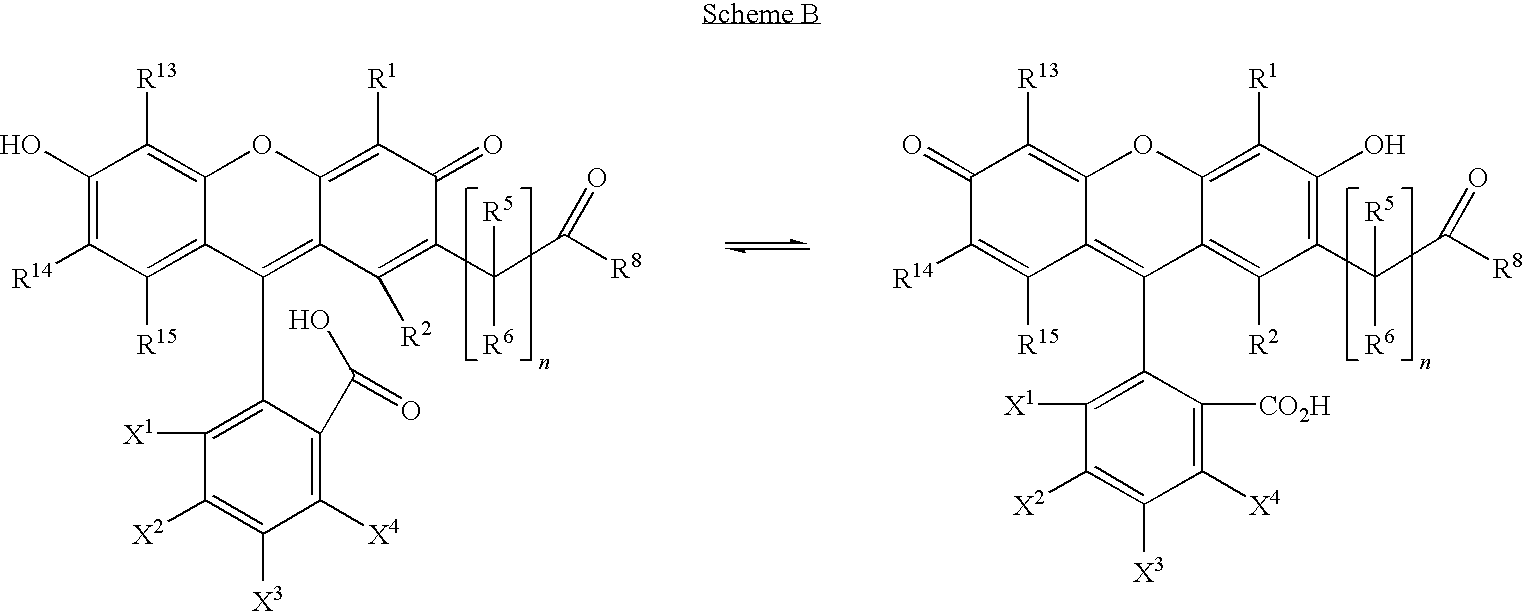

wherein A3 is hydroxyl, protected hydroxyl or N(Z1)(Z2); each Z1 or Z2 is independently H or (C1-C8)alkyl, or is combined with either R13 or R14 and the atoms which attach them to form a 5-membered ring or a 6-membered ring, or is combined with both of R13 and R14 and the atoms which attach them to form two fused 6-membered rings; each R1, R2, R13, R14 and R15 is independently selected from the group consisting of H, halogen, cyano, halo(C1-C8)alkyl, (C1-C8)alkyl, (C1-C8)alkylthio and (C1-C8)alkoxy, or R15 is combined with R14 and the atoms which attach them to form a 5- or 6-membered aromatic ring; each R5 and R6 is independently selected from H, (C1-C8)alkyl, aryl and aryl(C1-C4)alkyl; R7 is H or a hydroxyl protecting group; n is an integer from 4 to about 20; Y4 is C, S, or SO; and each X1, X2, X3 and X4 is a member independently selected from the group consisting of H, halogen, cyano, halo(C1-C8)alkyl, (C1-C8)alkyl, (C1-C8)alkoxy, (C1-C8)alkylthio, (C2-C8)alkenyl, (C2-C8)alkynyl, SO3H and CO2H, or any two adjacent X1, X2, X3, and X4 are combined to form a fused aromatic or heteroaromatic ring that is optionally further substituted with from one to four substituents selected from halogen cyano, carboxy, sulfo, hydroxy, amino, mono(C1-C6)alkylamino, di(C1-C6)alkylamino, (C1-C6)alkyl, (C1-C6)alkylthio and (C1-C6)alkoxy.


wherein A2 is O, NZ1 or N+(Z1)(Z2); each Z1 or Z2 is independently H, (C1-C8)alkyl, or is optionally combined with R13 and the atoms to which to form a 5- or 6-membered ring; each X0 is a member independently selected from the group consisting of H, halogen, cyano, halo(C1-C8)alkyl, (C1-C8)alkyl, (C1-C8)alkoxy, (C1-C8)alkylthio, (C2-C8)alkenyl, (C2-C8)alkynyl, aryl, heteroaryl, SO3H and CO2H; each R1, R2 and R13 is independently selected from the group consisting of H, halogen, cyano, halo(C1-C8)alkyl, (C1-C8)alkyl, (C1-C8)alkylthio, (C1-C8)alkoxy, aryl and heteroaryl; each R5 and R6 is independently selected from H, (C1-C8)alkyl, aryl, heteroaryl, aryl(C1-C4)alkyl and heteroaryl(C1-C4)alkyl; R7 is H or a hydroxylprotecting group; the subscript q is an integer of from 0 to 4; and n is an integer from about 4 to about 20.

wherein A3 is hydroxyl, protected hydroxyl or N(Z1)(Z2); each Z1 or Z2 is independently H or (C1-C8)alkyl, or is combined with either R13 or X0 and the atoms which attach them to form a 5-membered ring or a 6-membered ring, or is combined with both of R13 and X0 and the atoms which attach them to form two fused 6-membered rings; each X0 is a member independently selected from the group consisting of H, halogen, cyano, halo(C1-C8)alkyl, (C1-C8)alkyl, (C1-C8)alkoxy, (C1-C8)alkylthio, (C2-C8)alkenyl, (C2-C8)alkynyl, aryl, heteroaryl, SO3H and CO2H; each R1, R2 and R13 are independently selected from H, halogen, cyano, halo(C1-C8)alkyl, (C1-C8)alkyl, (C1-C8)alkylthio and (C1-C8)alkoxy; each R5 and Rr are each independently selected from H, (C1-C8)alkyl, aryl and aryl(C1-C4)alkyl; R7 is H or a hydroxylprotecting group; n is an integer from about 4 to about 20; and the subscript q is an integer of from 0 to 3. Further preferred are those compounds of formula IIc and IId wherein A3 is hydroxy or a protected hydroxy. Preferred protecting groups are acyl groups derived from (C2-C20)alkanoic acids (e.g., acetyl, propionyl, pivaloyl, isobutyryl, and the like). More preferably, each R1, R2 and R13 are independently selected from the group consisting of H, halogen, CF3 and cyano; and each X0 is H, halogen, CF3 or cyano. In other preferred embodiments, each X1 X2, X3 and X4 is independently selected from H, F or Cl or two of X1 X2, X3 or X4 are combined to form a six-membered aromatic ring. In other particularly preferred embodiments, in the compounds of IIb and IIc, each of R5, R6, R7 is H, and R8 is OH. Most preferred are those embodiments in which A3 is hydroxy or protected hydroxy; each R1, R2, and R13 is independently selected from H, halogen, CN and CF3; each of R5, R6, R7 is H, and R8 is OH; each X0 is H, halogen, CF3 or cyano; and each X1 X2, X3 and X4 is independently selected from H, F or Cl.


wherein A3 is hydroxyl, protected hydroxyl or N(Z1)(Z2); each Z1 or Z2 is independently H or (C1-C8)alkyl, or is combined with X0 and the atoms which attach them to form a 5- or a 6-membered ring; each X0 is a member independently selected from the group consisting of H, halogen, cyano, halo(C1-C8)alkyl, (C1-C8)alkyl, (C1-C8)alkoxy, (C1-C8)alkylthio, (C2-C8)alkenyl, (C2-C8)alkynyl, aryl, heteroaryl, SO3H and CO2H; each R1, R2, R13 and R15 is independently selected from the group consisting of H, halogen, cyano, halo(C1-C8)alkyl, (C1-C8)alkyl, (C1-C8)alkylthio and (C1-C8)alkoxy; each R5 and R6 is independently selected from H, (C1-C8)alkyl, aryl and aryl(C1-C4)alkyl; R7 is H or a hydroxylprotecting group; n is an integer from about 4 to about 20 and the subscript q is an integer of from 0 to 3.

wherein A2 is O, NZ1 or N+(Z1)(Z2); each Z1 or Z2 is independently H, (C1-C8)alkyl, or is optionally combined with an X0 adjacent to A2 and the atoms which attach them to form a 5- or 6-membered ring or is combined with two X0 groups adjacent to A and the atoms which attach them to form two fused 6-membered rings; each X0 is a member independently selected from the group consisting of H, halogen, cyano, (C1-C8)haloalkyl, (C1-C8)alkyl, (C1-C8)alkoxy, (C1-C8)alkylthio, (C2-C8)alkenyl, (C2-C8)alkynyl, aryl, heteroaryl, SO3H and CO2H; each R1, R2, R14 and R15 is independently selected from the group consisting of H, halogen, cyano, halo(C1-C8)alkyl, (C1-C8)alkyl, (C1-C8)alkylthio, (C1-C8)alkoxy, aryl and heteroaryl, or R14 and R5 is combined with the atoms which attach them to form a 5- or 6-membered aromatic ring; each R5 and R6 is independently selected from the group consisting of H, (C1-C8)alkyl, aryl, heteroaryl, aryl(C1-C4)alkyl and heteroaryl(C1-C4)alkyl; R7 is H or a hydroxylprotecting group; the subscript q is an integer of from 0 to 4 and the subscript n is about 4 to about 20. Compounds wherein n is 4, 5, 6, 7, 8, 9, 10, 11, 12, 13, 14, 15, 16, 17, 18, 19 and 20 are equally preferred.

wherein A3 is hydroxyl, protected hydroxyl or N(Z1)(Z2); each Z1 or Z2 is independently H or (C1-C8)alkyl, or is combined with X0 and the atoms which attach them to form a 5- or a 6-membered ring; each X0 is a member independently selected from the group consisting of H, halogen, cyano, halo(C1-C8)alkyl, (C1-C8)alkyl, (C1-C8)alkoxy, (C1-C8)alkylthio, (C2-C8)alkenyl, (C2-C8)alkynyl, aryl, heteroaryl, SO3H and CO2H; each R1, R2, R14 and R15 is independently selected from the group consisting of H, halogen, cyano, CF3, (C1-C8)alkyl, (C1-C8)alkylthio and (C1-C8)alkoxy, or R14 and R15 is combined with the atoms which attach them to form a 5- or 6-membered aromatic ring; each R5 and R6 is independently selected from the group consisting of H, (C1-C8)alkyl, aryl and aryl(C1-C4)alkyl; R7 is H or a hydroxyl protecting group; the subscript n is about 4 to about 20; and the subscript q is an integer of from 0 to 3. Compounds wherein n is 4, 5, 6, 7, 8, 9, 10, 11, 12, 13, 14, 15, 16, 17, 18, 19 and 20 are equally preferred.

wherein A2 is O, NZ1 or N+(Z1)(Z2); each Z1 or Z2 is independently H, (C1-C8)alkyl, or is optionally combined with an R13 or R14 and the atoms which attach them to form a 5- or 6-membered ring or is combined with both R13 or R14 and the atoms which attach them to form two fused 6-membered rings; each R1, R2, R13, R14 and R15 is independently selected from the group consisting of H, halogen, cyano, halo(C1-C8)alkyl, (C1-C8)alkyl, (C1-C8)alkylthio, (C1-C8)alkoxy, aryl and heteroaryl, or R14 and R15 is combined with the atoms which attach them to form a 5- or 6-membered aromatic ring; each R5 and R6 is independently selected from H, (C1-C8)alkyl, aryl, heteroaryl, aryl(C1-C4)alkyl and heteroaryl(C1-C4)alkyl; R7 is H or a hydroxylprotecting group; and the subscript n is 4 to about 20. Compounds wherein n is 4, 5, 6, 7, 8, 9, 10, 11, 12, 13, 14, 15, 16, 17, 18, 19 and 20 are equally preferred.


wherein A2 is O, NZ1 or N+(Z1)(Z2); each Z1 or Z2 is independently H, (C1-C8)alkyl, or is optionally combined with R13 and the atoms which attach them to form a 5- or 6-membered ring; each X0 is independently selected from the group consisting of H, halogen, cyano, halo(C1-C8)alkyl, (C1-C8)alkyl, (C1-C8)alkoxy, (C1-C8)alkylthio, (C2-C8)alkenyl, (C2-C8)alkynyl, aryl, heteroaryl, SO3H and CO2H; each R1, R2 and R13 is independently selected from the group consisting of H, halogen, cyano, halo(C1-C8)alkyl, (C1-C8)alkyl, (C1-C8)alkylthio, (C1-C8)alkoxy, aryl and heteroaryl; each R5 and R6 is independently selected from the group consisting of H, (C1-C8)alkyl, aryl, heteroaryl, aryl(C1-C4)alkyl and heteroaryl(C1-C4)alkyl; R7 is H or a hydroxylprotecting group; the subscript q is an integer of from about 0 to 4 and the subscript n is an integer of from about 4 to about 20. Compounds wherein n is 4, 5, 6, 7, 8, 9, 10, 11, 12, 13, 14, 15, 16, 17, 18, 19 and 20 are equally preferred.

wherein A2 is O, NZ1 or N+(Z1)(Z2); each Z1 or Z2 is independently H, (C1-C8)alkyl, or is optionally combined with an X0 adjacent to A2 and the atoms which attach them to form a 5- or 6-membered ring or is combined with two X0 groups adjacent to A2 and the atoms which attach them to form two fused 6-membered rings; each X0 is independently selected from the group consisting of H, halogen, cyano, halo(C1-C8)alkyl, (C1-C8)alkyl, (C1-C8)alkoxy, (C1-C8)alkylthio, (C2-C8)alkenyl, (C2-C8)alkynyl, aryl, heteroaryl, SO3H and CO2H, or optionally, any two adjacent X0 groups can be taken together with the atoms which attach them to form a fused aromatic or heteroaromatic ring; each R1, R2, R13 and R15 is independently selected from H, halogen, cyano, halo(C1-C8)alkyl, (C1-C8)alkyl, (C1-C8)alkylthio, (C1-C8)alkoxy, aryl and heteroaryl; each R5 and R6 is independently selected from the group consisting of H, (C1-C8)alkyl, aryl, heteroaryl, aryl(C1-C4)alkyl and heteroaryl(C1-C4)alkyl; R7 is H or a hydroxyl protecting group; the subscript q is an integer of from 0 to 4 and the subscript n is about 4 to about 20. Compounds wherein n is 4, 5, 6, 7, 8, 9, 10, 11, 12, 13, 14, 15, 16, 17, 18, 19 and 20 are equally preferred.

wherein A2 is O, NZ1 or N+(Z1)(Z2); each Z1 or Z2 is independently H, (C1-C8)alkyl, or is optionally combined with an X0 adjacent to A2 and the atoms which attach them to form a 5- or 6-membered ring or is combined with two X0 groups adjacent to A2 and the atoms which attach them to form two fused 6-membered rings; each X0 is independently selected from the group consisting of H, halogen, cyano, halo(C1-C8)alkyl, (C1-C8)alkyl, (C1-C8)alkoxy, (C1-C8)alkylthio, (C2-C8)alkenyl, (C2-C8)alkynyl, aryl, heteroaryl, SO3H and CO2H; each R1, R2, R14 and R15 is independently selected from H, halogen, cyano, halo(C1-C8)alkyl, (C1-C8)alkyl, (C1-C8)alkylthio, (C1-C8)alkoxy, aryl and heteroaryl, or R14 and R15 is combined with the atoms which attach them to form a 5- or 6-membered aromatic ring; each R5 and R6 is independently selected from the group consisting of H, (C1-C8)alkyl, aryl, heteroaryl, aryl(C1-C4)alkyl and heteroaryl(C1-C4)alkyl; R7 is H or a hydroxylprotecting group; the subscript q is an integer of from 0 to 3 and the subscript n is about 4 to about 20. Compounds wherein n is 4, 5, 6, 7, 8, 9, 10, 11, 12, 13, 14, 15, 16, 17, 18, 19 and 20 are equally preferred.

wherein A2 is O, NZ1 or N+(Z1)(Z2); each Z1 or Z2 is independently H, (C1-C8)alkyl; each R1, R2, R12 and R14 is independently selected from the group consisting of H, halogen, cyano, halo(C1-C8)alkyl, (C1-C8)alkyl, (C1-C8)alkylthio, (C1-C8)alkoxy, aryl and heteroaryl, or R12 and R14 are taken together with the atoms which attach them to form a fused aromatic ring; each R5 and R6 is independently selected from the group consisting of H, (C1-C8)alkyl, aryl, heteroaryl, aryl(C1-C4)alkyl and heteroaryl(C1-C4)alkyl; R7 is H or a hydroxy protecting group; and the subscript n is about 4 to about 20. Compounds wherein n is 4, 5, 6, 7, 8, 9, 10, 11, 12, 13, 14, 15, 16, 17, 18, 19 and 20 are equally preferred.

wherein each X1, X2, X3, X4 and X5 is independently selected from the group consisting of H, halogen, cyano, halo(C1-C8)alkyl, (C1-C8)alkyl, (C1-C8)alkoxy, (C1-C8)alkylthio, (C2-C8)alkenyl, (C2-C8)alkynyl, SO3H and CO2H, and optionally, any two adjacent substituents X1, X2, X3, X4 and X5 can be taken together with the ring to which each is attached to form a fused aromatic or heteroaromatic ring that is optionally further substituted with from one to four substituents selected from halogen cyano, carboxy, sulfo, hydroxy, amino, mono(C1-C6)alkylamino, di(C1-C6)alkylamino, (C1-C6)alkyl, (C1-C6)alkylthio and (C1-C6)alkoxy.

Synthesis of Compounds


Phenoxazine (Resorufin)-Based Dye Synthesis


Benzo[a]- and benzo[c]xanthene-Containing Dye Synthesis


Other Reagents

wherein dashed line indicates the point of attachment to L and the wavy line indicates the point of attachment to the rest of the molecule; each R10 is independently (C1-C8)alkyl or (C1-C8)alkoxy. The subscript p may be an integer of from 0 to 1, each being equally preferred. L is solid support when p is 1 and L is a member selected from the group consisting of an O-phosphoramidite or a reactive functional group when p is 0; the subscript m is an integer of from about 0 to about 2; the subscript n is an integer of from about 3 to about 19. Compounds wherein n is 3, 4, 5, 6, 7, 8, 9, 10, 11, 12, 13, 14, 15, 16, 17, 18 and 19 are equally preferred. Preferably R9 and W are combined together to form a linking group which comprises a prolinol component.


wherein dashed line indicates the point of attachment to L and the wavy line indicates the point of attachment to the rest of the molecule; and each R10 is independently (C1-C8)alkyl or (C1-C8)alkoxy.

A3 is a protected hydroxyl group; R12 taken together with R13 form a fused aromatic or heteroaromatic ring that is optionally substituted with from one to four substituents selected from halogen cyano, carboxy, sulfo, hydroxy, amino, mono(C1-C6)alkylamino, di(C1-C6)alkylamino, (C1-C6)alkyl, (C1-C6)alkylthio and (C1-C6)alkoxy; and tautomeric forms thereof; each R1, R2, R13, R14 and R15 is independently selected from the group consisting of H, halogen, cyano, halo(C1-C8)alkyl, (C1-C8)alkyl, (C1-C8)alkylthio, (C1-C8)alkoxy, aryl and heteroaryl, or R14 and R15 is combined with the atoms which attach them to form a 5- or 6-membered aromatic ring; each R5 and R6 is independently selected from the group consisting of H, (C1-C8)alkyl, aryl, heteroaryl, aryl(C1-C4)alkyl and heteroaryl(C1-C4)alkyl; and optionally, each R7 is H or a hydroxylprotecting group; and n is an integer from 4 to about 20.

wherein R4, R3, R2, R1 and R7 have the meanings provided above and W is a (C2-C12)alkylene or (C5-C12)heteroalkylene or (C8-C25) heteroalkylenearyl linking group.


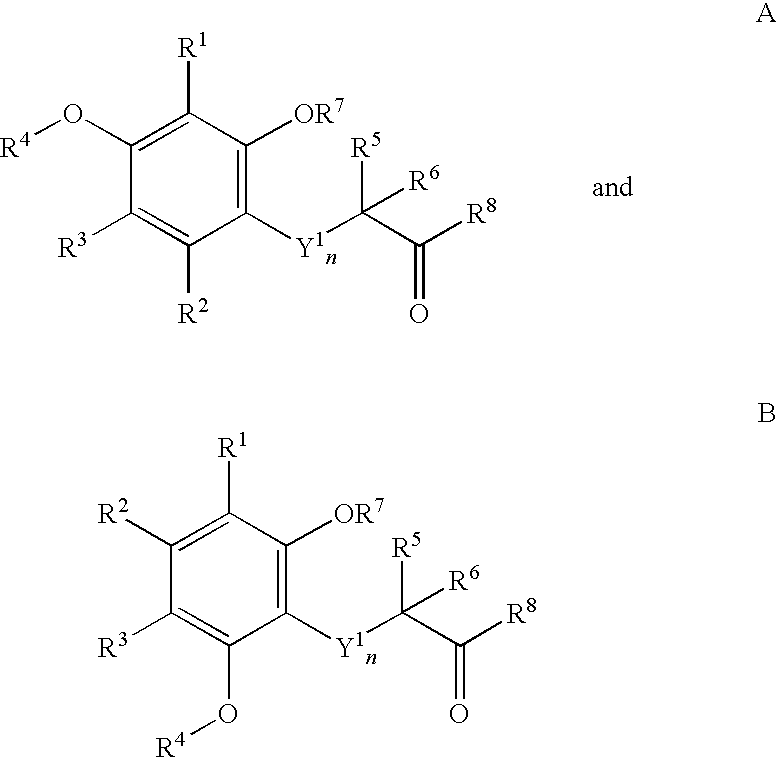
wherein Y1 is selected from the group consisting of CR5R6, NR5, O, P(O)m and S(O)m, wherein at least one CR5R6 is between each member selected from the group consisting of NR5, O, P(O)m and S(O)m; each R1 or R2 is a member independently selected from the group consisting of H, halogen, cyano, halo(C1-C8)alkyl, (C1-C8)alkyl, (C1-C8)alkylthio, (C1-C8)alkoxy, aryl and heteroaryl; R3 and R4 are combined with the phenoxy moiety to which they are attached to form a ring system comprising from 2 to 5 rings, individually selected from the group consisting of five-membered rings, six-membered rings, and combinations thereof, wherein the rings are fused or spiro; optionally substituted with halogen, cyano, halo(C1-C8)alkyl, (C1-C8)alkyl, (C1-C8)alkylthio, (C1-C8)alkoxy, aryl and heteroaryl, aryl(C1-C4)alkyl and heteroaryl(C1-C4)alkyl; wherein the alkyl portions of any of these substitutents are optionally substituted with halogen, carboxy, sulfo, amino, mono(C1-C6)alkylamino, di(C1-C6)alkylamino, (C1-C6)alkoxy, cyano, haloacetyl or hydroxy; and the aryl portions of any of these substitutents are optionally substituted with from one to four substituents selected from the group consisting of halogen, cyano, carboxy, sulfo, hydroxy, amino, mono(C1-C6)alkylamino, di(C1-C6)alkylamino, (C1-C6)alkyl, (C1-C6)alkylthio and (C1-C6)alkoxy; each R5 or R6 is a member independently selected from the group consisting of H, (C1-C8)alkyl, aryl, heteroaryl, aryl(C1-C4)alkyl and heteroaryl(C1-C4)alkyl; R7 is H or a hydroxylprotecting group; R8 is NR9W(Y2 pL); R9 is H, alkyl or combined with W to form a heterocycloalkylene, heterocycloalkylenearylene, or heterocycloalkyleneheteroarylene linking group; W is a linking group selected from the group consisting of a (C2-C50)alkylene, heteroalkylene, (C2-C50)cycloalkylene, heterocycloalkylene, (C6-C50)arylene group, a heteroarylene group, (C2-C50)alkylenearylene group, a heteroalkylenearylene group, optionally substituted with substituents independently selected from the group consisting of (C1-C8)alkyl, hydroxy, protected hydroxyl, alkoxy, amino, protected amino, hydrazino, thio, protected thio and aryl; Y2 is a cleavable linking group selected from the group consisting of:

wherein dashed line indicates the point of attachment to L and the wavy line indicates the point of attachment to the rest of the molecule; each R10 is independently (C1-C8)alkyl or (C1-C8)alkoxy; the subscript p is 0, L is solid support when p is 1 and L is a member selected from the group consisting of an O-phosphoramidite or a reactive functional group when p is 0; the subscript m is an integer of from about 0 to about 2; the subscript n is an integer of from about 3 to about 19; said method comprising contacting a compound of formula A or B wherein R8 is a leaving group with a nucleophilic linking group component HNR9W(Y2 pL). Compounds wherein n is 3, 4, 5, 6, 7, 8, 9, 10, 11, 12, 13, 14, 15, 16, 17, 18 and 19 are equally preferred.

wherein Y1 is selected from the group consisting of CR5R6, NR5, O, P(O)m and S(O)m, wherein at least one CR5R6 is between each member selected from the group consisting of NR5, O, P(O)m and S(O)m; each R1 or R2 is a member independently selected from the group consisting of H, halogen, cyano, halo(C1-C8)alkyl, (C1-C8)alkyl, (C1-C8)alkylthio, (C1-C8)alkoxy, aryl and heteroaryl; R3 and R4 are combined with the phenoxy moiety to which they are attached to form a ring system comprising from 2 to 5 rings, individually selected from the group consisting of five-membered rings, six-membered rings, and combinations thereof, wherein the rings are fused or spiro; optionally substituted with halogen, cyano, halo(C1-C8)alkyl, (C1-C8)alkyl, (C1-C8)alkylthio, (C1-C8)alkoxy, aryl and heteroaryl, aryl(C1-C4)alkyl and heteroaryl(C1-C4)alkyl; wherein the alkyl portions of any of these substitutents are optionally substituted with halogen, carboxy, sulfo, amino, mono(C1-C6)alkylamino, di(C1-C6)alkylamino, (C1-C6)alkoxy, cyano, haloacetyl or hydroxy; and the aryl portions of any of these substitutents are optionally substituted with from one to four substituents selected from the group consisting of halogen, cyano, carboxy, sulfo, hydroxy, amino, mono(C1-C6)alkylamino, di(C1-C6)alkylamino, (C1-C6)alkyl, (C1-C6)alkylthio and (C1-C6)alkoxy; each R5 or R6 is a member independently selected from the group consisting of H, (C1-C8)alkyl, aryl, heteroaryl, aryl(C1-C4)alkyl and heteroaryl(C1-C4)alkyl; R7 is H or a hydroxylprotecting group; R8 is NR9W(Y2 pL); R9 is H, alkyl or combined with W to form a heterocycloalkylene, heterocycloalkylenearylene, or heterocycloalkyleneheteroarylene linking group; W is a linking group selected from the group consisting of a (C2-C50)alkylene, heteroalkylene, (C2-C50)cycloalkylene, heterocycloalkylene, (C6-C50)arylene group, a heteroarylene group, (C2-C50)alkylenearylene group, a heteroalkylenearylene group, optionally substituted with substituents independently selected from the group consisting of (C1-C8)alkyl, hydroxy, protected hydroxyl, alkoxy, amino, protected amino, hydrazino, thio, protected thio and aryl; the subscript p is 0; L is an O-phosphoramidite; the subscript m is an integer of from about 0 to about 2; the subscript n is an integer of from about 3 to about 19; said method comprising contacting a compound of formula A or B wherein R8 is NR9W(Y2 pL), and L is a reactive functional group; with a phosphoramidite reagent under conditions sufficient to covalently attach a phosphoramidite moiety. Compounds wherein n is 3, 4, 5, 6, 7, 8, 9, 10, 11, 12, 13, 14, 15, 16, 17, 18 and 19 are equally preferred.
Synthetic Intermediates


wherein the subscript n is an integer of from 4 to about 20. Compounds wherein n is 4, 5, 6, 7, 8, 9, 10,11,12,13, 14, 15, 16, 17, 18, 19 and 20 are equally preferred.
Methods for Labeling Biological Agents


wherein Y1 is selected from the group consisting of CR5R6, NR5, O, P(O)m and S(O)m, wherein at least one CR5R6 is between each member selected from the group consisting of NR5, O, P(O)m and S(O)m; each R1 or R2 is a member independently selected from the group consisting of H, halogen, cyano, halo(C1-C8)alkyl, (C1-C8)alkyl, (C1-C8)alkylthio, (C1-C8)alkoxy, aryl and heteroaryl; R3 and R4 are combined with the phenoxy moiety to which they are attached to form a ring system comprising from 2 to 5 rings, individually selected from the group consisting of five-membered rings, six-membered rings, and combinations thereof, wherein the rings are fused or spiro; optionally substituted with halogen, cyano, halo(C1-C8)alkyl, (C1-C8)alkyl, (C1-C8)alkylthio, (C1-C8)alkoxy, aryl and heteroaryl, aryl(C1-C4)alkyl and heteroaryl(C1-C4)alkyl; each R5 or R6 is a member independently selected from the group consisting of H, (C1-C8)alkyl, aryl, heteroaryl, aryl(C1-C4)alkyl and heteroaryl(C1-C4)alkyl; R7 is H or a hydroxylprotecting group; the subscript m is an integer of from about 0 to about 2; the subscript n is an integer of from about 4 to about 20; and the dashed line indicates the point of attachment to said biological agent or said linking group joining said biological agent to said substituent. Compounds wherein n is 4, 5, 6, 7, 8, 9, 10, 11, 12, 13, 14, 15, 16, 17, 18, 19 and 20 are equally preferred.

wherein, A3 is OH; R7 is H or a hydroxylprotecting group; each R1, R2, R13, R14 and R15 is a member independently selected from the group consisting of H, halogen, cyano, halo(C1-C8)alkyl, (C1-C8)alkyl, (C1-C8)alkylthio, (C1-C8)alkoxy, aryl and heteroaryl; or R14 and R15 is combined with the atoms which attach them to form a 5- or 6-membered aromatic ring; and the wavy line indicates the point of attachment to said nucleic acid or said linking group joining said nucleic acid to said substituent. In another preferred embodiment, the nucleic acid comprises an attached quencher, an attached minor groove binder, or a combination thereof. In one embodiment the substituent is preferably attached at the 3′-end of said nucleic acid and said quencher and said minor groove binder are attached at the 5′-end of said nucleic acid. In another embodiment the substituent is preferably attached at the 5′-end of said nucleic acid and said quencher and said minor groove binder are attached at the 3′-end of said nucleic acid.


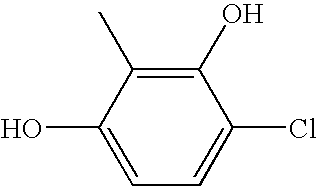


Claims (20)


Priority Applications (1)
| Application Number | Priority Date | Filing Date | Title |
|---|---|---|---|
| US10/975,042 US7541454B2 (en) | 2003-10-24 | 2004-10-25 | Compounds and methods for fluorescent labeling |
Applications Claiming Priority (2)
| Application Number | Priority Date | Filing Date | Title |
|---|---|---|---|
| US51442503P | 2003-10-24 | 2003-10-24 | |
| US10/975,042 US7541454B2 (en) | 2003-10-24 | 2004-10-25 | Compounds and methods for fluorescent labeling |
Publications (2)
| Publication Number | Publication Date |
|---|---|
| US20050159606A1 US20050159606A1 (en) | 2005-07-21 |
| US7541454B2 true US7541454B2 (en) | 2009-06-02 |
Family
ID=34520206
Family Applications (1)
| Application Number | Title | Priority Date | Filing Date |
|---|---|---|---|
| US10/975,042 Expired - Lifetime US7541454B2 (en) | 2003-10-24 | 2004-10-25 | Compounds and methods for fluorescent labeling |
Country Status (2)
| Country | Link |
|---|---|
| US (1) | US7541454B2 (en) |
| WO (1) | WO2005040357A2 (en) |
Families Citing this family (3)
| Publication number | Priority date | Publication date | Assignee | Title |
|---|---|---|---|---|
| US6972339B2 (en) | 2001-09-07 | 2005-12-06 | Epoch Biosciences, Inc. | Compounds and methods for fluorescent labeling |
| US8569516B2 (en) * | 2001-09-07 | 2013-10-29 | Elitech Holding B.V. | Compounds and methods for fluorescent labeling |
| US8435800B2 (en) * | 2004-11-22 | 2013-05-07 | Biosight Ltd. | Activated labeling reagents and methods for preparing and using the same |
Citations (29)
| Publication number | Priority date | Publication date | Assignee | Title |
|---|---|---|---|---|
| US4774191A (en) * | 1979-09-07 | 1988-09-27 | Syntex (U.S.A.) Inc. | Fluorescent conjugates bound to a support |
| US5162571A (en) | 1987-06-09 | 1992-11-10 | Takeda Chemical Industries, Ltd. | Phenol derivatives, their production and use |
| US5187288A (en) | 1991-05-22 | 1993-02-16 | Molecular Probes, Inc. | Ethenyl-substituted dipyrrometheneboron difluoride dyes and their synthesis |
| US5188934A (en) | 1989-11-14 | 1993-02-23 | Applied Biosystems, Inc. | 4,7-dichlorofluorescein dyes as molecular probes |
| US5221611A (en) | 1991-06-19 | 1993-06-22 | Sigma Chemical Company | Ddi immunoassays, derivatives, conjugates and antibodies |
| US5227487A (en) | 1990-04-16 | 1993-07-13 | Molecular Probes, Inc. | Certain tricyclic and pentacyclic-hetero nitrogen rhodol dyes |
| US5248782A (en) | 1990-12-18 | 1993-09-28 | Molecular Probes, Inc. | Long wavelength heteroaryl-substituted dipyrrometheneboron difluoride dyes |
| US5262530A (en) | 1988-12-21 | 1993-11-16 | Applied Biosystems, Inc. | Automated system for polynucleotide synthesis and purification |
| US5304645A (en) | 1985-07-25 | 1994-04-19 | Boehringer Mannheim Gmbh | Resorufin derivatives |
| US5419966A (en) | 1991-06-10 | 1995-05-30 | Microprobe Corporation | Solid support for synthesis of 3'-tailed oligonucleotides |
| US5433896A (en) | 1994-05-20 | 1995-07-18 | Molecular Probes, Inc. | Dibenzopyrrometheneboron difluoride dyes |
| US5451463A (en) | 1989-08-28 | 1995-09-19 | Clontech Laboratories, Inc. | Non-nucleoside 1,3-diol reagents for labeling synthetic oligonucleotides |
| US5451343A (en) * | 1991-05-20 | 1995-09-19 | Spectra Group Limited, Inc. | Fluorone and pyronin y derivatives |
| US5512667A (en) | 1990-08-28 | 1996-04-30 | Reed; Michael W. | Trifunctional intermediates for preparing 3'-tailed oligonucleotides |
| US5556959A (en) | 1993-01-22 | 1996-09-17 | Pharmacia P-L Biochemicals Inc. | Indocarbocyanine-linked phosphoramidites |
| US5583236A (en) | 1991-07-19 | 1996-12-10 | Pharmacia Biotech Inc. | Fluorescein labelled phosphoramidites |
| US5589586A (en) | 1990-11-26 | 1996-12-31 | Pharmacia Lkb Biotechnology Ab | Nucleosides attached to a solid support through a 3'-silyl linkage and their use in oligonucleotide synthesis |
| US5696251A (en) | 1987-09-21 | 1997-12-09 | Gen-Probe Incorporated | Non-nucleotide linking reagents for nucleotide probes |
| US5739386A (en) | 1994-06-23 | 1998-04-14 | Affymax Technologies N.V. | Photolabile compounds and methods for their use |
| US5808044A (en) | 1993-01-22 | 1998-09-15 | Pharmacia Biotech Inc. | Indocarbocyanine and benzindocarbocyanine phosphoramidites |
| US5986086A (en) | 1997-06-20 | 1999-11-16 | Amersham Pharmacia Biotech Inc. | Non-sulfonated cyanine dyes for labeling nucleosides and nucleotides |
| US6020481A (en) | 1996-04-01 | 2000-02-01 | The Perkin-Elmer Corporation | Asymmetric benzoxanthene dyes |
| US6162931A (en) | 1996-04-12 | 2000-12-19 | Molecular Probes, Inc. | Fluorinated xanthene derivatives |
| US6221604B1 (en) | 2000-02-07 | 2001-04-24 | Pe Corporation | Electron-deficient nitrogen heterocycle-substituted fluorescein dyes |
| WO2001064958A2 (en) | 2000-03-01 | 2001-09-07 | Epoch Bioscienecs, Inc. | Modified oligonucleotides for mismatch discrimination |
| WO2003023357A2 (en) | 2001-09-07 | 2003-03-20 | Epoch Biosciences, Inc. | Compounds and methods for fluorescent labeling |
| US6660845B1 (en) | 1999-11-23 | 2003-12-09 | Epoch Biosciences, Inc. | Non-aggregating, non-quenching oligomers comprising nucleotide analogues; methods of synthesis and use thereof |
| WO2003107144A2 (en) | 2002-06-18 | 2003-12-24 | Epoch Biosciences, Inc. | Systems and methods for predicting oligonucleotide melting temperatures (tms) |
| US6683173B2 (en) | 1998-04-03 | 2004-01-27 | Epoch Biosciences, Inc. | Tm leveling methods |
-
2004
- 2004-10-25 US US10/975,042 patent/US7541454B2/en not_active Expired - Lifetime
- 2004-10-25 WO PCT/US2004/035843 patent/WO2005040357A2/en not_active Ceased
Patent Citations (31)
| Publication number | Priority date | Publication date | Assignee | Title |
|---|---|---|---|---|
| US4774191A (en) * | 1979-09-07 | 1988-09-27 | Syntex (U.S.A.) Inc. | Fluorescent conjugates bound to a support |
| US5304645A (en) | 1985-07-25 | 1994-04-19 | Boehringer Mannheim Gmbh | Resorufin derivatives |
| US5162571A (en) | 1987-06-09 | 1992-11-10 | Takeda Chemical Industries, Ltd. | Phenol derivatives, their production and use |
| US5696251A (en) | 1987-09-21 | 1997-12-09 | Gen-Probe Incorporated | Non-nucleotide linking reagents for nucleotide probes |
| US5262530A (en) | 1988-12-21 | 1993-11-16 | Applied Biosystems, Inc. | Automated system for polynucleotide synthesis and purification |
| US5942610A (en) | 1989-08-28 | 1999-08-24 | Clontech Laboratories, Inc. | Non-nucleoside 1,3-diol reagents and their use to label or modify synthetic oligonucleotides |
| US5451463A (en) | 1989-08-28 | 1995-09-19 | Clontech Laboratories, Inc. | Non-nucleoside 1,3-diol reagents for labeling synthetic oligonucleotides |
| US5188934A (en) | 1989-11-14 | 1993-02-23 | Applied Biosystems, Inc. | 4,7-dichlorofluorescein dyes as molecular probes |
| US5442045A (en) | 1990-04-16 | 1995-08-15 | Molecular Probes, Inc. | Biological conjugates of fluorescent rhodol dyes |
| US5227487A (en) | 1990-04-16 | 1993-07-13 | Molecular Probes, Inc. | Certain tricyclic and pentacyclic-hetero nitrogen rhodol dyes |
| US5512667A (en) | 1990-08-28 | 1996-04-30 | Reed; Michael W. | Trifunctional intermediates for preparing 3'-tailed oligonucleotides |
| US5589586A (en) | 1990-11-26 | 1996-12-31 | Pharmacia Lkb Biotechnology Ab | Nucleosides attached to a solid support through a 3'-silyl linkage and their use in oligonucleotide synthesis |
| US5248782A (en) | 1990-12-18 | 1993-09-28 | Molecular Probes, Inc. | Long wavelength heteroaryl-substituted dipyrrometheneboron difluoride dyes |
| US5451343A (en) * | 1991-05-20 | 1995-09-19 | Spectra Group Limited, Inc. | Fluorone and pyronin y derivatives |
| US5187288A (en) | 1991-05-22 | 1993-02-16 | Molecular Probes, Inc. | Ethenyl-substituted dipyrrometheneboron difluoride dyes and their synthesis |
| US5419966A (en) | 1991-06-10 | 1995-05-30 | Microprobe Corporation | Solid support for synthesis of 3'-tailed oligonucleotides |
| US5221611A (en) | 1991-06-19 | 1993-06-22 | Sigma Chemical Company | Ddi immunoassays, derivatives, conjugates and antibodies |
| US5583236A (en) | 1991-07-19 | 1996-12-10 | Pharmacia Biotech Inc. | Fluorescein labelled phosphoramidites |
| US5556959A (en) | 1993-01-22 | 1996-09-17 | Pharmacia P-L Biochemicals Inc. | Indocarbocyanine-linked phosphoramidites |
| US5808044A (en) | 1993-01-22 | 1998-09-15 | Pharmacia Biotech Inc. | Indocarbocyanine and benzindocarbocyanine phosphoramidites |
| US5433896A (en) | 1994-05-20 | 1995-07-18 | Molecular Probes, Inc. | Dibenzopyrrometheneboron difluoride dyes |
| US5739386A (en) | 1994-06-23 | 1998-04-14 | Affymax Technologies N.V. | Photolabile compounds and methods for their use |
| US6020481A (en) | 1996-04-01 | 2000-02-01 | The Perkin-Elmer Corporation | Asymmetric benzoxanthene dyes |
| US6162931A (en) | 1996-04-12 | 2000-12-19 | Molecular Probes, Inc. | Fluorinated xanthene derivatives |
| US5986086A (en) | 1997-06-20 | 1999-11-16 | Amersham Pharmacia Biotech Inc. | Non-sulfonated cyanine dyes for labeling nucleosides and nucleotides |
| US6683173B2 (en) | 1998-04-03 | 2004-01-27 | Epoch Biosciences, Inc. | Tm leveling methods |
| US6660845B1 (en) | 1999-11-23 | 2003-12-09 | Epoch Biosciences, Inc. | Non-aggregating, non-quenching oligomers comprising nucleotide analogues; methods of synthesis and use thereof |
| US6221604B1 (en) | 2000-02-07 | 2001-04-24 | Pe Corporation | Electron-deficient nitrogen heterocycle-substituted fluorescein dyes |
| WO2001064958A2 (en) | 2000-03-01 | 2001-09-07 | Epoch Bioscienecs, Inc. | Modified oligonucleotides for mismatch discrimination |
| WO2003023357A2 (en) | 2001-09-07 | 2003-03-20 | Epoch Biosciences, Inc. | Compounds and methods for fluorescent labeling |
| WO2003107144A2 (en) | 2002-06-18 | 2003-12-24 | Epoch Biosciences, Inc. | Systems and methods for predicting oligonucleotide melting temperatures (tms) |
Non-Patent Citations (20)
| Title |
|---|
| Berge, S.M. et al.: "Pharmaceutical Salts;" J. Pharm. Sci.; vol. 66, pp. 1-19 (1977). |
| Blickenstaff, R.T. et al., "The synthesis and lithium ammonia reduction of 7-methoxychroman." Tetrahedron, vol. 24, pp. 2495-2498 (1968). |
| Boyle, A.L. (ed.): Current Protocols in Nucleic Acid Chemistry, John Wiley and Sons, New York, vol. 1 (2000). |
| Eckstein (ed.) Oligonucleotide Synthesis: A Practical Approach, IRL Press (1991). |
| Gait (ed.) Oligonucleotide Synthesis: A Practical Approach, IRL Press (1984). |
| Greene, T.W. and P.G. Wuts (eds.): Protective Groups in Organic Chemistry, Wiley, 2nd. Ed. (1991). |
| Harrison, et al. (eds.): Compendium of Synthetic Organic Methods, vols. 1-8, John Wiley and Sons (1971-1996). |
| Haugland et al.: Handbook of Fluorescent Probes and Research Chemicals, 6th Ed., Molecular Probes, Eugene, Ore. (1996). |
| Hirshberg, M. et al. "Crystal structure of phosphate binding protein labeled with a coumarin fluorophore, a probe for inorganic phosphate." Biochemistry, vol. 37, No. 29; pp. 10381-10385. (1998). |
| Kendall, et al., "A kinetic study of the hydrolysis of some substituted p-nitroso-dialkylanilines." J. Am. Chem. Soc., vol. 82, pp. 1853-1854 (1960). |
| Kovacic, P. and M.E. Kurz, "Reactions of t-butylperoxy isopropyl carbonate with aromatic compounds under Friedel-Crafts conditions." J. Org. Chem, vol. 31, pp. 2459-2467 (1966). |
| Maniatis et al., Molecular Cloning: A Laboratory Manual (1982). |
| Maniatis et.al., Molecular Cloning: A Laboratory Manual, 2nd Ed., (1989). |
| March, J. (ed.): Advanced Organic Chemistry, Chapter 4, 4th Ed., John Wiley and Sons, New York (1992). |
| McGall, G.H. and J.A. Fidanza: "Photolithographic synthesis of high density oligonucleotide arrays;" Methods Mol. Biol., vol. 170, pp. 71-101 (2001). |
| Plattner, J.J. et al., "Substituted 5,6-dihydrofuro[3,2-f]-1,2-benzisoxazole-6-carboxylic acids: high-ceiling diuretics with uricosuric activity." J. Med. Chem., vol. 27, No. 8; pp. 1016-1026 (1984). |
| Smith, et al., "The design and properties of a series of calcium indicators which shift from rhodamine-like to fluorescin-like fluorescence on binding calcium." J. Chem. Soc. Perkin Trans., vol. 2, pp. 1195-1204 (1993). |
| Sun, P. et al., "Tert-butylsulfonyl (Bus), a new protecting group for amines." J. Org. Chem.; vol. 62, No. 24; pp. 6469-6475 (1997). |
| Wada, M. et al., Bull. Chem. Soc. Jpn.; vol. 65, No. 5; pp. 1389-1391 (1992). |
| Whitaker, et al., "Fluorescent rhodol derivatives: versatile, photostable labels and tracers." Anal. Biochem., vol. 207, No. 2., pp. 267-279 (1992). |
Also Published As
| Publication number | Publication date |
|---|---|
| US20050159606A1 (en) | 2005-07-21 |
| WO2005040357A2 (en) | 2005-05-06 |
| WO2005040357A3 (en) | 2005-06-30 |
Similar Documents
| Publication | Publication Date | Title |
|---|---|---|
| US6972339B2 (en) | Compounds and methods for fluorescent labeling | |
| US9714260B2 (en) | Asymmetrical Si rhodamine and rhodol synthesis | |
| US11434377B2 (en) | Ultra bright dimeric or polymeric dyes with rigid spacing groups | |
| AU717569B2 (en) | Fluorinated xanthene derivatives | |
| US8389745B2 (en) | Phosphonate fluorescent dyes and conjugates | |
| US11365203B2 (en) | Fluorescent dye and preparation method and use thereof | |
| US9745336B2 (en) | Fluorescent dye compounds, conjugates and uses thereof | |
| CA2218641C (en) | Diaminofluorescein derivative | |
| WO2004003510A2 (en) | Fluorescent dyes, energy transfer couples and methods | |
| JP2002519404A (en) | New fluorescent lanthanide chelate | |
| JP2009527591A (en) | Compounds and methods for fluorescent labeling | |
| US20050159606A1 (en) | Compounds and methods for fluorescent labeling | |
| US9062205B2 (en) | Alkyl amine compounds for fluorescent labeling | |
| EP1163372A1 (en) | Chemically reactive plane-rigidized cyanine dyes and their derivatives | |
| US20250129076A1 (en) | Fused tetracyclic compounds, compositions and diagnostic applications thereof | |
| JPH08198873A (en) | Compound-selective fluorescent labeling reagent with sulfhydryl group |
Legal Events
| Date | Code | Title | Description |
|---|---|---|---|
| AS | Assignment |
Owner name: EPOCH BIOSCIENCES, INC., WASHINGTON Free format text: ASSIGNMENT OF ASSIGNORS INTEREST;ASSIGNOR:LUKHTANOV, EUGENY A.;REEL/FRAME:015820/0014 Effective date: 20050311 |
|
| STCF | Information on status: patent grant |
Free format text: PATENTED CASE |
|
| AS | Assignment |
Owner name: ELITECH HOLDING B.V.,NETHERLANDS Free format text: ASSIGNMENT OF ASSIGNORS INTEREST;ASSIGNORS:EPOCH BIOSCIENCES, INC.;NANOGEN, INC.;NANOTRONICS, INC.;REEL/FRAME:024312/0554 Effective date: 20090702 |
|
| FPAY | Fee payment |
Year of fee payment: 4 |
|
| FPAY | Fee payment |
Year of fee payment: 8 |
|
| AS | Assignment |
Owner name: ELITECHGROUP B.V., NETHERLANDS Free format text: CHANGE OF NAME;ASSIGNOR:ELITECH HOLDING BV;REEL/FRAME:041974/0867 Effective date: 20130704 |
|
| AS | Assignment |
Owner name: ELITECHGROUP, INC., UTAH Free format text: ASSIGNMENT OF ASSIGNORS INTEREST;ASSIGNOR:ELITECHGROUP B.V.;REEL/FRAME:048078/0553 Effective date: 20181221 |
|
| MAFP | Maintenance fee payment |
Free format text: PAYMENT OF MAINTENANCE FEE, 12TH YR, SMALL ENTITY (ORIGINAL EVENT CODE: M2553); ENTITY STATUS OF PATENT OWNER: SMALL ENTITY Year of fee payment: 12 |
|
| AS | Assignment |
Owner name: ELITECHGROUP MDX LLC, WASHINGTON Free format text: NUNC PRO TUNC ASSIGNMENT;ASSIGNOR:ELITECHGROUP, INC.;REEL/FRAME:058615/0341 Effective date: 20211220 |