US7538212B2 - Intermediate for carbapenem compound for oral administration and process for producing the same - Google Patents
Intermediate for carbapenem compound for oral administration and process for producing the same Download PDFInfo
- Publication number
- US7538212B2 US7538212B2 US10/533,868 US53386803A US7538212B2 US 7538212 B2 US7538212 B2 US 7538212B2 US 53386803 A US53386803 A US 53386803A US 7538212 B2 US7538212 B2 US 7538212B2
- Authority
- US
- United States
- Prior art keywords
- group
- compound
- compound represented
- formula
- carbon atoms
- Prior art date
- Legal status (The legal status is an assumption and is not a legal conclusion. Google has not performed a legal analysis and makes no representation as to the accuracy of the status listed.)
- Expired - Fee Related, expires
Links
- 0 [2*]SC(=O)[C@H](C)[C@@]1([H])N(CC(=O)O)C(=O)[C@]1([H])[C@@H](C)O.[2*]SC(=O)[C@H](C)[C@@]1([H])N(CC(=O)OCOC([3*])=O)C(=O)[C@]1([H])[C@@H](C)O.[3*]C(=O)OCC.[3*]C(=O)OCOC(=O)C1=C(OP(=O)(OC2=CC=CC=C2)OC2=CC=CC=C2)[C@H](C)[C@@]2([H])N1C(=O)[C@]2([H])C(C)C.[3*]C(=O)OCOC(=O)C1=C(OP(=O)(OC2=CC=CC=C2)OC2=CC=CC=C2)[C@H](C)[C@@]2([H])N1C(=O)[C@]2([H])[C@@H](C)O Chemical compound [2*]SC(=O)[C@H](C)[C@@]1([H])N(CC(=O)O)C(=O)[C@]1([H])[C@@H](C)O.[2*]SC(=O)[C@H](C)[C@@]1([H])N(CC(=O)OCOC([3*])=O)C(=O)[C@]1([H])[C@@H](C)O.[3*]C(=O)OCC.[3*]C(=O)OCOC(=O)C1=C(OP(=O)(OC2=CC=CC=C2)OC2=CC=CC=C2)[C@H](C)[C@@]2([H])N1C(=O)[C@]2([H])C(C)C.[3*]C(=O)OCOC(=O)C1=C(OP(=O)(OC2=CC=CC=C2)OC2=CC=CC=C2)[C@H](C)[C@@]2([H])N1C(=O)[C@]2([H])[C@@H](C)O 0.000 description 31
- JFYFTADEIBJAQR-NZPYPRRVSA-N [H][C@]1([C@@H](C)O)C(=O)N(CC(=O)OCOC(C)=O)[C@]1([H])[C@@H](C)C(=O)SC1=CC=C(Cl)C=C1.[H][C@]1([C@@H](C)O[Si](C)(C)C)C(=O)N(CC(=O)OCOC(C)=O)[C@]1([H])[C@@H](C)C(=O)SC1=CC=C(Cl)C=C1.[H][C@]1([C@@H](C)O[Si](C)(C)C)C(=O)N2C(C(=O)OCOC(C)=O)=C(OP(=O)(OC3=CC=CC=C3)OC3=CC=CC=C3)[C@H](C)[C@@]21[H] Chemical compound [H][C@]1([C@@H](C)O)C(=O)N(CC(=O)OCOC(C)=O)[C@]1([H])[C@@H](C)C(=O)SC1=CC=C(Cl)C=C1.[H][C@]1([C@@H](C)O[Si](C)(C)C)C(=O)N(CC(=O)OCOC(C)=O)[C@]1([H])[C@@H](C)C(=O)SC1=CC=C(Cl)C=C1.[H][C@]1([C@@H](C)O[Si](C)(C)C)C(=O)N2C(C(=O)OCOC(C)=O)=C(OP(=O)(OC3=CC=CC=C3)OC3=CC=CC=C3)[C@H](C)[C@@]21[H] JFYFTADEIBJAQR-NZPYPRRVSA-N 0.000 description 2
- WXLPEIBBDQOTFV-UHFFFAOYSA-N Cl.SC1CN(C2=NCCS2)C1 Chemical compound Cl.SC1CN(C2=NCCS2)C1 WXLPEIBBDQOTFV-UHFFFAOYSA-N 0.000 description 1
- RADPGJBZLCMARV-GSVOUGTGSA-N O=C(C1)NC[C@@H]1S Chemical compound O=C(C1)NC[C@@H]1S RADPGJBZLCMARV-GSVOUGTGSA-N 0.000 description 1
- RADPGJBZLCMARV-UHFFFAOYSA-N O=C1CC(S)CN1 Chemical compound O=C1CC(S)CN1 RADPGJBZLCMARV-UHFFFAOYSA-N 0.000 description 1
- VBIJJKJEIFFBNQ-JNLPXBBXSA-N O=C1C[C@@H](S)CN1.[H][C@]1([C@@H](C)O)C(=O)N2C(C(=O)OCOC(C)=O)=C(SC3CNC(=O)C3)[C@H](C)[C@@]21[H].[H][C@]1([C@@H](C)O[Si](C)(C)C)C(=O)N2C(C(=O)OCOC(C)=O)=C(OP(=O)(OC3=CC=CC=C3)OC3=CC=CC=C3)[C@H](C)[C@@]21[H] Chemical compound O=C1C[C@@H](S)CN1.[H][C@]1([C@@H](C)O)C(=O)N2C(C(=O)OCOC(C)=O)=C(SC3CNC(=O)C3)[C@H](C)[C@@]21[H].[H][C@]1([C@@H](C)O[Si](C)(C)C)C(=O)N2C(C(=O)OCOC(C)=O)=C(OP(=O)(OC3=CC=CC=C3)OC3=CC=CC=C3)[C@H](C)[C@@]21[H] VBIJJKJEIFFBNQ-JNLPXBBXSA-N 0.000 description 1
- FHSXBJPTIZPCFF-YDZYTXBHSA-N SC1CN(C2=NCCS2)C1.[H][C@]1([C@@H](C)O)C(=O)N2C(C(=O)OCOC(C)=O)=C(OP(=O)(OC3=CC=CC=C3)OC3=CC=CC=C3)[C@H](C)[C@@]21[H].[H][C@]1([C@@H](C)O)C(=O)N2C(C(=O)OCOC(C)=O)=C(SC3CN(C4=NCCS4)C3)[C@H](C)[C@@]21[H] Chemical compound SC1CN(C2=NCCS2)C1.[H][C@]1([C@@H](C)O)C(=O)N2C(C(=O)OCOC(C)=O)=C(OP(=O)(OC3=CC=CC=C3)OC3=CC=CC=C3)[C@H](C)[C@@]21[H].[H][C@]1([C@@H](C)O)C(=O)N2C(C(=O)OCOC(C)=O)=C(SC3CN(C4=NCCS4)C3)[C@H](C)[C@@]21[H] FHSXBJPTIZPCFF-YDZYTXBHSA-N 0.000 description 1
- ZTUGGFLHVATILE-JFUYJGHMSA-N [H][C@]1(C(C)C)C(=O)N(CC(=O)OCOC(C)=O)[C@]1([H])[C@@H](C)C(=O)SC1=CC=C(Cl)C=C1.[H][C@]1(C(C)C)C(=O)N2C(C(=O)OCOC(C)=O)=C(OP(=O)(OC3=CC=CC=C3)OC3=CC=CC=C3)[C@H](C)[C@@]21[H].[H][C@]1([C@@H](C)O)C(=O)N(CC(=O)OCOC(C)=O)[C@]1([H])[C@@H](C)C(=O)SC1=CC=C(Cl)C=C1 Chemical compound [H][C@]1(C(C)C)C(=O)N(CC(=O)OCOC(C)=O)[C@]1([H])[C@@H](C)C(=O)SC1=CC=C(Cl)C=C1.[H][C@]1(C(C)C)C(=O)N2C(C(=O)OCOC(C)=O)=C(OP(=O)(OC3=CC=CC=C3)OC3=CC=CC=C3)[C@H](C)[C@@]21[H].[H][C@]1([C@@H](C)O)C(=O)N(CC(=O)OCOC(C)=O)[C@]1([H])[C@@H](C)C(=O)SC1=CC=C(Cl)C=C1 ZTUGGFLHVATILE-JFUYJGHMSA-N 0.000 description 1
- RAXJNWXFQYGISL-OPIVJUARSA-N [H][C@]1([C@@H](C)O)C(=O)N(CC(=O)O)[C@]1([H])[C@@H](C)C(=O)SC1=CC=C(Cl)C=C1.[H][C@]1([C@@H](C)O)C(=O)N(CC(=O)OCOC(C)=O)[C@]1([H])[C@@H](C)C(=O)SC1=CC=C(Cl)C=C1 Chemical compound [H][C@]1([C@@H](C)O)C(=O)N(CC(=O)O)[C@]1([H])[C@@H](C)C(=O)SC1=CC=C(Cl)C=C1.[H][C@]1([C@@H](C)O)C(=O)N(CC(=O)OCOC(C)=O)[C@]1([H])[C@@H](C)C(=O)SC1=CC=C(Cl)C=C1 RAXJNWXFQYGISL-OPIVJUARSA-N 0.000 description 1
- VJRPECZQWFMRFO-DADDRQJJSA-N [H][C@]1([C@@H](C)O)C(=O)N(CC(=O)O)[C@]1([H])[C@@H](C)C(=O)SC1=CC=CC=C1.[H][C@]1([C@@H](C)O)C(=O)N(CC(=O)OCOC(C)=O)[C@]1([H])[C@@H](C)C(=O)SC1=CC=CC=C1 Chemical compound [H][C@]1([C@@H](C)O)C(=O)N(CC(=O)O)[C@]1([H])[C@@H](C)C(=O)SC1=CC=CC=C1.[H][C@]1([C@@H](C)O)C(=O)N(CC(=O)OCOC(C)=O)[C@]1([H])[C@@H](C)C(=O)SC1=CC=CC=C1 VJRPECZQWFMRFO-DADDRQJJSA-N 0.000 description 1
- SYZWNEAINQGVFH-YEIBDDFHSA-N [H][C@]1([C@@H](C)O)C(=O)N(CC(=O)OCOC(C)=O)[C@]1([H])[C@@H](C)C(=O)SC1=CC=C(Cl)C=C1.[H][C@]1([C@@H](C)O)C(=O)N2C(C(=O)OCOC(C)=O)=C(OP(=O)(OC3=CC=CC=C3)OC3=CC=CC=C3)[C@H](C)[C@@]21[H].[H][C@]1([C@@H](C)O[Si](C)(C)C)C(=O)N(CC(=O)OCOC(C)=O)[C@]1([H])[C@@H](C)C(=O)SC1=CC=C(Cl)C=C1 Chemical compound [H][C@]1([C@@H](C)O)C(=O)N(CC(=O)OCOC(C)=O)[C@]1([H])[C@@H](C)C(=O)SC1=CC=C(Cl)C=C1.[H][C@]1([C@@H](C)O)C(=O)N2C(C(=O)OCOC(C)=O)=C(OP(=O)(OC3=CC=CC=C3)OC3=CC=CC=C3)[C@H](C)[C@@]21[H].[H][C@]1([C@@H](C)O[Si](C)(C)C)C(=O)N(CC(=O)OCOC(C)=O)[C@]1([H])[C@@H](C)C(=O)SC1=CC=C(Cl)C=C1 SYZWNEAINQGVFH-YEIBDDFHSA-N 0.000 description 1
- NOYBHFPGRXSLPO-YXPUKAJBSA-N [H][C@]1([C@@H](C)O)C(=O)N(CC(=O)OCOC(C)=O)[C@]1([H])[C@@H](C)C(=O)SC1=CC=CC=C1.[H][C@]1([C@@H](C)O[Si](C)(C)C)C(=O)N(CC(=O)OCOC(C)=O)[C@]1([H])[C@@H](C)C(=O)SC1=CC=CC=C1.[H][C@]1([C@@H](C)O[Si](C)(C)C)C(=O)N2C(C(=O)OCOC(C)=O)=C(OP(=O)(OC3=CC=CC=C3)OC3=CC=CC=C3)[C@H](C)[C@@]21[H] Chemical compound [H][C@]1([C@@H](C)O)C(=O)N(CC(=O)OCOC(C)=O)[C@]1([H])[C@@H](C)C(=O)SC1=CC=CC=C1.[H][C@]1([C@@H](C)O[Si](C)(C)C)C(=O)N(CC(=O)OCOC(C)=O)[C@]1([H])[C@@H](C)C(=O)SC1=CC=CC=C1.[H][C@]1([C@@H](C)O[Si](C)(C)C)C(=O)N2C(C(=O)OCOC(C)=O)=C(OP(=O)(OC3=CC=CC=C3)OC3=CC=CC=C3)[C@H](C)[C@@]21[H] NOYBHFPGRXSLPO-YXPUKAJBSA-N 0.000 description 1
- STULDTCHQXVRIX-PIYXRGFCSA-N [H][C@]1([C@@H](C)O)C(=O)N2C(C(=O)OCC3=CC=C([N+](=O)[O-])C=C3)=C(OP(=O)(OC3=CC=CC=C3)OC3=CC=CC=C3)[C@H](C)[C@@]21[H] Chemical compound [H][C@]1([C@@H](C)O)C(=O)N2C(C(=O)OCC3=CC=C([N+](=O)[O-])C=C3)=C(OP(=O)(OC3=CC=CC=C3)OC3=CC=CC=C3)[C@H](C)[C@@]21[H] STULDTCHQXVRIX-PIYXRGFCSA-N 0.000 description 1
- UEMMSZDRDPEMBN-GCCNALETSA-N [H][C@]1([C@@H](C)O)C(=O)N2C(C(=O)OCOC(C)=O)=C(SC3CC4=NC=CN4C3)[C@H](C)[C@@]21[H] Chemical compound [H][C@]1([C@@H](C)O)C(=O)N2C(C(=O)OCOC(C)=O)=C(SC3CC4=NC=CN4C3)[C@H](C)[C@@]21[H] UEMMSZDRDPEMBN-GCCNALETSA-N 0.000 description 1
- HOKROXYWXXARNX-DMTCVQMQSA-N [H][C@]1([C@@H](C)O)C(=O)N2C(C(=O)OCOC(C)=O)=C(SC3CN(C4=NCCS4)C3)[C@H](C)[C@@]21[H] Chemical compound [H][C@]1([C@@H](C)O)C(=O)N2C(C(=O)OCOC(C)=O)=C(SC3CN(C4=NCCS4)C3)[C@H](C)[C@@]21[H] HOKROXYWXXARNX-DMTCVQMQSA-N 0.000 description 1
- RCTDMBFJLBKBSR-CHLDXSRRSA-N [H][C@]1([C@@H](C)O)C(=O)N2C(C(=O)OCOC(C)=O)=C(SC3CNC(=O)C3)[C@H](C)[C@@]21[H] Chemical compound [H][C@]1([C@@H](C)O)C(=O)N2C(C(=O)OCOC(C)=O)=C(SC3CNC(=O)C3)[C@H](C)[C@@]21[H] RCTDMBFJLBKBSR-CHLDXSRRSA-N 0.000 description 1
- RCJXPWACQOGFAK-DJEYIWCMSA-N [H][C@]1([C@@H](C)O[Si](C)(C)C)C(=O)N2C(C(=O)OCOC(C)=O)=C(OP(=O)(OC3=CC=CC=C3)OC3=CC=CC=C3)[C@H](C)[C@@]21[H] Chemical compound [H][C@]1([C@@H](C)O[Si](C)(C)C)C(=O)N2C(C(=O)OCOC(C)=O)=C(OP(=O)(OC3=CC=CC=C3)OC3=CC=CC=C3)[C@H](C)[C@@]21[H] RCJXPWACQOGFAK-DJEYIWCMSA-N 0.000 description 1
Classifications
-
- C—CHEMISTRY; METALLURGY
- C07—ORGANIC CHEMISTRY
- C07F—ACYCLIC, CARBOCYCLIC OR HETEROCYCLIC COMPOUNDS CONTAINING ELEMENTS OTHER THAN CARBON, HYDROGEN, HALOGEN, OXYGEN, NITROGEN, SULFUR, SELENIUM OR TELLURIUM
- C07F9/00—Compounds containing elements of Groups 5 or 15 of the Periodic Table
- C07F9/02—Phosphorus compounds
- C07F9/547—Heterocyclic compounds, e.g. containing phosphorus as a ring hetero atom
- C07F9/6561—Heterocyclic compounds, e.g. containing phosphorus as a ring hetero atom containing systems of two or more relevant hetero rings condensed among themselves or condensed with a common carbocyclic ring or ring system, with or without other non-condensed hetero rings
-
- C—CHEMISTRY; METALLURGY
- C07—ORGANIC CHEMISTRY
- C07F—ACYCLIC, CARBOCYCLIC OR HETEROCYCLIC COMPOUNDS CONTAINING ELEMENTS OTHER THAN CARBON, HYDROGEN, HALOGEN, OXYGEN, NITROGEN, SULFUR, SELENIUM OR TELLURIUM
- C07F9/00—Compounds containing elements of Groups 5 or 15 of the Periodic Table
- C07F9/02—Phosphorus compounds
- C07F9/547—Heterocyclic compounds, e.g. containing phosphorus as a ring hetero atom
- C07F9/6561—Heterocyclic compounds, e.g. containing phosphorus as a ring hetero atom containing systems of two or more relevant hetero rings condensed among themselves or condensed with a common carbocyclic ring or ring system, with or without other non-condensed hetero rings
- C07F9/65611—Heterocyclic compounds, e.g. containing phosphorus as a ring hetero atom containing systems of two or more relevant hetero rings condensed among themselves or condensed with a common carbocyclic ring or ring system, with or without other non-condensed hetero rings containing the ring system (X = CH2, O, S, NH) optionally with an additional double bond and/or substituents, e.g. penicillins and analogs
-
- C—CHEMISTRY; METALLURGY
- C07—ORGANIC CHEMISTRY
- C07D—HETEROCYCLIC COMPOUNDS
- C07D205/00—Heterocyclic compounds containing four-membered rings with one nitrogen atom as the only ring hetero atom
- C07D205/02—Heterocyclic compounds containing four-membered rings with one nitrogen atom as the only ring hetero atom not condensed with other rings
- C07D205/06—Heterocyclic compounds containing four-membered rings with one nitrogen atom as the only ring hetero atom not condensed with other rings having one double bond between ring members or between a ring member and a non-ring member
- C07D205/08—Heterocyclic compounds containing four-membered rings with one nitrogen atom as the only ring hetero atom not condensed with other rings having one double bond between ring members or between a ring member and a non-ring member with one oxygen atom directly attached in position 2, e.g. beta-lactams
-
- C—CHEMISTRY; METALLURGY
- C07—ORGANIC CHEMISTRY
- C07D—HETEROCYCLIC COMPOUNDS
- C07D477/00—Heterocyclic compounds containing 1-azabicyclo [3.2.0] heptane ring systems, i.e. compounds containing a ring system of the formula:, e.g. carbapenicillins, thienamycins; Such ring systems being further condensed, e.g. 2,3-condensed with an oxygen-, nitrogen- or sulphur-containing hetero ring
- C07D477/10—Heterocyclic compounds containing 1-azabicyclo [3.2.0] heptane ring systems, i.e. compounds containing a ring system of the formula:, e.g. carbapenicillins, thienamycins; Such ring systems being further condensed, e.g. 2,3-condensed with an oxygen-, nitrogen- or sulphur-containing hetero ring with hydrogen atoms, hydrocarbon or substituted hydrocarbon radicals, directly attached in position 4, and with a carbon atom having three bonds to hetero atoms with at the most one bond to halogen, e.g. an ester or nitrile radical, directly attached in position 2
- C07D477/12—Heterocyclic compounds containing 1-azabicyclo [3.2.0] heptane ring systems, i.e. compounds containing a ring system of the formula:, e.g. carbapenicillins, thienamycins; Such ring systems being further condensed, e.g. 2,3-condensed with an oxygen-, nitrogen- or sulphur-containing hetero ring with hydrogen atoms, hydrocarbon or substituted hydrocarbon radicals, directly attached in position 4, and with a carbon atom having three bonds to hetero atoms with at the most one bond to halogen, e.g. an ester or nitrile radical, directly attached in position 2 with hydrogen atoms, hydrocarbon or substituted hydrocarbon radicals, attached in position 6
- C07D477/16—Heterocyclic compounds containing 1-azabicyclo [3.2.0] heptane ring systems, i.e. compounds containing a ring system of the formula:, e.g. carbapenicillins, thienamycins; Such ring systems being further condensed, e.g. 2,3-condensed with an oxygen-, nitrogen- or sulphur-containing hetero ring with hydrogen atoms, hydrocarbon or substituted hydrocarbon radicals, directly attached in position 4, and with a carbon atom having three bonds to hetero atoms with at the most one bond to halogen, e.g. an ester or nitrile radical, directly attached in position 2 with hydrogen atoms, hydrocarbon or substituted hydrocarbon radicals, attached in position 6 with hetero atoms or carbon atoms having three bonds to hetero atoms with at the most one bond to halogen, e.g. an ester or nitrile radical, directly attached in position 3
- C07D477/18—Oxygen atoms
-
- Y—GENERAL TAGGING OF NEW TECHNOLOGICAL DEVELOPMENTS; GENERAL TAGGING OF CROSS-SECTIONAL TECHNOLOGIES SPANNING OVER SEVERAL SECTIONS OF THE IPC; TECHNICAL SUBJECTS COVERED BY FORMER USPC CROSS-REFERENCE ART COLLECTIONS [XRACs] AND DIGESTS
- Y02—TECHNOLOGIES OR APPLICATIONS FOR MITIGATION OR ADAPTATION AGAINST CLIMATE CHANGE
- Y02P—CLIMATE CHANGE MITIGATION TECHNOLOGIES IN THE PRODUCTION OR PROCESSING OF GOODS
- Y02P20/00—Technologies relating to chemical industry
- Y02P20/50—Improvements relating to the production of bulk chemicals
- Y02P20/55—Design of synthesis routes, e.g. reducing the use of auxiliary or protecting groups
Definitions
- the present invention relates to a novel ⁇ -lactam compound which is extremely useful as a common intermediate for the synthesis of 1 ⁇ -methylcarbapenem compounds for oral administration and a process for producing the ⁇ -lactam compound.
- 1 ⁇ -Methylcarbapenem compounds exhibit excellent antimicrobial activity against a wide range of pathogenic microbes and have excellent stability in vivo.
- 1 ⁇ -methylcarbapenem compounds are one of the antimicrobial agents that are attracting most of the attention. Therefore, recently, energetical research and development has been conducted on drugs for oral administration. A currently commonly used process for producing a 1 ⁇ -methylcarbapenem compound for oral administration will be described below.
- Examples of the compound represented by general formula (10) include a compound represented by general formula (11):
- Japanese Unexamined Patent Application Publication Nos. 8-59663 and 2000-344774 each describe a process in which from a compound represented by general formula (14):
- R 4 , R 5 , and R 6 are the same as above; and R 7 , R 8 , and R 9 each represent a lower alkoxy group having 1 to 4 carbon atoms; or one of R 7 , R 8 , and R 9 represents an alkyl group having 1 to 4 carbon atoms and the remaining two of R 7 , R 8 , and R 9 each represent a lower alkoxy group having 1 to 4 carbon atoms) is synthesized, and the compound (15) is cyclized to produce a compound represented by general formula (16):
- the present inventors have conducted energetical research on the development of a novel ⁇ -lactam compound and a process for producing the ⁇ -lactam compound which allows a thiol compound to be introduced in one step at the final stage in the synthesis of a 1 ⁇ -methylcarbapenem compound for oral administration, and as a result, the present invention has been achieved.
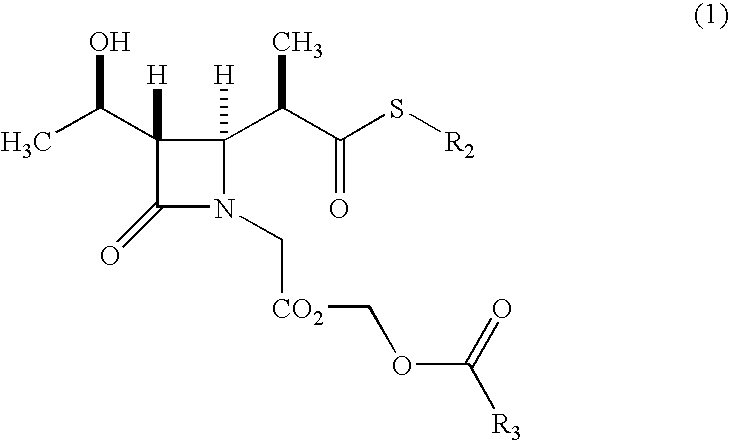
- the present invention provides a process for producing a ⁇ -lactam compound including protecting the hydroxyl group of a compound represented by general formula (1):
- R 1 represents a trimethylsilyl group or a triethylsilyl group; and R 2 and R 3 are the same as above
- cyclizing the compound (2) in the presence of a strong base and subsequently allowing the cyclized compound to react with diphenylphosphoryl chloride to produce a compound represented by general formula (3):
- the present invention provides a process for producing a ⁇ -lactam compound represented by general formula (4):
- the present invention provides a process for producing a ⁇ -lactam compound, the process including protecting the hydroxyl group of a compound represented by general formula (1):
- the compound represented by general formula (1) is produced by allowing a compound represented by general formula (5):
- the compound represented by general formula (3) produced by the process for producing the ⁇ -lactam compound may be converted into a ⁇ -lactam compound represented by general formula (4):
- the protecting group R 1 of the hydroxyl group is a trimethylsilyl group or a triethylsilyl group, and particularly preferably a trimethylsilyl group.
- the present inventors have found, through energetical research, that these substituents can be eliminated under mild reaction conditions with minimum decomposition of the other functional group moieties during deprotection reaction of the protecting group R 1 of the compound (3) used in the production process of the present invention.
- R 2 which is a thiol residue, represents an aryl group or a heteroaryl group that may be substituted with a halogen atom, such as chlorine, bromine, or iodine, a nitro group, an alkyl group having 1 to 3 carbon atoms, or an alkoxy group having 1 to 3 carbon atoms.
- a halogen atom such as chlorine, bromine, or iodine
- aryl group examples include a phenyl group, a halogenophenyl group substituted with one to three halogen atoms, such as chlorine, bromine, or iodine, a p-nitrophenyl group, an o-nitrophenyl group, a p-methoxyphenyl group, a 1-naphthyl group, and a 2-naphthyl group.
- heteroaryl group examples include a 2-pyridyl group, a 3-pyridyl group, a 4-pyridyl group, a 2-pyrimidyl group, a 2-(4,6-dimethyl)pyrimidyl group, a 2-benzothiazolyl group, a 2-benzimidazolyl group, a 2-benzoxazolyl group, and a 2-thienyl group.
- an aryl group is preferable, and a phenyl group and a halogenophenyl group are more preferable in view of ease of availability, economics, reactivity, etc.
- a p-chlorophenyl group is preferable.
- the substituent R 3 which is ultimately contained in the alkanoyloxymethyl moiety of the carboxylate residue in a compound that can be developed as a 1 ⁇ -methylcarbapenem compound for oral administration, represents an alkyl group having 1 to 10 carbon atoms or a cycloalkyl group having 3 to 10 carbon atoms.
- alkyl group having 1 to 10 carbon atoms examples include a methyl group, an ethyl group, a n-propyl, an isopropyl group, a n-butyl group, an isobutyl group, a sec-butyl group, a tert-butyl group, a n-octyl group, and a n-decanyl group.
- the cycloalkyl group having 3 to 10 carbon atoms may have a substituent, and as the substituent, an alkyl group having 1 to 4 carbon atoms, such as a methyl group or an ethyl group, may be mentioned.
- Examples of the cycloalkyl group having 3 to 10 carbon atoms include a cyclopropyl group, a cyclohexyl group, a 1-methylcyclohexyl group, and a 4-methylcyclohexyl group.
- a tert-butyl group which is often used in the development of carbapenem compounds for oral administration, is particularly preferable.
- the substituent X represents a halogen atom, such as a fluorine atom, a chlorine atom, a bromine atom, or an iodine atom.
- a chlorine atom is particularly preferable.
- the compound represented by general formula (5) which is preferably used as a starting material in the present invention, can be easily produced, for example, by a process described in the Chemical and Pharmaceutical Bulletin (Chem. Pharm. Bull.), 42, 1381-1387, 1994.
- This compound can be easily synthesized in the form of a desired optically active substance as a material for synthesis of a 1 ⁇ -methylcarbapenem compound.
- a ⁇ -lactam compound represented by formula (1) By allowing the compound (5) to react with an alkanoyloxymethyl halide represented by formula (6) in the presence of a base, a ⁇ -lactam compound represented by formula (1) can be derived.
- the reaction is carried out using an inert solvent that does not decompose the compound (5) and the compound (6).
- the inert solvent is not particularly limited. Examples thereof include ether solvents, such as tetrahydrofuran, dioxane, and diethyl ether; aromatic hydrocarbon solvents, such as benzene, toluene, and xylene; amide solvents, such as N,N-dimethylformamide and N,N-dimethylacetamide; dimethyl sulfoxide, acetonitrile, acetone, methylene chloride, and mixed solvents of these. From the standpoint of reaction rate, N,N-dimethylformamide and N,N-dimethylacetamide are particularly preferable.
- the amount of the alkanoyloxymethyl halide (6) used for the reaction must be 1.0 or more molar times and is preferably 1.1 to 3.0 molar times the amount of the compound (5).
- any base that is generally used in the reaction for forming an ester using a carboxylic acid and an alkyl halide can be used.
- examples thereof include organic amines and alkali metal salts.
- alkali metal salts include alkali metal carbonates, such as sodium carbonate, potassium carbonate, and cesium carbonate; and alkali metal bicarbonates, such as sodium bicarbonate and potassium bicarbonate.
- alkali metal carbonates such as sodium carbonate, potassium carbonate, and cesium carbonate
- alkali metal bicarbonates such as sodium bicarbonate and potassium bicarbonate.
- the amount of use thereof must be 0.5 or more molar times and is preferably 1.1 to 2.0 molar times the amount of the compound (5).
- an alkali metal bicarbonate the amount of use thereof must be 1.0 or more molar times and is preferably 1.1 to 2.0 molar times the amount of the compound (5).
- an additive as a reaction promoter, may be added to the reaction described above if necessary.
- the additive examples include alkali metal halides, such as sodium iodide and lithium bromide; and quaternary ammonium halides, such as tetrabutylammonium bromide and benzyltriethylammonium chloride.
- the amount of use thereof is preferably 1.0 or more molar times and most preferably 1.0 to 1.5 molar times the amount of the compound (6).
- the reaction described above is usually carried out at 0° C. to 80° C. From the standpoint of inhibiting decomposition of the reactants and product, the reaction is preferably carried out at 10° C. to 40° C.
- reaction time is usually 1 to 50 hours and preferably 2 to 30 hours from the same standpoint.
- reaction can be determined by analytical means, such as thin-layer chromatography (TLC) or high-performance liquid chromatography (HPLC).
- analytical means such as thin-layer chromatography (TLC) or high-performance liquid chromatography (HPLC).
- the target compound (1) can be isolated from the reaction mixture by means of pH adjustment, extraction, liquids separation, washing, concentration, purification, and others, which are often commonly performed in organic reactions.
- the compound (1) obtained by the reaction described above is a novel compound, of which application as a useful precursor for producing a common intermediate for the synthesis of 1 ⁇ -methylcarbapenem compounds for oral administration has been confirmed by the present inventors.
- the compound (1) obtained by the reaction described above is subsequently converted into the compound (2) by the protection of the hydroxyl group.
- a trimethylsilyl group or a triethylsilyl group is introduced.
- the compound (2) can be derived by allowing the compound (1) to react with chlorotrimethylsilane or chlorotriethylsilane in an inert solvent in the presence of a base, such as an amine. This method is most commonly used and is most suitable for the production of the compound (2).
- the amount of chlorotrimethylsilane or chlordtriethylsilane used in this stage must be 1.0 or more molar times and is preferably 1.1 to 3.0 molar times the amount of the compound (1).
- examples of the amine used as the base include triethylamine, diisopropylethylamine, pyridine, and imidazole.
- the amount of use thereof must be 1.0 or more molar times and is preferably 1.1 to 3.0 molar times the amount of the compound (1).
- any solvent that is inert so as not to decompose the chlorotrialkylsilane described above may be used without limitation.
- examples thereof include ether solvents, such as tetrahydrofuran, dioxane, and diethyl ether; aromatic hydrocarbon solvents, such as benzene, toluene, and xylene; amide solvents, such as N,N-dimethylformamide and N,N-dimethylacetamide; dimethyl sulfoxide, acetonitrile, acetone, methylene chloride, and mixed solvents of these.
- ether solvents such as tetrahydrofuran, dioxane, and diethyl ether
- aromatic hydrocarbon solvents such as benzene, toluene, and xylene
- amide solvents such as N,N-dimethylformamide and N,N-dimethylacetamide
- the reaction described above is usually carried out at 0° C. to 100° C. From the standpoint of inhibiting decomposition of the reactants and product, the reaction is preferably carried out at 10° C. to 60° C.
- reaction time is usually 0.5 to 50 hours and preferably 1 to 30 hours from the same standpoint.
- the compound (2) can be isolated from the reaction mixture by means of pH adjustment, extraction, liquids separation, washing, concentration, purification, and others, which are often commonly performed in organic reactions. During this stage, if the compound (2) is subjected to acidic conditions, the protecting group on the hydroxyl group is eliminated and the compound (2) reverts back to the starting compound (1). Therefore, sufficient care must be taken not to cause acidic conditions.
- the compound (2) obtained by the reaction described above is converted into the compound (3) by cyclization in the presence of a strong base and subsequent treatment with diphenylphosphoryl chloride.
- Examples of the strong base which may be preferably used in the cyclization reaction of the compound (2) include alkali metal alkoxides, such as potassium tert-butoxide and sodium tert-butoxide; alkali metal amides, such as lithium bis(trimethylsilyl)amide, sodium bis(trimethylsilyl)amide, and potassium bis(trimethylsilyl)amide; and alkali metal hydrides, such as sodium hydride and potassium hydride.
- alkali metal alkoxides such as potassium tert-butoxide and sodium tert-butoxide
- alkali metal amides such as lithium bis(trimethylsilyl)amide, sodium bis(trimethylsilyl)amide, and potassium bis(trimethylsilyl)amide
- alkali metal hydrides such as sodium hydride and potassium hydride.
- the strong base is used desirably in an amount that allows the cyclization reaction to proceed sufficiently.
- the amount of use is 2 to 3 molar times the amount of the compound (2).
- a metal thiolate As cyclization progresses, formation of a metal thiolate as a by-product occurs.
- a scavenger is preferably used.
- the scavenger examples include alkylating agents, such as methyl iodide, propyl iodide, allyl bromide, benzyl bromide, and methyl p-toluenesulphonate; sulfonylating agents, such as p-toluenesulfonyl chloride and methanesulfonyl chloride; and phosphorylating agents, such as diphenylphosphoryl chloride.
- the scavenger is used desirably in an amount equal to the amount of the metal thiolate formed from the compound (2) as a by-product.
- the amount of use is 1.0 to 1.5 molar times the amount of the compound (2).
- the compound (3) is produced by reaction between the reaction intermediate obtained by cyclizing the compound (2) and diphenylphosphoryl chloride. This reaction is usually carried out in the same reactor vessel as that used for the cyclization reaction.
- Diphenylphosphoryl chloride must be used in an amount that allows the reaction to proceed sufficiently.
- the amount of use is preferably 1.0 to 1.5 molar times the amount of the compound (2). Since diphenylphosphoryl chloride can also act as a scavenger as described above, in such a case, diphenylphosphoryl chloride is used in an amount of 2 or more molar times the amount of the compound (2) so that the metal thiolate is trapped and so as to also serve as a phosphorylating agent.
- the cyclization and phosphorylation reactions described above are carried out in an inert solvent.
- the inert solvent is not particularly limited. Preferred examples thereof include ether solvents, such as tetrahydrofuran, dioxane, and diethyl ether; aromatic hydrocarbon solvents, such as benzene, toluene, and xylene; amide solvents, such as N,N-dimethylformamide and N,N-dimethylacetamide; dimethyl sulfoxide, acetonitrile, acetone, methylene chloride, and mixed solvents of these.
- ether solvents such as tetrahydrofuran, dioxane, and diethyl ether
- aromatic hydrocarbon solvents such as benzene, toluene, and xylene
- amide solvents such as N,N-dimethylformamide and N,N-dimethylacetamide
- tetrahydrofuran or a mixed solvent of tetrahydrofuran and toluene are most preferable.
- the mixing ratio is not particularly limited as long as the reaction reagent is dissolved.
- the cyclization and phosphorylation reactions described above are usually carried out at ⁇ 78° C. to 60° C. From the standpoint of inhibiting decomposition of the reactants and product, the reactions are preferably carried out at ⁇ 78° C. to 10° C.
- the cyclization reaction time is usually 1 minute to 20 hours, and preferably 5 minutes to 5 hours.
- the phosphorylation reaction time is usually 5 minutes to 30 hours, and preferably 30 minutes to 10 hours.
- the compound (3) can be isolated from the reaction mixture by means of pH adjustment, extraction, liquids separation, washing, concentration, purification, and others, which are often commonly performed in organic reactions.
- the compound (3) obtained by the reactions described above is a novel compound, of which application as a useful precursor for producing a common intermediate for the synthesis of 1 ⁇ -methylcarbapenem compounds for oral administration has been confirmed by the present inventors.
- the compound (4) can be derived from the compound (3) by eliminating R 1 , i.e., the protecting group of the hydroxyl group.
- a method is preferably used in which the pH of the reaction mixture after the cyclization and phosphorylation of the compound (2) is adjusted so as to achieve acidic conditions, and thus the hydroxyl moiety is deprotected.
- the compound (4) may be derived from the compound (3) after the compound (3) has been recovered.
- the acidic conditions used in this stage are not particularly limited as long as the pH is 7 or less.
- the pH is 2 to 6.
- the silyl protecting group can be extremely easily eliminated.
- phosphoric acid, aqueous citric acid, hydrochloric acid, or the like may be added to the mixture.
- the compound (4) is a novel compound, and as will be described below, useful application of the compound (4) as a common intermediate for the synthesis of 1 ⁇ -methylcarbapenem compounds for oral administration has been confirmed by the present inventors for the first time.
- any of 1 ⁇ -methylcarbapenem compounds for oral administration may be derived. Without isolating the compound (3) or (4), a desired 1 ⁇ -methylcarbapenem compound can be derived directly.
- the compound (2) is cyclized and then a phosphorylation reaction with diphenylphosphoryl chloride is carried out to produce the compound (3). Subsequently, the compound (3) is allowed to react with a thiol compound (R′—SH) in the presence of a base.
- a thiol compound R′—SH
- the base used in the reaction with the thiol compound may be the same as or different from the strong base used in the cyclization reaction described above.
- an organic amine or an alkali metal salt can be used as the base other than the strong base used in the cyclization of the compound (2) described above.
- the organic amine include triethylamine, diisopropylethylamine, 4-dimethylaminopyridine, 1,8-diazabicyclo[5.4.0]-undec-7-ene (DBU), 1,5-diazabicyclo[4.3.0]-non-5-ene (DBN), and 1,4-diazabicyclo[2.2.2]octane (DABCO).
- the alkali metal salt include alkali metal carbonates, such as sodium carbonate, potassium carbonate, and cesium carbonate; and alkali metal bicarbonates, such as sodium bicarbonate and potassium bicarbonate.
- reaction may be accelerated by the addition of a different inert solvent from the one used in the cyclization reaction.
- Preferred examples of the inert solvent which is further added to accelerate the reaction include acetonitrile, N,N-dimethylformamide, and N,N-dimethylacetamide.
- the 1 ⁇ -methylcarbapenem compound produced as described above can be converted into a desired 1 ⁇ -methylcarbapenem compound for oral administration by the above-described common method in which deprotection of the hydroxyl group is performed, and preferably by a deprotection method in which the conditions are set to be the same as those described above to minimize the decomposition of the other functional group moieties.
- the reaction solution was diluted with 120 ml of toluene, and washing was performed several times using 2.5% aqueous sodium bicarbonate and water.
- the resulting toluene solution was dried over sodium sulfate, and then the solvent was removed by distillation.
- the resulting oily residue was dissolved in 60 ml of toluene at room temperature, and 120 ml of hexane was added to the toluene solution to precipitate crystals.
- the resulting crystals were separated by filtration and washed. Thereby, 9.46 g of white crystals of the target compound was produced (yield 92.7%).
- the reaction solution was diluted with 40 ml of ethyl acetate, and washing was performed several times using 5% aqueous sodium bicarbonate and water.
- the resulting ethyl acetate solution was dried over sodium sulfate, and then the solvent was removed by distillation. Thereby, 1.88 g of the target compound was produced.
- a solution was prepared by dissolving 0.49 g (1.0 mmol) of (3S, 4S)-4-[(1R)-1-(p-chlorophenylthiocarbonyl)ethyl]-3-[(1R)-1-hydroxyethyl]-1-pivaloyloxymethyloxycarbonylmethyl-2-azetidinone synthesized as in Example 1 in 5 ml of toluene, and 0.17 g (1.7 mmol) of triethylamine was added thereto at room temperature. Subsequently, 0.17 g (1.5 mmol) of chlorotrimethylsilane was added dropwise thereto, and stirring was performed at the same temperature for 14 hours. The reaction solution was diluted with 5 ml of toluene, and washing was performed several times with water. The resulting toluene solution was dried over sodium sulfate, and then the solvent was removed by distillation.
- the resulting oily residue was dissolved in 8 ml of tetrahydrofuran, and cooling was performed to ⁇ 25° C. After 0.089 g (2.1 mmol) of sodium hydride was added to the resulting solution, stirring was performed for 135 minutes. At the same temperature, 0.18 g (1.05 mmol) of benzyl bromide was added to the mixture, followed by stirring for 15 minutes, and then 0.30 g (1.1 mmol) of diphenylphosphoryl chloride was added thereto, followed by stirring for 2.5 hours.
- the reaction solution was diluted with 50 ml of toluene, and washing was performed several times using 2.5% aqueous sodium bicarbonate and water under ice cooling. The resulting toluene solution was dried over sodium sulfate, and then the solvent was removed by distillation. The target compound was thereby produced.
- a solution was prepared by dissolving 1.997 g (4.1 mmol) of (3S, 4S)-4-[(1R)-1-(p-chlorophenylthiocarbonyl)ethyl]-3-[(1R)-1-hydroxyethyl]-1-pivaloyloxymethyloxycarbonylmethyl-2-azetidinone synthesized as in Example 1 in 20 ml of toluene, and 0.88 mL (6.4 mmol) of triethylamine was added thereto at room temperature. Subsequently, 0.78 mL (6.2 mmol) of chlorotrimethylsilane was added dropwise thereto, and stirring was performed at the same temperature for 15 hours. The reaction solution was diluted with 5 ml of toluene, and washing was performed several times with water. The resulting toluene solution was dried over sodium sulfate, and then the solvent was removed by distillation.
- the resulting oily residue (2.63 g) was dissolved in 22.5 ml of tetrahydrofuran, and cooling was performed to ⁇ 70° C. After 0.956 g (8.5 mmol) of potassium tert-butoxide was added to the resulting solution, stirring was performed for 15 minutes. At the same temperature, 0.26 mL (4.2 mmol) of methyl iodide was added to the mixture, and stirring was performed for 2.5 minutes while the temperature was gradually increased to ⁇ 35° C. Subsequently, at ⁇ 35° C., 1.0 mL (4.9 mmol) of diphenylphosphoryl chloride was added to the mixture, and stirring was performed for 1.8 hours while the temperature was gradually increased to ⁇ 9° C.
- reaction solution was diluted with 20 ml of toluene, and washing was performed several times using 2.5% aqueous sodium bicarbonate and water under ice cooling.
- the resulting toluene solution was dried over sodium sulfate, and then the solvent was removed by distillation. The target compound was thereby produced.
- a solution was prepared by dissolving 0.97 g (2.0 mmol) of (3S, 4S)-4-[(1R)-1-(p-chlorophenylthiocarbonyl)ethyl]-3-[(1R)-1-hydroxyethyl]-1-pivaloyloxymethyloxycarbonylmethyl-2-azetidinone synthesized as in Example 1 in 5 ml of toluene, and 0.50 g (5.0 mmol) of triethylamine was added thereto at room temperature. Subsequently, 0.39 g (3.6 mmol) of chlorotrimethylsilane was added dropwise thereto, and stirring was performed at the same temperature for 15 hours. The reaction solution was diluted with toluene, and washing was performed several times with water. The resulting toluene solution was dried over sodium sulfate, and then the solvent was removed by distillation.
- the resulting oily residue was dissolved in 15 ml of a mixed solvent including tetrahydrofuran and toluene at a volume ratio of 1:2, and cooling was performed to ⁇ 25° C. After 0.475 g (4.2 mmol) of potassium tert-butoxide was added to the resulting solution, stirring was performed for 1 hour. At the same temperature, 0.30 g (2.1 mmol) of methyl iodide was added to the mixture, followed by stirring for 20 minutes, and then 0.60 g (2.2 mmol) of diphenylphosphoryl chloride was added thereto, followed by stirring for 2.5 hours.
- a solution was prepared by dissolving 0.493 g (1.0 mmol) of (3S, 4S)-4-[(1R)-1-(p-chlorophenylthiocarbonyl)ethyl]-3-[(1R)-1-hydroxyethyl]-1-pivaloyloxymethyloxycarbonylmethyl-2-azetidinone synthesized as in Example 1 in 10 ml of toluene, and 0.17 g (1.7 mmol) of triethylamine was added thereto at room temperature. Subsequently, 0.24 g (1.6 mmol) of chlorotriethylsilane was added dropwise thereto, and stirring was performed at the same temperature for 22 hours. The reaction solution was diluted with 10 ml of toluene, and washing was performed several times with water. The resulting toluene solution was dried over sodium sulfate, and then the solvent was removed by distillation.
- the resulting oily residue was dissolved in 6 ml of tetrahydrofuran, and cooling was performed to ⁇ 25° C. After 0.232 g (2.1 mmol) of potassium tert-butoxide was added to the resulting solution, stirring was performed for 60 minutes. At the same temperature, 0.19 g (1.05 mmol) of benzyl bromide was added to the mixture, followed by stirring for 20 minutes, and then 0.30 g (1.1 mmol) of diphenylphosphoryl chloride was added thereto, followed by stirring for 2 hours. The reaction solution was diluted with 50 ml of toluene, and washing was performed several times using 2.5% aqueous sodium bicarbonate and water under ice cooling. The resulting toluene solution was dried over sodium sulfate, and then the solvent was removed by distillation. The target compound was thereby produced.
- a solution was prepared by dissolving 0.94 g of an oily residue containing (3S,4S)-4-[(1R)-1-(phenylthiocarbonyl)ethyl]-3-[(1R)-1-hydroxyethyl]-1-pivaloyloxymethyloxycarbonylmethyl-2-azetidinone synthesized as in Example 2 in 10 ml of toluene, and 0.51 g (5.0 mmol) of triethylamine was added thereto at room temperature. Subsequently, 0.40 g (3.6 mmol) of chlorotrimethylsilane was added dropwise thereto, and stirring was performed at the same temperature for 19 hours. The reaction solution was diluted with 10 ml of toluene, and washing was performed several times with water. The resulting toluene solution was dried over sodium sulfate, and then the solvent was removed by distillation.
- the resulting oily residue was dissolved in 10 ml of tetrahydrofuran, and cooling was performed to ⁇ 60° C. After 0.45 g (4.0 mmol) of potassium tert-butoxide was added to the resulting solution, stirring was performed for 20 minutes. Subsequently, at ⁇ 50° C., 0.28 g (2.0 mmol) of methyl iodide was added to the mixture, followed by stirring for 25 minutes, and then 0.56 g (2.1 mmol) of diphenylphosphoryl chloride was added thereto, followed by stirring for 1.7 hours. The reaction solution was diluted with 20 ml of toluene, and washing was performed several times using 2.5% aqueous sodium bicarbonate and water under ice cooling. The resulting toluene solution was dried over sodium sulfate, and then the solvent was removed by distillation. The target compound was thereby produced.
- a solution was prepared by dissolving 0.32 g of an oily residue containing (4R,5R,6S)-6-[(1R)-1-hydroxyethyl]-3-diphenylphosphoryloxy-4-methyl-7-oxo-1-azabicyclo[3.2.0]hept-2-ene-2-carboxylic acid pivaloyloxymethyl ester, which was synthesized as in Example 5 and purified, in 1 ml of acetonitrile, and 0.07 g (0.33 mmol) of a compound represented by formula (18):
- a solution was prepared by dissolving 4.32 g of an oily residue containing (4R, 5R, 6S)-6-[(1R)-1-trimethylsilyloxyethyl]-3-diphenylphosphoryloxy-4-methyl-7-oxo-1-azabicyclo[3.2.0]hept-2-ene-2-carboxylic acid pivaloyloxymethyl ester synthesized as in Example 4 in 15 ml of acetonitrile, and 0.57 g (4.9 mmol) of a compound represented by formula (19):
- the ethyl acetate solution obtained by a separation process was washed with aqueous sodium bicarbonate and water, and then dried over sodium sulfate.
- the solvent was removed by distillation, and the residue was dissolved in 20 mL of acetone.
- Toluene (30 mL) was added to the resulting solution, and the acetone solvent was gradually removed by distillation. Formation of a white, turbid solution was confirmed.
- the white, turbid solution was stirred at 0° C. to 5° C. for 1 hour, and white crystals were obtained by filtration and washing.
- the white crystals were dissolved in acetone again, and as in the above process, through addition of toluene, removal of the solvent by distillation, stirring, filtration, and washing, 0.70 g of white crystals containing the target compound was obtained.
- the present invention provides compounds, such as a novel common intermediate (4), and novel precursors thereof (1) and (3), and production processes therefor, which enable efficient synthesis of various 1 ⁇ -methylcarbapenem compounds for oral administration on which recently research and development has been actively conducted.
- the present invention is industrially useful.
Landscapes
- Chemical & Material Sciences (AREA)
- Organic Chemistry (AREA)
- Health & Medical Sciences (AREA)
- Life Sciences & Earth Sciences (AREA)
- Biochemistry (AREA)
- General Health & Medical Sciences (AREA)
- Molecular Biology (AREA)
- Nitrogen Condensed Heterocyclic Rings (AREA)
- Low-Molecular Organic Synthesis Reactions Using Catalysts (AREA)
- Pharmaceuticals Containing Other Organic And Inorganic Compounds (AREA)
Abstract

(In the formulae, R1 represents a trimethylsilyl group or a triethylsilyl group; R2 represents an aryl group or a heteroaryl group; R2 represents an aryl group or a heteroaryl group; R3 represents an alkyl group having 1 to 10 carbon atoms or a cycloalkyl group having 3 to 10 carbon atoms; and X represents a halogen atom.)
Description

is allowed to react with any of various thiol compounds (R—SH) to synthesize a compound represented by general formula (8):

(wherein R represents a thiol residue); the p-nitrobenzyl group, which is a protecting group, is eliminated, for example, by hydrogenolysis or by reduction using zinc dust to convert the compound (8) into a compound represented by general formula (9):

(wherein R represents a thiol residue); and the carboxylic moiety of the resulting compound (9) is subjected, for example, to pivaloyloxymethylation to produce a compound represented by general formula (10):

(wherein R represents a thiol residue, and But represents a tert-butyl group).

which is described in the Japanese Unexamined Patent Application Publication No. 8-53453 and Japanese Unexamined Patent Application Publication No. 10-195076; a compound represented by general formula (12):

which is described in the Journal of Antibiotics (J. Antibiot. 429-439, 1997, and Japanese Unexamined Patent Application Publication No. 10-130270; and a compound represented by general formula (13):

which is described in Japanese Unexamined Patent Application Publication No. 10-152491. All of these compounds are synthesized by the-process described above.

(wherein R4 represents a protecting group of the hydroxyl group, R5 represents a thiol residue contained in the reaction product 1β-methylcarbapenem compound, and R6 represents an organic group), a compound represented by general formula (15):

(wherein R4, R5, and R6 are the same as above; and R7, R8, and R9 each represent a lower alkoxy group having 1 to 4 carbon atoms; or one of R7, R8, and R9 represents an alkyl group having 1 to 4 carbon atoms and the remaining two of R7, R8, and R9 each represent a lower alkoxy group having 1 to 4 carbon atoms) is synthesized, and the compound (15) is cyclized to produce a compound represented by general formula (16):

(wherein R4, R5, and R6 are the same as above)

(wherein Me represents a methyl group, and But is the same as above). It can be conceived that a 1β-methylcarbapenem compound may be derived from this compound through reaction with any of various thiol compounds and deprotection of the hydroxyl group. However, in the compound (17), since the protecting group of the hydroxyl group is a tert-butyldimethylsilyl group, a reaction reagent that may affect the other functional groups must be used for the deprotection of the hydroxyl moiety, as exemplified in Protective Groups in Organic Synthesis (J. Wiley & Sons, New York), 44-46, 1981. Thus, there is a problem in terms of yield, etc. Although the present inventors have examined various methods for deprotection, it has not been possible to perform the deprotection easily and efficiently.

(wherein R2 represents an aryl group or a heteroaryl group; and R3 represents an alkyl group having 1 to 10 carbon atoms or a cycloalkyl group having 3 to 10 carbon atoms), to produce a compound represented by general formula (2):

(wherein R1 represents a trimethylsilyl group or a triethylsilyl group; and R2 and R3 are the same as above); cyclizing the compound (2) in the presence of a strong base; and subsequently allowing the cyclized compound to react with diphenylphosphoryl chloride to produce a compound represented by general formula (3):

(wherein R1 and R3 are the same as above).

(wherein R3 is the same as above), the process including deprotecting the hydroxyl moiety of the compound (3) produced by the process described above.

(wherein R2 and R3 are the same as above).

(wherein R1 and R3 are the same as above).

(wherein R3 is the same as above).

to produce a compound represented by general formula (2):

cyclizing the compound (2) in the presence of a strong base, and subsequently allowing the cyclized compound to react with diphenylphosphoryl chloride to produce a compound represented by general formula (3):


to react with a compound represented by general formula (6):

in the presence of a base.

through deprotection of the hydroxyl moiety.

(wherein R′ represents a thiol residue; and R3 is the same as above) can be derived by one step.

(wherein R′, R1, and R3 are the same as above) is obtained, and then by deprotecting the hydroxyl moiety, any of 1β-methylcarbapenem compounds for oral administration may be derived. Without isolating the compound (3) or (4), a desired 1β-methylcarbapenem compound can be derived directly.
- Me: methyl group
- But: tert-butyl group
- TMS: trimethylsilyl group
- TES: triethylsilyl group


was added thereto. Subsequently, 0.09 g (0.70 mmol) of diisopropylethylamine was added dropwise thereto at −10° C., and stirring was performed at the same temperature for 3 hours. After the reaction was completed, 20 ml of ethyl acetate and 20 ml of water were added to the reaction solution, and extraction into an aqueous layer was carried out by adding aqueous citric acid, and then extraction into an ethyl acetate layer was carried out by adding 20 ml of ethyl acetate and potassium bicarbonate. The extraction solution was dried over sodium sulfate, and then the solvent was removed by distillation. NMR analysis confirmed the formation of the target compound.


was added thereto. Subsequently, 0.79 g (6.1 mmol) of diisopropylethylamine was added dropwise thereto at 5° C., and stirring was performed at the same temperature for 70 minutes. After the reaction was completed, acetonitrile was removed by distillation. The residue was dissolved in 40 ml of ethyl acetate, and washing was performed several times with aqueous sodium bicarbonate to remove diphenylphosphoric acid which was formed as a by-product. Water was added to the resulting ethyl acetate solution, and 1 N aqueous hydrochloric acid was added thereto to achieve pH 3. The ethyl acetate solution obtained by a separation process was washed with aqueous sodium bicarbonate and water, and then dried over sodium sulfate. The solvent was removed by distillation, and the residue was dissolved in 20 mL of acetone. Toluene (30 mL) was added to the resulting solution, and the acetone solvent was gradually removed by distillation. Formation of a white, turbid solution was confirmed. The white, turbid solution was stirred at 0° C. to 5° C. for 1 hour, and white crystals were obtained by filtration and washing. The white crystals were dissolved in acetone again, and as in the above process, through addition of toluene, removal of the solvent by distillation, stirring, filtration, and washing, 0.70 g of white crystals containing the target compound was obtained.
Claims (11)



Applications Claiming Priority (3)
| Application Number | Priority Date | Filing Date | Title |
|---|---|---|---|
| JP2002330127 | 2002-11-13 | ||
| JP2002-330127 | 2002-11-13 | ||
| PCT/JP2003/014419 WO2004043973A1 (en) | 2002-11-13 | 2003-11-13 | Novel intermediate for carbapenem compound for oral administration and process for producing the same |
Publications (2)
| Publication Number | Publication Date |
|---|---|
| US20060252929A1 US20060252929A1 (en) | 2006-11-09 |
| US7538212B2 true US7538212B2 (en) | 2009-05-26 |
Family
ID=32310588
Family Applications (1)
| Application Number | Title | Priority Date | Filing Date |
|---|---|---|---|
| US10/533,868 Expired - Fee Related US7538212B2 (en) | 2002-11-13 | 2003-11-13 | Intermediate for carbapenem compound for oral administration and process for producing the same |
Country Status (7)
| Country | Link |
|---|---|
| US (1) | US7538212B2 (en) |
| EP (1) | EP1582526A4 (en) |
| JP (1) | JP4481829B2 (en) |
| KR (1) | KR101031143B1 (en) |
| CN (2) | CN100347179C (en) |
| AU (1) | AU2003284545A1 (en) |
| WO (1) | WO2004043973A1 (en) |
Families Citing this family (6)
| Publication number | Priority date | Publication date | Assignee | Title |
|---|---|---|---|---|
| JP2006176418A (en) * | 2004-12-21 | 2006-07-06 | Kaneka Corp | METHOD FOR PRODUCING CARBAPENEM COMPOUND FOR ORAL ADMINISTRATION AND NEW beta-LACTAM COMPOUND |
| KR101256692B1 (en) | 2005-03-29 | 2013-04-19 | 가부시키가이샤 가네카 | 1β-METHYLCARBAPENEM INTERMEDIATE IN CRYSTALLINE FORM |
| CN102532117B (en) * | 2010-12-22 | 2014-05-14 | 深圳万乐药业有限公司 | Method for preparing 1-(4,5-dihydrothiazol-2-yl)-3-hydroxyl-azetidine hydrochloride |
| CN102775410B (en) * | 2011-05-10 | 2016-07-20 | 上海医药工业研究院 | A kind of preparation method of L-084 |
| CN103059026A (en) * | 2011-10-20 | 2013-04-24 | 北京康健源科技有限公司 | Preparation method of tebipenem ester |
| CN102702204A (en) * | 2012-06-25 | 2012-10-03 | 江苏济川制药有限公司 | Preparation method of tebipenem pivoxil |
Citations (4)
| Publication number | Priority date | Publication date | Assignee | Title |
|---|---|---|---|---|
| EP0188816A1 (en) | 1984-12-27 | 1986-07-30 | Sumitomo Pharmaceuticals Company, Limited | Novel beta-lactams and their production |
| EP0559533A1 (en) | 1992-03-06 | 1993-09-08 | Tanabe Seiyaku Co., Ltd. | Process for preparing beta-lactam derivative and synthetic intermediate thereof |
| WO2004035539A1 (en) | 2002-10-18 | 2004-04-29 | Meiji Seika Kaisha, Ltd. | Process for producing carbapenem derivative and intermediate for use in the production |
| US20060009442A1 (en) * | 2002-11-13 | 2006-01-12 | Keita Nishino | Process for producing carbapenem compound for oral administration |
Family Cites Families (4)
| Publication number | Priority date | Publication date | Assignee | Title |
|---|---|---|---|---|
| AR008255A1 (en) * | 1996-07-12 | 1999-12-29 | Merck & Co Inc | PROCEDURE FOR SYNTHESIZING CARBAPENEM ANTIBIOTICS |
| ES2260900T3 (en) * | 1998-03-02 | 2006-11-01 | MERCK & CO., INC. | PROCEDURE FOR SYNTHESIZING CARBAPENEM ANTIBIOTICS. |
| AR035728A1 (en) * | 2001-01-16 | 2004-07-07 | Merck & Co Inc | PERFECTED PROCESS FOR CARBAPENEM SYNTHESIS |
| US7553989B2 (en) * | 2002-10-18 | 2009-06-30 | Meiji Seika Kaisha, Ltd. | Malonic acid monoesters and process for producing the same |
-
2003
- 2003-11-13 WO PCT/JP2003/014419 patent/WO2004043973A1/en not_active Ceased
- 2003-11-13 CN CNB2003801019645A patent/CN100347179C/en not_active Expired - Fee Related
- 2003-11-13 CN CN2007101547133A patent/CN101172962B/en not_active Expired - Fee Related
- 2003-11-13 AU AU2003284545A patent/AU2003284545A1/en not_active Abandoned
- 2003-11-13 US US10/533,868 patent/US7538212B2/en not_active Expired - Fee Related
- 2003-11-13 JP JP2004551226A patent/JP4481829B2/en not_active Expired - Fee Related
- 2003-11-13 EP EP03774004A patent/EP1582526A4/en not_active Withdrawn
- 2003-11-13 KR KR1020057008453A patent/KR101031143B1/en not_active Expired - Fee Related
Patent Citations (5)
| Publication number | Priority date | Publication date | Assignee | Title |
|---|---|---|---|---|
| EP0188816A1 (en) | 1984-12-27 | 1986-07-30 | Sumitomo Pharmaceuticals Company, Limited | Novel beta-lactams and their production |
| JPS62103084A (en) | 1984-12-27 | 1987-05-13 | Sumitomo Pharmaceut Co Ltd | Method for producing β-lactam compounds |
| EP0559533A1 (en) | 1992-03-06 | 1993-09-08 | Tanabe Seiyaku Co., Ltd. | Process for preparing beta-lactam derivative and synthetic intermediate thereof |
| WO2004035539A1 (en) | 2002-10-18 | 2004-04-29 | Meiji Seika Kaisha, Ltd. | Process for producing carbapenem derivative and intermediate for use in the production |
| US20060009442A1 (en) * | 2002-11-13 | 2006-01-12 | Keita Nishino | Process for producing carbapenem compound for oral administration |
Non-Patent Citations (4)
| Title |
|---|
| Greene, Protective Groups in Organic Synthesis (Wiley, 1981), p. 40-41. * |
| International Search Report from Corresponding International Application No. PCT/JP03/14419, dated Mar. 16, 2004, 1 page. |
| Mori, Chemical and pharmaceutical bulletin 2000, vol. 48, No. 1, pp. 126-130. * |
| Sakurai, Osamu et al., "A New Synthesis of 1beta-Alkylcarbapenems Utilizing Eschenmoser Sulfide Contraction of the Novel Thiazinone Intermediates," Journal of Organic Chemistry, 1996, vol. 61, pp. 7889-7894. |
Also Published As
| Publication number | Publication date |
|---|---|
| WO2004043973A1 (en) | 2004-05-27 |
| CN100347179C (en) | 2007-11-07 |
| KR20050075392A (en) | 2005-07-20 |
| AU2003284545A1 (en) | 2004-06-03 |
| CN101172962A (en) | 2008-05-07 |
| JP4481829B2 (en) | 2010-06-16 |
| JPWO2004043973A1 (en) | 2006-03-09 |
| US20060252929A1 (en) | 2006-11-09 |
| CN1708504A (en) | 2005-12-14 |
| EP1582526A4 (en) | 2008-08-06 |
| CN101172962B (en) | 2010-09-08 |
| KR101031143B1 (en) | 2011-04-27 |
| EP1582526A1 (en) | 2005-10-05 |
Similar Documents
| Publication | Publication Date | Title |
|---|---|---|
| JP2665767B2 (en) | β-lactam compound | |
| US7553989B2 (en) | Malonic acid monoesters and process for producing the same | |
| CS214690B2 (en) | Method of making the 2-penem compounds | |
| EP0559533B1 (en) | Process for preparing beta-lactam derivative and synthetic intermediate thereof | |
| US7538212B2 (en) | Intermediate for carbapenem compound for oral administration and process for producing the same | |
| US7524952B2 (en) | Process for producing carbapenem compound for oral administration | |
| EP0679652B1 (en) | Process for preparing carbapenem compounds | |
| US6265396B1 (en) | β-lactam compounds and process for preparing the same | |
| JP2696807B2 (en) | Preparation of carbapenem derivatives | |
| RU2070555C1 (en) | Method of synthesis of penem or carbopenem and carbopenem compound | |
| JPS6034970A (en) | 2-Heterocyclyl-lower alkyl-2-penem compound, its production method, and pharmaceutical preparations containing the compound | |
| JP4463520B2 (en) | Method for producing carbapenem derivatives | |
| JP2006176418A (en) | METHOD FOR PRODUCING CARBAPENEM COMPOUND FOR ORAL ADMINISTRATION AND NEW beta-LACTAM COMPOUND | |
| JPWO2004035539A1 (en) | Process for producing carbapenems and intermediates used for the production | |
| JP3959128B2 (en) | Method for producing carbapenem compounds | |
| JP4294124B2 (en) | Method for producing azetidinone derivative | |
| JPH0782248A (en) | Production of 4-substituted azetidinone derivative | |
| JPH0931056A (en) | Production of carbapenem intermediate | |
| WO2014097257A1 (en) | A method of preparation of (1'r,3r,4r)-4-acetoxy-3-(1'-(tert-butyldimethylsilyloxy)ethyl)-2-azetidinone, a precursor for carbapenem antibiotics synthesis |
Legal Events
| Date | Code | Title | Description |
|---|---|---|---|
| AS | Assignment |
Owner name: KANEKA CORPORATION, JAPAN Free format text: ASSIGNMENT OF ASSIGNORS INTEREST;ASSIGNORS:NISHINO, KEITA;KOGA, TERUYOSHI;REEL/FRAME:017500/0068 Effective date: 20050428 |
|
| FEPP | Fee payment procedure |
Free format text: PAYOR NUMBER ASSIGNED (ORIGINAL EVENT CODE: ASPN); ENTITY STATUS OF PATENT OWNER: LARGE ENTITY |
|
| FPAY | Fee payment |
Year of fee payment: 4 |
|
| REMI | Maintenance fee reminder mailed | ||
| LAPS | Lapse for failure to pay maintenance fees | ||
| STCH | Information on status: patent discontinuation |
Free format text: PATENT EXPIRED DUE TO NONPAYMENT OF MAINTENANCE FEES UNDER 37 CFR 1.362 |
|
| STCH | Information on status: patent discontinuation |
Free format text: PATENT EXPIRED DUE TO NONPAYMENT OF MAINTENANCE FEES UNDER 37 CFR 1.362 |
|
| FP | Lapsed due to failure to pay maintenance fee |
Effective date: 20170526 |