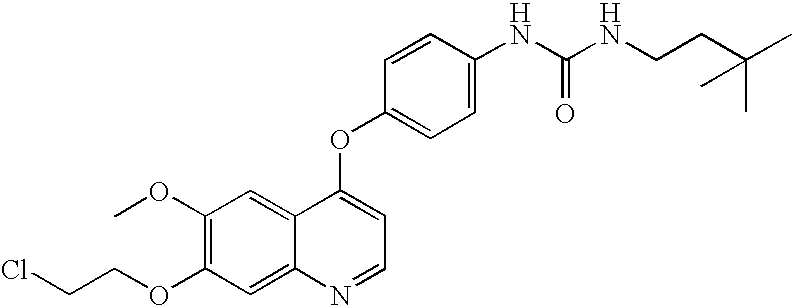
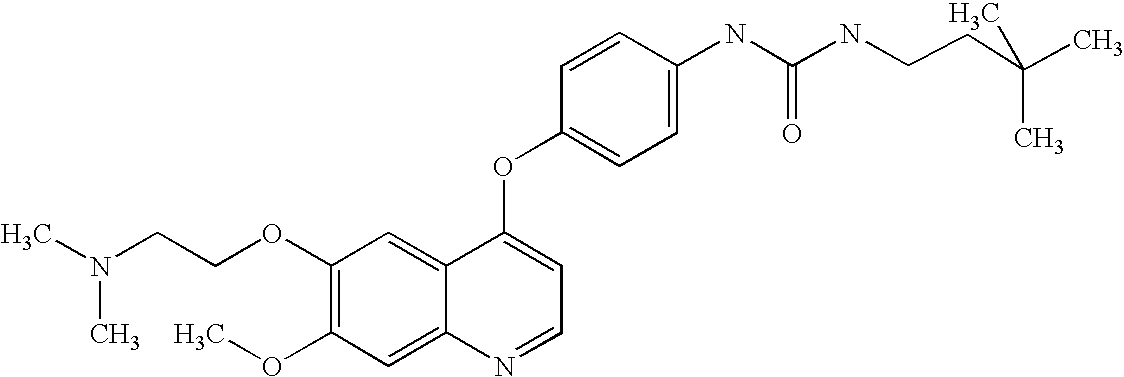
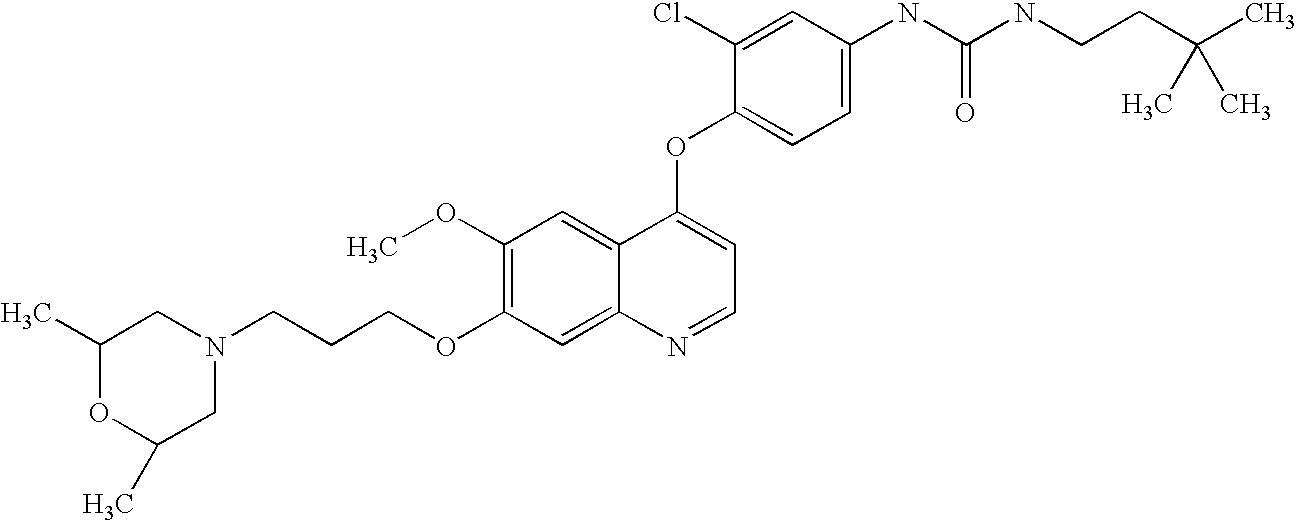
BACKGROUND OF THE INVENTION
1. Field of the Invention
The present invention relates to quinoline derivatives and quinazoline derivatives which have antitumor activity. More particularly, the present invention relates to quinoline derivatives and quinazoline derivatives which have inhibitory activity against the autophosphorylation of fibroblast growth factor receptors and have inhibitory activity against abnormal cell proliferation.
2. Background Art
Growth factors such as epithelial growth factors, platelet-derived growth factors, insulin-like growth factors, and basic fibroblast growth factors (hereinafter abbreviated to “bFGF”) play an important role in cell proliferation. Among others, bFGF is known to accelerate cell proliferation and migration of vascular endothelial cells, fibloblasts and the like, and is also known to be involved in angiogenesis and wound healing (Trends. Pharmacol. Sci. April; 22 (4): 201–7, 2001).
Further, the expression of bFGF, or FGFR1 (hereinafter referred to as “Flg”), FGFR2 (hereinafter referred to as “Bek”) and the like belonging to a fibroblast growth factor receptor family is reported to be found in various cancers such as brain tumors, lung cancer, breast cancer, gastric cancer, head and neck cancer, and prostatic cancer (Proc. Natl. Acad. Sci. USA, 87: 5710–5714, 1990 Oncogene. 1997 Aug. 14; 15 (7): 817–26 Cancer Res. 1994 Jan. 15; 54 (2): 523–30. Cancer Res. 1992 Feb. 1; 52 (3): 571–7). In particular, it is reported for gastric cancer that overexpression of Bek correlates with poor prognosis mainly in poorly differentiated cancers such as scirrhus gastric cancers (Clin Cancer Res. 1996 August; 2 (8): 1373–81. J Cancer Res Clin Oncol. 2001 April; 127 (4): 207–16. Int Rev Cytol. 2001; 204: 49–95.).
There is a plurality of reports on small molecule compounds having inhibitory activity against the autophosphorylation of Flg (J Pharmacol Exp Ther. 1998 July; 286 (1): 569–77. Invest New Drugs. 1999; 17 (2): 121–35. Cancer Res. 2001 Feb. 15; 61 (4): 1464–8.). On the other hand, there is no report on compounds capable of inhibiting the autophosphorylation of Bek which is considered to be deeply involved in the progression of gastric cancer.
SUMMARY OF THE INVENTION
The present inventors have found that a certain group of quinoline derivatives and quinazoline derivatives have Bek-autophosphorylation inhibitory activity and, at the same time, have antitumor effect.
An object of the present invention is to provide compounds having potent antitumor activity, more specifically novel compounds which have inhibitory activity against the autophosphorylation of members of an FGF receptor family including Bek and, when orally or intraveneously administered, can suppress the growth of cancer cells.
According to the present invention, there is provided a compound represented by formula (I) or a pharmaceutically acceptable salt or solvate thereof:
X represents CH or N;
Z represents O or S;
Q represents
—N(—R10)— wherein R10 represents a hydrogen atom or C1-4 alkyl,
—C(—R11)(—R12)— wherein R11 and R12, which may be the same or different, represent a hydrogen atom or C1-6 alkylcarbonyloxy,
—C(═O)—,
—O—,
—S(═O)m- wherein m is 0, 1, or 2, or
—NH—C(═O)—NH—;
R1, R2, and R3, which may be the same or different, represent
a hydrogen atom,
hydroxyl,
a halogen atom,
nitro,
amino,
C1-6 alkyl,
C2-6 alkenyl,
C2-6 alkynyl, or
C1-6 alkoxy,
in which the C1-6 alkyl, C2-6 alkenyl, C2-6 alkynyl, and C1-6 alkoxy groups, which may be represented by R1, R2, and R3, are optionally substituted by hydroxyl; a halogen atom; C1-6 alkoxy; C1-6 alkylcarbonyl; carboxyl; C1-6 alkoxycarbonyl; —(C═O)—NR14R15 wherein R14 and R15, which may be the same or different, represent a hydrogen atom or C1-4 alkyl optionally substituted by hydroxyl, or alternatively R14 and R15 may combine with the nitrogen atom attached thereto to form a saturated five- or six-membered heterocyclic group; amino in which one or two hydrogen atoms on the amino group are optionally substituted by C1-6 alkyl or a saturated or unsaturated three- to eight-membered carbocyclic or heterocyclic group, and the C1-6 alkyl group is optionally substituted by hydroxyl, C1-6 alkoxy, or a saturated or unsaturated three- to eight-membered carbocyclic or heterocyclic group; or a saturated or unsaturated three- to eight-membered carbocyclic or heterocyclic group in which (i) the carbocyclic or heterocyclic group is optionally substituted by hydroxyl, an oxygen atom, C1-6 alkyl, C2-6 alkenyl, C2-6 alkynyl, C1-6 alkoxy, C1-6 alkoxycarbonyl, or a saturated or unsaturated three- to eight-membered carbocyclic or heterocyclic group; the C1-6 alkyl, C2-6 alkenyl, and C2-6 alkynyl groups are optionally substituted by hydroxyl, C1-6 alkoxy, or a saturated or unsaturated three- to eight-membered carbocyclic or heterocyclic group; (ii) when the carbocyclic or heterocyclic group is substituted by two C1-6 alkyl groups, the two alkyl groups may combine together to form an alkylene chain; and (iii) the carbocyclic or heterocyclic group may be condensed with another saturated or unsaturated five- to seven-membered carbocyclic or heterocyclic group to form a bicyclic group;
one or two hydrogen atoms on the amino group, which may be represented by R1, R2, and R3, are optionally substituted by C1-6 alkyl which is optionally substituted by hydroxyl or C1-6 alkoxy;
R4 represents a hydrogen atom;
R5, R6, R7, and R8, which may be the same or different, represent a hydrogen atom, a halogen atom, C1-4 alkyl, C1-4 alkoxy, nitro, or amino; and
R9 represents C1-10 alkyl or a saturated or unsaturated three- to eight-membered carbocyclic or heterocyclic group in which the three- to eight-membered carbocyclic or heterocyclic group is optionally substituted by an oxygen atom, C1-6 alkyl, C2-6 alkenyl, C2-6 alkynyl, C1-6 alkoxy, a halogen atom, or a saturated or unsaturated three- to eight-membered carbocyclic or heterocyclic group, and the C1-6 alkyl, C2-6 alkenyl, C2-6 alkynyl, and C1-6 alkoxy groups are optionally substituted by a halogen atom or a saturated or unsaturated three- to eight-membered carbocyclic or heterocyclic group,
provided that, when Q represents —C(═O)—, R2 and R3 do not simultaneously represent methoxy.
The compounds according to the present invention can be used for the theraphy and prophylaxis of a disease for which the inhibition of Bek-autophosphorylation is effective therapeutically or prophylactically.
DETAILED DESCRIPTION OF THE INVENTION
Compound
The terms “alkyl,” “alkoxy,” “alkenyl,” and “alkynyl” as used herein as a group or a part of a group respectively mean straight chain or branched chain alkyl, alkoxy, alkenyl, and alkynyl.
C1-6 alkyl is preferably C1-4 alkyl.
C1-6 alkoxy is preferably C1-4 alkoxy.
C2-6 alkenyl is preferably C2-4 alkenyl.
C2-6 alkynyl is preferably C2-4 alkynyl.
Examples of C1-6 alkyl include methyl, ethyl, n-propyl, isopropyl, n-butyl, i-butyl, s-butyl, t-butyl, n-pentyl, and n-hexyl.
Examples of C1-6 alkoxy include methoxy, ethoxy, n-propoxy, i-propoxy, n-butoxy, i-butoxy, s-butoxy, and t-butoxy.
Examples of C2-6 alkenyl include allyl, butenyl, pentenyl, and hexenyl.
Examples of C2-6 alkynyl include 2-propynyl, butynyl, pentynyl, and hexynyl.
The expression “alkyl optionally substituted by” as used herein refers to alkyl, in which one or more hydrogen atoms on the alkyl group have been substituted by one or more substituents which may be the same or different, and unsubstituted alkyl. It will be apparent to a person having ordinary skill in the art that the maximum number of substituents may be determined depending upon the number of substitutable hydrogen atoms on the alkyl group. This is true of a group having a substituent other than the alkyl group.
The term “halogen atom” means a fluorine, chlorine, bromine, or iodine atom.
The saturated or unsaturated three- to eight-membered carbocyclic ring is preferably a four- to seven-membered, more preferably five- or six-membered, saturated or unsaturated carbocyclic ring. Examples of saturated or unsaturated three- to eight-membered carbocyclic rings include phenyl, cyclopropyl, cyclobutyl, cyclopentyl, cyclohexyl, and cycloheptyl.
The saturated or unsaturated three- to eight-membered heterocyclic ring contains at least one hetero-atom selected from oxygen, nitrogen, and sulfur atoms. The saturated or unsaturated three- to eight-membered heterocyclic ring preferably contains one, two or three hetero-atoms with the remaining ring-constituting atoms being carbon atoms. The saturated or unsaturated three- to eight-membered heterocyclic ring is preferably a saturated or unsaturated four- to seven-membered heterocyclic ring, more preferably a saturated or unsaturated five- or six-membered heterocyclic ring. Examples of saturated or unsaturated three- to eight-membered heterocyclic groups include thienyl, pyridyl, 1,2,3-triazolyl, thiazolyl, imidazolyl, isoxazolyl, pyrazolyl, piperazinyl, piperazino, piperidyl, piperidino, morpholinyl, morpholino, homopiperazinyl, homopiperazino, thiomorpholinyl, thiomorpholino, tetrahydropyrrolyl, and azepanyl.
The saturated or unsaturated carboxylic and heterocyclic groups may condense with another saturated or unsaturated five- to seven-membered carbocyclic or heterocyclic ring to form a bicyclic group, preferably a saturated or unsaturated nine- to twelve-membered bicyclic carbocyclic or heterocyclic group. Such bicyclic groups include naphthyl, quinolyl, 1,2,3,4-tetrahydroquinolyl, 1,4-benzoxanyl, indanyl, indolyl, 1,2,3,4-tetrahydronaphthyl, and phthalimide.
When the carbocyclic or heterocyclic group is substituted by two C1-6 alkyl groups, the two alkyl groups may combine together to form an alkylene chain, preferably a C1-3 alkylene chain. Carbocyclic or heterocyclic groups having this crosslinked structure include azabicyclo[2.2.2]octanyl, bicyclo[2.2.2]octanyl and norbornanyl.
R1 preferably represents a hydrogen atom.
Preferably, R2 and R3 may be the same or different and represent a group other than a hydrogen atom.
More preferably, R2 represents unsubstituted C1-6 alkoxy, still more preferably unsubstituted methoxy, and R3 represents hydroxyl or optionally substituted C1-6 alkoxy, or alternatively R2 represents hydroxyl or optionally substituted C1-6 alkoxy and R3 represents unsubstituted C1-6 alkoxy, still more preferably unsubstituted methoxy.
R3, and R103 which will be described later preferably represent —O—(CH2)p-R13 wherein p is an integer of 0 to 6, —(CH2)p- is optionally substituted by C1-6 alkyl, hydroxyl, or a halogen atom, and R13 represents a hydrogen atom; hydroxyl; a halogen atom; C1-6 alkoxy; C1-6 alkylcarbonyl; carboxyl; C1-6 alkoxycarbonyl; —(C═O)—NR14R15 wherein R14 and R15, which may be the same or different, represent a hydrogen atom or C1-4 alkyl optionally substituted by hydroxyl, or alternatively R14 and R15 may combine with the nitrogen atom attached thereto to form a saturated five- or six-membered heterocyclic group; amino in which one or two hydrogen atoms on the amino group are optionally substituted by C1-6 alkyl or a saturated or unsaturated three- to eight-membered carbocyclic or heterocyclic group, and the C1-6 alkyl group is optionally substituted by hydroxyl, C1-6 alkoxy, or a saturated or unsaturated three- to eight-membered carbocyclic or heterocyclic group; or a saturated or unsaturated three- to eight-membered carbocyclic or heterocyclic group in which the carbocyclic or heterocyclic group is optionally substituted by hydroxyl, an oxygen atom, C1-6 alkyl, C2-6 alkenyl, C2-6 alkynyl, C1-6 alkoxy, C1-6 alkoxycarbonyl, or a saturated or unsaturated three- to eight-membered carbocyclic or heterocyclic group; the C1-6 alkyl, C2-6 alkenyl, and C2-6 alkynyl groups are optionally substituted by hydroxyl, C1-6 alkoxy, or a saturated or unsaturated three- to eight-membered carbocyclic or heterocyclic group; when the carbocyclic or heterocyclic group is substituted by two C1-6 alkyl groups, the two alkyl groups may combine together to form an alkylene chain; and the carbocyclic or heterocyclic group may be condensed with another saturated or unsaturated five- to seven-membered carbocyclic or heterocyclic group to form a bicyclic group. When p=0, —(CH2)p- represents a bond.
All of R5, R6, R7, and R8 preferably represent a hydrogen atom, or any one or two of R5, R6, R7, and R8 represent a group other than a hydrogen atom with all the remaining groups representing a hydrogen atom.
R9 preferably represents a saturated or unsaturated four- to seven-membered carbocyclic or heterocyclic group.
Preferred substituents of the carbocyclic or heterocyclic group represented by R9 include an oxygen atom, C1-4 alkyl, C2-4 alkenyl, C1-4 alkoxy, a halogen atom, or a saturated or unsaturated four- to seven-membered carbocyclic or heterocyclic group, and the C1-4 alkyl, C2-4 alkenyl, and C1-4 alkoxy groups are optionally substituted by a halogen atom or saturated or unsaturated four- to seven-membered carbocyclic or heterocyclic group.
R9, and R109 which will be described later preferably represent phenyl of which the p-position is substituted by C1-4 alkyl or a saturated or unsaturated four- to seven-membered carbocyclic or heterocyclic group.
R9, and R409 which will be described later preferably represent C1-4 alkyl substituted by t-butyl; or a saturated five- to seven-membered carbocyclic group optionally substituted by one, two, or three of C1-4 alkyl groups. The C1-4 alkyl substituted by t-butyl preferably represents —(CH2)t-R51 wherein t is an integer of 1 to 4 and R51 represents t-butyl.
When Q represents —NH—(C═O)—NH—, R9 preferably represents C1-4 alkyl substituted by t-butyl; or a saturated five- to seven-membered carbocyclic group optionally substituted by one, two, or three of C1-4 alkyl groups.
Examples of preferred compounds according to the present invention include compounds represented by formula (100):
X represents CH or N;
Q represents
—N(—R110)— wherein R110 represents a hydrogen atom or C1-4 alkyl,
—C(—R111)(—R112)— wherein R111 and R112, which may be the same or different, represent a hydrogen atom or C1-4 alkylcarbonyloxy, or
—O—;
R103 represents hydroxyl or C1-6 alkoxy in which the C1-6 alkoxy group is optionally substituted by hydroxyl; a halogen atom; C1-6 alkoxy; C1-6 alkylcarbonyl; carboxyl; C1-6 alkoxycarbonyl; —(C═O)—NR14R15 wherein R14 and R15, which may be the same or different, represent a hydrogen atom or C1-4 alkyl optionally substituted by hydroxyl, or alternatively R14 and R15 may combine with the nitrogen atom attached thereto to form a saturated five- or six-membered heterocyclic group; amino in which one or two hydrogen atoms on the amino group are optionally substituted by C1-6 alkyl or a saturated or unsaturated three- to eight-membered carbocyclic or heterocyclic group, and the C1-6 alkyl group is optionally substituted by hydroxyl, C1-6 alkoxy, or a saturated or unsaturated three- to eight-membered carbocyclic or heterocyclic group; or a saturated or unsaturated three- to eight-membered carbocyclic or heterocyclic group in which the carbocyclic or heterocyclic group is optionally substituted by hydroxyl, an oxygen atom, C1-6 alkyl, C2-6 alkenyl, C2-6 alkynyl, C1-6 alkoxy, C1-6 alkoxycarbonyl, or a saturated or unsaturated three- to eight-membered carbocyclic or heterocyclic group; the C1-6 alkyl, C2-6 alkenyl, and C2-6 alkynyl groups are optionally substituted by hydroxyl, C1-6 alkoxy, or a saturated or unsaturated three- to eight-membered carbocyclic or heterocyclic group; when the carbocyclic or heterocyclic group is substituted by two C1-6 alkyl groups, the two alkyl groups may combine together to form an alkylene chain; and the carbocyclic or heterocyclic group may be condensed with another saturated or unsaturated five- to seven-membered carbocyclic or heterocyclic group to form a bicyclic group;
all of R105, R106, R107, and R108 represent a hydrogen atom, or any one or two of R105, R106, R107, and R108 represent a halogen atom, C1-4 alkyl, C1-4 alkoxy, nitro, or amino with all the remaining groups representing a hydrogen atom; and
R109 represents a saturated or unsaturated four- to seven-membered carbocyclic or heterocyclic group in which the four- to seven-membered carbocyclic or heterocyclic group is optionally substituted by an oxygen atom, C1-4 alkyl, C2-4 alkenyl, C1-4 alkoxy, a halogen atom, or a saturated or unsaturated four- to seven-membered carbocyclic or heterocyclic group, and the C1-4 alkyl, C2-4 alkenyl, and C1-4 alkoxy groups are optionally substituted by a halogen atom or saturated or unsaturated four- to seven-membered carbocyclic or heterocyclic group.
Examples of more preferred compounds according to the present invention include compounds represented by formula (200):
X represents CH or N;
R203 represents —O—(CH2)p-R13 wherein p is an integer of 0 to 6, —(CH2)p- is optionally substituted by C1-6 alkyl, hydroxyl, or a halogen atom, and R13 represents a hydrogen atom; hydroxyl; a halogen atom; C1-6 alkoxy; C1-6 alkylcarbonyl; carboxyl; C1-6 alkoxycarbonyl; —(C═O)—NR14R15 wherein R14 and R15, which may be the same or different, represent a hydrogen atom or C1-4 alkyl optionally substituted by hydroxyl, or alternatively R14 and R15 may combine with the nitrogen atom attached thereto to form a saturated five- or six-membered heterocyclic group; C1-6 alkoxycarbonyl; amino in which one or two hydrogen atoms on the amino group are optionally substituted by C1-6 alkyl or a saturated or unsaturated three- to eight-membered carbocyclic or heterocyclic group, and the C1-6 alkyl group is optionally substituted by hydroxyl, C1-6 alkoxy, or a saturated or unsaturated three- to eight-membered carbocyclic or heterocyclic group; or a saturated or unsaturated three- to eight-membered carbocyclic or heterocyclic group in which the carbocyclic or heterocyclic group is optionally substituted by hydroxyl, an oxygen atom, C1-6 alkyl, C2-6 alkenyl, C2-6 alkynyl, C1-6 alkoxy, C1-6 alkoxycarbonyl, or a saturated or unsaturated three- to eight-membered carbocyclic or heterocyclic group; the C1-6 alkyl, C2-6 alkenyl, and C2-6 alkynyl groups are optionally substituted by hydroxyl, C1-6 alkoxy, or a saturated or unsaturated three- to eight-membered carbocyclic or heterocyclic group; when the carbocyclic or heterocyclic group is substituted by two C1-6 alkyl groups, the two alkyl groups may combine together to form an alkylene chain; and the carbocyclic or heterocyclic group may be condensed with another saturated or unsaturated five- to seven-membered carbocyclic or heterocyclic group to form a bicyclic group;
all of R205, R206, R207, and R208 represent a hydrogen atom, or any one or two of R205, R206, R207, and R208 represent a halogen atom, C1-4 alkyl, C1-4 alkoxy, nitro, or amino with all the remaining groups representing a hydrogen atom; and
R209 represents C1-4 alkyl or a saturated or unsaturated four- to seven-membered carbocyclic or heterocyclic group and R210 represents a hydrogen atom or C1-4 alkyl.
Examples of preferred compounds according to the present invention include compounds represented by formula (300):
X represents CH or N;
R302 represents —O—(CH2)p-R13 wherein p is an integer of 0 to 6, —(CH2)p- is optionally substituted by C1-6 alkyl, hydroxyl, or a halogen atom, and R13 represents a hydrogen atom; hydroxyl; a halogen atom; C1-6 alkoxy; C1-6 alkylcarbonyl; carboxyl; C1-6 alkoxycarbonyl; —(C═O)—NR14R15 wherein R14 and R15, which may be the same or different, represent a hydrogen atom or C1-4 alkyl optionally substituted by hydroxyl, or alternatively R14 and R15 may combine with the nitrogen atom attached thereto to form a saturated five- or six-membered heterocyclic group; C1-6 alkoxycarbonyl; amino in which one or two hydrogen atoms on the amino group are optionally substituted by C1-6 alkyl or a saturated or unsaturated three- to eight-membered carbocyclic or heterocyclic group, and the C1-6 alkyl group is optionally substituted by hydroxyl, C1-6 alkoxy, or a saturated or unsaturated three- to eight-membered carbocyclic or heterocyclic group; or a saturated or unsaturated three- to eight-membered carbocyclic or heterocyclic group in which the carbocyclic or heterocyclic group is optionally substituted by hydroxyl, an oxygen atom, C1-6 alkyl, C2-6 alkenyl, C2-6 alkynyl, C1-6 alkoxy, C1-6 alkoxycarbonyl, or a saturated or unsaturated three- to eight-membered carbocyclic or heterocyclic group; the C1-6 alkyl, C2-6 alkenyl, and C2-6 alkynyl groups are optionally substituted by hydroxyl, C1-6 alkoxy, or a saturated or unsaturated three- to eight-membered carbocyclic or heterocyclic group; when the carbocyclic or heterocyclic group is substituted by two C1-6 alkyl groups, the two alkyl groups may combine together to form an alkylene chain; and the carbocyclic or heterocyclic group may be condensed with another saturated or unsaturated five- to seven-membered carbocyclic or heterocyclic group to form a bicyclic group;
all of R305, R306, R307, and R308 represent a hydrogen atom, or any one or two of R305 R306 R307 and R308 represent a halogen atom, C1-4 alkyl, C1-4 alkoxy, nitro, or amino with all the remaining groups representing a hydrogen atom; and
R309 represents C1-4 alkyl or a saturated or unsaturated four- to seven-membered carbocyclic or heterocyclic group and R310 represents a hydrogen atom or C1-4 alkyl.
Examples of preferred compounds according to the present invention include compounds represented by formula (400):
X represents CH or N;
R402 and R403, which may be the same or different, represent —O—(CH2)p-R13 wherein p is an integer of 0 to 6, —(CH2)p- is optionally substituted by C1-6 alkyl, hydroxyl, or a halogen atom, and R13 represents a hydrogen atom; hydroxyl; a halogen atom; C1-6 alkoxy; C1-6 alkylcarbonyl; carboxyl; C1-6 alkoxycarbonyl; —(C═O)—NR14R15 wherein R14 and R15, which may be the same or different, represent a hydrogen atom or C1-4 alkyl optionally substituted by hydroxyl, or alternatively R14 and R15 may combine with the nitrogen atom attached thereto to form a saturated five- or six-membered heterocyclic group; C1-6 alkoxycarbonyl; amino in which one or two hydrogen atoms on the amino group are optionally substituted by C1-6 alkyl or a saturated or unsaturated three- to eight-membered carbocyclic or heterocyclic group, and the C1-6 alkyl group is optionally substituted by hydroxyl, C1-6 alkoxy, or a saturated or unsaturated three- to eight-membered carbocyclic or heterocyclic group; or a saturated or unsaturated three- to eight-membered carbocyclic or heterocyclic group in which the carbocyclic or heterocyclic group is optionally substituted by hydroxyl, an oxygen atom, C1-6 alkyl, C2-6 alkenyl, C2-6 alkynyl, C1-6 alkoxy, C1-6 alkoxycarbonyl, or a saturated or unsaturated three- to eight-membered carbocyclic or heterocyclic group; the C1-6 alkyl, C2-6 alkenyl, and C2-6 alkynyl groups are optionally substituted by hydroxyl, C1-6 alkoxy, or a saturated or unsaturated three- to eight-membered carbocyclic or heterocyclic group; when the carbocyclic or heterocyclic group is substituted by two C1-6 alkyl groups, the two alkyl groups may combine together to form an alkylene chain; and the carbocyclic or heterocyclic group may be condensed with another saturated or unsaturated five- to seven-membered carbocyclic or heterocyclic group to form a bicyclic group;
all of R405, R406, R407, and R408 represent a hydrogen atom, or any one or two of R405, R406, R407, and R408 represent a halogen atom, C1-4 alkyl, C1-4 alkoxy, nitro, or amino with all the remaining groups representing a hydrogen atom; and
R409 represents C1-4 alkyl substituted by t-butyl; or a saturated five- to seven-membered carbocyclic group optionally substituted by one, two, or three of C1-4 alkyl groups.
Preferably, any one of R402 and R403 represents unsubstituted alkoxy, and the other represents a group other than unsubstituted alkoxy.
Examples of preferred compounds according to the present invention include compounds described in working examples.
Particularly preferred compounds according to the present invention include compounds 37, 59, 70, 71, 79, 81, and 102 described in working examples.
The compounds according to the present invention may form pharmaceutically acceptable salts thereof. Preferred examples of such salts include: alkali metal or alkaline earth metal salts such as sodium salts, potassium salts or calcium salts; hydrohalogenic acid salts such as hydrofluoride salts, hydrochloride salts, hydrobromide salts, or hydroiodide salts; inorganic acid salts such as nitric acid salts, perchloric acid salts, sulfuric acid salts, or phosphoric acid salts; lower alkylsulfonic acid salts such as methanesulfonic acid salts, trifluoromethanesulfonic acid salts, or ethanesulfonic acid salts; arylsulfonic acid salts such as benzenesulfonic acid salts or p-toluenesulfonic acid salts; organic acid salts such as fumaric acid salts, succinic acid salts, citric acid salts, tartaric acid salts, oxalic acid salts, maleic acid salts, acetic acid salts, malic acid salts, lactic acid salts, or ascorbic acid salts; and amino acid salts such as glycine salts, phenylalanine salts, glutamic acid salts, or aspartic acid salts.
The compounds according to the present invention may form solvates. Such solvates include, for example, hydrates, alcoholates, for example, methanolates and ethanolates, and etherates, for example, diethyl etherate.
Production of Compounds
Compounds according to the present invention may be produced, for example, according to schemes 1 to 14. Starting compounds necessary for the synthesis of the compounds according to the present invention are commercially available or alternatively can be easily produced by conventional methods. In the schemes, R1 to R10 are as defined in formula (I).
For example, a 4-chloroquinoline derivative can be synthesized by a conventional method as described, for example, in Org. Synth. Col. Vol. 3, 272 (1955), Acta Chim. Hung., 112, 241 (1983), or WO 98/47873. Scheme 1 shows an example of the synthesis of the 4-chloroquinoline derivative. A quinolone derivative is produced by reacting a 2-aminoacetophenone derivative with a formic ester, for example, ethyl formate, in a suitable solvent, for example, tetrahydrofuran, in the presence of a base, for example, sodium methoxide. The 4-chloroquinoline derivative is produced by reacting the quinolone derivative in the presence of a chlorinating agent, for example, phosphorus oxychloride.
For example, a 4-chloroquinazoline derivative can be produced as follows. A quinazolone derivative is produced by reacting a 2-amino-benzoate acid derivative with formamide in a suitable solvent, for example, a mixed solvent composed of N,N-dimethylformamide and methanol, in the presence of a base, for example, sodium methoxide. The 4-chloroquinazoline derivative is produced by reacting the quinazolone derivative in the presence of a chlorinating agent, for example, phosphorus oxychloride.
A 4-(aminophenoxy)quinoline derivative or a corresponding quinazoline derivative is produced by reacting a nitrophenol derivative with the 4-chloroquinoline derivative or corresponding quinazoline derivative in a suitable solvent, for example, chlorobenzene, to synthesize a 4-(nitrophenoxy)quinoline derivative or a corresponding quinazoline derivative and then reacting the 4-(nitrophenoxy)quinoline derivative or corresponding quinazoline derivative in a suitable solvent, for example, N,N-dimethyl formamide, in the presence of a catalyst, for example, palladium hydroxide-carbon or palladium-carbon, under a hydrogen atmosphere. The nitro group can also be reduced with zinc, iron or the like.
Alternatively, the 4-(aminophenoxy)quinoline derivative or corresponding quinazoline derivative can be produced by reacting an aminophenol derivative with the 4-chloroquinoline derivative or corresponding quinazoline derivative in a suitable solvent, for example, dimethyl sulfoxide, in the presence of a base, for example, sodium hydride. Alternatively, the 4-(aminophenoxy)quinazoline derivative can also be produced by dissolving an aminophenol derivative in an aqueous sodium hydroxide solution and subjecting the solution to a two-phase reaction with a solution of the 4-chloroquinazoline derivative in a suitable organic solvent, for example, ethyl methyl ketone, in the presence of a phase transfer catalyst, for example, tetra-n-butylammonium chloride, or in the absence of the catalyst.
The corresponding aniline derivative can be produced by subjecting an anilino group in a 4-(aminophenoxy)quinoline derivative or a quinazoline derivative to arylation under suitable conditions (e.g., mixed solvent in the presence of copper(II) acetate) or alkylation under suitable conditions (e.g., condensing the anilino group with a ketone derivative in N,N-dimethylformamide and then reacting the condensate with sodium borohydride acetate).
A quinoline derivative or a corresponding quinazoline derivative having a hydroxyl group at its 6- or 7-position can be produced by dissolving a 6,7-dimethoxy-4-(nitrophenoxy)quinoline derivative or a corresponding quinazoline derivative in a suitable solvent (for example, chloroform) and heating the solution under reflux in the presence of a suitable Lewis acid (for example, aluminum trichloride). A 4-(nitrophenoxy)quinoline derivative or corresponding quinazoline derivative containing a specific substituent introduced at its 6- or 7-position can be produced by introducing a desired substituent into the introduced hydroxyl group, or by protecting the hydroxyl group with a protective group. The hydroxyl group can be protected by reacting an unpurified solid of the derivative with benzyl chloride in N,N-dimethylformamide in the presence of potassium carbonate and then conducting separation and purification.
A 4-(hydroxyphenoxy)quinoline derivative or a corresponding quinazoline derivative is produced by reacting a phenol derivative with the 4-chloroquinoline derivative or corresponding quinazoline derivative in a suitable solvent, for example, chlorobenzene, to synthesize a 4-phenoxyquinoline derivative or a corresponding quinazoline derivative and then removing the protective group of the hydroxyl group under suitable conditions (for example, when the protective group is benzyl, for example, a reaction is allowed to proceed in N,N-dimethylformamide in the presence of palladium hydroxide-carbon or palladium-carbon in a hydrogen atmosphere). A corresponding ether derivative is produced by subjecting a hydroxy group in the 4-(hydroxyphenoxy)quinoline derivative or quinazoline derivative to arylation under suitable conditions (e.g., reacting the hydroxy group with an aryl borate derivative in a chloroform-triethylamine mixed solvent in the presence of copper(II) acetate) or alkylation under suitable conditions (e.g., reacting the hydroxy group with an alkyl halide in N,N-dimethylformamide in the presence of potassium carbonate.
A corresponding ketone derivative is produced by reacting an acylphenol derivative with a 4-chloroquinoline derivative or a corresponding quinazoline derivative in a suitable solvent (for example, chlorobenzene). A corresponding methylene derivative is produced by reducing the carbonyl group in the ketone derivative under suitable conditions. The acylphenol derivative is commercially available or can easily be produced by a conventional method. For example, an acyl-containing phenol derivative is produced by reacting a phenol derivative containing a protective hydroxyl group with an acid chloride derivative in a suitable solvent (for example, nitromethane) in the presence of a Lewis acid (for example, ytterbium(III) triflate), and a corresponding acylphenol derivative is produced by further removing the protective group of the hydroxyl group under suitable conditions.
For example, an intermediate for synthesizing a derivative having a specific substituent at the 7-position of the quinoline ring can be produced according to scheme 5. A nitro group can be introduced by protecting a commercially available 4′-hydroxyacetophenone derivative with a suitable substituent, for example, benzyl, and then reacting the protected 4′-hydroxyacetophenone derivative with a nitrating agent, for example, fuming nitric acid-acetic acid. The later steps of scheme 5 are carried out as shown in scheme 1. Specifically, the nitro group is reduced to an amino group which is then reacted with a formic ester in the presence of a base to give a quinolone ring. Next, the quinolone ring is reacted with a chlorinating agent to give a 4-chloroquinoline derivative. In the chlorination reaction, when phosphorus oxychloride is used as the chlorinating agent, the yield can be improved by adding a base, for example, N,N-diisopropylethylamine.
An intermediate for synthesizing a derivative having a specific substituent at the 6-position of the quinoline ring can be produced by using a 3′-hydroxyacetophenone derivative instead of the 4′-hydroxyacetophenone derivative.
For example, an intermediate for synthesizing a derivative having a specific substituent at the 7-position of the quinazoline ring can be produced according to scheme 6. A nitro group can be introduced by protecting a hydroxyl group in a commercially available 4′-hydroxybezoic ester derivative with a suitable substituent, for example, benzyl, and then reacting the product with a nitrating agent, for example, fuming nitric acid-acetic acid. The later steps of scheme 6 are carried out as shown in scheme 1. Specifically, a quinazolone ring is formed by reducing the nitro group to an amino group and then reacting the product with formamide in the presence of a base. Next, a 4-chloroquinazoline derivative can be produced by reacting the product with a chlorinating agent. In the chlorination reaction, when phosphorus oxychloride is used as a chlorinating agent, the addition of a base, for example, N,N-diisopropylethylamine can improve the yield.
An intermediate for synthesizing a derivative having a specific substituent at the 6-position of the quinazoline ring can be produced by using a 3′-hydroxybenozic ester derivative instead of the 4′-hydroxybenzoic ester derivative.
An aniline derivative having a specific substituent at the 7-position of the quinoline or quinazoline ring can be produced, for example, according to scheme 7. Specifically, a 4-(aminophenoxy)quinoline derivative or a corresponding quinazoline derivative is produced by reacting the 4-chloroquinoline derivative or quinazoline derivative produced in scheme 5 or scheme 6 with a nitrophenol derivative in a suitable solvent, for example, chlorobenzene, to synthesize a 4-(nitrophenoxy)quinoline derivative or a corresponding quinazoline derivative and then reacting the 4-(nitrophenoxy)quinoline derivative or corresponding quinazoline derivative in a suitable solvent, for example, N,N-dimethyl formamide, in the presence of a catalyst, for example, palladium hydroxide-carbon or palladium-carbon, under a hydrogen atmosphere. The nitro group can also be reduced with zinc, iron or the like. Alternatively, the 4-(aminophenoxy)quinoline derivative or corresponding quinazoline derivative may be produced by reacting an aminophenol derivative with the 4-chloroquinoline derivative or corresponding quinazoline derivative in a suitable solvent, for example, dimethyl sulfoxide, in the presence of a base, for example, sodium hydride. Alternatively, the 4-(aminophenoxy)quinazoline derivative may also be produced by dissolving an aminophenol derivative in an aqueous sodium hydroxide solution and subjecting the solution to a two-phase reaction with a solution of the 4-chloroquinazoline derivative in a suitable organic solvent, for example, ethyl methyl ketone, in the presence of a phase transfer catalyst, for example, tetra-n-butylammonium chloride, or in the absence of the catalyst. A corresponding aniline derivative, in which the hydroxyl group at the 7-position of quinoline or quinazoline has been protected, is produced by subjecting an anilino group in a 4-(aminophenoxy)quinoline derivative or a quinazoline derivative to arylation under suitable conditions (e.g., reacting the anilino group with an aryl borate derivative in a chloroform-triethylamine mixed solvent in the presence of copper(II) acetate) or alkylation under suitable conditions (e.g., condensing the anilino group with a ketone derivative in N,N-dimethylformamide and then reacting the condensate with sodium borohydride acetate). A 7-hydroxyquinoline derivative or a corresponding 7-hydroxyquinazoline derivative is produced by removing the protective group of the hydroxyl group in the aniline derivative under suitable conditions (for example, when the protective group is benzyl, for example, a reaction is allowed to proceed in N,N-dimethylformamide in the presence of palladium hydroxide-carbon or palladium-carbon in a hydrogen atmosphere). Next, an aniline derivative having a specific substituent at the 7-position of the quinoline or quinazoline ring is produced by alkylating the 7-hydroxyquinoline derivative or corresponding 7-hydroxyquinazoline derivative under suitable conditions (e.g., reacting the derivative with an alkyl halide in N,N-dimethylformamide in the presence of potassium carbonate).
A method for synthesizing the compound according to the present invention having a substituent at the 7-position of the quinoline ring or the quinazoline ring is disclosed in scheme 7. When a quinoline derivative or quinazoline derivative containing a protective group introduced into its 6-position is used as a starting compound, the compound according to the present invention having a substituent at the 6-position of the quinoline ring or quinazoline ring can be synthesized. The quinoline derivative or quinazoline derivative containing a protective group introduced at the 6-position to be used as the starting compound can be synthesized, for example, according to scheme 18 which will be described later.
An ether derivative having a specific substituent at the 7-position of the quinoline ring or quinazoline ring can be produced, for example, according to scheme 8. Specifically, a 4-(hydroxyphenoxy)quinoline derivative or a corresponding quinazoline derivative is produced by reacting a phenol derivative with the 4-chloroquinoline derivative or quinazoline derivative produced in scheme 5 or 6 in a suitable solvent, for example, chlorobenzene, to synthesize a 4-phenoxyquinoline derivative or a corresponding quinazoline derivative and then removing the protective group of the hydroxyl group under suitable conditions (for example, when the protective group is benzyl, for example, a reaction is allowed to proceed in N,N-dimethylformamide in the presence of palladium hydroxide-carbon or palladium-carbon in a hydrogen atmosphere). A corresponding ether derivative having a protected hydroxyl group at the 7-position of quinoline or quinazoline is produced by subjecting a hydroxy group in the 4-(hydroxyphenoxy)quinoline derivative or quinazoline derivative to arylation under suitable conditions (e.g., reacting the hydroxy group with an aryl borate derivative in a chloroform-triethylamine mixed solvent in the presence of copper(II) acetate) or alkylation under suitable conditions (e.g., reacting the hydroxy group with an alkyl halide in N,N-dimethylformamide in the presence of potassium carbonate). A 7-hydroxyquinoline derivative or a corresponding 7-hydroxyquinazoline derivative is produced by removing the protective group of the hydroxyl group in the ether derivative under suitable conditions (for example, when the protective group is benzyl, for example, a reaction is allowed to proceed in N,N-dimethylformamide in the presence of palladium hydroxide-carbon or palladium-carbon in a hydrogen atmosphere). Next, an ether derivative having a specific substituent at the 7-position of the quinoline or quinazoline ring is produced by alkylating the 7-hydroxyquinoline derivative or corresponding 7-hydroxyquinazoline derivative under suitable conditions (e.g., reacting the derivative with an alkyl halide in N,N-dimethylformamide in the presence of potassium carbonate).
A method for synthesizing the compound according to the present invention having a substituent at the 7-position of the quinoline ring or the quinazoline ring is disclosed in scheme 8. When a quinoline derivative or quinazoline derivative containing a protective group introduced into its 6-position is used as a starting compound, the compound according to the present invention having a substituent at the 6-position of the quinoline ring or quinazoline ring can be synthesized. The quinoline derivative or quinazoline derivative containing a protective group introduced at the 6-position to be used as the starting compound can be synthesized, for example, according to scheme 18 which will be described later.
A ketone derivative having a specific substituent at the 7-position of the quinoline or quinazoline ring can be produced, for example, according to scheme 9. Specifically, a ketone derivative having a protected hydroxyl group at the 7-position of quinoline or quinazoline is produced by reacting the 4-chloroquinoline derivative or quinazoline derivative produced in scheme 5 or scheme 6 with an acylphenol derivative in a suitable solvent, for example, chlorobenzene. A 7-hydroxyquinoline derivative or a corresponding 7-hydroxyquinazoline derivative is produced by removing the protective group of the hydroxyl group in the ketone derivative under suitable conditions (for example, when the protective group is benzyl, for example, a reaction is allowed to proceed in N,N-dimethylformamide in the presence of palladium hydroxide-carbon or palladium-carbon in a hydrogen atmosphere). Next, a ketone derivative having a specific substituent at the 7-position of the quinoline or quinazoline ring is produced by alkylating the 7-hydroxyquinoline derivative or corresponding 7-hydroxyquinazoline derivative under suitable conditions (e.g., reacting the derivative with an alkyl halide in N,N-dimethylformamide in the presence of potassium carbonate).
A method for synthesizing the compound according to the present invention having a substituent at the 7-position of the quinoline ring or the quinazoline ring is disclosed in scheme 9. When a quinoline derivative or quinazoline derivative containing a protective group introduced into its 6-position is used as a starting compound, the compound according to the present invention having a substituent at the 6-position of the quinoline ring or quinazoline ring can be synthesized. The quinoline derivative or quinazoline derivative containing a protective group introduced at the 6-position to be used as the starting compound can be synthesized, for example, according to scheme 18 which will be described later.
A methylene derivative having a specific substituent at the 7-position of the quinoline or quinazoline ring can be produced, for example, according to scheme 10. Specifically, a corresponding methylene derivative is produced by reducing the carbonyl group of the ketone derivative having a protected hydroxyl group at the 7-position of quinoline or quinazoline produced in scheme 9 under suitable conditions. A 7-hydroxyquinoline derivative or a corresponding 7-hydroxyquinazoline derivative is produced by removing the protective group of the hydroxyl group in the methylene derivative under suitable conditions (for example, when the protective group is benzyl, for example, a reaction is allowed to proceed in N,N-dimethylformamide in the presence of palladium hydroxide-carbon or palladium-carbon in a hydrogen atmosphere). Next, a methylene derivative having a specific substituent at the 7-position of the quinoline or quinazoline ring is produced by alkylating the 7-hydroxyquinoline derivative or corresponding 7-hydroxyquinazoline derivative under suitable conditions (e.g., reacting the derivative with an alkyl halide in N,N-dimethylformamide in the presence of potassium carbonate).
A method for synthesizing the compound according to the present invention having a substituent at the 7-position of the quinoline ring or the quinazoline ring is disclosed in scheme 10. When a quinoline derivative or quinazoline derivative containing a protective group introduced into its 6-position is used as a starting compound, the compound according to the present invention having a substituent at the 6-position of the quinoline ring or quinazoline ring can be synthesized. The quinoline derivative or quinazoline derivative containing a protective group introduced at the 6-position to be used as the starting compound can be synthesized, for example, according to scheme 18 which will be described later.
A 4-(quinolylsulfanyl)aniline derivative or a 4-(quinazolinylsulfanyl)aniline derivative (a compound represented by formula (I) in which Z represents S) is produced by reacting an aminothiophenol derivative with a 4-chloroquinoline derivative or a corresponding quinazoline derivative in a suitable solvent, for example, chlorobenzene.
A compound represented by formula (I), wherein Q represents S, is produced by reacting a phenol derivative with a 4-chloroquinoline derivative or a corresponding quinazoline derivative in a suitable solvent, for example, chlorobenzene, to synthesize a 4-phenoxyquinoline derivative or a corresponding quinazoline derivative and then reacting the 4-phenoxyquinoline derivative or corresponding quinazoline derivative with NaS—R9 in a suitable solvent, for example, ethylene glycol, in the presence of a catalyst, for example, a nickel catalyst.
An ester derivative (a compound represented by formula (I) wherein R11 or R12 represents C1-6 alkylcarbonyloxy) is produced, for example, by allowing sodium borohydride to act in ethanol to give an alcohol derivative and then reacting the alcohol derivative with an acylating agent, for example, acetic anhydrie, in a suitable solvent, for example, N,N-dimethylformamide in the presence of a base, for example, triethylamine.
A urea derivative having a specific substituent at the 6- or 7-position of the quinoline or quinazoline ring can be produced, for example, according to scheme 14. Specifically, a urea derivative having a protected hydroxyl group at the 7-position of quinoline or quinazoline can be produced by dissolving the 4-(aminophenoxy)quinoline derivative or corresponding quinazoline derivative produced in scheme 7 in a suitable solvent, for example, chloroform to prepare a solution, adding triphosgene or a chloroformic ester to the solution in the presence of a suitable base, for example, triethylamine, and reacting the mixture with a suitable alkylamine. A 7-hydroxyquinoline derivative or a corresponding quinazoline derivative can be produced by deprotecting the hydroxyl group of the urea derivative under suitable conditions. For example, when the protective group is benzyl, the urea derivative is reacted in a hydrogen atmosphere in N,N-dimethylformamide in the presence of palladium hydroxide-carbon or palladium-carbon. Next, a urea derivative having a specific substituent at the 7-position of quinoline or quinazoline can be produced by alkylating the 7-hydroxyquinoline derivative or corresponding quinazoline derivative under suitable conditions (for example, reacting the 7-hydroxyquinoline derivative or corresponding quinazoline derivative with an alkyl halide (RHaI) in N,N-dimethylformamide in the presence of potassium carbonate, or reacting the 7-hydroxyquinoline derivative or corresponding quinazoline derivative with an alkyl alcohol (ROH) by a Mitsunobu reaction).
A quinoline derivative or corresponding quinazoline derivative having a hydroxyl group at the 6- or 7-position of quinoline or quinazoline can be produced by dissolving a 6,7-dimethoxy-4-(nitrophenoxy)quinoline derivative or corresponding quinazoline derivative having a specific substituent at the 6- or 7-position of the quinoline ring or quinazoline ring in a suitable solvent, for example, chloroform, to prepare a solution and heating the solution under reflux in the presence of a suitable Lewis acid, for example, aluminum trichloride. A 4-(nitrophenoxy)quinoline derivative or corresponding quinazoline derivative having a protective group at its 6- or 7-position can be produced by protecting the hydroxyl group of this derivative under suitable conditions and then conducting separation and purification. The hydroxyl group may be protected, for example, with a benzyl group, and the benzyl group can be introduced by reacting the derivative with benzyl chloride in N,N-dimethylformamide in the presence of potassium carbonate. A 4-(aminophenoxy)quinoline derivative or a corresponding quinazoline derivative can be derived from the derivative thus obtained in the same manner as in scheme 7. A urea derivative having a specific substituent at the 6- or 7-position of the quinoline ring or quinazoline ring can be produced from this derivative according to scheme 14.
A method for synthesizing the compound according to the present invention having a substituent at the 7-position of the quinoline ring or the quinazoline ring is disclosed in scheme 14. When a quinoline derivative or quinazoline derivative containing a protective group introduced into its 6-position is used as a starting compound, the compound according to the present invention having a substituent at the 6-position of the quinoline ring or quinazoline ring can be synthesized. The quinoline derivative or quinazoline derivative containing a protective group introduced at the 6-position to be used as the starting compound can be synthesized, for example, according to scheme 18, which will be described later, and scheme 7.
A urea derivative having a specific substituent at the 7-position of the quinoline ring or at the 7-position of the quinazoline ring can also be synthesized according to the method described in WO 00/43366.
Use of Compounds/Pharmaceutical Composition
Overexpression of Bek, overexpression of Bek variants and the like in poorly differentiated gastric cancers, mainly scirrhus gastric cancers, are reported, and Bek signals are considered to be involved in malignancy of cancer cells (Biochem. Biophys. Res. Commun. 265, 739–745, 1999, Surg Oncol. 2000 July; 9 (1): 5–11.). Further, as with VEGF, bFGF is reported to accelerate angiogenesis (Am J Surg. 1997 November; 174 (5): 540–4. Arterioscler Thromb Vasc Biol. 2000 May; 20 (5): 1250–6.) and is considered to be involved in angiogenesis in cancers. Therefore, the growth of cancer cells and angiogenesis can be suppressed by inhibiting the autophosphorylation of Bek.
The compounds according to the present invention inhibited in vitro the Bek-autophosphorylation which constitutively occurs in human gastric cancer cells (OCUM-2MD3) bFGF-independently (see Pharmacological Test Example 1).
Further, the compounds according to the present invention actually exhibited in vivo tumor growth inhibitory activity against human gastric cancer cells (OCUM-2MD3) (see Pharmacological Test Examples 2 and 3).
Accordingly, the compounds according to the present invention are useful for the treatment or prophylaxis of a disease for which the inhibition of Bek-autophosphorylation is effective therapeutically or prophylactically.
Diseases for which the inhibition of Bek-autophosphorylation is effective therapeutically or prophylactically include malignant tumors such as brain tumors, colon cancer, pancreatic cancer, lung cancer, renal cancer, ovarian cancer, and prostatic cancer, preferably solid tumors.
According to the present invention, there is provided a pharmaceutical composition comprising the compound according to the present invention. The pharmaceutical composition according to the present invention can be used for the treatment or prophylaxis of diseases for which the inhibition of Bek-autophosphorylation is effective therapeutically or prophylactically.
Further, according to the present invention, there is provided a method for treating or preventing a disease for which the inhibition of Bek-autophosphorylation is effective therapeutically or prophylactically, said method comprising the step of administering a therapeutically or prophylactically effective amount of the compound according to the present invention together with a pharmaceutically acceptable carrier to a mammal.
According to the present invention, there is provided use of the compound according to the present invention, for the manufacture of an agent for use in the treatment or prophylaxis of a disease for which the inhibition of Bek-autophosphorylation is effective therapeutically or prophylactically.
The compounds according to the present invention can be administered to human and non-human animals orally or parenterally by administration routes, for example, intravenous administration, intramuscular administration, subcutaneous administration, rectal administration, or percutaneous administration. Therefore, the pharmaceutical composition comprising as an active ingredient the compound according to the present invention is formulated into suitable dosage forms according to the administration routes.
Specifically, oral preparations include tablets, capsules, powders, granules, and syrups, and parental preparations include injections, suppositories, tapes, and ointments.
These various preparations may be prepared by conventional methods, for example, with commonly used excipients, disintegrants, binders, lubricants, colorants, and diluents.
Excipients include, for example, lactose, glucose, corn starch, sorbit, and crystalline cellulose. Disintegrants include, for example, starch, sodium alginate, gelatin powder, calcium carbonate, calcium citrate, and dextrin. Binders include, for example, dimethylcellulose, polyvinyl alcohol, polyvinyl ether, methylcellulose, ethylcellulose, gum arabic, gelatin, hydroxypropylcellulose, and polyvinyl pyrrolidone. Lubricants include, for example, talc, magnesium stearate, polyethylene glycol, and hydrogenated vegetable oils.
In preparing the injections, if necessary, for example, buffers, pH adjustors, stabilizers, tonicity agents, and preservatives may be added.
The content of the compound according to the present invention in the pharmaceutical composition according to the present invention may vary depending upon the dosage form. In general, however, the content is 0.5 to 50% by weight, preferably 1 to 20% by weight, based on the whole composition.
The dose may be appropriately determined in consideration of, for example, the age, weight, sex, difference in diseases, and severity of condition of individual patients, preferably in the range of 1 to 100 mg/kg. This dose is administered at a time daily or divided doses of several times daily.
The compound according to the present invention may be administered in combination with other medicament, for example, a carcinostatic agent. In this case, the compound according to the present invention may be administered simultaneously with or after or before the administration of other medicament. The type, administration intervals and the like of the carcinostatic agent may be determined depending upon the type of cancer and the condition of patients.
EXAMPLES
The present invention is further illustrated by the following Examples that are not intended as a limitation of the invention.
Necessary starting compounds were produced as described in WO 97/17329, WO 98/47873, WO 00/43366, and Japanese Patent Laid-Open No. 328782/1997. Starting compounds not described in these publications were produced as described in Preparation Examples below.
Preparation Example 1 (Starting Compound 1)
4-Aminophenol (12.21 g) and sodium methoxide (28% methanol solution, 21.07 g) were dissolved in N,N-dimethylacetamide (140 ml) to prepare a solution which was then stirred at room temperature for one hr. The solvent was removed by evaporation under the reduced pressure. 7-(Benzyloxy)-4-chloro-6-methoxyquinoline (21.00 g) and N,N-dimethylacetamide (210 ml) were added to the residue, and the mixture was stirred at 120° C. for 22 hr. The solvent was removed by evaporation under the reduced pressure. Water (300 ml) was added to the residue, and the mixture was stirred at room temperature for 4 hr. The resultant precipitate was collected by filtration and was dried to give the target compound (24.90 g, yield 96%).
Preparation Example 2 (Starting Compound 2)
4-{[7-(Benzyloxy)-6-methoxy-4-quinolyl]oxy}aniline (18.60 g), 4-tert-butylphenylboronic acid (17.8 g), copper(II) acetate (22.7 g), and triethylamine (50 ml) were added to chloroform, and the mixture was stirred at room temperature for 96 hr. Water was added to the reaction solution, and the mixture was extracted with chloroform. The chloroform layer was dried over sodium sulfate. The solvent was removed by evaporation under the reduced pressure. The crude was purified by chromatography on silica gel using chloroform/acetone for development to give the target compound (7.89 g, yield 31%).
Preparation Example 3 (Starting Compound 3)
7-(Benzyloxy)-4-chloro-6-methoxyquinoline (9.00 g) and 3-fluoro-4-nitrophenol (5.66 g) were added to chlorobenzene (60 ml), and the mixture was stirred at 120° C. for 21 hr. Chloroform (100 ml) and an aqueous sodium hydroxide solution (prepared by dissolving sodium hydroxide (2.4 g) in water (100 ml)) were added to the reaction solution, and the mixture was stirred at room temperature overnight. The organic layer was extracted with chloroform, and the chloroform layer was washed with an aqueous saturated sodium hydrogencarbonate solution and saturated brine. The chloroform layer was dried over sodium sulfate. The solvent was removed by evaporation under the reduced pressure. The crude thus obtained was washed with hexane/ethyl acetate (1/1), then the target compound was collected by filtration, dried and given (10.39 g, yield 82%).
Preparation Example 4 (Starting Compound 4)
7-(Benzyloxy)-4-(3-fluoro-4-nitrophenoxy)-6-methoxyquinoline (4.11 g), ammonium chloride (2.62 g), and zinc (12.80 g) were added to methanol (80 ml), and the mixture was stirred at 100° C. for 3 hr. The reaction solution was filtered, and the filtrate was concentrated. An aqueous saturated sodium hydrogencarbonate solution was added to the crude thus obtained, and the mixture was stirred at room temperature overnight. Chloroform was added to the solution, and the mixture was extracted. The chloroform layer was dried over sodium sulfate. The solvent was removed by evaporation under the reduced pressure to give the target compound (1.80 g, yield 47%).
Preparation Example 5 (Starting Compound 5)
4-{[7-(Benzyloxy)-6-methoxy-4-quinolyl]oxy}-2-fluoroaniline (1.78 g), 4-tert-butylphenylboronic acid (1.62 g), copper(II) acetate (2.07 g), and triethylamine (6 ml) were added to chloroform (100 ml), and the mixture was stirred at room temperature overnight. Further, 4-tert-butylboronic acid (0.81 g) and copper(II) acetate (1.03 g) were added thereto, and the mixture was stirred at room temperature overnight. Water was added to the reaction solution, and the mixture was extracted with chloroform. The chloroform layer was dried over sodium sulfate. The solvent was removed by evaporation under the reduced pressure to give a crude which was then purified by chromatography on silica gel using chloroform/acetone for development to give the target compound (1.94 g, yield 82%).
Preparation Example 6 (Starting Compound 6)
N-(4-{[7-(Benzyloxy)-6-methoxy-4-quinolyl]oxy}-2-fluorophenyl)-N-[4-(tert-butyl)phenyl]amine (1.94 g) and methanesulfonic acid (1 ml) were added to trifluoroacetic acid (20 ml), and the mixture was heated under reflux for one hr. The solvent in the reaction solution was removed by evaporation under the reduced pressure. An aqueous saturated sodium hydrogencarbonate solution was added to the crude thus obtained, and the mixture was extracted with chloroform. The chloroform layer was dried over anhydrous sodium sulfate, and the solvent was removed by evaporation under the reduced pressure to give a crude which was then purified by chromatography on silica gel using chloroform/methanol for development to give the target compound (1.28 g, yield 80%).
Preparation Example 7 (Starting Compound 7)
6,7-Dimethoxy-4-chloroquinoline (4.00 g) and 4-benzyloxyphenol (7.15 g) were added to chlorobenzene (4 ml), and the mixture was heated under reflux overnight. Chloroform and an aqueous sodium hydroxide solution were added to the reaction solution, and the mixture was stirred at room temperature. The organic layer was extracted with chloroform, and the chloroform layer was washed with an aqueous saturated sodium hydrogencarbonate solution. The chloroform layer was then dried over sodium sulfate. The solvent was removed by evaporation under the reduced pressure to give a crude which was then purified by chromatography on silica gel using hexane/acetone/dichloromethane for development to give the target compound (4.04 g, yield 58%).
Preparation Example 8 (Starting Compound 8)
4-[4-(Benzyloxy)phenoxy]-6,7-dimethoxyquinoline (3.00 g) and palladium hydroxide (600 mg) were added to N,N-dimethylformamide (150 ml), and the mixture was stirred in a hydrogen atmosphere at 60° C. overnight. The reaction solution was filtered through Celite. The solvent was removed by evaporation under the reduced pressure. The crude thus obtained was washed with methanol, followed by filtration and drying to quantitatively give the target compound.
Preparation Example 9 (Starting Compound 9)
7-(Benzyloxy)-4-chloro-6-methoxyquinazoline (500 mg) and tetra-n-butylammonium chloride (230 mg) were added to ethyl methyl ketone (20 ml) (solution A). 4-Aminophenol (270 mg) and sodium hydroxide (99 mg) were added to water (10 ml) (solution B). Solution A and solution B were mixed together, and the mixture was heated under reflux for 2 hr. Ethyl methyl ketone was removed by evaporation under the reduced pressure, and the crude was extracted with chloroform. The chloroform layer was washed with an aqueous saturated sodium carbonate solution and saturated brine and was then dried over anhydrous sodium sulfate. The solvent was removed by evaporation under the reduced pressure to give a crude which was then purified by chromatography on silica gel using chloroform/acetone for development to quantitatively give the target compound.
Preparation Example 10 (Starting Compound 10)
4-{[7-(Benzyloxy)-6-methoxy-4-quinazolinyl]oxy}aniline (620 mg), 4-tert-butylphenylboronic acid (530 mg), copper(II) acetate (660 mg), and triethylamine (2 ml) were added to chloroform (30 ml), and the mixture was stirred at room temperature overnight. Water was added to the reaction solution, and the mixture was extracted with chloroform. The chloroform layer was dried over sodium sulfate. The solvent was removed by evaporation under the reduced pressure to give a crude which was purified by chromatography on silica gel using chloroform/acetone for development to give the target compound (0.45 g, yield 54%).
Preparation Example 11 (Starting Compound 11)
N-(4-{[7-(Benzyloxy)-6-methoxy-4-quinazolinyl]oxy}phenyl)-N-[4-(tert-butyl)phenyl]amine (0.45 g) and methanesulfonic acid (0.5 ml) were added to trifluoroacetic acid (10 ml), and the mixture was heated under reflux for one hr. The solvent in the reaction solution was removed by evaporation under the reduced pressure. An aqueous saturated sodium hydrogencarbonate solution was added to the crude thus obtained, and the mixture was extracted with chloroform. The chloroform layer was dried over anhydrous sodium sulfate, and the solvent was removed by evaporation under the reduced pressure to give a crude which was then purified by chromatography on silica gel using chloroform/acetone for development to give the target compound (0.20 g, yield 54%).
Preparation Example 12
Production of 2-amino-5-benzyloxy-4-methoxyacetophenone (Starting Compound 16)
3′,4′-Dihydroxyacetophenone (20.1 g) was dissolved in N,N-dimethylformamide (320 ml) to prepare a solution. Lithium carbonate (24.4 g) and methyl iodide (20.5 ml) were added to the solution, and the mixture was stirred at 55° C. overnight. The reaction solution was ice-cooled and was acidified by the addition of a 10% aqueous hydrochloric acid solution. Chloroform was added to the solution, and the mixture was extracted twice. The extract was washed with saturated brine, was dried over sodium sulfate, and was then evaporated to dryness. The solid was dissolved in N,N-dimethylformamide (200 ml). Potassium carbonate (21.8 g), tetrabutylammonium iodide (4.8 g), and benzyl bromide (18.9 ml) were added to the solution, and the mixture was stirred at 100° C. for one hr. Water was added thereto, and the mixture was extracted twice with chloroform. The extract was washed with saturated brine, was dried over sodium sulfate, and was then evaporated to dryness. The solid was dissolved in acetic acid (95 ml). Fuming nitric acid (13.6 ml) was added to the solution by portions under ice cooling, and the mixture was stirred at room temperature for 3 hr. Under ice cooling, the mixture was neutralized by the addition of a 10% aqueous sodium hydroxide solution. Chloroform was added thereto to dissolve the resultant solid. The reaction solution was extracted twice with chloroform. The extract was washed with saturated brine, was dried over sodium sulfate, and was then evaporated to dryness. Ethanol was added to the solid, and the mixture was heated to 100° C. to dissolve the solid in ethanol. Water (20 ml), ammonium chloride (21.1 g), and zinc powder (112 g) were added to the solution, and the mixture was stirred at 100° C. for one hr. The reaction solution was filtered while hot, and the filtrate was washed with a chloroform-methanol mixed solution. The mother liquor was concentrated. Ethyl acetate and 10% sodium hydroxide were added to the residue, the mixture was vigorously stirred, and the insolubles were then removed by filtration. The mother liquor was extracted with ethyl acetate, and the extract was washed with saturated brine, was dried over sodium sulfate, and was then evaporated to dryness. The solid thus obtained was purified by chromatography on silica gel using hexane/ethyl acetate/dichloromethane for development to give the title compound (13.1 g, yield 37%) (4 steps).
1H-NMR (CDCl3, 400 MHz): 2.39 (s, 3H), 3.89 (s, 3H), 5.05 (s, 2H), 6.25 (s, 1H), 7.15 (s, 1H), 7.29–7.45 (m, 5H)
Preparation Example 13
Production of 6-benzyloxy-7-methoxy-4-quinolone (Starting Compound 17)
2-Amino-5-benzyloxy-4-methoxyacetophenone (13.1 g), tetrahydrofuran (anhydrous) (200 ml), and sodium methoxide (5 eq, 13.1 g) were added, and the mixture was stirred at room temperature for 30 min. Ethyl formate (5 eq, 19.4 ml) was added thereto, and the mixture was further stirred at room temperature for one hr. Water was added thereto, and the mixture was stirred at room temperature for one hr, followed by concentration under the reduced pressure. The concentrate was rendered weakly acidic by the addition of 10% aqueous hydrochloric acid. Chloroform was added thereto, the mixture was extracted with chloroform, and the extract was washed with saturated brine, was dried over sodium sulfate, and the solvent was then removed by evaporation under the reduced pressure. The crude thus obtained was purified by chromatography on silica gel using chloroform/methanol for development to give the title compound (11.5 g, yield 85%).
1H-NMR (CDCl3, 400 MHz): δ 3.97 (s, 3H), 5.19 (s, 2H), 6.28 (d, J=7.3 Hz, 1H), 7.02 (s, 1H), 7.29–7.41 (m, 3H), 7.47–7.51 (m, 2H), 7.71 (s, 1H), 7.86 (d, J=7.3 Hz, 1H)
Preparation Example 14
Production of 6-benzyloxy-4-chloro-7-methoxy-quinoline (Starting Compound 18)
6-Benzyloxy-7-methoxy-4-quinolone (2.4 g), diisopropylamine (5 eq, 7.4 ml), and phosphorus oxychloride (2.5 eq, 2.0 ml) were added, and the mixture was stirred at 110° C. for one hr. The stirred mixture was concentrated under the reduced pressure. Chloroform and iced water were then added to the concentrate. The mixture was rendered weakly alkaline by the addition of 28% aqueous ammonia, followed by extraction with chloroform. The extract was washed with saturated brine and was dried over sodium sulfate, and the solvent was then removed by evaporation under the reduced pressure. The crude thus obtained was purified by chromatography on silica gel using chloroform/methanol for development to give the title compound (1.6 g, yield 63%).
1H-NMR (CDCl3, 400 MHz): δ 4.04 (s, 3H), 5.32 (s, 2H), 7.32–7.44 (m, 4H), 7.45 (s, 1H), 7.49 (s, 1H), 7.51–7.55 (m, 2H), 8.57 (d, J=4.9 Hz, 1H)
Mass spectrometric value (ESI-MS, m/z): 300 (M+1)
Preparation Example 15
Production of 4-[(6-benzyloxy-7-methoxy-4-quinolyl)oxy]-3-fluoro-nitrobenzene (Starting Compound 19)
4-[(6,7-Dimethoxy-4-quinolyl)oxy]-3-fluoro-nitrobenzene (4.3 g) was dissolved in chloroform (200 ml) to prepare a solution. Aluminium chloride (10 g) was added to the solution, and the mixture was heated under reflux for 2 hr. The solvent was removed by evaporation before water (200 ml) was carefully added to the residue. The precipitated crude crystal (6.5 g) was collected by filtration. This crude crystal was dissolved in dimethylformamide (150 ml). Potassium carbonate (9.0 g) and benzyl chloride (4.5 g) were added to the solution, and the mixture was stirred at room temperature for 5 hr. The mixture was extracted with ethyl acetate. The extract was then washed with saturated brine and was dried over anhydrous sodium sulfate, and the solvent was removed by evaporation under the reduced pressure. The residue was purified by column chromatography on silica gel, and the title compound (1.4 g, yield 27%) was obtained from the fraction of n-hexane:ethyl acetate (1:4).
1H-NMR (CDCl3, 400 MHz): 4.04 (s, 3H), 5.26 (s, 2H), 6.57 (d, J=5.1 Hz, 1H), 7.15–7.47 (m, 6H), 7.33 (s, 1H), 7.47 (s, 1H), 8.02–8.05 (m, 1H), 8.13–8.16 (m, 1H), 8.57 (d, J=5.1 Hz, 1H)
Compound 5: (4-Tert-butylphenyl)-[4-(6,7-dimethoxyquinolin-4-yloxy)phenyl]amine
4-[(6,7-Dimethoxy-4-quinolyl)oxy]aniline (689 mg) (starting compound A) and 4-t-butylphenylboronic acid (450 mg) (starting compound B) were dissolved in a mixed solution composed of dichloromethane (50 ml) and triethylamine (0.7 ml) to prepare a solution. Copper(II) acetate (450 mg) was added to the solution, and the mixture was stirred at room temperature for 16 hr. The mixture was filtered, and the filtrate was then concentrated to give a crude which was then purified by chromatography on silica gel to give the title compound (500 mg, yield 50%).
1H-NMR (CDCl3, 400 MHz): 1.24 (s, 9H), 4.13 (s, 3H), 4.15 (s, 3H), 5.75 (brs, 1H), 6.41 (d, J=5.4 Hz, 1H), 6.96–7.06 (m, 6H), 7.22–7.26 (m, 2H), 7.34 (s, 1H), 7.51 (s, 1H), 8.40 (d, J=5.1 Hz, 1H)
Mass spectrometric value (m/z): 429 [M+H]+
Compound 20: (4-Tert-butylphenyl)-[4-(6.7-dimethoxyquinolin-4-yloxy)phenyl]-methylamine
[4-(6,7-Dimethoxy-4-quinolyloxy)phenyl]methylamine (100 mg) was dissolved in chloroform (10 ml) to prepare a solution. Triethylamine (0.3 ml), 4-tert-butylphenylboranic acid (100 mg), and copper(II) acetate (50 mg) were then added to the solution, and the mixture was stirred at room temperature for 3 days. The insolubles were removed by filtration, and the solvent was then removed by evaporation under the reduced pressure. The residue was purified by thin-layer chromatography on silica gel using chloroform/acetone for development to give the title compound (21 mg, yield 15%).
1H-NMR (CDCl3, 400 MHz): δ 8.49 (m, 1H), 7.59 (s, 1H), 7.44 (s, 1H), 7.34 (d, J=8.8 Hz, 2H), 7.07 (d, J=9.0 Hz, 2H), 7.04 (d, J=8.8 Hz, 2H), 7.02 (d, J=9.3 Hz, 2H), 6.50 (d, J=4.4 Hz, 1H), 4.05 (s, 3H), 4.05 (s, 3H), 3.34 (s, 3H), 1.33 (s, 9H)
Mass spectrometric value (m/z): 443 [M+H]+
Compound 21: 4-[4-(4-Tert-butylphenylamino)phenoxy]-6-methoxy-quinolin-7-ol
[4-(7-Benzyloxy-6-methoxy-4-quinolyloxy)phenyl](4-tert-butylphenyl)amine (starting compound 2) (400 mg) was dissolved in N,N-dimethylformamide (10 ml) to prepare a solution. Triethylamine (2 ml) and 20% palladium hydroxide (0.58 g) were then added to the solution, and the mixture was stirred in a hydrogen atmosphere at room temperature overnight. The insolubles were removed by filtration, and the solvent was then removed by evaporation under the reduced pressure. Water and ethyl acetate were added to the crude, and the mixture was extracted with ethyl acetate. The extract was washed with saturated brine and was dried over sodium sulfate. The solvent was removed by evaporation under the reduced pressure, and the residue was purified by chromatography on silica gel using chloroform/acetone for development to give the title compound (205 mg, yield 62%).
1H-NMR (CDCl3, 400 MHz): δ 8.49 (d, J=5.2 Hz, 1H), 7.60 (s, 1H), 7.52 (s, 1H), 7.32 (d, J=8.5 Hz, 2H), 7.12 (d, J=8.8 Hz, 2H), 7.07 (d, J=9.3 Hz, 2H), 7.05 (d, J=8.8 Hz, 2H), 6.45 (d, J=5.4 Hz, 1H), 5.68 (s, 1H), 4.08 (s, 3H), 1.32 (s, 9H)
Mass spectrometric value (m/z): 415 [M+H]+
Compound 22: (4-Tert-butylphenyl)-{4-[7-(2-chloroethoxy)-6-methoxyquinolin-4-yloxy]phenyl}amine
4-[4-(4-Tert-butylphenylamino)phenoxy]-6-methoxyquinolin-7-ol (Compound 21) (60 mg) (starting compound A) was dissolved in N,N-dimethylformamide (2 ml) to prepare a solution. Potassium carbonate (200 mg) and 1-bromo-2-chloroethylene (0.1 ml) (starting compound B) were then added to the solution, and the mixture was stirred at room temperature for 8 hr. Water and ethyl acetate were added to the reaction solution, and the mixture was extracted with ethyl acetate. The extract was washed with saturated brine and was dried over sodium sulfate. The solvent was removed by evaporation under the reduced pressure, and the crude was washed with methanol for purification to give the title compound (22 mg, yield 32%).
1H-NMR (CDCl3, 400 MHz): δ 8.49 (d, J=5.1 Hz, 1H), 7.60 (s, 1H), 7.41 (s, 1H), 7.33 (d, J=8.6 Hz, 2H), 7.12 (d, J=8.6 Hz, 2H), 7.07 (d, J=8.3 Hz, 2H), 7.06 (d, J=8.6 Hz, 2H), 6.49 (d, J=5.4 Hz, 1H), 5.69 (s, 1H), 4.45 (t, J=6.1 Hz, 2H), 4.05 (s, 3H), 3.96 (t, J=6.3 Hz, 2H), 1.33 (s, 9H)
Mass spectrometric value (m/z): 975 [2M+Na]+
Compound 24: (4-Tert-butylphenyl)-{4-[6-methoxy-7-(3-morpholin-4-ylpropoxy)quinolin-4-yloxy]phenyl}amine
(4-Tert-butylphenyl)-{4-[7-(3-chloropropoxy)-6-methoxy-4-quinolyloxy]phenyl}amine (40 mg) (starting compound A) was dissolved in N,N-dimethylformamide (1 ml) to prepare a solution. Morpholine (30 μl) (starting compound B) was then added to the solution, and the mixture was stirred at 70° C. for 2 days. Water and ethyl acetate were added to the reaction solution, and the mixture was extracted with ethyl acetate. The extract was washed with saturated brine and was dried over sodium sulfate. The solvent was removed by evaporation under the reduced pressure, and the residue was purified by thin-layer chromatography on silica gel using chloroform/methanol for development to give the title compound (12 mg, yield 27%).
1H-NMR (CDCl3, 400 MHz): δ 8.47 (d, J=5.4 Hz, 1H), 7.57 (s, 1H), 7.43 (s, 1H), 7.32 (d, J=8.8 Hz, 2H), 7.11 (d, J=9.0 Hz, 2H), 7.07 (d, J=9.3 Hz, 2H), 7.05 (d, J=8.8 Hz, 2H), 6.47 (d, J=5.4 Hz, 1H), 5.71 (s, 1H), 4.27 (t, J=6.6 Hz, 2H), 4.03 (s, 3H), 3.72 (m, 4H), 2.58 (t, J=7.1 Hz, 2H), 2.49 (m, 4H), 2.13 (tt, J=6.8, 7.1 Hz, 2H), 1.32 (s, 9H)
Mass spectrometric value (m/z): 542 [M+H]+
Compound 30: 4-[4-(4-Tert-butylphenoxy)phenoxy]-6,7-dimethoxyquinoline
4-(6,7-Dimethoxy-4-quinolyloxy)phenol (starting compound 8) (24 mg) was dissolved in chloroform (2 ml) to prepare a solution. Triethylamine (0.3 ml), 4-tert-butylphenylboranic acid (50 mg), and copper(II) acetate (90 mg) were added to the solution, and the mixture was stirred at room temperature for 4 days. The insolubles were removed by filtration, and the solvent was then removed by evaporation under the reduced pressure. The residue was purified by thin-layer chromatography on silica gel using chloroform/acetone for development to give the title compound (20 mg, yield 58%).
1H-NMR (CDCl3, 400 MHz): δ 8.50 (d, J=5.1 Hz, 1H), 7.57 (s, 1H), 7.44 (s, 1H), 7.38 (d, J=8.8 Hz, 2H), 7.15 (d, J=8.8 Hz, 2H), 7.09 (d, J=9.0 Hz, 2H), 6.99 (d, J=8.8 Hz, 2H), 6.48 (d, J=5.4 Hz, 1H), 4.05 (s, 3H), 4.05 (s, 3H), 1.34 (s, 9H)
Mass spectrometric value (m/z): 430 [M+H]+
Compound 31: (4-Tert-butylphenyl)-[4-(6,7-dimethoxyquinolin-4-yloxy)phenyl]methyl acetate
[4-(Tert-butyl)phenyl]{4-[(6,7-dimethoxy-4-quinolyl)oxy]phenyl}-methanone (111 mg) and sodium boron hydride (76 mg) were added to ethanol (15 ml), and the mixture was stirred at room temperature for 3 hr. Water was added to the reaction solution, and the mixture was extracted with chloroform. The chloroform layer was dried over anhydrous sodium sulfate. Chloroform was removed by evaporation under the reduced pressure to give a crude which was then purified by thin-layer chromatography on silica gel using chloroform/ethyl acetate for development to give (4-tert-butylphenyl)-[4-(6,7-dimethoxy-4-quinolyloxy)phenyl]methanol (108 mg, yield 97%).
(4-Tert-butylphenyl)-[4-(6,7-dimethoxy-4-quinolyloxy)phenyl]-methanol (51 mg) was dissolved in N,N-dimethylformamide (10 ml). Triethylamine (1 ml) and acetic anhydride (0.5 ml) were then added to the solution, and the mixture was stirred at room temperature overnight. Water and ethyl acetate were added to the reaction solution, and the mixture was extracted with ethyl acetate. The extract was washed with saturated brine and was dried over sodium sulfate. The solvent was removed by evaporation under the reduced pressure, and the residue was purified by thin-layer chromatography on silica gel using chloroform/acetone for development to give the title compound (35 mg, yield 63%).
1H-NMR (CDCl3, 400 MHz): δ 8.50 (m, 1H), 7.54 (s, 1H), 7.52 (s, 1H), 7.45 (d, J=8.8 Hz, 2H), 7.39 (d, J=8.3 Hz, 2H), 7.29 (d, J=8.6 Hz, 2H), 7.16 (d, J=8.5 Hz, 2H), 6.91 (s, 1H), 6.52 (d, J=5.2 Hz, 1H), 4.06 (s, 3H), 4.03 (s, 3H), 2.19 (s, 3H), 1.32 (s, 9H)
Mass spectrometric value (m/z): 486 [M+H]+
Compound 32: 4-[4-(4-Tert-butylbenzyl)phenoxy]-6,7-dimethoxyquinoline
(4-Tert-butylphenyl)-[4-(6,7-dimethoxy-4-quinolyloxy)phenyl]-methyl acetate (Compound 31) (26 mg) was dissolved in N,N-dimethylformamide (3 ml) to prepare a solution. Triethylamine (0.5 ml) and 20% palladium hydroxide (200 mg) were then added to the solution, and the mixture was stirred in a hydrogen atmosphere at room temperature for 2 hr. The reaction solution was filtered, water and ethyl acetate were added to the filtrate, and the mixture was extracted with ethyl acetate. The extract was washed with saturated brine and was dried over sodium sulfate. The solvent was removed by evaporation under the reduced pressure to give the title compound (18 mg, yield 79%).
1H-NMR (CDCl3, 400 MHz): δ 8.48 (d, J=5.1 Hz, 1H), 7.55 (s, 1H), 7.42 (s, 1H), 7.34 (d, J=8.0 Hz, 2H), 7.28 (d, J=8.3 Hz, 2H), 7.15 (d, J=8.0 Hz, 2H), 7.10 (d, J=8.3 Hz, 2H), 6.47 (d, J=5.1 Hz, 1H), 4.05 (s, 3H), 4.04 (s, 3H), 4.00 (s, 2H), 1.32 (s, 9H)
Mass spectrometric value (m/z): 428 [M+H]+
Compound 37: (4-Tert-butylphenyl)-{4-[6-methoxy-7-(2-morpholin-4-ylethoxy)quinolin-4-yloxy]phenyl}amine
N,N-Dimethylformamide (2 ml) was added to 4-{4-[4-(tert-butyl)anilino]phenoxy}-6-methoxy-7-quinolinol (compound 21) (100 mg), potassium carbonate (167 mg), and 4-(2-chloroethyl)morpholine hydrochloride (70 mg), and the mixture was stirred at 75 to 80° C. for 6 hr. Water and ethyl acetate were added to the reaction solution, and the mixture was extracted with ethyl acetate. The extract was washed with saturated brine and was dried over sodium sulfate, and the solvent was then removed by evaporation under the reduced pressure. The crude thus obtained was purified by thin-layer chromatography on silica gel using chloroform/methanol for development to give the title compound (102 mg, yield 81%).
1H-NMR (CDCl3, 400 MHz): δ 8.48 (d, J=5.1 Hz, 1H), 7.58 (s, 1H), 7.41 (s, 1H), 7.33 (d, J=8.8 Hz, 2H), 7.04–7.13 (m, 6H), 6.48 (d, J=5.1 Hz, 1H), 5.69 (br, 1H), 4.34 (t, J=6.0 Hz, 2H), 4.03 (s, 3H), 3.73–3.77 (m, 4H), 2.96 (t, J=6.1 Hz, 2H), 2.62–2.66 (m, 4H), 1.33 (s, 9H)
Mass spectrometric value (m/z): 528 [M+H]+
Compound 42: (4-Tert-butylphenyl)-{4-[6-methoxy-7-(1-propylpiperidin-4-ylmethoxy)quinolin-4-yloxy]phenyl}amine
4-Hydroxymethyl piperidine (1.8 g) was dissolved in chloroform (30 ml) to prepare a solution. Triethylamine (4 ml) and di-tert-butyl dicarbonate (3.28 g) were then added to the solution, and the mixture was stirred at room temperature for one hr. The solvent was removed by evaporation under the reduced pressure. The crude thus obtained was then dissolved in ethyl acetate, and the solution was washed with saturated brine and was dried over sodium sulfate. The solvent was removed by evaporation under the reduced pressure, and the residue was washed with hexane to give tert-butyl-4-(hydroxymethyl)-1-piperidine carboxylate (2.67 g, yield 83%).
(4-Tert-butylphenyl)-[4-(6-methoxy-7-hydroxy-4-quinolyloxy)-phenyl]amine (compound 21) (0.8 g) (starting compound A), tert-butyl-4-(hydroxymethyl)-1-piperidine carboxylate (0.59 g) (starting compound B), and triphenylphosphine (0.85 g) were dissolved in tetrahydrofuran (25 ml), and the solution was stirred at room temperature for 20 min. Under ice cooling, 40% diethyl azodicarboxylate (1.5 ml) was added to the reaction solution, and the mixture was stirred at room temperature overnight. Water and ethyl acetate were added to the reaction solution. The mixture was extracted with ethyl acetate, and the extract was washed with saturated brine and was dried over sodium sulfate. The solvent was removed by evaporation under the reduced pressure. The crude was dissolved in a 30% trifluoroacetic acid/chloroform solution (15 ml), and the solution was stirred at room temperature for 30 min. The solvent was removed by evaporation under the reduced pressure, and the residue was then purified by chromatography on silica get using chloroform/acetone for development to give (4-tert-butylphenyl)-{4-[6-methoxy-7-(4-piperidinylmethoxy)-4-quinolyloxy]phenyl}amine (0.84 g, yield 86%).
(4-Tert-butylphenyl)-{4-[6-methoxy-7-(4-piperidinylmethoxy)-4-quinolyloxy]phenyl}amine (150 mg) was dissolved in N,N-dimethylformamide (3 ml) to prepare a solution. Potassium carbonate (300 mg) and 1-bromopropane (0.15 ml) were then added to the solution, and the mixture was stirred at room temperature for 4 hr. Water and ethyl acetate were added to the reaction solution, and the mixture was extracted with ethyl acetate. The extract was washed with saturated brine and was dried over sodium sulfate. The solvent was removed by evaporation under the reduced pressure, and the residue was purified by thin-layer chromatography on silica gel using chloroform/acetone for development to give the title compound (12 mg, yield 7%).
1H-NMR (CDCl3, 400 MHz): δ 8.47 (d, J=5.4 Hz, 1H), 7.57 (s, 1H), 7.38 (s, 1H), 7.32 (d, J=8.8 Hz, 2H), 7.12 (d, J=9.0 Hz, 2H), 7.07 (d, J=8.8 Hz, 2H), 7.05 (d, J=8.5 Hz, 2H), 6.47 (d, J=5.4 Hz, 1H), 4.06 (m, 2H), 4.02 (s, 3H), 3.12 (m, 2H), 2.44 (m, 2H), 2.22–1.94 (m, 5H), 1.64 (m, 4H), 1.32 (s, 9H), 0.93 (t, J=7.4 Hz, 3H)
Mass spectrometric value (m/z): 588 [M+Cl]−
Compound 44: [4-(6,7-Dimethoxyquinolin-4-yloxy)phenyl]-(4-morpholin-4-ylphenyl)amine
4-[(6,7-Dimethoxy-4-quinolyl)oxy]aniline (100 mg) and 4-bromophenylboronic acid (80 mg) were dissolved in a mixed solution composed of dichloromethane (5 ml) and triethylamine (0.07 ml) to prepare a solution. Copper(II) acetate (50 mg) was added to the solution, and the mixture was stirred at room temperature for 16 hr. The stirred mixture was filtered, and the filtrate was then concentrated. The crude thus obtained was purified by chromatography on silica gel to give (4-bromophenyl)-[4-(6,7-dimethoxy-4-quinolyloxy)phenyl]amine (70 mg).
Palladium acetate (18 mg) and (+)-BINAP (70 mg) were dissolved in toluene (1.5 ml), and the solution was stirred at room temperature for 5 min. (4-Bromophenyl)-[4-(6,7-dimethoxy-4-quinolyloxy)phenyl]amine (100 mg), morpholine (0.15 ml), and cesium carbonate (200 mg) were added in that order to the reaction solution, and the mixture was stirred at 80° C. overnight. The insolubles were removed by filtration, and the solvent was then removed by evaporation under the reduced pressure. The residue was purified by thin-layer chromatography on silica gel using chloroform/acetone to give the title compound (10 mg, yield 9%).
1H-NMR (CDCl3, 400 MHz): δ 8.47 (d, J=5.6 Hz, 1H), 7.59 (s, 1H), 7.51 (s, 1H), 7.32–6.70 (m, 8H), 6.51 (d, J=5.6 Hz, 1H), 4.06 (s, 3H), 4.06 (s, 3H), 3.88 (m, 4H), 3.74–3.38 (m, 4H)
Mass spectrometric value (m/z): 458 [M+H]+
Compound 59: 1-{4-[4-(4-Tert-butyl-phenylamino)phenoxy]-6-methoxyquinolin-7-yloxy}-3-morpholin-4-ylpropan-2-ol
N,N-Dimethylformamide (2 ml) was added to 4-[4-(4-tert-butylphenylamino)phenoxy]-6-methoxyquinolin-7-ol (compound 21) (150 mg) (starting compound A) and potassium carbonate (250 mg). Epibromohydrin (46 μl) was added dropwise thereto, and the mixture was stirred at room temperature for 24 hr. Morpholine (95 μl) (starting compound B) was added dropwise to the reaction solution, and the mixture was stirred at 70 to 75° C. for 5 hr. The stirred mixture was extracted with ethyl acetate, and the extract was washed with saturated brine and was dried over sodium sulfate. The solvent was then removed by evaporation under the reduced pressure. The crude thus obtained was purified by thin-layer chromatography on silica gel using chloroform/methanol for development to give the title compound (179 mg, yield 89%).
1H-NMR (CDCl3, 400 MHz): δ 8.48 (d, J=5.4 Hz, 1H), 7.58 (s, 1H), 7.43 (s, 1H), 7.33 (d, J=8.8 Hz, 2H), 7.04–7.14 (m, 6H), 6.48 (d, J=5.1 Hz, 1H), 5.69 (br, 1H), 4.25–4.32 (m, 1H), 4.15–4.24 (m, 2H), 4.02 (s, 3H), 3.69–3.79 (m, 4H), 2.66–2.72 (m, 2H), 2.60–2.64 (m, 2H), 2.48–2.54 (m, 2H), 1.32 (s, 9H)
Mass spectrometric value (m/z): 558 [M+H]+
Compound 70: (R)-1-{4-[4-(4-Tert-butylphenylamino)phenoxy]-6-methoxyquinolin-7-yloxy}-3-morpholin-4-ylpropan-2-ol
4-[4-(4-Tert-butylphenylamino)phenoxy]-6-methoxyquinolin-7-ol (compound 21) (230 mg) was dissolved in N,N-dimethylformamide (8 ml) to prepare a solution. Potassium carbonate (300 mg) and p-toluenesulfonic acid (2R)-(−)-glycidyl (0.22 g) were then added to the solution, and the mixture was stirred at room temperature overnight. Morpholine (0.5 ml) was added to the reaction solution, and the mixture was further stirred at 70° C. overnight. Water and ethyl acetate were added to the reaction solution, and the mixture was extracted with ethyl acetate. The extract was washed with saturated brine and was dried over sodium sulfate. The solvent was removed by evaporation under the reduced pressure, and the residue was purified by thin-layer chromatography on silica gel using chloroform/acetone for development to give the title compound (200 mg, yield 65%).
1H-NMR (CDCl3, 400 MHz): δ 8.48 (d, J=5.4 Hz, 1H), 7.58 (s, 1H), 7.43 (s, 1H), 7.33 (d, J=8.8 Hz, 2H), 7.04–7.14 (m, 6H), 6.48 (d, J=5.1 Hz, 1H), 5.69 (br, 1H), 4.25–4.32 (m, 1H), 4.15–4.24 (m, 2H), 4.02 (s, 3H), 3.69–3.79 (m, 4H), 2.66–2.72 (m, 2H), 2.60–2.64 (m, 2H), 2.48–2.54 (m, 2H), 1.32 (s, 9H)
Mass spectrometric value (m/z): 558 [M+H]+
Compound 71: (s)-1-{4-[4-(4-Tert-butylphenylamino)phenoxy]-6-methoxyquinolin-7-yloxy}-3-morpholin-4-ylpropan-2-ol
4-[4-(4-Tert-butylphenylamino)phenoxy]-6-methoxyquinolin-7-ol (compound 21) (210 mg) was dissolved in N,N-dimethylformamide (10 ml) to prepare a solution. Potassium carbonate (500 mg) and p-toluenesulfonic acid (2S)-(+)-glycidyl (0.31 g) were then added to the solution, and the mixture was stirred at room temperature overnight. Morpholine (0.5 ml) was added to the reaction solution, and the mixture was stirred at 70° C. for additional 9 hr. Water and ethyl acetate were added to the reaction solution, and the mixture was extracted with ethyl acetate. The extract was washed with saturated brine and was dried over sodium sulfate. The solvent was removed by evaporation under the reduced pressure, and the residue was purified by thin-layer chromatography on silica gel using chloroform/acetone for development to give the title compound (180 mg, yield 64%).
1H-NMR (CDCl3, 400 MHz): δ 8.48 (d, J=5.4 Hz, 1H), 7.58 (s, 1H), 7.43 (s, 1H), 7.33 (d, J=8.8 Hz, 2H), 7.04–7.14 (m, 6H), 6.48 (d, J=5.1 Hz, 1H), 5.69 (br, 1H), 4.25–4.32 (m, 1H), 4.15–4.24 (m, 2H), 4.02 (s, 3H), 3.69–3.79 (m, 4H), 2.66–2.72 (m, 2H), 2.60–2.64 (m, 2H), 2.48–2.54 (m, 2H), 1.32 (s, 9H)
Mass spectrometric value (m/z): 558 [M+H]+
Compound 75: [4-(6,7-Dimethoxyquinolin-4-yloxy)phenyl]-(4,5-dimethylthiazol-2-yl)amine
4-[(6,7-Dimethoxy-4-quinolyl)oxy]aniline (200 mg) was dissolved in ethanol (30 ml) to prepare a solution. 4-Chlorobenzoyl isothiocyanate (173 mg) was added to the solution, and the mixture was stirred at room temperature for 3 hr. After the completion of the reaction, the solvent was removed by evaporation. The crude thus obtained was purified by chromatography on silica gel using chloroform/acetone for development to give N-(4-chlorobenzoyl)-N′-4-[(6,7-dimethoxy-4-quinolyl)oxy]phenyl]thiourea (313 mg, yield 94%).
This compound was added to a 3 N aqueous sodium hydroxide solution (10 ml), and the mixture was stirred with heating at 100° C. for 10 min. The heating was stopped, and the reaction solution was acidified by the addition of concentrated hydrochloric acid and was then rendered weakly alkaline by the addition of aqueous ammonia. The precipitate in the solution was collected by filtration while washing with water to give N-{4-[(6,7-dimethoxy-4-quinolyl)oxy]phenyl}thiourea (200 mg, yield 89%).
N-{4-[(6,7-Dimethoxy-4-quinolyl)oxy]phenyl}thiourea (50 mg) was dissolved in dimethylformamide (5 ml) to prepare a solution. Triethylamine (43 mg) and 3-bromo-2-butanone (43 mg) were added to the solution, and the mixture was stirred at room temperature for 3 hr. Water and ethyl acetate were added to the reaction solution, and the mixture was extracted with ethyl acetate. The extract was then washed with saturated brine and was dried over anhydrous sodium sulfate, and the solvent was removed by evaporation under the reduced pressure. The crude thus obtained was purified by column chromatography on silica gel using chloroform/methanol for development to give the title compound (42 mg, yield 73%).
1H-NMR (CDCl3, 400 MHz): 2.14 (s, 2H), 2.18 (s, 4H), 3.97 (s, 3H), 3.98 (s, 3H), 6.39 (d, J=5.4 Hz, 1H), 7.07 (d, J=8.8 Hz, 2H), 7.35 (s, 1H), 7.35 (d, J=8.8 Hz, 2H), 7.50 (s, 1H), 8.40 (d, J=5.4 Hz, 1H)
Mass spectrometric value (m/z): 408 [M+1]+
Compound 76: 5-[4-(6,7-Dimethoxyquinolin-4-yloxy)phenylamino]-3-phenyl-3H-[1,3,4]oxazol-2-one
4-(6,7-Dimethoxy-4-quinolyloxy)aniline (310 mg) was dissolved in triethylamine/chloroform (5 ml/20 ml) to prepare a solution. Triphosgene (350 mg) was then added to the solution, and the mixture was stirred at room temperature for 30 min. Phenylhydrazine hydrochloride (180 mg) was added to the reaction solution, and the mixture was stirred at room temperature for additional 30 min. Water and ethyl acetate were added to the reaction solution, and the mixture was extracted with ethyl acetate. The extract was washed with saturated brine and was dried over sodium sulfate. The solvent was removed by evaporation under the reduced pressure, and the residue was purified by thin-layer chromatography on silica gel using chloroform/acetone for development to give N1-{4-[(6,7-dimethoxy-4-quinolyl)oxy]phenyl}-2-phenyl-1-hydrazinecarboxamide (270 mg, yield 60%).
N1-{4-[(6,7-Dimethoxy-4-quinolyl)oxy]phenyl}-2-phenyl-1-hydrazinecarboxamide (34 mg) was dissolved in chloroform (5 ml) to prepare a solution. Triethylamine (1 ml) and triphosgene (77 mg) were then added to the solution, and the mixture was stirred at room temperature for 2 hr. Water and ethyl acetate were added to the reaction solution, and the mixture was extracted with ethyl acetate. The extract was washed with saturated brine and was dried over sodium sulfate. The solvent was removed by evaporation under the reduced pressure, and the residue was purified by thin-layer chromatography on silica gel using chloroform/methanol for development to give the title compound (6 mg, yield 17%).
1H-NMR (DMSO-d6, 400 MHz): δ 8.52 (d, J=5.1 Hz, 1H), 7.72–7.66 (m, 4H), 7.50 (s, 1H), 7.45 (m, 2H), 7.41 (s, 1H), 7.39 (d, J=9.0 Hz, 2H), 7.20 (m, 1H), 6.60 (d, J=5.1 Hz, 1H), 3.96 (s, 3H), 3.94 (s, 3H)
Mass spectrometric value (m/z): 455 [M−H]−
Compound 77: (4-Tert-butylcyclohexyl)-[4-(6,7-dimethoxyquinolin-4-yloxy)phenyl]amine
4-(6,7-Dimethoxy-4-quinolyloxy)aniline (300 mg) was dissolved in N,N-dimethylformamide (10 ml) to prepare a solution. 4-Tert-butylcyclohexanone (200 mg) was then added to the solution, and the mixture was stirred at 60° C. for one hr. The reaction solution was cooled to room temperature before sodium triacetoxy borohydride (400 mg) was added thereto. The mixture was then stirred at room temperature for 3 hr. Water and ethyl acetate were added to the reaction solution, and the mixture was extracted with ethyl acetate. The extract was washed with saturated brine and was dried over sodium sulfate. The solvent was removed by evaporation under the reduced pressure, and the residue was purified by chromatography on silica gel using chloroform/acetone for development to give the title compound (50 mg, yield 11%).
1H-NMR (CDCl3, 400 MHz): δ 8.45 (m, 1H), 7.59 (s, 1H), 7.48 (s, 1H), 7.02–6.96 (m, 2H), 6.70–6.62 (m, 2H), 6.48 (m, 1H), 4.05 (s, 6H), 3.18 (m, 1H), 2.25–1.05 (m, 9H), 0.88 (m, 9H)
Mass spectrometric value (m/z): 435 [M+H]+
Compound 78: (4-Tert-butylphenyl)-{4-[6-methoxy-7-(2-morpholin-4-ylethoxy)quinazolin-4-yloxy]phenyl}amine
4-{4-[4-(Tert-butyl)anilino]phenoxy}-6-methoxy-7-quinazolinol (starting compound 11) (100 mg), potassium carbonate (50 mg), and 4-(2-chloroethyl)morpholine hydrochloride (67 mg) were added to N,N-dimethylformamide (2 ml), and the mixture was stirred at 80° C. overnight. Water was added to the reaction solution, and the mixture was extracted with ethyl acetate. The ethyl acetate layer was washed with saturated brine and was dried over sodium sulfate. The solvent was then removed by evaporation under the reduced pressure. The crude thus obtained was purified by thin-layer chromatography on silica gel using chloroform/methanol for development to give the title compound (120 mg, yield 94%).
1H-NMR (DMSO-d6, 400 MHz): δ 8.54 (s, 1H), 8.09 (s, 1H), 7.55 (s, 1H), 7.41 (s, 1H), 7.28 (d, J=8.5 Hz, 2H), 7.12 (m, 4H), 7.04 (d, J=8.8 Hz, 2H), 4.32 (t, J=5.6 Hz, 2H), 3, 97 (s, 3H), 3.60 (m, 4H), 2.80 (t, J=5.9 Hz, 2H), 2.53 (m, 4H), 1.27 (s, 9H)
Mass spectrometric value (m/z): 527 [M−H]−
Compound 79: (4-Tert-butylphenyl)-{2-fluoro-4-[6-methoxy-7-(2-morpholin-4-ylethoxy)quinolin-4-yloxy]phenyl}amine
4-{4-[4-(Tert-butyl)anilino]-3-fluorophenoxy}-6-methoxy-7-quinolinol (starting compound 6) (1.75 g), potassium carbonate (2.80 g), and 4-(2-chloroethyl)morpholine hydrochloride (1.13 g) were added to N,N-dimethylformamide (20 ml), and the mixture was stirred at 80° C. overnight. Water was added to the reaction solution, and the mixture was extracted with ethyl acetate. The ethyl acetate layer was washed with saturated brine and was dried over sodium sulfate. The solvent was then removed by evaporation under the reduced pressure. The crude thus obtained was purified by chromatography on silica gel using chloroform/methanol for development to give the title compound (1.44 g, yield 64%).
1H-NMR (CDCl3, 400 MHz): δ 8.50 (d, J=5.4 Hz, 1H), 7.53 (s, 1H), 7.41 (s, 1H), 7.31–7.38 (m, 3H), 7.09 (d, J=8.5 Hz, 2H), 6.97 (m, 1H), 6.88 (m, 1H), 6.51 (d, J=5.4 Hz, 1H), 5.74 (br, 1H), 4.34 (t, J=5.9 Hz, 2H), 4.03 (s, 3H), 3.76 (m, 4H), 2.96 (t, J=5.9 Hz, 2H), 2.64 (m, 4H), 1.33 (s, 9H)
Mass spectrometric value (m/z): 546 [M+H]+
Compound 87: 1-(3,3-Dimethyl-butyl)-3-{2-fluoro-4-[6-methoxy-7-(2-morpholin-4-yl-ethoxy)-quinolin-4-yloxy]-phenyl}-urea
4-[(7-Benzyloxy-6-methoxy-4-quinolyl)oxy]-2-fluoro-aniline (3.0 g) was dissolved in anhydrous chloroform (100 ml) to prepare a solution. Triethylamine (3.9 g) was added to the solution, and a solution of triphosgene (2.3 g) in anhydrous chloroform (5 ml) was then added thereto. The mixture was stirred at room temperature for 30 min. Subsequently, a solution of 3,3-dimethylbutylamine (1.6 g) in anhydrous chloroform (5 ml) was added thereto, and the mixture was stirred at room temperature for additional 1 hr. A saturated sodium hydrogencarbonate solution was added thereto, and the mixture was stirred. The organic layer was then separated, was washed with saturated brine, and was dried over anhydrous sodium sulfate. The solvent was removed by evaporation under the reduced pressure. The residue was purified by column chromatography on silica gel, and 1-[4-([7-benzyloxy-6-methoxy-quinolin-4-yloxy]-2-fluorophenyl)-3-(3,3-dimethyl-butyl)urea (3.9 g, yield 97%) was obtained from the fraction of chloroform: methanol (98:2).
1H-NMR (CDCl3, 400 MHz): 0.93 (s, 9H), 1.43–1.47 (m, 2H), 3.26–3.31 (m, 2H), 4.01 (s, 3H), 4.78 (brs, 1H), 5.30 (s, 2H), 6.45 (d, J=5.4 Hz, 1H), 6.57 (brs, 1H), 6.88–6.95 (m, 2H), 7.28–7.49 (m, 5H), 7.44 (s, 1H), 7.50 (s, 1H), 8.14 (t, J=8.8 Hz, 1H), 8.45 (d, J=5.4 Hz, 1H)
1-[4-([7-Benzyloxy-6-methoxy-quinolin-4-yloxy]-2-fluorophenyl)-3-(3,3-dimethyl-butyl)urea (11 g) prepared above was suspended in trifluoroacetic acid (20 ml) and methanesulfonic acid (1 ml), and the suspension was heated under reflux for 1 hr. The solvent was removed by evaporation under the reduced pressure. Water was added to the residue, and the solution was adjusted to a pH value of substantially 7 by the addition of a 10% sodium hydroxide solution. The resultant precipitate was collected by filtration to give 1-(3,3-dimethyl-butyl)-3-[2-fluoro-4-(7-hydroxy-6-methoxy-quinolin-4-yloxy)-phenyl]-urea. Next, N,N-dimethylformamide (2 ml) was added to the urea (103 mg) (starting compound A), potassium carbonate (166 mg), and 4-(2-chloroethyl)morpholine hydrochloride (69 mg) (starting compound B), and the mixture was stirred at 75 to 80° C. for 16 hr. Water and ethyl acetate were added to the reaction solution, and the mixture was extracted with ethyl acetate. The extract was washed with saturated brine and was dried over sodium sulfate, and the solvent was then removed by evaporation under the reduced pressure. The crude thus obtained was purified by thin-layer chromatography on silica gel using chloroform/methanol for development to give the title compound (47.7 mg, yield 37%).
1H-NMR (CDCl3+CD3OD, 400 MHz): 0.96 (s, 9H), 1.45–1.51 (m, 2H), 2.72 (br, 4H), 3.02 (t, J=5.6 Hz, 2H), 3.28–3.34 (m, 2H), 3.78–3.81 (m, 4H), 4.02 (s, 3H), 4.40 (t, J=5.6 Hz, 2H), 5.16 (br, 1H), 6.51 (d, J=5.6 Hz, 1H), 6.89 (dd, J=2.7, 11.2 Hz, 1H), 6.91 (br, 1H), 6.95–6.97 (m, 1H), 7.52 (s, 1H), 7.55 (s, 1H), 8.24 (dd, J=9.0, 9.0 Hz, 1H), 8.46 (d, J=5.6 Hz, 1H)
Mass spectrometric value (ESI-MS, m/z): 541 (M++1)
1-(3,3-Dimethyl-butyl)-3-{2-fluoro-4-[6-methoxy-7-(2-morpholin-4-yl-ethoxy)-quinolin-4-yloxy]-phenyl}-urea hydrochloride
1-(3,3-Dimethyl-butyl)-3-{2-fluoro-4-[6-methoxy-7-(2-morpholin-4-yl-ethoxy)-quinolin-4-yloxy]-phenyl}-urea (42.7 mg) was dissolved in chloroform (1 ml) and methanol (1 ml) to prepare a solution. To the solution was added 10 drops of 10% hydrogen chloride-methanol with a Pasteur pipette. The mixture was concentrated by an evaporator, and the concentrate was dried by means of a vacuum pump to give a hydride compound (48.9 mg).
1H-NMR (CDCl3+CD3OD, 400 MHz): 0.96 (s, 9H), 1.45–1.51 (m, 2H), 3.22–3.32 (m, 4H), 3.71–3.80 (m, 4H), 4.00–4.10 (m, 5H), 4.18–4.28 (m, 2H), 4.94 (br, 2H), 6.84 (d, J=5.1 Hz, 1H), 6.97 (d, J=9.0 Hz, 2H), 7.64 (s, 1H), 8.01 (s, 1H), 8.38 (t, J=9.0 Hz, 1H), 8.57 (d, J=4.6 Hz, 1H)
Mass spectrometric value (ESI-MS, m/z): 563 (M+Na)+
Compound 99: 1-(3,3-Dimethyl-butyl)-3-{2-fluoro-4-[6-methoxy-7-(2-piperidin-1-yl-ethoxy)-quinolin-4-yloxy]-phenyl}-urea
A crude product of 1-(3,3-dimethyl-butyl)-3-[2-fluoro-4-(7-hydroxy-6-methoxy-quinolin-4-yloxy)-phenyl]-urea was dissolved in dimethylformamide (100 ml) to prepare a solution. Potassium carbonate (18 g) and 1-bromo-2-chloroethane (11 g) were added to the solution, and the mixture was stirred at room temperature for 20 hr. The mixture was extracted with ethyl acetate, was then washed with saturated brine, and was dried over anhydrous sodium sulfate. The solvent was removed by evaporation under the reduced pressure. The residue was washed with a mixed solvent of n-hexane: ethyl acetate (2:1) and was then collected by filtration to give 1-{4-[7-(2-chloroethoxy)-6-methoxy-quinolin-4-yloxy]-2-fluorophenyl}-3-(3,3-dimethyl-butyl)urea (7.7 g, yield 74%).
1H-NMR (CDCl3, 400 MHz): 0.94 (s, 3H), 1.44–1.48 (m, 2H), 3.26–3.32 (m, 2H), 3.91–3.95 (m, 2H), 4.01 (s, 3H), 4.41–4.45 (m, 2H), 4.79–4.81 (m, 1H), 6.47 (d, J=5.4 Hz, 1H), 6.55–6.57 (m, 1H), 6.89–6.96 (m, 2H), 7.40 (s, 1H), 7.51 (s, 1H), 8.10 (t, J=8.8 Hz, 1H), 8.47 (d, J=5.4 Hz, 1H)
N,N-Dimethylformamide (80 ml) was added to the urea (1.98 g) (starting compound A), potassium carbonate (5 eq, 2.82 g), and piperidine (5 eq, 2.02 ml) (starting compound B), and the mixture was stirred at 70 to 75° C. for 17 hr. Piperidine (2 eq, 0.8 ml) (starting compound B) was added thereto. The mixture was further stirred at 70 to 75° C. for 23 hr. Water and ethyl acetate were added to the reaction solution, and the mixture was extracted with ethyl acetate. The extract was washed with saturated brine and was dried over sodium sulfate, and the solvent was then removed by evaporation under the reduced pressure. The crude thus obtained was purified by chromatography on alumina (grade III) using chloroform/methanol for development to give the title compound (1.69 g, yield 78%).
1H-NMR (CDCl3, 400 MHz): δ 0.95 (s, 9H), 1.43–1.52 (m, 4H), 1.62–1.70 (m, 4H), 2.53–2.62 (m, 4H), 2.92 (t, J=5.9 Hz, 2H), 3.24–3.31 (m, 2H), 4.02 (s, 3H), 4.32 (t, J=5.9 Hz, 2H), 6.48 (d, J=5.4 Hz, 1H), 6.87–6.97 (m, 2H), 7.38 (s, 1H), 7.52 (s, 1H), 8.19–8.26 (m, 1H), 8.43 (d, J=5.4 Hz, 1H)
Mass spectrometric value (ESI-MS, m/z): 539 (M+1)
1-(3,3-Dimethyl-butyl)-3-{2-fluoro-4-[6-methoxy-7-(2-piperidin-1-yl-ethoxy)-quinolin-4-yloxy]-phenyl}-urea hydrochloride
Methanol (20 ml) and chloroform (2 ml) were added to 1-(3,3-dimethyl-butyl)-3-{2-fluoro-4-[6-methoxy-7-(2-piperidin-1-yl-ethoxy)-quinolin-4-yloxy]-phenyl}-urea to prepare a solution. Hydrogen chloride-methanol was added to the solution, and the mixture was acidified and was concentrated. Diethyl ether was added to the residue, and mixture was filtrated to give the title compound (1.75 g, yield 91%).
1H-NMR (CDCl3, 400 MHz): δ 0.93 (s, 9H), 1.46–1.52 (m, 2H), 1.78–1.96 (m, 4H), 2.13–2.27 (m, 2H), 3.03–3.12 (m, 2H), 3.21–3.27 (m, 2H), 3.68–3.83 (m, 4H), 4.05 (s, 3H), 4.87–4.94 (m, 2H), 6.82 (d, J=6.6 Hz, 1H), 6.87–6.96 (m, 2H), 7.58 (s, 1H), 7.97 (s, 1H), 8.30–8.33 (m, 1H), 8.56 (d, J=6.8 Hz, 1H)
Mass spectrometric value (ESI-MS, m/z): 539 (M+1)
Compound 101: 1-[4-(6,7-Dimethoxy-quinolin-4-yloxy)-phenyl]-3-(3,3-dimethyl-butyl)-urea
4-[(6,7-Dimethoxy-quinolyl)oxy]aniline (2 g) was dissolved in chloroform (100 ml) (starting compound A) to prepare a solution. Triethylamine (2 ml) was added to the solution. A solution of triphosgene (1 g) in chloroform (4 ml) was added dropwise thereto, and the mixture was stirred at room temperature for 30 min. 3,3-Dimethylbutylamine (750 mg) (starting compound B) was added thereto, and the mixture was stirred at room temperature for 5 hr. Water and chloroform were added to the reaction solution, and the mixture was extracted with chloroform. The extract was washed with saturated brine and was dried over sodium sulfate. The solvent was then removed by evaporation under the reduced pressure. The crude thus obtained was purified by chromatography on silica gel using chloroform/acetone for development to give the title compound (1.70 g, yield 59%).
1H-NMR (CDCl3, 400 MHz): 0.93 (s, 9H), 1.42–1.46 (m, 2H), 3.27–3.32 (m, 2H), 4.03 (s, 3H), 4.03 (s, 3H), 5.03 (br, 1H), 6.44 (d, J=5.3 Hz, 1H), 7.11 (d, J=9.0 Hz, 2H), 7.41 (s, 1H), 7.43 (d, J=8.8 Hz, 2H), 7.55 (s, 1H), 8.46 (d, J=5.1 Hz, 1H), 8.84 (br, 1H)
Mass spectrometric value (ESI-MS, m/z): 424 (M++1)
1-[4-(6,7-Dimethoxy-quinolin-4-yloxy)-phenyl]-3-(3,3-dimethyl-butyl)-urea hydrochloride
Methanol (20 ml) and chloroform (2 ml) were added to 1-[4-(6,7-dimethoxy-quinolin-4-yloxy)-phenyl]-3-(3,3-dimethyl-butyl)-urea to prepare a solution. The solution was acidified by the addition of hydrogen chloride-methanol, and the acidified solution was concentrated. Diethyl ether was added to the residue, and the mixture was filtrated to give the title compound (1.75 g, yield 91%).
1H-NMR (CDCl3, 400 MHz): 0.92 (s, 9H), 1.45–1.49 (m, 2H), 3.24–3.30 (m, 2H), 4.10 (s, 3H), 4.14 (s, 3H), 5.98 (br, 1H), 6.48 (d, J=6.6 Hz, 1H), 7.02 (d, J=9.0 Hz, 2H), 7.65 (s, 1H), 7.72 (d, J=9.0 Hz, 2H), 7.88 (s, 1H), 8.18 (d, J=6.6 Hz, 1H), 8.84 (br, 1H)
Mass spectrometric value (ESI-MS, m/z): 424 (M++1)
Compounds 5, 20, 21, 22, 24, 30, 31, 32, 37, 42, 44, 59, 70, 71, 75, 76, 77, 78, 79, 87, 99 and 101 had the following respective chemical structures.
| |
| Compound |
|
| No. |
Structure of compound |
| |
| |
| 5 |
|
| |
| 20 |
|
| |
| 21 |
|
| |
| 22 |
|
| |
| 24 |
|
| |
| 30 |
|
| |
| 31 |
|
| |
| 32 |
|
| |
| 37 |
|
| |
| 42 |
|
| |
| 44 |
|
| |
| 59 |
|
| |
| 70 |
|
| |
| 71 |
|
| |
| 75 |
|
| |
| 76 |
|
| |
| 77 |
|
| |
| 78 |
|
| |
| 79 |
|
| |
| 87 |
|
| |
| 99 |
|
| |
| 101 |
|
| |
The following compounds were synthesized in the same manner as in the Synthesis Examples of the above compounds.
Compound No. Name of Compound
- 1: [4-(6,7-Dimethoxyquinolin-4-yloxy)phenyl]-(4-methoxyphenyl)-amine
- 2: [4-(6,7-Dimethoxyquinolin-4-yloxy)phenyl]-(4-vinylphenyl)amine
- 3: Biphenyl-4-yl-[4-(6,7-dimethoxyquinolin-4-yloxy)phenyl]amine
- 4: [4-(6,7-Dimethoxyquinolin-4-yloxy)phenyl]-(4-fluorophenyl)amine
- 6: [4-(6,7-Dimethoxyquinolin-4-yloxy)phenyl]-(4-trifluoromethoxy-phenyl)amine
- 7: (4-Benzyloxyphenyl)-[4-(6,7-dimethoxyquinolin-4-yloxy)phenyl]-amine
- 8: (4-Butylphenyl)-[4-(6,7-dimethoxyquinolin-4-yloxy)phenyl]amine
- 9: [4-(6,7-Dimethoxyquinolin-4-yloxy)phenyl]-(4-isopropylphenyl)-amine
- 10: (4-Cyclohexylphenyl)-[4-(6,7-dimethoxyquinolin-4-yloxy)phenyl]-amine
- 11: (4-Tert-butylphenyl)-[2-chloro-4-(6,7-dimethoxyquinolin-4-yloxy)phenyl]amine
- 12: (4-Tert-butylphenyl)-[3-chloro-4-(6,7-dimethoxyquinolin-4-yloxy)phenyl]amine
- 13: (4-Tert-butylphenyl)-[4-(6,7-dimethoxyquinolin-4-yloxy)-2-methylphenyl]amine
- 14: (4-Tert-butylphenyl)-[4-(6,7-dimethoxyquinolin-4-yloxy)-2-methoxyphenyl]amine
- 15: (4-Tert-butylphenyl)-[4-(6,7-dimethoxyquinolin-4-yloxy)-3-methoxyphenyl]amine
- 16: (4-Tert-butylphenyl)-[4-(6,7-dimethoxyquinolin-4-yloxy)-2,3-dimethylphenyl]amine
- 17: (4-Tert-butylphenyl)-[4-(6,7-dimethoxyquinolin-4-yloxy)-2,5-dimethylphenyl]amine
- 18: (4-Tert-butylphenyl)-[4-(6,7-dimethoxyquinolin-4-yloxy)-3-fluorophenyl]amine
- 19: (4-Tert-butylphenyl)-[4-(6,7-dimethoxyquinolin-4-yloxy)-2-fluorophenyl]amine
- 23: (4-Tert-butylphenyl)-{4-[7-(3-chloropropoxy)-6-methoxyquinolin-4-yloxy]phenyl}amine
- 25: (4-Tert-butylphenyl)-{4-[6-methoxy-7-(4-morpholin-4-ylbutoxy)-quinolin-4-yloxy]phenyl}amine
- 26: 3-{4-[4-(4-Tert-butylphenylamino)phenoxy]-6-methoxyquinolin-7-yloxy}propionamide
- 27: (4-Tert-butylphenyl)-(4-{6-methoxy-7-[2-(1-methylpyrrolidin-2-yl)ethoxy]quinolin-4-yloxy}phenyl)amine
- 28: (4-Tert-butylphenyl)-{4-[6-methoxy-7-(2-methylthiazol-4-ylmethoxy)quinolin-4-yloxy]phenyl}amine
- 29: (4-Tert-butylphenyl)-(4-{6-methoxy-7-[4-(4-methylpiperazin-1-yl)butoxy]quinolin-4-yloxy}phenyl)amine
- 33: (4-Tert-butylphenyl)-(4-{6-methoxy-7-[2-(4-methylpiperazin-1-yl)ethoxy]quinolin-4-yloxy}phenyl)amine
- 34: (4-Tert-butylphenyl)-{4-[6-methoxy-7-(3-piperidin-1-ylpropoxy)-quinolin-4-yloxy]phenyl}amine
- 35: (4-Tert-butylphenyl)-(4-{6-methoxy-7-[3-(4-methylpiperazin-1-yl)propoxy]quinolin-4-yloxy}phenyl)amine
- 36: (4-Tert-butylphenyl)-{4-[6-methoxy-7-(4-piperidin-1-ylbutoxy)-quinolin-4-yloxy]phenyl}amine
- 38: (4-Tert-butylphenyl)-{4-[6-methoxy-7-(2-piperidin-1-ylethoxy)-quinolin-4-yloxy]phenyl}amine
- 39: (4-Tert-butylphenyl)-{4-[6-methoxy-7-(2-pyrrolidin-1-ylethoxy)-quinolin-4-yloxy]phenyl}amine
- 40: N1-[4-(Tert-butyl)phenyl]-4-({7-[2-(dimethylamino)ethoxy]-6-methoxy-4-quinolyl}oxy)aniline
- 41: N1-[4-(Tert-butyl)phenyl]-4-({7-[2-(diethylamino)ethoxy]-6-methoxy-4-quinolyl}oxy)aniline
- 43: (3,4-Dimethoxyphenyl)-[4-(6,7-dimethoxyquinolin-4-yloxy)-phenyl]amine
- 45: (4-Tert-butylphenyl)-(4-{6-methoxy-7-[2-(4-methyl-[1,4]diazepin-1-yl)ethoxy]quinolin-4-yloxy}phenyl)amine
- 46: N1-[4-(Tert-butyl)phenyl]-4-({7-[3-(dimethylamino)propoxy]-6-methoxy-4-quinolyl}oxy)aniline
- 47: N1-[4-(Tert-butyl)phenyl]-4-({7-[3-(diethylamino)propoxy]-6-methoxy-4-quinolyl}oxy)aniline
- 48: 2-[(2-{4-[4-(4-Tert-butyl-phenylamino)phenoxy]-6-methoxy-quinolin-7-yloxy}ethyl)-(2-hydroxyethyl)amino]ethanol
- 49: 2-[(2-{4-[4-(4-Tert-butyl-phenylamino)phenoxy]-6-methoxy-quinolin-7-yloxy}ethyl)methylamino]ethanol
- 50: {4-[7-(2-Azepan-1-ylethoxy)-6-methoxyquinolin-4-yloxy]phenyl}-(4-tert-butylphenyl)amine
- 51: 2-[(3-{4-[4-(4-Tert-butylphenylamino)phenoxy]-6-methoxy-quinolin-7-yloxy}propyl)-(2-hydroxyethyl)amino]ethanol
- 52: 2-[(3-{4-[4-(4-Tert-butylphenylamino)phenoxy]-6-methoxy-quinolin-7-yloxy}propyl)methylamino]ethanol
- 53: (4-Tert-butylphenyl)-{4-[6-methoxy-7-(3-pyrrolidin-1-ylpropoxy)-quinolin-4-yloxy]phenyl}amine
- 54: {4-[7-(3-Azepan-1-ylpropoxy)-6-methoxyquinolin-4-yloxyl]-phenyl}-(4-tert-butylphenyl)amine
- 55: (4-Tert-butylphenyl)-{4-[6-methoxy-7-(1-methylpiperidin-2-ylmethoxy)quinolin-4-yloxy]phenyl}amine
- 56: (4-Tert-butylphenyl)-{4-[6-methoxy-7-(1-methylpiperidin-3-ylmethoxy)quinolin-4-yloxy]phenyl}amine
- 57: (4-Tert-butylphenyl)-{4-[6-methoxy-7-(5-vinyl-1-azabicyclo-[2.2.2]oct-2-ylmethoxy)quinolin-4-yloxy]phenyl}amine
- 58: (4-Tert-butylphenyl)-{4-[6-methoxy-7-(1-methylpyrrolidin-2-ylmethoxy)quinolin-4-yloxy]phenyl}amine
- 60: 1-{4-[4-(4-Tert-butyl-phenylamino)phenoxy]-6-methoxyquinolin-7-yloxy}-3-diethylaminopropan-2-ol
- 61: 1-{4-[4-(4-Tert-butyl-phenylamino)phenoxy]-6-methoxyquinolin-7-yloxy}-3-pyrrolidin-1-ylpropan-2-ol
- 62: 1-{4-[4-(4-Tert-butyl-phenylamino)phenoxy]-6-methoxyquinolin-7-yloxy}-3-piperidin-1-ylpropan-2-ol
- 63: 1-Azepan-1-yl-3-{4-[4-(4-tert-butylphenylamino)phenoxy]-6-methoxyquinolin-7-yloxy}propan-2-ol
- 64: 1-{4-[4-(4-Tert-butylphenylamino)phenoxy]-6-methoxyquinolin-7-yloxy}-3-(4-methylpiperazin-1-yl)propan-2-ol
- 65: 1-{4-[4-(4-Tert-butylphenylamino)phenoxy]-6-methoxyquinolin-7-yloxy}-3-(4-methyl-[1,4]diazepin-1-yl)propan-2-ol
- 66: 1-{4-[4-(4-Tert-butylphenylamino)phenoxy]-6-methoxyquinolin-7-yloxy}-3-ethylaminopropan-2-ol
- 67: 1-{4-[4-(4-Tert-butylphenylamino)phenoxy]-6-methoxyquinolin-7-yloxy}-3-dimethylaminopropan-2-ol
- 68: (4-Tert-butylphenyl)-(4-{7-[2-(2,6-dimethylmorpholin-4-yl)ethoxy]-6-methoxyquinolin-4-yloxy}phenyl)amine
- 69: (4-Tert-butylphenyl)-(4-{7-[3-(2,6-dimethylmorpholin-4-yl)propoxy]-6-methoxyquinolin-4-yloxy}phenyl)amine
- 72: [4-(6,7-Dimethoxyquinazolin-4-yloxy)phenyl]-(4-isopropyl-phenyl)amine
- 73: [4-(6,7-Dimethoxyquinolin-4-yloxy)phenyl]thiophen-3-ylamine
- 74: (4-Tert-butylphenyl)-[4-(6,7-dimethoxyquinazolin-4-yloxy)-phenyl]amine
- 80: (4-Tert-butylphenyl)-{4-[6-methoxy-7-(3-morpholin-4-ylbutoxy)-quinolin-4-yloxy]phenyl}amine
- 81: [1-(2-{4-[4-(4-Tert-butylphenylamino)phenoxy]-6-methoxy-quinolin-7-yloxy}ethyl)piperidin-4-yl]methanol
- 82: 1-(2-{4-[4-(4-Tert-butylphenylamino)phenoxy]-6-methoxy-quinolin-7-yloxy}ethyl)piperidin-4-ol
- 83: 4-{2-[(4-{4-[4-(Tert-butyl)anilino]phenoxy}-6-methoxy-7-quinolyl)-oxy]ethyl}-1,4-oxazinan-4-ium-4-oleate
- 84: N-[4-(Tert-butyl)phenyl]-N-(3-chloro-4-{[6-methoxy-7-(2-morpholinoethoxy)-4-quinolyl]oxy}phenyl)amine
- 85: 2-({2-[(4-{4-[4-(Tert-butyl)anilino]phenoxy}-6-methoxy-7-quinolyl)oxy]ethyl}amino)-1-ethanol
- 86: 1-[(4-{4-[4-(Tert-butyl)anilino]phenoxy}-7-methoxy-6-quinolyl)-oxy]-3-morpholino-2-propanol
- 88: 1-(3,3-Dimethyl-butyl)-3-{2-fluoro-4-[6-methoxy-7-(3-morpholin-4-yl-propoxy)-quinolin-4-yloxy]-phenyl}-urea hydrochloride
- 89: 1-(3,3-Dimethyl-butyl)-3-{2-fluoro-4-[7-(2-hydroxy-3-morpholin-4-yl-propoxy)-6-methoxy-quinolin-4-yloxy]-phenyl}-urea hydrochloride
- 90: 1-(3,3-Dimethyl-butyl)-3-{4-[7-methoxy-6-(2-morpholin-4-yl-ethoxy)-quinolin-4-yloxy]-phenyl}-urea
- 91: 1-(3,3-Dimethyl-butyl)-3-{4-[6-methoxy-7-(2-piperidin-1-yl-ethoxy)-quinolin-4-yloxy]-phenyl}-urea hydrochloride
- 94: 1-(3,3-Dimethyl-butyl)-3-(4-{7-[3-(4-hydroxymethyl-piperidin-1-yl)-propoxy]-6-methoxy-quinolin-4-yloxy}-phenyl)-urea
- 96: 1-(3,3-Dimethyl-butyl)-3-(4-{7-[3-(4-hydroxy-piperidin-1-yl)-propoxy]-6-methoxy-quinolin-4-yloxy}-phenyl)-urea
- 97: 1-(3,3-Dimethyl-butyl)-3-(4-{7-[2-(2,6-dimethyl-morpholin-4-yl)-ethoxy]-6-methoxy-quinolin-4-yloxy}-2-fluoro-phenyl)-urea
- 98: 1-(3,3-Dimethyl-butyl)-3-{3-fluoro-4-[6-methoxy-7-(2-morpholin-4-yl-ethoxy)-quinolin-4-yloxy]-phenyl}-urea
- 100: 1-{2-Chloro-4-[6-methoxy-7-(2-piperidin-1-yl-ethoxy)-quinolin-4-yloxy]-phenyl}-3-(3,3-dimethyl-butyl)-urea
- 102: 1-[4-(6,7-Dimethoxy-quinolin-4-yloxy)-3-fluorophenyl]-3-(3,3-dimethyl-butyl)-urea
- 103: 1-[2-Chloro-4-(6,7-dimethoxyquinolin-4-yloxy)-phenyl]-3-(3,3-dimethyl-butyl)-urea
- 105: 1-[4-(6,7-Dimethoxy-quinolin-4-yloxy)-phenyl]-3-(3,3,5-trimethyl-cyclohexyl)-urea
- 106: 1-[4-(6,7-Dimethoxy-quinolin-4-yloxy)-2-fluoro-phenyl]-3-(3,3,5-trimethyl-cyclohexyl)-urea
- 107: 1-[2-Chloro-4-(6,7-dimethoxy-quinolin-4-yloxy)-phenyl]-3-(3,3,5-tri methyl-cyclohexyl)-urea
- 108: 1-[4-(6,7-Dimethoxy-quinolin-4-yloxy)-phenyl]-3-(3,3-dimethyl-cyclohexyl)-urea
- 109: 1-[4-(6,7-Dimethoxy-quinolin-4-yloxy)-2-fluoro-phenyl]-3-(3,3-dimethyl-cyclohexyl)-urea
- 110: 1-[2-Chloro-4-(6,7-dimethoxy-quinolin-4-yloxy)-phenyl]-3-(3,3-dimethyl-cyclohexyl)-urea
- 111: 1-[4-(6,7-Dimethoxy-quinolin-4-yloxy)-2-fluoro-phenyl]-3-(3,3-dimethyl-butyl)-urea
- 112: 1-(3,3-Dimethyl-butyl)-3-{4-[6-methoxy-7-(2-morpholin-4-yl-ethoxy)-quinolin-4-yloxy]-phenyl}-urea hydrochloride
- 113: 1-(3,3-Dimethyl-butyl)-3-(4-{6-methoxy-7-[2-(4-methyl-piperazin-1-yl)-ethoxy]-quinolin-4-yloxy}-phenyl)-urea hydrochloride
- 114: 1-{2-Chloro-4-[6-methoxy-7-(2-morpholin-4-yl-ethoxy)-quinolin-4-yloxy]-phenyl}-3-(3,3-dimethyl-butyl)-urea
- 115: 1-(2-Chloro-4-{6-methoxy-7-[2-(4-methyl-piperazin-1-yl)-ethoxy]-quinolin-4-yloxy}-phenyl)-3-(3,3-dimethyl-butyl)-urea
- 116: 1-(2-Chloro-4-{7-[2-(2,6-dimethyl-morpholin-4-yl)-ethoxy]-6-methoxy-quinolin-4-yloxy}-phenyl)-3-(3,3-dimethyl-butyl)-urea
- 117: 1-(2-Chloro-4-{6-methoxy-7-[2-(4-methyl-piperidin-1-yl)-ethoxy]-quinolin-4-yloxy}-phenyl)-3-(3,3-dimethyl-butyl)-urea
- 119: 1-(3,3-Dimethyl-butyl)-3-(4-{7-[2-(2,6-dimethyl-morpholin-4-yl)-ethoxy]-6-methoxy-quinolin-4-yloxy}-phenyl)-urea
- 120: 1-(3,3-Dimethyl-butyl)-3-(4-{7-[2-(3,5-dimethyl-piperidin-1-yl)-ethoxy]-6-methoxy-quinolin-4-yloxy}-phenyl)-urea
- 121: 1-(3,3-Dimethyl-butyl)-3-(4-{6-methoxy-7-[2-(4-phenyl-piperidin-1-yl)-ethoxy]-quinolin-4-yloxy}-phenyl)-urea
- 122: 1-(4-{7-[2-(4-Benzyl-piperidin-1-yl)-ethoxy]-6-methoxy-quinolin-4-yloxy}-phenyl)-3-(3,3-dimethyl-butyl)-urea
- 123: 1-{4-[7-(2-[1,4′]bipiperidineyl-1′-yl-ethoxy)-6-methoxy-quinolin-4-yloxy]-phenyl}-3-(3,3-dimethyl-butyl)-urea
- 124: 1-(3,3-Dimethyl-butyl)-3-(4-{6-methoxy-7-[2-(4-pyrrolidin-1-yl-piperidin-1-yl)-ethoxy]-quinolin-4-yloxy}-phenyl)-urea
- 125: 1-(2-Chloro-4-{7-[2-(2,6-dimethyl-morpholin-4-yl)-ethoxy]-6-methoxy-quinolin-4-yloxy}-phenyl)-3-(3, 3-dimethyl-butyl)-urea
- 126: 1-{3-Chloro-4-[6-methoxy-7-(2-morpholin-4-yl-ethoxy)-quinolin-4-yloxy]-phenyl}-3-(3,3-dimethyl-butyl)-urea
- 127: 1-(3-Chloro-4-{7-[2-(2,6-dimethyl-morpholin-4-yl)-ethoxy]-6-methoxy-quinolin-4-yloxy}-phenyl)-3-(3,3-dimethyl-butyl)-urea
- 128: 1-(3,3-Dimethyl-butyl)-3-(4-{7-[2-(2,6-dimethyl-morpholin-4-yl)-ethoxy]-6-methoxy-quinolin-4-yloxy}-3-fluoro-phenyl)-urea
- 129: 1-(3,3-Dimethyl-butyl)-3-{3-fluoro-4-[6-methoxy-7-(2-piperidin-1-yl-ethoxy)-quinolin-4-yloxy]-phenyl}-urea
- 130: 1-(3,3-Dimethyl-butyl)-3-(4-{7-[2-(2,6-dimethyl-piperidin-1-yl)-ethoxy]-6-methoxy-quinolin-4-yloxy}-2-fluoro-phenyl)-urea
- 131: 1-(3,3-Dimethyl-butyl)-3-(2-fluoro-4-{6-methoxy-7-[2-(2,2,6,6-tetramethyl-piperidin-1-yl)-ethoxy]-quinolin-4-yloxy}-phenyl)-urea
- 132: 1-(3,3-Dimethyl-butyl)-3-(4-{7-[2-(2,6-dimethyl-piperidin-1-yl)-ethoxy]-6-methoxy-quinolin-4-yloxy}-3-fluoro-phenyl)-urea
- 133: 1-(3,3-Dimethyl-cyclohexyl)-3-{2-fluoro-4-[6-methoxy-7-(2-morpholin-4-yl-ethoxy)-quinolin-4-yloxy]-phenyl}-urea
- 134: 1-(3,3-Dimethyl-cyclohexyl)-3-(4-{7-[2-(2,6-dimethyl-morpholin-4-yl)-ethoxy]-6-methoxy-quinolin-4-yloxy}-2-fluoro-phenyl)-urea
For these compounds, chemical structures, starting compounds, synthesis methods, and data for identifying the compounds are as follows. The numeral described in the column of the synthesis method indicates that the indicated compound has been synthesized according to the Synthesis Example of the indicated compound number.
| |
| Compound |
|
|
| No. |
Structure of compound |
Starting compound A |
| |
| Compound |
|
Mass spectrometric |
Synthesis |
| No. |
Starting compound B |
value (m/z) |
method |
| |
| 1 |
|
403 [M + H]+ |
5 |
| |
| 2 |
|
399 [M + H]+ |
5 |
| |
| 3 |
|
449 [M + H]+ |
5 |
| |
| 4 |
|
391 [M + H]+ |
5 |
| |
| 6 |
|
457 [M + H]+ |
5 |
| |
| Compound |
|
|
| No. |
Structure of compound |
Starting compound A |
| |
| Compound |
|
Mass spectrometric |
Synthesis |
| No. |
Starting compound B |
value (m/z) |
method |
| |
| 7 |
|
479 [M + H]+ |
5 |
| |
| 8 |
|
429 [M + H]+ |
5 |
| |
| 9 |
|
415 [M + H]+ |
5 |
| |
| 10 |
|
455 [M + H]+ |
5 |
| |
| 11 |
|
497 [M + Cl]− |
5 |
| |
| Compound |
|
|
| No. |
Structure of compound |
Starting compound A |
| |
| Compound |
|
Mass spectrometric |
Synthesis |
| No. |
Starting compound B |
value (m/z) |
method |
| |
| 12 |
|
497 [M + Cl]− |
5 |
| |
| 13 |
|
478 [M + Cl]− |
5 |
| |
| 14 |
|
493 [M + Cl]− |
5 |
| |
| 15 |
|
493 [M + Cl]− |
5 |
| |
| 16 |
|
491 [M + Cl]− |
5 |
| |
| Com- |
|
|
| pound |
| No. |
Structure of compound |
Starting compound A |
| |
| Compound |
|
Mass spectrometric |
Synthesis |
| No. |
Starting compound B |
value (m/z) |
method |
| |
| 17 |
|
491 [M + Cl]− |
5 |
| |
| 18 |
|
455 [M − H]− |
5 |
| |
| 19 |
|
445 [M − H]− |
5 |
| |
| 23 |
|
491 [M + H]+ |
22 |
| |
| 25 |
|
556 [M + H]+ |
24 |
| |
| Com- |
|
|
| pound |
| No. |
Structure of compound |
Starting compound A |
| |
| Compound |
|
Mass spectrometric |
Synthesis |
| No. |
Starting compound B |
value (m/z) |
method |
| |
| 26 |
|
508 [M + Na]+ |
42 |
| |
| 27 |
|
526 [M + H]+ |
42 |
| |
| 28 |
|
526 [M + H]+ |
42 |
| |
| 29 |
|
569 [M + H]+ |
24 |
| |
| 33 |
|
563 [M + Na]+ |
24 |
| |
| Com- |
|
|
| pound |
| No. |
Structure of compound |
Starting compound A |
| |
| Compound |
|
Mass spectrometric |
Synthesis |
| No. |
Starting compound B |
value (m/z) |
method |
| |
| 34 |
|
540 [M + H]+ |
24 |
| |
| 35 |
|
555 [M + H]+ |
24 |
| |
| 36 |
|
554 [M + H]+ |
24 |
| |
| 38 |
|
526 [M + H]+ |
24 |
| |
| 39 |
|
512 [M + H]+ |
24 |
| |
| Com- |
|
|
| pound |
| No. |
Structure of compound |
Starting compound A |
| |
| Compound |
|
Mass spectrometric |
Synthesis |
| No. |
Starting compound B |
value (m/z) |
method |
| |
| 40 |
|
486 [M + H]+ |
24 |
| |
| 41 |
|
514 [M + H]+ |
24 |
| |
| 43 |
|
467 [M + Cl]− |
5 |
| |
| 45 |
|
555 [M + H]+ |
24 |
| |
| 46 |
|
500 [M + H]+ |
24 |
| |
| Com- |
|
|
| pound |
| No. |
Structure of compound |
Starting compound A |
| |
| Compound |
|
Mass spectrometric |
Synthesis |
| No. |
Starting compound B |
value (m/z) |
method |
| |
| 47 |
|
528 [M + H]+ |
24 |
| |
| 48 |
|
546 [M + H]+ |
24 |
| |
| 49 |
|
516 [M + H]+ |
24 |
| |
| 50 |
|
540 [M + H]+ |
24 |
| |
| 51 |
|
560 [M + H]+ |
24 |
| |
| Com- |
|
|
| pound |
| No. |
Structure of compound |
Starting compound A |
| |
| Compound |
|
Mass spectrometric |
Synthesis |
| No. |
Starting compound B |
value (m/z) |
method |
| |
| 52 |
|
530 [M + H]+ |
24 |
| |
| 53 |
|
526 [M + H]+ |
24 |
| |
| 54 |
|
554 [M + H]+ |
24 |
| |
| 55 |
|
526 [M + H]+ |
42 |
| |
| 56 |
|
526 [M + H]+ |
42 |
| |
| Com- |
|
|
| pound |
| No. |
Structure of compound |
Starting compound A |
| |
| Compound |
|
Mass spectrometric |
Synthesis |
| No. |
Starting compound B |
value (m/z) |
method |
| |
| 57 |
|
564 [M + H]+ |
42 |
| |
| 58 |
|
512 [M + H]+ |
42 |
| |
| 60 |
|
544 [M + H]+ |
59 |
| |
| 61 |
|
542 [M + H]+ |
59 |
| |
| 62 |
|
556 [M + H]+ |
59 |
| |
| |
| Com- |
|
|
| pound |
| No. |
Structure of Compound |
Starting compound A |
| |
| Compound |
|
Mass spectrometric |
Synthesis |
| No. |
Starting compound B |
value (m/z) |
method |
| |
| 63 |
|
570 [M + H]+ |
59 |
| |
| 64 |
|
571 [M + H]+ |
59 |
| |
| 65 |
|
585 [M + H]+ |
59 |
| |
| 66 |
|
516 [M + H]+ |
59 |
| |
| 67 |
|
516 [M + H]+ |
59 |
| |
| Com- |
|
|
| pound |
| No. |
Structure of compound |
Starting compound A |
| |
| Compound |
|
Mass spectrometric |
Synthesis |
| No. |
Starting compound B |
value (m/z) |
method |
| |
| 68 |
|
556 [M + H]+ |
24 |
| |
| 69 |
|
570 [M + H]+ |
24 |
| |
| 72 |
|
416 (M + H)+ |
5 |
| |
| 73 |
|
379 (M + H)+ |
5 |
| |
| 74 |
|
430 (M + H)+ |
5 |
| |
| Com- |
|
|
| pound |
| No. |
Structure of compound |
Starting compound A |
| |
| Compound |
|
Mass spectrometric |
Synthesis |
| No. |
Starting compound B |
value (m/z) |
method |
| |
| 80 |
|
556 (M + H)+ |
24 |
| |
| 81 |
|
556 (M + H)+ |
24 |
| |
| 82 |
|
542 (M + H)+ |
24 |
| |
| Com- |
|
|
| pound |
| No. |
Structure of compound |
Starting compound A |
| |
| 83 |
|
|
| |
| 84 |
|
|
| |
| 85 |
|
|
| |
| 86 |
|
|
| |
| 88 |
|
|
| |
| Compound No. |
Starting compound B |
Synthesis method |
| |
| 83 |
|
24 |
| |
| 84 |
|
24 |
| |
| 85 |
|
24 |
| |
| 86 |
|
59 |
| |
| 88 |
|
99 |
| |
| Compound |
|
| No. |
Structure of compound |
| |
| |
Compound |
|
| |
No. |
Starting compound A |
| |
|
| Compound No. |
Starting compound B |
Synthesis method |
| |
| 89 |
|
59 |
| |
| 90 |
|
87 |
| |
| 91 |
|
99 |
| |
| 94 |
|
99 |
| |
| 96 |
|
99 |
| |
| Compound |
|
| No. |
Structure of compound |
| |
| |
Compound |
|
| |
No. |
Starting compound A |
| |
|
| Compound No. |
Starting compound B |
Synthesis method |
| |
| 97 |
|
99 |
| |
| 98 |
|
99 |
| |
| 100 |
|
99 |
| |
| 102 |
|
101 |
| |
| 103 |
|
101 |
| |
| Compound |
|
|
| No. |
Structure of compound |
Starting compound A |
| |
| Compound No. |
Starting compound B |
Synthesis method |
| |
| 105 |
|
101 |
| |
| 106 |
|
101 |
| |
| 107 |
|
101 |
| |
| 108 |
|
101 |
| |
| 109 |
|
101 |
| |
| Com- |
|
|
| pound |
| No. |
Structure of compound |
Starting compound A |
| |
| Compound No. |
Starting compound B |
Synthesis method |
| |
| 110 |
|
101 |
| |
| 111 |
|
101 |
| |
| 112 |
|
99 |
| |
| 113 |
|
99 |
| |
| 114 |
|
99 |
| |
| Compound |
|
| No. |
Structure of compound |
| |
| |
Compound |
|
| |
No. |
Starting compound A |
| |
|
| Compound No. |
Starting compound B |
Synthesis method |
| |
| 115 |
|
99 |
| |
| 116 |
|
99 |
| |
| 117 |
|
99 |
| |
| 119 |
|
99 |
| |
| 120 |
|
99 |
| |
| Compound |
|
| No. |
Structure of compound |
| |
| |
Compound |
|
| |
No. |
Starting compound A |
| |
|
| Compound No. |
Starting compound B |
Synthesis method |
| |
| 121 |
|
99 |
| |
| 122 |
|
99 |
| |
| 123 |
|
99 |
| |
| 124 |
|
99 |
| |
| 125 |
|
99 |
| |
| |
| Compound | |
| No. | Structure of compound |
| |
| | Compound | |
| | No. | Starting compound A |
| | |
| | 126 | |
| | |
| | 127 | |
| | |
| | 128 | |
| | |
| | 129 | |
| | |
| | 130 | |
| | |
| Compound No. | Starting compound B | Synthesis method |
| |
| 126 | | 99 |
| |
| 127 | | 99 |
| |
| 128 | | 99 |
| |
| 129 | | 99 |
| |
| 130 | | 101 |
| |
| Compound | |
| No. | Structure of compound |
| |
| | Compound | |
| | No. | Starting compound A |
| | |
| Compound No. | Starting compound B | Synthesis method |
| |
| 131 | | 101 |
| |
| 132 | | 101 |
| |
| 133 | | 99 |
| |
| 134 | | 99 |
| |
Compound 83
1H-NMR (CDCl3, 400 MHz): 1.32 (s, 9H), 3.47–3.54 (m, 4H), 3.83–3.89 (m, 4H), 3.99 (s, 3H), 4.45–4.50 (m, 2H), 4.83–4.87 (m, 2H), 5.76 (br, 1H), 6.49 (d, J=5.1 Hz, 1H), 7.06 (d, J=8.5 Hz, 2H), 7.06 (d, J=9.0 Hz, 2H), 7.12 (d, J=9.0 Hz, 2H), 7.33 (d, J=8.8 Hz, 2H), 7.49 (s, 1H), 7.58 (s, 1H), 8.49 (d, J=5.4 Hz, 1H)
Compound 84
1H-NMR (CDCl3, 400 MHz): 1.33 (s, 9H), 2.62–2.64 (m, 4H), 2.94 (t, J=5.9 Hz, 2H), 3.74–3.77 (m, 4H), 4.004 (s, 3H), 4.33 (t, J=5.9 Hz, 2H), 5.79 (s, 1H), 6.37 (d, J=5.1 Hz, 1H), 6.79 (d, J=6.6 Hz, 2H), 6.96 (dd, J=2.7, 8.8 Hz, 1H), 7.07–7.12 (m, 1H), 7.17 (d, J=2.7 Hz, 1H), 7.35 (d, J=8.5 Hz, 2H), 7.42 (s, 1H), 7.61 (s, 1H), 8.48 (d, J=5.4 Hz, 1H)
Compound 85
1H-NMR (CDCl3, 400 MHz): 1.32 (s, 9H), 2.89–2.92 (m, 2H), 3.18 (t, J=5.1 Hz, 2H), 3.68–3.71 (m, 2H), 4.03 (s, 3H), 4.23 (t, J=5.1 Hz, 2H), 5.72 (br, 1H), 6.48 (d, J=5.4 Hz, 1H), 7.06 (d, J=8.5 Hz, 2H), 7.07 (d, J=8.5 Hz, 2H), 7.12 (d, J=9.0 Hz, 2H), 7.33 (d, J=8.5 Hz, 2H), 7.42 (s, 1H), 7.58 (s, 1H), 8.48 (d, J=5.4 Hz, 1H)
Compound 86
1H-NMR (CDCl3, 400 MHz): 1.33 (s, 9H), 2.52–2.57 (m, 2H), 2.65–2.74 (m, 4H), 3.73–3.78 (m, 4H), 4.03 (s, 3H), 4.21 (t, J=5.1 Hz, 2H), 4.27–4.32 (m, 1H), 5.71 (s, 1H), 6.51 (d, J=5.4 Hz, 1H), 7.06 (d, J=8.8 Hz, 2H), 7.06 (d, J=8.8 Hz, 2H), 7.12 (d, J=9.0 Hz, 2H), 7.33 (d, J=8.8 Hz, 2H), 7.49 (s, 1H), 7.63 (s, 1H), 8.49 (d, J=5.6 Hz, 1H)
Mass spectrometric value (ESI-MS, m/z): 558 (M++1)
Compound 88
1H-NMR (CDCl3+CD3OD, 400 MHz): 0.96 (s, 9H), 1.44–1.50 (m, 2H), 2.54–2.61 (m, 2H), 3.04–3.14 (m, 2H), 3.24–3.30 (m, 2H), 3.35–3.42 (m, 2H), 3.56–3.64 (m, 2H), 4.00–4.09 (m, 5H), 4.16–4.25 (m, 2H), 4.47 (t, J=6.1 Hz, 2H), 6.81 (d, J=6.6 Hz, 1H), 6.95–7.12 (m, 2H), 7.32 (s, 1H), 7.63 (s, 1H), 8.40 (t, J=8.8 Hz, 1H), 8.54 (d, J=6.8 Hz, 1H)
Mass spectrometric value (ESI-MS, m/z): 555 (M+1)+
Compound 89
1H-NMR (CDCl3+CD3OD, 400 MHz): 0.97 (s, 9H), 1.44–1.50 (m, 2H), 3.18–3.44 (m, 5H), 3.48–3.68 (m, 2H), 3.80–3.89 (m, 1H), 3.97–4.25 (m, 7H), 4.35–4.46 (m, 2H), 4.85 (br, 1H), 6.82 (d, J=6.6 Hz, 1H), 6.99 (d, J=8.8 Hz, 2H), 7.64 (s, 1H), 7.96 (s, 1H), 8.39 (t, J=8.8 Hz, 1H), 8.53 (d, J=6.6 Hz, 1H)
Mass spectrometric value (ESI-MS, m/z): 571 (M+1)+
Compound 90
1H-NMR (CDCl3, 400 MHz): δ 0.94 (s, 9H), 1.43–1.48 (m, 2H), 2.63–2.68 (m, 4H), 2.96 (t, J=5.8 Hz, 2H), 3.26–3.33 (m, 2H), 3.73–3.77 (m, 4H), 4.02 (s, 3H), 4.33 (t, J=6.0 Hz, 2H), 4.91–4.96 (m, 1H), 6.44 (d, J=5.4 Hz, 1H), 6.96 (br, 1H), 7.08 (d, J=9.0 Hz, 2H), 7.42–7.47 (m, 3H), 7.59 (s, 1H), 8.42 (d, J=5.6 Hz, 1H)
Mass spectrometric value (ESI-MS, m/z): 523 (M+1)
Compound 91
1H-NMR (CD3OD, 400 MHz): 0.97 (s, 9H), 1.48–2.02 (m, 8H), 3.19 (m, 2H), 3.25 (m, 2H), 3.72–3.80 (m, 4H), 4.12 (s, 3H), 4.76 (m, 2H), 6.94 (d, J=6.8 Hz, 1H), 7.24 (d, J=9.0 Hz, 2H), 7.61 (d, J=8.8 Hz, 2H), 7.64 (s, 1H), 7.88 (s, 1H), 8.70 (d, J=6.6 Hz, 1H)
Mass spectrometric value (ESI-MS, m/z): 521 (M+−1)
Compound 94
1H-NMR (CDCl3+CD3OD, 400 MHz): 0.95 (s, 9H), 1.32–1.41 (m, 1H), 1.44–1.46 (m, 2H), 1.74–1.77 (m, 4H), 2.03–2.08 (m, 2H), 2.13–2.19 (m, 2H), 2.61–2.64 (m, 2H), 3.03–3.07 (m, 2H), 3.27–3.32 (m, 2H), 3.51 (t, J=6.1 Hz, 2H), 4.00 (s, 3H), 4.25 (t, J=6.6 Hz, 2H), 4.83 (br, 1H), 6.43 (d, J=5.4 Hz, 1H), 6.78 (s, 1H), 7.11 (d, J=9.0 Hz, 2H), 7.42 (s, 1H), 7.43 (d, J=9.0 Hz, 2H), 7.53 (s, 1H), 8.44 (d, J=5.4 Hz, 1H)
Mass spectrometric value (ESI-MS, m/z): 555 (M+1)+
Compound 96
1H-NMR (CDCl3, 400 MHz): 0.95 (s, 9H), 1.44–1.48 (m, 2H), 1.58–1.67 (m, 2H), 1.93–2.30 (m, 6H), 2.61 (t, J=7.6 Hz, 2H), 2.78–2.86 (m, 2H), 3.27–3.35 (m, 2H), 3.72–3.83 (m, 1H), 4.01 (s, 3H), 4.25 (t, J=6.6 Hz, 3H), 4.93 (t, J=5.4 Hz, 1H), 6.43 (d, J=5.4 Hz, 1H), 6.92 (s, 1H), 7.10 (d, J=8.8 Hz, 2H), 7.41 (s, 1H), 7.44 (d, J=9.0 Hz, 2H), 7.57 (s, 1H), 8.43 (d, J=5.4 Hz, 1H)
Compound 97
1H-NMR (CDCl3, 400 MHz): δ 0.96 (s, 9H), 1.18 (d, J=6.3 Hz, 6H), 1.45–1.51 (m, 2H), 1.95–2.05 (m, 2H), 2.90–3.00 (m, 4H), 3.28–3.35 (m, 2H), 3.73–3.81 (m, 2H), 4.01 (s, 3H), 4.37 (t, J=5.8 Hz, 2H), 4.79–4.84 (m, 1H), 6.49 (d, J=5.4 Hz, 1H), 6.56–6.60 (m, 1H), 6.91 (dd, J=2.4, 11.2 Hz, 1H), 6.96 (d, J=9.0 Hz, 1H), 7.44 (s, 1H), 7.50 (s, 1H), 8.18 (t, J=9.0 Hz, 1H), 8.49 (d, J=5.4 Hz, 1H)
Mass spectrometric value (ESI-MS, m/z): 567 (M−1)
Compound 98
1H-NMR (CDCl3, 400 MHz): δ 0.95 (s, 9H), 1.44–1.49 (m, 2H), 2.63–2.68 (m, 4H), 2.96 (t, J=5.8 Hz, 2H), 3.26–3.34 (m, 2H), 3.74–3.78 (m, 4H), 4.03 (s, 3H), 4.35 (t, J=5.8 Hz, 2H), 4.90–4.95 (m, 1H), 6.40 (d, J=5.4 Hz, 1H), 7.04–7.14 (m, 3H), 7.45 (s, 1H), 7.50–7.55 (m, 1H), 7.58 (s, 1H), 8.43 (d, J=5.4 Hz, 1H)
Mass spectrometric value (ESI-MS, m/z): 539 (M−1)
Compound 100
1-{2-Chloro-4-[6-methoxy-7-(2-piperidin-1-yl-ethoxy)-quinolin-4-yloxy]-phenyl}-3-(3.3-dimethyl-butyl)-urea
1H-NMR (CDCl3, 400 MHz): 0.97 (s, 9H), 1.42–1.54 (m, 4H), 1.58–1.68 (m, 4H), 2.57 (br, 4H), 2.93 (t, J=6.3 Hz, 2H), 3.28–3.36 (m, 2H), 4.01 (s, 3H), 4.34 (t, J=6.3 Hz, 2H), 4.74 (s, 1H), 6.47 (d, J=5.4 Hz, 1H), 6.70 (s, 1H), 7.10 (dd, J=2.7, 9.0 Hz, 1H), 7.21 (d, J=2.7 Hz, 1H), 7.41 (s, 1H), 7.49 (s, 1H), 8.25 (d, J=9.0 Hz, 1H), 8.49 (d, J=5.1 Hz, 1H)
Mass spectrometric value (ESI-MS, m/z): 555 (M)+
Compound 102
1H-NMR (CDCl3, 400 MHz): 0.92 (s, 9H), 1.41–1.45 (m, 2H), 3.26–3.32 (m, 2H), 4.02 (s, 3H), 4.04 (s, 3H), 5.36 (br, 1H), 6.39 (d, J=5.4 Hz, 1H), 7.07–7.13 (m, 2H), 7.40 (s, 1H), 7.49–7.52 (m, 1H), 7.58 (s, 1H), 7.86 (br, 1H), 8.44 (d, J=5.4 Hz, 1H)
Compound 103
1H-NMR (CDCl3, 400 MHz): 0.95 (s, 9H), 1.45–1.50 (m, 2H), 3.27–3.35 (m, 2H), 4.04 (s, 3H), 4.04 (s, 3H), 5.61 (br, 1H), 6.48 (d, J=5.4 Hz, 1H), 7.10 (dd, J=2.7, 9.0 Hz, 1H), 7.17 (br, 1H), 7.18 (d, J=2.7 Hz, 1H), 7.43 (s, 1H), 7.51 (s, 1H), 8.29 (d, J=9.0 Hz, 1H), 8.49 (d, J=5.4 Hz, 1H)
Mass spectrometric value (ESI-MS, m/z): 458 (M++1)
Compound 105
1H-NMR (CDCl3, 400 MHz): 0.53–2.09 (m, 7H), 0.85 (d, J=6.4 Hz, 3H), 0.90 (s, 3H), 0.95 (s, 3H), 3.81–3.89 (m, 1H), 4.02 (s, 6H), 4.71 (d, J=7.8 Hz), 6.42 (d, J=5.4 Hz, 1H), 6.80 (s, 1H), 7.08 (d, J=8.8 Hz, 2H), 7.38 (s, 1H), 7.39 (d, J=8.8 Hz, 2H), 7.53 (s, 1H), 8.44 (d, J=5.4 Hz, 1H)
Mass spectrometric value (ESI-MS, m/z): 464 (M++1)
Compound 106
1H-NMR (CDCl3, 400 MHz): 0.51–2.05 (m, 7H), 0.82 (d, J=6.6 Hz, 3H), 0.86 (s, 3H), 0.90 (s, 3H), 3.76–3.83 (m, 1H), 3.97 (s, 6H), 4.90 (d, J=8.1 Hz, 1H), 6.41 (d, J=5.4 Hz, 1H), 6.73–6.74 (m, 1H), 6.83–6.93 (m, 2H), 7.35 (s, 1H), 7.44 (s, 1H), 8.13 (t, J=9.1 Hz, 1H), 8.42 (d, J=5.4 Hz, 1H)
Mass spectrometric value (ESI-MS, m/z): 482 (M++1)
Compound 107
1H-NMR (CDCl3, 400 MHz): 0.58–2.05 (m, 7H), 0.87 (d, J=6.6 Hz, 3H), 0.91 (s, 3H), 0.95 (s, 3H), 3.78–3.87 (m, 1H), 4.01 (s, 3H), 4.02 (s, 3H), 5.12 (d, J=7.4 Hz, 1H), 6.44 (d, J=5.4 Hz, 1H), 6.98 (s, 1H), 7.07 (dd, J=2.7, 9.0 Hz, 1H), 7.16 (d, J=2.7 Hz, 1H), 7.39 (s, 1H), 7.49 (s, 1H), 8.27 (d, J=9.0 Hz, 1H), 8.46 (d, J=5.4 Hz, 1H)
Mass spectrometric value (ESI-MS, m/z): 498, 500 (M++1)
Compound 108
1H-NMR (CDCl3, 400 MHz): 0.84–2.15 (m, 8H), 0.87 (s, 3H), 0.93 (s, 3H), 3.77–3.83 (m, 1H), 4.00 (s, 3H), 4.01 (s, 3H), 5.01 (d, J=7.8 Hz, 1H), 6.40 (d, J=5.4 Hz, 1H), 7.01 (d, J=9.0 Hz, 2H), 7.22 (s, 1H), 7.33 (s, 1H), 7.35 (d, J=9.0 Hz, 2H), 8.38 (d, J=5.4 Hz, 1H)
Mass spectrometric value (ESI-MS, m/z): 450 (M++1)
Compound 109
1H-NMR (CDCl3, 400 MHz): 0.81–2.03 (m, 8H), 0.86 (s, 3H), 0.90 (s, 3H), 3.72–3.80 (m, 1H), 3.97 (s, 3H), 3.98 (s, 3H), 5.02 (d, J=7.8 Hz, 1H), 6.41 (d, J=5.4 Hz, 1H), 6.82–6.93 (m, 3H), 7.35 (s, 1H), 7.44 (s, 1H), 8.13 (t, J=9.0 Hz, 1H), 8.41 (d, J=5.4 Hz, 1H)
Mass spectrometric value (ESI-MS, m/z): 468 (M++1)
Compound 110
1H-NMR (CDCl3, 400 MHz): 0.85–2.07 (m, 8H), 3.72–3.83 (m, 1H), 4.01 (s, 3H), 4.02 (s, 3H), 5.01 (d, J=7.6 Hz, 1H), 6.44 (d, J=5.4 Hz, 1H), 7.07 (dd, J=2.7, 9.0 Hz, 1H), 7.16 (d, J=2.7 Hz, 1H), 7.40 (s, 1H), 7.49 (s, 1H), 8.27 (d, J=9.0 Hz, 1H), 8.46 (d, J=5.4 Hz, 1H)
Mass spectrometric value (ESI-MS, m/z): 484, 486 (M++1)
Compound 111
1H-NMR (CDCl3, 400 MHz): 0.96 (s, 9H), 1.45–1.51 (m, 2H), 3.28–3.35 (m, 2H), 4.04 (s, 3H), 4.05 (s, 3H), 4.74 (t, J=5.4 Hz, 1H), 6.48–6.53 (m, 2H), 6.92–7.00 (m, 2H), 7.42 (s, 1H), 7.51 (s, 1H), 8.17 (t, J=9.0 Hz, 1H), 8.50 (d, J=5.4 Hz, 1H)
Compound 112
1H-NMR (CD3OD, 400 MHz): 0.85 (s, 9H), 1.32–1.38 (m, 2H), 2.54–2.57 (m, 4H), 2.85–2.88 (m, 2H), 3.17–3.23 (m, 2H), 3.64–3.69 (m, 4H), 3.93 (s, 3H), 4.23–4.26 (m, 2H), 5.36–5.38 (m, 1H), 6.34 (d, J=5.2 Hz, 1H), 6.99 (d, J=8.8 Hz, 2H), 7.39 (s, 1H), 7.40 (d, J=5.2 Hz, 1H), 7.47 (s, 1H), 7.71 (brs, 1H), 8.36 (d, J=5.2 Hz, 1H)
Mass spectrometric value (ESI-MS, m/z): 523 (M++1)
Compound 113
1H-NMR (CD3OD, 400 MHz): 0.97 (s, 9H), 1.48 (m, 2H), 3.06 (s, 3H), 3.24 (m, 2H), 3.80–4.02 (m, 10H), 4.12 (s, 3H), 4.86 (m, 2H), 6.94 (d, J=6.6 Hz, 1H), 7.25 (d, J=8.3 Hz, 2H), 7.61 (d, J=8.8 Hz, 2H), 7.62 (s, 1H), 7.87 (s, 1H), 8.70 (d, J=6.6 Hz, 1H)
Mass spectrometric value (ESI-MS, m/z): 536 (M+−1)
Compound 114
1-{2-Chloro-4-[6-methoxy-7-(2-morpholin-4-yl-ethoxy)-quinolin-4-yloxy]-phenyl}-3-(3,3-dimethyl-butyl)-urea
1H-NMR (CDCl3, 400 MHz): 0.97 (s, 9H), 1.46–1.53 (m, 2H), 2.62–2.67 (m, 4H), 2.95 (t, J=6.1 Hz, 2H), 3.29–3.36 (m, 2H), 3.73–3.78 (m, 4H), 4.01 (s, 3H), 4.34 (t, J=6.1 Hz, 2H), 4.75 (t, J=5.6 Hz, 1H), 6.48 (d, J=5.1 Hz, 1H), 6.70 (s, 1H), 7.10 (dd, J=2.7, 9.0 Hz, 1H), 7.21 (d, J=2.9 Hz, 1H), 7.42 (s, 1H), 7.50 (s, 1H), 8.26 (d, J=9.0 Hz, 1H), 8.50 (d, J=5.1 Hz, 1H)
Mass spectrometric value (ESI-MS, m/z): 557 (M)+
Compound 115
1H-NMR (CDCl3, 400 MHz): 0.97 (s, 9H), 1.48–1.52 (m, 2H), 1.81 (br, 4H), 2.31 (s, 3H), 2.51 (br, 2H), 2.68 (br, 2H), 2.97 (t, J=6.1 Hz, 2H), 3.29–3.35 (m, 2H), 4.01 (s, 3H), 4.33 (t, J=6.1 Hz, 2H), 4.75 (br, 1H), 6.47 (d, J=5.4 Hz, 1H), 6.71 (s, 1H), 7.11 (dd, J=2.7, 9.0 Hz, 1H), 7.21 (d, J=2.7 Hz, 1H), 7.41 (s, 1H), 7.49 (s, 1H), 8.26 (d, J=9.0 Hz, 1H), 8.49 (d, J=5.4 Hz, 1H)
Mass spectrometric value (ESI-MS, m/z): 570 (M++1)
Compound 116
1H-NMR (CDCl3, 400 MHz): 0.96 (s, 9H), 1.18 (d, J=6.3 Hz, 6H), 1.47–1.52 (m, 2H), 1.92–1.97 (m, 2H), 2.88–2.96 (m, 4H), 3.29–3.35 (m, 2H), 3.70–3.77 (m, 2H), 4.01 (s, 3H), 4.33 (t, J=6.1 Hz, 2H), 4.97 (t, J=5.4 Hz, 1H), 6.48 (d, J=5.4 Hz, 1H), 6.82 (s, 1H), 7.10 (dd, J=2.7, 9.0 Hz, 1H), 7.42 (s, 1H), 7.50 (s, 1H), 8.27 (d, J=9.0 Hz, 1H), 8.49 (d, J=5.1 Hz, 1H)
Compound 117
1H-NMR (CDCl3, 400 MHz): 0.94 (d, J=6.1 Hz, 3H), 0.96 (s, 9H), 1.23–1.26 (m, 2H), 1.47–1.51 (m, 2H), 1.64–1.67 (m, 2H), 2.12–2.18 (m, 2H), 2.95 (t, J=6.1 Hz, 2H), 3.01–3.04 (m, 2H), 3.29–3.33 (m, 2H), 4.01 (s, 3H), 4.32 (t, J=6.1 Hz, 2H), 5.09 (t, J=5.4 Hz, 1H), 6.47 (d, J=5.4 Hz, 1H), 6.89 (s, 1H), 7.10 (dd, J=2.7, 9.0 Hz, 1H), 7.19 (d, J=2.7 Hz, 1H), 7.41 (s, 1H), 7.50 (s, 1H), 8.27 (d, J=9.0 Hz, 1H), 8.49 (d, J=5.4 Hz, 1H)
Compound 119
1H-NMR (CDCl3, 400 MHz): δ 0.95 (s, 9H), 1.19 (d, J=6.3 Hz, 6H), 1.43–1.49 (m, 2H), 2.02 (t, J=9.7 Hz, 2H), 2.93–3.01 (m, 4H), 3.26–3.33 (m, 2H), 3.74–3.84 (m, 2H), 4.02 (s, 3H), 4.38 (t, J=5.7 Hz, 2H), 4.90–4.96 (m, 1H), 6.44 (d, J=5.6 Hz, 1H), 6.97 (br, 1H), 7.08 (d, J=8.8 Hz, 2H), 7.47 (d, J=8.8 Hz, 2H), 7.51 (s, 1H), 7.56 (s, 1H), 8.40 (d, J=5.6 Hz, 1H)
Mass spectrometric value (ESI-MS, m/z): 551 (M+1), 549 (M−1)
Compound 120
1H-NMR (CDCl3, 400 MHz): δ 0.90 (d, J=6.1 Hz, 6H), 0.95 (s, 9H), 0.94–1.10 (m, 2H), 1.42–1.48 (m, 2H), 1.74–1.95 (m, 3H), 3.04–3.16 (m, 3H), 3.26–3.33 (m, 2H), 4.00 (s, 3H), 4.39–4.45 (m, 2H), 4.93 (br, 1H), 6.39 (d, J=5.1 Hz, 1H), 6.91 (br, 1H), 7.05 (d, J=9.0 Hz, 2H), 7.39–7.44 (m, 3H), 7.54 (s, 1H), 8.43 (d, J=5.4 Hz, 1H)
Mass spectrometric value (ESI-MS, m/z): 549 (M+1), 547 (M−1)
Compound 121
1H-NMR (CDCl3, 400 MHz): δ 0.94 (s, 9H), 1.43–1.49 (m, 2H), 1.88–2.06 (m, 4H), 2.38–2.50 (m, 2H), 2.53–2.62 (m, 1H), 3.09–3.14 (m, 2H), 3.26–3.34 (m, 4H), 4.01 (s, 3H), 4.41–4.46 (m, 2H), 4.87–4.93 (m, 1H), 6.40 (d, J=5.1 Hz, 1H), 6.88 (br, 1H), 7.07 (d, J=9.0 Hz, 2H), 7.18–7.33 (m, 5H), 7.42–7.50 (m, 3H), 7.55 (s, 1H), 8.42 (d, J=5.4 Hz, 1H)
Mass spectrometric value (ESI-MS, m/z): 597 (M+1), 595 (M−1)
Compound 122
1H-NMR (CDCl3, 400 MHz): δ 0.95 (s, 9H), 1.42–1.49 (m, 2H), 1.88–2.09 (m, 4H), 2.26–2.47 (m, 4H), 2.55–2.66 (m, 1H), 2.83–2.92 (m, 2H), 3.24–3.37 (m, 4H), 4.01 (s, 3H), 4.27 (t, J=6.3 Hz, 2H), 6.41 (d, J=5.4 Hz, 1H), 7.08 (d, J=9.0 Hz, 2H), 7.19–7.34 (m, 5H), 7.38 (s, 1H), 7.47 (d, J=8.8 Hz, 2H), 7.54 (s, 1H), 8.39 (d, J=5.1 Hz, 1H)
Mass spectrometric value (ESI-MS, m/z): 611 (M+1)
Compound 123
1H-NMR (CDCl3, 400 MHz): δ 0.94 (s, 9H), 1.42–1.50 (m, 4H), 1.62–1.74 (m, 6H), 1.83–1.90 (m, 2H), 2.11–2.20 (m, 2H), 2.43 (br, 1H), 2.61 (br, 4H), 2.93 (t, J=6.1 Hz, 2H), 3.08–3.15 (m, 2H), 3.25–3.33 (m, 2H), 4.00 (s, 3H), 4.30 (t, J=6.1 Hz, 2H), 4.88–4.93 (m, 1H), 6.43 (d, J=5.4 Hz, 1H), 6.88 (br, 1H), 7.10 (d, J=9.0 Hz, 2H), 7.40 (s, 1H), 7.43 (d, J=8.8 Hz, 2H), 7.52 (s, 1H), 8.45 (d, J=5.4 Hz, 1H)
Mass spectrometric value (ESI-MS, m/z): 604 (M+1)
Compound 124
1H-NMR (CDCl3, 400 MHz): δ 0.94 (s, 9H), 1.42–1.49 (m, 2H), 1.61–1.73 (m, 2H), 1.76–1.98 (m, 4H), 2.13–2.25 (m, 2H), 2.64–2.71 (m, 3H), 2.93 (t, J=6.0 Hz, 2H), 3.02–3.09 (m, 2H), 3.26–3.32 (m, 2H), 4.00 (s, 3H), 4.31 (t, J=6.0 Hz, 2H), 4.90–4.95 (m, 1H), 6.42 (d, J=5.4 Hz, 1H), 6.88 (br, 1H), 7.09 (d, J=9.0 Hz, 2H), 7.41 (d, J=5.6 Hz, 2H), 7.44 (s, 1H), 7.52 (s, 1H), 8.44 (d, J=5.1 Hz, 1H)
Mass spectrometric value (ESI-MS, m/z): 590 (M+1)
Compound 125
1H-NMR (CDCl3, 400 MHz): 0.97 (s, 9H), 1.17 (s, 3H), 1.19 (s, 3H), 1.46–1.54 (m, 2H), 1.91–1.99 (m, 2H), 2.84–2.96 (m, 4H), 3.28–3.36 (m, 2H), 3.68–3.78 (m, 2H), 4.01 (s, 3H), 4.33 (t, J=6.1 Hz, 2H), 4.76 (br, 1H), 6.48 (d, J=5.4 Hz, 1H), 6.72 (br, 1H), 7.10 (dd, J=2.7, 9.0 Hz, 1H), 7.21 (d, J=2.7 Hz, 1H), 7.42 (s, 1H), 7.50 (s, 1H), 8.26 (d, J=9.0 Hz, 1H), 8.05 (d, J=5.4 Hz, 1H)
Mass spectrometric value (ESI-MS, m/z): 607 (M+Na)+
Compound 126
1H-NMR (CDCl3, 400 MHz): 0.93 (s, 9H), 1.40–1.48 (m, 2H), 2.60–2.66 (m, 4H), 2.94 (t, J=6.1 Hz, 2H), 3.25–3.34 (m, 2H), 3.72–3.78 (m, 4H), 4.02 (s, 3H), 4.32 (t, J=5.9 Hz, 2H), 5.13 (br, 1H), 6.29 (d, J=6.1 Hz, 1H), 7.11 (d, J=8.8 Hz, 1H), 7.31 (dd, J=2.7, 8.8 Hz, 1H), 7.40 (s, 1H), 7.42 (br, 1H), 7.59 (s, 1H), 7.63 (d, J=2.7 Hz, 1H), 8.44 (d, J=5.1 Hz, 1H)
Mass spectrometric value (ESI-MS, m/z): 579 (M+Na)+
Compound 127
1H-NMR (CDCl3, 400 MHz): 0.95 (s, 9H), 1.17 (s, 3H), 1.18 (s, 3H), 1.42–1.50 (m, 2H), 1.90–1.98 (m, 2H), 2.85–2.95 (m, 4H), 3.26–3.35 (m, 2H), 3.67–3.77 (m, 2H), 4.03 (s, 3H), 4.33 (t, J=5.9 Hz, 2H), 4.82 (br, 1H), 6.30 (d, J=5.4 Hz, 1H), 6.88 (br, 1H), 7.14 (d, J=8.8 Hz, 1H), 7.31 (dd, J=2.7, 8.8 Hz, 1H), 7.42 (s, 1H), 7.59 (s, 1H), 7.64 (d, J=2.7 Hz, 1H), 8.45 (d, J=5.1 Hz, 1H)
Mass spectrometric value (ESI-MS, m/z): 607 (M+Na)+
Compound 128
1H-NMR (CDCl3, 400 MHz): δ 0.95 (s, 9H), 1.18 (d, J=6.3 Hz, 6H), 1.44–1.50 (m, 2H), 1.99 (t, J=10.9 Hz, 2H), 2.90–2.98 (m, 4H), 3.24–3.33 (m, 2H), 3.71–3.80 (m, 2H), 4.02 (s, 3H), 4.36 (t, J=6.0 Hz, 2H), 4.90–4.95 (m, 1H), 6.39 (d, J=5.4 Hz, 1H), 7.04–7.13 (m, 3H), 7.44 (s, 1H), 7.50–7.55 (m, 1H), 7.58 (s, 1H), 8.42 (d, J=5.4 Hz, 1H)
Mass spectrometric value (ESI-MS, m/z): 569 (M+1)
Compound 129
1H-NMR (CDCl3, 400 MHz): δ 0.93 (s, 9H), 1.41–1.51 (m, 4H), 1.63–1.70 (m, 4H), 2.57–2.64 (m, 4H), 2.96 (t, J=6.0 Hz, 2H), 3.25–3.32 (m, 2H), 4.00 (s, 3H), 4.34 (t, J=6.0 Hz, 2H), 5.21–5.26 (m, 1H), 6.36 (d, J=5.4 Hz, 1H), 7.04–7.07 (m, 2H), 7.40 (s, 1H), 7.49–7.55 (m, 2H), 7.57 (s, 1H), 8.43 (d, J=5.4 Hz, 1H)
Mass spectrometric value (ESI-MS, m/z): 539 (M+1)
Compound 130
1H-NMR (CDCl3, 400 MHz): 0.92 (s, 9H), 1.18 (d, J=6.3 Hz, 6H), 1.19–1.75 (m, 8H), 2.55–2.61 (m, 2H), 3.17–3.31 (m, 4H), 3.98 (s, 3H), 4.16–4.19 (m, 2H), 5.07–5.09 (m, 1H), 6.44 (d, J=5.3 Hz, 1H), 6.82–6.95 (m, 3H), 7.39 (s, 1H), 7.46 (s, 1H), 8.18 (t, J=9.0 Hz, 1H), 8.46 (d, J=5.3 Hz, 1H)
Mass spectrometric value (ESI-MS, m/z): 567 (M++1)
Compound 131
1H-NMR (CDCl3, 400 MHz): 0.88 (s, 9H), 1.12 (s, 12H), 1.32–1.52 (m, 8H), 2.95–3.00 (m, 2H), 3.21–3.27 (m, 2H), 3.96 (s, 3H), 4.00-4.17 (m, 2H), 5.03–5.06 (m, 1H), 6.39 (d, J=5.4 Hz, 1H), 6.77–6.93 (m, 3H), 7.36 (s, 1H), 7.42 (s, 1H), 8.11 (t, J=9.0 Hz, 1H), 8.41 (d, J=5.4 Hz, 1H)
Mass spectrometric value (ESI-MS, m/z): 595 (M++1)
Compound 132
1H-NMR (CDCl3, 400 MHz): 0.90 (s, 9H), 1.17 (d, J=6.3 Hz, 6H), 1.27–1.67 (m, 8H), 2.54–2.61 (m, 2H), 3.16–3.23 (m, 2H), 3.24–3.29 (m, 2H), 3.99 (s, 3H), 4.02–4.18 (m, 2H), 5.15–5.18 (m, 1H), 6.36 (d, J=5.4 Hz, 1H), 7.03–7.09 (m, 2H), 7.37 (s, 1H), 7.54 (s, 1H), 7.46–7.50 (m, 1H), 7.64 (brs, 1H), 8.42 (d, J=5.4 Hz, 1H)
Mass spectrometric value (ESI-MS, m/z): 567 (M++1)
Compound 133
1H-NMR (CDCl3, 400 MHz): δ 0.94 (s, 3H), 0.98 (s, 3H), 0.95–1.12 (m, 2H), 1.33–1.40 (m, 1H), 1.50–1.65 (m, 2H), 1.71–1.77 (m, 1H), 2.03–2.10 (m, 1H), 2.61–2.66 (m, 4H), 2.95 (t, J=5.9 Hz, 2H), 3.70–3.88 (m, 6H), 4.00 (s, 3H), 4.33 (t, J=5.9 Hz, 2H), 4.94 (d, J=7.8 Hz, 1H), 6.48 (d, J=5.1 Hz, 1H), 6.79 (d, J=2.6 Hz, 1H), 6.91 (dd, J=2.6, 11.5 Hz, 1H), 6.96 (d, J=9.0 Hz, 1H), 7.41 (s, 1H), 7.50 (s, 1H), 8.20 (t, J=9.0 Hz, 1H), 8.48 (d, J=5.1 Hz, 1H)
Mass spectrometric value (ESI-MS, m/z): 565 (M−1)
Compound 134
1H-NMR (CDCl3, 400 MHz): δ 0.93 (s, 3H), 0.98 (s, 3H), 0.94–1.11 (m, 2H), 1.17 (d, J=9.3 Hz, 6H), 1.33–1.38 (m, 1H), 1.46–1.65 (m, 2H), 1.70–1.76 (m, 1H), 1.94 (t, J=10.7 Hz, 2H), 2.04–2.14 (m, 2H), 2.86–2.95 (m, 4H), 3.68–3.87 (m, 3H), 4.01 (s, 3H), 4.32 (t, J=5.9 Hz, 2H), 5.05 (d, J=8.1 Hz, 1H), 6.47 (d, J=5.1 Hz, 1H), 6.86–6.98 (m, 3H), 7.41 (s, 1H), 7.51 (s, 1H), 8.21 (t, J=9.0 Hz, 1H), 8.48 (d, J=5.1 Hz, 1H)
Mass spectrometric value (ESI-MS, m/z): 595 (M+1)
The following compounds were synthesized in the same manner as in the Synthesis Examples of the above compounds.
Compound No. Name of Compound
- 135: 1-[4-(6,7-Dimethoxy-quinolin-4-yloxy)-2-nitro-phenyl]-3-(3,3-dimethyl-butyl)-urea
- 136: 1-[4-(6,7-Dimethoxy-quinolin-4-yloxy)-2-methyl-phenyl]-3-(3,3-dimethyl-butyl)-urea
- 137: 1-[4-(6,7-Dimethoxy-quinolin-4-yloxy)-3-methyl-phenyl]-3-(3,3-dimethyl-butyl)-urea
- 138: 1-[4-(6,7-Dimethoxy-quinolin-4-yloxy)-2-methoxy-phenyl]-3-(3,3-dimethyl-butyl)-urea
- 139: 1-[4-(6,7-Dimethoxy-quinolin-4-yloxy)-3-methoxy-phenyl]-3-(3,3-dimethyl-butyl)-urea
- 140: 1-[3,5-Dichloro-4-(6,7-dimethoxy-quinolin-4-yloxy)-phenyl]-3-(3,3-dimethyl-butyl)-urea
- 141: 1-[4-(6,7-Dimethoxy-quinolin-4-yloxy)-2,3-dimethyl-phenyl]-3-(3,3-dimethyl-butyl)-urea
- 142: 1-[4-(6,7-Dimethoxy-quinolin-4-yloxy)-2,5-dimethyl-phenyl]-3-(3,3-dimethyl-butyl)-urea
- 143: 1-[4-(6,7-Dimethoxy-quinolin-4-yloxy)-phenyl]-3-(1,1,3,3-tetramethyl-butyl)-urea
- 144: 1-[2-Chloro-4-(6,7-dimethoxy-quinolin-4-yloxy)-phenyl]-3-(1,1,3,3-tetramethyl-butyl)-urea
- 145: 1-[4-(7-Benzyloxy-6-methoxy-quinolin-4-yloxy)-phenyl]-3-(3,3-dimethyl-butyl)-urea
- 146: 1-{4-[7-(2-Bromo-ethoxy)-6-methoxy-quinolin-4-yloxy]-phenyl}-3-(3,3-dimethyl-butyl)-urea
- 147: 1-{4-[7-(3-Bromo-propoxy)-6-methoxy-quinolin-4-yloxy]-phenyl}-3-(3,3-dimethyl-butyl)-urea
- 148: 1-{4-[7-(4-Bromo-butoxy)-6-methoxy-quinolin-4-yloxy]-phenyl}-3-(3,3-dimethyl-butyl)-urea
- 149: 1-[4-(6,7-Dimethoxy-quinolin-4-yloxy)-2-fluoro-phenyl]-3-(3,3,5,5-tetramethyl-hexyl)-urea
- 150: 1-[4-(6,7-Dimethoxy-quinolin-4-yloxy)-2-trifluoromethyl-phenyl]-3-(3,3-dimethyl-butyl)-urea
- 151: 1-{4-[7-(3-Chloro-propoxy)-6-methoxy-quinolin-4-yloxy]-phenyl}-3-(3,3-dimethyl-butyl)-urea
- 152: 1-{4-[7-(2-Chloro-ethoxy)-6-methoxy-quinolin-4-yloxy]-phenyl}-3-(3,3-dimethyl-butyl)-urea
- 153: 1-{4-[7-(4-Chloro-butoxy)-6-methoxy-quinolin-4-yloxy]-phenyl}-3-(3,3-dimethyl-butyl)-urea
- 154: 1-(3,3-Dimethyl-butyl)-3-{4-[6-methoxy-7-(3-piperidin-1-yl-propoxy)-quinolin-4-yloxy]-phenyl}-urea hydrochloride
- 155: 1-(3,3-Dimethyl-butyl)-3-{4-[6-methoxy-7-(3-morpholin-4-yl-propoxy)-quinolin-4-yloxy]-phenyl}-urea hydrochloride
- 156: 1-(3,3-Dimethyl-butyl)-3-(4-{6-methoxy-7-[3-(4-methyl-piperazin-1-yl)-propoxy]-quinolin-4-yloxy}-phenyl)-urea hydrochloride
- 157: 1-(3,3-Dimethyl-butyl)-3-{4-[6-methoxy-7-(4-piperidin-1-yl-butoxy)-quinolin-4-yloxy]-phenyl}-urea hydrochloride
- 158: 1-(3,3-Dimethyl-butyl)-3-{4-[6-methoxy-7-(4-morpholin-4-yl-butoxy)-quinolin-4-yloxy]-phenyl}-urea hydrochloride
- 159: 1-(3,3-Dimethyl-butyl)-3-(4-{6-methoxy-7-[4-(4-methyl-piperazin-1-yl)-butoxy]-quinolin-4-yloxy}-phenyl)-urea hydrochloride
- 160: 1-{2-Chloro-4-[7-(2-chloro-ethoxy)-6-methoxy-quinolin-4-yloxy]-phenyl}-3-(3,3-dimethyl-butyl)-urea
- 161: 1-{2-Chloro-4-[7-(3-chloro-propoxy)-6-methoxy-quinolin-4-yloxy]-phenyl}-3-(3,3-dimethyl-butyl)-urea
- 162: 1-{2-Chloro-4-[7-(4-chloro-butoxy)-6-methoxy-quinolin-4-yloxy]-phenyl}-3-(3,3-dimethyl-butyl)-urea
- 163: 1-[4-(7-Benzyloxy-6-methoxy-quinolin-4-yloxy)-2-chloro-phenyl]-3-(3,3-dimethyl-butyl)-urea
- 164: 1-(2-Chloro-4-{7-[4-(1,3-dioxo-1,3-dihydro-isoindol-2-yl)-butoxy]-6-methoxy-quinolin-4-yloxy}-phenyl)-3-(3,3-dimethyl-butyl)-urea
- 165: 1-{2-Chloro-4-[6-methoxy-7-(2-pyrrolidin-1-yl-ethoxy)-quinolin-4-yloxy]-phenyl}-3-(3,3-dimethyl-butyl)-urea
- 166: 1-{2-Chloro-4-[7-(2-dimethylamino-ethoxy)-6-methoxy-quinolin-4-yloxy]-phenyl}-3-(3,3-dimethyl-butyl)-urea
- 167: 1-{2-Chloro-4-[7-(2-diethylamino-ethoxy)-6-methoxy-quinolin-4-yloxy]-phenyl}-3-(3,3-dimethyl-butyl)-urea
- 168: 1-{2-Chloro-4-[6-methoxy-7-(piperidin-4-ylmethoxy)-quinolin-4-yloxy]-phenyl}-3-(3,3-dimethyl-butyl)-urea
- 169: 1-{2-Chloro-4-[6-methoxy-7-(1-methyl-piperidin-4-ylmethoxy)-quinolin-4-yloxy]-phenyl}-3-(3,3-dimethyl-butyl)-urea
- 170: 1-(2-Chloro-4-{7-[1-(2-hydroxy-ethyl)-piperidin-4-ylmethoxy]-6-methoxy-quinolin-4-yloxy}-phenyl)-3-(3,3-dimethyl-butyl)-urea
- 171: 1-(2-Chloro-4-{6-methoxy-7-[1-(2-methoxy-ethyl)-piperidin-4-ylmethoxy]-quinolin-4-yloxy}-phenyl)-3-(3,3-dimethyl-butyl)-urea
- 172: 1-{2-Chloro-4-[7-(3-dimethylamino-propoxy)-6-methoxy-quinolin-4-yloxy]-phenyl}-3-(3,3-dimethyl-butyl)-urea
- 173: 1-(2-Chloro-4-{7-[2-(1,3-dioxo-1,3-dihydro-isoindol-2-yl)-ethoxy]-6-methoxy-quinolin-4-yloxy}-phenyl)-3-(3,3-dimethyl-butyl)-urea
- 174: 1-(2-Chloro-4-{7-[3-(1,3-dioxo-1,3-dihydro-isoindol-2-yl)-propoxy]-6-methoxy-quinolin-4-yloxy}-phenyl)-3-(3,3-dimethyl-butyl)-urea
- 175: 1-{4-[7-(4-Amino-butoxy)-6-methoxy-quinolin-4-yloxy]-2-chloro-phenyl}-3-(3,3-dimethyl-butyl)-urea
- 176: 1-[4-(7-{2-[Bis-(2-hydroxy-ethyl)-amino]-ethoxy}-6-methoxy-quinolin-4-yloxy)-2-chloro-phenyl]-3-(3,3-dimethyl-butyl)-urea
- 177: 1-[2-Chloro-4-(7-{2-[(2-hydroxy-ethyl)-methyl-amino]-ethoxy}-6-methoxy-quinolin-4-yloxy)-phenyl]-3-(3,3-dimethyl-butyl)-urea
- 178: 1-[2-Chloro-4-(7-{3-[(2-hydroxy-ethyl)-methyl-amino]-propoxy}-6-methoxy-quinolin-4-yloxy)-phenyl]-3-(3,3-dimethyl-butyl)-urea
- 179: 1-{2-Chloro-4-[6-methoxy-7-(3-pyrrolidin-1-yl-propoxy)-quinolin-4-yloxy]-phenyl}-3-(3,3-dimethyl-butyl)-urea
- 180: 1-{2-Chloro-4-[6-methoxy-7-(3-piperidin-1-yl-propoxy)-quinolin-4-yloxy]-phenyl}-3-(3,3-dimethyl-butyl)-urea
- 181: 1-{4-[7-(3-Azepan-1-yl-propoxy)-6-methoxy-quinolin-4-yloxy]-2-chloro-phenyl}-3-(3,3-dimethyl-butyl)-urea
- 182: 1-{2-Chloro-4-[6-methoxy-7-(3-morpholin-4-yl-propoxy)-quinolin-4-yloxy]-phenyl}-3-(3,3-dimethyl-butyl)-urea
- 183: 1-{2-Chloro-4-[7-(3-diethylamino-propoxy)-6-methoxy-quinolin-4-yloxy]-phenyl}-3-(3,3-dimethyl-butyl)-urea
- 184: 1-[4-(7-{3-[Bis-(2-hydroxy-ethyl)-amino]-propoxy}-6-methoxy-quinolin-4-yloxy)-2-chloro-phenyl]-3-(3,3-dimethyl-butyl)-urea
- 185: 1-{4-[7-(2-Azepan-1-yl-ethoxy)-6-methoxy-quinolin-4-yloxy]-2-chloro-phenyl}-3-(3,3-dimethyl-butyl)-urea
- 186: 1-(2-Chloro-4-{6-methoxy-7-[2-(4-methyl-[1,4]diazepan-1-yl)-ethoxy]-quinolin-4-yloxy}-phenyl)-3-(3,3-dimethyl-butyl)-urea
- 187: 1-(2-Chloro-4-{6-methoxy-7-[3-(4-methyl-piperazin-1-yl)-propoxy]-quinolin-4-yloxy}-phenyl)-3-(3,3-dimethyl-butyl)-urea
- 188: 1-(2-Chloro-4-{6-methoxy-7-[3-(4-methyl-[1,4]diazepan-1-yl)-propoxy]-quinolin-4-yloxy}-phenyl)-3-(3,3-dimethyl-butyl)-urea
- 189: Tert-butyl 3-(4-{3-chloro-4-[3-(3,3-dimethyl-butyl)-ureido]-phenoxy}-6-methoxy-quinolin-7-yloxymethyl)-piperidin-1-carboxylate
- 190: 1-{2-Chloro-4-[6-methoxy-7-(piperidin-3-ylmethoxy)-quinolin-4-yloxy]-phenyl}-3-(3,3-dimethyl-butyl)-urea
- 191: 1-{2-Chloro-4-[7-(3-diethylamino-2-hydroxy-propoxy)-6-methoxy-quinolin-4-yloxy]-phenyl}-3-(3,3-dimethyl-butyl)-urea
- 192: 1-{2-Chloro-4-[7-(2-hydroxy-3-pyrrolidin-1-yl-propoxy)-6-methoxy-quinolin-4-yloxy]-phenyl}-3-(3,3-dimethyl-butyl)-urea
- 193: 1-{2-Chloro-4-[7-(2-hydroxy-3-piperidin-1-yl-propoxy)-6-methoxy-quinolin-4-yloxy]-phenyl}-3-(3,3-dimethyl-butyl)-urea
- 194: 1-{4-[7-(3-Azepan-1-yl-2-hydroxy-propoxy)-6-methoxy-quinolin-4-yloxy]-2-chloro-phenyl}-3-(3,3-dimethyl-butyl)-urea
- 195: 1-{2-Chloro-4-[7-(2-hydroxy-3-morpholin-4-yl-propoxy)-6-methoxy-quinolin-4-yloxy]-phenyl}-3-(3,3-dimethyl-butyl)-urea
- 196: 1-(2-Chloro-4-{7-[2-hydroxy-3-(4-methyl-[1,4]diazepan-1-yl)-propoxy]-6-methoxy-quinolin-4-yloxy}-phenyl)-3-(3,3-dimethyl-butyl)-urea
- 197: 1-{2-Chloro-4-[7-(2-hydroxy-3-morpholin-4-yl-propoxy)-6-methoxy-quinolin-4-yloxy]-phenyl}-3-(3,3-dimethyl-butyl)-urea
- 198: 1-{2-Chloro-4-[7-(3-ethylamino-2-hydroxy-propoxy)-6-methoxy-quinolin-4-yloxy]-phenyl}-3-(3,3-dimethyl-butyl)-urea
- 199: 1-{2-Chloro-4-[7-(3-dimethylamino-2-hydroxy-propoxy)-6-methoxy-quinolin-4-yloxy]-phenyl}-3-(3,3-dimethyl-butyl)-urea
- 200: 1-(3,3-Dimethyl-butyl)-3-(4-{7-[3-(2,6-dimethyl-morpholin-4-yl)-propoxy]-6-methoxy-quinolin-4-yloxy}-phenyl)-urea
- 201: 1-{2-Chloro-4-[7-(2-hydroxy-3-morpholin-4-yl-propoxy)-6-methoxy-quinolin-4-yloxy]-phenyl}-3-(3,3-dimethyl-butyl)-urea
- 202: 1-{2-Chloro-4-[6-methoxy-7-(2-piperidin-4-yl-ethoxy)-quinolin-4-yloxy]-phenyl}-3-(3,3-dimethyl-butyl)-urea
- 203: 1-{2-Chloro-4-[6-methoxy-7-(2-piperidin-2-yl-ethoxy)-quinolin-4-yloxy]-phenyl}-3-(3,3-dimethyl-butyl)-urea
- 204: 1-{4-[7-(3-Chloro-propoxy)-6-methoxy-quinolin-4-yloxy]-2-fluoro-phenyl}-3-(3,3-dimethyl-butyl)-urea
- 205: 1-{2-Chloro-4-[6-methoxy-7-(3-morpholin-4-yl-propoxy)-quinolin-4-yloxy]-phenyl}-3-(3,3-dimethyl-butyl)-urea
- 206: 1-{2-Chloro-4-[7-(2-hydroxy-3-morpholin-4-yl-propoxy)-6-methoxy-quinolin-4-yloxy]-phenyl}-3-(3,3-dimethyl-butyl)-urea
- 207: 1-(2-Chloro-4-{6-methoxy-7-[3-(4-methyl-piperidin-1-yl)-propoxy]-quinolin-4-yloxy}-phenyl)-3-(3,3-dimethyl-butyl)-urea
- 208: 1-(2-Chloro-4-{7-[3-(2-hydroxymethyl-pyrrolidin-1-yl)-propoxy]-6-methoxy-quinolin-4-yloxy}-phenyl)-3-(3,3-dimethyl-butyl)-urea
- 209: 1-(3,3-Dimethyl-butyl)-3-{2-fluoro-4-[7-(2-hydroxy-3-morpholin-4-yl-propoxy)-6-methoxy-quinolin-4-yloxy]-phenyl}-urea
- 210: 1-(3,3-Dimethyl-butyl)-3-{2-fluoro-4-[6-methoxy-7-(3-morpholin-4-yl-propoxy)-quinolin-4-yloxy]-phenyl}-urea
- 211: 1-{2-Chloro-4-[7-(2-hydroxy-ethoxy)-6-methoxy-quinolin-4-yloxy]-phenyl}-3-(3,3-dimethyl-butyl)-urea
- 212: (4-Tert-butyl-phenyl)-{4-[7-methoxy-6-(2-morpholin-4-yl-ethoxy)-quinolin-4-yloxy]-phenyl}-amine
- 213: 1-{4-[4-(4-Tert-butyl-phenylamino)-phenoxy]-7-methoxy-quinolin-6-yloxy}-3-morpholin-4-yl-propan-2-ol
- 214: 4-[4-(4-Tert-butyl-phenylamino)-phenoxy]-7-methoxy-quinolin-6-ol
- 215: Methyl (4-{4-[3-(3,3-dimethyl-butyl)-ureido]-phenoxy}-6-methoxy-quinolin-7-yloxy)-acetate
- 216: 1-(3-{4-[4-(4-Tert-butyl-phenylamino)-phenoxy]-6-methoxy-quinolin-7-yloxy}-propyl)-piperidin-4-ol
- 217: [1-(3-{4-[4-(4-Tert-butyl-phenylamino)-phenoxy]-6-methoxy-quinolin-7-yloxy}-propyl)-piperidin-4-yl]-methanol
- 218: 2-[1-(3-{4-[4-(4-Tert-butyl-phenylamino)-phenoxy]-6-methoxy-quinolin-7-yloxy}-propyl)-piperidin-4-yl]-ethanol
- 219: 1-(3,3-Dimethyl-butyl)-3-[4-(7-{2-[4-(2-hydroxy-ethyl)-piperidin-1-yl]-ethoxy}-6-methoxy-quinolin-4-yloxy)-phenyl]-urea
- 220: 1-(3,3-Dimethyl-butyl)-3-[4-(7-{3-[4-(2-hydroxy-ethyl)-piperidin-1-yl]-propoxy}-6-methoxy-quinolin-4-yloxy)-phenyl]-urea
- 221: (4-{4-[3-(3,3-Dimethyl-butyl)-ureido]-phenoxy}-6-methoxy-quinolin-7-yloxy)-acetic acid
- 222: 1-{4-[6-(2-Dimethylamino-ethoxy)-7-methoxy-quinolin-4-yloxy]-phenyl}-3-(3,3-dimethyl-butyl)-urea
- 223: 1-(3,3-Dimethyl-butyl)-3-{4-[7-methoxy-6-(3-morpholin-4-yl-propoxy)-quinolin-4-yloxy]-phenyl}-urea
- 224: 1-{4-[6-(3-Dimethylamino-propoxy)-7-methoxy-quinolin-4-yloxy]-phenyl}-3-(3,3-dimethyl-butyl)-urea
- 225: 1-(3,3-Dimethyl-butyl)-3-{4-[6-(2-hydroxy-3-morpholin-4-yl-propoxy)-7-methoxy-quinolin-4-yloxy]-phenyl}-urea
- 226: 1-{4-[6-(3-Dimethylamino-2-hydroxy-propoxy)-7-methoxy-quinolin-4-yloxy]-phenyl}-3-(3,3-dimethyl-butyl)-urea
- 227: 1-(3,3-Dimethyl-butyl)-3-{4-[7-methoxy-6-(4-morpholin-4-yl-butoxy)-quinolin-4-yloxy]-phenyl}-urea
- 228: 1-{4-[6-(4-Dimethylamino-butoxy)-7-methoxy-quinolin-4-yloxy]-phenyl}-3-(3,3-dimethyl-butyl)-urea
- 229: 2-{4-[4-(4-Isopropyl-phenylamino)-phenoxy]-6-methoxy-quinolin-7-yloxy}-1-morpholin-4-yl-ethanone
- 230: 4-{4-[3-(3,3-Dimethyl-butyl)-ureido]-3-fluoro-phenoxy}-6-methoxy-quinolin-7-yl [1,4′]bipiperidineyl-1′-carboxylate
- 231: 1-(3,3-Dimethyl-butyl)-3-(4-{6-[3-(2,6-dimethyl-morpholin-4-yl)-propoxy]-7-methoxy-quinolin-4-yloxy}-3-fluoro-phenyl)-urea
- 232: (4-Tert-butyl-phenyl)-(4-{7-[3-(2,6-dimethyl-morpholin-4-yl)-propoxy]-6-methoxy-quinolin-4-yloxy}-phenyl)-amine
- 233: (4-Tert-butyl-phenyl)-(4-{7-[3-(3,5-dimethyl-piperidin-1-yl)-propoxy]-6-methoxy-quinolin-4-yloxy}-phenyl)-amine
- 234: (4-Tert-butyl-phenyl)-(4-{6-methoxy-7-[3-(4-phenyl-piperidin-1-yl)-propoxy]-quinolin-4-yloxy}-phenyl)-amine
- 235: (4-{7-[3-(4-Benzyl-piperidin-1-yl)-propoxy]-6-methoxy-quinolin-4-yloxy}-phenyl)-(4-tert-butyl-phenyl)-amine
- 236: {4-[7-(3-[1,4′]Bipiperidineyl-1 ′-yl-propoxy)-6-methoxy-quinolin-4-yloxy]-phenyl}-(4-tert-butyl-phenyl)-amine
- 237: (4-Tert-butyl-phenyl)-(4-{6-methoxy-7-[3-(4-pyrrolidin-1-yl-piperidin-1-yl)-propoxy]-quinolin-4-yloxy}-phenyl)-amine
- 238: (4-Tert-butyl-phenyl)-(4-{7-[2-(2,6-dimethyl-morpholin-4-yl)-ethoxy]-6-methoxy-quinolin-4-yloxy}-phenyl)-amine
- 239: (4-Tert-butyl-phenyl)-(4-{7-[2-(3,5-dimethyl-piperidin-1-yl)-ethoxy]-6-methoxy-quinolin-4-yloxy}-phenyl)-amine
- 240: (4-Tert-butyl-phenyl)-(4-{6-methoxy-7-[2-(4-phenyl-piperidin-1-yl)-ethoxy]-quinolin-4-yloxy}-phenyl)-amine
- 241: (4-{7-[2-(4-Benzyl-piperidin-1-yl)-ethoxy]-6-methoxy-quinolin-4-yloxy}-phenyl)-(4-tert-butyl-phenyl)-amine
- 242: {4-[7-(2-[1,4′]Bipiperidineyl-1′-yl-ethoxy)-6-methoxy-quinolin-4-yloxy]-phenyl}-(4-tert-butyl-phenyl)-amine
- 243: (4-Tert-butyl-phenyl)-(4-{6-methoxy-7-[2-(4-pyrrolidin-1-yl-piperidin-1-yl)-ethoxy]-quinolin-4-yloxy}-phenyl)-amine
- 244: 1-(3,3-Dimethyl-butyl)-3-(4-{7-[3-(2,6-dimethyl-morpholin-4-yl)-propoxy]-6-methoxy-quinolin-4-yloxy}-phenyl)-urea
- 245: 1-(3,3-Dimethyl-butyl)-3-(4-{7-[3-(3,5-dimethyl-piperidin-1-yl)-propoxy]-6-methoxy-quinolin-4-yloxy}-phenyl)-urea
- 246: 1-(3,3-Dimethyl-butyl)-3-(4-{6-methoxy-7-[3-(4-phenyl-piperidin-1-yl)-propoxy]-quinolin-4-yloxy}-phenyl)-urea
- 247: 1-(4-{7-[3-(4-Benzyl-piperidin-1-yl)-propoxy]-6-methoxy-quinolin-4-yloxy}-phenyl)-3-(3,3-dimethyl-butyl)-urea
- 248: 1-{4-[7-(3-[1,4′]Bipiperidinyl-1′-yl-propoxy)-6-methoxy-quinolin-4-yloxy]-phenyl}-3-(3,3-dimethyl-butyl)-urea
- 249: 1-(3,3-Dimethyl-butyl)-3-(4-{6-methoxy-7-[3-(4-pyrrolidin-1-yl-piperidin-1-yl)-propoxy]-quinolin-4-yloxy}-phenyl)-urea
- 250: 1-(3,3-Dimethyl-butyl)-3-(4-{7-[3-(2,6-dimethyl-morpholin-4-yl)-2-hydroxy-propoxy]-6-methoxy-quinolin-4-yloxy}-phenyl)-urea
- 251: 1-(3,3-Dimethyl-butyl)-3-(4-{7-[3-(3,5-dimethyl-piperidin-1-yl)-2-hydroxy-propoxy]-6-methoxy-quinolin-4-yloxy}-phenyl)-urea
- 252: 1-(3,3-Dimethyl-butyl)-3-(4-{7-[2-hydroxy-3-(4-phenyl-piperidin-1-yl)-propoxy]-6-methoxy-quinolin-4-yloxy}-phenyl)-urea
- 253: 1-{4-[4-(4-Tert-butyl-phenylamino)-phenoxy]-6-methoxy-quinolin-7-yloxy}-3-(2,6-dimethyl-morpholin-4-yl)-propan-2-ol
- 254: 1-{4-[4-(4-Tert-butyl-phenylamino)-phenoxy]-6-methoxy-quinolin-7-yloxy}-3-(3,5-dimethyl-piperidin-1-yl)-propan-2-ol
- 256: 1-{4-[4-(4-Tert-butyl-phenylamino)-phenoxy]-6-methoxy-quinolin-7-yloxy}-3-(4-phenyl-piperidin-1-yl)-propan-2-ol
- 257: 1-(4-Benzyl-piperidin-1-yl)-3-{4-[4-(4-tert-butyl-phenylamino)-phenoxy]-6-methoxy-quinolin-7-yloxy}-propan-2-ol
- 258: 1-[1,4′]Bipiperidineyl-1′-yl-3-{4-[4-(4-tert-butyl-phenylamino)-phenoxy]-6-methoxy-quinolin-7-yloxy}-propan-2-ol
- 259: 1-{4-[4-(4-Tert-butyl-phenylamino)-phenoxy]-6-methoxy-quinolin-7-yloxy}-3-(4-pyrrolidin-1-yl-piperidin-1-yl)-propan-2-ol
- 260: 1-(4-{7-[3-(4-Benzyl-piperidin-1-yl)-2-hydroxy-propoxy]-6-methoxy-quinolin-4-yloxy}-phenyl)-3-(3,3-dimethyl-butyl)-urea
- 261: 1-{4-[7-(3-[1,4′]Bipiperidineyl-1′-yl-2-hydroxy-propoxy)-6-methoxy-quinolin-4-yloxy]-phenyl}-3-(3,3-dimethyl-butyl)-urea
- 262: 1-(3,3-Dimethyl-butyl)-3-(4-{7-[2-hydroxy-3-(4-pyrrolidin-1-yl-piperidin-1-yl)-propoxy]-6-methoxy-quinolin-4-yloxy}-phenyl)-urea
- 263: 1-(3,3-Dimethyl-butyl)-3-(4-{7-[3-(2-hydroxymethyl-pyrrolidin-1-yl)-propoxy]-6-methoxy-quinolin-4-yloxy}-phenyl)-urea
- 265: 1-(3,3-Dimethyl-butyl)-3-(4-{7-[3-(4-hydroxymethyl-piperidin-1-yl)-propoxy]-6-methoxy-quinolin-4-yloxy}-phenyl)-urea
- 266: 1-(2-Chloro-4-{7-[3-(4-hydroxymethyl-piperidin-1-yl)-propoxy]-6-methoxy-quinolin-4-yloxy}-phenyl)-3-(3,3-dimethyl-butyl)-urea
- 267: 1-[2-Chloro-4-(7-{3-[4-(2-hydroxy-ethyl)-piperidin-1-yl]-propoxy}-6-methoxy-quinolin-4-yloxy)-phenyl]-3-(3,3-dimethyl-butyl)-urea
- 268: 1-(2-Chloro-4-{7-[3-(4-hydroxy-piperidin-1-yl)-propoxy]-6-methoxy-quinolin-4-yloxy}-phenyl)-3-(3,3-dimethyl-butyl)-urea
- 269: 1-(3,3-Dimethyl-butyl)-3-[4-(7-{3-[(2-hydroxy-ethyl)-methyl-amino]-propoxy}-6-methoxy-quinolin-4-yloxy)-phenyl]-urea
- 270: [1-(3-{4-[4-(4-Tert-butyl-phenylamino)-2-fluoro-phenoxy]-6-methoxy-quinolin-7-yloxy}-propyl)-piperidin-4-yl]-methanol
- 271: 1-(3,3-Dimethyl-butyl)-3-(4-{6-methoxy-7-[3-(2-methoxy-ethylamino)-propoxy]-quinolin-4-yloxy}-phenyl)-urea
- 272: 2-[1-(3-{4-[4-(4-Tert-butyl-phenylamino)-2-fluoro-phenoxy]-6-methoxy-quinolin-7-yloxy}-propyl)-piperidin-4-yl]-ethanol
- 273: 1-(3-{4-[4-(4-Tert-butyl-phenylamino)-2-fluoro-phenoxy]-6-methoxy-quinolin-7-yloxy}-propyl)-piperidin-4-ol
- 274: 1-(2-Chloro-4-{7-[2-(4-hydroxy-piperidin-1-yl)-ethoxy]-6-methoxy-quinolin-4-yloxy}-phenyl)-3-(3,3-dimethyl-butyl)-urea
- 275: 1-(2-Chloro-4-{7-[2-(4-hydroxymethyl-piperidin-1-yl)-ethoxy]-6-methoxy-quinolin-4-yloxy}-phenyl)-3-(3,3-dimethyl-butyl)-urea
- 276: 1-(3-{4-[4-(4-Tert-butyl-phenylamino)-3-chloro-phenoxy]-6-methoxy-quinolin-7-yloxy}-propyl)-piperidin-4-ol
- 277: [1-(3-{4-[4-(4-Tert-butyl-phenylamino)-3-chloro-phenoxy]-6-methoxy-quinolin-7-yloxy}-propyl)-piperidin-4-yl]-methanol
- 278: 1-(2-{4-[4-(4-Tert-butyl-phenylamino)-3-chloro-phenoxy]-6-methoxy-quinolin-7-yloxy}-ethyl)-piperidin-4-ol
- 279: [1-(2-{4-[4-(4-Tert-butyl-phenylamino)-3-chloro-phenoxy]-6-methoxy-quinolin-7-yloxy}-ethyl)-piperidin-4-yl]-methanol
- 280: (4-Tert-butyl-phenyl)-(4-{6-methoxy-7-[2-(4-methoxy-piperidin-1-yl)-ethoxy]-quinolin-4-yloxy}-phenyl)-amine
- 281: (4-Tert-butyl-phenyl)-(4-{6-methoxy-7-[2-(4-methoxymethyl-piperidin-1-yl)-ethoxy]-quinolin-4-yloxy}-phenyl)-amine
- 282: 1-(3,3-Dimethyl-butyl)-3-(4-{6-methoxy-7-[3-(4-methoxymethyl-piperidin-1-yl)-propoxy]-quinolin-4-yloxy}-phenyl)-urea
- 283: [1-(2-{4-[4-(4-Tert-butyl-phenylamino)-2-fluoro-phenoxy]-6-methoxy-quinolin-7-yloxy}-ethyl)-piperidin-4-yl]-methanol
- 284: 1-(2-{4-[4-(4-Tert-butyl-phenylamino)-2-fluoro-phenoxy]-6-methoxy-quinolin-7-yloxy}-ethyl)-piperidin-4-ol
- 285: 1-(3,3-Dimethyl-butyl)-3-(3-fluoro-4-{7-[3-(4-hydroxymethyl-piperidin-1-yl)-propoxy]-6-methoxy-quinolin-4-yloxy}-phenyl)-urea
- 286: 1-(3,3-Dimethyl-butyl)-3-(3-fluoro-4-{7-[3-(4-hydroxy-piperidin-1-yl)-propoxy]-6-methoxy-quinolin-4-yloxy}-phenyl)-urea
- 287: 1-(2-{4-[4-(4-Tert-butyl-phenylamino)-3-fluoro-phenoxy]-6-methoxy-quinolin-7-yloxy}-ethyl)-piperidin-4-ol
- 288: [1-(2-{4-[4-(4-Tert-butyl-phenylamino)-3-fluoro-phenoxy]-6-methoxy-quinolin-7-yloxy}-ethyl)-piperidin-4-yl]-methanol
- 289: 1-(3-{4-[4-(4-Tert-butyl-phenylamino)-3-fluoro-phenoxy]-6-methoxy-quinolin-7-yloxy}-propyl)-piperidin-4-ol
- 290: [1-(3-{4-[4-(4-Tert-butyl-phenylamino)-3-fluoro-phenoxy]-6-methoxy-quinolin-7-yloxy}-propyl)-piperidin-4-yl]-methanol
- 292: 1-[2-Chloro-4-(7-{2-[4-(2-hydroxy-ethyl)-piperidin-1-yl]-ethoxy}-6-methoxy-quinolin-4-yloxy)-phenyl]-3-(3,3-dimethyl-butyl)-urea
- 293: 2-[1-(2-{4-[4-(4-Tert-butyl-phenylamino)-3-chloro-phenoxy]-6-methoxy-quinolin-7-yloxy}-ethyl)-piperidin-4-yl]-ethanol
- 294: 2-[1-(3-{4-[4-(4-Tert-butyl-phenylamino)-3-chloro-phenoxy]-6-methoxy-quinolin-7-yloxy}-propyl)-piperidin-4-yl]-ethanol
- 295: 1-(3,3-Dimethyl-butyl)-3-(3-fluoro-4-{7-[2-(4-hydroxymethyl-piperidin-1-yl)-ethoxy]-6-methoxy-quinolin-4-yloxy}-phenyl)-urea
- 296: 1-(3,3-Dimethyl-butyl)-3-(3-fluoro-4-{7-[2-(4-hydroxy-piperidin-1-yl)-ethoxy]-6-methoxy-quinolin-4-yloxy}-phenyl)-urea
- 297: 1-(3,3-Dimethyl-butyl)-3-[3-fluoro-4-(7-{2-[4-(2-hydroxy-ethyl)-piperidin-1-yl]-ethoxy}-6-methoxy-quinolin-4-yloxy)-phenyl]-urea
- 298: 1-(3,3-Dimethyl-butyl)-3-[3-fluoro-4-(7-{3-[4-(2-hydroxy-ethyl)-1-piperidin-1-yl]-propoxy}-6-methoxy-quinolin-4-yloxy)-phenyl]-urea
- 299: 1-(3,3-Dimethyl-butyl)-3-(2-fluoro-4-{7-[2-(4-hydroxy-piperidin-1-yl)-ethoxy]-6-methoxy-quinolin-4-yloxy}-phenyl)-urea
- 300: 1-(3,3-Dimethyl-butyl)-3-(2-fluoro-4-{7-[2-(4-hydroxymethyl-piperidin-1-yl)-ethoxy]-6-methoxy-quinolin-4-yloxy}-phenyl)-urea
- 301: 1-(3,3-Dimethyl-butyl)-3-[2-fluoro-4-(7-{2-[4-(2-hydroxy-ethyl)-piperidin-1-yl]-ethoxy}-6-methoxy-quinolin-4-yloxy)-phenyl]-urea
- 302: 1-(3,3-Dimethyl-butyl)-3-(2-fluoro-4-{7-[3-(4-hydroxy-piperidin-1-yl)-propoxy]-6-methoxy-quinolin-4-yloxy}-phenyl)-urea
- 303: 1-(3,3-Dimethyl-butyl)-3-(2-fluoro-4-{7-[3-(4-hydroxymethyl-piperidin-1-yl)-propoxy]-6-methoxy-quinolin-4-yloxy}-phenyl)-urea
- 304: 1-(3,3-Dimethyl-butyl)-3-[2-fluoro-4-(7-{3-[4-(2-hydroxy-ethyl)-piperidin-1-yl]-propoxy}-6-methoxy-quinolin-4-yloxy)-phenyl]-urea
- 305: 2-[1-(2-{4-[4-(4-Tert-butyl-phenylamino)-3-fluoro-phenoxy]-6-methoxy-quinolin-7-yloxy}-ethyl)-piperidin-4-yl]-ethanol
- 306: 2-[1-(3-{4-[4-(4-Tert-butyl-phenylamino)-3-fluoro-phenoxy]-6-methoxy-quinolin-7-yloxy}-propyl)-piperidin-4-yl]-ethanol
- 307: 1-(2-{4-[4-(4-Tert-butyl-phenylamino)-2-chloro-phenoxy]-6-methoxy-quinolin-7-yloxy}-ethyl)-piperidin-4-ol
- 308: [1-(2-{4-[4-(4-Tert-butyl-phenylamino)-2-chloro-phenoxy]-6-methoxy-quinolin-7-yloxy}-ethyl)-piperidin-4-yl]-methanol
- 309: 1-(3-{4-[4-(4-Tert-butyl-phenylamino)-2-chloro-phenoxy]-6-methoxy-quinolin-7-yloxy}-propyl)-piperidin-4-ol
- 310: [1-(3-{4-[4-(4-Tert-butyl-phenylamino)-2-chloro-phenoxy]-6-methoxy-quinolin-7-yloxy}-propyl)-piperidin-4-yl]-methanol
- 311: 1-(3-Chloro-4-{7-[2-(4-hydroxy-piperidin-1-yl)-ethoxy]-6-methoxy-quinolin-4-yloxy}-phenyl)-3-(3,3-dimethyl-butyl)-urea
- 312: 1-(3-Chloro-4-{7-[2-(4-hydroxymethyl-piperidin-1-yl)-ethoxy]-6-methoxy-quinolin-4-yloxy}-phenyl)-3-(3,3-dimethyl-butyl)-urea
- 313: 2-[1-(2-{4-[4-(4-Tert-butyl-phenylamino)-2-chloro-phenoxy]-6-methoxy-quinolin-7-yloxy}-ethyl)-piperidin-4-yl]-ethanol
- 314: 2-[1-(3-{4-[4-(4-Tert-butyl-phenylamino)-2-chloro-phenoxy]-6-methoxy-quinolin-7-yloxy}-propyl)-piperidin-4-yl]-ethanol
- 315: 1-[3-Chloro-4-(7-{2-[4-(2-hydroxy-ethyl)-piperidin-1-yl]-ethoxy}-6-methoxy-quinolin-4-yloxy)-phenyl]-3-(3,3-dimethyl-butyl)-urea
- 316: 1-[3-Chloro-4-(7-{3-[4-(2-hydroxy-ethyl)-piperidin-1-yl]-propoxy}-6-methoxy-quinolin-4-yloxy)-phenyl]-3-(3,3-dimethyl-butyl)-urea
- 317: 1-(2-Chloro-4-{7-[3-(2,6-dimethyl-morpholin-4-yl)-propoxy]-6-methoxy-quinolin-4-yloxy}-phenyl)-3-(3,3-dimethyl-butyl)-urea
- 318: 1-{3-Chloro-4-[6-methoxy-7-(3-morpholin-4-yl-propoxy)-quinolin-4-yloxy]-phenyl}-3-(3,3-dimethyl-butyl)-urea
- 319: 1-(3-Chloro-4-{7-[3-(2,6-dimethyl-morpholin-4-yl)-propoxy]-6-methoxy-quinolin-4-yloxy}-phenyl)-3-(3,3-dimethyl-butyl)-urea
- 320: 1-{2-Chloro-4-[6-methoxy-7-(4-morpholin-4-yl-butoxy)-quinolin-4-yloxy]-phenyl}-3-(3,3-dimethyl-butyl)-urea
- 321: 1-(2-Chloro-4-{7-[4-(2,6-dimethyl-morpholin-4-yl)-butoxy]-6-methoxy-quinolin-4-yloxy}-phenyl)-3-(3,3-dimethyl-butyl)-urea
- 322: 1-(3,3-Dimethyl-butyl)-3-(4-{6-[3-(4-hydroxy-piperidin-1-yl)-propoxy]-7-methoxy-quinolin-4-yloxy}-phenyl)-urea
- 323: 1-(3,3-Dimethyl-butyl)-3-(4-{6-[3-(4-hydroxymethyl-piperidin-1-yl)-propoxy]-7-methoxy-quinolin-4-yloxy}-phenyl)-urea
- 324: 1-(3,3-Dimethyl-butyl)-3-[4-(6-{3-[4-(2-hydroxy-ethyl)-piperidin-1-yl]-propoxy}-7-methoxy-quinolin-4-yloxy)-phenyl]-urea
- 325: 1-(3,3-Dimethyl-butyl)-3-(4-{7-[3-(2,6-dimethyl-morpholin-4-yl)-propoxy]-6-methoxy-quinolin-4-yloxy}-2-fluoro-phenyl)-urea
- 326: 1-(3,3-Dimethyl-butyl)-3-{3-fluoro-4-[6-methoxy-7-(3-morpholin-4-yl-propoxy)-quinolin-4-yloxy]-phenyl}-urea
- 327: 1-(3,3-Dimethyl-butyl)-3-(4-{7-[3-(2,6-dimethyl-morpholin-4-yl)-propoxy]-6-methoxy-quinolin-4-yloxy}-3-fluoro-phenyl)-urea
- 328: 1-(3,3-Dimethyl-butyl)-3-[4-(7-{2-[(2-hydroxy-ethyl)-methyl-amino]-ethoxy}-6-methoxy-quinolin-4-yloxy)-phenyl]-urea
- 329: 1-(3,3-Dimethyl-butyl)-3-(2-fluoro-4-{7-[2-(2-hydroxy-ethylamino)-ethoxy]-6-methoxy-quinolin-4-yloxy}-phenyl)-urea
- 330: 1-(3,3-Dimethyl-butyl)-3-[2-fluoro-4-(7-{2-[(2-hydroxy-ethyl)-methyl-amino]-ethoxy}-6-methoxy-quinolin-4-yloxy)-phenyl]-urea
- 331: 1-(2-Chloro-4-{7-[2-(2-hydroxy-ethylamino)-ethoxy]-6-methoxy-quinolin-4-yloxy}-phenyl)-3-(3,3-dimethyl-butyl)-urea
- 332: 1-(3,3-Dimethyl-butyl)-3-(2-fluoro-4-{7-[3-(2-hydroxy-ethylamino)-propoxy]-6-methoxy-quinolin-4-yloxy}-phenyl)-urea
- 333: 1-(3,3-Dimethyl-butyl)-3-[2-fluoro-4-(7-{3-[(2-hydroxy-ethyl)-methyl-amino]-propoxy}-6-methoxy-quinolin-4-yloxy)-phenyl]-urea
- 334: 1-(2-Chloro-4-{7-[3-(2-hydroxy-ethylamino)-propoxy]-6-methoxy-quinolin-4-yloxy}-phenyl)-3-(3,3-dimethyl-butyl)-urea
- 335: 2-[(2-{4-[4-(4-Tert-butyl-phenylamino)-3-fluoro-phenoxy]-6-methoxy-quinolin-7-yloxy}-ethyl)-(2-hydroxy-ethyl)-amino]-ethanol
- 336: 2-[(2-{4-[4-(4-Tert-butyl-phenylamino)-2-fluoro-phenoxy]-6-methoxy-quinolin-7-yloxy}-ethyl)-(2-hydroxy-ethyl)-amino]-ethanol
- 337: 2-[(2-{4-[4-(4-Tert-butyl-phenylamino)-3-chloro-phenoxy]-6-methoxy-quinolin-7-yloxy}-ethyl)-(2-hydroxy-ethyl)-amino]-ethanol
- 338: 1-(3-Chloro-4-{7-[3-(4-hydroxy-piperidin-1-yl)-propoxy]-6-methoxy-quinolin-4-yloxy}-phenyl)-3-(3,3-dimethyl-butyl)-urea
- 339: 1-(3-Chloro-4-{7-[3-(4-hydroxymethyl-piperidin-1-yl)-propoxy]-6-methoxy-quinolin-4-yloxy}-phenyl)-3-(3,3-dimethyl-butyl)-urea
- 340: 1-(3,3-Dimethyl-butyl)-3-[4-(7-{2-[ethyl-(2-hydroxy-ethyl)-amino]-ethoxy}-6-methoxy-quinolin-4-yloxy)-phenyl]-urea
- 341: 1-(3,3-Dimethyl-butyl)-3-[4-(7-{2-[ethyl-(2-hydroxy-ethyl)-amino]-ethoxy}-6-methoxy-quinolin-4-yloxy)-2-fluoro-phenyl]-urea
- 342: 1-[2-Chloro-4-(7-{2-[ethyl-(2-hydroxy-ethyl)-amino]-ethoxy}-6-methoxy-quinolin-4-yloxy)-phenyl]-3-(3,3-dimethyl-butyl)-urea
- 343: 1-(3,3-Dimethyl-butyl)-3-[4-(7-{3-[ethyl-(2-hydroxy-ethyl)-amino]-propoxy}-6-methoxy-quinolin-4-yloxy)-phenyl]-urea
- 344: 1-(3,3-Dimethyl-butyl)-3-[4-(7-{3-[ethyl-(2-hydroxy-ethyl)-amino]-propoxy}-6-methoxy-quinolin-4-yloxy)-2-fluoro-phenyl]-urea
- 345: 1-[2-Chloro-4-(7-{3-[ethyl-(2-hydroxy-ethyl)-amino]-propoxy}-6-methoxy-quinolin-4-yloxy)-phenyl]-3-(3,3-dimethyl-butyl)-urea
- 346: 2-[(2-{4-[4-(4-Tert-butyl-phenylamino)-2-chloro-phenoxy]-6-methoxy-quinolin-7-yloxy}-ethyl)-(2-hydroxy-ethyl)-amino]-ethanol
- 347: N1-[4-(Tert-butyl)phenyl]-4-[(6-methoxy-7-{2-[(tetrahydro-2-furanylmethyl)amino]ethoxy}-4-quinolyl)oxy]aniline
- 348: 2-[(2-{4-[4-(4-Tert-butyl-phenylamino)-phenoxy]-6-methoxy-quinolin-7-yloxy}-ethyl)-methyl-amino]-ethanol hydrochloride
- 349: 2-[(2-{4-[4-(4-Tert-butyl-phenylamino)-phenoxy]-6-methoxy-quinolin-7-yloxy}-ethyl)-(2-hydroxy-ethyl)-amino]-ethanol hydrochloride
- 350: [1-(2-{4-[4-(4-Tert-butyl-phenylamino)-phenoxy]-6-methoxy-quinolin-7-yloxy}-ethylamino)-cyclopenthyl]-methanol
- 351: 2-(2-{4-[4-(4-Tert-butyl-phenylamino)-phenoxy]-6-methoxy-quinolin-7-yloxy}-ethylamino)-2-ethyl-propan-1,3-diol
- 352: 1-[(2-{4-[4-(4-Tert-butyl-phenylamino)-phenoxy]-6-methoxy-quinolin-7-yloxy}-ethyl)-(2-hydroxy-propyl)-amino]-propan-2-ol
- 353: 2-(2-{4-[4-(4-Tert-butyl-phenylamino)-phenoxy]-6-methoxy-quinolin-7-yloxy}-ethylamino)-propan-1-ol
- 354: 1-(4-{7-[2-(1,1-Bis-hydroxymethyl-propylamino)-ethoxy]-6-methoxy-quinolin-4-yloxy}-phenyl)-3-(3,3-dimethyl-butyl)-urea
- 355: [1-(2-{4-[4-(4-Tert-butyl-phenylamino)-phenoxy]-7-methoxy-quinolin-6-yloxy}-ethyl)-piperidin-4-yl]-methanol
- 356: 2-(2-{4-[4-(4-Tert-butyl-phenylamino)-phenoxy]-7-methoxy-quinolin-6-yloxy}-ethylamino)-ethanol
- 357: 2-[(2-{4-[4-(4-Tert-butyl-phenylamino)-phenoxy]-7-methoxy-quinolin-6-yloxy}-ethyl)-methyl-amino]-ethanol
- 358: 2-[(2-{4-[4-(4-Tert-butyl-phenylamino)-phenoxy]-7-methoxy-quinolin-6-yloxy}-ethyl)-(2-hydroxy-ethyl)-amino]-ethanol
- 359: 1-(3,3-Dimethyl-butyl)-3-(4-{7-[2-(1-hydroxymethyl-cyclopenthylamino)-ethoxy]-6-methoxy-quinolin-4-yloxy}-phenyl)-urea
- 360: 1-[4-(7-{2-[Bis-(2-hydroxy-propyl)-amino]-ethoxy}-6-methoxy-quinolin-4-yloxy)-phenyl]-3-(3,3-dimethyl-butyl)-urea
- 361: 1-(3,3-Dimethyl-butyl)-3-(4-{7-[2-(2-hydroxy-1-methyl-ethylamino)-ethoxy]-6-methoxy-quinolin-4-yloxy}-phenyl)-urea
- 362: 1-[4-(7-{2-[Cyclohexyl-(2-hydroxy-ethyl)-amino]-ethoxy}-6-methoxy-quinolin-4-yloxy)-phenyl]-3-(3,3-dimethyl-butyl)-urea
- 363: N1-[4-(Tert-butyl)phenyl]-4-[(6-methoxy-7-{2-[(2-methoxy-1-methylethyl)amino]ethoxy}-4-quinolyl)oxy]aniline
- 364: 2-[(2-{4-[4-(4-Tert-butyl-phenylamino)-phenoxy]-6-methoxy-quinolin-7-yloxy}-ethyl)-cyclohexyl-amino]-ethanol
- 365: 2-[Benzyl-(2-{4-[4-(4-tert-butyl-phenylamino)-phenoxy]-6-methoxy-quinolin-7-yloxy}-ethyl)-amino]-ethanol
- 366: 2-[(2-{4-[4-(4-Tert-butyl-phenylamino)-phenoxy]-6-methoxy-quinolin-7-yloxy}-ethyl)-propyl-amino]-ethanol
- 367: 2-[(2-{4-[4-(4-Tert-butyl-phenylamino)-phenoxy]-6-methoxy-quinolin-7-yloxy}-ethyl)-isopropyl-amino]-ethanol
- 368: 1-[4-(7-{2-[Benzyl-(2-hydroxy-ethyl)-amino]-ethoxy}-6-methoxy-quinolin-4-yloxy)-phenyl]-3-(3,3-dimethyl-butyl)-urea
- 369: 1-(3,3-Dimethyl-butyl)-3-[4-(7-{2-[(2-hydroxy-ethyl)-propyl-amino]-ethoxy}-6-methoxy-quinolin-4-yloxy)-phenyl]-urea
- 370: 1-(3,3-Dimethyl-butyl)-3-[4-(7-{2-[(2-hydroxy-ethyl)-isopropyl-amino]-ethoxy}-6-methoxy-quinolin-4-yloxy)-phenyl]-urea
- 371: 1-(3,3-Dimethyl-butyl)-3-(4-{7-[2-(4-hydroxymethyl-piperidin-1-yl)-ethoxy]-6-methoxy-quinolin-4-yloxy}-phenyl)-urea
- 372: 1-(3,3-Dimethyl-butyl)-3-(4-{7-[2-(2-hydroxy-ethylamino)-ethoxy]-6-methoxy-quinolin-4-yloxy}-phenyl)-urea
- 373: 1-(3,3-Dimethyl-butyl)-3-(4-{7-[2-(4-hydroxy-piperidin-1-yl)-ethoxy]-6-methoxy-quinolin-4-yloxy}-phenyl)-urea
- 374: 1-[3-Chloro-4-(6,7-dimethoxy-quinolin-4-yloxy)-phenyl]-3-(3,3-dimethyl-butyl)-urea
- 375: 1-(3,3-Dimethyl-butyl)-3-{4-[6-methoxy-7-(2-morpholin-4-yl-2-oxo-ethoxy)-quinolin-4-yloxy]-phenyl}-urea
Compounds 135 to 141, 165, 179, 180, 183, 202, 207, and 245 were analyzed by mass spectrometry. The results were as follows.
| |
|
| |
|
Mass spectrometric |
| |
Compound No. |
value (m/z) |
| |
|
| |
135 |
469 [M + 1] |
| |
136 |
438 [M + 1] |
| |
137 |
438 [M + 1] |
| |
138 |
454 [M + 1] |
| |
139 |
454 [M + 1] |
| |
140 |
492 [M + 1] |
| |
141 |
452 [M + 1] |
| |
165 |
541 [M + 1] |
| |
179 |
555 [M + 1] |
| |
180 |
569 [M + 1] |
| |
183 |
557 [M + 1] |
| |
202 |
555 [M + 1] |
| |
207 |
583 [M + 1] |
| |
245 |
563 [M + 1] |
| |
|
Compounds 135 to 375 had the following respective chemical structures.
| |
| Compound |
|
| No. |
structure of compound |
| |
| 135 |
|
| |
| 136 |
|
| |
| 137 |
|
| |
| 138 |
|
| |
| 139 |
|
| |
| 140 |
|
| |
| 141 |
|
| |
| 142 |
|
| |
| 143 |
|
| |
| 144 |
|
| |
| 145 |
|
| |
| 146 |
|
| |
| 147 |
|
| |
| 148 |
|
| |
| 149 |
|
| |
| 150 |
|
| |
| 151 |
|
| |
| 152 |
|
| |
| 153 |
|
| |
| 154 |
|
| |
| 155 |
|
| |
| 156 |
|
| |
| 157 |
|
| |
| 158 |
|
| |
| 159 |
|
| |
| 160 |
|
| |
| 161 |
|
| |
| 162 |
|
| |
| 163 |
|
| |
| 164 |
|
| |
| 165 |
|
| |
| 166 |
|
| |
| 167 |
|
| |
| 168 |
|
| |
| 169 |
|
| |
| 170 |
|
| |
| 171 |
|
| |
| 172 |
|
| |
| 173 |
|
| |
| 174 |
|
| |
| 175 |
|
| |
| 176 |
|
| |
| 177 |
|
| |
| 178 |
|
| |
| 179 |
|
| |
| 180 |
|
| |
| 181 |
|
| |
| 182 |
|
| |
| 183 |
|
| |
| 184 |
|
| |
| 185 |
|
| |
| 186 |
|
| |
| 187 |
|
| |
| 188 |
|
| |
| 189 |
|
| |
| 190 |
|
| |
| 191 |
|
| |
| 192 |
|
| |
| 193 |
|
| |
| 194 |
|
| |
| 195 |
|
| |
| 196 |
|
| |
| 197 |
|
| |
| 198 |
|
| |
| 199 |
|
| |
| 200 |
|
| |
| 201 |
|
| |
| 202 |
|
| |
| 203 |
|
| |
| 204 |
|
| |
| 205 |
|
| |
| 206 |
|
| |
| 207 |
|
| |
| 208 |
|
| |
| 209 |
|
| |
| 210 |
|
| |
| 211 |
|
| |
| 212 |
|
| |
| 213 |
|
| |
| 214 |
|
| |
| |
| 215 |
|
| |
| 216 |
|
| |
| 217 |
|
| |
| 218 |
|
| |
| 219 |
|
| |
| 220 |
|
| |
| 221 |
|
| |
| 222 |
|
| |
| 223 |
|
| |
| 224 |
|
| |
| 225 |
|
| |
| 226 |
|
| |
| 227 |
|
| |
| 228 |
|
| |
| 229 |
|
| |
| 230 |
|
| |
| 231 |
|
| |
| 232 |
|
| |
| 233 |
|
| |
| 234 |
|
| |
| 235 |
|
| |
| 236 |
|
| |
| 237 |
|
| |
| 238 |
|
| |
| 239 |
|
| |
| 240 |
|
| |
| 241 |
|
| |
| 242 |
|
| |
| 243 |
|
| |
| 244 |
|
| |
| 245 |
|
| |
| 246 |
|
| |
| 247 |
|
| |
| 248 |
|
| |
| 249 |
|
| |
| 250 |
|
| |
| 251 |
|
| |
| 252 |
|
| |
| 253 |
|
| |
| 254 |
|
| |
| 256 |
|
| |
| 257 |
|
| |
| 258 |
|
| |
| 259 |
|
| |
| 260 |
|
| |
| 261 |
|
| |
| 262 |
|
| |
| 263 |
|
| |
| 265 |
|
| |
| 266 |
|
| |
| 267 |
|
| |
| 268 |
|
| |
| 269 |
|
| |
| 270 |
|
| |
| 271 |
|
| |
| 272 |
|
| |
| 273 |
|
| |
| 274 |
|
| |
| 275 |
|
| |
| 276 |
|
| |
| 277 |
|
| |
| 278 |
|
| |
| 279 |
|
| |
| 280 |
|
| |
| 281 |
|
| |
| 282 |
|
| |
| 283 |
|
| |
| 284 |
|
| |
| 285 |
|
| |
| 286 |
|
| |
| 287 |
|
| |
| 288 |
|
| |
| 289 |
|
| |
| 290 |
|
| |
| 292 |
|
| |
| 293 |
|
| |
| 294 |
|
| |
| 295 |
|
| |
| 296 |
|
| |
| 297 |
|
| |
| |
| 298 |
|
| |
| 299 |
|
| |
| 300 |
|
| |
| 301 |
|
| |
| 302 |
|
| |
| 303 |
|
| |
| 304 |
|
| |
| 305 |
|
| |
| 306 |
|
| |
| 307 |
|
| |
| 308 |
|
| |
| 309 |
|
| |
| 310 |
|
| |
| 311 |
|
| |
| 312 |
|
| |
| 313 |
|
| |
| 314 |
|
| |
| 315 |
|
| |
| 316 |
|
| |
| 317 |
|
| |
| 318 |
|
| |
| 319 |
|
| |
| 320 |
|
| |
| 321 |
|
| |
| 322 |
|
| |
| 323 |
|
| |
| 324 |
|
| |
| 325 |
|
| |
| 326 |
|
| |
| 327 |
|
| |
| 328 |
|
| |
| 329 |
|
| |
| 330 |
|
| |
| 331 |
|
| |
| 332 |
|
| |
| 333 |
|
| |
| 334 |
|
| |
| 335 |
|
| |
| 336 |
|
| |
| 337 |
|
| |
| 338 |
|
| |
| 339 |
|
| |
| 340 |
|
| |
| 341 |
|
| |
| 342 |
|
| |
| 343 |
|
| |
| 344 |
|
| |
| 345 |
|
| |
| 346 |
|
| |
| 347 |
|
| |
| 348 |
|
| |
| 349 |
|
| |
| 350 |
|
| |
| 351 |
|
| |
| 352 |
|
| |
| 353 |
|
| |
| 354 |
|
| |
| 355 |
|
| |
| 356 |
|
| |
| 357 |
|
| |
| 358 |
|
| |
| 359 |
|
| |
| 360 |
|
| |
| 361 |
|
| |
| 362 |
|
| |
| 363 |
|
| |
| 364 |
|
| |
| 365 |
|
| |
| 366 |
|
| |
| 367 |
|
| |
| 368 |
|
| |
| 369 |
|
| |
| 370 |
|
| |
| 371 |
|
| |
| 372 |
|
| |
| 373 |
|
| |
| 374 |
|
| |
| 375 |
|
| |
The following compounds were synthesized in the same manner as in the Synthesis Examples of the above compounds.
| |
| Compound No. |
Name of compound |
| |
| 376: |
1-[4-(6,7-Dimethoxy-quinolin-4- |
| |
yloxy)-3-fluoro-phenyl]-3-(3,3- |
| |
dimethyl-butyl)-urea hydrochloride |
| 377: |
1-[3-Chloro-4-(6,7-dimethoxy- |
| |
quinolin-4-yloxy)-phenyl]-3-(3,3- |
| |
dimethyl-cyclohexyl)-urea |
| 378: |
1-[4-(6,7-Dimethoxy-quinolin-4- |
| |
yloxy)-3-fluoro-phenyl]-3-(3,3- |
| |
dimethyl-cyclohexyl)-urea |
| 379: |
1-[4-(6,7-Dimethoxy-quinolin-4- |
| |
yloxy)-3-fluoro-phenyl]-3-(3,3- |
| |
dimethyl-cyclohexyl)-urea |
| 380: |
1-[4-(6,7-Dimethoxy-quinolin-4- |
| |
yloxy)-phenyl]-3-pentyl-urea |
| 381: |
1-Cyclohexyl-3-[4-(6,7-dimethoxy- |
| |
quinolin-4-yloxy)-phenyl]-urea |
| 382: |
1-[4-(6,7-Dimethoxy-quinolin-4- |
| |
yloxy)-phenyl]-3-(4,4-dimethyl- |
| |
pentyl)-urea |
| 383: |
1-[4-(6,7-Dimethoxy-quinazolin-4- |
| |
yloxy)-phenyl]-3-(3,3- |
| |
dimethyl-butyl)-urea |
| 384: |
1-(3,3-Dimethyl-cyclohexyl)-3-{3- |
| |
fluoro-4-[6-methoxy-7-(2- |
| |
piperidin-1-yl-ethoxy)-quinolin-4- |
| |
yloxy]-phenyl}-urea |
| 385: |
1-{3-Fluoro-4-[6-methoxy-7-(2- |
| |
piperidin-1-yl-ethoxy)-quinolin-4- |
| |
yloxy]-phenyl}-3-(3,3,5- |
| |
trimethyl-cyclohexyl)-urea |
| 386: |
1-{2-Fluoro-4-[6-methoxy-7-(2- |
| |
piperidin-1-yl-ethoxy)-quinolin-4- |
| |
yloxy]-phenyl}-3-(3,3,5- |
| |
trimethyl-cyclohexyl)-urea |
| 387: |
1-{4-[7-(2-Azepan-1-yl-ethoxy)- |
| |
6-methoxy-quinolin-4-yloxy]-2- |
| |
chloro-phenyl}-3-(3,3-dimethyl- |
| |
butyl)-urea |
| 388: |
1-(3,3-Dimethyl-butyl)-3-(4-{6- |
| |
methoxy-7-[3-(4-methyl- |
| |
piperazin-1-yl)-propoxy]- |
| |
quinolin-4-yloxy}-phenyl)-urea |
| |
hydrochloride |
| 389: |
1-(3,3-Dimethyl-butyl)-3-(2-fluoro- |
| |
4-{6-methoxy-7-[3-(4-methyl- |
| |
piperazin-1-yl)-propoxy]- |
| |
quinolin-4-yloxy}-phenyl)-urea |
| 390: |
1-(3,3-Dimethyl-butyl)-3-(3-chloro- |
| |
4-{6-methoxy-7-[3-(4-methyl- |
| |
piperazin-1-yl)-propoxy]- |
| |
quinolin-4-yloxy}-phenyl)-urea |
| |
For these compounds, chemical structures, starting compounds, synthesis methods, and data for identifying the compounds are as follows. The numeral described in the column of the synthesis method indicates that the indicated compound has been synthesized according to the Synthesis Example of the indicated compound number.
| |
| Compound |
|
|
| No |
Structure of compound |
Starting compound A |
| |
| Compound |
Starting |
Synthesis |
Mass spectrometric |
| No. |
compound B |
method |
value (m/z) |
| |
| 376 |
|
101 |
482 [M − 1]484 [M + 1] |
| |
| 377 |
|
101 |
496 [M − 1]498 [M + 1] |
| |
| 378 |
|
101 |
468 [M + 1]466 [M − 1] |
| |
| 379 |
|
101 |
482 [M + 1]480 [M − 1] |
| |
| 380 |
|
101 |
410 [M + 1] |
| |
| Com- |
|
|
| pound |
| No. |
Structure of compound |
Starting compound A |
| |
| 381 |
|
|
| |
| 382 |
|
|
| |
| 383 |
|
|
| |
| 384 |
|
|
| |
| 385 |
|
|
| |
| Compound |
|
Synthesis |
Mass spectrometric |
| No. |
Starting compound B |
method |
value (m/z) |
| |
| 381 |
|
101 |
422 [M + 1] |
| |
| 382 |
|
101 |
438 [M + 1] |
| |
| 383 |
|
101 |
425 [M + 1] |
| |
| 384 |
|
99 |
565 [M + 1] |
| |
| 385 |
|
99 |
579 [M + 1] |
| |
| Compound |
|
| No. |
Structure of compound |
| |
| Compound |
|
| No. |
Starting compound A |
| |
| 386 |
|
| |
| 387 |
|
| |
| 388 |
|
| |
| 389 |
|
| |
| 390 |
|
| |
| Compound |
Starting |
Synthesis |
Mass spectrometric |
| No. |
compound B |
method |
value (m/z) |
| |
| 386 |
|
99 |
579 [M + 1] |
| |
| 387 |
|
99 |
569 [M + 1] |
| |
| 388 |
|
99 |
550 [M + 1] |
| |
| 389 |
|
99 |
568 [M + 1] |
| |
| 390 |
|
99 |
584 [M + 1] |
| |
Pharmacological Test Example 1
Measurement of Inhibitory Activity against Bek-Autophosphorylation Using ELISA Method
Human scirrhus stomach cancer cells OCUM-2MD3 (kindly provided by Dr. Kosei Hirakawa, Osaka City University) were cultured in an RPMI medium containing 10% fetal calf serum (purchased from ICN) within a 5% carbon dioxide incubator until 50 to 90% confluent. The harvested cells were seeded onto 96-well flat-bottom plate in RPMI containing 0.1% fetal calf serum at 3.5×10⁴ cells per well, followed by cultivation at 37° C. overnight. A solution of the test compound in dimethyl sulfoxide was added to each well, and the cultivation was continued at 37° C. for additional one hr. The medium was removed, and 50 μl of lysis buffer (20 mM HEPES (pH 7.4), 150 mM NaCl, 0.2% Triton X-100, 10% glycerol, 5 mM sodium orthovanadylate, 5 mM disodium ethylenediaminetetraacetate, and 2 mM Na4P2O7) was then added thereto. The mixture was shaken at 4° C. for 2 hr to prepare cell extracts.
Separately, phosphate buffered saline (50 μl, pH 7.4) containing 5 μg/ml of anti-phospho-tyrosine antibody (PY20; purchased from Transduction Laboratories) was added to a microplate for ELISA (Maxisorp; purchased from NUNC), followed by standing at 4° C. overnight to form a solid phase on the wells. After washing of the plate, 300 μl of a blocking solution was added, followed by standing at room temperature for 2 hr to perform blocking. After washing, the whole quantity of the cell extracts was transferred to the wells, and the plate was then allowed to stand at 4° C. overnight. After washing, an anti-Bek antibody (Bek (C-17), purchased from Santa Cruz Biotechnology) or Anti-Human K-sam Rabbit IgG Affinity Purity (purchased from IBL Co., Ltd.) was allowed to react at room temperature for one hr, and, after washing, a peroxidase-labeled anti-rabbit Ig antibody (purchased from Amersham) was allowed to react at room temperature for one hr. After washing, a chromophoric substrate for peroxidase (purchased from Sumitomo Bakelite Co., Ltd.) was added thereto to initiate a reaction. After a suitable level of color development, a reaction termination solution was added to stop the reaction, and the absorbance at 450 nm was measured with a microplate reader. The Bek-phosphorylation activity for each well was determined by presuming the absorbance without the addition of the medicament to be 100% Bek-phosphorylation activity and the absorbance with the addition of a large excess of a positive control (N-{4-[(6,7-dimethoxy-4-quinolyl)oxy]phenyl}-N′-(3,3-dimethylbutyl)urea, 1000 nM) to be 0% Bek-phosphorylation activity. The concentration of the test compound was varied on several levels, the Bek-phosphorylation inhibitory activity was determined for each case, and the concentration of the test compound necessary for inhibiting 50% of Bek-phosphorylation (IC50) was calculated. The results were as shown in Table 1.
| |
TABLE 1 |
| |
|
| |
Compound No. |
IC50, uM |
| |
|
| |
| |
1 |
3.9286 |
| |
2 |
7.9407 |
| |
3 |
4.5819 |
| |
4 |
3.7268 |
| |
5 |
0.3209 |
| |
6 |
0.8753 |
| |
7 |
1.7965 |
| |
8 |
1.5028 |
| |
9 |
0.3127 |
| |
10 |
0.6314 |
| |
11 |
0.3199 |
| |
12 |
0.2853 |
| |
13 |
0.2791 |
| |
14 |
1.9230 |
| |
15 |
0.4298 |
| |
16 |
0.2418 |
| |
17 |
5.6149 |
| |
18 |
0.1554 |
| |
19 |
0.1946 |
| |
20 |
0.3254 |
| |
21 |
0.3279 |
| |
22 |
0.1891 |
| |
23 |
0.7617 |
| |
24 |
0.1831 |
| |
25 |
0.1994 |
| |
26 |
0.3176 |
| |
27 |
2.5210 |
| |
28 |
2.4043 |
| |
29 |
0.9310 |
| |
30 |
3.2615 |
| |
31 |
1.0087 |
| |
32 |
0.6935 |
| |
33 |
0.1554 |
| |
34 |
0.2188 |
| |
35 |
0.2205 |
| |
36 |
0.2469 |
| |
37 |
0.3449 |
| |
38 |
0.4626 |
| |
39 |
0.5703 |
| |
40 |
0.9242 |
| |
41 |
0.4799 |
| |
42 |
0.3989 |
| |
43 |
3.3410 |
| |
44 |
0.0765 |
| |
45 |
0.2403 |
| |
46 |
0.2300 |
| |
47 |
0.2433 |
| |
48 |
0.0335 |
| |
49 |
0.0339 |
| |
50 |
0.0350 |
| |
51 |
0.0306 |
| |
52 |
0.0330 |
| |
53 |
0.0380 |
| |
54 |
0.3242 |
| |
55 |
8.0027 |
| |
56 |
0.4054 |
| |
57 |
3.8267 |
| |
58 |
1.1998 |
| |
59 |
0.1427 |
| |
60 |
0.2034 |
| |
61 |
0.1865 |
| |
62 |
0.2494 |
| |
63 |
0.2466 |
| |
64 |
0.1782 |
| |
65 |
0.1845 |
| |
66 |
0.1986 |
| |
67 |
0.1885 |
| |
68 |
0.2483 |
| |
69 |
0.2477 |
| |
70 |
0.0685 |
| |
71 |
0.0611 |
| |
72 |
0.8359 |
| |
73 |
3.5085 |
| |
74 |
0.5206 |
| |
75 |
5.1890 |
| |
76 |
7.5605 |
| |
77 |
3.4479 |
| |
78 |
0.2737 |
| |
79 |
0.1587 |
| |
80 |
0.1512 |
| |
81 |
0.0101 |
| |
82 |
0.0701 |
| |
87 |
<0.0100 |
| |
88 |
0.0108 |
| |
89 |
<0.0100 |
| |
90 |
0.0126 |
| |
91 |
0.0184 |
| |
94 |
<0.0100 |
| |
96 |
<0.0100 |
| |
97 |
<0.0100 |
| |
98 |
<0.0100 |
| |
99 |
0.0286 |
| |
100 |
0.1753 |
| |
101 |
<0.0100 |
| |
102 |
0.0278 |
| |
103 |
0.0298 |
| |
105 |
0.0306 |
| |
106 |
0.0197 |
| |
107 |
<0.0100 |
| |
108 |
<0.0100 |
| |
109 |
<0.0100 |
| |
110 |
<0.0100 |
| |
111 |
<0.0100 |
| |
112 |
0.0521 |
| |
113 |
0.01 |
| |
114 |
0.0201 |
| |
115 |
<0.0100 |
| |
116 |
0.0144 |
| |
117 |
0.1778 |
| |
119 |
<0.0100 |
| |
120 |
0.021 |
| |
121 |
0.088 |
| |
122 |
0.1509 |
| |
123 |
<0.0100 |
| |
124 |
<0.0100 |
| |
125 |
0.013 |
| |
126 |
0.0133 |
| |
127 |
0.0094 |
| |
128 |
<0.0100 |
| |
129 |
0.0481 |
| |
130 |
0.1623 |
| |
131 |
0.1607 |
| |
132 |
0.1463 |
| |
133 |
0.0092 |
| |
134 |
0.0118 |
| |
136 |
0.0562 |
| |
137 |
0.0667 |
| |
138 |
0.3166 |
| |
139 |
1.1584 |
| |
140 |
0.1723 |
| |
141 |
0.0586 |
| |
142 |
0.2653 |
| |
143 |
0.1925 |
| |
144 |
0.2018 |
| |
147 |
0.6539 |
| |
148 |
1.6713 |
| |
149 |
0.2182 |
| |
150 |
0.0638 |
| |
151 |
0.2214 |
| |
152 |
0.025 |
| |
153 |
0.2408 |
| |
154 |
0.0244 |
| |
155 |
0.0287 |
| |
156 |
0.0191 |
| |
157 |
0.0285 |
| |
158 |
0.0321 |
| |
159 |
0.0262 |
| |
160 |
0.0235 |
| |
161 |
0.1887 |
| |
162 |
0.2522 |
| |
163 |
0.3696 |
| |
164 |
0.2598 |
| |
165 |
0.0689 |
| |
166 |
0.039 |
| |
167 |
0.095 |
| |
168 |
0.024 |
| |
169 |
0.0252 |
| |
170 |
0.0244 |
| |
171 |
0.0324 |
| |
172 |
<0.0100 |
| |
173 |
0.1526 |
| |
175 |
0.0217 |
| |
176 |
<0.0100 |
| |
177 |
0.0106 |
| |
178 |
<0.0100 |
| |
179 |
0.0173 |
| |
180 |
0.0227 |
| |
181 |
0.0262 |
| |
182 |
0.0095 |
| |
183 |
0.0154 |
| |
184 |
0.0092 |
| |
185 |
0.0548 |
| |
186 |
0.0183 |
| |
187 |
0.0223 |
| |
188 |
0.0299 |
| |
189 |
0.0833 |
| |
190 |
0.0335 |
| |
191 |
0.0106 |
| |
192 |
0.0091 |
| |
193 |
0.0174 |
| |
194 |
0.0197 |
| |
195 |
<0.0100 |
| |
196 |
0.0173 |
| |
197 |
<0.0100 |
| |
198 |
0.0123 |
| |
199 |
<0.0100 |
| |
200 |
0.0211 |
| |
201 |
<0.0100 |
| |
202 |
0.0285 |
| |
203 |
0.0297 |
| |
204 |
0.2343 |
| |
205 |
0.0255 |
| |
206 |
0.0185 |
| |
207 |
0.06 |
| |
208 |
0.027 |
| |
209 |
<0.0100 |
| |
210 |
<0.0100 |
| |
211 |
<0.0100 |
| |
212 |
0.1374 |
| |
213 |
0.1255 |
| |
214 |
0.0261 |
| |
215 |
0.341 |
| |
216 |
0.1741 |
| |
217 |
0.0409 |
| |
218 |
0.096 |
| |
219 |
<0.0100 |
| |
220 |
0.012 |
| |
221 |
0.7625 |
| |
222 |
0.0243 |
| |
223 |
0.0498 |
| |
224 |
0.0704 |
| |
225 |
0.0199 |
| |
226 |
0.0279 |
| |
227 |
0.0239 |
| |
228 |
0.0385 |
| |
229 |
0.1559 |
| |
230 |
0.0321 |
| |
231 |
0.1133 |
| |
232 |
0.1029 |
| |
233 |
0.3711 |
| |
236 |
0.2688 |
| |
237 |
0.2072 |
| |
238 |
0.0472 |
| |
239 |
0.8949 |
| |
242 |
0.4007 |
| |
243 |
0.3415 |
| |
244 |
<0.0100 |
| |
245 |
0.0165 |
| |
246 |
0.0309 |
| |
247 |
0.0819 |
| |
248 |
0.0126 |
| |
249 |
<0.0100 |
| |
250 |
<0.0100 |
| |
251 |
0.0207 |
| |
252 |
0.0426 |
| |
253 |
0.0285 |
| |
254 |
0.0942 |
| |
258 |
0.11 |
| |
259 |
0.0466 |
| |
260 |
0.0267 |
| |
261 |
<0.0100 |
| |
262 |
<0.0100 |
| |
263 |
<0.0100 |
| |
264 |
1.4351 |
| |
265 |
<0.0100 |
| |
266 |
0.011 |
| |
267 |
0.0267 |
| |
268 |
0.0157 |
| |
269 |
0.0356 |
| |
270 |
0.303 |
| |
271 |
0.0332 |
| |
272 |
0.1512 |
| |
273 |
0.1612 |
| |
274 |
0.0278 |
| |
275 |
0.0316 |
| |
276 |
1.1253 |
| |
277 |
0.617 |
| |
278 |
1.1247 |
| |
279 |
0.3699 |
| |
280 |
0.2784 |
| |
281 |
0.2443 |
| |
282 |
0.0316 |
| |
283 |
0.167 |
| |
284 |
0.2467 |
| |
285 |
0.0228 |
| |
286 |
0.0172 |
| |
287 |
0.2541 |
| |
288 |
0.1095 |
| |
289 |
0.2482 |
| |
290 |
0.2329 |
| |
292 |
0.0496 |
| |
293 |
2.3564 |
| |
294 |
1.1001 |
| |
295 |
0.0144 |
| |
296 |
0.0198 |
| |
297 |
0.0424 |
| |
298 |
0.0417 |
| |
299 |
0.0274 |
| |
300 |
0.0227 |
| |
301 |
0.0384 |
| |
302 |
0.0266 |
| |
303 |
0.022 |
| |
304 |
0.0312 |
| |
305 |
0.3593 |
| |
306 |
0.2865 |
| |
307 |
0.3792 |
| |
308 |
0.2045 |
| |
309 |
0.2111 |
| |
310 |
0.1837 |
| |
311 |
0.0231 |
| |
312 |
0.0205 |
| |
313 |
0.3674 |
| |
314 |
0.2772 |
| |
315 |
0.1328 |
| |
316 |
0.0851 |
| |
317 |
0.0204 |
| |
318 |
0.0187 |
| |
319 |
0.022 |
| |
320 |
0.0214 |
| |
321 |
0.0254 |
| |
322 |
0.247 |
| |
323 |
0.3733 |
| |
324 |
0.2868 |
| |
325 |
0.0342 |
| |
326 |
<0.0100 |
| |
327 |
0.0206 |
| |
328 |
0.037 |
| |
329 |
0.0208 |
| |
330 |
0.0178 |
| |
331 |
0.0301 |
| |
332 |
0.0108 |
| |
333 |
0.0094 |
| |
334 |
0.0165 |
| |
335 |
0.0953 |
| |
336 |
0.053 |
| |
337 |
0.252 |
| |
338 |
0.0166 |
| |
339 |
0.0164 |
| |
340 |
0.0183 |
| |
341 |
0.0289 |
| |
342 |
0.0116 |
| |
343 |
<0.0100 |
| |
344 |
<0.0100 |
| |
345 |
0.0098 |
| |
346 |
0.2941 |
| |
347 |
0.3541 |
| |
348 |
0.1862 |
| |
349 |
0.0959 |
| |
350 |
0.3342 |
| |
351 |
0.2323 |
| |
352 |
0.0547 |
| |
353 |
0.3741 |
| |
354 |
0.0384 |
| |
355 |
0.4027 |
| |
356 |
0.3467 |
| |
357 |
0.2131 |
| |
358 |
0.0517 |
| |
359 |
0.2542 |
| |
360 |
0.0195 |
| |
361 |
0.0298 |
| |
362 |
0.0492 |
| |
363 |
0.3636 |
| |
364 |
0.2301 |
| |
365 |
7.1303 |
| |
366 |
0.2571 |
| |
367 |
0.4681 |
| |
368 |
0.1566 |
| |
369 |
0.0423 |
| |
370 |
0.1303 |
| |
371 |
<0.0100 |
| |
372 |
<0.0100 |
| |
373 |
<0.0100 |
| |
374 |
0.0328 |
| |
375 |
0.028 |
| |
|
Pharmacological Test Example 2
Tumor Growth Inhibitory Activity against Human Gastric Cancer Cells (OCUM-2MD3)
Human gastric cancer cells (OCUM-2MD3) (kindly provided by Dr. Kosei Hirakawa, Osaka City University) were transplanted into nude mice. When the tumor volume became about 100 to 200 mm3, the mice were grouped so that the groups each consisted of four mice and had an even average tumor volume. The test compound suspended in 0.5% methylcellulose was orally administered every day twice a day for 5 days (except for the first day on which the suspension was administered once a day).
Only 0.5% methylcellulose was administered to the control group in the manner as in the test groups. The tumor growth inhibition rate (TGIR) was calculated as follows: The tumor growth inhibition rate (TGIR)=(1−TX/CX)×100 wherein CX represents the volume of tumor at day X for the control group when the tumor volume at the day of the start of the administration was presumed to be 1; and TX represents the volume of tumor for test compound administration groups.
The tumor growth inhibition rate for representative examples of a group of compounds according to the present invention is shown in Table 2.
| |
TABLE 2 |
| |
|
| |
Unit dose, mg/kg |
TGIR, % |
| |
|
| |
| |
Compound 37 (hydrochloride) |
10 |
35 |
| |
Compound 59 (hydrochloride) |
10 |
16 |
| |
|
Pharmacological Test Example 3
Tumor Growth Inhibitory Activity against Human Gastric Cancer Cells (OCUM-2MD3)
Tumor growth inhibitory activity was measured in the same manner as in Pharmacological Test Example 2, except that oral administration was carried out once a day or twice a day (except for the first day on which the suspension was administered once a day).
The tumor growth inhibition rate for representative examples of a group of compounds according to the present invention is shown in Table 3.
| |
TABLE 3 |
| |
|
| |
Dose per day |
TGIR, % |
| |
|
| |
| |
Compound 83 |
10 mg × 2 |
34 |
| |
Compound 84 |
10 mg × 2 |
33 |
| |
Compound 85 |
10 mg × 2 |
43 |
| |
Compound 86 |
10 mg × 2 |
30 |
| |
Compound 87 |
10 mg × 2 |
33 |
| |
Compound 87 |
25 mg × 1 |
54 |
| |
Compound 88 |
10 mg × 2 |
35 |
| |
Compound 89 |
10 mg × 2 |
29 |
| |
Compound 90 |
10 mg × 2 |
36 |
| |
Compound 91 |
25 mg × 1 |
28 |
| |
Compound 94 |
10 mg × 2 |
40 |
| |
Compound 97 |
25 mg × 1 |
48 |
| |
Compound 98 |
25 mg × 1 |
48 |
| |
Compound 99 |
25 mg × 1 |
63 |
| |
Compound 100 |
25 mg × 1 |
43 |
| |
Compound 114 |
30 mg × 2 |
48 |
| |
|