US7494763B2 - Polyhydric phenol compound and chemically amplified resist composition containing the same - Google Patents
Polyhydric phenol compound and chemically amplified resist composition containing the same Download PDFInfo
- Publication number
- US7494763B2 US7494763B2 US11/976,197 US97619707A US7494763B2 US 7494763 B2 US7494763 B2 US 7494763B2 US 97619707 A US97619707 A US 97619707A US 7494763 B2 US7494763 B2 US 7494763B2
- Authority
- US
- United States
- Prior art keywords
- group
- alkyl
- formula
- acid
- adamantyl
- Prior art date
- Legal status (The legal status is an assumption and is not a legal conclusion. Google has not performed a legal analysis and makes no representation as to the accuracy of the status listed.)
- Expired - Fee Related
Links
- 0 *C1=C(CC2=C(C)C=CC(C)=C2)C(C)=C(CC2=CC(C)=CC(CC3=CC(C)=C(C)C(CC4=CC(C)=CC=C4C)=C3C)=C2C)C=C1C Chemical compound *C1=C(CC2=C(C)C=CC(C)=C2)C(C)=C(CC2=CC(C)=CC(CC3=CC(C)=C(C)C(CC4=CC(C)=CC=C4C)=C3C)=C2C)C=C1C 0.000 description 10
- SVOULLKABXIBJW-UHFFFAOYSA-N CCOC(=O)C(C)(C)C(C)(C)C.[Y] Chemical compound CCOC(=O)C(C)(C)C(C)(C)C.[Y] SVOULLKABXIBJW-UHFFFAOYSA-N 0.000 description 8
- FPNVPSVQCVBKFC-UHFFFAOYSA-N CC1=CC=C(O)C(CC2=C(C)C(CC3=C(O)C(CC4=C(C)C(CC5=C(O)C=CC(C)=C5)=C(O)C(C)=C4)=CC(C)=C3)=CC(C)=C2O)=C1 Chemical compound CC1=CC=C(O)C(CC2=C(C)C(CC3=C(O)C(CC4=C(C)C(CC5=C(O)C=CC(C)=C5)=C(O)C(C)=C4)=CC(C)=C3)=CC(C)=C2O)=C1 FPNVPSVQCVBKFC-UHFFFAOYSA-N 0.000 description 7
- GKMNLHJBTNXXGI-UHFFFAOYSA-N CC1(C)C2=C(OC(C)(C3=C(O)C(O)=C(O)C=C3)C1(C)C)C(O)=C(O)C=C2 Chemical compound CC1(C)C2=C(OC(C)(C3=C(O)C(O)=C(O)C=C3)C1(C)C)C(O)=C(O)C=C2 GKMNLHJBTNXXGI-UHFFFAOYSA-N 0.000 description 5
- LXTSWOQLGDBTNZ-UHFFFAOYSA-N CCCC1(C)C2CC3CC(C2)CC1C3 Chemical compound CCCC1(C)C2CC3CC(C2)CC1C3 LXTSWOQLGDBTNZ-UHFFFAOYSA-N 0.000 description 3
- MRVPQUMWMFGZJA-UHFFFAOYSA-N CCCC1(CC)C2CC3CC(C2)CC1C3 Chemical compound CCCC1(CC)C2CC3CC(C2)CC1C3 MRVPQUMWMFGZJA-UHFFFAOYSA-N 0.000 description 3
- MYZGWRHAVZUYTA-UHFFFAOYSA-N CCOC(=O)C(C)(C)C(C)(C)[W].[Y] Chemical compound CCOC(=O)C(C)(C)C(C)(C)[W].[Y] MYZGWRHAVZUYTA-UHFFFAOYSA-N 0.000 description 3
- ACOHRUIHHXUXFP-UHFFFAOYSA-N C.C.C.CC1(O)C2CC3C(=O)OC1C3C2.CC1(O)CCC2CC1(C)OC2=O.CC1(O)CCC2CC1OC2=O.CC12CC(CCC1O)C(=O)O2.CC12CC3C(=O)OC(C3C1)C2O.CC12CC3CC1C(O)(C3)OC2=O.CC12OC(=O)C3CC(CC31)C2O.CC1CC2CC(OC2=O)C1O.O=C1OC2C(O)C3CC1C2C3.O=C1OC2CC1CCC2O Chemical compound C.C.C.CC1(O)C2CC3C(=O)OC1C3C2.CC1(O)CCC2CC1(C)OC2=O.CC1(O)CCC2CC1OC2=O.CC12CC(CCC1O)C(=O)O2.CC12CC3C(=O)OC(C3C1)C2O.CC12CC3CC1C(O)(C3)OC2=O.CC12OC(=O)C3CC(CC31)C2O.CC1CC2CC(OC2=O)C1O.O=C1OC2C(O)C3CC1C2C3.O=C1OC2CC1CCC2O ACOHRUIHHXUXFP-UHFFFAOYSA-N 0.000 description 1
- XLAAANSEXOOJOH-UHFFFAOYSA-N C1=CC=NC=C1.C1=CC=NC=C1.C1=CC=NC=C1.C1=CN=C(C2=NC=CC=C2)C=C1.CC.CC.CC.CC.CC.CC.CC.CC.CC.CC.CC.CC.CC.CC.CC.CC.CC.CC.CC.CC.CC.CC.CC.CC.CC1=CN(C)C(C)=N1.CC1=NC2=CC=CC=C2N1C.CCC.CCC.CN(C)C.CN(C)C1=CC=CC=C1.CN(C)C1=CC=CC=C1.CN(C)C1=CC=CC=C1.CN1CCCCC1.CN1CCN(C)CC1.CN1CCOCC1 Chemical compound C1=CC=NC=C1.C1=CC=NC=C1.C1=CC=NC=C1.C1=CN=C(C2=NC=CC=C2)C=C1.CC.CC.CC.CC.CC.CC.CC.CC.CC.CC.CC.CC.CC.CC.CC.CC.CC.CC.CC.CC.CC.CC.CC.CC.CC1=CN(C)C(C)=N1.CC1=NC2=CC=CC=C2N1C.CCC.CCC.CN(C)C.CN(C)C1=CC=CC=C1.CN(C)C1=CC=CC=C1.CN(C)C1=CC=CC=C1.CN1CCCCC1.CN1CCN(C)CC1.CN1CCOCC1 XLAAANSEXOOJOH-UHFFFAOYSA-N 0.000 description 1
- DUHOKVLTIOCXQF-UHFFFAOYSA-N CC1(C)C2CC3CC(C2)CC1C3.CC1(C)C2CC3CC(C2)CC1C3.CC1(C)C2CC3CC(C2)CC1C3.CC1(C)C2CC3CC(C2)CC1C3.CC1(C)C2CC3CC(C2)CC1C3.CC1(C)C2CC3CC(C2)CC1C3.CC1(C)C2CC3CC(C2)CC1C3.CC1(C)CC2CCC1C2.CC1(C)CC2CCC1C2.CC1(C)CC2CCC1C2.CC1(C)CC2CCC1C2.CC1(C)CC2CCC1C2.CC1(C)CC2CCC1C2.CC1(C)CCCC1.CC1(C)CCCC1.CC1(C)CCCC1.CC1(C)CCCC1.CC1(C)CCCC1.CC1(C)CCCCC1.CC1(C)CCCCC1.CCC1(C)C2CC3CC(C2)CC1C3.CCC1(C)CC2CCC1C2.CCC1(C)CCCC1.CCC1(C)CCCCC1.CCCC1(C)CC2CCC1C2.CCCC1(C)CCCC1.CCCC1(C)CCCCC1.CCCCC1(C)C2CC3CC(C2)CC1C3.CCCCC1(C)CC2CCC1C2.CCCCC1(C)CCCC1.CCCCC1(C)CCCCC1.CCCCCC1(C)C2CC3CC(C2)CC1C3.CCCCCC1(C)CC2CCC1C2 Chemical compound CC1(C)C2CC3CC(C2)CC1C3.CC1(C)C2CC3CC(C2)CC1C3.CC1(C)C2CC3CC(C2)CC1C3.CC1(C)C2CC3CC(C2)CC1C3.CC1(C)C2CC3CC(C2)CC1C3.CC1(C)C2CC3CC(C2)CC1C3.CC1(C)C2CC3CC(C2)CC1C3.CC1(C)CC2CCC1C2.CC1(C)CC2CCC1C2.CC1(C)CC2CCC1C2.CC1(C)CC2CCC1C2.CC1(C)CC2CCC1C2.CC1(C)CC2CCC1C2.CC1(C)CCCC1.CC1(C)CCCC1.CC1(C)CCCC1.CC1(C)CCCC1.CC1(C)CCCC1.CC1(C)CCCCC1.CC1(C)CCCCC1.CCC1(C)C2CC3CC(C2)CC1C3.CCC1(C)CC2CCC1C2.CCC1(C)CCCC1.CCC1(C)CCCCC1.CCCC1(C)CC2CCC1C2.CCCC1(C)CCCC1.CCCC1(C)CCCCC1.CCCCC1(C)C2CC3CC(C2)CC1C3.CCCCC1(C)CC2CCC1C2.CCCCC1(C)CCCC1.CCCCC1(C)CCCCC1.CCCCCC1(C)C2CC3CC(C2)CC1C3.CCCCCC1(C)CC2CCC1C2 DUHOKVLTIOCXQF-UHFFFAOYSA-N 0.000 description 1
- MENNIBVOJFCKKK-UHFFFAOYSA-N CC1(C)C2CC3CC(C2)CC1C3.CC1(C)C2CC3CC(C2)CC1C3.CC1(C)C2CC3CC(C2)CC1C3.CC1(C)C2CC3CC(C2)CC1C3.CC1(C)C2CC3CC(C2)CC1C3.CC1(C)CC2CC1C1C3CCC(C3)C21.CC1(C)CC2CC1C1CCC21.CC1(C)CC2CC1C1CCC21.CC1(C)CC2CCC1C1C3CCC(CC3)C21.CC1(C)CC2CCC1C1C3CCC(CC3)C21.CC1(C2CC2)CC2CCC1C2.CC1(C2CC2)CCCC1.CC1(C2CC2)CCCCC1.CC1(C2CCC2)CC2CCC1C2.CC1(C2CCC2)CCCC1.CC1(C2CCC2)CCCCC1.CC1(C2CCCC2)CC2CCC1C2.CC1(C2CCCC2)CCCC1.CC1(C2CCCC2)CCCCC1.CC1(C2CCCCC2)CCCC1.CC1(C2CCCCC2)CCCCC1.CCC1(C)CC2CC1C1CCC21.CCC1(C)CC2CCC1C1C3CCC(CC3)C21.CCCCC1(C)C2CC3CC(C2)CC1C3.CCCCC1(C)CC2CC1C1CCC21.CCCCC1(C)CC2CCC1C1C3CCC(CC3)C21.CCCCCC1(C)C2CC3CC(C2)CC1C3 Chemical compound CC1(C)C2CC3CC(C2)CC1C3.CC1(C)C2CC3CC(C2)CC1C3.CC1(C)C2CC3CC(C2)CC1C3.CC1(C)C2CC3CC(C2)CC1C3.CC1(C)C2CC3CC(C2)CC1C3.CC1(C)CC2CC1C1C3CCC(C3)C21.CC1(C)CC2CC1C1CCC21.CC1(C)CC2CC1C1CCC21.CC1(C)CC2CCC1C1C3CCC(CC3)C21.CC1(C)CC2CCC1C1C3CCC(CC3)C21.CC1(C2CC2)CC2CCC1C2.CC1(C2CC2)CCCC1.CC1(C2CC2)CCCCC1.CC1(C2CCC2)CC2CCC1C2.CC1(C2CCC2)CCCC1.CC1(C2CCC2)CCCCC1.CC1(C2CCCC2)CC2CCC1C2.CC1(C2CCCC2)CCCC1.CC1(C2CCCC2)CCCCC1.CC1(C2CCCCC2)CCCC1.CC1(C2CCCCC2)CCCCC1.CCC1(C)CC2CC1C1CCC21.CCC1(C)CC2CCC1C1C3CCC(CC3)C21.CCCCC1(C)C2CC3CC(C2)CC1C3.CCCCC1(C)CC2CC1C1CCC21.CCCCC1(C)CC2CCC1C1C3CCC(CC3)C21.CCCCCC1(C)C2CC3CC(C2)CC1C3 MENNIBVOJFCKKK-UHFFFAOYSA-N 0.000 description 1
- LAQVYIFVCNKEKU-UHFFFAOYSA-N CC1(C)C2CC3CC(C2)CC1C3.CC1(C)C2CC3CC(C2)CC1C3.CC1(C)CC2CCC1C2.CC1(C)CC2CCC1C2.CC1(C)CC2CCC1C2.CC1(C)CC2CCC1C2.CC1(C)CC2CCC1C2.CC1(C)CC2CCC1C2.CC1(C)CC2CCC1C2(C)C.CC1(C)CC2CCC1C2(C)C.CC1(C)CC2CCC1CC2.CC1(C)CC2CCC1CC2.CC1(C)CC2CCC1CC2.CC1(C)CCCC1.CC1(C)CCCC1.CC1(C)CCCC1.CC1(C)CCCC1.CC1(C)CCCC1.CC1(C)CCCCC1.CC1(C)CCCCC1.CC1(C)CCCCCC1.CC1(C)CCCCCC1.CC1(C)CCCCCCC1.CCC1(C)C2CC3CC(C2)CC1C3.CCC1(C)CC2CCC1C2.CCC1(C)CC2CCC1C2(C)C.CCC1(C)CC2CCC1CC2.CCC1(C)CCCC1.CCC1(C)CCCCC1.CCC1(C)CCCCCC1.CCC1(C)CCCCCCC1.CCCC1(C)CC2CCC1C2.CCCC1(C)CC2CCC1C2(C)C.CCCC1(C)CCCC1.CCCC1(C)CCCCC1.CCCCC1(C)CC2CCC1C2.CCCCC1(C)CC2CCC1C2(C)C.CCCCC1(C)CC2CCC1CC2.CCCCC1(C)CCCC1.CCCCC1(C)CCCCC1.CCCCC1(C)CCCCCCC1.CCCCCC1(C)CC2CCC1C2 Chemical compound CC1(C)C2CC3CC(C2)CC1C3.CC1(C)C2CC3CC(C2)CC1C3.CC1(C)CC2CCC1C2.CC1(C)CC2CCC1C2.CC1(C)CC2CCC1C2.CC1(C)CC2CCC1C2.CC1(C)CC2CCC1C2.CC1(C)CC2CCC1C2.CC1(C)CC2CCC1C2(C)C.CC1(C)CC2CCC1C2(C)C.CC1(C)CC2CCC1CC2.CC1(C)CC2CCC1CC2.CC1(C)CC2CCC1CC2.CC1(C)CCCC1.CC1(C)CCCC1.CC1(C)CCCC1.CC1(C)CCCC1.CC1(C)CCCC1.CC1(C)CCCCC1.CC1(C)CCCCC1.CC1(C)CCCCCC1.CC1(C)CCCCCC1.CC1(C)CCCCCCC1.CCC1(C)C2CC3CC(C2)CC1C3.CCC1(C)CC2CCC1C2.CCC1(C)CC2CCC1C2(C)C.CCC1(C)CC2CCC1CC2.CCC1(C)CCCC1.CCC1(C)CCCCC1.CCC1(C)CCCCCC1.CCC1(C)CCCCCCC1.CCCC1(C)CC2CCC1C2.CCCC1(C)CC2CCC1C2(C)C.CCCC1(C)CCCC1.CCCC1(C)CCCCC1.CCCCC1(C)CC2CCC1C2.CCCCC1(C)CC2CCC1C2(C)C.CCCCC1(C)CC2CCC1CC2.CCCCC1(C)CCCC1.CCCCC1(C)CCCCC1.CCCCC1(C)CCCCCCC1.CCCCCC1(C)CC2CCC1C2 LAQVYIFVCNKEKU-UHFFFAOYSA-N 0.000 description 1
- YYJQQBMCOCHZQQ-UHFFFAOYSA-N CC1(C)C2CC3CC(C2)CC1C3.CC1(C)CC2CC1C1C3CCC(C3)C21.CC1(C)CC2CC1C1CCC21.CC1(C)CC2CCC1C1C3CCC(CC3)C21.CC1(C)CC2CCC1C2.CC1(C)CC2CCC1C2(C)C.CC1(C)CC2CCC1CC2.CC1(C)CCCC1.CC1(C)CCCCC1.CC1(C)CCCCCC1.CC1(C)CCCCCCC1 Chemical compound CC1(C)C2CC3CC(C2)CC1C3.CC1(C)CC2CC1C1C3CCC(C3)C21.CC1(C)CC2CC1C1CCC21.CC1(C)CC2CCC1C1C3CCC(CC3)C21.CC1(C)CC2CCC1C2.CC1(C)CC2CCC1C2(C)C.CC1(C)CC2CCC1CC2.CC1(C)CCCC1.CC1(C)CCCCC1.CC1(C)CCCCCC1.CC1(C)CCCCCCC1 YYJQQBMCOCHZQQ-UHFFFAOYSA-N 0.000 description 1
- JKEFUYHKUSKDIW-UHFFFAOYSA-N CC1(C)C2CC3CC(C2)CC1C3.CC1(C)CC2CCC1C2 Chemical compound CC1(C)C2CC3CC(C2)CC1C3.CC1(C)CC2CCC1C2 JKEFUYHKUSKDIW-UHFFFAOYSA-N 0.000 description 1
- FYBIEBVSLFRKMT-UHFFFAOYSA-N CC1(C)C2CC3CC(C2)CC1C3.CC1(C)CC2CCC1C2.CC1(C)CCCC1.CC1(C)CCCCC1 Chemical compound CC1(C)C2CC3CC(C2)CC1C3.CC1(C)CC2CCC1C2.CC1(C)CCCC1.CC1(C)CCCCC1 FYBIEBVSLFRKMT-UHFFFAOYSA-N 0.000 description 1
- FTLLAXSYASEUAL-UHFFFAOYSA-N CC1(C)C2CC3CC(C2)CC1C3.CC1(C)CC2CCC1C2.CC1(C)CCCCC1 Chemical compound CC1(C)C2CC3CC(C2)CC1C3.CC1(C)CC2CCC1C2.CC1(C)CCCCC1 FTLLAXSYASEUAL-UHFFFAOYSA-N 0.000 description 1
- JGZPFAHETFVONI-UHFFFAOYSA-N CC1(C)CC(C)(C2=C(O)C(O)=C(O)C=C2)OC2=C1C=CC(O)=C2O Chemical compound CC1(C)CC(C)(C2=C(O)C(O)=C(O)C=C2)OC2=C1C=CC(O)=C2O JGZPFAHETFVONI-UHFFFAOYSA-N 0.000 description 1
- UYKGQNXARRUXLT-UHFFFAOYSA-N CC1(C2CC2)C2CC3CC(C2)CC1C3.CC1(C2CCC2)C2CC3CC(C2)CC1C3.CC1(C2CCC2)CC2CC1C1C3CCC(C3)C21.CC1(C2CCCC2)C2CC3CC(C2)CC1C3.CC1(C2CCCC2)CC2CC1C1C3CCC(C3)C21.CC1(C2CCCCC2)C2CC3CC(C2)CC1C3.CC1(C2CCCCC2)CC2CC1C1C3CCC(C3)C21.CC1(C2CCCCC2)CC2CCC1C2 Chemical compound CC1(C2CC2)C2CC3CC(C2)CC1C3.CC1(C2CCC2)C2CC3CC(C2)CC1C3.CC1(C2CCC2)CC2CC1C1C3CCC(C3)C21.CC1(C2CCCC2)C2CC3CC(C2)CC1C3.CC1(C2CCCC2)CC2CC1C1C3CCC(C3)C21.CC1(C2CCCCC2)C2CC3CC(C2)CC1C3.CC1(C2CCCCC2)CC2CC1C1C3CCC(C3)C21.CC1(C2CCCCC2)CC2CCC1C2 UYKGQNXARRUXLT-UHFFFAOYSA-N 0.000 description 1
- HXFIRQHMXJBTRV-UHFFFAOYSA-N CC1C(=O)OC(=O)C1C Chemical compound CC1C(=O)OC(=O)C1C HXFIRQHMXJBTRV-UHFFFAOYSA-N 0.000 description 1
- ZYYJNRFQDIPCAI-UHFFFAOYSA-N CCC(C)(C)C(=O)OC1(CC)C2CC3CC(C2)CC1C3.CCC(C)(C)C(=O)OC1C2CC3CC1CC(O)(C3)C2.CCC(C)(C)C(=O)OC1CCOC1=O Chemical compound CCC(C)(C)C(=O)OC1(CC)C2CC3CC(C2)CC1C3.CCC(C)(C)C(=O)OC1C2CC3CC1CC(O)(C3)C2.CCC(C)(C)C(=O)OC1CCOC1=O ZYYJNRFQDIPCAI-UHFFFAOYSA-N 0.000 description 1
- PDPKZSPBWWIRIT-UHFFFAOYSA-N CCC.[Y] Chemical compound CCC.[Y] PDPKZSPBWWIRIT-UHFFFAOYSA-N 0.000 description 1
- HRMQFEOLGGKZLJ-UHFFFAOYSA-N CCC1(C)CC(=O)OC1=O Chemical compound CCC1(C)CC(=O)OC1=O HRMQFEOLGGKZLJ-UHFFFAOYSA-N 0.000 description 1
- ZENONVGCRRMNMZ-UHFFFAOYSA-N CCOC(=O)CC.[Y] Chemical compound CCOC(=O)CC.[Y] ZENONVGCRRMNMZ-UHFFFAOYSA-N 0.000 description 1
- VDHYKYJIGLNNOC-ZVSPKCCMSA-N C[IH][C@@]1(C(C2)CC3CC22C1CC2C3)N Chemical compound C[IH][C@@]1(C(C2)CC3CC22C1CC2C3)N VDHYKYJIGLNNOC-ZVSPKCCMSA-N 0.000 description 1
- QEMXHQIAXOOASZ-UHFFFAOYSA-N C[N+](C)(C)C.[OH-] Chemical compound C[N+](C)(C)C.[OH-] QEMXHQIAXOOASZ-UHFFFAOYSA-N 0.000 description 1
Classifications
-
- C—CHEMISTRY; METALLURGY
- C07—ORGANIC CHEMISTRY
- C07C—ACYCLIC OR CARBOCYCLIC COMPOUNDS
- C07C43/00—Ethers; Compounds having groups, groups or groups
- C07C43/02—Ethers
-
- C—CHEMISTRY; METALLURGY
- C07—ORGANIC CHEMISTRY
- C07C—ACYCLIC OR CARBOCYCLIC COMPOUNDS
- C07C39/00—Compounds having at least one hydroxy or O-metal group bound to a carbon atom of a six-membered aromatic ring
- C07C39/12—Compounds having at least one hydroxy or O-metal group bound to a carbon atom of a six-membered aromatic ring polycyclic with no unsaturation outside the aromatic rings
- C07C39/15—Compounds having at least one hydroxy or O-metal group bound to a carbon atom of a six-membered aromatic ring polycyclic with no unsaturation outside the aromatic rings with all hydroxy groups on non-condensed rings, e.g. phenylphenol
-
- C—CHEMISTRY; METALLURGY
- C07—ORGANIC CHEMISTRY
- C07C—ACYCLIC OR CARBOCYCLIC COMPOUNDS
- C07C33/00—Unsaturated compounds having hydroxy or O-metal groups bound to acyclic carbon atoms
- C07C33/36—Polyhydroxylic alcohols containing six-membered aromatic rings and other rings
-
- C—CHEMISTRY; METALLURGY
- C07—ORGANIC CHEMISTRY
- C07C—ACYCLIC OR CARBOCYCLIC COMPOUNDS
- C07C43/00—Ethers; Compounds having groups, groups or groups
- C07C43/02—Ethers
- C07C43/20—Ethers having an ether-oxygen atom bound to a carbon atom of a six-membered aromatic ring
-
- C—CHEMISTRY; METALLURGY
- C07—ORGANIC CHEMISTRY
- C07C—ACYCLIC OR CARBOCYCLIC COMPOUNDS
- C07C67/00—Preparation of carboxylic acid esters
- C07C67/30—Preparation of carboxylic acid esters by modifying the acid moiety of the ester, such modification not being an introduction of an ester group
- C07C67/31—Preparation of carboxylic acid esters by modifying the acid moiety of the ester, such modification not being an introduction of an ester group by introduction of functional groups containing oxygen only in singly bound form
-
- C—CHEMISTRY; METALLURGY
- C07—ORGANIC CHEMISTRY
- C07C—ACYCLIC OR CARBOCYCLIC COMPOUNDS
- C07C69/00—Esters of carboxylic acids; Esters of carbonic or haloformic acids
- C07C69/66—Esters of carboxylic acids having esterified carboxylic groups bound to acyclic carbon atoms and having any of the groups OH, O—metal, —CHO, keto, ether, acyloxy, groups, groups, or in the acid moiety
- C07C69/67—Esters of carboxylic acids having esterified carboxylic groups bound to acyclic carbon atoms and having any of the groups OH, O—metal, —CHO, keto, ether, acyloxy, groups, groups, or in the acid moiety of saturated acids
- C07C69/708—Ethers
- C07C69/712—Ethers the hydroxy group of the ester being etherified with a hydroxy compound having the hydroxy group bound to a carbon atom of a six-membered aromatic ring
-
- G—PHYSICS
- G03—PHOTOGRAPHY; CINEMATOGRAPHY; ANALOGOUS TECHNIQUES USING WAVES OTHER THAN OPTICAL WAVES; ELECTROGRAPHY; HOLOGRAPHY
- G03F—PHOTOMECHANICAL PRODUCTION OF TEXTURED OR PATTERNED SURFACES, e.g. FOR PRINTING, FOR PROCESSING OF SEMICONDUCTOR DEVICES; MATERIALS THEREFOR; ORIGINALS THEREFOR; APPARATUS SPECIALLY ADAPTED THEREFOR
- G03F7/00—Photomechanical, e.g. photolithographic, production of textured or patterned surfaces, e.g. printing surfaces; Materials therefor, e.g. comprising photoresists; Apparatus specially adapted therefor
- G03F7/004—Photosensitive materials
- G03F7/0045—Photosensitive materials with organic non-macromolecular light-sensitive compounds not otherwise provided for, e.g. dissolution inhibitors
-
- G—PHYSICS
- G03—PHOTOGRAPHY; CINEMATOGRAPHY; ANALOGOUS TECHNIQUES USING WAVES OTHER THAN OPTICAL WAVES; ELECTROGRAPHY; HOLOGRAPHY
- G03F—PHOTOMECHANICAL PRODUCTION OF TEXTURED OR PATTERNED SURFACES, e.g. FOR PRINTING, FOR PROCESSING OF SEMICONDUCTOR DEVICES; MATERIALS THEREFOR; ORIGINALS THEREFOR; APPARATUS SPECIALLY ADAPTED THEREFOR
- G03F7/00—Photomechanical, e.g. photolithographic, production of textured or patterned surfaces, e.g. printing surfaces; Materials therefor, e.g. comprising photoresists; Apparatus specially adapted therefor
- G03F7/004—Photosensitive materials
- G03F7/039—Macromolecular compounds which are photodegradable, e.g. positive electron resists
- G03F7/0392—Macromolecular compounds which are photodegradable, e.g. positive electron resists the macromolecular compound being present in a chemically amplified positive photoresist composition
- G03F7/0397—Macromolecular compounds which are photodegradable, e.g. positive electron resists the macromolecular compound being present in a chemically amplified positive photoresist composition the macromolecular compound having an alicyclic moiety in a side chain
-
- Y—GENERAL TAGGING OF NEW TECHNOLOGICAL DEVELOPMENTS; GENERAL TAGGING OF CROSS-SECTIONAL TECHNOLOGIES SPANNING OVER SEVERAL SECTIONS OF THE IPC; TECHNICAL SUBJECTS COVERED BY FORMER USPC CROSS-REFERENCE ART COLLECTIONS [XRACs] AND DIGESTS
- Y10—TECHNICAL SUBJECTS COVERED BY FORMER USPC
- Y10S—TECHNICAL SUBJECTS COVERED BY FORMER USPC CROSS-REFERENCE ART COLLECTIONS [XRACs] AND DIGESTS
- Y10S430/00—Radiation imagery chemistry: process, composition, or product thereof
- Y10S430/1053—Imaging affecting physical property or radiation sensitive material, or producing nonplanar or printing surface - process, composition, or product: radiation sensitive composition or product or process of making binder containing
- Y10S430/1055—Radiation sensitive composition or product or process of making
- Y10S430/106—Binder containing
-
- Y—GENERAL TAGGING OF NEW TECHNOLOGICAL DEVELOPMENTS; GENERAL TAGGING OF CROSS-SECTIONAL TECHNOLOGIES SPANNING OVER SEVERAL SECTIONS OF THE IPC; TECHNICAL SUBJECTS COVERED BY FORMER USPC CROSS-REFERENCE ART COLLECTIONS [XRACs] AND DIGESTS
- Y10—TECHNICAL SUBJECTS COVERED BY FORMER USPC
- Y10S—TECHNICAL SUBJECTS COVERED BY FORMER USPC CROSS-REFERENCE ART COLLECTIONS [XRACs] AND DIGESTS
- Y10S430/00—Radiation imagery chemistry: process, composition, or product thereof
- Y10S430/1053—Imaging affecting physical property or radiation sensitive material, or producing nonplanar or printing surface - process, composition, or product: radiation sensitive composition or product or process of making binder containing
- Y10S430/1055—Radiation sensitive composition or product or process of making
- Y10S430/106—Binder containing
- Y10S430/111—Polymer of unsaturated acid or ester
Definitions
- the present invention relates to a polyhydric phenol compound and a chemically amplified resist composition containing the same.
- a chemically amplified resist composition is used for semiconductor microfabrication.
- JP 2006-58739A discloses a chemically amplified resist composition containing a polyhydric phenol compound wherein at least one hydroxyl group bonded to a phenyl group is protected by a 1-ethoxyethyl group.
- An object of the present invention is to provide a novel polyhydric phenol compound capable of providing a chemically amplified resist composition giving patterns having good resolution and good line edge roughness.
- the other object of the present invention is to provide a chemically amplified resist composition containing the same.
- the present invention relates to the followings:
- R 1 , R 2 , R 3 , R 4 , and R 5 is a group represented by the formula (II):
- R 1 , R 2 , R 3 , R 4 , and R 5 is a group represented by the formula (II):
- P 1 , P 2 and P 3 each independently represents a hydrogen atom, a C1-C4 alkyl group, a C2-C4 alkenyl group, a C3-C8 cycloalkyl group, a C6-C12 aryl group or a C7-C12 aralkyl group;
- P 1 , P 2 and P 3 each independently represents a hydrogen atom, a C1-C4 alkyl group, a C2-C4 alkenyl group, a C3-C8 cycloalkyl group, a C6-C12 aryl group or a C7-C12 aralkyl group;
- R 1 , R 2 , R 3 , R 4 , and R 5 is a group represented by the formula (II):
- X 1 , X 2 , X 3 , X 4 , n, Z 1 and Y are the same as defined above, and W represents a chlorine atom, a bromine atom, an iodine atom, a methanesulfonyloxy group or a p-toluenesulfonyloxy group.
- the present polyhydric phenol compound represented by the formula (I) (hereinafter, simply referred to as the polyhydric phenol compound (I)) will be illustrated.
- R 1 , R 2 , R 3 , R 4 , and R 5 is a group represented by the formula (II):
- X 1 , X 2 , X 3 and X 4 each independently represent a hydrogen atom or a C1-C4 alkyl group.
- the C1-C4 alkyl group include a methyl, ethyl, n-propyl, isopropyl, n-butyl, isobutyl, sec-butyl and tert-butyl group. It is preferred that X 1 , X 2 , X 3 and X 4 each independently represent the hydrogen atom, the methyl group or the ethyl group.
- X 1 , X 2 , X 3 and X 4 are the same and represent hydrogen atoms, methyl groups or ethyl groups, and it is especially preferred that X 1 , X 2 , X 3 and X 4 are the same and represent hydrogen atoms.
- n represents an integer of 0 to 3, preferably an integer of 0 or 1, and more preferably 0.
- Z 1 represents a C1-C6 alkyl group or a C3-C12 cycloalkyl group, and the C1-C6 alkyl group is preferable.
- the C1-C6 alkyl group include a methyl, ethyl, n-propyl, isopropyl, n-butyl, isobutyl, sec-butyl, tert-butyl, n-pentyl, 3-methylbutyl and n-hexyl group, and the methyl, ethyl and isopropyl group are preferable.
- Examples of the C3-C12 cycloalkyl group include a cyclopropyl, cyclobutyl, cyclopentyl, cyclohexyl, cycloheptyl and cyclooctyl group.
- the ring Y represents an alicyclic hydrocarbon group.
- the alicyclic hydrocarbon group may have monocycle or bicycle or more, and the alicyclic hydrocarbon group having bicycle or more is preferable.
- Examples of the alicyclic hydrocarbon group include the followings.
- one straight line with an open end shows a bond extended from the adjacent —CO 2 —
- the other straight line with an open end shows a bond extended from the adjacent group Z 1 .
- one straight line with an open end shows a bond extended from the adjacent —CO 2 —
- the other straight line with an open end shows a bond extended from the adjacent group Z 1 .
- group (II) is the following.
- Examples of the polyhydric phenol compound (I) include the polyhydric phenol compound wherein any one of R 1 , R 2 , R 3 , R 4 , and R 5 is the group (II) and the other four groups are hydrogen atoms; the polyhydric phenol compound wherein any two of R 1 , R 2 , R 3 , R 4 , and R 5 are the groups (II) and the other three groups are hydrogen atoms; the polyhydric phenol compound wherein any three of R 1 , R 2 , R 3 , R 4 , and R 5 are the groups (II) and the other two groups are hydrogen atoms; the polyhydric phenol compound wherein any four of R 1 , R 2 , R 3 , R 4 , and R 5 are groups (II) and the other group is a hydrogen atom; and the polyhydric phenol compound wherein all of R 1 , R 2 , R 3 , R 4 , and R 5 are the groups (II).
- the molecular weight of the polyhydric phenol compound (I) is usually 730 to 5000.
- the polyhydric phenol compound (I) can be produced by a reaction of a compound represented by the formula (III):
- X 1 , X 2 , X 3 , X 4 , n, Z 1 and Y are the same as defined above, and W represents a chlorine atom, a bromine atom, an iodine atom, a methanesulfonyloxy group or a p-toluenesulfonyloxy group (hereinafter, simply referred to as the compound (IV)).
- the compound (III) can be produced according to the method described in U.S. Pat. No. 5,866,724 A.
- the reaction of the compound (III) and the compound (IV) is usually conducted in an inert solvent such as toluene, tetrahydrofuran, N,N-dimethylformamide and dimethylsulfoxide.
- the reaction temperature is usually ⁇ 30 to 200° C., preferably 0 to 150° C.
- the amount of the compound (IV) to be used is usually 1 to 6 moles, and preferably 1 to 4 moles relative to 1 mole of the compound (III).
- the reaction is preferably conducted in the presence of a base.
- a base examples include an organic base such as triethylamine, pyridine, sodium methoxide, sodium ethoxide and potassium tert-butoxide; an inorganic base such as sodium hydride, potassium carbonate and sodium hydroxide. These bases may be used alone and a mixture thereof may be used.
- the amount of the base is usually 1 to 6 moles, and preferably 1 to 4 moles relative to 1 mole of the compound (III).
- the reaction may be conducted in the presence of a phase transfer catalyst such as tetrabutylammonium bromide.
- a phase transfer catalyst such as tetrabutylammonium bromide.
- the reaction may also be conducted in the presence of an iodide compound such as potassium iodide.
- the polyhydric phenol compound (I) can be isolated, for example, by conducting extraction treatment of the reaction mixture and then concentrating the organic layer obtained.
- the polyhydric phenol compound (I) isolated may be further purified by a conventional purification means such as column chromatography, recrystallization and distillation.
- the polyhydric phenol compound (I) itself is insoluble or poorly soluble in an aqueous alkali solution and becomes soluble in an aqueous alkali solution by the action of an acid.
- the present chemically amplified resist composition contains the polyhydric phenol compound (I) and an acid generator.
- the acid generator generates an acid with the action of radiation, and the acid generated by irradiation to the present resist composition catalytically acts against the polyhydric phenol compound (I), cleaves the group capable of being cleaved by the acid, and the polyhydric phenol compound (I) becomes soluble in an alkali aqueous solution.
- the present resist composition preferably contains at least two kinds of the polyhydric phenol compound (I).
- the present resist composition preferably contains the polyhydric phenol compound (I) wherein any two of R 1 , R 2 , R 3 , R 4 , and R 5 are the groups (II) and the other three groups are hydrogen atoms.
- the acid generator in the resist composition of the present invention can be selected from various compounds generating an acid by irradiation with radiation on the acid generator itself or a resist composition containing the acid generator.
- an onium salt, a halogenated alkyltriazine compound, a disulfone compound, a diazomethane compound having a sulfonyl group, a sulfonate compound and an imide compound having a sulfonyloxy group are exemplified.
- an onium salt in which one or more nitro groups are contained in an anion an onium salt in which one or more ester groups are contained in an anion, and the like are listed.
- onium salt examples include diphenyliodonium trifluoromethanesulfonate, (4-methoxyphenyl)phenyliodonium hexafluoroantimonate, (4-methoxyphenyl)phenyliodonium trifluoromethanesulfonate, bis(4-tert-butylphenyl)iodonium tetrafluoroborate, bis(4-tert-butylphenyl)iodonium hexafluorophosphate, bis(4-tert-butylphenyl)iodonium hexafluoroantimonate, bis(4-tert-butylphenyl)iodonium trifluoromethanesulfonate, triphenylsulfonium hexafluorophosphate, triphenylsulfonium hexafluoroantimonate, triphenylsulfonium (1-adamantylmethoxy)
- halogenated alkyltriazine compound examples include 2-methyl-4,6-bis(trichloromethyl)-1,3,5-triazine, 2,4,6-tris(trichloromethyl)-1,3,5-triazine, 2-phenyl-4,6-bis(trichloromethyl)-1,3,5-triazine, 2-(4-chlorophenyl)-4,6-bis(trichloromethyl)-1,3,5-triazine, 2-(4-methoxyphenyl)-4,6-bis(trichloromethyl)-1,3,5-triazine, 2-(4-methoxy-1-naphthyl)-4,6-bis(trichloromethyl)-1,3,5-triazine, 2-(benzo[d][1,3]dioxoran-5-yl)-4,6-bis(trichloromethyl)-1,3,5-triazi ne, 2-(4-methoxystyryl)-4,6-
- sulfonate compound examples include 1-benzoyl-1-phenylmethyl p-toluenesulfonate (generally called “benzoin tosylate”), 2-benzoyl-2-hydroxy-2-phenylethyl p-toluenesulfonate (generally called “ ⁇ -methylolbenzoin tosylate”), 1,2,3-benzene-tri-yl tris(methanesulfonate), 2,6-dinitrobenzyl p-toluenesulfonate, 2-nitrobenzyl p-toluenesulfonate and 4-nitrobenzyl p-toluenesulfonate.
- benzoin tosylate 2-benzoyl-2-hydroxy-2-phenylethyl p-toluenesulfonate
- ⁇ -methylolbenzoin tosylate 1,2,3-benzene-tri-yl tris(methanesulf
- disulfone compound examples include diphenyl disulfone and di(p-tolyl)disulfone.
- diazomethane compound having a sulfonyl group examples include bis(phenylsulfonyl)diazomethane, bis(4-dhlorophenylsulfonyl)diazomethane, bis(p-tolylsulfonyl)diazomethane, bis(4-tert-butylphenylsulfonyl)diazomethane, bis(2,4-xylylsulfonyl)diazomethane, bis(cyclohexylsulfonyl)diazomethane and (benzoyl)(phenylsulfonyl)diazomethane.
- Examples of the imide compound having a sulfonyloxy group include N-(phenylsulfonyloxy)succinimide, N-(trifluoromethylsulfonyloxy)succinimide, N-(trifluoromethylsulfonyloxy)phthalimide, N-(trifluoromethylsulfonyloxy)-5-norbornene-2,3-dicarboxylmide, N-(trifluoromethylsulfonyloxy)naphthalimide and N-(10-camphorsulfonyloxy)naphthalimide.
- the acid generator may be used alone or a mixture of two or more thereof may be used.
- the present resist composition may further contain the other polyhydric phenol compound in addition to the polyhydric phenol compound (I) and the acid generator.
- the other polyhydric phenol compound a compound which has at least one phenolic hydroxyl group and which is soluble in alkali aqueous solution is exemplified.
- P 1 , P 2 and P 3 each independently represents a hydrogen atom, a C1-C4 alkyl group, a C2-C4 alkenyl group, a C3-C8 cycloalkyl group, a C6-C12 aryl group or a C7-C12 aralkyl group.
- Examples of the C1-C4 alkyl group include a methyl, ethyl, n-propyl, n-butyl and isobutyl group.
- Examples of the C2-C4 alkenyl group include a vinyl, propenyl and 3-butenyl group.
- Examples of the C3-C8 cycloalkyl group include a cyclopentyl and cyclohexyl group.
- Examples of the C6-C12 aryl group include a phenyl and tolyl group.
- Examples of the C7-C12 aralkyl group include a benzyl group. It is preferred that P 1 , P 1 and P 3 each independently represent the hydrogen atom, the methyl group or the ethyl group.
- the compound represented by the formula (V) can be produced according to the method described in U.S. Pat. No. 5,556,995.
- the present resist composition also may contain at least one resin containing a structural unit which has an acid-labile group and which itself is insoluble or poorly soluble in an aqueous alkali solution but becomes soluble in an aqueous alkali solution by the action of an acid in addition to the polyhydric phenol compound (I) and the acid generator.
- the present resist composition also may contain the other polyhydric phenol compound and at least one resin containing a structural unit which has an acid-labile group and which itself is insoluble or poorly soluble in an aqueous alkali solution but becomes soluble in an aqueous alkali solution by the action of an acid in addition to the polyhydric phenol compound (I) and the acid generator.
- the acid generated by irradiation to the acid generator catalytically acts against acid-labile groups in the resin, cleaves acid-labile groups, and the resin becomes soluble in an alkali aqueous solution.
- —COOR may be described as “a structure having ester of carboxylic acid”, and may also be abbreviated as “ester group”. Specifically, “—COOC(CH 3 ) 3 ” may be described as “a structure having tert-butyl ester of carboxylic acid”, or be abbreviated as “tert-butyl ester group”.
- Examples of the acid-labile group include a structure having ester of carboxylic acid such as alkyl ester group in which a carbon atom adjacent to the oxygen atom is quaternary carbon atom, alicyclic ester group in which a carbon atom adjacent to the oxygen atom is quaternary carbon atom, and a lactone ester group in which a carbon atom adjacent to the oxygen atom is quaternary carbon atom.
- the “quaternary carbon atom” means a “carbon atom joined to four substituents other than hydrogen atom”.
- the acid-labile group examples include an alkyl ester group in which a carbon atom adjacent to the oxygen atom is quaternary carbon atom such as a tert-butyl ester group; an acetal type ester group such as a methoxymethyl ester, ethoxymethyl ester, 1-ethoxyethyl ester, 1-isobutoxyethyl ester, 1-isopropoxyethyl ester, 1-ethoxypropoxy ester, 1-(2-methoxyethoxy)ethyl ester, 1-(2-acetoxyethoxy)ethyl ester, 1-[2-(1-adamantyloxy)ethoxy]ethyl ester, 1-[2-(1-adamantanecarbonyloxy)ethoxy]ethyl ester, tetrahydro-2-furyl ester and tetrahydro-2-pyranyl ester group; an alicyclic ester group in which a carbon atom adjacent to the
- the structural unit examples include a structure unit derived from an ester of acrylic acid, a structural unit derived from an ester of methacrylic acid, a structure unit derived from an ester of ⁇ -trifluoromethylacrylic acid, a structural unit derived from an ester of norbornenecarboxylic acid, a structural unit derived from an ester of tricyclodecenecarboxylic acid and a structural unit derived from an ester of tetracyclodecenecarboxylic acid.
- the structure units derived from the ester of acrylic acid, from the ester of methacrylic acid and from the ester of ⁇ -trifluoromethylacrylic acid are preferable.
- the resin used for the present composition can be obtained by conducting polymerization reaction of a monomer or monomers having the acid-labile group and an olefinic double bond.
- those having a bulky and acid-labile group such as an alicyclic ester group (e.g. a 2-alkyl-2-adamantyl ester and 1-(1-adamantyl)-1-alkylalkyl ester group), since excellent resolution is obtained when the resin obtained is used in the present composition.
- a bulky and acid-labile group such as an alicyclic ester group (e.g. a 2-alkyl-2-adamantyl ester and 1-(1-adamantyl)-1-alkylalkyl ester group)
- Examples of such monomer containing the bulky and acid-labile group include a 2-alkyl-2-adamantyl acrylate, a 2-alkyl-2-adamantyl methacrylate, a 2-alkyl-2-adamantyl ⁇ -trifluoromethylacrylate, 1-(1-adamantyl)-1-alkylalkyl acrylate, a 1-(1-adamantyl)-1-alkylalkyl methacrylate, a 2-alkyl-2-adamantyl 5-norbornene-2-carboxylate, a 1-(1-adamantyl)-1-alkylalkyl 5-norbornene-2-carboxylate, a 2-alkyl-2-adamantyl ⁇ -chloroacrylate, a 1-(1-adamantyl)-1-alkylalkyl ⁇ -chloroacrylate, a 2-alkyl-2-adamantyl ⁇ -trifluoromethyl
- the 2-alkyl-2-adamantyl acrylate, the 2-alkyl-2-adamantyl methacrylate, the 2-alkyl-2-adamantyl ⁇ -trifluoromethylacrylate or the 2-alkyl-2-adamantyl ⁇ -chloroacrylate is used as the monomer for the resin component in the present composition, a resist composition having excellent resolution tend to be obtained.
- Typical examples thereof include 2-methyl-2-adamantyl acrylate, 2-methyl-2-adamantyl methacrylate, 2-ethyl-2-adamantyl acrylate, 2-ethyl-2-adamantyl methacrylate, 2-isopropyl-2-adamantyl acrylate, 2-isopropyl-2-adamantyl methacrylate, 2-n-butyl-2-adamantyl acrylate, 2-methyl-2-adamantyl ⁇ -trifluoromethylacrylate, 2-ethyl-2-adamantyl ⁇ -trifluoromethylacrylate, 2-isopropyl-2-adamantyl ⁇ -trifluoromethylacrylate, 2-methyl-2-adamantyl ⁇ -chloroacrylate and 2-ethyl-2-adamantyl ⁇ -chloroacrylate.
- two or more kinds of monomers having a group or groups dissociated by the action of the acid may be used together, if necessary.
- the 2-alkyl-2-adamantyl acrylate can be usually produced by reacting a 2-alkyl-2-adamantanol or a metal salt thereof with an acrylic halide
- the 2-alkyl-2-adamantyl methacrylate can be usually produced by reacting a 2-alkyl-2-adamantanol or a metal salt thereof with a methacrylic halide
- the 2-alkyl-2-adamantyl ⁇ -trifluoromethylacrylate can be usually produced by reacting a 2-alkyl-2-adamantanol or a metal salt thereof with an ⁇ -trifluoromethylacrylic halide.
- the resin can also contain other structural unit or units derived from an acid-stable monomer in addition to the above-mentioned structural units having the acid-labile group.
- structural unit derived from an acid-stable monomer means “a structural unit not dissociated by an acid generated”.
- Examples of such other structural unit derived from the acid-stable monomer include a structural unit derived from a monomer having a free carboxyl group such as acrylic acid and methacrylic acid; a structural unit derived from an aliphatic unsaturated dicarboxylic anhydride such as maleic anhydride and itaconic anhydride; a structural unit derived from 2-norbornene; a structural unit derived from acrylonitrile or methacrylonitrile; a structural unit derived from an alkyl acrylate or an alkyl methacrylate in which a carbon atom adjacent to oxygen atom is secondary or tertiary carbon atom; a structural unit derived from 1-adamantyl acrylate or 1-adamantyl methacrylate; a structural unit derived from styrene monomer such as p-hydroxystyrene and m-hydroxystyrene; a structural unit derived from acryloyloxy- ⁇ -butyrolactone or
- the 1-adamantyloxycarbonyl group is the acid-stable group though the carbon atom adjacent to oxygen atom is the quaternary carbon atom, and the 1-adamantyloxycarbonyl group may be substituted with at least one hydroxyl group.
- the structural unit derived from the acid-stable monomer include a structural unit derived from 3-hydroxy-1-adamantyl acrylate;
- R 6 represents a hydrogen atom or a methyl group
- R 7 represents a methyl group, a trifluoromethyl group or a halogen atom
- p represents an integer of 0 to 3
- R 7 s may be the same or different each other;
- R 8 represents a hydrogen atom or a methyl group
- R 9 represents a methyl group, a trifluoromethyl group or a halogen atom
- q represents an integer of 0 to 3
- R 9 s may be the same or different each other;
- R 10 and R 11 each independently represents a hydrogen atom, a C1-C3 alkyl group, a C1-C3 hydroxyalkyl group, a carboxyl group, a cyano group or a —COOU group in which U represents an alcohol residue, or R 10 and R 11 can be bonded together to form a carboxylic anhydride residue represented by —C( ⁇ O)OC( ⁇ O)—;
- 3-Hydroxy-1-adamantyl acrylate, 3-hydroxy-1-adamantyl methacrylate, 3,5-dihydroxy-1-adamantyl acrylate and 3,5-dihydroxy-1-adamantyl methacrylate can be produced, for example, by reacting the corresponding hydroxyadamantane with acrylic acid, methacrylic acid or its acid halide, and they are also commercially available.
- the acryloyloxy- ⁇ -butyrolactone and the methacryloyloxy- ⁇ -butyrolactone having the lactone ring which may be substituted with the alkyl group can be produced by reacting corresponding ⁇ - or ⁇ -bromo- ⁇ -butyrolactone with acrylic acid or methacrylic acid, or reacting corresponding ⁇ - or ⁇ -hydroxy- ⁇ -butyrolactone with the acrylic halide or the methacrylic halide.
- esters As monomers to give structural units represented by the formulae (X) and (XI), specifically listed are, for example, an acrylate of alicyclic lactones and a methacrylate of alicyclic lactones having the hydroxyl group described below, and mixtures thereof. These esters can be produced, for example, by reacting the corresponding alicyclic lactone having the hydroxyl group with acrylic acid or methacrylic acid, and the production method thereof is described in, for example, JP 2000-26446 A.
- Examples of the acryloyloxy- ⁇ -butyrolactone and the methacryloyloxy- ⁇ -butyrolactone having the lactone ring which may be substituted with the alkyl group include ⁇ -acryloyloxy- ⁇ -butyrolactone, ⁇ -methacryloyloxy- ⁇ -butyrolactone, ⁇ -acryloyloxy- ⁇ , ⁇ -dimethyl- ⁇ -butyrolactone, ⁇ -methacryloyloxy- ⁇ , ⁇ -dimethyl- ⁇ -butyrolactone, ⁇ -acryloyloxy- ⁇ -methyl- ⁇ -butyrolactone, ⁇ -methacryloyloxy- ⁇ -methyl- ⁇ -butyrolactone, ⁇ -acryloyloxy- ⁇ -butyrolactone, ⁇ -methacryloyloxy- ⁇ -butyrolactone and ⁇ -methacryloyloxy- ⁇ -methyl- ⁇ -butyrolactone.
- the corresponding acrylic or methacrylic ester monomer can be radical-polymerized with acetoxystyrene and styrene, and then the acetoxy group in the structure unit derived from acetoxystyrene can be de-acetylated with an acid.
- the resin containing a structural unit derived from 2-norbornene shows strong structure because the alicyclic group is directly present on its main chain and shows a property that dry etching resistance is excellent.
- the structural unit derived from 2-norbornene can be introduced into the main chain by radical polymerization using, for example, an aliphatic unsaturated dicarboxylic anhydride such as maleic anhydride and itaconic anhydride together in addition to corresponding 2-norbornene.
- the structural unit derived from 2-norbornene is formed by opening of its double bond, and can be represented by the above-mentioned formula (XII).
- the structural unit derived from maleic anhydride and from itaconic anhydride which are the structural unit derived from aliphatic unsaturated dicarboxylic anhydrides are formed by opening of their double bonds, and can be represented by the above-mentioned formula (XIII) and the formula (XIV), respectively.
- examples of the C1-C3 alkyl group include a methyl, ethyl, and n-propyl group
- examples of the C1-C3 hydroxyalkyl group include a hydroxymethyl and 2-hydroxyethyl group.
- the —COOU group is an ester formed from the carboxyl group, and as the alcohol residue corresponding to U, for example, an optionally substituted C1-C8 alkyl group, 2-oxooxolan-3-yl group, 2-oxooxolan-4-yl and the like are listed, and as the substituent on the C1-C8 alkyl group, a hydroxyl group, an alicyclic hydrocarbon residue and the like are listed.
- Specific examples of the monomer used to give the structural unit represented by the above-mentioned formula (XII) may include 2-norbornene, 2-hydroxy-5-norbornene, 5-norbornene-2-carboxylic acid, methyl 5-norbornene-2-carboxylate, 2-hydroxyethyl 5-norbornene-2-carboxylate, 5-norbornene-2-methanol and 5-norbornene-2,3-dicarboxylic anhydride.
- the structural unit represented by the formula (XII) is a structural unit having the acid-labile group even if it has the norbornane structure.
- monomers giving structural unit having the acid-labile group include tert-butyl 5-norbornene-2-carboxylate, 1-cyclohexyl-1-methylethyl 5-norbornene-2-carboxylate, 1-methylcyclohexyl 5-norbornene-2-carboxylate, 2-methyl-2-adamantyl 5-norbornene-2-carboxylate, 2-ethyl-2-adamantyl 5-norbornene-2-carboxylate, 1-(4-methylcyclohexyl)-1-methylethyl 5-norbornene-2-carboxylate, 1-(4-hydroxylcyclohexyl)-1-methylethyl 5-norbornene-2-carboxylate, 1-methyl-1-(4-
- the resin preferably contains the structural unit or units having the acid-labile group generally in a ratio of 10 to 80% by mole in all structural units of the resin though the ratio varies depending on the kind of radiation for patterning exposure, the kind of the acid-labile group, and the like.
- the structural units particularly derived from the 2-alkyl-2-adamantyl acrylate, the 2-alkyl-2-adamantyl methacrylate, the 1-(1-adamantyl)-1-alkylalkyl acrylate or the 1-(1-adamantyl)-1-alkylalkyl methacrylate are used as the structural unit having the acid-labile group, it is advantageous in dry-etching resistance of the resist that the ratio of the structural units is 15% by mole or more in all structural units of the resin.
- the sum of these structural units is in the range of 20 to 90% by mole based on all structural units of the resin.
- the resin can be produced, for example, by conducting polymerization reaction of the corresponding monomer or monomers.
- the resin can also be produced by conducting oligomerization of the corresponding monomer or monomers followed by polymerizing the oligomer obtained.
- the polymerization reaction is usually carried out in the presence of a radical initiator.
- the radical initiator is not limited and examples thereof include an azo compound such as 2,2′-azobisisobutyronitrile, 2,2′-azobis(2-methylbutyronitrile), 1,1′-azobis(cyclohexane-1-carbonitrile), 2,2′-azobis(2,4-dimethylvaleronitrile), 2,2′-azobis(2,4-dimethyl-4-methoxyvaleronitrile), dimethyl-2,2′-azobis(2-methylpropionate) and 2,2′-azobis(2-hydroxymethylpropionitrile); an organic hydroperoxide such as lauroyl peroxide, tert-butyl hydroperoxide, benzoyl peroxide, tert-butyl peroxybenzoate, cumene hydroperoxide, diisopropyl peroxydicarbonate, di-n-propyl peroxydicarbonate, tert-butyl peroxyneodecanoate, tert-butyl peroxypivalate and
- the azo compound is preferable and 2,2′-azobisisobutyronitrile, 2,2′-azobis(2-methylbutyronitrile), 1,1′-azobis(cyclohexane-1-carbonitrile), 2,2′-azobis(2,4-dimethylvaleronitrile) and dimethyl-2,2′-azobis(2-methylpropionate) are more preferable, and 2,2′-azobisisobutyronitrile and 2,2′-azobis(2,4-dimethylvaleronitrile) are especially preferable.
- radical initiators may be used alone or in a form of a mixture of two or more kinds thereof.
- the mixed ratio is not particularly limited.
- the amount of the radical initiator is preferably 1 to 20% by mole based on molar amount of all monomer or oligomer.
- the polymerization temperature is usually 0 to 150° C., and preferably 40 to 100° C.
- the polymerization reaction is usually carried out in the presence of a solvent and it is preferred to use a solvent which is sufficient to dissolve the monomer, the radical initiator and the resin obtained.
- a solvent which is sufficient to dissolve the monomer, the radical initiator and the resin obtained.
- examples thereof include a hydrocarbon solvent such as toluene; an ether solvent such as 1,4-dioxane and tetrahydrofuran; a ketone solvent such as methyl isobutyl ketone; an alcohol solvent such as isopropyl alcohol; a cyclic ester solvent such as ⁇ -butyrolactone; a glycol ether ester ester solvent such as propylene glycol monomethyl ether acetate; and an acyclic ester solvent such as ethyl lactate. These solvents may be used alone and a mixture thereof may be used.
- the amount of the solvent is not limited, and practically, it is preferably 1 to 5 parts by weight relative to 1 part of all monomers or oligomers.
- the resin produced can be isolated, for example, by adding a solvent in which the present resin is insoluble or poorly soluble to the reaction mixture obtained and filtering the precipitated resin. If necessary, the isolated resin may be purified, for example, by washing with a suitable solvent.
- the present resist composition contains the polyhydric phenol compound (I) in an amount of about 65 to 99.9% by weight and the acid generator in an amount of 0.1 to 35% by weight on the total amount of the polyhydric phenol compound (I), the acid generator and the resin component.
- the resin component means the component or components except the polyhydric phenol compound (I), the acid generator and a solvent in the present resist composition.
- the amount of the polyhydric phenol compound (I) is preferably 10 to 100% by weight, more preferably 20 to 100% by weight, and especially preferably 30 to 100% by weight based on the total amount of the resin component and the polyhydric phenol compound (I).
- nitrogen-containing organic base compound examples include an amine compound represented by the following formulae:
- T 1 and T 2 independently represent a hydrogen atom, an alkyl group, a cycloalkyl group or an aryl group, and the alkyl, cycloalkyl and aryl groups may be substituted with at least one group selected from a hydroxyl group, an amino group which may be substituted with a C1-C4 alkyl group and a C1-C6 alkoxy group which may be substituted with a C1-C6 alkoxy group,
- T 1 , T 2 and T 6 are the same as defined above, and T 7 represents a hydrogen atom, an alkyl group, a cycloalkyl group or an aryl group, and the alkyl and cycloalkyl groups may be substituted with at least one group selected from a hydroxyl group, an amino group which may be substituted with a C1-C4 alkyl group and a C1-C6 alkoxy group, and the aryl group may be substituted with at least one group selected from a hydroxyl group, an amino group which may be substituted with a C1-C4 alkyl group, a C1-C6 alkoxy group and a C1-C4 perfluoroalkyl group.
- the alkyl group in T 1 , T 2 , T 3 , T 4 , T 5 , T 6 and T 7 preferably has about 1 to 10 carbon atoms, and more preferably has about 1 to 6 carbon atoms.
- Examples of the amino group which may be substituted with the C1-C4 alkyl group include an amino, methylamino, ethylamino, n-butylamino, dimethylamino and diethylamino group.
- Examples of the C1-C6 alkoxy group which may be substituted with the C1-C6 alkoxy group include a methoxy, ethoxy, n-propoxy, isopropoxy, n-butoxy, tert-butoxy, n-pentyloxy, n-hexyloxy and 2-methoxyethoxy group.
- alkyl group which may be substituted with at least one group selected from a hydroxyl group, an amino group which may be substituted with a C1-C4 alkyl group, and a C1-C6 alkoxy group which may be substituted with a C1-C6 alkoxy group
- the cycloalkyl group in T 1 , T 2 , T 3 , T 4 , T 5 , T 6 and T 7 preferably has about 5 to 10 carbon atoms.
- Specific examples of the cycloalkyl group which may be substituted with at least one group selected from a hydroxyl group, an amino group which may be substituted with a C1-C4 alkyl group and a C1-C6 alkoxy group include a cyclopentyl, cyclohexyl, cycloheptyl and cyclooctyl group.
- the aryl group in T 1 , T 2 , T 3 , T 4 and T 5 preferably has about 6 to 10 carbon atoms.
- Specific examples of the aryl group which may be substituted with at least one group selected from a hydroxyl group, an amino group which may be substituted with a C1-C4 alkyl group and a C1-C6 alkoxy group include a phenyl and naphthyl group.
- the aryl group in T 7 preferably has about 6 to 10 carbon atoms.
- Specific examples of the aryl group which may be substituted with at least one group selected from a hydroxyl group, an amino group which may be substituted with a C1-C4 alkyl group, a C1-C6 alkoxy group and a C1-C4 perfluoroalkyl group include a phenyl, naphthyl and 3-trifluoromethylphenyl group.
- the alkoxy group in T 3 , T 4 and T 5 preferably has about 1 to 6 carbon atoms and specific examples thereof include a methoxy, ethoxy, n-propoxy, isopropoxy, n-butoxy, tert-butoxy, n-pentyloxy, n-hexyloxy group.
- the alkylene and alkenylene groups in A 1 preferably have 2 to 6 carbon atoms.
- Specific examples of the alkylene group include an ethylene, trimethylene, tetramethylene, methylenedioxy and ethylene-1,2-dioxy group
- specific examples of the alkenylene group include an ethane-1,2-diyl, 1-propene-1,3-diyl and 2-butene-1,4-diyl group.
- amine compound examples include n-hexylamine, n-heptylamine, n-octylamine, n-nonylamine, n-decylamine, aniline, 2-methylaniline, 3-methylaniline, 4-methylaniline, 4-nitroaniline, 1-naphthylamine, 2-naphthylamine, ethylenediamine, tetramethylenediamine, hexamethylendiamine, 4,4′-diamino-1,2-diphenylethane, 4,4′-diamino-3,3′-dimethyldiphenylmethane, 4,4′-diamino-3,3′-diethyldiphenylmethane, dibutylamine, dipentylamine, dihexylamine, diheptyamine, dioctylamine, dinonylamine, didecylamine, N-methylaniline, piperidine, diphenylamine, trie
- Examples of the quaternary ammonium hydroxide include tetramethylammonium hydroxide, tetrabutylammonium hydroxide, tetrahexylammonium hydroxide, tetraoctylammonium hydroxide, phenyltrimethylammonium hydroxide, (3-trifluoromethylphenyl)trimethylammonium hydroxide and (2-hydroxyethyl)trimethylammonium hydroxide (so-called “choline”).
- a hindered amine compound having a piperidine skeleton as disclosed in JP 11-52575 A1 can be also used as the quencher.
- the quaternary ammonium hydroxide is preferably used as the quencher.
- the amount of the quencher is usually 0.001 to 10 parts by weight, preferably 0.01 to 5 parts by weight relative to 100 parts by weight of the polyhydric phenol compound (I).
- the present resist composition can contain, if necessary, a small amount of various additives such as a sensitizer, a solution suppressing agent, other polymers, a surfactant, a stabilizer and a dye as long as the effect of the present invention is not prevented.
- various additives such as a sensitizer, a solution suppressing agent, other polymers, a surfactant, a stabilizer and a dye as long as the effect of the present invention is not prevented.
- the present resist composition is usually in the form of a resist liquid composition in which the above-mentioned ingredients are dissolved in a solvent and the resist liquid composition is applied onto a substrate such as a silicon wafer by a conventional process such as spin coating.
- the solvent used is sufficient to dissolve the above-mentioned ingredients, have an adequate drying rate, and give a uniform and smooth coat after evaporation of the solvent. Solvents generally used in the art can be used.
- the solvent examples include a glycol ether ester such as ethyl cellosolve acetate, methyl cellosolve acetate and propylene glycol monomethyl ether acetate; an acyclic ester such as ethyl lactate, butyl acetate, amyl acetate and ethyl pyruvate; a ketone such as acetone, methyl isobutyl ketone, 2-heptanone and cyclohexanone; and a cyclic ester such as ⁇ -butyrolactone.
- a glycol ether ester such as ethyl cellosolve acetate, methyl cellosolve acetate and propylene glycol monomethyl ether acetate
- an acyclic ester such as ethyl lactate, butyl acetate, amyl acetate and ethyl pyruvate
- a ketone such as acetone, methyl iso
- a resist film applied onto the substrate and then dried is subjected to exposure for patterning, then heat-treated to facilitate a deblocking reaction, and thereafter developed with an alkali developer.
- the alkali developer used may be any one of various alkaline aqueous solution used in the art. Generally, an aqueous solution of tetramethylammonium hydroxide or (2-hydroxyethyl)trimethylammonium hydroxide (commonly known as “choline”) is often used.
- the reaction mixture was cooled, diluted with 1% aqueous oxalic acid solution and then extracted with ethyl acetate.
- the organic layer obtained was mixed with magnesium sulfate and activated carbon to dry and decolorize.
- the mixture obtained was filtrated and the filtrate obtained was concentrated to obtain 15.3 parts of brown solid, which is called as A1. Yield: 92%.
- R 20 , R 21 , R 22 , R 23 and R 24 is the following group:
- COMPOUND (1) hydrogen atoms
- R 25 , R 26 , R 27 , R 28 and R 29 are the following groups:
- COMPOUND (2) hydrogen atoms
- R 30 , R 31 , R 32 , R 33 and R 34 are the following groups:
- COMPOUND (3) hydrogen atoms
- the content ratio of COMPOUND (1), COMPOUND (2) and COMPOUND (3) in A1 is shown in Table 1-1.
- “the content ratio” means a ratio of values of each compounds calculated by a liquid chromatography area percentage method.
- Example 2 According to a similar manner as that of Example 1, the reactions were conducted to obtain solids containing COMPOUNDS (1) to (3) except that the molar amount of 2-methyl-2-adamantyl chloroacetate was changed as shown in Table 1-1.
- molar ratio of 2-methyl-2-adamantyl chloroacetate was calculated by dividing molar amount of 2-methyl-2-adamantyl chloroacetate by molar amount of B1.
- Constent Ratio means a ratio of values of each compound calculated by a liquid chromatography area percentage method.
- Example 2 The solid obtained in Example 2 is called as A2 and the solid obtained in Example 5 is called as A3.
- R 40 , R 41 , R 42 , R 43 and R 44 is the following group:
- COMPOUND (4) hydrogen atoms
- R 45 , R 46 , R 47 , R 48 and R 49 are the following groups:
- R 50 , R 51 , R 52 , R 53 and R 54 are the following groups:
- COMPOUND (6) hydrogen atoms
- the content ratio of COMPOUND (4), COMPOUND (5) and COMPOUND (6) in A4 is shown in Table 1-2.
- “the content ratio” means a ratio of values of each compounds calculated by a liquid chromatography area percentage method.
- Example 6 According to a similar manner as that of Example 6, the reaction was conducted to obtain the solid containing COMPOUNDS (4) to (5) except that the molar amount of 2-ethyl-2-adamantyl chloroacetate was changed as shown in Table 1-2.
- molar ratio of 2-ethyl-2-adamantyl chloroacetate was calculated by dividing molar amount of 2-ethyl-2-adamantyl chloroacetate by molar amount of B1.
- Constent Ratio means a ratio of values of each compound calculated by a liquid chromatography area percentage method.
- This copolymer C4 had the following structural units and the weight-average molecular weight thereof was about 9,200.
- Acid generators, quenchers and solvents used in following Examples are followings.
- Acid generator S1 (4-methylphenyl)diphenylsulfonium nonafluorobutanesulfonate
- Acid generator S2 triphenylsulfonium (1-adamantylmethoxy)carbonyldifluoromethanesulfonate
- Solvent Y propylene glycol monomethyl ether acetate 180 parts 2-heptanone 30 parts 1-methoxy-2-propanol 40 parts ⁇ -butyrolactone 5 parts
- A1/7 S3/3.0 Q1/0.15 Y 110 95 13 B1/3 Q2/0.10 Ex.
- A3/5 S3/3.0 Q1/0.15 Y 110 95 15 B1/5 Q2/0.10 Ex.
- A4/5 S3/1.5 Q1/0.05 Y 110 95 16 B1/5 Q2/0.05 Ex.
- A1/2.5 S3/1.5 Q1/0.01 Y 110 95 17 A4/2.5 B2/5 Ex.
- A2/10 S2/1.2 Q1/0.01 Y 110 105 18 Ex.
- Silicon wafers were each contacted with hexamethyldisilazane at 90° C. for 60 seconds and each of the resist liquids prepared as above was spin-coated over the silicon wafer to give a film thickness after drying of 0.12 ⁇ m.
- the silicon wafers thus coated with the respective resist liquids were each prebaked on a direct hotplate at a temperature shown in the column of “PB” in Table 2-1 or 2-2 for 60 seconds.
- a writing electron beam lithography system (“HL-800D” manufactured by Hitachi, Ltd., 50 KeV)
- each wafer on which the respective resist film had been thus formed was exposed to a line and space pattern, while changing stepwise the exposure quantity.
- each wafer was subjected to post-exposure baking on a hotplate at a temperature shown in the column of “PEB” in Table 2-1 or 2-2 for 60 seconds and then to paddle development with an aqueous solution of 2.38% by weight tetramethylammonium hydroxide for 60 seconds.
- Effective Sensitivity It is expressed as the amount of exposure that the line pattern and the space pattern become 1:1 after exposure through 0.10 ⁇ m line and space pattern mask and development.
- Resolution It is expressed as the minimum size of space pattern which gave the space pattern split by the line pattern at the exposure amount of the effective sensitivity.
- Line Edge Roughness when line edge roughness is very good, its evaluation is marked by “ ⁇ ”, when line edge roughness is good, its evaluation is marked by “ ⁇ ”, and when line edge roughness is bad, its evaluation is marked by
- the present resist composition provides excellent resist pattern in line edge roughness and is suitable for extreme ultraviolet (EUV) lithography and electron lithography.
- EUV extreme ultraviolet
Landscapes
- Chemical & Material Sciences (AREA)
- Organic Chemistry (AREA)
- Physics & Mathematics (AREA)
- Spectroscopy & Molecular Physics (AREA)
- General Physics & Mathematics (AREA)
- Materials For Photolithography (AREA)
- Organic Low-Molecular-Weight Compounds And Preparation Thereof (AREA)
Abstract
The present invention provides a polyhydric phenol compound represented by the formula (I):

wherein at least one selected from R1, R2, R3, R4, and R5 is a group represented by the formula (II):

-
- wherein X1, X2, X3 and X4 each independently represent a hydrogen atom or a C1-C4 alkyl group, n represents an integer of 0 to 3, Z1 represents a C1-C6 alkyl group or a C3-C12 cycloalkyl group, and ring Y represents an alicyclic hydrocarbon group,
and the others are hydrogen atoms, and a chemically amplified resist composition containing the same.
- wherein X1, X2, X3 and X4 each independently represent a hydrogen atom or a C1-C4 alkyl group, n represents an integer of 0 to 3, Z1 represents a C1-C6 alkyl group or a C3-C12 cycloalkyl group, and ring Y represents an alicyclic hydrocarbon group,
Description
This nonprovisional application claims priority under 35 U.S.C. § 119(a) on Patent Application No. 2006-289737 filed in JAPAN on Oct. 25, 2006, the entire contents of which are hereby incorporated by reference.
The present invention relates to a polyhydric phenol compound and a chemically amplified resist composition containing the same.
A chemically amplified resist composition is used for semiconductor microfabrication.
In semiconductor microfabrication, it is desirable to form patterns having high resolution, high sensitivity and good line-edge roughness, and it is expected for a chemically amplified resist composition to give such patterns.
JP 2006-58739A discloses a chemically amplified resist composition containing a polyhydric phenol compound wherein at least one hydroxyl group bonded to a phenyl group is protected by a 1-ethoxyethyl group.
An object of the present invention is to provide a novel polyhydric phenol compound capable of providing a chemically amplified resist composition giving patterns having good resolution and good line edge roughness.
The other object of the present invention is to provide a chemically amplified resist composition containing the same.
These and other objects of the present invention will be apparent from the following description.
The present invention relates to the followings:
- <1> A polyhydric phenol compound represented by the formula (I):

wherein at least one selected from R1, R2, R3, R4, and R5 is a group represented by the formula (II):

-
- wherein X1, X2, X3 and X4 each independently represent a hydrogen atom or a C1-C4 alkyl group, n represents an integer of 0 to 3, Z1 represents a C1-C6 alkyl group or a C3-C12 cycloalkyl group, and ring Y represents an alicyclic hydrocarbon group,
and the others are hydrogen atoms;
- wherein X1, X2, X3 and X4 each independently represent a hydrogen atom or a C1-C4 alkyl group, n represents an integer of 0 to 3, Z1 represents a C1-C6 alkyl group or a C3-C12 cycloalkyl group, and ring Y represents an alicyclic hydrocarbon group,
- <2> The polyhydric phenol compound according to <1>, wherein X1 and X2 represent hydrogen atoms and n represents 0;
- <3> The polyhydric phenol compound according to <1>, wherein the molecular weight of the polyhydric phenol compound represented by the formula (I) is 730 to 5000;
- <4> A chemically amplified resist composition comprising a polyhydric phenol compound represented by the formula (I):

wherein at least one selected from R1, R2, R3, R4, and R5 is a group represented by the formula (II):

-
- wherein X1, X2, X3 and X4 each independently represent a hydrogen atom or a C1-C4 alkyl group, n represents an integer of 0 to 3, Z1 represents a C1-C6 alkyl group or a C3-C12 cycloalkyl group, and ring Y represents an alicyclic hydrocarbon group,
and the others are hydrogen atoms, and an acid generator;
- wherein X1, X2, X3 and X4 each independently represent a hydrogen atom or a C1-C4 alkyl group, n represents an integer of 0 to 3, Z1 represents a C1-C6 alkyl group or a C3-C12 cycloalkyl group, and ring Y represents an alicyclic hydrocarbon group,
- <5> The chemically amplified resist composition according to <4>, wherein the composition contains at least two kinds of the polyhydric phenol compound represented by the formula (I);
- <6> The chemically amplified resist composition according to <4> or <5>, wherein the composition further contains at least one compound selected from a compound represented by the formula (III):

and a compound represented by the formula (V):

wherein P1, P2 and P3 each independently represents a hydrogen atom, a C1-C4 alkyl group, a C2-C4 alkenyl group, a C3-C8 cycloalkyl group, a C6-C12 aryl group or a C7-C12 aralkyl group;
- <7> The chemically amplified resist composition according to <4> or <5>, wherein the composition further contains a resin containing a structural unit which has an acid-labile group and which itself is insoluble or poorly soluble in an aqueous alkali solution but becomes soluble in an aqueous alkali solution by the action of an acid;
- <8> The chemically amplified resist composition according to <4> or <5>, wherein the composition further contains a resin containing a structural unit which has an acid-labile group and which itself is insoluble or poorly soluble in an aqueous alkali solution but becomes soluble in an aqueous alkali solution by the action of an acid and at least one compound selected from a compound represented by the formula (III):

and a compound represented by the formula (V):

wherein P1, P2 and P3 each independently represents a hydrogen atom, a C1-C4 alkyl group, a C2-C4 alkenyl group, a C3-C8 cycloalkyl group, a C6-C12 aryl group or a C7-C12 aralkyl group;
- <9> The chemically amplified resist composition according to <7>, wherein the resin containing a structural unit which has an acid-labile group and which itself is insoluble or poorly soluble in an aqueous alkali solution but becomes soluble in an aqueous alkali solution by the action of an acid is a resin containing a structural unit derived from a 2-alkyl-2-adamantyl acrylate, a 2-alkyl-2-adamantyl methacrylate, a 2-alkyl-2-adamantyl α-chloroacrylate or a 2-alkyl-2-adamantyl α-trifluoromethylacrylate, and a structure unit derived from hydroxystyrene;
- <10> The chemically amplified resist composition according to <8>, wherein the resin containing a structural unit which has an acid-labile group and which itself is insoluble or poorly soluble in an aqueous alkali solution but becomes soluble in an aqueous alkali solution by the action of an acid is a resin containing a structural unit derived from a 2-alkyl-2-adamantyl acrylate, a 2-alkyl-2-adamantyl methacrylate, a 2-alkyl-2-adamantyl α-chloroacrylate or a 2-alkyl-2-adamantyl α-trifluoromethylacrylate, and a structure unit derived from hydroxystyrene;
- <11> A process for production of a polyhydric phenol compound represented by the formula (I):

wherein at least one selected from R1, R2, R3, R4, and R5 is a group represented by the formula (II):

-
- wherein X1, X2, X3 and X4 each independently represent a hydrogen atom or a C1-C4 alkyl group, n represents an integer of 0 to 3, Z1 represents a C1-C6 alkyl group or a C3-C12 cycloalkyl group, and ring Y represents an alicyclic hydrocarbon group,
and the others are hydrogen atoms,
which comprises reacting a compound represented by the formula (III):
- wherein X1, X2, X3 and X4 each independently represent a hydrogen atom or a C1-C4 alkyl group, n represents an integer of 0 to 3, Z1 represents a C1-C6 alkyl group or a C3-C12 cycloalkyl group, and ring Y represents an alicyclic hydrocarbon group,

with a compound represented by the formula (IV):

wherein X1, X2, X3, X4, n, Z1 and Y are the same as defined above, and W represents a chlorine atom, a bromine atom, an iodine atom, a methanesulfonyloxy group or a p-toluenesulfonyloxy group.
First, the present polyhydric phenol compound represented by the formula (I) (hereinafter, simply referred to as the polyhydric phenol compound (I)) will be illustrated.
In the polyhydric phenol compound (I), at least one selected from R1, R2, R3, R4, and R5 is a group represented by the formula (II):

(hereinafter, simply referred to as the group (II)) and the others are hydrogen atoms.
In the group (II), X1, X2, X3 and X4 each independently represent a hydrogen atom or a C1-C4 alkyl group. Examples of the C1-C4 alkyl group include a methyl, ethyl, n-propyl, isopropyl, n-butyl, isobutyl, sec-butyl and tert-butyl group. It is preferred that X1, X2, X3 and X4 each independently represent the hydrogen atom, the methyl group or the ethyl group. It is more preferred that X1, X2, X3 and X4 are the same and represent hydrogen atoms, methyl groups or ethyl groups, and it is especially preferred that X1, X2, X3 and X4 are the same and represent hydrogen atoms.
In the group (II), n represents an integer of 0 to 3, preferably an integer of 0 or 1, and more preferably 0.
Z1 represents a C1-C6 alkyl group or a C3-C12 cycloalkyl group, and the C1-C6 alkyl group is preferable. Examples of the C1-C6 alkyl group include a methyl, ethyl, n-propyl, isopropyl, n-butyl, isobutyl, sec-butyl, tert-butyl, n-pentyl, 3-methylbutyl and n-hexyl group, and the methyl, ethyl and isopropyl group are preferable. Examples of the C3-C12 cycloalkyl group include a cyclopropyl, cyclobutyl, cyclopentyl, cyclohexyl, cycloheptyl and cyclooctyl group.
The ring Y represents an alicyclic hydrocarbon group. The alicyclic hydrocarbon group may have monocycle or bicycle or more, and the alicyclic hydrocarbon group having bicycle or more is preferable.
Examples of the alicyclic hydrocarbon group include the followings.

In the above formulae, one straight line with an open end shows a bond extended from the adjacent —CO2—, and the other straight line with an open end shows a bond extended from the adjacent group Z1.
Preferable examples thereof include the followings:

and more preferable examples thereof include the followings:

and especially preferable examples thereof include the followings:

In the above formulae, one straight line with an open end shows a bond extended from the adjacent —CO2—, and the other straight line with an open end shows a bond extended from the adjacent group Z1.
As the group represented by the following formula:

following groups are exemplified.


In the above formulae, a straight line with an open end shows a bond extended from the adjacent —CO2—.
Preferable examples thereof include

In the above formulae, a straight line with an open end shows a bond extended from the adjacent —CO2—.
It is preferred that the group (II) is the following.

Examples of the polyhydric phenol compound (I) include the polyhydric phenol compound wherein any one of R1, R2, R3, R4, and R5 is the group (II) and the other four groups are hydrogen atoms; the polyhydric phenol compound wherein any two of R1, R2, R3, R4, and R5 are the groups (II) and the other three groups are hydrogen atoms; the polyhydric phenol compound wherein any three of R1, R2, R3, R4, and R5 are the groups (II) and the other two groups are hydrogen atoms; the polyhydric phenol compound wherein any four of R1, R2, R3, R4, and R5 are groups (II) and the other group is a hydrogen atom; and the polyhydric phenol compound wherein all of R1, R2, R3, R4, and R5 are the groups (II).
Preferred are the polyhydric phenol compound (I) wherein any one of R1, R2, R3, R4, and R5 is the group (II) and the other four groups are hydrogen atoms; the polyhydric phenol compound (I) wherein any two of R1, R2, R3, R4, and R5 are the groups (II) and the other three groups are hydrogen atoms; and the polyhydric phenol compound (I) wherein any three of R1, R2, R3, R4, and R5 are the groups (II) and the other two groups are hydrogen atoms.
The molecular weight of the polyhydric phenol compound (I) is usually 730 to 5000.
The polyhydric phenol compound (I) can be produced by a reaction of a compound represented by the formula (III):

(hereinafter, simply referred to as the compound (III)) and a compound represented by the formula (IV):

wherein X1, X2, X3, X4, n, Z1 and Y are the same as defined above, and W represents a chlorine atom, a bromine atom, an iodine atom, a methanesulfonyloxy group or a p-toluenesulfonyloxy group (hereinafter, simply referred to as the compound (IV)).
The compound (III) can be produced according to the method described in U.S. Pat. No. 5,866,724 A.
As the compound (IV), commercially available one may be used and one produced by a known method may be used.
The reaction of the compound (III) and the compound (IV) is usually conducted in an inert solvent such as toluene, tetrahydrofuran, N,N-dimethylformamide and dimethylsulfoxide. The reaction temperature is usually −30 to 200° C., preferably 0 to 150° C.
The amount of the compound (IV) to be used is usually 1 to 6 moles, and preferably 1 to 4 moles relative to 1 mole of the compound (III).
The reaction is preferably conducted in the presence of a base. Examples of the base include an organic base such as triethylamine, pyridine, sodium methoxide, sodium ethoxide and potassium tert-butoxide; an inorganic base such as sodium hydride, potassium carbonate and sodium hydroxide. These bases may be used alone and a mixture thereof may be used. The amount of the base is usually 1 to 6 moles, and preferably 1 to 4 moles relative to 1 mole of the compound (III).
The reaction may be conducted in the presence of a phase transfer catalyst such as tetrabutylammonium bromide. The reaction may also be conducted in the presence of an iodide compound such as potassium iodide.
After completion of the reaction, the polyhydric phenol compound (I) can be isolated, for example, by conducting extraction treatment of the reaction mixture and then concentrating the organic layer obtained. The polyhydric phenol compound (I) isolated may be further purified by a conventional purification means such as column chromatography, recrystallization and distillation.
Next, the present chemically amplified resist composition will be illustrated.
The polyhydric phenol compound (I) itself is insoluble or poorly soluble in an aqueous alkali solution and becomes soluble in an aqueous alkali solution by the action of an acid.
The present chemically amplified resist composition contains the polyhydric phenol compound (I) and an acid generator.
The acid generator generates an acid with the action of radiation, and the acid generated by irradiation to the present resist composition catalytically acts against the polyhydric phenol compound (I), cleaves the group capable of being cleaved by the acid, and the polyhydric phenol compound (I) becomes soluble in an alkali aqueous solution.
The present resist composition preferably contains at least two kinds of the polyhydric phenol compound (I). The present resist composition preferably contains the polyhydric phenol compound (I) wherein any two of R1, R2, R3, R4, and R5 are the groups (II) and the other three groups are hydrogen atoms.
The resist composition containing the polyhydric phenol compound (I) wherein any one of R1, R2, R3, R4, and R5 is the group (II) and the other four groups are hydrogen atoms and the polyhydric phenol compound (I) wherein any two of R1, R2, R3, R4, and R5 are the groups (II) and the other three groups are hydrogen atoms;
the resist composition containing the polyhydric phenol compound (I) wherein any one of R1, R2, R3, R4, and R5 is the group (II) and the other four groups are hydrogen atoms, the polyhydric phenol compound (I) wherein any two of R1, R2, R3, R4, and R5 are the groups (II) and the other three groups are hydrogen atoms and the polyhydric phenol compound (I) wherein any three of R1, R2, R3, R4, and R5 are the groups (II) and the other two groups are hydrogen atoms; and
the resist composition containing the polyhydric phenol compound (I) wherein any two of R1, R2, R3, R4, and R5 are the groups (II) and the other three groups are hydrogen atoms and the polyhydric phenol compound (I) wherein any three of R1, R2, R3, R4, and R5 are the groups (II) and the other two groups are hydrogen atoms, are preferable.
The acid generator in the resist composition of the present invention can be selected from various compounds generating an acid by irradiation with radiation on the acid generator itself or a resist composition containing the acid generator. For example, an onium salt, a halogenated alkyltriazine compound, a disulfone compound, a diazomethane compound having a sulfonyl group, a sulfonate compound and an imide compound having a sulfonyloxy group, are exemplified.
As the onium salt, an onium salt in which one or more nitro groups are contained in an anion, an onium salt in which one or more ester groups are contained in an anion, and the like are listed.
Examples of the onium salt include diphenyliodonium trifluoromethanesulfonate, (4-methoxyphenyl)phenyliodonium hexafluoroantimonate, (4-methoxyphenyl)phenyliodonium trifluoromethanesulfonate, bis(4-tert-butylphenyl)iodonium tetrafluoroborate, bis(4-tert-butylphenyl)iodonium hexafluorophosphate, bis(4-tert-butylphenyl)iodonium hexafluoroantimonate, bis(4-tert-butylphenyl)iodonium trifluoromethanesulfonate, triphenylsulfonium hexafluorophosphate, triphenylsulfonium hexafluoroantimonate, triphenylsulfonium (1-adamantylmethoxy)carbonyldifluoromethanesulfonate, triphenylsulfonium (3-hydroxymethyl-1-adamantyl)methoxycarbonyldifluoromethanesulfonate, triphenylsulfonium 1-(hexahydro-2-oxo-3,5-methano-2H-cyclopenta[b]furan-6-yloxycarbonyl)difluoromethanesulfonate, triphenylsulfonium (4-oxo-1-adamantyloxy)carbonyldifluoromethanesulfonate, triphenylsulfonium (3-hydroxy-1-adamantyl)methoxycarbonyldifluoromethanesulfonate, (4-methylphenyl)diphenylsulfonium nonafluorobutanesulfonate, (4-methoxyphenyl)diphenylsulfonium hexafluoroantimonate, (4-methoxyphenyl)diphenylsulfonium trifluoromethanesulfonate, (4-methylphenyl)diphenylsulfonium trifluoromethanesulfonate, (4-methylphenyl)diphenylsulfonium heptadecafluorooctanesulfonate, (2,4,6-trimethylphenyl)diphenylsulfonium trifluoromethanesulfonate, (4-tert-butylphenyl)diphenylsulfonium trifluoromethanesulfonate, (4-phenylthiophenyl)diphenylsulfonium hexafluorophosphate, (4-phenylthiophenyl)diphenylsulfonium hexafluoroantimonate, 1-(2-naphthoylmethyl)thiolanium hexafluoroantimonate, 1-(2-naphthoylmethyl)thiolanium trifluoromethanesulfonate, (4-hydroxy-1-naphthyl)dimethylsulfonium hexafluoroantimonate and (4-hydroxy-1-naphthyl)dimethylsulfonium trifluoromethanesulfonate.
Examples of the halogenated alkyltriazine compound include 2-methyl-4,6-bis(trichloromethyl)-1,3,5-triazine, 2,4,6-tris(trichloromethyl)-1,3,5-triazine, 2-phenyl-4,6-bis(trichloromethyl)-1,3,5-triazine, 2-(4-chlorophenyl)-4,6-bis(trichloromethyl)-1,3,5-triazine, 2-(4-methoxyphenyl)-4,6-bis(trichloromethyl)-1,3,5-triazine, 2-(4-methoxy-1-naphthyl)-4,6-bis(trichloromethyl)-1,3,5-triazine, 2-(benzo[d][1,3]dioxoran-5-yl)-4,6-bis(trichloromethyl)-1,3,5-triazi ne, 2-(4-methoxystyryl)-4,6-bis(trichloromethyl)-1,3,5-triazine, 2-(3,4,5-trimethoxystyryl)-4,6-bis(trichloromethyl)-1,3,5-triazine, 2-(3,4-dimethoxystyryl)-4,6-bis(trichloromethyl)-1,3,5-triazine, 2-(2,4-methoxystyryl)-4,6-bis(trichloromethyl)-1,3,5-triazine, 2-(2-methoxystyryl)-4,6-bis(trichloromethyl)-1,3,5-triazine, 2-(4-butoxystyryl)-4,6-bis(trichloromethyl)-1,3,5-triazine and 2-(4-pentyloxystyryl)-4,6-bis(trichloromethyl)-1,3,5-triazine.
Examples of the sulfonate compound include 1-benzoyl-1-phenylmethyl p-toluenesulfonate (generally called “benzoin tosylate”), 2-benzoyl-2-hydroxy-2-phenylethyl p-toluenesulfonate (generally called “α-methylolbenzoin tosylate”), 1,2,3-benzene-tri-yl tris(methanesulfonate), 2,6-dinitrobenzyl p-toluenesulfonate, 2-nitrobenzyl p-toluenesulfonate and 4-nitrobenzyl p-toluenesulfonate.
Examples of the disulfone compound include diphenyl disulfone and di(p-tolyl)disulfone.
Examples of the diazomethane compound having a sulfonyl group include bis(phenylsulfonyl)diazomethane, bis(4-dhlorophenylsulfonyl)diazomethane, bis(p-tolylsulfonyl)diazomethane, bis(4-tert-butylphenylsulfonyl)diazomethane, bis(2,4-xylylsulfonyl)diazomethane, bis(cyclohexylsulfonyl)diazomethane and (benzoyl)(phenylsulfonyl)diazomethane.
Examples of the imide compound having a sulfonyloxy group include N-(phenylsulfonyloxy)succinimide, N-(trifluoromethylsulfonyloxy)succinimide, N-(trifluoromethylsulfonyloxy)phthalimide, N-(trifluoromethylsulfonyloxy)-5-norbornene-2,3-dicarboxylmide, N-(trifluoromethylsulfonyloxy)naphthalimide and N-(10-camphorsulfonyloxy)naphthalimide.
The acid generator may be used alone or a mixture of two or more thereof may be used.
The present resist composition may further contain the other polyhydric phenol compound in addition to the polyhydric phenol compound (I) and the acid generator.
As the other polyhydric phenol compound, a compound which has at least one phenolic hydroxyl group and which is soluble in alkali aqueous solution is exemplified.
Specific examples of the other polyhydric phenol compound include the compound (III) and a compound represented by the following formula (V):

wherein P1, P2 and P3 each independently represents a hydrogen atom, a C1-C4 alkyl group, a C2-C4 alkenyl group, a C3-C8 cycloalkyl group, a C6-C12 aryl group or a C7-C12 aralkyl group.
Examples of the C1-C4 alkyl group include a methyl, ethyl, n-propyl, n-butyl and isobutyl group. Examples of the C2-C4 alkenyl group include a vinyl, propenyl and 3-butenyl group. Examples of the C3-C8 cycloalkyl group include a cyclopentyl and cyclohexyl group. Examples of the C6-C12 aryl group include a phenyl and tolyl group. Examples of the C7-C12 aralkyl group include a benzyl group. It is preferred that P1, P1 and P3 each independently represent the hydrogen atom, the methyl group or the ethyl group.
The compound represented by the formula (V) can be produced according to the method described in U.S. Pat. No. 5,556,995.
The present resist composition also may contain at least one resin containing a structural unit which has an acid-labile group and which itself is insoluble or poorly soluble in an aqueous alkali solution but becomes soluble in an aqueous alkali solution by the action of an acid in addition to the polyhydric phenol compound (I) and the acid generator.
The present resist composition also may contain the other polyhydric phenol compound and at least one resin containing a structural unit which has an acid-labile group and which itself is insoluble or poorly soluble in an aqueous alkali solution but becomes soluble in an aqueous alkali solution by the action of an acid in addition to the polyhydric phenol compound (I) and the acid generator.
The acid generated by irradiation to the acid generator catalytically acts against acid-labile groups in the resin, cleaves acid-labile groups, and the resin becomes soluble in an alkali aqueous solution.
In the present specification, “—COOR” may be described as “a structure having ester of carboxylic acid”, and may also be abbreviated as “ester group”. Specifically, “—COOC(CH3)3” may be described as “a structure having tert-butyl ester of carboxylic acid”, or be abbreviated as “tert-butyl ester group”.
Examples of the acid-labile group include a structure having ester of carboxylic acid such as alkyl ester group in which a carbon atom adjacent to the oxygen atom is quaternary carbon atom, alicyclic ester group in which a carbon atom adjacent to the oxygen atom is quaternary carbon atom, and a lactone ester group in which a carbon atom adjacent to the oxygen atom is quaternary carbon atom. The “quaternary carbon atom” means a “carbon atom joined to four substituents other than hydrogen atom”.
Examples of the acid-labile group include an alkyl ester group in which a carbon atom adjacent to the oxygen atom is quaternary carbon atom such as a tert-butyl ester group; an acetal type ester group such as a methoxymethyl ester, ethoxymethyl ester, 1-ethoxyethyl ester, 1-isobutoxyethyl ester, 1-isopropoxyethyl ester, 1-ethoxypropoxy ester, 1-(2-methoxyethoxy)ethyl ester, 1-(2-acetoxyethoxy)ethyl ester, 1-[2-(1-adamantyloxy)ethoxy]ethyl ester, 1-[2-(1-adamantanecarbonyloxy)ethoxy]ethyl ester, tetrahydro-2-furyl ester and tetrahydro-2-pyranyl ester group; an alicyclic ester group in which a carbon atom adjacent to the oxygen atom is quaternary carbon atom, such as an isobornyl ester, 1-alkylcycloalkyl ester, 2-alkyl-2-adamantyl ester and 1-(1-adamantyl)-1-alkylalkyl ester group. At least one hydrogen atom in the adamantyl group may be substituted with a hydroxyl group.
Examples of the structural unit include a structure unit derived from an ester of acrylic acid, a structural unit derived from an ester of methacrylic acid, a structure unit derived from an ester of α-trifluoromethylacrylic acid, a structural unit derived from an ester of norbornenecarboxylic acid, a structural unit derived from an ester of tricyclodecenecarboxylic acid and a structural unit derived from an ester of tetracyclodecenecarboxylic acid. The structure units derived from the ester of acrylic acid, from the ester of methacrylic acid and from the ester of α-trifluoromethylacrylic acid are preferable.
The resin used for the present composition can be obtained by conducting polymerization reaction of a monomer or monomers having the acid-labile group and an olefinic double bond.
Among the monomers, those having a bulky and acid-labile group such as an alicyclic ester group (e.g. a 2-alkyl-2-adamantyl ester and 1-(1-adamantyl)-1-alkylalkyl ester group), since excellent resolution is obtained when the resin obtained is used in the present composition.
Examples of such monomer containing the bulky and acid-labile group include a 2-alkyl-2-adamantyl acrylate, a 2-alkyl-2-adamantyl methacrylate, a 2-alkyl-2-adamantyl α-trifluoromethylacrylate, 1-(1-adamantyl)-1-alkylalkyl acrylate, a 1-(1-adamantyl)-1-alkylalkyl methacrylate, a 2-alkyl-2-adamantyl 5-norbornene-2-carboxylate, a 1-(1-adamantyl)-1-alkylalkyl 5-norbornene-2-carboxylate, a 2-alkyl-2-adamantyl α-chloroacrylate, a 1-(1-adamantyl)-1-alkylalkyl α-chloroacrylate, a 2-alkyl-2-adamantyl α-trifluoromethylacrylate and a 1-(1-adamantyl)-1-alkylalkyl α-trifluoromethylacrylate.
Particularly when the 2-alkyl-2-adamantyl acrylate, the 2-alkyl-2-adamantyl methacrylate, the 2-alkyl-2-adamantyl α-trifluoromethylacrylate or the 2-alkyl-2-adamantyl α-chloroacrylate is used as the monomer for the resin component in the present composition, a resist composition having excellent resolution tend to be obtained. Typical examples thereof include 2-methyl-2-adamantyl acrylate, 2-methyl-2-adamantyl methacrylate, 2-ethyl-2-adamantyl acrylate, 2-ethyl-2-adamantyl methacrylate, 2-isopropyl-2-adamantyl acrylate, 2-isopropyl-2-adamantyl methacrylate, 2-n-butyl-2-adamantyl acrylate, 2-methyl-2-adamantyl α-trifluoromethylacrylate, 2-ethyl-2-adamantyl α-trifluoromethylacrylate, 2-isopropyl-2-adamantyl α-trifluoromethylacrylate, 2-methyl-2-adamantyl α-chloroacrylate and 2-ethyl-2-adamantyl α-chloroacrylate. When particularly 2-ethyl-2-adamantyl acrylate, 2-ethyl-2-adamantyl methacrylate, 2-isopropyl-2-adamantyl acrylate or 2-isopropyl-2-adamantyl methacrylate is used for the present composition, a resist composition having excellent sensitivity and heat resistance tends to be obtained.
In the present invention, two or more kinds of monomers having a group or groups dissociated by the action of the acid may be used together, if necessary.
The 2-alkyl-2-adamantyl acrylate can be usually produced by reacting a 2-alkyl-2-adamantanol or a metal salt thereof with an acrylic halide, and the 2-alkyl-2-adamantyl methacrylate can be usually produced by reacting a 2-alkyl-2-adamantanol or a metal salt thereof with a methacrylic halide. The 2-alkyl-2-adamantyl α-trifluoromethylacrylate can be usually produced by reacting a 2-alkyl-2-adamantanol or a metal salt thereof with an α-trifluoromethylacrylic halide.
The resin can also contain other structural unit or units derived from an acid-stable monomer in addition to the above-mentioned structural units having the acid-labile group. Herein, the “structural unit derived from an acid-stable monomer” means “a structural unit not dissociated by an acid generated”.
Examples of such other structural unit derived from the acid-stable monomer include a structural unit derived from a monomer having a free carboxyl group such as acrylic acid and methacrylic acid; a structural unit derived from an aliphatic unsaturated dicarboxylic anhydride such as maleic anhydride and itaconic anhydride; a structural unit derived from 2-norbornene; a structural unit derived from acrylonitrile or methacrylonitrile; a structural unit derived from an alkyl acrylate or an alkyl methacrylate in which a carbon atom adjacent to oxygen atom is secondary or tertiary carbon atom; a structural unit derived from 1-adamantyl acrylate or 1-adamantyl methacrylate; a structural unit derived from styrene monomer such as p-hydroxystyrene and m-hydroxystyrene; a structural unit derived from acryloyloxy-γ-butyrolactone or methacryloyloxy-γ-butyrolactone having a lactone ring which may be substituted with an alkyl group; and the like. Herein, the 1-adamantyloxycarbonyl group is the acid-stable group though the carbon atom adjacent to oxygen atom is the quaternary carbon atom, and the 1-adamantyloxycarbonyl group may be substituted with at least one hydroxyl group.
Specific examples of the structural unit derived from the acid-stable monomer include a structural unit derived from 3-hydroxy-1-adamantyl acrylate;
- a structural unit derived from 3-hydroxy-1-adamantyl methacrylate;
- a structural unit derived from 3,5-dihydroxy-1-adamantyl acrylate;
- a structural unit derived from 3,5-dihydroxy-1-adamantyl methacrylate;
- a structural unit derived from α-acryloyloxy-γ-butyrolactone;
- a structural unit derived from α-methacryloyloxy-γ-butyrolactone;
- a structural unit derived from β-acryloyloxy-γ-butyrolactone;
- a structural unit derived from β-methacryloyloxy-γ-butyrolactone;
- a structural unit represented by the formula (X):
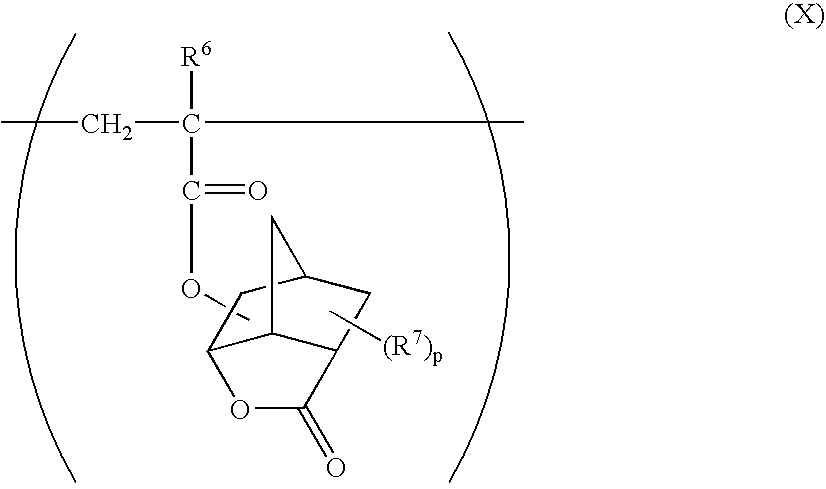
wherein R6 represents a hydrogen atom or a methyl group, R7 represents a methyl group, a trifluoromethyl group or a halogen atom, p represents an integer of 0 to 3, and when p represents 2 or 3, R7s may be the same or different each other;
- a structural unit represented by the formula (X1):

wherein R8 represents a hydrogen atom or a methyl group, R9 represents a methyl group, a trifluoromethyl group or a halogen atom, q represents an integer of 0 to 3, and when q represents 2 or 3, R9s may be the same or different each other;
- a structural unit derived from p-hydroxystyrene;
- a structural unit derived from m-hydroxystyrene;
- a structural unit derived from an alicyclic compound having an olefinic double bond such as a structural unit represented by the formula (XII):

wherein R10 and R11 each independently represents a hydrogen atom, a C1-C3 alkyl group, a C1-C3 hydroxyalkyl group, a carboxyl group, a cyano group or a —COOU group in which U represents an alcohol residue, or R10 and R11 can be bonded together to form a carboxylic anhydride residue represented by —C(═O)OC(═O)—;
- a structural unit derived from an aliphatic unsaturated dicarboxylic anhydride such as a structural unit represented by the formula (XIII):

- a structural unit represented by the formula (XIV):

and the like.
Particularly, the resin having further at least one structural unit selected from the structural unit derived from p-hydroxystyrene, the structural unit derived from m-hydroxystyrene, the structural unit derived from 3-hydroxy-1-adamantyl acrylate, the structural unit derived from 3-hydroxy-1-adamantyl methacrylate, the structural unit derived from 3,5-dihydroxy-1-adamantyl acrylate, the structural unit derived from 3,5-dihydroxy-1-adamantyl methacrylate, the structural unit represented by the formula (X) and the structural unit represented by the formula (X1) in addition to the structural unit having the acid-labile group is preferable from the standpoint of the adhesiveness of resist to a substrate and resolution of resist.
3-Hydroxy-1-adamantyl acrylate, 3-hydroxy-1-adamantyl methacrylate, 3,5-dihydroxy-1-adamantyl acrylate and 3,5-dihydroxy-1-adamantyl methacrylate can be produced, for example, by reacting the corresponding hydroxyadamantane with acrylic acid, methacrylic acid or its acid halide, and they are also commercially available.
Further, the acryloyloxy-γ-butyrolactone and the methacryloyloxy-γ-butyrolactone having the lactone ring which may be substituted with the alkyl group can be produced by reacting corresponding α- or β-bromo-γ-butyrolactone with acrylic acid or methacrylic acid, or reacting corresponding α- or β-hydroxy-γ-butyrolactone with the acrylic halide or the methacrylic halide.
As monomers to give structural units represented by the formulae (X) and (XI), specifically listed are, for example, an acrylate of alicyclic lactones and a methacrylate of alicyclic lactones having the hydroxyl group described below, and mixtures thereof. These esters can be produced, for example, by reacting the corresponding alicyclic lactone having the hydroxyl group with acrylic acid or methacrylic acid, and the production method thereof is described in, for example, JP 2000-26446 A.

Examples of the acryloyloxy-γ-butyrolactone and the methacryloyloxy-γ-butyrolactone having the lactone ring which may be substituted with the alkyl group include α-acryloyloxy-γ-butyrolactone, α-methacryloyloxy-γ-butyrolactone, α-acryloyloxy-β,β-dimethyl-γ-butyrolactone, α-methacryloyloxy-β,β-dimethyl-γ-butyrolactone, α-acryloyloxy-α-methyl-γ-butyrolactone, α-methacryloyloxy-α-methyl-γ-butyrolactone, α-acryloyloxy-γ-butyrolactone, β-methacryloyloxy-γ-butyrolactone and β-methacryloyloxy-α-methyl-γ-butyrolactone.
In the case of KrF lithography, even in the case of using a structure unit derived from hydroxystyrene such as p-hydroxystyrene and m-hydroxystyrene, as one of components of the resin, a resist composition having sufficient transparency can be obtained. For obtaining such copolymerization resins, the corresponding acrylic or methacrylic ester monomer can be radical-polymerized with acetoxystyrene and styrene, and then the acetoxy group in the structure unit derived from acetoxystyrene can be de-acetylated with an acid.
The resin containing a structural unit derived from 2-norbornene shows strong structure because the alicyclic group is directly present on its main chain and shows a property that dry etching resistance is excellent. The structural unit derived from 2-norbornene can be introduced into the main chain by radical polymerization using, for example, an aliphatic unsaturated dicarboxylic anhydride such as maleic anhydride and itaconic anhydride together in addition to corresponding 2-norbornene. The structural unit derived from 2-norbornene is formed by opening of its double bond, and can be represented by the above-mentioned formula (XII). The structural unit derived from maleic anhydride and from itaconic anhydride which are the structural unit derived from aliphatic unsaturated dicarboxylic anhydrides are formed by opening of their double bonds, and can be represented by the above-mentioned formula (XIII) and the formula (XIV), respectively.
In R10 and R11, examples of the C1-C3 alkyl group include a methyl, ethyl, and n-propyl group, and examples of the C1-C3 hydroxyalkyl group include a hydroxymethyl and 2-hydroxyethyl group.
In R10 and R11, the —COOU group is an ester formed from the carboxyl group, and as the alcohol residue corresponding to U, for example, an optionally substituted C1-C8 alkyl group, 2-oxooxolan-3-yl group, 2-oxooxolan-4-yl and the like are listed, and as the substituent on the C1-C8 alkyl group, a hydroxyl group, an alicyclic hydrocarbon residue and the like are listed.
Specific examples of the monomer used to give the structural unit represented by the above-mentioned formula (XII) may include 2-norbornene, 2-hydroxy-5-norbornene, 5-norbornene-2-carboxylic acid, methyl 5-norbornene-2-carboxylate, 2-hydroxyethyl 5-norbornene-2-carboxylate, 5-norbornene-2-methanol and 5-norbornene-2,3-dicarboxylic anhydride.
When U in the —COOU group is the acid-labile group, the structural unit represented by the formula (XII) is a structural unit having the acid-labile group even if it has the norbornane structure. Examples of monomers giving structural unit having the acid-labile group include tert-butyl 5-norbornene-2-carboxylate, 1-cyclohexyl-1-methylethyl 5-norbornene-2-carboxylate, 1-methylcyclohexyl 5-norbornene-2-carboxylate, 2-methyl-2-adamantyl 5-norbornene-2-carboxylate, 2-ethyl-2-adamantyl 5-norbornene-2-carboxylate, 1-(4-methylcyclohexyl)-1-methylethyl 5-norbornene-2-carboxylate, 1-(4-hydroxylcyclohexyl)-1-methylethyl 5-norbornene-2-carboxylate, 1-methyl-1-(4-oxocyclohexyl)ethyl 5-norbornene-2-carboxylate, 1-(1-adamantyl)-1-methylethyl 5-norbornene-2-carboxylate, and the like.
The resin preferably contains the structural unit or units having the acid-labile group generally in a ratio of 10 to 80% by mole in all structural units of the resin though the ratio varies depending on the kind of radiation for patterning exposure, the kind of the acid-labile group, and the like.
When the structural units particularly derived from the 2-alkyl-2-adamantyl acrylate, the 2-alkyl-2-adamantyl methacrylate, the 1-(1-adamantyl)-1-alkylalkyl acrylate or the 1-(1-adamantyl)-1-alkylalkyl methacrylate are used as the structural unit having the acid-labile group, it is advantageous in dry-etching resistance of the resist that the ratio of the structural units is 15% by mole or more in all structural units of the resin.
When, in addition to structural units having the acid-labile group, other structural units having the acid-stable group are contained in the resin, it is preferable that the sum of these structural units is in the range of 20 to 90% by mole based on all structural units of the resin.
The resin can be produced, for example, by conducting polymerization reaction of the corresponding monomer or monomers. The resin can also be produced by conducting oligomerization of the corresponding monomer or monomers followed by polymerizing the oligomer obtained.
The polymerization reaction is usually carried out in the presence of a radical initiator.
The radical initiator is not limited and examples thereof include an azo compound such as 2,2′-azobisisobutyronitrile, 2,2′-azobis(2-methylbutyronitrile), 1,1′-azobis(cyclohexane-1-carbonitrile), 2,2′-azobis(2,4-dimethylvaleronitrile), 2,2′-azobis(2,4-dimethyl-4-methoxyvaleronitrile), dimethyl-2,2′-azobis(2-methylpropionate) and 2,2′-azobis(2-hydroxymethylpropionitrile); an organic hydroperoxide such as lauroyl peroxide, tert-butyl hydroperoxide, benzoyl peroxide, tert-butyl peroxybenzoate, cumene hydroperoxide, diisopropyl peroxydicarbonate, di-n-propyl peroxydicarbonate, tert-butyl peroxyneodecanoate, tert-butyl peroxypivalate and 3,5,5-trimethylhexanoyl peroxide; and an inorganic peroxide such as potassium peroxodisulfate, ammonium peroxodisulfate and hydrogen peroxide. Among them, the azo compound is preferable and 2,2′-azobisisobutyronitrile, 2,2′-azobis(2-methylbutyronitrile), 1,1′-azobis(cyclohexane-1-carbonitrile), 2,2′-azobis(2,4-dimethylvaleronitrile) and dimethyl-2,2′-azobis(2-methylpropionate) are more preferable, and 2,2′-azobisisobutyronitrile and 2,2′-azobis(2,4-dimethylvaleronitrile) are especially preferable.
These radical initiators may be used alone or in a form of a mixture of two or more kinds thereof. When the mixture of two or more kinds thereof is used, the mixed ratio is not particularly limited.
The amount of the radical initiator is preferably 1 to 20% by mole based on molar amount of all monomer or oligomer.
The polymerization temperature is usually 0 to 150° C., and preferably 40 to 100° C.
The polymerization reaction is usually carried out in the presence of a solvent and it is preferred to use a solvent which is sufficient to dissolve the monomer, the radical initiator and the resin obtained. Examples thereof include a hydrocarbon solvent such as toluene; an ether solvent such as 1,4-dioxane and tetrahydrofuran; a ketone solvent such as methyl isobutyl ketone; an alcohol solvent such as isopropyl alcohol; a cyclic ester solvent such as γ-butyrolactone; a glycol ether ester ester solvent such as propylene glycol monomethyl ether acetate; and an acyclic ester solvent such as ethyl lactate. These solvents may be used alone and a mixture thereof may be used.
The amount of the solvent is not limited, and practically, it is preferably 1 to 5 parts by weight relative to 1 part of all monomers or oligomers.
When an alicyclic compound having an olefinic double bond and an aliphatic unsaturated dicarboxylic anhydride are used as monomers, it is preferable to use them in excess amount in view of a tendency that these are not easily polymerized.
After competition of the polymerization reaction, the resin produced can be isolated, for example, by adding a solvent in which the present resin is insoluble or poorly soluble to the reaction mixture obtained and filtering the precipitated resin. If necessary, the isolated resin may be purified, for example, by washing with a suitable solvent.
It is preferable that the present resist composition contains the polyhydric phenol compound (I) in an amount of about 65 to 99.9% by weight and the acid generator in an amount of 0.1 to 35% by weight on the total amount of the polyhydric phenol compound (I), the acid generator and the resin component. In the present specification, “the resin component” means the component or components except the polyhydric phenol compound (I), the acid generator and a solvent in the present resist composition.
In the present resist composition, the amount of the polyhydric phenol compound (I) is preferably 10 to 100% by weight, more preferably 20 to 100% by weight, and especially preferably 30 to 100% by weight based on the total amount of the resin component and the polyhydric phenol compound (I).
In the present resist composition, performance deterioration caused by inactivation of acid which occurs due to post exposure delay can be diminished by adding an organic base compound, particularly a nitrogen-containing organic base compound as a quencher.
Specific examples of the nitrogen-containing organic base compound include an amine compound represented by the following formulae:

wherein T1 and T2 independently represent a hydrogen atom, an alkyl group, a cycloalkyl group or an aryl group, and the alkyl, cycloalkyl and aryl groups may be substituted with at least one group selected from a hydroxyl group, an amino group which may be substituted with a C1-C4 alkyl group and a C1-C6 alkoxy group which may be substituted with a C1-C6 alkoxy group,
- T3 and T4 independently represent a hydrogen atom, an alkyl group, a cycloalkyl group, an aryl group or an alkoxy group, and the alkyl, cycloalkyl, aryl and alkoxy groups may be substituted with at least one group selected from a hydroxyl group, an amino group which may be substituted with a C1-C4 alkyl group and a C1-C6 alkoxy group, or T3 and T4 bond together with the carbon atoms to which they bond to form an aromatic ring,
- T5 represent a hydrogen atom, an alkyl group, a cycloalkyl group, an aryl group, an alkoxy group or a nitro group, and the alkyl, cycloalkyl, aryl and alkoxy groups may be substituted with at least one group selected from a hydroxyl group, an amino group which may be substituted with a C1-C4 alkyl group and a C1-C6 alkoxy group,
- T6 represents an alkyl or cycloalkyl group, and the alkyl and cycloalkyl groups may be substituted with at least one group selected from a hydroxyl group, an amino group which may be substituted with a C1-C4 alkyl group and a C1-C6 alkoxy group, and
- A1 represents —CO—, —NH—, —S—, —S—S—, an alkylene group of which at least one methylene group may be replaced with —O—, or an alkenylene group of which at least one methylene group may be replaced with —O—, and a quaternary ammonium hydroxide represented by the following formula:

wherein T1, T2 and T6 are the same as defined above, and T7 represents a hydrogen atom, an alkyl group, a cycloalkyl group or an aryl group, and the alkyl and cycloalkyl groups may be substituted with at least one group selected from a hydroxyl group, an amino group which may be substituted with a C1-C4 alkyl group and a C1-C6 alkoxy group, and the aryl group may be substituted with at least one group selected from a hydroxyl group, an amino group which may be substituted with a C1-C4 alkyl group, a C1-C6 alkoxy group and a C1-C4 perfluoroalkyl group.
The alkyl group in T1, T2, T3, T4, T5, T6 and T7 preferably has about 1 to 10 carbon atoms, and more preferably has about 1 to 6 carbon atoms.
Examples of the amino group which may be substituted with the C1-C4 alkyl group include an amino, methylamino, ethylamino, n-butylamino, dimethylamino and diethylamino group. Examples of the C1-C6 alkoxy group which may be substituted with the C1-C6 alkoxy group include a methoxy, ethoxy, n-propoxy, isopropoxy, n-butoxy, tert-butoxy, n-pentyloxy, n-hexyloxy and 2-methoxyethoxy group.
Specific examples of the alkyl group which may be substituted with at least one group selected from a hydroxyl group, an amino group which may be substituted with a C1-C4 alkyl group, and a C1-C6 alkoxy group which may be substituted with a C1-C6 alkoxy group include a methyl, ethyl, n-propyl, isopropyl, n-butyl, tert-butyl, n-pentyl, n-hexyl, n-octyl, n-nonyl, n-decyl, 2-(2-methoxyethoxy)ethyl, 2-hydroxyethyl, 2-hydroxypropyl, 2-aminoethyl, 4-aminobutyl and 6-aminohexyl group.
The cycloalkyl group in T1, T2, T3, T4, T5, T6 and T7 preferably has about 5 to 10 carbon atoms. Specific examples of the cycloalkyl group which may be substituted with at least one group selected from a hydroxyl group, an amino group which may be substituted with a C1-C4 alkyl group and a C1-C6 alkoxy group include a cyclopentyl, cyclohexyl, cycloheptyl and cyclooctyl group.
The aryl group in T1, T2, T3, T4 and T5 preferably has about 6 to 10 carbon atoms. Specific examples of the aryl group which may be substituted with at least one group selected from a hydroxyl group, an amino group which may be substituted with a C1-C4 alkyl group and a C1-C6 alkoxy group include a phenyl and naphthyl group.
The aryl group in T7 preferably has about 6 to 10 carbon atoms. Specific examples of the aryl group which may be substituted with at least one group selected from a hydroxyl group, an amino group which may be substituted with a C1-C4 alkyl group, a C1-C6 alkoxy group and a C1-C4 perfluoroalkyl group include a phenyl, naphthyl and 3-trifluoromethylphenyl group.
The alkoxy group in T3, T4 and T5 preferably has about 1 to 6 carbon atoms and specific examples thereof include a methoxy, ethoxy, n-propoxy, isopropoxy, n-butoxy, tert-butoxy, n-pentyloxy, n-hexyloxy group.
The alkylene and alkenylene groups in A1 preferably have 2 to 6 carbon atoms. Specific examples of the alkylene group include an ethylene, trimethylene, tetramethylene, methylenedioxy and ethylene-1,2-dioxy group, and specific examples of the alkenylene group include an ethane-1,2-diyl, 1-propene-1,3-diyl and 2-butene-1,4-diyl group.
Specific examples of the amine compound include n-hexylamine, n-heptylamine, n-octylamine, n-nonylamine, n-decylamine, aniline, 2-methylaniline, 3-methylaniline, 4-methylaniline, 4-nitroaniline, 1-naphthylamine, 2-naphthylamine, ethylenediamine, tetramethylenediamine, hexamethylendiamine, 4,4′-diamino-1,2-diphenylethane, 4,4′-diamino-3,3′-dimethyldiphenylmethane, 4,4′-diamino-3,3′-diethyldiphenylmethane, dibutylamine, dipentylamine, dihexylamine, diheptyamine, dioctylamine, dinonylamine, didecylamine, N-methylaniline, piperidine, diphenylamine, triethylamine, trimethylamine, tripropylamine, tributylamine, tripentylamine, trihexylamine, triheptylamine, trioctylamine, trinonylamine, tridecylamine, methyldibutylamine, methyldipentylamine, methyldihexylamine, methyldicyclohexylamine, methyldiheptylamine, methyldioctylamine, methyldinonylamine, methyldidecylamine, ethyldibutylamine, ethyldipentylamine, ethyldihexylamine, ethyldiheptylamine, ethyldioctylamine, ethyldinonylamine, ethyldidecyamine, dicyclohexylmethylamine, tris[2-(2-methoxyethoxy)ethyl]amine, triisopuropanolamine, N,N-dimethylaniline, 2,6-diisopropylaniline, imidazole, benzimidazole, pyridine, 4-methylpyridine, 4-methylimidazole, bipyridine, 2,2′-dipyridylamine, di-2-pyridyl ketone, 1,2-di(2-pyridyl)ethane, 1,2-di(4-pyridyl)ethane, 1,3-di(4-pyridyl)propane, 1,2-bis(2-pyridyl)ethylene, 1,2-bis(4-pyridyl)ethylene, 1,2-bis(4-pyridyloxy)ethane, 4,4′-dipyridyl sulfide, 4,4′-dipyridyl disulfide, 1,2-bis(4-pyridyl)ethylene, 2,2′-dipicolylamine and 3,3′-dipicolylamine.
Examples of the quaternary ammonium hydroxide include tetramethylammonium hydroxide, tetrabutylammonium hydroxide, tetrahexylammonium hydroxide, tetraoctylammonium hydroxide, phenyltrimethylammonium hydroxide, (3-trifluoromethylphenyl)trimethylammonium hydroxide and (2-hydroxyethyl)trimethylammonium hydroxide (so-called “choline”).
A hindered amine compound having a piperidine skeleton as disclosed in JP 11-52575 A1 can be also used as the quencher.
In the point of forming patterns having higher resolution, the quaternary ammonium hydroxide is preferably used as the quencher.
The amount of the quencher is usually 0.001 to 10 parts by weight, preferably 0.01 to 5 parts by weight relative to 100 parts by weight of the polyhydric phenol compound (I).
The present resist composition can contain, if necessary, a small amount of various additives such as a sensitizer, a solution suppressing agent, other polymers, a surfactant, a stabilizer and a dye as long as the effect of the present invention is not prevented.
The present resist composition is usually in the form of a resist liquid composition in which the above-mentioned ingredients are dissolved in a solvent and the resist liquid composition is applied onto a substrate such as a silicon wafer by a conventional process such as spin coating. The solvent used is sufficient to dissolve the above-mentioned ingredients, have an adequate drying rate, and give a uniform and smooth coat after evaporation of the solvent. Solvents generally used in the art can be used.
Examples of the solvent include a glycol ether ester such as ethyl cellosolve acetate, methyl cellosolve acetate and propylene glycol monomethyl ether acetate; an acyclic ester such as ethyl lactate, butyl acetate, amyl acetate and ethyl pyruvate; a ketone such as acetone, methyl isobutyl ketone, 2-heptanone and cyclohexanone; and a cyclic ester such as γ-butyrolactone. These solvents may be used alone and two or more thereof may be mixed to use.
A resist film applied onto the substrate and then dried is subjected to exposure for patterning, then heat-treated to facilitate a deblocking reaction, and thereafter developed with an alkali developer. The alkali developer used may be any one of various alkaline aqueous solution used in the art. Generally, an aqueous solution of tetramethylammonium hydroxide or (2-hydroxyethyl)trimethylammonium hydroxide (commonly known as “choline”) is often used.
It should be construed that embodiments disclosed here are examples in all aspects and not restrictive. It is intended that the scope of the present invention is determined not by the above descriptions but by appended Claims, and includes all variations of the equivalent meanings and ranges to the Claims.
The present invention will be described more specifically by Examples, which are not construed to limit the scope of the present invention. The “%” and “part(s)” used to represent the content of any component and the amount of any material to be used in the following Examples are on a weight basis unless otherwise specifically noted.
10 Parts of 2,6-bis[4-hydroxy-3-(2-hydroxy-5-methylbenzyl)-2,5-dimethylbenzyl]-4-methylphenol (hereinafter, simply referred to as B1) was dissolved in 100 parts of N,N-dimethylformamide. To the resultant solution, 6.8 parts of potassium carbonate was added. To the mixture obtained, a solution obtained by mixing 7.9 parts of 2-methyl-2-adamantyl chloroacetate with 40 parts of N,N-dimethylformamide was added dropwise below 50° C. 0.6 Part of potassium iodide was added to the mixture obtained and the resultant mixture was stirred at 50° C. for 5 hours. The reaction mixture was cooled, diluted with 1% aqueous oxalic acid solution and then extracted with ethyl acetate. The organic layer obtained was mixed with magnesium sulfate and activated carbon to dry and decolorize. The mixture obtained was filtrated and the filtrate obtained was concentrated to obtain 15.3 parts of brown solid, which is called as A1. Yield: 92%.
A1 was analyzed by liquid chromatography to find that three polyhydric phenol compounds represented by the following formulae (I) to (3):

wherein any one of R20, R21, R22, R23 and R24 is the following group:

and the other four groups are hydrogen atoms (hereinafter, simply referred to as COMPOUND (1)),

wherein any two of R25, R26, R27, R28 and R29 are the following groups:

and the other three groups are hydrogen atoms (hereinafter, simply referred to as COMPOUND (2)),

wherein any three of R30, R31, R32, R33 and R34 are the following groups:

and the other two groups are hydrogen atoms (hereinafter, simply referred to as COMPOUND (3)) were contained in A1.
The content ratio of COMPOUND (1), COMPOUND (2) and COMPOUND (3) in A1 is shown in Table 1-1. Herein, “the content ratio” means a ratio of values of each compounds calculated by a liquid chromatography area percentage method.
Liquid chromatography mass spectroscopy;
COMPOUND (1): [M+K]+=861.4 (M+=822.45)
COMPOUND (2): [M+K]+=1067.4 (M+=1028.58)
COMPOUND (3): [M+K]+=1273.6 (M+=1234.71)
According to a similar manner as that of Example 1, the reactions were conducted to obtain solids containing COMPOUNDS (1) to (3) except that the molar amount of 2-methyl-2-adamantyl chloroacetate was changed as shown in Table 1-1.
The results are shown in Table 1-1.
Herein, molar ratio of 2-methyl-2-adamantyl chloroacetate was calculated by dividing molar amount of 2-methyl-2-adamantyl chloroacetate by molar amount of B1. “Content Ratio” means a ratio of values of each compound calculated by a liquid chromatography area percentage method.
The solid obtained in Example 2 is called as A2 and the solid obtained in Example 5 is called as A3.
| TABLE 1-1 | |||
| Molar ratio of | Content Ratio (%) | ||
| 2-methyl- | COM- | ||||
| Ex. | 2-adamantyl | COMPOUND | COMPOUND | POUND | |
| No. | chloroacetate | B1 | (1) | (2) | (3) |
| 1 | 2.0 | 0 | 4 | 92 | 4 |
| 2 | 1.0 | 29 | 33 | 38 | 0 |
| 3 | 1.5 | 4 | 29 | 67 | 0 |
| 4 | 1.8 | 1 | 21 | 78 | 0 |
| 5 | 3.0 | 0 | 1 | 56 | 43 |
50.8 Parts of B1 was dissolved in 435 parts of N,N-dimethylformamide. To the resultant solution, 32.88 parts of potassium carbonate was added. To the mixture obtained, a solution obtained by mixing 43.5 parts of 2-ethyl-2-adamantyl chloroacetate with 218 parts of N,N-dimethylformamide was added dropwise below 50° C. 2.63 Part of potassium iodide was added to the mixture obtained and the resultant mixture was stirred at 50° C. for 5 hours. The reaction mixture was cooled, diluted with 5% aqueous oxalic acid solution and then extracted with ethyl acetate. The organic layer obtained was washed with water and mixed with magnesium sulfate and activated carbon to dry and decolorize. The mixture obtained was filtrated and the filtrate obtained was concentrated to obtain 65.76 parts of brown solid, which is called as A4. Yield: 76%.
A4 was analyzed by liquid chromatography to find that three polyhydric phenol compounds represented by the following formulae (4) to (6):

wherein any one of R40, R41, R42, R43 and R44 is the following group:

and the other four groups are hydrogen atoms (hereinafter, simply referred to as COMPOUND (4)),

wherein any two of R45, R46, R47, R48 and R49 are the following groups:

and the other three groups are hydrogen atoms (hereinafter, simply referred to as COMPOUND (5)),

wherein any three of R50, R51, R52, R53 and R54 are the following groups:

and the other two groups are hydrogen atoms (hereinafter, simply referred to as COMPOUND (6)) were contained in A4.
The content ratio of COMPOUND (4), COMPOUND (5) and COMPOUND (6) in A4 is shown in Table 1-2. Herein, “the content ratio” means a ratio of values of each compounds calculated by a liquid chromatography area percentage method.
Liquid chromatography mass spectroscopy;
COMPOUND (4): [M+K]+=875.3 (M+=836.47)
COMPOUND (5): [M+K]+=1095.4 (M+=1056.61)
COMPOUND (6): [M+K]+=1315.5 (M+=1276.76)
According to a similar manner as that of Example 6, the reaction was conducted to obtain the solid containing COMPOUNDS (4) to (5) except that the molar amount of 2-ethyl-2-adamantyl chloroacetate was changed as shown in Table 1-2.
The result is shown in Table 1-2.
Herein, molar ratio of 2-ethyl-2-adamantyl chloroacetate was calculated by dividing molar amount of 2-ethyl-2-adamantyl chloroacetate by molar amount of B1. “Content Ratio” means a ratio of values of each compound calculated by a liquid chromatography area percentage method.
| TABLE 1-2 | |||
| Molar ratio of | Content Ratio (%) | ||
| 2-ethyl-2- | COM- | ||||
| Ex. | adamantyl | COMPOUND | COMPOUND | POUND | |
| No. | chloroacetate | B1 | (4) | (5) | (6) |
| 6 | 2.0 | 0 | 12 | 84 | 4 |
| 7 | 1.0 | 23 | 52 | 25 | 0 |
According to the method described in JP 2003-107708A1, a copolymer of 2-ethyl-2-adamantyl methacrylate and p-hydroxystyrene (2-ethyl-2-adamantyl methacrylate/p-hydroxystyrene ratio=20/80), which is called as C1, a copolymer of 2-ethyl-2-adamantyl methacrylate and p-hydroxystyrene (2-ethyl-2-adamantyl methacrylate/p-hydroxystyrene ratio=30/70), which is called as C2, and a copolymer of 2-methyl-2-adamantyl methacrylate and p-hydroxystyrene (2-methyl-2-adamantyl methacrylate/p-hydroxystyrene ratio=30/70), which is called as C3, were synthesized.
According to the method described in U.S. Pat. No. 6,239,231 B1, a copolymer of 2-ethyl-2-adamantyl methacrylate, 3-hydroxy-1-adamantyl methacrylate and α-methacryloyl-γ-butyrolactone (2-ethyl-2-adamantyl methacrylate/3-hydroxy-1-adamantyl methacrylate/α-methacryloyl-γ-butyrolactone ratio=50/25/25), which is called as C4, was synthesized.
This copolymer C4 had the following structural units and the weight-average molecular weight thereof was about 9,200.

According to the method described in U.S. Pat. No. 5,556,995 B1, the polyhydric phenol compound represented by the following formula:

was synthesized from pyrogallol and acetone, which is called as B2.
Acid generators, quenchers and solvents used in following Examples are followings.
<Acid generator>
Acid generator S1: (4-methylphenyl)diphenylsulfonium nonafluorobutanesulfonate
Acid generator S2: triphenylsulfonium (1-adamantylmethoxy)carbonyldifluoromethanesulfonate
- Acid generator S3: triphenylsulfonium (4-oxo-1-adamantyloxy)carbonyldifluoromethanesulfonate
- Acid generator S4: triphenylsulfonium (3-hydroxy-1-adamantyl)methoxycarbonyldifluoromethanesulfonate
<Quencher> - Quencher Q1: 2,6-diisopropylaniline
- Quencher Q2: tetrabutylammonium hydroxide
| <Solvent> |
| Solvent Y: | propylene glycol monomethyl ether acetate | 180 parts |
| 2-heptanone | 30 parts | |
| 1-methoxy-2-propanol | 40 parts | |
| γ-butyrolactone | 5 parts | |
The following components were mixed to give a solution, and the solution was further filtrated through a fluorine resin filter having a pore diameter of 0.2 μm, to prepare resist liquid.
Compound (kind and amount are described in Tables 2-1 and 2-2)
Acid generator (kind and amount are described in Tables 2-1 and 2-2)
Quencher (kind and amount are described in Tables 2-1 and 2-2)
Solvent (kind are described in Tables 2-1 and 2-2)
| TABLE 2-1 | ||||||
| Compound | Acid generator | Quencher | ||||
| (kind/amount | (kind/amount | (kind/amount | ||||
| Ex. No. | (part)) | (part)) | (part)) | Solvent | PB (° C.) | PEB (° C.) |
| Ex. 8 | A1/5 | S1/0.8 | Q1/0.03 | Y | 110 | 105 |
| B1/5 | ||||||
| Ex. 9 | A1/5 | S2/0.8 | Q1/0.03 | Y | 110 | 105 |
| B1/5 | ||||||
| Ex. | A1/5 | S3/0.8 | Q1/0.03 | Y | 110 | 105 |
| 10 | B1/5 | |||||
| Ex. | A1/5 | S4/0.8 | Q1/0.03 | Y | 110 | 105 |
| 11 | B1/5 | |||||
| Ex. | A1/5 | S3/3.0 | Q1/0.15 | Y | 110 | 95 |
| 12 | B1/5 | Q2/0.10 | ||||
| Ex. | A1/7 | S3/3.0 | Q1/0.15 | Y | 110 | 95 |
| 13 | B1/3 | Q2/0.10 | ||||
| Ex. | A1/6 | S3/0.8 | Q1/0.18 | Y | 110 | 105 |
| 14 | B1/2 | |||||
| B2/2 | ||||||
| Ex. | A3/5 | S3/3.0 | Q1/0.15 | Y | 110 | 95 |
| 15 | B1/5 | Q2/0.10 | ||||
| Ex. | A4/5 | S3/1.5 | Q1/0.05 | Y | 110 | 95 |
| 16 | B1/5 | Q2/0.05 | ||||
| Ex. | A1/2.5 | S3/1.5 | Q1/0.01 | Y | 110 | 95 |
| 17 | A4/2.5 | |||||
| B2/5 | ||||||
| Ex. | A2/10 | S2/1.2 | Q1/0.01 | Y | 110 | 105 |
| 18 | ||||||
| Ex. | A1/10 | S2/1.2 | Q1/0.075 | Y | 110 | 105 |
| 19 | ||||||
| Ex. | A1/10 | S3/3.0 | Q1/0.01 | Y | 100 | 90 |
| 20 | ||||||
| Ex. | A3/10 | S2/1.2 | Q1/0.01 | Y | 110 | 105 |
| 21 | ||||||
| Ex. | A4/10 | S2/1.2 | Q1/0.01 | Y | 110 | 90 |
| 22 | ||||||
| Ex. | A3/5 | S1/1.2 | Q1/0.01 | Y | 110 | 105 |
| 23 | C4/5 | |||||
| Ex. | A3/5 | S2/1.2 | Q1/0.01 | Y | 110 | 105 |
| 24 | C4/5 | |||||
| Ex. | A1/5 | S2/1.2 | Q1/0.01 | Y | 110 | 105 |
| 25 | C2/5 | |||||
| TABLE 2-2 | ||||||
| Compound | Acid generator | Quencher | ||||
| (kind/amount | (kind/amount | (kind/amount | ||||
| Ex. No. | (part)) | (part)) | (part)) | Solvent | PB (° C.) | PEB (° C.) |
| Ex. | A1/5 | S1/1.2 | Q1/0.01 | Y | 110 | 110 |
| 26 | C3/5 | |||||
| Ex. | A1/5 | S2/1.2 | Q1/0.01 | Y | 110 | 115 |
| 27 | C3/5 | |||||
| Ex. | A1/2.5 | S3/1.5 | Q1/0.05 | Y | 110 | 95 |
| 28 | B1/2.5 | Q2/0.05 | ||||
| C1/2.5 | ||||||
| C2/2.5 | ||||||
| Ex. | A1/5 | S3/1.5 | Q1/0.05 | Y | 110 | 100 |
| 29 | C1/2.5 | Q2/0.05 | ||||
| C2/2.5 | ||||||
| Comp. | C1/5 | S1/0.8 | Q1/0.018 | Y | 110 | 105 |
| Ex. 1 | C2/5 | |||||
| Comp. | C1/5 | S2/0.8 | Q1/0.018 | Y | 110 | 105 |
| Ex. 2 | C2/5 | |||||
| Comp. | C1/5 | S3/0.8 | Q1/0.018 | Y | 110 | 105 |
| Ex. 3 | C2/5 | |||||
| Comp. | C1/5 | S4/0.8 | Q1/0.018 | Y | 110 | 105 |
| Ex. 4 | C2/5 | |||||
Silicon wafers were each contacted with hexamethyldisilazane at 90° C. for 60 seconds and each of the resist liquids prepared as above was spin-coated over the silicon wafer to give a film thickness after drying of 0.12 μm. After application of each of the resist liquids, the silicon wafers thus coated with the respective resist liquids were each prebaked on a direct hotplate at a temperature shown in the column of “PB” in Table 2-1 or 2-2 for 60 seconds. Using a writing electron beam lithography system (“HL-800D” manufactured by Hitachi, Ltd., 50 KeV), each wafer on which the respective resist film had been thus formed was exposed to a line and space pattern, while changing stepwise the exposure quantity.
After the exposure, each wafer was subjected to post-exposure baking on a hotplate at a temperature shown in the column of “PEB” in Table 2-1 or 2-2 for 60 seconds and then to paddle development with an aqueous solution of 2.38% by weight tetramethylammonium hydroxide for 60 seconds.
Each of a pattern developed on the silicon substrate after the development was observed with a scanning electron microscope, and the results of which are shown in Table 3.
Effective Sensitivity (ES): It is expressed as the amount of exposure that the line pattern and the space pattern become 1:1 after exposure through 0.10 μm line and space pattern mask and development.
Resolution: It is expressed as the minimum size of space pattern which gave the space pattern split by the line pattern at the exposure amount of the effective sensitivity.
Line Edge Roughness: when line edge roughness is very good, its evaluation is marked by “◯”, when line edge roughness is good, its evaluation is marked by “Δ”, and when line edge roughness is bad, its evaluation is marked by 
| TABLE 3 | |||||
| ES | Resolution | Line Edge | |||
| Ex. No. | (μC) | (nm) | Roughness | ||
| Ex. 8 | 10 | 120 | ◯ | ||
| Ex. 9 | 8 | 90 | ◯ | ||
| Ex. 10 | 16 | 70 | ◯ | ||
| Ex. 11 | 12 | 70 | ◯ | ||
| Ex. 12 | 24 | 90 | ◯ | ||
| Ex. 13 | 24 | 80 | ◯ | ||
| Ex. 14 | 12 | 80 | ◯ | ||
| Ex. 15 | 24 | 90 | ◯ | ||
| Ex. 16 | 17 | 50 | ◯ | ||
| Ex. 17 | 24 | 80 | ◯ | ||
| Ex. 18 | 11 | 90 | ◯ | ||
| Ex. 19 | 10 | 100 | ◯ | ||
| Ex. 20 | 18 | 80 | ◯ | ||
| Ex. 21 | 7 | 90 | ◯ | ||
| Ex. 22 | 14 | 90 | ◯ | ||
| Ex. 23 | 14 | 90 | ◯ | ||
| Ex. 24 | 10 | 100 | ◯ | ||
| Ex. 25 | 10 | 60 | ◯ | ||
| Ex. 26 | 10 | 60 | ◯ | ||
| Ex. 27 | 8 | 70 | ◯ | ||
| Ex. 28 | 34 | 50 | ◯ | ||
| Ex. 29 | 41 | 60 | ◯ | ||
| Comp. Ex. 1 | 14 | 90 | X | ||
| Comp. Ex. 2 | 14 | 90 | X | ||
| Comp. Ex. 3 | 14 | 90 | X | ||
| Comp. Ex. 4 | 12 | 80 | X | ||
Apparent from the results shown in Table 3, the resist compositions obtained by Examples corresponding to the present invention show very good line edge roughness.
The present resist composition provides excellent resist pattern in line edge roughness and is suitable for extreme ultraviolet (EUV) lithography and electron lithography.
Claims (11)
1. A polyhydric phenol compound represented by the formula (I):

wherein at least one selected from R1, R2, R3, R4, and R5 is a group represented by the formula (II):

wherein X1, X2, X3 and X4 each independently represent a hydrogen atom or a C1-C4 alkyl group, n represents an integer of 0 to 3, Z1 represents a C1-C6 alkyl group or a C3-C12 cycloalkyl group, and ring Y represents an alicyclic hydrocarbon group,
and the others are hydrogen atoms.
2. The polyhydric phenol compound according to claim 1 , wherein X1 and X2 represent hydrogen atoms and n represents 0.
3. The polyhydric phenol compound according to claim 1 , wherein the molecular weight of the polyhydric phenol compound represented by the formula (I) is 730 to 5000.
4. A chemically amplified resist composition comprising a polyhydric phenol compound represented by the formula (I):

wherein at least one selected from R1, R2, R3, R4, and R5 is a group represented by the formula (II):

wherein X1, X2, X3 and X4 each independently represent a hydrogen atom or a C1-C4 alkyl group, n represents an integer of 0 to 3, Z1 represents a C1-C6 alkyl group or a C3-C12 cycloalkyl group, and ring Y represents an alicyclic hydrocarbon group,
and the others are hydrogen atoms, and an acid generator.
5. The chemically amplified resist composition according to claim 4 , wherein the composition contains at least two kinds of the polyhydric phenol compound represented by the formula (I).
6. The chemically amplified resist composition according to claim 4 or claim 5 , wherein the composition further contains at least one compound selected from a compound represented by the formula (III):

and a compound represented by the formula (V):

wherein P1, P2 and P3 each independently represents a hydrogen atom, a C1-C4 alkyl group, a C2-C4 alkenyl group, a C3-C8 cycloalkyl group, a C6-C12 aryl group or a C7-C12 aralkyl group.
7. The chemically amplified resist composition according to claim 4 or claim 5 , wherein the composition further contains a resin containing a structural unit which has an acid-labile group and which itself is insoluble or poorly soluble in an aqueous alkali solution but becomes soluble in an aqueous alkali solution by the action of an acid.
8. The chemically amplified resist composition according to claim 4 or claim 5 , wherein the composition further contains a resin containing a structural unit which has an acid-labile group and which itself is insoluble or poorly soluble in an aqueous alkali solution but becomes soluble in an aqueous alkali solution by the action of an acid and at least one compound selected from a compound represented by the formula (III):

and a compound represented by the formula (V):

wherein P1, P2 and P3 each independently represents a hydrogen atom, a C1-C4 alkyl group, a C2-C4 alkenyl group, a C3-C8 cycloalkyl group, a C6-C12 aryl group or a C7-C12 aralkyl group.
9. The chemically amplified resist composition according to claim 7 , wherein the resin containing a structural unit which has an acid-labile group and which itself is insoluble or poorly soluble in an aqueous alkali solution but becomes soluble in an aqueous alkali solution by the action of an acid is a resin containing a structural unit derived from a 2-alkyl-2-adamantyl acrylate, a 2-alkyl-2-adamantyl methacrylate, a 2-alkyl-2-adamantyl α-chloroacrylate or a 2-alkyl-2-adamantyl α-trifluoromethylacrylate, and a structure unit derived from hydroxystyrene.
10. The chemically amplified resist composition according to claim 8 , wherein the resin containing a structural unit which has an acid-labile group and which itself is insoluble or poorly soluble in an aqueous alkali solution but becomes soluble in an aqueous alkali solution by the action of an acid is a resin containing a structural unit derived from a 2-alkyl-2-adamantyl acrylate, a 2-alkyl-2-adamantyl methacrylate, a 2-alkyl-2-adamantyl α-chloroacrylate or a 2-alkyl-2-adamantyl α-trifluoromethylacrylate, and a structure unit derived from hydroxystyrene.
11. A process for production of a polyhydric phenol compound represented by the formula (I):

wherein at least one selected from R1, R2, R3, R4, and R5 is a group represented by the formula (II):

wherein X1, X2, X3 and X4 each independently represent a hydrogen atom or a C1-C4 alkyl group, n represents an integer of 0 to 3, Z1 represents a C1-C6 alkyl group or a C3-C12 cycloalkyl group, and ring Y represents an alicyclic hydrocarbon group,
and the others are hydrogen atoms,
which comprises reacting a compound represented by the formula (III):

with a compound represented by the formula (IV):

wherein X1, X2, X3, X4, n, Z1 and Y are the same as defined above, and W represents a chlorine atom, a bromine atom, an iodine atom, a methanesulfonyloxy group or a p-toluenesulfonyloxy group.
Applications Claiming Priority (2)
| Application Number | Priority Date | Filing Date | Title |
|---|---|---|---|
| JP2006289737 | 2006-10-25 | ||
| JP2006-289737 | 2006-10-25 |
Publications (2)
| Publication Number | Publication Date |
|---|---|
| US20080248417A1 US20080248417A1 (en) | 2008-10-09 |
| US7494763B2 true US7494763B2 (en) | 2009-02-24 |
Family
ID=39389298
Family Applications (1)
| Application Number | Title | Priority Date | Filing Date |
|---|---|---|---|
| US11/976,197 Expired - Fee Related US7494763B2 (en) | 2006-10-25 | 2007-10-22 | Polyhydric phenol compound and chemically amplified resist composition containing the same |
Country Status (4)
| Country | Link |
|---|---|
| US (1) | US7494763B2 (en) |
| KR (1) | KR20080037533A (en) |
| CN (1) | CN101168509A (en) |
| TW (1) | TW200833654A (en) |
Cited By (4)
| Publication number | Priority date | Publication date | Assignee | Title |
|---|---|---|---|---|
| US20090220886A1 (en) * | 2008-02-22 | 2009-09-03 | Sumitomo Chemical Company, Limited | Polyhydric compound and chemically amplified resist composition containing the same |
| US20100151379A1 (en) * | 2008-12-11 | 2010-06-17 | Sumitomo Chemical Company, Limited | Compound and chemically amplified resist composition containing the same |
| US20100151380A1 (en) * | 2008-12-11 | 2010-06-17 | Sumitomo Chemical Company, Limited | Resist composition |
| US20110236827A1 (en) * | 2010-03-26 | 2011-09-29 | Sumitomo Chemical Company, Limited | Resin and photoresist composition containing the same |
Families Citing this family (3)
| Publication number | Priority date | Publication date | Assignee | Title |
|---|---|---|---|---|
| CN101514173A (en) * | 2008-02-22 | 2009-08-26 | 住友化学株式会社 | Polyhydric compound and chemically amplified resist composition containing the same |
| TW201039057A (en) * | 2009-03-12 | 2010-11-01 | Sumitomo Chemical Co | Method for producing resist pattern |
| JP2011180579A (en) * | 2010-02-04 | 2011-09-15 | Sumitomo Chemical Co Ltd | Resist composition |
Citations (6)
| Publication number | Priority date | Publication date | Assignee | Title |
|---|---|---|---|---|
| US5407779A (en) * | 1992-06-04 | 1995-04-18 | Sumitomo Chemical Company, Limited | Positive resist composition |
| US5866724A (en) | 1995-10-18 | 1999-02-02 | Sumitomo Chemical Company, Limited | Positive resist composition and photosensitizers |
| US6492085B1 (en) * | 1999-08-10 | 2002-12-10 | Tokyo Ohka Kogyo Co., Ltd. | Positive photoresist composition and process and synthesizing polyphenol compound |
| US6551755B2 (en) * | 2000-09-12 | 2003-04-22 | Tokyo Ohka Kogyo Co., Ltd. | Positive photoresist composition |
| US6869742B2 (en) * | 2001-04-02 | 2005-03-22 | Tokyo Ohka Kogyo Co., Ltd. | Positive photoresist composition |
| JP2006058739A (en) | 2004-08-23 | 2006-03-02 | Tokyo Ohka Kogyo Co Ltd | Protective film forming material for resist layer used for electron beam or euv lithography, laminated body, and method for forming resist pattern |
-
2007
- 2007-10-22 US US11/976,197 patent/US7494763B2/en not_active Expired - Fee Related
- 2007-10-22 CN CNA2007101673189A patent/CN101168509A/en active Pending
- 2007-10-22 TW TW096139468A patent/TW200833654A/en unknown
- 2007-10-23 KR KR1020070106879A patent/KR20080037533A/en not_active Withdrawn
Patent Citations (6)
| Publication number | Priority date | Publication date | Assignee | Title |
|---|---|---|---|---|
| US5407779A (en) * | 1992-06-04 | 1995-04-18 | Sumitomo Chemical Company, Limited | Positive resist composition |
| US5866724A (en) | 1995-10-18 | 1999-02-02 | Sumitomo Chemical Company, Limited | Positive resist composition and photosensitizers |
| US6492085B1 (en) * | 1999-08-10 | 2002-12-10 | Tokyo Ohka Kogyo Co., Ltd. | Positive photoresist composition and process and synthesizing polyphenol compound |
| US6551755B2 (en) * | 2000-09-12 | 2003-04-22 | Tokyo Ohka Kogyo Co., Ltd. | Positive photoresist composition |
| US6869742B2 (en) * | 2001-04-02 | 2005-03-22 | Tokyo Ohka Kogyo Co., Ltd. | Positive photoresist composition |
| JP2006058739A (en) | 2004-08-23 | 2006-03-02 | Tokyo Ohka Kogyo Co Ltd | Protective film forming material for resist layer used for electron beam or euv lithography, laminated body, and method for forming resist pattern |
Non-Patent Citations (1)
| Title |
|---|
| Yamaguchi et al, "Characterization of Line-Edge Roughness in Resist Patterns and Estimation of its Effect on Device Performance," Proceedings of SPIE, vol. 5038 (2003), pp. 689-694. |
Cited By (6)
| Publication number | Priority date | Publication date | Assignee | Title |
|---|---|---|---|---|
| US20090220886A1 (en) * | 2008-02-22 | 2009-09-03 | Sumitomo Chemical Company, Limited | Polyhydric compound and chemically amplified resist composition containing the same |
| US8071270B2 (en) * | 2008-02-22 | 2011-12-06 | Sumitomo Chemical Company, Limited | Polyhydric compound and chemically amplified resist composition containing the same |
| US20100151379A1 (en) * | 2008-12-11 | 2010-06-17 | Sumitomo Chemical Company, Limited | Compound and chemically amplified resist composition containing the same |
| US20100151380A1 (en) * | 2008-12-11 | 2010-06-17 | Sumitomo Chemical Company, Limited | Resist composition |
| US8158329B2 (en) | 2008-12-11 | 2012-04-17 | Sumitomo Chemical Company, Limited | Compound and chemically amplified resist composition containing the same |
| US20110236827A1 (en) * | 2010-03-26 | 2011-09-29 | Sumitomo Chemical Company, Limited | Resin and photoresist composition containing the same |
Also Published As
| Publication number | Publication date |
|---|---|
| US20080248417A1 (en) | 2008-10-09 |
| KR20080037533A (en) | 2008-04-30 |
| TW200833654A (en) | 2008-08-16 |
| CN101168509A (en) | 2008-04-30 |
Similar Documents
| Publication | Publication Date | Title |
|---|---|---|
| US7439006B2 (en) | Salt suitable for an acid generator and a chemically amplified positive resist composition containing the same | |
| KR101296989B1 (en) | A resin suitable for an acid generator and a chemically amplified positive resist composition containing the same | |
| US7579132B2 (en) | Salt suitable for an acid generator and a chemically amplified positive resist composition containing the same | |
| US7998656B2 (en) | Chemically amplified positive resist composition | |
| US7972763B2 (en) | Chemically amplified positive resist composition | |
| US7611822B2 (en) | Salt suitable for an acid generator and a chemically amplified positive resist composition containing the same | |
| US7741007B2 (en) | Chemicallly amplified resist composition | |
| US7175963B2 (en) | Chemical amplification type positive resist composition and a resin therefor | |
| US7667050B2 (en) | Salt suitable for an acid generator and a chemically amplified positive resist composition containing the same | |
| US20090317744A1 (en) | Polymer and chemically amplified resist composition comprising the same | |
| US7572570B2 (en) | Chemically amplified resist composition | |
| US7803513B2 (en) | Chemically amplified resist composition | |
| US7494763B2 (en) | Polyhydric phenol compound and chemically amplified resist composition containing the same | |
| US20090286937A1 (en) | Chemically amplified positive resist composition | |
| US20080220369A1 (en) | Chemically amplified resist composition | |
| US20080176168A1 (en) | Chemically amplified resist composition | |
| US7759045B2 (en) | Chemically amplified positive resist composition | |
| JP4239661B2 (en) | Chemically amplified resist composition | |
| US20110033804A1 (en) | Photoresist composition |
Legal Events
| Date | Code | Title | Description |
|---|---|---|---|
| AS | Assignment |
Owner name: SUMITOMO CHEMICAL COMPANY, LIMITED, JAPAN Free format text: ASSIGNMENT OF ASSIGNORS INTEREST;ASSIGNORS:TAKEMOTO, ICHIKI;ANDO, NOBUO;SHIGEMATSU, JUNJI;REEL/FRAME:021135/0552;SIGNING DATES FROM 20071026 TO 20071105 |
|
| FPAY | Fee payment |
Year of fee payment: 4 |
|
| REMI | Maintenance fee reminder mailed | ||
| LAPS | Lapse for failure to pay maintenance fees | ||
| STCH | Information on status: patent discontinuation |
Free format text: PATENT EXPIRED DUE TO NONPAYMENT OF MAINTENANCE FEES UNDER 37 CFR 1.362 |
|
| STCH | Information on status: patent discontinuation |
Free format text: PATENT EXPIRED DUE TO NONPAYMENT OF MAINTENANCE FEES UNDER 37 CFR 1.362 |
|
| FP | Lapsed due to failure to pay maintenance fee |
Effective date: 20170224 |