US7482363B2 - Piperidine derivatives useful as modulators of chemokine receptor activity - Google Patents
Piperidine derivatives useful as modulators of chemokine receptor activity Download PDFInfo
- Publication number
- US7482363B2 US7482363B2 US10/508,332 US50833204A US7482363B2 US 7482363 B2 US7482363 B2 US 7482363B2 US 50833204 A US50833204 A US 50833204A US 7482363 B2 US7482363 B2 US 7482363B2
- Authority
- US
- United States
- Prior art keywords
- alkyl
- compound
- formula
- optionally substituted
- alkoxy
- Prior art date
- Legal status (The legal status is an assumption and is not a legal conclusion. Google has not performed a legal analysis and makes no representation as to the accuracy of the status listed.)
- Expired - Fee Related, expires
Links
- 0 [1*]CC1CCN(C2CCN(C([2*])C)CC2)CC1 Chemical compound [1*]CC1CCN(C2CCN(C([2*])C)CC2)CC1 0.000 description 21
- ROUYFJUVMYHXFJ-UHFFFAOYSA-N CC(C)(C)OC(=O)N1CCC(=O)CC1 Chemical compound CC(C)(C)OC(=O)N1CCC(=O)CC1 ROUYFJUVMYHXFJ-UHFFFAOYSA-N 0.000 description 2
- HJOHQOBTDWJTJN-UHFFFAOYSA-N CB(O)N1CCC(N2CCC(O)CC2)CC1 Chemical compound CB(O)N1CCC(N2CCC(O)CC2)CC1 HJOHQOBTDWJTJN-UHFFFAOYSA-N 0.000 description 1
Classifications
-
- C—CHEMISTRY; METALLURGY
- C07—ORGANIC CHEMISTRY
- C07D—HETEROCYCLIC COMPOUNDS
- C07D405/00—Heterocyclic compounds containing both one or more hetero rings having oxygen atoms as the only ring hetero atoms, and one or more rings having nitrogen as the only ring hetero atom
- C07D405/14—Heterocyclic compounds containing both one or more hetero rings having oxygen atoms as the only ring hetero atoms, and one or more rings having nitrogen as the only ring hetero atom containing three or more hetero rings
-
- A—HUMAN NECESSITIES
- A61—MEDICAL OR VETERINARY SCIENCE; HYGIENE
- A61P—SPECIFIC THERAPEUTIC ACTIVITY OF CHEMICAL COMPOUNDS OR MEDICINAL PREPARATIONS
- A61P1/00—Drugs for disorders of the alimentary tract or the digestive system
-
- A—HUMAN NECESSITIES
- A61—MEDICAL OR VETERINARY SCIENCE; HYGIENE
- A61P—SPECIFIC THERAPEUTIC ACTIVITY OF CHEMICAL COMPOUNDS OR MEDICINAL PREPARATIONS
- A61P11/00—Drugs for disorders of the respiratory system
-
- A—HUMAN NECESSITIES
- A61—MEDICAL OR VETERINARY SCIENCE; HYGIENE
- A61P—SPECIFIC THERAPEUTIC ACTIVITY OF CHEMICAL COMPOUNDS OR MEDICINAL PREPARATIONS
- A61P11/00—Drugs for disorders of the respiratory system
- A61P11/02—Nasal agents, e.g. decongestants
-
- A—HUMAN NECESSITIES
- A61—MEDICAL OR VETERINARY SCIENCE; HYGIENE
- A61P—SPECIFIC THERAPEUTIC ACTIVITY OF CHEMICAL COMPOUNDS OR MEDICINAL PREPARATIONS
- A61P11/00—Drugs for disorders of the respiratory system
- A61P11/06—Antiasthmatics
-
- A—HUMAN NECESSITIES
- A61—MEDICAL OR VETERINARY SCIENCE; HYGIENE
- A61P—SPECIFIC THERAPEUTIC ACTIVITY OF CHEMICAL COMPOUNDS OR MEDICINAL PREPARATIONS
- A61P17/00—Drugs for dermatological disorders
-
- A—HUMAN NECESSITIES
- A61—MEDICAL OR VETERINARY SCIENCE; HYGIENE
- A61P—SPECIFIC THERAPEUTIC ACTIVITY OF CHEMICAL COMPOUNDS OR MEDICINAL PREPARATIONS
- A61P19/00—Drugs for skeletal disorders
- A61P19/02—Drugs for skeletal disorders for joint disorders, e.g. arthritis, arthrosis
-
- A—HUMAN NECESSITIES
- A61—MEDICAL OR VETERINARY SCIENCE; HYGIENE
- A61P—SPECIFIC THERAPEUTIC ACTIVITY OF CHEMICAL COMPOUNDS OR MEDICINAL PREPARATIONS
- A61P25/00—Drugs for disorders of the nervous system
- A61P25/28—Drugs for disorders of the nervous system for treating neurodegenerative disorders of the central nervous system, e.g. nootropic agents, cognition enhancers, drugs for treating Alzheimer's disease or other forms of dementia
-
- A—HUMAN NECESSITIES
- A61—MEDICAL OR VETERINARY SCIENCE; HYGIENE
- A61P—SPECIFIC THERAPEUTIC ACTIVITY OF CHEMICAL COMPOUNDS OR MEDICINAL PREPARATIONS
- A61P29/00—Non-central analgesic, antipyretic or antiinflammatory agents, e.g. antirheumatic agents; Non-steroidal antiinflammatory drugs [NSAID]
-
- A—HUMAN NECESSITIES
- A61—MEDICAL OR VETERINARY SCIENCE; HYGIENE
- A61P—SPECIFIC THERAPEUTIC ACTIVITY OF CHEMICAL COMPOUNDS OR MEDICINAL PREPARATIONS
- A61P31/00—Antiinfectives, i.e. antibiotics, antiseptics, chemotherapeutics
- A61P31/12—Antivirals
- A61P31/14—Antivirals for RNA viruses
- A61P31/16—Antivirals for RNA viruses for influenza or rhinoviruses
-
- A—HUMAN NECESSITIES
- A61—MEDICAL OR VETERINARY SCIENCE; HYGIENE
- A61P—SPECIFIC THERAPEUTIC ACTIVITY OF CHEMICAL COMPOUNDS OR MEDICINAL PREPARATIONS
- A61P37/00—Drugs for immunological or allergic disorders
-
- A—HUMAN NECESSITIES
- A61—MEDICAL OR VETERINARY SCIENCE; HYGIENE
- A61P—SPECIFIC THERAPEUTIC ACTIVITY OF CHEMICAL COMPOUNDS OR MEDICINAL PREPARATIONS
- A61P37/00—Drugs for immunological or allergic disorders
- A61P37/08—Antiallergic agents
-
- A—HUMAN NECESSITIES
- A61—MEDICAL OR VETERINARY SCIENCE; HYGIENE
- A61P—SPECIFIC THERAPEUTIC ACTIVITY OF CHEMICAL COMPOUNDS OR MEDICINAL PREPARATIONS
- A61P43/00—Drugs for specific purposes, not provided for in groups A61P1/00-A61P41/00
-
- A—HUMAN NECESSITIES
- A61—MEDICAL OR VETERINARY SCIENCE; HYGIENE
- A61P—SPECIFIC THERAPEUTIC ACTIVITY OF CHEMICAL COMPOUNDS OR MEDICINAL PREPARATIONS
- A61P9/00—Drugs for disorders of the cardiovascular system
- A61P9/10—Drugs for disorders of the cardiovascular system for treating ischaemic or atherosclerotic diseases, e.g. antianginal drugs, coronary vasodilators, drugs for myocardial infarction, retinopathy, cerebrovascula insufficiency, renal arteriosclerosis
-
- C—CHEMISTRY; METALLURGY
- C07—ORGANIC CHEMISTRY
- C07D—HETEROCYCLIC COMPOUNDS
- C07D211/00—Heterocyclic compounds containing hydrogenated pyridine rings, not condensed with other rings
- C07D211/04—Heterocyclic compounds containing hydrogenated pyridine rings, not condensed with other rings with only hydrogen or carbon atoms directly attached to the ring nitrogen atom
- C07D211/06—Heterocyclic compounds containing hydrogenated pyridine rings, not condensed with other rings with only hydrogen or carbon atoms directly attached to the ring nitrogen atom having no double bonds between ring members or between ring members and non-ring members
- C07D211/36—Heterocyclic compounds containing hydrogenated pyridine rings, not condensed with other rings with only hydrogen or carbon atoms directly attached to the ring nitrogen atom having no double bonds between ring members or between ring members and non-ring members with hetero atoms or with carbon atoms having three bonds to hetero atoms with at the most one bond to halogen, e.g. ester or nitrile radicals, directly attached to ring carbon atoms
- C07D211/56—Nitrogen atoms
- C07D211/58—Nitrogen atoms attached in position 4
-
- C—CHEMISTRY; METALLURGY
- C07—ORGANIC CHEMISTRY
- C07D—HETEROCYCLIC COMPOUNDS
- C07D409/00—Heterocyclic compounds containing two or more hetero rings, at least one ring having sulfur atoms as the only ring hetero atoms
- C07D409/14—Heterocyclic compounds containing two or more hetero rings, at least one ring having sulfur atoms as the only ring hetero atoms containing three or more hetero rings
Definitions
- the present invention concerns piperidine derivatives having pharmaceutical activity, to processes for preparing such derivatives, to pharmaceutical compositions comprising such derivatives and to the use of such derivatives as active therapeutic agents.
- Histamine is a basic amine, 2-(4-imidazolyl)-ethylamine, and is formed from histidine by histidine decarboxylase. It is found in most tissues of the body, but is present in high concentrations in the lung, skin and in the gastrointestinal tract. At the cellular level inflammatory cells such as mast cells and basophils store large amounts of histamine. It is recognised that the degranulation of mast cells and basophils and the subsequent release of histamine is a fundamental mechanism responsible for the clinical manifestation of an allergic process. Histamine produces its actions by an effect on specific histamine G-protein coupled receptors, which are of three main types, H1, H2 and H3.
- Histamine H1 antagonists comprise the largest class of medications used in the treatment of patients with allergic disorders, such as rhinitis and urticaria. H1 antagonists are useful in controlling the allergic response by for example blocking the action of histamine on post-capillary venule smooth muscle, resulting in decreased vascular permeability, exudation and oedema The antagonists also produce blockade of the actions of histamine on the H1 receptors on c-type nociceptive nerve fibres, resulting in decreased itching and sneezing.
- Chemokines are chemotactic cytokines that are released by a wide variety of cells to attract macrophages, T cells, eosinophils, basophils and neutrophils to sites of inflammation and also play a consideration in the maturation of cells of the immune system. Chemokines play an important consideration in immune and inflammatory responses in various diseases and disorders, including asthma and allergic diseases, as well as autoimmune pathologies such as rheumatoid arthritis and atherosclerosis. These small secreted molecules are a growing superfamily of 8-14 kDa proteins characterised by a conserved four cysteine motif.
- the chemokine superfamily can be divided into two main groups exhibiting characteristic structural motifs, the Cys-X-Cys (C—X—C, or ⁇ ) and Cys-Cys (C—C, or ⁇ ) families. These are distinguished on the basis of a single amino acid insertion between the NH-proximal pair of cysteine residues and sequence similarity.
- the C—X—C chemokines include several potent chemoattractants and activators of neutrophils such as interleukin-8 (IL-8) and neutrophil-activating peptide 2 (NAP-2).
- IL-8 interleukin-8
- NAP-2 neutrophil-activating peptide 2
- the C—C chemokines include potent chemoattractants of monocytes and lymphocytes but not neutrophils such as human monocyte chemotactic proteins 1-3 (MCP-1, MCP-2 and MCP-3), RANTES (Regulated on Activation, Normal T Expressed and Secreted), eotaxin and the macrophage inflammatory proteins 1 ⁇ and 1 ⁇ (MIP-1 ⁇ and MIP-1 ⁇ ).
- chemokines are mediated by subfamilies of G protein-coupled receptors, among which are the receptors designated CCR1, CCR2, CCR2A, CCR2B, CCR3, CCR4, CCR5, CCR6, CCR7, CCR8, CCR9, CCR10, CXCR1, CXCR2, CXCR3 and CXCR4.
- G protein-coupled receptors among which are the receptors designated CCR1, CCR2, CCR2A, CCR2B, CCR3, CCR4, CCR5, CCR6, CCR7, CCR8, CCR9, CCR10, CXCR1, CXCR2, CXCR3 and CXCR4.
- the present invention provides a compound of formula (I):
- Certain compounds of the present invention can exist in different isomeric forms (such as enantiomers, diastereomers, geometric isomers or tautomers).
- the present invention covers all such isomers and mixtures thereof in all proportions.
- Suitable salts include acid addition salts such as a hydrochloride, dihydrochloride, hydrobromide, phosphate, acetate, diacetate, fumarate, maleate, tartrate, citrate, oxalate, methanesulphonate or p-toluenesulphonate.
- acid addition salts such as a hydrochloride, dihydrochloride, hydrobromide, phosphate, acetate, diacetate, fumarate, maleate, tartrate, citrate, oxalate, methanesulphonate or p-toluenesulphonate.
- Another example of an addition salt is sulphate.
- Salts also include metal salts, such as a sodium, potassium, magnesium or calcium salt.
- the compounds of the invention may exist as solvates (such as hydrates) and the present invention covers all such solvates.
- Halogen includes fluorine, chlorine, bromine and iodine.
- Halogen is, for example, fluorine or chlorine.
- Alkyl groups and moieties are straight or branched chain and are, for example, methyl, ethyl, n-propyl, iso-propyl or tert-butyl.
- Alkenyl groups are, for example, vinyl or allyl.
- Cycloalkyl is mono-, bi or tricyclic and is, for example, cyclopropyl, cyclopentyl, cyclohexyl, norbornyl or camphoryl.
- the cycloalkyl ring is optionally fused to a benzene ring (for example forming a bicyclo[4.2.0]octa-1,3,5-trienyl or indanyl ring system).
- Cycloalkenyl is, for example, monocyclic and is, for example, cyclopentenyl or cyclohexenyl.
- Aryl is, for example, phenyl or naphthyl.
- Heterocyclyl is an aromatic or non-aromatic 5 or 6 membered ring, optionally fused to one or more other rings, comprising at least one heteroatom selected from the group comprising nitrogen, oxygen and sulphur; or an N-oxide thereof, or an S-oxide or S-dioxide thereof.
- Heterocyclyl is, for example, furyl, thienyl (also known as thiophenyl), pyrrolyl, 2,5-dihydropyrrolyl, thiazolyl, pyrazolyl, oxazolyl, isoxazolyl, imidazolyl, piperidinyl, morpholinyl, pyridinyl (for example in 6-oxo-1,6-dihydro-pyridinyl), pyrimidinyl, indolyl, 2,3-dihydroindolyl, benzo[b]furyl (also known as benzofuryl), benz[b]thienyl (also known as benzthienyl or benzthiophenyl), 2,3-dihydrobenz[b]thienyl (for example in 1-dioxo-2,3-dihydrobenz[b]thienyl), indazolyl, benzimidazolyl, benztriazoly
- N-oxide of a compound of formula (I) is, for example, a 1-oxy-[1,4′]bipiperidinyl-1′-yl compound.
- the invention provides a compound of formula (I) wherein X is O.
- R 24 is hydrogen
- R 1 is phenyl optionally substituted with fluorine, chlorine, C 1-4 alkyl (for example methyl) or C 1-4 alkoxy (for example methoxy).
- R 1 is phenyl optionally substituted (for example with one, two or three) with fluorine, chlorine, C 1-4 alkyl (for example methyl) or C 1-4 alkoxy (for example methoxy).
- R 1 is phenyl optionally substituted (for example with one, two or three) with fluorine, chlorine or C 1-4 alkyl (for example methyl).
- R 1 is phenyl substituted by one, two or three of fluorine, chlorine, methyl or methoxy.
- R 1 is 3,4-dichlorophenyl, 2,4-dichloro-3-methylphenyl, 3,4-dichloro-2-methylphenyl, 2,4-dichlorophenyl, 4-chloro-2-methylphenyl or 2-chloro4-fluorophenyl.
- R 1 is phenyl optionally substituted (for example independently di-substituted) with halogen (for example chlorine) or C 1-4 alkyl (for example methyl).
- R 2 is unsubstituted phenyl, mono-substituted phenyl or mono-substituted heterocyclyl, the substituents being chosen from those described above.
- R 2 is oxo substituted heterocyclyl, said heterocyclyl optionally further substituted with one or more substituents chosen from those described above.
- R 2 is phenyl or heterocyclyl, either of which is optionally substituted by: halo, hydroxy, nitro, cyano, amino, C 1-4 alkyl (itself optionally substituted by S(O) 2 (C 1-4 alkyl) or S(O) 2 phenyl), C 1-4 alkoxy, S(O) p R 4 (wherein p is 0, 1 or 2 (for example 2)), C(O)NH 2 , NHS(O) 2 (C 1-4 alkyl), S(O) 2 NH 2 , S(O) 2 NH(C 1-4 allyl) or S(O) 2 N(C 1-4 alkyl) 2 ; and R 4 is C 1-4 alkyl, C 1-4 hydroxyalkyl, C 3-7 cycloalkyl or C 3-7 cycloalkyl(C 1-4 alkyl)(such as cyclopropylmethyl).
- R 2 is phenyl mono-substituted by halo, hydroxy, nitro, cyano, amino, C 1-4 alkyl (itself optionally substituted by S(O) 2 (C 1-4 alkyl) or S(O) 2 phenyl), C 1-4 alkoxy, S(O) p R 4 (wherein p is 0, 1 or 2 (for example 2)), C(O)NH 2 , NHS(O) 2 (C 1-4 alkyl), S(O) 2 NH 2 , S(O) 2 NH(C 1-4 alkyl) or S(O) 2 N(C 1-4 alkyl) 2 ; and R 4 is C 1-4 alkyl, C 1-4 hydroxyalkyl, C 3-7 cycloalkyl or C 3-7 cycloalkyl(C 1-4 alkyl)(such as cyclopropylmethyl).
- R 2 is phenyl (optionally substituted by C 1-6 alkyl (itself optionally mono-substituted by hydroxy), C 1-6 alkoxy or phenyl), naphthylenyl (optionally substituted by C 1-4 alkoxy) or heterocyclyl.
- Heterocyclyl is, for example, thienyl, furanyl, benzofuranyl or benzo[b]thienyl.
- heterocyclyl is optionally substituted by halogen, C 1-4 alkyl or C 1-4 alkoxy.
- the present invention provides a compound of formula (I) wherein X is O; R 1 is phenyl optionally substituted by halogen (for example chlorine) or C 1-4 alkyl (for example methyl); and R 2 is as defined above.
- a compound of formula (I) can be prepared by coupling a compound of formula (II):
- L is a suitable leaving group (such as can be halogen (such as chloro) or C 1-6 alkylsulfonyl) and the coupling can be carried out in a suitable solvent (such as water).
- a suitable leaving group such as can be halogen (such as chloro) or C 1-6 alkylsulfonyl
- a compound of formula (I) can be prepared by reductive amination of a compound (II) with an ester (such as a C 1-6 alkyl ester or a benzyl ester) of a compound of formula (IIIa):
- a compound of formula (I) where R 24 represents H can be prepared by a three component coupling of a compound of formula (II) with compounds of formula (IIIb) and (IIIc):
- a compound of formula (II) can be prepared by deprotecting a compound of formula (IV):
- a suitable solvent such as dichloromethane
- a source of hydrogen chloride in a suitable solvent (such as dioxane).
- a compound of formula (IV), wherein X is O, can be prepared by reacting a compound of formula (V):
- a compound of formula (IV), wherein X is CO or CH 2 can be prepared by oxidising or reducing a compound of formula (VII):
- a compound of formula (VII) can be prepared by reacting a compound of formula (VIII):
- a compound of formula (VIII) can be prepared by reduction of a compound of formula (IX):
- a compound of formula (I) wherein X is NR 3 can be prepared by reacting a compound of formula (X):
- a compound of formula (X) can be prepared by reacting NHR 1 R 3 with a compound of formula (XII):
- the present invention provides processes for the preparation of compounds of formula (I).
- the compounds of formula (I) have activity as pharmaceuticals, in particular as modulators of chemokine receptor (for example CCR3) activity, and may be used in the treatment of autoimmune, inflammatory, proliferative or hyperproliferative diseases, or immunologically-mediated diseases (including rejection of transplanted organs or tissues and Acquired Immunodeficiency Syndrome (AIDS)).
- chemokine receptor for example CCR3
- immunologically-mediated diseases including rejection of transplanted organs or tissues and Acquired Immunodeficiency Syndrome (AIDS)).
- the compounds of formula (I) or a pharmaceutically acceptable salt thereof or a solvate thereof are also H1 antagonists (and can, therefore, be used in the treatment of allergic disorders); and may also be used to control a sign and/or symptom of what is commonly referred to as a cold (for example a sign and/or symptom of a common cold or influenza or other associated respiratory virus infection).
- a method for treating a chemokine mediated disease state for example a CCR3 mediated disease state
- a chemokine mediated disease state for example a CCR3 mediated disease state
- a mammal such as man, suffering from, or at risk of, said disease state
- administering to a mammal in need of such treatment a therapeutically effective amount of a compound of the formula (I) or a pharmaceutically acceptable salt thereof or a solvate thereof.
- a method for antagonising H1 in a mammal such as man, suffering from, or at risk of, an H1 mediated disease state, which comprises administering to a mammal in need of such treatment a therapeutically effective amount of a compound of the formula (I) or a pharmaceutically acceptable salt thereof or a solvate thereof.
- a method for treating a sign and/or symptom of what is commonly referred to as a cold in a mammal, such as man, suffering from, or at risk of, said disease state which comprises administering to a mammal in need of such treatment a therapeutically effective amount of a compound of the formula (I) or a pharmaceutically acceptable salt thereof or a solvate thereof.
- the invention also provides a compound of the formula (I), or a pharmaceutically acceptable salt thereof or a solvate thereof, for use in therapy.
- the invention provides the use of a compound of formula (I), or a pharmaceutically acceptable salt thereof or a solvate thereof, in the manufacture of a medicament for use in therapy (for example modulating chemokine receptor activity (for example CCR3 receptor activity), antagonising H1 or treating a sign and/or symptom of what is commonly referred to as a cold).
- therapy for example modulating chemokine receptor activity (for example CCR3 receptor activity), antagonising H1 or treating a sign and/or symptom of what is commonly referred to as a cold).
- the invention further provides the use of a compound of formula (I), or a pharmaceutically acceptable salt thereof, in the manufacture of a medicament for use in the treatment of:
- the invention provides a compound of formula (I), or a pharmaceutically acceptable salt thereof, for use in the treatment of asthma ⁇ such as bronchial, allergic, intrinsic, extrinsic or dust asthma, particularly chronic or inveterate asthma (for example late asthma or airways hyper-responsiveness) ⁇ ; or rhinitis ⁇ including acute, allergic, atrophic or chronic rhinitis, such as rhinitis caseosa, hypertrophic rhinitis, rhinitis purulenta, rhinitis sicca or rhinitis medicamentosa; membranous rhinitis including croupous, fibrinous or pseudomembranous rhinitis or scrofulous rhinitis; seasonal rhinitis including rhinitis nervosa (hay fever) or vasomotor rhinitis ⁇ .
- asthma such as bronchial, allergic, intrinsic, extrinsic or dust asthma, particularly chronic or inveterate asthma (for example late
- a compound of formula (I), or a pharmaceutically acceptable salt thereof is useful in the treatment of asthma.
- the present invention also provides a the use of a compound of formula (I), or a pharmaceutically acceptable salt thereof, in the manufacture of a medicament for use in the treatment of asthma ⁇ such as bronchial, allergic, intrinsic, extrinsic or dust asthma, particularly chronic or inveterate asthma (for example late asthma or airways hyper-responsiveness) ⁇ ; or rhinitis ⁇ including acute, allergic, atrophic or chronic rhinitis, such as rhinitis caseosa, hypertrophic rhinitis, rhinitis purulenta, rhinitis sicca or rhinitis medicamentosa; membranous rhinitis including croupous, fibrinous or pseudomembranous rhinitis or scrofulous rhinitis; seasonal rhinitis including rhinitis nervosa (hay fever) or vasomotor rhinitis ⁇ .
- asthma such as bronchial, allergic, intrinsic, extrinsic or dust
- the present invention provides a pharmaceutical composition which comprises a compound of the formula (I), or a pharmaceutically acceptable salt thereof or a solvate thereof (active ingredient), and a pharmaceutically acceptable adjuvant, diluent or carrier.
- the present invention provides a process for the preparation of said composition which comprises mixing active ingredient with a pharmaceutically acceptable adjuvant, diluent or carrier.
- the pharmaceutical composition will, for example, comprise from 0.05 to 99% w (percent by weight), such as from 0.05 to 80% w, for example from 0.10 to 70% w, such as from 0.10 to 50% w, of active ingredient, all percentages by weight being based on total composition.
- compositions of this invention may be administered in standard manner for the disease condition that it is desired to treat, for example by topical (such as to the lung and/or airways or to the skin), oral, rectal or parenteral administration.
- topical such as to the lung and/or airways or to the skin
- oral, rectal or parenteral administration for these purposes the compounds of this invention may be formulated by means known in the art.
- a suitable pharmaceutical composition of this invention is one suitable for oral administration in unit dosage form, for example a tablet or capsule which contains between 0.1 mg and 1 g of active ingredient
- Each patient may receive, for example, a dose of 0.01 mgkg ⁇ 1 to 100 mgkg ⁇ 1 , for example in the range of 0.1 mgkg ⁇ 1 to 20 mgkg ⁇ 1 , of the active ingredient administered, for example, 1 to 4 times per day.
- This Example illustrates the preparation of 4-(3,4-dichlorophenoxy)- ⁇ -phenyl-[1,4′-bipiperidine]-1′-acetic acid.
- This Example illustrates the preparation of 4-(3,4-dichlorophenoxy)- ⁇ -(2, 6-dimethoxyphenyl)-[1,4′-bipiperidine]-1′-acetic acid.
- This Example illustrates the preparation of 4-(4-chloro-2-methylphenoxy)- ⁇ -phenyl-[1,4′-bipiperidine]-1′-acetic acid.
- Examples 5-24 are examples of compounds of formula (I) and were prepared by the following general method.
- FLIPR Fluorometric Imaging Plate Reader
- Human eosinophils were isolated from EDTA anticoagulated peripheral blood as previously described (Hansel et al., J. Immunol. Methods, 1991, 145, 105-110). The cells were resuspended at 10 ⁇ 10 6 ml ⁇ 1 in RPMI containing 200 IU/ml penicillin, 200 ⁇ g/ml streptomycin sulphate and supplemented with 10% HIFCS, at room temperature.
- Eosinophils (700 ⁇ l) were pre-incubated for 15 mins at 37° C. with 7 ⁇ l of either vehicle or compound (100 ⁇ required final concentration in 10% DMSO).
- the chemotaxis plate (ChemoTx, 3 ⁇ m pore, Neuroprobe) was loaded by adding 28 ⁇ l of a concentration of eotaxin (0.1 to 100 nM) containing a concentration of a compound according to the Examples or solvent to the lower wells of the chemotaxis plate.
- the filter was then placed over the wells and 25 ⁇ l of eosinophil suspension were added to the top of the filter.
- the plate was incubated for 1 hr at 37° C. in a humidified incubator with a 95% air/5% CO 2 atmosphere to allow chemotaxis.
- the filter was washed once with phosphate buffered saline (PBS) containing 5 mM EDTA to remove any adherent cells.
- PBS phosphate buffered saline
- Cells that had migrated through the filter were pelleted by centrifugation (300 ⁇ g for 5 mins at room temperature) and the filter removed and the supernatant transferred to each well of a 96-well plate (Costar).
- the pelleted cells were lysed by the addition of 28 ⁇ l of PBS containing 0.5% Triton x100 followed by two cycles of freeze/thawing. The cell lysate was then added to the supernatant.
- the number of eosinophils migrating was quantified according to the method of Strath et al., J. Immunol. Methods, 1985, 83, 209 by measuring eosinophil peroxidase activity in the supernatant.
- Indomethacin (2.8 ⁇ M) was added to the Krebs solution to prevent development of smooth muscle tone due to the synthesis of cyclo-oxygenase products.
- the tracheal rings were suspended between two parallel tungsten wire hooks, one attached to an Ormed beam isometric force transducer and the other to a stationary support in the organ bath. Changes in isometric force were recorded on 2-channel Sekonic flat bed chart recorders.
- E/[A] histamine concentration effect
- Histamine H1 receptor binding activity of compounds of the invention was assessed by competition displacement of 1 nM [3H]-pyrilamine (Amersham, Bucks, Product code TRK 608, specific activity 30 Ci/mmol) to 2 ⁇ g membranes prepared from recombinant CHO-K1 cells expressing the human H1 receptor (Euroscreen SA, Brussels, Belgium, product code ES-390-M) in assay buffer (50 mM Tris pH 7.4 containing 2 mM MgCl 2 , 250 mM sucrose and 100 mM NaCl) for 1 hour at room temperature.
- assay buffer 50 mM Tris pH 7.4 containing 2 mM MgCl 2 , 250 mM sucrose and 100 mM NaCl
Landscapes
- Health & Medical Sciences (AREA)
- Chemical & Material Sciences (AREA)
- Organic Chemistry (AREA)
- Life Sciences & Earth Sciences (AREA)
- Medicinal Chemistry (AREA)
- Pharmacology & Pharmacy (AREA)
- Chemical Kinetics & Catalysis (AREA)
- General Chemical & Material Sciences (AREA)
- Bioinformatics & Cheminformatics (AREA)
- Nuclear Medicine, Radiotherapy & Molecular Imaging (AREA)
- Engineering & Computer Science (AREA)
- Veterinary Medicine (AREA)
- Public Health (AREA)
- Animal Behavior & Ethology (AREA)
- General Health & Medical Sciences (AREA)
- Pulmonology (AREA)
- Immunology (AREA)
- Virology (AREA)
- Neurology (AREA)
- Biomedical Technology (AREA)
- Rheumatology (AREA)
- Neurosurgery (AREA)
- Psychiatry (AREA)
- Oncology (AREA)
- Heart & Thoracic Surgery (AREA)
- Vascular Medicine (AREA)
- Hospice & Palliative Care (AREA)
- Molecular Biology (AREA)
- Urology & Nephrology (AREA)
- Communicable Diseases (AREA)
- Pain & Pain Management (AREA)
- Cardiology (AREA)
- Dermatology (AREA)
- Orthopedic Medicine & Surgery (AREA)
- Physical Education & Sports Medicine (AREA)
- Otolaryngology (AREA)
- Pharmaceuticals Containing Other Organic And Inorganic Compounds (AREA)
- Hydrogenated Pyridines (AREA)
- Plural Heterocyclic Compounds (AREA)
Abstract
The present invention provides a compound of formula (I), wherein the variables are defined herein; to a process for preparing such a compound; and to the use of such a compound in the treatment of a chemokine (such as CCR3) or H1 mediated disease state.

Description
This application is the national phase application under 35 U.S.C. § 371 of PCT International Application No. PCT/SE03/00442, filed Mar. 17, 2003, which claims priority to Swedish Application Serial No. 0200843-1, filed Mar. 19, 2002.
The present invention concerns piperidine derivatives having pharmaceutical activity, to processes for preparing such derivatives, to pharmaceutical compositions comprising such derivatives and to the use of such derivatives as active therapeutic agents.
Pharmaceutically active piperidine derivatives are disclosed in WO99/38514, WO99/04794 and WO00/35877.
Histamine is a basic amine, 2-(4-imidazolyl)-ethylamine, and is formed from histidine by histidine decarboxylase. It is found in most tissues of the body, but is present in high concentrations in the lung, skin and in the gastrointestinal tract. At the cellular level inflammatory cells such as mast cells and basophils store large amounts of histamine. It is recognised that the degranulation of mast cells and basophils and the subsequent release of histamine is a fundamental mechanism responsible for the clinical manifestation of an allergic process. Histamine produces its actions by an effect on specific histamine G-protein coupled receptors, which are of three main types, H1, H2 and H3. Histamine H1 antagonists comprise the largest class of medications used in the treatment of patients with allergic disorders, such as rhinitis and urticaria. H1 antagonists are useful in controlling the allergic response by for example blocking the action of histamine on post-capillary venule smooth muscle, resulting in decreased vascular permeability, exudation and oedema The antagonists also produce blockade of the actions of histamine on the H1 receptors on c-type nociceptive nerve fibres, resulting in decreased itching and sneezing.
Chemokines are chemotactic cytokines that are released by a wide variety of cells to attract macrophages, T cells, eosinophils, basophils and neutrophils to sites of inflammation and also play a rôle in the maturation of cells of the immune system. Chemokines play an important rôle in immune and inflammatory responses in various diseases and disorders, including asthma and allergic diseases, as well as autoimmune pathologies such as rheumatoid arthritis and atherosclerosis. These small secreted molecules are a growing superfamily of 8-14 kDa proteins characterised by a conserved four cysteine motif. The chemokine superfamily can be divided into two main groups exhibiting characteristic structural motifs, the Cys-X-Cys (C—X—C, or α) and Cys-Cys (C—C, or β) families. These are distinguished on the basis of a single amino acid insertion between the NH-proximal pair of cysteine residues and sequence similarity.
The C—X—C chemokines include several potent chemoattractants and activators of neutrophils such as interleukin-8 (IL-8) and neutrophil-activating peptide 2 (NAP-2).
The C—C chemokines include potent chemoattractants of monocytes and lymphocytes but not neutrophils such as human monocyte chemotactic proteins 1-3 (MCP-1, MCP-2 and MCP-3), RANTES (Regulated on Activation, Normal T Expressed and Secreted), eotaxin and the macrophage inflammatory proteins 1α and 1β (MIP-1α and MIP-1β).
Studies have demonstrated that the actions of the chemokines are mediated by subfamilies of G protein-coupled receptors, among which are the receptors designated CCR1, CCR2, CCR2A, CCR2B, CCR3, CCR4, CCR5, CCR6, CCR7, CCR8, CCR9, CCR10, CXCR1, CXCR2, CXCR3 and CXCR4. These receptors represent good targets for drug development since agents which modulate these receptors would be useful in the treatment of disorders and diseases such as those mentioned above.
Viral infections are known to cause lung inflammation. It has been shown experimentally that the common cold increases mucosal output of eotaxin in the airways. Instillation of eotaxin into the nose can mimic some of the signs and symptoms of a common cold. (See, Greiff L et al Allergy (1999) 54(11) 1204-8 [Experimental common cold increase mucosal output of eotaxin in atopic individuals] and Kawaguchi M et al Int. Arch. Allergy Immunol. (2000) 122 S1 44 [Expression of eotaxin by normal airway epithelial cells after virus A infection].)
The present invention provides a compound of formula (I):

wherein:
- X is CH2, C(O), O, S, S(O), S(O)2 or NR3;
- R1 is hydrogen, C1-6 alkyl, aryl or heterocyclyl;
- R2 is C3-7 cycloalkyl {optionally substituted by C1-4 alkyl, aryl or oxo}, C3-7 cycloalkenyl {optionally substituted by oxo, C1-6 alkyl or aryl}, aryl or heterocyclyl;
wherein the foregoing aryl and heterocyclyl moieties are optionally substituted by: halogen, cyano, nitro, hydroxy, oxo, S(O)pR4, OC(O)NR5R6, NR7R8, NR9C(O)R10, NR11C(O)NR12R13, S(O)2NR14R15, NR16S(O)2R17, C(O)NR18R19, C(O)R20, CO2R21, NR22CO2R23, C1-6 alkyl, C1-6 haloalkyl, C1-6 alkoxy(C1-6)alkyl, C1-6 alkoxy, C1-6 haloalkoxy, C1-6 alkoxy(C1-6)alkoxy, C1-6 alkylthio, C1-6 haloalkylthio, C2-6 alkenyl, C2-6 alkynyl, C3-10 cycloalkyl (itself optionally substituted by C1-4 alkyl or oxo), methylenedioxy, difluoromethylenedioxy, phenyl, phenyl(C1-4)alkyl, phenoxy, phenylthio, phenyl(C1-4)alkoxy, heterocyclyl, heterocyclyl(C1-4)alkyl, heterocyclyloxy or heterocyclyl(C1-4)alkoxy; wherein any of the immediately foregoing phenyl and heterocyclyl moieties are optionally substituted with halogen, hydroxy, nitro, S(O)q(C1-4 alkyl), S(O)2NH2, cyano, C1-4 alkyl, C1-4 alkoxy, C(O)NH2, C(O)NH(C1-4 alkyl), C(O)N(C1-4 alkyl)2 (and these alkyl groups may join to form a ring as described for R5 and R6 below), CO2H, CO2(C1-4 alkyl), NHC(O)(C1-4 alkyl), NHS(O)2(C1-4 alkyl), C(O)(C1-4 alkyl), CF3 or OCF3; - p and q are, independently, 0, 1 or 2;
- R3, R5, R6, R7, R8, R9, R10, R11, R12, R13,R14, R15, R16, R18, R19, R20, R21 and R22 are, independently, hydrogen, C1-6 alkyl (optionally substituted by halogen, hydroxy or C3-10 cycloalkyl), CH2(C2-6 alkenyl), phenyl (itself optionally substituted by halogen, hydroxy, nitro, NH2, NH(C1-4 alkyl), N(C1-4 alkyl)2 (and these alkyl groups may join to form a ring as described for R5 and R6 below), S(O)2(C1-4 alkyl), S(O)2NH2, cyano, C1-4 alkyl, C1-4 alkoxy, C(O)NH2, C(O)NH(C1-4 alkyl), C(O)N(C1-4 alkyl)2 (and these alkyl groups may join to form a ring as described for R5 and R6 below), CO2H, CO2(C1-4 alkyl), NHC(O)(C1-4 alkyl), NHS(O)2(C1-4 alkyl), C(O)(C1-4 alkyl), CF3 or OCF3) or heterocyclyl (itself optionally substituted by halogen, hydroxy, nitro, NH2, NH(C1-4 alkyl), N(C1-4 alkyl)2 (and these alkyl groups may join to form a ring as described for R5 and R6 below), S(O)2(C1-4 alkyl), S(O)2NH2, S(O)2NH(C1-4 alkyl), S(O)2N(C1-4 alkyl)2 (and these alkyl groups may join to form a ring as described for R5 and R6 below), cyano, C1-4 alkyl, C1-4 alkoxy, C(O)NH2, C(O)NH(C1-4 alkyl), C(O)N(C1-4 alkyl)2 (and these alkyl groups may join to form a ring as described for R5 and R6 below), CO2H, CO2(C1-4 alkyl), NHC(O)(C1-4 alkyl), NHS(O)2(C1-4 alkyl), C(O)(C1-4 alkyl), CF3 or OCF3);
- alternatively NR5R6, NR7R8, NR12R13, NR14R15, NR18R19, may, independently, form a 4-7 membered heterocyclic ring, azetidine, pyrrolidine, piperidine, azepine, 1,4-morpholine or 1,4-piperazine, the latter optionally substituted by C1-4alkyl on the distal nitrogen;
- R4, R17 and R23 are, independently, C1-6 alkyl (optionally substituted by halogen, hydroxy or C3-10 cycloalkyl), CH2(C2-6 alkenyl), phenyl (itself optionally substituted by halogen, hydroxy, nitro, NH2, NH(C1-4 alkyl), N(C1-4 alkyl)2 (and these alkyl groups may join to form a ring as described for R5 and R6 above), S(O)2(C1-4 alkyl), S(O)2NH2, S(O)2NH(C1-4 alkyl), S(O)2N(C1-4 alkyl)2 (and these alkyl groups may join to form a ring as described for R5 and R6 above), cyano, C1-4 alkyl, C1-4 alkoxy, C(O)NH2, C(O)NH(C1-4 alkyl), C(O)N(C1-4 alkyl)2 (and these alkyl groups may join to form a ring as described for R5 and R6 above), CO2H, CO2(C1-4 alkyl), NHC(O)(C1-4 alkyl), NHS(O)2(C1-4 alkyl), C(O)(C1-4 alkyl), CF3 or OCF3) or heterocyclyl (itself optionally substituted by halogen, hydroxy, nitro, NH2, NH(C1-4 alkyl), N(C1-4 alkyl)2 (and these alkyl groups may join to form a ring as described for R5 and R6 above), S(O)2(C1-4 alkyl), S(O)2NH2, S(O)2NH(C1-4 alkyl), S(O)2N(C1-4 alkyl)2 (and these alkyl groups may join to form a ring as described for R5 and R6 above), cyano, C1-4 alkyl, C1-4 alkoxy, C(O)NH2, C(O)NH(C1-4 alkyl), C(O)N(C1-4 alkyl)2 (and these alkyl groups may join to form a ring as described for R5 and R6 above), CO2H, CO2(C1-4 alkyl), NHC(O)(C1-4 alkyl), NHS(O)2(C1-4 alkyl), C(O)(C)1-4 alkyl), CF3 or OCF3);
- R24 is hydrogen, C1-6 alkyl or benzyl;
or an N-oxide thereof; or a pharmaceutically acceptable salt thereof; or a solvate thereof.
Certain compounds of the present invention can exist in different isomeric forms (such as enantiomers, diastereomers, geometric isomers or tautomers). The present invention covers all such isomers and mixtures thereof in all proportions.
Suitable salts include acid addition salts such as a hydrochloride, dihydrochloride, hydrobromide, phosphate, acetate, diacetate, fumarate, maleate, tartrate, citrate, oxalate, methanesulphonate or p-toluenesulphonate. Another example of an addition salt is sulphate. Salts also include metal salts, such as a sodium, potassium, magnesium or calcium salt.
The compounds of the invention may exist as solvates (such as hydrates) and the present invention covers all such solvates.
Halogen includes fluorine, chlorine, bromine and iodine. Halogen is, for example, fluorine or chlorine.
Alkyl groups and moieties are straight or branched chain and are, for example, methyl, ethyl, n-propyl, iso-propyl or tert-butyl.
Alkenyl groups are, for example, vinyl or allyl.
Cycloalkyl is mono-, bi or tricyclic and is, for example, cyclopropyl, cyclopentyl, cyclohexyl, norbornyl or camphoryl. The cycloalkyl ring is optionally fused to a benzene ring (for example forming a bicyclo[4.2.0]octa-1,3,5-trienyl or indanyl ring system).
Cycloalkenyl is, for example, monocyclic and is, for example, cyclopentenyl or cyclohexenyl.
Aryl is, for example, phenyl or naphthyl.
Heterocyclyl is an aromatic or non-aromatic 5 or 6 membered ring, optionally fused to one or more other rings, comprising at least one heteroatom selected from the group comprising nitrogen, oxygen and sulphur; or an N-oxide thereof, or an S-oxide or S-dioxide thereof. Heterocyclyl is, for example, furyl, thienyl (also known as thiophenyl), pyrrolyl, 2,5-dihydropyrrolyl, thiazolyl, pyrazolyl, oxazolyl, isoxazolyl, imidazolyl, piperidinyl, morpholinyl, pyridinyl (for example in 6-oxo-1,6-dihydro-pyridinyl), pyrimidinyl, indolyl, 2,3-dihydroindolyl, benzo[b]furyl (also known as benzofuryl), benz[b]thienyl (also known as benzthienyl or benzthiophenyl), 2,3-dihydrobenz[b]thienyl (for example in 1-dioxo-2,3-dihydrobenz[b]thienyl), indazolyl, benzimidazolyl, benztriazolyl, benzoxazolyl, benzthiazolyl (for example in 1H-benzthiazol-2-one-yl), 2,3-dihydrobenzthiazolyl (for example in 2,3-dihydrobenzthiazol-2-one-yl), 1,2,3-benzothiadiazolyl, an imidazopyridinyl (such as imidazo[1,2a]pyridinyl), thieno[3,2-b ]pyridin-6-yl 1,2,3-benzoxadiazolyl, benzo[1,2,3]thiadiazolyl, 2,1,3-benzothiadiazolyl, benzofurazan (also known as 2,1,3-benzoxadiazolyl), quinoxalinyl, dihydro-1-benzopyryliumyl (for example in a coumarinyl or a chromonyl), 3,4-dihydro-1H-2,1-benzothiazinyl (for example in 2-dioxo-3,4-dihydro-1H-2,1-benzothiazinyl), a pyrazolopyridine (for example 1H-pyrazolo[3,4-b]pyridinyl), a purine (for example in 3,7 -dihydro-purin-2,6-dione-8-yl), quinolinyl, isoquinolinyl (for example in 2H-isoquinolin-1 -one-yl), a naphthyridinyl (for example [1,6]naphthyridinyl or [1,8]naphthyridinyl or in 1H-[1,8]naphthyridin4-one-yl), a benzothiazinyl (for example in 4H-benzo[1,4]thiazin-3-one-yl), benzo[d]imidazo[2,1-b]thiazol-2-yl or dibenzothiophenyl (also known as dibenzothienyl); or an N-oxide thereof, or an S-oxide or S-dioxide thereof. Heterocyclyl also includes isothiazolyl.
An N-oxide of a compound of formula (I) is, for example, a 1-oxy-[1,4′]bipiperidinyl-1′-yl compound.
In one particular aspect the invention provides a compound of formula (I) wherein X is O.
In a further aspect R24 is hydrogen.
In another aspect R1 is phenyl optionally substituted with fluorine, chlorine, C1-4 alkyl (for example methyl) or C1-4 alkoxy (for example methoxy).
In yet another aspect R1 is phenyl optionally substituted (for example with one, two or three) with fluorine, chlorine, C1-4 alkyl (for example methyl) or C1-4 alkoxy (for example methoxy). In a further aspect R1 is phenyl optionally substituted (for example with one, two or three) with fluorine, chlorine or C1-4 alkyl (for example methyl). In a still further aspect R1 is phenyl substituted by one, two or three of fluorine, chlorine, methyl or methoxy. For example R1 is 3,4-dichlorophenyl, 2,4-dichloro-3-methylphenyl, 3,4-dichloro-2-methylphenyl, 2,4-dichlorophenyl, 4-chloro-2-methylphenyl or 2-chloro4-fluorophenyl.
In a still further aspect R1 is phenyl optionally substituted (for example independently di-substituted) with halogen (for example chlorine) or C1-4 alkyl (for example methyl).
In a further aspect R2 is unsubstituted phenyl, mono-substituted phenyl or mono-substituted heterocyclyl, the substituents being chosen from those described above.
In a still further aspect R2 is oxo substituted heterocyclyl, said heterocyclyl optionally further substituted with one or more substituents chosen from those described above.
In another aspect R2 is phenyl or heterocyclyl, either of which is optionally substituted by: halo, hydroxy, nitro, cyano, amino, C1-4 alkyl (itself optionally substituted by S(O)2(C1-4 alkyl) or S(O)2phenyl), C1-4 alkoxy, S(O)pR4 (wherein p is 0, 1 or 2 (for example 2)), C(O)NH2, NHS(O)2(C1-4 alkyl), S(O)2NH2, S(O)2NH(C1-4 allyl) or S(O)2N(C1-4 alkyl)2; and R4 is C1-4 alkyl, C1-4 hydroxyalkyl, C3-7 cycloalkyl or C3-7 cycloalkyl(C1-4 alkyl)(such as cyclopropylmethyl).
In a further aspect R2 is phenyl mono-substituted by halo, hydroxy, nitro, cyano, amino, C1-4 alkyl (itself optionally substituted by S(O)2(C1-4 alkyl) or S(O)2phenyl), C1-4 alkoxy, S(O)pR4 (wherein p is 0, 1 or 2 (for example 2)), C(O)NH2, NHS(O)2(C1-4 alkyl), S(O)2NH2, S(O)2NH(C1-4 alkyl) or S(O)2N(C1-4 alkyl)2; and R4 is C1-4 alkyl, C1-4 hydroxyalkyl, C3-7 cycloalkyl or C3-7 cycloalkyl(C1-4 alkyl)(such as cyclopropylmethyl).
In yet another aspect R2 is phenyl (optionally substituted by C1-6 alkyl (itself optionally mono-substituted by hydroxy), C1-6 alkoxy or phenyl), naphthylenyl (optionally substituted by C1-4 alkoxy) or heterocyclyl.
Heterocyclyl is, for example, thienyl, furanyl, benzofuranyl or benzo[b]thienyl. In a further aspect of the invention heterocyclyl is optionally substituted by halogen, C1-4 alkyl or C1-4 alkoxy.
In a further aspect the present invention provides a compound of formula (I) wherein X is O; R1 is phenyl optionally substituted by halogen (for example chlorine) or C1-4 alkyl (for example methyl); and R2 is as defined above.
A compound of formula (I) can be prepared by coupling a compound of formula (II):

with a compound of formula (III):

wherein L is a suitable leaving group (such as can be halogen (such as chloro) or C1-6 alkylsulfonyl) and the coupling can be carried out in a suitable solvent (such as water).
Alternatively, a compound of formula (I) can be prepared by reductive amination of a compound (II) with an ester (such as a C1-6 alkyl ester or a benzyl ester) of a compound of formula (IIIa):

in the presence of NaBH(OAc)3 and acetic acid, optionally followed by removal of the ester group.
Alternatively, a compound of formula (I) where R24 represents H can be prepared by a three component coupling of a compound of formula (II) with compounds of formula (IIIb) and (IIIc):

A compound of formula (II) can be prepared by deprotecting a compound of formula (IV):

for example using trifluoroacetic acid in a suitable solvent (such as dichloromethane) or using a source of hydrogen chloride in a suitable solvent (such as dioxane).
A compound of formula (IV), wherein X is O, can be prepared by reacting a compound of formula (V):

with a compound of formula (VI):

in the presence of NaBH(OAc)3 and acetic acid.
A compound of formula (IV), wherein X is CO or CH2, can be prepared by oxidising or reducing a compound of formula (VII):

A compound of formula (VII) can be prepared by reacting a compound of formula (VIII):

with a compound of formula (VI) in the presence of NaBH(OAc)3 and acetic acid. A compound of formula (VIII) can be prepared by reduction of a compound of formula (IX):

A compound of formula (I) wherein X is NR3 can be prepared by reacting a compound of formula (X):

with a compound of formula (XI):
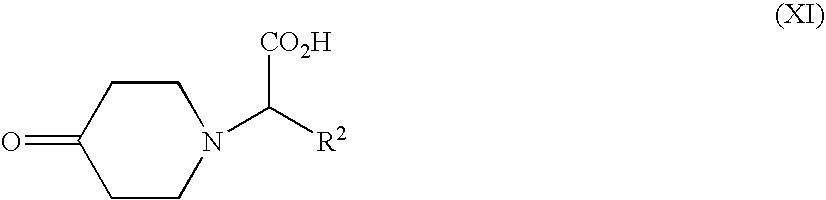
in the presence of NaBH(OAc)3 and acetic acid. A compound of formula (X) can be prepared by reacting NHR1R3 with a compound of formula (XII):

in the presence of NaBH(OAc)3 and acetic acid and then deprotecting the piperidine nitrogen {for example using trifluoroacetic acid in a suitable solvent (such as dichloromethane) or using a source of hydrogen chloride in a suitable solvent (such as dioxane)}.
Compounds (IV) where X is O and R1 represents aryl or heterocyclyl may be prepared from a compound of formula (XV):

and a compound of formula (XVI):

for example using potassium t-butoxide in N-methylpyrrolidinone, for example at 60° C.
Compounds of formula (I) where R24 is hydrogen may be converted to compounds of formula (I) where R24 is not hydrogen by standard esterifcation methods well known in the art.
Compounds of formula (I) where R24 is not hydrogen may be converted to compounds of formula (I) where R24 is hydrogen by standard ester hydrolysis methods well known in the art.
The preparation of various intermediates can be found in WO00/66559 and WO01/77101; alternatively they can be prepared by using or adapting literature methods.
Further compounds of formula (I) can be prepared by adaptation of: the routes described above, methods described in the art or the Examples recited below.
Compounds of formula (V), (VI), (IX), (XI), (XII), (XV) and (XVI) can be prepared by using or adapting methods described in the art.
In another aspect the present invention provides processes for the preparation of compounds of formula (I).
The compounds of formula (I) have activity as pharmaceuticals, in particular as modulators of chemokine receptor (for example CCR3) activity, and may be used in the treatment of autoimmune, inflammatory, proliferative or hyperproliferative diseases, or immunologically-mediated diseases (including rejection of transplanted organs or tissues and Acquired Immunodeficiency Syndrome (AIDS)).
Examples of these conditions are:
- (1) (the respiratory tract) obstructive diseases of airways including: chronic obstructive pulmonary disease (COPD)(such as irreversible COPD); asthma {such as bronchial, allergic, intrinsic, extrinsic or dust asthma, particularly chronic or inveterate asthma (for example late asthma or airways hyper-responsiveness)}; bronchitis {such as eosinophilic bronchitis}; acute, allergic, atrophic rhinitis or chronic rhinitis including rhinitis caseosa, hypertrophic rhinitis, rhinitis purulenta, rhinitis sicca or rhinitis medicamentosa; membranous rhinitis including croupous, fibrinous or pseudomembranous rhinitis or scrofulous rhinitis; seasonal rhinitis including rhinitis nervosa (hay fever) or vasomotor rhinitis; sarcoidosis; farmer's lung and related diseases; nasal polyposis; fibroid lung, idiopathic interstitial pneumonia, antitussive activity, treatment of chronic cough associated with inflammatory conditions of the airways or iatrogenic induced cough;
- (2) (bone and joints) arthrides including rheumatic, infectious, autoimmune, seronegative spondyloarthropathies (such as ankylosing spondylitis, psoriatic arthritis or Reiter's disease), Behcet's disease, Sjogren's syndrome or systemic sclerosis;
- (3) (skin and eyes) psoriasis, atopic dermatitis, contact dermatitis or other eczmatous dermitides, seborrhoetic dermatitis, lichen planus, phemphigus, bullous phemphigus, epidermolysis bullosa, urticaria, angiodermas, vasculitides erythemas, cutaneous eosinophilias, uveitis, alopecia areata, corneal ulcer or vernal conjunctivitis;
- (4) (gastrointestinal tract) Coeliac disease, proctitis, eosinophilic gastro-enteritis, mastocytosis, Crohn's disease, ulcerative colitis, irritable bowel disease or food-related allergies which have effects remote from the gut (for example migraine, rhinitis or eczema);
- (5) (Allograft rejection) acute and chronic following, for example, transplantation of kidney, heart, liver, lung, bone marrow, skin or cornea; or chronic graft versus host disease; and/or
- (6) (other tissues or diseases) Alzheimer's disease, multiple sclerosis, atherosclerosis, Acquired Immunodeficiency Syndrome (AIDS), lupus disorders (such as lupus erythematosus or systemic lupus), erythematosus, Hashimoto's thyroiditis, myasthenia gravis; type I diabetes, nephrotic syndrome, eosinophilia fascitis, hyper IgE syndrome, leprosy (such as lepromatous leprosy), peridontal disease, Sezary syndrome, idiopathic thrombocytopenia pupura or disorders of the menstrual cycle.
The compounds of formula (I) or a pharmaceutically acceptable salt thereof or a solvate thereof, are also H1 antagonists (and can, therefore, be used in the treatment of allergic disorders); and may also be used to control a sign and/or symptom of what is commonly referred to as a cold (for example a sign and/or symptom of a common cold or influenza or other associated respiratory virus infection).
According to a further feature of the present invention there is provided a method for treating a chemokine mediated disease state (for example a CCR3 mediated disease state) in a mammal, such as man, suffering from, or at risk of, said disease state, which comprises administering to a mammal in need of such treatment a therapeutically effective amount of a compound of the formula (I) or a pharmaceutically acceptable salt thereof or a solvate thereof.
According to another feature of the present invention there is provided a method for antagonising H1 in a mammal, such as man, suffering from, or at risk of, an H1 mediated disease state, which comprises administering to a mammal in need of such treatment a therapeutically effective amount of a compound of the formula (I) or a pharmaceutically acceptable salt thereof or a solvate thereof.
According to yet another feature of the present invention there is provided a method for treating a sign and/or symptom of what is commonly referred to as a cold in a mammal, such as man, suffering from, or at risk of, said disease state, which comprises administering to a mammal in need of such treatment a therapeutically effective amount of a compound of the formula (I) or a pharmaceutically acceptable salt thereof or a solvate thereof.
The invention also provides a compound of the formula (I), or a pharmaceutically acceptable salt thereof or a solvate thereof, for use in therapy.
In another aspect the invention provides the use of a compound of formula (I), or a pharmaceutically acceptable salt thereof or a solvate thereof, in the manufacture of a medicament for use in therapy (for example modulating chemokine receptor activity (for example CCR3 receptor activity), antagonising H1 or treating a sign and/or symptom of what is commonly referred to as a cold).
The invention further provides the use of a compound of formula (I), or a pharmaceutically acceptable salt thereof, in the manufacture of a medicament for use in the treatment of:
- (1) (the respiratory tract) obstructive diseases of airways including: chronic obstructive pulmonary disease (COPD)(such as irreversible COPD); asthma {such as bronchial, allergic, intrinsic, extrinsic or dust asthma, particularly chronic or inveterate asthma (for example late asthma or airways hyper-responsiveness)}; bronchitis {such as eosinophilic bronchitis}; acute, allergic, atrophic rhinitis or chronic rhinitis including rhinitis caseosa, hypertrophic rhinitis, rhinitis purulenta, rhinitis sicca or rhinitis medicamentosa; membranous rhinitis including croupous, fibrinous or pseudomembranous rhinitis or scrofulous rhinitis; seasonal rhinitis including rhinitis nervosa (hay fever) or vasomotor rhinitis; sarcoidosis; farmer's lung and related diseases; nasal polyposis; fibroid lung, idiopathic interstitial pneumonia, antitussive activity, treatment of chronic cough associated with inflammatory conditions of the airways or iatrogenic induced cough;
- (2) (bone and joints) arthrides including rheumatic, infectious, autoimmune, seronegative spondyloarthropathies (such as ankylosing spondylitis, psoriatic arthritis or Reiter's disease), Behcet's disease, Sjogren's syndrome or systemic sclerosis;
- (3) (skin and eyes) psoriasis, atopic dermatitis, contact dermatitis or other eczmatous dermitides, seborrhoetic dermatitis, lichen planus, phemphigus, bullous phemphigus, epidermolysis bullosa, urticaria, angiodermas, vasculitides erythemas, cutaneous eosinophilias, uveitis, alopecia areata, corneal ulcer or vernal conjunctivitis;
- (4) (gastrointestinal tract) Coeliac disease, proctitis, eosinophilic gastro-enteritis, mastocytosis, Crohn's disease, ulcerative colitis, irritable bowel disease or food-related allergies which have effects remote from the gut (for example migraine, rhinitis or eczema);
- (5) (Allograft rejection) acute and chronic following, for example, transplantation of kidney, heart, liver, lung, bone marrow, skin or cornea; or chronic graft versus host disease; and/or
- (6) (other tissues or diseases) Alzheimer's disease, multiple sclerosis, atherosclerosis, Acquired Immunodeficiency Syndrome (AIDS), lupus disorders (such as lupus erythematosus or systemic lupus), erythematosus, Hashimoto's thyroiditis, myasthenia gravis, type I diabetes, nephrotic syndrome, eosinophilia fascitis, hyper IgE syndrome, leprosy (such as lepromatous leprosy), Peridontal disease, sezary syndrome, idiopathic thrombocytopenia pupura or disorders of the menstrual cycle;
in a mammal (for example man).
In a further aspect the invention provides a compound of formula (I), or a pharmaceutically acceptable salt thereof, for use in the treatment of asthma {such as bronchial, allergic, intrinsic, extrinsic or dust asthma, particularly chronic or inveterate asthma (for example late asthma or airways hyper-responsiveness)}; or rhinitis {including acute, allergic, atrophic or chronic rhinitis, such as rhinitis caseosa, hypertrophic rhinitis, rhinitis purulenta, rhinitis sicca or rhinitis medicamentosa; membranous rhinitis including croupous, fibrinous or pseudomembranous rhinitis or scrofulous rhinitis; seasonal rhinitis including rhinitis nervosa (hay fever) or vasomotor rhinitis}.
In a still further aspect a compound of formula (I), or a pharmaceutically acceptable salt thereof, is useful in the treatment of asthma.
The present invention also provides a the use of a compound of formula (I), or a pharmaceutically acceptable salt thereof, in the manufacture of a medicament for use in the treatment of asthma {such as bronchial, allergic, intrinsic, extrinsic or dust asthma, particularly chronic or inveterate asthma (for example late asthma or airways hyper-responsiveness)}; or rhinitis {including acute, allergic, atrophic or chronic rhinitis, such as rhinitis caseosa, hypertrophic rhinitis, rhinitis purulenta, rhinitis sicca or rhinitis medicamentosa; membranous rhinitis including croupous, fibrinous or pseudomembranous rhinitis or scrofulous rhinitis; seasonal rhinitis including rhinitis nervosa (hay fever) or vasomotor rhinitis}.
In order to use a compound of the invention, or a pharmaceutically acceptable salt thereof or solvate thereof, for the therapeutic treatment of a mammal, such as man, said ingredient is normally formulated in accordance with standard pharmaceutical practice as a pharmaceutical composition. Therefore in another aspect the present invention provides a pharmaceutical composition which comprises a compound of the formula (I), or a pharmaceutically acceptable salt thereof or a solvate thereof (active ingredient), and a pharmaceutically acceptable adjuvant, diluent or carrier.
In a further aspect the present invention provides a process for the preparation of said composition which comprises mixing active ingredient with a pharmaceutically acceptable adjuvant, diluent or carrier. Depending on the mode of administration, the pharmaceutical composition will, for example, comprise from 0.05 to 99% w (percent by weight), such as from 0.05 to 80% w, for example from 0.10 to 70% w, such as from 0.10 to 50% w, of active ingredient, all percentages by weight being based on total composition.
The pharmaceutical compositions of this invention may be administered in standard manner for the disease condition that it is desired to treat, for example by topical (such as to the lung and/or airways or to the skin), oral, rectal or parenteral administration. For these purposes the compounds of this invention may be formulated by means known in the art. A suitable pharmaceutical composition of this invention is one suitable for oral administration in unit dosage form, for example a tablet or capsule which contains between 0.1 mg and 1 g of active ingredient
Each patient may receive, for example, a dose of 0.01 mgkg−1 to 100 mgkg−1, for example in the range of 0.1 mgkg−1 to 20 mgkg−1, of the active ingredient administered, for example, 1 to 4 times per day.
The invention will now be illustrated by the following non-limiting examples in which, unless stated otherwise:
- (i) when given, 1H NMR data is quoted and is in the form of delta values for major diagnostic protons, given in parts per million (ppm) relative to tetramethylsilane (TMS) as an internal standard, determined at 300 MHz or 400 MHz using perdeuterio DMSO-D6 (CD3SOCD3) or CDCl3 as the solvent unless otherwise stated;
- (ii) mass spectra (MS) were run with an electron energy of 70 electron volts in the chemical ionisation (CI) mode using a direct exposure probe; where indicated ionisation was effected by electron impact (EI) or fast atom bombardment (FAB); where values for m/z are given, generally only ions which indicate the parent mass are reported, and unless otherwise stated the mass ion quoted is the positive mass ion—(M+H)+;
- (iii) the title and sub-title compounds of the examples and methods were named using the index name program from Advanced Chemistry Development Inc;
- (iv) unless stated otherwise, reverse phase HPLC was conducted using a Symmetry™, NovaPak™ or Xerra™ reverse phase silica column; and
- (v) the following abbreviations are used:
| Boc or BOC | tert-butoxycarbonyl | DMSO | dimethylsulfoxide |
| HPLC | high pressure liquid | aq | aqueous |
| chromatography | |||
This Example illustrates the preparation of 4-(3,4-dichlorophenoxy)-α-phenyl-[1,4′-bipiperidine]-1′-acetic acid.
To a solution of 4-(3,4-dichlorophenoxy)-1,4′-bipiperidine (WO 01/77101) (0.500 g) in water (5 ml) was added bromo(phenyl)acetic acid (0.348 g) and the reaction was left to stir for 16 hrs. Evaporation of solvent and purification using reverse phase HPLC (with a gradient eluent system of 5% MeCN/NH4OAc(aq) (0.1%) to 95% MeCN/NH4OAc(aq) (0.1%) gave the title compound as a solid (0.049 g).
MS: APCI(−ve): 461 (M—H)−
1H NMR (CDCl3) δ 1.80-2.05 (6H, m), 2.33-2.78 (5H, m), 3.25-3.56 (7H, m), 4.23-4.26 (2H, m), 6.69 (1H, dd), 6.93 (1H, d), 7.28-7.36 (4H, m), 7.52-7.55 (2H, m).
This Example illustrates the preparation of 4-(3,4-dichlorophenoxy)-α-(2, 6-dimethoxyphenyl)-[1,4′-bipiperidine]-1′-acetic acid.
To a solution of 4-(3,4-dichlorophenoxy)-1,4′-bipiperidine (0.500 g) in ethanol (3 ml) was added 2,6-dimethoxyphenylboronic acid (0.275 g) and oxoacetic acid (0.1 ml). The mixture was heated to 80° C. for 5 minutes using microwaves at 50 Watts. The solvent was removed by evaporation. Purification using reverse phase HPLC (with a gradient eluent system of 5% MeCN/NH3(aq) (0.2%) to 95% MeCN/NH3(aq) (0.2%) gave the title compound (0.210 g).
MS: ES(+ve): 523 (M+H)+
1H NMR (CDCl3) δ 1.75-1.77 (2H, m), 1.89-1.97 (5H, m), 2.04-2.10 (1H, m), 2.39-2.43 (4H, m), 2.73-2.75 (2H, m), 2.84-2.90 (1H, m), 3.48-3.53 (2H, m), 3.84 (6H, s), 4.20-4.26 (1H, m), 5.00 (1H, s), 6.59-6.61 (2H, m), 6.71-6.74 (1H, m), 6.96-6.97 (1H, m), 7.27-7.34 (2H, m).
This Example illustrates the preparation of 4-(4-chloro-2-methylphenoxy)-α-phenyl-[1,4′-bipiperidine]-1′-acetic acid.
To a solution of 4-(4-chloro-2-methylphenoxy)-1,4′-bipiperidine (0.540 g)(WO 01/77101) in acetonitrile (5 ml) was added phenylboronic acid (0.212 g) and oxoacetic acid (0.1 ml). The mixture was heated to 100° C. for 4 minutes using microwaves at 50 Watts. The crude reaction was put onto an Oasis® MCX cartridge (Waters Chromotography) in MeOH and the cartridge washed with MeOH followed by elution with 20%/NH3(aq)/MeOH. Evaporation of solvent and further purification by reverse phase HPLC (with a gradient eluent system of 5% MeCN/NH3(aq) (0.2%) to 95% MeCN/NH3(aq) (0.2%) gave the title compound (0.052 g).
MS: APCI(+ve): 443 (M+H)+
1H NMR (CD3OD) d 1.84-2.11 (8H, m), 2.18 (3H, s), 2.69-3.01 (8H, m), 3.72 (1H, s), 4.27 (1H, s), 4.42-4.47 (1H, m), 6.88 (1H, d), 7.07-7.12 (2H, m), 7.39-7.43 (3H, m), 7.54-7.57 (2H, m).
This Example illustrates the preparation of methyl 4-(3,4-dichlorophenoxy)-α-phenyl-[1,4′-bipiperidine]-1′-acetate
4-(3,4-Dichlorophenoxy)-1,4′-bipiperidine (0.20 g) and methyl-α-bromophenylacetate (0.14 g) were dissolved in acetone (20 mL). Potassium carbonate (0.08 g) was added. The reaction mixture was stirred at room temperature for 16 h, then filtered and purified via RPHPLC (gradient Ammonium acetate/Acetonitrile 75% to 5% aqueous; Symmetry column) to give the title compound (0.09 g).
MS [M+H]+ (ES+) 477
1H NMR δ(CD3OD) 1.46-1.53 (1H, m), 1.56-1.63 (1H, m), 1.66-1.76 (2H, m), 1.77-1.86 (3H, m), 1.89-1.98 (2H, m), 2.04-2.13 (1H, m), 2.29-2.40 (1H, m), 2.48-2.57 (2H, m), 2.64-2.71 (1H, m), 2.78-2.88 (2H, m), 2.94-3.01 (1H, m), 3.56 (3H, s), 3.93 (1H, s), 4.30-4.37 (1H, m), 6.79 (1H, dd), 7.01 (1H, d), 7.22-7.34 (6H, m).
Examples 5-24 are examples of compounds of formula (I) and were prepared by the following general method.
To a solution of 4-(3,4-dichlorophenoxy)-1,4′-bipiperidine (0.004 g) in dimethyl acetamide (0.150 ml) was added appropriate boronic acid (1 molar equivalent in 0.2 ml of dimethylacetamide) and oxoacetic acid (1.5 molar equivalents). The mixture was heated to 80° C. for 5 minutes using microwaves at 300 Watts. Purification using reverse phase HPLC [with a gradient eluent system of 5% MeCN/NH3(aq) (0.2%) to 95% MeCN/NH3(aq) (2.0%)] gave the required product.
| Example | Name | (M + H)+ |
| 5 | 4-(3,4-dichlorophenoxy)-α-[3- | 493 |
| (hydroxymethyl)phenyl]-[1,4′- | ||
| bipiperidine]-1′-acetic acid | ||
| 6 | 4-(3,4-dichlorophenoxy)-α-(6-methoxy-2- | 543 |
| naphthalenyl)-[1,4′-bipiperidine]- | ||
| 1′-acetic acid | ||
| 7 | 4-(3,4-dichlorophenoxy)-α-phenyl-[1,4′- | 463 |
| bipiperidine]-1′-acetic acid | ||
| 8 | 4-(3,4-dichlorophenoxy)-α-(4-methylphenyl)- | 477 |
| [1,4′-bipiperidine]-1′-acetic acid | ||
| 9 | 4-(3,4-dichlorophenoxy)-α-(2-thienyl)-[1,4′- | 469 |
| bipiperidine]-1′-acetic acid | ||
| 10 | 4-(3,4-dichlorophenoxy)-α-(3-thienyl)-[1,4′- | 469 |
| bipiperidine]-1′-acetic acid | ||
| 11 | α-(2-benzofuranyl)-4-(3,4-dichlorophenoxy)- | 503 |
| [1,4′-bipiperidine]-1′-acetic acid | ||
| 12 | 4-(3,4-dichlorophenoxy)-α-[4-(1,1- | 536 |
| dimethylethoxy)phenyl]-[1,4′-bipiperidine]- | ||
| 1′-acetic acid | ||
| 13 | 4-(3,4-dichlorophenoxy)-α-(3-methylphenyl)- | 477 |
| [1,4′-bipiperidine]-1′-acetic acid | ||
| 14 | 4-(3,4-dichlorophenoxy)-α-(1-naphthalenyl)-[1,4′- | 513 |
| bipiperidine]-1′-acetic acid | ||
| 15 | 4-(3,4-dichlorophenoxy)-α-(2-naphthalenyl)-[1,4′- | 513 |
| bipiperidine]-1′-acetic acid | ||
| 16 | α-benzo[b]thien-2-yl-4-(3,4-dichlorophenoxy)- | 519 |
| [1,4′-bipiperidine]-1′-acetic acid | ||
| 17 | α-[1,1′-biphenyl]-3-yl-4-(3,4-dichlorophenoxy)- | 540 |
| [1,4′-bipiperidine]-1′-acetic acid | ||
| 18 | 4-(3,4-dichlorophenoxy)-α-(2,6- | 523 |
| dimethoxyphenyl)-[1,4′-bipiperidine]- | ||
| 1′-acetic acid | ||
| 19 | 4-(3,4-dichlorophenoxy)-α-(3,4- | 523 |
| dimethoxyphenyl)-[1,4′-bipiperidine]- | ||
| 1′-acetic acid | ||
| 20 | 4-(3,4-dichlorophenoxy)-α-(2,4- | 523 |
| dimethoxyphenyl)-[1,4′-bipiperidine]- | ||
| 1′-acetic acid | ||
| 21 | 4-(3,4-dichlorophenoxy)-α-[3-(1- | 505 |
| methylethyl)phenyl]-[1,4′-bipiperidine]- | ||
| 1′-acetic acid | ||
| 22 | 4-(3,4-dichlorophenoxy)-α-(3,4,5- | 553 |
| trimethoxyphenyl)]-[1,4′-bipiperidine]- | ||
| 1′-acetic acid | ||
| 23 | 4-(3,4-dichlorophenoxy)-α-[4-(1,1- | 520 |
| dimethylethyl)phenyl]-[1,4′-bipiperidine]- | ||
| 1′-acetic acid | ||
Pharmacological Analysis: Calcium Flux [Ca2+]i assay
Human Eosinophils
Human eosinophils were isolated from EDTA anticoagulated peripheral blood as previously described (Hansel et al., J. Immunol. Methods, 1991, 145, 105-110). The cells were resuspended (5×10⁶ ml−1) and loaded with 5 μM FLUO-3/AM+Pluronic F127 2.2 μl/ml (Molecular Probes) in low potassium solution (LKS; NaCl 118 mM, MgSO4 0.8 mM, glucose 5.5 mM, Na2CO3 8.5 mM, KCl 5 mM, HEPES 20 mM, CaCl2 1.8 mM, BSA 0.1%, pH 7.4) for one hour at room temperature. After loading, cells were centrifuged at 200 g for 5 min and resuspended in LKS at 2.5×10⁶ ml−1. The cells were then transferred to 96 well FLIPr plates (Poly-D-Lysine plates from Becton Dickinson pre-incubated with 5 μM fibronectin for two hours) at 25 μl/well. The plate was centrifuged at 200 g for 5 min and the cells were washed twice with LKS (200 μl; room temperature).
A compound of the Examples was pre-dissolved in DMSO and added to a final concentration of 0.1% (v/v) DMSO. Assays were initiated by the addition of an A50 concentration of eotaxin and the transient increase in fluo-3 fluorescence (lEx=490 nm and lEm=520 nm) monitored using a FLIPR (Fluorometric Imaging Plate Reader, Molecular Devices, Sunnyvale, U.S.A.).
Human Eosinophil Chemotaxis
Human eosinophils were isolated from EDTA anticoagulated peripheral blood as previously described (Hansel et al., J. Immunol. Methods, 1991, 145, 105-110). The cells were resuspended at 10×106 ml−1 in RPMI containing 200 IU/ml penicillin, 200 μg/ml streptomycin sulphate and supplemented with 10% HIFCS, at room temperature.
Eosinophils (700 μl) were pre-incubated for 15 mins at 37° C. with 7 μl of either vehicle or compound (100× required final concentration in 10% DMSO). The chemotaxis plate (ChemoTx, 3 μm pore, Neuroprobe) was loaded by adding 28 μl of a concentration of eotaxin (0.1 to 100 nM) containing a concentration of a compound according to the Examples or solvent to the lower wells of the chemotaxis plate. The filter was then placed over the wells and 25 μl of eosinophil suspension were added to the top of the filter. The plate was incubated for 1 hr at 37° C. in a humidified incubator with a 95% air/5% CO2 atmosphere to allow chemotaxis.
The medium, containing cells that had not migrated, was carefully aspirated from above the filter and discarded. The filter was washed once with phosphate buffered saline (PBS) containing 5 mM EDTA to remove any adherent cells. Cells that had migrated through the filter were pelleted by centrifugation (300×g for 5 mins at room temperature) and the filter removed and the supernatant transferred to each well of a 96-well plate (Costar). The pelleted cells were lysed by the addition of 28 μl of PBS containing 0.5% Triton x100 followed by two cycles of freeze/thawing. The cell lysate was then added to the supernatant. The number of eosinophils migrating was quantified according to the method of Strath et al., J. Immunol. Methods, 1985, 83, 209 by measuring eosinophil peroxidase activity in the supernatant.
Compounds of the Examples were found to be antagonists of the eotaxin mediated human eosinophil chemotaxis.
| % Inhibition (3 nM Human | |||
| Example | Eotaxin) | ||
| 2 | 90 | ||
| 3 | 105 | ||
Guinea-Pig Isolated Trachea
(See for example, Harrison, R. W. S., Carswell, H. & Young, J. M. (1984) European J. Pharmacol., 106, 405-409.)
Male albino Dunkin-Hartley guinea-pigs (250 g) were killed by cervical dislocation and the whole trachea removed. After clearing the adherent connective tissue, the trachea was cut into six ring segments each three cartilage bands wide and then suspended in 20 ml organ baths containing Krebs-Henseleit solution of the following composition (mM):NaCl 117.6, NaH2PO4 0.9, NaHCO3 25.0, MgSO4 1.2, KCl 5.4, CaCl2 2.6 and glucose 11.1. The buffer was maintained at 37° C. and gassed with 5% CO2 in oxygen. Indomethacin (2.8 μM) was added to the Krebs solution to prevent development of smooth muscle tone due to the synthesis of cyclo-oxygenase products. The tracheal rings were suspended between two parallel tungsten wire hooks, one attached to an Ormed beam isometric force transducer and the other to a stationary support in the organ bath. Changes in isometric force were recorded on 2-channel Sekonic flat bed chart recorders.
Experimental Protocols
At the beginning of each experiment a force of 1 g was applied to the tissues and this was reinstated over a 60 minute equilibration period until a steady resting tone was achieved. Subsequently, a cumulative histamine concentration effect (E/[A]) curve was constructed at 0.5 log10 unit increments, in each tissue. The tissues were then washed and approximately 30 minutes later, test compound or vehicle (20% DMSO) was added. Following an incubation period of 60 minutes a second E/[A] curve was performed to histamine.
Contraction responses were recorded as a percentage of the first curve maximum.
Data Analysis
Experimental E/[A] curve data were analysed for the purposes of estimating the potencies (p[A50] values) of histamine in the absence and presence of the test compound. Affinity (pA2) values of test compounds were subsequently calculated using the following equation:
log(r−1)=log[B]+pA 2
where r=[A]50 in presence of test compound/[A]50 in absence of antagonist and [B] is the concentration of test compound. Compounds of the Examples were found to be H1 antagonists.
log(r−1)=log[B]+pA 2
where r=[A]50 in presence of test compound/[A]50 in absence of antagonist and [B] is the concentration of test compound. Compounds of the Examples were found to be H1 antagonists.
Histamine H1 receptor binding activity of compounds of the invention was assessed by competition displacement of 1 nM [3H]-pyrilamine (Amersham, Bucks, Product code TRK 608, specific activity 30 Ci/mmol) to 2 μg membranes prepared from recombinant CHO-K1 cells expressing the human H1 receptor (Euroscreen SA, Brussels, Belgium, product code ES-390-M) in assay buffer (50 mM Tris pH 7.4 containing 2 mM MgCl2, 250 mM sucrose and 100 mM NaCl) for 1 hour at room temperature.
The following compounds of the invention gave inhibition of [3H] pyrilimine binding:
| Example | H1 antagonism pKi | ||
| 1 | 7.2 | ||
| 2 | 6.8 | ||
| 3 | 7.3 | ||
| 4 | 7.2 | ||
Claims (7)
1. A compound of formula (I):

wherein:
X is CH2, C(O), O, S, S(O), S(O)2 or NR3;
R1 is hydrogen, C1-6 alkyl, aryl or heterocyclyl;
R2 is C3-7 cycloalkyl {optionally substituted by C1-4 alkyl, aryl or oxo}, C3-7 cycloalkenyl {optionally substituted by oxo, C1-6 alkyl or aryl}, aryl or heterocyclyl; wherein the foregoing aryl and heterocyclyl moieties are optionally substituted by: halogen, cyano, nitro, hydroxy, oxo, S(O)pR4, OC(O)NR5R6, NR7R8, NR9C(O)R10, NR11C(O)NR12R13, S(O)2NR14R15, NR16S(O)2R17, C(O)NR18R19, C(O)R20, CO2R21, NR22CO2R23, C1-6 alkyl, C1-6 haloalkyl, C1-6 alkoxy(C1-6)alkyl, C1-6 alkoxy, C1-6 haloalkoxy, C1-6 alkoxy(C1-6)alkoxy, C1-6 alkylthio, C1-6 haloalkylthio, C2-6 alkenyl, C2-6 alkynyl, C3-10 cycloalkyl (optionally substituted by C1-4 alkyl or oxo), methylenedioxy, difluoromethylenedioxy, phenyl, phenyl(C1-4)alkyl, phenoxy, phenylthio, phenyl(C1-4)alkoxy, heterocyclyl, heterocyclyl(C1-4)alkyl, heterocyclyloxy or heterocyclyl(C1-4)alkoxy; wherein any of the immediately foregoing phenyl and heterocyclyl moieties are optionally substituted with halogen, hydroxy, nitro, S(O)q(C1-4alkyl), S(O)2NH2, cyano, C1-4 alkyl, C1-4 alkoxy, C(O)NH2, C(O)NH(C1-4 alkyl), C(O)N(C1-4 alkyl)2 (and these alkyl groups optionally being joined to form a ring as described for R5 and R6 below), CO2H, CO2(C1-4 alkyl), NHC(O)(C1-4 alkyl), NHS(O)2(C1-4 alkyl), C(O)(C1-4 alkyl), CF3 or OCF3;
p and q are, independently, 0, 1 or 2;
R3, R5, R6, R7, R8, R9, R10,R11,R12, R13, R14, R15, R16, R18, R19, R20, R21and R22 are, independently, hydrogen, C1-6 alkyl (optionally substituted by halogen, hydroxy or C3-10 cycloalkyl), CH2(C2-6 alkenyl), phenyl (optionally substituted by halogen, hydroxy, nitro, NH2, NH(C1-4 alkyl), N(C1-4 alkyl)2, S(O)2(C1-4 alkyl), S(O)2NH2, cyano, C1-4 alkyl, C1-4 alkoxy, C(O)NH2, C(O)NH(C1-4 alkyl), C(O)N(C1-4 alkyl)2 (and these alkyl groups optionally being joined to form a ring as described for R5 and R6 below), CO2H, CO2(C1-4 alkyl), NHC(O)(C1-4 alkyl), NHS(O)2(C1-4 alkyl), C(O)(C1-4 alkyl), CF3 or OCF3) or heterocyclyl (optionally substituted by halogen, hydroxy, nitro, NH2, NH(C1-4 alkyl), N(C1-4 alkyl)2, S(O)2(C1-4 alkyl), S(O)2NH2, S(O)2NH(C1-4 alkyl), S(O)2N(C1-4 alkyl)2 (and these alkyl groups optionally being joined to form a ring as described for R5and R6 below), cyano, C1-4 alkyl, C1-4 alkoxy, C(O)NH2, C(O)NH(C1-4 alkyl), C(O)N(C1-4 alkyl)2 (and these alkyl groups optionally being joined to form a ring as described for R5and R6 below), CO2H, CO2(C1-4 alkyl), NHC(O)(C1-4 alkyl), NHS(O)2(C1-4 alkyl), C(O)(C1-4 alkyl), CF3 or OCF3);
alternatively NR5R6, NR7R8, NR12R13, NR14R15, NR18R19, independently, form a 4-7 membered heterocyclic ring, azetidine, pyrrolidine, piperidine, azepine, 1,4-morpholine or 1,4-piperazine, the latter optionally substituted by C1-4alkyl on the distal nitrogen;
R4, R17and R23 are, independently, C1-6 alkyl (optionally substituted by halogen, hydroxy or C3-10 cycloalkyl), CH2(C2-6 alkenyl), phenyl (optionally substituted by halogen, hydroxy, nitro, NH2, NH(C1-4 alkyl), N(C1-4 alkyl)2 (and these alkyl groups optionally being joined to form a ring as described for R5and R6 above), S(O)2(C1-4 alkyl), S(O)2NH2, S(O)2NH(C1-4 alkyl), S(O)2N(C1-4 alkyl)2 (and these alkyl groups optionally being joined to form a ring as described for R5and R6 above), cyano, C1-4 alkyl, C1-4 alkoxy, C(O)NH2, C(O)NH(C1-4 alkyl), C(O)N(C1-4 alkyl)2 (and these alkyl groups optionally being joined to form a ring as described for R5and R6 above), CO2H, CO2(C1-4 alkyl), NHC(O)(C1-4 alkyl), NHS(O)2(C1-4 alkyl), C(O)(C1-4 alkyl), CF3 or OCF3) or heterocyclyl (optionally substituted by halogen, hydroxy, nitro, NH2, NH(C1-4 alkyl), N(C1-4 alkyl)2 (and these alkyl groups optionally being joined to form a ring as described for R5and R6 above), S(O)2(C1-4 alkyl), S(O)2NH2, S(O)2NH(C1-4 alkyl), S(O)2N(C1-4 alkyl)2 (and these alkyl groups optionally being joined to form a ring as described for R5and R6 above), cyano, C1-4 alkyl, C1-4 alkoxy, C(O)NH2, C(O)NH(C1-4 alkyl), C(O)N(C1-4 alkyl)2 (and these alkyl groups optionally being joined to form a ring as described for R5and R6 above), CO2H, CO2(C1-4 alkyl), NHC(O)(C1-4 alkyl), NHS(O)2(C1-4 alkyl), C(O)(C1-4 alkyl), CF3 or OCF3);
R24 is hydrogen, C1-6 alkyl or benzyl;
or an N-oxide thereof; or a pharmaceutically acceptable salt thereof.
2. A compound of formula (I) as claimed in claim 1 wherein X is O.
3. A compound of formula (I) as claimed in claim 1 wherein R24 is hydrogen.
4. A compound of formula (I) as claimed in claim 1 wherein R1 is phenyl optionally substituted with fluorine, chlorine, C1-4 alkyl or C1-4 alkoxy.
5. A compound of formula (I) as claimed in claim 1 wherein R2 is phenyl or heterocyclyl, either of which is optionally substituted by: halo, hydroxy, nitro, cyano, amino, C1-4 alkyl (optionally substituted by S(O)2(C1-4 alkyl) or S(O)2phenyl), C1-4 alkoxy, S(O)pR4 (wherein p is 0, 1 or 2), C(O)NH2, NHS(O)2(C1-4 alkyl), S(O)2NH2, S(O)2NH(C1-4 alkyl) or S(O)2N(C1-4 alkyl)2; and R4 is C1-4 alkyl, C1-4 hydroxyalkyl, C3-7 cycloalkyl or C3-7 cycloalkyl(C1-4 alkyl).
6. A process for preparing a compound of formula (I) as claimed in claim 1 , the process comprising:
i. coupling a compound of formula (II):

with a compound of formula (III):

wherein L is a suitable leaving group, in a suitable solvent; or,
ii. reductive amination of a compound (II) with an ester compound of formula (IIIa):

in the presence of NaBH(OAc)3 and acetic acid, followed optionally by removal of the ester group; or
iii. a three component coupling of a compound of formula (II) with compounds of formula (IIIb) and (IIIc):

7. A pharmaceutical composition which comprises a compound of the formula (I), or a pharmaceutically acceptable salt thereof as claimed in claim 1 , and a pharmaceutically acceptable adjuvant, diluent or carrier.
Applications Claiming Priority (3)
| Application Number | Priority Date | Filing Date | Title |
|---|---|---|---|
| SE0200843A SE0200843D0 (en) | 2002-03-19 | 2002-03-19 | Chemical compounds |
| SE0200843-1 | 2002-03-19 | ||
| PCT/SE2003/000442 WO2003078421A1 (en) | 2002-03-19 | 2003-03-17 | Piperidine derivatives useful as modulators of chemokine receptor activity |
Publications (2)
| Publication Number | Publication Date |
|---|---|
| US20050182094A1 US20050182094A1 (en) | 2005-08-18 |
| US7482363B2 true US7482363B2 (en) | 2009-01-27 |
Family
ID=20287325
Family Applications (1)
| Application Number | Title | Priority Date | Filing Date |
|---|---|---|---|
| US10/508,332 Expired - Fee Related US7482363B2 (en) | 2002-03-19 | 2003-03-17 | Piperidine derivatives useful as modulators of chemokine receptor activity |
Country Status (9)
| Country | Link |
|---|---|
| US (1) | US7482363B2 (en) |
| EP (1) | EP1487817B1 (en) |
| JP (1) | JP2005526089A (en) |
| AT (1) | ATE397599T1 (en) |
| AU (1) | AU2003212769A1 (en) |
| DE (1) | DE60321452D1 (en) |
| ES (1) | ES2305447T3 (en) |
| SE (1) | SE0200843D0 (en) |
| WO (1) | WO2003078421A1 (en) |
Families Citing this family (15)
| Publication number | Priority date | Publication date | Assignee | Title |
|---|---|---|---|---|
| AR033517A1 (en) * | 2000-04-08 | 2003-12-26 | Astrazeneca Ab | PIPERIDINE DERIVATIVES, PROCESS FOR THE PREPARATION AND USE OF THESE DERIVATIVES IN THE MANUFACTURE OF MEDICINES |
| EP1604982A1 (en) | 2001-07-02 | 2005-12-14 | AstraZeneca AB | Intermediates for the preparation of piperidine derivatives useful as modulators of chemokine receptor activity |
| GB0120461D0 (en) | 2001-08-22 | 2001-10-17 | Astrazeneca Ab | Novel compounds |
| GB0122503D0 (en) | 2001-09-18 | 2001-11-07 | Astrazeneca Ab | Chemical compounds |
| US6949590B2 (en) * | 2002-01-10 | 2005-09-27 | University Of Washington | Hydrogels formed by non-covalent linkages |
| SE0200844D0 (en) * | 2002-03-19 | 2002-03-19 | Astrazeneca Ab | Chemical compounds |
| SE0202838D0 (en) * | 2002-09-24 | 2002-09-24 | Astrazeneca Ab | Chemical compounds |
| SE0300957D0 (en) * | 2003-04-01 | 2003-04-01 | Astrazeneca Ab | Chemical compounds |
| SE0400925D0 (en) * | 2004-04-06 | 2004-04-06 | Astrazeneca Ab | Chemical compounds |
| TW200722419A (en) * | 2005-05-27 | 2007-06-16 | Astrazeneca Ab | Chemical compounds |
| WO2006126948A1 (en) * | 2005-05-27 | 2006-11-30 | Astrazeneca Ab | Piperidines for the treatment of chemokine mediated diseases |
| BRPI0613563A2 (en) * | 2005-07-21 | 2012-01-17 | Astrazeneca Ab | new piperidine derivatives |
| WO2010129351A1 (en) | 2009-04-28 | 2010-11-11 | Schepens Eye Research Institute | Method to identify and treat age-related macular degeneration |
| ES2616238T3 (en) | 2010-10-06 | 2017-06-12 | Glaxosmithkline Llc, Corporation Service Company | Benzimidazole derivatives as PI3 kinase inhibitors |
| US12221463B2 (en) | 2020-08-07 | 2025-02-11 | The Board Of Regents Of The University Of Oklahoma | Method of promoting wound healing by inhibiting CCR3 |
Citations (65)
| Publication number | Priority date | Publication date | Assignee | Title |
|---|---|---|---|---|
| GB1250719A (en) | 1969-03-19 | 1971-10-20 | ||
| EP0099139A2 (en) | 1982-07-12 | 1984-01-25 | Janssen Pharmaceutica N.V. | Novel N-(bicyclic heterocyclyl)-4-piperidinamines |
| EP0121972A2 (en) | 1983-04-11 | 1984-10-17 | Janssen Pharmaceutica N.V. | N-aryl-alpha-amino-carboxamides |
| EP0145037A2 (en) | 1983-10-06 | 1985-06-19 | Janssen Pharmaceutica N.V. | N-(bicyclic heterocyclyl)-4-piperidinamines |
| EP0151824A2 (en) | 1984-01-09 | 1985-08-21 | Janssen Pharmaceutica N.V. | N-(4-piperidinyl) bicyclic condensed 2-imidazolamine derivatives |
| EP0151826A1 (en) | 1984-01-09 | 1985-08-21 | Janssen Pharmaceutica N.V. | 4-[(Bicyclic heterocyclyl)-methyl and -hetero]-piperidines |
| US4695575A (en) | 1984-11-13 | 1987-09-22 | Janssen Pharmaceutica, N.V. | 4-[(bicycle heterocyclyl)-methyl and -hetero]-piperidines |
| WO1993010091A2 (en) | 1991-11-14 | 1993-05-27 | Glaxo Group Limited | Piperidine acetic acid derivatives as inhibitors of fibrinogen-dependent blood platelet aggregation |
| WO1995008535A1 (en) | 1993-09-22 | 1995-03-30 | Knoll Ag | 4-alkylamino-1-phenoxyalkyl piperidines as antiinflammatory, antiallergic and immunomodulating agents |
| WO1996026196A2 (en) | 1995-02-23 | 1996-08-29 | Schering Corporation | Benzylpiperidines and piperazines as muscarinic antagonists |
| WO1996034857A1 (en) | 1995-05-02 | 1996-11-07 | Schering Corporation | Substituted oximes, hydrazones and olefins as neurokinin antagonists |
| WO1996041631A1 (en) | 1995-06-09 | 1996-12-27 | Eli Lilly And Company | Methods of treating cold and allergic rhinitis |
| WO1997024324A1 (en) | 1995-12-27 | 1997-07-10 | Janssen Pharmaceutica N.V. | 1-(1,2-disubstituted piperidinyl)-4-substituted piperidine derivatives as tachykinin receptor antagonists |
| WO1998001425A1 (en) | 1996-07-10 | 1998-01-15 | Schering Corporation | 1,4-di-sustituted piperidines as muscarinic antagonists |
| WO1998005292A2 (en) | 1996-08-08 | 1998-02-12 | Schering Corporation | Piperidine and piperazine derivatives and their use as muscarinic antagonists |
| WO1998005291A2 (en) | 1996-08-01 | 1998-02-12 | Eli Lilly And Company | Method for treating mental retardation |
| WO1998006697A1 (en) | 1996-08-15 | 1998-02-19 | Schering Corporation | Ether muscarinic antagonists |
| WO1998011128A1 (en) | 1996-09-10 | 1998-03-19 | Dr. Karl Thomae Gmbh | Modified aminoacids, pharmaceuticals containing these compounds and method for their production |
| WO1999004794A1 (en) | 1997-07-25 | 1999-02-04 | Merck & Co., Inc. | Cyclic amine modulators of chemokine receptor activity |
| WO1999037304A1 (en) | 1998-01-27 | 1999-07-29 | Aventis Pharmaceuticals Products Inc. | SUBSTITUTED OXOAZAHETEROCYCLYL FACTOR Xa INHIBITORS |
| WO1999038514A1 (en) | 1998-02-02 | 1999-08-05 | Merck & Co., Inc. | Cyclic amine modulators of chemokine receptor activity |
| US5952349A (en) | 1996-07-10 | 1999-09-14 | Schering Corporation | Muscarinic antagonists for treating memory loss |
| WO1999051578A1 (en) | 1998-04-02 | 1999-10-14 | Janssen Pharmaceutica N.V. | Biocidal benzylbiphenyl derivatives |
| US5977138A (en) | 1996-08-15 | 1999-11-02 | Schering Corporation | Ether muscarinic antagonists |
| WO1999055324A1 (en) | 1998-04-27 | 1999-11-04 | Smithkline Beecham Corporation | Ccr-3 receptor antagonists |
| WO2000000488A1 (en) | 1998-06-30 | 2000-01-06 | Schering Corporation | Muscarinic antagonists |
| WO2000012478A1 (en) | 1998-08-31 | 2000-03-09 | Astrazeneca Ab | Arylpiperazines and their use as metalloproteinase inhibiting agents (mmp) |
| US6066636A (en) | 1998-06-30 | 2000-05-23 | Schering Corporation | Muscarinic antagonists |
| WO2000032590A1 (en) | 1998-11-25 | 2000-06-08 | Aventis Pharmaceuticals Products Inc. | SUBSTITUTED OXOAZAHETEROCYCLYL FACTOR Xa INHIBITORS |
| WO2000035877A1 (en) | 1998-12-18 | 2000-06-22 | Du Pont Pharmaceuticals Company | Heterocyclic piperidines as modulators of chemokine receptor activity |
| WO2000066559A1 (en) | 1999-05-04 | 2000-11-09 | Schering Corporation | Piperidine derivatives useful as ccr5 antagonists |
| WO2001002381A1 (en) | 1999-07-02 | 2001-01-11 | Astrazeneca Uk Limited | Piperazine derivatives as modulators of chemokine receptor activity |
| WO2001007436A2 (en) | 1999-07-28 | 2001-02-01 | Aventis Pharmaceuticals Inc. | Substituted oxoazaheterocyclyl compounds |
| EP1076055A1 (en) | 1998-04-28 | 2001-02-14 | Dainippon Pharmaceutical Co., Ltd. | 1- (1-substituted-4-piperidinyl)methyl]-4-piperidine derivatives, process for producing the same, medicinal compositions containing the same and intermediates of these compounds |
| WO2001029066A2 (en) | 1999-10-21 | 2001-04-26 | Menarini Ricerche S.P.A. | Basic monocyclic compounds having nk2 antagonist action, processes for their preparation, and formulations containing them |
| US6294554B1 (en) | 1999-09-22 | 2001-09-25 | Schering Corporation | Muscarinic antagonists |
| WO2001077101A1 (en) | 2000-04-08 | 2001-10-18 | Astrazeneca Ab | Chemical compounds |
| WO2001092227A1 (en) | 2000-05-31 | 2001-12-06 | Astrazeneca Ab | Chemical compounds |
| WO2002018335A1 (en) | 2000-08-28 | 2002-03-07 | Yamanouchi Pharmaceutical Co., Ltd. | Cyclic amine derivatives |
| WO2002020484A1 (en) | 2000-09-04 | 2002-03-14 | Astrazeneca Ab | Chemical compounds |
| US6387930B1 (en) | 1999-05-04 | 2002-05-14 | Schering Corporation | Piperidine derivatives useful as CCR5 antagonists |
| WO2002066460A1 (en) | 2001-02-19 | 2002-08-29 | Astrazeneca Ab | Chemical compounds |
| GB2373186A (en) | 2001-02-23 | 2002-09-18 | Astrazeneca Ab | Pharmaceutical combinations of a CCR3 antagonist and a compound which is usefulreatment of asthma, allergic disease or inflammation |
| WO2002072570A2 (en) | 2001-03-13 | 2002-09-19 | Schering Corporation | Non-imidazole compounds as histamine h3 antagonists |
| WO2002079194A1 (en) | 2001-03-29 | 2002-10-10 | Schering Corporation | Ccr5 antagonists useful for treating aids |
| WO2002079190A1 (en) | 2001-03-29 | 2002-10-10 | Smithkline Beecham P.L.C. | 3-substituted indoles as chemokine antagonists |
| WO2002081449A1 (en) | 2001-04-09 | 2002-10-17 | Novartis Ag | Bipiperidinyl-derivatives and their use as chemokine receptors inhibitors |
| WO2003004487A1 (en) | 2001-07-02 | 2003-01-16 | Astrazeneca Ab | Piperidine derivatives useful as modulators of chemokine receptor activity |
| WO2003018576A1 (en) | 2001-08-22 | 2003-03-06 | Astrazeneca Ab | New piperidinyl-morpholinyl derivatives as modulators of chemokine receptor activity |
| WO2003020716A1 (en) | 2001-08-29 | 2003-03-13 | Schering Corporation | Piperidine derivatives useful as ccr5 antagonists |
| WO2003022277A1 (en) | 2001-09-07 | 2003-03-20 | Bayer Healthcare Ag | Arylsulfonamide derivatives for use as ccr3 antagonists in the treatment of inflammatory and immunological disorders |
| WO2003024962A1 (en) | 2001-09-18 | 2003-03-27 | Astrazeneca Ab | Piperidine derivatives and their use as modulators of chemokine (especially ccr3) activity |
| WO2003078395A1 (en) | 2002-03-19 | 2003-09-25 | Astrazeneca Ab | Piperidine derivatives useful as modulators of chemokine receptor activity |
| EP1362857A1 (en) | 2002-05-16 | 2003-11-19 | Dainippon Pharmaceutical Co., Ltd. | (S)-4-amino-5-chloro-2-methoxy-n-[1-[1-(2-tetrahydrofuryl-carbonyl)-4-piperidinymethyl]-4-piperidinyl]benzamide for treating gastrointestinal motility disorders |
| EP1389616A1 (en) | 2001-04-27 | 2004-02-18 | Mitsubishi Pharma Corporation | Novel benzylpiperidine compound |
| WO2004029041A1 (en) | 2002-09-24 | 2004-04-08 | Astrazeneca Ab | Novel piperidine derivatives for use in the treatment of chemokine mediated disease states |
| WO2004085423A1 (en) | 2003-03-25 | 2004-10-07 | Astrazeneca Ab | Piperidine derivatives for the treatment of chemokine or h1 mediated disease state |
| WO2004087659A1 (en) | 2003-04-01 | 2004-10-14 | Astrazeneca Ab | Chemical compounds |
| WO2004099144A1 (en) | 2003-05-09 | 2004-11-18 | Astrazeneca Ab | Chemical compounds |
| WO2004113323A1 (en) | 2003-06-13 | 2004-12-29 | Schering Aktiengesellschaft | Quinolyl amide derivatives as ccr-5 antagonists |
| WO2005097775A1 (en) | 2004-04-06 | 2005-10-20 | Astrazeneca Ab | Piperidine derivates for the treatment of chemokines mediared disease |
| WO2006126947A1 (en) | 2005-05-27 | 2006-11-30 | Astrazeneca Ab | Piperidines for the treatment of chemokine mediated diseases |
| WO2006126948A1 (en) | 2005-05-27 | 2006-11-30 | Astrazeneca Ab | Piperidines for the treatment of chemokine mediated diseases |
| WO2007011293A1 (en) | 2005-07-21 | 2007-01-25 | Astrazeneca Ab | Novel piperidine derivatives |
| US7265227B2 (en) | 2001-07-23 | 2007-09-04 | Astrazeneca Ab | Piperidine derivatives useful as modulators of chemokine receptor activity |
-
2002
- 2002-03-19 SE SE0200843A patent/SE0200843D0/en unknown
-
2003
- 2003-03-17 US US10/508,332 patent/US7482363B2/en not_active Expired - Fee Related
- 2003-03-17 AT AT03708798T patent/ATE397599T1/en not_active IP Right Cessation
- 2003-03-17 AU AU2003212769A patent/AU2003212769A1/en not_active Abandoned
- 2003-03-17 WO PCT/SE2003/000442 patent/WO2003078421A1/en not_active Ceased
- 2003-03-17 JP JP2003576426A patent/JP2005526089A/en active Pending
- 2003-03-17 EP EP03708798A patent/EP1487817B1/en not_active Expired - Lifetime
- 2003-03-17 ES ES03708798T patent/ES2305447T3/en not_active Expired - Lifetime
- 2003-03-17 DE DE60321452T patent/DE60321452D1/en not_active Expired - Fee Related
Patent Citations (83)
| Publication number | Priority date | Publication date | Assignee | Title |
|---|---|---|---|---|
| GB1250719A (en) | 1969-03-19 | 1971-10-20 | ||
| EP0099139A2 (en) | 1982-07-12 | 1984-01-25 | Janssen Pharmaceutica N.V. | Novel N-(bicyclic heterocyclyl)-4-piperidinamines |
| EP0121972A2 (en) | 1983-04-11 | 1984-10-17 | Janssen Pharmaceutica N.V. | N-aryl-alpha-amino-carboxamides |
| EP0145037A2 (en) | 1983-10-06 | 1985-06-19 | Janssen Pharmaceutica N.V. | N-(bicyclic heterocyclyl)-4-piperidinamines |
| EP0151824A2 (en) | 1984-01-09 | 1985-08-21 | Janssen Pharmaceutica N.V. | N-(4-piperidinyl) bicyclic condensed 2-imidazolamine derivatives |
| EP0151826A1 (en) | 1984-01-09 | 1985-08-21 | Janssen Pharmaceutica N.V. | 4-[(Bicyclic heterocyclyl)-methyl and -hetero]-piperidines |
| US4588722A (en) | 1984-01-09 | 1986-05-13 | Janssen Pharmaceutica N.V. | N-(4-piperidinyl) bicyclic condensed 2-imidazolamine derivatives |
| US4695575A (en) | 1984-11-13 | 1987-09-22 | Janssen Pharmaceutica, N.V. | 4-[(bicycle heterocyclyl)-methyl and -hetero]-piperidines |
| WO1993010091A2 (en) | 1991-11-14 | 1993-05-27 | Glaxo Group Limited | Piperidine acetic acid derivatives as inhibitors of fibrinogen-dependent blood platelet aggregation |
| WO1995008535A1 (en) | 1993-09-22 | 1995-03-30 | Knoll Ag | 4-alkylamino-1-phenoxyalkyl piperidines as antiinflammatory, antiallergic and immunomodulating agents |
| WO1996026196A2 (en) | 1995-02-23 | 1996-08-29 | Schering Corporation | Benzylpiperidines and piperazines as muscarinic antagonists |
| US5883096A (en) | 1995-02-23 | 1999-03-16 | Schering Corporation | Muscarinic antagonists |
| US5889006A (en) | 1995-02-23 | 1999-03-30 | Schering Corporation | Muscarinic antagonists |
| WO1996034857A1 (en) | 1995-05-02 | 1996-11-07 | Schering Corporation | Substituted oximes, hydrazones and olefins as neurokinin antagonists |
| WO1996041631A1 (en) | 1995-06-09 | 1996-12-27 | Eli Lilly And Company | Methods of treating cold and allergic rhinitis |
| WO1997024324A1 (en) | 1995-12-27 | 1997-07-10 | Janssen Pharmaceutica N.V. | 1-(1,2-disubstituted piperidinyl)-4-substituted piperidine derivatives as tachykinin receptor antagonists |
| US5952349A (en) | 1996-07-10 | 1999-09-14 | Schering Corporation | Muscarinic antagonists for treating memory loss |
| WO1998001425A1 (en) | 1996-07-10 | 1998-01-15 | Schering Corporation | 1,4-di-sustituted piperidines as muscarinic antagonists |
| WO1998005291A2 (en) | 1996-08-01 | 1998-02-12 | Eli Lilly And Company | Method for treating mental retardation |
| WO1998005292A2 (en) | 1996-08-08 | 1998-02-12 | Schering Corporation | Piperidine and piperazine derivatives and their use as muscarinic antagonists |
| WO1998006697A1 (en) | 1996-08-15 | 1998-02-19 | Schering Corporation | Ether muscarinic antagonists |
| US5977138A (en) | 1996-08-15 | 1999-11-02 | Schering Corporation | Ether muscarinic antagonists |
| WO1998011128A1 (en) | 1996-09-10 | 1998-03-19 | Dr. Karl Thomae Gmbh | Modified aminoacids, pharmaceuticals containing these compounds and method for their production |
| WO1999004794A1 (en) | 1997-07-25 | 1999-02-04 | Merck & Co., Inc. | Cyclic amine modulators of chemokine receptor activity |
| WO1999037304A1 (en) | 1998-01-27 | 1999-07-29 | Aventis Pharmaceuticals Products Inc. | SUBSTITUTED OXOAZAHETEROCYCLYL FACTOR Xa INHIBITORS |
| WO1999038514A1 (en) | 1998-02-02 | 1999-08-05 | Merck & Co., Inc. | Cyclic amine modulators of chemokine receptor activity |
| US6440440B1 (en) | 1998-02-04 | 2002-08-27 | Lieven Meerpoel | Biocidal benzylbiphenyl derivatives |
| WO1999051578A1 (en) | 1998-04-02 | 1999-10-14 | Janssen Pharmaceutica N.V. | Biocidal benzylbiphenyl derivatives |
| WO1999055324A1 (en) | 1998-04-27 | 1999-11-04 | Smithkline Beecham Corporation | Ccr-3 receptor antagonists |
| EP1076055A1 (en) | 1998-04-28 | 2001-02-14 | Dainippon Pharmaceutical Co., Ltd. | 1- (1-substituted-4-piperidinyl)methyl]-4-piperidine derivatives, process for producing the same, medicinal compositions containing the same and intermediates of these compounds |
| US6066636A (en) | 1998-06-30 | 2000-05-23 | Schering Corporation | Muscarinic antagonists |
| WO2000000488A1 (en) | 1998-06-30 | 2000-01-06 | Schering Corporation | Muscarinic antagonists |
| WO2000012478A1 (en) | 1998-08-31 | 2000-03-09 | Astrazeneca Ab | Arylpiperazines and their use as metalloproteinase inhibiting agents (mmp) |
| WO2000032590A1 (en) | 1998-11-25 | 2000-06-08 | Aventis Pharmaceuticals Products Inc. | SUBSTITUTED OXOAZAHETEROCYCLYL FACTOR Xa INHIBITORS |
| WO2000035877A1 (en) | 1998-12-18 | 2000-06-22 | Du Pont Pharmaceuticals Company | Heterocyclic piperidines as modulators of chemokine receptor activity |
| US6759411B2 (en) | 1998-12-18 | 2004-07-06 | Bristol-Myers Squibb Pharma Company | Heterocyclic piperidines as modulators of chemokine receptor activity |
| WO2000066559A1 (en) | 1999-05-04 | 2000-11-09 | Schering Corporation | Piperidine derivatives useful as ccr5 antagonists |
| US6387930B1 (en) | 1999-05-04 | 2002-05-14 | Schering Corporation | Piperidine derivatives useful as CCR5 antagonists |
| WO2001002381A1 (en) | 1999-07-02 | 2001-01-11 | Astrazeneca Uk Limited | Piperazine derivatives as modulators of chemokine receptor activity |
| WO2001007436A2 (en) | 1999-07-28 | 2001-02-01 | Aventis Pharmaceuticals Inc. | Substituted oxoazaheterocyclyl compounds |
| US6294554B1 (en) | 1999-09-22 | 2001-09-25 | Schering Corporation | Muscarinic antagonists |
| WO2001029066A2 (en) | 1999-10-21 | 2001-04-26 | Menarini Ricerche S.P.A. | Basic monocyclic compounds having nk2 antagonist action, processes for their preparation, and formulations containing them |
| US20070179297A1 (en) | 2000-04-08 | 2007-08-02 | Astrazeneca Ab, A Sweden Corporation | Chemical compounds |
| US7238811B2 (en) | 2000-04-08 | 2007-07-03 | Astrazeneca Ab | Chemical compounds |
| WO2001077101A1 (en) | 2000-04-08 | 2001-10-18 | Astrazeneca Ab | Chemical compounds |
| US7179922B2 (en) | 2000-04-08 | 2007-02-20 | Astrazeneca Ab | Chemical compounds |
| US6903115B2 (en) | 2000-04-08 | 2005-06-07 | Astrazeneca Ab | Bipiperidine compounds |
| US6525070B2 (en) | 2000-04-08 | 2003-02-25 | Astrazeneca Ab | Bipiperidine derivatives as modulators of CCR3 activity and as H1 antagonists |
| WO2001092227A1 (en) | 2000-05-31 | 2001-12-06 | Astrazeneca Ab | Chemical compounds |
| WO2002018335A1 (en) | 2000-08-28 | 2002-03-07 | Yamanouchi Pharmaceutical Co., Ltd. | Cyclic amine derivatives |
| WO2002020484A1 (en) | 2000-09-04 | 2002-03-14 | Astrazeneca Ab | Chemical compounds |
| WO2002066460A1 (en) | 2001-02-19 | 2002-08-29 | Astrazeneca Ab | Chemical compounds |
| GB2373186A (en) | 2001-02-23 | 2002-09-18 | Astrazeneca Ab | Pharmaceutical combinations of a CCR3 antagonist and a compound which is usefulreatment of asthma, allergic disease or inflammation |
| WO2002072570A2 (en) | 2001-03-13 | 2002-09-19 | Schering Corporation | Non-imidazole compounds as histamine h3 antagonists |
| WO2002079190A1 (en) | 2001-03-29 | 2002-10-10 | Smithkline Beecham P.L.C. | 3-substituted indoles as chemokine antagonists |
| WO2002079194A1 (en) | 2001-03-29 | 2002-10-10 | Schering Corporation | Ccr5 antagonists useful for treating aids |
| WO2002081449A1 (en) | 2001-04-09 | 2002-10-17 | Novartis Ag | Bipiperidinyl-derivatives and their use as chemokine receptors inhibitors |
| EP1389616A1 (en) | 2001-04-27 | 2004-02-18 | Mitsubishi Pharma Corporation | Novel benzylpiperidine compound |
| WO2003004487A1 (en) | 2001-07-02 | 2003-01-16 | Astrazeneca Ab | Piperidine derivatives useful as modulators of chemokine receptor activity |
| US7307090B2 (en) | 2001-07-02 | 2007-12-11 | Astrazeneca Ab | Piperidine derivatives useful as modulators of chemokine receptor activity |
| US7265227B2 (en) | 2001-07-23 | 2007-09-04 | Astrazeneca Ab | Piperidine derivatives useful as modulators of chemokine receptor activity |
| US7186718B2 (en) | 2001-08-22 | 2007-03-06 | Astrazeneca Ab | Piperidinyl-morpholinyl derivatives as modulators of chemokine receptor activity |
| WO2003018576A1 (en) | 2001-08-22 | 2003-03-06 | Astrazeneca Ab | New piperidinyl-morpholinyl derivatives as modulators of chemokine receptor activity |
| WO2003020716A1 (en) | 2001-08-29 | 2003-03-13 | Schering Corporation | Piperidine derivatives useful as ccr5 antagonists |
| WO2003022277A1 (en) | 2001-09-07 | 2003-03-20 | Bayer Healthcare Ag | Arylsulfonamide derivatives for use as ccr3 antagonists in the treatment of inflammatory and immunological disorders |
| WO2003024962A1 (en) | 2001-09-18 | 2003-03-27 | Astrazeneca Ab | Piperidine derivatives and their use as modulators of chemokine (especially ccr3) activity |
| US7238691B2 (en) | 2001-09-18 | 2007-07-03 | Astrazeneca Ab | Piperidine derivatives and their use as modulators of chemokine (especially CCR3) activity |
| US20050176708A1 (en) | 2002-03-19 | 2005-08-11 | Christopher Luckhurst | Piperidine derivatives useful as modulators of chemokine receptor activity |
| WO2003078395A1 (en) | 2002-03-19 | 2003-09-25 | Astrazeneca Ab | Piperidine derivatives useful as modulators of chemokine receptor activity |
| EP1362857A1 (en) | 2002-05-16 | 2003-11-19 | Dainippon Pharmaceutical Co., Ltd. | (S)-4-amino-5-chloro-2-methoxy-n-[1-[1-(2-tetrahydrofuryl-carbonyl)-4-piperidinymethyl]-4-piperidinyl]benzamide for treating gastrointestinal motility disorders |
| US20060040984A1 (en) | 2002-09-24 | 2006-02-23 | Christopher Luckhurst | Novel piperidine derivatives for use in the treatment of chemokine medicated disease states |
| WO2004029041A1 (en) | 2002-09-24 | 2004-04-08 | Astrazeneca Ab | Novel piperidine derivatives for use in the treatment of chemokine mediated disease states |
| US20060281726A1 (en) | 2003-03-25 | 2006-12-14 | Christopher Luckhurst | Piperidine derivatives for the treatment of chemokine or h1 mediated disease state |
| WO2004085423A1 (en) | 2003-03-25 | 2004-10-07 | Astrazeneca Ab | Piperidine derivatives for the treatment of chemokine or h1 mediated disease state |
| US20070032523A1 (en) | 2003-04-01 | 2007-02-08 | Moya Caffrey | Chemical compounds |
| WO2004087659A1 (en) | 2003-04-01 | 2004-10-14 | Astrazeneca Ab | Chemical compounds |
| US20060264463A1 (en) | 2003-05-09 | 2006-11-23 | Christopher Luckhurst | Chemical compounds |
| WO2004099144A1 (en) | 2003-05-09 | 2004-11-18 | Astrazeneca Ab | Chemical compounds |
| WO2004113323A1 (en) | 2003-06-13 | 2004-12-29 | Schering Aktiengesellschaft | Quinolyl amide derivatives as ccr-5 antagonists |
| WO2005097775A1 (en) | 2004-04-06 | 2005-10-20 | Astrazeneca Ab | Piperidine derivates for the treatment of chemokines mediared disease |
| WO2006126948A1 (en) | 2005-05-27 | 2006-11-30 | Astrazeneca Ab | Piperidines for the treatment of chemokine mediated diseases |
| WO2006126947A1 (en) | 2005-05-27 | 2006-11-30 | Astrazeneca Ab | Piperidines for the treatment of chemokine mediated diseases |
| WO2007011293A1 (en) | 2005-07-21 | 2007-01-25 | Astrazeneca Ab | Novel piperidine derivatives |
Non-Patent Citations (8)
| Title |
|---|
| Allain et al., (2005) STN International, HCAPLUS Database, Columbus, OH, Accession No. 1992:187881, Reg. No. 46817-91-8, citing "Antidepressants and cognition: comparative effects of moclobemide, viloxazine and maprotiline", Psychopharmacology 106 (Suppl.). |
| Cohen et al., Am. J. Clin. Pathol. 105:589 (1996). |
| Harada et al., "Novel N-[1-(1-Substituted 4-Piperidinylmethyl)-4-piperidinyl]benzamides as Potent Colonic Prokinetic Agents", Bioorganic & Medicinal Chemistry Letters 12:967-970 (2002). |
| Hermans et al., "4-Substituted Piperidines. II. Reaction of 1-Benzyl-4-cyano-4-t-aminopiperidines with Organometallic Compounds", J. Med. Chem. 8(6):851-855 (1965) at p. 852 ("compound 12" in Table I). |
| Hodgson et al., "Chemokines and Drug Discovery", Drug New Perspect 17(5):335-338 (2004). |
| Hoffman et al., "The Preparation of 2-Hydrazinyl Esters in High Optical Purity from 2-Sulfonyloxy Esters", Tetrahedron Letters 31(21):2953-2956 (1990). |
| Patani and LaVoie, "Bioisosterism: A Rational Approach in Drug Design", Chem. Rev. 96:3147-3176 (1996). |
| STN International, File CAPLUS, CAPLUS accession No. 1988:630911, Document No. 109:230911, Lehmann, Jochen et al: "Lactones. XVIII. Synthesis of lactone-bridged 1,1-diarylpropanamines"; & Arch. Pharm. (Weinheim, Ger.) (1988), 321(8), 443-5. |
Also Published As
| Publication number | Publication date |
|---|---|
| DE60321452D1 (en) | 2008-07-17 |
| AU2003212769A1 (en) | 2003-09-29 |
| EP1487817A1 (en) | 2004-12-22 |
| SE0200843D0 (en) | 2002-03-19 |
| ATE397599T1 (en) | 2008-06-15 |
| EP1487817B1 (en) | 2008-06-04 |
| ES2305447T3 (en) | 2008-11-01 |
| JP2005526089A (en) | 2005-09-02 |
| WO2003078421A1 (en) | 2003-09-25 |
| US20050182094A1 (en) | 2005-08-18 |
Similar Documents
| Publication | Publication Date | Title |
|---|---|---|
| US7265227B2 (en) | Piperidine derivatives useful as modulators of chemokine receptor activity | |
| US6903115B2 (en) | Bipiperidine compounds | |
| US7304077B2 (en) | Chemical compounds | |
| US7348341B2 (en) | Chemical compounds | |
| US20090069325A1 (en) | Piperidine Derivatives Useful as Modulators of Chemokine Receptor Activity | |
| US7307090B2 (en) | Piperidine derivatives useful as modulators of chemokine receptor activity | |
| US20060040984A1 (en) | Novel piperidine derivatives for use in the treatment of chemokine medicated disease states | |
| US7238691B2 (en) | Piperidine derivatives and their use as modulators of chemokine (especially CCR3) activity | |
| US20050182094A1 (en) | Piperidine derivatives useful as modulators of chemokine receptor activity | |
| HK1051193B (en) | [1,4']-bipiperidine compounds | |
| HK1062559B (en) | Piperidine derivatives useful as modulators of chemokine receptor activity | |
| HK1071137A (en) | Substituted bipiperidine intermediates and derivatives thereof | |
| AU2002318097A1 (en) | Piperidine derivatives useful as modulators of chemokine receptor activity |
Legal Events
| Date | Code | Title | Description |
|---|---|---|---|
| AS | Assignment |
Owner name: ASTRAZENECA AB, SWEDEN Free format text: ASSIGNMENT OF ASSIGNORS INTEREST;ASSIGNORS:SANGANEE, HITESH;SPRINGTHORPE, BRIAN;REEL/FRAME:016443/0773;SIGNING DATES FROM 20040715 TO 20040727 |
|
| CC | Certificate of correction | ||
| CC | Certificate of correction | ||
| REMI | Maintenance fee reminder mailed | ||
| LAPS | Lapse for failure to pay maintenance fees | ||
| STCH | Information on status: patent discontinuation |
Free format text: PATENT EXPIRED DUE TO NONPAYMENT OF MAINTENANCE FEES UNDER 37 CFR 1.362 |
|
| FP | Lapsed due to failure to pay maintenance fee |
Effective date: 20130127 |