US7482342B2 - Indazolecarboxamide derivatives, preparation and use thereof as CDK1, CDK2 and CDK4 inhibitors - Google Patents
Indazolecarboxamide derivatives, preparation and use thereof as CDK1, CDK2 and CDK4 inhibitors Download PDFInfo
- Publication number
- US7482342B2 US7482342B2 US11/096,375 US9637505A US7482342B2 US 7482342 B2 US7482342 B2 US 7482342B2 US 9637505 A US9637505 A US 9637505A US 7482342 B2 US7482342 B2 US 7482342B2
- Authority
- US
- United States
- Prior art keywords
- indazole
- carboxamide
- pyridin
- nhr
- optionally substituted
- Prior art date
- Legal status (The legal status is an assumption and is not a legal conclusion. Google has not performed a legal analysis and makes no representation as to the accuracy of the status listed.)
- Expired - Fee Related, expires
Links
- 238000002360 preparation method Methods 0.000 title claims description 10
- 239000003112 inhibitor Substances 0.000 title description 8
- DITBWPUMEUDVLU-UHFFFAOYSA-N 1h-indazole-3-carboxamide Chemical class C1=CC=C2C(C(=O)N)=NNC2=C1 DITBWPUMEUDVLU-UHFFFAOYSA-N 0.000 title description 4
- 108010024986 Cyclin-Dependent Kinase 2 Proteins 0.000 title 1
- 108010025464 Cyclin-Dependent Kinase 4 Proteins 0.000 title 1
- 102100032857 Cyclin-dependent kinase 1 Human genes 0.000 title 1
- 101710106279 Cyclin-dependent kinase 1 Proteins 0.000 title 1
- 102100036239 Cyclin-dependent kinase 2 Human genes 0.000 title 1
- 102100036252 Cyclin-dependent kinase 4 Human genes 0.000 title 1
- 150000001875 compounds Chemical class 0.000 claims abstract description 212
- 125000001072 heteroaryl group Chemical group 0.000 claims abstract description 92
- 125000001997 phenyl group Chemical group [H]C1=C([H])C([H])=C(*)C([H])=C1[H] 0.000 claims abstract description 90
- 125000005843 halogen group Chemical group 0.000 claims abstract description 50
- 150000003839 salts Chemical class 0.000 claims abstract description 20
- 239000012453 solvate Substances 0.000 claims abstract description 15
- -1 phenoxy, morpholinyl Chemical group 0.000 claims description 81
- 125000001424 substituent group Chemical group 0.000 claims description 61
- 125000004169 (C1-C6) alkyl group Chemical group 0.000 claims description 56
- HEMHJVSKTPXQMS-UHFFFAOYSA-M Sodium hydroxide Chemical compound [OH-].[Na+] HEMHJVSKTPXQMS-UHFFFAOYSA-M 0.000 claims description 54
- 229910052786 argon Inorganic materials 0.000 claims description 53
- 125000003917 carbamoyl group Chemical group [H]N([H])C(*)=O 0.000 claims description 50
- 238000000034 method Methods 0.000 claims description 44
- 125000004191 (C1-C6) alkoxy group Chemical group 0.000 claims description 30
- 125000000896 monocarboxylic acid group Chemical group 0.000 claims description 28
- 125000004076 pyridyl group Chemical group 0.000 claims description 28
- FPGGTKZVZWFYPV-UHFFFAOYSA-M tetrabutylammonium fluoride Chemical compound [F-].CCCC[N+](CCCC)(CCCC)CCCC FPGGTKZVZWFYPV-UHFFFAOYSA-M 0.000 claims description 26
- 229910006074 SO2NH2 Inorganic materials 0.000 claims description 23
- 125000000565 sulfonamide group Chemical group 0.000 claims description 23
- MDFFNEOEWAXZRQ-UHFFFAOYSA-N aminyl Chemical compound [NH2] MDFFNEOEWAXZRQ-UHFFFAOYSA-N 0.000 claims description 21
- CBOIHMRHGLHBPB-UHFFFAOYSA-N hydroxymethyl Chemical compound O[CH2] CBOIHMRHGLHBPB-UHFFFAOYSA-N 0.000 claims description 21
- 125000002496 methyl group Chemical group [H]C([H])([H])* 0.000 claims description 21
- 125000006239 protecting group Chemical group 0.000 claims description 21
- 125000004001 thioalkyl group Chemical group 0.000 claims description 20
- DTQVDTLACAAQTR-UHFFFAOYSA-N Trifluoroacetic acid Chemical compound OC(=O)C(F)(F)F DTQVDTLACAAQTR-UHFFFAOYSA-N 0.000 claims description 18
- 125000002887 hydroxy group Chemical group [H]O* 0.000 claims description 18
- GDTBXPJZTBHREO-UHFFFAOYSA-N bromine Substances BrBr GDTBXPJZTBHREO-UHFFFAOYSA-N 0.000 claims description 14
- 238000005859 coupling reaction Methods 0.000 claims description 14
- 229910052760 oxygen Inorganic materials 0.000 claims description 14
- 125000004429 atom Chemical group 0.000 claims description 13
- 229910052717 sulfur Inorganic materials 0.000 claims description 13
- PIICEJLVQHRZGT-UHFFFAOYSA-N Ethylenediamine Chemical compound NCCN PIICEJLVQHRZGT-UHFFFAOYSA-N 0.000 claims description 12
- 230000008878 coupling Effects 0.000 claims description 11
- 238000010168 coupling process Methods 0.000 claims description 11
- ZCYVEMRRCGMTRW-UHFFFAOYSA-N 7553-56-2 Chemical group [I] ZCYVEMRRCGMTRW-UHFFFAOYSA-N 0.000 claims description 10
- 229910052794 bromium Inorganic materials 0.000 claims description 10
- 229910052801 chlorine Inorganic materials 0.000 claims description 10
- 229910052740 iodine Chemical group 0.000 claims description 10
- 125000000335 thiazolyl group Chemical group 0.000 claims description 10
- 125000002971 oxazolyl group Chemical group 0.000 claims description 9
- ZAMOUSCENKQFHK-UHFFFAOYSA-N Chlorine atom Chemical compound [Cl] ZAMOUSCENKQFHK-UHFFFAOYSA-N 0.000 claims description 8
- 239000000460 chlorine Substances 0.000 claims description 8
- 125000002183 isoquinolinyl group Chemical group C1(=NC=CC2=CC=CC=C12)* 0.000 claims description 8
- 238000010438 heat treatment Methods 0.000 claims description 7
- 125000001449 isopropyl group Chemical group [H]C([H])([H])C([H])(*)C([H])([H])[H] 0.000 claims description 7
- 125000000956 methoxy group Chemical group [H]C([H])([H])O* 0.000 claims description 7
- 125000003226 pyrazolyl group Chemical group 0.000 claims description 7
- 125000000714 pyrimidinyl group Chemical group 0.000 claims description 7
- 125000001495 ethyl group Chemical group [H]C([H])([H])C([H])([H])* 0.000 claims description 6
- 239000000546 pharmaceutical excipient Substances 0.000 claims description 6
- 125000002943 quinolinyl group Chemical group N1=C(C=CC2=CC=CC=C12)* 0.000 claims description 6
- PXGOKWXKJXAPGV-UHFFFAOYSA-N Fluorine Chemical compound FF PXGOKWXKJXAPGV-UHFFFAOYSA-N 0.000 claims description 5
- 239000003153 chemical reaction reagent Substances 0.000 claims description 5
- 239000011737 fluorine Substances 0.000 claims description 5
- 229910052731 fluorine Inorganic materials 0.000 claims description 5
- YOETUEMZNOLGDB-UHFFFAOYSA-N 2-methylpropyl carbonochloridate Chemical compound CC(C)COC(Cl)=O YOETUEMZNOLGDB-UHFFFAOYSA-N 0.000 claims description 4
- 230000003213 activating effect Effects 0.000 claims description 4
- 150000001412 amines Chemical class 0.000 claims description 4
- PFKFTWBEEFSNDU-UHFFFAOYSA-N carbonyldiimidazole Chemical compound C1=CN=CN1C(=O)N1C=CN=C1 PFKFTWBEEFSNDU-UHFFFAOYSA-N 0.000 claims description 4
- 239000008194 pharmaceutical composition Substances 0.000 claims description 4
- 125000003831 tetrazolyl group Chemical group 0.000 claims description 4
- 125000001246 bromo group Chemical group Br* 0.000 claims description 3
- 125000000959 isobutyl group Chemical group [H]C([H])([H])C([H])(C([H])([H])[H])C([H])([H])* 0.000 claims description 3
- 125000003349 3-pyridyl group Chemical group N1=C([H])C([*])=C([H])C([H])=C1[H] 0.000 claims description 2
- 125000004938 5-pyridyl group Chemical group N1=CC=CC(=C1)* 0.000 claims description 2
- 230000009471 action Effects 0.000 claims description 2
- 150000003857 carboxamides Chemical class 0.000 claims description 2
- 125000004005 formimidoyl group Chemical group [H]\N=C(/[H])* 0.000 claims 1
- XXJGBENTLXFVFI-UHFFFAOYSA-N 1-amino-methylene Chemical compound N[CH2] XXJGBENTLXFVFI-UHFFFAOYSA-N 0.000 abstract description 11
- 239000002253 acid Substances 0.000 abstract description 7
- 125000004435 hydrogen atom Chemical group [H]* 0.000 abstract description 7
- 239000001257 hydrogen Substances 0.000 abstract description 5
- 229910052739 hydrogen Inorganic materials 0.000 abstract description 5
- 238000002560 therapeutic procedure Methods 0.000 abstract description 4
- 239000000543 intermediate Substances 0.000 description 193
- RTZKZFJDLAIYFH-UHFFFAOYSA-N Diethyl ether Chemical compound CCOCC RTZKZFJDLAIYFH-UHFFFAOYSA-N 0.000 description 177
- 239000000243 solution Substances 0.000 description 134
- 239000000047 product Substances 0.000 description 118
- OKKJLVBELUTLKV-UHFFFAOYSA-N Methanol Chemical compound OC OKKJLVBELUTLKV-UHFFFAOYSA-N 0.000 description 108
- XEKOWRVHYACXOJ-UHFFFAOYSA-N Ethyl acetate Chemical compound CCOC(C)=O XEKOWRVHYACXOJ-UHFFFAOYSA-N 0.000 description 99
- WYURNTSHIVDZCO-UHFFFAOYSA-N Tetrahydrofuran Chemical compound C1CCOC1 WYURNTSHIVDZCO-UHFFFAOYSA-N 0.000 description 98
- XKRFYHLGVUSROY-UHFFFAOYSA-N Argon Chemical compound [Ar] XKRFYHLGVUSROY-UHFFFAOYSA-N 0.000 description 96
- 239000000203 mixture Substances 0.000 description 96
- XLYOFNOQVPJJNP-UHFFFAOYSA-N water Substances O XLYOFNOQVPJJNP-UHFFFAOYSA-N 0.000 description 92
- 239000007787 solid Substances 0.000 description 83
- YMWUJEATGCHHMB-UHFFFAOYSA-N Dichloromethane Chemical compound ClCCl YMWUJEATGCHHMB-UHFFFAOYSA-N 0.000 description 81
- 239000011541 reaction mixture Substances 0.000 description 81
- ZMXDDKWLCZADIW-UHFFFAOYSA-N N,N-Dimethylformamide Chemical compound CN(C)C=O ZMXDDKWLCZADIW-UHFFFAOYSA-N 0.000 description 49
- YLQBMQCUIZJEEH-UHFFFAOYSA-N tetrahydrofuran Natural products C=1C=COC=1 YLQBMQCUIZJEEH-UHFFFAOYSA-N 0.000 description 49
- FKNQCJSGGFJEIZ-UHFFFAOYSA-N CC1=CC=NC=C1 Chemical compound CC1=CC=NC=C1 FKNQCJSGGFJEIZ-UHFFFAOYSA-N 0.000 description 47
- VYPSYNLAJGMNEJ-UHFFFAOYSA-N Silicium dioxide Chemical compound O=[Si]=O VYPSYNLAJGMNEJ-UHFFFAOYSA-N 0.000 description 45
- IAZDPXIOMUYVGZ-WFGJKAKNSA-N Dimethyl sulfoxide Chemical compound [2H]C([2H])([2H])S(=O)C([2H])([2H])[2H] IAZDPXIOMUYVGZ-WFGJKAKNSA-N 0.000 description 42
- 238000005160 1H NMR spectroscopy Methods 0.000 description 36
- 238000004895 liquid chromatography mass spectrometry Methods 0.000 description 36
- VEXZGXHMUGYJMC-UHFFFAOYSA-N Hydrochloric acid Chemical compound Cl VEXZGXHMUGYJMC-UHFFFAOYSA-N 0.000 description 35
- 239000000741 silica gel Substances 0.000 description 34
- 229910002027 silica gel Inorganic materials 0.000 description 34
- YXFVVABEGXRONW-UHFFFAOYSA-N Toluene Chemical compound CC1=CC=CC=C1 YXFVVABEGXRONW-UHFFFAOYSA-N 0.000 description 30
- 239000000843 powder Substances 0.000 description 29
- 239000003208 petroleum Substances 0.000 description 28
- ITQTTZVARXURQS-UHFFFAOYSA-N CC1=CC=CN=C1 Chemical compound CC1=CC=CN=C1 ITQTTZVARXURQS-UHFFFAOYSA-N 0.000 description 26
- 239000012043 crude product Substances 0.000 description 23
- 239000012074 organic phase Substances 0.000 description 23
- LFQSCWFLJHTTHZ-UHFFFAOYSA-N Ethanol Chemical compound CCO LFQSCWFLJHTTHZ-UHFFFAOYSA-N 0.000 description 22
- UIIMBOGNXHQVGW-UHFFFAOYSA-M Sodium bicarbonate Chemical compound [Na+].OC([O-])=O UIIMBOGNXHQVGW-UHFFFAOYSA-M 0.000 description 22
- SJRJJKPEHAURKC-UHFFFAOYSA-N N-Methylmorpholine Chemical compound CN1CCOCC1 SJRJJKPEHAURKC-UHFFFAOYSA-N 0.000 description 21
- 238000003756 stirring Methods 0.000 description 21
- 239000007832 Na2SO4 Substances 0.000 description 19
- PMZURENOXWZQFD-UHFFFAOYSA-L Sodium Sulfate Chemical compound [Na+].[Na+].[O-]S([O-])(=O)=O PMZURENOXWZQFD-UHFFFAOYSA-L 0.000 description 19
- 239000012267 brine Substances 0.000 description 19
- NFHFRUOZVGFOOS-UHFFFAOYSA-N palladium;triphenylphosphane Chemical compound [Pd].C1=CC=CC=C1P(C=1C=CC=CC=1)C1=CC=CC=C1.C1=CC=CC=C1P(C=1C=CC=CC=1)C1=CC=CC=C1.C1=CC=CC=C1P(C=1C=CC=CC=1)C1=CC=CC=C1.C1=CC=CC=C1P(C=1C=CC=CC=1)C1=CC=CC=C1 NFHFRUOZVGFOOS-UHFFFAOYSA-N 0.000 description 19
- 229910052938 sodium sulfate Inorganic materials 0.000 description 19
- HPALAKNZSZLMCH-UHFFFAOYSA-M sodium;chloride;hydrate Chemical compound O.[Na+].[Cl-] HPALAKNZSZLMCH-UHFFFAOYSA-M 0.000 description 19
- 239000002904 solvent Substances 0.000 description 19
- 239000000725 suspension Substances 0.000 description 19
- HEDRZPFGACZZDS-UHFFFAOYSA-N Chloroform Chemical compound ClC(Cl)Cl HEDRZPFGACZZDS-UHFFFAOYSA-N 0.000 description 18
- CDBYLPFSWZWCQE-UHFFFAOYSA-L Sodium Carbonate Chemical compound [Na+].[Na+].[O-]C([O-])=O CDBYLPFSWZWCQE-UHFFFAOYSA-L 0.000 description 18
- QTBSBXVTEAMEQO-UHFFFAOYSA-N Acetic acid Chemical compound CC(O)=O QTBSBXVTEAMEQO-UHFFFAOYSA-N 0.000 description 17
- 101150073031 cdk2 gene Proteins 0.000 description 15
- VLKZOEOYAKHREP-UHFFFAOYSA-N n-Hexane Chemical compound CCCCCC VLKZOEOYAKHREP-UHFFFAOYSA-N 0.000 description 15
- CSNNHWWHGAXBCP-UHFFFAOYSA-L Magnesium sulfate Chemical compound [Mg+2].[O-][S+2]([O-])([O-])[O-] CSNNHWWHGAXBCP-UHFFFAOYSA-L 0.000 description 14
- 0 [1*]C1=CC=C2NN=C(C(=O)NC)C2=C1 Chemical compound [1*]C1=CC=C2NN=C(C(=O)NC)C2=C1 0.000 description 14
- 230000015572 biosynthetic process Effects 0.000 description 14
- 238000001816 cooling Methods 0.000 description 14
- 101150012716 CDK1 gene Proteins 0.000 description 13
- 101100059559 Emericella nidulans (strain FGSC A4 / ATCC 38163 / CBS 112.46 / NRRL 194 / M139) nimX gene Proteins 0.000 description 13
- 238000003786 synthesis reaction Methods 0.000 description 13
- 101100005789 Caenorhabditis elegans cdk-4 gene Proteins 0.000 description 12
- KFZMGEQAYNKOFK-UHFFFAOYSA-N Isopropanol Chemical compound CC(C)O KFZMGEQAYNKOFK-UHFFFAOYSA-N 0.000 description 12
- MZRVEZGGRBJDDB-UHFFFAOYSA-N N-Butyllithium Chemical compound [Li]CCCC MZRVEZGGRBJDDB-UHFFFAOYSA-N 0.000 description 12
- 238000001704 evaporation Methods 0.000 description 12
- 230000008020 evaporation Effects 0.000 description 12
- 206010028980 Neoplasm Diseases 0.000 description 11
- 229910000030 sodium bicarbonate Inorganic materials 0.000 description 11
- 230000000694 effects Effects 0.000 description 10
- 238000010828 elution Methods 0.000 description 10
- 239000000706 filtrate Substances 0.000 description 10
- 238000001914 filtration Methods 0.000 description 10
- 230000002401 inhibitory effect Effects 0.000 description 10
- 239000002244 precipitate Substances 0.000 description 10
- 238000006243 chemical reaction Methods 0.000 description 9
- BWHMMNNQKKPAPP-UHFFFAOYSA-L potassium carbonate Chemical compound [K+].[K+].[O-]C([O-])=O BWHMMNNQKKPAPP-UHFFFAOYSA-L 0.000 description 9
- 229910000029 sodium carbonate Inorganic materials 0.000 description 9
- XTHFKEDIFFGKHM-UHFFFAOYSA-N Dimethoxyethane Chemical compound COCCOC XTHFKEDIFFGKHM-UHFFFAOYSA-N 0.000 description 8
- KDLHZDBZIXYQEI-UHFFFAOYSA-N Palladium Chemical compound [Pd] KDLHZDBZIXYQEI-UHFFFAOYSA-N 0.000 description 8
- 238000010992 reflux Methods 0.000 description 8
- LPXPTNMVRIOKMN-UHFFFAOYSA-M sodium nitrite Chemical compound [Na+].[O-]N=O LPXPTNMVRIOKMN-UHFFFAOYSA-M 0.000 description 8
- JIAARYAFYJHUJI-UHFFFAOYSA-L zinc dichloride Chemical compound [Cl-].[Cl-].[Zn+2] JIAARYAFYJHUJI-UHFFFAOYSA-L 0.000 description 8
- BHXVYTQDWMQVBI-UHFFFAOYSA-N 1h-indazole-3-carboxylic acid Chemical compound C1=CC=C2C(C(=O)O)=NNC2=C1 BHXVYTQDWMQVBI-UHFFFAOYSA-N 0.000 description 7
- 238000006069 Suzuki reaction reaction Methods 0.000 description 7
- 208000037265 diseases, disorders, signs and symptoms Diseases 0.000 description 7
- 238000001035 drying Methods 0.000 description 7
- 238000000605 extraction Methods 0.000 description 7
- 229910052943 magnesium sulfate Inorganic materials 0.000 description 7
- SCVFZCLFOSHCOH-UHFFFAOYSA-M potassium acetate Chemical compound [K+].CC([O-])=O SCVFZCLFOSHCOH-UHFFFAOYSA-M 0.000 description 7
- BKOOMYPCSUNDGP-UHFFFAOYSA-N 2-methylbut-2-ene Chemical compound CC=C(C)C BKOOMYPCSUNDGP-UHFFFAOYSA-N 0.000 description 6
- VHYFNPMBLIVWCW-UHFFFAOYSA-N 4-Dimethylaminopyridine Chemical compound CN(C)C1=CC=NC=C1 VHYFNPMBLIVWCW-UHFFFAOYSA-N 0.000 description 6
- IJGRMHOSHXDMSA-UHFFFAOYSA-N Atomic nitrogen Chemical compound N#N IJGRMHOSHXDMSA-UHFFFAOYSA-N 0.000 description 6
- OCOLIBYZTNPPAB-UHFFFAOYSA-N CC1=CN=CC2=CC=CC=C12 Chemical compound CC1=CN=CC2=CC=CC=C12 OCOLIBYZTNPPAB-UHFFFAOYSA-N 0.000 description 6
- 102000003909 Cyclin E Human genes 0.000 description 6
- 108090000257 Cyclin E Proteins 0.000 description 6
- XEEYBQQBJWHFJM-UHFFFAOYSA-N Iron Chemical compound [Fe] XEEYBQQBJWHFJM-UHFFFAOYSA-N 0.000 description 6
- 239000002585 base Substances 0.000 description 6
- 125000001309 chloro group Chemical group Cl* 0.000 description 6
- 230000000875 corresponding effect Effects 0.000 description 6
- 201000010099 disease Diseases 0.000 description 6
- 229910052757 nitrogen Inorganic materials 0.000 description 6
- 125000002924 primary amino group Chemical group [H]N([H])* 0.000 description 6
- IVRIRQXJSNCSPQ-UHFFFAOYSA-N propan-2-yl carbonochloridate Chemical compound CC(C)OC(Cl)=O IVRIRQXJSNCSPQ-UHFFFAOYSA-N 0.000 description 6
- 238000012360 testing method Methods 0.000 description 6
- NUKYPUAOHBNCPY-UHFFFAOYSA-N 4-aminopyridine Chemical compound NC1=CC=NC=C1 NUKYPUAOHBNCPY-UHFFFAOYSA-N 0.000 description 5
- NLXLAEXVIDQMFP-UHFFFAOYSA-N Ammonia chloride Chemical compound [NH4+].[Cl-] NLXLAEXVIDQMFP-UHFFFAOYSA-N 0.000 description 5
- ZYMHCFYHVYGFMS-UHFFFAOYSA-N CC1=CN=CO1 Chemical compound CC1=CN=CO1 ZYMHCFYHVYGFMS-UHFFFAOYSA-N 0.000 description 5
- RLYUNPNLXMSXAX-UHFFFAOYSA-N CC1=CN=CS1 Chemical compound CC1=CN=CS1 RLYUNPNLXMSXAX-UHFFFAOYSA-N 0.000 description 5
- 102000016736 Cyclin Human genes 0.000 description 5
- 108050006400 Cyclin Proteins 0.000 description 5
- 102000002554 Cyclin A Human genes 0.000 description 5
- 108010068192 Cyclin A Proteins 0.000 description 5
- IAZDPXIOMUYVGZ-UHFFFAOYSA-N Dimethylsulphoxide Chemical compound CS(C)=O IAZDPXIOMUYVGZ-UHFFFAOYSA-N 0.000 description 5
- AFVFQIVMOAPDHO-UHFFFAOYSA-N Methanesulfonic acid Chemical class CS(O)(=O)=O AFVFQIVMOAPDHO-UHFFFAOYSA-N 0.000 description 5
- JGFZNNIVVJXRND-UHFFFAOYSA-N N,N-Diisopropylethylamine (DIPEA) Chemical compound CCN(C(C)C)C(C)C JGFZNNIVVJXRND-UHFFFAOYSA-N 0.000 description 5
- 125000003545 alkoxy group Chemical group 0.000 description 5
- 125000000217 alkyl group Chemical group 0.000 description 5
- 125000004432 carbon atom Chemical group C* 0.000 description 5
- 229960001760 dimethyl sulfoxide Drugs 0.000 description 5
- 229960004979 fampridine Drugs 0.000 description 5
- 125000003453 indazolyl group Chemical group N1N=C(C2=C1C=CC=C2)* 0.000 description 5
- 230000007170 pathology Effects 0.000 description 5
- 125000000951 phenoxy group Chemical group [H]C1=C([H])C([H])=C(O*)C([H])=C1[H] 0.000 description 5
- 239000000377 silicon dioxide Substances 0.000 description 5
- UKLNMMHNWFDKNT-UHFFFAOYSA-M sodium chlorite Chemical compound [Na+].[O-]Cl=O UKLNMMHNWFDKNT-UHFFFAOYSA-M 0.000 description 5
- 229960002218 sodium chlorite Drugs 0.000 description 5
- AJPJDKMHJJGVTQ-UHFFFAOYSA-M sodium dihydrogen phosphate Chemical compound [Na+].OP(O)([O-])=O AJPJDKMHJJGVTQ-UHFFFAOYSA-M 0.000 description 5
- HPGGPRDJHPYFRM-UHFFFAOYSA-J tin(iv) chloride Chemical compound Cl[Sn](Cl)(Cl)Cl HPGGPRDJHPYFRM-UHFFFAOYSA-J 0.000 description 5
- RYHBNJHYFVUHQT-UHFFFAOYSA-N 1,4-Dioxane Chemical compound C1COCCO1 RYHBNJHYFVUHQT-UHFFFAOYSA-N 0.000 description 4
- IAYSDKUKIIYRRA-UHFFFAOYSA-N 1-(isocyanatomethylsulfonyl)-4-methylbenzene Chemical compound CC1=CC=C(S(=O)(=O)CN=C=O)C=C1 IAYSDKUKIIYRRA-UHFFFAOYSA-N 0.000 description 4
- 150000008581 1H-indazole-3-carboxamides Chemical class 0.000 description 4
- PVJZBZSCGJAWNG-UHFFFAOYSA-N 2,4,6-trimethylbenzenesulfonyl chloride Chemical compound CC1=CC(C)=C(S(Cl)(=O)=O)C(C)=C1 PVJZBZSCGJAWNG-UHFFFAOYSA-N 0.000 description 4
- BPXKZEMBEZGUAH-UHFFFAOYSA-N 2-(chloromethoxy)ethyl-trimethylsilane Chemical compound C[Si](C)(C)CCOCCl BPXKZEMBEZGUAH-UHFFFAOYSA-N 0.000 description 4
- VXOSGHMXAYBBBB-UHFFFAOYSA-N 2h-indazole-3-carbaldehyde Chemical compound C1=CC=C2C(C=O)=NNC2=C1 VXOSGHMXAYBBBB-UHFFFAOYSA-N 0.000 description 4
- BNCGUATWCKZLLN-UHFFFAOYSA-N 3,5-dibromo-4-methylpyridine Chemical compound CC1=C(Br)C=NC=C1Br BNCGUATWCKZLLN-UHFFFAOYSA-N 0.000 description 4
- WKBOTKDWSSQWDR-UHFFFAOYSA-N Bromine atom Chemical group [Br] WKBOTKDWSSQWDR-UHFFFAOYSA-N 0.000 description 4
- 241000282414 Homo sapiens Species 0.000 description 4
- UFHFLCQGNIYNRP-UHFFFAOYSA-N Hydrogen Chemical compound [H][H] UFHFLCQGNIYNRP-UHFFFAOYSA-N 0.000 description 4
- TWRXJAOTZQYOKJ-UHFFFAOYSA-L Magnesium chloride Chemical compound [Mg+2].[Cl-].[Cl-] TWRXJAOTZQYOKJ-UHFFFAOYSA-L 0.000 description 4
- 230000018199 S phase Effects 0.000 description 4
- QAOWNCQODCNURD-UHFFFAOYSA-N Sulfuric acid Chemical compound OS(O)(=O)=O QAOWNCQODCNURD-UHFFFAOYSA-N 0.000 description 4
- 229960000583 acetic acid Drugs 0.000 description 4
- 239000004480 active ingredient Substances 0.000 description 4
- 230000006907 apoptotic process Effects 0.000 description 4
- 210000004027 cell Anatomy 0.000 description 4
- 230000022131 cell cycle Effects 0.000 description 4
- 238000010511 deprotection reaction Methods 0.000 description 4
- 230000002255 enzymatic effect Effects 0.000 description 4
- 125000002883 imidazolyl group Chemical group 0.000 description 4
- 125000001041 indolyl group Chemical group 0.000 description 4
- 125000004552 isoquinolin-4-yl group Chemical group C1=NC=C(C2=CC=CC=C12)* 0.000 description 4
- 229910000027 potassium carbonate Inorganic materials 0.000 description 4
- 230000008569 process Effects 0.000 description 4
- 125000001436 propyl group Chemical group [H]C([*])([H])C([H])([H])C([H])([H])[H] 0.000 description 4
- 125000003373 pyrazinyl group Chemical group 0.000 description 4
- 229910000104 sodium hydride Inorganic materials 0.000 description 4
- 235000010288 sodium nitrite Nutrition 0.000 description 4
- RIOQSEWOXXDEQQ-UHFFFAOYSA-N triphenylphosphine Chemical compound C1=CC=CC=C1P(C=1C=CC=CC=1)C1=CC=CC=C1 RIOQSEWOXXDEQQ-UHFFFAOYSA-N 0.000 description 4
- 230000003612 virological effect Effects 0.000 description 4
- 239000011592 zinc chloride Substances 0.000 description 4
- 125000004520 1,3,4-thiadiazolyl group Chemical group 0.000 description 3
- BAQIJWFGYGKBRU-UHFFFAOYSA-N 4-bromoisoquinolin-8-amine Chemical compound C1=NC=C2C(N)=CC=CC2=C1Br BAQIJWFGYGKBRU-UHFFFAOYSA-N 0.000 description 3
- MBVCESWADCIXJN-UHFFFAOYSA-N 5-Bromoisatin Chemical compound BrC1=CC=C2NC(=O)C(=O)C2=C1 MBVCESWADCIXJN-UHFFFAOYSA-N 0.000 description 3
- OEUGDMOJQQLVAZ-UHFFFAOYSA-N 5-Iodoisatin Chemical compound IC1=CC=C2NC(=O)C(=O)C2=C1 OEUGDMOJQQLVAZ-UHFFFAOYSA-N 0.000 description 3
- TVQLYTUWUQMGMP-UHFFFAOYSA-N 5-iodo-1h-indole Chemical compound IC1=CC=C2NC=CC2=C1 TVQLYTUWUQMGMP-UHFFFAOYSA-N 0.000 description 3
- LMYRWZFENFIFIT-UHFFFAOYSA-N CC1=CC=C(S(N)(=O)=O)C=C1 Chemical compound CC1=CC=C(S(N)(=O)=O)C=C1 LMYRWZFENFIFIT-UHFFFAOYSA-N 0.000 description 3
- BOHCMQZJWOGWTA-UHFFFAOYSA-N CC1=CC=CC(C#N)=C1 Chemical compound CC1=CC=CC(C#N)=C1 BOHCMQZJWOGWTA-UHFFFAOYSA-N 0.000 description 3
- OKTJSMMVPCPJKN-UHFFFAOYSA-N Carbon Chemical group [C] OKTJSMMVPCPJKN-UHFFFAOYSA-N 0.000 description 3
- UGFAIRIUMAVXCW-UHFFFAOYSA-N Carbon monoxide Chemical compound [O+]#[C-] UGFAIRIUMAVXCW-UHFFFAOYSA-N 0.000 description 3
- 102000002427 Cyclin B Human genes 0.000 description 3
- 108010068150 Cyclin B Proteins 0.000 description 3
- 102000003910 Cyclin D Human genes 0.000 description 3
- 108090000259 Cyclin D Proteins 0.000 description 3
- 244000166102 Eucalyptus leucoxylon Species 0.000 description 3
- 235000004694 Eucalyptus leucoxylon Nutrition 0.000 description 3
- WMFOQBRAJBCJND-UHFFFAOYSA-M Lithium hydroxide Chemical compound [Li+].[OH-] WMFOQBRAJBCJND-UHFFFAOYSA-M 0.000 description 3
- 208000031888 Mycoses Diseases 0.000 description 3
- 238000005481 NMR spectroscopy Methods 0.000 description 3
- GRYLNZFGIOXLOG-UHFFFAOYSA-N Nitric acid Chemical compound O[N+]([O-])=O GRYLNZFGIOXLOG-UHFFFAOYSA-N 0.000 description 3
- IOVCWXUNBOPUCH-UHFFFAOYSA-N Nitrous acid Chemical compound ON=O IOVCWXUNBOPUCH-UHFFFAOYSA-N 0.000 description 3
- KWYUFKZDYYNOTN-UHFFFAOYSA-M Potassium hydroxide Chemical compound [OH-].[K+] KWYUFKZDYYNOTN-UHFFFAOYSA-M 0.000 description 3
- 229910021626 Tin(II) chloride Inorganic materials 0.000 description 3
- ZMANZCXQSJIPKH-UHFFFAOYSA-N Triethylamine Chemical compound CCN(CC)CC ZMANZCXQSJIPKH-UHFFFAOYSA-N 0.000 description 3
- 101100273808 Xenopus laevis cdk1-b gene Proteins 0.000 description 3
- 150000007513 acids Chemical class 0.000 description 3
- 125000001931 aliphatic group Chemical group 0.000 description 3
- 230000004075 alteration Effects 0.000 description 3
- 239000007864 aqueous solution Substances 0.000 description 3
- 229910002091 carbon monoxide Inorganic materials 0.000 description 3
- 239000007795 chemical reaction product Substances 0.000 description 3
- 238000002512 chemotherapy Methods 0.000 description 3
- 239000013078 crystal Substances 0.000 description 3
- 229940043378 cyclin-dependent kinase inhibitor Drugs 0.000 description 3
- UAOMVDZJSHZZME-UHFFFAOYSA-N diisopropylamine Chemical compound CC(C)NC(C)C UAOMVDZJSHZZME-UHFFFAOYSA-N 0.000 description 3
- 238000004090 dissolution Methods 0.000 description 3
- 239000003814 drug Substances 0.000 description 3
- 229910052742 iron Inorganic materials 0.000 description 3
- 125000001786 isothiazolyl group Chemical group 0.000 description 3
- 229910000403 monosodium phosphate Inorganic materials 0.000 description 3
- 235000019799 monosodium phosphate Nutrition 0.000 description 3
- 208000015122 neurodegenerative disease Diseases 0.000 description 3
- 229910017604 nitric acid Inorganic materials 0.000 description 3
- 235000011056 potassium acetate Nutrition 0.000 description 3
- 230000035755 proliferation Effects 0.000 description 3
- 125000002098 pyridazinyl group Chemical group 0.000 description 3
- 125000000168 pyrrolyl group Chemical group 0.000 description 3
- 229920006395 saturated elastomer Polymers 0.000 description 3
- AXZWODMDQAVCJE-UHFFFAOYSA-L tin(II) chloride (anhydrous) Chemical compound [Cl-].[Cl-].[Sn+2] AXZWODMDQAVCJE-UHFFFAOYSA-L 0.000 description 3
- 238000013518 transcription Methods 0.000 description 3
- 230000035897 transcription Effects 0.000 description 3
- 238000005406 washing Methods 0.000 description 3
- 125000004178 (C1-C4) alkyl group Chemical group 0.000 description 2
- 125000003363 1,3,5-triazinyl group Chemical group N1=C(N=CN=C1)* 0.000 description 2
- CUYKNJBYIJFRCU-UHFFFAOYSA-N 3-aminopyridine Chemical compound NC1=CC=CN=C1 CUYKNJBYIJFRCU-UHFFFAOYSA-N 0.000 description 2
- WFCIQRPATFRBOY-UHFFFAOYSA-N 3-bromo-4-methyl-5-nitropyridine Chemical compound CC1=C(Br)C=NC=C1[N+]([O-])=O WFCIQRPATFRBOY-UHFFFAOYSA-N 0.000 description 2
- UCYKRKVKMOETLY-UHFFFAOYSA-N 4-[(5-isoquinolin-4-yl-1h-indazole-3-carbonyl)amino]benzoic acid Chemical compound C1=CC(C(=O)O)=CC=C1NC(=O)C1=NNC2=CC=C(C=3C4=CC=CC=C4C=NC=3)C=C12 UCYKRKVKMOETLY-UHFFFAOYSA-N 0.000 description 2
- JAYGEXFKJUWRML-UHFFFAOYSA-N 4-bromo-5-nitroisoquinoline Chemical compound N1=CC(Br)=C2C([N+](=O)[O-])=CC=CC2=C1 JAYGEXFKJUWRML-UHFFFAOYSA-N 0.000 description 2
- KPCPLMDZUBRAKV-UHFFFAOYSA-N 4-bromo-8-nitroisoquinoline Chemical compound C1=NC=C2C([N+](=O)[O-])=CC=CC2=C1Br KPCPLMDZUBRAKV-UHFFFAOYSA-N 0.000 description 2
- SCRBSGZBTHKAHU-UHFFFAOYSA-N 4-bromoisoquinoline Chemical compound C1=CC=C2C(Br)=CN=CC2=C1 SCRBSGZBTHKAHU-UHFFFAOYSA-N 0.000 description 2
- GYPDLTSKAKHLKM-UHFFFAOYSA-N 5-(1,3-oxazol-5-yl)-n-pyridin-4-yl-1h-indazole-3-carboxamide Chemical compound N=1NC2=CC=C(C=3OC=NC=3)C=C2C=1C(=O)NC1=CC=NC=C1 GYPDLTSKAKHLKM-UHFFFAOYSA-N 0.000 description 2
- JJTANKMFDNMIHL-UHFFFAOYSA-N 5-(1h-pyrazol-4-yl)-n-pyridin-4-yl-1h-indazole-3-carboxamide Chemical compound N=1NC2=CC=C(C3=CNN=C3)C=C2C=1C(=O)NC1=CC=NC=C1 JJTANKMFDNMIHL-UHFFFAOYSA-N 0.000 description 2
- GQCSCYACJHHIFZ-UHFFFAOYSA-N 5-(3-methylbutanoylamino)-n-pyridin-4-yl-1h-indazole-3-carboxamide Chemical compound C12=CC(NC(=O)CC(C)C)=CC=C2NN=C1C(=O)NC1=CC=NC=C1 GQCSCYACJHHIFZ-UHFFFAOYSA-N 0.000 description 2
- XXMFKXJLJCAJHY-UHFFFAOYSA-N 5-(4-methyl-5-pyridin-4-ylpyridin-3-yl)-n-pyridin-4-yl-1h-indazole-3-carboxamide;hydrochloride Chemical compound Cl.CC1=C(C=2C=CN=CC=2)C=NC=C1C(C=C12)=CC=C1NN=C2C(=O)NC1=CC=NC=C1 XXMFKXJLJCAJHY-UHFFFAOYSA-N 0.000 description 2
- SBUUZLJSDOYTEU-UHFFFAOYSA-N 5-(5-amino-4-methylpyridin-3-yl)-n-pyridin-4-yl-1h-indazole-3-carboxamide Chemical compound CC1=C(N)C=NC=C1C1=CC=C(NN=C2C(=O)NC=3C=CN=CC=3)C2=C1 SBUUZLJSDOYTEU-UHFFFAOYSA-N 0.000 description 2
- KJYNCEWHPGQHQE-UHFFFAOYSA-N 5-(5-carbamoyl-4-methylpyridin-3-yl)-n-pyridin-4-yl-1h-indazole-3-carboxamide Chemical compound CC1=C(C(N)=O)C=NC=C1C1=CC=C(NN=C2C(=O)NC=3C=CN=CC=3)C2=C1 KJYNCEWHPGQHQE-UHFFFAOYSA-N 0.000 description 2
- ZUOVKLRNEOTSCA-UHFFFAOYSA-N 5-[4-methyl-5-(phenoxymethyl)pyridin-3-yl]-n-pyridin-4-yl-1h-indazole-3-carboxamide;hydrochloride Chemical compound Cl.C1=NC=C(C=2C=C3C(C(=O)NC=4C=CN=CC=4)=NNC3=CC=2)C(C)=C1COC1=CC=CC=C1 ZUOVKLRNEOTSCA-UHFFFAOYSA-N 0.000 description 2
- LFGSZBGUSJXTGT-UHFFFAOYSA-N 5-[4-methyl-5-(pyridin-3-ylcarbamoyl)pyridin-3-yl]-n-pyridin-4-yl-1h-indazole-3-carboxamide Chemical compound CC1=C(C(=O)NC=2C=NC=CC=2)C=NC=C1C(C=C12)=CC=C1NN=C2C(=O)NC1=CC=NC=C1 LFGSZBGUSJXTGT-UHFFFAOYSA-N 0.000 description 2
- WFVUZEHQDBQWKB-UHFFFAOYSA-N 5-[8-(benzylamino)isoquinolin-4-yl]-n-pyridin-4-yl-1h-indazole-3-carboxamide Chemical compound N=1NC2=CC=C(C=3C4=CC=CC(NCC=5C=CC=CC=5)=C4C=NC=3)C=C2C=1C(=O)NC1=CC=NC=C1 WFVUZEHQDBQWKB-UHFFFAOYSA-N 0.000 description 2
- SKLKNHMESJMAIF-UHFFFAOYSA-N 5-amino-n-pyridin-4-yl-1h-indazole-3-carboxamide Chemical compound C12=CC(N)=CC=C2NN=C1C(=O)NC1=CC=NC=C1 SKLKNHMESJMAIF-UHFFFAOYSA-N 0.000 description 2
- AMJVXOOGGBPVCZ-UHFFFAOYSA-N 5-bromo-1h-indazole-3-carboxylic acid Chemical compound C1=C(Br)C=C2C(C(=O)O)=NNC2=C1 AMJVXOOGGBPVCZ-UHFFFAOYSA-N 0.000 description 2
- KDLHIVJVRCQAKD-UHFFFAOYSA-N 5-bromo-n-pyridin-4-yl-1h-indazole-3-carboxamide Chemical compound C12=CC(Br)=CC=C2NN=C1C(=O)NC1=CC=NC=C1 KDLHIVJVRCQAKD-UHFFFAOYSA-N 0.000 description 2
- LQGUTGVMJHVXOJ-UHFFFAOYSA-N 5-cyano-n-pyridin-4-yl-1h-indazole-3-carboxamide Chemical compound N=1NC2=CC=C(C#N)C=C2C=1C(=O)NC1=CC=NC=C1 LQGUTGVMJHVXOJ-UHFFFAOYSA-N 0.000 description 2
- MNNUMQMZVUIHLW-UHFFFAOYSA-N 5-isoquinolin-4-yl-n-pyridin-4-yl-1h-indazole-3-carboxamide Chemical compound N=1NC2=CC=C(C=3C4=CC=CC=C4C=NC=3)C=C2C=1C(=O)NC1=CC=NC=C1 MNNUMQMZVUIHLW-UHFFFAOYSA-N 0.000 description 2
- DJFMWQAKMXPKDJ-UHFFFAOYSA-N 5-pyridin-3-yl-n-pyridin-4-yl-1h-indazole-3-carboxamide;hydrochloride Chemical compound Cl.N=1NC2=CC=C(C=3C=NC=CC=3)C=C2C=1C(=O)NC1=CC=NC=C1 DJFMWQAKMXPKDJ-UHFFFAOYSA-N 0.000 description 2
- HBAQYPYDRFILMT-UHFFFAOYSA-N 8-[3-(1-cyclopropylpyrazol-4-yl)-1H-pyrazolo[4,3-d]pyrimidin-5-yl]-3-methyl-3,8-diazabicyclo[3.2.1]octan-2-one Chemical class C1(CC1)N1N=CC(=C1)C1=NNC2=C1N=C(N=C2)N1C2C(N(CC1CC2)C)=O HBAQYPYDRFILMT-UHFFFAOYSA-N 0.000 description 2
- PAYRUJLWNCNPSJ-UHFFFAOYSA-N Aniline Chemical compound NC1=CC=CC=C1 PAYRUJLWNCNPSJ-UHFFFAOYSA-N 0.000 description 2
- 208000023275 Autoimmune disease Diseases 0.000 description 2
- VYYUSTHJZIXPIN-UHFFFAOYSA-N CC1=C(C(=O)NC2=CN=CC=C2)C=NC=C1 Chemical compound CC1=C(C(=O)NC2=CN=CC=C2)C=NC=C1 VYYUSTHJZIXPIN-UHFFFAOYSA-N 0.000 description 2
- ZNEHIDGAPGVZSA-UHFFFAOYSA-N CC1=C(F)C(F)=CC=C1 Chemical compound CC1=C(F)C(F)=CC=C1 ZNEHIDGAPGVZSA-UHFFFAOYSA-N 0.000 description 2
- VCZNNAKNUVJVGX-UHFFFAOYSA-N CC1=CC=C(C#N)C=C1 Chemical compound CC1=CC=C(C#N)C=C1 VCZNNAKNUVJVGX-UHFFFAOYSA-N 0.000 description 2
- LPNBBFKOUUSUDB-UHFFFAOYSA-N CC1=CC=C(C(=O)O)C=C1 Chemical compound CC1=CC=C(C(=O)O)C=C1 LPNBBFKOUUSUDB-UHFFFAOYSA-N 0.000 description 2
- JSSIRQJITXDDGR-UHFFFAOYSA-N CC1=CC=C(NS(C)(=O)=O)C=C1 Chemical compound CC1=CC=C(NS(C)(=O)=O)C=C1 JSSIRQJITXDDGR-UHFFFAOYSA-N 0.000 description 2
- CWOMTHDOJCARBY-UHFFFAOYSA-N CC1=CC=CC(N(C)C)=C1 Chemical compound CC1=CC=CC(N(C)C)=C1 CWOMTHDOJCARBY-UHFFFAOYSA-N 0.000 description 2
- VXLYOURCUVQYLN-UHFFFAOYSA-N CC1=CN=C(Cl)C=C1 Chemical compound CC1=CN=C(Cl)C=C1 VXLYOURCUVQYLN-UHFFFAOYSA-N 0.000 description 2
- PYNPSBCCLQMLAG-UHFFFAOYSA-N CC1=CN=CC2=C(NC(=O)C3=CC=CN=C3)C=CC=C12 Chemical compound CC1=CN=CC2=C(NC(=O)C3=CC=CN=C3)C=CC=C12 PYNPSBCCLQMLAG-UHFFFAOYSA-N 0.000 description 2
- RIKMMFOAQPJVMX-UHFFFAOYSA-N CC1=CNN=C1 Chemical compound CC1=CNN=C1 RIKMMFOAQPJVMX-UHFFFAOYSA-N 0.000 description 2
- PIRUTBLISOIFHU-UHFFFAOYSA-N CCN(CC)CC1=CC(C)=CC=C1 Chemical compound CCN(CC)CC1=CC(C)=CC=C1 PIRUTBLISOIFHU-UHFFFAOYSA-N 0.000 description 2
- AHSNAOOBNGLDJW-UHFFFAOYSA-N CCNCC1=CC(C)=CC=C1 Chemical compound CCNCC1=CC(C)=CC=C1 AHSNAOOBNGLDJW-UHFFFAOYSA-N 0.000 description 2
- NFQGQMBFMIIIOR-UHFFFAOYSA-N COC1=CC=C(C)C=N1 Chemical compound COC1=CC=C(C)C=N1 NFQGQMBFMIIIOR-UHFFFAOYSA-N 0.000 description 2
- 208000024172 Cardiovascular disease Diseases 0.000 description 2
- 102100025064 Cellular tumor antigen p53 Human genes 0.000 description 2
- 108010058546 Cyclin D1 Proteins 0.000 description 2
- QOSSAOTZNIDXMA-UHFFFAOYSA-N Dicylcohexylcarbodiimide Chemical compound C1CCCCC1N=C=NC1CCCCC1 QOSSAOTZNIDXMA-UHFFFAOYSA-N 0.000 description 2
- 206010017533 Fungal infection Diseases 0.000 description 2
- 230000010190 G1 phase Effects 0.000 description 2
- 102100024165 G1/S-specific cyclin-D1 Human genes 0.000 description 2
- 208000023661 Haematological disease Diseases 0.000 description 2
- 108010033040 Histones Proteins 0.000 description 2
- 241000282412 Homo Species 0.000 description 2
- DGAQECJNVWCQMB-PUAWFVPOSA-M Ilexoside XXIX Chemical compound C[C@@H]1CC[C@@]2(CC[C@@]3(C(=CC[C@H]4[C@]3(CC[C@@H]5[C@@]4(CC[C@@H](C5(C)C)OS(=O)(=O)[O-])C)C)[C@@H]2[C@]1(C)O)C)C(=O)O[C@H]6[C@@H]([C@H]([C@@H]([C@H](O6)CO)O)O)O.[Na+] DGAQECJNVWCQMB-PUAWFVPOSA-M 0.000 description 2
- SIKJAQJRHWYJAI-UHFFFAOYSA-N Indole Chemical compound C1=CC=C2NC=CC2=C1 SIKJAQJRHWYJAI-UHFFFAOYSA-N 0.000 description 2
- 206010061535 Ovarian neoplasm Diseases 0.000 description 2
- ISWSIDIOOBJBQZ-UHFFFAOYSA-N Phenol Chemical compound OC1=CC=CC=C1 ISWSIDIOOBJBQZ-UHFFFAOYSA-N 0.000 description 2
- NBIIXXVUZAFLBC-UHFFFAOYSA-N Phosphoric acid Chemical compound OP(O)(O)=O NBIIXXVUZAFLBC-UHFFFAOYSA-N 0.000 description 2
- 108091000080 Phosphotransferase Proteins 0.000 description 2
- 108050002653 Retinoblastoma protein Proteins 0.000 description 2
- KEAYESYHFKHZAL-UHFFFAOYSA-N Sodium Chemical compound [Na] KEAYESYHFKHZAL-UHFFFAOYSA-N 0.000 description 2
- PXIPVTKHYLBLMZ-UHFFFAOYSA-N Sodium azide Chemical compound [Na+].[N-]=[N+]=[N-] PXIPVTKHYLBLMZ-UHFFFAOYSA-N 0.000 description 2
- 108010022394 Threonine synthase Proteins 0.000 description 2
- 208000036142 Viral infection Diseases 0.000 description 2
- 206010003246 arthritis Diseases 0.000 description 2
- 230000001363 autoimmune Effects 0.000 description 2
- 230000008901 benefit Effects 0.000 description 2
- HUMNYLRZRPPJDN-UHFFFAOYSA-N benzaldehyde Chemical compound O=CC1=CC=CC=C1 HUMNYLRZRPPJDN-UHFFFAOYSA-N 0.000 description 2
- 125000003785 benzimidazolyl group Chemical group N1=C(NC2=C1C=CC=C2)* 0.000 description 2
- BLFLLBZGZJTVJG-UHFFFAOYSA-N benzocaine Chemical compound CCOC(=O)C1=CC=C(N)C=C1 BLFLLBZGZJTVJG-UHFFFAOYSA-N 0.000 description 2
- 125000001164 benzothiazolyl group Chemical group S1C(=NC2=C1C=CC=C2)* 0.000 description 2
- IPWKHHSGDUIRAH-UHFFFAOYSA-N bis(pinacolato)diboron Chemical compound O1C(C)(C)C(C)(C)OB1B1OC(C)(C)C(C)(C)O1 IPWKHHSGDUIRAH-UHFFFAOYSA-N 0.000 description 2
- ZADPBFCGQRWHPN-UHFFFAOYSA-N boronic acid Chemical compound OBO ZADPBFCGQRWHPN-UHFFFAOYSA-N 0.000 description 2
- 210000000481 breast Anatomy 0.000 description 2
- 238000004587 chromatography analysis Methods 0.000 description 2
- 210000001072 colon Anatomy 0.000 description 2
- 230000003831 deregulation Effects 0.000 description 2
- 238000011161 development Methods 0.000 description 2
- 125000001664 diethylamino group Chemical group [H]C([H])([H])C([H])([H])N(*)C([H])([H])C([H])([H])[H] 0.000 description 2
- 150000002148 esters Chemical class 0.000 description 2
- 125000000031 ethylamino group Chemical group [H]C([H])([H])C([H])([H])N([H])[*] 0.000 description 2
- 230000001747 exhibiting effect Effects 0.000 description 2
- 238000007306 functionalization reaction Methods 0.000 description 2
- 230000003394 haemopoietic effect Effects 0.000 description 2
- XLYOFNOQVPJJNP-ZSJDYOACSA-N heavy water Substances [2H]O[2H] XLYOFNOQVPJJNP-ZSJDYOACSA-N 0.000 description 2
- 150000004677 hydrates Chemical class 0.000 description 2
- 208000027866 inflammatory disease Diseases 0.000 description 2
- 150000007529 inorganic bases Chemical class 0.000 description 2
- 238000007918 intramuscular administration Methods 0.000 description 2
- 238000001990 intravenous administration Methods 0.000 description 2
- 159000000014 iron salts Chemical class 0.000 description 2
- 125000000904 isoindolyl group Chemical group C=1(NC=C2C=CC=CC12)* 0.000 description 2
- 125000000842 isoxazolyl group Chemical group 0.000 description 2
- 230000003902 lesion Effects 0.000 description 2
- 210000004072 lung Anatomy 0.000 description 2
- 229910001629 magnesium chloride Inorganic materials 0.000 description 2
- HQKMJHAJHXVSDF-UHFFFAOYSA-L magnesium stearate Chemical compound [Mg+2].CCCCCCCCCCCCCCCCCC([O-])=O.CCCCCCCCCCCCCCCCCC([O-])=O HQKMJHAJHXVSDF-UHFFFAOYSA-L 0.000 description 2
- 238000005259 measurement Methods 0.000 description 2
- 125000002757 morpholinyl group Chemical group 0.000 description 2
- 210000002346 musculoskeletal system Anatomy 0.000 description 2
- MRVHMABNLXASSS-UHFFFAOYSA-N n-(1h-indazol-5-yl)-1h-indazole-3-carboxamide Chemical compound C1=CC=C2C(C(NC=3C=C4C=NNC4=CC=3)=O)=NNC2=C1 MRVHMABNLXASSS-UHFFFAOYSA-N 0.000 description 2
- FMQNWGCQMZUUSJ-UHFFFAOYSA-N n-[3-(ethylaminomethyl)phenyl]-5-isoquinolin-4-yl-1h-indazole-3-carboxamide;dihydrochloride Chemical compound Cl.Cl.CCNCC1=CC=CC(NC(=O)C=2C3=CC(=CC=C3NN=2)C=2C3=CC=CC=C3C=NC=2)=C1 FMQNWGCQMZUUSJ-UHFFFAOYSA-N 0.000 description 2
- ZJUCWILIOOUKPA-UHFFFAOYSA-N n-pyridin-4-yl-5-(1,3-thiazol-5-yl)-1h-indazole-3-carboxamide Chemical compound N=1NC2=CC=C(C=3SC=NC=3)C=C2C=1C(=O)NC1=CC=NC=C1 ZJUCWILIOOUKPA-UHFFFAOYSA-N 0.000 description 2
- VWCIMYAASKKRLM-UHFFFAOYSA-N n-pyridin-4-yl-5-(1h-pyrrolo[2,3-c]pyridin-4-yl)-1h-indazole-3-carboxamide Chemical compound N=1NC2=CC=C(C=3C=4C=CNC=4C=NC=3)C=C2C=1C(=O)NC1=CC=NC=C1 VWCIMYAASKKRLM-UHFFFAOYSA-N 0.000 description 2
- 125000001715 oxadiazolyl group Chemical group 0.000 description 2
- 230000020477 pH reduction Effects 0.000 description 2
- 229940124531 pharmaceutical excipient Drugs 0.000 description 2
- XHXFXVLFKHQFAL-UHFFFAOYSA-N phosphoryl trichloride Chemical compound ClP(Cl)(Cl)=O XHXFXVLFKHQFAL-UHFFFAOYSA-N 0.000 description 2
- 102000020233 phosphotransferase Human genes 0.000 description 2
- 210000002307 prostate Anatomy 0.000 description 2
- 108090000623 proteins and genes Proteins 0.000 description 2
- 238000000746 purification Methods 0.000 description 2
- 239000012264 purified product Substances 0.000 description 2
- 230000004044 response Effects 0.000 description 2
- 229910052708 sodium Inorganic materials 0.000 description 2
- 239000012312 sodium hydride Substances 0.000 description 2
- 229910000162 sodium phosphate Inorganic materials 0.000 description 2
- 210000002784 stomach Anatomy 0.000 description 2
- 238000007920 subcutaneous administration Methods 0.000 description 2
- 239000000126 substance Substances 0.000 description 2
- 239000000758 substrate Substances 0.000 description 2
- DYHSDKLCOJIUFX-UHFFFAOYSA-N tert-butoxycarbonyl anhydride Chemical compound CC(C)(C)OC(=O)OC(=O)OC(C)(C)C DYHSDKLCOJIUFX-UHFFFAOYSA-N 0.000 description 2
- 230000001225 therapeutic effect Effects 0.000 description 2
- 125000004055 thiomethyl group Chemical group [H]SC([H])([H])* 0.000 description 2
- 230000000699 topical effect Effects 0.000 description 2
- 230000007704 transition Effects 0.000 description 2
- 125000001425 triazolyl group Chemical group 0.000 description 2
- DBGVGMSCBYYSLD-UHFFFAOYSA-N tributylstannane Chemical compound CCCC[SnH](CCCC)CCCC DBGVGMSCBYYSLD-UHFFFAOYSA-N 0.000 description 2
- VJCHUDDPWPQOLH-UHFFFAOYSA-N trimethyl(1,3-thiazol-2-yl)silane Chemical compound C[Si](C)(C)C1=NC=CS1 VJCHUDDPWPQOLH-UHFFFAOYSA-N 0.000 description 2
- 241001529453 unidentified herpesvirus Species 0.000 description 2
- 210000003932 urinary bladder Anatomy 0.000 description 2
- QEWDJADYEVCKRO-UHFFFAOYSA-N (5-bromo-4-phenylpyridin-3-yl)methanol Chemical compound OCC1=CN=CC(Br)=C1C1=CC=CC=C1 QEWDJADYEVCKRO-UHFFFAOYSA-N 0.000 description 1
- DHKHKXVYLBGOIT-UHFFFAOYSA-N 1,1-Diethoxyethane Chemical compound CCOC(C)OCC DHKHKXVYLBGOIT-UHFFFAOYSA-N 0.000 description 1
- BDNKZNFMNDZQMI-UHFFFAOYSA-N 1,3-diisopropylcarbodiimide Chemical compound CC(C)N=C=NC(C)C BDNKZNFMNDZQMI-UHFFFAOYSA-N 0.000 description 1
- HJSRQJDIKAYHOI-UHFFFAOYSA-N 1-(2,4,6-trimethylphenyl)sulfonylindazole-3-carboxylic acid Chemical compound CC1=CC(C)=CC(C)=C1S(=O)(=O)N1C2=CC=CC=C2C(C(O)=O)=N1 HJSRQJDIKAYHOI-UHFFFAOYSA-N 0.000 description 1
- XBTOSRUBOXQWBO-UHFFFAOYSA-N 1h-indazol-5-amine Chemical compound NC1=CC=C2NN=CC2=C1 XBTOSRUBOXQWBO-UHFFFAOYSA-N 0.000 description 1
- YHYLDEVWYOFIJK-UHFFFAOYSA-N 1h-indole-5-carbonitrile Chemical compound N#CC1=CC=C2NC=CC2=C1 YHYLDEVWYOFIJK-UHFFFAOYSA-N 0.000 description 1
- LTMRRSWNXVJMBA-UHFFFAOYSA-L 2,2-diethylpropanedioate Chemical compound CCC(CC)(C([O-])=O)C([O-])=O LTMRRSWNXVJMBA-UHFFFAOYSA-L 0.000 description 1
- YJDGPUCAPUOFQD-UHFFFAOYSA-N 2-[(4-iodopyrazol-1-yl)methoxy]ethyl-trimethylsilane Chemical compound C[Si](C)(C)CCOCN1C=C(I)C=N1 YJDGPUCAPUOFQD-UHFFFAOYSA-N 0.000 description 1
- JKMHFZQWWAIEOD-UHFFFAOYSA-N 2-[4-(2-hydroxyethyl)piperazin-1-yl]ethanesulfonic acid Chemical compound OCC[NH+]1CCN(CCS([O-])(=O)=O)CC1 JKMHFZQWWAIEOD-UHFFFAOYSA-N 0.000 description 1
- MGOLNIXAPIAKFM-UHFFFAOYSA-N 2-isocyanato-2-methylpropane Chemical compound CC(C)(C)N=C=O MGOLNIXAPIAKFM-UHFFFAOYSA-N 0.000 description 1
- JMTMSDXUXJISAY-UHFFFAOYSA-N 2H-benzotriazol-4-ol Chemical compound OC1=CC=CC2=C1N=NN2 JMTMSDXUXJISAY-UHFFFAOYSA-N 0.000 description 1
- SOSPMXMEOFGPIM-UHFFFAOYSA-N 3,5-dibromopyridine Chemical compound BrC1=CN=CC(Br)=C1 SOSPMXMEOFGPIM-UHFFFAOYSA-N 0.000 description 1
- VWVKFFQORJMCMU-UHFFFAOYSA-N 3-(1h-indazole-3-carbonylamino)benzoic acid Chemical compound OC(=O)C1=CC=CC(NC(=O)C=2C3=CC=CC=C3NN=2)=C1 VWVKFFQORJMCMU-UHFFFAOYSA-N 0.000 description 1
- LPCINXWHNYBINL-UHFFFAOYSA-N 3-(3-aminopropyl)aniline Chemical compound NCCCC1=CC=CC(N)=C1 LPCINXWHNYBINL-UHFFFAOYSA-N 0.000 description 1
- FTQGEZJTBYMEIH-UHFFFAOYSA-N 3-bromo-4-chloro-5-nitropyridine Chemical compound [O-][N+](=O)C1=CN=CC(Br)=C1Cl FTQGEZJTBYMEIH-UHFFFAOYSA-N 0.000 description 1
- SABGQVLEXFSXCS-UHFFFAOYSA-N 3-bromo-4-methyl-5-(phenoxymethyl)pyridine Chemical compound CC1=C(Br)C=NC=C1COC1=CC=CC=C1 SABGQVLEXFSXCS-UHFFFAOYSA-N 0.000 description 1
- NNIIWWUEQIMBRN-UHFFFAOYSA-N 3-bromo-4-methyl-5-pyridin-4-ylpyridine Chemical group CC1=C(Br)C=NC=C1C1=CC=NC=C1 NNIIWWUEQIMBRN-UHFFFAOYSA-N 0.000 description 1
- IIIJPRRVYYWKQW-UHFFFAOYSA-N 3-bromo-5-nitro-1h-pyridin-4-one Chemical compound [O-][N+](=O)C1=CNC=C(Br)C1=O IIIJPRRVYYWKQW-UHFFFAOYSA-N 0.000 description 1
- MOWLWBZKJGHACF-UHFFFAOYSA-N 3-formyl-1-(2,4,6-trimethylphenyl)sulfonylindazole-5-carbonitrile Chemical compound CC1=CC(C)=CC(C)=C1S(=O)(=O)N1C2=CC=C(C#N)C=C2C(C=O)=N1 MOWLWBZKJGHACF-UHFFFAOYSA-N 0.000 description 1
- DMKHJKMEUJBCED-UHFFFAOYSA-N 3-formyl-2h-indazole-5-carbonitrile Chemical compound C1=CC(C#N)=CC2=C(C=O)NN=C21 DMKHJKMEUJBCED-UHFFFAOYSA-N 0.000 description 1
- KDHWOCLBMVSZPG-UHFFFAOYSA-N 3-imidazol-1-ylpropan-1-amine Chemical compound NCCCN1C=CN=C1 KDHWOCLBMVSZPG-UHFFFAOYSA-N 0.000 description 1
- ISULZYQDGYXDFW-UHFFFAOYSA-N 3-methylbutanoyl chloride Chemical compound CC(C)CC(Cl)=O ISULZYQDGYXDFW-UHFFFAOYSA-N 0.000 description 1
- YUWOLBZMQDGRFV-UHFFFAOYSA-N 3-nitro-1h-pyridin-4-one Chemical compound [O-][N+](=O)C1=CNC=CC1=O YUWOLBZMQDGRFV-UHFFFAOYSA-N 0.000 description 1
- MFEILWXBDBCWKF-UHFFFAOYSA-N 3-phenylpropanoyl chloride Chemical compound ClC(=O)CCC1=CC=CC=C1 MFEILWXBDBCWKF-UHFFFAOYSA-N 0.000 description 1
- NZUWATDXQMWXMY-UHFFFAOYSA-N 4-bromo-1h-pyrrolo[2,3-c]pyridine Chemical compound BrC1=CN=CC2=C1C=CN2 NZUWATDXQMWXMY-UHFFFAOYSA-N 0.000 description 1
- WDFQBORIUYODSI-UHFFFAOYSA-N 4-bromoaniline Chemical compound NC1=CC=C(Br)C=C1 WDFQBORIUYODSI-UHFFFAOYSA-N 0.000 description 1
- RJLUYBOSXJNQBN-UHFFFAOYSA-N 4-bromoisoquinolin-5-amine Chemical compound N1=CC(Br)=C2C(N)=CC=CC2=C1 RJLUYBOSXJNQBN-UHFFFAOYSA-N 0.000 description 1
- LLNQWPTUJJYTTE-UHFFFAOYSA-N 4-iodopyrazole Chemical compound IC=1C=NNC=1 LLNQWPTUJJYTTE-UHFFFAOYSA-N 0.000 description 1
- BZIGOZKJTHKJEK-UHFFFAOYSA-N 5-(1,3-oxazol-5-yl)-n-pyridin-4-yl-1-(2-trimethylsilylethoxymethyl)indazole-3-carboxamide Chemical compound C12=CC(C=3OC=NC=3)=CC=C2N(COCC[Si](C)(C)C)N=C1C(=O)NC1=CC=NC=C1 BZIGOZKJTHKJEK-UHFFFAOYSA-N 0.000 description 1
- BYGXZEKFXWXWCA-UHFFFAOYSA-N 5-(3-methylbutanoylamino)-n-pyridin-4-yl-1-(2,4,6-trimethylphenyl)sulfonylindazole-3-carboxamide Chemical compound C12=CC(NC(=O)CC(C)C)=CC=C2N(S(=O)(=O)C=2C(=CC(C)=CC=2C)C)N=C1C(=O)NC1=CC=NC=C1 BYGXZEKFXWXWCA-UHFFFAOYSA-N 0.000 description 1
- JDYVFCYJCVAMIG-UHFFFAOYSA-N 5-(4-methyl-5-pyridin-4-ylpyridin-3-yl)-n-pyridin-4-yl-1-(2-trimethylsilylethoxymethyl)indazole-3-carboxamide Chemical compound CC1=C(C=2C=CN=CC=2)C=NC=C1C(C=C12)=CC=C1N(COCC[Si](C)(C)C)N=C2C(=O)NC1=CC=NC=C1 JDYVFCYJCVAMIG-UHFFFAOYSA-N 0.000 description 1
- HWUIWWVMSDYJCP-UHFFFAOYSA-N 5-(5-amino-4-methylpyridin-3-yl)-n-pyridin-4-yl-1-(2-trimethylsilylethoxymethyl)indazole-3-carboxamide Chemical compound CC1=C(N)C=NC=C1C1=CC=C(N(COCC[Si](C)(C)C)N=C2C(=O)NC=3C=CN=CC=3)C2=C1 HWUIWWVMSDYJCP-UHFFFAOYSA-N 0.000 description 1
- VGNUINUVLTWWFQ-UHFFFAOYSA-N 5-(5-carbamoyl-4-methylpyridin-3-yl)-n-pyridin-4-yl-1-(2-trimethylsilylethoxymethyl)indazole-3-carboxamide Chemical compound CC1=C(C(N)=O)C=NC=C1C1=CC=C(N(COCC[Si](C)(C)C)N=C2C(=O)NC=3C=CN=CC=3)C2=C1 VGNUINUVLTWWFQ-UHFFFAOYSA-N 0.000 description 1
- RLIBBIPZAPYDTJ-UHFFFAOYSA-N 5-(aminomethyl)-n-pyridin-4-yl-1h-indazole-3-carboxamide Chemical compound C12=CC(CN)=CC=C2NN=C1C(=O)NC1=CC=NC=C1 RLIBBIPZAPYDTJ-UHFFFAOYSA-N 0.000 description 1
- OIQAWNSJFDCKDX-UHFFFAOYSA-N 5-[4-methyl-5-(phenoxymethyl)pyridin-3-yl]-n-pyridin-4-yl-1-(2-trimethylsilylethoxymethyl)indazole-3-carboxamide Chemical compound C1=NC=C(C=2C=C3C(C(=O)NC=4C=CN=CC=4)=NN(COCC[Si](C)(C)C)C3=CC=2)C(C)=C1COC1=CC=CC=C1 OIQAWNSJFDCKDX-UHFFFAOYSA-N 0.000 description 1
- KWUSOTWIMGKPNM-UHFFFAOYSA-N 5-[4-methyl-5-(pyridin-3-ylcarbamoyl)pyridin-3-yl]-n-pyridin-4-yl-1-(2-trimethylsilylethoxymethyl)indazole-3-carboxamide Chemical compound CC1=C(C(=O)NC=2C=NC=CC=2)C=NC=C1C(C=C12)=CC=C1N(COCC[Si](C)(C)C)N=C2C(=O)NC1=CC=NC=C1 KWUSOTWIMGKPNM-UHFFFAOYSA-N 0.000 description 1
- WPPOCUGZKRPFCZ-UHFFFAOYSA-N 5-[5-(3-phenylpropanoylamino)isoquinolin-4-yl]-n-pyridin-4-yl-1-(2-trimethylsilylethoxymethyl)indazole-3-carboxamide Chemical compound C12=CC(C=3C4=C(NC(=O)CCC=5C=CC=CC=5)C=CC=C4C=NC=3)=CC=C2N(COCC[Si](C)(C)C)N=C1C(=O)NC1=CC=NC=C1 WPPOCUGZKRPFCZ-UHFFFAOYSA-N 0.000 description 1
- YDNRJGYSNOJUTE-UHFFFAOYSA-N 5-[5-(3-phenylpropanoylamino)isoquinolin-4-yl]-n-pyridin-4-yl-1h-indazole-3-carboxamide Chemical compound C=1C=CC2=CN=CC(C=3C=C4C(C(=O)NC=5C=CN=CC=5)=NNC4=CC=3)=C2C=1NC(=O)CCC1=CC=CC=C1 YDNRJGYSNOJUTE-UHFFFAOYSA-N 0.000 description 1
- JOLDIDMXIFUISW-UHFFFAOYSA-N 5-[8-(3-phenylpropanoylamino)isoquinolin-4-yl]-n-pyridin-4-yl-1-(2-trimethylsilylethoxymethyl)indazole-3-carboxamide Chemical compound C12=CC(C=3C4=CC=CC(NC(=O)CCC=5C=CC=CC=5)=C4C=NC=3)=CC=C2N(COCC[Si](C)(C)C)N=C1C(=O)NC1=CC=NC=C1 JOLDIDMXIFUISW-UHFFFAOYSA-N 0.000 description 1
- SHNQJLJXGXHOAZ-UHFFFAOYSA-N 5-[8-(benzylamino)isoquinolin-4-yl]-n-pyridin-4-yl-1-(2-trimethylsilylethoxymethyl)indazole-3-carboxamide Chemical compound C12=CC(C=3C4=CC=CC(NCC=5C=CC=CC=5)=C4C=NC=3)=CC=C2N(COCC[Si](C)(C)C)N=C1C(=O)NC1=CC=NC=C1 SHNQJLJXGXHOAZ-UHFFFAOYSA-N 0.000 description 1
- RBNFROHBTICCEB-UHFFFAOYSA-N 5-amino-n-pyridin-4-yl-1-(2,4,6-trimethylphenyl)sulfonylindazole-3-carboxamide Chemical compound CC1=CC(C)=CC(C)=C1S(=O)(=O)N1C2=CC=C(N)C=C2C(C(=O)NC=2C=CN=CC=2)=N1 RBNFROHBTICCEB-UHFFFAOYSA-N 0.000 description 1
- MGBPCCVRCOUBIO-UHFFFAOYSA-N 5-bromo-1-(2,4,6-trimethylphenyl)sulfonylindazole-3-carbaldehyde Chemical compound CC1=CC(C)=CC(C)=C1S(=O)(=O)N1C2=CC=C(Br)C=C2C(C=O)=N1 MGBPCCVRCOUBIO-UHFFFAOYSA-N 0.000 description 1
- IAYHFDJRXBSHBT-UHFFFAOYSA-N 5-bromo-1-(2,4,6-trimethylphenyl)sulfonylindazole-3-carboxylic acid Chemical compound CC1=CC(C)=CC(C)=C1S(=O)(=O)N1C2=CC=C(Br)C=C2C(C(O)=O)=N1 IAYHFDJRXBSHBT-UHFFFAOYSA-N 0.000 description 1
- KGWMABRJPCOYBP-UHFFFAOYSA-N 5-bromo-1-(2-trimethylsilylethoxymethyl)indazole-3-carboxylic acid Chemical compound BrC1=CC=C2N(COCC[Si](C)(C)C)N=C(C(O)=O)C2=C1 KGWMABRJPCOYBP-UHFFFAOYSA-N 0.000 description 1
- VXWVFZFZYXOBTA-UHFFFAOYSA-N 5-bromo-1h-indole Chemical compound BrC1=CC=C2NC=CC2=C1 VXWVFZFZYXOBTA-UHFFFAOYSA-N 0.000 description 1
- ILGTYHMEQSSHFG-UHFFFAOYSA-N 5-bromo-2h-indazole-3-carbaldehyde Chemical compound C1=C(Br)C=CC2=NNC(C=O)=C21 ILGTYHMEQSSHFG-UHFFFAOYSA-N 0.000 description 1
- ZWXNNELISWYWMG-UHFFFAOYSA-N 5-bromo-4-methyl-n-pyridin-3-ylpyridine-3-carboxamide Chemical compound CC1=C(Br)C=NC=C1C(=O)NC1=CC=CN=C1 ZWXNNELISWYWMG-UHFFFAOYSA-N 0.000 description 1
- VZPJBIMRSJQEMB-UHFFFAOYSA-N 5-bromo-4-methylpyridin-3-amine Chemical compound CC1=C(N)C=NC=C1Br VZPJBIMRSJQEMB-UHFFFAOYSA-N 0.000 description 1
- VMKUWJPBSLTFMK-UHFFFAOYSA-N 5-bromo-4-methylpyridine-3-carbaldehyde Chemical compound CC1=C(Br)C=NC=C1C=O VMKUWJPBSLTFMK-UHFFFAOYSA-N 0.000 description 1
- NEMOGJGTCATZAO-UHFFFAOYSA-N 5-bromo-4-methylpyridine-3-carboxamide Chemical compound CC1=C(Br)C=NC=C1C(N)=O NEMOGJGTCATZAO-UHFFFAOYSA-N 0.000 description 1
- RLENEIYXKWSGEX-UHFFFAOYSA-N 5-bromo-4-methylpyridine-3-carboxylic acid Chemical compound CC1=C(Br)C=NC=C1C(O)=O RLENEIYXKWSGEX-UHFFFAOYSA-N 0.000 description 1
- KREXRVBRQXCENC-UHFFFAOYSA-N 5-bromo-n-tert-butyl-4-methylpyridine-3-carboxamide Chemical compound CC1=C(Br)C=NC=C1C(=O)NC(C)(C)C KREXRVBRQXCENC-UHFFFAOYSA-N 0.000 description 1
- CWELBSHGKAPTMT-UHFFFAOYSA-N 5-cyano-1-(2,4,6-trimethylphenyl)sulfonylindazole-3-carboxylic acid Chemical compound CC1=CC(C)=CC(C)=C1S(=O)(=O)N1C2=CC=C(C#N)C=C2C(C(O)=O)=N1 CWELBSHGKAPTMT-UHFFFAOYSA-N 0.000 description 1
- CGOJWJHASQQWBP-UHFFFAOYSA-N 5-cyano-n-pyridin-4-yl-1h-indazole-3-carboxamide;hydrochloride Chemical compound Cl.N=1NC2=CC=C(C#N)C=C2C=1C(=O)NC1=CC=NC=C1 CGOJWJHASQQWBP-UHFFFAOYSA-N 0.000 description 1
- ATXDNWVFXYVBNG-UHFFFAOYSA-N 5-iodo-1-(2-trimethylsilylethoxymethyl)indazole-3-carbaldehyde Chemical compound IC1=CC=C2N(COCC[Si](C)(C)C)N=C(C=O)C2=C1 ATXDNWVFXYVBNG-UHFFFAOYSA-N 0.000 description 1
- VRWNCSJMDOUQJT-UHFFFAOYSA-N 5-iodo-1h-indazole-3-carboxylic acid Chemical compound C1=C(I)C=C2C(C(=O)O)=NNC2=C1 VRWNCSJMDOUQJT-UHFFFAOYSA-N 0.000 description 1
- NOSDSVDHJGTJLY-UHFFFAOYSA-N 5-iodo-2h-indazole-3-carbaldehyde Chemical compound IC1=CC=C2NN=C(C=O)C2=C1 NOSDSVDHJGTJLY-UHFFFAOYSA-N 0.000 description 1
- BGZBKVIJWXLJCM-UHFFFAOYSA-N 5-iodo-n-pyridin-4-yl-1-(2-trimethylsilylethoxymethyl)indazole-3-carboxamide Chemical compound C12=CC(I)=CC=C2N(COCC[Si](C)(C)C)N=C1C(=O)NC1=CC=NC=C1 BGZBKVIJWXLJCM-UHFFFAOYSA-N 0.000 description 1
- VAYQQPWSQWXFEN-UHFFFAOYSA-N 5-iodo-n-pyridin-4-yl-1h-indazole-3-carboxamide Chemical compound C12=CC(I)=CC=C2NN=C1C(=O)NC1=CC=NC=C1 VAYQQPWSQWXFEN-UHFFFAOYSA-N 0.000 description 1
- VJMHKHGVZGQOER-UHFFFAOYSA-N 5-isoquinolin-4-yl-1-(2-trimethylsilylethoxymethyl)indazole-3-carbaldehyde Chemical compound C1=CC=C2C(C=3C=C4C(C=O)=NN(C4=CC=3)COCC[Si](C)(C)C)=CN=CC2=C1 VJMHKHGVZGQOER-UHFFFAOYSA-N 0.000 description 1
- MXCXIVSEKOJBEA-UHFFFAOYSA-N 5-isoquinolin-4-yl-1-(2-trimethylsilylethoxymethyl)indazole-3-carboxylic acid Chemical compound C1=CC=C2C(C=3C=C4C(C(O)=O)=NN(C4=CC=3)COCC[Si](C)(C)C)=CN=CC2=C1 MXCXIVSEKOJBEA-UHFFFAOYSA-N 0.000 description 1
- HETQCOAYNUFNTA-UHFFFAOYSA-N 5-isoquinolin-4-yl-n-pyridin-4-yl-1-(2-trimethylsilylethoxymethyl)indazole-3-carboxamide Chemical compound C12=CC(C=3C4=CC=CC=C4C=NC=3)=CC=C2N(COCC[Si](C)(C)C)N=C1C(=O)NC1=CC=NC=C1 HETQCOAYNUFNTA-UHFFFAOYSA-N 0.000 description 1
- SPPQKJHOSRHTGG-UHFFFAOYSA-N 5-nitro-1-(2,4,6-trimethylphenyl)sulfonylindazole-3-carbaldehyde Chemical compound CC1=CC(C)=CC(C)=C1S(=O)(=O)N1C2=CC=C([N+]([O-])=O)C=C2C(C=O)=N1 SPPQKJHOSRHTGG-UHFFFAOYSA-N 0.000 description 1
- GQWGJCXYNAYEPB-UHFFFAOYSA-N 5-nitro-1-(2,4,6-trimethylphenyl)sulfonylindazole-3-carboxylic acid Chemical compound CC1=CC(C)=CC(C)=C1S(=O)(=O)N1C2=CC=C([N+]([O-])=O)C=C2C(C(O)=O)=N1 GQWGJCXYNAYEPB-UHFFFAOYSA-N 0.000 description 1
- OZFPSOBLQZPIAV-UHFFFAOYSA-N 5-nitro-1h-indole Chemical compound [O-][N+](=O)C1=CC=C2NC=CC2=C1 OZFPSOBLQZPIAV-UHFFFAOYSA-N 0.000 description 1
- UVUPPLXBIXJRKD-UHFFFAOYSA-N 5-nitro-2h-indazole-3-carbaldehyde Chemical compound C1=C([N+](=O)[O-])C=CC2=NNC(C=O)=C21 UVUPPLXBIXJRKD-UHFFFAOYSA-N 0.000 description 1
- DOGHUFULBRSYLL-UHFFFAOYSA-N 5-nitro-n-pyridin-4-yl-1-(2,4,6-trimethylphenyl)sulfonylindazole-3-carboxamide Chemical compound CC1=CC(C)=CC(C)=C1S(=O)(=O)N1C2=CC=C([N+]([O-])=O)C=C2C(C(=O)NC=2C=CN=CC=2)=N1 DOGHUFULBRSYLL-UHFFFAOYSA-N 0.000 description 1
- YNDJBSHANPFVDM-UHFFFAOYSA-N 5-nitro-n-pyridin-4-yl-1h-indazole-3-carboxamide Chemical compound C12=CC([N+](=O)[O-])=CC=C2NN=C1C(=O)NC1=CC=NC=C1 YNDJBSHANPFVDM-UHFFFAOYSA-N 0.000 description 1
- 206010065040 AIDS dementia complex Diseases 0.000 description 1
- 208000024893 Acute lymphoblastic leukemia Diseases 0.000 description 1
- 208000014697 Acute lymphocytic leukaemia Diseases 0.000 description 1
- 208000031261 Acute myeloid leukaemia Diseases 0.000 description 1
- 201000004384 Alopecia Diseases 0.000 description 1
- 208000024827 Alzheimer disease Diseases 0.000 description 1
- 208000032467 Aplastic anaemia Diseases 0.000 description 1
- BSYNRYMUTXBXSQ-UHFFFAOYSA-N Aspirin Chemical compound CC(=O)OC1=CC=CC=C1C(O)=O BSYNRYMUTXBXSQ-UHFFFAOYSA-N 0.000 description 1
- 201000001320 Atherosclerosis Diseases 0.000 description 1
- 206010003694 Atrophy Diseases 0.000 description 1
- 208000003950 B-cell lymphoma Diseases 0.000 description 1
- 239000005711 Benzoic acid Substances 0.000 description 1
- WPYMKLBDIGXBTP-UHFFFAOYSA-N Benzoic acid Natural products OC(=O)C1=CC=CC=C1 WPYMKLBDIGXBTP-UHFFFAOYSA-N 0.000 description 1
- 206010005003 Bladder cancer Diseases 0.000 description 1
- 206010006187 Breast cancer Diseases 0.000 description 1
- 208000026310 Breast neoplasm Diseases 0.000 description 1
- ZAGZCKXUPOPRPK-UHFFFAOYSA-N C#NCS(=O)(=O)C1=CC=C(C)C=C1.CNC(=O)C1=NN(COCC[Si](C)(C)C)C2=CC=C(C3=CN=CO3)C=C21.CNC(=O)C1=NN(COCC[Si](C)(C)C)C2=CC=C(I)C=C21.[H]C(=O)C1=CC=C2C(=C1)C(C(=O)NC)=NN2COCC[Si](C)(C)C Chemical compound C#NCS(=O)(=O)C1=CC=C(C)C=C1.CNC(=O)C1=NN(COCC[Si](C)(C)C)C2=CC=C(C3=CN=CO3)C=C21.CNC(=O)C1=NN(COCC[Si](C)(C)C)C2=CC=C(I)C=C21.[H]C(=O)C1=CC=C2C(=C1)C(C(=O)NC)=NN2COCC[Si](C)(C)C ZAGZCKXUPOPRPK-UHFFFAOYSA-N 0.000 description 1
- YWEPIPCBCFJUFN-UHFFFAOYSA-M C.CNC(=O)C1=NN(COCC[Si](C)(C)C)C2=CC=C(C3=CN=CS3)C=C21.CNC(=O)C1=NN(COCC[Si](C)(C)C)C2=CC=C(I)C=C21.C[Si](C)(C)C1=NC=C([Zn]Cl)S1.C[Si](C)(C)C1=NC=CS1 Chemical compound C.CNC(=O)C1=NN(COCC[Si](C)(C)C)C2=CC=C(C3=CN=CS3)C=C21.CNC(=O)C1=NN(COCC[Si](C)(C)C)C2=CC=C(I)C=C21.C[Si](C)(C)C1=NC=C([Zn]Cl)S1.C[Si](C)(C)C1=NC=CS1 YWEPIPCBCFJUFN-UHFFFAOYSA-M 0.000 description 1
- HKAGZXQWPJGLHV-UHFFFAOYSA-N CC(=O)NC1=CC=CC2=CN=CC(C)=C21 Chemical compound CC(=O)NC1=CC=CC2=CN=CC(C)=C21 HKAGZXQWPJGLHV-UHFFFAOYSA-N 0.000 description 1
- MAFKKMFQKPHBPQ-UHFFFAOYSA-N CC1=C(C(=O)NCC(N)=O)C=NC=C1 Chemical compound CC1=C(C(=O)NCC(N)=O)C=NC=C1 MAFKKMFQKPHBPQ-UHFFFAOYSA-N 0.000 description 1
- YFBUVAGRKDHZCU-UHFFFAOYSA-N CC1=C(C)C(N)=CN=C1 Chemical compound CC1=C(C)C(N)=CN=C1 YFBUVAGRKDHZCU-UHFFFAOYSA-N 0.000 description 1
- UOHJBNHOMGKWLS-UHFFFAOYSA-N CC1=C2C(=CN=C1)C=CC=C2NC(=O)C1=CC=CC=C1 Chemical compound CC1=C2C(=CN=C1)C=CC=C2NC(=O)C1=CC=CC=C1 UOHJBNHOMGKWLS-UHFFFAOYSA-N 0.000 description 1
- VUPJBTAXUWHACI-UHFFFAOYSA-N CC1=C2C(=CN=C1)C=CC=C2NC(=O)CCC1=CC=CC=C1 Chemical compound CC1=C2C(=CN=C1)C=CC=C2NC(=O)CCC1=CC=CC=C1 VUPJBTAXUWHACI-UHFFFAOYSA-N 0.000 description 1
- QHRZMGDJNNDMGZ-UHFFFAOYSA-N CC1=C2C=CN=CC2=CC=C1 Chemical compound CC1=C2C=CN=CC2=CC=C1 QHRZMGDJNNDMGZ-UHFFFAOYSA-N 0.000 description 1
- ZTNANFDSJRRZRJ-UHFFFAOYSA-N CC1=CC(C)=NC2=CC=CC=C12 Chemical compound CC1=CC(C)=NC2=CC=CC=C12 ZTNANFDSJRRZRJ-UHFFFAOYSA-N 0.000 description 1
- FZMPLKVGINKUJZ-UHFFFAOYSA-N CC1=CC(F)=C(F)C=C1 Chemical compound CC1=CC(F)=C(F)C=C1 FZMPLKVGINKUJZ-UHFFFAOYSA-N 0.000 description 1
- YISYUYYETHYYMD-UHFFFAOYSA-N CC1=CC(F)=CC(F)=C1 Chemical compound CC1=CC(F)=CC(F)=C1 YISYUYYETHYYMD-UHFFFAOYSA-N 0.000 description 1
- ZBTMRBYMKUEVEU-UHFFFAOYSA-N CC1=CC=C(Br)C=C1 Chemical compound CC1=CC=C(Br)C=C1 ZBTMRBYMKUEVEU-UHFFFAOYSA-N 0.000 description 1
- LKWQNMIDLFGETG-UHFFFAOYSA-N CC1=CC=C(C#N)C(Cl)=C1 Chemical compound CC1=CC=C(C#N)C(Cl)=C1 LKWQNMIDLFGETG-UHFFFAOYSA-N 0.000 description 1
- MFFVZXOPRXMVET-UHFFFAOYSA-N CC1=CC=C(C(=O)NN)C=C1 Chemical compound CC1=CC=C(C(=O)NN)C=C1 MFFVZXOPRXMVET-UHFFFAOYSA-N 0.000 description 1
- RZOKQIPOABEQAM-UHFFFAOYSA-N CC1=CC=C(C(=O)O)C=N1 Chemical compound CC1=CC=C(C(=O)O)C=N1 RZOKQIPOABEQAM-UHFFFAOYSA-N 0.000 description 1
- UHBGYFCCKRAEHA-UHFFFAOYSA-N CC1=CC=C(C(N)=O)C=C1 Chemical compound CC1=CC=C(C(N)=O)C=C1 UHBGYFCCKRAEHA-UHFFFAOYSA-N 0.000 description 1
- KMTDMTZBNYGUNX-UHFFFAOYSA-N CC1=CC=C(CO)C=C1 Chemical compound CC1=CC=C(CO)C=C1 KMTDMTZBNYGUNX-UHFFFAOYSA-N 0.000 description 1
- IKNQPNLSEBWZKX-UHFFFAOYSA-N CC1=CC=C(F)C(Cl)=C1 Chemical compound CC1=CC=C(F)C(Cl)=C1 IKNQPNLSEBWZKX-UHFFFAOYSA-N 0.000 description 1
- GYVGXEWAOAAJEU-UHFFFAOYSA-N CC1=CC=C(N(C)C)C=C1 Chemical compound CC1=CC=C(N(C)C)C=C1 GYVGXEWAOAAJEU-UHFFFAOYSA-N 0.000 description 1
- RZXMPPFPUUCRFN-UHFFFAOYSA-N CC1=CC=C(N)C=C1 Chemical compound CC1=CC=C(N)C=C1 RZXMPPFPUUCRFN-UHFFFAOYSA-N 0.000 description 1
- OLAFVASCPJETBP-UHFFFAOYSA-N CC1=CC=C(N2CCOCC2)C=C1 Chemical compound CC1=CC=C(N2CCOCC2)C=C1 OLAFVASCPJETBP-UHFFFAOYSA-N 0.000 description 1
- AGHYMXKKEXDUTA-UHFFFAOYSA-N CC1=CC=C(NC2=CC=CC=C2)C=C1 Chemical compound CC1=CC=C(NC2=CC=CC=C2)C=C1 AGHYMXKKEXDUTA-UHFFFAOYSA-N 0.000 description 1
- SSTNIXFHCIOCJI-UHFFFAOYSA-N CC1=CC=C(OC2=CC=CC=C2)C=C1 Chemical compound CC1=CC=C(OC2=CC=CC=C2)C=C1 SSTNIXFHCIOCJI-UHFFFAOYSA-N 0.000 description 1
- CPCXLCCZESBBBZ-UHFFFAOYSA-N CC1=CC=C(S(=O)(=O)NC2=NC=CC=N2)C=C1 Chemical compound CC1=CC=C(S(=O)(=O)NC2=NC=CC=N2)C=C1 CPCXLCCZESBBBZ-UHFFFAOYSA-N 0.000 description 1
- YYDNBUBMBZRNQQ-UHFFFAOYSA-N CC1=CC=C(S(C)(=O)=O)C=C1 Chemical compound CC1=CC=C(S(C)(=O)=O)C=C1 YYDNBUBMBZRNQQ-UHFFFAOYSA-N 0.000 description 1
- DCUNRLLJHAWKRZ-UHFFFAOYSA-N CC1=CC=C2NN=CC2=C1 Chemical compound CC1=CC=C2NN=CC2=C1 DCUNRLLJHAWKRZ-UHFFFAOYSA-N 0.000 description 1
- WJIFKOVZNJTSGO-UHFFFAOYSA-N CC1=CC=CC(Br)=C1 Chemical compound CC1=CC=CC(Br)=C1 WJIFKOVZNJTSGO-UHFFFAOYSA-N 0.000 description 1
- GPSDUZXPYCFOSQ-UHFFFAOYSA-N CC1=CC=CC(C(=O)O)=C1 Chemical compound CC1=CC=CC(C(=O)O)=C1 GPSDUZXPYCFOSQ-UHFFFAOYSA-N 0.000 description 1
- WGRPQCFFBRDZFV-UHFFFAOYSA-N CC1=CC=CC(C(N)=O)=C1 Chemical compound CC1=CC=CC(C(N)=O)=C1 WGRPQCFFBRDZFV-UHFFFAOYSA-N 0.000 description 1
- KKPCPGWGLHHNSW-UHFFFAOYSA-N CC1=CC=CC(CN2CCOCC2)=C1 Chemical compound CC1=CC=CC(CN2CCOCC2)=C1 KKPCPGWGLHHNSW-UHFFFAOYSA-N 0.000 description 1
- PGLRFAILADPRIX-UHFFFAOYSA-N CC1=CC=CC(NS(C)(=O)=O)=C1 Chemical compound CC1=CC=CC(NS(C)(=O)=O)=C1 PGLRFAILADPRIX-UHFFFAOYSA-N 0.000 description 1
- NVZINPVISUVPHW-UHFFFAOYSA-N CC1=CC=CC(S(N)(=O)=O)=C1 Chemical compound CC1=CC=CC(S(N)(=O)=O)=C1 NVZINPVISUVPHW-UHFFFAOYSA-N 0.000 description 1
- NWPNXBQSRGKSJB-UHFFFAOYSA-N CC1=CC=CC=C1C#N Chemical compound CC1=CC=CC=C1C#N NWPNXBQSRGKSJB-UHFFFAOYSA-N 0.000 description 1
- RNVCVTLRINQCPJ-UHFFFAOYSA-N CC1=CC=CC=C1N Chemical compound CC1=CC=CC=C1N RNVCVTLRINQCPJ-UHFFFAOYSA-N 0.000 description 1
- DTBDAFLSBDGPEA-UHFFFAOYSA-N CC1=CN=C2C=CC=CC2=C1 Chemical compound CC1=CN=C2C=CC=CC2=C1 DTBDAFLSBDGPEA-UHFFFAOYSA-N 0.000 description 1
- PACDEMQJTXJADM-UHFFFAOYSA-N CC1=CN=CC(C(N)=O)=C1C Chemical compound CC1=CN=CC(C(N)=O)=C1C PACDEMQJTXJADM-UHFFFAOYSA-N 0.000 description 1
- UUWOWHHTSWBUIM-UHFFFAOYSA-N CC1=CN=CC(C2=CC=CN=C2)=C1C Chemical compound CC1=CN=CC(C2=CC=CN=C2)=C1C UUWOWHHTSWBUIM-UHFFFAOYSA-N 0.000 description 1
- XYJOXDUYTJTHMR-UHFFFAOYSA-N CC1=CN=CC(C2=CC=NC=C2)=C1C Chemical compound CC1=CN=CC(C2=CC=NC=C2)=C1C XYJOXDUYTJTHMR-UHFFFAOYSA-N 0.000 description 1
- BIIDLKRWQAKIEE-UHFFFAOYSA-N CC1=CN=CC(COC2=CC=CC=C2)=C1C Chemical compound CC1=CN=CC(COC2=CC=CC=C2)=C1C BIIDLKRWQAKIEE-UHFFFAOYSA-N 0.000 description 1
- RRHCLTNDSYGJJB-UHFFFAOYSA-N CC1=CN=CC2=C(NC(=O)C3=CC=CC=C3)C=CC=C12 Chemical compound CC1=CN=CC2=C(NC(=O)C3=CC=CC=C3)C=CC=C12 RRHCLTNDSYGJJB-UHFFFAOYSA-N 0.000 description 1
- PNLQQFILIKVMRI-UHFFFAOYSA-N CC1=CN=CC2=C(NC(=O)CCC3=CC=CC=C3)C=CC=C12 Chemical compound CC1=CN=CC2=C(NC(=O)CCC3=CC=CC=C3)C=CC=C12 PNLQQFILIKVMRI-UHFFFAOYSA-N 0.000 description 1
- HNHNGFXENFNQHV-UHFFFAOYSA-N CC1=CN=CC2=C(NCC3=CC=CC=C3)C=CC=C12 Chemical compound CC1=CN=CC2=C(NCC3=CC=CC=C3)C=CC=C12 HNHNGFXENFNQHV-UHFFFAOYSA-N 0.000 description 1
- XAARYQDTXBRXAA-UHFFFAOYSA-N CC1=CN=CC2=C1C=CN2 Chemical compound CC1=CN=CC2=C1C=CN2 XAARYQDTXBRXAA-UHFFFAOYSA-N 0.000 description 1
- TWGNOYAGHYUFFR-UHFFFAOYSA-N CC1=CN=CN=C1 Chemical compound CC1=CN=CN=C1 TWGNOYAGHYUFFR-UHFFFAOYSA-N 0.000 description 1
- ZFRKQXVRDFCRJG-UHFFFAOYSA-N CC1=CNC2=C1/C=C\C=C/2 Chemical compound CC1=CNC2=C1/C=C\C=C/2 ZFRKQXVRDFCRJG-UHFFFAOYSA-N 0.000 description 1
- PTURTHBRTGJYRN-UHFFFAOYSA-N CC1=NC=CC(O)=C1C Chemical compound CC1=NC=CC(O)=C1C PTURTHBRTGJYRN-UHFFFAOYSA-N 0.000 description 1
- BSKHPKMHTQYZBB-UHFFFAOYSA-N CC1=NC=CC=C1 Chemical compound CC1=NC=CC=C1 BSKHPKMHTQYZBB-UHFFFAOYSA-N 0.000 description 1
- CAWHJQAVHZEVTJ-UHFFFAOYSA-N CC1=NC=CN=C1 Chemical compound CC1=NC=CN=C1 CAWHJQAVHZEVTJ-UHFFFAOYSA-N 0.000 description 1
- XLMYEKRXECIUDQ-UHFFFAOYSA-N CC1=NNCS1 Chemical compound CC1=NNCS1 XLMYEKRXECIUDQ-UHFFFAOYSA-N 0.000 description 1
- XZGLNCKSNVGDNX-UHFFFAOYSA-N CC1=NNN=N1 Chemical compound CC1=NNN=N1 XZGLNCKSNVGDNX-UHFFFAOYSA-N 0.000 description 1
- MGHKWBQZEBMFOH-UHFFFAOYSA-N CC1=NOC(C)=C1C Chemical compound CC1=NOC(C)=C1C MGHKWBQZEBMFOH-UHFFFAOYSA-N 0.000 description 1
- WSJNYOVBJSOQST-UHFFFAOYSA-N CCOC(=O)C1=CC(C)=CC=C1 Chemical compound CCOC(=O)C1=CC(C)=CC=C1 WSJNYOVBJSOQST-UHFFFAOYSA-N 0.000 description 1
- CLGKEUKISVVXPZ-UHFFFAOYSA-N CCOC(=O)C1=CC(C)=CN=C1 Chemical compound CCOC(=O)C1=CC(C)=CN=C1 CLGKEUKISVVXPZ-UHFFFAOYSA-N 0.000 description 1
- NWPWRAWAUYIELB-UHFFFAOYSA-N CCOC(=O)C1=CC=C(C)C=C1 Chemical compound CCOC(=O)C1=CC=C(C)C=C1 NWPWRAWAUYIELB-UHFFFAOYSA-N 0.000 description 1
- 101150035324 CDK9 gene Proteins 0.000 description 1
- 108091007914 CDKs Proteins 0.000 description 1
- MCTWTZJPVLRJOU-UHFFFAOYSA-N CN1C=CN=C1 Chemical compound CN1C=CN=C1 MCTWTZJPVLRJOU-UHFFFAOYSA-N 0.000 description 1
- NKKAQOOITQXFCR-UHFFFAOYSA-N CNC(=O)C1=NN(COCC[Si](C)(C)C)C2=CC=C(C)C=C21 Chemical compound CNC(=O)C1=NN(COCC[Si](C)(C)C)C2=CC=C(C)C=C21 NKKAQOOITQXFCR-UHFFFAOYSA-N 0.000 description 1
- GFWZPTGIVKRQNM-UHFFFAOYSA-N CNC(=O)CC(C)C Chemical compound CNC(=O)CC(C)C GFWZPTGIVKRQNM-UHFFFAOYSA-N 0.000 description 1
- RWGJVMFILBWTGJ-UHFFFAOYSA-N CNC(=O)CCC1=CC=CC=C1 Chemical compound CNC(=O)CCC1=CC=CC=C1 RWGJVMFILBWTGJ-UHFFFAOYSA-N 0.000 description 1
- OSIGJGFTADMDOB-UHFFFAOYSA-N COC1=CC(C)=CC=C1 Chemical compound COC1=CC(C)=CC=C1 OSIGJGFTADMDOB-UHFFFAOYSA-N 0.000 description 1
- HCQVSQDSAZSABA-UHFFFAOYSA-N CSC1=CC(C)=CC=C1 Chemical compound CSC1=CC(C)=CC=C1 HCQVSQDSAZSABA-UHFFFAOYSA-N 0.000 description 1
- CURLTUGMZLYLDI-UHFFFAOYSA-N Carbon dioxide Chemical compound O=C=O CURLTUGMZLYLDI-UHFFFAOYSA-N 0.000 description 1
- 201000009030 Carcinoma Diseases 0.000 description 1
- 101150090188 Cdk8 gene Proteins 0.000 description 1
- 208000010833 Chronic myeloid leukaemia Diseases 0.000 description 1
- 206010009944 Colon cancer Diseases 0.000 description 1
- 229920002261 Corn starch Polymers 0.000 description 1
- 102000002428 Cyclin C Human genes 0.000 description 1
- 108010068155 Cyclin C Proteins 0.000 description 1
- 102000002495 Cyclin H Human genes 0.000 description 1
- 108010068237 Cyclin H Proteins 0.000 description 1
- 102000003903 Cyclin-dependent kinases Human genes 0.000 description 1
- 108090000266 Cyclin-dependent kinases Proteins 0.000 description 1
- 201000003883 Cystic fibrosis Diseases 0.000 description 1
- FBPFZTCFMRRESA-KVTDHHQDSA-N D-Mannitol Chemical compound OC[C@@H](O)[C@@H](O)[C@H](O)[C@H](O)CO FBPFZTCFMRRESA-KVTDHHQDSA-N 0.000 description 1
- 108020004414 DNA Proteins 0.000 description 1
- 206010014824 Endotoxic shock Diseases 0.000 description 1
- 201000008808 Fibrosarcoma Diseases 0.000 description 1
- 230000004707 G1/S transition Effects 0.000 description 1
- 230000010337 G2 phase Effects 0.000 description 1
- 206010018364 Glomerulonephritis Diseases 0.000 description 1
- 239000007821 HATU Substances 0.000 description 1
- 239000007995 HEPES buffer Substances 0.000 description 1
- 241000701044 Human gammaherpesvirus 4 Species 0.000 description 1
- 101000805434 Human herpesvirus 8 type P (isolate GK18) viral cyclin homolog Proteins 0.000 description 1
- 241000725303 Human immunodeficiency virus Species 0.000 description 1
- 241000713772 Human immunodeficiency virus 1 Species 0.000 description 1
- 206010061218 Inflammation Diseases 0.000 description 1
- 208000008839 Kidney Neoplasms Diseases 0.000 description 1
- 206010058467 Lung neoplasm malignant Diseases 0.000 description 1
- 206010025323 Lymphomas Diseases 0.000 description 1
- 235000019759 Maize starch Nutrition 0.000 description 1
- 229930195725 Mannitol Natural products 0.000 description 1
- 206010027406 Mesothelioma Diseases 0.000 description 1
- 241001465754 Metazoa Species 0.000 description 1
- 206010028116 Mucosal inflammation Diseases 0.000 description 1
- 201000010927 Mucositis Diseases 0.000 description 1
- HSHXDCVZWHOWCS-UHFFFAOYSA-N N'-hexadecylthiophene-2-carbohydrazide Chemical compound CCCCCCCCCCCCCCCCNNC(=O)c1cccs1 HSHXDCVZWHOWCS-UHFFFAOYSA-N 0.000 description 1
- 229910020889 NaBH3 Inorganic materials 0.000 description 1
- 206010029260 Neuroblastoma Diseases 0.000 description 1
- 208000009905 Neurofibromatoses Diseases 0.000 description 1
- 208000015914 Non-Hodgkin lymphomas Diseases 0.000 description 1
- 208000001132 Osteoporosis Diseases 0.000 description 1
- 206010033128 Ovarian cancer Diseases 0.000 description 1
- 229910019213 POCl3 Inorganic materials 0.000 description 1
- 206010061902 Pancreatic neoplasm Diseases 0.000 description 1
- 208000018737 Parkinson disease Diseases 0.000 description 1
- 229920001213 Polysorbate 20 Polymers 0.000 description 1
- 206010060862 Prostate cancer Diseases 0.000 description 1
- 208000000236 Prostatic Neoplasms Diseases 0.000 description 1
- 201000004681 Psoriasis Diseases 0.000 description 1
- 206010038389 Renal cancer Diseases 0.000 description 1
- 206010038910 Retinitis Diseases 0.000 description 1
- 208000007014 Retinitis pigmentosa Diseases 0.000 description 1
- 101150112625 SSN3 gene Proteins 0.000 description 1
- 101100150415 Schizosaccharomyces pombe (strain 972 / ATCC 24843) srb10 gene Proteins 0.000 description 1
- 201000010208 Seminoma Diseases 0.000 description 1
- 206010040070 Septic Shock Diseases 0.000 description 1
- MTCFGRXMJLQNBG-UHFFFAOYSA-N Serine Natural products OCC(N)C(O)=O MTCFGRXMJLQNBG-UHFFFAOYSA-N 0.000 description 1
- 241000710960 Sindbis virus Species 0.000 description 1
- 208000000453 Skin Neoplasms Diseases 0.000 description 1
- 208000005718 Stomach Neoplasms Diseases 0.000 description 1
- NINIDFKCEFEMDL-UHFFFAOYSA-N Sulfur Chemical compound [S] NINIDFKCEFEMDL-UHFFFAOYSA-N 0.000 description 1
- 239000005864 Sulphur Substances 0.000 description 1
- RAHZWNYVWXNFOC-UHFFFAOYSA-N Sulphur dioxide Chemical group O=S=O RAHZWNYVWXNFOC-UHFFFAOYSA-N 0.000 description 1
- AYFVYJQAPQTCCC-UHFFFAOYSA-N Threonine Natural products CC(O)C(N)C(O)=O AYFVYJQAPQTCCC-UHFFFAOYSA-N 0.000 description 1
- 239000004473 Threonine Substances 0.000 description 1
- 102000005497 Thymidylate Synthase Human genes 0.000 description 1
- 208000024770 Thyroid neoplasm Diseases 0.000 description 1
- ATJFFYVFTNAWJD-UHFFFAOYSA-N Tin Chemical class [Sn] ATJFFYVFTNAWJD-UHFFFAOYSA-N 0.000 description 1
- 108091023040 Transcription factor Proteins 0.000 description 1
- 102000040945 Transcription factor Human genes 0.000 description 1
- 206010052779 Transplant rejections Diseases 0.000 description 1
- 206010067584 Type 1 diabetes mellitus Diseases 0.000 description 1
- 208000007097 Urinary Bladder Neoplasms Diseases 0.000 description 1
- 208000002495 Uterine Neoplasms Diseases 0.000 description 1
- 241000700647 Variola virus Species 0.000 description 1
- 241000700605 Viruses Species 0.000 description 1
- 230000002159 abnormal effect Effects 0.000 description 1
- 229960001138 acetylsalicylic acid Drugs 0.000 description 1
- 230000004913 activation Effects 0.000 description 1
- 239000013543 active substance Substances 0.000 description 1
- 230000001154 acute effect Effects 0.000 description 1
- 150000001299 aldehydes Chemical group 0.000 description 1
- 231100000360 alopecia Toxicity 0.000 description 1
- 229910000147 aluminium phosphate Inorganic materials 0.000 description 1
- 235000019270 ammonium chloride Nutrition 0.000 description 1
- 206010002026 amyotrophic lateral sclerosis Diseases 0.000 description 1
- 238000004458 analytical method Methods 0.000 description 1
- 208000007502 anemia Diseases 0.000 description 1
- 230000033115 angiogenesis Effects 0.000 description 1
- 238000002399 angioplasty Methods 0.000 description 1
- 230000001028 anti-proliverative effect Effects 0.000 description 1
- 239000002220 antihypertensive agent Substances 0.000 description 1
- 229940076005 apoptosis modulator Drugs 0.000 description 1
- 239000008346 aqueous phase Substances 0.000 description 1
- 239000012300 argon atmosphere Substances 0.000 description 1
- 206010003119 arrhythmia Diseases 0.000 description 1
- QVGXLLKOCUKJST-UHFFFAOYSA-N atomic oxygen Chemical compound [O] QVGXLLKOCUKJST-UHFFFAOYSA-N 0.000 description 1
- 230000037444 atrophy Effects 0.000 description 1
- 235000010233 benzoic acid Nutrition 0.000 description 1
- WXBLLCUINBKULX-UHFFFAOYSA-N benzoic acid Chemical compound OC(=O)C1=CC=CC=C1.OC(=O)C1=CC=CC=C1 WXBLLCUINBKULX-UHFFFAOYSA-N 0.000 description 1
- 230000033228 biological regulation Effects 0.000 description 1
- 230000000903 blocking effect Effects 0.000 description 1
- 230000037396 body weight Effects 0.000 description 1
- 238000009835 boiling Methods 0.000 description 1
- UWTDFICHZKXYAC-UHFFFAOYSA-N boron;oxolane Chemical compound [B].C1CCOC1 UWTDFICHZKXYAC-UHFFFAOYSA-N 0.000 description 1
- 125000000484 butyl group Chemical group [H]C([*])([H])C([H])([H])C([H])([H])C([H])([H])[H] 0.000 description 1
- 244000309466 calf Species 0.000 description 1
- 235000011089 carbon dioxide Nutrition 0.000 description 1
- 150000001732 carboxylic acid derivatives Chemical class 0.000 description 1
- 239000003054 catalyst Substances 0.000 description 1
- 230000003197 catalytic effect Effects 0.000 description 1
- 101150059448 cdk7 gene Proteins 0.000 description 1
- 230000030833 cell death Effects 0.000 description 1
- 230000032823 cell division Effects 0.000 description 1
- 230000004663 cell proliferation Effects 0.000 description 1
- 230000009028 cell transition Effects 0.000 description 1
- 210000001638 cerebellum Anatomy 0.000 description 1
- 230000008859 change Effects 0.000 description 1
- 239000003638 chemical reducing agent Substances 0.000 description 1
- 235000015218 chewing gum Nutrition 0.000 description 1
- 238000003776 cleavage reaction Methods 0.000 description 1
- 208000029742 colonic neoplasm Diseases 0.000 description 1
- 230000002596 correlated effect Effects 0.000 description 1
- 239000006071 cream Substances 0.000 description 1
- 238000002425 crystallisation Methods 0.000 description 1
- 230000008025 crystallization Effects 0.000 description 1
- 239000000824 cytostatic agent Substances 0.000 description 1
- 238000000354 decomposition reaction Methods 0.000 description 1
- 238000007872 degassing Methods 0.000 description 1
- 230000007850 degeneration Effects 0.000 description 1
- 230000001419 dependent effect Effects 0.000 description 1
- 238000000151 deposition Methods 0.000 description 1
- 238000006193 diazotization reaction Methods 0.000 description 1
- LMWVBTQJHJCLNC-UHFFFAOYSA-N diethyl 2-(3-bromo-5-nitropyridin-4-yl)propanedioate Chemical compound CCOC(=O)C(C(=O)OCC)C1=C(Br)C=NC=C1[N+]([O-])=O LMWVBTQJHJCLNC-UHFFFAOYSA-N 0.000 description 1
- FAMRKDQNMBBFBR-BQYQJAHWSA-N diethyl azodicarboxylate Substances CCOC(=O)\N=N\C(=O)OCC FAMRKDQNMBBFBR-BQYQJAHWSA-N 0.000 description 1
- 102000004419 dihydrofolate reductase Human genes 0.000 description 1
- 229940043279 diisopropylamine Drugs 0.000 description 1
- BGRWYRAHAFMIBJ-UHFFFAOYSA-N diisopropylcarbodiimide Natural products CC(C)NC(=O)NC(C)C BGRWYRAHAFMIBJ-UHFFFAOYSA-N 0.000 description 1
- 150000002009 diols Chemical class 0.000 description 1
- 238000007598 dipping method Methods 0.000 description 1
- 208000035475 disorder Diseases 0.000 description 1
- 238000010494 dissociation reaction Methods 0.000 description 1
- 230000005593 dissociations Effects 0.000 description 1
- 239000002552 dosage form Substances 0.000 description 1
- DQYBDCGIPTYXML-UHFFFAOYSA-N ethoxyethane;hydrate Chemical compound O.CCOCC DQYBDCGIPTYXML-UHFFFAOYSA-N 0.000 description 1
- VELBMNZOTGVKRH-UHFFFAOYSA-N ethyl 3-(1h-indazole-3-carbonylamino)benzoate Chemical compound CCOC(=O)C1=CC=CC(NC(=O)C=2C3=CC=CC=C3NN=2)=C1 VELBMNZOTGVKRH-UHFFFAOYSA-N 0.000 description 1
- FPDJSYULBSLYEB-UHFFFAOYSA-N ethyl 4-[(5-isoquinolin-4-yl-1h-indazole-3-carbonyl)amino]benzoate Chemical compound C1=CC(C(=O)OCC)=CC=C1NC(=O)C1=NNC2=CC=C(C=3C4=CC=CC=C4C=NC=3)C=C12 FPDJSYULBSLYEB-UHFFFAOYSA-N 0.000 description 1
- UVFSKRHWADWMNS-UHFFFAOYSA-N ethyl 4-[[5-isoquinolin-4-yl-1-(2-trimethylsilylethoxymethyl)indazole-3-carbonyl]amino]benzoate Chemical compound C1=CC(C(=O)OCC)=CC=C1NC(=O)C1=NN(COCC[Si](C)(C)C)C2=CC=C(C=3C4=CC=CC=C4C=NC=3)C=C12 UVFSKRHWADWMNS-UHFFFAOYSA-N 0.000 description 1
- FAMRKDQNMBBFBR-UHFFFAOYSA-N ethyl n-ethoxycarbonyliminocarbamate Chemical compound CCOC(=O)N=NC(=O)OCC FAMRKDQNMBBFBR-UHFFFAOYSA-N 0.000 description 1
- IPELTCBRKZZTTK-UHFFFAOYSA-N ethyl-[(3-nitrophenyl)methyl]azanium;chloride Chemical compound Cl.CCNCC1=CC=CC([N+]([O-])=O)=C1 IPELTCBRKZZTTK-UHFFFAOYSA-N 0.000 description 1
- DEFVIWRASFVYLL-UHFFFAOYSA-N ethylene glycol bis(2-aminoethyl)tetraacetic acid Chemical compound OC(=O)CN(CC(O)=O)CCOCCOCCN(CC(O)=O)CC(O)=O DEFVIWRASFVYLL-UHFFFAOYSA-N 0.000 description 1
- 201000003444 follicular lymphoma Diseases 0.000 description 1
- 239000012458 free base Substances 0.000 description 1
- 125000000524 functional group Chemical group 0.000 description 1
- 206010017758 gastric cancer Diseases 0.000 description 1
- 239000007903 gelatin capsule Substances 0.000 description 1
- 239000012362 glacial acetic acid Substances 0.000 description 1
- 239000008187 granular material Substances 0.000 description 1
- 230000023597 hemostasis Effects 0.000 description 1
- 125000005842 heteroatom Chemical group 0.000 description 1
- 150000003840 hydrochlorides Chemical group 0.000 description 1
- 238000005984 hydrogenation reaction Methods 0.000 description 1
- MSYBLBLAMDYKKZ-UHFFFAOYSA-N hydron;pyridine-3-carbonyl chloride;chloride Chemical compound Cl.ClC(=O)C1=CC=CN=C1 MSYBLBLAMDYKKZ-UHFFFAOYSA-N 0.000 description 1
- NPZTUJOABDZTLV-UHFFFAOYSA-N hydroxybenzotriazole Substances O=C1C=CC=C2NNN=C12 NPZTUJOABDZTLV-UHFFFAOYSA-N 0.000 description 1
- 239000001866 hydroxypropyl methyl cellulose Substances 0.000 description 1
- 235000010979 hydroxypropyl methyl cellulose Nutrition 0.000 description 1
- 229920003088 hydroxypropyl methyl cellulose Polymers 0.000 description 1
- 230000001969 hypertrophic effect Effects 0.000 description 1
- 239000012535 impurity Substances 0.000 description 1
- PZOUSPYUWWUPPK-UHFFFAOYSA-N indole Natural products CC1=CC=CC2=C1C=CN2 PZOUSPYUWWUPPK-UHFFFAOYSA-N 0.000 description 1
- RKJUIXBNRJVNHR-UHFFFAOYSA-N indolenine Natural products C1=CC=C2CC=NC2=C1 RKJUIXBNRJVNHR-UHFFFAOYSA-N 0.000 description 1
- 230000006698 induction Effects 0.000 description 1
- 230000004054 inflammatory process Effects 0.000 description 1
- 238000002329 infrared spectrum Methods 0.000 description 1
- 230000000968 intestinal effect Effects 0.000 description 1
- 239000011630 iodine Substances 0.000 description 1
- PNDPGZBMCMUPRI-UHFFFAOYSA-N iodine Chemical compound II PNDPGZBMCMUPRI-UHFFFAOYSA-N 0.000 description 1
- INQOMBQAUSQDDS-UHFFFAOYSA-N iodomethane Chemical compound IC INQOMBQAUSQDDS-UHFFFAOYSA-N 0.000 description 1
- 238000004255 ion exchange chromatography Methods 0.000 description 1
- 230000002427 irreversible effect Effects 0.000 description 1
- JXDYKVIHCLTXOP-UHFFFAOYSA-N isatin Chemical group C1=CC=C2C(=O)C(=O)NC2=C1 JXDYKVIHCLTXOP-UHFFFAOYSA-N 0.000 description 1
- 230000007654 ischemic lesion Effects 0.000 description 1
- 238000002955 isolation Methods 0.000 description 1
- GDTOUTKTCGPAGY-UHFFFAOYSA-N isoquinolin-4-ylboronic acid Chemical compound C1=CC=C2C(B(O)O)=CN=CC2=C1 GDTOUTKTCGPAGY-UHFFFAOYSA-N 0.000 description 1
- KVBIOGMRHMKPFZ-UHFFFAOYSA-N isoquinolin-4-ylboronic acid;hydrochloride Chemical compound Cl.C1=CC=C2C(B(O)O)=CN=CC2=C1 KVBIOGMRHMKPFZ-UHFFFAOYSA-N 0.000 description 1
- 210000003734 kidney Anatomy 0.000 description 1
- 201000010982 kidney cancer Diseases 0.000 description 1
- 208000017169 kidney disease Diseases 0.000 description 1
- 208000032839 leukemia Diseases 0.000 description 1
- 201000002364 leukopenia Diseases 0.000 description 1
- 231100001022 leukopenia Toxicity 0.000 description 1
- 230000000670 limiting effect Effects 0.000 description 1
- 238000004811 liquid chromatography Methods 0.000 description 1
- 210000004185 liver Anatomy 0.000 description 1
- 201000007270 liver cancer Diseases 0.000 description 1
- 208000019423 liver disease Diseases 0.000 description 1
- 208000014018 liver neoplasm Diseases 0.000 description 1
- 239000006210 lotion Substances 0.000 description 1
- 201000005202 lung cancer Diseases 0.000 description 1
- 208000020816 lung neoplasm Diseases 0.000 description 1
- 206010025135 lupus erythematosus Diseases 0.000 description 1
- 235000019359 magnesium stearate Nutrition 0.000 description 1
- 208000015486 malignant pancreatic neoplasm Diseases 0.000 description 1
- 239000000594 mannitol Substances 0.000 description 1
- 235000010355 mannitol Nutrition 0.000 description 1
- 238000004949 mass spectrometry Methods 0.000 description 1
- 201000001441 melanoma Diseases 0.000 description 1
- 238000002844 melting Methods 0.000 description 1
- 230000008018 melting Effects 0.000 description 1
- 239000012528 membrane Substances 0.000 description 1
- 230000004048 modification Effects 0.000 description 1
- 238000012986 modification Methods 0.000 description 1
- 230000003387 muscular Effects 0.000 description 1
- 230000035772 mutation Effects 0.000 description 1
- 208000010125 myocardial infarction Diseases 0.000 description 1
- XVFRWEMAZANWLB-UHFFFAOYSA-N n-(1h-indazol-5-yl)-1-(2,4,6-trimethylphenyl)sulfonylindazole-3-carboxamide Chemical compound CC1=CC(C)=CC(C)=C1S(=O)(=O)N1C2=CC=CC=C2C(C(=O)NC=2C=C3C=NNC3=CC=2)=N1 XVFRWEMAZANWLB-UHFFFAOYSA-N 0.000 description 1
- ZRNNIPSVRCOTPK-UHFFFAOYSA-N n-(3-imidazol-1-ylpropyl)-1h-indazole-3-carboxamide Chemical compound N=1NC2=CC=CC=C2C=1C(=O)NCCCN1C=CN=C1 ZRNNIPSVRCOTPK-UHFFFAOYSA-N 0.000 description 1
- IRRZLMXSKCTNBP-UHFFFAOYSA-N n-(4-anilinophenyl)-1h-indazole-3-carboxamide Chemical compound N=1NC2=CC=CC=C2C=1C(=O)NC(C=C1)=CC=C1NC1=CC=CC=C1 IRRZLMXSKCTNBP-UHFFFAOYSA-N 0.000 description 1
- MZSNNZFSNULEMH-UHFFFAOYSA-N n-(4-bromoisoquinolin-5-yl)-3-phenylpropanamide Chemical compound C=12C(Br)=CN=CC2=CC=CC=1NC(=O)CCC1=CC=CC=C1 MZSNNZFSNULEMH-UHFFFAOYSA-N 0.000 description 1
- QLYHFKOPQICSMR-UHFFFAOYSA-N n-(4-bromoisoquinolin-8-yl)-3-phenylpropanamide Chemical compound C1=CC=C2C(Br)=CN=CC2=C1NC(=O)CCC1=CC=CC=C1 QLYHFKOPQICSMR-UHFFFAOYSA-N 0.000 description 1
- XFGPXADLUFUKLM-UHFFFAOYSA-N n-(4-bromoisoquinolin-8-yl)pyridine-3-carboxamide Chemical compound C1=CC=C2C(Br)=CN=CC2=C1NC(=O)C1=CC=CN=C1 XFGPXADLUFUKLM-UHFFFAOYSA-N 0.000 description 1
- MNHPHKFLWAPNOV-UHFFFAOYSA-N n-(4-sulfamoylphenyl)-1h-indazole-3-carboxamide Chemical compound C1=CC(S(=O)(=O)N)=CC=C1NC(=O)C1=NNC2=CC=CC=C12 MNHPHKFLWAPNOV-UHFFFAOYSA-N 0.000 description 1
- LCWNVPQMEOJYQX-UHFFFAOYSA-N n-[(3-nitrophenyl)methyl]acetamide Chemical compound CC(=O)NCC1=CC=CC([N+]([O-])=O)=C1 LCWNVPQMEOJYQX-UHFFFAOYSA-N 0.000 description 1
- VDQVUXZQLQVTFP-UHFFFAOYSA-N n-[(4-methylphenyl)methyl]-1h-indazole-3-carboxamide Chemical compound C1=CC(C)=CC=C1CNC(=O)C1=NNC2=CC=CC=C12 VDQVUXZQLQVTFP-UHFFFAOYSA-N 0.000 description 1
- GBOOKUGKLQPVLL-UHFFFAOYSA-N n-benzyl-4-bromoisoquinolin-8-amine Chemical compound C1=CC=C2C(Br)=CN=CC2=C1NCC1=CC=CC=C1 GBOOKUGKLQPVLL-UHFFFAOYSA-N 0.000 description 1
- KENAFPQAERFKAO-UHFFFAOYSA-N n-pyridin-4-yl-1-(2-trimethylsilylethoxymethyl)-5-[1-(2-trimethylsilylethoxymethyl)pyrazol-4-yl]indazole-3-carboxamide Chemical compound C1=NN(COCC[Si](C)(C)C)C=C1C1=CC=C(N(COCC[Si](C)(C)C)N=C2C(=O)NC=3C=CN=CC=3)C2=C1 KENAFPQAERFKAO-UHFFFAOYSA-N 0.000 description 1
- XRFDPKCVECFWQL-UHFFFAOYSA-N n-pyridin-4-yl-5-(1,3-thiazol-5-yl)-1-(2-trimethylsilylethoxymethyl)indazole-3-carboxamide Chemical compound C12=CC(C=3SC=NC=3)=CC=C2N(COCC[Si](C)(C)C)N=C1C(=O)NC1=CC=NC=C1 XRFDPKCVECFWQL-UHFFFAOYSA-N 0.000 description 1
- BDOUNOOVDHFHOY-UHFFFAOYSA-N n-pyridin-4-yl-5-(1h-pyrrolo[2,3-c]pyridin-4-yl)-1-(2-trimethylsilylethoxymethyl)indazole-3-carboxamide Chemical compound C12=CC(C=3C=4C=CNC=4C=NC=3)=CC=C2N(COCC[Si](C)(C)C)N=C1C(=O)NC1=CC=NC=C1 BDOUNOOVDHFHOY-UHFFFAOYSA-N 0.000 description 1
- UQXZSTBEYWLHTQ-UHFFFAOYSA-N n-pyridin-4-yl-5-(2h-tetrazol-5-yl)-1h-indazole-3-carboxamide;hydrochloride Chemical compound Cl.N=1NC2=CC=C(C3=NNN=N3)C=C2C=1C(=O)NC1=CC=NC=C1 UQXZSTBEYWLHTQ-UHFFFAOYSA-N 0.000 description 1
- 230000004770 neurodegeneration Effects 0.000 description 1
- 201000004931 neurofibromatosis Diseases 0.000 description 1
- 230000007935 neutral effect Effects 0.000 description 1
- 238000006396 nitration reaction Methods 0.000 description 1
- GQPLMRYTRLFLPF-UHFFFAOYSA-N nitrous oxide Inorganic materials [O-][N+]#N GQPLMRYTRLFLPF-UHFFFAOYSA-N 0.000 description 1
- 238000000655 nuclear magnetic resonance spectrum Methods 0.000 description 1
- 239000002674 ointment Substances 0.000 description 1
- 201000008968 osteosarcoma Diseases 0.000 description 1
- 230000002611 ovarian Effects 0.000 description 1
- 239000001301 oxygen Substances 0.000 description 1
- ATGUVEKSASEFFO-UHFFFAOYSA-N p-aminodiphenylamine Chemical compound C1=CC(N)=CC=C1NC1=CC=CC=C1 ATGUVEKSASEFFO-UHFFFAOYSA-N 0.000 description 1
- 229910052763 palladium Inorganic materials 0.000 description 1
- 210000000496 pancreas Anatomy 0.000 description 1
- 201000002528 pancreatic cancer Diseases 0.000 description 1
- 208000008443 pancreatic carcinoma Diseases 0.000 description 1
- QNGNSVIICDLXHT-UHFFFAOYSA-N para-ethylbenzaldehyde Natural products CCC1=CC=C(C=O)C=C1 QNGNSVIICDLXHT-UHFFFAOYSA-N 0.000 description 1
- 230000008506 pathogenesis Effects 0.000 description 1
- 125000001147 pentyl group Chemical group C(CCCC)* 0.000 description 1
- 230000000144 pharmacologic effect Effects 0.000 description 1
- 239000012071 phase Substances 0.000 description 1
- JTJMJGYZQZDUJJ-UHFFFAOYSA-N phencyclidine Chemical compound C1CCCCN1C1(C=2C=CC=CC=2)CCCCC1 JTJMJGYZQZDUJJ-UHFFFAOYSA-N 0.000 description 1
- UHZYTMXLRWXGPK-UHFFFAOYSA-N phosphorus pentachloride Chemical compound ClP(Cl)(Cl)(Cl)Cl UHZYTMXLRWXGPK-UHFFFAOYSA-N 0.000 description 1
- 230000026731 phosphorylation Effects 0.000 description 1
- 238000006366 phosphorylation reaction Methods 0.000 description 1
- 230000000704 physical effect Effects 0.000 description 1
- 239000000256 polyoxyethylene sorbitan monolaurate Substances 0.000 description 1
- 235000010486 polyoxyethylene sorbitan monolaurate Nutrition 0.000 description 1
- 208000015768 polyposis Diseases 0.000 description 1
- 108090000765 processed proteins & peptides Proteins 0.000 description 1
- 230000000069 prophylactic effect Effects 0.000 description 1
- 102000004169 proteins and genes Human genes 0.000 description 1
- 208000005069 pulmonary fibrosis Diseases 0.000 description 1
- ABMYEXAYWZJVOV-UHFFFAOYSA-N pyridin-3-ylboronic acid Chemical compound OB(O)C1=CC=CN=C1 ABMYEXAYWZJVOV-UHFFFAOYSA-N 0.000 description 1
- FRCJIPVZGXGFIU-UHFFFAOYSA-N pyridin-4-yl nitrate Chemical compound [O-][N+](=O)OC1=CC=NC=C1 FRCJIPVZGXGFIU-UHFFFAOYSA-N 0.000 description 1
- QLULGIRFKAWHOJ-UHFFFAOYSA-N pyridin-4-ylboronic acid Chemical compound OB(O)C1=CC=NC=C1 QLULGIRFKAWHOJ-UHFFFAOYSA-N 0.000 description 1
- 238000011002 quantification Methods 0.000 description 1
- 230000009257 reactivity Effects 0.000 description 1
- 230000009467 reduction Effects 0.000 description 1
- 230000001105 regulatory effect Effects 0.000 description 1
- 230000010410 reperfusion Effects 0.000 description 1
- 208000037803 restenosis Diseases 0.000 description 1
- 230000002441 reversible effect Effects 0.000 description 1
- 201000009410 rhabdomyosarcoma Diseases 0.000 description 1
- 206010039073 rheumatoid arthritis Diseases 0.000 description 1
- 231100000241 scar Toxicity 0.000 description 1
- 230000007017 scission Effects 0.000 description 1
- 125000002914 sec-butyl group Chemical group [H]C([H])([H])C([H])([H])C([H])(*)C([H])([H])[H] 0.000 description 1
- 238000000926 separation method Methods 0.000 description 1
- 201000009890 sinusitis Diseases 0.000 description 1
- 201000000849 skin cancer Diseases 0.000 description 1
- 239000011734 sodium Substances 0.000 description 1
- 239000001632 sodium acetate Substances 0.000 description 1
- 235000017281 sodium acetate Nutrition 0.000 description 1
- 239000012279 sodium borohydride Substances 0.000 description 1
- 229910000033 sodium borohydride Inorganic materials 0.000 description 1
- BEOOHQFXGBMRKU-UHFFFAOYSA-N sodium cyanoborohydride Chemical compound [Na+].[B-]C#N BEOOHQFXGBMRKU-UHFFFAOYSA-N 0.000 description 1
- QONLSMHLSIDOLM-UHFFFAOYSA-M sodium;5-iodo-1-(2-trimethylsilylethoxymethyl)indazole-3-carboxylate Chemical compound [Na+].IC1=CC=C2N(COCC[Si](C)(C)C)N=C(C([O-])=O)C2=C1 QONLSMHLSIDOLM-UHFFFAOYSA-M 0.000 description 1
- 239000007858 starting material Substances 0.000 description 1
- 201000011549 stomach cancer Diseases 0.000 description 1
- FDDDEECHVMSUSB-UHFFFAOYSA-N sulfanilamide Chemical compound NC1=CC=C(S(N)(=O)=O)C=C1 FDDDEECHVMSUSB-UHFFFAOYSA-N 0.000 description 1
- 229940124530 sulfonamide Drugs 0.000 description 1
- 239000001117 sulphuric acid Substances 0.000 description 1
- 235000011149 sulphuric acid Nutrition 0.000 description 1
- 208000011580 syndromic disease Diseases 0.000 description 1
- 230000009885 systemic effect Effects 0.000 description 1
- 208000001608 teratocarcinoma Diseases 0.000 description 1
- 125000000999 tert-butyl group Chemical group [H]C([H])([H])C(*)(C([H])([H])[H])C([H])([H])[H] 0.000 description 1
- HMQFNKDFTUKLPA-UHFFFAOYSA-N tert-butyl n-[3-(3-aminophenyl)propyl]carbamate Chemical compound CC(C)(C)OC(=O)NCCCC1=CC=CC(N)=C1 HMQFNKDFTUKLPA-UHFFFAOYSA-N 0.000 description 1
- OHXVLXRPWSQCIM-UHFFFAOYSA-N tert-butyl n-[3-[3-[[5-bromo-1-(2-trimethylsilylethoxymethyl)indazole-3-carbonyl]amino]phenyl]propyl]carbamate Chemical compound CC(C)(C)OC(=O)NCCCC1=CC=CC(NC(=O)C=2C3=CC(Br)=CC=C3N(COCC[Si](C)(C)C)N=2)=C1 OHXVLXRPWSQCIM-UHFFFAOYSA-N 0.000 description 1
- SZFZKPGJALMAID-UHFFFAOYSA-N tert-butyl n-ethyl-n-[[3-[[5-isoquinolin-4-yl-1-(2-trimethylsilylethoxymethyl)indazole-3-carbonyl]amino]phenyl]methyl]carbamate Chemical compound CC(C)(C)OC(=O)N(CC)CC1=CC=CC(NC(=O)C=2C3=CC(=CC=C3N(COCC[Si](C)(C)C)N=2)C=2C3=CC=CC=C3C=NC=2)=C1 SZFZKPGJALMAID-UHFFFAOYSA-N 0.000 description 1
- WROMPOXWARCANT-UHFFFAOYSA-N tfa trifluoroacetic acid Chemical compound OC(=O)C(F)(F)F.OC(=O)C(F)(F)F WROMPOXWARCANT-UHFFFAOYSA-N 0.000 description 1
- 206010043554 thrombocytopenia Diseases 0.000 description 1
- 210000001541 thymus gland Anatomy 0.000 description 1
- 201000002510 thyroid cancer Diseases 0.000 description 1
- 210000001685 thyroid gland Anatomy 0.000 description 1
- FWPIDFUJEMBDLS-UHFFFAOYSA-L tin(II) chloride dihydrate Chemical compound O.O.Cl[Sn]Cl FWPIDFUJEMBDLS-UHFFFAOYSA-L 0.000 description 1
- 239000003053 toxin Substances 0.000 description 1
- 231100000765 toxin Toxicity 0.000 description 1
- 108700012359 toxins Proteins 0.000 description 1
- 238000002054 transplantation Methods 0.000 description 1
- 210000004881 tumor cell Anatomy 0.000 description 1
- 241000701161 unidentified adenovirus Species 0.000 description 1
- 201000005112 urinary bladder cancer Diseases 0.000 description 1
- 206010046766 uterine cancer Diseases 0.000 description 1
- 238000007631 vascular surgery Methods 0.000 description 1
- 210000003462 vein Anatomy 0.000 description 1
- 230000029812 viral genome replication Effects 0.000 description 1
- 150000003751 zinc Chemical class 0.000 description 1
- 235000005074 zinc chloride Nutrition 0.000 description 1
Classifications
-
- C—CHEMISTRY; METALLURGY
- C07—ORGANIC CHEMISTRY
- C07D—HETEROCYCLIC COMPOUNDS
- C07D231/00—Heterocyclic compounds containing 1,2-diazole or hydrogenated 1,2-diazole rings
- C07D231/54—Heterocyclic compounds containing 1,2-diazole or hydrogenated 1,2-diazole rings condensed with carbocyclic rings or ring systems
- C07D231/56—Benzopyrazoles; Hydrogenated benzopyrazoles
-
- A—HUMAN NECESSITIES
- A61—MEDICAL OR VETERINARY SCIENCE; HYGIENE
- A61P—SPECIFIC THERAPEUTIC ACTIVITY OF CHEMICAL COMPOUNDS OR MEDICINAL PREPARATIONS
- A61P1/00—Drugs for disorders of the alimentary tract or the digestive system
- A61P1/16—Drugs for disorders of the alimentary tract or the digestive system for liver or gallbladder disorders, e.g. hepatoprotective agents, cholagogues, litholytics
-
- A—HUMAN NECESSITIES
- A61—MEDICAL OR VETERINARY SCIENCE; HYGIENE
- A61P—SPECIFIC THERAPEUTIC ACTIVITY OF CHEMICAL COMPOUNDS OR MEDICINAL PREPARATIONS
- A61P13/00—Drugs for disorders of the urinary system
- A61P13/12—Drugs for disorders of the urinary system of the kidneys
-
- A—HUMAN NECESSITIES
- A61—MEDICAL OR VETERINARY SCIENCE; HYGIENE
- A61P—SPECIFIC THERAPEUTIC ACTIVITY OF CHEMICAL COMPOUNDS OR MEDICINAL PREPARATIONS
- A61P17/00—Drugs for dermatological disorders
- A61P17/14—Drugs for dermatological disorders for baldness or alopecia
-
- A—HUMAN NECESSITIES
- A61—MEDICAL OR VETERINARY SCIENCE; HYGIENE
- A61P—SPECIFIC THERAPEUTIC ACTIVITY OF CHEMICAL COMPOUNDS OR MEDICINAL PREPARATIONS
- A61P19/00—Drugs for skeletal disorders
-
- A—HUMAN NECESSITIES
- A61—MEDICAL OR VETERINARY SCIENCE; HYGIENE
- A61P—SPECIFIC THERAPEUTIC ACTIVITY OF CHEMICAL COMPOUNDS OR MEDICINAL PREPARATIONS
- A61P21/00—Drugs for disorders of the muscular or neuromuscular system
-
- A—HUMAN NECESSITIES
- A61—MEDICAL OR VETERINARY SCIENCE; HYGIENE
- A61P—SPECIFIC THERAPEUTIC ACTIVITY OF CHEMICAL COMPOUNDS OR MEDICINAL PREPARATIONS
- A61P25/00—Drugs for disorders of the nervous system
- A61P25/28—Drugs for disorders of the nervous system for treating neurodegenerative disorders of the central nervous system, e.g. nootropic agents, cognition enhancers, drugs for treating Alzheimer's disease or other forms of dementia
-
- A—HUMAN NECESSITIES
- A61—MEDICAL OR VETERINARY SCIENCE; HYGIENE
- A61P—SPECIFIC THERAPEUTIC ACTIVITY OF CHEMICAL COMPOUNDS OR MEDICINAL PREPARATIONS
- A61P29/00—Non-central analgesic, antipyretic or antiinflammatory agents, e.g. antirheumatic agents; Non-steroidal antiinflammatory drugs [NSAID]
-
- A—HUMAN NECESSITIES
- A61—MEDICAL OR VETERINARY SCIENCE; HYGIENE
- A61P—SPECIFIC THERAPEUTIC ACTIVITY OF CHEMICAL COMPOUNDS OR MEDICINAL PREPARATIONS
- A61P31/00—Antiinfectives, i.e. antibiotics, antiseptics, chemotherapeutics
-
- A—HUMAN NECESSITIES
- A61—MEDICAL OR VETERINARY SCIENCE; HYGIENE
- A61P—SPECIFIC THERAPEUTIC ACTIVITY OF CHEMICAL COMPOUNDS OR MEDICINAL PREPARATIONS
- A61P31/00—Antiinfectives, i.e. antibiotics, antiseptics, chemotherapeutics
- A61P31/10—Antimycotics
-
- A—HUMAN NECESSITIES
- A61—MEDICAL OR VETERINARY SCIENCE; HYGIENE
- A61P—SPECIFIC THERAPEUTIC ACTIVITY OF CHEMICAL COMPOUNDS OR MEDICINAL PREPARATIONS
- A61P31/00—Antiinfectives, i.e. antibiotics, antiseptics, chemotherapeutics
- A61P31/12—Antivirals
-
- A—HUMAN NECESSITIES
- A61—MEDICAL OR VETERINARY SCIENCE; HYGIENE
- A61P—SPECIFIC THERAPEUTIC ACTIVITY OF CHEMICAL COMPOUNDS OR MEDICINAL PREPARATIONS
- A61P35/00—Antineoplastic agents
-
- A—HUMAN NECESSITIES
- A61—MEDICAL OR VETERINARY SCIENCE; HYGIENE
- A61P—SPECIFIC THERAPEUTIC ACTIVITY OF CHEMICAL COMPOUNDS OR MEDICINAL PREPARATIONS
- A61P37/00—Drugs for immunological or allergic disorders
-
- A—HUMAN NECESSITIES
- A61—MEDICAL OR VETERINARY SCIENCE; HYGIENE
- A61P—SPECIFIC THERAPEUTIC ACTIVITY OF CHEMICAL COMPOUNDS OR MEDICINAL PREPARATIONS
- A61P43/00—Drugs for specific purposes, not provided for in groups A61P1/00-A61P41/00
-
- A—HUMAN NECESSITIES
- A61—MEDICAL OR VETERINARY SCIENCE; HYGIENE
- A61P—SPECIFIC THERAPEUTIC ACTIVITY OF CHEMICAL COMPOUNDS OR MEDICINAL PREPARATIONS
- A61P7/00—Drugs for disorders of the blood or the extracellular fluid
-
- A—HUMAN NECESSITIES
- A61—MEDICAL OR VETERINARY SCIENCE; HYGIENE
- A61P—SPECIFIC THERAPEUTIC ACTIVITY OF CHEMICAL COMPOUNDS OR MEDICINAL PREPARATIONS
- A61P9/00—Drugs for disorders of the cardiovascular system
-
- C—CHEMISTRY; METALLURGY
- C07—ORGANIC CHEMISTRY
- C07D—HETEROCYCLIC COMPOUNDS
- C07D401/00—Heterocyclic compounds containing two or more hetero rings, having nitrogen atoms as the only ring hetero atoms, at least one ring being a six-membered ring with only one nitrogen atom
- C07D401/02—Heterocyclic compounds containing two or more hetero rings, having nitrogen atoms as the only ring hetero atoms, at least one ring being a six-membered ring with only one nitrogen atom containing two hetero rings
- C07D401/04—Heterocyclic compounds containing two or more hetero rings, having nitrogen atoms as the only ring hetero atoms, at least one ring being a six-membered ring with only one nitrogen atom containing two hetero rings directly linked by a ring-member-to-ring-member bond
-
- C—CHEMISTRY; METALLURGY
- C07—ORGANIC CHEMISTRY
- C07D—HETEROCYCLIC COMPOUNDS
- C07D401/00—Heterocyclic compounds containing two or more hetero rings, having nitrogen atoms as the only ring hetero atoms, at least one ring being a six-membered ring with only one nitrogen atom
- C07D401/02—Heterocyclic compounds containing two or more hetero rings, having nitrogen atoms as the only ring hetero atoms, at least one ring being a six-membered ring with only one nitrogen atom containing two hetero rings
- C07D401/12—Heterocyclic compounds containing two or more hetero rings, having nitrogen atoms as the only ring hetero atoms, at least one ring being a six-membered ring with only one nitrogen atom containing two hetero rings linked by a chain containing hetero atoms as chain links
-
- C—CHEMISTRY; METALLURGY
- C07—ORGANIC CHEMISTRY
- C07D—HETEROCYCLIC COMPOUNDS
- C07D401/00—Heterocyclic compounds containing two or more hetero rings, having nitrogen atoms as the only ring hetero atoms, at least one ring being a six-membered ring with only one nitrogen atom
- C07D401/14—Heterocyclic compounds containing two or more hetero rings, having nitrogen atoms as the only ring hetero atoms, at least one ring being a six-membered ring with only one nitrogen atom containing three or more hetero rings
-
- C—CHEMISTRY; METALLURGY
- C07—ORGANIC CHEMISTRY
- C07D—HETEROCYCLIC COMPOUNDS
- C07D403/00—Heterocyclic compounds containing two or more hetero rings, having nitrogen atoms as the only ring hetero atoms, not provided for by group C07D401/00
- C07D403/02—Heterocyclic compounds containing two or more hetero rings, having nitrogen atoms as the only ring hetero atoms, not provided for by group C07D401/00 containing two hetero rings
- C07D403/12—Heterocyclic compounds containing two or more hetero rings, having nitrogen atoms as the only ring hetero atoms, not provided for by group C07D401/00 containing two hetero rings linked by a chain containing hetero atoms as chain links
-
- C—CHEMISTRY; METALLURGY
- C07—ORGANIC CHEMISTRY
- C07D—HETEROCYCLIC COMPOUNDS
- C07D413/00—Heterocyclic compounds containing two or more hetero rings, at least one ring having nitrogen and oxygen atoms as the only ring hetero atoms
- C07D413/14—Heterocyclic compounds containing two or more hetero rings, at least one ring having nitrogen and oxygen atoms as the only ring hetero atoms containing three or more hetero rings
-
- C—CHEMISTRY; METALLURGY
- C07—ORGANIC CHEMISTRY
- C07D—HETEROCYCLIC COMPOUNDS
- C07D417/00—Heterocyclic compounds containing two or more hetero rings, at least one ring having nitrogen and sulfur atoms as the only ring hetero atoms, not provided for by group C07D415/00
- C07D417/02—Heterocyclic compounds containing two or more hetero rings, at least one ring having nitrogen and sulfur atoms as the only ring hetero atoms, not provided for by group C07D415/00 containing two hetero rings
- C07D417/12—Heterocyclic compounds containing two or more hetero rings, at least one ring having nitrogen and sulfur atoms as the only ring hetero atoms, not provided for by group C07D415/00 containing two hetero rings linked by a chain containing hetero atoms as chain links
-
- C—CHEMISTRY; METALLURGY
- C07—ORGANIC CHEMISTRY
- C07D—HETEROCYCLIC COMPOUNDS
- C07D417/00—Heterocyclic compounds containing two or more hetero rings, at least one ring having nitrogen and sulfur atoms as the only ring hetero atoms, not provided for by group C07D415/00
- C07D417/14—Heterocyclic compounds containing two or more hetero rings, at least one ring having nitrogen and sulfur atoms as the only ring hetero atoms, not provided for by group C07D415/00 containing three or more hetero rings
-
- C—CHEMISTRY; METALLURGY
- C07—ORGANIC CHEMISTRY
- C07D—HETEROCYCLIC COMPOUNDS
- C07D471/00—Heterocyclic compounds containing nitrogen atoms as the only ring hetero atoms in the condensed system, at least one ring being a six-membered ring with one nitrogen atom, not provided for by groups C07D451/00 - C07D463/00
- C07D471/02—Heterocyclic compounds containing nitrogen atoms as the only ring hetero atoms in the condensed system, at least one ring being a six-membered ring with one nitrogen atom, not provided for by groups C07D451/00 - C07D463/00 in which the condensed system contains two hetero rings
- C07D471/04—Ortho-condensed systems
Definitions
- the subject of the invention is 1H-indazole-3-carboxamide derivatives, their preparation and their use in therapy.
- N-(4-Methylbenzyl)-1H-indazole-3-carboxamide has been described in J. Gen. Chem. USSR, 32, 78 (1962) and has shown no pharmacological activity.
- U.S. Pat. No. 3,457,269 describes 1H-indazole-3-carboxamides which are useful as hypotensive agents.
- cdks cycline dependent kinases
- the invention satisfies this aim by providing 1H-indazole-3-carboxamide derivatives which exhibit cdk1, cdk2 and cdk4 inhibiting effects.
- the first subject of the invention is compounds corresponding to general formula (I):
- a first family of preferred compounds consists of the compounds for which:
- a second family of preferred compounds consists of the compounds for which:
- a third family of preferred compounds consists of the compounds for which:
- a fourth family of particularly preferred compounds consists of the compounds for which:
- a fifth family of particularly preferred compounds consists of the compounds for which:
- a first family of preferred compounds consists of the compounds for which:
- a second family of preferred compounds consists of the compounds for which:
- the compounds of general formula (I) may comprise one or more asymmetric carbon atoms. They may therefore exist in the form of enantiomers or diastereoisomers. These enantiomers, diastereoisomers and mixtures thereof, including the racemic mixtures, form part of the invention.
- the compounds of general formula (I) may exist in the form of tautomers.
- the subject of the invention is the compounds of the invention in all their tautomeric forms.
- the compounds of general formula (I) may exist in the form of bases or addition salts with acids. Such addition salts form part of the invention. These salts are advantageously prepared with pharmaceutically acceptable acids, but the salts of other acids useful, for example, for the purification or isolation of the compounds of general formula (I) also form part of the invention.
- the compounds of general formula (I) may exist in the form of hydrates or solvates, namely in the form of associations or combinations with one or more molecules of water or with a solvent. Such hydrates and solvates also form part of the invention.
- the subject of the present invention is also methods for preparing the compounds of general formula (I).
- protecting group PG is understood to mean a group which makes it possible to prevent the reactivity of a functional group or a position, during a chemical reaction capable of affecting it, and which restores the molecule after cleavage according to methods known to persons skilled in the art. Examples of protecting groups and methods of protection and deprotection are given, inter alia, in Protective groups in Organic Synthesis, Green et al., 2nd Ed. (John Wiley & Sons, Inc., New York).
- the compounds of general formula (I) may be prepared by the method illustrated in scheme 1. This method consists in converting an indole of general formula (II), where R 1 is NO 2 , CN or a halogen atom, to an indazole-3-carbaldehyde of general formula (III) for example with nitrous acid.
- the compound of general formula (III) is then protected in a basic medium with a group PG, of the trimethylsilylethoxymethyl (SEM) or mesitylenesulphonyl (Mts) type, to give indazole-3-carbaldehyde protected at the 1-position of general formula (IV).
- the compound (IV) is oxidized to indazole-3-carboxylic acid of general formula (V), for example by reaction with sodium chlorite.
- Indazole-3-carboxamide protected at the 1-position of general formula (VII) is obtained by coupling the compound of general formula (V) with an amine of general formula Ar(CH 2 )nNH 2 (VI) in which Ar and n are as defined in general formula (I).
- This coupling reaction may be carried out by activating a compound of general formula (V) with coupling reagents, such as carbonyldiimidazole or isopropyl or isobutyl chloroformate.
- the deprotection of the compound of general formula (VII) may be carried out either by the action of a base such as sodium hydroxide, or in the presence of tetrabutylammonium fluoride (TBAF) and ethylenediamine, or alternatively in the presence of trifluoroacetic acid and then heating with ethylenediamine.
- TBAF tetrabutylammonium fluoride
- This deprotection step makes it possible to obtain the indazole-3-carboxamide of general formula (I).
- R 1 is a hydrogen atom
- the method of preparation described in scheme 1 is repeated, carrying out the reaction of coupling of the amine of general formula Ar(CH 2 )nNH 2 (VI), as defined above, with commercial indazole-3-carboxylic acid.
- the compounds of general formula (I), where R 1 represents CH 2 NH 2 are obtained by hydrogenation at atmospheric pressure of a compound of general formula (I), where R 1 is CN, as obtained according to scheme 1, for example in the presence of palladium on carbon.
- R 1 represents an optionally substituted phenyl or heteroaromatic group
- the compounds of general formula (I) may be obtained according to one of the methods illustrated in schemes 1, 2 and 3.
- R 1 represents an oxazolyl group
- the compounds of formula (I) may be obtained according to scheme 4
- R 1 represents a thiazolyl group
- compounds of formula (I) may be obtained according to scheme 5.
- the compound of general formula (II), where R 1 represents an optionally substituted phenyl or heteroaromatic group as defined in general formula (I), may be obtained for example by a Suzuki type reaction on 5-iodoindole according to techniques known to persons skilled in the art.
- Scheme 2 illustrates an alternative method of preparation of the compound of general formula (VII) from 5-iodoindole.
- the compound of general formula (IVa), where SEM is a trimethylsilylethoxymethyl group is obtained by repeating the first two steps illustrated in scheme 1.
- a Suzuki reaction carried out for example in the presence of a boronic acid of general formula R 1 B(OH) 2 (VIII), where R 1 represents an optionally substituted phenyl or heteroaromatic group as defined in general formula (I), of an inorganic base, such as sodium carbonate (Na 2 CO 3 ), and palladium(0), makes it possible to obtain the compound of general formula (IV) in which PG represents an SEM group.
- the compound of general formula (I), where R 1 represents an optionally substituted phenyl or heteroaromatic group as defined in general formula (I) is obtained from the compound of general formula (IV) by repeating the last three steps illustrated in scheme 1.
- Scheme 3 illustrates a method of preparation from 5-iodo- or 5-bromoisatin.
- the compound of general formula (VII) may be obtained from the compound of general formula (X) by 2 methods:
- Scheme 4 illustrates a method of preparing the compounds of general formula (VIIa), that is to say the compounds of general formula (VII) for which R 1 represents an oxazolyl group and PG represents an SEM group.
- the compound of general formula (X), as defined above and in which X represents an iodine atom, is formylated for example in the presence of carbon monoxide and of a palladium complex, such as tetrakis(triphenylphosphine)palladium, and then of a reducing agent, such as tributyltin hydride in a solvent such as tetrahydrofuran (THF).
- a palladium complex such as tetrakis(triphenylphosphine)palladium
- a reducing agent such as tributyltin hydride in a solvent such as tetrahydrofuran (THF).
- the compound of general formula (XIII) thus obtained is heated under reflux in a solvent, such as methanol, in the presence of tosylmethyl isocyanate (TosMIC) and a base such as potassium carbonate (K 2 CO 3 ), to give the compound of general formula (VIIa).
- a solvent such as methanol
- TosMIC tosylmethyl isocyanate
- K 2 CO 3 potassium carbonate
- Scheme 5 illustrates a method of preparing the compounds of general formula (VIIb), that is to say the compounds of general formula (VII) for which R 1 represents a thiazolyl group and PG represents an SEM group.
- the thiazolyl group is introduced by heating the compound of general formula (X), as defined above and in which X represents an iodine atom, in the presence of the derivative of formula (XIV) illustrated in scheme 5, of tetrakis(triphenylphosphine)palladium in anhydrous THF and then by acidification.
- the derivative of formula (XIV) is prepared from 2-trimethylsilyl(thiazole), in the presence of a strong base, such as butyllithium, by the reaction of zinc chloride (ZnCl 2 ) in solution in anhydrous ether.
- a strong base such as butyllithium
- ZnCl 2 zinc chloride
- the compound of general formula (VIIb) thus obtained is deprotected according to the last step of scheme 1 in order to obtain the compound of general formula (I), where R 1 represents a thiazolyl group.
- the compounds of general formula (V), (VII) and (X) are novel and also form part of the invention. They are used as synthesis intermediates for the preparation of the compounds of general formula (I).
- the numbers for the compounds exemplified refer to those given in the table below.
- the microanalyses, the IR and NMR spectra and/or the LC/MS/UV (Liquid Chromatography coupled to Mass Spectroscopy and to Ultraviolet analysis) confirm the structures of the compounds obtained.
- Indazole-3-carboxylic acid (810 mg, 5 mmol) is heated at 60° C. in the presence of carbonyldiimidazole (891 mg, 5.5 mmol) in N,N-dimethylformamide (DMF) (14 ml) under argon for 3 h.
- 1-(3-Aminopropyl)-imidazole (597 ⁇ l, 5 mmol) in solution in DMF (2 ml) is added and the mixture is heated for 2 h and 20 min at 60° C. After cooling, the DMF is evaporated under vacuum to give a yellow oil which is chromatographed on 54 g of silica. The compound obtained is eluted with an ethyl acetate (AcOEt)/methanol (MeOH) (9/1) mixture.
- This compound is synthesized in a manner similar to the procedure described in Example 2 by coupling indazole-3-carboxylic acid and N-phenyl-1,4-phenylenediamine on the scale of 1 mmol, but using dicyclohexylcarbodiimide (DCC) as coupling reagent.
- DCC dicyclohexylcarbodiimide
- the crude product obtained after extraction is taken up in CHCl 3 .
- the insoluble matter is filtered and dried.
- the medium is allowed to react for 30 min at room temperature.
- the solvents are evaporated under vacuum and the residue is taken up in 0.1N NaOH solution.
- the solution obtained is washed with diethyl ether and then acidified with 6N HCl.
- the compound which separates is filtered, and taken up in AcOEt.
- the AcOEt solution is dried over Na 2 SO 4 and then evaporated.
- the residue (6.18 g) is recrystallized from AcOEt/petroleum ether.
- This compound is synthesized in a manner similar to the procedure described in Example 5. The synthesis is carried out on the scale of 5 mmol. The final compound is recrstallized from AcOEt.
- This compound is prepared in a manner similar to the procedure described in Example 4 on the scale of 1.56 mmol.
- Intermediate 4.2 is reacted with 3-(thiomethyl)aniline overnight at room temperature and the reaction product is treated with NaOH.
- the reaction mixture is acidified with 6N HCl and is then evaporated under vacuum.
- the residue is extracted with AcOEt/1N HCl.
- the AcOEt solution is successively washed with 10% NaHCO 3 , H 2 O and brine. The final compound is washed with MeOH.
- 5-Iodoisatin (5 g, 18.3 mmol) is heated in the presence of sodium hydroxide (0.77 g, 19.2 mmol in 12 ml H 2 O) until dissolution is obtained and then the reaction mixture is cooled to 0° C.
- a sodium nitrite solution cooled beforehand to 0° C. (1.26 g, 18.3 mmol in 5.5 ml H 2 O) is added.
- the paste obtained is added in small portions, with vigorous stirring, to a sulphuric acid solution (3.40 g, 34.8 mmol in 37 ml H 2 O) precooled to 0° C. so that the temperature does not exceed 4° C.
- intermediate 9.1 (20 g, 70 mmol) is added at 0° C. to sodium hydride (6.16 g, 55% in oil, 140 mmol) in anhydrous THF (200 ml). The temperature is allowed to rise to room temperature and stirring is maintained for 20 min. The reaction mixture is again cooled at 0° C. and 2-(trimethylsilyl)ethoxymethyl chloride (12.25 g, 73.5 mmol) in solution in THF (75 ml) is slowly introduced. The reaction is stirred for a few minutes at 0° C. and then for 3 h at room temperature. 80 ml of water are added. The THF is evaporated under vacuum and the insoluble matter is filtered. The solid is washed with H 2 O and then with a diethyl ether/petroleum ether mixture and finally with diethyl ether. The solid obtained is dried under vacuum over potassium hydroxide.
- pyridine-3-boronic acid (299 mg, 1.15 equiv.) is added to a solution of intermediate 9.3 (685 mg, 1.38 mmol) in dimethoxyethane (DME) (5.5 ml), followed by an aqueous Na 2 CO 3 solution (734 mg/2.7 ml H 2 O, 5 equiv.).
- DME dimethoxyethane
- the reactor is degassed several times with argon and then, under argon, tetrakis(triphenylphosphine)palladium (48 mg, 0.03 equiv.) is added.
- the reaction mixture is heated at 85° C. overnight.
- the solvents are evaporated under vacuum and the residue is extracted with AcOEt/H 2 O.
- the organic phase is dried and evaporated.
- the crude product is chromatographed on silica gel (200 g). Elution with AcOEt/MeOH (95/5) gives, after evaporation, 370 mg of product.
- a tetrabutylammonium fluoride (TBAF) solution in THF (1M, 6 ml, 5 equiv.), water (0.2 ml) and ethylenediamine (0.20 ml, 3 mmol, 2.5 equiv.) are added to a solution of intermediate 9.4 (530 mg, 1.19 mmol) in THF (15 ml).
- THF tetrabutylammonium fluoride
- the reaction mixture is heated at 60° C. for 3 days. Additional tetrabutylammonium fluoride (1N, 3 ml) is added. The heating is maintained for an extra night.
- the reaction mixture is acidified with 4N HCl (1.2 ml), concentrated under vacuum and then diluted with H 2 O. The precipitate is filtered, washed with CH 3 OH and diethyl ether. The solid obtained is recrystallized from CH 2 Cl 2 /MeOH.
- pinacolyl ester of pyridine-4-boronic acid 910 mg, 4.45 mmol
- an aqueous Na 2 CO 3 solution (2.35 g/9 ml H 2 O)
- tetrakis(triphenylphosphine)palladium 153 mg
- the mixture is heated at 85° C. for 2 days.
- the solvent is evaporated and then the residue is extracted with AcOEt/H 2 O.
- the compound obtained after washing the organic solution with brine, drying over MgSO 4 and evaporation is chromatographed on silica gel (200 g), eluting with an AcOEt/petroleum ether (1/1) mixture.
- the protecting group SEM of intermediate 10.4 is cleaved in the presence of tetrabutylammonium fluoride in a manner similar to the procedure described in Example 9.
- the crude product is taken up in MeOH/Et 2 O.
- the compound obtained is isolated by filtration and washed with MeOH.
- This compound is synthesized in a manner similar to intermediate 10.4, by a Suzuki reaction between intermediate 10.3 and intermediate 11.2, on the scale of 1.29 mmol. It is recrystallized from a CHCl 3 /AcOEt mixture.
- Phenol (0.22 ml, 2.50 mmol), triphenylphosphine (655 mg, 2.50 mmol) and diethylazodicarboxylate (0.393 ml, 2.50 mmol) are added to intermediate 12.2 (420 mg, 2.08 mmol) in solution in a mixture of THF (10 ml) and toluene (3 ml).
- the reaction mixture is stirred for 3 days at room temperature and is then extracted with AcOEt/H 2 O.
- the crude compound is purified on silica gel (100 g). Elution with AcOEt/petroleum ether (1/1) gives a compound which is taken up in AcOEt and washed with 1N NaOH.
- This compound is synthesized in a manner similar to intermediate 10.4, by a Suzuki reaction between intermediates 10.3 and 12.3, on a scale of 1.37 mmol. It is chromatographed on silica gel, eluting with AcOEt.
- the protecting group SEM of intermediate 12.4 is cleaved with tetrabutylammonium fluoride in a manner similar to the procedure described in Example 9, on the scale of 1 mmol.
- the compound is taken up in MeOH and then filtered.
- intermediate 13.1 (2.58 g, 9.5 mmol) is added to a suspension of sodium hydride (50% in oil, 0.50 g, 10.4 mmol) in anhydrous DMF (10 ml), followed dropwise by a trimethylsilylethoxymethyl chloride solution (SEMCI, 1.60 g, 9.6 mmol) in DMF (5 ml).
- SEMCI trimethylsilylethoxymethyl chloride solution
- the stirring is maintained for 1 h at room temperature. Water is added and then the DMF is evaporated under vacuum. The residue is taken up in CH 2 Cl 2 . The organic solution is washed with brine, dried and then evaporated under vacuum.
- the crude product is chromatographed on silica gel (500 g). Elution with CH 2 Cl 2 gives the product in the form of a brown viscous oil.
- This compound is prepared in a manner similar to intermediate 13.5 by coupling intermediate 13.4 with ethyl 4-aminobenzoate, on the scale of 2.4 mmol.
- the crude compound is purified on silica gel (80 g). An elution gradient from CH 2 Cl 2 to CH 2 Cl 2 /AcOEt (7/3) makes it possible to isolate 0.62 g of product in the form of an oil.
- This intermediate is prepared in a manner similar to intermediate 13.1 by reacting nitrous acid with 5-nitroindole on the scale of 30 mmol.
- the reaction mixture is extracted with AcOEt.
- the organic phase is washed with brine and then dried over Na 2 SO 4 . Evaporation under vacuum gives a reddish solid which is washed with petroleum ether and dried under vacuum.
- 4-dimethylaminopyridine (3.63 g, 29.71 mmol) is added to a solution of intermediate 15.1 (5.4 g, 28.25 mmol) in anhydrous CH 2 Cl 2 (250 ml) kept at 0° C. by an ice bath, followed after a few minutes, dropwise by 2-mesitylenesulphonyl chloride (6.50 g, 29.71 mmol) in solution in CH 2 Cl 2 (100 ml).
- the reaction mixture is stirred for 1 h at 0° C. and then overnight at room temperature. Water is added.
- the reaction mixture is extracted with CH 2 Cl 2 .
- the crude product a yellow oil, is crystallized from a petroleum ether/diethyl ether mixture.
- Intermediate 15.4 is obtained in a manner similar to intermediate 13.5 by coupling intermediate 15.3 with 4-aminopyridine, on the scale of 4.78 mmol.
- the crude reaction product is taken up in diethyl ether.
- a precipitate forms which is filtered and then purified by chromatography on silica gel (80 g), eluting with an AcOEt/CH 2 Cl 2 (1/1) mixture.
- a 1N sodium hydroxide solution (3.18 ml) is added to intermediate 15.5 (0.277 g, 0.636 mmol) in solution in 1,4-dioxane.
- the reaction mixture is heated at 70° C. with an oil bath for 4 h.
- the reaction mixture is neutralized by adding 1N HCl solution (3.2 ml) and then evaporated.
- the residue is taken up in water.
- the pH is adjusted to neutral pH. A precipitate forms which is filtered, washed with water and then with diethyl ether.
- N,N-diisopropylethylamine 72 mg, 0.55 mmol is added to a solution of intermediate 15.5 (240 mg, 0.55 mmol) in anhydrous CH 2 Cl 2 (5 ml) kept at 0° C., followed by isovaleryl chloride (68 mg, 0.55 mmol) in solution in CH 2 Cl 2 (2 ml). Stirring is maintained for 30 min at 0° C. and then overnight at room temperature. The reaction mixture is evaporated. The residue is taken up in AcOEt. The organic solution is washed with NaHCO 3 , brine and then dried over Na 2 SO 4 . The evaporation residue is taken up in diethyl ether. The compound obtained is isolated by filtration and then washed with diethyl ether.
- This compound is prepared by cleaving the protecting group mesitylenesulphonyl of intermediate 16.1 with sodium hydroxide in a manner similar to the procedure described in Example 15.
- the protecting group mesitylenesulphonyl of the intermediate 15.4 is cleaved with sodium hydroxide, in a manner similar to Example 15, on the scale of 0.7 mmol.
- the protecting group SEM of the intermediate 9.3 is cleaved with TBAF, in a manner similar to the procedure described in Example 13, on the scale of 0.5 mmol.
- the crude reaction product is washed with diethyl ether.
- 5-Cyanoindole (2.85 g, 20 mmol) is added to an aqueous sodium nitrite solution (13.80 g, 200 mmol in 400 ml H 2 O), followed dropwise over 30 min by a 6N HCl solution (30 ml). The reaction mixture is stirred for 3 h and then filtered. The solid is taken up in AcOEt. The organic solution is dried over Na 2 SO 4 and then evaporated.
- the product is obtained in the form of an orange-coloured solid.
- Example 19 A solution of the compound obtained in Example 19 (263 mg, 1 mmol) in an AcOH/H 2 O (25 ml/5 ml) mixture is hydrogenated at atmospheric pressure in the presence of 10% Pd/C (50 mg) for 3 h. The catalyst is filtered and the mixture is concentrated under vacuum. The residue is crystallized from an isopropanol/H 2 O mixture.
- 5-Bromoindole (3.93 g, 20 mmol) is added to an aqueous sodium nitrite solution (13.80 g, 200 mmol in 400 ml H 2 O), followed slowly, over 25 min, by a 6N aqueous HCl solution (30 ml). The reaction mixture is vigorously stirred for 3 h and then filtered. The solid collected is taken up in AcOEt. This solution is dried and evaporated.
- the residue is purified on silica gel, eluting according to a gradient from AcOEt/petroleum ether (1/9) to AcOEt/petroleum ether (1/4).
- the purified compound is recrystallized in AcOEt/petroleum ether.
- O-(7-azabenzotriazol-1-yl)-N,N,N′,N′-tetramethyluronium hexafluorophosphate (HATU, 2.36 g, 6.21 mmol) is added to a solution of intermediate 22.1 (1.22 g, 5.65 mmol) in anhydrous DMF (60 ml).
- the reaction mixture is stirred for 10 min before adding 3-aminopyridine (740 mg, 7.86 mmol). The stirring is maintained for 3 days at room temperature.
- the DMF is evaporated.
- the residue is taken up in AcOEt/H 2 O.
- the organic phase is washed with 1N HCl.
- the aqueous phases are combined and brought to a basic pH by adding 1N sodium hydroxide and then extracted with AcOEt.
- the organic phase is dried over MgSO 4 and then evaporated.
- 504 mg of product are obtained in the form of a powder.
- the compound is obtained in a manner similar to the procedure described in Example 11 by cleaving the protecting group SEM of intermediate 22.3 (500 mg, 0.86 mmol).
- the crude product is taken up in MeOH.
- the compound obtained is isolated by filtration.
- Tin chloride (SnCl 2 , 2H 2 O), 12.04 g, 53.3 mmol) in solution in a mixture of EtOH (30 ml) and 12N HCl (30 ml) is added to a solution of intermediate 23.1 (2.70 g, 10.7 mmol) in EtOH (50 ml).
- the reaction mixture is heated under reflux for 1 h. After cooling, the orange-coloured precipitate is filtered and then taken up in water.
- the product is extracted at a basic pH with diethyl ether.
- the tin salts are removed by filtration on celite.
- the organic phase is dried over Na 2 SO 4 and then evaporated under vacuum. The residue is recrystallized from absolute EtOH.
- 3-Phenylpropionyl chloride (176.5 ⁇ l, 1.18 mmol) is added at 0° C. to a solution of intermediate 23.2 (265 mg, 1.18 mmol) in anhydrous THF (20 ml). The stirring is maintained overnight at room temperature. The reaction mixture is evaporated under vacuum and then the residue is extracted with NaHCO 3 /AcOEt. The organic solution is washed with brine, dried over Na 2 SO 4 and then evaporated under vacuum. The residue is purified on silica gel, eluting with an AcOEt/petroleum ether (2/3) mixture.
- the compound is obtained in a manner similar to the procedure described in Example 11 by cleaving the protecting group SEM of intermediate 23.4 (380 mg, 0.59 mmol).
- the crude product is washed with THF and then with diethyl ether.
- 150 mg of product are obtained in the form of a yellowish powder.
- Nicotinoyl chloride hydrochloride (356 mg, 2 mmol) and triethylamine (558 ⁇ l, 2 mmol) are added to a solution of 8-amino-4-bromoisoquinoline (intermediate 23.2, 446 mg, 0.90 mmol) in anhydrous THF (25 ml).
- the reaction mixture is stirred overnight, diluted with AcOEt (200 ml) and washed twice with 1N NaOH (100 ml) and then the organic phase is dried over Na 2 SO 4 and evaporated under vacuum. The residue is purified on silica gel, eluting with AcOEt.
- the title compound is obtained in a manner similar to the procedure described in Example 11 by cleaving the protecting group SEM of intermediate 24.2 (360 mg, 0.58 mmol).
- the crude product is taken up in the hot state in a CH 2 Cl 2 /MeOH mixture and filtered.
- the filtrate is acidified by adding 6N HCl.
- the precipitate which appears is filtered.
- the solid is washed with a CH 3 OH/Et 2 O mixture.
- benzaldehyde (584 ⁇ l, 5.75 mmol) is added to a solution of 8-amino-4-bromoisoquinoline (Intermediate 23.2, 1.11 g, 5 mmol) in absolute EtOH (60 ml).
- the mixture is heated at 90° C. for 24 h. It is cooled to 0° C. and then sodium cyanoborohydride (NaBH 3 CN, 3.3 g, 50 mmol) is added in small portions.
- NaBH 3 CN sodium cyanoborohydride
- the stirring is maintained for 2 h at room temperature.
- the reaction mixture is diluted with AcOEt (600 ml) and is then washed with water.
- the organic phase is dried over Na 2 SO 4 and then evaporated.
- the residue is purified on silica gel, eluting with an AcOEt/petroleum ether (1/4) mixture.
- This compound is obtained in a manner similar to the procedure described in Example 11 by cleaving the protecting group SEM of Intermediate 25.2 (510 mg, 0.85 mmol).
- the crude product is taken up in MeOH.
- the mixture is stirred for 30 min.
- the solid is filtered, washed with MeOH and then with diethyl ether.
- This compound is prepared from Intermediate 26.2, in a manner similar to Intermediate 23.3, on the scale of 1.6 mmol.
- the crude product is purified on silica gel, eluting with an AcOEt/methylene chloride (1/5) mixture.
- 600 mg of product are obtained in the form of a cream-coloured solid.
- This compound is obtained in a manner similar to the procedure described in Example 11 by cleaving the protecting group SEM of Intermediate 26.4 (600 mg, 0.93 mmol).
- the reaction mixture is heated for 3 days at 60° C.
- the reaction mixture is diluted with water and then filtered.
- the solid obtained by filtration is recrystallized from isopropanol, and then dried under vacuum at 90° C.
- the brown oil obtained (5.10 g) is rapidly filtered on silica. After crystallization from diethyl ether, a yellow solid (2.40 g) is obtained. The solid is chromatographed on silica (300 g). An elution gradient petroleum ether/AcOEt (2/3) to petroleum ether/AcOEt (1.3) makes it possible to separate two isomers. The expected compound is more polar.
- This compound is obtained in a manner similar to Example 11 by cleaving the protecting group SEM of Intermediate 28.1 (452 mg, 1 mmol).
- the crude product is recrystallized from an MeOH/AcOEt mixture in the presence of a trace of water and is then filtered.
- 4-Pyridol nitrate (10 g, 63 mmol) is added at 0° C. to the mixture which is then heated at 90° C. for 1 h 30 min.
- the reaction mixture is poured over 50 g of ice.
- the suspension is stirred for 30 min at 0° C. and is then filtered.
- the solid is washed with a few ml of water and then air-dried.
- diethyl malonate (7.2 ml, 47.4 mmol) is added over 10-15 min to a suspension of NaH (1.70 g, 55-60% in oil, 39-46 mmol) in anhydrous DMF (30 ml), such that the temperature of the reaction mixture does not exceed 50° C.
- the stirring is maintained for a further 30 min after the addition.
- Intermediate 29.3 (4.46 g, 18.62 mmol) is added in solid form in small portions.
- the stirring is maintained for 3 h 30 min at room temperature.
- Water (50 ml) and AcOH (5 ml) are added.
- the mixture is extracted with diethyl ether.
- the organic phase is washed with brine, dried over Na 2 SO 4 and evaporated.
- the residue is eluted on silica gel (300 g) according to a gradient from an AcOEt/petroleum ether (1/9) mixture to an AcOEt/petroleum ether (3/7) mixture.
- This compound is obtained in a manner similar to Example 11 by cleaving the protecting group SEM of Intermediate 29.8 (780 mg, 1.61 mmol) with TFA followed by heating in the presence of ethylenediamine. The crude product is stirred for 1 h in the presence of MeOH and is then filtered.
- This compound is obtained by reducing 3-bromo-4-methyl-5-nitropyridine (Intermediate 29.5) with iron in a manner similar to the synthesis of Intermediate 29.7, on the scale of 10 mmol.
- DIEA diisopropylethylamine
- SEMCl trimethylsilylethoxymethyl chloride
- This compound is obtained in a manner similar to Example 11 by cleaving the protecting groups SEM of Intermediate 31.2 (550 mg, 0.97 mmol) with TFA followed by heating in the presence of ethylenediamine. The reaction mixture is filtered. The solid is stirred in the presence of CHCl 3 /H 2 O. The insoluble fraction is stirred in the presence of MeOH for 1 h and then filtered to give the expected product.
- a carbon monoxide stream is introduced over 15 min into a solution of Intermediate 9.3 (4.95 g, 10 mmol) in THF (50 ml). Tetrakis(triphenylphosphine)palladium (578 mg, 0.5 mmol) is added and then a carbon monoxide stream is introduced over 10 min.
- the mixture is heated to 50° C. and a tributyltin hydride solution (3.05 ml, 11 mmol) in THF (20 ml) is slowly added over 2 h 30 min. After cooling, water (0.5 ml) is added and the reaction mixture is evaporated. The residue is purified on silica gel, eluting with MeOH/AcOEt/CH 2 Cl 2 (2/29/69).
- H 0 — 246 >250 34. 0 HCl(1/1) 316 196 35. 0 HCl(1/1) 407 192 36. 0 — 373 >250 37. 0 HCl(1/1) 436 160 38. 0 — 316 192 39. 0 — 316 >250 40. 0 — 315 >250 41. 0 — 366 >250 42. 1 — 380 238 43. 0 — 390 >260 44. 0 — 444 >260 45. 0 — 409 >260 46. NH 2 0 — 254 >260 47. 0 — 338 >260 48. 0 — 386 240 49. NO 2 0 — 284 >260 50.
- the compound of the invention have been the subject of pharmacology trials which have shown their value as active substances in therapy.
- cdks cyclin dependent kinases
- the cdks are protein (serine/threonine) kinases which play a decisive role in the progression of the cell cycle, functioning solely on being associated with cyclins. Within these associations, the cyclins have a control function, whereas the function of the cdks is catalytic.
- cdk1 to cdk9 nine cdks (cdk1 to cdk9) and eleven cyclins have been identified in humans.
- the individual cdks play distinct roles in the progression of the cell cycle and can be classified according to the stage of the cell cycle in which they are involved: G1/S transition (cdk2/cyclin E, cdk4/cyclin D1-D3, cdk6/cyclin D1, cdk8/cyclin C), S phase (cdk2/cyclin A), G2 phase (cdc2/cyclin A), G2/M transition (cdc2/cyclin B, cdk7/cyclin H).
- G1/S transition cdk2/cyclin E, cdk4/cyclin D1-D3, cdk6/cyclin D1, cdk8/cyclin C
- S phase cdk2/cyclin A
- G2 phase cdc2/cyclin A
- G2/M transition cdc2/cyclin
- the active cdk4/cyclin D and cdk6/cyclin D phosphorylate the retinoblastoma protein pRb leading to its dissociation of the transcription factor complex E2F/PD1 and thus deactivating its transcription suppressor activity.
- the result of the release of E2F/DP1 is the activation of the transcription of a group of genes necessary for entering into the S phase, including thymidylate synthetase, dihydrofolate reductase and cyclin E.
- cyclin E stimulates cdk2 which acts by continuing the process of phosphorylation of pRb, having the result of an irreversible engagement in a cell division and transition to S phase process.
- cyclin A replaces cyclin E by activating cdk2, this having the result of a change in the specificity of the cdk2 substrate.
- E2F/DP1 is phosphorylated, which inactivates its transcription promoter activity. This results in a decrease in the synthesis of cyclin E and a transition to G2.
- cdkI endogenous cdk inhibitors
- tumours in humans are often associated with a deregulation of the cdk activity.
- p16 a cdk4 and cdk6 inhibitor
- p27, another inhibitor, and the cyclin E and cyclin D coactivators are respectively “overexpressed” or “underexpressed”, in especially breast, colon, non-small cell lung, stomach, prostate, bladder, nonhodgkin lymphoma and ovarian cancers. It has been shown that their altered expression can be correlated with an increase in the cdk2 and cdk4 activities.
- tumour suppressor p53 in response to the signals for alteration of DNA, inhibits the activity of cdk2 (the key component in the control of the G1 phase); thus, the mutation of p53 in about 50% of all human cancers can indirectly result in the deregulation of the cdk activity and the loss of the control of the G1 phase, contributing to the generation of tumours (Paulovich A et al., Cell. 88, 315-321 (1997)).
- the compounds of the invention represent a novel class of cdk inhibitors, whose properties include the suspension of the cell cycle, the blocking of the proliferation of cells and apoptosis.
- the inhibitory activity on cdk2 has been demonstrated in a test where the enzymatic cdk2/cyclin A activity is measured by quantification of 33 P obtained from 33 P-ATP which was incorporated into the type III-S histone of calf thymus (Sigma Ref: H-5505).
- the trial is carried out in 50 mM HEPES medium, pH 7.2, in the presence of 1 mM DTT (added at the time of use), 1 mM MgCl 2 , 1 mM EGTA and 0.02% Tween 20.
- the histone concentration is 0.4 mg/ml and the cold ATP concentration is 10 ⁇ M.
- the concentration of 33 P-ATP is adjusted to an activity of about 300 000 cpm.
- the inhibitor 5 ⁇ l is added in solution in 10% aqueous DMSO in order to have a final concentration of 1% DMSO.
- the reaction mixture is incubated for 1 hour at room temperature.
- the reaction is stopped by depositing on a filter (Whatman P81, ion-exchange chromatography paper).
- the filters are washed twice by dipping for 20 min in a 37.5 mM phosphoric acid solution.
- the filters are placed in scintillation vials and the scintillant (aquasafe, Zinsser Analytic, 5 ml) is added. These vials are then counted for 1 min on a Wallac counter.
- the most active compounds of the invention have IC 50 values (concentration inhibiting 50% of the enzymatic activity) of less than 20 ⁇ M.
- the inhibitory activity on cdk1 was demonstrated in a cdk1/cyclin B test.
- the measurement of the inhibitory activity of the compounds of the invention on cdk1 is carried out according to the same procedure as for the cdk2/cyclin A test with the following modifications: MgCl 2 concentration is 10 mmol and the ATP concentration is 0.1 ⁇ M.
- the most active compounds of the invention exhibit IC 50 (concentration inhibiting 50% of the enzymatic activity) values of less than 20 ⁇ M.
- the inhibitory activity on cdk4 was demonstrated in a cdk4/cyclin D1 test.
- the measurement of the inhibitory activity of the compounds of the invention on cdk4 is carried out according to the same procedure as for the cdk1/cyclin B test.
- the substrate which may be the retinoblastoma protein at a concentration of 0.02 mg/ml or the peptide K10K (K-A-P-L-S-P-K-K-A-K-NH 2 ) at a concentration of 1 mM.
- the most active compounds of the invention exhibit IC 50 (concentration inhibiting 50% of the enzymatic activity) values of less than 20 ⁇ M.
- the compounds of the invention may be used in the treatment of pathologies in which an inhibitor of cdk1, cdk2 and cdk4 provides a therapeutic benefit.
- pathologies are cancers, autoimmune and/or inflammatory diseases, cardiovascular diseases, neurodegenerative diseases, viral and fungal infections, degenerative diseases of the musculoskeletal system, haematological diseases, kidney diseases and liver diseases caused by toxins or alcohol.
- the compounds of the invention have demonstrated in particular a powerful antiproliferative activity on certain tumour cell lines.
- the inhibitors of the invention can behave as reversible cytostatic agents which can be used in the treatment of disease processes exhibiting abnormal cell proliferation characteristics.
- the compounds of general formula (I) are also capable of modulating apoptosis, a process of physiological cell death, which is crucial for normal development and haemostasis. Alterations in apoptosis contribute to the pathogenesis of a multiplicity of human diseases.
- the compounds of general formula (I), as apoptosis modulator, may be useful for the treatment of human diseases exhibiting aberrations in apoptosis.
- the cdk inhibitors of the invention may be used in the treatment of viral and fungal diseases since cdks are activated by viral cyclin (v-cyclin) and are therefore involved in viral replication and the proliferation of viruses such as the herpesvirus and HIV-1.
- the compounds of general formula (I) may be useful in the treatment:
- the compounds of general formula (I) may be used for treating alopecia caused by chemotherapy, thrombocytopenia caused by chemotherapy, leukopenia or mucositis caused by chemotherapy.
- the subject of the invention is also medicaments which comprise a compound of general formula (I) or an addition salt thereof with a pharmaceutically acceptable acid or alternatively a hydrate or solvate of the compound of general formula (I).
- medicaments find their use in therapy, in particular in the treatment of the pathologies mentioned above.
- the present invention relates to pharmaceutical compositions comprising, as active ingredient, at least one compound according to the invention.
- These pharmaceutical compositions comprise an effective dose of a compound according to the invention, or a pharmaceutically acceptable salt, a hydrate or a solvate of the said compound, and optionally one or more pharmaceutically acceptable excipients.
- excipients are chosen according to the pharmaceutical dosage form and the desired mode of administration from the usual excipients which are known to a person skilled in the art.
- compositions of the present invention for oral, sublingual, subcutaneous, intramuscular, intravenous, topical, local, intratracheal, intranasal, transdermal or rectal administration the active ingredient of general formula (I) above, or its possible salt, solvate or hydrate, may be administered in a unit form for administration, as a mixture with conventional pharmaceutical excipients, to animals or to human beings for the prophylaxy or the treatment of the above disorders or diseases.
- the appropriate unit forms for administration comprise the forms for oral administration such as tablets, soft or hard gelatin capsules, powders, granules, chewing gums or oral solutions or suspensions, the forms for sublingual, buccal, intratracheal, intraocular or intranasal administration, or for administration by inhalation, the forms for subcutaneous, intramuscular or intravenous administration and the forms for rectal or vaginal administration.
- oral administration such as tablets, soft or hard gelatin capsules, powders, granules, chewing gums or oral solutions or suspensions
- the forms for sublingual, buccal, intratracheal, intraocular or intranasal administration, or for administration by inhalation the forms for subcutaneous, intramuscular or intravenous administration and the forms for rectal or vaginal administration.
- topical application it is possible to use the compounds according to the invention in creams, ointments or lotions.
- a unit form for administration of a compound according to the invention in tablet form may comprise the following components:
- the dose of active ingredient may vary between 0.1 mg and 200 mg per kg of body weight and per day. Although these dosages are examples of an average situation, there may be particular cases where higher or lower dosages are appropriate, such dosages also belong to the invention. According to the usual practice, the dosage appropriate for each patient is determined by the doctor according to the mode of administration, the weight and the response of the said patient.
- Each unit dose may contain from 0.1 to 1 000 mg, preferably from 0.1 to 500 mg, of active ingredient in combination with one or more pharmaceutical excipients. This unit dose may be administered 1 to 5 times per day so as to administer a daily dosage of 0.5 to 5 000 mg, preferably from 0.5 to 2 500 mg.
- the present invention also relates to a method for treating the pathologies indicated above which comprise the administration of a compound according to the invention, of a pharmaceutically acceptable salt, of a solvate or of a hydrate of the said compound.
Landscapes
- Organic Chemistry (AREA)
- Chemical & Material Sciences (AREA)
- Health & Medical Sciences (AREA)
- Life Sciences & Earth Sciences (AREA)
- Pharmacology & Pharmacy (AREA)
- Animal Behavior & Ethology (AREA)
- Chemical Kinetics & Catalysis (AREA)
- General Chemical & Material Sciences (AREA)
- Medicinal Chemistry (AREA)
- Nuclear Medicine, Radiotherapy & Molecular Imaging (AREA)
- Veterinary Medicine (AREA)
- Public Health (AREA)
- General Health & Medical Sciences (AREA)
- Engineering & Computer Science (AREA)
- Bioinformatics & Cheminformatics (AREA)
- Communicable Diseases (AREA)
- Neurology (AREA)
- Oncology (AREA)
- Neurosurgery (AREA)
- Physical Education & Sports Medicine (AREA)
- Biomedical Technology (AREA)
- Hematology (AREA)
- Urology & Nephrology (AREA)
- Immunology (AREA)
- Hospice & Palliative Care (AREA)
- Diabetes (AREA)
- Heart & Thoracic Surgery (AREA)
- Psychiatry (AREA)
- Pain & Pain Management (AREA)
- Rheumatology (AREA)
- Virology (AREA)
- Orthopedic Medicine & Surgery (AREA)
- Cardiology (AREA)
- Dermatology (AREA)
- Gastroenterology & Hepatology (AREA)
- Pharmaceuticals Containing Other Organic And Inorganic Compounds (AREA)
- Plural Heterocyclic Compounds (AREA)
- Nitrogen Condensed Heterocyclic Rings (AREA)
- Pyridine Compounds (AREA)
Abstract
Compound corresponding to general formula (I):

in which, R1 represents a hydrogen or halogen atom, an NH2, NHR2, NHCOR2, NO2, CN, CH2NH2 and CH2NHR2; or alternatively R1 represents an optionally substituted phenyl or an optionally substituted heteroaromatic group;
- Ar represents an optionally substituted phenyl group or an optionally substituted heteroaromatic group;
- n represents 0, 1, 2 or 3;
- in the form of a base, of an addition salt with an acid, of a hydrate or of a solvate. Application in therapy.
Description
This application is a continuation of WO Application No. PCT/FR03/002862, filed Sep. 30, 2003, which, in turn, claims the benefit of priority of French Application No. 02/12188, filed Oct. 2, 2002.
The subject of the invention is 1H-indazole-3-carboxamide derivatives, their preparation and their use in therapy.
Certain 1H-indazole-3-carboxamide derivatives have been described in the prior art.
N-(4-Methylbenzyl)-1H-indazole-3-carboxamide has been described in J. Gen. Chem. USSR, 32, 78 (1962) and has shown no pharmacological activity. Moreover, U.S. Pat. No. 3,457,269 describes 1H-indazole-3-carboxamides which are useful as hypotensive agents.
A need still exists for finding and developing products which are inhibitors of cycline dependent kinases (cdks) such as cdk1, cdk2 and cdk4.
The invention satisfies this aim by providing 1H-indazole-3-carboxamide derivatives which exhibit cdk1, cdk2 and cdk4 inhibiting effects.
The first subject of the invention is compounds corresponding to general formula (I):

in which,
- R1 represents
- a hydrogen or halogen atom, NH2, NHR2, NHCOR2, NO2, CN, CH2NH2 or CH2NHR2;
- or alternatively R1 represents a phenyl optionally substituted with one or two substituents chosen from a halogen atom, a hydroxyl, C1-6 alkyl, C1-6 alkoxy, NH2, NHR2 and NR2R3;
- or alternatively R1 represents a heteroaromatic group optionally substituted with one or two substituents chosen from a halogen atom, hydroxyl, a heteroaromatic group, C1-6 alkyl, NH2, NHR2, NHCOR2, COOR2, CONH2, CONHR2 and CH2XR2 where X represents an atom chosen from O, NH and S;
- Ar represents
- a phenyl group optionally substituted with one or two substituents chosen from a halogen atom, C1-6 alkyl, C1-6 thioalkyl, C1-6 alkoxy, CH2OH, phenoxy, morpholinyl, —CH2-morpholinyl, NH2, NHR2, NR2R3, NHSO2R2, CN, SO2R2, SO2NH2, SO2NHR2, COOH, COOR2, CONH2, CONHNH2, CONHR2, CH2NHR2 and CH2NR2R3;
- or alternatively Ar represents a heteroaromatic group, optionally substituted with one or two substituents chosen from a halogen atom, C1-6 alkyl, C1-6 thioalkyl, C1-6 alkoxy, CH2OH, phenoxy, morpholinyl, —CH2-morpholinyl, NH2, NHR2, NR2R3, NHSO2R2, CN, SO2R2, SO2NH2, SO2NHR2, COOH, COOR2, CONH2, CONHNH2, CONHR2, CH2NHR2 and CH2NR2R3;
- R2 and R3 represent, independently of each other, a C1-6 alkyl optionally substituted with a group CONH2, with a phenyl or with a heteroaromatic group; or R2 and R3 represent, independently of each other, a phenyl or a heteroaromatic group;
- n represents 0, 1, 2 or 3.
The following compounds do not form part of the invention:
- —N-phenyl-1H-indazole-3-carboxamide;
- —N-(2-chlorophenyl)-1H-indazole-3-carboxamide;
- —N-(3-chlorophenyl)-1H-indazole-3-carboxamide;
- —N-(4-chlorophenyl)-1H-indazole-3-carboxamide;
- —N-(2,4-dichlorophenyl)-1H-indazole-3-carboxamide;
- —N-(3,4-dichlorophenyl)-1H-indazole-3-carboxamide;
- —N-(2-methylphenyl)-1H-indazole-3-carboxamide;
- —N-(2-methoxyphenyl)-1H-indazole-3-carboxamide;
- —N-(4-methoxyphenyl)-1H-indazole-3-carboxamide;
- —N-(4-thiomethylphenyl)-1H-indazole-3-carboxamide;
- —N-(3-chloro-4-thiomethylphenyl)-5-amino-1H-indazole-3-carboxamide;
- —N-benzyl-1H-indazole-3-carboxamide;
- —N-(2-chlorobenzyl)-1H-indazole-3-carboxamide;
- —N-(4-methylbenzyl)-1H-indazole-3-carboxamide;
- —N-(pyridin-2-ylmethyl)-1H-indazole-3-carboxamide;
- —N-(pyridin-3-ylmethyl)-1H-indazole-3-carboxamide;
- —N-(pyridin-4-ylmethyl)-1H-indazole-3-carboxamide;
- —N-(2-phenylethyl)-1H-indazole-3-carboxamide;
- —N-(3,4-dimethoxyphenylethyl)-1H-indazole-3-carboxamide;
- —N-[3-(pyridin-2-yl)propyl]-1H-indazole-3-carboxamide;
- —N-[3-(2,6-dimethylphenyl)propyl]-5-nitro-1H-indazole-3-carboxamide.
Among the compounds of general formula (I), a first family of preferred compounds consists of the compounds for which:
- R1 represents
- a hydrogen or halogen atom, NH2, NHR2, NHCOR2, NO2, CN, CH2NH2 or CH2NHR2;
- or alternatively R1 represents a phenyl optionally substituted with one or two substituents chosen from a halogen atom, hydroxyl, C1-4 alkyl, C1-6 alkoxy, NH2, NHR2 and NR2R3;
- or alternatively R1 represents a heteroaromatic group optionally substituted with one or two substituents chosen from a halogen atom, hydroxyl, a heteroaromatic group, C1-6 alkyl, NH2, NHR2, NHCOR2, COOR2, CONH2, CONHR2 and CH2XR2 where X represents an atom chosen from O, N and S; and/or
- Ar represents
- a phenyl group optionally substituted with one or two substituents chosen from a halogen atom, C1-6 alkyl, C1-6 thioalkyl, C1-6 alkoxy, CH2OH, phenoxy, morpholinyl, —CH2-morpholinyl, NH2, NHR2, NR2R3, NHSO2R2, CN, SO2R2, SO2NH2, SO2NHR2, COOH, COOR2, CONH2, CONHNH2, CONHR2, CH2NHR2 and CH2NR2R3;
- or alternatively Ar represents a heteroaromatic group, optionally substituted with one or two substituents chosen from a halogen atom, C1-6 alkyl, C1-6 thioalkyl, C1-6 alkoxy, CH2OH, phenoxy, morpholinyl, —CH2-morpholinyl, NH2, NHR2, NR2R3, NHSO2R2, CN, SO2R2, SO2NH2, SO2NHR2, COOH, COOR2, CONH2, CONHNH2, CONHR2, CH2NHR2 and CH2NR2R3; and/or
- R2 and R3 represent, independently of each other, a C1-6 alkyl optionally substituted with a group CONH2, with a phenyl or with a heteroaromatic group; or R2 and R3 represent, independently of each other, a phenyl or a heteroaromatic group; and/or
- n represents 0, 1, 2 or 3;
- with the condition that
- when R1 represents a hydrogen atom
- if n represents 0 and Ar is a phenyl, then the phenyl is necessarily substituted as defined above, the methyl, methoxy, thiomethyl and chlorine atom substituents being excluded;
- if n represents 1, and then Ar is a phenyl, then the phenyl is necessarily substituted as defined above, the methyl and chlorine atom substituents being excluded;
- if n represents 1, and then Ar is a pyridinyl, then the pyridinyl is necessarily substituted as defined above;
- if n represents 2 and Ar is a phenyl, then the phenyl is necessarily substituted as defined above, the methoxy substituent being excluded;
- if n represents 3 and Ar is a pyridinyl, then the pyridinyl is necessarily substituted as defined above;
- when R1 represents an NH2
- if n represents 0 and Ar is a phenyl, then the substituent(s) of the phenyl cannot be chosen from a thiomethyl or a chlorine atom;
- when R1 represents an NO2
- if n represents 3 and Ar is a phenyl, then the substituent(s) of the phenyl of Ar cannot be a methyl.
Among the compounds of general formula (I), a second family of preferred compounds consists of the compounds for which:
-
- when R1 represents a hydrogen atom,
- then Ar represents
- a phenyl group substituted with one or two substituents chosen from a bromine or iodine atom, C2-6 alkyl, C2-6 thioalkyl, C2-6 alkoxy, CH2OH, phenoxy, morpholinyl, —CH2-morpholinyl, NH2, NHR2, NR2R3, NHSO2R2, CN, SO2R2, SO2NH2, SO2NHR2, COOH, COOR2, CONH2, CONHNH2, CONHR2, CH2NHR2 and CH2NR2R3;
- or alternatively Ar represents a heteroaromatic group chosen from pyrrolyl, imidazolyl, pyrazolyl, triazolyl, tetrazolyl, thiazolyl, isothiazolyl, 1,3,4-thiadiazol-yl, oxazolyl, isoxazolyl, oxadiazolyl, pyridazinyl, pirimidinyl, pyrazinyl, 1,3,5-triazinyl, indolyl, isoindolyl, indazolyl, benzimidazolyl, benzothiazolyl, quinolinyl, isoquinolinyl and pyrrolo[2,3-c]pyridinyl, optionally substituted with one or two substituents; or Ar represents a pyridinyl substituted with one or two substituents; the substituents being chosen from a halogen atom, C1-6 alkyl, C1-6 thioalkyl, C1-6 alkoxy, CH2OH, phenoxy, morpholinyl, —CH2-morpholinyl, NH2, NHR2, NR2R3, NHSO2R2, CN, SO2R2, SO2NH2, SO2NHR2, COOH, COOR2, CONH2, CONHNH2, CONHR2, CH2NHR2 and CH2NR2R3; and/or
- R2 and R3 represent, independently of each other, a C1-6 alkyl optionally substituted with a group CONH2, with a phenyl or with a heteroaromatic group; or R2 and R3 represent, independently of each other, a phenyl or a heteroaromatic group; and/or
- n represents 0, 1, 2 or 3;
- when R1 represents a halogen atom, NH2, NHR2, NHCOR2, NO2, CN, CH2NH2 or CH2NHR2;
- or alternatively R1 represents a phenyl optionally substituted with one or two substituents chosen from a halogen atom, hydroxyl, C1-6 alkyl, C1-6 alkoxy, NH2, NHR2 and NR2R3;
- or alternatively R1 represents a heteroaromatic group optionally substituted with one or two substituents chosen from a halogen atom, hydroxyl, a heteroaromatic group, C1-6 alkyl, NH2, NHR2, NHCOR2, COOR2, CONH2, CONHR2 and CH2XR2 where X represents an atom chosen from O, N and S;
- then Ar represents
- a phenyl group optionally substituted with one or two substituents chosen from a bromine or iodine atom, C2-6 alkyl, C2-6 thioalkyl, C2-6 alkoxy, CH2OH, phenoxy, morpholinyl, —CH2-morpholinyl, NH2, NHR2, NR2R3, NHSO2R2, CN, SO2R2, SO2NH2, SO2NHR2, COOH, COOR2, CONH2, CONHNH2, CONHR2, CH2NHR2 and CH2NR2R3;
- or alternatively Ar represents a heteroaromatic group, optionally substituted with one or two substituents chosen from a halogen atom, C1-6 alkyl, C1-6 thioalkyl, C1-6 alkoxy, CH2OH, phenoxy, morpholinyl, —CH2-morpholinyl, NH2, NHR2, NR2R3, NHSO2R2, CN, SO2R2, SO2NH2, SO2NHR2, COOH, COOR2, CONH2, CONHNH2, CONHR2, CH2NHR2 and CH2NR2R3; and/or
- R2 and R3 represent, independently of each other, a C1-6 alkyl optionally substituted with a group CONH2, with a phenyl or with a heteroaromatic group; or R2 and R3 represent, independently of each other, a phenyl or a heteroaromatic group; and/or
- n represents 0, 1, 2 or 3.
Among the compounds of general formula (I), a third family of preferred compounds consists of the compounds for which:
-
- when R1 represents a hydrogen atom,
- then Ar represents
- a phenyl substituted with one or two substituents chosen from a bromine atom, CH2OH, phenoxy, NH2, NHR2, NR2R3, CN, SO2NH2, COOH, COOR2 and CONH2;
- or alternatively Ar represents a heteroaromatic group chosen from imidazolyl, 1,3,4-thiadiazolyl, pyrazinyl, indolyl, indazolyl, quinolinyl and isoquinolinyl, optionally substituted with one or two substituents; or Ar represents a pyridinyl substituted with one or two substituents; the substituents being chosen from a halogen atom, more particularly a chlorine, a COOH, a C1-6 alkyl, more particularly a methyl, a C1-6 alkoxy, more particularly a methoxy; and/or
- R2 and R3 represent, independently of each other, a C1-6 alkyl, more particularly a methyl or an ethyl; or R2 and R3 represent, independently of each other, a phenyl; and/or
- n represents 0, 2 or 3;
- when R1 represents a halogen atom, more particularly a bromine or an iodine, NH2, NHCOR2, NO2, CN or CH2NH2;
- or alternatively R1 represents a phenyl;
- or alternatively R1 represents a heteroaromatic group, more particularly pyrazolyl, tetrazolyl, thiazolyl, oxazolyl, pyridinyl, pyrimidinyl, quinolinyl, isoquinolinyl or pyrrolo[2,3-c]pyridinyl, optionally substituted with one or two substituents chosen from a halogen atom, more particularly a chlorine or a fluorine, a hydroxyl, a heteroaromatic group, more particularly a pyridinyl, a C1-6 alkyl, more particularly a methyl, NH2, NHR2, NHCOR2, COOR2, CONH2, CONHR2 and CH2OR2;
- then Ar represents
- a phenyl optionally substituted with one or two substituents chosen from a halogen atom, more particularly a chlorine or a fluorine, morpholinyl, —CH2-morpholinyl, NHSO2R2, CN, SO2R2, SO2NH2, SO2NHR2, COOH, CONHNH2, CH2NHR2 and CH2NR2R3;
- or alternatively Ar represents a heteroaromatic group, more particularly a pyridinyl, optionally substituted with a C1-6 alkoxy, preferably a methoxy; and/or
- R2 and R3 represent, independently of each other, a C1-6 alkyl, more particularly a methyl, an ethyl or a 2-methylpropyl, optionally substituted with a group CONH2 or with a phenyl; or R2 and R3 represent, independently of each other, a phenyl or a heteroaromatic group, more particularly a pyridinyl or a pyrimidinyl; and/or
- n represents 0 or 1.
Among the compounds of general formula (I), a fourth family of particularly preferred compounds consists of the compounds for which:
- R1 represents a heteroaromatic group optionally substituted with one or two substituents chosen from a halogen atom, a hydroxyl, a heteroaromatic group, C1-6 alkyl, NH2, NHR2, NHCOR2, COOR2, CONH2, CONHR2 and CH2XR2 where X represents an atom chosen from O, N and S; and/or
- Ar represents
- a phenyl group optionally substituted with one or two substituents chosen from a halogen atom, C1-6 alkyl, C1-6 thioalkyl, C1-6 alkoxy, CH2OH, phenoxy, morpholinyl, —CH2-morpholinyl, NH2, NHR2, NR2R3, NHSO2R2, CN, SO2R2, SO2NH2, SO2NHR2, COOH, COOR2, CONH2, CONHNH2, CONHR2, CH2NHR2 and CH2NR2R3;
- or alternatively Ar represents a heteroaromatic group, optionally substituted with one or two substituents chosen from a halogen atom, C1-6 alkyl, C1-6 thioalkyl, C1-6 alkoxy, CH2OH, phenoxy, morpholinyl, —CH2-morpholinyl, NH2, NHR2, NR2R3, NHSO2R2, CN, SO2R2, SO2NH2, SO2NHR2, COOH, COOR2, CONH2, CONHNH2, CONHR2, CH2NHR2 and CH2NR2R3; and/or
- R2 and R3 represent, independently of each other, a C1-6 alkyl optionally substituted with a group CONH2, with a phenyl or with a heteroaromatic group; or R2 and R3 represent, independently of each other, a phenyl or a heteroaromatic group; and/or
- n represents 0, 1, 2 or 3.
Among the compounds of general formula (I), a fifth family of particularly preferred compounds consists of the compounds for which:
- R1 represents a heteroaromatic group, more particularly pyrazolyl, thiazolyl, oxazolyl, pyridinyl, isoquinolinyl or pyrrolo[2,3-c]pyridinyl, optionally substituted with one or two substituents chosen from a halogen atom, more particularly a chlorine, a heteroaromatic group, more particularly a pyridinyl, a C1-6 alkyl, more particularly a methyl, NH2 and CONHR2; and/or
- Ar represents
- a phenyl optionally substituted with one or two substituents chosen from morpholinyl, —CH2-morpholinyl, NHSO2R2, CN, SO2R2, SO2NH2, SO2NHR2, COOH, CH2NHR2 and CH2NR2R3;
- or alternatively Ar represents a heteroaromatic group, more particularly a pyridinyl, optionally substituted with a C1-6 alkoxy, preferably a methoxy; and/or
- R2 and R3 represent, independently of each other, a C1-6 alkyl, more particularly a methyl or an ethyl, optionally substituted with a group CONH2, or with a phenyl;
- or R2 and R3 represent, independently of each other, a heteroaromatic group, more particularly a pyridinyl or a pyrimidinyl; and/or
- n represents 0 or 1.
By way of example of preferred compounds of general formula (I), the following compounds may be mentioned:
- —N-(pyridin-4-yl)-5-pyridin-3-yl-1H-indazole-3-carboxamide hydrochloride
- —N-(pyridin-4-yl)-5-(4-methyl-[3,4′]bipyridinyl-5-yl)-1H-indazole-3-carboxamide hydrochloride
- —N-(pyridin-4-yl)-5-isoquinolin-4-yl-1H-indazole-3-carboxamide
- —N-(pyridin-3-ylmethyl)-5-isoquinolin-4-yl-1H-indazole-3-carboxamide
- —N-(3-cyanophenyl)-5-isoquinolin-4-yl-1H-indazole-3-carboxamide
- —N-(4-sulphamoylphenyl)-5-isoquinolin-4-yl-1H-indazole-3-carboxamide
- -4-[5-(isoquinolin-4-yl)-1H-indazole-3-carbonylamino]benzoic acid
- —N-(pyridin-4-yl)-5-[4-methyl-5-(pyridin-3-ylcarbamoyl)pyridin-3-yl]-1H-indazole-3-carboxamide
- —N-(pyridin-4-yl)-5-(4-methyl[3,3′]bipyridinyl-5-yl)-1H-indazole-3-carboxamide
- —N-{4-[(N-methylsulphonyl)amino]phenyl}-5-pyridin-3-yl-1H-indazole-3-carboxamide
- —N-(pyridin-4-yl)-5-(1,3-thiazol-5-yl)-1H-indazole-3-carboxamide
- —N-(pyridin-4-yl)-5-(1H-pyrrolo[2,3-c]pyridin-4-yl)-1H-indazole-3-carboxamide
- -5-(1H-pyrazol-4-yl)-N-(pyridin-4-yl)-1H-indazole-3-carboxamide
- —N-(pyridin-4-yl)-5-[(2-chloro)pyridin-5-yl]-1H-indazole-3-carboxamide
- -5-(1,3-oxazol-5-yl)-N-(pyridin-4-yl)-1H-indazole-3-carboxamide
- —N-{3-[(ethylamino)methyl]phenyl}-5-isoquinolin-4-yl-1H-indazole-3-carboxamide dihydrochloride
- -5-(5-amino-4-methylpyridin-3-yl)-N-(pyridin-4-yl)-1H-indazole-3-carboxamide
- —N-(pyridin-4-yl)-5-(3-(N-aminoketomethyl)carboxamide)pyridin-4-yl-1H-indazole-3-carboxamide
- —N-(pyridin-3-ylmethyl)-5-(1,3-thiazol-5-yl)-1H-indazole-3-carboxamide
- —N-(pyridin-3-ylmethyl)-5-pyridin-3-yl-1H-indazole-3-carboxamide
- —N-(4-sulphamoylphenyl)-5-pyridin-3-yl-1H-indazole-3-carboxamide
- —N-(3-sulphamoylphenyl)-5-pyridin-3-yl-1H-indazole-3-carboxamide
- —N-phenyl-5-pyridin-3-yl-1H-indazole-3-carboxamide
- —N-(3-methylsulphonamidophenyl)-5-pyridin-3-yl-1H-indazole-3-carboxamide
- —N-(4-morpholin-4-ylphenyl)-5-pyridin-3-yl-1H-indazole-3-carboxamide
- -5-pyridin-3-yl-N-{4-[(N-pyrimidin-2-ylamino)sulphonyl]phenyl}-1H-indazole-3-carboxamide
- —N-(4-methylsulphonylphenyl)-5-pyridin-3-yl-1H-indazole-3-carboxamide
- -5-(4-hydroxy-3-methylpyridin-2-yl)-N-pyridin-4-yl-1H-indazole-3-carboxamide
- —N-(3-cyanophenyl)-5-oxazol-5-yl-1H-indazole-3-carboxamide
- —N-(2-methoxypyridin-5-yl)-5-(1,3-oxazol-5-yl)-1H-indazole-3-carboxamide
- —N-{3-[(ethylamino)methyl]phenyl}-5-(1,3-thiazol-5-yl)-1H-indazole-3-carboxamide
- —N-{3-[(diethylamino)methyl]phenyl}-5-(1,3-oxazol-5-yl)-1H-indazole-3-carboxamide
- —N-{3-[(diethylamino)methyl]phenyl}-5-(1,3-thiazol-5-yl)-1H-indazole-3-carboxamide
- —N-[3-(morpholin-4-ylmethyl)phenyl]-5-pyridin-3-yl-1H-indazole-3-carboxamide
- —N-(3,5-difluorobenzyl)-5-pyridin-3-yl-1H-indazole-3-carboxamide
- —N-(3,4-difluorobenzyl)-5-pyridin-3-yl-1H-indazole-3-carboxamide
The subject of the invention is also, among the compounds of general formula (I), compounds corresponding to general formula (I′):

in which,
- R1 represents
- a hydrogen or halogen atom, NH2, NHR2, NHCOR2, NO2, CN, CH2NH2 or CH2NHR2;
- or alternatively R1 represents a phenyl optionally substituted with one or two substituents chosen from a halogen atom, a hydroxyl, C1-6 alkyl, C1-6 alkoxy, NH2, NHR2 and NR2R3;
- or alternatively R1 represents a heteroaromatic optionally substituted with one or more substituents chosen from a heteroaromatic, C1-6 alkyl, NH2, NHR2, NHCOR2, CONH2, CONHR2 and CH2XR2 where X represents an atom chosen from O, NH and S;
- Ar represents
- a phenyl group optionally substituted with one or two substituents chosen from a halogen atom, C1-6 alkyl, C1-6 thioalkyl, C1-6 alkoxy, CH2OH, phenoxy, NH2, NHR2, NR2R3, CN, SO2NH2, SO2NHR2, COOH, COOR2, CONH2 and CONHR2;
- or alternatively Ar represents a heteroaromatic, optionally substituted with one or two substituents chosen from a halogen atom, COOH, C1-6 alkyl, C1-6 alkoxy;
- R2 and R3 represent, independently of each other, a C1-6 alkyl optionally substituted with a phenyl or a heteroaromatic; or R2 and R3 represent, independently of each other, a phenyl or a heteroaromatic;
- n represents 0, 1, 2 or 3.
The following compounds do not form part of the compounds corresponding to general formula (I′):
- —N-phenyl-1H-indazole-3-carboxamide;
- —N-(2-chlorophenyl)-1H-indazole-3-carboxamide;
- —N-(3-chlorophenyl)-1H-indazole-3-carboxamide;
- —N-(4-chlorophenyl)-1H-indazole-3-carboxamide;
- —N-(2,4-dichlorophenyl)-1H-indazole-3-carboxamide;
- —N-(3,4-dichlorophenyl)-1H-indazole-3-carboxamide;
- —N-(2-methylphenyl)-1H-indazole-3-carboxamide;
- —N-(2-methoxyphenyl)-1H-indazole-3-carboxamide;
- —N-(4-methoxyphenyl)-1H-indazole-3-carboxamide;
- —N-(4-thiomethylphenyl)-1H-indazole-3-carboxamide;
- —N-(3-chloro-4-thiomethylphenyl)-5-amino-1H-indazole-3-carboxamide;
- —N-benzyl-1H-indazole-3-carboxamide;
- —N-(2-chlorobenzyl)-1H-indazole-3-carboxamide;
- —N-(4-methylbenzyl)-1H-indazole-3-carboxamide;
- —N-(pyridin-2-ylmethyl)-1H-indazole-3-carboxamide;
- —N-(pyridin-3-ylmethyl)-1H-indazole-3-carboxamide;
- —N-(pyridin-4-ylmethyl)-1H-indazole-3-carboxamide;
- —N-(2-phenylethyl)-1H-indazole-3-carboxamide;
- —N-(3,4-dimethoxyphenylethyl)-1H-indazole-3-carboxamide;
- —N-[3-(pyridin-2-yl)propyl]-1H-indazole-3-carboxamide;
- —N-[3-(2,6-dimethylphenyl)propyl]-5-nitro-1H-indazole-3-carboxamide.
Among the compounds of general formula (I′), a first family of preferred compounds consists of the compounds for which:
- R1 represents
- a hydrogen or halogen atom, NH2, NHR2, NHCOR2, NO2, CN, CH2NH2 or CH2NHR2;
- or alternatively R1 represents a phenyl optionally substituted with one or two substituents chosen from a halogen atom, hydroxyl, C1-4 alkyl, C1-6 alkoxy, NH2, NHR2 and NR2R3;
- or alternatively R1 represents a heteroaromatic optionally substituted with one or more substituents chosen from a heteroaromatic, C1-6 alkyl, NH2, NHR2, NHCOR2, CONH2, CONHR2 and CH2XR2, where X represents an atom chosen from O, NH and S; and/or
- Ar represents
- a phenyl optionally substituted with one or two substituents chosen from a halogen atom, C1-6 alkyl, C1-6 thioalkyl, C1-6 alkoxy, CH2OH, phenoxy, NH2, NHR2, NR2R3, CN, SO2NH2, SO2NHR2, COOH, COOR2, CONH2 and CONHR2;
- or alternatively Ar represents a heteroaromatic, optionally chosen from one or two substituents chosen from a halogen atom, a COOH, a C1-6 alkyl, a C1-6 alkoxy; and/or
- R2 and R3 represent, independently of each other, a C1-6 alkyl optionally substituted with a phenyl or a heteroaromatic or R2 represents a phenyl or a heteroaromatic; and/or
- n represents 0, 1, 2 or 3;
- with the condition that
- when R1 represents a hydrogen atom
- if n represents 0 and Ar is a phenyl, then the phenyl is necessarily substituted as defined above, the methyl, methoxy, thiomethyl and chlorine atom substituents being excluded;
- if n represents 1, and then Ar is a phenyl, then the phenyl is necessarily substituted as defined above, the methyl and chlorine atom substituents being excluded;
- if n represents 1, and then Ar is a pyridinyl, then the pyridinyl is necessarily substituted as defined above;
- if n represents 2 and Ar is a phenyl, then the phenyl is necessarily substituted as defined above, the methoxy substituent being excluded;
- if n represents 3 and Ar is a pyridinyl, then the pyridinyl is necessarily substituted as defined above;
- when R1 represents an NH2
- if n represents 0 and Ar is a phenyl, then the substituent(s) of the phenyl cannot be chosen from a thiomethyl or a chlorine atom;
- when R1 represents an NO2
- if n represents 3 and Ar is a phenyl, then the substituent(s) of the phenyl of Ar cannot be a methyl.
Among the compounds of general formula (I′), a second family of preferred compounds consists of the compounds for which:
-
- when R1 represents a hydrogen atom,
- then Ar represents
- a phenyl substituted with one or two substituents chosen from a bromine or iodine atom, C2-6 alkyl, C2-6 thioalkyl, C2-6 alkoxy, CH2OH, phenoxy, NH2, NHR2, NR2R3, CN, SO2NH2, SO2NHR2, COOH, COOR2, CONH2 and CONHR2;
- or alternatively Ar represents a heteroaromatic chosen from pyrrolyl, imidazolyl, pyrazolyl, isothiazolyl, 1,3,4-thiadiazolyl, pyridazinyl, pyrimidinyl, pyrazinyl, indolyl, indazolyl, quinolinyl and isoquinolinyl, optionally substituted with one or two substituents; or Ar represents a pyridinyl substituted with one or two substituents; the substituents being chosen from a halogen atom, a COOH, C1-6 alkyl, C1-6 alkoxy; and/or
- R2 and R3 represent, independently of each other, a C1-6 alkyl optionally substituted with a phenyl or a heteroaromatic; or R2 and R3 represent, independently of each other, a phenyl or a heteroaromatic; and/or
- n represents 0, 1, 2 or 3;
- when R1 represents a halogen atom, NH2, NHR2, NHCOR2, NO2, CN, CH2NH2 or CH2NHR2;
- or alternatively R1 represents a phenyl optionally substituted with one or two substituents chosen from a halogen atom, hydroxyl, C1-6 alkyl, C1-6 alkoxy, NH2, NHR2 and NR2R3;
- or alternatively R1 represents a heteroaromatic optionally substituted with one or more substituents chosen from a heteroaromatic, C1-6 alkyl, NH2, NHR2, NHCOR2, CONH2, CONHR2 and CH2XR2, where X represents an atom chosen from O, NH and S;
- then Ar represents
- a phenyl optionally substituted with one or two substituents chosen from a bromine or iodine atom, C2-6 alkyl, C2-6 thioalkyl, C1-6 alkoxy, CH2OH, phenoxy, NH2, NHR2, NR2R3, CN, SO2NH2, SO2NHR2, COOH, COOR2, CONH2 and CONHR2;
- or alternatively Ar represents a heteroaromatic, optionally substituted with one or two substituents chosen from a halogen atom, a COOH, a C1-6 alkyl and a C1-6 alkoxy; and/or
- R2 and R3 represent, independently of each other, a C1-6 alkyl optionally substituted with a phenyl or a heteroaromatic; or R2 and R3 represent, independently of each other, a phenyl or a heteroaromatic; and/or
- n represents 0, 1, 2 or 3.
In the context of the invention, there is understood by:
-
- Ct-z where t and z may take the values from 1 to 6, a carbon chain which may have from t to z carbon atoms, for example C1-6 a carbon chain which may have from 1 to 6 carbon atoms;
- alkyl, a linear or branched, saturated aliphatic group; for example, a C1-6 alkyl group represents a linear or branched carbon chain of 1 to 6 carbon atoms, more particularly methyl, ethyl, propyl, isopropyl, butyl, isobutyl, sec-butyl, tert-butyl or pentyl, and the like;
- alkoxy, an alkyloxy group having a linear or branched, saturated aliphatic chain;
- thioalkyl, an —S-alkyl group having a linear or branched, saturated aliphatic chain;
- a halogen atom, a fluorine, chlorine, bromine or iodine;
- a heteroaromatic group: a cyclic aromatic group comprising between 5 and 9 carbon atoms and comprising between 1 and 4 heteroatoms, such as nitrogen, oxygen or sulphur. By way of examples of heteroaromatic groups, there may be mentioned the pyrrolyl, imidazolyl, pyrazolyl, triazolyl, tetrazolyl, thiazolyl, isothiazolyl, 1,3,4-thiadiazolyl, oxazolyl, isoxazolyl, oxadiazolyl, pyridinyl, pyridazinyl, pirimidinyl, pyrazinyl, 1,3,5-triazinyl, indolyl, isoindolyl, indazolyl, benzimidazolyl, benzothiazolyl, quinolinyl, isoquinolinyl and pyrrolo[2,3-c]pyridinyl groups.
The compounds of general formula (I) may comprise one or more asymmetric carbon atoms. They may therefore exist in the form of enantiomers or diastereoisomers. These enantiomers, diastereoisomers and mixtures thereof, including the racemic mixtures, form part of the invention.
The compounds of general formula (I) may exist in the form of tautomers. Thus, the subject of the invention is the compounds of the invention in all their tautomeric forms.
The compounds of general formula (I) may exist in the form of bases or addition salts with acids. Such addition salts form part of the invention. These salts are advantageously prepared with pharmaceutically acceptable acids, but the salts of other acids useful, for example, for the purification or isolation of the compounds of general formula (I) also form part of the invention.
The compounds of general formula (I) may exist in the form of hydrates or solvates, namely in the form of associations or combinations with one or more molecules of water or with a solvent. Such hydrates and solvates also form part of the invention.
The subject of the present invention is also methods for preparing the compounds of general formula (I).
Thus, the compounds of the invention may be prepared by the methods illustrated in the schemes which follow, of which the operating conditions are standard for persons skilled in the art.
The expression protecting group PG is understood to mean a group which makes it possible to prevent the reactivity of a functional group or a position, during a chemical reaction capable of affecting it, and which restores the molecule after cleavage according to methods known to persons skilled in the art. Examples of protecting groups and methods of protection and deprotection are given, inter alia, in Protective groups in Organic Synthesis, Green et al., 2nd Ed. (John Wiley & Sons, Inc., New York).
When R1 represents a halogen atom, NO2 or CN, the compounds of general formula (I) may be prepared by the method illustrated in scheme 1. This method consists in converting an indole of general formula (II), where R1 is NO2, CN or a halogen atom, to an indazole-3-carbaldehyde of general formula (III) for example with nitrous acid. The compound of general formula (III) is then protected in a basic medium with a group PG, of the trimethylsilylethoxymethyl (SEM) or mesitylenesulphonyl (Mts) type, to give indazole-3-carbaldehyde protected at the 1-position of general formula (IV). The compound (IV) is oxidized to indazole-3-carboxylic acid of general formula (V), for example by reaction with sodium chlorite. Indazole-3-carboxamide protected at the 1-position of general formula (VII) is obtained by coupling the compound of general formula (V) with an amine of general formula Ar(CH2)nNH2 (VI) in which Ar and n are as defined in general formula (I). This coupling reaction may be carried out by activating a compound of general formula (V) with coupling reagents, such as carbonyldiimidazole or isopropyl or isobutyl chloroformate. The deprotection of the compound of general formula (VII) may be carried out either by the action of a base such as sodium hydroxide, or in the presence of tetrabutylammonium fluoride (TBAF) and ethylenediamine, or alternatively in the presence of trifluoroacetic acid and then heating with ethylenediamine. This deprotection step makes it possible to obtain the indazole-3-carboxamide of general formula (I). In the case where R1 is a hydrogen atom, the method of preparation described in scheme 1 is repeated, carrying out the reaction of coupling of the amine of general formula Ar(CH2)nNH2 (VI), as defined above, with commercial indazole-3-carboxylic acid.
The compounds of general formula (I), where R1 represents NH2, are obtained by reducing a compound of general formula (I), where R1 is NO2, as obtained in scheme 1, for example in the presence of tin chloride.
The compounds of general formula (I), where R1 represents NHR2 or NHCOR2, are obtained by functionalization of the corresponding compounds of general formula (I), where R1 is NH2, according to techniques known to persons skilled in the art.
The compounds of general formula (I), where R1 represents CH2NH2, are obtained by hydrogenation at atmospheric pressure of a compound of general formula (I), where R1 is CN, as obtained according to scheme 1, for example in the presence of palladium on carbon.
The compounds of general formula (I), where R1 represents CH2NHR2, are obtained by functionalization of the corresponding compounds of general formula (I), where R1 is CH2NH2, according to techniques known to persons skilled in the art.

When R1 represents an optionally substituted phenyl or heteroaromatic group, the compounds of general formula (I) may be obtained according to one of the methods illustrated in schemes 1, 2 and 3. However, when R1 represents an oxazolyl group, the compounds of formula (I) may be obtained according to scheme 4 and when R1 represents a thiazolyl group, compounds of formula (I) may be obtained according to scheme 5.
In the case of scheme 1, the compound of general formula (II), where R1 represents an optionally substituted phenyl or heteroaromatic group as defined in general formula (I), may be obtained for example by a Suzuki type reaction on 5-iodoindole according to techniques known to persons skilled in the art.
Scheme 2 illustrates an alternative method of preparation of the compound of general formula (VII) from 5-iodoindole.
The compound of general formula (IVa), where SEM is a trimethylsilylethoxymethyl group, is obtained by repeating the first two steps illustrated in scheme 1. A Suzuki reaction, carried out for example in the presence of a boronic acid of general formula R1B(OH)2 (VIII), where R1 represents an optionally substituted phenyl or heteroaromatic group as defined in general formula (I), of an inorganic base, such as sodium carbonate (Na2CO3), and palladium(0), makes it possible to obtain the compound of general formula (IV) in which PG represents an SEM group. The compound of general formula (I), where R1 represents an optionally substituted phenyl or heteroaromatic group as defined in general formula (I), is obtained from the compound of general formula (IV) by repeating the last three steps illustrated in scheme 1.

Scheme 3 illustrates a method of preparation from 5-iodo- or 5-bromoisatin.
- 5-Iodo- or 5-bromoindazolecarboxylic acid may be obtained by opening the indoledione ring of 5-iodo- or 5-bromoisatin, for example in the presence of sodium hydroxide, followed by diazotization, for example using nitrous acid, and finally by reduction and formation of the indazole ring, for example in the presence of tin chloride (SnCl2). The 5-iodo- or 5-bromoindazole-3-carboxylic acid obtained is then protected in basic medium, for example with an SEM group, to give the compound of general formula (IX), in which X represents a bromine or iodine atom.
- The indazole-3-carboxamide of general formula (X) may be obtained by coupling the compound of general formula (IX) with an amine of general formula Ar(CH2)nNH2 (VI), in which Ar and n are as defined in general formula (I). This coupling reaction may be carried out by activating a compound of general formula (IX) with coupling reagents such as carbonyldiimidazole or isopropyl or isobutyl chloroformate.

The compound of general formula (VII) may be obtained from the compound of general formula (X) by 2 methods:
-
- either by a Suzuki reaction, carried out in the presence of a boronic acid of general formula R1B(OH)2 (VIII), where R1 represents an optionally substituted phenyl or heteroaromatic group as defined in general formula (I), of a base and of palladium(0);
- or by means of a dioxaborolane of general formula (XI) obtained by the reaction of bis(pinacolato)diborane and of 1,1′-bis(diphenylphosphino)ferrocenedichloropalladiumII with the compound of general formula (X); the intermediate of general formula (XI) then being brought into contact with an inorganic base such as sodium or potassium acetate, of palladium(0) and of a compound of general formula R1—X (XII), where R1 represents an optionally substituted phenyl or heteroaromatic group as defined in general formula (I) and X is a bromine or iodine atom.
The compound of general formula (I), where R1 represents an optionally substituted phenyl or heteroaromatic group as defined in general formula (I), is obtained by deprotecting the compound of general formula (VII), as illustrated in the last step of scheme 1.
Scheme 4 illustrates a method of preparing the compounds of general formula (VIIa), that is to say the compounds of general formula (VII) for which R1 represents an oxazolyl group and PG represents an SEM group. The compound of general formula (X), as defined above and in which X represents an iodine atom, is formylated for example in the presence of carbon monoxide and of a palladium complex, such as tetrakis(triphenylphosphine)palladium, and then of a reducing agent, such as tributyltin hydride in a solvent such as tetrahydrofuran (THF). The compound of general formula (XIII) thus obtained is heated under reflux in a solvent, such as methanol, in the presence of tosylmethyl isocyanate (TosMIC) and a base such as potassium carbonate (K2CO3), to give the compound of general formula (VIIa).
The compound of general formula (I), where R1 represents an oxazolyl group, is obtained from the compound of general formula (VIIa) by deprotection as illustrated in the last step of scheme 1.

Scheme 5 illustrates a method of preparing the compounds of general formula (VIIb), that is to say the compounds of general formula (VII) for which R1 represents a thiazolyl group and PG represents an SEM group. The thiazolyl group is introduced by heating the compound of general formula (X), as defined above and in which X represents an iodine atom, in the presence of the derivative of formula (XIV) illustrated in scheme 5, of tetrakis(triphenylphosphine)palladium in anhydrous THF and then by acidification. The derivative of formula (XIV) is prepared from 2-trimethylsilyl(thiazole), in the presence of a strong base, such as butyllithium, by the reaction of zinc chloride (ZnCl2) in solution in anhydrous ether. The compound of general formula (VIIb) thus obtained is deprotected according to the last step of scheme 1 in order to obtain the compound of general formula (I), where R1 represents a thiazolyl group.

The compounds of general formula (V), (VII) and (X) are novel and also form part of the invention. They are used as synthesis intermediates for the preparation of the compounds of general formula (I).
In schemes 1 to 5, the starting compounds and the reagents, when their mode of preparation is not described, are commercially available or are described in the literature, or may be prepared by methods which are described therein or which are known to persons skilled in the art.
The following examples describe the preparation of some compounds in accordance with the invention. These examples are not limiting and only illustrate the invention.
The numbers for the compounds exemplified refer to those given in the table below. The microanalyses, the IR and NMR spectra and/or the LC/MS/UV (Liquid Chromatography coupled to Mass Spectroscopy and to Ultraviolet analysis) confirm the structures of the compounds obtained.
For each LC/MS/UV value provided, the percentage in brackets represents the UV purity of the compound.
Indazole-3-carboxylic acid (810 mg, 5 mmol) is heated at 60° C. in the presence of carbonyldiimidazole (891 mg, 5.5 mmol) in N,N-dimethylformamide (DMF) (14 ml) under argon for 3 h. 1-(3-Aminopropyl)-imidazole (597 μl, 5 mmol) in solution in DMF (2 ml) is added and the mixture is heated for 2 h and 20 min at 60° C. After cooling, the DMF is evaporated under vacuum to give a yellow oil which is chromatographed on 54 g of silica. The compound obtained is eluted with an ethyl acetate (AcOEt)/methanol (MeOH) (9/1) mixture.
690 mg of product are obtained.
m.p.: 154-155° C.
LC/MS/UV: MH+270 (100%)
1H NMR (500 MHz, DMSO-D6) δ (ppm): 1.98 (quintuplet, 2H), 3.27 (m, 2H), 4.01 (t, 2H), 6.88 (s, 1H), 7.20 (s, 1H), 7.22 (m, 1H), 7.39 (m, 1H), 7.58 (m, 1H), 7.66 (s, 1H), 8.16 (m, 1H), 8.52 (m, 1H), 13.5 (s, 1H).
A mixture of indazole-3-carboxylic acid (324 mg, 2 mmol), hydroxybenzotriazole (297 mg, 2.2 mmol) and diisopropylcarbodiimide (344 μl, 2.2 mmol) in DMF (10 ml) is stirred for 30 min at room temperature. Sulphanilamide (380 mg, 2.2 mmol) is added. The reaction mixture is stirred overnight at room temperature and then filtered. The filtrate is evaporated and is then extracted with AcOEt/H2O. The organic phase is dried over MgSO4, filtered and evaporated under vacuum to give a yellow solid (640 mg). This compound is recrystallized successively from AcOEt/CH2Cl2 and AcOEt/MeOH.
110 mg of product are obtained in the form of a cream-coloured solid.
m.p.: >250° C.
LC/MS/UV: MH+317 (96.5%)
1H NMR (500 MHz, DMSO-D6) δ (ppm): 7.26 (s, 2H), 7.30 (m, 1H), 7.46 (m, 1H), 7.67 (m, 1H), 7.78 (d, 1H), 8.07 (d, 1H), 8.21 (d, 1H), 10.69 (s, 1H), 13.87 (s, 1H).
This compound is synthesized in a manner similar to the procedure described in Example 2 by coupling indazole-3-carboxylic acid and N-phenyl-1,4-phenylenediamine on the scale of 1 mmol, but using dicyclohexylcarbodiimide (DCC) as coupling reagent. The crude product obtained after extraction is taken up in CHCl3. The insoluble matter is filtered and dried.
190 mg of product are obtained.
m.p.: 218° C.
LC/MS/UV: MH+329 (100%)
1H NMR (500 MHz, DMSO-D6) δ (ppm): 6.76 (t, 1H), 7.02 (d, 2H), 7.06 (d, 2H), 7.19 (t, 2H), 7.27 (t, 1H), 7.44 (t, 1H), 7.64 (d, 1H), 7.74 (d, 2H), 8.04 (s, 1H), 8.21 (d, 1H), 10.14 (s, 1H), 13.65 (s, 1H).
NaH (60% in oil, 40 mmol) is washed under argon with petroleum ether and then suspended in 60 ml of anhydrous DMF. An indazole-3-carboxylic acid solution (3.35 g, 20 mmol) in anhydrous DMF (50 ml) is added dropwise to this suspension kept at 0° C. The reaction mixture becomes clear. When the addition is complete, the medium is allowed to react for 30 min at room temperature and then the reaction mixture is again cooled to 0° C. Mesitylenesulphonyl chloride (4.82 g, 22 mmol) in solution in anhydrous tetrahydrofuran (THF) (50 ml) is added. The ice bath is removed and a suspension appears. The medium is allowed to react for 30 min at room temperature. The solvents are evaporated under vacuum and the residue is taken up in 0.1N NaOH solution. The solution obtained is washed with diethyl ether and then acidified with 6N HCl. The compound which separates is filtered, and taken up in AcOEt. The AcOEt solution is dried over Na2SO4 and then evaporated. The residue (6.18 g) is recrystallized from AcOEt/petroleum ether.
4.89 g of product are obtained in the form of a yellow solid.
m.p.: 208-209° C.
An isopropyl chloroformate solution (1M in toluene, 22 ml) is added dropwise to a solution of intermediate 4.1 (7.58 g, 22 mmol) in 300 ml of anhydrous THF kept at 0° C. under argon, followed by N-methylmorpholine (2.42 ml, 22 mmol). A precipitate appears, the stirring is maintained for 15 min at 0° C. and then the medium is allowed to return to room temperature over 15 min. The solvents are evaporated under vacuum and the residue is taken up in a diethyl ether/water mixture. The ethereal phase is washed with 0.5N HCl and 10% NaHCO3, and then dried over Na2SO4 and evaporated to give the product.
10.8 g of product are obtained in the form of a yellow gum.
Under argon, a mixture of intermediate 4.2 (431 mg, 1 mmol) and 5-aminoindazole (137 mg, 1 mmol) in THF (10 ml) is heated at 60° C. for 3 days. The THF is evaporated to give the product in the form of a gum.
Under argon, an NaOH solution (0.5N, 20 ml, dioxane/H2O 1/1) is added to a suspension of intermediate 4.3 (1 mmol) in dioxane (10 ml). The reaction mixture is heated for 2 h at 60° C. and then concentrated under vacuum and taken up in H2O. The precipitate is filtered and then recrystallized from an isopropanol/petroleum ether mixture.
175 mg of product are obtained in the form of a cream-coloured solid.
m.p.: >250° C.
LC/MS/UV: MH+278 (100%)
1H NMR (500 MHz, DMSO-D6) δ (ppm): 7.28 (t, 1H), 7.44 (t, 1H), 7.50 (d, 1H), 7.65 (d, 1H), 7.75 (d, 1H), 8.04 (s, 1H), 8.23 (d, 1H), 8.43 (s, 1H), 10.31 (s, 1H), 12.99 (s, 1H), 13.7 (s, 1H).
Under argon, isobutyl chloroformate (357 μl, 2.75 mmol) is added at 0° C. to an indazole-3-carboxylic acid solution (405 mg, 2.5 mmol) in THF (50 ml), followed by N-methylmorpholine (302 μl, 2.75 mmol). The reaction mixture is stirred for 15 min at 0° C. and then 4-bromoaniline (860 mg, 5 mmol) is added. The ice bath is removed and the stirring is maintained overnight. The solvent is evaporated under vacuum. The residue is taken up in an AcOEt/H2O mixture. The evaporation of the organic solution after drying over MgSO4 gives a crude compound (1.27 g) which is chromatographed on silica, eluting with CH2Cl2. The compound thus obtained is recrystallized from isopropanol.
572 mg of product are obtained.
m.p.: >250° C.
LC/MS/UV: MH+316
1H NMR (500 MHz, DMSO-D6) δ (ppm): 7.29 (t, 1H), 7.45 (t, 1H), 7.52 (d, 2H), 7.65 (d, 1H), 7.89 (d, 2H), 8.20 (d, 1H), 10.52 (s, 1H), 13.81 (s, 1H).
This compound is synthesized in a manner similar to the procedure described in Example 5. The synthesis is carried out on the scale of 5 mmol. The final compound is recrstallized from AcOEt.
390 mg of product are obtained in the form of a yellow solid.
m.p.: 187-188° C.
LC/MS/UV: MH+310 (100%)
1H NMR (500 MHz, DMSO-D6) δ (ppm): 1.33 (t, 3H), 4.32 (q, 2H), 7.30 (t, 1H), 7.48 (m, 2H), 7.67 (m, 2H), 8.11 (d, 1H), 8.22 (d, 1H), 8.63 (s, 1H), 10.62 (s, 1H), 13.9 (s, 1H).
A suspension of the compound obtained in Example 6 (310 mg, 1 mmol) in dioxane (10 ml) is reacted with aqueous NaOH (0.5N, 10 ml, 5 mmol). The reaction mixture is heated overnight at 50° C. and is then concentrated under vacuum, diluted with H2O and acidified with 6N HCl. The resulting suspension is filtered. The solid is washed with H2O, isopropanol and diethyl ether and then dried under vacuum.
230 mg of product are obtained.
m.p.: >250° C.
LC/MS/UV: MH+282 (100%)
1H NMR (500 MHz, DMSO-D6) δ (ppm): 7.29 (t, 1H), 7.45 (m, 2H), 7.67 (d, 2H), 8.05 (d, 1H), 8.22 (d, 1H), 8.60 (s, 1H), 10.56 (s, 1H), 12.9 (s, 1H), 13.82 (s, 1H).
This compound is prepared in a manner similar to the procedure described in Example 4 on the scale of 1.56 mmol. Intermediate 4.2 is reacted with 3-(thiomethyl)aniline overnight at room temperature and the reaction product is treated with NaOH. The reaction mixture is acidified with 6N HCl and is then evaporated under vacuum. The residue is extracted with AcOEt/1N HCl. The AcOEt solution is successively washed with 10% NaHCO3, H2O and brine. The final compound is washed with MeOH.
260 mg of product are obtained in the form of a powder.
m.p.: 183° C.
LC/MS/UV: MH+284 (100%)
1H NMR (500 MHz, DMSO-D6) δ (ppm): 2.49 (s, 3H), 6.97 (d, 1H), 7.27 (m, 2H), 7.45 (t, 1H), 7.66 (d, 1H), 7.69 (d, 1H), 7.88 (s, 1H), 8.21 (d, 1H), 10.35 (s, 1H), 13.79 (s, 1H).
5-Iodoisatin (5 g, 18.3 mmol) is heated in the presence of sodium hydroxide (0.77 g, 19.2 mmol in 12 ml H2O) until dissolution is obtained and then the reaction mixture is cooled to 0° C. A sodium nitrite solution cooled beforehand to 0° C. (1.26 g, 18.3 mmol in 5.5 ml H2O) is added. The paste obtained is added in small portions, with vigorous stirring, to a sulphuric acid solution (3.40 g, 34.8 mmol in 37 ml H2O) precooled to 0° C. so that the temperature does not exceed 4° C. The stirring is maintained for 15 min and then a tin chloride solution (SnCl2.2H2O, 9.91 g, 43.9 mmol in 15 ml concentrated HCl) is slowly added such that the temperature does not exceed 4° C. The medium is allowed to react for several hours. The reaction mixture is filtered. The solid is washed with boiling water and then taken up in ethanol in the hot state. The insoluble impurities are removed by filtration.
2 g of product are obtained.
Under argon, intermediate 9.1 (20 g, 70 mmol) is added at 0° C. to sodium hydride (6.16 g, 55% in oil, 140 mmol) in anhydrous THF (200 ml). The temperature is allowed to rise to room temperature and stirring is maintained for 20 min. The reaction mixture is again cooled at 0° C. and 2-(trimethylsilyl)ethoxymethyl chloride (12.25 g, 73.5 mmol) in solution in THF (75 ml) is slowly introduced. The reaction is stirred for a few minutes at 0° C. and then for 3 h at room temperature. 80 ml of water are added. The THF is evaporated under vacuum and the insoluble matter is filtered. The solid is washed with H2O and then with a diethyl ether/petroleum ether mixture and finally with diethyl ether. The solid obtained is dried under vacuum over potassium hydroxide.
20.71 g of product are obtained in the form of a yellow powder.
Under argon, an isopropyl chloroformate solution in toluene (1M, 12 ml) is slowly added, at a temperature of −10° C., to a solution of intermediate 9.2 (5.02 g, 11.4 mmol) in anhydrous THF (50 ml), followed dropwise by N-methylmorpholine (1.22 g, 12 mmol). The temperature is kept for 5 min at −10° C. and then the cooling bath is removed. The mixture is stirred for 25 min at room temperature and then cooled again and a 4-aminopyridine solution (1.13 g, 12 mmol) in THF is added. The reaction mixture is then stirred overnight at room temperature, filtered and concentrated under vacuum. The crude product is chromatographed on silica gel (500 g), eluting according to a gradient from CH2Cl2 to AcOEt.
4.17 g of product are obtained.
Under argon, pyridine-3-boronic acid (299 mg, 1.15 equiv.) is added to a solution of intermediate 9.3 (685 mg, 1.38 mmol) in dimethoxyethane (DME) (5.5 ml), followed by an aqueous Na2CO3 solution (734 mg/2.7 ml H2O, 5 equiv.). The reactor is degassed several times with argon and then, under argon, tetrakis(triphenylphosphine)palladium (48 mg, 0.03 equiv.) is added. The reaction mixture is heated at 85° C. overnight. The solvents are evaporated under vacuum and the residue is extracted with AcOEt/H2O. The organic phase is dried and evaporated. The crude product is chromatographed on silica gel (200 g). Elution with AcOEt/MeOH (95/5) gives, after evaporation, 370 mg of product.
Under argon, a tetrabutylammonium fluoride (TBAF) solution in THF (1M, 6 ml, 5 equiv.), water (0.2 ml) and ethylenediamine (0.20 ml, 3 mmol, 2.5 equiv.) are added to a solution of intermediate 9.4 (530 mg, 1.19 mmol) in THF (15 ml). The reaction mixture is heated at 60° C. for 3 days. Additional tetrabutylammonium fluoride (1N, 3 ml) is added. The heating is maintained for an extra night. The reaction mixture is acidified with 4N HCl (1.2 ml), concentrated under vacuum and then diluted with H2O. The precipitate is filtered, washed with CH3OH and diethyl ether. The solid obtained is recrystallized from CH2Cl2/MeOH.
190 mg of product are obtained in the form of a white powder.
m.p.: 196° C.
LC/MS/UV: MH+316 (96.8%)
1H NMR (500 MHz, DMSO-D6) δ (ppm): 7.53 (dd, 1H), 7.84 (s, 2H), 7.99 (d, 2H), 8.13 (d, 1H), 8.46 (s, 1H), 8.50 (d, 1H), 8.59 (d, 1H), 8.92 (s, 1H), 10.86 (s, 1H), 14.1 (s, 1H).
Under argon, an n-butyllithium solution in hexane (1.6N, 16 ml) is added dropwise to a diisopropylamine solution (3.6 ml, 1.02 equiv.) in anhydrous THF (145 ml) kept at −10° C. The reaction mixture is cooled to −78° C. and then a 3,5-dibromopyridine solution (5.92 g, 25 mmol) in THF (200 ml) cooled to −78° C. is added dropwise. The reaction mixture is stirred for 30 min and then methyl iodide (2.17 ml, 1.4 equiv.) is added dropwise. The stirring is maintained for 2 h at −78° C. A saturated aqueous NH4Cl solution (120 ml) is added. After evaporation of the solvents, the reaction mixture is extracted with AcOEt. The organic phase is washed with brine, dried over MgSO4 and evaporated. The yellow solid obtained is taken up in AcOEt. The suspension is filtered. The filtrate is evaporated and then the residue is chromatographed on silica gel, eluting with a petroleum ether/AcOEt (97.5/2.5) mixture.
1.67 g of product are obtained in the form of a white solid.
Under argon, pinacolyl ester of pyridine-4-boronic acid (910 mg, 4.45 mmol), an aqueous Na2CO3 solution (2.35 g/9 ml H2O) and finally tetrakis(triphenylphosphine)palladium (153 mg) are added to a solution of intermediate 10.1 (1.3 g, 5.18 mmol) in DME (18 ml). The mixture is heated at 85° C. for 2 days. The solvent is evaporated and then the residue is extracted with AcOEt/H2O. The compound obtained after washing the organic solution with brine, drying over MgSO4 and evaporation is chromatographed on silica gel (200 g), eluting with an AcOEt/petroleum ether (1/1) mixture.
440 mg of product are obtained in the form of an oil.
A mixture of intermediate 9.3 (3.77 g, 7.6 mmol), bis(pinacolato)diborane (2.12 g, 8.3 mmol), potassium acetate (2.24 g) in dimethyl sulphoxide (DMSO) (50 ml) is degassed with argon. 1,1′-Bis(diphenylphosphino)ferrocenedichloropalladiumII (310 mg, 0.38 mmol, 0.05 equiv.) is added under argon. The reaction mixture is heated at 80° C. for 1.5 h. Extraction with AcOEt/H2O makes it possible to isolate an orange-coloured oil which is chromatographed on silica gel, eluting with AcOEt. The yellow oil obtained is crystallized from diethyl ether.
2.56 g of product are obtained in the form of a white powder.
An aqueous Na2CO3 solution (686 mg/2.6 ml) is added to a solution of intermediate 10.3 (640 mg, 1.29 mmol) and of intermediate 10.2 (370 mg, 1.15 equiv.) in DME (6 ml). The reaction mixture is degassed with argon. Tetrakis(triphenylphosphine)palladium (46 mg) is added under argon. The reaction mixture is heated at 85° C. overnight. The solvent is evaporated. Extraction with AcOEt/H2O makes it possible to isolate an oil which is crystallized from an AcOEt/petroleum ether mixture.
530 mg of product are obtained in the form of a white powder.
The protecting group SEM of intermediate 10.4 is cleaved in the presence of tetrabutylammonium fluoride in a manner similar to the procedure described in Example 9. The crude product is taken up in MeOH/Et2O. The compound obtained is isolated by filtration and washed with MeOH.
265 mg of product are obtained in the form of a powder.
m.p.: 192° C.
LC/MS/UV: MH+407 (96.1%)
1H NMR (500 MHz, DMSO-D6) δ (ppm): 2.13 (s, 3H), 7.65 (m, 3H), 7.90 (d, J=8.5, 1H), 8.01 (d, J=7.2, 2H), 8.32 (s, 1H), 8.54 (s, 1H), 8.55 (d, J=6.2, 2H), 8.60 (s, 1H), 8.79 (d, J=5.7, 2H), 10.90 (s, 1H), 13 (s, 1H).
Under argon, an n-butyllithium solution in hexane (1.55N, 6.6 ml) is added dropwise to a solution of 3,5-dibromo-4-methylpyridine (intermediate 10.1, 2.51 g, 10 mmol) kept at −100° C. After stirring for 10 min, tert-butyl isocyanate (2.28 ml, 20 mmol) is added. The stirring is maintained for 20 min at −100° C. and then for 1 h at −78° C. and at room temperature overnight. An aqueous NH4Cl solution is added to the reaction mixture. Extraction with AcOEt/H2O gives a brown solid which is taken up in an AcOEt/petroleum ether mixture. The compound obtained is isolated by filtration.
1.6 g of product are obtained.
Intermediate 11.1 (1.4 g, 5.18 mmol) is reacted with 90% H2SO4 (25 ml). The mixture is stirred at room temperature for 3 days. The reaction mixture is neutralized with a saturated aqueous Na2CO3 solution, and is then extracted with AcOEt. The solid obtained is taken up in AcOEt and filtered.
880 mg of product are obtained in the form of a powder.
This compound is synthesized in a manner similar to intermediate 10.4, by a Suzuki reaction between intermediate 10.3 and intermediate 11.2, on the scale of 1.29 mmol. It is recrystallized from a CHCl3/AcOEt mixture.
530 mg of product are obtained in the form of a white solid.
Intermediate 11.3 (550 mg, 1.09 mmol) is reacted with trifluoroacetic acid (TFA) for 5 min at 0° C. and then for 1.5 h at room temperature. The TFA is evaporated under vacuum. The traces of TFA are removed by coevaporation with toluene. The white solid obtained is reacted with an ethylenediamine solution (366 μl, 5.4 mmol) in THF (10 ml). The reaction mixture is heated under reflux overnight. The reaction mixture is filtered and then washed with an MeOH/H2O mixture.
270 mg of product are obtained in the form of a white solid.
m.p.: >250° C.
LC/MS/UV: MH+373 (100%)
1H NMR (500 MHz, DMSO-D6) δ (ppm): 2.25 (s, 3H), 7.54 (dd, J=8.7, J=1.1, 1H), 7.73 (s, 1H), 7.87 (d, J=8.6, 1H), 7.98 (d, J=6.3, 2H), 8.09 (s, 1H), 8.21 (s, 1H), 8.49 (d, J=5.0, 2H), 8.54 (s, 1H), 8.59 (s, 1H), 10.87 (s, 1H), 14.1 (s, 1H).
Under argon, an n-butyllithium solution in hexane (1.55N, 4.6 ml) is added dropwise to a 3,5-dibromo-4-methylpyridine solution (intermediate 10.1, 1.76 g, 7 mmol) kept at −100° C. After stirring for 5 min, DMF (0.84 ml, 1.54 equiv.) is added dropwise. The stirring is maintained for 20 min at −100° C. and then for 1 h at −78° C. An aqueous NH4Cl solution is added and the reaction mixture is extracted with a diethyl ether/water mixture. The yellow solid obtained is purified on silica gel (100 g), eluting with AcOEt/petroleum ether (1/4).
610 mg of product are obtained in the form of a colourless oil.
Sodium borohydride (358 mg, 9.46 mmol) is added at 0° C. to intermediate 12.1 (610 mg, 3.05 mmol) in solution in MeOH (15 ml). The reaction mixture is stirred for 1.5 h and is then diluted with AcOEt/H2O. Extraction with AcOEt gives a white solid which is chromatographed on silica gel (100 g). Elution with AcOEt gives 420 mg of product.
Phenol (0.22 ml, 2.50 mmol), triphenylphosphine (655 mg, 2.50 mmol) and diethylazodicarboxylate (0.393 ml, 2.50 mmol) are added to intermediate 12.2 (420 mg, 2.08 mmol) in solution in a mixture of THF (10 ml) and toluene (3 ml). The reaction mixture is stirred for 3 days at room temperature and is then extracted with AcOEt/H2O. The crude compound is purified on silica gel (100 g). Elution with AcOEt/petroleum ether (1/1) gives a compound which is taken up in AcOEt and washed with 1N NaOH.
380 mg of product are obtained in the form of a colourless oil.
This compound is synthesized in a manner similar to intermediate 10.4, by a Suzuki reaction between intermediates 10.3 and 12.3, on a scale of 1.37 mmol. It is chromatographed on silica gel, eluting with AcOEt.
567 mg of product are obtained in the form of a colourless oil.
The protecting group SEM of intermediate 12.4 is cleaved with tetrabutylammonium fluoride in a manner similar to the procedure described in Example 9, on the scale of 1 mmol. The compound is taken up in MeOH and then filtered.
230 mg of product are obtained in the form of a white powder.
m.p.: 160° C.
LC/MS/UV: MH+436 (98.8%)
1H NMR (500 MHz, DMSO-D6) δ (ppm): 2.40 (s, 3H), 5.32 (s, 2H), 7.07 (t, J=4.85, 1H), 7.19 (d, J=7.9, 2H), 7.42 (t, J=5.3, 2H), 7.56 (dd, J=8.4, J=1.5, 1H), 7.88 (d, J=8.6, 1H), 7.99 (d, J=6.3, 2H), 8.23 (s, 1H), 8.53 (s, 1H), 8.54 (d, J=6.0, 2H), 8.70 (s, 1H), 10.88 (s, 1H), 14.05 (s, 1H)
Under argon, 1 g of sodium nitrite (27.6 g, 400 mmol) is added in portions to a suspension of 5-iodoindole (9.722 g, 40 mmol) in water, followed dropwise by a 6N HCl solution (59 ml). The temperature of the reaction mixture is kept under 15° C. and then the reaction mixture is left under vigorous stirring at room temperature overnight. The nitrous vapours are expelled under an argon stream and then the reaction mixture is filtered. Washing the solid with H2O followed by purification on silica gel (600 g), eluting according to an elution gradient from CH2Cl2 to a CH2Cl2/AcOEt (9/1) mixture, makes it possible to isolate 1.37 g of product in the form of a brown solid.
LC/MS/UV: MH+273 (88.6%)
Under argon, intermediate 13.1 (2.58 g, 9.5 mmol) is added to a suspension of sodium hydride (50% in oil, 0.50 g, 10.4 mmol) in anhydrous DMF (10 ml), followed dropwise by a trimethylsilylethoxymethyl chloride solution (SEMCI, 1.60 g, 9.6 mmol) in DMF (5 ml). The stirring is maintained for 1 h at room temperature. Water is added and then the DMF is evaporated under vacuum. The residue is taken up in CH2Cl2. The organic solution is washed with brine, dried and then evaporated under vacuum. The crude product is chromatographed on silica gel (500 g). Elution with CH2Cl2 gives the product in the form of a brown viscous oil.
Under argon, isoquinolin-4-ylboronic acid hydrochloride (0.56 g, 2.66 mmol), an aqueous Na2CO3 solution (1.42 g, 13.4 mmol in 5 ml H2O) and tetrakis(triphenylphosphine)palladium0 (0.160 g, 0.14 mmol, 0.05 equiv.) are added to a solution of intermediate 13.2 (1.07 g, 2.66 mmol) in DME (10 ml). The reaction mixture is heated by means of an oil bath regulated at 85° C. for 5 h and is then concentrated under vacuum. The residue is taken up in AcOEt. The organic solution is washed with brine, dried and then evaporated to give a crude product which is purified on silica gel (150 g). The elution according to a gradient ranging from CH2Cl2 to CH2Cl2/AcOEt (9/1) gives 0.84 g of product.
2-Methyl-2-butene (5 ml) and DMF (5 ml) are added to a solution of intermediate 13.3 (0.50 g, 1.24 mmol) in DMF (5 ml) maintained at a temperature between 0° C. and −5° C., cooled by a bath consisting of a mixture of ice and salt, followed by an aqueous solution (10 ml) of sodium chlorite (1.12 g) and sodium dihydrogen phosphate (1.37 g, in hydrate form). The temperature of the reaction mixture is kept at 0° C. for 30 min, and then the reaction mixture is stirred for 4.5 h at room temperature and, after acidification with 6N HCl (5 ml), overnight. The reaction mixture is evaporated. The residue is taken up in AcOEt. This solution is washed with H2O and brine, dried over Na2SO4 and evaporated to give 0.50 g of product in the form of a white solid.
Under argon, isopropyl chloroformate (1M in toluene, 1.2 ml) and N-methylmorpholine (0.120 g, 1.2 mmol) are added to a solution of intermediate 13.4 (0.50 g, 1.19 mmol) in anhydrous THF (10 ml) kept at a temperature between −5° C. and 0° C. The medium is allowed to react for 15 min before adding 4-aminopyridine (0.114 g, 1.2 mmol). The reaction mixture is stirred for 30 min at 0° C. and then overnight at room temperature. It is then evaporated and taken up in AcOEt. The organic solution is washed with brine, dried over Na2SO4 and evaporated. The oil obtained is purified on silica gel. Elution with a CH2Cl2/MeOH (9/1) mixture makes it possible to isolate 250 mg of product in the form of a yellow oil.
Under argon, a mixture of intermediate 13.5 (0.250 g, 0.5 mmol), 1,2-diaminoethane (0.150 g, 2.5 mmol) and tetrabutylammonium fluoride in THF (1M, 5 ml) is heated at 70° C. overnight. The reaction mixture is evaporated under vacuum. The residue is taken up in AcOEt. This solution is washed with a saturated aqueous NaHCO3 solution and brine, and then dried and evaporated. The solid obtained is washed with diethyl ether and then purified on silica gel (50 g). The compound obtained is eluted with an AcOEt/MeOH (9/1) mixture. It is taken up in a diethyl ether/petroleum ether mixture and then filtered.
182 mg of product are obtained in the form of a white solid.
m.p.: >250° C.
LC/MS/UV: MH+366 (99.4%)
1H NMR (500 MHz, DMSO-D6) δ (ppm): 7.65 (d, J=8.5, 1H), 7.76 (t, J=7.3, 1H), 7.81 (t, J=7.4, 1H), 7.88 (dd, J=8.4, J=3.3, 2H), 7.92 (d, J=6.1, 2H), 8.26 (d, J=8.0, 1H), 8.34, (s, 1H), 8.46 (d, J=5.9, 2H), 8.52 (s, 1H), 9.38 (s, 1H), 10.85 (s, 1H), 14.2 (s, 1H).
This compound is prepared in a manner similar to intermediate 13.5 by coupling intermediate 13.4 with ethyl 4-aminobenzoate, on the scale of 2.4 mmol. The crude compound is purified on silica gel (80 g). An elution gradient from CH2Cl2 to CH2Cl2/AcOEt (7/3) makes it possible to isolate 0.62 g of product in the form of an oil.
The protecting group SEM of intermediate 14.1 is cut with TBAF in a manner similar to the procedure described in Example 13, on the scale of 1.1 mmol. This compound is taken up in diethyl ether and then filtered.
292 mg of a mixture of the expected ester and of the corresponding acid are obtained.
An aqueous lithium hydroxide solution (36 mg/1 ml H2O, 1.48 mmol) is added to a suspension of intermediate 14.2 (290 mg, 0.67 mmol) in THF (5 ml). The reaction mixture is heated under reflux overnight and then acidified with 1N HCl (1.5 ml). Evaporation of the solvents gives a solid which is taken up in water, filtered, washed with water and diethyl ether (Et2O). The solid obtained is dried under vacuum in the presence of P2O5.
0.278 g of product is obtained in the form of a grey solid.
m.p.: >260° C.
LC/MS/UV: MH+409 (100%)
1H NMR (500 MHz, DMSO-D6) δ (ppm): 7.5-8.6 (m, 12H), 9.42 (s, 1H), 10.75 (s, 1H), 12.67 (s, 1H), 14.08 (s, 1H).
This intermediate is prepared in a manner similar to intermediate 13.1 by reacting nitrous acid with 5-nitroindole on the scale of 30 mmol. The reaction mixture is extracted with AcOEt. The organic phase is washed with brine and then dried over Na2SO4. Evaporation under vacuum gives a reddish solid which is washed with petroleum ether and dried under vacuum.
5.51 g of product are obtained.
Under argon, 4-dimethylaminopyridine (3.63 g, 29.71 mmol) is added to a solution of intermediate 15.1 (5.4 g, 28.25 mmol) in anhydrous CH2Cl2 (250 ml) kept at 0° C. by an ice bath, followed after a few minutes, dropwise by 2-mesitylenesulphonyl chloride (6.50 g, 29.71 mmol) in solution in CH2Cl2 (100 ml). The reaction mixture is stirred for 1 h at 0° C. and then overnight at room temperature. Water is added. The reaction mixture is extracted with CH2Cl2. The organic phase is washed with brine, dried over Na2SO4 and evaporated to give a brown solid which is purified by chromatography on silica gel (300 g), eluting with CH2Cl2. A solid separates after concentrating the fractions under vacuum. It is filtered and then washed with diethyl ether and petroleum ether.
5 g of product are obtained in the form of a beige solid.
The aldehyde functional group of intermediate 15.2 is oxidized to carboxylic acid with sodium chlorite in a manner similar to intermediate 13.4, on the scale of 13.4 mmol.
The crude product, a yellow oil, is crystallized from a petroleum ether/diethyl ether mixture.
4.47 g of product are obtained in the form of a white solid.
Intermediate 15.4 is obtained in a manner similar to intermediate 13.5 by coupling intermediate 15.3 with 4-aminopyridine, on the scale of 4.78 mmol. The crude reaction product is taken up in diethyl ether. A precipitate forms which is filtered and then purified by chromatography on silica gel (80 g), eluting with an AcOEt/CH2Cl2 (1/1) mixture.
0.69 g of product is obtained in the form of a white solid.
Intermediate 15.4 (0.35 g, 0.75 mmol) is suspended in ethanol (40 ml). Tin chloride (SnCl2, 2H2O, 0.847 g, 3.75 mmol) is added and then the reaction mixture is heated under reflux for 4 h. It is evaporated under vacuum. The residue is taken up in H2O and the pH is adjusted to pH 8 by adding 2N sodium hydroxide. Extraction with a CH2Cl2/CHCl3 mixture followed by washing with brine, drying over Na2SO4 and then evaporation under vacuum gives a crude product which is taken up in a diethyl ether/petroleum ether mixture and then filtered.
0.282 g of product is obtained in the form of a white solid.
A 1N sodium hydroxide solution (3.18 ml) is added to intermediate 15.5 (0.277 g, 0.636 mmol) in solution in 1,4-dioxane. The reaction mixture is heated at 70° C. with an oil bath for 4 h. The reaction mixture is neutralized by adding 1N HCl solution (3.2 ml) and then evaporated. The residue is taken up in water. The pH is adjusted to neutral pH. A precipitate forms which is filtered, washed with water and then with diethyl ether.
121 mg of product are obtained in the form of a brown solid.
m.p.: >260° C.
LC/MS/UV: MH+254 (100%)
1H NMR (500 MHz, DMSO-D6) δ (ppm): 5.13 (s, 2H), 6.88 (d, 1H), 7.30 (s, 1H), 7.38 (d, 1H), 7.78 (d, 2H), 8.44 (d, 2H), 10.49 (s, 1H), 13.46 (s, 1H).
Under argon, N,N-diisopropylethylamine (72 mg, 0.55 mmol) is added to a solution of intermediate 15.5 (240 mg, 0.55 mmol) in anhydrous CH2Cl2 (5 ml) kept at 0° C., followed by isovaleryl chloride (68 mg, 0.55 mmol) in solution in CH2Cl2 (2 ml). Stirring is maintained for 30 min at 0° C. and then overnight at room temperature. The reaction mixture is evaporated. The residue is taken up in AcOEt. The organic solution is washed with NaHCO3, brine and then dried over Na2SO4. The evaporation residue is taken up in diethyl ether. The compound obtained is isolated by filtration and then washed with diethyl ether.
198 mg of product are obtained.
This compound is prepared by cleaving the protecting group mesitylenesulphonyl of intermediate 16.1 with sodium hydroxide in a manner similar to the procedure described in Example 15.
76.5 mg of product are obtained in the form of a brown solid.
m.p.: >260° C.
LC/MS/UV: MH+338 (95.3%)
1H NMR (500 MHz, DMSO-D6) δ (ppm): 0.95 (d, 6H), 2.12 (m, 1H), 2.21 (d, 2H), 7.63 (s, 2H), 8.15 (d, 2H), 8.59 (d, 2H), 8.61 (s, 1H), 10.02 (s, 1H), 11.13 (s, 1H), 13.96 (s, 1H).
The protecting group mesitylenesulphonyl of the intermediate 15.4 is cleaved with sodium hydroxide, in a manner similar to Example 15, on the scale of 0.7 mmol.
0.20 g of product is obtained in the form of a yellow solid.
m.p.: >260° C.
LC/MS/UV: MH+284 (100%)
1H NMR (500 MHz, DMSO-D6) δ (ppm): 7.93 (d, J=9.0, 1H), 8.13 (d, J=6.3, 2H), 8.32 (dd, J=8.8, J=1.9, 1H), 8.61 (d, J=6.9, 2H), 9.08 (d, J=1.9, 1H), 11.35 (s, 1H), 14.65 (s, 1H).
The protecting group SEM of the intermediate 9.3 is cleaved with TBAF, in a manner similar to the procedure described in Example 13, on the scale of 0.5 mmol. The crude reaction product is washed with diethyl ether.
297 mg of product are obtained.
m.p.: >260° C.
LC/MS/UV: MH+365 (100%)
1H NMR (500 MHz, DMSO-D6) δ (ppm): 7.59 (d, 1H), 7.76 (d, 1H), 8.09 (d, 2H), 8.54 (d, 2H), 8.61 (s, 1H), 11.01 (s, 1H), 14.16 (s, 1H).
5-Cyanoindole (2.85 g, 20 mmol) is added to an aqueous sodium nitrite solution (13.80 g, 200 mmol in 400 ml H2O), followed dropwise over 30 min by a 6N HCl solution (30 ml). The reaction mixture is stirred for 3 h and then filtered. The solid is taken up in AcOEt. The organic solution is dried over Na2SO4 and then evaporated.
The product is obtained in the form of an orange-coloured solid.
4-Dimethylaminopyridine (2.21 g, 21 mmol) and a mesitylenesulphonyl chloride solution (4.60 g, 21 mmol) in anhydrous THF (50 ml) are added to a solution of intermediate 19.1 (20 mmol) in anhydrous THF (200 ml) kept at 0° C. The reaction mixture is stirred at room temperature overnight. It is filtered and then evaporated. The residue is taken up in AcOEt. The organic solution is washed with 1N HCl, H2O and 10% NaHCO3 and then dried and concentrated under vacuum. The residue is precipitated by adding petroleum ether.
6.11 g of product are obtained in the form of an orange-coloured solid.
A solution of intermediate 19.2 (6.0 g, 17 mmol) in DMF (100 ml) is cooled to 0° C. 2-Methyl-2-butene (70 ml) and then an aqueous solution (125 ml) of sodium chlorite (80%, 15.3 g, 136 mmol) and sodium dihydrogen phosphate (NaH2PO4.H2O, 18.7 g, 136 mmol) are added. The reaction mixture is stirred for 1 h at room temperature. A 4N HCl solution (100 ml) is added dropwise and the reaction mixture is stirred for 2 h. The mixture is diluted with water and extracted with AcOEt. The organic phase is washed with water, dried and evaporated. The residue is precipitated from a diethyl ether/petroleum ether mixture.
5.32 g of product are obtained in the form of a cream-coloured powder.
Under argon, an isopropyl chloroformate solution in toluene (1M, 15.8 ml) is added to a solution of intermediate 19.3 (5.32 g, 14.4 mmol) in anhydrous THF (150 ml) kept at 0° C., and N-methylmorpholine (1.74 ml, 15.8 mmol) is added dropwise. The reaction mixture is stirred for 15 min at 0° C. and then for 30 min at room temperature. The solvent is evaporated and the residue is taken up in a diethyl ether/water mixture. The organic phase is washed with water, 0.5N HCl and 5% NaHCO3 and then dried and evaporated.
5.61 g of product are obtained in the form of a cream-coloured solid.
Under argon, 4-aminopyridine (2.32 g, 24.6 mmol) is added to 5.61 g (12.3 mmol) of intermediate 19.4 in solution in anhydrous THF (100 ml). The reaction mixture is heated at 60° C. for 36 h, and then filtered. The solid thus isolated is washed with THF. It is taken up in a CH2Cl2/MeOH mixture and filtered.
3.95 g of product are obtained in the form of a cream-coloured solid.
m.p.: >250° C.
LC/MS/UV: MH+254 (100%)
1H NMR (500 MHz, DMSO-D6) δ (ppm): 7.80 (d, 1H), 7.87 (d, 1H), 7.91 (d, 2H), 8.47 (d, 2H), 8.65 (s, 1H), 10.95 (s, 1H), 14.3 (s, 1H).
A solution of the compound obtained in Example 19 (263 mg, 1 mmol) in an AcOH/H2O (25 ml/5 ml) mixture is hydrogenated at atmospheric pressure in the presence of 10% Pd/C (50 mg) for 3 h. The catalyst is filtered and the mixture is concentrated under vacuum. The residue is crystallized from an isopropanol/H2O mixture.
128 mg of product are obtained.
m.p.: >250° C.
LC/MS/UV: MH+268 (100%)
1H NMR (500 MHz, DMSO-D6) δ (ppm): (in agreement with C14H13N5O; 1.5 CH4O3S) 2.31 (d, 2H), 7.60 (d, J=8.8, 1H), 7.82 (d, J=8.7, 1H), 8.21 (s, 3H), 8.38 (s, 1H), 8.43 (d, J=6.8, 2H), 8.77 (d, J=7.0, 2H), 11.79 (s, 1H), 14.32 (s, 1H).
5-Bromoindole (3.93 g, 20 mmol) is added to an aqueous sodium nitrite solution (13.80 g, 200 mmol in 400 ml H2O), followed slowly, over 25 min, by a 6N aqueous HCl solution (30 ml). The reaction mixture is vigorously stirred for 3 h and then filtered. The solid collected is taken up in AcOEt. This solution is dried and evaporated.
4-Dimethylaminopyridine (2.21 g, 21 mmol) and a solution of mesitylenesulphonyl chloride (4.60 g, 21 mmol) in anhydrous THF (50 ml) are added to a solution of intermediate 21.1 (20 mmol) in anhydrous THF (200 ml) kept at 0° C. The reaction mixture is stirred at room temperature overnight, and is then filtered and evaporated. The residue is taken up in AcOEt. The organic solution is washed with 1N HCl, H2O and 10% NaHCO3 and then dried and concentrated under vacuum. The residue is purified on silica gel, eluting according to a gradient from AcOEt/petroleum ether (1/9) to AcOEt/petroleum ether (1/4). The purified compound is recrystallized in AcOEt/petroleum ether.
3.60 g of product are obtained in the form of a brown solid.
An aqueous solution (40 ml) of sodium chlorite (80%, 4.50 g, 50 mmol) and sodium dihydrogen phosphate (NaH2PO4.H2O, 5.50 g, 40 mmol) is added over 20 min to a solution of intermediate 21.2 (2.04 g, 5 mmol) in DMF (50 ml) and 2-methyl-2-butene (20 ml) cooled to 0° C. The reaction mixture is stirred for 1 h at room temperature. A 4N HCl solution (30 ml) is added dropwise and the reaction mixture is stirred for 2 h. It is diluted with water (100 ml) and extracted with diethyl ether. The organic phase is washed with water, dried and evaporated. The residue is precipitated from a CH2Cl2/petroleum ether mixture.
2.1 g of product are obtained in the form of a brown solid.
Under argon, a solution of isopropyl chloroformate in toluene (1M, 5.5 ml) is added to a solution of intermediate 21.3 (5 mmol) in anhydrous THF (50 ml) kept at 0° C., followed dropwise by N-methylmorpholine (605 μl, 5.5 mmol). The reaction mixture is stirred for 15 min at 0° C. and then for 30 min at room temperature. The solvent is evaporated and the residue is taken up in a diethyl ether/water mixture. The organic phase is washed with water, 0.5N HCl and 5% NaHCO3 and then dried and evaporated.
2.58 g of product are obtained in the form of a black-red gum.
Under argon, 4-aminopyridine (941 mg, 10 mmol) and intermediate 21.4 (5 mmol) in solution in anhydrous THF (35 ml) are heated at 60° C. for 36 h. The reaction mixture is evaporated. The residue is taken up in diethyl ether. The ethereal solution is evaporated. The residue is recrystallized from MeOH/CH2Cl2.
186 mg of product are obtained.
LC/MS/UV: MH+317 (99.5%)
1H NMR (500 MHz, DMSO-D6) δ (ppm): 7.59 (d, 1H), 7.68 (d, 1H), 7.90 (d, 2H), 8.35 (s, 1H), 8.46 (d, 2H), 10.80 (s, 1H), 14.1 (s, 1H).
Under argon, a solution of 3,5-dibromo-4-methylpyridine (intermediate 10.1, 2.51 g, 10 mmol) in anhydrous THF (100 ml) is reacted at a temperature of −100° C. with a solution of n-butyllithium in hexane (1.6N, 6.5 ml). The reaction mixture is stirred for 15 min and then dry ice is added. The temperature is kept for 15 min at −85° C., for 1 h 30 min at −78° C. and for 2 h at room temperature. Water is added. The solvents are evaporated under vacuum and the residue is purified, eluting on diol grafted silica with MeOH.
1.66 g of product are obtained in the form of a white solid.
Under argon, O-(7-azabenzotriazol-1-yl)-N,N,N′,N′-tetramethyluronium hexafluorophosphate (HATU, 2.36 g, 6.21 mmol) is added to a solution of intermediate 22.1 (1.22 g, 5.65 mmol) in anhydrous DMF (60 ml). The reaction mixture is stirred for 10 min before adding 3-aminopyridine (740 mg, 7.86 mmol). The stirring is maintained for 3 days at room temperature. The DMF is evaporated. The residue is taken up in AcOEt/H2O. The organic phase is washed with 1N HCl. The aqueous phases are combined and brought to a basic pH by adding 1N sodium hydroxide and then extracted with AcOEt. The organic phase is dried over MgSO4 and then evaporated.
1.08 g of product are obtained in the form of a white solid.
An aqueous Na2CO3 solution (686 mg/2.6 ml) is added to a solution of intermediate 10.3 (640 mg, 1.29 mmol) and of intermediate 22.2 (435 mg, 1.49 mmol) in DME (6 ml). The reaction mixture is degassed with argon. Tetrakis(triphenylphosphine)palladium (46 mg) is added under argon. The reaction mixture is heated at 85° C. overnight. The solvent is evaporated. Extraction with AcOEt/H2O makes it possible to isolate an oil which is crystallized from an AcOEt/CHCl3 mixture.
504 mg of product are obtained in the form of a powder.
The compound is obtained in a manner similar to the procedure described in Example 11 by cleaving the protecting group SEM of intermediate 22.3 (500 mg, 0.86 mmol). The crude product is taken up in MeOH. The compound obtained is isolated by filtration.
340 mg of product are obtained in the form of a white powder.
m.p.: >250° C.
LC/MS/UV: MH+450 (97.7%)
1H NMR (500 MHz, DMSO-D6) δ (ppm): 2.29 (s, 3H), 7.48 (dd, J=8.0, J=4.7, 1H), 7.57 (d, J=8.5), 7.89 (d, J=8.6, 1H), 7.98 (d, J=5.2, 2H), 8.26 (m, 2H), 8.40 (d, J=4.5, 1H), 8.52 (d, J=5.2, 2H), 8.64 (s, 1H), 8.77 (s, 1H), 9.86 (s, 1H), 10.88 (s, 1H), 13.8 (s, 1H).
Under argon, at room temperature, 65% HNO3 (200 mmol, 13.85 ml) is added in small portions to a solution of 4-bromoisoquinoline (100 mmol, 21.24 g) in 36N H2SO4 (50 ml). The reaction mixture is stirred for 3 h at room temperature. It is cooled to 0° C. and is then diluted with water. A yellow precipitate forms. It is filtered. The pH of the filtrate is adjusted to pH 10 by slow addition of 5N NaOH. The white precipitate which appears is extracted with CH2Cl2. This organic solution is washed with brine, dried over Na2SO4 and then evaporated under vacuum. The residue is purified by eluting on silica gel with an AcOEt/petroleum ether mixture. The purified product is recrystallized from absolute ethanol (EtOH).
2.71 g of product are obtained in the form of yellow crystals.
m.p.: 127-128° C.
Tin chloride (SnCl2, 2H2O), 12.04 g, 53.3 mmol) in solution in a mixture of EtOH (30 ml) and 12N HCl (30 ml) is added to a solution of intermediate 23.1 (2.70 g, 10.7 mmol) in EtOH (50 ml). The reaction mixture is heated under reflux for 1 h. After cooling, the orange-coloured precipitate is filtered and then taken up in water. The product is extracted at a basic pH with diethyl ether. The tin salts are removed by filtration on celite. The organic phase is dried over Na2SO4 and then evaporated under vacuum. The residue is recrystallized from absolute EtOH.
2.26 g of product are obtained.
m.p.: 200-201° C.
NMR (DMSO-d6): 6.5 (s, 2H), 6.85 (d, 1H), 7.15 (d, 1H), 7.6 (t, 1H), 8.6 (s, 1H), 9.45 (s, 1H).
3-Phenylpropionyl chloride (176.5 μl, 1.18 mmol) is added at 0° C. to a solution of intermediate 23.2 (265 mg, 1.18 mmol) in anhydrous THF (20 ml). The stirring is maintained overnight at room temperature. The reaction mixture is evaporated under vacuum and then the residue is extracted with NaHCO3/AcOEt. The organic solution is washed with brine, dried over Na2SO4 and then evaporated under vacuum. The residue is purified on silica gel, eluting with an AcOEt/petroleum ether (2/3) mixture.
340 mg of product are obtained.
m.p.: 174-175° C.
NMR (DMSO-d6): 2.84 (t, J=7.9, 2H), 2.99 (t, J=7.9, 2H), 7.21 (m, 1H), 7.31 (m, 4H), 7.92 (s, 3H), 8.76 (s, 1H), 9.30 (s, 1H), 10.28 (s, 1H).
Intermediate 23.3 and intermediate 10.3 are coupled under Suzuki conditions in a manner similar to the procedure described in Example 10, on the scale of 0.93 mmol. The crude product is taken up in AcOEt/Et2O and then filtered.
380 mg of product are obtained in the form of a white powder.
The compound is obtained in a manner similar to the procedure described in Example 11 by cleaving the protecting group SEM of intermediate 23.4 (380 mg, 0.59 mmol). The crude product is washed with THF and then with diethyl ether.
150 mg of product are obtained in the form of a yellowish powder.
m.p.: 205° C.
LC/MS/UV: MH+513 (100%)
1H NMR (500 MHz, DMSO-D6) δ (ppm): 2.87 (t, J=6.4, 2H), 3.03 (t, J=6.4, 2H), 7.28 (m, 1H), 7.38 (m, 4H), 7.68 (d, J=8.5, 2H), 7.80 (t, J=8.0, 1H), 7.89 (d, J=7.6, 1H), 7.93 (d, J=8.6, 1H), 7.97 (d, J=5.1, 2H), 8.37 (s, 1H), 8.51 (d, J=5.3, 2H), 9.43 (s, 1H), 10.33 (s, 1H), 10.89 (s, 1H), 14.1 (s, 1H).
Nicotinoyl chloride hydrochloride (356 mg, 2 mmol) and triethylamine (558 μl, 2 mmol) are added to a solution of 8-amino-4-bromoisoquinoline (intermediate 23.2, 446 mg, 0.90 mmol) in anhydrous THF (25 ml). The reaction mixture is stirred overnight, diluted with AcOEt (200 ml) and washed twice with 1N NaOH (100 ml) and then the organic phase is dried over Na2SO4 and evaporated under vacuum. The residue is purified on silica gel, eluting with AcOEt.
200 mg of product are obtained.
m.p.: 221-222° C.
NMR (DMSO-d6): 7.62 (dd, J=7.6, J=4.4, 1H), 7.96 (dd, J=6.9, J=1.9, 1H), 8.00 (dd, J=8.2, J=8.2, 1H), 8.04 (broad d, J=8.8, 1H), 8.44 (ddd, J=2.2, J=2.2, J=7.6, 1H), 8.80 (s, 1H), 8.81 (dd, J=5.7, J=1.3, 1H), 9.26 (broad d, J=1.9, 1H), 9.48 (s, 1H), 10.95 (s, 1H).
Intermediate 24.1 and intermediate 10.3 are coupled under Suzuki conditions in a manner similar to the procedure described in Example 10, on the scale of 0.79 mmol. The crude product is taken up in CH3OH/AcOEt and then filtered. The filtrate is concentrated. The residue is taken up in hot AcOEt and the product obtained is isolated by filtration.
360 mg of product are obtained in the form of a powder.
The title compound is obtained in a manner similar to the procedure described in Example 11 by cleaving the protecting group SEM of intermediate 24.2 (360 mg, 0.58 mmol). The crude product is taken up in the hot state in a CH2Cl2/MeOH mixture and filtered. The filtrate is acidified by adding 6N HCl. The precipitate which appears is filtered. The solid is washed with a CH3OH/Et2O mixture.
140 mg of product are obtained in the form of a powder.
m.p.: >250° C.
LC/MS/UV: MH+486 (100%)
1H NMR (500 MHz, DMSO-D6) δ (ppm): 7.70 (dd, J=4.4, J=6.3, 1H), 7.74 (d, J =8.2, 1H), 7.82 (dd, J=5.7, J=3.2, 1H), 7.99 (m, 3H), 8.40 (s, 1H), 8.48 (d, J=6.3, 2H), 8.55 (d, J=8.2, 1H), 8.64 (s, 1H), 8.77 (d, J=6.3, 2H), 8.87 (d, J=3.8, 1H), 9.34 (s, 1H), 9.72 (s, 1H), 11.15 (s, 1H), 11.90 (s, 1H), 14.52 (s, 1H).
Under argon, benzaldehyde (584 μl, 5.75 mmol) is added to a solution of 8-amino-4-bromoisoquinoline (Intermediate 23.2, 1.11 g, 5 mmol) in absolute EtOH (60 ml). The mixture is heated at 90° C. for 24 h. It is cooled to 0° C. and then sodium cyanoborohydride (NaBH3CN, 3.3 g, 50 mmol) is added in small portions. The stirring is maintained for 2 h at room temperature. The reaction mixture is diluted with AcOEt (600 ml) and is then washed with water. The organic phase is dried over Na2SO4 and then evaporated. The residue is purified on silica gel, eluting with an AcOEt/petroleum ether (1/4) mixture.
640 mg of product are obtained.
m.p.: 193-194° C.
1H NMR (500 MHz, DMSO-D6) δ (ppm): 4.54 (d, J=5.7, 2H), 6.60 (d, J=8.2, 1H), 7.18 (d, J=8.2, 1H), 7.23 (dd, J=7.2, J=7.2, 1H), 7.32 (dd, J=7.9, J=7.9, 2H), 7.41 (d, J=7.9, 2H), 7.56 (dd, J=8.2, J=8.2, 1H), 7.79 (t, J=6.0, 1H), 8.64 (s, 1H), 9.62 (s, 1H).
Intermediate 25.1 and intermediate 10.3 are coupled under Suzuki conditions in a manner similar to the procedure described in Example 10, on the scale of 0.91 mmol. The crude product is crystallized from CHCl3/Et2O.
510 mg of product are obtained in the form of a yellow powder.
This compound is obtained in a manner similar to the procedure described in Example 11 by cleaving the protecting group SEM of Intermediate 25.2 (510 mg, 0.85 mmol). The crude product is taken up in MeOH. The mixture is stirred for 30 min. The solid is filtered, washed with MeOH and then with diethyl ether.
60 mg of product are obtained in the form of a powder.
m.p. >250° C.
LC/MS/UV: MH+471 (94.8%)
1H NMR (500 MHz, DMSO-D6) δ (ppm): 4.47 (d, J=5.5, 1H), 6.53 (d, J=8.2, 1H), 6.91 (d, J=8.2, 1H), 7.23 (d, J=7.2, 1H), 7.34 (t, J=7.2, 2H), 7.39 (t, J=7.2, 1H), 7.45 (d, J=7.2, 2H), 7.56 (d, J=8.2, 1H), 7.71 (t, J=5.3, 1H), 7.83 (d, J =8.8, 1H), 7.91 (d, J=5.0, 2H), 8.27 (s, 1H), 8.40 (s, 1H), 8.45 (d, J=5.0, 2H), 9.70 (s, 1H), 10.80 (s, 1H), 13.92 (s, 1H).
The nitration of 4-bromoisoquinoline allows the synthesis of 4-bromo-8-nitroisoquinoline (Intermediate 23.1) and of 4-bromo-5-nitroisoquinoline. The yellow precipitate which forms after addition of H2O (see synthesis of Intermediate 23.1) is taken up in AcOEt. The solution is washed with a 10% aqueous NaHCO3 solution and then with brine. The crude product obtained after drying over Na2SO4 and evaporation under vacuum is recrystallized from absolute EtOH.
22.35 g of product are obtained in the form of crystals.
m.p. 174-175° C.
This compound is obtained in a manner similar to Intermediate 23.2, from Intermediate 26.1, on the scale of 25 mmol. The crude product is recrystallized from absolute EtOH.
5.11 g of product are obtained in the form of yellow crystals.
m.p.: 156-157° C.
1H NMR (500 MHz, DMSO-D6) δ (ppm): 6.18 (s, 2H), 7.08 (d, 1H), 7.37 (d, 1H), 7.48 (dd, 1H), 8.4 (s, 1H), 9.0 (s, 1H).
This compound is prepared from Intermediate 26.2, in a manner similar to Intermediate 23.3, on the scale of 1.6 mmol. The crude product is purified on silica gel, eluting with an AcOEt/methylene chloride (1/5) mixture.
470 mg of product are obtained.
m.p.: 168-169° C.
1H NMR (500 MHz, DMSO-D6) δ (ppm): 2.75 (t, 2H), 2.95 (t, 2H), 7.3 (m, 5H), 7.55 (d, 1H), 7.8 (t, 1H), 8.18 (d, 1H), 8.67 (s, 1H), 9.35 (s, 1H), 10.0 (s, 1H).
Intermediate 26.3 and Intermediate 10.3 are coupled under Suzuki conditions in a manner similar to the procedure described in Example 10, on the scale of 1 mmol. The reaction is carried out in a mixture of DME (6 ml) and DMSO (1 ml). The reaction mixture is diluted with AcOEt/H2O and then filtered. The organic phase is separated, dried over Na2SO4 and then evaporated. The crude product is purified on silica gel, eluting with an AcOEt/MeOH (98/2) mixture.
600 mg of product are obtained in the form of a cream-coloured solid.
This compound is obtained in a manner similar to the procedure described in Example 11 by cleaving the protecting group SEM of Intermediate 26.4 (600 mg, 0.93 mmol). The reaction mixture is heated for 3 days at 60° C. The reaction mixture is diluted with water and then filtered. The solid obtained by filtration is recrystallized from isopropanol, and then dried under vacuum at 90° C.
260 mg of product are obtained.
m.p.: 209-211° C.
LC/MS/UV: MH+513 (99.4%)
1H NMR (500 MHz, DMSO-D6) δ (ppm): 1.41 (m, 1H), 1.50 (m, 1H), 2.22 (m, 1H), 2.33 (M, 1H), 6.81 (d, J=7.6, 1H), 7.11 (t, J=7.7, 1H), 7.18 (t, J=7.7, 2H), 7.34 (d, J=8.8, 1H), 7.59 (d, J=7.6, 1H), 7.71 (d, J=8.8, 1H), 7.76 (t, J=8.0, 1H), 7.93 (d, J=5.7, 2H), 8.17 (d, J=8.2, 1H), 8.22 (s, 1H), 8.31 (s, 1H), 8.45 (d, J=5.7, 2H), 9.00 (s, 1H), 9.38 (s, 1H), 10.80 (s, 1H), 14.02 (s, 1H).
A suspension of the hydrochloride of the compound obtained in Example 19, salified according to a method known to a person skilled in the art, (N-(pyridin-4-yl)-5-cyano-1H-indazole-3-carboxamide hydrochloride, 330 mg, 1.1 mmol), ammonium chloride (615 mg, 11.5 mmol) and sodium azide (715 mg, 11 mmol) in DMF (20 ml) is heated under argon at 115° C. overnight. After cooling, acetic acid (0.7 ml) is added and then the reaction mixture is concentrated under vacuum. The residue is taken up in AcOEt/H2O, stirred for 10 min and then filtered. The solid thus separated is suspended in DMF and acidified with 1N HCl. Heating to 80° C. and addition of H2O cause the dissolution of the solid. After cooling, the suspension is filtered to give the expected product.
21 g of product are obtained in the form of a white powder.
m.p.: >250° C.
LC/MS/UV: MH+307 (100%)
1H NMR (500 MHz, DMSO-D6) δ (ppm): 7.93 (d, J=8.2 Hz, 1H), 7.94 (s, 1H) 8.18 (m, 3H) 8.62 (d, J=6.3 Hz, 2H), 9.00 (s, 1H) 11.34 (s, 1H) 14.39 (s, 1H).
Under an argon atmosphere, a solution of 2-trimethylsilyl(thiazole) (1.97 ml, 12 mmol) in anhydrous diethyl ether (12 ml) is added dropwise to a solution of n-butyllithium (8.25 ml, 1.6N in hexane, 13.2 mmol) in anhydrous diethyl ether (12 ml) cooled to −78° C. The stirring is maintained for 30 min at −78° C. and a molar solution of ZnCl2 (4.91 g, 36 mmol) in anhydrous diethyl ether (36 ml) freshly prepared from very dry ZnCl2 is added. The cooling bath is removed and the mixture is stirred for 30 min at room temperature. The solvents are evaporated under vacuum. Under argon, a mixture of Intermediate 9.3 (5.37 g, 12 mmol) and tetrakis(triphenylphosphine)palladium (277 mg) in anhydrous THF (50 ml) is added to the residue and the suspension is heated under reflux for 24 h. The reaction mixture is acidified to pH 2 by adding 1N HCl and is then concentrated under vacuum. 1N sodium hydroxide is added in order to obtain pH 10. The solid obtained is stirred in the presence of CH2Cl2 and the zinc salts are separated by filtration. The filtrate is washed with water. The organic phase is dried over MgSO4 and then evaporated. The brown oil obtained (5.10 g) is rapidly filtered on silica. After crystallization from diethyl ether, a yellow solid (2.40 g) is obtained. The solid is chromatographed on silica (300 g). An elution gradient petroleum ether/AcOEt (2/3) to petroleum ether/AcOEt (1.3) makes it possible to separate two isomers. The expected compound is more polar.
1.08 g of product are obtained in the form of a white powder.
This compound is obtained in a manner similar to Example 11 by cleaving the protecting group SEM of Intermediate 28.1 (452 mg, 1 mmol). The crude product is recrystallized from an MeOH/AcOEt mixture in the presence of a trace of water and is then filtered.
22.5 g of product are obtained in the form of a yellow solid.
m.p.: >250° C.
LC/MS/UV: MH+322 (98.5%)
1H NMR (500 MHz, DMSO-D6) δ (ppm): 7.77 (d, J=8.8 Hz, 1H) 7.86 (d, J=8.8 Hz, 1H) 7.93 (d, J=6.3 Hz, 3H) 8.35 (s, 1H) 8.41 (s, 1H) 8.47 (d, J=6.3 Hz, 2H) 9.10 (s, 1H) 10.80 (s, 1H), 14.0 (s, 1H)
A nitric acid solution (HNO3>90%, 13.3 ml) is slowly added to a solution of oleum (H2SO4 containing 20% SO3, d=1.9, 10.5 ml) cooled to 0° C. 4-Pyridol nitrate (10 g, 63 mmol) is added at 0° C. to the mixture which is then heated at 90° C. for 1 h 30 min. The reaction mixture is poured over 50 g of ice. The suspension is stirred for 30 min at 0° C. and is then filtered. The solid is washed with a few ml of water and then air-dried.
6.59 g of product are obtained in the form of a white powder.
Bromine (5.07 g. 31.7 mmol) is added dropwise to a suspension of Intermediate 29.1 (4.04 g, 28.4 mmol) in H2O (40 ml). The mixture is heated with an oil bath at a temperature of 90° C. for 1 h. After cooling, the mixture is filtered. The solid is washed with H2O and then dried in a desiccator in the presence of silica gel.
4.51 g of product are obtained in the form of a white solid.
Intermediate 29.2 (5.30 g, 24.0 mmol) is dried at 60° C. under vacuum (0.5 mBar) for 2 h in a two-necked flask. PCl5 (9.12 g, 43.8 mmol) and POCl3 (0.5 ml, 5.4 mmol) are added. The mixture is heated at 160° C. in an oil bath. After 20 min, the solid was converted to a clear brown oil. After cooling, the mixture solidifies. The volatile substances are evaporated under vacuum and then the solid suspended in CHCl3 is treated at 0° C. with an aqueous potassium acetate solution (AcOK 25 g/35 ml H2O). The organic phase is separated and is then evaporated. The residue is extracted with a diethyl ether/NaHCO3 mixture. The organic phase is washed with brine, dried over Na2SO4 and evaporated. The residue is taken up in CH2Cl2. The insolubles are removed by filtration and the filtrate is evaporated to give the expected product.
4.66 g of product are obtained in the form of a brown oil.
Under nitrogen, diethyl malonate (7.2 ml, 47.4 mmol) is added over 10-15 min to a suspension of NaH (1.70 g, 55-60% in oil, 39-46 mmol) in anhydrous DMF (30 ml), such that the temperature of the reaction mixture does not exceed 50° C. The stirring is maintained for a further 30 min after the addition. Intermediate 29.3 (4.46 g, 18.62 mmol) is added in solid form in small portions. The stirring is maintained for 3 h 30 min at room temperature. Water (50 ml) and AcOH (5 ml) are added. The mixture is extracted with diethyl ether. The organic phase is washed with brine, dried over Na2SO4 and evaporated. The residue is eluted on silica gel (300 g) according to a gradient from an AcOEt/petroleum ether (1/9) mixture to an AcOEt/petroleum ether (3/7) mixture.
5.15 g of product are obtained in the form of a brown oil.
Intermediate 29.4 (5.15 g, 14.2 mmol) is heated at 100° C. in the presence of 18% aqueous HCl (50 ml) for 15 h. The mixture is extracted with diethyl ether (3×80 ml). The ethereal solution is washed with brine, dried over MgSO4 and evaporated under vacuum to give the expected product.
2.43 g of product are obtained in the form of a yellow solid.
A mixture of intermediate 29.5 (1.136 g, 5.19 mmol) and diethyl acetal of DMF (1.46 ml, 8.52 mmol) in DMF (6 ml) is heated at 85° C. for 1 h 15 min. The DMF is evaporated under vacuum to give the expected product.
1.407 g of product are obtained in the form of a purple-coloured solid.
Intermediate 29.6 (1.407 g, 5.13 mmol) in solution in acetic acid (15 ml) is heated under nitrogen in the presence of iron (powder 325 mesh, 1.85 g, 33.1 mmol) at 120° C. for 40 min. The mixture is filtered. The iron salts are washed with AcOH (5 ml). The filtrate is diluted in 75 ml of water to give a clear orange-red coloured solution. This solution is neutralized by adding solid K2CO3 until a pH of 9 is obtained. The brownish suspension is extracted with CHCl3. The organic solution is washed with brine, filtered on a 0.45 μM membrane, dried over Na2SO4 and is finally evaporated under vacuum.
801 mg of product are obtained in the form of a brown-grey solid.
The synthesis of this intermediate is carried out in a manner similar to the synthesis of Intermediate 10.4, carrying out a Suzuki reaction between Intermediate 29.7 and Intermediate 10.3 on the scale of 2.43 mmol. The crude product is purified on silica gel (50 g), eluting with an AcOEt/MeOH (95/5) mixture.
780 mg of product are obtained in the form of a white powder.
This compound is obtained in a manner similar to Example 11 by cleaving the protecting group SEM of Intermediate 29.8 (780 mg, 1.61 mmol) with TFA followed by heating in the presence of ethylenediamine. The crude product is stirred for 1 h in the presence of MeOH and is then filtered.
480 mg of product are obtained in the form of a white powder.
m.p.: >250° C.
LC/MS/UV: MH+355 (100%)
1H NMR (500 MHz, DMSO-D6) δ (ppm): 6.67 (s, 1H) 7.71 (s, 1H) 7.84 (s, 2H) 7.93 (d, J=5.7 Hz, 2H) 8.27 (s, 1H) 8.46 (d, J=6.3 Hz, 2H) 8.55 (s, 1H) 8.77 (s, 1H) 10.79 (s, 1H) 11.80 (s, 1H) 12-14 (s, 1H)
This compound is obtained by reducing 3-bromo-4-methyl-5-nitropyridine (Intermediate 29.5) with iron in a manner similar to the synthesis of Intermediate 29.7, on the scale of 10 mmol.
1.20 g of product are obtained in the form of a cream-coloured solid.
The synthesis of this intermediate is carried out in a manner similar to the synthesis of Intermediate 10.4, by carrying out a Suzuki reaction between Intermediate 30.1 and Intermediate 10.3 on the scale of 2.48 mmol. The reaction mixture is evaporated. The residue is taken up in AcOEt/H2O. An insoluble product is separated. After stirring for 1 h, it is filtered.
1.02 g of product are obtained in the form of a cream-coloured powder.
Intermediate 30.2 (980 mg, 2.06 mmol) in solution in THF (30 ml) is reacted with a solution of tetrabutylammonium fluoride (1M solution in THF, 10.3 ml), ethylenediamine (0.347 ml, 5.2 mmol) and H2O (0.377 ml). The mixture is heated at 60° C. for 3 days and then evaporated. The residue is stirred in an AcOEt/H2O mixture and then filtered. The solid thus recovered is stirred in the presence of MeOH and is then filtered to give the expected product (270 mg) in the form of a cream-coloured solid. The filtrate is evaporated under vacuum and is then chromatographed on silica gel (50 g), eluting with an MeOH/CH2Cl2 (1/4) mixture to give a 2nd batch of the expected product (1.5 g) in the form of a yellow solid.
LC/MS/UV: MH+345 (100%)
1H NMR (500 MHz, DMSO-D6) δ (ppm): 1.98 (s, 3H) 5.19 (s, 2H) 7.40 (d, J=8.2 Hz, 1H) 7.67 (s, 1H) 7.74 (d, J=8.8 Hz, 1H) 7.91 (d, J=6.3 Hz, 2H) 7.96 (s, 1H) 8.08 (s, 1H) 8.45 (d, J=6.3 Hz, 2H) 10.76 (s, 1H) 13.67 (s, 1H)
Under argon, diisopropylethylamine (DIEA, 1.75 ml, 10 mmol) and trimethylsilylethoxymethyl chloride (SEMCl, 1.83 ml, 10 mmol) are added to a solution of 4-iodopyrazole (1.94 g, 10 mmol) in CH2Cl2 (100 ml). The mixture is stirred overnight at room temperature. The solvent is evaporated under vacuum. The residue is taken up in a diethyl ether/water mixture. The organic phase after drying and evaporation gives a colourless oil which is purified by eluting on silica gel with an AcOEt/CH2Cl2 (5/95) mixture.
3.02 g of product are obtained in the form of a colourless oil.
The synthesis of this intermediate is carried out in a manner similar to the synthesis of Intermediate 10.4 by carrying out a Suzuki reaction between Intermediate 31.1 and Intermediate 10.3 on the scale of 2.0 mmol. The crude product is purified on silica gel (50 g), eluting with an MeOH/CH2Cl2 (2/98) mixture. The purified compound is crystallized from a CHCl3/Et2O mixture.
367 mg of product are obtained in the form of a white powder.
This compound is obtained in a manner similar to Example 11 by cleaving the protecting groups SEM of Intermediate 31.2 (550 mg, 0.97 mmol) with TFA followed by heating in the presence of ethylenediamine. The reaction mixture is filtered. The solid is stirred in the presence of CHCl3/H2O. The insoluble fraction is stirred in the presence of MeOH for 1 h and then filtered to give the expected product.
220 mg of product are obtained in the form of a white powder.
m.p.: >250° C.
LC/MS/UV: MH+305 (100%)
1H NMR (500 MHz, DMSO-D6) δ (ppm): 7.67 (d, J=8.2 Hz, 1H) 7.75 (d, J=6.9 Hz, 1H) 7.94 (d, J=6.3 Hz, 2H) 7.96 (broad s, 1H) 8.21 (broad s, 1H) 8.35 (s, 1H) 8.46 (d, J=5.7 Hz, 2H) 10.72 (s, 1H) 13.0 (s, 1H)
A carbon monoxide stream is introduced over 15 min into a solution of Intermediate 9.3 (4.95 g, 10 mmol) in THF (50 ml). Tetrakis(triphenylphosphine)palladium (578 mg, 0.5 mmol) is added and then a carbon monoxide stream is introduced over 10 min. The mixture is heated to 50° C. and a tributyltin hydride solution (3.05 ml, 11 mmol) in THF (20 ml) is slowly added over 2 h 30 min. After cooling, water (0.5 ml) is added and the reaction mixture is evaporated. The residue is purified on silica gel, eluting with MeOH/AcOEt/CH2Cl2 (2/29/69).
2.65 g of product are obtained in the form of a yellow solid.
K2CO3 (1.02 g, 7.35 mmol) and tosylmethyl isocyanate (TosMIC, 1.44 g, 7.35 mmol) are added to Intermediate 32.1 (2.65 g, 6.68 mmol) in solution in MeOH (100 ml). The mixture is heated under reflux for 2 h 30 min, and then after cooling is concentrated under vacuum. The residue is taken up in AcOEt/H2O. After drying and evaporation, the organic phase gives a solid which is purified on silica gel, eluting with MeOH/AcOEt/CH2Cl2 (3/28.5/68.5). The purified product is recrystallized from AcOEt.
2.345 g of product are obtained in the form of a white solid.
Intermediate 32.2 (360 mg, 0.82 mmol) is reacted at room temperature with TFA (3 ml) for 1 h. The reaction mixture is evaporated under vacuum. The residue is taken up in THF, causing the separation of a solid. The mixture is again evaporated and then taken up in THF (10 ml). Ethylenediamine (267 μl, 4 mmol) is added and the mixture is heated at 70° C. overnight. The THF is evaporated. The residue is triturated in MeOH, filtered and then washed with diethyl ether. It is taken up in 80 ml of an MeOH/H2O (9/1) mixture. The mixture is heated under reflux. DMF is added until complete dissolution is obtained. After cooling, an orange-coloured solid appears which is filtered and dried under high vacuum for 2 days.
206 mg of product are obtained in the form of an orange-coloured powder.
LC/MS/UV: MH+306 (94.3%)
1H NMR (500 MHz, DMSO-D6) δ (ppm): 7.74 (s, 1H) 7.77 (d, J=8.8 Hz, 1H) 7.84 (d, J=8.8 Hz, 1H) 7.92 (d, J=5.7 Hz, 2H) 8.45 (d, J=5.0 Hz, 3H) 8.46 (s, 1H) 8.51 (s, 1H) 10.82 (s, 1H) 13.9 (s, 1H)
Under argon, a BH3-THF solution (1M, 60 ml) is added dropwise to a solution of N-(3-nitrobenzyl)acetamide (3.89 g, 20 mmol) in anhydrous THF (100 ml). The reaction mixture is stirred at 40° C. overnight. MeOH (40 ml) is added. The solvents are evaporated under vacuum and the residue is heated for 4 h at 60° C. in a THF/4N HCl (80/25) mixture. After cooling, a solid separates. AcOEt (50 ml) is added, while the stirring is maintained. The solid is filtered, washed with AcOEt and diethyl ether and then dried.
3.95 g of product are obtained in the form of a white powder.
Under argon, Intermediate 33.1 (3.90 g, 18 mmol) in glacial acetic acid (100 ml) is stirred at 110° C. for 30 min in the presence of iron (6.64 g, 118.8 mmol). After cooling, the iron salts are filtered and washed with acetic acid (15 ml). The filtrate is diluted in water (200 ml) and then brought to pH 9 by adding solid K2CO3 and to pH 12 by adding NaOH. The resulting suspension is extracted with CH2Cl2. The organic solution is dried and then evaporated to give the expected product.
2.65 g of product are obtained in the form of a yellow oil.
Under argon, Intermediate 33.2 (2.60 g, 17.3 mmol) in solution in CH2Cl2 (150 ml) is reacted with di-tert-butyl dicarbonate (3.89 g, 17.3 mmol) for 1 h 30 min. The solvent is evaporated. The oil obtained is purified on silica gel, carrying out an elution gradient from an AcOEt/CH2Cl2 (1/9) mixture to an AcOEt/CH2Cl2 (1/4) mixture.
1.28 g of product are obtained in the form of a colourless gum.
Under argon, a solution of isopropyl chloroformate in toluene (1M, 5.5 ml, 5.5 mmol) is added at 0° C. to a solution of 5-bromo-1-(2-trimethylsilylethoxymethyl)-1H-indazole-3-carboxylic acid (1.86 g, 5 mmol), prepared from 5-bromoisatin in a manner similar to Intermediate 9.2, in anhydrous THF (45 ml), followed by N-methylmorpholine (600 μl, 5.5 mmol). The mixture is stirred for 20 min at 0° C. and then for 15 min at room temperature. After cooling to 0° C., Intermediate 33.3 (1.38 g, 5.5 mmol) in solution in anhydrous THF (5 ml) is added. The reaction mixture is stirred for 5 h at room temperature and is then concentrated under vacuum. The residue is taken up in AcOEt/H2O. The organic phase is washed with 10% K2CO3, dried and then evaporated under vacuum.
2.81 g of product are obtained in the form of a yellow gum.
Isoquinolin-4-ylboronic acid (461 mg, 2 mmol) and an aqueous Na2CO3 solution (2M, 5 ml, 10 mmol) are added to a solution of Intermediate 33.4 (1.21 g, 2 mmol) in DME (12 ml). The reaction mixture is degassed with argon and then tetrakis(triphenylphosphine)palladium (116 mg, 0.1 mmol) is added. After degassing again, the mixture is heated at 80° C. for 20 h. The reaction mixture is evaporated under vacuum and then taken up in AcOEt/H2O and filtered. The AcOEt solution is dried and then evaporated under vacuum. The residue is purified on silica gel, eluting with an AcOEt/DCM (1/3) mixture.
1.08 g of product are obtained in the form of a yellow gum.
Under argon, TFA (20 ml) cooled to 4° C. is added to Intermediate 33.5 (1.0 g, 1.53 mmol). The mixture is stirred for 2 h at room temperature. The TFA is evaporated under vacuum. The residue is taken up in toluene and then the mixture is evaporated under vacuum. This operation is repeated. The residue is taken up in THF (50 ml). Ethylenediamine (620 μl, 9.20 mmol) is added and the mixture is heated at 70° C. under argon overnight. The mixture is evaporated and the residue is extracted with AcOEt/H2O. The organic phase, after drying and evaporation, gives a compound which is solubilized in an isopropanol/4N HCl (20 ml/2 ml) mixture. The solid which slowly separates is filtered.
622 mg of product are obtained in the form of a yellow solid.
LC/MS/UV: MH+422 (100%)
1H NMR (500 MHz, DMSO-D6) δ (ppm): 1.21 (t, J=6.9 Hz, 3H) 2.95 (m, 2H) 4.09 (t, J=6.0 Hz, 2H) 7.30 (d, J=7.6 Hz, 1H) 7.40 (t, J=7.9 Hz, 1H) 7.68 (d, J=10.1 Hz, 1H) 7.81 (d, J=8.2 Hz, 1H) 7.92 (d, J=8.2 Hz, 1H) 7.97 (t, J=7.9 Hz, 1H) 8.07 (m, 1H) 8.12 (s, 1H) 8.41 (s, 1H) 8.53 (d, J=7.6 Hz, 1H) 8.67 (s, 1H) 9.1 (broad s, 2H) 9.78 (s, 1H) 10.55 (s, 1H) 14.2 (s, 1H).
The table which follows illustrates the chemical structures and the physical properties of a few compounds of the invention.
In this table:
-
- in the “salt” column, “-” represents a compound in free base form; whereas “HCl” represents a compound in hydrochloride form and “CH3SO3H” represents a compound in the form of a methanesulphonic acid salt. The ratio in brackets is the (acid:base) ratio;
- m.p. (° C.) represents the melting point of the compound in degrees Celsius;
- M+H represents the mass of the compound plus 1;
- “dec.” means decomposition of the product.
| TABLE | |
| (I) | |
 |
|
| m.p. | ||||||
| No. | R1 | n | Ar | Salt | M + H | (° C.) |
| 1. | H | 3 |
 |
— | 270 | 154-155 |
| 2. | H | 2 |
 |
— | 305 | 197-198 |
| 3. | H | 0 |
 |
— | 317 | >250 |
| 4. | H | 0 |
 |
— | 329 | 218 |
| 5. | H | 0 |
 |
— | 289 | >250 |
| 6. | H | 0 |
 |
— | 278 | >250 |
| 7. | H | 0 |
 |
— | 316 | >250 |
| 8. | H | 0 |
 |
— | 316 | 229-230 |
| 9. | H | 0 |
 |
— | 263 | 251-252 |
| 10. | H | 0 |
 |
— | 268 | 180 |
| 11. | H | 0 |
 |
— | 310 | 227-228 |
| 12. | H | 0 |
 |
— | 310 | 187-188 |
| 13. | H | 0 |
 |
— | 282 | >250 |
| 14. | H | 0 |
 |
— | 282 | >250 |
| 15. | H | 0 |
 |
CH3SO3H(1/1) | 239 | >250 |
| 16. | H | 0 |
 |
HCl(1/1) | 239 | >250 |
| 17. | H | 0 |
 |
— | 240 | >220 |
| 18. | H | 0 |
 |
— | 269 | 217-218 |
| 19. | H | 0 |
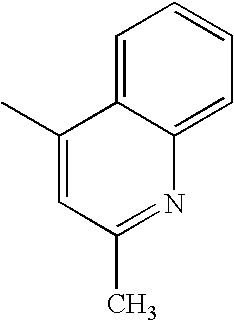 |
— | 303 | >250 |
| 20. | H | 0 |
 |
— | 273 | >250 |
| 21. | H | 0 |
 |
— | 283 | >250 |
| 22. | H | 0 |
 |
— | 284 | 188 |
| 23. | H | 0 |
 |
— | 263 | 242 |
| 24. | H | 0 |
 |
— | 263 | >250 |
| 25. | H | 0 |
 |
— | 330 | 206 |
| 26. | H | 0 |
 |
— | 281 | >250 |
| 27. | H | 0 |
 |
— | 281 | >250 |
| 28. | H | 0 |
 |
— | 281 | >250 |
| 29. | H | 0 |
 |
— | 281 | 191 |
| 30. | H | 0 |
 |
— | 253 | 236 |
| 31. | H | 0 |
 |
— | 253 | 185 |
| 32. | H | 0 |
 |
— | 268 | 243 |
| 33. | H | 0 |
 |
— | 246 | >250 |
| 34. |
 |
0 |
 |
HCl(1/1) | 316 | 196 |
| 35. |
 |
0 |
 |
HCl(1/1) | 407 | 192 |
| 36. |
 |
0 |
 |
— | 373 | >250 |
| 37. |
 |
0 |
 |
HCl(1/1) | 436 | 160 |
| 38. |
 |
0 |
 |
— | 316 | 192 |
| 39. |
 |
0 |
 |
— | 316 | >250 |
| 40. |
 |
0 |
 |
— | 315 | >250 |
| 41. |
 |
0 |
 |
— | 366 | >250 |
| 42. |
 |
1 |
 |
— | 380 | 238 |
| 43. |
 |
0 |
 |
— | 390 | >260 |
| 44. |
 |
0 |
 |
— | 444 | >260 |
| 45. |
 |
0 |
 |
— | 409 | >260 |
| 46. | NH2 | 0 |
 |
— | 254 | >260 |
| 47. |
 |
0 |
 |
— | 338 | >260 |
| 48. |
 |
0 |
 |
— | 386 | 240 |
| 49. | NO2 | 0 |
 |
— | 284 | >260 |
| 50. | I | 0 |
 |
— | 365 | >260 |
| 51. | CN | 0 |
 |
— | 254 | >250 |
| 52. | CH2NH2 | 0 |
 |
CH3SO3H(1/1) | 268 | >250 |
| 53. | Br | 0 |
 |
— | 317 | >250 |
| 54. |
 |
0 |
 |
— | 450 | >250 |
| 55 |
 |
0 |
 |
— | 513 | 205 |
| 56. |
 |
0 |
 |
HCI(1/1) | 486 | >250 |
| 57. |
 |
0 |
 |
— | 471 | >250 |
| 58. |
 |
0 |
 |
— | 485 | >250 |
| 59. |
 |
0 |
 |
— | 513 | 209-211 |
| 60. |
 |
0 |
 |
— | 485 | 241-243 |
| 61. |
 |
1 |
 |
— | 330 | >250 |
| 62. |
 |
0 |
 |
— | 315 | >250 |
| 63. |
 |
0 |
 |
— | 423 | >250 |
| 64. |
 |
0 |
 |
— | 407 | >250 |
| 65. |
 |
0 |
 |
HCl(1/1) | 307 | >250 |
| 66. |
 |
0 |
 |
HCI(1/1) | 408 | >250 |
| 67. |
 |
0 |
 |
— | 322 | >250 |
| 68. |
 |
0 |
 |
— | 355 | >250 |
| 69. |
 |
0 |
 |
— | 366 | >250 |
| 70. |
 |
0 |
 |
— | 345 | — |
| 71. |
 |
0 |
 |
— | 305 | >250 |
| 72. |
 |
0 |
 |
— | 350 | — |
| 73. |
 |
0 |
 |
HCl(2/1) | 306 | — |
| 74. |
 |
0 |
 |
— | 422 | — |
| 75. |
 |
0 |
 |
— | 430 | — |
| 76. |
 |
1 |
 |
— | 336 | 248 |
| 77. |
 |
0 |
 |
— | 317 | — |
| 78. |
 |
0 |
 |
— | 388 | — |
| 79. |
 |
1 |
 |
— | 330 | — |
| 80. |
 |
0 |
 |
— | 394 | — |
| 81. |
 |
0 |
 |
— | 394 | — |
| 82. |
 |
0 |
 |
— | 315 | — |
| 83. |
 |
0 |
 |
— | 408 | — |
| 84. |
 |
0 |
 |
— | 400 | >260 |
| 85. |
 |
0 |
 |
— | 472 | >260 |
| 86. |
 |
0 |
 |
— | 374 | >260 |
| 87. |
 |
0 |
 |
— | 367 | >260 |
| 88. |
 |
0 |
 |
— | 373 | >260 |
| 89. |
 |
1 |
 |
— | 407 | >260 |
| 90. |
 |
0 |
 |
— | 346 | — |
| 91. |
 |
0 |
 |
— | 351 | — |
| 92. |
 |
0 |
 |
— | 330 | >250 |
| 93. |
 |
0 |
 |
— | 336 | 235(dec.) |
| 94. |
 |
0 |
 |
— | 334 | >250 |
| 95. |
 |
0 |
 |
— | 378 | 182 |
| 96. |
 |
0 |
 |
— | 390 | 224 |
| 97 |
 |
0 |
 |
— | 406 | — |
| 98. |
 |
0 |
 |
— | 414 | 160(dec.) |
| 99. |
 |
1 |
 |
— | 365 | >260 |
| 100. |
 |
1 |
 |
— | 365 | >260 |
The compound of the invention have been the subject of pharmacology trials which have shown their value as active substances in therapy.
They were in particular tested for their effects of inhibiting certain cyclin dependent kinases (cdks) such as cdk1 (also called cdc2), cdk2 and cdk4.
The cdks are protein (serine/threonine) kinases which play a decisive role in the progression of the cell cycle, functioning solely on being associated with cyclins. Within these associations, the cyclins have a control function, whereas the function of the cdks is catalytic.
To date, nine cdks (cdk1 to cdk9) and eleven cyclins have been identified in humans. The individual cdks play distinct roles in the progression of the cell cycle and can be classified according to the stage of the cell cycle in which they are involved: G1/S transition (cdk2/cyclin E, cdk4/cyclin D1-D3, cdk6/cyclin D1, cdk8/cyclin C), S phase (cdk2/cyclin A), G2 phase (cdc2/cyclin A), G2/M transition (cdc2/cyclin B, cdk7/cyclin H).
For example, the active cdk4/cyclin D and cdk6/cyclin D phosphorylate the retinoblastoma protein pRb leading to its dissociation of the transcription factor complex E2F/PD1 and thus deactivating its transcription suppressor activity. The result of the release of E2F/DP1 is the activation of the transcription of a group of genes necessary for entering into the S phase, including thymidylate synthetase, dihydrofolate reductase and cyclin E. At the end of the G1 stage, cyclin E stimulates cdk2 which acts by continuing the process of phosphorylation of pRb, having the result of an irreversible engagement in a cell division and transition to S phase process. During the S phase, cyclin A replaces cyclin E by activating cdk2, this having the result of a change in the specificity of the cdk2 substrate. E2F/DP1 is phosphorylated, which inactivates its transcription promoter activity. This results in a decrease in the synthesis of cyclin E and a transition to G2.
The activity of the cdks is inhibited by the endogenous cdk inhibitors (cdkI: p15, p16, p18, p19, p21, p27 and p57).
The development of tumours in humans is often associated with a deregulation of the cdk activity. p16, a cdk4 and cdk6 inhibitor, is destroyed or mutated in 55% of glyomas and mesotheliomas and in 38% of cancers of the pancreas. It has been shown that p27, another inhibitor, and the cyclin E and cyclin D coactivators are respectively “overexpressed” or “underexpressed”, in especially breast, colon, non-small cell lung, stomach, prostate, bladder, nonhodgkin lymphoma and ovarian cancers. It has been shown that their altered expression can be correlated with an increase in the cdk2 and cdk4 activities.
The induction of p21 by the activated tumour suppressor p53, in response to the signals for alteration of DNA, inhibits the activity of cdk2 (the key component in the control of the G1 phase); thus, the mutation of p53 in about 50% of all human cancers can indirectly result in the deregulation of the cdk activity and the loss of the control of the G1 phase, contributing to the generation of tumours (Paulovich A et al., Cell. 88, 315-321 (1997)).
The compounds of the invention represent a novel class of cdk inhibitors, whose properties include the suspension of the cell cycle, the blocking of the proliferation of cells and apoptosis.
The inhibitory activity on cdk2 has been demonstrated in a test where the enzymatic cdk2/cyclin A activity is measured by quantification of 33P obtained from 33P-ATP which was incorporated into the type III-S histone of calf thymus (Sigma Ref: H-5505). The trial is carried out in 50 mM HEPES medium, pH 7.2, in the presence of 1 mM DTT (added at the time of use), 1 mM MgCl2, 1 mM EGTA and 0.02% Tween 20. The histone concentration is 0.4 mg/ml and the cold ATP concentration is 10 μM. The concentration of 33P-ATP is adjusted to an activity of about 300 000 cpm. The inhibitor 5 μl is added in solution in 10% aqueous DMSO in order to have a final concentration of 1% DMSO. The reaction mixture is incubated for 1 hour at room temperature. The reaction is stopped by depositing on a filter (Whatman P81, ion-exchange chromatography paper). The filters are washed twice by dipping for 20 min in a 37.5 mM phosphoric acid solution. The filters are placed in scintillation vials and the scintillant (aquasafe, Zinsser Analytic, 5 ml) is added. These vials are then counted for 1 min on a Wallac counter.
Under these conditions, the most active compounds of the invention have IC50 values (concentration inhibiting 50% of the enzymatic activity) of less than 20 μM.
The inhibitory activity on cdk1 was demonstrated in a cdk1/cyclin B test. The measurement of the inhibitory activity of the compounds of the invention on cdk1 is carried out according to the same procedure as for the cdk2/cyclin A test with the following modifications: MgCl2 concentration is 10 mmol and the ATP concentration is 0.1 μM.
Under these conditions, the most active compounds of the invention exhibit IC50 (concentration inhibiting 50% of the enzymatic activity) values of less than 20 μM.
The inhibitory activity on cdk4 was demonstrated in a cdk4/cyclin D1 test. The measurement of the inhibitory activity of the compounds of the invention on cdk4 is carried out according to the same procedure as for the cdk1/cyclin B test.
The only difference is the substrate which may be the retinoblastoma protein at a concentration of 0.02 mg/ml or the peptide K10K (K-A-P-L-S-P-K-K-A-K-NH2) at a concentration of 1 mM.
Under these conditions, the most active compounds of the invention exhibit IC50 (concentration inhibiting 50% of the enzymatic activity) values of less than 20 μM.
The results of the biological tests show that the compounds of the invention are inhibitors of cdk1, cdk2 and cdk4.
Thus, the compounds of the invention may be used in the treatment of pathologies in which an inhibitor of cdk1, cdk2 and cdk4 provides a therapeutic benefit. In particular, such pathologies are cancers, autoimmune and/or inflammatory diseases, cardiovascular diseases, neurodegenerative diseases, viral and fungal infections, degenerative diseases of the musculoskeletal system, haematological diseases, kidney diseases and liver diseases caused by toxins or alcohol.
The compounds of the invention have demonstrated in particular a powerful antiproliferative activity on certain tumour cell lines.
Furthermore, given the key role of cdks in the regulation of the proliferation of cells in general, the inhibitors of the invention can behave as reversible cytostatic agents which can be used in the treatment of disease processes exhibiting abnormal cell proliferation characteristics.
The compounds of general formula (I) are also capable of modulating apoptosis, a process of physiological cell death, which is crucial for normal development and haemostasis. Alterations in apoptosis contribute to the pathogenesis of a multiplicity of human diseases. The compounds of general formula (I), as apoptosis modulator, may be useful for the treatment of human diseases exhibiting aberrations in apoptosis. Finally, the cdk inhibitors of the invention may be used in the treatment of viral and fungal diseases since cdks are activated by viral cyclin (v-cyclin) and are therefore involved in viral replication and the proliferation of viruses such as the herpesvirus and HIV-1.
More specifically, the compounds of general formula (I) may be useful in the treatment:
-
- of cancers, including but not limited to carcinoma, including bladder, breast, colon, kidney, liver, lung, ovarian, pancreatic, stomach, uterine, thyroid, prostate and skin cancer; haematopoietic tumours of the lymphoid family, including acute lymphocytic leukaemia, follicular lymphomas, B cell lymphoma and Burkett's lymphoma; haematopoietic tumours of the myeloid family, including acute and chronic myeloid leukaemias and promyelocytic leukaemia; tumours of mesenchymal origin including fibrosarcoma and rhabdomyosarcoma; and other tumours, including melanoma, seminoma, teratocarcinoma, osteosarcoma, neuroblastoma and glyoma, and precancerous lesions such as hereditary adenomatous polyposis;
- autoimmune or inflammatory diseases: including but not limited to arthritis, such as rheumatoid arthritis, psoriasis, immune glomerulonephritis, intestinal inflammation, transplant rejection and endotoxic shock, systemic lupus, erythematosis, autoimmune diabetes mellitus, pigmentary retinitis;
- cardiovascular diseases: including but not limited to neurofibromatosis, atherosclerosis, pulmonary fibrosis, restenosis following angioplasty or vascular surgery, the formation of a hypertrophic scar, angiogenesis, vein graft disease, transplantation vasculopathy, ischaemic lesions following myocardial infarction, lesions caused by a stroke or a reperfusion, cardiac arrhythmia;
- neurodenerative diseases, including but not limited to Alzheimer's diseases, AIDS-related dementia, Parkinson's disease, amyotrophic lateral sclerosis, retinitis pigmentosa, muscular spinal atrophy, cerebellum degeneration;
- viral and fungal infections, including but not limited to the herpesvirus, the smallpox virus, the Epstein-Barr virus, the Sindbis virus, the adenovirus and the AIDS virus;
- degenerative diseases of the musculoskeletal system, including but not limited to osteoporosis and arthritis, rhinosinusitis reactive to aspirin, cystic fibrosis;
- haematological diseases, including but not limited to chronic anaemia, aplastic anaemia and myeloplastic syndromes.
Furthermore, the compounds of general formula (I) may be used for treating alopecia caused by chemotherapy, thrombocytopenia caused by chemotherapy, leukopenia or mucositis caused by chemotherapy.
The use of the compounds of general formula (I), and of the following compounds, for the preparation of a medicament intended for treating the pathologies mentioned above forms an integral part of the invention:
- —N-phenyl-1H-indazole-3-carboxamide
- —N-(2-chlorophenyl)-1H-indazole-3-carboxamide
- —N-(3-chlorophenyl)-1H-indazole-3-carboxamide
- —N-(4-chlorophenyl)-1H-indazole-3-carboxamide
- —N-(2,4-dichlorophenyl)-1H-indazole-3-carboxamide
- —N-(3,4-dichlorophenyl)-1H-indazole-3-carboxamide
- —N-(2-methylphenyl)-1H-indazole-3-carboxamide
- —N-(2,4-dimethylphenyl)-1H-indazole-3-carboxamide
- —N-(2-methoxyphenyl)-1H-indazole-3-carboxamide
- —N-(4-methoxyphenyl)-1H-indazole-3-carboxamide
- —N-(4-thiomethylphenyl)-1H-indazole-3-carboxamide
- —N-(3-chloro-4-thiomethylphenyl)-5-amino-1H-indazole-3-carboxamide
- —N-benzyl-1H-indazole-3-carboxamide
- —N-(2-chlorobenzyl)-1H-indazole-3-carboxamide
- —N-(4-methylbenzyl)-1H-indazole-3-carboxamide
- —N-(pyridin-2-ylmethyl)-1H-indazole-3-carboxamide
- —N-(pyridin-3-ylmethyl)-1H-indazole-3-carboxamide
- —N-(pyridin-4-ylmethyl)-1H-indazole-3-carboxamide
- —N-(2-phenylethyl)-1H-indazole-3-carboxamide
- —N-(3,4-dimethoxyphenylethyl)-1H-indazole-3-carboxamide
- —N-[3-(pyridin-2-yl)propyl]-1H-indazole-3-carboxamide
- —N-[3-(2,6-dimethylphenyl)propyl]-5-nitro-1H-indazole-3-carboxamide
The subject of the invention is also medicaments which comprise a compound of general formula (I) or an addition salt thereof with a pharmaceutically acceptable acid or alternatively a hydrate or solvate of the compound of general formula (I). These medicaments find their use in therapy, in particular in the treatment of the pathologies mentioned above.
According to another of its aspects, the present invention relates to pharmaceutical compositions comprising, as active ingredient, at least one compound according to the invention. These pharmaceutical compositions comprise an effective dose of a compound according to the invention, or a pharmaceutically acceptable salt, a hydrate or a solvate of the said compound, and optionally one or more pharmaceutically acceptable excipients.
The said excipients are chosen according to the pharmaceutical dosage form and the desired mode of administration from the usual excipients which are known to a person skilled in the art.
In the pharmaceutical compositions of the present invention for oral, sublingual, subcutaneous, intramuscular, intravenous, topical, local, intratracheal, intranasal, transdermal or rectal administration, the active ingredient of general formula (I) above, or its possible salt, solvate or hydrate, may be administered in a unit form for administration, as a mixture with conventional pharmaceutical excipients, to animals or to human beings for the prophylaxy or the treatment of the above disorders or diseases.
The appropriate unit forms for administration comprise the forms for oral administration such as tablets, soft or hard gelatin capsules, powders, granules, chewing gums or oral solutions or suspensions, the forms for sublingual, buccal, intratracheal, intraocular or intranasal administration, or for administration by inhalation, the forms for subcutaneous, intramuscular or intravenous administration and the forms for rectal or vaginal administration. For topical application, it is possible to use the compounds according to the invention in creams, ointments or lotions.
By way of example, a unit form for administration of a compound according to the invention in tablet form may comprise the following components:
| Compound according to the invention | 50.0 | mg | ||
| Mannitol | 223.75 | mg | ||
| Croscaramellose sodium | 6.0 | mg | ||
| Maize starch | 15.0 | mg | ||
| Hydroxypropylmethylcellulose | 2.25 | mg | ||
| Magnesium stearate | 3.0 | mg | ||
In order to obtain the desired prophylactic or therapeutic effect, the dose of active ingredient may vary between 0.1 mg and 200 mg per kg of body weight and per day. Although these dosages are examples of an average situation, there may be particular cases where higher or lower dosages are appropriate, such dosages also belong to the invention. According to the usual practice, the dosage appropriate for each patient is determined by the doctor according to the mode of administration, the weight and the response of the said patient.
Each unit dose may contain from 0.1 to 1 000 mg, preferably from 0.1 to 500 mg, of active ingredient in combination with one or more pharmaceutical excipients. This unit dose may be administered 1 to 5 times per day so as to administer a daily dosage of 0.5 to 5 000 mg, preferably from 0.5 to 2 500 mg.
The present invention, according to another of its aspects, also relates to a method for treating the pathologies indicated above which comprise the administration of a compound according to the invention, of a pharmaceutically acceptable salt, of a solvate or of a hydrate of the said compound.
Claims (13)
1. A compound corresponding to general formula (I):

in which,
R1 represents
a heteroaromatic group optionally substituted with one or two substituents selected from a halogen atom, a hydroxyl, a heteroaromatic group, C1-6 alkyl, NH2, NHR2, NHCOR2, COOR2, CONH2, CONHR2 and CH2XR2 where X represents an atom selected from O, NH and S; and
Ar represents
a heteroaromatic group, optionally substituted with one or two substituents selected from a halogen atom, C1-6 alkyl, C1-6 thioalkyl, C1-6 alkoxy, CH2OH, phenoxy, morpholinyl, —CH2-morpholinyl, NH2, NHR2, NR2R3, NHSO2R2, CN, SO2R2, SO2NH2, SO2NHR2, COOH, COOR2, CONH2, CONHNH2, CONHR2, CH2NHR2 and CH2NR2R3; and wherein
R2 and R3 represent, independently of each other, a C1-6 alkyl optionally substituted with a CONH2 group, with a phenyl or with a heteroaromatic group; or R2 and R3 represent, independently of each other, a phenyl or a heteroaromatic group; and
n represents 0, 1, 2 or 3; or a salt thereof, or a hydrate or a solvate thereof.
2. The compound according to claim 1 , wherein:
R1 represents
a heteroaromatic group optionally substituted with one or two substituents selected from a halogen atom, a hydroxyl, a heteroaromatic group, C1-6 alkyl, NH2, NHR2, NHCOR2, COOR2, CONH2, CONHR2 and CH2XR2 where X represents an atom selected from O, NH and S;
Ar represents
a heteroaromatic group, optionally substituted with one or two substituents selected from a halogen atom, C1-6 thioalkyl, C1-6 alkoxy, CH2OH, phenoxy, morpholinyl, —CH2-morpholinyl, NH2, NHR2, NR2R3, NHSO2R2, CN, SO2R2, SO2NH2, SO2NHR2, COOH, COOR2, CONH2, CONHNH2, CONHR2, CH2NHR2 and CH2NR2R3; and wherein
R2 and R3 represent, independently of each other, a C1-6 alkyl optionally substituted with a CONH2 group, with a phenyl or with a heteroaromatic group; or R2 and R3 represent, independently of each other, a phenyl or a heteroaromatic group; and
n represents 0, 1, or 2; or a salt thereof, or a hydrate or a solvate thereof.
3. The compound of general formula (I) according to claim 1 , wherein:
when R1 represents
a heteroaromatic group optionally substituted with one or two substituents selected from a halogen atom, a hydroxyl, a heteroaromatic group, C1-6 alkyl, NH2, NHR2, NHCOR2, COOR2, CONH2, CONHR2 and CH2XR2 where X represents an atom selected from O, NH and S;
then Ar represents
a heteroaromatic group, optionally substituted with one or two substituents selected from a halogen atom, C1-6 alkyl, C1-6 thioalkyl, C1-6 alkoxy, CH2OH, phenoxy, morpholinyl, —CH2-morpholinyl, NH2, NHR2, NR2R3, NHSO2R2, CN, SO2R2, SO2NH2, SO2NHR2, COOH, COOR2, CONH2, CONHNH2, CONHR2, CH2NHR2 and CH2NR2R3; and wherein
R2 and R3 represent, independently of each other, a C1-6 alkyl optionally substituted with a CONH2 group, with a phenyl or with a heteroaromatic group; or R2 and R3 represent, independently of each other, a phenyl or a heteroaromatic group; and
n represents 0 or 1; or a salt thereof, or a hydrate or a solvate thereof.
4. The compound of general formula (I) according to claim 1 , wherein:
when R1 represents
a heteroaromatic group chosen from pyrazolyl, tetrazolyl, thiazolyl, oxazolyl, pyridinyl, pyrimidinyl, quinolinyl, isoquinolinyl or pyrrolo [2,3-c]pyridinyl, optionally substituted with one or two substituents chosen from a chlorine or a fluorine, a hydroxyl, a pyridinyl, a methyl, NH2, NHR2, NHCOR2, COOR2, CONH2, CONHR2 and CH2OR2;
then Ar represents
pyridinyl, optionally substituted with a C1-6 alkoxy; and wherein
R2 represents a methyl, an ethyl or a 2-methylpropyl, optionally substituted with a group CONH2 or with a phenyl; or R2 represents a phenyl or a heteroaromatic group chosen from a pyridinyl or a pyrimidinyl; and
n represents 0 or 1;
or a salt thereof, or a hydrate or a solvate thereof.
5. The compound of general formula (I) according to claim 1 , wherein:
R1 represents a heteroaromatic group optionally substituted with one or two substituents chosen from a halogen atom, a hydroxyl, a heteroaromatic group, C1-6 alkyl, NH2, NHR2, NHCOR2, COOR2, CONH2, CONHR2 and CH2XR2 where X represents an atom chosen from O, NH and S;
Ar represents
a heteroaromatic group, optionally substituted with one or two substituents chosen from fluorine, chlorine, methoxy, CH2OH, phenoxy, morpholinyl, —CH2-morpholinyl, NH2, NHSO2CH3, CN, SO2CH3, SO2NH2, SO2NH-pyrimidinyl, COOH, CONH2, CONHNH2, CH2NHC2H5 and CH2N(CH2H5)2; and
n represents 0, 1, 2 or 3;
or a salt thereof, or a hydrate or a solvate thereof.
6. The compound of general formula (I) according to claim 1 , wherein:
R1 represents a heteroaromatic group chosen from pyrazolyl, thiazolyl, oxazolyl, pyridinyl, isoquinolinyl or pyrrolo[2,3-c]pyridinyl, optionally substituted with one or two substituents chosen from a chlorine,
a pyridinyl, methyl, NH2 and CONHR2;
Ar represents
a pyridinyl, optionally substituted with a methoxy;
R2 represents a methyl or an ethyl, optionally substituted with a group CONH2, or with a phenyl; or R2 represents a pyridinyl or a pyrimidinyl; and
n represents 0 or 1;
or a salt thereof, or a hydrate or a solvate thereof.
7. The compound of formula (I) according to claim 1 , which is selected from the group consisting of:
—N-(pyridin-4-yl)-5-pyridin-3-yl-1H-indazole-3-carboxamide hydrochloride;
—N-(pyridin-4-yl)-5-(4-methyl-[3,4′]bipyridinyl-5-yl)-1H-indazole-3-carboxamide hydrochloride;
—N-(pyridin-4-yl)-5-isoquinolin-4-yl-1H-indazole-3-carboxamide;
—N-(pyridin-3-ylmethyl)-5-isoquinolin-4-yl-1H-indazole-3-carboxamide;
—N-(pyridin-4-yl)-5-[4-methyl-5-(pyridin-3-ylcarbamoyl)pyridin-3-yl]-1H-indazole-3-carboxamide;
—N-(pyridin-4-yl)-5-(4-methyl-[3,3′]bipyridinyl-5-yl)-1H-indazole-3-carboxamide;
—N-(pyridin-4-yl)-5-(1,3-thiazol-5-yl)-1H-indazole-3-carboxamide;
—N-(pyridin-4-yl)-5-(1H-pyrrolo[2,3-c]pyridin-4-yl)-1H-indazole-3-carboxamide;
-5-(1H-pyrazol-4-yl)-N-(pyridin-4-yl)-1H-indazole-3-carboxamide;
—N-(pyridin-4-yl)-5-[(2-chloro)pyridin-5-yl]-1H-indazole-3-carboxamide;
-5-(1,3-oxazol-5-yl)-N-(pyridin-4-yl)-1H-indazole-3-carboxamide;
-5-(5-amino-4-methylpyridin-3-yl)-N-(pyridin-4-yl)-1H-indazole-3-carboxamide;
—N-(pyridin-4-yl)-5-(3-(N-aminoketomethyl)carboxamide)pyridin-4-yl-1H-indazole-3-carboxamide;
—N-(pyridin-3-ylmethyl)-5-(1,3-thiazol-5-yl)-1H-indazole-3-carboxamide;
—N-(pyridin-3-ylmethyl)-5-pyridin-3-yl-1H-indazole-3-carboxamide;
-5-(4-hydroxy-3-methylpyridin-2-yl)-N-pyridin-4-yl-1H-indazole-3-carboxamide;
—N-(2-methoxypyridin-5-yl)-5-(1,3-oxazol-5-yl)-1H-indazole-3-carboxamide;
or a salt thereof, or a hydrate or a solvate thereof.
8. A method for preparing a compound of general formula (I) of claim 1 , comprising the step consisting in deprotecting a compound of general formula (VII)

in which R1, Ar and n are as defined in general formula (I) according to claim 1 and PG represents a protecting group of the trimethylsilylethoxymethyl (SEM) or mesitylenesulphonyl (Mts) type,
either by the action of a base such as sodium hydroxide, or in the presence of tetrabutylammonium fluoride (TBAF) and ethylenediamine, or alternatively in the presence of trifluoroacetic acid followed by heating with ethylenediamine.
9. The method of preparation according to claim 8 , wherein the compound of general formula (VII),

in which R1, Ar and n are as defined in general formula (I) according to claim 1 and PG represents a protecting group of the trimethylsilylethoxymethyl (SEM) or mesitylenesulphonyl (Mts) type,
is prepared by coupling a compound of general formula (V)

in which R1 is as defined in general formula (I) according to claim 1 and PG represents a protecting group of the trimethylsilylethoxymethyl (SEM) or mesitylenesulphonyl (Mts) type,
with an amine of general formula Ar(CH2)nNH2 (VI) in which Ar and n are as defined in general formula (I) according to claim 1 , it being possible for the coupling reaction to be carried out by activating the compound of general formula (V) with coupling reagents, such as carbonyldiimidazole or isopropyl or isobutyl chloroformate.
10. A compound of general formula (V)

in which
R1 represents
a heteroaromatic group optionally substituted with one or two substituents selected from a halogen atom, a hydroxyl, a heteroaromatic group, C1-6 alkyl, NH2, NHR2, NHCOR2, COOR2, CONH2, CONHR2 and CH2XR2 where X represents an atom selected from O, NH and S; and
PG represents a protecting group of the trimethylsilylethoxymethyl (SEM) or mesitylenesulphonyl (Mts) type.
11. A compound of general formula (VII)

in which
R1 represents
a heteroaromatic group optionally substituted with one or two substituents selected from a halogen atom, a hydroxyl, a heteroaromatic group, C1-6 alkyl, NH2, NHR2, NHCOR2, COOR2, CONH2, CONHR2 and CH2XR2 where X represents an atom selected from O, NH and S;
Ar represents
a heteroaromatic group, optionally substituted with one or two substituents selected from a halogen atom, C1-6 alkyl, C1-6 thioalkyl, C1-6 alkoxy, CH2OH, phenoxy, morpholinyl, NH2, NHR2, NR2R3, NHSO2R2, CN, SO2R2, SO2NH2, SO2NHR2, COOH, COOR2, CONH2, CONHNH2, CONHR2 and CH2NHR2; and wherein
R2 and R3 represent, independently of each other, a C1-6 alkyl optionally substituted with a CONH2, a phenyl or a heteroaromatic group; or R2 and R3 represent, independently of each other, a phenyl or a heteroaromatic group;
n represents 0, 1, 2 or 3; and
PG represents a protecting group of the trimethylsilylethoxymethyl (SEM) or mesitylenesuiphonyl (Mts) type.
12. A compound of general formula (X)

in which
Ar represents
a heteroaromatic group, optionally substituted with one or two substituents selected from a halogen atom, C1-6 alkyl, C1-6 thioalkyl, C1-6 alkoxy, CH2OH, phenoxy, morpholinyl, NH2, NHR2, NR2R3, NHSO2R2, CN, SO2R2, SO2NH2, SO2NHR2, COOH, COOR2, CONH2, CONHNH2, CONHR2 and CH2NHR2; and wherein
R2 and R3 represent, independently of each other, a C1-6 alkyl optionally substituted with a CONH2, a phenyl or a heteroaromatic group; or R2 and R3 represent, independently of each other, a phenyl or a heteroaromatic group;
n represents 0, 1, 2 or 3;
SEM represents a protecting group of trimethylsilylethoxymethyl type; and
X represents a bromine or iodine atom.
13. A pharmaceutical composition comprising at least one compound of general formula (I) according to claim 1 , or a pharmaceutically acceptable salt, hydrate or solvate thereof, in combination with one or more pharmaceutically acceptable excipients.
Applications Claiming Priority (3)
| Application Number | Priority Date | Filing Date | Title |
|---|---|---|---|
| FR02/12188 | 2002-10-02 | ||
| FR0212188A FR2845382A1 (en) | 2002-10-02 | 2002-10-02 | INDAZOLECARBOXAMIDE DERIVATIVES, THEIR PREPARATION AND THEIR USE IN THERAPEUTICS |
| PCT/FR2003/002862 WO2004031158A1 (en) | 2002-10-02 | 2003-09-30 | Indazolecarboxamide derivatives, preparation and use thereof as cdk1, cdk2 and cdk4 inhibitors |
Related Parent Applications (1)
| Application Number | Title | Priority Date | Filing Date |
|---|---|---|---|
| PCT/FR2003/002862 Continuation WO2004031158A1 (en) | 2002-10-02 | 2003-09-30 | Indazolecarboxamide derivatives, preparation and use thereof as cdk1, cdk2 and cdk4 inhibitors |
Publications (2)
| Publication Number | Publication Date |
|---|---|
| US20060004000A1 US20060004000A1 (en) | 2006-01-05 |
| US7482342B2 true US7482342B2 (en) | 2009-01-27 |
Family
ID=32011336
Family Applications (1)
| Application Number | Title | Priority Date | Filing Date |
|---|---|---|---|
| US11/096,375 Expired - Fee Related US7482342B2 (en) | 2002-10-02 | 2005-04-01 | Indazolecarboxamide derivatives, preparation and use thereof as CDK1, CDK2 and CDK4 inhibitors |
Country Status (8)
| Country | Link |
|---|---|
| US (1) | US7482342B2 (en) |
| EP (1) | EP1549620A1 (en) |
| JP (1) | JP4762543B2 (en) |
| AR (1) | AR041459A1 (en) |
| AU (1) | AU2003299125A1 (en) |
| FR (1) | FR2845382A1 (en) |
| TW (1) | TWI331603B (en) |
| WO (1) | WO2004031158A1 (en) |
Cited By (56)
| Publication number | Priority date | Publication date | Assignee | Title |
|---|---|---|---|---|
| US20090197882A1 (en) * | 2006-07-01 | 2009-08-06 | Hans Peter Buchstaller | Indazole derivatives for the treatment of hsp90-induced diseases |
| US20110034441A1 (en) * | 2009-08-10 | 2011-02-10 | Epitherix, Llc | Indazoles as wnt/b-catenin signaling pathway inhibitors and therapeutic uses thereof |
| US20110190290A1 (en) * | 2009-12-21 | 2011-08-04 | Epitherix, Llc | 1h-pyrazolo[3,4-b]pyridines and therapeutic uses thereof |
| US8252812B2 (en) | 2009-08-10 | 2012-08-28 | Samumed, Llc | Indazole inhibitors of the WNT signal pathway and therapeutic uses thereof |
| WO2013113762A1 (en) | 2012-01-31 | 2013-08-08 | INSERM (Institut National de la Santé et de la Recherche Médicale) | Methods and kits for predicting the risk of having a cutaneous melanoma in a subject |
| US8618128B1 (en) | 2012-05-04 | 2013-12-31 | Samumed, Llc | 1H-pyrazolo[3,4-b]pyridines and therapeutic uses thereof |
| US8664241B2 (en) | 2012-04-04 | 2014-03-04 | Samumed, Llc | Indazole inhibitors of the Wnt signal pathway and therapeutic uses thereof |
| US8697887B2 (en) | 2011-09-14 | 2014-04-15 | Samumed, Llc | Indazole-3-carboxamides and their use as Wnt/β-catenin signaling pathway inhibitors |
| US9394315B2 (en) | 2012-05-08 | 2016-07-19 | Lycera Corporation | Tetrahydro[1,8]naphthyridine sulfonamide and related compounds for use as agonists of RORγ and the treatment of disease |
| US9475825B2 (en) | 2014-09-08 | 2016-10-25 | Samumed, Llc | 3-(3H-imidazo[4,5-C]pyridin-2-yl)-1H-pyrazolo[3,4-C]pyridine and therapeutic uses thereof |
| US9475807B2 (en) | 2014-09-08 | 2016-10-25 | Samumed, Llc | 2-(1H-indazol-3-yl)-1H-imidazo[4,5-C]pyridine and therapeutic uses thereof |
| US9493487B2 (en) | 2014-09-08 | 2016-11-15 | Samumed, Llc | 3-(1H-imidazo[4,5-C]pyridin-2-YL)-1H-pyrazolo[3,4-B]pyridine and therapeutic uses thereof |
| US9512111B2 (en) | 2010-11-08 | 2016-12-06 | Lycera Corporation | N-sulfonylated tetrahydroquinolines and related bicyclic compounds for inhibition of RORγ activity and the treatment of disease |
| US9540398B2 (en) | 2014-09-08 | 2017-01-10 | Samumed, Llc | 3-(1h-imidazo[4,5-C]pyridin-2-yl)-1h-pyrazolo[3,4-C]pyridine and therapeutic uses thereof |
| US9546185B2 (en) | 2014-09-08 | 2017-01-17 | Samumed, Llc | 3-(3H-imidazo[4,5-B]pyridin-2-yl)-1H-pyrazolo[3,4-C]pyridine and therapeutic uses thereof |
| US9657016B2 (en) | 2014-09-08 | 2017-05-23 | Samumed, Llc | 3-(1h-benzo[d]imidazol-2-yl)-1h-pyrazolo[3,4-c]pyridine and therapeutic uses thereof |
| US9657033B2 (en) | 2012-05-08 | 2017-05-23 | Lycera Corporation | Tetrahydronaphthyridine and related bicyclic compounds for inhibition of RORγ activity and the treatment of disease |
| US9663502B2 (en) | 2013-12-20 | 2017-05-30 | Lycera Corporation | 2-Acylamidomethyl and sulfonylamidomethyl benzoxazine carbamates for inhibition of RORgamma activity and the treatment of disease |
| US9738638B2 (en) | 2014-09-08 | 2017-08-22 | Samumed, Llc | 2-(1H-indazol-3-yl)-3H-imidazo[4,5-B]pyridine and therapeutic uses thereof |
| US9745271B2 (en) | 2014-03-20 | 2017-08-29 | Samumed, Llc | 5-substituted indazole-3-carboxamides and preparation and use thereof |
| US9758531B2 (en) | 2014-09-08 | 2017-09-12 | Samumed, Llc | 3-(3H-imidazo[4,5-B]pyridin-2-yl)-1H-pyrazolo[3,4-B]pyridine and therapeutic uses thereof |
| US9783511B2 (en) | 2013-12-20 | 2017-10-10 | Lycera Corporation | Carbamate benzoxazine propionic acids and acid derivatives for modulation of RORgamma activity and the treatment of disease |
| US9809561B2 (en) | 2013-12-20 | 2017-11-07 | Merck Sharp & Dohme Corp. | Tetrahydronaphthyridine, benzoxazine, aza-benzoxazine and related bicyclic compounds for inhibition of RORgamma activity and the treatment of disease |
| US9896441B2 (en) | 2014-05-05 | 2018-02-20 | Lycera Corporation | Tetrahydroquinoline sulfonamide and related compounds for use as agonists of RORγ and the treatment of disease |
| US9908867B2 (en) | 2013-01-08 | 2018-03-06 | Samumed, Llc | 3-(benzoimidazol-2-yl)-indazole inhibitors of the Wnt signaling pathway and therapeutic uses thereof |
| US10072004B2 (en) | 2016-06-01 | 2018-09-11 | Samumed, Llc | Process for preparing N-(5-(3-(7-(3-fluorophenyl)-3H-imidazo [4,5-C]pyridin-2-yl)-1H-indazol-5-yl)pyridin-3-yl)-3-methylbutanamide |
| US10166218B2 (en) | 2015-08-03 | 2019-01-01 | Samumed, Llc | 3-(1H-indol-2-yl)-1H-pyrazolo[3,4-C]pyridines and therapeutic uses thereof |
| US10189777B2 (en) | 2014-05-05 | 2019-01-29 | Lycera Corporation | Benzenesulfonamido and related compounds for use as agonists of RORγ and the treatment of disease |
| US10188634B2 (en) | 2015-08-03 | 2019-01-29 | Samumed, Llc | 3-(3H-imidazo[4,5-C]pyridin-2-yl)-1 H-pyrazolo[4,3-B]pyridines and therapeutic uses thereof |
| US10195185B2 (en) | 2015-08-03 | 2019-02-05 | Samumed, Llc | 3-(1H-imidazo[4,5-C]pyridin-2-yl)-1H-pyrazolo[4,3-B]pyridines and therapeutic uses thereof |
| US10206908B2 (en) | 2015-08-03 | 2019-02-19 | Samumed, Llc | 3-(1H-pyrrolo[3,2-C]pyridin-2-YL)-1H-pyrazolo[3,4-C]pyridines and therapeutic uses thereof |
| US10206909B2 (en) | 2015-08-03 | 2019-02-19 | Samumed, Llc | 3-(1H-pyrrolo[2,3-B]pyridin-2-yl)-1H-pyrazolo[4,3-B]pyridines and therapeutic uses thereof |
| US10221142B2 (en) | 2015-02-11 | 2019-03-05 | Merck Sharp & Dohme Corp. | Substituted pyrazole compounds as RORgammaT inhibitors and uses thereof |
| US10226453B2 (en) | 2015-08-03 | 2019-03-12 | Samumed, Llc | 3-(1H-indol-2-yl)-1H-pyrazolo[4,3-B]pyridines and therapeutic uses thereof |
| US10226448B2 (en) | 2015-08-03 | 2019-03-12 | Samumed, Llc | 3-(1H-pyrrolo[3,2-C]pyridin-2-yl)-1H-pyrazolo[3,4-B]pyridines and therapeutic uses thereof |
| US10231956B2 (en) | 2015-08-03 | 2019-03-19 | Samumed, Llc | 3-(1H-pyrrolo[3,2-C]pyridin-2-YL)-1 H-pyrazolo[4,3-B]pyridines and therapeutic uses thereof |
| US10285982B2 (en) | 2015-08-03 | 2019-05-14 | Samumed, Llc | 3-(1H-pyrrolo[2,3-B]pyridin-2-yl)-1H-pyrazolo[3,4-C]pyridines and therapeutic uses thereof |
| US10285983B2 (en) | 2015-08-03 | 2019-05-14 | Samumed, Llc | 3-(1H-pyrrolo[2,3-B]pyridin-2-yl)-1H-pyrazolo[3,4-B] pyridines and therapeutic uses thereof |
| US10287272B2 (en) | 2015-10-27 | 2019-05-14 | Merck Sharp & Dohme Corp. | Substituted indazole compounds as RORgammaT inhibitors and uses thereof |
| US10329309B2 (en) | 2015-08-03 | 2019-06-25 | Samumed, Llc | 3-(3H-imidazo[4,5-B]pyridin-2-yl)-1H-pyrazolo[4,3-B]pyridines and therapeutic uses thereof |
| US10344000B2 (en) | 2015-10-27 | 2019-07-09 | Merck Sharp & Dohme Corp. | Substituted bicyclic pyrazole compounds as RORgammaT inhibitors and uses thereof |
| US10350199B2 (en) | 2015-08-03 | 2019-07-16 | Samumed, Llc | 3-(1h-pyrrolo[2,3-b]pyridin-2-yl)-1h-indazoles and therapeutic uses thereof |
| US10383861B2 (en) | 2015-08-03 | 2019-08-20 | Sammumed, LLC | 3-(1H-pyrrolo[2,3-C]pyridin-2-yl)-1H-pyrazolo[3,4-C]pyridines and therapeutic uses thereof |
| US10392383B2 (en) | 2015-08-03 | 2019-08-27 | Samumed, Llc | 3-(1H-benzo[d]imidazol-2-yl)-1H-pyrazolo[4,3-b]pyridines and therapeutic uses thereof |
| US10421751B2 (en) | 2015-05-05 | 2019-09-24 | Lycera Corporation | Dihydro-2H-benzo[b][1,4]oxazine sulfonamide and related compounds for use as agonists of RORγ and the treatment of disease |
| US10463651B2 (en) | 2015-08-03 | 2019-11-05 | Samumed, Llc | 3-(1H-pyrrolo[3,2-C]pyridin-2-YL)-1H-indazoles and therapeutic uses thereof |
| US10519169B2 (en) | 2015-08-03 | 2019-12-31 | Samumed, Llc | 3-(1H-pyrrolo[2,3-C]pyridin-2-yl)-1 H-pyrazolo[4,3-B]pyridines and therapeutic uses thereof |
| US10532088B2 (en) | 2014-02-27 | 2020-01-14 | Lycera Corporation | Adoptive cellular therapy using an agonist of retinoic acid receptor-related orphan receptor gamma and related therapeutic methods |
| US10544139B2 (en) | 2015-11-06 | 2020-01-28 | Samumed, Llc | Treatment of osteoarthritis |
| US10584121B2 (en) | 2015-10-27 | 2020-03-10 | Merck Sharp & Dohme Corp. | Heteroaryl substituted benzoic acids as RORgammaT inhibitors and uses thereof |
| US10604512B2 (en) | 2015-08-03 | 2020-03-31 | Samumed, Llc | 3-(1H-indol-2-yl)-1H-indazoles and therapeutic uses thereof |
| US10611740B2 (en) | 2015-06-11 | 2020-04-07 | Lycera Corporation | Aryl dihydro-2H-benzo[b][1,4]oxazine sulfonamide and related compounds for use as agonists of RORγ and the treatment of disease |
| US10758523B2 (en) | 2016-11-07 | 2020-09-01 | Samumed, Llc | Single-dose, ready-to-use injectable formulations |
| US10806726B2 (en) | 2016-10-21 | 2020-10-20 | Samumed, Llc | Methods of using indazole-3-carb oxamides and their use as Wnt/B-catenin signaling pathway inhibitors |
| US11713320B2 (en) | 2018-02-23 | 2023-08-01 | Biosplice Therapeutics, Inc. | 5-heteroaryl substituted indazole-3-carboxamides and preparation and use thereof |
| US12435086B2 (en) | 2020-04-29 | 2025-10-07 | Plexxikon Inc. | Synthesis of heterocyclic compounds |
Families Citing this family (44)
| Publication number | Priority date | Publication date | Assignee | Title |
|---|---|---|---|---|
| WO2005014554A1 (en) * | 2003-08-08 | 2005-02-17 | Astex Therapeutics Limited | 1h-indazole-3-carboxamide compounds as mapkap kinase modulators |
| FR2867778B1 (en) * | 2004-03-16 | 2006-06-09 | Sanofi Synthelabo | USE OF INDAZOLECARBOXAMIDE DERIVATIVES FOR THE PREPARATION OF A MEDICAMENT FOR THE TREATMENT AND PREVENTION OF MALARIA |
| US7626021B2 (en) | 2004-07-27 | 2009-12-01 | Sgx Pharmaceuticals, Inc. | Fused ring heterocycle kinase modulators |
| CA2573573A1 (en) * | 2004-07-27 | 2006-02-09 | Sgx Pharmaceuticals, Inc. | Fused ring heterocycle kinase modulators |
| CA2644910C (en) * | 2006-03-31 | 2014-01-28 | Abbott Laboratories | Indazole compounds |
| CA2668859A1 (en) | 2006-11-07 | 2008-05-15 | Proteologics Ltd. | Pyrimidine derivatives as posh and posh-ap inhibitors |
| MX2009013213A (en) * | 2007-06-08 | 2010-03-30 | Abbott Lab | 5-heteroaryl substituted indazoles as kinase inhibitors. |
| US8648069B2 (en) | 2007-06-08 | 2014-02-11 | Abbvie Inc. | 5-substituted indazoles as kinase inhibitors |
| WO2009061345A2 (en) * | 2007-11-07 | 2009-05-14 | Cornell Research Foundation, Inc. | Targeting cdk4 and cdk6 in cancer therapy |
| WO2009106980A2 (en) * | 2008-02-29 | 2009-09-03 | Pfizer Inc. | Indazole derivatives |
| JP5370957B2 (en) | 2008-08-20 | 2013-12-18 | 学校法人日本大学 | Apoptosis inhibitor |
| KR101061599B1 (en) * | 2008-12-05 | 2011-09-02 | 한국과학기술연구원 | Novel indazole derivatives that are protein kinase inhibitors for the treatment of abnormal cell growth diseases, pharmaceutically acceptable salts thereof, and pharmaceutical compositions containing the same as active ingredients |
| US8889730B2 (en) | 2012-04-10 | 2014-11-18 | Pfizer Inc. | Indole and indazole compounds that activate AMPK |
| RU2015106013A (en) * | 2012-08-10 | 2016-10-10 | Ф. Хоффманн-Ля Рош Аг | Compounds of pyrazolecarboxamide, compositions and methods of use |
| MX365640B (en) | 2012-12-21 | 2019-06-10 | Plexxikon Inc | Compounds and methods for kinase modulation, and indications therefor. |
| US9315464B1 (en) * | 2013-01-31 | 2016-04-19 | Nant Holdings Ip, Llc | Small molecule inhibitors of influenza A RNA-dependent RNA polymerase |
| US9096549B2 (en) * | 2013-02-01 | 2015-08-04 | Acetylon Pharmaceuticals, Inc. | Selective HDAC3 inhibitors |
| EP2970200A1 (en) * | 2013-03-13 | 2016-01-20 | Abbvie Inc. | Pyridine cdk9 kinase inhibitors |
| EP2970177A1 (en) | 2013-03-15 | 2016-01-20 | Pfizer Inc. | Indole compounds that activate ampk |
| KR101731624B1 (en) * | 2014-07-01 | 2017-05-04 | 광주과학기술원 | Compositions for inducing a cell re-programming |
| WO2016200339A1 (en) | 2015-06-12 | 2016-12-15 | National University Of Singapore | Selective anti-cancer compounds |
| GB201511382D0 (en) | 2015-06-29 | 2015-08-12 | Imp Innovations Ltd | Novel compounds and their use in therapy |
| WO2017035405A1 (en) | 2015-08-26 | 2017-03-02 | Achillion Pharmaceuticals, Inc. | Amino compounds for treatment of immune and inflammatory disorders |
| AR106018A1 (en) | 2015-08-26 | 2017-12-06 | Achillion Pharmaceuticals Inc | ARYL, HETEROARYL AND HETEROCYCLIC COMPOUNDS FOR THE TREATMENT OF MEDICAL DISORDERS |
| WO2017035409A1 (en) | 2015-08-26 | 2017-03-02 | Achillion Pharmaceuticals, Inc. | Aryl, heteroaryl, and heterocyclic compounds for treatment of immune and inflammatory disorders |
| WO2017035401A1 (en) | 2015-08-26 | 2017-03-02 | Achillion Pharmaceuticals, Inc. | Amide compounds for treatment of immune and inflammatory disorders |
| AR108325A1 (en) | 2016-04-27 | 2018-08-08 | Samumed Llc | ISOQUINOLIN-3-IL CARBOXAMIDS AND PREPARATION AND USE OF THE SAME |
| CN110603252A (en) | 2017-03-01 | 2019-12-20 | 艾其林医药公司 | Aryl, heteroaryl and heterocyclic pharmaceutical compounds for the treatment of medical disorders |
| WO2018160891A1 (en) | 2017-03-01 | 2018-09-07 | Achillion Pharmaceutical, Inc. | Pharmaceutical compounds for treatment of medical disorders |
| WO2020051538A1 (en) | 2018-09-06 | 2020-03-12 | Achillion Pharmaceuticals, Inc. | Morphic forms of complement factor d inhibitors |
| JP7443375B2 (en) | 2018-09-06 | 2024-03-05 | アキリオン ファーマシューティカルズ, インコーポレーテッド | Macrocyclic compounds for the treatment of medical disorders |
| KR20210093855A (en) | 2018-09-25 | 2021-07-28 | 아칠리온 파르마세우티칼스 인코포레이티드 | Conformational forms of complement factor D inhibitors |
| WO2020131974A1 (en) | 2018-12-17 | 2020-06-25 | Achillion Pharmaceuticals, Inc. | Targeted dosing for the treatment of complement mediated disorders |
| BR112021018456A2 (en) | 2019-03-22 | 2021-11-23 | Achillion Pharmaceuticals Inc | Pharmaceutical compounds for the treatment of complement-mediated disorders |
| EP4079732A4 (en) * | 2019-12-16 | 2023-10-18 | Korea Research Institute of Chemical Technology | Novel indazole derivative, and use thereof |
| CN114230565B (en) * | 2020-09-09 | 2023-10-27 | 成都奥睿药业有限公司 | 5-substituted indole 3-amide derivatives and preparation methods and uses thereof |
| WO2022113003A1 (en) | 2020-11-27 | 2022-06-02 | Rhizen Pharmaceuticals Ag | Cdk inhibitors |
| WO2022149057A1 (en) | 2021-01-05 | 2022-07-14 | Rhizen Pharmaceuticals Ag | Cdk inhibitors |
| KR20240020735A (en) | 2021-05-07 | 2024-02-15 | 카이메라 쎄라퓨틱스 인코포레이티드 | CDK2 degraders and their uses |
| CN114605329B (en) * | 2022-03-28 | 2024-01-26 | 河南中医药大学 | Substituted indazole carboxamides or substituted azaindazole carboxamides FLT3 inhibitors and their uses |
| WO2024052685A1 (en) | 2022-09-09 | 2024-03-14 | MyricX Pharma Limited | Cytotoxic imidazo[1,2-a]pyridine compounds and their use in therapy |
| WO2024073502A1 (en) * | 2022-09-28 | 2024-04-04 | Accutar Biotechnology Inc. | Heterocyclic compounds as e3 ligase inhibitors |
| CN116874432B (en) * | 2023-07-28 | 2025-08-05 | 常州大学 | Benzimidazole derivatives as β2-adrenoceptor antagonists |
| WO2024109642A1 (en) * | 2023-07-28 | 2024-05-30 | 常州大学 | USE OF BENZOAZACYCLIC COMPOUND AS ALLOSTERIC MODULATOR OF β2-ADRENOCEPTOR |
Citations (7)
| Publication number | Priority date | Publication date | Assignee | Title |
|---|---|---|---|---|
| US3457269A (en) | 1967-02-24 | 1969-07-22 | Sterling Drug Inc | N-substituted phenyl and n-substituted phenylalkyl 3 - indazolecarboxamides and preparation thereof |
| EP0410509A1 (en) | 1989-07-25 | 1991-01-30 | Duphar International Research B.V | New substituted 1H-indazole-3-carboxamides |
| WO1994005642A1 (en) | 1992-08-28 | 1994-03-17 | Ciba-Geigy Ag | Indazole derivatives |
| WO2001085726A1 (en) | 2000-05-10 | 2001-11-15 | Lg Life Sciences Ltd. | Indazoles substituted with 1,1-dioxoisothiazolidine useful as inhibitors of cell proliferation |
| WO2004014922A1 (en) | 2002-08-10 | 2004-02-19 | Astex Technology Limited | 3-(carbonyl) 1h-indazole compounds as cyclin dependent kinases (cdk) inhibitors |
| WO2004014864A1 (en) | 2002-08-10 | 2004-02-19 | Astex Technology Limited | 1h-indazole-3-carboxamide compounds as cyclin dependent kinases (cdk) inhibitors |
| US7294644B2 (en) * | 2003-01-02 | 2007-11-13 | Hoffmann-La Roche Inc. | CB 1 receptor inverse agonists |
Family Cites Families (1)
| Publication number | Priority date | Publication date | Assignee | Title |
|---|---|---|---|---|
| US7429609B2 (en) * | 2002-05-31 | 2008-09-30 | Eisai R & D Management Co., Ltd. | Pyrazole compound and medicinal composition containing the same |
-
2002
- 2002-10-02 FR FR0212188A patent/FR2845382A1/en active Pending
-
2003
- 2003-09-30 AU AU2003299125A patent/AU2003299125A1/en not_active Abandoned
- 2003-09-30 JP JP2004540862A patent/JP4762543B2/en not_active Expired - Fee Related
- 2003-09-30 WO PCT/FR2003/002862 patent/WO2004031158A1/en not_active Ceased
- 2003-09-30 EP EP03798949A patent/EP1549620A1/en not_active Withdrawn
- 2003-10-01 AR ARP030103581A patent/AR041459A1/en unknown
- 2003-10-01 TW TW092127213A patent/TWI331603B/en not_active IP Right Cessation
-
2005
- 2005-04-01 US US11/096,375 patent/US7482342B2/en not_active Expired - Fee Related
Patent Citations (7)
| Publication number | Priority date | Publication date | Assignee | Title |
|---|---|---|---|---|
| US3457269A (en) | 1967-02-24 | 1969-07-22 | Sterling Drug Inc | N-substituted phenyl and n-substituted phenylalkyl 3 - indazolecarboxamides and preparation thereof |
| EP0410509A1 (en) | 1989-07-25 | 1991-01-30 | Duphar International Research B.V | New substituted 1H-indazole-3-carboxamides |
| WO1994005642A1 (en) | 1992-08-28 | 1994-03-17 | Ciba-Geigy Ag | Indazole derivatives |
| WO2001085726A1 (en) | 2000-05-10 | 2001-11-15 | Lg Life Sciences Ltd. | Indazoles substituted with 1,1-dioxoisothiazolidine useful as inhibitors of cell proliferation |
| WO2004014922A1 (en) | 2002-08-10 | 2004-02-19 | Astex Technology Limited | 3-(carbonyl) 1h-indazole compounds as cyclin dependent kinases (cdk) inhibitors |
| WO2004014864A1 (en) | 2002-08-10 | 2004-02-19 | Astex Technology Limited | 1h-indazole-3-carboxamide compounds as cyclin dependent kinases (cdk) inhibitors |
| US7294644B2 (en) * | 2003-01-02 | 2007-11-13 | Hoffmann-La Roche Inc. | CB 1 receptor inverse agonists |
Non-Patent Citations (1)
| Title |
|---|
| Hannig E et al, Zur Darstellung einiger Derivate der 5-Methylindazole-3-carbonsaure , Pharmazie, Veb Verlag Volk und Gesundheit. Berlin, DD, vol. 28, No. H 11/12, 1973, pp. 720-721. |
Cited By (123)
| Publication number | Priority date | Publication date | Assignee | Title |
|---|---|---|---|---|
| US20090197882A1 (en) * | 2006-07-01 | 2009-08-06 | Hans Peter Buchstaller | Indazole derivatives for the treatment of hsp90-induced diseases |
| US8722903B2 (en) | 2006-07-01 | 2014-05-13 | Merck Patent Gmbh | Indazole derivatives for the treatment of HSP9O-induced diseases |
| US9763927B2 (en) | 2009-08-10 | 2017-09-19 | Samumed, Llc | Indazole inhibitors of the Wnt signal pathway and therapeutic uses thereof |
| US8703794B2 (en) | 2009-08-10 | 2014-04-22 | Samumed, Llc | Indazole inhibitors of the Wnt signal pathway and therapeutic uses thereof |
| US9090613B2 (en) | 2009-08-10 | 2015-07-28 | Samumed, Llc | Indazole inhibitors of the Wnt signal pathway and therapeutic uses thereof |
| US9381192B2 (en) | 2009-08-10 | 2016-07-05 | Samumed, Llc | Indazole inhibitors of the Wnt signal pathway and therapeutic uses thereof |
| US8604052B2 (en) | 2009-08-10 | 2013-12-10 | Samumed, Llc | Indazole inhibitors of the WNT signal pathway and therapeutic uses thereof |
| US10016406B2 (en) | 2009-08-10 | 2018-07-10 | Samumed, Llc | Indazole inhibitors of the WNT signal pathway and therapeutic uses thereof |
| US8822478B2 (en) | 2009-08-10 | 2014-09-02 | Samumed, Llc | Indazole inhibitors of the WNT signal pathway and therapeutic uses thereof |
| US20110034441A1 (en) * | 2009-08-10 | 2011-02-10 | Epitherix, Llc | Indazoles as wnt/b-catenin signaling pathway inhibitors and therapeutic uses thereof |
| US8252812B2 (en) | 2009-08-10 | 2012-08-28 | Samumed, Llc | Indazole inhibitors of the WNT signal pathway and therapeutic uses thereof |
| US9446035B2 (en) | 2009-12-21 | 2016-09-20 | Samumed, Llc | 1H-pyrazolo[3,4-b]pyridines and therapeutic uses thereof |
| US20110190290A1 (en) * | 2009-12-21 | 2011-08-04 | Epitherix, Llc | 1h-pyrazolo[3,4-b]pyridines and therapeutic uses thereof |
| US8815897B2 (en) | 2009-12-21 | 2014-08-26 | Samumed, Llc | 1H-pyrazolo[3,4-B]pyridines and therapeutic uses thereof |
| US9067939B2 (en) | 2009-12-21 | 2015-06-30 | Samumed, Llc | 1H-pyrazolo[3,4-b]pyridines and therapeutic uses thereof |
| US8846714B2 (en) | 2009-12-21 | 2014-09-30 | Samumed, Llc | 1H-pyrazolo[3,4-β]pyridines and therapeutic uses thereof |
| US10105370B2 (en) | 2009-12-21 | 2018-10-23 | Samumed, Llc | 1H-pyrazolo[3,4-B]pyridines and therapeutic uses thereof |
| US8901150B2 (en) | 2009-12-21 | 2014-12-02 | Samumed, Llc | 1H-pyrazolo[3,4-B]pyridines and therapeutic uses thereof |
| US8450340B2 (en) | 2009-12-21 | 2013-05-28 | Samumed, Llc | 1H-pyrazolo[3,4-b]pyridines and therapeutic uses thereof |
| US9512111B2 (en) | 2010-11-08 | 2016-12-06 | Lycera Corporation | N-sulfonylated tetrahydroquinolines and related bicyclic compounds for inhibition of RORγ activity and the treatment of disease |
| US8697887B2 (en) | 2011-09-14 | 2014-04-15 | Samumed, Llc | Indazole-3-carboxamides and their use as Wnt/β-catenin signaling pathway inhibitors |
| US10464924B2 (en) | 2011-09-14 | 2019-11-05 | Samumed, Llc | Indazole-3-carboxamides and their use as Wnt/β-catenin signaling pathway inhibitors |
| US11066388B2 (en) | 2011-09-14 | 2021-07-20 | Biosplice Therapeutics, Inc. | Indazole-3-carboxamides and their use as WNT/B-catenin signaling pathway inhibitors |
| US9221793B2 (en) | 2011-09-14 | 2015-12-29 | Samumed, Llc | Indazole-3-carboxamides and their use as Wnt/β-catenin signaling pathway inhibitors |
| US11780823B2 (en) | 2011-09-14 | 2023-10-10 | Biosplice Therapeutics, Inc. | Indazole-3-carboxamides and their use as Wnt/β-catenin signaling pathway inhibitors |
| US9802916B2 (en) | 2011-09-14 | 2017-10-31 | Samumed, Llc | Indazole-3-carboxamides and their use as Wnt/beta-catenin signaling pathway inhibitors |
| WO2013113762A1 (en) | 2012-01-31 | 2013-08-08 | INSERM (Institut National de la Santé et de la Recherche Médicale) | Methods and kits for predicting the risk of having a cutaneous melanoma in a subject |
| US10407425B2 (en) | 2012-04-04 | 2019-09-10 | Samumed, Llc | Indazole inhibitors of the Wnt signal pathway and therapeutic uses thereof |
| US9994563B2 (en) | 2012-04-04 | 2018-06-12 | Samumed, Llc | Indazole inhibitors of the wnt signal pathway and therapeutic uses thereof |
| US8673936B2 (en) | 2012-04-04 | 2014-03-18 | Samumed, Llc | Indazole inhibitors of the Wnt signal pathway and therapeutic uses thereof |
| US11697649B2 (en) | 2012-04-04 | 2023-07-11 | Biosplice Therapeutics, Inc. | Indazole inhibitors of the Wnt signal pathway and therapeutic uses thereof |
| US8664241B2 (en) | 2012-04-04 | 2014-03-04 | Samumed, Llc | Indazole inhibitors of the Wnt signal pathway and therapeutic uses thereof |
| US9199991B2 (en) | 2012-04-04 | 2015-12-01 | Samumed, Llc | Indazole inhibitors of the WNT signal pathway and therapeutic uses thereof |
| US10947228B2 (en) | 2012-04-04 | 2021-03-16 | Samumed, Llc | Indazole inhibitors of the Wnt signal pathway and therapeutic uses thereof |
| US8987298B2 (en) | 2012-04-04 | 2015-03-24 | Samumed, Llc | Indazole inhibitors of the Wnt signal pathway and therapeutic uses thereof |
| US10071086B2 (en) | 2012-05-04 | 2018-09-11 | Samumed, Llc | 1H-pyrazolo[3,4-b]pyridines and therapeutic uses thereof |
| US10342788B2 (en) | 2012-05-04 | 2019-07-09 | Samumed, Llc | 1H-pyrazolo[3,4-b]pyridines and therapeutic uses thereof |
| US9586977B2 (en) | 2012-05-04 | 2017-03-07 | Samumed, Llc | 1H-pyrazolo[3,4-b]pyridines and therapeutic uses thereof |
| US9012472B2 (en) | 2012-05-04 | 2015-04-21 | Samumed, Llc | 1H-pyrazolo[3,4-B]pyridines and therapeutic uses thereof |
| US8618128B1 (en) | 2012-05-04 | 2013-12-31 | Samumed, Llc | 1H-pyrazolo[3,4-b]pyridines and therapeutic uses thereof |
| US8883822B2 (en) | 2012-05-04 | 2014-11-11 | Samumed, Llc | 1H-pyrazolo[3,4-B]pyridines and therapeutic uses thereof |
| US9233104B2 (en) | 2012-05-04 | 2016-01-12 | Samumed, Llc | 1H-pyrazolo[3,4-B]pyridines and therapeutic uses thereof |
| US9657033B2 (en) | 2012-05-08 | 2017-05-23 | Lycera Corporation | Tetrahydronaphthyridine and related bicyclic compounds for inhibition of RORγ activity and the treatment of disease |
| US10377768B2 (en) | 2012-05-08 | 2019-08-13 | Lycera Corporation | Tetrahydronaphthyridine and related bicyclic compounds for inhibition of RORgamma activity and the treatment of disease |
| US10208061B2 (en) | 2012-05-08 | 2019-02-19 | Lycera Corporation | Tetrahydro[1,8]naphthyridine sulfonamide and related compounds for use as agonists of RORγ and the treatment of disease |
| US9394315B2 (en) | 2012-05-08 | 2016-07-19 | Lycera Corporation | Tetrahydro[1,8]naphthyridine sulfonamide and related compounds for use as agonists of RORγ and the treatment of disease |
| US9802958B2 (en) | 2012-05-08 | 2017-10-31 | Lycera Corporation | Tetrahydro[1,8]naphthyridine sulfonamide and related compounds for use as agonists of RORy and the treatment of disease |
| US10654832B2 (en) | 2013-01-08 | 2020-05-19 | Samumed, Llc | 3-(benzoimidazol-2-YL)-indazole inhibitors of the Wnt signaling pathway and therapeutic uses thereof |
| US9908867B2 (en) | 2013-01-08 | 2018-03-06 | Samumed, Llc | 3-(benzoimidazol-2-yl)-indazole inhibitors of the Wnt signaling pathway and therapeutic uses thereof |
| US10183929B2 (en) | 2013-01-08 | 2019-01-22 | Samumed, Llc | 3-(benzoimidazol-2-yl)-indazole inhibitors of the Wnt signaling pathway and therapeutic uses thereof |
| US9663502B2 (en) | 2013-12-20 | 2017-05-30 | Lycera Corporation | 2-Acylamidomethyl and sulfonylamidomethyl benzoxazine carbamates for inhibition of RORgamma activity and the treatment of disease |
| US9809561B2 (en) | 2013-12-20 | 2017-11-07 | Merck Sharp & Dohme Corp. | Tetrahydronaphthyridine, benzoxazine, aza-benzoxazine and related bicyclic compounds for inhibition of RORgamma activity and the treatment of disease |
| US9783511B2 (en) | 2013-12-20 | 2017-10-10 | Lycera Corporation | Carbamate benzoxazine propionic acids and acid derivatives for modulation of RORgamma activity and the treatment of disease |
| US10745364B2 (en) | 2013-12-20 | 2020-08-18 | Lycera Corporation | Tetrahydronaphthyridine, benzoxazine, aza-benzoxazine and related bicyclic compounds for inhibition of RORgamma activity and the treatment of disease |
| US10221146B2 (en) | 2013-12-20 | 2019-03-05 | Lycera Corporation | Tetrahydronaphthyridine, benzoxazine, aza-benzoxazine and related bicyclic compounds for inhibition of RORgamma activity and the treatment of disease |
| US10532088B2 (en) | 2014-02-27 | 2020-01-14 | Lycera Corporation | Adoptive cellular therapy using an agonist of retinoic acid receptor-related orphan receptor gamma and related therapeutic methods |
| US9745271B2 (en) | 2014-03-20 | 2017-08-29 | Samumed, Llc | 5-substituted indazole-3-carboxamides and preparation and use thereof |
| US10669240B2 (en) * | 2014-03-20 | 2020-06-02 | Samumed, Llc | 5-substituted indazole-3-carboxamides and preparation and use thereof |
| US10364237B2 (en) | 2014-05-05 | 2019-07-30 | Lycera Corporation | Tetrahydroquinoline sulfonamide and related compounds for use as agonists of RORγ and the treatment of disease |
| US10442798B2 (en) | 2014-05-05 | 2019-10-15 | Lycera Corporation | Tetrahydroquinoline sulfonamide and related compounds for use as agonists of RORγ and the treatment of disease |
| US10189777B2 (en) | 2014-05-05 | 2019-01-29 | Lycera Corporation | Benzenesulfonamido and related compounds for use as agonists of RORγ and the treatment of disease |
| US9896441B2 (en) | 2014-05-05 | 2018-02-20 | Lycera Corporation | Tetrahydroquinoline sulfonamide and related compounds for use as agonists of RORγ and the treatment of disease |
| US9475807B2 (en) | 2014-09-08 | 2016-10-25 | Samumed, Llc | 2-(1H-indazol-3-yl)-1H-imidazo[4,5-C]pyridine and therapeutic uses thereof |
| US9763951B2 (en) | 2014-09-08 | 2017-09-19 | Samumed, Llc | 3-(3H-imidazo[4,5-C]pyridin-2-yl)-1H-pyrazolo[3,4-C]pyridine and therapeutic uses thereof |
| US9475825B2 (en) | 2014-09-08 | 2016-10-25 | Samumed, Llc | 3-(3H-imidazo[4,5-C]pyridin-2-yl)-1H-pyrazolo[3,4-C]pyridine and therapeutic uses thereof |
| US10202377B2 (en) | 2014-09-08 | 2019-02-12 | Samumed, Llc | 3-(1H-benzo[D]imidazol-2-yl)-1H-pyrazolo[3,4-C]pyridine and therapeutic uses thereof |
| US9493487B2 (en) | 2014-09-08 | 2016-11-15 | Samumed, Llc | 3-(1H-imidazo[4,5-C]pyridin-2-YL)-1H-pyrazolo[3,4-B]pyridine and therapeutic uses thereof |
| US9540398B2 (en) | 2014-09-08 | 2017-01-10 | Samumed, Llc | 3-(1h-imidazo[4,5-C]pyridin-2-yl)-1h-pyrazolo[3,4-C]pyridine and therapeutic uses thereof |
| US10206929B2 (en) | 2014-09-08 | 2019-02-19 | Samumed, Llc | 3-(1H-imidazo[4,5-c]pyridin-2-yl)-1H-pyrazolo[3,4-b]pyridine and therapeutic uses thereof |
| US9889140B2 (en) | 2014-09-08 | 2018-02-13 | Samumed, Llc | 3-(1H-imidazo[4,5-C]pyridin-2-yl)-1H-pyrazolo[3,4-B]pyridine and therapeutic uses thereof |
| US10131677B2 (en) | 2014-09-08 | 2018-11-20 | Samumed, Llc | 3-(3H-imidazo[4,5-B]pyridin-2-yl)-1H-pyrazolo[3,4-B]pyridine and therapeutic uses thereof |
| US10052331B2 (en) | 2014-09-08 | 2018-08-21 | Samumed, Llc | 3-(3H-imidazo[4,5-C]pyridin-2-yl)-1H-pyrazolo[3,4-C]pyridine and therapeutic uses thereof |
| US9546185B2 (en) | 2014-09-08 | 2017-01-17 | Samumed, Llc | 3-(3H-imidazo[4,5-B]pyridin-2-yl)-1H-pyrazolo[3,4-C]pyridine and therapeutic uses thereof |
| US9657016B2 (en) | 2014-09-08 | 2017-05-23 | Samumed, Llc | 3-(1h-benzo[d]imidazol-2-yl)-1h-pyrazolo[3,4-c]pyridine and therapeutic uses thereof |
| US9738638B2 (en) | 2014-09-08 | 2017-08-22 | Samumed, Llc | 2-(1H-indazol-3-yl)-3H-imidazo[4,5-B]pyridine and therapeutic uses thereof |
| US10280166B2 (en) | 2014-09-08 | 2019-05-07 | Samumed, Llc | 2-(1H-indazol-3-yl)-3H-imidazo[4,5-B]pyridine and therapeutic uses thereof |
| US9758531B2 (en) | 2014-09-08 | 2017-09-12 | Samumed, Llc | 3-(3H-imidazo[4,5-B]pyridin-2-yl)-1H-pyrazolo[3,4-B]pyridine and therapeutic uses thereof |
| US9844536B2 (en) | 2014-09-08 | 2017-12-19 | Samumed, Llc | 3-(1H-imidazo[4,5-C]pyridin-2-yl)-1H-pyrazolo[3,4-C]pyridine and therapeutic uses thereof |
| US10596154B2 (en) | 2014-09-08 | 2020-03-24 | Samumed, Llc | 3-(1H-imidazo[4,5-C]pyridin-2-yl)-1H-pyrazolo[3,4-C]pyridine and therapeutic uses thereof |
| US10533020B2 (en) | 2014-09-08 | 2020-01-14 | Samumed, Llc | 3-(3H-imidazo[4,5-B]pyridin-2-yl)-1 H-pyrazolo[3,4-C]pyridine and therapeutic uses thereof |
| US10081631B2 (en) | 2014-09-08 | 2018-09-25 | Samumed, Llc | 2-(1H-indazol-3-yl)-1H-imidazo[4,5-C]pyridine and therapeutic uses thereof |
| US10023572B2 (en) | 2014-09-08 | 2018-07-17 | Samumed, Llc | 2-(1h-indazol-3-yl)-3h-imidazo[4,5-b]pyridine and therapeutic uses thereof |
| US10526347B2 (en) | 2014-09-08 | 2020-01-07 | Samumed, Llc | 3-(3H-imidazo[4,5-B]pyridin-2-yl)-1H-pyrazolo[3,4-B]pyridine and therapeutic uses thereof |
| US10221142B2 (en) | 2015-02-11 | 2019-03-05 | Merck Sharp & Dohme Corp. | Substituted pyrazole compounds as RORgammaT inhibitors and uses thereof |
| US10421751B2 (en) | 2015-05-05 | 2019-09-24 | Lycera Corporation | Dihydro-2H-benzo[b][1,4]oxazine sulfonamide and related compounds for use as agonists of RORγ and the treatment of disease |
| US10611740B2 (en) | 2015-06-11 | 2020-04-07 | Lycera Corporation | Aryl dihydro-2H-benzo[b][1,4]oxazine sulfonamide and related compounds for use as agonists of RORγ and the treatment of disease |
| US11059796B2 (en) | 2015-06-11 | 2021-07-13 | The Regents Of The University Of Michigan | Aryl dihydro-2H benzo[b][1,4]oxazine sulfonamide and related compounds for use as agonists of RORγ and the treatment of disease |
| US10329309B2 (en) | 2015-08-03 | 2019-06-25 | Samumed, Llc | 3-(3H-imidazo[4,5-B]pyridin-2-yl)-1H-pyrazolo[4,3-B]pyridines and therapeutic uses thereof |
| US10392383B2 (en) | 2015-08-03 | 2019-08-27 | Samumed, Llc | 3-(1H-benzo[d]imidazol-2-yl)-1H-pyrazolo[4,3-b]pyridines and therapeutic uses thereof |
| US10383861B2 (en) | 2015-08-03 | 2019-08-20 | Sammumed, LLC | 3-(1H-pyrrolo[2,3-C]pyridin-2-yl)-1H-pyrazolo[3,4-C]pyridines and therapeutic uses thereof |
| US10463651B2 (en) | 2015-08-03 | 2019-11-05 | Samumed, Llc | 3-(1H-pyrrolo[3,2-C]pyridin-2-YL)-1H-indazoles and therapeutic uses thereof |
| US10195185B2 (en) | 2015-08-03 | 2019-02-05 | Samumed, Llc | 3-(1H-imidazo[4,5-C]pyridin-2-yl)-1H-pyrazolo[4,3-B]pyridines and therapeutic uses thereof |
| US10519169B2 (en) | 2015-08-03 | 2019-12-31 | Samumed, Llc | 3-(1H-pyrrolo[2,3-C]pyridin-2-yl)-1 H-pyrazolo[4,3-B]pyridines and therapeutic uses thereof |
| US10350199B2 (en) | 2015-08-03 | 2019-07-16 | Samumed, Llc | 3-(1h-pyrrolo[2,3-b]pyridin-2-yl)-1h-indazoles and therapeutic uses thereof |
| US10166218B2 (en) | 2015-08-03 | 2019-01-01 | Samumed, Llc | 3-(1H-indol-2-yl)-1H-pyrazolo[3,4-C]pyridines and therapeutic uses thereof |
| US10188634B2 (en) | 2015-08-03 | 2019-01-29 | Samumed, Llc | 3-(3H-imidazo[4,5-C]pyridin-2-yl)-1 H-pyrazolo[4,3-B]pyridines and therapeutic uses thereof |
| US10206908B2 (en) | 2015-08-03 | 2019-02-19 | Samumed, Llc | 3-(1H-pyrrolo[3,2-C]pyridin-2-YL)-1H-pyrazolo[3,4-C]pyridines and therapeutic uses thereof |
| US10206909B2 (en) | 2015-08-03 | 2019-02-19 | Samumed, Llc | 3-(1H-pyrrolo[2,3-B]pyridin-2-yl)-1H-pyrazolo[4,3-B]pyridines and therapeutic uses thereof |
| US10226453B2 (en) | 2015-08-03 | 2019-03-12 | Samumed, Llc | 3-(1H-indol-2-yl)-1H-pyrazolo[4,3-B]pyridines and therapeutic uses thereof |
| US10604512B2 (en) | 2015-08-03 | 2020-03-31 | Samumed, Llc | 3-(1H-indol-2-yl)-1H-indazoles and therapeutic uses thereof |
| US10285983B2 (en) | 2015-08-03 | 2019-05-14 | Samumed, Llc | 3-(1H-pyrrolo[2,3-B]pyridin-2-yl)-1H-pyrazolo[3,4-B] pyridines and therapeutic uses thereof |
| US10226448B2 (en) | 2015-08-03 | 2019-03-12 | Samumed, Llc | 3-(1H-pyrrolo[3,2-C]pyridin-2-yl)-1H-pyrazolo[3,4-B]pyridines and therapeutic uses thereof |
| US10285982B2 (en) | 2015-08-03 | 2019-05-14 | Samumed, Llc | 3-(1H-pyrrolo[2,3-B]pyridin-2-yl)-1H-pyrazolo[3,4-C]pyridines and therapeutic uses thereof |
| US10231956B2 (en) | 2015-08-03 | 2019-03-19 | Samumed, Llc | 3-(1H-pyrrolo[3,2-C]pyridin-2-YL)-1 H-pyrazolo[4,3-B]pyridines and therapeutic uses thereof |
| US10689369B2 (en) | 2015-10-27 | 2020-06-23 | Merck Sharp & Dohme Corp. | Substituted indazole compounds as RORgammaT inhibitors and uses thereof |
| US10287272B2 (en) | 2015-10-27 | 2019-05-14 | Merck Sharp & Dohme Corp. | Substituted indazole compounds as RORgammaT inhibitors and uses thereof |
| US10344000B2 (en) | 2015-10-27 | 2019-07-09 | Merck Sharp & Dohme Corp. | Substituted bicyclic pyrazole compounds as RORgammaT inhibitors and uses thereof |
| US10584121B2 (en) | 2015-10-27 | 2020-03-10 | Merck Sharp & Dohme Corp. | Heteroaryl substituted benzoic acids as RORgammaT inhibitors and uses thereof |
| US10899757B2 (en) | 2015-11-06 | 2021-01-26 | Samumed, Llc | 2-(1H-indazol-3-yl)-3H-imidazo[4,5-C]pyridines and their anti-inflammatory uses thereof |
| US11667632B2 (en) | 2015-11-06 | 2023-06-06 | Biosplice Therapeutics, Inc. | 2-(1H-indazol-3-yl)-3H-imidazo[4,5-C]pyridines and their anti-inflammatory uses thereof |
| US10882860B2 (en) | 2015-11-06 | 2021-01-05 | Samumed, Llc | Treatment of osteoarthritis |
| US11560378B2 (en) | 2015-11-06 | 2023-01-24 | Biosplice Therapeutics, Inc. | Treatment of osteoarthritis |
| US10544139B2 (en) | 2015-11-06 | 2020-01-28 | Samumed, Llc | Treatment of osteoarthritis |
| US10633380B2 (en) | 2016-06-01 | 2020-04-28 | Samumed, Llc | Process for preparing N-(5-(3-(7-(3-fluorophenyl)-3H-imidazo[4,5-C]pyridin-2-yl)-1H-indazol-5-yl)pyridin-3-yl)-3-methylbutanamide |
| US10072004B2 (en) | 2016-06-01 | 2018-09-11 | Samumed, Llc | Process for preparing N-(5-(3-(7-(3-fluorophenyl)-3H-imidazo [4,5-C]pyridin-2-yl)-1H-indazol-5-yl)pyridin-3-yl)-3-methylbutanamide |
| US12012401B2 (en) | 2016-06-01 | 2024-06-18 | Biosplice Therapeutics, Inc. | Process for preparing N-(5-(3-(7-(3-fluorophenyl)-3H-imidazo[4,5-c]pyridin-2-yl)-1H-indazol-5-yl)pyridin-3-yl)-3-methylbutanamide |
| US10806726B2 (en) | 2016-10-21 | 2020-10-20 | Samumed, Llc | Methods of using indazole-3-carb oxamides and their use as Wnt/B-catenin signaling pathway inhibitors |
| US11684615B2 (en) | 2016-10-21 | 2023-06-27 | Biosplice Therapeutics, Inc. | Methods of using indazole-3-carboxamides and their use as Wnt/β-catenin signaling pathway inhibitors |
| US11446288B2 (en) | 2016-11-07 | 2022-09-20 | Biosplice Therapeutics, Inc. | Single-dose, ready-to-use injectable formulations |
| US10758523B2 (en) | 2016-11-07 | 2020-09-01 | Samumed, Llc | Single-dose, ready-to-use injectable formulations |
| US11819499B2 (en) | 2016-11-07 | 2023-11-21 | Biosplice Therapeutics, Inc. | Single-dose, ready-to-use injectable formulations |
| US11713320B2 (en) | 2018-02-23 | 2023-08-01 | Biosplice Therapeutics, Inc. | 5-heteroaryl substituted indazole-3-carboxamides and preparation and use thereof |
| US12435086B2 (en) | 2020-04-29 | 2025-10-07 | Plexxikon Inc. | Synthesis of heterocyclic compounds |
Also Published As
| Publication number | Publication date |
|---|---|
| JP4762543B2 (en) | 2011-08-31 |
| AR041459A1 (en) | 2005-05-18 |
| TWI331603B (en) | 2010-10-11 |
| FR2845382A1 (en) | 2004-04-09 |
| AU2003299125A1 (en) | 2004-04-23 |
| EP1549620A1 (en) | 2005-07-06 |
| US20060004000A1 (en) | 2006-01-05 |
| WO2004031158A1 (en) | 2004-04-15 |
| JP2006504711A (en) | 2006-02-09 |
| TW200418805A (en) | 2004-10-01 |
Similar Documents
| Publication | Publication Date | Title |
|---|---|---|
| US7482342B2 (en) | Indazolecarboxamide derivatives, preparation and use thereof as CDK1, CDK2 and CDK4 inhibitors | |
| US7842711B2 (en) | Indazolecarboxamide derivatives for the treatment and prevention of malaria | |
| US8916593B2 (en) | Alkoxy-substituted 2-aminopyridines as ALK inhibitors | |
| AU2007229559B2 (en) | Pyridyl- and pyrimidinyl-substituted pyrrole-, thiophene- and furane-derivatives as kinase inhibitors | |
| US9163007B2 (en) | 5-substituted indazoles as kinase inhibitors | |
| AU2003294329B2 (en) | Diaminotriazoles useful as inhibitors of protein kinases | |
| US20060135589A1 (en) | 1h-Indazole-3-carboxamide compounds as cyclin dependent kinase (cdk) inhibitors | |
| US20100093668A1 (en) | N,n'-2,4-dianilinopyrimidine derivatives, preparation thereof as drugs, pharmaceutical compositions essentially as ikk inhibitors | |
| CA2504320A1 (en) | Compositions useful as inhibitors of rock and other protein kinases | |
| JP2010514822A (en) | Novel phenyl (4-phenylpyrimidin-2-yl) amine derivatives, their preparation as drugs, pharmaceutical compositions and their use as basically IKK inhibitors | |
| WO2008154241A1 (en) | 5-heteroaryl substituted indazoles as kinase inhibitors | |
| WO2004004730A2 (en) | 2-aminopyrazine derivatives as inhibitors of cyclin dependent kinases for the treatment of proliferative disorders | |
| RS52030B (en) | DERIVAT TRIAZOLONA | |
| JP2006522784A (en) | 5-Amino-2-carbonylthiophene derivatives for use as p38 MAP kinase inhibitors in the treatment of inflammatory diseases | |
| US20060135516A1 (en) | 3-(Carbonyl) 1h-indazole compounds as cyclin dependent kinases (cdk) inhibitors | |
| CA2653005A1 (en) | Thiophene-carboxamides useful as inhibitors of protein kinases | |
| WO2002002550A1 (en) | Novel pyrazinone derivatives | |
| CA2786537A1 (en) | 5-oxo-5, 8-dihydropyrido [2, 3-d] pyrimidine derivatives as camkii kinase inhibitors for treating cardiovascular diseases | |
| US20050124620A1 (en) | Pharmaceutical compounds | |
| FR2888239A1 (en) | New 2,4-dianilinopyrimidine derivatives are kappa B kinase inhibitors, useful to treat or prevent e.g. inflammatory diseases, diabetes, cancer resistant to cytotoxic agents, solid or liquid tumors and in cancer chemotherapy | |
| HK1134285A (en) | Thiophene-carboxamides useful as inhibitors or protein kinases | |
| HK1130788A (en) | Thiophene-carboxamides useful as inhibitors of protein kinases | |
| AU2013231090A1 (en) | 5-heteroaryl substituted indazoles as kinase inhibitors | |
| HK1123808B (en) | Triazolone derivative |
Legal Events
| Date | Code | Title | Description |
|---|---|---|---|
| AS | Assignment |
Owner name: SANOFI-AVENTIS, FRANCE Free format text: ASSIGNMENT OF ASSIGNORS INTEREST;ASSIGNORS:D'ORCHYMONT, HUGUES;VAN HIJFTE, LUC;ZIMMERMANN, ANDRE;REEL/FRAME:016750/0565;SIGNING DATES FROM 20050821 TO 20050906 |
|
| FEPP | Fee payment procedure |
Free format text: PAYOR NUMBER ASSIGNED (ORIGINAL EVENT CODE: ASPN); ENTITY STATUS OF PATENT OWNER: LARGE ENTITY |
|
| REMI | Maintenance fee reminder mailed | ||
| LAPS | Lapse for failure to pay maintenance fees | ||
| STCH | Information on status: patent discontinuation |
Free format text: PATENT EXPIRED DUE TO NONPAYMENT OF MAINTENANCE FEES UNDER 37 CFR 1.362 |
|
| FP | Lapsed due to failure to pay maintenance fee |
Effective date: 20130127 |