US7465732B2 - (2S,4S)-4-(piperazin-1-yl)pyrrolidine-2-methanone derivatives - Google Patents
(2S,4S)-4-(piperazin-1-yl)pyrrolidine-2-methanone derivatives Download PDFInfo
- Publication number
- US7465732B2 US7465732B2 US11/636,011 US63601106A US7465732B2 US 7465732 B2 US7465732 B2 US 7465732B2 US 63601106 A US63601106 A US 63601106A US 7465732 B2 US7465732 B2 US 7465732B2
- Authority
- US
- United States
- Prior art keywords
- pyrrolidin
- compound
- methanone
- piperazin
- pharmaceutically acceptable
- Prior art date
- Legal status (The legal status is an assumption and is not a legal conclusion. Google has not performed a legal analysis and makes no representation as to the accuracy of the status listed.)
- Expired - Fee Related
Links
- 0 C.[1*]CC.[2*]C1([3*])[C@H](N)CN[C@@H]1C(=O)N1CC[Y][C@H]1C Chemical compound C.[1*]CC.[2*]C1([3*])[C@H](N)CN[C@@H]1C(=O)N1CC[Y][C@H]1C 0.000 description 14
- QWEWGXUTRTXFRF-KBPBESRZSA-N O=C([C@@H]1C[C@H](N2CCN(C3=NC=CC=N3)CC2)CN1)N1CCC(F)(F)C1 Chemical compound O=C([C@@H]1C[C@H](N2CCN(C3=NC=CC=N3)CC2)CN1)N1CCC(F)(F)C1 QWEWGXUTRTXFRF-KBPBESRZSA-N 0.000 description 2
- KEBYYKZCEJVXIG-UHFFFAOYSA-N CC(C)(C)C(N1)=CC=CC1=O Chemical compound CC(C)(C)C(N1)=CC=CC1=O KEBYYKZCEJVXIG-UHFFFAOYSA-N 0.000 description 1
- RBFZSFFMGIBOED-UHFFFAOYSA-N CC(C)(C)C1=CC=CC(=O)N1.CC(C)(C)C1=CC=CC(O)=N1 Chemical compound CC(C)(C)C1=CC=CC(=O)N1.CC(C)(C)C1=CC=CC(O)=N1 RBFZSFFMGIBOED-UHFFFAOYSA-N 0.000 description 1
- XNDNTUOEUNAQAX-UHFFFAOYSA-N CC(C)c1nc(O)ccc1 Chemical compound CC(C)c1nc(O)ccc1 XNDNTUOEUNAQAX-UHFFFAOYSA-N 0.000 description 1
- CHKSIIDFOIUQFE-ILHSMLOTSA-N [H]C(C(=O)C(C)(C)C)C(C)(C)C.[H]O/C(=C/C(C)(C)C)C(C)(C)C Chemical compound [H]C(C(=O)C(C)(C)C)C(C)(C)C.[H]O/C(=C/C(C)(C)C)C(C)(C)C CHKSIIDFOIUQFE-ILHSMLOTSA-N 0.000 description 1
Classifications
-
- C—CHEMISTRY; METALLURGY
- C07—ORGANIC CHEMISTRY
- C07D—HETEROCYCLIC COMPOUNDS
- C07D207/00—Heterocyclic compounds containing five-membered rings not condensed with other rings, with one nitrogen atom as the only ring hetero atom
- C07D207/02—Heterocyclic compounds containing five-membered rings not condensed with other rings, with one nitrogen atom as the only ring hetero atom with only hydrogen or carbon atoms directly attached to the ring nitrogen atom
- C07D207/04—Heterocyclic compounds containing five-membered rings not condensed with other rings, with one nitrogen atom as the only ring hetero atom with only hydrogen or carbon atoms directly attached to the ring nitrogen atom having no double bonds between ring members or between ring members and non-ring members
- C07D207/10—Heterocyclic compounds containing five-membered rings not condensed with other rings, with one nitrogen atom as the only ring hetero atom with only hydrogen or carbon atoms directly attached to the ring nitrogen atom having no double bonds between ring members or between ring members and non-ring members with hetero atoms or with carbon atoms having three bonds to hetero atoms with at the most one bond to halogen, e.g. ester or nitrile radicals, directly attached to ring carbon atoms
- C07D207/14—Nitrogen atoms not forming part of a nitro radical
-
- A—HUMAN NECESSITIES
- A61—MEDICAL OR VETERINARY SCIENCE; HYGIENE
- A61P—SPECIFIC THERAPEUTIC ACTIVITY OF CHEMICAL COMPOUNDS OR MEDICINAL PREPARATIONS
- A61P1/00—Drugs for disorders of the alimentary tract or the digestive system
-
- A—HUMAN NECESSITIES
- A61—MEDICAL OR VETERINARY SCIENCE; HYGIENE
- A61P—SPECIFIC THERAPEUTIC ACTIVITY OF CHEMICAL COMPOUNDS OR MEDICINAL PREPARATIONS
- A61P1/00—Drugs for disorders of the alimentary tract or the digestive system
- A61P1/04—Drugs for disorders of the alimentary tract or the digestive system for ulcers, gastritis or reflux esophagitis, e.g. antacids, inhibitors of acid secretion, mucosal protectants
-
- A—HUMAN NECESSITIES
- A61—MEDICAL OR VETERINARY SCIENCE; HYGIENE
- A61P—SPECIFIC THERAPEUTIC ACTIVITY OF CHEMICAL COMPOUNDS OR MEDICINAL PREPARATIONS
- A61P1/00—Drugs for disorders of the alimentary tract or the digestive system
- A61P1/14—Prodigestives, e.g. acids, enzymes, appetite stimulants, antidyspeptics, tonics, antiflatulents
-
- A—HUMAN NECESSITIES
- A61—MEDICAL OR VETERINARY SCIENCE; HYGIENE
- A61P—SPECIFIC THERAPEUTIC ACTIVITY OF CHEMICAL COMPOUNDS OR MEDICINAL PREPARATIONS
- A61P13/00—Drugs for disorders of the urinary system
- A61P13/12—Drugs for disorders of the urinary system of the kidneys
-
- A—HUMAN NECESSITIES
- A61—MEDICAL OR VETERINARY SCIENCE; HYGIENE
- A61P—SPECIFIC THERAPEUTIC ACTIVITY OF CHEMICAL COMPOUNDS OR MEDICINAL PREPARATIONS
- A61P15/00—Drugs for genital or sexual disorders; Contraceptives
-
- A—HUMAN NECESSITIES
- A61—MEDICAL OR VETERINARY SCIENCE; HYGIENE
- A61P—SPECIFIC THERAPEUTIC ACTIVITY OF CHEMICAL COMPOUNDS OR MEDICINAL PREPARATIONS
- A61P15/00—Drugs for genital or sexual disorders; Contraceptives
- A61P15/08—Drugs for genital or sexual disorders; Contraceptives for gonadal disorders or for enhancing fertility, e.g. inducers of ovulation or of spermatogenesis
-
- A—HUMAN NECESSITIES
- A61—MEDICAL OR VETERINARY SCIENCE; HYGIENE
- A61P—SPECIFIC THERAPEUTIC ACTIVITY OF CHEMICAL COMPOUNDS OR MEDICINAL PREPARATIONS
- A61P19/00—Drugs for skeletal disorders
-
- A—HUMAN NECESSITIES
- A61—MEDICAL OR VETERINARY SCIENCE; HYGIENE
- A61P—SPECIFIC THERAPEUTIC ACTIVITY OF CHEMICAL COMPOUNDS OR MEDICINAL PREPARATIONS
- A61P19/00—Drugs for skeletal disorders
- A61P19/02—Drugs for skeletal disorders for joint disorders, e.g. arthritis, arthrosis
-
- A—HUMAN NECESSITIES
- A61—MEDICAL OR VETERINARY SCIENCE; HYGIENE
- A61P—SPECIFIC THERAPEUTIC ACTIVITY OF CHEMICAL COMPOUNDS OR MEDICINAL PREPARATIONS
- A61P19/00—Drugs for skeletal disorders
- A61P19/08—Drugs for skeletal disorders for bone diseases, e.g. rachitism, Paget's disease
-
- A—HUMAN NECESSITIES
- A61—MEDICAL OR VETERINARY SCIENCE; HYGIENE
- A61P—SPECIFIC THERAPEUTIC ACTIVITY OF CHEMICAL COMPOUNDS OR MEDICINAL PREPARATIONS
- A61P19/00—Drugs for skeletal disorders
- A61P19/08—Drugs for skeletal disorders for bone diseases, e.g. rachitism, Paget's disease
- A61P19/10—Drugs for skeletal disorders for bone diseases, e.g. rachitism, Paget's disease for osteoporosis
-
- A—HUMAN NECESSITIES
- A61—MEDICAL OR VETERINARY SCIENCE; HYGIENE
- A61P—SPECIFIC THERAPEUTIC ACTIVITY OF CHEMICAL COMPOUNDS OR MEDICINAL PREPARATIONS
- A61P25/00—Drugs for disorders of the nervous system
-
- A—HUMAN NECESSITIES
- A61—MEDICAL OR VETERINARY SCIENCE; HYGIENE
- A61P—SPECIFIC THERAPEUTIC ACTIVITY OF CHEMICAL COMPOUNDS OR MEDICINAL PREPARATIONS
- A61P25/00—Drugs for disorders of the nervous system
- A61P25/04—Centrally acting analgesics, e.g. opioids
-
- A—HUMAN NECESSITIES
- A61—MEDICAL OR VETERINARY SCIENCE; HYGIENE
- A61P—SPECIFIC THERAPEUTIC ACTIVITY OF CHEMICAL COMPOUNDS OR MEDICINAL PREPARATIONS
- A61P25/00—Drugs for disorders of the nervous system
- A61P25/08—Antiepileptics; Anticonvulsants
-
- A—HUMAN NECESSITIES
- A61—MEDICAL OR VETERINARY SCIENCE; HYGIENE
- A61P—SPECIFIC THERAPEUTIC ACTIVITY OF CHEMICAL COMPOUNDS OR MEDICINAL PREPARATIONS
- A61P25/00—Drugs for disorders of the nervous system
- A61P25/08—Antiepileptics; Anticonvulsants
- A61P25/10—Antiepileptics; Anticonvulsants for petit-mal
-
- A—HUMAN NECESSITIES
- A61—MEDICAL OR VETERINARY SCIENCE; HYGIENE
- A61P—SPECIFIC THERAPEUTIC ACTIVITY OF CHEMICAL COMPOUNDS OR MEDICINAL PREPARATIONS
- A61P25/00—Drugs for disorders of the nervous system
- A61P25/08—Antiepileptics; Anticonvulsants
- A61P25/12—Antiepileptics; Anticonvulsants for grand-mal
-
- A—HUMAN NECESSITIES
- A61—MEDICAL OR VETERINARY SCIENCE; HYGIENE
- A61P—SPECIFIC THERAPEUTIC ACTIVITY OF CHEMICAL COMPOUNDS OR MEDICINAL PREPARATIONS
- A61P25/00—Drugs for disorders of the nervous system
- A61P25/20—Hypnotics; Sedatives
-
- A—HUMAN NECESSITIES
- A61—MEDICAL OR VETERINARY SCIENCE; HYGIENE
- A61P—SPECIFIC THERAPEUTIC ACTIVITY OF CHEMICAL COMPOUNDS OR MEDICINAL PREPARATIONS
- A61P25/00—Drugs for disorders of the nervous system
- A61P25/22—Anxiolytics
-
- A—HUMAN NECESSITIES
- A61—MEDICAL OR VETERINARY SCIENCE; HYGIENE
- A61P—SPECIFIC THERAPEUTIC ACTIVITY OF CHEMICAL COMPOUNDS OR MEDICINAL PREPARATIONS
- A61P25/00—Drugs for disorders of the nervous system
- A61P25/24—Antidepressants
-
- A—HUMAN NECESSITIES
- A61—MEDICAL OR VETERINARY SCIENCE; HYGIENE
- A61P—SPECIFIC THERAPEUTIC ACTIVITY OF CHEMICAL COMPOUNDS OR MEDICINAL PREPARATIONS
- A61P25/00—Drugs for disorders of the nervous system
- A61P25/30—Drugs for disorders of the nervous system for treating abuse or dependence
- A61P25/32—Alcohol-abuse
-
- A—HUMAN NECESSITIES
- A61—MEDICAL OR VETERINARY SCIENCE; HYGIENE
- A61P—SPECIFIC THERAPEUTIC ACTIVITY OF CHEMICAL COMPOUNDS OR MEDICINAL PREPARATIONS
- A61P27/00—Drugs for disorders of the senses
- A61P27/02—Ophthalmic agents
-
- A—HUMAN NECESSITIES
- A61—MEDICAL OR VETERINARY SCIENCE; HYGIENE
- A61P—SPECIFIC THERAPEUTIC ACTIVITY OF CHEMICAL COMPOUNDS OR MEDICINAL PREPARATIONS
- A61P27/00—Drugs for disorders of the senses
- A61P27/02—Ophthalmic agents
- A61P27/12—Ophthalmic agents for cataracts
-
- A—HUMAN NECESSITIES
- A61—MEDICAL OR VETERINARY SCIENCE; HYGIENE
- A61P—SPECIFIC THERAPEUTIC ACTIVITY OF CHEMICAL COMPOUNDS OR MEDICINAL PREPARATIONS
- A61P3/00—Drugs for disorders of the metabolism
-
- A—HUMAN NECESSITIES
- A61—MEDICAL OR VETERINARY SCIENCE; HYGIENE
- A61P—SPECIFIC THERAPEUTIC ACTIVITY OF CHEMICAL COMPOUNDS OR MEDICINAL PREPARATIONS
- A61P3/00—Drugs for disorders of the metabolism
- A61P3/04—Anorexiants; Antiobesity agents
-
- A—HUMAN NECESSITIES
- A61—MEDICAL OR VETERINARY SCIENCE; HYGIENE
- A61P—SPECIFIC THERAPEUTIC ACTIVITY OF CHEMICAL COMPOUNDS OR MEDICINAL PREPARATIONS
- A61P3/00—Drugs for disorders of the metabolism
- A61P3/06—Antihyperlipidemics
-
- A—HUMAN NECESSITIES
- A61—MEDICAL OR VETERINARY SCIENCE; HYGIENE
- A61P—SPECIFIC THERAPEUTIC ACTIVITY OF CHEMICAL COMPOUNDS OR MEDICINAL PREPARATIONS
- A61P3/00—Drugs for disorders of the metabolism
- A61P3/08—Drugs for disorders of the metabolism for glucose homeostasis
-
- A—HUMAN NECESSITIES
- A61—MEDICAL OR VETERINARY SCIENCE; HYGIENE
- A61P—SPECIFIC THERAPEUTIC ACTIVITY OF CHEMICAL COMPOUNDS OR MEDICINAL PREPARATIONS
- A61P3/00—Drugs for disorders of the metabolism
- A61P3/08—Drugs for disorders of the metabolism for glucose homeostasis
- A61P3/10—Drugs for disorders of the metabolism for glucose homeostasis for hyperglycaemia, e.g. antidiabetics
-
- A—HUMAN NECESSITIES
- A61—MEDICAL OR VETERINARY SCIENCE; HYGIENE
- A61P—SPECIFIC THERAPEUTIC ACTIVITY OF CHEMICAL COMPOUNDS OR MEDICINAL PREPARATIONS
- A61P3/00—Drugs for disorders of the metabolism
- A61P3/12—Drugs for disorders of the metabolism for electrolyte homeostasis
-
- A—HUMAN NECESSITIES
- A61—MEDICAL OR VETERINARY SCIENCE; HYGIENE
- A61P—SPECIFIC THERAPEUTIC ACTIVITY OF CHEMICAL COMPOUNDS OR MEDICINAL PREPARATIONS
- A61P43/00—Drugs for specific purposes, not provided for in groups A61P1/00-A61P41/00
-
- A—HUMAN NECESSITIES
- A61—MEDICAL OR VETERINARY SCIENCE; HYGIENE
- A61P—SPECIFIC THERAPEUTIC ACTIVITY OF CHEMICAL COMPOUNDS OR MEDICINAL PREPARATIONS
- A61P5/00—Drugs for disorders of the endocrine system
- A61P5/06—Drugs for disorders of the endocrine system of the anterior pituitary hormones, e.g. TSH, ACTH, FSH, LH, PRL, GH
-
- A—HUMAN NECESSITIES
- A61—MEDICAL OR VETERINARY SCIENCE; HYGIENE
- A61P—SPECIFIC THERAPEUTIC ACTIVITY OF CHEMICAL COMPOUNDS OR MEDICINAL PREPARATIONS
- A61P5/00—Drugs for disorders of the endocrine system
- A61P5/48—Drugs for disorders of the endocrine system of the pancreatic hormones
- A61P5/50—Drugs for disorders of the endocrine system of the pancreatic hormones for increasing or potentiating the activity of insulin
-
- A—HUMAN NECESSITIES
- A61—MEDICAL OR VETERINARY SCIENCE; HYGIENE
- A61P—SPECIFIC THERAPEUTIC ACTIVITY OF CHEMICAL COMPOUNDS OR MEDICINAL PREPARATIONS
- A61P9/00—Drugs for disorders of the cardiovascular system
- A61P9/04—Inotropic agents, i.e. stimulants of cardiac contraction; Drugs for heart failure
-
- A—HUMAN NECESSITIES
- A61—MEDICAL OR VETERINARY SCIENCE; HYGIENE
- A61P—SPECIFIC THERAPEUTIC ACTIVITY OF CHEMICAL COMPOUNDS OR MEDICINAL PREPARATIONS
- A61P9/00—Drugs for disorders of the cardiovascular system
- A61P9/10—Drugs for disorders of the cardiovascular system for treating ischaemic or atherosclerotic diseases, e.g. antianginal drugs, coronary vasodilators, drugs for myocardial infarction, retinopathy, cerebrovascula insufficiency, renal arteriosclerosis
-
- A—HUMAN NECESSITIES
- A61—MEDICAL OR VETERINARY SCIENCE; HYGIENE
- A61P—SPECIFIC THERAPEUTIC ACTIVITY OF CHEMICAL COMPOUNDS OR MEDICINAL PREPARATIONS
- A61P9/00—Drugs for disorders of the cardiovascular system
- A61P9/12—Antihypertensives
-
- C—CHEMISTRY; METALLURGY
- C07—ORGANIC CHEMISTRY
- C07D—HETEROCYCLIC COMPOUNDS
- C07D275/00—Heterocyclic compounds containing 1,2-thiazole or hydrogenated 1,2-thiazole rings
- C07D275/04—Heterocyclic compounds containing 1,2-thiazole or hydrogenated 1,2-thiazole rings condensed with carbocyclic rings or ring systems
- C07D275/06—Heterocyclic compounds containing 1,2-thiazole or hydrogenated 1,2-thiazole rings condensed with carbocyclic rings or ring systems with hetero atoms directly attached to the ring sulfur atom
-
- C—CHEMISTRY; METALLURGY
- C07—ORGANIC CHEMISTRY
- C07D—HETEROCYCLIC COMPOUNDS
- C07D401/00—Heterocyclic compounds containing two or more hetero rings, having nitrogen atoms as the only ring hetero atoms, at least one ring being a six-membered ring with only one nitrogen atom
- C07D401/14—Heterocyclic compounds containing two or more hetero rings, having nitrogen atoms as the only ring hetero atoms, at least one ring being a six-membered ring with only one nitrogen atom containing three or more hetero rings
-
- C—CHEMISTRY; METALLURGY
- C07—ORGANIC CHEMISTRY
- C07D—HETEROCYCLIC COMPOUNDS
- C07D403/00—Heterocyclic compounds containing two or more hetero rings, having nitrogen atoms as the only ring hetero atoms, not provided for by group C07D401/00
- C07D403/02—Heterocyclic compounds containing two or more hetero rings, having nitrogen atoms as the only ring hetero atoms, not provided for by group C07D401/00 containing two hetero rings
- C07D403/06—Heterocyclic compounds containing two or more hetero rings, having nitrogen atoms as the only ring hetero atoms, not provided for by group C07D401/00 containing two hetero rings linked by a carbon chain containing only aliphatic carbon atoms
-
- C—CHEMISTRY; METALLURGY
- C07—ORGANIC CHEMISTRY
- C07D—HETEROCYCLIC COMPOUNDS
- C07D403/00—Heterocyclic compounds containing two or more hetero rings, having nitrogen atoms as the only ring hetero atoms, not provided for by group C07D401/00
- C07D403/14—Heterocyclic compounds containing two or more hetero rings, having nitrogen atoms as the only ring hetero atoms, not provided for by group C07D401/00 containing three or more hetero rings
-
- C—CHEMISTRY; METALLURGY
- C07—ORGANIC CHEMISTRY
- C07D—HETEROCYCLIC COMPOUNDS
- C07D413/00—Heterocyclic compounds containing two or more hetero rings, at least one ring having nitrogen and oxygen atoms as the only ring hetero atoms
- C07D413/14—Heterocyclic compounds containing two or more hetero rings, at least one ring having nitrogen and oxygen atoms as the only ring hetero atoms containing three or more hetero rings
-
- C—CHEMISTRY; METALLURGY
- C07—ORGANIC CHEMISTRY
- C07D—HETEROCYCLIC COMPOUNDS
- C07D417/00—Heterocyclic compounds containing two or more hetero rings, at least one ring having nitrogen and sulfur atoms as the only ring hetero atoms, not provided for by group C07D415/00
- C07D417/14—Heterocyclic compounds containing two or more hetero rings, at least one ring having nitrogen and sulfur atoms as the only ring hetero atoms, not provided for by group C07D415/00 containing three or more hetero rings
-
- C—CHEMISTRY; METALLURGY
- C07—ORGANIC CHEMISTRY
- C07D—HETEROCYCLIC COMPOUNDS
- C07D471/00—Heterocyclic compounds containing nitrogen atoms as the only ring hetero atoms in the condensed system, at least one ring being a six-membered ring with one nitrogen atom, not provided for by groups C07D451/00 - C07D463/00
- C07D471/02—Heterocyclic compounds containing nitrogen atoms as the only ring hetero atoms in the condensed system, at least one ring being a six-membered ring with one nitrogen atom, not provided for by groups C07D451/00 - C07D463/00 in which the condensed system contains two hetero rings
- C07D471/04—Ortho-condensed systems
-
- C—CHEMISTRY; METALLURGY
- C07—ORGANIC CHEMISTRY
- C07D—HETEROCYCLIC COMPOUNDS
- C07D487/00—Heterocyclic compounds containing nitrogen atoms as the only ring hetero atoms in the condensed system, not provided for by groups C07D451/00 - C07D477/00
- C07D487/02—Heterocyclic compounds containing nitrogen atoms as the only ring hetero atoms in the condensed system, not provided for by groups C07D451/00 - C07D477/00 in which the condensed system contains two hetero rings
- C07D487/04—Ortho-condensed systems
-
- C—CHEMISTRY; METALLURGY
- C07—ORGANIC CHEMISTRY
- C07D—HETEROCYCLIC COMPOUNDS
- C07D498/00—Heterocyclic compounds containing in the condensed system at least one hetero ring having nitrogen and oxygen atoms as the only ring hetero atoms
- C07D498/02—Heterocyclic compounds containing in the condensed system at least one hetero ring having nitrogen and oxygen atoms as the only ring hetero atoms in which the condensed system contains two hetero rings
- C07D498/04—Ortho-condensed systems
Definitions
- the invention relates to selective inhibitors of the enzyme dipeptidyl peptidase-IV (DPP-IV), pharmaceutical compositions thereof, and uses thereof for treating diseases and conditions associated with proteins that are subject to processing by DPP-IV.
- DPP-IV dipeptidyl peptidase-IV
- DPP-IV (EC 3.4.14.5) is a serine protease that preferentially hydrolyzes an N-terminal dipeptide from proteins having proline or alanine in the 2-position. DPP-IV is believed to be involved in diabetes, glucose tolerance, obesity, appetite regulation, lipidemia, osteoporosis, neuropeptide metabolism and T-cell activation, among others. Accordingly, administration of DPP-IV inhibitors in vivo prevents N-terminal degradation of substrate peptides, thereby resulting in higher circulating concentrations of such peptides, and therapeutic benefits associated with such elevated concentrations.
- DPP-IV has been implicated in the control of glucose homeostasis because its substrates include the incretin peptides glucagon-like peptide 1 (GLP-1) and gastric inhibitory polypeptide (GIP). Cleavage of the N-terminal amino acids from these peptides renders them functionally inactive.
- GLP-1 has been shown to be an effective anti-diabetic therapy in Type 2 diabetic patients and to reduce the meal-related insulin requirement in Type 1 diabetic patients.
- GLP-1 and/or GIP are believed to regulate satiety, lipidemia and osteogenesis.
- Exogenous GLP-1 has been proposed as a treatment for patients suffering from acute coronary syndrome, angina and ischemic heart disease.
- DPP-IV inhibitors in vivo prevents N-terminal degradation of GLP-1 and GIP, resulting in higher circulating concentrations of these peptides, increased insulin secretion and improved glucose tolerance.
- DPP-IV inhibitors are regarded as agents for the treatment of Type 2 diabetes, a disease in which glucose tolerance is impaired.
- treatment with DPP-IV inhibitors prevents degradation of Neuropeptide Y (NPY), a peptide associated with a variety of central nervous system disorders, and Peptide YY which has been linked to gastrointestinal conditions such as ulcers, irritable bowel disease, and inflammatory bowel disease.
- NPY Neuropeptide Y
- Peptide YY which has been linked to gastrointestinal conditions such as ulcers, irritable bowel disease, and inflammatory bowel disease.
- Treatment of Type 2 diabetes usually comprises a combination of diet, exercise, oral agents, and in more severe cases, insulin.
- the clinically available hypoglycemics can have side effects that limit their use.
- Type 2 diabetes is a direct cause of the multiplicity of complications (cataracts, neuropathy, nephropathy, retinopathy, cardiomyopathy) that characterize advanced Type 2 diabetes.
- Type 2 diabetes is a comorbid disease that frequently confounds hyperlipidemia, atherosclerosis and hypertension, adding significantly to the overall morbidity and mortality attributable to those diseases.
- CVD cardiovascular disease
- Hypertension is a condition that can occur in many patients in whom the causative agent or disorder is unknown. Such “essential” hypertension is often associated with disorders such as obesity, diabetes, and hypertriglyceridemia and it is known that hypertension is positively associated with heart failure, renal failure, and stroke. Hypertension can also contribute to the development of atherosclerosis and coronary disease. Hypertension, together with insulin resistance and hyperlipidemia, comprise the constellation of symptoms that characterize metabolic syndrome, also known as insulin resistance syndrome (IRS) and Syndrome X.
- IRS insulin resistance syndrome
- Obesity is a well-known and common risk factor for the development of atherosclerosis, hypertension, and diabetes. The incidence of obesity and its related sequelae is increasing worldwide. Currently, few pharmacological agents are available that reduce adiposity effectively and acceptably.
- Osteoporosis is a progressive systemic disease characterized by low bone density and microarchitectural deterioration of bone tissue, with a consequent increase in bone fragility and susceptibility to fracture. Osteoporosis and the consequences of compromised bone strength are a significant cause of frailty, and of increased morbidity and mortality.
- Heart disease is a major health problem throughout the world. Myocardial infarctions are a significant source of mortality among those individuals with heart disease. Acute coronary syndrome denotes patients who have or are at high risk of developing an acute myocardial infarction (MI).
- MI myocardial infarction
- DPP-IV inhibitors are discussed in Augustyns, et al., Curr. Medicinal Chem., 6, 311 (1999); Ohnuki, et al., Drugs of the Future, 1999, 24, 665-670 (1999); Villhauer, et al., Annual Reports in Medicinal Chemistry, 36, 191-200 (2001); Drucker, Expert Opin. Invest. Drugs, 12, 87-100 (2003); and Weideman, et al., Curr. Opin. Invest. Drugs, 4, 412-420 (2003).
- Orally administered compounds that inhibit DPP-IV have recently been prepared, such as those disclosed in International Application WO 02/14271.
- DPP-IV inhibitors such as those disclosed in WO 02/14271, are believed to act by inhibiting the degradation of the natural hormones, GLP-1 and GIP. Therefore, it is important that a suitable concentration of the DPP-IV inhibitor be available in plasma to inhibit DPP-IV coincidently with the secretion of these GLP-1 and GIP hormones. To achieve such plasma concentrations, it is preferred that the DPP-IV inhibitor compounds maintain a higher plasma concentration over time than that which would be expected for other DPP-IV inhibitor compounds, such as those disclosed in WO 02/14271.
- the present invention relates to compounds having the structure of Formula (I)
- R 1 is —(C 1 -C 6 )alkyl, —(C 1 -C 6 )alkoxy, —(C 1 -C 6 )arylalkyl, —NR a R b , hydroxy, cyano, aryl, or heteroaryl, wherein said —(C 1 -C 6 )alkyl, said aryl, or said heteroaryl is optionally substituted independently with one to three—COOH, —C(O)(C 1 -C 6 )alkoxy, —C(O)(C 1 -C 6 )alkyl, —C(O)NR a R b , cyano, halogen, nitro, trifluoromethyl, —(C 1 -C 6 )alkyl, —(C 1 -C 6 )alkoxy, —(C 3 -C 6 )cycloalkyl, or phenyl, and wherein R a and R b are, independently,
- R 2 and R 3 are, independently, hydrogen, halogen, —(C 1 -C 6 )alkyl, or —(C 3 -C 8 )cycloalkyl;
- Q is a covalent bond, —C(O)—, or —SO 2 —;
- HET is a heterocycloalkyl ring moiety, optionally substituted with: (A) one to four —(C 1 -C 6 )alkyl, optionally substituted with one to six halogen atoms, —(C 1 -C 6 )alkoxy, cyano, halogen, hydroxy, or —NR a R b , or (B) —(C 1 -C 6 )arylalkyl, optionally substituted with one to six halogen atoms, —(C 1 -C 6 )alkoxy, cyano, halogen, hydroxy, or —NR a R b ;
- n zero or one
- X is —CH 2 —, —CHF—, or —CF 2 — and Y is —CH 2 —, —CHF—, or —CF 2 —, provided that when n is one X and Y are not both CH 2 and when n is zero X is —CH 2 —;
- Z is hydrogen or cyano.
- the present invention also relates to a pharmaceutical composition
- a pharmaceutical composition comprising a therapeutically effective amount of a compound of the present invention, or a pharmaceutically acceptable salt of the compound, or a solvate of the compound or salt, and a pharmaceutically acceptable carrier, vehicle, diluent or excipient.
- the present invention further relates to a method of treating diabetes comprising administering to a mammal in need of such treatment a therapeutically effective amount of a compound of the present invention, or a pharmaceutically acceptable salt of the compound, or a solvate of the compound or salt.
- a compound of the present invention or a pharmaceutically acceptable salt of the compound, or a solvate of the compound or salt.
- the type of diabetes treated is Type 2 diabetes.
- the present invention additionally relates to a method of treating a condition mediated by dipeptidyl peptidase-IV in a mammal comprising administering to said mammal in need of such treatment a therapeutically effective amount of a compound of the present invention, or a pharmaceutically acceptable salt of said compound, or a solvate of said compound or salt.
- the compounds, salts, solvates and pharmaceutical compositions of the present invention are useful for the treatment of Type 2 diabetes, Type 1 diabetes, impaired glucose tolerance, hyperglycemia, metabolic syndrome (also known as Syndrome X or insulin resistance syndrome), and diabetic complications such as sugar cataracts, diabetic neuropathy, diabetic nephropathy, diabetic retnopathy and diabetic cardiomyopathy; and also the prevention or mitigation of disease progression in Type 1 and Type 2 diabetes.
- the compounds, salts, solvates and pharmaceutical compositions of the present invention are also useful for the treatment of diabetes-related atherosclerosis; obesity, conditions exacerbated by obesity, hypertension, hyperlipidemia, osteoporosis, osteopenia, frailty, bone loss, bone fracture, acute coronary syndrome, infertility due to polycystic ovary syndrome, short stature due to growth hormone deficiency, anxiety, depression, insomnia, chronic fatigue, epilepsy, eating disorders, chronic pain, alcohol addiction, diseases associated with intestinal motility, ulcers, irritable bowel syndrome, inflammatory bowel syndrome, short bowel syndrome, and cancer.
- phrases “pharmaceutically acceptable” indicates that the designated carrier, vehicle, diluent, excipient(s), and/or salt is generally chemically and/or physically compatible with the other ingredients comprising the formulation, and physiologically compatible with the recipient thereof.
- the carbon atom content of the various hydrocarbon-containing moieties herein may be indicated by a prefix designating the minimum and maximum number of carbon atoms in the moiety, for example, the prefixes (C a -C b )alkyl, and C a-b alkyl, indicate an alkyl moiety of the integer “a” to “b” carbon atoms, inclusive.
- (C 1 -C 6 )alkyl and C 1-6 alkyl refer to an alkyl group of one to six carbon atoms inclusive.
- alkyl denotes a straight or branched chain of carbon atoms, wherein the alkyl group optionally incorporates one or more double or triple bonds, or a combination of double bonds and triple bonds.
- alkyl groups include methyl, ethyl, propyl, isopropyl, butyl, isobutyl, vinyl, allyl, 2-methylpropenyl, 2-butenyl, 1,3-butadienyl, ethynyl, propargyl, and the like.
- alkoxy refers to straight or branched, monovalent, saturated aliphatic chains of carbon atoms bonded to an oxygen atom that is attached to a core structure.
- alkoxy groups include methoxy, ethoxy, propoxy, butoxy, iso-butoxy, tert-butoxy, and the like.
- cycloalkyl denotes a saturated monocyclic or bicyclic cycloalkyl group. Cycloalkyl groups may be optionally fused to aromatic hydrocarbons such as benzene to form fused cycloalkyl groups, such as indanyl and the like. Examples of cycloalkyl groups include cyclopropyl, cyclobutyl, cyclopentyl, cyclohexyl, cycloheptyl, and the like.
- halogen or “halo” represents chloro, bromo, fluoro, and iodo atoms and substituents.
- aryl denotes a monocyclic or polycyclic aromatic hydrocarbon group, for example, anthracenyl, fluorenyl, naphthyl, phenanthrenyl, phenyl, and the like.
- arylalkyl means an alkyl group, as defined hereinabove, wherein at least one of the hydrogen atoms thereof has been substituted with an aryl group, also as defined hereinabove.
- arylalkyl groups include, inter alia, benzyl groups.
- heterocycloalkyl refers to a saturated four- to eight-membered heterocyclic ring system, optionally fused to a five- or six-membered aromatic or heteroaromatic ring system.
- heterocycloalkyl groups comprise homopiperazinyl, piperazinyl, piperidyl, pyrrolidinyl, azetidinyl, 2-aza-bicyclo[2.2.1]heptanyl, 3-aza-bicyclo[3.1.0]hexanyl, 2,5-diaza-bicyclo[2.2.1]heptanyl, 5,6,7,8-tetrahydro-2H-imidazo[1,2-a]pyrazinyl, 5,6,7,8-tetrahydro[1,2,4]triazolo[4,3-a]pyrazinyl, 4,5,6,7-tetrahydropyrazolo[1,5-a]pyrazinyl, 5,6,7,8-tetrahydropyrido[3,4-d]pyrimidyl, 5,6,7,8-tetrahydropyrido[4,3-d]pyrimidyl, octahydropyrrolo[3,4-b]pyrrolyl,
- heteroaryl denotes a monocyclic or polycyclic aromatic heterocyclic ring system.
- heteroaryl groups comprise benzoisothiazolyl, benzisoxazolyl, benzooxazolyl, benzothiazolyl, benzofuranyl, benzothienyl, benzimidazolyl, cinnolinyl, furanyl, furopyridyl, imidazolopyrimidyl, imidazolyl, indazolyl, indolyl, isoquinolyl, isothiazolyl, isoxadiazolyl, isoxazolyl, oxazolopyridyl, oxadiazolyl, oxazolyl, phthalazinyl, pteridinyl, pyrazinyl, pyridazinyl, pyrrolopyrimidyl, pyrrolopyridyl, pyrazolopyrimidyl, phthalazinyl
- oxo means a carbonyl group formed by the combination of a carbon atom and an oxygen atom.
- substituted means that a hydrogen atom on a molecule has been replaced with a different atom or molecule.
- the atom or molecule replacing the hydrogen atom is denoted as a “substituent.”
- inert solvent refers to a solvent, or mixture of solvents, that does not interact with starting materials, reagents, intermediates, or products in a manner that adversely affects their desired properties.
- treating includes preventative (e.g., prophylactic), palliative, and curative uses or results.
- terapéuticaally effective amount means an amount of a compound of the present invention that (i) treats or prevents the particular disease, condition, or disorder, (ii) attenuates, ameliorates, or eliminates one or more symptoms of the particular disease, condition, or disorder, or (iii) prevents or delays the onset of one or more symptoms of the particular disease, condition, or disorder described herein.
- mammal is an individual animal that is a member of the taxonomic class Mammalia.
- the class Mammalia includes, for example, humans, monkeys, chimpanzees, gorillas, cattle, swine, horses, sheep, dogs, cats, mice and rats.
- the preferred mammal is a human.
- the compounds of the present invention have the structure of Formula (I) wherein:
- R 1 is aryl or heteroaryl, optionally substituted independently with one to three cyano, halogen, nitro, trifluoromethyl, —(C 1 -C 6 )alkyl, —(C 1 -C 6 )alkoxy, —(C 3 -C 6 )cycloalkyl, or phenyl;
- R 2 is —H or —(C 1 -C 6 )alkyl
- R 3 is —H —(C 1 -C 6 )alkyl
- HET is azetidinyl, piperazinyl, piperidinyl, pyrrolidinyl, 5,6-dihydro-8H-imidazo[1,2-a]pyrazin-7-yl, 5,6-dihydro-8H-[1,2,4]triazolo[4,3-a]pyrazin-7-yl, or 7,8-dihydro-5H-pyrido[4,3-a]pyrimidin-6-yl.
- the compounds of the present invention have the structure of Formula (IA)
- R 1 is benzoisothiazolyl, benzisoxazolyl, isothiazolyl, isoxazolyl, oxazolopyridyl, pyrazinyl, pyridinyl, pyrimidinyl, quinolinyl, quinoxalinyl, thiadiazolyl, triazinyl, or 1,1-dioxo-1H-1,2-benzoisothiazolyl.
- R 1 is pyridinyl or pyrimidinyl and more preferred that R 1 is pyrdinyl or pyrimidinyl, n is 1, X is —CF 2 — and Y is —CH 2 —.
- the compound (3,3-difluoropyrrolidin-1-yl)-((2S,4S)-4-(4-(pyrimidin-2-yl)piperazin-1-yl)pyrrolidin-2-yl)methanone, or a pharmaceutically acceptable salt of said compound is most preferred.
- the compounds of the present invention contain all contain at least two stereogenic centers, specifically the (2S, 4S) pyrrolidin-2-yl, stereogenic centers shown below in Formula (I).
- the compounds of the present invention may be resolved into the pure enantiomers by methods known to those skilled in the art, for example by formation of diastereoisomeric salts which may be separated, for example, by crystallization; formation of diastereoisomeric derivatives or complexes which may be separated, for example, by crystallization, gas-liquid or liquid chromatography; selective reaction of one enantiomer with an enantiomer-specific reagent, for example enzymatic esterification; or gas-liquid or liquid chromatography in a chiral environment, for example on a chiral support for example silica with a bound chiral ligand or in the presence of a chiral solvent.
- the desired stereoisomer is converted into another chemical entity by one of the separation procedures described above, a further step is required to liberate the desired enantiomeric form.
- the specific stereoisomers may be synthesized by using an optically active starting material, by asymmetric synthesis using optically active reagents, substrates, catalysts or solvents, or by converting one stereoisomer into the other by asymmetric transformation.
- intermediates in the course of the synthesis may exist as racemic mixtures and be subjected to resolution by methods known to those skilled in the art, for example by formation of diastereoisomeric salts which may be separated, for example, by crystallization; formation of diastereoisomeric derivatives or complexes which may be separated, for example, by crystallization, gas-liquid or liquid chromatography; selective reaction of one enantiomer with an enantiomer-specific reagent, for example enzymatic esterification; or gas-liquid or liquid chromatography in a chiral environment, for example on a chiral support for example silica with a bound chiral ligand or in the presence of a chiral solvent.
- stereoisomer is converted into another chemical entity by one of the separation procedures described above, a further step is required to liberate the desired enantiomeric form.
- specific stereoisomers may be synthesized by asymmetric synthesis using optically active reagents, substrates, catalysts or solvents, or by converting one stereoisomer into the other by asymmetric transformation.
- Certain compounds of Formula (I) may exist in different stable conformational forms which may be separable. Torsional asymmetry due to restricted rotation about an asymmetric single bond, for example because of steric hindrance or ring strain, may permit separation of different conformers.
- the present invention includes each conformational isomer of compounds of Formula (I) and mixtures thereof. Practitioners will appreciate that certain compounds of Formula (I) may exist in tautomeric form, i.e., that an equilibrium exists between two isomers which are in rapid equilibrium with each other.
- a common example of tautomerism is keto-enol tautomerism, i.e.,
- hydroxypyridines examples include, inter alia, hydroxypyridines (pyridones) and hydroxypyrmidines (pyrimidones).
- pyridones hydroxypyridines
- pyrmidines pyrimidones
- the compounds of the present invention may exist in unsolvated as well as solvated forms with pharmaceutically acceptable solvents such as water, ethanol, and the like, and it is intended that the invention embrace unsolvated forms, solvated forms and mixtures of solvated forms.
- Certain compounds of Formula (I) and their salts and solvates may exist in more than one crystal form.
- Polymorphs of compounds represented by Formula (I) form part of this invention and may be prepared by crystallization of a compound of Formula (I) under different conditions. For example, using different solvents or different solvent mixtures for recrystallization; crystallization at different temperatures; various modes of cooling, ranging from very fast to very slow cooling during crystallization. Polymorphs may also be obtained by heating or melting a compound of Formula (I) followed by gradual or fast cooling. The presence of polymorphs may be determined by solid probe nmr spectroscopy, ir spectroscopy, differential scanning calorimetry, powder X-ray diffraction or such other techniques.
- This invention also includes isotopically-labeled compounds, which are identical to those described by Formula (I), but for the fact that one or more atoms are replaced by an atom having an atomic mass or mass number different from the atomic mass or mass number usually found in nature.
- isotopes that can be incorporated into compounds of the invention include isotopes of hydrogen, carbon, nitrogen, oxygen, sulfur and fluorine, such as 2 H, 3 H, 13 C, 14 C, 15 N, 18 O, 17 O, 35 S, 36 Cl, 125 I, 129 I, and 18 F respectively.
- Compounds of the present invention, prodrugs thereof, and pharmaceutically acceptable salts of the compounds or of the prodrugs which contain the aforementioned isotopes and/or other isotopes of other atoms are within the scope of this invention.
- Certain isotopically-labeled compounds of the present invention, for example those into which radioactive isotopes such as 3 H and 14 C are incorporated, are useful in drug and/or substrate tissue distribution assays. Tritiated (i.e., 3 H), and carbon-14 (i.e., 14 C), isotopes are particularly preferred for their ease of preparation and detectability.
- Isotopically labeled compounds of Formula (I) of this invention and prodrugs thereof can generally be prepared by carrying out the procedures disclosed in the schemes and/or in the Examples below, by substituting a readily available isotopically labeled reagent for a non-isotopically labeled reagent.
- Pharmaceutically acceptable salts include pharmaceutically acceptable inorganic and organic salts of said compound. These salts can be prepared in situ during the final isolation and purification of a compound, or by separately reacting the compound or prodrug with a suitable organic or inorganic acid and isolating the salt thus formed.
- Representative salts include, but are not limited to, the hydrobromide, hydrochloride, hydroiodide, sulfate, bisulfate, nitrate, acetate, trifluoroacetate, oxalate, besylate, palmitate, pamoate, malonate, stearate, laurate, malate, borate, benzoate, lactate, phosphate, hexafluorophosphate, benzene sulfonate, tosylate, formate, citrate, maleate, fumarate, succinate, tartrate, naphthylate, mesylate, glucoheptonate, lactobionate and laurylsulphonate salts, and the like.
- alkali and alkaline earth metals such as sodium, lithium, potassium, calcium, magnesium, and the like
- non-toxic ammonium, quaternary ammonium, and amine cations including, but not limited to, ammonium, tetramethylammonium, tetraethylammonium, methylamine, dimethylamine, trimethylamine, triethylamine, ethylamine, and the like.
- ammonium, tetramethylammonium, tetraethylammonium, methylamine, dimethylamine, trimethylamine, triethylamine, ethylamine, and the like For additional examples see, for example, Berge, et al., J. Pharm. Sci., 66, 1-19 (1977).
- the compounds of the present invention may be isolated and used per se or in the form of their pharmaceutically acceptable salts or solvates.
- compounds with multiple basic nitrogen atoms can form salts with varying number of equivalents of acid. It will be understood by practitioners that all such salts are within the scope of the present invention.
- a prodrug of a compound of Formula (I) may be one formed in a conventional manner with a functional group of the compound, such as with an amino, hydroxy or carboxy group.
- the term “prodrug” means a compound that is transformed in vivo to yield a compound of Formula (I) or a pharmaceutically acceptable salt or solvate of the compound. The transformation may occur by various mechanisms, such as through hydrolysis in blood.
- a discussion of the use of prodrugs is provided by T. Higuchi and W. Stella, “Pro-drugs as Novel Delivery Systems,” Vol. 14 of the A.C.S. Symposium Series, and in Bioreversible Carriers in Drug Design, ed. Edward B. Roche, American Pharmaceutical Association and Pergamon Press, 1987.
- a prodrug can be formed by the replacement of a hydrogen atom in the amine group with a group such as R-carbonyl, RO-carbonyl, NRR′-carbonyl where R and R′ are each independently (C 1 -C 10 )alkyl, (C 3 -C 7 )cycloalkyl, benzyl, or R-carbonyl is a natural ⁇ -aminoacyl or natural ⁇ -aminoacyl-natural ⁇ -aminoacyl, —C(OH)C(O)OY′ wherein Y′ is H, (C 1 -C 6 )alkyl or benzyl, —C(OY 0 )Y 1 wherein Y 0 is (C 1 -C 4 ) alkyl and Y 1 is (C 1 -C 6 )alkyl, carboxy(C 1 -C 6 )alkyl, amino(C 1 -C 1 )
- a prodrug can be formed by the replacement of the hydrogen atom of the alcohol group with a group such as (C 1 -C 6 )alkanoyloxymethyl, 1-((C 1 -C 6 )alkanoyloxy)ethyl, 1-methyl-1-((C 1 -C 6 )alkanoyloxy)ethyl, (C 1 -C 6 )alkoxycarbonyloxymethyl, N—(C 1 -C 6 )alkoxycarbonylaminomethyl, succinoyl, (C 1 -C 6 )alkanoyl, ⁇ -amino(C 1 -C 4 )alkanoyl, arylacyl and ⁇ -aminoacyl, or ⁇ -aminoacyl- ⁇ -aminoacyl, where each ⁇ -aminoacyl group is independently selected from the naturally occurring L-amino acids, P(O)(OH)
- a prodrug can comprise an ester formed by the replacement of the hydrogen atom of the acid group with a group such as (C 1 -C 8 )alkyl, (C 2 -C 12 )alkanoyloxymethyl, 1-(alkanoyloxy)ethyl having from 4 to 9 carbon atoms, 1-methyl-1-(alkanoyloxy)-ethyl having from 5 to 10 carbon atoms, alkoxycarbonyloxymethyl having from 3 to 6 carbon atoms, 1-(alkoxycarbonyloxy)ethyl having from 4 to 7 carbon atoms, 1-methyl-1-(alkoxycarbonyloxy)ethyl having from 5 to 8 carbon atoms, N-(alkoxycarbonyl)aminomethyl having from 3 to 9 carbon atoms, 1-(N-(alkoxycarbonyl)amino)ethyl having from 4 to 10 carbon atoms, 3-phthalidy
- the compounds of Formula (I) of this invention may be prepared by methods that include processes known in the chemical arts, particularly in light of the description contained herein. Certain processes for the manufacture of the compounds of Formula (I) of this invention are illustrated by the following reaction schemes. Other processes are described in the experimental section. The methods disclosed in the instant Schemes and Examples are are intended for purposes of exemplifying the instant invention, and are not to be construed in any manner as limitations thereon.
- BOC tert-butoxycarbonyl
- Cbz benzyloxycarbonyl
- DMF N,N-dimethylformamide
- NMP N-methyl-2-pyrrolidinone
- DMAC N,N-dimethylacetamide
- DME diimethoxyethane
- DMSO dimethylsulfoxide
- EtOAC ethyl acetate
- EtOH ethanol
- MeOH MeOH
- TFA trifluoroacetic acid
- TFAA trifluoroacetic anhydride
- TEA triethylamine
- THF tetrahydrofuran
- DIPEA diisopropylethylamine
- EDC 1-(3-dimethylaminopropyl)-3-carbodiimide
- DCC dicyclohexylcarbodiimide
- CDI 1,1′-carbonyldiimidazole
- HATU O-(7
- (II) is dissolved in TFA and, after a suitable time (e.g., about 30 min to about 24 hours), excess TFA is removed in vacuo, and the residual product is triturated with a solvent such as ether.
- a suitable time e.g., about 30 min to about 24 hours
- deprotection may be performed by hydrogenolysis in the presence of catalyst, such as 10% palladium or palladium hydroxide, in a suitable solvent such as EtOH or EtOAC at a pressure of about 30 psi to about 60 psi, for a sufficient period of time, usually overnight, at a temperature of between about 20° C. and about 80° C.
- hydrogenolysis is effected at a pressure of about 45 psi at room temperature.
- the compounds of formula (II) may be prepared by coupling an appropriately-substituted carboxylic acid derivative (III) with an appropriately-substituted amine derivative (IV) as depicted hereinbelow in Scheme 2.
- the coupling is typically accomplished by combining (III) and (IV) in a reaction-inert solvent, preferably an aprotic solvent such as acetonitrile, dichloromethane, DMF, THF, or chloroform.
- a coupling agent such as EDC, HATU, DCC, EEDQ, CDI, pivaloyl chloride or diethylphosphorylcyanide is then added, optionally in the presence of a base, such as TEA or pyridine, and an optional adjuvant, such as HOBT or HOAT.
- the coupling is typically effected at a temperature of between about 0° C. and about 50° C., for a suitable time, such as from about one hour and about 24 hours, for example about 16 hours.
- the formula (VI) amines are well-known in the relevant art and may be obtained commercially or prepared by known methods. See, for example, D. A. Horton, et al., Chem. Rev., 103, 893-930 (2003), H. Fukui, et al, Heterocycles, 56, 257-264 (2002), M. Y. Chu-Moyer, et al., J. Org. Chem., 60, 5721-5725 (1995), and J. P. Yevich, et al., J. Med. Chem., 29, 359-369 (1986).
- (V) and (VI) are condensed in the presence of a reducing agent such as sodium borohydride, sodium cyanoborohydride, sodium triacetoxyborohydride, tetramethylammonium triacetoxyborohydride, or hydrogen in the presence of a catalyst (10% Pd/C, platinum oxide, etc.), optionally in the presence of an acid (e.g. acetic acid (AcOH), hydrochloric acid, etc.).
- a reaction-inert solvent such as 1,2-dichloroethane, THF, DMF, EtOH, or MeOH.
- the reaction is performed at a suitable temperature, such as 0 to 50° C., for a suitable period of time, such as between about one to about 24 hours, for example, about 16 hours.
- the compounds of formula (V) may be prepared as described hereinbelow in Scheme 4, beginning with, as appropriate, commercially available carboxylic acid (VII), ketocarboxylic acid (IX), or ketoester (X).
- Step 1 protected acid (VII) is coupled with amine (IV) as described hereinabove in Scheme 2 to afford alcohol (VIII).
- alcohol (VIII) is oxidized to ketone (Va) by treating (VIII) with an oxidizing agent in a reaction-inert solvent.
- oxidizing agents comprise pyridine/sulfur trioxide in DMSO; aqueous sodium hypochlorite in the presence of sodium bromide and TEMPO (2,2,6,6-tetramethyl-1-piperidinyloxy) free radical catalyst; chromium based reagents, such as chromium trioxide, pyridinium dichromate, or pyridinium chlorochromate; and oxalyl chloride in DMSO in the presence of a tertiary amine.
- reaction-inert solvents comprise dichloromethane, EtOAc, toluene, or pyridine.
- the oxidation is typically conducted at a temperature of between about ⁇ 78° C. and about 50° C., for between about one and about 24 hours, for example, about 16 hours.
- Such oxidations are well-known to one skilled in the art. See, for example, M. Tamaki, et al., J. Org. Chem., 66, 3593 (2001) and X-I. Qiu, et al., J. Org. Chem., 67, 7162 (2002).
- Step 3 protected ketocarboxylic acid (IX) is first coupled with amine (IV), as described hereinabove in Scheme 2, to afford (Va), which is then alkylated to afford ketone (V).
- the alkylation is typically effected by first forming an enamine by reacting ketone (Va) with a secondary amine, for example, pyrrolidine, piperidine or morpholine, followed by treatment with an alkylating agent, optionally in the presence of a base, such as potassium carbonate.
- a base such as potassium carbonate.
- the reaction is effected in a solvent such as benzene, toluene, acetonitrile, or dioxane.
- solvent such as benzene, toluene, acetonitrile, or dioxane.
- Step 6 ketoester (XI) is saponified to yield the corresponding carboxylic acid which, in Step 7, is coupled with an appropriately-substituted amine (IV), as previously described hereinabove in Scheme 2.
- the saponification step is typically accomplished by dissolving (XI) in a water-miscible solvent, such as MeOH or EtOH, and water in the presence of a base, such as lithium hydroxide or sodium hydroxide.
- the saponification is effected at suitable temperature, such as between about 0° C. and about 100° C., preferably room temperature, for a suitable time, such as between about one and about 24 hours, for example, about 16 hours.
- a pharmaceutical composition of the present invention comprises a therapeutically effective amount of a compound of Formula (IA), or a pharmaceutically acceptable salt of the compound, or a solvate of the compound or salt, and a pharmaceutically acceptable carrier, vehicle, diluent or excipient.
- a pharmaceutically acceptable carrier vehicle, diluent or excipient.
- a pharmaceutical composition of the present invention comprises a therapeutically effective amount of the compound (3,3-difluoropyrrolidin-1-yl)-((2S,4S)-4-(4-(pyrimidin-2-yl)piperazin-1-yl)pyrrolidin-2-yl)methanone, or a pharmaceutically acceptable salt of said compound, or a solvate of said compound or salt; and a pharmaceutically acceptable carrier, vehicle, diluent or excipient.
- compositions formed by combining the compounds of this invention and the pharmaceutically acceptable carriers, vehicles or diluents are then readily administered in a variety of dosage forms such as tablets, powders, lozenges, syrups, injectable solutions and the like.
- These pharmaceutical compositions can, if desired, contain additional ingredients such as flavorings, binders, excipients and the like.
- tablets containing various excipients such as sodium citrate, calcium carbonate and/or calcium phosphate
- various disintegrants such as starch, alginic acid and/or certain complex silicates, together with binding agents such as polyvinylpyrrolidone, sucrose, gelatin and/or acacia.
- binding agents such as polyvinylpyrrolidone, sucrose, gelatin and/or acacia.
- lubricating agents such as magnesium stearate, sodium lauryl sulfate and talc are often useful for tabletting purposes.
- Solid compositions of a similar type may also be employed as fillers in soft and hard filled gelatin capsules. Preferred materials for this include lactose or milk sugar and high molecular weight polyethylene glycols.
- the active pharmaceutical agent therein may be combined with various sweetening or flavoring agents, coloring matter or dyes and, if desired, emulsifying or suspending agents, together with diluents such as water, ethanol, propylene glycol, glycerin and/or combinations thereof.
- solutions of the compounds or compositions of this invention in sesame or peanut oil, aqueous propylene glycol, or in sterile aqueous solutions may be employed.
- aqueous solutions should be suitably buffered if necessary and the liquid diluent first rendered isotonic with sufficient saline or glucose.
- aqueous solutions are especially suitable for intravenous, intramuscular, subcutaneous and intraperitoneal administration.
- the sterile aqueous media employed are all readily available by standard techniques known to those skilled in the art.
- the compounds or compositions of the invention are conveniently delivered in the form of a solution or suspension from a pump spray container that is squeezed or pumped by the patient or as an aerosol spray presentation from a pressurized container or a nebulizer, with the use of a suitable propellant, e.g., dichlorodifluoromethane, trichlorofluoromethane, dichlorotetrafluoroethane, carbon dioxide or other suitable gas.
- a suitable propellant e.g., dichlorodifluoromethane, trichlorofluoromethane, dichlorotetrafluoroethane, carbon dioxide or other suitable gas.
- the dosage unit may be determined by providing a valve to deliver a metered amount.
- the pressurized container or nebulizer may contain a solution or suspension of a compound of this invention.
- Capsules and cartridges for use in an inhaler or insufflator may be formulated containing a powder mix of a compound or compounds of the invention and a suitable powder base such as lactose or starch.
- the invention is directed to a pharmaceutical composition, which comprises a therapeutically effective amount of a first compound of Formula (I), or a pharmaceutically acceptable salt of the compound and a second compound that is an antidiabetic agent selected from insulin and insulin analogs; insulinotropin; biguanides; ⁇ 2 -antagonists and imidazolines; glitazones; aldose reductase inhibitors; glycogen phosphorylase inhibitors; sorbitol dehydrogenase inhibitors; fatty acid oxidation inhibitors; ⁇ -glucosidase inhibitors; ⁇ -agonists; phosphodiesterase inhibitors; lipid-lowering agents; antiobesity agents; vanadate and vanadium complexes and peroxovanadium complexes; amylin antagonists; glucagon antagonists; growth hormone secretagogues; gluconeogenesis inhibitors; somatostatin analogs; antilipolytic agents; a prodrug of the antidiabetic agents, or
- the invention is directed to a kit comprising: a first dosage form comprising a compound of Formula (I), or a pharmaceutically acceptable salt of the compound, or a solvate of the compound or salt; and a second dosage form comprising an antidiabetic agent selected from insulin and insulin analogs; insulinotropin; biguanides; ⁇ 2 -antagonists and imidazolines; glitazones; aldose reductase inhibitors; glycogen phosphorylase inhibitors; sorbitol dehydrogenase inhibitors; fatty acid oxidation inhibitors; ⁇ -glucosidase inhibitors; ⁇ -agonists; phosphodiesterase inhibitors; lipid-lowering agents; antiobesity agents; vanadate and vanadium complexes and peroxovanadium complexes; amylin antagonists; glucagon antagonists; growth hormone secretagogues; gluconeogenesis inhibitors; somatostatin analogs; antilipolytic agents; prodrugs
- the invention is directed to a therapeutic method of inhibiting dipeptidyl peptidase-IV comprising administering to a mammal in need of such treatment a therapeutically effective amount of a compound of Formula (I), or a pharmaceutically acceptable salt of the compound, or a solvate of the compound or salt; either alone or in combination with an antidiabetic agent as described above.
- the condition treated is Type 2 diabetes, Type 1 diabetes, impaired glucose tolerance, hyperglycemia, metabolic syndrome or a diabetic complication such as diabetic neuropathy, diabetic nephropathy, diabetic retinopathy, diabetic cardiomyopathy and diabetes-related cataracts.
- the condition treated is Type 2 diabetes.
- the condition treated is glucosuria, metabolic acidosis, arthritis, obesity, conditions exacerbated by obesity, hypertension, hyperlipidemia, atherosclerosis, osteoporosis, osteopenia, frailty, bone loss, bone fracture, acute coronary syndrome, short stature due to growth hormone deficiency, infertility due to polycystic ovary syndrome, anxiety, depression, insomnia, chronic fatigue, epilepsy, eating disorders, chronic pain, alcohol addiction, diseases associated with intestinal motility, ulcers, irritable bowel syndrome, inflammatory bowel syndrome short bowel syndrome and cancer.
- the invention is directed to a method of identifying an insulin secretagogue agent for diabetes, comprising: administering an agent of Formula (I) to a fasted, diabetic KK/H1J symptomatic mouse; and assessing a response in the mouse to a subsequent oral glucose challenge, wherein, if said mouse demonstrates an improvement in the symptoms, said agent is identified as a treatment for Type 2 diabetes, Type 1 diabetes, impaired glucose tolerance, hyperglycemia, metabolic syndrome (syndrome X and/or insulin resistance syndrome), glucosuria, metabolic acidosis, arthritis, cataracts, diabetic neuropathy, diabetic nephropathy, diabetic retinopathy, diabetic cardiomyopathy, obesity, conditions exacerbated by obesity, hypertension, hyperlipidemia, atherosclerosis, osteoporosis, osteopenia, frailty, bone loss, bone fracture, acute coronary syndrome, short stature due to growth hormone deficiency, infertility due to polycystic ovary syndrome, anxiety, depression,
- the present invention also relates to therapeutic methods for treating or preventing the above described conditions in a mammal, including a human, wherein a compound of Formula (I) of this invention is administered as part of an appropriate dosage regimen designed to obtain the benefits of the therapy.
- the appropriate dosage regimen, the amount of each dose administered and the intervals between doses of the compound will depend upon the compound of Formula (I) of this invention being used, the type of pharmaceutical compositions being used, the characteristics of the subject being treated and the severity of the conditions.
- an effective dosage for the compounds of the present invention is in the range of 0.01 mg/kg/day to 30 mg/kg/day, preferably 0.01 mg/kg/day to 5 mg/kg/day of active compound in single or divided doses. Some variation in dosage will necessarily occur, however, depending on the condition of the subject being treated. The individual responsible for dosing will, in any event, determine the appropriate dose for the individual subject. Practitioners will appreciate that “kg” refers to the weight of the patient measured in kilograms.
- the compounds or compositions of this invention may be administered in single (e.g., once daily) or multiple doses or via constant infusion.
- the compounds of this invention may also be administered alone or in combination with pharmaceutically acceptable carriers, vehicles or diluents, in either single or multiple doses.
- suitable pharmaceutical carriers, vehicles and diluents include inert solid diluents or fillers, sterile aqueous solutions and various organic solvents.
- compositions of the present invention may be administered to a subject in need of treatment by a variety of conventional routes of administration, including orally and parenterally, (e.g., intravenously, subcutaneously or intramedullary). Further, the pharmaceutical compositions of this invention may be administered intranasally, as a suppository, or using a “flash” formulation, i.e., allowing the medication to dissolve in the mouth without the need to use water.
- TEA 3,3-difluoropyrrolidine hydrochloride (0.79 g, 5.5 mmol; Synlett, 55 (1995)), in 10 mL of dichloromethane. After five min, (4R)-1-(tert -butoxycarbonyl)-4-hydroxy-L-proline (1.16 g, 5 mmol), HOBt (0.74 g, 5.5 mmol), and EDC (1.05 g, 5.5 mmol) were added. After stirring the reaction overnight, the mixture was washed sequentially with saturated sodium bicarbonate and brine, dried over magnesium sulfate, filtered, and concentrated.
- tert-butyl-(2S)-2-[(3,3-difluoropyrrolidin-1-yl)carbonyl]-4-oxopyrrolidine-1-carboxylate may be prepared according to the following procedure.
- Step 1 The product of Step 1 (1.97 g, 6.15 mmol) was oxidized in a manner analogous to that described in Preparation 1, Step 2, to afford 0.74 g (38%) of the title compound as a light yellow solid. MS m/z 319 (MH + ).
- 3-Pyrroline (10 g, 0.145 mol) was added to a slurry of sodium bicarbonate (14 g, 0.17 mol) in toluene (100 mL). The mixture was cooled to 0° C. and benzyl chloroformate (23 mL, 0.16 mol) was added dropwise. After stirring overnight the solution was diluted with dichloromethane, washed with cold water and brine, dried over magnesium sulfate, and concentrated to a pale yellow oil that was distilled in vacuo. Bp 119-126° C. (0.32 mm).
- Step 1 The title compound of Step 1 (3.0 g, 15 mmol) was dissolved in a mixture of acetonitrile (100 mL) and water (70 mL) containing ethylenediamine tetraacetate, disodium salt dihydrate (11 mg, 0.03 mmol). The solution was cooled to 0° C. and 1,1,1-trifluoroacetone (14.5 mL, 160 mmol) was added over 10 min. Potassium peroxymonosulfate (45 g, 74 mmol) was added portionwise over 40 min while maintaining the pH at 7 by adding sodium bicarbonate. The mixture was stirred at 0° C. for 1.5 hr then poured into water and extracted with dichloromethane. The combined extracts were dried over magnesium sulfate and concentrated to a colorless oil (3.45 g, 100%).
- N-tert-Boc-4-oxo-L-proline 917 mg, 4 mmol
- the title compound of Step 2 (446 mg, 4 mmol)
- HATU 1.673 g, 4.4 mmol
- the reaction mixture was allowed to warm to RT and stirred overnight. Saturated sodium bicarbonate was added, the phases were separated and the aqueous phase was extracted with methylene chloride. The combined organic portions were washed with brine and dried over magnesium sulfate.
- Step 1 4-[(3S,5S)-1-tert-Butoxycarbonyl-5-(3,3-difluoro-pyrrolidine-1-carbonyl) -pyrrolidin-3-yl]-piperazine-1-carboxylic acid benzyl ester
- Step 1 The product of Step 1 (1 g, 1.91 mmol) was dissolved in EtOH (50 mL) and 10% Pd/C (1 g, 1 equiv. w/w) was carefully added, followed by 1,4-cyclohexadiene (1.81 mL, 10 equiv.). The mixture was stirred gently in a tightly-capped flask at RT overnight. The reaction mixture was filtered through diatomaceous earth and concentrated to give the product as yellow semisolid (758 mg, 100%). MS m/z 389.4 (MH + ).
- N-tert-BOC-4-oxo-L-proline (458 mg, 2 mmol), 3,3-difluoroazetidine hydrochloride (258 mg, 2 mmol) (prepared as described in WO 2000/47582), and DIPEA (0.35 mL, 2 mmol) were mixed in anhydrous methylene chloride (10 mL) and cooled to 0° C.
- HOBT (405 mg, 3 mmol) was then added in one portion followed by EDC hydrochloride (422 mg, 2.2 mmol). The resulting mixture was allowed to warm to RT and stirred overnight. Saturated sodium bicarbonate was added, the organic layer was separated, and the aqueous phase extracted with methylene chloride.
- Step 1 (2S,4S)-4-Fluoro-pyrrolidine-1,2-dicarboxylic acid 2-tert-butyl ester 1-(2,5-dioxo-pyrrolidin-1-yl) ester
- N-tert-BOC-cis-4-fluoro-L-proline 700 mg, 3 mmol
- anhydrous DMF 8 mL
- N-hydroxysuccinimide 380 mg, 3.3 mmol
- 1,3-diisopropylcarbodiimide 391 mg, 3.1 mmol
- the reaction was allowed to warm to RT and stirred overnight.
- the mixture was diluted with 100 mL of water, the precipitate was collected, washed with cold water, and dried in a vacuum oven overnight.
- the product 1.093 g was used without further purification.
- the compounds of formula (I), the stereoisomers thereof, and the pharmaceutically acceptable salts of the compounds and stereoisomers may be prepared as described in the following Examples.
- the free base compounds of the present invention may be obtained from their salt forms by conventional means such as disclosed in Example 113, herein.
- Step 1 The product of Step 1 (120 mg, 0.225 mmol) was treated with 4N HCl in dioxane (5 mL). After two hr at RT, the mixture was concentrated to dryness, triturated with ether, filtered, and dried in vacuo to provide 92 mg of the title compound as a white solid. MS m/z 433 (MH + ).
- hydrochloride salts of the compounds of Examples 2 to 112, disclosed in Table 1 hereinbelow were prepared in a manner analogous to that described in Example 1.
- Step 1 (S)-2-(3,3-Difluoro-pyrrolidine-1-carbonyl)-4-oxo-pyrrolidine-1-carboxylic acid tert-butyl ester
- reaction mixture was sampled for completion by HPLC (using diethylamine to derivatize) after held for 1 hour at 0° C. to 5° C.
- 3,3-Difluoro-pyrrolidine hydrochloride (4.13 kg, 1.0 equivalent) was charged to the above mixture over 10 minutes at ⁇ 10° C. to 0° C.
- Triethylamine (4.0 liters, 1.0 equiv) was introduced slowly over 70 minutes at ⁇ 10° C. to 0° C.
- the mixture was stirred for 1 h at 0 to 5° C.
- the reaction was complete by HPLC assay ( ⁇ 1% starting material). The reaction was quenched with water (10 volumes) at 0° C. to 5° C.
- the mixture was heated to 20° C. to 25° C. The layers were separated, and the organic layer was washed with 0.5 M HCl (5 volumes). The organic layer was again washed with combined 5% NaHCO 3 (2 volumes) and half saturated brine solution (1.64 M, 3 volumes). The organic solution was concentrated atmospherically to a low stirrable volume (approximately 20 liters). Ethyl acetate (12.6 volumes, 82.8 liters) was added, the solution was concentrated atmospherically to ⁇ 6 volumes. The mixture was held at 60° C. to 65° C. for 2 hours and cooled to room temperature over 3 hours. The mixture was held at 20° C. to 25° C. for 8 hours.
- Step 2 (2S,4S)-2-(3,3-Difluoro-pyrrolidine-1-carbonyl)-4-(4-pyrimidin-2-yl-piperazin-1-yl)-pyrrolidine-1-carboxylic acid tert-butyl ester
- a reactor was charged with THF (20 volumes), 2-piperazin-1-yl-pyrimidine (2.17 kg, 1.05 equivalents) and the product from Step 1 (4.00 kg, 1.0 equivalent). The mixture was held at 20° C. to 25° C. until all material was dissolved over 30 minutes. Acetic acid (0.792 kg, 1.05 equivalents) as added. The mixture was stirred for 1 hour during which the reaction mixture turned to cloudy. The reaction mixture was refluxed for 30 minutes and then concentrated at 60° C. to 70° C. until a steady temperature of 66.9° C. was observed in the overheads indicating complete removal of water from the system. More THF was added as necessary. At the end, THF was added to bring the total volume in the reactor to 15 volumes of the limit reagent.
- the reaction mixture was cooled to ⁇ 3° C. to 7° C. and sampled for complete formation of imine by HPLC (using sodium triacetoxyborohydride to reduce imine).
- Sodium triacetoxyborohydride (5.33 kg, 2.0 equivalents) was added portion-wise to the suspension at ⁇ 5° C. to 15° C.
- the reaction mixture was heated to 20° C. to 25° C. and held for 12 hours. HPLC results confirmed the reaction was complete by 99.8%.
- Sodium bicarbonate aqueous solution (10% w/w, 10 volumes) was added.
- the slurry was concentrated to remove 10 volumes of THF under partial vacuum at 30° C. to 60° C.
- Ethyl acetate (10 volumes) was added to the suspension after it cooled to 20° C.
- the organic phase was separated and the aqueous phase was checked by HPLC. It contained less than 2% of the product.
- the organic phase was washed with water (5 volumes), saturated brine solution (5 volumes) and concentrated to a small volume (2 volumes) under partial vacuum at 45° C. to 50° C.
- To the slurry was added heptane (10 volumes) at 45° C. to 50° C. over 30 minutes.
- the mixture was cooled to 20° C. to 25° C. and granulated for 2 hours. Solid was collected by filtration, rinsed with heptane (2 volumes). Drying in a tray dryer for 12 hours at 35° C. to 45° C. yield 5.35 kg (91.3%) of the product.
- Step 3 (3,3-Difluoro-pyrrolidin-1-yl)-[(2S,4S)-4-(4-pyrimidin-2-yl-piperazin-1-yl)-pyrrolidin-2-yl]-methanone
- the mixture was cooled to 20° C. to 25° C. over 30 minutes. Upon cooling to room temperature, crystallization occurred. The mixture was held for 30 minutes. Hexanes (20 liters, 2 volumes) was added slowly over 1 hour. The mixture was granulated for 2 hours. The solid product was collected by filtration and rinsed with hexanes/ethyl acetate (10 liters, 1:1 v/v). The filter was blown dry with nitrogen for a minimum of 2 hours. The product was dried in a tray dryer at 44° C. for 12 hours. Yield: 5.7 kg, 75.9%. m.p. 156° C. MS m/z 367 (MH + ).
- the dihydrochloride salt of the titled compound was prepared according to the method of Example 1.
- hydrochloride salts of the compounds of Examples 115 to 122 were prepared in a manner analogous to that described in Example 114.
- hydrochloride salts of the compounds of Examples 125 to 127 were prepared in a manner analogous to that described in Example 124.
- Step 1 (2S,4S)-4-[4-(2,4-Difluoro-benzoyl)-piperazin-1-yl]-2-(3,3-difluoro -pyrrolidine-1-carbonyl)-pyrrolidine-1-carboxylic acid tert-butyl ester
- Step 2 An acetonitrile solution of the product of Step 1 (120 mg) was treated with 4N HCl in dioxane (1 mL). The reaction was stirred at RT overnight and evaporated. The residue was dissolved in water, filtered, and lyophilized overnight to afford the title product as white powder (110 mg, 96%). MS m/z 429.2 (MH + ).
- hydrochloride salts of the compounds of Examples 129 to 133, disclosed in Table 4 were prepared in a manner analogous to that described in Example 128.
- the utility of the compounds of formula (I), the prodrugs and stereoisomers thereof, and the pharmaceutically acceptable salts of the compounds, prodrugs, and stereoisomers, in the treatment or prevention of the conditions enumerated hereinabove in mammals may be demonstrated in conventional assays known to one of ordinary skill in the relevant art, including the in vivo and in vitro assays described below. Such assays also provide a means by which the activities of the compounds of formula (I), the prodrugs, and stereoisomers thereof, and the pharmaceutically acceptable salts of the compounds, prodrugs, and stereoisomers, may be compared with the activities of other compounds.
- DPP-IV inhibition may be demonstrated in vitro by the following assay, which is adapted from methods of Scharpe, et al., A. Clin. Chem., 2299 (1988) and Lodja, Z. Czechoslovak Medicine, 181 (1988).
- 150 ⁇ L of an enzyme-substrate solution is pipetted into microtiter wells of a polystyrene 96-well plate, and maintained at 4° C.
- the enzyme-substrate solution comprises 50 ⁇ M Gly-Pro-4-methoxy- ⁇ -naphthylamide hydrochloride in 50 mM Tris assay buffer pH 7.3 containing 0.1M sodium chloride, 0.1% (v/v) Triton and 50 ⁇ U/mL DPP-IV (MP Biomedicals, Livermore, Calif.; DPP-IV 5 mU/mL stock). 5 ⁇ L per well of the compound of formula (I) is added, bringing the final concentrations of the formula (I) compound to between 3 ⁇ M and 10 nM per well.
- Enzyme is omitted from four (4) wells, as a reagent blank. 5 ⁇ L of 3 mM Diprotin A (Bachem Bioscience, Inc.; King of Prussia, Pa.) is added to four wells as a positive quality control, providing a final Diprotin A concentration of 100 ⁇ M. To measure total enzyme activity (i.e., a negative control), without the influence of any compounds of formula (I), 5 ⁇ L of distilled water is added to four wells.
- the entire assay is incubated overnight (between 14 and 18 hours) at 37° C.
- the reaction is quenched by adding 10 ⁇ L of Fast Blue B solution (0.5 mg/mL Fast Blue B in a buffer comprising 0.1M sodium acetate pH 4.2 and 10% (v/v) Triton X-100 to each well, followed by shaking for approximately 5 min at room temperature.
- the plates may be analyzed on a Spectramax spectrophotometer (Molecular Devices; Sunnyvale, Calif.), or equivalent equipment, (absorption maximum at 525 nm).
- IC 50 data for compounds may be obtained by measuring the activity of DPP-IV over a range of compound concentrations from 10 nM to 3 ⁇ M.
- DPP-IV inhibitors including the compounds of formula (I) may be exemplified in 4-6 week old KK/H1J mice (Jackson Labs; Bar Harbor, Me.) in the context of an oral glucose tolerance test.
- Oral glucose tolerance tests have been in use in humans since, at least, the 1930s, as described by Pincus, et al., Am. J. Med. Sci., 782 (1934), and are routinely used in the diagnosis of human diabetes, though not to evaluate the efficacy of therapeutic agents in patients.
- KK mice have been used to evaluate (i) glitazones (Fujita et al. Diabetes, 804 (1983); Fujiwara, et al., Diabetes, 1549 (1988); and Izumi, et al., Biopharm Drug. Dispos., 247 (1997)); (ii) metformin (Reddi, et al., Diabet. Metabol., 44 (1993)); (iii) glucosidase inhibitors (Hamada, et al., Jap. Pharmacol. Ther., 17 (1988) and Matsuo, et al., Am. J. Clin.
- KK mice are derived from an inbred line first established and described by Kondo, et al., Bull. Exp. Anim., 107 (1957). These mice spontaneously develop a hereditary form of polygenic diabetes that progresses to cause renal, retinal, and neurological complications analogous to those seen in human diabetic subjects, however, they do not require insulin or other medication for survival.
- Another aspect of the invention is directed to the use of KK mice to evaluate the effects of insulin secretagogue agents in the context of an oral glucose tolerance test.
- the mice (10 per group) are then orally dosed with a solution of a compound of formula (I) in 0.5% methylcellulose (0.2 mL/mouse). Two controls groups receive only 0.5% methylcellulose.
- mice are bled, as described above, and then dosed with 1 mg/kg glucose in distilled water (0.2 mL/mouse).
- the first control group is dosed with glucose.
- the second control group is dosed with water.
- the mice are again bled, as described above.
- the blood samples are centrifuged, the plasma collected and analyzed for glucose content on a Roche-Hitachi 912 glucose analyzer (Roche Diagnostics Corp.; Indianapolis, Ind.).
- the data may be expressed as percent (%) inhibition of glucose excursion relative to the two control groups (i.e., the glucose level in the animals receiving glucose but no test compound representing 0% inhibition and the glucose concentration in the animals receiving only water representing 100% inhibition).
- the compounds of formula (I) generally exhibit inhibitory activity, expressed as IC 50 's, against DPP-IV that are ⁇ 1,000 nM. Generally preferred compounds have IC 50 's ⁇ 100 nM.
- IC 50 's ⁇ 100 nM.
- ((2S,4S)-4-(4-(3-cyanopyrazin-2-yl)piperazin-1-yl)pyrrolidin-2-yl)-((3R*,4S*)-3,4-difluoropyrrolidin-1-yl)-methanone dihydrochloride has an IC 50 of 3.5 nM.
- mice male Sprague-Dawley rats (200-250 grams) implanted with jugular vein cannulas (JVC) were obtained from Charles River Laboratories. Each compound was administered to two rats or by oral gavage. The oral dose was administered as a solution in 0.5% methycellulose with a dose volume of 10 mL/kg. The amount of each compound administered was 5 mg/kg body weight.
- Blood samples (0.25 mL) were collected at multiple time points from 0-24 hours and placed into tubes containing lithium heparin (Becton Dickinson, Microtainer®). The blood samples were then centrifuged at 12000 rpm for 10 minutes). Plasma aliquots were taken for determination of compound plasma concentrations (pharmacokinetic analysis). The plasma samples were frozen at ⁇ 70° C. until analysis.
- rat plasma samples were analyzed for compound concentrations by LC/MS/MS (Applied Biosystems API 4000 mass spectrometer).
- compound standard curves were prepared in control rat plasma with a dynamic range of 1.0-2000 ng/mL. Aliquots (0.02 mL) of both standards and samples were placed into MarshTM tubes in a 96-well block. Proteins were precipitated by addition of 0.1 mL acetonitrile containing 0.1 ⁇ g/mL of internal standard. The 96-well blocks were vortexed and then centrifuged at 3000 rpm for 5 minutes. The resulting supernatant was removed and placed into a new 96-well block and taken to dryness at 50° C. under a nitrogen stream. Residues were reconstituted in mobile phase (60% 5 mM ammonium acetate and 40% acetonitrile). Aliquots (0.01 mL) were then injected onto the LC/MS/MS for analysis.
- the average plasma concentrations, measured are provided in the following table.
- CPD 113 Comparator Mean Plasma Mean Compound/ Level Plasma Level Time (hr) ng/ml Std dev ng/ml Std dev 0.25 1406.0 338.0 446 71.1 0.5 1322.5 359.9 425 108 0.75 979.2 137.0 319 59.8 1 768.2 314.0 283 13.3 2 289.2 71.8 128 40.4 4 97.8 69.2 27.3 11.2 6 49.3 19.1 12.7 1.2 8 32.8 25.5 6.16 2.62
- CPD 113 achieved and maintained significantly higher plasma concentrations than did the comparator compound.
Landscapes
- Health & Medical Sciences (AREA)
- Chemical & Material Sciences (AREA)
- Organic Chemistry (AREA)
- Engineering & Computer Science (AREA)
- Bioinformatics & Cheminformatics (AREA)
- General Health & Medical Sciences (AREA)
- Public Health (AREA)
- Chemical Kinetics & Catalysis (AREA)
- General Chemical & Material Sciences (AREA)
- Medicinal Chemistry (AREA)
- Nuclear Medicine, Radiotherapy & Molecular Imaging (AREA)
- Pharmacology & Pharmacy (AREA)
- Life Sciences & Earth Sciences (AREA)
- Animal Behavior & Ethology (AREA)
- Veterinary Medicine (AREA)
- Diabetes (AREA)
- Biomedical Technology (AREA)
- Neurosurgery (AREA)
- Neurology (AREA)
- Physical Education & Sports Medicine (AREA)
- Endocrinology (AREA)
- Obesity (AREA)
- Hematology (AREA)
- Pain & Pain Management (AREA)
- Rheumatology (AREA)
- Orthopedic Medicine & Surgery (AREA)
- Cardiology (AREA)
- Ophthalmology & Optometry (AREA)
- Reproductive Health (AREA)
- Heart & Thoracic Surgery (AREA)
- Addiction (AREA)
- Psychiatry (AREA)
- Emergency Medicine (AREA)
- Urology & Nephrology (AREA)
- Anesthesiology (AREA)
- Immunology (AREA)
- Child & Adolescent Psychology (AREA)
- Vascular Medicine (AREA)
- Gynecology & Obstetrics (AREA)
- Pregnancy & Childbirth (AREA)
Abstract
The invention provides compounds of formula (I),

or a pharmaceutically acceptable salt of said compound, or a solvate of said compound or salt, wherein R1, R2, R3, HET, n, Q, X, Y, and Z are as described herein; compositions thereof; and uses thereof including treating Type 2 diabetes.
Description
This patent application is a continuation of U.S. patent application Ser. No. 11/129,277, filed May 12, 2005, which claims the benefit of U.S. Provisional Application Ser. No. 60/664,305, filed on Mar. 21, 2005 and U.S. Provisional Application Ser. No. 60/570,300, filed on May 12, 2004, all of which are herein incorporated by reference in their entirety.
The invention relates to selective inhibitors of the enzyme dipeptidyl peptidase-IV (DPP-IV), pharmaceutical compositions thereof, and uses thereof for treating diseases and conditions associated with proteins that are subject to processing by DPP-IV.
DPP-IV (EC 3.4.14.5) is a serine protease that preferentially hydrolyzes an N-terminal dipeptide from proteins having proline or alanine in the 2-position. DPP-IV is believed to be involved in diabetes, glucose tolerance, obesity, appetite regulation, lipidemia, osteoporosis, neuropeptide metabolism and T-cell activation, among others. Accordingly, administration of DPP-IV inhibitors in vivo prevents N-terminal degradation of substrate peptides, thereby resulting in higher circulating concentrations of such peptides, and therapeutic benefits associated with such elevated concentrations.
DPP-IV has been implicated in the control of glucose homeostasis because its substrates include the incretin peptides glucagon-like peptide 1 (GLP-1) and gastric inhibitory polypeptide (GIP). Cleavage of the N-terminal amino acids from these peptides renders them functionally inactive. GLP-1 has been shown to be an effective anti-diabetic therapy in Type 2 diabetic patients and to reduce the meal-related insulin requirement in Type 1 diabetic patients. GLP-1 and/or GIP are believed to regulate satiety, lipidemia and osteogenesis. Exogenous GLP-1 has been proposed as a treatment for patients suffering from acute coronary syndrome, angina and ischemic heart disease.
Administration of DPP-IV inhibitors in vivo prevents N-terminal degradation of GLP-1 and GIP, resulting in higher circulating concentrations of these peptides, increased insulin secretion and improved glucose tolerance. On the basis of these observations, DPP-IV inhibitors are regarded as agents for the treatment of Type 2 diabetes, a disease in which glucose tolerance is impaired. In addition, treatment with DPP-IV inhibitors prevents degradation of Neuropeptide Y (NPY), a peptide associated with a variety of central nervous system disorders, and Peptide YY which has been linked to gastrointestinal conditions such as ulcers, irritable bowel disease, and inflammatory bowel disease.
In spite of the early discovery of insulin and its subsequent widespread use in the treatment of diabetes, and the later discovery of and use of sulfonylureas (e.g. chlorpropamide, tolbutamide, acetohexamide, biguanides (e.g., phenformin), metformin, thiazolidinediones (e.g., rosiglitazone), and pioglitazone as oral hypoglycemic agents, the treatment of diabetes remains less than satisfactory.
The use of insulin, necessary in Type 1 diabetic patients and about 10% of Type 2 diabetic patients in whom currently available oral hypoglycemic agents are ineffective, requires multiple daily doses, usually by self-injection. Determination of the appropriate dosage of insulin necessitates frequent estimations of the glucose concentration in urine or blood. The administration of an excess dose of insulin causes hypoglycemia, with consequences ranging from mild abnormalities in blood glucose to coma, or even death.
Treatment of Type 2 diabetes usually comprises a combination of diet, exercise, oral agents, and in more severe cases, insulin. However, the clinically available hypoglycemics can have side effects that limit their use. A continuing need for hypoglycemic agents, which may have fewer side effects or succeed where others fail, is clearly evident.
Poorly controlled hyperglycemia is a direct cause of the multiplicity of complications (cataracts, neuropathy, nephropathy, retinopathy, cardiomyopathy) that characterize advanced Type 2 diabetes. In addition, Type 2 diabetes is a comorbid disease that frequently confounds hyperlipidemia, atherosclerosis and hypertension, adding significantly to the overall morbidity and mortality attributable to those diseases.
Epidemiological evidence has firmly established hyperlipidemia as a primary risk factor for cardiovascular disease (CVD) due to atherosclerosis. Atherosclerosis is recognized to be a leading cause of death in the United States and Western Europe. CVD is especially prevalent among diabetic subjects, at least in part because of the existence of multiple independent risk factors such as glucose intolerance, left ventricular hypertrophy and hypertension in this population. Successful treatment of hyperlipidemia in the general population, and in diabetic subjects in particular, is therefore of exceptional medical importance.
Hypertension (high blood pressure) is a condition that can occur in many patients in whom the causative agent or disorder is unknown. Such “essential” hypertension is often associated with disorders such as obesity, diabetes, and hypertriglyceridemia and it is known that hypertension is positively associated with heart failure, renal failure, and stroke. Hypertension can also contribute to the development of atherosclerosis and coronary disease. Hypertension, together with insulin resistance and hyperlipidemia, comprise the constellation of symptoms that characterize metabolic syndrome, also known as insulin resistance syndrome (IRS) and Syndrome X.
Obesity is a well-known and common risk factor for the development of atherosclerosis, hypertension, and diabetes. The incidence of obesity and its related sequelae is increasing worldwide. Currently, few pharmacological agents are available that reduce adiposity effectively and acceptably.
Osteoporosis is a progressive systemic disease characterized by low bone density and microarchitectural deterioration of bone tissue, with a consequent increase in bone fragility and susceptibility to fracture. Osteoporosis and the consequences of compromised bone strength are a significant cause of frailty, and of increased morbidity and mortality.
Heart disease is a major health problem throughout the world. Myocardial infarctions are a significant source of mortality among those individuals with heart disease. Acute coronary syndrome denotes patients who have or are at high risk of developing an acute myocardial infarction (MI).
Though there are therapies available for the treatment of diabetes, hyperglycemia, hyperlipidemia, hypertension, obesity, and osteoporosis there is a continuing need for alternative and improved therapies.
Various indications for DPP-IV inhibitors are discussed in Augustyns, et al., Curr. Medicinal Chem., 6, 311 (1999); Ohnuki, et al., Drugs of the Future, 1999, 24, 665-670 (1999); Villhauer, et al., Annual Reports in Medicinal Chemistry, 36, 191-200 (2001); Drucker, Expert Opin. Invest. Drugs, 12, 87-100 (2003); and Weideman, et al., Curr. Opin. Invest. Drugs, 4, 412-420 (2003).
Orally administered compounds that inhibit DPP-IV have recently been prepared, such as those disclosed in International Application WO 02/14271.
DPP-IV inhibitors, such as those disclosed in WO 02/14271, are believed to act by inhibiting the degradation of the natural hormones, GLP-1 and GIP. Therefore, it is important that a suitable concentration of the DPP-IV inhibitor be available in plasma to inhibit DPP-IV coincidently with the secretion of these GLP-1 and GIP hormones. To achieve such plasma concentrations, it is preferred that the DPP-IV inhibitor compounds maintain a higher plasma concentration over time than that which would be expected for other DPP-IV inhibitor compounds, such as those disclosed in WO 02/14271.
Therefore, what is needed is an orally administered DPP-IV inhibitor compound that has equivalent or better DPP-IV inhibitory activity and that maintains a higher plasma concentration over time.
The present invention relates to compounds having the structure of Formula (I)

or a pharmaceutically acceptable salt of said compound, or a solvate of said compound or salt, wherein:
R1 is —(C1-C6)alkyl, —(C1-C6)alkoxy, —(C1-C6)arylalkyl, —NRaRb, hydroxy, cyano, aryl, or heteroaryl, wherein said —(C1-C6)alkyl, said aryl, or said heteroaryl is optionally substituted independently with one to three—COOH, —C(O)(C1-C6)alkoxy, —C(O)(C1-C6)alkyl, —C(O)NRaRb, cyano, halogen, nitro, trifluoromethyl, —(C1-C6)alkyl, —(C1-C6)alkoxy, —(C3-C6)cycloalkyl, or phenyl, and wherein Ra and Rb are, independently, hydrogen, —(C1-C6)alkyl, aryl, or heteroaryl, or Ra and Rb, taken together with the nitrogen atom to which they are attached, form a four- to six-membered heterocyclic ring, wherein said ring optionally incorporates an additional one or two nitrogen, oxygen, or sulfur ring heteroatoms;
R2 and R3 are, independently, hydrogen, halogen, —(C1-C6)alkyl, or —(C3-C8)cycloalkyl;
Q is a covalent bond, —C(O)—, or —SO2—;
HET is a heterocycloalkyl ring moiety, optionally substituted with: (A) one to four —(C1-C6)alkyl, optionally substituted with one to six halogen atoms, —(C1-C6)alkoxy, cyano, halogen, hydroxy, or —NRaRb, or (B) —(C1-C6)arylalkyl, optionally substituted with one to six halogen atoms, —(C1-C6)alkoxy, cyano, halogen, hydroxy, or —NRaRb;
n is zero or one;
X is —CH2—, —CHF—, or —CF2— and Y is —CH2—, —CHF—, or —CF2—, provided that when n is one X and Y are not both CH2 and when n is zero X is —CH2—; and
Z is hydrogen or cyano.
The present invention also relates to a pharmaceutical composition comprising a therapeutically effective amount of a compound of the present invention, or a pharmaceutically acceptable salt of the compound, or a solvate of the compound or salt, and a pharmaceutically acceptable carrier, vehicle, diluent or excipient.
The present invention further relates to a method of treating diabetes comprising administering to a mammal in need of such treatment a therapeutically effective amount of a compound of the present invention, or a pharmaceutically acceptable salt of the compound, or a solvate of the compound or salt. Preferably, the type of diabetes treated is Type 2 diabetes.
The present invention additionally relates to a method of treating a condition mediated by dipeptidyl peptidase-IV in a mammal comprising administering to said mammal in need of such treatment a therapeutically effective amount of a compound of the present invention, or a pharmaceutically acceptable salt of said compound, or a solvate of said compound or salt.
The compounds, salts, solvates and pharmaceutical compositions of the present invention are useful for the treatment of Type 2 diabetes, Type 1 diabetes, impaired glucose tolerance, hyperglycemia, metabolic syndrome (also known as Syndrome X or insulin resistance syndrome), and diabetic complications such as sugar cataracts, diabetic neuropathy, diabetic nephropathy, diabetic retnopathy and diabetic cardiomyopathy; and also the prevention or mitigation of disease progression in Type 1 and Type 2 diabetes.
The compounds, salts, solvates and pharmaceutical compositions of the present invention are also useful for the treatment of diabetes-related atherosclerosis; obesity, conditions exacerbated by obesity, hypertension, hyperlipidemia, osteoporosis, osteopenia, frailty, bone loss, bone fracture, acute coronary syndrome, infertility due to polycystic ovary syndrome, short stature due to growth hormone deficiency, anxiety, depression, insomnia, chronic fatigue, epilepsy, eating disorders, chronic pain, alcohol addiction, diseases associated with intestinal motility, ulcers, irritable bowel syndrome, inflammatory bowel syndrome, short bowel syndrome, and cancer.
The terms used to describe the present invention have the following meanings herein.
The phrase “pharmaceutically acceptable” indicates that the designated carrier, vehicle, diluent, excipient(s), and/or salt is generally chemically and/or physically compatible with the other ingredients comprising the formulation, and physiologically compatible with the recipient thereof.
The carbon atom content of the various hydrocarbon-containing moieties herein may be indicated by a prefix designating the minimum and maximum number of carbon atoms in the moiety, for example, the prefixes (Ca-Cb)alkyl, and Ca-balkyl, indicate an alkyl moiety of the integer “a” to “b” carbon atoms, inclusive. Thus, for example, (C1-C6)alkyl and C1-6alkyl refer to an alkyl group of one to six carbon atoms inclusive.
The term “alkyl” denotes a straight or branched chain of carbon atoms, wherein the alkyl group optionally incorporates one or more double or triple bonds, or a combination of double bonds and triple bonds. Examples of alkyl groups include methyl, ethyl, propyl, isopropyl, butyl, isobutyl, vinyl, allyl, 2-methylpropenyl, 2-butenyl, 1,3-butadienyl, ethynyl, propargyl, and the like.
The term “alkoxy” refers to straight or branched, monovalent, saturated aliphatic chains of carbon atoms bonded to an oxygen atom that is attached to a core structure. Examples of alkoxy groups include methoxy, ethoxy, propoxy, butoxy, iso-butoxy, tert-butoxy, and the like.
The term “cycloalkyl” denotes a saturated monocyclic or bicyclic cycloalkyl group. Cycloalkyl groups may be optionally fused to aromatic hydrocarbons such as benzene to form fused cycloalkyl groups, such as indanyl and the like. Examples of cycloalkyl groups include cyclopropyl, cyclobutyl, cyclopentyl, cyclohexyl, cycloheptyl, and the like.
The term “halogen” or “halo” represents chloro, bromo, fluoro, and iodo atoms and substituents.
The term “aryl” denotes a monocyclic or polycyclic aromatic hydrocarbon group, for example, anthracenyl, fluorenyl, naphthyl, phenanthrenyl, phenyl, and the like.
The term “arylalkyl” means an alkyl group, as defined hereinabove, wherein at least one of the hydrogen atoms thereof has been substituted with an aryl group, also as defined hereinabove. Examples of arylalkyl groups include, inter alia, benzyl groups.
The term “heterocycloalkyl”, as employed with reference to HET hereinabove, refers to a saturated four- to eight-membered heterocyclic ring system, optionally fused to a five- or six-membered aromatic or heteroaromatic ring system. Examples of heterocycloalkyl groups comprise homopiperazinyl, piperazinyl, piperidyl, pyrrolidinyl, azetidinyl, 2-aza-bicyclo[2.2.1]heptanyl, 3-aza-bicyclo[3.1.0]hexanyl, 2,5-diaza-bicyclo[2.2.1]heptanyl, 5,6,7,8-tetrahydro-2H-imidazo[1,2-a]pyrazinyl, 5,6,7,8-tetrahydro[1,2,4]triazolo[4,3-a]pyrazinyl, 4,5,6,7-tetrahydropyrazolo[1,5-a]pyrazinyl, 5,6,7,8-tetrahydropyrido[3,4-d]pyrimidyl, 5,6,7,8-tetrahydropyrido[4,3-d]pyrimidyl, octahydropyrrolo[3,4-b]pyrrolyl, octahydropyrrolo[3,4-c]pyrrolyl, 6-azabicyclo[3.2.1]octanyl, 3,8-diazabicyclo[3.2.1]octanyl, 2,3-dihydrospiro[indene-1,4′-piperidyl], spiro[indene-1,4′-piperidyl], 1-oxa-8-azaspiro[4.5]decanyl, 8-azabicyclo[3.2.1]octanyl, 2,3,4,5-tetrahydrobenzo[f][1,4]oxazepinyl, hexahydro-2H-pyrrolo[3,4-d]isothiazolyl-1,1-dioxide, 2,7-diazaspiro[4.4]nonanyl, 6,7,8,9-tetrahydro-5H-[1,2,4]triazolo[4,3-g][1,4]diazepinyl, 5,6-dihydro-8H-imidazo[1,2-a]pyrazinyl, 5,6-dihydro-8H-[1,2,4]triazolo[4,3-a]pyrazinyl, 7,8-dihydro-5H-pyrido[4,3-a]pyrimidyl, 7,8-dihydro-5H-pyrido[4,3-d]pyrimidyl, pyrazolo[1,5-a]pyrimidyl, and the like.
The term “heteroaryl” denotes a monocyclic or polycyclic aromatic heterocyclic ring system. Examples of heteroaryl groups comprise benzoisothiazolyl, benzisoxazolyl, benzooxazolyl, benzothiazolyl, benzofuranyl, benzothienyl, benzimidazolyl, cinnolinyl, furanyl, furopyridyl, imidazolopyrimidyl, imidazolyl, indazolyl, indolyl, isoquinolyl, isothiazolyl, isoxadiazolyl, isoxazolyl, oxazolopyridyl, oxadiazolyl, oxazolyl, phthalazinyl, pteridinyl, pyrazinyl, pyridazinyl, pyrrolopyrimidyl, pyrrolopyridyl, pyrazolopyrimidyl, pyrazolyl, pyridyl, pyrimidyl, pyrrolyl, quinazolyl, quinolyl, quinoxalinyl, tetrazolyl, thiazolyl, thiadiazolyl, thiazolopyridyl, thienopyridyl, thienyl, triazinyl, triazolyl, 1,1-dioxo-1H-1,2-benzoisothiazolyl, oxazolopyridyl, and the like.
The term “oxo”, means a carbonyl group formed by the combination of a carbon atom and an oxygen atom.
The term “substituted” means that a hydrogen atom on a molecule has been replaced with a different atom or molecule. The atom or molecule replacing the hydrogen atom is denoted as a “substituent.”
The symbol “—” represents a covalent bond.
The phrase “inert solvent” refers to a solvent, or mixture of solvents, that does not interact with starting materials, reagents, intermediates, or products in a manner that adversely affects their desired properties.
The terms “treating”, “treated”, or “treatment” as employed herein includes preventative (e.g., prophylactic), palliative, and curative uses or results.
The phrase “therapeutically effective amount” means an amount of a compound of the present invention that (i) treats or prevents the particular disease, condition, or disorder, (ii) attenuates, ameliorates, or eliminates one or more symptoms of the particular disease, condition, or disorder, or (iii) prevents or delays the onset of one or more symptoms of the particular disease, condition, or disorder described herein.
The term “mammal” is an individual animal that is a member of the taxonomic class Mammalia. The class Mammalia includes, for example, humans, monkeys, chimpanzees, gorillas, cattle, swine, horses, sheep, dogs, cats, mice and rats. In the present invention, the preferred mammal is a human.
Preferably, the compounds of the present invention have the structure of Formula (I) wherein:
R1 is aryl or heteroaryl, optionally substituted independently with one to three cyano, halogen, nitro, trifluoromethyl, —(C1-C6)alkyl, —(C1-C6)alkoxy, —(C3-C6)cycloalkyl, or phenyl;
R2 is —H or —(C1-C6)alkyl;
R3 is —H —(C1-C6)alkyl; and
HET is azetidinyl, piperazinyl, piperidinyl, pyrrolidinyl, 5,6-dihydro-8H-imidazo[1,2-a]pyrazin-7-yl, 5,6-dihydro-8H-[1,2,4]triazolo[4,3-a]pyrazin-7-yl, or 7,8-dihydro-5H-pyrido[4,3-a]pyrimidin-6-yl.
More preferably, the compounds of the present invention have the structure of Formula (IA)

wherein R1 is benzoisothiazolyl, benzisoxazolyl, isothiazolyl, isoxazolyl, oxazolopyridyl, pyrazinyl, pyridinyl, pyrimidinyl, quinolinyl, quinoxalinyl, thiadiazolyl, triazinyl, or 1,1-dioxo-1H-1,2-benzoisothiazolyl.
In the present invention, it is preferred, for the compounds of Formula (IA), that R1 is pyridinyl or pyrimidinyl and more preferred that R1 is pyrdinyl or pyrimidinyl, n is 1, X is —CF2— and Y is —CH2—.
In the present invention, the compound (3,3-difluoropyrrolidin-1-yl)-((2S,4S)-4-(4-(pyrimidin-2-yl)piperazin-1-yl)pyrrolidin-2-yl)methanone, or a pharmaceutically acceptable salt of said compound is most preferred.
In an alternate embodiment, a compound selected from the group consisting of:
((2S,4S)-4-(3-(trifluoromethyl)-5,6-dihydro-[1,2,4]triazolo[4,3-a]pyrazin-7(8H )-yl)pyrrolidin-2-yl)-(3,3-difluoropyrrolidin-1-yl)-methanone,
(3,3-difluoropyrrolidin-1-yl)-((2S,4S)-4-(4-(oxazolo[5,4-b]pyridin-2-yl)piperazin-1-yl)pyrrolidin-2-yl)-methanone,
(3,3-difluoropyrrolidin-1-yl)-((2S,4S)-4-(4-(4-methylpyrimidin-2-yl)piperazin-1-yl)pyrrolidin-2-yl)-methanone,
((2S,4S)-4-(2-(trifluoromethyl)-7,8-dihydropyrdo[4,3-d]pyrmidin-6(5H)-yl)pyrrolidin -2-yl)-(3,3-difluoropyrrolidin-1-yl)-methanone,
((S)-3-fluoro-pyrrolidin-1-yl)-{(2S,4S)-4-[4-(3-trifluoromethyl-pyridin-2-yl) -piperazin-1-yl]-pyrrolidin-2-yl}-methanone,
((S)-3-fluoro-pyrrolidin-1-yl)-[(2S,4S)-4-(2-trifluoromethyl-7,8-dihydro-5H-pyrido[4,3-d]pyrimidin-6-yl)-pyrrolidin-2-yl]-methanone,
(3,3-difluoro-pyrrolidin-1-yl)-[(2S,4S)-4-(4-oxazolo[4,5-c]pyridin-2-yl-piperazin -1-yl)-pyrrolidin-2-yl]-methanone,
[(2S,4S)-4-(2-cyclopropyl-7,8-dihydro-5H-pyrido[4,3-d]pyrimidin-6-yl)-pyrrolidin -2-yl]-(3-fluoro-azetidin-1-yl)-methanone,
(3,3-difluoro-pyrrolidin-1-yl)-[(2S,4S)-4-(2-ethoxy-7,8-dihydro-5H-pyrido[4,3-d]pyrimidin-6-yl)-pyrrolidin-2-yl]-methanone,
2-{4-[(3S,5S)-5-(3-fluoro-azetidine-1-carbonyl)-pyrrolidin-3-yl]-piperazin-1-yl}-nicotinonitrile,
((S)-3-fluoro-pyrrolidin-1-yl)-[(2S,4S)-4-(4-oxazolo[5,4-b]pyridin-2-yl-piperazin -1-yl)-pyrrolidin-2-yl]-methanone,
(3-fluoro-azetidin-1-yl)-[(2S,4S)-4-(2-trifluoromethyl-7,8-dihydro-5H-pyrido[4,3-d]pyrimidin-6-yl)-pyrrolidin-2-yl]-methanone,
2-{4-[(3S,5S)-5-((S)-3-fluoro-pyrrolidine-1-carbonyl)-pyrrolidin-3-yl]-piperazin -1-yl}-nicotinonitrile,
(3-fluoro-azetidin-1-yl)-{(2S,4S)-4-[4-(2-trifluoromethyl-quinolin-4-yl)-piperazin -1-yl]-pyrrolidin-2-yl}-methanone,
((3R*,4S*)-3,4-difluoro-pyrrolidin-1-yl)-[(2S,4S)-4-(2-trifluoromethyl-7,8-dihydro-5H-pyrido[4,3-d]pyrimidin-6-yl)-pyrrolidin-2-yl]-methanone, and
((3R*,4S*)-3,4-difluoro-pyrrolidin-1-yl)-[(2S,4S)-4-(4-oxazolo[5,4-b]pyridin -2-yl-piperazin-1-yl)-pyrrolidin-2-yl]-methanone, or a pharmaceutically acceptable salt of said compound, is preferred.
The compounds of the present invention contain all contain at least two stereogenic centers, specifically the (2S, 4S) pyrrolidin-2-yl, stereogenic centers shown below in Formula (I).

The compounds of the present invention may be resolved into the pure enantiomers by methods known to those skilled in the art, for example by formation of diastereoisomeric salts which may be separated, for example, by crystallization; formation of diastereoisomeric derivatives or complexes which may be separated, for example, by crystallization, gas-liquid or liquid chromatography; selective reaction of one enantiomer with an enantiomer-specific reagent, for example enzymatic esterification; or gas-liquid or liquid chromatography in a chiral environment, for example on a chiral support for example silica with a bound chiral ligand or in the presence of a chiral solvent. It will be appreciated that where the desired stereoisomer is converted into another chemical entity by one of the separation procedures described above, a further step is required to liberate the desired enantiomeric form. Alternatively, the specific stereoisomers may be synthesized by using an optically active starting material, by asymmetric synthesis using optically active reagents, substrates, catalysts or solvents, or by converting one stereoisomer into the other by asymmetric transformation.
Wherein said compounds contain one or more additional stereogenic centers, those skilled in the art will appreciate that all diastereoisomers and diastereoisomeric mixtures of the compounds illustrated and discussed herein are within the scope of the present invention. These diastereoisomers may be isolated by methods known to those skilled in the art, for example, by crystallization, gas-liquid or liquid chromatography. Alternatively, intermediates in the course of the synthesis may exist as racemic mixtures and be subjected to resolution by methods known to those skilled in the art, for example by formation of diastereoisomeric salts which may be separated, for example, by crystallization; formation of diastereoisomeric derivatives or complexes which may be separated, for example, by crystallization, gas-liquid or liquid chromatography; selective reaction of one enantiomer with an enantiomer-specific reagent, for example enzymatic esterification; or gas-liquid or liquid chromatography in a chiral environment, for example on a chiral support for example silica with a bound chiral ligand or in the presence of a chiral solvent. It will be appreciated that where the desired stereoisomer is converted into another chemical entity by one of the separation procedures described above, a further step is required to liberate the desired enantiomeric form. Alternatively, specific stereoisomers may be synthesized by asymmetric synthesis using optically active reagents, substrates, catalysts or solvents, or by converting one stereoisomer into the other by asymmetric transformation.
Certain compounds of Formula (I) may exist in different stable conformational forms which may be separable. Torsional asymmetry due to restricted rotation about an asymmetric single bond, for example because of steric hindrance or ring strain, may permit separation of different conformers. The present invention includes each conformational isomer of compounds of Formula (I) and mixtures thereof. Practitioners will appreciate that certain compounds of Formula (I) may exist in tautomeric form, i.e., that an equilibrium exists between two isomers which are in rapid equilibrium with each other. A common example of tautomerism is keto-enol tautomerism, i.e.,

Examples of such compounds of the present invention include, inter alia, hydroxypyridines (pyridones) and hydroxypyrmidines (pyrimidones). In particular, a person skilled in the art will recognize that a hydroxypyridine of the instant invention can exist as two separate tautomers, e.g.,

The degree to which one tautomer is present over the other depends upon various factors, including substitution pattern and solvent type. Other examples in accordance with the present invention will be recognized by those skilled in the art. All tautomeric forms of Formula (I) are included within the scope of the claimed invention.
The compounds of the present invention may exist in unsolvated as well as solvated forms with pharmaceutically acceptable solvents such as water, ethanol, and the like, and it is intended that the invention embrace unsolvated forms, solvated forms and mixtures of solvated forms.
Certain compounds of Formula (I) and their salts and solvates may exist in more than one crystal form. Polymorphs of compounds represented by Formula (I) form part of this invention and may be prepared by crystallization of a compound of Formula (I) under different conditions. For example, using different solvents or different solvent mixtures for recrystallization; crystallization at different temperatures; various modes of cooling, ranging from very fast to very slow cooling during crystallization. Polymorphs may also be obtained by heating or melting a compound of Formula (I) followed by gradual or fast cooling. The presence of polymorphs may be determined by solid probe nmr spectroscopy, ir spectroscopy, differential scanning calorimetry, powder X-ray diffraction or such other techniques.
This invention also includes isotopically-labeled compounds, which are identical to those described by Formula (I), but for the fact that one or more atoms are replaced by an atom having an atomic mass or mass number different from the atomic mass or mass number usually found in nature. Examples of isotopes that can be incorporated into compounds of the invention include isotopes of hydrogen, carbon, nitrogen, oxygen, sulfur and fluorine, such as 2H, 3H, 13C, 14C, 15N, 18O, 17O, 35S, 36Cl, 125I, 129I, and 18F respectively. Compounds of the present invention, prodrugs thereof, and pharmaceutically acceptable salts of the compounds or of the prodrugs which contain the aforementioned isotopes and/or other isotopes of other atoms are within the scope of this invention. Certain isotopically-labeled compounds of the present invention, for example those into which radioactive isotopes such as 3H and 14C are incorporated, are useful in drug and/or substrate tissue distribution assays. Tritiated (i.e., 3H), and carbon-14 (i.e., 14C), isotopes are particularly preferred for their ease of preparation and detectability. Further, substitution with heavier isotopes such as deuterium (i.e., 2H), can afford certain therapeutic advantages resulting from greater metabolic stability, for example increased in vivo half-life or reduced dosage requirements and, hence, may be preferred in some circumstances. Isotopically labeled compounds of Formula (I) of this invention and prodrugs thereof can generally be prepared by carrying out the procedures disclosed in the schemes and/or in the Examples below, by substituting a readily available isotopically labeled reagent for a non-isotopically labeled reagent.
Pharmaceutically acceptable salts, as used herein in relation to compounds of the present invention, include pharmaceutically acceptable inorganic and organic salts of said compound. These salts can be prepared in situ during the final isolation and purification of a compound, or by separately reacting the compound or prodrug with a suitable organic or inorganic acid and isolating the salt thus formed. Representative salts include, but are not limited to, the hydrobromide, hydrochloride, hydroiodide, sulfate, bisulfate, nitrate, acetate, trifluoroacetate, oxalate, besylate, palmitate, pamoate, malonate, stearate, laurate, malate, borate, benzoate, lactate, phosphate, hexafluorophosphate, benzene sulfonate, tosylate, formate, citrate, maleate, fumarate, succinate, tartrate, naphthylate, mesylate, glucoheptonate, lactobionate and laurylsulphonate salts, and the like. These may also include cations based on the alkali and alkaline earth metals, such as sodium, lithium, potassium, calcium, magnesium, and the like, as well as non-toxic ammonium, quaternary ammonium, and amine cations including, but not limited to, ammonium, tetramethylammonium, tetraethylammonium, methylamine, dimethylamine, trimethylamine, triethylamine, ethylamine, and the like. For additional examples see, for example, Berge, et al., J. Pharm. Sci., 66, 1-19 (1977).
The compounds of the present invention may be isolated and used per se or in the form of their pharmaceutically acceptable salts or solvates. In accordance with the present invention, compounds with multiple basic nitrogen atoms can form salts with varying number of equivalents of acid. It will be understood by practitioners that all such salts are within the scope of the present invention.
A prodrug of a compound of Formula (I) may be one formed in a conventional manner with a functional group of the compound, such as with an amino, hydroxy or carboxy group. The term “prodrug” means a compound that is transformed in vivo to yield a compound of Formula (I) or a pharmaceutically acceptable salt or solvate of the compound. The transformation may occur by various mechanisms, such as through hydrolysis in blood. A discussion of the use of prodrugs is provided by T. Higuchi and W. Stella, “Pro-drugs as Novel Delivery Systems,” Vol. 14 of the A.C.S. Symposium Series, and in Bioreversible Carriers in Drug Design, ed. Edward B. Roche, American Pharmaceutical Association and Pergamon Press, 1987.
For example, if a compound of the present invention incorporates an amine functional group, a prodrug can be formed by the replacement of a hydrogen atom in the amine group with a group such as R-carbonyl, RO-carbonyl, NRR′-carbonyl where R and R′ are each independently (C1-C10)alkyl, (C3-C7)cycloalkyl, benzyl, or R-carbonyl is a natural α-aminoacyl or natural α-aminoacyl-natural α-aminoacyl, —C(OH)C(O)OY′ wherein Y′ is H, (C1-C6)alkyl or benzyl, —C(OY0)Y1 wherein Y0 is (C1-C4) alkyl and Y1 is (C1-C6)alkyl, carboxy(C1-C6)alkyl, amino(C1-C4)alkyl or mono-N- or di-N,N-(C1-C6)alkylaminoalkyl, —C(Y2)Y3 wherein Y2 is H or methyl and Y3 is mono-N- or di-N,N-(C1-C6)alkylamino, morpholino, piperidin-1-yl or pyrrolidin-1-yl.
Similarly, if a compound of the present invention contains an alcohol functional group, a prodrug can be formed by the replacement of the hydrogen atom of the alcohol group with a group such as (C1-C6)alkanoyloxymethyl, 1-((C1-C6)alkanoyloxy)ethyl, 1-methyl-1-((C1-C6)alkanoyloxy)ethyl, (C1-C6)alkoxycarbonyloxymethyl, N—(C1-C6)alkoxycarbonylaminomethyl, succinoyl, (C1-C6)alkanoyl, α-amino(C1-C4)alkanoyl, arylacyl and α-aminoacyl, or α-aminoacyl-α-aminoacyl, where each α-aminoacyl group is independently selected from the naturally occurring L-amino acids, P(O)(OH)2, —P(O)(O(C1-C6)alkyl)2 or glycosyl (the radical resulting from the removal of a hydroxyl group of the hemiacetal form of a carbohydrate).
If a compound of the present invention contains a carboxylic acid functional group, a prodrug can comprise an ester formed by the replacement of the hydrogen atom of the acid group with a group such as (C1-C8)alkyl, (C2-C12)alkanoyloxymethyl, 1-(alkanoyloxy)ethyl having from 4 to 9 carbon atoms, 1-methyl-1-(alkanoyloxy)-ethyl having from 5 to 10 carbon atoms, alkoxycarbonyloxymethyl having from 3 to 6 carbon atoms, 1-(alkoxycarbonyloxy)ethyl having from 4 to 7 carbon atoms, 1-methyl-1-(alkoxycarbonyloxy)ethyl having from 5 to 8 carbon atoms, N-(alkoxycarbonyl)aminomethyl having from 3 to 9 carbon atoms, 1-(N-(alkoxycarbonyl)amino)ethyl having from 4 to 10 carbon atoms, 3-phthalidyl, 4-crotonolactonyl, gamma-butyrolacton-4-yl, di-N,N-(C1-C2)alkylamino(C2-C3)alkyl (such as β-dimethylaminoethyl), carbamoyl-(C1-C2)alkyl, N,N-di(C1-C2)alkylcarbamoyl-(C1-C2)alkyl and piperidino-, pyrrolidino- or morpholino(C2-C3)alkyl.
In general, the compounds of Formula (I) of this invention may be prepared by methods that include processes known in the chemical arts, particularly in light of the description contained herein. Certain processes for the manufacture of the compounds of Formula (I) of this invention are illustrated by the following reaction schemes. Other processes are described in the experimental section. The methods disclosed in the instant Schemes and Examples are are intended for purposes of exemplifying the instant invention, and are not to be construed in any manner as limitations thereon.
Some of the starting compounds for the reactions described in the schemes and Examples are prepared as illustrated herein. All other starting compounds may be obtained from general commercial sources, such as Sigma-Aldrich Corporation, St. Louis, Mo.
In the discussions below, the following abbreviations are used: BOC (tert-butoxycarbonyl), Cbz (benzyloxycarbonyl), DMF (N,N-dimethylformamide), NMP (N-methyl-2-pyrrolidinone), DMAC (N,N-dimethylacetamide), DME (dimethoxyethane), DMSO (dimethylsulfoxide), EtOAC (ethyl acetate), EtOH (ethanol), MeOH (methanol), TFA (trifluoroacetic acid), TFAA (trifluoroacetic anhydride), TEA (triethylamine), THF (tetrahydrofuran), DIPEA (diisopropylethylamine), EDC (1-(3-dimethylaminopropyl)-3-carbodiimide)), DCC (dicyclohexylcarbodiimide), CDI (1,1′-carbonyldiimidazole), HATU (O-(7-azabenzotriazol-1-yl)-N,N,N′,N′-tetramethyluronium hexafluorophosphate), HOAT (1-hydroxy-7-azabenzotriazole), HOBT (N-hydroxybenzotriazole), and EEDQ (2-ethoxy-1-ethoxycarbonyl-1,2-dihydroquinoline).
A generalized method for preparing the compounds of formula (I) is depicted in Scheme 1 hereinbelow.

In Scheme 1, a compound of formula (II), prepared as described in Scheme 2, wherein P represents a nitrogen-protecting group, is deprotected according to known methods. If P represents BOC, deprotection is typically effected by first treating (II), dissolved in a solvent such as EtOAc, ether dioxane or water, with optional cooling at a suitable temperature, such as about 0° C., with acid (e.g., hydrogen chloride) for a suitable time, such as about 5 minutes to about an hour. The solution is allowed to warm to room temperature (RT), followed by stirring for an additional amount of time, typically an additional 30 minutes to about 16 hours. Preferably, the reaction mixture is stirred about 15 minutes, allowed to reach room temperature, then stirred an additional 30 minutes. Alternatively, (II) is dissolved in TFA and, after a suitable time (e.g., about 30 min to about 24 hours), excess TFA is removed in vacuo, and the residual product is triturated with a solvent such as ether. If P represents Cbz, deprotection may be performed by hydrogenolysis in the presence of catalyst, such as 10% palladium or palladium hydroxide, in a suitable solvent such as EtOH or EtOAC at a pressure of about 30 psi to about 60 psi, for a sufficient period of time, usually overnight, at a temperature of between about 20° C. and about 80° C. Preferably, hydrogenolysis is effected at a pressure of about 45 psi at room temperature.
The compounds of formula (II) may be prepared by coupling an appropriately-substituted carboxylic acid derivative (III) with an appropriately-substituted amine derivative (IV) as depicted hereinbelow in Scheme 2.

The coupling is typically accomplished by combining (III) and (IV) in a reaction-inert solvent, preferably an aprotic solvent such as acetonitrile, dichloromethane, DMF, THF, or chloroform. A coupling agent, such as EDC, HATU, DCC, EEDQ, CDI, pivaloyl chloride or diethylphosphorylcyanide is then added, optionally in the presence of a base, such as TEA or pyridine, and an optional adjuvant, such as HOBT or HOAT. The coupling is typically effected at a temperature of between about 0° C. and about 50° C., for a suitable time, such as from about one hour and about 24 hours, for example about 16 hours. For a discussion of other conditions useful for coupling carboxylic acids see Houben-Weyl, Vol. XV, Part II, E. Wunsch, Ed., G. Theime Verlag, (1974), Stuttgart; M. Bodansky, “Principles of Peptide Synthesis”, Springer-Verlag Berlin (1984); and “The Peptides: Analysis, Synthesis and Biology” (ed. E. Gross and J. Meienhofer), Vols. 1-5 (Academic Press NY 1979-1983). The compounds of formulae (III) and (IV) may be prepared by known methods or, alternatively, according to the exemplary preparative procedures described hereinbelow. For exemplary preparations of formula (IV) amines, see PCT International Application Publication No. WO 2003/101958 and U.S. Pat. No. 6,710,040, the disclosure of which is incorporated herein by reference.
Alternatively, the compounds of formula (II) may be prepared as described below in Scheme 3.

In Scheme 3, the compounds of formula (II) are prepared by reductive amination of a protected ketone (V), prepared as described hereinbelow in Scheme 4, with an appropriately-substituted heterocycloalkylamine (VI). Such amination reactions are well-known to one skilled in the art. See, for example, A. F. Abdel-Magid, et al., J. Org. Chem., 61, 3849 (1996); R. F. Borch, et al., J. Am. Chem. Soc., 93, 2897 (1971); and S. Bhattacharyya, et al., Synlett, 1079 (1995). The formula (VI) amines are well-known in the relevant art and may be obtained commercially or prepared by known methods. See, for example, D. A. Horton, et al., Chem. Rev., 103, 893-930 (2003), H. Fukui, et al, Heterocycles, 56, 257-264 (2002), M. Y. Chu-Moyer, et al., J. Org. Chem., 60, 5721-5725 (1995), and J. P. Yevich, et al., J. Med. Chem., 29, 359-369 (1986).
Typically, (V) and (VI) are condensed in the presence of a reducing agent such as sodium borohydride, sodium cyanoborohydride, sodium triacetoxyborohydride, tetramethylammonium triacetoxyborohydride, or hydrogen in the presence of a catalyst (10% Pd/C, platinum oxide, etc.), optionally in the presence of an acid (e.g. acetic acid (AcOH), hydrochloric acid, etc.). The coupling is normally effected in a reaction-inert solvent, such as 1,2-dichloroethane, THF, DMF, EtOH, or MeOH. The reaction is performed at a suitable temperature, such as 0 to 50° C., for a suitable period of time, such as between about one to about 24 hours, for example, about 16 hours.
The compounds of formula (V) may be prepared as described hereinbelow in Scheme 4, beginning with, as appropriate, commercially available carboxylic acid (VII), ketocarboxylic acid (IX), or ketoester (X).

In Scheme 4, Step 1, protected acid (VII) is coupled with amine (IV) as described hereinabove in Scheme 2 to afford alcohol (VIII).
In Scheme 4, Step 2, alcohol (VIII) is oxidized to ketone (Va) by treating (VIII) with an oxidizing agent in a reaction-inert solvent. Examples of appropriate oxidizing agents comprise pyridine/sulfur trioxide in DMSO; aqueous sodium hypochlorite in the presence of sodium bromide and TEMPO (2,2,6,6-tetramethyl-1-piperidinyloxy) free radical catalyst; chromium based reagents, such as chromium trioxide, pyridinium dichromate, or pyridinium chlorochromate; and oxalyl chloride in DMSO in the presence of a tertiary amine. Examples of reaction-inert solvents comprise dichloromethane, EtOAc, toluene, or pyridine. The oxidation is typically conducted at a temperature of between about −78° C. and about 50° C., for between about one and about 24 hours, for example, about 16 hours. Such oxidations are well-known to one skilled in the art. See, for example, M. Tamaki, et al., J. Org. Chem., 66, 3593 (2001) and X-I. Qiu, et al., J. Org. Chem., 67, 7162 (2002).
In Scheme 4, Step 3, protected ketocarboxylic acid (IX) is first coupled with amine (IV), as described hereinabove in Scheme 2, to afford (Va), which is then alkylated to afford ketone (V). The alkylation is typically effected by first forming an enamine by reacting ketone (Va) with a secondary amine, for example, pyrrolidine, piperidine or morpholine, followed by treatment with an alkylating agent, optionally in the presence of a base, such as potassium carbonate. Typically, the reaction is effected in a solvent such as benzene, toluene, acetonitrile, or dioxane. Such conversions are well-known to one skilled in the art. See, for example, G. Stork, et al., J. Am. Chem. Soc., 85, 207 (1963); M. W. Holladay, et al., J. Med. Chem., 34, 455 (1991); and P. Barraclough, et al., Tetrahedron, 51, 4195 (1995).
In Scheme 4, Step 5, protected ketoester (X), wherein R represents an alkyl or arylalkyl moiety, is alkylated under the conditions previously described in Step 4 to afford ketoester (XI).
In Scheme 4, Step 6, ketoester (XI) is saponified to yield the corresponding carboxylic acid which, in Step 7, is coupled with an appropriately-substituted amine (IV), as previously described hereinabove in Scheme 2. The saponification step is typically accomplished by dissolving (XI) in a water-miscible solvent, such as MeOH or EtOH, and water in the presence of a base, such as lithium hydroxide or sodium hydroxide. The saponification is effected at suitable temperature, such as between about 0° C. and about 100° C., preferably room temperature, for a suitable time, such as between about one and about 24 hours, for example, about 16 hours.
Preferably, a pharmaceutical composition of the present invention comprises a therapeutically effective amount of a compound of Formula (IA), or a pharmaceutically acceptable salt of the compound, or a solvate of the compound or salt, and a pharmaceutically acceptable carrier, vehicle, diluent or excipient.
More preferably, a pharmaceutical composition of the present invention comprises a therapeutically effective amount of the compound (3,3-difluoropyrrolidin-1-yl)-((2S,4S)-4-(4-(pyrimidin-2-yl)piperazin-1-yl)pyrrolidin-2-yl)methanone, or a pharmaceutically acceptable salt of said compound, or a solvate of said compound or salt; and a pharmaceutically acceptable carrier, vehicle, diluent or excipient.
The pharmaceutical compositions formed by combining the compounds of this invention and the pharmaceutically acceptable carriers, vehicles or diluents are then readily administered in a variety of dosage forms such as tablets, powders, lozenges, syrups, injectable solutions and the like. These pharmaceutical compositions can, if desired, contain additional ingredients such as flavorings, binders, excipients and the like.
Thus, for purposes of oral administration, tablets containing various excipients such as sodium citrate, calcium carbonate and/or calcium phosphate, may be employed along with various disintegrants such as starch, alginic acid and/or certain complex silicates, together with binding agents such as polyvinylpyrrolidone, sucrose, gelatin and/or acacia. Additionally, lubricating agents such as magnesium stearate, sodium lauryl sulfate and talc are often useful for tabletting purposes. Solid compositions of a similar type may also be employed as fillers in soft and hard filled gelatin capsules. Preferred materials for this include lactose or milk sugar and high molecular weight polyethylene glycols. When aqueous suspensions or elixirs are desired for oral administration, the active pharmaceutical agent therein may be combined with various sweetening or flavoring agents, coloring matter or dyes and, if desired, emulsifying or suspending agents, together with diluents such as water, ethanol, propylene glycol, glycerin and/or combinations thereof.
For parenteral administration, solutions of the compounds or compositions of this invention in sesame or peanut oil, aqueous propylene glycol, or in sterile aqueous solutions may be employed. Such aqueous solutions should be suitably buffered if necessary and the liquid diluent first rendered isotonic with sufficient saline or glucose. These particular aqueous solutions are especially suitable for intravenous, intramuscular, subcutaneous and intraperitoneal administration. In this connection, the sterile aqueous media employed are all readily available by standard techniques known to those skilled in the art.
For intranasal administration or administration by inhalation, the compounds or compositions of the invention are conveniently delivered in the form of a solution or suspension from a pump spray container that is squeezed or pumped by the patient or as an aerosol spray presentation from a pressurized container or a nebulizer, with the use of a suitable propellant, e.g., dichlorodifluoromethane, trichlorofluoromethane, dichlorotetrafluoroethane, carbon dioxide or other suitable gas. In the case of a pressurized aerosol, the dosage unit may be determined by providing a valve to deliver a metered amount. The pressurized container or nebulizer may contain a solution or suspension of a compound of this invention. Capsules and cartridges (made, for example, from gelatin) for use in an inhaler or insufflator may be formulated containing a powder mix of a compound or compounds of the invention and a suitable powder base such as lactose or starch.
Methods of preparing various pharmaceutical compositions with a certain amount of active ingredient are known, or will be apparent in light of this disclosure, to those skilled in this art. For examples of methods of preparing pharmaceutical compositions, see Remington's Pharmaceutical Sciences, Mack Publishing Company, Easton, Pa., 19th Edition (1995).
In another aspect, the invention is directed to a pharmaceutical composition, which comprises a therapeutically effective amount of a first compound of Formula (I), or a pharmaceutically acceptable salt of the compound and a second compound that is an antidiabetic agent selected from insulin and insulin analogs; insulinotropin; biguanides; α2-antagonists and imidazolines; glitazones; aldose reductase inhibitors; glycogen phosphorylase inhibitors; sorbitol dehydrogenase inhibitors; fatty acid oxidation inhibitors; α-glucosidase inhibitors; β-agonists; phosphodiesterase inhibitors; lipid-lowering agents; antiobesity agents; vanadate and vanadium complexes and peroxovanadium complexes; amylin antagonists; glucagon antagonists; growth hormone secretagogues; gluconeogenesis inhibitors; somatostatin analogs; antilipolytic agents; a prodrug of the antidiabetic agents, or a pharmaceutically acceptable salt of the antidiabetic agents and the prodrugs.
In another aspect, the invention is directed to a kit comprising: a first dosage form comprising a compound of Formula (I), or a pharmaceutically acceptable salt of the compound, or a solvate of the compound or salt; and a second dosage form comprising an antidiabetic agent selected from insulin and insulin analogs; insulinotropin; biguanides; α2-antagonists and imidazolines; glitazones; aldose reductase inhibitors; glycogen phosphorylase inhibitors; sorbitol dehydrogenase inhibitors; fatty acid oxidation inhibitors; α-glucosidase inhibitors; β-agonists; phosphodiesterase inhibitors; lipid-lowering agents; antiobesity agents; vanadate and vanadium complexes and peroxovanadium complexes; amylin antagonists; glucagon antagonists; growth hormone secretagogues; gluconeogenesis inhibitors; somatostatin analogs; antilipolytic agents; prodrugs of the antidiabetic agents, or a pharmaceutically acceptable salts of the antidiabetic agents and the prodrug; and a container for containing said first dosage (a) and said second dosage (b). In a preferred embodiment of the kit, both the first and the second dosage forms independently comprise a pharmaceutically acceptable carrier or diluent.
In another aspect, the invention is directed to a therapeutic method of inhibiting dipeptidyl peptidase-IV comprising administering to a mammal in need of such treatment a therapeutically effective amount of a compound of Formula (I), or a pharmaceutically acceptable salt of the compound, or a solvate of the compound or salt; either alone or in combination with an antidiabetic agent as described above.
In the present invention, typically, the condition treated is Type 2 diabetes, Type 1 diabetes, impaired glucose tolerance, hyperglycemia, metabolic syndrome or a diabetic complication such as diabetic neuropathy, diabetic nephropathy, diabetic retinopathy, diabetic cardiomyopathy and diabetes-related cataracts. Preferably, the condition treated is Type 2 diabetes.
In an alternate embodiment, the condition treated is glucosuria, metabolic acidosis, arthritis, obesity, conditions exacerbated by obesity, hypertension, hyperlipidemia, atherosclerosis, osteoporosis, osteopenia, frailty, bone loss, bone fracture, acute coronary syndrome, short stature due to growth hormone deficiency, infertility due to polycystic ovary syndrome, anxiety, depression, insomnia, chronic fatigue, epilepsy, eating disorders, chronic pain, alcohol addiction, diseases associated with intestinal motility, ulcers, irritable bowel syndrome, inflammatory bowel syndrome short bowel syndrome and cancer.
In another aspect, the invention is directed to a method of identifying an insulin secretagogue agent for diabetes, comprising: administering an agent of Formula (I) to a fasted, diabetic KK/H1J symptomatic mouse; and assessing a response in the mouse to a subsequent oral glucose challenge, wherein, if said mouse demonstrates an improvement in the symptoms, said agent is identified as a treatment for Type 2 diabetes, Type 1 diabetes, impaired glucose tolerance, hyperglycemia, metabolic syndrome (syndrome X and/or insulin resistance syndrome), glucosuria, metabolic acidosis, arthritis, cataracts, diabetic neuropathy, diabetic nephropathy, diabetic retinopathy, diabetic cardiomyopathy, obesity, conditions exacerbated by obesity, hypertension, hyperlipidemia, atherosclerosis, osteoporosis, osteopenia, frailty, bone loss, bone fracture, acute coronary syndrome, short stature due to growth hormone deficiency, infertility due to polycystic ovary syndrome, anxiety, depression, insomnia, chronic fatigue, epilepsy, eating disorders, chronic pain, alcohol addiction, diseases associated with intestinal motility, ulcers, irritable bowel syndrome, inflammatory bowel syndrome; short bowel syndrome, and to prevent disease progression in Type 2 diabetes.
The present invention also relates to therapeutic methods for treating or preventing the above described conditions in a mammal, including a human, wherein a compound of Formula (I) of this invention is administered as part of an appropriate dosage regimen designed to obtain the benefits of the therapy. The appropriate dosage regimen, the amount of each dose administered and the intervals between doses of the compound will depend upon the compound of Formula (I) of this invention being used, the type of pharmaceutical compositions being used, the characteristics of the subject being treated and the severity of the conditions.
In general, an effective dosage for the compounds of the present invention is in the range of 0.01 mg/kg/day to 30 mg/kg/day, preferably 0.01 mg/kg/day to 5 mg/kg/day of active compound in single or divided doses. Some variation in dosage will necessarily occur, however, depending on the condition of the subject being treated. The individual responsible for dosing will, in any event, determine the appropriate dose for the individual subject. Practitioners will appreciate that “kg” refers to the weight of the patient measured in kilograms.
The compounds or compositions of this invention may be administered in single (e.g., once daily) or multiple doses or via constant infusion. The compounds of this invention may also be administered alone or in combination with pharmaceutically acceptable carriers, vehicles or diluents, in either single or multiple doses. Suitable pharmaceutical carriers, vehicles and diluents include inert solid diluents or fillers, sterile aqueous solutions and various organic solvents.
The compounds or compositions of the present invention may be administered to a subject in need of treatment by a variety of conventional routes of administration, including orally and parenterally, (e.g., intravenously, subcutaneously or intramedullary). Further, the pharmaceutical compositions of this invention may be administered intranasally, as a suppository, or using a “flash” formulation, i.e., allowing the medication to dissolve in the mouth without the need to use water.
Unless noted otherwise, all reactants were obtained commercially.
Flash chromatography was performed according to the method described by W. C. Still et al. in J. Org. Chem. 1978, 43, 2923.
The compounds and intermediates of the present invention were generally named according to the IUPAC (International Union for Pure and Applied Chemistry) recommendations on Nomenclature of Organic Chemistry and the CAS Index rules.
Step 1—tert-butyl-(2S,4R-2-[(3,3-Difluoropyrrolidin-1-yl)carbonyl]-4-hydroxypyrrolidine-1-carboxylate
TEA (0.77 mL, 5.5 mmol) was added to a suspension of 3,3-difluoropyrrolidine hydrochloride (0.79 g, 5.5 mmol; Synlett, 55 (1995)), in 10 mL of dichloromethane. After five min, (4R)-1-(tert -butoxycarbonyl)-4-hydroxy-L-proline (1.16 g, 5 mmol), HOBt (0.74 g, 5.5 mmol), and EDC (1.05 g, 5.5 mmol) were added. After stirring the reaction overnight, the mixture was washed sequentially with saturated sodium bicarbonate and brine, dried over magnesium sulfate, filtered, and concentrated. The residue was purified by chromatography (Biotage® Flash 40S (A Dynax Corp.; Charlottesville, Va.), 9:1 dichloromethane:methanol) to afford 1.07 g of a light pink foam. Additional product (0.26 g) was obtained by repeated dichloromethane extractions of the aqueous layer to provide an overall yield of 1.33 g (83%).
MS m/z 321 (MH+).
Step 2
DMSO (0.57 mL, 8 mmol) in 3 mL dichloromethane was added dropwise to a solution of oxalyl chloride (0.38 mL, 4.4 mmol) in 10 mL dichloromethane at —65° C. After five min, a solution of the product of Step 1 (1.28 g, 4 mmol) in 20 mL dichloromethane was added. After 15 min, TEA (2.79 mL, 20 mmol) was added. The reaction mixture was allowed to warm to RT. After 2 hr, the mixture was poured onto ice. The organic layer was separated, washed sequentially with 10% NaHCO3 solution and brine, dried (MgSO4), and concentrated. The residue was purified by chromatography (Biotage® Flash 40S, 95:5 dichloromethane:MeOH) to afford 765 mg (60%) of the title compound. MS m/z 319 (MH+).
Alternatively, tert-butyl-(2S)-2-[(3,3-difluoropyrrolidin-1-yl)carbonyl]-4-oxopyrrolidine-1-carboxylate may be prepared according to the following procedure.
1-(tert-Butoxycarbonyl)-4-oxo-L-proline (6.88 g, 30 mmol), HOBt (4.46 g, 33 mmol), EDC (6.326 g, 33 mmol), and 3,3-difluoropyrrolidine hydrochloride (4.52 g, 31.5 mmol) were dissolved in 100 mL of dichloromethane and the reaction mixture was cooled to 0° C. in an ice bath before adding TEA (8.4 mL, 60 mmol). The reaction mixture was then allowed to warm to RT. After stirring overnight, saturated sodium bicarbonate (100 mL) was added and the aqueous layer was extracted with dichloromethane. The combined organic layers were washed with brine, dried over magnesium sulfate, filtered, and concentrated. The residue was purified by chromatography (Biotage® Flash 40M, eluting with 1:10 dichloromethane:hexanes) to afford the title compound 7.85 g (82% yield). MS (El) m/z 319.3 (MH+).
Step 1—tert-Butyl (2S,4R)-2-{[(3R*,4S*)-3,4difluoropyrrolidin-1-yl]carbonyl}-4-hydroxypyrrolidine-1-carboxylate
(4R)-1-(tert-butoxycarbonyl)-4-hydroxy-L-proline (2.31 g, 10 mmol), was coupled with (3R,4S) -rel-3,4-difluoropyrrolidine hydrochloride (1.44 g, 10 mmol, Preparation 4), in a manner analogous to that described in Preparation 1, Step 1, to afford 2.15 g (67%) of the title product as an off-white foam. MS m/z 321 (MH+).
Step 2
The product of Step 1 (1.97 g, 6.15 mmol) was oxidized in a manner analogous to that described in Preparation 1, Step 2, to afford 0.74 g (38%) of the title compound as a light yellow solid. MS m/z 319 (MH+).
1-(tert-Butoxycarbonyl)-4-oxo-L-proline (1.0 g, 4.4 mmol), 2-piperazin-1-ylpyrimidine (0.73 g, 4.4 mmol), and acetic acid (275 μL, 4.6 mmol) were dissolved in 20 mL of anhydrous 1,2-dichloroethane and sodium triacetoxyborohydride (1.85 g, 8.7 mmol) was added. After agitating at RT for 24 hr, the reaction mixture was quenched with saturated NaHCO3. The pH was adjusted to pH 7 by addition of solid NaHCO3 and concentrated HCl, the mixture was extracted with dichloromethane, dried over MgSO4, filtered, and concentrated to afford 1.0 (61%) of crude material that was sufficiently pure for further use. MS m/z 378 (MH+).
Step 1—2,5-Dihydro-pyrrole-1-carboxylic acid benzyl ester
3-Pyrroline (10 g, 0.145 mol) was added to a slurry of sodium bicarbonate (14 g, 0.17 mol) in toluene (100 mL). The mixture was cooled to 0° C. and benzyl chloroformate (23 mL, 0.16 mol) was added dropwise. After stirring overnight the solution was diluted with dichloromethane, washed with cold water and brine, dried over magnesium sulfate, and concentrated to a pale yellow oil that was distilled in vacuo. Bp 119-126° C. (0.32 mm).
Step 2—6-Oxa-3-aza-bicyclo[3.1.0]hexane-3-carboxylic acid benzyl ester
The title compound of Step 1 (3.0 g, 15 mmol) was dissolved in a mixture of acetonitrile (100 mL) and water (70 mL) containing ethylenediamine tetraacetate, disodium salt dihydrate (11 mg, 0.03 mmol). The solution was cooled to 0° C. and 1,1,1-trifluoroacetone (14.5 mL, 160 mmol) was added over 10 min. Potassium peroxymonosulfate (45 g, 74 mmol) was added portionwise over 40 min while maintaining the pH at 7 by adding sodium bicarbonate. The mixture was stirred at 0° C. for 1.5 hr then poured into water and extracted with dichloromethane. The combined extracts were dried over magnesium sulfate and concentrated to a colorless oil (3.45 g, 100%).
Step 3—(3RS,4RS-3-Fluoro-4-hydroxy-pyrrolidine-1-carboxylic acid benzyl ester
A mixture of TEA trihydrofluoride (1.95 mL, 12 mmol) and the title compound of Step 2 (2.62 g, 12 mmol) was heated to 155° C. for three hr, cooled, and partitioned between water and dichloromethane. The aqueous phase was extracted again with dichloromethane and the combined organic extracts were washed with brine, dried over magnesium sulfate and concentrated. The residue was purified by flash-chromatography (1% methanol in dichloromethane) to give the title compound as a pale oil (1.14 g, 40%).
Step 4—(3R,4S)-rel-3,4-Difluoro-pyrrolidine-1-carboxylic acid benzyl ester
A solution of the title compound of Step 3 in dichloromethane (15 mL) was cooled to −50° C. and [bis(2-methoxyethyl)amino]sulfur trifluoride (1.3 mL, 6.9 mmol) was added. The solution was warmed to room temperature over 18 hr then partitioned between water and EtOAc. The aqueous phase was extracted again with EtOAc and the combined organic extracts were washed with brine, dried over magnesium sulfate, and concentrated. The residue was purified by flash-chromatography (dichloromethane) to give the product as a brown oil (1.14 g, 40%).
Step 5
A solution of the title compound of Step 4 (675 mg, 2.8 mmol) in EtOH (10 mL) containing 10% Pd/C (200 mg) was hydrogenated at 40 psi in a Parr apparatus for 18 hr. The solution was filtered over diatomaceous earth and the filtrate was concentrated to dryness, leaving a yellow solid (400 mg, 100%).
Step 1—Benzhydryl-3-fluoro-azetidine hydrochloride
1-Benzyhydryl-azetidin-3-ol (5.0 g, 20.9 mmol) was dissolved in 50 mL of benzene, the solution cooled to 15° C., and (diethylamino)sulfur trifluoride (10.1 g, 62.7 mmol) was added dropwise. After stirring overnight at room temperature, saturated sodium bicarbonate was added. The mixture was extracted with EtOAc, dried over magnesium sulfate, filtered, and concentrated. The residue was purified by chromatography (Biotage® 40S, 10% EtOAc/hexanes). The product was dissolved in EtOAc, treated with HCl (15 mL, 2N in ether), heated briefly, and concentrated. The solid was triturated with ether, filtered, and dried to provide 2.58 g of the title compound. MS m/z 242.3 (MH+).
Step 2—3-Fluoro-azetidine hydrochloride
A solution of the product of Step 1 (2.58 g, 9.3 mmol) in 30 mL of methanol containing 10% Pd/C (0.38 g) was hydrogenated at 30-50 psi in a Parr apparatus for 60 hr. The solution was filtered over diatomaceous earth and the filtrate concentrated to dryness. The solid was recrystallized from MeOH/EtOAc to furnish 0.62 g (60%) of the title compound.
Step 3
N-tert-Boc-4-oxo-L-proline (917 mg, 4 mmol), the title compound of Step 2 (446 mg, 4 mmol), and HATU (1.673 g, 4.4 mmol) were mixed under nitrogen in anhydrous methylene chloride. The solution was cooled in an ice bath before the addition of DIEA (1.4 mL, 8 mmol). The reaction mixture was allowed to warm to RT and stirred overnight. Saturated sodium bicarbonate was added, the phases were separated and the aqueous phase was extracted with methylene chloride. The combined organic portions were washed with brine and dried over magnesium sulfate. The crude product (2.11 g) was purified by chromatography (Biotage® Flash 40S, 95:5 EtOAc:MeOH) to give the title product as light pink foam (1.06 g, 92%). MS m/z 287.3 (MH+).
N-tert-Boc-4-oxo-L-proline (2.29 g, 10 mmol), (S)-3-fluoropyrrolidine hydrochloride (1.38 g, 11 mmol) and TEA (2.09 mL, 15 mmol) were mixed in anhydrous methylene chloride (30 mL) under nitrogen. HOBT (2.03 g, 15 mmol) was added and the mixture cooled to 0° C. in an ice bath before addition of EDC (2.10, 11 mmol). The reaction mixture was allowed to warm to RT and stirred overnight. The mixture was washed with saturated sodium bicarbonate and brine and dried over magnesium sulfate. The crude material (3.15 g) was recrystallized from hexane:EtOAc (2:1) to give the title compound as light yellow needles (2.18 g, 73%). MS m/z 301.3 (MH+).
Step 1—4-[(3S,5S)-1-tert-Butoxycarbonyl-5-(3,3-difluoro-pyrrolidine-1-carbonyl) -pyrrolidin-3-yl]-piperazine-1-carboxylic acid benzyl ester
To a solution of the title compound of Preparation 1 (1.59 g, 5 mmol) and 1-(benzyloxycarbonyl)piperazine (1.21 g, 5.5 mmol) in 1,2-dichloroethane (20 mL) was added AcOH (0.3 mL, 1.05 equiv.), followed by sodium triacetoxyborohydride (2.119 g, 10 mmol). The reaction mixture was stirred at RT for 4 hr. Saturated sodium bicarbonate was added and the product extracted with methylene chloride. The organic phase was washed with brine and dried over magnesium sulfate. After evaporation, the crude product (2.28 g yellow foam) was purified by flash chromatography eluting with EtOAc to give title compound as white foam (1.28 g, 49%). MS m/z 523.3 (MH+).
Step 2
The product of Step 1 (1 g, 1.91 mmol) was dissolved in EtOH (50 mL) and 10% Pd/C (1 g, 1 equiv. w/w) was carefully added, followed by 1,4-cyclohexadiene (1.81 mL, 10 equiv.). The mixture was stirred gently in a tightly-capped flask at RT overnight. The reaction mixture was filtered through diatomaceous earth and concentrated to give the product as yellow semisolid (758 mg, 100%). MS m/z 389.4 (MH+).
N-tert-BOC-4-oxo-L-proline (458 mg, 2 mmol), 3,3-difluoroazetidine hydrochloride (258 mg, 2 mmol) (prepared as described in WO 2000/47582), and DIPEA (0.35 mL, 2 mmol) were mixed in anhydrous methylene chloride (10 mL) and cooled to 0° C. HOBT (405 mg, 3 mmol) was then added in one portion followed by EDC hydrochloride (422 mg, 2.2 mmol). The resulting mixture was allowed to warm to RT and stirred overnight. Saturated sodium bicarbonate was added, the organic layer was separated, and the aqueous phase extracted with methylene chloride. The combined organic extracts were washed twice with brine, dried over magnesium sulfate, filtered, and concentrated. The crude product (570 mg) was triturated with hexanes:methylene chloride (10:1), filtered, and dried in a vacuum oven to afford 510 mg (84% yield) of the title product as a light orange powder. MS (m/z): 305.1 (MH+).
Step 1—(2S,4S)-4-Fluoro-pyrrolidine-1,2-dicarboxylic acid 2-tert-butyl ester 1-(2,5-dioxo-pyrrolidin-1-yl) ester
To a solution of N-tert-BOC-cis-4-fluoro-L-proline (700 mg, 3 mmol) in anhydrous DMF (8 mL) was at 0° C. added N-hydroxysuccinimide (380 mg, 3.3 mmol) in one portion, followed by 1,3-diisopropylcarbodiimide (391 mg, 3.1 mmol) in small portions. The reaction was allowed to warm to RT and stirred overnight. The mixture was diluted with 100 mL of water, the precipitate was collected, washed with cold water, and dried in a vacuum oven overnight. The product (1.093 g) was used without further purification. MS m/z 331.3 (MH+).
Step 2—(2S,4S)-2-Carbamoyl-4-fluoro-pyrrolidine-1-carboxylic acid tert-butyl ester
The title compound of Step 1 (1.03 g, 3.12 mmol) was dissolved in dioxane (12 mL) at RT and the solution was treated with concentrated aqueous ammonium hydroxide (10 mmol) dropwise. The resulting thick solution was stirred at RT for three hr, then acidified with 6N HCl to pH 4-5, and extracted with methylene chloride (2×). The combined extracts were washed with saturated sodium bicarbonate and brine, dried over magnesium sulfate, filtered, and concentrated to afford 562 mg (78% yield) of a clear oil. MS m/z 233.3 (MH+).
Step 3—(2S,4S)-2-Cyano-4-fluoro-pyrrolidine-1-carboxylic acid tert-butyl ester
To a solution of the title compound of Step 2 (550 mg, 2.37 mmol) and dry pyridine (0.4 mL, 2 equiv.) in anhydrous methylene chloride (15 mL) at 0° C. was added a solution of TFAA in 2 mL of methylene chloride under nitrogen. The solution was stirred at 0° C. for two hr and then at RT for one hr. The reaction mixture was washed with saturated aqueous sodium bicarbonate and brine, dried over magnesium sulfate, filtered, and concentrated. The residue was purified by flash chromatography on silica gel to give 458 mg (90% yield) of an oil that solidified on standing. MS m/z 215.3 (MH+).
Step 4
The title compound of Step 3 (400 mg) was dissolved in dry acetonitrile (8 mL) and 0.5 mL of 4N HCl in dioxane was added under nitrogen. The resulting solution was stirred at RT overnight and the white precipitate that formed was filtered and dried in a vacuum oven to yield 128 mg (46% yield) of the title compound. MS m/z 115.1 (MH+). Additional product could be obtained from the filtrate.
Step 1—N-tert-BOC-4,4-Difluoropyrrolidine-2-carbonitrile
To a solution of N-tert-BOC-4,4-difluoropyrrolidine-L-proline amide (250 mg, 1 mmol) and dry pyridine (97 μL, 1.2 equiv.) in anhydrous methylene chloride at 0° C. was added a solution of TFAA (252 mg, 1.2 equiv.) in 1 mL of anhydrous methylene chloride. The solution was allowed to warm to RT and stirred for 36 hr. The reaction was quenched with saturated ammonium chloride, the organic phase was washed successively with 1N HCl, saturated sodium bicarbonate and brine, dried over magnesium sulfate, filtered, and concentrated to afford 252 mg of a white semisolid. MS m/z 233.1 (MH+).
Step 2
The title compound of Step 1 (245 mg) was dissolved in dry acetonitrile (10 mL) and 0.5 mL of 4N HCl was added. The resulting solution was stirred at RT for five hr and the solvents were removed. The residue was triturated with EtOAc, the solid was filtered, and then dried under high-vacuum to afford 105 (59% yield) of the title compound as a white solid. MS m/z 133.2 (MH+).
The compounds of formula (I), the stereoisomers thereof, and the pharmaceutically acceptable salts of the compounds and stereoisomers, may be prepared as described in the following Examples. The free base compounds of the present invention may be obtained from their salt forms by conventional means such as disclosed in Example 113, herein.
Step 1—tert-Butyl (2S,4S)-2-[(3,3-difluoropyrrolidin-1-yl)carbonyl]-4-{4-[3-(trifluoromethyl)phenyl]piperazin-1-yl}pyrrolidine-1-carboxylate
The title compound of Preparation 1 (96 mg, 0.3 mmol), 1-[3-(trifluoromethyl)phenyl]piperazine (70 mg, 0.3 mmol) and AcOH (18 μL, 0.3 mmol) were dissolved in 8 mL anhydrous 1,2-dichloroethane. Sodium triacetoxylborohydride (127 mg, 0.6 mmol) was added. After stirring the reaction at RT for 3 hr, the reaction was quenched with saturated sodium bicarbonate, extracted with EtOAc, washed with brine, dried over magnesium sulfate, filtered, and concentrated. The crude material was purified by chromatography (Biotage® Flash 40S, 95:5 dichloromethane:MeOH) to afford 126 mg (79%) of the title compound as a white foam. MS m/z 533 (MH+).
Step 2
The product of Step 1 (120 mg, 0.225 mmol) was treated with 4N HCl in dioxane (5 mL). After two hr at RT, the mixture was concentrated to dryness, triturated with ether, filtered, and dried in vacuo to provide 92 mg of the title compound as a white solid. MS m/z 433 (MH+).
Using appropriate starting materials, the hydrochloride salts of the compounds of Examples 2 to 112, disclosed in Table 1 hereinbelow, were prepared in a manner analogous to that described in Example 1.
| TABLE 1 | ||
| Example | Name | MS (M + 1) |
| 2 | ((2S,4S)-4-(4-(5-(Trifluoromethyl)pyridin-2-yl)piperazin-1- | 434 |
| yl)pyrrolidin-2-yl)-(3,3-difluoropyrrolidin-1-yl)-methanone | ||
| 3 | ((2S,4S)-4-(4-(5-(Trifluoromethyl)pyridin-2-yl)-1,4-diazepan-1- | 448 |
| yl)pyrrolidin-2-yl)-(3,3-difluoropyrrolidin-1-yl)-methanone | ||
| 4 | ((2S,4S)-4-(4-(3-(Trifluoromethyl)phenyl)piperazin-1-yl)pyrrolidin-2- | 433 |
| yl)-((3R*,4S*)-3,4-difluoropyrrolidin-1-yl)-methanone | ||
| 5 | ((2S,4S)-4-(4-(2-(Trifluoromethyl)quinolin-4-yl)piperazin-1- | 484 |
| yl)pyrrolidin-2-yl)-(3,3-difluoropyrrolidin-1-yl)-methanone | ||
| 6 | (3,3-Difluoropyrrolidin-1-yl)-((2S,4S)-4-(4-(5-nitropyridin-2- | 411 |
| yl)piperazin-1-yl)pyrrolidin-2-yl)-methanone | ||
| 7 | ((2S,4S)-4-(4-(3-Cyanopyridin-2-yl)piperazin-1-yl)pyrrolidin-2-yl)- | 391 |
| (3,3-difluoropyrrolidin-1-yl)-methanone | ||
| 8 | ((2S,4S)-4-(4-(5-(Trifluoromethyl)pyridin-2-yl)piperazin-1- | 434 |
| yl)pyrrolidin-2-yl)-((3R*,4S*)-3,4-difluoropyrrolidin-1-yl)-methanone | ||
| 9 | ((2S,4S)-4-(4-(3-Cyanopyridin-2-yl)piperazin-1-yl)pyrrolidin-2-yl)- | 391 |
| ((3R*,4S*)-3,4-difluoropyrrolidin-1-yl)-methanone | ||
| 10 | ((2S,4S)-4-(4-(3-Cyanopyrazin-2-yl)piperazin-1-yl)pyrrolidin-2-yl)- | 392 |
| ((3R*,4S*)-3,4-difluoropyrrolidin-1-yl)-methanone | ||
| 11 | ((2S,4S)-4-(4-(4-(Trifluoromethyl)phenyl)piperazin-1-yl)pyrrolidin-2- | 433 |
| yl)-((3R*,4S*)-3,4-difluoropyrrolidin-1-yl)-methanone | ||
| 12 | ((2S,4S)-4-(2-(Trifluoromethyl)-5,6-dihydroimidazo[1,2-a]pyrazin- | 394 |
| 7(8H)-yl)pyrrolidin-2-yl)-((3R*,4S*)-3,4-difluoropyrrolidin-1-yl)- | ||
| methanone | ||
| 13 | ((2S,4S)-4-(4-(3-Cyanopyrazin-2-yl)piperazin-1-yl)pyrrolidin-2-yl)- | 392 |
| (3,3-difluoropyrrolidin-1-yl)-methanone | ||
| 14 | ((2S,4S)-4-(2-(Trifluoromethyl)-5,6-dihydroimidazo[1,2-a]pyrazin- | 394 |
| 7(8H)-yl)pyrrolidin-2-yl)-(3,3-difluoropyrrolidin-1-yl)-methanone | ||
| 15 | ((3R*,4S*)-3,4-difluoropyrrolidin-1-yl)-((2S,4S)-4-(4-(pyrimidin-2- | 367 |
| yl)piperazin-1-yl)pyrrolidin-2-yl)-methanone | ||
| 16 | ((2S,4S)-4-(4-(2-(Trifluoromethyl)phenyl)piperazin-1-yl)pyrrolidin-2- | 433 |
| yl)-(3,3-difluoropyrrolidin-1-yl)-methanone | ||
| 17 | ((2S,4S)-4-((1S,5R,6R)-6-Amino-3-aza-bicyclo[3.1.0]hexan-3- | 301 |
| yl)pyrrolidin-2-yl)-(3,3-difluoropyrrolidin-1-yl)-methanone | ||
| 18 | ((2S,4S)-4-(4-Cyano-4-phenylpiperidin-1-yl)pyrrolidin-2-yl)-(3,3- | 389 |
| difluoropyrrolidin-1-yl)methanone | ||
| 19 | ((2S,4S)-4-(4-(1,1-Dioxo-1H-1,2-benzo[d]isothiazol-3-yl)-piperazin- | 454 |
| 1-yl)pyrrolidin-2-yl)-(3,3-difluoro-pyrrolidin-1-yl)-methanone | ||
| 20 | ((2S,4S)-4-(4-(5-(Trifluoromethyl)-1,3,4-thiadiazol-2-yl)piperazin-1- | 441 |
| yl)pyrrolidin-2-yl)-(3,3-difluoropyrrolidin-1-yl)-methanone | ||
| 21 | (3,3-Difluoropyrrolidin-1-yl)-((2S,4S)-4-(4-(isothiazol-3-yl)piperazin- | 372 |
| 1-yl)pyrrolidin-2-yl)methanone | ||
| 22 | (3,3-Difluoropyrrolidin-1-yl)-((2S,4S)-4-(4-(8-methyl- | 421 |
| [1,2,4]triazolo[4,3-a]pyrazin-3-yl)piperazin-1-yl)pyrrolidin-2-yl)- | ||
| methanone | ||
| 23 | ((2S,4S)-4-(3-(Trifluoromethyl)-5,6-dihydro-[1,2,4]triazolo[4,3- | 395 |
| a]pyrazin-7(8H)-yl)pyrrolidin-2-yl)-(3,3-difluoropyrrolidin-1-yl)- | ||
| methanone | ||
| 24 | (3,3-Difluoropyrrolidin-1-yl)-((2S,4S)-4-(4-(2,6-dimethylpyrimidin-4- | 395 |
| yl)piperazin-1-yl)pyrrolidin-2-yl)-methanone | ||
| 25 | ((2S,4S)-4-(4-(Benzo[d]isothiazol-3-yl)piperazin-1-yl)pyrrolidin-2-yl)- | 422 |
| (3,3-difluoropyrrolidin-1-yl)-methanone | ||
| 26 | ((2S,4S)-4-(4-(4-(Trifluoromethyl)-6-methylpyridin-2-yl)piperazin-1- | 448 |
| yl)pyrrolidin-2-yl)-(3,3-difluoropyrrolidin-1-yl)-methanone | ||
| 27 | (3,3-Difluoropyrrolidin-1-yl)-((2S,4S)-4-(4-(oxazolo[5,4-b]pyridin-2- | 407 |
| yl)piperazin-1-yl)pyrrolidin-2-yl)-methanone | ||
| 28 | (3,3-Difluoropyrrolidin-1-yl)-((2S,4S)-4-(4-(4-methylpyrimidin-2- | 381 |
| yl)piperazin-1-yl)pyrrolidin-2-yl)-methanone | ||
| 29 | ((2S,4S)-4-(4-(4-Cyanopyridin-2-yl)piperazin-1-yl)pyrrolidin-2-yl)- | 391 |
| (3,3-difluoropyrrolidin-1-yl)-methanone | ||
| 30 | ((2S,4S)-4-(4-(7-(Trifluoromethyl)quinolin-4-yl)piperazin-1- | 484 |
| yl)pyrrolidin-2-yl)-(3,3-difluoropyrrolidin-1-yl)-methanone | ||
| 31 | ((2S,4S)-4-(4-(5-Cyanopyridin-2-yl)piperazin-1-yl)pyrrolidin-2-yl)- | 391 |
| (3,3-difluoropyrrolidin-1-yl)-methanone | ||
| 32 | (3,3-Difluoropyrrolidin-1-yl)-((2S,4S)-4-(4-(pyridin-2-yl)piperazin-1- | 366 |
| yl)pyrrolidin-2-yl)methanone | ||
| 33 | ((2S,4S)-4-(4-(6-(Trifluoromethyl)quinolin-4-yl)piperazin-1- | 484 |
| yl)pyrrolidin-2-yl)-(3,3-difluoropyrrolidin-1-yl)-methanone | ||
| 34 | (3,3-Difluoropyrrolidin-1-yl)-((2S,4S)-4-(4-(5-methylpyridin-2- | 380 |
| yl)piperazin-1-yl)pyrrolidin-2-yl)-methanone | ||
| 35 | ((2S,4S)-4-(4-(4-(Trifluoromethyl)pyrimidin-2-yl)piperazin-1- | 435 |
| yl)pyrrolidin-2-yl)-(3,3-difluoropyrrolidin-1-yl)-methanone | ||
| 36 | (3,3-Difluoropyrrolidin-1-yl)-((2S,4S)-4-(4-(3-methyl-1,2,4-oxadiazol- | 370 |
| 5-yl)piperidin-1-yl)pyrrolidin-2-yl)-methanone | ||
| 37 | (3,3-Difluoropyrrolidin-1-yl)-((2S,4S)-4-(4-(quinolin-2-yl)piperazin-1- | 416 |
| yl)pyrrolidin-2-yl)-methanone | ||
| 38 | (3,3-Difluoropyrrolidin-1-yl)-((2S,4S)-4-(4-(6-methoxypyridin-2- | 396 |
| yl)piperazin-1-yl)pyrrolidin-2-yl)-methanone | ||
| 39 | (3,3-Difluoropyrrolidin-1-yl)-((2S,4S)-4-(4-(5-methyl-1,2,4-oxadiazol- | 370 |
| 3-yl)piperidin-1-yl)pyrrolidin-2-yl)-methanone | ||
| 40 | (3,3-Difluoropyrrolidin-1-yl)-((2S,4S)-4-(4-(quinolin-8-yl)piperazin-1- | 416 |
| yl)pyrrolidin-2-yl)-methanone | ||
| 41 | (3,3-Difluoropyrrolidin-1-yl)-((2S,4S)-4-(4-(1-phenyl-1H-imidazol-2- | 430 |
| yl)piperidin-1-yl)pyrrolidin-2-yl)-methanone | ||
| 42 | (3,3-Difluoropyrrolidin-1-yl)-((2S,4S)-4-(4-(quinoxalin-5-yl)piperazin- | 417 |
| 1-yl)pyrrolidin-2-yl)-methanone | ||
| 43 | ((2S,4S)-4-(4-(Benzo[d]isoxazol-3-yl)piperazin-1-yl)pyrrolidin-2-yl)- | 406 |
| (3,3-difluoropyrrolidin-1-yl)methanone | ||
| 44 | (3,3-Difluoro-pyrrolidin-1-yl)-[(2S,4S)-4-(8-trifluoromethyl-3,4- | 444 |
| dihydro-1H-benzo[4,5]imidazo[1,2-a]pyrazin-2-yl)-pyrrolidin-2-yl]- | ||
| methanone | ||
| 45 | (3,3-Difluoropyrrolidin-1-yl)-((2S,4S)-4-(4-phenylpiperidin-1- | 364 |
| yl)pyrrolidin-2-yl)-methanone | ||
| 46 | ((2S,4S)-4-(4-(3-(Trifluoromethyl)phenyl)piperidin-1-yl)pyrrolidin-2- | 432 |
| yl)-(3,3-difluoropyrrolidin-1-yl)-methanone | ||
| 47 | ((2S,4S)-4-(4-(3-(Trifluoromethyl)pyridin-2-yl)piperazin-1- | 434 |
| yl)pyrrolidin-2-yl)-(3,3-difluoropyrrolidin-1-yl)-methanone | ||
| 48 | ((2S,4S)-4-(4-(4-(Trifluoromethyl)quinolin-2-yl)piperazin-1- | 484 |
| yl)pyrrolidin-2-yl)-(3,3-difluoropyrrolidin-1-yl)-methanone | ||
| 49 | ((2S,4S)-4-(2-(Trifluoromethyl)-7,8-dihydropyrido[4,3-d]pyrimidin- | 406 |
| 6(5H)-yl)pyrrolidin-2-yl)-(3,3-difluoropyrrolidin-1-yl)-methanone | ||
| 50 | (3,3-Difluoropyrrolidin-1-yl)-((2S,4S)-4-(4-(4-methyl-6- | 457 |
| phenylpyrimidin-2-yl)piperazin-1-yl)pyrrolidin-2-yl)-methanone | ||
| 51 | ((2S,4S)-4-(4-(1H-Benzo[d][1,2,3]triazol-1-yl)piperidin-1- | 405 |
| yl)pyrrolidin-2-yl)-(3,3-difluoropyrrolidin-1-yl)-methanone | ||
| 52 | (3,3-Difluoropyrrolidin-1-yl)((2S,4S)-4-(4-(thiazol-2-yl)piperazin-1- | 372 |
| yl)pyrrolidin-2-yl)-methanone | ||
| 53 | (3,3-Difluoropyrrolidin-1-yl)-((2S,4S)-4-(4-(3-methylpyridin-2- | 380 |
| yl)piperazin-1-yl)pyrrolidin-2-yl)-methanone | ||
| 54 | ((2S,4S)-4-(4-(Benzo[d]oxazol-2-yl)piperazin-1-yl)pyrrolidin-2-yl)- | 406 |
| (3,3-difluoropyrrolidin-1-yl)-methanone | ||
| 55 | (3,3-Difluoropyrrolidin-1-yl)-((2S,4S)-4-(4-(6-phenylpyridin-2- | 442 |
| yl)piperazin-1-yl)pyrrolidin-2-yl)-methanone | ||
| 56 | (3,3-Difluoropyrrolidin-1-yl)-((2S,4S)-4-((3R,5S)-3,5-dimethyl-4- | 424 |
| (4,6-dimethyl-1,3,5-triazin-2-yl)piperazin-1-yl)pyrrolidin-2-yl)- | ||
| methanone | ||
| 57 | [(2S,4S)-4-(2-Cyclopropyl-7,8-dihydro-5H-pyrido[4,3-d]pyrimidin-6- | 378.4 |
| yl)-pyrrolidin-2-yl]-(3,3-difluoro-pyrrolidin-1-yl)-methanone | ||
| 58 | (3,3-Difluoro-pyrrolidin-1-yl)-[(2S,4S)-4-(2-methoxy-7,8-dihydro-5H- | 368.3 |
| pyrido[4,3-d]pyrimidin-6-yl)-pyrrolidin-2-yl]-methanone | ||
| 59 | (3,3-Difluoro-pyrrolidin-1-yl)-[(2S,4S)-4-(2-phenyl-7,8-dihydro-5H- | 414.4 |
| pyrido[4,3-d]pyrimidin-6-yl)-pyrrolidin-2-yl]-methanone | ||
| 60 | (3,3-Difluoro-pyrrolidin-1-yl)-[(2S,4S)-4-(4-oxazolo[4,5-c]pyridin-2- | 407.4 |
| yl-piperazin-1-yl)-pyrrolidin-2-yl]-methanone | ||
| 61 | (3,3-Difluoro-pyrrolidin-1-yl)-[(2S,4S)-4-(4-oxazolo[5,4-c]pyridin-2- | 407.4 |
| yl-piperazin-1-yl)-pyrrolidin-2-yl]-methanone | ||
| 62 | (3,3-Difluoro-pyrrolidin-1-yl)-[(2S,4S)-4-(2,3,4,5-tetrahydro- | 367.4 |
| [1,2′]bipyrazinyl-4-yl)-pyrrolidin-2-yl]-methanone | ||
| 63 | {(2S,4S)-4-[4-(3,5-Dichloro-pyridin-4-yl)-piperazin-1-yl]-pyrrolidin-2- | 434.2 |
| yl}-(3,3-difluoro-pyrrolidin-1-yl)-methanone | ||
| 64 | (3,3-Difluoro-pyrrolidin-1-yl)-[(2S,4S)-4-(4-quinoxalin-2-yl-piperazin- | 417.4 |
| 1-yl)-pyrrolidin-2-yl]-methanone | ||
| 65 | 4-[(3S,5S)-5-(3,3-Difluoro-pyrrolidine-1-carbonyl)-pyrrolidin-3-yl]- | 396.3 |
| piperazine-1-sulfonic acid dimethylamide | ||
| 66 | [(2S,4S)-4-(2-Amino-7,8-dihydro-5H-pyrido[4,3-d]pyrimidin-6-yl)- | 353.3 |
| pyrrolidin-2-yl]-(3,3-difluoro-pyrrolidin-1-yl)-methanone | ||
| 67 | (3,3-Difluoro-pyrrolidin-1-yl)-[(2S,4S)-4-(2-methyl-4-pyrimidin-2-yl- | 381.4 |
| piperazin-1-yl)-pyrrolidin-2-yl]-methanone | ||
| 68 | (3,3-Difluoro-pyrrolidin-1-yl)-{(2S,4S)-4-[4-(5-ethyl-pyrimidin-2-yl)- | 395.4 |
| piperazin-1-yl]-pyrrolidin-2-yl}-methanone | ||
| 69 | {(2S,4S)-4-[4-(5-Bromo-pyrimidin-2-yl)-piperazin-1-yl]-pyrrolidin-2- | 445.4 |
| yl}-(3,3-difluoro-pyrrolidin-1-yl)-methanone | ||
| 70 | 4-[(3S,5S)-5-(3,3-Difluoro-pyrrolidine-1-carbonyl)-pyrrolidin-3-yl]- | 423.4 |
| piperazine-1-carboxylic acid benzyl ester | ||
| 71 | ((2S,4S)-4-(2-(4-Chlorophenyl)-7,8-dihydropyrido[4,3-d]pyrimidin- | 448.4 |
| 6(5H)-yl)pyrrolidin-2-yl)(3,3-difluoropyrrolidin-1-yl)methanone | ||
| 72 | (3,3-Difluoropyrrolidin-1-yl)((2S,4S)-4-(7,8-dihydro-2- | 382.4 |
| propylpyrido[4,3-d]pyrimidin-6(5H)-yl)pyrrolidin-2-yl)methanone | ||
| 73 | {(2S,4S)-4-[4-(5-Chloro-benzooxazol-2-yl)-piperazin-1-yl]-pyrrolidin- | 440.4 |
| 2-yl}-(3,3-difluoro-pyrrolidin-1-yl)-methanone | ||
| 74 | (3,3-Difluoro-pyrrolidin-1-yl)-[(2S,4S)-4-((2-pyridin-2-yl)-7,8-dihydro- | 415.4 |
| 5H-pyrido[4,3-d]pyrimidin-6-yl)-pyrrolidin-2-yl]-methanone | ||
| 75 | (3,3-Difluoro-pyrrolidin-1-yl)-[(2S,4S)-4-(2-pyridin-4-yl-7,8-dihydro- | 415.4 |
| 5H-pyrido[4,3-d]pyrimidin-6-yl)-pyrrolidin-2-yl]-methanone | ||
| 76 | (3,3-Difluoro-pyrrolidin-1-yl)-{(2S,4S)-4-[4-(5-methyl-benzooxazol-2- | 420.4 |
| yl)-piperazin-1-yl]-pyrrolidin-2-yl}-methanone | ||
| 77 | {(2S,4S)-4-[4-(6-Chloro-benzooxazol-2-yl)-piperazin-1-yl]-pyrrolidin- | 440.4 |
| 2-yl}-(3,3-difluoro-pyrrolidin-1-yl)-methanone | ||
| 78 | (3,3-Difluoro-pyrrolidin-1-yl)-[(2S,4S)-4-(7,8-dihydro-5H-pyrido[4,3- | 338.4 |
| d]pyrimidin-6-yl)-pyrrolidin-2-yl]-methanone | ||
| 79 | ((S)-3-Fluoro-pyrrolidin-1-yl)-[(2S,4S)-4-(4-oxazolo[5,4-c]pyridin-2- | 389.4 |
| yl-piperazin-1-yl)-pyrrolidin-2-yl]-methanone | ||
| 80 | 4-[(3S,5S)-5-((S)-3-Fluoro-pyrrolidine-1-carbonyl)-pyrrolidin-3-yl]- | 374.4 |
| 3,4,5,6-tetrahydro-2H-[1,2′]bipyrazinyl-3′-carbonitrile | ||
| 81 | ((S)-3-Fluoro-pyrrolidin-1-yl)-{(2S,4S)-4-[4-(5-trifluoromethyl-pyridin- | 416.4 |
| 2-yl)-piperazin-1-yl]-pyrrolidin-2-yl}-methanone | ||
| 82 | ((S)-3-Fluoro-pyrrolidin-1-yl)-[(2S,4S)-4-(4-oxazolo[5,4-b]pyridin-2- | 389.4 |
| yl-piperazin-1-yl)-pyrrolidin-2-yl]-methanone | ||
| 83 | 2-{4-[(3S,5S)-5-((S)-3-Fluoro-pyrrolidine-1-carbonyl)-pyrrolidin-3-yl]- | 373.4 |
| piperazin-1-yl}-nicotinonitrile | ||
| 84 | ((S)-3-Fluoro-pyrrolidin-1-yl)-{(2S,4S)-4-[4-(3-trifluoromethyl-pyridin- | 416.5 |
| 2-yl)-piperazin-1-yl]-pyrrolidin-2-yl}-methanone | ||
| 85 | ((2S,4S)-4-(2-(Trifluoromethyl)-7,8-dihydropyrido[4,3-d]pyrimidin- | 388.4 |
| 6(5H)-yl)pyrrolidin-2-yl)((S)-3-fluoropyrrolidin-1-yl)methanone | ||
| 86 | ((S)-3-Fluoro-pyrrolidin-1-yl)-{(2S,4S)-4-[4-(4-methyl-pyrimidin-2-yl)- | 363.5 |
| piperazin-1-yl]-pyrrolidin-2-yl}-methanone | ||
| 87 | ((S)-3-Fluoropyrrolidin-1-yl)((2S,4S)-4-(4-(pyrazin-2-yl)piperazin-1- | 349.4 |
| yl)pyrrolidin-2-yl)methanone | ||
| 88 | [(2S,4S)-4-(2-Cyclopropyl-7,8-dihydro-5H-pyrido[4,3-d]pyrimidin-6- | 360.4 |
| yl)-pyrrolidin-2-yl]-((S)-3-fluoro-pyrrolidin-1-yl)-methanone | ||
| 89 | ((S)-3-Fluoro-pyrrolidin-1-yl)-{(2S,4S)-4-[4-(2-trifluoromethyl- | 466.5 |
| quinolin-4-yl)-piperazin-1-yl]-pyrrolidin-2-yl}-methanone | ||
| 90 | (3-Fluoroazetidin-1-yl)((2S,4S)-4-(4-(pyrazin-2-yl)piperazin-1- | 335.4 |
| yl)pyrrolidin-2-yl)methanone | ||
| 91 | 4-[(3S,5S)-5-(3-Fluoro-azetidine-1-carbonyl)-pyrrolidin-3-yl]-3,4,5,6- | 360.4 |
| tetrahydro-2H-[1,2′]bipyrazin-3′-carbonitrile | ||
| 92 | (3-Fluoro-azetidin-1-yl)-[(2S,4S)-4-(4-oxazolo[5,4-b]pyridin-2-yl- | 375.4 |
| piperazin-1-yl)-pyrrolidin-2-yl]-methanone | ||
| 93 | (3-Fluoro-azetidin-1-yl)-{(2S,4S)-4-[4-(3-trifluoromethyl-pyridin-2-yl)- | 402.4 |
| piperazin-1-yl]-pyrrolidin-2-yl}-methanone | ||
| 94 | (3-Fluoro-azetidin-1-yl)-[(2S,4S)-4-(4-oxazolo[5,4-c]pyridin-2-yl- | 375.4 |
| piperazin-1-yl)-pyrrolidin-2-yl]-methanone | ||
| 95 | [(2S,4S)-4-(2-Cyclopropyl-7,8-dihydro-5H-pyrido[4,3-d]pyrimidin-6- | 346.4 |
| yl)-pyrrolidin-2-yl]-(3-fluoro-azetidin-1-yl)-methanone | ||
| 96 | 2-{4-[(3S,5S)-5-(3-Fluoro-azetidine-1-carbonyl)-pyrrolidin-3-yl]- | 359.4 |
| piperazin-1-yl}-nicotinonitrile | ||
| 97 | (3-Fluoroazetidin-1-yl)((2S,4S)-4-(4-(5-(trifluoromethyl)pyridin-2- | 402.4 |
| yl)piperazin-1-yl)pyrrolidin-2-yl)methanone | ||
| 98 | (3-Fluoro-azetidin-1-yl)-[(2S,4S)-4-(2-trifluoromethyl-7,8-dihydro- | 374.4 |
| 5H-pyrido[4,3-d]pyrimidin-6-yl)-pyrrolidin-2-yl]-methanone | ||
| 99 | (3-Fluoro-azetidin-1-yl)-{(2S,4S)-4-[4-(4-methyl-pyrimidin-2-yl)- | 349.4 |
| piperazin-1-yl]-pyrrolidin-2-yl}-methanone | ||
| 100 | (3-Fluoro-azetidin-1-yl)-{(2S,4S)-4-[4-(2-trifluoromethyl-quinolin-4- | 452.5 |
| yl)-piperazin-1-yl]-pyrrolidin-2-yl}-methanone | ||
| 101 | [(2S,4S)-4-(4-Benzooxazolo-2-ylpiperazin-1-yl)-pyrrolidin-2-yl]- | 406.4 |
| ((3R*,4S*)-3,4-difluoro-pyrrolidin-1-yl)-methanone | ||
| 102 | ((3R*,4S*)-3,4-Difluoro-pyrrolidin-1-yl)-[(2S,4S)-4-(2-trifluoromethyl- | 406.4 |
| 7,8-dihydro-5H-pyrido[4,3-d]pyrimidin-6-yl)-pyrrolidin-2-yl]- | ||
| methanone | ||
| 103 | ((3R*,4S*)-3,4-Difluoro-pyrrolidin-1-yl)-[(2S,4S)-4-(4-oxazolo[5,4- | 407.4 |
| c]pyridin-2-yl-piperazin-1-yl)-pyrrolidin-2-yl]-methanone | ||
| 104 | ((3R*,4S*)-3,4-Difluoro-pyrrolidin-1-yl)-[(2S,4S)-4-(4-oxazolo[5,4- | 407.4 |
| b]pyridin-2-yl-piperazin-1-yl)-pyrrolidin-2-yl]-methanone | ||
| 105 | ((3R*,4S*)-3,4-Difluoro-pyrrolidin-1-yl)-{(2S,4S)-4-[4-(4-methyl- | 381.4 |
| pyrimidin-2-yl)-piperazin-1-yl]-pyrrolidin-2-yl}-methanone | ||
| 106 | (3,3-Difluoro-azetidin-1-yl)-{(2S,4S)-4-[4-(3-trifluoromethyl-pyridin- | 420.2 |
| 2-yl)-piperazin-1-yl]-pyrrolidin-2-yl}-methanone | ||
| 107 | 2-{4-[(3S,5S)-5-(3,3-Difluoro-azetidin-1-carbonyl)-pyrrolidin-3-yl]- | 377.2 |
| piperazin-1-yl}-nicotinonitrile | ||
| 108 | (3,3-Difluoro-azetidin-1-yl)-[(2S,4S)-4-(2-trifluoromethyl-7,8- | 392.2 |
| dihydro5H-pyrido[4,3-d]pyrimidin-6-yl)-pyrrolidin-2-yl]-methanone | ||
| 109 | (3,3-Difluoro-azetidin-1-yl)-{(2S,4S)-4-[4-(2-trifluoromethyl-quinolin- | 470.2 |
| 4-yl)-piperazin-1-yl]-pyrrolidin-2-yl}-methanone | ||
| 110 | (3,3-Difluoro-azetidin-1-yl)-[(2S,4S)-4-(4-oxazolo[5,4-c]pyridin-2-yl- | 393.2 |
| piperazin-1-yl)-pyrrolidin-2-yl]-methanone | ||
| 111 | {(2S,4S)-4-[5-(4-Chloro-phenyl)-2-aza-bicyclo[2.2.1]hept-2-yl]- | 410.2 |
| pyrrolidin-2-yl}-(3,3-difluoro-pyrrolidin-1-yl)-methanone | ||
| 112 | (3,3-Difluoro-pyrrolidin-1-yl)-[(2S,4S)-4-(2-trifluoromethyl-5,8- | 406.1 |
| dihydro-6H-pyrido[3,4-d]pyrimidin-7-yl)-pyrrolidin-2-yl]-methanone | ||

Step 1—(S)-2-(3,3-Difluoro-pyrrolidine-1-carbonyl)-4-oxo-pyrrolidine-1-carboxylic acid tert-butyl ester
(S)-4-Oxo-pyrrolidine-1,2-dicarboxylic acid 1-tert-butyl ester (6.6 kg, 1.0 equivalent) was charged to a reactor, followed by addition of dichloromethane (15 volumes). The reaction mixture was cooled to 0° C. Triethylamine (4.82 liters, 1.2 equiv) was added over 30 minutes. The mixture turned from suspension to a clear solution at the end of triethylamine addition. The mixture was held at 0° C. to 5° C. for 10 minutes. Pivaloyl chloride (3.65 kg, 1.05 equivalents) was added slowly while keeping the reaction temperature at 0° C. to 5° C. The reaction mixture turned back to a slurry. The reaction mixture was sampled for completion by HPLC (using diethylamine to derivatize) after held for 1 hour at 0° C. to 5° C. 3,3-Difluoro-pyrrolidine hydrochloride (4.13 kg, 1.0 equivalent) was charged to the above mixture over 10 minutes at −10° C. to 0° C. Triethylamine (4.0 liters, 1.0 equiv) was introduced slowly over 70 minutes at −10° C. to 0° C. Upon completion of triethylamine addition, the mixture was stirred for 1 h at 0 to 5° C. The reaction was complete by HPLC assay (˜1% starting material). The reaction was quenched with water (10 volumes) at 0° C. to 5° C. The mixture was heated to 20° C. to 25° C. The layers were separated, and the organic layer was washed with 0.5 M HCl (5 volumes). The organic layer was again washed with combined 5% NaHCO3 (2 volumes) and half saturated brine solution (1.64 M, 3 volumes). The organic solution was concentrated atmospherically to a low stirrable volume (approximately 20 liters). Ethyl acetate (12.6 volumes, 82.8 liters) was added, the solution was concentrated atmospherically to ˜6 volumes. The mixture was held at 60° C. to 65° C. for 2 hours and cooled to room temperature over 3 hours. The mixture was held at 20° C. to 25° C. for 8 hours. Heptane (8 volumes) was added, and the mixture was granulated for a minimum of 2 hours. The solid was filtered, rinsed with 2:1 heptane/ethyl acetate (1 volume), and dried in a tray dryer at 25° C. to 35° C. for a minimum of 12 h. Yield: 7.26 kg, 79%. HPLC purity: 99.7%. The mother liquor (86 liters) was concentrated to 12 liters under partial vacuum at 65° C. to 70° C. The mixture was cooled to 60° C. to 65° C. Ethyl acetate (4.0 liters) was added slowly over 15 minutes. The mixture was cooled to 20° C. to 25° C. over 2 hours and was held at that temperature for at least 2 hours. The solid was filtered and rinsed with heptane/ethyl acetate (3:1 v/v, 1.7 liters). Drying in a tray dryer for 12 hours at 35° C. to 45° C. yielded 435 grams of product. HPLC purity: 96.4%.
Step 2—(2S,4S)-2-(3,3-Difluoro-pyrrolidine-1-carbonyl)-4-(4-pyrimidin-2-yl-piperazin-1-yl)-pyrrolidine-1-carboxylic acid tert-butyl ester
A reactor was charged with THF (20 volumes), 2-piperazin-1-yl-pyrimidine (2.17 kg, 1.05 equivalents) and the product from Step 1 (4.00 kg, 1.0 equivalent). The mixture was held at 20° C. to 25° C. until all material was dissolved over 30 minutes. Acetic acid (0.792 kg, 1.05 equivalents) as added. The mixture was stirred for 1 hour during which the reaction mixture turned to cloudy. The reaction mixture was refluxed for 30 minutes and then concentrated at 60° C. to 70° C. until a steady temperature of 66.9° C. was observed in the overheads indicating complete removal of water from the system. More THF was added as necessary. At the end, THF was added to bring the total volume in the reactor to 15 volumes of the limit reagent. The reaction mixture was cooled to −3° C. to 7° C. and sampled for complete formation of imine by HPLC (using sodium triacetoxyborohydride to reduce imine). Sodium triacetoxyborohydride (5.33 kg, 2.0 equivalents) was added portion-wise to the suspension at −5° C. to 15° C. The reaction mixture was heated to 20° C. to 25° C. and held for 12 hours. HPLC results confirmed the reaction was complete by 99.8%. Sodium bicarbonate aqueous solution (10% w/w, 10 volumes) was added. The slurry was concentrated to remove 10 volumes of THF under partial vacuum at 30° C. to 60° C. Ethyl acetate (10 volumes) was added to the suspension after it cooled to 20° C. to 25° C. The organic phase was separated and the aqueous phase was checked by HPLC. It contained less than 2% of the product. The organic phase was washed with water (5 volumes), saturated brine solution (5 volumes) and concentrated to a small volume (2 volumes) under partial vacuum at 45° C. to 50° C. To the slurry was added heptane (10 volumes) at 45° C. to 50° C. over 30 minutes. The mixture was cooled to 20° C. to 25° C. and granulated for 2 hours. Solid was collected by filtration, rinsed with heptane (2 volumes). Drying in a tray dryer for 12 hours at 35° C. to 45° C. yield 5.35 kg (91.3%) of the product.
Step 3—(3,3-Difluoro-pyrrolidin-1-yl)-[(2S,4S)-4-(4-pyrimidin-2-yl-piperazin-1-yl)-pyrrolidin-2-yl]-methanone
Water (19 liters, 2 volumes) was charged to a reactor followed by the product from Step 2 (9.57 kg, 1.0 equivalent). To the slurry was added concentrated HCl (37 wt % in water, 19.1 liters, 2 volumes) slowly at 20° C. to 30° C. over 4 hours. The slurry went into solution after 12 liters of HCl was added. After the addition completion, the reaction was complete by HPLC assay. The reaction mixture was cooled to 5° C. to 15° C. To the mixture was added 50% NaOH aqueous solution slowly with agitation to pH 10 to pH 11. The pH was monitored with a pH meter closely during the neutralization. The total volume of 50% NaOH added was 12.45 liters. The mixture was warmed to 20° C. to 25° C. and extracted with ethyl acetate twice (115 liters, 12 volumes and 57 liters, 6 volumes, respectively). The sample from aqueous layer after second extraction was analyzed by HPLC and showed only 1% of the product in that aqueous solution. The organic layers were combined and treated with magnesium sulfate (5 kg) for 1 hour. The mixture was filtered. The filter cake was rinsed with ethyl acetate (10 liters). The filtrate was charged back to the reactor via a 0.2 micron in-line filter for speck free operation. (The following operations were performed under speck free conditions.) The solution was concentrated to 20 liters (2 volumes) under partial vacuum at 50° C. to 60° C. The mixture was cooled to 20° C. to 25° C. over 30 minutes. Upon cooling to room temperature, crystallization occurred. The mixture was held for 30 minutes. Hexanes (20 liters, 2 volumes) was added slowly over 1 hour. The mixture was granulated for 2 hours. The solid product was collected by filtration and rinsed with hexanes/ethyl acetate (10 liters, 1:1 v/v). The filter was blown dry with nitrogen for a minimum of 2 hours. The product was dried in a tray dryer at 44° C. for 12 hours. Yield: 5.7 kg, 75.9%. m.p. 156° C. MS m/z 367 (MH+). 1H NMR (400 MHz, D2O): δ8.15 (d, 2H, J=5.0 Hz, CH of pyrimidine), 6.55 (t, 1H, J=4.8 Hz, CH of pyrimidine), 3.87-3.81 (dd, 1H, H2b of proline, rotomeric), 3.78-3.50 (m, 4H, N—CH2 of pyrrolidide), 3.55-3.40 (m, 4H, N—CH2 of piperazine), 2.97 (dd, 1H, J=10.2, 6.6 Hz, H5a of proline), 2.85-2.75 (m, 1H, H4b of proline), 2.69 (dd, 1H, J=10.0, 9.1 Hz, H5b of proline), 2.55-2.20 (m, 7H, overlapping N—CH2 of piperazine, CH2 of pyrrolidide and H3b of proline), 1.47-1.38 (m, 1H, H3a of proline).
Alternatively, the dihydrochloride salt of the titled compound was prepared according to the method of Example 1.
Step 1—tert-Butyl (2S,4S)-4-(4-pyrimidin-2-ylpiperazin-1-yl)-2-[(3,3,4,4-tetrafluoropyrrolidin-1-yl)carbonyl]pyrrolidine-1-carboxylate
DIPEA (261 mL, 1.5 mmol) was added dropwise to a suspension of the title compound of Preparation 3 (114 mg, 0.3 mmol), HATU (128 mg, 0.33 mmol), and 3,3,4,4-tetrafluoropyrrolidine hydrochloride (54 mg, 0.3 mmol) in 5 mL dichloromethane. After stirring overnight, saturated sodium bicarbonate solution was added, the mixture was extracted with dichloromethane, the extracts dried over magnesium sulfate, and concentrated. The residue was purified by chromatography (Biotage® Flash 40S, EtOAc) to afford the title compound. MS m/z 503 (MH+).
Step 2
An EtOAc/MeOH solution of the product from Step 1 was treated with 4M HCl in dioxane (ca. 5 mL). After 18 hr, the solvent was removed and the residue was taken up in acetonitrile and concentrated. The solid was taken up in hexanes, filtered, and dried to afford 50 mg (33%, two steps) of the title compound. MS m/z 403 (MH+).
Using appropriate starting materials, the hydrochloride salts of the compounds of Examples 115 to 122, disclosed in Table 2, were prepared in a manner analogous to that described in Example 114.
| TABLE 2 | ||
| Example | Name | MS (M + 1) |
| 115 | (3-Fluoroazetidin-1-yl)-((2S,4S)-4-(4-(pyrimidin-2-yl)piperazin-1- | 335 |
| yl)pyrrolidin-2-yl)-methanone | ||
| 116 | ((3R*,4R*)-3,4-Difluoropyrrolidin-1-yl)-((2S,4S)-4-(4-(pyrimidin-2- | 367 |
| yl)piperazin-1-yl)pyrrolidin-2-yl)-methanone | ||
| 117 | ((S)-3-Fluoropyrrolidin-1-yl)-((2S,4S)-4-(4-(pyrimidin-2-yl)piperazin- | 349 |
| 1-yl)pyrrolidin-2-yl)-methanone | ||
| 118 | ((R)-3-Fluoropyrrolidin-1-yl)-((2S,4S)-4-(4-(pyrimidin-2-yl)piperazin- | 349 |
| 1-yl)pyrrolidin-2-yl)-methanone | ||
| 119 | (3,3-Difluoroazetidin-1-yl)((4S)-4-(4-(pyrimidin-2-yl)piperazin-1- | 353.3 |
| yl)pyrrolidin-2-yl)methanone | ||
| 120 | (2S,4S)-4-Fluoro-1-[(2S,4S)-4-(4-pyrimidin-2-yl-piperazin-1-yl)- | 374.1 |
| pyrrolidine-2-carbonyl]-pyrrolidine-2-carbonitrile | ||
| 121 | (S)-4,4-Difluoro-1-[(2S,4S)-4-(2-trifluoromethyl-7,8-dihydro-5H- | 431.2 |
| pyrido[4,3-d]pyrimidin-6-yl)-pyrrolidine-2-carbonyl]-pyrrolidine-2- | ||
| carbonitrile | ||
| 122 | (2S,4S)-4-Fluoro-1-[(2S,4S)-4-(2-trifluoromethyl-7,8-dihydro-5H- | 413.3 |
| pyrido[4,3-d]pyrimidin-6-yl)-pyrrolidine-2-carbonyl]-pyrrolidine-2- | ||
| carbonitrile | ||
| 123 | (Azetidin-1-yl)((2S,4S)-4-(4-(pyrimidin-2-yl)piperazin-1-yl)pyrrolidin- | 317 |
| 2-yl)methanone | ||
Step 1
The title compound of Preparation 1 (5.6 g, 20 mmol) was dissolved in benzene (50 mL) containing 4 Å molecular sieves (7.9 g) and treated with pyrrolidine (2.0 mL, 24 mmol). The solution was filtered and concentrated to dryness, leaving an orange foam (7.0 g, 100% yield).
Step 2
A solution of the product of Step 1 (7.0 g, 20 mmol) in acetonitrile (100 mL) was added to crushed potassium carbonate (5.2 g, 38 mmol) and treated with methyl iodide (1.5 mL, 24 mmol). The mixture was heated to 90° C. for 16 hrs, cooled to RT, and concentrated. The residue was taken up in chloroform (150 mL) and a mixture of AcOH (5 mL) and water (45 mL) was added. After three hr at RT, the layers were separated, the aqueous layer was extracted with chloroform (3×25 mL), and the combined organic phases were washed with saturated sodium bicarbonate (2×25 mL) and brine, and concentrated to a brown oil. The oil was dissolved in ether (75 mL), filtered, and concentrated to a pale brown solid (0.97 g, 16% yield).
Step 3
To a mixture of the product of Step 2 (74 mg, 0.25 mmol), 1-(3-trifluoromethyl)pyridin-2-yl -piperazine (63 mg, 0.28 mmol), AcOH (16 μL), and sodium acetate (23 mg, 0.28 mmol) in MeOH (1 mL) was added sodium cyanoborohydride (21 mg, 0.28 mmol). The mixture was stirred at RT for 65 hr and then concentrated. The residue was taken up in EtOAc (20 mL) and the solution was washed with 1 N sodium hydroxide (2×3 mL) and brine (5 mL), dried over magnesium sulfate, and concentrated to dryness. The residue was purified by preparative HPLC (Shimadzu, Columbia, Md.; 30×50 cm Waters-Xterra® C18 column—Waters Instrument Co., Milford, Mass.; 30 mL/min gradient of 15% acetonitrile with 0.1% ammonium hydroxide over 10 min) to afford a colorless solid (35.7 mg, 26% yield).
Step 4
HCl (4M) in dioxane (0.5 mL) was added to a solution of the product of Step 3 (35 mg, 0.064 mmol) in acetonitrile (1 mL). After 16 hr, the mixture was concentrated to dryness and the residue was triturated with ether (2 mL). The title compound was obtained as a solid (32 mg, 96% yield). MS m/z 448.4 (MH+).
Using appropriate starting materials, the hydrochloride salts of the compounds of Examples 125 to 127, disclosed in Table 3 hereinbelow, were prepared in a manner analogous to that described in Example 124.
| TABLE 3 | ||
| Example | Name | MS (M + 1) |
| 125 | ((2S,3R,4S)-4-(4-(2-tert-Butyl-5- | 544.5 |
| (trifluoromethyl)pyrazolo[1,5-a]pyrimidin-7- | ||
| yl)piperazin-1-yl)-3-methylpyrrolidin- | ||
| 2-yl)(3,3-difluoropyrrolidin-1- | ||
| yl)methanone | ||
| 126 | (3,3-Difluoro-pyrrolidin-1-yl)-{(2S,3R,4S)-3- | 448.4 |
| methyl-4-[4-(5-trifluoromethyl-pyridin-2-yl)- | ||
| piperazin-1-yl]-pyrrolidin-2-yl}-methanone | ||
| 127 | (3,3-Difluoro-pyrrolidin-1-yl)-[(2S,3R,4S)-3- | 381.4 |
| methyl-4-(4-pyrimidin-2-yl-piperazin-1- | ||
| yl)-pyrrolidin-2-yl]-methanone | ||
Step 1—(2S,4S)-4-[4-(2,4-Difluoro-benzoyl)-piperazin-1-yl]-2-(3,3-difluoro -pyrrolidine-1-carbonyl)-pyrrolidine-1-carboxylic acid tert-butyl ester
The title compound of Preparation 7 (97 mg, 0.25 mmol), 2,4-difluorobenzoic acid (40 mg, 0.25 mmol) and HATU (95 mg, 0.3 mmol) were mixed in anhydrous methylene chloride under nitrogen and cooled to 0° C. in and ice bath before addition of DIEA (32 mg, 45 μL, 0.3 mmol). The reaction mixture was allowed to warm to RT and stirred overnight. The reaction was quenched with saturated sodium bicarbonate and the aqueous layer was extracted with methylene chloride. The combined organic extracts were washed with brine and dried over magnesium sulfate. The crude product was purified by flash chromatography using methylene chloride:MeOH (95:5) to give the final product as white powder (132 mg, 100%). MS m/z 529.4 (MH+). Step 2—An acetonitrile solution of the product of Step 1 (120 mg) was treated with 4N HCl in dioxane (1 mL). The reaction was stirred at RT overnight and evaporated. The residue was dissolved in water, filtered, and lyophilized overnight to afford the title product as white powder (110 mg, 96%). MS m/z 429.2 (MH+).
Using appropriate starting materials, the hydrochloride salts of the compounds of Examples 129 to 133, disclosed in Table 4, were prepared in a manner analogous to that described in Example 128.
| TABLE 4 | ||
| Example | Name | MS (M + 1) |
| 129 | (3,3-Difluoro-pyrrolidin-1-yl)-{(2S,4S)-4- | 443.2 |
| [4-(toluene-4-sulfonyl)-piperazin-1- | ||
| yl]-pyrrolidin-2-yl}-methanone | ||
| 130 | (3-Amino-pyrazin-2-yl)-{4-[(3S,5S)-5- | 410.2 |
| (3,3-difluoro-pyrrolidine-1-carbonyl)- | ||
| pyrrolidin-3-yl]-piperazin-1-yl}- | ||
| methanone | ||
| 131 | {4-[(3S,5S)-5-(3,3-Difluoro-pyrrolidine-1- | 444.3 |
| carbonyl)-pyrrolidin-3-yl]-piperazin-1- | ||
| yl}-quinolin-4-yl-methanone | ||
| 132 | 4-[(3S,5S)-5-(3,3-Difluoro-pyrrolidine-1- | 360.2 |
| carbonyl)-pyrrolidin-3-yl]-piperazine- | ||
| 1-carboxylic acid-ethylamide | ||
| 133 | 4-[(3S,5S)-5-(3,3-Difluoro-pyrrolidine- | 426.2 |
| 1-carbonyl)-pyrrolidin-3-yl]-piperazine- | ||
| 1-carboxylic acid-(4-fluoro-phenyl)-amide | ||
Biological Methodologies
The utility of the compounds of formula (I), the prodrugs and stereoisomers thereof, and the pharmaceutically acceptable salts of the compounds, prodrugs, and stereoisomers, in the treatment or prevention of the conditions enumerated hereinabove in mammals may be demonstrated in conventional assays known to one of ordinary skill in the relevant art, including the in vivo and in vitro assays described below. Such assays also provide a means by which the activities of the compounds of formula (I), the prodrugs, and stereoisomers thereof, and the pharmaceutically acceptable salts of the compounds, prodrugs, and stereoisomers, may be compared with the activities of other compounds.
In Vitro Assay for DPP-IV Inhibition
DPP-IV inhibition may be demonstrated in vitro by the following assay, which is adapted from methods of Scharpe, et al., A. Clin. Chem., 2299 (1988) and Lodja, Z. Czechoslovak Medicine, 181 (1988). 150 μL of an enzyme-substrate solution is pipetted into microtiter wells of a polystyrene 96-well plate, and maintained at 4° C. The enzyme-substrate solution comprises 50 μM Gly-Pro-4-methoxy-β-naphthylamide hydrochloride in 50 mM Tris assay buffer pH 7.3 containing 0.1M sodium chloride, 0.1% (v/v) Triton and 50 μU/mL DPP-IV (MP Biomedicals, Livermore, Calif.; DPP-IV 5 mU/mL stock). 5 μL per well of the compound of formula (I) is added, bringing the final concentrations of the formula (I) compound to between 3 μM and 10 nM per well.
Controls. Enzyme is omitted from four (4) wells, as a reagent blank. 5 μL of 3 mM Diprotin A (Bachem Bioscience, Inc.; King of Prussia, Pa.) is added to four wells as a positive quality control, providing a final Diprotin A concentration of 100 μM. To measure total enzyme activity (i.e., a negative control), without the influence of any compounds of formula (I), 5 μL of distilled water is added to four wells.
The entire assay is incubated overnight (between 14 and 18 hours) at 37° C. The reaction is quenched by adding 10 μL of Fast Blue B solution (0.5 mg/mL Fast Blue B in a buffer comprising 0.1M sodium acetate pH 4.2 and 10% (v/v) Triton X-100 to each well, followed by shaking for approximately 5 min at room temperature. The plates may be analyzed on a Spectramax spectrophotometer (Molecular Devices; Sunnyvale, Calif.), or equivalent equipment, (absorption maximum at 525 nm). IC50 data for compounds may be obtained by measuring the activity of DPP-IV over a range of compound concentrations from 10 nM to 3 μM.
In Vivo Assay for Glucose Lowering
The glucose lowering effects of DPP-IV inhibitors, including the compounds of formula (I), may be exemplified in 4-6 week old KK/H1J mice (Jackson Labs; Bar Harbor, Me.) in the context of an oral glucose tolerance test.
Oral glucose tolerance tests (OGTT) have been in use in humans since, at least, the 1930s, as described by Pincus, et al., Am. J. Med. Sci., 782 (1934), and are routinely used in the diagnosis of human diabetes, though not to evaluate the efficacy of therapeutic agents in patients.
KK mice have been used to evaluate (i) glitazones (Fujita et al. Diabetes, 804 (1983); Fujiwara, et al., Diabetes, 1549 (1988); and Izumi, et al., Biopharm Drug. Dispos., 247 (1997)); (ii) metformin (Reddi, et al., Diabet. Metabol., 44 (1993)); (iii) glucosidase inhibitors (Hamada, et al., Jap. Pharmacol. Ther., 17 (1988) and Matsuo, et al., Am. J. Clin. Nutr., 314S (1992)), and (iv) extra-pancreatic effects of sulfonylureas (Kameda, et al., Arzneim. Forsch./Drug Res., 39044 (1982) and Muller et al., Horm. Metabl. Res., 469 (1990)).
KK mice are derived from an inbred line first established and described by Kondo, et al., Bull. Exp. Anim., 107 (1957). These mice spontaneously develop a hereditary form of polygenic diabetes that progresses to cause renal, retinal, and neurological complications analogous to those seen in human diabetic subjects, however, they do not require insulin or other medication for survival.
Another aspect of the invention is directed to the use of KK mice to evaluate the effects of insulin secretagogue agents in the context of an oral glucose tolerance test. The mice are fasted overnight (about 14 to about 18 hr), but allowed free access to water. After fasting, (time at “t”=0), 25 μL of blood is drawn from the retro-orbital sinus and added to 0.025% heparinized saline (100 μL) on ice. The mice (10 per group) are then orally dosed with a solution of a compound of formula (I) in 0.5% methylcellulose (0.2 mL/mouse). Two controls groups receive only 0.5% methylcellulose. At t=15 min, the mice are bled, as described above, and then dosed with 1 mg/kg glucose in distilled water (0.2 mL/mouse). The first control group is dosed with glucose. The second control group is dosed with water. At t=45 min, the mice are again bled, as described above. The blood samples are centrifuged, the plasma collected and analyzed for glucose content on a Roche-Hitachi 912 glucose analyzer (Roche Diagnostics Corp.; Indianapolis, Ind.). The data may be expressed as percent (%) inhibition of glucose excursion relative to the two control groups (i.e., the glucose level in the animals receiving glucose but no test compound representing 0% inhibition and the glucose concentration in the animals receiving only water representing 100% inhibition).
The compounds of formula (I) generally exhibit inhibitory activity, expressed as IC50's, against DPP-IV that are <1,000 nM. Generally preferred compounds have IC50's<100 nM. For example, ((2S,4S)-4-(4-(3-cyanopyrazin-2-yl)piperazin-1-yl)pyrrolidin-2-yl)-((3R*,4S*)-3,4-difluoropyrrolidin-1-yl)-methanone dihydrochloride has an IC50 of 3.5 nM.
Comparative Rat Pharmacokinetics Experiments
Rat Pharmacokinetics experiments were performed to demonstrate the improvement in plasma concentrations maintained over time for a compound of the present invention as compared to a structurally similar prior art compound generically disclosed in International Application WO 02/14271. Specifically, plasma concentrations over time were measured for rats administered (a) the dihydrochloride salt of (3,3-difluoropyrrolidin-1-yl)((2S,4S)-4-(4-(pyrimidin-2-yl)piperazin-1-yl)pyrrolidin-2-yl)-methanone (hereinafter “CPD 113”), which was prepared as described in Example 113, and (b) the comparative dihydrochloride salt of ((2S,4S-4-(4-(pyrimidin-2-yl)piperazin-1-yl)pyrrolidin-2-yl)(pyrrolidin-1-yl)methanone (hereinafter “comparator”), which may be prepared according to the method of Example 1 or as generally described in WO 02/14271.
In this experiment, male Sprague-Dawley rats (200-250 grams) implanted with jugular vein cannulas (JVC) were obtained from Charles River Laboratories. Each compound was administered to two rats or by oral gavage. The oral dose was administered as a solution in 0.5% methycellulose with a dose volume of 10 mL/kg. The amount of each compound administered was 5 mg/kg body weight. Blood samples (0.25 mL) were collected at multiple time points from 0-24 hours and placed into tubes containing lithium heparin (Becton Dickinson, Microtainer®). The blood samples were then centrifuged at 12000 rpm for 10 minutes). Plasma aliquots were taken for determination of compound plasma concentrations (pharmacokinetic analysis). The plasma samples were frozen at −70° C. until analysis.
The rat plasma samples were analyzed for compound concentrations by LC/MS/MS (Applied Biosystems API 4000 mass spectrometer). In brief, compound standard curves were prepared in control rat plasma with a dynamic range of 1.0-2000 ng/mL. Aliquots (0.02 mL) of both standards and samples were placed into Marsh™ tubes in a 96-well block. Proteins were precipitated by addition of 0.1 mL acetonitrile containing 0.1 μg/mL of internal standard. The 96-well blocks were vortexed and then centrifuged at 3000 rpm for 5 minutes. The resulting supernatant was removed and placed into a new 96-well block and taken to dryness at 50° C. under a nitrogen stream. Residues were reconstituted in mobile phase (60% 5 mM ammonium acetate and 40% acetonitrile). Aliquots (0.01 mL) were then injected onto the LC/MS/MS for analysis.
The average plasma concentrations, measured are provided in the following table.
| CPD 113 | Comparator | |||
| Mean Plasma | Mean | |||
| Compound/ | Level | Plasma Level | ||
| Time (hr) | ng/ml | Std dev | ng/ml | Std dev |
| 0.25 | 1406.0 | 338.0 | 446 | 71.1 |
| 0.5 | 1322.5 | 359.9 | 425 | 108 |
| 0.75 | 979.2 | 137.0 | 319 | 59.8 |
| 1 | 768.2 | 314.0 | 283 | 13.3 |
| 2 | 289.2 | 71.8 | 128 | 40.4 |
| 4 | 97.8 | 69.2 | 27.3 | 11.2 |
| 6 | 49.3 | 19.1 | 12.7 | 1.2 |
| 8 | 32.8 | 25.5 | 6.16 | 2.62 |
As shown by their despective plasma concentrations, CPD 113 achieved and maintained significantly higher plasma concentrations than did the comparator compound.
Claims (17)
1. A compound of formula (I)

or a pharmaceutically acceptable salt thereof, wherein:
R1 is —(C1-C6)alkyl, —(C1-C6)alkoxy, —(C1-C6)arylalkyl, —NRaRb, hydroxy, cyano, aryl, or heteroaryl, wherein said —(C1-C6)alkyl, said aryl, or said heteroaryl is optionally substituted independently with one to three —COOH, —C(O)(C1-C6)alkoxy, —C(O)(C1-C6)alkyl, —C(O)NRaRb, cyano, halogen, nitro, trifluoromethyl, —(C1-C6)alkyl, —(C1-C6)alkoxy, —(C3-C6)cycloalkyl, or phenyl, wherein:
Ra and Rb are, independently, hydrogen, —(C1-C6)alkyl, aryl, or heteroaryl, or
Ra and Rb, taken together with the nitrogen atom to which they are attached, form a four- to six-membered heterocyclic ring, wherein said ring optionally incorporates an additional one or two nitrogen, oxygen, or sulfur ring heteroatoms;
R2 and R3 are, independently, hydrogen, halogen, —(C1-C6)alkyl, or —(C3-C8)cycloalkyl;
Q is a covalent bond, —C(O)—, or —SO2—;
HET is a piperaziny, optionally substituted with: (A) one to four —(C1-C6)alkyl, optionally substituted with one to six halogen atoms, —(C1-C6)alkoxy, cyano, halogen, hydroxy, or —NRaRb, or (B) —(C1-C6)arylalkyl, optionally substituted with one to six halogen atoms, —(C1-C6)alkoxy, cyano, halogen, hydroxy, or —NRaRb;
n is 0 or 1;
when n is 0, X is —CH2—, and Y is —CH2—, —CHF—, or —CF2—;
or when n is 1, X is —CH2—, —CHF—, or —CF2—; and Y is —CH2—, —CHF—, or —CF2—, provided that X and Y are not both —CH2—; and
Z is hydrogen or cyano.
2. The compound of claim 1 , wherein:
R1 is aryl or heteroaryl, optionally substituted independently with one to three cyano, halogen, nitro, trifluoromethyl, —(C1-C6)alkyl, —(C1-C6)alkoxy, —(C3-C6)cycloalkyl, or phenyl;
R2 is —H or —(C1-C6)alkyl; and
R3 is —H or —(C1-C6)alkyl.
3. The compound of claim 1 ,
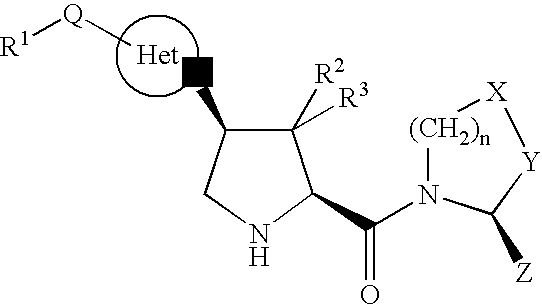
wherein:
R1 is benzoisothiazolyl, benzisoxazolyl, isothiazolyl, isoxazolyl, oxazolopyridyl, pyrazinyl, pyridinyl, pyrimidinyl, quinolinyl, quinoxalinyl, thiadiazolyl, triazinyl, or 1,1-dioxo-1H-1,2-benzoisothiazolyl;
R2 and R3 are —H; and
Q is a covalent bond.
4. The compound of claim 3 wherein R1 is pyridinyl or pyrimidinyl.
5. The compound of claim 4 wherein n is 1, X is —CF2— and Y is —CH2—.
6. The compound of claim 1 selected from the group consisting of
(3,3-difluoropyrrolidin-1-yl)-((2S,4S)-4-(4-(oxazolo[5,4-b]pyridin-2-yl)piperazin -1-yl)pyrrolidin-2-yl)-methanone,
(3,3-difluoropyrrolidin-1-yl)-((2S,4S)-4-(4-(4-methylpyrimidin-2-yl)piperazin-1-yl)pyrrolidin-2-yl)-methanone,
((S)-3-fluoro-pyrrolidin-1-yl)-{(2S,4S)-4-[4-(3-trifluoromethyl-pyridin-2-yl) -piperazin-1-yl]-pyrrolidin-2-yl}-methanone,
(3,3-difluoro-pyrrolidin-1-yl)-[(2S,4S)-4-(4-oxazolo[4,5-c]pyridin-2-yl-piperazin -1-yl)-pyrrolidin-2-yl]-methanone,
2-{4-[(3S,5S)-5-(3-fluoro-azetidine-1-carbonyl)-pyrrolidin-3-yl]-piperazin-1-yl}-nicotinonitrile,
((S)-3-fluoro-pyrrolidin-1-yl)-[(2S,4S)-4-(4-oxazolo[5,4-b]pyridin-2-yl-piperazin -1-yl)-pyrrolidin-2-yl]-methanone,
2-{4-[(3S,5S)-5-((S)-3-fluoro-pyrrolidine-1-carbonyl)-pyrrolidin-3-yl]-piperazin -1-yl}-nicotinonitrile,
(3-fluoro-azetidin-1-yl)-{(2S,4S)-4-[4-(2-trifluoromethyl-quinolin-4-yl)-piperazin -1-yl]-pyrrolidin-2-yl}-methanone,
((3R*,4S*)-3,4-difluoro-pyrrolidin-1-yl)-[(2S,4S)-4-(4-oxazolo[5,4-b]pyridin-2-yl-piperazin-1-yl)-pyrrolidin-2-yl]-methanone; or a pharmaceutically acceptable salt of said compound.
7. A pharmaceutical composition comprising:
(a) a compound of claim 1 , or a pharmaceutically acceptable salt of said compound; and
(b) a pharmaceutically acceptable carrier, vehicle, diluent or excipient.
8. A method of treating Type 2 diabetes in a mammal in need of such treatment a therapeutically effective amount of a compound of claim 1 , or a pharmaceutically acceptable salt of said compound.
9. A method of treating Type 1 diabetes in a mammal in need of such treatment a therapeutically effective amount of a compound of claim 1 , or a pharmaceutically acceptable salt of said compound.
10. A method of treating hyperglycemia in a mammal in need of such treatment a therapeutically effective amount of a compound of claim 1 , or a pharmaceutically acceptable salt of said compound.
11. A method of treating metabolic syndrome in a mammal in need of such treatment a therapeutically effective amount of a compound of claim 1 , or a pharmaceutically acceptable salt of said compound.
12. A method of treating impaired glucose tolerance in a mammal in need of such treatment a therapeutically effective amount of a compound of claim 1 , or a pharmaceutically acceptable salt of said compound.
13. A method of treating diabetic neuropathy in a mammal in need of such treatment a therapeutically effective amount of a compound of claim 1 , or a pharmaceutically acceptable salt of said compound.
14. A method of treating diabetic nephropathy in a mammal in need of such treatment a therapeutically effective amount of a compound of claim 1 , or a pharmaceutically acceptable salt of said compound.
15. A method of treating diabetic retinopathy in a mammal in need of such treatment a therapeutically effective amount of a compound of claim 1 , or a pharmaceutically acceptable salt of said compound.
16. A method of treating diabetic cardiomyopathy in a mammal in need of such treatment a therapeutically effective amount of a compound of claim 1 , or a pharmaceutically acceptable salt of said compound.
17. The method of claim 8 wherein said mammal is a human.
Priority Applications (1)
| Application Number | Priority Date | Filing Date | Title |
|---|---|---|---|
| US11/636,011 US7465732B2 (en) | 2004-05-12 | 2006-12-07 | (2S,4S)-4-(piperazin-1-yl)pyrrolidine-2-methanone derivatives |
Applications Claiming Priority (5)
| Application Number | Priority Date | Filing Date | Title |
|---|---|---|---|
| US57030004P | 2004-05-12 | 2004-05-12 | |
| US66430505P | 2005-03-21 | 2005-03-21 | |
| US11/129,277 US7291618B2 (en) | 2004-05-12 | 2005-05-12 | Therapeutic compounds |
| US11/282,057 US20060079498A1 (en) | 2004-05-12 | 2005-11-16 | Therapeutic compounds |
| US11/636,011 US7465732B2 (en) | 2004-05-12 | 2006-12-07 | (2S,4S)-4-(piperazin-1-yl)pyrrolidine-2-methanone derivatives |
Related Parent Applications (1)
| Application Number | Title | Priority Date | Filing Date |
|---|---|---|---|
| US11/282,057 Division US20060079498A1 (en) | 2004-05-12 | 2005-11-16 | Therapeutic compounds |
Publications (2)
| Publication Number | Publication Date |
|---|---|
| US20070099897A1 US20070099897A1 (en) | 2007-05-03 |
| US7465732B2 true US7465732B2 (en) | 2008-12-16 |
Family
ID=34966115
Family Applications (4)
| Application Number | Title | Priority Date | Filing Date |
|---|---|---|---|
| US11/129,277 Expired - Fee Related US7291618B2 (en) | 2004-05-12 | 2005-05-12 | Therapeutic compounds |
| US11/282,057 Abandoned US20060079498A1 (en) | 2004-05-12 | 2005-11-16 | Therapeutic compounds |
| US11/636,011 Expired - Fee Related US7465732B2 (en) | 2004-05-12 | 2006-12-07 | (2S,4S)-4-(piperazin-1-yl)pyrrolidine-2-methanone derivatives |
| US11/682,945 Abandoned US20070161664A1 (en) | 2004-05-12 | 2007-03-07 | Therapeutic compounds |
Family Applications Before (2)
| Application Number | Title | Priority Date | Filing Date |
|---|---|---|---|
| US11/129,277 Expired - Fee Related US7291618B2 (en) | 2004-05-12 | 2005-05-12 | Therapeutic compounds |
| US11/282,057 Abandoned US20060079498A1 (en) | 2004-05-12 | 2005-11-16 | Therapeutic compounds |
Family Applications After (1)
| Application Number | Title | Priority Date | Filing Date |
|---|---|---|---|
| US11/682,945 Abandoned US20070161664A1 (en) | 2004-05-12 | 2007-03-07 | Therapeutic compounds |
Country Status (36)
| Country | Link |
|---|---|
| US (4) | US7291618B2 (en) |
| EP (2) | EP1753748B1 (en) |
| JP (1) | JP4227660B2 (en) |
| KR (1) | KR100869616B1 (en) |
| AP (1) | AP2320A (en) |
| AR (1) | AR049894A1 (en) |
| AT (1) | ATE437870T1 (en) |
| AU (1) | AU2005247684B2 (en) |
| BR (1) | BRPI0510284A (en) |
| CA (1) | CA2566108C (en) |
| CR (1) | CR8744A (en) |
| CY (1) | CY1109322T1 (en) |
| DE (1) | DE602005015699D1 (en) |
| DK (1) | DK1753748T3 (en) |
| EA (1) | EA011086B9 (en) |
| EC (1) | ECSP066985A (en) |
| ES (1) | ES2327857T3 (en) |
| GE (1) | GEP20084421B (en) |
| HR (1) | HRP20090471T1 (en) |
| IL (1) | IL178339A (en) |
| MA (1) | MA28578B1 (en) |
| MX (1) | MXPA06013114A (en) |
| MY (1) | MY139805A (en) |
| NL (1) | NL1029015C2 (en) |
| NO (1) | NO20064400L (en) |
| NZ (1) | NZ550229A (en) |
| PA (1) | PA8632701A1 (en) |
| PE (1) | PE20060316A1 (en) |
| PL (1) | PL1753748T3 (en) |
| PT (1) | PT1753748E (en) |
| RS (1) | RS51106B (en) |
| SI (1) | SI1753748T1 (en) |
| SV (1) | SV2006002110A (en) |
| TW (1) | TWI347322B (en) |
| UY (1) | UY28892A1 (en) |
| WO (1) | WO2005116014A1 (en) |
Families Citing this family (130)
| Publication number | Priority date | Publication date | Assignee | Title |
|---|---|---|---|---|
| EP1368349B1 (en) * | 2001-02-24 | 2007-02-14 | Boehringer Ingelheim Pharma GmbH & Co.KG | Xanthine derivative, production and use thereof as a medicament |
| US7407955B2 (en) | 2002-08-21 | 2008-08-05 | Boehringer Ingelheim Pharma Gmbh & Co., Kg | 8-[3-amino-piperidin-1-yl]-xanthines, the preparation thereof and their use as pharmaceutical compositions |
| US7501426B2 (en) | 2004-02-18 | 2009-03-10 | Boehringer Ingelheim International Gmbh | 8-[3-amino-piperidin-1-yl]-xanthines, their preparation and their use as pharmaceutical compositions |
| PL1753748T3 (en) | 2004-05-12 | 2010-01-29 | Pfizer Prod Inc | Proline derivatives and their use as dipeptidyl peptidase iv inhibitors |
| DE102004054054A1 (en) | 2004-11-05 | 2006-05-11 | Boehringer Ingelheim Pharma Gmbh & Co. Kg | Process for preparing chiral 8- (3-amino-piperidin-1-yl) -xanthines |
| WO2006071875A1 (en) | 2004-12-29 | 2006-07-06 | Millennium Pharmaceuticals, Inc. | Compounds useful as chemokine receptor antagonists |
| WO2006071958A1 (en) | 2004-12-29 | 2006-07-06 | Millennium Pharmaceuticals, Inc. | Compounds useful as chemokine receptor antagonists |
| WO2006073167A1 (en) * | 2005-01-07 | 2006-07-13 | Ono Pharmaceutical Co., Ltd. | Pyrrolidine derivatives |
| DE102005035891A1 (en) | 2005-07-30 | 2007-02-08 | Boehringer Ingelheim Pharma Gmbh & Co. Kg | 8- (3-amino-piperidin-1-yl) -xanthines, their preparation and their use as pharmaceuticals |
| PE20071221A1 (en) | 2006-04-11 | 2007-12-14 | Arena Pharm Inc | GPR119 RECEPTOR AGONISTS IN METHODS TO INCREASE BONE MASS AND TO TREAT OSTEOPOROSIS AND OTHER CONDITIONS CHARACTERIZED BY LOW BONE MASS, AND COMBINED THERAPY RELATED TO THESE AGONISTS |
| AU2007235876A1 (en) | 2006-04-12 | 2007-10-18 | Probiodrug Ag | Enzyme inhibitors |
| EP1852108A1 (en) | 2006-05-04 | 2007-11-07 | Boehringer Ingelheim Pharma GmbH & Co.KG | DPP IV inhibitor formulations |
| EP2540725A1 (en) | 2006-05-04 | 2013-01-02 | Boehringer Ingelheim International GmbH | Polymorphs of 1-((4-Methyl-chinazolin-2-yl)methyl)-3-methyl-7-(2-butin-1-yl)-8-(3-(R)-amino-piperidin-1-yl)xanthin |
| PE20080251A1 (en) | 2006-05-04 | 2008-04-25 | Boehringer Ingelheim Int | USES OF DPP IV INHIBITORS |
| TW200815405A (en) * | 2006-06-09 | 2008-04-01 | Astrazeneca Ab | Novel compounds |
| WO2007148185A2 (en) * | 2006-06-21 | 2007-12-27 | Pfizer Products Inc. | Substituted 3 -amino- pyrrolidino-4 -lactams as dpp inhibitors |
| US8278345B2 (en) | 2006-11-09 | 2012-10-02 | Probiodrug Ag | Inhibitors of glutaminyl cyclase |
| ATE554085T1 (en) | 2006-11-30 | 2012-05-15 | Probiodrug Ag | NEW INHIBITORS OF GLUTAMINYL CYCLASE |
| EP2142514B1 (en) | 2007-04-18 | 2014-12-24 | Probiodrug AG | Thiourea derivatives as glutaminyl cyclase inhibitors |
| PE20090987A1 (en) * | 2007-08-16 | 2009-08-14 | Boehringer Ingelheim Int | PHARMACEUTICAL COMPOSITION INCLUDING A DERIVATIVE OF PIRAZOL-O-GLUCOSIDE |
| CL2008002427A1 (en) * | 2007-08-16 | 2009-09-11 | Boehringer Ingelheim Int | Pharmaceutical composition comprising 1-chloro-4- (bd-glucopyranos-1-yl) -2- [4 - ((s) -tetrahydrofuran-3-yloxy) benzyl] -benzene combined with 1 - [(4-methylquinazolin- 2-yl) methyl] -3-methyl-7- (2-butyn-1-yl) -8- (3- (r) -aminopiperidin-1-yl) xanthine; and its use to treat type 2 diabetes mellitus. |
| UA108596C2 (en) | 2007-11-09 | 2015-05-25 | Peptide deformylase inhibitors | |
| PE20091730A1 (en) | 2008-04-03 | 2009-12-10 | Boehringer Ingelheim Int | FORMULATIONS INVOLVING A DPP4 INHIBITOR |
| EP2108960A1 (en) | 2008-04-07 | 2009-10-14 | Arena Pharmaceuticals, Inc. | Methods of using A G protein-coupled receptor to identify peptide YY (PYY) secretagogues and compounds useful in the treatment of conditons modulated by PYY |
| PE20100156A1 (en) * | 2008-06-03 | 2010-02-23 | Boehringer Ingelheim Int | NAFLD TREATMENT |
| UY32030A (en) | 2008-08-06 | 2010-03-26 | Boehringer Ingelheim Int | "TREATMENT FOR DIABETES IN INAPPROPRIATE PATIENTS FOR THERAPY WITH METFORMIN" |
| BRPI0916997A2 (en) | 2008-08-06 | 2020-12-15 | Boehringer Ingelheim International Gmbh | DPP-4 INHIBITOR AND ITS USE |
| NZ604091A (en) * | 2008-08-15 | 2014-08-29 | Boehringer Ingelheim Int | Purin derivatives for use in the treatment of fab-related diseases |
| CN102149407A (en) | 2008-09-10 | 2011-08-10 | 贝林格尔.英格海姆国际有限公司 | Combination therapy for the treatment of diabetes and related conditions |
| US20200155558A1 (en) | 2018-11-20 | 2020-05-21 | Boehringer Ingelheim International Gmbh | Treatment for diabetes in patients with insufficient glycemic control despite therapy with an oral antidiabetic drug |
| WO2010071819A1 (en) * | 2008-12-19 | 2010-06-24 | Schering Corporation | Bicyclic heterocyclic derivatives and methods of use thereof |
| CN102256976A (en) | 2008-12-23 | 2011-11-23 | 贝林格尔.英格海姆国际有限公司 | Salt Forms of Organic Compounds |
| AR074990A1 (en) | 2009-01-07 | 2011-03-02 | Boehringer Ingelheim Int | TREATMENT OF DIABETES IN PATIENTS WITH AN INAPPROPRIATE GLUCEMIC CONTROL THROUGH METFORMIN THERAPY |
| AR075204A1 (en) | 2009-01-29 | 2011-03-16 | Boehringer Ingelheim Int | DPP-4 INHIBITORS AND PHARMACEUTICAL COMPOSITIONS THAT INCLUDE THEM, USEFUL TO TREAT METABOLIC DISEASES IN PEDIATRIC PATIENTS, PARTICULARLY MELLITUS DIABETES TYPE 2 |
| AU2010212823B2 (en) | 2009-02-13 | 2016-01-28 | Boehringer Ingelheim International Gmbh | Antidiabetic medications comprising a DPP-4 inhibitor (linagliptin) optionally in combination with other antidiabetics |
| JP5685550B2 (en) | 2009-02-13 | 2015-03-18 | ベーリンガー インゲルハイム インターナショナル ゲゼルシャフト ミット ベシュレンクテル ハフツング | Pharmaceutical composition comprising SGLT2 inhibitor, DPP-IV inhibitor, and optionally antidiabetic agent, and use thereof |
| AR077642A1 (en) | 2009-07-09 | 2011-09-14 | Arena Pharm Inc | METABOLISM MODULATORS AND THE TREATMENT OF DISORDERS RELATED TO THE SAME |
| JP5934645B2 (en) | 2009-09-11 | 2016-06-15 | プロビオドルグ エージー | Heterocyclic derivatives as glutaminyl cyclase inhibitors |
| KR20240090632A (en) | 2009-11-27 | 2024-06-21 | 베링거 인겔하임 인터내셔날 게엠베하 | Treatment of genotyped diabetic patients with dpp-iv inhibitors such as linagliptin |
| EP2338888A1 (en) | 2009-12-24 | 2011-06-29 | Almirall, S.A. | Imidazopyridine derivatives as JAK inhibitors |
| JP6026284B2 (en) | 2010-03-03 | 2016-11-16 | プロビオドルグ エージー | Inhibitors of glutaminyl cyclase |
| NZ602312A (en) | 2010-03-10 | 2014-02-28 | Probiodrug Ag | Heterocyclic inhibitors of glutaminyl cyclase (qc, ec 2.3.2.5) |
| EP2547339A1 (en) | 2010-03-18 | 2013-01-23 | Boehringer Ingelheim International GmbH | Combination of a gpr119 agonist and the dpp-iv inhibitor linagliptin for use in the treatment of diabetes and related conditions |
| DK2547679T3 (en) | 2010-03-19 | 2016-01-11 | Pfizer | 2,3 dihydro-1H-inden-1-yl-2,7-diazaspiro [3.6] nonane derivatives and their use as antagonists or inverse agonists of ghrelin receptor |
| CA2795513A1 (en) | 2010-04-06 | 2011-10-13 | Arena Pharmaceuticals, Inc. | Modulators of the gpr119 receptor and the treatment of disorders related thereto |
| WO2011131748A2 (en) | 2010-04-21 | 2011-10-27 | Probiodrug Ag | Novel inhibitors |
| CN102946875A (en) | 2010-05-05 | 2013-02-27 | 贝林格尔.英格海姆国际有限公司 | Combination therapy |
| WO2011161161A1 (en) | 2010-06-24 | 2011-12-29 | Boehringer Ingelheim International Gmbh | Diabetes therapy |
| EP3323818A1 (en) | 2010-09-22 | 2018-05-23 | Arena Pharmaceuticals, Inc. | Modulators of the gpr119 receptor and the treatment of disorders related thereto |
| ES2546465T3 (en) | 2010-10-29 | 2015-09-23 | Pfizer Inc | N1 / N2-lactam acetyl-CoA carboxylase inhibitors |
| AR083878A1 (en) | 2010-11-15 | 2013-03-27 | Boehringer Ingelheim Int | VASOPROTECTORA AND CARDIOPROTECTORA ANTIDIABETIC THERAPY, LINAGLIPTINA, TREATMENT METHOD |
| AR085689A1 (en) | 2011-03-07 | 2013-10-23 | Boehringer Ingelheim Int | PHARMACEUTICAL COMPOSITIONS OF METFORMIN, LINAGLIPTINE AND AN SGLT-2 INHIBITOR |
| EP2686313B1 (en) | 2011-03-16 | 2016-02-03 | Probiodrug AG | Benzimidazole derivatives as inhibitors of glutaminyl cyclase |
| US20140018371A1 (en) | 2011-04-01 | 2014-01-16 | Arena Pharmaceuticals, Inc. | Modulators Of The GPR119 Receptor And The Treatment Of Disorders Related Thereto |
| WO2012145361A1 (en) | 2011-04-19 | 2012-10-26 | Arena Pharmaceuticals, Inc. | Modulators of the gpr119 receptor and the treatment of disorders related thereto |
| US20140051714A1 (en) | 2011-04-22 | 2014-02-20 | Arena Pharmaceuticals, Inc. | Modulators Of The GPR119 Receptor And The Treatment Of Disorders Related Thereto |
| AU2012245996B2 (en) | 2011-04-22 | 2016-09-01 | Pfizer Inc. | Pyrazolospiroketone derivatives for use as acetyl-CoA carboxylase inhibitors |
| US20140038889A1 (en) | 2011-04-22 | 2014-02-06 | Arena Pharmaceuticals, Inc. | Modulators Of The GPR119 Receptor And The Treatment Of Disorders Related Thereto |
| WO2012170702A1 (en) | 2011-06-08 | 2012-12-13 | Arena Pharmaceuticals, Inc. | Modulators of the gpr119 receptor and the treatment of disorders related thereto |
| US8883800B2 (en) | 2011-07-15 | 2014-11-11 | Boehringer Ingelheim International Gmbh | Substituted quinazolines, the preparation thereof and the use thereof in pharmaceutical compositions |
| JP2014520879A (en) | 2011-07-15 | 2014-08-25 | ファイザー・インク | GPR119 regulator |
| US8927577B2 (en) | 2011-07-22 | 2015-01-06 | Pfizer Inc. | Quinolinyl glucagon receptor modulators |
| JP6043355B2 (en) | 2011-08-31 | 2016-12-14 | ファイザー・インク | Hexahydropyrano [3,4-d] [1,3] thiazin-2-amine compound |
| WO2013055910A1 (en) | 2011-10-12 | 2013-04-18 | Arena Pharmaceuticals, Inc. | Modulators of the gpr119 receptor and the treatment of disorders related thereto |
| CN103917529B (en) | 2011-11-11 | 2016-08-17 | 辉瑞大药厂 | 2-thiopyrimidinones |
| US9555001B2 (en) | 2012-03-07 | 2017-01-31 | Boehringer Ingelheim International Gmbh | Pharmaceutical composition and uses thereof |
| EA201400990A1 (en) | 2012-04-06 | 2015-01-30 | Пфайзер Инк. | INHIBITORS DIACYLGLYCERINACYLTRANSFERASE 2 |
| US8889730B2 (en) | 2012-04-10 | 2014-11-18 | Pfizer Inc. | Indole and indazole compounds that activate AMPK |
| WO2013164730A1 (en) | 2012-05-04 | 2013-11-07 | Pfizer Inc. | Heterocyclic substituted hexahydropyrano [3,4-d] [1,3] thiazin- 2 -amine compounds as inhibitors of app, bace1 and bace 2. |
| JP6224084B2 (en) | 2012-05-14 | 2017-11-01 | ベーリンガー インゲルハイム インターナショナル ゲゼルシャフト ミット ベシュレンクテル ハフツング | Xanthine derivatives as DPP-4 inhibitors for the treatment of glomerular epithelial cell related disorders and / or nephrotic syndrome |
| JP6218811B2 (en) | 2012-05-14 | 2017-10-25 | ベーリンガー インゲルハイム インターナショナル ゲゼルシャフト ミット ベシュレンクテル ハフツング | Xanthine derivatives as DPP-4 inhibitors for use in the treatment of SIRS and / or sepsis |
| WO2013174767A1 (en) | 2012-05-24 | 2013-11-28 | Boehringer Ingelheim International Gmbh | A xanthine derivative as dpp -4 inhibitor for use in modifying food intake and regulating food preference |
| EP2897964A1 (en) | 2012-09-20 | 2015-07-29 | Pfizer Inc. | Alkyl-substituted hexahydropyrano [3,4-d][1,3]thiazin-2-amine compounds |
| WO2014074668A1 (en) | 2012-11-08 | 2014-05-15 | Arena Pharmaceuticals, Inc. | Modulators of gpr119 and the treatment of disorders related thereto |
| EP2931731A1 (en) | 2012-12-11 | 2015-10-21 | Pfizer Inc. | Hexahydropyrano [3,4-d][1,3]thiazin-2-amine compounds as inhibitors of bace1 |
| US9403846B2 (en) | 2012-12-19 | 2016-08-02 | Pfizer Inc. | Carbocyclic- and heterocyclic-substituted hexahydropyrano[3,4-d][1,3]thiazin-2-amine compounds |
| EP2956458B1 (en) | 2013-02-13 | 2017-08-09 | Pfizer Inc | Heteroaryl-substituted hexahydropyrano[3,4-d][1,3]thiazin-2-amine compounds |
| US9233981B1 (en) | 2013-02-15 | 2016-01-12 | Pfizer Inc. | Substituted phenyl hexahydropyrano[3,4-d][1,3]thiazin-2-amine compounds |
| WO2015019238A1 (en) * | 2013-08-06 | 2015-02-12 | Ranbaxy Laboratories Limited | Process for the preparation of n-protected (5s)-5-(1,3-thiazolidin-3-ylcarbonyl)pyrrolidin-3-one |
| CA2926568C (en) | 2013-10-09 | 2017-09-05 | Pfizer Inc. | Antagonists of prostaglandin ep3 receptor |
| EP3110449B1 (en) | 2014-02-28 | 2023-06-28 | Boehringer Ingelheim International GmbH | Medical use of a dpp-4 inhibitor |
| LT3119757T (en) | 2014-03-17 | 2018-07-10 | Pfizer Inc. | Diacylglycerol acyltransferase 2 inhibitors for use in the treatment of metabolic and related disorders |
| DK3126330T3 (en) | 2014-04-04 | 2019-04-23 | Pfizer | BICYCLE-FUSED HETEROARYL OR ARYL COMPOUNDS AND USE THEREOF AS IRAC4 INHIBITORS |
| CN106459088A (en) | 2014-04-10 | 2017-02-22 | 辉瑞公司 | 2-amino-6-methyl-4,4a,5,6-tetrahydropyrano[3,4-d][1,3]thiazin-8a(8h)-yl-1,3-thiazol-4-yl amides |
| WO2016092413A1 (en) | 2014-12-10 | 2016-06-16 | Pfizer Inc. | Indole and indazole compounds that activate ampk |
| EP3237401B1 (en) | 2014-12-22 | 2019-03-06 | Pfizer Inc | Antagonists of prostaglandin ep3 receptor |
| AU2016257179A1 (en) | 2015-05-05 | 2017-11-02 | Pfizer Inc. | 2-thiopyrimidinones |
| US10308615B2 (en) | 2015-05-29 | 2019-06-04 | Pfizer Inc. | Heterocyclic compounds as inhibitors of Vanin-1 enzyme |
| CN107787322B (en) | 2015-06-17 | 2023-07-07 | 辉瑞大药厂 | Tricyclic compounds and their use as phosphodiesterase inhibitors |
| WO2016203335A1 (en) | 2015-06-18 | 2016-12-22 | Pfizer Inc. | Novel pyrido[2,3-b]pyrazinones as bet-family bromodomain inhibitors |
| WO2017025849A1 (en) | 2015-08-13 | 2017-02-16 | Pfizer Inc. | Bicyclic-fused heteroaryl or aryl compounds |
| HUE053705T2 (en) | 2015-08-27 | 2021-07-28 | Pfizer | Bicyclic fused heteroaryl or aryl compounds as modulators of IRAK4 |
| WO2017037567A1 (en) | 2015-09-03 | 2017-03-09 | Pfizer Inc. | Regulators of frataxin |
| JP2018534251A (en) | 2015-09-24 | 2018-11-22 | ファイザー・インク | N- [2- (3-Amino-2,5-dimethyl-1,1-dioxide-5,6-dihydro-2H-1,2,4-thiadiazin-5-yl) -1 useful as a BACE inhibitor , 3-Thiazol-4-yl] amide |
| WO2017051303A1 (en) | 2015-09-24 | 2017-03-30 | Pfizer Inc. | Tetrahydropyrano[3,4-d][1,3]oxazin derivatives and their use as bace inhibitors |
| JP2018531923A (en) | 2015-09-24 | 2018-11-01 | ファイザー・インク | N- [2- (2-Amino-6,6-disubstituted-4,4a, 5,6-tetrahydropyrano [3,4-d] [1,3] thiazin-8a (8H) -yl)- 1,3-thiazol-4-yl] amide |
| SI3397631T1 (en) | 2015-12-29 | 2022-01-31 | Pfizer Inc. | Substituted 3-azabicyclo(3.1.0)hexanes as ketohexokinase inhibitors |
| CN109310697A (en) | 2016-06-10 | 2019-02-05 | 勃林格殷格翰国际有限公司 | Combination of linagliptin and metformin |
| WO2018011681A1 (en) | 2016-07-14 | 2018-01-18 | Pfizer Inc. | Novel pyrimidine carboxamides as inhibitors of vanin-1 enzyme |
| AR109179A1 (en) | 2016-08-19 | 2018-11-07 | Pfizer | DIACILGLICEROL ACILTRANSFERASA 2 INHIBITORS |
| ES2812698T3 (en) | 2017-09-29 | 2021-03-18 | Probiodrug Ag | Glutaminyl cyclase inhibitors |
| WO2019133445A1 (en) | 2017-12-28 | 2019-07-04 | Inception Ibd, Inc. | Aminothiazoles as inhibitors of vanin-1 |
| US11254660B2 (en) | 2018-08-31 | 2022-02-22 | Pfizer Inc. | Combinations for treatment of NASH/NAFLD and related diseases |
| WO2020102575A1 (en) | 2018-11-16 | 2020-05-22 | Inception Ibd, Inc. | Heterocyclic aminothiazoles and uses thereof |
| WO2020234726A1 (en) | 2019-05-20 | 2020-11-26 | Pfizer Inc. | Combinations comprising benzodioxol as glp-1r agonists for use in the treatment of nash/nafld and related diseases |
| TW202115086A (en) | 2019-06-28 | 2021-04-16 | 美商輝瑞大藥廠 | Bckdk inhibitors |
| WO2020261144A1 (en) | 2019-06-28 | 2020-12-30 | Pfizer Inc. | 5-(thiophen-2-yl)-1h-tetrazole derivatives as bckdk inhibitors useful for treating various diseases |
| TWI771766B (en) | 2019-10-04 | 2022-07-21 | 美商輝瑞股份有限公司 | Diacylglycerol acyltransferase 2 inhibitor |
| JP2022058085A (en) | 2020-02-24 | 2022-04-11 | ファイザー・インク | Combination of inhibitors of diacylglycerol acyltransferase 2 and inhibitors of acetyl-coa carboxylase |
| JP7288554B1 (en) | 2020-06-09 | 2023-06-07 | ファイザー・インク | Spiro compounds and their use as melanocortin 4 receptor antagonists |
| US20250066337A1 (en) | 2021-08-26 | 2025-02-27 | Pfizer Inc. | Amorphous Form of (S)-2-(5-((3-Ethoxypyridin-2-YL)Oxy)Pyridin-3-YL)-N-(Tetrahydrofuran-3-YL)Pyrimidine-5-Carboxamide |
| CA3240990A1 (en) | 2021-12-01 | 2023-06-08 | Pfizer Inc. | 3-phenyl-1-benzothiophene-2-carboxylic acid derivatives as branched-chain alpha keto acid dehydrogenase kinase inhibitors for the treatment of diabetes, kidney diseases, nash and heart failure |
| JP2024544021A (en) | 2021-12-06 | 2024-11-26 | ファイザー・インク | Melanocortin 4 receptor antagonists and their uses - Patents.com |
| KR20250075705A (en) | 2022-10-07 | 2025-05-28 | 화이자 인코포레이티드 | HSD17B13 inhibitor and/or degrader |
| AU2023364628A1 (en) | 2022-10-18 | 2025-04-03 | Pfizer Inc. | Patatin-like phospholipase domain-containing protein 3 (pnpla3) modifiers |
| WO2024118524A1 (en) | 2022-11-28 | 2024-06-06 | Cerevel Therapeutics, Llc | Azaindole compounds and their use as phosphodiesterase inhibitors |
| EP4634169A1 (en) | 2022-12-16 | 2025-10-22 | Pfizer Inc. | 3-fluoro-4-hydroxybenzmide-containing inhibitors and/or degraders and uses thereof |
| EP4695226A1 (en) | 2023-04-14 | 2026-02-18 | Pfizer Inc. | Glucose-dependent insulinotropic polypeptide receptor antagonists and uses thereof |
| WO2025099566A1 (en) | 2023-11-08 | 2025-05-15 | Pfizer Inc. | A crystalline form of 6-fluoro-3-(2,4,5-trifluoro-3-methoxyphenyl)-1-benzothiophene-2-carboxylic acid |
| TW202539633A (en) | 2024-02-01 | 2025-10-16 | 美商輝瑞股份有限公司 | Glucose-dependent insulinotropic polypeptide receptor antagonists and uses thereof |
| US20250326741A1 (en) | 2024-04-22 | 2025-10-23 | Pfizer Inc. | Glucose-dependent insulinotropic polypeptide receptor antagonists and uses thereof |
| WO2026013531A1 (en) | 2024-07-10 | 2026-01-15 | Pfizer Inc. | Spiro[2.5]octane compounds |
| WO2026033382A1 (en) | 2024-08-07 | 2026-02-12 | Pfizer Inc. | Heterocyclic glp-1r modulators |
| WO2026042018A1 (en) | 2024-08-21 | 2026-02-26 | Pfizer Inc. | 4-{4-[(1-{[4-(propan-2-yl)phenyl]carbamoyl)-d-prolyl)amino]cyclohexyl}benzoic acid derivatives as gipr antagonists for the treatment of diabetes |
| WO2026078617A1 (en) | 2024-10-11 | 2026-04-16 | Pfizer Inc. | Glucose-dependent insulinotropic polypeptide receptor antagonists and uses thereof |
| WO2026078672A1 (en) | 2024-10-13 | 2026-04-16 | Pfizer Inc. | Glucose-dependent insulinotropic polypeptide receptor antagonists and uses thereof |
| WO2026078673A1 (en) | 2024-10-13 | 2026-04-16 | Pfizer Inc. | Glucose-dependent insulinotropic polypeptide receptor antagonists and uses thereof |
| WO2026078670A1 (en) | 2024-10-13 | 2026-04-16 | Pfizer Inc. | Heterocyclic derivatives as glucose-dependent insulinotropic polypeptide receptor antagonists |
| WO2026078671A1 (en) | 2024-10-13 | 2026-04-16 | Pfizer Inc. | Heterocyclic compounds as glucose-dependent insulinotropic polypeptide receptor antagonists |
| WO2026078674A1 (en) | 2024-10-13 | 2026-04-16 | Pfizer Inc. | Heterocyclic derivatives as glucose-dependent insulinotropic polypeptide receptor antagonists and uses thereof |
Citations (30)
| Publication number | Priority date | Publication date | Assignee | Title |
|---|---|---|---|---|
| WO1995034538A2 (en) | 1994-06-10 | 1995-12-21 | Universitaire Instelling Antwerpen | Purification of serine proteases and synthetic inhibitors thereof |
| CA2428271A1 (en) | 2000-11-10 | 2002-05-16 | Taisho Pharmaceutical Co., Ltd. | Cyanopyrrolidine derivatives as inhibitors of dpp-iv |
| WO2002076450A1 (en) | 2001-03-27 | 2002-10-03 | Merck & Co., Inc. | Dipeptidyl peptidase inhibitors for the treatment or prevention of diabetes |
| WO2003000250A1 (en) | 2001-06-25 | 2003-01-03 | Ferring Bv | 3-fluoro-pyrrolidines as antidiabetic agents |
| WO2003002553A2 (en) | 2001-06-27 | 2003-01-09 | Smithkline Beecham Corporation | Fluoropyrrolidines as dipeptidyl peptidase inhibitors |
| WO2003002531A2 (en) | 2001-06-27 | 2003-01-09 | Smithkline Beecham Corporation | Fluoropyrrolidines as dipeptidyl peptidase inhibitors |
| WO2003035057A1 (en) | 2001-10-23 | 2003-05-01 | Ferring B.V. | Inhibitors of dipeptidyl peptidase iv |
| EP1308439A1 (en) | 2000-08-10 | 2003-05-07 | Welfide Corporation | Proline derivatives and use thereof as drugs |
| WO2003057144A2 (en) | 2001-12-26 | 2003-07-17 | Guilford Pharmaceuticals | Change inhibitors of dipeptidyl peptidase iv |
| WO2003095425A1 (en) | 2002-05-09 | 2003-11-20 | Taisho Pharmaceutical Co.,Ltd. | Cyanopyrrolidine derivatives |
| WO2003101958A2 (en) | 2002-06-04 | 2003-12-11 | Pfizer Products Inc. | Flourinated cyclic amides as dipeptidyl peptidase iv inhibitors |
| WO2003101449A2 (en) | 2002-06-04 | 2003-12-11 | Pfizer Products Inc. | Process for the preparation of 3,3,4,4-tetrafluoropyrrolidine and derivatives thereof |
| WO2004007446A1 (en) | 2002-07-10 | 2004-01-22 | Yamanouchi Pharmaceutical Co., Ltd. | Novel azetidine derivative or salt thereof |
| JP2004026820A (en) | 2002-05-09 | 2004-01-29 | Taisho Pharmaceut Co Ltd | Dipeptidyl peptidase IV inhibitor |
| WO2004043940A1 (en) | 2002-11-07 | 2004-05-27 | Merck & Co., Inc. | Phenylalanine derivatives as dipeptidyl peptidase inhibitors for the treatment or prevention of diabetes |
| WO2004046106A1 (en) | 2002-11-18 | 2004-06-03 | Pfizer Products Inc. | Dipeptidyl peptidase iv inhibiting fluorinated cyclic amides |
| EP1426366A1 (en) | 2001-09-14 | 2004-06-09 | Mitsubishi Pharma Corporation | Thiazolidine derivative and medicinal use thereof |
| WO2004050022A2 (en) | 2002-12-04 | 2004-06-17 | Merck & Co., Inc. | Phenylalanine derivatives as dipeptidyl peptidase inhibitors for the treatment or prevention of diabetes |
| WO2004071454A2 (en) | 2003-02-13 | 2004-08-26 | Guilford Pharmaceuticals Inc. | Substituted azetidine compounds as inhibitors of dipeptidyl peptidase iv |
| WO2004092128A1 (en) | 2003-04-10 | 2004-10-28 | Smithkline Beecham Corporation | Anhydrous crystalline forms of (2s, 4s)-1-{(2r)-2-amino-3-‘4-methoxybenzyl)sulfonyl!-3-methylbutanoyl}-4-fluoropyrrolindine-2-carbonitrile |
| WO2004110436A1 (en) | 2003-06-06 | 2004-12-23 | Merck & Co., Inc. | Fused indoles as dipeptidyl peptidase inhibitors for the treatment or prevention of diabetes |
| WO2004112701A2 (en) | 2003-06-17 | 2004-12-29 | Merck & Co., Inc. | Cyclohexylglycine derivatives as dipeptidyl peptidase inhibitors for the treatment or prevention of diabetes |
| WO2005009956A1 (en) | 2003-07-21 | 2005-02-03 | Smithkline Beecham Corporation | (2s,4s)-4-fluoro-1-[4-fluoro-beta-(4-fluorophenyl)-l-phenylalanyl]-2-pyrrolidinecarbonitrile p-toluenesulfonic acid salt and anhydrous crystalline forms thereof |
| WO2005023762A1 (en) | 2003-09-04 | 2005-03-17 | Abbott Laboratories | Pyrrolidine-2-carbonitrile derivatives and their use as inhibitors of dipeptidyl peptidase-iv (dpp-iv) |
| WO2005042533A2 (en) | 2003-10-31 | 2005-05-12 | Astellas Pharma Inc. | 2-cyanopyrrolidinecarboxamides as dipeptidyl peptidase-iv inhibitors |
| WO2005044195A2 (en) | 2003-11-04 | 2005-05-19 | Merck & Co., Inc. | Fused phenylalanine derivatives as dipeptidyl peptidase-iv inhibitors for the treatment or prevention of diabetes |
| EP1535906A1 (en) | 2002-08-19 | 2005-06-01 | Ono Pharmaceutical Co., Ltd. | Nitrogen-containing compounds |
| JP2005139107A (en) | 2003-11-05 | 2005-06-02 | Taisho Pharmaceut Co Ltd | Dipeptidyl peptidase IV inhibitor |
| JP2005170792A (en) * | 2002-11-22 | 2005-06-30 | Mitsubishi Pharma Corp | L-proline derivatives and their pharmaceutical use. |
| US20050256310A1 (en) | 2004-05-12 | 2005-11-17 | Pfizer Inc | Therapeutic compounds |
Family Cites Families (19)
| Publication number | Priority date | Publication date | Assignee | Title |
|---|---|---|---|---|
| JP3170059B2 (en) | 1992-08-25 | 2001-05-28 | 誠 大塚 | Calcium phosphate drug sustained-release body and method for producing the same |
| GB9903119D0 (en) | 1999-02-11 | 1999-04-07 | Merck Sharp & Dohme | Therapeutic agents |
| US7169373B2 (en) | 1999-07-14 | 2007-01-30 | Calcitec, Inc. | Tetracalcium phosphate (TTCP) having calcium phosphate whisker on surface and process for preparing the same |
| US7270705B2 (en) | 1999-07-14 | 2007-09-18 | Jiin-Huey Chern Lin | Method of increasing working time of tetracalcium phosphate cement paste |
| US7094282B2 (en) | 2000-07-13 | 2006-08-22 | Calcitec, Inc. | Calcium phosphate cement, use and preparation thereof |
| US6960249B2 (en) | 1999-07-14 | 2005-11-01 | Calcitec, Inc. | Tetracalcium phosphate (TTCP) having calcium phosphate whisker on surface |
| US6840995B2 (en) | 1999-07-14 | 2005-01-11 | Calcitec, Inc. | Process for producing fast-setting, bioresorbable calcium phosphate cements |
| JP4070951B2 (en) | 2000-12-07 | 2008-04-02 | ペンタックス株式会社 | Method for producing porous calcium phosphate ceramic sintered body |
| US6616742B2 (en) | 2001-08-30 | 2003-09-09 | Cana Lab Corporation | Process for preparing a paste from calcium phosphate cement |
| WO2003055418A1 (en) | 2001-12-21 | 2003-07-10 | Lagow Richard J | Calcium phosphate bone replacement materials and methods of use thereof |
| US6955716B2 (en) | 2002-03-01 | 2005-10-18 | American Dental Association Foundation | Self-hardening calcium phosphate materials with high resistance to fracture, controlled strength histories and tailored macropore formation rates |
| US20040137032A1 (en) | 2002-03-15 | 2004-07-15 | Wang Francis W. | Combinations of calcium phosphates, bone growth factors, and pore-forming additives as osteoconductive and osteoinductive composite bone grafts |
| US20030216777A1 (en) | 2002-05-16 | 2003-11-20 | Yin-Chun Tien | Method of enhancing healing of interfacial gap between bone and tendon or ligament |
| US6710040B1 (en) | 2002-06-04 | 2004-03-23 | Pfizer Inc. | Fluorinated cyclic amides as dipeptidyl peptidase IV inhibitors |
| DE60300666T2 (en) | 2002-07-11 | 2006-04-27 | Biomet Deutschland Gmbh | Process for the preparation of porous calcium phosphate chips and granules from gelatine processing |
| US20040180091A1 (en) | 2003-03-13 | 2004-09-16 | Chang-Yi Lin | Carbonated hydroxyapatite-based microspherical composites for biomedical uses |
| US7306610B2 (en) | 2003-03-21 | 2007-12-11 | Cana Lab Corporation | Method and device for forming a hardened cement in a bone cavity |
| WO2005019168A2 (en) * | 2003-08-20 | 2005-03-03 | Pfizer Products Inc. | Fluorinated lysine derivatives as dipeptidyl peptidase iv inhibitors |
| EP1686934B1 (en) | 2003-11-07 | 2020-03-18 | Vivex Biologics Group, Inc. | Injectable bone substitute |
-
2005
- 2005-04-29 PL PL05733750T patent/PL1753748T3/en unknown
- 2005-04-29 ES ES05733750T patent/ES2327857T3/en not_active Expired - Lifetime
- 2005-04-29 EP EP05733750A patent/EP1753748B1/en not_active Expired - Lifetime
- 2005-04-29 BR BRPI0510284-7A patent/BRPI0510284A/en active Search and Examination
- 2005-04-29 WO PCT/IB2005/001194 patent/WO2005116014A1/en not_active Ceased
- 2005-04-29 JP JP2007512552A patent/JP4227660B2/en not_active Expired - Fee Related
- 2005-04-29 PT PT05733750T patent/PT1753748E/en unknown
- 2005-04-29 MX MXPA06013114A patent/MXPA06013114A/en active IP Right Grant
- 2005-04-29 EP EP09166645.3A patent/EP2116541B1/en not_active Expired - Lifetime
- 2005-04-29 DK DK05733750T patent/DK1753748T3/en active
- 2005-04-29 AP AP2006003770A patent/AP2320A/en active
- 2005-04-29 RS RSP-2009/0401A patent/RS51106B/en unknown
- 2005-04-29 AU AU2005247684A patent/AU2005247684B2/en not_active Ceased
- 2005-04-29 EA EA200601896A patent/EA011086B9/en active Protection Beyond IP Right Term
- 2005-04-29 HR HR20090471T patent/HRP20090471T1/en unknown
- 2005-04-29 CA CA2566108A patent/CA2566108C/en not_active Expired - Fee Related
- 2005-04-29 NZ NZ550229A patent/NZ550229A/en not_active IP Right Cessation
- 2005-04-29 SI SI200530767T patent/SI1753748T1/en unknown
- 2005-04-29 AT AT05733750T patent/ATE437870T1/en active
- 2005-04-29 GE GEAP20059699A patent/GEP20084421B/en unknown
- 2005-04-29 DE DE602005015699T patent/DE602005015699D1/en not_active Expired - Lifetime
- 2005-04-29 KR KR1020067023663A patent/KR100869616B1/en not_active Expired - Fee Related
- 2005-05-06 MY MYPI20052038A patent/MY139805A/en unknown
- 2005-05-09 PE PE2005000515A patent/PE20060316A1/en not_active Application Discontinuation
- 2005-05-10 AR ARP050101880A patent/AR049894A1/en not_active Application Discontinuation
- 2005-05-11 NL NL1029015A patent/NL1029015C2/en not_active IP Right Cessation
- 2005-05-11 PA PA20058632701A patent/PA8632701A1/en unknown
- 2005-05-11 TW TW094115224A patent/TWI347322B/en not_active IP Right Cessation
- 2005-05-11 UY UY28892A patent/UY28892A1/en not_active Application Discontinuation
- 2005-05-12 US US11/129,277 patent/US7291618B2/en not_active Expired - Fee Related
- 2005-05-12 SV SV2005002110A patent/SV2006002110A/en unknown
- 2005-11-16 US US11/282,057 patent/US20060079498A1/en not_active Abandoned
-
2006
- 2006-09-27 IL IL178339A patent/IL178339A/en not_active IP Right Cessation
- 2006-09-28 NO NO20064400A patent/NO20064400L/en not_active Application Discontinuation
- 2006-11-09 CR CR8744A patent/CR8744A/en unknown
- 2006-11-09 EC EC2006006985A patent/ECSP066985A/en unknown
- 2006-11-10 MA MA29446A patent/MA28578B1/en unknown
- 2006-12-07 US US11/636,011 patent/US7465732B2/en not_active Expired - Fee Related
-
2007
- 2007-03-07 US US11/682,945 patent/US20070161664A1/en not_active Abandoned
-
2009
- 2009-08-20 CY CY20091100886T patent/CY1109322T1/en unknown
Patent Citations (32)
| Publication number | Priority date | Publication date | Assignee | Title |
|---|---|---|---|---|
| WO1995034538A2 (en) | 1994-06-10 | 1995-12-21 | Universitaire Instelling Antwerpen | Purification of serine proteases and synthetic inhibitors thereof |
| EP1308439A1 (en) | 2000-08-10 | 2003-05-07 | Welfide Corporation | Proline derivatives and use thereof as drugs |
| CA2428271A1 (en) | 2000-11-10 | 2002-05-16 | Taisho Pharmaceutical Co., Ltd. | Cyanopyrrolidine derivatives as inhibitors of dpp-iv |
| WO2002076450A1 (en) | 2001-03-27 | 2002-10-03 | Merck & Co., Inc. | Dipeptidyl peptidase inhibitors for the treatment or prevention of diabetes |
| WO2003000250A1 (en) | 2001-06-25 | 2003-01-03 | Ferring Bv | 3-fluoro-pyrrolidines as antidiabetic agents |
| WO2003002553A2 (en) | 2001-06-27 | 2003-01-09 | Smithkline Beecham Corporation | Fluoropyrrolidines as dipeptidyl peptidase inhibitors |
| WO2003002531A2 (en) | 2001-06-27 | 2003-01-09 | Smithkline Beecham Corporation | Fluoropyrrolidines as dipeptidyl peptidase inhibitors |
| EP1426366A1 (en) | 2001-09-14 | 2004-06-09 | Mitsubishi Pharma Corporation | Thiazolidine derivative and medicinal use thereof |
| WO2003035057A1 (en) | 2001-10-23 | 2003-05-01 | Ferring B.V. | Inhibitors of dipeptidyl peptidase iv |
| WO2003057144A2 (en) | 2001-12-26 | 2003-07-17 | Guilford Pharmaceuticals | Change inhibitors of dipeptidyl peptidase iv |
| WO2003057666A2 (en) | 2001-12-26 | 2003-07-17 | Guilford Pharmaceuticals | Inhibitors of dipeptidyl peptidase iv |
| WO2003095425A1 (en) | 2002-05-09 | 2003-11-20 | Taisho Pharmaceutical Co.,Ltd. | Cyanopyrrolidine derivatives |
| JP2004026820A (en) | 2002-05-09 | 2004-01-29 | Taisho Pharmaceut Co Ltd | Dipeptidyl peptidase IV inhibitor |
| WO2003101958A2 (en) | 2002-06-04 | 2003-12-11 | Pfizer Products Inc. | Flourinated cyclic amides as dipeptidyl peptidase iv inhibitors |
| WO2003101449A2 (en) | 2002-06-04 | 2003-12-11 | Pfizer Products Inc. | Process for the preparation of 3,3,4,4-tetrafluoropyrrolidine and derivatives thereof |
| WO2004007446A1 (en) | 2002-07-10 | 2004-01-22 | Yamanouchi Pharmaceutical Co., Ltd. | Novel azetidine derivative or salt thereof |
| EP1535906A1 (en) | 2002-08-19 | 2005-06-01 | Ono Pharmaceutical Co., Ltd. | Nitrogen-containing compounds |
| WO2004043940A1 (en) | 2002-11-07 | 2004-05-27 | Merck & Co., Inc. | Phenylalanine derivatives as dipeptidyl peptidase inhibitors for the treatment or prevention of diabetes |
| WO2004046106A1 (en) | 2002-11-18 | 2004-06-03 | Pfizer Products Inc. | Dipeptidyl peptidase iv inhibiting fluorinated cyclic amides |
| JP2005170792A (en) * | 2002-11-22 | 2005-06-30 | Mitsubishi Pharma Corp | L-proline derivatives and their pharmaceutical use. |
| WO2004050022A2 (en) | 2002-12-04 | 2004-06-17 | Merck & Co., Inc. | Phenylalanine derivatives as dipeptidyl peptidase inhibitors for the treatment or prevention of diabetes |
| WO2004071454A2 (en) | 2003-02-13 | 2004-08-26 | Guilford Pharmaceuticals Inc. | Substituted azetidine compounds as inhibitors of dipeptidyl peptidase iv |
| WO2004092128A1 (en) | 2003-04-10 | 2004-10-28 | Smithkline Beecham Corporation | Anhydrous crystalline forms of (2s, 4s)-1-{(2r)-2-amino-3-‘4-methoxybenzyl)sulfonyl!-3-methylbutanoyl}-4-fluoropyrrolindine-2-carbonitrile |
| WO2004110436A1 (en) | 2003-06-06 | 2004-12-23 | Merck & Co., Inc. | Fused indoles as dipeptidyl peptidase inhibitors for the treatment or prevention of diabetes |
| WO2004112701A2 (en) | 2003-06-17 | 2004-12-29 | Merck & Co., Inc. | Cyclohexylglycine derivatives as dipeptidyl peptidase inhibitors for the treatment or prevention of diabetes |
| WO2005009956A1 (en) | 2003-07-21 | 2005-02-03 | Smithkline Beecham Corporation | (2s,4s)-4-fluoro-1-[4-fluoro-beta-(4-fluorophenyl)-l-phenylalanyl]-2-pyrrolidinecarbonitrile p-toluenesulfonic acid salt and anhydrous crystalline forms thereof |
| WO2005023762A1 (en) | 2003-09-04 | 2005-03-17 | Abbott Laboratories | Pyrrolidine-2-carbonitrile derivatives and their use as inhibitors of dipeptidyl peptidase-iv (dpp-iv) |
| WO2005042533A2 (en) | 2003-10-31 | 2005-05-12 | Astellas Pharma Inc. | 2-cyanopyrrolidinecarboxamides as dipeptidyl peptidase-iv inhibitors |
| WO2005044195A2 (en) | 2003-11-04 | 2005-05-19 | Merck & Co., Inc. | Fused phenylalanine derivatives as dipeptidyl peptidase-iv inhibitors for the treatment or prevention of diabetes |
| JP2005139107A (en) | 2003-11-05 | 2005-06-02 | Taisho Pharmaceut Co Ltd | Dipeptidyl peptidase IV inhibitor |
| US20050256310A1 (en) | 2004-05-12 | 2005-11-17 | Pfizer Inc | Therapeutic compounds |
| US20060079498A1 (en) | 2004-05-12 | 2006-04-13 | Pfizer Inc | Therapeutic compounds |
Non-Patent Citations (7)
| Title |
|---|
| Augustyns, KJL., et al., "Pyrrolidides:: synthesis and structure-activity relationship as inhibitors of dipeptidyl peptidase IV", Eur J Med Chem., vol. 32, pp. 301-309 (1997). |
| Caldwell, C.G., et al., "Fluoropyrrolidine amides as dipeptidyl peptidase IV inhibitors", Bioorganic & Medicinal Chemistry Letters, vol. 14, pp. 1265-1268 (2004). |
| Fukushima, H., "Synthesis and structure-activity relationships of potent 3- or 4-substituted-2-cyanopyrrolodine dipeptidyl peptidase IV inhibitors", Bioorganic & Medicinal Chemistry, vol. 12, pp. 6053-6061 (2004). |
| Lu, I., et al., "Glutamic acid Analogues as potent dipeptidyl peptidase IV and 8 inhibitors", Bioorganic & Medicinal Chemistry Letters, vol. 15, pp. 3271-3275 (2005). |
| Mastracchio, A., et al., "Heterocycle Fused Cyclohexylglycine Derivatives as Novel Dipeptidyl Peptidase-IV Inhibitors", Heterocycles, vol. 82, pp. 203-206 (2004). |
| Sakashita, H., et al., "1-((S)-gamma-Substituted prolyl)-(S)-2-cyanopyrrolidine as novel series of highly potent DPP-IV inhibitors", Bioorganic & Medicinal Chemistry Letters, vol. 15, pp. 2441-2445 (2005). |
| Xu, J., et al., "Discovery of potent and selective phenylalanine based dipeptidyl peptidase IV inhibitors", Bioorganic & Medicinal Chemistry Letters, vol. 15, pp. 2533-2536 (2005). |
Also Published As
Similar Documents
| Publication | Publication Date | Title |
|---|---|---|
| US7465732B2 (en) | (2S,4S)-4-(piperazin-1-yl)pyrrolidine-2-methanone derivatives | |
| US7485641B2 (en) | Substituted 3-amino-pyrrolidino-4-lactams | |
| KR102816424B1 (en) | Bifunctional compounds for degrading BTK via the ubiquitin proteasome pathway | |
| US11065231B2 (en) | Compounds and methods for the targeted degradation of interleukin-1 receptor- associated kinase 4 polypeptides | |
| JP6128449B2 (en) | Kinase inhibitor | |
| KR20230173234A (en) | Indazole compounds and related methods of use | |
| US20050234065A1 (en) | Dipeptidyl peptidase-IV inhibitors | |
| WO2024032689A1 (en) | Compound based on isoindoline-substituted glutarimide backbone and use thereof | |
| CA3204318A1 (en) | N-(2-(4-cyanothiazolidin-3-yl)-2-oxoethyl)-quinoline-4-carboxamides | |
| CN1968949B (en) | Proline derivatives and their use as dipeptidyl peptidase IV inhibitors | |
| WO2006008644A1 (en) | Antidiabetic compounds | |
| HK1106767B (en) | Proline derivatives and their use as dipeptidyl peptidase iv inhibitors | |
| US20240238425A1 (en) | HSD17B13 Inhibitors and/or Degraders |
Legal Events
| Date | Code | Title | Description |
|---|---|---|---|
| FPAY | Fee payment |
Year of fee payment: 4 |
|
| REMI | Maintenance fee reminder mailed | ||
| LAPS | Lapse for failure to pay maintenance fees | ||
| STCH | Information on status: patent discontinuation |
Free format text: PATENT EXPIRED DUE TO NONPAYMENT OF MAINTENANCE FEES UNDER 37 CFR 1.362 |
|
| STCH | Information on status: patent discontinuation |
Free format text: PATENT EXPIRED DUE TO NONPAYMENT OF MAINTENANCE FEES UNDER 37 CFR 1.362 |
|
| FP | Lapsed due to failure to pay maintenance fee |
Effective date: 20161216 |