US7442758B2 - Polymer compound for use in electrode material, electrode using the same and nonaqueous solution battery using the same - Google Patents
Polymer compound for use in electrode material, electrode using the same and nonaqueous solution battery using the same Download PDFInfo
- Publication number
- US7442758B2 US7442758B2 US11/008,250 US825004A US7442758B2 US 7442758 B2 US7442758 B2 US 7442758B2 US 825004 A US825004 A US 825004A US 7442758 B2 US7442758 B2 US 7442758B2
- Authority
- US
- United States
- Prior art keywords
- electrode
- solution
- polymer compound
- discharge
- polymer
- Prior art date
- Legal status (The legal status is an assumption and is not a legal conclusion. Google has not performed a legal analysis and makes no representation as to the accuracy of the status listed.)
- Expired - Fee Related, expires
Links
- FPDVLEQXXLAXPF-UHFFFAOYSA-N C.C.C.C.C.C.C.C.C.C.C.C.CCC(C)C(=O)N1C(=N)SSC1=S.CCC(C)C(=O)N1C(=O)SSC1=O.CCC(C)C(=O)OC1CSSCC1O.CCC(C)C(=O)OCC(CSCC1=CC=CC=C1)SCC1=CC=CC=C1.CCC(C)CN1C(=N)SSC1=S.CCC(C)CN1C(=O)SSC1=O Chemical compound C.C.C.C.C.C.C.C.C.C.C.C.CCC(C)C(=O)N1C(=N)SSC1=S.CCC(C)C(=O)N1C(=O)SSC1=O.CCC(C)C(=O)OC1CSSCC1O.CCC(C)C(=O)OCC(CSCC1=CC=CC=C1)SCC1=CC=CC=C1.CCC(C)CN1C(=N)SSC1=S.CCC(C)CN1C(=O)SSC1=O FPDVLEQXXLAXPF-UHFFFAOYSA-N 0.000 description 2
- OWPUBJCSHWRBIW-UHFFFAOYSA-N C.C.C.C.CCC(C)C(=O)OCC(CSCC1=CC=CC=C1)SCC1=CC=CC=C1.CCC(C)C(=O)OCC1CSS1 Chemical compound C.C.C.C.CCC(C)C(=O)OCC(CSCC1=CC=CC=C1)SCC1=CC=CC=C1.CCC(C)C(=O)OCC1CSS1 OWPUBJCSHWRBIW-UHFFFAOYSA-N 0.000 description 2
- BPVALDZRWMHTCJ-UHFFFAOYSA-N [H]N1C(=O)SSC1=O Chemical compound [H]N1C(=O)SSC1=O BPVALDZRWMHTCJ-UHFFFAOYSA-N 0.000 description 2
- LHCWHFFYVXYCLO-UHFFFAOYSA-N B.C.C.C=CC(=O)N1C(=N)SSC1=S.CCC(C)C(=O)N1C(=N)SSC1=S Chemical compound B.C.C.C=CC(=O)N1C(=N)SSC1=S.CCC(C)C(=O)N1C(=N)SSC1=S LHCWHFFYVXYCLO-UHFFFAOYSA-N 0.000 description 1
- 0 C.C.C.C.C.C.C.C.[1*]/C(C)=C(\C)[4*]C.[1*]/C(C)=C(\C)[4*][5*]C.[1*]C([2*])(C)C([3*])(C)[4*]C.[1*]C([2*])(C)C([3*])(C)[4*][5*]C Chemical compound C.C.C.C.C.C.C.C.[1*]/C(C)=C(\C)[4*]C.[1*]/C(C)=C(\C)[4*][5*]C.[1*]C([2*])(C)C([3*])(C)[4*]C.[1*]C([2*])(C)C([3*])(C)[4*][5*]C 0.000 description 1
- AURGIWXXQPQMDU-UHFFFAOYSA-N C.C.C.C=CCN1C(=N)SSC1=S.CCC(C)CN1C(=N)SSC1=S.[H]N1C(=N)SSC1=S Chemical compound C.C.C.C=CCN1C(=N)SSC1=S.CCC(C)CN1C(=N)SSC1=S.[H]N1C(=N)SSC1=S AURGIWXXQPQMDU-UHFFFAOYSA-N 0.000 description 1
- OPQGCWCYIRMSQU-UHFFFAOYSA-N C.C.C.C=CCN1C(=O)SSC1=O.CCC(C)CN1C(=O)SSC1=O.NN1C(=O)SSC1=O Chemical compound C.C.C.C=CCN1C(=O)SSC1=O.CCC(C)CN1C(=O)SSC1=O.NN1C(=O)SSC1=O OPQGCWCYIRMSQU-UHFFFAOYSA-N 0.000 description 1
- WVJKWXJLIHQWRX-UHFFFAOYSA-N C.C.C=CC(=O)N1C(=O)SSC1=O.CCC(C)C(=O)N1C(=O)SSC1=O.F Chemical compound C.C.C=CC(=O)N1C(=O)SSC1=O.CCC(C)C(=O)N1C(=O)SSC1=O.F WVJKWXJLIHQWRX-UHFFFAOYSA-N 0.000 description 1
- MECQFCUTNULRFE-UHFFFAOYSA-N C.C.C=CC(=O)OC1CSSCC1O.CCC(C)C(=O)OC1CSSCC1O Chemical compound C.C.C=CC(=O)OC1CSSCC1O.CCC(C)C(=O)OC1CSSCC1O MECQFCUTNULRFE-UHFFFAOYSA-N 0.000 description 1
- DIALYLUPSZFLSJ-UHFFFAOYSA-N C.C.C=CC(=O)OCC(CSCC1=CC=CC=C1)SCC1=CC=CC=C1.CCC(C)C(=O)OCC(CSCC1=CC=CC=C1)SCC1=CC=CC=C1 Chemical compound C.C.C=CC(=O)OCC(CSCC1=CC=CC=C1)SCC1=CC=CC=C1.CCC(C)C(=O)OCC(CSCC1=CC=CC=C1)SCC1=CC=CC=C1 DIALYLUPSZFLSJ-UHFFFAOYSA-N 0.000 description 1
- BQTHCZJDLVZRNU-UHFFFAOYSA-N C.C=CC(=O)Cl.C=CC(=O)N1C(=O)SSC1=O.[H]N1C(=O)SSC1=O Chemical compound C.C=CC(=O)Cl.C=CC(=O)N1C(=O)SSC1=O.[H]N1C(=O)SSC1=O BQTHCZJDLVZRNU-UHFFFAOYSA-N 0.000 description 1
- GYWPTECXUSWLMX-UHFFFAOYSA-N C=CC(=O)Cl.C=CC(=O)N1C(=N)SSC1=S.[H]N1C(=N)SSC1=S Chemical compound C=CC(=O)Cl.C=CC(=O)N1C(=N)SSC1=S.[H]N1C(=N)SSC1=S GYWPTECXUSWLMX-UHFFFAOYSA-N 0.000 description 1
- NRQVYYFDOHMNJH-VQVBRHRRSA-N C=CC(=O)Cl.C=CC(=O)OC1CSSCC1O.O[C@H]1CSSC[C@@H]1O.[HH] Chemical compound C=CC(=O)Cl.C=CC(=O)OC1CSSCC1O.O[C@H]1CSSC[C@@H]1O.[HH] NRQVYYFDOHMNJH-VQVBRHRRSA-N 0.000 description 1
- ZBZHNOCSWTTYIQ-UHFFFAOYSA-N C=CC(=O)Cl.C=CC(=O)OCC(CSCC1=CC=CC=C1)SCC1=CC=CC=C1.OCC(CSCC1=CC=CC=C1)SCC1=CC=CC=C1.[KH] Chemical compound C=CC(=O)Cl.C=CC(=O)OCC(CSCC1=CC=CC=C1)SCC1=CC=CC=C1.OCC(CSCC1=CC=CC=C1)SCC1=CC=CC=C1.[KH] ZBZHNOCSWTTYIQ-UHFFFAOYSA-N 0.000 description 1
- PHQICFYYKWTWSH-UHFFFAOYSA-M ClCC1=CC=CC=C1.OCC(CSCC1=CC=CC=C1)SCC1=CC=CC=C1.OCC(S)CS.O[Na] Chemical compound ClCC1=CC=CC=C1.OCC(CSCC1=CC=CC=C1)SCC1=CC=CC=C1.OCC(S)CS.O[Na] PHQICFYYKWTWSH-UHFFFAOYSA-M 0.000 description 1
Images




Classifications
-
- H—ELECTRICITY
- H01—ELECTRIC ELEMENTS
- H01M—PROCESSES OR MEANS, e.g. BATTERIES, FOR THE DIRECT CONVERSION OF CHEMICAL ENERGY INTO ELECTRICAL ENERGY
- H01M4/00—Electrodes
- H01M4/02—Electrodes composed of, or comprising, active material
- H01M4/36—Selection of substances as active materials, active masses, active liquids
- H01M4/60—Selection of substances as active materials, active masses, active liquids of organic compounds
-
- C—CHEMISTRY; METALLURGY
- C08—ORGANIC MACROMOLECULAR COMPOUNDS; THEIR PREPARATION OR CHEMICAL WORKING-UP; COMPOSITIONS BASED THEREON
- C08F—MACROMOLECULAR COMPOUNDS OBTAINED BY REACTIONS ONLY INVOLVING CARBON-TO-CARBON UNSATURATED BONDS
- C08F120/00—Homopolymers of compounds having one or more unsaturated aliphatic radicals, each having only one carbon-to-carbon double bond, and only one being terminated by only one carboxyl radical or a salt, anhydride, ester, amide, imide or nitrile thereof
- C08F120/02—Monocarboxylic acids having less than ten carbon atoms; Derivatives thereof
- C08F120/10—Esters
- C08F120/38—Esters containing sulfur
-
- C—CHEMISTRY; METALLURGY
- C08—ORGANIC MACROMOLECULAR COMPOUNDS; THEIR PREPARATION OR CHEMICAL WORKING-UP; COMPOSITIONS BASED THEREON
- C08F—MACROMOLECULAR COMPOUNDS OBTAINED BY REACTIONS ONLY INVOLVING CARBON-TO-CARBON UNSATURATED BONDS
- C08F120/00—Homopolymers of compounds having one or more unsaturated aliphatic radicals, each having only one carbon-to-carbon double bond, and only one being terminated by only one carboxyl radical or a salt, anhydride, ester, amide, imide or nitrile thereof
- C08F120/02—Monocarboxylic acids having less than ten carbon atoms; Derivatives thereof
- C08F120/52—Amides or imides
- C08F120/54—Amides, e.g. N,N-dimethylacrylamide or N-isopropylacrylamide
- C08F120/58—Amides, e.g. N,N-dimethylacrylamide or N-isopropylacrylamide containing oxygen in addition to the carbonamido oxygen, e.g. N-methylolacrylamide, N-acryloyl morpholine
-
- C—CHEMISTRY; METALLURGY
- C08—ORGANIC MACROMOLECULAR COMPOUNDS; THEIR PREPARATION OR CHEMICAL WORKING-UP; COMPOSITIONS BASED THEREON
- C08F—MACROMOLECULAR COMPOUNDS OBTAINED BY REACTIONS ONLY INVOLVING CARBON-TO-CARBON UNSATURATED BONDS
- C08F126/00—Homopolymers of compounds having one or more unsaturated aliphatic radicals, each having only one carbon-to-carbon double bond, and at least one being terminated by a single or double bond to nitrogen or by a heterocyclic ring containing nitrogen
- C08F126/06—Homopolymers of compounds having one or more unsaturated aliphatic radicals, each having only one carbon-to-carbon double bond, and at least one being terminated by a single or double bond to nitrogen or by a heterocyclic ring containing nitrogen by a heterocyclic ring containing nitrogen
-
- C—CHEMISTRY; METALLURGY
- C08—ORGANIC MACROMOLECULAR COMPOUNDS; THEIR PREPARATION OR CHEMICAL WORKING-UP; COMPOSITIONS BASED THEREON
- C08F—MACROMOLECULAR COMPOUNDS OBTAINED BY REACTIONS ONLY INVOLVING CARBON-TO-CARBON UNSATURATED BONDS
- C08F128/00—Homopolymers of compounds having one or more unsaturated aliphatic radicals, each having only one carbon-to-carbon double bond, and at least one being terminated by a bond to sulfur or by a heterocyclic ring containing sulfur
- C08F128/06—Homopolymers of compounds having one or more unsaturated aliphatic radicals, each having only one carbon-to-carbon double bond, and at least one being terminated by a bond to sulfur or by a heterocyclic ring containing sulfur by a heterocyclic ring containing sulfur
-
- C—CHEMISTRY; METALLURGY
- C08—ORGANIC MACROMOLECULAR COMPOUNDS; THEIR PREPARATION OR CHEMICAL WORKING-UP; COMPOSITIONS BASED THEREON
- C08F—MACROMOLECULAR COMPOUNDS OBTAINED BY REACTIONS ONLY INVOLVING CARBON-TO-CARBON UNSATURATED BONDS
- C08F8/00—Chemical modification by after-treatment
- C08F8/48—Isomerisation; Cyclisation
-
- H—ELECTRICITY
- H01—ELECTRIC ELEMENTS
- H01M—PROCESSES OR MEANS, e.g. BATTERIES, FOR THE DIRECT CONVERSION OF CHEMICAL ENERGY INTO ELECTRICAL ENERGY
- H01M4/00—Electrodes
- H01M4/02—Electrodes composed of, or comprising, active material
- H01M4/36—Selection of substances as active materials, active masses, active liquids
- H01M4/60—Selection of substances as active materials, active masses, active liquids of organic compounds
- H01M4/602—Polymers
-
- Y—GENERAL TAGGING OF NEW TECHNOLOGICAL DEVELOPMENTS; GENERAL TAGGING OF CROSS-SECTIONAL TECHNOLOGIES SPANNING OVER SEVERAL SECTIONS OF THE IPC; TECHNICAL SUBJECTS COVERED BY FORMER USPC CROSS-REFERENCE ART COLLECTIONS [XRACs] AND DIGESTS
- Y02—TECHNOLOGIES OR APPLICATIONS FOR MITIGATION OR ADAPTATION AGAINST CLIMATE CHANGE
- Y02E—REDUCTION OF GREENHOUSE GAS [GHG] EMISSIONS, RELATED TO ENERGY GENERATION, TRANSMISSION OR DISTRIBUTION
- Y02E60/00—Enabling technologies; Technologies with a potential or indirect contribution to GHG emissions mitigation
- Y02E60/10—Energy storage using batteries
Definitions
- the present invention relates to a polymer compound for an electrode material, an electrode using the polymer compound and a nonaqueous solution battery using the polymer compound.
- the positive and negative electrode materials which can make larger the capacities per weight of the positive and negative electrodes, respectively; as for the positive electrode, some of these materials being investigated are oxides of metals including manganese, iron and niobium, any of which is large in weight and small in the number of reactive electrons so that a large capacity can hardly be obtained.
- the investigations also involve the application of conducting polymers including polyaniline as the positive electrode materials because these polymers are light in weight; however, the number of reactive electrons per unit molecular weight of polyaniline is 0.5 and the capacity per weight of polyaniline is about 145 mAh/g, which is not much larger than the above described capacity of cobalt at lithiumate.
- the organo-sulfur polymer compound has S—S bonds in the main chain thereof, the polymer compounds being represented by R—S—S—R.
- the organo-sulfur polymer compound undergoes a reversible redox reaction in which organic thiolates (R—SH) are formed in the reduced state thereof with the cleaved S—S bond, and the organic thiolates are in turn bonded in the oxidized state to regenerate the S—S bond. Accordingly, when the organo-sulfur polymer compound is used as a positive electrode material, the polymer compound can conduct charge/discharge by making use of the redox reaction.
- the organo-sulfur polymer compound has a large difference between the oxidation potential and the reduction potential so as for the reaction rate to be made slow, leading to a disadvantage that the operation temperature is needed to be elevated to a temperature of 100° C. or higher when operation as a battery is made to come into effect.
- the organo-sulfur polymer compound is reduced into the organic thiolate, the molecular weight of the compound is made smaller, and hence the compound is dissolved in the electrolytic solution to diffuse outside the electrode, leading to a disadvantage that the capacity degradation tends to be caused.
- another object of the present invention is the provision of an electrode using the polymer compound for an electrode material, and a nonaqueous solution battery using the electrode as the positive electrode.
- the polymer compound for an electrode material of the present invention is characterized in that the polymer compound comprises a structure in which at least one intramolecular S—S bond can be formed in a single side chain of the repeating unit so that these objects may be achieved.
- the polymer compound can undergo redox reaction at low temperatures in the vicinity of room temperature through cleavage and regeneration of the S—S bond, and can provide a large capacity per weight.
- the polymer compound includes the S—S bond in a side chain of each of the repeating units, and the bond is formed intramolecularly, so that no reduction of the molecular weight occurs even when the S—S bond is cleaved by reduction, thus preventing the capacity degradation due to the diffusion of the compound to the outside of the electrode.
- the S—S bond forms a part of, for example, a 4- to 6-membered heterocycle; examples of the polymer compound include the compounds each comprising any one of the structures represented by the following formulas (1) to (4).
- the S—S bond may be originally formed in the molecule of the compound, or may be formed in the initial stages of the charge/discharge or in the electrochemical oxidation/reduction when the polymer compound for an electrode material is used as an electrode.
- R1, R2 and R3 each are a monovalent group selected from the set consisting of a hydrogen atom, a halogen atom, a lower alkyl group having 1 to 3 carbon atoms, an amino group, a hydroxy group, and a sulfone group;
- R4 is —CO— or —CH 2 —;
- R5 is —O— or —O—CH 2 —;
- X is a heterocycle including the S—S bond.
- polymer compounds include the compounds each comprising any one of the structures represented by the following formulas (5) to (10).
- the compound represented by formula (10) can intramolecularly form the S—S bond through the electrochemical oxidation represented by the following formula (I).
- the electrode of the present invention is characterized in that the electrode includes as the electrode material the polymer compound for an electrode material
- the nonaqueous solution battery of the present invention is characterized in that the battery comprises a positive electrode, an electrolytic solution and a negative electrode, and the positive electrode includes as the electrode material the polymer compound for an electrode material.
- FIG. 1 is a graph showing the time variations of the battery terminal voltage, during the charge/discharge, of a nonaqueous solution battery using as the positive electrode an electrode formed of a polymer compound for an electrode material of a first embodiment;
- FIG. 2 is a graph showing the time variations of the battery terminal voltage, during the charge/discharge, of a nonaqueous solution battery using as the positive electrode an electrode formed of a polymer compound for an electrode material of a second embodiment;
- FIG. 3 is a graph showing the time variations of the battery terminal voltage, during the charge/discharge, of a nonaqueous solution battery using as the positive electrode an electrode formed of a polymer compound for an electrode material of a third embodiment;
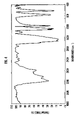
- FIG. 4 is a diagram showing the infrared absorption spectrum of a compound to be a raw material for a polymer compound for an electrode material of a fourth embodiment
- FIG. 5 is a diagram showing the infrared absorption spectrum of a polymer compound for an electrode material of a fourth embodiment
- FIG. 6 is a graph showing the time variations of the battery terminal voltage, during the charge/discharge, of a nonaqueous solution battery using as the positive electrode an electrode formed of the polymer compound for an electrode material of the fourth embodiment;
- FIG. 7 is a graph showing the time variations of the battery terminal voltage, during the charge/discharge, of a nonaqueous solution battery using as the positive electrode an electrode formed of a polymer compound for an electrode material of a fifth embodiment.
- FIG. 8 is a graph showing the time variations of the battery terminal voltage, during the charge/discharge, of a nonaqueous solution battery using as the positive electrode an electrode formed of a polymer compound for an electrode material of a sixth embodiment.
- reaction solution was stirred for 30 minutes under heating at the above specified temperature.
- the resulting polymer was filtered out, and dissolved in toluene.
- 30 ml of methylene chloride was added under refluxing to purify the polymer through reprecipitation.
- the acrylamide polymer B has a 5-membered ring containing sulfur and nitrogen at the end of the individual chains, a part of the 5-membered ring being formed with a S—S bond.
- the 5-membered ring is connected to the main chain through the intermediary of an amide bond containing a nitrogen atom involved in formation of the ring.
- the S—S bond is cleaved by reduction, and regenerated by oxidation.
- the acrylamide polymer B was grinded, and classified to obtain an about 22 g of a powder having particle sizes of 10 to 30 ⁇ m. A fraction of the powder was checked for conductivity to reveal that the acrylamide polymer B has no conductivity and hence is an electrically insulating material.
- acetylene black as a conducting aid
- 2.0 g of polytetrafluoroethylene (PTFE) as a binder were added to 16.0 g of the powder, and the mixture thus prepared was stirred fully in a small V mixer.
- the mixture composed of the powder, acetylene black and PTFE was kneaded with an automatic mortar, and the kneaded mixture was used to form an about 0.8 mm thick sheet.
- a disk of 14 mm in diameter was blanked out from the sheet, and the disk was laminated with a disk of pure titanium net of 14 mm in diameter; the laminate was compressed with an oil press to integrally form a positive electrode.
- the weight of the positive electrode exclusive of the weight of the piece of pure titanium net was 52 mg.
- the positive electrode was dried at 80° C. for 16 hours under a vacuum, and then, stored in a glove box in which argon gas was circulated, the dew point of the glove box being ⁇ 80° C. or lower.
- a component of a commercially available coin type cell (CR2030) and the positive electrode were used to form a battery.
- a disk of lithium foil of 99.99% in purity, 0.2 mm in thickness, and 15.3 mm in diameter was used as the negative electrode.
- the separator was a polyolefin type resin disk of 30 ⁇ m in thickness and 20 mm in diameter which had been dried at 60° C. under a vacuum for 24 hours and thereafter stored in the above described glove box.
- the electrolytic solution used was a 1 mol/l solution of LiClO 4 dissolved in a mixed solvent composed of ethylene carbonate and diethyl carbonate in a ratio of 1:1 (volume ratio); 600 ⁇ l of the LiClO 4 solution was placed on the separator to assemble a nonaqueous solution battery.
- the nonaqueous solution battery was allowed to stand for 24 hours, and thereafter charge/discharge were repeated at the ambient temperature of 25 ⁇ 2° C. to evaluate the performance of the battery.
- the open circuit voltage prior to charge/discharge was 3.3 V.
- the first discharge gave a termination voltage of 2.0 V and a discharge capacity of 9.4 mAh with a constant current of 0.5 mA.
- the following charge was carried out up to a termination voltage of 4.2 V with a constant current of 0.5 mA and thereafter charge was carried out with a constant voltage of 4.2 V until the charge current reached 0.05 mA.
- the charge capacity was 11.8 mAh.
- the second discharge was carried out under the same conditions as in the first discharge, the discharge capacity being 10.5 mAh and the average discharge voltage being 2.75 V. The results obtained are shown in FIG. 1 .
- the discharge capacity of the 20th cycle was 9.9 mAh, yielding no significant capacity decrease in relation to the initial discharge capacity.
- the acrylic polymer C was grinded, and classified to obtain 1.9 g of a powder having particle sizes of 10 to 30 ⁇ m. A fraction of the powder was checked for conductivity to reveal that the acrylic polymer C has no conductivity and hence is an electrically insulating material.
- acetylene black as a conducting aid and 0.2 g of PTFE as a binder were added to 1.6 g of the powder, and the mixture thus prepared was stirred fully in a small V mixer. Then, the mixture composed of the powder, acetylene black and PTFE was kneaded with an automatic mortar, and the kneaded mixture was used to form a 0.6 mm thick sheet. A disk of 14 mm in diameter was blanked out from the sheet, and the disk was laminated with a disk of pure titanium net of 14 mm in diameter; the laminate was compressed with an oil press to integrally form a positive electrode. The weight of the positive electrode exclusive of the weight of the piece of pure titanium net was 41 mg. The positive electrode was dried under a vacuum at 80° C. for 16 hours, and then, stored in a glove box in which argon gas was circulated, the dew point the of the glove box being ⁇ 80° C. or lower.
- a nonaqueous solution battery was assembled in the same manner as in the first embodiment except that the above described positive electrode was used, and the performance of the battery thus obtained was evaluated.
- the open circuit voltage prior to charge/discharge was 3.5 V.
- the first discharge gave a termination voltage of 2.0 V and a discharge capacity of 8.8 mAh with a constant current of 0.5 mA.
- the following charge was carried out up to a termination voltage of 4.2 V with a constant current of 0.5 mA and thereafter charge was carried out with a constant voltage of 4.2 V until the charge current reached 0.05 mA.
- the charge capacity was 10.1 mAh.
- the second discharge was carried out under the same conditions as in the first discharge, the discharge capacity being 9.2 mAh and the average discharge voltage being 2.75 V. The results obtained are shown in FIG. 2 .
- the discharge capacity of the 20th cycle was 8.9 mAh, yielding no significant capacity decrease in relation to the initial discharge capacity.
- 1,2,4-dithiazolidine-3,5-dione represented by the following formula D was synthesized according to the method well known in the art (see U.S. Pat. No. 5,852,168), to obtain about 25 g of a sample.
- the obtained sample was subjected to elemental analysis, NMR analysis and IR analysis, to reveal that the sample was a substance very high in purity to ensure the structure represented by formula D.
- An infrared absorption spectrum of 1,2,4-dithiazolidine-3,5-dione is shown in FIG. 4 .
- reaction solution was stirred for 30 minutes under heating at the above specified temperature.
- the resulting polymer was filtered out, and dissolved in toluene.
- 41 ml of methylene chloride was added under refluxing to purify the polymer through reprecipitation.
- the acrylamidepolymer F was grinded, and classified to obtain 0.3 g of a powder having particle sizes of 10 to 30 ⁇ m. A fraction of the powder was checked for conductivity to reveal that the arylamide polymer F has no conductivity to be an electrically insulating material.
- acetylene black as a conducting aid and 0.025 g of PTFE as a binder were added to 0.2 g of the powder, and the mixture thus prepared was stirred fully with a small V mixer. Then, the mixture composed of the powder, acetylene black and PTFE was kneaded with an automatic mortar, and the kneaded mixture was used to form an about 0.6 mm thick sheet. A disk of 14 mm in diameter was blanked out from the sheet, and the disk was laminated with a disk of pure titanium net of 14 mm in diameter; the laminate was compressed with an oil press to integrally form a positive electrode. The weight of the positive electrode exclusive of the weight of the piece of pure titanium net was 39 mg. The positive electrode was dried under a vacuum at 80° C. for 16 hours, and then, stored in a glove box in which argon gas was circulated, the dew point of the glove box being ⁇ 80° C. or lower.
- a nonaqueous solution battery was assembled in the same manner as in the first embodiment except that the above described positive electrode was used, and the performance of the battery thus obtained was evaluated.
- the open circuit voltage prior to charge/discharge was 4.01 V.
- the first discharge gave a termination voltage of 2.0 V and a discharge capacity of 8.6 mAh with a constant current of 0.5 mA.
- the following charge was carried out up to a termination voltage of 4.2 V with a constant current of 0.5 mA and thereafter charge was carried out with a constant voltage of 4.2 V until the charge current reached 0.05 mA.
- the charge capacity was 9.6 mAh.
- the second discharge was carried out under the same conditions as in the first discharge, the discharge capacity being 8.8 mAh and the average discharge voltage being 2.69 V. The results obtained are shown in FIG. 3 .
- the discharge capacity of the 20th cycle was 8.4 mAh, yielding no significant capacity decrease in relation to the initial discharge capacity.
- 1,2,4-dithiazolidine-3,5-dione represented by the above described formula D was synthesized according to the method well known in the art (see U.S. Pat. No. 5,852,168).
- the obtained sample was subjected to elemental analysis, NMR analysis and IR analysis, to reveal that the sample was a substance very high in purity to ensure the structure represented by formula D.
- An infrared absorption spectrum of 1,2,4-dithiazolidine-3,5-dione is shown in FIG. 4 .
- the allyl polymer G was grinded, and classified to obtain 2.1 g of a powder having particle sizes of 10 to 30 ⁇ m. A fraction of the powder was checked for conductivity to reveal that the allyl polymer G has no conductivity and hence is an electrically insulating material.
- acetylene black as a conducting aid 0.25 g of acetylene black as a conducting aid and 0.25 g of PTFE as a binder were added to 2.0 g of the powder, and the mixture thus prepared was stirred fully in a small V mixer. Then, the mixture composed of the powder, acetylene black and PTFE was kneaded with an automatic mortar, and the kneaded mixture was used to form an about 0.6 mm thick sheet. A disk of 14 mm in diameter was blanked out from the sheet, and the disk was laminated with a disk of pure titanium net of 14 mm in diameter; the laminate was compressed with an oil press to integrally form a positive electrode. The weight of the positive electrode exclusive of the weight of the piece of pure titanium net was 37 mg. The positive electrode was dried under a vacuum at 80° C. for 16 hours, and then, stored in a glove box in which argon gas was circulated, the dew point of the glove box being ⁇ 80° C. or lower.
- a nonaqueous solution battery was assembled in the same manner as in the first embodiment except that the above described positive electrode was used, and the performance of the battery thus obtained was evaluated.
- the open circuit voltage prior to charge/discharge was 3.98 V.
- the first discharge gave a termination voltage of 2.0 V and a discharge capacity of 8.8 mAh with a constant current of 0.5 mA.
- the following charge was carried out up to a termination voltage of 4.2 V with a constant current of 0.5 mA and thereafter charge was carried out with a constant voltage of 4.2 V until the charge current reached 0.05 mA.
- the charge capacity was 9.5 mAh.
- the second discharge was carried out under the same conditions as in the first discharge, the discharge capacity being 9.0 mAh and the average discharge voltage being 2.66 V. The results obtained are shown in FIG. 6 .
- the discharge capacity of the 20th cycle was 8.7 mAh, yielding no significant capacity decrease in relation to the initial discharge capacity.
- reaction solution was stirred for 30 minutes under heating at the above specified temperature.
- the resulting polymer was filtered out, and dissolved in toluene.
- 20 ml of methylene chloride was added under refluxing to purify the polymer through reprecipitation.
- the polyacrylic ester derivative J has a 6-membered ring containing sulfur at the end of the single chain, the 6-membered ring being connected to the main chain through the intermediary of an ester bond.
- the S—S bond is cleaved by reduction, and regenerated by oxidation.
- the polyacrylic ester derivative J was grinded, and classified to obtain an about 2.8 g of a powder having particle sizes of 10 to 30 ⁇ m. A fraction of the powder was checked for conductivity to reveal that the polyacrylic ester derivative J has no conductivity and hence is an electrically insulating material.
- acetylene black and 0.2 g of PTFE were added to 1.6 g of the powder, and the mixture thus prepared was stirred fully in a small V mixer. Then, the mixture composed of the powder, acetylene black and PTFE was kneaded with an automatic mortar, and the kneaded mixture was used to form an about 0.8 mm thick sheet. A disk of 14 mm in diameter was blanked out from the sheet, and the disk was laminated with a disk of pure titanium net of 14 mm in diameter; the laminate was compressed with an oil press to integrally form a positive electrode. The weight of the positive electrode exclusive of the weight of the piece of pure titanium net was 50 mg. The positive electrode was dried under a vacuum at 80° C. for 16 hours, and then, stored in a glove box in which argon gas was circulated, the dew point of the glove box being ⁇ 80° C. or lower.
- a nonaqueous solution battery was assembled in the same manner as in the first embodiment except that the above described positive electrode was used, and the performance of the battery thus obtained was evaluated.
- the open circuit voltage prior to charge/discharge was 3.42 V.
- the first discharge gave a termination voltage of 2.0 V and a discharge capacity of 9.6 mAh with a constant current of 0.5 mA.
- the following charge was carried out up to a termination voltage of 4.25 V with a constant current of 0.5 mA and thereafter charge was carried out with a constant voltage of 4.25 V until the charge current reached 0.05 mA.
- the charge capacity was 11.1 mAh.
- the second discharge was carried out under the same conditions as in the first discharge, the discharge capacity being 10.2 mAh and the average discharge voltage being 2.77 V. The results obtained are shown in FIG. 7 .
- the discharge capacity of the 20th cycle was 9.6 mAh, yielding no significant capacity decrease in relation to the initial discharge capacity.
- reaction solution was stirred for 30 minutes under heating at the above specified temperature.
- the resulting polymer was filtered out, and dissolved in toluene.
- 30 ml of methylene chloride was added under refluxing to purify the polymer through reprecipitation.
- the polyacrylic ester derivative L through reaction with an oxidant or electrochemical oxidation reaction thereof, can give a polyacrylic ester derivative denoted by M in the following formula (XIII).
- the polyacrylic ester derivative M has a 4-membered ring containing sulfur at the end of the single chain, the 4-membered ring being connected to the main chain through the intermediary of an ester bond.
- the S—S bond is cleaved by reduction, and regenerated by oxidation.
- the above described electrode was used as the working electrode; a 20 mm ⁇ 20 mm piece of 0.2 mm thick lithium foil of 99.99% in purity is laminated with a 20 mm ⁇ 20 mm pure titanium net, and the laminate was compressed with an oil press to integrally form an electrode; two of such an electrode were used as the counter electrode and the reference electrode, respectively; and the working, counter and reference electrodes were dipped into an electrolytic solution contained in a beaker.
- the electrolytic solution used was 100 ml of a 1 mol/l solution of LiClO 4 dissolved in a mixed solvent composed of ethylene carbonate and diethyl carbonate in a ratio of 1:1 (volume ratio).
- the working electrode was electrolytic oxidized with a current of 0.05 mA for 59 hours, the voltage between the reference electrode and the working electrode being 1.91 V at the start and 4.31 V at the end. Consequently, the polyacrylic ester derivative L constituting the working electrode was electrochemically oxidized to form the polyacrylate derivative M shown in formula (XIII) by electrolytic oxidation.
- a nonaqueous solution battery was assembled in the same manner as in the first embodiment except that the above described working electrode was used as the positive electrode, and the performance of the battery thus obtained was evaluated.
- the open circuit voltage prior to charge/discharge was 4.07 V.
- the first discharge gave a termination voltage of 2.0 V and a discharge capacity of 2.89 mAh with a constant current of 0.1 mA.
- the following charge was carried out up to a termination voltage of 4.2 V with a constant current of 0.1 mA and thereafter charge was carried out with a constant voltage of 4.2 V until the charge current reached 0.01 mA.
- the charge capacity was 2.97 mAh.
- the second discharge was carried out under the same conditions as in the first discharge, the discharge capacity being 2.85 mAh and the average discharge voltage being 2.69 V. The results obtained are shown in FIG. 8 .
- the discharge capacity of the 20th cycle was 2.77 mAh, yielding no significant capacity decrease in relation to the initial discharge capacity.
- the positive electrodes were formed using acetylene black as an conducting aid and PTFE as a binder together with the polymer compounds for an electrode material obtained in the embodiments.
- the conducting aid other carbon materials, metal powders, conducting polymers and the like may be used; additionally, as the binder, any polymer may be used as long as the polymer is one of the polymers usually used in forming electrodes.
- Examples of the above described carbon material include Ketchen Black (R), graphite and scale-like graphite, in addition to the above described acetylene black.
- Examples of the above described metal powders include powders of nickel, titanium and silver and the like.
- Examples of the above described conducting polymers include polyaniline, polypyrrole and polyacetylene and the like.
- examples of the polymers to be used for the above described binder include polyvinylidene fluoride, and the like, in addition to the above described PTFE.
- polymer compounds in the above described embodiments each have a main chain solely formed of carbon-carbon single bonds
- the main chain of the polymer compound may comprise carbon-carbon double bonds or phenylene groups as well as carbon-carbon single bonds.
Landscapes
- Chemical & Material Sciences (AREA)
- Chemical Kinetics & Catalysis (AREA)
- Health & Medical Sciences (AREA)
- Medicinal Chemistry (AREA)
- Polymers & Plastics (AREA)
- Organic Chemistry (AREA)
- General Chemical & Material Sciences (AREA)
- Electrochemistry (AREA)
- Battery Electrode And Active Subsutance (AREA)
- Secondary Cells (AREA)
Abstract
Description

In the above formulas, R1, R2 and R3 each are a monovalent group selected from the set consisting of a hydrogen atom, a halogen atom, a lower alkyl group having 1 to 3 carbon atoms, an amino group, a hydroxy group, and a sulfone group; R4 is —CO— or —CH2—; R5 is —O— or —O—CH2—; and X is a heterocycle including the S—S bond.


Claims (3)

Applications Claiming Priority (4)
| Application Number | Priority Date | Filing Date | Title |
|---|---|---|---|
| JP2003412785 | 2003-12-11 | ||
| JP2003-412785 | 2003-12-11 | ||
| JP2004334093A JP4476788B2 (en) | 2003-12-11 | 2004-11-18 | Polymer compound for electrode material, electrode using the same and non-aqueous battery |
| JP2004-334093 | 2004-11-18 |
Publications (2)
| Publication Number | Publication Date |
|---|---|
| US20050142441A1 US20050142441A1 (en) | 2005-06-30 |
| US7442758B2 true US7442758B2 (en) | 2008-10-28 |
Family
ID=34703270
Family Applications (1)
| Application Number | Title | Priority Date | Filing Date |
|---|---|---|---|
| US11/008,250 Expired - Fee Related US7442758B2 (en) | 2003-12-11 | 2004-12-10 | Polymer compound for use in electrode material, electrode using the same and nonaqueous solution battery using the same |
Country Status (3)
| Country | Link |
|---|---|
| US (1) | US7442758B2 (en) |
| JP (1) | JP4476788B2 (en) |
| DE (1) | DE102004059687B4 (en) |
Families Citing this family (5)
| Publication number | Priority date | Publication date | Assignee | Title |
|---|---|---|---|---|
| JPWO2011152471A1 (en) * | 2010-06-01 | 2013-08-22 | 株式会社ポリチオン | Secondary battery, functional polymer, and synthesis method thereof |
| TWI686415B (en) * | 2016-08-05 | 2020-03-01 | 德商贏創運營有限公司 | Use of thianthrene-containing polymers as charge storage means |
| JP7304032B2 (en) * | 2019-06-12 | 2023-07-06 | Eneos株式会社 | Cathode materials and power storage devices |
| CN113793915B (en) * | 2021-09-15 | 2023-03-24 | 昆明理工大学 | Method for repairing anode material of waste lithium ion battery |
| CN115385834B (en) * | 2022-08-15 | 2023-11-03 | 中国科学院理化技术研究所 | Dendritic (methyl) acrylate monomer with high refractive index as well as preparation method and application thereof |
Citations (3)
| Publication number | Priority date | Publication date | Assignee | Title |
|---|---|---|---|---|
| US4833048A (en) | 1988-03-31 | 1989-05-23 | The United States Of America As Represented By The United States Department Of Energy | Metal-sulfur type cell having improved positive electrode |
| US5324599A (en) * | 1991-01-29 | 1994-06-28 | Matsushita Electric Industrial Co., Ltd. | Reversible electrode material |
| US5852168A (en) | 1996-04-30 | 1998-12-22 | Regents Of The University Of Minesota | Sulfurization of phosphorus-containing compounds |
Family Cites Families (3)
| Publication number | Priority date | Publication date | Assignee | Title |
|---|---|---|---|---|
| US5362493A (en) * | 1990-05-04 | 1994-11-08 | Associated Universities, Inc. | Preparation of redox polymer cathodes for thin film rechargeable batteries |
| JP5164236B2 (en) * | 2001-07-11 | 2013-03-21 | 株式会社ポリチオン | Isothiocyanate derivatives, redox active polymers, electrode materials, lithium batteries |
| US20040128555A1 (en) * | 2002-09-19 | 2004-07-01 | Atsuhisa Saitoh | Image forming device controlling operation according to document security policy |
-
2004
- 2004-11-18 JP JP2004334093A patent/JP4476788B2/en not_active Expired - Fee Related
- 2004-12-10 US US11/008,250 patent/US7442758B2/en not_active Expired - Fee Related
- 2004-12-10 DE DE102004059687.5A patent/DE102004059687B4/en not_active Expired - Fee Related
Patent Citations (3)
| Publication number | Priority date | Publication date | Assignee | Title |
|---|---|---|---|---|
| US4833048A (en) | 1988-03-31 | 1989-05-23 | The United States Of America As Represented By The United States Department Of Energy | Metal-sulfur type cell having improved positive electrode |
| US5324599A (en) * | 1991-01-29 | 1994-06-28 | Matsushita Electric Industrial Co., Ltd. | Reversible electrode material |
| US5852168A (en) | 1996-04-30 | 1998-12-22 | Regents Of The University Of Minesota | Sulfurization of phosphorus-containing compounds |
Non-Patent Citations (8)
| Title |
|---|
| Grzeskowiak et al; Chemical-emulsions; 1996; Minnesota mining and manufacturing Co. USA; Chem Abstract 125: 99946. * |
| Howell et al; Synthesis-pyrrolidone]; 1996; American chemical society; Chem Abstract 1124: 290405. * |
| Kato et al; Direct writing-platemaking; Fuji photo film Co. Ltd, Japan; 1993; Chem Abstract 120: 311621. * |
| Meilin Liu et al., "Electrochemical Properties of Organic Disulfide/Thiolate Redox Couples," J. Electrochem. Soc., vol. 136, No. 9, Sep. 1989, pp. 2570-2575. |
| Saito et al; Antireflective film and patterning method; 1998; Sony Co. Japan; Chem Abstract 129: 210462. * |
| Steven J. Visco et al., "A Novel Class of Organosulfur Electrodes for Energy Storage," J. Electrochem. Soc., vol. 136, No. 3, Mar. 1989, pp. 661-664. |
| Sun et al; Ultrathin-on gold; 1994; Vacuum, surfaces, and films, 12(4,Pt.2), 1499-56; Chem Abstract 121: 135436. * |
| Yamada et al; Black and white-image formation; 1999; Konica Co., Japan; Chem Abstract 130: 318646. * |
Also Published As
| Publication number | Publication date |
|---|---|
| US20050142441A1 (en) | 2005-06-30 |
| JP2005197221A (en) | 2005-07-21 |
| DE102004059687B4 (en) | 2014-08-07 |
| JP4476788B2 (en) | 2010-06-09 |
| DE102004059687A1 (en) | 2005-08-04 |
Similar Documents
| Publication | Publication Date | Title |
|---|---|---|
| EP1381100B1 (en) | Electricity storage device | |
| KR101041722B1 (en) | Electrolyte including eutectic mixture and nitrile compound and electrochemical device having same | |
| KR101028887B1 (en) | Electrolyte including amide compound and electrochemical device having same | |
| EP0208254A2 (en) | Secondary battery | |
| JPWO2016027788A1 (en) | Electrolyte composition, secondary battery, and method of using secondary battery | |
| JP2009545129A (en) | Secondary battery using eutectic mixture and manufacturing method thereof | |
| JP2002110235A (en) | Electrolyte for electrochemical device and battery using the same | |
| CN100499226C (en) | Method for producing polyradical compound and battery | |
| JP2009104819A (en) | Power storage material and secondary battery using the same | |
| JPWO2010104002A1 (en) | Pyrroline-based nitroxide polymer and battery using the same | |
| JPWO2012133202A1 (en) | Radical composition and battery using the same | |
| JPWO2012133204A1 (en) | battery | |
| JPWO2009157206A1 (en) | Storage material and storage device | |
| JP2018522952A (en) | Use of certain polymers as charge storage | |
| US7442758B2 (en) | Polymer compound for use in electrode material, electrode using the same and nonaqueous solution battery using the same | |
| JP2004071560A (en) | Polymer electrolyte for lithium-sulfur battery and lithium-sulfur battery including the same | |
| JP2008135371A (en) | Secondary battery active material and secondary battery | |
| JP4139960B2 (en) | Electricity storage device | |
| JP5224675B2 (en) | Lithium dicyanotriazolate | |
| JP2017506408A (en) | High potential organic materials for energy storage applications | |
| JPH06283175A (en) | Reversible electrode | |
| JPH0660907A (en) | Organic compound battery | |
| JP2004319470A (en) | Electrode and electrochemical device using the same | |
| JP4343819B2 (en) | Redox-active polymer, electrode using the same, and non-aqueous battery | |
| JP2005194511A (en) | Redox-active polymer, electrode using the same, and non-aqueous battery |
Legal Events
| Date | Code | Title | Description |
|---|---|---|---|
| AS | Assignment |
Owner name: SENSA CORPORATION, JAPAN Free format text: ASSIGNMENT OF ASSIGNORS INTEREST;ASSIGNORS:UEMACHI, HIROSHI;NAKAYA, KATSUNORI;MOKUDAI, HIDEHISA;REEL/FRAME:016354/0715;SIGNING DATES FROM 20041215 TO 20041217 Owner name: HONDA MOTOR CO., LTD., JAPAN Free format text: ASSIGNMENT OF ASSIGNORS INTEREST;ASSIGNORS:UEMACHI, HIROSHI;NAKAYA, KATSUNORI;MOKUDAI, HIDEHISA;REEL/FRAME:016354/0715;SIGNING DATES FROM 20041215 TO 20041217 |
|
| AS | Assignment |
Owner name: POLYTHIONE CO., LTD., JAPAN Free format text: ASSIGNMENT OF ASSIGNORS INTEREST;ASSIGNOR:SENSA CORPORATION;REEL/FRAME:020330/0838 Effective date: 20071122 |
|
| CC | Certificate of correction | ||
| FEPP | Fee payment procedure |
Free format text: PAYOR NUMBER ASSIGNED (ORIGINAL EVENT CODE: ASPN); ENTITY STATUS OF PATENT OWNER: LARGE ENTITY |
|
| FEPP | Fee payment procedure |
Free format text: PAYER NUMBER DE-ASSIGNED (ORIGINAL EVENT CODE: RMPN); ENTITY STATUS OF PATENT OWNER: LARGE ENTITY Free format text: PAYOR NUMBER ASSIGNED (ORIGINAL EVENT CODE: ASPN); ENTITY STATUS OF PATENT OWNER: LARGE ENTITY |
|
| FPAY | Fee payment |
Year of fee payment: 4 |
|
| REMI | Maintenance fee reminder mailed | ||
| LAPS | Lapse for failure to pay maintenance fees | ||
| STCH | Information on status: patent discontinuation |
Free format text: PATENT EXPIRED DUE TO NONPAYMENT OF MAINTENANCE FEES UNDER 37 CFR 1.362 |
|
| STCH | Information on status: patent discontinuation |
Free format text: PATENT EXPIRED DUE TO NONPAYMENT OF MAINTENANCE FEES UNDER 37 CFR 1.362 |
|
| FP | Lapsed due to failure to pay maintenance fee |
Effective date: 20161028 |