US7439807B2 - Method and system for generating a temperature-compensated control signal - Google Patents

Method and system for generating a temperature-compensated control signal Download PDF

Info

Publication number
US7439807B2
US7439807B2 US11/471,408 US47140806A US7439807B2 US 7439807 B2 US7439807 B2 US 7439807B2 US 47140806 A US47140806 A US 47140806A US 7439807 B2 US7439807 B2 US 7439807B2
Authority
US
United States
Prior art keywords
transistor
control signal
current
temperature
coupled
Prior art date
Legal status (The legal status is an assumption and is not a legal conclusion. Google has not performed a legal analysis and makes no representation as to the accuracy of the status listed.)
Expired - Fee Related, expires
Application number
US11/471,408
Other versions
US20070290760A1 (en
Inventor
Christopher Yong
Current Assignee (The listed assignees may be inaccurate. Google has not performed a legal analysis and makes no representation or warranty as to the accuracy of the list.)
ST Ericsson SA
Original Assignee
STMicroelectronics lnc USA
Priority date (The priority date is an assumption and is not a legal conclusion. Google has not performed a legal analysis and makes no representation as to the accuracy of the date listed.)
Filing date
Publication date
Application filed by STMicroelectronics lnc USA filed Critical STMicroelectronics lnc USA
Priority to US11/471,408 priority Critical patent/US7439807B2/en
Assigned to STMICROELECTRONICS, INC. reassignment STMICROELECTRONICS, INC. ASSIGNMENT OF ASSIGNORS INTEREST (SEE DOCUMENT FOR DETAILS). Assignors: YONG, CHRISTOPHER
Publication of US20070290760A1 publication Critical patent/US20070290760A1/en
Application granted granted Critical
Publication of US7439807B2 publication Critical patent/US7439807B2/en
Assigned to ST WIRELESS SA reassignment ST WIRELESS SA ASSIGNMENT OF ASSIGNORS INTEREST (SEE DOCUMENT FOR DETAILS). Assignors: STMICROELECTRONICS, INC.
Assigned to ST-ERICSSON SA, EN LIQUIDATION reassignment ST-ERICSSON SA, EN LIQUIDATION STATUS CHANGE-ENTITY IN LIQUIDATION Assignors: ST-ERICSSON SA
Assigned to ST-ERICSSON SA reassignment ST-ERICSSON SA CHANGE OF NAME (SEE DOCUMENT FOR DETAILS). Assignors: ST WIRELESS SA
Expired - Fee Related legal-status Critical Current
Adjusted expiration legal-status Critical

Links

Images

Classifications

    • HELECTRICITY
    • H03ELECTRONIC CIRCUITRY
    • H03GCONTROL OF AMPLIFICATION
    • H03G3/00Gain control in amplifiers or frequency changers
    • H03G3/20Automatic control
    • H03G3/30Automatic control in amplifiers having semiconductor devices
    • H03G3/3036Automatic control in amplifiers having semiconductor devices in high-frequency amplifiers or in frequency-changers
    • HELECTRICITY
    • H03ELECTRONIC CIRCUITRY
    • H03GCONTROL OF AMPLIFICATION
    • H03G2201/00Indexing scheme relating to subclass H03G
    • H03G2201/70Gain control characterized by the gain control parameter
    • H03G2201/708Gain control characterized by the gain control parameter being temperature

Definitions

  • This disclosure is generally directed to variable gain amplifiers and, more specifically, to a method and system for generating a temperature-compensated control signal.
  • the transmit path generally includes multiple variable gain amplifiers (VGAs).
  • VGAs variable gain amplifiers
  • the gain control equation for each of the VGAs includes the absolute temperature, T. Therefore, the gain performance of conventional a VGA is a function of temperature. Because of this, VGA performance may be unreliable in changing environments. Problems with this include an increased need for RF calibration in order to keep the VGAs functioning properly.
  • This disclosure provides a method and system for generating a temperature-compensated control signal.
  • a method in one aspect, includes receiving a constant control signal.
  • a temperature-compensated control signal is generated based on the constant control signal.
  • the temperature-compensated control signal is provided to a variable gain amplifier.
  • the temperature-compensated control signal is operable to cause the variable gain amplifier to function independently of temperature.
  • a temperature compensation control circuit in another aspect, includes a thermal voltage generator, a voltage-to-current converter, and a current multiplier.
  • the thermal voltage generator is operable to generate a thermal voltage.
  • the voltage-to-current converter is coupled to the thermal voltage generator and is operable to convert the thermal voltage into a thermal current.
  • the current multiplier is coupled to the voltage-to-current converter and is operable to multiply the thermal current by an input current to generate an output current.
  • an automatic gain control system in yet another aspect, includes a variable gain amplifier and a temperature compensation control circuit.
  • the variable gain amplifier is operable to receive a variable gain amplifier (VGA) input signal and to generate a VGA output signal based on the VGA input signal.
  • the temperature compensation control circuit is coupled to the variable gain amplifier.
  • the temperature compensation control circuit is operable to generate a temperature-compensated control signal based on a constant control signal and to provide the temperature-compensated control signal to the variable gain amplifier.
  • the variable gain amplifier is further operable to generate the VGA output signal based on the temperature-compensated control signal.
  • FIG. 1 illustrates an automatic gain control system that is capable of varying gain exponentially with respect to a control signal according to one embodiment of this disclosure
  • FIG. 2 illustrates a simplified circuit design of the gain control circuit of FIG. 1 according to one embodiment of this disclosure
  • FIG. 3 illustrates a circuit diagram of the gain control circuit of FIG. 1 or 2 and the variable gain amplifier of FIG. 1 according to one embodiment of this disclosure
  • FIG. 4 illustrates a method for varying gain exponentially with respect to a control signal using the gain control circuit of FIGS. 1 , 2 or 3 according to one embodiment of this disclosure
  • FIG. 5 illustrates an automatic gain control system that is capable of generating a temperature-compensated control signal according to one embodiment of this disclosure
  • FIG. 6 illustrates a block diagram of the temperature compensation control circuit of FIG. 5 according to one embodiment of this disclosure
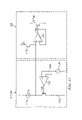
  • FIG. 7A illustrates a circuit diagram of the thermal voltage generator of FIG. 6 according to one embodiment of this disclosure
  • FIG. 7B illustrates a circuit diagram of the thermal voltage generator of FIG. 6 according to another embodiment of this disclosure.
  • FIG. 8A illustrates a circuit diagram of the current multiplier of FIG. 6 according to one embodiment of this disclosure
  • FIG. 8B illustrates a circuit diagram of the current multiplier of FIG. 6 according to another embodiment of this disclosure.
  • FIG. 9 illustrates a circuit diagram of the voltage-to-current converter of FIG. 6 according to one embodiment of this disclosure.
  • FIG. 10 illustrates a circuit diagram of the current-to-voltage converter of FIG. 6 according to one embodiment of this disclosure
  • FIG. 11 illustrates a circuit diagram of the input circuit, the voltage-to-current converter and the current multiplier of FIG. 6 according to one embodiment of this disclosure
  • FIG. 12 illustrates a method for generating a temperature-compensated control signal using the temperature compensation control circuit of FIG. 5 or 6 according to one embodiment of this disclosure.
  • FIG. 13 illustrates an automatic gain control system that is capable of varying gain exponentially with respect to a temperature-compensated control signal according to one embodiment of this disclosure.
  • FIGS. 1 through 13 discussed below, and the various embodiments used to describe the principles of the present invention in this patent document are by way of illustration only and should not be construed in any way to limit the scope of the invention. Those skilled in the art will understand that the principles of the present invention may be implemented in any suitably arranged variable gain circuit.
  • FIG. 1 illustrates an automatic gain control system 100 that is capable of varying the gain of a variable gain amplifier 105 exponentially with respect to a control signal based on a modified version of that control signal received from a gain control circuit 110 according to one particular embodiment of this disclosure.
  • the automatic gain control system 100 may be implemented in a transmit path of a communication system.
  • the automatic gain control system 100 may be implemented in any other suitable system without departing from the scope of the present disclosure.
  • the gain control circuit 110 is operable to receive a primary control signal 135 and to generate a secondary control signal 130 based on the primary control signal 135 in order to exponentially vary the gain of the variable gain amplifier 105 .
  • the variable gain amplifier 105 which is coupled to the gain control circuit 110 , is operable to receive a variable gain amplifier (VGA) input signal 120 and to generate a VGA output signal 125 by amplifying the VGA input signal 120 based on the secondary control signal 130 .
  • VGA variable gain amplifier
  • the gain of the variable gain amplifier 105 varies exponentially with respect to the primary control signal 135 instead of with respect to the secondary control signal 130 .
  • variable gain amplifier 105 and the gain control circuit 110 are part of an automatic gain control system 100 that also comprises an amplifier 150 , a detector 155 , a filter 160 , and a differential amplifier 165 .
  • variable gain amplifier 105 and the gain control circuit 110 may be implemented in a differently arranged automatic gain control system or in any other suitable system without departing from the scope of the present disclosure.
  • the amplifier 150 is coupled to the variable gain amplifier 105 and is operable to further amplify the VGA output signal 125 in order to generate a system output signal 175 that is at a higher level than the VGA output signal 125 for use in an application in which the automatic gain control system 100 is implemented.
  • the detector 155 which is coupled to the amplifier 150 , is operable to detect one or more parameters associated with the system output signal 175 , such as amplitude, carrier frequency, modulation index or the like, and to generate a detected parameter signal 180 based on the detection.
  • the filter 160 which may comprise a low-pass or other suitable filter, is coupled to the detector 155 and is operable to filter out any undesired components to generate a filtered signal 185 .
  • the differential amplifier 165 is coupled to the filter 160 and is operable to compare the filtered signal 185 to a reference signal 190 in order to generate the primary control signal 135 .
  • the gain control circuit 110 which is coupled to the differential amplifier 165 , may then generate the secondary control signal 130 based on the primary control signal 135 and exponentially vary the gain of the variable gain amplifier 105 with respect to the primary control signal 135 using the secondary control signal 130 .
  • the gain control circuit 110 is operable to generate the secondary control signal 130 in such a manner as to maximize the ability of the variable gain amplifier 105 to vary its gain exponentially (i.e., in a linear-in-dB fashion) with respect to the primary control signal 135 .
  • FIG. 2 illustrates a simplified circuit design of the gain control circuit 110 according to one embodiment of this disclosure.
  • This embodiment of the gain control circuit 110 comprises a plurality of transistors 205 , 210 and 215 , a current mirror 220 , a current-controlled voltage source (CCVS) 225 , and a current source 230 .
  • CCVS current-controlled voltage source
  • the primary control signal 135 is applied across one of the transistors (transistor 205 ) in a differential pair (transistors 205 and 210 ).
  • transistor 215 is matched to transistor 210 and is biased in the same direction as transistor 210 in order to cancel the voltage drop across transistor 210 .
  • the output current, identified as I c1 is normalized to the current source 230 , which provides the input current identified as I 0 .
  • ⁇ V be2 is added to the differential pair 205 and 210 (as part of the CCVS 225 ).
  • ⁇ V c is added to the circuit (also as part of the CCVS 225 ).
  • V in ⁇ V be1 +V c .
  • the secondary control signal 130 is generated at the bases of transistors 205 and 210 , as indicated by the two nodes 130 a and 130 b.
  • FIG. 3 illustrates a circuit diagram of the variable gain amplifier 105 and the gain control circuit 110 according to one embodiment of this disclosure.
  • the gain control circuit 110 comprises a plurality of transistors, an operational amplifier and a current source.
  • the transistors Q 1 a and Q 1 b form a first current mirror
  • Q 2 a and Q 2 b form a second current mirror
  • Q 3 a , Q 3 b and Q 3 c form a third current mirror.
  • the transistors Q 4 and Q 7 are matched.
  • V be is the same
  • V be is the same.
  • the primary control signal 135 is applied across transistors Q 4 and Q 7 , and the secondary control signal 130 is generated from transistors Q 6 and Q 7 , as indicated at nodes 130 a and 130 b , respectively.
  • the secondary control signal 130 is applied to the variable gain amplifier 105 at transistors Q 8 and Q 9 .
  • FIG. 4 illustrates a method for exponentially varying gain in the variable gain amplifier 105 with respect to a primary control signal 135 using the gain control circuit 110 according to one embodiment of this disclosure.
  • This embodiment corresponds to the automatic gain control system 100 illustrated in FIG. 1 .
  • portions of this embodiment may be implemented in any other suitable system without departing from the scope of the present disclosure.
  • the embodiment of FIG. 4 illustrates a method for exponentially varying gain in the variable gain amplifier 105 with respect to a primary control signal 135 using the gain control circuit 110 according to one embodiment of this disclosure.
  • This embodiment corresponds to the automatic gain control system 100 illustrated in FIG. 1 .
  • portions of this embodiment may be implemented in any other suitable system without departing from the scope of the present disclosure.
  • the method begins at step 405 where the gain control circuit 110 receives a primary control signal 135 from the differential amplifier 165 .
  • the gain control circuit 110 generates a secondary control signal 130 based on the primary control signal 135 .
  • the gain control circuit 110 generates the secondary control signal 130 by applying the primary control signal 135 directly across one transistor (such as transistor 205 or Q 6 ) in a differential pair of transistors (such as transistors 205 and 210 or Q 6 and Q 7 ).
  • the gain control circuit 110 provides the secondary control signal 130 to the variable gain amplifier (VGA) 105 in order to exponentially vary the gain of the variable gain amplifier 105 with respect to the primary control signal 135 .
  • VGA variable gain amplifier
  • the variable gain amplifier 105 receives the secondary control signal 130 from the gain control circuit 110 and receives a VGA input signal 120 from any suitable component coupled to the automatic gain control system 100 .
  • the variable gain amplifier 105 generates a VGA output signal 125 based on both the VGA input signal 120 and the secondary control signal 130 by amplifying the VGA input signal 120 with a gain that is controlled by the secondary control signal 130 .
  • the amplifier 150 amplifies the VGA output signal 125 to generate a system output signal 175 for the automatic gain control system 100 .
  • the detector 155 detects one or more parameters of the system output signal 175 to generate a detected parameter signal 180 .
  • the filter 160 filters the detected parameter signal 180 to generate a filtered signal 185 .
  • the differential amplifier 165 compares the filtered signal 185 to a reference signal 190 .
  • the differential amplifier 165 generates the primary control signal 135 based on the comparison of the filtered signal 185 to the reference signal 190 .
  • the differential amplifier 165 provides the primary control signal 135 to the gain control circuit 110 , and the method returns to step 405 where the gain control circuit 110 continues to receive the primary control signal 135 .
  • the gain (in dB) of at least one variable gain amplifier 105 in a transmit path of a communication system may be linearly adjusted, making compliance with power adjustment specifications and other system considerations easier.
  • the transfer function is linear-in-dB even at relatively large control voltages. This results in the variable gain amplifier 105 having an improved performance as compared to a variable gain amplifier with a gain that is adjusted only by a primary control signal from a differential amplifier.
  • the variable gain amplifier 105 has a reduced requirement for RF calibration.
  • FIG. 5 illustrates an automatic gain control system 500 that is capable of generating a temperature-compensated control signal for varying the gain of a variable gain amplifier 505 according to one embodiment of this disclosure.
  • the automatic gain control system 500 may be implemented in a transmit path of a communication system.
  • the automatic gain control system 500 may be implemented in any other suitable system without departing from the scope of the present disclosure.
  • the automatic gain control system 500 comprises a temperature compensation control circuit 510 that is coupled to the variable gain amplifier 505 .
  • the temperature compensation control circuit 510 is operable to receive a constant control signal 515 and to generate a temperature-compensated control signal 520 based on the constant control signal 515 in order to cause the variable gain amplifier 505 to function independently of temperature.
  • a “constant control signal” means a control signal that is not temperature-compensated.
  • the constant control signal 515 may be altered in order to adjust the gain of the variable gain amplifier 505 .
  • the constant control signal 515 is not altered to compensate for temperature differences that may affect the performance of the variable gain amplifier 505 .
  • the variable gain amplifier 505 which is coupled to the temperature compensation control circuit 510 , is operable to receive a variable gain amplifier (VGA) input signal 530 and to generate a VGA output signal 535 by amplifying the VGA input signal 530 based on the temperature-compensated control signal 520 .
  • VGA variable gain amplifier
  • variable gain amplifier 505 and the temperature compensation control circuit 510 are part of an automatic gain control system 500 that also comprises an amplifier 550 , a detector 555 , a filter 560 , and a differential amplifier 565 .
  • variable gain amplifier 505 and the temperature compensation control circuit 510 may be implemented in a differently arranged automatic gain control system or in any other suitable system without departing from the scope of the present disclosure.
  • the amplifier 550 is coupled to the variable gain amplifier 505 and is operable to further amplify the VGA output signal 535 in order to generate a system output signal 575 that is at a higher level than the VGA output signal 535 for use in an application in which the automatic gain control system 500 is implemented.
  • the detector 555 which is coupled to the amplifier 550 , is operable to detect one or more parameters associated with the system output signal 575 , such as amplitude, carrier frequency, modulation index or the like, and to generate a detected parameter signal 580 based on the detection.
  • the filter 560 which may comprise a low-pass or other suitable filter, is coupled to the detector 555 and is operable to filter out any undesired components to generate a filtered signal 585 .
  • the differential amplifier 565 is coupled to the filter 560 and is operable to compare the filtered signal 585 to a reference signal 590 in order to generate the constant control signal 515 .
  • the temperature compensation control circuit 510 which is coupled to the differential amplifier 565 , may then generate the temperature-compensated control signal 520 based on the constant control signal 515 . As described in more detail below in connection with FIGS. 6-12 , the temperature compensation control circuit 510 is operable to generate the temperature-compensated control signal 520 such that the variable gain amplifier 505 may function independently of temperature.
  • FIG. 6 illustrates a block diagram of the temperature compensation control circuit 510 according to one embodiment of this disclosure.
  • the temperature compensation control circuit 510 comprises a thermal voltage generator 605 , an input circuit 615 , two voltage-to-current (V-I) converters 610 and 620 , a current multiplier 625 , and a current-to-voltage (I-V) converter 630 .
  • V-I voltage-to-current
  • I-V current-to-voltage
  • the thermal voltage generator 605 is operable to generate a thermal voltage 640 .
  • the first V-I converter 610 which is coupled to the thermal voltage generator 605 , is operable to convert the thermal voltage 640 into a thermal current 645 .
  • the input circuit 615 is operable to receive the constant control signal 515 and to generate an adjusted constant control signal 650 based on the constant control signal 515 by applying an offset, if desired. In generating the adjusted constant control signal 650 , the input circuit 615 is operable to define a starting point for gain control.
  • the second V-I converter 620 which is coupled to the input circuit 615 , is operable to convert the adjusted constant control signal 650 into an input current 655 .
  • the current multiplier 625 which is coupled to the V-I converters 610 and 620 , is operable to multiply the thermal current 645 and the input current 655 to generate an output current 660 .
  • the I-V converter 630 which is coupled to the current multiplier 625 , is operable to convert the output current 660 into the temperature-compensated control signal 520 .
  • FIG. 7A illustrates a circuit diagram of the thermal voltage generator 605 according to one embodiment of this disclosure.
  • the thermal voltage generator 605 comprises four transistors 705 , 710 , 715 and 720 .
  • transistors 705 and 710 the illustrated embodiment uses two differential pairs.
  • the illustrated embodiment uses two differential pairs.
  • V be1 is the base-emitter voltage for transistor 705
  • V be2 is the base-emitter voltage for transistor 710
  • V be3 is the base-emitter voltage for transistor 715
  • V be4 is the base-emitter voltage for transistor 720 .
  • FIG. 7B illustrates a circuit diagram of the thermal voltage generator 605 according to another embodiment of this disclosure.
  • the thermal voltage generator 605 comprises four transistors 750 , 755 , 760 and 765 and one current source 770 .
  • the device size ratio of transistor 760 compared to transistor 765 is m:n and the current source 770 provides a current of (m+n)I c .
  • FIG. 8A illustrates a circuit diagram of the current multiplier 625 according to one embodiment of this disclosure.
  • the current multiplier 625 comprises two transistors 805 and 810 , an operational amplifier 815 , two diodes 820 and 825 , and three current sources 830 , 835 and 840 .
  • FIG. 8B illustrates a circuit diagram of the current multiplier 625 according to another embodiment of this disclosure.
  • the current multiplier 625 comprises four transistors 850 , 855 , 860 and 865 , two diodes 870 and 875 , and four current sources 880 , 885 , 890 and 895 .
  • transistors 850 and 855 as a differential circuit in this manner allows the current multiplier 625 to be implemented without an operational amplifier.
  • FIG. 9 illustrates a circuit diagram of the voltage-to-current converter 610 according to one embodiment of this disclosure.
  • the voltage-to-current converter 610 comprises an operational amplifier 905 , a resistor 910 , and three transistors 915 , 920 and 925 .
  • the operational amplifier 905 comprises a positive terminal 930 and a negative terminal 935
  • the resistor 910 is coupled between a node 940 and the negative terminal 935 of the operational amplifier 905 .
  • I y V T ⁇ ln( m/n )/ R y , where R y is the resistance provided by the resistor 910 and the values m and n correspond to the m and n illustrated in FIG. 7A or 7 B.
  • the voltage across the positive terminal 930 of the operational amplifier 905 and the node 940 corresponds to the voltage, V y , illustrated in FIG. 7A or 7 B.
  • V y the voltage across the positive terminal 930 of the operational amplifier 905 and the node 940 corresponds to the voltage, V y , illustrated in FIG. 7A or 7 B.
  • the positive terminal 930 is coupled to the base of transistor 720 and the node 940 is coupled to the base of transistor 705 .
  • the positive terminal 930 is coupled to the base of transistor 755 and the node 940 is coupled to the base of transistor 750 .
  • the voltage-to-current converter 610 is operable to convert the thermal voltage 640 (V T , which is provided by way of the voltage V y ) into the thermal current 645 (I T , which is provided by way of the collector current, I y , of transistor 925 ).
  • FIG. 10 illustrates a circuit diagram of the current-to-voltage converter 630 according to one embodiment of this disclosure.
  • the current-to-voltage converter 630 comprises an operational amplifier 1005 , a resistor 1010 , and a voltage source 1015 .
  • the current-to-voltage converter 630 is operable to convert the output current 660 (I out ) generated by the current multiplier 625 into the temperature-compensated control signal 520 .
  • the resistor 1010 tracks the resistor 910 in order to minimize mismatch errors.
  • FIG. 11 illustrates a circuit diagram of the input circuit 615 , the voltage-to-current converter 620 , and a portion of the current multiplier 625 according to one embodiment of this disclosure.
  • the input circuit 615 and the voltage-to-current converter 620 comprise a transistor 1105 , an operational amplifier 1110 , a current source 1115 , a resistor 1120 and a voltage source 1125 .
  • the portion of the current multiplier 625 illustrated comprises an operational amplifier 1150 and two transistors 1155 and 1160 .
  • the voltage source 1125 is operable to generate the adjusted constant control signal 650 by applying an offset voltage (V os ) to the constant control signal 515 (V V ) such that the adjusted constant control signal 650 is equal to V os +V V .
  • the current source 1115 is operable to provide an offset current (I os ).
  • I os offset current
  • the input circuit 615 and voltage-to-current converter 620 are operable to generate the input current (I V ) 655 as the collector current for the transistor 1155 of the current multiplier 625 .
  • the current multiplier 625 is operable to multiply the input current 655 by the thermal current 645 to generate the output current 660 .
  • the operational amplifier 1150 provides a buffer to prevent leakage current when no input voltage is provided.
  • FIG. 12 illustrates a method for generating a temperature-compensated control signal 520 using the temperature compensation control circuit 510 according to one embodiment of this disclosure.
  • the method begins at step 1205 where the thermal voltage generator 605 generates a thermal voltage 640 .
  • the thermal voltage generator 605 generates the thermal voltage 640 by multiplying current ratios of two differential pairs of transistors, across which the total voltage drop is V T ⁇ ln(m/n).
  • the device sizes m and n may be chosen to provide a positive or negative voltage drop based on the corresponding application.
  • the voltage-to-current converter 610 converts the thermal voltage 640 into a thermal current 645 .
  • the input circuit 615 receives a constant control signal 515 .
  • the input circuit 615 generates an adjusted constant control signal 650 based on the constant control signal 515 .
  • the input circuit 615 may provide a voltage offset and/or a current offset to the constant control signal 515 in order to generate the adjusted constant control signal 650 .
  • the voltage-to-current converter 620 converts the adjusted constant control signal 650 into an input current 655 .
  • the current multiplier 625 multiplies the thermal current 645 and the input current 655 to generate an output current 660 .
  • the current multiplier 625 may generate an output current 660 that is equal to the thermal current 645 multiplied by the input current 655 and divided by another current, I 0 .
  • the current-to-voltage converter 630 converts the output current 660 into a temperature-compensated control signal 520 , at which point the method comes to an end. In this way, a temperature-compensated control signal 520 may be generated that is operable to cause the variable gain amplifier 505 to function independently of temperature.
  • FIG. 13 illustrates an automatic gain control system 1300 that is capable of varying the gain of a variable gain amplifier 1305 exponentially with respect to a temperature-compensated control signal based on a modified version of that control signal received from a gain control circuit 1310 according to one particular embodiment of this disclosure.
  • the automatic gain control system 1300 may be implemented in a transmit path of a communication system.
  • the automatic gain control system 1300 may be implemented in any other suitable system without departing from the scope of the present disclosure.
  • the automatic gain control system 500 comprises a temperature compensation control circuit 1315 .
  • the temperature compensation control circuit 1315 is operable to receive a constant control signal 1320 and to generate a temperature-compensated control signal 1325 based on the constant control signal 1320 in order to cause the variable gain amplifier 1305 to function independently of temperature.
  • the gain control circuit 1310 which is coupled to the temperature compensation control circuit 1315 , is operable to receive the temperature-compensated control signal 1325 and to generate a final control signal 1330 based on the temperature-compensated control signal 1325 in order to exponentially vary the gain of the variable gain amplifier 1305 .
  • the variable gain amplifier 1305 which is coupled to the gain control circuit 1310 , is operable to receive a variable gain amplifier (VGA) input signal 1335 and to generate a VGA output signal 1340 by amplifying the VGA input signal 1335 based on the final control signal 1330 .
  • VGA variable gain amplifier
  • the gain of the variable gain amplifier 1305 varies exponentially with respect to the temperature-compensated control signal 1325 instead of with respect to the final control signal 1330 .
  • variable gain amplifier 1305 , the gain control circuit 1310 and the temperature compensation control circuit 1315 are part of an automatic gain control system 1300 that also comprises an amplifier 1350 , a detector 1355 , a filter 1360 , and a differential amplifier 1365 .
  • variable gain amplifier 1305 , the gain control circuit 1310 and the temperature compensation control circuit 1315 may be implemented in a differently arranged automatic gain control system or in any other suitable system without departing from the scope of the present disclosure.
  • the amplifier 1350 is coupled to the variable gain amplifier 1305 and is operable to further amplify the VGA output signal 1340 in order to generate a system output signal 1375 that is at a higher level than the VGA output signal 1340 for use in an application in which the automatic gain control system 1300 is implemented.
  • the detector 1355 which is coupled to the amplifier 1350 , is operable to detect one or more parameters associated with the system output signal 1375 , such as amplitude, carrier frequency, modulation index or the like, and to generate a detected parameter signal 1380 based on the detection.
  • the filter 1360 which may comprise a low-pass or other suitable filter, is coupled to the detector 1355 and is operable to filter out any undesired components to generate a filtered signal 1385 .
  • the differential amplifier 1365 is coupled to the filter 1360 and is operable to compare the filtered signal 1385 to a reference signal 1390 in order to generate the constant control signal 1320 .
  • the temperature compensation control circuit 1315 which is coupled to the differential amplifier 1365 , may then generate the temperature-compensated control signal 1325 based on the constant control signal 1320 , and the gain control circuit 1310 may exponentially vary the gain of the variable gain amplifier 1305 with respect to the temperature-compensated control signal 1325 using the final control signal 1330 .
  • the gain control circuit 1310 is operable to generate the final control signal 1330 in such a manner as to maximize the ability of the variable gain amplifier 1305 to vary its gain exponentially (i.e., in a linear-in-dB fashion) with respect to the temperature-compensated control signal 1325 .
  • controller means any device, system, or part thereof that controls at least one operation.
  • a controller may be implemented in hardware, firmware, or software, or a combination of at least two of the same. It should be noted that the functionality associated with any particular controller may be centralized or distributed, whether locally or remotely.

Landscapes

  • Amplifiers (AREA)

Abstract

A method for generating a temperature-compensated control signal is provided. The method includes receiving a constant control signal. A temperature-compensated control signal is generated based on the constant control signal. The temperature-compensated control signal is provided to a variable gain amplifier. The temperature-compensated control signal is operable to cause the variable gain amplifier to function independently of temperature.

Description

CROSS-REFERENCE TO RELATED APPLICATION
The present application is related to U.S. patent application Ser. No. 11/455,983 titled “METHOD AND SYSTEM FOR VARYING GAIN EXPONENTIALLY WITH RESPECT TO A CONTROL SIGNAL” and filed concurrently herewith, is assigned to the assignee of the present application and is hereby incorporated by reference into the present disclosure as if fully set forth herein.
TECHNICAL FIELD
This disclosure is generally directed to variable gain amplifiers and, more specifically, to a method and system for generating a temperature-compensated control signal.
BACKGROUND
In wireless communication, the transmit path generally includes multiple variable gain amplifiers (VGAs). The gain control equation for each of the VGAs includes the absolute temperature, T. Therefore, the gain performance of conventional a VGA is a function of temperature. Because of this, VGA performance may be unreliable in changing environments. Problems with this include an increased need for RF calibration in order to keep the VGAs functioning properly.
SUMMARY
This disclosure provides a method and system for generating a temperature-compensated control signal.
In one aspect, a method includes receiving a constant control signal. A temperature-compensated control signal is generated based on the constant control signal. The temperature-compensated control signal is provided to a variable gain amplifier. The temperature-compensated control signal is operable to cause the variable gain amplifier to function independently of temperature.
In another aspect, a temperature compensation control circuit includes a thermal voltage generator, a voltage-to-current converter, and a current multiplier. The thermal voltage generator is operable to generate a thermal voltage. The voltage-to-current converter is coupled to the thermal voltage generator and is operable to convert the thermal voltage into a thermal current. The current multiplier is coupled to the voltage-to-current converter and is operable to multiply the thermal current by an input current to generate an output current.
In yet another aspect, an automatic gain control system includes a variable gain amplifier and a temperature compensation control circuit. The variable gain amplifier is operable to receive a variable gain amplifier (VGA) input signal and to generate a VGA output signal based on the VGA input signal. The temperature compensation control circuit is coupled to the variable gain amplifier. The temperature compensation control circuit is operable to generate a temperature-compensated control signal based on a constant control signal and to provide the temperature-compensated control signal to the variable gain amplifier. The variable gain amplifier is further operable to generate the VGA output signal based on the temperature-compensated control signal.
Other technical features may be readily apparent to one skilled in the art from the following figures, descriptions, and claims.
BRIEF DESCRIPTION OF THE DRAWINGS
For a more complete understanding of this disclosure and its features, reference is now made to the following description, taken in conjunction with the accompanying drawings, in which:
FIG. 1 illustrates an automatic gain control system that is capable of varying gain exponentially with respect to a control signal according to one embodiment of this disclosure;
FIG. 2 illustrates a simplified circuit design of the gain control circuit of FIG. 1 according to one embodiment of this disclosure;
FIG. 3 illustrates a circuit diagram of the gain control circuit of FIG. 1 or 2 and the variable gain amplifier of FIG. 1 according to one embodiment of this disclosure;
FIG. 4 illustrates a method for varying gain exponentially with respect to a control signal using the gain control circuit of FIGS. 1, 2 or 3 according to one embodiment of this disclosure;
FIG. 5 illustrates an automatic gain control system that is capable of generating a temperature-compensated control signal according to one embodiment of this disclosure;
FIG. 6 illustrates a block diagram of the temperature compensation control circuit of FIG. 5 according to one embodiment of this disclosure;
FIG. 7A illustrates a circuit diagram of the thermal voltage generator of FIG. 6 according to one embodiment of this disclosure;
FIG. 7B illustrates a circuit diagram of the thermal voltage generator of FIG. 6 according to another embodiment of this disclosure;
FIG. 8A illustrates a circuit diagram of the current multiplier of FIG. 6 according to one embodiment of this disclosure;
FIG. 8B illustrates a circuit diagram of the current multiplier of FIG. 6 according to another embodiment of this disclosure;
FIG. 9 illustrates a circuit diagram of the voltage-to-current converter of FIG. 6 according to one embodiment of this disclosure;
FIG. 10 illustrates a circuit diagram of the current-to-voltage converter of FIG. 6 according to one embodiment of this disclosure;
FIG. 11 illustrates a circuit diagram of the input circuit, the voltage-to-current converter and the current multiplier of FIG. 6 according to one embodiment of this disclosure;
FIG. 12 illustrates a method for generating a temperature-compensated control signal using the temperature compensation control circuit of FIG. 5 or 6 according to one embodiment of this disclosure; and
FIG. 13 illustrates an automatic gain control system that is capable of varying gain exponentially with respect to a temperature-compensated control signal according to one embodiment of this disclosure.
DETAILED DESCRIPTION
FIGS. 1 through 13, discussed below, and the various embodiments used to describe the principles of the present invention in this patent document are by way of illustration only and should not be construed in any way to limit the scope of the invention. Those skilled in the art will understand that the principles of the present invention may be implemented in any suitably arranged variable gain circuit.
FIG. 1 illustrates an automatic gain control system 100 that is capable of varying the gain of a variable gain amplifier 105 exponentially with respect to a control signal based on a modified version of that control signal received from a gain control circuit 110 according to one particular embodiment of this disclosure. For a particular embodiment, the automatic gain control system 100 may be implemented in a transmit path of a communication system. However, it will be understood that the automatic gain control system 100 may be implemented in any other suitable system without departing from the scope of the present disclosure.
The gain control circuit 110 is operable to receive a primary control signal 135 and to generate a secondary control signal 130 based on the primary control signal 135 in order to exponentially vary the gain of the variable gain amplifier 105. The variable gain amplifier 105, which is coupled to the gain control circuit 110, is operable to receive a variable gain amplifier (VGA) input signal 120 and to generate a VGA output signal 125 by amplifying the VGA input signal 120 based on the secondary control signal 130. However, the gain of the variable gain amplifier 105 varies exponentially with respect to the primary control signal 135 instead of with respect to the secondary control signal 130.
For the illustrated embodiment, the variable gain amplifier 105 and the gain control circuit 110 are part of an automatic gain control system 100 that also comprises an amplifier 150, a detector 155, a filter 160, and a differential amplifier 165. However, it will be understood that the variable gain amplifier 105 and the gain control circuit 110 may be implemented in a differently arranged automatic gain control system or in any other suitable system without departing from the scope of the present disclosure.
For this embodiment, the amplifier 150 is coupled to the variable gain amplifier 105 and is operable to further amplify the VGA output signal 125 in order to generate a system output signal 175 that is at a higher level than the VGA output signal 125 for use in an application in which the automatic gain control system 100 is implemented. The detector 155, which is coupled to the amplifier 150, is operable to detect one or more parameters associated with the system output signal 175, such as amplitude, carrier frequency, modulation index or the like, and to generate a detected parameter signal 180 based on the detection.
The filter 160, which may comprise a low-pass or other suitable filter, is coupled to the detector 155 and is operable to filter out any undesired components to generate a filtered signal 185. The differential amplifier 165 is coupled to the filter 160 and is operable to compare the filtered signal 185 to a reference signal 190 in order to generate the primary control signal 135.
The gain control circuit 110, which is coupled to the differential amplifier 165, may then generate the secondary control signal 130 based on the primary control signal 135 and exponentially vary the gain of the variable gain amplifier 105 with respect to the primary control signal 135 using the secondary control signal 130. As described in more detail below in connection with FIGS. 2-4, the gain control circuit 110 is operable to generate the secondary control signal 130 in such a manner as to maximize the ability of the variable gain amplifier 105 to vary its gain exponentially (i.e., in a linear-in-dB fashion) with respect to the primary control signal 135.
FIG. 2 illustrates a simplified circuit design of the gain control circuit 110 according to one embodiment of this disclosure. This embodiment of the gain control circuit 110 comprises a plurality of transistors 205, 210 and 215, a current mirror 220, a current-controlled voltage source (CCVS) 225, and a current source 230.
The primary control signal 135, or Vin, is applied across one of the transistors (transistor 205) in a differential pair (transistors 205 and 210). To accomplish this, transistor 215 is matched to transistor 210 and is biased in the same direction as transistor 210 in order to cancel the voltage drop across transistor 210. In addition, the output current, identified as Ic1, is normalized to the current source 230, which provides the input current identified as I0.
The CCVS 225 provides a voltage, Vc, given by the following equation:
V c =V T ln(I 0 /I s),
where VT is the thermal voltage and the transistor exponential characteristics are given by:
Ic=Ise(V be /V T ).
If Is=Iin, Vbe=−Vin, and Iout=Ic, then
Iout=Iine(−V in /V T )
and current gain A1 is
A l=1/e (V in /V T ).
This relationship is provided by ensuring that Vin appears directly across transistor 205 and biasing transistor 210 such that Ic1=I0 when Vin=0.
To accomplish this, first −Vbe2 is added to the differential pair 205 and 210 (as part of the CCVS 225). The current-voltage relationship may then be written as:
Ic1=Ise(−V in /V T )
and current gain is given by:
A l =I c1 /I 0 =e ((−V in −V c )/V T ).
Next, −Vc is added to the circuit (also as part of the CCVS 225). The current-voltage relationship with −Vc added becomes:
Ic1=Ise(V be /V T )=Ise((−V in +V c )/V T )
and current gain becomes:
A l =I c1 /I 0 =e (−V in /V T ),
which provides the desired exponential behavior for the variable gain amplifier 105. Using this system, Vin=−Vbe1+Vc. In addition, the secondary control signal 130 is generated at the bases of transistors 205 and 210, as indicated by the two nodes 130 a and 130 b.
FIG. 3 illustrates a circuit diagram of the variable gain amplifier 105 and the gain control circuit 110 according to one embodiment of this disclosure. For this embodiment, the gain control circuit 110 comprises a plurality of transistors, an operational amplifier and a current source.
The transistors Q1 a and Q1 b form a first current mirror, Q2 a and Q2 b form a second current mirror, and Q3 a, Q3 b and Q3 c form a third current mirror. The transistors Q4 and Q7 are matched. For the transistors Q3 a and Q5, Vbe is the same, and for the transistors Q4 and Q7, Vbe is the same.
The primary control signal 135 is applied across transistors Q4 and Q7, and the secondary control signal 130 is generated from transistors Q6 and Q7, as indicated at nodes 130 a and 130 b, respectively. The secondary control signal 130 is applied to the variable gain amplifier 105 at transistors Q8 and Q9.
FIG. 4 illustrates a method for exponentially varying gain in the variable gain amplifier 105 with respect to a primary control signal 135 using the gain control circuit 110 according to one embodiment of this disclosure. This embodiment corresponds to the automatic gain control system 100 illustrated in FIG. 1. However, it will be understood that portions of this embodiment may be implemented in any other suitable system without departing from the scope of the present disclosure. In addition, the embodiment of FIG. 4 arbitrarily begins with the gain control circuit 110; however, it will be understood that the method could be described beginning with any component 105, 110, 150, 155, 160 or 165 of the automatic gain control system 100 and that each component 105, 110, 150, 155, 160 or 165 performs its function essentially continuously instead of only performing its function at a specific time, as described.
The method begins at step 405 where the gain control circuit 110 receives a primary control signal 135 from the differential amplifier 165. At step 410, the gain control circuit 110 generates a secondary control signal 130 based on the primary control signal 135. For one embodiment, the gain control circuit 110 generates the secondary control signal 130 by applying the primary control signal 135 directly across one transistor (such as transistor 205 or Q6) in a differential pair of transistors (such as transistors 205 and 210 or Q6 and Q7). At step 415, the gain control circuit 110 provides the secondary control signal 130 to the variable gain amplifier (VGA) 105 in order to exponentially vary the gain of the variable gain amplifier 105 with respect to the primary control signal 135.
At step 420, the variable gain amplifier 105 receives the secondary control signal 130 from the gain control circuit 110 and receives a VGA input signal 120 from any suitable component coupled to the automatic gain control system 100. At step 425, the variable gain amplifier 105 generates a VGA output signal 125 based on both the VGA input signal 120 and the secondary control signal 130 by amplifying the VGA input signal 120 with a gain that is controlled by the secondary control signal 130.
At step 430, the amplifier 150 amplifies the VGA output signal 125 to generate a system output signal 175 for the automatic gain control system 100. At step 435, the detector 155 detects one or more parameters of the system output signal 175 to generate a detected parameter signal 180.
At step 440, the filter 160 filters the detected parameter signal 180 to generate a filtered signal 185. At step 445, the differential amplifier 165 compares the filtered signal 185 to a reference signal 190. At step 450, the differential amplifier 165 generates the primary control signal 135 based on the comparison of the filtered signal 185 to the reference signal 190. At step 455, the differential amplifier 165 provides the primary control signal 135 to the gain control circuit 110, and the method returns to step 405 where the gain control circuit 110 continues to receive the primary control signal 135.
In this way, the gain (in dB) of at least one variable gain amplifier 105 in a transmit path of a communication system may be linearly adjusted, making compliance with power adjustment specifications and other system considerations easier. The transfer function is linear-in-dB even at relatively large control voltages. This results in the variable gain amplifier 105 having an improved performance as compared to a variable gain amplifier with a gain that is adjusted only by a primary control signal from a differential amplifier. In addition, the variable gain amplifier 105 has a reduced requirement for RF calibration.
FIG. 5 illustrates an automatic gain control system 500 that is capable of generating a temperature-compensated control signal for varying the gain of a variable gain amplifier 505 according to one embodiment of this disclosure. For a particular embodiment, the automatic gain control system 500 may be implemented in a transmit path of a communication system. However, it will be understood that the automatic gain control system 500 may be implemented in any other suitable system without departing from the scope of the present disclosure.
The automatic gain control system 500 comprises a temperature compensation control circuit 510 that is coupled to the variable gain amplifier 505. The temperature compensation control circuit 510 is operable to receive a constant control signal 515 and to generate a temperature-compensated control signal 520 based on the constant control signal 515 in order to cause the variable gain amplifier 505 to function independently of temperature. As used herein, a “constant control signal” means a control signal that is not temperature-compensated. Thus, the constant control signal 515 may be altered in order to adjust the gain of the variable gain amplifier 505. However, the constant control signal 515 is not altered to compensate for temperature differences that may affect the performance of the variable gain amplifier 505.
The variable gain amplifier 505, which is coupled to the temperature compensation control circuit 510, is operable to receive a variable gain amplifier (VGA) input signal 530 and to generate a VGA output signal 535 by amplifying the VGA input signal 530 based on the temperature-compensated control signal 520.
For the illustrated embodiment, the variable gain amplifier 505 and the temperature compensation control circuit 510 are part of an automatic gain control system 500 that also comprises an amplifier 550, a detector 555, a filter 560, and a differential amplifier 565. However, it will be understood that the variable gain amplifier 505 and the temperature compensation control circuit 510 may be implemented in a differently arranged automatic gain control system or in any other suitable system without departing from the scope of the present disclosure.
For this embodiment, the amplifier 550 is coupled to the variable gain amplifier 505 and is operable to further amplify the VGA output signal 535 in order to generate a system output signal 575 that is at a higher level than the VGA output signal 535 for use in an application in which the automatic gain control system 500 is implemented. The detector 555, which is coupled to the amplifier 550, is operable to detect one or more parameters associated with the system output signal 575, such as amplitude, carrier frequency, modulation index or the like, and to generate a detected parameter signal 580 based on the detection.
The filter 560, which may comprise a low-pass or other suitable filter, is coupled to the detector 555 and is operable to filter out any undesired components to generate a filtered signal 585. The differential amplifier 565 is coupled to the filter 560 and is operable to compare the filtered signal 585 to a reference signal 590 in order to generate the constant control signal 515.
The temperature compensation control circuit 510, which is coupled to the differential amplifier 565, may then generate the temperature-compensated control signal 520 based on the constant control signal 515. As described in more detail below in connection with FIGS. 6-12, the temperature compensation control circuit 510 is operable to generate the temperature-compensated control signal 520 such that the variable gain amplifier 505 may function independently of temperature.
FIG. 6 illustrates a block diagram of the temperature compensation control circuit 510 according to one embodiment of this disclosure. For this embodiment, the temperature compensation control circuit 510 comprises a thermal voltage generator 605, an input circuit 615, two voltage-to-current (V-I) converters 610 and 620, a current multiplier 625, and a current-to-voltage (I-V) converter 630.
The thermal voltage generator 605 is operable to generate a thermal voltage 640. The first V-I converter 610, which is coupled to the thermal voltage generator 605, is operable to convert the thermal voltage 640 into a thermal current 645. The input circuit 615 is operable to receive the constant control signal 515 and to generate an adjusted constant control signal 650 based on the constant control signal 515 by applying an offset, if desired. In generating the adjusted constant control signal 650, the input circuit 615 is operable to define a starting point for gain control. The second V-I converter 620, which is coupled to the input circuit 615, is operable to convert the adjusted constant control signal 650 into an input current 655.
The current multiplier 625, which is coupled to the V-I converters 610 and 620, is operable to multiply the thermal current 645 and the input current 655 to generate an output current 660. The I-V converter 630, which is coupled to the current multiplier 625, is operable to convert the output current 660 into the temperature-compensated control signal 520.
As described in more detail below, the thermal voltage generator 605 and the current multiplier 625 are designed to compensate for the temperature variation in the following gain control equation:
A I=1/e (V in /V T ),
where the thermal voltage VT=kT/q, by making the original Vin (the constant control signal 515) a function of VT (the thermal voltage 640) to generate a modified Vin (the temperature-compensated control signal 520).
FIG. 7A illustrates a circuit diagram of the thermal voltage generator 605 according to one embodiment of this disclosure. For this embodiment, the thermal voltage generator 605 comprises four transistors 705, 710, 715 and 720. Although it would be possible to use a single differential pair, such as transistors 705 and 710, the illustrated embodiment uses two differential pairs. For this embodiment,
V y = V be 1 - V be 2 + V be 3 - V be 4 = V T ln [ ( I c 1 / I c 2 ) ( I c 3 / I c 4 ) ] = V T ln [ ( I c 1 / I c 2 ) ( mI c 2 / nI c 1 ) ] = V T ln ( m / n ) ,
where Vy is the voltage across the bases of transistors 705 and 720, as illustrated in FIG. 7A, Vbe1 is the base-emitter voltage for transistor 705, Vbe2 is the base-emitter voltage for transistor 710, Vbe3 is the base-emitter voltage for transistor 715, and Vbe4 is the base-emitter voltage for transistor 720.
FIG. 7B illustrates a circuit diagram of the thermal voltage generator 605 according to another embodiment of this disclosure. For this embodiment, the thermal voltage generator 605 comprises four transistors 750, 755, 760 and 765 and one current source 770. The device size ratio of transistor 760 compared to transistor 765 is m:n and the current source 770 provides a current of (m+n)Ic. Thus,
V y = V be 1 - V be 2 = V T ln ( m / n ) ,
where Vy is the voltage across the bases of transistors 750 and 755, as illustrated in FIG. 7B, Vbe1 is the base-emitter voltage for transistor 750, and Vbe2 is the base-emitter voltage for transistor 755.
FIG. 8A illustrates a circuit diagram of the current multiplier 625 according to one embodiment of this disclosure. For this embodiment, the current multiplier 625 comprises two transistors 805 and 810, an operational amplifier 815, two diodes 820 and 825, and three current sources 830, 835 and 840.
The current multiplier 625 is operable to multiply the thermal current 645 (IT, which is provided by current source 830) and the input current 655 (IV, which corresponds to the collector current of transistor 805) to generate an output current 660 (Iout, which corresponds to the collector current of transistor 810) as follows:
V be,out +V be,0 =V be,T +V be,V
V T ln(I out /I s)+V T ln(I 0 /I s)=V T ln(I T /I s)+VT ln(I V /I s)
Figure US07439807-20081021-P00001
I out =I T ·I V /I 0,
where Vbe,out is the base-emitter voltage for transistor 810, Vbe,0 is the voltage drop across diode 825, Vbe,T is the voltage drop across diode 820, Vbe,V is the base-emitter voltage for transistor 805, and I0 is the current provided by current source 840.
FIG. 8B illustrates a circuit diagram of the current multiplier 625 according to another embodiment of this disclosure. For this embodiment, the current multiplier 625 comprises four transistors 850, 855, 860 and 865, two diodes 870 and 875, and four current sources 880, 885, 890 and 895. Using transistors 850 and 855 as a differential circuit in this manner allows the current multiplier 625 to be implemented without an operational amplifier.
This current multiplier 625 is operable to multiply the thermal current 645 (IT, which is provided by current source 880) and the input current 655 (IV, which is provided by current source 885) to generate an output current 660 (Iout, which corresponds to the collector current of transistor 855) as follows:
I T ·I V(I C −I out)=I out(I C −I outI 0
Figure US07439807-20081021-P00001
I out =I T ·I V /I 0,
where IC is the current provided by current source 890 and I0 is the current provided by current source 895.
FIG. 9 illustrates a circuit diagram of the voltage-to-current converter 610 according to one embodiment of this disclosure. For this embodiment, the voltage-to-current converter 610 comprises an operational amplifier 905, a resistor 910, and three transistors 915, 920 and 925. The operational amplifier 905 comprises a positive terminal 930 and a negative terminal 935, and the resistor 910 is coupled between a node 940 and the negative terminal 935 of the operational amplifier 905. The current, Iy, through the resistor 910 is provided by the following equation:
I y =V T·ln(m/n)/R y,
where Ry is the resistance provided by the resistor 910 and the values m and n correspond to the m and n illustrated in FIG. 7A or 7B.
The voltage across the positive terminal 930 of the operational amplifier 905 and the node 940 corresponds to the voltage, Vy, illustrated in FIG. 7A or 7B. Thus, for FIG. 7A, the positive terminal 930 is coupled to the base of transistor 720 and the node 940 is coupled to the base of transistor 705. Similarly, for FIG. 7B, the positive terminal 930 is coupled to the base of transistor 755 and the node 940 is coupled to the base of transistor 750.
The voltage-to-current converter 610 is operable to convert the thermal voltage 640 (VT, which is provided by way of the voltage Vy) into the thermal current 645 (IT, which is provided by way of the collector current, Iy, of transistor 925).
FIG. 10 illustrates a circuit diagram of the current-to-voltage converter 630 according to one embodiment of this disclosure. The current-to-voltage converter 630 comprises an operational amplifier 1005, a resistor 1010, and a voltage source 1015.
The current-to-voltage converter 630 is operable to convert the output current 660 (Iout) generated by the current multiplier 625 into the temperature-compensated control signal 520. For the embodiment in which the voltage-to-current converter 610 illustrated in FIG. 9 is used, the resistor 1010 tracks the resistor 910 in order to minimize mismatch errors.
For this embodiment of the current-to-voltage converter 630, the temperature-compensated control signal 520 (Vout) is provided by the following equation:
V out =I out ·R x,
where Rx is the resistance provided by the resistor 1010.
FIG. 11 illustrates a circuit diagram of the input circuit 615, the voltage-to-current converter 620, and a portion of the current multiplier 625 according to one embodiment of this disclosure. For this embodiment, the input circuit 615 and the voltage-to-current converter 620 comprise a transistor 1105, an operational amplifier 1110, a current source 1115, a resistor 1120 and a voltage source 1125. The portion of the current multiplier 625 illustrated comprises an operational amplifier 1150 and two transistors 1155 and 1160.
The voltage source 1125 is operable to generate the adjusted constant control signal 650 by applying an offset voltage (Vos) to the constant control signal 515 (VV) such that the adjusted constant control signal 650 is equal to Vos+VV. The current source 1115 is operable to provide an offset current (Ios). Thus, by adjusting the offset voltage and the offset current, the input circuit 615 is operable to define a starting point for gain control for the temperature compensation control circuit 510.
The input circuit 615 and voltage-to-current converter 620 are operable to generate the input current (IV) 655 as the collector current for the transistor 1155 of the current multiplier 625. As described above, the current multiplier 625 is operable to multiply the input current 655 by the thermal current 645 to generate the output current 660. The operational amplifier 1150 provides a buffer to prevent leakage current when no input voltage is provided.
FIG. 12 illustrates a method for generating a temperature-compensated control signal 520 using the temperature compensation control circuit 510 according to one embodiment of this disclosure. The method begins at step 1205 where the thermal voltage generator 605 generates a thermal voltage 640. For a particular embodiment, the thermal voltage generator 605 generates the thermal voltage 640 by multiplying current ratios of two differential pairs of transistors, across which the total voltage drop is VT·ln(m/n). Thus, the device sizes m and n may be chosen to provide a positive or negative voltage drop based on the corresponding application.
At step 1210, the voltage-to-current converter 610 converts the thermal voltage 640 into a thermal current 645. At step 1215, the input circuit 615 receives a constant control signal 515. At step 1220, the input circuit 615 generates an adjusted constant control signal 650 based on the constant control signal 515. For example, the input circuit 615 may provide a voltage offset and/or a current offset to the constant control signal 515 in order to generate the adjusted constant control signal 650.
At step 1225, the voltage-to-current converter 620 converts the adjusted constant control signal 650 into an input current 655. At step 1230, the current multiplier 625 multiplies the thermal current 645 and the input current 655 to generate an output current 660. For a particular embodiment, the current multiplier 625 may generate an output current 660 that is equal to the thermal current 645 multiplied by the input current 655 and divided by another current, I0. At step 1235, the current-to-voltage converter 630 converts the output current 660 into a temperature-compensated control signal 520, at which point the method comes to an end. In this way, a temperature-compensated control signal 520 may be generated that is operable to cause the variable gain amplifier 505 to function independently of temperature.
FIG. 13 illustrates an automatic gain control system 1300 that is capable of varying the gain of a variable gain amplifier 1305 exponentially with respect to a temperature-compensated control signal based on a modified version of that control signal received from a gain control circuit 1310 according to one particular embodiment of this disclosure. For a particular embodiment, the automatic gain control system 1300 may be implemented in a transmit path of a communication system. However, it will be understood that the automatic gain control system 1300 may be implemented in any other suitable system without departing from the scope of the present disclosure.
In addition to the variable gain amplifier 1305 and the gain control circuit 1310, the automatic gain control system 500 comprises a temperature compensation control circuit 1315. The temperature compensation control circuit 1315 is operable to receive a constant control signal 1320 and to generate a temperature-compensated control signal 1325 based on the constant control signal 1320 in order to cause the variable gain amplifier 1305 to function independently of temperature.
The gain control circuit 1310, which is coupled to the temperature compensation control circuit 1315, is operable to receive the temperature-compensated control signal 1325 and to generate a final control signal 1330 based on the temperature-compensated control signal 1325 in order to exponentially vary the gain of the variable gain amplifier 1305. The variable gain amplifier 1305, which is coupled to the gain control circuit 1310, is operable to receive a variable gain amplifier (VGA) input signal 1335 and to generate a VGA output signal 1340 by amplifying the VGA input signal 1335 based on the final control signal 1330. However, the gain of the variable gain amplifier 1305 varies exponentially with respect to the temperature-compensated control signal 1325 instead of with respect to the final control signal 1330.
For the illustrated embodiment, the variable gain amplifier 1305, the gain control circuit 1310 and the temperature compensation control circuit 1315 are part of an automatic gain control system 1300 that also comprises an amplifier 1350, a detector 1355, a filter 1360, and a differential amplifier 1365. However, it will be understood that the variable gain amplifier 1305, the gain control circuit 1310 and the temperature compensation control circuit 1315 may be implemented in a differently arranged automatic gain control system or in any other suitable system without departing from the scope of the present disclosure.
For this embodiment, the amplifier 1350 is coupled to the variable gain amplifier 1305 and is operable to further amplify the VGA output signal 1340 in order to generate a system output signal 1375 that is at a higher level than the VGA output signal 1340 for use in an application in which the automatic gain control system 1300 is implemented. The detector 1355, which is coupled to the amplifier 1350, is operable to detect one or more parameters associated with the system output signal 1375, such as amplitude, carrier frequency, modulation index or the like, and to generate a detected parameter signal 1380 based on the detection.
The filter 1360, which may comprise a low-pass or other suitable filter, is coupled to the detector 1355 and is operable to filter out any undesired components to generate a filtered signal 1385. The differential amplifier 1365 is coupled to the filter 1360 and is operable to compare the filtered signal 1385 to a reference signal 1390 in order to generate the constant control signal 1320.
The temperature compensation control circuit 1315, which is coupled to the differential amplifier 1365, may then generate the temperature-compensated control signal 1325 based on the constant control signal 1320, and the gain control circuit 1310 may exponentially vary the gain of the variable gain amplifier 1305 with respect to the temperature-compensated control signal 1325 using the final control signal 1330. The gain control circuit 1310 is operable to generate the final control signal 1330 in such a manner as to maximize the ability of the variable gain amplifier 1305 to vary its gain exponentially (i.e., in a linear-in-dB fashion) with respect to the temperature-compensated control signal 1325.
It may be advantageous to set forth definitions of certain words and phrases used in this patent document. The terms “include” and “comprise,” as well as derivatives thereof, mean inclusion without limitation. The term “or” is inclusive, meaning and/or. The term “each” means every one of at least a subset of the identified items. The phrases “associated with” and “associated therewith,” as well as derivatives thereof, may mean to include, be included within, interconnect with, contain, be contained within, connect to or with, couple to or with, be communicable with, cooperate with, interleave, juxtapose, be proximate to, be bound to or with, have, have a property of, or the like. The term “controller” means any device, system, or part thereof that controls at least one operation. A controller may be implemented in hardware, firmware, or software, or a combination of at least two of the same. It should be noted that the functionality associated with any particular controller may be centralized or distributed, whether locally or remotely.
While this disclosure has described certain embodiments and generally associated methods, alterations and permutations of these embodiments and methods will be apparent to those skilled in the art. Accordingly, the above description of example embodiments does not define or constrain this disclosure. Other changes, substitutions, and alterations are also possible without departing from the spirit and scope of this disclosure, as defined by the following claims.

Claims (16)

1. A method for generating a temperature-compensated control signal, comprising:
receiving a constant control signal;
generating the temperature-compensated control signal based on the constant control signal by:
generating a thermal voltage;
converting the thermal voltage into a thermal current;
generating an input current based on the constant control signal;
multiplying the thermal current and the input current to generate an output current; and
converting the output current into the temperature-compensated control signal; and
providing the temperature-compensated control signal to a variable gain amplifier, the temperature-compensated control signal operable to cause the variable gain amplifier to function independently of temperature.
2. The method of claim 1, generating the temperature-compensated control signal based on the constant control signal further comprising:
generating an adjusted constant control signal based on the constant control signal; and
generating an input current based on the constant control signal comprising converting the adjusted constant control signal into the input current.
3. The method of claim 1, providing the temperature-compensated control signal to the variable gain amplifier comprising:
providing the temperature-compensated control signal to a gain control circuit;
generating a final control signal based on the temperature-compensated control signal at the gain control circuit; and
providing the final control signal to the variable gain amplifier, the final control signal operable to exponentially vary a gain for the variable gain amplifier with respect to the temperature-compensated control signal.
4. The method of claim 3, further comprising:
receiving the final control signal and a variable gain amplifier (VGA) input signal at the variable gain amplifier;
generating a VGA output signal based on the VGA input signal and the final control signal;
amplifying the VGA output signal to generate a system output signal;
detecting at least one parameter associated with the system output signal to generate a detected parameter signal, the at least one parameter comprising at least one of amplitude, carrier frequency and modulation index;
filtering the detected parameter signal to generate a filtered signal;
comparing the filtered signal to a reference signal; and
generating the constant control signal based on the comparing of the filtered signal to the reference signal.
5. A temperature compensation control circuit, comprising:
a thermal voltage generator operable to generate a thermal voltage;
a first voltage-to-current converter coupled to the thermal voltage generator, the first voltage-to-current converter operable to convert the thermal Voltage into a thermal current; and
a current multiplier coupled to the first voltage-to-current converter, the current multiplier operable to multiply the thermal current by an input current to generate an output current.
6. The temperature compensation control circuit of claim 5, further comprising:
an input circuit operable to receive a constant control signal; and
a second voltage-to-current converter coupled to the input circuit and to the current multiplier, the second voltage-to-current converter operable to convert the constant control signal into the input current.
7. The temperature compensation control circuit of claim 5, further comprising a current-to-voltage converter coupled to the current multiplier, the current-to-voltage converter operable to convert the output current into a temperature-compensated control signal.
8. The temperature compensation control circuit of claim 5, the thermal voltage generator comprising:
a first transistor, a collector of the first transistor associated with a first collector current; and
a second transistor, a collector of the second transistor associated with a second collector current, a base of the second transistor coupled to the collector of the second transistor, and an emitter of the second transistor coupled to an emitter of the first transistor, the thermal voltage operable to be generated across a base of the first transistor and the base of the second transistor.
9. The temperature compensation control circuit of claim 5, the thermal voltage generator comprising:
a first transistor, a collector of the first transistor associated with a first collector current;
a second transistor, a collector of the second transistor associated with a second collector current, a base of the second transistor coupled to the collector of the second transistor, and an emitter of the second transistor coupled to an emitter of the first transistor;
a third transistor, a collector of the third transistor associated with a third collector current proportional to the second collector current, and a base of the third transistor coupled to the base of the second transistor; and
a fourth transistor, a collector of the fourth transistor associated with a fourth collector current proportional to the first collector current, a base of the fourth transistor coupled to the collector of the fourth transistor, and an emitter of the fourth transistor coupled to an emitter of the third transistor, the thermal voltage operable to be generated across a base of the first transistor and the base of the fourth transistor.
10. The temperature compensation control circuit of claim 5, the thermal voltage generator comprising:
a first transistor, an emitter of the first transistor coupled to a power supply, and a base of the first transistor coupled to a collector of the first transistor;
a second transistor, an emitter of the second transistor coupled to the power supply, and a base of the second transistor coupled to the base of the first transistor, a device size ratio for the first transistor compared to the second transistor comprising m:n;
a third transistor, a collector of the third transistor associated with a first collector current; and
a fourth transistor, a collector of the fourth transistor associated with a second collector current, the first collector current m times a standard current and the second collector current n times the standard current, the collector of the fourth transistor coupled to a base of the fourth transistor and to a collector of the second transistor, an emitter of the fourth transistor coupled to an emitter of the third transistor, and the emitters of the third and fourth transistors associated with an emitter current that is (m+n) times the standard current, the thermal voltage operable to be generated across a base of the third transistor and the base of the fourth transistor.
11. The temperature compensation control circuit of claim 5, the current multiplier comprising:
a first transistor having a collector associated with the input current and a base associated with the thermal current;
a second transistor having a collector associated with the output current;
an operational amplifier comprising a positive input terminal coupled to an emitter of the first transistor, an output terminal coupled to an emitter of the second transistor, and a negative input terminal coupled to the output terminal;
a first diode coupled to the base of the first transistor; and
a second diode coupled to a base of the second transistor.
12. The temperature compensation control circuit of claim 5, the current multiplier comprising:
a first transistor having an emitter associated with the input current and a base associated with the thermal current;
a second transistor having a base coupled to the emitter of the first transistor;
a third transistor having a collector associated with the output current and an emitter coupled to an emitter of the second transistor;
a fourth transistor having an emitter coupled to a base of the third transistor;
a first diode coupled to the base of the first transistor; and
a second diode coupled to a base of the fourth transistor.
13. An automatic gain control system, comprising:
a variable gain amplifier operable to receive a variable gain amplifier (VGA) input signal and to generate a VGA output signal based on the VGA input signal; and
a temperature compensation control circuit coupled to the variable gain amplifier, the temperature compensation control circuit operable to generate a temperature-compensated control signal based on a constant control signal and to provide the temperature-compensated control signal to the variable gain amplifier, the variable gain amplifier further operable to generate the VGA output signal based on the temperature-compensated control signal,
the temperature compensation control circuit operable to generate the temperature-compensated control signal based on the constant control signal by generating a thermal voltage, converting the thermal voltage into a thermal current, generating an input current based on the constant control signal, multiplying the thermal current and the input current to generate an output current, and converting the output current into the temperature-compensated control signal.
14. The system of claim 13, the temperature compensation control circuit further operable to generate the temperature-compensated control signal based on the constant control signal by generating an adjusted constant control signal based on the constant control signal, and generating the input current based on the constant control signal comprising converting the adjusted constant control signal into the input current.
15. The system of claim 13, further comprising a gain control circuit coupled between the temperature compensation control circuit and the variable gain amplifier, the gain control circuit operable to generate a final control signal based on the temperature-compensated control signal and to provide the final control signal to the variable gain amplifier, the variable gain amplifier further operable to generate the VGA output signal based on the final control signal by exponentially varying a gain for the variable gain amplifier with respect to the temperature-compensated control signal in response to the final control signal.
16. The system of claim 15, the gain control circuit comprising a differential pair of transistors, the gain control circuit operable to generate the final control signal based on the temperature-compensated control signal by receiving the temperature-compensated control signal directly across one transistor in the differential pair of transistors.
US11/471,408 2006-06-20 2006-06-20 Method and system for generating a temperature-compensated control signal Expired - Fee Related US7439807B2 (en)

Priority Applications (1)

Application Number Priority Date Filing Date Title
US11/471,408 US7439807B2 (en) 2006-06-20 2006-06-20 Method and system for generating a temperature-compensated control signal

Applications Claiming Priority (1)

Application Number Priority Date Filing Date Title
US11/471,408 US7439807B2 (en) 2006-06-20 2006-06-20 Method and system for generating a temperature-compensated control signal

Publications (2)

Publication Number Publication Date
US20070290760A1 US20070290760A1 (en) 2007-12-20
US7439807B2 true US7439807B2 (en) 2008-10-21

Family

ID=38860926

Family Applications (1)

Application Number Title Priority Date Filing Date
US11/471,408 Expired - Fee Related US7439807B2 (en) 2006-06-20 2006-06-20 Method and system for generating a temperature-compensated control signal

Country Status (1)

Country Link
US (1) US7439807B2 (en)

Cited By (3)

* Cited by examiner, † Cited by third party
Publication number Priority date Publication date Assignee Title
CN102111194A (en) * 2009-12-23 2011-06-29 中兴通讯股份有限公司 Method and device for realizing simulated automatic gain control
US20120218038A1 (en) * 2011-02-25 2012-08-30 Hsien-Cheng Chen Automatic gain control device having frequency response unit included therein and related automatic gain control method thereof
US8258876B1 (en) * 2011-01-07 2012-09-04 Anadigics, Inc. Power amplifier protection circuit

Families Citing this family (1)

* Cited by examiner, † Cited by third party
Publication number Priority date Publication date Assignee Title
CN107863940B (en) * 2017-11-21 2021-06-11 西安空间无线电技术研究所 Large-dynamic-range ALC (automatic level control) protection circuit with temperature compensation function

Citations (3)

* Cited by examiner, † Cited by third party
Publication number Priority date Publication date Assignee Title
US6717469B2 (en) * 2001-12-28 2004-04-06 Mitsubishi Denki Kabushiki Kaisha Gain control circuit for controlling a gain in a variable gain cell
US6791416B2 (en) * 2002-10-15 2004-09-14 Agilent Technologies, Inc. Variable gain amplifier with adjustable gain slope
US6819183B1 (en) * 2003-05-23 2004-11-16 Qualcomm, Incorporated Temperature and process compensation of MOSFET operating in sub-threshold mode

Patent Citations (3)

* Cited by examiner, † Cited by third party
Publication number Priority date Publication date Assignee Title
US6717469B2 (en) * 2001-12-28 2004-04-06 Mitsubishi Denki Kabushiki Kaisha Gain control circuit for controlling a gain in a variable gain cell
US6791416B2 (en) * 2002-10-15 2004-09-14 Agilent Technologies, Inc. Variable gain amplifier with adjustable gain slope
US6819183B1 (en) * 2003-05-23 2004-11-16 Qualcomm, Incorporated Temperature and process compensation of MOSFET operating in sub-threshold mode

Cited By (4)

* Cited by examiner, † Cited by third party
Publication number Priority date Publication date Assignee Title
CN102111194A (en) * 2009-12-23 2011-06-29 中兴通讯股份有限公司 Method and device for realizing simulated automatic gain control
CN102111194B (en) * 2009-12-23 2014-09-10 中兴通讯股份有限公司 Method and device for realizing simulated automatic gain control
US8258876B1 (en) * 2011-01-07 2012-09-04 Anadigics, Inc. Power amplifier protection circuit
US20120218038A1 (en) * 2011-02-25 2012-08-30 Hsien-Cheng Chen Automatic gain control device having frequency response unit included therein and related automatic gain control method thereof

Also Published As

Publication number Publication date
US20070290760A1 (en) 2007-12-20

Similar Documents

Publication Publication Date Title
US6650181B2 (en) High-frequency amplifier
US6744319B2 (en) Exponential function generator embodied by using a CMOS process and variable gain amplifier employing the same
US6873208B2 (en) High-frequency amplifier
US6674328B2 (en) Amplifier circuit
GB2259782A (en) Detecting RF signals
TW200822534A (en) Peak detector and fixed gain amplifier circuit for automatic gain control and variable gain amplifier circuit and method thereof
JPH1022758A (en) Temperature compensated power detection circuit of wide operation range for portable rf transmission terminal equipment
US6348829B1 (en) RMS-DC converter having detector cell with dynamically adjustable scaling factor
KR19990062583A (en) Soft-Limiting Control Circuits for Variable Gain Amplifiers
JP2010136377A (en) Improved exponential current generator and method
US6933786B1 (en) Amplifier circuit and method
JP2002520937A (en) Converter circuit and variable gain amplifier with temperature compensation function
EP3729108B1 (en) Power detector for radiofrequency power amplifier circuits
US7439807B2 (en) Method and system for generating a temperature-compensated control signal
US20030174015A1 (en) Variable offset amplifier circuits and their applications
EP0868022B1 (en) Offset correction circuit
JP3154207B2 (en) Detector and transmitter
US7525380B2 (en) Method and system for varying gain exponentially with respect to a control signal
US7622981B2 (en) Square cell having wide dynamic range and power detector implementing same
US6781462B2 (en) Power amplifier
US20030052726A1 (en) Logarithmic amplifier with temperature compensated detection scheme
US7994855B2 (en) Amplifier arrangement
US6980052B1 (en) Low-voltage pre-distortion circuit for linear-in-dB variable-gain cells
US6771111B2 (en) Precision analog exponentiation circuit and method
JP4667939B2 (en) High power amplifier and multi-stage high power amplifier

Legal Events

Date Code Title Description
AS Assignment

Owner name: STMICROELECTRONICS, INC., TEXAS

Free format text: ASSIGNMENT OF ASSIGNORS INTEREST;ASSIGNOR:YONG, CHRISTOPHER;REEL/FRAME:017997/0641

Effective date: 20060619

STCF Information on status: patent grant

Free format text: PATENTED CASE

FPAY Fee payment

Year of fee payment: 4

AS Assignment

Owner name: ST WIRELESS SA, SWITZERLAND

Free format text: ASSIGNMENT OF ASSIGNORS INTEREST;ASSIGNOR:STMICROELECTRONICS, INC.;REEL/FRAME:037673/0641

Effective date: 20080728

AS Assignment

Owner name: ST-ERICSSON SA, SWITZERLAND

Free format text: CHANGE OF NAME;ASSIGNOR:ST WIRELESS SA;REEL/FRAME:037683/0128

Effective date: 20080714

Owner name: ST-ERICSSON SA, EN LIQUIDATION, SWITZERLAND

Free format text: STATUS CHANGE-ENTITY IN LIQUIDATION;ASSIGNOR:ST-ERICSSON SA;REEL/FRAME:037739/0493

Effective date: 20150223

FPAY Fee payment

Year of fee payment: 8

FEPP Fee payment procedure

Free format text: MAINTENANCE FEE REMINDER MAILED (ORIGINAL EVENT CODE: REM.); ENTITY STATUS OF PATENT OWNER: LARGE ENTITY

LAPS Lapse for failure to pay maintenance fees

Free format text: PATENT EXPIRED FOR FAILURE TO PAY MAINTENANCE FEES (ORIGINAL EVENT CODE: EXP.); ENTITY STATUS OF PATENT OWNER: LARGE ENTITY

STCH Information on status: patent discontinuation

Free format text: PATENT EXPIRED DUE TO NONPAYMENT OF MAINTENANCE FEES UNDER 37 CFR 1.362

FP Lapsed due to failure to pay maintenance fee

Effective date: 20201021