US7420428B2 - Low noise phase locked loop with a high precision lock detector - Google Patents

Low noise phase locked loop with a high precision lock detector Download PDF

Info

Publication number
US7420428B2
US7420428B2 US11/485,664 US48566406A US7420428B2 US 7420428 B2 US7420428 B2 US 7420428B2 US 48566406 A US48566406 A US 48566406A US 7420428 B2 US7420428 B2 US 7420428B2
Authority
US
United States
Prior art keywords
signal
frequency
vco
pfd
voltage
Prior art date
Legal status (The legal status is an assumption and is not a legal conclusion. Google has not performed a legal analysis and makes no representation as to the accuracy of the status listed.)
Active, expires
Application number
US11/485,664
Other versions
US20080024230A1 (en
Inventor
Florin Pera
Dennis Whittaker
Current Assignee (The listed assignees may be inaccurate. Google has not performed a legal analysis and makes no representation or warranty as to the accuracy of the list.)
L3Harris Global Communications Inc
Original Assignee
ITT Manufacturing Enterprises LLC
Priority date (The priority date is an assumption and is not a legal conclusion. Google has not performed a legal analysis and makes no representation as to the accuracy of the date listed.)
Filing date
Publication date
Application filed by ITT Manufacturing Enterprises LLC filed Critical ITT Manufacturing Enterprises LLC
Priority to US11/485,664 priority Critical patent/US7420428B2/en
Assigned to ITT MANUFACTURING ENTERPRISES, INC. reassignment ITT MANUFACTURING ENTERPRISES, INC. ASSIGNMENT OF ASSIGNORS INTEREST (SEE DOCUMENT FOR DETAILS). Assignors: PERA, FLORIN, WHITTAKER, DENNIS
Priority to AU2007202856A priority patent/AU2007202856B8/en
Priority to DE602007005733T priority patent/DE602007005733D1/en
Priority to EP07111599A priority patent/EP1885067B1/en
Publication of US20080024230A1 publication Critical patent/US20080024230A1/en
Application granted granted Critical
Publication of US7420428B2 publication Critical patent/US7420428B2/en
Assigned to Exelis Inc. reassignment Exelis Inc. ASSIGNMENT OF ASSIGNORS INTEREST (SEE DOCUMENT FOR DETAILS). Assignors: ITT MANUFACTURING ENTERPRISES LLC (FORMERLY KNOWN AS ITT MANUFACTURING ENTERPRISES, INC.)
Assigned to EXELIS, INC. reassignment EXELIS, INC. ASSIGNMENT OF ASSIGNORS INTEREST (SEE DOCUMENT FOR DETAILS). Assignors: ITT MANUFACTURING ENTERPRISES, LLC (FORMERLY KNOWN AS ITT MANUFACTURING ENTERPRISES, INC.)
Assigned to HARRIS CORPORATION reassignment HARRIS CORPORATION MERGER (SEE DOCUMENT FOR DETAILS). Assignors: Exelis Inc.
Assigned to Harris Solutions NY, Inc. reassignment Harris Solutions NY, Inc. ASSIGNMENT OF ASSIGNORS INTEREST (SEE DOCUMENT FOR DETAILS). Assignors: HARRIS CORPORATION
Assigned to HARRIS GLOBAL COMMUNICATIONS, INC. reassignment HARRIS GLOBAL COMMUNICATIONS, INC. CHANGE OF NAME (SEE DOCUMENT FOR DETAILS). Assignors: Harris Solutions NY, Inc.
Active legal-status Critical Current
Adjusted expiration legal-status Critical

Links

Images

Classifications

    • HELECTRICITY
    • H03ELECTRONIC CIRCUITRY
    • H03LAUTOMATIC CONTROL, STARTING, SYNCHRONISATION OR STABILISATION OF GENERATORS OF ELECTRONIC OSCILLATIONS OR PULSES
    • H03L7/00Automatic control of frequency or phase; Synchronisation
    • H03L7/06Automatic control of frequency or phase; Synchronisation using a reference signal applied to a frequency- or phase-locked loop
    • H03L7/08Details of the phase-locked loop
    • H03L7/085Details of the phase-locked loop concerning mainly the frequency- or phase-detection arrangement including the filtering or amplification of its output signal
    • H03L7/095Details of the phase-locked loop concerning mainly the frequency- or phase-detection arrangement including the filtering or amplification of its output signal using a lock detector
    • HELECTRICITY
    • H03ELECTRONIC CIRCUITRY
    • H03LAUTOMATIC CONTROL, STARTING, SYNCHRONISATION OR STABILISATION OF GENERATORS OF ELECTRONIC OSCILLATIONS OR PULSES
    • H03L7/00Automatic control of frequency or phase; Synchronisation
    • H03L7/06Automatic control of frequency or phase; Synchronisation using a reference signal applied to a frequency- or phase-locked loop
    • H03L7/08Details of the phase-locked loop
    • H03L7/085Details of the phase-locked loop concerning mainly the frequency- or phase-detection arrangement including the filtering or amplification of its output signal
    • H03L7/087Details of the phase-locked loop concerning mainly the frequency- or phase-detection arrangement including the filtering or amplification of its output signal using at least two phase detectors or a frequency and phase detector in the loop
    • HELECTRICITY
    • H03ELECTRONIC CIRCUITRY
    • H03LAUTOMATIC CONTROL, STARTING, SYNCHRONISATION OR STABILISATION OF GENERATORS OF ELECTRONIC OSCILLATIONS OR PULSES
    • H03L7/00Automatic control of frequency or phase; Synchronisation
    • H03L7/06Automatic control of frequency or phase; Synchronisation using a reference signal applied to a frequency- or phase-locked loop
    • H03L7/08Details of the phase-locked loop
    • H03L7/085Details of the phase-locked loop concerning mainly the frequency- or phase-detection arrangement including the filtering or amplification of its output signal
    • H03L7/089Details of the phase-locked loop concerning mainly the frequency- or phase-detection arrangement including the filtering or amplification of its output signal the phase or frequency detector generating up-down pulses
    • H03L7/0891Details of the phase-locked loop concerning mainly the frequency- or phase-detection arrangement including the filtering or amplification of its output signal the phase or frequency detector generating up-down pulses the up-down pulses controlling source and sink current generators, e.g. a charge pump
    • HELECTRICITY
    • H03ELECTRONIC CIRCUITRY
    • H03LAUTOMATIC CONTROL, STARTING, SYNCHRONISATION OR STABILISATION OF GENERATORS OF ELECTRONIC OSCILLATIONS OR PULSES
    • H03L7/00Automatic control of frequency or phase; Synchronisation
    • H03L7/06Automatic control of frequency or phase; Synchronisation using a reference signal applied to a frequency- or phase-locked loop
    • H03L7/08Details of the phase-locked loop
    • H03L7/14Details of the phase-locked loop for assuring constant frequency when supply or correction voltages fail
    • HELECTRICITY
    • H03ELECTRONIC CIRCUITRY
    • H03LAUTOMATIC CONTROL, STARTING, SYNCHRONISATION OR STABILISATION OF GENERATORS OF ELECTRONIC OSCILLATIONS OR PULSES
    • H03L2207/00Indexing scheme relating to automatic control of frequency or phase and to synchronisation
    • H03L2207/06Phase locked loops with a controlled oscillator having at least two frequency control terminals

Definitions

  • the present invention relates, in general, to phase locked loop (PLL) systems. More specifically, the present invention relates to a low noise PLL with a high precision lock detector.
  • PLL phase locked loop
  • a phase locked loop is a frequency feedback circuit that is used to lock a locally generated clock signal to an external reference signal.
  • a PLL is useful in telecommunications equipment and audio/visual equipment that receive a reference signal and require a local clock signal, whose frequency and phase are related (locked) to the received signal, in order to properly decode incoming signals.
  • a PLL includes a reference frequency generator, a phase and frequency detector (PFD), a charge pump and a voltage controlled oscillator (VCO).
  • the PFD detects the frequency and phase difference between the VCO output frequency (as a feedback signal) and the reference frequency.
  • the PFD outputs a control signal to the charge pump to produce a voltage that is proportional to the frequency and phase difference.
  • the present invention provides a phase lock loop (PLL) including a voltage controlled oscillator (VCO) for providing a VCO output signal.
  • VCO voltage controlled oscillator
  • a first phase/frequency detector (PFD) is included for providing a first voltage tuning signal for controlling a frequency of the VCO output signal by comparing a first reference signal to the VCO output signal; and a second phase/frequency detector (PFD) is included for providing a second voltage tuning signal for controlling the frequency of the VCO output signal by comparing a second reference signal to the VCO output signal.
  • the first and second voltage tuning signals provide, respectively, first and second gains of frequency per volt for controlling the frequency of the VCO output signal.
  • the first voltage tuning signal may have a higher gain than the second voltage tuning signal.
  • the first voltage tuning signal provides coarse frequency control of the VCO output signal and the second voltage tuning signal provides fine frequency control of the VCO output signal.
  • a filter network is coupled between the first and second PFDs and the VCO for filtering the first and second voltage tuning signals prior to controlling the frequency of the VCO output signal.
  • the filter network includes resistive and capacitive elements for damping or reducing overshoot of the second voltage tuning signal.
  • a first charge pump is coupled between the first PFD and the VCO for providing the first voltage tuning signal
  • a second charge pump is coupled between the second PFD and the VCO for providing the second voltage tuning signal.
  • an enable/disable signal for enabling one of the first and second charge pumps or disabling the other one of the first and second charge pumps.
  • a frequency divider is coupled to the VCO output signal.
  • the frequency divider provides a first feedback signal to the first PFD for comparison with the first reference signal.
  • a second feedback signal may be provided directly from the VCO output signal to the second PFD for comparison with the second reference signal.
  • the first reference signal has a lower frequency than the second reference signal, and the second reference signal is substantially equal to a desired frequency of the VCO output signal.
  • phase lock loop PLL
  • PLL phase lock loop
  • VCO voltage controlled oscillator
  • PFD phase/frequency detector
  • XOR exclusive-or
  • integrator coupled to the XOR gate for outputting an integrated XOR signal
  • comparator for comparing the integrated XOR signal to a predetermined threshold level and providing a comparator output signal having a time period dependent upon the integrated XOR signal.
  • the PLL includes an edge detector coupled to the comparator for detecting rising edges of the comparator output signal; and a counter coupled to the edge detector for counting a time period between detected rising edges to determine the time period of the comparator output signal.
  • T exceeds the predetermined threshold time period, the VCO is providing the desired frequency for the VCO output signal.
  • the PLL also includes a charge pump coupled between the PFD and the VCO for providing a first voltage tuning signal to control the frequency of the VCO output signal.
  • Another charge pump is coupled between another PFD and the VCO for providing a second voltage tuning signal to control the frequency of the VCO output signal.
  • the second voltage tuning signal has a gain of frequency per volt that is lower than a gain of frequency per volt of the first voltage tuning signal.
  • Yet another embodiment of the present invention is a method of controlling a frequency of a voltage controlled oscillator (VCO) having an acquisition mode and a tracking mode.
  • the method includes the steps of: (a) tuning the frequency of the VCO using a first phase/frequency detector (PFD); (b) tuning the frequency of the VCO using a second phase/frequency detector (PFD); (c) enabling the first PFD and disabling the second PFD during the acquisition mode; and (d) enabling the second PFD and disabling the first PFD during the tracking mode.
  • FIG. 1 is a functional block diagram of a low noise phase locked loop with a high precision lock detector, in accordance with an embodiment of the present invention
  • FIG. 2 is a functional block diagram of the phase/frequency detector with the high precision lock detection shown in FIG. 1 , in accordance with an embodiment of the present invention
  • FIG. 3 is schematic diagram of the phase/frequency detector with the high precision lock detection shown in FIG. 2 , in accordance with an embodiment of the present invention
  • FIGS. 4A , 4 B, 4 C, 4 D, 4 E, 4 F and 4 G are timing diagrams showing exemplary relationships among the signals flowing in the modules shown in FIG. 2 ;
  • FIG. 5 is a functional block diagram of a frequency offset analyzer shown in FIG. 2 , in accordance with an embodiment of the present invention
  • FIGS. 6A and 6B are timing diagrams showing an exemplary relationship between signals in the frequency offset analyzer shown in FIG. 5 , in accordance with an embodiment of the present invention
  • FIGS. 7A , 7 B, 7 C, 7 D, 7 E and 7 F are plots showing exemplary relationships among signals of the counter shown in FIG. 5 , in accordance with an embodiment of the present invention.
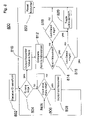
  • FIG. 8 is a flow diagram showing an exemplary method for determining lock as implemented in the frequency offset analyzer shown in FIG. 5 , in accordance with an embodiment of the present invention
  • FIGS. 9A , 9 B and 9 C are timing diagrams showing expanded views of portions of the timings shown in FIGS. 4C , 4 D and 4 E;
  • FIGS. 10A , 10 B and 10 C are more timing diagrams showing expanded views of portions of the timings shown in FIGS. 4C , 4 D and 4 E.
  • the present invention provides a low noise phase locked loop (PLL) with a high precision lock detector.
  • the PLL includes a voltage controlled oscillator (VCO) that is tuned by two separate tuning signals.
  • the first tuning signal controls the VCO during its acquisition mode and the second tuning signal controls the VCO during its tracking mode.
  • a first phase/frequency detector (PFD) operating a charge pump establishes the first tuning signal.
  • a second phase/frequency detector (PFD) operating a second charge pump establishes the second tuning signal.
  • the first charge pump is enabled during the acquisition mode of the VCO and the second charge pump is enabled during the tracking mode of the VCO. When one charge pump is enabled, however, the other charge pump is disabled.
  • the first tuning signal has a large gain that, for example, is greater than 1 GHz per volt, while the second tuning signal has a lower gain that, for example, is less than 1 GHz per volt. More typically, the second tuning signal has a gain that is less than three times that of the first tuning signal. Such gain, for example, may be 300 MHz per volt. The inventor has discovered that the high gain quickly allows the PLL to acquire the desired frequency, while the lower gain allows the PLL to operate with low noise interference.
  • the first PFD and charge pump operate by comparing (1) a first reference frequency signal from an external source, such as a clock reference, and (2) a first feedback frequency signal from the VCO.
  • the first feedback frequency signal to the first PFD is provided by way of a frequency divider, which lowers the VCO feedback frequency to 150 MHz, for example.
  • the first reference frequency in such case, is also set to be approximately the same as the first feedback frequency provided by the frequency divider (for example, 150 MHz).
  • the second PFD and charge pump operate by comparing (1) a second reference frequency signal from an external source, such as a clock reference, and (2) a second feedback frequency signal from the VCO.
  • the second reference frequency is substantially equal to the desired frequency of the VCO.
  • desired frequency may be, for example, 10 GHz.
  • the second feedback frequency signal may be a direct feedback signal from the VCO.
  • the frequency of the signal may be approximately equal to 10 GHz.
  • an RC filter network that filters the first and second tuning signals to further lower the noise of the VCO output signal.
  • the filter network described in detail later, provides a high damping response and reduces overshoot response of the first and second tuning signals.
  • a further aspect of the present invention includes a high precision lock detector to ascertain whether the PLL is locked onto the desired frequency.
  • the high precision lock detector generates a lock detect signal to indicate the PLL lock status.
  • PLL system 100 includes Phase/Frequency Detector (PFD) with High Precision Lock Detector 102 .
  • PFD Phase/Frequency Detector
  • the PFD with High Precision Lock Detector 102 receives a reference frequency f 1 signal and a feedback frequency f 2 signal.
  • Reference frequency f 1 signal may be generated externally by an oscillator, such as a quartz crystal (not shown).
  • the reference frequency is generally a lower frequency multiple of the desired lock frequency.
  • the feedback frequency f 2 signal is the VCO output feedback frequency, which is first divided down by frequency divider 112 .
  • PLL system 100 further includes charge pump 104 that receives up/down pulses from PFD with High Precision Lock Detector 102 .
  • Charge Pump 104 provides an analog voltage, designated as voltage tuning one, or VT 1 , to RC filter network 106 .
  • the VT 1 signal controls the frequency output of VCO 108 .
  • Charge pump 104 also receives an Enable 1 signal for enabling or disabling the charge pump. This signal is described in more detail below.
  • the PLL system 100 also includes a second phase/frequency detector (PFD) with a charge pump, shown as 110 .
  • the PFD with charge pump 110 (abbreviated herein as PFDCP 110 ) provides an analog voltage, designated as voltage tuning two, or VT 2 , to RC filter network 106 .
  • the VT 2 signal controls the frequency output of VCO 108 .
  • the PFDCP 110 receives an Enable 2 signal for enabling or disabling the charge pump of PFDCP 110 .
  • the Enable 2 signal is described in more detail below.
  • the VCO 108 provides as an output the VCO OUT signal, typically at a high frequency (for example 10 GHz). This high frequency may or may not be the desired frequency.
  • the VCO OUT signal is looped back as a feedback signal to frequency divider 112 and to PFDCP 110 .
  • Frequency divider 112 divides the VCO OUT frequency by an integer multiple (for example, divide by 64) and provides the divided VCO OUT signal as the feedback frequency f 2 signal (for example 150 MHz).
  • PFDCP 110 receives the VCO OUT signal directly from VCO 108 and the frequency divider is bypassed.
  • the frequency of the VCO OUT signal may be, for example, 10 GHz.
  • the PFDCP 110 also receives a reference frequency f 5 signal, which is the desired high frequency VCO output signal that PLL system 100 is attempting to lock onto.
  • a reference frequency f 5 signal may be 10 GHz.
  • the reference frequency f 4 signal may be the VCO OUT signal directly connected to PFDCP 110 or, alternatively, the f 4 signal may be derived from the VCO OUT signal through frequency divider 112 .
  • Frequency divider 112 may divide the VCO OUT frequency by an integer multiple (for example, divide by 2) and provide the divided VCO OUT signal as the feedback frequency f 4 signal (for example 5 GHz).
  • PFDCP 110 may receive the VCO OUT signal directly from VCO 108 .
  • the frequency of the VCO OUT signal may be, for example, 10 GHz.
  • the RC filter network 106 includes R 1 and C 1 connected in series to each other and in parallel to the terminal providing the VT 1 tuning signal. Similarly, RC filter network 106 includes R 3 and C 2 connected in series to each other and in parallel to the terminal providing the VT 2 tuning signal. A resistor R 2 couples the output of the VT 1 signal together with the output of the VT 2 signal.
  • charge pump 104 may be in a disabled mode, nevertheless the VT 1 signal is still present, and effectively supplies a DC bias about which the VT 2 signal primarily controls the VCO frequency.
  • PFDCP 110 may be in a disabled mode, nevertheless the VT 2 signal is still present, but effectively provides minor affect on controlling the VCO frequency, because primary control is provided by way of the VT 1 signal.
  • VT 1 signal and the VT 2 signal are combined by way of RC filter network 106 and both tuning signals simultaneously control the frequency of the VCO output signal.
  • the amount of control varies depending on whether one charge pump is enabled or the other charge pump is enabled. As described previously, only one charge pump at any one time is enabled, while the other charge pump is disabled. Because both VT 1 and VT 2 remain in the direct path of tuning the VCO, this effectively reduces noise in the system, although the system switches from one charge pump to the other charge pump.
  • PFD with High Precision Lock Detector 102 includes Phase/Frequency detector (PFD) 202 , which receives the signals having the reference and feedback frequencies f 1 and f 2 , respectively.
  • the PFD 202 receives the reference frequency f 1 signal and the feedback frequency f 2 signal and generates, in a conventional manner, output pulses labeled as down (DN) and up bar (UPB), which are used to control Charge Pump 104 shown in FIG. 1 .
  • Signals DN and UPB are, at the same time, provided to a logic gate, exclusive-NOR gate 204 (XNOR 204 ).
  • XNOR exclusive-NOR gate
  • the XNOR provides the XNOR OUT signal, as shown.
  • the XNOR OUT signal is integrated by low pass filter (LPF) 206 , which generates an LPF OUT signal.
  • LPF OUT signal is compared to a predetermined reference threshold voltage, VREF, by comparator 208 .
  • Comparator 208 generates output signal f 3 , which is provided to frequency offset analyzer 210 .
  • Frequency offset analyzer 210 generates the LOCK DETECT signal, which is also shown in FIG. 1 as the LOCK DETECT signal outputted from PFD with High Precision Lock Detector 102 .
  • FIG. 3 there is shown an exemplary embodiment of the PFD with High Precision Lock Detector that has just been described with reference to FIG. 2 .
  • the logic gates of a conventional phase/frequency detector are shown as PFD 202 .
  • This PFD is known as a zero dead zone PFD for generating up (actually up bar) and down pulses.
  • the PFD 202 is followed by XNOR gate 204 and low pass filter (LPF) 206 , the latter being implemented, as an example, by resistor R 4 and capacitor C 3 .
  • the output from the LPF is inputted into comparator 208 for comparison with the VREF signal.
  • the output signal from comparator 208 shown as the f 3 signal, is provided to Frequency Offset Analyzer 210 .
  • output pulse DN is generally low and output pulse UPB is generally high; each of these pulses is seen as a transient toggle pulse.
  • VCO feedback frequency f 2 begins to lag reference frequency f 1
  • output pulse DN remains generally low, and the duration of time that output pulse UPB is low increases proportionally to the increase in the lag time.
  • VCO feedback frequency f 2 begins to lead reference frequency f 1
  • output pulse UPB remains generally high, and the duration of time that output pulse DN is high increases proportionally to the increase in the lead time.
  • output pulses UPB and DN are proportional to the frequency and phase difference between the two f 1 and f 2 input signals.
  • This proportionality of the output pulses UPB and DN to the phase and frequency of input signals f 1 and f 2 is utilized to control the output frequency of the VCO.
  • Output pulses UPB and DN are connected to charge pump 104 which increases or decreases the VCO control voltage based on output pulses UPB and DN.
  • charge pump 104 increases the VCO control voltage; and as the pulse duration of output pulse DN become increasingly, as a function of time, to be in a high state, charge pump 104 decreases the VCO control voltage.
  • output pulses UPB and DN are inputted into exclusive-NOR gate 204 . Because output pulse UPB is proportional to the phase and frequency lag of f 2 to f 1 , and output pulse DN is proportional to the phase and frequency lead of f 2 to f 1 , the output of the exclusive-NOR is also proportional to the phase and frequency difference between f 1 and f 2 .
  • the XNOR OUT signal is integrated by low pass filter 206 , forming a low pass average analog voltage level at LPF OUT.
  • the LPF OUT is then compared to a predetermined reference voltage threshold, VREF, by comparator 208 .
  • the VREF threshold is determined based on the UPB and DN pulse amplitudes and the low pass filter characteristics.
  • comparator 208 toggles its output to provide the f 3 signal.
  • the f 3 signal becomes a level one when the voltage of LPF OUT exceeds VREF and a level zero when the voltage of LPF OUT is lower than VREF.
  • FIGS. 4A-G show exemplary relationships among these signals.
  • the f 1 and f 2 signals are depicted in FIGS. 4A and 4B .
  • the output pulses UPB and DN are depicted, respectively, in FIGS. 4C and 4D .
  • the XNOR OUT signal is shown in FIG. 4E .
  • the integrated output of LPF OUT is shown against the VREF threshold in FIG. 4F
  • the f 3 output signal of comparator 208 is shown in FIG. 4G .
  • Frequency offset analyzer 210 is provided to frequency offset analyzer 210 , as shown in FIG. 5 .
  • Frequency offset analyzer 210 may be implemented in hardware, or may be implemented as an embedded software routine executed in a microcontroller, or may be a combination of both.
  • Frequency offset analyzer 210 includes rising edge is detector 502 , which receives the f 3 signal and marks its positive pulse transition. When the f 3 signal has a positive pulse transition, rising edge detector 502 toggles the RST (reset) signal.
  • RST reset
  • Ncounter 504 receives the RST signal and an Nclk signal.
  • the RST signal is used to reset Ncounter 504 , while the Nclk signal may be a system clock.
  • Ncounter 504 counts the number of Nclk transitions between the rising edges of the RST signal, and outputs a counter value of Ncnt. Because the RST signal corresponds to the rising edges of the f 3 signal, the value of Ncnt is effectively a measure of the period of the f 3 signal.
  • T 1/(f 1 ⁇ f 2 ).
  • the Ncnt value is compared to a predetermined threshold count value of Nthreshold by comparator 506 . If the Ncnt value exceeds the Nthreshold value, comparator 506 provides a CMP output signal to XOR 507 and toggle logic 508 . If control signal LOCK DETECT is in a low state and the CMP output becomes high, then LOCK DETECT is toggled into a high state, indicating that the PLL is locked on correctly to the desired frequency. If, on the other hand, control signal LOCK DETECT is in a high state and the CMP output becomes high, then LOCK DETECT is maintained in its high state, indicating that the PLL is still locked on correctly to the desired frequency. If, however, control signal LOCK DETECT is in a high state and the CMP output becomes low, then LOCK DETECT is toggled into a low state, indicating that the PLL has lost lock to the desired frequency.
  • FIG. 8 shows an exemplary method 800 for controlling the LOCK DETECT signal provided from the frequency offset analyzer of FIG. 5 .
  • rising edge detector 502 receives the f 3 signal (waveform), and waits for a rising edge to be detected on the f 3 signal.
  • Decision block 804 remains false until a rising edge is detected. So long as decision block 804 is false, the method sequentially enters decision blocks 806 and 808 .
  • Ncounter 504 is incremented one count for every clock cycle of Nclk, thus counting the number of Nclk values between a previous rising edge of the f 3 waveform until detection of a current rising edge of the f 3 waveform by decision block 804 .
  • Ncnt is compared to a predetermined number, Nthreshold, in process block 812 and decision block 814 .
  • the number Nthreshold represents the minimum number of Nclk cycles between f 3 rising edges for PLL 100 to be considered to have a locked status.
  • Nthreshold is selected to meet a predetermined ppm tolerance level for the frequency accuracy of PLL 100 .
  • Ncnt exceeds Nthreshold
  • decision block 814 becomes true, and PLL 100 is in a locked status. If PLL 100 is in a locked status, the LOCK DETECT output is set high (assuming that it is not already set high) by way of decision block 816 and process block 820 . If, however, the LOCK DETECT signal is already high (as determined by decision block 818 ), then the method does not reset the LOCK DETECT signal and only loops back to reset the Ncounter by way of process block 822 .
  • Ncnt is less than Nthreshold, however, as determined by decision block 814 , the method loops to decision block 818 to determine whether the LOCK DETECT signal is high. If the LOCK DETECT signal is high, then the method enters process block 820 to toggle the LOCK DETECT signal to false. The method loops back to reset the Ncounter by way of process block 822 . Process block 822 resets the value of the Ncounter to zero, and the method returns to decision block 804 to detect the next rising edge of the f 3 waveform.
  • FIGS. 9A-9C show exemplary relationships among UPB, DN and XNOR OUT, when reference frequency f 1 is less than VCO feedback frequency f 2 .
  • the UPB pulse is a transient and the DN pulse is proportional to the phase/frequency difference between the f 1 and f 2 signals.
  • FIGS. 10A-10C show other exemplary relationships among UPB, DN and XNOR OUT, when reference frequency f 1 is greater than VCO feedback frequency f 2 .
  • the DN pulse is a transient and the UPB pulse is proportional to the phase/frequency difference between the f 1 and f 2 signals.
  • PLL 100 has two modes, an acquisition mode and a tracking mode.
  • charge pump 104 is enabled by the Enable 1 signal.
  • the Enable 1 signal may be a control signal from an external circuit, such as a microcontroller.
  • the charge pump of PFDCP 110 is enabled by the Enable 2 signal.
  • the Enable 2 signal may be another control signal from an external circuit, such as a microcontroller.
  • the decision whether to assert the Enable 1 signal or the Enable 2 signal is based upon the status of the LOCK DETECT output from PFD with High Precision Lock Detector 102 . It will be appreciated that the Enable 1 and Enable 2 signals are mutually exclusive because they cannot be asserted at the same time.
  • tuning voltage V 11 that controls VCO 108 has a high gain, such as 1 GHz/Volt, and tuning voltage VT 2 has a lower gain, such as 300 MHz/Volt.
  • the present invention uses charge pump 104 to primarily control the high gain of tuning voltage VT 1 , and to secondarily control the lower gain of tuning voltage VT 2 .
  • the charge pump of PFDCP 110 is used to primarily fine tune the VCO by way of the low gain of tuning voltage VT 2 and tuning voltage VT 1 has minimal impact on the frequency of the VCO. This advantageously minimizes the noise of the VCO output signal.
  • the present invention controls the affect of tuning voltages V 11 and VT 2 on the VCO by way of filter network 106 .
  • the filter network is comprised of three resistors and two capacitors.
  • the combination of R 1 and C 1 approximately defines the bandwidth of PLL 100 when charge pump 104 is enabled in the acquisition mode.
  • Resistor R 2 transfers the voltage between VT 1 to VT 2 .
  • the combination of R 3 and C 2 approximately defines the bandwidth of PLL 100 when the charge pump of PFDCP 110 is operational in the tracking mode.
  • V 12 When V 12 is active, little current is passed through R 2 and R 1 to have any appreciable affect on VT 1 . In this manner, V 11 is effective in supplying a DC bias to the VCO and small frequency shift occurs when VT 2 is enabled and VT 1 is disabled.
  • the extra filtering of VT 2 by filter network 106 helps dampen the response of VCO 108 and reduces frequency overshoot.
  • Exemplary values for the elements of filter network 106 may be as follows: the R 1 , R 2 and R 3 values may, respectively, be 20K, 10K and 4K; the C 1 and C 2 values may each be 20 pfd.
  • the present invention has another advantage over the prior art. Because PFD with High Precision Lock Detector 102 operates at low input frequencies of f 1 and f 2 (such as in the range of 150 MHz), charge pump 104 does not need to have a high response speed, and may be implemented by an inexpensive charge pump.
  • tuning voltage VT 1 has a high gain, such as 1 GHz/Volt
  • tuning voltage VT 2 has a lower gain, such as 300 MHz/Volt.
  • PFDCP 110 directly control the lower gain tuning voltage VT 2 , but indirectly maintain the DC voltage level of the high gain tuning voltage VT 1 . This operation further reduces PLL noise.
  • PFDCP 110 operates at the higher frequencies of f 4 and f 5 , which in the present embodiment are in the range of 10 GHz, PFDCP 110 needs to have high response speed and, as such, may be implemented by a high frequency Hodge linear PFD and charge pump.

Landscapes

  • Stabilization Of Oscillater, Synchronisation, Frequency Synthesizers (AREA)

Abstract

A phase lock loop (PLL) includes a voltage controlled oscillator (VCO) for providing a VCO output signal. A first phase/frequency detector (PFD) for providing a first voltage tuning signal is included for controlling a frequency of the VCO output signal by comparing a first reference signal to the VCO output signal. A second phase/frequency detector (PFD) for providing a second voltage tuning signal is included for controlling the frequency of the VCO output signal by comparing a second reference signal to the VCO output signal. The first and second voltage tuning signals provide, respectively, first and second gains of frequency per volt for controlling the frequency of the VCO output signal. The first voltage tuning signal has a higher gain than the second voltage tuning signal. The first voltage tuning signal provides coarse frequency control of the VCO output signal and the second voltage tuning signal provides fine frequency control of the VCO output signal.

Description

FIELD OF THE INVENTION
The present invention relates, in general, to phase locked loop (PLL) systems. More specifically, the present invention relates to a low noise PLL with a high precision lock detector.
BACKGROUND OF THE INVENTION
A phase locked loop (PLL) is a frequency feedback circuit that is used to lock a locally generated clock signal to an external reference signal. A PLL is useful in telecommunications equipment and audio/visual equipment that receive a reference signal and require a local clock signal, whose frequency and phase are related (locked) to the received signal, in order to properly decode incoming signals.
In general, a PLL includes a reference frequency generator, a phase and frequency detector (PFD), a charge pump and a voltage controlled oscillator (VCO). The PFD detects the frequency and phase difference between the VCO output frequency (as a feedback signal) and the reference frequency. The PFD outputs a control signal to the charge pump to produce a voltage that is proportional to the frequency and phase difference.
Conventional PLL systems are notoriously noisy during their acquisition and tracking cycles because of the desire to adjust and correct quickly the frequency of the VCO output signal. Hence, there is a need for an improved PLL system that quickly adjusts its frequency output but produces little noise in the process. Additionally, there is a need to accurately determine when the PLL frequency is within a small error range that may be expressed in minute quantities of parts per million (PPM). The present invention addresses such a PLL system.
SUMMARY OF THE INVENTION
To meet this and other needs, and in view of its purposes, the present invention provides a phase lock loop (PLL) including a voltage controlled oscillator (VCO) for providing a VCO output signal. A first phase/frequency detector (PFD) is included for providing a first voltage tuning signal for controlling a frequency of the VCO output signal by comparing a first reference signal to the VCO output signal; and a second phase/frequency detector (PFD) is included for providing a second voltage tuning signal for controlling the frequency of the VCO output signal by comparing a second reference signal to the VCO output signal. The first and second voltage tuning signals provide, respectively, first and second gains of frequency per volt for controlling the frequency of the VCO output signal.
The first voltage tuning signal may have a higher gain than the second voltage tuning signal. In addition, the first voltage tuning signal provides coarse frequency control of the VCO output signal and the second voltage tuning signal provides fine frequency control of the VCO output signal.
A filter network is coupled between the first and second PFDs and the VCO for filtering the first and second voltage tuning signals prior to controlling the frequency of the VCO output signal. The filter network includes resistive and capacitive elements for damping or reducing overshoot of the second voltage tuning signal.
A first charge pump is coupled between the first PFD and the VCO for providing the first voltage tuning signal, and a second charge pump is coupled between the second PFD and the VCO for providing the second voltage tuning signal. Also included is an enable/disable signal for enabling one of the first and second charge pumps or disabling the other one of the first and second charge pumps.
A frequency divider is coupled to the VCO output signal. The frequency divider provides a first feedback signal to the first PFD for comparison with the first reference signal. A second feedback signal may be provided directly from the VCO output signal to the second PFD for comparison with the second reference signal. The first reference signal has a lower frequency than the second reference signal, and the second reference signal is substantially equal to a desired frequency of the VCO output signal.
Another embodiment of the present invention is a phase lock loop (PLL) that includes a voltage controlled oscillator (VCO) for providing a VCO output signal; a phase/frequency detector (PFD) for receiving (a) the VCO output signal and (b) a reference signal, and outputting up/down pulses; an exclusive-or (XOR) gate for logically combining the up/down pulses and outputting an XOR signal; an integrator coupled to the XOR gate for outputting an integrated XOR signal; and a comparator for comparing the integrated XOR signal to a predetermined threshold level and providing a comparator output signal having a time period dependent upon the integrated XOR signal. When the time period of the comparator output signal exceeds a predetermined threshold time period, the VCO is providing a desired frequency for the VCO output signal.
The PLL includes an edge detector coupled to the comparator for detecting rising edges of the comparator output signal; and a counter coupled to the edge detector for counting a time period between detected rising edges to determine the time period of the comparator output signal. The counter determines the time period, T, based on the following relationship:
T=1/(reference frequency−VCO feedback frequency)
where the reference frequency is the frequency of the reference signal, and the VCO feedback frequency is the frequency of the VCO output signal. When T exceeds the predetermined threshold time period, the VCO is providing the desired frequency for the VCO output signal.
The PLL also includes a charge pump coupled between the PFD and the VCO for providing a first voltage tuning signal to control the frequency of the VCO output signal. Another charge pump is coupled between another PFD and the VCO for providing a second voltage tuning signal to control the frequency of the VCO output signal. The second voltage tuning signal has a gain of frequency per volt that is lower than a gain of frequency per volt of the first voltage tuning signal.
Yet another embodiment of the present invention is a method of controlling a frequency of a voltage controlled oscillator (VCO) having an acquisition mode and a tracking mode. The method includes the steps of: (a) tuning the frequency of the VCO using a first phase/frequency detector (PFD); (b) tuning the frequency of the VCO using a second phase/frequency detector (PFD); (c) enabling the first PFD and disabling the second PFD during the acquisition mode; and (d) enabling the second PFD and disabling the first PFD during the tracking mode.
It is understood that the foregoing general description and the following detailed description are exemplary, but not restrictive, of the invention.
BRIEF DESCRIPTION OF THE DRAWING
The invention is best understood from the following detailed description when read in connection with the accompanying drawing. Included in the drawing are the following figures:
FIG. 1 is a functional block diagram of a low noise phase locked loop with a high precision lock detector, in accordance with an embodiment of the present invention;
FIG. 2 is a functional block diagram of the phase/frequency detector with the high precision lock detection shown in FIG. 1, in accordance with an embodiment of the present invention;
FIG. 3 is schematic diagram of the phase/frequency detector with the high precision lock detection shown in FIG. 2, in accordance with an embodiment of the present invention;
FIGS. 4A, 4B, 4C, 4D, 4E, 4F and 4G are timing diagrams showing exemplary relationships among the signals flowing in the modules shown in FIG. 2;
FIG. 5 is a functional block diagram of a frequency offset analyzer shown in FIG. 2, in accordance with an embodiment of the present invention;
FIGS. 6A and 6B are timing diagrams showing an exemplary relationship between signals in the frequency offset analyzer shown in FIG. 5, in accordance with an embodiment of the present invention;
FIGS. 7A, 7B, 7C, 7D, 7E and 7F are plots showing exemplary relationships among signals of the counter shown in FIG. 5, in accordance with an embodiment of the present invention;
FIG. 8 is a flow diagram showing an exemplary method for determining lock as implemented in the frequency offset analyzer shown in FIG. 5, in accordance with an embodiment of the present invention;
FIGS. 9A, 9B and 9C are timing diagrams showing expanded views of portions of the timings shown in FIGS. 4C, 4D and 4E; and
FIGS. 10A, 10B and 10C are more timing diagrams showing expanded views of portions of the timings shown in FIGS. 4C, 4D and 4E.
DETAILED DESCRIPTION OF THE INVENTION
As will be described, the present invention provides a low noise phase locked loop (PLL) with a high precision lock detector. The PLL includes a voltage controlled oscillator (VCO) that is tuned by two separate tuning signals. The first tuning signal controls the VCO during its acquisition mode and the second tuning signal controls the VCO during its tracking mode. A first phase/frequency detector (PFD) operating a charge pump establishes the first tuning signal. A second phase/frequency detector (PFD) operating a second charge pump establishes the second tuning signal. The first charge pump is enabled during the acquisition mode of the VCO and the second charge pump is enabled during the tracking mode of the VCO. When one charge pump is enabled, however, the other charge pump is disabled.
The first tuning signal has a large gain that, for example, is greater than 1 GHz per volt, while the second tuning signal has a lower gain that, for example, is less than 1 GHz per volt. More typically, the second tuning signal has a gain that is less than three times that of the first tuning signal. Such gain, for example, may be 300 MHz per volt. The inventor has discovered that the high gain quickly allows the PLL to acquire the desired frequency, while the lower gain allows the PLL to operate with low noise interference.
The first PFD and charge pump operate by comparing (1) a first reference frequency signal from an external source, such as a clock reference, and (2) a first feedback frequency signal from the VCO. As will be explained, the first feedback frequency signal to the first PFD is provided by way of a frequency divider, which lowers the VCO feedback frequency to 150 MHz, for example. The first reference frequency, in such case, is also set to be approximately the same as the first feedback frequency provided by the frequency divider (for example, 150 MHz).
The second PFD and charge pump operate by comparing (1) a second reference frequency signal from an external source, such as a clock reference, and (2) a second feedback frequency signal from the VCO. As will be explained, the second reference frequency is substantially equal to the desired frequency of the VCO. Such desired frequency may be, for example, 10 GHz. The second feedback frequency signal may be a direct feedback signal from the VCO. In this example, the frequency of the signal may be approximately equal to 10 GHz.
Also included in the present invention is an RC filter network that filters the first and second tuning signals to further lower the noise of the VCO output signal. The filter network, described in detail later, provides a high damping response and reduces overshoot response of the first and second tuning signals.
A further aspect of the present invention includes a high precision lock detector to ascertain whether the PLL is locked onto the desired frequency. The high precision lock detector generates a lock detect signal to indicate the PLL lock status. This and other features, as explained below, contribute to advantageous improvements over conventional phase locked loops.
Referring first to FIG. 1, there is shown a functional block diagram of a phase locked loop (PLL) system including a high precision lock detector, the system generally referred to as 100. As shown, PLL system 100 includes Phase/Frequency Detector (PFD) with High Precision Lock Detector 102. The PFD with High Precision Lock Detector 102 receives a reference frequency f1 signal and a feedback frequency f2 signal. Reference frequency f1 signal may be generated externally by an oscillator, such as a quartz crystal (not shown). The reference frequency is generally a lower frequency multiple of the desired lock frequency. The feedback frequency f2 signal is the VCO output feedback frequency, which is first divided down by frequency divider 112.
As shown, PLL system 100 further includes charge pump 104 that receives up/down pulses from PFD with High Precision Lock Detector 102. Charge Pump 104 provides an analog voltage, designated as voltage tuning one, or VT1, to RC filter network 106. The VT1 signal controls the frequency output of VCO 108. Charge pump 104 also receives an Enable1 signal for enabling or disabling the charge pump. This signal is described in more detail below.
The PLL system 100 also includes a second phase/frequency detector (PFD) with a charge pump, shown as 110. The PFD with charge pump 110 (abbreviated herein as PFDCP 110) provides an analog voltage, designated as voltage tuning two, or VT2, to RC filter network 106. The VT2 signal controls the frequency output of VCO 108. The PFDCP 110 receives an Enable 2 signal for enabling or disabling the charge pump of PFDCP 110. The Enable 2 signal is described in more detail below.
The VCO 108 provides as an output the VCO OUT signal, typically at a high frequency (for example 10 GHz). This high frequency may or may not be the desired frequency. The VCO OUT signal is looped back as a feedback signal to frequency divider 112 and to PFDCP 110. Frequency divider 112 divides the VCO OUT frequency by an integer multiple (for example, divide by 64) and provides the divided VCO OUT signal as the feedback frequency f2 signal (for example 150 MHz). On the other hand, PFDCP 110 receives the VCO OUT signal directly from VCO 108 and the frequency divider is bypassed. The frequency of the VCO OUT signal may be, for example, 10 GHz.
The PFDCP 110 also receives a reference frequency f5 signal, which is the desired high frequency VCO output signal that PLL system 100 is attempting to lock onto. In this example, the reference frequency f5 signal may be 10 GHz.
The reference frequency f4 signal may be the VCO OUT signal directly connected to PFDCP 110 or, alternatively, the f4 signal may be derived from the VCO OUT signal through frequency divider 112. Frequency divider 112 may divide the VCO OUT frequency by an integer multiple (for example, divide by 2) and provide the divided VCO OUT signal as the feedback frequency f4 signal (for example 5 GHz). On the other hand, PFDCP 110 may receive the VCO OUT signal directly from VCO 108. The frequency of the VCO OUT signal may be, for example, 10 GHz.
The RC filter network 106 includes R1 and C1 connected in series to each other and in parallel to the terminal providing the VT1 tuning signal. Similarly, RC filter network 106 includes R3 and C2 connected in series to each other and in parallel to the terminal providing the VT2 tuning signal. A resistor R2 couples the output of the VT1 signal together with the output of the VT2 signal. In operation, although charge pump 104 may be in a disabled mode, nevertheless the VT1 signal is still present, and effectively supplies a DC bias about which the VT2 signal primarily controls the VCO frequency. In a similar manner, although PFDCP 110 may be in a disabled mode, nevertheless the VT2 signal is still present, but effectively provides minor affect on controlling the VCO frequency, because primary control is provided by way of the VT1 signal.
Thus, one of the advantages of the present invention is that the VT1 signal and the VT2 signal are combined by way of RC filter network 106 and both tuning signals simultaneously control the frequency of the VCO output signal. The amount of control, however, varies depending on whether one charge pump is enabled or the other charge pump is enabled. As described previously, only one charge pump at any one time is enabled, while the other charge pump is disabled. Because both VT1 and VT2 remain in the direct path of tuning the VCO, this effectively reduces noise in the system, although the system switches from one charge pump to the other charge pump.
A functional block diagram of PFD with High Precision Lock Detector 102 is shown in FIG. 2. As shown, PFD with High Precision Lock Detector 102 includes Phase/Frequency detector (PFD) 202, which receives the signals having the reference and feedback frequencies f1 and f2, respectively. The PFD 202 receives the reference frequency f1 signal and the feedback frequency f2 signal and generates, in a conventional manner, output pulses labeled as down (DN) and up bar (UPB), which are used to control Charge Pump 104 shown in FIG. 1. Signals DN and UPB are, at the same time, provided to a logic gate, exclusive-NOR gate 204 (XNOR 204). The XNOR provides the XNOR OUT signal, as shown. Although shown as an XNOR logic gate, it will be appreciated that the PLL system is equally effective when providing an exclusive-OR (XOR) gate, instead of an XNOR gate.
The XNOR OUT signal is integrated by low pass filter (LPF) 206, which generates an LPF OUT signal. LPF OUT signal is compared to a predetermined reference threshold voltage, VREF, by comparator 208. Comparator 208 generates output signal f3, which is provided to frequency offset analyzer 210. Frequency offset analyzer 210 generates the LOCK DETECT signal, which is also shown in FIG. 1 as the LOCK DETECT signal outputted from PFD with High Precision Lock Detector 102.
Referring next to FIG. 3, there is shown an exemplary embodiment of the PFD with High Precision Lock Detector that has just been described with reference to FIG. 2. In the embodiment shown in FIG. 3, the logic gates of a conventional phase/frequency detector are shown as PFD 202. This PFD is known as a zero dead zone PFD for generating up (actually up bar) and down pulses. The PFD 202 is followed by XNOR gate 204 and low pass filter (LPF) 206, the latter being implemented, as an example, by resistor R4 and capacitor C3. The output from the LPF is inputted into comparator 208 for comparison with the VREF signal. The output signal from comparator 208, shown as the f3 signal, is provided to Frequency Offset Analyzer 210.
In operation, when VCO feedback frequency f2 and reference frequency f1 are substantially equal to each other, output pulse DN is generally low and output pulse UPB is generally high; each of these pulses is seen as a transient toggle pulse. As VCO feedback frequency f2 begins to lag reference frequency f1, output pulse DN remains generally low, and the duration of time that output pulse UPB is low increases proportionally to the increase in the lag time. Conversely, as VCO feedback frequency f2 begins to lead reference frequency f1, output pulse UPB remains generally high, and the duration of time that output pulse DN is high increases proportionally to the increase in the lead time. Thus, output pulses UPB and DN are proportional to the frequency and phase difference between the two f1 and f2 input signals.
This proportionality of the output pulses UPB and DN to the phase and frequency of input signals f1 and f2 is utilized to control the output frequency of the VCO. Output pulses UPB and DN are connected to charge pump 104 which increases or decreases the VCO control voltage based on output pulses UPB and DN. As the pulse durations of output pulse UPB become increasingly, as a function of time, to be in a low state, charge pump 104 increases the VCO control voltage; and as the pulse duration of output pulse DN become increasingly, as a function of time, to be in a high state, charge pump 104 decreases the VCO control voltage.
As shown in FIG. 3, output pulses UPB and DN are inputted into exclusive-NOR gate 204. Because output pulse UPB is proportional to the phase and frequency lag of f2 to f1, and output pulse DN is proportional to the phase and frequency lead of f2 to f1, the output of the exclusive-NOR is also proportional to the phase and frequency difference between f1 and f2.
The XNOR OUT signal is integrated by low pass filter 206, forming a low pass average analog voltage level at LPF OUT. The LPF OUT is then compared to a predetermined reference voltage threshold, VREF, by comparator 208. The VREF threshold is determined based on the UPB and DN pulse amplitudes and the low pass filter characteristics. When the voltage of LPF OUT exceeds VREF, comparator 208 toggles its output to provide the f3 signal. The f3 signal becomes a level one when the voltage of LPF OUT exceeds VREF and a level zero when the voltage of LPF OUT is lower than VREF. The frequency of f3 is proportional to the difference between the reference frequency f1 and the VCO feedback frequency f2, according to the equation f3=f1−f2. FIGS. 4A-G show exemplary relationships among these signals.
As shown, the f1 and f2 signals are depicted in FIGS. 4A and 4B. The output pulses UPB and DN are depicted, respectively, in FIGS. 4C and 4D. The XNOR OUT signal is shown in FIG. 4E. The integrated output of LPF OUT is shown against the VREF threshold in FIG. 4F, and the f3 output signal of comparator 208 is shown in FIG. 4G.
Signal f3 is provided to frequency offset analyzer 210, as shown in FIG. 5. Frequency offset analyzer 210 may be implemented in hardware, or may be implemented as an embedded software routine executed in a microcontroller, or may be a combination of both. Frequency offset analyzer 210 includes rising edge is detector 502, which receives the f3 signal and marks its positive pulse transition. When the f3 signal has a positive pulse transition, rising edge detector 502 toggles the RST (reset) signal. An example of the relationship between the f3 signal and the RST signal is shown in FIGS. 6A and 6B.
Returning to FIG. 5, Ncounter 504 receives the RST signal and an Nclk signal. The RST signal is used to reset Ncounter 504, while the Nclk signal may be a system clock. As shown in FIGS. 7A-7F, Ncounter 504 counts the number of Nclk transitions between the rising edges of the RST signal, and outputs a counter value of Ncnt. Because the RST signal corresponds to the rising edges of the f3 signal, the value of Ncnt is effectively a measure of the period of the f3 signal.
As previously described, the period of the f3 signal is proportional to the difference between the reference frequency f1 and the VCO feedback frequency f2, according to the equation T=1/(f1−f2). The closer that frequencies f1 and f2 are to each other, the longer is the time period T of the f3 signal. Since the relationship between the time period of the f3 signal and the error between the f1 and f2 frequencies are inversely related to each other, PFD 102 is effective in providing a very accurate determination of when the PLL is locked onto the desired frequency.
The Ncnt value is compared to a predetermined threshold count value of Nthreshold by comparator 506. If the Ncnt value exceeds the Nthreshold value, comparator 506 provides a CMP output signal to XOR 507 and toggle logic 508. If control signal LOCK DETECT is in a low state and the CMP output becomes high, then LOCK DETECT is toggled into a high state, indicating that the PLL is locked on correctly to the desired frequency. If, on the other hand, control signal LOCK DETECT is in a high state and the CMP output becomes high, then LOCK DETECT is maintained in its high state, indicating that the PLL is still locked on correctly to the desired frequency. If, however, control signal LOCK DETECT is in a high state and the CMP output becomes low, then LOCK DETECT is toggled into a low state, indicating that the PLL has lost lock to the desired frequency.
FIG. 8 shows an exemplary method 800 for controlling the LOCK DETECT signal provided from the frequency offset analyzer of FIG. 5. As shown by process block 802, rising edge detector 502 receives the f3 signal (waveform), and waits for a rising edge to be detected on the f3 signal. Decision block 804 remains false until a rising edge is detected. So long as decision block 804 is false, the method sequentially enters decision blocks 806 and 808. During this cycle (804, 806 and 808), Ncounter 504 is incremented one count for every clock cycle of Nclk, thus counting the number of Nclk values between a previous rising edge of the f3 waveform until detection of a current rising edge of the f3 waveform by decision block 804.
When decision block 804 is true, the method moves to process block 810 and outputs the value of Ncounter 504 as the Ncnt value. The value of Ncnt is compared to a predetermined number, Nthreshold, in process block 812 and decision block 814. The number Nthreshold, as previously described, represents the minimum number of Nclk cycles between f3 rising edges for PLL 100 to be considered to have a locked status. Nthreshold is selected to meet a predetermined ppm tolerance level for the frequency accuracy of PLL 100.
Thus, if Ncnt exceeds Nthreshold, decision block 814 becomes true, and PLL 100 is in a locked status. If PLL 100 is in a locked status, the LOCK DETECT output is set high (assuming that it is not already set high) by way of decision block 816 and process block 820. If, however, the LOCK DETECT signal is already high (as determined by decision block 818), then the method does not reset the LOCK DETECT signal and only loops back to reset the Ncounter by way of process block 822.
If Ncnt is less than Nthreshold, however, as determined by decision block 814, the method loops to decision block 818 to determine whether the LOCK DETECT signal is high. If the LOCK DETECT signal is high, then the method enters process block 820 to toggle the LOCK DETECT signal to false. The method loops back to reset the Ncounter by way of process block 822. Process block 822 resets the value of the Ncounter to zero, and the method returns to decision block 804 to detect the next rising edge of the f3 waveform.
FIGS. 9A-9C show exemplary relationships among UPB, DN and XNOR OUT, when reference frequency f1 is less than VCO feedback frequency f2. As described above, when f1 is less than f2, the UPB pulse is a transient and the DN pulse is proportional to the phase/frequency difference between the f1 and f2 signals.
FIGS. 10A-10C show other exemplary relationships among UPB, DN and XNOR OUT, when reference frequency f1 is greater than VCO feedback frequency f2. As described above, when f1 is greater than f2, the DN pulse is a transient and the UPB pulse is proportional to the phase/frequency difference between the f1 and f2 signals.
In operation, PLL 100 has two modes, an acquisition mode and a tracking mode. In the acquisition mode, charge pump 104 is enabled by the Enable1 signal. The Enable1 signal may be a control signal from an external circuit, such as a microcontroller. Similarly, in the tracking mode, the charge pump of PFDCP 110 is enabled by the Enable2 signal. The Enable2 signal may be another control signal from an external circuit, such as a microcontroller. The decision whether to assert the Enable1 signal or the Enable2 signal is based upon the status of the LOCK DETECT output from PFD with High Precision Lock Detector 102. It will be appreciated that the Enable1 and Enable2 signals are mutually exclusive because they cannot be asserted at the same time.
By way of example, tuning voltage V11 that controls VCO 108 has a high gain, such as 1 GHz/Volt, and tuning voltage VT2 has a lower gain, such as 300 MHz/Volt. In the acquisition mode, when the VCO frequency and the desired lock frequency are far apart, it is desired to adjust the VCO frequency quickly. Therefore, the present invention uses charge pump 104 to primarily control the high gain of tuning voltage VT1, and to secondarily control the lower gain of tuning voltage VT2. On the other hand, when the PLL is correctly locked onto the desired frequency, the charge pump of PFDCP 110 is used to primarily fine tune the VCO by way of the low gain of tuning voltage VT2 and tuning voltage VT1 has minimal impact on the frequency of the VCO. This advantageously minimizes the noise of the VCO output signal.
The present invention controls the affect of tuning voltages V11 and VT2 on the VCO by way of filter network 106. The filter network is comprised of three resistors and two capacitors. The combination of R1 and C1 approximately defines the bandwidth of PLL 100 when charge pump 104 is enabled in the acquisition mode. Resistor R2 transfers the voltage between VT1 to VT2. The combination of R3 and C2 approximately defines the bandwidth of PLL 100 when the charge pump of PFDCP 110 is operational in the tracking mode. When V12 is active, little current is passed through R2 and R1 to have any appreciable affect on VT1. In this manner, V11 is effective in supplying a DC bias to the VCO and small frequency shift occurs when VT2 is enabled and VT1 is disabled. In addition, the extra filtering of VT2 by filter network 106 helps dampen the response of VCO 108 and reduces frequency overshoot.
Exemplary values for the elements of filter network 106 may be as follows: the R1, R2 and R3 values may, respectively, be 20K, 10K and 4K; the C1 and C2 values may each be 20 pfd.
The present invention has another advantage over the prior art. Because PFD with High Precision Lock Detector 102 operates at low input frequencies of f1 and f2 (such as in the range of 150 MHz), charge pump 104 does not need to have a high response speed, and may be implemented by an inexpensive charge pump.
As previously described, tuning voltage VT1 has a high gain, such as 1 GHz/Volt, and tuning voltage VT2 has a lower gain, such as 300 MHz/Volt. In the tracking mode, when the VCO frequency and the desired lock frequency are close is together, it is desired to adjust the VCO frequency slowly and avoid any response overshoot. Therefore, it is desired that PFDCP 110 directly control the lower gain tuning voltage VT2, but indirectly maintain the DC voltage level of the high gain tuning voltage VT1. This operation further reduces PLL noise.
Additionally, because PFDCP 110 operates at the higher frequencies of f4 and f5, which in the present embodiment are in the range of 10 GHz, PFDCP 110 needs to have high response speed and, as such, may be implemented by a high frequency Hodge linear PFD and charge pump.
Although the invention is illustrated and described herein with reference to specific embodiments, the invention is not intended to be limited to the details shown. Rather, various modifications may be made in the details within the scope and range of equivalents of the claims and without departing from the invention.

Claims (22)

1. A phase lock loop (PLL) comprising
a voltage controlled oscillator (VCO) for providing a VCO output signal, based on first and second voltage tuning signals inputted to the VCO,
a filter network for outputting the first and second voltage tuning signals to the VCO,
a first phase/frequency detector (PFD) for inputting a first signal to the filter network for forming the first and second voltage tuning signals,
a second phase/frequency detector (PFD) for inputting a second signal to the filter network for forming the first and second voltage tuning signals,
wherein the first and second voltage tuning signals provide, respectively, first and second gains of frequency per volt for controlling a frequency of the VCO output signal, and
when the first PFD is active, the filter network (a) receives the first signal from the first PFD, and responsively outputs the first voltage tuning signal to the VCO and (b) outputs a DC voltage as the second voltage tuning signal to the VCO, and
when the second PFD is active, the filter network (a) receives the second signal from the second PFD, and responsively outputs the second voltage tuning signal to the VCO and (b) outputs another DC voltage as the first voltage tuning signal to the VCO.
2. The PLL of claim 1 wherein the first voltage tuning signal has a higher gain than the second voltage tuning signal, and
the first voltage tuning signal provides coarse frequency control of the VCO output signal and the second voltage tuning signal provides fine frequency control of the VCO output signal.
3. The PLL of claim 1 wherein
the first gain of the first voltage tuning signal is greater than 1 GHz per volt and the second gain of the second voltage tuning signal is less than 500 MHz per volt.
4. The PLL of claim 1 wherein
the filter network includes resistive and capacitive elements for damping or reducing overshoot of the second voltage tuning signal.
5. The PLL of claim 1 including
a first charge pump coupled between the first PFD and the filter network for providing the first voltage tuning signal,
a second charge pump coupled between the second PFD and the filter network for providing the second voltage tuning signal, and
an enable/disable signal for enabling one of the first and second charge pumps or disabling the other one of the first and second charge pumps.
6. The PLL of claim 1 including
a frequency divider coupled to the VCO output signal,
wherein the frequency divider provides a first feedback signal to the first PFD for comparison with a first reference signal, and
a second feedback signal is provided from the VCO output signal to the second PFD for comparison with a second reference signal.
7. The PLL of claim 6 wherein
the first reference signal has a lower frequency than the second reference signal, and
the second reference signal is substantially equal to a desired frequency of the VCO output signal.
8. The PLL of claim 1 including
a frequency offset analyzer coupled to the first PFD for determining frequency lock status of the VCO output signal.
9. The PLL of claim 8 wherein
the frequency offset analyzer includes a counter for determining a period of time, T, based on the following relationship:

T=1/(reference frequency−VCO feedback frequency)
where the reference frequency is the frequency of a first reference signal, and the VCO feedback frequency is the frequency of the VCO output signal; and
when T exceeds a predetermined threshold value, the frequency lock status is determined to be correctly locked.
10. The PLL of claim 1 wherein
the DC voltages provided as the first and second voltage tuning signals to the VCO each includes an average voltage.
11. The PLL of claim 1 wherein the first and second voltage tuning signals are correlated to each other.
12. The PLL of claim 1 wherein
the filter network includes a first resistor in series with a first capacitor, one end of the first resistor connected to a first terminal providing the first voltage tuning signal, and
a second resistor in series with the first capacitor, one end of the second resistor connected to a second terminal providing the second voltage tuning signal,
when the first PFD is active, the first resistor in series with the first capacitor is configured as an integrator for providing the DC voltage as the second voltage tuning signal to the VCO, and
when the second PFD is active, the second resistor in series with the first capacitor is configured as an integrator for providing the other DC voltage as the first voltage tuning signal to the VCO.
13. A phase lock loop (PLL) comprising
a voltage controlled oscillator (VCO) for providing a VCO output signal,
a phase/frequency detector (PFD) for receiving (a) the VCO output signal and (b) a reference signal, and outputting up/down pulses,
a gate for logically combining the up/down pulses and outputting an XOR or XNOR signal,
an integrator coupled to the gate for outputting an integrated XOR or XNOR signal, and
a comparator for comparing the integrated XOR or XNOR signal to a predetermined threshold level and providing a comparator output signal having a time period dependent upon the integrated XOR or XNOR signal,
wherein when the time period of the comparator output signal exceeds a predetermined threshold time period, the VCO is providing a desired frequency for the VCO output signal.
14. The PLL of claim 13 including
an edge detector coupled to the comparator for detecting rising edges of the comparator output signal, and
a counter coupled to the edge detector for counting a time period between detected rising edges to determine the time period of the comparator output signal.
15. The PLL of claim 14 wherein
the counter determines the time period, T, based on the following relationship:

T=1/(reference frequency−VCO feedback frequency)
where the reference frequency is the frequency of the reference signal, and the VCO feedback frequency is the frequency of the VCO output signal; and
when T exceeds the predetermined threshold time period, the VCO is providing the desired frequency for the VCO output signal.
16. The PLL of claim 13 including
a charge pump coupled between the PFD and the VCO for providing a first voltage tuning signal to control the frequency of the VCO output signal.
17. The PLL of claim 16 including
another charge pump coupled between another PFD and the VCO for providing a second voltage tuning signal to control the frequency of the VCO output signal,
wherein the second voltage tuning signal has a gain of frequency per volt that is lower than a gain of frequency per volt of the first voltage tuning signal.
18. A method of controlling a frequency of a voltage controlled oscillator (VCO) having an acquisition mode and a tracking mode, the method comprising the steps of:
(a) tuning the frequency of the VCO, by way of a filter network, using a first phase/frequency detector (PFD);
(b) tuning the frequency of the VCO, by way of the filter network, using a second phase/frequency detector (PFD);
(c) enabling the first PFD and disabling the second PFD during the acquisition mode; and
(d) enabling the second PFD and disabling the first PFD during the tracking mode,
wherein when the first PFD is enabled, the filter network (a) receives a first signal from the first PFD, and responsively outputs a first voltage tuning signal to the VCO and (b) outputs a DC voltage as a second voltage tuning signal to the VCO, and
when the second PFD is enabled, the filter network (a) receives a second signal from the second PFD, and responsively outputs the second voltage tuning signal to the VCO and (b) outputs another DC voltage as the first voltage tuning signal to the VCO.
19. The method of claim 18 wherein
step (a) includes tuning the frequency of the VCO based on (i) a feedback signal f2 derived from the VCO and (ii) a first reference signal f1; and
step (b) includes tuning the frequency of the VCO based on (i) a feedback signal f4 derived from the VCO and (ii) a second reference signal f5;
wherein f1 is approximately equal to f2 and f4 is approximately equal to f5.
20. The method of claim 19 wherein f1 is substantially lower in frequency than f5.
21. The method of claim 19 wherein
a VCO output signal has an output frequency of f4.
22. The method of claim 19 including the steps of:
(e) generating a difference signal based on signals ft and f2;
(f) comparing the difference signal to a threshold value and outputting a signal f3 based on the comparison;
(g) measuring a period T of the outputted signal f3; and
(h) determining status of the VCO based on the period T measured in step (g).
US11/485,664 2006-07-13 2006-07-13 Low noise phase locked loop with a high precision lock detector Active 2026-10-20 US7420428B2 (en)

Priority Applications (4)

Application Number Priority Date Filing Date Title
US11/485,664 US7420428B2 (en) 2006-07-13 2006-07-13 Low noise phase locked loop with a high precision lock detector
AU2007202856A AU2007202856B8 (en) 2006-07-13 2007-06-20 Low noise phase locked loop with a high precision lock detector
DE602007005733T DE602007005733D1 (en) 2006-07-13 2007-07-03 Low noise phase locked loop with high precision shutter detector
EP07111599A EP1885067B1 (en) 2006-07-13 2007-07-03 Low noise phase locked loop with high precision lock detector

Applications Claiming Priority (1)

Application Number Priority Date Filing Date Title
US11/485,664 US7420428B2 (en) 2006-07-13 2006-07-13 Low noise phase locked loop with a high precision lock detector

Publications (2)

Publication Number Publication Date
US20080024230A1 US20080024230A1 (en) 2008-01-31
US7420428B2 true US7420428B2 (en) 2008-09-02

Family

ID=38562854

Family Applications (1)

Application Number Title Priority Date Filing Date
US11/485,664 Active 2026-10-20 US7420428B2 (en) 2006-07-13 2006-07-13 Low noise phase locked loop with a high precision lock detector

Country Status (4)

Country Link
US (1) US7420428B2 (en)
EP (1) EP1885067B1 (en)
AU (1) AU2007202856B8 (en)
DE (1) DE602007005733D1 (en)

Cited By (3)

* Cited by examiner, † Cited by third party
Publication number Priority date Publication date Assignee Title
US20070194811A1 (en) * 2003-12-19 2007-08-23 Koninklijke Philips Electronic, N.V. Method and arrangement for interference compensation in a voltage-controlled frequency generator
US20090189657A1 (en) * 2008-01-25 2009-07-30 Himax Technologies Limited Delay locked loop circuit and method for eliminating jitter and offset therein
US20110006820A1 (en) * 2009-07-07 2011-01-13 Mstar Semiconductor, Inc. Dual Phase-Locked Loop Circuit and Method for Controlling the Same

Families Citing this family (10)

* Cited by examiner, † Cited by third party
Publication number Priority date Publication date Assignee Title
US7990224B2 (en) 2007-04-27 2011-08-02 Atmel Corporation Dual reference phase tracking phase-locked loop
US8228431B2 (en) * 2009-08-31 2012-07-24 Silicon Laboratories Inc. Digital phase lock loop configurable as a frequency estimator
GB2498945A (en) * 2012-01-31 2013-08-07 Texas Instruments Ltd Improved loop filter for phase locked loop (PLL)
EP3258603B1 (en) * 2016-06-15 2022-11-09 Nxp B.V. Phase locked loop with lock/unlock detector
CN109274367A (en) * 2018-09-05 2019-01-25 东南大学 A phase detector which is resistant to charge pump mismatch and phase-locked loop pull-in range
CN109358228B (en) * 2018-11-09 2020-12-15 哈工大(张家口)工业技术研究院 Real-time estimation method of positive and negative sequence components of grid voltage based on double enhanced phase-locked loop
TWI695585B (en) * 2019-07-31 2020-06-01 力林科技股份有限公司 Pulse width modulation control circuit and control method of pulse width modulation signal
JP2023548568A (en) 2020-12-08 2023-11-17 アナログ ディヴァイスィズ インク External oscillator control and calibration
KR20230094575A (en) * 2021-12-21 2023-06-28 주식회사 엘엑스세미콘 Frequency generator and frequency correction method of frequency generator
CN117978160A (en) * 2024-03-29 2024-05-03 成都电科星拓科技有限公司 A frequency discrimination circuit and clock data recovery chip

Citations (4)

* Cited by examiner, † Cited by third party
Publication number Priority date Publication date Assignee Title
US4542351A (en) 1981-09-08 1985-09-17 Fujitsu Limited PLL for regenerating a synchronizing signal from magnetic storage
EP0278079A2 (en) 1987-02-11 1988-08-17 International Business Machines Corporation NRZ Phase-locked loop circuit with associated monitor and recovery circuitry
US6803827B1 (en) * 2003-04-09 2004-10-12 Analog Devices, Inc. Frequency acquisition system
US6856202B2 (en) 2003-04-14 2005-02-15 Wolfson Microelectronics, Plc Phase/frequency detector and phase lock loop circuit

Patent Citations (4)

* Cited by examiner, † Cited by third party
Publication number Priority date Publication date Assignee Title
US4542351A (en) 1981-09-08 1985-09-17 Fujitsu Limited PLL for regenerating a synchronizing signal from magnetic storage
EP0278079A2 (en) 1987-02-11 1988-08-17 International Business Machines Corporation NRZ Phase-locked loop circuit with associated monitor and recovery circuitry
US6803827B1 (en) * 2003-04-09 2004-10-12 Analog Devices, Inc. Frequency acquisition system
US6856202B2 (en) 2003-04-14 2005-02-15 Wolfson Microelectronics, Plc Phase/frequency detector and phase lock loop circuit

Cited By (6)

* Cited by examiner, † Cited by third party
Publication number Priority date Publication date Assignee Title
US20070194811A1 (en) * 2003-12-19 2007-08-23 Koninklijke Philips Electronic, N.V. Method and arrangement for interference compensation in a voltage-controlled frequency generator
US7498888B2 (en) * 2003-12-19 2009-03-03 Nxp B.V. Method and arrangement for interference compensation in a voltage-controlled frequency generator
US20090189657A1 (en) * 2008-01-25 2009-07-30 Himax Technologies Limited Delay locked loop circuit and method for eliminating jitter and offset therein
US7733139B2 (en) * 2008-01-25 2010-06-08 Himax Technologies Limited Delay locked loop circuit and method for eliminating jitter and offset therein
US20110006820A1 (en) * 2009-07-07 2011-01-13 Mstar Semiconductor, Inc. Dual Phase-Locked Loop Circuit and Method for Controlling the Same
US8564340B2 (en) * 2009-07-07 2013-10-22 Mstar Semiconductor, Inc. Dual phase-locked loop circuit and method for controlling the same

Also Published As

Publication number Publication date
EP1885067A3 (en) 2008-02-20
AU2007202856B2 (en) 2011-07-14
DE602007005733D1 (en) 2010-05-20
AU2007202856B8 (en) 2011-11-10
US20080024230A1 (en) 2008-01-31
EP1885067B1 (en) 2010-04-07
EP1885067A2 (en) 2008-02-06
AU2007202856A1 (en) 2008-01-31

Similar Documents

Publication Publication Date Title
AU2007202856B2 (en) Low noise phase locked loop with a high precision lock detector
US7372339B2 (en) Phase lock loop indicator
US8736323B2 (en) Method and apparatus for on-chip phase error measurement to determine jitter in phase-locked loops
US6816019B2 (en) Automatically calibrated phase locked loop system and associated methods
US6903613B1 (en) Voltage controlled oscillator
CA2220622C (en) Method and circuit for built in self test of phase locked loops
US6466058B1 (en) PLL lock detection using a cycle slip detector with clock presence detection
KR100918355B1 (en) Apparatus and method for controlling delay locked loop or phase locked loop as a function of loop frequency
KR100545947B1 (en) Phase locked loop
US7750618B1 (en) System and method for testing a clock circuit
US7236028B1 (en) Adaptive frequency variable delay-locked loop
US7277518B2 (en) Low-jitter charge-pump phase-locked loop
US6496554B1 (en) Phase lock detection circuit for phase-locked loop circuit
EP1158680B1 (en) Phase comparator and clock recovery circuit
US6998889B2 (en) Circuit, apparatus and method for obtaining a lock state value
US6396890B1 (en) Phase corrected frequency synthesizers
US7719368B1 (en) Configurable reset circuit for a phase-locked loop
US7567642B2 (en) Phase detector with extended linear operating range
US6696828B2 (en) Integrated circuit and lot selection system therefor
US7432749B1 (en) Circuit and method for improving frequency range in a phase locked loop
US8508271B1 (en) Phase locked loop
US7598816B2 (en) Phase lock loop circuit with delaying phase frequency comparson output signals
JP7120155B2 (en) Anomaly detector
JP3647699B2 (en) Integrated circuit and lot sorting system
US7327199B1 (en) Phase-locked loop (PLL) device and method for entering a test mode without a dedicated test pin

Legal Events

Date Code Title Description
AS Assignment

Owner name: ITT MANUFACTURING ENTERPRISES, INC., DELAWARE

Free format text: ASSIGNMENT OF ASSIGNORS INTEREST;ASSIGNORS:PERA, FLORIN;WHITTAKER, DENNIS;REEL/FRAME:018059/0059

Effective date: 20060712

STCF Information on status: patent grant

Free format text: PATENTED CASE

AS Assignment

Owner name: EXELIS INC., VIRGINIA

Free format text: ASSIGNMENT OF ASSIGNORS INTEREST;ASSIGNOR:ITT MANUFACTURING ENTERPRISES LLC (FORMERLY KNOWN AS ITT MANUFACTURING ENTERPRISES, INC.);REEL/FRAME:027574/0040

Effective date: 20111221

AS Assignment

Owner name: EXELIS, INC., VIRGINIA

Free format text: ASSIGNMENT OF ASSIGNORS INTEREST;ASSIGNOR:ITT MANUFACTURING ENTERPRISES, LLC (FORMERLY KNOWN AS ITT MANUFACTURING ENTERPRISES, INC.);REEL/FRAME:027604/0001

Effective date: 20111028

FPAY Fee payment

Year of fee payment: 4

FPAY Fee payment

Year of fee payment: 8

AS Assignment

Owner name: HARRIS CORPORATION, FLORIDA

Free format text: MERGER;ASSIGNOR:EXELIS INC.;REEL/FRAME:039362/0534

Effective date: 20151223

AS Assignment

Owner name: HARRIS GLOBAL COMMUNICATIONS, INC., NEW YORK

Free format text: CHANGE OF NAME;ASSIGNOR:HARRIS SOLUTIONS NY, INC.;REEL/FRAME:047598/0361

Effective date: 20180417

Owner name: HARRIS SOLUTIONS NY, INC., NEW YORK

Free format text: ASSIGNMENT OF ASSIGNORS INTEREST;ASSIGNOR:HARRIS CORPORATION;REEL/FRAME:047600/0598

Effective date: 20170127

MAFP Maintenance fee payment

Free format text: PAYMENT OF MAINTENANCE FEE, 12TH YEAR, LARGE ENTITY (ORIGINAL EVENT CODE: M1553); ENTITY STATUS OF PATENT OWNER: LARGE ENTITY

Year of fee payment: 12