US7419620B2 - Dichroic mixtures - Google Patents
Dichroic mixtures Download PDFInfo
- Publication number
- US7419620B2 US7419620B2 US10/477,124 US47712404A US7419620B2 US 7419620 B2 US7419620 B2 US 7419620B2 US 47712404 A US47712404 A US 47712404A US 7419620 B2 US7419620 B2 US 7419620B2
- Authority
- US
- United States
- Prior art keywords
- mesogenic
- mixture according
- independently
- substituted
- crosslinkable mixture
- Prior art date
- Legal status (The legal status is an assumption and is not a legal conclusion. Google has not performed a legal analysis and makes no representation as to the accuracy of the status listed.)
- Expired - Fee Related, expires
Links
- VLFZHMWZMNJMTK-UHFFFAOYSA-N CCC.CCC.CCC.CCC Chemical compound CCC.CCC.CCC.CCC VLFZHMWZMNJMTK-UHFFFAOYSA-N 0.000 description 3
- PLCDRPBRCFDFHP-QYGUTFKISA-N C=CC(=O)OCCCCCCOC1=C2C=CC=CC2=C(/N=N/C2=CC=C(/N=N/C3=C4C=CC=CC4=C(N(C)C)C=C3)C=C2)C=C1 Chemical compound C=CC(=O)OCCCCCCOC1=C2C=CC=CC2=C(/N=N/C2=CC=C(/N=N/C3=C4C=CC=CC4=C(N(C)C)C=C3)C=C2)C=C1 PLCDRPBRCFDFHP-QYGUTFKISA-N 0.000 description 2
- FHRWWNZSECUGKA-UHFFFAOYSA-N C=CC(=O)OCCCCCCOC1=CC=C(C(=O)OC2=CC=C(OCCCCCCOC(=O)C3=C(N)C4=C(C(=O)C5=CC=CC=C5C4=O)C(N)=C3)C=C2)C=C1 Chemical compound C=CC(=O)OCCCCCCOC1=CC=C(C(=O)OC2=CC=C(OCCCCCCOC(=O)C3=C(N)C4=C(C(=O)C5=CC=CC=C5C4=O)C(N)=C3)C=C2)C=C1 FHRWWNZSECUGKA-UHFFFAOYSA-N 0.000 description 2
- VYOXYQYMMWGNSM-UHFFFAOYSA-N CC.CC.CC.CC Chemical compound CC.CC.CC.CC VYOXYQYMMWGNSM-UHFFFAOYSA-N 0.000 description 2
- SCMGZEDFQCTLNC-UHFFFAOYSA-N CC1=C2/C=C\C=C3\CN(C)C(=C23)C=C1.CC1=CC2=C(C3=C1C=CC=C3)N(C)CC2.CC1=CC=C2C(=C1)CCN2C Chemical compound CC1=C2/C=C\C=C3\CN(C)C(=C23)C=C1.CC1=CC2=C(C3=C1C=CC=C3)N(C)CC2.CC1=CC=C2C(=C1)CCN2C SCMGZEDFQCTLNC-UHFFFAOYSA-N 0.000 description 2
- GSCCDPUBVDPOAO-UHFFFAOYSA-N NC1=CC=C(N)C2=C1C(=O)C1=C(C2=O)C(N)=CC=C1N.NC1=CC=C(N)C2=C1C(=O)C1=C(C=CC=C1)C2=O.NC1=CC=CC2=C1C(=O)C1=C(C2=O)C(N)=CC=C1.NC1=CC=CC2=C1C(=O)C1=C(C2=O)C(N)=CC=C1N.NC1=CC=CC2=C1C(=O)C1=C(C=CC=C1N)C2=O Chemical compound NC1=CC=C(N)C2=C1C(=O)C1=C(C2=O)C(N)=CC=C1N.NC1=CC=C(N)C2=C1C(=O)C1=C(C=CC=C1)C2=O.NC1=CC=CC2=C1C(=O)C1=C(C2=O)C(N)=CC=C1.NC1=CC=CC2=C1C(=O)C1=C(C2=O)C(N)=CC=C1N.NC1=CC=CC2=C1C(=O)C1=C(C=CC=C1N)C2=O GSCCDPUBVDPOAO-UHFFFAOYSA-N 0.000 description 2
- 0 *CC(*)(C)C(=O)OCCCCCCOC1=CC=C(C(=O)OC2=CC=C(/C=C/C(=O)OC)C=C2OC)C=C1 Chemical compound *CC(*)(C)C(=O)OCCCCCCOC1=CC=C(C(=O)OC2=CC=C(/C=C/C(=O)OC)C=C2OC)C=C1 0.000 description 1
- SXIZYXAZGRAJQP-UHFFFAOYSA-N C.C.C.CCC.CCC.CCC.CCC Chemical compound C.C.C.CCC.CCC.CCC.CCC SXIZYXAZGRAJQP-UHFFFAOYSA-N 0.000 description 1
- GFFLYSSNJIVSOS-UHFFFAOYSA-N C=C(C)C(=O)OCCCCCCOC1=CC=C(C(=O)OC2=C(CNC3=CC=C(NCC4=C(OC(=O)C5=CC=C(OCCCCCCOC(=O)C(=C)C)C=C5)C=CC=C4)C4=C3C(=O)C3=C(C=CC=C3)C4=O)C=CC=C2)C=C1 Chemical compound C=C(C)C(=O)OCCCCCCOC1=CC=C(C(=O)OC2=C(CNC3=CC=C(NCC4=C(OC(=O)C5=CC=C(OCCCCCCOC(=O)C(=C)C)C=C5)C=CC=C4)C4=C3C(=O)C3=C(C=CC=C3)C4=O)C=CC=C2)C=C1 GFFLYSSNJIVSOS-UHFFFAOYSA-N 0.000 description 1
- YUPUFTQIGUQKMZ-UHFFFAOYSA-N C=CC(=O)NC1=CC(C(=O)OC2=CC=C(CCCCCCC)C=C2)=C(N)C2=C1C(=O)C1=C(C=CC=C1)C2=O Chemical compound C=CC(=O)NC1=CC(C(=O)OC2=CC=C(CCCCCCC)C=C2)=C(N)C2=C1C(=O)C1=C(C=CC=C1)C2=O YUPUFTQIGUQKMZ-UHFFFAOYSA-N 0.000 description 1
- HVBWFHXCPPJNIC-UHFFFAOYSA-N C=CC(=O)OCCCCCCOC(=O)C1=C(N)C2=C(C(=O)C3=CC=CC=C3C2=O)C(N)=C1 Chemical compound C=CC(=O)OCCCCCCOC(=O)C1=C(N)C2=C(C(=O)C3=CC=CC=C3C2=O)C(N)=C1 HVBWFHXCPPJNIC-UHFFFAOYSA-N 0.000 description 1
- CDMJPAPLRPOCCH-UHFFFAOYSA-N C=CC(=O)OCCCCCCOC(=O)C1=C(OC(=O)C2=CC=C(OCCCCCCOC3=CC=C(C(=O)OC4=CC=C(C5=CC=C(C#N)C=C5)C=C4)C=C3)C=C2)C=CC(OC(=O)C2=CC=C(OCCCCCCOC(=O)C(=C)C)C=C2)=C1 Chemical compound C=CC(=O)OCCCCCCOC(=O)C1=C(OC(=O)C2=CC=C(OCCCCCCOC3=CC=C(C(=O)OC4=CC=C(C5=CC=C(C#N)C=C5)C=C4)C=C3)C=C2)C=CC(OC(=O)C2=CC=C(OCCCCCCOC(=O)C(=C)C)C=C2)=C1 CDMJPAPLRPOCCH-UHFFFAOYSA-N 0.000 description 1
- QNCCRYKCWADKQI-UHFFFAOYSA-N C=CC(=O)OCCCCCCOC1=CC2=CC=C(C#CC3=CC=C(OCCCCCCOC4=C(OC5CCCC5)C=C(C#CC5=CC=C6C=C(OCCCCCCOC(=O)C=C)C=CC6=C5)C=C4)C=C3)C=C2C=C1 Chemical compound C=CC(=O)OCCCCCCOC1=CC2=CC=C(C#CC3=CC=C(OCCCCCCOC4=C(OC5CCCC5)C=C(C#CC5=CC=C6C=C(OCCCCCCOC(=O)C=C)C=CC6=C5)C=C4)C=C3)C=C2C=C1 QNCCRYKCWADKQI-UHFFFAOYSA-N 0.000 description 1
- SUIMPYOIYYWBKW-UHFFFAOYSA-N C=CC(=O)OCCCCCCOC1=CC=C(C(=O)OC2=C(CNC3=CC=C(NCC4=C(OC(=O)C5=CC=C(OCCCCCCOC(=O)C=C)C=C5)C=CC([N+](=O)[O-])=C4)C4=C3C(=O)C3=C(C=CC=C3)C4=O)C=C([N+](=O)[O-])C=C2)C=C1 Chemical compound C=CC(=O)OCCCCCCOC1=CC=C(C(=O)OC2=C(CNC3=CC=C(NCC4=C(OC(=O)C5=CC=C(OCCCCCCOC(=O)C=C)C=C5)C=CC([N+](=O)[O-])=C4)C4=C3C(=O)C3=C(C=CC=C3)C4=O)C=C([N+](=O)[O-])C=C2)C=C1 SUIMPYOIYYWBKW-UHFFFAOYSA-N 0.000 description 1
- SHICTRDFWAFZJP-UHFFFAOYSA-N C=CC(=O)OCCCCCCOC1=CC=C(C(=O)OC2=CC(C(=O)OCCCCC)=C(OC(=O)C3=CC=C(OCCCCCCOC(=O)C=C)C=C3)C=C2)C=C1 Chemical compound C=CC(=O)OCCCCCCOC1=CC=C(C(=O)OC2=CC(C(=O)OCCCCC)=C(OC(=O)C3=CC=C(OCCCCCCOC(=O)C=C)C=C3)C=C2)C=C1 SHICTRDFWAFZJP-UHFFFAOYSA-N 0.000 description 1
- FQCKIWWAEIOPSD-UHFFFAOYSA-N C=CC(=O)OCCCCCCOC1=CC=C(C(=O)OC2=CC(C)=C(OC(=O)C3=CC=C(OCCCCCCOC(=O)C=C)C=C3)C=C2)C=C1 Chemical compound C=CC(=O)OCCCCCCOC1=CC=C(C(=O)OC2=CC(C)=C(OC(=O)C3=CC=C(OCCCCCCOC(=O)C=C)C=C3)C=C2)C=C1 FQCKIWWAEIOPSD-UHFFFAOYSA-N 0.000 description 1
- ZBTCSYDLYVZCDB-UHFFFAOYSA-N C=CC(=O)OCCCCCCOC1=CC=C(C(=O)OC2=CC(Cl)=C(OC(=O)C3=CC=C(OCCCCCCOC(=O)C=C)C=C3)C=C2)C=C1 Chemical compound C=CC(=O)OCCCCCCOC1=CC=C(C(=O)OC2=CC(Cl)=C(OC(=O)C3=CC=C(OCCCCCCOC(=O)C=C)C=C3)C=C2)C=C1 ZBTCSYDLYVZCDB-UHFFFAOYSA-N 0.000 description 1
- WCEXXZFIFRGEDP-UHFFFAOYSA-N C=CC(=O)OCCCCCCOC1=CC=C(C(=O)OC2=CC=C(OC(=O)C3=C(N)C4=C(C(=O)C5=CC=CC=C5C4=O)C(N)=C3)C=C2)C=C1 Chemical compound C=CC(=O)OCCCCCCOC1=CC=C(C(=O)OC2=CC=C(OC(=O)C3=C(N)C4=C(C(=O)C5=CC=CC=C5C4=O)C(N)=C3)C=C2)C=C1 WCEXXZFIFRGEDP-UHFFFAOYSA-N 0.000 description 1
- UZVPUXRHPIRRMJ-UHFFFAOYSA-N C=CC(=O)OCCCCCCOC1=CC=C(CNC2=CC=C(NCC3=CC=C(OCCCCCCOC(=O)C=C)C=C3)C3=C2C(=O)C2=C(C=CC=C2)C3=O)C=C1 Chemical compound C=CC(=O)OCCCCCCOC1=CC=C(CNC2=CC=C(NCC3=CC=C(OCCCCCCOC(=O)C=C)C=C3)C3=C2C(=O)C2=C(C=CC=C2)C3=O)C=C1 UZVPUXRHPIRRMJ-UHFFFAOYSA-N 0.000 description 1
- RDMATGGFHRTQKJ-UHFFFAOYSA-N C=CC(=O)OCCCCCCOC1=CC=C(OC(=O)C2=C(N)C3=C(C(=O)C4=CC=CC=C4C3=O)C(N)=C2)C=C1 Chemical compound C=CC(=O)OCCCCCCOC1=CC=C(OC(=O)C2=C(N)C3=C(C(=O)C4=CC=CC=C4C3=O)C(N)=C2)C=C1 RDMATGGFHRTQKJ-UHFFFAOYSA-N 0.000 description 1
- WEPSGDHBHRYTKZ-XOXGWFOHSA-N C=CC(=O)OCCCCOC1=C(C)C=C(/N=N/C2=CC=C(/N=N/C3=CC=CC=C3)C=C2)C=C1 Chemical compound C=CC(=O)OCCCCOC1=C(C)C=C(/N=N/C2=CC=C(/N=N/C3=CC=CC=C3)C=C2)C=C1 WEPSGDHBHRYTKZ-XOXGWFOHSA-N 0.000 description 1
- KYAGRMSIDKQCSU-UHFFFAOYSA-N NC1=CC=C(N)C2=C1C(=O)C1=C(C2=O)C(N)=CC=C1N.NC1=CC=CC2=C1C(=O)C1=C(C2=O)C(N)=CC=C1.NC1=CC=CC2=C1C(=O)C1=C(C2=O)C(N)=CC=C1N.NC1=CC=CC2=C1C(=O)C1=C(C=CC=C1N)C2=O Chemical compound NC1=CC=C(N)C2=C1C(=O)C1=C(C2=O)C(N)=CC=C1N.NC1=CC=CC2=C1C(=O)C1=C(C2=O)C(N)=CC=C1.NC1=CC=CC2=C1C(=O)C1=C(C2=O)C(N)=CC=C1N.NC1=CC=CC2=C1C(=O)C1=C(C=CC=C1N)C2=O KYAGRMSIDKQCSU-UHFFFAOYSA-N 0.000 description 1
Classifications
-
- C—CHEMISTRY; METALLURGY
- C09—DYES; PAINTS; POLISHES; NATURAL RESINS; ADHESIVES; COMPOSITIONS NOT OTHERWISE PROVIDED FOR; APPLICATIONS OF MATERIALS NOT OTHERWISE PROVIDED FOR
- C09K—MATERIALS FOR MISCELLANEOUS APPLICATIONS, NOT PROVIDED FOR ELSEWHERE
- C09K19/00—Liquid crystal materials
- C09K19/04—Liquid crystal materials characterised by the chemical structure of the liquid crystal components, e.g. by a specific unit
- C09K19/38—Polymers
-
- C—CHEMISTRY; METALLURGY
- C09—DYES; PAINTS; POLISHES; NATURAL RESINS; ADHESIVES; COMPOSITIONS NOT OTHERWISE PROVIDED FOR; APPLICATIONS OF MATERIALS NOT OTHERWISE PROVIDED FOR
- C09B—ORGANIC DYES OR CLOSELY-RELATED COMPOUNDS FOR PRODUCING DYES, e.g. PIGMENTS; MORDANTS; LAKES
- C09B69/00—Dyes not provided for by a single group of this subclass
- C09B69/10—Polymeric dyes; Reaction products of dyes with monomers or with macromolecular compounds
-
- C—CHEMISTRY; METALLURGY
- C09—DYES; PAINTS; POLISHES; NATURAL RESINS; ADHESIVES; COMPOSITIONS NOT OTHERWISE PROVIDED FOR; APPLICATIONS OF MATERIALS NOT OTHERWISE PROVIDED FOR
- C09B—ORGANIC DYES OR CLOSELY-RELATED COMPOUNDS FOR PRODUCING DYES, e.g. PIGMENTS; MORDANTS; LAKES
- C09B69/00—Dyes not provided for by a single group of this subclass
- C09B69/10—Polymeric dyes; Reaction products of dyes with monomers or with macromolecular compounds
- C09B69/101—Polymeric dyes; Reaction products of dyes with monomers or with macromolecular compounds containing an anthracene dye
-
- C—CHEMISTRY; METALLURGY
- C09—DYES; PAINTS; POLISHES; NATURAL RESINS; ADHESIVES; COMPOSITIONS NOT OTHERWISE PROVIDED FOR; APPLICATIONS OF MATERIALS NOT OTHERWISE PROVIDED FOR
- C09B—ORGANIC DYES OR CLOSELY-RELATED COMPOUNDS FOR PRODUCING DYES, e.g. PIGMENTS; MORDANTS; LAKES
- C09B69/00—Dyes not provided for by a single group of this subclass
- C09B69/10—Polymeric dyes; Reaction products of dyes with monomers or with macromolecular compounds
- C09B69/106—Polymeric dyes; Reaction products of dyes with monomers or with macromolecular compounds containing an azo dye
-
- C—CHEMISTRY; METALLURGY
- C09—DYES; PAINTS; POLISHES; NATURAL RESINS; ADHESIVES; COMPOSITIONS NOT OTHERWISE PROVIDED FOR; APPLICATIONS OF MATERIALS NOT OTHERWISE PROVIDED FOR
- C09K—MATERIALS FOR MISCELLANEOUS APPLICATIONS, NOT PROVIDED FOR ELSEWHERE
- C09K19/00—Liquid crystal materials
- C09K19/52—Liquid crystal materials characterised by components which are not liquid crystals, e.g. additives with special physical aspect: solvents, solid particles
- C09K19/60—Pleochroic dyes
-
- G—PHYSICS
- G02—OPTICS
- G02B—OPTICAL ELEMENTS, SYSTEMS OR APPARATUS
- G02B5/00—Optical elements other than lenses
- G02B5/30—Polarising elements
- G02B5/3016—Polarising elements involving passive liquid crystal elements
-
- C—CHEMISTRY; METALLURGY
- C09—DYES; PAINTS; POLISHES; NATURAL RESINS; ADHESIVES; COMPOSITIONS NOT OTHERWISE PROVIDED FOR; APPLICATIONS OF MATERIALS NOT OTHERWISE PROVIDED FOR
- C09K—MATERIALS FOR MISCELLANEOUS APPLICATIONS, NOT PROVIDED FOR ELSEWHERE
- C09K2323/00—Functional layers of liquid crystal optical display excluding electroactive liquid crystal layer characterised by chemical composition
Definitions
- the present invention relates to a new mixture of crosslinkable liquid crystals and polymerisable dichroic dyes and their use in the construction of unstructured and structured polarisers.
- Optical polarisers play a crucial role in the functioning principle of many optical or electro-optical devices, such as Liquid Crystal Devices, modern Security Elements, and the like. Furthermore, optical polarisers are also used in many instruments or devices, for example in different kinds of measuring instruments, dashboards or sunglasses, where stray light and undesired reflections have to be eliminated to improve visibility.
- Such polarising films usually comprise stretched polymer films such as, for example, polyvinyl alcohol (PVA), a dichroic absorber and other optional layers.
- Dichroic absorbers usually are iodine or dichroic dyes which are absorbed on or dissolved in the polymer film.
- U.S. Pat. No. 5,707,544 describes liquid crystals characterised by a molecular architecture, wherein a chromophore is laterally attached to a polymerisable mesogenic core. Such compounds and liquid crystalline mixtures containing these are described to be useful mainly for non-linear optic devices or colour filters.
- the present invention provides a mesogenic, crosslinkable mixture comprising at least one polymerisable liquid crystal and at least one polymerisable dichroic dye of the general formula I:
- the invention also provides the use of said mesogenic crosslinkable mixtures for the production of dichroic crosslinked films as well as their use in the construction of unstructured and structured optical elements and multi-layer systems as for example, for colour filters, polarisers and for the construction of security devices.
- crosslinkable mixture refers to a mixture comprising at least one compound that comprises more than one polymerisable group in its structure.
- dichroic residue refers to a dichroic dye exhibiting positive or negative dichroism structurally reduced to the pure chromophore systems.
- aromatic includes optionally substituted carbocyclic and heterocyclic groups comprising five-, six- or ten-membered ring systems, such as furane, phenyl, pyridine, pyrimidine, naphthalene, or tetraline units.
- alicyclic includes non-aromatic carbocyclic or heterocyclic ring systems having 3 to 10 carbon atoms, such as cyclopropane, cyclobutane, cyclopentane, cyclopentene, cyclohexane, cyclohexene, cyclohexadiene and decaline.
- cyclic, straight-chain or branched alkyl group which is optionally substituted by a single cyano group or by one or more halogen atoms, and in which one or more of the non-adjacent —CH 2 — groups may be optionally replaced by a group Q” includes groups selected from the group comprising methyl, ethyl, propyl, isopropyl, butyl, isobutyl, sec-butyl, tert-butyl, pentyl, isopentyl, cyclopentyl, hexyl, cyclohexyl, heptyl, octyl, nonyl, decyl, undecyl, dodecyl, 3-methylpentyl, allyl, but-3-en-1-yl, pent-4-en-1-yl, hex-5-en-1-yl, propynyl, butynyl, pentynyl
- 1-fluoropropoxy 1-fluoropentyloxy, 2-fluoropropoxy, 2,2-difluoropropoxy, 3-fluoropropoxy, 3,3-difluoropropoxy, 3,3,3-trifluoropropoxy, trifluoromethoxy, and the like.
- lower alkyl includes straight chain and branched hydrocarbon radicals having 1 to 6 carbon atoms, preferably 1 to 3 carbon atoms. Methyl, ethyl, propyl and isopropyl groups are especially preferred.
- Dichroic dyes of which the dichroic residues A are derived from, are described in the literature, e.g. in Molecular Crystals, Liquid Crystals 150A, (1987).
- the dichroic dyes of the present invention include azo dyes, anthraquinones, benzoquinones, perylenes, azulenes, and merocyanines.
- Particularly preferred dichroic dyes of the present invention include dyes comprising azo- or anthraquinone residues.
- the sum of substituents B attached to a dichroic residue A expressed by (n 1 +n 2 +n 3 +n 4 ) is preferably ⁇ 3, more preferably ⁇ 2.
- Preferred rings A 1 , A 2 and A 3 independently of each other are unsubstituted, saturated five- or six-membered alicyclic rings or six-membered aromatic rings, optionally substituted by fluorine or chlorine or nitro or by a straight chain or branched alkyl residue, which is unsubstituted, mono- or poly-substituted by fluorine having 1-12 carbon atoms, wherein one or more of the non-adjacent CH 2 groups may independently be replaced by —O—, —CO—O—, —O—CO—, —NR 2 —CO—, —CO—NR 2 —, —NR 2 —CO—O—, —O—CO—NR 2 —, —CH ⁇ CH—, —C ⁇ C—, —O—CO—O—, wherein R 2 represents hydrogen or lower alkyl.
- Particularly preferred rings A 1 , A 2 and A 3 include unsubstituted cyclopentane-1,3-diyl, unsubstituted cyclohexane-1,4-diyl, or 1,4-phenylene, which is unsubstituted, mono- or poly-substituted by fluorine or chlorine or a straight-chain or branched alkyl residue, which is unsubstituted, mono- or poly-substituted by fluorine having 1-12 carbon atoms, wherein one or more of the non-adjacent CH 2 groups may independently be replaced by —O—, —CO—O—, —O—CO—,—CH ⁇ CH—, —C ⁇ C—.
- Preferred “spacer units” S 1 and S 2 of the present invention include a single bond, or a straight-chain or branched alkylene grouping, such as —(CH 2 ) r —, and also —(CH 2 ) r —O—, —(CH 2 ) r —CO—, —(CH 2 ) r —CO—O—, —(CH 2 ) r —O—CO—, —(CH 2 ) r —CO—NR 2 —, —(CH 2 ) r —NR 2 —CO—, —(CH 2 ) r —NR 2 —, —(CH 2 ) r —O—(CH 2 ) s —, —(CH 2 ) r —CO—O—(CH 2 ) s —, —(CH 2 ) r —O—CO—(CH 2 ) s —, —(CH 2 ) r —NR 2 —
- Particularly preferred “spacer units” S 1 include a single bond, a straight-chain alkylene grouping, such as —(CH 2 ) r —, and also —(CH 2 ) r —O—, —(CH 2 ) r —CO—O—, —(CH 2 ) r —O—CO—, —(CH 2 ) r —CO—NH—, —(CH 2 ) r —NH—CO—, —(CH 2 ) r —NH—CO—(CH 2 ) s —, —(CH 2 ) r —NH—CO—O—(CH 2 ) s —, —(CH 2 ) r —O—(CH 2 ) s —O—, —(CH 2 ) r —NH—CO—(CH 2 ) s —O—, —(CH 2 ) r —NH—CO—(CH 2 ) s —O—, —
- Most preferred “spacer units” of S 1 include a single bond, a straight-chain alkylene grouping represented by —(CH 2 ) r —, and also —(CH 2 ) r —O—, —(CH 2 ) r —CO—O—, —(CH 2 ) r —O—CO—, —(CH 2 ) r —O—(CH 2 ) s —O—, —(CH 2 ) r —NH—CO—O—(CH 2 ) s —O—, and if attached to a carbon atom of the dichroic residue also —O—(CH 2 ) r —, —CO—O—(CH 2 ) r —, —O—CO—(CH 2 ) r —, —O—CO—(CH 2 ) r —CO—O—, —O—(CH 2 ) r —O—CO—, —O—(CH 2 ) r
- Examples of preferred “spacer units” S 1 include 1,2-ethylene, 1,3-propylene, 1,4-butylene, 1,5-pentylene, 1,6-hexylene, 1,7-heptylene, 1,8-octylene, 1,9-nonylene, 1,10-decylene, 1,11-undecylene, 1,12-dodecylene, 3-methyl-1,4-butylene, 3-propyleneoxy, 3-propyleneoxycarbonyl, 2-ethylenecarbonyloxy, 4butyleneoxy, 4-butyleneoxycarbonyl, 3-propylenecarbonyloxy, 5-pentyleneoxy, 5-pentyleneoxycarbonyl, 4-butylenecarbonyloxy, 6-hexyleneoxy, 6-hexyleneoxycarbonyl, 5-pentylenecarbonyloxy, 7-heptyleneoxy, 7-heptyleneoxycarbonyl, 6-hexylenecarbonyloxy, 8-octyleneoxy, 8-octyleneoxycarbonyl
- Preferred Z 1 and Z 2 groups include a single covalent bond or a straight-chain or branched alkylene residue, which is unsubstituted, mono-substituted or poly-substituted by fluoro, having 1 to 8 carbon atoms, wherein one or more of the non-adjacent CH 2 groups may independently be replaced by —O—, —CO—, —CO—O—, —O—CO—, —NR 2 —CO—, —CO—NR 2 —, —NR 2 —CO—O—, —O—CO—NR 2 —, —CH ⁇ CH—, —C ⁇ C—, —O—CO—O—, —N ⁇ N—, —CR 2 ⁇ C—CO—, wherein R 2 represents hydrogen or lower alkyl.
- Particularly preferred Z 1 and Z 2 groups include a single covalent bond or a straight-chain or branched alkylene residue, having 1 to 6 carbon atoms, wherein one or more of the non-adjacent CH 2 groups may independently be replaced by —O—, —CO—O—, —O—CO—, —CH ⁇ CH—, —C ⁇ C—, —O—CO—O—, —N ⁇ N—, —CR 2 ⁇ C—CO—, wherein R 2 represents hydrogen or lower alkyl.
- Z 1 and Z 2 groups include a single covalent bond or a straight-chain or branched alkylene residue, having 1 to 4 carbon atoms, wherein one or two of the non-adjacent CH 2 groups may independently be replaced by —O—, —CO—O—, —O—CO—, —N ⁇ N—.
- Polymerisable groups P are preferably selected from the formulae CH 2 ⁇ CW—, CH 2 ⁇ CW—COO—, CH 2 ⁇ CH—CO—NH—, CH 2 ⁇ C(Ph)-CO—NH—, CH 2 ⁇ CH—O—, CH 2 ⁇ CH—OOC—, Ph-CH ⁇ CH—, CH 2 ⁇ CH—Ph-, CH 2 ⁇ CH—Ph-O—, R 3 —Ph-CH ⁇ CH—COO—, R 3 —OOC—CH ⁇ CH—Ph-O—, N-maleinimidyl, wherein W is hydrogen, chloro or methyl, R 3 is lower alkyl or lower alkoxy, Ph- is phenyl and —Ph- is 1,4-phenylene.
- Particularly preferred groups P include CH 2 ⁇ CW—, CH 2 ⁇ CW—COO—, CH 2 ⁇ CH—O— wherein W is hydrogen or methyl.
- the number of rings in substructure II expressed by m 1 +m 2 +m 3 is preferably ⁇ 2.
- LCP Polymerisable liquid crystals
- mixtures of two or more LCP components may generally be used. At least one of the LCP components may optionally comprise more than one polymerisable group in the chemical structure in order to achieve crosslinking.
- crosslinkers As an alternative or to improve crosslinking abilities the addition of isotropic compounds comprising two or more polymerisable groups, so called crosslinkers, may also be possible. Furthermore well known additives such as, e.g. phenol derivatives for stabilisation and photoinitiators such as, e.g. Irgacure® may also be present in the inventive mixture.
- the number of dyes of formula I present in the mixture may depend mainly on the spectral working range of the polariser and on the solubility of the dyes.
- Coloured polarisers, which are absorbing in a selective spectral range may preferably be achieved by the presence of one or two, black polarisers, selectively absorbing in the whole visible range by the presence of three or more dyes in the mixture.
- Preferred mixtures of the invention consequently comprise at least one dichroic dye according to the general formula I and at least two polymerisable liquid crystals, wherein at least one of them comprises more than one polymerisable group and optionally additives, such as crosslinkers, stabilisers and photoinitiators.
- mixtures comprising one to four dichroic dyes of formula I and at least two polymerisable liquid crystals comprising each two polymerisable groups and optionally additives such as crosslinkers, stabilisers and photoinitiators.
- the total content of dichroic dyes of formula I in the inventive mixture may depend on different factors such as solubility in the LCP host, influence on the mesomorphic properties (e.g. depression of clearing point) and absorption ability (extinction) of the dyes involved.
- Preferred dye concentrations may be in the range of 0.1 to 50% wt, more preferably from 0.5 to 30% wt , most preferably from 0.5 to 20% wt .
- Dichroic dyes from the class of azo dyes suitable for the inventive mixtures may preferably be selected from the groups according to general formulae III-V: R 4 —Ar 1 —N ⁇ N—Ar 2 —B 1 III R 4 —Ar 1 —N ⁇ N—Ar 2 —N ⁇ N—Ar 3 —B 1 IV R 4 —Ar 1 —N ⁇ N—Ar 2 —N ⁇ N—Ar 3 —N ⁇ N—Ar 4 —B 1 V wherein
- the dyes of formula III to V are new and represent a further aspect of the present invention.
- Preferred dyes of formula III to V include those wherein R 4 represents hydrogen, chloro, cyano, nitro, —NR 2 R 3 , 1-piperidyl-1-pyrrolidyl or a straight chain or branched alkyl residue, which is unsubstituted, having 1-12 carbon atoms, wherein one or two of the non-adjacent CH 2 groups may independently be replaced by —O—, —CO—O—, —O—CO—, —CH ⁇ CH—, wherein R 2 and R 3 independently represent hydrogen or lower alkyl;
- Preferred dyes of formula III to V include also those where Ar 1 to Ar 4 independently of each other are 1,4-phenylene or 1,4-naphthylene optionally substituted by chlorine, hydroxy, —NR 2 R 3 or by a straight chain or branched alkyl residue, which is unsubstituted, having 1-12 carbon atoms, wherein one or two of the non-adjacent CH 2 groups may independently be replaced by —O—, —CO—O—, —O—CO—, —CH ⁇ CH—, wherein R 2 and R 3 independently represent hydrogen or lower alkyl; and wherein Ar 1 additionally is a group of formula a) to c).
- Preferred azo dyes of formula III may comprise no 1,4-naphtylene units, preferred azo dyes of formula IV at most one 1,4-naphtylene unit, and preferred azo dyes of formula V not more than two 1,4-naphtylene units.
- Dichroic dyes from the class of anthraquinones suitable for the mixtures of the present invention may preferably be selected from the groups according to formulae VI-X:
- Such anthraquinone dyes are new and represent a further aspect of the present invention.
- Preferred anthraquinone dyes may comprise one or two of the groups B 1 to B 4 . Further preferred anthraquinone dyes may be represented by the formulae VI, VII or X.
- dichroic azo dyes of formula III to V and the dichroic anthraquinone dyes based on formulae VI to X may readily be prepared using methods well known to the person skilled in the art, such as those documented in Houben-Weyl, Methoden der Organischen Chemie , Thieme-Verlag, Stuttgart or in Molecular Crystals and Liquid Crystals Vol. 150A, 1987.
- the polymerisable liquid crystalline mixtures according to the present invention may further be formed into liquid crystalline polymer films (LCP films).
- LCP films liquid crystalline polymer films
- Such LCP films may readily be prepared by UV or thermal polymerisation of the mixtures of the present invention.
- a film comprising a mixture according to the present invention is formed on a substrate, for example, by first preparing a solution of a mixture, which is subsequently applied to a support by different coating techniques, such as spincoating, miniscuscoating, wirecoating, slotcoating, offsetprinting, flexoprinting, gravureprinting.
- the obtained film is polymerised using UV light to give a cross-linked dichroic liquid crystal film of preferably 0.5 to 5 ⁇ m thickness. If required such films may further be coated with other layers, such as, e.g. protective layers for protection against oxygen, UV-irradiation or mechanical stress. Such films may be used in the manufacture of devices such as polarisers or optical filters.
- substrates used in the preparation of dichroic LCP films may include transparent substrates, such as glass or plastic including an orientation layer, which is able to induce a uniform orientation to the mixture.
- orientation layers may include rubbed polyimide, or polyamide or preferably layers of photo-orientable materials.
- a well-suited kind of photo-orientable orientation layers are Linearly Photopolymerisable Polymers (LPP), also sometimes referred to as Photooriented Polymer Networks (PPN). Backgrounds and manufacturing of such orientation layers are disclosed in, for example, U.S. Pat. Nos. 5,389,698, 5,838,407, 5,602,661, 6,160,597, 6,144,428, all of the applicant. Using LPP layers, segments (pixels) of locally varying orientation may be formed.
- dichroic LCP layers not only uniformly aligned dichroic LCP layers but also structured complex orientation patterns within the dichroic LCP layers may be produced.
- multilayer systems formed from stacks of alternating LPP and LCP layers, wherein at least one of the LCP layers is a dichroic LCP layer are feasible.
- Such layers or stacks of layers may additionally be covered by other well known functional layers, such as, e.g. protecting layers against oxygen or humidity or layers for protection against ultraviolet radiation.
- photo-orienting materials like LPPs may also be able to orient liquid crystals, such as LCPs, if they are admixed to the mixture to be oriented prior to illumination with polarised light. In this way, orientation layers and LCP layers need not be formed separately.
- an analogous preparation of a dichroic LCP film using an inventive mixture, which in addition contains a photo-orientable material, may also be possible.
- the dichroic mixtures and films of the present invention may be used to prepare electro-optical and optical devices including security devices.
- a further aspect of the invention therefore provides an electro-optical or optical component or a security device comprising a dichroic liquid crystalline polymer film formed from a mixture of the invention.
- optical or electro-optical components may include structured or unstructured optical filters, polarisers or elements of security devices.
- the starting material was prepared in accordance with the following procedure:
- the obtained yellowish oily residue was dissolved in 30 ml of ethanol containing 0.5 ml of water and the so obtained solution was cooled at 0° C., followed by slow addition of 0.37 g of sodium borohydride. The mixture obtained after complete addition was stirred for 15 min at 0° C., and subsequently for 30 min at room temperature. The resulting mixture was then quenched by adding 100 ml of water followed by extraction with ether (2 ⁇ 150 ml). The combined ether extracts were washed with half saturated ammonium chloride solution, dried over sodium sulphate and concentrated to dryness to give an oily residue.
- reaction mixture was further stirred for 1 h at about 5° C. and then poured into 100 ml of water.
- the resulting brownish precipitate was filtered off, washed with water (100 ml) and methanol (50 ml). Crystallisation in methanol gave 3.3 g of the desired product.
- reaction mixture was further stirred for 1 h at room temperature and then poured into 300 ml of water.
- brownish precipitate was filtered off, washed with water (300 ml) and with methanol (100 ml) and crystallised from methanol to give 15.3 g of the desired product.
- the mixtures M LCP1 to M LCP5 were used to produce oriented, dichroic liquid crystal samples on glass substrates as described below.
- each single specimen comprised an alignment layer and a dichroic liquid crystal polymer layer.
- the alignment layers were manufactured using the linearly photo-polymerizable aligning (LPP) technique.
- LPP linearly photo-polymerizable aligning
- the dichroic liquid crystal polymer layers were oriented by the adjacent LPP layers. The manufacturing processes of both layers are described in the following.
- LPP orientation layer For the production of an LPP orientation layer, suitable LPP materials are described for example in patent publications EP 0 611 786, WO 96/10049 and EP 0 763 552, and include cinnamic acid derivatives and ferulic acid derivatives. For the examples, the following LPP material was chosen:
- a 2% solution of the LPP material in methylpropylketone (MPK) as a solvent was spin-coated at 2000 rpm for 60 seconds at room temperature (20° C.).
- the layer was then dried for 5 to 10 minutes at 130 to 150° C. on a hot stage.
- the layer was exposed to linearly polarised light from a mercury high-pressure lamp for 10 to 550 seconds (depending on the strength of the lamp and on the characteristics of LPP and dichroic LCP layers) at room temperature.
- the layer was then used as an orientation layer for a liquid crystal material comprising dichroic dyes.
- the mixtures M LCP1 to M LCP5 were dissolved in anisole to give a 20 wt % solution. These LCP mixtures, which include dichroic dyes, were then spin-coated at 800 rpm for 60 seconds on top of the photo-exposed LPP layers. The spin-coated dichroic LCP layers were then dried at 60° C. for approximately 1 minute on a hot stage. For photo-initiated cross-linking of the liquid crystals and dye components, the layers were exposed to isotropic light from a xenon lamp for about 5 minutes (depending on the strength of the lamp) in an inert atmosphere.
- Table 4 shows the order parameters S of samples E 1 to E 5 as measured at the indicated wavelength.
Landscapes
- Chemical & Material Sciences (AREA)
- Organic Chemistry (AREA)
- Crystallography & Structural Chemistry (AREA)
- Engineering & Computer Science (AREA)
- Physics & Mathematics (AREA)
- Materials Engineering (AREA)
- General Physics & Mathematics (AREA)
- Optics & Photonics (AREA)
- Organic Low-Molecular-Weight Compounds And Preparation Thereof (AREA)
- Liquid Crystal Substances (AREA)
- Liquid Crystal (AREA)
- Dental Preparations (AREA)
- Disintegrating Or Milling (AREA)
- Manufacturing Of Micro-Capsules (AREA)
Abstract

wherein

-
- wherein the broken line symbolises the linkage to said dichroic residue.
Description

wherein
- A represents a dichroic residue exhibiting at least partial absorption in the visible region >400 nm;
- n1, n2, n3, n4 signifies 0 or 1 whereby the sum of n1, n2, n3 and n4 is >0, and
- B1 to B4 represent a group of substructure II

wherein the broken line symbolises the linkage to said dichroic residue and wherein:
- A1, A2, A3 each independently represents an aromatic or alicyclic group, which is unsubstituted or substituted by fluorine, chlorine, cyano, nitro, or a straight-chain or branched alkyl residue, which is unsubstituted, mono-substituted by cyano or halogeno, or poly-substituted by halogeno, having 1 to 18 carbon atoms, and wherein one or more of the non-adjacent CH2 groups may independently be replaced by Q, whereby Q represents —O—, —CO—, —CO—O—, —O—CO—, —Si(CH3)2—O—Si(CH3)2—, —NR2—, —NR2—CO—, —CO—NR2—, —NR2—CO—O—, —O—CO—NR2—, —NR2—CO—NR2—, —CH═CH—, —C≡C—, —O—CO—O—, and R2 represents hydrogen or lower alkyl;
- S1, S2 represent a single covalent bond or a spacer unit, such as a straight-chain or branched alkylene residue, which is unsubstituted, mono-substituted by cyano or halogeno, or poly-substituted by halogeno, having 1 to 24 carbon atoms, wherein one or more of the non-adjacent CH2 groups may independently be replaced by Q, wherein Q has the meaning given above;
- Z1, Z2 independently represent a single covalent bond or a spacer unit, such as a straight-chain or branched alkylene residue, which is unsubstituted, mono-substituted by cyano or halogeno, or poly-substituted by halogeno, having 1 to 8 carbon atoms, wherein one or more of the non-adjacent CH2 groups may independently be replaced by Q, —N═N— or —CR2═C—CO—, wherein Q and R2 have the meaning given above;
- P represents a polymerisable group;
- m1, m2, m3 independently are 0 or 1; and
- o is 0 or 1, whereby the sum of the symbols o in B1 to B4 is >0.
R4—Ar1—N═N—Ar2—B1 III
R4—Ar1—N═N—Ar2—N═N—Ar3—B1 IV
R4—Ar1—N═N—Ar2—N═N—Ar3—N═N—Ar4—B1 V
wherein
- R4 represents hydrogen, fluoro, chloro, bromo, cyano, nitro, —NR2R3, a three- to seven-membered cyclic amino group, —CR2═CR3—NO2, —CR2═CR3—CN, —CR2═C(CN)2, or a straight chain or branched alkyl residue, which is unsubstituted, mono- or poly-substituted by fluorine having 1-18 carbon atoms, wherein one or more of the non-adjacent CH2 groups may independently be replaced by —O—, —CO—O—, —O—CO—, —NR2—CO—, —CO—NR2—, —NR2—CO—O—, —O—CO—NR2—, —CH═CH—, —C≡C—, —O—CO—O—, wherein R2 and R3 independently represent hydrogen or lower alkyl;
- Ar1, Ar2, Ar3, Ar4 independently of each other are 1,4-phenylene, 1,4- or 1,5-naphthylene optionally substituted by fluorine, chlorine, hydroxy, —NR2R3 or by a straight chain or branched alkyl residue, which is unsubstituted, mono- or poly-substituted by fluorine having 1-12 carbon atoms, wherein one or more of the non-adjacent CH2 groups may independently be replaced by —O—, —CO—O—, —O—CO—, —NR2—CO—, —CO—NR2—, —NR2—CO—O—, —O—CO—NR2—, —CH═CH—, —C≡C—, —O—CO—O—, wherein R2 and R3 independently represent hydrogen or lower alkyl; and
- wherein Ar1 is also a group of formula a) to c)

-
- wherein p is an integer of 1 to 3 and R4 of formulae III to V is attached to the nitrogen atom; and
- B1 has the meaning given above.

wherein one to four hydrogen atoms are substituted by the groups of B1 to B4 either at carbon or nitrogen atoms, and wherein B1 to B4 have the meaning given above, with the provision that at most one of B1 to B4 is attached to the same nitrogen atom.


λmax. (CH2Cl2): 625 nm (ε=12′995), 599 nm (ε=12′900).

λmax. (CH2Cl2): 624 nm (ε=11′306), 590 nm (ε=11′404).

λmax. (CH2Cl2): 624 nm (ε=11′921), 591 nm (ε=11′789).


λmax. (CB 483): 639 nm

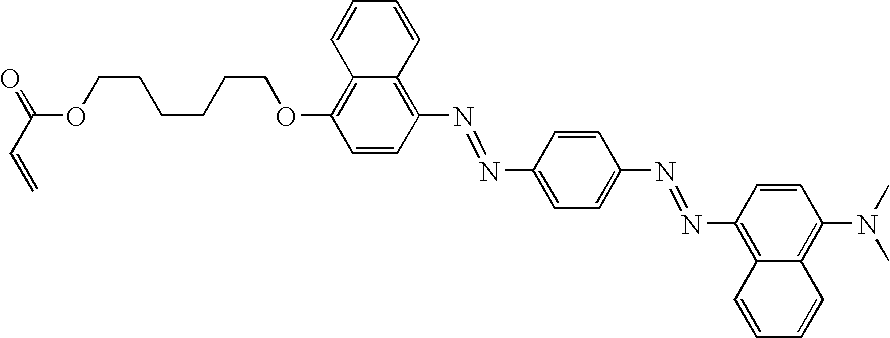
| TABLE 1 |
| Dichroic dyes |
| B1 |
 |
| R1 |
 |
| TABLE 2 |
| LCP components |
| Mon1 |
 |
| Mon2 |
 |
| Mon3 |
 |
| Mon4 |
 |
| Mon5 |
 |
| TABLE 3 |
| Mixture compositions |
| MLCP1: | MLCP2: | MLCP3: | MLCP4: | MLCP5: |
| B1 | 3.85 wt % | R1 | 3.85 wt % | B1 | 5.58 wt % | B1 | 3.85 wt % | R1 | 3.85 wt % |
| Mon1 | 76.92 wt % | Mon1 | 76.92 wt % | R1 | 1.40 wt % | Mon4 | 96.15 wt % | Mon5 | 96.15 wt % |
| Mon2 | 14.42 wt % | Mon2 | 14.42 wt % | Mon1 | 74.42 wt % | ||||
| Mon3 | 4.81 wt % | Mon3 | 4.81 wt % | Mon2 | 13.95 wt % | ||||
| Mon3 | 4.65 wt % | ||||||||
| wt % = weight % | |||||||||

S=D ∥ −D ⊥ /D ∥+2D ⊥
wherein D∥ and D⊥ are the optical densities of a dichroic dye in a liquid crystal measured for light polarisations parallel and perpendicular to the liquid crystal director.
| TABLE 4 | |||||
| Sample | Dye B1 | Dye R1 | Dyes B1 + R1 | ||
| E1 | S = 0.48 | — | — | ||
| at λ = 639 nm | |||||
| E2 | — | S = 0.57 | — | ||
| at λ = 499 nm | |||||
| E3 | — | — | S = 0.55 | ||
| at λ = 493 nm | |||||
| E4 | S = 0.65 | — | — | ||
| at λ = 642 nm | |||||
| E5 | — | S = 0.75 | |||
| at λ = 507 nm | |||||
Claims (51)


R4—Ar1—N═N—Ar2—N═N—Ar3—B1 IV
R4—Ar1—N═N—Ar2—N═N—Ar3—N═N—Ar4—B1 V


Applications Claiming Priority (4)
| Application Number | Priority Date | Filing Date | Title |
|---|---|---|---|
| EP01810455.0 | 2001-05-08 | ||
| EP01810445 | 2001-05-08 | ||
| EP01810445A EP1256602A1 (en) | 2001-05-08 | 2001-05-08 | Dichroic mixture |
| PCT/CH2002/000044 WO2002090447A1 (en) | 2001-05-08 | 2002-01-28 | Dichroic mixture |
Publications (2)
| Publication Number | Publication Date |
|---|---|
| US20040164272A1 US20040164272A1 (en) | 2004-08-26 |
| US7419620B2 true US7419620B2 (en) | 2008-09-02 |
Family
ID=8183897
Family Applications (1)
| Application Number | Title | Priority Date | Filing Date |
|---|---|---|---|
| US10/477,124 Expired - Fee Related US7419620B2 (en) | 2001-05-08 | 2002-01-28 | Dichroic mixtures |
Country Status (9)
| Country | Link |
|---|---|
| US (1) | US7419620B2 (en) |
| EP (2) | EP1256602A1 (en) |
| JP (1) | JP4778192B2 (en) |
| KR (1) | KR100864449B1 (en) |
| CN (1) | CN100556959C (en) |
| AT (1) | ATE402226T1 (en) |
| AU (1) | AU2002224717A1 (en) |
| DE (1) | DE60227797D1 (en) |
| WO (1) | WO2002090447A1 (en) |
Cited By (4)
| Publication number | Priority date | Publication date | Assignee | Title |
|---|---|---|---|---|
| US20060188663A1 (en) * | 2003-03-26 | 2006-08-24 | Thomas Peglow | Polymerizable dichroic azo dyes |
| US20070254220A1 (en) * | 2004-06-30 | 2007-11-01 | Dainippon Ink And Chemicals, Inc. | Azo Compound, Composition For Photo-Alignment Film Using The Same, And Method For Producing Photo-Alignment Film |
| US20080001120A1 (en) * | 2004-05-04 | 2008-01-03 | Thomas Peglow | Polymerizable Dichromophoric Dichroic Azo Dyes |
| US20100055353A1 (en) * | 2007-07-05 | 2010-03-04 | Lg Chem, Ltd. | Composition comprising curable dichroic dye for forming optical component and an optical component prerared using the same |
Families Citing this family (44)
| Publication number | Priority date | Publication date | Assignee | Title |
|---|---|---|---|---|
| ATE295872T1 (en) | 2001-12-10 | 2005-06-15 | Merck Patent Gmbh | OLIGOMERS AND POLYMERS CONTAINING A 2,6-AZULENE GROUP AND THEIR USE AS CHARGE TRANSPORT MATERIALS |
| EP1318185B1 (en) * | 2001-12-10 | 2005-02-16 | MERCK PATENT GmbH | Reactive mesogenic azulenes |
| ATE289343T1 (en) | 2001-12-10 | 2005-03-15 | Merck Patent Gmbh | REACTIVE MESOGENE AZULENE |
| US7097303B2 (en) * | 2004-01-14 | 2006-08-29 | Ppg Industries Ohio, Inc. | Polarizing devices and methods of making the same |
| EP1593990B1 (en) * | 2004-05-07 | 2007-12-05 | ESSILOR INTERNATIONAL (Compagnie Générale d'Optique) | Polarizing and abrasion-resistant optical film and process for manufacturing thereof |
| EP1669431B1 (en) * | 2004-12-07 | 2008-05-07 | MERCK PATENT GmbH | Polymerizable liquid crystal formulation and polarizer |
| WO2006070318A2 (en) * | 2004-12-29 | 2006-07-06 | Koninklijke Philips Electronics N.V. | Method for manufacturing a polarizer |
| KR20070119007A (en) * | 2005-04-13 | 2007-12-18 | 아사히 가라스 가부시키가이샤 | Polymerizable liquid crystal composition, optically anisotropic material, optical element and optical head device |
| FR2893422B1 (en) * | 2005-11-14 | 2008-03-07 | Essilor Int | OPHTHALMIC LENS COMPRISING A PROTECTIVE COATING AGAINST PHOTODEGRADATION AND METHOD FOR PREPARING SUCH AN OPHTHALMIC LENS. |
| JP4736823B2 (en) * | 2006-01-26 | 2011-07-27 | 三菱化学株式会社 | Composition for anisotropic dye film, anisotropic dye film, polarizing element and dye for anisotropic dye film |
| FR2897694B1 (en) * | 2006-02-23 | 2008-05-16 | Essilor Int | METHOD FOR PRODUCING A POLARIZING OPTICAL ELEMENT |
| US7935212B2 (en) * | 2006-07-31 | 2011-05-03 | Essilor International Compagnie | Process for transferring onto a surface of an optical article a layer having a variable index of refraction |
| KR100881982B1 (en) | 2006-09-08 | 2009-02-05 | 주식회사 엘지화학 | Dichroic dye for polarizing film, polarizing film composition comprising the same, durable polarizing plate manufacturing method using the same, and polarizing plate manufactured accordingly |
| EP2067064B1 (en) | 2006-09-13 | 2014-06-11 | Rolic AG | Volume photo-aligned retarder |
| US7927671B2 (en) | 2006-09-21 | 2011-04-19 | Chisso Corporation | Trifunctional compound, composition and polymer thereof |
| JP2009538958A (en) * | 2006-11-24 | 2009-11-12 | エルジー・ケム・リミテッド | Dichroic dye for color filter, color filter-forming composition containing the same, and color filter array substrate manufactured thereby |
| US8574454B2 (en) * | 2006-12-22 | 2013-11-05 | Rolic Ag | Patternable liquid crystal polymer comprising thio-ether units |
| KR100938181B1 (en) | 2006-12-22 | 2010-01-21 | 주식회사 엘지화학 | Polarizing plate having a dichroic dye for a polarizing film, a curable polarizing film composition comprising the same, and a polarizing film formed therefrom |
| JP5453798B2 (en) * | 2007-12-28 | 2014-03-26 | 住友化学株式会社 | Compound, optical film and method for producing optical film |
| JP5463666B2 (en) * | 2007-12-28 | 2014-04-09 | 住友化学株式会社 | Compound, optical film and method for producing optical film |
| JP2010072521A (en) * | 2008-09-22 | 2010-04-02 | Hitachi Displays Ltd | Polarizer, and liquid crystal display device |
| EP2272937A1 (en) | 2009-07-09 | 2011-01-12 | Rolic AG | Ester group containing compounds for optical or electro optical devices |
| TWI490316B (en) | 2009-07-09 | 2015-07-01 | Rolic Ag | Ester group containing liquid crystals for optical or electro optical devices |
| WO2011113250A1 (en) * | 2010-03-19 | 2011-09-22 | Unilever Plc | Method of treating hair |
| KR102007652B1 (en) * | 2011-03-30 | 2019-08-06 | 디아이씨 가부시끼가이샤 | Polymerizable liquid crystal composition, polarized light-emitting coating material, novel naphtholactam derivative, novel coumarin derivative, novel nile red derivative, and novel anthracene derivative |
| KR101960467B1 (en) | 2012-03-09 | 2019-03-20 | 삼성전자주식회사 | Dichromic dye for polarizing film, polarizing film and display device including the polarizing film |
| KR101732687B1 (en) | 2013-12-27 | 2017-05-04 | 주식회사 엘지화학 | Composition for forming dye type polarizer and dye type polarizer |
| US10385215B2 (en) * | 2014-05-21 | 2019-08-20 | Rolic Ag | Polymerizable dichroic dyes |
| KR20160001513A (en) * | 2014-06-27 | 2016-01-06 | 삼성전자주식회사 | Polarizing film and antireflection film and display device |
| JP2016139055A (en) | 2015-01-28 | 2016-08-04 | Jxエネルギー株式会社 | Retardation plate, laminated polarizing plate using retardation plate, and display device using retardation plate |
| JP7078903B2 (en) | 2016-03-31 | 2022-06-01 | 日産化学株式会社 | Polarizing layer forming composition |
| JP7025702B2 (en) | 2016-03-31 | 2022-02-25 | 日産化学株式会社 | Orientation layer forming composition |
| CN109476926B (en) | 2016-07-26 | 2022-03-04 | 日产化学株式会社 | polymer composition |
| EP3491434B1 (en) | 2016-07-29 | 2020-09-02 | Rolic Technologies AG | Method for generating alignment on top of a liquid crystal polymer material |
| CN106501986B (en) * | 2016-10-25 | 2020-06-16 | 南京大学 | Optically functionalized film, its preparation method, optical path system and beam shaping method |
| CN111788505B (en) | 2018-03-19 | 2022-10-04 | 三菱化学株式会社 | Composition for forming anisotropic dye film, and optical element |
| US12248218B2 (en) | 2019-07-24 | 2025-03-11 | Rolic Technologies AG | Photo-alignable positive c-plate retarder |
| CN111718724B (en) * | 2020-05-27 | 2022-04-05 | 国科广化(南雄)新材料研究院有限公司 | A kind of reactive azobenzene main and side chain liquid crystal compound and its preparation method and application |
| JP7782460B2 (en) | 2020-11-27 | 2025-12-09 | 三菱ケミカル株式会社 | Optically anisotropic laminate and optical element |
| CN113563212B (en) * | 2021-06-25 | 2022-06-10 | 同济大学 | Anthraquinone derivative tetraamine monomer, black intrinsic polyimide derived therefrom and preparation method thereof |
| TW202321422A (en) * | 2021-07-28 | 2023-06-01 | 瑞士商羅立克科技股份公司 | Liquid crystal compounds |
| CN113583179B (en) * | 2021-07-30 | 2022-11-25 | Tcl华星光电技术有限公司 | Composition for preparing polarizing film, preparation method of polarizing film, polarizing film and display module |
| KR20250078908A (en) | 2022-09-27 | 2025-06-04 | 미쯔비시 케미컬 주식회사 | Optically anisotropic laminates and optical elements |
| EP4421131A1 (en) * | 2023-02-23 | 2024-08-28 | Dover Europe Sàrl | Polymeric dyes |
Citations (10)
| Publication number | Priority date | Publication date | Assignee | Title |
|---|---|---|---|---|
| GB1006883A (en) | 1962-01-02 | 1965-10-06 | Searle & Co | Amino esters |
| US4101269A (en) | 1974-08-02 | 1978-07-18 | Produits Chimiques Ugine Kuhlmann | Dyed polymers and copolymers having a cyanovinyl-azo dye incorporated in the structure thereof |
| EP0369376A2 (en) | 1988-11-14 | 1990-05-23 | Mitsubishi Rayon Co., Ltd. | Flame retardant polyphenylene ether resin composition |
| US4943617A (en) | 1986-09-19 | 1990-07-24 | Basf Aktiengesellschaft | Liquid crystalline copolymer |
| EP0799864A1 (en) | 1996-04-05 | 1997-10-08 | Hoya Corporation | Reactive dyes and lenses utilizing the same |
| US5707544A (en) | 1995-06-07 | 1998-01-13 | Rolic Ag | Chromophore-containing photo cross-linkable liquid crystals |
| JPH10251537A (en) | 1997-03-13 | 1998-09-22 | Menicon Co Ltd | Polymerizable dye and colored ophthalmic lens material using the same |
| US6007745A (en) | 1996-07-04 | 1999-12-28 | Merck Patent Gesellschaft Mit Beschrankter Haftung | Linear UV polarizer |
| WO2000054111A1 (en) | 1999-03-08 | 2000-09-14 | Bayer Aktiengesellschaft | Holographic recording material |
| US20060188663A1 (en) * | 2003-03-26 | 2006-08-24 | Thomas Peglow | Polymerizable dichroic azo dyes |
Family Cites Families (6)
| Publication number | Priority date | Publication date | Assignee | Title |
|---|---|---|---|---|
| GB1006884A (en) * | 1962-04-19 | 1965-10-06 | Nat Starch Chem Corp | Improvements in or relating to azobenzene containing monomers for use in the preparation of copolymers |
| DE3211400A1 (en) * | 1982-03-27 | 1983-09-29 | Basf Ag, 6700 Ludwigshafen | POLYMERS WITH MESOGENIC GROUPS AND DYE REMAINS IN THE SIDE CHAINS |
| DE3808430A1 (en) * | 1988-03-14 | 1989-09-28 | Consortium Elektrochem Ind | LIQUID CRYSTAL POLYMERS WITH CHROMOPHORES SIDE GROUPS |
| JPH0444015A (en) * | 1990-06-12 | 1992-02-13 | Idemitsu Kosan Co Ltd | Liquid crystal display element |
| JP2001133630A (en) * | 1999-11-04 | 2001-05-18 | Fuji Photo Film Co Ltd | Anisotropic film and liquid crystal display device |
| JP2002309256A (en) * | 2001-04-13 | 2002-10-23 | Fuji Photo Film Co Ltd | Liquid crystal composition, color filter and liquid crystal display |
-
2001
- 2001-05-08 EP EP01810445A patent/EP1256602A1/en not_active Withdrawn
-
2002
- 2002-01-28 DE DE60227797T patent/DE60227797D1/en not_active Expired - Lifetime
- 2002-01-28 EP EP02715349A patent/EP1385914B1/en not_active Expired - Lifetime
- 2002-01-28 AU AU2002224717A patent/AU2002224717A1/en not_active Abandoned
- 2002-01-28 AT AT02715349T patent/ATE402226T1/en not_active IP Right Cessation
- 2002-01-28 JP JP2002587515A patent/JP4778192B2/en not_active Expired - Fee Related
- 2002-01-28 KR KR1020037014461A patent/KR100864449B1/en not_active Expired - Fee Related
- 2002-01-28 WO PCT/CH2002/000044 patent/WO2002090447A1/en not_active Ceased
- 2002-01-28 CN CNB028095065A patent/CN100556959C/en not_active Expired - Lifetime
- 2002-01-28 US US10/477,124 patent/US7419620B2/en not_active Expired - Fee Related
Patent Citations (10)
| Publication number | Priority date | Publication date | Assignee | Title |
|---|---|---|---|---|
| GB1006883A (en) | 1962-01-02 | 1965-10-06 | Searle & Co | Amino esters |
| US4101269A (en) | 1974-08-02 | 1978-07-18 | Produits Chimiques Ugine Kuhlmann | Dyed polymers and copolymers having a cyanovinyl-azo dye incorporated in the structure thereof |
| US4943617A (en) | 1986-09-19 | 1990-07-24 | Basf Aktiengesellschaft | Liquid crystalline copolymer |
| EP0369376A2 (en) | 1988-11-14 | 1990-05-23 | Mitsubishi Rayon Co., Ltd. | Flame retardant polyphenylene ether resin composition |
| US5707544A (en) | 1995-06-07 | 1998-01-13 | Rolic Ag | Chromophore-containing photo cross-linkable liquid crystals |
| EP0799864A1 (en) | 1996-04-05 | 1997-10-08 | Hoya Corporation | Reactive dyes and lenses utilizing the same |
| US6007745A (en) | 1996-07-04 | 1999-12-28 | Merck Patent Gesellschaft Mit Beschrankter Haftung | Linear UV polarizer |
| JPH10251537A (en) | 1997-03-13 | 1998-09-22 | Menicon Co Ltd | Polymerizable dye and colored ophthalmic lens material using the same |
| WO2000054111A1 (en) | 1999-03-08 | 2000-09-14 | Bayer Aktiengesellschaft | Holographic recording material |
| US20060188663A1 (en) * | 2003-03-26 | 2006-08-24 | Thomas Peglow | Polymerizable dichroic azo dyes |
Non-Patent Citations (2)
| Title |
|---|
| Database WPI, Section Ch, Week 199848, Derwent Publications Ltd., London, GB; Class A41, AN 1998-563355; XP002180180 & JP 10 251537 A (Menicon Co Ltd), Sep. 22, 1998 abstract. |
| Database WPI, Section Ch, Week 199848, Derwent Publications Ltd., London, GB; Class A41, AN 1998-563355; XP002180180 & JP 10 251537 A (Menicon Co Ltd), Sep. 22, 1998 abstract. |
Cited By (8)
| Publication number | Priority date | Publication date | Assignee | Title |
|---|---|---|---|---|
| US20060188663A1 (en) * | 2003-03-26 | 2006-08-24 | Thomas Peglow | Polymerizable dichroic azo dyes |
| US8053039B2 (en) * | 2003-03-26 | 2011-11-08 | Rolic Ag | Polymerizable dichroic azo dyes |
| US20080001120A1 (en) * | 2004-05-04 | 2008-01-03 | Thomas Peglow | Polymerizable Dichromophoric Dichroic Azo Dyes |
| US7811642B2 (en) * | 2004-05-04 | 2010-10-12 | Rolic Ag | Polymerizable dichromophoric dichroic azo dyes |
| US20070254220A1 (en) * | 2004-06-30 | 2007-11-01 | Dainippon Ink And Chemicals, Inc. | Azo Compound, Composition For Photo-Alignment Film Using The Same, And Method For Producing Photo-Alignment Film |
| US7892711B2 (en) * | 2004-06-30 | 2011-02-22 | Dic Corporation | Azo compound, composition for photo-alignment film using the same, and method for producing photo-alignment film |
| US20100055353A1 (en) * | 2007-07-05 | 2010-03-04 | Lg Chem, Ltd. | Composition comprising curable dichroic dye for forming optical component and an optical component prerared using the same |
| US8545717B2 (en) * | 2007-07-05 | 2013-10-01 | Lg Chem, Ltd. | Composition comprising curable dichroic dye for forming optical component and an optical component prepared using the same |
Also Published As
| Publication number | Publication date |
|---|---|
| US20040164272A1 (en) | 2004-08-26 |
| CN100556959C (en) | 2009-11-04 |
| WO2002090447A1 (en) | 2002-11-14 |
| CN1507478A (en) | 2004-06-23 |
| ATE402226T1 (en) | 2008-08-15 |
| EP1256602A1 (en) | 2002-11-13 |
| WO2002090447A8 (en) | 2004-01-29 |
| KR100864449B1 (en) | 2008-10-29 |
| JP2004535483A (en) | 2004-11-25 |
| DE60227797D1 (en) | 2008-09-04 |
| AU2002224717A1 (en) | 2002-11-18 |
| EP1385914A1 (en) | 2004-02-04 |
| JP4778192B2 (en) | 2011-09-21 |
| KR20040043120A (en) | 2004-05-22 |
| EP1385914B1 (en) | 2008-07-23 |
Similar Documents
| Publication | Publication Date | Title |
|---|---|---|
| EP1385914B1 (en) | Dichroic mixture | |
| EP1606354B1 (en) | Polymerizable dichroic azo dyes | |
| EP1753825B1 (en) | Polymerizable dichromophoric dichroic azo dyes | |
| US10385215B2 (en) | Polymerizable dichroic dyes | |
| TWI302553B (en) | Dichroic mixture | |
| HK1231909A1 (en) | Polymerizable dichroic dyes |
Legal Events
| Date | Code | Title | Description |
|---|---|---|---|
| AS | Assignment |
Owner name: ROLIC AG, SWITZERLAND Free format text: ASSIGNMENT OF ASSIGNORS INTEREST;ASSIGNORS:BUCHECKER, RICHARD;CHERKAOUI, ZOUBAIR M.;PEGLOW, THOMAS;AND OTHERS;REEL/FRAME:015277/0310;SIGNING DATES FROM 20040217 TO 20040308 |
|
| FEPP | Fee payment procedure |
Free format text: PAYOR NUMBER ASSIGNED (ORIGINAL EVENT CODE: ASPN); ENTITY STATUS OF PATENT OWNER: LARGE ENTITY |
|
| STCF | Information on status: patent grant |
Free format text: PATENTED CASE |
|
| FPAY | Fee payment |
Year of fee payment: 4 |
|
| FPAY | Fee payment |
Year of fee payment: 8 |
|
| FEPP | Fee payment procedure |
Free format text: MAINTENANCE FEE REMINDER MAILED (ORIGINAL EVENT CODE: REM.); ENTITY STATUS OF PATENT OWNER: LARGE ENTITY |
|
| LAPS | Lapse for failure to pay maintenance fees |
Free format text: PATENT EXPIRED FOR FAILURE TO PAY MAINTENANCE FEES (ORIGINAL EVENT CODE: EXP.); ENTITY STATUS OF PATENT OWNER: LARGE ENTITY |
|
| STCH | Information on status: patent discontinuation |
Free format text: PATENT EXPIRED DUE TO NONPAYMENT OF MAINTENANCE FEES UNDER 37 CFR 1.362 |
|
| FP | Lapsed due to failure to pay maintenance fee |
Effective date: 20200902 |