US7406562B2 - Information read/write device - Google Patents
Information read/write device Download PDFInfo
- Publication number
- US7406562B2 US7406562B2 US11/401,724 US40172406A US7406562B2 US 7406562 B2 US7406562 B2 US 7406562B2 US 40172406 A US40172406 A US 40172406A US 7406562 B2 US7406562 B2 US 7406562B2
- Authority
- US
- United States
- Prior art keywords
- processor
- information
- read
- recording medium
- write
- Prior art date
- Legal status (The legal status is an assumption and is not a legal conclusion. Google has not performed a legal analysis and makes no representation as to the accuracy of the status listed.)
- Expired - Fee Related, expires
Links
Images



Classifications
-
- G—PHYSICS
- G06—COMPUTING OR CALCULATING; COUNTING
- G06F—ELECTRIC DIGITAL DATA PROCESSING
- G06F3/00—Input arrangements for transferring data to be processed into a form capable of being handled by the computer; Output arrangements for transferring data from processing unit to output unit, e.g. interface arrangements
- G06F3/06—Digital input from, or digital output to, record carriers, e.g. RAID, emulated record carriers or networked record carriers
- G06F3/0601—Interfaces specially adapted for storage systems
- G06F3/0628—Interfaces specially adapted for storage systems making use of a particular technique
- G06F3/0655—Vertical data movement, i.e. input-output transfer; data movement between one or more hosts and one or more storage devices
- G06F3/0659—Command handling arrangements, e.g. command buffers, queues, command scheduling
-
- G—PHYSICS
- G06—COMPUTING OR CALCULATING; COUNTING
- G06F—ELECTRIC DIGITAL DATA PROCESSING
- G06F3/00—Input arrangements for transferring data to be processed into a form capable of being handled by the computer; Output arrangements for transferring data from processing unit to output unit, e.g. interface arrangements
- G06F3/06—Digital input from, or digital output to, record carriers, e.g. RAID, emulated record carriers or networked record carriers
- G06F3/0601—Interfaces specially adapted for storage systems
- G06F3/0602—Interfaces specially adapted for storage systems specifically adapted to achieve a particular effect
- G06F3/0625—Power saving in storage systems
-
- G—PHYSICS
- G06—COMPUTING OR CALCULATING; COUNTING
- G06F—ELECTRIC DIGITAL DATA PROCESSING
- G06F3/00—Input arrangements for transferring data to be processed into a form capable of being handled by the computer; Output arrangements for transferring data from processing unit to output unit, e.g. interface arrangements
- G06F3/06—Digital input from, or digital output to, record carriers, e.g. RAID, emulated record carriers or networked record carriers
- G06F3/0601—Interfaces specially adapted for storage systems
- G06F3/0602—Interfaces specially adapted for storage systems specifically adapted to achieve a particular effect
- G06F3/0626—Reducing size or complexity of storage systems
-
- G—PHYSICS
- G06—COMPUTING OR CALCULATING; COUNTING
- G06F—ELECTRIC DIGITAL DATA PROCESSING
- G06F3/00—Input arrangements for transferring data to be processed into a form capable of being handled by the computer; Output arrangements for transferring data from processing unit to output unit, e.g. interface arrangements
- G06F3/06—Digital input from, or digital output to, record carriers, e.g. RAID, emulated record carriers or networked record carriers
- G06F3/0601—Interfaces specially adapted for storage systems
- G06F3/0628—Interfaces specially adapted for storage systems making use of a particular technique
- G06F3/0655—Vertical data movement, i.e. input-output transfer; data movement between one or more hosts and one or more storage devices
- G06F3/0658—Controller construction arrangements
-
- G—PHYSICS
- G06—COMPUTING OR CALCULATING; COUNTING
- G06F—ELECTRIC DIGITAL DATA PROCESSING
- G06F3/00—Input arrangements for transferring data to be processed into a form capable of being handled by the computer; Output arrangements for transferring data from processing unit to output unit, e.g. interface arrangements
- G06F3/06—Digital input from, or digital output to, record carriers, e.g. RAID, emulated record carriers or networked record carriers
- G06F3/0601—Interfaces specially adapted for storage systems
- G06F3/0668—Interfaces specially adapted for storage systems adopting a particular infrastructure
- G06F3/0671—In-line storage system
- G06F3/0673—Single storage device
- G06F3/0674—Disk device
- G06F3/0676—Magnetic disk device
-
- G—PHYSICS
- G11—INFORMATION STORAGE
- G11B—INFORMATION STORAGE BASED ON RELATIVE MOVEMENT BETWEEN RECORD CARRIER AND TRANSDUCER
- G11B20/00—Signal processing not specific to the method of recording or reproducing; Circuits therefor
- G11B20/10—Digital recording or reproducing
-
- Y—GENERAL TAGGING OF NEW TECHNOLOGICAL DEVELOPMENTS; GENERAL TAGGING OF CROSS-SECTIONAL TECHNOLOGIES SPANNING OVER SEVERAL SECTIONS OF THE IPC; TECHNICAL SUBJECTS COVERED BY FORMER USPC CROSS-REFERENCE ART COLLECTIONS [XRACs] AND DIGESTS
- Y02—TECHNOLOGIES OR APPLICATIONS FOR MITIGATION OR ADAPTATION AGAINST CLIMATE CHANGE
- Y02D—CLIMATE CHANGE MITIGATION TECHNOLOGIES IN INFORMATION AND COMMUNICATION TECHNOLOGIES [ICT], I.E. INFORMATION AND COMMUNICATION TECHNOLOGIES AIMING AT THE REDUCTION OF THEIR OWN ENERGY USE
- Y02D10/00—Energy efficient computing, e.g. low power processors, power management or thermal management
Definitions
- the present invention relates to information read/write devices such as magnetic disk drives or optical disk drives, and more particularly, to information read/write devices intended mainly to reduce electric power consumption.
- FIG. 1 A typical configuration example of an application apparatus (first conventional technology) which uses a conventional magnetic disk drive is shown in FIG. 1 .
- the application apparatus in this configuration example is broadly divided into two blocks.
- One of the two blocks is a drive 199 (magnetic disk drive) that receives issued commands through a storage interface 101 and operates in accordance with the received commands, and the other is a host 198 that issues commands to the drive 199 .
- the circuits of the host 198 and those of the drive 199 are mounted as independent circuit modules, which are coupled via the element, such as connector or cable, that forms part of the physical entity of the storage interface 101 .
- Non-Patent Document 1 ANSI INCITS 361-2002 AT Attachment—6 with Packet Interface
- serial ATA interface standards these standards are disclosed in Non-Patent Document 2 (Serial ATA: High-Speed Serialized AT Attachment Revision 1.0), for example
- Small Computer System Interface (SCSI) standards these standards are disclosed in Non-Patent Document 3 (ANSI INCITS 362-2002 Information Technology—SCSI Parallel Interface-4 (SPI-4)), for example), or the like are widely known, and proliferated, as the standards adopted for the storage interface 101 .
- the commands issued from the host 198 to the drive 199 , the status data returned from the drive 199 to the host 198 , the write data transferred from the internal RAM- 1 115 of the host 198 to write the data onto a recording medium, and the data read out from the recording medium to store the data into the internal RAM- 1 115 of the host 198 are transferred over the storage interface 101 .
- the rectangular-wave digital signals of relatively large amplitude that have frequencies from several tens of megahertz to several gigahertz are transmitted since rapid data transfer is requested through signal paths relatively long in transmission distance.
- a drive compliant with the parallel ATA interface standards proliferating at a particularly rapid pace is mounted as one type of register file, and commands and status data are transferred in basic units of eight bits to the drive in parallel.
- the data read/written is also handled as access to a specific register, and 512 bytes of block data is sequentially transferred as an indivisible basic transfer unit in an 8-bit or 16-bit pattern. That is to say, the host 198 cannot make random access in units of less than 512 bytes of data to the internal RAM- 2 124 of the drive 199 in any form or by any means.
- the host 198 is constructed with the processor- 1 111 as its central element, and the processor- 1 111 mainly executes the application programs (not shown) that determine the external functions of the application apparatus.
- the processor- 1 111 uses a memory control circuit 114 to access the RAM- 1 115 or other internal resources of the host 198 .
- Data transfer arbitration circuit 113 arbitrates data transfer between a DMA control circuit 112 , an external interface circuit 110 , a storage interface circuit 116 , the memory control circuit 114 , and a ROM- 1 117 .
- the data transfer arbitration circuit 113 also adjusts bands and latency between the above elements.
- the host 198 is connected to the drive 199 only via the storage interface circuit 116 , and as mentioned above, the host 198 conducts control of the drive 199 , based on commands and protocol specifications, through the storage interface 101 .
- the drive 199 that undertakes a storage function in the application apparatus has a processor- 2 122 different from the processor- 1 111 of the host 198 .
- the processor- 2 122 mainly executes the read/write channel control programs (not shown) that have been loaded into the RAM- 2 124 or a ROM- 2 124 , and mechanism control programs (not shown).
- the processor- 2 122 also controls a head/disk assembly 126 through a head/disk control circuit 125 .
- the sharable RAM- 1 115 and RAM- 2 124 are mounted in or on semiconductor memory elements such as dynamic RAMs (DRAMs) or static RAMs (SRAMs).
- the processor- 1 111 accesses the ROM- 1 117 via the memory control circuit 114 and the data transfer arbitration circuit 113 and then starts executing an initializing program (not shown) that is prestored within the ROM- 1 117 .
- the processor- 1 111 attempts loading an application program from the drive 199 into the RAM- 1 115 via the memory control circuit 114 , the data transfer arbitration circuit 113 , and the storage interface circuit 116 .
- its initializing program may load an operating system program (not shown) from a drive 199 before an application program is loaded, and then the operating system program may load and execute the application program.
- the host 198 starts an initializing operation
- the drive 199 is also notified of this via the storage interface 101 and the drive 199 also starts an initializing operation.
- the processor- 2 122 executes an initializing program (not shown) that is prestored within the ROM- 2 124 and initializes each internal resource of the drive 199 .
- the processor- 2 122 operates the head/disk control circuit 125 and the memory control circuit 123 in accordance with the initializing program, then loads an additional program from a recording medium (not shown) into the RAM- 2 124 , and executes the program.
- the drive 199 enters a stand-by state to wait for a command to be issued from the host 198 .
- the processor- 1 111 When the initialization of both the host 198 and the drive 199 is completed, the processor- 1 111 finally executes the application program that was loaded into the RAM- 1 115 , and issues a read command via the storage interface 101 in order to further read in only necessary data of the application program from the drive 199 .
- a write command may be issued through the storage interface 101 in order to process, and write into the drive 199 , data that has been acquired from an external interface 100 through the external interface circuit 110 beforehand. The operation of each section during the issuance of the read command or of the write command is described below.
- a command analysis/status display circuit 121 receives the command through a host interface circuit 120 . If the results of command analyses by the command analysis/status display circuit 121 and the processor- 2 122 indicate that the command is a write command, the processor- 2 122 instructs the memory control circuit 123 to transfer the data to be sent from the host interface 120 to the RAM- 2 124 . Thus, write data (not shown) is temporarily stored from the host 198 into the RAM- 2 124 . At this time, the DMA control circuit 112 inside the host 198 operates in accordance with an instruction from the processor- 1 111 and then the write data is transferred from the RAM- 1 115 via the storage interface circuit 116 .
- the processor- 2 122 instructs the head/disk control circuit 125 to conduct the positioning of a read/write head (not shown) with respect to the recording medium, setup of writing conditions, and other operations.
- the processor- 2 122 subsequently instructs the memory control circuit 123 to transfer the write data from the RAM- 2 124 to the head/disk control circuit 125 , and finally, the write data is written onto (recorded on) the recording medium.
- the processor- 2 122 instructs the head/disk control circuit 125 to conduct the positioning of the read/write head with respect to the recording medium, setup of reading conditions, and other operations.
- the processor- 2 122 also instructs the memory control circuit 123 to transfer data from the head/disk control circuit 125 to the RAM- 2 124 , and write data (not shown) is temporarily stored into the RAM- 2 124 .
- the processor- 2 122 further instructs the memory control circuit 123 to transfer the data to be sent from the RAM- 2 124 to the host interface circuit 120 , and read data is sent to the host 198 via the storage interface 101 .
- the DMA control circuit 112 inside the host 198 operates in accordance with an instruction from the processor- 1 111 , and finally, the read data is stored into the RAM- 1 115 via the storage interface circuit 116 .
- Patent Document 1 Japanese Patent Laid-Open No. 2004-146036
- the processor- 1 111 within the host 198 constantly monitors the status of the application apparatus exterior via the external interface circuit 110 and the external interface 100 .
- the processor- 1 111 conducts a normal command-issuing process to issue a necessary command to the drive 119 via the memory control circuit 114 , the data transfer arbitration circuit 113 , and the storage interface circuit 116 .
- the host 198 makes the drive 199 reliably save the important data required for application apparatus operation (e.g., metadata associated with file storage in the drive 199 , operational state data on the application apparatus, data settings, and the like) on the recording medium.
- the host 198 also issues a stopping command to the drive 199 to retract the read/write head (moves the read/write head to a safe location free from the danger of the head being brought into contact with the recording medium by, for example, vacuum attraction, or colliding with the medium). If the physical overturn of an application system is detected, the read/write head is also retracted in the above manner.
- the trigger it has been necessary for the trigger to be given from the host 198 before a constituent element of the drive 199 became able to actively access an internal resources of the host 198 via the storage interface 101 (e.g., before the processor- 2 122 became able to make random access to the RAM- 1 115 within the host 198 ) or before a constituent element of the drive 199 became able to directly control the operation of the processor- 1 111 within the host 198 (e.g., before the processor- 2 122 became able to stop the execution of an activity/job by the processor- 1 111 ).
- the necessity for the host 198 and the drive 199 to have the ROM- 1 117 and ROM- 2 124 for storage of the respective initializing programs, and the RAM- 1 115 and RAM- 2 124 for storage of data and a part of an application program, has increased the total number of components in the application apparatus, thus presenting problems in terms of total apparatus costs, power consumption, and size.
- Patent Document 1 second conventional technology
- a new command must be issued after the storage interface 101 has been released following completion of the data transfer.
- the possible delay in emergency processing by a drive 199 may result in important data being lost or a head/disk assembly being physically damaged.
- the technology is disclosed that moves a read/write head to a retrocession region in the magnetic disk drive not via a host.
- the above problem with the second conventional technology can be avoided since the drive can conduct emergency processing at its own discretion without waiting for the storage interface to be released.
- the host cannot detect this and thus a mismatch arises during subsequent control of the magnetic drive by the host.
- the drive cannot recognize the importance of data to be written, there has been the problem that the drive cannot distinguish between data whose writing is abortable, and data to be preferentially written, and thus that truly important data is not likely to be writable.
- the present invention provides an information read/write device that includes: a first processor; a second processor; a recording medium to retain information using a distribution of physical states; a recording module for inciting changes in local physical state of the recording medium; a reading module for detecting the local physical state of the recording medium; a scanning module for scanning a desired position on the recording medium via the recording module and the reading means; a write signal processing module for generating a driving signal for the recording module by providing information to be written, with required processing; a read signal processing module for restoring read information to its original form by providing the signal obtained from the reading module, with processing inverse to that provided by the write signal processing means; a memory module random-accessible from the first processor and the second processor; and a memory control circuit to arbitrate access requests from the first and second processors to the memory module and conduct access processing with respect to the memory module.
- the first processor instructs the second processor to write information onto, or read information from, the recording medium
- the second processor controls the scanning module, the write signal processing module, and the read signal processing module, whereby the information to be written or the read information is stored into the memory module.
- the information read/write device is adapted so that the first processor, the second processor, the memory control circuit, the write signal processing module, and the read signal processing module are mounted on one circuit substrate or in one package.
- the present invention since the number of components, including memory elements, in an application apparatus of an information read/write device, and capacities of the memory elements are reduced and since the number of data transfer operations in the application apparatus is also reduced, not only the processors forming part of the application apparatus but also data transfer paths can be reduced in throughput. These reductions provide advantages in terms of cost, electric power consumption, and size. Also, since rectangular-wave digital signals that are relatively large in amplitude and high in transfer rate do not require routing via a storage interface, this also provides an advantage in terms of EMI suppression.
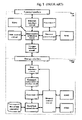
- FIG. 1 is a diagram explaining a typical configuration example of an application apparatus which uses a conventional magnetic disk drive.
- FIG. 2 is a diagram explaining a first configuration example of an information read/write device which uses a technology according to the present invention.
- FIGS. 3( a ) to 3 ( c ) are diagrams explaining an example of command issuance by the processor- 1 211 in the information read/write device described using FIG. 2 .
- FIG. 4 is a diagram explaining a more specific second configuration example of an information read/write device, based on the configuration described using FIG. 2 .
- FIG. 5 is a diagram explaining a third configuration example of an information read/write device which uses the technology according to the present invention.
- FIG. 6 is a diagram explaining a fourth configuration example of an information read/write device which uses the technology according to the present invention.
- FIG. 2 is a diagram explaining a first configuration example of an information read/write device which uses a technology according to the present invention.
- a processor- 1 211 mainly executes the application programs (not shown) that are prestored within a sharable RAM- 215 , and determines external functions of the drive 299 (i.e., the functions that use an external interface 200 ).
- a processor- 2 222 mainly executes the read/write channel control program (not shown) and mechanism control program (not shown) that are prestored within a ROM 227 , and controls a head/disk assembly 226 through a head/disk control circuit 225 .
- processor- 1 211 and the processor- 2 222 can make random access to the sharable RAM- 215 and the ROM 227 , respectively, through a memory control circuit 223 , and both processors exchange operational information and other information between each other through the sharable RAM- 215 .
- the sharable RAM- 215 may have all its regions shared between the processor- 1 211 and the processor- 2 222 or may have a region random-accessible from both processors, and a region accessible only from either one of the two processors. Also, the processor- 1 211 may be adapted to have random accessibility to the ROM 227 . These are common in the following description.
- the “sharable RAM” in the following description refers to a RAM region random-accessible from both the processor- 1 211 that mainly executes application programs, and the processor- 2 222 that mainly executes the read/write channel control program and the mechanism control program.
- an entity of the sharable RAM itself means a semiconductor memory element such an SRAM or DRAM
- the kind of element is not limited only to such a semiconductor memory and may be an electronic circuit-based memory element such as a magnetoresistive RAM (MRAM) or phase change memory.
- MRAM magnetoresistive RAM
- the head/disk assembly 226 includes a disk-like recording medium (not shown), a read/write head (not shown), and a scanning element (not shown) that can scan any position on the recording medium by means of the read/write head.
- the sharable RAM- 215 and the ROM 227 are connected to the memory control circuit 223 , which arbitrates access requests from the processor- 1 211 , the processor- 2 222 , and a data transfer arbitration circuit 213 , to the sharable RAM- 215 and the ROM 227 , and conducts actual access processes.
- the data transfer arbitration circuit 213 arbitrates access requests from the memory control circuit 223 and a DMA control circuit 212 , and adjusts mutual communications bands and latency.
- an external interface circuit 210 outputs data from the drive 299 to an external device (not shown) connected to the external interface 200 , or conversely, acquires signal information from the external device into the drive 299 .
- the processor- 2 222 accesses the ROM 227 via the memory control circuit 223 and starts executing an initializing program (not shown) that is prestored within the ROM 227 .
- an initializing program not shown
- electric power to the processor- 1 211 is suppressed since execution of an instruction by the processor- 1 211 is stopped by the execution control signal 290 sent from the processor- 2 222 .
- a usable method of stopping an instruction execute operation of the processor- 1 211 is by, for example, stopping clock signal application to the processor- 1 211 or forcibly executing a stopping instruction using a masking prohibition interrupt signal. However, other methods may be usable instead.
- the processor- 1 211 after processing the signal information that has been acquired from the external interface 200 through the external interface circuit 210 , writes the signal information onto the recording medium, or after processing the information that has been read out from the recording medium, outputs the information to the external interface 200 through the external interface circuit 210 .
- a user command within the drive 299 may be acquired through the external interface 200 and operation of the application program may be subject to a change or the like in accordance with the user command.
- the processor- 2 222 If, for some reason, the processor- 2 222 has failed to load the application program or has been unable to confirm the validity of the application program, the processor- 2 222 leaves the instruction execute operation of the processor- 1 211 in a stopped state. At the same, the processor- 2 222 stops operation of the head/disk assembly 226 through the head/disk control circuit 225 , thus stopping operation of the entire drive 299 .
- the processor- 1 211 uses the following operation sequence to read data from the recording medium into the sharable RAM- 215 . That is, the processor- 1 211 issues a recording-medium data read command to the command analysis/status display circuit 221 through the memory control circuit 223 and the data transfer arbitration circuit 213 .
- the read command contains information such as a position on the recording medium where the data to be read out is stored, a size of the data, and a physical address within the sharable RAM- 215 where the data is to be read out.
- the command analysis/status display circuit 221 and the processor- 2 222 analyze the issued command and calculate a physical position on the recording medium where the data to be read out exists.
- the processor- 2 222 operates to move the read/write head to a desired position on the recording medium through the head/disk control circuit 225 .
- the processor- 2 222 notifies the memory control circuit 223 of the physical address within the sharable RAM- 215 where the data read out is to be stored.
- a reading element within the read/write head outputs a distribution of directions of magnetization on the recording medium, as read signals (not shown).
- These read signals after undergoing a required decoding process, error detection/correction, and/or other processing in the head/disk control circuit 225 , are sequentially transferred to the memory control circuit 223 and stored as read data into a specified address range of the sharable RAM- 215 .
- the processor- 2 222 uses the command analysis/status display circuit 221 to make a display to the effect that data reading has been completed. When this display is recognized by the processor- 1 211 , the reading operation is completed.
- the processor- 1 211 uses the following operation sequence to write data from the sharable RAM- 215 onto the recording medium during the execution of the application program. That is, the processor- 1 211 issues a recording-medium data write command to the command analysis/status display circuit 221 through the memory control circuit 223 and the data transfer arbitration circuit 213 .
- the write command contains information such as a physical address within the sharable RAM- 215 where the data to be written is stored, a size of the data, and a position on the recording medium where the data is to be written.
- the command analysis/status display circuit 221 and the processor- 2 222 analyze the issued command and calculate a physical position on the recording medium where the data is to be written.
- the processor- 2 222 operates to move the read/write head to a desired position on the recording medium through the head/disk control circuit 225 .
- the processor- 2 222 notifies the memory control circuit 223 of the physical address within the sharable RAM- 215 where the data to be written is stored.
- the data to be written is sequentially transferred from the sharable RAM- 215 through the memory control circuit 223 to the head/disk control circuit 225 .
- the data to be written undergoes processing such as a required coding process and/or an error detection/correction information adding process.
- the data is further converted into write signals (not shown), then supplied to a writing element within the read/write head, and written onto the desired position of the recording medium as a distribution of directions of magnetization.
- the processor- 2 222 uses the command analysis/status display circuit 221 to make a display to the effect that data writing has been completed. When this display is recognized by the processor- 1 211 , the writing operation is completed.
- the processor- 1 211 constantly monitors an external status of the drive 299 via the external interface circuit 210 and the external interface 200 . On detecting an event that requires emergency processing, the processor- 1 211 notifies this emergency to the processor- 2 222 via the execution control signal 290 , not through a normal command issuance route. Such notification from the processor- 1 211 to the processor- 2 222 via the execution control signal 290 uses an interrupt signal or the like.
- the processor- 2 222 when notified of the emergency, immediately brings a read/write command of low importance into a temporarily stop if this command is undergoing processing. Next, the processor- 2 222 saves on the recording medium the important data necessary for the operation of the application apparatus, prestored in a required region of the sharable RAM- 215 , or starts a process for retracting the read/write head.
- the processor- 2 222 directly reads information such as a physical address within the sharable RAM- 215 where the data to be saved is stored, a size of the data to be written (saved), and a position on the recording medium where the data is to be written, from a work area of the processor- 1 211 , within the sharable RAM- 215 , via the memory control circuit 223 .
- the processor- 2 222 calculates the physical position on the recording medium where the data is to be written. In accordance with calculation results, the processor- 2 222 operates to move the read/write head to a desired position on the recording medium through the head/disk control circuit 225 .
- the processor- 2 222 notifies the memory control circuit 223 of the physical address within the sharable RAM- 215 where the data to be written is stored.
- the data to be written is sequentially transferred from the sharable RAM- 215 through the memory control circuit 223 to the head/disk control circuit 225 .
- the data to be written undergoes processing such as a required coding process and/or an error detection/correction information adding process.
- the data is further converted into write signals, then supplied to the writing element within the read/write head, and written onto the desired position of the recording medium as the distribution of directions of magnetization.
- the processor- 2 222 orders the head/disk control circuit 225 to operate the head/disk assembly 226 , whereby the read/write head is moved to a safe position.
- the processor- 2 by referring to the work area of the processor- 1 that exists within the sharable RAM- 215 , to write data in conformity with the priority level of the data while recognizing the priority level. It is therefore possible to avoid the occurrence of problems such as a failure in writing of truly important data or mismatching in apparatus operation during application program execution.
- FIGS. 3( a ) to 3 ( c ) are diagrams explaining an example of command issuance by the processor- 1 211 in the information read/write device described using FIG. 2 .
- the explanation below assumes that in the drive 299 , the processor- 1 211 is a processor core of an architecture with an independent I/O space in addition to a memory space.
- FIG. 3( a ) shows an arrangement of registers on a logical I/O space of the processor- 1 211 .
- lower-level addresses are shown in upper positions, and higher-level addresses, in lower positions.
- Two register groups are mapped on the logical I/O space.
- One is a task file register group 300 consisting of six 8-bit-wide registers (a Sector Count register 310 , an LBA Low register 311 , an LBA Mid. register 312 , an LBA High register 313 , a Status register 314 , and a Command register 315 ).
- the other is a register group 301 that denotes data positions (physical addresses) within the sharable RAM- 215 (the register group 301 consists of four 8-bit registers: Data Address # 3 316 , Data Address # 2 317 , Data Address # 1 318 , and Data Address # 0 319 ). Access to either of these registers during application program execution is equivalent to access to the command analysis/status display circuit 221 via the memory control circuit 223 and the data transfer arbitration circuit 213 by the processor- 1 211 in the circuit block of FIG. 2 .
- FIG. 3( b ) shows a storage status of read/write data on a logical memory space of the processor- 1 211 .
- a required region from the lowest-level address is mapped in the sharable RAM- 215 and includes an empty region for storage of data to be written onto the recording medium, or of data that has been read out from the recording medium.
- This figure assumes that in the logical memory space of the processor- 1 211 , logical addresses of the sharable RAM- 215 agree with physical addresses in an access bus of the processor- 1 211 .
- the important data itself that is required for application apparatus operation a physical address at which the important data is stored, a size of data to be written in case of the above-mentioned emergency, a position on the recording medium where the data is to be written, an importance level of the important data, and other information are stored in the work area of the sharable RAM- 215 that is reserved for application program execution by the processor- 1 211 .
- FIG. 3( c ) shows a storage status of data on a logical block address (LBA) space of the recording medium.
- LBA logical block address
- the Command register 315 is used for the processor- 1 211 to issue a command concerned with read/write operations, to the command analysis/status display circuit 221 .
- the Status register 314 is used to confirm, prior to command issuance through the Command register 315 , whether the command is in an issuable state, or to confirm, after command issuance, whether the command has been properly processed to completion.
- the Sector Count register 310 is used to specify, in sector units having a size of 512 bytes, either the amount of data to be written from the sharable RAM- 215 onto the recording medium using a write command, or the amount of data to be read out from the recording medium into the sharable RAM- 215 using a read command.
- the LBA High register 313 , the LBA Mid. register 312 , and the LBA Low register 311 are coupled in order and used as a 24-bit register to specify a position on the LBA space of the recording medium where data is to be written thereonto or read out therefrom, by use of the write or read command.
- the Data Address # 0 register 319 , the Data Address # 1 register 318 , the Data Address # 2 register 317 , and the Data Address # 3 register 316 are coupled in order and used as a 32-bit register to specify a first physical address of the data to be written using the write command, within the sharable RAM- 215 , or a first physical address of the data to read out using the read command, within the sharable RAM- 215 .
- the processor- 1 211 To write data onto the recording medium, the processor- 1 211 provides the data to be written, in the sharable RAM- 215 , and then after reading out contents of the Status register 314 , confirms that a new command can be issued. If a new command cannot be issued, the processor- 1 211 waits for the issuance to become possible. After this, the processor- 1 211 writes a first physical address of data to be written, from the sharable RAM- 215 into the Data Address # 0 register 319 , the Data Address # 1 register 318 , the Data Address # 2 register 317 , or the Data Address # 3 register 316 .
- the processor- 1 211 further writes the amount of data to be written, into the Sector Count register 310 , and the position on the LBA space of the recording medium where the data is to be written, into the LBA High register 313 , the LBA Mid. register 312 , or the LBA Low register 311 . Finally, the processor- 1 211 writes the write command into the Command register 315 , thus completing issuance of the write command.
- the command analysis/status display circuit 221 and the processor- 2 222 analyze command contents and then the processor- 2 222 operates the head/disk control circuit 225 , the head/disk assembly 226 , and/or the memory control circuit 223 as appropriate, whereby desired data is written from the sharable RAM- 215 onto the recording medium.
- the processor- 1 211 reserves an empty region for reading out the data into the sharable RAM- 215 , and then after reading the contents of the Status register 314 , confirms whether a new command can be issued. If a new command cannot be issued, the processor- 1 211 waits for the issuance to become possible. If a new command can be issued, the processor- 1 211 writes a first physical address of data to be read out, into the Data Address # 0 register 319 , the Data Address # 1 register 318 , the Data Address # 2 register 317 , or the Data Address # 3 register 316 .
- the processor- 1 211 further writes the amount of data to be read out, into the Sector Count register 310 , and the position on the LBA space of the recording medium where the data is written, into the LBA High register 313 , the LBA Mid. register 312 , or the LBA Low register 311 . Finally, the processor- 1 211 writes the read command into the Command register 315 , thus completing issuance of the read command.
- the command analysis/status display circuit 221 and the processor- 2 222 analyze command contents and then the processor- 2 221 operates the head/disk control circuit 225 , the head/disk assembly 226 , and/or the memory control circuit 223 as appropriate, whereby the desired data existing on the recording medium is transferred to the specified region within the sharable RAM- 215 .
- FIG. 4 is a diagram explaining a more specific second configuration example of an information read/write device, based on the configuration described using FIG. 2 .
- a drive 499 in the present second configuration example has a status display function based on a liquid-crystal display 460 .
- the drive 499 assumes a so-called “voice recorder” for compressing analog input signals 463 such as audio signals, and then saving these signals as compressed audio data 470 on a recording medium (not shown), or for decompressing the compressed audio data 470 that was saved on the recording medium, and then reading the data 470 as analog output signals 462 .
- Operation of a processor- 1 411 and that of a processor- 2 422 are basically as described in the first embodiment, and the processor- 1 411 executes an application program 472 that the processor- 2 422 has read out from the recording medium into a sharable RAM 415 .
- the application program 472 includes various functions.
- these functions mainly include: a function that monitors user operations of an operation switch 461 via a multiplexer 451 , a function for controlling a display-driving circuit 450 and activating the liquid-crystal display 460 to display an operating status of the drive 499 and the messages directed to a user, a function for compressing the analog input signals 463 obtained via an A/D converter 453 , and then saving these signals as compressed audio data 470 on the recording medium, and a function that reads out compressed audio data 470 from the recording medium, then decompresses the data, and outputs the data as analog output signals 462 via a D/A converter 452 .
- the application program 472 that the processor- 1 411 is to execute is stored into the sharable RAM 415 .
- Compressed audio data 474 that is to be written onto the recording medium or that has been read out therefrom, non-compressed audio data 473 that is not yet compressed or that has already been decompressed, and other data are also stored into the sharable RAM 415 .
- a drive-initializing program 475 provided for the processor- 2 422 to initialize various internal resources of the drive 499 during initialization of the drive 499 itself and then read out an application program 471 into the sharable RAM 415 , is stored in a ROM 427 .
- a read/write channel control program 476 and a mechanism control program 477 both provided for the processor- 2 422 to control a head/disk assembly 426 through a head/disk control circuit 425 , are also stored in the ROM 427 .
- the processor- 1 411 When audio recording is specified with the operation switch 461 by the user, the processor- 1 411 that was scanning the operation switch 461 via the multiplexer 451 detects the specification of audio recording and instructs a DMA control circuit 412 to store outputs of the A/D converter 453 into the sharable RAM 415 at required time intervals. After a while, when a desired amount of non-compressed audio data 473 is stored into the sharable RAM 415 , the processor- 1 411 starts an compressing operation to generate compressed audio data 474 . Next, the processor- 1 411 issues a write command to a command analysis/status display circuit 421 through a memory control circuit 423 and a data transfer arbitration circuit 413 so that the compressed audio data 474 will be written onto the recording medium. After receiving this write command, the processor- 2 422 operates the head/disk control circuit 425 and the memory control circuit 423 so as to write the compressed audio data 474 within the sharable RAM 415 onto the recording medium.
- the processor- 1 411 When audio reproduction is specified with the operation switch 461 by the user, the processor- 1 411 that was scanning the operation switch via the multiplexer 451 detects the specification of the reproduction and issues a read command to the command analysis/status display circuit 421 through the memory control circuit 423 and the data transfer arbitration circuit 413 . After receiving this write command, the processor- 2 422 operates the head/disk control circuit 425 and the memory control circuit 423 so as to read the compressed audio data 470 , written onto the recording medium, into the sharable RAM 415 . The compressed audio data 474 that has been read out into the sharable RAM 415 is decompressed into non-compressed audio data 473 by the processor- 1 411 .
- the processor- 1 411 transfers the non-compressed audio data 473 within the sharable RAM 415 to the D/A converter 452 at required time intervals and instructs the DMA control circuit 412 to output the above data 473 as analog output signals 462 .
- the processor- 1 411 by executing the application program 472 , constantly monitors, through the memory control circuit 423 , the data transfer arbitration circuit 413 and a sending circuit 454 , a magnitude of the gravitational acceleration that the information read/write device, namely, the drive 499 feels by means of an acceleration sensor 464 . If the gravitational acceleration detected by the acceleration sensor 464 is smaller than a required value, the processor- 1 411 interprets this state as an overturn of the drive 499 , and sends an execution control signal 490 to the processor- 2 422 to notify it of the fact that an emergency has occurred.
- the processor- 2 422 after being notified of the emergency, immediately brings a read/write command of low importance (e.g., a command for reading out a body of the compressed audio data 470 ) into a temporary stop if that command is undergoing processing.
- a read/write command of low importance e.g., a command for reading out a body of the compressed audio data 470
- the processor- 2 422 starts a process for retracting a read/write head. That is to say, since the processor- 2 422 orders the head/disk control circuit 425 to operate the head/disk assembly 426 and thus the read/write head is moved to a safe position, the possibility of the disk/disk assembly 426 being damaged by a physical shock of its overturn is reduced significantly.
- FIG. 5 is a diagram explaining a third configuration example of an information read/write device which uses the technology according to the present invention.
- a processor- 1 511 mainly executes the application programs (not shown) that are prestored within a sharable RAM 515 , and determines external functions of the drive 599 .
- a processor- 2 522 mainly executes the read/write channel control program (not shown) and mechanism control program (not shown) that are prestored within a ROM 527 , and controls a head/disk assembly 526 through a head/disk control circuit 525 .
- the processor- 1 511 and the processor- 2 522 can make random access to the sharable RAM 515 and the ROM 527 , respectively, through a memory control circuit 523 , and both processors exchange operational information and other information between each other through the sharable RAM 515 .
- the head/disk assembly 526 includes a disk-like recording medium (not shown), a read/write head (not shown), and a scanning element (not shown) that can scan any position on the recording medium by means of the read/write head.
- the sharable RAM 515 and the ROM 527 are connected to the memory control circuit 523 , which arbitrates access requests from the processor- 1 511 , the processor- 2 522 , and a data transfer arbitration circuit 513 , to the sharable RAM 515 and the ROM 527 , and conducts actual access processes.
- the data transfer arbitration circuit 513 arbitrates access requests from the memory control circuit 523 and a DMA control circuit 512 , and adjusts mutual communications bands and latency.
- an external interface circuit 510 outputs data from the drive 599 to an external device (not shown) connected to an external interface 500 , or conversely, acquires signal information from the external device into the drive 599 .
- a command analysis/status display circuit 521 has two ports for command input and status display and is adapted to selectively process either a command issued from the processor- 1 511 via the data transfer arbitration circuit 513 , or a command issued from an external host device (not shown) that is connected to a storage interface 501 via a host interface 520 . Either one of the above two elements that issue, commands acceptable by the command analysis/status display circuit 521 is selected by the processor- 2 522 when a required selection command is received.
- the processor- 2 522 accesses the ROM 527 via the memory control circuit 523 and starts executing an initializing program (not shown) that is prestored within the ROM 527 .
- the processor- 1 511 has its instruction execution operation stopped by transmission of the execution control signal 590 sent from the processor- 2 522 .
- the processor- 1 511 then starts executing the application program that has been loaded into the sharable RAM 515 .
- the processor- 1 511 after processing the signal information that has been acquired from the external interface 500 , writes the signal information onto the recording medium, or after processing the information that has been read out from the recording medium, outputs the information through the external interface 500 .
- a user command within the drive 599 may be acquired through the external interface 500 and operation of the application program may be subject to a change or the like in accordance with the user command.
- the processor- 1 511 uses the following operation sequence to read data from the recording medium into the sharable RAM 515 during the execution of the application program. That is, the processor- 1 511 issues a recording-medium data read command to the command analysis/status display circuit 521 through the memory control circuit 523 and the data transfer arbitration circuit 513 .
- the read command contains information such as a position on the recording medium where the data to be read out is stored, a size of the data, and a physical address within the sharable RAM 515 where the data is to be read out.
- the command analysis/status display circuit 521 and the processor- 2 522 analyze the issued command and calculate a physical position on the recording medium where the data to be read out exists.
- the processor- 2 522 operates to move the read/write head to a desired position on the recording medium through the head/disk control circuit 525 .
- the processor- 2 522 notifies the memory control circuit 523 of the physical address within the sharable RAM 515 where the data read out is to be stored.
- a reading element within the read/write head outputs a distribution of directions of magnetization on the recording medium, as read signals (not shown).
- read signals after undergoing a required decoding process, error detection/correction, and/or other processing in the head/disk control circuit 525 , are sequentially transferred to the memory control circuit 523 and stored as read data into a desired address range of the sharable RAM 515 .
- the processor- 2 522 uses the command analysis/status display circuit 521 to make a display to the effect that data reading has been completed. When this display is recognized by the processor- 1 511 , the reading operation is completed.
- the processor- 1 511 uses the following operation sequence to write data from the sharable RAM 515 onto the recording medium during the execution of the application program. That is, the processor- 1 511 issues a recording-medium data write command to the command analysis/status display circuit 521 through the memory control circuit 523 and the data transfer arbitration circuit 513 .
- the write command contains information such as a physical address within the sharable RAM 515 where the data to be written is stored, a size of the data, and a position on the recording medium where the data is to be written.
- the command analysis/status display circuit 521 and the processor- 2 522 analyze the issued command and calculate a physical position on the recording medium where the data is to be written.
- the processor- 2 522 operates to move the read/write head to a desired position on the recording medium through the head/disk control circuit 525 .
- the processor- 2 522 notifies the memory control circuit 523 of the physical address within the sharable RAM 515 where the data to be written is stored.
- the data to be written is sequentially transferred from the sharable RAM 515 through the memory control circuit 523 to the head/disk control circuit 525 .
- the data to be written undergoes processing such as a required coding process and/or an error detection/correction information adding process.
- the data is further converted into write signals (not shown), then supplied to a writing element within the read/write head, and written onto the desired position of the recording medium as a distribution of directions of magnetization.
- the processor- 2 522 uses the command analysis/status display circuit 521 to make a display to the effect that data writing has been completed.
- this display is recognized by the processor- 1 511 , the writing operation is completed.
- the processor- 2 522 If, for some reason, the processor- 2 522 has failed to load the application program for the processor- 1 511 or has been unable to confirm the validity of the application program, the processor- 2 522 leaves the instruction execute operation of the processor- 1 511 in a stopped state. At the same, the processor- 2 522 selects the host interface circuit 520 as a fixed issuance source of the commands that the command analysis/status display circuit 521 accepts. In this case, the drive 599 operates in exactly the same manner as that of a conventional drive, in accordance only with the commands issued from the external host device connected to the storage interface 501 .
- FIG. 6 is a diagram explaining a fourth configuration example of an information read/write device which uses the technology according to the present invention.
- a processor- 1 611 mainly executes the application programs (not shown) that are prestored within a sharable RAM- 1 615 and as necessary, within a sharable RAM- 2 624 , and determines external functions of the drive 699 .
- a processor- 2 622 mainly executes the read/write channel control program (not shown) and mechanism control program (not shown) that are prestored within a ROM 627 , and controls a head/disk assembly 626 through a head/disk control circuit 625 .
- the processor- 1 611 can make random access to the sharable RAM- 1 615 through a memory control circuit 623 , and to the sharable RAM- 2 624 through the memory control circuit 623 , a memory page management circuit 630 , and an address conversion circuit 631 . Both processors exchange operational information and other information between each other through the sharable RAM- 1 615 and the sharable RAM- 2 624 .
- the logical address that the processor- 1 611 transmits as an access request object to the memory control circuit 623 is used intact as a physical address on an access bus of the sharable RAM- 1 615 .
- the logical address transmitted to the memory control circuit 623 when the processor- 1 611 accesses the sharable RAM- 2 624 is converted into a physical address on an access bus of the sharable RAM- 2 624 by the address conversion circuit 631 .
- the conversion from the logical address into the physical address is managed by the memory page management circuit 630 . The management of the address conversion will be described later in this Specification.
- the logical address that the processor- 2 622 transmits as an access request object to the memory control circuit 623 is used intact as a physical address on the access bus of the sharable RAM- 1 615 .
- operation of a virtual memory control circuit 625 ′ is bypassed and the logical address that the processor- 2 622 transmits as the access request object to the memory control circuit 623 is also used intact as a physical address on the access bus of the sharable RAM- 2 624 by the address conversion circuit 631 .
- the head/disk assembly 626 includes a disk-like recording medium (not shown), a read/write head (not shown), and a scanning element (not shown) that can scan any position on the recording medium by means of the read/write head.
- the sharable RAM- 1 615 , the sharable RAM- 2 624 , and the ROM 627 are connected to the memory control circuit 623 , which arbitrates access requests from the processor- 1 611 , the processor- 2 622 , and a data transfer arbitration circuit 613 , to the sharable RAM- 1 615 , the sharable RAM- 2 624 , and the ROM 627 , and conducts actual access processes.
- the data transfer arbitration circuit 613 arbitrates access requests from the memory control circuit 623 and a DMA control circuit 612 , and adjusts mutual communications bands and latency.
- an external interface circuit 610 outputs data from the drive 699 to an external device (not shown) connected to an external interface 600 , or conversely, acquires signal information from the external device into the drive 699 .
- the processor- 2 622 accesses the ROM 627 via the memory control circuit 623 and starts executing an initializing program (not shown) that is prestored within the ROM 627 .
- the processor- 1 611 has its instruction execution operation stopped by the execution control signal 690 sent from the processor- 2 622 .
- the virtual memory control circuit 625 ′ When initialization of internal resources of elements such as the head/disk assembly 626 , the virtual memory control circuit 625 ′ is completed by execution of the initializing program by the processor- 2 622 , an application program for the processor- 1 611 , pre-recorded in a required position on the recording medium, is loaded from the head/disk assembly 626 into the sharable RAM- 1 615 by the processor- 2 622 . Next, the processor- 2 622 checks contents of the application program and verifies that this program is a valid program which the processor- 1 611 can execute.
- the processor- 2 622 restarts the instruction execute operation of the processor- 1 611 through the execution control signal 690 sent to the processor- 1 611 .
- the processor- 1 611 starts executing the application program that has been loaded into the sharable RAM- 1 615 .
- the processor- 1 611 after processing the signal information that has been acquired from the external interface 600 , writes the signal information onto the recording medium, or after processing the information that has been read out from the recording medium, outputs the information to the external interface 600 .
- a user command within the drive 699 may be acquired through the external interface 600 and operation of the application program may be subject to a change or the like in accordance with the user command.
- Operation of the virtual memory control circuit 625 ′ is as follows. That is, the program that the processor- 1 611 executes, and the data used for that program are basically stored in the sharable RAM- 1 615 . In this case, as mentioned above, the logical address specified to the memory control circuit 623 when the processor- 1 611 accesses the sharable RAM- 1 615 is also used intact as a physical address on the access bus of the sharable RAM- 1 615 .
- a virtual memory region having a capacity greater than the particular amount of shortage is reserved on the recording medium beforehand.
- a logical address space associated with the virtual memory region is called “virtual memory space.”
- the virtual memory region within the recording medium, the sharable RAM- 2 624 , and the virtual memory space defined above are each divided into “pages” that are a unit having a required common size.
- the virtual memory space and the internal virtual memory space of the recording medium are equal in size, these virtual memory spaces have respective pages associated at a rate of one to one, and this relationship is fixed. Also, associative relationships between the pages of the virtual memory spaces and pages of a physical address space on the sharable RAM- 2 are dynamically managed by the memory page management circuit 630 .
- the memory page management circuit 630 detects the access request and then sends a page control signal 691 to the processor- 2 622 to notify this processor of detection results. After being notified of the detection results, the processor- 2 622 sends the execution control signal 690 to the processor- 1 611 to suspend current processing until data of the page including that logical address has been loaded from the virtual memory region into the sharable RAM- 2 624 , or to execute only other processing that does not require access to the specified logical address.
- the memory page management circuit 630 notifies the processor- 2 622 not only of the physical address of the above page not associated with the virtual memory space (this page is referred to as an empty page) with respect to the appropriate page of the physical address space on the sharable RAM- 2 624 , but also the page position of the virtual memory region that is associated with the access-requested page of the virtual memory space. Additionally, the memory page management circuit 630 associates the page that includes access-requested logical addresses, and the empty page, and notifies the address conversion circuit 631 of both the first logical address of the page including the access-requested logical addresses, and the first physical address of the empty page.
- the address conversion circuit 631 subsequently operates to convert the access request to the particular page of the virtual memory space, into an access request associated with the physical address of the empty page.
- the processor- 2 622 calculates the physical storage position on the recording medium that is associated with the particular page. In accordance with calculation results, the processor- 2 622 operates to move the read/write head to a desired position on the recording medium through the head/disk control circuit 625 .
- the processor- 2 622 notifies the memory control circuit 623 of the physical address of the foregoing empty page, as a position in the sharable RAM- 2 624 where data is to be read out from the virtual memory region on the recording medium.
- a reading element within the read/write head outputs a distribution of directions of magnetization on the recording medium, as read signals (not shown).
- read signals after undergoing a required decoding process, error detection/correction, and/or other processing in the head/disk control circuit 625 , are sequentially transferred to the memory control circuit 623 and finally, stored into the page of the sharable RAM- 2 624 that has been associated with the appropriate page of the virtual memory space beforehand.
- the processor- 2 622 sends the execution control signal 690 to the processor- 1 611 , thus instructing this processor to restart previously suspended processing that requires access to the relevant logical address.
- the memory page management circuit 630 records only the fact that the access request has been issued to the above page of the virtual memory space. Also, the address conversion circuit 631 converts the logical address into physical address form in accordance with the existing associative relationships between logical and physical addresses, and processes the access request. The virtual memory control circuit 625 ′ and the processor- 2 622 continue the above operation until all empty pages present on the sharable RAM- 2 624 have been consumed.
- the processor- 2 622 After being notified of the detection results, the processor- 2 622 sends the execution control signal 690 to the processor- 1 611 to suspend current processing until data of the page including that logical address has been loaded from the virtual memory region into the sharable RAM- 2 624 , or to execute only other processing that does not require access to the specified logical address.
- the memory page management circuit 630 next cancels the associative relationship between the virtual memory space and the page whose frequency of access is the lowest of all pages within the sharable RAM- 2 624 , and changes the appropriate page of the sharable RAM- 2 624 into an empty page.
- a physical address of this empty page and the page position of the virtual memory region that is associated with the previously associated page of the virtual memory space are notified to the processor- 2 622 .
- the processor- 2 622 calculates the physical storage position on the recording medium that is associated with the particular page, and in accordance with calculation results, the processor- 2 622 operates to move the read/write head to a desired position on the recording medium through the head/disk control circuit 625 . Furthermore, the processor- 2 622 notifies the memory control circuit 623 of the physical address of the foregoing empty page within the sharable RAM- 2 624 , as a storage position for the data of the page that is to be written back into the virtual memory region. After a while, when the read/write head arrives at the desired position on the recording medium, data to be written is sequentially transferred from the sharable RAM- 2 624 to the head/disk control circuit 625 through the memory control circuit 623 .
- the data to be written after undergoing a required decoding process, error detection/correction, and/or other processing in the head/disk control circuit 625 , is converted into read signals (not shown), then supplied to the writing element of the read/write head, and written onto the desired position on the recording medium as a distribution of directions of magnetization.
- the virtual memory control circuit 625 and the processor- 2 622 associate a released page of the sharable RAM- 2 624 , with a previously access-requested page of the virtual memory space, and makes the processor- 1 611 restart suspended processing that requires access to the relevant address.
Landscapes
- Engineering & Computer Science (AREA)
- Theoretical Computer Science (AREA)
- Human Computer Interaction (AREA)
- Physics & Mathematics (AREA)
- General Engineering & Computer Science (AREA)
- General Physics & Mathematics (AREA)
- Signal Processing (AREA)
- Signal Processing For Digital Recording And Reproducing (AREA)
Abstract
Description
Claims (14)
Applications Claiming Priority (2)
| Application Number | Priority Date | Filing Date | Title |
|---|---|---|---|
| JP2005118604A JP2006302343A (en) | 2005-04-15 | 2005-04-15 | Information recording / reproducing device |
| JP2005-118604 | 2005-04-15 |
Publications (2)
| Publication Number | Publication Date |
|---|---|
| US20060236024A1 US20060236024A1 (en) | 2006-10-19 |
| US7406562B2 true US7406562B2 (en) | 2008-07-29 |
Family
ID=37109888
Family Applications (1)
| Application Number | Title | Priority Date | Filing Date |
|---|---|---|---|
| US11/401,724 Expired - Fee Related US7406562B2 (en) | 2005-04-15 | 2006-04-10 | Information read/write device |
Country Status (2)
| Country | Link |
|---|---|
| US (1) | US7406562B2 (en) |
| JP (1) | JP2006302343A (en) |
Cited By (1)
| Publication number | Priority date | Publication date | Assignee | Title |
|---|---|---|---|---|
| US20080080383A1 (en) * | 2006-09-28 | 2008-04-03 | Fujitsu Limited | Storage Apparatus And Data Transfer Method |
Families Citing this family (4)
| Publication number | Priority date | Publication date | Assignee | Title |
|---|---|---|---|---|
| US8572302B1 (en) | 2006-10-13 | 2013-10-29 | Marvell International Ltd. | Controller for storage device with improved burst efficiency |
| JP4773377B2 (en) * | 2007-01-29 | 2011-09-14 | ルネサスエレクトロニクス株式会社 | COMMUNICATION SYSTEM, COMMUNICATION DEVICE, AND FLOW CONTROL METHOD |
| US10101763B2 (en) * | 2015-07-29 | 2018-10-16 | Sandisk Technologies Inc. | Interface adjustment processes for a data storage device |
| US11875051B2 (en) * | 2022-06-17 | 2024-01-16 | Microsoft Technology Licensing, Llc | Contiguous data storage using group identifiers |
Citations (2)
| Publication number | Priority date | Publication date | Assignee | Title |
|---|---|---|---|---|
| US5737481A (en) * | 1994-06-22 | 1998-04-07 | Matsushita Electric Industrial Co., Ltd. | Information recording method, information recording apparatus and information recording medium |
| JP2004146036A (en) | 2002-10-03 | 2004-05-20 | Internatl Business Mach Corp <Ibm> | Protective mechanism for magnetic disk, computer system provided therewith, method for protecting magnetic disk and program |
-
2005
- 2005-04-15 JP JP2005118604A patent/JP2006302343A/en active Pending
-
2006
- 2006-04-10 US US11/401,724 patent/US7406562B2/en not_active Expired - Fee Related
Patent Citations (2)
| Publication number | Priority date | Publication date | Assignee | Title |
|---|---|---|---|---|
| US5737481A (en) * | 1994-06-22 | 1998-04-07 | Matsushita Electric Industrial Co., Ltd. | Information recording method, information recording apparatus and information recording medium |
| JP2004146036A (en) | 2002-10-03 | 2004-05-20 | Internatl Business Mach Corp <Ibm> | Protective mechanism for magnetic disk, computer system provided therewith, method for protecting magnetic disk and program |
Cited By (2)
| Publication number | Priority date | Publication date | Assignee | Title |
|---|---|---|---|---|
| US20080080383A1 (en) * | 2006-09-28 | 2008-04-03 | Fujitsu Limited | Storage Apparatus And Data Transfer Method |
| US7715411B2 (en) * | 2006-09-28 | 2010-05-11 | Fujitsu Limited | Storage apparatus and data transfer method |
Also Published As
| Publication number | Publication date |
|---|---|
| US20060236024A1 (en) | 2006-10-19 |
| JP2006302343A (en) | 2006-11-02 |
Similar Documents
| Publication | Publication Date | Title |
|---|---|---|
| US7788427B1 (en) | Flash memory interface for disk drive | |
| KR101035225B1 (en) | Controller device and method for improved data transmission | |
| US8380922B1 (en) | Data storage device comprising host interface state machine blocking on target logical block address | |
| US8332555B2 (en) | Disk drive system on chip with integrated buffer memory and support for host memory access | |
| US6408369B1 (en) | Internal copy for a storage controller | |
| US20070083785A1 (en) | System with high power and low power processors and thread transfer | |
| US20100049905A1 (en) | Flash memory-mounted storage apparatus | |
| US20070094444A1 (en) | System with high power and low power processors and thread transfer | |
| WO1996018141A1 (en) | Computer system | |
| US20030135674A1 (en) | In-band storage management | |
| US5996045A (en) | IDE disk drive arrangement that combines the capacity of a master drive and slave drive while hiding the presence of slave drive to a host computer | |
| US8626985B2 (en) | Hybrid optical disk drive, method of operating the same, and electronic system adopting the hybrid optical disk drive | |
| JP2021125248A (en) | Controller, controller action method, and storage device including controller | |
| JPH07281840A (en) | Dual disk recording device | |
| US20090083482A1 (en) | Increasing the speed at which flash memory is written and read | |
| US20060236024A1 (en) | Information read/write device | |
| US7069409B2 (en) | System for addressing a data storage unit used in a computer | |
| US12153797B2 (en) | Hybrid storage device with data migration for an information handling system | |
| US7587550B2 (en) | Functional test method and functional test apparatus for data storage devices | |
| US20110173372A1 (en) | Method and apparatus for increasing file copy performance on solid state mass storage devices | |
| US20240118829A1 (en) | Relocation of data in a storage device based on access information | |
| US7886310B2 (en) | RAID control method and core logic device having RAID control function | |
| US20040061970A1 (en) | System and method for storing information in a disk drive | |
| KR100464788B1 (en) | apparatus and method for high-speed storage | |
| JP3555871B2 (en) | Disk array device |
Legal Events
| Date | Code | Title | Description |
|---|---|---|---|
| AS | Assignment |
Owner name: HITACHI GLOBAL STORAGE TECHNOLOGIES NETHERLANDS B. Free format text: ASSIGNMENT OF ASSIGNORS INTEREST;ASSIGNORS:SAGA, HIDEKI;TSUNODA, MOTOYASU;TAKASHI, TERUMI;REEL/FRAME:017623/0193;SIGNING DATES FROM 20060322 TO 20060327 |
|
| FPAY | Fee payment |
Year of fee payment: 4 |
|
| AS | Assignment |
Owner name: HGST, NETHERLANDS B.V., NETHERLANDS Free format text: CHANGE OF NAME;ASSIGNOR:HGST, NETHERLANDS B.V.;REEL/FRAME:029341/0777 Effective date: 20120723 Owner name: HGST NETHERLANDS B.V., NETHERLANDS Free format text: CHANGE OF NAME;ASSIGNOR:HITACHI GLOBAL STORAGE TECHNOLOGIES NETHERLANDS B.V.;REEL/FRAME:029341/0777 Effective date: 20120723 |
|
| REMI | Maintenance fee reminder mailed | ||
| LAPS | Lapse for failure to pay maintenance fees | ||
| STCH | Information on status: patent discontinuation |
Free format text: PATENT EXPIRED DUE TO NONPAYMENT OF MAINTENANCE FEES UNDER 37 CFR 1.362 |
|
| STCH | Information on status: patent discontinuation |
Free format text: PATENT EXPIRED DUE TO NONPAYMENT OF MAINTENANCE FEES UNDER 37 CFR 1.362 |
|
| FP | Lapsed due to failure to pay maintenance fee |
Effective date: 20160729 |