US7403047B2 - System and method for power-on control of input/output drivers - Google Patents
System and method for power-on control of input/output drivers Download PDFInfo
- Publication number
- US7403047B2 US7403047B2 US11/754,957 US75495707A US7403047B2 US 7403047 B2 US7403047 B2 US 7403047B2 US 75495707 A US75495707 A US 75495707A US 7403047 B2 US7403047 B2 US 7403047B2
- Authority
- US
- United States
- Prior art keywords
- voltage level
- supply voltage
- terminal
- voltage
- transistor
- Prior art date
- Legal status (The legal status is an assumption and is not a legal conclusion. Google has not performed a legal analysis and makes no representation as to the accuracy of the status listed.)
- Expired - Lifetime
Links
Images




Classifications
-
- H—ELECTRICITY
- H03—ELECTRONIC CIRCUITRY
- H03K—PULSE TECHNIQUE
- H03K19/00—Logic circuits, i.e. having at least two inputs acting on one output; Inverting circuits
- H03K19/003—Modifications for increasing the reliability for protection
Definitions
- the present invention is directed to integrated circuits. More particularly, the invention provides a system and method for power-on control. Merely by way of example, the invention has been applied to input/output drivers. But it would be recognized that the invention has a much broader range of applicability.
- Integrated circuits or “ICs” have evolved from a handful of interconnected devices fabricated on a single chip of silicon to millions of devices. Current ICs provide performance and complexity far beyond what was originally imagined. In order to achieve improvements in complexity and circuit density (i.e., the number of devices capable of being packed onto a given chip area), the size of the smallest device feature, also known as the device “geometry”, has become smaller with each generation of ICs. Semiconductor devices are now being fabricated with features less than a quarter of a micron across.
- IC fabrication facility can cost hundreds of millions, or even billions, of dollars.
- Each fabrication facility will have a certain throughput of wafers, and each wafer will have a certain number of ICs on it. Therefore, by making the individual devices of an IC smaller, more devices may be fabricated on each wafer, thus increasing the output of the fabrication facility.
- Making devices smaller is very challenging, as a given process, device layout, and/or system design often work down to only a certain feature size.
- An example of such a limit is the performance of an input/output driver. If the input/output driver operates in an uncertain state, the input/output crowbar current may become higher, and the input/output bus can even become congested.
- the present invention is directed to integrated circuits. More particularly, the invention provides a system and method for power-on control. Merely by way of example, the invention has been applied to input/output drivers. But it would be recognized that the invention has a much broader range of applicability.
- the invention provides a system for controlling an input/output driver.
- the system includes a control system configured to receive a first supply voltage and a second supply voltage and generate a control signal, and a first transistor including a first gate, a first terminal, and a second terminal.
- the first gate is configured to receive the control signal
- the first terminal is configured to receive the first supply voltage.
- the system includes a second transistor including a second gate, a third terminal, and a fourth terminal, and the second gate is coupled to the second terminal.
- the system includes a third transistor including a third gate, a fifth terminal, and a sixth terminal, and the third gate is configured to receive the control signal.
- the system includes an input/output pad coupled to the fourth terminal and the fifth terminal.
- the first supply voltage can be equal to at least a first voltage level or a second voltage level, the second voltage level being higher than the first voltage level
- the second supply voltage can be equal to at least a third voltage level or a fourth voltage level, the fourth voltage level being higher than the third voltage level.
- the control signal is indicative of a first control state if the first supply voltage is equal to the second voltage level and the second supply voltage is equal to the third voltage level
- the control signal is indicative of a second control state if the first supply voltage is equal to the second voltage level and the second supply voltage is equal to the fourth voltage level. If the control signal is indicative of the first control state, the second transistor and the third transistor are turned off.
- a system for controlling an input/output driver includes a control system configured to receive a first supply voltage and a second supply voltage and generate a control signal, and a first transistor including a first gate, a first terminal, and a second terminal.
- the first gate is configured to receive the control signal
- the first terminal is configured to receive the first supply voltage.
- the system includes a second transistor including a second gate, a third terminal, and a fourth terminal, and the second gate is coupled to the second terminal.
- the system includes a third transistor including a third gate, a fifth terminal, and a sixth terminal, and the third gate is configured to receive the control signal.
- the system includes an input/output pad coupled to the fourth terminal and the fifth terminal.
- the control system includes a fourth transistor including a fourth gate, and the fourth gate is configured to receive the second supply voltage. Additionally, the control system includes an inverter configured to receive the second supply voltage and generate a voltage signal, and a fifth transistor including a fifth gate and a seventh terminal. The fifth gate is configured to receive the voltage signal. Moreover, the control system includes a sixth transistor. the sixth transistor includes a sixth gate, is coupled to the fourth transistor and the fifth transistor, and is configured to receive the first supply voltage. Also, the control system includes a seventh transistor. The seventh transistor includes a seventh gate and an eighth terminal, is coupled to the fourth transistor and the fifth transistor, and is configured to receive the first supply voltage.
- a method for controlling an input/output driver includes receiving a first supply voltage, receiving a second supply voltage, processing information associated with the first supply voltage and the second supply voltage, and generating a control signal based on at least information associated with the first supply voltage and the second supply voltage. Additionally, the method includes processing information associated with the control signal, turning on or off a first transistor based on at least information associated with the control signal, and turning on or off a second transistor based on at least information associated with the control signal. The first transistor and the second transistor are coupled to an input/output pad.
- the first supply voltage can be equal to at least a first voltage level or a second voltage level, the second voltage level being higher than the first voltage level
- the second supply voltage can be equal to at least a third voltage level or a fourth voltage level, the fourth voltage level being higher than the third voltage level.
- the control signal is indicative of a first control state if the first supply voltage is equal to the second voltage level and the second supply voltage is equal to the third voltage level
- the control signal is indicative of a second control state if the first supply voltage is equal to the second voltage level and the second supply voltage is equal to the fourth voltage level. If the control signal is indicative of the first control state, turning off the first transistor and turning off the second transistor.
- Some embodiments of the present invention provide a power-on control signal, which can make the input/output pad at a high impedance state if the input/output voltage supply is powered on but the core voltage supply is not yet powered on. Certain embodiments of the present invention provide a power-on control signal, which allows the input/output pad to work properly if both the input/output voltage supply and the core voltage supply are powered on. For example, the input/output pad is at a logic high state, a logic low state, or a high impedance state.
- Some embodiments of the present invention can reduce or eliminate high input/output crowbar current even if the input/output voltage supply is powered on but the core voltage supply is not yet powered on. Certain embodiments of the present invention can reduce or eliminate bus congestion even if the input/output voltage supply is powered on but the core voltage supply is not yet powered on. Depending upon the embodiment, one or more of these benefits may be achieved. These and other benefits will be described in more throughout the present specification and more particularly below.
- FIG. 1 is a simplified conventional system for input/output driver
- FIGS. 2(A) and (B) show simplified power-on control system and input/output system according to an embodiment of the present invention
- FIG. 3 is a simplified diagram showing operations of the control system and the input/output system according to an embodiment of the present invention
- FIG. 4 is the simplified power-on control system according to another embodiment of the present invention.
- the present invention is directed to integrated circuits. More particularly, the invention provides a system and method for power-on control. Merely by way of example, the invention has been applied to input/output drivers. But it would be recognized that the invention has a much broader range of applicability.
- FIG. 1 is a simplified conventional system for input/output driver.
- An input/output driver 110 includes transistors 120 , 122 , 124 , and 126 , and is controlled by an input voltage 130 and an output enabling signal 132 .
- the input voltage 130 is a core supply voltage.
- the input/output driver 110 operates in an uncertain state. For example, if the transistors 120 , 122 , 124 , and 126 all are turned on, the input/output crowbar current becomes higher. Additionally, the input/output bus can even become congested.
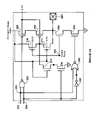
- FIGS. 2(A) and (B) show simplified power-on control system and input/output system according to an embodiment of the present invention. These diagrams are merely examples, which should not unduly limit the scope of the claims. One of ordinary skill in the art would recognize many variations, alternatives, and modifications.
- a power-on control system 200 includes the following components:
- control system 200 provides a power-on control signal to an input/output system 250 .
- system 200 is part of an input/output power supply cell. Further details of these components are found throughout the present specification and more particularly below.
- the transistors 220 and 222 are PMOS transistors.
- the sources of the transistors 220 and 222 each are biased to an input/output supply voltage.
- the transistors 210 and 212 are NMOS transistors.
- the gate of the transistor 210 is biased to a core supply voltage.
- the core supply voltage is also received by the inverter 230 .
- the inverter sends its output to the gate of the transistor 212 .
- the drain of the transistor 210 is connected to the drain of the transistor 220 and the gate of the transistor 222 .
- the drain of the transistor 212 is connected to the drain of the transistor 222 and the gate of the transistor 220 .
- the sources of the transistors 210 and 212 each are biased to the ground voltage.
- a power-on control signal 242 is provided, for example, to the input/output system 250 .
- the input/output system 250 includes the following components:
- the input/output system 250 receives a power-on control signal from the power-on control system 200 .
- the system 250 is part of an input/output cell. Further details of these components are found throughout the present specification and more particularly below.
- the input/output system 250 receives the control signal 242 .
- the transistors 260 , 262 , and 270 are PMOS transistors, and the transistors 264 and 266 are NMOS transistors.
- the transistors 260 , 262 , 264 , and 266 are parts of an input/output driver.
- the gates of the transistors 270 and 264 each receive the control signal 242 .
- the drain of the transistor 270 is directly connected to the gate of the transistor 262 .
- the drains of the transistors 262 and 264 are connected to the input/output pad 280 .
- the sources of the transistors 270 and 260 are biased to the input/output supply voltage, and the sources of the transistors 266 and 276 are biased to the ground voltage.
- the drain of the transistor 260 is connected to the source of the transistor 262
- the source of the transistor 264 is connected to the drain of the transistor 266 .
- the transistor 272 is a PMOS transistor.
- the PMOS transistors 260 , 262 , 270 , and 272 each are fabricated in an n-type well, which is biased to a predetermined voltage.
- the input/output system 250 receives a signal 252 at a node 284 , and a signal 254 at a node 286 .
- the signal 252 is equal to at least zero volt or the core supply voltage.
- the signal 254 is an output enabling signal.
- the gate bias for the transistor 260 is controlled by the NAND gate 290 based on at least the signals 252 and 254 .
- the gate bias for the transistor 266 is controlled by the inverter 292 and the NOR gate 294 based on at the signals 252 and 254 .
- FIG. 3 is a simplified diagram showing operations of the control system 200 and the input/output system 250 according to an embodiment of the present invention.
- This diagram is merely an example, which should not unduly limit the scope of the claims.
- One of ordinary skill in the art would recognize many variations, alternatives, and modifications.
- a curve 310 represents the input/output supply voltage increasing from a low voltage level to a high voltage level at about time t 1 .
- a curve 320 represents the core supply voltage increasing from a low voltage level to a high voltage level at about time t 2 .
- the time t 2 is later than the time t 1 .
- the low voltage level for the input/output supply voltage and the low voltage level for the core supply voltage each are equal to 0 volt.
- the high voltage level for the input/output supply voltage is equal to 3.3 volts.
- the high voltage level for the core supply voltage is equal to 1.2 volts.
- the input/output supply voltage and the core supply voltage are received by the control system 200 .
- the control system 200 outputs the control signal 242 .
- a curve 330 represents the control signal increasing from a low voltage level to a high voltage level at about time t 2 .
- the control signal 242 remains at a low voltage level until about the time t 2 .
- the control signal increases from the low voltage level to the high voltage level.
- the low voltage level is equal to 0 volt.
- the high voltage level for the control signal 242 is equal to the high voltage level for the input/output voltage supply voltage.
- the high voltage level for the control signal 242 is equal to 3.3 volts.
- both the input/output supply voltage and the core supply voltage are at their respective low voltage levels.
- the control signal 242 is also at its low voltage level.
- the input/output supply voltage increases from the low voltage level to its high voltage level, but the core supply voltage remains at the low voltage level.
- the control signal 242 remains at its low voltage level.
- the core supply voltage increases to its high voltage level while the input/output supply voltage remains at its high voltage level.
- the control signal 242 increases from the low voltage level to its high voltage level.
- the control signal 242 is received by the gates of the transistors 270 and 264 . If the control signal 242 is at its low voltage level and the input/output supply voltage is at its high voltage level, the drain of the transistor 270 provides a high voltage level to the gate of the transistor 262 . Between about the time t 1 and the time t 2 , both the transistors 262 and 264 are turned off. The input/output pad 280 is at the high impedance state. If the control signal 242 is at its high voltage level, the transistor 264 is turned on and the transistor 270 is turned off. In response, the gate bias for the transistor 262 is controlled by at least the transistors 272 , 274 and 276 based on at least the input/output supply voltage and the signal 254 .
- FIGS. 2(A) , 2 (B), and 3 are merely examples, which should not unduly limit the scope of the claims.
- FIG. 4 is the simplified power-on control system 200 according to another embodiment of the present invention. This diagram is merely an example, which should not unduly limit the scope of the claims.
- the power-on control system 200 includes inverters 320 and 330 in addition to the transistors 210 , 212 , 220 and 222 , and the inverter 230 .
- the control signal 242 is output to the inverter 320 , which is also coupled to the inverter 330 .
- the inverter 330 generates a power-on control signal 340 at a node 310 .
- the control signal 340 is received by the input/output system 250 at the node 282 , and used to bias the gates of the transistors 270 and 264 .
- a system for controlling an input/output driver includes a control system configured to receive a first supply voltage and a second supply voltage and generate a control signal, and a first transistor including a first gate, a first terminal, and a second terminal.
- the first gate is configured to receive the control signal
- the first terminal is configured to receive the first supply voltage.
- the system includes a second transistor including a second gate, a third terminal, and a fourth terminal, and the second gate is coupled to the second terminal.
- the system includes a third transistor including a third gate, a fifth terminal, and a sixth terminal, and the third gate is configured to receive the control signal.
- the system includes an input/output pad coupled to the fourth terminal and the fifth terminal.
- the first supply voltage can be equal to at least a first voltage level or a second voltage level, the second voltage level being higher than the first voltage level
- the second supply voltage can be equal to at least a third voltage level or a fourth voltage level, the fourth voltage level being higher than the third voltage level.
- the control signal is indicative of a first control state if the first supply voltage is equal to the second voltage level and the second supply voltage is equal to the third voltage level
- the control signal is indicative of a second control state if the first supply voltage is equal to the second voltage level and the second supply voltage is equal to the fourth voltage level. If the control signal is indicative of the first control state, the second transistor and the third transistor are turned off.
- the system is implemented according to the systems 200 and 250 .
- a system for controlling an input/output driver includes a control system configured to receive a first supply voltage and a second supply voltage and generate a control signal, and a first transistor including a first gate, a first terminal, and a second terminal.
- the first gate is configured to receive the control signal
- the first terminal is configured to receive the first supply voltage.
- the system includes a second transistor including a second gate, a third terminal, and a fourth terminal, and the second gate is coupled to the second terminal.
- the system includes a third transistor including a third gate, a fifth terminal, and a sixth terminal, and the third gate is configured to receive the control signal.
- the system includes an input/output pad coupled to the fourth terminal and the fifth terminal.
- the control system includes a fourth transistor including a fourth gate, and the fourth gate is configured to receive the second supply voltage. Additionally, the control system includes an inverter configured to receive the second supply voltage and generate a voltage signal, and a fifth transistor including a fifth gate and a seventh terminal. The fifth gate is configured to receive the voltage signal. Moreover, the control system includes a sixth transistor. the sixth transistor includes a sixth gate, is coupled to the fourth transistor and the fifth transistor, and is configured to receive the first supply voltage. Also, the control system includes a seventh transistor. The seventh transistor includes a seventh gate and an eighth terminal, is coupled to the fourth transistor and the fifth transistor, and is configured to receive the first supply voltage. For example, the system is implemented according to the systems 200 and 250 .
- a method for controlling an input/output driver includes receiving a first supply voltage, receiving a second supply voltage, processing information associated with the first supply voltage and the second supply voltage, and generating a control signal based on at least information associated with the first supply voltage and the second supply voltage. Additionally, the method includes processing information associated with the control signal, turning on or off a first transistor based on at least information associated with the control signal, and turning on or off a second transistor based on at least information associated with the control signal. The first transistor and the second transistor are coupled to an input/output pad.
- the first supply voltage can be equal to at least a first voltage level or a second voltage level, the second voltage level being higher than the first voltage level
- the second supply voltage can be equal to at least a third voltage level or a fourth voltage level, the fourth voltage level being higher than the third voltage level.
- the control signal is indicative of a first control state if the first supply voltage is equal to the second voltage level and the second supply voltage is equal to the third voltage level
- the control signal is indicative of a second control state if the first supply voltage is equal to the second voltage level and the second supply voltage is equal to the fourth voltage level. If the control signal is indicative of the first control state, turning off the first transistor and turning off the second transistor.
- the method is performed by the systems 200 and 250 .
- the present invention has various advantages. Some embodiments of the present invention provide a power-on control signal, which can make the input/output pad at a high impedance state if the input/output voltage supply is powered on but the core voltage supply is not yet powered on. Certain embodiments of the present invention provide a power-on control signal, which allows the input/output pad to work properly if both the input/output voltage supply and the core voltage supply are powered on. For example, the input/output pad is at a logic high state, a logic low state, or a high impedance state. Some embodiments of the present invention can reduce or eliminate high input/output crowbar current even if the input/output voltage supply is powered on but the core voltage supply is not yet powered on. Certain embodiments of the present invention can reduce or eliminate bus congestion even if the input/output voltage supply is powered on but the core voltage supply is not yet powered on.
Landscapes
- Physics & Mathematics (AREA)
- Engineering & Computer Science (AREA)
- Computer Hardware Design (AREA)
- Computing Systems (AREA)
- General Engineering & Computer Science (AREA)
- Mathematical Physics (AREA)
- Logic Circuits (AREA)
Abstract
A system and method for controlling an input/output driver. The system includes a control system configured to receive a first supply voltage and a second supply voltage and generate a control signal, and a first transistor including a first gate, a first terminal, and a second terminal. The first gate is configured to receive the control signal, and the first terminal is configured to receive the first supply voltage. Additionally, the system includes a second transistor including a second gate, a third terminal, and a fourth terminal, and the second gate is coupled to the second terminal. Moreover, the system includes a third transistor including a third gate, a fifth terminal, and a sixth terminal, and the third gate is configured to receive the control signal. Also, the system includes an input/output pad coupled to the fourth terminal and the fifth terminal.
Description
This application is a continuation of U.S. patent application Ser. No. 11/262,505, filed Oct. 28, 2005, which claims priority to Chinese Patent Application No. 200510030369.8, filed Sep. 27, 2005. Both applications are commonly assigned and incorporated by reference herein for all purposes.
NOT APPLICABLE
NOT APPLICABLE
The present invention is directed to integrated circuits. More particularly, the invention provides a system and method for power-on control. Merely by way of example, the invention has been applied to input/output drivers. But it would be recognized that the invention has a much broader range of applicability.
Integrated circuits or “ICs” have evolved from a handful of interconnected devices fabricated on a single chip of silicon to millions of devices. Current ICs provide performance and complexity far beyond what was originally imagined. In order to achieve improvements in complexity and circuit density (i.e., the number of devices capable of being packed onto a given chip area), the size of the smallest device feature, also known as the device “geometry”, has become smaller with each generation of ICs. Semiconductor devices are now being fabricated with features less than a quarter of a micron across.
Increasing circuit density has not only improved the complexity and performance of ICs but has also provided lower cost parts to the consumer. An IC fabrication facility can cost hundreds of millions, or even billions, of dollars. Each fabrication facility will have a certain throughput of wafers, and each wafer will have a certain number of ICs on it. Therefore, by making the individual devices of an IC smaller, more devices may be fabricated on each wafer, thus increasing the output of the fabrication facility. Making devices smaller is very challenging, as a given process, device layout, and/or system design often work down to only a certain feature size. An example of such a limit is the performance of an input/output driver. If the input/output driver operates in an uncertain state, the input/output crowbar current may become higher, and the input/output bus can even become congested.
From the above, it is seen that an improved technique for input/output driver is desired.
The present invention is directed to integrated circuits. More particularly, the invention provides a system and method for power-on control. Merely by way of example, the invention has been applied to input/output drivers. But it would be recognized that the invention has a much broader range of applicability.
In a specific embodiment, the invention provides a system for controlling an input/output driver. The system includes a control system configured to receive a first supply voltage and a second supply voltage and generate a control signal, and a first transistor including a first gate, a first terminal, and a second terminal. The first gate is configured to receive the control signal, and the first terminal is configured to receive the first supply voltage. Additionally, the system includes a second transistor including a second gate, a third terminal, and a fourth terminal, and the second gate is coupled to the second terminal. Moreover, the system includes a third transistor including a third gate, a fifth terminal, and a sixth terminal, and the third gate is configured to receive the control signal. Also, the system includes an input/output pad coupled to the fourth terminal and the fifth terminal. The first supply voltage can be equal to at least a first voltage level or a second voltage level, the second voltage level being higher than the first voltage level, and the second supply voltage can be equal to at least a third voltage level or a fourth voltage level, the fourth voltage level being higher than the third voltage level. The control signal is indicative of a first control state if the first supply voltage is equal to the second voltage level and the second supply voltage is equal to the third voltage level, and the control signal is indicative of a second control state if the first supply voltage is equal to the second voltage level and the second supply voltage is equal to the fourth voltage level. If the control signal is indicative of the first control state, the second transistor and the third transistor are turned off.
In another embodiment, a system for controlling an input/output driver includes a control system configured to receive a first supply voltage and a second supply voltage and generate a control signal, and a first transistor including a first gate, a first terminal, and a second terminal. The first gate is configured to receive the control signal, and the first terminal is configured to receive the first supply voltage. Additionally, the system includes a second transistor including a second gate, a third terminal, and a fourth terminal, and the second gate is coupled to the second terminal. Moreover, the system includes a third transistor including a third gate, a fifth terminal, and a sixth terminal, and the third gate is configured to receive the control signal. Also, the system includes an input/output pad coupled to the fourth terminal and the fifth terminal. The control system includes a fourth transistor including a fourth gate, and the fourth gate is configured to receive the second supply voltage. Additionally, the control system includes an inverter configured to receive the second supply voltage and generate a voltage signal, and a fifth transistor including a fifth gate and a seventh terminal. The fifth gate is configured to receive the voltage signal. Moreover, the control system includes a sixth transistor. the sixth transistor includes a sixth gate, is coupled to the fourth transistor and the fifth transistor, and is configured to receive the first supply voltage. Also, the control system includes a seventh transistor. The seventh transistor includes a seventh gate and an eighth terminal, is coupled to the fourth transistor and the fifth transistor, and is configured to receive the first supply voltage.
In yet another embodiment, a method for controlling an input/output driver includes receiving a first supply voltage, receiving a second supply voltage, processing information associated with the first supply voltage and the second supply voltage, and generating a control signal based on at least information associated with the first supply voltage and the second supply voltage. Additionally, the method includes processing information associated with the control signal, turning on or off a first transistor based on at least information associated with the control signal, and turning on or off a second transistor based on at least information associated with the control signal. The first transistor and the second transistor are coupled to an input/output pad. The first supply voltage can be equal to at least a first voltage level or a second voltage level, the second voltage level being higher than the first voltage level, and the second supply voltage can be equal to at least a third voltage level or a fourth voltage level, the fourth voltage level being higher than the third voltage level. The control signal is indicative of a first control state if the first supply voltage is equal to the second voltage level and the second supply voltage is equal to the third voltage level, and the control signal is indicative of a second control state if the first supply voltage is equal to the second voltage level and the second supply voltage is equal to the fourth voltage level. If the control signal is indicative of the first control state, turning off the first transistor and turning off the second transistor.
Many benefits are achieved by way of the present invention over conventional techniques. Some embodiments of the present invention provide a power-on control signal, which can make the input/output pad at a high impedance state if the input/output voltage supply is powered on but the core voltage supply is not yet powered on. Certain embodiments of the present invention provide a power-on control signal, which allows the input/output pad to work properly if both the input/output voltage supply and the core voltage supply are powered on. For example, the input/output pad is at a logic high state, a logic low state, or a high impedance state. Some embodiments of the present invention can reduce or eliminate high input/output crowbar current even if the input/output voltage supply is powered on but the core voltage supply is not yet powered on. Certain embodiments of the present invention can reduce or eliminate bus congestion even if the input/output voltage supply is powered on but the core voltage supply is not yet powered on. Depending upon the embodiment, one or more of these benefits may be achieved. These and other benefits will be described in more throughout the present specification and more particularly below.
Various additional objects, features and advantages of the present invention can be more fully appreciated with reference to the detailed description and accompanying drawings that follow.
The present invention is directed to integrated circuits. More particularly, the invention provides a system and method for power-on control. Merely by way of example, the invention has been applied to input/output drivers. But it would be recognized that the invention has a much broader range of applicability.
-
- 1.
transistors - 2.
transistors - 3. an
inverter 230.
- 1.
Although the above has been shown using a selected group of components for the control system 200, there can be many alternatives, modifications, and variations. For example, some of the components may be expanded and/or combined. Other components may be inserted to those noted above. Depending upon the embodiment, the arrangement of components may be interchanged with others replaced. For example, the system 200 provides a power-on control signal to an input/output system 250. In another example, the system 200 is part of an input/output power supply cell. Further details of these components are found throughout the present specification and more particularly below.
For example, the transistors 220 and 222 are PMOS transistors. The sources of the transistors 220 and 222 each are biased to an input/output supply voltage. In another example, the transistors 210 and 212 are NMOS transistors. The gate of the transistor 210 is biased to a core supply voltage. The core supply voltage is also received by the inverter 230. The inverter sends its output to the gate of the transistor 212. The drain of the transistor 210 is connected to the drain of the transistor 220 and the gate of the transistor 222. The drain of the transistor 212 is connected to the drain of the transistor 222 and the gate of the transistor 220. The sources of the transistors 210 and 212 each are biased to the ground voltage. At a node 240, a power-on control signal 242 is provided, for example, to the input/output system 250.
As shown in FIG. 2(B) , the input/output system 250 includes the following components:
-
- 1.
transistors - 2.
transistors - 3. an input/
output pad 280; - 4. a
NAND gate 290; - 5. an
inverter 292; - 6. a NOR
gate 294.
- 1.
Although the above has been shown using a selected group of components for the input/output system 250, there can be many alternatives, modifications, and variations. For example, some of the components may be expanded and/or combined. Other components may be inserted to those noted above. Depending upon the embodiment, the arrangement of components may be interchanged with others replaced. For example, the input/output system 250 receives a power-on control signal from the power-on control system 200. In another example, the system 250 is part of an input/output cell. Further details of these components are found throughout the present specification and more particularly below.
At a node 282, the input/output system 250 receives the control signal 242. For example, the transistors 260, 262, and 270 are PMOS transistors, and the transistors 264 and 266 are NMOS transistors. In another example, the transistors 260, 262, 264, and 266 are parts of an input/output driver. The gates of the transistors 270 and 264 each receive the control signal 242. The drain of the transistor 270 is directly connected to the gate of the transistor 262. The drains of the transistors 262 and 264 are connected to the input/output pad 280. The sources of the transistors 270 and 260 are biased to the input/output supply voltage, and the sources of the transistors 266 and 276 are biased to the ground voltage.
Additionally, the drain of the transistor 260 is connected to the source of the transistor 262, and the source of the transistor 264 is connected to the drain of the transistor 266. For example, the transistor 272 is a PMOS transistor. In another example, the PMOS transistors 260, 262, 270, and 272 each are fabricated in an n-type well, which is biased to a predetermined voltage. As shown in FIG. 2(B) , the input/output system 250 receives a signal 252 at a node 284, and a signal 254 at a node 286. For example, the signal 252 is equal to at least zero volt or the core supply voltage. In another example, the signal 254 is an output enabling signal. Moreover, the gate bias for the transistor 260 is controlled by the NAND gate 290 based on at least the signals 252 and 254. The gate bias for the transistor 266 is controlled by the inverter 292 and the NOR gate 294 based on at the signals 252 and 254.
The input/output supply voltage and the core supply voltage are received by the control system 200. In response, the control system 200 outputs the control signal 242. As shown in FIG. 3 , a curve 330 represents the control signal increasing from a low voltage level to a high voltage level at about time t2. The control signal 242 remains at a low voltage level until about the time t2. After the time t2, the control signal increases from the low voltage level to the high voltage level. For example, the low voltage level is equal to 0 volt. In another example, the high voltage level for the control signal 242 is equal to the high voltage level for the input/output voltage supply voltage. In yet another example, the high voltage level for the control signal 242 is equal to 3.3 volts.
Before the time t1, both the input/output supply voltage and the core supply voltage are at their respective low voltage levels. In response, the control signal 242 is also at its low voltage level. Between the time t1 and the time t2, the input/output supply voltage increases from the low voltage level to its high voltage level, but the core supply voltage remains at the low voltage level. In response, the control signal 242 remains at its low voltage level. After the time t2, the core supply voltage increases to its high voltage level while the input/output supply voltage remains at its high voltage level. In response, the control signal 242 increases from the low voltage level to its high voltage level.
In one embodiment, the control signal 242 is received by the gates of the transistors 270 and 264. If the control signal 242 is at its low voltage level and the input/output supply voltage is at its high voltage level, the drain of the transistor 270 provides a high voltage level to the gate of the transistor 262. Between about the time t1 and the time t2, both the transistors 262 and 264 are turned off. The input/output pad 280 is at the high impedance state. If the control signal 242 is at its high voltage level, the transistor 264 is turned on and the transistor 270 is turned off. In response, the gate bias for the transistor 262 is controlled by at least the transistors 272, 274 and 276 based on at least the input/output supply voltage and the signal 254.
As discussed above and further emphasized here, FIGS. 2(A) , 2(B), and 3 are merely examples, which should not unduly limit the scope of the claims. One of ordinary skill in the art would recognize many variations, alternatives, and modifications. For example, FIG. 4 is the simplified power-on control system 200 according to another embodiment of the present invention. This diagram is merely an example, which should not unduly limit the scope of the claims. One of ordinary skill in the art would recognize many variations, alternatives, and modifications. The power-on control system 200 includes inverters 320 and 330 in addition to the transistors 210, 212, 220 and 222, and the inverter 230. At the node 240, the control signal 242 is output to the inverter 320, which is also coupled to the inverter 330. The inverter 330 generates a power-on control signal 340 at a node 310. For example, the control signal 340 is received by the input/output system 250 at the node 282, and used to bias the gates of the transistors 270 and 264.
In another embodiment, a system for controlling an input/output driver includes a control system configured to receive a first supply voltage and a second supply voltage and generate a control signal, and a first transistor including a first gate, a first terminal, and a second terminal. The first gate is configured to receive the control signal, and the first terminal is configured to receive the first supply voltage. Additionally, the system includes a second transistor including a second gate, a third terminal, and a fourth terminal, and the second gate is coupled to the second terminal. Moreover, the system includes a third transistor including a third gate, a fifth terminal, and a sixth terminal, and the third gate is configured to receive the control signal. Also, the system includes an input/output pad coupled to the fourth terminal and the fifth terminal. The first supply voltage can be equal to at least a first voltage level or a second voltage level, the second voltage level being higher than the first voltage level, and the second supply voltage can be equal to at least a third voltage level or a fourth voltage level, the fourth voltage level being higher than the third voltage level. The control signal is indicative of a first control state if the first supply voltage is equal to the second voltage level and the second supply voltage is equal to the third voltage level, and the control signal is indicative of a second control state if the first supply voltage is equal to the second voltage level and the second supply voltage is equal to the fourth voltage level. If the control signal is indicative of the first control state, the second transistor and the third transistor are turned off. For example, the system is implemented according to the systems 200 and 250.
In yet another embodiment, a system for controlling an input/output driver includes a control system configured to receive a first supply voltage and a second supply voltage and generate a control signal, and a first transistor including a first gate, a first terminal, and a second terminal. The first gate is configured to receive the control signal, and the first terminal is configured to receive the first supply voltage. Additionally, the system includes a second transistor including a second gate, a third terminal, and a fourth terminal, and the second gate is coupled to the second terminal. Moreover, the system includes a third transistor including a third gate, a fifth terminal, and a sixth terminal, and the third gate is configured to receive the control signal. Also, the system includes an input/output pad coupled to the fourth terminal and the fifth terminal. The control system includes a fourth transistor including a fourth gate, and the fourth gate is configured to receive the second supply voltage. Additionally, the control system includes an inverter configured to receive the second supply voltage and generate a voltage signal, and a fifth transistor including a fifth gate and a seventh terminal. The fifth gate is configured to receive the voltage signal. Moreover, the control system includes a sixth transistor. the sixth transistor includes a sixth gate, is coupled to the fourth transistor and the fifth transistor, and is configured to receive the first supply voltage. Also, the control system includes a seventh transistor. The seventh transistor includes a seventh gate and an eighth terminal, is coupled to the fourth transistor and the fifth transistor, and is configured to receive the first supply voltage. For example, the system is implemented according to the systems 200 and 250.
In yet another embodiment, a method for controlling an input/output driver includes receiving a first supply voltage, receiving a second supply voltage, processing information associated with the first supply voltage and the second supply voltage, and generating a control signal based on at least information associated with the first supply voltage and the second supply voltage. Additionally, the method includes processing information associated with the control signal, turning on or off a first transistor based on at least information associated with the control signal, and turning on or off a second transistor based on at least information associated with the control signal. The first transistor and the second transistor are coupled to an input/output pad. The first supply voltage can be equal to at least a first voltage level or a second voltage level, the second voltage level being higher than the first voltage level, and the second supply voltage can be equal to at least a third voltage level or a fourth voltage level, the fourth voltage level being higher than the third voltage level. The control signal is indicative of a first control state if the first supply voltage is equal to the second voltage level and the second supply voltage is equal to the third voltage level, and the control signal is indicative of a second control state if the first supply voltage is equal to the second voltage level and the second supply voltage is equal to the fourth voltage level. If the control signal is indicative of the first control state, turning off the first transistor and turning off the second transistor. For example, the method is performed by the systems 200 and 250.
The present invention has various advantages. Some embodiments of the present invention provide a power-on control signal, which can make the input/output pad at a high impedance state if the input/output voltage supply is powered on but the core voltage supply is not yet powered on. Certain embodiments of the present invention provide a power-on control signal, which allows the input/output pad to work properly if both the input/output voltage supply and the core voltage supply are powered on. For example, the input/output pad is at a logic high state, a logic low state, or a high impedance state. Some embodiments of the present invention can reduce or eliminate high input/output crowbar current even if the input/output voltage supply is powered on but the core voltage supply is not yet powered on. Certain embodiments of the present invention can reduce or eliminate bus congestion even if the input/output voltage supply is powered on but the core voltage supply is not yet powered on.
It is also understood that the examples and embodiments described herein are for illustrative purposes only and that various modifications or changes in light thereof will be suggested to persons skilled in the art and are to be included within the spirit and purview of this application and scope of the appended claims.
Claims (13)
1. A system for controlling an input/output driver, the system comprising:
a control system configured to receive a first supply voltage and a second supply voltage and generate a control signal;
a first transistor including a first gate, a first terminal, and a second terminal, the first gate configured to receive the control signal, the first terminal configured to receive the first supply voltage;
a second transistor including a second gate, a third terminal, and a fourth terminal, the second gate coupled to the second terminal;
a third transistor including a third gate, a fifth terminal, and a sixth terminal, the third gate configured to receive the control signal;
wherein:
the first supply voltage can be equal to at least a first voltage level or a second voltage level, the second voltage level being higher than the first voltage level;
the second supply voltage can be equal to at least a third voltage level or a fourth voltage level, the fourth voltage level being higher than the third voltage level;
the control signal is indicative of a control state when the first supply voltage is equal to the second voltage level and the second supply voltage is equal to the third voltage level;
when the control signal is indicative of the control state, the second transistor and the third transistor are turned off.
2. The system of claim 1 , and further comprising:
a fourth transistor including a fourth gate, a seventh terminal, and an eighth terminal, the seventh terminal configured to receive the first supply voltage, the eighth terminal being coupled to the third terminal;
a fifth transistor including a fifth gate, a ninth terminal, and a tenth terminal, the ninth terminal being coupled to the sixth terminal, the tenth terminal configured to receive a predetermined voltage level.
3. The system of claim 2 wherein the predetermined voltage level is a ground voltage level.
4. The system of claim 2 wherein the input/output driver comprises the second transistor, the third transistor, the fourth transistor, and the fifth transistor.
5. The system of claim 1 wherein:
the first transistor includes a first PMOS transistor;
the second transistor includes a second PMOS transistor;
the third transistor includes an NMOS transistor.
6. The system of claim 1 wherein the first supply voltage is an input/output supply voltage.
7. The system of claim 1 wherein the second supply voltage is a core supply voltage.
8. The system of claim 1 wherein:
the control signal is associated with a fifth voltage level when the first supply voltage is equal to the second voltage level and the second supply voltage is equal to the third voltage level;
the control signal is associated with a sixth voltage level when the first supply voltage is equal to the second voltage level and the second supply voltage is equal to the fourth voltage level;
the fifth voltage level and the sixth voltage level are different.
9. The system of claim 1 wherein the second voltage level and the fourth voltage level are different.
10. A method for controlling an input/output driver, the method comprising:
receiving a first supply voltage;
receiving a second supply voltage;
processing information associated with the first supply voltage and the second supply voltage;
generating a control signal based on at least information associated with the first supply voltage and the second supply voltage;
processing information associated with the control signal;
turning on or off a first transistor based on at least information associated with the control signal;
turning on or off a second transistor based on at least information associated with the control signal;
wherein:
the first supply voltage can be equal to at least a first voltage level or a second voltage level, the second voltage level being higher than the first voltage level;
the second supply voltage can be equal to at least a third voltage level or a fourth voltage level, the fourth voltage level being higher than the third voltage level;
the control signal is indicative of a control state when the first supply voltage is equal to the second voltage level and the second supply voltage is equal to the third voltage level;
when the control signal is indicative of the control state, turning off the first transistor and turning off the second transistor.
11. The system of claim 10 wherein the first supply voltage is an input/output supply voltage.
12. The system of claim 10 wherein the second supply voltage is a core supply voltage.
13. The system of claim 10 wherein:
the control signal is associated with a fifth voltage level when the first supply voltage is equal to the second voltage level and the second supply voltage is equal to the third voltage level;
the control signal is associated with a sixth voltage level when the first supply voltage is equal to the second voltage level and the second supply voltage is equal to the fourth voltage level;
the fifth voltage level and the sixth voltage level are different.
Priority Applications (1)
| Application Number | Priority Date | Filing Date | Title |
|---|---|---|---|
| US11/754,957 US7403047B2 (en) | 2005-09-27 | 2007-05-29 | System and method for power-on control of input/output drivers |
Applications Claiming Priority (4)
| Application Number | Priority Date | Filing Date | Title |
|---|---|---|---|
| CN200510030369.8 | 2005-09-27 | ||
| CN200510030369.8A CN100536334C (en) | 2005-09-27 | 2005-09-27 | Electric controlling system and method for input/output driver |
| US11/262,505 US7239186B2 (en) | 2005-09-27 | 2005-10-28 | System and method for power-on control of input/output drivers |
| US11/754,957 US7403047B2 (en) | 2005-09-27 | 2007-05-29 | System and method for power-on control of input/output drivers |
Related Parent Applications (1)
| Application Number | Title | Priority Date | Filing Date |
|---|---|---|---|
| US11/262,505 Continuation US7239186B2 (en) | 2005-09-27 | 2005-10-28 | System and method for power-on control of input/output drivers |
Publications (2)
| Publication Number | Publication Date |
|---|---|
| US20070268046A1 US20070268046A1 (en) | 2007-11-22 |
| US7403047B2 true US7403047B2 (en) | 2008-07-22 |
Family
ID=37910557
Family Applications (2)
| Application Number | Title | Priority Date | Filing Date |
|---|---|---|---|
| US11/262,505 Expired - Lifetime US7239186B2 (en) | 2005-09-27 | 2005-10-28 | System and method for power-on control of input/output drivers |
| US11/754,957 Expired - Lifetime US7403047B2 (en) | 2005-09-27 | 2007-05-29 | System and method for power-on control of input/output drivers |
Family Applications Before (1)
| Application Number | Title | Priority Date | Filing Date |
|---|---|---|---|
| US11/262,505 Expired - Lifetime US7239186B2 (en) | 2005-09-27 | 2005-10-28 | System and method for power-on control of input/output drivers |
Country Status (2)
| Country | Link |
|---|---|
| US (2) | US7239186B2 (en) |
| CN (1) | CN100536334C (en) |
Families Citing this family (5)
| Publication number | Priority date | Publication date | Assignee | Title |
|---|---|---|---|---|
| KR100633440B1 (en) * | 2005-10-18 | 2006-10-16 | 삼성전자주식회사 | High voltage generation circuit for improving high voltage generation efficiency and nonvolatile semiconductor memory device including the same |
| CN101419495B (en) * | 2007-10-22 | 2012-05-30 | 国际商业机器公司 | Method and device for reducing I /O power in computer system and the computer system |
| TWI395405B (en) | 2009-08-06 | 2013-05-01 | Etron Technology Inc | Buffer driving circuit capable of increasing responding speed and prolonging lifespan, buffer, and method thereof |
| CN104700901B (en) * | 2013-12-05 | 2017-09-22 | 中芯国际集成电路制造(上海)有限公司 | The detection method of memory cell in SRAM |
| CN105790753B (en) * | 2014-12-25 | 2018-12-21 | 中芯国际集成电路制造(上海)有限公司 | Output buffer |
Citations (3)
| Publication number | Priority date | Publication date | Assignee | Title |
|---|---|---|---|---|
| US20020130683A1 (en) * | 1994-04-20 | 2002-09-19 | Yoji Nishio | Gate circuit and semiconductor circuit to process low amplitude signals, memory, processor and information processing system manufactured by use of them |
| US6803789B1 (en) * | 2002-10-04 | 2004-10-12 | Semiconductor Manufacturing International Corporation | High voltage tolerant output buffer |
| US20060170454A1 (en) * | 2005-02-02 | 2006-08-03 | Seouk-Kyu Choi | Level shifter having extended input level |
-
2005
- 2005-09-27 CN CN200510030369.8A patent/CN100536334C/en not_active Expired - Lifetime
- 2005-10-28 US US11/262,505 patent/US7239186B2/en not_active Expired - Lifetime
-
2007
- 2007-05-29 US US11/754,957 patent/US7403047B2/en not_active Expired - Lifetime
Patent Citations (3)
| Publication number | Priority date | Publication date | Assignee | Title |
|---|---|---|---|---|
| US20020130683A1 (en) * | 1994-04-20 | 2002-09-19 | Yoji Nishio | Gate circuit and semiconductor circuit to process low amplitude signals, memory, processor and information processing system manufactured by use of them |
| US6803789B1 (en) * | 2002-10-04 | 2004-10-12 | Semiconductor Manufacturing International Corporation | High voltage tolerant output buffer |
| US20060170454A1 (en) * | 2005-02-02 | 2006-08-03 | Seouk-Kyu Choi | Level shifter having extended input level |
Also Published As
| Publication number | Publication date |
|---|---|
| US20070268046A1 (en) | 2007-11-22 |
| CN1941624A (en) | 2007-04-04 |
| US20070080721A1 (en) | 2007-04-12 |
| CN100536334C (en) | 2009-09-02 |
| US7239186B2 (en) | 2007-07-03 |
Similar Documents
| Publication | Publication Date | Title |
|---|---|---|
| US7786779B2 (en) | Buffer for driving circuit and method thereof | |
| US7196547B2 (en) | Level shifter and buffer circuit | |
| US6040729A (en) | Digital output buffer for multiple voltage system | |
| TWI481191B (en) | High voltage tolerant input/output interface circuit | |
| US20190312575A1 (en) | Biasing cascode transistors of an output buffer circuit for operation over a wide range of supply voltages | |
| KR20010049227A (en) | Level adjustment circuit and data output circuit thereof | |
| WO2003030360A2 (en) | High voltage cmos output driver in low voltage process | |
| US5703825A (en) | Semiconductor integrated circuit device having a leakage current reduction means | |
| US20070268046A1 (en) | System and method for power-on control of input/output drivers | |
| KR100211758B1 (en) | Multi-power data buffer | |
| US20060097769A1 (en) | Level shift circuit and semiconductor circuit device including the level shift circuit | |
| US6201428B1 (en) | 5-volt tolerant 3-volt drive push-pull buffer/driver | |
| CN109427371B (en) | Power switch, memory device and method for providing power switch voltage output | |
| JP4137118B2 (en) | Semiconductor device | |
| US7764108B2 (en) | Electrical fuse circuit | |
| US7233178B2 (en) | Power-on solution to avoid crowbar current for multiple power supplies' inputs/outputs | |
| US20010015656A1 (en) | Buffer circuit | |
| US8044687B2 (en) | Wide input common mode voltage comparator | |
| US7545201B2 (en) | System and method for switching between high voltage and low voltage | |
| US20100073073A1 (en) | Microprocessor with substrate bias clamps | |
| US7345500B2 (en) | Method and system for device characterization with array and decoder | |
| US11418195B1 (en) | Voltage power switch | |
| JP2006210670A (en) | Semiconductor device | |
| US20060226875A1 (en) | Level shifter circuit | |
| US6326835B1 (en) | Input/output circuit for semiconductor integrated circuit device |
Legal Events
| Date | Code | Title | Description |
|---|---|---|---|
| STCF | Information on status: patent grant |
Free format text: PATENTED CASE |
|
| FPAY | Fee payment |
Year of fee payment: 4 |
|
| FPAY | Fee payment |
Year of fee payment: 8 |
|
| MAFP | Maintenance fee payment |
Free format text: PAYMENT OF MAINTENANCE FEE, 12TH YEAR, LARGE ENTITY (ORIGINAL EVENT CODE: M1553); ENTITY STATUS OF PATENT OWNER: LARGE ENTITY Year of fee payment: 12 |