US7361682B2 - Indole derivatives as H3 inverse agonists - Google Patents
Indole derivatives as H3 inverse agonists Download PDFInfo
- Publication number
- US7361682B2 US7361682B2 US11/157,093 US15709305A US7361682B2 US 7361682 B2 US7361682 B2 US 7361682B2 US 15709305 A US15709305 A US 15709305A US 7361682 B2 US7361682 B2 US 7361682B2
- Authority
- US
- United States
- Prior art keywords
- piperidin
- isopropyl
- yloxy
- indol
- methanone
- Prior art date
- Legal status (The legal status is an assumption and is not a legal conclusion. Google has not performed a legal analysis and makes no representation as to the accuracy of the status listed.)
- Expired - Fee Related, expires
Links
- 0 [1*]N([2*])C(=C)C1=CC2=CC([4*])=C([5*])C=C2N1[3*] Chemical compound [1*]N([2*])C(=C)C1=CC2=CC([4*])=C([5*])C=C2N1[3*] 0.000 description 32
- ZRIYKSMFARHXFO-UHFFFAOYSA-N CC(C)N1CCC(OC2=CC=C3NC(C(=O)O)=CC3=C2)CC1 Chemical compound CC(C)N1CCC(OC2=CC=C3NC(C(=O)O)=CC3=C2)CC1 ZRIYKSMFARHXFO-UHFFFAOYSA-N 0.000 description 1
- YJPVKWLMMMIVDC-UHFFFAOYSA-N CCOC(=O)C1=CC2=CC=C(OC3CCN(C(C)C)CC3)C=C2N1 Chemical compound CCOC(=O)C1=CC2=CC=C(OC3CCN(C(C)C)CC3)C=C2N1 YJPVKWLMMMIVDC-UHFFFAOYSA-N 0.000 description 1
- PFPCVVMONOQGHN-UHFFFAOYSA-N CCOC(=O)C1=CC2=CC=C(OCCC3CCCN3C)C=C2N1 Chemical compound CCOC(=O)C1=CC2=CC=C(OCCC3CCCN3C)C=C2N1 PFPCVVMONOQGHN-UHFFFAOYSA-N 0.000 description 1
- KBPIJVGIHRIHOV-UHFFFAOYSA-N CCOC(=O)C1=CC2=CC=C(OCCCN3CCCCC3)C=C2N1 Chemical compound CCOC(=O)C1=CC2=CC=C(OCCCN3CCCCC3)C=C2N1 KBPIJVGIHRIHOV-UHFFFAOYSA-N 0.000 description 1
- OSKOPTHTGMCICF-UHFFFAOYSA-N CN1CCCC1CCOC1=CC=C2NC(C(=O)O)=CC2=C1 Chemical compound CN1CCCC1CCOC1=CC=C2NC(C(=O)O)=CC2=C1 OSKOPTHTGMCICF-UHFFFAOYSA-N 0.000 description 1
Classifications
-
- C—CHEMISTRY; METALLURGY
- C07—ORGANIC CHEMISTRY
- C07D—HETEROCYCLIC COMPOUNDS
- C07D405/00—Heterocyclic compounds containing both one or more hetero rings having oxygen atoms as the only ring hetero atoms, and one or more rings having nitrogen as the only ring hetero atom
- C07D405/14—Heterocyclic compounds containing both one or more hetero rings having oxygen atoms as the only ring hetero atoms, and one or more rings having nitrogen as the only ring hetero atom containing three or more hetero rings
-
- A—HUMAN NECESSITIES
- A61—MEDICAL OR VETERINARY SCIENCE; HYGIENE
- A61P—SPECIFIC THERAPEUTIC ACTIVITY OF CHEMICAL COMPOUNDS OR MEDICINAL PREPARATIONS
- A61P1/00—Drugs for disorders of the alimentary tract or the digestive system
- A61P1/04—Drugs for disorders of the alimentary tract or the digestive system for ulcers, gastritis or reflux esophagitis, e.g. antacids, inhibitors of acid secretion, mucosal protectants
-
- A—HUMAN NECESSITIES
- A61—MEDICAL OR VETERINARY SCIENCE; HYGIENE
- A61P—SPECIFIC THERAPEUTIC ACTIVITY OF CHEMICAL COMPOUNDS OR MEDICINAL PREPARATIONS
- A61P11/00—Drugs for disorders of the respiratory system
-
- A—HUMAN NECESSITIES
- A61—MEDICAL OR VETERINARY SCIENCE; HYGIENE
- A61P—SPECIFIC THERAPEUTIC ACTIVITY OF CHEMICAL COMPOUNDS OR MEDICINAL PREPARATIONS
- A61P11/00—Drugs for disorders of the respiratory system
- A61P11/06—Antiasthmatics
-
- A—HUMAN NECESSITIES
- A61—MEDICAL OR VETERINARY SCIENCE; HYGIENE
- A61P—SPECIFIC THERAPEUTIC ACTIVITY OF CHEMICAL COMPOUNDS OR MEDICINAL PREPARATIONS
- A61P25/00—Drugs for disorders of the nervous system
-
- A—HUMAN NECESSITIES
- A61—MEDICAL OR VETERINARY SCIENCE; HYGIENE
- A61P—SPECIFIC THERAPEUTIC ACTIVITY OF CHEMICAL COMPOUNDS OR MEDICINAL PREPARATIONS
- A61P25/00—Drugs for disorders of the nervous system
- A61P25/02—Drugs for disorders of the nervous system for peripheral neuropathies
-
- A—HUMAN NECESSITIES
- A61—MEDICAL OR VETERINARY SCIENCE; HYGIENE
- A61P—SPECIFIC THERAPEUTIC ACTIVITY OF CHEMICAL COMPOUNDS OR MEDICINAL PREPARATIONS
- A61P25/00—Drugs for disorders of the nervous system
- A61P25/04—Centrally acting analgesics, e.g. opioids
-
- A—HUMAN NECESSITIES
- A61—MEDICAL OR VETERINARY SCIENCE; HYGIENE
- A61P—SPECIFIC THERAPEUTIC ACTIVITY OF CHEMICAL COMPOUNDS OR MEDICINAL PREPARATIONS
- A61P25/00—Drugs for disorders of the nervous system
- A61P25/06—Antimigraine agents
-
- A—HUMAN NECESSITIES
- A61—MEDICAL OR VETERINARY SCIENCE; HYGIENE
- A61P—SPECIFIC THERAPEUTIC ACTIVITY OF CHEMICAL COMPOUNDS OR MEDICINAL PREPARATIONS
- A61P25/00—Drugs for disorders of the nervous system
- A61P25/08—Antiepileptics; Anticonvulsants
-
- A—HUMAN NECESSITIES
- A61—MEDICAL OR VETERINARY SCIENCE; HYGIENE
- A61P—SPECIFIC THERAPEUTIC ACTIVITY OF CHEMICAL COMPOUNDS OR MEDICINAL PREPARATIONS
- A61P25/00—Drugs for disorders of the nervous system
- A61P25/08—Antiepileptics; Anticonvulsants
- A61P25/10—Antiepileptics; Anticonvulsants for petit-mal
-
- A—HUMAN NECESSITIES
- A61—MEDICAL OR VETERINARY SCIENCE; HYGIENE
- A61P—SPECIFIC THERAPEUTIC ACTIVITY OF CHEMICAL COMPOUNDS OR MEDICINAL PREPARATIONS
- A61P25/00—Drugs for disorders of the nervous system
- A61P25/08—Antiepileptics; Anticonvulsants
- A61P25/12—Antiepileptics; Anticonvulsants for grand-mal
-
- A—HUMAN NECESSITIES
- A61—MEDICAL OR VETERINARY SCIENCE; HYGIENE
- A61P—SPECIFIC THERAPEUTIC ACTIVITY OF CHEMICAL COMPOUNDS OR MEDICINAL PREPARATIONS
- A61P25/00—Drugs for disorders of the nervous system
- A61P25/14—Drugs for disorders of the nervous system for treating abnormal movements, e.g. chorea, dyskinesia
- A61P25/16—Anti-Parkinson drugs
-
- A—HUMAN NECESSITIES
- A61—MEDICAL OR VETERINARY SCIENCE; HYGIENE
- A61P—SPECIFIC THERAPEUTIC ACTIVITY OF CHEMICAL COMPOUNDS OR MEDICINAL PREPARATIONS
- A61P25/00—Drugs for disorders of the nervous system
- A61P25/18—Antipsychotics, i.e. neuroleptics; Drugs for mania or schizophrenia
-
- A—HUMAN NECESSITIES
- A61—MEDICAL OR VETERINARY SCIENCE; HYGIENE
- A61P—SPECIFIC THERAPEUTIC ACTIVITY OF CHEMICAL COMPOUNDS OR MEDICINAL PREPARATIONS
- A61P25/00—Drugs for disorders of the nervous system
- A61P25/20—Hypnotics; Sedatives
-
- A—HUMAN NECESSITIES
- A61—MEDICAL OR VETERINARY SCIENCE; HYGIENE
- A61P—SPECIFIC THERAPEUTIC ACTIVITY OF CHEMICAL COMPOUNDS OR MEDICINAL PREPARATIONS
- A61P25/00—Drugs for disorders of the nervous system
- A61P25/24—Antidepressants
-
- A—HUMAN NECESSITIES
- A61—MEDICAL OR VETERINARY SCIENCE; HYGIENE
- A61P—SPECIFIC THERAPEUTIC ACTIVITY OF CHEMICAL COMPOUNDS OR MEDICINAL PREPARATIONS
- A61P25/00—Drugs for disorders of the nervous system
- A61P25/28—Drugs for disorders of the nervous system for treating neurodegenerative disorders of the central nervous system, e.g. nootropic agents, cognition enhancers, drugs for treating Alzheimer's disease or other forms of dementia
-
- A—HUMAN NECESSITIES
- A61—MEDICAL OR VETERINARY SCIENCE; HYGIENE
- A61P—SPECIFIC THERAPEUTIC ACTIVITY OF CHEMICAL COMPOUNDS OR MEDICINAL PREPARATIONS
- A61P25/00—Drugs for disorders of the nervous system
- A61P25/30—Drugs for disorders of the nervous system for treating abuse or dependence
-
- A—HUMAN NECESSITIES
- A61—MEDICAL OR VETERINARY SCIENCE; HYGIENE
- A61P—SPECIFIC THERAPEUTIC ACTIVITY OF CHEMICAL COMPOUNDS OR MEDICINAL PREPARATIONS
- A61P3/00—Drugs for disorders of the metabolism
-
- A—HUMAN NECESSITIES
- A61—MEDICAL OR VETERINARY SCIENCE; HYGIENE
- A61P—SPECIFIC THERAPEUTIC ACTIVITY OF CHEMICAL COMPOUNDS OR MEDICINAL PREPARATIONS
- A61P3/00—Drugs for disorders of the metabolism
- A61P3/04—Anorexiants; Antiobesity agents
-
- A—HUMAN NECESSITIES
- A61—MEDICAL OR VETERINARY SCIENCE; HYGIENE
- A61P—SPECIFIC THERAPEUTIC ACTIVITY OF CHEMICAL COMPOUNDS OR MEDICINAL PREPARATIONS
- A61P37/00—Drugs for immunological or allergic disorders
- A61P37/08—Antiallergic agents
-
- A—HUMAN NECESSITIES
- A61—MEDICAL OR VETERINARY SCIENCE; HYGIENE
- A61P—SPECIFIC THERAPEUTIC ACTIVITY OF CHEMICAL COMPOUNDS OR MEDICINAL PREPARATIONS
- A61P43/00—Drugs for specific purposes, not provided for in groups A61P1/00-A61P41/00
-
- A—HUMAN NECESSITIES
- A61—MEDICAL OR VETERINARY SCIENCE; HYGIENE
- A61P—SPECIFIC THERAPEUTIC ACTIVITY OF CHEMICAL COMPOUNDS OR MEDICINAL PREPARATIONS
- A61P9/00—Drugs for disorders of the cardiovascular system
- A61P9/10—Drugs for disorders of the cardiovascular system for treating ischaemic or atherosclerotic diseases, e.g. antianginal drugs, coronary vasodilators, drugs for myocardial infarction, retinopathy, cerebrovascula insufficiency, renal arteriosclerosis
-
- C—CHEMISTRY; METALLURGY
- C07—ORGANIC CHEMISTRY
- C07D—HETEROCYCLIC COMPOUNDS
- C07D209/00—Heterocyclic compounds containing five-membered rings, condensed with other rings, with one nitrogen atom as the only ring hetero atom
- C07D209/02—Heterocyclic compounds containing five-membered rings, condensed with other rings, with one nitrogen atom as the only ring hetero atom condensed with one carbocyclic ring
- C07D209/04—Indoles; Hydrogenated indoles
- C07D209/30—Indoles; Hydrogenated indoles with hetero atoms or with carbon atoms having three bonds to hetero atoms with at the most one bond to halogen, directly attached to carbon atoms of the hetero ring
- C07D209/42—Carbon atoms having three bonds to hetero atoms with at the most one bond to halogen, e.g. ester or nitrile radicals
-
- C—CHEMISTRY; METALLURGY
- C07—ORGANIC CHEMISTRY
- C07D—HETEROCYCLIC COMPOUNDS
- C07D401/00—Heterocyclic compounds containing two or more hetero rings, having nitrogen atoms as the only ring hetero atoms, at least one ring being a six-membered ring with only one nitrogen atom
- C07D401/02—Heterocyclic compounds containing two or more hetero rings, having nitrogen atoms as the only ring hetero atoms, at least one ring being a six-membered ring with only one nitrogen atom containing two hetero rings
- C07D401/12—Heterocyclic compounds containing two or more hetero rings, having nitrogen atoms as the only ring hetero atoms, at least one ring being a six-membered ring with only one nitrogen atom containing two hetero rings linked by a chain containing hetero atoms as chain links
-
- C—CHEMISTRY; METALLURGY
- C07—ORGANIC CHEMISTRY
- C07D—HETEROCYCLIC COMPOUNDS
- C07D401/00—Heterocyclic compounds containing two or more hetero rings, having nitrogen atoms as the only ring hetero atoms, at least one ring being a six-membered ring with only one nitrogen atom
- C07D401/14—Heterocyclic compounds containing two or more hetero rings, having nitrogen atoms as the only ring hetero atoms, at least one ring being a six-membered ring with only one nitrogen atom containing three or more hetero rings
-
- C—CHEMISTRY; METALLURGY
- C07—ORGANIC CHEMISTRY
- C07D—HETEROCYCLIC COMPOUNDS
- C07D403/00—Heterocyclic compounds containing two or more hetero rings, having nitrogen atoms as the only ring hetero atoms, not provided for by group C07D401/00
- C07D403/02—Heterocyclic compounds containing two or more hetero rings, having nitrogen atoms as the only ring hetero atoms, not provided for by group C07D401/00 containing two hetero rings
- C07D403/12—Heterocyclic compounds containing two or more hetero rings, having nitrogen atoms as the only ring hetero atoms, not provided for by group C07D401/00 containing two hetero rings linked by a chain containing hetero atoms as chain links
-
- C—CHEMISTRY; METALLURGY
- C07—ORGANIC CHEMISTRY
- C07D—HETEROCYCLIC COMPOUNDS
- C07D403/00—Heterocyclic compounds containing two or more hetero rings, having nitrogen atoms as the only ring hetero atoms, not provided for by group C07D401/00
- C07D403/14—Heterocyclic compounds containing two or more hetero rings, having nitrogen atoms as the only ring hetero atoms, not provided for by group C07D401/00 containing three or more hetero rings
Definitions
- the present invention is directed to novel indole derivatives, their manufacture, pharmaceutical compositions containing them and their use as medicaments.
- the present invention relates to compounds of the formula I:
- the compounds of formula I are antagonists and/or inverse agonists at the histamine 3 receptor (H3 receptor) and are useful in treating obesity and other disorders.
- Histamine (2-(4-imidazolyl) ethylamine) is one of the aminergic neurotransmitters which is widely distributed throughout the body, e.g. the gastrointestinal tract (Burks 1994 in Johnson L. R. ed., Physiology of the Gastrointestinal Tract, Raven Press, NY, pp. 211-242). Histamine regulates a variety of digestive pathophysiological events like gastric acid secretion, intestinal motility (Leurs et al., Br J. Pharmacol. 1991, 102, pp 179-185), vasomotor responses, intestinal inflammatory responses and allergic reactions (Raithel et al., Int. Arch. Allergy Immunol. 1995, 108, 127-133).
- histamine is synthesized in histaminergic cell bodies which are found centrally in the tuberomammillary nucleus of the posterior basal hypothalamus. From there, the histaminergic cell bodies project to various brain regions (Panula et al., Proc. Natl. Acad. Sci. USA 1984, 81, 2572-2576; Inagaki et al., J. Comp. Neurol 1988, 273, 283-300).
- histamine mediates all its actions in both the CNS and the periphery through four distinct histamine receptors, the histamine H1, H2H3 and H4 receptors.
- H3 receptors are predominantly localized in the central nervous system (CNS). As an autoreceptor H3 receptors constitutively inhibit the synthesis and secretion of histamine from histaminergic neurons (Arrang et al., Nature 1983, 302, 832-837; Arrang et al., Neuroscience 1987, 23, 149-157). As heteroreceptors, H3 receptors also modulate the release of other neurotransmitters such as acetylcholine, dopamine, serotonin and norepinephrine among others in both the central nervous system and in peripheral organs, such as lungs, cardiovascular system and gastrointestinal tract (Clapham & Kilpatrik, Br. J. Pharmacol.
- CNS central nervous system
- H3 receptors are constitutively active, meaning that even without exogenous histamine, the receptor is tonically activated. In the case of an inhibitory receptor such as the H3 receptor, this inherent activity causes tonic inhibition of neurotransmitter release. Therefore it may be important that a H3R antagonist would also have inverse agonist activity to both block exogenous histamine effects and to shift the receptor from its constitutively active (inhibitory) form to a neutral state.
- H3 receptors in the mammalian CNS indicates the physiological role of this receptor. Therefore the therapeutic potential as a novel drug development target in various indications has been proposed.
- H3R ligands as antagonists, inverse agonists, agonists or partial agonists—may influence the histamine levels or the secretion of neurotransmitters in the brain and the periphery and thus may be useful in the treatment of several disorders.
- disorders include obesity, (Masaki et al; Endocrinol. 2003, 144, 2741-2748; Hancock et al., European J. of Pharmacol.
- cardiovascular disorders such as acute myocardial infarction, dementia and cognitive disorders such as attention deficit hyperactivity disorder (ADHD) and Alzheimer's disease, neurological disorders such as schizophrenia, depression, epilepsy, Parkinson's disease, and seizures or convulsions, sleep disorders, narcolepsy, pain, gastrointestinal disorders, vestibular dysfunction such as Morbus Meniere, drug abuse and motion sickness (Timmermann, J. Med. Chem. 1990, 33, 4-11).
- ADHD attention deficit hyperactivity disorder
- neurological disorders such as schizophrenia, depression, epilepsy, Parkinson's disease, and seizures or convulsions
- sleep disorders such as schizophrenia, depression, epilepsy, Parkinson's disease, and seizures or convulsions
- sleep disorders such as schizophrenia, depression, epilepsy, Parkinson's disease, and seizures or convulsions
- sleep disorders such as schizophrenia, depression, epilepsy, Parkinson's disease, and seizures or convulsions
- sleep disorders such as schizophrenia, depression, epilepsy, Parkinson's disease, and seizures or convulsions
- sleep disorders such
- compositions comprising a therapeutically effective amount of a compound as defined above and a pharmaceutically acceptable carrier and/or adjuvant.
- a method for the treatment and/or prevention of diseases which are associated with the modulation of H3 receptors comprising the step of administering a therapeutically effective amount of a compound according to formula I to a human being or animal in need thereof.
- the present invention provides for selective, directly acting H3 receptor antagonists respectively inverse agonists.
- Such antagonists/inverse agonists are useful as therapeutically active substances, particularly in the treatment and/or prevention of diseases which are associated with the modulation of H3 receptors.
- alkyl refers to a branched or straight-chain monovalent saturated aliphatic hydrocarbon radical of one to twenty carbon atoms, preferably one to sixteen carbon atoms, more preferably one to ten carbon atoms.
- lower alkyl or “C 1 -C 8 -alkyl”, alone or in combination, signifies a straight-chain or branched-chain alkyl group with 1 to 8 carbon atoms, preferably a straight or branched-chain alkyl group with 1 to 6 carbon atoms and particularly preferred a straight or branched-chain alkyl group with 1 to 4 carbon atoms
- straight-chain and branched C 1 -C 8 alkyl groups are methyl, ethyl, propyl, isopropyl, butyl, isobutyl, tert.-butyl, the isomeric pentyls, the isomeric hexyls, the isomeric heptyls and the isomeric octyls, preferably methyl and ethyl and most preferred methyl.
- lower alkenyl or “C 2-8 -alkenyl”, alone or in combination, signifies a straight-chain or branched hydrocarbon radical comprising an olefinic bond and up to 8, preferably up to 6, particularly preferred up to 4 carbon atoms.
- alkenyl groups are ethenyl, 1-propenyl, 2-propenyl, isopropenyl, 1-butenyl, 2-butenyl, 3-butenyl and isobutenyl.
- a preferred example is 2-propenyl.
- lower alkinyl or “C 2-8 -alkinyl”, alone or in combination, signifies a straight-chain or branched hydrocarbon residue comprising a triple bond and up to 8, preferably up to 6, particularly preferred up to 4 carbon atoms.
- alkinyl groups are ethinyl, 1-propinyl, or 2-propinyl. A preferred example is 2-propinyl.
- cycloalkyl or “C 3-7 -cycloalkyl” denotes a saturated carbocyclic group containing from 3 to 7 carbon atoms, such as cyclopropyl, cyclobutyl, cydopentyl, cyclohexyl or cycloheptyl. Especially preferred are cyclopropyl, cyclopentyl and cyclohexyl.
- lower cycloalkylalkyl or “C 3-7 -cycloalkyl-C 1-8 -alkyl” refers to lower alkyl groups as defined above wherein at least one of the hydrogen atoms of the lower alkyl group is replaced by cycloalkyl.
- a preferred example is cyclopropylmethyl.
- alkoxy refers to the group R′—O—, wherein R′ is lower alkyl and the term “lower alkyl” has the previously given significance.
- lower alkoxy groups are e.g. methoxy, ethoxy, n-propoxy, isopropoxy, n-butoxy, isobutoxy, sec. butoxy and tert.butoxy, preferably methoxy and ethoxy and most preferred methoxy.
- lower alkoxyalkyl or “C 1-8 -alkoxy-C 1-8 -alkyl” refers to lower alkyl groups as defined above wherein at least one of the hydrogen atoms of the lower alkyl groups is replaced by an alkoxy group, preferably methoxy or ethoxy.
- alkoxy group preferably methoxy or ethoxy.
- preferred lower alkoxyalkyl groups are 2-methoxyethyl or 3-methoxypropyl.
- alkylsulfanyl or “C 1-8 -alkylsulfanyl” refers to the group R′—S—, wherein R′ is lower alkyl and the term “lower alkyl” has the previously given significance.
- alkylsulfanyl groups are e.g. methylsulfanyl or ethylsulfanyl.
- lower alkylsulfanylalkyl or “C 1-8 -alkylsulfanyl-C 1-8 -alkyl” refers to lower alkyl groups as defined above wherein at least one of the hydrogen atoms of the lower alkyl groups is replaced by an alkylsulfanyl group, preferably methylsulfanyl.
- An example for a preferred lower alkylsulfanylalkyl group is 2-methylsulfanylethyl.
- alkylsulfonyl or “lower alkylsulfanyl” refers to the group R′—S(O) 2 —, wherein R′ is lower alkyl and the term “lower alkyl” has the previously given significance.
- alkylsulfonyl groups are e.g. methylsulfonyl or ethylsulfonyl.
- halogen refers to fluorine, chlorine, bromine and iodine, with fluorine, chlorine and bromine being preferred.
- lower halogenalkyl or “halogen-C 1-8 -alkyl” refers to lower alkyl groups as defined above wherein at least one of the hydrogen atoms of the lower alkyl group is replaced by a halogen atom, preferably fluoro or chloro, most preferably fluoro.
- halogen atom preferably fluoro or chloro, most preferably fluoro.
- preferred halogenated lower alkyl groups are trifluoromethyl, difluoromethyl, fluoromethyl and chloromethyl, with trifluoromethyl being especially preferred.
- lower halogenalkoxy or “halogen-C 1-8 -alkoxy” refers to lower alkoxy groups as defined above wherein at least one of the hydrogen atoms of the lower alkoxy group is replaced by a halogen atom, preferably fluoro or chloro, most preferably fluoro.
- halogenated lower alkyl groups are trifluoromethoxy, difluoromethoxy, fluormethoxy and chloromethoxy, with trifluoromethoxy being especially preferred.
- lower hydroxyalkyl or “hydroxy-C 1-8 -alkyl” refers to lower alkyl groups as defined above wherein at least one of the hydrogen atoms of the lower alkyl group is replaced by a hydroxy group. Examples of lower hydroxyalkyl groups are hydroxymethyl or hydroxyethyl.
- dialkylamino refers to the group —NR′R′′, wherein R′ and R′′ are lower alkyl and the term “lower alkyl” has the previously given significance.
- a preferred dialkylamino group is dimethylamino.
- lower dialkylaminoalkyl or “C 1-8 -dialkylamino-C 1-8 -alkyl” refers to lower alkyl groups as defined above wherein at least one of the hydrogen atoms of the lower alkyl group is replaced by a dialkylamino group, preferably dimethylamino.
- a preferred lower dialkylaminoalkyl group is 3-dimethylaminopropyl.
- lower alkanoyl refers to the group —CO—R′, wherein R′ is lower alkyl and the term “lower alkyl” has the previously given significance.
- Preferred is a group —CO—R′, wherein R′ is methyl, meaning an acetyl group.
- carbamoyl refers to the group —CO—NH 2 .
- dialkylcarbamoyl or “C 1-8 -dialkylcarbamoyl” refers to the group —CO—NR′R′′ wherein R′ and R′′ are lower alkyl and the term “lower alkyl” has the previously given significance.
- a preferred dialkylcarbamoyl group is dimethylcarbamoyl.
- lower dialkylcarbamoylalkyl or “C 1-8 -dialkylcarbamoyl-C 1-8 -alkyl” refers to lower alkyl groups as defined above wherein at least one of the hydrogen atoms of the lower alkyl group is replaced by a dialkylcarbamoyl group as defined herein before.
- a preferred lower dialkylcarbamoylalkyl groups is dimethylcarbamoylmethyl.
- lower phenylalkyl or “phenyl-C 1-8 -alkyl” to lower alkyl groups as defined above wherein at least one of the hydrogen atoms of the lower alkyl group is replaced by a phenyl group.
- Preferred lower phenylalkyl groups are benzyl or phenethyl.
- heteroaryl refers to an aromatic 5- or 6-membered ring which can comprise one, two or three atoms selected from nitrogen, oxygen and/or sulphur.
- heteroaryl groups are e.g. furyl, pyridyl, pyrazinyl, pyrimidinyl, pyridazinyl, thienyl, isoxazolyl, thiazolyl, isothiazolyl, oxazolyl, imidazolyl, or pyrrolyl.
- furyl and pyridyl are especially preferred.
- lower heteroarylalkyl or “heteroaryl-C 1-8 -alcyl” refers to lower alkyl groups as defined above wherein at least one of the hydrogen atoms of the lower alkyl group is replaced by a heteroaryl group as defined above.
- heterocyclyl refers to a saturated or partly unsaturated 5- or 6-membered ring which can comprise one, two or three atoms selected from nitrogen, oxygen and/or sulphur.
- heterocyclyl rings include piperidinyl, piperazinyl, azepinyl, pyrrolidinyl, pyrazolidinyl, imidazolinyl, imidazolidinyl, pyridinyl, pyridazinyl, pyrimidinyl, oxazolidinyl, isoxazolidinyl, morpholinyl, thiazolidinyl, isothiazolidinyl, thiadiazolylidinyl, dihydrofuryl, tetrahydrofuryl, dihydropyranyl, tetrahydropyranyl, and thiamorpholinyl.
- a preferred heterocyclyl group is piperidinyl.
- lower heterocyclylalkyl or “heterocyclyl-C 1-8 -alkyl” refers to lower alkyl groups as defined above wherein at least one of the hydrogen atoms of the lower alkyl group is replaced by a heterocyclyl group as defined above.
- form a 4-, 5-, 6- or 7-membered saturated heterocyclic ring optionally containing a further heteroatom selected from nitrogen, oxygen or sulfur refers to a saturated N-heterocyclic ring, which may optionally contain a further nitrogen, oxygen or sulfur atom, such as azetidinyl, pyrrolidinyl, imidazolidinyl, pyrazolidinyl, oxazolidinyl, isoxazolidinyl, thiazolidinyl, isothiazolidinyl, piperidinyl, piperazinyl, morpholinyl, thiomorpholinyl, or azepanyl.
- a “4-, 5-, 6- or 7-membered partly unsaturated heterocyclic ring” means a heterocyclic ring as defined above which contains a double bond, for example 2,5-dihydropyrrolyl or 3,6-dihydro-2H-pyridinyl.
- the heteroyclic ring may be unsubstituted or substituted by one, two or three groups independently selected from lower alkyl, lower alkoxy and oxo.
- the heterocyclic ring may also be condensed with a phenyl ring, said phenyl ring being unsubstituted or substituted by one, two or three groups independently selected from lower alkyl, lower alkoxy and halogen.
- An example for such a condensed heterocyclic ring is 3,4-dihydro-1H-isoquinoline.
- salts refers to those salts which retain the biological effectiveness and properties of the free bases or free acids, which are not biologically or otherwise undesirable.
- the salts are formed with inorganic acids such as hydrochloric acid, hydrobromic acid, sulfuric acid, nitric acid, phosphoric acid and the like, preferably hydrochloric acid, and organic acids such as acetic acid, propionic acid, glycolic acid, pyruvic acid, oxylic acid, maleic acid, malonic acid, salicylic acid, succinic acid, fumaric acid, tartaric acid, citric acid, benzoic acid, cinnamic acid, mandelic acid, methanesulfonic acid, ethanesulfonic acid, p-toluenesulfonic acid, salicylic acid, N-acetylcystein and the like.
- salts derived from an inorganic base include, but are not limited to, the sodium, potassium, lithium, ammonium, calcium, magnesium salts and the like.
- Salts derived from organic bases include, but are not limited to salts of primary, secondary, and tertiary amines, substituted amines including naturally occurring substituted amines, cyclic amines and basic ion exchange resins, such as isopropylamine, trimethylamine, diethylamine, triethylamine, tripropylamine, ethanolamine, lysine, arginine, N-ethylpiperidine, piperidine, polymine resins and the like.
- the compound of formula I can also be present in the form of zwitterions. Particularly preferred pharmaceutically acceptable salts of compounds of formula I are the hydrochloride salts.
- the compounds of formula I can also be solvated, e.g. hydrated.
- the solvation can be effected in the course of the manufacturing process or can take place e.g. as a consequence of hygroscopic properties of an initially anhydrous compound of formula I (hydration).
- pharmaceutically acceptable salts also include physiologically acceptable solvates.
- “Isomers” are compounds that have identical molecular formulae but that differ in the nature or the sequence of bonding of their atoms or in the arrangement of their atoms in space. Isomers that differ in the arrangement of their atoms in space are termed “stereoisomers”. Stereoisomers that are not mirror images of one another are termed “diastereoisomers”, and stereoisomers that are non-superimposable mirror images are termed “enantiomers”, or sometimes optical isomers. A carbon atom bonded to four nonidentical substituents is termed a “chiral center”.
- Preferred compounds of formula I of the present invention are compounds of formula I, wherein
- R 1 and R 2 together with the nitrogen atom to which they are attached form a 4-, 5-, 6- or 7-membered saturated or partly unsaturated heterocyclic ring optionally containing a further heteroatom selected from nitrogen, oxygen or sulfur, said saturated heterocyclic ring being unsubstituted or substituted by one, two or three groups independently selected from lower alkyl, halogen, halogenalkyl, hydroxy, lower alkoxy, oxo, phenyl, benzyl, pyridyl and carbamoyl, or being condensed with a phenyl ring, said phenyl ring being unsubstituted or substituted by one, two or three groups independently selected from lower alkyl, lower alkoxy and halogen.
- R 1 and R 2 together with the nitrogen atom to which they are attached form a heterocyclic ring selected from the group consisting of morpholine, piperidine, 2,5-dihydropyrrole, pyrrolidine, azepane, piperazine, azetidine, thiomorpholine and 3,6-dihydro-2H-pyridine, said saturated heterocyclic ring being unsubstituted or substituted by one, two or three groups independently selected from lower alkyl, halogen, halogenalkyl, hydroxy, lower alkoxy, oxo, phenyl, benzyl, pyridyl and carbamoyl, or being condensed with a phenyl ring, said phenyl ring being unsubstituted or substituted by one, two or three groups independently selected from lower alkyl, lower alkoxy and halogen.
- R 1 and R 2 together with the nitrogen atom to which they are attached form a heterocyclic ring selected from the group consisting of morpholine, piperidine, azepane, pyrrolidine and azetidine, wherein the ring is unsubstituted or substituted by lower alkyl.
- R 3 is selected from the group consisting of lower alkyl, lower alkoxyalkyl, lower halogenalkyl, lower cycloalkylalkyl, lower alkylsulfonyl and lower alkanoyl
- Het is a group selected from
- R 6 is selected from lower alkyl, cycloalkyl, lower cycloalkylalkyl and lower phenylalkyl, with those compounds, wherein R 6 is lower alkyl, being especially preferred.
- a further preferred group includes those compounds of formula I, wherein m is 1, thus meaning piperidine groups are also preferred.
- Another preferred group of compounds are those compounds of formula I, wherein Het signifies
- n 0, 1 or 2; and R 7 is lower alkyl, with those compounds, wherein n is 0, thus meaning pyrrolidine derivatives, being more preferred.
- R 8 , R 8′ , R 9 , R 9′ , R 10 , R 10′ , R 11 and R 11′ independently from each other are selected from the group consisting of hydrogen, lower alkyl, hydroxy, halogen and dialkylamino.
- R 9 and R 10 together may also form a double bond, meaning a compound of the formula
- R 12 is lower alkyl and R 13 is C 3 -C 6 -alkyl.
- Compounds of formula I may form acid addition salts with acids, such as conventional pharmaceutically acceptable acids, for example hydrochloride, hydrobromide, phosphate, acetate, fumarate, maleate, salicylate, sulphate, pyruvate, citrate, lactate, mandelate, tartarate, and methanesulphonate.
- acids such as conventional pharmaceutically acceptable acids, for example hydrochloride, hydrobromide, phosphate, acetate, fumarate, maleate, salicylate, sulphate, pyruvate, citrate, lactate, mandelate, tartarate, and methanesulphonate.
- acids such as conventional pharmaceutically acceptable acids, for example hydrochloride, hydrobromide, phosphate, acetate, fumarate, maleate, salicylate, sulphate, pyruvate, citrate, lactate, mandelate, tartarate, and methanesulphonate.
- hydrochloride salts solvates and hydrate
- Compounds of formula I can have one or more asymmetric carbon atoms and can exist in the form of optically pure enantiomers, mixtures of enantiomers such as, for example, racemates, optically pure diastereoisomers, mixtures of diastereoisomers, diastereoisomeric racemates or mixtures of diastereoisomeric racemates.
- the optically active forms can be obtained for example by resolution of the racemates, by asymmetric synthesis or asymmetric chromatography (chromatography with a chiral adsorbens or eluant). The invention embraces all of these forms.
- the compounds of general formula I in this invention may be derivatized at functional groups to provide derivatives which are capable of conversion back to the parent compound in vivo.
- Physiologically acceptable and metabolically labile derivatives, which are capable of producing the parent compounds of general formula I in vivo are also within the scope of this invention.
- a further aspect of the present invention is the process for the manufacture of compounds of formula I as defined above, which process comprises
- R 3 is hydrogen, and optionally alkylating this compound to obtain a compound of formula Ia′
- R 3 is lower alkyl, and if desired, converting the compound obtained into a pharmaceutically acceptable acid addition salt, or alternatively,
- R 4 and R 5 are —O-Het as defined herein before and the other one is H, with an amine of the formula V H—NR 1 R 2 V wherein R 1 and R 2 are as defined herein before, under basic conditions to obtain a compound of the formula Ib
- R 3 is hydrogen, and optionally alkylating this compound to obtain a compound of formula Ib′
- R 3 is lower alkyl, and if desired, converting the compound obtained into a pharmaceutically acceptable acid addition salt.
- the compounds of formula I can be manufactured by the methods given below, by the methods given in the examples or by analogous methods. Appropriate reaction conditions for the individual reaction steps are known to a person skilled in the art. Starting materials are either commercially available or can be prepared by methods analogous to the methods given below, by methods described in references cited in the text or in the examples, or by methods known in the art.
- compounds of formula I can be prepared according to scheme 3 below. Exemplified is a stereospecific synthetic pathway optionally starting from enantiomerically pure starting materials synonymous shown for N-protected-3-pyrrolidinol. Starting from 5-hydroxy-indole-2-carboxylic acid ethyl ester compounds of formula I can be prepared as follows:
- the compounds of formula I of the present invention can be used as medicaments for the treatment and/or prevention of diseases which are associated with the modulation of H3 receptors.
- diseases are obesity, metabolic syndrome (syndrome X), neurological diseases including Alzheimer's disease, dementia, age-related memory dysfunction, mild cognitive impairment, cognitive deficit, attention deficit hyperactivity disorder, epilepsy, neuropathic pain, inflammatory pain, migraine, Parkinson's disease, multiple sclerosis, stroke, dizziness, schizophrenia, depression, addiction, motion sickness and sleep disorders including narcolepsy, and other diseases including asthma, allergy, allergy-induced airway responses, congestion, chronic obstructive pulmonary disease and gastro-intestinal disorders.
- the use as medicament for the treatment and/or prevention of obesity is preferred.
- the invention relates to compounds as defined above for use as therapeutically active substances, particularly as therapeutic active substances for the treatment and/or prevention of diseases which are associated with the modulation of H3 receptors.
- diseases are obesity, metabolic syndrome (syndrome X), neurological diseases including Alzheimer's disease, dementia, age-related memory dysfunction, mild cognitive impairment, cognitive deficit, attention deficit hyperactivity disorder, epilepsy, neuropathic pain, inflammatory pain, migraine, Parkinson's disease, multiple sclerosis, stroke, dizziness, schizophrenia, depression, addiction, motion sickness and sleep disorders including narcolepsy, and other diseases including asthma, allergy, allergy-induced airway responses, congestion, chronic obstructive pulmonary disease and gastro-intestinal disorders.
- the invention relates to a method for the treatment and/or prevention of diseases which are associated with the modulation of H3 receptors.
- diseases are obesity, metabolic syndrome (syndrome X), neurological diseases including Alzheimer's disease, dementia, age-related memory dysfunction, mild cognitive impairment, cognitive deficit, attention deficit hyperactivity disorder, epilepsy, neuropathic pain, inflammatory pain, migraine, Parkinson's disease, multiple sclerosis, stroke, dizziness, schizophrenia, depression, addiction, motion sickness and sleep disorders including narcolepsy, and other diseases including asthma, allergy, allergy-induced airway responses, congestion, chronic obstructive pulmonary disease and gastro-intestinal disorders.
- a method for the treatment and/or prevention of obesity is preferred.
- the invention further relates to the use of compounds of formula I as defined above for the treatment and/or prevention of diseases which are associated with the modulation of H3 receptors.
- diseases are obesity, metabolic syndrome (syndrome X), neurological diseases including Alzheimer's disease, dementia, age-related memory dysfunction, mild cognitive impairment, cognitive deficit, attention deficit hyperactivity disorder, epilepsy, neuropathic pain, inflammatory pain, migraine, Parkinson's disease, multiple sclerosis, stroke, dizziness, schizophrenia, depression, addiction, motion sickness and sleep disorders including narcolepsy, and other diseases including asthma, allergy, allergy-induced airway responses, congestion, chronic obstructive pulmonary disease and gastrointestinal disorders.
- the use of compounds of formula I as defined above for the treatment and/or prevention of obesity is preferred.
- the invention relates to the use of compounds of formula I as defined above for the preparation of medicaments for the treatment and/or prevention of diseases which are associated with the modulation of H3 receptors.
- diseases are obesity, metabolic syndrome (syndrome X), neurological diseases including Alzheimer's disease, dementia, age-related memory dysfunction, mild cognitive impairment, cognitive deficit, attention deficit hyperactivity disorder, epilepsy, neuropathic pain, inflammatory pain, migraine, Parkinson's disease, multiple sclerosis, stroke, dizziness, schizophrenia, depression, addiction, motion sickness and sleep disorders including narcolepsy, and other diseases including asthma, allergy, allergy-induced airway responses, congestion, chronic obstructive pulmonary disease and gastro-intestinal disorders.
- the use of compounds of formula I as defined above for the preparation of medicaments for the treatment and/or prevention of obesity is preferred.
- the compounds of formula (I) and their pharmaceutically acceptable salts and esters can be used as medicaments, e.g. in the form of pharmaceutical preparations for enteral, parenteral or topical administration. They can be administered, for example, perorally, e.g. in the form of tablets, coated tablets, dragees, hard and soft gelatine capsules, solutions, emulsions or suspensions, rectally, e.g. in the form of suppositories, parenterally, e.g. in the form of injection solutions or infusion solutions, or topically, e.g. in the form of ointments, creams or oils.
- perorally e.g. in the form of tablets, coated tablets, dragees, hard and soft gelatine capsules, solutions, emulsions or suspensions, rectally, e.g. in the form of suppositories, parenterally, e.g. in the form of injection solutions or infusion solutions, or topically, e.
- the production of the pharmaceutical preparations can be effected in a manner which will be familiar to any person skilled in the art by bringing the described compounds of formula (I) and their pharmaceutically acceptable, into a galenical administration form together with suitable, non-toxic, inert, therapeutically compatible solid or liquid carrier materials and, if desired, usual pharmaceutical adjuvants.
- Suitable carrier materials are not only inorganic carrier materials, but also organic carrier materials.
- lactose, corn starch or derivatives thereof, talc, stearic acid or its salts can be used as carrier materials for tablets, coated tablets, dragees and hard gelatine capsules.
- Suitable carrier materials for soft gelatine capsules are, for example, vegetable oils, waxes, fats and semi-solid and liquid polyols (depending on the nature of the active ingredient no carriers are, however, required in the case of soft gelatine capsules).
- Suitable carrier materials for the production of solutions and syrups are, for example, water, polyols, sucrose, invert sugar and the like.
- Suitable carrier materials for injection solutions are, for example, water, alcohols, polyols, glycerol and vegetable oils.
- Suitable carrier materials for suppositories are, for example, natural or hardened oils, waxes, fats and semi-liquid or liquid polyols.
- Suitable carrier materials for topical preparations are glycerides, semi-synthetic and synthetic glycerides, hydrogenated oils, liquid waxes, liquid paraffins, liquid fatty alcohols, sterols, polyethylene glycols and cellulose derivatives.
- Usual stabilizers preservatives, wetting and emulsifying agents, consistency-improving agents, flavor-improving agents, salts for varying the osmotic pressure, buffer substances, solubilizers, colorants and masking agents and antioxidants come into consideration as pharmaceutical adjuvants.
- the dosage of the compounds of formula (I) can vary within wide limits depending on the disease to be controlled, the age and the individual condition of the patient and the mode of administration, and will, of course, be fitted to the individual requirements in each particular case.
- the pharmaceutical preparations conveniently contain about 0.1-500 mg, preferably 0.5-100 mg, of a compound of formula (I).
- Example 1 According to the procedure described for the synthesis of Example 1 the title compound was synthesized from (5-hydroxy-1H-indol-2-yl)-morpholin-4-yl-methanone and 1-isopropyl-pyrrolidinol which was yielded in 8% as white solid. MS (m/e): 358.1 (MH + , 100%).
- Example 1/step 2 According to the procedure described for the synthesis of Example 1/step 2 the title compound was synthesized from (3,4-dihydro-1H-isoquinolin-2-yl)-(5-hydroxy-1H-indol-2-yl)-methanone and 1-isopropyl-pyrrolidinol which was yielded in 28% as white solid. MS (m/e): 404.5 (MH + , 100%).
- Example 1 According to the procedure described for the synthesis of Example 1 the title compound was synthesized from (3,4-dihydro-1H-isoquinolin-2-yl)-(5-hydroxy-1H-indol-2-yl)-methanone and 1-methyl-2-pyrrolidineethanol (commercially available) which was yielded in 3% as white solid. MS (m/e): 404.5 (MH + , 100%).
- Step 3 5-(1-Isopropyl-pyrrolidin-3-yloxy)-1H-indole-2-carboxylic acid cyclopropylmethyl-propyl-amide
- Step 1 5-[2-(1-methyl-pyrrolidin-2-yl)-ethoxy]-1H-indole-2-carboxylic acid ethyl ester
- Example 5 further indole derivatives have been synthesized from 5-[2-(1-methyl-pyrrolidin-2-yl)-ethoxy]-1H-indole-2-carboxylic acid, 5-(1-isopropyl-piperidin-4-yloxy)-1H-indole-2-carboxylic acid or 5-(1-isopropyl-pyrrolidin-3-yloxy)-1H-indole-2-carboxylic acid respectively through the coupling procedure described for Example 5/step 3 with the respective amine mentioned in table 1.
- the purification procedure has been adapted due to precipitation of the respective compound from the respective mixture. In those cases the tide compound was filtered off, washed with methanol (containing HCL in case of example 85) and diethyl ether and dried. The results are shown in Table 1 and comprise Example 6 to Example 134.
- Example 138/step 1 6-(1-isopropyl-piperidin-4-yloxy)-1H-indole-2-carboxylic acid ethyl ester was synthesized from 6-hydroxy-1H-indole-2-carboxylic acid ethyl ester and 1-isopropyl-piperidin-4-ol (commercially available). The title compound was yielded in 15% as light brown solid. MS (m/e): 331.1 (MH + , 100%).
- Example 138/step 1 6-[2-(1-methyl-pyrrolidin-2-yl)-ethoxy]-1H-indole-2-carboxylic acid ethyl ester was synthesized from 6-hydroxy-1H-indole-2-carboxylic acid ethyl ester and 2-(1-methyl-pyrrolidin-2-yl)-ethanol (commercially available). The title compound was yielded in 77% as light brown oil. MS (m/e): 317.3 (MH + , 100%).
- Example 138/step 1 6-(3-Piperidin-1-yl-propoxy)-1H-indole-2-carboxylic acid ethyl ester was synthesized from 6-hydroxy-1H-indole-2-carboxylic acid ethyl ester and 3-Piperidin-1-yl-propan-1-ol (commercially available). The title compound was yielded in 77% as light brown oil. MS (m/e): 317.3 (MH + , 100%).
- Example 138/step 2 further indole derivatives have been synthesized from 6-[2-(1-methyl-pyrrolidin-2-yl)-ethoxy]-1H-indole-2-carboxylic acid ethyl ester, 6-(1-isopropyl-piperidin-4-yloxy)-1H-indole-2-carboxylic acid ethyl ester, 6-(1-isopropyl-pyrrolidin-3-yloxy)-1H-indole-2-carboxylic acid ethyl ester or 6-(3-Piperidin-1-yl-propoxy)-1H-indole-2-carboxylic acid ethyl ester, respectively, with the respective amine mentioned in Table 2.
- Table 2 The results are shown in Table 2 and comprise Example 139 to Example 162.
- step 2 the title compound was synthesized starting from 5-fluoro-6-hydroxy-1H-indole-2-carboxylic acid methyl ester and 1-isopropyl-piperidin-4-ol (commercially available) in 48% yield as white crystals. MS (m/e):335.4 (MH + , 100%).
- Example 5 According to the procedure described for the synthesis of Example 5 (step 3) the title compound was synthesized starting from 5-fluoro-6-(1-isopropyl-piperidin-4-yloxy)-1H-indole-2-carboxylic acid methyl ester and lithium hydroxide and used without further purification in the consecutive step. MS (m/e): 321.4(MH + , 100%).
- Example 5 According to the procedure described for the synthesis of Example 5 (step 3) the title compound was synthesized starting from 5-fluoro-6-(1-isopropyl-piperidin-4-yloxy)-1H-indole-2-carboxylic acid and morpholine (commercially available) in 68% yield. MS (m/e): 390.4(MH + , 100%).
- Example 5/step 3 According to the procedure described for the synthesis of Example 5/step 3 the title compound was synthesized from [5-(1-isopropyl-piperidin-4-yloxy)-1H-indole-2-carboxylic acid and 3,3′-difluoropiperidine (commercially available). MS (m/e): 406.6 (MH + , 100%).
- Example 135 According to the procedure described for Example 135 the title compound was synthesized from 5-((S)-1-benzyl-pyrrolidin-3-yloxy)-1H-indole-2-carboxylic acid ethyl ester and 4,4-difluoropiperidine. MS (m/e): 440.4 (MH + , 100%).
- Example 135 According to the procedure described for Example 135 the title compound was synthesized from [5-((S)-1-benzyl-pyrrolidin-3-yloxy)-1H-indol-2-yl]-(4,4-difluoro-piperidin-1-yl)-methanone through hydrogenation. MS (m/e): 350.5 (MH + , 100%).
- Step 1 5-((S)-1-Isopropyl-pyrrolidin-3-yloxy)-1H-indole-2-carboxylic acid ethyl ester
- Example 1 According to the procedure described for the synthesis of Example 1 the title compound was synthesized from 5-((S)-1-isopropyl-pyrrolidin-3-yloxy)-1H-indole-2-carboxylic acid 1:1 hydrochloride and pyrrolidine under coupling conditions employing TBTU and DIPEA in DMF. The crude product was purified over silica eluting with a gradient formed from DCM/MeOH(2 N NH 3 ) 98/2 to 94/6. The product fractions were evaporated to yield the title compound as off-white solid. (m/e): 342.3 (MH + , 100%).
- Example 5 According to the procedure described for the synthesis of Example 5 (step 3) the title compound was synthesized starting from 5-fluoro-6-(3-piperidin-1-yl-propoxy)-1H-indole-2-carboxylic acid methyl ester and lithium hydroxide and used without further purification in the consecutive step. MS (m/e): 321.4 (MH + , 100%).
- Example 5 According to the procedure described for the synthesis of Example 5 (step 3) the title compound was synthesized starting from 5-fluoro-6-(3-piperidin-1-yl-propoxy)-1H-indole-2-carboxylic acid and 4,4′-difluoropiperidine (commercially available). MS (m/e): 424.5 (MH + , 100%).
- Example 5 According to the procedure described for the synthesis of Example 5 (step 3) the title compound was synthesized starting from 5-fluoro-6-(3-piperidin-1-yl-propoxy)-1H-indole-2-carboxylic acid and morpholine (commercially available). MS (m/e): 390.5 (MH + , 100%).
- Example 172 According to the procedure described for the synthesis of Example 172 the title compound was synthesized starting from (4,4-difluoro-piperidin-1-yl)-[5-(1-isopropyl-piperidin-4-yloxy)-1H-indol-2-yl]-methanone (Example 102) and 2-bromopropane (commercially available). MS (m/e): 448.5 (MH + , 100%).
- Example 172 According to the procedure described for the synthesis of Example 172 the title compound was synthesized starting from (4,4-difluoro-piperidin-1-yl)-[5-(1-isopropyl-piperidin-4-yloxy)-1H-indol-2-yl]-methanone (Example 102) and 2-bromoethyl methyl ether (commercially available). MS (m/e): 464.6 (MH + , 100%).
- Example 172 According to the procedure described for the synthesis of Example 172 the title compound was synthesized starting from (4,4-difluoro-piperidin-1-yl)-[5-(1-isopropyl-piperidin-4-yloxy)-1H-indol-2-yl]-methanone (Example 102) and bromoethane (commercially available). MS (m/e): 434.5 (MH + , 100%).
- Example 172 According to the procedure described for the synthesis of Example 172 the title compound was synthesized starting from (4,4-difluoro-piperidin-1-yl)-[5-(1-isopropyl-piperidin-4-yloxy)-1H-indol-2-yl]-methanone (Example 102) and 2,2,2-trifluoroethyl trifluoromethanesulfonate (commercially available). MS (m/e): 434.5 (MH + , 100%).
- Example 172 According to the procedure described for the synthesis of Example 172 the title compound was synthesized starting from (4,4-difluoro-piperidin-1-yl)-[5-(1-isopropyl-piperidin-4-yloxy)-1H-indol-2-yl]-methanone (Example 102) and bromomethyl cyclopropane (commercially available). MS (m/e): 434.5 (MH + , 100%).
- Example 172 According to the procedure described for the synthesis of Example 172 the title compound was synthesized starting from [5-(1-isopropyl-piperidin-4-yloxy)-1H-indol-2-yl]-pyrrolidin-1-yl-methanone (Example 90) and 2,2,2-trifluoroethyl trifluoromethane-sulfonate (commercially available). MS (m/e): 437.5 (MH + , 100%).
- Example 172 According to the procedure described for the synthesis of Example 172 the title compound was synthesized starting from [5-(1-isopropyl-piperidin-4-yloxy)-1H-indol-2-yl]-morpholin-4-yl-methanone (Example 92) and 2,2,2-trifluoroethyl trifluoromethane-sulfonate (commercially available). MS (m/e): 454.5 (MH + , 100%).
- Example 172 According to the procedure described for the synthesis of Example 172 the title compound was synthesized starting from (3,3-difluoro-piperidin-1-yl)-[5-(1-isopropyl-piperidin-4-yloxy)-1H-indol-2-yl]-methanone (Example 174) and 2,2,2-trifluoroethyl trifluoromethanesulfonate (commercially available). MS (m/e): 488.5 (MH + , 100%).
- Example 172 According to the procedure described for the synthesis of Example 172 the title compound was synthesized starting from (4,4-difluoro-piperidin-1-yl)-[5-(1-isopropyl-piperidin-4-yloxy)-1H-indol-2-yl]-methanone (Example 102) and 1,3,2-dioxathiolane-2,2-dioxide (commercially available). MS (m/e): 488.5 (MH + , 100%).
- Example 172 According to the procedure described for the synthesis of Example 172 the title compound was synthesized starting from (4,4-difluoro-piperidin-1-yl)-[5-(1-isopropyl-piperidin-4-yloxy)-1H-indol-2-yl]-methanone (Example 102) and methanesulfonyl chloride (commercially available). MS (m/e): 484.5 (MH + , 100%).
- Example 172 According to the procedure described for the synthesis of Example 172 the title compound was synthesized starting from (4,4-difluoro-piperidin-1-yl)-[5-(1-isopropyl-piperidin-4-yloxy)-1H-indol-2-yl]-methanone (Example 102) and acetyl chloride (commercially available). MS (m/e): 448.5 (MH + , 100%).
- Step 1 4-[2-(4,4-Difluoro-piperidine-1-carbonyl)-1-methyl-1H-indol-5-yloxy]-1-isopropyl-1-methyl-piperidinium as monomethylsulfate salt
- Example 1/Step 2 According to the procedure described for the synthesis of Example 1/Step 2 the title compound was synthesized from (5-hydroxy-1H-indol-2-yl)-morpholin-4-yl-methanone (Example 1, Step 1) and 1-cyclopropylmethyl-piperidin-4-ol (Example 192, Step 2). (m/e): 384.4 (MH + , 100%).
- Example 1 According to the procedure described for the synthesis of Example 1/Step 2 the tide compound was synthesized from (5-hydroxy-1H-indol-2-yl)-morpholin-4-yl-methanone (Example 1, Step 1) and 1-benzyl-4-hydroxy-piperidine (commercially available). (m/e): 419.52 (MH + , 100%).
- Example 5/step 2 [5-(3-chloro-propoxy)-1H-indole-2-carboxylic acid was synthesized from 5-(3-chloro-propoxy)-1H-indole-2-carboxylic acid ethyl ester. The title compound was yielded in 98% as an off-white solid. MS (m/e): 253.1 (M, 100%).
- Example 194/Step 4 further indole derivatives have been synthesized from [5-(3-chloro-propoxy)-1H-indol-2-yl]-(4,4-difluoro-piperidin-1-yl)-methanone with the respective amine mentioned in Table 3.
- the results are shown in Table 3 and comprise Example 195 to Example 208.
- Step 2 ⁇ 5-[3-(4,4-Difluoro-piperidin-1-yl)-propoxy]-1H-indol-2-yl ⁇ -morpholin-4-yl -methanone
- Example 194/step 4 ⁇ 5-[3-(4,4-difluoro-piperidin-1-yl)-propoxy]-1H-indol-2-yl ⁇ -morpholin-4-yl-methanone was synthesized from [5-(3-chloro-propoxy)-1H-indol-2-yl]-morpholin-4-yl-methanone and 4,4′-difluoropiperidine hydrochloride (commercially available). The title compound was yielded in 54% as a brown solid. MS (m/e): 408.5 (MH + , 100%).
- Step 1 3-[Cyclopropyl-(2-ethoxycarbonyl-ethyl)-amino]-propionic acid ethyl ester
- the solution obtained was neutralized (pH: 7) with diluted acetic acid and partitioned between water and ethyl acetate. The aqueous layer was extracted with ethyl acetate. The combined extracts were dried over sodium sulfate and the solvent was removed in vacuo, yielding to 10.2 g of reddish oil.
- Example 1/step 2 [5-(1-cyclopropyl-piperidin-4-yloxy)-1H-indol-2-yl]-morpholin-4-yl-methanone was synthesized from (5-hydroxy-1H-indol-2-yl)-morpholin-4-yl-methanone (Example 1, Step 1) and 1-cyclopropyl-piperidin-4-ol (Example 201, Step 3). The title compound was yielded in 14% as a white solid. MS (m/e): 370.5 (MH + , 100%).
- Film coated tablets containing the following ingredients can be manufactured in a conventional manner:
- Kernel Compound of formula (I) 10.0 mg 200.0 mg Microcrystalline cellulose 23.5 mg 43.5 mg Lactose hydrous 60.0 mg 70.0 mg Povidone K30 12.5 mg 15.0 mg Sodium starch glycolate 12.5 mg 17.0 mg Magnesium stearate 1.5 mg 4.5 mg (Kernel Weight) 120.0 mg 350.0 mg Film Coat: Hydroxypropyl methyl cellulose 3.5 mg 7.0 mg Polyethylene glycol 6000 0.8 mg 1.6 mg Talc 1.3 mg 2.6 mg Iron oxide (yellow) 0.8 mg 1.6 mg Titanium dioxide 0.8 mg 1.6 mg
- the active ingredient is sieved and mixed with microcrystalline cellulose and the mixture is granulated with a solution of polyvinylpyrrolidone in water.
- the granulate is mixed with sodium starch glycolate and magnesium stearate and compressed to yield kernels of 120 or 350 mg respectively.
- the kernels are lacquered with an aqueous solution/suspension of the above mentioned film coat.
- Capsules containing the following ingredients can be manufactured in a conventional manner:
- the components are sieved and mixed and filled into capsules of size 2.
- Injection solutions can have the following composition:
- Soft gelatin capsules containing the following ingredients can be manufactured in a conventional manner:
- Capsule contents Compound of formula (I) 5.0 mg Yellow wax 8.0 mg Hydrogenated Soya bean oil 8.0 mg Partially hydrogenated plant oils 34.0 mg Soya bean oil 110.0 mg Weight of capsule contents 165.0 mg Gelatin capsule Gelatin 75.0 mg Glycerol 85% 32.0 mg Karion 83 8.0 mg (dry matter) Titanium dioxide 0.4 mg Iron oxide yellow 1.1 mg
- the active ingredient is dissolved in a warm melting of the other ingredients and the mixture is filled into soft gelatin capsules of appropriate size.
- the filled soft gelatin capsules are treated according to the usual procedures.
- Sachets containing the following ingredients can be manufactured in a conventional manner:
- the active ingredient is mixed with lactose, microcrystalline cellulose and sodium carboxymethyl cellulose and granulated with a mixture of polyvinylpyrrolidone in water.
- the granulate is mixed with magnesium stearate and the flavoring additives and filled into sachets.
- the compounds of formula I and their pharmaceutically acceptable salts possess valuable pharmacological properties. Specifically, it has been found that the compounds of the present invention are good histamine 3 receptor (H3R) antagonists and/or inverse agonists. The following test was carried out in order to determine the activity of the compounds of formula (I).
- H3R histamine 3 receptor
- the filtration was made using a cell-harvester and the filter plates were then washed five times with ice cold washing buffer containing 0.5 M NaCl. After harvesting, the plates were dried at 55° C. for 60 min, then we added scintillation fluid (Microscint 40, 40 microl in each well) and the amount of radioactivity on the filter was determined in Packard top-counter after shaking the plates for two hours at 200 rpm at room temperature.
- scintillation fluid Meroscint 40, 40 microl in each well
- Binding Buffer 50 mM Tris-HCl pH 7.4 and 5 mM MgCl 2 ⁇ 6H 2 O pH 7.4.
- Washing Buffer 50 mM Tris-HCl pH 7.4 and 5 mM MgCl 2 ⁇ 6H 2 O and 0.5 M NaCl pH 7.4.
- the compounds of the present invention exhibit K i values within the range of about 1 nM to about 1000 nM, preferably of about 1 nM to about 100 nM, and more preferably of about 1 nM to about 30 nM.
- the following table shows measured values for some selected compounds of the present invention.
Landscapes
- Health & Medical Sciences (AREA)
- Chemical & Material Sciences (AREA)
- Organic Chemistry (AREA)
- Engineering & Computer Science (AREA)
- Bioinformatics & Cheminformatics (AREA)
- Chemical Kinetics & Catalysis (AREA)
- Life Sciences & Earth Sciences (AREA)
- General Chemical & Material Sciences (AREA)
- Medicinal Chemistry (AREA)
- Nuclear Medicine, Radiotherapy & Molecular Imaging (AREA)
- Veterinary Medicine (AREA)
- Pharmacology & Pharmacy (AREA)
- Public Health (AREA)
- Animal Behavior & Ethology (AREA)
- General Health & Medical Sciences (AREA)
- Neurology (AREA)
- Biomedical Technology (AREA)
- Neurosurgery (AREA)
- Pain & Pain Management (AREA)
- Pulmonology (AREA)
- Psychiatry (AREA)
- Diabetes (AREA)
- Hematology (AREA)
- Obesity (AREA)
- Vascular Medicine (AREA)
- Hospice & Palliative Care (AREA)
- Heart & Thoracic Surgery (AREA)
- Child & Adolescent Psychology (AREA)
- Cardiology (AREA)
- Urology & Nephrology (AREA)
- Immunology (AREA)
- Addiction (AREA)
- Psychology (AREA)
- Anesthesiology (AREA)
- Pharmaceuticals Containing Other Organic And Inorganic Compounds (AREA)
- Plural Heterocyclic Compounds (AREA)
- Low-Molecular Organic Synthesis Reactions Using Catalysts (AREA)
Abstract

wherein X, R1, R2, R3, R4 and R5 are as defined in the description and claims, and pharmaceutically acceptable salts thereof, to the preparation of such compounds and pharmaceutical compositions containing them. The compounds are useful for the treatment and/or prevention of diseases which are associated with the modulation of H3 receptors.
Description

and pharmaceutically acceptable salts thereof.

wherein
- X is O or S;
- R1 is selected from the group consisting of hydrogen,
- lower alkyl, lower alkenyl, lower alkinyl,
- cycloalkyl, lower cycloalkylalkyl,
- lower hydroxyalkyl,
- lower alkoxyalkyl,
- lower alkylsulfanylalkyl,
- lower dialkylaminoalkyl,
- lower dialkylcarbamoylalkyl,
- phenyl unsubstituted or substituted with one or two groups independently selected from lower alkyl, lower halogenalkoxy or lower hydroxyalkyl,
- lower phenylalkyl wherein the phenyl ring may be unsubstituted or substituted with one or two groups independently selected from lower alkyl, halogen, lower alkoxy or lower hydroxyalkyl, lower heteroarylalkyl wherein the heteroaryl ring may be unsubstituted or substituted with one or two groups independently selected from lower alkyl, halogen, lower alkoxy or lower hydroxyalkyl, and
- lower heterocyclylalkyl wherein the heterocyclyl ring may be unsubstituted or substituted with one or two lower alkyl groups;
- R2 is selected from the group consisting of hydrogen,
- lower alkyl, lower alkenyl, lower alkinyl,
- cycloalkyl, lower cycloalkylalkyl,
- lower hydroxyalkyl, lower alkoxyalkyl,
- lower alkylsulfanylalkyl,
- lower dialkylaminoalkyl,
- lower dialkylcarbamoylalkyl,
- phenyl unsubstituted or substituted with one or two groups independently selected from lower alkyl, lower halogenalkoxy or lower hydroxyalkyl,
- lower phenylalkyl wherein the phenyl ring may be unsubstituted or substituted with one or two groups independently selected from lower alkyl, halogen, lower alkoxy or lower hydroxyalkyl, lower heteroarylalkyl wherein the heteroaryl ring may be unsubstituted or substituted with one or two groups independently selected from lower alkyl, halogen, lower alkoxy or lower hydroxyalkyl, and
- lower heterocyclylalkyl wherein the heterocycly ring may be unsubstituted or substituted with one or two lower alkyl groups; or
- R1 and R2 together with the nitrogen atom to which they are attached form a 4-, 5-, 6- or 7-membered saturated or partly unsaturated heterocyclic ring optionally containing a further heteroatom selected from nitrogen, oxygen or sulfur,
- said saturated heterocyclic ring
- being unsubstituted or substituted by one, two or three groups independently selected from lower alkyl, halogen, halogenalkyl, hydroxy, lower hydroxyalkyl, lower alkoxy, oxo, phenyl, benzyl, pyridyl and carbamoyl, or
- being condensed with a phenyl ring, said phenyl ring being unsubstituted or substituted by one, two or three groups independently selected from lower alkyl, lower alkoxy and halogen;
- R3 is selected from the group consisting of hydrogen, lower alkyl, lower alkoxyalkyl, lower halogenalkyl, lower cycloalylalkyl, lower alkylsulfonyl and lower alkanoyl;
- R4 is —O-Het and R5 is hydrogen, or
- R4 is hydrogen or fluoro and R5 is —O-Het;
- Het is selected from

wherein
- m is 0, 1 or 2;
- R6 is selected from lower alkyl, cycloalkyl, lower cycloalkylalkyl and lower phenylalkyl;
- n is 0, 1 or 2;
- R7 is lower alkyl;
- p is 0, 1 or 2;
- q is 0, 1 or 2;
- X is selected from CR10R10′, O and S;
- R8, R8′, R9, R9′, R10, R10′, R11 and R11′ independently from each other are selected from the group consisting of hydrogen, lower alkyl, hydroxy, halogen and dialkylamino, or
- R9 and R10 together form a double bond;
- R12 is lower alkyl;
- R13 is C3-C6-alkyl;
and pharmaceutically acceptable salts thereof.
- X is O or S;
- R1 is selected from the group consisting of hydrogen,
- lower alkyl, lower alkenyl, lower alkinyl,
- cycloalkyl, lower cycloalkylalkyl,
- lower hydroxyalkyl,
- lower alkoxyalkyl,
- lower alkylsulfanylalkyl,
- lower dialkylaminoalkyl,
- lower dialkylcarbamoylalkyl,
- phenyl unsubstituted or substituted with one or two groups independently selected from lower alkyl, lower halogenalkoxy or lower hydroxyalkyl,
- lower phenylalkyl wherein the phenyl ring may be unsubstituted or substituted with one or two groups independently selected from lower alkyl, halogen, lower alkoxy or lower hydroxyalkyl, lower heteroarylalkyl wherein the heteroaryl ring may be unsubstituted or substituted with one or two groups independently selected from lower alkyl, halogen, lower alkoxy or lower hydroxyalkyl, and
- lower heterocyclylalkyl wherein the heterocyclyl ring may be unsubstituted or substituted with one or two lower alkyl groups;
- R2 is selected from the group consisting of hydrogen,
- lower alkyl, lower alkenyl, lower alkinyl,
- cycloalkyl, lower cycloalkylalkyl,
- lower hydroxyalkyl, lower alkoxyalkyl,
- lower alkylsulfanylalkyl,
- lower dialkylaminoalkyl,
- lower dialkylcarbamoylalkyl,
- phenyl unsubstituted or substituted with one or two groups independently selected from lower alkyl, lower halogenalkoxy or lower hydroxyalkyl,
- lower phenylalkyl wherein the phenyl ring may be unsubstituted or substituted with one or two groups independently selected from lower alkyl, halogen, lower alkoxy or lower hydroxyalkyl,
- lower heteroarylalkyl wherein the heteroaryl ring may be unsubstituted or substituted with one or two groups independently selected from lower alkyl, halogen, lower alkoxy or lower hydroxyalkyl, and
- lower heterocyclylalkyl wherein the heterocycly ring may be unsubstituted or substituted with one or two lower alkyl groups; or
- R1 and R2 together with the nitrogen atom to which they are attached form a 4-, 5-, 6- or 7-membered saturated or partly unsaturated heterocyclic ring optionally containing a further heteroatom selected from nitrogen, oxygen or sulfur,
- said saturated heterocyclic ring
- being unsubstituted or substituted by one, two or three groups independently selected from lower alkyl, halogen, halogenalkyl, hydroxy, lower alkoxy, oxo, phenyl, benzyl, pyridyl and carbamoyl, or
- being condensed with a phenyl ring, said phenyl ring being unsubstituted or substituted by one, two or three groups independently selected from lower alkyl, lower alkoxy and halogen;
- R3 is hydrogen or lower alkyl;
- R4 is —O-Het and R5 is hydrogen, or
- R4 is hydrogen or fluoro and R5 is —O-Het;
- Het is selected from

wherein
- m is 0, 1 or 2;
- R6 is lower alkyl;
- n is 0, 1 or 2;
- R7 is lower alkyl;
- p is 0, 1 or 2;
- q is 0, 1 or 2;
- R8 is hydrogen or lower alkyl;
and pharmaceutically acceptable salts thereof.
- R1 is selected from the group consisting of
- lower alkyl, lower alkenyl, lower alkinyl,
- cycloalkyl, lower cycloalkylalkyl,
- lower hydroxyalkyl, lower alkoxyalkyl,
- lower alkylsulfanylalkyl,
- lower dialkylaminoalkyl, lower dialkylcarbamoylalkyl,
- phenyl unsubstituted or substituted with one or two groups independently selected from lower alkyl, lower halogenalkoxy or lower hydroxyalkyl,
- lower phenylalkyl wherein the phenyl ring may be unsubstituted or substituted with one or two groups independently selected from lower alkyl, halogen, lower alkoxy or lower hydroxyalkyl,
- lower heteroarylalkyl wherein the heteroaryl ring may be unsubstituted or substituted with one or two groups independently selected from lower alkyl, halogen, lower alkoxy or lower hydroxyalkyl, and
- lower heterocyclylalkyl wherein the heterocycly ring may be unsubstituted or substituted with one or two lower alkyl groups, and
- R2 is hydrogen or lower alkyl.
- R1 is selected from the group consisting of
- lower alkyl, cycloalkyl, lower cycloalkylalkyl, lower alkoxyalkyl,
- lower phenylalkyl,
- lower heteroarylalkyl, and
- lower heterocyclylalkyl wherein the heterocyclyl ring may be unsubstituted or substituted with one or two lower alkyl groups, and
- R2 is hydrogen or lower alkyl.

wherein m, n, p, q, R6, R7, R8, R8′, R9, R9′, R11, R11′ and X are as defined herein before. Especially preferred compounds of formula I according to the present invention are those, wherein Het signifies
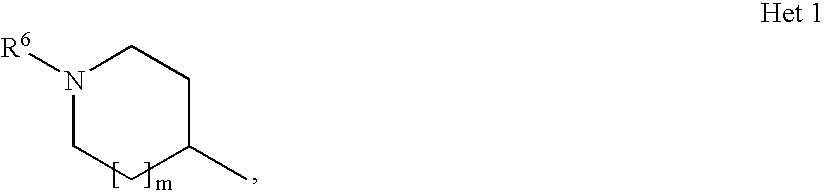
wherein m is 0, 1 or 2, and R6 is selected from lower alkyl, cycloalkyl, lower cycloalkylalkyl and lower phenylalkyl, with those compounds, wherein R6 is lower alkyl, being especially preferred.

wherein n is 0, 1 or 2; and R7 is lower alkyl, with those compounds, wherein n is 0, thus meaning pyrrolidine derivatives, being more preferred.

wherein p is 0, 1 or 2; q is 0, 1 or 2; X is selected from CR10R10′, O and S; and R8, R8′, R9, R9′, R10, R10′, R11 and R11′ independently from each other are selected from the group consisting of hydrogen, lower alkyl, hydroxy, halogen and dialkylamino.

wherein p, q, R8, R8′, R9′, R10′, R11 and R11′ are as defined above.

wherein p is 0, 1 or 2, q is 0, 1 or 2, and R8 is hydrogen or lower alkyl. Within this group, those compounds of formula I are preferred, wherein p is 1 and q is 1, thus meaning piperidine groups are preferred.

wherein q is 0, 1 or 2, R12 is lower alkyl and R13 is C3-C6-alkyl.
- morpholin-4-yl-[5-(3-piperidin-1-yl-propoxy)-1H-indol-2-yl]-methanone,
- [5-(1-isopropyl-pyrrolidin-3-yloxy)-1H-indol-2-yl]-morpholin-4-yl-methanone,
- (3,4-dihydro-1H-isoquinolin-2-yl)-[5-(1-isopropyl-pyrrolidin-3-yloxy)-1H-indol-2-yl]-methanone,
- (3,4-dihydro-1H-isoquinolin-2-yl)-{5-[2-(1-methyl-pyrrolidin-2-yl)-ethoxy]-1H-indol-2-yl}-methanone,
- 5-(1-isopropyl-pyrrolidin-3-yloxy)-1H-indole-2-carboxylic acid cyclopropylmethyl-propyl-amide,
- 5-(1-isopropyl-pyrrolidin-3-yloxy)-1H-indole-2-carboxylic acid diethylamide,
- 5-(1-isopropyl-pyrrolidin-3-yloxy)-1H-indole-2-carboxylic acid ethyl-methyl-amide,
- 5-(1-isopropyl-pyrrolidin-3-yloxy)-1H-indole-2-carboxylic acid methyl-propyl-amide,
- (2,6-dimethyl-morpholin-4-yl)-[5-(-isopropyl-pyrrolidin-3-yloxy)-1H-indol-2-yl]-methanone,
- 5-(1-isopropyl-pyrrolidin-3-yloxy)-1H-indole-2-carboxylic acid methyl-phenethyl-amide,
- (2,5-dihydro-pyrrol-1-yl)-[5-(1-isopropyl-pyrrolidin-3-yloxy)-1H-indol-2-yl]-methanone,
- 5-(1-isopropyl-pyrrolidin-3-yloxy)-1H-indole-2-carboxylic acid cyclohexyl-methyl-amide,
- (3-hydroxy-pyrrolidin-1-yl)-[5-(1-isopropyl-pyrrolidin-3-yloxy)-1H-indol-2-yl]-methanone,
- azepan-1-yl-[5-(1-isopropyl-pyrrolidin-3-yloxy)-1H-indol-2-yl]-methanone,
- [5-(1-isopropyl-pyrrolidin-3-yloxy)-1H-indol-2-yl]-(4-methyl-piperidin-1-yl)-methanone,
- 5-(1-isopropyl-pyrrolidin-3-yloxy)-1H-indole-2-carboxylic acid isopropyl-methyl-amide,
- 5-(1-isopropyl-pyrrolidin-3-yloxy)-1H-indole-2-carboxylic acid isobutyl-amide,
- [5-(1-isopropyl-pyrrolidin-3-yloxy)-1H-indol-2-yl]-(2-methyl-piperidin-1-yl)-methanone,
- 5-(1-isopropyl-piperidin-4-yloxy)-1H-indole-2-carboxylic acid cyclopropylmethyl-propyl-amide,
- 5-(1-isopropyl-piperidin-4-yloxy)-1H-indole-2-carboxylic acid diethylamide,
- 5-(1-isopropyl-piperidin-4-yloxy)-1H-indole-2-carboxylic acid isopropylamide,
- 5-(1-isopropyl-piperidin-4-yloxy)-1H-indole-2-carboxylic acid tert-butylamide,
- 5-(1-isopropyl-piperidin-4-yloxy)-1H-indole-2-carboxylic acid cyclopropylamide,
- 5-(1-isopropyl-piperidin-4-yloxy)-1H-indole-2-carboxylic acid ethyl-methyl-amide,
- 5-(1-isopropyl-piperidin-4-yloxy)-1H-indole-2-carboxylic acid propylamide,
- 5-(1-isopropyl-piperidin-4-yloxy)-1H-indole-2-carboxylic acid methyl-propyl-amide,
- 5-(1-isopropyl-piperidin-4-yloxy)-1H-indole-2-carboxylic acid allylamide,
- 5-(1-isopropyl-piperidin-4-yloxy)-1H-indole-2-carboxylic acid prop-2-ynylamide,
- (2,6-dimethyl-morpholin-4-yl)-[5-(1-isopropyl-piperidin-4-yloxy)-1H-indol-2-yl]-methanone,
- 5-(1-isopropyl-piperidin-4-yloxy)-1H-indole-2-carboxylic acid methyl-phenethyl-amide,
- (2,5-dihydro-pyrrol-1-yl)-[5-(1-isopropyl-piperidin-4-yloxy)-1H-indol-2-yl]-methanone,
- 5-(1-isopropyl-piperidin-4-yloxy)-1H-indole-2-carboxylic acid cyclohexyl-methyl-amide,
- (3-hydroxy-pyrrolidin-1-yl)-[5-(1-isopropyl-piperidin-4-yloxy)-1H-indol-2-yl]-methanone,
- azepan-1-yl-[5-(1-isopropyl-piperidin-4-yloxy)-1H-indol-2-yl]-methanone,
- 5-(1-isopropyl-piperidin-4-yloxy)-1H-indole-2-carboxylic acid ethyl-(2-methoxy-ethyl)-amide,
- [5-(1-isopropyl-piperidin-4-yloxy)-1H-indol-2-yl]-(4-methyl-piperidin-1-yl)-methanone,
- 5-(1-isopropyl-piperidin-4-yloxy)-1H-indole-2-carboxylic acid isopropyl-methyl-amide,
- 5-(1-isopropyl-piperidin-4-yloxy)-1H-indole-2-carboxylic acid isobutyl-amide,
- [5-(1-isopropyl-piperidin-4-yloxy)-1H-indol-2-yl]-(2-methyl-piperidin-1-yl)-methanone,
- (4-benzyl-piperazin-1-yl)-[5-(1-isopropyl-piperidin-4-yloxy)-1H-indol-2-yl]-methanone,
- 5-[2-(1-methyl-pyrrolidin-2-yl)-ethoxy]-1H-indole-2-carboxylic acid cyclopropylmethyl-propyl-amide,
- 5-[2-(1-methyl-pyrrolidin-2-yl)-ethoxy]-1H-indole-2-carboxylic acid diethylamide,
- 5-[2-(1-methyl-pyrrolidin-2-yl)-ethoxy]-1H-indole-2-carboxylic acid isopropylamide,
- 5-[2-(1-methyl-pyrrolidin-2-yl)-ethoxy]-1H-indole-2-carboxylic acid tert-butylamide,
- 5-[2-(1-methyl-pyrrolidin-2-yl)-ethoxy]-1H-indole-2-carboxylic acid ethyl-methyl-amide,
- 5-[2-(1-methyl-pyrrolidin-2-yl)-ethoxy]-1H-indole-2-carboxylic acid methyl-propyl-amide,
- (2,6-dimethyl-morpholin-4-yl)-{5-[2-(1-methyl-pyrrolidin-2-yl)-ethoxy]-1H-indol-2-yl}-methanone,
- 5-[2-(1-methyl-pyrrolidin-2-yl)-ethoxy]-1H-indole-2-carboxylic acid methyl-phenethyl-amide,
- (2,5-dihydro-pyrrol-1-yl)-{5-[2-(1-methyl-pyrrolidin-2-yl)-ethoxy]-1H-indol-2-yl}-methanone,
- 5-[2-(1-methyl-pyrrolidin-2-yl)-ethoxy]-1H-indole-2-carboxylic acid cyclohexyl-methyl-amide,
- (3-hydroxy-pyrrolidin-1-yl)-{5-[2-(1-methyl-pyrrolidin-2-yl)-ethoxy]-1H-indol-2-yl}-methanone,
- azepan-1-yl-{5-[2-(1-methyl-pyrrolidin-2-yl)-ethoxy]-1H-indol-2-yl}-methanone,
- (4-methyl-piperidin-1-yl)-{5-[2-(1-methyl-pyrrolidin-2-yl)-ethoxy]-1H-indol-2-yl}-methanone,
- 5-[2-(1-methyl-pyrrolidin-2-yl)-ethoxy]-1H-indole-2-carboxylic acid isopropyl-methyl-amide,
- (2-methyl-piperidin-1-yl)-{5-[2-(1-methyl-pyrrolidin-2-yl)-ethoxy]-1H-indol-2-yl}-methanone,
- 5-(1-isopropyl-pyrrolidin-3-yloxy)-1H-indole-2-carboxylic acid methyl-(2-pyridin-2-yl-ethyl)-amide,
- 5-(1-isopropyl-pyrrolidin-3-yloxy)-1H-indole-2-carboxylic acid cyclohexylamide,
- 5-(1-isopropyl-pyrrolidin-3-yloxy)-1H-indole-2-carboxylic acid (2-piperidin-1-yl-ethyl)-amide,
- azetidin-1-yl-[5-(1-isopropyl-pyrrolidin-3-yloxy)-1H-indol-2-yl]-methanone,
- (4-isopropyl-piperazin-1-yl)-[5-(1-isopropyl-pyrrolidin-3-yloxy)-1H-indol-2-yl]-methanone,
- [5-(1-isopropyl-pyrrolidin-3-yloxy)-1H-indol-2-yl]-(2-methyl-pyrrolidin-1-yl)-methanone,
- [5-(1-isopropyl-pyrrolidin-3-yloxy)-1H-indol-2-yl]-pyrrolidin-1-yl-methanone,
- [5-(1-isopropyl-pyrrolidin-3-yloxy)-1H-indol-2-yl]-piperidin-1-yl-methanone,
- [5-(1-isopropyl-pyrrolidin-3-yloxy)-1H-indol-2-yl]-thiomorpholin-4-yl-methanone,
- [5-(1-isopropyl-pyrrolidin-3-yloxy)-1H-indol-2-yl]-(4-methoxy-piperidin-1-yl)-methanone,
- [5-(1-isopropyl-pyrrolidin-3-yloxy)-1H-indol-2-yl]-(4-methyl-piperazin-1-yl)-methanone,
- (4-benzyl-piperidin-1-yl)-[5-(1-isopropyl-pyrrolidin-3-yloxy)-1H-indol-2-yl]-methanone,
- (4,4-difluoro-piperidin-1-yl)-[5-(1-isopropyl-pyrrolidin-3-yloxy)-1H-indol-2-yl]-methanone,
- (3,6-dihydro-2H-pyridin-1-yl)-[5-(1-isopropyl-pyrrolidin-3-yloxy)-1H-indol-2-yl]-methanone,
- [5-(1-isopropyl-pyrrolidin-3-yloxy)-1H-indol-2-yl]-(3-methyl-piperidin-1-yl)-methanone,
- 5-(1-isopropyl-pyrrolidin-3-yloxy)-1H-indole-2-carboxylic acid methyl-pyridin-3-ylmethyl-amide,
- 5-(1-isopropyl-pyrrolidin-3-yloxy)-1H-indole-2-carboxylic acid [2-(2-methyl-piperidin-1-yl)-ethyl]-amide,
- (4-hydroxymethyl-piperidin-1-yl)-[5-(1-isopropyl-pyrrolidin-3-yloxy)-1H-indol-2-yl]-methanone,
- (1,3-dihydro-isoindol-2-yl)-[5-(1-isopropyl-pyrrolidin-3-yloxy)-1H-indol-2-yl]-methanone,
- 5-(1-isopropyl-piperidin-4-yloxy)-1H-indole-2-carboxylic acid methyl-(2-pyridin-2-yl-ethyl)-amide,
- 5-(1-isopropyl-piperidin-4-yloxy)-1H-indole-2-carboxylic acid ethyl-pyridin-4-ylmethyl-amide,
- [5-(1-isopropyl-piperidin-4-yloxy)-1H-indol-2-yl]-((S)-2-trifluoromethyl-pyrrolidin-1-yl)-methanone,
- 5-(1-isopropyl-piperidin-4-yloxy)-1H-indole-2-carboxylic acid (furan-2-ylmethyl)-amide,
- 5-(1-isopropyl-piperidin-4-yloxy)-1H-indole-2-carboxylic acid (2-morpholin-4-yl-ethyl)-amide,
- 5-(1-isopropyl-piperidin-4-yloxy)-1H-indole-2-carboxylic acid (3-methoxy-propyl)-amide,
- 5-(1-isopropyl-piperidin-4-yloxy)-1H-indole-2-carboxylic acid (3-dimethylamino-propyl)-amide,
- 5-(1-isopropyl-piperidin-4-yloxy)-1H-indole-2-carboxylic acid cyclopentylamide,
- 5-(1-isopropyl-piperidin-4-yloxy)-1H-indole-2-carboxylic acid cyclohexylamide,
- 5-(1-isopropyl-piperidin-4-yloxy)-1H-indole-2-carboxylic acid (2-piperidin-1-yl-ethyl)-amide,
- azetidin-1-yl-[5-(1-isopropyl-piperidin-4-yloxy)-1H-indol-2-yl]-methanone; hydrochloride,
- [5-(1-isopropyl-piperidin-4-yloxy)-1H-indol-2-yl]-(3-pyridin-2-yl-pyrrolidin-1-yl)-methanone,
- 5-(1-isopropyl-piperidin-4-yloxy)-1H-indole-2-carboxylic acid (1-ethyl-piperidin-3-yl)-amide,
- (4-isopropyl-piperazin-1-yl)-[5-(1-isopropyl-piperidin-4-yloxy)-1H-indol-2-yl]-methanone,
- [5-(1-isopropyl-piperidin-4-yloxy)-1H-indol-2-yl]-(2-methyl-pyrrolidin-1-yl)-methanone,
- [5-(1-isopropyl-piperidin-4-yloxy)-1H-indol-2-yl]-pyrrolidin-1-yl-methanone,
- [5-(1-isopropyl-piperidin-4-yloxy)-1H-indol-2-yl]-piperidin-1-yl-methanone,
- [5-(1-isopropyl-piperidin-4-yloxy)-1H-indol-2-yl]-morpholin-4-yl-methanone,
- [5-(1-isopropyl-piperidin-4-yloxy)-1H-indol-2-yl]-thiomorpholin-4-yl-methanone,
- 5-(1-isopropyl-piperidin-4-yloxy)-1H-indole-2-carboxylic acid cyclopropylmethyl-amide,
- [5-(1-isopropyl-piperidin-4-yloxy)-1H-indol-2-yl]-(4-methoxy-piperidin-1-yl)-methanone,
- [5-(1-isopropyl-piperidin-4-yloxy)-1H-indol-2-yl]-(4-methyl-piperazin-1-yl)-methanone,
- [5-(1-isopropyl-piperidin-4-yloxy)-1H-indol-2-yl]-(3-methoxy-piperidin-1-yl)-methanone,
- (4-benzyl-piperidin-1-yl)-[5-(1-isopropyl-piperidin-4-yloxy)-1H-indol-2-yl]-methanone,
- 5-(1-isopropyl-piperidin-4-yloxy)-1H-indole-2-carboxylic acid (2-methylsulfanyl-ethyl)-amide,
- 5-(1-isopropyl-piperidin-4-yloxy)-1H-indole-2-carboxylic acid (1-phenyl-propyl)-amide,
- (4,4-difluoro-piperidin-1-yl)-[5-(1-isopropyl-piperidin-4-yloxy)-1H-indol-2-yl]-methanone,
- 5-(1-isopropyl-piperidin-4-yloxy)-1H-indole-2-carboxylic acid ethyl-(2-fluoro-benzyl)-amide,
- 5-(1-isopropyl-piperidin-4-yloxy)-1H-indole-2-carboxylic acid 4-methyl-benzylamide,
- 1-[5-(1-isopropyl-piperidin-4-yloxy)-1H-indole-2-carbonyl]-piperidine-4-carboxylic acid amide,
- (3,6-dihydro-2H-pyridin-1-yl)-[5-(1-isopropyl-piperidin-4-yloxy)-1H-indol-2-yl]-methanone,
- [5-(1-isopropyl-piperidin-4-yloxy)-1H-indol-2-yl]-(3-methyl-piperidin-1-yl)-methanone,
- 5-(1-isopropyl-piperidin-4-yloxy)-1H-indole-2-carboxylic acid methyl-pyridin-3-ylmethyl-amide,
- 5-(1-isopropyl-piperidin-4-yloxy)-1H-indole-2-carboxylic acid [2-(2-methyl-piperidin-1-yl)-ethyl]-amide,
- 5-(1-isopropyl-piperidin-4-yloxy)-1H-indole-2-carboxylic acid dimethylcarbamoylmethyl-methyl-amide,
- (4-hydroxymethyl-piperidin-1-yl)-[5-(1-isopropyl-piperidin-4-yloxy)-1H-indol-2-yl]-methanone,
- (1,3-dihydro-isoindol-2-yl)-[5-(1-isopropyl-piperidin-4-yloxy)-1H-indol-2-yl]-methanone,
- 5-[2-(1-methyl-pyrrolidin-2-yl)-ethoxy]-1H-indole-2-carboxylic acid cyclopentylamide,
- 5-[2-(1-methyl-pyrrolidin-2-yl)-ethoxy]-1H-indole-2-carboxylic acid (2-piperidin-1-yl-ethyl)-amide,
- azetidin-1-yl-{5-[2-(1-methyl-pyrrolidin-2-yl)-ethoxy]-1H-indol-2-yl}-methanone,
- {5-[2-(1-methyl-pyrrolidin-2-yl)-ethoxy]-1H-indol-2-yl}-(3-pyridin-2-yl-pyrrolidin-1-yl)-methanone,
- (4-isopropyl-piperazin-1-yl)-{5-[2-(1-methyl-pyrrolidin-2-yl)-ethoxy]-1H-indol-2-yl}-methanone,
- (2-methyl-pyrrolidin-1-yl)-{5-[2-(1-methyl-pyrrolidin-2-yl)-ethoxy]-1H-indol-2-yl}-methanone,
- {5-[2-(1-methyl-pyrrolidin-2-yl)-ethoxy]-1H-indol-2-yl}-pyrrolidin-1-yl-methanone,
- {5-[2-(1-methyl-pyrrolidin-2-yl)-ethoxy]-1H-indol-2-yl}-piperidin-1-yl-methanone,
- {5-[2-(1-methyl-pyrrolidin-2-yl)-ethoxy]-1H-indol-2-yl}-morpholin-4-yl-methanone,
- {5-[2-(1-methyl-pyrrolidin-2-yl)-ethoxy]-1H-indol-2-yl}-thiomorpholin-4-yl-methanone,
- (4-methoxy-piperidin-1-yl)-{5-[2-(1-methyl-pyrrolidin-2-yl)-ethoxy]-1H-indol-2-yl}-methanone,
- (4-methyl-piperazin-1-yl)-{5-[2-(1-methyl-pyrrolidin-2-yl)-ethoxy]-1H-indol-2-yl}-methanone,
- (3-methoxy-piperidin-1-yl)-{5-[2-(1-methyl-pyrrolidin-2-yl)-ethoxy]-1H-indol-2-yl}-methanone,
- (4-benzyl-piperidin-1-yl)-{5-[2-(1-methyl-pyrrolidin-2-yl)-ethoxy]-1H-indol-2-yl}-methanone,
- (4-hydroxy-piperidin-1-yl)-{5-[2-(1-methyl-pyrrolidin-2-yl)-ethoxy]-1H-indol-2-yl}-methanone,
- (4,4-difluoro-piperidin-1-yl)-{5-[2-(1-methyl-pyrrolidin-2-yl)-ethoxy]-1H-indol-2-yl}-methanone,
- (3,6-dihydro-2H-pyridin-1-yl)-{5-[2-(1-methyl-pyrrolidin-2-yl)-ethoxy]-1H-indol-2-yl}-methanone,
- (3-methyl-piperidin-1-yl)-{5-[2-(1-methyl-pyrrolidin-2-yl)-ethoxy]-1H-indol-2-yl}-methanone,
- (4-hydroxymethyl-piperidin-1-yl)-{5-[2-(1-methyl-pyrrolidin-2-yl)-ethoxy]-1H-indol-2-yl}-methanone,
- (1,3-dihydro-isoindol-2-yl)-{5-[2-(1-methyl-pyrrolidin-2-yl)-ethoxy]-1H-indol-2-yl}-methanone,
- [5-(1-isopropyl-pyrrolidin-3-yloxy)-1H-indol-2-yl]-((S)-2-trifluoromethyl-pyrrolidin-1-yl)-methanone,
- {5-[2-(1-methyl-pyrrolidin-2-yl)-ethoxy]-1H-indol-2-yl}-((S)-2-trifluoromethyl-pyrrolidin-1-yl)-methanone,
- [5-((S)-1-isopropyl-pyrrolidin-3-yloxy)-1H-indol-2-yl]-morpholin-4-yl-methanone,
- [5-((R)-1-isopropyl-pyrrolidin-3-yloxy)-1H-indol-2-yl]-morpholin-4-yl-methanone,
- [5-((S)-1-cyclopropylmethyl-pyrrolidin-3-yloxy)-1H-indol-2-yl]-morpholin-4-yl-methanone,
- morpholin-4-yl-[5-((S)-1-propyl-pyrrolidin-3-yloxy)-1H-indol-2-yl]-methanone,
- [6-(1-isopropyl-pyrrolidin-3-yloxy)-1H-indol-2-yl]-morpholin-4-yl-methanone,
- [6-(1-isopropyl-piperidin-4-yloxy)-1H-indol-2-yl]-morpholin-4-yl-methanone,
- [6-(1-isopropyl-piperidin-4-yloxy)-1H-indol-2-yl]-thiomorpholin-4-yl-methanone,
- [6-(1-isopropyl-piperidin-4-yloxy)-1H-indol-2-yl]-piperidin-1-yl-methanone,
- [6-(1-isopropyl-piperidin-4-yloxy)-1H-indol-2-yl]-(4-methyl-piperidin-1-yl)-methanone,
- [6-(1-isopropyl-piperidin-4-yloxy)-1H-indol-2-yl]-(4-methoxy-piperidin-1-yl)-methanone,
- [6-(1-isopropyl-piperidin-4-yloxy)-1H-indol-2-yl]-pyrrolidin-1-yl-methanone,
- [6-(1-isopropyl-piperidin-4-yloxy)-1H-indol-2-yl]-(2-methyl-pyrrolidin-1-yl)-methanone,
- azepan-1-yl-[6-(1-isopropyl-piperidin-4-yloxy)-1H-indol-2-yl]-methanone,
- (2,6-dimethyl-morpholin-4-yl)-[6-(1-isopropyl-piperidin-4-yloxy)-1H-indol-2-yl]-methanone,
- 6-(1-isopropyl-piperidin-4-yloxy)-1H-indole-2-carboxylic acid cyclopropylmethyl-amide,
- 6-(1-isopropyl-piperidin-4-yloxy)-1H-indole-2-carboxylic acid 4-fluoro-benzylamide,
- 6-(1-isopropyl-piperidin-4-yloxy)-1H-indole-2-carboxylic acid (furan-2-ylmethyl)-amide,
- azepan-1-yl-{6-[2-(1-methyl-pyrrolidin-2-yl)-ethoxy]-1H-indol-2-yl}-methanone,
- {6-[2-(1-methyl-pyrrolidin-2-yl)-ethoxy]-1H-indol-2-yl}-pyrrolidin-1-yl-methanone,
- [6-(1-isopropyl-pyrrolidin-3-yloxy)-1H-indol-2-yl]-thiomorpholin-4-yl-methanone,
- [6-(1-isopropyl-pyrrolidin-3-yloxy)-1H-indol-2-yl]-piperidin-1-yl-methanone,
- [6-(1-isopropyl-pyrrolidin-3-yloxy)-1H-indol-2-yl]-(4-methyl-piperidin-1-yl)-methanone,
- [6-(1-isopropyl-pyrrolidin-3-yloxy)-1H-indol-2-yl]-(4-methoxy-piperidin-1-yl)-methanone,
- [6-(1-isopropyl-pyrrolidin-3-yloxy)-1H-indol-2-yl]-pyrrolidin-1-yl-methanone,
- azepan-1-yl-[6-(1-isopropyl-pyrrolidin-3-yloxy)-1H-indol-2-yl]-methanone,
- (2,6-dimethyl-morpholin-4-yl)-[6-(1-isopropyl-pyrrolidin-3-yloxy)-1H-indol-2-yl]-methanone,
- 6-(1-isopropyl-pyrrolidin-3-yloxy)-1H-indole-2-carboxylic acid cyclopropylmethyl-amide,
- [5-((S)-1-isopropyl-pyrrolidin-3-yloxy) 1H-indol-2-yl]-morpholin-4-yl-methanone,
- [5-fluoro-6-(1-isopropyl-piperidin-4-yloxy)-1H-indol-2-yl]-morpholin-4-yl-methanone,
- [5-fluoro-6-(-isopropyl-piperidin-4-yloxy)-1H-indol-2-yl]-thiomorpholin-4-yl-methanone,
- [5-fluoro-6-(1-isopropyl-piperidin-4-yloxy)-1H-indol-2-yl]-piperidin-1-yl-methanone,
- [5-fluoro-6-(1-isopropyl-piperidin-4-yloxy)-1H-indol-2-yl]-(4-methyl-piperidin-1-yl)-methanone,
- [5-fluoro-6(1-isopropyl-piperidin-4-yloxy)-1H-indol-2-yl]-(4-methoxy-piperidin-1-yl)-methanone,
- [5-fluoro-6(1-isopropyl-piperidin-4-yloxy)-1H-indol-2-yl]-pyrrolidin-1-yl-methanone,
- azepan-1-yl-[5-fluoro-6-(1-isopropyl-piperidin-4-yloxy)-1H-indol-2-yl]-methanone,
- 5-fluoro-6-(1-isopropyl-piperidin-4-yloxy)-1H-indole-2-carboxylic acid cyclopropyl-methyl-amide,
- [1-ethyl-5-(1-isopropyl-pyrrolidin-3-yloxy)-1H-indol-2-yl]-morpholin-4-yl-methanone,
- [1-isopropyl-5-(1-isopropyl-pyrrolidin-3-yloxy)-1H-indol-2-yl]-morpholin-4-yl-methanone,
- (4,4-difluoro-piperidin-1-yl) [5-((S)-1-isopropyl-pyrrolidin-3-yloxy)-1H-indol-2-yl]-methanone,
- (4,4-difluoro-piperidin-1-yl)-[5-((R)-1-isopropyl-pyrrolidin-3-yloxy)-1H-indol-2-yl]-methanone,
- [5-((S)-1-isopropyl-pyrrolidin-3-yloxy)-1H-indol-2-yl]-pyrrolidin-1-yl-methanone,
- (3,3-difluoro-piperidin-1-yl) [5-(1-isopropyl-piperidin-4-yloxy)-1H-indol-2-yl]-methanone,
- (4,4-difluoro-piperidin-1-yl) [6-(3-piperidin-1-yl-propoxy)-1H-indol-2-yl]-methanone,
- morpholin-4-yl-[6-(3-piperidin-1-yl-propoxy)-1H-indol-2-yl]-methanone,
- (4,4-difluoro-piperidin-1-yl)-[5-fluoro-6-(3-piperidin-1-yl-propoxy)-1H-indol-2-yl]-methanone,
- [5-fluoro-6-(3-piperidin-1-yl-propoxy)-1H-indol-2-yl]-morpholin-4-yl-methanone,
- (4,4-difluoro-piperidin-1-yl)-[1-isopropyl-5-(1-isopropyl-piperidin-4-yloxy)-1H-indol-2-yl]-methanone,
- (4,4-di fluoro-piperidin-1-yl)-[5-((-isopropyl-piperidin-4-yloxy)-1-(2-methoxy-ethyl)-1H-indol-2-yl]-methanone,
- (4,4-difluoro-piperidin-1-yl)-[1-ethyl-S-(1-isopropyl-piperidin-4-yloxy)-1H-indol-2-yl]-methanone,
- (4,4-difluoro-piperidin-1-yl)-[5-(1-isopropyl-piperidin-4-yloxy)-1-(2,2,2-trifluoro-ethyl)-1H-indol-2-yl]-methanone,
- [1-cyclopropylmethyl-5-(1-isopropyl-piperidin-4-yloxy)-1H-indol-2-yl]-(4,4-difluoro-piperidin-1-yl)-methanone,
- [5-(1-isopropyl-piperidin-4-yloxy)-1-(2,2,2-trifluoro-ethyl)-1H-indol-2-yl]-pyrrolidin-1-yl-methanone,
- [5-(1-isopropyl-piperidin-4-yloxy)-1-(2,2,2-trifluoro-ethyl)-1H-indol-2-yl]-morpholin-4-yl-methanone,
- (3,3-difluoro-piperidin-1-yl)-[5-(1-isopropyl-piperidin-4-yloxy)-1-(2,2,2-trifluoro-ethyl)-1H-indol-2-yl]-methanone,
- (4,4-difluoro-piperidin-1-yl)-[1-(2-hydroxy-ethyl)-5-(1-isopropyl-piperidin-4-yloxy)-1H-indol-2-yl]-methanone,
- (4,4-difluoro-piperidin-1-yl)-[5-(1-isopropyl-piperidin-4-yloxy)-1-methanesulfonyl-1H-indol-2-yl]-methanone,
- 1-[2-(4,4-difluoro-piperidine-1-carbonyl)-5-(1-isopropyl-piperidin-4-yloxy)-indol-1-yl]-ethanone,
- (4,4-difluoro-piperidin-1-yl)-[5-(1-isopropyl-piperidin-4-yloxy)-1-methyl-1H-indol-2-yl]-methanone,
- [5-(1-cyclopropylmethyl-piperidin-4-yloxy)-1H-indol-2-yl]-morpholin-4-yl-methanone,
- [5-(1-benzyl-piperidin-4-yloxy)-1H-indol-2-yl]-morpholin-4-yl-methanone,
- (4,4-difluoro-piperidin-1-yl)-{5-[3-(methyl-propyl-amino)-propoxy]-1H-indol-2-yl}-methanone as formic acid salt,
- (4,4-difluoro-piperidin-1-yl)-{5-[3-(ethyl-propyl-amino)-propoxy]-1H-indol-2-yl}-methanone as formic acid salt,
- (4,4-difluoro-piperidin-1-yl)-{5-[3-(isopropyl-methyl-amino)-propoxy]-1H-indol-2-yl}-methanone as formic acid salt,
- (4,4-difluoro-piperidin-1-yl)-[5-(3-pyrrolidin-1-yl-propoxy)-1H-indol-2-yl]-methanone as formic acid salt,
- [5-(3-azepan-1-yl-propoxy)-1H-indol-2-yl]-(4,4-difluoro-piperidin-1-yl)-methanone as formic acid salt,
- (4,4-difluoro-piperidin-1-yl)-{5-[3-(3-methyl-piperidin-1-yl)-propoxy]-1H-indol-2-yl}-methanone as formic acid salt,
- (4,4-difluoro-piperidin-1-yl)-{5-[3-(2,6-cis-dimethyl-piperidin-1-yl)-propoxy]-1H-indol-2-yl}-methanone as formic acid salt,
- (4,4-difluoro-piperidin-1-yl)-[5-(3-thiomorpholin-4-yl-propoxy)-1H-indol-2-yl]-methanone as formic acid salt,
- (4,4-difluoro-piperidin-1-yl)-{5-[3-(2,5-dihydro-pyrrol-1-yl)-propoxy]-1H-indol-2-yl}-methanone as formic acid salt,
- (4,4-difluoro-piperidin-1-yl)-{5-[3-(2-methyl-pyrrolidin-1-yl)-propoxy]-1H-indol-2-yl}-methanone as formic acid salt,
- (4,4-difluoro-piperidin-1-yl)-{5-[3-(2,5-cis/trans-dimethyl-pyrrolidin-1-yl)-propoxy]-1H-indol-2-yl}-methanone as formic acid salt,
- (4,4-difluoro-piperidin-1-yl)-{5-[3-(3S-hydroxy-pyrrolidin-1-yl)-propoxy]-1H-indol-2-yl}-methanone as formic acid salt,
- (4,4-difluoro-piperidin-1-yl)-{5-[3-(3-dimethylamino-pyrrolidin-1-yl)-propoxy]-1H-indol-2-yl}-methanone as formic acid salt,
- (4,4-difluoro-piperidin-1-yl)-[5-(3-piperidin-1-yl-propoxy)-1H-indol-2-yl]-methanone,
- (4,4-difluoro-piperidin-1-yl)-[5-(3-morpholin-4-yl-propoxy)-1H-indol-2-yl]-methanone,
- {5-[3-(4,4-difluoro-piperidin-1-yl)-propoxy]-1H-indol-2-yl}-morpholin-4-yl-methanone,
- [5-(1-cyclopropyl-piperidin-4-yloxy)-1H-indol-2-yl]-morpholin-4-yl-methanone,
and pharmaceutically acceptable salts thereof.
- morpholin-4-yl-[5-(3-piperidin-1-yl-propoxy)-1H-indol-2-yl]-methanone,
- [5-(1-isopropyl-pyrrolidin-3-yloxy)-1H-indol-2-yl]-morpholin-4-yl-methanone,
- 5-(1-isopropyl-piperidin-4-yloxy)-1H-indole-2-carboxylic acid tert-butylamide,
- (2,5-dihydro-pyrrol-1-yl)-[5-(1-isopropyl-piperidin-4-yloxy)-1H-indol-2-yl]-methanone,
- (3-hydroxy-pyrrolidin-1-yl)-[5-(1-isopropyl-piperidin-4-yloxy)-1H-indol-2-yl]-methanone,
- 5-(1-isopropyl-piperidin-4-yloxy)-1H-indole-2-carboxylic acid ethyl-(2-methoxy-ethyl)-amide,
- 5-(1-isopropyl-piperidin-4-yloxy)-1H-indole-2-carboxylic acid isopropyl-methyl-amide,
- 5-(1-isopropyl-piperidin-4-yloxy)-1H-indole-2-carboxylic acid (2-morpholin-4-yl-ethyl)-amide,
- 5-(1-isopropyl-piperidin-4-yloxy)-1H-indole-2-carboxylic acid (2-piperidin-1-yl-ethyl)-amide,
- 5-(1-isopropyl-piperidin-4-yloxy)-1H-indole-2-carboxylic acid (1-ethyl-piperidin-3-yl)-amide,
- [5-(1-isopropyl-piperidin-4-yloxy)-1H-indol-2-yl]-pyrrolidin-1-yl-methanone,
- [5-(1-isopropyl-piperidin-4-yloxy)-1H-indol-2-yl]-morpholin-4-yl-methanone,
- [5-(1-isopropyl-piperidin-4-yloxy)-1H-indol-2-yl]-(4-methoxy-piperidin-1-yl)-methanone,
- (4,4-difluoro-piperidin-1-yl)-[5-(1-isopropyl-piperidin-4-yloxy)-1H-indol-2-yl]-methanone,
- 5-(1-isopropyl-piperidin-4-yloxy)-1H-indole-2-carboxylic acid [2-(2-methyl-piperidin-1-yl)-ethyl]-amide,
- [5-((S)-1-isopropyl-pyrrolidin-3-yloxy)-1H-indol-2-yl]-morpholin-4-yl-methanone,
- [6-(1-isopropyl-piperidin-4-yloxy)-1H-indol-2-yl]-morpholin-4-yl-methanone,
- (3,3-difluoro-piperidin-1-yl)-[5-(1-isopropyl-piperidin-4-yloxy)-1H-indol-2-yl]-methanone,
- (4,4-difluoro-piperidin-1-yl)-[1-isopropyl-5-(1-isopropyl-piperidin-4-yloxy)-1H-indol-2-yl]-methanone,
- (4,4-difluoro-piperidin-1-yl)-[5-(1-isopropyl-piperidin-4-yloxy)-1-(2-methoxy-ethyl)-1H-indol-2-yl]-methanone,
- (4,4-difluoro-piperidin-1-yl)-[5-(1-isopropyl-piperidin-4-yloxy)-1-(2,2,2-trifluoro-ethyl)-1H-indol-2-yl]-methanone,
- [1-cyclopropylmethyl-5-(1-isopropyl-piperidin-4-yloxy)-1H-indol-2-yl]-(4,4-difluoro-piperidin-1-yl)-methanone,
- [5-(1-isopropyl-piperidin-4-yloxy)-1-(2,2,2-trifluoro-ethyl)-1H-indol-2-yl]-morpholin-4-yl-methanone,
- (4,4-difluoro-piperidin-1-yl)-[5-(1-isopropyl-piperidin-4-yloxy)-1-methanesulfonyl-1H-indol-2-yl]-methanone,
- 1-[2-(4,4-difluoro-piperidine-1-carbonyl)-5-(1-isopropyl-piperidin-4-yloxy)-indol-1-yl]-ethanone,
- (4,4-difluoro-piperidin-1-yl)-[5-(1-isopropyl-piperidin-4-yloxy)-1-methyl-1H-indol-2-yl]-methanone,
- [5-(1-cyclopropylmethyl-piperidin-4-yloxy)-1H-indol-2-yl]-morpholin-4-yl-methanone,
- (4,4-difluoro-piperidin-1-yl)-[5-(3-pyrrolidin-1-yl-propoxy)-1H-indol-2-yl]-methanone as formic acid salt,
- (4,4-difluoro-piperidin-1-yl)-{5-[3-(2-methyl-pyrrolidin-1-yl)-propoxy]-1H-indol-2-yl}-methanone as formic acid salt,
- (4,4-difluoro-piperidin-1-yl)-[5-(3-piperidin-1-yl-propoxy)-1H-indol-2-yl]-methanone,
- [5-(1-cyclopropyl-piperidin-4-yloxy)-1H-indol-2-yl]-morpholin-4-yl-methanone,
and pharmaceutically acceptable salts thereof.
- morpholin-4-yl-[5-(3-piperidin-1-yl-propoxy)-1H-indol-2-yl]-methanone,
- [5-(1-isopropyl-pyrrolidin-3-yloxy)-1H-indol-2-yl]-morpholin-4-yl-methanone,
- (2,5-dihydro-pyrrol-1-yl)-[5-(1-isopropyl-piperidin-4-yloxy)-1H-indol-2-yl]-methanone,
- (3-hydroxy-pyrrolidin-1-yl)-[5-(1-isopropyl-piperidin-4-yloxy)-1H-indol-2-yl]-methanone,
- 5-(1-isopropyl-piperidin-4-yloxy)-1H-indole-2-carboxylic acid isopropyl-methyl-amide,
- [5-(1-isopropyl-piperidin-4-yloxy)-1H-indol-2-yl]-pyrrolidin-1-yl-methanone,
- [5-(1-isopropyl-piperidin-4-yloxy)-1H-indol-2-yl]-morpholin-4-yl-methanone,
- [5-(1-isopropyl-piperidin-4-yloxy)-1H-indol-2-yl]-(4-methoxy-piperidin-1-yl)-methanone,
- (4,4-difluoro-piperidin-1-yl)-[5-(1-isopropyl-piperidin-4-yloxy)-1H-indol-2-yl]-methanone,
- [6-(1-isopropyl-piperidin-4-yloxy)-1H-indol-2-yl]-morpholin-4-yl-methanone,
- (3,3-difluoro-piperidin-1-yl)-[5-(1-isopropyl-piperidin-4-yloxy)-1H-indol-2-yl]-methanone,
- (4,4-difluoro-piperidin-1-yl)-[1-isopropyl-5-(1-isopropyl-piperidin-4-yloxy)-1H-indol-2-yl]-methanone,
- (4,4-difluoro-piperidin-1-yl)-[5-(1-isopropyl-piperidin-4-yloxy)-1-(2,2,2-trifluoro-ethyl)-1H-indol-2-yl]-methanone,
- (4,4-difluoro-piperidin-1-yl)-[5-(1-isopropyl-piperidin-4-yloxy)-1-methyl-1H-indol-2-yl]-methanone,
- [5-(1-cyclopropyl-piperidin-4-yloxy)-1H-indol-2-yl]-morpholin-4-yl-methanone,
and pharmaceutically acceptable salts thereof.
- a) reacting a compound of the formula II

wherein X, R1 and R2 are as defined herein before and
one of R4 and R5 is —OH and the other one is H,
with an alcohol of the formula III
HO-Het III
wherein Het is as defined herein before,
in the presence of a trialkylphosphine or triphenylphosphine and of a diazo compound to obtain a compound of the formula Ia

wherein R3 is hydrogen, and optionally alkylating this compound to obtain a compound of formula Ia′

wherein R3 is lower alkyl,
and if desired,
converting the compound obtained into a pharmaceutically acceptable acid addition salt, or alternatively,
- b) coupling a compound of formula IV

wherein one of R4 and R5 is —O-Het as defined herein before and the other one is H, with an amine of the formula V
H—NR1R2 V
wherein R1 and R2 are as defined herein before,
under basic conditions to obtain a compound of the formula Ib

wherein R3 is hydrogen, and optionally alkylating this compound to obtain a compound of formula Ib′

wherein R3 is lower alkyl,
and if desired,
converting the compound obtained into a pharmaceutically acceptable acid addition salt.

- a) The coupling of carboxylic acids with amines is widely described in literature and the procedures are known to those in the art (For reaction conditions described in literature affecting such reactions see for example: Comprehensive Organic Transformations: A Guide to Functional Group Preparations, 2nd Edition, Richard C. Larock. John Wiley & Sons, New York, N.Y. 1999). 5-Hydroxy-indole-2-carboxylic acid IV can conveniently be transformed to the respective amide through coupling with an amine V (either commercially available or accessible by methods described in references or by methods known in the art; as appropriate) by employing the usage of coupling reagents. For example coupling reagents like N,N′-carbonyldiimidazole (CDI), N,N′-dicyclohexylcarbodiimide (DCC), 1-(3-dimethylaminopropyl)-3-ethylcarbodiimide hydrochloride (EDCI), 1-[bis(dimethylamino)methylene]-1H-1,2,3-triazolo[4,5-b]pyridinium-3-oxide hexafluorophosphate (HATU), 1-hydroxy-1,2,3-benzotriazole (HOBT), O-benzotriazol-1-yl-N,N,N′,N′-tetramethyluronium tetrafluoroborate (TBTU) and the like can equally well be employed to affect such transformation. We find it convenient to carry out the reaction in a solvent like dimethylformamide (DMF) and in the presence of a base. There is no particular restriction on the nature of the solvent to be employed, provided that it has no adverse effect on the reaction or the reagents involved and that it can dissolve the reagents, at least to some extent. Examples for suitable solvents include: DMF, dichloromethane (DCM), dioxane, THF, and the like. There is no particular restriction on the nature of the base used in this stage, and any base commonly used in this type of reaction may equally be employed here. Examples of such bases include triethylamine and diisopropylethylamine, and the like. The reaction can take place over a wide range of temperatures, and the precise reaction temperature is not critical to the invention. We find it convenient to carry out the reaction with heating from ambient temperature to reflux. The time required for the reaction may also vary widely, depending on many factors, notably the reaction temperature and the nature of the reagents. However, a period of from 0.5 h to several days will usually suffice to yield amide derivatives VIII.
- b) The syntheses of ethers are widely described in literature and the procedures are known to those in the art (For reaction conditions described in literature affecting such reactions see for example: Comprehensive Organic Transformations: A Guide to Functional Group Preparations, 2nd Edition, Richard C. Larock. John Wiley & Sons, New York, N.Y. 1999). The transformation can be affected by employing reaction conditions which are commonly utilised in the so called “Mitsunobu reaction” which is known to those in the art and widely described (Hughes, David L. The Mitsunobu reaction. Organic Reactions (New York) (1992), 42, 335-656.). We find it convenient to couple amide VIII with alcohols HO-Het III (either commercially available or accessible by methods described in references or by methods known in the art; as appropriate) under conditions employing a phosphine like a trialkylphosphine such as tributylphosphine ((n-Bu)3,P), triphenylphosphine (Ph3P) and the like and a diazo-compound like diethyl-azodicarboxylate (DEAD), diisopropyl-azodicarboxylate (DIAD) (optionally polymer bound), tetramethyl azodicarboxamide and the like in a solvent commonly used in such transformations like tetrahydrofurane (THF), toluene, dichloromethane and the like. There is no particular restriction on the nature of the solvent to be employed, provided that it has no adverse effect on the reaction or the reagents involved and that it can dissolve the reagents, at least to some extent. The reaction can take place over a wide range of temperatures, and the precise reaction temperature is not critical to the invention. We find it convenient to carry out the reaction with heating from ambient temperature to reflux. The time required for the reaction may also vary widely, depending on many factors, notably the reaction temperature and the nature of the reagents. However, a period of from 0.5 h to several days will usually suffice to yield the title compounds Ib.
- c) Compounds Ib might be the final products, however, they might optionally be subjected to a consecutive step in which the indole NH will be substituted by lower alkyl substituents through a reaction with an alkylating agent. Conditions commonly used in such types of transformation are widely described in literature and known to those in the art. The reaction might be carried out in the presence or absence of a solvent and preferably in the presence of a base. Solvents like N,N-diethyl acetamide, tetrahydrofurane (THF), diethyl ether, dioxane and the like are conveniently used. There is no particular restriction on the nature of the solvent to be employed, provided that it has no adverse effect on the reaction or the reagents involved and that it can dissolve the reagents, at least to some extent. Usually the reaction is carried out in the presence of a base. Suitable bases include NaH, DIPEA, Na2CO3 and the like. The reaction can take place over a wide range of temperatures, and the precise reaction temperature is not critical to the invention. We find it convenient to carry out the reaction with heating from ambient temperature to reflux. The time required for the reaction may also vary widely, depending on many factors, notably the reaction temperature and the nature of the reagents. However, a period of from 0.5 h to several days will usually suffice to yield the title compounds Ic.

- d) The ethers of formula X are prepared from 5-hydroxy-indole-2-carboxylic acid ethyl ester IX under the conditions as described above under point b) of the so called “Mitsunobu reaction”.
- e) The compounds of formula X are transformed into the free acids of formula XI under basic conditions, for example by using lithium hydroxide monohydrate as a base.
- f) The acids of formula XI are further reacted with an amine of formula V through a amide coupling procedure under conditions as described under point a) above.
- g) The indoles Ib might be the desired products, however, they might optionally be subjected to a subsequent alkylating reaction as described above under point c) to furnish the desired compounds Ic.
- h) The ethers of formula XIII are prepared from 5-hydroxy-indole-2-carboxylic acid ethyl ester IX under the conditions as described above under point b) of the so called “Mitsunobu reaction” with suitably N-protected (PG=benzyl, tert-butoxycarbonyl (Boc), 9-fluorenylmethoxycarbonyl (Fmoc) and the like; either commercially available or accessible by methods described in references or by methods known in the art; as appropriate) 3-pyrrolidinol (R or S, however also applicable for racemic, as appropriate) derivatives.
- i) The compounds of formula XIII are transformed into the free acids under basic conditions, for example by using lithium hydroxide monohydrate as a base and subsequently those intermediates are coupled with amines of formula V through a amide coupling procedure under conditions as described under point a) above to furnish compounds formula XIV.
- j) The N-protected indole derivatives XIV are further transformed to the respective free amine through cleavage of the PG by suitable methods for instance in case where PG=benzyl the protecting group is removed under hydrogenolytical conditions widely described in literature. Those intermediates are conveniently alkylated with a suitable alkylating reagent under basic conditions to give access to the indole derivatives Id.
- k) The indoles Id might be the desired products, however, they might optionally be subjected to a subsequent alkylating reaction as described above under point c) to furnish the desired compounds Ie.


- l) Starting from a suitable aldehyde, 3-fluoro-4-hydroxy-benzaldehyde XIV, the hydroxyl functionality is protected by a suitable group (PG=benzyl, allyl and any other group commonly used to protect hydroxy functionalities to participate adversely in any proceeding reaction sequence) to furnish aldehyde XV.
- m) Aldehyde XV is conveniently transformed to the respective indole derivative XVI through reaction with methyl 2-azidoacetate (commercially available) under basic conditions and elevated temperatures (Synthesis 1985, 186-188).
- n) The removal of the protecting group PG can be done depending on the nature of the protecting group and in case were PG=benzyl the reaction in most conveniently done under hydrogenolytical conditions giving access to the free alcohol which as an intermediate is subjected to a reaction as described above under point b) of the so called “Mitsunobu reaction” to give access to the indole derivative XVII.
- o) The compounds of formula XVII are transformed into the free acids under basic conditions, for example by using lithium hydroxide monohydrate as a base and subsequently those intermediates are coupled with amines of formula V through a amide coupling procedure under conditions as described under point a) above to furnish compounds described by formula If.
- p) The indoles If might be the desired products, however, they might optionally be subjected to a subsequent alkylating reaction as described above under point c) to furnish the desired compounds Ig.

a) Step 1: 5-(1-isopropyl-piperidin-4-yloxy)-1H-indole-2-carboxylic acid ethyl ester

a) Step 1: 5-[2-(1-methyl-pyrrolidin-2-yl)-ethoxy]-1H-indole-2-carboxylic acid ethyl ester
| TABLE 1 | ||||
| MW | ||||
| Ex. | found | |||
| No | Systematic name | MW | Starting materials | (M + H)+ |
| 6 | 5-(1-Isopropyl-pyrrolidin- | 343.5 | 5-(1-Isopropyl-pyrrolidin-3- | 344.3 |
| 3-yloxy)-1H-indole-2- | yloxy)-1H-indole-2-carboxylic | |||
| carboxylic acid diethylamide | acid (Example 5/step 2) and | |||
| diethylamine (commercially | ||||
| available) | ||||
| 7 | 5-(1-Isopropyl-pyrrolidin- | 329.4 | 5-(1-Isopropyl-pyrrolidin-3- | 330.3 |
| 3-yloxy)-1H-indole-2- | yloxy)-1H-indole-2-carboxylic | |||
| carboxylic acid ethyl- | acid (Example 5/step 2) and | |||
| methyl-amide | ethyl-methyl-amine | |||
| (commercially available) | ||||
| 8 | 5-(1-Isopropyl-pyrrolidin- | 343.5 | 5-(1-Isopropyl-pyrrolidin-3- | 344.3 |
| 3-yloxy)-1H-indole-2- | yloxy)-1H-indole-2-carboxylic | |||
| carboxylic acid methyl- | acid (Example 5/step 2) and | |||
| propyl-amide | methyl-propyl-amine | |||
| (commercially available) | ||||
| 9 | (2,6-Dimethyl-morpholin- | 385.5 | 5-(1-Isopropyl-pyrrolidin-3- | 386.5 |
| 4-yl)-[5-(1-isopropyl- | yloxy)-1H-indole-2-carboxylic | |||
| pyrrolidin-3-yloxy)-1H- | acid (Example 5/step 2) and | |||
| indol-2-yl]-methanone | 2,6-Dimethyl-morpholine | |||
| (commercially available) | ||||
| 10 | 5-(1-Isopropyl-pyrrolidin- | 405.5 | 5-(1-Isopropyl-pyrrolidin-3- | 406.5 |
| 3-yloxy)-1H-indole-2- | yloxy)-1H-indole-2-carboxylic | |||
| carboxylic acid methyl- | acid (Example 5/step 2) and | |||
| phenethyl-amide | methyl-phenethyl-amine | |||
| (commercially available) | ||||
| 11 | (2,5-Dihydro-pyrrol-1-yl)- | 339.4 | 5-(1-Isopropyl-pyrrolidin-3- | 340.4 |
| [5-(1-isopropyl-pyrrolidin- | yloxy)-1H-indole-2-carboxylic | |||
| 3-yloxy)-1H-indol-2-yl]- | acid (Example 5/step 2) and | |||
| methanone | 2,5-Dihydro-pyrrol | |||
| (commercially available) | ||||
| 12 | 5-(1-Isopropyl-pyrrolidin- | 383.5 | 5-(1-Isopropyl-pyrrolidin-3- | 384.4 |
| 3-yloxy)-1H-indole-2- | yloxy)-1H-indole-2-carboxylic | |||
| carboxylic acid cyclohexyl- | acid (Example 5/step 2) and | |||
| methyl-amide | cyclohexyl-methyl-amide | |||
| (commercially available) | ||||
| 13 | (3-Hydroxy-pyrrolidin-1- | 357.5 | 5-(1-Isopropyl-pyrrolidin-3- | 358.3 |
| yl)-[5-(1-isopropyl- | yloxy)-1H-indole-2-carboxylic | |||
| pyrrolidin-3-yloxy)-1H- | acid (Example 5/step 2) and | |||
| indol-2-yl]-methanone | 3-Hydroxy-pyrrolidin | |||
| (commercially available) | ||||
| 14 | Azepan-1-yl-[5-(1- | 369.5 | 5-(1-Isopropyl-pyrrolidin-3- | 370.3 |
| isopropyl-pyrrolidin-3- | yloxy)-1H-indole-2-carboxylic | |||
| yloxy)-1H-indol-2-yl]- | acid (Example 5/step 2) and | |||
| methanone | azepan (commercially | |||
| available) | ||||
| 15 | [5-(1-Isopropyl-pyrrolidin- | 369.5 | 5-(1-Isopropyl-pyrrolidin-3- | 370.3 |
| 3-yloxy)-1H-indol-2-yl]-(4- | yloxy)-1H-indole-2-carboxylic | |||
| methyl-piperidin-1-yl)- | acid (Example 5/step 2) and | |||
| methanone | 4-methyl-piperidine | |||
| (commercially available) | ||||
| 16 | 5-(1-Isopropyl-pyrrolidin- | 343.5 | 5-(1-Isopropyl-pyrrolidin-3- | 344.3 |
| 3-yloxy)-1H-indole-2- | yloxy)-1H-indole-2-carboxylic | |||
| carboxylic acid isopropyl- | acid (Example 5/step 2) and | |||
| methyl-amide | isopropyl-methyl-amine | |||
| (commercially available) | ||||
| 17 | 5-(1-Isopropyl-pyrrolidin- | 343.5 | 5-(1-Isopropyl-pyrrolidin-3- | 344.3 |
| 3-yloxy)-1H-indole-2- | yloxy)-1H-indole-2-carboxylic | |||
| carboxylic acid isobutyl- | acid (Example 5/step 2) and | |||
| amide | isobutyl-amine (commercially | |||
| available) | ||||
| 18 | [5-(1-Isopropyl-pyrrolidin- | 369.5 | 5-(1-Isopropyl-pyrrolidin-3- | 370.3 |
| 3-yloxy)-1H-indol-2-yl]-(2- | yloxy)-1H-indole-2-carboxylic | |||
| methyl-piperidin-1-yl)- | acid (Example 5/step 2) and | |||
| methanone | 2-methyl-piperidine | |||
| (commercially available) | ||||
| 19 | 5-(1-Isopropyl-piperidin-4- | 397.6 | 5-(1-Isopropyl-piperidin-4- | 398.5 |
| yloxy)-1H-indole-2- | yloxy)-1H-indole-2-carboxylic | |||
| carboxylic acid | acid (intermediate 1) and | |||
| cyclopropylmethyl-propyl- | cyclopropylmethyl-propyl- | |||
| amide | amide (commercially available) | |||
| 20 | 5-(1-Isopropyl-piperidin-4- | 357.5 | 5-(1-Isopropyl-piperidin-4- | 358.5 |
| yloxy)-1H-indole-2- | yloxy)-1H-indole-2-carboxylic | |||
| carboxylic acid diethylamide | acid (intermediate 1) and | |||
| diethylamine (commercially | ||||
| available) | ||||
| 21 | 5-(1-Isopropyl-piperidin-4- | 343.5 | 5-(1-Isopropyl-piperidin-4- | 344.1 |
| yloxy)-1H-indole-2- | yloxy)-1H-indole-2-carboxylic | |||
| carboxylic acid | acid (intermediate 1) and | |||
| isopropylamide | isopropylamine (commercially | |||
| available) | ||||
| 22 | 5-(1-Isopropyl-piperidin-4- | 357.5 | 5-(1-Isopropyl-piperidin-4- | 358.4 |
| yloxy)-1H-indole-2- | yloxy)-1H-indole-2-carboxylic | |||
| carboxylic acid tert- | acid (intermediate 1) and | |||
| butylamide | tert-butylamine (commercially | |||
| available) | ||||
| 23 | 5-(1-Isopropyl-piperidin-4- | 341.5 | 5-(1-Isopropyl-piperidin-4- | 342.3 |
| yloxy)-1H-indole-2- | yloxy)-1H-indole-2-carboxylic | |||
| carboxylic acid | acid (intermediate 1) and | |||
| cyclopropylamine | cyclopropylamine | |||
| (commercially available) | ||||
| 24 | 5-(1-Isopropyl-piperidin-4- | 343.5 | 5-(1-Isopropyl-piperidin-4- | 344.3 |
| yloxy)-1H-indole-2- | yloxy)-1H-indole-2-carboxylic | |||
| carboxylic acid ethyl- | acid (intermediate 1) and | |||
| methyl-amide | ethyl-methyl-amine | |||
| (commercially available) | ||||
| 25 | 5-(1-Isopropyl-piperidin-4- | 343.5 | 5-(1-Isopropyl-piperidin-4- | 344.4 |
| yloxy)-1H-indole-2- | yloxy)-1H-indole-2-carboxylic | |||
| carboxylic acid propylamide | acid (intermediate 1) and | |||
| propylamine (commercially | ||||
| available) | ||||
| 26 | 5-(1-Isopropyl-piperidin-4- | 357.5 | 5-(1-Isopropyl-piperidin-4- | 358.4 |
| yloxy)-1H-indole-2- | yloxy)-1H-indole-2-carboxylic | |||
| carboxylic acid methyl- | acid (intermediate 1) and | |||
| propyl-amide | methyl-propyl-amine | |||
| (commercially available) | ||||
| 27 | 5-(1-Isopropyl-piperidin-4- | 341.5 | 5-(1-Isopropyl-piperidin-4- | 342.1 |
| yloxy)-1H-indole-2- | yloxy)-1H-indole-2-carboxylic | |||
| carboxylic acid allylamide | acid (intermediate 1) and | |||
| allylamine (commercially | ||||
| available) | ||||
| 28 | 5-(1-Isopropyl-piperidin-4- | 339.4 | 5-(1-Isopropyl-piperidin-4- | 340.4 |
| yloxy)-1H-indole-2- | yloxy)-1H-indole-2-carboxylic | |||
| carboxylic acid prop-2- | acid (intermediate 1) and | |||
| ynylamide | prop-2-ynylamine | |||
| (commercially available) | ||||
| 29 | (2,6-Dimethyl-morpholin- | 399.5 | 5-(1-Isopropyl-piperidin-4- | 400.6 |
| 4-yl)-[5-(1-isopropyl- | yloxy)-1H-indole-2-carboxylic | |||
| piperidin-4-yloxy)-1H- | acid (intermediate 1) and | |||
| indol-2-yl]-methanone | 2,6-Dimethyl-morpholine | |||
| (commercially available) | ||||
| 30 | 5-(1-Isopropyl-piperidin-4- | 419.6 | 5-(1-Isopropyl-piperidin-4- | 420.4 |
| yloxy)-1H-indole-2- | yloxy)-1H-indole-2-carboxylic | |||
| carboxylic acid methyl- | acid (intermediate 1) and | |||
| phenethyl-amide | methyl-phenethyl-amine | |||
| (commercially available) | ||||
| 31 | (2,5-Dihydro-pyrrol-1-yl)- | 353.5 | 5-(1-Isopropyl-piperidin-4- | 354.3 |
| [5-(1-isopropyl-piperidin- | yloxy)-1H-indole-2-carboxylic | |||
| 4-yloxy)-1H-indol-2-yl]- | acid (intermediate 1) and | |||
| methanone | 2,5-Dihydro-pyrrol | |||
| (commercially available) | ||||
| 32 | 5-(1-Isopropyl-piperidin-4- | 397.6 | 5-(1-Isopropyl-piperidn-4- | 398.5 |
| yloxy)-1H-indole-2- | yloxy)-1H-indole-2-carboxylic | |||
| carboxylic acid cyclohexyl- | acid (intermediate 1) and | |||
| methyl-amide | cyclohexyl-methyl-amine | |||
| (commercially available) | ||||
| 33 | (3-Hydroxy-pyrrolidin-1- | 371.5 | 5-(1-Isopropyl-piperidin-4- | 372.4 |
| yl)-[5-(1-isopropyl- | yloxy)-1H-indole-2-carboxylic | |||
| piperidin-4-yloxy)-1H- | acid (intermediate 1) and | |||
| indol-2-yl]-methanone | 3-Hydroxy-pyrrolidin | |||
| (commercially available) | ||||
| 34 | Azepan-1-yl-[5-(1- | 383.5 | 5-(1-Isopropyl-piperidin-4- | 384.5 |
| isopropyl-piperidin-4- | yloxy)-1H-indole-2-carboxylic | |||
| yloxy)-1H-indol-2-yl]- | acid (intermediate 1) and | |||
| methanone | azepan (commercially | |||
| available) | ||||
| 35 | 5-(1-Isopropyl-piperidin-4- | 387.5 | 5-(1-Isopropyl-piperidin-4- | 388.5 |
| yloxy)-1H-indole-2- | yloxy)-1H-indole-2-carboxylic | |||
| carboxylic acid ethyl-(2- | acid (intermediate 1) and | |||
| methoxy-ethyl)-amide | 2-methoxy-ethyl-amine | |||
| (commercially available) | ||||
| 36 | [5-(1-Isopropyl-piperidin- | 383.5 | 5-(1-Isopropyl-piperidin-4- | 384.4 |
| 4-yloxy)-1H-indol-2-yl]-(4- | yloxy)-1H-indole-2-carboxylic | |||
| methyl-piperidin-1-yl)- | acid (intermediate 1) and | |||
| methanone | 4-methyl-piperidine | |||
| (commercially available) | ||||
| 37 | 5-(1-Isopropyl-piperidin-4- | 357.5 | 5-(1-Isopropyl-piperidin-4- | 358.3 |
| yloxy)-1H-indole-2- | yloxy)-1H-indole-2-carboxylic | |||
| carboxylic acid isopropyl- | acid (intermediate 1) and | |||
| methyl-amide | isopropyl-methyl-amine | |||
| (commercially available) | ||||
| 38 | 5-(1-Isopropyl-piperidin-4- | 357.5 | 5-(1-Isopropyl-piperidin-4- | 358.4 |
| yloxy)-1H-indole-2- | yloxy)-1H-indole-2-carboxylic | |||
| carboxylic acid isobutyl- | acid (intermediate 1) and | |||
| amide | isobutyl-amine (commercially | |||
| available) | ||||
| 39 | [5-(1-Isopropyl-piperidin- | 383.5 | 5-(1-Isopropyl-piperidin-4- | 384.5 |
| 4-yloxy)-1H-indol-2-yl]-(2- | yloxy)-1H-indole-2-carboxylic | |||
| methyl-piperidin-1-yl)- | acid (intermediate 1) and | |||
| methanone | 2-methyl-piperidin | |||
| (commercially available) | ||||
| 40 | (4-Benzyl-piperazin-1-yl)- | 460.6 | 5-(1-Isopropyl-piperidin-4- | 461.5 |
| [5-(1-isopropyl-piperidin- | yloxy)-1H-indole-2-carboxylic | |||
| 4-yloxy)-1H-indol-2-yl]- | acid (intermediate 1) and | |||
| methanone | 4-Benzyl-piperazine | |||
| (commercially available) | ||||
| 41 | 5-[2-(1-Methyl-pyrrolidin- | 383.5 | 5-[2-(1-Methyl-pyrrolidin-2- | 384.5 |
| 2-yl)-ethoxy]-1H-indole-2- | yl)-ethoxy]-1H-indole-2- | |||
| carboxylic acid | carboxylic acid (intermediate | |||
| cyclopropylmethyl-propyl- | 2) and | |||
| amide | cyclopropylmethyl-propyl- | |||
| amine (commercially available) | ||||
| 42 | 5-[2-(1-Methyl-pyrrolidin- | 343.5 | 5-[2-(1-Methyl-pyrrolidin-2- | 344.0 |
| 2-yl)-ethoxy]-1H-indole-2- | yl-ethoxy]-1H-indole-2- | |||
| carboxylic acid diethylamide | carboxylic acid (intermediate | |||
| 2) and | ||||
| diethylamine (commercially | ||||
| available) | ||||
| 43 | 5-[2-(1-Methyl-pyrrolidin- | 329.4 | 5-[2-(1-Methyl-pyrrolidin-2- | 330.4 |
| 2-yl)-ethoxy]-1H-indole-2- | yl)-ethoxy]-1H-indole-2- | |||
| carboxylic acid | carboxylic acid (intermediate | |||
| isopropylamide | 2) and | |||
| isopropylamine (commercially | ||||
| available) | ||||
| 44 | 5-[2-(1-Methyl-pyrrolidin- | 343.5 | 5-[2-(1-Methyl-pyrrolidin-2- | 344.4 |
| 2-yl)-ethoxy]-1H-indole-2- | yl)-ethoxy]-1H-indole-2- | |||
| carboxylic acid tert- | carboxylic acid (intermediate | |||
| butylamide | 2) and | |||
| tert-butylamide (commercially | ||||
| available) | ||||
| 45 | 5-[2-(1-Methyl-pyrrolidin- | 329.4 | 5-[2-(1-Methyl-pyrrolidin-2- | 330.4 |
| 2-yl)-ethoxy]-1H-indole-2- | yl)-ethoxy]-1H-indole-2- | |||
| carboxylic acid ethyl- | carboxylic acid (intermediate | |||
| methyl-amide | 2) and | |||
| ethyl-methyl-amine | ||||
| (commercially available) | ||||
| 46 | 5-[2-(1-Methyl-pyrrolidin- | 343.5 | 5-[2-(1-Methyl-pyrrolidin-2- | 344.3 |
| 2-yl)-ethoxy]-1H-indole-2- | yl)-ethoxy]-1H-indole-2- | |||
| carboxylic acid methyl- | carboxylic acid (intermediate | |||
| propyl-amide | 2) and | |||
| methyl-propyl-amine | ||||
| (commercially available) | ||||
| 47 | (2,6-Dimethyl-morpholin- | 385.5 | 5-[2-(1-Methyl-pyrrolidin-2- | 386.5 |
| 4-yl)-{5-[2-(1-methyl- | yl)-ethoxy]-1H-indole-2- | |||
| pyrrolidin-2-yl)-ethoxy]- | carboxylic acid (intermediate | |||
| 1H-indol-2-yl}-methanone | 2) and | |||
| 2,6-Dimethyl-morpholine | ||||
| (commercially available) | ||||
| 48 | 5-[2-(1-Methyl-pyrrolidin- | 405.5 | 5-[2-(1-Methyl-pyrrolidin-2- | 406.5 |
| 2-yl)-ethoxy]-1H-indole-2- | yl)-ethoxy]-1H-indole-2- | |||
| carboxylic acid methyl- | carboxylic acid (intermediate | |||
| phenethyl-amide | 2) and | |||
| methyl-phenethyl-amine | ||||
| (commercially available) | ||||
| 49 | (2,5-Dihydro-pyrrol-1-yl)- | 339.4 | 5-[2-(1-Methyl-pyrrolidin-2- | 340.3 |
| {5-[2-(1-methyl-pyrrolidin- | yl)-ethoxy]-1H-indole-2- | |||
| 2-yl)-ethoxy]-1H-indol-2- | carboxylic acid (intermediate | |||
| yl}-methanone | 2) and | |||
| 2,5-Dihydro-pyrrol | ||||
| (commercially available) | ||||
| 50 | 5-[2-(1-Methyl-pyrrolidin- | 383.5 | 5-[2-(1-Methyl-pyrrolidin-2- | 384.5 |
| 2-yl)-ethoxy]-1H-indole-2- | yl)-ethoxy]-1H-indole-2- | |||
| carboxylic acid cyclohexyl- | carboxylic acid (intermediate | |||
| methyl-amide | 2) and | |||
| cyclohexyl-methyl-amine | ||||
| (commercially available) | ||||
| 51 | (3-Hydroxy-pyrrolidin-1- | 357.5 | 5-[2-(1-Methyl-pyrrolidin-2- | 358.3 |
| yl)-{5-[2-(1-methyl- | yl)-ethoxy]-1H-indole-2- | |||
| pyrrolidin-2-yl)-ethoxy]- | carboxylic acid (intermediate | |||
| 1H-indol-2-yl}-methanone | 2) and | |||
| 3-Hydroxy-pyrrolidin | ||||
| (commercially available) | ||||
| 52 | Azepan-1-yl-{5-[2-(1- | 369.5 | 5-[2-(1-Methyl-pyrrolidin-2- | 370.3 |
| methyl-pyrrolidin-2-yl)- | yl)-ethoxy]-1H-indole-2- | |||
| ethoxy]-1H-indol-2-yl}- | carboxylic acid (intermediate | |||
| methanone | 2) and | |||
| azepane (commercially | ||||
| available) | ||||
| 53 | (4-Methyl-piperidin-1-yl)- | 369.5 | 5-[2-(1-Methyl-pyrrolidin-2- | 370.3 |
| {5-[2-(1-methyl-pyrrolidin- | yl)-ethoxy]-1H-indole-2- | |||
| 2-yl)-ethoxy]-1H-indol-2- | carboxylic acid (intermediate | |||
| yl}-methanone | 2) and | |||
| 4-Methyl-piperidin | ||||
| (commercially available) | ||||
| 54 | 5-[2-(1-Methyl-pyrrolidin- | 343.5 | 5-[2-(1-Methyl-pyrrolidin-2- | 344.3 |
| 2-yl)-ethoxy]-1H-indole-2- | yl)-ethoxy]-1H-indole-2- | |||
| carboxylic acid isopropyl- | carboxylic acid (intermediate | |||
| methyl-amide | 2) and | |||
| isopropyl-methyl-amine | ||||
| (commercially available) | ||||
| 55 | (2-Methyl-piperidin-1-yl)- | 369.5 | 5-[2-(1-Methyl-pyrrolidin-2- | 370.3 |
| {5-[2-(1-methyl-pyrrolidin- | yl)-ethoxy]-1H-indole-2- | |||
| 2-yl)-ethoxy]-1H-indol-2- | carboxylic acid (intermediate | |||
| yl}-methanone | 2) and | |||
| 2-methyl-piperidine | ||||
| (commercially available) | ||||
| 56 | 5-(1-Isopropyl-pyrrolidin- | 406.5 | 5-(1-Isopropyl-pyrrolidin-3- | 407.5 |
| 3-yloxy)-1H-indole-2- | yloxy)-1H-indole-2-carboxylic | |||
| carboxylic acid methyl-(2- | acid (Example 5/step 2) and | |||
| pyridin-2-yl-ethyl)-amide | 2-pyridin-2-yl-ethyl-amide | |||
| (commercially available) | ||||
| 57 | 5-(1-Isopropyl-pyrrolidin- | 369.5 | 5-(1-Isopropyl-pyrrolidin-3- | 370.3 |
| 3-yloxy)-1H-indole-2- | yloxy)-1H-indole-2-carboxylic | |||
| carboxylic acid | acid (Example 5/step 2) and | |||
| cyclohexylamide | cyclohexylamine | |||
| (commercially available) | ||||
| 58 | 5-(1-Isopropyl-pyrrolidin- | 398.5 | 5-(1-Isopropyl-pyrrolidin-3- | 399.5 |
| 3-yloxy)-1H-indole-2- | yloxy)-1H-indole-2-carboxylic | |||
| carboxylic acid (2- | acid (Example 5/step 2) and | |||
| piperidin-1-yl-ethyl)-amide | 2-piperidin-1-yl-ethyl-amine | |||
| (commercially available) | ||||
| 59 | Azetidin-1-yl-[5-(1- | 327.4 | 5-(1-Isopropyl-pyrrolidin-3- | 328.3 |
| isopropyl-pyrrolidin-3- | yloxy)-1H-indole-2-carboxylic | |||
| yloxy)-1H-indol-2-yl]- | acid (Example 5/step 2) and | |||
| methanone | azetidine (commercially | |||
| available) | ||||
| 60 | (4-Isopropyl-piperazin-1- | 398.5 | 5-(1-Isopropyl-pyrrolidin-3- | 399.5 |
| yl)-[5-(1-isopropyl- | yloxy)-1H-indole-2-carboxylic | |||
| pyrrolidin-3-yloxy)-1H- | acid (Example 5/step 2) and | |||
| indol-2-yl]-methanone | 4-isopropyl-piperazine | |||
| (commercially available) | ||||
| 61 | [5-(1-Isopropyl-pyrrolidin- | 355.5 | 5-(1-Isopropyl-pyrrolidin-3- | 356.4 |
| 3-yloxy)-1H-indol-2-yl]-(2- | yloxy)-1H-indole-2-carboxylic | |||
| methyl-pyrrolidin-1-yl)- | acid (Example 5/step 2) and | |||
| methanone | 2-methyl-pyrrolidine | |||
| (commercially available) | ||||
| 62 | [5-(1-Isopropyl-pyrrolidin- | 341.5 | 5-(1-Isopropyl-pyrrolidin-3- | 342.2 |
| 3-yloxy)-1H-indol-2-yl]- | yloxy)-1H-indole-2-carboxylic | |||
| pyrrolidin-1-yl-methanone | acid (Example 5/step 2) and | |||
| pyrrolidine (commercially | ||||
| available) | ||||
| 63 | [5-(1-Isopropyl-pyrrolidin- | 355.5 | 5-(1-Isopropyl-pyrrolidin-3- | 356.4 |
| 3-yloxy)-1H-indol-2-yl]- | yloxy)-1H-indole-2-carboxylic | |||
| piperidin-1-yl-methanone | acid (Example 5/step 2) and | |||
| piperidine (commercially | ||||
| available) | ||||
| 64 | [5-(1-Isopropyl-pyrrolidin- | 373.5 | 5-(1-Isopropyl-pyrrolidin-3- | 374.4 |
| 3-yloxy)-1H-indol-2-yl]- | yloxy)-1H-indole-2-carboxylic | |||
| thiomorpholin-4-yl- | acid (Example 5/step 2) and | |||
| methanone | thiomorpholine (commercially | |||
| available) | ||||
| 65 | [5-(1-Isopropyl-pyrrolidin- | 385.5 | 5-(1-Isopropyl-pyrrolidin-3- | 386.4 |
| 3-yloxy)-1H-indol-2-yl]-(4- | yloxy)-1H-indole-2-carboxylic | |||
| methoxy-piperidin-1-yl)- | acid (Example 5/step 2) and | |||
| methanone | 4-methoxy-piperidine | |||
| (commercially available) | ||||
| 66 | [5-(1-Isopropyl-pyrrolidin- | 370.5 | 5-(1-Isopropyl-pyrrolidin-3- | 371.3 |
| 3-yloxy)-1H-indol-2-yl]-(4- | yloxy)-1H-indole-2-carboxylic | |||
| methyl-piperazin-1-yl)- | acid (Example 5/step 2) and | |||
| methanone | 4-methyl-piperazine | |||
| (commercially available) | ||||
| 67 | (4-Benzyl-piperidin-1-yl)- | 445.6 | 5-(1-Isopropyl-pyrrolidin-3- | 446.3 |
| [5-(1-isopropyl-pyrrolidin- | yloxy)-1H-indole-2-carboxylic | |||
| 3-yloxy)-1H-indol-2-yl]- | acid (Example 5/step 2) and | |||
| methanone | 4-benzyl-piperidine | |||
| (commercially available) | ||||
| 68 | (4,4-Difluoro-piperidin-1- | 391.5 | 5-(1-Isopropyl-pyrrolidin-3- | 392.2 |
| yl)-[5-(1-isoproyl- | yloxy)-1H-indole-2-carboxylic | |||
| pyrrolidin-3-yloxy)-1H- | acid (Example 5/step 2) and | |||
| indol-2-yl]-methanone | 4,4-difluoro-piperidine | |||
| (commercially available) | ||||
| 69 | (3,6-Dihydro-2H-pyridin- | 353.5 | 5-(1-Isopropyl-pyrrolidin-3- | 354.3 |
| 1-yl)-[5-(1-isopropyl- | yloxy)-1H-indole-2-carboxylic | |||
| pyrrolidin-3-yloxy)-1H- | acid (Example 5/step 2) and | |||
| indol-2-yl]-methanone | 3,6-dihydro-2H-pyridine | |||
| (commercially available) | ||||
| 70 | [5-(1-Isopropyl-pyrrolidin- | 369.5 | 5-(1-Isopropyl-pyrrolidin-3- | 370.3 |
| 3-yloxy)-1H-indol-2-yl]-(3- | yloxy)-1H-indole-2-carboxylic | |||
| methyl-piperidin-1-yl)- | acid (Example 5/step 2) and | |||
| methanone | 3-methyl-piperidine | |||
| (commercially available) | ||||
| 71 | 5-(1-Isopropyl-pyrrolidin- | 392.5 | 5-(1-Isopropyl-pyrrolidin-3- | 393.2 |
| 3-yloxy)-1H-indole-2- | yloxy)-1H-indole-2-carboxylic | |||
| carboxylic acid methyl- | acid (Example 5/step 2) and | |||
| pyridin-3-ylmethyl-amide | methyl-pyridin-3-ylmethyl- | |||
| amine (commercially available) | ||||
| 72 | 5-(1-Isopropyl-pyrrolidin- | 412.6 | 5-(1-Isopropyl-pyrrolidin-3- | 413.5 |
| 3-yloxy)-1H-indole-2- | yloxy)-1H-indole-2-carboxylic | |||
| carboxylic acid [2-(2- | acid (Example 5/step 2) and | |||
| methyl-piperidin-1-yl)- | 2-(2-methyl-piperidin-1-yl)- | |||
| ethyl]-amide | ethyl-amine (commercially | |||
| available) | ||||
| 73 | (4-Hydroxymethyl- | 385.5 | 5-(1-Isopropyl-pyrrolidin-3- | 386.4 |
| piperidin-1-yl)-[5-(1- | yloxy)-1H-indole-2-carboxylic | |||
| isopropyl-pyrrolidin-3- | acid (Example 5/step 2) and | |||
| yloxy)-1H-indol-2-yl]- | 4-hydroxymethyl-piperidine | |||
| methanone | (commercially available) | |||
| 74 | (1,3-Dihydro-isoindol-2- | 389.5 | 5-(1-Isopropyl-pyrrolidin-3- | 390.3 |
| yl)-[5-(1-isopropyl- | yloxy)-1H-indole-2-carboxylic | |||
| pyrrolidin-3-yloxy)-1H- | acid (Example 5/step 2) and | |||
| indol-2-yl]-methanone | 1,3-dihydro-isoindole | |||
| (commercially available) | ||||
| 75 | 5-(1-Isopropyl-piperidin-4- | 420.6 | 5(1-Isopropyl-piperidin-4- | 421.4 |
| yloxy)-1H-indole-2- | yloxy)-1H-indole-2-carboxylic | |||
| carboxylic acid methyl-(2- | acid (intermediate 1) and | |||
| pyridin-2-yl-ethyl)-amide | 2-pyridin-2-yl-ethyl-amine | |||
| (commercially available) | ||||
| 76 | 5-(1-Isopropyl-piperidin-4- | 420.6 | 5-(1-Isopropyl-piperidin-4- | 421.4 |
| yloxy)-1H-indole-2- | yloxy)-1H-indole-2-carboxylic | |||
| carboxylic acid ethyl- | acid (intermediate 1) and | |||
| pyridin-4-ylmethyl-amide | ethyl-pyridin-4-ylmethyl- | |||
| amine (commercially available) | ||||
| 77 | [5-(1-Isopropyl-piperidin- | 423.5 | 5-(1-Isopropyl-piperidin-4- | 424.4 |
| 4-yloxy)-1H-indol-2-yl]- | yloxy)-1H-indole-2-carboxylic | |||
| ((S)-2-trifluoromethyl- | acid (intermediate 1) and | |||
| pyrrolidin-1-yl)-methanone | (S)-2-trifluoromethyl- | |||
| pyrrolidine (commercially | ||||
| available) | ||||
| 78 | 5-(1-Isopropyl-piperidin-4- | 381.5 | 5-(1-Isopropyl-piperidin-4- | 382.3 |
| yloxy)-1H-indole-2- | yloxy)-1H-indole-2-carboxylic | |||
| carboxylic acid (furan-2- | acid (intermediate 1) and | |||
| ylmethyl)-amide | furan-2-ylmethyl-amine | |||
| (commercially available) | ||||
| 79 | 5-(1-Isopropyl-piperidin-4- | 414.5 | 5-(1-Isopropyl-piperidin-4- | 415.5 |
| yloxy)-1H-indole-2- | yloxy)-1H-indole-2-carboxylic | |||
| carboxylic acid (2- | acid (intermediate 1) and | |||
| morpholin-4-yl-ethyl)- | 2-morpholin-4-yl-ethyl-amine | |||
| amide | (commercially available) | |||
| 80 | 5-(1-Isopropyl-piperidin-4- | 373.5 | 5-(1-Isopropyl-piperidin-4- | 374.5 |
| yloxy)-1H-indole-2- | yloxy)-1H-indole-2-carboxylic | |||
| carboxylic acid (3-methoxy- | acid (intermediate 1) and | |||
| propyl)-amide | 3-methoxy-propyl-amine | |||
| (commercially available) | ||||
| 81 | 5-(1-Isopropyl-piperidin-4- | 386.5 | 5-(1-Isopropyl-piperidin-4- | 387.4 |
| yloxy)-1H-indole-2- | yloxy)-1H-indole-2-carboxylic | |||
| carboxylic acid (3- | acid (intermediate 1) and | |||
| dimethylamino-propyl)- | 3-dimethylamino-propyl)- | |||
| amide | amine (commercially available) | |||
| 82 | 5-(1-Isopropyl-piperidin-4- | 369.5 | 5-(1-Isopropyl-piperidin-4- | 370.4 |
| yloxy)-1H-indole-2- | yloxy)-1H-indole-2-carboxylic | |||
| carboxylic acid | acid (intermediate 1) and | |||
| cyclopentylamide | cyclopentylamine | |||
| (commercially available) | ||||
| 83 | 5-(1-Isopropyl-piperidin-4- | 383.5 | 5-(1-Isopropyl-piperidin-4- | 384.4 |
| yloxy)-1H-indole-2- | yloxy)-1H-indole-2-carboxylic | |||
| carboxylic acid | acid (intermediate 1) and | |||
| cyclohexylamide | cyclohexylamine | |||
| (commercially available) | ||||
| 84 | 5-(1-Isopropyl-piperidin-4- | 412.6 | 5-(1-Isopropyl-piperidin-4- | 413.5 |
| yloxy)-1H-indole-2- | yloxy)-1H-indole-2-carboxylic | |||
| carboxylic acid (2- | acid (intermediate 1) and | |||
| piperidin-1-yl-ethyl)-amide | 2-piperidin-1-yl-ethyl-amine | |||
| (commercially available) | ||||
| 85 | Azetidin-1-yl-[5-(1- | 341.5 | 5-(1-Isopropyl-piperidin-4- | 342.3 |
| isopropyl-piperidin-4- | yloxy)-1H-indole-2-carboxylic | |||
| yloxy)-1H-indol-2-yl]- | acid (intermediate 1) and | |||
| methanone; hydrochloride | azetidine (commercially | |||
| available) | ||||
| 86 | [5-(1-Isopropyl-piperidin- | 432.6 | 5-(1-Isopropyl-piperidin-4- | 433.4 |
| 4-yloxy)-1H-indol-2-yl]-(3- | yloxy)-1H-indole-2-carboxylic | |||
| pyridin-2-yl-pyrrolidin-1- | acid (intermediate 1) and | |||
| yl)-methanone | 3-pyridin-2-yl-pyrrolidine | |||
| (commercially available) | ||||
| 87 | 5-(1-Isopropyl-piperidin-4- | 412.6 | 5-(1-Isopropyl-piperidin-4- | 413.5 |
| yloxy)-1H-indole-2- | yloxy)-1H-indole-2-carboxylic | |||
| carboxylic acid (1-ethyl- | acid (intermediate 1) and | |||
| piperidin-3-yl)-amide | 1-ethyl-piperidin-3-yl-amine | |||
| (commercially available) | ||||
| 88 | (4-Isopropyl-piperazin-1- | 412.6 | 5-(1-Isopropyl-piperidin-4- | 413.5 |
| yl)-[5-(1-isopropyl- | yloxy)-1H-indole-2-carboxylic | |||
| piperidin-4-yloxy)-1H- | acid (intermediate 1) and | |||
| indol-2-yl]-methanone | 4-isopropyl-piperazine | |||
| (commercially available) | ||||
| 89 | [5-(1-Isopropyl-piperidin- | 369.5 | 5-(1-Isopropyl-piperidin-4- | 370.4 |
| 4-yloxy)-1H-indol-2-yl]-(2- | yloxy)-1H-indole-2-carboxylic | |||
| methyl-pyrrolidin-1-yl)- | acid (intermediate 1) and | |||
| methanone | 2-methyl-pyrrolidine | |||
| (commercially available) | ||||
| 90 | [5-(1-Isopropyl-piperidin- | 355.5 | 5-(1-Isopropyl-piperidin-4- | 356.4 |
| 4-yloxy)-1H-indol-2-yl]- | yloxy)-1H-indole-2-carboxylic | |||
| pyrrolidin-1-yl-methanone | acid and | |||
| pyrrolidine (commercially | ||||
| available) | ||||
| 91 | [5-(1-Isopropyl-piperidin- | 369.5 | 5-(1-Isopropyl-piperidin-4- | 370.4 |
| 4-yloxy)-1H-indol-2-yl]- | yloxy)-1H-indole-2-carboxylic | |||
| piperidin-1-yl-methanone | acid (intermediate 1) and | |||
| piperidine (commercially | ||||
| available) | ||||
| 92 | [5-(1-Isopropyl-piperidin- | 371.5 | 5-(1-Isopropyl-piperidin-4- | 372.3 |
| 4-yloxy)-1H-indol-2-yl]- | yloxy)-1H-indole-2-carboxylic | |||
| morpholin-4-yl-methanone | acid (intermediate 1) and | |||
| morpholine (commercially | ||||
| available) | ||||
| 93 | [5-(1-Isopropyl-piperidin- | 387.5 | 5-(1-Isopropyl-piperidin-4- | 388.3 |
| 4-yloxy)-1H-indol-2-yl]- | yloxy)-1H-indole-2-carboxylic | |||
| thiomorpholin-4-yl- | acid (intermediate 1) and | |||
| methanone | thiomorpholine (commercially | |||
| available) | ||||
| 95 | 5-(1-Isopropyl-piperidin-4- | 355.5 | 5-(1-Isopropyl-piperidin-4- | 356.4 |
| yloxy)-1H-indole-2- | yloxy)-1H-indole-2-carboxylic | |||
| carboxylic acid | acid (intermediate 1) and | |||
| cyclopropylmethyl-amide | cyclopropylmethyl-amine | |||
| (commercially available) | ||||
| 96 | [5-(1-Isopropyl-piperidin- | 399.5 | 5-(1-Isopropyl-piperidin-4- | 400.5 |
| 4-yloxy)-1H-indol-2-yl]-(4- | yloxy)-1H-indole-2-carboxylic | |||
| methoxy-piperidin-1-yl)- | acid (intermediate 1) and | |||
| methanone | 4-methoxy-piperidine | |||
| (commercially available) | ||||
| 97 | [5-(1-Isopropyl-piperidin- | 384.5 | 5-(1-Isopropyl-piperidin-4- | 385.4 |
| 4-yloxy)-1H-indol-2-yl]-(4- | yloxy)-1H-indole-2-carboxylic | |||
| methyl-piperazin-1-yl)- | acid (intermediate 1) and | |||
| methanone | 4-methyl-piperazine | |||
| (commercially available) | ||||
| 98 | [5-(1-Isopropyl-piperidin- | 399.5 | 5-(1-Isopropyl-piperidin-4- | 400.5 |
| 4-yloxy)-1H-indol-2-yl]-(3- | yloxy)-1H-indole-2-carboxylic | |||
| methoxy-piperidin-1-yl)- | acid (intermediate 1) and | |||
| methanone | 3-methoxy-piperidine | |||
| (commercially available) | ||||
| 99 | (4-Benzyl-piperidin-1-yl)- | 459.6 | 5-(1-Isopropyl-piperidin-4- | 460.6 |
| [5-(1-isopropyl-piperidin- | yloxy)-1H-indole-2-carboxylic | |||
| 4-yloxy)-1H-indol-2-yl]- | acid (intermediate 1) and | |||
| methanone | 4-benzyl-piperidine | |||
| (commercially available) | ||||
| 100 | 5-(1-Isopropyl-piperidin-4- | 375.5 | 5-(1-Isopropyl-piperidin-4- | 376.4 |
| yloxy)-1H-indole-2- | yloxy)-1H-indole-2-carboxylic | |||
| carboxylic acid (2- | acid (intermediate 1) and | |||
| methylsulfanyl-ethyl)-amide | 2-methylsulfanyl-ethyl-amine | |||
| (commercially available) | ||||
| 101 | 5-(1-Isopropyl-piperidin-4- | 419.6 | 5-(1-Isopropyl-piperidin-4- | 420.4 |
| yloxy)-1H-indole-2- | yloxy)-1H-indole-2-carboxylic | |||
| carboxylic acid (1-phenyl- | acid (intermediate 1) and | |||
| propyl)-amide | 1-phenyl-propyl-amine | |||
| (commercially available) | ||||
| 102 | (4,4-Difluoro-piperidin-1- | 405.5 | 5-(1-Isopropyl-piperidin-4- | 406.5 |
| yl)-[5-(1-isopropyl- | yloxy)-1H-indole-2-carboxylic | |||
| piperidin-4-yloxy)-1H- | acid (intermediate 1) and | |||
| indol-2-yl]-methanone | 4,4-difluoro-piperidine | |||
| (commercially available) | ||||
| 103 | 5-(1-Isopropyl-piperidin-4- | 437.6 | 5-(1-Isopropyl-piperidin-4- | 438.4 |
| yloxy)-1H-indole-2- | yloxy)-1H-indole-2-carboxylic | |||
| carboxylic acid ethyl-(2- | acid (intermediate 1) and | |||
| fluoro-benzyl)-amide | ethyl-(2-fluoro-benzyl)-amine | |||
| (commercially available) | ||||
| 104 | 5-(1-Isopropyl-piperidin-4 | 405.5 | 5-(1-Isopropyl-piperidin-4- | 406.5 |
| yloxy)-1H-indole-2- | yloxy)-1H-indole-2-carboxylic | |||
| carboxylic acid 4-methyl- | acid (intermediate 1) and | |||
| benzylamide | 4-methyl-benzylamine | |||
| (commercially available) | ||||
| 105 | 1-[5-(1-Isopropyl- | 412.5 | 5-(1-Isopropyl-piperidin-4- | 413.4 |
| piperidin-4-yloxy)-1H- | yloxy)-1H-indole-2-carboxylic | |||
| indole-2-carbonyl]- | acid (intermediate 1) and | |||
| piperidine-4-carboxylic acid | piperidine-4-carboxylic acid | |||
| amide | amide (commercially available) | |||
| 106 | (3,6-Dihydro-2H-pyridin- | 367.5 | 5-(1-Isopropyl-piperidin-4- | 368.3 |
| 1-yl)-[5-(1-isopropyl- | yloxy)-1H-indole-2-carboxylic | |||
| piperidin-4-yloxy)-1H- | acid (intermediate 1) and | |||
| indol-2-yl]-methanone | 3,6-dihydro-2H-pyridine | |||
| (commercially available) | ||||
| 107 | [5-(1-Isopropyl-piperidin- | 383.5 | 5-(1-Isopropyl-piperidin-4- | 384.3 |
| 4-yloxy)-1H-indol-2-yl](3- | yloxy)-1H-indole-2-carboxylic | |||
| methyl-piperidin-1-yl)- | acid (intermediate 1) and | |||
| methanone | 3-methyl-piperidine | |||
| (commercially available) | ||||
| 108 | 5-(1-Isopropyl-piperidin-4- | 406.5 | 5-(1-Isopropyl-piperidin-4- | 407.4 |
| yloxy)-1H-indole-2- | yloxy)-1H-indole-2-carboxylic | |||
| carboxylic acid methyl- | acid (intermediate 1) and | |||
| pyridin-3-ylmethyl-amide | methyl-pyridin-3-ylmethyl- | |||
| amine (commercially available) | ||||
| 109 | 5-(1-Isopropyl-piperidin-4- | 426.6 | 5-(1-Isopropyl-piperidin-4- | 427.5 |
| yloxy)-1H-indole-2- | yloxy)-1H-indole-2-carboxylic | |||
| carboxylic acid[2-(2- | acid (intermediate 1) and | |||
| methyl-piperidin-1-yl)- | 2-(2-methyl-piperidin-1-yl)- | |||
| ethyl]-amide | ethyl]-amine (commercially | |||
| available) | ||||
| 110 | 5-(1-Isopropyl-piperidin-4- | 400.5 | 5-(1-Isopropyl-piperidin-4- | 401.6 |
| yloxy)-1H-indole-2- | yloxy)-1H-indole-2-carboxylic | |||
| carboxylic acid | acid (intermediate 1) and | |||
| dimethylcarbamoylmethyl- | dimethylcarbamoylmethyl- | |||
| methyl-amide | methyl-amine (commercially | |||
| available) | ||||
| 111 | (4-Hydroxymethyl- | 399.5 | 5-(1-Isopropyl-piperidin-4- | 400.5 |
| piperidin-1-yl)-[5-(1- | yloxy)-1H-indole-2-carboxylic | |||
| isopropyl-piperidin-4- | acid (intermediate 1) and | |||
| yloxy)-1H-indol-2-yl]- | 4-hydroxymethyl-piperidine | |||
| methanone | (commercially available) | |||
| 112 | (1,3-Dihydro-isoindol-2- | 403.5 | 5-(1-Isopropyl-piperidin-4- | 404.5 |
| yl)-[5-(1-isopropyl- | yloxy)-1H-indole-2-carboxylic | |||
| piperidin-4-yloxy)-1H- | acid (intermediate 1) and | |||
| indol-2-yl]-methanone | 1,3-dihydro-isoindole | |||
| (commercially available) | ||||
| 113 | 5-[2-(1-Methyl-pyrrolidin- | 355.5 | 5-[2-(1-Methyl-pyrrolidin-2- | 356.3 |
| 2-yl)-ethoxy]-1H-indole-2- | yl)-ethoxy]-1H-indole-2- | |||
| carboxylic acid | carboxylic acid (intermediate | |||
| cyclopentylamide | 2) and | |||
| cyclopentylamine | ||||
| (commercially available) | ||||
| 114 | 5-[2-(1-Methyl-pyrrolidin- | 398.5 | 5-[2-(1-Methyl-pyrrolidin-2- | 399.5 |
| 2-yl)-ethoxy]-1H-indole-2- | yl)-ethoxy]-1H-indole-2- | |||
| carboxylic acid (2- | carboxylic acid (intermediate | |||
| piperidin-1-yl-ethyl)-amide | 2) and | |||
| (2-piperidin-1-yl-ethyl)-amine | ||||
| (commercially available) | ||||
| 115 | Azetidin-1-yl-{5-[2-(1- | 327.4 | 5-[2-(1-Methyl-pyrrolidin-2- | 328.2 |
| methyl-pyrrolidin-2-yl)- | yl)-ethoxy]-1H-indole-2- | |||
| ethoxy]-1H-indol-2-yl}- | carboxylic acid (intermediate | |||
| methanone | 2) and | |||
| azetidine (commercially | ||||
| available) | ||||
| 116 | {5-[2-(1-Methyl-pyrrolidin- | 418.5 | 5-[2-(1-Methyl-pyrrolidin-2- | 419.4 |
| 2-yl)-ethoxy]-1H-indol-2- | yl)-ethoxy]-1H-indole-2- | |||
| yl}-(3-pyridin-2-yl- | carboxylic acid (intermediate | |||
| pyrrolidin-1-yl)-methanone | 2) and | |||
| 3-pyridin-2-yl-pyrrolidine | ||||
| (commercially available) | ||||
| 117 | (4-Isopropyl-piperazin-1- | 398.5 | 5-[2-(1-Methyl-pyrrolidin-2- | 399.5 |
| yl)-{5-[2-(1-methyl- | yl)-ethoxy]-1H-indole-2- | |||
| pyrrolidin-2-yl)-ethoxy]- | carboxylic acid (intermediate | |||
| 1H-indol-2-yl}-methanone | 2) and | |||
| 4-isopropyl-piperazine | ||||
| (commercially available) | ||||
| 118 | (2-Methyl-pyrrolidin-1-yl)- | 355.5 | 5-[2-(1-Methyl-pyrrolidin-2- | 356.4 |
| {5-[2-(1-methyl-pyrrolidin- | yl)-ethoxy]-1H-indole-2- | |||
| 2-yl)-ethoxy]-1H-indol-2- | carboxylic acid (intermediate | |||
| yl}-methanone | 2) and | |||
| 2-methyl-pyrrolidine | ||||
| (commercially available) | ||||
| 119 | {5-[2-(1-Methyl-pyrrolidin- | 341.5 | 5-[2-(1-Methyl-pyrrolidin-2- | 342.2 |
| 2-yl)-ethoxy]-1H-indol-2- | yl)-ethoxy]-1H-indole-2- | |||
| yl}-pyrrolidin-1-yl- | carboxylic acid (intermediate | |||
| methanone | 2) and | |||
| pyrrolidine (commercially | ||||
| available) | ||||
| 120 | {5-[2-(1-Methyl-pyrrolidin- | 355.5 | 5-[2-(1-Methyl-pyrrolidin-2- | 356.4 |
| 2-yl)-ethoxy]-1H-indol-2- | yl)-ethoxy]-1H-indole-2- | |||
| yl}-piperidin-1-yl- | carboxylic acid (intermediate | |||
| methanone | 2) and | |||
| piperidine (commercially | ||||
| available) | ||||
| 121 | {5-[2-(1-Methyl-pyrrolidin- | 357.5 | 5-[2-(1-Methyl-pyrrolidin-2- | 358.3 |
| 2-yl)-ethoxy]-1H-indol-2- | yl)-ethoxy]-1H-indole-2- | |||
| yl}-morpholin-4-yl- | carboxylic acid (intermediate | |||
| methanone | 2) and | |||
| morpholine (commercially | ||||
| available) | ||||
| 122 | {5-[2-(1-Methyl-pyrrolidin- | 373.5 | 5-[2-(1-Methyl-pyrrolidin-2- | 374.4 |
| 2-yl)-ethoxy]-1H-indol-2- | yl)-ethoxy]-1H-indole-2- | |||
| yl}-thiomorpholin-4-yl- | carboxylic acid (intermediate | |||
| methanone | 2) and | |||
| thiomorpholine (commercially | ||||
| available) | ||||
| 123 | (4-Methoxy-piperidin-1- | 385.5 | 5-[2-(1-Methyl-pyrrolidin-2- | 386.4 |
| yl)-{5-[2-(1-methyl- | yl)-ethoxy]-1H-indole-2- | |||
| pyrrolidin-2-yl)-ethoxy]- | carboxylic acid (intermediate | |||
| 1H-indol-2-yl}-methanone | 2) and | |||
| 4-methoxy-piperidine | ||||
| (commercially available) | ||||
| 124 | (4-Methyl-piperazin-1-yl)- | 370.5 | 5-[2-(1-Methyl-pyrrolidin-2- | 371.3 |
| {5-[2-(1-methyl-pyrrolidin- | yl)-ethoxy]-1H-indole-2- | |||
| 2-yl)-ethoxy]-1H-indol-2- | carboxylic acid (intermediate | |||
| yl}-methanone | 2) and | |||
| 4-methyl-piperazine | ||||
| (commercially available) | ||||
| 125 | (3-Methoxy-piperidin-1- | 385.5 | 5-[2-(1-Methyl-pyrrolidin-2- | 386.4 |
| yl)-{5-[2-(1-methyl- | yl)-ethoxy]-1H-indole-2- | |||
| pyrrolidin-2-yl)-ethoxy]- | carboxylic acid (intermediate | |||
| 1H-indol-2-yl}-methanone | 2) and | |||
| 3-methoxy-piperidine | ||||
| (commercially available) | ||||
| 126 | (4-Benzyl-piperidin-1-yl)- | 445.6 | 5-[2-(1-Methyl-pyrrolidin-2- | 446.3 |
| {5-[2-(1-methyl-pyrrolidin- | yl)-ethoxy]-1H-indole-2- | |||
| 2-yl)-ethoxy]-1H-indol-2- | carboxylic acid (intermediate | |||
| yl}-methanone | 2) and | |||
| 4-benzyl-piperidine | ||||
| (commercially available) | ||||
| 127 | (4-Hydroxy-piperidin-1- | 371.5 | 5-[2-(1-Methyl-pyrrolidin-2- | 372.3 |
| yl)-{5-[2-(1-methyl- | yl)-ethoxy]-1H-indole-2- | |||
| pyrrolidin-2-yl)-ethoxy]- | carboxylic acid (intermediate | |||
| 1H-indol-2-yl}-methanone | 2) and | |||
| 4-hydroxy-piperidine | ||||
| (commercially available) | ||||
| 128 | (4,4-Difluoro-piperidin-1- | 391.5 | 5-[2-(1-Methyl-pyrrolidin-2- | 392.2 |
| yl)-{5-[2-(1-methyl- | yl)-ethoxy]-1H-indole-2- | |||
| pyrrolidin-2-yl)-ethoxy]- | carboxylic acid (intermediate | |||
| 1H-indol-2-yl}-methanone | 2) and | |||
| 4,4-difluoro-piperidine | ||||
| (commercially available) | ||||
| 129 | (3,6-Dihydro-2H-pyridin- | 353.5 | 5-[2-(1-Methyl-pyrrolidin-2- | 354.3 |
| 1-yl)-{5-[2-(1-methyl- | yl)-ethoxy]-1H-indole-2- | |||
| pyrrolidin-2-yl)-ethoxy]- | carboxylic acid (intermediate | |||
| 1H-indol-2-yl}-methanone | 2) and | |||
| 3,6-dihydro-2H-pyridin-1-yl | ||||
| (commercially available) | ||||
| 130 | (3-Methyl-piperidin-1-yl)- | 369.5 | 5-[2-(1-Methyl-pyrrolidin-2- | 370.4 |
| {5-[2-(1-methyl-pyrrolidin- | yl)-ethoxy]-1H-indole-2- | |||
| 2-yl)-ethoxy]-1H-indol-2- | carboxylic acid (intermediate | |||
| yl}-methanone | 2) and | |||
| 3-methyl-piperidine | ||||
| (commercially available) | ||||
| 131 | (4-Hydroxymethyl- | 385.5 | 5-[2-(1-Methyl-pyrrolidin-2- | 386.4 |
| piperidin-1-yl)-{5-[2-(1- | yl)-ethoxy]-1H-indole-2- | |||
| methyl-pyrrolidin-2-yl)- | carboxylic acid (intermediate | |||
| ethoxy]-1H-indol-2-yl}- | 2) and | |||
| methanone | 4-hydroxymethyl-piperidine | |||
| (commercially available) | ||||
| 132 | (1,3-Dihydro-isoindol-2- | 389.5 | 5-[2-(1-Methyl-pyrrolidin-2- | 390.3 |
| yl)-{5-[2-(1-methyl- | yl)-ethoxy]-1H-indole-2- | |||
| pyrrolidin-2-yl)-ethoxy]- | carboxylic acid (intermediate | |||
| 1H-indol-2-yl}-methanone | 2) and | |||
| 1,3-dihydro-isoindole | ||||
| (commercially available) | ||||
| 133 | [5-(1-Isopropyl-pyrrolidin- | 409.4 | 5-(1-Isopropyl-pyrrolidin-3- | 410.5 |
| 3-yloxy)-1H-indol-2-yl]- | yloxy)-1H-indole-2-carboxylic | |||
| ((S)-2-trifluoromethyl- | acid (Example 5/step 2) and | |||
| pyrrolidin-1-yl)-methanone | (S)-2-trifluoromethyl- | |||
| pyrrolidine (commercially | ||||
| available) | ||||
| 134 | {5-[2-(1-Methyl-pyrrolidin- | 409.4 | 5-[2-(1-Methyl-pyrrolidin-2- | 410.5 |
| 2-yl)-ethoxy]-1H-indol-2- | yl)-ethoxy]-1H-indole-2- | |||
| yl}-((S)-2-trifluoromethyl- | carboxylic acid (intermediate | |||
| pyrrolidin-1-yl)-methanone | 2) and | |||
| (S)-2-trifluoromethyl- | ||||
| pyrrolidine (commercially | ||||
| available) | ||||


| MW | ||||
| Ex. | found | |||
| No | Systematic name | MW | Starting materials | (M + H)+ |
| 139 | [6-(1-Isopropyl-piperidin- | 371.5 | 6-(1-Isopropyl-piperidin-4- | 372.4 |
| 4-yloxy)-1H-indol-2-yl]- | yloxy)-1H-indole-2-carboxylic | |||
| morpholin-4-yl-methanone | acid ethyl ester (intermediate | |||
| 3) and | ||||
| morpholine (commercially | ||||
| available) | ||||
| 140 | [6-(1-Isopropyl-piperidin- | 387.5 | 6-(1-Isopropyl-piperidin-4- | 388.5 |
| 4-yloxy)-1H-indol-2-yl]- | yloxy)-1H-indole-2-carboxylic | |||
| thiomorpholin-4-yl- | acid ethyl ester (intermediate | |||
| methanone | 3) and | |||
| thiomorpholine (commercially | ||||
| available) | ||||
| 141 | [6-(1-Isopropyl-piperidin- | 369.5 | 6-(1-Isopropyl-piperidin-4- | 370.3 |
| 4-yloxy)-1H-indol-2-yl]- | yloxy)-1H-indole-2-carboxylic | |||
| piperidin-1-yl-methanone | acid ethyl ester (intermediate | |||
| 3) and | ||||
| piperidine (commercially | ||||
| available) | ||||
| 142 | [6-(1-Isopropyl-piperidin- | 383.5 | 6-(1-Isopropyl-piperidin-4- | 384.5 |
| 4-yloxy)-1H-indol-2-yl]-(4- | yloxy)-1H-indole-2-carboxylic | |||
| methyl-piperidin-1-yl)- | acid ethyl ester (intermediate | |||
| methanone | 3) and | |||
| 4-methyl-piperidine | ||||
| (commercially available) | ||||
| 143 | [6-(1-Isopropyl-piperidin- | 399.5 | 6-(1-Isopropyl-piperidin-4- | 400.6 |
| 4-yloxy)-1H-indol-2-yl]-(4- | yloxy)-1H-indole-2-carboxylic | |||
| methoxy-piperidin-1-yl)- | acid ethyl ester (intermediate | |||
| methanone | 3) and | |||
| 4-methoxy-piperidine | ||||
| (commercially available) | ||||
| 144 | [6-(1-Isopropyl-piperidin- | 355.5 | 6-(1-Isopropyl-piperidin-4- | 356.5 |
| 4-yloxy)-1H-indol-2-yl]- | yloxy)-1H-indole-2-carboxylic | |||
| pyrrolidin-1-yl-methanone | acid ethyl ester (intermediate | |||
| 3) and | ||||
| pyrrolidine (commercially | ||||
| available) | ||||
| 145 | [6-(1-Isopropyl-piperidin- | 369.5 | 6-(1-Isopropyl-piperidin-4- | 370.1 |
| 4-yloxy)-1H-indol-2-yl]-(2- | yloxy)-1H-indole-2-carboxylic | |||
| methyl-pyrrolidin-1-yl)- | acid ethyl ester (intermediate | |||
| methanone | 3) and | |||
| 2-methyl-pyrrolidine | ||||
| (commercially available) | ||||
| 146 | Azepan-1-yl-[6-(1- | 383.5 | 6-(1-Isopropyl-piperidin-4- | 384.1 |
| isopropyl-piperidin-4- | yloxy)-1H-indole-2-carboxylic | |||
| yloxy)-1H-indol-2-yl]- | acid ethyl ester (intermediate | |||
| methanone | 3) and | |||
| azepane (commercially | ||||
| available) | ||||
| 147 | (2,6-Dimethyl-morpholin- | 399.5 | 6-(1-Isopropyl-piperidin-4- | 400.0 |
| 4-yl)-[6-(1-isopropyl- | yloxy)-1H-indole-2-carboxylic | |||
| piperidin-4-yloxy)-1H- | acid ethyl ester (intermediate | |||
| indol-2-yl]-methanone | 3) and | |||
| 2,6-dimethyl-morpholine | ||||
| (commercially available) | ||||
| 148 | 6-(1-Isopropyl-piperidin-4- | 355.5 | 6-(1-Isopropyl-piperidin-4- | 356.5 |
| yloxy)-1H-indole-2- | yloxy)-1H-indole-2-carboxylic | |||
| carboxylic acid | acid ethyl ester (intermediate | |||
| cyclopropylmethyl-amide | 3) and | |||
| cyclopropylmethyl-amine | ||||
| (commercially available) | ||||
| 149 | 6-(1-Isopropyl-piperidin-4- | 409.5 | 6-(1-Isopropyl-piperidin-4- | 410.3 |
| yloxy)-1H-indole-2- | yloxy)-1H-indole-2-carboxylic | |||
| carboxylic acid 4-fluoro- | acid ethyl ester (intermediate | |||
| benzylamide | 3) and | |||
| 4-fluoro-benzylamine | ||||
| (commercially available) | ||||
| 150 | 6-(1-Isopropyl-piperidin-4- | 381.5 | 6-(1-Isopropyl-piperidin-4- | 382.4 |
| yloxy)-1H-indole-2- | yloxy)-1H-indole-2-carboxylic | |||
| carboxlic acid (furan-2- | acid ethyl ester (intermediate | |||
| ylmethyl)-amide | 3) and | |||
| furan-2-ylmethyl-amine | ||||
| (commercially available) | ||||
| 151 | Azepan-1-yl-{6-[2-(1- | 369.5 | 6-[2-(1-Methyl-pyrrolidin-2- | 370.3 |
| methyl-pyrrolidin-2-yl)- | yl)-ethoxy]-1H-indole-2- | |||
| ethoxy]-1H-indol-2-yl}- | carboxylic acid ethyl ester | |||
| methanone | (intermediate 4) and | |||
| azepane (commercially | ||||
| available) | ||||
| 152 | {6-[2-(1-Methyl-pyrrolidin- | 341.5 | 6-[2-(1-Methyl-pyrrolidin-2- | 342.1 |
| 2-yl)-ethoxy]-1H-indol-2- | yl)-ethoxy]-1H-indole-2- | |||
| yl}-pyrrolidin-1-yl- | carboxylic acid ethyl ester | |||
| methanone | (intermediate 4) and | |||
| pyrrolidine (commercially | ||||
| available) | ||||
| 153 | [6-(1-Isopropyl-pyrrolidin- | 373.5 | 6-(1-Isopropyl-pyrrolidin-3- | 374.5 |
| 3-yloxy)-1H-indol-2-yl]- | yloxy)-1H-indole-2-carboxylic | |||
| thiomorpholin-4-yl- | acid ethyl ester (Example 138/ | |||
| methanone | step 1) and | |||
| thiomorpholine (commercially | ||||
| available) | ||||
| 154 | [6-(1-Isopropyl-pyrrolidin- | 355.5 | 6-(1-Isopropyl-pyrrolidin-3- | 356.5 |
| 3-yloxy)-1H-indol-2-yl]- | yloxy)-1H-indole-2-carboxylic | |||
| piperidin-1-yl-methanone | acid ethyl ester (Example 138/ | |||
| step 1) and | ||||
| piperidine (commercially | ||||
| available) | ||||
| 155 | [6-(1-Isopropyl-pyrrolidin- | 369.5 | 6-(1-Isopropyl-pyrrolidin-3- | 370.3 |
| 3-yloxy)-1H-indol-2-yl]-(4- | yloxy)-1H-indole-2-carboxylic | |||
| methyl-piperidin-1-yl)- | acid ethyl ester (Example 138/ | |||
| methanone | step 1) and | |||
| 4-methyl-piperidine | ||||
| (commercially available) | ||||
| 156 | [6-(1-Isopropyl-pyrrolidin- | 385.5 | 6-(1-Isopropyl-pyrrolidin-3- | 386.5 |
| 3-yloxy)-1H-indol-2-yl]-(4- | yloxy)-1H-indole-2-carboxylic | |||
| methoxy-piperidin-1-yl)- | acid ethyl ester (Example 138/ | |||
| methanone | step 1) and | |||
| 4-methoxy-piperidine | ||||
| (commercially available) | ||||
| 157 | [6-(1-Isopropyl-pyrrolidin- | 341.5 | 6-(1-Isopropyl-pyrrolidin-3- | 342.1 |
| 3-yloxy)-1H-indol-2-yl]- | yloxy)-1H-indole-2-carboxylic | |||
| pyrrolidin-1-yl-methanone | acid ethyl ester (Example 138/ | |||
| step 1) and | ||||
| pyrrolidine (commercially | ||||
| available) | ||||
| 158 | Azepan-1-yl-[6-(1- | 369.5 | 6-(1-Isopropyl-pyrrolidin-3- | 370.3 |
| isopropyl-pyrrolidin-3- | yloxy)-1H-indole-2-carboxylic | |||
| yloxy)-1H-indol-2-yl]- | acid ethyl ester (Example 138/ | |||
| methanone | step 1) and | |||
| azepane (commercially | ||||
| available) | ||||
| 159 | (2,6-Dimethyl-morpholin- | 385.5 | 6-(1-Isopropyl-pyrrolidin-3- | 386.5 |
| 4-yl)-[6-(1-isopropyl- | yloxy)-1H-indole-2-carboxylic | |||
| pyrrolidin-3-yloxy)-1H- | acid ethyl ester (Example 138/ | |||
| indol-2-yl]-methanone | step 1) and 2,6-dimethyl- | |||
| morpholin (commercially | ||||
| available) | ||||
| 160 | 6-(1-Isopropyl-pyrrolidin- | 341.5 | 6-(1-Isopropyl-pyrrolidin-3- | 342.3 |
| 3-yloxy)-1H-indole-2- | yloxy)-1H-indole-2-carboxylic | |||
| carboxylic acid | acid ethyl ester (Example 138/ | |||
| cyclopropylmethyl-amide | step 1) and | |||
| cyclopropylmethyl amine | ||||
| (commercially available) | ||||
| 161 | (4,4-Difluoro-piperidin-1- | 371.5 | 6-(3-Piperidin-1-yl-propoxy)- | 371.6 |
| yl)-[6-(3-piperidin-1-yl- | 1H-indole-2-carboxylic acid | |||
| propoxy)-1H-indol-2-yl]- | ethyl ester (intermediate 5) and | |||
| methanone | 4,4′-difluoropiperidine | |||
| (commercially available) | ||||
| 162 | 6-(1-Isopropyl-pyrrolidin- | 341.5 | 6-(3-Piperidin-1-yl-propoxy)- | 342.3 |
| 3-yloxy)-1H-indole-2- | 1H-indole-2-carboxylic acid | |||
| carboxylic acid | ethyl ester (intermediate 5) and | |||
| cyclopropylmethyl-amide | morpholine (commercially | |||
| available) | ||||
| TABLE 3 | ||||
| MW | ||||
| Ex. | found | |||
| No | Systematic name | MW | Starting materials | (M + H)+ |
| 195 | (4,4-Difluoro-piperidin-1- | 407.5 | [5-(3-Chloro-propoxy)-1H- | 408.5 |
| yl)-{5-[3-(ethyl-propyl- | indol-2-yl]-(4,4-difluoro- | |||
| amino)-propoxy]-1H- | piperidin-1-yl)-methanone | |||
| indol-2-yl}-methanone as | and | |||
| formic acid salt | N-ethyl-N-propylamine | |||
| (commercially available) | ||||
| 196 | (4,4-Difluoro-piperidin-1- | 393.5 | [5-(3-Chloro-propoxy)-1H | 394.5 |
| yl)-{5-[3-(isopropyl- | indol-2-yl]-(4,4-difluoro- | |||
| methyl-amino)-propoxy]- | piperidin-1-yl)-methanone | |||
| 1H-indol-2-yl}-methanone | and | |||
| as formic acid salt | N-methyl-N-isopropylamine | |||
| (commercially available) | ||||
| 197 | (4,4-Difluoro-piperidin-1- | 391.5 | [5-(3-Chloro-propoxy)-1H- | 392.5 |
| yl)-[5-(3-pyrrolidin-1-yl- | indol-2-yl]-(4,4-difluoro- | |||
| propoxy)-1H-indol-2-yl]- | piperidin-1-yl)-methanone | |||
| methanone as formic acid salt | and | |||
| pyrrolidine (commercially | ||||
| available) | ||||
| 198 | [5-(3-Azepan-1-yl- | 419.5 | [5-(3-Chloro-propoxy)-1H- | 420.6 |
| propoxy)-1Hindol-2-yl]- | indol-2-yl]-(4,4-difluoro- | |||
| (4,4-difluoro-piperidin-1- | piperidin-1-yl)-methanone | |||
| yl)-methanone as formic | and | |||
| acid salt | hexamethyleneimine | |||
| (commercially available) | ||||
| 199 | (4,4-Difluoro-piperidin-1- | 419.5 | [5-(3-Chloro-propoxy)-1H- | 420.5 |
| yl)-{5-[3-(3-methyl- | indol-2-yl]-(4,4-difluoro- | |||
| piperidin-1-yl)-propoxy]- | piperidin-1-yl)-methanone | |||
| 1H-indol-2-yl}-methanone | and | |||
| as formic acid salt | (rac)-3-methylpiperidine | |||
| (commercially available) | ||||
| 200 | (4,4-Difluoro-piperidin-1- | 433.5 | [5-(3-Chloro-propoxy)-1H- | 434.5 |
| yl)-{5-[3-(2,6-cis-dimethyl- | indol-2-yl]-(4,4-difluoro- | |||
| piperidin-1-yl)-propoxy]- | piperidin-1-yl)-methanone | |||
| 1H-indol-2-yl}-methanone | and | |||
| as formic acid salt | cis-2,6-dimethyl-piperidine | |||
| (commercially available) | ||||
| 201 | (4,4-Difluoro-piperidin-1- | 423.5 | [5-(3-Chloro-propoxy)-1H- | 424.5 |
| yl)-[5-(3-thiomorpholin-4- | indol-2-yl]-(4,4-difluoro- | |||
| yl-propoxy)-1H-indol-2- | piperidin-1-yl)-methanone | |||
| yl]-methanone as formic | and | |||
| acid salt | thiomorpholine (commercially | |||
| available) | ||||
| 202 | (4,4-Difluoro-piperidin-1- | 389.5 | [5-(3-Chloro-propoxy)-1H- | 390.4 |
| yl)-{5-[3-(2,5-dihydro- | indol-2-yl]-(4,4-difluoro- | |||
| pyrrol-1-yl)-propoxy]-1H- | piperidin-1-yl)-methanone | |||
| indol-2-yl}-methanone as | and | |||
| formic acid salt | 3-pyrroline (commercially | |||
| available) | ||||
| 203 | (4,4-Difluoro-piperidin-1- | 405.5 | [5-(3-Chloro-propoxy)-1H- | 405.6 |
| yl)-{5-[3-(2-methyl- | indol-2-yl]-(4,4-difluoro- | |||
| pyrrolidin-1-yl)-propoxy]- | piperidin-1-yl)-methanone | |||
| 1H-indol-2-yl}-methanone | and | |||
| as formic acid salt | rac-2-methyl-pyrrolidine | |||
| (commercially available) | ||||
| 204 | (4,4-Difluoro-piperidin-1- | 419.5 | [5-(3-Chloro-propoxy)-1H- | 420.6 |
| yl)-{5-[3-(2,5-cis/trans- | indol-2-yl]-(4,4-difluoro- | |||
| dimethyl-pyrrolidin-1-yl)- | piperidin-1-yl)-methanone | |||
| propoxy]-1H-indol-2-yl}- | and | |||
| methanone as formic acid salt | cis/trans-2,5-dimethyl- | |||
| pyrrolidine (commercially | ||||
| available) | ||||
| 205 | (4,4-Difluoro-piperidin-1- | 407.5 | [5-(3-Chloro-propoxy)-1H- | 408.6 |
| yl)-{5-[3-(3S-hydroxy- | indol-2-yl]-(4,4-difluoro- | |||
| pyrrolidin-1-yl)-propoxy]- | piperidin-1-yl)-methanone | |||
| 1H-indol-2-yl}-methanone | and | |||
| as formic acid salt | 3S-hydroxy-pyrrolidine | |||
| (commercially available) | ||||
| 206 | (4,4-Difluoro-piperidin-1- | 434.5 | [5-(3-Chloro-propoxy)-1H- | 435.6 |
| yl)-{5-[3-(3- | indol-2-yl]-(4,4-difluoro- | |||
| dimethylamino-pyrrolidin- | piperidin-1-yl)-methanone | |||
| 1-yl)-propoxy]-1H-indol-2- | and | |||
| yl}-methanone as formic | rac-2-N,N-dimethylamino- | |||
| acid salt | pyrrolidine (commercially | |||
| available) | ||||
| 207 | (4,4-Difluoro-piperidin-1- | 405.5 | [5-(3-Chloro-propoxy)-1H- | 406.5 |
| yl)-[5-(3-piperidin-1-yl- | indol-2-yl]-(4,4-difluoro- | |||
| propoxy)-1H-indol-2-yl]- | piperidin-1-yl)-methanone | |||
| methanone | and | |||
| piperidine (commercially | ||||
| available) | ||||
| 208 | (4,4-Difluoro-piperidin-1- | 407.5 | [5-(3-Chloro-propoxy)-1H- | 408.5 |
| yl)-[5-(3-morpholin-4-yl- | indol-2-yl]-(4,4-difluoro- | |||
| propoxy)-1H-indol-2-yl]- | piperidin-1-yl)-methanone | |||
| methanone | and | |||
| morpholine (commercially | ||||
| available) | ||||
| Ingredients | Per tablet | |||
| Kernel: | ||||||
| Compound of formula (I) | 10.0 | mg | 200.0 | mg | ||
| Microcrystalline cellulose | 23.5 | mg | 43.5 | mg | ||
| Lactose hydrous | 60.0 | mg | 70.0 | mg | ||
| Povidone K30 | 12.5 | mg | 15.0 | mg | ||
| Sodium starch glycolate | 12.5 | mg | 17.0 | mg | ||
| Magnesium stearate | 1.5 | mg | 4.5 | mg | ||
| (Kernel Weight) | 120.0 | mg | 350.0 | mg | ||
| Film Coat: | ||||||
| Hydroxypropyl methyl cellulose | 3.5 | mg | 7.0 | mg | ||
| Polyethylene glycol 6000 | 0.8 | mg | 1.6 | mg | ||
| Talc | 1.3 | mg | 2.6 | mg | ||
| Iron oxide (yellow) | 0.8 | mg | 1.6 | mg | ||
| Titanium dioxide | 0.8 | mg | 1.6 | mg | ||
| Ingredients | Per capsule | ||
| Compound of formula (I) | 25.0 mg | ||
| Lactose | 150.0 mg | ||
| Maize starch | 20.0 mg | ||
| Talc | 5.0 mg | ||
| Compound of formula (I) | 3.0 mg | ||
| Gelatine | 150.0 mg | ||
| Phenol | 4.7 mg | ||
| Sodium carbonate | to obtain a final pH of 7 | ||
| Water for injection solutions | ad 1.0 ml | ||
| Capsule contents | ||||
| Compound of formula (I) | 5.0 | mg | ||
| Yellow wax | 8.0 | mg | ||
| Hydrogenated Soya bean oil | 8.0 | mg | ||
| Partially hydrogenated plant oils | 34.0 | mg | ||
| Soya bean oil | 110.0 | mg | ||
| Weight of capsule contents | 165.0 | mg | ||
| Gelatin capsule | ||||
| Gelatin | 75.0 | mg | ||
| Glycerol 85% | 32.0 | mg | ||
| Karion 83 | 8.0 | mg (dry matter) | ||
| Titanium dioxide | 0.4 | mg | ||
| Iron oxide yellow | 1.1 | mg | ||
| Compound of formula (I) | 50.0 | mg | ||
| Lactose, fine powder | 1015.0 | mg | ||
| Microcrystalline cellulose (AVICEL PH 102) | 1400.0 | mg | ||
| Sodium carboxymethyl cellulose | 14.0 | mg | ||
| Polyvinylpyrrolidone K 30 | 10.0 | mg | ||
| Magnesium stearate | 10.0 | mg | ||
| Flavoring additives | 1.0 | mg | ||
| Ki (nM) | ||
| Example 2 | 23 | ||
| Example 117 | 77 | ||
| Example 140 | 93 | ||
Claims (26)


HO-Het III


H—NR1R2 V


Applications Claiming Priority (2)
| Application Number | Priority Date | Filing Date | Title |
|---|---|---|---|
| EP04102839 | 2004-06-21 | ||
| EP04102839.0 | 2004-06-21 |
Publications (2)
| Publication Number | Publication Date |
|---|---|
| US20050282864A1 US20050282864A1 (en) | 2005-12-22 |
| US7361682B2 true US7361682B2 (en) | 2008-04-22 |
Family
ID=34982342
Family Applications (1)
| Application Number | Title | Priority Date | Filing Date |
|---|---|---|---|
| US11/157,093 Expired - Fee Related US7361682B2 (en) | 2004-06-21 | 2005-06-20 | Indole derivatives as H3 inverse agonists |
Country Status (23)
| Country | Link |
|---|---|
| US (1) | US7361682B2 (en) |
| EP (1) | EP1761519B1 (en) |
| JP (1) | JP4652404B2 (en) |
| CN (1) | CN1972926B (en) |
| AR (1) | AR049696A1 (en) |
| AT (1) | ATE394391T1 (en) |
| AU (1) | AU2005254658B2 (en) |
| BR (1) | BRPI0512335A (en) |
| CA (1) | CA2569611C (en) |
| DE (1) | DE602005006567D1 (en) |
| DK (1) | DK1761519T3 (en) |
| ES (1) | ES2306170T3 (en) |
| IL (1) | IL179737A (en) |
| MX (1) | MXPA06014810A (en) |
| MY (1) | MY139941A (en) |
| NO (1) | NO20070336L (en) |
| NZ (1) | NZ551663A (en) |
| PL (1) | PL1761519T3 (en) |
| PT (1) | PT1761519E (en) |
| RU (1) | RU2382778C2 (en) |
| TW (1) | TW200612936A (en) |
| WO (1) | WO2005123716A1 (en) |
| ZA (1) | ZA200610416B (en) |
Cited By (1)
| Publication number | Priority date | Publication date | Assignee | Title |
|---|---|---|---|---|
| US20070123515A1 (en) * | 2005-11-30 | 2007-05-31 | Matthias Nettekoven | 1,5-Substituted indol-2-yl amide derivatives |
Families Citing this family (25)
| Publication number | Priority date | Publication date | Assignee | Title |
|---|---|---|---|---|
| MX2007008676A (en) * | 2005-01-19 | 2007-07-25 | Hoffmann La Roche | 5-aminoindole derivatives. |
| CN101316835A (en) * | 2005-11-30 | 2008-12-03 | 霍夫曼-拉罗奇有限公司 | 5-substituted indole-2-carboxamide derivatives |
| CN101316838B (en) * | 2005-11-30 | 2013-01-30 | 霍夫曼-拉罗奇有限公司 | 1,1-dioxo-thiomorpholinyl indolyl methanone derivatives for use as h3 modulators |
| KR20090024115A (en) * | 2006-04-12 | 2009-03-06 | 에프. 호프만-라 로슈 아게 | 5-amido-2-carboxamide indole |
| US7432255B2 (en) * | 2006-05-16 | 2008-10-07 | Hoffmann-La Roche Inc. | 1H-indol-5-yl-piperazin-1-yl-methanone derivatives |
| US7514433B2 (en) * | 2006-08-03 | 2009-04-07 | Hoffmann-La Roche Inc. | 1H-indole-6-yl-piperazin-1-yl-methanone derivatives |
| WO2008074703A1 (en) | 2006-12-19 | 2008-06-26 | F. Hoffmann-La Roche Ag | Heteroaryl pyrrolidinyl and piperidinyl ketone derivatives |
| US8012955B2 (en) * | 2006-12-28 | 2011-09-06 | Rigel Pharmaceuticals, Inc. | N-substituted-heterocycloalkyloxybenzamide compounds and methods of use |
| US7557108B2 (en) * | 2007-02-07 | 2009-07-07 | Hoffmann-La Roche Inc. | (Indol-4-yl) or (indol-5-yl)-piperazinylmethanones |
| US7648979B2 (en) * | 2007-02-07 | 2010-01-19 | Hoffmann-La Roche Inc. | 5-amido-(1H-indol-2-yl)-piperazin-1-yl-methanone derivatives |
| US7507736B2 (en) * | 2007-02-07 | 2009-03-24 | Hoffmann-La Roche Inc. | Indol-2-yl-piperazin-1-yl-methanone derivatives |
| AU2008223142A1 (en) * | 2007-03-01 | 2008-09-12 | Janssen Pharmaceutica N.V. | Indole and benzothiophene compounds as modulators of the histamine H3 receptor |
| BRPI0814532A2 (en) * | 2007-07-25 | 2015-01-27 | Hoffmann La Roche | COMPOUNDS, PROCESS FOR THE MANUFACTURE, PHARMACEUTICAL COMPOSITIONS UNDERSTANDING THEM, METHOD FOR TREATMENT AND / OR PREVENTION OF NURSES THAT ARE ASSOCIATED WITH THE MODULATION OF H3 RECEPTORS, AND USE OF THESE COMPOUNDS FOR PREPARING MEDICINAL PRODUCTS. |
| KR20100050444A (en) * | 2007-08-31 | 2010-05-13 | 아스텔라스세이야쿠 가부시키가이샤 | Piperidine derivatives |
| NZ585298A (en) * | 2007-11-16 | 2012-08-31 | Rigel Pharmaceuticals Inc | Carboxamide, sulfonamide and amine compounds for metabolic disorders |
| EP2231666B1 (en) | 2007-12-12 | 2015-07-29 | Rigel Pharmaceuticals, Inc. | Carboxamide, sulfonamide and amine compounds for metabolic disorders |
| BRPI0911681B8 (en) * | 2008-04-23 | 2021-05-25 | Rigel Pharmaceuticals Inc | compound, pharmaceutical composition, and, method of activating the 5'-amp activated protein kinase pathway in a cell in vitro |
| WO2009158375A1 (en) * | 2008-06-25 | 2009-12-30 | Abbott Laboratories | Aza-cylic indole- 2 -carboxamides and methods of use thereof |
| FR2950053B1 (en) * | 2009-09-11 | 2014-08-01 | Fournier Lab Sa | USE OF BENZOIC INDOLE DERIVATIVES AS NURR-1 ACTIVATORS FOR THE TREATMENT OF PARKINSON'S DISEASE |
| HRP20161167T1 (en) * | 2012-08-23 | 2016-11-04 | Suven Life Sciences Limited | Acrylamide compounds as histamine h3 receptor ligands |
| EP2722329A1 (en) * | 2012-10-18 | 2014-04-23 | F. Hoffmann-La Roche AG | Indol-amide compounds as beta-amyloid inhbitors |
| KR101551313B1 (en) | 2014-07-28 | 2015-09-09 | 충남대학교산학협력단 | Novel indene derivatives, preparation method thereof, and pharmaceutical composition for use in preventing or treating blindness related diseases containing the same as an active ingredient |
| CN106065008B (en) * | 2016-06-16 | 2018-06-05 | 黑龙江中医药大学 | It is a kind of that there is the indoles -2- amides compounds for improving sleep effect and its application |
| AU2018221148B2 (en) | 2017-02-17 | 2022-05-05 | Trevena, Inc. | 5-membered aza-heterocyclic containing delta-opioid receptor modulating compounds, methods of using and making the same |
| CN110446495B (en) | 2017-02-17 | 2023-09-05 | 特维娜有限公司 | Delta opioid receptor modulating compound containing 7-membered azaheterocyclic ring and its use and preparation method |
Citations (7)
| Publication number | Priority date | Publication date | Assignee | Title |
|---|---|---|---|---|
| EP0624575A1 (en) | 1993-05-12 | 1994-11-17 | Adir Et Compagnie | Substituted indoles and pharmaceutical compositions containing them |
| EP0978512A1 (en) | 1998-07-29 | 2000-02-09 | Societe Civile Bioprojet | Non-imidazole aryloxy (or arylthio) alkylamines as histamine H3-receptor antagonists and their therapeutic applications |
| WO2001074773A2 (en) | 2000-03-31 | 2001-10-11 | Ortho Mcneil Pharmaceutical, Inc. | Phenyl-substituted indoles as histamine h3-receptor antagonists |
| WO2002072548A2 (en) | 2001-03-09 | 2002-09-19 | Ortho-Mcneil Pharmaceutical, Inc. | Heterocyclic compounds and their use as histamine h4 ligands. |
| WO2004000831A1 (en) | 2002-06-24 | 2003-12-31 | Schering Corporation | Indole derivatives useful as histamine h3 antagonists |
| US6673829B2 (en) * | 2001-09-14 | 2004-01-06 | Novo Nordisk A/S | Aminoazetidine,-pyrrolidine and -piperidine derivatives |
| US6919355B2 (en) * | 2000-10-24 | 2005-07-19 | Richter Gedeon Vegyeszeti Gyar Rt. | Amide derivatives as NMDA receptor antagonists |
Family Cites Families (1)
| Publication number | Priority date | Publication date | Assignee | Title |
|---|---|---|---|---|
| DK1042287T3 (en) * | 1997-12-24 | 2005-08-15 | Aventis Pharma Gmbh | Indole derivatives as inhibitors of factor Xa |
-
2005
- 2005-06-13 RU RU2007102224/04A patent/RU2382778C2/en not_active IP Right Cessation
- 2005-06-13 WO PCT/EP2005/006303 patent/WO2005123716A1/en not_active Ceased
- 2005-06-13 BR BRPI0512335-6A patent/BRPI0512335A/en not_active IP Right Cessation
- 2005-06-13 DK DK05756581T patent/DK1761519T3/en active
- 2005-06-13 JP JP2007517135A patent/JP4652404B2/en not_active Expired - Fee Related
- 2005-06-13 AT AT05756581T patent/ATE394391T1/en active
- 2005-06-13 AU AU2005254658A patent/AU2005254658B2/en not_active Ceased
- 2005-06-13 MX MXPA06014810A patent/MXPA06014810A/en active IP Right Grant
- 2005-06-13 NZ NZ551663A patent/NZ551663A/en unknown
- 2005-06-13 EP EP05756581A patent/EP1761519B1/en not_active Expired - Lifetime
- 2005-06-13 DE DE602005006567T patent/DE602005006567D1/en not_active Expired - Lifetime
- 2005-06-13 CA CA2569611A patent/CA2569611C/en not_active Expired - Fee Related
- 2005-06-13 CN CN2005800204455A patent/CN1972926B/en not_active Expired - Fee Related
- 2005-06-13 PL PL05756581T patent/PL1761519T3/en unknown
- 2005-06-13 ES ES05756581T patent/ES2306170T3/en not_active Expired - Lifetime
- 2005-06-13 PT PT05756581T patent/PT1761519E/en unknown
- 2005-06-17 AR ARP050102510A patent/AR049696A1/en not_active Application Discontinuation
- 2005-06-20 US US11/157,093 patent/US7361682B2/en not_active Expired - Fee Related
- 2005-06-20 MY MYPI20052800A patent/MY139941A/en unknown
- 2005-06-20 TW TW094120464A patent/TW200612936A/en unknown
-
2006
- 2006-11-30 IL IL179737A patent/IL179737A/en not_active IP Right Cessation
- 2006-12-12 ZA ZA200610416A patent/ZA200610416B/en unknown
-
2007
- 2007-01-18 NO NO20070336A patent/NO20070336L/en not_active Application Discontinuation
Patent Citations (7)
| Publication number | Priority date | Publication date | Assignee | Title |
|---|---|---|---|---|
| EP0624575A1 (en) | 1993-05-12 | 1994-11-17 | Adir Et Compagnie | Substituted indoles and pharmaceutical compositions containing them |
| EP0978512A1 (en) | 1998-07-29 | 2000-02-09 | Societe Civile Bioprojet | Non-imidazole aryloxy (or arylthio) alkylamines as histamine H3-receptor antagonists and their therapeutic applications |
| WO2001074773A2 (en) | 2000-03-31 | 2001-10-11 | Ortho Mcneil Pharmaceutical, Inc. | Phenyl-substituted indoles as histamine h3-receptor antagonists |
| US6919355B2 (en) * | 2000-10-24 | 2005-07-19 | Richter Gedeon Vegyeszeti Gyar Rt. | Amide derivatives as NMDA receptor antagonists |
| WO2002072548A2 (en) | 2001-03-09 | 2002-09-19 | Ortho-Mcneil Pharmaceutical, Inc. | Heterocyclic compounds and their use as histamine h4 ligands. |
| US6673829B2 (en) * | 2001-09-14 | 2004-01-06 | Novo Nordisk A/S | Aminoazetidine,-pyrrolidine and -piperidine derivatives |
| WO2004000831A1 (en) | 2002-06-24 | 2003-12-31 | Schering Corporation | Indole derivatives useful as histamine h3 antagonists |
Non-Patent Citations (14)
| Title |
|---|
| Arrang et al., Nature 1983, 302, 832-837. |
| Arrang et al., Neuroscience 1987, 23, 149-157. |
| Blandina et al. in The Histamine H3 Receptor (Leurs RL and Timmermann H eds, 1998, pp. 27-40. |
| Brashear, K.M., et al., Bioorganic and Medicinal Chemistry Letters, vol. 7, No. 21, pp. 2793-2798 (1997), XP002347978. |
| Burks 1994 in Johnson L.R. ed., Physiology of the Gastrointestinal Tract, Raven Press, NY, pp. 211-242. |
| Clapham & Kilpatrik, Br. J. Pharmacol. 1982, 107, 919-923. |
| Hancock et al., European J. of Pharmacol. 2004, 487, 183-197. |
| Inagaki et al., J. Comp. Neurol 1988, 273, 283-300. |
| Leurs et al., Br J. Pharmacol. 1991, 102, pp. 179-185. |
| Masaki et al; Endocrinol. 2003, 144, 2741-2748. |
| Panula et al., Proc. Natl. Acad. Sci. USA 1984, 81, 2572-2576. |
| Raithel et al., Int. Arch. Allergy Immunol. 1995, 108, 127-133. |
| Timmermann, J. Med. Chem. 1990, 33, 4-11. |
| Witkin et al. Pharmacology & Therapeutics 2004, 103, 1-20. * |
Cited By (2)
| Publication number | Priority date | Publication date | Assignee | Title |
|---|---|---|---|---|
| US20070123515A1 (en) * | 2005-11-30 | 2007-05-31 | Matthias Nettekoven | 1,5-Substituted indol-2-yl amide derivatives |
| US7745479B2 (en) * | 2005-11-30 | 2010-06-29 | Hoffmann-La Roche Inc. | 1,5-substituted indol-2-yl amide derivatives |
Also Published As
| Publication number | Publication date |
|---|---|
| EP1761519B1 (en) | 2008-05-07 |
| MY139941A (en) | 2009-11-30 |
| IL179737A0 (en) | 2007-05-15 |
| WO2005123716A1 (en) | 2005-12-29 |
| TW200612936A (en) | 2006-05-01 |
| ES2306170T3 (en) | 2008-11-01 |
| ZA200610416B (en) | 2008-09-25 |
| DK1761519T3 (en) | 2008-07-21 |
| CA2569611A1 (en) | 2005-12-29 |
| EP1761519A1 (en) | 2007-03-14 |
| CN1972926B (en) | 2011-02-16 |
| AR049696A1 (en) | 2006-08-30 |
| BRPI0512335A (en) | 2008-03-04 |
| PT1761519E (en) | 2008-07-02 |
| PL1761519T3 (en) | 2008-09-30 |
| CN1972926A (en) | 2007-05-30 |
| IL179737A (en) | 2011-12-29 |
| DE602005006567D1 (en) | 2008-06-19 |
| MXPA06014810A (en) | 2007-02-12 |
| ATE394391T1 (en) | 2008-05-15 |
| NO20070336L (en) | 2007-02-13 |
| AU2005254658B2 (en) | 2011-06-16 |
| RU2007102224A (en) | 2008-07-27 |
| JP4652404B2 (en) | 2011-03-16 |
| RU2382778C2 (en) | 2010-02-27 |
| US20050282864A1 (en) | 2005-12-22 |
| JP2008503511A (en) | 2008-02-07 |
| NZ551663A (en) | 2009-09-25 |
| AU2005254658A1 (en) | 2005-12-29 |
| CA2569611C (en) | 2012-12-11 |
Similar Documents
| Publication | Publication Date | Title |
|---|---|---|
| US7361682B2 (en) | Indole derivatives as H3 inverse agonists | |
| US7534891B2 (en) | Quinoline derivatives as H3R inverse agonists | |
| US7608617B2 (en) | Naphthaline derivatives as H3 inverse agonists | |
| KR20090007430A (en) | 1H-indol-5-yl-piperazin-1-yl-methanone derivative | |
| KR100841838B1 (en) | Indole Derivatives as Histamine Receptor Antagonists | |
| HK1104554A (en) | Indole derivatives as histamine receptor antagonists |
Legal Events
| Date | Code | Title | Description |
|---|---|---|---|
| AS | Assignment |
Owner name: HOFFMANN-LA ROCHE INC., NEW JERSEY Free format text: ASSIGNMENT OF ASSIGNORS INTEREST;ASSIGNOR:F. HOFFMANN-LA ROCHE AG;REEL/FRAME:017039/0243 Effective date: 20050527 Owner name: F. HOFFMANN-LA ROCHE AG, SWITZERLAND Free format text: ASSIGNMENT OF ASSIGNORS INTEREST;ASSIGNORS:GATTI MCARTHUR, SILVIA;HERTEL, CORNELIA;NETTEKOVEN, MATTHIAS HEINRICH;AND OTHERS;REEL/FRAME:017039/0323 Effective date: 20050525 |
|
| CC | Certificate of correction | ||
| FPAY | Fee payment |
Year of fee payment: 4 |
|
| REMI | Maintenance fee reminder mailed | ||
| LAPS | Lapse for failure to pay maintenance fees | ||
| STCH | Information on status: patent discontinuation |
Free format text: PATENT EXPIRED DUE TO NONPAYMENT OF MAINTENANCE FEES UNDER 37 CFR 1.362 |
|
| STCH | Information on status: patent discontinuation |
Free format text: PATENT EXPIRED DUE TO NONPAYMENT OF MAINTENANCE FEES UNDER 37 CFR 1.362 |
|
| FP | Lapsed due to failure to pay maintenance fee |
Effective date: 20160422 |