US7214328B2 - Composition for electrolytic solution and process for producing the same - Google Patents

Composition for electrolytic solution and process for producing the same Download PDF

Info

Publication number
US7214328B2
US7214328B2 US10/497,982 US49798204A US7214328B2 US 7214328 B2 US7214328 B2 US 7214328B2 US 49798204 A US49798204 A US 49798204A US 7214328 B2 US7214328 B2 US 7214328B2
Authority
US
United States
Prior art keywords
mixture
compound
group
general formula
electrolytic solution
Prior art date
Legal status (The legal status is an assumption and is not a legal conclusion. Google has not performed a legal analysis and makes no representation as to the accuracy of the status listed.)
Expired - Lifetime, expires
Application number
US10/497,982
Other versions
US20050077495A1 (en
Inventor
Noritaka Miyoshi
Masashi Nakagawa
Yasuyuki Yamagawa
Kazuhisa Takii
Current Assignee (The listed assignees may be inaccurate. Google has not performed a legal analysis and makes no representation or warranty as to the accuracy of the list.)
Okamura Oil Mill Ltd
Original Assignee
Okamura Oil Mill Ltd
Priority date (The priority date is an assumption and is not a legal conclusion. Google has not performed a legal analysis and makes no representation as to the accuracy of the date listed.)
Filing date
Publication date
Application filed by Okamura Oil Mill Ltd filed Critical Okamura Oil Mill Ltd
Assigned to OKAMURA OIL MILL, LTD. reassignment OKAMURA OIL MILL, LTD. ASSIGNMENT OF ASSIGNORS INTEREST (SEE DOCUMENT FOR DETAILS). Assignors: MIYOSHI, NORITAKA, NAKAGAWA, MASASHI, TAKII, KUZUHISA, YAMAGAWA, YASUYUKI
Publication of US20050077495A1 publication Critical patent/US20050077495A1/en
Assigned to OKAMURA OIL MILL, LTD. reassignment OKAMURA OIL MILL, LTD. CORRECTIVE ASSIGNMENT TO CORRECT THE NAME OF THE ASSIGNOR PREVIOUSLY RECORDED ON REEL 016046 FRAME 0045. ASSIGNOR(S) HEREBY CONFIRMS THE CORRECTIVE ASSIGNMENT. Assignors: MIYOSHI, NORITAKA, NAKAGAWA, MASASHI, TAKII, KAZUHISA, YAMAGAWA, YASUYUKI
Application granted granted Critical
Publication of US7214328B2 publication Critical patent/US7214328B2/en
Adjusted expiration legal-status Critical
Expired - Lifetime legal-status Critical Current

Links

Images

Classifications

    • HELECTRICITY
    • H01ELECTRIC ELEMENTS
    • H01GCAPACITORS; CAPACITORS, RECTIFIERS, DETECTORS, SWITCHING DEVICES, LIGHT-SENSITIVE OR TEMPERATURE-SENSITIVE DEVICES OF THE ELECTROLYTIC TYPE
    • H01G9/00Electrolytic capacitors, rectifiers, detectors, switching devices, light-sensitive or temperature-sensitive devices; Processes of their manufacture
    • H01G9/004Details
    • H01G9/022Electrolytes; Absorbents
    • H01G9/035Liquid electrolytes, e.g. impregnating materials
    • HELECTRICITY
    • H01ELECTRIC ELEMENTS
    • H01GCAPACITORS; CAPACITORS, RECTIFIERS, DETECTORS, SWITCHING DEVICES, LIGHT-SENSITIVE OR TEMPERATURE-SENSITIVE DEVICES OF THE ELECTROLYTIC TYPE
    • H01G9/00Electrolytic capacitors, rectifiers, detectors, switching devices, light-sensitive or temperature-sensitive devices; Processes of their manufacture
    • H01G9/004Details
    • H01G9/022Electrolytes; Absorbents
    • HELECTRICITY
    • H01ELECTRIC ELEMENTS
    • H01GCAPACITORS; CAPACITORS, RECTIFIERS, DETECTORS, SWITCHING DEVICES, LIGHT-SENSITIVE OR TEMPERATURE-SENSITIVE DEVICES OF THE ELECTROLYTIC TYPE
    • H01G9/00Electrolytic capacitors, rectifiers, detectors, switching devices, light-sensitive or temperature-sensitive devices; Processes of their manufacture
    • H01G9/004Details
    • H01G9/02Diaphragms; Separators

Definitions

  • the present invention relates to a composition for an electrolytic solution suitable for an electrolytic capacitor, in particular, a medium-to-high voltage electrolytic capacitor and a process for producing the same, and an electrolytic solution for operating an electrolytic capacitor.
  • linear saturated dibasic acid since the solubility of linear saturated dibasic acid with respect to a solvent such as ethylene glycol is low, the linear saturated dibasic acid tends to be precipitated in the form of crystals at a low temperature, and therefore the problems that overcurrent is generated, and the low temperature characteristics of the capacitor deteriorate cannot be avoided.
  • dibasic acids such as 7-methyl-tetradecane-1,14-dicarboxylic acid, 7,12-dimethyl-octadecane-1,18-dicarboxylic acid, 7,12-dimethyl-7,11-octadecadiene-1,18-dicarboxylic acid, 7-methyl-7-tetradecene-1,14-dicarboxylic acid
  • dibasic acids such as 7-methyl-tetradecane-1,14-dicarboxylic acid, 7,12-dimethyl-octadecane-1,18-dicarboxylic acid, 7,12-dimethyl-7,11-octadecadiene-1,18-dicarboxylic acid, 7-methyl-7-tetradecene-1,14-dicarboxylic acid
  • dibasic acids such as 7-methyl-tetradecane-1,14-dicarboxylic acid, 7,12-dimethyl-octadecane-1,18-dicarboxy
  • the solubility of such branched unsaturated dibasic acids or their salts in a solvent such as ethylene glycol has been improved from that of linear saturated dibasic acids as described above or their salts. Therefore, the branched unsaturated dibasic acids or their salts are useful as a solute of an electrolytic solution.
  • a dibasic acid of 7-vinyl-9-hexadecene-1,16-dicaroboxylic acid or its salt is useful as a solute of a specific electrolytic solution having electrical characteristics having a high breakdown voltage that exceeds a medium voltage region. This seems to be because the vinyl group in position 7 has a high ability of forming a complex with an aluminum electrode foil.
  • the branched unsaturated dibasic acids as described above or their salts are used as a solute of an electrolytic solution for a high voltage capacitor, the electric conductivity (mS/cm) or the sparking threshold voltage (Vsp) of the electrolytic solution is reduced in use over a long time, and the water content tends to be increased. Therefore, the performance as a high voltage capacitor is not always adequate.
  • composition for an electrolytic capacitor that can be used for a high voltage capacitor, does not allow the electric conductivity (mS/cm) or the sparking threshold voltage (Vsp) of the electrolytic solution to be reduced in a long time use and prevents the water content from increasing, in particular, a composition for a high voltage electrolytic capacitor.
  • the present invention provides a composition for an electrolytic solution comprising a compound expressed by general formula (1) below and a compound expressed by general formula (2) below or their salts:
  • each R is a same or different alkyl group, and R′ is hydrogen, a methyl group or an ethyl group, and n is an integer of 0 to 14.
  • R is a methyl group, an ethyl group, a propyl group or a butyl group, and n is 2 to 10.
  • the present invention also provides an electrolytic solution for operating an electrolytic capacitor containing the composition for an electrolytic solution.
  • the present invention provides a process for producing a mixture comprising a compound expressed by general formula (1) below and a compound expressed by general formula (2) below or their salts:
  • each R is a same or different alkyl group, and R′ is hydrogen, a methyl group or an ethyl group, and n is an integer of 0 to 14, comprising:
  • step of obtaining a diester of alkylated malonic acid by reacting a diester of malonic acid with alkylhalide in the presence of a base;
  • R and R′′ is each independently an alkyl group, and R′ is hydrogen, a methyl group or an ethyl group, and n is an integer of 0 to 14;
  • each R is a same or different alkyl group, and R′ is hydrogen, a methyl group or an ethyl group, and n is an integer of 0 to 14;
  • the base in each of step (i) and step (ii) is selected from the group consisting of pyridine, n-methyl pyrrolidine, metalalkoxide, potassium carbonate, and sodium carbonate.
  • R is a methyl group, an ethyl group, a propyl group or a butyl group, and n is 2 to 10.
  • FIG. 1 is a process diagram showing an example of a process for producing a mixed solution containing main components of an electrolytic composition of the present invention.
  • FIG. 2 is a graph showing the relationship between the composition of the electrolytic solution and the electric conductivity.
  • a composition for an electrolytic solution of the present invention comprises a compound expressed by general formula (1) below and a compound expressed by general formula (2) below or their salts.
  • the compound expressed by the formula (1) (this compound may be referred to as “compound (1)” in this specification) is a dibasic acid, and has an alkyl group at the carbon atom of ⁇ position of each of two carboxylic acids.
  • the compound expressed by the formula (2) (this compound may be referred to as “compound (2)” in this specification) also has an alkyl group in the carbon atom of ⁇ position of a carboxylic acid.
  • R is an alkyl group, and may be the same or different. There is no particular limitation regarding the alkyl group.
  • the alkyl group may be branched. Among alkyl groups, lower alkyl groups having 1 to 7 carbon atoms are preferable, and alkyl groups having 1 to 5 carbon atoms are more preferable. Among these, linear alkyl groups having 1 to 4 carbon atoms (methyl group, ethyl group, propyl group butyl group, etc.) are even more preferable.
  • R′ is hydrogen, a methyl group, or an ethyl group.
  • n in the general formulae above is each independently an integer of 0 to 14, and preferably n is 1 to 12, and more preferably 2 to 10.
  • ammonium or amine salts thereof can be used preferably.
  • the composition for an electrolytic solution contains the compound (1) (dibasic acid) or a salt thereof and the compound (2) or a salt thereof in a mole ratio of 100:0 to 55:45, more preferably, 90:10 to 55:45, even more preferably, 80:20 to 55:45, and particularly preferably, 80:20 to 75:25.
  • composition for an electrolytic solution of the present invention may contain a dibasic acid other than the above that conventionally has been used as a solute for an electrolytic solution in an amount that does not inhibit the characteristics of the composition for an electrolytic solution of the present invention.
  • a dibasic acid such as alkyl malonic acid may be contained.
  • FIG. 1 shows a case where metalalkoxide, potassium carbonate or sodium carbonate is used as the base.
  • R and R′′ are each independently an alkyl group
  • RX alkylhalide
  • R′′ is preferably a methyl group or an ethyl group.
  • the step (i) includes the following processes, for example. Using an alcohol as a solvent, metallic sodium, sodium hydride or potassium carbonate is slowly added to the solvent, so that a base (e.g., sodium alkoxide or potassium alkoxide) is produced; a diester of malonic acid is dripped to this solution; then, alkylhalide is dripped; the mixture is refluxed; resultant alkylhalide (sodium halide) is filtered off, and then an excess amount of aqueous solution saturated with an ammonium chloride is poured to the reaction liquid so as to separate it into an organic layer and a water layer; then, the organic layer is washed with water, and by super-fractionation, unreacted diester of malonic acid is separated from a diester of alkylated malonic acid (A0); and the diester of alkylated malonic acid (A0) is isolated.
  • a base e.g., sodium alkoxide or potassium alkoxide
  • metalalkoxide As the base, metalalkoxide, pyridine, n-methyl pyrrolidine, potassium carbonate, and sodium carbonate can be used preferably. Among these, metalalkoxide is preferable. As metalalkoxide, sodium alkoxide produced from metallic sodium or sodium hydride and an alcohol is preferably used. Examples thereof include sodium ethoxide and sodium methoxide.
  • alkylhalide for example, alkyl chloride (propyl chloride, butyl chloride, etc), methyl iodide and ethyl bromide can be used.
  • the alkyl group of this alkylhalide corresponds to R of the compound (1) and the compound (2) above.
  • the metalalkoxide is reacted in an amount of, preferably 1.0 to 1.2 mols, and more preferably 1.1 mols, with respect to one mol of the diester of malonic acid.
  • the alkylhalide is reacted in an amount of, preferably 0.5 to 0.8 mols, and more preferably 0.67 mols, with respect to one mol of the diester of malonic acid.
  • the alkyl groups R of the compounds expressed by the general formulae (1) and (2) are the same.
  • the alkyl groups R of the compounds expressed by the general formulae (1) and (2) can be different.
  • R and R′′ are each independently an alkyl group, and R′ is hydrogen, a methyl group, or an ethyl group, and n is an integer of 0 to 14).
  • the base and the metalalkoxide used in this step (ii), the same base and metalalkoxide as those in the step (i) can be used.
  • the step (ii) includes the following processes, for example. Using an alcohol as a solvent, metal sodium or sodium hydride is slowly added thereto, so that sodium alkoxide is produced; a diester of alkylated malonic acid (A0) is dripped thereto; then, dihaloalkane (e.g., 1, ⁇ -dichloroalkane) is dripped; the mixture is refluxed; after the reaction is completed, halogenated sodium is filtrated off, and then an excessive amount of aqueous solution saturated with an ammonium chloride is poured to the reaction liquid so as to separate it into an organic layer and a water; then, the organic layer is washed with water, and the organic layer is subjected to superfractionation so that unreacted dihaloalkane and the diester of alkylated malonic acid (A0) are separated from Mixture (I) of the compound expressed by general formula (A1) and the compound expressed by general formula (A2) can be obtained, and the mixture is collected.
  • the metalalkoxide is reacted in an amount of,-preferably 0.9 to 1.1 mols, and more preferably 1.0 mols, with respect to one mol of the diester of alkylated malonic acid (A0).
  • the dihaloalkane is reacted in an amount of, preferably 0.45 to 0.55 mols, and more preferably 0.5 mols, with respect to one mol of the diester of alkylated malonic acid (A0).
  • a compound that is expressed by general formula (1) but has a different number as n and a compound that is expressed by general formula (2) but has a different number as n can be produced.
  • R is each independently an alkyl group, and R′ is hydrogen, a methyl group, or an ethyl group, and n is an integer of 0 to 14).
  • the saponification and acidolysis can be performed by a method used by those skilled in the art as appropriate.
  • a saponification reaction can be performed by dripping an alkaline aqueous solution (e.g., sodium hydroxide solution) to Mixture (I).
  • an alkaline aqueous solution e.g., sodium hydroxide solution
  • the mixture was turned to be acidic with, for example, sulfuric acid, and then washing with water is repeated so that Mixture (II) containing compounds expressed by general formulae (B1) and (B2) can be obtained.
  • R is an alkyl group, and R′ is hydrogen, a methyl group, or an ethyl group, and n is an integer of 0 to 14).
  • step (iv) for example, first, Mixture (II) is dissolved in a suitable solvent (e.g., acetonitrile).
  • a catalyst e.g., copper oxide
  • an inert gas e.g., argon gas
  • the mixture is heated and refluxed so that decarbonation proceeds and thus a mixture containing the compound (1) and the compound (2) can be obtained.
  • the thus produced compound (1) and the compound (2) are made into a desired salt in accordance with necessity.
  • they are made into salts of ammonium, amine or the like, and, in particular, ammonium salts can be used preferably.
  • the salts of the above compounds can be produced in the following manner, for example:the compound (1) and the compound (2) serving as solutes are dissolved in a solvent (e.g., ethylene glycol, ⁇ -butyrolactone, methyl cellosolve, or a mixture thereof); ammonia, amine or the like is supplied to this solution; the supply of ammonia or amine is stopped when the pH of the solution has reached 6 to 8, preferably about 6.5 to about 7.5.
  • the concentration of the solute is, for example, about 3 to 60% by weight (hereinafter wt %), preferably about 5 to 40 wt % and more preferably about 20 wt %.
  • the electrolytic solution for operating an electrolytic capacitor of the present invention contains the compound (1) and the compound (2) or their salts. More specifically, this electrolytic solution contains the compound (1) and the compound (2) or their salts as solutes in a suitable solvent.
  • a suitable solvent acetonitrile, ethylene glycol, y-butyrolactone, methyl cellosolve, and the like can be used. These compounds generally are contained in a total amount of 0.5 to 40 wt %, preferably 1 to 25 wt %, more preferably 2 to 20 wt %, and even more preferably 5 to 12 wt %.
  • the electrolytic solution for operating an electrolytic capacitor contains the compound (1) or its salt and the compound (2) or its salt in a mole ratio of 100:0 to 55:45, more preferably 90:10 to 55:45, and even more preferably 80:20 to 55:45, and particularly more preferably 80:20 to 75:25 in order to exhibit an excellent function as an electrolytic solution.
  • the electrolytic solution of the present invention is prepared by dissolving the compound (1) and the compound (2) or their salts in a solvent. Further, the mixture obtained by the process including the above-described steps (i) to (iv) can be utilized as an electrolytic solution as it is.
  • An additive that can be added to a conventional electrolytic solution by those skilled in the art can be added to the electrolytic solution for operating an electrolytic capacitor of the present invention in an amount that does not impair its function.
  • an additive include oxy-acids (such as malic acid, citric acid, glycolic acid, lactic acid, tartronic acid, and salicylic acid), 8-oxyquinoline, and ethylene diamine tetraacetic acid (EDTA).
  • the electrolytic solution for operating an electrolytic capacitor of the present invention may contain a dibasic acid other than the compound (1) and the compound (2) that conventionally has been used as a solute in an amount that does not impair the characteristics of the electrolytic solution for operating an electrolytic capacitor of the present invention.
  • the thus obtained electrolytic solution for operating an electrolytic capacitor of the present invention exhibits excellent characteristics in a wide temperature range. That is to say, an electrolytic solution for operating an electrolytic capacitor in which there is little precipitation at a low temperature, and that can be used at a rated voltage of 500 W and has a large industrial and practical value can be provided.
  • Mixture (I) was prepared using the above obtained diethyl n-butylmalonate in the following manner. First, metallic sodium (1 mol:23 g) was slowly added to 1 L of ethanol to produce EtONa, and diethyl n-butylmalonate (1 mol: 216 g) was dripped thereto. After the dripping is completed, 1,4-dichlorobutane (0.4 mols: 50.8 g) was dripped as dihaloalkane. The temperature of the reaction liquid was gradually increased to the reflux temperature of ethanol and the reflux was allowed to continue for four hours.
  • the precipitated sodium chloride was filtrated off, and then the reaction liquid was poured to an excess amount (1 L) of an aqueous solution saturated with ammonium chloride, and separated into an organic layer and a water layer. The organic layer was collected, and washed with water. The obtained organic layer was subjected to superfractionation so that unreacted diethyl butylmalonate and 1,4-dichlorobutane were separated from the mixture. Thus a mixture (expressed by E4-4 in Table 2, which corresponds to Mixture (I) ) was obtained.
  • the mixture contains a compound expressed by general formula (A1) where R has 4 carbon atoms and n is 4 (a compound expressed by (A1) of E4-4 in Table 2 below) in an amount of 147 g (0.30 mols) and a compound expressed by general formula (A2) where R has 4 carbon atoms and n is 4 (a compound expressed by (A2) of E4-4 in Table 2 below) in an amount of 22 g (0.07 mols).
  • the yield of the compound (A1) and the compound (A2) contained in the mixture (E4-4) was 92.5% in total when calculated based on the amount of 1,4-dichlorobutane used in the reaction.
  • the acid value of the mixture (E4-4) was 1.2 KOHmg/g, and the saponification value was 456 KOHmg/g as its actually measured value (calculated value: 461 KOHmg/g).
  • the mixture E4-4 was subjected to saponification and acidolysis in the following manner. First, 500 mL of water was put in a 2 L flask, and E4-4 (146 g) was added thereto, and a 48% NaOH solution (120 g) was dripped at 100 ° C. while stirring. After the dripping was completed, the reaction was allowed to continue for further four hours while the temperature as above was maintained. Then, the reaction mixture was turned to be acidic with sulfuric acid, washing with water was repeated, and thus a mixture (expressed by AA4-4 in Table 3 and corresponding to Mixture (II)).
  • the mixture contains a compound expressed by general formula (B1) where R has 4 carbon atoms and n is 4 (a compound expressed by (B1) of AA4-4 in Table 3 below) and a compound expressed by general formula (B2) where R has 4 carbon atoms and n is 4 (a compound expressed by (B2) of AA4-4 in Table 3 below) in a total amount of 95.7 g (0.26 mols) was obtained.
  • the yield of the compound (B1) and the compound (B2) contained in this mixture (AA4-4) was 80 mol % based on the total amount of the compound expressed by (A1) and the compound expressed by (A2) of E4-4.
  • the acid value of the mixture (AA4-4) was 587 KOHmg/g as its actually measured value (calculated value: 596 KOHmg/g).
  • AA4-4 was subjected to decarbonation in the following manner.
  • AA4-4 (83 g) was dissolved in 100 ml of acetonitrile, and this was added to 500 mL of water in a 2 L flask.
  • 0.01 mols (1 g) of copper oxide (I) was added thereto, and the container was purged with argon gas while gradually increasing the temperature.
  • the reaction was allowed to continue for six hours under acetonitrile reflux. After it was confirmed that generation of carbon acid gas has been stopped, the reaction liquid was poured to 50 ml of 3N hydrochloric acid, and the organic layer was collected, and then washing with water was repeated.
  • the compound (1) and the compound (2) contained in the mixture A4-4 are methylesterified and purified by distillation, and then the structure of the obtained compound was determined.
  • Each of the Mixtures (III) (except A4-1) shown in Table 4 was taken out in an amount of 55 g and was dissolved in 495 g of ethylene glycol (concentration of the mixture was 10 wt %). Ammonia gas was blown to this solution at room temperature, and the blowing of ammonia gas was stopped when the pH of the solution reached about 7. The water content of this mixed solution was measured, and adjusted such that the water content was about 1%. Using the obtained solution containing the mixture as an electrolytic solution for operating an electrolytic capacitor, the pH, the water content (%), the electric conductivity and the sparking threshold voltage (Vsp) of this electrolytic solution were measured.
  • Vsp sparking threshold voltage
  • Ethylene glycol solutions containing 10% by weight of each of suberic acid, 1,6-decane dicarboxylic acid and 5,6-decane dicarboxylic acid were prepared, and were used as electrolytic solutions. Regarding these electrolytic solutions, the changes with the passage of time were measured in the same manner as in Example 2. Table 5 shows the results.
  • the percent in Table 5 shows an increase or a decrease for each period, taking the initial value as 100%.
  • the electric conductivity is significantly reduced at the time of 1000 hours, the pH is increased, and the water content was increased to about 2.5 times as much. This indicates that the electrical stability is very poor.
  • the electrical deterioration of the electrolytic solution containing 1,6-decane dicarboxylic acid was significantly larger than the electrolytic solution containing the mixture of the present invention, but was not so large as the electrical deterioration of the electrolytic solution containing suberic acid. This seems to be because structurally, 1,6-decane dicarboxylic acid has one butyl group at one of carbon atoms of ⁇ position of the carboxyl groups.
  • FIG. 2 shows the relationship between the composition of an electrolytic solution and the electric conductivity. More specifically, FIG. 2 shows the relationship between the ratio (molar %) of 2-butyl-6-ethoxyhexanoic acid with respect to the total amount of 2,7-di-(n-butyl)octanedioic acid and 2-butyl-6-ethoxyhexanoic acid and the electric conductivity (mS/cm).
  • the electric conductivity tends to be slightly reduced as 2-butyl-6-ethoxyhexanoic acid increases, the electric conductivity was relatively high and the sparking threshold voltage was high when 2-butyl-6-ethoxyhexanoic acid was contained in an amount of 30 molar % or less.
  • the electric conductivity of the electrolytic solution containing only 2,7-di-(n-butyl) octanedioic acid was 2.19 mS/cm and the sparking threshold voltage thereof was 460V.
  • the electric conductivity of the electrolytic solution containing only 2-butyl-6-ethoxyhexanoic acid was 1.66 mS/cm and the sparking threshold voltage thereof was 540V.
  • the electrolytic solution for operating an electrolytic capacitor using the compounds (1) and (2) as solutes has only a small electrical deterioration at a high voltage, and maintains good electrical characteristics for a long time.
  • This electrolytic solution can be applied to a product with a rated voltage of 500 W, and has industrial and practical value.

Landscapes

  • Engineering & Computer Science (AREA)
  • Power Engineering (AREA)
  • Chemical & Material Sciences (AREA)
  • Chemical Kinetics & Catalysis (AREA)
  • Electrochemistry (AREA)
  • Microelectronics & Electronic Packaging (AREA)
  • Organic Low-Molecular-Weight Compounds And Preparation Thereof (AREA)
  • Secondary Cells (AREA)
  • Electric Double-Layer Capacitors Or The Like (AREA)

Abstract

An electrolytic solution for operating electrolytic capacitors which deteriorates extremely little in electrical properties even when used in a high-tension capacitor. The electrolytic solution comprises a compound expressed by general formula (1) below and a compound expressed by general formula (2) below or their salts:
Figure US07214328-20070508-C00001
    • where each R is a same or different alkyl group, and R′ is hydrogen, a methyl group or an ethyl group, and n is an integer of 0 to 14.

Description

TECHNICAL FIELD
The present invention relates to a composition for an electrolytic solution suitable for an electrolytic capacitor, in particular, a medium-to-high voltage electrolytic capacitor and a process for producing the same, and an electrolytic solution for operating an electrolytic capacitor.
BACKGROUND ART
As a conventional electrolytic solution for operating an electrolytic capacitor, in particular, as an electrolytic solution for a medium-to-high voltage electrolytic capacitor, solutions obtained by adding boric acid or ammonium pentaborate serving as an electrolyte to a solution comprising ethylene glycol as a main component have been used. In an electrolytic solution containing boric acid, the boric acid is reacted with ethylene glycol so that a large amount of water is produced by condensation, which results in increasing water content in the electrolytic solution system. Therefore, when an electrolytic solution containing boric acid is used at a temperature of more than 100° C., the water in the electrolytic solution is evaporated to form a water vapor. Thus, the internal pressure in the package of the electrolytic capacitor is increased, and the electrolytic capacitor tends to be damaged. In order to overcome such a disadvantage, an electrolytic solution containing linear saturated dibasic acid or a salt thereof has come to be used.
However, since the solubility of linear saturated dibasic acid with respect to a solvent such as ethylene glycol is low, the linear saturated dibasic acid tends to be precipitated in the form of crystals at a low temperature, and therefore the problems that overcurrent is generated, and the low temperature characteristics of the capacitor deteriorate cannot be avoided.
Therefore, in recent years, it is attempted to use branched saturated or unsaturated dibasic acids, for example, dibasic acids such as 7-methyl-tetradecane-1,14-dicarboxylic acid, 7,12-dimethyl-octadecane-1,18-dicarboxylic acid, 7,12-dimethyl-7,11-octadecadiene-1,18-dicarboxylic acid, 7-methyl-7-tetradecene-1,14-dicarboxylic acid (Japanese Laid-Open Patent Publication No. 57-27013, Japanese Patent Publication Nos. 63-54209, 62-11765, 62-8005, and 62-7684, Japanese Laid-Open Patent Publication Nos. 62-254416, and 64-31408), 7-vinyl-9-hexadecene-1,16-dicarboxylic acid (Japanese Laid-Open Patent Publication No. 4-186713) and their salts as a solute.
The solubility of such branched unsaturated dibasic acids or their salts in a solvent such as ethylene glycol has been improved from that of linear saturated dibasic acids as described above or their salts. Therefore, the branched unsaturated dibasic acids or their salts are useful as a solute of an electrolytic solution. In particular, a dibasic acid of 7-vinyl-9-hexadecene-1,16-dicaroboxylic acid or its salt is useful as a solute of a specific electrolytic solution having electrical characteristics having a high breakdown voltage that exceeds a medium voltage region. This seems to be because the vinyl group in position 7 has a high ability of forming a complex with an aluminum electrode foil.
However, when the branched unsaturated dibasic acids as described above or their salts are used as a solute of an electrolytic solution for a high voltage capacitor, the electric conductivity (mS/cm) or the sparking threshold voltage (Vsp) of the electrolytic solution is reduced in use over a long time, and the water content tends to be increased. Therefore, the performance as a high voltage capacitor is not always adequate.
Therefore, there is a demand for a composition for an electrolytic capacitor that can be used for a high voltage capacitor, does not allow the electric conductivity (mS/cm) or the sparking threshold voltage (Vsp) of the electrolytic solution to be reduced in a long time use and prevents the water content from increasing, in particular, a composition for a high voltage electrolytic capacitor.
DISCLOSURE OF INVENTION
The present invention provides a composition for an electrolytic solution comprising a compound expressed by general formula (1) below and a compound expressed by general formula (2) below or their salts:
Figure US07214328-20070508-C00002
where each R is a same or different alkyl group, and R′ is hydrogen, a methyl group or an ethyl group, and n is an integer of 0 to 14.
In a preferable embodiment, R is a methyl group, an ethyl group, a propyl group or a butyl group, and n is 2 to 10.
The present invention also provides an electrolytic solution for operating an electrolytic capacitor containing the composition for an electrolytic solution.
Furthermore, the present invention provides a process for producing a mixture comprising a compound expressed by general formula (1) below and a compound expressed by general formula (2) below or their salts:
Figure US07214328-20070508-C00003
where each R is a same or different alkyl group, and R′ is hydrogen, a methyl group or an ethyl group, and n is an integer of 0 to 14, comprising:
(i) step of obtaining a diester of alkylated malonic acid by reacting a diester of malonic acid with alkylhalide in the presence of a base;
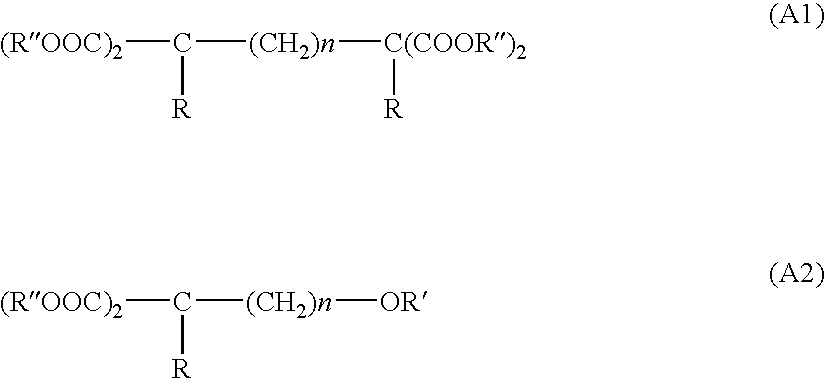
(ii) step of obtaining Mixture (I) containing a compound expressed by general formula (A1) below and a compound expressed by general formula (A2) below by reacting the diester of alkylated malonic acid with a dihaloalkane in the presence of a base:
Figure US07214328-20070508-C00004
where R and R″ is each independently an alkyl group, and R′ is hydrogen, a methyl group or an ethyl group, and n is an integer of 0 to 14;
(iii) step of obtaining Mixture (II) containing a compound expressed by general formula (B1) below and a compound expressed by general formula (B2) below by subjecting Mixture (I) to saponification and acidolysis:
Figure US07214328-20070508-C00005
where each R is a same or different alkyl group, and R′ is hydrogen, a methyl group or an ethyl group, and n is an integer of 0 to 14; and
(iv) step of collecting Mixture (III) containing the compound expressed by general formula (1) and the compound expressed by general formula (2) by subjecting Mixture (II) to decarbonation.
In a preferable embodiment, the base in each of step (i) and step (ii) is selected from the group consisting of pyridine, n-methyl pyrrolidine, metalalkoxide, potassium carbonate, and sodium carbonate.
In a preferable embodiment, R is a methyl group, an ethyl group, a propyl group or a butyl group, and n is 2 to 10.
BRIEF DESCRIPTION OF DRAWINGS
FIG. 1 is a process diagram showing an example of a process for producing a mixed solution containing main components of an electrolytic composition of the present invention.
FIG. 2 is a graph showing the relationship between the composition of the electrolytic solution and the electric conductivity.
BEST MODE FOR CARRYING OUT THE INVENTION
(Composition for Electrolytic Solution)
A composition for an electrolytic solution of the present invention comprises a compound expressed by general formula (1) below and a compound expressed by general formula (2) below or their salts.
Figure US07214328-20070508-C00006
The compound expressed by the formula (1) (this compound may be referred to as “compound (1)” in this specification) is a dibasic acid, and has an alkyl group at the carbon atom of α position of each of two carboxylic acids. The compound expressed by the formula (2) (this compound may be referred to as “compound (2)” in this specification) also has an alkyl group in the carbon atom of α position of a carboxylic acid.
In the general formulae above, R is an alkyl group, and may be the same or different. There is no particular limitation regarding the alkyl group. The alkyl group may be branched. Among alkyl groups, lower alkyl groups having 1 to 7 carbon atoms are preferable, and alkyl groups having 1 to 5 carbon atoms are more preferable. Among these, linear alkyl groups having 1 to 4 carbon atoms (methyl group, ethyl group, propyl group butyl group, etc.) are even more preferable. R′ is hydrogen, a methyl group, or an ethyl group.
n in the general formulae above is each independently an integer of 0 to 14, and preferably n is 1 to 12, and more preferably 2 to 10.
As a salt of the compound (1) and the compound (2), ammonium or amine salts thereof can be used preferably.
It is preferable that the composition for an electrolytic solution contains the compound (1) (dibasic acid) or a salt thereof and the compound (2) or a salt thereof in a mole ratio of 100:0 to 55:45, more preferably, 90:10 to 55:45, even more preferably, 80:20 to 55:45, and particularly preferably, 80:20 to 75:25.
The composition for an electrolytic solution of the present invention may contain a dibasic acid other than the above that conventionally has been used as a solute for an electrolytic solution in an amount that does not inhibit the characteristics of the composition for an electrolytic solution of the present invention. For example, a dibasic acid such as alkyl malonic acid may be contained.
(Process for Producing a Mixture Containing Compound (1) and Compound (2))
It is possible to produce separately each of the compound (1) and the compound (2) that are the main components of the composition for an electrolytic solution of the present invention with any suitable process. However, a mixture containing both of these components can be produced preferably by the process including steps (i) to (iv) below, and it is convenient to use this process.
  • (i) step of obtaining a diester of alkylated malonic acid (A0) by reacting a diester of malonic acid with an alkylhalide in the presence of a base;
  • (ii) step of obtaining Mixture (I) containing a compound expressed by general formula (A1) and a compound expressed by general formula (A2) (described later) by reacting the diester of alkylated malonic acid obtained in the step (i) with dihaloalkane in the presence of a base;
  • (iii) step of obtaining Mixture (II) containing a compound expressed by general formula (B1) and a compound expressed by general formula (B2) (described later) by subjecting Mixture (I) to saponification and acidolysis; and
  • (iv) step of obtaining Mixture (III) containing the compound (1) and the compound (2) by subjecting Mixture (II) to decarbonation.
The above-described process will be described more specifically with reference to FIG. 1. FIG. 1 shows a case where metalalkoxide, potassium carbonate or sodium carbonate is used as the base.
First, in the step (i), a diester of alkylated malonic acid (A0):
Figure US07214328-20070508-C00007
(where R and R″ are each independently an alkyl group) is obtained by reacting a diester of malonic acid with an alkylhalide (RX) in the presence of a base (metalalkoxide or potassium carbonate). R″ is preferably a methyl group or an ethyl group.
The step (i) includes the following processes, for example. Using an alcohol as a solvent, metallic sodium, sodium hydride or potassium carbonate is slowly added to the solvent, so that a base (e.g., sodium alkoxide or potassium alkoxide) is produced; a diester of malonic acid is dripped to this solution; then, alkylhalide is dripped; the mixture is refluxed; resultant alkylhalide (sodium halide) is filtered off, and then an excess amount of aqueous solution saturated with an ammonium chloride is poured to the reaction liquid so as to separate it into an organic layer and a water layer; then, the organic layer is washed with water, and by super-fractionation, unreacted diester of malonic acid is separated from a diester of alkylated malonic acid (A0); and the diester of alkylated malonic acid (A0) is isolated.
As the base, metalalkoxide, pyridine, n-methyl pyrrolidine, potassium carbonate, and sodium carbonate can be used preferably. Among these, metalalkoxide is preferable. As metalalkoxide, sodium alkoxide produced from metallic sodium or sodium hydride and an alcohol is preferably used. Examples thereof include sodium ethoxide and sodium methoxide.
As alkylhalide, for example, alkyl chloride (propyl chloride, butyl chloride, etc), methyl iodide and ethyl bromide can be used. The alkyl group of this alkylhalide corresponds to R of the compound (1) and the compound (2) above.
The metalalkoxide is reacted in an amount of, preferably 1.0 to 1.2 mols, and more preferably 1.1 mols, with respect to one mol of the diester of malonic acid. The alkylhalide is reacted in an amount of, preferably 0.5 to 0.8 mols, and more preferably 0.67 mols, with respect to one mol of the diester of malonic acid.
In this step (i), when one kind of alkylhalide is used, the alkyl groups R of the compounds expressed by the general formulae (1) and (2) are the same. When a combination of two or more kinds of alkylhalide having different alkyl groups is used, the alkyl groups R of the compounds expressed by the general formulae (1) and (2) can be different.
In the step (ii), Mixture (I) containing a compound expressed by the general formula (A1) below and a compound expressed by the general formula (A2) below is obtained by reacting the diester of alkylated malonic acid (A0) obtained in the step (i) with dihaloalkane in the presence of a base:
Figure US07214328-20070508-C00008
(where R and R″ are each independently an alkyl group, and R′ is hydrogen, a methyl group, or an ethyl group, and n is an integer of 0 to 14).
The base and the metalalkoxide used in this step (ii), the same base and metalalkoxide as those in the step (i) can be used.
The step (ii) includes the following processes, for example. Using an alcohol as a solvent, metal sodium or sodium hydride is slowly added thereto, so that sodium alkoxide is produced; a diester of alkylated malonic acid (A0) is dripped thereto; then, dihaloalkane (e.g., 1,ω-dichloroalkane) is dripped; the mixture is refluxed; after the reaction is completed, halogenated sodium is filtrated off, and then an excessive amount of aqueous solution saturated with an ammonium chloride is poured to the reaction liquid so as to separate it into an organic layer and a water; then, the organic layer is washed with water, and the organic layer is subjected to superfractionation so that unreacted dihaloalkane and the diester of alkylated malonic acid (A0) are separated from Mixture (I) of the compound expressed by general formula (A1) and the compound expressed by general formula (A2) can be obtained, and the mixture is collected.
The metalalkoxide is reacted in an amount of,-preferably 0.9 to 1.1 mols, and more preferably 1.0 mols, with respect to one mol of the diester of alkylated malonic acid (A0). The dihaloalkane is reacted in an amount of, preferably 0.45 to 0.55 mols, and more preferably 0.5 mols, with respect to one mol of the diester of alkylated malonic acid (A0).
By using a combination two or more dihaloalkanes in the step (ii), a compound that is expressed by general formula (1) but has a different number as n and a compound that is expressed by general formula (2) but has a different number as n can be produced.
In the step (iii), Mixture (II) containing a compound expressed by general formula (B1) below and a compound expressed by general formula (B2) below is obtained by subjecting Mixture (I) to saponification and acidolysis:
Figure US07214328-20070508-C00009
(where R is each independently an alkyl group, and R′ is hydrogen, a methyl group, or an ethyl group, and n is an integer of 0 to 14).
The saponification and acidolysis can be performed by a method used by those skilled in the art as appropriate. For example, a saponification reaction can be performed by dripping an alkaline aqueous solution (e.g., sodium hydroxide solution) to Mixture (I). After the saponification reaction is completed, the mixture was turned to be acidic with, for example, sulfuric acid, and then washing with water is repeated so that Mixture (II) containing compounds expressed by general formulae (B1) and (B2) can be obtained.
In the step (iv), Mixture (III) containing the compound (1) and the compound (2) is obtained by subjecting Mixture (II) to decarbonation:
Figure US07214328-20070508-C00010
(where R is an alkyl group, and R′ is hydrogen, a methyl group, or an ethyl group, and n is an integer of 0 to 14).
In the step (iv), for example, first, Mixture (II) is dissolved in a suitable solvent (e.g., acetonitrile). A catalyst (e.g., copper oxide) is added to the solution, and an inert gas (e.g., argon gas) is blown into the solution so as to remove air. Then, the mixture is heated and refluxed so that decarbonation proceeds and thus a mixture containing the compound (1) and the compound (2) can be obtained.
The thus produced compound (1) and the compound (2) are made into a desired salt in accordance with necessity. For example, they are made into salts of ammonium, amine or the like, and, in particular, ammonium salts can be used preferably. The salts of the above compounds can be produced in the following manner, for example:the compound (1) and the compound (2) serving as solutes are dissolved in a solvent (e.g., ethylene glycol, γ-butyrolactone, methyl cellosolve, or a mixture thereof); ammonia, amine or the like is supplied to this solution; the supply of ammonia or amine is stopped when the pH of the solution has reached 6 to 8, preferably about 6.5 to about 7.5. The concentration of the solute is, for example, about 3 to 60% by weight (hereinafter wt %), preferably about 5 to 40 wt % and more preferably about 20 wt %.
(Electrolytic Solution for Operating Electrolytic Capacitor)
The electrolytic solution for operating an electrolytic capacitor of the present invention contains the compound (1) and the compound (2) or their salts. More specifically, this electrolytic solution contains the compound (1) and the compound (2) or their salts as solutes in a suitable solvent. As the solvent, acetonitrile, ethylene glycol, y-butyrolactone, methyl cellosolve, and the like can be used. These compounds generally are contained in a total amount of 0.5 to 40 wt %, preferably 1 to 25 wt %, more preferably 2 to 20 wt %, and even more preferably 5 to 12 wt %. It is preferable that the electrolytic solution for operating an electrolytic capacitor contains the compound (1) or its salt and the compound (2) or its salt in a mole ratio of 100:0 to 55:45, more preferably 90:10 to 55:45, and even more preferably 80:20 to 55:45, and particularly more preferably 80:20 to 75:25 in order to exhibit an excellent function as an electrolytic solution.
The electrolytic solution of the present invention is prepared by dissolving the compound (1) and the compound (2) or their salts in a solvent. Further, the mixture obtained by the process including the above-described steps (i) to (iv) can be utilized as an electrolytic solution as it is.
An additive that can be added to a conventional electrolytic solution by those skilled in the art can be added to the electrolytic solution for operating an electrolytic capacitor of the present invention in an amount that does not impair its function. Examples of such an additive include oxy-acids (such as malic acid, citric acid, glycolic acid, lactic acid, tartronic acid, and salicylic acid), 8-oxyquinoline, and ethylene diamine tetraacetic acid (EDTA).
The electrolytic solution for operating an electrolytic capacitor of the present invention may contain a dibasic acid other than the compound (1) and the compound (2) that conventionally has been used as a solute in an amount that does not impair the characteristics of the electrolytic solution for operating an electrolytic capacitor of the present invention.
The thus obtained electrolytic solution for operating an electrolytic capacitor of the present invention exhibits excellent characteristics in a wide temperature range. That is to say, an electrolytic solution for operating an electrolytic capacitor in which there is little precipitation at a low temperature, and that can be used at a rated voltage of 500 W and has a large industrial and practical value can be provided.
EXAMPLES
The present invention will be described more specifically by way of example, but the present invention is not limited to these examples.
Example 1
(Preparation of a Diester of Alkylated Malonic Acid)
Metallic sodium (2 mols:46 g) was gradually added to 2 L of ethanol to produce sodium ethoxide (EtONa), and diethyl malonate (3 mols 480 g) was dripped thereto. After the dripping is completed, methyl iodide (2 mols, 284 g) was dripped as alkylhalide. After the dripping is completed, the reaction was allowed to continue under reflux for one hour. The reaction liquid was poured to an excess amount (1 L) of an aqueous solution saturated with ammonium chloride, and separated into an organic layer and a water layer. The organic layer was collected, and washed with water. The obtained organic layer was subjected to superfractionation so as to separate unreacted diethyl malonate from diethyl methylmalonate, and thus the diethyl methylmalonate was isolated.
In the same manner, a reaction was performed under the same conditions as above, using ethyl bromide (2 mols, 218 g), propyl chloride (2 mols, 157 g) and butyl chloride (2 mols, 185 g). Table 1 shows the yield and the properties of the thus obtained diethyl alkylated malonates (diethyl methylmalonate, diethyl ethylmalonate, diethyl n-propylmalonate, and diethyl n-butylmalonate).
TABLE 1
molar
Name of compound bp/mmHg yield 1H-NMR CDCl3 standard: TMS
diethyl methylmalonate 60.0–60.4° C./ 94.1% δ 0.95(d, J = 8.2 Hz, 3H), 1.28(t, J = 8.7
CH3—CH(COOC2H5)2 3 mmHg 6H), Hz, 3.30(q, J = 8.2 Hz, 1H), 4.21(q, J =
8.7 Hz, 4H)
diethyl ethylmalonate 68.2–70.0° C./ 91.0% δ 0.98(t, J = 8.2 Hz, 3H), 1.28(t, J = 8.7 Hz,
C2H5—CH(COOC2H5)2 3 mmHg 6H), 1.92(d-q, J = 8.2 and 8.2 Hz, 2H),
3.25(t, J = 8.2 Hz, 1H), 4.21(q, J = 8.2 Hz,
4H)
diethyl n-propylmalonate 75.2–80.1° C./ 86.3% δ 0.94(t, J = 8.2 Hz, 3H), 1.28(t, J = 8.7 Hz,
C3H7—CH(COOC2H5)2 3 mmHg 6H, 1.36(t-q, J = 8.2 and 8.2 Hz, 2H),
1.88(t-d, J = 8.2 and 8.2 Hz, 2H),
3.35(t, J = 8.2 Hz, 2H), 4.20(q, J = 8.7 Hz,
4H)
diethyl n-butylmalonate 79.0–82.1° C./ 81.6% δ 0.90(t, J = 8.2 Hz, 3H), 1.30(t, J = 8.7 Hz,
C4H9—CH(COOC2H5)2 2 mmHg 6H, 1.30–1.42(c, 4H), 1.90(t-d, J = 8.2 and
8.2 Hz, 2H), 3.25(t, J = 8.2 Hz, 1H),
4.20(q, J = 8.7 Hz, 4H)

(Preparation of Mixture (I))
Mixture (I) was prepared using the above obtained diethyl n-butylmalonate in the following manner. First, metallic sodium (1 mol:23 g) was slowly added to 1 L of ethanol to produce EtONa, and diethyl n-butylmalonate (1 mol: 216 g) was dripped thereto. After the dripping is completed, 1,4-dichlorobutane (0.4 mols: 50.8 g) was dripped as dihaloalkane. The temperature of the reaction liquid was gradually increased to the reflux temperature of ethanol and the reflux was allowed to continue for four hours. The precipitated sodium chloride was filtrated off, and then the reaction liquid was poured to an excess amount (1 L) of an aqueous solution saturated with ammonium chloride, and separated into an organic layer and a water layer. The organic layer was collected, and washed with water. The obtained organic layer was subjected to superfractionation so that unreacted diethyl butylmalonate and 1,4-dichlorobutane were separated from the mixture. Thus a mixture (expressed by E4-4 in Table 2, which corresponds to Mixture (I) ) was obtained. The mixture contains a compound expressed by general formula (A1) where R has 4 carbon atoms and n is 4 (a compound expressed by (A1) of E4-4 in Table 2 below) in an amount of 147 g (0.30 mols) and a compound expressed by general formula (A2) where R has 4 carbon atoms and n is 4 (a compound expressed by (A2) of E4-4 in Table 2 below) in an amount of 22 g (0.07 mols). The yield of the compound (A1) and the compound (A2) contained in the mixture (E4-4) was 92.5% in total when calculated based on the amount of 1,4-dichlorobutane used in the reaction. The acid value of the mixture (E4-4) was 1.2 KOHmg/g, and the saponification value was 456 KOHmg/g as its actually measured value (calculated value: 461 KOHmg/g).
Separately from this, various Mixtures (I) were obtained, using diethyl alkylated malonate other than diethyl n-butylmalonate as above, by reacting it with various dihaloalkane under the reaction conditions as above. Table 2 shows the compositions of the obtained mixtures. In Table 2, each mixture is shown by Er-n with symbolized r, which is the carbon number of the alkyl group R, and n, which is the number of the methylene group of the compound (A1) and the compound (A2) contained in the mixture. For example, the carbon number r of alkyl group R of the compound (A1) and the compound (A2) contained in the above Mixture (I) obtained from diethyl n-butylmalonate and 1,4-dichlorobutane is 4, and n is 4, and therefore Mixture (I) is shown by “E4-4”. The yield in Table 2 is based on the amount of dihaloalkane.
TABLE 2
mixture
No. Mixture(I) (A1):(A2) molar
Er—n compound (A1) compound (A2) molar ratio yield(%)
E1-4
Figure US07214328-20070508-C00011
Figure US07214328-20070508-C00012
85:15 88.7
E2-4
Figure US07214328-20070508-C00013
Figure US07214328-20070508-C00014
84:16 81.9
E3-4
Figure US07214328-20070508-C00015
Figure US07214328-20070508-C00016
82:18 86.2
E4-4
Figure US07214328-20070508-C00017
Figure US07214328-20070508-C00018
81:19 92.5
E4-1
Figure US07214328-20070508-C00019
Figure US07214328-20070508-C00020
80:20 91.2
E4-2
Figure US07214328-20070508-C00021
Figure US07214328-20070508-C00022
81:19 89.1
E4-6
Figure US07214328-20070508-C00023
Figure US07214328-20070508-C00024
79:21 87.7
E4-8
Figure US07214328-20070508-C00025
Figure US07214328-20070508-C00026
78:22 84.4
E4-10
Figure US07214328-20070508-C00027
Figure US07214328-20070508-C00028
79:21 81.2

(Preparation of Mixture (II))
Next, the mixture E4-4 was subjected to saponification and acidolysis in the following manner. First, 500 mL of water was put in a 2 L flask, and E4-4 (146 g) was added thereto, and a 48% NaOH solution (120 g) was dripped at 100 ° C. while stirring. After the dripping was completed, the reaction was allowed to continue for further four hours while the temperature as above was maintained. Then, the reaction mixture was turned to be acidic with sulfuric acid, washing with water was repeated, and thus a mixture (expressed by AA4-4 in Table 3 and corresponding to Mixture (II)). The mixture contains a compound expressed by general formula (B1) where R has 4 carbon atoms and n is 4 (a compound expressed by (B1) of AA4-4 in Table 3 below) and a compound expressed by general formula (B2) where R has 4 carbon atoms and n is 4 (a compound expressed by (B2) of AA4-4 in Table 3 below) in a total amount of 95.7 g (0.26 mols) was obtained. The yield of the compound (B1) and the compound (B2) contained in this mixture (AA4-4) was 80 mol % based on the total amount of the compound expressed by (A1) and the compound expressed by (A2) of E4-4. The acid value of the mixture (AA4-4) was 587 KOHmg/g as its actually measured value (calculated value: 596 KOHmg/g).
Various Mixtures (II) were obtained by reacting other Mixtures (I) other than E4-4 shown in Table 2 in the same manner. Table 3 shows the compositions of the obtained mixtures. In Table 3, each mixture is shown by AAr-n with symbolized r, which is the carbon number of the alkyl group R, and n, which is the number of the methylene group of the compound (B1) and the compound (B2) contained in the mixture. For example, the carbon number r of alkyl group R of the compound (B1) and the compound (B2) contained in the above Mixture (II) obtained from the mixture (E4-4) is 4, and n is 4, and therefore Mixture (II) is shown by “AA4-4”.
TABLE 3
mixture
No. Mixture(II) molar
AAr-n compound(B1) compound(B2) yield(%)
AA1-4
Figure US07214328-20070508-C00029
Figure US07214328-20070508-C00030
81.5
AA2-4
Figure US07214328-20070508-C00031
Figure US07214328-20070508-C00032
82.4
AA3-4
Figure US07214328-20070508-C00033
Figure US07214328-20070508-C00034
85.3
AA4-4
Figure US07214328-20070508-C00035
Figure US07214328-20070508-C00036
80.0
AA4-1
Figure US07214328-20070508-C00037
Figure US07214328-20070508-C00038
84.2
AA4-2
Figure US07214328-20070508-C00039
Figure US07214328-20070508-C00040
83.0
AA4-6
Figure US07214328-20070508-C00041
Figure US07214328-20070508-C00042
82.9
AA4-8
Figure US07214328-20070508-C00043
Figure US07214328-20070508-C00044
83.3
AA4-10
Figure US07214328-20070508-C00045
Figure US07214328-20070508-C00046
84.9

(Preparation of Mixture (III))
Next, the mixture AA4-4 was subjected to decarbonation in the following manner. First, AA4-4 (83 g) was dissolved in 100 ml of acetonitrile, and this was added to 500 mL of water in a 2 L flask. Then, 0.01 mols (1 g) of copper oxide (I) was added thereto, and the container was purged with argon gas while gradually increasing the temperature. After purge with argon gas, the reaction was allowed to continue for six hours under acetonitrile reflux. After it was confirmed that generation of carbon acid gas has been stopped, the reaction liquid was poured to 50 ml of 3N hydrochloric acid, and the organic layer was collected, and then washing with water was repeated. The organic layer was dried so that the solvent is removed. Thus, a mixture (expressed by A4-4 in Table 4 and corresponding to Mixture (III)) containing a compound expressed by general formula (1) where R has 4 carbon atoms and n is 4 (a compound expressed by (1) of A4-4 in Table 4 below) and a compound expressed by general formula (2) where R has 4 carbon atoms and n is 4 (a compound expressed by (2) of A4-4 in Table 4 below) was obtained in an amount of 57.2 g. The yield of the compound (1) and the compound (2) contained in this mixture (A4-4) was 90.9 mol % based on the total amount of the compound expressed by (B1) and the compound expressed by (B2) of AA4-4. The acid value of the mixture (A4-4) was 383 KOHmg/g as its actually measured value (calculated value: 392 KOHmg/g).
The compound (1) and the compound (2) contained in the mixture A4-4 are methylesterified and purified by distillation, and then the structure of the obtained compound was determined.
The spectrum of a methyl esterified product of the compound (1) contained in the mixture A4-4 was as follows:
1H-NMR(CDCl3): δ 0.87 (t), 1.2–1.4 (c), 1.4–1.55 (c), 2.31 (t-t), 3.78 (s)
13C-NMR(CDCl3): δ 14.0, 23.1, 27.5, 29.7, 29.8, 30.1, 42.2, 50.7, 176.0
As a result, it was confirmed that this product was dimethyl-2,7-di-(n-butyl)octanedioic acid, and the compound (1) was 2,7-di-(n-butyl)octanedioic acid.
On the other hand, the spectrum of a methyl esterified product of the compound (2) contained in the mixture A4-4 was as follows:
1H-NMR(CDCl3): δ 0.96 (t), 1.11 (t), 1.2–1.7 (m-c), 3.41 (q), 3.37 (t), 3.67 (s)
13C-NMR(CDCl3): δ 14.0, 14.7, 23.1, 23.8, 29.7, 30.1, 31.0, 50.7, 63.0, 69.9, 176.0
As a result, it was confirmed that this product was methyl-2-butyl-6-ethoxyhexanoic acid, and the compound (2) was 2-butyl-6-ethoxyhexanoic acid.
Various Mixtures (III) were obtained by reacting other Mixtures (II) other than AA4-4 shown in Table 3 in the same manner. Table 4 shows the compositions of the obtained mixtures. In Table 4, each mixture is shown by Ar-n with symbolized r, which is the carbon number of the alkyl group R, and n, which is the number of the methylene group of the compound (1) and the compound (2) contained in the mixture. For example, the carbon number r of alkyl group R of the compound (1) and the compound (2) contained in the above Mixture (III) obtained from the mixture (AA4-4) is 4, and n is 4, and therefore Mixture (III) is shown by “A4-4”.
TABLE 4
mixture
No. Mixture(III) molar
Ar-n compound(1) compound(2) yield(%)
A1-4
Figure US07214328-20070508-C00047
Figure US07214328-20070508-C00048
86.6
A2-4
Figure US07214328-20070508-C00049
Figure US07214328-20070508-C00050
85.9
A3-4
Figure US07214328-20070508-C00051
Figure US07214328-20070508-C00052
88.8
A4-4
Figure US07214328-20070508-C00053
Figure US07214328-20070508-C00054
90.9
A4-1
Figure US07214328-20070508-C00055
Figure US07214328-20070508-C00056
90.0
A4-2
Figure US07214328-20070508-C00057
Figure US07214328-20070508-C00058
91.2
A4-6
Figure US07214328-20070508-C00059
Figure US07214328-20070508-C00060
89.9
A4-8
Figure US07214328-20070508-C00061
Figure US07214328-20070508-C00062
86.8
A4-10
Figure US07214328-20070508-C00063
Figure US07214328-20070508-C00064
87.7
Example 2
Each of the Mixtures (III) (except A4-1) shown in Table 4 was taken out in an amount of 55 g and was dissolved in 495 g of ethylene glycol (concentration of the mixture was 10 wt %). Ammonia gas was blown to this solution at room temperature, and the blowing of ammonia gas was stopped when the pH of the solution reached about 7. The water content of this mixed solution was measured, and adjusted such that the water content was about 1%. Using the obtained solution containing the mixture as an electrolytic solution for operating an electrolytic capacitor, the pH, the water content (%), the electric conductivity and the sparking threshold voltage (Vsp) of this electrolytic solution were measured. This electrolytic solution was used for 1000 hours, and the changes with the passage of time regarding the pH, the water content (%) and the electric conductivity were measured. Table 5 shows the results. For the mixture A4-4, the sparking threshold voltage (Vsp) after 1000 hours was measured and found to be 420 V.
Comparative Example
Ethylene glycol solutions containing 10% by weight of each of suberic acid, 1,6-decane dicarboxylic acid and 5,6-decane dicarboxylic acid were prepared, and were used as electrolytic solutions. Regarding these electrolytic solutions, the changes with the passage of time were measured in the same manner as in Example 2. Table 5 shows the results.
TABLE 5
Example 2
A1-4 A2-4 A3-4 A4-2 A4-4
Time Evaluation measured measured Measured measured measured
(hrs) item value % value % value % value % value %
Initial PH 8.97 100 8.32 100 8.46 100 9.13 100 9.06 100
Stage Water 1.47 100 1.18 100 1.32 100 1.28 100 1.01 100
   0 content (%)
mS/cm 2.87 100 2.61 100 2.23 100 2.28 100 1.97 100
Vsp(V) 390 100 365 100 380 100 385 100 405 100
  100 PH 9.06 101 8.39 101 8.57 101 9.15 100 9.19 101
Water 1.60 109 1.26 107 1.37 104 1.29 101 1.07 106
content (%)
mS/cm 2.73 95 2.51 96 2.17 97 2.24 98 1.86 94
  250 PH 9.42 105 8.56 103 8.77 104 9.18 101 9.20 102
Water 1.71 116 1.32 112 1.40 106 1.31 102 1.10 109
content (%)
mS/cm 2.68 93 2.47 95 2.16 97 2.19 96 1.85 94
  500 pH 9.60 107 8.92 107 8.94 106 9.32 102 9.32 103
water 1.84 125 1.43 121 1.47 111 1.31 102 1.18 117
content (%)
mS/cm 2.61 91 2.44 94 2.12 95 2.16 95 1.67 94
1,000 pH 9.87 110 9.07 109 8.94 106 9.50 104 9.36 103
water 1.88 128 1.48 125 1.50 114 1.35 102 1.21 120
content (%)
mS/cm 2.58 90 2.41 92 2.09 94 2.10 92 1.67 94
Example 2 Comparative Example
A4-6 A4-8 A4-10 suberic acid 1,6-D*1 5,6-D*2
Time Measured measured measured measured measured measured
(hrs) value % value % value % value % value % value %
Initial 8.38 100 7.63 100 8.65 100 7.39 100 8.08 100 7.03 100
Stage 1.25 100 1.32 100 1.09 100 1.16 100 1.16 100 1.14 100
   0 1.93 100 1.90 100 1.83 100 2.74 100 2.12 100 2.70 100
410 100 425 100 440 100 370 100 320 100 270 100
  100 8.46 101 7.96 104 8.74 100 8.17 111 9.12 113 8.53 121
1.30 104 1.43 108 1.14 105 2.11 182 1.58 136 1.64 144
1.85 96 1.84 97 1.83 100 2.70 99 2.08 98 1.92 71
  250 8.63 103 8.16 107 8.84 102 8.54 116 9.21 114 8.89 126
1.38 110 1.48 112 1.18 108 2.30 198 1.71 147 1.84 161
1.80 93 1.82 96 1.81 99 2.27 83 1.94 92 1.59 59
  500 8.68 104 8.36 110 8.98 104 8.89 120 9.25 114 9.04 129
1.44 115 1.52 115 1.26 116 9.02 122 1.81 156 1.92 168
1.83 95 1.80 95 1.79 98 1.89 69 1.59 75 1.06 39
1,000 8.79 105 8.42 110 9.05 105 9.27 125 9.32 115 9.04 129
1.44 115 1.54 117 1.31 120 2.90 100 1.94 167 1.92 168
1.83 95 1.78 94 1.75 96 0.97 35 1.59 75 1.06 39
*11,6-D: 1,6-decane dicarboxylic acid
*25,6-D: 5,6-decane dicarboxylic acid
The percent in Table 5 shows an increase or a decrease for each period, taking the initial value as 100%. As shown in Table 5, in the suberic acid that does not have an alkyl group at a carbon atom of α position, the electric conductivity is significantly reduced at the time of 1000 hours, the pH is increased, and the water content was increased to about 2.5 times as much. This indicates that the electrical stability is very poor.
The electrical deterioration of the electrolytic solution containing 1,6-decane dicarboxylic acid was significantly larger than the electrolytic solution containing the mixture of the present invention, but was not so large as the electrical deterioration of the electrolytic solution containing suberic acid. This seems to be because structurally, 1,6-decane dicarboxylic acid has one butyl group at one of carbon atoms of α position of the carboxyl groups.
The electrical deterioration of the electrolytic solution containing 5,6-decane dicarboxylic acid was also significantly large. This seems to be because the dicarboxyl groups at the vicinal position can be easily anhydrated and esterified by ethylene glycol. Thus, although 5,6-decane dicarboxylic acid has a butyl group at each carbon atom of α position of both carboxyl groups, desired characteristics cannot be obtained.
The reduction in the electric conductivity of the mixture of the present invention containing dibasic acid having alkyl groups at each carbon atoms of α position of the carboxyl groups was small, and the variations in the pH and water content were also very small. This seems to be because the alkyl groups at each carbon atoms of α position significantly suppress not only anhydration of the carboxylic acid but also an esterification by the ethylene glycol in the capacitor. Furthermore, it seems that the alkyl groups at each carbon atoms of α position of the carboxylic acid prevent amidation by ammonia.
Example 3
The electric characteristics were examined, with varied mixture ratios of 2,7-di-(n-butyl)octanedioic acid and 2-butyl-6-ethoxyhexanoic acid, which is a component compound A4-4 that was isolated in Example 1. FIG. 2 shows the relationship between the composition of an electrolytic solution and the electric conductivity. More specifically, FIG. 2 shows the relationship between the ratio (molar %) of 2-butyl-6-ethoxyhexanoic acid with respect to the total amount of 2,7-di-(n-butyl)octanedioic acid and 2-butyl-6-ethoxyhexanoic acid and the electric conductivity (mS/cm). Although the electric conductivity tends to be slightly reduced as 2-butyl-6-ethoxyhexanoic acid increases, the electric conductivity was relatively high and the sparking threshold voltage was high when 2-butyl-6-ethoxyhexanoic acid was contained in an amount of 30 molar % or less. The electric conductivity of the electrolytic solution containing only 2,7-di-(n-butyl) octanedioic acid was 2.19 mS/cm and the sparking threshold voltage thereof was 460V. The electric conductivity of the electrolytic solution containing only 2-butyl-6-ethoxyhexanoic acid was 1.66 mS/cm and the sparking threshold voltage thereof was 540V. These results indicate that it is necessary that in addition to the compound (1) (dibasic acid), the compound (2) is contained in the electrolytic solution of the present invention, because it significantly contributes to an increase in the sparking threshold voltage.
INDUSTRIAL APPLICABILITY
As described above, the electrolytic solution for operating an electrolytic capacitor using the compounds (1) and (2) as solutes has only a small electrical deterioration at a high voltage, and maintains good electrical characteristics for a long time. This electrolytic solution can be applied to a product with a rated voltage of 500 W, and has industrial and practical value.

Claims (8)

1. A composition for an electrolytic solution comprising a compound expressed by general formula (1) below and a compound expressed by general formula (2) below or their salts:
Figure US07214328-20070508-C00065
where each R is a same or different alkyl group, and R′ is hydrogen, a methyl group or an ethyl group, and n is an integer of 0 to 14,
wherein the compound expressed by general formula (1) and the compound expressed by general formula (2) are contained in a mole ratio of 90:10 to 55:45.
2. The composition for an electrolytic solution according to claim 1, wherein R is a methyl group, and ethyl group, a propyl group or a butyl group, and n is 2 to 10.
3. An electrolytic solution for operating an electrolytic capacitor containing the composition for an electrolytic solution according to claim 1.
4. A process for producing a mixture comprising a compound expressed by general formula (1) below and a compound expressed by general formula (2) below or their salts:
Figure US07214328-20070508-C00066
where each R is a same or different alkyl group, and R′ is hydrogen, a methyl group or an ethyl group, and n is an integer of 0 to 14, comprising:
(i) step of obtaining a diester of alkylated malonic acid by reacting a diester of malonic acid with alkylhalide in the presence of a base;
(ii) step of obtaining Mixture (I) containing a compound expressed by general formula (A1) below and a compound expressed by general formula (A2) below by reacting the diester of alkylated malonic acid with a dihaloalkane in the presence of a base:
Figure US07214328-20070508-C00067
where R and R″ is each independently an alkyl group, and R′ is hydrogen, a methyl group or an ethyl group, and n is an integer of 0 to 14;
(iii) step of obtaining Mixture (II) containing a compound expressed by general formula (B1) below and a compound expressed by general formula (B2) below by subjecting Mixture (I) to saponification and acidolysis:
Figure US07214328-20070508-C00068
where each R is a same or different alkyl group, and R′ is hydrogen, a methyl group or an ethyl group, and n is an integer of 0 to 14; and
(iv) step of collecting Mixture (III) containing the compound expressed by general formula (1) and the compound expressed by general formula (2) by subjecting Mixture (II) to decarbonation.
5. The process according to claim 4, wherein the base in each of step (i) and step (ii) is selected from the group consisting of pyridine, n-methyl pyrrolidine, metalalkoxide, potassium carbonate, and sodium carbonate.
6. The process according to claim 4, wherein R is a methyl group, an ethyl group, a propyl group or a butyl group, and n is 2 to 10.
7. An electrolytic solution for operating an electrolytic capacitor containing the composition for an electrolytic solution according to claim 2.
8. The process according to claim 5, wherein R is a methyl group, an ethyl group, a propyl group or a butyl group, and n is 2 to 10.
US10/497,982 2001-12-11 2002-12-09 Composition for electrolytic solution and process for producing the same Expired - Lifetime US7214328B2 (en)

Applications Claiming Priority (3)

Application Number Priority Date Filing Date Title
JP2001-377318 2001-12-11
JP2001377318 2001-12-11
PCT/JP2002/012873 WO2003050828A1 (en) 2001-12-11 2002-12-09 Composition for electrolytic solution and process for producing the same

Publications (2)

Publication Number Publication Date
US20050077495A1 US20050077495A1 (en) 2005-04-14
US7214328B2 true US7214328B2 (en) 2007-05-08

Family

ID=19185319

Family Applications (1)

Application Number Title Priority Date Filing Date
US10/497,982 Expired - Lifetime US7214328B2 (en) 2001-12-11 2002-12-09 Composition for electrolytic solution and process for producing the same

Country Status (10)

Country Link
US (1) US7214328B2 (en)
EP (1) EP1463072B1 (en)
JP (1) JP4346444B2 (en)
KR (1) KR100922706B1 (en)
CN (1) CN100431072C (en)
AU (1) AU2002349522A1 (en)
BR (1) BRPI0214846B1 (en)
HU (1) HU228776B1 (en)
TW (1) TW589648B (en)
WO (1) WO2003050828A1 (en)

Families Citing this family (9)

* Cited by examiner, † Cited by third party
Publication number Priority date Publication date Assignee Title
JP4346444B2 (en) 2001-12-11 2009-10-21 岡村製油株式会社 Composition for electrolytic solution and method for producing the same
CN101521117B (en) * 2009-03-27 2011-06-29 深圳新宙邦科技股份有限公司 A kind of preparation method of dibasic carboxylic acid containing branched chain in alpha position for aluminum electrolytic capacitor electrolyte
CN103086871B (en) * 2013-02-02 2014-12-10 刘珍明 Preparation method of dicarboxylic acid with branch at alpha position for aluminum electrolytic capacitor electrolyte
CN103408415A (en) * 2013-07-22 2013-11-27 张家港保税区超威电化技术服务有限公司 Synthesis method of capacitance grade 2-sebacate
CN104447277B (en) * 2014-10-29 2016-03-09 江苏国泰超威新材料有限公司 A kind of method of coproduction capacitor stage 2-butyl sebacic acid and 2,9-dibutyl sebacic acid
CN105037138A (en) * 2015-07-06 2015-11-11 上海应用技术学院 Preparation method for 2,9-dibutyl sebacate
CN108047028A (en) * 2017-12-15 2018-05-18 中国石油大学(华东) A kind of preparation method of capacitor stage 2,7- dibutyl suberic acids
CN109180540A (en) * 2018-09-20 2019-01-11 武汉海斯普林科技发展有限公司 A kind of preparation method and application of highly branched chain dicarboxylic acids ammonium salt
CN110105211A (en) * 2019-05-24 2019-08-09 启东东岳药业有限公司 The recoverying and utilizing method of by-product in the halogenated ethyl caprilate preparation process of 8-

Citations (19)

* Cited by examiner, † Cited by third party
Publication number Priority date Publication date Assignee Title
JPS5727013A (en) 1980-07-25 1982-02-13 Nippon Chemical Condenser Kk Electrolyte for driving electrolytic condenser
JPS627684A (en) 1985-07-04 1987-01-14 日立化成工業株式会社 Manufacture of coating forming graphite material and equipment therefor
JPS628005A (en) 1985-07-03 1987-01-16 Mitsubishi Electric Corp Apparatus for measuring thickness of film
JPS6211765A (en) 1985-07-10 1987-01-20 Asahi Chem Ind Co Ltd Thermoplastic resin composition
JPS62254416A (en) 1986-04-28 1987-11-06 三菱化学株式会社 Electrolyte for electrolytic capacitor
US4715976A (en) 1985-12-20 1987-12-29 Mitsubishi Petrochemical Co., Ltd. Electrolyte solution for electrolytic capacitor
JPS6354209A (en) 1986-08-26 1988-03-08 三井建設株式会社 Manufacture of resin concrete
JPS6431408U (en) 1987-08-18 1989-02-27
JPH02277208A (en) * 1989-04-18 1990-11-13 Matsushita Electric Ind Co Ltd Electrolyte for driving electrolytic capacitors
JPH02298007A (en) * 1989-05-12 1990-12-10 Matsushita Electric Ind Co Ltd Electrolyte for driving electrolytic capacitors
JPH0374826A (en) * 1989-08-16 1991-03-29 Matsushita Electric Ind Co Ltd Electrolyte for driving electrolytic capacitors
JPH04186713A (en) 1990-11-20 1992-07-03 Nichicon Corp Electrolyte for driving electrolytic capacitor
JPH04273421A (en) 1991-02-28 1992-09-29 Mitsubishi Petrochem Co Ltd Electrolyte for electrolytic capacitor drive use
JPH0684705A (en) 1992-09-03 1994-03-25 Sanyo Chem Ind Ltd Electrolytic solution for driving electrolytic capacitor and electrolytic capacitor using it
JPH06275472A (en) 1993-03-19 1994-09-30 Matsushita Electric Ind Co Ltd Electrolyte for driving electrolytic capacitor and electrolytic capacitor using same
JPH06290998A (en) 1993-04-01 1994-10-18 Matsushita Electric Ind Co Ltd Electrolytic capacitor driving electrolytic solution and electrolytic capacitor using the same
JPH0982577A (en) 1995-09-11 1997-03-28 Hitachi Aic Inc Electrolyte for electrolytic capacitor
EP1005053A2 (en) * 1998-11-26 2000-05-31 Okamura Oil Mills, Ltd. Composition comprising long chain dibasic acids and electrolytic solution using thereof
WO2003050828A1 (en) 2001-12-11 2003-06-19 Okamura Oil Mill. Ltd. Composition for electrolytic solution and process for producing the same

Family Cites Families (3)

* Cited by examiner, † Cited by third party
Publication number Priority date Publication date Assignee Title
DE3401913A1 (en) * 1984-01-20 1985-08-01 A. Nattermann & Cie GmbH, 5000 Köln Process for the preparation of 8-hydroxyoctanoic acid and its salts, and its use
JP3671262B2 (en) * 1995-08-30 2005-07-13 岡村製油株式会社 Long chain dibasic acid and electrolytic solution for electrolytic capacitor drive
JP4081617B2 (en) * 1997-01-13 2008-04-30 日本ケミコン株式会社 Electrolytic solution for electrolytic capacitors

Patent Citations (20)

* Cited by examiner, † Cited by third party
Publication number Priority date Publication date Assignee Title
JPS5727013A (en) 1980-07-25 1982-02-13 Nippon Chemical Condenser Kk Electrolyte for driving electrolytic condenser
JPS628005A (en) 1985-07-03 1987-01-16 Mitsubishi Electric Corp Apparatus for measuring thickness of film
JPS627684A (en) 1985-07-04 1987-01-14 日立化成工業株式会社 Manufacture of coating forming graphite material and equipment therefor
JPS6211765A (en) 1985-07-10 1987-01-20 Asahi Chem Ind Co Ltd Thermoplastic resin composition
US4715976A (en) 1985-12-20 1987-12-29 Mitsubishi Petrochemical Co., Ltd. Electrolyte solution for electrolytic capacitor
JPS62254416A (en) 1986-04-28 1987-11-06 三菱化学株式会社 Electrolyte for electrolytic capacitor
JPS6354209A (en) 1986-08-26 1988-03-08 三井建設株式会社 Manufacture of resin concrete
JPS6431408U (en) 1987-08-18 1989-02-27
JPH02277208A (en) * 1989-04-18 1990-11-13 Matsushita Electric Ind Co Ltd Electrolyte for driving electrolytic capacitors
JPH02298007A (en) * 1989-05-12 1990-12-10 Matsushita Electric Ind Co Ltd Electrolyte for driving electrolytic capacitors
JPH0374826A (en) * 1989-08-16 1991-03-29 Matsushita Electric Ind Co Ltd Electrolyte for driving electrolytic capacitors
JPH04186713A (en) 1990-11-20 1992-07-03 Nichicon Corp Electrolyte for driving electrolytic capacitor
JPH04273421A (en) 1991-02-28 1992-09-29 Mitsubishi Petrochem Co Ltd Electrolyte for electrolytic capacitor drive use
JPH0684705A (en) 1992-09-03 1994-03-25 Sanyo Chem Ind Ltd Electrolytic solution for driving electrolytic capacitor and electrolytic capacitor using it
JPH06275472A (en) 1993-03-19 1994-09-30 Matsushita Electric Ind Co Ltd Electrolyte for driving electrolytic capacitor and electrolytic capacitor using same
JPH06290998A (en) 1993-04-01 1994-10-18 Matsushita Electric Ind Co Ltd Electrolytic capacitor driving electrolytic solution and electrolytic capacitor using the same
JPH0982577A (en) 1995-09-11 1997-03-28 Hitachi Aic Inc Electrolyte for electrolytic capacitor
EP1005053A2 (en) * 1998-11-26 2000-05-31 Okamura Oil Mills, Ltd. Composition comprising long chain dibasic acids and electrolytic solution using thereof
US6258288B1 (en) * 1998-11-26 2001-07-10 Okamura Oil Mills, Ltd. Composition comprising long chain dibasic acids and electrolytic solution using thereof
WO2003050828A1 (en) 2001-12-11 2003-06-19 Okamura Oil Mill. Ltd. Composition for electrolytic solution and process for producing the same

Non-Patent Citations (2)

* Cited by examiner, † Cited by third party
Title
International Preliminary Examination Report, PCT/JP2002/012873, dated Mar. 2, 2004.
International Search Report for PCT/JP02/12873 dated Mar. 18, 2003.

Also Published As

Publication number Publication date
AU2002349522A1 (en) 2003-06-23
CN100431072C (en) 2008-11-05
BRPI0214846B1 (en) 2016-01-26
US20050077495A1 (en) 2005-04-14
TW589648B (en) 2004-06-01
TW200302497A (en) 2003-08-01
HUP0402544A2 (en) 2005-03-29
EP1463072A4 (en) 2007-12-19
EP1463072A1 (en) 2004-09-29
BR0214846A (en) 2004-08-31
HUP0402544A3 (en) 2012-08-28
WO2003050828A1 (en) 2003-06-19
KR20040071719A (en) 2004-08-12
KR100922706B1 (en) 2009-10-22
CN1602532A (en) 2005-03-30
JPWO2003050828A1 (en) 2005-04-21
JP4346444B2 (en) 2009-10-21
HU228776B1 (en) 2013-05-28
EP1463072B1 (en) 2013-02-27

Similar Documents

Publication Publication Date Title
JP5466256B2 (en) Aluminum electrolytic capacitor electrolyte and method for producing core solute thereof
US7214328B2 (en) Composition for electrolytic solution and process for producing the same
US8279581B2 (en) Electrolytic solution for electrolytic capacitor and electrolytic capacitor using the same
JP2016134406A (en) Carboxylic acid compounds useful as solutes for electrolytic solutions for power storage devices, and methods for producing the same.
US6791823B2 (en) Electrolysis solution for electrolytic capacitors
JP3373889B2 (en) Electrolytic solution for driving electrolytic capacitor and electrolytic capacitor using the same
JP3373884B2 (en) Electrolytic solution for driving electrolytic capacitor and electrolytic capacitor using the same
JP2910056B2 (en) Electrolyte for driving electrolytic capacitors
JP3304459B2 (en) Electrolytic solution for driving electrolytic capacitor and electrolytic capacitor using the same
JP2910048B2 (en) Electrolyte for driving electrolytic capacitors
JP2003163139A (en) Electrolyte for electrolytic capacitors
JP2000068155A (en) Electrolytic solution for electrolytic capacitor
CN112028741B (en) Electrolyte for ultrahigh-voltage aluminum electrolytic capacitor and preparation method and application thereof
JP2910050B2 (en) Electrolyte for driving electrolytic capacitors
JP2000182897A (en) Electrolyte for electrolytic capacitor
JP2005005336A (en) Electrolytic solution for electrolytic capacitor driving and electrolytic capacitor using the same
JP2022069386A (en) Electrolytes and compounds and capacitors used for the electrolytes
JP2649239B2 (en) Heat-resistant charge transfer complex and heat-resistant solid electrolytic capacitor
JP2649240B2 (en) Heat-resistant charge transfer complex and heat-resistant solid electrolytic capacitor
JP2774525B2 (en) Electrolyte for electrolytic capacitors
JPH0810663B2 (en) Electrolytic solution for electrolytic capacitors
JP2673436B2 (en) Heat-resistant charge transfer complex and heat-resistant solid electrolytic capacitor
JP2002270472A (en) Electrolyte for electrolytic capacitor and electrolytic capacitor
JPH11340099A (en) Electrolytic solution for electrolytic capacitor and electrolytic capacitor using the same
JP2649238B2 (en) Heat-resistant charge transfer complex and heat-resistant solid electrolytic capacitor

Legal Events

Date Code Title Description
AS Assignment

Owner name: OKAMURA OIL MILL, LTD., JAPAN

Free format text: ASSIGNMENT OF ASSIGNORS INTEREST;ASSIGNORS:MIYOSHI, NORITAKA;NAKAGAWA, MASASHI;YAMAGAWA, YASUYUKI;AND OTHERS;REEL/FRAME:016046/0045

Effective date: 20040525

AS Assignment

Owner name: OKAMURA OIL MILL, LTD., JAPAN

Free format text: CORRECTIVE ASSIGNMENT TO CORRECT THE NAME OF THE ASSIGNOR PREVIOUSLY RECORDED ON REEL 016046 FRAME 0045;ASSIGNORS:MIYOSHI, NORITAKA;NAKAGAWA, MASASHI;YAMAGAWA, YASUYUKI;AND OTHERS;REEL/FRAME:016241/0934

Effective date: 20040525

STCF Information on status: patent grant

Free format text: PATENTED CASE

FPAY Fee payment

Year of fee payment: 4

FPAY Fee payment

Year of fee payment: 8

MAFP Maintenance fee payment

Free format text: PAYMENT OF MAINTENANCE FEE, 12TH YR, SMALL ENTITY (ORIGINAL EVENT CODE: M2553); ENTITY STATUS OF PATENT OWNER: SMALL ENTITY

Year of fee payment: 12