US6954875B2 - Method of recovering a flight critical computer after a radiation event - Google Patents
Method of recovering a flight critical computer after a radiation event Download PDFInfo
- Publication number
- US6954875B2 US6954875B2 US10/095,730 US9573002A US6954875B2 US 6954875 B2 US6954875 B2 US 6954875B2 US 9573002 A US9573002 A US 9573002A US 6954875 B2 US6954875 B2 US 6954875B2
- Authority
- US
- United States
- Prior art keywords
- data
- operational
- memory
- damaged
- controller
- Prior art date
- Legal status (The legal status is an assumption and is not a legal conclusion. Google has not performed a legal analysis and makes no representation as to the accuracy of the status listed.)
- Expired - Fee Related, expires
Links
Images


Classifications
-
- G—PHYSICS
- G06—COMPUTING OR CALCULATING; COUNTING
- G06F—ELECTRIC DIGITAL DATA PROCESSING
- G06F11/00—Error detection; Error correction; Monitoring
- G06F11/07—Responding to the occurrence of a fault, e.g. fault tolerance
- G06F11/14—Error detection or correction of the data by redundancy in operation
-
- G—PHYSICS
- G06—COMPUTING OR CALCULATING; COUNTING
- G06F—ELECTRIC DIGITAL DATA PROCESSING
- G06F11/00—Error detection; Error correction; Monitoring
- G06F11/07—Responding to the occurrence of a fault, e.g. fault tolerance
- G06F11/14—Error detection or correction of the data by redundancy in operation
- G06F11/1479—Generic software techniques for error detection or fault masking
- G06F11/1492—Generic software techniques for error detection or fault masking by run-time replication performed by the application software
-
- G—PHYSICS
- G06—COMPUTING OR CALCULATING; COUNTING
- G06F—ELECTRIC DIGITAL DATA PROCESSING
- G06F11/00—Error detection; Error correction; Monitoring
- G06F11/07—Responding to the occurrence of a fault, e.g. fault tolerance
- G06F11/14—Error detection or correction of the data by redundancy in operation
- G06F11/1479—Generic software techniques for error detection or fault masking
- G06F11/1492—Generic software techniques for error detection or fault masking by run-time replication performed by the application software
- G06F11/1494—N-modular type
-
- G—PHYSICS
- G06—COMPUTING OR CALCULATING; COUNTING
- G06F—ELECTRIC DIGITAL DATA PROCESSING
- G06F11/00—Error detection; Error correction; Monitoring
- G06F11/07—Responding to the occurrence of a fault, e.g. fault tolerance
- G06F11/14—Error detection or correction of the data by redundancy in operation
- G06F11/1497—Details of time redundant execution on a single processing unit
-
- G—PHYSICS
- G06—COMPUTING OR CALCULATING; COUNTING
- G06F—ELECTRIC DIGITAL DATA PROCESSING
- G06F11/00—Error detection; Error correction; Monitoring
- G06F11/07—Responding to the occurrence of a fault, e.g. fault tolerance
- G06F11/16—Error detection or correction of the data by redundancy in hardware
- G06F11/1658—Data re-synchronization of a redundant component, or initial sync of replacement, additional or spare unit
-
- G—PHYSICS
- G06—COMPUTING OR CALCULATING; COUNTING
- G06F—ELECTRIC DIGITAL DATA PROCESSING
- G06F11/00—Error detection; Error correction; Monitoring
- G06F11/07—Responding to the occurrence of a fault, e.g. fault tolerance
- G06F11/16—Error detection or correction of the data by redundancy in hardware
- G06F11/1666—Error detection or correction of the data by redundancy in hardware where the redundant component is memory or memory area
-
- G—PHYSICS
- G06—COMPUTING OR CALCULATING; COUNTING
- G06F—ELECTRIC DIGITAL DATA PROCESSING
- G06F11/00—Error detection; Error correction; Monitoring
- G06F11/07—Responding to the occurrence of a fault, e.g. fault tolerance
- G06F11/16—Error detection or correction of the data by redundancy in hardware
- G06F11/18—Error detection or correction of the data by redundancy in hardware using passive fault-masking of the redundant circuits
-
- G—PHYSICS
- G06—COMPUTING OR CALCULATING; COUNTING
- G06F—ELECTRIC DIGITAL DATA PROCESSING
- G06F11/00—Error detection; Error correction; Monitoring
- G06F11/07—Responding to the occurrence of a fault, e.g. fault tolerance
- G06F11/16—Error detection or correction of the data by redundancy in hardware
- G06F11/18—Error detection or correction of the data by redundancy in hardware using passive fault-masking of the redundant circuits
- G06F11/182—Error detection or correction of the data by redundancy in hardware using passive fault-masking of the redundant circuits based on mutual exchange of the output between redundant processing components
-
- G—PHYSICS
- G06—COMPUTING OR CALCULATING; COUNTING
- G06F—ELECTRIC DIGITAL DATA PROCESSING
- G06F11/00—Error detection; Error correction; Monitoring
- G06F11/07—Responding to the occurrence of a fault, e.g. fault tolerance
- G06F11/16—Error detection or correction of the data by redundancy in hardware
- G06F11/18—Error detection or correction of the data by redundancy in hardware using passive fault-masking of the redundant circuits
- G06F11/183—Error detection or correction of the data by redundancy in hardware using passive fault-masking of the redundant circuits by voting, the voting not being performed by the redundant components
Definitions
- This invention relates to real-time computing systems and more specifically to a method for recovering a real-time computer system after a transient radiation event such as that caused by a cosmic ray striking a trace within a semiconductor device.
- a single energetic particle can deposit sufficient charge in an integrated circuit to change the state of internal storage elements and may also cause more complex internal behavior.
- the observable changes of state can include bit-flips, latched power conditions, and short circuits.
- a bit-flip such as from logic ‘0’ to logic ‘1’, is an example of a transient fault mode known as a single event upset (SEU).
- SEU single event upset
- a latched power condition is an example of a potentially catastrophic fault mode known as a single event latch-up (SEL).
- SEL single event latch-up
- a short circuit in an integrated circuit typically results in a hard failure, which is typically mitigated by redundant circuitry.
- redundant computers are typically employed.
- FIG. 1 shows a triple redundant flight critical computer architecture that might typically be used onboard a spacecraft.
- Redundant sensors 15 provide inputs to a first computer 11 , a second computer 12 , and a third computer 13 .
- Each computer includes inputs 17 , processing 18 , and outputs 19 .
- the outputs from each of the redundant computers 11 - 13 are routed to redundant sensors 16 .
- the redundant computers 11 - 13 are interconnected with a cross-channel data link (CCDL) 14 which allows the computers to interchange data.
- CCDL cross-channel data link
- each flight critical computer such as a spacecraft navigation computer
- each flight critical computer is able to detect and recover from both an SEU and an SEL because an undetected transient fault can possibly diverge to a hard failure.
- FIG. 2 depicts a block diagram of a typical flight critical computer that may be found onboard a spacecraft.
- the computer includes a central processing unit (CPU) 21 connected by an address bus 22 and a data bus 23 to a nonvolatile memory (NVM) 24 , a memory-mapped input/output controller 25 , and random access memory (RAM) hardware modules 26 - 28 .
- the input/output controller 25 is connected to inputs 17 using, for example, analog to digital converters, and to outputs 19 using, for example, relay drivers.
- An operational flight program (OFP) is loaded during an initialization sequence to the random memory modules 26 - 28 and is then executed.
- OFP operational flight program
- a known method of recovering a flight critical computer in a radiation environment, without accessing another computer via the CCDL 14 and re-initialing, is to save the state data of the computer, stored in random access memory (RAM) 26 - 28 , to a radiation-hardened temporary storage while executing the operational flight program (OFP).
- OFP operational flight program
- SEU single event upset
- RAM random access memory
- this prior art approach fails to insure data integrity in the temporary storage and also can cause the redundant computers 11 - 13 to lose synchronization.
- the recovered computer needs to be re-admitted before the next SEU occurs and there can be critical phases of a mission during which re-initialization is not practical, such as initializing a de-orbit burn.
- FDIR fault detection, identification and reconfiguration
- a typical FDIR design aims to prevent the flight critical computer 11 from using erroneous data from faulty sensors 15 and from sending out improper control to faulty actuators 16 .
- a typical flight critical computer includes both a fault detection and identification algorithm and a fault accommodation/reconfiguration algorithm.
- the fault detection and identification algorithm typically embedded in the control laws, is devised to detect faulty components in the various control loops.
- the reconfiguration algorithm is typically a vehicle-specific adaptive mechanism that cancels the adverse effects caused by faulty components, such as ‘hard-over’ actuators.
- the present invention for the real-time self-recovery of a flight critical computer, is based on the concept of analytical redundancy such that it can be realized in application software, without the need for additional radiation-hardened devices or other proprietary circuitry to increase the survivability of each flight critical computer.
- the present inventive method does not require extensive modifications to presently available real-time operating system (RTOS) software or operational flight programs (OFP) that may be available in the prior art, but utilizes faster central processing units (CPU) and hardware memory modules with greater storage capacity.
- RTOS real-time operating system
- OFFP operational flight programs
- Analytical redundancy uses the functional relationship between system variables, which are processed in the operational flight program (OFP), to generate synthetic outputs that are comparable to the outputs from physical redundancy. These synthetic outputs are created by sequentially running multiple versions of the same or similar operational flight programs (OFP) on the central processing unit (CPU) 21 in each flight critical computer 11 - 13 and comparing the results.
- OFP operational flight program
- CPU central processing unit
- multiple versions of the same or similar computer programs are run on the same processor within the time frame required to previously run a single copy.
- Each one of these multiple OFPs is associated with a dedicated memory partition located in a distinct hardware random access memory (RAM) module.
- RAM hardware random access memory
- the typical flight critical computer illustrated in FIG. 2 could have three versions of the OFP, where each version is located in RAM modules 26 , 27 , and 28 respectively.
- SEU single event upset
- the controller OFP is responsible for control of devices attached to the flight critical computer.
- the observer OFP can be a copy of the controller OFP or it can be an alternate design that replicates the full states of the controller.
- Each OFP includes a fault detection and isolation algorithm in which the data results from that OFP are compared with the data results of the other OFPs.
- the controller OFP is declared invalid, one of the observers is designated as the controller. It is another aspect of my invention that each invalid OFP is recovered by copying a data image of the memory partition associated with a valid OFP. The controller OFP becomes an observer OFP after data set recovery.
- FIG. 1 depicts a set of triple redundant flight critical computers as may be found in the prior art
- FIG. 2 depicts an internal block diagram of a typical flight critical computer including memory-mapped inputs and outputs;
- FIG. 3 is a flow chart illustrating a procedure for recovering a flight critical computer in accordance with an illustrative embodiment of the present invention
- FIGS. 4 , 5 , and 6 illustrate specific details of the procedure of FIG. 3 , in accordance with the present invention
- FIG. 7 depicts the layout of a memory partition contained on a distinct hardware module depicts an internal block diagram of a typical flight critical computer including memory-mapped inputs and outputs;
- FIG. 8 depicts the block diagram of an identity observer constructed according to Luenberger's identity observer theorem that is suitable for use with my invention.
- FIG. 9 depicts the token of output priority for an example embodiment of my invention.
- FIG. 10 depicts the error detection flag to memory partition 1 for an example embodiment of my invention.
- FIG. 11 depicts the error detection flag to memory partition 2 for an example embodiment of my invention.
- FIG. 12 depicts the error detection flag to memory partition 3 for an example embodiment of my invention.
- FIG. 13 depicts the memory recovery flag in memory partition 1 for an example embodiment of my invention.
- FIG. 14 depicts the memory recovery flag in memory partition 2 for an example embodiment of my invention.
- FIG. 15 depicts the memory recovery flag in memory partition 3 for an example embodiment of my invention.
- FIG. 16 depicts the time response of ‘altitude’ versus ‘altitude reference’ for an example embodiment of my invention.
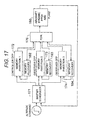
- FIG. 17 depicts the system architecture of an example embodiment of my invention.
- the identity observers replicate the state data of the operational flight program of the controller in distinct data partitions in the memory modules.
- a faulty controller can be recovered by replacing the data image of the faulty data partition with that of a healthy data partition.
- VMS vehicle management system
- my invention may be employed and comprising lanes of redundant vehicle management computers (VMC) 11 - 13 , redundant input sensors 15 , and redundant output actuators 16 .
- VMC vehicle management computers
- Identical hardware and software are used in all lanes of the system for redundancy.
- the VMC can be, for example, a flight-critical computer executing flight mode logic and control laws and managing input and output signals.
- a VMC might perform some of or all of the following tasks:
- the redundant flight critical computers 11 - 13 are managed by a redundancy management system (RMS).
- the RMS is the fault tolerant mechanism that detects and accommodates the possible faults in the input and the output signals.
- the RMS uses majority voting for fault detection.
- the redundant computers communicate with each other using a dedicated cross-channel data link (CCDL) 14 , in which the RMS distributes selected data from each lane for voting.
- CCDL cross-channel data link
- a redundancy management system might perform some of or all of the following tasks:
- an identity observer can be designed to restore the state vector of the original system.
- VMS functions as the original system, and the term ‘controller’ herein denotes the VMS functions in general, an identity observer can be constructed to track the state data of the controller.
- the identity observer is connected to the controller in series, meaning that computation of the controller and that of the observer can be executed sequentially. This enables us to expand our concept of a single observer to series observers. An array of identity observers can be designed accordingly. This enables data recovery in both the controller and the series observers.
- each partitioned random access memory (RAM) hardware module 26 - 28 is operated by a dedicated data memory-partition manager.
- the program code residing in the program memory is operated by a dedicated program partition manager.
- a hardware timer connected to the input signal management (ISM) block is devised to schedule the execution of run-time operational flight program (OFP).
- Another hardware timer is connected to fault detection, identification, and recovery (FDIR) block to regulate the activation of the FDIR procedure.
- ISM input signal management
- OFP run-time operational flight program
- FDIR fault detection, identification, and recovery
- FIG. 3 shows the method steps of one illustrative embodiment of my invention
- FIG. 7 depicts a computer memory allocation scheme.
- the program memory space (software) is partitioned (step 31 ) according to the banks (hardware) of system RAM 26 - 28 to isolate blocks of memory and provide space redundancy, each memory partition corresponding to a hardware memory device in the flight computer.
- These hardware isolated memory blocks 70 including program memory data segments 71 and program memory code segments 73 as shown in FIG. 7 , are allocated to accommodate the state data of the operational flight program (OFP).
- OFP operational flight program
- a hardware isolated memory block is assigned to the controller operational flight program (OFP) and separate hardware isolated memory blocks are assigned to each of the observer operational flight programs (OFP). It is another aspect of my invention that the run-time portion of each OFP is encapsulated to access only RAM within its assigned partition.
- a version of an executable operational flight program is downloaded (step 32 ) from the flight critical computer nonvolatile memory (NVM) 24 to each of respective hardware isolated memory blocks 70 , where each hardware isolated memory block is contained on a respective bank of system RAM 26 - 28 .
- Each version of the OFP is an ‘identity observer’ of each other version, meaning that all state variables have corresponding values at the end of an iteration of the OFP.
- the controller operational flight program (OFP) is run (step 33 ) and then each observer OFP is run in a predetermined sequence (step 34 ) to provide time redundancy.
- each OFP is scheduled by a dedicated hardware timer.
- a fault detection and isolation (FDI) procedure on the outputs of the controller OFP is performed (step 35 ) to determine whether the controller OFP memory partition is damaged. If it is determined that the memory partition that is currently the ‘controller’ OFP is damaged, another memory partition is assigned (step 36 ) to be ‘controller’.
- FDI fault detection and isolation
- the data within the controller OFP memory partition is checked by performing (step 351 ) a majority vote of that data against corresponding data in the other ‘observer’ memory partitions. When any data in a partition does not match the majority results, it is marked (step 352 ) as damaged. When data within the controller OFP partition is damaged, then an ‘assign new controller’ can be set (step 353 ).
- different fault detection and isolation schemes such as parity checking or cross-channel comparison, are used instead of or in addition to majority voting.
- step 37 when erroneous data is detected in one of the memory partitions, that data is overwritten (step 37 ) with fault-free data from an undamaged memory partition.
- SEU single event upset
- FIG. 5 details the sub-steps of the data overwriting method step (step 37 ).
- step 371 it is determined (step 371 ) whether more than one memory partition has been damaged, which would indicate that more than a single event upset (SEU) has occurred. If, for example, more than one memory partition has been damaged, a ‘use cross channel data link’ flag could be set (step 372 ) and the computer on which these memory partitions had been damaged could reset and rebuild its memory partitions via the cross channel data link 14 using methods that are known in the art.
- SEU single event upset
- the damaged data occurs in a single memory partition, corresponding to a single event upset (SEU), that damaged data is overwritten (step 373 ) with fault-free data, as determined by the fault detection, identification and reconfiguration (FDIR) function discussed previously.
- SEU single event upset
- FDIR fault detection, identification and reconfiguration
- FDIR fault detection, identification and reconfiguration
- the present invention recovers a flight critical computer from SEU-induced errors in the CPU, program memory data segment 71 and the program memory code segment 73 .
- a faulty computer can be recovered in a minimal number of OFP iterations.
- FIG. 6 details the sub-steps of determining whether to continue (step 38 ) operation of the flight computer after a damaged memory partition is damaged.
- a majority vote on data contained within each partition is performed (step 381 ) to reverify the memory partitions that are damaged.
- the operational flight program and data are downloaded (step 383 ) to each damaged memory partition from the cross channel data link (CCDL) 14 .
- Another majority vote is performed (step 385 ) on the data contained within each partition and it is determined whether more than one memory partition remains damaged (step 385 ). If more the one memory partition is damaged, then a ‘do not continue’ flag is set (step 386 ) which indicates that the flight computer should be taken off line.
- FIG. 8 depicts the block diagram of an identity observer, constructed according to Luenberger's identity observer theorem.
- x c ( k+ 1) Ax c ( k )+ Bu ( k )
- y c ( k ) CX c ( k )+ Du ( k )
- x c (0) [0; 0; . . . ; 0 ]
- y c (0) [0; 0; . . . ; 0] Eq. 1
- x c (k) ⁇ R n is the vector of system state
- x c (0) and y c (0) are the vectors of initial condition of the system
- u(k) ⁇ R m is the vector of system input
- y c (k) ⁇ R p is the vector of system output.
- A, B, C, and D are appropriately dimensioned real constant matrices.
- Perturbation of data in any components of the above equations results in anomalous in output y(t).
- an observer that is built on the mathematical description of the original system can be employed to track the state of the original system.
- the identity observer one that possesses a great degree of redundancy to the original system is the identity observer. The identity observer reconstructs all state variables of the original system.
- a system suitable for use with my invention includes a controller OFP and an observer OFP.
- the system RAM is partitioned for each OFP. The size of the partition is equally allocated to enable the direct mapping of memory address.
- the program code of each OFP resides in the redundant program memory.
- the run-time OFP block, the FDIR block, the block of data recovery algorithm, and the block of program recovery algorithm are placed in a way of representing the real-time program execution.
- the architecture includes other necessary function blocks such as input signal management (ISM) and output signal management (OSM).
- An altitude-hold autopilot controller is presented in this section to illustrate an illustrative system architecture using an example K matrix, in accordance with my invention, in a controller-observer design for recovery.
- An example mathematical representation of an aircraft's dynamics along the pitch axis serves as the plant in this full-state feedback control system.
- the plant is a continuous system described in Eq. 4 by the state space equation and output equation in the s domain. x .
- the plant is stabilized by a controller H in the first memory partition MP 0 with inputs h ref and z 0 (t), and output p 0 (t).
- the representation of the plant is depicted in Eq. 5.
- H [ 0.0009 - 0.0016 1.883 7.603 - 0.0018 ]
- FIG. 17 depicts a block diagram of the control system implementing an illustrative embodiment of my invention.
- the block diagram consists of master scheduler 171 , run-time controller 172 , observers 173 - 174 , FDIR module 176 , and certain other function blocks.
- the aircraft plant 180 such as the aircraft dynamic pitch axis, is controlled by the consecutively connected controller 172 and observers 173 - 174 .
- the mechanism of keeping the equality of initial conditions among the controller and observers resides in the master scheduler 171 .
- the first observer 173 and the second observer 174 use the same architecture and settings as the controller 172 .
- a fault detection (FD) process using the pair-wise comparison generates the residual between outputs is added to the first observer in the second memory partition MP 1 as shown in Eq. 6.
- FD fault detection
- the second observer in the third memory partition MP 2 is constructed in a similar way as the first observer.
- Eq. 7 depicts the representation of the second observer.
- each partition MP i,status is evaluated by a fault isolation process, such as those known in the art.
- a fault isolation process such as those known in the art.
- the output priority Token output is evaluated for fault accommodation, and then the data image replication process MR is initiated to recover faulty memory partition. Since the controller holds the output priority, the token of output priority changes in case of a faulty controller.
- the token of output priority is assigned according to the fault mode of the memory partitions.
- the data image in the memory partition that obtains the token serves as the baseline to replace the data image in the faulty memory partition.
- the generalized process is mathematically described in Eq. 8.
- the system RAM 26 - 28 is partitioned to accommodate the operations of the controller 172 and the observers 173 - 174 .
- Sufficient memory is also allocated to FDIR functions.
- the size of the partition is equally allocated among the controller and the observers to enable the direct mapping of memory address between the any given two partitions.
- Each memory partition is operated by a dedicated memory-partition manager to configure the perspective memory partition.
- the memory managers keep the equality of the initial conditions in the controller 172 and observers 173 - 174 .
- the master scheduler block is devised to activate the run-time controller and observers in a predefined timeframe while keeping the equality of initial conditions.
- the fault detection process proceeds in accordance with the readiness of outputs from controller 172 and observers 173 - 174 .
- the final FDIR procedure is triggered before the output of control to the plant 180 .
- the FDIR process commands the memory recovery managers 182 - 184 to initiate the memory recovery procedures in either a faulty controller or a faulty observer.
- FIGS. 9-13 depicts the sequence of detected single event upset (SEU).
- SEU single event upset
- FIG. 9 the SEU is detected at 10.0 seconds in the controller in the first memory partition.
- FIG. 10 shows that the SEU is detected at 15.0 seconds in the observer in the second memory partition, and
- FIG. 11 shows that the SEU is detected at 20.0 seconds in the observer in the third memory partition.
- FIGS. 14-15 depict the sequence and duration of triggered memory recovery efforts after each SEU being detected.
- FIG. 16 depicts the time response of the control system in such a scenario.
- my invention provides a real-time recovery of a flight critical computer after a single event upset caused by radiation.
- the performance of the controller is not degraded after the continual occurrence of SEU.
- CCA circuit card assembly CCDL cross channel data link
- CPU central processing unit FDIR fault detection, identification and reconfiguration I/O input/output
- ISM input signal management NVM nonvolatile memory
- OFP operational flight program OSM output signal management PID proportional, integral, and derivative (controller)
- RAM random access memory RMS redundancy management system
- RTOS real-time operating system software
Landscapes
- Engineering & Computer Science (AREA)
- Theoretical Computer Science (AREA)
- Quality & Reliability (AREA)
- Physics & Mathematics (AREA)
- General Engineering & Computer Science (AREA)
- General Physics & Mathematics (AREA)
- Hardware Redundancy (AREA)
- Techniques For Improving Reliability Of Storages (AREA)
Priority Applications (1)
| Application Number | Priority Date | Filing Date | Title |
|---|---|---|---|
| US10/095,730 US6954875B2 (en) | 2001-03-12 | 2002-03-12 | Method of recovering a flight critical computer after a radiation event |
Applications Claiming Priority (2)
| Application Number | Priority Date | Filing Date | Title |
|---|---|---|---|
| US27554401P | 2001-03-12 | 2001-03-12 | |
| US10/095,730 US6954875B2 (en) | 2001-03-12 | 2002-03-12 | Method of recovering a flight critical computer after a radiation event |
Publications (2)
| Publication Number | Publication Date |
|---|---|
| US20030033553A1 US20030033553A1 (en) | 2003-02-13 |
| US6954875B2 true US6954875B2 (en) | 2005-10-11 |
Family
ID=23052751
Family Applications (1)
| Application Number | Title | Priority Date | Filing Date |
|---|---|---|---|
| US10/095,730 Expired - Fee Related US6954875B2 (en) | 2001-03-12 | 2002-03-12 | Method of recovering a flight critical computer after a radiation event |
Country Status (9)
| Country | Link |
|---|---|
| US (1) | US6954875B2 (enExample) |
| EP (1) | EP1379950A4 (enExample) |
| JP (1) | JP2004528637A (enExample) |
| KR (1) | KR20030082983A (enExample) |
| AU (1) | AU2002245678C1 (enExample) |
| CA (1) | CA2440887A1 (enExample) |
| IL (1) | IL157911A0 (enExample) |
| NZ (1) | NZ528503A (enExample) |
| WO (1) | WO2002073505A1 (enExample) |
Cited By (14)
| Publication number | Priority date | Publication date | Assignee | Title |
|---|---|---|---|---|
| US20060211208A1 (en) * | 2004-08-27 | 2006-09-21 | Parekh Kunal R | Methods of forming gatelines and transistor devices |
| US20090094425A1 (en) * | 2007-10-08 | 2009-04-09 | Alex Winokur | Fast data recovery system |
| US20090106581A1 (en) * | 2007-10-19 | 2009-04-23 | Honda Motor Co., Ltd. | System and method for data writing |
| US20090261857A1 (en) * | 2006-06-07 | 2009-10-22 | Marshall Jr Joseph R | Universal non-volatile support device for supporting reconfigurable processing systems |
| US20090287967A1 (en) * | 2008-05-19 | 2009-11-19 | Axxana (Israel) Ltd. | Resilient Data Storage in the Presence of Replication Faults and Rolling Disasters |
| US20100169706A1 (en) * | 2005-04-20 | 2010-07-01 | Axxana (Israel) Ltd | Remote data mirroring system |
| US20100172084A1 (en) * | 2009-01-05 | 2010-07-08 | Axxana (Israel) Ltd | Disaster-Proof Storage Unit Having Transmission Capabilities |
| US20100313065A1 (en) * | 2009-06-03 | 2010-12-09 | Micron Technology, Inc. | Object oriented memory in solid state devices |
| US9021124B2 (en) | 2009-12-02 | 2015-04-28 | Axxana (Israel) Ltd. | Distributed intelligent network |
| US9104639B2 (en) | 2012-05-01 | 2015-08-11 | SEAKR Engineering, Inc. | Distributed mesh-based memory and computing architecture |
| US9195397B2 (en) | 2005-04-20 | 2015-11-24 | Axxana (Israel) Ltd. | Disaster-proof data recovery |
| US10379958B2 (en) | 2015-06-03 | 2019-08-13 | Axxana (Israel) Ltd. | Fast archiving for database systems |
| US10592326B2 (en) | 2017-03-08 | 2020-03-17 | Axxana (Israel) Ltd. | Method and apparatus for data loss assessment |
| US10769028B2 (en) | 2013-10-16 | 2020-09-08 | Axxana (Israel) Ltd. | Zero-transaction-loss recovery for database systems |
Families Citing this family (12)
| Publication number | Priority date | Publication date | Assignee | Title |
|---|---|---|---|---|
| US6813527B2 (en) * | 2002-11-20 | 2004-11-02 | Honeywell International Inc. | High integrity control system architecture using digital computing platforms with rapid recovery |
| FR2881243B1 (fr) * | 2005-01-24 | 2007-04-27 | Peugeot Citroen Automobiles Sa | Procede et systeme de reconfiguration par poursuite de calculateurs redondants d'une architecture distribuee tolerante aux fautes, notamment de vehicule automobile |
| US7789345B2 (en) * | 2005-03-03 | 2010-09-07 | Nabtesco Corporation | Actuator control apparatus |
| US20100318245A1 (en) * | 2005-03-03 | 2010-12-16 | Nabtesco Corporation | Flight control system |
| EP1857934B1 (en) | 2006-05-16 | 2009-07-15 | Saab Ab | Fault tolerant control system |
| FR2911972B1 (fr) * | 2007-01-30 | 2009-03-27 | Hispano Suiza Sa | Procede de surveillance de moteurs d'avion |
| US8209526B2 (en) * | 2008-09-30 | 2012-06-26 | General Electric Company | Method and systems for restarting a flight control system |
| FR2978264B1 (fr) * | 2011-07-18 | 2014-06-27 | Airbus Operations Sas | Un procede de rechargement automatique de logiciel et un dispositif de rechargement automatique de logiciel |
| KR101333468B1 (ko) * | 2012-04-25 | 2013-11-26 | 한국항공우주산업 주식회사 | 비행제어컴퓨터의 채널 아이디 점검 방법 및 그 방법을 실행하기 위한 컴퓨터 프로그램을 기록한 컴퓨터 판독 가능한 기록 매체 |
| JP6066748B2 (ja) * | 2013-01-29 | 2017-01-25 | 三菱重工業株式会社 | システム管理装置およびシステム |
| US10296429B2 (en) * | 2014-07-25 | 2019-05-21 | Hitachi, Ltd. | Storage device |
| JP6415161B2 (ja) * | 2014-07-29 | 2018-10-31 | 三菱重工業株式会社 | システム管理装置およびシステム |
Citations (14)
| Publication number | Priority date | Publication date | Assignee | Title |
|---|---|---|---|---|
| US5134619A (en) | 1990-04-06 | 1992-07-28 | Sf2 Corporation | Failure-tolerant mass storage system |
| US5363502A (en) | 1990-06-08 | 1994-11-08 | Hitachi, Ltd. | Hot stand-by method and computer system for implementing hot stand-by method |
| US5649089A (en) | 1994-11-30 | 1997-07-15 | Motorola, Inc. | Method and apparatus for maintaining a redundant database system |
| US5812565A (en) | 1995-07-11 | 1998-09-22 | Temic Telefunken Micro-Electric Gmbh | Method for automatic recognition and correction of an invalid data set and system for carrying out the method |
| US5835695A (en) * | 1996-07-29 | 1998-11-10 | Micron Electronics, Llp | Method for a primary BIOS ROM recovery in a dual BIOS ROM computer system |
| US5938774A (en) | 1997-07-08 | 1999-08-17 | Winbond Electronics Corp. | Apparatus for repairing faulty program segments in embedded microprocessor systems |
| US6154854A (en) | 1990-11-09 | 2000-11-28 | Emc Corporation | Logical partitioning of a redundant array storage system |
| US6195695B1 (en) * | 1998-10-27 | 2001-02-27 | International Business Machines Corporation | Data processing system and method for recovering from system crashes |
| US20010016919A1 (en) | 2000-01-31 | 2001-08-23 | Hitachi, Ltd. | Storage system |
| US20020032881A1 (en) | 2000-08-04 | 2002-03-14 | Ng Teckhock | Retrieval of a single complete copy from multiple stored copies of information |
| US6430663B1 (en) * | 1998-07-06 | 2002-08-06 | Adaptec, Inc. | Methods for selecting a boot partition and hiding a non-selected partition |
| US20030126493A1 (en) * | 1999-05-11 | 2003-07-03 | Hsin-Yi Lee | Method for automatically duplicating a bios |
| US6615375B1 (en) * | 2000-02-03 | 2003-09-02 | International Business Machines Corporation | Method and apparatus for tolerating unrecoverable errors in a multi-processor data processing system |
| US6665813B1 (en) * | 2000-08-03 | 2003-12-16 | International Business Machines Corporation | Method and apparatus for updateable flash memory design and recovery with minimal redundancy |
Family Cites Families (1)
| Publication number | Priority date | Publication date | Assignee | Title |
|---|---|---|---|---|
| US5530949A (en) * | 1991-03-19 | 1996-06-25 | Fujitsu Limited | Transmission equipment |
-
2002
- 2002-03-12 EP EP02713853A patent/EP1379950A4/en not_active Withdrawn
- 2002-03-12 AU AU2002245678A patent/AU2002245678C1/en not_active Ceased
- 2002-03-12 US US10/095,730 patent/US6954875B2/en not_active Expired - Fee Related
- 2002-03-12 IL IL15791102A patent/IL157911A0/xx unknown
- 2002-03-12 WO PCT/US2002/007666 patent/WO2002073505A1/en not_active Ceased
- 2002-03-12 NZ NZ528503A patent/NZ528503A/en unknown
- 2002-03-12 KR KR10-2003-7011973A patent/KR20030082983A/ko not_active Withdrawn
- 2002-03-12 JP JP2002572087A patent/JP2004528637A/ja active Pending
- 2002-03-12 CA CA002440887A patent/CA2440887A1/en not_active Abandoned
Patent Citations (14)
| Publication number | Priority date | Publication date | Assignee | Title |
|---|---|---|---|---|
| US5134619A (en) | 1990-04-06 | 1992-07-28 | Sf2 Corporation | Failure-tolerant mass storage system |
| US5363502A (en) | 1990-06-08 | 1994-11-08 | Hitachi, Ltd. | Hot stand-by method and computer system for implementing hot stand-by method |
| US6154854A (en) | 1990-11-09 | 2000-11-28 | Emc Corporation | Logical partitioning of a redundant array storage system |
| US5649089A (en) | 1994-11-30 | 1997-07-15 | Motorola, Inc. | Method and apparatus for maintaining a redundant database system |
| US5812565A (en) | 1995-07-11 | 1998-09-22 | Temic Telefunken Micro-Electric Gmbh | Method for automatic recognition and correction of an invalid data set and system for carrying out the method |
| US5835695A (en) * | 1996-07-29 | 1998-11-10 | Micron Electronics, Llp | Method for a primary BIOS ROM recovery in a dual BIOS ROM computer system |
| US5938774A (en) | 1997-07-08 | 1999-08-17 | Winbond Electronics Corp. | Apparatus for repairing faulty program segments in embedded microprocessor systems |
| US6430663B1 (en) * | 1998-07-06 | 2002-08-06 | Adaptec, Inc. | Methods for selecting a boot partition and hiding a non-selected partition |
| US6195695B1 (en) * | 1998-10-27 | 2001-02-27 | International Business Machines Corporation | Data processing system and method for recovering from system crashes |
| US20030126493A1 (en) * | 1999-05-11 | 2003-07-03 | Hsin-Yi Lee | Method for automatically duplicating a bios |
| US20010016919A1 (en) | 2000-01-31 | 2001-08-23 | Hitachi, Ltd. | Storage system |
| US6615375B1 (en) * | 2000-02-03 | 2003-09-02 | International Business Machines Corporation | Method and apparatus for tolerating unrecoverable errors in a multi-processor data processing system |
| US6665813B1 (en) * | 2000-08-03 | 2003-12-16 | International Business Machines Corporation | Method and apparatus for updateable flash memory design and recovery with minimal redundancy |
| US20020032881A1 (en) | 2000-08-04 | 2002-03-14 | Ng Teckhock | Retrieval of a single complete copy from multiple stored copies of information |
Non-Patent Citations (1)
| Title |
|---|
| International Search Report PCT/US02/07666; mailed Jun. 5, 2002. |
Cited By (23)
| Publication number | Priority date | Publication date | Assignee | Title |
|---|---|---|---|---|
| US20060211208A1 (en) * | 2004-08-27 | 2006-09-21 | Parekh Kunal R | Methods of forming gatelines and transistor devices |
| US7996709B2 (en) * | 2005-04-20 | 2011-08-09 | Axxana (Israel) Ltd. | Remote data mirroring system |
| US20110231366A1 (en) * | 2005-04-20 | 2011-09-22 | Axxana (Israel) Ltd | Remote data mirroring system |
| US9195397B2 (en) | 2005-04-20 | 2015-11-24 | Axxana (Israel) Ltd. | Disaster-proof data recovery |
| US8914666B2 (en) | 2005-04-20 | 2014-12-16 | Axxana (Israel) Ltd. | Remote data mirroring system |
| US20100169706A1 (en) * | 2005-04-20 | 2010-07-01 | Axxana (Israel) Ltd | Remote data mirroring system |
| US7800403B2 (en) | 2006-06-07 | 2010-09-21 | Bae Systems Information And Electronic Systems Integration Inc. | Universal non-volatile support device for supporting reconfigurable processing systems |
| US20090261857A1 (en) * | 2006-06-07 | 2009-10-22 | Marshall Jr Joseph R | Universal non-volatile support device for supporting reconfigurable processing systems |
| US20090094425A1 (en) * | 2007-10-08 | 2009-04-09 | Alex Winokur | Fast data recovery system |
| US7984327B2 (en) | 2007-10-08 | 2011-07-19 | Axxana (Israel) Ltd. | Fast data recovery system |
| US20090106581A1 (en) * | 2007-10-19 | 2009-04-23 | Honda Motor Co., Ltd. | System and method for data writing |
| US8015436B2 (en) | 2008-05-19 | 2011-09-06 | Axxana (Israel) Ltd | Resilient data storage in the presence of replication faults and rolling disasters |
| US20090287967A1 (en) * | 2008-05-19 | 2009-11-19 | Axxana (Israel) Ltd. | Resilient Data Storage in the Presence of Replication Faults and Rolling Disasters |
| US20100172084A1 (en) * | 2009-01-05 | 2010-07-08 | Axxana (Israel) Ltd | Disaster-Proof Storage Unit Having Transmission Capabilities |
| US8289694B2 (en) | 2009-01-05 | 2012-10-16 | Axxana (Israel) Ltd. | Disaster-proof storage unit having transmission capabilities |
| US8751860B2 (en) * | 2009-06-03 | 2014-06-10 | Micron Technology, Inc. | Object oriented memory in solid state devices |
| US9110832B2 (en) | 2009-06-03 | 2015-08-18 | Micron Technology, Inc. | Object oriented memory in solid state devices |
| US20100313065A1 (en) * | 2009-06-03 | 2010-12-09 | Micron Technology, Inc. | Object oriented memory in solid state devices |
| US9021124B2 (en) | 2009-12-02 | 2015-04-28 | Axxana (Israel) Ltd. | Distributed intelligent network |
| US9104639B2 (en) | 2012-05-01 | 2015-08-11 | SEAKR Engineering, Inc. | Distributed mesh-based memory and computing architecture |
| US10769028B2 (en) | 2013-10-16 | 2020-09-08 | Axxana (Israel) Ltd. | Zero-transaction-loss recovery for database systems |
| US10379958B2 (en) | 2015-06-03 | 2019-08-13 | Axxana (Israel) Ltd. | Fast archiving for database systems |
| US10592326B2 (en) | 2017-03-08 | 2020-03-17 | Axxana (Israel) Ltd. | Method and apparatus for data loss assessment |
Also Published As
| Publication number | Publication date |
|---|---|
| EP1379950A4 (en) | 2009-11-11 |
| WO2002073505A1 (en) | 2002-09-19 |
| KR20030082983A (ko) | 2003-10-23 |
| US20030033553A1 (en) | 2003-02-13 |
| AU2002245678B2 (en) | 2005-01-27 |
| JP2004528637A (ja) | 2004-09-16 |
| CA2440887A1 (en) | 2002-09-19 |
| IL157911A0 (en) | 2004-03-28 |
| EP1379950A1 (en) | 2004-01-14 |
| AU2002245678C1 (en) | 2005-10-13 |
| NZ528503A (en) | 2004-06-25 |
Similar Documents
| Publication | Publication Date | Title |
|---|---|---|
| US6954875B2 (en) | Method of recovering a flight critical computer after a radiation event | |
| AU2002245678A1 (en) | Method of recovering a flight critical computer after a radiation event | |
| Sklaroff | Redundancy management technique for space shuttle computers | |
| Spector et al. | The space shuttle primary computer system | |
| JP5283650B2 (ja) | 過渡エラー制約を受ける電子システムのためのメモリアクセス監視装置 | |
| Siewiorek | Architecture of fault-tolerant computers: An historical perspective | |
| US4771427A (en) | Equalization in redundant channels | |
| JP7427366B2 (ja) | 運用環境用の仮想化されたアビオニクスシステム | |
| WO2010144913A2 (en) | Memory change track logging | |
| JP2003518289A (ja) | 間欠誤りに耐性のあるソフトウェアシステムおよびそのシステムにおける制御処理 | |
| Jacklin | Survey of verification and validation techniques for small satellite software development | |
| Johnson et al. | Fault tolerant computer system for the A129 helicopter | |
| Duarte et al. | Development of an autonomous redundant attitude determination system for Cubesats | |
| Liu | A study of flight-critical computer system recovery from space radiation-induced error | |
| Bavuso | Advanced reliability modeling of fault-tolerant computer-based systems | |
| Li et al. | Transient fault tolerance on multicore processor in amp mode | |
| Hopkins Jr et al. | The evolution of fault tolerant computing at the Charles Stark Draper Laboratory, 1955–85 | |
| Malcom et al. | Flight software in the space department: a look at the past and a view toward the future | |
| Pontuschka et al. | FDIR for the IMU Component of AOCS Systems | |
| Kazi et al. | Design and Validation Architecture of the Dream Chaser® Fault Tolerant Flight Computer | |
| Szalai et al. | Flight experience with flight control redundancy management | |
| Albert et al. | Vehicle health management (VHM) architecture process development | |
| Grisbeck et al. | Autonomous surveillance satellite | |
| Bavuso | Hampton, Virginia 23665/USA | |
| Tulpule et al. | Equalization in redundant channels |
Legal Events
| Date | Code | Title | Description |
|---|---|---|---|
| AS | Assignment |
Owner name: HONEYWELL INTERNATIONAL INC., NEW JERSEY Free format text: ASSIGNMENT OF ASSIGNORS INTEREST;ASSIGNOR:LIU, CHUNG-YU;REEL/FRAME:013006/0406 Effective date: 20020409 |
|
| REMI | Maintenance fee reminder mailed | ||
| LAPS | Lapse for failure to pay maintenance fees | ||
| STCH | Information on status: patent discontinuation |
Free format text: PATENT EXPIRED DUE TO NONPAYMENT OF MAINTENANCE FEES UNDER 37 CFR 1.362 |
|
| FP | Lapsed due to failure to pay maintenance fee |
Effective date: 20091011 |
|
| AS | Assignment |
Owner name: POLARIS INNOVATIONS LIMITED, IRELAND Free format text: ASSIGNMENT OF ASSIGNORS INTEREST;ASSIGNOR:INFINEON TECHNOLOGIES AG;REEL/FRAME:036827/0885 Effective date: 20150708 |
|
| AS | Assignment |
Owner name: POLARIS INNOVATIONS LIMITED, IRELAND Free format text: CORRECTIVE ASSIGNMENT TO CORRECT THE PATENT 7105729 PREVIOUSLY RECORDED AT REEL: 036827 FRAME: 0885. ASSIGNOR(S) HEREBY CONFIRMS THE ASSIGNMENT;ASSIGNOR:INFINEON TECHNOLOGIES AG;REEL/FRAME:043336/0694 Effective date: 20150708 |