US6949566B2 - Thiazole and oxazole derivatives - Google Patents
Thiazole and oxazole derivatives Download PDFInfo
- Publication number
- US6949566B2 US6949566B2 US10/381,280 US38128003A US6949566B2 US 6949566 B2 US6949566 B2 US 6949566B2 US 38128003 A US38128003 A US 38128003A US 6949566 B2 US6949566 B2 US 6949566B2
- Authority
- US
- United States
- Prior art keywords
- optionally substituted
- compound
- pharmaceutically acceptable
- prodrug
- solvate
- Prior art date
- Legal status (The legal status is an assumption and is not a legal conclusion. Google has not performed a legal analysis and makes no representation as to the accuracy of the status listed.)
- Expired - Fee Related
Links
- FZWLAAWBMGSTSO-UHFFFAOYSA-N Thiazole Chemical compound C1=CSC=N1 FZWLAAWBMGSTSO-UHFFFAOYSA-N 0.000 title description 3
- 150000007978 oxazole derivatives Chemical class 0.000 title description 2
- 150000001875 compounds Chemical class 0.000 claims abstract description 115
- 125000000217 alkyl group Chemical group 0.000 claims abstract description 76
- 229940002612 prodrug Drugs 0.000 claims abstract description 37
- 239000000651 prodrug Substances 0.000 claims abstract description 37
- 150000003839 salts Chemical class 0.000 claims abstract description 34
- 239000012453 solvate Substances 0.000 claims abstract description 31
- 125000004435 hydrogen atom Chemical group [H]* 0.000 claims abstract description 25
- 125000003107 substituted aryl group Chemical group 0.000 claims abstract description 12
- 125000000732 arylene group Chemical group 0.000 claims abstract description 8
- -1 thiazole-2,5-diyl Chemical group 0.000 claims description 159
- 125000003545 alkoxy group Chemical group 0.000 claims description 51
- 229910052736 halogen Inorganic materials 0.000 claims description 37
- 150000002367 halogens Chemical class 0.000 claims description 36
- 238000000034 method Methods 0.000 claims description 34
- 125000001449 isopropyl group Chemical group [H]C([H])([H])C([H])(*)C([H])([H])[H] 0.000 claims description 31
- 125000002924 primary amino group Chemical group [H]N([H])* 0.000 claims description 30
- 125000002252 acyl group Chemical group 0.000 claims description 27
- 125000004414 alkyl thio group Chemical group 0.000 claims description 26
- 125000000959 isobutyl group Chemical group [H]C([H])([H])C([H])(C([H])([H])[H])C([H])([H])* 0.000 claims description 25
- 125000000304 alkynyl group Chemical group 0.000 claims description 23
- 125000003917 carbamoyl group Chemical group [H]N([H])C(*)=O 0.000 claims description 23
- 102000002274 Matrix Metalloproteinases Human genes 0.000 claims description 22
- 108010000684 Matrix Metalloproteinases Proteins 0.000 claims description 22
- 125000001072 heteroaryl group Chemical group 0.000 claims description 22
- 125000000449 nitro group Chemical group [O-][N+](*)=O 0.000 claims description 22
- 125000003342 alkenyl group Chemical group 0.000 claims description 21
- 125000004453 alkoxycarbonyl group Chemical group 0.000 claims description 21
- 230000002401 inhibitory effect Effects 0.000 claims description 21
- 125000003118 aryl group Chemical group 0.000 claims description 17
- 125000000753 cycloalkyl group Chemical group 0.000 claims description 16
- 125000004446 heteroarylalkyl group Chemical group 0.000 claims description 15
- 125000003710 aryl alkyl group Chemical group 0.000 claims description 14
- 125000006615 aromatic heterocyclic group Chemical group 0.000 claims description 13
- 125000004093 cyano group Chemical group *C#N 0.000 claims description 12
- 125000003302 alkenyloxy group Chemical group 0.000 claims description 11
- 125000002496 methyl group Chemical group [H]C([H])([H])* 0.000 claims description 11
- 125000001797 benzyl group Chemical group [H]C1=C([H])C([H])=C(C([H])=C1[H])C([H])([H])* 0.000 claims description 10
- 201000010099 disease Diseases 0.000 claims description 10
- 208000037265 diseases, disorders, signs and symptoms Diseases 0.000 claims description 10
- 125000006302 indol-3-yl methyl group Chemical group [H]N1C([H])=C(C2=C([H])C([H])=C([H])C([H])=C12)C([H])([H])* 0.000 claims description 9
- 125000003143 4-hydroxybenzyl group Chemical group [H]C([*])([H])C1=C([H])C([H])=C(O[H])C([H])=C1[H] 0.000 claims description 7
- 125000002057 carboxymethyl group Chemical group [H]OC(=O)C([H])([H])[*] 0.000 claims description 7
- 125000005549 heteroarylene group Chemical group 0.000 claims description 7
- 125000001997 phenyl group Chemical group [H]C1=C([H])C([H])=C(*)C([H])=C1[H] 0.000 claims description 7
- 102000005741 Metalloproteases Human genes 0.000 claims description 6
- 108010006035 Metalloproteases Proteins 0.000 claims description 6
- 239000008194 pharmaceutical composition Substances 0.000 claims description 5
- 241000124008 Mammalia Species 0.000 claims description 4
- 201000008482 osteoarthritis Diseases 0.000 claims description 4
- 239000000546 pharmaceutical excipient Substances 0.000 claims description 4
- 125000001140 1,4-phenylene group Chemical group [H]C1=C([H])C([*:2])=C([H])C([H])=C1[*:1] 0.000 claims description 3
- 206010019280 Heart failures Diseases 0.000 claims description 3
- 201000008383 nephritis Diseases 0.000 claims description 3
- 125000004356 hydroxy functional group Chemical group O* 0.000 claims 7
- 125000001475 halogen functional group Chemical group 0.000 claims 4
- 239000003937 drug carrier Substances 0.000 claims 3
- 208000019693 Lung disease Diseases 0.000 claims 1
- 230000001684 chronic effect Effects 0.000 claims 1
- 125000002887 hydroxy group Chemical group [H]O* 0.000 abstract description 33
- 239000013543 active substance Substances 0.000 abstract description 12
- 239000003475 metalloproteinase inhibitor Substances 0.000 abstract description 2
- IAZDPXIOMUYVGZ-WFGJKAKNSA-N Dimethyl sulfoxide Chemical compound [2H]C([2H])([2H])S(=O)C([2H])([2H])[2H] IAZDPXIOMUYVGZ-WFGJKAKNSA-N 0.000 description 42
- 125000005843 halogen group Chemical group 0.000 description 41
- 239000000203 mixture Substances 0.000 description 41
- XEKOWRVHYACXOJ-UHFFFAOYSA-N Ethyl acetate Chemical compound CCOC(C)=O XEKOWRVHYACXOJ-UHFFFAOYSA-N 0.000 description 39
- YXFVVABEGXRONW-UHFFFAOYSA-N Toluene Chemical compound CC1=CC=CC=C1 YXFVVABEGXRONW-UHFFFAOYSA-N 0.000 description 37
- IAZDPXIOMUYVGZ-UHFFFAOYSA-N Dimethylsulphoxide Chemical compound CS(C)=O IAZDPXIOMUYVGZ-UHFFFAOYSA-N 0.000 description 33
- NPDACUSDTOMAMK-UHFFFAOYSA-N CC1=CC=C(Cl)C=C1 Chemical compound CC1=CC=C(Cl)C=C1 NPDACUSDTOMAMK-UHFFFAOYSA-N 0.000 description 32
- CHLICZRVGGXEOD-UHFFFAOYSA-N COC1=CC=C(C)C=C1 Chemical compound COC1=CC=C(C)C=C1 CHLICZRVGGXEOD-UHFFFAOYSA-N 0.000 description 32
- VLKZOEOYAKHREP-UHFFFAOYSA-N n-Hexane Chemical compound CCCCCC VLKZOEOYAKHREP-UHFFFAOYSA-N 0.000 description 27
- 238000005160 1H NMR spectroscopy Methods 0.000 description 25
- WRWPPGUCZBJXKX-UHFFFAOYSA-N CC1=CC=C(F)C=C1 Chemical compound CC1=CC=C(F)C=C1 WRWPPGUCZBJXKX-UHFFFAOYSA-N 0.000 description 25
- CSCPPACGZOOCGX-UHFFFAOYSA-N Acetone Chemical compound CC(C)=O CSCPPACGZOOCGX-UHFFFAOYSA-N 0.000 description 24
- YMWUJEATGCHHMB-UHFFFAOYSA-N Dichloromethane Chemical compound ClCCl YMWUJEATGCHHMB-UHFFFAOYSA-N 0.000 description 24
- VEXZGXHMUGYJMC-UHFFFAOYSA-N Hydrochloric acid Chemical compound Cl VEXZGXHMUGYJMC-UHFFFAOYSA-N 0.000 description 21
- 125000001424 substituent group Chemical group 0.000 description 21
- QIMMUPPBPVKWKM-UHFFFAOYSA-N CC1=CC2=C(C=CC=C2)C=C1 Chemical compound CC1=CC2=C(C=CC=C2)C=C1 QIMMUPPBPVKWKM-UHFFFAOYSA-N 0.000 description 20
- 239000000243 solution Substances 0.000 description 20
- 0 [2*]C(C)N([3*])O(O)S[4*][5*][6*] Chemical compound [2*]C(C)N([3*])O(O)S[4*][5*][6*] 0.000 description 19
- 125000004423 acyloxy group Chemical group 0.000 description 16
- 230000008569 process Effects 0.000 description 15
- ZBTMRBYMKUEVEU-UHFFFAOYSA-N CC1=CC=C(Br)C=C1 Chemical compound CC1=CC=C(Br)C=C1 ZBTMRBYMKUEVEU-UHFFFAOYSA-N 0.000 description 14
- 230000002829 reductive effect Effects 0.000 description 13
- 125000003396 thiol group Chemical class [H]S* 0.000 description 13
- HEDRZPFGACZZDS-UHFFFAOYSA-N Chloroform Chemical compound ClC(Cl)Cl HEDRZPFGACZZDS-UHFFFAOYSA-N 0.000 description 12
- ZMXDDKWLCZADIW-UHFFFAOYSA-N N,N-Dimethylformamide Chemical compound CN(C)C=O ZMXDDKWLCZADIW-UHFFFAOYSA-N 0.000 description 12
- UIIMBOGNXHQVGW-UHFFFAOYSA-M Sodium bicarbonate Chemical compound [Na+].OC([O-])=O UIIMBOGNXHQVGW-UHFFFAOYSA-M 0.000 description 12
- XSQUKJJJFZCRTK-UHFFFAOYSA-N Urea Chemical compound NC(N)=O XSQUKJJJFZCRTK-UHFFFAOYSA-N 0.000 description 12
- IWDCLRJOBJJRNH-UHFFFAOYSA-N CC1=CC=C(O)C=C1 Chemical compound CC1=CC=C(O)C=C1 IWDCLRJOBJJRNH-UHFFFAOYSA-N 0.000 description 11
- GOVXKUCVZUROAN-UHFFFAOYSA-N CCC1=CNC2=CC=CC=C12 Chemical compound CCC1=CNC2=CC=CC=C12 GOVXKUCVZUROAN-UHFFFAOYSA-N 0.000 description 10
- WYURNTSHIVDZCO-UHFFFAOYSA-N Tetrahydrofuran Chemical compound C1CCOC1 WYURNTSHIVDZCO-UHFFFAOYSA-N 0.000 description 10
- 239000000047 product Substances 0.000 description 10
- 102000004190 Enzymes Human genes 0.000 description 9
- 108090000790 Enzymes Proteins 0.000 description 9
- PMZURENOXWZQFD-UHFFFAOYSA-L Sodium Sulfate Chemical compound [Na+].[Na+].[O-]S([O-])(=O)=O PMZURENOXWZQFD-UHFFFAOYSA-L 0.000 description 9
- 239000004480 active ingredient Substances 0.000 description 9
- 229940088598 enzyme Drugs 0.000 description 9
- 239000004615 ingredient Substances 0.000 description 9
- 238000000746 purification Methods 0.000 description 9
- GUBGYTABKSRVRQ-QKKXKWKRSA-N Lactose Natural products OC[C@H]1O[C@@H](O[C@H]2[C@H](O)[C@@H](O)C(O)O[C@@H]2CO)[C@H](O)[C@@H](O)[C@H]1O GUBGYTABKSRVRQ-QKKXKWKRSA-N 0.000 description 8
- 108010015302 Matrix metalloproteinase-9 Proteins 0.000 description 8
- HEDRZPFGACZZDS-MICDWDOJSA-N Trichloro(2H)methane Chemical compound [2H]C(Cl)(Cl)Cl HEDRZPFGACZZDS-MICDWDOJSA-N 0.000 description 8
- 239000008101 lactose Substances 0.000 description 8
- HQKMJHAJHXVSDF-UHFFFAOYSA-L magnesium stearate Chemical compound [Mg+2].CCCCCCCCCCCCCCCCCC([O-])=O.CCCCCCCCCCCCCCCCCC([O-])=O HQKMJHAJHXVSDF-UHFFFAOYSA-L 0.000 description 8
- CTSLXHKWHWQRSH-UHFFFAOYSA-N oxalyl chloride Chemical compound ClC(=O)C(Cl)=O CTSLXHKWHWQRSH-UHFFFAOYSA-N 0.000 description 8
- LFQSCWFLJHTTHZ-UHFFFAOYSA-N Ethanol Chemical compound CCO LFQSCWFLJHTTHZ-UHFFFAOYSA-N 0.000 description 7
- 239000002253 acid Substances 0.000 description 7
- 239000012267 brine Substances 0.000 description 7
- 238000002844 melting Methods 0.000 description 7
- 230000008018 melting Effects 0.000 description 7
- 239000012074 organic phase Substances 0.000 description 7
- HPALAKNZSZLMCH-UHFFFAOYSA-M sodium;chloride;hydrate Chemical compound O.[Na+].[Cl-] HPALAKNZSZLMCH-UHFFFAOYSA-M 0.000 description 7
- 239000000725 suspension Substances 0.000 description 7
- XLYOFNOQVPJJNP-UHFFFAOYSA-N water Substances O XLYOFNOQVPJJNP-UHFFFAOYSA-N 0.000 description 7
- 102100027995 Collagenase 3 Human genes 0.000 description 6
- 108050005238 Collagenase 3 Proteins 0.000 description 6
- 229920002261 Corn starch Polymers 0.000 description 6
- 102100027998 Macrophage metalloelastase Human genes 0.000 description 6
- 101710187853 Macrophage metalloelastase Proteins 0.000 description 6
- SJRJJKPEHAURKC-UHFFFAOYSA-N N-Methylmorpholine Chemical compound CN1CCOCC1 SJRJJKPEHAURKC-UHFFFAOYSA-N 0.000 description 6
- 101710118230 Neutrophil collagenase Proteins 0.000 description 6
- 102100030411 Neutrophil collagenase Human genes 0.000 description 6
- JUJWROOIHBZHMG-UHFFFAOYSA-N Pyridine Chemical compound C1=CC=NC=C1 JUJWROOIHBZHMG-UHFFFAOYSA-N 0.000 description 6
- HEMHJVSKTPXQMS-UHFFFAOYSA-M Sodium hydroxide Chemical compound [OH-].[Na+] HEMHJVSKTPXQMS-UHFFFAOYSA-M 0.000 description 6
- 239000004202 carbamide Substances 0.000 description 6
- 239000008120 corn starch Substances 0.000 description 6
- 238000000921 elemental analysis Methods 0.000 description 6
- 238000009472 formulation Methods 0.000 description 6
- 239000008187 granular material Substances 0.000 description 6
- VKYKSIONXSXAKP-UHFFFAOYSA-N hexamethylenetetramine Chemical compound C1N(C2)CN3CN1CN2C3 VKYKSIONXSXAKP-UHFFFAOYSA-N 0.000 description 6
- BPHPUYQFMNQIOC-NXRLNHOXSA-N isopropyl beta-D-thiogalactopyranoside Chemical compound CC(C)S[C@@H]1O[C@H](CO)[C@H](O)[C@H](O)[C@H]1O BPHPUYQFMNQIOC-NXRLNHOXSA-N 0.000 description 6
- 239000003607 modifier Substances 0.000 description 6
- 229910000030 sodium bicarbonate Inorganic materials 0.000 description 6
- 235000017557 sodium bicarbonate Nutrition 0.000 description 6
- 102100026802 72 kDa type IV collagenase Human genes 0.000 description 5
- ADKBJSILBMKDPW-UHFFFAOYSA-N CC1=CN=C(C)O1.CC1=CN=C(C)S1 Chemical compound CC1=CN=C(C)O1.CC1=CN=C(C)S1 ADKBJSILBMKDPW-UHFFFAOYSA-N 0.000 description 5
- 102100030412 Matrix metalloproteinase-9 Human genes 0.000 description 5
- FFBHFFJDDLITSX-UHFFFAOYSA-N benzyl N-[2-hydroxy-4-(3-oxomorpholin-4-yl)phenyl]carbamate Chemical compound OC1=C(NC(=O)OCC2=CC=CC=C2)C=CC(=C1)N1CCOCC1=O FFBHFFJDDLITSX-UHFFFAOYSA-N 0.000 description 5
- 238000006243 chemical reaction Methods 0.000 description 5
- 125000002914 sec-butyl group Chemical group [H]C([H])([H])C([H])([H])C([H])(*)C([H])([H])[H] 0.000 description 5
- 239000002904 solvent Substances 0.000 description 5
- 239000000758 substrate Substances 0.000 description 5
- 125000000999 tert-butyl group Chemical group [H]C([H])([H])C(*)(C([H])([H])[H])C([H])([H])[H] 0.000 description 5
- YLQBMQCUIZJEEH-UHFFFAOYSA-N tetrahydrofuran Natural products C=1C=COC=1 YLQBMQCUIZJEEH-UHFFFAOYSA-N 0.000 description 5
- 101710151806 72 kDa type IV collagenase Proteins 0.000 description 4
- 229920003114 HPC-L Polymers 0.000 description 4
- 229920002684 Sepharose Polymers 0.000 description 4
- 125000004432 carbon atom Chemical group C* 0.000 description 4
- 210000004027 cell Anatomy 0.000 description 4
- 238000001816 cooling Methods 0.000 description 4
- 230000000694 effects Effects 0.000 description 4
- 238000002955 isolation Methods 0.000 description 4
- CFHGBZLNZZVTAY-UHFFFAOYSA-N lawesson's reagent Chemical compound C1=CC(OC)=CC=C1P1(=S)SP(=S)(C=2C=CC(OC)=CC=2)S1 CFHGBZLNZZVTAY-UHFFFAOYSA-N 0.000 description 4
- 235000019359 magnesium stearate Nutrition 0.000 description 4
- VNWKTOKETHGBQD-UHFFFAOYSA-N methane Natural products C VNWKTOKETHGBQD-UHFFFAOYSA-N 0.000 description 4
- 125000004108 n-butyl group Chemical group [H]C([H])([H])C([H])([H])C([H])([H])C([H])([H])* 0.000 description 4
- 125000004123 n-propyl group Chemical group [H]C([H])([H])C([H])([H])C([H])([H])* 0.000 description 4
- 229910052760 oxygen Inorganic materials 0.000 description 4
- 239000001301 oxygen Substances 0.000 description 4
- XHXFXVLFKHQFAL-UHFFFAOYSA-N phosphoryl trichloride Chemical compound ClP(Cl)(Cl)=O XHXFXVLFKHQFAL-UHFFFAOYSA-N 0.000 description 4
- 229920006395 saturated elastomer Polymers 0.000 description 4
- 229940124530 sulfonamide Drugs 0.000 description 4
- 150000003456 sulfonamides Chemical class 0.000 description 4
- 229910052717 sulfur Inorganic materials 0.000 description 4
- 238000012360 testing method Methods 0.000 description 4
- QTBSBXVTEAMEQO-UHFFFAOYSA-N Acetic acid Chemical compound CC(O)=O QTBSBXVTEAMEQO-UHFFFAOYSA-N 0.000 description 3
- PHEDXBVPIONUQT-UHFFFAOYSA-N Cocarcinogen A1 Natural products CCCCCCCCCCCCCC(=O)OC1C(C)C2(O)C3C=C(C)C(=O)C3(O)CC(CO)=CC2C2C1(OC(C)=O)C2(C)C PHEDXBVPIONUQT-UHFFFAOYSA-N 0.000 description 3
- 102100029727 Enteropeptidase Human genes 0.000 description 3
- 108010013369 Enteropeptidase Proteins 0.000 description 3
- 241000588722 Escherichia Species 0.000 description 3
- 102000001776 Matrix metalloproteinase-9 Human genes 0.000 description 3
- OKKJLVBELUTLKV-UHFFFAOYSA-N Methanol Chemical compound OC OKKJLVBELUTLKV-UHFFFAOYSA-N 0.000 description 3
- 150000007945 N-acyl ureas Chemical class 0.000 description 3
- 206010028980 Neoplasm Diseases 0.000 description 3
- VYPSYNLAJGMNEJ-UHFFFAOYSA-N Silicium dioxide Chemical compound O=[Si]=O VYPSYNLAJGMNEJ-UHFFFAOYSA-N 0.000 description 3
- NINIDFKCEFEMDL-UHFFFAOYSA-N Sulfur Chemical compound [S] NINIDFKCEFEMDL-UHFFFAOYSA-N 0.000 description 3
- DPXJVFZANSGRMM-UHFFFAOYSA-N acetic acid;2,3,4,5,6-pentahydroxyhexanal;sodium Chemical compound [Na].CC(O)=O.OCC(O)C(O)C(O)C(O)C=O DPXJVFZANSGRMM-UHFFFAOYSA-N 0.000 description 3
- 125000004390 alkyl sulfonyl group Chemical group 0.000 description 3
- 150000001408 amides Chemical class 0.000 description 3
- 150000001412 amines Chemical class 0.000 description 3
- QVGXLLKOCUKJST-UHFFFAOYSA-N atomic oxygen Chemical compound [O] QVGXLLKOCUKJST-UHFFFAOYSA-N 0.000 description 3
- 239000002775 capsule Substances 0.000 description 3
- 230000003197 catalytic effect Effects 0.000 description 3
- 239000013522 chelant Substances 0.000 description 3
- 238000004587 chromatography analysis Methods 0.000 description 3
- KRKNYBCHXYNGOX-UHFFFAOYSA-N citric acid Chemical compound OC(=O)CC(O)(C(O)=O)CC(O)=O KRKNYBCHXYNGOX-UHFFFAOYSA-N 0.000 description 3
- 150000002148 esters Chemical class 0.000 description 3
- 239000013604 expression vector Substances 0.000 description 3
- 238000001914 filtration Methods 0.000 description 3
- 125000002541 furyl group Chemical group 0.000 description 3
- 150000004820 halides Chemical class 0.000 description 3
- 239000004312 hexamethylene tetramine Substances 0.000 description 3
- 235000010299 hexamethylene tetramine Nutrition 0.000 description 3
- 150000002430 hydrocarbons Chemical group 0.000 description 3
- 125000002883 imidazolyl group Chemical group 0.000 description 3
- 239000003112 inhibitor Substances 0.000 description 3
- 229910052751 metal Inorganic materials 0.000 description 3
- 239000002184 metal Substances 0.000 description 3
- 125000004433 nitrogen atom Chemical group N* 0.000 description 3
- UMJSCPRVCHMLSP-UHFFFAOYSA-N pyridine Natural products COC1=CC=CN=C1 UMJSCPRVCHMLSP-UHFFFAOYSA-N 0.000 description 3
- 125000004076 pyridyl group Chemical group 0.000 description 3
- 206010039073 rheumatoid arthritis Diseases 0.000 description 3
- 239000000741 silica gel Substances 0.000 description 3
- 229910002027 silica gel Inorganic materials 0.000 description 3
- 239000011734 sodium Substances 0.000 description 3
- 239000011593 sulfur Substances 0.000 description 3
- 239000003826 tablet Substances 0.000 description 3
- 125000001544 thienyl group Chemical group 0.000 description 3
- 210000001519 tissue Anatomy 0.000 description 3
- 125000005871 1,3-benzodioxolyl group Chemical group 0.000 description 2
- NGNBDVOYPDDBFK-UHFFFAOYSA-N 2-[2,4-di(pentan-2-yl)phenoxy]acetyl chloride Chemical compound CCCC(C)C1=CC=C(OCC(Cl)=O)C(C(C)CCC)=C1 NGNBDVOYPDDBFK-UHFFFAOYSA-N 0.000 description 2
- 125000002941 2-furyl group Chemical group O1C([*])=C([H])C([H])=C1[H] 0.000 description 2
- 125000003349 3-pyridyl group Chemical group N1=C([H])C([*])=C([H])C([H])=C1[H] 0.000 description 2
- SOQKGIIJUBDLFW-UHFFFAOYSA-N C.C1=CC2=C(C=C1)C1=C(C=CC=C1)O2.C1=CC2=C(C=C1)OCO2.C1=CC=C2C=CC=CC2=C1.C1=CC=C2C=NC=CC2=C1.C1=CC=C2N=CC=CC2=C1.C1=CC=C2OC=CC2=C1.C1=CC=C2SC=CC2=C1.C1=CC=NC=C1.C1=COC=C1.C1=CSC=C1.CC.CC.CC.CC.CC.CC.CC.CC.CC.CC.CC.CC.CC.CC.CC.CC.CC.CC.CC.CC.CC.CC1=CC=CC=C1 Chemical compound C.C1=CC2=C(C=C1)C1=C(C=CC=C1)O2.C1=CC2=C(C=C1)OCO2.C1=CC=C2C=CC=CC2=C1.C1=CC=C2C=NC=CC2=C1.C1=CC=C2N=CC=CC2=C1.C1=CC=C2OC=CC2=C1.C1=CC=C2SC=CC2=C1.C1=CC=NC=C1.C1=COC=C1.C1=CSC=C1.CC.CC.CC.CC.CC.CC.CC.CC.CC.CC.CC.CC.CC.CC.CC.CC.CC.CC.CC.CC.CC.CC1=CC=CC=C1 SOQKGIIJUBDLFW-UHFFFAOYSA-N 0.000 description 2
- SWDVFTWIQCVYRH-UHFFFAOYSA-N C1=CC=C2C=CC=CC2=C1.C1=COC=C1.C1=CSC=C1.CC.CC.CC.CC.CC.CC.CC.CC1=CC=CC=C1 Chemical compound C1=CC=C2C=CC=CC2=C1.C1=COC=C1.C1=CSC=C1.CC.CC.CC.CC.CC.CC.CC.CC1=CC=CC=C1 SWDVFTWIQCVYRH-UHFFFAOYSA-N 0.000 description 2
- 208000006545 Chronic Obstructive Pulmonary Disease Diseases 0.000 description 2
- 108010037362 Extracellular Matrix Proteins Proteins 0.000 description 2
- 102000010834 Extracellular Matrix Proteins Human genes 0.000 description 2
- 201000008808 Fibrosarcoma Diseases 0.000 description 2
- VZCYOOQTPOCHFL-OWOJBTEDSA-N Fumaric acid Chemical compound OC(=O)\C=C\C(O)=O VZCYOOQTPOCHFL-OWOJBTEDSA-N 0.000 description 2
- 208000031886 HIV Infections Diseases 0.000 description 2
- 208000037357 HIV infectious disease Diseases 0.000 description 2
- 102000000380 Matrix Metalloproteinase 1 Human genes 0.000 description 2
- 108010016113 Matrix Metalloproteinase 1 Proteins 0.000 description 2
- NBIIXXVUZAFLBC-UHFFFAOYSA-N Phosphoric acid Chemical compound OP(O)(O)=O NBIIXXVUZAFLBC-UHFFFAOYSA-N 0.000 description 2
- CDBYLPFSWZWCQE-UHFFFAOYSA-L Sodium Carbonate Chemical compound [Na+].[Na+].[O-]C([O-])=O CDBYLPFSWZWCQE-UHFFFAOYSA-L 0.000 description 2
- QAOWNCQODCNURD-UHFFFAOYSA-N Sulfuric acid Chemical compound OS(O)(=O)=O QAOWNCQODCNURD-UHFFFAOYSA-N 0.000 description 2
- DTQVDTLACAAQTR-UHFFFAOYSA-N Trifluoroacetic acid Chemical compound OC(=O)C(F)(F)F DTQVDTLACAAQTR-UHFFFAOYSA-N 0.000 description 2
- 206010064996 Ulcerative keratitis Diseases 0.000 description 2
- 150000008065 acid anhydrides Chemical class 0.000 description 2
- 230000004913 activation Effects 0.000 description 2
- 125000003277 amino group Chemical group 0.000 description 2
- 239000007864 aqueous solution Substances 0.000 description 2
- 125000004104 aryloxy group Chemical group 0.000 description 2
- 238000003556 assay Methods 0.000 description 2
- 125000004196 benzothienyl group Chemical group S1C(=CC2=C1C=CC=C2)* 0.000 description 2
- 125000001246 bromo group Chemical group Br* 0.000 description 2
- 201000011510 cancer Diseases 0.000 description 2
- 230000015556 catabolic process Effects 0.000 description 2
- 239000001913 cellulose Substances 0.000 description 2
- 229920002678 cellulose Polymers 0.000 description 2
- 239000003795 chemical substances by application Substances 0.000 description 2
- 125000001309 chloro group Chemical group Cl* 0.000 description 2
- 239000013078 crystal Substances 0.000 description 2
- 238000000502 dialysis Methods 0.000 description 2
- 125000001495 ethyl group Chemical group [H]C([H])([H])C([H])([H])* 0.000 description 2
- 210000002744 extracellular matrix Anatomy 0.000 description 2
- 238000011049 filling Methods 0.000 description 2
- 125000001153 fluoro group Chemical group F* 0.000 description 2
- 239000007903 gelatin capsule Substances 0.000 description 2
- 125000005842 heteroatom Chemical group 0.000 description 2
- 208000033519 human immunodeficiency virus infectious disease Diseases 0.000 description 2
- 125000002636 imidazolinyl group Chemical group 0.000 description 2
- 125000001041 indolyl group Chemical group 0.000 description 2
- 125000006301 indolyl methyl group Chemical group 0.000 description 2
- 230000005764 inhibitory process Effects 0.000 description 2
- 239000007924 injection Substances 0.000 description 2
- 238000002347 injection Methods 0.000 description 2
- 125000004594 isoindolinyl group Chemical group C1(NCC2=CC=CC=C12)* 0.000 description 2
- 125000005956 isoquinolyl group Chemical group 0.000 description 2
- 125000004170 methylsulfonyl group Chemical group [H]C([H])([H])S(*)(=O)=O 0.000 description 2
- 239000013081 microcrystal Substances 0.000 description 2
- 239000011812 mixed powder Substances 0.000 description 2
- 125000002757 morpholinyl group Chemical group 0.000 description 2
- 125000006574 non-aromatic ring group Chemical group 0.000 description 2
- 239000012044 organic layer Substances 0.000 description 2
- 125000002971 oxazolyl group Chemical group 0.000 description 2
- 125000000286 phenylethyl group Chemical group [H]C1=C([H])C([H])=C(C([H])=C1[H])C([H])([H])C([H])([H])* 0.000 description 2
- 230000004962 physiological condition Effects 0.000 description 2
- 239000000843 powder Substances 0.000 description 2
- 239000002243 precursor Substances 0.000 description 2
- 238000002360 preparation method Methods 0.000 description 2
- 108090000765 processed proteins & peptides Proteins 0.000 description 2
- 125000003072 pyrazolidinyl group Chemical group 0.000 description 2
- 125000002755 pyrazolinyl group Chemical group 0.000 description 2
- 125000001422 pyrrolinyl group Chemical group 0.000 description 2
- 125000005493 quinolyl group Chemical group 0.000 description 2
- 239000011541 reaction mixture Substances 0.000 description 2
- 238000003757 reverse transcription PCR Methods 0.000 description 2
- 159000000000 sodium salts Chemical class 0.000 description 2
- JOXIMZWYDAKGHI-UHFFFAOYSA-N toluene-4-sulfonic acid Chemical compound CC1=CC=C(S(O)(=O)=O)C=C1 JOXIMZWYDAKGHI-UHFFFAOYSA-N 0.000 description 2
- VZCYOOQTPOCHFL-UHFFFAOYSA-N trans-butenedioic acid Natural products OC(=O)C=CC(O)=O VZCYOOQTPOCHFL-UHFFFAOYSA-N 0.000 description 2
- 125000002023 trifluoromethyl group Chemical group FC(F)(F)* 0.000 description 2
- 230000009385 viral infection Effects 0.000 description 2
- 108091032973 (ribonucleotides)n+m Proteins 0.000 description 1
- 125000001781 1,3,4-oxadiazolyl group Chemical group 0.000 description 1
- 125000004520 1,3,4-thiadiazolyl group Chemical group 0.000 description 1
- HBOMLICNUCNMMY-KJFJCRTCSA-N 1-[(4s,5s)-4-azido-5-(hydroxymethyl)oxolan-2-yl]-5-methylpyrimidine-2,4-dione Chemical compound O=C1NC(=O)C(C)=CN1C1O[C@H](CO)[C@@H](N=[N+]=[N-])C1 HBOMLICNUCNMMY-KJFJCRTCSA-N 0.000 description 1
- 125000004214 1-pyrrolidinyl group Chemical group [H]C1([H])N(*)C([H])([H])C([H])([H])C1([H])[H] 0.000 description 1
- 125000001462 1-pyrrolyl group Chemical group [*]N1C([H])=C([H])C([H])=C1[H] 0.000 description 1
- MEKOFIRRDATTAG-UHFFFAOYSA-N 2,2,5,8-tetramethyl-3,4-dihydrochromen-6-ol Chemical compound C1CC(C)(C)OC2=C1C(C)=C(O)C=C2C MEKOFIRRDATTAG-UHFFFAOYSA-N 0.000 description 1
- FZVYWBMMOSHMRS-UHFFFAOYSA-N 2-amino-1-(4-methoxyphenyl)ethanone;hydrochloride Chemical compound Cl.COC1=CC=C(C(=O)CN)C=C1 FZVYWBMMOSHMRS-UHFFFAOYSA-N 0.000 description 1
- 125000004174 2-benzimidazolyl group Chemical group [H]N1C(*)=NC2=C([H])C([H])=C([H])C([H])=C12 0.000 description 1
- YHXHHGDUANVQHE-UHFFFAOYSA-N 2-bromo-1-naphthalen-2-ylethanone Chemical compound C1=CC=CC2=CC(C(=O)CBr)=CC=C21 YHXHHGDUANVQHE-UHFFFAOYSA-N 0.000 description 1
- NEAQRZUHTPSBBM-UHFFFAOYSA-N 2-hydroxy-3,3-dimethyl-7-nitro-4h-isoquinolin-1-one Chemical compound C1=C([N+]([O-])=O)C=C2C(=O)N(O)C(C)(C)CC2=C1 NEAQRZUHTPSBBM-UHFFFAOYSA-N 0.000 description 1
- 125000003903 2-propenyl group Chemical group [H]C([*])([H])C([H])=C([H])[H] 0.000 description 1
- 125000001494 2-propynyl group Chemical group [H]C#CC([H])([H])* 0.000 description 1
- 125000004105 2-pyridyl group Chemical group N1=C([*])C([H])=C([H])C([H])=C1[H] 0.000 description 1
- 125000004485 2-pyrrolidinyl group Chemical group [H]N1C([H])([H])C([H])([H])C([H])([H])C1([H])* 0.000 description 1
- 125000000389 2-pyrrolyl group Chemical group [H]N1C([*])=C([H])C([H])=C1[H] 0.000 description 1
- 125000000175 2-thienyl group Chemical group S1C([*])=C([H])C([H])=C1[H] 0.000 description 1
- BMYNFMYTOJXKLE-UHFFFAOYSA-N 3-azaniumyl-2-hydroxypropanoate Chemical compound NCC(O)C(O)=O BMYNFMYTOJXKLE-UHFFFAOYSA-N 0.000 description 1
- 125000000474 3-butynyl group Chemical group [H]C#CC([H])([H])C([H])([H])* 0.000 description 1
- 125000003682 3-furyl group Chemical group O1C([H])=C([*])C([H])=C1[H] 0.000 description 1
- 125000006201 3-phenylpropyl group Chemical group [H]C1=C([H])C([H])=C(C([H])=C1[H])C([H])([H])C([H])([H])C([H])([H])* 0.000 description 1
- 125000004364 3-pyrrolinyl group Chemical group [H]C1=C([H])C([H])([H])N(*)C1([H])[H] 0.000 description 1
- 125000001397 3-pyrrolyl group Chemical group [H]N1C([H])=C([*])C([H])=C1[H] 0.000 description 1
- PTCSSXYPZOFISK-UHFFFAOYSA-N 4-chlorosulfonylbenzoic acid Chemical compound OC(=O)C1=CC=C(S(Cl)(=O)=O)C=C1 PTCSSXYPZOFISK-UHFFFAOYSA-N 0.000 description 1
- 125000000339 4-pyridyl group Chemical group N1=C([H])C([H])=C([*])C([H])=C1[H] 0.000 description 1
- NLXLAEXVIDQMFP-UHFFFAOYSA-N Ammonia chloride Chemical compound [NH4+].[Cl-] NLXLAEXVIDQMFP-UHFFFAOYSA-N 0.000 description 1
- QGZKDVFQNNGYKY-UHFFFAOYSA-O Ammonium Chemical compound [NH4+] QGZKDVFQNNGYKY-UHFFFAOYSA-O 0.000 description 1
- 206010002329 Aneurysm Diseases 0.000 description 1
- 208000003120 Angiofibroma Diseases 0.000 description 1
- 206010003210 Arteriosclerosis Diseases 0.000 description 1
- 208000000575 Arteriosclerosis Obliterans Diseases 0.000 description 1
- 201000001320 Atherosclerosis Diseases 0.000 description 1
- 208000023275 Autoimmune disease Diseases 0.000 description 1
- 108010017443 B 43 Proteins 0.000 description 1
- 108091003079 Bovine Serum Albumin Proteins 0.000 description 1
- RNVHPQDKNRYRBO-ODFNGXKHSA-N C.C.C.C.C.C.COC(=O)[C@@H](CC1=CC=CC=C1)NS(=O)(=O)C1=CC=C(C(=O)NCC(=O)C2=CC3=C(C=CC=C3)C=C2)C=C1.COC(=O)[C@@H](CC1=CC=CC=C1)NS(=O)(=O)C1=CC=C(C(=O)O)C=C1.COC(=O)[C@@H](CC1=CC=CC=C1)NS(=O)(=O)C1=CC=C(C2=NC=C(C3=CC4=C(C=CC=C4)C=C3)O2)C=C1.COC(=O)[C@H](N)CC1=CC=CC=C1.Cl.Cl.NCC(=O)C1=CC2=C(C=CC=C2)C=C1.O=C(CBr)C1=CC2=C(C=CC=C2)C=C1.O=C(O)C1=CC=C(S(=O)(=O)Cl)C=C1.O=C(O)[C@@H](CC1=CC=CC=C1)NS(=O)(=O)C1=CC=C(C2=NC=C(C3=CC4=C(C=CC=C4)C=C3)O2)C=C1 Chemical compound C.C.C.C.C.C.COC(=O)[C@@H](CC1=CC=CC=C1)NS(=O)(=O)C1=CC=C(C(=O)NCC(=O)C2=CC3=C(C=CC=C3)C=C2)C=C1.COC(=O)[C@@H](CC1=CC=CC=C1)NS(=O)(=O)C1=CC=C(C(=O)O)C=C1.COC(=O)[C@@H](CC1=CC=CC=C1)NS(=O)(=O)C1=CC=C(C2=NC=C(C3=CC4=C(C=CC=C4)C=C3)O2)C=C1.COC(=O)[C@H](N)CC1=CC=CC=C1.Cl.Cl.NCC(=O)C1=CC2=C(C=CC=C2)C=C1.O=C(CBr)C1=CC2=C(C=CC=C2)C=C1.O=C(O)C1=CC=C(S(=O)(=O)Cl)C=C1.O=C(O)[C@@H](CC1=CC=CC=C1)NS(=O)(=O)C1=CC=C(C2=NC=C(C3=CC4=C(C=CC=C4)C=C3)O2)C=C1 RNVHPQDKNRYRBO-ODFNGXKHSA-N 0.000 description 1
- 125000000882 C2-C6 alkenyl group Chemical group 0.000 description 1
- GUGZHAWLJMRQDA-AQCXUYLBSA-N COC(=O)[C@@H](CC1=CC=CC=C1)NS(=O)(=O)C1=CC=C(C(=O)NCC(=O)C2=CC=C(C)C=C2)C=C1.COC(=O)[C@@H](CC1=CC=CC=C1)NS(=O)(=O)C1=CC=C(C(=O)O)C=C1.COC(=O)[C@@H](CC1=CC=CC=C1)NS(=O)(=O)C1=CC=C(C2=NC=C(C3=CC=C(OC)C=C3)S2)C=C1.COC1=CC=C(C(=O)CN)C=C1.COC1=CC=C(C2=CN=C(C3=CC=C(S(=O)(=O)N[C@H](CC4=CC=CC=C4)C(=O)O)C=C3)S2)C=C1.Cl.[BH4-] Chemical compound COC(=O)[C@@H](CC1=CC=CC=C1)NS(=O)(=O)C1=CC=C(C(=O)NCC(=O)C2=CC=C(C)C=C2)C=C1.COC(=O)[C@@H](CC1=CC=CC=C1)NS(=O)(=O)C1=CC=C(C(=O)O)C=C1.COC(=O)[C@@H](CC1=CC=CC=C1)NS(=O)(=O)C1=CC=C(C2=NC=C(C3=CC=C(OC)C=C3)S2)C=C1.COC1=CC=C(C(=O)CN)C=C1.COC1=CC=C(C2=CN=C(C3=CC=C(S(=O)(=O)N[C@H](CC4=CC=CC=C4)C(=O)O)C=C3)S2)C=C1.Cl.[BH4-] GUGZHAWLJMRQDA-AQCXUYLBSA-N 0.000 description 1
- BLAFWVANWBVLOC-SDOALTEBSA-N C[C@@H](CC1=CC=CC=C1)NS(=O)(=O)C1=CC=C(C(=O)NCC(=O)C2=CC=CC=C2)S1.C[C@@H](CC1=CC=CC=C1)NS(=O)(=O)C1=CC=C(C(=O)O)S1.C[C@@H](CC1=CC=CC=C1)NS(=O)(=O)C1=CC=C(C2=NC=C(C3=CC=CC=C3)S2)S1.Cl.NCC(=O)C1=CC=CC=C1.O=C(O)[C@@H](CC1=CC=CC=C1)NS(=O)(=O)C1=CC=C(C2=NC=C(C3=CC=CC=C3)S2)S1.[CH3-] Chemical compound C[C@@H](CC1=CC=CC=C1)NS(=O)(=O)C1=CC=C(C(=O)NCC(=O)C2=CC=CC=C2)S1.C[C@@H](CC1=CC=CC=C1)NS(=O)(=O)C1=CC=C(C(=O)O)S1.C[C@@H](CC1=CC=CC=C1)NS(=O)(=O)C1=CC=C(C2=NC=C(C3=CC=CC=C3)S2)S1.Cl.NCC(=O)C1=CC=CC=C1.O=C(O)[C@@H](CC1=CC=CC=C1)NS(=O)(=O)C1=CC=C(C2=NC=C(C3=CC=CC=C3)S2)S1.[CH3-] BLAFWVANWBVLOC-SDOALTEBSA-N 0.000 description 1
- 206010006895 Cachexia Diseases 0.000 description 1
- OYPRJOBELJOOCE-UHFFFAOYSA-N Calcium Chemical compound [Ca] OYPRJOBELJOOCE-UHFFFAOYSA-N 0.000 description 1
- 201000009030 Carcinoma Diseases 0.000 description 1
- 102000008186 Collagen Human genes 0.000 description 1
- 108010035532 Collagen Proteins 0.000 description 1
- 102000029816 Collagenase Human genes 0.000 description 1
- 108060005980 Collagenase Proteins 0.000 description 1
- 206010011091 Coronary artery thrombosis Diseases 0.000 description 1
- 208000011231 Crohn disease Diseases 0.000 description 1
- 206010012689 Diabetic retinopathy Diseases 0.000 description 1
- 206010014989 Epidermolysis bullosa Diseases 0.000 description 1
- 108010067306 Fibronectins Proteins 0.000 description 1
- 102000016359 Fibronectins Human genes 0.000 description 1
- 206010016654 Fibrosis Diseases 0.000 description 1
- 108700042658 GAP-43 Proteins 0.000 description 1
- 208000010412 Glaucoma Diseases 0.000 description 1
- 208000032843 Hemorrhage Diseases 0.000 description 1
- 101000990908 Homo sapiens Neutrophil collagenase Proteins 0.000 description 1
- UFHFLCQGNIYNRP-UHFFFAOYSA-N Hydrogen Chemical group [H][H] UFHFLCQGNIYNRP-UHFFFAOYSA-N 0.000 description 1
- 229920002153 Hydroxypropyl cellulose Polymers 0.000 description 1
- DGAQECJNVWCQMB-PUAWFVPOSA-M Ilexoside XXIX Chemical compound C[C@@H]1CC[C@@]2(CC[C@@]3(C(=CC[C@H]4[C@]3(CC[C@@H]5[C@@]4(CC[C@@H](C5(C)C)OS(=O)(=O)[O-])C)C)[C@@H]2[C@]1(C)O)C)C(=O)O[C@H]6[C@@H]([C@H]([C@@H]([C@H](O6)CO)O)O)O.[Na+] DGAQECJNVWCQMB-PUAWFVPOSA-M 0.000 description 1
- 206010061218 Inflammation Diseases 0.000 description 1
- 108010002352 Interleukin-1 Proteins 0.000 description 1
- 102000007547 Laminin Human genes 0.000 description 1
- 108010085895 Laminin Proteins 0.000 description 1
- WHXSMMKQMYFTQS-UHFFFAOYSA-N Lithium Chemical compound [Li] WHXSMMKQMYFTQS-UHFFFAOYSA-N 0.000 description 1
- 229940124761 MMP inhibitor Drugs 0.000 description 1
- FYYHWMGAXLPEAU-UHFFFAOYSA-N Magnesium Chemical compound [Mg] FYYHWMGAXLPEAU-UHFFFAOYSA-N 0.000 description 1
- 108010016165 Matrix Metalloproteinase 2 Proteins 0.000 description 1
- 102100024130 Matrix metalloproteinase-23 Human genes 0.000 description 1
- 108050006284 Matrix metalloproteinase-23 Proteins 0.000 description 1
- 201000009906 Meningitis Diseases 0.000 description 1
- 206010027476 Metastases Diseases 0.000 description 1
- 206010030348 Open-Angle Glaucoma Diseases 0.000 description 1
- 208000001132 Osteoporosis Diseases 0.000 description 1
- 102000035195 Peptidases Human genes 0.000 description 1
- 108091005804 Peptidases Proteins 0.000 description 1
- 208000030831 Peripheral arterial occlusive disease Diseases 0.000 description 1
- ZLMJMSJWJFRBEC-UHFFFAOYSA-N Potassium Chemical compound [K] ZLMJMSJWJFRBEC-UHFFFAOYSA-N 0.000 description 1
- OFOBLEOULBTSOW-UHFFFAOYSA-N Propanedioic acid Natural products OC(=O)CC(O)=O OFOBLEOULBTSOW-UHFFFAOYSA-N 0.000 description 1
- 239000004365 Protease Substances 0.000 description 1
- 102000016611 Proteoglycans Human genes 0.000 description 1
- 108010067787 Proteoglycans Proteins 0.000 description 1
- 201000004681 Psoriasis Diseases 0.000 description 1
- 201000002154 Pterygium Diseases 0.000 description 1
- 206010037660 Pyrexia Diseases 0.000 description 1
- 206010038923 Retinopathy Diseases 0.000 description 1
- 206010038934 Retinopathy proliferative Diseases 0.000 description 1
- 206010039705 Scleritis Diseases 0.000 description 1
- 239000012506 Sephacryl® Substances 0.000 description 1
- 206010040047 Sepsis Diseases 0.000 description 1
- 206010040070 Septic Shock Diseases 0.000 description 1
- 208000007107 Stomach Ulcer Diseases 0.000 description 1
- 102000005354 Tissue Inhibitor of Metalloproteinase-2 Human genes 0.000 description 1
- 108010031372 Tissue Inhibitor of Metalloproteinase-2 Proteins 0.000 description 1
- DGYIJVNZSDYBOE-UHFFFAOYSA-N [CH2]C1=CC=NC=C1 Chemical group [CH2]C1=CC=NC=C1 DGYIJVNZSDYBOE-UHFFFAOYSA-N 0.000 description 1
- 230000001594 aberrant effect Effects 0.000 description 1
- 125000000738 acetamido group Chemical group [H]C([H])([H])C(=O)N([H])[*] 0.000 description 1
- 125000002777 acetyl group Chemical group [H]C([H])([H])C(*)=O 0.000 description 1
- 150000007513 acids Chemical class 0.000 description 1
- 125000000641 acridinyl group Chemical group C1(=CC=CC2=NC3=CC=CC=C3C=C12)* 0.000 description 1
- 230000001154 acute effect Effects 0.000 description 1
- 150000001266 acyl halides Chemical class 0.000 description 1
- 229910052783 alkali metal Inorganic materials 0.000 description 1
- 150000001340 alkali metals Chemical class 0.000 description 1
- 229910052784 alkaline earth metal Inorganic materials 0.000 description 1
- 150000001342 alkaline earth metals Chemical class 0.000 description 1
- 125000004457 alkyl amino carbonyl group Chemical group 0.000 description 1
- 125000004448 alkyl carbonyl group Chemical group 0.000 description 1
- HSFWRNGVRCDJHI-UHFFFAOYSA-N alpha-acetylene Natural products C#C HSFWRNGVRCDJHI-UHFFFAOYSA-N 0.000 description 1
- 229910000147 aluminium phosphate Inorganic materials 0.000 description 1
- 150000001413 amino acids Chemical class 0.000 description 1
- 230000033115 angiogenesis Effects 0.000 description 1
- 208000022531 anorexia Diseases 0.000 description 1
- 125000005428 anthryl group Chemical group [H]C1=C([H])C([H])=C2C([H])=C3C(*)=C([H])C([H])=C([H])C3=C([H])C2=C1[H] 0.000 description 1
- 208000007474 aortic aneurysm Diseases 0.000 description 1
- 150000004945 aromatic hydrocarbons Chemical class 0.000 description 1
- 208000011775 arteriosclerosis disease Diseases 0.000 description 1
- 125000002102 aryl alkyloxo group Chemical group 0.000 description 1
- 125000005129 aryl carbonyl group Chemical group 0.000 description 1
- 208000006673 asthma Diseases 0.000 description 1
- 125000000751 azo group Chemical group [*]N=N[*] 0.000 description 1
- SRSXLGNVWSONIS-UHFFFAOYSA-N benzenesulfonic acid Chemical compound OS(=O)(=O)C1=CC=CC=C1 SRSXLGNVWSONIS-UHFFFAOYSA-N 0.000 description 1
- 229940092714 benzenesulfonic acid Drugs 0.000 description 1
- 125000003785 benzimidazolyl group Chemical group N1=C(NC2=C1C=CC=C2)* 0.000 description 1
- 125000004604 benzisothiazolyl group Chemical group S1N=C(C2=C1C=CC=C2)* 0.000 description 1
- 125000004603 benzisoxazolyl group Chemical group O1N=C(C2=C1C=CC=C2)* 0.000 description 1
- 125000000499 benzofuranyl group Chemical group O1C(=CC2=C1C=CC=C2)* 0.000 description 1
- 125000004618 benzofuryl group Chemical group O1C(=CC2=C1C=CC=C2)* 0.000 description 1
- 125000001164 benzothiazolyl group Chemical group S1C(=NC2=C1C=CC=C2)* 0.000 description 1
- 125000004541 benzoxazolyl group Chemical group O1C(=NC2=C1C=CC=C2)* 0.000 description 1
- 125000003236 benzoyl group Chemical group [H]C1=C([H])C([H])=C(C([H])=C1[H])C(*)=O 0.000 description 1
- 125000000051 benzyloxy group Chemical group [H]C1=C([H])C([H])=C(C([H])=C1[H])C([H])([H])O* 0.000 description 1
- 239000011230 binding agent Substances 0.000 description 1
- 230000037396 body weight Effects 0.000 description 1
- 210000001185 bone marrow Anatomy 0.000 description 1
- 125000004369 butenyl group Chemical group C(=CCC)* 0.000 description 1
- 239000011575 calcium Substances 0.000 description 1
- 229910052791 calcium Inorganic materials 0.000 description 1
- 125000000609 carbazolyl group Chemical group C1(=CC=CC=2C3=CC=CC=C3NC12)* 0.000 description 1
- 229910052799 carbon Inorganic materials 0.000 description 1
- 125000003178 carboxy group Chemical group [H]OC(*)=O 0.000 description 1
- 210000000845 cartilage Anatomy 0.000 description 1
- 238000012512 characterization method Methods 0.000 description 1
- 125000000259 cinnolinyl group Chemical group N1=NC(=CC2=CC=CC=C12)* 0.000 description 1
- 238000005345 coagulation Methods 0.000 description 1
- 230000015271 coagulation Effects 0.000 description 1
- 229920001436 collagen Polymers 0.000 description 1
- 229960002424 collagenase Drugs 0.000 description 1
- 239000002299 complementary DNA Substances 0.000 description 1
- 208000002528 coronary thrombosis Diseases 0.000 description 1
- 125000001995 cyclobutyl group Chemical group [H]C1([H])C([H])([H])C([H])(*)C1([H])[H] 0.000 description 1
- 125000000582 cycloheptyl group Chemical group [H]C1([H])C([H])([H])C([H])([H])C([H])([H])C([H])(*)C([H])([H])C1([H])[H] 0.000 description 1
- 125000000113 cyclohexyl group Chemical group [H]C1([H])C([H])([H])C([H])([H])C([H])(*)C([H])([H])C1([H])[H] 0.000 description 1
- 125000000640 cyclooctyl group Chemical group [H]C1([H])C([H])([H])C([H])([H])C([H])([H])C([H])(*)C([H])([H])C([H])([H])C1([H])[H] 0.000 description 1
- 125000001511 cyclopentyl group Chemical group [H]C1([H])C([H])([H])C([H])([H])C([H])(*)C1([H])[H] 0.000 description 1
- 125000001559 cyclopropyl group Chemical group [H]C1([H])C([H])([H])C1([H])* 0.000 description 1
- 238000000354 decomposition reaction Methods 0.000 description 1
- 206010061428 decreased appetite Diseases 0.000 description 1
- 238000006731 degradation reaction Methods 0.000 description 1
- 238000013461 design Methods 0.000 description 1
- 238000011161 development Methods 0.000 description 1
- 206010012601 diabetes mellitus Diseases 0.000 description 1
- 125000006003 dichloroethyl group Chemical group 0.000 description 1
- 230000004069 differentiation Effects 0.000 description 1
- 125000006001 difluoroethyl group Chemical group 0.000 description 1
- 229940079593 drug Drugs 0.000 description 1
- 239000003814 drug Substances 0.000 description 1
- 230000002255 enzymatic effect Effects 0.000 description 1
- 125000004494 ethyl ester group Chemical group 0.000 description 1
- 125000006125 ethylsulfonyl group Chemical group 0.000 description 1
- 125000002534 ethynyl group Chemical group [H]C#C* 0.000 description 1
- 238000001125 extrusion Methods 0.000 description 1
- 208000024519 eye neoplasm Diseases 0.000 description 1
- 238000004992 fast atom bombardment mass spectroscopy Methods 0.000 description 1
- 239000012894 fetal calf serum Substances 0.000 description 1
- 210000002950 fibroblast Anatomy 0.000 description 1
- 230000004761 fibrosis Effects 0.000 description 1
- 239000001530 fumaric acid Substances 0.000 description 1
- 125000001634 furandiyl group Chemical group O1C(=C(C=C1)*)* 0.000 description 1
- 201000005917 gastric ulcer Diseases 0.000 description 1
- 230000014509 gene expression Effects 0.000 description 1
- 208000007565 gingivitis Diseases 0.000 description 1
- 230000012010 growth Effects 0.000 description 1
- 125000002795 guanidino group Chemical group C(N)(=N)N* 0.000 description 1
- 230000002140 halogenating effect Effects 0.000 description 1
- XLYOFNOQVPJJNP-ZSJDYOACSA-N heavy water Substances [2H]O[2H] XLYOFNOQVPJJNP-ZSJDYOACSA-N 0.000 description 1
- 201000011066 hemangioma Diseases 0.000 description 1
- 125000004051 hexyl group Chemical group [H]C([H])([H])C([H])([H])C([H])([H])C([H])([H])C([H])([H])C([H])([H])* 0.000 description 1
- 150000004677 hydrates Chemical class 0.000 description 1
- 229910052739 hydrogen Chemical group 0.000 description 1
- 239000001257 hydrogen Chemical group 0.000 description 1
- 150000002440 hydroxy compounds Chemical class 0.000 description 1
- 239000001863 hydroxypropyl cellulose Substances 0.000 description 1
- 235000010977 hydroxypropyl cellulose Nutrition 0.000 description 1
- 125000002632 imidazolidinyl group Chemical group 0.000 description 1
- 230000006872 improvement Effects 0.000 description 1
- 238000001727 in vivo Methods 0.000 description 1
- 125000003453 indazolyl group Chemical group N1N=C(C2=C1C=CC=C2)* 0.000 description 1
- 125000003406 indolizinyl group Chemical group C=1(C=CN2C=CC=CC12)* 0.000 description 1
- 208000015181 infectious disease Diseases 0.000 description 1
- 230000004054 inflammatory process Effects 0.000 description 1
- 229910052500 inorganic mineral Inorganic materials 0.000 description 1
- 230000009545 invasion Effects 0.000 description 1
- 125000002346 iodo group Chemical group I* 0.000 description 1
- 125000004491 isohexyl group Chemical group C(CCC(C)C)* 0.000 description 1
- 125000001972 isopentyl group Chemical group [H]C([H])([H])C([H])(C([H])([H])[H])C([H])([H])C([H])([H])* 0.000 description 1
- 125000005928 isopropyloxycarbonyl group Chemical group [H]C([H])([H])C([H])(OC(*)=O)C([H])([H])[H] 0.000 description 1
- 125000001786 isothiazolyl group Chemical group 0.000 description 1
- 125000000842 isoxazolyl group Chemical group 0.000 description 1
- 206010023332 keratitis Diseases 0.000 description 1
- 230000000670 limiting effect Effects 0.000 description 1
- 239000007788 liquid Substances 0.000 description 1
- 229910052744 lithium Inorganic materials 0.000 description 1
- 239000000314 lubricant Substances 0.000 description 1
- 239000011777 magnesium Substances 0.000 description 1
- 229910052749 magnesium Inorganic materials 0.000 description 1
- 201000004792 malaria Diseases 0.000 description 1
- VZCYOOQTPOCHFL-UPHRSURJSA-N maleic acid Chemical compound OC(=O)\C=C/C(O)=O VZCYOOQTPOCHFL-UPHRSURJSA-N 0.000 description 1
- 239000011976 maleic acid Substances 0.000 description 1
- 238000004519 manufacturing process Methods 0.000 description 1
- 239000000463 material Substances 0.000 description 1
- 239000011159 matrix material Substances 0.000 description 1
- 238000005259 measurement Methods 0.000 description 1
- 239000012528 membrane Substances 0.000 description 1
- 108020004999 messenger RNA Proteins 0.000 description 1
- 229910021645 metal ion Inorganic materials 0.000 description 1
- 230000009401 metastasis Effects 0.000 description 1
- SWVMLNPDTIFDDY-SBSPUUFOSA-N methyl (2r)-2-amino-3-phenylpropanoate;hydrochloride Chemical compound Cl.COC(=O)[C@H](N)CC1=CC=CC=C1 SWVMLNPDTIFDDY-SBSPUUFOSA-N 0.000 description 1
- 150000004702 methyl esters Chemical class 0.000 description 1
- 125000004458 methylaminocarbonyl group Chemical group [H]N(C(*)=O)C([H])([H])[H] 0.000 description 1
- 239000011707 mineral Substances 0.000 description 1
- 235000010755 mineral Nutrition 0.000 description 1
- 238000002156 mixing Methods 0.000 description 1
- 238000012986 modification Methods 0.000 description 1
- 230000004048 modification Effects 0.000 description 1
- 125000002950 monocyclic group Chemical group 0.000 description 1
- 201000006417 multiple sclerosis Diseases 0.000 description 1
- 125000003136 n-heptyl group Chemical group [H]C([H])([H])C([H])([H])C([H])([H])C([H])([H])C([H])([H])C([H])([H])C([H])([H])* 0.000 description 1
- 125000001280 n-hexyl group Chemical group C(CCCCC)* 0.000 description 1
- 125000000740 n-pentyl group Chemical group [H]C([H])([H])C([H])([H])C([H])([H])C([H])([H])C([H])([H])* 0.000 description 1
- 125000006256 n-propyloxycarbonyl group Chemical group [H]C([H])([H])C([H])([H])C([H])([H])OC(*)=O 0.000 description 1
- 125000004957 naphthylene group Chemical group 0.000 description 1
- 125000004923 naphthylmethyl group Chemical group C1(=CC=CC2=CC=CC=C12)C* 0.000 description 1
- 125000004593 naphthyridinyl group Chemical group N1=C(C=CC2=CC=CN=C12)* 0.000 description 1
- 125000001971 neopentyl group Chemical group [H]C([*])([H])C(C([H])([H])[H])(C([H])([H])[H])C([H])([H])[H] 0.000 description 1
- 201000003142 neovascular glaucoma Diseases 0.000 description 1
- 229910052757 nitrogen Inorganic materials 0.000 description 1
- 201000008106 ocular cancer Diseases 0.000 description 1
- 150000007524 organic acids Chemical class 0.000 description 1
- 235000005985 organic acids Nutrition 0.000 description 1
- 150000007530 organic bases Chemical class 0.000 description 1
- 239000003960 organic solvent Substances 0.000 description 1
- WCPAKWJPBJAGKN-UHFFFAOYSA-N oxadiazole Chemical compound C1=CON=N1 WCPAKWJPBJAGKN-UHFFFAOYSA-N 0.000 description 1
- 125000001715 oxadiazolyl group Chemical group 0.000 description 1
- 125000004430 oxygen atom Chemical group O* 0.000 description 1
- 230000001575 pathological effect Effects 0.000 description 1
- 208000028169 periodontal disease Diseases 0.000 description 1
- 201000001245 periodontitis Diseases 0.000 description 1
- 125000004934 phenanthridinyl group Chemical group C1(=CC=CC2=NC=C3C=CC=CC3=C12)* 0.000 description 1
- 125000000843 phenylene group Chemical group C1(=C(C=CC=C1)*)* 0.000 description 1
- 125000004344 phenylpropyl group Chemical group 0.000 description 1
- PHEDXBVPIONUQT-RGYGYFBISA-N phorbol 13-acetate 12-myristate Chemical compound C([C@]1(O)C(=O)C(C)=C[C@H]1[C@@]1(O)[C@H](C)[C@H]2OC(=O)CCCCCCCCCCCCC)C(CO)=C[C@H]1[C@H]1[C@]2(OC(C)=O)C1(C)C PHEDXBVPIONUQT-RGYGYFBISA-N 0.000 description 1
- 125000004592 phthalazinyl group Chemical group C1(=NN=CC2=CC=CC=C12)* 0.000 description 1
- 125000004193 piperazinyl group Chemical group 0.000 description 1
- 125000005936 piperidyl group Chemical group 0.000 description 1
- 210000002826 placenta Anatomy 0.000 description 1
- 239000011148 porous material Substances 0.000 description 1
- 239000011591 potassium Substances 0.000 description 1
- 229910052700 potassium Inorganic materials 0.000 description 1
- 230000003389 potentiating effect Effects 0.000 description 1
- 230000002265 prevention Effects 0.000 description 1
- 108010067415 progelatinase Proteins 0.000 description 1
- 125000004368 propenyl group Chemical group C(=CC)* 0.000 description 1
- 125000001501 propionyl group Chemical group O=C([*])C([H])([H])C([H])([H])[H] 0.000 description 1
- 125000006239 protecting group Chemical group 0.000 description 1
- 108090000623 proteins and genes Proteins 0.000 description 1
- 125000001042 pteridinyl group Chemical group N1=C(N=CC2=NC=CN=C12)* 0.000 description 1
- 125000004307 pyrazin-2-yl group Chemical group [H]C1=C([H])N=C(*)C([H])=N1 0.000 description 1
- 125000003373 pyrazinyl group Chemical group 0.000 description 1
- 125000003226 pyrazolyl group Chemical group 0.000 description 1
- 125000002206 pyridazin-3-yl group Chemical group [H]C1=C([H])C([H])=C(*)N=N1 0.000 description 1
- 125000002098 pyridazinyl group Chemical group 0.000 description 1
- 125000005344 pyridylmethyl group Chemical group [H]C1=C([H])C([H])=C([H])C(=N1)C([H])([H])* 0.000 description 1
- 125000000246 pyrimidin-2-yl group Chemical group [H]C1=NC(*)=NC([H])=C1[H] 0.000 description 1
- 125000004527 pyrimidin-4-yl group Chemical group N1=CN=C(C=C1)* 0.000 description 1
- 125000000714 pyrimidinyl group Chemical group 0.000 description 1
- 125000000719 pyrrolidinyl group Chemical group 0.000 description 1
- 125000000168 pyrrolyl group Chemical group 0.000 description 1
- 150000003242 quaternary ammonium salts Chemical class 0.000 description 1
- 125000002294 quinazolinyl group Chemical group N1=C(N=CC2=CC=CC=C12)* 0.000 description 1
- 238000007634 remodeling Methods 0.000 description 1
- 208000037803 restenosis Diseases 0.000 description 1
- 238000000926 separation method Methods 0.000 description 1
- 230000036303 septic shock Effects 0.000 description 1
- 230000035939 shock Effects 0.000 description 1
- 229910052708 sodium Inorganic materials 0.000 description 1
- 229910000029 sodium carbonate Inorganic materials 0.000 description 1
- 238000003797 solvolysis reaction Methods 0.000 description 1
- 230000001954 sterilising effect Effects 0.000 description 1
- 125000004434 sulfur atom Chemical group 0.000 description 1
- 239000006228 supernatant Substances 0.000 description 1
- 239000000829 suppository Substances 0.000 description 1
- 238000003786 synthesis reaction Methods 0.000 description 1
- 239000007916 tablet composition Substances 0.000 description 1
- 125000003831 tetrazolyl group Chemical group 0.000 description 1
- 125000001113 thiadiazolyl group Chemical group 0.000 description 1
- 125000000335 thiazolyl group Chemical group 0.000 description 1
- 125000005302 thiazolylmethyl group Chemical group [H]C1=C([H])N=C(S1)C([H])([H])* 0.000 description 1
- 125000006000 trichloroethyl group Chemical group 0.000 description 1
- 125000003866 trichloromethyl group Chemical group ClC(Cl)(Cl)* 0.000 description 1
- 125000004205 trifluoroethyl group Chemical group [H]C([H])(*)C(F)(F)F 0.000 description 1
- 125000000876 trifluoromethoxy group Chemical group FC(F)(F)O* 0.000 description 1
- 238000001665 trituration Methods 0.000 description 1
- 239000012588 trypsin Substances 0.000 description 1
- 230000005747 tumor angiogenesis Effects 0.000 description 1
- 230000004614 tumor growth Effects 0.000 description 1
- 238000000108 ultra-filtration Methods 0.000 description 1
- 125000000391 vinyl group Chemical group [H]C([*])=C([H])[H] 0.000 description 1
- 229920002554 vinyl polymer Polymers 0.000 description 1
Classifications
-
- C—CHEMISTRY; METALLURGY
- C07—ORGANIC CHEMISTRY
- C07D—HETEROCYCLIC COMPOUNDS
- C07D413/00—Heterocyclic compounds containing two or more hetero rings, at least one ring having nitrogen and oxygen atoms as the only ring hetero atoms
- C07D413/02—Heterocyclic compounds containing two or more hetero rings, at least one ring having nitrogen and oxygen atoms as the only ring hetero atoms containing two hetero rings
- C07D413/06—Heterocyclic compounds containing two or more hetero rings, at least one ring having nitrogen and oxygen atoms as the only ring hetero atoms containing two hetero rings linked by a carbon chain containing only aliphatic carbon atoms
-
- A—HUMAN NECESSITIES
- A61—MEDICAL OR VETERINARY SCIENCE; HYGIENE
- A61P—SPECIFIC THERAPEUTIC ACTIVITY OF CHEMICAL COMPOUNDS OR MEDICINAL PREPARATIONS
- A61P1/00—Drugs for disorders of the alimentary tract or the digestive system
- A61P1/02—Stomatological preparations, e.g. drugs for caries, aphtae, periodontitis
-
- A—HUMAN NECESSITIES
- A61—MEDICAL OR VETERINARY SCIENCE; HYGIENE
- A61P—SPECIFIC THERAPEUTIC ACTIVITY OF CHEMICAL COMPOUNDS OR MEDICINAL PREPARATIONS
- A61P1/00—Drugs for disorders of the alimentary tract or the digestive system
- A61P1/16—Drugs for disorders of the alimentary tract or the digestive system for liver or gallbladder disorders, e.g. hepatoprotective agents, cholagogues, litholytics
-
- A—HUMAN NECESSITIES
- A61—MEDICAL OR VETERINARY SCIENCE; HYGIENE
- A61P—SPECIFIC THERAPEUTIC ACTIVITY OF CHEMICAL COMPOUNDS OR MEDICINAL PREPARATIONS
- A61P11/00—Drugs for disorders of the respiratory system
-
- A—HUMAN NECESSITIES
- A61—MEDICAL OR VETERINARY SCIENCE; HYGIENE
- A61P—SPECIFIC THERAPEUTIC ACTIVITY OF CHEMICAL COMPOUNDS OR MEDICINAL PREPARATIONS
- A61P11/00—Drugs for disorders of the respiratory system
- A61P11/06—Antiasthmatics
-
- A—HUMAN NECESSITIES
- A61—MEDICAL OR VETERINARY SCIENCE; HYGIENE
- A61P—SPECIFIC THERAPEUTIC ACTIVITY OF CHEMICAL COMPOUNDS OR MEDICINAL PREPARATIONS
- A61P13/00—Drugs for disorders of the urinary system
- A61P13/12—Drugs for disorders of the urinary system of the kidneys
-
- A—HUMAN NECESSITIES
- A61—MEDICAL OR VETERINARY SCIENCE; HYGIENE
- A61P—SPECIFIC THERAPEUTIC ACTIVITY OF CHEMICAL COMPOUNDS OR MEDICINAL PREPARATIONS
- A61P17/00—Drugs for dermatological disorders
-
- A—HUMAN NECESSITIES
- A61—MEDICAL OR VETERINARY SCIENCE; HYGIENE
- A61P—SPECIFIC THERAPEUTIC ACTIVITY OF CHEMICAL COMPOUNDS OR MEDICINAL PREPARATIONS
- A61P17/00—Drugs for dermatological disorders
- A61P17/06—Antipsoriatics
-
- A—HUMAN NECESSITIES
- A61—MEDICAL OR VETERINARY SCIENCE; HYGIENE
- A61P—SPECIFIC THERAPEUTIC ACTIVITY OF CHEMICAL COMPOUNDS OR MEDICINAL PREPARATIONS
- A61P19/00—Drugs for skeletal disorders
- A61P19/02—Drugs for skeletal disorders for joint disorders, e.g. arthritis, arthrosis
-
- A—HUMAN NECESSITIES
- A61—MEDICAL OR VETERINARY SCIENCE; HYGIENE
- A61P—SPECIFIC THERAPEUTIC ACTIVITY OF CHEMICAL COMPOUNDS OR MEDICINAL PREPARATIONS
- A61P19/00—Drugs for skeletal disorders
- A61P19/08—Drugs for skeletal disorders for bone diseases, e.g. rachitism, Paget's disease
-
- A—HUMAN NECESSITIES
- A61—MEDICAL OR VETERINARY SCIENCE; HYGIENE
- A61P—SPECIFIC THERAPEUTIC ACTIVITY OF CHEMICAL COMPOUNDS OR MEDICINAL PREPARATIONS
- A61P19/00—Drugs for skeletal disorders
- A61P19/08—Drugs for skeletal disorders for bone diseases, e.g. rachitism, Paget's disease
- A61P19/10—Drugs for skeletal disorders for bone diseases, e.g. rachitism, Paget's disease for osteoporosis
-
- A—HUMAN NECESSITIES
- A61—MEDICAL OR VETERINARY SCIENCE; HYGIENE
- A61P—SPECIFIC THERAPEUTIC ACTIVITY OF CHEMICAL COMPOUNDS OR MEDICINAL PREPARATIONS
- A61P25/00—Drugs for disorders of the nervous system
-
- A—HUMAN NECESSITIES
- A61—MEDICAL OR VETERINARY SCIENCE; HYGIENE
- A61P—SPECIFIC THERAPEUTIC ACTIVITY OF CHEMICAL COMPOUNDS OR MEDICINAL PREPARATIONS
- A61P27/00—Drugs for disorders of the senses
- A61P27/02—Ophthalmic agents
-
- A—HUMAN NECESSITIES
- A61—MEDICAL OR VETERINARY SCIENCE; HYGIENE
- A61P—SPECIFIC THERAPEUTIC ACTIVITY OF CHEMICAL COMPOUNDS OR MEDICINAL PREPARATIONS
- A61P29/00—Non-central analgesic, antipyretic or antiinflammatory agents, e.g. antirheumatic agents; Non-steroidal antiinflammatory drugs [NSAID]
-
- A—HUMAN NECESSITIES
- A61—MEDICAL OR VETERINARY SCIENCE; HYGIENE
- A61P—SPECIFIC THERAPEUTIC ACTIVITY OF CHEMICAL COMPOUNDS OR MEDICINAL PREPARATIONS
- A61P3/00—Drugs for disorders of the metabolism
- A61P3/08—Drugs for disorders of the metabolism for glucose homeostasis
- A61P3/10—Drugs for disorders of the metabolism for glucose homeostasis for hyperglycaemia, e.g. antidiabetics
-
- A—HUMAN NECESSITIES
- A61—MEDICAL OR VETERINARY SCIENCE; HYGIENE
- A61P—SPECIFIC THERAPEUTIC ACTIVITY OF CHEMICAL COMPOUNDS OR MEDICINAL PREPARATIONS
- A61P31/00—Antiinfectives, i.e. antibiotics, antiseptics, chemotherapeutics
-
- A—HUMAN NECESSITIES
- A61—MEDICAL OR VETERINARY SCIENCE; HYGIENE
- A61P—SPECIFIC THERAPEUTIC ACTIVITY OF CHEMICAL COMPOUNDS OR MEDICINAL PREPARATIONS
- A61P31/00—Antiinfectives, i.e. antibiotics, antiseptics, chemotherapeutics
- A61P31/12—Antivirals
-
- A—HUMAN NECESSITIES
- A61—MEDICAL OR VETERINARY SCIENCE; HYGIENE
- A61P—SPECIFIC THERAPEUTIC ACTIVITY OF CHEMICAL COMPOUNDS OR MEDICINAL PREPARATIONS
- A61P35/00—Antineoplastic agents
-
- A—HUMAN NECESSITIES
- A61—MEDICAL OR VETERINARY SCIENCE; HYGIENE
- A61P—SPECIFIC THERAPEUTIC ACTIVITY OF CHEMICAL COMPOUNDS OR MEDICINAL PREPARATIONS
- A61P37/00—Drugs for immunological or allergic disorders
- A61P37/02—Immunomodulators
-
- A—HUMAN NECESSITIES
- A61—MEDICAL OR VETERINARY SCIENCE; HYGIENE
- A61P—SPECIFIC THERAPEUTIC ACTIVITY OF CHEMICAL COMPOUNDS OR MEDICINAL PREPARATIONS
- A61P43/00—Drugs for specific purposes, not provided for in groups A61P1/00-A61P41/00
-
- A—HUMAN NECESSITIES
- A61—MEDICAL OR VETERINARY SCIENCE; HYGIENE
- A61P—SPECIFIC THERAPEUTIC ACTIVITY OF CHEMICAL COMPOUNDS OR MEDICINAL PREPARATIONS
- A61P7/00—Drugs for disorders of the blood or the extracellular fluid
-
- A—HUMAN NECESSITIES
- A61—MEDICAL OR VETERINARY SCIENCE; HYGIENE
- A61P—SPECIFIC THERAPEUTIC ACTIVITY OF CHEMICAL COMPOUNDS OR MEDICINAL PREPARATIONS
- A61P7/00—Drugs for disorders of the blood or the extracellular fluid
- A61P7/02—Antithrombotic agents; Anticoagulants; Platelet aggregation inhibitors
-
- A—HUMAN NECESSITIES
- A61—MEDICAL OR VETERINARY SCIENCE; HYGIENE
- A61P—SPECIFIC THERAPEUTIC ACTIVITY OF CHEMICAL COMPOUNDS OR MEDICINAL PREPARATIONS
- A61P9/00—Drugs for disorders of the cardiovascular system
- A61P9/04—Inotropic agents, i.e. stimulants of cardiac contraction; Drugs for heart failure
-
- A—HUMAN NECESSITIES
- A61—MEDICAL OR VETERINARY SCIENCE; HYGIENE
- A61P—SPECIFIC THERAPEUTIC ACTIVITY OF CHEMICAL COMPOUNDS OR MEDICINAL PREPARATIONS
- A61P9/00—Drugs for disorders of the cardiovascular system
- A61P9/08—Vasodilators for multiple indications
-
- A—HUMAN NECESSITIES
- A61—MEDICAL OR VETERINARY SCIENCE; HYGIENE
- A61P—SPECIFIC THERAPEUTIC ACTIVITY OF CHEMICAL COMPOUNDS OR MEDICINAL PREPARATIONS
- A61P9/00—Drugs for disorders of the cardiovascular system
- A61P9/10—Drugs for disorders of the cardiovascular system for treating ischaemic or atherosclerotic diseases, e.g. antianginal drugs, coronary vasodilators, drugs for myocardial infarction, retinopathy, cerebrovascula insufficiency, renal arteriosclerosis
-
- C—CHEMISTRY; METALLURGY
- C07—ORGANIC CHEMISTRY
- C07D—HETEROCYCLIC COMPOUNDS
- C07D263/00—Heterocyclic compounds containing 1,3-oxazole or hydrogenated 1,3-oxazole rings
- C07D263/02—Heterocyclic compounds containing 1,3-oxazole or hydrogenated 1,3-oxazole rings not condensed with other rings
- C07D263/30—Heterocyclic compounds containing 1,3-oxazole or hydrogenated 1,3-oxazole rings not condensed with other rings having two or three double bonds between ring members or between ring members and non-ring members
- C07D263/32—Heterocyclic compounds containing 1,3-oxazole or hydrogenated 1,3-oxazole rings not condensed with other rings having two or three double bonds between ring members or between ring members and non-ring members with only hydrogen atoms, hydrocarbon or substituted hydrocarbon radicals, directly attached to ring carbon atoms
-
- C—CHEMISTRY; METALLURGY
- C07—ORGANIC CHEMISTRY
- C07D—HETEROCYCLIC COMPOUNDS
- C07D277/00—Heterocyclic compounds containing 1,3-thiazole or hydrogenated 1,3-thiazole rings
- C07D277/02—Heterocyclic compounds containing 1,3-thiazole or hydrogenated 1,3-thiazole rings not condensed with other rings
- C07D277/20—Heterocyclic compounds containing 1,3-thiazole or hydrogenated 1,3-thiazole rings not condensed with other rings having two or three double bonds between ring members or between ring members and non-ring members
- C07D277/22—Heterocyclic compounds containing 1,3-thiazole or hydrogenated 1,3-thiazole rings not condensed with other rings having two or three double bonds between ring members or between ring members and non-ring members with only hydrogen atoms, hydrocarbon or substituted hydrocarbon radicals, directly attached to ring carbon atoms
- C07D277/26—Radicals substituted by sulfur atoms
-
- C—CHEMISTRY; METALLURGY
- C07—ORGANIC CHEMISTRY
- C07D—HETEROCYCLIC COMPOUNDS
- C07D417/00—Heterocyclic compounds containing two or more hetero rings, at least one ring having nitrogen and sulfur atoms as the only ring hetero atoms, not provided for by group C07D415/00
- C07D417/02—Heterocyclic compounds containing two or more hetero rings, at least one ring having nitrogen and sulfur atoms as the only ring hetero atoms, not provided for by group C07D415/00 containing two hetero rings
- C07D417/04—Heterocyclic compounds containing two or more hetero rings, at least one ring having nitrogen and sulfur atoms as the only ring hetero atoms, not provided for by group C07D415/00 containing two hetero rings directly linked by a ring-member-to-ring-member bond
-
- C—CHEMISTRY; METALLURGY
- C07—ORGANIC CHEMISTRY
- C07D—HETEROCYCLIC COMPOUNDS
- C07D417/00—Heterocyclic compounds containing two or more hetero rings, at least one ring having nitrogen and sulfur atoms as the only ring hetero atoms, not provided for by group C07D415/00
- C07D417/02—Heterocyclic compounds containing two or more hetero rings, at least one ring having nitrogen and sulfur atoms as the only ring hetero atoms, not provided for by group C07D415/00 containing two hetero rings
- C07D417/06—Heterocyclic compounds containing two or more hetero rings, at least one ring having nitrogen and sulfur atoms as the only ring hetero atoms, not provided for by group C07D415/00 containing two hetero rings linked by a carbon chain containing only aliphatic carbon atoms
-
- C—CHEMISTRY; METALLURGY
- C07—ORGANIC CHEMISTRY
- C07D—HETEROCYCLIC COMPOUNDS
- C07D417/00—Heterocyclic compounds containing two or more hetero rings, at least one ring having nitrogen and sulfur atoms as the only ring hetero atoms, not provided for by group C07D415/00
- C07D417/14—Heterocyclic compounds containing two or more hetero rings, at least one ring having nitrogen and sulfur atoms as the only ring hetero atoms, not provided for by group C07D415/00 containing three or more hetero rings
Definitions
- This invention relates to thiazole and oxazole derivatives and metalloproteinase inhibitors containing them.
- An extracellular matrix consisting of collagen, fibronectin, laminin, proteoglycan, etc., has a function to support tissues, and plays a role in propagation, differentiation, adhesion, or the like in cells.
- Metalloproteinases which are protease having a metal ion in the active center, especially matrix metalloproteinases (MMP), are concerned with the degradation of the extracellular matrix.
- MMP matrix metalloproteinases
- Sulfonamide derivatives containing a oxazole group are disclosed in WO 99/04780 and the like.
- Sulfonamide derivatives having an inhibitory activity against MMP are disclosed in WO 97/27174 and WO 99/4780 and the like.
- MMP inhibition of such MMP activities is considered to contribute to the improvement and prevention of the above-mentioned diseases caused by or related to the activity. Therefore, the development of MMP inhibitors has been desired.
- the present invention relates to: I) A compound of the formula (I): wherein R 1 is NHOH, hydroxy, or lower alkyloxy; R 2 is hydrogen atom, optionally substituted lower alkyl, optionally substituted aryl, optionally substituted aralkyl, optionally substituted heteroaryl, or optionally substituted heteroarylalkyl; R 3 is hydrogen atom, optionally substituted lower alkyl, optionally substituted aryl, optionally substituted aralkyl, optionally substituted heteroaryl, or optionally substituted heteroarylalkyl; R 4 is optionally substituted arylene, or optionally substituted heteroarylene; R 5 is a group represented by the formula: R 6 is optionally substituted aryl, optionally substituted heteroaryl or optionally substituted non-aromatic heterocyclic group; provided that R 5 is thiazole-2,5-diyl when R 4 is thiophene-2,5-diyl and R 6 is optionally substituted pheny
- the invention relates to the following II)-XVI).
- R 6 is a group represented by the formula: wherein R 7 is each independently hydrogen atom, halogen, lower alkyl, cycloalkyl, lower alkenyl, lower alkynyl, lower alkyloxy, lower alkenyloxy, lower alkylthio, halo(lower)alkyl, hydroxy, carboxy, lower alkyloxycarbonyl, carbamoyl, acyl, nitro, cyano, or optionally substituted amino; m is 0, 1, 2, or 3, its optically active substance, its prodrug, their pharmaceutically acceptable salt, or solvate thereof.
- V) A compound, its optically active substance, its prodrug, their pharmaceutically acceptable salt, or solvate thereof as described in any one of I) to IV), wherein R 2 is hydrogen atom, methyl, isopropyl, isobutyl, benzyl, indol-3-ylmethyl, carboxymethyl, carboxyethyl, 2-methylthioethyl, 4-hydroxy-benzyl, or (5-hydroxy-indol-3-yl)methyl.
- R 3 is hydrogen atom.
- R 8 is hydrogen atom, methyl, isopropyl, isobutyl, carboxymethyl, carboxyethyl, 2-methylthioethyl, benzyl, 4-hydroxybenzyl, or indol-3-ylmethyl
- R 9 is a group represented by the formula:
- R 10 is hydrogen atom, halogen, lower alkyl, lower alkyloxy, halo(lower)alkyl, acyl, nitro, cyano, optionally substituted amino, or hydroxy, its optically active substance, its prodrug, their pharmaceutically acceptable salt, or solvate thereof.
- XI) A compound of the formula (III): wherein R 8 is hydrogen atom, methyl, isopropyl, isobutyl, carboxymethyl, carboxyethyl, 2-methylthioethyl, benzyl, 4-hydroxybenzyl, or indol-3-ylmethyl; R 10 is hydrogen atom, halogen, lower alkyl, lower alkyloxy, halo(lower)alkyl, acyl, nitro, cyano, optionally substituted amino, or hydroxy, its optically active substance, its prodrug, their pharmaceutically acceptable salt, or solvate thereof.
- XII) A pharmaceutical composition containing a compound of any one of I) to XI) as an active ingredient.
- XIII) A composition for inhibiting metalloproteinase containing a compound of any one of I) to XI) as an active ingredient.
- XIV) A composition for inhibiting matrix metalloproteinase containing a compound of any one of I) to XI) as an active ingredient.
- XV) Use of a compound of any one of I) to XI) for preparation of a pharmaceutical composition for treating diseases caused by or related to metalloproteinase.
- XVI) A method for treating a mammal, including a human, to alleviate the pathological effects of diseases caused by or related to metalloproteinase, which comprises administration to said mammal of a compound as described in any one of I) to XI) in a therapeutically effective amount.
- XVII A composition for treating or preventing cancer, containing a compound of any one of I) to XI) as an active ingredient.
- XVIII A composition for treating or preventing nephritis, containing a compound of any one of I) to XI) as an active ingredient.
- XIX A composition for treating or preventing osteoarthritis, containing a compound of any one of I) to XI) as an active ingredient.
- XX) A composition for treating or preventing heart failure, containing a compound of any one of I) to XI) as an active ingredient.
- XXI) A composition for treating or preventing rheumatoid arthritis, containing a compound of any one of I) to XI) as an active ingredient.
- XXI) A composition for treating or preventing chronic obstructive pulmonary disease, containing a compound of any one of I) to XI) as an active ingredient.
- lower alkyl employed alone or in combination with other terms means a straight- or branched chain monovalent hydrocarbon group having 1 to 8 carbon atom(s).
- alkyl include methyl, ethyl, n-propyl, isopropyl, n-butyl, isobutyl, sec-butyl, tert-butyl, n-pentyl, isopentyl, neo-pentyl, n-hexyl, isohexyl, n-heptyl, n-octyl and the like.
- C 1 to C 6 alkyl is preferred.
- C 1 to C 3 alkyl is more preferred.
- lower alkenyl employed alone or in combination with other terms means a straight- or branched chain monovalent hydrocarbon group having 2 to 8 carbon atoms and at least one double bond.
- alkenyl examples include vinyl, allyl, propenyl, crotonyl, isopentenyl, a variety of butenyl isomers and the like.
- C 2 to C 6 alkenyl is preferred.
- C 2 to C 4 alkenyl is more preferred.
- lower alkynyl used in the present specification means a straight- or branched chain monovalent hydrocarbon group having 2 to 8 carbon atoms and at least one triple bond.
- the alkynyl may contain (a) double bond(s).
- Examples of the alkynyl include ethynyl, 2-propynyl, 3-butynyl, 4-pentynyl, 5-hexynyl, 6-heptynyl, 7-octynyl and the like.
- C 2 to C 6 alkynyl is preferred.
- C 2 to C 4 alkynyl is more preferred.
- cycloalkyl used in the present specification includes cycloalkyl group having 3 to 8 carbon atoms.
- Examples of cycloalkyl group include cyclopropyl, cyclobutyl, cyclopentyl, cyclohexyl, cycloheptyl, cyclooctyl and the like.
- C 3 to C 6 cycloalkyl is preferred.
- aryl employed alone or in combination with other terms includes monocyclic or condensed ring aromatic hydrocarbons. Examples of the aryl include phenyl, 1-naphtyl, 2-naphtyl, anthryl, and the like.
- phenyl as “aryl” for R 2 .
- phenyl as “aryl” for R 3 .
- aryl Preferable is phenyl, 1-naphtyl and 2-naphtyl as “aryl” for R 6 .
- aralkyl herein used means the above-mentioned “lower alkyl” substituted with one or more above-mentioned “aryl” at any possible position.
- examples of the aralkyl are benzyl, phenylethyl (e.g., 2-phenethyl and the like), phenylpropyl (e.g., 3-phenylpropyl and the like), naphthylmethyl (e.g., 1-naphthylmethyl and 2-naphthylmethyl and the like), anthrylmethyl (e.g., 9-anthrylmethyl and the like), and the like. Benzyl and phenylethyl are preferred.
- heteroaryl employed alone or in combination with other terms includes a 5 to 6 membered aromatic heterocyclic group which contains one or more hetero atoms selected from the group consisting of oxygen, sulfur, and nitrogen atoms in the ring and may be fused with cycloalkyl, aryl, non-aromatic heterocyclic group, and other heteroaryl at any possible position.
- heteroaryl examples include pyrrolyl (e.g., 1-pyrrolyl, 2-pyrrolyl, 3-pyrrolyl), furyl (e.g., 2-furyl, 3-furyl), thienyl (e.g., 2-thienyl 3-thienyl), imidazolyl (e.g., 2-imidazolyl, 4-imidazolyl), pyrazolyl (e.g., 1-pyrazolyl, 3-pyrazolyl), isothiazolyl (e.g., 3-isothiazolyl), isoxazolyl (e.g., 3-isoxazolyl), oxazolyl (e.g., 2-oxazolyl), thiazolyl (e.g., 2-thiazolyl), pyridyl (e.g., 2-pyridyl, 3-pyridyl, 4-pyridyl), pyrazinyl (e.g., 2-pyrazinyl), pyrimid
- indolyl Preferable are indolyl, imidazolyl and the like as “heteroaryl” for R 2 .
- heteroaryl Preferable are pyridyl, thienyl, furyl, imidazolyl and the like as “heteroaryl” for R 3 .
- quinolyl e.g., 2-quinolyl
- pyridyl e.g., 3-pyridyl
- benzofuranyl e.g., 2-benzofuranyl
- benzothienyl e.g., 2-benzothienyl
- dibenzofuranyl isoquinolyl (e.g., 3-isoquinolyl)
- thienyl e.g., 2-thienyl
- furyl e.g., 2-furyl
- benzodioxolanyl e.g., 2-quinolyl
- benzodioxolanyl e.g., 2-quinolyl
- pyridyl e.g., 3-pyridyl
- benzofuranyl e.g., 2-benzofuranyl
- benzothienyl e.g., 2-benzothienyl
- dibenzofuranyl isoquinolyl (e.g.
- heteroarylalkyl herein used includes the above mentioned “lower alkyl” substituted with at least one above-mentioned “heteroaryl” at any possible position.
- heteroarylalkyl examples include thiazolylmethyl (e.g., 4-thiazolylmethyl), thiazolylethyl (e.g., 5-thiazolyl-2-ethyl), benzothiazolylmethyl (e.g., benzothiazol-2-ylmethyl), indolylmethyl (e.g., indol-3-ylmethyl), imidazolylmethyl (e.g., 4-imidazolylmethyl), benzothiazolylmethyl (e.g., 2-benzothiazolylmethyl), indazolylmethyl (e.g., 1-indazolylmethyl), benzotriazolylmethyl (e.g., 1-benzotriazolylmethyl), benzoquinolylmethyl (e.g., 2-benzoquinolylmethyl),
- heteroarylalkyl examples are indolylmethyl (e.g., indol-3-ylmethyl) and imidazolylmethyl (imidazol-5-ylmethyl) and the like.
- non-aromatic heterocyclic group employed alone or in combination with other terms includes a 5 to 7 membered non-aromatic ring which contains one or more hetero atoms selected from the group consisting of oxygen, sulfur, and nitrogen atoms in the ring and a condensed ring which are formed with two or more of the non-aromatic ring.
- non-aromatic heterocyclic group examples include pyrrolidinyl (e.g., 1-pyrrolidinyl, 2-pyrrolidinyl), pyrrolinyl (e.g., 3-pyrrolinyl), imidazolidinyl (e.g., 2-imidazolidinyl), imidazolinyl (e.g., imidazolinyl), pyrazolidinyl (e.g., 1-pyrazolidinyl, 2-pyrazolidinyl), pyrazolinyl (e.g., pyrazolinyl), piperidinyl (piperidino, 2-piperidinyl), piperazinyl (e.g., 1-piperazinyl), indolynyl (e.g., 1-indolynyl), isoindolinyl (e.g., isoindolinyl), morpholinyl (e.g., morpholino, 3-morpholinyl),
- pyrazolidinyl Preferable are pyrazolidinyl, piperidyl, pyrrolinyl, morpholinyl, 1,3-benzodioxolyl and the like as “non-aromatic heterocyclic group” for R 6 .
- arylene herein used means a divalent group of the above-mentioned “aryl”.
- arylene examples of the arylene are phenylene, naphthylene, and the like. Mentioned in more detail, it is exemplified by 1,2-phenylene, 1,3-phenylen, 1,4-phenylene, and the like. Preferable is 1,4-phenylene.
- heteroarylene herein used means a divalent group of the above-mentioned “heteroaryl”.
- heteroarylene examples include thiophene-diyl, furan-diyl, pyridine-diyl, and the like.
- Preferable is 2,5-thionphene-diyl, 2,5-furan-diyl, and the like.
- acyl employed alone or in combination with other terms includes alkylcarbonyl in which alkyl group is the above-mentioned “lower alkyl” and arylcarbonyl in which aryl group is the above-mentioned “aryl”.
- examples of the acyl are acetyl, propionyl, benzoyl, and the like.
- “Lower alkyl” and “aryl” may be substituted respectively with substituents mentioned below.
- halogen herein used means fluoro, chloro, bromo, and iodo. Fluoro, chloro, and bromo are preferred.
- lower alkyloxy herein used are methyloxy, ethyloxy, n-propyloxy, isopropyloxy, n-butyloxy, isobutyloxy, sec-butyloxy, tert-butyloxy, and the like. Methyloxy, ethyloxy, n-propyloxy, isopropyloxy and n-butyloxy are preferred.
- lower alkylthio herein used are methylthio, ethylthio, and the like.
- lower alkenyloxy herein used are vinyloxy, aryloxy, propenyloxy, crotonyloxy, isopentenyloxy and the like.
- lower alkyloxycarbonyl herein used are methyloxycarbonyl, ethyloxycarbonyl, n-propyloxycarbonyl, isopropyloxycarbonyl, and the like.
- halo(lower)alkyl employed alone or in combination with other terms includes the above-mentioned “lower alkyl” which is substituted with the above mentioned “halogen” at 1 to 8 positions, preferably, at 1 to 5.
- Examples of the halo(lower)alkyl are trifluoromethyl, trichloromethyl, difluoroethyl, trifluoroethyl, dichloroethyl, trichloroethyl, and the like. Preferable is trifluoromethyl.
- halo(lower)alkyloxy examples are trifluoromethyloxy and the like.
- lower alkylsulfonyl examples are methylsulfonyl, ethylsulfonyl and the like. Preferable is methylsulfonyl.
- acyloxy herein used are acetyloxy, propionyloxy, benzoyloxy and the like.
- optionally substituted amino includes amino or amino substituted with one or two of the above mentioned “lower alkyl”, “aralkyl”, “heteroarylalkyl” or “acyl”.
- the optionally substituted amino are amino, methylamino, dimethylamino, ethylmethylamino, diethylamino, benzylamino, acetylamino, benzoylamino and the like.
- Preferable are amino, methylamino, dimethylamino, ethylmethylamino, diethylamino and acetylamino.
- aminocarbonyl examples include aminocarbonyl, methylaminocarbonyl, dimethylaminocarbonyl, ethylmethylaminocarbonyl, diethylaminocarbonyl and the like. Preferable is aminocarbonyl, diethylaminocarbonyl.
- substituents of “optionally substituted lower alkyl” are cycloalkyl, hydroxy, lower alkyloxy, mercapto, lower alkylthio, halogen, nitro, cyano, carboxy, lower alkyloxycarbonyl, halo(lower)alkyl, halo(lower)alkyloxy, optionally substituted amino, optionally substituted aminocarbonyl, acyl, acyloxy, optionally substituted non-aromatic heterocyclic group, aryloxy (e.g., phenyloxy), aralkyloxy (e.g., benzyloxy), lower alkylsulfonyl, guanidino, azo group, optionally substituted ureide and the like. These substituents are able to locate at one or more of any possible positions.
- hydroxy, lower alkyloxy, optionally substituted non-aromatic heterocyclic group as substituents of “optionally substituted lower alkyl” for R 3 .
- substituents of “optionally substituted arylene”, “optionally substituted heteroarylene”, “optionally substituted aryl”, “optionally substituted heteroaryl”, “optionally substituted non-aromatic heterocyclic group”, “optionally substituted aralkyl”, “optionally substituted heteroarylalkyl”, and “optionally substituted ureide” herein used are optionally substituted lower alkyl, cycloalkyl, lower alkenyl, lower alkynyl, hydroxy, lower alkyloxy, mercapto, lower alkylthio, halogen, nitro, cyano, carboxy, lower alkyloxycarbonyl, halo(lower)alkyl, halo(lower)alkyloxy, optionally substituted amino, optionally substituted aminocarbonyl, acyl, acyloxy, optionally substituted aryl, optionally substituted heteroaryl, optionally substituted non-aromatic heterocyclic group, optionally substituted aralkyl, lower al
- Substituents of “optionally substituted arylene” and “optionally substituted heteroarylene” for R 4 herein used are halogen, nitro, cyano, lower alkyloxy, and the like. Preferable are unsubstituted “arylene” and unsubstituted “heteroarylene”.
- Substituents of “optionally substituted aryl” for R 2 herein used are optionally substituted lower alkyl, lower alkenyl, lower alkynyl, hydroxy, lower alkyloxy, mercapto, lower alkylthio, halogen, nitro, cyano, carboxy, lower alkyloxycarbonyl, halo(lower) alkyl, halo(lower) alkyloxy, optionally substituted amino, optionally substituted aminocarbonyl, acyl, acyloxy and the like.
- Preferable are aryl optionally substituted with hydroxy.
- Substituents of “optionally substituted aryl” for R 3 herein used are optionally substituted lower alkyl, lower alkenyl, lower alkynyl, hydroxy, lower alkyloxy, mercapto, lower alkylthio, halogen, nitro, cyano, carboxy, lower alkyloxycarbonyl, halo(lower)alkyl, halo(lower)alkyloxy, optionally substituted amino, optionally substituted aminocarbonyl, acyl, acyloxy and the like.
- Preferable is aryl optionally substituted with hydroxy, lower alkyloxy, halogen, or halo(lower)alkyl.
- Substituents of “optionally substituted aryl” for R 6 herein used are optionally substituted lower alkyl, cycloalkyl, lower alkenyl, lower alkynyl, hydroxy, lower alkyloxy, lower alkenyloxy, mercapto, lower alkylthio, halogen, nitro, cyano, carboxy, carbamoyl, lower alkyloxycarbonyl, halo(lower)alkyl, halo(lower)alkyloxy, optionally substituted amino, optionally substituted aminocarbonyl, acyl, acyloxy and the like.
- halogen lower alkyl, cycloalkyl, lower alkenyl, lower alkynyl, lower alkyloxy, lower alkenyloxy, lower alkylthio, halo(lower)alkyl, hydroxy, carboxy, lower alkyloxycarbonyl, carbamoyl, acyl, nitro, cyano, optionally substituted amino and the like as a substituent.
- aryl optionally substituted with lower alkyl, lower alkyloxy, halogen, lower alkylthio, or optionally substituted amino.
- Substituents of “optionally substituted heteroaryl” for R 2 herein used are optionally substituted lower alkyl, lower alkenyl, lower alkynyl, hydroxy, lower alkyloxy, mercapto, lower alkylthio, halogen, nitro, cyano, carboxy, lower alkyloxycarbonyl, halo(lower)alkyl, halo(lower)alkyloxy, optionally substituted amino, optionally substituted aminocarbonyl, acyl, acyloxy and the like.
- Preferable are heteroaryl optionally substituted with hydroxy or halogen.
- Substituents of “optionally substituted heteroaryl” for R 3 herein used are optionally substituted lower alkyl, lower alkenyl, lower alkynyl, hydroxy, lower alkyloxy, mercapto, lower alkylthio, halogen, nitro, cyano, carboxy, lower alkyloxycarbonyl, halo(lower)alkyl, halo (lower)alkyloxy, optionally substituted amino, optionally substituted aminocarbonyl, acyl, acyloxy and the like.
- Preferable are heteroaryl optionally substituted with hydroxy, lower alkyloxy, halogen or halo(lower)alkyl.
- Substituents of “optionally substituted heteroaryl” for R 6 herein used are optionally substituted lower alkyl, cycloalkyl, lower alkenyl, lower alkynyl, hydroxy, lower alkyloxy, lower alkenyloxy, mercapto, lower alkylthio, halogen, nitro, cyano, carboxy, carbamoyl, lower alkyloxycarbonyl, halo(lower)alkyl, halo(lower)alkyloxy, optionally substituted amino, optionally substituted aminocarbonyl, acyl, acyloxy and the like.
- halogen lower alkyl, cycloalkyl, lower alkenyl, lower alkynyl, lower alkyloxy, lower alkenyloxy, lower alkylthio, halo(lower)alkyl, hydroxy, carboxy, lower alkyloxycarbonyl, carbamoyl, acyl, nitro, cyano, optionally substituted amino as a substituent.
- heteroaryl optionally substituted with lower alkyl, lower alkyloxy, halogen, lower alkylthio, or optionally substituted amino.
- Substituents of “optionally substituted aralkyl” for R 2 herein used are optionally substituted lower alkyl, lower alkenyl, lower alkynyl, hydroxy, lower alkyloxy, mercapto, lower alkylthio, halogen, nitro, cyano, carboxy, lower alkyloxycarbonyl, halo(lower)alkyl, halo(lower)alkyloxy, optionally substituted amino, optionally substituted aminocarbonyl, acyl, acyloxy and the like.
- Preferable are aryl optionally substituted with hydroxy.
- Substituents of “optionally substituted aralkyl” for R 3 herein used are optionally substituted lower alkyl, lower alkenyl, lower alkynyl, hydroxy, lower alkyloxy, mercapto, lower alkylthio, halogen, nitro, cyano, carboxy, lower alkyloxycarbonyl, halo(lower)alkyl, halo(lower)alkyloxy, optionally substituted amino, optionally substituted aminocarbonyl, acyl, acyloxy and the like.
- Preferable are aralkyl optionally substituted with hydroxy, lower alkyloxy, halogen, or halo(lower)alkyl.
- Substituents of “optionally substituted heteroarylalkyl” for R 2 herein used are optionally substituted lower alkyl, lower alkenyl, lower alkynyl, hydroxy, lower alkyloxy, mercapto, lower alkylthio, halogen, nitro, cyano, carboxy, lower alkyloxycarbonyl, halo(lower)alkyl, halo(lower)alkyloxy, optionally substituted amino, optionally substituted aminocarbonyl, acyl, acyloxy and the like.
- Preferable are heteroarylalkyl optionally substituted with halogen or hydroxy.
- Substituents of “optionally substituted heteroarylalkyl” for R 3 herein used are optionally substituted lower alkyl, lower alkenyl, lower alkynyl, hydroxy, lower alkyloxy, mercapto, lower alkylthio, halogen, nitro, cyano, carboxy, lower alkyloxycarbonyl, halo(lower)alkyl, halo(lower)alkyloxy, optionally substituted amino, optionally substituted aminocarbonyl, acyl, acyloxy and the like.
- Preferable are heteroaryl alkyl optionally substituted with hydroxy, lower alkyloxy, halogen, or halo(lower)alkyl.
- Substituents of “optionally substituted non-aromatic heterocyclic group” for R 6 herein used are optionally substituted lower alkyl, cycloalkyl, lower alkenyl, lower alkynyl, hydroxy, lower alkyloxy, lower alkenyloxy, mercapto, lower alkylthio, halogen, nitro, cyano, carboxy, carbamoyl, lower alkyloxycarbonyl, halo(lower)alkyl, halo(lower) alkyloxy, optionally substituted amino, optionally substituted aminocarbonyl, acyl, acyloxy and the like.
- Preferable are halogen, lower alkyl, cycloalkyl, lower alkenyl, lower alkynyl, lower alkyloxy, lower alkenyloxy, lower alkylthio, halo(lower)alkyl, hydroxy, carboxy, lower alkyloxycarbonyl, carbamoyl, acyl, nitro, cyano, or optionally substituted amino and the like.
- Preferable is optionally substituted non-aromatic heterocyclic group optionally substituted with lower alkyl, lower alkyloxy, halogen, lower alkylthio, or optionally substituted amino.
- a compound of the present invention has excellent inhibitory activities against plural MMPs (e.g., MMP-2, MMP-8, MMP-9, MMP-12, MMP-13) and preferable is a compound represented by the formula: wherein R 8 is hydrogen atom, methyl, isopropyl, isobutyl, carboxymethyl, carboxyethyl, 2-methylthioethyl, benzyl, 4-hydroxybenzyl, or indol-3-ylmethyl: R 10 is hydrogen atom, halogen, lower alkyl, lower alkyloxy, halo(lower)alkyl, acyl, nitro, cyano, optionally substituted amino, or hydroxy.
- a compound represented by the formula (I) is able to be prepared by the following method.
- R 2 , R 4 , and R 6 are as defined above, R 11 is a protecting group of a carboxyl group; Hal is each independently halogen; W is oxygen or sulfur atom.
- This process can be accomplished in accordance with the process 1 in the method A described in WO97/27174.
- Compound (VII) is dissolved in a solvent such as chloroform, dichloromethane.
- An amine such as hexamethylenetetramine is added.
- the mixture is stirred at 0° C. to 60° C., preferably 10° C. to 40° C. for 1 to 48 h, preferably 10 to 30 h.
- the obtained quaternary ammonium salt is suspended in a solvent such as methanol, ethanol.
- Concentrated hydrochloric acid is added thereto.
- the mixture is stirred at 0° C. to 60° C., preferably 10° C. to 40° C. for 1 to 48 h, preferably 10 to 30 h to give a primary ammonium hydrochloride (VIII).
- Compound (VI) and dimethylformamide are suspended in a solvent such as dichloromethane.
- a halogenating agent such as oxalyl chloride is added thereto at ⁇ 30° C. to 20° C., preferably at ⁇ 10° C. to 5° C.
- the suspension is stirred for 10 min to 3 h, preferably for 30 min to 2 h to give the acid halide of compound (VI).
- Compound (VIII) and pyridine or N-methylmorpholine are suspended in a solvent such as dichloromethane.
- the above obtained solution containing the acid halide is added to the suspension at ⁇ 30° C. to 30° C., preferably at ⁇ 10° C. to 10° C.
- the mixture is stirred at 0° C. to 50° C., preferably at 10° C. to 40° C. for 1 h to 24 h, preferably for 2 h to 5 h to give compound (IX).
- compound (IX) is suspended in phosphorus oxychloride.
- the mixture is stirred at 70° C. to 150° C., preferably at 90° C. to 120° C. for 1 h to 5 h, preferably for 1 h to 2 h to give compound (X).
- compound (IX) is dissolved in a solvent such as tetrahydrofuran and the like. Lawesson's reagent is added. The mixture is stirred at 40° C. to 100° C., preferably at 60° C. to 90° C. for 1 h to 5 h, preferably for 1 h to 3 h to give compound (X).
- This process can be accomplished in accordance with the process 1 in the method A described in WO97/27174.
- the obtained compound (X) can be converted to a compound, which has a hydroxamic acid group or is substituted with R 3 at the nitrogen atom.
- solvate in the present invention herein used includes a solvate with an organic solvent(s), a hydrate and the like. These hydrates can coordinate with any water molecules.
- the term “compound of the present invention” herein used includes a pharmaceutically acceptable salt or its solvate.
- the salt is exemplified by a salt with alkali metals (e.g., lithium, sodium, potassium, and the like), alkaline earth metals (e.g., magnesium, calcium, and the like), ammonium, organic bases, amino acids, mineral acids (e.g., hydrochloric acid, hydrobromic acid, phosphoric acid, sulfuric acid, and the like), or organic acids (e.g., acetic acid, citric acid, maleic acid, fumaric acid, benzenesulfonic acid, p-toluenesulfonic acid, and the like).
- alkali metals e.g., lithium, sodium, potassium, and the like
- alkaline earth metals e.g., magnesium, calcium, and the like
- ammonium organic bases
- amino acids e.g., mineral acids (e.g., hydrochloric acid, hydro
- Prodrug is a derivative of the compound having a group which can be decomposed chemically or metabolically, and such prodrug is a compound according to the present invention which becomes pharmaceutically active by means of solvolysis or by placing the compound in vivo under a physiological condition.
- the method of both selection and manufacture of appropriate prodrug derivatives is described in, for example. Design of Prodrugs, Elsevier, Amsterdam, 1985.
- prodrugs such as an ester derivative, optionally substituted alkyloxycarbonyl, which is prepared by reacting a basal acid compound with a suitable alcohol, or an amide derivative, optionally substituted alkylaminocarbonyl, which is prepared by reacting a basal acid compound with a suitable amine are exemplified when the compounds according to present invention have a carboxylic group.
- esters as prodrugs are methyl ester, ethyl ester, n-propyl ester, isopropyl ester, n-butyl ester, isobutyl ester, tert-butyl ester, morpholinoethyl ester, and N,N-diethylglycolamido ester, and the like.
- prodrugs such as an acyloxy derivative which is prepared by reacting a basal hydroxy compound with a suitable acyl halide or a suitable acid anhydride are exemplified when the compounds according to present invention have a hydroxy group.
- acyloxy derivatives as prodrugs are —OCOC 2 H 5 , —OCO(t-Bu), —OCOC 15 H 31 , —OCO(m-COONa-Ph), —OCOCH 2 CH 2 COONa, —OCOCH(NH 2 )CH 3 , —OCOCH 2 N(CH 3 ) 2 , and the like.
- prodrugs such as an amide derivative which is prepared by reacting a basal amino compound with a suitable acid halide or a suitable acid anhydride are exemplified when the compounds according to present invention have an amino group.
- Particularly preferred amide as prodrugs are —NHCO(CH 2 ) 20 CH 3 , —NHCOCH(NH 2 )CH 3 , and the like.
- the compound of the present invention is not restricted to any particular isomers but includes all possible isomers and racemic modifications.
- the compound of the present invention has excellent inhibitory activities against MMPs, as described in the following test example.
- the compounds of the present invention are useful in the treatment of diseases such as chronic obstructive pulmonary disease, osteoarthritis, rheumatoid arthritis, corneal ulceration, periodontal disease, advanced virus infection (e.g., HIV infection), arteriosclerosis obliterans, arteriosclerotic aneurysm, aortic aneurysm, atherosclerosis, restenosis, sepsis, septic shock, coronary thrombosis, aberrant angiogenesis, scleritis, multiple sclerosis, hepatocirrhosis, open angle glaucoma, retinopathies (e.g., diabetic retinopathy), proliferative retinopathy, neovascular glaucoma, pterygium, keratitis, epidermolysis bullosa, psoriasis, diabetes, nephritis, neurodegengerative disease, inflammation, osteoporosis, deos
- the compound of the present invention When the compound of the present invention is administered to a person for the treatment of the above diseases, it can be administered orally as powder, granules, tablets, capsules, pilulae, and liquid medicines, or parenterally as injections, suppositories, percutaneous formulations, insufflation, or the like.
- An effective dose of the compound is formulated by being mixed with appropriate medicinal admixtures such as excipient, binder, penetrant, disintegrators, lubricant, and the like if necessary.
- Parenteral injections are prepared by sterilizing the compound together with an appropriate carrier.
- the dosage varies with the conditions of the patients, administration route, their age, and body weight.
- the dosage can generally be between 0.1 to 100 mg/kg/day, and preferably 0.1 to 20 mg/kg/day for adult.
- Oxalyl chloride (105 ⁇ l, 1.2 mmol) was added to a suspension of compound (3) (363 mg, 1 mmol) and dimethylformamide (0.05 ml) in dichloromethane (3 ml) with cooling in ice. The mixture was stirred at a room temperature for 1 h. The acid chloride solution obtained above was added to a suspension of compound (5) (244 mg, 1.1 mmol) and pyridine (0.28 ml, 3.5 mmol) in dichloromethane (3 ml) with cooling in ice. The mixture was stirred at a room temperature for 3 h and poured to ice-2N hydrochloric acid and extracted with ethyl acetate.
- Oxalyl chloride (0.31 ml, 3.6 mmol) was added to a suspension of compound (3) (1.09 g, 3 mmol) and dimethylformamide (0.05 ml) in dichloromethane (10 ml) with cooling in ice. The mixture was stirred at a room temperature for 1 h and concentrated under a reduced pressure. Pyridine (0.85 ml, 10.5 mmol) was added to a suspension of the crude acid chloride obtained above and 2-amino-4′-methoxyacetophenone hydrochloric acid salt (8) in dichloromethane (10 ml) with cooling in ice.
- Oxalyl chloride (0.25 ml, 2.87 mmol) was added to a solution of compound (11) (1.00 g, 2.43 mmol) and dimethylformamide (0.05 ml) in tetrahydrofuran (20 ml). The mixture was stirred at a room temperature for 6 h. Compound (12) (0.501 g, 2.92 mmol) and then N-methylmorpholine (0.80 ml, 7.28 mmol) were added to the reaction mixture. The mixture was stirred at a room temperature for 20 h. Water was added and then 2 mol/L hydrochloric acid was added to acidify. The mixture was extracted with ethyl acetate.
- Trifluoroacetic acid (0.823 ml, 10.7 mmol) was added to a solution of compound (14) (281 mg, 0.534 mmol) in dichloromethane (7 ml). The mixture was stirred for 20 h and concentrated under a reduced pressure. Toluene was added to the residue and the mixture was concentrated under a reduced pressure again. The residue was crystallized from acetone/hexane to give a desired product (C-1, 204 mg, yield 81.1%) with a melting point of 233-234° C.
- the mark * shows to be an optically active form and the absolute configuration was displayed in the table.
- MMP-1 was purchased from Yagai.
- MMP-2 was purchased from Calbiochem-Novabiochem International, Inc.
- catalytic domain 99 Phe ⁇ 262 Gly
- PCR Human Bone Marrow cDNA
- IPTG Isopropyl- ⁇ -D-thiogalactopyranoside
- Ciccarelli Gene expression, purification and characterization of recombinant human neutrophil collagenase. Gene 146, (1994) 297-301, Prepared by the a improved method of this material). Isolation of MMP-8 from an insoluble fraction was carried out by dissolving in modifier (6M urea) by a usual method and purification with metal chelate chromatography. And then removing modifier (6M urea) with dialysis and refolding of the enzyme spontaneously gave activated MMP-8.
- MMP-9 was isolated and purified by procedures described in as follows: Yasunori Okada, Yukio Gonoji, Katsumi Naka, Katsuro Tomita, Isao Nakanishi, Kazushi Iwata, Kyoko Yamashita, and Taro Hayakawa: Matrix metalloproteinase 9 (92-kDa gelatinase/type IV collagenase) from HT1080 human fibrosarcoma cells. Purification and activation of the precursor and enzymic properties J. Biol.
- human fibrosarcoma ATCC HT1080 cell line was cultured to confluent in Dulbecco's Modified Medium (DMEM) containing 10% fetal-calf serum at 37° C. for 48 hours. Subsequently, the medium of confluent culture was changed to serum-free DMEM medium.
- DMEM Dulbecco's Modified Medium
- Phorbol-12-myristate-13-acetate must be added to this serum-free DMEM medium at a concentration of 50 ng/ml.
- the TPA treated medium was centrifuged at 3000 rpm for 15 min and the supernatant was concentrated to 450 ml by a Toyo-Roshi UP-20 apparatus with an ultrafiltration membrane.
- proMMP-9 in this concentrated solution was purified by using columns of Gelatin-Sepharose and Concanavalin A-Sepharose.
- the pool containing proMMP-9 was dialyzed, concentrated (Toyo-Roshi UP-20) and applied to columns of Sephacryl S-200 and Green A matrix for the separation from TIMPs.
- the obtained proMMP-9 fraction was activated by TPCK-Trypsin (Final conc. 3 ⁇ g/501 ⁇ l React Mix.).
- MMP-12 catalytic domain( 100 Phe ⁇ 263 Gly) was amplified with RT-PCR from Human Placenta Total RNA. This was cloned in Escherichia. coli expression vector pTrc99AHE inserted with His-tag sequence and enterokinase digestion-site, induced and expressed by IPTG (Isopropyl- ⁇ -D-thiogalactopyranoside) and expressed in a insoluble fraction. Isolation of MMP-12 from an insoluble fraction was carried out by dissolving in modifier (6M urea) by a usual method and purification with metal chelate chromatography (Ni Chelateing Sepharose). And then removing modifier (6M urea) with dialysis and refolding of the enzyme spontaneously gave activated MMP-12.
- modifier 6M urea
- MMP-13 mRNA was prepared from carcinoma cell SW1353 derived from human cartilage stimulate by IL-1, TNF and catalytic domain ( 104 Tyr ⁇ 267 Gly) was amplified with RT-PCR. This was cloned in Escherichia. coli expression vector pTrc99AHE inserted with His-tag sequence and enterokinase digestion-site, induced and expressed by IPTG (Isopropyl- ⁇ -D-thiogalactopyranoside) and expressed in a insoluble fraction. Isolation of MMP-13 from an insoluble fraction was carried out by dissolving in modifier (6M urea) by a usual method and purification with metal chelate chromatography (Ni Chelateing Sepharose). And then removing modifier (6M urea) with dialyze and refolding of the enzyme spontaneously gave activated MMP-13.
- modifier 6M urea
- the enzymatic activity on MMPs was analyzed by the method described in “C. Graham Knight, Frances Willenbrock and Gillian Murphy: A novel coumarin-labelled peptide for sensitive continuous assays of the matrix metalloproteinases: FEBS LETT., 296, (1992), 263-266”.
- the substrate MOCAc-Pro-Leu-Gly-Leu-A 2 Pr(DNP)-Ala-Arg-NH 2 was purchased from Peptide Institute, Inc., Osaka, Japan.
- the measurement of the inhibitory activities (IC 50 ) was carried out by the following four methods;
- Compounds including the present invention have broad inhibitory activities against various kinds of MMPs
- Granules are prepared using the following ingredients.
- the compound represented by the formula (I) and lactose are made pass through a 60 mesh sieve.
- Corn starch is made pass through a 120 mesh sieve. They are mixed by a twin shell blender.
- An aqueous solution of HPC-L (low mucosity hydroxypropylcellulose) is added to the mixture and the resulting mixture is kneaded, granulated (by the extrusion with pore size 0.5 to 1 mm mesh), and dried.
- the dried granules thus obtained are sieved by a swing sieve (12/60 mesh) to yield the granules.
- Powders for filling capsules are prepared using the following ingredients.
- the compound represented by the formula (I) and lactose are made pass through a 60 mesh sieve.
- Corn starch is made pass through a 120 mesh sieve.
- These ingredients and magnesium stearate are mixed by a twin shell blender. 100 mg of the 10-fold trituration is filled into a No. 5 hard gelatin capsule.
- Granules for filling capsules are prepared using the following ingredients.
- the compound represented by the formula (I) and lactose are made pass through a 60 mesh sieve.
- Corn starch is made pass through a 120 mesh sieve.
- an aqueous solution of HPC-L is added to the mixture and the resulting mixture is kneaded, granulated, and dried. After the dried granules are lubricated, 150 mg of that are filled into a No. 4 hard gelatin capsule.
- Tablets are prepared using the following ingredients.
- the compound represented by the formula (I), lactose, microcrystal cellulose, and CMC-Na (carboxymethylcellulose sodium salt) are made pass through a 60 mesh sieve and then mixed.
- the resulting mixture is mixed with magnesium stearate to obtain the mixed powder for the tablet formulation.
- the mixed powder is compressed to yield tablets of 150 mg.
- the sulfonamide derivatives of the present invention have inhibiting activities against the matrix metalloproteinase, especially excellent inhibiting activities against plural MMPs and are useful as the treating or preventing agent of diseases caused by MMP.
Landscapes
- Health & Medical Sciences (AREA)
- Chemical & Material Sciences (AREA)
- Organic Chemistry (AREA)
- Life Sciences & Earth Sciences (AREA)
- Public Health (AREA)
- Veterinary Medicine (AREA)
- General Chemical & Material Sciences (AREA)
- Medicinal Chemistry (AREA)
- Nuclear Medicine, Radiotherapy & Molecular Imaging (AREA)
- Chemical Kinetics & Catalysis (AREA)
- Pharmacology & Pharmacy (AREA)
- General Health & Medical Sciences (AREA)
- Animal Behavior & Ethology (AREA)
- Bioinformatics & Cheminformatics (AREA)
- Engineering & Computer Science (AREA)
- Physical Education & Sports Medicine (AREA)
- Rheumatology (AREA)
- Diabetes (AREA)
- Orthopedic Medicine & Surgery (AREA)
- Cardiology (AREA)
- Heart & Thoracic Surgery (AREA)
- Pulmonology (AREA)
- Immunology (AREA)
- Hematology (AREA)
- Urology & Nephrology (AREA)
- Communicable Diseases (AREA)
- Oncology (AREA)
- Dermatology (AREA)
- Hospice & Palliative Care (AREA)
- Neurosurgery (AREA)
- Virology (AREA)
- Emergency Medicine (AREA)
- Endocrinology (AREA)
- Obesity (AREA)
- Ophthalmology & Optometry (AREA)
- Pain & Pain Management (AREA)
- Neurology (AREA)
- Biomedical Technology (AREA)
- Vascular Medicine (AREA)
- Gastroenterology & Hepatology (AREA)
Abstract
A compound of the formula (I):

-
- wherein R1 is hydroxy and the like; R2 is optionally substituted lower alkyl and the like; R3 is hydrogen atom and the like; R4 is optionally substituted arylene and the like;
- R5 is a group represented by the formula:

- and the like; R6 is optionally substituted aryl and the like,
- its optically active substance, its prodrug, their pharmaceutically acceptable salt, or solvate thereof and metalloproteinase inhibitors containing them.
Description
This invention relates to thiazole and oxazole derivatives and metalloproteinase inhibitors containing them.
An extracellular matrix, consisting of collagen, fibronectin, laminin, proteoglycan, etc., has a function to support tissues, and plays a role in propagation, differentiation, adhesion, or the like in cells. Metalloproteinases which are protease having a metal ion in the active center, especially matrix metalloproteinases (MMP), are concerned with the degradation of the extracellular matrix. Many types of MMP, from MMP-1 (collagenase type I) to MMP-23, have been reported as enzymes working for the growth, remodeling of tissues, etc. under usual physiological conditions. It is reported, however, that the progression of various kinds of diseases involving breakdown and fibrosis of tissues (e.g., osteoarthritis, rheumatoid arthritis, corneal ulceration, periodontitis, metastasis and invasion of tumor, and virus infection (HIV infection)) is related with increase of the manifestation or activity of the above-mentioned enzyme.
Sulfonamide derivatives containing a oxazole group are disclosed in WO 99/04780 and the like.
Sulfonamide derivatives having an inhibitory activity against MMP are disclosed in WO 97/27174 and WO 99/4780 and the like.
The inhibition of such MMP activities is considered to contribute to the improvement and prevention of the above-mentioned diseases caused by or related to the activity. Therefore, the development of MMP inhibitors has been desired.
In the above situation, inventors of the present invention have found that certain sulfonamide derivatives having an oxadiazole or thiazole ring have a potent inhibitory activity against several MMPs.
Inventors of the present invention have accomplished the present invention.
The present invention relates to: I) A compound of the formula (I):

wherein R1 is NHOH, hydroxy, or lower alkyloxy;
R2 is hydrogen atom, optionally substituted lower alkyl, optionally substituted aryl, optionally substituted aralkyl, optionally substituted heteroaryl, or optionally substituted heteroarylalkyl;
R3 is hydrogen atom, optionally substituted lower alkyl, optionally substituted aryl, optionally substituted aralkyl, optionally substituted heteroaryl, or optionally substituted heteroarylalkyl;
R4 is optionally substituted arylene, or optionally substituted heteroarylene;
R5 is a group represented by the formula: 
R6 is optionally substituted aryl, optionally substituted heteroaryl or optionally substituted non-aromatic heterocyclic group; provided that R5 is thiazole-2,5-diyl when R4 is thiophene-2,5-diyl and R6 is optionally substituted phenyl,
its optically active substance, its prodrug, their pharmaceutically acceptable salt, or solvate thereof.
wherein R1 is NHOH, hydroxy, or lower alkyloxy;
R2 is hydrogen atom, optionally substituted lower alkyl, optionally substituted aryl, optionally substituted aralkyl, optionally substituted heteroaryl, or optionally substituted heteroarylalkyl;
R3 is hydrogen atom, optionally substituted lower alkyl, optionally substituted aryl, optionally substituted aralkyl, optionally substituted heteroaryl, or optionally substituted heteroarylalkyl;
R4 is optionally substituted arylene, or optionally substituted heteroarylene;
R5 is a group represented by the formula:
R6 is optionally substituted aryl, optionally substituted heteroaryl or optionally substituted non-aromatic heterocyclic group; provided that R5 is thiazole-2,5-diyl when R4 is thiophene-2,5-diyl and R6 is optionally substituted phenyl,
its optically active substance, its prodrug, their pharmaceutically acceptable salt, or solvate thereof.
In more detail, the invention relates to the following II)-XVI).
II) A compound described in I), wherein R6 is a group represented by the formula: 
wherein R7 is each independently hydrogen atom, halogen, lower alkyl, cycloalkyl, lower alkenyl, lower alkynyl, lower alkyloxy, lower alkenyloxy, lower alkylthio, halo(lower)alkyl, hydroxy, carboxy, lower alkyloxycarbonyl, carbamoyl, acyl, nitro, cyano, or optionally substituted amino;
m is 0, 1, 2, or 3,
its optically active substance, its prodrug, their pharmaceutically acceptable salt, or solvate thereof.
III) A compound, its optically active substance, its prodrug, their pharmaceutically acceptable salt, or solvate thereof described in I) or II), wherein R1 is hydroxy.
IV) A compound, its optically active substance, its prodrug, their pharmaceutically acceptable salt, or solvate thereof as described in any one of I) to III), wherein R2 is lower alkyl optionally substituted with carboxy, carbamoyl or lower alkylthio, aryl optionally substituted with hydroxy, aralkyl optionally substituted with hydroxy, or heteroarylalkyl optionally substituted with hydroxy, or hydrogen.
V) A compound, its optically active substance, its prodrug, their pharmaceutically acceptable salt, or solvate thereof as described in any one of I) to IV), wherein R2 is hydrogen atom, methyl, isopropyl, isobutyl, benzyl, indol-3-ylmethyl, carboxymethyl, carboxyethyl, 2-methylthioethyl, 4-hydroxy-benzyl, or (5-hydroxy-indol-3-yl)methyl.
VI) A compound, its optically active substance, its prodrug, their pharmaceutically acceptable salt, or solvate thereof as described in any one of I) to V), wherein R3 is hydrogen atom.
VII) A compound, its optically active substance, its prodrug, their pharmaceutically acceptable salt, or solvate thereof as described in any one of I) to VI), wherein R4 is 1,4-phenylene or 2,5-thiophene-diyl.
VIII) A compound, its optically active substance, as described in any one of I) to VII), wherein R6 is a group represented by the formula: 
wherein R7 and m are as defined above.
its prodrug, their pharmaceutically acceptable salt, or solvate thereof.
IX) A compound, as described in any one of I) to VIII), wherein R6 is a group represented by the formula: 
wherein R7 is as defined above,
its optically active substance, its prodrug, their pharmaceutically acceptable salt, or solvate thereof.
X) A compound of the formula (II): 
wherein R8 is hydrogen atom, methyl, isopropyl, isobutyl, carboxymethyl, carboxyethyl, 2-methylthioethyl, benzyl, 4-hydroxybenzyl, or indol-3-ylmethyl;
R9 is a group represented by the formula: 
R10 is hydrogen atom, halogen, lower alkyl, lower alkyloxy, halo(lower)alkyl, acyl, nitro, cyano, optionally substituted amino, or hydroxy,
its optically active substance, its prodrug, their pharmaceutically acceptable salt, or solvate thereof.
XI) A compound of the formula (III): 
wherein R8 is hydrogen atom, methyl, isopropyl, isobutyl, carboxymethyl, carboxyethyl, 2-methylthioethyl, benzyl, 4-hydroxybenzyl, or indol-3-ylmethyl;
R10 is hydrogen atom, halogen, lower alkyl, lower alkyloxy, halo(lower)alkyl, acyl, nitro, cyano, optionally substituted amino, or hydroxy,
its optically active substance, its prodrug, their pharmaceutically acceptable salt, or solvate thereof.
XII) A pharmaceutical composition containing a compound of any one of I) to XI) as an active ingredient.
XIII) A composition for inhibiting metalloproteinase containing a compound of any one of I) to XI) as an active ingredient.
XIV) A composition for inhibiting matrix metalloproteinase containing a compound of any one of I) to XI) as an active ingredient.
XV) Use of a compound of any one of I) to XI) for preparation of a pharmaceutical composition for treating diseases caused by or related to metalloproteinase.
XVI) A method for treating a mammal, including a human, to alleviate the pathological effects of diseases caused by or related to metalloproteinase, which comprises administration to said mammal of a compound as described in any one of I) to XI) in a therapeutically effective amount.
XVII) A composition for treating or preventing cancer, containing a compound of any one of I) to XI) as an active ingredient.
XVIII) A composition for treating or preventing nephritis, containing a compound of any one of I) to XI) as an active ingredient.
XIX) A composition for treating or preventing osteoarthritis, containing a compound of any one of I) to XI) as an active ingredient.
XX) A composition for treating or preventing heart failure, containing a compound of any one of I) to XI) as an active ingredient.
XXI) A composition for treating or preventing rheumatoid arthritis, containing a compound of any one of I) to XI) as an active ingredient.
XXI) A composition for treating or preventing chronic obstructive pulmonary disease, containing a compound of any one of I) to XI) as an active ingredient.
II) A compound described in I), wherein R6 is a group represented by the formula:
wherein R7 is each independently hydrogen atom, halogen, lower alkyl, cycloalkyl, lower alkenyl, lower alkynyl, lower alkyloxy, lower alkenyloxy, lower alkylthio, halo(lower)alkyl, hydroxy, carboxy, lower alkyloxycarbonyl, carbamoyl, acyl, nitro, cyano, or optionally substituted amino;
m is 0, 1, 2, or 3,
its optically active substance, its prodrug, their pharmaceutically acceptable salt, or solvate thereof.
III) A compound, its optically active substance, its prodrug, their pharmaceutically acceptable salt, or solvate thereof described in I) or II), wherein R1 is hydroxy.
IV) A compound, its optically active substance, its prodrug, their pharmaceutically acceptable salt, or solvate thereof as described in any one of I) to III), wherein R2 is lower alkyl optionally substituted with carboxy, carbamoyl or lower alkylthio, aryl optionally substituted with hydroxy, aralkyl optionally substituted with hydroxy, or heteroarylalkyl optionally substituted with hydroxy, or hydrogen.
V) A compound, its optically active substance, its prodrug, their pharmaceutically acceptable salt, or solvate thereof as described in any one of I) to IV), wherein R2 is hydrogen atom, methyl, isopropyl, isobutyl, benzyl, indol-3-ylmethyl, carboxymethyl, carboxyethyl, 2-methylthioethyl, 4-hydroxy-benzyl, or (5-hydroxy-indol-3-yl)methyl.
VI) A compound, its optically active substance, its prodrug, their pharmaceutically acceptable salt, or solvate thereof as described in any one of I) to V), wherein R3 is hydrogen atom.
VII) A compound, its optically active substance, its prodrug, their pharmaceutically acceptable salt, or solvate thereof as described in any one of I) to VI), wherein R4 is 1,4-phenylene or 2,5-thiophene-diyl.
VIII) A compound, its optically active substance, as described in any one of I) to VII), wherein R6 is a group represented by the formula:
wherein R7 and m are as defined above.
its prodrug, their pharmaceutically acceptable salt, or solvate thereof.
IX) A compound, as described in any one of I) to VIII), wherein R6 is a group represented by the formula:
wherein R7 is as defined above,
its optically active substance, its prodrug, their pharmaceutically acceptable salt, or solvate thereof.
X) A compound of the formula (II):
wherein R8 is hydrogen atom, methyl, isopropyl, isobutyl, carboxymethyl, carboxyethyl, 2-methylthioethyl, benzyl, 4-hydroxybenzyl, or indol-3-ylmethyl;
R9 is a group represented by the formula:
R10 is hydrogen atom, halogen, lower alkyl, lower alkyloxy, halo(lower)alkyl, acyl, nitro, cyano, optionally substituted amino, or hydroxy,
its optically active substance, its prodrug, their pharmaceutically acceptable salt, or solvate thereof.
XI) A compound of the formula (III):
wherein R8 is hydrogen atom, methyl, isopropyl, isobutyl, carboxymethyl, carboxyethyl, 2-methylthioethyl, benzyl, 4-hydroxybenzyl, or indol-3-ylmethyl;
R10 is hydrogen atom, halogen, lower alkyl, lower alkyloxy, halo(lower)alkyl, acyl, nitro, cyano, optionally substituted amino, or hydroxy,
its optically active substance, its prodrug, their pharmaceutically acceptable salt, or solvate thereof.
XII) A pharmaceutical composition containing a compound of any one of I) to XI) as an active ingredient.
XIII) A composition for inhibiting metalloproteinase containing a compound of any one of I) to XI) as an active ingredient.
XIV) A composition for inhibiting matrix metalloproteinase containing a compound of any one of I) to XI) as an active ingredient.
XV) Use of a compound of any one of I) to XI) for preparation of a pharmaceutical composition for treating diseases caused by or related to metalloproteinase.
XVI) A method for treating a mammal, including a human, to alleviate the pathological effects of diseases caused by or related to metalloproteinase, which comprises administration to said mammal of a compound as described in any one of I) to XI) in a therapeutically effective amount.
XVII) A composition for treating or preventing cancer, containing a compound of any one of I) to XI) as an active ingredient.
XVIII) A composition for treating or preventing nephritis, containing a compound of any one of I) to XI) as an active ingredient.
XIX) A composition for treating or preventing osteoarthritis, containing a compound of any one of I) to XI) as an active ingredient.
XX) A composition for treating or preventing heart failure, containing a compound of any one of I) to XI) as an active ingredient.
XXI) A composition for treating or preventing rheumatoid arthritis, containing a compound of any one of I) to XI) as an active ingredient.
XXI) A composition for treating or preventing chronic obstructive pulmonary disease, containing a compound of any one of I) to XI) as an active ingredient.
In the present specification, the term “lower alkyl” employed alone or in combination with other terms means a straight- or branched chain monovalent hydrocarbon group having 1 to 8 carbon atom(s). Examples of the alkyl include methyl, ethyl, n-propyl, isopropyl, n-butyl, isobutyl, sec-butyl, tert-butyl, n-pentyl, isopentyl, neo-pentyl, n-hexyl, isohexyl, n-heptyl, n-octyl and the like. C1 to C6 alkyl is preferred. C1 to C3 alkyl is more preferred.
In the present specification, the term “lower alkenyl” employed alone or in combination with other terms means a straight- or branched chain monovalent hydrocarbon group having 2 to 8 carbon atoms and at least one double bond. Examples of the alkenyl include vinyl, allyl, propenyl, crotonyl, isopentenyl, a variety of butenyl isomers and the like. C2 to C6 alkenyl is preferred. C2 to C4 alkenyl is more preferred.
The term “lower alkynyl” used in the present specification means a straight- or branched chain monovalent hydrocarbon group having 2 to 8 carbon atoms and at least one triple bond. The alkynyl may contain (a) double bond(s). Examples of the alkynyl include ethynyl, 2-propynyl, 3-butynyl, 4-pentynyl, 5-hexynyl, 6-heptynyl, 7-octynyl and the like. C2 to C6 alkynyl is preferred. C2 to C4 alkynyl is more preferred.
The term “cycloalkyl” used in the present specification includes cycloalkyl group having 3 to 8 carbon atoms. Examples of cycloalkyl group include cyclopropyl, cyclobutyl, cyclopentyl, cyclohexyl, cycloheptyl, cyclooctyl and the like. C3 to C6 cycloalkyl is preferred.
In the present specification, the term “aryl” employed alone or in combination with other terms includes monocyclic or condensed ring aromatic hydrocarbons. Examples of the aryl include phenyl, 1-naphtyl, 2-naphtyl, anthryl, and the like.
Preferable is phenyl as “aryl” for R2.
Preferable is phenyl as “aryl” for R3.
Preferable is phenyl, 1-naphtyl and 2-naphtyl as “aryl” for R6.
The term “aralkyl” herein used means the above-mentioned “lower alkyl” substituted with one or more above-mentioned “aryl” at any possible position. Examples of the aralkyl are benzyl, phenylethyl (e.g., 2-phenethyl and the like), phenylpropyl (e.g., 3-phenylpropyl and the like), naphthylmethyl (e.g., 1-naphthylmethyl and 2-naphthylmethyl and the like), anthrylmethyl (e.g., 9-anthrylmethyl and the like), and the like. Benzyl and phenylethyl are preferred.
In the present specification, the term “heteroaryl” employed alone or in combination with other terms includes a 5 to 6 membered aromatic heterocyclic group which contains one or more hetero atoms selected from the group consisting of oxygen, sulfur, and nitrogen atoms in the ring and may be fused with cycloalkyl, aryl, non-aromatic heterocyclic group, and other heteroaryl at any possible position. Examples of the heteroaryl are pyrrolyl (e.g., 1-pyrrolyl, 2-pyrrolyl, 3-pyrrolyl), furyl (e.g., 2-furyl, 3-furyl), thienyl (e.g., 2-thienyl 3-thienyl), imidazolyl (e.g., 2-imidazolyl, 4-imidazolyl), pyrazolyl (e.g., 1-pyrazolyl, 3-pyrazolyl), isothiazolyl (e.g., 3-isothiazolyl), isoxazolyl (e.g., 3-isoxazolyl), oxazolyl (e.g., 2-oxazolyl), thiazolyl (e.g., 2-thiazolyl), pyridyl (e.g., 2-pyridyl, 3-pyridyl, 4-pyridyl), pyrazinyl (e.g., 2-pyrazinyl), pyrimidinyl (e.g., 2-pyrimidinyl, 4-pyrimidinyl), pyridazinyl (e.g., 3-pyridazinyl), tetrazolyl (e.g., 1H-tetrazolyl), oxadiazolyl (e.g., 1,3,4-oxadiazolyl), thiadiazolyl (e.g., 1,3,4-thiadiazolyl), indolizinyl (e.g., 2-indolizinyl, 6-indolizinyl), isoindolyl (2-isoindolyl), indolyl (e.g., 1-indolyl, 2-indolyl, 3-indolyl), indazolyl (e.g., 3-indazolyl), puriyl (e.g., 8-puriyl), quinolizinyl (e.g., 2-quinolizinyl), isoquinolyl (e.g., 3-isoquinolyl), quinolyl (e.g., 2-quinolyl, 5-quinolyl), phthalazinyl (e.g., 1-phthalazinyl), naphthyridinyl (e.g., 2-naphthyridinyl), quinoxanyl (2-quinoxanyl), quinazolinyl (e.g., 2-quinazolinyl), cinnolinyl (e.g., 3-cinnolinyl), pteridinyl (e.g., 2-pteridinyl), carbazolyl (e.g., 2-carbazolyl, 3-carbazolyl), phenanthridinyl (e.g., 2-phenanthridinyl, 3-phenanthridinyl), acridinyl (e.g., 1-acridinyl, 2-acridinyl), dibenzofuranyl (e.g., 1-dibenzofuranyl, 2-dibenzofuranyl), benzimidazolyl (e.g., 2-benzimidazolyl), benzisoxazolyl (e.g., 3-benzisoxazolyl), benzoxazolyl (e.g., 2-benzoxazolyl), benzoxadiazolyl (e.g., 4-benzoxadiazolyl), benzisothiazolyl (e.g., 3-benzisothiazolyl), benzothiazolyl (e.g., 2-benzothiazolyl), benzofuryl (e.g., 3-benzofuryl), benzothienyl (e.g., 2-benzothienyl), benzodioxolanyl (e.g., 5-benzodioxolanyl) and the like.
Preferable are indolyl, imidazolyl and the like as “heteroaryl” for R2.
Preferable are pyridyl, thienyl, furyl, imidazolyl and the like as “heteroaryl” for R3.
Preferable are quinolyl (e.g., 2-quinolyl), pyridyl (e.g., 3-pyridyl), benzofuranyl (e.g., 2-benzofuranyl), benzothienyl (e.g., 2-benzothienyl), dibenzofuranyl, isoquinolyl (e.g., 3-isoquinolyl), thienyl (e.g., 2-thienyl), furyl (e.g., 2-furyl), benzodioxolanyl and the like as “heteroaryl” for R6.
The term “heteroarylalkyl” herein used includes the above mentioned “lower alkyl” substituted with at least one above-mentioned “heteroaryl” at any possible position. Examples of the heteroarylalkyl are thiazolylmethyl (e.g., 4-thiazolylmethyl), thiazolylethyl (e.g., 5-thiazolyl-2-ethyl), benzothiazolylmethyl (e.g., benzothiazol-2-ylmethyl), indolylmethyl (e.g., indol-3-ylmethyl), imidazolylmethyl (e.g., 4-imidazolylmethyl), benzothiazolylmethyl (e.g., 2-benzothiazolylmethyl), indazolylmethyl (e.g., 1-indazolylmethyl), benzotriazolylmethyl (e.g., 1-benzotriazolylmethyl), benzoquinolylmethyl (e.g., 2-benzoquinolylmethyl), benzimidazolylmethyl (e.g., 2-benzimidazolylmethyl), pyridylmethyl (e.g., 4-pyridylmethyl), and the like.
Examples as “heteroarylalkyl” for R2 are indolylmethyl (e.g., indol-3-ylmethyl) and imidazolylmethyl (imidazol-5-ylmethyl) and the like.
In the present specification, the term “non-aromatic heterocyclic group” employed alone or in combination with other terms includes a 5 to 7 membered non-aromatic ring which contains one or more hetero atoms selected from the group consisting of oxygen, sulfur, and nitrogen atoms in the ring and a condensed ring which are formed with two or more of the non-aromatic ring. Examples of the non-aromatic heterocyclic group are pyrrolidinyl (e.g., 1-pyrrolidinyl, 2-pyrrolidinyl), pyrrolinyl (e.g., 3-pyrrolinyl), imidazolidinyl (e.g., 2-imidazolidinyl), imidazolinyl (e.g., imidazolinyl), pyrazolidinyl (e.g., 1-pyrazolidinyl, 2-pyrazolidinyl), pyrazolinyl (e.g., pyrazolinyl), piperidinyl (piperidino, 2-piperidinyl), piperazinyl (e.g., 1-piperazinyl), indolynyl (e.g., 1-indolynyl), isoindolinyl (e.g., isoindolinyl), morpholinyl (e.g., morpholino, 3-morpholinyl), 4H- [1,2,4]oxaziazole-5-one, 1,2,3,4-tetrahydro-[1,8]naphtylidine, 1,3-benzodioxolyl and the like.
Preferable are pyrazolidinyl, piperidyl, pyrrolinyl, morpholinyl, 1,3-benzodioxolyl and the like as “non-aromatic heterocyclic group” for R6.
The term “arylene” herein used means a divalent group of the above-mentioned “aryl”. Examples of the arylene are phenylene, naphthylene, and the like. Mentioned in more detail, it is exemplified by 1,2-phenylene, 1,3-phenylen, 1,4-phenylene, and the like. Preferable is 1,4-phenylene.
The term “heteroarylene” herein used means a divalent group of the above-mentioned “heteroaryl”. Examples of the heteroarylene are thiophene-diyl, furan-diyl, pyridine-diyl, and the like. Preferable is 2,5-thionphene-diyl, 2,5-furan-diyl, and the like.
In the present specification, the term “acyl” employed alone or in combination with other terms includes alkylcarbonyl in which alkyl group is the above-mentioned “lower alkyl” and arylcarbonyl in which aryl group is the above-mentioned “aryl”. Examples of the acyl are acetyl, propionyl, benzoyl, and the like. “Lower alkyl” and “aryl” may be substituted respectively with substituents mentioned below.
The term “halogen” herein used means fluoro, chloro, bromo, and iodo. Fluoro, chloro, and bromo are preferred.
The term “lower alkyloxy” herein used are methyloxy, ethyloxy, n-propyloxy, isopropyloxy, n-butyloxy, isobutyloxy, sec-butyloxy, tert-butyloxy, and the like. Methyloxy, ethyloxy, n-propyloxy, isopropyloxy and n-butyloxy are preferred.
The term “lower alkylthio” herein used are methylthio, ethylthio, and the like.
The term “lower alkenyloxy” herein used are vinyloxy, aryloxy, propenyloxy, crotonyloxy, isopentenyloxy and the like.
The term “lower alkyloxycarbonyl” herein used are methyloxycarbonyl, ethyloxycarbonyl, n-propyloxycarbonyl, isopropyloxycarbonyl, and the like.
In the present specification, the term “halo(lower)alkyl” employed alone or in combination with other terms includes the above-mentioned “lower alkyl” which is substituted with the above mentioned “halogen” at 1 to 8 positions, preferably, at 1 to 5. Examples of the halo(lower)alkyl are trifluoromethyl, trichloromethyl, difluoroethyl, trifluoroethyl, dichloroethyl, trichloroethyl, and the like. Preferable is trifluoromethyl.
Examples of the term “halo(lower)alkyloxy” herein used are trifluoromethyloxy and the like.
Examples of the term “lower alkylsulfonyl” herein used are methylsulfonyl, ethylsulfonyl and the like. Preferable is methylsulfonyl.
Examples of the term “acyloxy” herein used are acetyloxy, propionyloxy, benzoyloxy and the like.
In the present specification, the term “optionally substituted amino” includes amino or amino substituted with one or two of the above mentioned “lower alkyl”, “aralkyl”, “heteroarylalkyl” or “acyl”. Examples of the optionally substituted amino are amino, methylamino, dimethylamino, ethylmethylamino, diethylamino, benzylamino, acetylamino, benzoylamino and the like. Preferable are amino, methylamino, dimethylamino, ethylmethylamino, diethylamino and acetylamino.
Examples of the term “optionally substituted aminocarbonyl” herein used are aminocarbonyl, methylaminocarbonyl, dimethylaminocarbonyl, ethylmethylaminocarbonyl, diethylaminocarbonyl and the like. Preferable is aminocarbonyl, diethylaminocarbonyl.
The substituents of “optionally substituted lower alkyl” are cycloalkyl, hydroxy, lower alkyloxy, mercapto, lower alkylthio, halogen, nitro, cyano, carboxy, lower alkyloxycarbonyl, halo(lower)alkyl, halo(lower)alkyloxy, optionally substituted amino, optionally substituted aminocarbonyl, acyl, acyloxy, optionally substituted non-aromatic heterocyclic group, aryloxy (e.g., phenyloxy), aralkyloxy (e.g., benzyloxy), lower alkylsulfonyl, guanidino, azo group, optionally substituted ureide and the like. These substituents are able to locate at one or more of any possible positions.
Preferable are carboxy, carbamoyl, lower alkylthio, hydroxy, lower alkyloxy as substituents of “optionally substituted lower alkyl” for R2.
Preferable are hydroxy, lower alkyloxy, optionally substituted non-aromatic heterocyclic group as substituents of “optionally substituted lower alkyl” for R3.
The substituents of “optionally substituted arylene”, “optionally substituted heteroarylene”, “optionally substituted aryl”, “optionally substituted heteroaryl”, “optionally substituted non-aromatic heterocyclic group”, “optionally substituted aralkyl”, “optionally substituted heteroarylalkyl”, and “optionally substituted ureide” herein used are optionally substituted lower alkyl, cycloalkyl, lower alkenyl, lower alkynyl, hydroxy, lower alkyloxy, mercapto, lower alkylthio, halogen, nitro, cyano, carboxy, lower alkyloxycarbonyl, halo(lower)alkyl, halo(lower)alkyloxy, optionally substituted amino, optionally substituted aminocarbonyl, acyl, acyloxy, optionally substituted aryl, optionally substituted heteroaryl, optionally substituted non-aromatic heterocyclic group, optionally substituted aralkyl, lower alkylsulfonyl, guanidino group, azo group, or optionally substituted ureide, carbamoyl, lower alkenyloxy and the like. These substituents are able to locate at one or more of any possible positions.
Substituents of “optionally substituted arylene” and “optionally substituted heteroarylene” for R4 herein used are halogen, nitro, cyano, lower alkyloxy, and the like. Preferable are unsubstituted “arylene” and unsubstituted “heteroarylene”.
Substituents of “optionally substituted aryl” for R2 herein used are optionally substituted lower alkyl, lower alkenyl, lower alkynyl, hydroxy, lower alkyloxy, mercapto, lower alkylthio, halogen, nitro, cyano, carboxy, lower alkyloxycarbonyl, halo(lower) alkyl, halo(lower) alkyloxy, optionally substituted amino, optionally substituted aminocarbonyl, acyl, acyloxy and the like. Preferable are aryl optionally substituted with hydroxy.
Substituents of “optionally substituted aryl” for R3 herein used are optionally substituted lower alkyl, lower alkenyl, lower alkynyl, hydroxy, lower alkyloxy, mercapto, lower alkylthio, halogen, nitro, cyano, carboxy, lower alkyloxycarbonyl, halo(lower)alkyl, halo(lower)alkyloxy, optionally substituted amino, optionally substituted aminocarbonyl, acyl, acyloxy and the like. Preferable is aryl optionally substituted with hydroxy, lower alkyloxy, halogen, or halo(lower)alkyl.
Substituents of “optionally substituted aryl” for R6 herein used are optionally substituted lower alkyl, cycloalkyl, lower alkenyl, lower alkynyl, hydroxy, lower alkyloxy, lower alkenyloxy, mercapto, lower alkylthio, halogen, nitro, cyano, carboxy, carbamoyl, lower alkyloxycarbonyl, halo(lower)alkyl, halo(lower)alkyloxy, optionally substituted amino, optionally substituted aminocarbonyl, acyl, acyloxy and the like. Preferable are halogen, lower alkyl, cycloalkyl, lower alkenyl, lower alkynyl, lower alkyloxy, lower alkenyloxy, lower alkylthio, halo(lower)alkyl, hydroxy, carboxy, lower alkyloxycarbonyl, carbamoyl, acyl, nitro, cyano, optionally substituted amino and the like as a substituent. Preferable are aryl optionally substituted with lower alkyl, lower alkyloxy, halogen, lower alkylthio, or optionally substituted amino.
Substituents of “optionally substituted heteroaryl” for R2 herein used are optionally substituted lower alkyl, lower alkenyl, lower alkynyl, hydroxy, lower alkyloxy, mercapto, lower alkylthio, halogen, nitro, cyano, carboxy, lower alkyloxycarbonyl, halo(lower)alkyl, halo(lower)alkyloxy, optionally substituted amino, optionally substituted aminocarbonyl, acyl, acyloxy and the like. Preferable are heteroaryl optionally substituted with hydroxy or halogen.
Substituents of “optionally substituted heteroaryl” for R3 herein used are optionally substituted lower alkyl, lower alkenyl, lower alkynyl, hydroxy, lower alkyloxy, mercapto, lower alkylthio, halogen, nitro, cyano, carboxy, lower alkyloxycarbonyl, halo(lower)alkyl, halo (lower)alkyloxy, optionally substituted amino, optionally substituted aminocarbonyl, acyl, acyloxy and the like. Preferable are heteroaryl optionally substituted with hydroxy, lower alkyloxy, halogen or halo(lower)alkyl.
Substituents of “optionally substituted heteroaryl” for R6 herein used are optionally substituted lower alkyl, cycloalkyl, lower alkenyl, lower alkynyl, hydroxy, lower alkyloxy, lower alkenyloxy, mercapto, lower alkylthio, halogen, nitro, cyano, carboxy, carbamoyl, lower alkyloxycarbonyl, halo(lower)alkyl, halo(lower)alkyloxy, optionally substituted amino, optionally substituted aminocarbonyl, acyl, acyloxy and the like. Preferable are halogen, lower alkyl, cycloalkyl, lower alkenyl, lower alkynyl, lower alkyloxy, lower alkenyloxy, lower alkylthio, halo(lower)alkyl, hydroxy, carboxy, lower alkyloxycarbonyl, carbamoyl, acyl, nitro, cyano, optionally substituted amino as a substituent. Preferable are heteroaryl optionally substituted with lower alkyl, lower alkyloxy, halogen, lower alkylthio, or optionally substituted amino.
Substituents of “optionally substituted aralkyl” for R2 herein used are optionally substituted lower alkyl, lower alkenyl, lower alkynyl, hydroxy, lower alkyloxy, mercapto, lower alkylthio, halogen, nitro, cyano, carboxy, lower alkyloxycarbonyl, halo(lower)alkyl, halo(lower)alkyloxy, optionally substituted amino, optionally substituted aminocarbonyl, acyl, acyloxy and the like. Preferable are aryl optionally substituted with hydroxy.
Substituents of “optionally substituted aralkyl” for R3 herein used are optionally substituted lower alkyl, lower alkenyl, lower alkynyl, hydroxy, lower alkyloxy, mercapto, lower alkylthio, halogen, nitro, cyano, carboxy, lower alkyloxycarbonyl, halo(lower)alkyl, halo(lower)alkyloxy, optionally substituted amino, optionally substituted aminocarbonyl, acyl, acyloxy and the like. Preferable are aralkyl optionally substituted with hydroxy, lower alkyloxy, halogen, or halo(lower)alkyl.
Substituents of “optionally substituted heteroarylalkyl” for R2 herein used are optionally substituted lower alkyl, lower alkenyl, lower alkynyl, hydroxy, lower alkyloxy, mercapto, lower alkylthio, halogen, nitro, cyano, carboxy, lower alkyloxycarbonyl, halo(lower)alkyl, halo(lower)alkyloxy, optionally substituted amino, optionally substituted aminocarbonyl, acyl, acyloxy and the like. Preferable are heteroarylalkyl optionally substituted with halogen or hydroxy.
Substituents of “optionally substituted heteroarylalkyl” for R3 herein used are optionally substituted lower alkyl, lower alkenyl, lower alkynyl, hydroxy, lower alkyloxy, mercapto, lower alkylthio, halogen, nitro, cyano, carboxy, lower alkyloxycarbonyl, halo(lower)alkyl, halo(lower)alkyloxy, optionally substituted amino, optionally substituted aminocarbonyl, acyl, acyloxy and the like. Preferable are heteroaryl alkyl optionally substituted with hydroxy, lower alkyloxy, halogen, or halo(lower)alkyl.
Substituents of “optionally substituted non-aromatic heterocyclic group” for R6 herein used are optionally substituted lower alkyl, cycloalkyl, lower alkenyl, lower alkynyl, hydroxy, lower alkyloxy, lower alkenyloxy, mercapto, lower alkylthio, halogen, nitro, cyano, carboxy, carbamoyl, lower alkyloxycarbonyl, halo(lower)alkyl, halo(lower) alkyloxy, optionally substituted amino, optionally substituted aminocarbonyl, acyl, acyloxy and the like. Preferable are halogen, lower alkyl, cycloalkyl, lower alkenyl, lower alkynyl, lower alkyloxy, lower alkenyloxy, lower alkylthio, halo(lower)alkyl, hydroxy, carboxy, lower alkyloxycarbonyl, carbamoyl, acyl, nitro, cyano, or optionally substituted amino and the like. Preferable is optionally substituted non-aromatic heterocyclic group optionally substituted with lower alkyl, lower alkyloxy, halogen, lower alkylthio, or optionally substituted amino.
A compound of the present invention has excellent inhibitory activities against plural MMPs (e.g., MMP-2, MMP-8, MMP-9, MMP-12, MMP-13) and preferable is a compound represented by the formula:

wherein R8 is hydrogen atom, methyl, isopropyl, isobutyl, carboxymethyl, carboxyethyl, 2-methylthioethyl, benzyl, 4-hydroxybenzyl, or indol-3-ylmethyl: R10 is hydrogen atom, halogen, lower alkyl, lower alkyloxy, halo(lower)alkyl, acyl, nitro, cyano, optionally substituted amino, or hydroxy.
wherein R8 is hydrogen atom, methyl, isopropyl, isobutyl, carboxymethyl, carboxyethyl, 2-methylthioethyl, benzyl, 4-hydroxybenzyl, or indol-3-ylmethyl: R10 is hydrogen atom, halogen, lower alkyl, lower alkyloxy, halo(lower)alkyl, acyl, nitro, cyano, optionally substituted amino, or hydroxy.
Compounds (I) of the present invention are able to be synthesized in accordance with the procedure described in WO97/27174 and WO99/4780. Syntheses are explained in detail below.
Method A
For example, a compound represented by the formula (I) is able to be prepared by the following method.

wherein R2, R4, and R6 are as defined above, R11 is a protecting group of a carboxyl group; Hal is each independently halogen; W is oxygen or sulfur atom.
(Process 1)
wherein R2, R4, and R6 are as defined above, R11 is a protecting group of a carboxyl group; Hal is each independently halogen; W is oxygen or sulfur atom.
(Process 1)
This process can be accomplished in accordance with the process 1 in the method A described in WO97/27174.
(Process 2)
Compound (VII) is dissolved in a solvent such as chloroform, dichloromethane. An amine such as hexamethylenetetramine is added. The mixture is stirred at 0° C. to 60° C., preferably 10° C. to 40° C. for 1 to 48 h, preferably 10 to 30 h. The obtained quaternary ammonium salt is suspended in a solvent such as methanol, ethanol. Concentrated hydrochloric acid is added thereto. The mixture is stirred at 0° C. to 60° C., preferably 10° C. to 40° C. for 1 to 48 h, preferably 10 to 30 h to give a primary ammonium hydrochloride (VIII).
(Process 3)
Compound (VI) and dimethylformamide are suspended in a solvent such as dichloromethane. A halogenating agent such as oxalyl chloride is added thereto at −30° C. to 20° C., preferably at −10° C. to 5° C. The suspension is stirred for 10 min to 3 h, preferably for 30 min to 2 h to give the acid halide of compound (VI). Compound (VIII) and pyridine or N-methylmorpholine are suspended in a solvent such as dichloromethane. The above obtained solution containing the acid halide is added to the suspension at −30° C. to 30° C., preferably at −10° C. to 10° C. The mixture is stirred at 0° C. to 50° C., preferably at 10° C. to 40° C. for 1 h to 24 h, preferably for 2 h to 5 h to give compound (IX).
(Process 4)
In a case of preparing a compound in which W is oxygen, compound (IX) is suspended in phosphorus oxychloride. The mixture is stirred at 70° C. to 150° C., preferably at 90° C. to 120° C. for 1 h to 5 h, preferably for 1 h to 2 h to give compound (X).
In a case of preparing a compound in which W is sulfur, compound (IX) is dissolved in a solvent such as tetrahydrofuran and the like. Lawesson's reagent is added. The mixture is stirred at 40° C. to 100° C., preferably at 60° C. to 90° C. for 1 h to 5 h, preferably for 1 h to 3 h to give compound (X).
(Process 5)
This process can be accomplished in accordance with the process 1 in the method A described in WO97/27174.
In accordance with the method described in WO97/27174, the obtained compound (X) can be converted to a compound, which has a hydroxamic acid group or is substituted with R3 at the nitrogen atom.
The term “solvate” in the present invention herein used includes a solvate with an organic solvent(s), a hydrate and the like. These hydrates can coordinate with any water molecules.
The term “compound of the present invention” herein used includes a pharmaceutically acceptable salt or its solvate. The salt is exemplified by a salt with alkali metals (e.g., lithium, sodium, potassium, and the like), alkaline earth metals (e.g., magnesium, calcium, and the like), ammonium, organic bases, amino acids, mineral acids (e.g., hydrochloric acid, hydrobromic acid, phosphoric acid, sulfuric acid, and the like), or organic acids (e.g., acetic acid, citric acid, maleic acid, fumaric acid, benzenesulfonic acid, p-toluenesulfonic acid, and the like). These salts and solvates can be formed by the usual method.
Prodrug is a derivative of the compound having a group which can be decomposed chemically or metabolically, and such prodrug is a compound according to the present invention which becomes pharmaceutically active by means of solvolysis or by placing the compound in vivo under a physiological condition. The method of both selection and manufacture of appropriate prodrug derivatives is described in, for example. Design of Prodrugs, Elsevier, Amsterdam, 1985. For instance, prodrugs such as an ester derivative, optionally substituted alkyloxycarbonyl, which is prepared by reacting a basal acid compound with a suitable alcohol, or an amide derivative, optionally substituted alkylaminocarbonyl, which is prepared by reacting a basal acid compound with a suitable amine are exemplified when the compounds according to present invention have a carboxylic group. Particularly preferred esters as prodrugs are methyl ester, ethyl ester, n-propyl ester, isopropyl ester, n-butyl ester, isobutyl ester, tert-butyl ester, morpholinoethyl ester, and N,N-diethylglycolamido ester, and the like. For instance, prodrugs such as an acyloxy derivative which is prepared by reacting a basal hydroxy compound with a suitable acyl halide or a suitable acid anhydride are exemplified when the compounds according to present invention have a hydroxy group. Particularly preferred acyloxy derivatives as prodrugs —OCOC2H5, —OCO(t-Bu), —OCOC15H31, —OCO(m-COONa-Ph), —OCOCH2CH2COONa, —OCOCH(NH2)CH3, —OCOCH2N(CH3)2, and the like. For instance, prodrugs such as an amide derivative which is prepared by reacting a basal amino compound with a suitable acid halide or a suitable acid anhydride are exemplified when the compounds according to present invention have an amino group. Particularly preferred amide as prodrugs are —NHCO(CH2)20CH3, —NHCOCH(NH2)CH3, and the like.
The compound of the present invention is not restricted to any particular isomers but includes all possible isomers and racemic modifications.
The compound of the present invention has excellent inhibitory activities against MMPs, as described in the following test example.
Definitely, the compounds of the present invention are useful in the treatment of diseases such as chronic obstructive pulmonary disease, osteoarthritis, rheumatoid arthritis, corneal ulceration, periodontal disease, advanced virus infection (e.g., HIV infection), arteriosclerosis obliterans, arteriosclerotic aneurysm, aortic aneurysm, atherosclerosis, restenosis, sepsis, septic shock, coronary thrombosis, aberrant angiogenesis, scleritis, multiple sclerosis, hepatocirrhosis, open angle glaucoma, retinopathies (e.g., diabetic retinopathy), proliferative retinopathy, neovascular glaucoma, pterygium, keratitis, epidermolysis bullosa, psoriasis, diabetes, nephritis, neurodegengerative disease, inflammation, osteoporosis, deossification, gingivitis, tumor growth, tumor angiogenesis, ocular tumor, angiofibroma, hemangioma, fever, hemorrhage, coagulation, cachexia, anorexia, acute infection, shock, autoimmune disease, malaria, Crohn disease, meningitis, heart failure, asthmatic respiatory tract disease, arteriosclerosis, cancer and gastric ulcer.
When the compound of the present invention is administered to a person for the treatment of the above diseases, it can be administered orally as powder, granules, tablets, capsules, pilulae, and liquid medicines, or parenterally as injections, suppositories, percutaneous formulations, insufflation, or the like. An effective dose of the compound is formulated by being mixed with appropriate medicinal admixtures such as excipient, binder, penetrant, disintegrators, lubricant, and the like if necessary. Parenteral injections are prepared by sterilizing the compound together with an appropriate carrier.
The dosage varies with the conditions of the patients, administration route, their age, and body weight. In the case of oral administration, the dosage can generally be between 0.1 to 100 mg/kg/day, and preferably 0.1 to 20 mg/kg/day for adult.
The following examples and test examples are provided to further illustrate the present invention and are not to be constructed as limiting the scope thereof.
Abbreviations described below are used in the following examples.
| Me: | methyl | ||
| Et: | ethyl | ||
| n-Pr: | n-propyl | ||
| i-Pr: | isopropyl | ||
| n-Bu: | n-butyl | ||
| i-Bu: | isobutyl | ||
| t-Bu: | tert-butyl | ||
| Ph: | phenyl | ||
| Bn: | benzyl | ||
| DMSO: | dimethyl sulfoxide | ||

(Process 3)
To a solution of D-phenylalanine methyl ester hydrochloric acid salt (1, 18.12 g, 84 mmol) in water (100 ml) were added 2 mol/L aqueous sodium carbonate solution (61.25 ml) and 4-chlorosulfonylbenzoic acid (2, 16.09 g,70 mmol) and the mixture was stirred at a room temperature for 3 h, poured to ice-hydrochloric acid (2 mol/L) and extracted with ethyl acetate. The organic layer was washed with brine, dried over anhydrous sodium sulfate and concentrated under a reduced pressure. The residue was crystallized from acetone/hexane to give a desired product (3, 21.56 g, yield 84.8%). m.p. 188-189° C.
IR (KBr, νmax cm−1) 3280, 2956, 1737, 1691, 1428, 1346, 1284, 1166, 723 1H NMR (CDCl3, δ ppm): 2.77(dd, J=9.3, 13.5 Hz, 1H), 2.94 (dd, J=5.7, 13.5 Hz, 1H), 3.37 (s, 3H), 4.01 (dt, J=6.0, 9.0 Hz, 1H), 7.08-7.23 (m, 5H), 7.66 (d, J=8.4 Hz, 2H), 7.97 (d, J=8.4 Hz, 2H), 8.69 (d, J=9.0 Hz, 1H), 13.38 (br s, 1H) [α]D+3.2±0.9 (c=0.505, DMSO, 24° C.) Elemental analysis (C17H17NO6S) Calcd.: C, 56.19; H, 4.72; N, 3.85; S, 8.82. Found: C, 56.06; H, 4.57; N, 3.93; S, 8.75.
(Process 2)
A solution of 2-bromoacetylnaphthalene (4, 4.98 g, 20 mmol) and hexamethylenetetramine (3.08 g, 22 mmol) in chloroform (60 ml) was stirred at a room temperature for 24 h. The obtained crystals were collected by filtration, washed with chloroform to give the salt of hexamethylenetetramine (7.66 g). A part of the salt (6.38 g) was suspended in ethanol (60 ml). Concentrated hydrochloric acid (15 ml) was added at a room temperature and the mixture was stirred for 24 h. Obtained crystals was filtered and washed with water to give a desired product (5, 3.10 g, yield 84%) with decomposition point more than 200° C.
IR (KBr, ν max cm−1) 3442, 2940, 2842, 1689, 1619, 1479, 1386, 1261, 1189, 1120, 817 1H NMR (DMSO-d6, δ ppm): 4.72 (s, 2H), 7.64-7.77 (m, 2H), 7.99-8.12 (m, 3H), 8.17 (d, J=7.8 Hz, 1H), 8.57 (s, 3H), 8.79 (s, 1H) HR-FABMS m/z Salt free amine C12H12NO [M+H]+ Calcd: 186.0919. Found: 186.0920.
(Process 3)
Oxalyl chloride (105 μl, 1.2 mmol) was added to a suspension of compound (3) (363 mg, 1 mmol) and dimethylformamide (0.05 ml) in dichloromethane (3 ml) with cooling in ice. The mixture was stirred at a room temperature for 1 h. The acid chloride solution obtained above was added to a suspension of compound (5) (244 mg, 1.1 mmol) and pyridine (0.28 ml, 3.5 mmol) in dichloromethane (3 ml) with cooling in ice. The mixture was stirred at a room temperature for 3 h and poured to ice-2N hydrochloric acid and extracted with ethyl acetate. The organic layer was washed with saturated aqueous sodium hydrogencarbonate solution and brine successively, dried over anhydrous sodium sulfate and concentrated under a reduced pressure. The crystalline residue obtained (6, 540 mg) was used to the next reaction without further purification.
(Process 4)
A suspension of compound (6) and phosphorus oxychloride (6 ml) was stirred at 110° C. for 1.5 h and concentrated under a reduced pressure. Ice was added to the residue. The mixture was extracted with ethyl acetate. The organic phase was washed with saturated aqueous sodium hydrogencarbonate solution and brine successively, dried over anhydrous sodium sulfate and concentrated under a reduced pressure. The residue was chromatographed on silica gel in chloroform/ethyl acetate=3/2 and crystallized from acetone/hexane to give a desired product (7, 212 mg, yield of two steps, 41.4%) with a melting point of 176-178° C.
IR (KBr, ν max cm−1) 3345, 1743, 1342, 1176, 1164, 1095, 817, 752 1H NMR (DMSO-d6, δ ppm): 3.04 and 3.10 (dABq, J=6.0, 13.8 Hz, 2H), 3.54 (s, 3H), 4.29 (dt, J=9.3, 6.0 Hz, 1H), 5.15 (d, J=9.3 Hz, 1H), 7.05-7.12 (m, 2H), 7.21-7.30 (m, 3H), 7.49-7.60 (m, 2H), 7.61 (s, 1H), 7.79 (dd, J=0.9, 8.4 Hz, 1H), 7.87 (d, J=8.1 Hz, 4H), 7.93 (d, J=8.4 Hz, 1H), 8.21-8.25 (m, 3H) [α]D−12.9±1.0 (c=0.506, DMSO, 24° C.) Elemental analysis (C29H24N2O5S.0.4 acetone) Calcd.: C, 67.70; H, 4.97; N, 5.23; S, 5.98. Found: C, 67.43; H, 4.75; N, 5.38; S, 6.26.
(Process 5)
1 Mol/L of aqueous sodium hydroxide solution (1.0 ml) was added to a solution of compound (7) (170 mg, 0.332 mmol) in dimethylsulfoxide (4 ml) at a room temperature and the mixture was stirred for 24 h. The precipitated sodium salt was collected by filtration, poured to ice-2 mol/L hydrochloric acid and extracted with ethyl acetate. The organic phase was washed with brine, dried over anhydrous sodium sulfate and concentrated under a reduced pressure. The residue was crystallized from acetone/hexane to give a desired product (A-1, 119 mg, yield 71.9%) with a melting point of 243-245° C.
IR (KBr, ν max cm−1) 3430, 3284, 1718, 1344, 1261, 1166, 1095, 846 1H NMR (DMSO-d6, δ ppm): 2.76(dd, J=9.3, 13.5 Hz, 1H), 2.99 (dd, J=5.1, 13.5 Hz, 1H), 3.97 (dt, J=5.7, 9.0 Hz, 1H), 7.11-7.26 (m, 5H), 7.54-7.65 (m, 2H), 7.76 (d, J=8.7 Hz, 2H), 7.98 (dd, J=2.1, 8.4 Hz, 1H), 8.01-8.10 (m, 4H), 8.18 (d, J=8.7 Hz, 2H), 8.44-8.53 (m, 2H), 12.80 (br s, 1H) [α]D−5.9±0.9 (c=0.508, DMSO, 24.5° C.) Elemental analysis (C28H22N2O5S.0.2H2O) Calcd: C, 66.97; H, 4.50; N, 5.58; S, 6.39. Found: C, 66.99; H, 4.34; N, 5.63; S, 6.24.
The following compounds (A-2) to (A-51) were synthesized in a manner similar to Example 1. Their results were shown in Table 1 to Table 7.

The mark * shows to be an optically active form unless R2 is hydrogen atom and the absolute configuration was displayed in the table.
The mark * shows to be an optically active form unless R2 is hydrogen atom and the absolute configuration was displayed in the table.
| TABLE 1 | |||||
| Example | Compound | ||||
| No. | No. | R2 | R6 | * | 1H-NMR (DMSO-d6) |
| 2 | A-2 | Me |
 |
R | 1.20 (d, J=7.2 Hz, 3H), 3.85 (m, 1H), 7.43 (m, 1H), 7.54 (t, J=7.5 Hz, 2H), 7.89 (d, J 7.5=Hz, 2H), 7.94 (s, 1H), 7.96 (d, J=8.1 Hz, 2H), 8.27 (d, J=8.1 Hz, 2H), 8.35 (d, 8.4 Hz, 1H), 12.67 (br s, 1H) |
| 3 | A-3 | Me |
 |
S | 1.20 (d, J=7.2 Hz, 3H), 3.85 (m, 1H), 7.43 (m, 1H), 7.54 (t, J=7.8 Hz, 2H), 7.89 (d, J=8.1 Hz, 2H), 7.94 (s, 1H), 7.96 (d, J=8.1 Hz, 2H), 8.27 (d, J=8.1 Hz, 2H), 8.33 (d, 8.1 Hz, 1H), 12.66 (br s, 1H) |
| 4 | A-4 | Me |
 |
R | 1.19 (d, J=7.5 Hz, 3H), 3.84 (m, 1H), 7.60 (d, J=8.7 Hz, 2H), 7.92 (d, J=9.0 Hz, 2H), 7.95 (d, J=8.7 Hz, 2H), 7.99 (s, 1H), 8.27 (d, J=8.7 Hz, 2H), 8.33 (m, 1H), 12.60 (br s, 1H) |
| 5 | A-5 | Me |
 |
S | 1.19 (d, J=7.5 Hz, 3H), 3.84 (m, 1H), 7.58-7.63 (m, 2H), 7.89-7.98 (m, 4H), 7.99 (s, 1H), 8.24-8.29 (m, 2H), 8.33 (d, J=8.1 Hz, 1H), 12.62 (br s, 1H) |
| 6 | A-6 | Me |
 |
R | 1.19 (d, J=7.5 Hz, 3H), 3.84 (m, 1H), 7.92 (s, 1H), 7.95 (m, 2H), 7.95 (d, J=8.4 Hz, 2H), 8.26 (d, J=8.7 Hz, 2H), 8.35 (d, J=8.1 Hz, 1H), 12.61 (br s, 1H) |
| 7 | A-7 | Me |
 |
S | 1.19 (d, J=7.5 Hz, 3H), 3.85 (m, 1H), 7.39 (t, J=8.7 Hz, 2H), 7.91-7.99 (m, 5h), 8.26 (d, J=8.7 Hz, 2H), 8.35 (d, J=7.8 Hz, 1H), 12.68 (br s, 1H) |
| 8 | A-8 | Me |
 |
R | 1.19 (d, J=7.2 Hz, 3H), 3.83 (s, 3H), 3.83 (m, 1H), 7.09 (d, J=9.0 Hz, 2H), 7.79 (s, 1H), 7.82 (d, J=9.0 Hz, 2H), 7.94 (d, J=8.7 Hz, 2H), 8.23 (d, J=8.4 Hz, 2H), 8.32 (d, J=6.9 Hz, 1H) |
| 9 | A-9 | Me |
 |
S | 1.19 (d, J=7.2 Hz, 3H), 3.83 (a, 3H), 3.84 (m, 1H), 7.06-7.12 (m, 2H), 7.79 (s, 1H), 7.79-7.85 (m, 2H), 7.91-7.97 (m, 2H), 8.21-8.26 (m, 2H), 8.33 (d, J=8.4 Hz, 1H), 12.65 (br s, 1H) |
| 10 | A-10 | Me |
 |
R | 1.19 (d, J=7.2 Hz, 3H), 3.84 (m, 1H), 7.74 (d, J=8.4 Hz, 2H), 7.85 (d, J=8.4 Hz, 2H), 7.95 (d, J=8.1 Hz, 2H), 8.00 (a, 1H), 8.27 (d, J=8.1 Hz, 2H), 8.34 (br s, 1H), 12.70 (br s, 1H) |
| TABLE 2 | |||||
| Example | Compound | ||||
| No. | No. | R2 | R6 | * | 1H-NMR (DMSO-d6) |
| 11 | A-11 | Me |
 |
S | 1.19 (d, J=7.2 Hz, 3H), 3.84 (in, 1H), 7.74 (d, J=8.7 Hz, 2H), 7.86 (d, J=9.0 Hz, 2H), 7.95 (d, J=8.7 Hz, 2H), 8.01 (s, 1H), 8.27 (d, J8.7 Hz, 2H), 8.35 (br s, 1H), 12.70 (br s, 1H) |
| 12 | A-12 | Bn |
 |
R | 2.75 (dd, J=9.3, 13.8 Hz, 1H), 2.94 (dd, J=5.4, 13.8 Hz, 1H), 3.95 (dt, J=5.7, 8.7 Hz, 1H), 7.11-7.24 (m, 5H), 7.43 (m, 1H), 7.54 (t, J=7.2 Hz, 2H), 7.72 (d, J=8.1 Hz, 2H), 7.89 (d, J=7.5 Hz, 2H), 7.94 (s, 1H), 8.11 (d, J=8.1 Hz, 2H), 8.49 (d, J=9.3 Hz, 1H), 12.79 (br s, 1H) |
| 13 | A-13 | Bn |
 |
S | 2.75 (dd, J=9.6, 13.8 Hz, 1H), 2.98 (dd, J=5.7, 13.8 Hz, 1H), 3.95 (dt, J=5.4, 9.0 Hz, 1H), 7.10-7.25 (m, 5H), 7.43 (m, 1H), 7.54 (t, J=7.2 Hz, 2H), 7.73 (d, J=8.4 Hz, 2H), 7.89 (d, J=7.2 Hz, 2H), 7.94 (s, 1H), 8.12 (d, J=8.4 Hz, 2H), 8.47 (d, J=8.7 Hz, 1H), 12.77 (br s, 1H) |
| 14 | A-14 | Bn |
 |
R | 2.75 (dd, Jz=9.3, 13.5 Hz, 1H), 2.97 (dd, J=5.4, 13.8 Hz, 1H), 3.83 (s, 3H), 3.94 (dt, J=5.4, 9.0 Hz, 1H), 7.10 (d, J=9.0 Hz, 2H), 7.12-7.24 (m, 5H), 7.71 (d, J=8.4 Hz, 2H), 7.78 (s, 1H), 7.82 (d, J=9.0 Hz, 2H), 8.09 (d, J=8.4 Hz, 2H), 8.47 (d, J=9.0 Hz, 1H), 12.76 (br s, 1H) |
| 15 | A-15 | Bn |
 |
R | 2.74 (dd, J=9.3, 13.8 Hz, 1H), 2.97 (dd, J=5.4, 13.8 Hz, 1H), 3.94 (m, 1H), 7.10-7.25 (m, 5H), 7.61 (d, J=8.7 Hz, 2H), 7.72 (d, J=8.7 Hz, 2H), 7.92 (d, J=8.7 Hz, 2H), 7.99 (s, 1H), 8.12 (d, J=8.7 Hz, 2H), 8.49 (d, J=9.9 Hz, 1H) |
| 16 | A-16 | Bn |
 |
S | 2.75 (dd, J=9.3, 13.8 Hz, 1H), 2.98 (dd, J=5.7, 13.8 Hz, 1H), 3.95 (m, 1H), 7.11- 7.23 (m, 5H), 7.58-7.64 (m, 2H), 7.72 (d, J=8.4 Hz, 2H), 7.90-7.95 (m, 2H), 7.99 (s, 1H), 8.12 (d, J=8.4 Hz, 2H), 8.49 (d, J=8.4 Hz, 1H), 12.80 (br s, 1H) |
| 17 | A-17 | Bn |
 |
R | 2.74 (dd, J=9.3, 13.8 Hz, 1H), 2.97 (dd, J=5.7, 13.8 Hz, 1H), 3.94 (m, 1H), 7.11- 7.22 (m, 5H), 7.71 (d, J=7.5 Hz, 2H), 7.70-7.75 (m, 2H), 7.83-7.87 (m, 2H), 8.00 (s, 1H), 8.12 (d, J=8.4 Hz, 2H), 8.48 (d, J=9.0 Hz, 2H), 12.78 (br s, 1H) |
| TABLE 3 | |||||
| Example | Compound | ||||
| No. | No. | R2 | R6 | * | 1H-NMR (DMSO-d6) |
| 18 | A-18 | Bn |
 |
S | 2.74 (dd, J=9.3, 13,8 Hz, 1H), 2.97 (dd, J=5.1, 13.5 Hz, 1H), 3.93 (m, 1H), 7.11- 7.22 (m, 5H), 7.71 (d, J=7.8 Hz, 2H), 7.74 (d, J=8.4 Hz, 2H), 7.85 (d, J=8.7 Hz, 2H), 8.00 (s, 1H), 8.12 (d, J=8.4 Hz, 2H), 8.49 (d, J=9.3 Hz, 1H), 12.80 (br s, 1H) |
| 19 | A-19 | Bn |
 |
R | 2.72 (dd, J=9.3, 13.8 Hz, 1H), 2.97 (dd, J=5.7, 13.8 Hz, 1H), 3.95 (m, 1H), 7.10- 7.24 (m, 5H), 7.39 (t, J=8.7 Hz, 2H), 7.72 (d, J=8.4 Hz, 2H), 7.92 (s, 1H), 7.92-7.99 (m, 2H), 8.12 (d, J=8.4 Hz, 2H), 8.48 (d, J=9.0 Hz, 1H), 12.78 (br s, 1H) |
| 20 | A-20 | Bn |
 |
S | 2.74 (dd, J=9.6, 14.1 Hz, 1H), 2.97 (dd, J=5.7, 13.8 Hz, 1H), 3.90 (m, 1H), 7.10-7.24 (m, 5H), 7.39 (t, J=9.0 Hz, 2H), 7.71 (d, J=8.4 Hz, 2H), 7.92 (s, 1H), 7.93-7.98 (m, 2H), 8.11 (d, J=8.4 Hz, 2H), 8.49 (d, J=9.0 Hz, 1H), 12.80 (br s, 1H) |
| 21 | A-21 | i-Pr |
 |
R | 0.81 (d, J=6.6 Hz, 3H), 0.84 (d, J=6.6 Hz, 3H), 1.96 (m, 1H), 3.58 (dd, J=6.0, 9.3 Hz, 1H), 7.43 (m, 1H), 7.53 (t, J=7.2 Hz, 2H), 7.86-7.97 (m, 5H), 8.22 (d, J=9.3 Hz, 1H), 8.25 (d, J=8.7 Hz, 2H), 12.61 (br s, 1H) |
| 22 | A-22 | i-Pr |
 |
S | 0.81 (d, J=6.9 Hz, 3H), 0.85 (d, J=6.9 Hz, 3H), 1.97 (m, 1H), 3.58 (dd, J=6.3, 8.4 Hz, 1H, 7.43 (m, 1H), 7.53 (t, J=7.2 Hz, 2H), 7.89 (d, J=7.8 Hz, 2H), 7.94 (d, J=8.4 Hz, 2H), 7.94 (s, 1H), 8.21 (d, J=8.4 Hz, 1H), 8.25 (d, J=8.4 Hz, 2H), 12.60 (br s, 1H) |
| 23 | A-23 | i-Pr |
 |
R | 0.81 (d, J=6.6 Hz, 3H), 0.84 (d, J, 6.9 Hz, 3H), 1.96 (m, 1H), 3.57 (m, 1H), 7.60 (d, J=8.7 Hz, 2H), 7.93 (d, J=9.0 Hz, 2H), 7.94 (d, J=8.7 Hz, 2H), 7.99 (s, 1H), 8.22 (m, 1H), 8.25 (d, J=8.7 Hz, 2H), 12.61 (br s, 1H) |
| 24 | A-24 | i-Pr |
 |
S | 0.81 (d, J=6.9 Hz, 3H), 0.84 (d, J=, 6.9 Hz, 3H), 1.97 (m, 1H), 3.57 (m, 1H), 7.60 (d, J=8.7 Hz, 2H), 7.58-7.63 (m, 2H), 7.90-7.97 (m, 2H), 7.99 (s, 1H), 8.18-8.29 (m, 3H), 12.60 (br s, 1H) |
| TABLE 4 | |||||
| Example | Compound | ||||
| No. | No. | R2 | R6 | * | 1H-NMR (DMSO-d6) |
| 25 | A-25 | i-Pr |
 |
R | 0.81 (d, J=6.9 Hz, 3H), 0.84 (d, J=, 6.9 Hz, 3H), 1.97 (m, 1H), 3.58 (dd, J=5.7, 8.7 Hz, 1H), 7.39 (t, J=8.7 Hz, 2H), 7.91- 7.99 (m, 5H), 8.20-8.28 (m, 3H), 12.62 (br s, 1H) |
| 26 | A-26 | i-Pr |
 |
S | 0.81 (d, J=6.9 Hz, 3H), 0.84 (d, J=, 6.6 Hz, 3H), 1.96 (m, 1H), 3.57 (dd, J=6.0, 8.7 Hz, 1H), 7.39 (t, J=9.0 Hz, 2H), 7.91- 7.99 (m, 5H), 8.22 (d, J=8.7 Hz, 1H), 8.24 (d, J=8.7 Hz, 2H), 12.62 (br s, 1H) |
| 27 | A-27 | i-Pr |
 |
R | 0.81 (d, J=6.9 Hz, 3H), 0.84 (d, J=, 6.6 Hz, 3H), 1.96 (m, 1H), 3.57 (m, 1H), 7.70-7.76 (m, 2H), 7.83-7.88 (m, 2H), 7.93 (d, J=8.4 Hz, 2H), 8.00 (s, 1H), 8.18-8.29 (m, 3H) 12.65 (br s, 1H) |
| 28 | A-28 | i-Bu |
 |
R | 0.73 (d, J=6.6 Hz, 3H), 0.83 (d, J=6.6 Hz, 3H), 1.32-1.50 (m, 2H), 1.60 (m, 1H), 3.71 (m, 1H), 3.83 (s, 3H), 7.09 (d, J=8.7 Hz, 2H), 7.79 (s, 1H), 7.83 (d, J=8.7 Hz, 2H), 7.92 (d, J=8.7 Hz, 2H), 8.23 (d, J=8.7 Hz, 2H), 8.33 (d, J=9.3 Hz, 1H), 12.61 (br s, 1H) |
| 29 | A-29 | i-Bu |
 |
S | 0.73 (d, J=6.6 Hz, 3H), 0.83 (d, J=6.6 Hz, 3H), 1.36-1.47 (m, 2H), 1.60 (m, 1H), 3.71 (m, 1H), 3.83 (s, 3H), 7.09 (d, J=9.0 Hz, 2H), 7.79 (s, 1H), 7.83 (d, J=9.0 Hz, 2H), 7.91 (d, J=8.7 Hz, 2H), 8.23 (d, J=8.4 Hz, 2H), 8.32 (d, J=8.1 Hz, 1H), 12.60 (br s, 1H) |
| 30 | A-30 | i-Bu |
 |
R | 0.73 (d, J=6.6 Hz, 3H), 0.83 (d, J=6.6 Hz, 3H), 1.33-1.50 (m, 2H), 1.60 (m, 1H), 3.72 (m, 1H), 7.57-7.63 (m, 2H), 7.89- 7.96 (m, 4H), 7,99 (s, 1H), 8.24-8.29 (m, 2H), 8.35 (d, J=9.0 Hz, 1H), 12.61 (br s, 1H) |
| 31 | A-31 | i-Bu |
 |
S | 0.73 (d, J=6.6 Hz, 3H), 0.83 (d, J=6.9 Hz, 3H), 1.34-1.47 (m, 2H), 1.60 (m, 1H), 3.71 (m, 1H), 7.60 (d, J=8.4 Hz, 2H), 7.93 (d, J=8.7 Hz, 2H), 7.99 (s, 1H), 8.26 (d, J=8.4 Hz, 2H), 8.35 (m, 1H), 12.60 (br s, 1H) |
| TABLE 5 | |||||
| Example | Compound | ||||
| No. | No. | R2 | R6 | * | 1H-NMR (DMSO-d6) |
| 32 | A-32 | i-Bu |
 |
S | 0.73 (d, J=6.6 Hz, 3H), 0.83 (d, J=6.6 Hz, 3H), 1.34-1.50 (m, 2H), 1.60 (m, 1H), 3.71 (m, 1H), 7.40(d, J=8.7 Hz, 2H), 7.91-7.98 (m, 5H), 8.26 (d, J=8.7 Hz, 2H), 8.35 (d, J=8.1 Hz, 1H), 12.65 (br s, 1H) |
| 33 | A-33 | s-Bu |
 |
S | 0.75-0.83 (m, 6H), 1.14 (m, 1H), 1.37 (m, 1H), 1.69 (m, 1H), 3.60 (m, 1H), 7.73 (d, J=8.7 Hz., 2H), 7.86 (d, J=8.4 Hz, 2H), 7.93 (d, J=8.4 Hz, 2H), 7.97 (s, 1H), 8.25 (d, J=8.4 Hz, 2H), 12.60 (br s, 1H) |
| 34 | A-34 | s-Bu |
 |
S | 0.72-0.86 (m, 6H), 1.12 (m, 1H), 1.37 (m, 1H), 1.69 (m, 1H), 3.61 (m, 1H), 3.83 (s, 3H), 7.09 (d, J=9.0 Hz, 2H), 7.79 (s, 1H), 7.83 (d, J=8.4 Hz, 2H), 7.92 (d, J=8.4 Hz, 2H), 8.22 (d, J=8.7 Hz, 2H), 8.26 (m, 1H), 12.62 (br s, 1H) |
| 35 | A-35 | CH3S— CH2CH2— |
 |
R | 165-1.95 (m, 2H), 1.94 (s, 3H), 2.26-2.48 (m, 2H), 3.83 (s, 3H), 3.91 (m, 1H), 7.09 (d, J=8.7 Hz, 2H), 7.79 (s, 1H), 7.83 (d, J=8.7 Hz, 2H), 7.92 (d, J=8.7 Hz, 2H), 8.23 (d, J=8.4 Hz, 2H), 8.38 (d, J=9.3 Hz, 1H), 12.81 (br s, 1H) |
| 36 | A-36 | CH3S— CH2CH2— |
 |
R | 1.67-1.93 (m, 2H), 1.94 (s, 3H), 2.27-2.49 (m, 2H), 3.92 (m, 1H), 7.60 (d, J=8.4 Hz, 2H), 7.91-7.96 (m, 4H), 7.99 (s, 1H), 8.26 (d, J=8.4 Hz, 2H), 8.39 (d, J=8.4 Hz, 1H), 12.77 (br s, 1H) |
| 37 | A-37 | H |
 |
3.67 (d, J=4.5 Hz, 2H), 7.43 (m, 1H), 7.49-7.58 (m, 2H), 7.89 (d, J=7.2 Hz, 2H), 7.94 (s, 1H), 7.96 (d, J=8.4 Hz, 2H), 8.19-8.30 (m, 3H), 12.72 (br s, 1H) | |
| 38 | A-38 | HOOC— CH2— |
 |
R | 2.46 (dd, J=6.9, 16.2 Hz, 1H), 2.63 (dd, J=6.3, 16.5 Hz, 1H), 4.13 (m, 1H), 7.60 (d, J=8.7 Hz, 2H), 7.93 (d, J=8.7 Hz, 2H), 7.95 (d, J=8.7 Hz, 2H), 7.99 (s, 1H), 8.42 (br s, 1H), 12.63 (br s, 2H) |
| 39 | A-39 | HOOC— CH2— |
 |
S | 2.40-2.65 (m, 2H), 4.H (m, 1H), 7.61 (d, J=8.4 Hz, 2H), 7.95 (dd, J=8.4 Hz, 4H), 8.00 (s, 1H), 8.25 (d, J=8.4 Hz, 2H), 8.43 (m, 1H), 12.51 (br s, 2H) |
| 40 | A-40 | HOOC— CH2— |
 |
S | 2.40-2.70 (m, 2H), 4.15 (m, 1H), 7.39 (t, J=8.7 Hz, 2H), 7.90-8.00 (m, 4H), 7.96 (s, 1H), 8.24 (d, J=8.4 Hz, 2H), 8.42 (br s, 1H), 12.50 (br s, 2H) |
| TABLE 6 | |||||
| Example | Compound | ||||
| No. | No. | R2 | R6 | * | 1H-NMR (DMSO-d6) |
| 41 | A-41 | HOOC— CH2— |
 |
R | 2.47 (m, 1H), 2.63 (dd, J=6.6, 16.8 Hz, 1H), 3.83 (s, 3H), 4.12 (t, J=6.6 Hz, 1H), 7.09 (d, J=9.0 Hz, 2H), 7.79 (s, 1H), 7.82 (d, J=8.7 Hz, 2H), 7.93 (d, J=8.7 Hz, 2H), 8.22 (d, J=8.4 Hz, 2H), 8.40 (br s, 1H), 12.50 (br s, 2H) |
| 42 | A-42 | HOOC— CH2— |
 |
S | 2.40-2.75 (m, 2H), 3.82 (s, 3H), 4.07 (m, 1H), 7.08 (d, J=8.7 Hz, 2H), 7.78 (s, 1H), 7.82 (d, J=8.7Hz, 2H), 7.92 (d, J=8.7 Hz, 2H), 8.22 (d, J=8.7 Hz, 2H), 8.40 (br s, 1H), 12.50 (br s, 2H) |
| 43 | A-43 | HOOC— (CH2)2— |
 |
R | 1.69 (m, 1H), 1.88 (m, 1H), 2.23 (t, J=7.2 Hz, 2H), 3.83 (m, 1H), 7.58-7.64 (m, 7.90-7.96 (m, 4H), 8.00 (s, 1H), 8.23-8.29 (m, 2H), 8.37 (br s, 1H), 12.42 (br s, 2H) |
| 44 | A-44 | HOOC— (CH2)2— |
 |
S | 1.69 (m, 1H), 1.88 (m, 1H), 2.23 (t, J=7.2 Hz, 2H), 3.83 (m, 1H), 7.58-7.63 (m, 2H), 7.89-7.95 (m, 4H), 7.99 (s, 1H), 8.23-8.29 (m, 2H), 8.36 (br s, 1H), 12.42 (br s, 2H) |
| 45 | A-45 | Ph |
 |
R | 4.97 (d, J=9.0 Hz, 1H), 7.19-7.33 (m, 5H), 7.57-7.63 (m, 2H), 7.85-7.95 (m, 4H), 7.98 (s, 1H), 8.14-8.19 (m, 2H7), 8.94 (d, J=9.3 Hz, 1H), 13.02 (br s, 1H) |
| 46 | A-46 | Me |
 |
R | 1.21 (d, J=7.5 Hz, 3H), 3.87 (m, 1H), 7.54-7.65 (m, 2H), 7.95-8.09 (m, 7H), 8.29-8.39 (m, 3H), 7.94 (s, 1H), 7.96 (d, J=8.1 Hz, 2H7), 8.47 (s, 1H), 12.67 (br s, 1H) |
| 47 | A-47 | Me |
 |
S | 1.21 (d, J=7.5 Hz, 3H), 3.87 (m, 1H), 7.54-7.65 (m, 2H), 7.95-8.09 (m, 7H), 8.29-8.41 (m, 3H), 7.94 (s, 1H), 7.96 (d, J=8.1 Hz, 2H), 8.47 (s, 1H), 12.68 (br s, 1H) |
| 48 | A-48 | Bn |
 |
R | 2.76 (dd, J=9.3, 13.5 Hz, 1H), 2.99 (dd, J=5.1, 13.5 Hz, 1H), 3.97 (dt, J=5.7, 9.0 Hz, 1H), 7.11-7.26 (m, 5H), 7.54-7.65 (m, 2H), 7.76 (d, J=8.7 Hz, 2H), 7.98 (dd, J=2.1, 8.4 Hz, 1H), 8.01-8.10 (m, 4H), 8.18 (d, J=8.7 Hz, 2H), 8.44-8.53 (m, 2H), 12.80 (br s, 1H) |
| TABLE 7 | |||||
| Example | Compound | ||||
| No. | No. | R2 | R6 | * | 1H-NMR (DMSO-d6) |
| 49 | A-49 | Bn |
 |
S | 2.76 (dd, J=9.3, 13.5 Hz, 1H), 2.99 (dd, J=5.1, 13.5 Hz, 1H), 3.97 (dt, J=5.1, 8.7 Hz, 1H), 7.11-7.26 (m, 5H), 7.54-7.65 (m, 2H), 7.76 (d, J=8.7 Hz, 2H), 7.98 (dd, J=2.4, 8.4 Hz, 1H), 8.01-8.10 (m, 4H), 8.19 (d, J=8.7 Hz, 2H), 8.47 (s, 1H), 8.49 d, J=8.7 Hz, 1H, 12.79 (br s, 1H) |
| 50 | A-50 | i-Pr |
 |
R | 0.82 (d, J=6.6 Hz, 3H), 0.85 (d, J=6.9 Hz, 3H), 1.98 (m, 1H), 3.59 (dd, J=6.0, 9.3 Hz, 1H), 7.54-7.64 (m, 2H), 7.94-8.00 (m, 3H) 8.01-8.09 (m, 4H), 8.23 (d, J=9.3 Hz, 1H), 8.31 (d, J=8.7 Hz, 2H), 8.47 (s, 1H), 12.61 (br s, 1H) |
| 51 | A-51 | i-Pr |
 |
S | 0.82 (d, J=6.9 Hz, 3H), 0.85 (d, J=6.9 Hz, 3H), 1.98 (m, 1H), 3.59 (dd, J=6.3, 9.3 Hz, 1H), 7.54-7.64 (m, 2H), 7.94-8.00 (m, 3H), 8.01-8.09 (m, 4H), 8.23 (d, J=9.3 Hz, 1H), 8.28-8.33 (m, 2H), 8.47 (s, 1H), 12.61 (br s, 1H) |

(Process 1)
Oxalyl chloride (0.31 ml, 3.6 mmol) was added to a suspension of compound (3) (1.09 g, 3 mmol) and dimethylformamide (0.05 ml) in dichloromethane (10 ml) with cooling in ice. The mixture was stirred at a room temperature for 1 h and concentrated under a reduced pressure. Pyridine (0.85 ml, 10.5 mmol) was added to a suspension of the crude acid chloride obtained above and 2-amino-4′-methoxyacetophenone hydrochloric acid salt (8) in dichloromethane (10 ml) with cooling in ice. The mixture was stirred at a room temperature 24 h, poured to ice-2 mol/L hydrochloric acid and extracted with ethyl acetate. The organic phase was washed with saturated aqueous sodium hydrogencarbonate solution and brine successively, dried over anhydrous sodium sulfate and concentrated under a reduced pressure. The residue was crystallized from tetrahydrofuran/hexane to give a desired product (9, 931 mg, yield 60.8%) with a melting point of 180-182 ° C.
IR (KBr, ν max cm−1) 3361, 3286, 1739, 1683, 1637, 1600, 1521, 1344, 1257, 1232, 1170, 1095 1H NMR (DMSO-d6, δ ppm): 2.78 (dd, J=9.0, 13.8 Hz, 1H), 2.95 (dd, J=6.0, 13.8 Hz, 1H), 3.33 (s, 3H), 3.86 (s, 3H), 4.03 (dt, J=6.0, 8.7 Hz, 1H), 4.76 (d, J=5.7 Hz, 2H), 7.09 (d, J=8.7 Hz, 2H), 7.09-7.25 (m, 5H), 7.67 (d, J=8.4 Hz, 2H), 7.94 (d, J=8.4 Hz, 2H), 8.04 (d, J=8.7 Hz, 2H), 8.66 (d, J=8.7 Hz, 1H), 8.97 (t, J=5.7 Hz, 1H) [α]436-11.2±1.0 (c=0.502, DMSO, 24° C.) Elemental analysis (C26H26N2O7S.0.3H2O) Calcd.: C, 60.52; H, 5.20; N, 5.43; S, 6.21. Found: C, 60.52; H, 5.04; N, 5.80; S, 6.13.
(Process 2)
A solution of compound (9) (445 mg, 0.872 mmol) and Lawesson's reagent (282 mg, 0.698 mmol) in tetrahydrofuran (6 ml) was stirred at 70° C. at 2 h, the reaction mixture was poured to ice-2 mol/L hydrochloric acid and extracted with ethyl acetate. The organic phase was washed with saturated aqueous sodium hydrogencarbonate solution and brine successively, dried over anhydrous sodium sulfate and concentrated under a reduced pressure. The residue was chromatographed on silica gel, chloroform/ethyl acetate=4/1 and crystallized from acetone/hexane to give a desired product (10, 386 mg, yield 87.0%) with a melting point of 185-186° C.
IR (KBr, ν max cm−1) 3087, 1745, 1486, 1430, 1342, 1253, 1182, 1162, 1108, 1089, 829 1H NMR (CDCl3, δ ppm): 3.02 and 3.09 (dABq, J=6.0, 13.8 Hz, 2H), 3.53 (s, 3H), 3.86 (s, 3H), 4.25 (dt, J=9.3, 6.0 Hz, 1H), 5.13 (d, J=9.3 Hz, 1H), 6.93-7.00 (m, 2H), 7.04-7.12 (m, 2H), 7.21-7.29 (m, 3H), 7.51-7.58 (m, 2H), 7.76-7.83 (m, 2H), 7.97 (s, 1H), 7.97-8.03 (m, 2H) [α]D−9.8±1.0 (c=0.511, DMSO, 24° C.) Elemental analysis (C26H24N2O5S2.) Calcd.: C, 61.40; H, 4.76; N, 5.51; S, 12.61. Found: C, 61.30; H, 4.53; N, 5.53; S, 12.41.
(Process 3)
1 Mol/L aqueous sodium hydroxide solution (2.0 ml) was added to a solution of compound (10) (340 mg, 0.668 mmol) in dimethylsulfoxide (8 ml) at a room temperature and the mixture was stirred for 5 h. The obtained sodium salt was collected by filtration, poured to ice-2 mol/L hydrochloric acid and extracted with ethyl acetate. The organic phase was washed with brine, dried over anhydrous sodium sulfate and concentrated under a reduced pressure. The residue was crystallized from acetone/hexane to give a desired product (B-1) (300 mg, yield 90.8%) with a melting point of 222-223° C.
IR (KBr, ν max cm−1) 3448, 3259, 2543, 1724, 1702, 1606, 1488, 1430, 1348, 1278, 1251, 1168, 1145, 1095, 835 1H NMR (DMSO-d6, δ ppm): 2.75 (dd, J=9.3, 13.5 Hz, 1H), 2.97 (dd, J=5.4, 13.5 Hz, 1H), 3.83 (s, 3H), 3.94 (dt, J=5.4, 9.0 Hz, 1H), 7.10 (d, J=9.0 Hz, 2H), 7.12-7.24 (m, 5H), 7.71 (d, J=8.4 Hz, 2H), 7.78 (s, 1H), 7.82 (d, J=9.0 Hz, 2H), 8.09 (d, J=8.4 Hz, 2H), 8.47 (d, J=9.0 Hz, 1H), 12.76 (br s, 1H) [α]436-24.4±1.3 (c=0.501, DMSO, 25° C.) Elemental analysis (C25H22N2O5S2) Calcd.: C, 60.71; H, 4.48; N, 5.66; S, 12.97. Found: C, 60.73; H, 4.41; N, 5.83; S, 12.67.
The following compounds (B-2) to (B-54) were synthesized in a manner similar to Example 52. Their results were shown in Table 8 to Table 14.

The mark * shows to be an optically active form unless R2 is hydrogen atom and the absolute configuration was displayed in the table.
The mark * shows to be an optically active form unless R2 is hydrogen atom and the absolute configuration was displayed in the table.
| TABLE 8 | |||||
| Example | Compound | ||||
| No. | No. | R2 | R6 | * | 1H-NMR (DMSO-d6) |
| 53 | B-2 | i-Pr |
 |
R | 0.82 (d, J=6.6 Hz, 3H), 0.85 (d, J=6.9 Hz, 3H), 1.97 (m, 1H), 3.57 (dd, J=6.0, 8.7 Hz, 1H), 7.42 (m, 1H), 7.46-7.54 (m, 2H), 7.77 (d, J=8.7 Hz, 2H), 7.90 (d, J=8.4 Hz, 2H), 8.13 (d, J=8.4 Hz, 2H), 8.19 (d, J=8.7 Hz, 1H), 8.43 (s, 1H), 12.63 (br s, 1H) |
| 54 | B-S | i-Pr |
 |
S | 0.82 (d, J=6.6 Hz, 3H), 0.85 (d, J=7.2 Hz, 3H), 1.97 (m, 1H), 3.58 (dd, J=6.0, 9.3 Hz, 1H), 7.42 (m, 1H), 7.46-7.54 (m, 2H), 7.88-7.93 (m, 2H), 8.10-8.27 (m, 2H), 8.19 (d, J=9.3 Hz, 1H), 8.43 (s, 1H), 12.63 (br s, 1H) |
| 55 | B-4 | i-Pr |
 |
R | 0.82 (d, J=6.7 Hz, 3H), 0.85 (d, J=6.7 Hz, 3H), 1.97 (m, 1H), 3.58 (m, 1H), 7.56 (d, J=8.5 Hz, 2H), 7.79 (d, J=8.6 Hz, 2H), 7.91 (d, J=8.5 Hz, 2H), 8.13 (d, J=8.5 Hz, 2H), 8.20 (d, J=8.2 Hz, 1H), 8.46 (s, 1H) |
| 56 | B-5 | i-Pr |
 |
S | 0.82 (d, J=6.7 Hz, 3H), 0.85 (d, J=6.7 Hz, 3H), 1.97 (m, 1H), 3.57 (m, 1H), 7.56 (d, J=8.5 Hz, 2H), 7.79 (d, J=8.5 Hz, 2H), 7.91 (d, J=8.5 Hz, 2H), 8.13 (d, J=8.5 Hz, 2H), 8.20 (d, J=9.5 Hz, 1H), 8.46 (s, 1H) |
| 57 | B-6 | i-Pr |
 |
R | 0.82 Cd, J=6.7 Hz, 3H), 0.85 (d, J=6.7 Hz, 3H), 1.96 (m, 1H), 3.57 (dd, J=6.1, 8.2 Hz, 1H), 3.82 (s, 3H), 7.06 (d, J=8.5 Hz, 2H), 7.69 (d, J=8.9 Hz, 2H), 7.89 (d, J=8.5 Hz, 2H), 8.11 (d, J=8.5 Hz, 2H), 8.17 (d, J=9.2 Hz, 1H), 8.30 (s, 1H) |
| 58 | B-7 | i-Pr |
 |
S | 0.81 (d, J=6.6 Hz, 3H), 0.85 (d, J=6.9 Hz, 3H), 1.96 (m, 1H), 3.57 (m, 1H), 3.82 (s, 3H), 7.06 (d, J=9.0 Hz, 2H), 7.70 (d, J=9.0 Hz, 2H), 7.89 (d, J=8.4 Hz, 2H), 8.11 (d, J=8.7 Hz, 2H), 8.19 (d, J=9.3 Hz, 1H), 8.30 (s, 1H), 12.64 (br s, 1H) |
| 59 | B-8 | i-Pr |
 |
R | 0.82 (d, J=6.9 Hz, 3H), 0.85 (d, J=6.9 Hz, 3H), 1.97 (m, 1H), 3.58 (dd, J=6.0, 9.0 Hz, 1H), 7.35 (t, J=8.7 Hz, 2H), 7.78-7.86 (m, 2H), 7.88-7.93 (m, 2H), 8.10-8.15 (m, 2H), 8.21 (d, J=9.0 Hz, 1H), 8.40 (s, 1H), 12.64 (br s, 1H) |
| TABLE 9 | |||||
| Example | Compound | ||||
| No. | No. | R2 | R6 | * | 1H-NMR (DMSO-d6) |
| 60 | B-9 | i-Pr |
 |
S | 0.81 (d, J=6.9 Hz, 3H), 0.85 (d, J=6.9 Hz, 3H), 1.96 (m, 1H), 3.57 (dd, J=6.0, 9.3 Hz, 1H), 7.31-7.40 (m, 2H), 7.78- 7.85 (m, 2H), 7.88-7.93 (m, 2H), 8.10- 8.15 (m, 2H), 8.20 (d, J=9.3 Hz, 1H), 8.39 (s, 1H), 12.62 (br s, 1H) |
| 61 | B-10 | i-Pr |
 |
R | 0.81 (d, J=6.9 Hz, 3H), 0.85 (d, J=6.9 Hz, 3H), 1.97 (m, 1H), 3.57 (m, 1H), 7.66-7.76 (m, 4H), 7.90 (d, J=8.4 Hz, 2H), 8.13 (d, J=8.4 Hz, 2H), 8.16 (d, J=9.0 Hz, 1H), 8.47 (s, 1H), 12.62 (br s, 1H) |
| 62 | B-11 | Bn |
 |
R | 2.75 (dd, J=9.6, 13.5 Hz, 1H), 2.98 (dd, J=5.7, 13.5 Hz, 1H), 3.94 (m, 1H), 7.10- 7.24 (m, 5H), 7.42 (m, 1H), 7.46-7.54 (m, 2H), 7.67 (d, J=8.4 Hz, 2H), 7.77 (d, J=8.4 Hz, 2H), 7.99 (d, J=8.4 Hz, 2H), 8.43 (s, 1H), 8.45 (d, J=8.1 Hz, 1H), 12.80 (br s, 1H) |
| 63 | B-12 | Bn |
 |
S | 2.74 (dd, J=9.3, 13.5 Hz, 1H), 2.98 (dd, J=5.1, 13.5 Hz, 1H), 3.93 (dt, J=5.1, 8.7 Hz, 1H), 7.10-7.24 (m, 5H), 7.42 (m, 1H), 7.46-7.54 (m, 2H), 7.64-7.69 (m, 2H), 7.77 (d, J=8.1 Hz, 2H), 7.96-8.01 (m, 2H), 8.43 (s, 1H), 8.46 (d, J=8.7 Hz, 1H), 12.80 (br s, 1H) |
| 64 | B-13 | Bn |
 |
R | 2.74 (dd, J=9.6, 13.4 Hz, 1H), 2.98 (dd, J=5.4, 13.9 Hz, 1H), 3.94 (d, J=5.5 Hz, 1H), 7.16-7.18 (m, 5H), 7.57 (d, J=8.2 Hz, 2H), 7.67 (d, J=8.2 Hz, 2H), 7.80 (d, J=8.2 Hz, 2H), 7.98 (d, J=8.0 Hz, 2H), 8.46 (s, 1H), 8.48 (d, J=7.7 Hz, 1H) |
| 65 | B-14 | Bn |
 |
S | 2.74 (dd, J=9.6, 13.8 Hz, 1H), 2.98 (dd, J=5.4, 13.8 Hz, 1H), 3.93 (m, 1H), 7.10- 7.22 (m, 5H), 7.53-7.60 (m, 2H), 7.66 (d, J=8.7 Hz, 2H), 7.77-7.83 (m, 2H), 7.98 (d, J=8.7 Hz, 2H), 8.46 (s, 1H), 8.47 (d, J=8.4 Hz, 1H), 12.81 (br s, 1H) |
| 66 | B-15 | Bn |
 |
R | 2.74 (dd, J=9.6, 13.8 Hz, 1H), 2.97 (dd, J=5.7, 13.8 Hz, 1H), 3.82 (s, 3H), 3.93 (dt, J=5.4, 8.7 Hz, 1H), 7.06 (d, J=9.0 Hz, 2H), 7.10-7.23 (m, 5H), 7.65 (d, J=8.7 Hz, 2H), 7.70 (d, J=9.0 Hz, 2H), 7.96 (d, J=8.7 Hz, 2H), 8.30 (s, 1H), 8.44 (d, J=8.7 Hz, 1H), 12.80 (br s, 1H) |
| TABLE 10 | |||||
| Example | Compound | ||||
| No. | No. | R2 | R6 | * | 1H-NMR (DMSO-d6) |
| 67 | B-16 | Bn |
 |
S | 2.73 (dd, J=9.6, 13.8 Hz, 1H), 2.96 (dd, J=5.4, 13.5 Hz, 1H), 3.81 (s, 3H), 3.92 (m, 1H), 7.05 (d, J=8.7 Hz, 2H), 7.10- 7.24 (m, 5H), 7.64 (d, J=8.4 Hz, 2H), 7.69 (d, J=8.4 Hz, 2H), 7.95 (d, J=8.1 Hz, 2H), 8.29 (a, 1H), 8.44 (d, J=9.0 Hz, 1H) 12.81 (br s, 1H) |
| 68 | B-17 | Bn |
 |
R | 2.72 (dd, J=9.3, 13.5 Hz, 1H), 2.97 (dd, J=5.4, 13.5 Hz, 1H), 3.93 (m, 1H), 7.10- 7.22 (m, 5H), 7.31-7.40 (m, 2H), 7.66 (d, J=8.4 Hz, 2H), 7.78-7.86 (m, 2H), 7.97 (d, J=8.4 Hz, 2H), 8.39 (a, 1H), 8.46 (d, J=9.0 Hz, 1H), 12.82 (br s, 1H) |
| 69 | B-18 | Bn |
 |
S | 2.74 (dd, J=9.9, 13,8 Hz, 1H), 2.98 (dd, J=5.1, 13.8 Hz, 1H), 3.93 (m, 1H), 7.10- 7.22 (m, 5H), 7.36 (t J=8.7 Hz, 2H), 7.66 (d, J=8.4 Hz, 2H), 7.80-7.85 (m, 2H), 7.97 (d, J=8.4 Hz, 2H), 8.40 (s, 1H), 8.47 (d, J=8.7 Hz, 1H), 12.80 (br s, 1H) |
| 70 | B-19 | Bn |
 |
R | 2.74 (dd, J=9.6, 13.8 Hz, 1H), 2.97 (dd, J=5.7, 13.8 Hz, 1H), 3.94 (m, 1H), 7.10- 7.22 (m, 5H), 7.62-7.78 (m, 6H), 7.98 (d, J=8.7 Hz, 2H), 8.46 (d, J=7.5 Hz, 2H), 12.80 (br s, 1H) |
| 71 | B-20 | Bn |
 |
S | 2.74 (dd, J=9.3, 13,5 Hz, 1H), 2.97 (dd, J=5.1, 13.5 Hz, 1H), 3.92 (m, 1H), 7.30- 7.42 (m, 5H), 7.64-7.75 (m, 6H), 7.98 (d, J=8.4 Hz, 2H), 8.47 (s, 1H), 8.47 (d, J=9.6 Hz, 1H), 12.80 (br s, 1H) |
| 72 | B-21 | Me |
 |
R | 1.20 (d, J=7.5 Hz, 3H), 3.84 (m, 1H), 7.42 (m, 1H), 7.46-7.54 (m, 2H), 7.77 (d, J=8.1 Hz, 2H), 7.92 (d, J=8.4 Hz, 2H), 8.15 (d, J=8.4 Hz, 2H), 8.32 (d, J=8.4 Hz, 1H), 8.43 (s, 1H), 12.68 (br s, 1H) |
| 73 | B-22 | Me |
 |
S | 1.20 (d, J=7.5 Hz, 3H), 3.84 (m, 1H), 7.42 (m, 1H), 7.46-7.54 (m, 2H), 7.77 (d, J=7.8 Hz, 2H), 7.89-7.94 (m, 2H), 8.12- 8.18 (m, 2H), 8.32 (d, J=9.0 Hz, 1H), 8.43 (a, 1H), 12.68 (br s, 1H) |
| 74 | B-23 | Me |
 |
R | 1.19 (d, J=7.1 Hz, 3H), 3.82 (s, 3H), 3.82-3.86 (m, 1H), 7.06 (d, J=8.8 Hz, 2H), 7.69 (d, J=8.8 Hz, 2H), 7.90 (d, J=8.5 Hz, 2H), 8.12 (d, J=8.2 Hz, 2H), 8.30 (m, 2H) |
| TABLE 11 | |||||
| Example | Compound | ||||
| No. | No. | R2 | R6 | * | 1H—NMR (DMSO-d6) |
| 75 | B-24 | Me |
 |
S | 1.20(d, J=7.2Hz, 3H), 3.82(s, 3H), 3.83 (m, 1H), 7.06(d, J=8.7Hz, 2H), 7.70(d, J=8.7Hz, 2H), 7.90(d, J=8.4Hz, 2H), 8.12(d, J=8.4Hz, 2H), 8.30(s, 1H), 8.31 (br s, 1H), 12.61(br s, 1H) |
| 76 | B-25 | Me |
 |
R | 1.20(d, J=7.5Hz, 3H), 3.84(m, 1H), 7.53-7.59(m, 2H), 7.77-7.82(m, 2H), 7.89-7.96(m, 2H), 8.12-8.17(m, 2H), 8.31(d, J=7.5Hz, 1H), 8.46(s, 1H), 12.60(br s, 1H) |
| 77 | B-26 | Me |
 |
S | 1.19(d, J=7.5Hz, 3H), 3.83(m, 1H), 7.53-7.60(m, 2H), 7.77-7.83(m, 2H), 7.89-7.95(m, 2H), 8.11-8.18(m, 2H), 8.32(d, J=6.6Hz, 1H), 8.46(s, 1H), 12.65(br s, 1H) |
| 78 | B-27 | Me |
 |
R | 1.19(d, J=7.2Hz, 3H), 3.84(m, 1H), 7.31-7.40(m, 2H), 7.79-7.86(m, 2H), 7.89-7.95(m, 2H), 8.12-8.17(m, 2H), 8.35(d, J=7.5Hz, 1H), 8.41(s, 1H), 12.71(br s, 1H) |
| 79 | B-28 | Me |
 |
S | 1.19(d, J=7.2Hz, 3H), 3.84(m, 1H), 7.31-7.40(m, 2H), 7.78-7.86(m, 2H), 7.89-7.94(m, 2H), 8.11-8.17(m, 2H), 8.33(d, J=8.7Hz, 1H), 8.40(s, 1H), 12.65(br s, 1H) |
| 80 | B-29 | Me |
 |
R | 1.19(d, J=7.2Hz, 3H), 3.83(m, 1H), 7.67-7.75(m, 4H), 7.89-7.95(m, 2H), 8.12-8.17(m, 2H), 8.30(br s, 1H), 8.47 (s, 1H), 12.71(br s, 1H) |
| 81 | B-30 | Me |
 |
S | 1.19(d, J=7.2Hz, 3H), 3.84 ((m, 1H), 7.68-7.75(m, 4H), 7.89-7.93(m, 2H), 8.13-8.16(m, 2H), 8.33(d, J=8.4Hz, 1H), 8.47(s, 1H), 12.70(br s, 1H) |
| 82 | B-31 | i-Bu |
 |
R | 0.73(d, J=6.6Hz, 3H), 0.83(d, J=6.6Hz, 3H), 1.33-1.50(m, 2H), 1.61 (m, 1H), 3.71(m, 1H), 7.56(d, J=8.7Hz, 2H), 7.79(d, J=8.7Hz, 2H), 7.89 (d, J=8.4Hz, 2H), 8.14(d, J=8.4Hz, 2H), 8.32(d, J=7.8Hz, 1H), 8.46(s, 1H), 12.61(br s, 1H) |
| TABLE 12 | |||||
| Example | Compound | ||||
| No. | No. | R2 | R6 | * | 1H—NMR (DMSO-d6) |
| 83 | B-32 | i-Bu |
 |
S | 0.73(d, J=6.3Hz, 3H), 0.83(d, J=6.3Hz, 3H), 1.38-1.46(m, 2H), 1.61(m, 1H), 3.71(m, 1H), 7.56(d, J=8.4Hz, 2H), 7.80(d, J=8.7Hz, 2H), 7.89(d, J=8.7Hz, 2H), 8.14(d, J=8.4Hz, 2H), 1H) |
| 84 | B-33 | i-Bu |
 |
S | 0.73(d, J=6.3Hz, 3H), 0.83(d, J=6.6Hz, 3H), 1.38-1.45(m, 2H), 1.60(m, 1H), 3.70(m, 1H), 7.35(t, J=9.0Hz, 2H), 7.82(dd, J=5.4, 9.0Hz, 2H), 7.89 (d, J=8.7Hz, 2H), 8.13(d, J=8.4Hz, 2H), 8.32(d, J=7.5Hz, 1H), 8.40(s, 1H), 12.68(br s, 1H) |
| 85 | B-34 | i-Bu |
 |
R | 0.73(d, J=6.6Hz, 3H), 0.83(d, J=6.3Hz, 3H), 1.33-1.50(m, 2H), 1.61(m, 1H), 3.71(m, 1H), 3.82(s, 3H), 7.03- 7.09(m, 2H), 7.66-7.72(m, 2H), 7.86- 7.91(m, 2H), 8.09-8.14(m, 2H), 8.29 (br s, 1H), 8.30(s, 1H), 12.65(br s, 1H) |
| 86 | B-35 | i-Bu |
 |
S | 0.73(d, J=6.6Hz, 3H), 0.83(d, J=6.9Hz, 3H), 1.38-1.44(m, 2H), 1.61(m, 1H), 3.71(m, 1H), 3.82(s, 3H), 7.06(d, J=9.0Hz, 2H), 7.69(d, J=8.7Hz, 2H), 7.88(d, J=8.7Hz, 2H), 8.11(d, J=8.7Hz, 2H), 8.30(s, 2H), 12.60(br s, 1H) |
| 87 | B-36 | s-Bu |
 |
S | 0.73-0.86(m, 6H), 1.12(m, 1H), 1.37 (m, 1H), 1.69(m, 1H), 3.60(m, 1H), 3.82(s, 3H), 7.06(d, J=9.0Hz, 2H), 7.70 (d, J=9.0Hz., 2H), 7.89(d, J=8.4Hz, 2H), 8.11(d, J=8.7Hz, 2H), 8.22(d, J=9.3Hz, 1H), 8.31(s, 1H), 12.65(br s, 1H) |
| 88 | B-37 | s-Bu |
 |
S | 0.75-0.83(m, 6H), 1.12(m, 1H), 1.37 (m, 1H), 1.69(m, 1H), 3.60(m, 1H), 7.06(d, J=9.0Hz, 2H), 7.71(d, J=9.0Hz., 2H), 7.90(d, J=8.4Hz, 2H), 8.13(d, J=8.7Hz, 2H), 8.22(d, J=9.3Hz, 1H), 8.47(s, 1H), 12.65(br s, 1H) |
| 89 | B-38 | HOOC— CH2— |
 |
R | 2.47(dd, J=6.9, 16.2Hz, 1H), 2.64(dd, J=6.5, 16.2Hz, 1H), 4.13(m, 1H), 7.57 (d, J=8.7Hz, 2H), 7.80(d, J=8.7Hz, 2H), 7.91(d, J=8.7Hz, 2H), 8.14(d, J=8.4Hz, 2H), 8.39(m, 1H), 8.46(s, 1H), 12.58(s, 2H) |
| TABLE 13 | |||||
| Example | Compound | ||||
| No. | No. | R2 | R6 | * | 1H—NMR (DMSO-d6) |
| 90 | B-39 | HOOC— CH2— |
 |
S | 2.40-2.65(m, 2H), 4.15(m, 1H), 7.60(d, J=8.4Hz, 2H), 7.92(d, J=8.4Hz, 2H), 7.95(d, J=8.4Hz, 2H), 7.99(s, 1H), 8.25 (d, J=8.4Hz, 2H) 8.42 (br s, 1H) 12.59 (br s, 2H) |
| 91 | B-40 | HOOC— CH2— |
 |
R | 2.47(m, 1H), 2.64(dd, J=6.3, 16.5Hz, 1H), 3.82(s, 3H), 4.12(t, J=6.3Hz, 1H), 7.06(d, J=8.7Hz, 2H), 7.70(d, J=8.7Hz, 2H), 7.90(d, J=8.7Hz, 2H), 8.11(d, J=8.7Hz, 2H), 8.30(s, 1H), 8.37(br s, 1H), 12.60(br s, 1H) |
| 92 | B-41 | HOOC— CH2— |
 |
S | 2.20-2.44(m, 2H), 3.87(m, 1H), 6.82(d, J=8.7Hz, 2H), 7.46(d, J=8.9Hz, 2H), 7.66(d, J=8.7Hz, 2H), 7.94(d, J=8.7Hz, 2H), 8.07(s, 1H), 8.10(br s, 1H) |
| 93 | B-42 | HOOC— CH2— |
 |
S | 2.42-2.75(m, 2H), 4.16(m, 1H), 7.35(t, J=8.7Hz, 2H), 7.85(t, J=8.7Hz, 2H), 7.91(d, J=8.4Hz, 2H), 8.13(d, J=8.4Hz, 2H), 8.40(a, 1H), 8.41(br s, 1H), 12.50 (br s, 2H) |
| 94 | B-43 | HOOC— (CH2)2— |
 |
R | 1.68(m, 1H), 1.89(m, 1H), 2.24(t, J=6.9Hz, 2H), 3.83(m, 1H), 7.54-7.60 (m, 2H), 7.77-7.83(m, 2H), 7.86-7.92 (m, 2H), 8.11-8.17(m, 2H), 8.35(br s, 1H), 8.47(s, 1H), 12.43(br s, 2H) |
| 95 | B-44 | HOOC— (CH2)2— |
 |
S | 1.69(m, 1H), 1.89(m, 1H), 2.23(t, J=7.2Hz, 2H), 3.83(m, 1H), 7.53-7.60 (m, 2H), 7.77-7.82(m, 2H), 7.89(d, J=8.4Hz, 2H), 8.13(d, J=8.4Hz, 2H), 8.34(br s, 1H), 8.46(s, 1H), 12.44(br s, 2H) |
| 96 | B-45 | CH3S— CH2CH2— |
 |
R | 1.67-1.93(m, 2H), 1.94(s, 3H), 2.27- 2.49(m, 2H), 3.91(m, 1H), 7.42(m, 1H), 7.46-7.54(m, 2H), 7.74-7.80(m, 2H), 7.90(d, J=8.4Hz, 2H), 8.15(d, J=8.4Hz, 2H), 8.37(d, J=8.1Hz, 1H), 8.43(s, 1H), 12.75(br s, 1H) |
| 97 | B-46 | CH3S— CH2CH2— |
 |
R | 1.67-1.93(m, 2H), 1.94(s, 3H), 2.27- 2.50(m, 2H), 3.91(m, 1H), 7.53-7.59 (m, 2H), 7.76-7.82(m, 2H), 7.87-7.93 (m, 2H), 8.12-8.17(m, 2H), 8.37(d, J=8.4Hz, 1H), 8.46(s, 1H), 12.79(br s, 1H) |
| TABLE 14 | |||||
| Example | Compound | ||||
| No. | No. | R2 | R6 | * | 1H—NMR (DMSO-d6) |
| 98 | B-47 | CH3S— CH2CH2— |
 |
R | 1.65-1.95(m, 2H), 1.94(s, 3H), 2.26- 2.50(m, 2H), 3.82(s, 3H), 3.91(m, 1H), 7.06(d, J=9.0Hz, 2H), 7.70(d, J=9.0Hz, 2H), 7.89(d, J=8.4Hz, 2H), 8.12(d, J=8.4Hz, 2H), 8.31(s, 1H), 8.36(d, J=9.0Hz, 1H), 12.79(br s, 1H) |
| 99 | B-48 | CH3S— CH2CH2— |
 |
R | 1.65-1.95(m, 2H), 1.94(s, 3H), 2.25- 2.50(m, 2H), 3.91(m, 1H), 7.67-7.76 (m, 4H), 7.90(d, J=8.1Hz, 2H), 8.15(d, J=8.7Hz, 2H), 8.38(d, J=9.3Hz, 1H), 8.48(s, 1H), 12.79(br s, 1H) |
| 100 | B-49 | CH3S— CH2CH2— |
 |
R | 1.66-1.93(m, 2H), 1.94(s, 3H), 2.28- 2.48(m, 2H), 3.91(m, 1H), 7.78-7.85 (m, 4H), 7.90(d, J=8.1Hz, 2H), 8.14(d, J=8.7Hz, 2H), 8.36(d, J=9.3Hz, 1H), 8.40(s, 1H), 12.69(br s, 1H) |
| 101 | B-50 | CH3S— CH2CH2— |
 |
S | 1.65-1.96(m, 2H), 1.94(s, 3H), 2.25- 2.48(m, 2H), 3.91(m, 1H), 7.67-7.76 (m, 4H), 7.90(d, J=8.1Hz, 2H), 8.16(d, J=8.7Hz, 2H), 8.38(d, J=9.3Hz, 1H), 8.48(s, 1H), 12.79(br s, 1H) |
| 102 | B-51 | (Indole- 3- yl)methyl |
 |
R | 2.88(dd, J=8.1, 14.1Hz, 1H), 3.09(dd, J=5.7, 14.1Hz, 1H), 3.96(m, 1H), 6.84- 7.02(m, 2H), 7.09(d, J=2.1Hz, 1H), 7.20(d, J=7.8Hz, 1H), 7.32(d, J=7.8Hz, 1H), 7.76-7.94(m, 4H), 7.50-7.65 (m, 4H), 8.43(d, J=9.0Hz, 1H), 8.46(s, 1H) |
| 103 | B-52 | H |
 |
3.66(s, 2H), 7.57(d, J=8.1Hz, 2H), 7.80 (d, J=8.1Hz, 2H), 7.94(d, J=8.1Hz, 2H), 8.16(d, J=8.1Hz, 2H), 8.22(br s, 1H), 8.46(s, 1H) | |
| 104 | B-53 | Me |
 |
R | 1.21(d, J=7.5Hz, 3H), 3.86(m, 1H), 7.53-7.63(m, 2H), 7.90-8.07(m, 6H), 8.18(d, J=8.1Hz, 2H), 8.31(d, J=1.2Hz, 1H), 8.33(d, J=8.7Hz, 1H), 8.57(s, 1H), 12.69(br s, 1H) |
| 105 | B-54 | Me |
 |
S | 1.21(d, J=7.5Hz, 3H), 3.86(m, 1H), 7.53-7.63(m, 2H), 7.91-8.07(m, 6H), 8.18(d, J=8.1Hz, 2H), 8.31(s, 1H), 8.33 (d, J=8.7Hz, 1H), 8.57(s, 1H), 12.69 (br s, 1H) |

(Process 1)
Oxalyl chloride (0.25 ml, 2.87 mmol) was added to a solution of compound (11) (1.00 g, 2.43 mmol) and dimethylformamide (0.05 ml) in tetrahydrofuran (20 ml). The mixture was stirred at a room temperature for 6 h. Compound (12) (0.501 g, 2.92 mmol) and then N-methylmorpholine (0.80 ml, 7.28 mmol) were added to the reaction mixture. The mixture was stirred at a room temperature for 20 h. Water was added and then 2 mol/L hydrochloric acid was added to acidify. The mixture was extracted with ethyl acetate. The organic phase was washed with 5% aqueous sodium hydrogencarbonate solution and water successively, dried over anhydrous sodium sulfate and concentrated under a reduced pressure. The residue was washed with hexane/ethyl acetate=2/1 to give a desired product (13, 947 mg, yield 73.7%).
1H NMR (CDCl3, δ ppm): 1.30 (s, 9H), 3.08 (d, J=5.8 Hz, 2H), 4.23 (m, 1H), 4.93 (d, J=3.7 Hz, 2H), 5.33 (d, J=9.2 Hz, 1H), 7.15-7.28 (m, 6H), 7.46-7.57 (m, 4H), 7.68 (m, 1H), 8.02 (d, J=8.5 Hz, 1H)
(Process 2)
A solution of compound (13) (470 mg, 0.889 mmol) and Lawesson's reagent (360 mg, 0.890 mmol) in tetrahydrofuran (5 ml) was stirred at 70° C. for 4 h. Lawesson's reagent (180 mg, 0.445 mmol) was added to the mixture, which was stirred further 4 h. Water was added to the mixture, which was acidified with 2 mol/L hydrochloric acid and extracted with ethyl acetate. The organic phase was washed with 5% aqueous sodium hydrogencarbonate solution and water successively, dried over anhydrous sodium sulfate and concentrated under a reduced pressure. The residue was chromatographed on silica gel in chloroform/ethyl acetate=10/1 and crystallized from acetone/hexane to give a desired product (14, 337 mg, yield 71.9%) with a melting point of 163-165° C.
IR (KBr, ν max cm−1) 3446, 3292, 2979, 1712, 1427, 1408, 1367, 1348, 1288, 1157, 1084, 1020, 897 1H NMR (CDCl3, δ ppm): 1.27 (s, 9H), 3.08 (d, J=5.8 Hz, 2H), 4.24 (m, 1H), 5.28 (d, J=9.1 Hz, 1H), 7.16-7.30 (m, 6H), 7.36-7.47 (m, 4H), 7.58 (d, J=6.9 Hz, 2H), 7.97 (s, 1H) [α]D—16.0±1.1 (c=0.506, DMSO, 27° C.)
(Process 3)
Trifluoroacetic acid (0.823 ml, 10.7 mmol) was added to a solution of compound (14) (281 mg, 0.534 mmol) in dichloromethane (7 ml). The mixture was stirred for 20 h and concentrated under a reduced pressure. Toluene was added to the residue and the mixture was concentrated under a reduced pressure again. The residue was crystallized from acetone/hexane to give a desired product (C-1, 204 mg, yield 81.1%) with a melting point of 233-234° C.
IR (KBr, ν max cm−1) 3340, 3087, 1736, 1701, 1377, 1352, 1165, 1105, 1018, 812 1H NMR (DMSO-d6, δ ppm): 2.76 (dd, J=9.9, 13.7 Hz, 1H), 3.01 (dd, J=4.7, 13.5 Hz, 1H), 4.00 (m, 1H), 7.13-7.18 (m, 5H), 7.31 (d, J=3.8 Hz, 1H), 7.39-7.55 (m, 4H), 7.74 (d, J=7.1 Hz, 2H), 8.33 (s, 1H), 8.76 (d, J=6.9 Hz, 1H) [α]D−13.9±1.1 (c=0.504, DMSO, 27° C.)
The following compounds (C-2) were synthesized in a manner similar to Example 106. Their results were shown in Table 15.

The mark * shows to be an optically active form and the absolute configuration was displayed in the table.
| TABLE 15 | |||||
| Example | Compound | ||||
| No. | No. | R2 | R6 | * | 1H—NMR (DMSO-d6) |
| 107 | C-2 | i-Pr |
 |
R | 0.83(d, J=6.9Hz, 3H), 0.88(d, J=6.9Hz, 3H), 2.01(m, 1H), 3.65 (m, 1H), 7.39-7.52(m, 3H), 7.57(d, J=4.1Hz, 1H), 7.69(d, J=4.1Hz, 1H), 7.73(d, J=8.0Hz, 2H), 8.33(s, 1H), 8.52(s, 1H) |
The following compounds (D-1) to (D-15), (E-1) to (E-19), and (F-1) to (F-7) in Table 16 to Table 19 can be synthesized in a similar manner.
| TABLE 16 |
 |
| Compound | ||
| No. | R2 | R6 |
| D-1 | i-Pr |
 |
| D-2 | HOOCCH2— |
 |
| D-3 |
 |
 |
| D-4 |
 |
 |
| D-5 |
 |
 |
| D-6 |
 |
 |
| D-7 |
 |
 |
| D-8 |
 |
 |
| D-9 | MeSCH2CH2— |
 |
| D-10 | MeSCH2CH2— |
 |
| D-11 | i-Bu |
 |
| D-12 |
 |
 |
| D-13 |
 |
 |
| D-14 | MeSCH2CH2— |
 |
| D-15 | i-Bu |
 |
| TABLE 17 |
 |
| Compound | ||
| No. | R2 | R6 |
| E-1 | H |
 |
| E-2 | H |
 |
| E-3 | H |
 |
| E-4 | HOOCCH2— |
 |
| E-5 |
 |
 |
| E-6 |
 |
 |
| E-7 |
 |
 |
| E-8 |
 |
 |
| E-9 |
 |
 |
| E-10 |
 |
 |
| E-11 | i-Bu |
 |
| E-12 | i-Pr |
 |
| E-13 | Bn |
 |
| E-14 | HOOCCH2— |
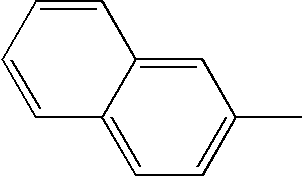 |
| E-15 | MeSCH2CH2— |
 |
| E-16 |
 |
 |
| TABLE 18 | ||
| Compound | ||
| No. | R2 | R6 |
| E-17 |
 |
 |
| E-18 | i-Bu |
 |
| E-19 | H |
 |
| TABLE 19 |
 |
| Compound | ||
| No. | R2 | R6 |
| F-1 | Me |
 |
| F-2 | H |
 |
| F-3 | HOOCCH2— |
 |
| F-4 | MeSCH2CH2— |
 |
| F-5 |
 |
 |
| F-6 |
 |
 |
| F-7 | i-Bu |
 |
MMP-1 was purchased from Yagai.
MMP-2 was purchased from Calbiochem-Novabiochem International, Inc.
In regard to MMP-8, catalytic domain (99Phe˜262Gly) was amplified with PCR using commercial available Human Bone Marrow cDNA. This was cloned in Escherichia. coli expression vector pTrc99AHE inserted with His-tag sequence and enterokinase digestion-site, induced and expressed by IPTG (Isopropyl-β-D-thiogalactopyranoside) and expressed in a insoluble fraction (Thau F. Ho, M. Walid Qoronfleh, Robert C. Wahl, Trica A. Pulvino, Karen J. Vavra, Joe Falvo, Tracey M. Banks, Patricia G. Brake and Richard B. Ciccarelli: Gene expression, purification and characterization of recombinant human neutrophil collagenase. Gene 146, (1994) 297-301, Prepared by the a improved method of this material). Isolation of MMP-8 from an insoluble fraction was carried out by dissolving in modifier (6M urea) by a usual method and purification with metal chelate chromatography. And then removing modifier (6M urea) with dialysis and refolding of the enzyme spontaneously gave activated MMP-8.
MMP-9 was isolated and purified by procedures described in as follows: Yasunori Okada, Yukio Gonoji, Katsumi Naka, Katsuro Tomita, Isao Nakanishi, Kazushi Iwata, Kyoko Yamashita, and Taro Hayakawa: Matrix metalloproteinase 9 (92-kDa gelatinase/type IV collagenase) from HT1080 human fibrosarcoma cells. Purification and activation of the precursor and enzymic properties J. Biol. Chem., 1992, 267 21712-21719, in combination with others: 1)Yasunori Okada, Tatsuhisa Morodomi, Jan J, Enghild, ko Suzuki, Atsushi Yasui, Isao Nakanishi, Guy Salvesen and Hideaki Nagase: Matrix metalloproteinase 2 from human rheumatoid synovial fibroblasts. Purification and activation of the precursor and enzymic properties. Eur. J. Biochem. 1990, 194 721-730; 2)Robin V Ward, Rosalind M Hembry, John J Reynolds and Gillian Murphy: The purification of tissue inhibitor of metalloproteinase-2 from its 72 kDa progelatinase complex. Biochem. J. 1991 278 179-187. In detail, human fibrosarcoma ATCC HT1080 cell line was cultured to confluent in Dulbecco's Modified Medium (DMEM) containing 10% fetal-calf serum at 37° C. for 48 hours. Subsequently, the medium of confluent culture was changed to serum-free DMEM medium. To obtain MMP-9, Phorbol-12-myristate-13-acetate (TPA) must be added to this serum-free DMEM medium at a concentration of 50 ng/ml. The TPA treated medium was centrifuged at 3000 rpm for 15 min and the supernatant was concentrated to 450 ml by a Toyo-Roshi UP-20 apparatus with an ultrafiltration membrane. Then, proMMP-9 in this concentrated solution was purified by using columns of Gelatin-Sepharose and Concanavalin A-Sepharose. The pool containing proMMP-9 was dialyzed, concentrated (Toyo-Roshi UP-20) and applied to columns of Sephacryl S-200 and Green A matrix for the separation from TIMPs. The obtained proMMP-9 fraction was activated by TPCK-Trypsin (Final conc. 3 μg/501 μl React Mix.).
In regard to MMP-12, catalytic domain(100Phe˜263Gly) was amplified with RT-PCR from Human Placenta Total RNA. This was cloned in Escherichia. coli expression vector pTrc99AHE inserted with His-tag sequence and enterokinase digestion-site, induced and expressed by IPTG (Isopropyl-β-D-thiogalactopyranoside) and expressed in a insoluble fraction. Isolation of MMP-12 from an insoluble fraction was carried out by dissolving in modifier (6M urea) by a usual method and purification with metal chelate chromatography (Ni Chelateing Sepharose). And then removing modifier (6M urea) with dialysis and refolding of the enzyme spontaneously gave activated MMP-12.
In regard to MMP-13, mRNA was prepared from carcinoma cell SW1353 derived from human cartilage stimulate by IL-1, TNF and catalytic domain (104Tyr˜267Gly) was amplified with RT-PCR. This was cloned in Escherichia. coli expression vector pTrc99AHE inserted with His-tag sequence and enterokinase digestion-site, induced and expressed by IPTG (Isopropyl-β-D-thiogalactopyranoside) and expressed in a insoluble fraction. Isolation of MMP-13 from an insoluble fraction was carried out by dissolving in modifier (6M urea) by a usual method and purification with metal chelate chromatography (Ni Chelateing Sepharose). And then removing modifier (6M urea) with dialyze and refolding of the enzyme spontaneously gave activated MMP-13.
The enzymatic activity on MMPs was analyzed by the method described in “C. Graham Knight, Frances Willenbrock and Gillian Murphy: A novel coumarin-labelled peptide for sensitive continuous assays of the matrix metalloproteinases: FEBS LETT., 296, (1992), 263-266”. The substrate MOCAc-Pro-Leu-Gly-Leu-A2Pr(DNP)-Ala-Arg-NH2 was purchased from Peptide Institute, Inc., Osaka, Japan. The measurement of the inhibitory activities (IC50) was carried out by the following four methods;
(A) Reaction with substrate, enzyme (MMPs) and inhibitor
(B) Reaction with substrate and inhibitor, without enzyme
(C) Reaction with substrate and enzyme (MMPs), without inhibitor
(D) Reaction with substrate only
IC50 values were calculated by using the following formula and each fluorescence values of above four methods (A to D).
% inhibition={1−(A−B)/(C−D)}×100
IC50 means the concentration required to inhibit 50% of the enzyme activity.
% inhibition={1−(A−B)/(C−D)}×100
IC50 means the concentration required to inhibit 50% of the enzyme activity.
The results are shown in Table 20 and Table 21.
| TABLE 20 | |
| Compound | MMP Inhibitory Activities IC50 (nM) |
| No. | MMP-2 | MMP-8 | MMP-9 | MMP-12 | MMP-13 |
| A-1 | 9.31 | 230 | 212 | 1.88 | 15.0 |
| A-5 | ND | ND | ND | 28.4 | ND |
| A-6 | 9.71 | 233 | 368 | 12.5 | 234 |
| A-8 | 3.37 | 25.2 | 218 | 2.78 | 22.6 |
| A-9 | 287 | 266 | 9320 | 27.3 | 433 |
| A-10 | 5.46 | 97.4 | 135 | 2.42 | 59.2 |
| A-14 | 2.66 | 7.07 | 174 | 1.88 | 5.51 |
| A-16 | 265 | ND | 758 | 26.2 | 774 |
| A-19 | 14.4 | 113 | 247 | 7.71 | 113 |
| A-22 | 7.84 | 53.3 | 144 | 2.69 | 5.31 |
| A-24 | 670 | 337 | 2370 | 10.0 | 678 |
| A-25 | 12.2 | 75.9 | 179 | 7.48 | 140 |
| A-26 | 514 | 569 | 1807 | 40.2 | ND |
| A-27 | 6.08 | 57.3 | 67.9 | 1.55 | 54.5 |
| A-28 | 10.9 | 26.1 | 483 | 5.05 | 44.8 |
| A-30 | 44.4 | 320 | 502 | 11.4 | 226 |
| A-36 | 16.3 | 127 | 226 | 2.98 | 140 |
| A-46 | 7.16 | 279 | 157 | 2.25 | 19.0 |
| A-50 | 4.86 | 146 | 88.6 | 0.699 | 11.9 |
| B-1 | 1.29 | 28.2 | 43.8 | 3.55 | 2.96 |
| B-2 | 1.83 | 15.1 | 13.8 | 2.92 | 14.5 |
| B-3 | 7.45 | 18.9 | 70.5 | 3.16 | 15.0 |
| B-4 | 1.27 | 56.9 | 5.71 | 3.06 | 5.51 |
| B-5 | 5.24 | 25.7 | 14.8 | 1.33 | 6.18 |
| B-6 | 0.347 | 6.47 | 10.0 | 0.370 | 1.16 |
| B-8 | 1.38 | 10.5 | 11.1 | 1.96 | 9.53 |
| B-9 | 8.05 | 12.5 | 55.0 | 1.33 | 13.1 |
| B-10 | 0.373 | 31.7 | 3.96 | 0.643 | 3.38 |
| B-11 | 1.08 | 26.1 | 16.2 | 2.40 | 6.34 |
| B-12 | 1.44 | 25.9 | 66.9 | 3.69 | 9.30 |
| TABLE 21 | |
| Compound | MMP Inhibitory Activities IC50 (nM) |
| No. | MMP-2 | MMP-8 | MMP-9 | MMP-12 | MMP-13 |
| B-13 | 1.20 | 92.3 | 11.8 | 1.41 | 5.08 |
| B-14 | 2.56 | 72.8 | 19.5 | 2.49 | 11.0 |
| B-17 | 2.09 | 22.4 | 22.6 | 3.21 | 12.1 |
| B-21 | 1.47 | 58.2 | 19.9 | 5.86 | 22.0 |
| B-23 | 0.479 | 15.4 | 16.2 | 1.37 | 2.04 |
| B-24 | 6.30 | 18.5 | 109 | 1.50 | 8.40 |
| B-25 | 0.484 | 51.7 | 5.69 | 0.949 | 4.82 |
| B-26 | 8.30 | 42.5 | 54.4 | 1.24 | 14.1 |
| B-27 | 0.901 | 25.2 | 13.3 | 3.29 | 15.3 |
| B-29 | 0.313 | 45.2 | 5.82 | 0.470 | 2.60 |
| B-31 | 3.57 | 144 | 35.7 | 4.55 | 32.6 |
| B-34 | 1.63 | 24.9 | 53.6 | 3.35 | 6.82 |
| B-38 | 2.14 | 104 | 11.6 | 2.54 | 7.43 |
| B-45 | 2.15 | 29.0 | 26.3 | 2.66 | 17.5 |
| B-46 | 1.17 | 57.0 | 24.0 | 1.08 | 11.0 |
| B-51 | 0.276 | 66.0 | 4.24 | 0.761 | 2.66 |
| B-52 | 2.50 | 453 | 34.7 | 5.55 | 29.5 |
| B-53 | 2.41 | 373 | 173 | 2.54 | 12.4 |
| ND: Not Determined | |||||
Compounds including the present invention have broad inhibitory activities against various kinds of MMPs
Granules are prepared using the following ingredients.
| Ingredients | ||
| The compound represented by the formula (I) | 10 | mg | ||
| Lactose | 700 | mg | ||
| Corn starch | 274 | mg | ||
| HPC-L | 16 | mg | ||
| 1000 | mg | |||
The compound represented by the formula (I) and lactose are made pass through a 60 mesh sieve. Corn starch is made pass through a 120 mesh sieve. They are mixed by a twin shell blender. An aqueous solution of HPC-L (low mucosity hydroxypropylcellulose) is added to the mixture and the resulting mixture is kneaded, granulated (by the extrusion with pore size 0.5 to 1 mm mesh), and dried. The dried granules thus obtained are sieved by a swing sieve (12/60 mesh) to yield the granules.
Powders for filling capsules are prepared using the following ingredients.
| Ingredients | ||
| The compound represented by the formula (I) | 10 | mg | ||
| Lactose | 79 | mg | ||
| Corn starch | 10 | mg | ||
| Magnesium stearate | 1 | mg | ||
| 100 | mg | |||
The compound represented by the formula (I) and lactose are made pass through a 60 mesh sieve. Corn starch is made pass through a 120 mesh sieve. These ingredients and magnesium stearate are mixed by a twin shell blender. 100 mg of the 10-fold trituration is filled into a No. 5 hard gelatin capsule.
Granules for filling capsules are prepared using the following ingredients.
| Ingredients | ||
| The compound represented by the formula (I) | 15 | mg | ||
| Lactose | 90 | mg | ||
| Corn starch | 42 | mg | ||
| HPC-L | 3 | mg | ||
| 150 | mg | |||
The compound represented by the formula (I) and lactose are made pass through a 60 mesh sieve. Corn starch is made pass through a 120 mesh sieve. After mixing them, an aqueous solution of HPC-L is added to the mixture and the resulting mixture is kneaded, granulated, and dried. After the dried granules are lubricated, 150 mg of that are filled into a No. 4 hard gelatin capsule.
Tablets are prepared using the following ingredients.
| Ingredients | ||
| The compound represented by the formula (I) | 10 | mg | ||
| Lactose | 90 | mg | ||
| Microcrystal cellulose | 30 | mg | ||
| CMC-Na | 15 | mg | ||
| Magnesium stearate | 5 | mg | ||
| 150 | mg | |||
The compound represented by the formula (I), lactose, microcrystal cellulose, and CMC-Na (carboxymethylcellulose sodium salt) are made pass through a 60 mesh sieve and then mixed. The resulting mixture is mixed with magnesium stearate to obtain the mixed powder for the tablet formulation. The mixed powder is compressed to yield tablets of 150 mg.
Industrial Applicability
The sulfonamide derivatives of the present invention have inhibiting activities against the matrix metalloproteinase, especially excellent inhibiting activities against plural MMPs and are useful as the treating or preventing agent of diseases caused by MMP.
Claims (16)
1. A compound of the formula (I):

wherein R1 is NHOH, hydroxy, or lower alkyloxy;
R2 is hydrogen atom, optionally substituted lower alkyl, optionally substituted aryl, optionally substituted aralkyl, optionally substituted heteroaryl, or optionally substituted heteroarylalkyl;
R3 is hydrogen atom, optionally substituted lower alkyl, optionally substituted aryl, optionally substituted aralkyl, optionally substituted heteroaryl, or optionally substituted heteroarylalkyl;
R4 is optionally substituted arylene, or optionally substituted heteroarylene;
R5 is:

R6 is optionally substituted aryl, optionally substituted heteroaryl or optionally substituted non-aromatic heterocyclic group; provided that R5 is thiazole-2,5-diyl when R4 is thiophene-2,5-diyl and R6 is optionally substituted phenyl; or
an optically active isomer, prodrug, pharmaceutically acceptable salt, or solvate thereof.
2. A compound as claimed in claim 1 , wherein R6 is:

wherein each R7 is each independently hydrogen atom, halogen, lower alkyl, cycloalkyl, lower alkenyl, lower alkynyl, lower alkyloxy, lower alkenyloxy, lower alkylthio, halo(lower)alkyl, hydroxy, carboxy, lower alkyloxycarbonyl, carbamoyl, acyl, nitro, cyano, or optionally substituted amino;
m is 0, 1, 2, or 3,
an optically active isomer, prodrug, pharmaceutically acceptable salt, or solvate thereof.
3. The compound of claim 1 , wherein R1 is hydroxy; or an optically active isomer, prodrug, pharmaceutically acceptable salt, or solvate thereof.
4. The compound of claim 1 , wherein R2 is lower alkyl optionally substituted with carboxy, carbamoyl or lower alkylthio, aryl optionally substituted with hydroxy, aralkyl optionally substituted with hydroxy, or heteroarylalkyl optionally substituted with hydroxy, or hydrogen atom; or an optically active isomer, prodrug, pharmaceutically acceptable salt, or solvate thereof.
5. The compound of claim 4 , wherein R2 is hydrogen atom, methyl, isopropyl, isobutyl, benzyl, indol-3-ylmethyl, carboxymethyl, 2-methylthioethyl, 4-hydroxybenzyl, or (5-hydroxy-indol-3-yl)methyl; or an optically active isomer, prodrug, pharmaceutically acceptable salt, or solvate thereof.
6. The compound of claim 1 , wherein R3 is hydrogen atom; or an optically active isomer, prodrug, pharmaceutically acceptable salt, or solvate thereof.
7. The compound of claim 1 , wherein R4 is 1,4-phenylene or 2,5-thiophene-diyl; or an optically active isomer, prodrug, pharmaceutically acceptable salt, or solvate thereof.
8. The compound of claim 2 , wherein R6 is:

wherein each R7 is each independently hydrogen atom, halogen, lower alkyl, cycloalkyl, lower alkenyl, lower alkynyl, lower alkyloxy, lower alkenyloxy, lower alkylthio, halo(lower)alkyl, hydroxy, carboxy, lower alkyloxycarbonyl, carbamoyl, acyl, nitro, cyano, or optionally substituted amino;
m is 0, 1, 2, or 3; or
an optically active isomer, prodrug, pharmaceutically acceptable salt, or solvate thereof.
9. The compound of claim 8 , wherein R6 is:

an optically active isomer, prodrug, pharmaceutically acceptable salt, or solvate thereof.
10. A compound of the formula (II):

wherein R8 is hydrogen atom, methyl, isopropyl, isobutyl, carboxymethyl, carboxyethyl, 2-methylthioethyl, benzyl, 4-hydroxybenzyl, or indol-3-ylmethyl;
R9is:

R10 is hydrogen atom, halogen, lower alkyl, lower alkyloxy, halo(lower)alkyl, acyl, nitro, cyano, optionally substituted amino, or hydroxy; or
an optically active isomer, prodrug, pharmaceutically acceptable salt, or solvate thereof.
11. A compound of the formula (III):

wherein R8 is hydrogen atom, methyl, isopropyl, isobutyl, carboxymethyl, arboxyethyl, 2-methylthioethyl, benzyl, 4-hydroxybenzyl, or indol-3-ylmethyl;
R10 is hydrogen atom, halogen, lower alkyl, lower alkyloxy, halo(lower)alkyl, acyl, nitro, cyano, optionally substituted amino, or hydroxy; or
an optically active isomer, prodrug, pharmaceutically acceptable salt, or solvate thereof.
12. A pharmaceutical composition comprising a compound of claim 1 , or a optically active isomer, prodrug, pharmaceutically acceptable salt, or solvate thereof, and a pharmaceutically acceptable carrier or excipient.
13. A pharmaceutical composition for inhibiting metalloproteinase comprising a compound of claim 1 , or a optically active isomer, prodrug, pharmaceutically acceptable salt, or solvate thereof, and a pharmaceutically acceptable carrier or excipient.
14. A pharmaceutical composition for inhibiting matrix metalloproteinase comprising a compound of claim 1 , or a optically active isomer, prodrug, pharmaceutically acceptable salt, or solvate thereof, and a pharmaceutically acceptable carrier or excipient.
15. A method for inhibiting metalloproteinase to treat a disease selected from the group consisting of nephritis, osteoarthritis, heart failure and chronic pulmonary disease, which comprises administering to a mammal a pharmaceutically effective amount of a compound of claim 1 , or an optically active isomer, prodrug, pharmaceutically acceptable salt, or solvate thereof.
16. The method of claim 15 , wherein said mammal is a human.
Applications Claiming Priority (3)
| Application Number | Priority Date | Filing Date | Title |
|---|---|---|---|
| JP2000298199 | 2000-09-29 | ||
| JP2000-298199 | 2000-09-29 | ||
| PCT/JP2001/008507 WO2002028844A1 (en) | 2000-09-29 | 2001-09-28 | Thiazole or oxazole derivatives |
Publications (2)
| Publication Number | Publication Date |
|---|---|
| US20040024029A1 US20040024029A1 (en) | 2004-02-05 |
| US6949566B2 true US6949566B2 (en) | 2005-09-27 |
Family
ID=18780188
Family Applications (1)
| Application Number | Title | Priority Date | Filing Date |
|---|---|---|---|
| US10/381,280 Expired - Fee Related US6949566B2 (en) | 2000-09-29 | 2001-09-28 | Thiazole and oxazole derivatives |
Country Status (8)
| Country | Link |
|---|---|
| US (1) | US6949566B2 (en) |
| EP (1) | EP1331224A4 (en) |
| JP (1) | JPWO2002028844A1 (en) |
| KR (1) | KR20030030036A (en) |
| CN (1) | CN1273456C (en) |
| AU (1) | AU2001292285A1 (en) |
| CA (1) | CA2423885A1 (en) |
| WO (1) | WO2002028844A1 (en) |
Cited By (1)
| Publication number | Priority date | Publication date | Assignee | Title |
|---|---|---|---|---|
| US20040106657A1 (en) * | 2002-11-25 | 2004-06-03 | Alfred Binggeli | Indolyl derivatives |
Families Citing this family (16)
| Publication number | Priority date | Publication date | Assignee | Title |
|---|---|---|---|---|
| WO2003035610A1 (en) * | 2001-10-26 | 2003-05-01 | Shionogi & Co., Ltd. | Sulfonamide derivative having mmp inhibitory activity |
| TW200305396A (en) * | 2002-03-27 | 2003-11-01 | Shionogi & Co | Cartilage extracellular matrix degradation |
| JPWO2003080041A1 (en) * | 2002-03-27 | 2005-07-21 | 塩野義製薬株式会社 | Osteoarthritis treatment |
| WO2004080452A1 (en) * | 2003-03-10 | 2004-09-23 | Shionogi & Co., Ltd. | Remedies for retinal diseases |
| WO2004092146A2 (en) * | 2003-04-14 | 2004-10-28 | The Institutes For Pharmaceutical Discovery, Llc | N- (((((1,3-thiazol-2-yl) amino) carbonyl) phenyl) sulfonyl) phenylalanine derivatives and related compounds for the treatment of diabetes |
| WO2004099168A2 (en) | 2003-04-30 | 2004-11-18 | The Institutes For Pharmaceutical Discovery, Llc | Substituted carboxylic acids |
| JPWO2005012268A1 (en) * | 2003-07-30 | 2006-09-14 | 塩野義製薬株式会社 | Sulfonamide derivatives having isoxazole rings |
| MX2007001337A (en) * | 2004-08-02 | 2008-03-13 | Genmedica Therapeutics Sl | Compounds for inhibiting copper-containing amine oxidases and uses thereof. |
| US20080119513A1 (en) * | 2004-09-06 | 2008-05-22 | Fumihiko Watanabe | Sulfonamide Derivative Selectively Inhibiting Mmp-13 |
| JPWO2007102392A1 (en) | 2006-03-03 | 2009-07-23 | 塩野義製薬株式会社 | MMP-13 selective inhibitor |
| JPWO2008053913A1 (en) | 2006-11-02 | 2010-02-25 | 塩野義製薬株式会社 | Sulfonylurea derivatives that selectively inhibit MMP-13 |
| EP2414366A1 (en) | 2009-04-01 | 2012-02-08 | Novartis AG | Spiro derivatives for the modulation of stearoyl-coa desaturase |
| WO2012068210A1 (en) * | 2010-11-18 | 2012-05-24 | Janssen Pharmaceutica Nv | Pyridyl-thiazolyl inhibitors of pro-matrix metalloproteinase activation |
| WO2012068204A1 (en) * | 2010-11-18 | 2012-05-24 | Janssen Pharmaceutica Nv | Fused heteroaryl inhibitors of pro-matrix metalloproteinase activation |
| WO2012162463A1 (en) * | 2011-05-25 | 2012-11-29 | Janssen Pharmaceutica Nv | Benzothiazolyl inhibitors of pro-matrix metalloproteinase activation |
| US20120302569A1 (en) * | 2011-05-25 | 2012-11-29 | Paul Francis Jackson | Phenyl-thiazolyl inhibitors of pro-matrix metalloproteinase activation |
Citations (3)
| Publication number | Priority date | Publication date | Assignee | Title |
|---|---|---|---|---|
| EP0757037A2 (en) | 1995-07-28 | 1997-02-05 | Ono Pharmaceutical Co., Ltd. | Sulfonylamino acid derivatives as metalloproteinase inhibitors |
| WO1999004780A1 (en) | 1997-07-22 | 1999-02-04 | Shionogi & Co., Ltd. | Therapeutic or prophylactic agent for glomerulopathy |
| EP0950656A1 (en) | 1996-01-23 | 1999-10-20 | Shionogi & Co., Ltd. | Sulfonated amino acid derivatives and metalloproteinase inhibitors containing the same |
Family Cites Families (2)
| Publication number | Priority date | Publication date | Assignee | Title |
|---|---|---|---|---|
| ATE207891T1 (en) * | 1996-05-17 | 2001-11-15 | Warner Lambert Co | BIPHENYLSULFONAMIDE MATRIX METALLOPROTEINASE INHIBITORS |
| CN1349498A (en) * | 1999-03-03 | 2002-05-15 | 宝洁公司 | Alkenyl-and alkynyl-containing metalloprotease inhibitors |
-
2001
- 2001-09-28 CA CA002423885A patent/CA2423885A1/en not_active Abandoned
- 2001-09-28 US US10/381,280 patent/US6949566B2/en not_active Expired - Fee Related
- 2001-09-28 KR KR10-2003-7004302A patent/KR20030030036A/en not_active Ceased
- 2001-09-28 EP EP01972561A patent/EP1331224A4/en not_active Withdrawn
- 2001-09-28 WO PCT/JP2001/008507 patent/WO2002028844A1/en not_active Ceased
- 2001-09-28 AU AU2001292285A patent/AU2001292285A1/en not_active Abandoned
- 2001-09-28 CN CNB018164943A patent/CN1273456C/en not_active Expired - Fee Related
- 2001-09-28 JP JP2002532429A patent/JPWO2002028844A1/en not_active Withdrawn
Patent Citations (5)
| Publication number | Priority date | Publication date | Assignee | Title |
|---|---|---|---|---|
| EP0757037A2 (en) | 1995-07-28 | 1997-02-05 | Ono Pharmaceutical Co., Ltd. | Sulfonylamino acid derivatives as metalloproteinase inhibitors |
| EP0950656A1 (en) | 1996-01-23 | 1999-10-20 | Shionogi & Co., Ltd. | Sulfonated amino acid derivatives and metalloproteinase inhibitors containing the same |
| WO1999004780A1 (en) | 1997-07-22 | 1999-02-04 | Shionogi & Co., Ltd. | Therapeutic or prophylactic agent for glomerulopathy |
| EP1029541A1 (en) | 1997-07-22 | 2000-08-23 | Shionogi & Co., Ltd. | Therapeutic or prophylactic agent for glomerulopathy |
| US6423729B1 (en) * | 1997-07-22 | 2002-07-23 | Shionogi & Co., Ltd. | Therapeutic or prophylactic agent for glomerulopathy |
Non-Patent Citations (5)
| Title |
|---|
| Ho et al., "Gene Expression, Purification and Characterization of Recombinant Human Neutrophil Collagenase," Gene, vol. 146, pp. 297-301 (1994). |
| Knight et al., "A Novel Coumarin-labelled Peptide for Sensitive Continuous Assays of the Matrix Metalloproteinases," vol. 296, No. 3, pp. 263-266 (1992). |
| Okada et al., "Matrix Metalloproteinase 2 from Human Rheumatoid Synovial Fibroblasts," Eur. J. Biochem., vol. 194, pp. 721-730 (1990). |
| Okada et al., "Matrix Metalloproteinase 9 (92-kDa Gelatinase/Type IV Collagenase) from HT 1080 Human Fibrosarcoma Cells," The Journal of Biological Chemistry, vol. 267, No. 30, pp. 21712-21719 (1992). |
| Ward et al., "The Purification of Tissue Inhibitor of Metalloproteinases-2 from Its 72 kDa Progelatinase Complex," Biochem J., vol. 278, pp. 179-187 (1991). |
Cited By (2)
| Publication number | Priority date | Publication date | Assignee | Title |
|---|---|---|---|---|
| US20040106657A1 (en) * | 2002-11-25 | 2004-06-03 | Alfred Binggeli | Indolyl derivatives |
| US7098228B2 (en) * | 2002-11-25 | 2006-08-29 | Hoffmann-La Roche Inc. | Indolyl derivatives |
Also Published As
| Publication number | Publication date |
|---|---|
| CA2423885A1 (en) | 2003-03-27 |
| EP1331224A1 (en) | 2003-07-30 |
| CN1273456C (en) | 2006-09-06 |
| US20040024029A1 (en) | 2004-02-05 |
| JPWO2002028844A1 (en) | 2004-02-12 |
| KR20030030036A (en) | 2003-04-16 |
| WO2002028844A1 (en) | 2002-04-11 |
| EP1331224A4 (en) | 2004-03-17 |
| CN1466580A (en) | 2004-01-07 |
| AU2001292285A1 (en) | 2002-04-15 |
Similar Documents
| Publication | Publication Date | Title |
|---|---|---|
| US6897237B2 (en) | MMP-12 inhibitors | |
| US20040024029A1 (en) | Thiazole and oxazole derivatives | |
| US6495578B1 (en) | Sulfonamide derivatives having oxadiazole rings | |
| US20050227994A1 (en) | Decomposition inhibitor for extracellular matrix of cartilage | |
| JPWO1997027174A1 (en) | Sulfonated amino acid derivatives and metalloproteinase inhibitors containing the same | |
| KR100542780B1 (en) | Oxadiazole derivatives having anticancer effect | |
| JPH11246527A (en) | MMP-8 inhibitor | |
| JPWO2002046176A1 (en) | Activator of peroxisome proliferator-activated receptor | |
| JP4219810B2 (en) | Sulfonamide derivatives having MMP inhibitory action | |
| JPWO2001083463A1 (en) | Oxadiazole derivatives with anticancer activity | |
| EP1491520A1 (en) | Process for production of bisphenol a | |
| WO2001083461A1 (en) | Thiazole and oxazole derivatives | |
| WO2000058278A1 (en) | β-AMINO ACID DERIVATIVES | |
| US7825146B2 (en) | Sulfonamide derivative having isoxazole ring | |
| JPWO2006028038A1 (en) | Sulfonamide derivatives that selectively inhibit MMP-13 | |
| JPWO2000063194A1 (en) | Sulfonamide derivatives containing an oxadiazole ring | |
| JP4371377B2 (en) | Sulfonated amino acid derivatives and metalloproteinase inhibitors containing the same | |
| JPWO2000058278A1 (en) | Beta Amino Acid Derivatives | |
| JPWO2000058280A1 (en) | Carbocyclic sulfonamide derivatives | |
| JPWO2001083461A1 (en) | Thiazole and oxazole derivatives | |
| JPWO2000046189A1 (en) | Sulfonamide derivatives with a cyclic structure | |
| JPWO2000058304A1 (en) | Heterocyclic sulfonamide derivatives |
Legal Events
| Date | Code | Title | Description |
|---|---|---|---|
| AS | Assignment |
Owner name: SHIONOGI & CO., LTD., JAPAN Free format text: ASSIGNMENT OF ASSIGNORS INTEREST;ASSIGNORS:WATANABE, FUMIHIKO;TAMURA, YOSHINORI;REEL/FRAME:014188/0652 Effective date: 20030226 |
|
| REMI | Maintenance fee reminder mailed | ||
| LAPS | Lapse for failure to pay maintenance fees | ||
| STCH | Information on status: patent discontinuation |
Free format text: PATENT EXPIRED DUE TO NONPAYMENT OF MAINTENANCE FEES UNDER 37 CFR 1.362 |
|
| FP | Lapsed due to failure to pay maintenance fee |
Effective date: 20090927 |