US6918976B2 - Gas generating composition - Google Patents
Gas generating composition Download PDFInfo
- Publication number
- US6918976B2 US6918976B2 US10/679,384 US67938403A US6918976B2 US 6918976 B2 US6918976 B2 US 6918976B2 US 67938403 A US67938403 A US 67938403A US 6918976 B2 US6918976 B2 US 6918976B2
- Authority
- US
- United States
- Prior art keywords
- weight
- gas
- gas generating
- metal
- nitrate
- Prior art date
- Legal status (The legal status is an assumption and is not a legal conclusion. Google has not performed a legal analysis and makes no representation as to the accuracy of the status listed.)
- Expired - Fee Related
Links
- 239000000203 mixture Substances 0.000 title claims abstract description 99
- 239000007800 oxidant agent Substances 0.000 claims abstract description 53
- GDDNTTHUKVNJRA-UHFFFAOYSA-N 3-bromo-3,3-difluoroprop-1-ene Chemical compound FC(F)(Br)C=C GDDNTTHUKVNJRA-UHFFFAOYSA-N 0.000 claims abstract description 49
- 239000000446 fuel Substances 0.000 claims abstract description 42
- 229910002651 NO3 Inorganic materials 0.000 claims abstract description 36
- NHNBFGGVMKEFGY-UHFFFAOYSA-N Nitrate Chemical compound [O-][N+]([O-])=O NHNBFGGVMKEFGY-UHFFFAOYSA-N 0.000 claims abstract description 36
- 229910052784 alkaline earth metal Inorganic materials 0.000 claims abstract description 36
- 150000001342 alkaline earth metals Chemical class 0.000 claims abstract description 36
- 239000011230 binding agent Substances 0.000 claims description 35
- IDCPFAYURAQKDZ-UHFFFAOYSA-N 1-nitroguanidine Chemical compound NC(=N)N[N+]([O-])=O IDCPFAYURAQKDZ-UHFFFAOYSA-N 0.000 claims description 24
- 238000000465 moulding Methods 0.000 claims description 17
- 239000000654 additive Substances 0.000 claims description 14
- 150000001875 compounds Chemical class 0.000 claims description 10
- 230000000996 additive effect Effects 0.000 claims description 5
- 238000001125 extrusion Methods 0.000 claims description 5
- 150000004676 glycans Chemical class 0.000 claims description 3
- 230000000813 microbial effect Effects 0.000 claims description 3
- 229920001282 polysaccharide Polymers 0.000 claims description 3
- 239000005017 polysaccharide Substances 0.000 claims description 3
- 229920002678 cellulose Polymers 0.000 claims 1
- 239000001913 cellulose Substances 0.000 claims 1
- 239000007789 gas Substances 0.000 abstract description 211
- 229910052751 metal Inorganic materials 0.000 abstract description 72
- 239000002184 metal Substances 0.000 abstract description 72
- -1 nitrogenous organic compound Chemical class 0.000 abstract description 30
- 238000002309 gasification Methods 0.000 abstract description 20
- VEXZGXHMUGYJMC-UHFFFAOYSA-N Hydrochloric acid Chemical compound Cl VEXZGXHMUGYJMC-UHFFFAOYSA-N 0.000 abstract description 13
- IXCSERBJSXMMFS-UHFFFAOYSA-N hydrogen chloride Substances Cl.Cl IXCSERBJSXMMFS-UHFFFAOYSA-N 0.000 abstract description 13
- 229910000041 hydrogen chloride Inorganic materials 0.000 abstract description 13
- 239000003795 chemical substances by application Substances 0.000 description 93
- DHEQXMRUPNDRPG-UHFFFAOYSA-N strontium nitrate Chemical compound [Sr+2].[O-][N+]([O-])=O.[O-][N+]([O-])=O DHEQXMRUPNDRPG-UHFFFAOYSA-N 0.000 description 60
- 239000002893 slag Substances 0.000 description 51
- MWUXSHHQAYIFBG-UHFFFAOYSA-N Nitric oxide Chemical compound O=[N] MWUXSHHQAYIFBG-UHFFFAOYSA-N 0.000 description 39
- 238000012360 testing method Methods 0.000 description 37
- JKQOBWVOAYFWKG-UHFFFAOYSA-N molybdenum trioxide Chemical compound O=[Mo](=O)=O JKQOBWVOAYFWKG-UHFFFAOYSA-N 0.000 description 32
- 239000008188 pellet Substances 0.000 description 32
- 238000002485 combustion reaction Methods 0.000 description 30
- ULRPISSMEBPJLN-UHFFFAOYSA-N 2h-tetrazol-5-amine Chemical compound NC1=NN=NN1 ULRPISSMEBPJLN-UHFFFAOYSA-N 0.000 description 29
- 239000002245 particle Substances 0.000 description 25
- 239000000463 material Substances 0.000 description 23
- 229910052581 Si3N4 Inorganic materials 0.000 description 22
- HQVNEWCFYHHQES-UHFFFAOYSA-N silicon nitride Chemical compound N12[Si]34N5[Si]62N3[Si]51N64 HQVNEWCFYHHQES-UHFFFAOYSA-N 0.000 description 22
- 239000008187 granular material Substances 0.000 description 20
- 238000006243 chemical reaction Methods 0.000 description 19
- 239000003054 catalyst Substances 0.000 description 17
- 239000000314 lubricant Substances 0.000 description 16
- HQKMJHAJHXVSDF-UHFFFAOYSA-L magnesium stearate Chemical compound [Mg+2].CCCCCCCCCCCCCCCCCC([O-])=O.CCCCCCCCCCCCCCCCCC([O-])=O HQKMJHAJHXVSDF-UHFFFAOYSA-L 0.000 description 16
- 230000000052 comparative effect Effects 0.000 description 14
- GDVKFRBCXAPAQJ-UHFFFAOYSA-A dialuminum;hexamagnesium;carbonate;hexadecahydroxide Chemical compound [OH-].[OH-].[OH-].[OH-].[OH-].[OH-].[OH-].[OH-].[OH-].[OH-].[OH-].[OH-].[OH-].[OH-].[OH-].[OH-].[Mg+2].[Mg+2].[Mg+2].[Mg+2].[Mg+2].[Mg+2].[Al+3].[Al+3].[O-]C([O-])=O GDVKFRBCXAPAQJ-UHFFFAOYSA-A 0.000 description 14
- 229910001701 hydrotalcite Inorganic materials 0.000 description 14
- 229960001545 hydrotalcite Drugs 0.000 description 14
- 150000004767 nitrides Chemical class 0.000 description 14
- 239000000843 powder Substances 0.000 description 12
- 238000010438 heat treatment Methods 0.000 description 11
- 238000000034 method Methods 0.000 description 11
- 150000001540 azides Chemical class 0.000 description 10
- 239000000047 product Substances 0.000 description 10
- 239000000567 combustion gas Substances 0.000 description 8
- 235000019359 magnesium stearate Nutrition 0.000 description 8
- PAWQVTBBRAZDMG-UHFFFAOYSA-N 2-(3-bromo-2-fluorophenyl)acetic acid Chemical compound OC(=O)CC1=CC=CC(Br)=C1F PAWQVTBBRAZDMG-UHFFFAOYSA-N 0.000 description 7
- 239000004372 Polyvinyl alcohol Substances 0.000 description 7
- 230000006866 deterioration Effects 0.000 description 7
- 229920002451 polyvinyl alcohol Polymers 0.000 description 7
- 230000009467 reduction Effects 0.000 description 7
- 239000000126 substance Substances 0.000 description 7
- 229920003169 water-soluble polymer Polymers 0.000 description 7
- IJGRMHOSHXDMSA-UHFFFAOYSA-N Atomic nitrogen Chemical compound N#N IJGRMHOSHXDMSA-UHFFFAOYSA-N 0.000 description 6
- 239000000020 Nitrocellulose Substances 0.000 description 6
- VYPSYNLAJGMNEJ-UHFFFAOYSA-N Silicium dioxide Chemical compound O=[Si]=O VYPSYNLAJGMNEJ-UHFFFAOYSA-N 0.000 description 6
- 239000007864 aqueous solution Substances 0.000 description 6
- 238000001914 filtration Methods 0.000 description 6
- 238000004519 manufacturing process Methods 0.000 description 6
- 150000001247 metal acetylides Chemical class 0.000 description 6
- 238000002156 mixing Methods 0.000 description 6
- 229920001220 nitrocellulos Polymers 0.000 description 6
- FGIUAXJPYTZDNR-UHFFFAOYSA-N potassium nitrate Chemical compound [K+].[O-][N+]([O-])=O FGIUAXJPYTZDNR-UHFFFAOYSA-N 0.000 description 6
- XLYOFNOQVPJJNP-UHFFFAOYSA-N water Substances O XLYOFNOQVPJJNP-UHFFFAOYSA-N 0.000 description 6
- CURLTUGMZLYLDI-UHFFFAOYSA-N Carbon dioxide Chemical compound O=C=O CURLTUGMZLYLDI-UHFFFAOYSA-N 0.000 description 5
- 229910044991 metal oxide Inorganic materials 0.000 description 5
- 150000004706 metal oxides Chemical class 0.000 description 5
- VEXZGXHMUGYJMC-UHFFFAOYSA-M Chloride anion Chemical compound [Cl-] VEXZGXHMUGYJMC-UHFFFAOYSA-M 0.000 description 4
- CPLXHLVBOLITMK-UHFFFAOYSA-N Magnesium oxide Chemical compound [Mg]=O CPLXHLVBOLITMK-UHFFFAOYSA-N 0.000 description 4
- 230000009471 action Effects 0.000 description 4
- 229910052782 aluminium Inorganic materials 0.000 description 4
- XAGFODPZIPBFFR-UHFFFAOYSA-N aluminium Chemical compound [Al] XAGFODPZIPBFFR-UHFFFAOYSA-N 0.000 description 4
- PNEYBMLMFCGWSK-UHFFFAOYSA-N aluminium oxide Inorganic materials [O-2].[O-2].[O-2].[Al+3].[Al+3] PNEYBMLMFCGWSK-UHFFFAOYSA-N 0.000 description 4
- IWOUKMZUPDVPGQ-UHFFFAOYSA-N barium nitrate Chemical compound [Ba+2].[O-][N+]([O-])=O.[O-][N+]([O-])=O IWOUKMZUPDVPGQ-UHFFFAOYSA-N 0.000 description 4
- 229910002092 carbon dioxide Inorganic materials 0.000 description 4
- 229910052593 corundum Inorganic materials 0.000 description 4
- 230000000694 effects Effects 0.000 description 4
- 239000002360 explosive Substances 0.000 description 4
- 239000003721 gunpowder Substances 0.000 description 4
- 230000006872 improvement Effects 0.000 description 4
- 238000011068 loading method Methods 0.000 description 4
- 230000035945 sensitivity Effects 0.000 description 4
- VWDWKYIASSYTQR-UHFFFAOYSA-N sodium nitrate Chemical compound [Na+].[O-][N+]([O-])=O VWDWKYIASSYTQR-UHFFFAOYSA-N 0.000 description 4
- 239000007787 solid Substances 0.000 description 4
- 229910001845 yogo sapphire Inorganic materials 0.000 description 4
- PZNSFCLAULLKQX-UHFFFAOYSA-N Boron nitride Chemical compound N#B PZNSFCLAULLKQX-UHFFFAOYSA-N 0.000 description 3
- 229910020038 Mg6Al2 Inorganic materials 0.000 description 3
- 230000002159 abnormal effect Effects 0.000 description 3
- 230000008859 change Effects 0.000 description 3
- 239000011651 chromium Substances 0.000 description 3
- 239000005078 molybdenum compound Substances 0.000 description 3
- 150000002752 molybdenum compounds Chemical class 0.000 description 3
- 230000001590 oxidative effect Effects 0.000 description 3
- 239000004323 potassium nitrate Substances 0.000 description 3
- 235000010333 potassium nitrate Nutrition 0.000 description 3
- 230000008569 process Effects 0.000 description 3
- HBMJWWWQQXIZIP-UHFFFAOYSA-N silicon carbide Chemical compound [Si+]#[C-] HBMJWWWQQXIZIP-UHFFFAOYSA-N 0.000 description 3
- 239000000377 silicon dioxide Substances 0.000 description 3
- INZDTEICWPZYJM-UHFFFAOYSA-N 1-(chloromethyl)-4-[4-(chloromethyl)phenyl]benzene Chemical compound C1=CC(CCl)=CC=C1C1=CC=C(CCl)C=C1 INZDTEICWPZYJM-UHFFFAOYSA-N 0.000 description 2
- KJUGUADJHNHALS-UHFFFAOYSA-N 1H-tetrazole Substances C=1N=NNN=1 KJUGUADJHNHALS-UHFFFAOYSA-N 0.000 description 2
- QGZKDVFQNNGYKY-UHFFFAOYSA-O Ammonium Chemical compound [NH4+] QGZKDVFQNNGYKY-UHFFFAOYSA-O 0.000 description 2
- 101100379208 Arabidopsis thaliana APD2 gene Proteins 0.000 description 2
- 229910052582 BN Inorganic materials 0.000 description 2
- OKTJSMMVPCPJKN-UHFFFAOYSA-N Carbon Chemical compound [C] OKTJSMMVPCPJKN-UHFFFAOYSA-N 0.000 description 2
- UGFAIRIUMAVXCW-UHFFFAOYSA-N Carbon monoxide Chemical compound [O+]#[C-] UGFAIRIUMAVXCW-UHFFFAOYSA-N 0.000 description 2
- XTEGARKTQYYJKE-UHFFFAOYSA-M Chlorate Chemical compound [O-]Cl(=O)=O XTEGARKTQYYJKE-UHFFFAOYSA-M 0.000 description 2
- DGAQECJNVWCQMB-PUAWFVPOSA-M Ilexoside XXIX Chemical compound C[C@@H]1CC[C@@]2(CC[C@@]3(C(=CC[C@H]4[C@]3(CC[C@@H]5[C@@]4(CC[C@@H](C5(C)C)OS(=O)(=O)[O-])C)C)[C@@H]2[C@]1(C)O)C)C(=O)O[C@H]6[C@@H]([C@H]([C@@H]([C@H](O6)CO)O)O)O.[Na+] DGAQECJNVWCQMB-PUAWFVPOSA-M 0.000 description 2
- 229910039444 MoC Inorganic materials 0.000 description 2
- BPQQTUXANYXVAA-UHFFFAOYSA-N Orthosilicate Chemical compound [O-][Si]([O-])([O-])[O-] BPQQTUXANYXVAA-UHFFFAOYSA-N 0.000 description 2
- 239000004698 Polyethylene Substances 0.000 description 2
- 239000002202 Polyethylene glycol Substances 0.000 description 2
- OFOBLEOULBTSOW-UHFFFAOYSA-N Propanedioic acid Natural products OC(=O)CC(O)=O OFOBLEOULBTSOW-UHFFFAOYSA-N 0.000 description 2
- XUIMIQQOPSSXEZ-UHFFFAOYSA-N Silicon Chemical compound [Si] XUIMIQQOPSSXEZ-UHFFFAOYSA-N 0.000 description 2
- PXIPVTKHYLBLMZ-UHFFFAOYSA-N Sodium azide Chemical compound [Na+].[N-]=[N+]=[N-] PXIPVTKHYLBLMZ-UHFFFAOYSA-N 0.000 description 2
- 208000027418 Wounds and injury Diseases 0.000 description 2
- 229910026551 ZrC Inorganic materials 0.000 description 2
- OTCHGXYCWNXDOA-UHFFFAOYSA-N [C].[Zr] Chemical compound [C].[Zr] OTCHGXYCWNXDOA-UHFFFAOYSA-N 0.000 description 2
- 239000002253 acid Substances 0.000 description 2
- 230000032683 aging Effects 0.000 description 2
- APUPEJJSWDHEBO-UHFFFAOYSA-P ammonium molybdate Chemical compound [NH4+].[NH4+].[O-][Mo]([O-])(=O)=O APUPEJJSWDHEBO-UHFFFAOYSA-P 0.000 description 2
- 235000018660 ammonium molybdate Nutrition 0.000 description 2
- 239000011609 ammonium molybdate Substances 0.000 description 2
- 229940010552 ammonium molybdate Drugs 0.000 description 2
- YVBOZGOAVJZITM-UHFFFAOYSA-P ammonium phosphomolybdate Chemical compound [NH4+].[NH4+].[NH4+].[NH4+].[O-]P([O-])=O.[O-][Mo]([O-])(=O)=O YVBOZGOAVJZITM-UHFFFAOYSA-P 0.000 description 2
- 150000001450 anions Chemical class 0.000 description 2
- QVGXLLKOCUKJST-UHFFFAOYSA-N atomic oxygen Chemical compound [O] QVGXLLKOCUKJST-UHFFFAOYSA-N 0.000 description 2
- 230000008901 benefit Effects 0.000 description 2
- 229910002091 carbon monoxide Inorganic materials 0.000 description 2
- 229910001914 chlorine tetroxide Inorganic materials 0.000 description 2
- 238000001816 cooling Methods 0.000 description 2
- 229920001577 copolymer Polymers 0.000 description 2
- 230000006378 damage Effects 0.000 description 2
- 238000013461 design Methods 0.000 description 2
- 238000010586 diagram Methods 0.000 description 2
- 229910001873 dinitrogen Inorganic materials 0.000 description 2
- 235000012438 extruded product Nutrition 0.000 description 2
- 229910002804 graphite Inorganic materials 0.000 description 2
- 239000010439 graphite Substances 0.000 description 2
- 150000002440 hydroxy compounds Chemical class 0.000 description 2
- 150000003949 imides Chemical class 0.000 description 2
- 239000011777 magnesium Substances 0.000 description 2
- VZCYOOQTPOCHFL-UPHRSURJSA-N maleic acid Chemical compound OC(=O)\C=C/C(O)=O VZCYOOQTPOCHFL-UPHRSURJSA-N 0.000 description 2
- 239000011976 maleic acid Substances 0.000 description 2
- 238000002844 melting Methods 0.000 description 2
- UNASZPQZIFZUSI-UHFFFAOYSA-N methylidyneniobium Chemical compound [Nb]#C UNASZPQZIFZUSI-UHFFFAOYSA-N 0.000 description 2
- NFFIWVVINABMKP-UHFFFAOYSA-N methylidynetantalum Chemical compound [Ta]#C NFFIWVVINABMKP-UHFFFAOYSA-N 0.000 description 2
- 239000011812 mixed powder Substances 0.000 description 2
- CWQXQMHSOZUFJS-UHFFFAOYSA-N molybdenum disulfide Chemical compound S=[Mo]=S CWQXQMHSOZUFJS-UHFFFAOYSA-N 0.000 description 2
- 229910052982 molybdenum disulfide Inorganic materials 0.000 description 2
- VLAPMBHFAWRUQP-UHFFFAOYSA-L molybdic acid Chemical compound O[Mo](O)(=O)=O VLAPMBHFAWRUQP-UHFFFAOYSA-L 0.000 description 2
- 229910052757 nitrogen Inorganic materials 0.000 description 2
- QIQXTHQIDYTFRH-UHFFFAOYSA-N octadecanoic acid Chemical compound CCCCCCCCCCCCCCCCCC(O)=O QIQXTHQIDYTFRH-UHFFFAOYSA-N 0.000 description 2
- 239000001301 oxygen Substances 0.000 description 2
- 229910052760 oxygen Inorganic materials 0.000 description 2
- DHRLEVQXOMLTIM-UHFFFAOYSA-N phosphoric acid;trioxomolybdenum Chemical compound O=[Mo](=O)=O.O=[Mo](=O)=O.O=[Mo](=O)=O.O=[Mo](=O)=O.O=[Mo](=O)=O.O=[Mo](=O)=O.O=[Mo](=O)=O.O=[Mo](=O)=O.O=[Mo](=O)=O.O=[Mo](=O)=O.O=[Mo](=O)=O.O=[Mo](=O)=O.OP(O)(O)=O DHRLEVQXOMLTIM-UHFFFAOYSA-N 0.000 description 2
- 229920001495 poly(sodium acrylate) polymer Polymers 0.000 description 2
- 229920002401 polyacrylamide Polymers 0.000 description 2
- 229920000058 polyacrylate Polymers 0.000 description 2
- 229920000573 polyethylene Polymers 0.000 description 2
- 229920001223 polyethylene glycol Polymers 0.000 description 2
- 229920000642 polymer Polymers 0.000 description 2
- 229920001451 polypropylene glycol Polymers 0.000 description 2
- 229920001289 polyvinyl ether Polymers 0.000 description 2
- 229920000036 polyvinylpyrrolidone Polymers 0.000 description 2
- 239000001267 polyvinylpyrrolidone Substances 0.000 description 2
- 235000013855 polyvinylpyrrolidone Nutrition 0.000 description 2
- 230000009257 reactivity Effects 0.000 description 2
- 229960001860 salicylate Drugs 0.000 description 2
- 229910052710 silicon Inorganic materials 0.000 description 2
- 239000010703 silicon Substances 0.000 description 2
- 229910010271 silicon carbide Inorganic materials 0.000 description 2
- 235000012239 silicon dioxide Nutrition 0.000 description 2
- 229910052708 sodium Inorganic materials 0.000 description 2
- 239000011734 sodium Substances 0.000 description 2
- 235000015393 sodium molybdate Nutrition 0.000 description 2
- 239000011684 sodium molybdate Substances 0.000 description 2
- TVXXNOYZHKPKGW-UHFFFAOYSA-N sodium molybdate (anhydrous) Chemical compound [Na+].[Na+].[O-][Mo]([O-])(=O)=O TVXXNOYZHKPKGW-UHFFFAOYSA-N 0.000 description 2
- 239000004317 sodium nitrate Substances 0.000 description 2
- 235000010344 sodium nitrate Nutrition 0.000 description 2
- NNMHYFLPFNGQFZ-UHFFFAOYSA-M sodium polyacrylate Chemical compound [Na+].[O-]C(=O)C=C NNMHYFLPFNGQFZ-UHFFFAOYSA-M 0.000 description 2
- 230000006641 stabilisation Effects 0.000 description 2
- 238000011105 stabilization Methods 0.000 description 2
- 229910003468 tantalcarbide Inorganic materials 0.000 description 2
- 238000010998 test method Methods 0.000 description 2
- 150000003536 tetrazoles Chemical class 0.000 description 2
- 229910003470 tongbaite Inorganic materials 0.000 description 2
- VZCYOOQTPOCHFL-UHFFFAOYSA-N trans-butenedioic acid Natural products OC(=O)C=CC(O)=O VZCYOOQTPOCHFL-UHFFFAOYSA-N 0.000 description 2
- MTPVUVINMAGMJL-UHFFFAOYSA-N trimethyl(1,1,2,2,2-pentafluoroethyl)silane Chemical compound C[Si](C)(C)C(F)(F)C(F)(F)F MTPVUVINMAGMJL-UHFFFAOYSA-N 0.000 description 2
- XOOUIPVCVHRTMJ-UHFFFAOYSA-L zinc stearate Chemical compound [Zn+2].CCCCCCCCCCCCCCCCCC([O-])=O.CCCCCCCCCCCCCCCCCC([O-])=O XOOUIPVCVHRTMJ-UHFFFAOYSA-L 0.000 description 2
- QIJNJJZPYXGIQM-UHFFFAOYSA-N 1lambda4,2lambda4-dimolybdacyclopropa-1,2,3-triene Chemical compound [Mo]=C=[Mo] QIJNJJZPYXGIQM-UHFFFAOYSA-N 0.000 description 1
- PIGFYZPCRLYGLF-UHFFFAOYSA-N Aluminum nitride Chemical compound [Al]#N PIGFYZPCRLYGLF-UHFFFAOYSA-N 0.000 description 1
- 229910003178 Mo2C Inorganic materials 0.000 description 1
- 229910015421 Mo2N Inorganic materials 0.000 description 1
- 239000005062 Polybutadiene Substances 0.000 description 1
- 235000021355 Stearic acid Nutrition 0.000 description 1
- NRTOMJZYCJJWKI-UHFFFAOYSA-N Titanium nitride Chemical compound [Ti]#N NRTOMJZYCJJWKI-UHFFFAOYSA-N 0.000 description 1
- DPXJVFZANSGRMM-UHFFFAOYSA-N acetic acid;2,3,4,5,6-pentahydroxyhexanal;sodium Chemical compound [Na].CC(O)=O.OCC(O)C(O)C(O)C(O)C=O DPXJVFZANSGRMM-UHFFFAOYSA-N 0.000 description 1
- 229910000287 alkaline earth metal oxide Inorganic materials 0.000 description 1
- CEGOLXSVJUTHNZ-UHFFFAOYSA-K aluminium tristearate Chemical compound [Al+3].CCCCCCCCCCCCCCCCCC([O-])=O.CCCCCCCCCCCCCCCCCC([O-])=O.CCCCCCCCCCCCCCCCCC([O-])=O CEGOLXSVJUTHNZ-UHFFFAOYSA-K 0.000 description 1
- 229940063655 aluminum stearate Drugs 0.000 description 1
- 238000004458 analytical method Methods 0.000 description 1
- CXOWYMLTGOFURZ-UHFFFAOYSA-N azanylidynechromium Chemical compound [Cr]#N CXOWYMLTGOFURZ-UHFFFAOYSA-N 0.000 description 1
- GPBUGPUPKAGMDK-UHFFFAOYSA-N azanylidynemolybdenum Chemical compound [Mo]#N GPBUGPUPKAGMDK-UHFFFAOYSA-N 0.000 description 1
- CFJRGWXELQQLSA-UHFFFAOYSA-N azanylidyneniobium Chemical compound [Nb]#N CFJRGWXELQQLSA-UHFFFAOYSA-N 0.000 description 1
- SKKMWRVAJNPLFY-UHFFFAOYSA-N azanylidynevanadium Chemical compound [V]#N SKKMWRVAJNPLFY-UHFFFAOYSA-N 0.000 description 1
- 235000019399 azodicarbonamide Nutrition 0.000 description 1
- INAHAJYZKVIDIZ-UHFFFAOYSA-N boron carbide Chemical compound B12B3B4C32B41 INAHAJYZKVIDIZ-UHFFFAOYSA-N 0.000 description 1
- 239000006227 byproduct Substances 0.000 description 1
- 239000001569 carbon dioxide Substances 0.000 description 1
- 239000001768 carboxy methyl cellulose Substances 0.000 description 1
- 239000000919 ceramic Substances 0.000 description 1
- GVEHJMMRQRRJPM-UHFFFAOYSA-N chromium(2+);methanidylidynechromium Chemical compound [Cr+2].[Cr]#[C-].[Cr]#[C-] GVEHJMMRQRRJPM-UHFFFAOYSA-N 0.000 description 1
- 239000000470 constituent Substances 0.000 description 1
- 239000012611 container material Substances 0.000 description 1
- 239000013078 crystal Substances 0.000 description 1
- 238000002425 crystallisation Methods 0.000 description 1
- 230000008025 crystallization Effects 0.000 description 1
- 230000001955 cumulated effect Effects 0.000 description 1
- 230000003247 decreasing effect Effects 0.000 description 1
- 230000001627 detrimental effect Effects 0.000 description 1
- 238000011161 development Methods 0.000 description 1
- 230000018109 developmental process Effects 0.000 description 1
- 238000009826 distribution Methods 0.000 description 1
- 238000005516 engineering process Methods 0.000 description 1
- 239000003623 enhancer Substances 0.000 description 1
- 238000011156 evaluation Methods 0.000 description 1
- 230000008020 evaporation Effects 0.000 description 1
- 238000001704 evaporation Methods 0.000 description 1
- 239000010419 fine particle Substances 0.000 description 1
- 239000012634 fragment Substances 0.000 description 1
- 238000004868 gas analysis Methods 0.000 description 1
- 231100001261 hazardous Toxicity 0.000 description 1
- 239000003779 heat-resistant material Substances 0.000 description 1
- 229910001385 heavy metal Inorganic materials 0.000 description 1
- XLYOFNOQVPJJNP-ZSJDYOACSA-N heavy water Substances [2H]O[2H] XLYOFNOQVPJJNP-ZSJDYOACSA-N 0.000 description 1
- 125000002887 hydroxy group Chemical group [H]O* 0.000 description 1
- 208000014674 injury Diseases 0.000 description 1
- 238000009434 installation Methods 0.000 description 1
- 229910000765 intermetallic Inorganic materials 0.000 description 1
- 230000007774 longterm Effects 0.000 description 1
- 238000005259 measurement Methods 0.000 description 1
- 230000008018 melting Effects 0.000 description 1
- 229910052976 metal sulfide Inorganic materials 0.000 description 1
- 230000007935 neutral effect Effects 0.000 description 1
- 150000002823 nitrates Chemical class 0.000 description 1
- UAGLZAPCOXRKPH-UHFFFAOYSA-N nitric acid;1,2,3-triaminoguanidine Chemical compound O[N+]([O-])=O.NNC(NN)=NN UAGLZAPCOXRKPH-UHFFFAOYSA-N 0.000 description 1
- OQCDKBAXFALNLD-UHFFFAOYSA-N octadecanoic acid Natural products CCCCCCCC(C)CCCCCCCCC(O)=O OQCDKBAXFALNLD-UHFFFAOYSA-N 0.000 description 1
- 239000003921 oil Substances 0.000 description 1
- TWNQGVIAIRXVLR-UHFFFAOYSA-N oxo(oxoalumanyloxy)alumane Chemical compound O=[Al]O[Al]=O TWNQGVIAIRXVLR-UHFFFAOYSA-N 0.000 description 1
- 238000005453 pelletization Methods 0.000 description 1
- VLTRZXGMWDSKGL-UHFFFAOYSA-M perchlorate Inorganic materials [O-]Cl(=O)(=O)=O VLTRZXGMWDSKGL-UHFFFAOYSA-M 0.000 description 1
- VLTRZXGMWDSKGL-UHFFFAOYSA-N perchloric acid Chemical compound OCl(=O)(=O)=O VLTRZXGMWDSKGL-UHFFFAOYSA-N 0.000 description 1
- 229920002857 polybutadiene Polymers 0.000 description 1
- 239000011148 porous material Substances 0.000 description 1
- TZLVRPLSVNESQC-UHFFFAOYSA-N potassium azide Chemical compound [K+].[N-]=[N+]=[N-] TZLVRPLSVNESQC-UHFFFAOYSA-N 0.000 description 1
- 239000003380 propellant Substances 0.000 description 1
- 239000011347 resin Substances 0.000 description 1
- 229920005989 resin Polymers 0.000 description 1
- 230000000452 restraining effect Effects 0.000 description 1
- 230000035939 shock Effects 0.000 description 1
- 238000005549 size reduction Methods 0.000 description 1
- 235000019812 sodium carboxymethyl cellulose Nutrition 0.000 description 1
- 229920001027 sodium carboxymethylcellulose Polymers 0.000 description 1
- 239000000243 solution Substances 0.000 description 1
- 230000000087 stabilizing effect Effects 0.000 description 1
- 229910001220 stainless steel Inorganic materials 0.000 description 1
- 239000010935 stainless steel Substances 0.000 description 1
- 239000008117 stearic acid Substances 0.000 description 1
- 238000006467 substitution reaction Methods 0.000 description 1
- MZLGASXMSKOWSE-UHFFFAOYSA-N tantalum nitride Chemical compound [Ta]#N MZLGASXMSKOWSE-UHFFFAOYSA-N 0.000 description 1
- 229910052721 tungsten Inorganic materials 0.000 description 1
- 239000010937 tungsten Substances 0.000 description 1
- UONOETXJSWQNOL-UHFFFAOYSA-N tungsten carbide Chemical compound [W+]#[C-] UONOETXJSWQNOL-UHFFFAOYSA-N 0.000 description 1
- 239000013585 weight reducing agent Substances 0.000 description 1
- ZVWKZXLXHLZXLS-UHFFFAOYSA-N zirconium nitride Chemical compound [Zr]#N ZVWKZXLXHLZXLS-UHFFFAOYSA-N 0.000 description 1
Images


Classifications
-
- C—CHEMISTRY; METALLURGY
- C06—EXPLOSIVES; MATCHES
- C06D—MEANS FOR GENERATING SMOKE OR MIST; GAS-ATTACK COMPOSITIONS; GENERATION OF GAS FOR BLASTING OR PROPULSION (CHEMICAL PART)
- C06D5/00—Generation of pressure gas, e.g. for blasting cartridges, starting cartridges, rockets
-
- C—CHEMISTRY; METALLURGY
- C06—EXPLOSIVES; MATCHES
- C06B—EXPLOSIVES OR THERMIC COMPOSITIONS; MANUFACTURE THEREOF; USE OF SINGLE SUBSTANCES AS EXPLOSIVES
- C06B29/00—Compositions containing an inorganic oxygen-halogen salt, e.g. chlorate, perchlorate
- C06B29/22—Compositions containing an inorganic oxygen-halogen salt, e.g. chlorate, perchlorate the salt being ammonium perchlorate
-
- C—CHEMISTRY; METALLURGY
- C06—EXPLOSIVES; MATCHES
- C06B—EXPLOSIVES OR THERMIC COMPOSITIONS; MANUFACTURE THEREOF; USE OF SINGLE SUBSTANCES AS EXPLOSIVES
- C06B31/00—Compositions containing an inorganic nitrogen-oxygen salt
- C06B31/02—Compositions containing an inorganic nitrogen-oxygen salt the salt being an alkali metal or an alkaline earth metal nitrate
-
- C—CHEMISTRY; METALLURGY
- C06—EXPLOSIVES; MATCHES
- C06B—EXPLOSIVES OR THERMIC COMPOSITIONS; MANUFACTURE THEREOF; USE OF SINGLE SUBSTANCES AS EXPLOSIVES
- C06B43/00—Compositions characterised by explosive or thermic constituents not provided for in groups C06B25/00 - C06B41/00
-
- C—CHEMISTRY; METALLURGY
- C06—EXPLOSIVES; MATCHES
- C06C—DETONATING OR PRIMING DEVICES; FUSES; CHEMICAL LIGHTERS; PYROPHORIC COMPOSITIONS
- C06C9/00—Chemical contact igniters; Chemical lighters
-
- C—CHEMISTRY; METALLURGY
- C06—EXPLOSIVES; MATCHES
- C06D—MEANS FOR GENERATING SMOKE OR MIST; GAS-ATTACK COMPOSITIONS; GENERATION OF GAS FOR BLASTING OR PROPULSION (CHEMICAL PART)
- C06D5/00—Generation of pressure gas, e.g. for blasting cartridges, starting cartridges, rockets
- C06D5/06—Generation of pressure gas, e.g. for blasting cartridges, starting cartridges, rockets by reaction of two or more solids
Definitions
- the present invention relates to a gas generating agent for use in a gas generator for an occupant protection device using explosive and, more particularly, relates to a novel composition for generating gas in which a quantity of contained detrimental composition such as nitrogen oxide and carbon monoxide is small and gasification rate is high.
- An airbag system and a seatbelt pre-tensioner which are occupant protecting systems, have been widely adopted in recent years for improving safety of the occupants in an automobile.
- the principle of the airbag system operation is that a gas generator is operated under control of signals from a sensor detecting a collision so as to inflate an airbag between occupants and a car body.
- the principle of the seatbelt pre-tensioner operation is substantially same, that a gas generator is operated under control of signals from a sensor detecting a collision so as to put occupants under constraint with seatbelts for protection. It is required of the gas generator to have a function for producing clean gas containing no harmful gas with a required and sufficient amount in a short time. And also it is required of the gas generator to be small in size and light in weight.
- the gas generating agents for use in the gas generator are formed into a pellet form or a disc-like form by extrusion or pressure molding for stabilization of the burning. And it is required of the gas generating agents to maintain their initial combustion behavior over a long time even under various harsh environments.
- the pellets deform or decrease in strength due to deterioration with age or change of environments and the like, the flammability of the explosive compositions will vary from that of the initial design then exhibit an abnormal combustion behavior.
- the airbag or the gas generator may be broken itself in the event of the car-crash. In this case, it is failed to accomplish the aim of protecting the occupants. And there is even a possibility to cause them injury.
- Gas generating agents containing metal azides such as sodium azide and potassium azide as their major component have been used as gas generating agents satisfying those required functions.
- the metal azides have notable problems such that the metal azides itself are a harmful material, it produces azide easy to explode by impact and friction due to its contact with the heavy metal and it has decompose under the presence of water and acid then produce harmful gas. Thus, the metal azides must be handled with the greatest possible caution.
- gas generating agents containing tetrazoles, azodicarbonamides and other nitrogenous organic compounds as fuel components are proposed by, for example, Japanese Laid-open Patent Publications No. Hei 2(1990)-225159, No. Hei 2(1990)-225389, No. Hei 5(1993)-213687, No. Hei 6(1994)-32689 and No. Hei 6(1994)-80492, No. Hei 6(1994)-239684, No. Hei 7(1995)-206569 and No. Hei 7(1995)-206570.
- the tetrazoles in particular are thermally stable and have a high proportion of atoms of nitrogen in their molecular structure, and thus have the property of inherently suppressing the production of CO.
- these involve the problem of readily producing NOx.
- Japanese Laid-open Patent Publications No. Hei 2(1990)-225159 and No. Hei 3(1991)-208878 propose a method in which the gas generator is provided with a venturi means for introducing air into the combustion gas from outside so as to reduce the concentration of NOx as a whole.
- this method failed to clear up this problem essentially.
- nitrate such as alkaline metal or alkaline earth metal, perchlorate or chlorate is generally used as an oxidizing agent for burning the nitrogenous organic compound.
- the alkaline metal or the alkaline earth metal contained in the oxidizing agent produces slag in the form of oxide or chloride as a result of the burning reaction.
- the proportion of the slag to the combustion products is not a little.
- the occupant protection device may not serve since the oxide and chloride are harmful material for a human body and environment, and the oxide may cause damage to air bags to flow out of the gas generator. Accordingly, the oxide and chloride must be converted into slag in an easily collectable form, then the slag must collected in the gas generator.
- many of the gas generating agents using the nitrogenous organic compound as fuel have the calorific value as high as 2,000-3,000 joule/g or more. So, temperature and pressure of generated gas is high. Also temperature and flowability of slag is high, which is a by-product made in the burning of the gas generating agents. As a result of these, the slag collection efficiency of a filter fitted in a conventional type of gas generator tends to reduce.
- Japanese Laid-open Patent Publication No. Hei 4(1992)-265292 discloses another method for collecting the oxide of alkaline metal or alkaline earth metal which is produced in the reaction for burning the nitrogenous organic compound, wherein the oxide is converted into slag in the filtering part, the slag has a form easily collected, the slag is efficiently collected.
- silicon dioxide or aluminum oxide is added as an acid or neutral slag forming agent that easily causes a slag-forming reaction with the oxides of alkaline metal or alkaline earth metal which are basic substances.
- those compounds do not in any manner contribute to the production of gas in the combustion reaction, thus resulting in reduction of the rate of gasification.
- the inventors have studied on how to improve the rate of gasification (a quantity of generated gas per unit weight of the gas generating agent) by using an oxidizing agent that produces no solid slag or a possible smallest quantity of solid slag after the combustion reaction, if any, as the oxidizing agent for the composition of the gas generating agent.
- Ammonium nitrate and ammonium perchlorate can be cited as the oxidizing agent that produces no solid slag after combustion.
- One of the disadvantages that may arise from the use of ammonium nitrate as the oxidizing agent is that that substance causes various crystalline phase changes, among which the crystalline phase change that is caused at about 32° C. involves a great volume change.
- the gas generating agent is repeatedly exposed to the crystalline phase changes above and below of that temperature range, the crystals of the ammonium nitrate expand and contract repeatedly to cause reduction in strength of or decay of the press-formed tablets of the gas generating agent which may become a possible cause of an abnormal combustion.
- a phase stabilizing method for ammonium nitrate is disclosed by PCT WO95/04710.
- ammonium nitrate is very low in reactivity, so a hazardous fuel component such as triaminoguanidine nitrate must be used to compensate for its hard burning property.
- a hazardous fuel component such as triaminoguanidine nitrate must be used to compensate for its hard burning property.
- the use of the ammonium nitrate as the oxidizing agent involves unavoidable problems of improvements in heat resistance and flammability.
- the gas generating agents using the ammonium perchlorate are disclosed by Japanese Laid-open Patent Publications No. Hei 2(1990)-293389, No. Hei 5(1993)-221770 and No. Hei 8(1996)-228288. These are all produced by making use of the technology of propellant and are characterized by the use of a binder doubling as fuel.
- the binders doubling as the fuel that may be used include organic polymeric material, such as terminated hydroxyl polybutadiene, and silicon resin.
- the use of the organic polymeric material as the fuel constituent involves the inherent problem of increase in CO concentration in generated gas or aged deterioration resulting from the lack of heat resistance.
- Hei 2(1990)-225159 and Hei 3(1991)-208878 disclose examples using nitrogenous organic compound as the fuel component and the ammonium perchlorate as the oxidizing agent.
- the composition of the gas generating agents could not be used singly for the protection of automobile occupants because of the poorness of the generated gas after combustion.
- ammonium perchlorate is an interesting oxidizing agent in terms of heat resistance and reactability as the oxidizing agent, as compared with ammonium nitrate.
- 4,561,675 proposed a system for the aluminum container, according to which the gunpowder that ignites automatically at a temperature lower than the temperature at which reduction of strength of aluminum is caused is arranged in close contact with an inner surface of the container.
- the automatic igniting gunpowder used therein includes nitrocellulose as a major component. Nitrocellulose itself lacks long-term stabilization under high temperature and further may ignite automatically due to that deterioration.
- Smokeless powder having nitrocellulose as a major component has been equally used for the gas generating agent for use in the gas generator for a seatbelt pre-tensioner in terms of high burning velocity and autoignition capability, despite of the problems as mentioned above.
- Development of nitrocellulose is not originally intended for use in the gas generator and the oxygen balance in the composition (over and short oxygen in the combustion reaction) is not adjusted. Due to this, the use of nitrocellulose involves the problems of poorness in the combustion gas and very high combustion temperature.
- the present invention aims to provide a gas generating agent that is good in generated gas composition and high in gasification rate by making choice of an oxidizer component of the gas generating agent having nitrogenous organic compound, nitroguanidine or aminotetrazole, in particular, as a fuel component which is a material effective for solving the problem of harmfulness of the metallic compound azide that has been used hitherto, whereby reduction in size and weight of the gas generator for use in the occupant protection device is accomplished.
- the present invention aims provide the gas generating composition that is high in gasification rate, low in quantity of harmful NOx and CO gas components, excellent in heat resistance and small in volume of outflow slag and also holds an autoignition capability in the gas generating agent itself.
- the present invention is so designed that where a quantity of nitrate required solely for forming an oxide of alkaline metal or alkaline earth metal that can stoichiometrically neutralize hydrogen chloride generated from ammonium perchlorate is taken as 1, a quantity of nitrate of the alkaline metal or alkaline earth metal exceeds 0.9.
- ammonium perchlorate When ammonium perchlorate is used singly as the oxidizing agent, a 100% gasification rate can be obtained. But, harmful gas like hydrogen chloride is produced by the combustion of the ammonium perchlorate and also the combustion temperature is so high that the concentration of nitrogen oxides is increased. In order to solve these problems, the nitrate of the alkaline metal or alkaline earth metal is added to the ammonium perchlorate.
- the hydrogen chloride in particular is neutralized by the oxide of alkaline metal or alkaline earth metal originating from nitrate and is converted into water and harmless chloride.
- the amount of the nitrate of alkaline metal or alkaline earth metal added to the ammonium perchlorate is substantially equal to or slightly excess of the nitrate required solely for forming an oxide of alkaline metal or alkaline earth metal that can stoichiometrically neutralize hydrogen chloride generated from ammonium perchlorate.
- the oxides of alkaline metal or alkaline earth metal excessively produced are converted into materials that can be easily filtered by filters in the gas generator by the slag reaction with the slag collector mentioned later.
- nitroguanidine when used as the fuel component, it is important that 15-30 weight % ammonium perchlorate and 20-40 weight % nitrate of the alkaline metal or alkaline earth metal are contained as the oxidizing agent relative to 35-60 weight % nitroguanidine.
- aminotetrazole When aminotetrazole is used as the fuel component, it is important that 20-40 weight % ammonium perchlorate and 25-55 weight % nitrate of the alkaline metal or alkaline earth metal are contained as the oxidizing agent relative to 20-45 weight % aminotetrazole.
- said nitrate is at least one material selected from the group consisting of strontium nitrate, barium nitrate, potassium nitrate, and sodium nitrate.
- various kinds of additives are used to provide improvement in moldability, composition of generated gas, and slag formability.
- the one material of the additives is the binder
- hydrotalcites expressed by the following formula is contained as the binder and 2-10 weight % of hydrotalcites is contained in the composition:
- M 2+ represents bivalent metal including Mg 2+ , Mn 2+ , Fe 2+ , Co 2+ , Ni 2+ , Cu 2+ and Zn 2+ ;
- M 3+ represents trivalent metal including Al 3+ , Fe 3+ , Cr 3+ , Co 3+ and In 3+ ;
- a n ⁇ represents an n-valence anion including OH ⁇ , F ⁇ , Cl ⁇ , NO 3 ⁇ , CO 3 2 ⁇ , SO 4 2 ⁇ , Fe(CN) 6 3 ⁇ , CH 3 COO ⁇ , ion oxalate and ion salicylate;
- hydrotalcites are synthetic hydrotalcite or pyroaurite expressed by the following formulas:
- the one material of the additives is a catalyst for enabling an autoignition of the gas generating composition (autoignition capability developing catalyst)
- at least one molybdenum compound selected from the group consisting of molybdenum trioxide, molybdic acid, ammonium molybdate, sodium molybdate, phosphomolybdic acid, ammonium phosphomolybdate and sodium phosphomolybdate is contained as the autoignition capability developing catalyst. It is preferable that 0.05-5 weight % of molybdenum compound is contained in the composition.
- the one material of the additives is a slag collector
- at least one metal nitride or metal carbide is contained as the slag collector.
- 0.5-5 weight % of at least one metal nitride or metal carbide is contained in the composition.
- the one material of the additives is an auxiliary molding agent suitable for molding into granules and the like
- at least one water-soluble polymer selected from the group consisting of polyethylene glycol, polypropylene glycol, polyvinyl ether, copolymer of maleic acid and other polymerizable material, polyethylene imide, polyvinyl alcohol, polyvinyl pyrrolidone, polyacrylamide, sodium polyacrylate and ammonium polyacrylate is contained as the auxiliary molding agent.
- the water-soluble polymer solution may be sprayed on the gas generating composition and dried so as to form the granules of gas generating compositions. In this case, it is preferable that a 0.05-2 weight % addition of water-soluble polymer is contained in the composition.
- the one material of the additives is a press-forming-use lubricant suitable for molding into pellets and the like
- at least one material selected from the group consisting of magnesium stearate, zinc stearate, graphite, boron nitride and molybdenum disulfide is mixed as the lubricant in the gas generating composition.
- 0.1-1 weight % of lubricant is contained in the composition.
- the gas generating composition of the present invention may be extruded into a cylindrical form having a single hole or a plurality of holes by adding an extrusion-molding-use binder.
- an extrusion-molding-use binder it is preferable that at least one material selected from the group consisting of organic or inorganic binders such as cellulosic compound, polyvalent hydroxy compound, polybinyl polymer, microbial polysaccharide and inorganic binder is mixed as the extrusion-molding-use binder in the gas generating composition before the extrusion molding.
- a 1-15 weight % of addition is preferable.
- the gas generator of the present invention is a gas generator in which any of the above-mentioned gas generating compositions of the present invention is loaded.
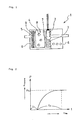
- FIG. 2 is a graph showing the relation between the time (t) in a combustion test using a high-pressure vessel and the pressure (P) in the vessel;
- FIG. 3 is a schematic sectional view of a gas generator 10 for a seatbelt pre-tensioner used in an embodiment of the present invention
- FIG. 4 is a diagram showing TABLE giving the composition ratios and the results of the 60 liter tank test and the autoignition property test.
- FIG. 5 is a diagram showing TABLE giving the results of the combustion test and the heat resistance test.
- the nitrate of the alkaline metal or alkaline earth metal is at least one material selected from the group consisting of readily available strontium nitrate, barium nitrate, potassium nitrate, and sodium nitrate.
- nitrogenous organic compounds which may be used as a fuel component in the present invention will be described first.
- Preferable nitrogenous organic compounds are those that have a high proportion of an atom of nitrogen in the molecular structure and have the structure of inherently restraining from generating harmful CO gas and also are easy to handle including thermal stability and safety and low in price.
- nitroguanidine and aminotetrazole are preferable in terms of reactivity with the oxidizing agent of the present invention.
- the nitroguanidine content is preferably of between 35 and 60 weight % in the composition.
- the content of not more than 35 weight % a limited amount of gas is generated, so that an inflating failure of the air bag may possibly be caused.
- the content added in excess of 60 weight % the added amount of oxidizing agent is relatively reduced to cause incomplete combustion and, as a result of this, there is a possible fear that a large amount of harmful CO gas may be generated. Further, in the extreme, there is a possible fear that unburned material may be produced.
- nitrate of the alkaline metal or alkaline earth metal are preferably contained as the oxidizing agent in the composition. It is noted here that a quantity of nitrate of the alkaline metal or alkaline earth metal is selected so as to exceed 0.9, where a quantity of nitrate required solely for forming an oxide of the alkaline metal or alkaline earth metal that can stoichiometrically neutralize hydrogen chloride generated from ammonium perchlorate is taken as 1, as mentioned above.
- the aminotetrazole content is preferably of between 20 and 45 weight % in the composition.
- the content of not more than 20 weight % a limited amount of gas is generated, so that an inflating failure of the air bag may possibly be caused.
- the content added in excess of 45 weight % the added amount of oxidizing agent is relatively reduced to cause incomplete combustion and, as a result of this, there is a possible fear that a large amount of harmful CO gas may be generated. Further, in the extreme, there is a possible fear that unburned material may be produced.
- the aminotetrazole content is of between 20 and 45 weight % in the composition
- 20-40 weight % of ammonium perchlorate and 25-55 weight % of nitrate of the alkaline metal or alkaline earth metal are preferably contained as the oxidizing agent in the composition.
- a quantity of nitrate of the alkaline metal or alkaline earth metal is selected so as to exceed 0.9, where a quantity of nitrate required solely for forming an oxide of the alkaline metal or alkaline earth metal that can stoichiometrically neutralize hydrogen chloride generated from ammonium perchlorate is taken as 1, as mentioned above.
- reaction formulas and gasification rates in the complete combustion in the reaction of nitroguanidine or aminotetrazole and the oxidizing agent are expressed by the following typical combination formulas (a) and (b).
- the inventors have found out the advantage in manufacturing safety resulting from the use of said mixed oxidizing agent.
- the mixture of aminotetrazole and ammonium perchlorate or the mixture of aminotetrazole and strontium nitrate keeps on burning in the atmosphere without interruption, once they are ignited.
- the mixture of aminotetrazole and mixed oxidizing agent of ammonium perchlorate/strontium nitrate ignites temporarily but does not burn continuously in the atmosphere. This means that in the event that fire comes out in the manufacturing process of the mixture, the mixture of aminotetrazole and mixed oxidizing agent of ammonium perchlorate/strontium nitrate is resistant to burning propagation, thus providing considerably improved manufacturing safety.
- nitroguanidine When nitroguanidine is used in combination with any one of the oxidizing agents of ammonium perchlorate, strontium nitrate and the mixture of ammonium perchlorate/strontium nitrate, no continuous burning in the atmosphere is found.
- hydrotalcites expressed by the following general formula are of preferable: [M 2+ 1 ⁇ x M 3+ x (OH) 2 ] x+ [A n ⁇ x/n .mH 2 O] x ⁇
- M 2+ represents bivalent metal including Mg 2+ , Mn 2+ , Fe 2+ , Co 2+ , Ni 2+ , Cu 2+ and Zn 2+ ;
- M 3+ represents trivalent metal including Al 3+ , Fe 3+ , Cr 3+ , Co 3+ and In 3+ ;
- a n ⁇ represents an n-valence anion including OH ⁇ , F ⁇ , Cl ⁇ , NO 3 ⁇ , CO 3 2 ⁇ , SO 4 2 ⁇ , Fe(CN) 6 3 ⁇ , CH 3 COO ⁇ , ion oxalate and ion salicylate;
- the hydrotalcites which are a porous material having water of crystallization, are very useful as a binder for a gas generating agent of nitrogenous organic compound. This seems to be because the hydrotalcites have the common property of being liable to absorb moisture and that property serves to firmly bind the components of the composition.
- the pellets when pellets of the gas generating agent are formed by using the hydrotalcites as the binder, the pellets can provide a degree of hardness (25-30 kgf) much higher than a degree of hardness of 10-15 kgf (Monsant type hardness meter) of a pellet of a general type of azide base gas generating agent even in a low pelletization pressure. Also, the molded products such as the pellets using this binder keep their characteristic and combustion behavior unchanged against the thermal shock caused by temperature being raised and fallen repeatedly, thus enabling the pellets to be minimized in deterioration with age after practical installation on a vehicle, to be very stable in properties.
- hydrotalcites are synthetic hydrotalcite or pyroaurite expressed by the following formulas.
- the synthetic hydrotalcite is of preferable in terms of availability and costs.
- the synthetic hydrotalcite of the hydrotalcites decomposes as shown in the following reaction formula and produces no harmful gas. Further, the reaction itself is an endothermic reaction, thus providing an advantageous effect of reducing the combustion temperature of the gas generating agent and resultantly suppressing the production of NOx.
- the hydrotalcites are quite insensitive to friction sensitivity and drop hammer sensitivity which are reference indexes of the degree of risk of explosives.
- the addition of the hydrotalcites to the gas generating composition of the present invention provides the gas generating composition that is safe to handle.
- the result of the friction sensitivity test as is prescribed by JIS-K-4810 (Explosive Performance Testing Method) is presented here as one example of an evaluation of risk.
- the composition of the nitroguanidine or aminotetrazole and the ammonium perchlorate/strontium nitrate having a 4-grade friction sensitivity is improved to have a 6-grade in safety by adding thereto the hydrotalcites of about 5 weight %.
- the hydrotalcites When the hydrotalcites is added to the gas generating composition of the present invention as the binder, the hydrotalcites is added in the range of 2 to 10 weight %. A less than 2 weight % hydrotalcites has difficulties in serving as the binder, while on the other hand, a more than 10 weight % hydrotalcites causes reduction of an added amount of other components to lead to difficulties in serving as the gas generating composition.
- the hydrotalcites is preferably added in the range of 3 to 8 weight % in particular.
- the hydrotalcites is of not more than 10 ⁇ m in a 50% average particle diameter of number of reference, so as to be dispersed uniformly in the gas generating composition.
- the 50% average particle diameter of number of reference is a measurement by which a size distribution is expressed on the basis of number: when the total number of particles is set to be 100, the particle size obtained when the particles integrated from the smaller number reach 50 is called the 50% average particle diameter of number of reference.
- the catalyst for enabling the autoignition of the gas generating composition used in the present invention (the autoignition capability developing catalyst) will be described below.
- the autoignition capability developing catalyst To allow series of nitroguanidine or aminotetrazole, ammonium perchlorate and nitrate of alkaline metal or alkaline earth metal to have an autoignition capability at 150-210° C., the study was made of the presence of the autoignition capabilities by adding thereto various kinds of metal oxides, metal sulphide and metal powder. This study showed that molybdenum trioxide and molybdenum trioxides, i.e., compounds that produce the molybdenum trioxide by heating, have the autoignition capability.
- the study also showed that even a very small quantity of 0.05 weight % addition to the gas generating composition developed the autoignition capability and that the capability was kept substantially unchanged in the range of between 0.05 weight % and 5 weight %.
- the molybdenum trioxide is preferably added as the catalyst for allowing them to have the autoignition capability in the range of between 0.05 weight % and 5 weight %.
- a less than 0.05 weight % addition develops no autoignition capability, while on the other hand, a more than 5 weight % addition develops a tendency of decreasing the gasification ratio.
- the molybdenum trioxides which may be used include molybdeum compounds such as molybdic acid, ammonium molybdate, sodium molybdate, phosphomolybdic acid, ammonium phosphomolybdate and sodium phosphomolybdate.
- molybdeum compounds such as molybdic acid, ammonium molybdate, sodium molybdate, phosphomolybdic acid, ammonium phosphomolybdate and sodium phosphomolybdate.
- the addition is preferably in the range of between 0.05 weight % and 5 weight % on a basis of the molybdenum trioxide produced.
- the slag collectors which may be used in the present invention include metal nitrides and metal carbides. There may be cases where the metal nitrides include azides, but the metal nitrides defined by the present invention include no azides.
- the nitrides which may be used include at least one material selected from the group consisting of silicon nitride (Si 3 N 4 ), boron nitride (BN), aluminum nitride (AlN), molybdenum nitride (MoN/Mo 2 N), tungsten nitride (WN 2 /W 2 N,W 2 N 3 ), titanium nitride (TiN), vanadium nitride (VN), zirconium nitride (ZrN), chromium nitride (CrN/Cr 2 N), tantalum nitride (TaN), and niobium nitride (NbN).
- silicon nitride Si 3 N 4
- BN boron nitride
- AlN aluminum nitride
- MoN/Mo 2 N molybdenum nitride
- WN 2 /W 2 N,W 2 N 3
- metal nitrides and metal carbides which are called fine ceramics, are used as heat-resistant materials which are thermally stable and high resistant, but they have the property of burning in high-temperature oxidizing atmospheres.
- the slag forming is performed through the use of their burning property.
- the nitrogen gas and carbon dioxide gas generated by the combustion reaction are also used for the operation of the occupant protection system, as is the case with the combustion gas generated by the burning of the fuel components.
- reaction formula of the slag forming in the present invention is given below, taking silicon nitride as an example. The same applies to the other metal nitrides and the metal carbides. It is to be noted that coefficient of reaction is omitted. Si 3 N 4 +O 2 +MO ⁇ 3MxSiOy+2N 2 where MO represents oxides of alkaline metal or alkaline earth metal or MgO and Al 2 O 3 produced from the hydrotalcites.
- the metal oxide produced from oxidizing agent or the binder coexists with silicon nitride in the burning of the silicon nitride and thus silicate is formed.
- the silicate has a melting point of about 1,600° C. and is in the molten state of high viscosity in the burning process of the gas generating agent, so that the fine particles of the slag are fused together to aggregate into large particles so as to be easily collected in the filtering members in the gas generator.
- the particle diameter of the metal nitride or the metal carbide is not more than 5 ⁇ m, or preferably not more than 1 ⁇ m, in the 50% average particle diameter of number of reference, because the finer the particle diameter, the more that effect can be expected.
- those metal oxides or metal carbides can act as a cohesion preventing agent for the pulverized components and also can be dispersed uniformly in the oxidizing agent and the fuel, to ensure uniform reaction for the slag.
- the metal nitride or metal carbide may be used in combination with pulverized silica which is pulverized powder of silicon dioxide.
- the added amount of the metal nitride or metal carbide depends on the oxide of alkaline metal or alkaline earth metal produced from the oxidizing agent and MgO and Al 2 O 3 produced from the hydrotalcites.
- the addition is preferably in the range of 0.5 to 5 weight % of the gas generating composition. With the addition of less than 0.5 weight %, the adequate slag collecting effects cannot be expected, while on the other hand, with the addition of more than 5 weight %, the added amounts of fuel and oxidizing agent are limited, so that there presents a possible fear of shortage of gas generation and incomplete combustion.
- the gas generating agents are molded into a granule form, a pellet form, a disk-like form, a cylindrical form having a single hole or a cylindrical form having a plurality of holes so that a desired burning velocity and a sufficient strength of the molded product can be obtained for their intended use.
- the auxiliary molding agent and the lubricant are used to mold the gas generating agent into an actual use configuration.
- the gas generating agent When the gas generating agent is formed into a granule form, aqueous solution including water-soluble polymer used as the auxiliary molding agent is sprayed on the gas generating agent and mixed. Then, the mixture is molded into a granule form having a diameter of 1.0 mm or less and then water is eliminated from the molded product to thereby produce the granules.
- the granules may be used as they are, but may further be press-formed into a pellet form or a disk-like form for their intended use.
- the addition of 0.05-2 weight % water-soluble polymer is contained in the composition.
- the addition of 0.1-1 weight % lubricant is contained in the composition.
- the gas generating agents formed into a pellet form or a disk-like form are heat-treated at 100-120° C. for about 2 to about 24 hours after formed to thereby produce the formed products of the gas generating agents which are resistant to deterioration with age.
- the heat-treatment is very effective particularly for passing harsh heat and aging tests of 107° C. ⁇ 400 hrs.
- the heat-treatment for less than 2 hours is insufficient and that for more than 24 hours will be of meaningless, for the reason of which the heat-treatment time should be selected from the range of 2-24 hours, preferably 5-20 hours.
- the heat-treatment at less than 100° C. is not effective and that at more than 120° C. may cause deterioration rather than improvement, for the reason of which the heat-treatment temperature should be selected from the range of 100-120° C., preferably 100-110° C.
- the gas generating composition of the present invention may be extruded into a cylindrical form having a single hole or a plurality of holes by adding an extrusion-molding-use binder.
- the gas generating agents molded into the cylindrical form having a single hole have an outer diameter of 1-7 mm, an inner diameter of 0.5-2 mm and an entire length of 2-10 mm, which may be varied in accordance with their intended use.
- the extrusion-molding-use binder to be mixed in the gas generating composition comprises at least one material selected from the group consisting of organic or inorganic binders including cellulosic compounds, polyvalent hydroxy compounds, polybinyl polymers and microbial polysaccharide.
- the mixture is extruded to form molded products.
- the addition of 1-15 weight % binder is contained in the composition.
- the gas generating agents of the invention thus extruded are heat-treated at 50-80° C. for about 20 to about 30 hours after formed to thereby produce the molded products of the gas generating agents which are resistant to deterioration with age.
- the molded products containing 20-30 weight % moisture are heat-treated, so that they must be heat-treated for a long time at low temperature.
- the heat-treatment is very effective particularly for passing harsh heat and aging tests of 107° C. ⁇ 400 hrs.
- the heat-treatment for less than 20 hours is insufficient and that for more than 30 hours will be of meaningless, for the reason of which the heat-treatment time should be selected from the range of 20-30 hours.
- the heat-treatment at less than 50° C. is not effective and that at more than 80° C. accelerates a moisture evaporation rate excessively to produce air bubbles in the molded product, which may cause a reduced strength and an abnormal burning in the combustion.
- nitroguanidine and aminotetrazole are optimum fuel components.
- the mixtures of ammonium perchlorate and nitrate of alkaline metal or alkaline earth metal are optimum oxidizing agents.
- the fuel component When nitroguanidine is used as the fuel component, the fuel component is preferably contained in the gas generating agent in the range of 5-60 weight %. Then, 15-30 weight % ammonium perchlorate and 20-40 weight % strontium nitrate are preferably contained as the oxidizing components in the gas generating agent. When aminotetrazole is used as the fuel component, the fuel component is preferably contained in the gas generating agent in the range of 20-45 weight %. Then, 20-40 weight % ammonium perchlorate and 25-55 weight % strontium nitrate are preferably contained as the oxidizing components in the gas generating agent.
- Molybdenum trioxide is an optimum autoignition capability developing catalyst. 0.05-5 weight % autoignition capability developing catalyst is preferably contained in the gas generating agent.
- Silicon nitride is an optimum metal nitride of the slag collector, and silicon carbide is an optimum metal carbide. This is because silicon component of the slag collector is allowed to react with oxide produced from the nitrate of the alkaline metal or alkaline earth metal or oxide produced from the binders mentioned below in the process of combustion, to form readily collectable, high-viscosity slag.
- This slag collector is preferably contained in the gas generating agent in the range of 0.5-5 weight %.
- Synthetic hydrotalcites that can produce high-melting oxides of MgO and Al 2 O 3 are an optimum binder for the gas generating agents to be press-formed into a pellet form or other like forms. These cause the slag reaction with silicon nitride or silicon carbide, as mentioned above, to produce the high-viscosity slag that is easily collected by the filtering part of the gas generator.
- This binder is preferably contained in the gas generating agent in the range of 2-10 weight %.
- Polyvinyl alcohol is an optimum auxiliary molding agent for the gas generating agent to be molded into a granule form.
- This auxiliary molding agent is preferably contained in the gas generating agent in the range of 0.05-2 weight %.
- the respective components are blended and then mixed by a V-type mixer. Then, aqueous solution in which water-soluble polymer of auxiliary molding agent is dissolved is sprayed on the mixture, which in turn is wet kneaded and granulated, so as to be molded into granules having a particle size of 1 mm or less. The granules is dried at 100° C. for 10 hours for use as the gas generating agent.
- Magnesium stearate is an optimum lubricant for the gas generating agent to be press-formed into a pellet form. This lubricant is preferably added in the gas generating agent in the range of 0.1-1 weight %.
- the lubricant is added to the mixed powder produced by the V-type mixer and then the mixture is press-formed into a desired form and is dried at 100° C. for 10 hours for use as the gas generating agent.
- the lubricant may be added to the granules before the agent is press-formed.
- Cellulosic compounds are an optimum binder for the gas generating agent to be extruded into a cylindrical form having a single hole or a plurality of holes.
- This extrusion-molding-use binder is preferably added in the gas generating agent in the range of 1-10 weight %.
- the fuel, the oxidizing agent and various kinds of additives are weighed in a spiral mixer and then 25 weight % water is added thereto at outer percentage and fully blended to produce a wet agent having viscosity. Thereafter, the wet agent is passed through a die that can extrude a material into a desired form and is cut to a required length. The extruded products thus obtained is heat-treated at 60° C. for 24 hours for use as the gas generating agent.
- gas generating agents were prepared in such a manner as to mentioned in Examples 1 to 4 and then loaded in the gas generators as shown in FIG. 1 , respectively. Then, 60 liter tank tests and autoignition capability tests were carried out by use of the gas generators 1 .
- an ordinate represents the internal pressure P of the vessel; an abscissa represents time t; P 1 represents a maximum range pressure in the vessel (Kpa); t 1 represents the time before the start of operation of the gas generator from the power supply to the ignitor 2 (ms:millisecond); and t 2 represents a required time (ms) for the pressure to reach P 1 after the operation of the gas generator.
- the autoignition capability was tested by use of the test-use gas generators in a test procedure called an outside fire test, through which the presence of autoignition capability against the fire and the like can be seen.
- the outside fire test is a test procedure in which after the test-use gas generator is placed on cumulated woods which then are oiled with lamp oil and ignited, the test-use gas generator is allowed to stand in the flame for 10-30 minutes to examine on whether or not the gas generator is damaged by the burning of the gas generating agents.
- the results of the 60 liter tank tests and the results of the autoignition capability tests are shown as TABLE 1 in FIG. 4 .
- the mixture was pulverized to about 12 ⁇ m in the 50% average particle diameter of number of reference.
- APD2 brand name
- the mixture was press-formed with a rotary type tablet making apparatus to obtain the gas generating pellets of 6 mm in diameter, 2.2 mm in thickness and 120 mg in weight.
- the pellets were heat-treated at 100° C. for 10 hours. 25 g of the pellets thus obtained were loaded in the airbag-use gas generator 1 having the structure shown in FIG. 1 .
- the test results are shown as TABLE 1 in FIG. 4 .
- the wet agents as fully kneaded into clayey clod were passed through the extruding machine so as to be extruded into the cylindrical form having a single hole having an outer diameter of 2 mm and an inner diameter of 1 mm and cut to an entire length of 3 mm.
- the extruded products were heat-treated at 60° C. for 24 hours.
- impalpable powders of the silicon nitride (0.2 ⁇ m in the 50% average particle diameter of number of reference) were added in advance to the strontium nitrate and then the mixture was pulverized to about 12 ⁇ m in the 50% average particle diameter of number of reference.
- 25 g of the molded products thus obtained were loaded in the airbag-use gas generator 1 having the structure shown in FIG. 1 .
- the test results are shown as TABLE 1 in FIG. 4 .
- impalpable powders of the silicon nitride (0.2 ⁇ m in the 50% average particle diameter of number of reference) were added in advance to the 5-aminotetrazole and the strontium nitrate, respectively, by amounts that were nearly proportionally allotted corresponding to their weights. Then, the mixture was pulverized to about 12 ⁇ m in the 50% average particle diameter of number of reference.
- APD2 brand name available from Japan Carlit Co., Ltd. was used as it is.
- the mixture was press-formed with the rotary type tablet making apparatus to obtain the gas generating pellets of 6 mm in diameter, 2.2 mm in thickness and 125 mg in weight.
- impalpable powders of the silicon nitride (0.2 ⁇ m in the 50% average particle diameter of number of reference) were added in advance to the 5-aminotetrazole and the strontium nitrate, respectively, by amounts that were nearly proportionally allotted corresponding to their weights. Then, the mixture was pulverized to about 12 ⁇ m in the 50% average particle diameter of number of reference. Then, the obtained pellets were heat-treated at 100° C. for 10 hours. Thereafter, 25 g of the pellets were loaded in the airbag-use gas generator 1 having the structure shown in FIG. 1 . The test results are shown as TABLE 1 in FIG. 4 .
- impalpable powders of the silicon nitride (0.2 ⁇ m in the 50% average particle diameter of number of reference) were added in advance to the strontium nitrate and then the mixture was pulverized to about 110 ⁇ m in the 50% average particle diameter of number of reference.
- the obtained pellets were heat-treated at 100° C. for 10 hours. Thereafter, 25 g of the pellets were loaded in the airbag-use gas generator 1 having the structure shown in FIG. 1 .
- the test results are shown as TABLE 1 in FIG. 4 . No autoignition capability test was carried out.
- impalpable powders of the silicon nitride (0.2 ⁇ m in the 50% average particle diameter of number of reference) were added in advance to the 5-aminotetrazole and the strontium nitrate, respectively, by amounts that were nearly proportionally allotted corresponding to their weights. Then, the mixture was pulverized to about 12 ⁇ m in the 50% average particle diameter of number of reference. The obtained pellets were heat-treated at 100° C. for 10 hours. Thereafter, 25 g of the pellets were loaded in the airbag-use gas generator 1 having the structure shown in FIG. 1 . The test results are shown as TABLE 1 in FIG. 4 . No autoignition capability test was carried out.
- the quantities of slag flown out are expressed by weight (g) of solid residues ejected from the gas exhausting holes 6 of the test-use gas generator shown in FIG. 1 as were collected from the inside of the vessel.
- the quantities (ppm) of CO, NOx (including NO and NO 2 ), HCl and Cl 2 which are harmful gas for a human body were determined by making an analysis of the gas, which is accumulated in the 60 liter vessel after the gas generator is put in action, by using a prescribed gas detector.
- Examples show more desirable values as the occupant-protection-purpose gas generating agents on the combustion behavior of both the maximum range pressure P 1 in the vessel and the time t 2 required for the pressure to reach P 1 from the start of operation of the gas generator.
- Examples used the ammonium perchlorate, which it is feared generates a harmful gas like hydrogen chloride, as the oxidizing agent, no hydrogen chloride was detected.
- Examples generated very little CO and NOx that are harmful gases for a human body.
- Comparative Examples 1-4 show the examples using strontium nitrate singly as the oxidizing agent without any ammonium perchlorate.
- the amounts of the agents used in Comparative Examples are calculated by coordination with those used in Examples, one half of the values of the maximum range pressure P 1 of Examples was obtained. It is seen from the results of Comparative Examples 1 and 2 that although those values are affected by the difference in heat release values in the burning of the gas generating agents, they reflect well on the difference in the gasification rate and therefore the gas generating compositions of the present invention have a high gasification rate, as compared with the conventional gas generating compositions.
- Comparative Examples 3 and 4 the amounts of agents were increased to 44 g so that the maximum range pressure P 1 could be in the same level as that of Examples, before the tests were carried out. In the outside fire tests, it was found that the gas produces were damaged and thus those agents had no autoignition capability. In this Comparative Example, when the strontium nitrate was used as the oxidizing agent, it was found that the concentration of NOx and the quantity of slag flown out increased.
- the gas generator 10 comprises an ignition support member 11 , an electric igniter 12 and a loading cylinder 13 .
- the gas generating agents 14 were loaded in the loading cylinder 13 .
- the combustion gas of the gas generating agents 14 is exhausted from a bottom of the loading cylinder 13 .
- the gas generator 10 was placed in a high pressure vessel having an internal volume of 10 milliliter and then was put in action to release the gas in the vessel, and changes of the internal pressure of the vessel with time were measured as shown in FIG. 2 used in Example 1.
- the gas generator 10 was placed in the 60 liter tank used in Example 1 and was put in action and, then, the combustion gas analysis was made with the gas detector. Further, the gas generating agents were allowed to stand at 120° C. for 50 hours to examine their heat resistance and then the reduction of weight was measured. The results of those tests are shown as TABLE 2 in FIG. 5 .
- the quantity of the polyvinyl alcohol aqueous solution was then contained 0.1 weight % in the mixture.
- the granules were dried at 100° C. for 10 hours. Thereafter, 1.0 g of granules were loaded in the seatbelt-pre-tensioner-use gas generator 10 having the structure shown in FIG. 3 and the tests were made. The test results are shown as TABLE 2 in FIG. 5 .
- Example 5 The same tests as those in Example 5 were made by using 1.0 g single base smokeless powder having nitrocellulose as a major component. The test results are shown as TABLE 2 in FIG. 5 .
- the gas generating composition of the present invention has remarkable characteristics of good composition of the combustion gas and excellent heat resistance.
- the concentration of CO is 4,500 ppm
- the concentration of CO is considerably improved to 700-900 ppm. This is obvious from the results of Examples mentioned above. Further, it was seen from the fact that no weight was found to reduce even when the agents were allowed to stand in the state of high temperature of 120° C. that the agents have good heat resistance.
- a nitrogenous organic compound nitroguanidine or aminotetrazole
- the fuel component is nitrogenous organic compound, so that a good gas that produces little CO gas is obtained.
- hydrotalcites are used as the binder, the generation of NOx is also suppressed.
- the addition of proper additives to the fuel component and the oxidizing agent can produce excellent heat resistance and reduced quantity of outflow slag and can hold an autoignition capability in the gas generating agent.
- the metal oxide produced from the oxidizing agent and the other metal oxides produced in the combustion process cause slag forming reaction with metal nitride or metal carbide added as the slag collector, so that they are converted into material that can be easily filtered by the filter. This can produce clean gas and also enables reduction in size and weight.
- the gas generating composition of the present invention When the gas generating composition of the present invention is used as the gas generating composition for use in the seatbelt pre-tensioner gas generator, a small amount of gas generating composition used is needed and thus a small quantity of slag is produced, thus requiring no filter for the use.
- the present invention is optimum as the gas generating composition that contains nitrogenous organic compound, nitroguanidine or aminotetrazole, in particular, as a fuel component, so as to produce clean gas for a human body at high gasification rate.
- the present invention is optimum as the gas generating composition having high gasification rate that is low in quantity of harmful NOx and CO gas components in the generated gas, excellent in heat resistance and small in volume of outflow slag and also holds an autoignition capability in the gas generating agent itself.
Landscapes
- Chemical & Material Sciences (AREA)
- Organic Chemistry (AREA)
- Chemical Kinetics & Catalysis (AREA)
- Inorganic Chemistry (AREA)
- Engineering & Computer Science (AREA)
- Combustion & Propulsion (AREA)
- General Chemical & Material Sciences (AREA)
- Air Bags (AREA)
- Feeding, Discharge, Calcimining, Fusing, And Gas-Generation Devices (AREA)
- Solid Fuels And Fuel-Associated Substances (AREA)
Abstract
A gas generating composition which contains a nitrogenous organic compound as a fuel component and generates, at a high gasification rate, a clean gas harmless to the human body. The composition of the present invention comprises a nitrogenous organic compound as a fuel component and ammonium perchlorate and the nitrate of an alkaline metal or alkaline earth metal as oxidizing agents, wherein where a quantity of nitrate required solely for forming an oxide of alkaline metal or alkaline earth metal that can stoichiometrically neutralize hydrogen chloride generated from ammonium perchlorate is taken as 1, a quantity of nitrate of said alkaline metal or alkaline earth metal exceeds 0.9.
Description
Divisional of prior application Ser. No.: 09/623,043 filed Aug. 25, 2000, now abandoned, which is a 371 of PCT/JP99/00835 filed Feb. 24, 1999.
The present invention relates to a gas generating agent for use in a gas generator for an occupant protection device using explosive and, more particularly, relates to a novel composition for generating gas in which a quantity of contained detrimental composition such as nitrogen oxide and carbon monoxide is small and gasification rate is high.
An airbag system and a seatbelt pre-tensioner, which are occupant protecting systems, have been widely adopted in recent years for improving safety of the occupants in an automobile. The principle of the airbag system operation is that a gas generator is operated under control of signals from a sensor detecting a collision so as to inflate an airbag between occupants and a car body. The principle of the seatbelt pre-tensioner operation is substantially same, that a gas generator is operated under control of signals from a sensor detecting a collision so as to put occupants under constraint with seatbelts for protection. It is required of the gas generator to have a function for producing clean gas containing no harmful gas with a required and sufficient amount in a short time. And also it is required of the gas generator to be small in size and light in weight.
The gas generating agents for use in the gas generator are formed into a pellet form or a disc-like form by extrusion or pressure molding for stabilization of the burning. And it is required of the gas generating agents to maintain their initial combustion behavior over a long time even under various harsh environments. When the pellets deform or decrease in strength due to deterioration with age or change of environments and the like, the flammability of the explosive compositions will vary from that of the initial design then exhibit an abnormal combustion behavior. As a result of this, there is a possibility that the airbag or the gas generator may be broken itself in the event of the car-crash. In this case, it is failed to accomplish the aim of protecting the occupants. And there is even a possibility to cause them injury.
Gas generating agents containing metal azides such as sodium azide and potassium azide as their major component have been used as gas generating agents satisfying those required functions.
These known gas generating agents are widely used in terms of their various advantages such thet they are burnt immediately, the component of combustion gas is substantially nitrogen gas only, harmful gas such as CO (carbon monoxide) or NOx (nitrogen oxide) is not produced and it is easy to design the gas generator since the burning velocity is little influenced by the environment or the structure of the gas generator.
However, the metal azides have notable problems such that the metal azides itself are a harmful material, it produces azide easy to explode by impact and friction due to its contact with the heavy metal and it has decompose under the presence of water and acid then produce harmful gas. Thus, the metal azides must be handled with the greatest possible caution.
As the substitution of metal azides, gas generating agents containing tetrazoles, azodicarbonamides and other nitrogenous organic compounds as fuel components are proposed by, for example, Japanese Laid-open Patent Publications No. Hei 2(1990)-225159, No. Hei 2(1990)-225389, No. Hei 5(1993)-213687, No. Hei 6(1994)-32689 and No. Hei 6(1994)-80492, No. Hei 6(1994)-239684, No. Hei 7(1995)-206569 and No. Hei 7(1995)-206570.
The tetrazoles in particular are thermally stable and have a high proportion of atoms of nitrogen in their molecular structure, and thus have the property of inherently suppressing the production of CO. However, these involve the problem of readily producing NOx. So then, Japanese Laid-open Patent Publications No. Hei 2(1990)-225159 and No. Hei 3(1991)-208878 propose a method in which the gas generator is provided with a venturi means for introducing air into the combustion gas from outside so as to reduce the concentration of NOx as a whole. However, this method failed to clear up this problem essentially.
When nitrogenous organic compound is used as fuel, nitrate such as alkaline metal or alkaline earth metal, perchlorate or chlorate is generally used as an oxidizing agent for burning the nitrogenous organic compound. The alkaline metal or the alkaline earth metal contained in the oxidizing agent produces slag in the form of oxide or chloride as a result of the burning reaction. The proportion of the slag to the combustion products is not a little.
The occupant protection device may not serve since the oxide and chloride are harmful material for a human body and environment, and the oxide may cause damage to air bags to flow out of the gas generator. Accordingly, the oxide and chloride must be converted into slag in an easily collectable form, then the slag must collected in the gas generator. However, many of the gas generating agents using the nitrogenous organic compound as fuel have the calorific value as high as 2,000-3,000 joule/g or more. So, temperature and pressure of generated gas is high. Also temperature and flowability of slag is high, which is a by-product made in the burning of the gas generating agents. As a result of these, the slag collection efficiency of a filter fitted in a conventional type of gas generator tends to reduce. In order to increase slag collection efficiency, a method may be conceivable, wherein the slag is cooled and solidified by increased number of filtering members set in the gas generator. But such a method has a disadvantage of increasing the size of the gas generator, going against the trend toward the size reduction and weight reduction of the gas generator.
Japanese Laid-open Patent Publication No. Hei 4(1992)-265292 discloses another method for collecting the oxide of alkaline metal or alkaline earth metal which is produced in the reaction for burning the nitrogenous organic compound, wherein the oxide is converted into slag in the filtering part, the slag has a form easily collected, the slag is efficiently collected. According to this method, silicon dioxide or aluminum oxide is added as an acid or neutral slag forming agent that easily causes a slag-forming reaction with the oxides of alkaline metal or alkaline earth metal which are basic substances. However, those compounds do not in any manner contribute to the production of gas in the combustion reaction, thus resulting in reduction of the rate of gasification. Accordingly, the inventors have studied on how to improve the rate of gasification (a quantity of generated gas per unit weight of the gas generating agent) by using an oxidizing agent that produces no solid slag or a possible smallest quantity of solid slag after the combustion reaction, if any, as the oxidizing agent for the composition of the gas generating agent.
Ammonium nitrate and ammonium perchlorate can be cited as the oxidizing agent that produces no solid slag after combustion. One of the disadvantages that may arise from the use of ammonium nitrate as the oxidizing agent is that that substance causes various crystalline phase changes, among which the crystalline phase change that is caused at about 32° C. involves a great volume change. When the gas generating agent is repeatedly exposed to the crystalline phase changes above and below of that temperature range, the crystals of the ammonium nitrate expand and contract repeatedly to cause reduction in strength of or decay of the press-formed tablets of the gas generating agent which may become a possible cause of an abnormal combustion. For avoidance of this problem, a phase stabilizing method for ammonium nitrate is disclosed by PCT WO95/04710.
The ammonium nitrate is very low in reactivity, so a hazardous fuel component such as triaminoguanidine nitrate must be used to compensate for its hard burning property. Thus, the use of the ammonium nitrate as the oxidizing agent involves unavoidable problems of improvements in heat resistance and flammability.
On the other hand, the gas generating agents using the ammonium perchlorate are disclosed by Japanese Laid-open Patent Publications No. Hei 2(1990)-293389, No. Hei 5(1993)-221770 and No. Hei 8(1996)-228288. These are all produced by making use of the technology of propellant and are characterized by the use of a binder doubling as fuel. The binders doubling as the fuel that may be used include organic polymeric material, such as terminated hydroxyl polybutadiene, and silicon resin. The use of the organic polymeric material as the fuel constituent involves the inherent problem of increase in CO concentration in generated gas or aged deterioration resulting from the lack of heat resistance. Japanese Laid-open Patent Publications No. Hei 2(1990)-225159 and Hei 3(1991)-208878 disclose examples using nitrogenous organic compound as the fuel component and the ammonium perchlorate as the oxidizing agent. However, the composition of the gas generating agents could not be used singly for the protection of automobile occupants because of the poorness of the generated gas after combustion. Nevertheless, ammonium perchlorate is an interesting oxidizing agent in terms of heat resistance and reactability as the oxidizing agent, as compared with ammonium nitrate.
On the other hand, as a substitute for conventional stainless steel (SUS), aluminum is being widely used as a container material of the gas generator, for the purpose of weight saving of the gas generator. In the case of the container made of SUS, because of its excellent strength in high temperature, even when a temperature rise is caused by car fire, incineration of the gas generator or the like, no fracture of the container is caused and the composition of the gunpowder can be burnt out. In the case of the container made of aluminum, since its strength reduces significantly in high temperature, when the gas generator is exposed to flame of the car fire and the like and the composition of the gunpowder loaded in the interior is burnt, it is feared that the container cannot withstand the burning pressure and thus may be broken so that the fragments may be flied off to the surrounding to kill and wound occupants and persons around them. Accordingly, it is cited as the required term for the gas generator that the critical condition of the container, such as the fracture of the container, can be prevented even in such circumstances. To take measures to meet that situation, U.S. Pat. No. 4,561,675 proposed a system for the aluminum container, according to which the gunpowder that ignites automatically at a temperature lower than the temperature at which reduction of strength of aluminum is caused is arranged in close contact with an inner surface of the container. The automatic igniting gunpowder used therein includes nitrocellulose as a major component. Nitrocellulose itself lacks long-term stabilization under high temperature and further may ignite automatically due to that deterioration.
Smokeless powder having nitrocellulose as a major component has been equally used for the gas generating agent for use in the gas generator for a seatbelt pre-tensioner in terms of high burning velocity and autoignition capability, despite of the problems as mentioned above. Development of nitrocellulose is not originally intended for use in the gas generator and the oxygen balance in the composition (over and short oxygen in the combustion reaction) is not adjusted. Due to this, the use of nitrocellulose involves the problems of poorness in the combustion gas and very high combustion temperature.
The present invention aims to provide a gas generating agent that is good in generated gas composition and high in gasification rate by making choice of an oxidizer component of the gas generating agent having nitrogenous organic compound, nitroguanidine or aminotetrazole, in particular, as a fuel component which is a material effective for solving the problem of harmfulness of the metallic compound azide that has been used hitherto, whereby reduction in size and weight of the gas generator for use in the occupant protection device is accomplished.
Further preferably, the present invention aims provide the gas generating composition that is high in gasification rate, low in quantity of harmful NOx and CO gas components, excellent in heat resistance and small in volume of outflow slag and also holds an autoignition capability in the gas generating agent itself.
After having devotedly studied about any method for solving the above-noted problems, the inventors have found that the gas generating composition containing a combustion fuel, an oxidizing agent and an additive is allowed to have the property of being good in generated gas composition and high in gasification rate by using nitrogenous organic compound, nitroguanidine or aminotetrazole, in particular, as the major component and using the mixture of ammonium perchlorate and nitrate salt of alkaline metal or alkaline earth metal as the oxidizing agent, then leading to the present invention.
Specifically, the present invention is so designed that where a quantity of nitrate required solely for forming an oxide of alkaline metal or alkaline earth metal that can stoichiometrically neutralize hydrogen chloride generated from ammonium perchlorate is taken as 1, a quantity of nitrate of the alkaline metal or alkaline earth metal exceeds 0.9.
When ammonium perchlorate is used singly as the oxidizing agent, a 100% gasification rate can be obtained. But, harmful gas like hydrogen chloride is produced by the combustion of the ammonium perchlorate and also the combustion temperature is so high that the concentration of nitrogen oxides is increased. In order to solve these problems, the nitrate of the alkaline metal or alkaline earth metal is added to the ammonium perchlorate. The hydrogen chloride in particular is neutralized by the oxide of alkaline metal or alkaline earth metal originating from nitrate and is converted into water and harmless chloride.
Preferably, the amount of the nitrate of alkaline metal or alkaline earth metal added to the ammonium perchlorate is substantially equal to or slightly excess of the nitrate required solely for forming an oxide of alkaline metal or alkaline earth metal that can stoichiometrically neutralize hydrogen chloride generated from ammonium perchlorate. The oxides of alkaline metal or alkaline earth metal excessively produced are converted into materials that can be easily filtered by filters in the gas generator by the slag reaction with the slag collector mentioned later.
Further, when nitroguanidine is used as the fuel component, it is important that 15-30 weight % ammonium perchlorate and 20-40 weight % nitrate of the alkaline metal or alkaline earth metal are contained as the oxidizing agent relative to 35-60 weight % nitroguanidine.
When aminotetrazole is used as the fuel component, it is important that 20-40 weight % ammonium perchlorate and 25-55 weight % nitrate of the alkaline metal or alkaline earth metal are contained as the oxidizing agent relative to 20-45 weight % aminotetrazole.
It is preferable that said nitrate is at least one material selected from the group consisting of strontium nitrate, barium nitrate, potassium nitrate, and sodium nitrate.
According to the present invention, various kinds of additives are used to provide improvement in moldability, composition of generated gas, and slag formability. When the one material of the additives is the binder, it is preferable that hydrotalcites expressed by the following formula is contained as the binder and 2-10 weight % of hydrotalcites is contained in the composition:
[M2+ 1−xM3+ x(OH)2]x+[An− x/n.mH2O]x−
where M2+ represents bivalent metal including Mg2+, Mn2+, Fe2+, Co2+, Ni2+, Cu2+ and Zn2+;
M3+ represents trivalent metal including Al3+, Fe3+, Cr3+, Co3+ and In3+;
An− represents an n-valence anion including OH−, F−, Cl−, NO3 −, CO3 2−, SO4 2−, Fe(CN)6 3−, CH3COO−, ion oxalate and ion salicylate; and
x: 0<x≦0.33.
Among others, it is preferable that the hydrotalcites are synthetic hydrotalcite or pyroaurite expressed by the following formulas:
(Synthetic Hydrotalcite)
Chemical formula: Mg6Al2(OH)16CO3.4H2O
(Pyroaurite)
Chemical formula: Mg6Fe2(OH)16CO3.4H2O
When the one material of the additives is a catalyst for enabling an autoignition of the gas generating composition (autoignition capability developing catalyst), it is preferable that at least one molybdenum compound selected from the group consisting of molybdenum trioxide, molybdic acid, ammonium molybdate, sodium molybdate, phosphomolybdic acid, ammonium phosphomolybdate and sodium phosphomolybdate is contained as the autoignition capability developing catalyst. It is preferable that 0.05-5 weight % of molybdenum compound is contained in the composition.
When the one material of the additives is a slag collector, it is preferable that at least one metal nitride or metal carbide is contained as the slag collector. Preferably, 0.5-5 weight % of at least one metal nitride or metal carbide is contained in the composition.
When the one material of the additives is an auxiliary molding agent suitable for molding into granules and the like, it is preferable that at least one water-soluble polymer selected from the group consisting of polyethylene glycol, polypropylene glycol, polyvinyl ether, copolymer of maleic acid and other polymerizable material, polyethylene imide, polyvinyl alcohol, polyvinyl pyrrolidone, polyacrylamide, sodium polyacrylate and ammonium polyacrylate is contained as the auxiliary molding agent. The water-soluble polymer solution may be sprayed on the gas generating composition and dried so as to form the granules of gas generating compositions. In this case, it is preferable that a 0.05-2 weight % addition of water-soluble polymer is contained in the composition.
When the one material of the additives is a press-forming-use lubricant suitable for molding into pellets and the like, it is preferable that at least one material selected from the group consisting of magnesium stearate, zinc stearate, graphite, boron nitride and molybdenum disulfide is mixed as the lubricant in the gas generating composition. Preferably, 0.1-1 weight % of lubricant is contained in the composition.
The gas generating composition of the present invention may be extruded into a cylindrical form having a single hole or a plurality of holes by adding an extrusion-molding-use binder. In this case, it is preferable that at least one material selected from the group consisting of organic or inorganic binders such as cellulosic compound, polyvalent hydroxy compound, polybinyl polymer, microbial polysaccharide and inorganic binder is mixed as the extrusion-molding-use binder in the gas generating composition before the extrusion molding. A 1-15 weight % of addition is preferable.
The gas generator of the present invention is a gas generator in which any of the above-mentioned gas generating compositions of the present invention is loaded.
The detailed description on the present invention will be given below. The gas generating agent of the present invention comprises nitrogenous organic compound in particular,nitroguanidine or aminotetrazole as a fuel component, and mixture of ammonium perchlorate and nitrate of alkaline metal or alkaline earth metal as an oxidizing agent used for burning the nitrogenous organic compound. Further, the gas generating agent of the present invention comprises a binder, an autoignition capability developing catalyst, a slag collector and other various kinds of auxiliary molding agent, which may selectively be added and mixed in accordance with the intended purpose. The gas generating composition of the present invention is characterized in that, we set a quantity of nitrate of the alkaline metal or alkaline earth metal exceeding 0.9 in the mixture of the oxidizing agent when a required quantity of nitrate for forming an oxide of alkaline metal or alkaline earth metal is regarded as one, the oxide can stoichiometrically neutralize hydrogen chloride generated from ammonium perchlorate.
It is preferable that the nitrate of the alkaline metal or alkaline earth metal is at least one material selected from the group consisting of readily available strontium nitrate, barium nitrate, potassium nitrate, and sodium nitrate.
Now, the nitrogenous organic compounds which may be used as a fuel component in the present invention will be described first. Preferable nitrogenous organic compounds are those that have a high proportion of an atom of nitrogen in the molecular structure and have the structure of inherently restraining from generating harmful CO gas and also are easy to handle including thermal stability and safety and low in price. Of those compounds, nitroguanidine and aminotetrazole are preferable in terms of reactivity with the oxidizing agent of the present invention.
When nitroguanidine is used as fuel component, the nitroguanidine content is preferably of between 35 and 60 weight % in the composition. With the content of not more than 35 weight %, a limited amount of gas is generated, so that an inflating failure of the air bag may possibly be caused. On the other hand, with the content added in excess of 60 weight %, the added amount of oxidizing agent is relatively reduced to cause incomplete combustion and, as a result of this, there is a possible fear that a large amount of harmful CO gas may be generated. Further, in the extreme, there is a possible fear that unburned material may be produced.
Thus, when the nitroguanidine content is of between 35 and 60 weight % in the composition, 15-30 weight % of ammonium perchlorate and 20-40 weight % of nitrate of the alkaline metal or alkaline earth metal are preferably contained as the oxidizing agent in the composition. It is noted here that a quantity of nitrate of the alkaline metal or alkaline earth metal is selected so as to exceed 0.9, where a quantity of nitrate required solely for forming an oxide of the alkaline metal or alkaline earth metal that can stoichiometrically neutralize hydrogen chloride generated from ammonium perchlorate is taken as 1, as mentioned above.
When aminotetrazole is used as fuel component, the aminotetrazole content is preferably of between 20 and 45 weight % in the composition. With the content of not more than 20 weight %, a limited amount of gas is generated, so that an inflating failure of the air bag may possibly be caused. On the other hand, with the content added in excess of 45 weight %, the added amount of oxidizing agent is relatively reduced to cause incomplete combustion and, as a result of this, there is a possible fear that a large amount of harmful CO gas may be generated. Further, in the extreme, there is a possible fear that unburned material may be produced.
Thus, when the aminotetrazole content is of between 20 and 45 weight % in the composition, 20-40 weight % of ammonium perchlorate and 25-55 weight % of nitrate of the alkaline metal or alkaline earth metal are preferably contained as the oxidizing agent in the composition. In this case also, a quantity of nitrate of the alkaline metal or alkaline earth metal is selected so as to exceed 0.9, where a quantity of nitrate required solely for forming an oxide of the alkaline metal or alkaline earth metal that can stoichiometrically neutralize hydrogen chloride generated from ammonium perchlorate is taken as 1, as mentioned above.
Then, the reaction formulas and gasification rates in the complete combustion in the reaction of nitroguanidine or aminotetrazole and the oxidizing agent are expressed by the following typical combination formulas (a) and (b).
(a) Reaction of Nitroguanidine and Mixtures of Ammonium Perchlorate/strontium Nitrate
CH4N4O2+0.4NH4ClO4+0.2Sr(NO3)2→2.4N2+CO2+2.8H2O+0.2SrCl2
Gasification Rate: 83.6%
CH4N4O2+0.4NH4ClO4+0.2Sr(NO3)2→2.4N2+CO2+2.8H2O+0.2SrCl2
Gasification Rate: 83.6%
(b) Reaction of Aminotetrazole and Mixtures of Ammonium Perchlorate/strontium Nitrate
CH3N5+0.7NH4ClO4+0.35Sr(NO3)2→3.2N2+CO2+2.9H2O+0.35SrCl2
Gasification Rate: 77.0%
CH3N5+0.7NH4ClO4+0.35Sr(NO3)2→3.2N2+CO2+2.9H2O+0.35SrCl2
Gasification Rate: 77.0%
Then, typical combinations of reaction formulas and gasification rates in the use of the oxidizing agent including no ammonium perchlorate are expressed by the following formulas (c) and (d) as Comparative
(c) Reaction of Nitroguanidine and Strontium Nitrate
CH4N4O2+0.4Sr(NO3)2→2.4N2+0.6CO2+2H2O+0.4SrCO3
Gasification Rate: 68.7%
(d) Reaction of Aminotetrazole and Strontium Nitrate
CH3N5+0.7Sr(NO3)2→3.2N2+0.3CO2+1.5H2O+0.7SrCO3
Gasification Rate: 55.7%
CH3N5+0.7Sr(NO3)2→3.2N2+0.3CO2+1.5H2O+0.7SrCO3
Gasification Rate: 55.7%
Further, the inventors have found out the advantage in manufacturing safety resulting from the use of said mixed oxidizing agent. Specifically, the mixture of aminotetrazole and ammonium perchlorate or the mixture of aminotetrazole and strontium nitrate keeps on burning in the atmosphere without interruption, once they are ignited. On the other hand, the mixture of aminotetrazole and mixed oxidizing agent of ammonium perchlorate/strontium nitrate ignites temporarily but does not burn continuously in the atmosphere. This means that in the event that fire comes out in the manufacturing process of the mixture, the mixture of aminotetrazole and mixed oxidizing agent of ammonium perchlorate/strontium nitrate is resistant to burning propagation, thus providing considerably improved manufacturing safety. When nitroguanidine is used in combination with any one of the oxidizing agents of ammonium perchlorate, strontium nitrate and the mixture of ammonium perchlorate/strontium nitrate, no continuous burning in the atmosphere is found.
Then, the binders which may be used as a material of additives in the present invention will be described below. In the present invention, hydrotalcites expressed by the following general formula are of preferable:
[M2+ 1−xM3+ x(OH)2]x+[An− x/n.mH2O]x−
where M2+ represents bivalent metal including Mg2+, Mn2+, Fe2+, Co2+, Ni2+, Cu2+and Zn2+;
[M2+ 1−xM3+ x(OH)2]x+[An− x/n.mH2O]x−
where M2+ represents bivalent metal including Mg2+, Mn2+, Fe2+, Co2+, Ni2+, Cu2+and Zn2+;
M3+ represents trivalent metal including Al3+, Fe3+, Cr3+, Co3+ and In3+;
An− represents an n-valence anion including OH−, F−, Cl−, NO3 −, CO3 2−, SO4 2−, Fe(CN)6 3−, CH3COO−, ion oxalate and ion salicylate; and
x: 0<x≦0.33.
The hydrotalcites, which are a porous material having water of crystallization, are very useful as a binder for a gas generating agent of nitrogenous organic compound. This seems to be because the hydrotalcites have the common property of being liable to absorb moisture and that property serves to firmly bind the components of the composition.
For example, when pellets of the gas generating agent are formed by using the hydrotalcites as the binder, the pellets can provide a degree of hardness (25-30 kgf) much higher than a degree of hardness of 10-15 kgf (Monsant type hardness meter) of a pellet of a general type of azide base gas generating agent even in a low pelletization pressure. Also, the molded products such as the pellets using this binder keep their characteristic and combustion behavior unchanged against the thermal shock caused by temperature being raised and fallen repeatedly, thus enabling the pellets to be minimized in deterioration with age after practical installation on a vehicle, to be very stable in properties.
Typical of the hydrotalcites are synthetic hydrotalcite or pyroaurite expressed by the following formulas. The synthetic hydrotalcite is of preferable in terms of availability and costs.
(Synthetic Hydrotalcite)
Chemical formula: Mg6Al2(OH)16CO3.4H2O
(Pyroaurite)
Chemical formula: Mg6Fe2(OH)16CO3.4H2O
In the combustion of the gas generating agent, for example the synthetic hydrotalcite of the hydrotalcites decomposes as shown in the following reaction formula and produces no harmful gas. Further, the reaction itself is an endothermic reaction, thus providing an advantageous effect of reducing the combustion temperature of the gas generating agent and resultantly suppressing the production of NOx.
Mg6Al2(OH)16CO3.4H2O→6MgO+Al2O3+CO2+12H2O
Mg6Al2(OH)16CO3.4H2O→6MgO+Al2O3+CO2+12H2O
Further, the hydrotalcites are quite insensitive to friction sensitivity and drop hammer sensitivity which are reference indexes of the degree of risk of explosives. Thus, the addition of the hydrotalcites to the gas generating composition of the present invention provides the gas generating composition that is safe to handle. The result of the friction sensitivity test as is prescribed by JIS-K-4810 (Explosive Performance Testing Method) is presented here as one example of an evaluation of risk. For example, the composition of the nitroguanidine or aminotetrazole and the ammonium perchlorate/strontium nitrate having a 4-grade friction sensitivity is improved to have a 6-grade in safety by adding thereto the hydrotalcites of about 5 weight %.
When the hydrotalcites is added to the gas generating composition of the present invention as the binder, the hydrotalcites is added in the range of 2 to 10 weight %. A less than 2 weight % hydrotalcites has difficulties in serving as the binder, while on the other hand, a more than 10 weight % hydrotalcites causes reduction of an added amount of other components to lead to difficulties in serving as the gas generating composition. The hydrotalcites is preferably added in the range of 3 to 8 weight % in particular. Preferably, the hydrotalcites is of not more than 10 μm in a 50% average particle diameter of number of reference, so as to be dispersed uniformly in the gas generating composition.
It is noted that the 50% average particle diameter of number of reference is a measurement by which a size distribution is expressed on the basis of number: when the total number of particles is set to be 100, the particle size obtained when the particles integrated from the smaller number reach 50 is called the 50% average particle diameter of number of reference.
Then, the catalyst for enabling the autoignition of the gas generating composition used in the present invention (the autoignition capability developing catalyst) will be described below. To allow series of nitroguanidine or aminotetrazole, ammonium perchlorate and nitrate of alkaline metal or alkaline earth metal to have an autoignition capability at 150-210° C., the study was made of the presence of the autoignition capabilities by adding thereto various kinds of metal oxides, metal sulphide and metal powder. This study showed that molybdenum trioxide and molybdenum trioxides, i.e., compounds that produce the molybdenum trioxide by heating, have the autoignition capability.
The study also showed that even a very small quantity of 0.05 weight % addition to the gas generating composition developed the autoignition capability and that the capability was kept substantially unchanged in the range of between 0.05 weight % and 5 weight %. Thus, the molybdenum trioxide is preferably added as the catalyst for allowing them to have the autoignition capability in the range of between 0.05 weight % and 5 weight %. A less than 0.05 weight % addition develops no autoignition capability, while on the other hand, a more than 5 weight % addition develops a tendency of decreasing the gasification ratio.
The molybdenum trioxides which may be used include molybdeum compounds such as molybdic acid, ammonium molybdate, sodium molybdate, phosphomolybdic acid, ammonium phosphomolybdate and sodium phosphomolybdate. When the molybdenum compounds are added as a substitute for the molybdenum trioxide, the addition is preferably in the range of between 0.05 weight % and 5 weight % on a basis of the molybdenum trioxide produced.
Then, the slag collectors used in the present invention will be described below. The slag collectors which may be used in the present invention include metal nitrides and metal carbides. There may be cases where the metal nitrides include azides, but the metal nitrides defined by the present invention include no azides. The nitrides which may be used include at least one material selected from the group consisting of silicon nitride (Si3N4), boron nitride (BN), aluminum nitride (AlN), molybdenum nitride (MoN/Mo2N), tungsten nitride (WN2/W2N,W2N3), titanium nitride (TiN), vanadium nitride (VN), zirconium nitride (ZrN), chromium nitride (CrN/Cr2N), tantalum nitride (TaN), and niobium nitride (NbN).
Actual examples of the metal carbides which may be used in the present invention include silicon carbide (SiC), boron carbide (B4C), molybdenum carbide (MoC/Mo2C), tungsten carbide (WC/W2C), titanium carbide (TiC), vanadium carbide (VC), zirconium carbide (ZrC), chromium carbide (Cr3C2/Cr7C3/Cr23C6), tantalum carbide (TaC) and niobium carbide (NbC). These may be used in mixture.
These metal nitrides and metal carbides, which are called fine ceramics, are used as heat-resistant materials which are thermally stable and high resistant, but they have the property of burning in high-temperature oxidizing atmospheres. In the present invention, the slag forming is performed through the use of their burning property. Simultaneously, the nitrogen gas and carbon dioxide gas generated by the combustion reaction are also used for the operation of the occupant protection system, as is the case with the combustion gas generated by the burning of the fuel components.
The reaction formula of the slag forming in the present invention is given below, taking silicon nitride as an example. The same applies to the other metal nitrides and the metal carbides. It is to be noted that coefficient of reaction is omitted.
Si3N4+O2+MO→3MxSiOy+2N2
where MO represents oxides of alkaline metal or alkaline earth metal or MgO and Al2O3 produced from the hydrotalcites.
Si3N4+O2+MO→3MxSiOy+2N2
where MO represents oxides of alkaline metal or alkaline earth metal or MgO and Al2O3 produced from the hydrotalcites.
According to the present invention, the metal oxide produced from oxidizing agent or the binder coexists with silicon nitride in the burning of the silicon nitride and thus silicate is formed. In general, the silicate has a melting point of about 1,600° C. and is in the molten state of high viscosity in the burning process of the gas generating agent, so that the fine particles of the slag are fused together to aggregate into large particles so as to be easily collected in the filtering members in the gas generator.
The particle diameter of the metal nitride or the metal carbide is not more than 5 μm, or preferably not more than 1 μm, in the 50% average particle diameter of number of reference, because the finer the particle diameter, the more that effect can be expected. Further, when a small quantity of fine particulate of the metal nitrides or metal carbides are added to the fuel component or oxidizing agent component when pulverized, those metal oxides or metal carbides can act as a cohesion preventing agent for the pulverized components and also can be dispersed uniformly in the oxidizing agent and the fuel, to ensure uniform reaction for the slag. When the metal nitride or metal carbide is used as the cohesion preventing agent, it may be used in combination with pulverized silica which is pulverized powder of silicon dioxide.
The added amount of the metal nitride or metal carbide depends on the oxide of alkaline metal or alkaline earth metal produced from the oxidizing agent and MgO and Al2O3 produced from the hydrotalcites. The addition is preferably in the range of 0.5 to 5 weight % of the gas generating composition. With the addition of less than 0.5 weight %, the adequate slag collecting effects cannot be expected, while on the other hand, with the addition of more than 5 weight %, the added amounts of fuel and oxidizing agent are limited, so that there presents a possible fear of shortage of gas generation and incomplete combustion.
Then, the auxiliary molding agent of one additive of the present invention and lubricant will be described below. In general, the gas generating agents are molded into a granule form, a pellet form, a disk-like form, a cylindrical form having a single hole or a cylindrical form having a plurality of holes so that a desired burning velocity and a sufficient strength of the molded product can be obtained for their intended use. The auxiliary molding agent and the lubricant are used to mold the gas generating agent into an actual use configuration.
When the gas generating agent is formed into a granule form, aqueous solution including water-soluble polymer used as the auxiliary molding agent is sprayed on the gas generating agent and mixed. Then, the mixture is molded into a granule form having a diameter of 1.0 mm or less and then water is eliminated from the molded product to thereby produce the granules. The granules may be used as they are, but may further be press-formed into a pellet form or a disk-like form for their intended use. Examples of the water-soluble polymer compounds which may be used include polyethylene glycol, polypropylene glycol, polyvinyl ether, copolymers of maleic acid and other polymerizable substances, polyethylene imide, polyvinyl alcohol, polyvinyl pyrrolidone, polyacrylamide, sodium polyacrylate and ammonium polyacrylate.
Preferably, the addition of 0.05-2 weight % water-soluble polymer is contained in the composition.
When the gas generating agents are press-formed into a pellet form or a disk-like form for their intended use, they are usually formed into pellets of 4-10 mm in diameter and 1.5-5 mm in thickness or disks of proper size. For the purpose of providing improved fluidity of powder or granules in the molding, at least one first lubricant selected from the group of, for example, stearic acid, zinc stearate, magnesium stearate, calsium stearate, aluminum stearate, molybdenum disulfide, graphite, and boron nitride is preferably added. This enables improvement of the moldability.
Preferably, the addition of 0.1-1 weight % lubricant is contained in the composition.
The gas generating agents formed into a pellet form or a disk-like form are heat-treated at 100-120° C. for about 2 to about 24 hours after formed to thereby produce the formed products of the gas generating agents which are resistant to deterioration with age. The heat-treatment is very effective particularly for passing harsh heat and aging tests of 107° C.×400 hrs. The heat-treatment for less than 2 hours is insufficient and that for more than 24 hours will be of meaningless, for the reason of which the heat-treatment time should be selected from the range of 2-24 hours, preferably 5-20 hours. Also, the heat-treatment at less than 100° C. is not effective and that at more than 120° C. may cause deterioration rather than improvement, for the reason of which the heat-treatment temperature should be selected from the range of 100-120° C., preferably 100-110° C.
The gas generating composition of the present invention may be extruded into a cylindrical form having a single hole or a plurality of holes by adding an extrusion-molding-use binder. In this case, the gas generating agents molded into the cylindrical form having a single hole have an outer diameter of 1-7 mm, an inner diameter of 0.5-2 mm and an entire length of 2-10 mm, which may be varied in accordance with their intended use. Preferably, the extrusion-molding-use binder to be mixed in the gas generating composition comprises at least one material selected from the group consisting of organic or inorganic binders including cellulosic compounds, polyvalent hydroxy compounds, polybinyl polymers and microbial polysaccharide. The mixture is extruded to form molded products. Preferably, the addition of 1-15 weight % binder is contained in the composition.
The gas generating agents of the invention thus extruded are heat-treated at 50-80° C. for about 20 to about 30 hours after formed to thereby produce the molded products of the gas generating agents which are resistant to deterioration with age. In the extrusion process, the molded products containing 20-30 weight % moisture are heat-treated, so that they must be heat-treated for a long time at low temperature. The heat-treatment is very effective particularly for passing harsh heat and aging tests of 107° C.×400 hrs. The heat-treatment for less than 20 hours is insufficient and that for more than 30 hours will be of meaningless, for the reason of which the heat-treatment time should be selected from the range of 20-30 hours. Also, the heat-treatment at less than 50° C. is not effective and that at more than 80° C. accelerates a moisture evaporation rate excessively to produce air bubbles in the molded product, which may cause a reduced strength and an abnormal burning in the combustion.
(Preferable Combination)
Now, some preferable combination of components of the gas generating composition of the present invention will be described below. Specifically, of the nitrogenous organic compounds, nitroguanidine and aminotetrazole are optimum fuel components. Of the mixtures of ammonium perchlorate and nitrate of alkaline metal or alkaline earth metal, the mixtures of ammonium perchlorate and strontium nitrate are optimum oxidizing agents.
When nitroguanidine is used as the fuel component, the fuel component is preferably contained in the gas generating agent in the range of 5-60 weight %. Then, 15-30 weight % ammonium perchlorate and 20-40 weight % strontium nitrate are preferably contained as the oxidizing components in the gas generating agent. When aminotetrazole is used as the fuel component, the fuel component is preferably contained in the gas generating agent in the range of 20-45 weight %. Then, 20-40 weight % ammonium perchlorate and 25-55 weight % strontium nitrate are preferably contained as the oxidizing components in the gas generating agent.
Molybdenum trioxide is an optimum autoignition capability developing catalyst. 0.05-5 weight % autoignition capability developing catalyst is preferably contained in the gas generating agent.
Silicon nitride is an optimum metal nitride of the slag collector, and silicon carbide is an optimum metal carbide. This is because silicon component of the slag collector is allowed to react with oxide produced from the nitrate of the alkaline metal or alkaline earth metal or oxide produced from the binders mentioned below in the process of combustion, to form readily collectable, high-viscosity slag. This slag collector is preferably contained in the gas generating agent in the range of 0.5-5 weight %.
Then, concrete examples of preferable binders will be given below. Synthetic hydrotalcites that can produce high-melting oxides of MgO and Al2O3 are an optimum binder for the gas generating agents to be press-formed into a pellet form or other like forms. These cause the slag reaction with silicon nitride or silicon carbide, as mentioned above, to produce the high-viscosity slag that is easily collected by the filtering part of the gas generator. This binder is preferably contained in the gas generating agent in the range of 2-10 weight %.
Polyvinyl alcohol is an optimum auxiliary molding agent for the gas generating agent to be molded into a granule form. This auxiliary molding agent is preferably contained in the gas generating agent in the range of 0.05-2 weight %.
In the case where the gas generating agent is formed into a granule form, the respective components are blended and then mixed by a V-type mixer. Then, aqueous solution in which water-soluble polymer of auxiliary molding agent is dissolved is sprayed on the mixture, which in turn is wet kneaded and granulated, so as to be molded into granules having a particle size of 1 mm or less. The granules is dried at 100° C. for 10 hours for use as the gas generating agent.
Magnesium stearate is an optimum lubricant for the gas generating agent to be press-formed into a pellet form. This lubricant is preferably added in the gas generating agent in the range of 0.1-1 weight %.
In the case where the gas generating agent is press-formed into a granule form or a disk-like form, the lubricant is added to the mixed powder produced by the V-type mixer and then the mixture is press-formed into a desired form and is dried at 100° C. for 10 hours for use as the gas generating agent. In this case, the lubricant may be added to the granules before the agent is press-formed.
Cellulosic compounds are an optimum binder for the gas generating agent to be extruded into a cylindrical form having a single hole or a plurality of holes. This extrusion-molding-use binder is preferably added in the gas generating agent in the range of 1-10 weight %.
In the case of extrusion molding, the fuel, the oxidizing agent and various kinds of additives are weighed in a spiral mixer and then 25 weight % water is added thereto at outer percentage and fully blended to produce a wet agent having viscosity. Thereafter, the wet agent is passed through a die that can extrude a material into a desired form and is cut to a required length. The extruded products thus obtained is heat-treated at 60° C. for 24 hours for use as the gas generating agent.
Further specific description of the present invention will be made with reference to Examples below.
A variety of gas generating agents were prepared in such a manner as to mentioned in Examples 1 to 4 and then loaded in the gas generators as shown in FIG. 1 , respectively. Then, 60 liter tank tests and autoignition capability tests were carried out by use of the gas generators 1.
In FIG. 1 , the gas generator 1 comprises a central ignition chamber 7 placing therein an ignitor 2 and a enhancer 3; a combustion chamber 8 provided around the ignition chamber and loading therein the gas generating agents 4; and a cooling/filtering chamber 9 provided outside of the combustion chamber and disposing therein a metal filter 5. The combustion gas is exhausted outside from gas exhausting holes 6 in a housing, passing through the cooling/filtering chamber 9.
In the 60 liter tank test, the gas generator placed in a high pressure vessel having an internal volume of 60 liter is put in action to release the gas in the vessel, and changes of the internal pressure with time as shown in FIG. 2 and the quantity of slag flown into the vessel are measured. In FIG. 2 , an ordinate represents the internal pressure P of the vessel; an abscissa represents time t; P1 represents a maximum range pressure in the vessel (Kpa); t1 represents the time before the start of operation of the gas generator from the power supply to the ignitor 2 (ms:millisecond); and t2 represents a required time (ms) for the pressure to reach P1 after the operation of the gas generator.
Further, the autoignition capability was tested by use of the test-use gas generators in a test procedure called an outside fire test, through which the presence of autoignition capability against the fire and the like can be seen.
The outside fire test is a test procedure in which after the test-use gas generator is placed on cumulated woods which then are oiled with lamp oil and ignited, the test-use gas generator is allowed to stand in the flame for 10-30 minutes to examine on whether or not the gas generator is damaged by the burning of the gas generating agents. The results of the 60 liter tank tests and the results of the autoignition capability tests are shown as TABLE 1 in FIG. 4.
49.0 weight % nitroguanidine used as the fuel component, 22.0 weight % ammonium perchlorate and 22.4 weight % strontium nitrate used as the oxidizing agent, 4.5 weight % synthetic hydrotalcite used as the binder, 0.9 weight % molybdenum trioxide used as the autoignition capability developing catalyst, 0.9 weight % silicon nitride used as the slag collector and 0.3 weight % magnesium stearate used as the pellet-forming-use lubricant were formulated and dryblended with the V-type mixer. Before the mixing, impalpable powders of the silicon nitride (0.2 μm in the 50% average particle diameter of number of reference) were added in advance to the strontium nitrate. Then, the mixture was pulverized to about 12 μm in the 50% average particle diameter of number of reference. As for the ammonium perchlorate, APD2 (brand name) available from Japan Carlit Co., Ltd. was used as it is. The mixture was press-formed with a rotary type tablet making apparatus to obtain the gas generating pellets of 6 mm in diameter, 2.2 mm in thickness and 120 mg in weight. Then, the pellets were heat-treated at 100° C. for 10 hours. 25 g of the pellets thus obtained were loaded in the airbag-use gas generator 1 having the structure shown in FIG. 1. The test results are shown as TABLE 1 in FIG. 4.
40.0 weight % nitroguanidine used as the fuel component, 25.0 weight % ammonium perchlorate and 25.8 weight % strontium nitrate used as the oxidizing agent, 2.4 weight % synthetic hydrotalcite, 0.9 weight % molybdenum trioxide used as the autoignition capability developing catalyst, 0.9 weight % silicon nitride used as the slag collector and 5.0 weight % sodium carboxymethylcellulose used as the molding-use binder (available from Wako Junyaku Kogyo Kabushiki Kaisha, chemical-use) were weighed in the spiral mixer and 25 weight % water was added to the mixed powder and kneaded.
The wet agents as fully kneaded into clayey clod were passed through the extruding machine so as to be extruded into the cylindrical form having a single hole having an outer diameter of 2 mm and an inner diameter of 1 mm and cut to an entire length of 3 mm.
Then, the extruded products were heat-treated at 60° C. for 24 hours. Before the mixing, impalpable powders of the silicon nitride (0.2 μm in the 50% average particle diameter of number of reference) were added in advance to the strontium nitrate and then the mixture was pulverized to about 12 μm in the 50% average particle diameter of number of reference. After the heat treatment, 25 g of the molded products thus obtained were loaded in the airbag-use gas generator 1 having the structure shown in FIG. 1. The test results are shown as TABLE 1 in FIG. 4.
33.0 weight % 5-aminotetrazole used as the fuel component, 30.1 weight % ammonium perchlorate and 30.1 weight % strontium nitrate used as the oxidizing agent, 4.7 weight % synthetic hydrotalcite used as the binder, 0.9 weight % molybdenum trioxide used as the autoignition capability developing catalyst, 0.9 weight % silicon nitride used as the slag collector and 0.3 weight % magnesium stearate used as the pellet-forming-use lubricant were formulated and dryblended with the V-type mixer. Before the mixing, impalpable powders of the silicon nitride (0.2 μm in the 50% average particle diameter of number of reference) were added in advance to the 5-aminotetrazole and the strontium nitrate, respectively, by amounts that were nearly proportionally allotted corresponding to their weights. Then, the mixture was pulverized to about 12 μm in the 50% average particle diameter of number of reference. As for the ammonium perchlorate, APD2 (brand name) available from Japan Carlit Co., Ltd. was used as it is. The mixture was press-formed with the rotary type tablet making apparatus to obtain the gas generating pellets of 6 mm in diameter, 2.2 mm in thickness and 125 mg in weight. Then, the pellets were heat-treated at 100° C. for 10 hours. 25 g of the pellets thus obtained were loaded in the airbag-use gas generator 1 having the structure shown in FIG. 1. The test results are shown as TABLE 1 in FIG. 4.
33.7 weight % 5-aminotetrazole used as the fuel component, 30.2 weight % ammonium perchlorate and 29.7 weight % potassium nitrate used as the oxidizing agent, 4.7 weight % synthetic hydrotalcite used as the binder, 0.5 weight % molybdenum trioxide used as the autoignition capability developing catalyst, 0.9 weight % silicon nitride used as the slag collector and 0.3 weight % magnesium stearate used as the pellet-forming-use lubricant were formulated and blended and molded in the same manner as in Example 3, to produce the pellets of 6 mm in diameter, 2.2 mm in thickness and 116 mg in weight. Before the mixing, impalpable powders of the silicon nitride (0.2 μm in the 50% average particle diameter of number of reference) were added in advance to the 5-aminotetrazole and the strontium nitrate, respectively, by amounts that were nearly proportionally allotted corresponding to their weights. Then, the mixture was pulverized to about 12 μm in the 50% average particle diameter of number of reference. Then, the obtained pellets were heat-treated at 100° C. for 10 hours. Thereafter, 25 g of the pellets were loaded in the airbag-use gas generator 1 having the structure shown in FIG. 1. The test results are shown as TABLE 1 in FIG. 4.
51.7 weight % nitroguanidine used as the fuel component, 41.7 weight % strontium nitrate used as the oxidizing agent, 0.9 weight % molybdenum trioxide used as the autoignition capability developing catalyst, 0.9 weight % silicon nitride used as the slag collector, 4.5 weight % synthetic hydrotalcite used as the binder and 0.3 weight % magnesium stearate used as the pellet-forming-use lubricant were formulated and then were blended and molded in the same manner as in the Example 1, to produce the pellets of 6 mm in diameter, 2 mm in thickness and 120 mg in weight. Before the mixing, impalpable powders of the silicon nitride (0.2 μm in the 50% average particle diameter of number of reference) were added in advance to the strontium nitrate and then the mixture was pulverized to about 110 μm in the 50% average particle diameter of number of reference. The obtained pellets were heat-treated at 100° C. for 10 hours. Thereafter, 25 g of the pellets were loaded in the airbag-use gas generator 1 having the structure shown in FIG. 1. The test results are shown as TABLE 1 in FIG. 4. No autoignition capability test was carried out.
32.6 weight % 5-aminotetrazole used as the fuel component, 60.6 weight % strontium nitrate used as the oxidizing agent, 0.9 weight % molybdenum trioxide used as the autoignition capability developing catalyst, 0.9 weight % silicon nitride used as the slag collector, 4.7 weight % synthetic hydrotalcite used as the binder and 0.3 weight % magnesium stearate used as the pellet-forming-use lubricant were formulated and then were blended and molded in the same manner as in the Example 3, to produce the pellets of 6 mm in diameter, 2.2 mm in thickness and 125 mg in weight. Before the mixing, impalpable powders of the silicon nitride (0.2 μm in the 50% average particle diameter of number of reference) were added in advance to the 5-aminotetrazole and the strontium nitrate, respectively, by amounts that were nearly proportionally allotted corresponding to their weights. Then, the mixture was pulverized to about 12 μm in the 50% average particle diameter of number of reference. The obtained pellets were heat-treated at 100° C. for 10 hours. Thereafter, 25 g of the pellets were loaded in the airbag-use gas generator 1 having the structure shown in FIG. 1. The test results are shown as TABLE 1 in FIG. 4. No autoignition capability test was carried out.
44 g of gas generating pellets used in Comparative Example 1 were loaded in the airbag-use gas generator 1 having the structure shown in FIG. 1. The test results are shown as TABLE 1 in FIG. 4.
44 g of gas generating pellets used in Comparative Example 2 were loaded in the airbag-use gas generator 1 having the structure shown in FIG. 1. The test results are shown as TABLE 1 in FIG. 4.
The quantities of slag flown out are expressed by weight (g) of solid residues ejected from the gas exhausting holes 6 of the test-use gas generator shown in FIG. 1 as were collected from the inside of the vessel. The quantities (ppm) of CO, NOx (including NO and NO2), HCl and Cl2 which are harmful gas for a human body were determined by making an analysis of the gas, which is accumulated in the 60 liter vessel after the gas generator is put in action, by using a prescribed gas detector.
From the tests on the autoignition capability of the compositions shown in Examples it was confirmed that no gas generators were damaged by the burning of the gas generating agents which was caused about 8 minutes past after the woods were ignited, so that all the compositions have the autoignition capabilities.
When comparison was made between Examples and Comparative Examples using the same quantity (25 g) of gas generating agents, it is seen that Examples show more desirable values as the occupant-protection-purpose gas generating agents on the combustion behavior of both the maximum range pressure P1 in the vessel and the time t2 required for the pressure to reach P1 from the start of operation of the gas generator. Further, although Examples used the ammonium perchlorate, which it is feared generates a harmful gas like hydrogen chloride, as the oxidizing agent, no hydrogen chloride was detected. In addition, it was found that Examples generated very little CO and NOx that are harmful gases for a human body.
Comparative Examples 1-4 show the examples using strontium nitrate singly as the oxidizing agent without any ammonium perchlorate. When the amounts of the agents used in Comparative Examples are calculated by coordination with those used in Examples, one half of the values of the maximum range pressure P1 of Examples was obtained. It is seen from the results of Comparative Examples 1 and 2 that although those values are affected by the difference in heat release values in the burning of the gas generating agents, they reflect well on the difference in the gasification rate and therefore the gas generating compositions of the present invention have a high gasification rate, as compared with the conventional gas generating compositions.
Further, in Comparative Examples 3 and 4, the amounts of agents were increased to 44 g so that the maximum range pressure P1 could be in the same level as that of Examples, before the tests were carried out. In the outside fire tests, it was found that the gas produces were damaged and thus those agents had no autoignition capability. In this Comparative Example, when the strontium nitrate was used as the oxidizing agent, it was found that the concentration of NOx and the quantity of slag flown out increased.
Then, the tests were made of the combustion behavior of the gas generators for use in the seatbelt pre-tensioner. A variety of gas generating agents were blended as described in Examples 5 and 6 and then were loaded in the gas generators 10 for use in the seatbelt pre-tensioner as shown in FIG. 3.
The gas generator 10 comprises an ignition support member 11, an electric igniter 12 and a loading cylinder 13. The gas generating agents 14 were loaded in the loading cylinder 13. The combustion gas of the gas generating agents 14 is exhausted from a bottom of the loading cylinder 13. The gas generator 10 was placed in a high pressure vessel having an internal volume of 10 milliliter and then was put in action to release the gas in the vessel, and changes of the internal pressure of the vessel with time were measured as shown in FIG. 2 used in Example 1.
Also, the gas generator 10 was placed in the 60 liter tank used in Example 1 and was put in action and, then, the combustion gas analysis was made with the gas detector. Further, the gas generating agents were allowed to stand at 120° C. for 50 hours to examine their heat resistance and then the reduction of weight was measured. The results of those tests are shown as TABLE 2 in FIG. 5.
49.0 weight % nitroguanidine used as the fuel component, 22.3 weight % ammonium perchlorate and 22.3 weight % strontium nitrate used as the oxidizing agent, 4.5 weight % synthetic hydrotalcite, 0.9 weight % molybdenum trioxide used as the autoignition capability developing catalyst and 0.9 weight % silicon nitride used as the slag collector were formulated and mixed by the V-type mixer. Thereafter, polyvinyl alcohol aqueous solution used as the auxiliary molding agent was sprayed on the mixture, which in turn was wet kneaded and granulated so as to be molded into granules having a particle size of 1 mm or less. The quantity of the polyvinyl alcohol aqueous solution was then contained 0.1 weight % in the mixture. The granules were dried at 100° C. for 10 hours. Thereafter, 1.0 g of granules were loaded in the seatbelt-pre-tensioner-use gas generator 10 having the structure shown in FIG. 3 and the tests were made. The test results are shown as TABLE 2 in FIG. 5.
33.0 weight % 5-aminotetrazole used as the fuel component, 30.3 weight % ammonium perchlorate and 30.3 weight % strontium nitrate used as the oxidizing agent, 4.5 weight % synthetic hydrotalcite used as the binder, 0.9 weight % molybdenum trioxide used as the autoignition capability developing catalyst and 0.9 weight % silicon nitride used as the slag collector were mixed with the V-type mixer. Thereafter, polyvinyl alcohol aqueous solution used as the auxiliary molding agent was sprayed on the mixture, which in turn was wet kneaded and granulated so as to be molded into granules having a particle size of 1 mm or less. The quantity of the polyvinyl alcohol aqueous solution was then contained 0.1 weight % in the mixture. The granules were dried at 100° C. for 10 hours. Thereafter, 1.0 g of granules were loaded in the seatbelt-pre-tensioner-use gas generator 10 having the structure shown in FIG. 3 and the tests were made. The test results are shown as TABLE 2 in FIG. 5.
The same tests as those in Example 5 were made by using 1.0 g single base smokeless powder having nitrocellulose as a major component. The test results are shown as TABLE 2 in FIG. 5.
As evident from TABLE 2, the gas generating composition of the present invention has remarkable characteristics of good composition of the combustion gas and excellent heat resistance. With the known smokeless powder, the concentration of CO is 4,500 ppm, whereas, with the gas generating agent of the present invention, the concentration of CO is considerably improved to 700-900 ppm. This is obvious from the results of Examples mentioned above. Further, it was seen from the fact that no weight was found to reduce even when the agents were allowed to stand in the state of high temperature of 120° C. that the agents have good heat resistance.
(Effects of the Invention)
According to the present invention, in the gas generating composition comprising a fuel component, an oxidizing agent and an additive, a nitrogenous organic compound, nitroguanidine or aminotetrazole, in particular, is used as a fuel component and also the mixture of ammonium perchlorate and nitrate of alkaline metal or alkaline earth metal as the oxidizing agent, so as to provide a high gasification rate. Also, the fuel component is nitrogenous organic compound, so that a good gas that produces little CO gas is obtained.
In addition, where a quantity of nitrate required solely for forming an oxide of alkaline metal or alkaline earth metal that can stoichiometrically neutralize hydrogen chloride generated from ammonium perchlorate is taken as 1, a quantity of nitrate of the alkaline metal or alkaline earth metal exceeds 0.9. By virtue of this, despite of ammonium perchlorate being used, little harmful gas like hydrogen chloride and the like is generated.
Further, when the hydrotalcites are used as the binder, the generation of NOx is also suppressed.
The addition of proper additives to the fuel component and the oxidizing agent can produce excellent heat resistance and reduced quantity of outflow slag and can hold an autoignition capability in the gas generating agent.
When the gas generating composition of the present invention is used as the gas generating composition for use in the airbag gas generator, the metal oxide produced from the oxidizing agent and the other metal oxides produced in the combustion process cause slag forming reaction with metal nitride or metal carbide added as the slag collector, so that they are converted into material that can be easily filtered by the filter. This can produce clean gas and also enables reduction in size and weight.
When the gas generating composition of the present invention is used as the gas generating composition for use in the seatbelt pre-tensioner gas generator, a small amount of gas generating composition used is needed and thus a small quantity of slag is produced, thus requiring no filter for the use.
Capabilities of Exploitation in Industry
The present invention is optimum as the gas generating composition that contains nitrogenous organic compound, nitroguanidine or aminotetrazole, in particular, as a fuel component, so as to produce clean gas for a human body at high gasification rate.
Further, the present invention is optimum as the gas generating composition having high gasification rate that is low in quantity of harmful NOx and CO gas components in the generated gas, excellent in heat resistance and small in volume of outflow slag and also holds an autoignition capability in the gas generating agent itself.
Claims (4)
1. An extruded gas generant molding comprising 35-60 weight % nitroguanidine fuel component, oxidizing agents of 15-30 weight % ammonium perchlorate and 20-40 weight % nitrate of an alkaline earth metal and at least one additive, wherein the additive is an extrusion-molding use binder of 1-15 weight % of at least one cellulosic compound or microbial polysaccharide.
2. The extruded gas generant molding according to claim 1 , wherein the cellulosic compound is cellulose.
3. A gas generator in which the gas generating composition according to claim 1 is loaded.
4. A gas generator in which the gas generating composition according to claim 2 loaded.
Priority Applications (1)
| Application Number | Priority Date | Filing Date | Title |
|---|---|---|---|
| US10/679,384 US6918976B2 (en) | 1998-02-25 | 2003-10-07 | Gas generating composition |
Applications Claiming Priority (5)
| Application Number | Priority Date | Filing Date | Title |
|---|---|---|---|
| JP4327198 | 1998-02-25 | ||
| PCT/JP1999/000835 WO1999043633A1 (en) | 1998-02-25 | 1999-02-24 | Gas generator composition |
| US62304300A | 2000-08-25 | 2000-08-25 | |
| JP10-043271 | 2000-10-31 | ||
| US10/679,384 US6918976B2 (en) | 1998-02-25 | 2003-10-07 | Gas generating composition |
Related Parent Applications (2)
| Application Number | Title | Priority Date | Filing Date |
|---|---|---|---|
| PCT/JP1999/000835 Division WO1999043633A1 (en) | 1998-02-25 | 1999-02-24 | Gas generator composition |
| US09623043 Division | 2000-08-25 |
Publications (2)
| Publication Number | Publication Date |
|---|---|
| US20040069383A1 US20040069383A1 (en) | 2004-04-15 |
| US6918976B2 true US6918976B2 (en) | 2005-07-19 |
Family
ID=12659167
Family Applications (1)
| Application Number | Title | Priority Date | Filing Date |
|---|---|---|---|
| US10/679,384 Expired - Fee Related US6918976B2 (en) | 1998-02-25 | 2003-10-07 | Gas generating composition |
Country Status (5)
| Country | Link |
|---|---|
| US (1) | US6918976B2 (en) |
| EP (1) | EP1061057B1 (en) |
| KR (1) | KR100381107B1 (en) |
| DE (1) | DE69942892D1 (en) |
| WO (1) | WO1999043633A1 (en) |
Cited By (8)
| Publication number | Priority date | Publication date | Assignee | Title |
|---|---|---|---|---|
| US20060219340A1 (en) * | 2005-03-31 | 2006-10-05 | Dunham Steven M | Gas generating system |
| US20070034307A1 (en) * | 2005-07-29 | 2007-02-15 | Hordos Deborah L | Autoignition/booster composition |
| US20070084532A1 (en) * | 2005-09-30 | 2007-04-19 | Burns Sean P | Gas generant |
| US20070113940A1 (en) * | 2005-06-30 | 2007-05-24 | Burns Sean P | Autoignition compositions |
| US20100186615A1 (en) * | 2006-01-18 | 2010-07-29 | Nippon Kayaku Kabushiki Kaisha | Small gas-generating device for gas actuator and pretensioner system |
| US9162933B1 (en) | 2007-04-24 | 2015-10-20 | Tk Holding Inc. | Auto-ignition composition |
| US9556078B1 (en) | 2008-04-07 | 2017-01-31 | Tk Holdings Inc. | Gas generator |
| US11235300B2 (en) * | 2017-12-21 | 2022-02-01 | IFP Energies Nouvelles | Pretreatment process for improving the filling of a chamber with solid particles |
Families Citing this family (16)
| Publication number | Priority date | Publication date | Assignee | Title |
|---|---|---|---|---|
| JP2000086375A (en) * | 1998-09-09 | 2000-03-28 | Daicel Chem Ind Ltd | Gas generating composition |
| JP2000086376A (en) | 1998-09-14 | 2000-03-28 | Daicel Chem Ind Ltd | Gas generating composition |
| DE29821544U1 (en) * | 1998-12-02 | 1999-02-18 | TRW Airbag Systems GmbH & Co. KG, 84544 Aschau | Azide-free, gas generating composition |
| CA2396863A1 (en) * | 2000-01-12 | 2001-07-19 | Nippon Kayaku Kabushiki Kaisha | Gas generator |
| JP4685262B2 (en) * | 2000-03-28 | 2011-05-18 | ダイセル化学工業株式会社 | Production method of gas generating agent |
| KR100514343B1 (en) * | 2002-10-21 | 2005-09-13 | 국방과학연구소 | Method for making ultra-fine ammonium perchlorate particles by salting out |
| KR100481591B1 (en) * | 2002-11-13 | 2005-04-08 | 주식회사 협진아이엔씨 | Polyelectrolyte nanocomposite membrane and the preparation method thereof and the fuel cell using the prepared polyelectrolyte nanocomposite membrane |
| JP5085903B2 (en) | 2006-08-29 | 2012-11-28 | 株式会社ダイセル | Gas generant composition |
| JP5058540B2 (en) * | 2006-09-14 | 2012-10-24 | 株式会社ダイセル | Gas generant composition |
| DE112007002820T5 (en) * | 2006-12-15 | 2009-10-22 | TK Holdings, Inc., Armada | Ignition / booster composition |
| KR101518316B1 (en) | 2013-05-21 | 2015-05-11 | 주식회사 한화 | Gas generant formulation with reducing inflator particulate |
| CN114988974A (en) * | 2014-06-05 | 2022-09-02 | Tk控股公司 | Improved pressurized compositions |
| WO2015188167A1 (en) * | 2014-06-05 | 2015-12-10 | Tk Holdings Inc. | Improved booster composition |
| JP6970190B2 (en) | 2016-05-23 | 2021-11-24 | ジョイソン セーフティー システムズ アクウィジション エルエルシー | Gas generation compositions and their production and use methods |
| CN113384842A (en) * | 2021-05-31 | 2021-09-14 | 南京理工大学 | Temperature-sensing self-starting perfluorohexanone device for explosion suppression |
| CN115974632A (en) * | 2022-12-27 | 2023-04-18 | 河北东方久乐瑞丰汽车安全部件有限公司 | Gas production medicine for automobile safety airbag gas generator and preparation process thereof |
Citations (14)
| Publication number | Priority date | Publication date | Assignee | Title |
|---|---|---|---|---|
| US4948439A (en) | 1988-12-02 | 1990-08-14 | Automotive Systems Laboratory, Inc. | Composition and process for inflating a safety crash bag |
| JPH05294773A (en) | 1992-04-23 | 1993-11-09 | Nissan Motor Co Ltd | Composite propellant |
| US5472647A (en) | 1993-08-02 | 1995-12-05 | Thiokol Corporation | Method for preparing anhydrous tetrazole gas generant compositions |
| US5516377A (en) | 1994-01-10 | 1996-05-14 | Thiokol Corporation | Gas generating compositions based on salts of 5-nitraminotetrazole |
| US5551725A (en) | 1995-03-10 | 1996-09-03 | Ludwig; Christopher P. | Vehicle airbag inflator and related method |
| WO1997005087A1 (en) | 1995-07-27 | 1997-02-13 | Sensor Technology Co., Ltd. | Airbag explosive composition and process for producing said composition |
| JPH09510429A (en) | 1994-03-18 | 1997-10-21 | オリン コーポレイション | Gas generating propellant |
| US5756929A (en) | 1996-02-14 | 1998-05-26 | Automotive Systems Laboratory Inc. | Nonazide gas generating compositions |
| US5780768A (en) | 1995-03-10 | 1998-07-14 | Talley Defense Systems, Inc. | Gas generating compositions |
| US5861571A (en) | 1997-04-18 | 1999-01-19 | Atlantic Research Corporation | Gas-generative composition consisting essentially of ammonium perchlorate plus a chlorine scavenger and an organic fuel |
| US5883330A (en) | 1994-02-15 | 1999-03-16 | Nippon Koki Co., Ltd. | Azodicarbonamide containing gas generating composition |
| US5962808A (en) | 1997-03-05 | 1999-10-05 | Automotive Systems Laboratory, Inc. | Gas generant complex oxidizers |
| US6123359A (en) * | 1998-07-25 | 2000-09-26 | Breed Automotive Technology, Inc. | Inflator for use with gas generant compositions containing guanidines |
| US6562087B1 (en) | 1999-07-09 | 2003-05-13 | Nippon Kayaku Kabushiki-Kaisha | Automatically ignitable enhancer agent composition |
Family Cites Families (6)
| Publication number | Priority date | Publication date | Assignee | Title |
|---|---|---|---|---|
| US4909549A (en) * | 1988-12-02 | 1990-03-20 | Automotive Systems Laboratory, Inc. | Composition and process for inflating a safety crash bag |
| WO1995018780A1 (en) * | 1994-01-10 | 1995-07-13 | Thiokol Corporation | Non-azide gas generant compositions containing dicyanamide salts |
| WO1997012849A1 (en) * | 1995-09-29 | 1997-04-10 | Otsuka Kagaku Kabushiki Kaisha | Gas generator for air bag |
| KR100272955B1 (en) * | 1995-12-01 | 2000-11-15 | 구마모토 마사히로 | Gas generating agent and transfer charge for use in airbag gas generator, and gas generator comprising said gas generating agent and transfer charge |
| AU6908596A (en) * | 1996-08-30 | 1998-03-19 | Talley Defense Systems, Inc. | Gas generating compositions |
| FR2772370B1 (en) * | 1997-12-12 | 2000-01-07 | Poudres & Explosifs Ste Nale | PYROTECHNIC COMPOSITIONS GENERATING NON-TOXIC GASES BASED ON AMMONIUM PERCHLORATE |
-
1999
- 1999-02-24 WO PCT/JP1999/000835 patent/WO1999043633A1/en not_active Ceased
- 1999-02-24 KR KR10-2000-7009289A patent/KR100381107B1/en not_active Expired - Fee Related
- 1999-02-24 EP EP99906464A patent/EP1061057B1/en not_active Expired - Lifetime
- 1999-02-24 DE DE69942892T patent/DE69942892D1/en not_active Expired - Lifetime
-
2003
- 2003-10-07 US US10/679,384 patent/US6918976B2/en not_active Expired - Fee Related
Patent Citations (15)
| Publication number | Priority date | Publication date | Assignee | Title |
|---|---|---|---|---|
| US4948439A (en) | 1988-12-02 | 1990-08-14 | Automotive Systems Laboratory, Inc. | Composition and process for inflating a safety crash bag |
| JPH05294773A (en) | 1992-04-23 | 1993-11-09 | Nissan Motor Co Ltd | Composite propellant |
| US5472647A (en) | 1993-08-02 | 1995-12-05 | Thiokol Corporation | Method for preparing anhydrous tetrazole gas generant compositions |
| US5516377A (en) | 1994-01-10 | 1996-05-14 | Thiokol Corporation | Gas generating compositions based on salts of 5-nitraminotetrazole |
| US5883330A (en) | 1994-02-15 | 1999-03-16 | Nippon Koki Co., Ltd. | Azodicarbonamide containing gas generating composition |
| JPH09510429A (en) | 1994-03-18 | 1997-10-21 | オリン コーポレイション | Gas generating propellant |
| US5780768A (en) | 1995-03-10 | 1998-07-14 | Talley Defense Systems, Inc. | Gas generating compositions |
| US5551725A (en) | 1995-03-10 | 1996-09-03 | Ludwig; Christopher P. | Vehicle airbag inflator and related method |
| WO1997005087A1 (en) | 1995-07-27 | 1997-02-13 | Sensor Technology Co., Ltd. | Airbag explosive composition and process for producing said composition |
| US6033500A (en) | 1995-07-27 | 2000-03-07 | Sensor Technology Co., Ltd. | Airbag explosive composition and process for producing said composition |
| US5756929A (en) | 1996-02-14 | 1998-05-26 | Automotive Systems Laboratory Inc. | Nonazide gas generating compositions |
| US5962808A (en) | 1997-03-05 | 1999-10-05 | Automotive Systems Laboratory, Inc. | Gas generant complex oxidizers |
| US5861571A (en) | 1997-04-18 | 1999-01-19 | Atlantic Research Corporation | Gas-generative composition consisting essentially of ammonium perchlorate plus a chlorine scavenger and an organic fuel |
| US6123359A (en) * | 1998-07-25 | 2000-09-26 | Breed Automotive Technology, Inc. | Inflator for use with gas generant compositions containing guanidines |
| US6562087B1 (en) | 1999-07-09 | 2003-05-13 | Nippon Kayaku Kabushiki-Kaisha | Automatically ignitable enhancer agent composition |
Cited By (10)
| Publication number | Priority date | Publication date | Assignee | Title |
|---|---|---|---|---|
| US20060219340A1 (en) * | 2005-03-31 | 2006-10-05 | Dunham Steven M | Gas generating system |
| US20070113940A1 (en) * | 2005-06-30 | 2007-05-24 | Burns Sean P | Autoignition compositions |
| US8784585B2 (en) | 2005-06-30 | 2014-07-22 | Tk Holdings Inc. | Autoignition compositions |
| US20070034307A1 (en) * | 2005-07-29 | 2007-02-15 | Hordos Deborah L | Autoignition/booster composition |
| US20070084532A1 (en) * | 2005-09-30 | 2007-04-19 | Burns Sean P | Gas generant |
| US20100186615A1 (en) * | 2006-01-18 | 2010-07-29 | Nippon Kayaku Kabushiki Kaisha | Small gas-generating device for gas actuator and pretensioner system |
| US8176851B2 (en) * | 2006-01-18 | 2012-05-15 | Nippon Kayaku Kabushiki Kaisha | Small gas generator for gas actuator and pretensioner system |
| US9162933B1 (en) | 2007-04-24 | 2015-10-20 | Tk Holding Inc. | Auto-ignition composition |
| US9556078B1 (en) | 2008-04-07 | 2017-01-31 | Tk Holdings Inc. | Gas generator |
| US11235300B2 (en) * | 2017-12-21 | 2022-02-01 | IFP Energies Nouvelles | Pretreatment process for improving the filling of a chamber with solid particles |
Also Published As
| Publication number | Publication date |
|---|---|
| KR100381107B1 (en) | 2003-04-18 |
| EP1061057A1 (en) | 2000-12-20 |
| EP1061057A4 (en) | 2009-10-21 |
| EP1061057B1 (en) | 2010-10-27 |
| KR20010041208A (en) | 2001-05-15 |
| WO1999043633A1 (en) | 1999-09-02 |
| DE69942892D1 (en) | 2010-12-09 |
| US20040069383A1 (en) | 2004-04-15 |
Similar Documents
| Publication | Publication Date | Title |
|---|---|---|
| US6918976B2 (en) | Gas generating composition | |
| US6416599B1 (en) | Gas-generating agent for air bag | |
| US6033500A (en) | Airbag explosive composition and process for producing said composition | |
| CA2135977C (en) | Gas generant compositions | |
| CA1146756A (en) | Multi-ingredient gas generants | |
| US5542704A (en) | Automotive inflatable safety system propellant with complexing agent | |
| SK45596A3 (en) | Gas developing agent | |
| US6964716B2 (en) | Gas generating composition | |
| US6958100B2 (en) | Gas-generating agent composition and gas generator employing the same | |
| JPWO1998029361A1 (en) | Airbag gas generator | |
| US5989367A (en) | Particle-free, gas-producing mixture | |
| EP1538137A1 (en) | Gas generant composition | |
| JPH0676272B2 (en) | Gas generating composition comprising 5-nitrobarbiturate, nitroorotate, or 5-nitrouracil | |
| EP1205458B1 (en) | Automatically ignitable enhancer agent composition | |
| EP1205457A1 (en) | Gas-generating agent composition | |
| JP3952424B2 (en) | Gas generant composition | |
| US7959749B2 (en) | Gas generating composition | |
| JP4318777B2 (en) | Gas generant composition | |
| JP4514024B2 (en) | Gunpowder molded body and gas generator having the same | |
| US6361630B2 (en) | Cool burning gas generating composition | |
| US6113713A (en) | Reduced smoke gas generant with improved mechanical stability | |
| KR100853877B1 (en) | Composition for gas generation and ignition with low ash content for automatic protection system of vehicle passengers | |
| EP1110929A1 (en) | Gas generator composition | |
| JP2001058895A (en) | Gas generating composition for automotive safety equipment | |
| JPWO1997005087A1 (en) | Explosive composition for airbags and method for producing the same |
Legal Events
| Date | Code | Title | Description |
|---|---|---|---|
| FPAY | Fee payment |
Year of fee payment: 4 |
|
| FEPP | Fee payment procedure |
Free format text: PAYOR NUMBER ASSIGNED (ORIGINAL EVENT CODE: ASPN); ENTITY STATUS OF PATENT OWNER: LARGE ENTITY |
|
| FPAY | Fee payment |
Year of fee payment: 8 |
|
| REMI | Maintenance fee reminder mailed | ||
| LAPS | Lapse for failure to pay maintenance fees | ||
| STCH | Information on status: patent discontinuation |
Free format text: PATENT EXPIRED DUE TO NONPAYMENT OF MAINTENANCE FEES UNDER 37 CFR 1.362 |
|
| FP | Lapsed due to failure to pay maintenance fee |
Effective date: 20170719 |